<?xml version="1.0" encoding="ISO-8859-1"?><article xmlns:mml="http://www.w3.org/1998/Math/MathML" xmlns:xlink="http://www.w3.org/1999/xlink" xmlns:xsi="http://www.w3.org/2001/XMLSchema-instance">
<front>
<journal-meta>
<journal-id>0123-3432</journal-id>
<journal-title><![CDATA[Íkala, Revista de Lenguaje y Cultura]]></journal-title>
<abbrev-journal-title><![CDATA[Íkala]]></abbrev-journal-title>
<issn>0123-3432</issn>
<publisher>
<publisher-name><![CDATA[Escuela de Idiomas, Universidad de Antioquia]]></publisher-name>
</publisher>
</journal-meta>
<article-meta>
<article-id>S0123-34322009000100008</article-id>
<title-group>
<article-title xml:lang="en"><![CDATA[Primary Language Teacher Education in Italy: Refining Syllabus Design by Listening to Learners' Voices]]></article-title>
<article-title xml:lang="es"><![CDATA[Enseñar lenguas en la educación primaria en Italia: perfeccionamiento del diseño del sílabo escuchando las voces de los alumnos]]></article-title>
</title-group>
<contrib-group>
<contrib contrib-type="author">
<name>
<surname><![CDATA[Poppi]]></surname>
<given-names><![CDATA[Franca]]></given-names>
</name>
<xref ref-type="aff" rid="A01"/>
</contrib>
<contrib contrib-type="author">
<name>
<surname><![CDATA[Bondi]]></surname>
<given-names><![CDATA[Marina]]></given-names>
</name>
<xref ref-type="aff" rid="A02"/>
</contrib>
</contrib-group>
<aff id="A01">
<institution><![CDATA[,University of Modena Faculty of Arts and Humanities ]]></institution>
<addr-line><![CDATA[Italy ]]></addr-line>
</aff>
<aff id="A02">
<institution><![CDATA[,University of Modena and Reggio Emilia Facoltà di Lettere e Filosofia ]]></institution>
<addr-line><![CDATA[Italy ]]></addr-line>
</aff>
<pub-date pub-type="pub">
<day>00</day>
<month>04</month>
<year>2009</year>
</pub-date>
<pub-date pub-type="epub">
<day>00</day>
<month>04</month>
<year>2009</year>
</pub-date>
<volume>14</volume>
<numero>21</numero>
<fpage>161</fpage>
<lpage>194</lpage>
<copyright-statement/>
<copyright-year/>
<self-uri xlink:href="http://www.scielo.org.co/scielo.php?script=sci_arttext&amp;pid=S0123-34322009000100008&amp;lng=en&amp;nrm=iso"></self-uri><self-uri xlink:href="http://www.scielo.org.co/scielo.php?script=sci_abstract&amp;pid=S0123-34322009000100008&amp;lng=en&amp;nrm=iso"></self-uri><self-uri xlink:href="http://www.scielo.org.co/scielo.php?script=sci_pdf&amp;pid=S0123-34322009000100008&amp;lng=en&amp;nrm=iso"></self-uri><abstract abstract-type="short" xml:lang="en"><p><![CDATA[Decisions concerning syllabus design are generally based on considerations linked to the level of competence to be attained by the end of the course. The Common European Framework of Reference is one of the many yardsticks against which language competence can be measured. However, the guidelines it provides may need further qualifications, especially when dealing with foreign-language primary school teaching. This paper sets out to examine how the opinions of a group of primary school teachers who have been trained to become English teachers can be exploited for the purpose of refining syllabus design for further training courses.]]></p></abstract>
<abstract abstract-type="short" xml:lang="es"><p><![CDATA[La definición del sílabo de un curso se basa generalmente en consideraciones vinculadas al nivel final de la competencia lingüística que se desea alcanzar. Para medir este nivel de competencia lingüística se puede recurrir a diferentes instrumentos, uno de los cuales es el Marco Común Europeo de Referencia. Dicho documento contiene, sin embargo, una serie de indicaciones que necesitan, sobre todo en el caso de la enseñanza primaria, de una mayor definición. El presente trabajo ilustra cómo las opiniones de profesores de educación primaria que frecuentaron un curso para enseñar la lengua inglesa en la escuela elemental, pueden utilizarse para identificar, de la forma más precisa posible, los contenidos de nuevos cursos de formación para los profesores de lengua inglesa de la escuela elemental.]]></p></abstract>
<abstract abstract-type="short" xml:lang="fr"><p><![CDATA[En général, la définition du plan du cours se fonde sur des considérations liées au niveau final de compétence linguistique que l'on se propose d'atteindre. Pour mesurer ce niveau de compétence linguistique, il est possible d'avoir recours à de nombreux outils, et en particulier au Cadre Européen Commun de Référence. Ce document contient toutefois des indications qui demandent une définition plus approfondie, notamment dans le cas de l'enseignement primaire. Cette recherche se propose d'illustrer la façon dont les opinions de professeurs qui ont enseigné l'anglais en primaire peuvent être exploitées afin d'établir, de manière ponctuelle, les contenus de nouveaux cours de formation pour les enseignants de langue anglaise de ce même niveau.]]></p></abstract>
<kwd-group>
<kwd lng="en"><![CDATA[syllabus design]]></kwd>
<kwd lng="en"><![CDATA[English language teaching]]></kwd>
<kwd lng="en"><![CDATA[primary school]]></kwd>
<kwd lng="en"><![CDATA[teacher training courses]]></kwd>
<kwd lng="es"><![CDATA[diseño de curso]]></kwd>
<kwd lng="es"><![CDATA[enseñanza de la lengua inglesa]]></kwd>
<kwd lng="es"><![CDATA[escuela elemental]]></kwd>
<kwd lng="es"><![CDATA[cursos de formación docente]]></kwd>
<kwd lng="fr"><![CDATA[définition du plan du cours]]></kwd>
<kwd lng="fr"><![CDATA[enseignement de la langue anglaise]]></kwd>
<kwd lng="fr"><![CDATA[école élémentaire]]></kwd>
<kwd lng="fr"><![CDATA[cours de formation pour professeurs]]></kwd>
</kwd-group>
</article-meta>
</front><body><![CDATA[ <p align="right"><font size="2" face="Verdana, Arial, Helvetica, sans-serif"><b>ART&Iacute;CULOS DE INVESTIGACI&Oacute;N</b> </font></p>     <p>&nbsp;</p>     <p align="center"><font size="4" face="Verdana, Arial, Helvetica, sans-serif"><b>Primary Language Teacher Education in Italy: Refining Syllabus Design by Listening to Learners' Voices</b>*<a name="en1" id="en1"></a><a href="#n1"><sup>1</sup></a></font></p>     <p align="center">&nbsp;</p>     <p align="center"><b><font size="3" face="Verdana, Arial, Helvetica, sans-serif">Ense&ntilde;ar lenguas en la educaci&oacute;n   primaria en Italia: perfeccionamiento   del dise&ntilde;o del s&iacute;labo  escuchando  las voces de los alumnos</font></b></p>     <p align="center">&nbsp;</p>     <p>&nbsp;</p>     <p><font size="2" face="Verdana, Arial, Helvetica, sans-serif"><b>Franca Poppi **; Marina Bondi ***</b></font></p>     <p><font size="2" face="Verdana, Arial, Helvetica, sans-serif">   ** Franca Poppi. Associate Professor of English Linguistics. Faculty of Arts    and Humanities. University of Modena and Reggio Emilia, Italy. E-mail:  <a href="mailto:franca.poppi@unimore.it">franca.poppi@unimore.it</a></font></p>     <p><font size="2" face="Verdana, Arial, Helvetica, sans-serif">   *** Marina Bondi. University of Modena and Reggio Emilia. Facolt&agrave; di Lettere    e Filosofia, Italy. E-mail: <a href="mailto:mbondi@unimo.it">mbondi@unimo.it</a></font></p>     ]]></body>
<body><![CDATA[<p>&nbsp;</p>     <p>&nbsp;</p> <hr size="1" noshade="noshade" />     <p><font size="2" face="Verdana, Arial, Helvetica, sans-serif"><b>ABSTRACT</b></font></p>     <p><font size="2" face="Verdana, Arial, Helvetica, sans-serif"> Decisions   concerning syllabus design are generally based on considerations linked   to the level of competence to be attained by the end of the course. The   Common European Framework of Reference is one of the many yardsticks   against which language competence can be measured. However, the   guidelines it provides may need further qualifications, especially when   dealing with foreign-language primary school teaching. </font></p>     <p><font size="2" face="Verdana, Arial, Helvetica, sans-serif">This   paper sets out to examine how the opinions of a group of primary school   teachers who have been trained to become English teachers can be   exploited for the purpose of refining syllabus design for further   training courses.</font></p>     <p><font size="2" face="Verdana, Arial, Helvetica, sans-serif"><b>Key words: </b>syllabus design, English language teaching, primary school, teacher training courses</font></p> <hr size="1" noshade="noshade" />     <p><font size="2" face="Verdana, Arial, Helvetica, sans-serif"><b>RESUMEN</b></font></p>     <p><font size="2" face="Verdana, Arial, Helvetica, sans-serif">La   definici&oacute;n del s&iacute;labo de un curso se basa generalmente en   consideraciones vinculadas al nivel final de la competencia ling&uuml;&iacute;stica   que se desea alcanzar. Para medir este nivel de competencia ling&uuml;&iacute;stica   se puede recurrir a diferentes instrumentos, uno de los cuales es el <i>Marco Com&uacute;n Europeo de Referencia.</i> Dicho documento contiene, sin embargo, una serie de indicaciones que   necesitan, sobre todo en el caso de la ense&ntilde;anza primaria, de una mayor   definici&oacute;n.</font></p>     <p><font size="2" face="Verdana, Arial, Helvetica, sans-serif">El   presente trabajo ilustra c&oacute;mo las opiniones de profesores de educaci&oacute;n   primaria que frecuentaron un curso para ense&ntilde;ar la lengua inglesa en la   escuela elemental, pueden utilizarse para identificar, de la forma m&aacute;s   precisa posible, los contenidos de nuevos cursos de formaci&oacute;n para los   profesores de lengua inglesa de la escuela elemental.</font></p>     <p><font size="2" face="Verdana, Arial, Helvetica, sans-serif"><b>Palabras clave: </b>dise&ntilde;o de curso, ense&ntilde;anza de la lengua inglesa, escuela elemental, cursos de formaci&oacute;n docente</font></p> <hr size="1" noshade="noshade" />     ]]></body>
<body><![CDATA[<p><font size="2" face="Verdana, Arial, Helvetica, sans-serif"><b>R&Eacute;SUM&Eacute;</b></font></p>     <p><font size="2" face="Verdana, Arial, Helvetica, sans-serif">En   g&eacute;n&eacute;ral, la d&eacute;finition du plan du cours se fonde sur des consid&eacute;rations   li&eacute;es au niveau final de comp&eacute;tence linguistique que l'on se propose   d'atteindre. Pour mesurer ce niveau de comp&eacute;tence linguistique, il est   possible d'avoir recours &agrave; de nombreux outils, et en particulier au   Cadre Europ&eacute;en Commun de R&eacute;f&eacute;rence. Ce document contient toutefois des   indications qui demandent une d&eacute;finition plus approfondie, notamment dans   le cas de l'enseignement primaire.</font></p>     <p><font size="2" face="Verdana, Arial, Helvetica, sans-serif">Cette   recherche se propose d'illustrer la fa&ccedil;on dont les opinions de   professeurs qui ont enseign&eacute; l'anglais en primaire peuvent &ecirc;tre   exploit&eacute;es afin d'&eacute;tablir, de mani&egrave;re ponctuelle, les contenus de   nouveaux cours de formation pour les enseignants de langue anglaise de   ce m&ecirc;me niveau.</font></p>     <p><font size="2" face="Verdana, Arial, Helvetica, sans-serif"><b>Mots-cl&eacute;s   : </b>d&eacute;finition du plan du cours, enseignement de la langue anglaise, &eacute;cole   &eacute;l&eacute;mentaire, cours de formation pour professeurs</font></p> <hr size=1 noshade />     <p>&nbsp;</p>     <p>&nbsp;</p>     <p><font size="3" face="Verdana, Arial, Helvetica, sans-serif"><b>1. INTRODUCTION</b></font></p>     <p><font size="2" face="Verdana, Arial, Helvetica, sans-serif">The last ten years<sup><a name="en2" id="en2"></a><a href="#n2">2</a></sup>   have seen a major Europe-wide initiative to expand the teaching of   modern foreign languages to primary age pupils. This process of gradual   introduction of foreign language teaching at the primary level has   involved most European countries and has remarkably increased the number   of pupils who are learning at least one foreign language.<a name="en3" id="en3"></a><a href="#n3"><sup>3</sup></a> </font></p>     <p><font size="2" face="Verdana, Arial, Helvetica, sans-serif">In   Italy, the teaching of a foreign language at the primary level was   introduced in 1985, and in 2004 it was extended to all five years of   primary school, with English as the most widely taught language.</font></p>     <p><font size="2" face="Verdana, Arial, Helvetica, sans-serif">In   order to cater to the new demand for foreign-language (FL) primary   school teachers, the Ministry of Education was compelled to organise   national in-service training courses for practising primary teachers,   who were thus encouraged and enabled to add a foreign language to their   repertoire of teaching subjects or skills. </font></p>     ]]></body>
<body><![CDATA[<p><font size="2" face="Verdana, Arial, Helvetica, sans-serif">As   more and more training courses were organized, it became apparent that   it was necessary to define a common standard for the training programmes   organized locally by different organizations and/or University Language   Centres. Accordingly, Local Education Authorities have implemented   various initiatives, including, above all, the development of a language   profile for primary school English teachers, validated first at the   local level (see Bondi and Poppi, 2006) and later on at the national   level (AAVV, 2007) by a panel that included representatives of   University Language Centres, representatives of professional   teacher-training organizations, the authors of the present study and   members of the Ministry of Education.<a name="en4" id="en4"></a><a href="#n4"><sup>4</sup></a> </font></p>     <p><font size="2" face="Verdana, Arial, Helvetica, sans-serif">This   nation-wide effort aimed at defining a common standard for the various   training courses has also involved the definition of a syllabus which   teacher-trainers were to use. Accordingly, a provisional syllabus was   devised (AAVV, 2007: 67-72 and 74-77), which will have, in due time, to   be refined and validated, so as to tailor it to the requirements of a   particular kind of learners, i.e., generalist primary teachers.</font></p>     <p><font size="2" face="Verdana, Arial, Helvetica, sans-serif">Primary   teachers are usually highly autonomous practitioners, often operating   across the full range of the primary curriculum. However, there is a   danger of poor self-image for primary teachers of a foreign language   because they may view themselves as inferior counterparts to perceived   language experts residing in the secondary schools. Secondary teachers   are in a position to criticise or even ignore the work done by primary   teachers in introducing the foreign language to their pupils.  There is   therefore the need to bolster confidence as well as competence among   primary foreign language teachers.</font></p>     <p><font size="2" face="Verdana, Arial, Helvetica, sans-serif">The   present study relies on the assumption that the opinions of primary   school generalist teachers who have been following a training course   (i.e., the learners' voices) can offer precious and valuable insight for   the purpose of refining the design of a syllabus to be used during   training courses addressed to English-language primary-teachers-to-be,   organized locally in Modena and Reggio Emilia.</font></p>     <p><font size="2" face="Verdana, Arial, Helvetica, sans-serif">The   paper will first provide some background information on the question of   foreign language learning in Italian schools, with particular attention   to the organization of training courses for primary school generalist   teachers. Later, the main issues that have contributed to defining the   theoretical framework of the training courses organized by the Local   Education Authorities in Modena and Reggio Emilia will be introduced. In   addition, the approaches to foreign language learning, teacher   training, syllabus design and self-assessment will be discussed.   Finally, in Section Four, the data provided by a small-scale case study   will be introduced. In particular, the results of a series of   self-assessment questionnaires completed by a group of generalist   primary teachers who had followed a 420-hour training course will be   analysed and integrated with the answers obtained from semi-structured   interviews with the same teachers. The conclusions will then provide   evidence of how learners' voices (i.e. the trainees' opinions) have   clearly shown that it is necessary to refine the syllabus that had been   provisionally defined as part of the nation-wide effort aimed at   defining a common standard for the various training courses all over   Italy. In fact, this syllabus, though appropriate for the language   level, has a more general target in mind. As the evidence provided by   the present study seems to confirm, a syllabus addressed to primary   language teachers-to-be should devote particular attention to the   abilities actually needed in the context of primary language teaching. </font></p>     <p>&nbsp;</p>     <p><font size="3" face="Verdana, Arial, Helvetica, sans-serif"><b>2. THE BACKGROUND TO THE STUDY</b></font></p>     <p><font size="2" face="Verdana, Arial, Helvetica, sans-serif"><b>2.1 Foreign Language Teaching in Italian Primary Schools</b></font></p>     <p><font size="2" face="Verdana, Arial, Helvetica, sans-serif">In   Italy, a survey carried out by IEA (International Association for the   Evaluation of Students' Achievement) between 1967 and 1973<a name="en5" id="en5"></a><a href="#n5"><sup>5</sup></a>   showed that the language competence of Italian students at the end of   their course of studies was well below the level of competence of  students in other industrialized countries. Therefore, several measures   were undertaken, aimed at providing in-service training courses for high   school teachers and at introducing FL learning in primary schools. The   ILSSE project (Insegnamento Lingue Straniere nella Scuola Elementare)<a name="en6" id="en6"></a><a href="#n6"><sup>6</sup></a> was thus developed, marking the beginning of initiatives in the area of early foreign language learning in Italy.</font></p>     <p><font size="2" face="Verdana, Arial, Helvetica, sans-serif">Following    that first initiative, a number of steps have been undertaken to pave   the way for the introduction of FL teaching throughout the five grades   of Italian primary schools. We can mention, for instance, the   development of the 'new primary school curricula' in 1985, which can be   considered another cornerstone for promoting foreign-language teaching   at the primary level. In fact, these new curricula officially   established the need for early foreign language learning in order to   achieve an ever-increasing integration among the member states of the   European Union. However, it took five years to complete the   reorganization of Italian primary schools.  Only in 1990, thanks to the   Act of Parliament number 148/90, the presence of a single class teacher   was replaced by the presence of two or more teachers, one of whom was in   charge of the teaching of the foreign language. Finally, in 2004, the   teaching of the FL was extended to all five years of primary school,   with English as the most widely taught language.</font></p>     ]]></body>
<body><![CDATA[<p><font size="2" face="Verdana, Arial, Helvetica, sans-serif">Since   there was an insufficient number of trained language teachers available   to cater to this new demand at the primary level, the Italian   government initiated national in-service training courses for practising   primary teachers to encourage and enable them to add a foreign language   to their repertoire of teaching subjects or skills.<a name="en7" id="en7"></a><sup><a href="#n7">7</a></sup>   At the same time, while courses for generalist primary teachers were   organized, many schools also took advantage of trained, specialist,   peripatetic language teachers. </font></p>     <p><font size="2" face="Verdana, Arial, Helvetica, sans-serif"><b>2.2 The Organization of Courses Addressed to Primary <b> School Language Teachers</b></b></font></p>     <p><font size="2" face="Verdana, Arial, Helvetica, sans-serif">At   first there was great variety in the policies, models and types of   training on offer. However, as more and more training courses were   organized, it became apparent that it was necessary to define a common   standard for training programmes that were organized locally by   different organizations and/or University Language Centres. Accordingly,   on July 4th   2005, a document was issued, which singled out the principles on the   basis of which of the various training courses had to be organized,   focusing most of all on the training process itself, which had to   include action-research practices, cooperative learning, workshops,   problem solving and self-training procedures. This document also stated   that in order to teach a foreign language, primary teachers had to reach   the B1 level<a name="en8" id="en8"></a><a href="#n8"><sup>8</sup></a> of the CEFR.<a name="en9" id="en9"></a><a href="#n9"><sup>9</sup></a> </font></p>     <p><font size="2" face="Verdana, Arial, Helvetica, sans-serif">After   the end of the first series of training courses the University of   Modena and Reggio Emilia was asked by the Local Education Authorities   for Modena and Reggio Emilia to act as a consultant regarding the   organization of new training courses and the definition of the syllabus   that was to be used during these courses.</font></p>     <p><font size="2" face="Verdana, Arial, Helvetica, sans-serif"><b><b>2.3 Principles and Definitions</b></b></font></p>     <p><font size="2" face="Verdana, Arial, Helvetica, sans-serif">Without   revisiting the debate on the usefulness of formal, conscious learning   and informal unconscious acquisition (cf. Bialystok, 1982; Davies,   Criper and Howatt, 1984; Larsen-Freeman and Long, 1991, 1997, for   instance), it is worth paraphrasing Little <i>et al.</i>, (1989: 2), that second language learning<a name="en10" id="en10"></a><a href="#n10"><sup>10</sup></a>   seems to be fostered by contexts that are rich in opportunities for   interaction in and with the foreign language. This interaction can be   both social and psychological, as learners must interact with the   language internally at various levels of consciousness if they are to   reach a satisfactory result. Whether or not such internal interaction   takes place appears to depend on how a course and its syllabus and   organization relate to the learner's past experience, linguistic or   other, and his or her general interests and needs. </font></p>     <p><font size="2" face="Verdana, Arial, Helvetica, sans-serif">It is therefore advisable to refrain from traditional approaches to linguistic syllabus design,<a name="en11" id="en11"></a><a href="#n11"><sup>11</sup></a>   which define syllabus, at its simplest level, as a statement of what is   to be learnt (cf. Hutchinson and Waters, 1987:80). This definition is,   in fact, a rather traditional interpretation, focusing as it does on   outcomes rather than process. </font></p>     <p><font size="2" face="Verdana, Arial, Helvetica, sans-serif">On   the contrary, the process is quite often the key factor, both when it   comes to triggering the learners' interaction in and with the foreign   language and when it comes to judging when their performance   (comprehension and production) is adequate for the situation in which   they are operating or intend to operate. </font></p>     <p><font size="2" face="Verdana, Arial, Helvetica, sans-serif">Judging   the adequacy of one's performance is a matter of self-assessment   (Dickinson, 1996: 31), an activity which is often hindered by the   learners' lack of confidence that they are able to do so, in spite of   the fact that they do it all the time (though privately and informally). </font></p>     <p><font size="2" face="Verdana, Arial, Helvetica, sans-serif">Until   recently, the value of this human process has been largely ignored in   pedagogy.  Learners were rarely asked to assess their performance, much   less have a say in the construction of evaluation instruments.   Pedagogically, the term self-assessment was considered oxymoronic. On   the contrary, it is important to legitimise self-assessment and to give   learners frequent opportunities for self-assessment, as self-assessment   accuracy is a condition of learner autonomy. If learners can appraise   their own performance accurately enough, they will not have to depend   entirely on the opinions of teachers and at the same time they will be   able to make teachers aware of their individual learning needs. </font></p>     ]]></body>
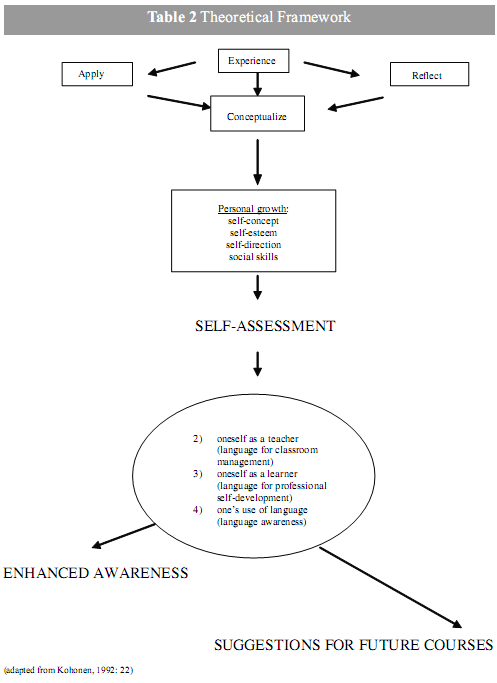
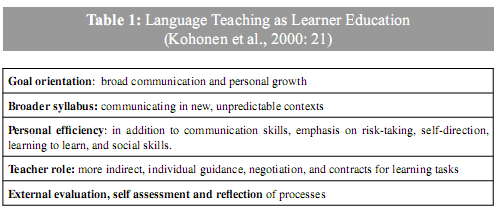
<body><![CDATA[<p><font size="2" face="Verdana, Arial, Helvetica, sans-serif">In   the last decade, with the increased attention to learner-centred   curricula, needs analysis, and learner autonomy, the topic of   self-assessment has become of particular interest (Blanche, 1988;   Oskarsson, 1997).  It is now being recognized that learners do have the   ability to provide meaningful input into the assessment of their   performance, and that this assessment can be valid (LeBlanc and   Painchaud, 1985; Oskarsson, 1981, 1984; Coombe, 1992). </font></p>     <p><font size="2" face="Verdana, Arial, Helvetica, sans-serif">The   reliability of learners' judgement is subject to variables whose   influence is difficult to establish, one of them being the learners'   age. On this topic, possible forms of guided self-assessment in adult   language learning have been outlined (see, for instance Oskarsson 1978   and 1981), in which steps have also been suggested in order to further   develop methods that can be used within schemes for foreign language   learning by adults.</font></p>     <p><font size="2" face="Verdana, Arial, Helvetica, sans-serif"><b><b>2.4 Theoretical Framework of the Local Training Courses</b></b></font></p>     <p><font size="2" face="Verdana, Arial, Helvetica, sans-serif">Teacher   training is not an easy task, but it can be further complicated when a   far too perfect and distant picture of a teacher's roles is provided. In   the case of the training courses organized by the Local Authorities in   Modena and Reggio Emilia, the principles and definitions that have been   described in the previous section were referred to. Moreover, it was   decided to focus on learner education rather than strict training,   following approaches highlighted by Kohonen <i>et al. </i>(2000).</font></p>     <p><font size="2" face="Verdana, Arial, Helvetica, sans-serif">In   this context, the traditional approach to motivation, where one's   behaviour is seen as motivating another's, is considered, following   Ushioda (1997), a contradiction in terms, as self-motivation becomes the   only logically coherent locus. Self-motivation is ''a capacity that can   and should be developed as an integral dimension of learner autonomy''   (Ushioda, 1997, p. 38), as it plays a role of pivotal importance in   optimising and sustaining one's involvement in learning. In short,   training courses need to cater to the learners' motivational agendas and   bring the world of their outside interests and experiences into play.   In this way, the learners will develop a particular kind of   psychological relation to the process and content of their learning,   which will provide the foundation for autonomous and effective learning   (Little, 1991, p. 4). </font></p>     <p>&nbsp;</p>     <p align="center"><font size="2" face="Verdana, Arial, Helvetica, sans-serif"><a name="t01" id="t01"></a><img src="/img/revistas/ikala/v14n21/v14n21a8t1.gif" /></font></p>     <p>&nbsp;</p>     <p><font size="2" face="Verdana, Arial, Helvetica, sans-serif">Banking   on the above, it was decided to adapt the theoretical framework   described in <a href="#t01">Table 1</a> for the purpose of organizing the training courses   addressed to primary-school, English-language teachers-to-be and   obtaining useful indications for future course-development.</font></p>     <p>&nbsp;</p>     ]]></body>
<body><![CDATA[<p><font size="3" face="Verdana, Arial, Helvetica, sans-serif"><b><b>3. RESEARCH DESIGN</b></b></font></p>     <p><font size="2" face="Verdana, Arial, Helvetica, sans-serif"><b><b>3.1 The Research Population</b></b></font></p>     <p><font size="2" face="Verdana, Arial, Helvetica, sans-serif">The   teachers involved in this study are 30 in-service generalist teachers   who had attended a training course (380 hours of language instruction   and 40 hours devoted to the development of foreign-language,   teaching-learning skills) organized by ''Direzione Didattica'' (Local   Education Authority) in Mirandola.<a name="en12" id="en12"></a><a href="#n12"><sup>12</sup></a>   This training course was meant to provide them with the necessary level   of language competence to teach English in primary schools. </font></p>     <p>&nbsp;</p>     <p align="center"><font size="2" face="Verdana, Arial, Helvetica, sans-serif"><a name="f01" id="f01"></a><img src="/img/revistas/ikala/v14n21/v14n21a8f1.gif" /></font></p>     <p>&nbsp;</p>     <p><font size="2" face="Verdana, Arial, Helvetica, sans-serif">The teachers involved were all females.<a name="en13" id="en13"></a><a href="#n13"><sup>13</sup></a>   Their ages ranged from 32 to 50. Of the group, 60% of the teachers   taught Italian language and other subjects in the humanities. Forty   percent of the teachers taught scientific subjects. A placement test   that had been administered before the beginning of the training course   had shown that half of the teachers were beginners, 30% had already   reached level A1 and 20% had reached level A2 of the Common European   Framework of Reference (CEFR). </font></p>     <p><font size="2" face="Verdana, Arial, Helvetica, sans-serif"><b><b>3.2 Data Collection</b></b></font></p>     <p><font size="2" face="Verdana, Arial, Helvetica, sans-serif">At   the end of the training course, the teachers were asked to self-assess   their ability to perform the different activities as defined by   descriptors contained in a series of questionnaires, referring to a 1-5   rating scale ranging from 'not able to,' to 'fully competent' (see   <a href="#app01">Appendix 1</a> for the complete list of the descriptors).<a name="en14" id="en14"></a><a href="#n14"><sup>14</sup></a></font></p>     <p><font size="2" face="Verdana, Arial, Helvetica, sans-serif">The   questionnaires were taken from the online grids provided on the PLEASE   website (Primary Language Teacher Education: Autonomy and   Self-Evaluation), jointly developed by the Universities of Modena and   Reggio Emilia, Italy, and Stirling, Scotland, as part of a Socrates   Lingua Action 'A' project entitled 'Autonomy in Primary Language Teacher   Education.'<a name="en15" id="en15"></a><a href="#n15"><sup>15</sup></a></font></p>     ]]></body>
<body><![CDATA[<p><font size="2" face="Verdana, Arial, Helvetica, sans-serif">The   PLEASE website was devised to offer primary language teachers the   chance to assess their competence by reviewing three different   checklists, each containing a series of statements that described the   required language behaviours for primary language teaching in the   contexts of listening, spoken interaction, spoken production, reading,   and writing. These statements had been obtained by adapting the B1 and   B2 level descriptors of the Common European Framework of Reference to   those areas that had been singled out as particularly meaningful for   English-language, primary-school teachers (cf. Bondi, 1999: 57), namely   language for classroom management (the language needed to manage   classroom activities and interaction), language for effective   professional self-development, and language awareness (the teachers'   awareness of the language and their analytic skills in order to improve   both their teaching and their own language learning).</font></p>     <p><font size="2" face="Verdana, Arial, Helvetica, sans-serif">The   results of the generalist teachers' self-assessment (which can be found   in <a href="#app02">Appendix 2</a>) were then integrated with the feedback provided in a   series of interviews with the same teachers. The interviews were   informally structured and had a two-fold aim: to make the teachers   express their comments on the course and its organization, and to have   them single out those skills that, in their opinion, needed further   improvement. The following questions were asked:</font></p> <ol>        <li><font size="2" face="Verdana, Arial, Helvetica, sans-serif"> Was the amount of time devoted to the various skills adequate?</font></li>         <li><font size="2" face="Verdana, Arial, Helvetica, sans-serif">Did the organization of the course meet your requirements?</font></li>         <li><font size="2" face="Verdana, Arial, Helvetica, sans-serif">Would you have liked to focus on certain skills more than on others? Which ones? </font></li>         <li><font size="2" face="Verdana, Arial, Helvetica, sans-serif">Were the explanations provided by the teacher-trainers clear and detailed?</font></li>         <li><font size="2" face="Verdana, Arial, Helvetica, sans-serif">Were the teacher-trainers able to explain the course objectives?</font></li>         <li><font size="2" face="Verdana, Arial, Helvetica, sans-serif">Did the teacher-trainers clearly explain the differences between the different language certificates: i.e., PET vs. CEPT?<a name="en16" id="en16"></a><a href="#n16"><sup>16</sup></a></font></li>         <li><font size="2" face="Verdana, Arial, Helvetica, sans-serif">Which were, in your opinion, the advantages/disadvantages of online autonomous training?<a name="en17" id="en17"></a><a href="#n17"><sup>17</sup></a></font></li>     </ol>     ]]></body>
<body><![CDATA[<p>&nbsp;</p>     <p><font size="3" face="Verdana, Arial, Helvetica, sans-serif"><b><b>4. DATA ANALYSIS</b></b></font></p>     <p><font size="2" face="Verdana, Arial, Helvetica, sans-serif"><b><b>4.1 Methodology</b></b></font></p>     <p><font size="2" face="Verdana, Arial, Helvetica, sans-serif">After   having had the generalist teachers review the questionnaires, only some   of the 77 available descriptors have been taken into account.   Specifically, it was decided to single out those descriptors for which   the majority of the teachers had rated their competence as being 1 or 2   (i.e., below the average standard of competence, signalled by a rating   of 3). Accordingly, for each of the five skills, a list was compiled,   which included only those abilities which were not competently mastered   by the majority of the generalist teachers. </font></p>     <p><font size="2" face="Verdana, Arial, Helvetica, sans-serif">Then,   by reviewing the transcripts of the trainees' interviews, it was   possible to refine the data collected and establish which skills had to   receive particular attention on occasion of future training courses.    These skills were selected on the grounds that they most needed further   practice, and on the understanding that, since they had attracted the   trainees' attention, they might contribute to the development of the   internal interaction between the learners and the foreign language,   which is at the base of successful language learning.</font></p>     <p><font size="2" face="Verdana, Arial, Helvetica, sans-serif"><i>a. Listening</i> </font></p>     <p><font size="2" face="Verdana, Arial, Helvetica, sans-serif">Looking   at the data from the teachers' self-evaluation in the area of   listening, we can see that in the domain of language use for classroom   management, most teachers seem to consider themselves capable of   mastery, with varying degrees of competence.  However, of the various   skills in the context of professional self-development, more than half   the teachers consider themselves not able to:</font></p> <ol>    <li><font size="2" face="Verdana, Arial, Helvetica, sans-serif">understand both the main points and specific details of a short talk   (e.g., an in-service presentation) in standard spoken language,   delivered at natural speed; </font></li>         <li><font size="2" face="Verdana, Arial, Helvetica, sans-serif"> understand fairly complex arguments (e.g., in lectures or media   programmes) on a familiar topic or when the context is well known;</font></li>         <li><font size="2" face="Verdana, Arial, Helvetica, sans-serif">use a variety of strategies such as listening for main points and relying on contextual clues for comprehension; and</font></li>         ]]></body>
<body><![CDATA[<li><font size="2" face="Verdana, Arial, Helvetica, sans-serif">understand most of the information of relevant, authentic materials in   standard, spoken language, delivered at natural speed.   </font></li>     </ol>     <p><font size="2" face="Verdana, Arial, Helvetica, sans-serif"><i>b. Spoken Interaction</i></font></p>     <p><font size="2" face="Verdana, Arial, Helvetica, sans-serif">In the context of classroom language, there is only one ability that is not fully developed by the majority of the teachers:</font></p> <ol>         <li><font size="2" face="Verdana, Arial, Helvetica, sans-serif">     acting as a mediator for students when they encounter native speaker   language, e.g., by a visitor to the classroom, or a videoconferencing   link</font></li>     </ol>      <p><font size="2" face="Verdana, Arial, Helvetica, sans-serif">In the area of professional self-development, most of the trainees do not consider themselves able to:</font></p> <ol>       <p>       <li><font size="2" face="Verdana, Arial, Helvetica, sans-serif">ask for clarification or information on occasion of seminars or language workshops; and </font></li>         <li><font size="2" face="Verdana, Arial, Helvetica, sans-serif">comment on the ideas, opinions, reactions, and contributions of others,   showing awareness of their feelings (e.g., during seminars or language   workshops). </font></li>     <font size="2" face="Verdana, Arial, Helvetica, sans-serif">     </p>     </font>     ]]></body>
<body><![CDATA[</ol>     <p><font size="2" face="Verdana, Arial, Helvetica, sans-serif"><i>c. Spoken Production</i></font></p>     <p><font size="2" face="Verdana, Arial, Helvetica, sans-serif">Looking   at the data on teachers' self-evaluation in the area of spoken   production, we can see that in the domain of language use for classroom   management, most teachers seem to consider themselves capable of mastery   of the various skills, with varying degrees of competence.    Nonetheless, in the context of professional self-development, more than   half the teachers consider themselves unable to:</font></p> <ol>       <p>       <li><font size="2" face="Verdana, Arial, Helvetica, sans-serif">go beyond simple reproduction and generate new language in familiar and some unfamiliar contexts;</font></li>         <li><font size="2" face="Verdana, Arial, Helvetica, sans-serif">alk in some detail about a range of professional experiences and opinions and explain points of view; and</font></li>         <li><font size="2" face="Verdana, Arial, Helvetica, sans-serif">make a short formal presentation/report to colleagues with the support   of notes or of an outline (e.g., on occasion of seminars or language   workshops).</font></li>     <font size="2" face="Verdana, Arial, Helvetica, sans-serif">     </p>     </font>     </ol>     <p><font size="2" face="Verdana, Arial, Helvetica, sans-serif"><i>d. Writing</i></font></p>     <p><font size="2" face="Verdana, Arial, Helvetica, sans-serif">In the context of classroom language, there is only one ability that is not fully developed by the majority of the teachers:</font></p> <ol>         ]]></body>
<body><![CDATA[<li><font size="2" face="Verdana, Arial, Helvetica, sans-serif">    writing fairly long and easily comprehensible stories for children.</font></li>    </ol> 	    <p><font size="2" face="Verdana, Arial, Helvetica, sans-serif">In the area of professional self-development, the trainees do not consider themselves able to:</font></p>     <p> <ol>         <li><font size="2" face="Verdana, Arial, Helvetica, sans-serif">    take notes in the foreign language in lectures, seminars or from written sources (e.g., for revision purposes).      </font></li>     </ol>  <font size="2" face="Verdana, Arial, Helvetica, sans-serif"> </p> </font>     <p><font size="3" face="Verdana, Arial, Helvetica, sans-serif"><b>5. DISCUSSING THE RESULTS</b></font></p>     <p><font size="2" face="Verdana, Arial, Helvetica, sans-serif"><b>5.1 The Importance of Including the Learners' Voices</b></font></p>     <p><font size="2" face="Verdana, Arial, Helvetica, sans-serif">The   answers provided by trainees on occasion of the interviews served the   purpose of complementing the results of the self-assessment   questionnaires. In particular, for concerns related to the organization   of the courses, the trainees remarked that since the lessons (380 hours)   had taken place over a period of 18 months, they lacked the time to   actually master the new issues that had been introduced. Moreover, they   unanimously agreed that the teacher-trainers had been able to guide them   and pinpoint their weaknesses and strengths and that the explanations   had always been clear and detailed. </font></p>     <p><font size="2" face="Verdana, Arial, Helvetica, sans-serif">As   for the objectives of the course, a sustained number of the trainees   reported that even though they had been told from the start that the   course was aimed at providing them with the necessary qualifications to   teach English in primary schools, they still would have liked to get the   PET certificate, which is a B1 level Cambridge ESOL certificate, rather   than the CEPT certificate. These remarks clearly highlight the fact   that it will be necessary, on the occasion of future training courses,   to sensitise generalist teachers towards the effective needs of primary   school foreign language teaching. In fact, in order to teach a foreign   language in primary schools, a teacher should master, in addition to B1   level language competences, other specific skills, which are connected   with language for classroom management, language for professional   self-development, and language awareness, alongside pedagogic and   methodological skills. The PET certificate, though appropriate for the   level, covers a wider range of skills than those strictly needed by   primary language teachers and has a different, more general target in   mind, while overlooking issues which are especially relevant to primary   teachers. It is therefore necessary to refer to a different certificate   that can assess teachers' competences in those areas and skills that are   most important for the purposes of primary school teaching. </font></p>     ]]></body>
<body><![CDATA[<p><font size="2" face="Verdana, Arial, Helvetica, sans-serif">The   40 hours devoted to the development of foreign-language,   teaching-learning skills included 20 hours of frontal lessons and 20   hours of autonomous learning via online resources. First of all, the   trainees remarked that they would have liked to be able to devote more   hours to issues connected with methodological training. Moreover, only   few of them considered online training completely satisfactory, thanks   to the possibility of working at one's own pace according to one's   individual schedule, and of accessing a multiplicity of available links.   However, the majority of the trainees claimed that online training had   made them feel alone, without anyone who could guide, advise, and spur   them on. In other words, they greatly missed the interaction with the   teacher-trainer and/or with their fellow learners. </font></p>     <p><font size="2" face="Verdana, Arial, Helvetica, sans-serif"><b>5.2 The Importance of Language Competence</b></font></p>     <p><font size="2" face="Verdana, Arial, Helvetica, sans-serif">An   initial survey of the answers provided by the generalist teachers   clearly shows that most of the abilities they considered not fully   mastered would probably require a higher level of competence than the   one that is needed in order to qualify for primary FL teaching (namely,   level B1 of the CEFR). This confirms that in-service training is   absolutely needed at the end of the initial training courses as well. In   addition, the teachers seemed to be more at ease with the language   needed for classroom management than with the language needed for   professional self-development. </font></p>     <p><font size="2" face="Verdana, Arial, Helvetica, sans-serif">Looking   at the answers provided by the teachers in the area of 'language use   for classroom management,' it became immediately apparent that the vast   majority of the teachers seemed to be more confident with the reading   and writing skills rather than with those abilities that refer to the   area of audio-oral skills. This finding is confirmed by the results   provided by the 'language use for professional self-development'   section, which seems to reinforce the idea that the teachers feel more   confident when they have some time for reflection (in writing, or even   when listening to themselves on a tape).</font></p>     <p><font size="2" face="Verdana, Arial, Helvetica, sans-serif">This   sense of inadequacy on the part of the teachers, which is noticeable in   spoken production and spoken interaction in particular, was also   explicitly mentioned by all the teachers in the short interviews that   were aimed at obtaining their overall comments on course contents and   organization. </font></p>     <p><font size="2" face="Verdana, Arial, Helvetica, sans-serif"><b>5.3 The Trainees' Perception of Their Needs</b></font></p>     <p><font size="2" face="Verdana, Arial, Helvetica, sans-serif">During   the interviews that were part of the present study, the teachers   complained that during the course there had not been time enough to   focus on the various skills. Even though the five skills had all been   taken into account, listening and speaking activities would have   required more time in order to let the trainees actually practice what   they had been learning. In fact, most teachers remarked that while a   person can work on his or her reading and writing skills at home, at his   or her convenience, looking words up in a dictionary and consulting   grammar books, a tutor and/or a peer is needed for the purpose of   practising listening and speaking skills. </font></p>     <p><font size="2" face="Verdana, Arial, Helvetica, sans-serif">Another   remark concerned the amount of time devoted to methodological training.   In fact, the majority of the teachers claimed that 100 hours should be   required rather than only 40 hours. This extra time, the teachers   suggested, could be used for  experimenting with different   teaching-learning approaches and especially for practising   lesson-planning activities and other tasks connected with the actual   management of everyday classroom activities.</font></p>     <p><font size="2" face="Verdana, Arial, Helvetica, sans-serif">By   integrating these comments with the results provided in the   self-assessment checklists, one may postulate that in a syllabus   addressed to primary teachers, the role/importance of spoken skills   should outweigh the role of the written ones. </font></p>     <p><font size="2" face="Verdana, Arial, Helvetica, sans-serif">In   other words, on the basis of the data that have thus far been collected   and analysed, one might suggest that teachers are most concerned with   the need to interact with their learners inside the classroom and/or   with fellow teachers on occasion of seminars, workshops, presentations,   etc., thus relying as much as possible on the 'technical' abilities   typical of  their profession.</font></p>     ]]></body>
<body><![CDATA[<p><font size="2" face="Verdana, Arial, Helvetica, sans-serif"><b>5.4 Implications for Syllabus Design</b></font></p>     <p><font size="2" face="Verdana, Arial, Helvetica, sans-serif">Any   syllabus can be refined in several different ways. The present study   has taken into account one of many possible syllabi. Therefore, in   accordance with the limited evidence provided by the results of the   present study, the following suggestions for the refinement of syllabi   for future training courses addressed to English-language teachers-to-be   can be advanced:</font></p> <ul>        <li><font size="2" face="Verdana, Arial, Helvetica, sans-serif">   more time should be devoted to practising those structures and   functions that are called to the fore whenever audio/oral skills are to   be deployed (such as, for instance, questions, use of interrogatives,    interrogative forms of all verbs and modals listed in the syllabus);</font></li>         <li><font size="2" face="Verdana, Arial, Helvetica, sans-serif">activities strictly connected with classroom management and   professional self-development should be focused on (e.g., lesson   planning, story telling, taking part in in-service presentations, asking   for or providing clarifications and information), paying attention to   the language forms and functions needed to carry them out;</font></li>         <li><font size="2" face="Verdana, Arial, Helvetica, sans-serif">greater emphasis should be placed on helping trainees practise   role-playing activities that simulate class interactions, so as to make   them master  the relevant lexis;</font></li>         <li><font size="2" face="Verdana, Arial, Helvetica, sans-serif">interactions between peers and/or trainees and their tutor should be favoured; and</font></li>         <li><font size="2" face="Verdana, Arial, Helvetica, sans-serif">rather than focusing on a general kind of lexis, the technical   vocabulary connected with the FL teaching profession should be focused   on.</font></li>     </ul>     <p>&nbsp;</p>     <p><font size="3" face="Verdana, Arial, Helvetica, sans-serif"><b>6. CONCLUSIONS</b></font></p>     ]]></body>
<body><![CDATA[<p><font size="2" face="Verdana, Arial, Helvetica, sans-serif">Syllabus   planning entails a series of decisions that can be compared to the   fitting into place of the different parts of a puzzle, in the sense that   quite often, the initial decisions about the contents of the course may   be modified on the basis of  the learners' feedback.</font></p>     <p><font size="2" face="Verdana, Arial, Helvetica, sans-serif">Once   the general framework of the language syllabus has been sketched out,   it will obviously be necessary to better refine the contents to be   delivered, making sure that  those issues and activities that are   perceived by practising teachers as the most relevant and meaningful are   included. </font></p>     <p><font size="2" face="Verdana, Arial, Helvetica, sans-serif">In   the case of this particular study, after considering both the local and   the professional cultures of the learners, it was decided to adapt   rather than adopt existing tools in order to negotiate the objectives of   the teacher training programme after having listened to the very voice   of the actors involved.</font></p>     <p><font size="2" face="Verdana, Arial, Helvetica, sans-serif">This   paper has focused on the results of a series of self-assessment   activities that have been integrated with information provided by   semi-structured interviews. The data obtained have highlighted the   presence of generalisable trends in the teachers' perceptions of the   most important skills connected with their profession, which can be   referred to by teacher educators and syllabus designers in order to   refine the syllabus design of further courses addressed to FL primary   teachers-to-be.</font></p>     <p><font size="2" face="Verdana, Arial, Helvetica, sans-serif">As   previously remarked, the number of teachers who have thus far reviewed   the self-assessment checklists is quite small. However, in the near   future, as more teachers self-assess their competence in different   areas, more meaningful data will be made available.</font></p>     <p>&nbsp;</p>     <p><font size="3" face="Verdana, Arial, Helvetica, sans-serif"><b>REFERENCES</b></font></p>     <!-- ref --><p><font size="2" face="Verdana, Arial, Helvetica, sans-serif">1. AAVV (1977). Misurazione del rendimento scolastico - Indagine I.E.A. e situazione italiana. In <i>Annali della Pubblica Istruzione</i>. Roma.</font>&nbsp;&nbsp;&nbsp;&nbsp;&nbsp;&nbsp;&nbsp;&nbsp;[&#160;<a href="javascript:void(0);" onclick="javascript: window.open('/scielo.php?script=sci_nlinks&ref=000150&pid=S0123-3432200900010000800001&lng=','','width=640,height=500,resizable=yes,scrollbars=1,menubar=yes,');">Links</a>&#160;]<!-- end-ref --><!-- ref --><p><font size="2" face="Verdana, Arial, Helvetica, sans-serif">2. AAVV (2007). <i>Quale profilo e quali competenze per l'inglese del docente di scuola primaria. Un'esperienza di ricerca.</i> Firenze: AS Agenziascuola.</font>&nbsp;&nbsp;&nbsp;&nbsp;&nbsp;&nbsp;&nbsp;&nbsp;[&#160;<a href="javascript:void(0);" onclick="javascript: window.open('/scielo.php?script=sci_nlinks&ref=000151&pid=S0123-3432200900010000800002&lng=','','width=640,height=500,resizable=yes,scrollbars=1,menubar=yes,');">Links</a>&#160;]<!-- end-ref --><!-- ref --><p><font size="2" face="Verdana, Arial, Helvetica, sans-serif">3. Alexander, L.G. (1976). Where do we go from here: A reconsideration of some basic assumptions affecting course design. <i>English Language Teaching,</i> 30(2), 89-103. </font>&nbsp;&nbsp;&nbsp;&nbsp;&nbsp;&nbsp;&nbsp;&nbsp;[&#160;<a href="javascript:void(0);" onclick="javascript: window.open('/scielo.php?script=sci_nlinks&ref=000152&pid=S0123-3432200900010000800003&lng=','','width=640,height=500,resizable=yes,scrollbars=1,menubar=yes,');">Links</a>&#160;]<!-- end-ref --><!-- ref --><p><font size="2" face="Verdana, Arial, Helvetica, sans-serif">4. Bialystock, E. (1982). On the relationship between knowing and using forms. <i>Applied Linguistics, </i>3,181-206.</font>&nbsp;&nbsp;&nbsp;&nbsp;&nbsp;&nbsp;&nbsp;&nbsp;[&#160;<a href="javascript:void(0);" onclick="javascript: window.open('/scielo.php?script=sci_nlinks&ref=000153&pid=S0123-3432200900010000800004&lng=','','width=640,height=500,resizable=yes,scrollbars=1,menubar=yes,');">Links</a>&#160;]<!-- end-ref --><!-- ref --><p><font size="2" face="Verdana, Arial, Helvetica, sans-serif">5. Blanche, P. (1988). <i>The FLIFLC Study</i>. Monterey: The US Department of Defense Language Institute.</font>&nbsp;&nbsp;&nbsp;&nbsp;&nbsp;&nbsp;&nbsp;&nbsp;[&#160;<a href="javascript:void(0);" onclick="javascript: window.open('/scielo.php?script=sci_nlinks&ref=000154&pid=S0123-3432200900010000800005&lng=','','width=640,height=500,resizable=yes,scrollbars=1,menubar=yes,');">Links</a>&#160;]<!-- end-ref --><!-- ref --><p><font size="2" face="Verdana, Arial, Helvetica, sans-serif">6. Blondin, C., Candelier, M., Edelenbos, P., Johnstone, R., Kubanek-German, A. &amp; Taeschner, T. (1998). <i>Foreign languages in primary and pre-school education. A review of recent research within the European Union</i>. London: CILT.</font>&nbsp;&nbsp;&nbsp;&nbsp;&nbsp;&nbsp;&nbsp;&nbsp;[&#160;<a href="javascript:void(0);" onclick="javascript: window.open('/scielo.php?script=sci_nlinks&ref=000155&pid=S0123-3432200900010000800006&lng=','','width=640,height=500,resizable=yes,scrollbars=1,menubar=yes,');">Links</a>&#160;]<!-- end-ref --><!-- ref --><p><font size="2" face="Verdana, Arial, Helvetica, sans-serif">7. Bondi,   M. (1999). A language profile for the FL primary teacher. In M. Bondi,   P. Faber, W. Gewehr, M.J. Jim&eacute;nez Raya, L. Low, C. Mewald &amp; A. Peck   (Eds.), <i>Autonomy in primary language teacher education. An approach using modern technology.</i> (pp. 53-59). Stirling: Scottish CILT.</font>&nbsp;&nbsp;&nbsp;&nbsp;&nbsp;&nbsp;&nbsp;&nbsp;[&#160;<a href="javascript:void(0);" onclick="javascript: window.open('/scielo.php?script=sci_nlinks&ref=000156&pid=S0123-3432200900010000800007&lng=','','width=640,height=500,resizable=yes,scrollbars=1,menubar=yes,');">Links</a>&#160;]<!-- end-ref --><!-- ref --><p><font size="2" face="Verdana, Arial, Helvetica, sans-serif">8. Bondi,   M. &amp; Poppi, F. (2006). L'insegnante di lingua straniera nella   scuola primaria: per un profilo e per una certificazione delle competenze.   In M. Bondi, D. Ghelfi, B. Toni (Eds.), <i>Teaching English. Ricerca e pratiche innovative per la scuola primaria. </i> (pp.13- 29). Napoli: Tecnodid Editrice.</font>&nbsp;&nbsp;&nbsp;&nbsp;&nbsp;&nbsp;&nbsp;&nbsp;[&#160;<a href="javascript:void(0);" onclick="javascript: window.open('/scielo.php?script=sci_nlinks&ref=000157&pid=S0123-3432200900010000800008&lng=','','width=640,height=500,resizable=yes,scrollbars=1,menubar=yes,');">Links</a>&#160;]<!-- end-ref --><!-- ref --><p><font size="2" face="Verdana, Arial, Helvetica, sans-serif">9. Bondi, M. &amp; Poppi, F. (2007). Devising a language certificate for primary school teachers of English. <i>Profile Journal, </i>8, 145-164.</font>&nbsp;&nbsp;&nbsp;&nbsp;&nbsp;&nbsp;&nbsp;&nbsp;[&#160;<a href="javascript:void(0);" onclick="javascript: window.open('/scielo.php?script=sci_nlinks&ref=000158&pid=S0123-3432200900010000800009&lng=','','width=640,height=500,resizable=yes,scrollbars=1,menubar=yes,');">Links</a>&#160;]<!-- end-ref --><!-- ref --><p><font size="2" face="Verdana, Arial, Helvetica, sans-serif">10.Coombe,   C. (1992). The Relationship Between Self-assessment Estimates of   Functional Literacy Skills and Basic English Skills Test Results in   Adult Refugee ESL Learners. Ph.D. Diss. The Ohio State University.</font>&nbsp;&nbsp;&nbsp;&nbsp;&nbsp;&nbsp;&nbsp;&nbsp;[&#160;<a href="javascript:void(0);" onclick="javascript: window.open('/scielo.php?script=sci_nlinks&ref=000159&pid=S0123-3432200900010000800010&lng=','','width=640,height=500,resizable=yes,scrollbars=1,menubar=yes,');">Links</a>&#160;]<!-- end-ref --><!-- ref --><p><font size="2" face="Verdana, Arial, Helvetica, sans-serif">11. Davies, A., Criper, C. &amp; Howatt A.P.R. (Eds), (1984). <i>Interlanguage. </i>Edinburgh: Edinburgh University Press.</font>&nbsp;&nbsp;&nbsp;&nbsp;&nbsp;&nbsp;&nbsp;&nbsp;[&#160;<a href="javascript:void(0);" onclick="javascript: window.open('/scielo.php?script=sci_nlinks&ref=000160&pid=S0123-3432200900010000800011&lng=','','width=640,height=500,resizable=yes,scrollbars=1,menubar=yes,');">Links</a>&#160;]<!-- end-ref --><!-- ref --><p><font size="2" face="Verdana, Arial, Helvetica, sans-serif">12. Dickinson, L. (1987). <i>Self-Instruction in Language Learning</i>. Cambridge: Cambridge University Press.</font>&nbsp;&nbsp;&nbsp;&nbsp;&nbsp;&nbsp;&nbsp;&nbsp;[&#160;<a href="javascript:void(0);" onclick="javascript: window.open('/scielo.php?script=sci_nlinks&ref=000161&pid=S0123-3432200900010000800012&lng=','','width=640,height=500,resizable=yes,scrollbars=1,menubar=yes,');">Links</a>&#160;]<!-- end-ref --><!-- ref --><p><font size="2" face="Verdana, Arial, Helvetica, sans-serif">13. Dubin, F. &amp; Olshtain, E. (1986). <i>Course design: Developing programs and materials for language learning</i>. Cambridge: Cambridge University Press. </font>&nbsp;&nbsp;&nbsp;&nbsp;&nbsp;&nbsp;&nbsp;&nbsp;[&#160;<a href="javascript:void(0);" onclick="javascript: window.open('/scielo.php?script=sci_nlinks&ref=000162&pid=S0123-3432200900010000800013&lng=','','width=640,height=500,resizable=yes,scrollbars=1,menubar=yes,');">Links</a>&#160;]<!-- end-ref --><!-- ref --><p><font size="2" face="Verdana, Arial, Helvetica, sans-serif">14. Edelenbos, P., Johnstone, R. &amp; Kubanek, A. (2006). <i>The main pedagogical principles underlying the teaching of languages to very young learners. Languages for the children of Europe: Published research, good practice and main principles.</i> European Commission Report. EAC 89/04. </font>&nbsp;&nbsp;&nbsp;&nbsp;&nbsp;&nbsp;&nbsp;&nbsp;[&#160;<a href="javascript:void(0);" onclick="javascript: window.open('/scielo.php?script=sci_nlinks&ref=000163&pid=S0123-3432200900010000800014&lng=','','width=640,height=500,resizable=yes,scrollbars=1,menubar=yes,');">Links</a>&#160;]<!-- end-ref --><!-- ref --><p><font size="2" face="Verdana, Arial, Helvetica, sans-serif">15. Gattegno, C. (1972). <i>Teaching foreign languages in schools: The silent way (2nd ed.).</i> New York: Educational Solutions. </font>&nbsp;&nbsp;&nbsp;&nbsp;&nbsp;&nbsp;&nbsp;&nbsp;[&#160;<a href="javascript:void(0);" onclick="javascript: window.open('/scielo.php?script=sci_nlinks&ref=000164&pid=S0123-3432200900010000800015&lng=','','width=640,height=500,resizable=yes,scrollbars=1,menubar=yes,');">Links</a>&#160;]<!-- end-ref --><!-- ref --><p><font size="2" face="Verdana, Arial, Helvetica, sans-serif">16. Hutchinson, T. &amp; Waters, A. (1987). <i>English for specific purposes: A learning centred approach</i>. Cambridge: Cambridge University Press. </font>&nbsp;&nbsp;&nbsp;&nbsp;&nbsp;&nbsp;&nbsp;&nbsp;[&#160;<a href="javascript:void(0);" onclick="javascript: window.open('/scielo.php?script=sci_nlinks&ref=000165&pid=S0123-3432200900010000800016&lng=','','width=640,height=500,resizable=yes,scrollbars=1,menubar=yes,');">Links</a>&#160;]<!-- end-ref --><!-- ref --><p><font size="2" face="Verdana, Arial, Helvetica, sans-serif">17. Kohonen,   V. (1992). Experiential language learning: Second language learning as   cooperative learner education. In D. Nunan (ed.), <i>Collaborative Language Learning and Teaching </i>(pp. 14-39). Cambridge: CUP.</font>&nbsp;&nbsp;&nbsp;&nbsp;&nbsp;&nbsp;&nbsp;&nbsp;[&#160;<a href="javascript:void(0);" onclick="javascript: window.open('/scielo.php?script=sci_nlinks&ref=000166&pid=S0123-3432200900010000800017&lng=','','width=640,height=500,resizable=yes,scrollbars=1,menubar=yes,');">Links</a>&#160;]<!-- end-ref --><!-- ref --><p><font size="2" face="Verdana, Arial, Helvetica, sans-serif">18. Kohonen, V., Jaaatinen, R., Kaikkonen, P., &amp; Lehtovaara, J. (Eds.), (2000). <i>Experiential Learning in Foreign Language Education. </i>England: Pearson Education Limited.</font>&nbsp;&nbsp;&nbsp;&nbsp;&nbsp;&nbsp;&nbsp;&nbsp;[&#160;<a href="javascript:void(0);" onclick="javascript: window.open('/scielo.php?script=sci_nlinks&ref=000167&pid=S0123-3432200900010000800018&lng=','','width=640,height=500,resizable=yes,scrollbars=1,menubar=yes,');">Links</a>&#160;]<!-- end-ref --><!-- ref --><p><font size="2" face="Verdana, Arial, Helvetica, sans-serif">19. Larsen-Freeman, D. &amp; Long, M. H. (1991, 1997). <i>An Introduction to Second Language Acquisition Research. </i>Edinburgh: Addison Wesley Longman Limited.</font>&nbsp;&nbsp;&nbsp;&nbsp;&nbsp;&nbsp;&nbsp;&nbsp;[&#160;<a href="javascript:void(0);" onclick="javascript: window.open('/scielo.php?script=sci_nlinks&ref=000168&pid=S0123-3432200900010000800019&lng=','','width=640,height=500,resizable=yes,scrollbars=1,menubar=yes,');">Links</a>&#160;]<!-- end-ref --><!-- ref --><p><font size="2" face="Verdana, Arial, Helvetica, sans-serif">20. LeBlanc, R. &amp; Painchaud, O. (1985). Self-Assessment as a Second Language Instrument. <i>TESOL Quarterly</i>, 19(4), 673-687.</font>&nbsp;&nbsp;&nbsp;&nbsp;&nbsp;&nbsp;&nbsp;&nbsp;[&#160;<a href="javascript:void(0);" onclick="javascript: window.open('/scielo.php?script=sci_nlinks&ref=000169&pid=S0123-3432200900010000800020&lng=','','width=640,height=500,resizable=yes,scrollbars=1,menubar=yes,');">Links</a>&#160;]<!-- end-ref --><!-- ref --><p><font size="2" face="Verdana, Arial, Helvetica, sans-serif">21. Little, D. (1991). <i>Learner autonomy. Definitions, issues and problems. </i>Dublin: Authentik. </font>&nbsp;&nbsp;&nbsp;&nbsp;&nbsp;&nbsp;&nbsp;&nbsp;[&#160;<a href="javascript:void(0);" onclick="javascript: window.open('/scielo.php?script=sci_nlinks&ref=000170&pid=S0123-3432200900010000800021&lng=','','width=640,height=500,resizable=yes,scrollbars=1,menubar=yes,');">Links</a>&#160;]<!-- end-ref --><!-- ref --><p><font size="2" face="Verdana, Arial, Helvetica, sans-serif">22. Little, D., Devitt, S. &amp; Singleton, D. (1989). <i>Learning Foreign Languages from Authentic Texts: Theory and Practice. </i>Dublin: Authentik.</font>&nbsp;&nbsp;&nbsp;&nbsp;&nbsp;&nbsp;&nbsp;&nbsp;[&#160;<a href="javascript:void(0);" onclick="javascript: window.open('/scielo.php?script=sci_nlinks&ref=000171&pid=S0123-3432200900010000800022&lng=','','width=640,height=500,resizable=yes,scrollbars=1,menubar=yes,');">Links</a>&#160;]<!-- end-ref --><!-- ref --><p><font size="2" face="Verdana, Arial, Helvetica, sans-serif">23. Lopriore,   L. (2006). The Long and Winding Road. A Profile of Italian Primary EFL   Teachers. In M. McCloskey, J. Orr &amp; M. Dolitsky. (Eds.), <i>Teaching English as a Foreign Language in Primary School,</i> (pp. 59-82).  Alexandria, Virginia: TESOL Publications.</font>&nbsp;&nbsp;&nbsp;&nbsp;&nbsp;&nbsp;&nbsp;&nbsp;[&#160;<a href="javascript:void(0);" onclick="javascript: window.open('/scielo.php?script=sci_nlinks&ref=000172&pid=S0123-3432200900010000800023&lng=','','width=640,height=500,resizable=yes,scrollbars=1,menubar=yes,');">Links</a>&#160;]<!-- end-ref --><!-- ref --><p><font size="2" face="Verdana, Arial, Helvetica, sans-serif">24. Mitchell, R. &amp; Myles, F. (2001). Second language learning: Concepts and issues. In Candlin, C. &amp; Mercer, N., <i>English Language Teaching in its Social Context, </i>(pp. 11-27). London and New York: Routledge.</font>&nbsp;&nbsp;&nbsp;&nbsp;&nbsp;&nbsp;&nbsp;&nbsp;[&#160;<a href="javascript:void(0);" onclick="javascript: window.open('/scielo.php?script=sci_nlinks&ref=000173&pid=S0123-3432200900010000800024&lng=','','width=640,height=500,resizable=yes,scrollbars=1,menubar=yes,');">Links</a>&#160;]<!-- end-ref --><!-- ref --><p><font size="2" face="Verdana, Arial, Helvetica, sans-serif">25. Nikolov, M. &amp; Curtain, H. (Eds.), (2000). <i>An early Start: Young learners and modern languages in Europe and beyond</i>. Graz: European Center for Modern Languages.</font>&nbsp;&nbsp;&nbsp;&nbsp;&nbsp;&nbsp;&nbsp;&nbsp;[&#160;<a href="javascript:void(0);" onclick="javascript: window.open('/scielo.php?script=sci_nlinks&ref=000174&pid=S0123-3432200900010000800025&lng=','','width=640,height=500,resizable=yes,scrollbars=1,menubar=yes,');">Links</a>&#160;]<!-- end-ref --><!-- ref --><p><font size="2" face="Verdana, Arial, Helvetica, sans-serif">26. Nunan, D. (1988). <i>Syllabus Design</i>. Oxford: Oxford University Press. </font>&nbsp;&nbsp;&nbsp;&nbsp;&nbsp;&nbsp;&nbsp;&nbsp;[&#160;<a href="javascript:void(0);" onclick="javascript: window.open('/scielo.php?script=sci_nlinks&ref=000175&pid=S0123-3432200900010000800026&lng=','','width=640,height=500,resizable=yes,scrollbars=1,menubar=yes,');">Links</a>&#160;]<!-- end-ref --><!-- ref --><p><font size="2" face="Verdana, Arial, Helvetica, sans-serif">27. Oskarsson, M. (1978). <i>Approaches to Self-Assessment in Foreign Language Learning.</i> Strasbourg: Council of Europe.</font>&nbsp;&nbsp;&nbsp;&nbsp;&nbsp;&nbsp;&nbsp;&nbsp;[&#160;<a href="javascript:void(0);" onclick="javascript: window.open('/scielo.php?script=sci_nlinks&ref=000176&pid=S0123-3432200900010000800027&lng=','','width=640,height=500,resizable=yes,scrollbars=1,menubar=yes,');">Links</a>&#160;]<!-- end-ref --><!-- ref --><p><font size="2" face="Verdana, Arial, Helvetica, sans-serif">28. Oskarsson, M. (1981). L'auto-evaluation dans l'apprentissage des langues pour adultes: quelques resultats des recherches. <i>&Eacute;tudes de Linguistique Appliqu&eacute;e</i>, 41, 102-130.</font>&nbsp;&nbsp;&nbsp;&nbsp;&nbsp;&nbsp;&nbsp;&nbsp;[&#160;<a href="javascript:void(0);" onclick="javascript: window.open('/scielo.php?script=sci_nlinks&ref=000177&pid=S0123-3432200900010000800028&lng=','','width=640,height=500,resizable=yes,scrollbars=1,menubar=yes,');">Links</a>&#160;]<!-- end-ref --><!-- ref --><p><font size="2" face="Verdana, Arial, Helvetica, sans-serif">29. Oskarsson, M. (1984). <i>Self-Assessment of Foreign Language Skills:  A Survey of</i> <i>Research and Development Work</i>.  Strasbourg: Council of Europe.</font>&nbsp;&nbsp;&nbsp;&nbsp;&nbsp;&nbsp;&nbsp;&nbsp;[&#160;<a href="javascript:void(0);" onclick="javascript: window.open('/scielo.php?script=sci_nlinks&ref=000178&pid=S0123-3432200900010000800029&lng=','','width=640,height=500,resizable=yes,scrollbars=1,menubar=yes,');">Links</a>&#160;]<!-- end-ref --><!-- ref --><p><font size="2" face="Verdana, Arial, Helvetica, sans-serif">30. Oskarsson, M. (1997). Self-Assessment of Foreign and Second Language Proficiency. <i>The Encyclopedia of Language and Education, </i>(pp 175-187), Vol. 7.  Kluwer Academic Publishers.</font>&nbsp;&nbsp;&nbsp;&nbsp;&nbsp;&nbsp;&nbsp;&nbsp;[&#160;<a href="javascript:void(0);" onclick="javascript: window.open('/scielo.php?script=sci_nlinks&ref=000179&pid=S0123-3432200900010000800030&lng=','','width=640,height=500,resizable=yes,scrollbars=1,menubar=yes,');">Links</a>&#160;]<!-- end-ref --><!-- ref --><p><font size="2" face="Verdana, Arial, Helvetica, sans-serif">31. Poppi,   F., Low, L., &amp; Bondi, M. (2003). Fostering autonomy: Implementing   change in teachers' education. In J. Gollin, G. Ferguson &amp; H.   Trappes-Lomax (Eds.), <i>Papers from three IALS Symposia &#151; 2000, 2001 and 2002, </i>(pp. 1-11)<i>. </i>Edinburgh: IALS.</font>&nbsp;&nbsp;&nbsp;&nbsp;&nbsp;&nbsp;&nbsp;&nbsp;[&#160;<a href="javascript:void(0);" onclick="javascript: window.open('/scielo.php?script=sci_nlinks&ref=000180&pid=S0123-3432200900010000800031&lng=','','width=640,height=500,resizable=yes,scrollbars=1,menubar=yes,');">Links</a>&#160;]<!-- end-ref --><!-- ref --><p><font size="2" face="Verdana, Arial, Helvetica, sans-serif">32. Poppi, F., Low, L., &amp; Bondi, M. (2005).PLEASE (Primary Language teacher Education: Autonomy and Self-Evaluation). In B. Holmberg, M. Shelley &amp; C. White (Eds.), <i>Distance education and languages. Evolution and change, </i>(pp. 295-308). Clevedon, Buffalo, Toronto: Multilingual Matters.</font>&nbsp;&nbsp;&nbsp;&nbsp;&nbsp;&nbsp;&nbsp;&nbsp;[&#160;<a href="javascript:void(0);" onclick="javascript: window.open('/scielo.php?script=sci_nlinks&ref=000181&pid=S0123-3432200900010000800032&lng=','','width=640,height=500,resizable=yes,scrollbars=1,menubar=yes,');">Links</a>&#160;]<!-- end-ref --><!-- ref --><p><font size="2" face="Verdana, Arial, Helvetica, sans-serif">33. Richards, J. C. &amp; Rodgers, T. S. (1986). <i>Approaches and Methods In Language Teaching</i>. Cambridge: Cambridge University Press. </font>&nbsp;&nbsp;&nbsp;&nbsp;&nbsp;&nbsp;&nbsp;&nbsp;[&#160;<a href="javascript:void(0);" onclick="javascript: window.open('/scielo.php?script=sci_nlinks&ref=000182&pid=S0123-3432200900010000800033&lng=','','width=640,height=500,resizable=yes,scrollbars=1,menubar=yes,');">Links</a>&#160;]<!-- end-ref --><!-- ref --><p><font size="2" face="Verdana, Arial, Helvetica, sans-serif">34. Ushioda, E. (1997). The role of motivational thinking in autonomous language learning. In D. Little, B. Voss (Eds.), <i>Language Centres: Planning for the New Millennium </i>(pp. 38-50). Plymouth: CercleS.</font>&nbsp;&nbsp;&nbsp;&nbsp;&nbsp;&nbsp;&nbsp;&nbsp;[&#160;<a href="javascript:void(0);" onclick="javascript: window.open('/scielo.php?script=sci_nlinks&ref=000183&pid=S0123-3432200900010000800034&lng=','','width=640,height=500,resizable=yes,scrollbars=1,menubar=yes,');">Links</a>&#160;]<!-- end-ref --><!-- ref --><p><font size="2" face="Verdana, Arial, Helvetica, sans-serif">35. White, R.V. (1988). <i>The ELT Curriculum: Design, Innovation and Management.</i> Oxford: Blackwell. </font>&nbsp;&nbsp;&nbsp;&nbsp;&nbsp;&nbsp;&nbsp;&nbsp;[&#160;<a href="javascript:void(0);" onclick="javascript: window.open('/scielo.php?script=sci_nlinks&ref=000184&pid=S0123-3432200900010000800035&lng=','','width=640,height=500,resizable=yes,scrollbars=1,menubar=yes,');">Links</a>&#160;]<!-- end-ref --><!-- ref --><p><font size="2" face="Verdana, Arial, Helvetica, sans-serif">36. Wilkins, D. A. (1976). <i>Notional Syllabuses</i>. Oxford: Oxford University Press. </font>&nbsp;&nbsp;&nbsp;&nbsp;&nbsp;&nbsp;&nbsp;&nbsp;[&#160;<a href="javascript:void(0);" onclick="javascript: window.open('/scielo.php?script=sci_nlinks&ref=000185&pid=S0123-3432200900010000800036&lng=','','width=640,height=500,resizable=yes,scrollbars=1,menubar=yes,');">Links</a>&#160;]<!-- end-ref --><!-- ref --><p><font size="2" face="Verdana, Arial, Helvetica, sans-serif">37. Yalden, J. (1987). <i>Principles of Course Design for Language Teaching</i>. Cambridge: Cambridge University Press.</font>&nbsp;&nbsp;&nbsp;&nbsp;&nbsp;&nbsp;&nbsp;&nbsp;[&#160;<a href="javascript:void(0);" onclick="javascript: window.open('/scielo.php?script=sci_nlinks&ref=000186&pid=S0123-3432200900010000800037&lng=','','width=640,height=500,resizable=yes,scrollbars=1,menubar=yes,');">Links</a>&#160;]<!-- end-ref --><p>&nbsp;</p>     <p><font size="3" face="Verdana, Arial, Helvetica, sans-serif"><b>WEBSITES</b></font></p>     <p><font size="2" face="Verdana, Arial, Helvetica, sans-serif">PLEASE website. Retrieved on August 20th, 2008, from <a href="http://www.please.unimore.it" target="_blank">http://www.please.unimore.it</a></font></p>     <p><font size="2" face="Verdana, Arial, Helvetica, sans-serif">The   Common European Framework of Reference. Retrieved on August 20th, 2008,   from <a href="http://www.coe.int/T/DG4/Linguistic/Source/Framework_EN.pdf" target="_blank">http://www.coe.int/T/DG4/Linguistic/Source/Framework_EN.pdf</a></font></p>     <p><font size="2" face="Verdana, Arial, Helvetica, sans-serif">Key data on teaching languages at school in Europe - 2005 Edition Retrieved on August 20th, 2008, from <a href="http://www.eurydice.org/portal/page/portal/Eurydice/showPresentation?pubid=049EN" target="_blank">http://www.eurydice.org/portal/page/portal/Eurydice/showPresentation?pubid=049EN</a></font></p>     <p><font size="2" face="Verdana, Arial, Helvetica, sans-serif">Documento   a cura del Comitato Tecnico Scientifico I.N.D.I.R.E.: Formazione di   competenze linguistico-comunicative della lingua inglese dei docenti   della scuola primaria. Retrieved on August 20th, 2008, from <a href="http://www.istruzioneer.it/allegato.asp?ID=211218" target="_blank">http://www.istruzioneer.it/allegato.asp?ID=211218</a></font></p>     ]]></body>
<body><![CDATA[<p>&nbsp;</p>     <p>&nbsp;</p>     <p> *Recibido: 18-11-07    <br> Aceptado: 14-01-09</p>     <p>&nbsp;</p>     <p>&nbsp;</p>     <p><font size="3" face="Verdana, Arial, Helvetica, sans-serif"><b>NOTES</b></font></p>     <p><font size="2" face="Verdana, Arial, Helvetica, sans-serif"><a name="n1" id="n1"></a><a href="#en1">1</a> This article derives from two research projects. The former was funded   by USR Emilia Romagna (local Education Authority in Emilia Romagna) and   the latter was funded by the Italian Ministry of Education and was   called Progetto di ricerca-azione sul profilo delle competenze   linguistiche in uscita dei docenti della scuola. (Action-research   project on the profile and language competences of primary school   foreign-language teachers).<br />   <a name="n2" id="n2"></a><a href="#en2">2</a> The changes brought about by the past ten years can be observed by   comparing the survey carried out by Blondin, Candelier, Edelenbos,   Johnstone, Kubanek-German &amp; Taeschner (1998) with the more recent   study by Edelenbos, Johnstone. and Kubanek (2006). An overview of   policies and approaches is also provided by Nikolov and Curtain (2000).<br />   <a name="n3"></a><a href="#en3">3</a> According to a report published by the European network Euridice, in   2002 approximately 50% of all pupils were learning at least one foreign   language. This figure has been increasing rapidly since the end of the   1990s, when educational reforms took place in a number of countries,   particularly in central and eastern Europe, Denmark, Spain, Italy and   Iceland, cf. <a href="http://www.eurydice.org/portal/page/portal/Eurydice/showPresentation?pubid=049EN" target="_blank">http://www.eurydice.org/portal/page/portal/Eurydice/showPresentation?pubid=049EN</a><br />   <a name="n4" id="n4"></a><a href="#en4">4</a> Relying on locally gathered expertise, attempts have also been made to   devise a national certificate, which is to become the official   qualification needed by any primary teacher to start teaching English in   the local state schools. Cf. for instance, the CEPT (Certificate of   English for Primary Teachers), jointly developed by the Language Centres   of the University of Modena and Reggio Emilia and the University of   Parma, described in Bondi and Poppi (2007).<br />   <a name="n5" id="n5"></a><a href="#en5">5</a> The results of this survey are available in <i>Annali della Pubblica Istruzione </i>(1977).<br />   <a name="n6" id="n6"></a><a href="#en6">6</a> Foreign Language Teaching in Primary Schools.<br />   <a name="n7" id="n7"></a><a href="#en7">7</a> For a critical overview of training programmes in Italy, see Lopriore (2006).<br />   <a name="n8" id="n8"></a><a href="#en8">8</a> Cf. Documento a cura del Comitato Tecnico Scientifico I.N.D.I.R.E.,   which states: ''&#91;...&#93; se il docente non &egrave; uno specialista, ha una   competenza minima di livello B1 in una lingua straniera...'' <a href="http://www.istruzioneer.it/allegato.asp?ID=211218" target="_blank">http://www.istruzioneer.it/allegato.asp?ID=211218</a>. Information of a more   general kind can also be found in Bondi, Ghelfi &amp; Toni (2006).<br />   <a name="n9" id="n9"></a><a href="#en9">9</a>   The Common European Framework of Reference is available at:   <a href="http://www.coe.int/T/DG4/Linguistic/Source/Framework_EN.pdf" target="_blank">http://www.coe.int/T/DG4/Linguistic/Source/Framework_EN.pdf</a>. It is a   document that consists of a series of levels (A1, A2, B1, B2, C1, C2)   across five language strands &#151; listening, spoken interaction, spoken   production, reading and writing. It has been designed with adult   language learners/users, as well as self-assessment in mind. It   has the benefit of not being specific to any country or context and offers   a continuum for identifying language proficiency within a   self-assessment grid. <br />   <a name="n10" id="n10"></a><a href="#en10">10</a> By 'second language learning' we refer to the learning of any language   at any level, provided that the learning of this second language takes   place sometime later than the acquisition of the first language. (Cf.   Mitchell and Myles, 2001: 11). This expression will be used as a synonym   for 'foreign language learning'. <br />   <a name="n11" id="n11"></a><a href="#en11">11</a>   On syllabus design see, for instance, Gattegno, 1972; Alexander, 1976;   Wilkins, 1976; Dubin and Olshtain, 1986; Richards and  Rodgers, 1986;   Nunan, 1988; and White, 1988. <br />   <a name="n12" id="n12"></a><a href="#en12">12</a> Mirandola is a small village, not far from Modena.<br />   <a name="n13" id="n13"></a><a href="#en13">13 </a>This is in line with the present state of primary teaching in Italy, where the number of male teachers is rather low.<br />   <a name="n14" id="n14"></a><a href="#en14">14</a>   For the purpose of the present study, however, only 77 out of the   available 98 descriptors have been taken into account. In fact, the 21   descriptors that are meant to assess the respondents' awareness as FL   teachers have not been referred to, since none of the generalist   teachers involved had ever taught English before attending the training   course. <br />   <a name="n15" id="n15"></a><a href="#en15">15 </a>For further information on the PLEASE website, see Poppi, Low and Bondi (2003); Poppi, Low and Bondi (2005).<br />   <a name="n16" id="16"></a><a href="#en16">16</a> The Preliminary English Test (PET) is one of the Cambridge ESOL   certificates. The Certificate of English for Primary Teachers (CEPT) has   been jointly developed by the Language Centres of the University of   Modena and Reggio Emilia and the University of Parma.<br /> <a name="n17" id="n17"></a><a href="#en17">17</a>   Twenty out of the forty hours devoted to the development of   foreign-language, teaching-learning skills were to be administered via   online resources.</font></p>     <p>&nbsp;</p>     <p>&nbsp;</p>     ]]></body>
<body><![CDATA[<p><font size="3" face="Verdana, Arial, Helvetica, sans-serif"><b><a name="app01" id="app01"></a>APPENDIX 1</b> </font></p>     <p><font size="2" face="Verdana, Arial, Helvetica, sans-serif"><b>Self-assessment questionnaries</b></font></p>     <p>&nbsp;</p>     <p align="center"><font size="2" face="Verdana, Arial, Helvetica, sans-serif"><img src="/img/revistas/ikala/v14n21/v14n21a8t2.gif" /></font></p>     <p>&nbsp;</p>     <p><font size="3" face="Verdana, Arial, Helvetica, sans-serif"><a name="app02" id="app02"></a><b>APPENDIX 2 </b></font></p>     <p><font size="2" face="Verdana, Arial, Helvetica, sans-serif"><b>Respondent's answers</b></font></p>     <p>&nbsp;</p>     <p align="center"><font size="2" face="Verdana, Arial, Helvetica, sans-serif"><img src="/img/revistas/ikala/v14n21/v14n21a8t3.gif" /></font></p>      ]]></body><back>
<ref-list>
<ref id="B1">
<label>1</label><nlm-citation citation-type="">
<person-group person-group-type="author">
<name>
<surname><![CDATA[AAVV]]></surname>
</name>
</person-group>
<source><![CDATA[Misurazione del rendimento scolastico - Indagine I.E.A. e situazione italiana]]></source>
<year>1977</year>
</nlm-citation>
</ref>
<ref id="B2">
<label>2</label><nlm-citation citation-type="book">
<person-group person-group-type="author">
<name>
<surname><![CDATA[AAVV]]></surname>
</name>
</person-group>
<source><![CDATA[Quale profilo e quali competenze per l'inglese del docente di scuola primaria: Un'esperienza di ricerca]]></source>
<year>2007</year>
<publisher-loc><![CDATA[Firenze ]]></publisher-loc>
<publisher-name><![CDATA[AS Agenziascuola]]></publisher-name>
</nlm-citation>
</ref>
<ref id="B3">
<label>3</label><nlm-citation citation-type="journal">
<person-group person-group-type="author">
<name>
<surname><![CDATA[Alexander]]></surname>
<given-names><![CDATA[L.G.]]></given-names>
</name>
</person-group>
<article-title xml:lang="en"><![CDATA[Where do we go from here: A reconsideration of some basic assumptions affecting course design]]></article-title>
<source><![CDATA[English Language Teaching]]></source>
<year>1976</year>
<volume>30</volume>
<numero>2</numero>
<issue>2</issue>
<page-range>89-103</page-range></nlm-citation>
</ref>
<ref id="B4">
<label>4</label><nlm-citation citation-type="journal">
<person-group person-group-type="author">
<name>
<surname><![CDATA[Bialystock]]></surname>
<given-names><![CDATA[E.]]></given-names>
</name>
</person-group>
<article-title xml:lang="en"><![CDATA[On the relationship between knowing and using forms]]></article-title>
<source><![CDATA[Applied Linguistics]]></source>
<year>1982</year>
<volume>3</volume>
<page-range>181-206</page-range></nlm-citation>
</ref>
<ref id="B5">
<label>5</label><nlm-citation citation-type="book">
<person-group person-group-type="author">
<name>
<surname><![CDATA[Blanche]]></surname>
<given-names><![CDATA[P.]]></given-names>
</name>
</person-group>
<source><![CDATA[The FLIFLC Study]]></source>
<year>1988</year>
<publisher-loc><![CDATA[Monterey ]]></publisher-loc>
<publisher-name><![CDATA[The US Department of Defense Language Institute]]></publisher-name>
</nlm-citation>
</ref>
<ref id="B6">
<label>6</label><nlm-citation citation-type="book">
<person-group person-group-type="author">
<name>
<surname><![CDATA[Blondin]]></surname>
<given-names><![CDATA[C.]]></given-names>
</name>
<name>
<surname><![CDATA[Candelier]]></surname>
<given-names><![CDATA[M.]]></given-names>
</name>
<name>
<surname><![CDATA[Edelenbos]]></surname>
<given-names><![CDATA[P.]]></given-names>
</name>
<name>
<surname><![CDATA[Johnstone]]></surname>
<given-names><![CDATA[R.]]></given-names>
</name>
<name>
<surname><![CDATA[Kubanek-German]]></surname>
<given-names><![CDATA[A.]]></given-names>
</name>
<name>
<surname><![CDATA[Taeschner]]></surname>
<given-names><![CDATA[T.]]></given-names>
</name>
</person-group>
<source><![CDATA[Foreign languages in primary and pre-school education: A review of recent research within the European Union]]></source>
<year>1998</year>
<publisher-loc><![CDATA[London ]]></publisher-loc>
<publisher-name><![CDATA[CILT]]></publisher-name>
</nlm-citation>
</ref>
<ref id="B7">
<label>7</label><nlm-citation citation-type="book">
<person-group person-group-type="author">
<name>
<surname><![CDATA[Bondi]]></surname>
<given-names><![CDATA[M.]]></given-names>
</name>
</person-group>
<article-title xml:lang="en"><![CDATA[A language profile for the FL primary teacher]]></article-title>
<person-group person-group-type="editor">
<name>
<surname><![CDATA[Bondi]]></surname>
<given-names><![CDATA[M.]]></given-names>
</name>
<name>
<surname><![CDATA[Faber]]></surname>
<given-names><![CDATA[P.]]></given-names>
</name>
<name>
<surname><![CDATA[Gewehr]]></surname>
<given-names><![CDATA[W.]]></given-names>
</name>
<name>
<surname><![CDATA[Jiménez Raya]]></surname>
<given-names><![CDATA[M.J.]]></given-names>
</name>
<name>
<surname><![CDATA[Low]]></surname>
<given-names><![CDATA[L.]]></given-names>
</name>
<name>
<surname><![CDATA[Mewald]]></surname>
<given-names><![CDATA[C.]]></given-names>
</name>
<name>
<surname><![CDATA[Peck]]></surname>
<given-names><![CDATA[A.]]></given-names>
</name>
</person-group>
<source><![CDATA[Autonomy in primary language teacher education: An approach using modern technology]]></source>
<year>1999</year>
<page-range>53-59</page-range><publisher-loc><![CDATA[Stirling ]]></publisher-loc>
<publisher-name><![CDATA[Scottish CILT]]></publisher-name>
</nlm-citation>
</ref>
<ref id="B8">
<label>8</label><nlm-citation citation-type="book">
<person-group person-group-type="author">
<name>
<surname><![CDATA[Bondi]]></surname>
<given-names><![CDATA[M.]]></given-names>
</name>
<name>
<surname><![CDATA[Poppi]]></surname>
<given-names><![CDATA[F.]]></given-names>
</name>
</person-group>
<article-title xml:lang="en"><![CDATA[L'insegnante di lingua straniera nella scuola primaria: per un profilo e per una certificazione delle competenze]]></article-title>
<person-group person-group-type="editor">
<name>
<surname><![CDATA[Bondi]]></surname>
<given-names><![CDATA[M.]]></given-names>
</name>
<name>
<surname><![CDATA[Ghelfi]]></surname>
<given-names><![CDATA[D.]]></given-names>
</name>
<name>
<surname><![CDATA[Toni]]></surname>
<given-names><![CDATA[B.]]></given-names>
</name>
</person-group>
<source><![CDATA[Teaching English: Ricerca e pratiche innovative per la scuola primaria]]></source>
<year>2006</year>
<page-range>13- 29</page-range><publisher-loc><![CDATA[Napoli ]]></publisher-loc>
<publisher-name><![CDATA[Tecnodid Editrice]]></publisher-name>
</nlm-citation>
</ref>
<ref id="B9">
<label>9</label><nlm-citation citation-type="journal">
<person-group person-group-type="author">
<name>
<surname><![CDATA[Bondi]]></surname>
<given-names><![CDATA[M.]]></given-names>
</name>
<name>
<surname><![CDATA[Poppi]]></surname>
<given-names><![CDATA[F.]]></given-names>
</name>
</person-group>
<article-title xml:lang="en"><![CDATA[Devising a language certificate for primary school teachers of English]]></article-title>
<source><![CDATA[Profile Journal]]></source>
<year>2007</year>
<volume>8</volume>
<page-range>145-164</page-range></nlm-citation>
</ref>
<ref id="B10">
<label>10</label><nlm-citation citation-type="">
<person-group person-group-type="author">
<name>
<surname><![CDATA[Coombe]]></surname>
<given-names><![CDATA[C.]]></given-names>
</name>
</person-group>
<source><![CDATA[The Relationship Between Self-assessment Estimates of Functional Literacy Skills and Basic English Skills Test Results in Adult Refugee ESL Learners]]></source>
<year>1992</year>
</nlm-citation>
</ref>
<ref id="B11">
<label>11</label><nlm-citation citation-type="book">
<person-group person-group-type="author">
<name>
<surname><![CDATA[Davies]]></surname>
<given-names><![CDATA[A.]]></given-names>
</name>
<name>
<surname><![CDATA[Criper]]></surname>
<given-names><![CDATA[C.]]></given-names>
</name>
<name>
<surname><![CDATA[Howatt]]></surname>
<given-names><![CDATA[A.P.R.]]></given-names>
</name>
</person-group>
<source><![CDATA[Interlanguage]]></source>
<year>1984</year>
<publisher-loc><![CDATA[Edinburgh ]]></publisher-loc>
<publisher-name><![CDATA[Edinburgh University Press]]></publisher-name>
</nlm-citation>
</ref>
<ref id="B12">
<label>12</label><nlm-citation citation-type="book">
<person-group person-group-type="author">
<name>
<surname><![CDATA[Dickinson]]></surname>
<given-names><![CDATA[L.]]></given-names>
</name>
</person-group>
<source><![CDATA[Self-Instruction in Language Learning]]></source>
<year>1987</year>
<publisher-loc><![CDATA[Cambridge ]]></publisher-loc>
<publisher-name><![CDATA[Cambridge University Press]]></publisher-name>
</nlm-citation>
</ref>
<ref id="B13">
<label>13</label><nlm-citation citation-type="book">
<person-group person-group-type="author">
<name>
<surname><![CDATA[Dubin]]></surname>
<given-names><![CDATA[F.]]></given-names>
</name>
<name>
<surname><![CDATA[Olshtain]]></surname>
<given-names><![CDATA[E.]]></given-names>
</name>
</person-group>
<source><![CDATA[Course design: Developing programs and materials for language learning]]></source>
<year>1986</year>
<publisher-loc><![CDATA[Cambridge ]]></publisher-loc>
<publisher-name><![CDATA[Cambridge University Press]]></publisher-name>
</nlm-citation>
</ref>
<ref id="B14">
<label>14</label><nlm-citation citation-type="">
<person-group person-group-type="author">
<name>
<surname><![CDATA[Edelenbos]]></surname>
<given-names><![CDATA[P.]]></given-names>
</name>
<name>
<surname><![CDATA[Johnstone]]></surname>
<given-names><![CDATA[R.]]></given-names>
</name>
<name>
<surname><![CDATA[Kubanek]]></surname>
<given-names><![CDATA[A.]]></given-names>
</name>
</person-group>
<source><![CDATA[The main pedagogical principles underlying the teaching of languages to very young learners]]></source>
<year>2006</year>
</nlm-citation>
</ref>
<ref id="B15">
<label>15</label><nlm-citation citation-type="book">
<person-group person-group-type="author">
<name>
<surname><![CDATA[Gattegno]]></surname>
<given-names><![CDATA[C.]]></given-names>
</name>
</person-group>
<source><![CDATA[Teaching foreign languages in schools: The silent way]]></source>
<year>1972</year>
<edition>2</edition>
<publisher-loc><![CDATA[New York ]]></publisher-loc>
<publisher-name><![CDATA[Educational Solutions]]></publisher-name>
</nlm-citation>
</ref>
<ref id="B16">
<label>16</label><nlm-citation citation-type="book">
<person-group person-group-type="author">
<name>
<surname><![CDATA[Hutchinson]]></surname>
<given-names><![CDATA[T.]]></given-names>
</name>
<name>
<surname><![CDATA[Waters]]></surname>
<given-names><![CDATA[A.]]></given-names>
</name>
</person-group>
<source><![CDATA[English for specific purposes: A learning centred approach]]></source>
<year>1987</year>
<publisher-loc><![CDATA[Cambridge ]]></publisher-loc>
<publisher-name><![CDATA[Cambridge University Press]]></publisher-name>
</nlm-citation>
</ref>
<ref id="B17">
<label>17</label><nlm-citation citation-type="book">
<person-group person-group-type="author">
<name>
<surname><![CDATA[Kohonen]]></surname>
<given-names><![CDATA[V.]]></given-names>
</name>
</person-group>
<article-title xml:lang="en"><![CDATA[Experiential language learning: Second language learning as cooperative learner education]]></article-title>
<person-group person-group-type="editor">
<name>
<surname><![CDATA[Nunan]]></surname>
<given-names><![CDATA[D.]]></given-names>
</name>
</person-group>
<source><![CDATA[Collaborative Language Learning and Teaching]]></source>
<year>1992</year>
<page-range>14-39</page-range><publisher-loc><![CDATA[Cambridge ]]></publisher-loc>
<publisher-name><![CDATA[CUP]]></publisher-name>
</nlm-citation>
</ref>
<ref id="B18">
<label>18</label><nlm-citation citation-type="book">
<person-group person-group-type="author">
<name>
<surname><![CDATA[Kohonen]]></surname>
<given-names><![CDATA[V.]]></given-names>
</name>
<name>
<surname><![CDATA[Jaaatinen]]></surname>
<given-names><![CDATA[R.]]></given-names>
</name>
<name>
<surname><![CDATA[Kaikkonen]]></surname>
<given-names><![CDATA[P.]]></given-names>
</name>
<name>
<surname><![CDATA[Lehtovaara]]></surname>
<given-names><![CDATA[J.]]></given-names>
</name>
</person-group>
<source><![CDATA[Experiential Learning in Foreign Language Education]]></source>
<year>2000</year>
<publisher-loc><![CDATA[England ]]></publisher-loc>
<publisher-name><![CDATA[Pearson Education Limited]]></publisher-name>
</nlm-citation>
</ref>
<ref id="B19">
<label>19</label><nlm-citation citation-type="book">
<person-group person-group-type="author">
<name>
<surname><![CDATA[Larsen-Freeman]]></surname>
<given-names><![CDATA[D.]]></given-names>
</name>
<name>
<surname><![CDATA[Long]]></surname>
<given-names><![CDATA[M. H.]]></given-names>
</name>
</person-group>
<source><![CDATA[An Introduction to Second Language Acquisition Research]]></source>
<year>1991</year>
<month>, </month>
<day>19</day>
<publisher-loc><![CDATA[Edinburgh ]]></publisher-loc>
<publisher-name><![CDATA[Addison Wesley Longman Limited]]></publisher-name>
</nlm-citation>
</ref>
<ref id="B20">
<label>20</label><nlm-citation citation-type="journal">
<person-group person-group-type="author">
<name>
<surname><![CDATA[LeBlanc]]></surname>
<given-names><![CDATA[R.]]></given-names>
</name>
<name>
<surname><![CDATA[Painchaud]]></surname>
<given-names><![CDATA[O.]]></given-names>
</name>
</person-group>
<article-title xml:lang="en"><![CDATA[Self-Assessment as a Second Language Instrument]]></article-title>
<source><![CDATA[TESOL Quarterly]]></source>
<year>1985</year>
<volume>19</volume>
<numero>4</numero>
<issue>4</issue>
<page-range>673-687</page-range></nlm-citation>
</ref>
<ref id="B21">
<label>21</label><nlm-citation citation-type="book">
<person-group person-group-type="author">
<name>
<surname><![CDATA[Little]]></surname>
<given-names><![CDATA[D.]]></given-names>
</name>
</person-group>
<source><![CDATA[Learner autonomy: Definitions, issues and problems]]></source>
<year>1991</year>
<publisher-loc><![CDATA[Dublin ]]></publisher-loc>
<publisher-name><![CDATA[Authentik]]></publisher-name>
</nlm-citation>
</ref>
<ref id="B22">
<label>22</label><nlm-citation citation-type="book">
<person-group person-group-type="author">
<name>
<surname><![CDATA[Little]]></surname>
<given-names><![CDATA[D.]]></given-names>
</name>
<name>
<surname><![CDATA[Devitt]]></surname>
<given-names><![CDATA[S.]]></given-names>
</name>
<name>
<surname><![CDATA[Singleton]]></surname>
<given-names><![CDATA[D.]]></given-names>
</name>
</person-group>
<source><![CDATA[Learning Foreign Languages from Authentic Texts: Theory and Practice]]></source>
<year>1989</year>
<publisher-loc><![CDATA[Dublin ]]></publisher-loc>
<publisher-name><![CDATA[Authentik]]></publisher-name>
</nlm-citation>
</ref>
<ref id="B23">
<label>23</label><nlm-citation citation-type="book">
<person-group person-group-type="author">
<name>
<surname><![CDATA[Lopriore]]></surname>
<given-names><![CDATA[L.]]></given-names>
</name>
</person-group>
<article-title xml:lang="en"><![CDATA[The Long and Winding Road: A Profile of Italian Primary EFL Teachers]]></article-title>
<person-group person-group-type="editor">
<name>
<surname><![CDATA[McCloskey]]></surname>
<given-names><![CDATA[M.]]></given-names>
</name>
<name>
<surname><![CDATA[Orr]]></surname>
<given-names><![CDATA[J.]]></given-names>
</name>
<name>
<surname><![CDATA[Dolitsky]]></surname>
<given-names><![CDATA[M.]]></given-names>
</name>
</person-group>
<source><![CDATA[Teaching English as a Foreign Language in Primary School]]></source>
<year>2006</year>
<page-range>59-82</page-range><publisher-loc><![CDATA[Alexandria^eVirginia Virginia]]></publisher-loc>
<publisher-name><![CDATA[TESOL Publications]]></publisher-name>
</nlm-citation>
</ref>
<ref id="B24">
<label>24</label><nlm-citation citation-type="book">
<person-group person-group-type="author">
<name>
<surname><![CDATA[Mitchell]]></surname>
<given-names><![CDATA[R.]]></given-names>
</name>
<name>
<surname><![CDATA[Myles]]></surname>
<given-names><![CDATA[F.]]></given-names>
</name>
</person-group>
<article-title xml:lang="en"><![CDATA[Second language learning: Concepts and issues]]></article-title>
<person-group person-group-type="editor">
<name>
<surname><![CDATA[Candlin]]></surname>
<given-names><![CDATA[C.]]></given-names>
</name>
<name>
<surname><![CDATA[Mercer]]></surname>
<given-names><![CDATA[N.]]></given-names>
</name>
</person-group>
<source><![CDATA[English Language Teaching in its Social Context]]></source>
<year>2001</year>
<page-range>11-27</page-range><publisher-loc><![CDATA[London and New York ]]></publisher-loc>
<publisher-name><![CDATA[Routledge]]></publisher-name>
</nlm-citation>
</ref>
<ref id="B25">
<label>25</label><nlm-citation citation-type="book">
<person-group person-group-type="author">
<name>
<surname><![CDATA[Nikolov]]></surname>
<given-names><![CDATA[M.]]></given-names>
</name>
<name>
<surname><![CDATA[Curtain]]></surname>
<given-names><![CDATA[H.]]></given-names>
</name>
</person-group>
<source><![CDATA[An early Start: Young learners and modern languages in Europe and beyond]]></source>
<year>2000</year>
<publisher-loc><![CDATA[Graz ]]></publisher-loc>
<publisher-name><![CDATA[European Center for Modern Languages]]></publisher-name>
</nlm-citation>
</ref>
<ref id="B26">
<label>26</label><nlm-citation citation-type="book">
<person-group person-group-type="author">
<name>
<surname><![CDATA[Nunan]]></surname>
<given-names><![CDATA[D.]]></given-names>
</name>
</person-group>
<source><![CDATA[Syllabus Design]]></source>
<year>1988</year>
<publisher-loc><![CDATA[Oxford ]]></publisher-loc>
<publisher-name><![CDATA[Oxford University Press]]></publisher-name>
</nlm-citation>
</ref>
<ref id="B27">
<label>27</label><nlm-citation citation-type="book">
<person-group person-group-type="author">
<name>
<surname><![CDATA[Oskarsson]]></surname>
<given-names><![CDATA[M.]]></given-names>
</name>
</person-group>
<source><![CDATA[Approaches to Self-Assessment in Foreign Language Learning]]></source>
<year>1978</year>
<publisher-loc><![CDATA[Strasbourg ]]></publisher-loc>
<publisher-name><![CDATA[Council of Europe]]></publisher-name>
</nlm-citation>
</ref>
<ref id="B28">
<label>28</label><nlm-citation citation-type="journal">
<person-group person-group-type="author">
<name>
<surname><![CDATA[Oskarsson]]></surname>
<given-names><![CDATA[M.]]></given-names>
</name>
</person-group>
<article-title xml:lang="fr"><![CDATA[L'auto-evaluation dans l'apprentissage des langues pour adultes: quelques resultats des recherches]]></article-title>
<source><![CDATA[Études de Linguistique Appliquée]]></source>
<year>1981</year>
<volume>41</volume>
<page-range>102-130</page-range></nlm-citation>
</ref>
<ref id="B29">
<label>29</label><nlm-citation citation-type="book">
<person-group person-group-type="author">
<name>
<surname><![CDATA[Oskarsson]]></surname>
<given-names><![CDATA[M.]]></given-names>
</name>
</person-group>
<source><![CDATA[Self-Assessment of Foreign Language Skills: A Survey of Research and Development Work]]></source>
<year>1984</year>
<publisher-loc><![CDATA[Strasbourg ]]></publisher-loc>
<publisher-name><![CDATA[Council of Europe]]></publisher-name>
</nlm-citation>
</ref>
<ref id="B30">
<label>30</label><nlm-citation citation-type="book">
<person-group person-group-type="author">
<name>
<surname><![CDATA[Oskarsson]]></surname>
<given-names><![CDATA[M.]]></given-names>
</name>
</person-group>
<article-title xml:lang="en"><![CDATA[Self-Assessment of Foreign and Second Language Proficiency]]></article-title>
<source><![CDATA[The Encyclopedia of Language and Education]]></source>
<year>1997</year>
<volume>7</volume>
<page-range>175-187</page-range><publisher-name><![CDATA[Kluwer Academic Publishers]]></publisher-name>
</nlm-citation>
</ref>
<ref id="B31">
<label>31</label><nlm-citation citation-type="">
<person-group person-group-type="author">
<name>
<surname><![CDATA[Poppi]]></surname>
<given-names><![CDATA[F.]]></given-names>
</name>
<name>
<surname><![CDATA[Low]]></surname>
<given-names><![CDATA[L.]]></given-names>
</name>
<name>
<surname><![CDATA[Bondi]]></surname>
<given-names><![CDATA[M.]]></given-names>
</name>
</person-group>
<article-title xml:lang="en"><![CDATA[Fostering autonomy: Implementing change in teachers' education]]></article-title>
<person-group person-group-type="editor">
<name>
<surname><![CDATA[Gollin]]></surname>
<given-names><![CDATA[J.]]></given-names>
</name>
<name>
<surname><![CDATA[Ferguson]]></surname>
<given-names><![CDATA[G.]]></given-names>
</name>
<name>
<surname><![CDATA[Trappes-Lomax]]></surname>
<given-names><![CDATA[H.]]></given-names>
</name>
</person-group>
<source><![CDATA[]]></source>
<year>2003</year>
</nlm-citation>
</ref>
<ref id="B32">
<label>32</label><nlm-citation citation-type="book">
<person-group person-group-type="author">
<name>
<surname><![CDATA[Poppi]]></surname>
<given-names><![CDATA[F.]]></given-names>
</name>
<name>
<surname><![CDATA[Low]]></surname>
<given-names><![CDATA[L.]]></given-names>
</name>
<name>
<surname><![CDATA[Bondi]]></surname>
<given-names><![CDATA[M.]]></given-names>
</name>
</person-group>
<article-title xml:lang="en"><![CDATA[PLEASE (Primary Language teacher Education: Autonomy and Self-Evaluation)]]></article-title>
<person-group person-group-type="editor">
<name>
<surname><![CDATA[Holmberg]]></surname>
<given-names><![CDATA[B.]]></given-names>
</name>
<name>
<surname><![CDATA[Shelley]]></surname>
<given-names><![CDATA[M.]]></given-names>
</name>
<name>
<surname><![CDATA[White]]></surname>
<given-names><![CDATA[C.]]></given-names>
</name>
</person-group>
<source><![CDATA[Distance education and languages: Evolution and change]]></source>
<year>2005</year>
<page-range>295-308</page-range><publisher-loc><![CDATA[Clevedon, Buffalo, Toronto ]]></publisher-loc>
<publisher-name><![CDATA[Multilingual Matters]]></publisher-name>
</nlm-citation>
</ref>
<ref id="B33">
<label>33</label><nlm-citation citation-type="book">
<person-group person-group-type="author">
<name>
<surname><![CDATA[Richards]]></surname>
<given-names><![CDATA[J. C.]]></given-names>
</name>
<name>
<surname><![CDATA[Rodgers]]></surname>
<given-names><![CDATA[T. S.]]></given-names>
</name>
</person-group>
<source><![CDATA[Approaches and Methods In Language Teaching]]></source>
<year>1986</year>
<publisher-loc><![CDATA[Cambridge ]]></publisher-loc>
<publisher-name><![CDATA[Cambridge University Press]]></publisher-name>
</nlm-citation>
</ref>
<ref id="B34">
<label>34</label><nlm-citation citation-type="book">
<person-group person-group-type="author">
<name>
<surname><![CDATA[Ushioda]]></surname>
<given-names><![CDATA[E.]]></given-names>
</name>
</person-group>
<article-title xml:lang="en"><![CDATA[The role of motivational thinking in autonomous language learning]]></article-title>
<person-group person-group-type="editor">
<name>
<surname><![CDATA[Little]]></surname>
<given-names><![CDATA[D.]]></given-names>
</name>
<name>
<surname><![CDATA[Voss]]></surname>
<given-names><![CDATA[B.]]></given-names>
</name>
</person-group>
<source><![CDATA[Language Centres: Planning for the New Millennium]]></source>
<year>1997</year>
<page-range>38-50</page-range><publisher-loc><![CDATA[Plymouth ]]></publisher-loc>
<publisher-name><![CDATA[CercleS]]></publisher-name>
</nlm-citation>
</ref>
<ref id="B35">
<label>35</label><nlm-citation citation-type="book">
<person-group person-group-type="author">
<name>
<surname><![CDATA[White]]></surname>
<given-names><![CDATA[R.V]]></given-names>
</name>
</person-group>
<source><![CDATA[The ELT Curriculum: Design, Innovation and Management]]></source>
<year>1988</year>
<publisher-loc><![CDATA[Oxford ]]></publisher-loc>
<publisher-name><![CDATA[Blackwell]]></publisher-name>
</nlm-citation>
</ref>
<ref id="B36">
<label>36</label><nlm-citation citation-type="book">
<person-group person-group-type="author">
<name>
<surname><![CDATA[Wilkins]]></surname>
<given-names><![CDATA[D. A.]]></given-names>
</name>
</person-group>
<source><![CDATA[Notional Syllabuses]]></source>
<year>1976</year>
<publisher-loc><![CDATA[Oxford ]]></publisher-loc>
<publisher-name><![CDATA[Oxford University Press]]></publisher-name>
</nlm-citation>
</ref>
<ref id="B37">
<label>37</label><nlm-citation citation-type="book">
<person-group person-group-type="author">
<name>
<surname><![CDATA[Yalden]]></surname>
<given-names><![CDATA[J.]]></given-names>
</name>
</person-group>
<source><![CDATA[Principles of Course Design for Language Teaching]]></source>
<year>1987</year>
<publisher-loc><![CDATA[Cambridge ]]></publisher-loc>
<publisher-name><![CDATA[Cambridge University Press]]></publisher-name>
</nlm-citation>
</ref>
</ref-list>
</back>
</article>