Language Teachers as Partners in Crafting Educational Language Policies?*1
¿Los profesores de inglés como socios en la elaboración de las políticas lingüísticas educativas?
Elana Shohamy**
** Dr. Elana Shohamy is a professor of language education at the School of Education, Tel Aviv University where she researches various topics related to language policy and language assessment in the context of conflicts and co-existence in multilingual societies, focusing on critical language policy, language rights, language equality and linguistic landscape. Among her more recent publications are: The power of tests: On the misues of language tests, 2001, Longman; Language policy: Hidden agendas and new approaches, 2006, Routledge; Volume 7 of the Encyclopedia of Language and Education: Language Testing and Assessment (ed. with Nancy Hornberter, Springer, 2008); Linguistic landscape: expanding the scenery, (ed. with Durk Gurter, 2009, Routledge). She is the current editor of the journal Language Policy. E-mail: elana@post.tau.ac.il
]]>
ABSTRACT
The paper presents an expanded view of language policy which incorporates a variety of policy mechanisms which are claimed to affect de facto language policies. These mechanisms include declared policies, language education documents, language tests and language in public space, among others. These policies are initiated and determined by ''policy bodies'' which are part of governments and other groups in authority, but are detached from those who are execute them. The main objective of this paper is to portray the expanded view of language policy, along these mechanisms, and to argue for the involvement and active participation of teachers in this process. I will argue that the participation, discussions and negotiations constitute a civic and democratic obligation on route to valid, open, fair, realistic policies. Negotiations with the different stake holders who come the process with experience and knowledge is essential for developing language policies which are valid, constructive, critically based and are based on theory of practice.
Keywords: language educational policies, language policies, policy mechanisms, policy bodies, language teachers, language tests, critical language policy
RESUMEN
Este artículo presenta una visión ampliada de la noción de políticas lingüísticas, que incorpora varios mecanismos que afectan la construcción de políticas lingüísticas de facto. Dichos mecanismos incluyen políticas declaradas, documentos sobre educación lingüística, pruebas lingüísticas y la lengua en el espacio público, entre otros. Dichas políticas son emprendidas y determinadas por ''organismos de políticas'' que forman parte de los gobiernos y de otros grupos de autoridad, pero que a menudo están desarticulados de las instancias que las llevan a cabo. Los objetivos principales de este artículo son presentar la visión ampliada de políticas lingüísticas sirviéndose de estos mecanismos y argumentar a favor de la participación activa de los docentes en este proceso. Se sustenta que la participación, las discusiones y las negociaciones constituyen un deber cívico y democrático para la construcción de políticas válidas, abiertas, justas y realistas. La negociación con los diferentes agentes que contribuyen al proceso con experiencia y conocimiento es esencial para el desarrollo de políticas lingüísticas que sean válidas, constructivas, críticas, así como nutridas por teorías de la práctica.
Palabras clave: políticas lingüísticas educativas, políticas lingüísticas, mecanismos de políticas, agentes de políticas, docentes de lenguas, exámenes de lenguas, políticas lingüísticas críticas
RÉSUMÉ
Cet article présente une vision élargie de la notion de politiques linguistiques qui incorpore plusieurs mécanismes affectant la construction de politiques linguistiques de facto. Ces mécanismes incluent des politiques déclarées, des documents portant sur l'éducation linguistique, des épreuves linguistiques et la langue dans l'espace publique, entre autres. Les politiques en question sont entreprises et déterminées par des '' organismes politiques '' qui font partie des gouvernements et des autres groupes d'autorité, mais qui souvent sont désarticulés des instances qui les mènent à bien. L'objectif principal de cet article est de présenter une vision amplifiée des politiques linguistiques en se servant de ces mécanismes, mais aussi d'argumenter en faveur de la participation active des professeurs dans ce processus. Nous maintenons que la participation, les discussions et les négociations constituent un devoir civique et démocratique pour la construction de politiques valides, ouvertes, justes et réalistes. La négociation avec les différents agents qui contribuent au processus avec expérience et savoir est essentielle au développement de politiques linguistiques qui soient valides, constructives, critiques, mais aussi inspirées de théories de la pratique.
Mots clés: politiques linguistiques éducatives, politiques linguistiques, mécanismes de politiques, agents de politiques, professeurs de langues, examens de langues, politiques linguistiques critiques
1. INTRODUCTION: TEACHERS AND POLICY
This paper is about an expanded view of language policy with a focus on the mechanisms that contribute to crafting and negotiating language policies. I am claiming here that teachers, who are instrumental in carrying out language policies are overlooked in the process of creating and designing these policies. I argue therefore for the involvement of teachers language education policy (LEP) making and for teachers to become active partners who bring their educational knowledge, experiences and praxis into the process. Teacher input about policies is in fact needed since it is grounded and embedded in actual practice and knowledge about language learning as manifested in real classrooms, schools and people — teachers and students. This input is needed given that most language policies originate from policy makers whose decisions about policies are driven by ideologies, politics, economics, all important dimensions, but they lack a sense of reality, i.e., whether these policy can in fact be implemented successfully. Thus, it is often the case that language education policies serve as arms for carrying out national policies, yet the absence of teachers from this process creates an unequal power relationship where experiences and praxis are ignored and perpetuating a view of teachers as obedient servants of the system. Yet, when teachers are brought into the policy negotiating table they are treated as valuable agents whose professional views are respected and counted; it is then understood that their professional views are crucial for the design of sensible and realistic policies. Unfortunately a big dis-connect exist between powerful policy statements and those which are practice-driven; this can help explain the reasons why policies often fail as they are driven by wishes and aspirations, by political and economic aspirations, which may be good in themselves but not always feasible. It is the role of professionals not just to obey policies, but rather to question these policies which are detached from practice as they put a heavy and detached burden on teachers who somehow, and in some ways, attempt to carry out un-achievable policies. This situation is especially tragic when policies fail and teachers get the blame for the failure.
Ample cases and examples can be used to provide evidence of the above claims. Take a 'close to home' view of the introduction of a new language policy in Colombia. Accordingly, 'the country' is expected to become bilingual in Spanish and English by the year 2014. One wonders about the role of teachers in crafting, constructing and designing such a language policy — the extent to which teachers were consulted about the policy, whether the policy was examined for its likelihood to be implemented and successful, and whether teachers were involved in that process. Additional aspects related to the success of the policy include, for example, whether the policy was introduced while considering multiple educational factors such as number of students in class, motivation, qualification of teachers, number of hours of language study, appropriate materials, etc. It is clear that this language policy is driven by political and economic agendas and represents wishful thinking but at the same time it overlooks a whole set of educational factors related to the feasibility of carrying out the policy. One also wonders whether the appropriate conditions exist for carrying the bilingual policy for all learners in Colombia such as users of indigenous languages who have to reach similar levels of language proficiency as those who are native users of Spanish.
Or, take another case of language policies which is broadly implemented currently in a large number of countries in Africa and certain parts of Asia where students are required to study all school subjects via English as the medium of instruction starting as early as grades 4 or 5. These policies replace those implemented in earlier grades where students use their home languages as mediums of instruction. Such policies are implemented in spite of research that demonstrates that only a small proportion of the population manages to acquire English and that the achievements in these very content areas are very low. In this case as well, policies are detached from reality and teachers are not part of the policy making.
Or take the case of language policies implemented in many schools in China where the strong aspiration to learn school subjects in English results in various types of bilingual and immersion programs, mostly driven by parents but resulting in low achievements, both in academic disciplines as well as in English (Hu, 2008). One wonders about the heavy responsibility that teachers have in carrying out such policies which are doomed to fail, and whether teachers were even consulted as to the feasibility of such policies when they were introduced. It is therefore claimed here that language policies need to be related and connected to the agents that implement them, as well as to research on language learning and to educational context. Yet, teachers who may have a lot to say about these policies need to be consulted about them, if nothing else, but for the mere reason that teachers are expected to implement the policies while not having any opportunities to resist and for their voices to be heard and included. Teachers are clearly those who are accountable when tests demonstrate low achievements and they bear the responsibility with no authority.
Major issues in Colombia therefore include the sweeping policy of teaching English, the cost of this policy in terms of investing resources into Spanish and the challenges that the indigenous languages and speakers face in meeting these expectations. Thus, what are the roles of teachers and other educational agents in policy making and in providing significant input into making the policies meaningful so that they can eventually yield satisfactory results? This is not unrelated to the role of researchers, especially with regards to the extent to which policy makers even consider and incorporate results from language learning research which examined the success of policies and the outcomes they bring about.
Thus, the lack of representation and input of language teachers in language educational policy is of particular concern. By framing LEP decisions as political acts, the creators of such policies remove them from professional input and action, even though teachers are expected to carry out the policies through their teaching practices in their classrooms. Such an approach then reduces teachers to bureaucrats who are the agents of big government policies without having any say in their shaping and delivery.
It is unfortunate that language teachers themselves all too often buy into this official view, unaware that decisions about the languages they teach are embedded in a variety of ideological and political agendas. At the same time teachers get very limited preparation and education in methods on how to become influential in policy making, as the study of how to influence LEP has not yet become an integral part of the basic intellectual preparation of language teaching professionals. As educational goals are being transformed to meet the evolving needs of increasingly diverse student populations in many countries, teachers should not view themselves as 'just' teaching languages, or as responsible for carrying out orders. Rather, they should view themselves as social actors who are aware of the loaded agendas that they are helping to realize through their teaching and who should, therefore, provide differentiated and well-informed input through active involvement in the creation of LEPs.
]]> Such an activist role for teachers in the creation, introduction, and implementation of LEPs presents challenges to the teachers of all languages, but particularly to teachers of English, who have a special status because of the global power of the language that they teach. Just as the English language can increase citizens' opportunities in various venues, it can also create inequalities between those who know it and those who do not (not to mention the fact that it can threaten local languages). English language teachers must view themselves as belonging to the larger profession of language teachers, not just as teachers of English, a reconception that also requires them to consider the political and social implications for the diverse constituencies of all the languages being taught.In order to better understand the methods of policy making, there is a need to understand the process of policy making, how is it brought about, crafted and planned, and the forces that influence it. These steps will be described in the following sections and lead to the conclusion that any policy needs to be viewed as a communicative, negotiable and democratic act of expanding the participation of multiple stake holders, in this case teachers and other educational agents. This refers not only to the inclusion of a broader constituent of agents, but also to the act of negotiating and bargaining about policies and the need to incorporate research and practice from those who are knowledgeable about it. The risk of not doing it is that policy making winds up as a set of oppressive devices where students and teachers pay the price.
2. DEBATES ABOUT LANGUAGE
At the center of the debate about language policy lies the debate about the meaning of language and especially about English as it is used in this day and age. This is so since language policy refers to decisions made regarding the very languages that will be used and learned in contexts such as countries and global spaces. Specifically it relates to global and national spaces such as the UN, NAFTA, the EU, specific countries as well as smaller entities such as schools, hospitals, media, road signs, the internet, homes and families and educational systems.
At the center of language policy making is the notion that learning specific languages is not a neutral act but rather that negotiations about LEPs originate from a variety of perceptions about languages which are related to identities of nations and people. In most nation states in the past century, languages have been viewed in ideological terms meant to define and create group membership, i.e., 'us/them', inclusion and exclusion as well as to determine loyalty/patriotism, economic status and to classify individuals as part of group identities. Such debates about the definitions of language vary from those perceiving language as a tool used to define people and groups to those viewing language as open, creative, dynamic, energetic, personal and constantly evolving. These latter views perceive language in more fluid terms as mixes and hybrids, resulting from languages being constantly interacted, debated, mediated and negotiated. An open view of language therefore refers to language not as a set of uniformed constructs but rather as consisting of legitimate concepts of codes, dialects that can exist harmoniously with less defined boundaries and consisting of multi-codes, fusions and hybrids, manifested through multi-modalities images, gestures, music, art, and other ways of 'languaging' (Shohamy, 2006a; Kress & van Leeuwen 1996). This refers also to the right to speak languages in certain 'personal' ways, to use certain languages and varieties and not others, and to the necessity to use correct, pure, 'native-like', 'grammatical', specific accents, lexicon, register, genres and tones.
It is also claimed that given the changes in the nature of nation states in the past decade or so, and moving towards trans-national entities consisting of immigrants, diasporas and globalization, languages are currently being viewed with less fixed boundaries and in more fluid terms consisting of people who are multilingual, use hybrids, varieties and mixed codes. This is especially relevant with regards to English as a lingua franca as new 'Englishes' are being created 'as we speak', in dynamic and personal ways in multiple types of spaces — global, local, and 'in between' (Canagarajah, 2007; Jenkins, 2006). These Englishes have new accents, words, tones, spellings that are constantly being created in multi-modal codes, especially in cyber space where icons, colors, signs, sounds and designs, are co-constructed with other languages and codes.
Yet, in spite of these fluid features of languages, there are those who want to control language, close, freeze and standardize it, mostly in order to promote/perpetuate political, social, economic and personal agendas (e.g., social cohesion, power, domination, exclusion). In doing so language is used to create stereotypical notions of language as: 'good' vs. 'bad'; 'high' vs. 'low', 'correct' vs. 'in-correct', 'polluted' vs. 'pure', 'native' vs. 'non-native'. Thus, in most nation states languages serve as criteria for belonging, unity, patriotism, group membership, economic class, exclusion and inclusion.
Thus, languages today fall in the midst of battles between those seeking to maintain the 'order' of the nation-state and others attempting to change it; between uniformity and diversity; native and 'non-native' varieties, 'correct/accurate and incorrect' language; grammatical vs. ungrammatical; pure/clean vs. 'polluted'; 'accented' and 'not accented'; monolingual vs. multilingual. Language policies therefore do not occur in a vacuum but rather fall in between these diverse views so that the different views of language are manifested in different language policies and are part of various political and economic agendas and serious negotiations.
]]> 3. LANGUAGE POLICY AND LANGUAGE TEACHERS WITHIN AN EXPANDED VIEW
It is within this notion of an understanding of language policy as a contested, negotiated and debated process that different stake holders representing different domains of interest and expertise need to be included. These stake holders include agents such as politicians, who use languages as an ideological tools, for their political agenda. They also include testers who design tests according to policies, applied linguists who provide information about realistic language learning, as well as the public at large, the users of languages.
It is here that teachers have special roles to play to contribute to the designs of language policies, since they are the ones who have 'to do the job' and gear their teaching in line with explicitly stated language policies. In the event that teachers play no role in this venture and do not contribute from their experience and expertise, policies are no more than declared statements with intentions and ideologies but with limited probabilities of being successfully implemented.
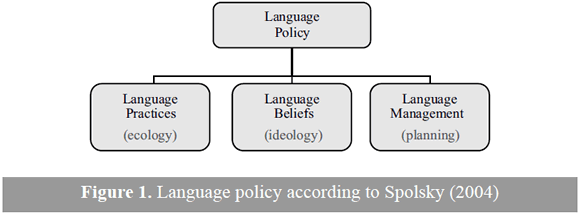
The role of teachers in LEP needs to be contextualized within the new ways of attempting to define language policy, as it is there that teachers can have a significant role to play in negotiating language policies. Language policy not only changed its focus from that of language planning to language policy, it also attempts to incorporate additional components under the umbrella of language policy. Spolsky (2004) introduces a broader concept of language policy, one that incorporates ideology, ecology and management. He argues for a complex relationship among these three components and thus provides a fuller and more comprehensive understanding of what language policy really is. Accordingly, practices refers to how languages are actually used; ideologies to what people and especially policy makers believe about language and management to the ways languages are manipulated.
Schiffman (1996) expanded the notion of language policy by differentiating between overt and covert policies: overt policies refer to explicit, formalized, de jure, while covert policies refer to language policies that are implicit, informal, indirect, unstated, de facto, grass-roots and latent. He further claims that covert aspects of language policies are usually ignored.
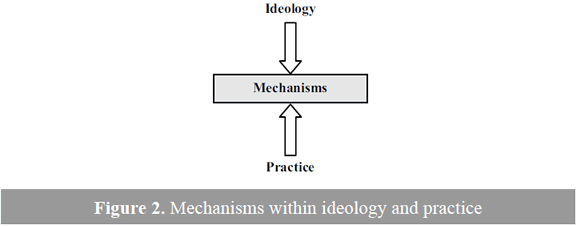
In my own work (Shohamy, 2004, 2006a, 2007) I focus on explicit and implicit language policies indicating how the act of policy making is powerful and imposing given an expanded perspective, focusing on 'policy mechanisms' which refer to tools that serve as mediators between ideology and practice and create de facto policies, that is, language practices. I show how mechanisms such as rules and regulations, language education policies, language tests, language in the public space, myths and propaganda, can lead to de facto language policies in implicit and covert ways. The argument being forwarded within an expanded view of language policy is that language policy needs to be understood in a broader way by focusing not only on ideology, management and practice, but also on the devices, or mechanisms which are used to alter policies, some overt, others covert, some explicit and open while others implicit, covert and hidden. These mechanisms are used to perpetuate language behaviors according to specific agendas. It is claimed that via the mechanisms language ideologies are being enforced and language practices created. Yet, it is also via the mechanisms that language policies get negotiated among the different stake holders. Figure 2 portrays an example of a number of such mechanisms. Take for example the mechanism of 'tests' that can turn ideologies into practice; yet it is also via tests that ideologies can also be resisted. Tests, as will be described later in the paper, can turn ideologies into practice as teachers prepare students for tests, students study for the material used on tests and then they eventually become the material students learn in classes, especially in the cases of national high stake tests (Shohamy, 2001; McNamara and Roever, 2006) and affect teaching and learning. In the next section I will describe a number of the major mechanisms.
]]>
4. MECHANISMS
4.1 Rules and regulations
Among the declared policy, one can note policy documents; these refer to language laws, statements about 'officiality', decisions as to standardized languages. It is often the case that in many nations language academies enforce the standardized language in schools, public spaces, the media. One can view the more recent trend in many countries world-wide to require citizens to be proficient in the national and official languages, i.e., citizenship laws, as one more way of declaring policies. There are ample debates as to the power of declared policies. In most cases these declared policies do not get implemented, especially in the case of officiality. It is important to note that those who make policy decisions for nations, are usually politicians and law makers, and rarely are these decisions made by politicians and other stake holders, involved teachers.
4.2 Language education policy
This mechanism refers to the method used to introduce, or impose language behaviors in educational institutions. Language education policies are part of decisions relating to the very languages which will be taught and learned, whether as second/foreign language and/or as a language of instruction; also focusing on issues of the appropriate age to begin studying these languages, type of language teachers, the purposes of learning, teaching methods and textbooks used to achieve these goals. Languages that should be taught to immigrants, indigenous learners, etc. are also included in such policies. Specific decisions of this sort may include the number of languages students should learn in schools, the language of instructions for immigrants, their participation in regular classes and the time they should be tested in content areas via the new language.
Language educational policies are viewed as powerful mechanisms since they are imposed by political entities, top down and are influential in terms of the age to begin studying languages and its purposes. Language educational policies serve central authorities, i.e., governments goals, to fulfill goals of education. There is general limited resistance to language education policies, as in most countries they are imposed from above with little room to resist, especially when they are backed by final national tests. These are reinforced by teachers, materials, curricula and tests. Such policies are driven by strong national ideology as to the selected languages to be learned, specifically focusing nowadays on English, regardless if such policies are feasible, as it is believed that a policy that includes the teaching of English will provide the nation with special status in the global world. Often such policies are supported by other developed nations that supply teaching materials and tests, produced in these countries so that they benefit financially from the choice of the very educational policy. Whether these educational policies are realistic and achieve-able is a separate question; it is often argued that there is little connection between declared educational policies and actual achievements, so they often serve as symbols of wishful thinking and imagined hopes or, alternatively, only a small portion of the population can ever reach the expected level, especially when the financial means are absent.
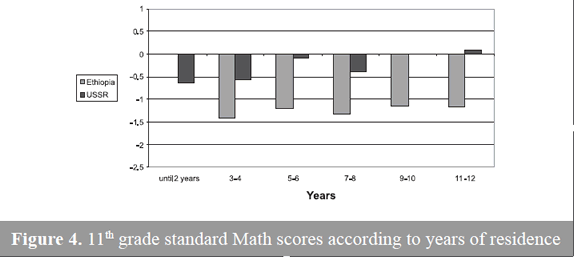
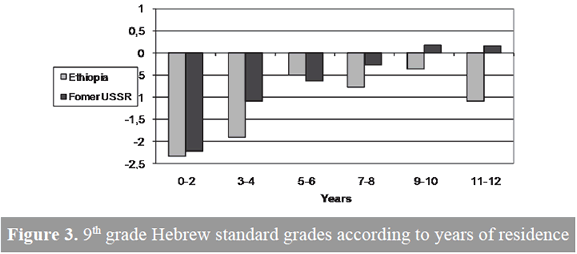
As in the above case those who make the language education policy decisions are government agencies, ministries of education, politicians and often applied linguists. Yet, here again, teachers are not included in the conversation. This is so while it is clear that teachers can provide input based on experience and a reality check as to the likelihood for these educational goals to be successful. These policies are generally introduced without any substantiated research. Take for example the educational policy whereby immigrants need to participate in regular monolingual classes where they are being taught in a language which they are still not proficient in. Research in my own context, in Israel, supported by an ample number of studies showed that it takes immigrants 9-11 years to gain achievement similar to native speakers in the new language (Figure 3) and in specific content areas. Still, governments make decisions to test academic knowledge of immigrants even after a short time of residence in a new country, and to force them to participate in monolingual content classes in a language they are still in the process of acquiring; such policies are clearly capable of affecting negatively their achievement and academic success, even in situations when they can have high levels of content as manifested in their first language.
]]>
4.3 Language tests
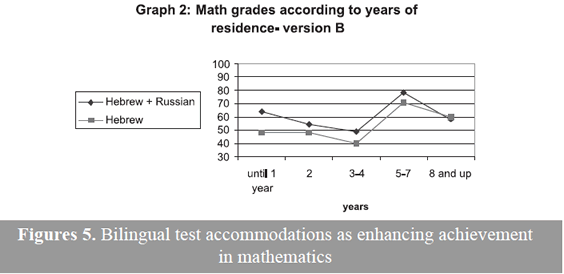
Language tests represent the most powerful mechanisms which are also imposed top down and are used as disciplinary tools to enforce policies. They lead to high stake decisions for individuals and societies — create winners/losers; successes/failures; rejections/acceptances (Shohamy, 2001; McNamara and Roaver, 2006). Tests lead to a variety of de facto negative policies. For example, they influence the priorities and hierarchies of language so that those languages which are tested are considered of higher place in the hierarchy of languages. Conversely, not testing a given language leads to the suppression, elimination and marginalization of the languages which are not tested as is the case with the No Child Left Behind in the USA (Menken, 2008). Moreover, tests are known to define knowledge and stipulate criteria for correctness ('the native variety, purism, written language). Given the consequences of tests, individuals change their behaviors according to the demands of the tests. Thus, tests lead to situations where the national language becomes the only norm, they can also lead to de-legitimization of 'other languages'; can bring about situations whereby the 'native speaker' becomes the only criterion of correctness, as in figures 3 and 4 above, and to gatekeeping and exclusion of unwanted people. For example, it is odd that such tests will be introduced without incorporating research that shows that it takes immigrant students about 9—11 years to acquire sufficient levels of proficiency to perform academically (Levin, Shohamy & Spolsky, 2003; Levin & Shohamy, 2007, 2008). It is also odd that policies will ignore the research that showed that test accommodations can be useful in supporting immigrant students in enhancing their performances on those tests. In another case, that of research on bilingualism, this is being overlooked for the sake of homogeneity and a political agenda. Such is the case with various types of accommodations as enhancing achievement. In Figure 5 one can see that when a math test included the questions in two languages (Russian and Hebrew), in comparison to students with a test version that had only one language, the newly acquired one, Hebrew, students performed significantly better.
Thus, it is in educational systems where tests serve as tools used extensively by educational authorities to create de facto policies and turn language ideologies into language practices. In these situations, language policies become no more than declarations of intentions that can be easily manipulated. This can be demonstrated in cases where a given language policy declares a specific language as significant and of high priority for the educational system. Yet, by establishing entrance criteria that do not include tests in that language or that include a different language, a new de facto language policy is created. The act of including a test in a high stake point implies that certain languages are interpreted as important to know. Indeed, since tests are often more powerful than any written policy documents, given their consequences, they lead to the elimination and suppression of certain languages in societies (Evans & Hornberger, 2005; Shohamy, 2004; Menken, 2006). Tests can also be used as tools to privilege certain forms and levels of language knowledge. Thus, while language educational policies may include criteria whereby correct grammar or 'native-like' accents are less essential for functional language proficiency, if language tests do include correct grammar and native-like accents as part of the criteria, these become the de facto language policy, as tests takers will attempt to conform with these requirements given the high power and the harsh consequences of failing on these tests. This situation is even more far reaching in cases where unrealistic testing requirements are stipulated and when most test takers cannot pass and become exposed to extreme sanctions (e.g., expulsion from a country). Such is also the case in situations when adult immigrants who have had no opportunity to learn the new language are required to pass language citizenship tests as criteria for residence; the chances of passing such tests successfully are often very slim. These tests are then viewed as tools and mechanisms for imposing certain ideological policies that have no basis in theories of language learning and acquisition. Still, the implications of these tests for test takers are very detrimental since they can lead to high-stake decisions such as granting permission to reside and obtain basic rights, to enter certain educational institutions and/or the workplace. Thus, language tests, given their power and influence in societies, play a major role in the implementation and introduction of language policies. It is possible that those who introduce the tests have not intended to bring about such consequences, but it is the power of these tests and the use of their results for high stake decisions that lead to harmful de facto language policies.
]]> The other case widely referred to for pointing to the interaction of language testing with language policy is that of the introduction of language tests for citizenship, a phenomenon that is widespread nowadays in many countries, whereby language tests are imposed on immigrants and lead to high-stake decisions as to the legitimacy of immigrants to obtain citizenship and/or to reside in the country they moved to (Shohamy, 2006a; McNamara & Shohamy, 2008). These tests serve as gate-keepers for immigrants as well as for those who have been living in other countries for some time. Thus, the use of language tests for policy making is used by governments as a means of carrying out and implementing a variety of public policies.
Another context in which uniformity is established ideologically is in the area of rating scales. Anchored historically in definitions provided by US government agencies, such as the FSI (Foreign Service Institute), the DLI (Defense Language Institute), and the Peace Corps, different proficiency scales (e.g., the Common European Framework Reference (CEFR) or the American Council of Teacher of Foreign Languages (ACTFL) guidelines) have been designed as criteria for determining language quality. These are aimed at criteria that would accord with viewing language development as a progression and a hierarchy of development, as learning progresses along the second/foreign language continuum from novice (minimal amount of language), through 'some language' to 'some more,' via 'advanced' to a 'professional' level. Different terms describe this progress.
These scales affect de facto language policy in many ways. First, the scales define a presumed hierarchical nature of second language learning, as though it followed a prescribed and controlled linear order without an empirical basis for this assumption. For example, it is not clear whether these hierarchies represent the reality of the process of second language learning, whether all learners proceed along the same route, whether a particular level is in fact higher than the previous one as stipulated by the guidelines, and whether these levels potentially represent deep-seated ideologies rather than the reality of language development.
Thus, these scales serve as policy tools pushing a linear and homogeneous order of progression that is believed to be identical for all learners. It is important to realize that these proficiency descriptions have deeply influenced the policy about language learning that a large number of schools and universities have adopted in terms of language policies all around the world. Fulcher (2004), for example, writes that over time the guidelines have created a 'false' truth for teachers and bureaucrats, with no evidence of their validity and they serve as 'prescriptions' that dictate proficiency levels in ways that are detached from reality. Instead of defining levels of language proficiency they have become the institutionalised 'it' of language: the main danger, he claims, is that teachers are beginning to believe that the scales represent an acquisitional hierarchy, rather than a common perception. These scales serve as testing tools which prescribe proficiency.
In Shohamy (2006b) it is shown how these descriptors are especially problematic for 'advanced' language proficiency use, which includes cognitive abilities, content knowledge, context awareness, input processing capacities, interactive abilities, and multilingual performance options, all components that are not being addressed in these scales. Further, they are detached from a variety of contextual variables such as the purpose of the assessment, the specific uses of the language, the context in which the language has been learned, the age of the learners, the learning conditions, the specific languages learned and assessed, and especially the multiple functions of different languages in different contexts. These scales view language learning in homogenous terms that can be generaliseable from one domain to another. There are therefore doubts as to whether such broad and generic testing descriptions are relevant and valid for different language learning contexts and uses, such as foreign language learning, second language learning, immersion programs, bilingual programs in immigration contexts, indigenous languages, specific grade levels, instructed learning, content based instruction, tertiary education, elementary and high schools, and for capturing the variety of language needs that characterize different workplaces. This points to the problems that arise when test criteria such as rating scales affect language policy, and definitions of 'what it means to know a language,' and when such rating scales (a) presuppose a hierarchy of both development and performance, (b) adhere to generic descriptions, and (c) claim to be universally applicable, detached from the contextualized nature of language and language performance in multilingual environments.
Therefore, a number of issues need to be raised: is the use of tests that bring about a shift in language policy hiding deeper ideologies about people and nations? With regards to school tests, does the introduction of these tests in societies which are multilingual represent a policy where all students of a nation will be required to acquire language proficiency in one homogenous language which is decided by the authorities of the nation to be the one language all students should know while de-valuing others? Educational policy or language policy cannot be detached from testing policy as testing policy leads to, or derives from, language and educational policy.
Yet, given the strong power of tests as a policy device, it is again surprising that teachers rarely make the final policy decision, and in fact even in classroom tests teachers tend to follow these very tests in their classrooms as they are considered to be of higher value and prestige. In this context it is important to note that in the past few years new dimensions of language policy and language testing have been introduced, not only in terms of expansion of the constructs, as was described above, but also in terms of who is involved in making policies. While previous models have focused primarily on 'top-down' models referring to the agencies that impose language policies and language tests, there is currently a growing role and emphases on those who are affected by both 'the tests' as well as 'the policies', specifically in the direction of negotiating policies and testing from by those who are affected by them. The emphasis on the victims of tests, those who are unable to perform the expected goals of the test, such as immigrants and students with disabilities, is being heard. The development and the introduction of test accommodations for example, is one indication that draws attention to the unrealistic expectations that all students will perform equally on tests, claiming that tests need to be adopted to people and not the other way around. This is also related to the large number of testing alternatives that currently emerge in classrooms, formative and summative levels and assessment for learning. Teachers are rarely included in making policy decision about large scale national test; yet, given an interactive view of policy as an interactive process, the use of teachers' grades and expectations can be used for negotiating tests which are more inclusive and realistic; these in turn can lead to more realistic policies which incorporate actual school experiences (Nevo, 2006). Building on the power of tests and on the phenomenon of washback per se, without viewing the whole picture is very problematic and dangerous. Yet, it is possible to build on the washback phenomenon in more constructive and negotiable ways. Thus, classroom language tests can become useful tools for negotiating between language ideologies and language practices and led by teachers.
4.4 The Incorporation of teachers
In all of the above cases, it is important to focus on the inclusion of teachers who are normally not part of the policy making process, not on the overt nor on the covert dimensions. Teachers who 'buy' into this type of condensing views, are often not aware that the languages they teach are embedded in a variety of ideological and political agendas as no language teaching is neutral. There is a need to view language teaching as policy making as this creates de facto policies and to at least examine whether teachers are in agreement with these policies. Should teachers remain technicians or responsible professionals who can provide meaningful feedback to the language negotiations arena? Thus, teachers should be listened to and have opportunities to influence language policies, as their input is crucial to success in addressing the realities of schools, students and 'the nation' at large.
]]> 5. CONCLUSIONS
Language policy falls in the midst of political agendas and battles while teachers are clearly excluded from this process and suffer from lack of participation. By expanding language policy to focus on mechanisms it is possible to observe covert and overt ways of creating de facto policies according to the following needs:
It is clear by now that LP is not neutral as it represents a significant tool for political power and manipulations. Yet, as Scollon (2004) wrote: ''I believe that only where the tools of power are openly known, openly critiqued, and accessible to everyone can anything like a true democracy work'' (p. 274). Linguistic activism refers to specific actions that can be taken by linguists, teachers and the public at large to open up the discussion of LP as a tool of power that should be examined and critiqued. These include taking actions to protest the uses and misuses of LP in affecting language behaviors in schools and society, through political movements as well as through the judiciary systems to so protect rights and promote inclusion. Activism calls for language professionals to take active roles in leading such a discussion of an expanded view of language and by making the mechanisms and their consequences more open, less hidden and monitor their consequences and thus incorporate democracy of inclusion with regard to LP.
Crawford (2000) argues that language professionals have no choice but to become activists especially in the area of language minority rights: ''It is understandable that researchers and practitioners would prefer to avoid political distractions. Yet, for professionals in language-minority education today, they are inescapable''. Educators, he claims, need to increase participation in the policy debate especially in the political context where members of the public can understand and endorse a given policy.
]]> Teachers need to be involved in many ways such as — are teachers in agreement with the policies? Should teachers remain technicians or responsible professionals who can provide meaningful feedback to the language negotiations arena? It is important that teachers should become aware of the fact that language teaching, given its association with political agendas is a political act. Teachers should be listened to and thus have opportunities to influence language policies, as their input is crucial to success in addressing the realities of schools, students and 'the nation' at large. Teachers are also citizens, and like other citizens they should be active participants in policy decisions, especially in the case of English teachers, given the role of English in the word today as a lingua franca, and given that it is a mixed code, where the native variety is not even the preferred reality; voices of teachers and applied linguists are essential for the creation of educated policies.There is a close connection between research on learning and language policy where teachers (as well as researchers) can play important roles. Curiously, not much information is available about how LEP relates to language learning, perhaps because LEP is often considered a separate entity, driven by political agendas and overlooking educational theories and knowledge. Even when certain languages are stipulated as compulsory and are taught in schools, little is known about students' success in learning these languages or about the feasibility of carrying out the LEP. One may suspect that this situation exists because, as noted earlier, LEP serves primarily as statements or declarations of intentions with little concern for practices. When policy makers impose languages on schools for a variety of political and social reasons without being attentive to the needs and wishes of those who are affected by the policy and without including those who are expected to carry it out, LEP generally has little effect on the students' language learning, especially when the public has negative attitudes or stereotypes about some of these languages and their people to begin with. Under such circumstances, learning these languages may actually lead to increased negative attitudes and low achievement or, alternatively, can create greater familiarity and reduced stereotyping of the languages and their speakers. At the same time, there are many examples where, without an official LEP that identifies the languages to be studied, a diversity of languages is learned and acquired successfully, as is the case with the learning of English by young pupils in a large number of countries.
Just as there is little knowledge about the connection between LEP and language learning, few studies trace the effects of introducing a new LEP on attitudes, stereotypes, and on successful language learning. One is tempted to ask: Is this lack of knowledge and investigation a consequence of how LEPs are created, often driven by ideology and overlooking aspirations and needs of schools and societies? Is it because LEP focuses mostly on the languages that should be taught and not on learning and teaching practices? Is it because it is a top-down process rather than a dialogical process? Is it because there is no input from teachers and students who are immersed in experiences and realities? Should one, more generally, attribute this dearth of information to how languages are taught and learned? Is it because many LEPs overlook insights from second language acquisition theories and practices? Is it because we have yet to define what constitutes success (and failure) of LEPs and, likewise, of learning languages (e.g., achievements, motivation, attitudes, relationships)? Is it that teachers are not paying much attention to LEP or that language policy makers are not noticing educational realities? Or is it that researchers in language policy and language learning do not actively address language policy concerns? These are some of the questions that need to be addressed if we are to introduce more inclusive, democratic and negotiable language policies that incorporate the knowledge of multiple stakeholders, but especially that of the main actors, the teachers.
REFERENCES
1. Casanova, P. (2001). La república mundial de las letras. Trad. Jaime Zulaika. Barcelona: Anagrama. [ Links ]
2. Canagarajah, S. (2007). The ecology of global English, International multilingual research Journal, 1, 89-100. [ Links ]
3. Evans, B. & Hornberger, N. (2005). No child left behind: Repealing and unpeeling federal language education policy in the United States. Language Policy, 4, 87—106. [ Links ]
4. Fulcher, G . (2004). Deluded by artifices? The Common European Framework and harmonization. Language Assessment Quarterly, 1, 253—266. [ Links ]
5. Jenkins, J. (2006). Current perspectives on teaching world Englishes and English as a lingua franca. TESOL Quarterly, 40, 157-181. [ Links ]
6. Kress, G. and Van Leeuwen, T. (1996). Reading images — the grammar of visual design. London, Routledge. [ Links ]
7. Levin, T., Shohamy, E. and Spolsky, B. (2003). Academic Achievements of Immigrants in Schools. Report submitted to the Ministry of Education (in Hebrew). [ Links ]
8. Levin, T. and Shohamy, E. (2007). The role of academic language in understanding the mathematics achievements of immigrant students in Israel. I n C. S. Sunal and K. Mutua, (eds.) The Enterprise of Education: Research on Education in Africa, the Caribbean, and the Middle East (pp. 313—336). Tuscaloosa, Alabama: Information Age Publishing. [ Links ]
9. Levin, T. and Shohamy, E. (2008). Achievement of immigrant students in mathematics and academic Hebrew in Israeli school: A large scale evaluation study. Studies in Educational Evaluation 34 (1), 1—14. [ Links ]
10. McNamara, T. and Shohamy, E. (2008). Language tests and human rights. International Journal of Applied Linguistics, 18 (1), 89—95. Language Policy and Language Assessment 373. [ Links ]
11. McNamara, T. and Roever, C. (2006). Language Testing: The Social Dimensions. Malden, MA and Oxford: Blackwell. [ Links ]
12. Menken, K. (2006). Teaching to the test: how standardized testing promoted by the No Child Left Behind Act impacts language policy, curriculum, and instruction for English language learners. Bilingual Research Journal, 30 (2), 521—546. [ Links ]
13. Menken, K. (2008). English Learners Left Behind. Clevedon: Multilingual Matters. [ Links ]
14. Messick, S. (1981) Evidence and ethics in the evaluation tests. Educational Researcher, 10, 9-20. [ Links ]
15. North, B. (2000). The Development of a Common Framework of Language Proficiency. New York: Peter Lang. [ Links ]
16. North, B. and Schneider, G. (1998). Scaling, descriptors for language proficiency scales.Language Testing, 15, 217—262. [ Links ]
17. Schiffman, H. (1996), Linguistic Culture and Language Policy. London: Routledge. [ Links ]
18. Scollon, R. (2004). Teaching language and culture as hegemonic practice. Modern Language Journal, 88, 271—274. [ Links ]
19. Shohamy, E. (2001). The Power of Tests, a Critical View of the Uses of Language Tests. Essex: Pearson, Longman. [ Links ]
20. Shohamy, E. (2004). Assessment in multicultural societies: Applying democratic principles and practices to language testing. In B. Norton and K. Toohey (eds.) Critical Pedagogies and Language Learning. New York/London: Cambridge University Press. [ Links ]
21. Shohamy, E. (2006a). Language Policy: Hidden Agendas and New Approaches. London: Routledge. [ Links ]
22. Shohamy, E. (2006b). Re-thinking assessment for advanced language proficiency. In H. Byrnes, H. Weger-Guntharp, and K.A. Sprang (eds.) Educating for Advanced Foreign Language Capacities: Constructs, Curriculum, Instruction, Assessment (pp. 188—208). Washington, DC: Georgetown University Press. [ Links ]
23. Shohamy, E. (2007). Langauge tests as language policy tools. Assessment in Education. 14 (1), 117—130. [ Links ]
24. Spolsky, B. (2004). Language Policy. Cambridge: Cambridge University Press. [ Links ]
26. Spolsky, B. (2004). Language Policy. Cambridge: Cambridge University Press. [ Links ]
27. Thomas, W. and Collier, V. (1997). School Effectiveness for Language Minority Education Students. Washington, DC: National Clearinghouse for Bilingual Education. [ Links ]
Recibido: 24-02-09
Aceptado: 31-03-09
NOTES
1 This paper is based on a plenary talk presented at the conference held at the Universidad de Antioquia, Medellín, Colombia, August 13, 2008. Parts of the article are taken from Shohamy, 2006, Language Policy: Hidden Agenda and New Approaches, Routledge.
]]>