<?xml version="1.0" encoding="ISO-8859-1"?><article xmlns:mml="http://www.w3.org/1998/Math/MathML" xmlns:xlink="http://www.w3.org/1999/xlink" xmlns:xsi="http://www.w3.org/2001/XMLSchema-instance">
<front>
<journal-meta>
<journal-id>0123-3432</journal-id>
<journal-title><![CDATA[Íkala, Revista de Lenguaje y Cultura]]></journal-title>
<abbrev-journal-title><![CDATA[Íkala]]></abbrev-journal-title>
<issn>0123-3432</issn>
<publisher>
<publisher-name><![CDATA[Escuela de Idiomas, Universidad de Antioquia]]></publisher-name>
</publisher>
</journal-meta>
<article-meta>
<article-id>S0123-34322010000100006</article-id>
<title-group>
<article-title xml:lang="en"><![CDATA[Explicit Teaching of Socio-Affective Language Learning Strategies to Beginner EFL Students]]></article-title>
<article-title xml:lang="fr"><![CDATA[L'enseignement explicite des facteurs affectifs et des stratégies socio-affectives pour l'apprentissage des langues à des étudiants débutants d'anglais langue étrangère]]></article-title>
</title-group>
<contrib-group>
<contrib contrib-type="author">
<name>
<surname><![CDATA[Fandiño Parra]]></surname>
<given-names><![CDATA[Yamith José]]></given-names>
</name>
<xref ref-type="aff" rid="A01"/>
</contrib>
</contrib-group>
<aff id="A01">
<institution><![CDATA[,Universidad Distrital Francisco José de Caldas Universidad de La Salle in Bogotá ]]></institution>
<addr-line><![CDATA[ ]]></addr-line>
<country>Colombia</country>
</aff>
<pub-date pub-type="pub">
<day>00</day>
<month>04</month>
<year>2010</year>
</pub-date>
<pub-date pub-type="epub">
<day>00</day>
<month>04</month>
<year>2010</year>
</pub-date>
<volume>15</volume>
<numero>24</numero>
<fpage>145</fpage>
<lpage>169</lpage>
<copyright-statement/>
<copyright-year/>
<self-uri xlink:href="http://www.scielo.org.co/scielo.php?script=sci_arttext&amp;pid=S0123-34322010000100006&amp;lng=en&amp;nrm=iso"></self-uri><self-uri xlink:href="http://www.scielo.org.co/scielo.php?script=sci_abstract&amp;pid=S0123-34322010000100006&amp;lng=en&amp;nrm=iso"></self-uri><self-uri xlink:href="http://www.scielo.org.co/scielo.php?script=sci_pdf&amp;pid=S0123-34322010000100006&amp;lng=en&amp;nrm=iso"></self-uri><abstract abstract-type="short" xml:lang="es"><p><![CDATA[Objetivo: enseñar explícitamente estrategias socioafectivas de aprendizaje de lengua, para impactar positivamente las creencias, actitudes, ansiedades y motivaciones de un grupo de estudiantes principiantes de inglés como lengua extranjera en el Centro Colombo Americano en Bogotá. Método: se realizó una investigación-acción con diecisiete estudiantes que asistían a un curso básico; estos estudiantes respondieron dos cuestionarios abiertos, uno al inicio y uno al final del estudio; diligenciaron una escala de valoración sobre factores afectivos, y participaron en una serie de actividades socioafectivas diseñadas e implementadas por el investigador. Resultados: los resultados de este estudio sugieren que la instrucción explícita de estrategias socioafectivas es útil para aumentar la conciencia del estudiante sobre la importancia de prestar atención a sus propios sentimientos y a sus relaciones sociales como parte de su proceso de aprendizaje. Conclusiones: este estudio le permitió al investigador asumir los factores afectivos como consideraciones importantes sobre las que tanto profesores como estudiantes necesitan reflexionar para ganar un entendimiento más profundo de la naturaleza del aprendizaje de lengua y para, en últimas, conocerse mejor a sí mismos.]]></p></abstract>
<abstract abstract-type="short" xml:lang="en"><p><![CDATA[Objective: To explicitly teach socio-affective language learning strategies (SLLS) to positively impact the beliefs, attitudes, anxieties, and motivations of a group of beginner EFL students at the Centro Colombo Americano in Bogota, Colombia. Method: An action research study was carried out with 17 students who were taking a Basic English course. They answered two open-ended questionnaires, one at the beginning and the other at the end of the study; they also answered questions using a rating scale about affective factors and participated in a set of socio-affective activities designed and implemented by the researcher. Results: The results of the study suggest that explicit strategy instruction in SLLS is helpful in heightening learner awareness of the importance of paying attention to their own feelings and social relationships as part of their learning process. Conclusions: Affective factors are important considerations that both teachers and students need to reflect on to gain a deeper understanding of the nature of language learning and, ultimately, to gain insight about themselves.]]></p></abstract>
<abstract abstract-type="short" xml:lang="fr"><p><![CDATA[Objectif: Enseigner explicitement des stratégies socio-affectives d'apprentissage de la langue, pour affecter de manière positive les croyances, les attitudes, les craintes et les motivations d'un groupe d'étudiants débutants d'anglais langue étrangère au Centre Colombo Americano de Bogotá, en Colombie. Méthode: une recherche action a été réalisée avec 17 étudiants qui suivaient un cours élémentaire d'anglais; ces étudiants ont répondu à deux questionnaires ouverts, l'un au début et l'autre à la fin de l'étude; ils ont rempli une échelle d'évaluation sur des facteurs affectifs et ont participé à une série d'activités socio affectives créées et mises en application par l'enquêteur. Résultats: les résultats de cette étude suggèrent que l'instruction explicite de stratégies socio affectives est utile pour augmenter la conscience de l'étudiant sur l'importance de prêter attention à ses propres sentiments et à ses relations sociales comme étant une chose faisant partie de son processus d'apprentissage. Conclusions: cette étude a permis à l'enquêteur d'assumer les facteurs affectifs comme des considérations importantes sur lesquelles professeurs et étudiants ont besoin de réfléchir pour obtenir une compréhension plus profonde de la nature de l'apprentissage de la langue et pour, au final, se connaître mieux eux-même.]]></p></abstract>
<kwd-group>
<kwd lng="es"><![CDATA[estrategias socioafectivas de aprendizaje de lengua]]></kwd>
<kwd lng="es"><![CDATA[factores afectivos]]></kwd>
<kwd lng="es"><![CDATA[estudiantes principiantes de lengua extranjera]]></kwd>
<kwd lng="es"><![CDATA[investigación-acción]]></kwd>
<kwd lng="es"><![CDATA[instrucción de estrategias]]></kwd>
<kwd lng="en"><![CDATA[socio-affective language learning strategies]]></kwd>
<kwd lng="en"><![CDATA[affective factors]]></kwd>
<kwd lng="en"><![CDATA[beginner EFL students]]></kwd>
<kwd lng="en"><![CDATA[action research]]></kwd>
<kwd lng="en"><![CDATA[strategy instruction]]></kwd>
<kwd lng="fr"><![CDATA[stratégies socio affectives d'apprentissage de la langue]]></kwd>
<kwd lng="fr"><![CDATA[facteurs affectifs]]></kwd>
<kwd lng="fr"><![CDATA[étudiants débutants de langue étrangère]]></kwd>
<kwd lng="fr"><![CDATA[recherche action]]></kwd>
<kwd lng="fr"><![CDATA[instruction de stratégies]]></kwd>
</kwd-group>
</article-meta>
</front><body><![CDATA[ <p align="right"><font size="2" face="Verdana, Arial, Helvetica, sans-serif"><b>ART&Iacute;CULOS DE INVESTIGACI&Oacute;N </b></font></p>     <p>&nbsp;</p>     <p align="center"><font face="Verdana, Arial, Helvetica, sans-serif"><b><font size="4">Explicit Teaching   of Socio-Affective Language Learning Strategies to Beginner EFL Students*<a name="en1"></a><a href="#n1"><sup>1</sup></a></font> </b></font></p>     <p>&nbsp;</p>     <p align="center"><font face="Verdana, Arial, Helvetica, sans-serif"><b><font size="3">L'enseignement explicite des facteurs affectifs et des strat&eacute;gies   socio-affectives pour l'apprentissage des langues &agrave; des &eacute;tudiants   d&eacute;butants d'anglais langue &eacute;trang&egrave;re</font></b></font></p>     <p>&nbsp;</p>     <p>&nbsp;</p>     <p><font face="Verdana, Arial, Helvetica, sans-serif"><b><font size="2">Yamith   Jos&eacute; Fandi&ntilde;o Parra**</font></b> <font size="2">    <br> ** Yamith Jos&eacute; Fandi&ntilde;o holds a   Bachelor's degree in English philology and language from Universidad   Nacional de Colombia and a Master's degree in education from Universidad   de La Salle. He currently works as a tenured professor at both   Universidad Distrital Francisco Jos&eacute; de Caldas and Universidad de La   Salle in Bogot&aacute;, Colombia. E-mail: <a href="mailto:teacheryamith@gmail.com">teacheryamith@gmail.com</a> </font></font></p>     <p>&nbsp;</p>     ]]></body>
<body><![CDATA[<p>&nbsp;</p> <hr size=1 noshade>     <p><font size="2" face="Verdana, Arial, Helvetica, sans-serif"><b>RESUMEN</b></font></p>     <p><font size="2" face="Verdana, Arial, Helvetica, sans-serif"><b>Objetivo: </b>ense&ntilde;ar expl&iacute;citamente   estrategias socioafectivas de aprendizaje de lengua, para impactar   positivamente las creencias, actitudes, ansiedades y motivaciones de un   grupo de estudiantes principiantes de ingl&eacute;s como lengua extranjera en   el Centro Colombo Americano en Bogot&aacute;.    <br>     <b>M&eacute;todo: </b>se realiz&oacute; una   investigaci&oacute;n-acci&oacute;n con diecisiete estudiantes que asist&iacute;an a un curso   b&aacute;sico; estos estudiantes respondieron dos cuestionarios abiertos, uno al   inicio y uno al final del estudio; diligenciaron una escala de valoraci&oacute;n sobre factores   afectivos, y participaron en una serie de actividades socioafectivas   dise&ntilde;adas e implementadas por el investigador.    <br>     <b>Resultados: </b>los   resultados de este estudio sugieren que la instrucci&oacute;n expl&iacute;cita de   estrategias socioafectivas es &uacute;til para aumentar la conciencia del   estudiante sobre la importancia de prestar atenci&oacute;n a sus propios   sentimientos y a sus relaciones sociales como parte de su proceso de   aprendizaje.    <br>     <b>Conclusiones: </b>este estudio le permiti&oacute; al   investigador asumir los factores afectivos como consideraciones   importantes sobre las que tanto profesores como estudiantes necesitan   reflexionar para ganar un entendimiento m&aacute;s profundo de la naturaleza del aprendizaje de lengua y para,   en &uacute;ltimas, conocerse mejor a s&iacute; mismos. </font></p>     <p><font size="2" face="Verdana, Arial, Helvetica, sans-serif"><b>Palabras clave: </b>estrategias   socioafectivas de aprendizaje de lengua, factores afectivos, estudiantes   principiantes de lengua extranjera, investigaci&oacute;n-acci&oacute;n, instrucci&oacute;n   de estrategias </font></p> <hr size=1 noshade>     <p><font size="2" face="Verdana, Arial, Helvetica, sans-serif"><b>ABSTRACT</b></font></p>     <p><font size="2" face="Verdana, Arial, Helvetica, sans-serif"><b>Objective: </b>To explicitly teach socio-affective language   learning strategies (SLLS) to positively impact the beliefs, attitudes,   anxieties, and motivations of a group of beginner EFL students at the   Centro Colombo Americano in Bogota, Colombia.    <br>     <b>Method: </b>An action   research study was carried out with 17 students who were taking a Basic   English course. They answered two open-ended questionnaires, one at the   beginning and the other at the end of the study; they also answered   questions using a rating scale about affective factors and participated   in a set of socio-affective activities designed and implemented by the   researcher.    ]]></body>
<body><![CDATA[<br>     <b>Results: </b>The results of the study suggest that   explicit strategy instruction in SLLS is helpful in heightening learner   awareness of the importance of paying attention to their own feelings   and social relationships as part of their learning process.    <br>     <b>Conclusions: </b>Affective factors are important considerations that both teachers   and students need to reflect on to gain a deeper understanding of the nature of   language learning and, ultimately, to gain insight about themselves. </font></p>     <p><font size="2" face="Verdana, Arial, Helvetica, sans-serif"><b>Key words: </b>socio-affective language   learning strategies, affective factors, beginner EFL students, action   research, strategy instruction </font></p> <hr size=1 noshade>     <p><font size="2" face="Verdana, Arial, Helvetica, sans-serif"><b>R&Eacute;SUM&Eacute;</b></font></p>     <p><font size="2" face="Verdana, Arial, Helvetica, sans-serif"><b>Objectif: </b>Enseigner explicitement des strat&eacute;gies   socio-affectives d'apprentissage de la langue, pour affecter de mani&egrave;re   positive les croyances, les attitudes, les craintes et les motivations   d'un groupe d'&eacute;tudiants d&eacute;butants d'anglais langue &eacute;trang&egrave;re au Centre   Colombo Americano de Bogot&aacute;, en Colombie.    <br>     <b>M&eacute;thode: </b>une recherche   action a &eacute;t&eacute; r&eacute;alis&eacute;e avec 17 &eacute;tudiants qui suivaient un cours   &eacute;l&eacute;mentaire d'anglais; ces &eacute;tudiants ont r&eacute;pondu &agrave; deux questionnaires   ouverts, l'un au d&eacute;but et l'autre &agrave; la fin de l'&eacute;tude; ils ont rempli une &eacute;chelle   d'&eacute;valuation sur des facteurs affectifs et ont particip&eacute; &agrave; une s&eacute;rie d'activit&eacute;s socio affectives cr&eacute;&eacute;es et mises en   application par l'enqu&ecirc;teur.    <br>     <b>R&eacute;sultats: </b>les r&eacute;sultats de cette   &eacute;tude sugg&egrave;rent que l'instruction explicite de strat&eacute;gies socio   affectives est utile pour augmenter la conscience de l'&eacute;tudiant sur   l'importance de pr&ecirc;ter attention &agrave; ses propres sentiments et &agrave; ses   relations sociales comme &eacute;tant une chose faisant partie de son processus   d'apprentissage.    <br>     <b>Conclusions: </b>cette &eacute;tude a permis &agrave; l'enqu&ecirc;teur   d'assumer les facteurs affectifs comme des consid&eacute;rations importantes sur lesquelles   professeurs et &eacute;tudiants ont besoin de r&eacute;fl&eacute;chir pour obtenir une compr&eacute;hension plus profonde de la nature de   l'apprentissage de la langue et pour, au final, se conna&icirc;tre mieux eux-m&ecirc;me. </font></p>     <p><font size="2" face="Verdana, Arial, Helvetica, sans-serif"><b>Mots-cl&eacute;s: </b>strat&eacute;gies socio affectives d'apprentissage   de la langue, facteurs affectifs, &eacute;tudiants d&eacute;butants de langue   &eacute;trang&egrave;re, recherche action, instruction de strat&eacute;gies </font></p> <hr size=1 noshade>     <p>&nbsp;</p>     ]]></body>
<body><![CDATA[<p>&nbsp;</p>     <p><font size="3" face="Verdana, Arial, Helvetica, sans-serif"><b>1. INTRODUCTION </b></font></p>     <p><font size="2" face="Verdana, Arial, Helvetica, sans-serif">English as a foreign language (EFL) learners decide to learn and speak   English because of personal interests, social needs, professional goals, or   academic requirements. However, many beginner EFL learners do poorly and   end up dropping out of their classes no matter how hard EFL teachers try to   help them succeed. This does not happen because they are not intelligent or   capable. In fact, Iverson (2005) pointed out, ''most of the &#91;beginner&#93; students   in &#91;our&#93; classes have already demonstrated incredible ingenuity, stamina, and   determination in previous &#91;life&#93; experiences'' (p. 9). So, why do some beginner   EFL students give up on English feeling they are not good at learning a foreign language or not able to excel at it?</font></p>     <p><font size="2" face="Verdana, Arial, Helvetica, sans-serif">Research has shown that there   are many factors involved when trying to understand what makes a person   learn a foreign language successfully (Wenden and Rubin, 1987; Chamot   and O'Malley, 1994). However, humanistic language teaching has indicated   that affective factors, such as attitudes, motivation, anxiety, and   self-esteem, have great influence on the success of language learning   since ''the way we feel about our capacities and ourselves can either   facilitate or impede our learning'' (Arnold and Brown, 1999, p. 8). In   the same vein, Andres (2002) argues that ''if we want our students to   develop their inherent potential to learn, the affective variables such   as anxiety, motivation, self-esteem and inhibition... &#91;and&#93; the inner   needs of the learners can no longer be neglected'' (p. 97). Previously, Oxford and   Ehrman (1993) had pointed out, ''many excellent teachers have learned to   do some of this intuitively, but explicit understanding of   individual-difference dimensions can enhance the work of all teachers''   (p. 188). </font></p>     <p><font size="2" face="Verdana, Arial, Helvetica, sans-serif">This study takes place within the context of a   longstanding but growing line of inquiry into affective consideration   in EFL. Specifically, this study aims to encourage foreign language   learners, teachers, and researchers to attend to socioaffective language   learning strategies (SLLS) explicitly and address students' personal,   emotional, and social attributes systematically. SLLS and   students'socioemotional attributes need to be considered methodically   and approached directly by the Colombian EFL community, not only because   they can help learners to acquire a language better, but also because   they can lead them to know themselves better and, ultimately, to learn   to take control of their own learning process (Thanasoulas, 2000). </font></p>     <p>&nbsp;</p>     <p><font size="3" face="Verdana, Arial, Helvetica, sans-serif"><b>2. LITERATURE REVIEW </b></font></p>     <p><font size="2" face="Verdana, Arial, Helvetica, sans-serif">The   importance of affective factors has brought about a number of approaches   and studies directed at educating the person as a whole: humanism, the   silent way, community language learning, etc. Rogers (1969) and   Moskowitz (1978), for instance, contended that it was necessary to shift   attention from content to learners' subjective needs and their search   for personal meaning. Along the same line of thought, Finch (2000) spoke   of the need for teachers to pay attention to students' affective   natures and needs, not simply to help them to live more satisfying lives   and to be responsible members of society, but also in order to improve   language teaching and education in the process. Chou (2004) argued   specifically for the use of SLLS because these strategies can both help   EFL learners regulate their emotions and attitudes towards learning and   learn to interact with others successfully. </font></p>     <p><font size="2" face="Verdana, Arial, Helvetica, sans-serif">In this   regard, Rainey de D&iacute;az (2005) determined that secondary school EFL   teachers in Bogot&aacute; tend to favor a socio-affective culture over that   preferred by mainstream TESOL. In fact, she stated that they have   undertaken or are currently undertaking the corresponding research in   their determination to address the issues they have with respect to the   socio-affective and cultural aspects of the EFL secondary school classroom. In   a similar vein, Habte-Gabr (2006) showed that socio-affective   strategies should be considered central to studying EFL at the   university level in Colombia.According to this author, the use of   socio-affective strategies allows students to eventually learn how to   learn by regarding the instructor as a resource for language and content   and as a provider of emotional support. Likewise, Rosas Lobo (2007)   suggests that Colombian EFL teachers apply SLLS because they can both   contribute to strengthening the interaction of EFL learners and help   learners to avoid negative situations such as nervousness, a fear of   public speaking, and anxiety. </font></p>     <p><font size="2" face="Verdana, Arial, Helvetica, sans-serif">Unfortunately, the EFL reality   in Colombia is still far from appropriately articulating the learners'   affective needs and reactions as integral elements of EFL teaching. The   Ministry of Education, for instance, has been implementing a national   bilingualism program<a name="en2"></a><a href="#n2"><sup>2</sup></a> in order to standardize levels, content, and teaching   practices in Colombian schools and universities based on guidelines   taken from the <i>Common European Framework of Reference for Languages.</i><a name="en3"></a><a href="#n3"><sup>3</sup></a> However,   little has been done to move the emphasis from curricular contents (what   and when students learn) to the process of learning (who learns and how   and why s/he learns). The present paper seeks to start bridging the gap   between EFL research and policies on learner-centeredness in Colombia,   especially in the area of socio-affective factors and strategy   instruction. </font></p>     ]]></body>
<body><![CDATA[<p><font size="2" face="Verdana, Arial, Helvetica, sans-serif"><b>2.1 Affective Factors </b></font></p>     <p><font size="2" face="Verdana, Arial, Helvetica, sans-serif">According to Feder   (1987), affective considerations have been incidental rather than   integral to teaching methodology and are not grounded in a conscious   pedagogical philosophy.Affect, however, should not continue being   considered the Cinderella of education, since affective factors ''link   what is important for us to the world of people, things, and happenings''   (Oatley and Jenkins, 1996, p. 122 cited in Arnold, 1999,   p. 2). According to Arnold (1999), attention and language learning can benefit mutually. For the purposes of   this study, only four affective factors were addressed: beliefs,   attitudes, anxiety, and motivation. </font></p>       <p><font size="2" face="Verdana, Arial, Helvetica, sans-serif"><b>2.2 Beliefs </b></font></p>     <p><font size="2" face="Verdana, Arial, Helvetica, sans-serif">According to Horwitz (1987, p. 121),   this variable refers to learners' ideas or opinions regarding various   aspects of language learning, including ''foreign language aptitude, the   difficulty of language learning, the nature of language learning, the   use of learning and communication strategies and the effect of   motivation.'' Similarly,Young (1991) cited learner beliefs about language   learning as a major contributor to language success, not only because   they influence learners' behaviors and strategy use but also because   they may be the basis of students' expectations for and commitment to   successful language learning. </font></p>       <p><font size="2" face="Verdana, Arial, Helvetica, sans-serif"><b>2.3 Attitudes </b></font></p>     <p><font size="2" face="Verdana, Arial, Helvetica, sans-serif">Ghadessy and Nicol (2002) support   Baker's (1992) main characteristics of attitudes: they are both   cognitive (i.e. are capable of being thought about) and affective (i.e.   have feelings and emotions attached to them); they are dimensional   rather than bipolar; they vary in degree of favorability/unfavorability;   they predispose a person to act in a certain way; they are learned, not   inherited or genetically endowed, and they tend to persist but they can   be modified by experience. These researchers also concur with Ellis   (1994), who states that attitudes are manifested towards a number of   things including the target language, the target language speakers,   target language culture, the social value of learning the L2, particular   uses of the target language, and students themselves as members of   their own culture. </font></p>       <p><font size="2" face="Verdana, Arial, Helvetica, sans-serif"><b>2.4 Anxiety </b></font></p>     <p><font size="2" face="Verdana, Arial, Helvetica, sans-serif">Scovel (1978) views anxiety as a state   of apprehension influenced by factors that are intrinsic and extrinsic   to the foreign language learner. This researcher differentiates between <i>facilitating </i>anxiety (a state that keeps us alert and gives us a competitive   edge) and <i>debilitating </i>anxiety (angst that causes us to flee the   new task or structure and hence leads to avoidance behavior). In 1986,   Horwitz, Horwitz, and Cope identified three performance anxieties in   foreign language learning: <i>communication apprehension </i>(an   uneasiness arising from the learner's inability to   adequately express mature thoughts and ideas), <i>test anxiety </i>(a   fear of academic evaluation), and <i>fear of negative evaluation </i>(an   apprehension arising from the learner's need to make a positive social   impression on others). Gardner and MacIntyre (1993) understand anxiety   as a fear or apprehension occurring when a learner is expected to   perform in an L2 and he or she perceives an uncomfortable experience. </font></p>         <p><font size="2" face="Verdana, Arial, Helvetica, sans-serif"><b>2.5 Motivation </b></font></p>     <p><font size="2" face="Verdana, Arial, Helvetica, sans-serif">Gardner (1985) describes motivation in terms of   attitude, effort, and desire. Peacock (1997) defines motivation as   interest in and enthusiasm for the materials used in the class,   persistence with the learning task, and levels of concentration and   enjoyment. D&ouml;rnyei (1994, 1998) created a model of FL learning   motivation composed of three different levels: <i>the language level </i>(integrative   and instrumental motivational subsystems focusing on reactions and   attitudes toward the target language), <i>the learner level </i>(the   individual's reactions to the language and the learning situation), and <i>the   learning situation level </i>(the extrinsic and intrinsic motivational   factors related to the teacher, the course, and the group of language   learners with which an individual interacts). </font></p>         ]]></body>
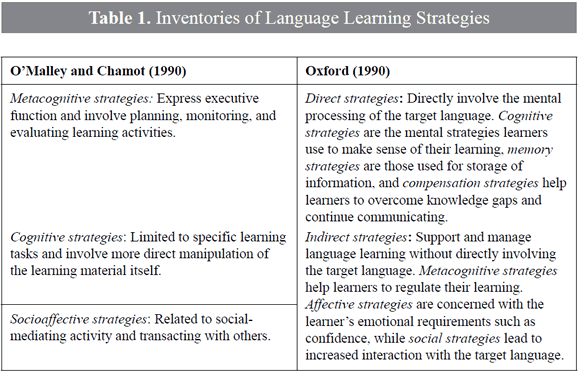
<body><![CDATA[<p><font size="2" face="Verdana, Arial, Helvetica, sans-serif"><b>2.6 Affective Factors and Language Learning Strategies </b></font></p>     <p><font size="2" face="Verdana, Arial, Helvetica, sans-serif">D&ouml;rnyei (2001, p. 116) suggests that ''teacher skills in   &#91;helping&#93; learners should be seen as central to teaching   effectiveness.'' This implies that teachers should not only be   knowledgeable about general affective and motivational concepts in   language learning, but also be able to apply them to promote affect and   emotion where they may be lacking. Similarly, Oxford (1996, p. 1) calls   for research regarding FL setting:</font></p>     <blockquote><font size="2" face="Verdana, Arial, Helvetica, sans-serif">For the sake of students worldwide, we cannot   afford to restrict ourselves to a small set of motivational variables,   especially when we know from research in other fields that &#91;the   affective domain&#93; is an extraordinarily complex, multifaceted, and   important construct. </font></blockquote>      <font size="2" face="Verdana, Arial, Helvetica, sans-serif"> </p> One specific area in which   affective factors can be seen at work is in the use of different   language learning strategies, particularly SLLS. Studies by Oxford and   Nyikos (1989) show that the degree of motivation and other affective factors are the most powerful influence on how and   when students use language learning strategies. Scimonelli (2002)   contends that affective and social language learning strategies as well   as communication strategies are the areas in which the teacher's   intervention should come first, in order to develop positive frames of   mind in the students and help them overcome the stress and sense of   discomfort that a poor or low oral command of English sometimes causes.      <p><b>2.7 Language Learning Strategies </b></p>     <p>O'Malley and Chamot (1990) define   language learning strategies (LLS) as the special thoughts or behaviors   that individuals use to help them comprehend, learn, or retain new   information. Oxford (1990, p. 8) provides this comprehensive definition   of LLS:</p>     <blockquote>&#91;...&#93; specific actions,   behaviours, steps, or techniques that students (often intentionally) use   to improve their progress in developing L2 skills. These strategies can   facilitate the internalization, storage, retrieval, or use of the new   language. Strategies are tools for the self-directed involvement   necessary for developing communicative ability.</blockquote>     <p>Different   authors have provided a number of classifications and inventories.   O'Malley and Chamot (1990), for instance, divide language learning   strategies into three main categories. Oxford (1990) divides them into   two main categories, direct and indirect, which are further subdivided   into 6 subcategories (<a href="#t01">see table 1</a>). </p> </font>         <p>&nbsp;</p>         <p align="center"><font size="2" face="Verdana, Arial, Helvetica, sans-serif"><a name="t01"></a><img src="/img/revistas/ikala/v15n24/v15n24a6t1.gif"></font></p>     <p>&nbsp;</p>         ]]></body>
<body><![CDATA[<p><font size="2" face="Verdana, Arial, Helvetica, sans-serif">The concept of SLLS as discussed by O'Malley   and Chamot (1990) refers to interaction and affective control through   the use of peer cooperation, socialmediating activities, interaction   with others, asking clarification questions, self-talk, and   self-reinforcement. To Oxford (1990), affective strategies consist of   lowering one's anxiety, encouraging oneself, and taking one's emotional   temperature whereas social strategies deal with asking questions,   cooperating with others, and empathizing with others. SLLS can, as   Mantle-Bromley (1995) notes, help EFL teachers attend to students'   affective component as well as to develop defendable pedagogical   techniques to increase both the length of time students commit to   language study and their chances of success. </font></p>         <p><font size="2" face="Verdana, Arial, Helvetica, sans-serif"><b>2.8 Strategy Instruction </b></font></p>     <p><font size="2" face="Verdana, Arial, Helvetica, sans-serif">Strategy instruction   supplies students with appropriate tools and techniques to understand   and learn new material or skills. With continued guidance and ample   opportunities for practice, students learn to integrate information in a   way that helps them to recall it at a later time, even in a different   situation or setting (Luke, 2006). Given the current state of knowledge   about explicit and integrated strategy instruction, this study opted for   explicitly instructing beginner EFL students about affective factors   and SLLS as part of their everyday language instruction. To do this, the   study utilized Cohen's (1998) approach to strategy training: 1)   Determine learners' needs and the resources available for training; 2)   Select the strategies to be taught; 3) Consider the benefits of   integrated strategy training; 4) Consider motivational issues; 5)   Prepare materials and activities; 6) Conduct explicit strategy training;   and 7) Evaluate and revise strategy training. </font></p>         <p>&nbsp;</p>         <p><font size="3" face="Verdana, Arial, Helvetica, sans-serif"><b>3. METHOD </b></font></p>           <p><font size="2" face="Verdana, Arial, Helvetica, sans-serif"><b>3.1 Research Questions </b></font></p>     <p><font size="2" face="Verdana, Arial, Helvetica, sans-serif">This study attempted to answer one main   question: How does the explicit teaching of socio-affective language   learning strategies impact the beliefs, attitudes, anxieties, and   motivations of a group of beginner students in a threemonth EFL course? </font></p>     <p><font size="2" face="Verdana, Arial, Helvetica, sans-serif">Responses to   this question were used to identify the students' beliefs, attitudes,   anxieties, and motivations in a course that used socio-affective   activities and materials. Students' responses and experiences were   collected throughout the course to examine how changes took place and to   guide the researchers'actions. This study also included a set of   specific questions that further explored the students' experiences.   These specific questions were: </font></p>       <ol>         <li align="justify"><font size="2" face="Verdana, Arial, Helvetica, sans-serif">What are   the beginner EFL students' beliefs, attitudes, anxieties, and   motivations with regard to learning English at the end of a three-month   course that implements affective strategy instruction? </font></li>         <li align="justify"><font size="2" face="Verdana, Arial, Helvetica, sans-serif">What obstacles and difficulties do EFL students   experience when engaging in learning activities? </font></li>         <li align="justify"><font size="2" face="Verdana, Arial, Helvetica, sans-serif">WhatlanguagelearningstrategiesdoEFLstudentsmakeuseofwhenengaging   in such activities? </font></li>         <li align="justify"><font size="2" face="Verdana, Arial, Helvetica, sans-serif">What are EFL   students' reactions to affective activities and materials and   socio-affective language learning strategies? </font></li>         <li align="justify"><font size="2" face="Verdana, Arial, Helvetica, sans-serif">Howdoesstudents'learningdevelopoverthecourse,andwhatimpactdothe   students feel the explicit socio-affective strategy instruction has on   them as EFL learners? </font></li>         <li align="justify"><font size="2" face="Verdana, Arial, Helvetica, sans-serif">Judging from   beginner EFL students' feedback, how does a socio-affective language   learning strategy approach enrich their language learning process? </font></li>           </ol>           <p><font size="2" face="Verdana, Arial, Helvetica, sans-serif"><b>3.2   Methodology and Design </b></font></p>     ]]></body>
<body><![CDATA[<p><font size="2" face="Verdana, Arial, Helvetica, sans-serif">In   order to integrate and enhance teaching, research, reflection and   selfexamination, we opted to use action research (AR).According to   McNiff (2002), AR is a term that refers to a practical way of looking at   your own work to ensure that it is as you would like it to be. InAR,   researchers do research on themselves because it involves them thinking   about and reflecting on their work. </font></p>           <p><font size="2" face="Verdana, Arial, Helvetica, sans-serif">Burns'(1999) model of AR and   Whitehead's (1993) set of reflective questions were adopted in order to   allow for practical but critical classroom inquiry. Burns' AR model<a name="en4"></a><sup><a href="#n4">4</a></sup> was chosen   because it provides a sound source for pedagogical planning and action.   Whitehead's set of questions<a name="en5"></a><a href="#n5"><sup>5</sup></a> was selected because it depicts a form of   self-reflective inquiry undertaken by teachers to systematically and   consistently answer research questions with the aim of improving   teaching. </font></p>           <p><font size="2" face="Verdana, Arial, Helvetica, sans-serif">With this AR study, I aimed to   contribute theoretical findings and pedagogical recommendations to   socio-affective research in the field of EFL. I did so by first   identifying and describing the beliefs, attitudes, anxieties, and   motivations of a group of beginner students in a three-month course in   which the learningto-learn and communicative language teaching   approaches were among its primary objectives. Afterwards, I analyzed   what affective factors seemed to play the greatest role in the language   learning process of this group of students. Subsequently, I implemented   strategy-based instruction on socio-affective language learning   strategies through affect-based activities. Then, I assessed the   usefulness of affect-based instruction. This study sought to promote a   critical consciousness which could exhibit itself in new educational as   well as practical actions for EFL teachers, beginner students, and   monolingual classrooms. </font></p>           <p><font size="2" face="Verdana, Arial, Helvetica, sans-serif"><b>3.3 Context </b></font></p>     <p><font size="2" face="Verdana, Arial, Helvetica, sans-serif">This study was carried   out in the Adult English Program (AEP) at the Centro Colombo Americano   (CCA) in Bogot&aacute;, Colombia. The CCA has 3 programs: the AEP, a Saturday   program for children, and a special program for university students and   businesspeople. The AEP offers courses to students ages 16 and up from 6   a.m. to 9 p.m., Monday through Friday. Classes meet for two hours a day for a total of 38   classroom hours. The program consists of four distinct blocks of   courses: Basic, Skills, Challenge, and Advance. According to the AEP   syllabus and teaching guidelines<a name="en6"></a><sup><a href="#n6">6</a></sup>, students who have completed the first three   courses of the Basic block are expected to be able to state short-term   goals for learning English, use basic sentences, expressions, formulae,   and chunks of language, and start and maintain basic conversations   related to personal information, routines, and small talk. </font></p>             <p><font size="2" face="Verdana, Arial, Helvetica, sans-serif"><b>3.4 Participants </b></font></p>     <p><font size="2" face="Verdana, Arial, Helvetica, sans-serif">The participants in this study were 17   beginner EFL students enrolled in the first three courses of the Basic   block of the AEP at the CCA in Bogot&aacute;, Colombia described previously.   They took classes from 6:10 to 7:50 a.m. from September to December, 2006. Fourteen   students had full-time jobs from 8:00 a.m. to 5:00 p.m. Three were studying at university   and needed to take an English course to satisfy university requirements.   This course was not their first contact with English since most schools   and universities teach English. Five students had studied English   previously at other English language institutes. </font></p>             <p><font size="2" face="Verdana, Arial, Helvetica, sans-serif"><b>3.5 Data Collection </b></font></p>     <p><font size="2" face="Verdana, Arial, Helvetica, sans-serif">In this study, I used a number of   qualitative research methods suggested by Burns (1999) and Wallace   (1998). These methods included two open-ended questionnaires, a rating   scale, participant observation, and field notes. These methods of data   collection were used interactively to obtain an optimum amount of   information within the context of the study. </font></p>              <p><font size="2" face="Verdana, Arial, Helvetica, sans-serif"><b><i>a. Questionnaires </i></b></font></p>     ]]></body>
<body><![CDATA[<p><font size="2" face="Verdana, Arial, Helvetica, sans-serif">Questionnaires are non-observational   techniques for data collection used to gain factual or attitudinal   responses to specific issues in non-face-to-face situations (Burns, p.   117). I used two questionnaires. The initial questionnaire allowed me to   make a comparison between what my students reported and what my   colleagues regarded as important or basic matters regarding the issues   at hand. </font></p>           <p><font size="2" face="Verdana, Arial, Helvetica, sans-serif">The final   questionnaire was to record my students' final thoughts regarding their   experiences with SLLS and affect-based instruction. </font></p>             <p><font size="2" face="Verdana, Arial, Helvetica, sans-serif"><b><i>b. Rating Scales </i></b></font></p>     <p><font size="2" face="Verdana, Arial, Helvetica, sans-serif">A rating scale is a set of statistical or numerical   values along a defined continuum used to measure the degree, direction,   or intensity to which an individual possesses certain attitudes, values,   or characteristics of interest (Key, 1997). I followed certain steps   suggested by Popham (2002)<a name="en7"></a><a href="#n7"><sup>7</sup></a> for building a rating scale based on existing   validated instruments such as the language learning attitude   questionnaire, the foreign language classroom anxiety scale, the   attitude and motivation test battery, and the strategies inventory for   language learning. The final rating scale included 50 statements that   addressed the following topics: English language learning anxieties   (from statement 1 to statement 10); English language learning attitudes   (from statement 11 to 20); English language learning beliefs (from   statement 21 to statement 30); English language learning motivations   (from statement 31 to statement 38); and English language learning   strategies (from statement 39 to statement 50). </font></p>             <p><font size="2" face="Verdana, Arial, Helvetica, sans-serif"><b><i>c. Observation </i></b></font></p>     <p><font size="2" face="Verdana, Arial, Helvetica, sans-serif">Burns (p. 80) defines   observation as taking regular and conscious notice of classroom actions   and occurrences through procedures that ensure that the information   collected provides a sound basis for answering research questions and   supporting the interpretations that are reached. I took field notes not   only because they can be useful for later reflection, but also because,   as Wallace (1998, p. 58) notes, ''they can prevent our hard-won   experience ebbing away and being lost in the tide of the pressures of   everyday work.'' </font></p>           <p><font size="2" face="Verdana, Arial, Helvetica, sans-serif">I took my field notes in a structured way following a   particular format called a <i>teaching log </i>to distinguish it from   more fluid and ad hoc field notes (Wallace, 1998, pp. 105-106). In it, I   wrote down occurrences relevant to the issue or topic being   investigated: affective factors and SLLS. I decided that <i>the focus of   the observation </i>was on my beginner students: the way they worked,   the way they interacted, the way they responded to my teaching, and   their on-task and off-task behaviors. I used <i>real time observation </i>to   gather observed data, that is, the observation is made and analyzed as   the teaching/learning actually happens without using any electronic   means of recalling data. </font></p>           <p><font size="2" face="Verdana, Arial, Helvetica, sans-serif"><b>3.6 Data Analysis </b></font></p>     <p><font size="2" face="Verdana, Arial, Helvetica, sans-serif">When making my plan for data processing   and analysis, I considered the following issues: sorting data,   performing quality-control checks, data processing, and data analysis. I   numbered the instruments and their different sections separately right   after they were sorted. I checked the data in the field to ensure that   all the information had been properly collected and recorded. I did the   data processing and analysis with careful consideration of the   objectives of my study as well as of the tools I developed to meet its   objectives. I used <i>frequency counts<a name="en8"></a></i><sup><a href="#n8">8</a></sup> for each section of my questionnaires and   rating scale. </font></p>           <p><font size="2" face="Verdana, Arial, Helvetica, sans-serif">Further   analysis of the data required the combination of information on the   first questionnaire and the rating scale in order to describe my   research topic or to arrive at possible explanations for it. For this   purpose and based on the objectives and the type of my study, I used <i>descriptive   cross-tabulations </i>that aimed at describing the problem under study.   In addition, I used <i>content analysis<a name="en9"></a></i><sup><a href="#n9">9</a></sup> for each section of my fieldnotes. Using   these data analysis techniques, I set up <i>relevant categories </i>by   choosing as many unambiguous concepts as I could and by avoiding   overlaps among the categories I chose (my thesis advisor and a colleague   helped a great deal   with this task). Once working categories were set up, I observed, noted,   and counted their instances to know how often they occurred. </font></p>           ]]></body>
<body><![CDATA[<p><font size="2" face="Verdana, Arial, Helvetica, sans-serif">I used <i>triangulation<a name="en10"></a></i><sup><a href="#n10">10</a></sup> in order to verify data through multiple   methods of data collection. Ialso used peerexaminationfrom a close   colleague, myvalidation group, and my thesis advisor to help get more   and better insights through a combination of viewpoints. Additionally, I   used thick description to ensure to the extent possible <i>verisimilitude</i>,   which implies that the reader comes to know what is being told as if he   or she had experienced the situation firsthand (Denzin, 1997 p. 10). </font></p>           <p><font size="2" face="Verdana, Arial, Helvetica, sans-serif">Based on Burns' suggestions, I   decided to create an interpretation matrix with the basic findings and   interpretations to be able to scan all the data in a general way and   then to extract the maximum amount of information. I searched for broad   patterns which I compared and contrasted to see what fit together. When   making comparisons, I made an effort to see whether themes or patterns   were repeated or developed across different data gathering techniques. </font></p>         <p>&nbsp;</p>         <p><font size="3" face="Verdana, Arial, Helvetica, sans-serif"><b>4. FINDINGS </b></font></p>         <p><font size="2" face="Verdana, Arial, Helvetica, sans-serif">After going over my interpretation matrix, the following   issues were identified: </font></p>         <p><font size="2" face="Verdana, Arial, Helvetica, sans-serif">&bull; Students seemed to have a combination of   intrinsic-instrumental motivation &#151; a desire to attain a goal utilizing L2;   intrinsic motivation to know &#151; doing an activity or task for the   pleasure related to developing knowledge or new ideas; and intrinsic   motivation towards accomplishment &#151; positive feeling associated with   attempting to realize a goal or master a task. </font></p>         <blockquote><font size="2" face="Verdana, Arial, Helvetica, sans-serif">Aug. 22nd: ''...El buscar nuevos horizontes a   partir del idioma. Querer comprender y desenvolverse con el ingl&eacute;s... En   primer lugar, estudio una carrera que me exige saber el idioma y estoy   cansado de pagar traducciones y en segundo lugar creo que aprender ingl&eacute;s   dej&oacute; de ser un gusto personal para convertirse en una necesidad general. (...)          <p>El deseo de superaci&oacute;n, el querer avanzar, el desenvolverme mejor       para poder interactuar con otros.'' &#91;Excerpt from student questionnaire,     Fandi&ntilde;o, 2007&#93;<a name="en11"></a><sup><a href="#n11">11</a></sup></p>     </font></blockquote>           <p><font size="2" face="Verdana, Arial, Helvetica, sans-serif">&bull; 	Students appeared to have two sets of perceptions about   language learning. A helpful set of beliefs made them believe in   themselves as language learners and in their ability to utilize various   actions and tactics to face the demands of language learning. An   unhelpful set of beliefs made them fail to put many actions and tactics   into practice since they would not or could not be as participative and   committed as they said they were going to be in class.</font></p>     <blockquote><font size="2" face="Verdana, Arial, Helvetica, sans-serif">Sept. 27th: ''They are using basic English and   classroom expressions to do the activity (completing application forms).   Some are sitting down on their chairs waiting for others to approach   them. Um, are they being lazy or just trying to avoid speaking because   they feel uncomfortable?... Students are just talking to their favorite   classmates or friends, but they do not invite other to talk to them. I   wonder why. Do they believe it is Ok? Does it help them feel relaxed?...   Those who prepared the homework (a short paragraph about their favorite   celebrities) are interacting and speaking more. What happened to the   others? Why didn't they prepare the paragraph? Did they think it was not   really necessary? I guess now they know being prepared really helps. I   need to say that to them...'' &#91;Excerpt from teacher's observations,   Fandi&ntilde;o, 2007&#93; </font></blockquote>       <font size="2" face="Verdana, Arial, Helvetica, sans-serif"> </p> &bull; 	Students agreed that participating, being   well-disposed in class, showing interest, practicing, and being   responsible were positive attitudes. Students regarded shyness,   avoidance to ask questions, and resistance to following teachers'   instructions as negative or unfavorable attitudes. However, their   tolerance to ambiguity and their risk-taking were rather low, which   seemed to decrease their desire to practice and participate in class. </font>     ]]></body>
<body><![CDATA[<blockquote>           <p><font size="2" face="Verdana, Arial, Helvetica, sans-serif">Aug. 22nd: ''Participaci&oacute;n ya que de esta depende o mejor se   MIDE el progreso que tiene cada persona y se identifican las fallas para   as&iacute; mejorarlas. Preparaci&oacute;n porque de &eacute;sta depende el mayor   entendimiento durante la clase...Disposici&oacute;n sac&aacute;ndose de la cabeza que   soy negado para el ingl&eacute;s. Este es un buen comienzo. En mi caso   particularmente. (...) </font></p>           <p><font size="2" face="Verdana, Arial, Helvetica, sans-serif">Es necesario tener una actitud emprendedora que muestre   inter&eacute;s para aprender el idioma. En general, es necesario tener una   actitud de incertidumbre para llenar los vac&iacute;os que se tengan. Debemos   participar en clase y realizar las actividades o ejercicios en la misma.   Es importante interesarse en la clase y practicar con los compa&ntilde;eros.''   &#91;Excerpt from student questionnaires, Fandi&ntilde;o, 2007&#93;. </font></p>     </blockquote>     <p><font size="2" face="Verdana, Arial, Helvetica, sans-serif">&bull; 	Students said they felt more anxious when   the tasks or exercise required a more spontaneous and authentic use of a   foreign language. This anxiety was characterized by avoidance,   passiveness, and discomfort; situations reflected on students'   reluctance to volunteering, little involvement, and high insecurity.   Specifically, students identified speaking, pronunciation, and whole   class activities as situations that made them feel insecure and nervous. </font></p>     <blockquote>       <p><font size="2" face="Verdana, Arial, Helvetica, sans-serif">Aug. 22nd: ''Participar en clase puede generar bastante ansiedad por el     temor a equivocarse y la reacci&oacute;n que pueda tener los compa&ntilde;eros de   clase. (...)</font></p>       <p><font size="2" face="Verdana, Arial, Helvetica, sans-serif"> ... el hecho de no tener resultados r&aacute;pidos en el aprendizaje del idioma y   desear hablarlo como lengua propia. (...)</font></p>       <p><font size="2" face="Verdana, Arial, Helvetica, sans-serif"> Poder tener una conversaci&oacute;n amena con mis compa&ntilde;eros... El hecho     de realizar actividades de escucha y habla.'' &#91;Excerpt from student   questionnaire, Fandi&ntilde;o, 2007&#93;</font></p> </blockquote>     <p><font size="2" face="Verdana, Arial, Helvetica, sans-serif">&bull; 	Language   learning strategies were mainly used to solve linguistic or   communicative problems, to accomplish course tasks, or to meet academic   objectives. In general, students focused much more on remembering and   memorizing vocabulary, on understanding and producing the language, and   on compensating for their knowledge gaps than on paying attention to the   affective, social, and decision-making aspects of language learning. </font></p>        <blockquote>    ]]></body>
<body><![CDATA[<p><font size="2" face="Verdana, Arial, Helvetica, sans-serif">Nov. 17th: ''Students compare   the similarities and differences between yes-no questions and short   answers between present simple and past simple. They are analyzing the   grammar chart and having a look at the one we studied in unit 4. It is   great to see them contrasting and preparing formulas... Wow! Some have   taken notes from our nicenet class and are sharing them with their   classmates. Others are using the dictionary to check the grammar charts   it has... They said they now feel more comfortable with grammar and know   what tools to resort to... I wish they did the same for speaking and   interacting...'' &#91;Excerpt from teacher's observations, Fandi&ntilde;o, 2007&#93; </font></p></blockquote>     <p><font size="2" face="Verdana, Arial, Helvetica, sans-serif">Based on the   triangulation and on the analytical steps I used, I determined that   anxiety, beliefs, attitudes, and the effective use of socio-affective   strategies to solve learning and communication difficulties were   priority areas to work on. I created an inventory of suggestions,   strategies, and possible activities I had collected from the literature   review to devise ways in which I could take action based on previous   research. Then, I consulted with others about how I could move forward   (a close colleague, my validation group, and my thesis advisor).   Subsequently, I elaborated a scheme adapted from Leng (2002)<a name="en12"></a><sup><a href="#n12">12</a></sup> and based on   Krathwohl's taxonomy of affective objectives (Krathwohl et al., 1964) to   work with affective factors and SLLS in my class effectively<a name="en13"></a><a href="#n13"><sup>13</sup></a>. </font></p>     <p><font size="2" face="Verdana, Arial, Helvetica, sans-serif">As a result of   the previous steps, I crafted some worksheets with SLLS and affective   factors. The first worksheet addressed anxiety and beliefs, the second   worksheet addressed speaking and classroom oral activities, and the last   worksheet had three sections: general recommendations to control or   reduce your anxiety, good or positive opinions for your English class,   and SLLS for your English class. Simultaneously, I implemented nine   basic activities to attend to SLLS and affective factors as part of my   daily teaching practices: </font></p>     <p>&nbsp;</p>     <p align="center"><font size="2" face="Verdana, Arial, Helvetica, sans-serif"><a name="t02"></a><img src="/img/revistas/ikala/v15n24/v15n24a6t2.gif"></font></p>     <p>&nbsp;</p>     <p><font size="2" face="Verdana, Arial, Helvetica, sans-serif">Finally, I used a structured   questionnaire with open-ended items to gather my students' assessments   of the usefulness of addressing SLLS and affective factors. Students   seemed to find improvisations, recommendations to work different   language areas, role-plays, presentations, and chats with their   classmates very useful. This preference seemed to suggest that when   receiving affect-based instruction, students are willing to face   classroom activities with appropriate strategies understanding that they   are free to make mistakes and capable of coping with language demands. </font></p>     <p><font size="2" face="Verdana, Arial, Helvetica, sans-serif">Results from the last   questionnaire along with final class observations suggested that   students appeared to have gained increased confidence, awareness, and   risk-taking out of this experience:</font></p> <ul>    <li><font size="2" face="Verdana, Arial, Helvetica, sans-serif">An increase   in student confidence seems to have taken place because, as Iwaki (2005)   explains, when students believe in their own capability to learn   languages and feel comfortable while doing class activities, they   approach EFL learning with a greater measure of self-assurance and tend   to be more open to allowing the new language experience to penetrate   their heads and hearts.</font></li>         <li><font size="2" face="Verdana, Arial, Helvetica, sans-serif"> Student awareness may have   been heightened because students tend to experiment with and take   control of their own language learning when they are mentally active and properly informed about   language learning techniques and processes and about themselves as   language learners (Stawowy, 2004). </font></li>         ]]></body>
<body><![CDATA[<li><font size="2" face="Verdana, Arial, Helvetica, sans-serif">Students appear to have understood that   taking risks may imply a temporary loss of security and a disorienting   feeling, but eventually helps us develop the knowledge, the skills, and   the understanding we need to be successful learners because, as Brown   states (2000, p. 149), ''learners have to be able to gamble a bit, to be   willing to try out hunches about the language and take the risk of being   wrong.'' </font></li>       </ul>   <font size="2" face="Verdana, Arial, Helvetica, sans-serif"> </p> Nov. 23rd:   ''S&iacute;, mucho, este curso me gener&oacute; la confianza que nunca tuve para el   estudio de ingl&eacute;s, que siempre fue mi mayor debilidad acad&eacute;mica y   personal. No soy una persona introvertida ni insegura pero en ingl&eacute;s   desde el colegio sol&iacute;a siempre generarme mucha ansiedad y temor... (...)      <p>Si tal vez el   hecho de que se dedique tiempo a hablar de c&oacute;mo trabajar las diferentes   &aacute;reas del aprendizaje y de las creencias que se tienen hacen ver que el   &uacute;nico problema que se tiene para aprender ingl&eacute;s es tener dedicaci&oacute;n y   lanzarse a ello. (...) </p>     <p>Creo que tengo   herramientas que me pueden ser muy &uacute;tiles al momento de enfrentarme a   un instante de ansiedad, el que lo puede controlar va a depender de   poner en pr&aacute;ctica estas herramientas y comprender que en la medida en   que m&aacute;s enfrente estos estados de ansiedad ser&aacute; m&aacute;s f&aacute;cil manejarlos.''   &#91;Excerpt from student questionnaires, Fandi&ntilde;o, 2007&#93; </p> </font>     <p>&nbsp;</p>     <p>&nbsp;</p>     <p><font size="3" face="Verdana, Arial, Helvetica, sans-serif"><b>5. DISCUSSION </b></font></p>     <p><font size="2" face="Verdana, Arial, Helvetica, sans-serif">Instruction   in affective factors and socio-affective strategies can promote and   facilitate the process of English learning by stimulating students to   have deeper thoughts about their learning state as well as the affective   factors they had brought into the learning process, which can   ultimately encourage them to plan more effective learning methods and   directions for future efforts. Other pedagogical implications that   derive from this study are: </font></p> <ol>   <li align="justify"><font size="2" face="Verdana, Arial, Helvetica, sans-serif">SLLS and affective factors   should not be regarded as simple instructional strategies or   techniques, but as a smarter way of teaching foreign languages that does   not require a total revamping of teaching practices. Rather, EFL teachers can complement their daily work with the use of   socio-affective materials and activities aimed at helping learners   better understand and experience the social and affective side of their   learning process. Working with SLLS and affective factors can ultimately   help EFL teachers create a comfortable classroom atmosphere in which   students can develop a deeper understanding of the nature of FL   learning. </font></li>       <li><font size="2" face="Verdana, Arial, Helvetica, sans-serif">The beliefs, attitudes, and anxieties of   EFL beginner students are constructed based on previous experiences with   activities and materials related to EFL language learning. Therefore,   teachers should be aware of these affective factors especially when   using learner-centered approaches or strategy-based instruction, since   students may come to the class with erroneous preconceptions, negative   experiences, or with limited exposure to these methods. </font></li>   <li align="justify"><font size="2" face="Verdana, Arial, Helvetica, sans-serif">The contents, the materials, the methods, and the class   itself bombard students with such a large number of new structures,   functions, rules, and skills that they tend to focus much more on   memorizing vocabulary, understanding the language, and compensating for   knowledge gaps than paying attention to the affective, social, and   decision-making aspects of language learning. Accordingly, EFLteachers   should create a relaxed and comfortable classroom and incorporate   classroom activities into their lessons that directly get students to   think about their own learning anxieties, concerns, and dilemmas, the   causes of these problems, and possible ways of solving them. </font></li>   <li align="justify"><font size="2" face="Verdana, Arial, Helvetica, sans-serif">SinceEnglishlanguagelearners'abilities,experiences,andexpectationscan   affect learning, EFL teachers need to get to know their students and   their needs. Consequently, it is important to include time for   activities that allow learners to get to know one another and get to   feel comfortable or at ease in class.These activities should also foster   a safe classroom environment in which beginner EFL students can build   up speaking skills, demystify false beliefs, promote appropriate   attitudes, and minimize debilitating anxieties. </font></li>   <li align="justify"><font size="2" face="Verdana, Arial, Helvetica, sans-serif">AR certainly helps to reveal the fact that teachers and   students' actions are based on implicitly held assumptions, theories,   and hypotheses. It allows teachers and students to make explicit the   justifications for their actions and to question the bases of those   justifications. The ensuing practical applications that follow can,   then, be subjected to further analysis in a transformative cycle aimed   at promoting a critical consciousness, which exhibits itself in   practical action. </font></li>     </ol>     ]]></body>
<body><![CDATA[<p>&nbsp;</p>     <p><font size="3" face="Verdana, Arial, Helvetica, sans-serif"><b>6. CONCLUSIONS </b></font></p>     <p><font size="2" face="Verdana, Arial, Helvetica, sans-serif">It seems   that beginner EFL students can become more interested in and ready for   their language learning if they realize that the focus of attention and   interest is upon themselves as intelligent individuals and effective   learners. With socioaffective learning, students can realize that they   do not necessarily need to work more, but simply need to be more aware   of affective factors, use language strategies better, and organize their   efforts more effectively. Learners, thus, can be led into a process of   self-discovery as successful learners who can and want to exploit their   inner attributes and their social skills. </font></p>     <p><font size="2" face="Verdana, Arial, Helvetica, sans-serif">With socio-affective training,   EFL teachers have an additional tool that helps them to get to know   learners individually and give them ''learning-to-learn'' tools that are   useful both for their present life in class and for their future life   outside the classroom. Instead of focusing on finding the best method or   approach, the EFL field should devote time and energy to instructing   EFL learners to be better informed about and prepared for their learning   process. In the long run, this kind of instruction can empower students   by making them feel that they can experiment with their language   learning and, ultimately, take control of their own language learning   process. </font></p>     <p><font size="2" face="Verdana, Arial, Helvetica, sans-serif">Finally, when striving to help   EFL students become better learners, foreign language teachers can   engage in AR to analyze potential problems, modify their teaching   practices, and evaluate the results. Not only can they successfully   adapt pedagogical theories into their professional performance, but they   can also face and transform their daily practices in ways which let   them respond adequately to their students' needs and sociocultural   agendas. In the end, they can create what Restrepo (2007) calls   ''pedagogical know-how'': practical but professional knowledge built up   through reflection on one's daily practice and a permanent   transformation of this knowledge in relation to the disciplinary   components that determine it. </font></p>     <p><font size="2" face="Verdana, Arial, Helvetica, sans-serif">* 	Due   to space constraints, instruments and appendices were not included in   this article. Readers can go to <a href="http://www.scribd.com/doc/17117213/ Masters-thesis-The-explicit-teaching-of-socioaffective-language-learningstrategies-to-beginner-EFL-students-at-the-Centro-Colombo-AmericanoAn-ac" target="_blank">http://www.scribd.com/doc/17117213/   Masters-thesis-The-explicit-teaching-of-socioaffective-language-learningstrategies-to-beginner-EFL-students-at-the-Centro-Colombo-AmericanoAn-ac</a>   to view the master's thesis on which this article is based. </font></p>     <p>&nbsp;</p>     <p><font size="3" face="Verdana, Arial, Helvetica, sans-serif"><b>REFERENCES</b></font> </font></p> <font size="2" face="Verdana, Arial, Helvetica, sans-serif">     <!-- ref --><p>1. Andres,   V. (2002). The Influence of Affective Variables on EFL/ESL Learning and   Teaching. <i>The journal of the   imagination in language learning and </i>teaching, 7. Retrieved from <a href="http://www.njcu.edu/CILL/vol7/andres.html" target="_blank">http://www.njcu.edu/CILL/vol7/andres.html</a> &nbsp;&nbsp;&nbsp;&nbsp;&nbsp;&nbsp;&nbsp;&nbsp;[&#160;<a href="javascript:void(0);" onclick="javascript: window.open('/scielo.php?script=sci_nlinks&ref=000141&pid=S0123-3432201000010000600001&lng=','','width=640,height=500,resizable=yes,scrollbars=1,menubar=yes,');">Links</a>&#160;]<!-- end-ref --><!-- ref --><p>2. Arnold, J. (1999).   Visualization: Language learning with the mind's eye. In J. Arnold   (Ed.), <i>Affect in language learning</i> (pp. 260-278). Cambridge:   Cambridge University Press. &nbsp;&nbsp;&nbsp;&nbsp;&nbsp;&nbsp;&nbsp;&nbsp;[&#160;<a href="javascript:void(0);" onclick="javascript: window.open('/scielo.php?script=sci_nlinks&ref=000142&pid=S0123-3432201000010000600002&lng=','','width=640,height=500,resizable=yes,scrollbars=1,menubar=yes,');">Links</a>&#160;]<!-- end-ref --><!-- ref --><p>3. Arnold, J. &amp; Brown, H. D.   (1999). A map of the terrain. In J. Arnold (Ed.), <i>Affect in language   learning</i> (pp. 1-27). Cambridge: Cambridge University Press. &nbsp;&nbsp;&nbsp;&nbsp;&nbsp;&nbsp;&nbsp;&nbsp;[&#160;<a href="javascript:void(0);" onclick="javascript: window.open('/scielo.php?script=sci_nlinks&ref=000143&pid=S0123-3432201000010000600003&lng=','','width=640,height=500,resizable=yes,scrollbars=1,menubar=yes,');">Links</a>&#160;]<!-- end-ref --><!-- ref --><p>4. Baker, C. (1992). <i>Attitudes   and Language. </i>Clevedon, Avon: Multilingual Matters. &nbsp;&nbsp;&nbsp;&nbsp;&nbsp;&nbsp;&nbsp;&nbsp;[&#160;<a href="javascript:void(0);" onclick="javascript: window.open('/scielo.php?script=sci_nlinks&ref=000144&pid=S0123-3432201000010000600004&lng=','','width=640,height=500,resizable=yes,scrollbars=1,menubar=yes,');">Links</a>&#160;]<!-- end-ref --><!-- ref --><p>5. Bernat, E. (2006). Assessing   EAP learners' beliefs about language learning in the Australian context. <i>Asian EFL Journal</i>, 8(2), 202-227. Retrieved from   <a href="http://www.asian-efl-journal.com/June_2006_EBook_editions.pdf" target="_blank">http://www.asian-efl-journal.com/June_2006_EBook_editions.pdf</a> &nbsp;&nbsp;&nbsp;&nbsp;&nbsp;&nbsp;&nbsp;&nbsp;[&#160;<a href="javascript:void(0);" onclick="javascript: window.open('/scielo.php?script=sci_nlinks&ref=000145&pid=S0123-3432201000010000600005&lng=','','width=640,height=500,resizable=yes,scrollbars=1,menubar=yes,');">Links</a>&#160;]<!-- end-ref --><!-- ref --><p>6. Bogdan, R. C. &amp; Biklen, S.   K. (2006). <i>Qualitative research in education: An introduction to   theory and methods.</i> Boston: Allyn &amp; Bacon. &nbsp;&nbsp;&nbsp;&nbsp;&nbsp;&nbsp;&nbsp;&nbsp;[&#160;<a href="javascript:void(0);" onclick="javascript: window.open('/scielo.php?script=sci_nlinks&ref=000146&pid=S0123-3432201000010000600006&lng=','','width=640,height=500,resizable=yes,scrollbars=1,menubar=yes,');">Links</a>&#160;]<!-- end-ref --><!-- ref --><p>7. Brown, H. D. (2000). <i>Principles   of language learning and teaching </i>(4th Ed.) NY: Addison Wesley Longman. &nbsp;&nbsp;&nbsp;&nbsp;&nbsp;&nbsp;&nbsp;&nbsp;[&#160;<a href="javascript:void(0);" onclick="javascript: window.open('/scielo.php?script=sci_nlinks&ref=000147&pid=S0123-3432201000010000600007&lng=','','width=640,height=500,resizable=yes,scrollbars=1,menubar=yes,');">Links</a>&#160;]<!-- end-ref --><!-- ref --><p>8. Burns, A. (1999). <i>Collaborative action research for English   language teachers</i>. Cambridge, UK: Cambridge university press. &nbsp;&nbsp;&nbsp;&nbsp;&nbsp;&nbsp;&nbsp;&nbsp;[&#160;<a href="javascript:void(0);" onclick="javascript: window.open('/scielo.php?script=sci_nlinks&ref=000148&pid=S0123-3432201000010000600008&lng=','','width=640,height=500,resizable=yes,scrollbars=1,menubar=yes,');">Links</a>&#160;]<!-- end-ref --><!-- ref --><p>9. C&aacute;rdenas, M.L. (2006). Bilingual Colombia: Are we ready for   it? What is needed? The 19th Annual English Australia Education   Conference. Retrieved from <a href="http://www.elicos.edu.au/index.cgi?E=hcatfuncs&PT=sl&X=getdoc&Lev1=pub_c07_07&Lev2=c06_carde" target="_blank">http://www.elicos.edu.au/index.cgi?E=hcatfuncsPT=slX=getdocLev1=pub_c07_07Lev2=c06_carde</a> &nbsp;&nbsp;&nbsp;&nbsp;&nbsp;&nbsp;&nbsp;&nbsp;[&#160;<a href="javascript:void(0);" onclick="javascript: window.open('/scielo.php?script=sci_nlinks&ref=000149&pid=S0123-3432201000010000600009&lng=','','width=640,height=500,resizable=yes,scrollbars=1,menubar=yes,');">Links</a>&#160;]<!-- end-ref --><!-- ref --><p >10. Chamot, A.U. &amp; O'Malley, J.M. (1994). <i>The CALLA   handbook: Implementing the cognitive academic language learning approach</i>.   White Plains, NY: Addison Wesley Longman.&nbsp;&nbsp;&nbsp;&nbsp;&nbsp;&nbsp;&nbsp;&nbsp;[&#160;<a href="javascript:void(0);" onclick="javascript: window.open('/scielo.php?script=sci_nlinks&ref=000150&pid=S0123-3432201000010000600010&lng=','','width=640,height=500,resizable=yes,scrollbars=1,menubar=yes,');">Links</a>&#160;]<!-- end-ref --><!-- ref --><p>11. Chou, Y. (2004). Promoting   Learners'Speaking Ability by Socioaffective Strategies. <i>The Internet   TESL Journal</i>, 10(9). Retrieved from   <a href="http://iteslj.org/Articles/Chou-Socioaffective.html" target="_blank">http://iteslj.org/Articles/Chou-Socioaffective.html</a>&nbsp;&nbsp;&nbsp;&nbsp;&nbsp;&nbsp;&nbsp;&nbsp;[&#160;<a href="javascript:void(0);" onclick="javascript: window.open('/scielo.php?script=sci_nlinks&ref=000151&pid=S0123-3432201000010000600011&lng=','','width=640,height=500,resizable=yes,scrollbars=1,menubar=yes,');">Links</a>&#160;]<!-- end-ref --><!-- ref --><p>12. Cohen, A. D. (1998). <i>Strategies in learning and using a second language</i>. London:   Longman.&nbsp;&nbsp;&nbsp;&nbsp;&nbsp;&nbsp;&nbsp;&nbsp;[&#160;<a href="javascript:void(0);" onclick="javascript: window.open('/scielo.php?script=sci_nlinks&ref=000152&pid=S0123-3432201000010000600012&lng=','','width=640,height=500,resizable=yes,scrollbars=1,menubar=yes,');">Links</a>&#160;]<!-- end-ref --><!-- ref --><p>13. Denzin, N. (1997). <i>Interpretive ethnography: Ethnographic   practices for the 21<sup>st </sup>century. </i>Thousand Oaks, CA: Sage. &nbsp;&nbsp;&nbsp;&nbsp;&nbsp;&nbsp;&nbsp;&nbsp;[&#160;<a href="javascript:void(0);" onclick="javascript: window.open('/scielo.php?script=sci_nlinks&ref=000153&pid=S0123-3432201000010000600013&lng=','','width=640,height=500,resizable=yes,scrollbars=1,menubar=yes,');">Links</a>&#160;]<!-- end-ref --><!-- ref --><p>14. D&ouml;rnyei, Z. (1994). Motivation   and Motivating in the Foreign Language Classroom. <i>Modern Language   Journa</i>l, 78 (3), 273-284. Retrieved from   <a href="http://mailer.fsu.edu/~jkeller/EDP5217/Library/Curiosity%20&%20Attention/Attention/Dornyei(1994)%20Foreign%20Language%20Classroom.pdf" target="_blank">http://mailer.fsu.edu/~jkeller/EDP5217/Library/Curiosity%20&amp;%20Attention/Attention/Dornyei(1994)%20   Foreign%20Language%20Classroom.pdf</a> &nbsp;&nbsp;&nbsp;&nbsp;&nbsp;&nbsp;&nbsp;&nbsp;[&#160;<a href="javascript:void(0);" onclick="javascript: window.open('/scielo.php?script=sci_nlinks&ref=000154&pid=S0123-3432201000010000600014&lng=','','width=640,height=500,resizable=yes,scrollbars=1,menubar=yes,');">Links</a>&#160;]<!-- end-ref --><!-- ref --><p>15. D&ouml;rnyei, Z. (1998). Motivation   in second and foreign language learning. <i>Language Teaching</i>, 31,   117-135. &nbsp;&nbsp;&nbsp;&nbsp;&nbsp;&nbsp;&nbsp;&nbsp;[&#160;<a href="javascript:void(0);" onclick="javascript: window.open('/scielo.php?script=sci_nlinks&ref=000155&pid=S0123-3432201000010000600015&lng=','','width=640,height=500,resizable=yes,scrollbars=1,menubar=yes,');">Links</a>&#160;]<!-- end-ref --><!-- ref --><p>16. D&ouml;rnyei, Z. (2001). <i>Motivational   strategies in the language classroom</i>. Cambridge: Cambridge   University Press. &nbsp;&nbsp;&nbsp;&nbsp;&nbsp;&nbsp;&nbsp;&nbsp;[&#160;<a href="javascript:void(0);" onclick="javascript: window.open('/scielo.php?script=sci_nlinks&ref=000156&pid=S0123-3432201000010000600016&lng=','','width=640,height=500,resizable=yes,scrollbars=1,menubar=yes,');">Links</a>&#160;]<!-- end-ref --><!-- ref --><p>17. Ellis, R. (1994). <i>The study   of second language acquisition</i>. Oxford: Oxford University Press. &nbsp;&nbsp;&nbsp;&nbsp;&nbsp;&nbsp;&nbsp;&nbsp;[&#160;<a href="javascript:void(0);" onclick="javascript: window.open('/scielo.php?script=sci_nlinks&ref=000157&pid=S0123-3432201000010000600017&lng=','','width=640,height=500,resizable=yes,scrollbars=1,menubar=yes,');">Links</a>&#160;]<!-- end-ref --><!-- ref --><p>18. Fandi&ntilde;o, Y. (2007). <i>The explicit teaching of socioaffective   language learning strategies to beginner EFL students at the Centro   Colombo Americano: An action research study. </i>298p. Master's project in teaching. University of La Salle:   school of education.&nbsp;&nbsp;&nbsp;&nbsp;&nbsp;&nbsp;&nbsp;&nbsp;[&#160;<a href="javascript:void(0);" onclick="javascript: window.open('/scielo.php?script=sci_nlinks&ref=000158&pid=S0123-3432201000010000600018&lng=','','width=640,height=500,resizable=yes,scrollbars=1,menubar=yes,');">Links</a>&#160;]<!-- end-ref --><!-- ref --><p>19. Feder, M. (1987). A skills building game for the   ESL classroom. <i>DiscoveryTrailTM</i>. Originally submitted to the   School for International Training, Brattleboro, VT. Retrieved from <a href="http://www.eslus.com/discovery/thesis.htm" target="_blank">http://www.eslus.com/discovery/thesis.htm</a> &nbsp;&nbsp;&nbsp;&nbsp;&nbsp;&nbsp;&nbsp;&nbsp;[&#160;<a href="javascript:void(0);" onclick="javascript: window.open('/scielo.php?script=sci_nlinks&ref=000159&pid=S0123-3432201000010000600019&lng=','','width=640,height=500,resizable=yes,scrollbars=1,menubar=yes,');">Links</a>&#160;]<!-- end-ref --><!-- ref --><p>20. Finch, A. E. (2000). A Formative Evaluation of a Task-based   EFL Programme for Korean University Students. Unpublished Ph.D. Thesis.   Manchester University, U.K. Retrieved from <a href="http://www.finchpark.com/afe/" target="_blank">http://www.finchpark.com/afe/</a> &nbsp;&nbsp;&nbsp;&nbsp;&nbsp;&nbsp;&nbsp;&nbsp;[&#160;<a href="javascript:void(0);" onclick="javascript: window.open('/scielo.php?script=sci_nlinks&ref=000160&pid=S0123-3432201000010000600020&lng=','','width=640,height=500,resizable=yes,scrollbars=1,menubar=yes,');">Links</a>&#160;]<!-- end-ref --><!-- ref --><p>21. Gardner, R. C. (1985). <i>Social psychology and language   learning: The role of attitudes and motivation.</i> London: Edward   Arnold. &nbsp;&nbsp;&nbsp;&nbsp;&nbsp;&nbsp;&nbsp;&nbsp;[&#160;<a href="javascript:void(0);" onclick="javascript: window.open('/scielo.php?script=sci_nlinks&ref=000161&pid=S0123-3432201000010000600021&lng=','','width=640,height=500,resizable=yes,scrollbars=1,menubar=yes,');">Links</a>&#160;]<!-- end-ref --><!-- ref --><p>22. Gardner, R. C. &amp; Macintyre, P. D. (1993).Astudent's   contributions to second-language learning: Part II. Affective variables. <i>Language Teaching</i>, 26, 1-11, Cambridge: CUP. &nbsp;&nbsp;&nbsp;&nbsp;&nbsp;&nbsp;&nbsp;&nbsp;[&#160;<a href="javascript:void(0);" onclick="javascript: window.open('/scielo.php?script=sci_nlinks&ref=000162&pid=S0123-3432201000010000600022&lng=','','width=640,height=500,resizable=yes,scrollbars=1,menubar=yes,');">Links</a>&#160;]<!-- end-ref --><!-- ref --><p>23. Ghadessy, M. &amp; Nicol, M. (2002). Attitude change in   bilingual education: the case of Brunei Darussalam. <i>The International   Journal of Bilingual Education and Bilingualism</i>. 5(2). 113-128. &nbsp;&nbsp;&nbsp;&nbsp;&nbsp;&nbsp;&nbsp;&nbsp;[&#160;<a href="javascript:void(0);" onclick="javascript: window.open('/scielo.php?script=sci_nlinks&ref=000163&pid=S0123-3432201000010000600023&lng=','','width=640,height=500,resizable=yes,scrollbars=1,menubar=yes,');">Links</a>&#160;]<!-- end-ref --><!-- ref --><p>24. Habte-gabr, E. (2006). The importance of socio-affective   strategies in using EFL for teaching mainstream subjects. <i>Humanising   English teaching</i>, 8(5). Retrieved from <a href="http://www.hltmag.co.uk/sep06/sart02.htm" target="_blank">http://www.hltmag.co.uk/sep06/sart02.htm</a> &nbsp;&nbsp;&nbsp;&nbsp;&nbsp;&nbsp;&nbsp;&nbsp;[&#160;<a href="javascript:void(0);" onclick="javascript: window.open('/scielo.php?script=sci_nlinks&ref=000164&pid=S0123-3432201000010000600024&lng=','','width=640,height=500,resizable=yes,scrollbars=1,menubar=yes,');">Links</a>&#160;]<!-- end-ref --><!-- ref --><p>25. Horwitz, E. (1987). Surveying student beliefs about language   learning. In A. Wenden &amp; J. Rubin (Eds.), <i>Learner strategies in language learning </i>(119-129)<i>. </i>Englewood, NJ: Prentice-Hall.&nbsp;&nbsp;&nbsp;&nbsp;&nbsp;&nbsp;&nbsp;&nbsp;[&#160;<a href="javascript:void(0);" onclick="javascript: window.open('/scielo.php?script=sci_nlinks&ref=000165&pid=S0123-3432201000010000600025&lng=','','width=640,height=500,resizable=yes,scrollbars=1,menubar=yes,');">Links</a>&#160;]<!-- end-ref --><!-- ref --><p>26. Horwitz, E. K., Horwitz, M. C., &amp;   Cope, J. (1986). Foreign language classroom anxiety. <i>Modern language   journal</i>, 70, 125-132. &nbsp;&nbsp;&nbsp;&nbsp;&nbsp;&nbsp;&nbsp;&nbsp;[&#160;<a href="javascript:void(0);" onclick="javascript: window.open('/scielo.php?script=sci_nlinks&ref=000166&pid=S0123-3432201000010000600026&lng=','','width=640,height=500,resizable=yes,scrollbars=1,menubar=yes,');">Links</a>&#160;]<!-- end-ref --><!-- ref --><p>27. Iverson, K. (2005). <i>The instruction of language learning   strategies for low-proficiency ESL learners. </i>Minnesota, 134   p. Masters of Arts in English as a second language, Hamline University.   Retrieved from <a href="http://www.hamline.edu/education/academics/resources_advising/pdf/capstne_kiverson.pdf" target="_blank">http://www.hamline.edu/education/academics/resources_advising/pdf/capstne_kiverson.pdf</a> &nbsp;&nbsp;&nbsp;&nbsp;&nbsp;&nbsp;&nbsp;&nbsp;[&#160;<a href="javascript:void(0);" onclick="javascript: window.open('/scielo.php?script=sci_nlinks&ref=000167&pid=S0123-3432201000010000600027&lng=','','width=640,height=500,resizable=yes,scrollbars=1,menubar=yes,');">Links</a>&#160;]<!-- end-ref --><!-- ref --><p>28. Iwaki, N. (2005). Examination of beliefs about language   learning. Explorations in teacher education. <i>JALT teacher education</i> SIG, 11(3), 2-10.&nbsp;&nbsp;&nbsp;&nbsp;&nbsp;&nbsp;&nbsp;&nbsp;[&#160;<a href="javascript:void(0);" onclick="javascript: window.open('/scielo.php?script=sci_nlinks&ref=000168&pid=S0123-3432201000010000600028&lng=','','width=640,height=500,resizable=yes,scrollbars=1,menubar=yes,');">Links</a>&#160;]<!-- end-ref --><!-- ref --><p>29. Karthwohl, D., Bloom, B. &amp; Masia, B. (1964). <i>Taxonomy   of educational objectives. Handbook H: Affective domain.</i> New York: David McKay   Company.&nbsp;&nbsp;&nbsp;&nbsp;&nbsp;&nbsp;&nbsp;&nbsp;[&#160;<a href="javascript:void(0);" onclick="javascript: window.open('/scielo.php?script=sci_nlinks&ref=000169&pid=S0123-3432201000010000600029&lng=','','width=640,height=500,resizable=yes,scrollbars=1,menubar=yes,');">Links</a>&#160;]<!-- end-ref --><!-- ref --><p>30. Key, J. (1997). Research design in occupational education.   Module 9: Other data gathering tools for a research investigation.   Oklahoma State University. Retrieved from <a href="http://www.okstate.edu/ag/agedcm4h/academic/aged5980a/5980/newpage17.htm" target="_blank">http://www.okstate.edu/ag/agedcm4h/academic/aged5980a/5980/newpage17.htm</a>&nbsp;&nbsp;&nbsp;&nbsp;&nbsp;&nbsp;&nbsp;&nbsp;[&#160;<a href="javascript:void(0);" onclick="javascript: window.open('/scielo.php?script=sci_nlinks&ref=000170&pid=S0123-3432201000010000600030&lng=','','width=640,height=500,resizable=yes,scrollbars=1,menubar=yes,');">Links</a>&#160;]<!-- end-ref --><!-- ref --><p>31. Leng, Y.   L. (2002). Learner analysis in instructional design: The affective   domain<i>. CDTLInk. </i>National Institute of Education, Nanyang   Technological University, Center for development of teaching and learning, 6(2). Retrieved from <a href="http://www.idrc.ca/en/ev-33011-201-1-DO_TOPIC.html" target="_blank">http://www.idrc.ca/en/ev-33011-201-1-DO_TOPIC.html</a> &nbsp;&nbsp;&nbsp;&nbsp;&nbsp;&nbsp;&nbsp;&nbsp;[&#160;<a href="javascript:void(0);" onclick="javascript: window.open('/scielo.php?script=sci_nlinks&ref=000171&pid=S0123-3432201000010000600031&lng=','','width=640,height=500,resizable=yes,scrollbars=1,menubar=yes,');">Links</a>&#160;]<!-- end-ref --><!-- ref --><p>32. Lessard-clouston, M. (1997).   Language learning strategies: An overview for L2 teachers. <i>The   Internet TESL journal, </i>3(12). Retrieved from   <a href="http://iteslj.org/Articles/Lessard-Clouston-Strategy.html" target="_blank">http://iteslj.org/Articles/Lessard-Clouston-Strategy.html</a> &nbsp;&nbsp;&nbsp;&nbsp;&nbsp;&nbsp;&nbsp;&nbsp;[&#160;<a href="javascript:void(0);" onclick="javascript: window.open('/scielo.php?script=sci_nlinks&ref=000172&pid=S0123-3432201000010000600032&lng=','','width=640,height=500,resizable=yes,scrollbars=1,menubar=yes,');">Links</a>&#160;]<!-- end-ref --><!-- ref --><p>33. Luke, S. (2006). The power of   strategy instruction. <i>Evidence for education</i>, 1(1), 1-12.   Retrieved from   <a href="http://www.nichcy.org/Research/EvidenceForEducation/Documents/NICHCY_EE_Strategy.pdf" target="_blank">http://www.nichcy.org/Research/EvidenceForEducation/Documents/NICHCY_EE_Strategy.pdf</a> &nbsp;&nbsp;&nbsp;&nbsp;&nbsp;&nbsp;&nbsp;&nbsp;[&#160;<a href="javascript:void(0);" onclick="javascript: window.open('/scielo.php?script=sci_nlinks&ref=000173&pid=S0123-3432201000010000600033&lng=','','width=640,height=500,resizable=yes,scrollbars=1,menubar=yes,');">Links</a>&#160;]<!-- end-ref --><!-- ref --><p>34. Mantle-Bromley, C. (1995).   Positive attitudes and realistic beliefs: Links to proficiency. <i>Modern   language journal</i>, 79 (3), 372-386. &nbsp;&nbsp;&nbsp;&nbsp;&nbsp;&nbsp;&nbsp;&nbsp;[&#160;<a href="javascript:void(0);" onclick="javascript: window.open('/scielo.php?script=sci_nlinks&ref=000174&pid=S0123-3432201000010000600034&lng=','','width=640,height=500,resizable=yes,scrollbars=1,menubar=yes,');">Links</a>&#160;]<!-- end-ref --><!-- ref --><p>35. Mcniff, J. (2002). Action   research for professional development: Concise advice for new action   researchers. At <i>Jean McNiff</i>, booklet 1, (6) Retrieved from   <a href="http://www.jeanmcniff.com/booklet1.html" target="_blank">http://www.jeanmcniff.com/booklet1.html</a>&nbsp;&nbsp;&nbsp;&nbsp;&nbsp;&nbsp;&nbsp;&nbsp;[&#160;<a href="javascript:void(0);" onclick="javascript: window.open('/scielo.php?script=sci_nlinks&ref=000175&pid=S0123-3432201000010000600035&lng=','','width=640,height=500,resizable=yes,scrollbars=1,menubar=yes,');">Links</a>&#160;]<!-- end-ref --><!-- ref --><p>36. Moskowitz, G. (1978). <i>Caring   and sharing in the foreign language classroom</i>. Rowley, MA: Newbury   house. &nbsp;&nbsp;&nbsp;&nbsp;&nbsp;&nbsp;&nbsp;&nbsp;[&#160;<a href="javascript:void(0);" onclick="javascript: window.open('/scielo.php?script=sci_nlinks&ref=000176&pid=S0123-3432201000010000600036&lng=','','width=640,height=500,resizable=yes,scrollbars=1,menubar=yes,');">Links</a>&#160;]<!-- end-ref --><!-- ref --><p>37. Oatley, K. &amp; Jenkins J.   (1996). <i>Understanding emotions</i>. Cambridge, MA: Blackwell. &nbsp;&nbsp;&nbsp;&nbsp;&nbsp;&nbsp;&nbsp;&nbsp;[&#160;<a href="javascript:void(0);" onclick="javascript: window.open('/scielo.php?script=sci_nlinks&ref=000177&pid=S0123-3432201000010000600037&lng=','','width=640,height=500,resizable=yes,scrollbars=1,menubar=yes,');">Links</a>&#160;]<!-- end-ref --><!-- ref --><p>38. O'Malley, J. M. &amp; Chamot,   A. U. (1990). <i>Learning strategies in second language acquisition</i>.   Cambridge: Cambridge University Press. &nbsp;&nbsp;&nbsp;&nbsp;&nbsp;&nbsp;&nbsp;&nbsp;[&#160;<a href="javascript:void(0);" onclick="javascript: window.open('/scielo.php?script=sci_nlinks&ref=000178&pid=S0123-3432201000010000600038&lng=','','width=640,height=500,resizable=yes,scrollbars=1,menubar=yes,');">Links</a>&#160;]<!-- end-ref --><!-- ref --><p>39. Oxford, R. (1990). <i>Language   learning strategies: What every teacher should know</i>. New York:   Newbury House. &nbsp;&nbsp;&nbsp;&nbsp;&nbsp;&nbsp;&nbsp;&nbsp;[&#160;<a href="javascript:void(0);" onclick="javascript: window.open('/scielo.php?script=sci_nlinks&ref=000179&pid=S0123-3432201000010000600039&lng=','','width=640,height=500,resizable=yes,scrollbars=1,menubar=yes,');">Links</a>&#160;]<!-- end-ref --><!-- ref --><p>40. Oxford, R. (1996). <i>Language   learning strategies around the world: Cross-cultural perspectives</i>.   Honolulu, HI: University of Hawaii Press. &nbsp;&nbsp;&nbsp;&nbsp;&nbsp;&nbsp;&nbsp;&nbsp;[&#160;<a href="javascript:void(0);" onclick="javascript: window.open('/scielo.php?script=sci_nlinks&ref=000180&pid=S0123-3432201000010000600040&lng=','','width=640,height=500,resizable=yes,scrollbars=1,menubar=yes,');">Links</a>&#160;]<!-- end-ref --><!-- ref --><p>41. Oxford, R. &amp; Ehrman, M.   (1993). Second language research on individual differences. <i>Annual   Review of Applied Linguistics</i>, 13, 188-205. &nbsp;&nbsp;&nbsp;&nbsp;&nbsp;&nbsp;&nbsp;&nbsp;[&#160;<a href="javascript:void(0);" onclick="javascript: window.open('/scielo.php?script=sci_nlinks&ref=000181&pid=S0123-3432201000010000600041&lng=','','width=640,height=500,resizable=yes,scrollbars=1,menubar=yes,');">Links</a>&#160;]<!-- end-ref --><!-- ref --><p>42. Oxford, R. &amp; Nyikos, M.   (1989). Variables affecting choice of language learning strategies by   university students. <i>The modern language journal</i>, 73(3), 291-300. &nbsp;&nbsp;&nbsp;&nbsp;&nbsp;&nbsp;&nbsp;&nbsp;[&#160;<a href="javascript:void(0);" onclick="javascript: window.open('/scielo.php?script=sci_nlinks&ref=000182&pid=S0123-3432201000010000600042&lng=','','width=640,height=500,resizable=yes,scrollbars=1,menubar=yes,');">Links</a>&#160;]<!-- end-ref --><!-- ref --><p>43. Peacock, M. (1997). The effect   of authentic materials on the motivation of EFL learners. <i>English   Language Teaching Journal</i>, 51(2), 144-156. &nbsp;&nbsp;&nbsp;&nbsp;&nbsp;&nbsp;&nbsp;&nbsp;[&#160;<a href="javascript:void(0);" onclick="javascript: window.open('/scielo.php?script=sci_nlinks&ref=000183&pid=S0123-3432201000010000600043&lng=','','width=640,height=500,resizable=yes,scrollbars=1,menubar=yes,');">Links</a>&#160;]<!-- end-ref --><!-- ref --><p>44. Popham, W. J. (2002). <i>Classroom   assessment: What teachers need to know</i>. (5rd edition). Boston: Allyn &amp; Bacon. &nbsp;&nbsp;&nbsp;&nbsp;&nbsp;&nbsp;&nbsp;&nbsp;[&#160;<a href="javascript:void(0);" onclick="javascript: window.open('/scielo.php?script=sci_nlinks&ref=000184&pid=S0123-3432201000010000600044&lng=','','width=640,height=500,resizable=yes,scrollbars=1,menubar=yes,');">Links</a>&#160;]<!-- end-ref --><!-- ref --><p>45. Rainey De Diaz, I. (2005). EFL teachers' research and   mainstream TESOL: Ships passing in the night? <i>PROFILE: Issues in   teachers' professional development</i>, 6, 7-21. Retrieved from <a href="http://www.scielo.org.co/pdf/prf/n6/n6a02.pdf" target="_blank">http://www.scielo.org.co/pdf/prf/n6/n6a02.pdf</a> &nbsp;&nbsp;&nbsp;&nbsp;&nbsp;&nbsp;&nbsp;&nbsp;[&#160;<a href="javascript:void(0);" onclick="javascript: window.open('/scielo.php?script=sci_nlinks&ref=000185&pid=S0123-3432201000010000600045&lng=','','width=640,height=500,resizable=yes,scrollbars=1,menubar=yes,');">Links</a>&#160;]<!-- end-ref --><!-- ref --><p>46. Restrepo, B. (2007) La investigaci&oacute;n-acci&oacute;n pedag&oacute;gica,   variante de la investigaci&oacute;n acci&oacute;n educativa que se viene validando en   Colombia. Simposio internacional investigaci&oacute;n acci&oacute;n y educaci&oacute;n en   contextos de pobreza. (Bogot&aacute;, 2007) Documentos simposio. Bogot&aacute;:   Universidad de La Salle. Retrieved from <a href="http://publicaciones.lasalle.edu.co/images/openacces/Revistas/usalle/salle42.pdf" target="_blank">http://publicaciones.lasalle.edu.co/images/openacces/Revistas/usalle/salle42.pdf</a> &nbsp;&nbsp;&nbsp;&nbsp;&nbsp;&nbsp;&nbsp;&nbsp;[&#160;<a href="javascript:void(0);" onclick="javascript: window.open('/scielo.php?script=sci_nlinks&ref=000186&pid=S0123-3432201000010000600046&lng=','','width=640,height=500,resizable=yes,scrollbars=1,menubar=yes,');">Links</a>&#160;]<!-- end-ref --><!-- ref --><p>47. Rogers, C. (1969). <i>Freedom to learn</i>. Columbus, Ohio:   Merril.&nbsp;&nbsp;&nbsp;&nbsp;&nbsp;&nbsp;&nbsp;&nbsp;[&#160;<a href="javascript:void(0);" onclick="javascript: window.open('/scielo.php?script=sci_nlinks&ref=000187&pid=S0123-3432201000010000600047&lng=','','width=640,height=500,resizable=yes,scrollbars=1,menubar=yes,');">Links</a>&#160;]<!-- end-ref --><!-- ref --><p>48. Rosas, E. Z. (2007). Las estrategias socio-afectivas y su efecto   motivador en situaciones de aprendizaje de una lengua extranjera. <i>PARADIGMA</i>,   28(2), 181-196. Retrieved from <a href="http://www.scielo.org.ve/pdf/pdg/v28n2/art09.pdf" target="_blank">http://www.scielo.org.ve/pdf/pdg/v28n2/art09.pdf</a> &nbsp;&nbsp;&nbsp;&nbsp;&nbsp;&nbsp;&nbsp;&nbsp;[&#160;<a href="javascript:void(0);" onclick="javascript: window.open('/scielo.php?script=sci_nlinks&ref=000188&pid=S0123-3432201000010000600048&lng=','','width=640,height=500,resizable=yes,scrollbars=1,menubar=yes,');">Links</a>&#160;]<!-- end-ref --><!-- ref --><p>49. Scimonelli, P. B. (2002).   Language learning strategies: Helping the students find ''il metodo''. In <i>Norwich   institute for language education</i>: Main assignment. Retrieved from <a href="http://web.tiscalinet.it/colabianchi/NorwichSITE/BRUNA%20main%20assign.-%20LLS.doc" target="_blank">http://web.tiscalinet.it/colabianchi/NorwichSITE/BRUNA%20main%20assign.-%20LLS.doc</a> &nbsp;&nbsp;&nbsp;&nbsp;&nbsp;&nbsp;&nbsp;&nbsp;[&#160;<a href="javascript:void(0);" onclick="javascript: window.open('/scielo.php?script=sci_nlinks&ref=000189&pid=S0123-3432201000010000600049&lng=','','width=640,height=500,resizable=yes,scrollbars=1,menubar=yes,');">Links</a>&#160;]<!-- end-ref --><!-- ref --><p>50. Scovel, T. (1978). The effect   of affect on foreign language learning: A review of the anxiety   research. <i>Language Learning</i>, 28, 129-142. &nbsp;&nbsp;&nbsp;&nbsp;&nbsp;&nbsp;&nbsp;&nbsp;[&#160;<a href="javascript:void(0);" onclick="javascript: window.open('/scielo.php?script=sci_nlinks&ref=000190&pid=S0123-3432201000010000600050&lng=','','width=640,height=500,resizable=yes,scrollbars=1,menubar=yes,');">Links</a>&#160;]<!-- end-ref --><!-- ref --><p>51. Stawowy, M. (2004). <i>Learning   strategies in the secondary foreign language classroom: An essential   curriculum component for beginning students</i>. 47 p. Master's Project   in Curriculum and Instruction. The College of William and Mary: School   of Education. Retrieved from   <a href="http://www.wm.edu/education/599/04projects/Diaz.pdf" target="_blank">http://www.wm.edu/education/599/04projects/Diaz.pdf</a>. &nbsp;&nbsp;&nbsp;&nbsp;&nbsp;&nbsp;&nbsp;&nbsp;[&#160;<a href="javascript:void(0);" onclick="javascript: window.open('/scielo.php?script=sci_nlinks&ref=000191&pid=S0123-3432201000010000600051&lng=','','width=640,height=500,resizable=yes,scrollbars=1,menubar=yes,');">Links</a>&#160;]<!-- end-ref --><!-- ref --><p>52. Thanasoulas, D. (2000). What   is learner autonomy and how it can be fostered? <i>The Internet TESL   journal</i>, 6(11). Retrieved from   <a href="http://iteslj.org/Articles/Thanasoulas-Autonomy.html" target="_blank">http://iteslj.org/Articles/Thanasoulas-Autonomy.html</a> &nbsp;&nbsp;&nbsp;&nbsp;&nbsp;&nbsp;&nbsp;&nbsp;[&#160;<a href="javascript:void(0);" onclick="javascript: window.open('/scielo.php?script=sci_nlinks&ref=000192&pid=S0123-3432201000010000600052&lng=','','width=640,height=500,resizable=yes,scrollbars=1,menubar=yes,');">Links</a>&#160;]<!-- end-ref --><!-- ref --><p>53. Varkevisser, C., Pathmanathan,   I. &amp; Brownlee, A. (1999). Designing and conducting health systems   research projects: volume 1. In <i>KIT Publishers</i>. Retrieved from   <a href="http://www.idrc.ca/en/ev-56606-201-1-DO_TOPIC.htm" target="_blank">http://www.idrc.ca/en/ev-56606-201-1-DO_TOPIC.htm</a> &nbsp;&nbsp;&nbsp;&nbsp;&nbsp;&nbsp;&nbsp;&nbsp;[&#160;<a href="javascript:void(0);" onclick="javascript: window.open('/scielo.php?script=sci_nlinks&ref=000193&pid=S0123-3432201000010000600053&lng=','','width=640,height=500,resizable=yes,scrollbars=1,menubar=yes,');">Links</a>&#160;]<!-- end-ref --><!-- ref --><p>54. Wallace, M. (1998). <i>Action   research for language teachers</i>. Cambridge, UK: Cambridge university   press.&nbsp;&nbsp;&nbsp;&nbsp;&nbsp;&nbsp;&nbsp;&nbsp;[&#160;<a href="javascript:void(0);" onclick="javascript: window.open('/scielo.php?script=sci_nlinks&ref=000194&pid=S0123-3432201000010000600054&lng=','','width=640,height=500,resizable=yes,scrollbars=1,menubar=yes,');">Links</a>&#160;]<!-- end-ref --><!-- ref --><p>55. Wenden, A. &amp; J. Rubin. (1987). <i>Learner Strategies in   Language Learning</i>. New Jersey: Prentice Hall.&nbsp;&nbsp;&nbsp;&nbsp;&nbsp;&nbsp;&nbsp;&nbsp;[&#160;<a href="javascript:void(0);" onclick="javascript: window.open('/scielo.php?script=sci_nlinks&ref=000195&pid=S0123-3432201000010000600055&lng=','','width=640,height=500,resizable=yes,scrollbars=1,menubar=yes,');">Links</a>&#160;]<!-- end-ref --><!-- ref --><p>56. Whitehead, J. (1993). <i>The   growth of educational knowledge: Creating your own living educational   theories</i>. Hyde: Bournemouth.&nbsp;&nbsp;&nbsp;&nbsp;&nbsp;&nbsp;&nbsp;&nbsp;[&#160;<a href="javascript:void(0);" onclick="javascript: window.open('/scielo.php?script=sci_nlinks&ref=000196&pid=S0123-3432201000010000600056&lng=','','width=640,height=500,resizable=yes,scrollbars=1,menubar=yes,');">Links</a>&#160;]<!-- end-ref --><!-- ref --><p>57.Williams, M. &amp; Burden, R. (1997). <i>Psychology   for language teachers: A social constructivist approach</i>. Cambridge:   CUP.&nbsp;&nbsp;&nbsp;&nbsp;&nbsp;&nbsp;&nbsp;&nbsp;[&#160;<a href="javascript:void(0);" onclick="javascript: window.open('/scielo.php?script=sci_nlinks&ref=000197&pid=S0123-3432201000010000600057&lng=','','width=640,height=500,resizable=yes,scrollbars=1,menubar=yes,');">Links</a>&#160;]<!-- end-ref --><!-- ref --><p>58. Young, D. (1991). Creating a low anxiety classroom environment:   What does language anxiety research suggest? <i>Modern language journal</i>,   75(4), 426-439. &nbsp;&nbsp;&nbsp;&nbsp;&nbsp;&nbsp;&nbsp;&nbsp;[&#160;<a href="javascript:void(0);" onclick="javascript: window.open('/scielo.php?script=sci_nlinks&ref=000198&pid=S0123-3432201000010000600058&lng=','','width=640,height=500,resizable=yes,scrollbars=1,menubar=yes,');">Links</a>&#160;]<!-- end-ref --><p>&nbsp;</p>     <p>&nbsp;</p>     <p><font size="2" face="Verdana, Arial, Helvetica, sans-serif">* Recibido: 10-08-09    <br> Aceptado: 04-12-09</font></p>     ]]></body>
<body><![CDATA[<p>&nbsp;</p>     <p>&nbsp;</p>     <p><font size="3" face="Verdana, Arial, Helvetica, sans-serif"><b>NOTES</b></font></p>     <p><font size="2" face="Verdana, Arial, Helvetica, sans-serif"><a name="n1"></a><a href="#en1">1</a> This article is derived from an action research project carried out by   the author as part of his master's degree thesis at Universidad de la   Salle. The full name of the project is <i>Un estudio de investigaci&oacute;n-acci&oacute;n sobre la ense&ntilde;anza expl&iacute;cita de factores afectivos y   estrategias socioafectivas de   aprendizaje de lengua a estudiantes principiantes de ingl&eacute;s como idioma   extranjero. </i>    <br>     <a name="n2"></a><a href="#en2">2</a> See National   Bilingualism Program and the implementation of competence standards at <a href="http://www.colombiaaprende.edu.co/html/productos/1685/article-158720.html" target="_blank">http://www.colombiaaprende.edu.co/html/productos/1685/article-158720.html</a>    <br>     <a name="n3"></a><a href="#en3">3</a> C&aacute;rdenas (2006) and others argued against imposing international   standards on EFL teaching and   research in Colombia instead of promoting open debate and critical   reflection about them.     <br>     <a name="n4"></a><a href="#en4">4</a> This model consists of 10 steps:   exploration, identification, planning, data collection,   analysis/reflection, hypothesizing/speculation, intervention,   observation, reporting, and writing/presentation (Burns, 1999, p. 35).     <br>     <a name="n5"></a><a href="#en5">5</a> Whitehead (1993) proposes 8 questions to   guide practitioners' reflection: What issue am I interested in researching?, Why do I want to   research this issue?, What kind of evidence can I gather to show why I   am interested in this issue?, What can I do?, What will I do?, What kind of evidence can I gather to show   that I am having an influence?, How can I explain that influence?, How   can I ensure that any judgments I might make are reasonably fair and accurate?, and How will I change my   practice in light of my evaluation?     <br>     <a name="n6"></a><a href="#en6">6</a> 	See Curricular Framework for Evaluation,   2006 at <a href="http://eduspaces.net/libiar/files/-1/13929/ tasks%2C+objectives+and+competencies2006.doc" target="_blank">http://eduspaces.net/libiar/files/-1/13929/   tasks%2C+objectives+and+competencies2006.doc</a>     <br>     <a name="n7"></a><a href="#en7">7</a> 	Popham (2002, pp. 225-226)   recommends eights steps for building a rating scale: choosing the   affective variable you want to assess; generating a series of favorable   and unfavorable statements regarding the affective variable; getting   several people to classify each statement as positive or negative;   deciding on the number and phrasing of the response options for each   statement; preparing the self-report inventory; giving students   directions regarding how to respond and stipulating that the inventory   must be completed anonymously; administering the inventory either to   your own students or, if possible (as a trial run), to other students;   scoring the inventories and identifying and eliminating statements that   fail to function in accord with the other statements.    ]]></body>
<body><![CDATA[<br>     <a name="n8"></a><a href="#en8">8</a> 	A frequency count is   defined as an enumeration of how often a certain measurement or a   certain answer to a specific question occurs (Varkevisser, Pathmanathan,   and Brownlee, 1999).    <br>     <a name="n9"></a><a href="#en9">9</a> Content analysis is concerned with   analyzing the meaning of the structures and expressions contained in a message or   communication to uncover incidences of certain words, phrases, or key themes (Burns, 1999,   pp. 166-167).     <br>     <a name="n10" id="n10"></a><a href="#en10">10</a> Triangulation is a powerful technique that facilitates validation of data through crossverification   from more than two sources. In particular, it refers to the application and   combination of several research methodologies in the study of the same phenomenon (Bogdan and Biklen, 2006, p. 80).    <br> <a name="n11"></a><a href="#en11">11</a> Quotes from questionnaire responses are taken verbatim.    <br> <a name="n12"></a><a href="#en12">12</a> This scheme consists of three steps:   assessing learners' affective characteristics, drawing affective   characteristics informally, and choosing some formal activities.     <br> <a name="n13"></a><a href="#en13">13</a> This taxonomy has 5 categories: receiving   (being willing to receive or to attend to new values), responding   (gaining satisfaction from working with new values), valuing (seeing   worth in respecting new values), organization (beginning the building of   a consistent value system) and characterization by value set (acting   consistently in accordance with a set of internalized values).</font></p>      ]]></body><back>
<ref-list>
<ref id="B1">
<label>1</label><nlm-citation citation-type="journal">
<person-group person-group-type="author">
<name>
<surname><![CDATA[Andres]]></surname>
<given-names><![CDATA[V.]]></given-names>
</name>
</person-group>
<article-title xml:lang="en"><![CDATA[The Influence of Affective Variables on EFL/ESL Learning and Teaching]]></article-title>
<source><![CDATA[The journal of the imagination in language learning and teaching]]></source>
<year>2002</year>
<volume>7</volume>
</nlm-citation>
</ref>
<ref id="B2">
<label>2</label><nlm-citation citation-type="book">
<person-group person-group-type="author">
<name>
<surname><![CDATA[Arnold]]></surname>
<given-names><![CDATA[J.]]></given-names>
</name>
</person-group>
<article-title xml:lang="en"><![CDATA[Visualization: Language learning with the mind's eye]]></article-title>
<person-group person-group-type="editor">
<name>
<surname><![CDATA[Arnold]]></surname>
<given-names><![CDATA[J.]]></given-names>
</name>
</person-group>
<source><![CDATA[Affect in language learning]]></source>
<year>1999</year>
<page-range>260-278</page-range><publisher-loc><![CDATA[Cambridge ]]></publisher-loc>
<publisher-name><![CDATA[Cambridge University Press]]></publisher-name>
</nlm-citation>
</ref>
<ref id="B3">
<label>3</label><nlm-citation citation-type="book">
<person-group person-group-type="author">
<name>
<surname><![CDATA[Arnold]]></surname>
<given-names><![CDATA[J.]]></given-names>
</name>
<name>
<surname><![CDATA[Brown]]></surname>
<given-names><![CDATA[H. D.]]></given-names>
</name>
</person-group>
<article-title xml:lang="en"><![CDATA[A map of the terrain]]></article-title>
<person-group person-group-type="editor">
<name>
<surname><![CDATA[Arnold]]></surname>
<given-names><![CDATA[J.]]></given-names>
</name>
</person-group>
<source><![CDATA[Affect in language learning]]></source>
<year>1999</year>
<page-range>1-27</page-range><publisher-loc><![CDATA[Cambridge ]]></publisher-loc>
<publisher-name><![CDATA[Cambridge University Press]]></publisher-name>
</nlm-citation>
</ref>
<ref id="B4">
<label>4</label><nlm-citation citation-type="book">
<person-group person-group-type="author">
<name>
<surname><![CDATA[Baker]]></surname>
<given-names><![CDATA[C.]]></given-names>
</name>
</person-group>
<source><![CDATA[Attitudes and Language]]></source>
<year>1992</year>
<publisher-name><![CDATA[Multilingual Matters]]></publisher-name>
</nlm-citation>
</ref>
<ref id="B5">
<label>5</label><nlm-citation citation-type="journal">
<person-group person-group-type="author">
<name>
<surname><![CDATA[Bernat]]></surname>
<given-names><![CDATA[E.]]></given-names>
</name>
</person-group>
<article-title xml:lang="en"><![CDATA[Assessing EAP learners' beliefs about language learning in the Australian context]]></article-title>
<source><![CDATA[Asian EFL Journal]]></source>
<year>2006</year>
<volume>8</volume>
<numero>2</numero>
<issue>2</issue>
<page-range>202-227</page-range></nlm-citation>
</ref>
<ref id="B6">
<label>6</label><nlm-citation citation-type="book">
<person-group person-group-type="author">
<name>
<surname><![CDATA[Bogdan]]></surname>
<given-names><![CDATA[R. C.]]></given-names>
</name>
<name>
<surname><![CDATA[Biklen]]></surname>
<given-names><![CDATA[S. K.]]></given-names>
</name>
</person-group>
<source><![CDATA[Qualitative research in education: An introduction to theory and methods]]></source>
<year>2006</year>
<publisher-loc><![CDATA[Boston ]]></publisher-loc>
<publisher-name><![CDATA[Allyn & Bacon]]></publisher-name>
</nlm-citation>
</ref>
<ref id="B7">
<label>7</label><nlm-citation citation-type="book">
<person-group person-group-type="author">
<name>
<surname><![CDATA[Brown]]></surname>
<given-names><![CDATA[H. D.]]></given-names>
</name>
</person-group>
<source><![CDATA[Principles of language learning and teaching]]></source>
<year>2000</year>
<edition>4</edition>
<publisher-loc><![CDATA[NY ]]></publisher-loc>
<publisher-name><![CDATA[Addison Wesley Longman]]></publisher-name>
</nlm-citation>
</ref>
<ref id="B8">
<label>8</label><nlm-citation citation-type="book">
<person-group person-group-type="author">
<name>
<surname><![CDATA[Burns]]></surname>
<given-names><![CDATA[A.]]></given-names>
</name>
</person-group>
<source><![CDATA[Collaborative action research for English language teachers]]></source>
<year>1999</year>
<publisher-loc><![CDATA[Cambridge ]]></publisher-loc>
<publisher-name><![CDATA[Cambridge university press]]></publisher-name>
</nlm-citation>
</ref>
<ref id="B9">
<label>9</label><nlm-citation citation-type="">
<person-group person-group-type="author">
<name>
<surname><![CDATA[Cárdenas]]></surname>
<given-names><![CDATA[M.L.]]></given-names>
</name>
</person-group>
<source><![CDATA[Bilingual Colombia: Are we ready for it? What is needed?]]></source>
<year>2006</year>
</nlm-citation>
</ref>
<ref id="B10">
<label>10</label><nlm-citation citation-type="book">
<person-group person-group-type="author">
<name>
<surname><![CDATA[Chamot]]></surname>
<given-names><![CDATA[A.U.]]></given-names>
</name>
<name>
<surname><![CDATA[O'Malley]]></surname>
<given-names><![CDATA[J.M.]]></given-names>
</name>
</person-group>
<source><![CDATA[The CALLA handbook: Implementing the cognitive academic language learning approach]]></source>
<year>1994</year>
<publisher-loc><![CDATA[White Plains^eNY NY]]></publisher-loc>
<publisher-name><![CDATA[Addison Wesley Longman]]></publisher-name>
</nlm-citation>
</ref>
<ref id="B11">
<label>11</label><nlm-citation citation-type="journal">
<person-group person-group-type="author">
<name>
<surname><![CDATA[Chou]]></surname>
<given-names><![CDATA[Y.]]></given-names>
</name>
</person-group>
<article-title xml:lang="en"><![CDATA[Promoting Learners'Speaking Ability by Socioaffective Strategies]]></article-title>
<source><![CDATA[The Internet TESL Journal]]></source>
<year>2004</year>
<volume>10</volume>
<numero>9</numero>
<issue>9</issue>
</nlm-citation>
</ref>
<ref id="B12">
<label>12</label><nlm-citation citation-type="book">
<person-group person-group-type="author">
<name>
<surname><![CDATA[Cohen]]></surname>
<given-names><![CDATA[A. D.]]></given-names>
</name>
</person-group>
<source><![CDATA[Strategies in learning and using a second language]]></source>
<year>1998</year>
<publisher-loc><![CDATA[London ]]></publisher-loc>
<publisher-name><![CDATA[Longman]]></publisher-name>
</nlm-citation>
</ref>
<ref id="B13">
<label>13</label><nlm-citation citation-type="book">
<person-group person-group-type="author">
<name>
<surname><![CDATA[Denzin]]></surname>
<given-names><![CDATA[N.]]></given-names>
</name>
</person-group>
<source><![CDATA[Interpretive ethnography: Ethnographic practices for the 21st century]]></source>
<year>1997</year>
<publisher-loc><![CDATA[Thousand Oaks^eCA CA]]></publisher-loc>
<publisher-name><![CDATA[Sage]]></publisher-name>
</nlm-citation>
</ref>
<ref id="B14">
<label>14</label><nlm-citation citation-type="journal">
<person-group person-group-type="author">
<name>
<surname><![CDATA[Dörnyei]]></surname>
<given-names><![CDATA[Z.]]></given-names>
</name>
</person-group>
<article-title xml:lang="en"><![CDATA[Motivation and Motivating in the Foreign Language Classroom]]></article-title>
<source><![CDATA[Modern Language Journal]]></source>
<year>1994</year>
<volume>78</volume>
<numero>3</numero>
<issue>3</issue>
<page-range>273-284</page-range></nlm-citation>
</ref>
<ref id="B15">
<label>15</label><nlm-citation citation-type="journal">
<person-group person-group-type="author">
<name>
<surname><![CDATA[Dörnyei]]></surname>
<given-names><![CDATA[Z.]]></given-names>
</name>
</person-group>
<article-title xml:lang="en"><![CDATA[Motivation in second and foreign language learning]]></article-title>
<source><![CDATA[Language Teaching]]></source>
<year>1998</year>
<volume>31</volume>
<page-range>117-135</page-range></nlm-citation>
</ref>
<ref id="B16">
<label>16</label><nlm-citation citation-type="book">
<person-group person-group-type="author">
<name>
<surname><![CDATA[Dörnyei]]></surname>
<given-names><![CDATA[Z.]]></given-names>
</name>
</person-group>
<source><![CDATA[Motivational strategies in the language classroom]]></source>
<year>2001</year>
<publisher-loc><![CDATA[Cambridge ]]></publisher-loc>
<publisher-name><![CDATA[Cambridge University Press]]></publisher-name>
</nlm-citation>
</ref>
<ref id="B17">
<label>17</label><nlm-citation citation-type="book">
<person-group person-group-type="author">
<name>
<surname><![CDATA[Ellis]]></surname>
<given-names><![CDATA[R.]]></given-names>
</name>
</person-group>
<source><![CDATA[The study of second language acquisition]]></source>
<year>1994</year>
<publisher-loc><![CDATA[Oxford ]]></publisher-loc>
<publisher-name><![CDATA[Oxford University Press]]></publisher-name>
</nlm-citation>
</ref>
<ref id="B18">
<label>18</label><nlm-citation citation-type="">
<person-group person-group-type="author">
<name>
<surname><![CDATA[Fandiño]]></surname>
<given-names><![CDATA[Y.]]></given-names>
</name>
</person-group>
<source><![CDATA[The explicit teaching of socioaffective language learning strategies to beginner EFL students at the Centro Colombo Americano: An action research study]]></source>
<year>2007</year>
<page-range>298</page-range></nlm-citation>
</ref>
<ref id="B19">
<label>19</label><nlm-citation citation-type="">
<person-group person-group-type="author">
<name>
<surname><![CDATA[Feder]]></surname>
<given-names><![CDATA[M.]]></given-names>
</name>
</person-group>
<source><![CDATA[A skills building game for the ESL classroom: DiscoveryTrailTM]]></source>
<year>1987</year>
</nlm-citation>
</ref>
<ref id="B20">
<label>20</label><nlm-citation citation-type="">
<person-group person-group-type="author">
<name>
<surname><![CDATA[Finch]]></surname>
<given-names><![CDATA[A. E.]]></given-names>
</name>
</person-group>
<source><![CDATA[A Formative Evaluation of a Task-based EFL Programme for Korean University Students]]></source>
<year>2000</year>
</nlm-citation>
</ref>
<ref id="B21">
<label>21</label><nlm-citation citation-type="book">
<person-group person-group-type="author">
<name>
<surname><![CDATA[Gardner]]></surname>
<given-names><![CDATA[R. C.]]></given-names>
</name>
</person-group>
<source><![CDATA[Social psychology and language learning: The role of attitudes and motivation]]></source>
<year>1985</year>
<publisher-loc><![CDATA[London ]]></publisher-loc>
<publisher-name><![CDATA[Edward Arnold]]></publisher-name>
</nlm-citation>
</ref>
<ref id="B22">
<label>22</label><nlm-citation citation-type="journal">
<person-group person-group-type="author">
<name>
<surname><![CDATA[Gardner]]></surname>
<given-names><![CDATA[R. C.]]></given-names>
</name>
<name>
<surname><![CDATA[Macintyre]]></surname>
<given-names><![CDATA[P. D.]]></given-names>
</name>
</person-group>
<article-title xml:lang="en"><![CDATA[Astudent's contributions to second-language learning: Part II. Affective variables]]></article-title>
<source><![CDATA[Language Teaching]]></source>
<year>1993</year>
<volume>26</volume>
<page-range>1-11</page-range><publisher-loc><![CDATA[Cambridge ]]></publisher-loc>
<publisher-name><![CDATA[CUP]]></publisher-name>
</nlm-citation>
</ref>
<ref id="B23">
<label>23</label><nlm-citation citation-type="journal">
<person-group person-group-type="author">
<name>
<surname><![CDATA[Ghadessy]]></surname>
<given-names><![CDATA[M.]]></given-names>
</name>
<name>
<surname><![CDATA[Nicol]]></surname>
<given-names><![CDATA[M.]]></given-names>
</name>
</person-group>
<article-title xml:lang="en"><![CDATA[Attitude change in bilingual education: the case of Brunei Darussalam]]></article-title>
<source><![CDATA[The International Journal of Bilingual Education and Bilingualism]]></source>
<year>2002</year>
<volume>5</volume>
<numero>2</numero>
<issue>2</issue>
<page-range>113-128</page-range></nlm-citation>
</ref>
<ref id="B24">
<label>24</label><nlm-citation citation-type="journal">
<person-group person-group-type="author">
<name>
<surname><![CDATA[Habte-gabr]]></surname>
<given-names><![CDATA[E.]]></given-names>
</name>
</person-group>
<article-title xml:lang="en"><![CDATA[The importance of socio-affective strategies in using EFL for teaching mainstream subjects]]></article-title>
<source><![CDATA[Humanising English teaching]]></source>
<year>2006</year>
<volume>8</volume>
<numero>5</numero>
<issue>5</issue>
</nlm-citation>
</ref>
<ref id="B25">
<label>25</label><nlm-citation citation-type="book">
<person-group person-group-type="author">
<name>
<surname><![CDATA[Horwitz]]></surname>
<given-names><![CDATA[E.]]></given-names>
</name>
</person-group>
<article-title xml:lang="en"><![CDATA[Surveying student beliefs about language learning]]></article-title>
<person-group person-group-type="editor">
<name>
<surname><![CDATA[Wenden]]></surname>
<given-names><![CDATA[A.]]></given-names>
</name>
<name>
<surname><![CDATA[Rubin]]></surname>
<given-names><![CDATA[J.]]></given-names>
</name>
</person-group>
<source><![CDATA[Learner strategies in language learning]]></source>
<year>1987</year>
<page-range>119-129</page-range><publisher-loc><![CDATA[Englewood^eNJ NJ]]></publisher-loc>
<publisher-name><![CDATA[Prentice-Hall]]></publisher-name>
</nlm-citation>
</ref>
<ref id="B26">
<label>26</label><nlm-citation citation-type="journal">
<person-group person-group-type="author">
<name>
<surname><![CDATA[Horwitz]]></surname>
<given-names><![CDATA[E. K.]]></given-names>
</name>
<name>
<surname><![CDATA[Horwitz]]></surname>
<given-names><![CDATA[M. C.]]></given-names>
</name>
<name>
<surname><![CDATA[Cope]]></surname>
<given-names><![CDATA[J]]></given-names>
</name>
</person-group>
<article-title xml:lang="en"><![CDATA[Foreign language classroom anxiety]]></article-title>
<source><![CDATA[Modern language journal]]></source>
<year>1986</year>
<volume>70</volume>
<page-range>125-132</page-range></nlm-citation>
</ref>
<ref id="B27">
<label>27</label><nlm-citation citation-type="">
<person-group person-group-type="author">
<name>
<surname><![CDATA[Iverson]]></surname>
<given-names><![CDATA[K.]]></given-names>
</name>
</person-group>
<source><![CDATA[The instruction of language learning strategies for low-proficiency ESL learners]]></source>
<year>2005</year>
<page-range>134</page-range><publisher-loc><![CDATA[Minnesota ]]></publisher-loc>
</nlm-citation>
</ref>
<ref id="B28">
<label>28</label><nlm-citation citation-type="journal">
<person-group person-group-type="author">
<name>
<surname><![CDATA[Iwaki]]></surname>
<given-names><![CDATA[N.]]></given-names>
</name>
</person-group>
<article-title xml:lang="en"><![CDATA[Examination of beliefs about language learning: Explorations in teacher education]]></article-title>
<source><![CDATA[JALT teacher education SIG]]></source>
<year>2005</year>
<volume>11</volume>
<numero>3</numero>
<issue>3</issue>
<page-range>2-10</page-range></nlm-citation>
</ref>
<ref id="B29">
<label>29</label><nlm-citation citation-type="book">
<person-group person-group-type="author">
<name>
<surname><![CDATA[Karthwohl]]></surname>
<given-names><![CDATA[D.]]></given-names>
</name>
<name>
<surname><![CDATA[Bloom]]></surname>
<given-names><![CDATA[B.]]></given-names>
</name>
<name>
<surname><![CDATA[Masia]]></surname>
<given-names><![CDATA[B.]]></given-names>
</name>
</person-group>
<source><![CDATA[Taxonomy of educational objectives]]></source>
<year>1964</year>
<publisher-loc><![CDATA[New York ]]></publisher-loc>
<publisher-name><![CDATA[David McKay Company]]></publisher-name>
</nlm-citation>
</ref>
<ref id="B30">
<label>30</label><nlm-citation citation-type="">
<person-group person-group-type="author">
<name>
<surname><![CDATA[Key]]></surname>
<given-names><![CDATA[J.]]></given-names>
</name>
</person-group>
<source><![CDATA[Research design in occupational education]]></source>
<year>1997</year>
</nlm-citation>
</ref>
<ref id="B31">
<label>31</label><nlm-citation citation-type="">
<person-group person-group-type="author">
<name>
<surname><![CDATA[Leng]]></surname>
<given-names><![CDATA[Y. L.]]></given-names>
</name>
</person-group>
<source><![CDATA[Learner analysis in instructional design: The affective domain]]></source>
<year>2002</year>
</nlm-citation>
</ref>
<ref id="B32">
<label>32</label><nlm-citation citation-type="journal">
<person-group person-group-type="author">
<name>
<surname><![CDATA[Lessard-clouston]]></surname>
<given-names><![CDATA[M.]]></given-names>
</name>
</person-group>
<article-title xml:lang="en"><![CDATA[Language learning strategies: An overview for L2 teachers]]></article-title>
<source><![CDATA[The Internet TESL journal]]></source>
<year>1997</year>
<volume>3</volume>
<numero>12</numero>
<issue>12</issue>
</nlm-citation>
</ref>
<ref id="B33">
<label>33</label><nlm-citation citation-type="journal">
<person-group person-group-type="author">
<name>
<surname><![CDATA[Luke]]></surname>
<given-names><![CDATA[S.]]></given-names>
</name>
</person-group>
<article-title xml:lang="en"><![CDATA[The power of strategy instruction]]></article-title>
<source><![CDATA[Evidence for education]]></source>
<year>2006</year>
<volume>1</volume>
<numero>1</numero>
<issue>1</issue>
<page-range>1-12</page-range></nlm-citation>
</ref>
<ref id="B34">
<label>34</label><nlm-citation citation-type="journal">
<person-group person-group-type="author">
<name>
<surname><![CDATA[Mantle-Bromley]]></surname>
<given-names><![CDATA[C.]]></given-names>
</name>
</person-group>
<article-title xml:lang="en"><![CDATA[Positive attitudes and realistic beliefs: Links to proficiency]]></article-title>
<source><![CDATA[Modern language journal]]></source>
<year>1995</year>
<volume>79</volume>
<numero>3</numero>
<issue>3</issue>
<page-range>372-386</page-range></nlm-citation>
</ref>
<ref id="B35">
<label>35</label><nlm-citation citation-type="journal">
<person-group person-group-type="author">
<name>
<surname><![CDATA[Mcniff]]></surname>
<given-names><![CDATA[J.]]></given-names>
</name>
</person-group>
<article-title xml:lang="en"><![CDATA[Action research for professional development: Concise advice for new action researchers]]></article-title>
<source><![CDATA[At Jean McNiff, booklet]]></source>
<year>2002</year>
<volume>1</volume>
<numero>6</numero>
<issue>6</issue>
</nlm-citation>
</ref>
<ref id="B36">
<label>36</label><nlm-citation citation-type="book">
<person-group person-group-type="author">
<name>
<surname><![CDATA[Moskowitz]]></surname>
<given-names><![CDATA[G.]]></given-names>
</name>
</person-group>
<source><![CDATA[Caring and sharing in the foreign language classroom]]></source>
<year>1978</year>
<publisher-loc><![CDATA[Rowley^eMA MA]]></publisher-loc>
<publisher-name><![CDATA[Newbury house]]></publisher-name>
</nlm-citation>
</ref>
<ref id="B37">
<label>37</label><nlm-citation citation-type="book">
<person-group person-group-type="author">
<name>
<surname><![CDATA[Oatley]]></surname>
<given-names><![CDATA[K.]]></given-names>
</name>
<name>
<surname><![CDATA[Jenkins]]></surname>
<given-names><![CDATA[J.]]></given-names>
</name>
</person-group>
<source><![CDATA[Understanding emotions]]></source>
<year>1996</year>
<publisher-loc><![CDATA[Cambridge^eMA MA]]></publisher-loc>
<publisher-name><![CDATA[Blackwell]]></publisher-name>
</nlm-citation>
</ref>
<ref id="B38">
<label>38</label><nlm-citation citation-type="book">
<person-group person-group-type="author">
<name>
<surname><![CDATA[O'Malley]]></surname>
<given-names><![CDATA[J. M.]]></given-names>
</name>
<name>
<surname><![CDATA[Chamot]]></surname>
<given-names><![CDATA[A. U.]]></given-names>
</name>
</person-group>
<source><![CDATA[Learning strategies in second language acquisition]]></source>
<year>1990</year>
<publisher-loc><![CDATA[Cambridge ]]></publisher-loc>
<publisher-name><![CDATA[Cambridge University Press]]></publisher-name>
</nlm-citation>
</ref>
<ref id="B39">
<label>39</label><nlm-citation citation-type="book">
<person-group person-group-type="author">
<name>
<surname><![CDATA[Oxford]]></surname>
<given-names><![CDATA[R.]]></given-names>
</name>
</person-group>
<source><![CDATA[Language learning strategies: What every teacher should know]]></source>
<year>1990</year>
<publisher-loc><![CDATA[New York ]]></publisher-loc>
<publisher-name><![CDATA[Newbury House]]></publisher-name>
</nlm-citation>
</ref>
<ref id="B40">
<label>40</label><nlm-citation citation-type="book">
<person-group person-group-type="author">
<name>
<surname><![CDATA[Oxford]]></surname>
<given-names><![CDATA[R.]]></given-names>
</name>
</person-group>
<source><![CDATA[Language learning strategies around the world: Cross-cultural perspectives]]></source>
<year>1996</year>
<publisher-loc><![CDATA[Honolulu ]]></publisher-loc>
<publisher-name><![CDATA[University of Hawaii Press]]></publisher-name>
</nlm-citation>
</ref>
<ref id="B41">
<label>41</label><nlm-citation citation-type="journal">
<person-group person-group-type="author">
<name>
<surname><![CDATA[Oxford]]></surname>
<given-names><![CDATA[R.]]></given-names>
</name>
<name>
<surname><![CDATA[Ehrman]]></surname>
<given-names><![CDATA[M.]]></given-names>
</name>
</person-group>
<article-title xml:lang="en"><![CDATA[Second language research on individual differences]]></article-title>
<source><![CDATA[Annual Review of Applied Linguistics]]></source>
<year>1993</year>
<volume>13</volume>
<page-range>188-205</page-range></nlm-citation>
</ref>
<ref id="B42">
<label>42</label><nlm-citation citation-type="journal">
<person-group person-group-type="author">
<name>
<surname><![CDATA[Oxford]]></surname>
<given-names><![CDATA[R.]]></given-names>
</name>
<name>
<surname><![CDATA[Nyikos]]></surname>
<given-names><![CDATA[M.]]></given-names>
</name>
</person-group>
<article-title xml:lang="en"><![CDATA[Variables affecting choice of language learning strategies by university students]]></article-title>
<source><![CDATA[The modern language journal]]></source>
<year>1989</year>
<volume>73</volume>
<numero>3</numero>
<issue>3</issue>
<page-range>291-300</page-range></nlm-citation>
</ref>
<ref id="B43">
<label>43</label><nlm-citation citation-type="journal">
<person-group person-group-type="author">
<name>
<surname><![CDATA[Peacock]]></surname>
<given-names><![CDATA[M.]]></given-names>
</name>
</person-group>
<article-title xml:lang="en"><![CDATA[The effect of authentic materials on the motivation of EFL learners]]></article-title>
<source><![CDATA[English Language Teaching Journal]]></source>
<year>1997</year>
<volume>51</volume>
<numero>2</numero>
<issue>2</issue>
<page-range>144-156</page-range></nlm-citation>
</ref>
<ref id="B44">
<label>44</label><nlm-citation citation-type="book">
<person-group person-group-type="author">
<name>
<surname><![CDATA[Popham]]></surname>
<given-names><![CDATA[W. J.]]></given-names>
</name>
</person-group>
<source><![CDATA[Classroom assessment: What teachers need to know]]></source>
<year>2002</year>
<edition>5</edition>
<publisher-loc><![CDATA[Boston ]]></publisher-loc>
<publisher-name><![CDATA[Allyn & Bacon]]></publisher-name>
</nlm-citation>
</ref>
<ref id="B45">
<label>45</label><nlm-citation citation-type="journal">
<person-group person-group-type="author">
<name>
<surname><![CDATA[Rainey De Diaz]]></surname>
<given-names><![CDATA[I.]]></given-names>
</name>
</person-group>
<article-title xml:lang="en"><![CDATA[EFL teachers' research and mainstream TESOL: Ships passing in the night?]]></article-title>
<source><![CDATA[PROFILE: Issues in teachers' professional development]]></source>
<year>2005</year>
<volume>6</volume>
<page-range>7-21</page-range></nlm-citation>
</ref>
<ref id="B46">
<label>46</label><nlm-citation citation-type="">
<person-group person-group-type="author">
<name>
<surname><![CDATA[Restrepo]]></surname>
<given-names><![CDATA[B.]]></given-names>
</name>
</person-group>
<source><![CDATA[La investigación-acción pedagógica, variante de la investigación acción educativa que se viene validando en Colombia]]></source>
<year>2007</year>
</nlm-citation>
</ref>
<ref id="B47">
<label>47</label><nlm-citation citation-type="book">
<person-group person-group-type="author">
<name>
<surname><![CDATA[Rogers]]></surname>
<given-names><![CDATA[C.]]></given-names>
</name>
</person-group>
<source><![CDATA[Freedom to learn]]></source>
<year>1969</year>
<publisher-loc><![CDATA[Columbus^eOhio Ohio]]></publisher-loc>
<publisher-name><![CDATA[Merril]]></publisher-name>
</nlm-citation>
</ref>
<ref id="B48">
<label>48</label><nlm-citation citation-type="journal">
<person-group person-group-type="author">
<name>
<surname><![CDATA[Rosas]]></surname>
<given-names><![CDATA[E. Z.]]></given-names>
</name>
</person-group>
<article-title xml:lang="es"><![CDATA[Las estrategias socio-afectivas y su efecto motivador en situaciones de aprendizaje de una lengua extranjera]]></article-title>
<source><![CDATA[PARADIGMA]]></source>
<year>2007</year>
<volume>28</volume>
<numero>2</numero>
<issue>2</issue>
<page-range>181-196</page-range></nlm-citation>
</ref>
<ref id="B49">
<label>49</label><nlm-citation citation-type="">
<person-group person-group-type="author">
<name>
<surname><![CDATA[Scimonelli]]></surname>
<given-names><![CDATA[P. B.]]></given-names>
</name>
</person-group>
<source><![CDATA[Language learning strategies: Helping the students find ''il metodo'']]></source>
<year>2002</year>
</nlm-citation>
</ref>
<ref id="B50">
<label>50</label><nlm-citation citation-type="journal">
<person-group person-group-type="author">
<name>
<surname><![CDATA[Scovel]]></surname>
<given-names><![CDATA[T.]]></given-names>
</name>
</person-group>
<article-title xml:lang="en"><![CDATA[The effect of affect on foreign language learning: A review of the anxiety research]]></article-title>
<source><![CDATA[Language Learning]]></source>
<year>1978</year>
<volume>28</volume>
<page-range>129-142</page-range></nlm-citation>
</ref>
<ref id="B51">
<label>51</label><nlm-citation citation-type="">
<person-group person-group-type="author">
<name>
<surname><![CDATA[Stawowy]]></surname>
<given-names><![CDATA[M.]]></given-names>
</name>
</person-group>
<source><![CDATA[Learning strategies in the secondary foreign language classroom: An essential curriculum component for beginning students]]></source>
<year>2004</year>
</nlm-citation>
</ref>
<ref id="B52">
<label>52</label><nlm-citation citation-type="journal">
<person-group person-group-type="author">
<name>
<surname><![CDATA[Thanasoulas]]></surname>
<given-names><![CDATA[D.]]></given-names>
</name>
</person-group>
<article-title xml:lang="en"><![CDATA[What is learner autonomy and how it can be fostered?]]></article-title>
<source><![CDATA[The Internet TESL journal]]></source>
<year>2000</year>
<volume>6</volume>
<numero>11</numero>
<issue>11</issue>
</nlm-citation>
</ref>
<ref id="B53">
<label>53</label><nlm-citation citation-type="book">
<person-group person-group-type="author">
<name>
<surname><![CDATA[Varkevisser]]></surname>
<given-names><![CDATA[C.]]></given-names>
</name>
<name>
<surname><![CDATA[Pathmanathan]]></surname>
<given-names><![CDATA[I.]]></given-names>
</name>
<name>
<surname><![CDATA[Brownlee]]></surname>
<given-names><![CDATA[A.]]></given-names>
</name>
</person-group>
<source><![CDATA[Designing and conducting health systems research projects]]></source>
<year>1999</year>
<volume>1</volume>
<publisher-name><![CDATA[KIT Publishers]]></publisher-name>
</nlm-citation>
</ref>
<ref id="B54">
<label>54</label><nlm-citation citation-type="book">
<person-group person-group-type="author">
<name>
<surname><![CDATA[Wallace]]></surname>
<given-names><![CDATA[M.]]></given-names>
</name>
</person-group>
<source><![CDATA[Action research for language teachers]]></source>
<year>1998</year>
<publisher-loc><![CDATA[Cambridge ]]></publisher-loc>
<publisher-name><![CDATA[Cambridge university press]]></publisher-name>
</nlm-citation>
</ref>
<ref id="B55">
<label>55</label><nlm-citation citation-type="book">
<person-group person-group-type="author">
<name>
<surname><![CDATA[Wenden]]></surname>
<given-names><![CDATA[A.]]></given-names>
</name>
<name>
<surname><![CDATA[Rubin]]></surname>
<given-names><![CDATA[J.]]></given-names>
</name>
</person-group>
<source><![CDATA[Learner Strategies in Language Learning]]></source>
<year>1987</year>
<publisher-loc><![CDATA[New Jersey ]]></publisher-loc>
<publisher-name><![CDATA[Prentice Hall]]></publisher-name>
</nlm-citation>
</ref>
<ref id="B56">
<label>56</label><nlm-citation citation-type="book">
<person-group person-group-type="author">
<name>
<surname><![CDATA[Whitehead]]></surname>
<given-names><![CDATA[J.]]></given-names>
</name>
</person-group>
<source><![CDATA[The growth of educational knowledge: Creating your own living educational theories]]></source>
<year>1993</year>
<publisher-loc><![CDATA[Hyde ]]></publisher-loc>
<publisher-name><![CDATA[Bournemouth]]></publisher-name>
</nlm-citation>
</ref>
<ref id="B57">
<label>57</label><nlm-citation citation-type="book">
<person-group person-group-type="author">
<name>
<surname><![CDATA[Williams]]></surname>
<given-names><![CDATA[M.]]></given-names>
</name>
<name>
<surname><![CDATA[Burden]]></surname>
<given-names><![CDATA[R.]]></given-names>
</name>
</person-group>
<source><![CDATA[Psychology for language teachers: A social constructivist approach]]></source>
<year>1997</year>
<publisher-loc><![CDATA[Cambridge ]]></publisher-loc>
<publisher-name><![CDATA[CUP]]></publisher-name>
</nlm-citation>
</ref>
<ref id="B58">
<label>58</label><nlm-citation citation-type="journal">
<person-group person-group-type="author">
<name>
<surname><![CDATA[Young]]></surname>
<given-names><![CDATA[D.]]></given-names>
</name>
</person-group>
<article-title xml:lang="en"><![CDATA[Creating a low anxiety classroom environment: What does language anxiety research suggest?]]></article-title>
<source><![CDATA[Modern language journal]]></source>
<year>1991</year>
<volume>75</volume>
<numero>4</numero>
<issue>4</issue>
<page-range>426-439</page-range></nlm-citation>
</ref>
</ref-list>
</back>
</article>
