<?xml version="1.0" encoding="ISO-8859-1"?><article xmlns:mml="http://www.w3.org/1998/Math/MathML" xmlns:xlink="http://www.w3.org/1999/xlink" xmlns:xsi="http://www.w3.org/2001/XMLSchema-instance">
<front>
<journal-meta>
<journal-id>0123-3432</journal-id>
<journal-title><![CDATA[Íkala, Revista de Lenguaje y Cultura]]></journal-title>
<abbrev-journal-title><![CDATA[Íkala]]></abbrev-journal-title>
<issn>0123-3432</issn>
<publisher>
<publisher-name><![CDATA[Escuela de Idiomas, Universidad de Antioquia]]></publisher-name>
</publisher>
</journal-meta>
<article-meta>
<article-id>S0123-34322012000100004</article-id>
<title-group>
<article-title xml:lang="en"><![CDATA[INTERACTION IN AN EFL READING COMPREHENSION DISTANCE WEB-BASED COURSE]]></article-title>
<article-title xml:lang="es"><![CDATA[LA INTERACCIÓN EN UN CURSO EN LÍNEA DE COMPRENSIÓN LECTORA EN INGLÉS COMO LENGUA EXTRANJERA]]></article-title>
</title-group>
<contrib-group>
<contrib contrib-type="author">
<name>
<surname><![CDATA[Osorno González]]></surname>
<given-names><![CDATA[Jaime Alberto]]></given-names>
</name>
<xref ref-type="aff" rid="A01"/>
</contrib>
<contrib contrib-type="author">
<name>
<surname><![CDATA[Lopera Medina]]></surname>
<given-names><![CDATA[Sergio Alonso]]></given-names>
</name>
<xref ref-type="aff" rid="A02"/>
</contrib>
</contrib-group>
<aff id="A01">
<institution><![CDATA[,Universidad de Antioquia  ]]></institution>
<addr-line><![CDATA[Medellín ]]></addr-line>
<country>Colombia</country>
</aff>
<aff id="A02">
<institution><![CDATA[,Universidad de Antioquia  ]]></institution>
<addr-line><![CDATA[Medellín ]]></addr-line>
<country>Colombia</country>
</aff>
<pub-date pub-type="pub">
<day>00</day>
<month>04</month>
<year>2012</year>
</pub-date>
<pub-date pub-type="epub">
<day>00</day>
<month>04</month>
<year>2012</year>
</pub-date>
<volume>17</volume>
<numero>1</numero>
<fpage>45</fpage>
<lpage>59</lpage>
<copyright-statement/>
<copyright-year/>
<self-uri xlink:href="http://www.scielo.org.co/scielo.php?script=sci_arttext&amp;pid=S0123-34322012000100004&amp;lng=en&amp;nrm=iso"></self-uri><self-uri xlink:href="http://www.scielo.org.co/scielo.php?script=sci_abstract&amp;pid=S0123-34322012000100004&amp;lng=en&amp;nrm=iso"></self-uri><self-uri xlink:href="http://www.scielo.org.co/scielo.php?script=sci_pdf&amp;pid=S0123-34322012000100004&amp;lng=en&amp;nrm=iso"></self-uri><abstract abstract-type="short" xml:lang="en"><p><![CDATA[This article reports the positive and negative effects of an EFL reading comprehension distance web-based course based on four models of interaction (Bouhnik & Marcus, 2006; Moore, 1989). The methodology used was a case study, and researchers used five different data collection instruments and the tools from the platform Moodle to collect them. Some of the positive findings include: language improvement, individualized assistance, a friendly environment, and a different teacher's role. Conversely, some of the negative results are: the number of exercises, anxiety, limited feed-back, lack of interaction among students, and the absence of a tutorial guide. In conclusion, it is suggested that web-based courses balance the number of exercises, give deeper feed-back, encourage interaction among students, and design a tutorial.]]></p></abstract>
<abstract abstract-type="short" xml:lang="es"><p><![CDATA[Este artículo describe los efectos positivos y negativos en un curso de competencia lectora en lengua extranjera inglés en modalidad a distancia en la red basados en cuatro modelos de interacción (Bouhnik & Marcus, 2006; Moore, 1989). Como método de investigación se siguió el estudio de caso y se utilizaron cinco instrumentos y las herramientas de la plataforma Moodle para recolectar la información. Como efectos positivos se encuentra que hubo progreso en lenguaje, acompañamiento individualizado, ambiente amigable del sistema y un nuevo rol del profesor. Como efectos negativos, el curso tiene muchos ejercicios, hay ansiedad, la retroalimentación es limitada, no se incentiva a que los estudiantes interactúen entre ellos y no hay un tutorial. Como conclusión se recomienda balancear un número determinado de ejercicios, brindar retroalimentación amplia, incentivar la interacción entre los estudiantes y diseñar un tutorial.]]></p></abstract>
<kwd-group>
<kwd lng="en"><![CDATA[interaction]]></kwd>
<kwd lng="en"><![CDATA[EFL reading]]></kwd>
<kwd lng="en"><![CDATA[MOODLE platform]]></kwd>
<kwd lng="es"><![CDATA[interacción]]></kwd>
<kwd lng="es"><![CDATA[lectura en EFL]]></kwd>
<kwd lng="es"><![CDATA[plataforma MOODLE]]></kwd>
</kwd-group>
</article-meta>
</front><body><![CDATA[ <p align="right"><font size="2" face="Verdana, Arial, Helvetica, sans-serif"><b>ART&Iacute;CULOS    DE INVESTIGACI&Oacute;N</b></font></p>     <p>&nbsp;</p>     <p align="center"><font face="Verdana, Arial, Helvetica, sans-serif"><b><font size="4">INTERACTION    IN AN EFL READING COMPREHENSION DISTANCE WEB-BASED COURSE</font></b></font></p>     <p align="center">&nbsp;</p>     <p align="center"><font face="Verdana, Arial, Helvetica, sans-serif"><b><font size="3">LA    INTERACCI&Oacute;N EN UN CURSO EN L&Iacute;NEA DE COMPRENSI&Oacute;N LECTORA    EN INGL&Eacute;S COMO LENGUA EXTRANJERA</font></b></font></p>     <p>&nbsp;</p>     <p>&nbsp;</p>     <p><font size="2" face="Verdana, Arial, Helvetica, sans-serif"><b>Jaime Alberto    Osorno Gonz&aacute;lez*; Sergio Alonso Lopera Medina** </b></font></p>     <p><font size="2" face="Verdana, Arial, Helvetica, sans-serif">* is an undergraduate    student in Foreign Language Teaching at Escuela de Idiomas, Universidad de Antioquia,    Medell&iacute;n, Antioquia. Member of the research group EALE (Ense&ntilde;anza    y Aprendizaje de Lenguas Extranjeras). Mailing address: Calle 67 #53-108, bloque    11, oficina 105, Medell&iacute;n, Colombia. E-mail: <a href="mailto:jaosorno@idiomas.udea.edu.co">jaosorno@idiomas.udea.edu.co</a></font></p>     <p><font size="2" face="Verdana, Arial, Helvetica, sans-serif">** is a Ph.D student    in Linguistics at Universidad de Antioquia. He is a full time professor at Escuela    de Idiomas, Universidad de Antioquia, Medell&iacute;n, Colombia. Member of the    research group EALE (Ense&ntilde;anza y Aprendizaje de Lenguas Extranjeras).    E-mail: <a href="mailto:slopera@idiomas.udea.edu.co">slopera@idiomas.udea.edu.co</a></font></p>     ]]></body>
<body><![CDATA[<p>&nbsp;</p>     <p><font size="2" face="Verdana, Arial, Helvetica, sans-serif">Received: 08-31-11    / Reviewed: 11-23-11 / Accepted: 12-16-11 / Published: 04-01-12</font></p>     <p>&nbsp;</p>     <p><font size="2" face="Verdana, Arial, Helvetica, sans-serif"><b>How to reference    this article:</b> Osorno, J., &amp; Lopera, S. (2012). Interaction in an EFL Reading    Comprehension Distance Web-based Course. &Iacute;kala, revista de lenguaje y  cultura, 17(1), 45-59.</font></p>     <p>&nbsp;</p> <hr size=1 noshade>     <p><font size="2" face="Verdana, Arial, Helvetica, sans-serif"><b>ABSTRACT</b></font></p>     <p><font size="2" face="Verdana, Arial, Helvetica, sans-serif"> This article reports    the positive and negative effects of an EFL reading comprehension distance web-based    course based on four models of interaction (Bouhnik &amp; Marcus, 2006; Moore,    1989). The methodology used was a case study, and researchers used five different    data collection instruments and the tools from the platform Moodle to collect    them. Some of the positive findings include: language improvement, individualized    assistance, a friendly environment, and a different teacher's role. Conversely,    some of the negative results are: the number of exercises, anxiety, limited    feed-back, lack of interaction among students, and the absence of a tutorial    guide. In conclusion, it is suggested that web-based courses balance the number    of exercises, give deeper feed-back, encourage interaction among students, and    design a tutorial. </font></p>     <p><font size="2" face="Verdana, Arial, Helvetica, sans-serif"><b>Keywords: </b>interaction,    EFL reading, MOODLE platform</font></p> <hr size=1 noshade>     <p><font size="2" face="Verdana, Arial, Helvetica, sans-serif"><b>RESUMEN</b></font></p>     <p><font size="2" face="Verdana, Arial, Helvetica, sans-serif"> Este art&iacute;culo    describe los efectos positivos y negativos en un curso de competencia lectora    en lengua extranjera ingl&eacute;s en modalidad a distancia en la red basados    en cuatro modelos de interacci&oacute;n (Bouhnik &amp; Marcus, 2006; Moore,    1989). Como m&eacute;todo de investigaci&oacute;n se sigui&oacute; el estudio    de caso y se utilizaron cinco instrumentos y las herramientas de la plataforma    Moodle para recolectar la informaci&oacute;n. Como efectos positivos se encuentra    que hubo progreso en lenguaje, acompa&ntilde;amiento individualizado, ambiente    amigable del sistema y un nuevo rol del profesor. Como efectos negativos, el    curso tiene muchos ejercicios, hay ansiedad, la retroalimentaci&oacute;n es    limitada, no se incentiva a que los estudiantes interact&uacute;en entre ellos    y no hay un tutorial. Como conclusi&oacute;n se recomienda balancear un n&uacute;mero    determinado de ejercicios, brindar retroalimentaci&oacute;n amplia, incentivar    la interacci&oacute;n entre los estudiantes y dise&ntilde;ar un tutorial. </font></p>     ]]></body>
<body><![CDATA[<p><font size="2" face="Verdana, Arial, Helvetica, sans-serif"><b>Palabras clave:</b>    interacci&oacute;n, lectura en EFL, plataforma MOODLE</font></p> <hr size=1 noshade>     <p>&nbsp;</p>     <p>&nbsp;</p>     <p><font size="3" face="Verdana, Arial, Helvetica, sans-serif"><b>1. INTRODUCTION</b></font></p>     <p><font size="2" face="Verdana, Arial, Helvetica, sans-serif">Some educators    highlight the importance of interaction in web-based distance education. Interaction    plays an important role in order to improve learning in a web-based distance    course. Wagner (1994) argues, ''Interactions are reciprocal events that require    at least two objects and two actions. Interaction occurs when these objects    8). Students and teachers have the possibility to interact with each other through    electronic bulletin boards, email, or chats. Moore (1989) and Bouhnik and Marcus    (2006) support that there are four kinds of interaction in a web-based distance    education: interaction with content, the teacher, the students, and the system.</font></p>     <p><font size="2" face="Verdana, Arial, Helvetica, sans-serif">These four types    of interaction are fundamental in web-based education through the usage of asynchronous    or synchronous tools (Lavooy &amp; Newlin, 2008). Interactivity is a key factor    to improve web-based learners' educational experience and it is vital for teachers    or designers to create the types of activities that lead learners to be involved    in the four kinds of interactions.</font></p>     <p><font size="2" face="Verdana, Arial, Helvetica, sans-serif">We decided to explore    these kinds of interactions and their effects during an EFL reading comprehension    distance web-based course in a graduate program at Universidad de Antioquia.    The findings are derived from a major research project: ''Efecto de las modalidades    de instrucci&oacute;n virtual y presencial en la comprensi&oacute;n de lectura    en ingl&eacute;s para los posgrados de la Universidad de Antioquia.'' The aim    of this project was to identify the effect of each modality in terms of motivation,    reading strategies, vocabulary, and interaction. With this paper, we concentrated    on interaction and we would like to share some findings of a web-based distance    course in order to contribute to the improvement of English teaching in this    modality in Colombia. Our study explored the four types of interaction and the    following research questions guided our inquiry:</font></p>     <p><font size="2" face="Verdana, Arial, Helvetica, sans-serif">What are the most    common interactions presented in the web-distance reading comprehension course?    </font></p>     <p><font size="2" face="Verdana, Arial, Helvetica, sans-serif">What are the positive    and negative effects in each type of interaction?</font></p>     <p>&nbsp;</p>     ]]></body>
<body><![CDATA[<p><font size="3" face="Verdana, Arial, Helvetica, sans-serif"><b>2. LITERATURE    REVIEW </b></font></p>     <p><font size="2" face="Verdana, Arial, Helvetica, sans-serif">In this section,    we will present three main topics: web-based education, interaction, and reading    comprehension in a foreign language.</font></p>     <p><font size="2" face="Verdana, Arial, Helvetica, sans-serif"><b>2.1 Web-based    education </b></font></p>     <p><font size="2" face="Verdana, Arial, Helvetica, sans-serif">Kiriakidis (2008,    p. 12) argues that web-based education gives students opportunities to learn    via the Internet, which offers a lot of options to students to learn because    they have access to courses, methods of communication such as asynchronous discussions,    academic resources, among others. Education via the Internet has increased in    the last years. Picciano (2002, p. 21) argues that 1.3% of post-secondary students    take online courses in the United States. Although there is not a precise number    of students who attend education via Internet in Colombia, institutions such    as Universidad de Antioquia, Universidad del Quind&iacute;o, Universidad de    Manizales, and Servicio Nacional de Aprendizaje (SENA) offer web-based distance    education.</font></p>     <p><font size="2" face="Verdana, Arial, Helvetica, sans-serif">Courses are almost    always available for students at any time. The only two things to consider are    internet connection and equipment. The user may experience technical difficulties    connecting to a course if these two things are not guaranteed. The web allows    access to course materials for those who reside large distances away from the    university or have job-related responsibilities. Learners can take courses from    different places that match their schedules. This becomes quite appealing to    adult students because they can handle jobs, education, and family simultaneously    (Kember, Lai, &amp; Murphy, 1994).</font></p>     <p><font size="2" face="Verdana, Arial, Helvetica, sans-serif">When learners take    responsibility for their own learning, it leads to autonomy. Andrade and Bunker    (2009) supported that ''learner autonomy involves the learner's ability to create    a learner plan, find resources that support study, and selfevaluate.''( p. 48).    In this process, students learn at their own pace and they use their own learning    strategies. Students also reflect on their learning process, take initiative,    explore, find options to the problems, and contrast results (Arn&oacute;, Rueda,    Soler, &amp; Barahona, 2004).</font></p>     <p><font size="2" face="Verdana, Arial, Helvetica, sans-serif">However, web-based    distance education has some disadvantages too. Students may not be satisfied    with this kind of modality. Research supports that a high number of students    who begin a webbased distance course do not finish it (Dutton &amp; Perry, 2002;    Roblyer, 1999). Marcus (2003) suggests some of the reasons why students are    dissatisfied with web-distance education: absence of a <i>learning atmosphere</i>,    the distant contact among students, and self-discipline are some of them. Moreover,    Hara and Kling (2003) state that students experience a kind of distress when    they study in this modality. Students may have a feeling of frustration, isolation,    anxiety, confusion, and panic because most of the users are worker students    and they have to interact with the course at night, or on the weekends, and    they do it alone. Students may have difficulties resolving academic as well    as technical problems leading them to be confused, frustrated, anxious and then    they panic.</font></p>     <p><font size="2" face="Verdana, Arial, Helvetica, sans-serif">Another disadvantage    is the possible lack of feedback. Brandl (2005) argues that web-based students    complain about the lack of feedback. One of the reasons is that teachers do    not usually give feedback to students as soon as students submit a task. Sometimes    they have to wait for hours or days to get an answer.</font></p>     <p><font size="2" face="Verdana, Arial, Helvetica, sans-serif"><b>2.2 Web-based    distance interaction</b></font></p>     <p><font size="2" face="Verdana, Arial, Helvetica, sans-serif">Thurmond (2003)    defines web&#8211;based distance interaction as:</font></p>     ]]></body>
<body><![CDATA[<blockquote>        <p><font size="2" face="Verdana, Arial, Helvetica, sans-serif">The learner's      engagement with the course content, other learners, the instructor, and the      technological medium used in the course. True interactions with other learners,      the instructor, and the technology result in a reciprocal exchange of information.      The exchange of information is intended to enhance knowledge development in      the learning environment. Depending on the nature of the course content, the      reciprocal exchange may be absent &#8211; such as in the case of paper printed      content. Ultimately, the goal of interaction is to increase understanding      of the course content or mastery of the defined goals. (p. 4)</font></p> </blockquote>     <p><font size="2" face="Verdana, Arial, Helvetica, sans-serif">Picciano (2002)    argues that in order to have a successful interaction, students must adjust    to the asynchronous way of web-based education. They have to interact with different    elements and have to gain experience and knowledge. Therefore, it is important    for faculty to design a course in which interaction is seen as the most important    key factor in web-based contexts.</font></p>     <p><font size="2" face="Verdana, Arial, Helvetica, sans-serif">Moore (1989) divides    interaction into three traditional categories in web-based distant education:    (a) interaction with content; (b) interaction with the instructor; and (c) interaction    with the students. Bouhnik and Marcus (2006, p. 209) add a fourth category:    (d) interaction with the system.</font></p>     <p><font size="2" face="Verdana, Arial, Helvetica, sans-serif"><b>2.2.1 Interaction    with content </b></font></p>     <p><font size="2" face="Verdana, Arial, Helvetica, sans-serif">The student has    to interact with the subject matter the web-distance course delivers. As soon    as the student finds new information, he/she combines it with the previous information    he/ she has (background knowledge) leading to the understanding of the text.    The dialog between the student and the content is evident in this type of interaction.    Moore (1989) states that there is no education without this type of interaction.</font></p>     <p><font size="2" face="Verdana, Arial, Helvetica, sans-serif"><b>2.2.2 Interaction    with the instructor</b></font></p>     <p><font size="2" face="Verdana, Arial, Helvetica, sans-serif">Swan (2001) argues    that this type of interaction follows the patterns of interaction of face-to-face,    even online. Asking for help, questions about doubts of a specific exercise,    and waiting for advice are some of the characteristics of web-distance education.    Nevertheless, Moore (1980) states that there is a psychological and communicational    gap between the students and the teacher due to the physical distance they both    face in this modality. However, if participants maintain a constant dialogue    between them, this may bridge that gap. The teacher plays an important role    to start or guide this dialog. Finally, Goodyear, Salmon, Spector, Steeples    and Tickner (2001) point out the role of the teacher in seven important issues    in web-based contexts: as facilitator, advisorcounselor, assessor, researcher,    content facilitator, technologist, and designer.</font></p>     <p><font size="2" face="Verdana, Arial, Helvetica, sans-serif"><b>2.2.3 Interaction    with the students</b></font></p>     <p><font size="2" face="Verdana, Arial, Helvetica, sans-serif">This is the interaction    among students. Students have access to interact by using e-mails, chats, or    forums. Some authors argue that this interaction in web-distance education may    lead students to be more reflective, participative, critical, and encourage    brainstorming (Jonassen &amp; Kwon, 2001; Klemm &amp; Snell, 1996; Lai, 1997).    One of the most important reasons is that all students have the chance to participate    and nobody dominates a dialogue. Due to the asynchronous nature of the modality,    students have time to reflect on their peers' ideas and then help building a    network of ideas leading to collaborative thinking (Jonassen &amp; Kwon, 2001;    Trentin, 1998).</font></p>     ]]></body>
<body><![CDATA[<p><font size="2" face="Verdana, Arial, Helvetica, sans-serif">Research has shown    that asynchronous interaction has some disadvantages, too. Delay to receive    a reply, lack of spontaneity and nonverbal features may be troublesome in this    modality (Harasim, 1986; Bonk, 2001)</font></p>     <p><font size="2" face="Verdana, Arial, Helvetica, sans-serif"><b>2.2.4 Interaction    with the system</b></font></p>     <p><font size="2" face="Verdana, Arial, Helvetica, sans-serif">This interaction    requires the users to understand the technological systems. Although the learner    can usually handle the system, there is no guarantee that the student will have    representative knowledge in this interaction. Students have to be in contact    with a transparent technology in order to avoid a psychological or functional    barrier. When students face a technological problem, a solution must be given    in order to avoid negative effects on the student's level of satisfaction (Bouhnik    &amp; Marcus, 2006). Carswell and Venkatesh (2002) support the idea that if    learners' perception of the technology is positive, the learning outcome is    positive.</font></p>     <p><font size="2" face="Verdana, Arial, Helvetica, sans-serif">Bouhnik and Marcus    (2006) list some advantages in using the system in order to create interaction:</font></p> <ul>       <li><font size="2" face="Verdana, Arial, Helvetica, sans-serif"> Students can      check and go back to previous academic discussions all times they want. </font></li>       <li><font size="2" face="Verdana, Arial, Helvetica, sans-serif"> Students have      the possibility to request any information at any time when they encounter      any doubt of the topic</font></li>       <li><font size="2" face="Verdana, Arial, Helvetica, sans-serif"> Due to the      tools the system offers, teachers have to think about how to assign activities      for students in order to maximize the benefit of learning</font></li>       <li><font size="2" face="Verdana, Arial, Helvetica, sans-serif"> The accessibility      of self and group data offers both the students and the teacher a new instrument      for interaction. Also, both students and teacher can monitor the progress      in learning through the system. </font></li>     </ul>     <p><font size="2" face="Verdana, Arial, Helvetica, sans-serif"><b>2.3 Reading    </b></font></p>     ]]></body>
<body><![CDATA[<p><font size="2" face="Verdana, Arial, Helvetica, sans-serif">Dubin and Bycina    (1984) argue that reading is a selective process that occurs between the reader    and the text where background knowledge and language knowledge play a very important    role for comprehension.</font></p>     <p><font size="2" face="Verdana, Arial, Helvetica, sans-serif">Cassany (2006),    Gonz&aacute;lez (2000), Grabe and Stoller (2002), and Weir (1993) see reading    from a cognitive view, where prediction, interpretation, hypothesis statement,    attention, memory, and perceptual processes are very important when decoding    a written message. Cassany (2006) reports that these processes are more complex    in a foreign language because the reader is not familiarized with syntax, vocabulary    or culture, which implies a bigger effort when trying to develop this competence.    Thus, a set of reading strategies is very important for learners.</font></p>     <p><font size="2" face="Verdana, Arial, Helvetica, sans-serif">Cohen (1990) defines    reading strategies as ''those mental processes that readers consciously choose    to use in accomplishing reading tasks'' (p. 83). Reading strategies help learners    conceive a task, identify what textual cues they have to pay attention to, make    sense of what they read, and decide what to do when they have troubles understanding    the text (Block, 1986). These reading strategies range from the simple ones    (e.g., scanning, guessing word meaning, previewing) to the complex ones (e.g.,    summarizing, inference, tone).</font></p>     <p><font size="2" face="Verdana, Arial, Helvetica, sans-serif">When fluent readers    apply simple and complex strategies two processes are involved: lower-level    processes and higher-level processes. The former are linked to vocabulary and    grammar recognition, the latter are associated to comprehension and interpretation    of a text. Grabe and Stoller (2002) support that a fluent reader needs the combination    of these two processes, and if she/he does not have this combination the reader    might not be as efficient as she/he should be.</font></p>     <p><font size="2" face="Verdana, Arial, Helvetica, sans-serif">Leu and Kinzer    (2000; Leu, 1997; Leu, Kinzer, Coiro, &amp; Cammack, 2004) state that reading    in web-based environments should be seen as a new literacy. The new virtual    environments offer richer and more complex information for teachers and students.    Teachers will find a lot of changes in the way they guide their students because    they are in the transition from printed material to the World Wide Web full    of content.</font></p>     <p>&nbsp;</p>     <p><font size="3" face="Verdana, Arial, Helvetica, sans-serif"><b>3. CONTEXT</b></font></p>     <p><font size="2" face="Verdana, Arial, Helvetica, sans-serif">Graduate students    in Especializaciones<a name="en1"></a><a href="#n1"><sup>1</sup></a> at Universidad    de Antioquia, have to certify reading comprehension in a foreign language to    be admitted to the second semester of their specialization. They have the options    of taking a proficiency test, or taking a face-to-face course. A new web-based    option for students emerged in 2007. EALE (Ense&ntilde;anza y Aprendizaje de    las Lenguas Extranjeras) research group from the School of Languages at this    university designed this course in order to help students of web-based graduate    programs to fulfill the requirement. In 2009, EALE decided to carry out the    project called: ''Efecto de las modalidades de instrucci&oacute;n presencial    y virtual en la comprensi&oacute;n de lectura en ingl&eacute;s en los posgrados    de la Universidad de Antioquia.'' The aim was to evidence the experience with    the web-based distance education in comparison with the traditional face-to-face    course.</font></p>     <p><font size="2" face="Verdana, Arial, Helvetica, sans-serif"><b>3.1 Description    of the web-based reading comprehension course</b></font></p>     <p><font size="2" face="Verdana, Arial, Helvetica, sans-serif">The course called    ''Competencia lectora en ingl&eacute;s para postgrados'' was a 120-hour course.    Both students and teacher had to dedicate 10 hours weekly. The course had five    academic units and was designed in the platform MOODLE (Modular Object-Oriented    Dynamic Learning Environment). The course started with an introductory unit    in which all the information about the course was displayed: objectives, evaluation,    content, scheduling of activities, recommendations, and sources. Also, it had    some links for resources, for online dictionaries, and for reading practice.</font></p>     ]]></body>
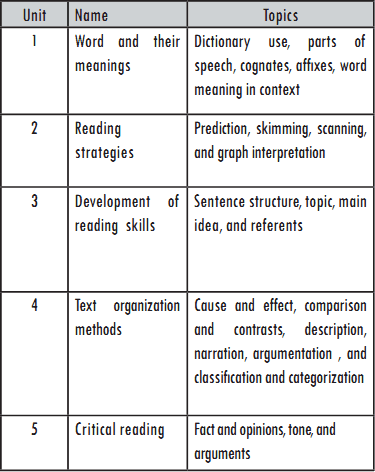
<body><![CDATA[<p><font size="2" face="Verdana, Arial, Helvetica, sans-serif">Each unit had a    thematic name, an objective, a guided map of topics, an introduction, theory    and examples, practice that included exercises and workshops, links for practice,    bibliography and webliography. For the evaluation, each unit was worth 20% and    there was a test in all of them. There were two types of evaluation: automated    and manual. In the first type, the platform MOODLE evaluated the exercises and    the students received the scores and comments instantaneously. In the second    type, the teacher had to evaluate the students' exercises and then he sent a    score with a comment. Due to the low level of English of the students and to    facilitate the learning process, both the teacher and the students used Spanish    to communicate. The course content, readings, examples, and exercises were in    English.</font></p>     <p><font size="2" face="Verdana, Arial, Helvetica, sans-serif">The detailed description    of each unit is:</font></p>     <p>&nbsp;</p>     <p align="center"><font size="2" face="Verdana, Arial, Helvetica, sans-serif"><img src="/img/revistas/ikala/v17n1/v17n1a4t01.gif"></font></p>     <p>&nbsp;</p>     <p><font size="2" face="Verdana, Arial, Helvetica, sans-serif"><b>3.2 Platform    MOODLE</b></font></p>     <p><font size="2" face="Verdana, Arial, Helvetica, sans-serif">MOODLE stands for    Modular Object-Oriented Dynamic Learning Environment. The platform is a free    intuitive, template-based network system that helps teachers to design virtual    courses, teach lessons, assign activities, and assess students' performance.    Ardila and Bedoya (2006) state that this kind of learning environment may help    students to develop skills to self-construct knowledge as the platform offers    many tools to work collaboratively.</font></p>     <p><font size="2" face="Verdana, Arial, Helvetica, sans-serif">Brandl (2005) argues    that the platform involves a constructivist and social constructionist approach    where both teachers and students participate and contribute to interaction in    this educational setting.</font></p>     <p>&nbsp;</p>     <p><font size="3" face="Verdana, Arial, Helvetica, sans-serif"><b>4. METHODOLOGY</b></font></p>     ]]></body>
<body><![CDATA[<p><font size="2" face="Verdana, Arial, Helvetica, sans-serif">This project follows    the methodology of an exploratory multiple case study as we wanted to do a deep    exploration of the web-based distance course using different instruments to    gather data (Creswell, 2007; Merriam, 1998; Tellis, 1997; Yin, 2003). We adopted    the multiple case design because we analyzed real-life events that showed numerous    sources of evidence through replication in the course. We also followed a case    study because it allowed us to analyze personal insights from the teacher and    students as well as data records from the platform MOODLE. We tallied and then    grouped the events of interaction in the different instruments according to    our opinions. We first had an individual reading to consider relevant issues    and then shared our patterns in the research group meetings. We named and coded    issues of interactions and we constructed categories through our discussions    (Freeman, 1998). Then, we analyzed the data according to the existing theory    of interaction and validated our findings.</font></p>     <p><font size="2" face="Verdana, Arial, Helvetica, sans-serif">Finally, participants    signed a consent form stating that their participation was voluntary and their    identity was protected. The form also stated that data gathered were going to    be used for archival purposes.</font></p>     <p>&nbsp;</p>     <p><font size="3" face="Verdana, Arial, Helvetica, sans-serif"><b>5. PARTICIPANTS</b></font></p>     <p><font size="2" face="Verdana, Arial, Helvetica, sans-serif"><b>5.1 The students</b></font></p>     <p><font size="2" face="Verdana, Arial, Helvetica, sans-serif">The course began    with 38 students and only 21 finished the all process. Ages ranged between 23    and 49 years. They were all enrolled in the first semester of a specialization    in Law at Universidad de Antioquia in Medellin (Colombia). All of them had full-time    jobs and most of them lived and worked in Medell&iacute;n where Internet and    connectivity were always available. Some participants lived or worked in municipalities    far from the metropolitan area with problems of connectivity to the Internet.    Some of them did not even have Internet at home, and they had to work on the    web-based virtual course from the office or internet cafes at night or during    the weekends. </font></p>     <p><font size="2" face="Verdana, Arial, Helvetica, sans-serif">Few students had    experience with web-based virtual education. Some expressed they had taken free    virtual courses at SENA. Regarding exposure to language, they expressed they    had only studied English in high school.</font></p>     <p><font size="2" face="Verdana, Arial, Helvetica, sans-serif"><b>5.2 The teacher    </b></font></p>     <p><font size="2" face="Verdana, Arial, Helvetica, sans-serif">The teacher holds    a Master degree in Language Teaching and has a lot of experience teaching face-to-face    EFL reading comprehension courses for both graduate and undergraduate students.    Nevertheless, it was his first experience teaching a web-based reading comprehension    course and he was quite motivated to teach this course. He also had computer    skills and was part of the team who designed the course making him confident    to teach this course.</font></p>     <p>&nbsp;</p>     ]]></body>
<body><![CDATA[<p><font size="3" face="Verdana, Arial, Helvetica, sans-serif"><b>6. DATA COLLECTION    AND ANALYSIS </b></font></p>     <p><font size="2" face="Verdana, Arial, Helvetica, sans-serif">Data presented    here were gathered through questionnaires, observations, in-depth interviews,    a teacher's journal, focus groups, and tools that the platform MOODLE offers.    The purpose of each instrument is explained below:</font></p>     <p><font size="2" face="Verdana, Arial, Helvetica, sans-serif"><b>Questionnaires:    </b>We used four questionnaires to evidence interaction: self-assessment, motivation,    evaluation of the teacher, and the evaluation of the platform MOODLE. Students    ranked their learning process from a scale of 1 to 4 (4 the highest). They also    had to select multiple choice questions in two of the questionnaires and had    to answer some open questions. The objective of these questionnaires was to    ask the students to self-verify the process of learning. We designed all questionnaires.</font></p>     <p><font size="2" face="Verdana, Arial, Helvetica, sans-serif"><b>Observations:    </b>Observation is a technique that allows the researchers to assess issues    such as teaching, behaviors, materials, and interactions (Brown, 1994). We analyzed    the web-based course content, evaluations of each unit, exercises, forums and    chat sessions. We also analyzed the e-mail exchanges that occurred between the    teacher and the students.</font></p>     <p><font size="2" face="Verdana, Arial, Helvetica, sans-serif"><b>In-depth interviews:    </b>We selected two students as key respondents (McNamara, 2009). The one who    obtained the best score and the one who expressed the highest number of difficulties    in the course. The objective to use this technique was to explore deeply issues    such as motivation, improvement in reading comprehension, advantages and disadvantages    of the web-based environment, and students' perceptions about the platform MOODLE.    We audiotaped and transcribed these sessions using regular orthography.</font></p>     <p><font size="2" face="Verdana, Arial, Helvetica, sans-serif"><b>The teacher's    journal:</b> The teacher kept a journal in order to record his observations    as well as reflections along the course (Jeffrey &amp; Hadley, 2002). We analyzed    this instrument to get insights from the teacher.</font></p>     <p><font size="2" face="Verdana, Arial, Helvetica, sans-serif"><b>Focus group:    </b>We asked students to participate in focus group sessions in order to comment    about their learning process during the web-based distance course. Kamberelis    and Dimitriadis (2005) state that this technique helps researchers verify students'    perceptions, opinions, beliefs and attitudes about an issue, in this case, about    the course. We also audiotaped and transcribed these sessions using regular    orthography.</font></p>     <p><font size="2" face="Verdana, Arial, Helvetica, sans-serif"><b>Tools from the    platform MOODLE:</b> We analyzed different issues in the web-based course: the    content, exercises, evaluations, and forums and chat sessions.</font></p>     <p>&nbsp;</p>     <p><font size="3" face="Verdana, Arial, Helvetica, sans-serif"><b>7. FINDINGS</b></font></p>     ]]></body>
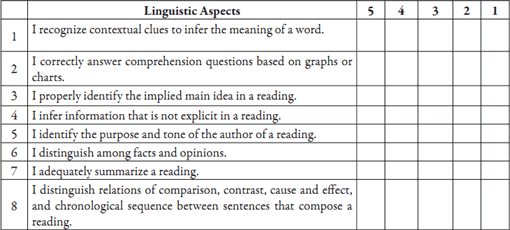
<body><![CDATA[<p><font size="2" face="Verdana, Arial, Helvetica, sans-serif">Based on Moore    (1989), Bouhnik and Marcus (2006) we concentrated our attention on observing    the effects of the four types of interaction identified in this distance web-based    reading foreign language course. The results are the following:</font></p>     <p><font size="2" face="Verdana, Arial, Helvetica, sans-serif"><b>7.1 Interaction    with content:</b></font></p>     <p><font size="2" face="Verdana, Arial, Helvetica, sans-serif">a. Positive effects</font></p>     <p><font size="2" face="Verdana, Arial, Helvetica, sans-serif"><b>Great interaction    and learning</b>: We found that students had a <i>great interaction with the    subject matter of the course</i>. Some of them even supported and verbalized    the positive interaction with the content, one of them expressed in the self-    assessment instrument:</font></p>     <blockquote>        <p><font size="2" face="Verdana, Arial, Helvetica, sans-serif">From the course,      I can tell I learnt a lot and I entrenched many concepts I had forgotten or      that I did not remember very well. Some of the aspects I highlight are: I      find it easier to read texts in English; I enriched my vocabulary; I can read      and interpret graphics with less difficulty; I can identify different kind      of texts; I analyze and take main ideas from texts; it is easier for me the      use of the dictionary and the use of technological resources; I learned a      lot and I am very motivated to keep on studying the language.</font></p> </blockquote>     <p><font size="2" face="Verdana, Arial, Helvetica, sans-serif">Students had to    grade themselves in the self- assessment instrument. The results of the instrument    showed that students improved in the subject matter especially in identifying    the implied main idea, distinguishing facts and opinion, summarizing texts,    and recognizing relations of comparison and contrast, cause and effects, and    time order. Appendix 1 shows the questionnaire in which students had to grade    themselves from 1 to 5 (5 the highest). Nineteen students out of 21 placed themselves    between 5 and 4; this means that they recognized they gained mastery in the    subject matter.</font></p>     <p><font size="2" face="Verdana, Arial, Helvetica, sans-serif"><i>Students also    applied the reading strategies they learnt in foreign language to their daily    reading routines in their mother tongue</i> leading to positive transfer. Odlin    (1989) defines transfer as ''the influence resulting from similarities and differences    between the target language and any other language that has been previously    (and perhaps imperfectly) acquired'' (p. 27). Students applied the reading strategies    to their academic or job duties when they read in their mother tongue and it    is seen as a positive effect. One of the students reported: ''With this course    we learnt a lot for our jobs, to apply those strategies when we have to read    lots of material in Law.''</font></p>     <p><font size="2" face="Verdana, Arial, Helvetica, sans-serif">Students reported    improvement with the subject matter because of the frequent contact they had    with the content. Two hours per day was a key factor for mastering the course    content. Thurmond and Wambach (2004) highlight a continuous contact with the    content as a key factor to gain mastery.</font></p>     <p><font size="2" face="Verdana, Arial, Helvetica, sans-serif">Another source    that showed improvement with the subject matter is the results of evaluation    in each unit, and this is supported by the observations and the diary of the    teacher. The observers and the teacher noticed that students had good scores    along the course especially in Unit 5. The teacher expressed the following in    two entries:</font></p>     ]]></body>
<body><![CDATA[<blockquote>        <p><font size="2" face="Verdana, Arial, Helvetica, sans-serif">Students seemed      to have been doing great with the exercises, I mean they seemed to be understanding      the exercises and therefore they seemed to perform well with the questionnaires.      I haven't seen a single student having bad grades in the exercises or failing      in all their attempts, I have noticed some students having problems with some      exercises, not understanding some instructions or having technical difficulties      with some exercises, but not students performing bad in the course. </font></p>       <p><font size="2" face="Verdana, Arial, Helvetica, sans-serif">Unit 5 had very      interesting issues to reflect about. The first issue is that students' performance      during the exercises in Unit 5 was very good, most of the grades and the exercises      are on 5, I mean most of the exercises had the best grade.</font></p> </blockquote>     <p><font size="2" face="Verdana, Arial, Helvetica, sans-serif">There might be    a connection between performance and scores in reading. When students apply    appropriate application of reading strategies they may obtain good scores. However,    this issue has to be explored deeply in other studies.</font></p>     <p><font size="2" face="Verdana, Arial, Helvetica, sans-serif"><b>b. Negative    effects</b></font></p>     <p><font size="2" face="Verdana, Arial, Helvetica, sans-serif"><b>Too many exercises:</b>    Students reported that the number of exercises they had to do was overwhelming.    One of the students reported in the self-assessment instrument: ''There are    too many questionnaires, and we have to do them all. Nevertheless, it is a sacrifice    but we have to do them; it is a good idea to have fewer exercises and to have    an extension of the deadline.''</font></p>     <p><font size="2" face="Verdana, Arial, Helvetica, sans-serif">The teacher also    reported that it was time consuming to check and correct all the exercises that    needed hand-grading. In fact, he said that he was behind scoring the exercises    due to the amount of these:</font> </p>     <blockquote><font size="2" face="Verdana, Arial, Helvetica, sans-serif">I will    start saying that grading UNIT 2 was hard, because there were so many exercises    to correct and grade. I tried to have exercises corrected so that students could    have a second chance, but it was really hard as students did their exercises    at the last minute. In other words, I found that it was really hard to keep    exercises correction updated.</font></blockquote>     <p><font size="2" face="Verdana, Arial, Helvetica, sans-serif"><b>Time concerns:</b>    Handling time was troublesome for students. Most of them usually left exercises    for the last day of each unit. Some students even asked for more days to complete    the exercises. We validated this negative issue from different sources: students'    self-evaluation, the platform forums and chats, and the teacher's diary and    e-mail. In all these instruments time concern was a constant.</font></p>     <p><font size="2" face="Verdana, Arial, Helvetica, sans-serif"><b>7.2 Interaction    with the instructor: </b></font></p>     ]]></body>
<body><![CDATA[<p><font size="2" face="Verdana, Arial, Helvetica, sans-serif"><b>a. Positive    effects</b></font></p>     <p><font size="2" face="Verdana, Arial, Helvetica, sans-serif">All the instruments    applied support the fact that one of the greatest advantages of this web-based    distance course is that you have an <i>individualized interaction with the teacher</i>.    One of the students expressed in his motivation questionnaire: ''What motivates    me is how direct and personalized the communication is. It is so nice to interact    with the teacher; he is always willing to resolve your concerns.''</font></p>     <p><font size="2" face="Verdana, Arial, Helvetica, sans-serif">Also, <i>the role    of the teacher varied </i>in this modality and researchers categorize his new    role <i>as a technical knowledge expert,</i> (Mu&ntilde;oz &amp; Gonz&aacute;lez,    2010, p. 77). The teacher expressed in his journal that he spent a great deal    of time solving students' basic questions regarding computer configuration.    The teacher reported:</font></p>     <blockquote>        <p><font size="2" face="Verdana, Arial, Helvetica, sans-serif">A very important      reflection I have from this virtual course, it is related to the role of the      teacher in this virtual course. I realized that the teacher not only needs      to be able to help students through content and grade their activities, but      also be able to provide ''technical support'' to students' on the different      issues concerning the platform.</font></p> </blockquote>     <p><font size="2" face="Verdana, Arial, Helvetica, sans-serif">In the evaluation    of the platform questionnaire, one of the students reported: ''The registration    process is a little complicated while you get used to the platform, but the    teacher is an excellent guide.''</font></p>     <p><font size="2" face="Verdana, Arial, Helvetica, sans-serif">Another positive    effect is that students perceived the role of the <i>teacher as an immediate    feedback provider</i> (Mu&ntilde;oz &amp; Gonz&aacute;lez, 2010, p. 78). Students    felt being accompanied by the teacher because he was always <i>there</i> answering    their questions. Although he was not signed in 24 hours a day, the teacher tried    to help students to develop academic, administrative, and technical issues with    the course as much time as he could. One of the students reported in the in-depth    interview: ''I asked the teacher a lot of questions and his answers were always    timely.''</font></p>     <p><font size="2" face="Verdana, Arial, Helvetica, sans-serif"><b>b. Negative    effects </b></font></p>     <p><font size="2" face="Verdana, Arial, Helvetica, sans-serif">Although students    saw the teacher as an immediate feedback provider, their <i>anxiety</i> sometimes    made him seem not that fast, leading to <i>a negative psychological effect</i>.    Students were quite worried when they finished their exercises and the teacher    did not score or correct them right away. One of the students expressed in the    motivation questionnaire: ''Another discouraging situation is that you cannot    get the score of an exercise immediately after sending it when this one requires    review from the teacher, so you have to wait without knowing if you did it right    or wrong.''</font></p>     <p><font size="2" face="Verdana, Arial, Helvetica, sans-serif">Also, the teacher    noticed this kind of anxiety in his students. He commented on this issue in    one of his entries in the diary: ''Students seemed to be very worried when they    finished an exercise and they did not find an automatic grade.''</font></p>     ]]></body>
<body><![CDATA[<p><font size="2" face="Verdana, Arial, Helvetica, sans-serif">When correcting    or grading students' exercises, the teacher did not give deep feedback in the    platform, leading to limited feedback. The amount of exercises may explain why    he gave limited feedback. The teacher was behind correcting the exercises and    usually could not give specific academic reasons to students. He wrote comments    like these in the exercises: ''Not a good answer.... not very well explained!    Not a good main idea! Not a good answer... you did not understand the exercise!''</font></p>     <p><font size="2" face="Verdana, Arial, Helvetica, sans-serif"><b>7.3 Interaction    with the students:</b></font></p>     <p><font size="2" face="Verdana, Arial, Helvetica, sans-serif">We observed that    <i>this interaction was the weakest</i> among the four types and there are two    main reasons that support the lack of interaction among students:</font></p>     <p><font size="2" face="Verdana, Arial, Helvetica, sans-serif"><i>Students worried    about making mistakes in public or felt that their level of English was lower    </i>than their peers and therefore interaction among students was weak. Mu&ntilde;oz    and Gonz&aacute;lez (2010, p. 79), Boling (2008, p. 93) argue that learners    do not want to be judged by peers or teachers and so avoid participation. As    an example of this, the teacher wrote in his diary:</font> </p>     <blockquote><font size="2" face="Verdana, Arial, Helvetica, sans-serif">Students    had to introduce themselves to the course and some of the people in this presentation    did the presentation in English, some students did not feel capable of doing    the presentation in English, so they did not do it or they did it in Spanish    with a single sentence... they were surprised to see how their classmates were    so advanced with the language. I noticed how this was one of the reasons for    students not to participate in the course.</font></blockquote>     <p><font size="2" face="Verdana, Arial, Helvetica, sans-serif"><i>The lack of    expertise of the teacher</i>: Although the teacher had experience teaching face-to-face    reading comprehension courses in FL he was a novice teaching web-based distance    courses. We analyzed all the instruments and we noticed that the teacher almost    never prompted interaction among students. He thought that the lack of interaction    among students was a matter of their attitude. The teacher expressed this feeling    in two diary entries:</font></p>     <blockquote>        <p><font size="2" face="Verdana, Arial, Helvetica, sans-serif">I have the feeling      virtual students are not quite willing to participate; they are more concerned      on completing the exercises and finishing their activities.</font></p> </blockquote>     <p><font size="2" face="Verdana, Arial, Helvetica, sans-serif">and</font></p>     <blockquote><font size="2" face="Verdana, Arial, Helvetica, sans-serif">I really    believe students could use the forum, the chats or the e-mails for asking about    any doubt they could have; however students did not bother.</font></blockquote>     ]]></body>
<body><![CDATA[<p><font size="2" face="Verdana, Arial, Helvetica, sans-serif">Nevertheless, we    took a closer look at this and noticed that the teacher did not activate academic    participation among students such as group work or pair work. He only asked    the students to participate in chats in order to talk about general things about    the course: technical problems, feelings, evaluation, deadlines and so on. This    is important but the call for interaction among students is a must. Collison,    Elbaum, Haavind and Tinker (2000) argue that teachers have to use conversational    techniques in order to deepen academic dialogues among students. Muirhead (2005)    support that online teachers have to involve students in an interaction level    that fosters the instruction for individuals and student groups. </font></p>     <p><font size="2" face="Verdana, Arial, Helvetica, sans-serif"><b>7.4 Interaction    with the system</b></font></p>     <p><font size="2" face="Verdana, Arial, Helvetica, sans-serif"><b>a. Positive    effects</b></font></p>     <p><font size="2" face="Verdana, Arial, Helvetica, sans-serif">Some students argued    that the platform MOODLE has a <i>friendly environment</i> leading to work in    an easy manner. One of the students expressed in the course evaluation: ''I    think the platform is excellent, fast, fresh, and friendly.'' </font></p>     <p><font size="2" face="Verdana, Arial, Helvetica, sans-serif">Also, students    argued that they felt motivated due to the <i>different tools</i> the platform    offered. One of the students supported this in the motivation questionnaire:    ''Something that motivates me is that this course is updated with many tools    to take advantage of.''</font></p>     <p><font size="2" face="Verdana, Arial, Helvetica, sans-serif">Another positive    effect about the platform was its <i>availability</i>. The platform MOODLE was    always available for students and they could work at any time or place leading    them to economize time, money, handle family, work and study at the same time.    The following quotations taken from the self-assessment instrument support this    positive effect:</font></p>     <blockquote>        <p><font size="2" face="Verdana, Arial, Helvetica, sans-serif">Working from      home allowed me to dedicate enough time to my academic activities without      leaving my family aside. Also, It was nice to experiment another way of studying      different from the face-to-face one, and that allows us to use different ways      to solve our doubts without being dependent on the teacher. </font></p>       <p><font size="2" face="Verdana, Arial, Helvetica, sans-serif">It also allowed      me to optimize my time, to save money and to do all the activities I have      to do as a mom and a housewife, without leaving aside my work and academic      responsibilities.</font></p> </blockquote>     <p><font size="2" face="Verdana, Arial, Helvetica, sans-serif"><b>b. Negative    effects</b></font></p>     ]]></body>
<body><![CDATA[<p><font size="2" face="Verdana, Arial, Helvetica, sans-serif">On the other hand,    some students complained about <i>having trouble with the platform</i> MOODLE.    The main concerns were registering into the platform, using some tools, and    the automatic evaluation without being corrected by the teacher. </font></p>     <p><font size="2" face="Verdana, Arial, Helvetica, sans-serif">Also, students    noticed that the platform MOODLE was not that reliable because they followed    instructions such as highlighting words, cutting and pasting sentences but the    platform sometimes did not recognize some actions. One of the students expressed    in the focus group:</font></p>     <blockquote>        <p><font size="2" face="Verdana, Arial, Helvetica, sans-serif">In one of the      evaluations we had to underline some words and highlight some others with      different colors. I did the whole exercise and I sent it, but the platform      did not recognize it and obviously my grade was zero. I had to use my second      chance to do all the work I had already done.</font></p> </blockquote>     <p><font size="2" face="Verdana, Arial, Helvetica, sans-serif">Another negative    effect was about guiding students to use the platform. Both the platform and    the course designers did not offer a <i>tutorial guide</i> regarding the use    of the platform for students. This issue caused negative effects on the process    of learning; they learnt some things by ''learning by doing.'' They did not    get any information about how to use the platform, the requirements regarding    equipment or the basics for using Office. One of the students expressed in the    evaluation of the course: ''I think the explanation about how to complete the    exercises could be more complete. At the beginning I had some difficulties,    but at the end it was noticeable that some classmates did not know how to answer    some exercises.''</font></p>     <p>&nbsp;</p>     <p><font size="3" face="Verdana, Arial, Helvetica, sans-serif"><b>8. CONCLUSIONS    </b></font></p>     <p><font size="2" face="Verdana, Arial, Helvetica, sans-serif">Interaction in    general plays an important role in web-based distance education. In this article,    we have explored the positive and negative effects of the four kinds of interactions    presented by Moore (1989), Bouhnik and Marcus (2006). Regarding positive effects    we found that language improvement, positive transfer, individualized guide,    friendly environment with the system, and a different role of the teacher are    the most outstanding ones. Regarding negative effects we outline some considerations    for improvement:</font></p>     <p><font size="2" face="Verdana, Arial, Helvetica, sans-serif">The first observation    we make regarding the first interaction (interaction with content) is that the    teacher or designers have to balance the amount of exercises. This is hard to    control but a moderate number of exercises have to be established. The observation    of the teacher and the comments of the students may work as a guide to establish    the number of exercises.</font></p>     <p><font size="2" face="Verdana, Arial, Helvetica, sans-serif">The second observation    is connected with the interaction with the teacher. In this modality the role    of the teacher is not only guiding the students with the content but also guiding    technical issues. Teachers have to be available to answer technical issues when    students face difficulties. On the other hand, the teacher has to give deeper    feedback when she/he answers or corrects students' exercises. If these two issues    are taken into account students may lessen their anxiety, thus avoiding a negative    psychological effect.</font></p>     ]]></body>
<body><![CDATA[<p><font size="2" face="Verdana, Arial, Helvetica, sans-serif">We found that the    interaction with the students was the weakest. The role of the teacher is crucial    to avoid this lack of interaction. The teacher has to be creative in asking    genuine questions or finding strategies about the subject matter and then involve    students in forums or chats in order to have an academic dialogue. Also, the    teacher has to ask students to work in pairs or groups when she/he assigns and    then gives a call for co-learning. Finally, when the teacher calls on students    to participate among themselves, the feeling of isolation lessens and the sense    of community arises.</font></p>     <p><font size="2" face="Verdana, Arial, Helvetica, sans-serif">Finally, in the    interaction with the system, it is very important to have a tutorial in order    to guide students through the use of the platform and the subject matter. This    tutorial may also lessen students' anxiety. The tutorial should guide them through    the whole registration process and will give them the basic information they    need to begin working on the course.</font></p>     <p>&nbsp;</p>     <p><font size="3" face="Verdana, Arial, Helvetica, sans-serif"><b>REFERENCES</b></font></p>     <!-- ref --><p><font size="2" face="Verdana, Arial, Helvetica, sans-serif">1. Aebersold, J.,    &amp; Field, M. (1997). <i>From reader to reading teacher</i>. Cambridge, England:    Cambridge University Press. </font>&nbsp;&nbsp;&nbsp;&nbsp;&nbsp;&nbsp;&nbsp;&nbsp;[&#160;<a href="javascript:void(0);" onclick="javascript: window.open('/scielo.php?script=sci_nlinks&ref=000167&pid=S0123-3432201200010000400001&lng=','','width=640,height=500,resizable=yes,scrollbars=1,menubar=yes,');">Links</a>&#160;]<!-- end-ref --><!-- ref --><p><font size="2" face="Verdana, Arial, Helvetica, sans-serif">2. Alyousef, H.    (2005). Teaching reading comprehension to ESL/EFL Learners. <i>The Reading Matrix,</i>    5(2), 143-154. </font>&nbsp;&nbsp;&nbsp;&nbsp;&nbsp;&nbsp;&nbsp;&nbsp;[&#160;<a href="javascript:void(0);" onclick="javascript: window.open('/scielo.php?script=sci_nlinks&ref=000168&pid=S0123-3432201200010000400002&lng=','','width=640,height=500,resizable=yes,scrollbars=1,menubar=yes,');">Links</a>&#160;]<!-- end-ref --><!-- ref --><p><font size="2" face="Verdana, Arial, Helvetica, sans-serif">3. Andrade, M.,    &amp; Bunker, E. (2009). A model for self- regulated distance language learning.    <i>Distance Education,</i> 30(1), 47-61. </font>&nbsp;&nbsp;&nbsp;&nbsp;&nbsp;&nbsp;&nbsp;&nbsp;[&#160;<a href="javascript:void(0);" onclick="javascript: window.open('/scielo.php?script=sci_nlinks&ref=000169&pid=S0123-3432201200010000400003&lng=','','width=640,height=500,resizable=yes,scrollbars=1,menubar=yes,');">Links</a>&#160;]<!-- end-ref --><!-- ref --><p><font size="2" face="Verdana, Arial, Helvetica, sans-serif">4. Ardila, M.,    &amp; Bedoya, J. (2006). La inclusi&oacute;n de la plataforma de aprendizaje    en l&iacute;nea MOODLE en un curso de gram&aacute;tica contrastiva espa&ntilde;ol-ingl&eacute;s.<i>    &Iacute;kala, revista de lenguaje y cultura</i>, 11(17), 181-205. </font>&nbsp;&nbsp;&nbsp;&nbsp;&nbsp;&nbsp;&nbsp;&nbsp;[&#160;<a href="javascript:void(0);" onclick="javascript: window.open('/scielo.php?script=sci_nlinks&ref=000170&pid=S0123-3432201200010000400004&lng=','','width=640,height=500,resizable=yes,scrollbars=1,menubar=yes,');">Links</a>&#160;]<!-- end-ref --><!-- ref --><p><font size="2" face="Verdana, Arial, Helvetica, sans-serif">5. Arn&oacute;,    E., Rueda, C., Soler, A., &amp; Barahona, C. (2004). Developing learner autonomy    through a virtual EAP course at university. <i>English Language and&nbsp; Literature    Studies</i>, 12. Retrieved from <a href="http://www.publicacions.ub.edu/revistes/bells12/articulos.asp?codart=30" target="_blank">http://www.publicacions.ub.edu/revistes/bells12/articulos.asp?codart=30</a>    </font>&nbsp;&nbsp;&nbsp;&nbsp;&nbsp;&nbsp;&nbsp;&nbsp;[&#160;<a href="javascript:void(0);" onclick="javascript: window.open('/scielo.php?script=sci_nlinks&ref=000171&pid=S0123-3432201200010000400005&lng=','','width=640,height=500,resizable=yes,scrollbars=1,menubar=yes,');">Links</a>&#160;]<!-- end-ref --><!-- ref --><p><font size="2" face="Verdana, Arial, Helvetica, sans-serif">6. Block, E. (1986).    The comprehension strategies of second language readers. <i>TESOL Quarterly</i>,    20, 463-494. </font>&nbsp;&nbsp;&nbsp;&nbsp;&nbsp;&nbsp;&nbsp;&nbsp;[&#160;<a href="javascript:void(0);" onclick="javascript: window.open('/scielo.php?script=sci_nlinks&ref=000172&pid=S0123-3432201200010000400006&lng=','','width=640,height=500,resizable=yes,scrollbars=1,menubar=yes,');">Links</a>&#160;]<!-- end-ref --><!-- ref --><p><font size="2" face="Verdana, Arial, Helvetica, sans-serif">7. Boling, E. (2008).    Learning from teachers' conceptions of technology integration: What do blogs,    instant messages, and 3D chat rooms have to do with it? <i>Research in the Teaching    of English</i>, 43(1), 74-100. </font>&nbsp;&nbsp;&nbsp;&nbsp;&nbsp;&nbsp;&nbsp;&nbsp;[&#160;<a href="javascript:void(0);" onclick="javascript: window.open('/scielo.php?script=sci_nlinks&ref=000173&pid=S0123-3432201200010000400007&lng=','','width=640,height=500,resizable=yes,scrollbars=1,menubar=yes,');">Links</a>&#160;]<!-- end-ref --><!-- ref --><p><font size="2" face="Verdana, Arial, Helvetica, sans-serif">8. Bonk, C. (2001).    <i>Online teaching in an online world</i>. Retrieved from <a href="http://php.indiana.edu/~cjbonk/faculty_survey_report.pdf" target="_blank">http://php.indiana.edu/~cjbonk/faculty_survey_report.pdf    </a></font>&nbsp;&nbsp;&nbsp;&nbsp;&nbsp;&nbsp;&nbsp;&nbsp;[&#160;<a href="javascript:void(0);" onclick="javascript: window.open('/scielo.php?script=sci_nlinks&ref=000174&pid=S0123-3432201200010000400008&lng=','','width=640,height=500,resizable=yes,scrollbars=1,menubar=yes,');">Links</a>&#160;]<!-- end-ref --><!-- ref --><p><font size="2" face="Verdana, Arial, Helvetica, sans-serif">9. Bouhnik, D.,    &amp; Marcus, T. (2006). Interaction in distance- learning courses. <i>Journal    of the American Society for Information Science and Technology</i>, 57(3), 299&#8211;305.    </font>&nbsp;&nbsp;&nbsp;&nbsp;&nbsp;&nbsp;&nbsp;&nbsp;[&#160;<a href="javascript:void(0);" onclick="javascript: window.open('/scielo.php?script=sci_nlinks&ref=000175&pid=S0123-3432201200010000400009&lng=','','width=640,height=500,resizable=yes,scrollbars=1,menubar=yes,');">Links</a>&#160;]<!-- end-ref --><!-- ref --><p><font size="2" face="Verdana, Arial, Helvetica, sans-serif">10. Brandl, K.    (2005). <i>Are you ready to ''MOODLE''?</i> Retrieved from <a href="http://llt.msu.edu/vol9num2/review1/review1.htm" target="_blank">http://llt.msu.edu/vol9num2/review1/review1.htm</a></font>&nbsp;&nbsp;&nbsp;&nbsp;&nbsp;&nbsp;&nbsp;&nbsp;[&#160;<a href="javascript:void(0);" onclick="javascript: window.open('/scielo.php?script=sci_nlinks&ref=000176&pid=S0123-3432201200010000400010&lng=','','width=640,height=500,resizable=yes,scrollbars=1,menubar=yes,');">Links</a>&#160;]<!-- end-ref --><!-- ref --><p><font size="2" face="Verdana, Arial, Helvetica, sans-serif">11. Brown, D. (1994).    <i>Teaching by principles</i>. New Jersey, NJ: Prentice Hall Regents.</font>&nbsp;&nbsp;&nbsp;&nbsp;&nbsp;&nbsp;&nbsp;&nbsp;[&#160;<a href="javascript:void(0);" onclick="javascript: window.open('/scielo.php?script=sci_nlinks&ref=000177&pid=S0123-3432201200010000400011&lng=','','width=640,height=500,resizable=yes,scrollbars=1,menubar=yes,');">Links</a>&#160;]<!-- end-ref --><!-- ref --><p><font size="2" face="Verdana, Arial, Helvetica, sans-serif"> 12. Carswell,    A., &amp; Venkatesh, V. (2002). Learners outcome and asynchronous distance education    environment. <i>International Journal of Human Computer Studies</i>, 56, 475-494.    </font>&nbsp;&nbsp;&nbsp;&nbsp;&nbsp;&nbsp;&nbsp;&nbsp;[&#160;<a href="javascript:void(0);" onclick="javascript: window.open('/scielo.php?script=sci_nlinks&ref=000178&pid=S0123-3432201200010000400012&lng=','','width=640,height=500,resizable=yes,scrollbars=1,menubar=yes,');">Links</a>&#160;]<!-- end-ref --><!-- ref --><p><font size="2" face="Verdana, Arial, Helvetica, sans-serif">13. Cassany, D.    (2006). <i>Tras las l&iacute;neas</i>. Barcelona, Spain: Editorial Anagrama.</font>&nbsp;&nbsp;&nbsp;&nbsp;&nbsp;&nbsp;&nbsp;&nbsp;[&#160;<a href="javascript:void(0);" onclick="javascript: window.open('/scielo.php?script=sci_nlinks&ref=000179&pid=S0123-3432201200010000400013&lng=','','width=640,height=500,resizable=yes,scrollbars=1,menubar=yes,');">Links</a>&#160;]<!-- end-ref --><!-- ref --><p><font size="2" face="Verdana, Arial, Helvetica, sans-serif"> 14. Cohen, A.    (1990). <i>Language learning: Insights for learners, teachers, and researchers</i>.    New York, NY: Newbury House. </font>&nbsp;&nbsp;&nbsp;&nbsp;&nbsp;&nbsp;&nbsp;&nbsp;[&#160;<a href="javascript:void(0);" onclick="javascript: window.open('/scielo.php?script=sci_nlinks&ref=000180&pid=S0123-3432201200010000400014&lng=','','width=640,height=500,resizable=yes,scrollbars=1,menubar=yes,');">Links</a>&#160;]<!-- end-ref --><!-- ref --><p><font size="2" face="Verdana, Arial, Helvetica, sans-serif">15. Collison, G.,    Elbaum, B., Haavind, S., &amp; Tinker, R. (2000). <i>Facilitating online learning.    Effective strategies for moderators</i>. Madison, WI: Atwood Publishing. </font>&nbsp;&nbsp;&nbsp;&nbsp;&nbsp;&nbsp;&nbsp;&nbsp;[&#160;<a href="javascript:void(0);" onclick="javascript: window.open('/scielo.php?script=sci_nlinks&ref=000181&pid=S0123-3432201200010000400015&lng=','','width=640,height=500,resizable=yes,scrollbars=1,menubar=yes,');">Links</a>&#160;]<!-- end-ref --><!-- ref --><p><font size="2" face="Verdana, Arial, Helvetica, sans-serif">16. Creswell, J.    (2007). <i>Qualitative inquiry and research design: Choosing among five approaches</i>    (2nd edition). Thousand Oaks, CA: Sage Publications. </font>&nbsp;&nbsp;&nbsp;&nbsp;&nbsp;&nbsp;&nbsp;&nbsp;[&#160;<a href="javascript:void(0);" onclick="javascript: window.open('/scielo.php?script=sci_nlinks&ref=000182&pid=S0123-3432201200010000400016&lng=','','width=640,height=500,resizable=yes,scrollbars=1,menubar=yes,');">Links</a>&#160;]<!-- end-ref --><!-- ref --><p><font size="2" face="Verdana, Arial, Helvetica, sans-serif">17. Dubin, F.,    &amp; Bycina, D. (1984). Academic reading and the ESL/EFL teacher. In Celce-Murcia,    M. <i>Teaching English as a second or foreign language </i>(pp. 195-216). Boston, MA:    Heinle &amp; Heinle Publishers.</font>&nbsp;&nbsp;&nbsp;&nbsp;&nbsp;&nbsp;&nbsp;&nbsp;[&#160;<a href="javascript:void(0);" onclick="javascript: window.open('/scielo.php?script=sci_nlinks&ref=000183&pid=S0123-3432201200010000400017&lng=','','width=640,height=500,resizable=yes,scrollbars=1,menubar=yes,');">Links</a>&#160;]<!-- end-ref --><!-- ref --><p><font size="2" face="Verdana, Arial, Helvetica, sans-serif">18. Dutton, J., &amp; Perry, J. (2002). How do online    students differ from lecture students? <i>Journal of Management Information  Systems</i>, 18(4), 169&#8211;190. </font>&nbsp;&nbsp;&nbsp;&nbsp;&nbsp;&nbsp;&nbsp;&nbsp;[&#160;<a href="javascript:void(0);" onclick="javascript: window.open('/scielo.php?script=sci_nlinks&ref=000184&pid=S0123-3432201200010000400018&lng=','','width=640,height=500,resizable=yes,scrollbars=1,menubar=yes,');">Links</a>&#160;]<!-- end-ref --><!-- ref --><p><font size="2" face="Verdana, Arial, Helvetica, sans-serif">19. Freeman, D.    (1998). <i>Doing teacher research: From inquiry to understanding</i>. Boston,    MA: Newbury House. </font>&nbsp;&nbsp;&nbsp;&nbsp;&nbsp;&nbsp;&nbsp;&nbsp;[&#160;<a href="javascript:void(0);" onclick="javascript: window.open('/scielo.php?script=sci_nlinks&ref=000185&pid=S0123-3432201200010000400019&lng=','','width=640,height=500,resizable=yes,scrollbars=1,menubar=yes,');">Links</a>&#160;]<!-- end-ref --><!-- ref --><p><font size="2" face="Verdana, Arial, Helvetica, sans-serif">20. Gonz&aacute;lez,    M. (2000). La habilidad de la lectura: sus implicaciones en la ense&ntilde;anza    del ingl&eacute;s como lengua extranjera o como segunda lengua. <i>Revista de    Ciencias Humanas</i>, 19. Retrieved from <a href="http://www.utp.edu.co/~chumanas/revistas/revistas/rev19/gonzalez.htm" target="_blank">http://www.utp.edu.co/~chumanas/revistas/revistas/rev19/gonzalez.htm</a>    </font>&nbsp;&nbsp;&nbsp;&nbsp;&nbsp;&nbsp;&nbsp;&nbsp;[&#160;<a href="javascript:void(0);" onclick="javascript: window.open('/scielo.php?script=sci_nlinks&ref=000186&pid=S0123-3432201200010000400020&lng=','','width=640,height=500,resizable=yes,scrollbars=1,menubar=yes,');">Links</a>&#160;]<!-- end-ref --><!-- ref --><p><font size="2" face="Verdana, Arial, Helvetica, sans-serif">21. Goodyear, P.,    Salmon, G., Spector, J., Steeples, C., &amp; Tickner, S. (2001). Competencies    for online teaching: a special report. <i>Educational Technology Research and    Development</i>, 49(1), 65-72</font>&nbsp;&nbsp;&nbsp;&nbsp;&nbsp;&nbsp;&nbsp;&nbsp;[&#160;<a href="javascript:void(0);" onclick="javascript: window.open('/scielo.php?script=sci_nlinks&ref=000187&pid=S0123-3432201200010000400021&lng=','','width=640,height=500,resizable=yes,scrollbars=1,menubar=yes,');">Links</a>&#160;]<!-- end-ref --><!-- ref --><p><font size="2" face="Verdana, Arial, Helvetica, sans-serif">22. Grabe, W.,    &amp; Stoller, F. (2002). Teaching and researching reading. London, England:    Pearson Education. </font>&nbsp;&nbsp;&nbsp;&nbsp;&nbsp;&nbsp;&nbsp;&nbsp;[&#160;<a href="javascript:void(0);" onclick="javascript: window.open('/scielo.php?script=sci_nlinks&ref=000188&pid=S0123-3432201200010000400022&lng=','','width=640,height=500,resizable=yes,scrollbars=1,menubar=yes,');">Links</a>&#160;]<!-- end-ref --><!-- ref --><p><font size="2" face="Verdana, Arial, Helvetica, sans-serif">23. Hara, N., &amp;    Kling, R. (2003). Students' distress with a web- based distance education course:    An ethnographic study of participants' experiences. <i>Turkish Online Journal    of Distance Education-TOJDE</i>, 4(2). Retrieved from <a href="http://tojde.anadolu.edu.tr/tojde10/articles/hara.htm" target="_blank">http://tojde.anadolu.edu.tr/tojde10/articles/hara.htm    </a></font>&nbsp;&nbsp;&nbsp;&nbsp;&nbsp;&nbsp;&nbsp;&nbsp;[&#160;<a href="javascript:void(0);" onclick="javascript: window.open('/scielo.php?script=sci_nlinks&ref=000189&pid=S0123-3432201200010000400023&lng=','','width=640,height=500,resizable=yes,scrollbars=1,menubar=yes,');">Links</a>&#160;]<!-- end-ref --><!-- ref --><p><font size="2" face="Verdana, Arial, Helvetica, sans-serif">24. Harasim, L.    (1986). Computer learning networks: Educational applications of computer conferencing.    <i>Journal of Distance Education</i>, 1(1), 59-70. </font>&nbsp;&nbsp;&nbsp;&nbsp;&nbsp;&nbsp;&nbsp;&nbsp;[&#160;<a href="javascript:void(0);" onclick="javascript: window.open('/scielo.php?script=sci_nlinks&ref=000190&pid=S0123-3432201200010000400024&lng=','','width=640,height=500,resizable=yes,scrollbars=1,menubar=yes,');">Links</a>&#160;]<!-- end-ref --><!-- ref --><p><font size="2" face="Verdana, Arial, Helvetica, sans-serif">25. Jeffrey, D.,    &amp; Hadley, G. (2002). Balancing intuition with insight: Reflective teaching    through diary studies. <i>The Language Teacher Online</i>, 26(5). Retrieved    from <a href="http://www.jaltpublications.org/tlt/articles/2002/05/jeffrey" target="_blank">http://www.jaltpublications.org/tlt/articles/2002/05/jeffrey</a>    </font>&nbsp;&nbsp;&nbsp;&nbsp;&nbsp;&nbsp;&nbsp;&nbsp;[&#160;<a href="javascript:void(0);" onclick="javascript: window.open('/scielo.php?script=sci_nlinks&ref=000191&pid=S0123-3432201200010000400025&lng=','','width=640,height=500,resizable=yes,scrollbars=1,menubar=yes,');">Links</a>&#160;]<!-- end-ref --><!-- ref --><p><font size="2" face="Verdana, Arial, Helvetica, sans-serif">26. Jonassen, D.,    &amp; Kwon, H. (2001). Communication patterns in computer mediated versus face-to-face    group problem solving. <i>Educational Technology Research and Development</i>,    49(1), 35&#8211;51.</font>&nbsp;&nbsp;&nbsp;&nbsp;&nbsp;&nbsp;&nbsp;&nbsp;[&#160;<a href="javascript:void(0);" onclick="javascript: window.open('/scielo.php?script=sci_nlinks&ref=000192&pid=S0123-3432201200010000400026&lng=','','width=640,height=500,resizable=yes,scrollbars=1,menubar=yes,');">Links</a>&#160;]<!-- end-ref --><!-- ref --><p><font size="2" face="Verdana, Arial, Helvetica, sans-serif"> 27. Kamberelis,    G., &amp; Dimitriadis, G. (2005). Focus groups: Strategic articulations of pedagogy,    politics and inquiry. In Denzin, N. &amp; Lincoln, Y. (Eds.).<i> The sage handbook    of qualitative research </i>(3rd edition) (pp. 887-907). Thousand Oaks, CA:    SAGE Publications. </font>&nbsp;&nbsp;&nbsp;&nbsp;&nbsp;&nbsp;&nbsp;&nbsp;[&#160;<a href="javascript:void(0);" onclick="javascript: window.open('/scielo.php?script=sci_nlinks&ref=000193&pid=S0123-3432201200010000400027&lng=','','width=640,height=500,resizable=yes,scrollbars=1,menubar=yes,');">Links</a>&#160;]<!-- end-ref --><!-- ref --><p><font size="2" face="Verdana, Arial, Helvetica, sans-serif">28. Kember, D.,    Lai, T., &amp; Murphy, D. (1994). Student progress in distance education courses:    A replication study. <i>Adult Education Quarterly</i>, 45(1), 286&#8211;301.    </font>&nbsp;&nbsp;&nbsp;&nbsp;&nbsp;&nbsp;&nbsp;&nbsp;[&#160;<a href="javascript:void(0);" onclick="javascript: window.open('/scielo.php?script=sci_nlinks&ref=000194&pid=S0123-3432201200010000400028&lng=','','width=640,height=500,resizable=yes,scrollbars=1,menubar=yes,');">Links</a>&#160;]<!-- end-ref --><!-- ref --><p><font size="2" face="Verdana, Arial, Helvetica, sans-serif">29. Kiriakidis,    P. (2008). Online learner satisfaction: Learner- instructor discourse. <i>College    Teaching Methods and &amp; Styles Journal</i>, 4(1), 11-18. </font>&nbsp;&nbsp;&nbsp;&nbsp;&nbsp;&nbsp;&nbsp;&nbsp;[&#160;<a href="javascript:void(0);" onclick="javascript: window.open('/scielo.php?script=sci_nlinks&ref=000195&pid=S0123-3432201200010000400029&lng=','','width=640,height=500,resizable=yes,scrollbars=1,menubar=yes,');">Links</a>&#160;]<!-- end-ref --><!-- ref --><p><font size="2" face="Verdana, Arial, Helvetica, sans-serif">30. Klemm, W.,    &amp; Snell, J. (1996). Enriching computer- mediated group learning by coupling    constructivism with collaborative learning. <i>Journal of Instructional Science    and Technology</i>, 57(3), 299-305. </font>&nbsp;&nbsp;&nbsp;&nbsp;&nbsp;&nbsp;&nbsp;&nbsp;[&#160;<a href="javascript:void(0);" onclick="javascript: window.open('/scielo.php?script=sci_nlinks&ref=000196&pid=S0123-3432201200010000400030&lng=','','width=640,height=500,resizable=yes,scrollbars=1,menubar=yes,');">Links</a>&#160;]<!-- end-ref --><!-- ref --><p><font size="2" face="Verdana, Arial, Helvetica, sans-serif">31. Lai, K. (1997).    Computer mediated communication for teenage students: A content analysis of    a student messaging system.<i> Education and Information Technologies</i>, 2,    31&#8211;45. </font>&nbsp;&nbsp;&nbsp;&nbsp;&nbsp;&nbsp;&nbsp;&nbsp;[&#160;<a href="javascript:void(0);" onclick="javascript: window.open('/scielo.php?script=sci_nlinks&ref=000197&pid=S0123-3432201200010000400031&lng=','','width=640,height=500,resizable=yes,scrollbars=1,menubar=yes,');">Links</a>&#160;]<!-- end-ref --><!-- ref --><p><font size="2" face="Verdana, Arial, Helvetica, sans-serif">32. Lavooy, M.,    &amp; Newlin, M. (2008). Online chats and cyber- office hours: Everything but    the office.<i> International Journal of E-Learning</i>, 7(1), 107-116. </font>&nbsp;&nbsp;&nbsp;&nbsp;&nbsp;&nbsp;&nbsp;&nbsp;[&#160;<a href="javascript:void(0);" onclick="javascript: window.open('/scielo.php?script=sci_nlinks&ref=000198&pid=S0123-3432201200010000400032&lng=','','width=640,height=500,resizable=yes,scrollbars=1,menubar=yes,');">Links</a>&#160;]<!-- end-ref --><!-- ref --><p><font size="2" face="Verdana, Arial, Helvetica, sans-serif">33. Leu,    D. Jr. (1997). Internet en    el aula: nuevas oportunidades para la educaci&oacute;n, el aprendizaje y la    ense&ntilde;anza. In Fundalectura (ed.), <i>Lectura y Nuevas Tecnolog&iacute;as.    3er Congreso Nacional de Lectura </i>(pp. 47-68). Bogot&aacute;, Colombia: Fundaci&oacute;n    para el Fomento de la Lectura.</font>&nbsp;&nbsp;&nbsp;&nbsp;&nbsp;&nbsp;&nbsp;&nbsp;[&#160;<a href="javascript:void(0);" onclick="javascript: window.open('/scielo.php?script=sci_nlinks&ref=000199&pid=S0123-3432201200010000400033&lng=','','width=640,height=500,resizable=yes,scrollbars=1,menubar=yes,');">Links</a>&#160;]<!-- end-ref --><!-- ref --><p><font size="2" face="Verdana, Arial, Helvetica, sans-serif">34. Leu, D., &amp;    Kinzer, C. (2000). The convergence of literacy instruction with networked technologies    for information and communication. <i>Reading Research Quarterly</i>, 35, 108-127.    </font>&nbsp;&nbsp;&nbsp;&nbsp;&nbsp;&nbsp;&nbsp;&nbsp;[&#160;<a href="javascript:void(0);" onclick="javascript: window.open('/scielo.php?script=sci_nlinks&ref=000200&pid=S0123-3432201200010000400034&lng=','','width=640,height=500,resizable=yes,scrollbars=1,menubar=yes,');">Links</a>&#160;]<!-- end-ref --><!-- ref --><p><font size="2" face="Verdana, Arial, Helvetica, sans-serif">35. Leu, D., Kinzer,    C., Coiro, J., &amp; Cammack, D. (2004). Toward a theory of new literacies emerging    from the Internet and other information and communication technologies. In Ruddell,    R., &amp; Unrau, N. (Eds.), <i>Theoretical models and processes of reading</i>    (5th edition) (pp.1570-1613). Newark, DE: International Reading Association.    </font>&nbsp;&nbsp;&nbsp;&nbsp;&nbsp;&nbsp;&nbsp;&nbsp;[&#160;<a href="javascript:void(0);" onclick="javascript: window.open('/scielo.php?script=sci_nlinks&ref=000201&pid=S0123-3432201200010000400035&lng=','','width=640,height=500,resizable=yes,scrollbars=1,menubar=yes,');">Links</a>&#160;]<!-- end-ref --><!-- ref --><p><font size="2" face="Verdana, Arial, Helvetica, sans-serif">36. Marcus, T.    (2003). <i>Communication, technology and education-The role of the discussion    group in asynchronic distance learning courses as a beneficial factor in the    learning process</i> (Unpublished master's thesis). </font><font size="2" face="Verdana, Arial, Helvetica, sans-serif">Bar-Ilan University,    Ramat Gan, Israel.</font>&nbsp;&nbsp;&nbsp;&nbsp;&nbsp;&nbsp;&nbsp;&nbsp;[&#160;<a href="javascript:void(0);" onclick="javascript: window.open('/scielo.php?script=sci_nlinks&ref=000202&pid=S0123-3432201200010000400036&lng=','','width=640,height=500,resizable=yes,scrollbars=1,menubar=yes,');">Links</a>&#160;]<!-- end-ref --><!-- ref --><p><font size="2" face="Verdana, Arial, Helvetica, sans-serif">37.  McNamara, C. (2009). <i>General guidelines for conducting    interviews</i>. Retrieved from <a href="http://managementhelp.org/evaluatn/intrview.htm" target="_blank">http://managementhelp.org/evaluatn/intrview.htm</a>    </font>&nbsp;&nbsp;&nbsp;&nbsp;&nbsp;&nbsp;&nbsp;&nbsp;[&#160;<a href="javascript:void(0);" onclick="javascript: window.open('/scielo.php?script=sci_nlinks&ref=000203&pid=S0123-3432201200010000400037&lng=','','width=640,height=500,resizable=yes,scrollbars=1,menubar=yes,');">Links</a>&#160;]<!-- end-ref --><!-- ref --><p><font size="2" face="Verdana, Arial, Helvetica, sans-serif">38. Merriam, S.    (1998). <i>Qualitative research and case study applications in education</i>.    San Francisco, CA: Jossey-Bass. </font>&nbsp;&nbsp;&nbsp;&nbsp;&nbsp;&nbsp;&nbsp;&nbsp;[&#160;<a href="javascript:void(0);" onclick="javascript: window.open('/scielo.php?script=sci_nlinks&ref=000204&pid=S0123-3432201200010000400038&lng=','','width=640,height=500,resizable=yes,scrollbars=1,menubar=yes,');">Links</a>&#160;]<!-- end-ref --><!-- ref --><p><font size="2" face="Verdana, Arial, Helvetica, sans-serif">39. Moore, M. (1980).    Independent study. In Boyd, R., &amp; Apps, J. (Eds.), Redefining the discipline    of adult education (pp. 16&#8211;31). San Francisco, CA: Jossey-Bass. Retrieved    from <a href="http://www.ajde.com/publications.htm" target="_blank">http://www.ajde.com/publications.htm</a>    </font>&nbsp;&nbsp;&nbsp;&nbsp;&nbsp;&nbsp;&nbsp;&nbsp;[&#160;<a href="javascript:void(0);" onclick="javascript: window.open('/scielo.php?script=sci_nlinks&ref=000205&pid=S0123-3432201200010000400039&lng=','','width=640,height=500,resizable=yes,scrollbars=1,menubar=yes,');">Links</a>&#160;]<!-- end-ref --><!-- ref --><p><font size="2" face="Verdana, Arial, Helvetica, sans-serif">40. Moore, M. (1989).    Three types of interaction. <i>The American Journal of Distance Education</i>,    3(2), 1&#8211;6. </font>&nbsp;&nbsp;&nbsp;&nbsp;&nbsp;&nbsp;&nbsp;&nbsp;[&#160;<a href="javascript:void(0);" onclick="javascript: window.open('/scielo.php?script=sci_nlinks&ref=000206&pid=S0123-3432201200010000400040&lng=','','width=640,height=500,resizable=yes,scrollbars=1,menubar=yes,');">Links</a>&#160;]<!-- end-ref --><!-- ref --><p><font size="2" face="Verdana, Arial, Helvetica, sans-serif">41. Muirhead, B.    (2005). Encouraging interaction in online classes.<i> International Journal    of Instructional Technology and Distance Learning</i>, 1(6). Retrieved from    <a href="http://itdl.org/Journal/Jun_04/article07.htm" target="_blank">http://itdl.org/Journal/Jun_04/article07.htm</a>    </font>&nbsp;&nbsp;&nbsp;&nbsp;&nbsp;&nbsp;&nbsp;&nbsp;[&#160;<a href="javascript:void(0);" onclick="javascript: window.open('/scielo.php?script=sci_nlinks&ref=000207&pid=S0123-3432201200010000400041&lng=','','width=640,height=500,resizable=yes,scrollbars=1,menubar=yes,');">Links</a>&#160;]<!-- end-ref --><!-- ref --><p><font size="2" face="Verdana, Arial, Helvetica, sans-serif">42. Mu&ntilde;oz,    H., &amp; Gonz&aacute;lez, A. (2010). Teaching reading comprehension in English    in a distance web-based Course: New roles for teachers. <i>PROFILE</i>, 12(2),    69-85. </font>&nbsp;&nbsp;&nbsp;&nbsp;&nbsp;&nbsp;&nbsp;&nbsp;[&#160;<a href="javascript:void(0);" onclick="javascript: window.open('/scielo.php?script=sci_nlinks&ref=000208&pid=S0123-3432201200010000400042&lng=','','width=640,height=500,resizable=yes,scrollbars=1,menubar=yes,');">Links</a>&#160;]<!-- end-ref --><!-- ref --><p><font size="2" face="Verdana, Arial, Helvetica, sans-serif">43. Odlin, T. (1989).    <i>Language transfer</i>. Cambridge, England: Cambridge University Press. </font>&nbsp;&nbsp;&nbsp;&nbsp;&nbsp;&nbsp;&nbsp;&nbsp;[&#160;<a href="javascript:void(0);" onclick="javascript: window.open('/scielo.php?script=sci_nlinks&ref=000209&pid=S0123-3432201200010000400043&lng=','','width=640,height=500,resizable=yes,scrollbars=1,menubar=yes,');">Links</a>&#160;]<!-- end-ref --><!-- ref --><p><font size="2" face="Verdana, Arial, Helvetica, sans-serif">44. Picciano, A.    (2002). Beyond student perceptions: Issues of interaction, presence, and performance    in an online course. <i>JALN</i>, 6(1), 21-40. </font>&nbsp;&nbsp;&nbsp;&nbsp;&nbsp;&nbsp;&nbsp;&nbsp;[&#160;<a href="javascript:void(0);" onclick="javascript: window.open('/scielo.php?script=sci_nlinks&ref=000210&pid=S0123-3432201200010000400044&lng=','','width=640,height=500,resizable=yes,scrollbars=1,menubar=yes,');">Links</a>&#160;]<!-- end-ref --><!-- ref --><p><font size="2" face="Verdana, Arial, Helvetica, sans-serif">45. Roblyer, M.    (1999). Is choice important in distance learning? A study of student motives    for taking internet- based courses at the high school and community college    levels. <i>Journal of Research on Computing in Education</i>, 32, 157&#8211;171.    </font>&nbsp;&nbsp;&nbsp;&nbsp;&nbsp;&nbsp;&nbsp;&nbsp;[&#160;<a href="javascript:void(0);" onclick="javascript: window.open('/scielo.php?script=sci_nlinks&ref=000211&pid=S0123-3432201200010000400045&lng=','','width=640,height=500,resizable=yes,scrollbars=1,menubar=yes,');">Links</a>&#160;]<!-- end-ref --><!-- ref --><p><font size="2" face="Verdana, Arial, Helvetica, sans-serif">46. Royer, J. (2004).    <i>Teaching reading comprehension skills</i>. Retrieved from <a href="http://educator.readingsuccesslab.com/Tips/TeachingReadingComprehensionSkills.html" target="_blank">http://educator.readingsuccesslab.com/Tips/TeachingReadingComprehensionSkills.html</a></font>&nbsp;&nbsp;&nbsp;&nbsp;&nbsp;&nbsp;&nbsp;&nbsp;[&#160;<a href="javascript:void(0);" onclick="javascript: window.open('/scielo.php?script=sci_nlinks&ref=000212&pid=S0123-3432201200010000400046&lng=','','width=640,height=500,resizable=yes,scrollbars=1,menubar=yes,');">Links</a>&#160;]<!-- end-ref --><!-- ref --><p><font size="2" face="Verdana, Arial, Helvetica, sans-serif">47. Swan, K. (2001).    Virtual interaction: Design factors affecting student satisfaction and perceived    learning in asynchronous online courses. <i>Distance Education</i>, 22(2), 306&#8211;331.    </font>&nbsp;&nbsp;&nbsp;&nbsp;&nbsp;&nbsp;&nbsp;&nbsp;[&#160;<a href="javascript:void(0);" onclick="javascript: window.open('/scielo.php?script=sci_nlinks&ref=000213&pid=S0123-3432201200010000400047&lng=','','width=640,height=500,resizable=yes,scrollbars=1,menubar=yes,');">Links</a>&#160;]<!-- end-ref --><!-- ref --><p><font size="2" face="Verdana, Arial, Helvetica, sans-serif">48. Tellis, W.    (1997). Introduction to case study.<i> The Qualitative Report</i>, 3(2). Retrieved    from <i><a href="http://www.nova.edu/ssss/QR/QR32/tellis1.html" target="_blank">http://www.nova.edu/ssss/QR/QR32/tellis1.html</a></i></font>&nbsp;&nbsp;&nbsp;&nbsp;&nbsp;&nbsp;&nbsp;&nbsp;[&#160;<a href="javascript:void(0);" onclick="javascript: window.open('/scielo.php?script=sci_nlinks&ref=000214&pid=S0123-3432201200010000400048&lng=','','width=640,height=500,resizable=yes,scrollbars=1,menubar=yes,');">Links</a>&#160;]<!-- end-ref --><!-- ref --><p><font size="2" face="Verdana, Arial, Helvetica, sans-serif">49. Thurmond, V.,    &amp; Wambach K. (2004). Understanding interactions in distance education: A    review of literature. <i>International Journal of Instructional Technology &amp;    Distance Learning</i>, 1(1), 9&#8211;26. Retrieved from <a href="http://www.itdl.org/journal/Jan_04/article02/htm" target="_blank">http://www.itdl.org/journal/Jan_04/article02/htm</a>    </font>&nbsp;&nbsp;&nbsp;&nbsp;&nbsp;&nbsp;&nbsp;&nbsp;[&#160;<a href="javascript:void(0);" onclick="javascript: window.open('/scielo.php?script=sci_nlinks&ref=000215&pid=S0123-3432201200010000400049&lng=','','width=640,height=500,resizable=yes,scrollbars=1,menubar=yes,');">Links</a>&#160;]<!-- end-ref --><!-- ref --><p><font size="2" face="Verdana, Arial, Helvetica, sans-serif">50. Thurmond, V.    (2003). <i>Examination of interaction variables as predictors of students' satisfaction    and willingness to enroll in future web-based courses while controlling for    student characteristics</i>. Ph.D Dissertation. University of Kansas. Parkland,    FL: Dissertation. com. Retrieved from <a href="http://www.dissertation.com/library/1121814a.htm" target="_blank">http://www.dissertation.com/library/1121814a.htm</a></font>&nbsp;&nbsp;&nbsp;&nbsp;&nbsp;&nbsp;&nbsp;&nbsp;[&#160;<a href="javascript:void(0);" onclick="javascript: window.open('/scielo.php?script=sci_nlinks&ref=000216&pid=S0123-3432201200010000400050&lng=','','width=640,height=500,resizable=yes,scrollbars=1,menubar=yes,');">Links</a>&#160;]<!-- end-ref --><!-- ref --><p><font size="2" face="Verdana, Arial, Helvetica, sans-serif">51. Trentin, G.    (1998). Computer conferencing systems as seen by a designer of online courses.    <i>Educational Technology</i>, 38(3), 36&#8211;43. </font>&nbsp;&nbsp;&nbsp;&nbsp;&nbsp;&nbsp;&nbsp;&nbsp;[&#160;<a href="javascript:void(0);" onclick="javascript: window.open('/scielo.php?script=sci_nlinks&ref=000217&pid=S0123-3432201200010000400051&lng=','','width=640,height=500,resizable=yes,scrollbars=1,menubar=yes,');">Links</a>&#160;]<!-- end-ref --><!-- ref --><p><font size="2" face="Verdana, Arial, Helvetica, sans-serif">52. Wagner, E.    (1994). In support of a functional definition of interaction. <i>The American    Journal of Distance Education</i>, 8(2), 6-26. </font>&nbsp;&nbsp;&nbsp;&nbsp;&nbsp;&nbsp;&nbsp;&nbsp;[&#160;<a href="javascript:void(0);" onclick="javascript: window.open('/scielo.php?script=sci_nlinks&ref=000218&pid=S0123-3432201200010000400052&lng=','','width=640,height=500,resizable=yes,scrollbars=1,menubar=yes,');">Links</a>&#160;]<!-- end-ref --><!-- ref --><p><font size="2" face="Verdana, Arial, Helvetica, sans-serif">53. Weir, C. (1993).    <i>Understanding and developing language tests</i>. Hemel Hempstead, England:    Prentice Hall. </font>&nbsp;&nbsp;&nbsp;&nbsp;&nbsp;&nbsp;&nbsp;&nbsp;[&#160;<a href="javascript:void(0);" onclick="javascript: window.open('/scielo.php?script=sci_nlinks&ref=000219&pid=S0123-3432201200010000400053&lng=','','width=640,height=500,resizable=yes,scrollbars=1,menubar=yes,');">Links</a>&#160;]<!-- end-ref --><!-- ref --><p><font size="2" face="Verdana, Arial, Helvetica, sans-serif">54. Yin, R. (2003).    <i>Case study research: Design and methods</i>. Thousand Oaks, CA: Sage Publications.</font>&nbsp;&nbsp;&nbsp;&nbsp;&nbsp;&nbsp;&nbsp;&nbsp;[&#160;<a href="javascript:void(0);" onclick="javascript: window.open('/scielo.php?script=sci_nlinks&ref=000220&pid=S0123-3432201200010000400054&lng=','','width=640,height=500,resizable=yes,scrollbars=1,menubar=yes,');">Links</a>&#160;]<!-- end-ref --><p>&nbsp;</p>     <p><font size="2" face="Verdana, Arial, Helvetica, sans-serif"><b>APPENDIX 1</b></font></p>     ]]></body>
<body><![CDATA[<p>&nbsp;</p>     <p align="center"><font size="2" face="Verdana, Arial, Helvetica, sans-serif"><img src="/img/revistas/ikala/v17n1/v17n1a4t02.gif"></font></p>     <p>&nbsp;</p>     <p><font size="3" face="Verdana, Arial, Helvetica, sans-serif"><b>AUTHOR'S NOTES</b></font></p>     <p><font size="2" face="Verdana, Arial, Helvetica, sans-serif"><a name="n1"></a><a href="#en1">1</a>    Especializaci&oacute;n (specialization) is a graduate program that usually lasts    two semesters. Students update their knowledge and improve their professional    practice when they take these programs.</font> </p>      ]]></body><back>
<ref-list>
<ref id="B1">
<label>1</label><nlm-citation citation-type="book">
<person-group person-group-type="author">
<name>
<surname><![CDATA[Aebersold]]></surname>
<given-names><![CDATA[J.]]></given-names>
</name>
<name>
<surname><![CDATA[Field]]></surname>
<given-names><![CDATA[M.]]></given-names>
</name>
</person-group>
<source><![CDATA[From reader to reading teacher]]></source>
<year>1997</year>
<publisher-loc><![CDATA[Cambridge ]]></publisher-loc>
<publisher-name><![CDATA[Cambridge University Press]]></publisher-name>
</nlm-citation>
</ref>
<ref id="B2">
<label>2</label><nlm-citation citation-type="journal">
<person-group person-group-type="author">
<name>
<surname><![CDATA[Alyousef]]></surname>
<given-names><![CDATA[H.]]></given-names>
</name>
</person-group>
<article-title xml:lang="en"><![CDATA[Teaching reading comprehension to ESL/EFL Learners]]></article-title>
<source><![CDATA[The Reading Matrix]]></source>
<year>2005</year>
<volume>5</volume>
<numero>2</numero>
<issue>2</issue>
<page-range>143-154</page-range></nlm-citation>
</ref>
<ref id="B3">
<label>3</label><nlm-citation citation-type="journal">
<person-group person-group-type="author">
<name>
<surname><![CDATA[Andrade]]></surname>
<given-names><![CDATA[M.]]></given-names>
</name>
<name>
<surname><![CDATA[Bunker]]></surname>
<given-names><![CDATA[E.]]></given-names>
</name>
</person-group>
<article-title xml:lang="en"><![CDATA[A model for self- regulated distance language learning]]></article-title>
<source><![CDATA[Distance Education]]></source>
<year>2009</year>
<volume>30</volume>
<numero>1</numero>
<issue>1</issue>
<page-range>47-61</page-range></nlm-citation>
</ref>
<ref id="B4">
<label>4</label><nlm-citation citation-type="journal">
<person-group person-group-type="author">
<name>
<surname><![CDATA[Ardila]]></surname>
<given-names><![CDATA[M.]]></given-names>
</name>
<name>
<surname><![CDATA[Bedoya]]></surname>
<given-names><![CDATA[J.]]></given-names>
</name>
</person-group>
<article-title xml:lang="es"><![CDATA[La inclusión de la plataforma de aprendizaje en línea MOODLE en un curso de gramática contrastiva español-inglés]]></article-title>
<source><![CDATA[Íkala, revista de lenguaje y cultura]]></source>
<year>2006</year>
<volume>11</volume>
<numero>17</numero>
<issue>17</issue>
<page-range>181-205</page-range></nlm-citation>
</ref>
<ref id="B5">
<label>5</label><nlm-citation citation-type="journal">
<person-group person-group-type="author">
<name>
<surname><![CDATA[Arnó]]></surname>
<given-names><![CDATA[E.]]></given-names>
</name>
<name>
<surname><![CDATA[Rueda]]></surname>
<given-names><![CDATA[C.]]></given-names>
</name>
<name>
<surname><![CDATA[Soler]]></surname>
<given-names><![CDATA[A.]]></given-names>
</name>
<name>
<surname><![CDATA[Barahona]]></surname>
<given-names><![CDATA[C.]]></given-names>
</name>
</person-group>
<article-title xml:lang="en"><![CDATA[Developing learner autonomy through a virtual EAP course at university]]></article-title>
<source><![CDATA[English Language and Literature Studies]]></source>
<year>2004</year>
<volume>12</volume>
</nlm-citation>
</ref>
<ref id="B6">
<label>6</label><nlm-citation citation-type="journal">
<person-group person-group-type="author">
<name>
<surname><![CDATA[Block]]></surname>
<given-names><![CDATA[E.]]></given-names>
</name>
</person-group>
<article-title xml:lang="en"><![CDATA[The comprehension strategies of second language readers]]></article-title>
<source><![CDATA[TESOL Quarterly]]></source>
<year>1986</year>
<volume>20</volume>
<page-range>463-494</page-range></nlm-citation>
</ref>
<ref id="B7">
<label>7</label><nlm-citation citation-type="journal">
<person-group person-group-type="author">
<name>
<surname><![CDATA[Boling]]></surname>
<given-names><![CDATA[E.]]></given-names>
</name>
</person-group>
<article-title xml:lang="en"><![CDATA[Learning from teachers' conceptions of technology integration: What do blogs, instant messages, and 3D chat rooms have to do with it?]]></article-title>
<source><![CDATA[Research in the Teaching of English]]></source>
<year>2008</year>
<volume>43</volume>
<numero>1</numero>
<issue>1</issue>
<page-range>74-100</page-range></nlm-citation>
</ref>
<ref id="B8">
<label>8</label><nlm-citation citation-type="">
<person-group person-group-type="author">
<name>
<surname><![CDATA[Bonk]]></surname>
<given-names><![CDATA[C.]]></given-names>
</name>
</person-group>
<source><![CDATA[Online teaching in an online world]]></source>
<year>2001</year>
</nlm-citation>
</ref>
<ref id="B9">
<label>9</label><nlm-citation citation-type="journal">
<person-group person-group-type="author">
<name>
<surname><![CDATA[Bouhnik]]></surname>
<given-names><![CDATA[D.]]></given-names>
</name>
<name>
<surname><![CDATA[Marcus]]></surname>
<given-names><![CDATA[T.]]></given-names>
</name>
</person-group>
<article-title xml:lang="en"><![CDATA[Interaction in distance- learning courses]]></article-title>
<source><![CDATA[Journal of the American Society for Information Science and Technology]]></source>
<year>2006</year>
<volume>57</volume>
<numero>3</numero>
<issue>3</issue>
<page-range>299-305</page-range></nlm-citation>
</ref>
<ref id="B10">
<label>10</label><nlm-citation citation-type="">
<person-group person-group-type="author">
<name>
<surname><![CDATA[Brandl]]></surname>
<given-names><![CDATA[K.]]></given-names>
</name>
</person-group>
<source><![CDATA[Are you ready to ''MOODLE''?]]></source>
<year>2005</year>
</nlm-citation>
</ref>
<ref id="B11">
<label>11</label><nlm-citation citation-type="book">
<person-group person-group-type="author">
<name>
<surname><![CDATA[Brown]]></surname>
<given-names><![CDATA[D.]]></given-names>
</name>
</person-group>
<source><![CDATA[Teaching by principles]]></source>
<year>1994</year>
<publisher-loc><![CDATA[New Jersey ]]></publisher-loc>
<publisher-name><![CDATA[Prentice Hall Regents]]></publisher-name>
</nlm-citation>
</ref>
<ref id="B12">
<label>12</label><nlm-citation citation-type="journal">
<person-group person-group-type="author">
<name>
<surname><![CDATA[Carswell]]></surname>
<given-names><![CDATA[A.]]></given-names>
</name>
<name>
<surname><![CDATA[Venkatesh]]></surname>
<given-names><![CDATA[V.]]></given-names>
</name>
</person-group>
<article-title xml:lang="en"><![CDATA[Learners outcome and asynchronous distance education environment]]></article-title>
<source><![CDATA[International Journal of Human Computer Studies]]></source>
<year>2002</year>
<volume>56</volume>
<page-range>475-494</page-range></nlm-citation>
</ref>
<ref id="B13">
<label>13</label><nlm-citation citation-type="book">
<person-group person-group-type="author">
<name>
<surname><![CDATA[Cassany]]></surname>
<given-names><![CDATA[D.]]></given-names>
</name>
</person-group>
<source><![CDATA[Tras las líneas]]></source>
<year>2006</year>
<publisher-loc><![CDATA[Barcelona ]]></publisher-loc>
<publisher-name><![CDATA[Editorial Anagrama]]></publisher-name>
</nlm-citation>
</ref>
<ref id="B14">
<label>14</label><nlm-citation citation-type="book">
<person-group person-group-type="author">
<name>
<surname><![CDATA[Cohen]]></surname>
<given-names><![CDATA[A.]]></given-names>
</name>
</person-group>
<source><![CDATA[Language learning: Insights for learners, teachers, and researchers]]></source>
<year>1990</year>
<publisher-loc><![CDATA[New York^eNY NY]]></publisher-loc>
<publisher-name><![CDATA[Newbury House]]></publisher-name>
</nlm-citation>
</ref>
<ref id="B15">
<label>15</label><nlm-citation citation-type="book">
<person-group person-group-type="author">
<name>
<surname><![CDATA[Collison]]></surname>
<given-names><![CDATA[G.]]></given-names>
</name>
<name>
<surname><![CDATA[Elbaum]]></surname>
<given-names><![CDATA[B.]]></given-names>
</name>
<name>
<surname><![CDATA[Haavind]]></surname>
<given-names><![CDATA[S.]]></given-names>
</name>
<name>
<surname><![CDATA[Tinker]]></surname>
<given-names><![CDATA[R.]]></given-names>
</name>
</person-group>
<source><![CDATA[Facilitating online learning: Effective strategies for moderators]]></source>
<year>2000</year>
<publisher-loc><![CDATA[Madison^eWI WI]]></publisher-loc>
<publisher-name><![CDATA[Atwood Publishing]]></publisher-name>
</nlm-citation>
</ref>
<ref id="B16">
<label>16</label><nlm-citation citation-type="book">
<person-group person-group-type="author">
<name>
<surname><![CDATA[Creswell]]></surname>
<given-names><![CDATA[J.]]></given-names>
</name>
</person-group>
<source><![CDATA[Qualitative inquiry and research design: Choosing among five approaches]]></source>
<year>2007</year>
<edition>2nd edition</edition>
<publisher-loc><![CDATA[Thousand Oaks^eCA CA]]></publisher-loc>
<publisher-name><![CDATA[Sage Publications]]></publisher-name>
</nlm-citation>
</ref>
<ref id="B17">
<label>17</label><nlm-citation citation-type="book">
<person-group person-group-type="author">
<name>
<surname><![CDATA[Dubin]]></surname>
<given-names><![CDATA[F.]]></given-names>
</name>
<name>
<surname><![CDATA[Bycina]]></surname>
<given-names><![CDATA[D.]]></given-names>
</name>
</person-group>
<article-title xml:lang="en"><![CDATA[Academic reading and the ESL/EFL teacher]]></article-title>
<person-group person-group-type="editor">
<name>
<surname><![CDATA[Celce-Murcia]]></surname>
<given-names><![CDATA[M.]]></given-names>
</name>
</person-group>
<source><![CDATA[Teaching English as a second or foreign language]]></source>
<year>1984</year>
<page-range>195-216</page-range><publisher-loc><![CDATA[Boston^eMA MA]]></publisher-loc>
<publisher-name><![CDATA[Heinle & Heinle Publishers]]></publisher-name>
</nlm-citation>
</ref>
<ref id="B18">
<label>18</label><nlm-citation citation-type="journal">
<person-group person-group-type="author">
<name>
<surname><![CDATA[Dutton]]></surname>
<given-names><![CDATA[J.]]></given-names>
</name>
<name>
<surname><![CDATA[Perry]]></surname>
<given-names><![CDATA[J.]]></given-names>
</name>
</person-group>
<article-title xml:lang="en"><![CDATA[How do online students differ from lecture students?]]></article-title>
<source><![CDATA[Journal of Management Information Systems]]></source>
<year>2002</year>
<volume>18</volume>
<numero>4</numero>
<issue>4</issue>
<page-range>169-190</page-range></nlm-citation>
</ref>
<ref id="B19">
<label>19</label><nlm-citation citation-type="book">
<person-group person-group-type="author">
<name>
<surname><![CDATA[Freeman]]></surname>
<given-names><![CDATA[D.]]></given-names>
</name>
</person-group>
<source><![CDATA[Doing teacher research: From inquiry to understanding]]></source>
<year>1998</year>
<publisher-loc><![CDATA[Boston^eMA MA]]></publisher-loc>
<publisher-name><![CDATA[Newbury House]]></publisher-name>
</nlm-citation>
</ref>
<ref id="B20">
<label>20</label><nlm-citation citation-type="journal">
<person-group person-group-type="author">
<name>
<surname><![CDATA[González]]></surname>
<given-names><![CDATA[M.]]></given-names>
</name>
</person-group>
<article-title xml:lang="es"><![CDATA[La habilidad de la lectura: sus implicaciones en la enseñanza del inglés como lengua extranjera o como segunda lengua]]></article-title>
<source><![CDATA[Revista de Ciencias Humanas]]></source>
<year>2000</year>
<volume>19</volume>
</nlm-citation>
</ref>
<ref id="B21">
<label>21</label><nlm-citation citation-type="journal">
<person-group person-group-type="author">
<name>
<surname><![CDATA[Goodyear]]></surname>
<given-names><![CDATA[P.]]></given-names>
</name>
<name>
<surname><![CDATA[Salmon]]></surname>
<given-names><![CDATA[G.]]></given-names>
</name>
<name>
<surname><![CDATA[Spector]]></surname>
<given-names><![CDATA[J.]]></given-names>
</name>
<name>
<surname><![CDATA[Steeples]]></surname>
<given-names><![CDATA[C.]]></given-names>
</name>
<name>
<surname><![CDATA[Tickner]]></surname>
<given-names><![CDATA[S.]]></given-names>
</name>
</person-group>
<article-title xml:lang="en"><![CDATA[Competencies for online teaching: a special report]]></article-title>
<source><![CDATA[Educational Technology Research and Development]]></source>
<year>2001</year>
<volume>49</volume>
<numero>1</numero>
<issue>1</issue>
<page-range>65-72</page-range></nlm-citation>
</ref>
<ref id="B22">
<label>22</label><nlm-citation citation-type="book">
<person-group person-group-type="author">
<name>
<surname><![CDATA[Grabe]]></surname>
<given-names><![CDATA[W.]]></given-names>
</name>
<name>
<surname><![CDATA[Stoller]]></surname>
<given-names><![CDATA[F.]]></given-names>
</name>
</person-group>
<source><![CDATA[Teaching and researching reading]]></source>
<year>2002</year>
<publisher-loc><![CDATA[London ]]></publisher-loc>
<publisher-name><![CDATA[Pearson Education]]></publisher-name>
</nlm-citation>
</ref>
<ref id="B23">
<label>23</label><nlm-citation citation-type="journal">
<person-group person-group-type="author">
<name>
<surname><![CDATA[Hara]]></surname>
<given-names><![CDATA[N.]]></given-names>
</name>
<name>
<surname><![CDATA[Kling]]></surname>
<given-names><![CDATA[R.]]></given-names>
</name>
</person-group>
<article-title xml:lang="en"><![CDATA[Students' distress with a web- based distance education course: An ethnographic study of participants' experiences]]></article-title>
<source><![CDATA[Turkish Online Journal of Distance Education-TOJDE]]></source>
<year>2003</year>
<volume>4</volume>
<numero>2</numero>
<issue>2</issue>
</nlm-citation>
</ref>
<ref id="B24">
<label>24</label><nlm-citation citation-type="journal">
<person-group person-group-type="author">
<name>
<surname><![CDATA[Harasim]]></surname>
<given-names><![CDATA[L.]]></given-names>
</name>
</person-group>
<article-title xml:lang="en"><![CDATA[Computer learning networks: Educational applications of computer conferencing]]></article-title>
<source><![CDATA[Journal of Distance Education]]></source>
<year>1986</year>
<volume>1</volume>
<numero>1</numero>
<issue>1</issue>
<page-range>59-70</page-range></nlm-citation>
</ref>
<ref id="B25">
<label>25</label><nlm-citation citation-type="journal">
<person-group person-group-type="author">
<name>
<surname><![CDATA[Jeffrey]]></surname>
<given-names><![CDATA[D.]]></given-names>
</name>
<name>
<surname><![CDATA[Hadley]]></surname>
<given-names><![CDATA[G.]]></given-names>
</name>
</person-group>
<article-title xml:lang="en"><![CDATA[Balancing intuition with insight: Reflective teaching through diary studies]]></article-title>
<source><![CDATA[The Language Teacher Online]]></source>
<year>2002</year>
<volume>26</volume>
<numero>5</numero>
<issue>5</issue>
</nlm-citation>
</ref>
<ref id="B26">
<label>26</label><nlm-citation citation-type="journal">
<person-group person-group-type="author">
<name>
<surname><![CDATA[Jonassen]]></surname>
<given-names><![CDATA[D.]]></given-names>
</name>
<name>
<surname><![CDATA[Kwon]]></surname>
<given-names><![CDATA[H.]]></given-names>
</name>
</person-group>
<article-title xml:lang="en"><![CDATA[Communication patterns in computer mediated versus face-to-face group problem solving]]></article-title>
<source><![CDATA[Educational Technology Research and Development]]></source>
<year>2001</year>
<volume>49</volume>
<numero>1</numero>
<issue>1</issue>
<page-range>35-51</page-range></nlm-citation>
</ref>
<ref id="B27">
<label>27</label><nlm-citation citation-type="book">
<person-group person-group-type="author">
<name>
<surname><![CDATA[Kamberelis]]></surname>
<given-names><![CDATA[G.]]></given-names>
</name>
<name>
<surname><![CDATA[Dimitriadis]]></surname>
<given-names><![CDATA[G.]]></given-names>
</name>
</person-group>
<article-title xml:lang="en"><![CDATA[Focus groups: Strategic articulations of pedagogy, politics and inquiry]]></article-title>
<person-group person-group-type="editor">
<name>
<surname><![CDATA[Denzin]]></surname>
<given-names><![CDATA[N.]]></given-names>
</name>
<name>
<surname><![CDATA[Lincoln]]></surname>
<given-names><![CDATA[Y.]]></given-names>
</name>
</person-group>
<source><![CDATA[The sage handbook of qualitative research]]></source>
<year>2005</year>
<edition>3rd edition</edition>
<page-range>887-907</page-range><publisher-loc><![CDATA[Thousand Oaks^eCA CA]]></publisher-loc>
<publisher-name><![CDATA[SAGE Publications]]></publisher-name>
</nlm-citation>
</ref>
<ref id="B28">
<label>28</label><nlm-citation citation-type="journal">
<person-group person-group-type="author">
<name>
<surname><![CDATA[Kember]]></surname>
<given-names><![CDATA[D.]]></given-names>
</name>
<name>
<surname><![CDATA[Lai]]></surname>
<given-names><![CDATA[T.]]></given-names>
</name>
<name>
<surname><![CDATA[Murphy]]></surname>
<given-names><![CDATA[D.]]></given-names>
</name>
</person-group>
<article-title xml:lang="en"><![CDATA[Student progress in distance education courses: A replication study]]></article-title>
<source><![CDATA[Adult Education Quarterly]]></source>
<year>1994</year>
<volume>45</volume>
<numero>1</numero>
<issue>1</issue>
<page-range>286-301</page-range></nlm-citation>
</ref>
<ref id="B29">
<label>29</label><nlm-citation citation-type="journal">
<person-group person-group-type="author">
<name>
<surname><![CDATA[Kiriakidis]]></surname>
<given-names><![CDATA[P.]]></given-names>
</name>
</person-group>
<article-title xml:lang="en"><![CDATA[Online learner satisfaction: Learner- instructor discourse]]></article-title>
<source><![CDATA[College Teaching Methods and & Styles Journal]]></source>
<year>2008</year>
<volume>4</volume>
<numero>1</numero>
<issue>1</issue>
<page-range>11-18</page-range></nlm-citation>
</ref>
<ref id="B30">
<label>30</label><nlm-citation citation-type="journal">
<person-group person-group-type="author">
<name>
<surname><![CDATA[Klemm]]></surname>
<given-names><![CDATA[W.]]></given-names>
</name>
<name>
<surname><![CDATA[Snell]]></surname>
<given-names><![CDATA[J.]]></given-names>
</name>
</person-group>
<article-title xml:lang="en"><![CDATA[Enriching computer- mediated group learning by coupling constructivism with collaborative learning]]></article-title>
<source><![CDATA[Journal of Instructional Science and Technology]]></source>
<year>1996</year>
<volume>57</volume>
<numero>3</numero>
<issue>3</issue>
<page-range>299-305</page-range></nlm-citation>
</ref>
<ref id="B31">
<label>31</label><nlm-citation citation-type="journal">
<person-group person-group-type="author">
<name>
<surname><![CDATA[Lai]]></surname>
<given-names><![CDATA[K.]]></given-names>
</name>
</person-group>
<article-title xml:lang="en"><![CDATA[Computer mediated communication for teenage students: A content analysis of a student messaging system]]></article-title>
<source><![CDATA[Education and Information Technologies]]></source>
<year>1997</year>
<volume>2</volume>
<page-range>31-45</page-range></nlm-citation>
</ref>
<ref id="B32">
<label>32</label><nlm-citation citation-type="journal">
<person-group person-group-type="author">
<name>
<surname><![CDATA[Lavooy]]></surname>
<given-names><![CDATA[M.]]></given-names>
</name>
<name>
<surname><![CDATA[Newlin]]></surname>
<given-names><![CDATA[M.]]></given-names>
</name>
</person-group>
<article-title xml:lang="en"><![CDATA[Online chats and cyber- office hours: Everything but the office]]></article-title>
<source><![CDATA[International Journal of E-Learning]]></source>
<year>2008</year>
<volume>7</volume>
<numero>1</numero>
<issue>1</issue>
<page-range>107-116</page-range></nlm-citation>
</ref>
<ref id="B33">
<label>33</label><nlm-citation citation-type="confpro">
<person-group person-group-type="author">
<name>
<surname><![CDATA[Leu]]></surname>
<given-names><![CDATA[D. Jr.]]></given-names>
</name>
</person-group>
<article-title xml:lang="es"><![CDATA[Internet en el aula: nuevas oportunidades para la educación, el aprendizaje y la enseñanza]]></article-title>
<collab>Fundalectura</collab>
<source><![CDATA[Lectura y Nuevas Tecnologías]]></source>
<year>1997</year>
<conf-name><![CDATA[3er Congreso Nacional de Lectura]]></conf-name>
<conf-loc> </conf-loc>
<page-range>47-68</page-range><publisher-loc><![CDATA[Bogotá ]]></publisher-loc>
<publisher-name><![CDATA[Fundación para el Fomento de la Lectura]]></publisher-name>
</nlm-citation>
</ref>
<ref id="B34">
<label>34</label><nlm-citation citation-type="journal">
<person-group person-group-type="author">
<name>
<surname><![CDATA[Leu]]></surname>
<given-names><![CDATA[D.]]></given-names>
</name>
<name>
<surname><![CDATA[Kinzer]]></surname>
<given-names><![CDATA[C.]]></given-names>
</name>
</person-group>
<article-title xml:lang="en"><![CDATA[The convergence of literacy instruction with networked technologies for information and communication]]></article-title>
<source><![CDATA[Reading Research Quarterly]]></source>
<year>2000</year>
<volume>35</volume>
<page-range>108-127</page-range></nlm-citation>
</ref>
<ref id="B35">
<label>35</label><nlm-citation citation-type="book">
<person-group person-group-type="author">
<name>
<surname><![CDATA[Leu]]></surname>
<given-names><![CDATA[D.]]></given-names>
</name>
<name>
<surname><![CDATA[Kinzer]]></surname>
<given-names><![CDATA[C.]]></given-names>
</name>
<name>
<surname><![CDATA[Coiro]]></surname>
<given-names><![CDATA[J.]]></given-names>
</name>
<name>
<surname><![CDATA[Cammack]]></surname>
<given-names><![CDATA[D.]]></given-names>
</name>
</person-group>
<article-title xml:lang="en"><![CDATA[Toward a theory of new literacies emerging from the Internet and other information and communication technologies]]></article-title>
<person-group person-group-type="editor">
<name>
<surname><![CDATA[Ruddell]]></surname>
<given-names><![CDATA[R.]]></given-names>
</name>
<name>
<surname><![CDATA[Unrau]]></surname>
<given-names><![CDATA[N.]]></given-names>
</name>
</person-group>
<source><![CDATA[Theoretical models and processes of reading]]></source>
<year>2004</year>
<edition>5th edition</edition>
<page-range>1570-1613</page-range><publisher-loc><![CDATA[Newark^eDE DE]]></publisher-loc>
<publisher-name><![CDATA[International Reading Association]]></publisher-name>
</nlm-citation>
</ref>
<ref id="B36">
<label>36</label><nlm-citation citation-type="">
<person-group person-group-type="author">
<name>
<surname><![CDATA[Marcus]]></surname>
<given-names><![CDATA[T.]]></given-names>
</name>
</person-group>
<source><![CDATA[Communication, technology and education-The role of the discussion group in asynchronic distance learning courses as a beneficial factor in the learning process]]></source>
<year>2003</year>
</nlm-citation>
</ref>
<ref id="B37">
<label>37</label><nlm-citation citation-type="">
<person-group person-group-type="author">
<name>
<surname><![CDATA[McNamara]]></surname>
<given-names><![CDATA[C.]]></given-names>
</name>
</person-group>
<source><![CDATA[General guidelines for conducting interviews]]></source>
<year>2009</year>
</nlm-citation>
</ref>
<ref id="B38">
<label>38</label><nlm-citation citation-type="book">
<person-group person-group-type="author">
<name>
<surname><![CDATA[Merriam]]></surname>
<given-names><![CDATA[S.]]></given-names>
</name>
</person-group>
<source><![CDATA[Qualitative research and case study applications in education]]></source>
<year>1998</year>
<publisher-loc><![CDATA[San Francisco^eCA CA]]></publisher-loc>
<publisher-name><![CDATA[Jossey-Bass]]></publisher-name>
</nlm-citation>
</ref>
<ref id="B39">
<label>39</label><nlm-citation citation-type="book">
<person-group person-group-type="author">
<name>
<surname><![CDATA[Moore]]></surname>
<given-names><![CDATA[M.]]></given-names>
</name>
</person-group>
<article-title xml:lang="en"><![CDATA[Independent study]]></article-title>
<person-group person-group-type="editor">
<name>
<surname><![CDATA[Boyd]]></surname>
<given-names><![CDATA[R.]]></given-names>
</name>
<name>
<surname><![CDATA[Apps]]></surname>
<given-names><![CDATA[J.]]></given-names>
</name>
</person-group>
<source><![CDATA[Redefining the discipline of adult education]]></source>
<year>1980</year>
<page-range>16-31</page-range><publisher-loc><![CDATA[San Francisco^eCA CA]]></publisher-loc>
<publisher-name><![CDATA[Jossey-Bass]]></publisher-name>
</nlm-citation>
</ref>
<ref id="B40">
<label>40</label><nlm-citation citation-type="journal">
<person-group person-group-type="author">
<name>
<surname><![CDATA[Moore]]></surname>
<given-names><![CDATA[M.]]></given-names>
</name>
</person-group>
<article-title xml:lang="en"><![CDATA[Three types of interaction]]></article-title>
<source><![CDATA[The American Journal of Distance Education]]></source>
<year>1989</year>
<volume>3</volume>
<numero>2</numero>
<issue>2</issue>
<page-range>1-6</page-range></nlm-citation>
</ref>
<ref id="B41">
<label>41</label><nlm-citation citation-type="journal">
<person-group person-group-type="author">
<name>
<surname><![CDATA[Muirhead]]></surname>
<given-names><![CDATA[B.]]></given-names>
</name>
</person-group>
<article-title xml:lang="en"><![CDATA[Encouraging interaction in online classes]]></article-title>
<source><![CDATA[International Journal of Instructional Technology and Distance Learning]]></source>
<year>2005</year>
<volume>1</volume>
<numero>6</numero>
<issue>6</issue>
</nlm-citation>
</ref>
<ref id="B42">
<label>42</label><nlm-citation citation-type="journal">
<person-group person-group-type="author">
<name>
<surname><![CDATA[Muñoz]]></surname>
<given-names><![CDATA[H.]]></given-names>
</name>
<name>
<surname><![CDATA[González]]></surname>
<given-names><![CDATA[A.]]></given-names>
</name>
</person-group>
<article-title xml:lang="en"><![CDATA[Teaching reading comprehension in English in a distance web-based Course: New roles for teachers]]></article-title>
<source><![CDATA[PROFILE]]></source>
<year>2010</year>
<volume>12</volume>
<numero>2</numero>
<issue>2</issue>
<page-range>69-85</page-range></nlm-citation>
</ref>
<ref id="B43">
<label>43</label><nlm-citation citation-type="book">
<person-group person-group-type="author">
<name>
<surname><![CDATA[Odlin]]></surname>
<given-names><![CDATA[T.]]></given-names>
</name>
</person-group>
<source><![CDATA[Language transfer]]></source>
<year>1989</year>
<publisher-loc><![CDATA[Cambridge ]]></publisher-loc>
<publisher-name><![CDATA[Cambridge University Press]]></publisher-name>
</nlm-citation>
</ref>
<ref id="B44">
<label>44</label><nlm-citation citation-type="journal">
<person-group person-group-type="author">
<name>
<surname><![CDATA[Picciano]]></surname>
<given-names><![CDATA[A.]]></given-names>
</name>
</person-group>
<article-title xml:lang="en"><![CDATA[Beyond student perceptions: Issues of interaction, presence, and performance in an online course]]></article-title>
<source><![CDATA[JALN]]></source>
<year>2002</year>
<volume>6</volume>
<numero>1</numero>
<issue>1</issue>
<page-range>21-40</page-range></nlm-citation>
</ref>
<ref id="B45">
<label>45</label><nlm-citation citation-type="journal">
<person-group person-group-type="author">
<name>
<surname><![CDATA[Roblyer]]></surname>
<given-names><![CDATA[M.]]></given-names>
</name>
</person-group>
<article-title xml:lang="en"><![CDATA[Is choice important in distance learning?: A study of student motives for taking internet- based courses at the high school and community college levels]]></article-title>
<source><![CDATA[Journal of Research on Computing in Education]]></source>
<year>1999</year>
<volume>32</volume>
<page-range>157-171</page-range></nlm-citation>
</ref>
<ref id="B46">
<label>46</label><nlm-citation citation-type="">
<person-group person-group-type="author">
<name>
<surname><![CDATA[Royer]]></surname>
<given-names><![CDATA[J.]]></given-names>
</name>
</person-group>
<source><![CDATA[Teaching reading comprehension skills]]></source>
<year>2004</year>
</nlm-citation>
</ref>
<ref id="B47">
<label>47</label><nlm-citation citation-type="journal">
<person-group person-group-type="author">
<name>
<surname><![CDATA[Swan]]></surname>
<given-names><![CDATA[K.]]></given-names>
</name>
</person-group>
<article-title xml:lang="en"><![CDATA[Virtual interaction: Design factors affecting student satisfaction and perceived learning in asynchronous online courses]]></article-title>
<source><![CDATA[Distance Education]]></source>
<year>2001</year>
<volume>22</volume>
<numero>2</numero>
<issue>2</issue>
<page-range>306-331</page-range></nlm-citation>
</ref>
<ref id="B48">
<label>48</label><nlm-citation citation-type="journal">
<person-group person-group-type="author">
<name>
<surname><![CDATA[Tellis]]></surname>
<given-names><![CDATA[W.]]></given-names>
</name>
</person-group>
<article-title xml:lang="en"><![CDATA[Introduction to case study]]></article-title>
<source><![CDATA[The Qualitative Report]]></source>
<year>1997</year>
<volume>3</volume>
<numero>2</numero>
<issue>2</issue>
</nlm-citation>
</ref>
<ref id="B49">
<label>49</label><nlm-citation citation-type="journal">
<person-group person-group-type="author">
<name>
<surname><![CDATA[Thurmond]]></surname>
<given-names><![CDATA[V.]]></given-names>
</name>
<name>
<surname><![CDATA[Wambach]]></surname>
<given-names><![CDATA[K.]]></given-names>
</name>
</person-group>
<article-title xml:lang="en"><![CDATA[Understanding interactions in distance education: A review of literature]]></article-title>
<source><![CDATA[International Journal of Instructional Technology & Distance Learning]]></source>
<year>2004</year>
<volume>1</volume>
<numero>1</numero>
<issue>1</issue>
<page-range>9-26</page-range><page-range>http://www.itdl.org/journal/Jan_04/article02/htm</page-range></nlm-citation>
</ref>
<ref id="B50">
<label>50</label><nlm-citation citation-type="">
<person-group person-group-type="author">
<name>
<surname><![CDATA[Thurmond]]></surname>
<given-names><![CDATA[V.]]></given-names>
</name>
</person-group>
<source><![CDATA[Examination of interaction variables as predictors of students' satisfaction and willingness to enroll in future web-based courses while controlling for student characteristics]]></source>
<year>2003</year>
</nlm-citation>
</ref>
<ref id="B51">
<label>51</label><nlm-citation citation-type="journal">
<person-group person-group-type="author">
<name>
<surname><![CDATA[Trentin]]></surname>
<given-names><![CDATA[G.]]></given-names>
</name>
</person-group>
<article-title xml:lang="en"><![CDATA[Computer conferencing systems as seen by a designer of online courses]]></article-title>
<source><![CDATA[Educational Technology]]></source>
<year>1998</year>
<volume>38</volume>
<numero>3</numero>
<issue>3</issue>
<page-range>36-43</page-range></nlm-citation>
</ref>
<ref id="B52">
<label>52</label><nlm-citation citation-type="journal">
<person-group person-group-type="author">
<name>
<surname><![CDATA[Wagner]]></surname>
<given-names><![CDATA[E.]]></given-names>
</name>
</person-group>
<article-title xml:lang="en"><![CDATA[In support of a functional definition of interaction]]></article-title>
<source><![CDATA[The American Journal of Distance Education]]></source>
<year>1994</year>
<volume>8</volume>
<numero>2</numero>
<issue>2</issue>
<page-range>6-26</page-range></nlm-citation>
</ref>
<ref id="B53">
<label>53</label><nlm-citation citation-type="book">
<person-group person-group-type="author">
<name>
<surname><![CDATA[Weir]]></surname>
<given-names><![CDATA[C.]]></given-names>
</name>
</person-group>
<source><![CDATA[Understanding and developing language tests]]></source>
<year>1993</year>
<publisher-loc><![CDATA[Hemel Hempstead ]]></publisher-loc>
<publisher-name><![CDATA[Prentice Hall]]></publisher-name>
</nlm-citation>
</ref>
<ref id="B54">
<label>54</label><nlm-citation citation-type="book">
<person-group person-group-type="author">
<name>
<surname><![CDATA[Yin]]></surname>
<given-names><![CDATA[R.]]></given-names>
</name>
</person-group>
<source><![CDATA[Case study research: Design and methods]]></source>
<year>2003</year>
<publisher-loc><![CDATA[Thousand Oaks^eCA CA]]></publisher-loc>
<publisher-name><![CDATA[Sage Publications]]></publisher-name>
</nlm-citation>
</ref>
</ref-list>
</back>
</article>