* holds a Ph.D in Linguistics from University of Calabar, Nigeria where he is also an Assistant Professor in the Department of Linguistics and Communication Studies. Mailing Address: P. O. Box 1412, Calabar Cross River State, Nigeris. E-mail: eyomensah@unical.edu.ng
How to reference this article: Mensah, E. (2012). Grammaticalization in Nigerian Pidgin. Ikala, revista de lenguaje y cultura, 17(2), 167-179
ABSTRACT
Nigerian Pidgin (hereafter NP) has assumed elaborated roles and functions, gaining new grounds in different sociolinguistic domains as a result of its sustained social expansion process. One of the consequences of this increased dynamism of NP is the development of lexical items into grammatical markers which is an expected natural process. In this paper, we examine language-internal mechanisms that transform lexical items into morphosyntactic items either for semantic value, creativity, expressivity or routinization. Our basic argument is that grammaticalization in NP is not contact-induced but a language-internal phenomenon, which reveals that NP has both a synchronic and diachronic existence that are imperative in evolving its unique grammar.
Como resultado de su proceso sostenido de expansión social, el pidgin nigeriano (en adelante NP) ha adoptado roles y funciones elaboradas, adquiriendo nuevos terrenos en diferentes ámbitos. Una de las consecuencias de este mayor dinamismo del NP es el desarrollo de unidades léxicas en los marcadores gramaticales, lo cual constituye un proceso natural esperado. En este trabajo, examinamos los mecanismos internos del lenguaje que transforman las unidades léxicas en unidades morfosintácticas, ya sea por su valor semántico, por su creatividad, por su expresividad o por su rutinización. Nuestro argumento básico es que la gramaticalización en NP no es inducida por el contacto, sino que se trata de un fenómeno interno de la lengua, lo que revela que el NP tiene una existencia tanto sincrónica como diacrónica, imprescindible en la evolución de su singular gramática.
NP is a variety of the West African Creole, which has been traced to the 15th century along the coastal regions of Calabar, Port-Harcourt, Sapele, Warri, and Badagry among others. The upsurge of interest in slave trade brought about the earliest contact between the Europeans and Africans, and where there was no common medium of communication, the emergence of a pidgin language became apparent (Nair, 1972). The first recorded form of NP was documented by the famous Antera Duke, a prominent chief and trader in Old Calabar, who wrote mostly about the activities that transpired between the Efik and White trading partners and supercargoes along the Cross River Basin up to Bakassi in Southern Cameroon (Mensah, 2011). It is noted that the earliest contact of West African people with the Europeans was with the Portuguese in the 15th Century. This explains the presence of a pocket of Portuguese words in the lexicon of NP such as pikin ''child'', palaver ''problem'', dash ''gift'', sabi ''know'' etc. (Vanamali, 1993).
Antera Duke's documentation has come to be known as the Diary of Antera Duke (DAD). Fayer (1990) maintains that DAD provides evidence that the pidgin English used in Old Calabar was not just a spoken language but also had written functions. The diary also provided some of the earliest evidence of the pidgin that continues as Nigerian Pidgin English (NPE) (p. 185). Unfortunately, a greater chunk of the diary was bombed at the library of the United Church of Scotland during the Second World War (Fayer, 1990).
NP started off as a language of business communication and with the passage of time, it expanded to other domains and functionalities. NP has English as the lexifier language, while other languages like French, Portuguese, and Nigeria's indigenous languages are the substrate source of lexical influence. In the developmental continuum of NP, a number of changes and innovations had taken place, which may either be contact-induced or self-renewing. One such change in the evolution of historical morphosyntax of NP is the acquisition of grammatical functions by lexical items which hitherto belonged to a categorical class and performed a lexical function (Traugott, 2004). Traugott (ibid) calls this phenomenon ''a shift from lexical to grammatical'' (p. 140) or from grammatical to further grammatical. In other words, lexical/grammatical items have undergone changes in use, meaning and form, and new forms and new functions have been assigned to them relative to the system (Vincent, 1995).
Grammaticalization has been described as a language-internal development and conceived as a slow, diachronic, progressive and unidirectional process (Hopper & Traugott, 1993; Miller, 2000; Traugott & Heine, 1991). In grammaticalization, synchronic realities are often explained in terms of diachronic changes. This paper discusses the grammaticalization of verbs, which function as tense markers, aspectual markers, auxiliary elements and complementizers as well as nouns which grammaticalize as plural markers. In the relevant literature on grammaticalization, no study has examined the phenomenon in NP either from a theoretical or exemplifying perspective. The present study, therefore, sets the tone to filling this conceptual gap by providing an analysis that would be of interest to scholars of grammaticalization and generative linguists. The paper is structured as follows: The next section examines the background on Calabar variety of NP which is the reference point for the present study. Section 3 deals with the grammaticalization of verbs, Section 4 is the grammaticalization of prepositions, Section 5 examines the grammaticalization of nouns. Section 6 is the summary of findings, and provides further perspectives for future research.
Data for the study were obtained through recording of natural occurring speech of speakers of a variety of NP spoken in Calabar, the capital city of Cross River State, South-Eastern Nigeria. This variety of NP is popularly called Una or Broken English. Fifty respondents or subjects within the age bracket of between 15 and 70 years were sampled randomly. Young people within the age range of between 15 and 35 constituted the largest population (52%) while middle-aged respondents (36-50 years) and elderly respondents (51-70 years) respectively constituted 25% and 23% of the total respondents studied. 70% of the respondents (35) were males while the remaining 30% were females. The preponderance of young people was based on their creative and innovative use of NP. They have a way of generating the relevant data without being prompted unlike other categories of respondents. The data were mainly obtained in schools, university campuses, homes, markets and other conversational contexts and involved a wide range of subjects –politics, religion, commerce, economy, education, labour etc.
Eighteen of the respondents speak NP as a second language, representing 36%, while 32 of them, representing 64%, speak NP as a third language. This variable also gives a clue to the educational background of the respondents. Those who speak NP as a second language are not literate in English (formal education), while those who have it as the third tongue may have graduated from either a higher school or the university. 15% of the respondents were elites like university professors, administrators, highly revered clergymen, etc. 60% were the middle class which includes teachers, civil servants, pensioners, farmers, etc. and 25% were artisans, bus conductors and motor park touts. We also employed participant observation as a primary method for the research. A digital recorder was used to store the corpus of grammaticalized speech. Four hours of recording were done in the field. The data which were transcribed and annotated formed the basis of our analysis.
]]>
2. BACKGROUND ON THE CALABAR VARIETY OF NP
A number of varieties of NP have been recognised in literature such as Wafi, spoken predominantly in Warri and Sapele (Marchese & Schnukal, 1982), Ajegunle, spoken in Lagos and its environs ( Jowitt, 1991), Una, the Calabar variety, spoken in Southern Cross River State (Mensah, 2011) and Special English, the varieties spoken in Port- Harcourt and Onitsha, etc. A generally known feature of all these varieties is that they developed in highly linguistically heterogenous settings. They are also mutually intelligible but each has its peculiar social and morphosyntactic idiosyncrasies which make it stand out as a distinct variety. The Warri variety is believed to be the most versatile and creative of all the varieties of NP (Marchese & Schnukal, 1982; Mensah, 2011). It contributes the highest amount of slang which eventually gains currency and becomes conventionalised in the lexicon of their variety of NP and beyond. Such newly invented entries in the Warri variety include efizy ''style'', káwásáki ''leave quickly'', strafe ''sexual intercourse'', ákátá ''an African-American'' and gbósá ''loud noise'', etc. These lexical items have socially invented meanings which gradually spread to the other varieties. The Ajegunle variety is highly influenced by Yoruba slang such as egunje ''bribe'', tokumbo ''second hand-rated goods'', òròbò ''an extremely fat person'', lékpá ''a very thin person (usually a female)'', ásháwó ''a prostitute'', ibeji ''twins'' etc. The Onitsha variety is partly influenced by Igbo's (its predominant speakers) commercialism and trade slang. Words and expressions like nyàkìrì ''dishonest transaction'', buy market ''be in trouble'', bad market ''worthless goods items'', etc. are commonplace and contribute to the resourcefulness and lexical enrichment of NP.
Una, the Calabar variety of NP, is a fairly stable variety which evolved with the advent of NP during the pre-colonial era in Nigeria (Elugbe & Omamor, 1991). It spreads to the entire South- Eastern part of the country due to the influx of traders with diverse linguistic backgrounds (e.g. Igbo, Ekoi, Agwagune, Ugep, Obubra etc.) who were transacting business along the West African coast. English is the chief donor language (superstrate) while Efik is the primary substrate lexical influence in addition to other pre-colonial Nigerian languages like Hausa, Igbo and Yoruba. Efik, English and NP exist in a diglossic relationship within the urban sociolinguistic ecology. This variety is mainly coloured by the Efik lexemes and calque forms which give it its distinctive character. A number of metaphors and metonym in this variety demonstrates the indigenous languages influence as our data could reveal:
1.
kóp nó mí (lit. listen to me) - love portion ínwáñ (lit. farm) - a foolish person útóñ (lit. ear) - a mobile handset kwat nkpe (lit. scratch and pay)- a prostitute ]]>
dry die - HIV/AIDS cry die - mourning yansh man - a homosexual yansh babe - a lesbian
Another important form of the influence of the indigenous language on this variety is its combination with English through blending to create lexical items by semantic association as we can see in 2:
2.
úbók gum (hand/gum) - a mean or selfish person sáí monkey (roamy monkey) - (lit.) a thief ]]>
There is also the juxtaposition of elements from two lexical items (clipping) in English to create a word. This is mainly for aesthetic and comic effects as the data in 3 show:
This kind of coinage has also gained currency in other varieties of NP and particularly in Keggite's (a social network group made up of undergraduate students) communication. It is, however, noted that it is somehow more common in the Una variety than in others, though they may not originally have been coined in this variety.
An interesting feature of NP is that it is gradually acquiring affixes, and thus developing a complex morphological system. For instance, words like misyarn, misfire, blacky, shorty, etc. are in the lexicon of NP and function to bring out contrastive meaning, and emphatic meaning. The illustrations in 3 naturally would be considered to be ''grammar'' by the speakers of NP (i.e., high sounding and embellished words) and would be simplified to less complicated forms in NP natural discourse. However, they are mainly used to create humour and achieve maximum comic effect. Elugbe and Omamor (1991) describe such creations as a substandard attempt by a large proportion of illiterate Nigerians ill-equipped to manipulate the English language. Mensah (2011) refers to such forms as a feature of Pidgin English which he rightly distinguishes from Nigerian Pidgin.
An important morphophonemic fact about the Calabar variety of NP is that it does not distinguish homophones. Though this is a general feature of NP, the Calabar variety seems to be a little more dynamic creating homophones from both superstrate and substrate sources. Words like thing, thin, tin are pronounced [tin]. Forms like sight, site and cite would be [sait] while write, right and rite may be [rait] etc. The reason for this discrepancy is that the relationship between sound and spelling is much more stable in NP than in English. The phonological reduction of codas and the neutralization of phonemes lead to greater number of homophones in NP than in metropolitan English. Although no variety of any language distinguishes homophones phonetically. The NP sounds match their corresponding letters in a direct and more faithful one-on-one relation. It is true that there is no generally accepted orthography for NP, hence, each writer prefers a writing system that is a true reflection of the sound. The only way to distinguish homophones in NP is with suprasegmental features like tone and intonation, non-linguistic features like gestures and mimicry as well as the context of discourse as we can see in the data in 4 and 5:
4.
Pálè no gree me come. pale NEG gree me come (My) father didn't allow me to come. ]]>
De pálè bin dey misyarn una. DET pale PAST PROG misyarn you (PL)
5.
Chelsea bin waya Arsenal well. Chelsea PAST waya Arsenal well Chelsea defeated Arsenal glaringly. ]]>
Jossy carry de waya troway. Jossy carry DET waya troway Jossy threw away the wire.
The homophones pálè father/friends in 4 and waya in defeat/wire in 5 can only be distinguished contextually. They are phonetically and orthographically identical and both pairs can be used in lexical decision task to investigate word recognition (Martin, 1982).
The Calabar variety allows a much greater degree of multifunctionality of lexical items in which case, a lexical item can belong to more than one grammatical class or part of speech in agreement with Muhlhausler (2008, p. 81) who states that the elimination of many formal distinctions between word classes is to be expected in any mixed language. In this regard, we examine two lexical items, runs and toronto which can function as nouns, transitive and intransitive verbs and adjectives:
]]>
6. As nouns
E dey do runs. 3SG PRES do runs She is into prostitution.
E be real toronto. 3SG be real toronto He' s a real cheat.
7. As adjectives
E be runs babe. ]]>
3SG be runs babe She is a smart girl (given to prostitution).
Wer de toronto boy? Q DET toronto boy Where is the fake boy?
8. As transitive verbs
E dey runs pay fees. 3SG PRES runs pay fees She does prostitution to pay her fees. ]]>
You no fit toronto me. 2SG NEG AUX toronto me You cannot deceive me.
9. As intransitive verbs
E dey runs. 3SG PRES runs She prostitutes very well.
Me dey toronto. ]]>
1SG PRES toronto I deceive people a lot.
Where these forms are used as verbs without cognate objects as in 9, a pragmatic reading is required to interpret the intensity of the action described by the verb. The verb emphasises the degree to which the action is performed. The examples in 6-9 reveal that the same words can be used freely as different parts of speech, where no formal distinction can be made between a noun, verb and adjective.
From the perspective of morphosyntax, the Calabar variety exhibits the presence of tense but also predominant loss of inflectional and derivational morphology which is a feature of pidgin languages. The most striking syntactic peculiarity of this variety is that some speakers use the objective singular personal pronoun me for both the subjective and objective positions as well as the objective plural personal pronoun we for both the subjective and objective positions as we can see in 10:
10.
Me wan follow come. 1SG want follow come ]]>
I want to come as well
Una no dey follow me. 2PL NEG PRES follow pro You cannot come with me
11.
We wan follow come 1PL want follow come ]]>
We want to come as well
Una no dey follow we 2PL NEG PRES follow pro You cannot follow us
It is, however, noted that the use of the first person subjective pronoun I is more productive than me just as the use of us is more marked than we as an objective personal pronoun in this variety. The reason is because pidgin languages are not very systematic. The use of me and we as the corresponding markers for both the objective and subjective cases do not impose selectional restrictions on the assignment of theta roles to either the external argument (subject noun phrase) and internal argument (object noun phrase). This is a morphosyntactic fact about person/number agreement that is also found in other varieties particularly the Ikom variety where it predominates. For the purpose of this study and reason of consistency, we shall adopt the use of I for the first person singular subjective pronoun instead of me. Generally, the sources of all the features of Calabar variety of NP being catalogued here are as follows:
(i) directly from an indigenous language (Efik).
]]>
(ii) other varieties of NP and metropolitan English.
(iii) an organic process of evolution which pertain to pidgin languages (the notorious ''simplification'' or ''resetting to default'' claim [Bikerton, 1984])
In the following discussion, we describe how NP verbs undergo grammaticalization.
3. GRAMMATICALIZATION OF VERBS
A number of lexical verbs in NP have undergone changes in use, form, meaning and function in the historical development of NP. In this way, grammaticalization can be seen as the gradual historical development of function morphemes from content morphemes (Fintel, 1995). Some verbs undergo changes from lexemes to auxiliaries, complementizers and tense while others encode temporal constituency of a situation. In the ensuing discussion, we examine the syntax of each verb as a grammatical marker in NP.
3.1 The grammaticalization of say and make
Say is a verb of communication, and it focuses on the communication of a message by a subject rather than illocutionary force. It has an agentive subject and a direct object or a recipient as its subcategorization requirements as illustrated in 12:
12
]]>
Oga say e wan see you. master say 3SG want see pro Master says (that) he wants to see you
I say you be mumu. 1SG say 2SG COP fool I am saying (that) you are a fool
]]>
As a verb in NP, say has retained its expressive value, functional significance and meaning and is quite dynamic and immutable as in 12. Say functions as the head of the predicate phrase in the matric clause. The noun in the subordinate clause is in identity with the noun in the matrix clause which it modifies. The noun in the subordinate clause is prenominalised overtly by that. The verb say, however, has talk and yarn as its near synonymies as we can see in 13:
13
Wetin you dey talk? Q 2SG PROG talk What are you saying?
Wetin me yarn be .... ]]>
Q ISG yarn be What I am saying is ....
Yarn, however, is a Wafi slang that is mostly used when one is asking another to tell him/her about what had happened or when one wants to acquaint another with what had happened as in 14:
14
Yarn me the tin wey happen. yarn me DET tin DET happen Tell me the thing that happened ]]>
Make I yarn you the tin wey I see. Make 1SG yarn 2SG DET tin DET 1SG see Let me tell you the thing that I saw
One cannot use say in the contexts of 14 (a) and (b), rather, another verb of communication, tell is implied. From the examples in 13, it is evident that the lexical items talk and yarn form a semantic cluster in which say can be substituted. It has been established that talk has a closer semantic relationship to say than yarn. We can therefore say that say does have a statable lexical meaning as a verb and can also function as a complementizer. This justifies Nicolle's (2007, p. 49) claim that lexical source constructions may also continue to be used concurrently with the gram that derives from it:
15
You think say me dey craze? ]]>
2SG think COMP ISG PRES craze Do you think (that) I am crazy?
Chairman wan see say you do am well Chairman want see COMP 2SG do it well (The) boss wants to ensure (that) you do it wel
Structurally, the complementizer say is closely associated with the main verb which it modifies. From 15, while the complementizer may be an optional element in English, it is a mandatory subcategorization requirement of the sentence in NP. Millar (2007) argues that historically, complement constructions are syntactically entirely independent. This implies that they existed as separate sentences and in the passage of time, the two sentences were combined into one and the demonstrative was reduced to a mere grammatical particle. Say functions as the head of the subordinate clause or complentizer phrase. It places emphasis on the complement of the sentence by preposing it to the focus position. The complementizer is subcategorized for the verb, hence, is the head of the embedded or complement clause. The notion of subcategorization is important here because not all verbs in NP can choose say as their complements:
]]>
16
Me wonder say me go come ISG wonder COMP ISG FUT come I wonder whether I will come
Allman dey prepare say dem to come Allman PROG prepare COMP for them to come Everyone is preparing for them to come
]]>
From the evidence in 16, it is established that say is a complementizer. It mainly subcategories for verbs of cognition and not verbs of perception. From the above analysis, we can propose the syntactic behaviour of say as a complementizer as follows:
(a) it must have an agentive subject. (b) it agrees with a non-finite complement clause. (c) it topicalises the complement at the expense of the main clause.
The evidence in 16 further reveals that there can be other types of complementizers in NP such as if and for as we can see in 17(a) and (b) respectively:
17
I wonder if I go come ISG wonder COMP ISG FUT come ]]>
I wonder if I could come
Allman dey prepare for dem to come Allman PROG prepare COMP them to come Everyone is preparing for their arrival
Conversely, if and for have stronger syntactic bond with verbs of perception and action, though they are not grammaticalized in these contexts. The assumption here is that the grammaticalization of say is due to internal evolution not necessarily as a result of language transfer or contact.
The irregular verb mek can also function as a complementizer in NP. It is said to be a light verb in English which implies an active role by the subject which causes something new to come into existence from a pre-existing situation or normal course of event. In NP, the verb mek acts as both lexeme and gram. As a lexeme, it is mainly a causative marker, and as a gram, it functions as a complementizer only in association with the lexical verb say:
]]>
18
Me wan mek you come 1SG want CAUSE 2SG come I want you to come
Me say mek you come 1SG say COMP 2SG come I say (that) you should come
]]>
In 18(a), the verb mek lends relatively little semantic content to the embedded command which is derived from the imperative construction you come. The implication of our analysis here is that matrix command in NP is covertly embedded. The introduction of the causativizer mek has brought about change in grammatical functions which can be stated as follows:
null => subject
subject => object
Note that the causative marker has also introduced a transitivizing verb wan which it complements and a new subject which has a theta role of an agent. In this way, mek has increased the valency of the verb and makes it take a new noun phrase and thematic function.
In 18(b), mek functions as a complementizer and encodes a modal interpretation. It is preceded by the subject and the main verb of the predicate phrase which is a subcategorization requirement. In other words, it connects a matrix clause with a subordinate clause. It constitutes the head of the CP which combines with the VP to form the subordinate clause. Semantically, it indicates the truth conditional of the proposition and demonstrates that the construction it introduces is embedded. According to Radford (1997), a gram like mek marks the illocutionary force of the clause it introduces.
3.2 The grammaticalization of go and bin as tense markers
The deitic movement verb go is gradually losing its concrete meaning such as physical motion or directionality. It functions as a future tense marker. The acquisition of the property of future tense by the verb go is brought about by the complex interplay between the need for expressivity and creativity on the one hand and regularization and routinization on the other (Bruyn, 1995, p. 4). The movement verb does not demonstrate the semantic component of physical movemente, rather it shows an ability to stack with a main verb as its auxiliary in the grammaticalization process. Millar (2007) argues that a grammaticalizing verb like go does not express actual motion but rather an intention for the near future. In other words, it expresses change of location on the part of the subject (Nicolle, 2007, p. 48):
]]>
19
I go chop rice ISG FUT chop rice I will eat rice
We go tumble you 1PL FUT tumble you We will fight you.
]]>
The examples in 19 show that go occurred when the situation time is posterior to the reference time and the action described by the verb will happen after the moment of speaking. The situation talked about intends to happen in the remote or near future. The movement verb to go occurs preverbally to indicate futurity in support of Nicolle (2007) claim that movement verbs are typically sources of future tenses. It does not select the type of verbs it co-occurs. This implies that it does not impose selectional restrictions on its subject. We notice a parametric difference between the structure of sentences containing tense markers when they are negated.
20
Me no go chop rice ISG NEG FUT chop rice I will not eat rice
We no go tumble you 3PL NEG FUT tumble you ]]>
We will not fight you
The NEG marker in NP follows the subject noun phrase directly and is the first constituent of the predicate phrase. It is preceded by the future tense marker and the main verb. In English, the superstrate lexical base for NP, the future tense marker precedes the NEG marker before the main verb.
In addition to functioning as a future tense marker, go can also function as a coordinator in a sentence, usually imperative order:
21.
Come go chop rice come CONJ chop rice Come and eat rice
]]>
This syntactic operation involves the stacking of verbs, which recognises go as a conjoining element that co-occurs between two other verbs. In this case, it connotes deitic movement and has the effect of ''providing the deitic anchoring of a situation with respect to the speaker or the hearer'' (Radden, 1996, p. 431). The function of go in 21 as a deitic movement verb has changed but its semantic content has not changed. This, according to Nicolle (2007, p. 58), is because pragmatically, the most salient verb would be chop and a verb like come only expresses the speaker's perspective since the chopping is to be done where the speaker is situated –physically or conceptually– and not anywhere else.
The English copular verb be which is the lexical source for bin in NP is grammaticalized as a past tense marker (in NP) having undergone functional renewal which involves reuse of an old construction for a new function (Traugott, 2004, p. 134). Just like the future tense marker, bin precedes the verb:
22
I bin chop rice ISG PAST chop rice I ate rice
We bin tumble you ]]>
3PL PAST tumble you We fought you
Bin here functions as a neutral perfect past which simply states what happened without a particular emphasis on any word or phrase in the sentence. It always attracts an agentive subject and no selectional restrictions on verbs. In 22, it indicates that the action described by the verb occurred prior to the time of the speech. This means that the situation time is anterior to the reference time and both are anterior to the speech time. Bin shows that the situation talked about happened in the near or remote past.
The grammaticalization of go and bin as tense markers is a direct response to the need of filling particular functional gaps. NP has been functionally deficient thus new categories are required to fill certain morphosyntactic vacuums, hence the derivation of go and bin. They usually do not select the type of verbs of perception, stative verbs and action verbs etc. These tense markers are sourced from the language's internal mechanism and not really the product of contact.
3.3 The grammaticalization of fit
The verb fit is used as a modal marker and it grammaticalizes two different degrees of the speaker's commitment towards the reality or truth of what he is saying:
23
]]>
I fit slap you now 1SG AUX slap you now I can slap you now.
I fit come 1SG AUX come I can come.
]]>
In 23 (a), fit is used to indicate that the action of the verb is possible while in 23 (b), it shows factual probability or epistemicity of the verb. We observe that in negating constructions containing fit, the order of NEG and AUX can be altered to convey different moods:
23
I fit no slap you now 1SG AUX NEG slap you now I may not slap you now
I fit no come ]]>
1SG AUX NEG come I may not come
I no fit slap you now 1SG NEG AUX slap you now I cannot slap you now.
I no fit come ]]>
1SG NEG AUX come I cannot come
The prohibitive ordering of elements, particularly the relationship between the NEG marker and AUX marker reveals different temporal relations or logical possibilities in 23 (c)-(f ). In 23(c) and (d) where the NEG marker precedes the AUX marker before the verb, the overall reality or truth of the statement expresses the semantic concept of prohibitive probability while in 23(e) and (f ) where the AUX marker precedes the NEG marker before the verb, they indicate prohibitive possibility. Generally, fit is used in expressing ability as an AUX in NP and it always requires a succeeding verb just as can in English.
3.4 The grammaticalization of suppose and try
The verbs suppose and try have modal and non-modal use in NP. They can function as semi- auxiliaries. Suppose is analogous with English ought to or should depending on context while try is synonymous with English dare:
24
]]>
I suppose see chairman early momo 1SG AUX see chairman ADJ morning I ought to/should see the chairman early in the morning'
You wan try me? 2SG want AUX pro Do you want to dare me?
]]>
Suppose as an auxiliary within the VP gives information about occurrence of suggested obligation or logical necessity. It precedes the main verb see within the VP, which has chairman as its complement. It has both an objective meaning as represented by English ought to and subjective meaning as indicated by English should. In 24(a), suppose refers to someone who is not fulfilling his obligation but hopes to do so in the future. It is a kind of epistemic modality since the speaker expresses an opinion about a statement. The speaker's attitude is about the possibility of seeing the chairman in the morning, but of which he is not certain. It can also express relatively high probability, e.g. The time reference for suppose can be shifted from the present to the past/future using the past tense operator bin/go.
The auxiliary try in NP is mainly restricted to non- assertive contexts, especially in interrogative and negative sentences. Unlike suppose, it follows the main verb within the VP. It expresses willingness in the face of contrary obligation. In 24(b), try is used by the speaker to denote his expressed commitment as a treat to bring about the proposition expressed by the utterance. The speaker desires that the situation be made to conform to certain norms or expectations. Hence, try could be said to be a deontic modality. The time reference for try can shift from the present/future to the past using the corresponding tense markers.
The three way grammatical chain for suppose and try is:
25. lexical verb => AUX => grammatical morpheme
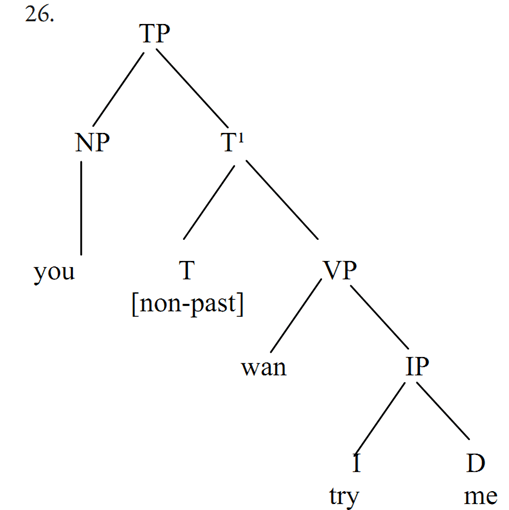
No overt morphological marking is possible on any of the verbs as a characteristics of pidgin languages. The stacking of the verbs within the same VPs is what Nicolle (2007) calls fake coordination. Suppose see in 24(a) is an instance of serial verb construction, which is a Bantu characteristic of most of the pre-colonial languages in Nigeria like Hausa, Igbo, Yoruba, Efik and Edo etc. which are the substrate lexical influence of NP. There is no overt marker of coordination, subordination, or syntactic dependency of any kind between the AUX and the main verb. The AUX indicates the inception phase of an event while the main verb is the corresponding termination phase of the same event. The two phases are semantically related and understood as two phases of a unitary event (Aikhenvald, 2006). Wan try is a case of verb stacking given that NP does not use the preposition to productively as English does. The simple yes-no question in 24(b) with wan and try is not tenseless. It has a semantic interpretation of non-past tense which is overtly marked. From the perspective of minimalist syntax, the position of TP is occupied by this null tense marker:
The form T1; out of VP is raised to full TP by a subject element which acts as a specifier. The sentence is a projection of the modal auxiliary try which is raised to IP by a complement D and to VP by a SPEC you.
4. THE GRAMMATICALIZATION OF PREPOSITIONS AND NOUNS
]]>
In the following discussions, we examine the grammaticalized status of the preposition for and the pronoun dem which fill some gaps in the continuum from lexical categories to syntactic auxiliary and plural markers respectively.
4.1 The grammaticalization of for
Mensah (2011) identifies for as the most mutable lexical item in NP. As a preposition, it can be used to substitute for several other prepositions as we can see in 27:
27
E dey for the table It's on the table.
I live for school domot I live at the school compound.
No be for mouth It's not by boasting.
I put am for your bag I put it in/inside your bag.
E good for you It's good for you.
Hú be gofnor for Lagos? Who is the governor of Lagos (State)?
]]>
Wáká for legedis. Walk with your legs.
Beyond its lexical mutability, the preposition for performs a major grammatical function in NP as an aspectual marker and an auxiliary marker:
28
We for like come 1PL AUX like come We would like to come
I for chop rice ISG AUX ASP chop rice I would have eaten rice
]]>
In 28(a), the preposition for clearly functions as a past auxiliary element which characteristically precedes the main verbs. Here, for is a modal auxiliary which gives the same grammatical information as represented on the verb. In 28 (b), the sentence has a perfect aspect, which refers to a completed action. This is marked by the use of for which is realised as an auxiliary marker + a perfective aspect. In other words, it is a combination of modal auxiliary and aspectual auxiliary. The examples in 28 obey the subject- auxiliary order in declarative sentences but not auxiliary-subject order in yes-no questions:
29
For we like come? AUX 1PL like come Would we like to come?
]]>
For I chop rice AUX ASP 1SG chop rice Would I have eaten rice
The implication is that, while English allows subjects to follow auxiliaries directly in yes-no questions, NP is selectionally constrained. The data in 29 show that subject-Aux inversion was not learned in NP given that subject-Aux inversion is a very marked construction. This, however, is a morphosyntactic fact that is not particularly relevant to grammaticalization.
4.2 The grammaticalization of dem
The use of dem in NP is also shifting from being a personal marker to becoming a plural marker with indefinite quantifying value:
30
]]>
Me bin see Kofi dem ISG PAST see Kofi PL I saw Kofi and others
E shout give student dem for class 3SG shout at student PL for class He shouted at the students in the clas
Dem in NP can only be used to postmodify definite animate nouns as a plural marker. In 30(a), it connotes the notion that Kofi was seen with at least another person or a company of people by the speaker. In 30(b), dem is used to mark plurality in the same sense of the pluralizing suffix -s in English.
However, the definite animate nouns like Kofi and student which dem postmodify can be deleted in the sentence if the listener or addressee has a pragmatic background of the discourse without the sentences losing their semantic load. in NP can only be used to postmodify definite animate nouns as a plural marker. In 30(a), it connotes the notion that Kofi was seen with at least another person or a company of people by the speaker. In 30(b), dem is used to mark plurality in the same sense of the pluralizing suffix -s in English. However, the definite animate nouns like Kofi and student which dem postmodify can be deleted in the sentence if the listener or addressee has a pragmatic background of the discourse without the sentences losing their semantic load.
]]>
5. SUMMARY OF FINDINGS
This study has examined internally motivated changes in NP which have resulted in lexical items developing into morphosyntactic markers after undergoing semantic bleaching in the language. We investigated verbs and nouns which have been grammaticalized as tense/aspect markers, complementizers, and plural markers, etc. in NP. We agree with Hopper and Traugott (1993) that a change in synchronic language development is opportunistic, not predetermined. NP lexical items which develop new grammatical functions are not influenced by its superstrate and substrate donors but are purely independent, self-renewing and language change mechanisms, which are robust paths towards its creolization and evolving its unique grammar. The present study will serve as a reference point in an attempt to further expand the frontiers of research in NP scholarship.
ACKNOWLEDGEMENTS
I wish to thank three anonymous reviewers of this paper and Prof.Victor Manfredi of the African Studies Centre, Boston University, USA. They have contributed ideas, references, criticisms and intellectual support which have considerably improved the quality of this paper. I gratefully acknowledge Prof. Fernando Ramallo of the University of Vigo, Spain for the Spanish translation.
6. REFERENCES
1. Aikhenvald, A. (2006). Serial verb constructions in a typological perspective. In A., Aikhenvald, & R., Dixon (Eds.), Serial verb constructions: A cross- linguistic typology (pp. 1-87). Oxford, England: Oxford University Press. [ Links ]
]]>
2. Bikerton, D. (1984). The language bioprogram hypothesis. Behavioural and Brain Science, 7(2), 173-188. [ Links ]
3. Bruyn, A. (1995) Grammaticalization in Creoles: the development of determiners and relative clauses in Sranan. Unpublished PhD Dissertation. Department of Linguistics, University of Amsterdam. [ Links ]
4. Elugbe, B., & Omamor, A. (1991). Nigerian Pidgin: background and prospects. Ibadan, Nigeria: Heinemann Educational Books. [ Links ]
5. Fayer, J. (1990). Nigerian Pidgin English in Old Calabar in the Eighteenth and Nineteenth centuries In J., Singler (Ed.), Pidgin and Creole: tense- mood–aspect systems (pp. 185-202.). New York, NY: John Benjamins. [ Links ]
6. Fintel, K. (1995). The formal semantics of grammaticalization. Proceedings from workshop on language acquisition and language change . Amherst, MA: University of Massachussets Amherst. [ Links ]
]]>
7. Hopper, P. & Traugott, E. (1993). Grammaticalization. Cambridge, England: Cambridge University Press. [ Links ]
8. Jowitt, D. (1991). Nigerian English usage: an introduction. Ikeja, Nigeria: Longman [ Links ]
9. Marchese, L. & Schnukal, A. (1982). Nigerian Pidgin English of Warri. Journal of Nigerian Languages 1, 213-219. [ Links ]
10. Martin, R. (1982). The psedohomophone effect: the role of visual similarity in nonword decision. Quaterly Journal of Experinmental Psychology, 34, 395-409. [ Links ]
11. Mensah, E. (2011). Lexicalization in Nigerian Pidgin. Concentric: Linguistics, 37(2), 209-240. [ Links ]
12. Millar, R. (2007). Trask's historical linguistics. London, England: Hodder Arnold [ Links ]
13. Miller, C. (2000). Grammaticalization of verb 'say' in Juba-Arabic. In M., Mifsud (ed.) Proceedings of the Third International Conference Aida Malta (pp. 213-218) Malta: Aida. [ Links ]
14. Muhlhausler, P. (2008). Multifunctionality in Pitkern- Norf'k and Tok Pisin. Journal of Pidgin and Creole Languages. 23(1), 75-113. [ Links ]
15. Nair, K. (1972). Politics and society in South-Eastern Nigeria (1814 – 1906): a study of p o we r , diplomacy and commerce in Old Calabar. London, England: Frank Cass. [ Links ]
16. Nicolle, S. (2007). The grammaticalization of tense markers: a pragmatic reanalysis. Cahire Chronos, 17, 47-65 [ Links ]
17. Radden, G. (1996). Motion metaphorizes: the case of coming and going. In E., Casad (Ed.), Cognitive linguistics in the reedwoods: the expansion of a New Paradigm in linguistics (pp. 263-423). Berlin, Germany: Mouton de Gruyter. [ Links ]
18. Radford, A. (1997). Syntactic theory and the structure of English: a minimalist approach. Cambridge, England: Cambridge University Press. [ Links ]
19. Traugott, E. (2004). Exaptation and grammaticalization. In M., Akimoto (Ed.), Linguistic studies based on corpora (pp. 133-156). Tokyo, Japan: Hituzi Syobo Publishing Co. [ Links ]
20. Traugott, E. & Heine, B. (eds.) (1991). Approaches to grammaticalization. Amsterdam, Netherlands: John Benjamins. [ Links ]
21. Vanamali, R. (1993). Pidgin and Creole linguistics. Calabar, Nigeria: University of Calabar. [ Links ]
22. Vincent, N. (1995). Exaptation and grammaticalization. In H., Anderson (Ed.), Historical linguistics (pp. 433-448). Amsterdam, Netherlands: Benjamins. [ Links ]