<?xml version="1.0" encoding="ISO-8859-1"?><article xmlns:mml="http://www.w3.org/1998/Math/MathML" xmlns:xlink="http://www.w3.org/1999/xlink" xmlns:xsi="http://www.w3.org/2001/XMLSchema-instance">
<front>
<journal-meta>
<journal-id>0123-3432</journal-id>
<journal-title><![CDATA[Íkala, Revista de Lenguaje y Cultura]]></journal-title>
<abbrev-journal-title><![CDATA[Íkala]]></abbrev-journal-title>
<issn>0123-3432</issn>
<publisher>
<publisher-name><![CDATA[Escuela de Idiomas, Universidad de Antioquia]]></publisher-name>
</publisher>
</journal-meta>
<article-meta>
<article-id>S0123-34322012000200006</article-id>
<title-group>
<article-title xml:lang="en"><![CDATA[OPPORTUNITY AND INCENTIVE FOR BECOMING BILINGUAL IN COLOMBIA: IMPLICATIONS FOR PROGRAMA NACIONAL DE BILINGÜISMO]]></article-title>
<article-title xml:lang="es"><![CDATA[OPORTUNIDADES E INCENTIVOS PARA VOLVERSE BILINGÜE EN COLOMBIA: IMPLICACIONES PARA EL PROGRAMA NACIONAL DE BILINGÜISMO]]></article-title>
</title-group>
<contrib-group>
<contrib contrib-type="author">
<name>
<surname><![CDATA[Herazo Rivera]]></surname>
<given-names><![CDATA[Jose David]]></given-names>
</name>
<xref ref-type="aff" rid="A01"/>
</contrib>
<contrib contrib-type="author">
<name>
<surname><![CDATA[Jerez Rodríguez]]></surname>
<given-names><![CDATA[Sonia]]></given-names>
</name>
<xref ref-type="aff" rid="A02"/>
</contrib>
<contrib contrib-type="author">
<name>
<surname><![CDATA[Lorduy Arellano]]></surname>
<given-names><![CDATA[Danilza]]></given-names>
</name>
<xref ref-type="aff" rid="A03"/>
</contrib>
</contrib-group>
<aff id="A01">
<institution><![CDATA[,Universidad de Cordoba  ]]></institution>
<addr-line><![CDATA[Corozal ]]></addr-line>
<country>Colombia</country>
</aff>
<aff id="A02">
<institution><![CDATA[,Universidad de Cordoba  ]]></institution>
<addr-line><![CDATA[Monteria ]]></addr-line>
<country>Colombia</country>
</aff>
<aff id="A03">
<institution><![CDATA[,Universidad de Cordoba  ]]></institution>
<addr-line><![CDATA[Montería ]]></addr-line>
<country>Colombia</country>
</aff>
<pub-date pub-type="pub">
<day>00</day>
<month>08</month>
<year>2012</year>
</pub-date>
<pub-date pub-type="epub">
<day>00</day>
<month>08</month>
<year>2012</year>
</pub-date>
<volume>17</volume>
<numero>2</numero>
<fpage>199</fpage>
<lpage>213</lpage>
<copyright-statement/>
<copyright-year/>
<self-uri xlink:href="http://www.scielo.org.co/scielo.php?script=sci_arttext&amp;pid=S0123-34322012000200006&amp;lng=en&amp;nrm=iso"></self-uri><self-uri xlink:href="http://www.scielo.org.co/scielo.php?script=sci_abstract&amp;pid=S0123-34322012000200006&amp;lng=en&amp;nrm=iso"></self-uri><self-uri xlink:href="http://www.scielo.org.co/scielo.php?script=sci_pdf&amp;pid=S0123-34322012000200006&amp;lng=en&amp;nrm=iso"></self-uri><abstract abstract-type="short" xml:lang="en"><p><![CDATA[The Programa Nacional de Bilingüismo (PNB) seeks to promote English proficiency in Colombian society in order to position Colombia within world communication processes, a global economy, and an increasingly multicultural world. Using documentary and statistical data within a case study approach, we characterize the PNB as a case of acquisition planning and argue that some of the social conditions that bolster bilingualism are not sufficiently developed in the Colombian context. Specifically, we maintain that the number of jobs requiring bilingual workers in Colombia's labor market and the patterns of international mobility of Colombians provide little opportunity and incentive for developing bilingualism to the extent envisioned by the PNB.]]></p></abstract>
<abstract abstract-type="short" xml:lang="es"><p><![CDATA[El Programa Nacional de Bilingüismo (PNB) busca desarrollar dominio del inglés en la sociedad colombiana a fin de posicionarla en procesos mundiales de comunicación, la economía global y un mundo cada vez más intercultural. A partir de datos documentales y estadísticos, en este estudio de caso caracterizamos al PNB como un caso de planeamiento lingüístico de adquisición y argumentamos que algunas de las condiciones sociales que promueven el bilingüismo no están lo suficientemente desarrolladas en el contexto colombiano. Específicamente, sostenemos que el número de puestos de trabajo que requieren trabajadores bilingües y los patrones de movilidad internacional de colombianos(as) ofrecen pocas oportunidades e incentivos para desarrollar el bilingüismo en la dimensión que el PNB plantea.]]></p></abstract>
<kwd-group>
<kwd lng="en"><![CDATA[bilingualism]]></kwd>
<kwd lng="en"><![CDATA[Programa Nacional de Bilingüismo]]></kwd>
<kwd lng="en"><![CDATA[opportunity]]></kwd>
<kwd lng="en"><![CDATA[incentive]]></kwd>
<kwd lng="en"><![CDATA[language policy and planning]]></kwd>
<kwd lng="en"><![CDATA[labor market]]></kwd>
<kwd lng="en"><![CDATA[interlingual contact]]></kwd>
<kwd lng="es"><![CDATA[bilingüismo]]></kwd>
<kwd lng="es"><![CDATA[Programa Nacional de Bilingüismo]]></kwd>
<kwd lng="es"><![CDATA[oportunidad]]></kwd>
<kwd lng="es"><![CDATA[incentivo]]></kwd>
<kwd lng="es"><![CDATA[planeamiento y política lingüística]]></kwd>
<kwd lng="es"><![CDATA[mercado laboral]]></kwd>
<kwd lng="es"><![CDATA[contacto interlingual]]></kwd>
</kwd-group>
</article-meta>
</front><body><![CDATA[  <font face="Verdana, Arial, Helvetica, sans-serif" size="2">     <p align="right"><b>REPORTES DE CASO</b></p>     <p>&nbsp;</p> </font>     <p align="center"><font size="4" face="Verdana, Arial, Helvetica, sans-serif"><b>OPPORTUNITY AND INCENTIVE FOR BECOMING BILINGUAL IN COLOMBIA: IMPLICATIONS FOR PROGRAMA NACIONAL DE BILING&Uuml;ISMO </b></font></p> <font face="Verdana, Arial, Helvetica, sans-serif" size="2">     <p align="center">&nbsp;</p> </font>     <p align="center"><font size="3" face="Verdana, Arial, Helvetica, sans-serif"><b>OPORTUNIDADES E INCENTIVOS PARA VOLVERSE BILING&Uuml;E EN COLOMBIA: IMPLICACIONES PARA EL PROGRAMA NACIONAL DE BILING&Uuml;ISMO</b></font></p> <font face="Verdana, Arial, Helvetica, sans-serif" size="2">     <p>&nbsp;</p>     <p>&nbsp;</p>     <p><b>Jose David Herazo Rivera*; Sonia Jerez Rodr&iacute;guez**;Danilza Lorduy Arellano</b>***</p>     <p>* holds a Master's degree in Education  from Universidad del Norte, Colombia.  He currently works as full time  professor at Universidad de Cordoba,  Colombia.  Mailing address: calle 25  # 24-21 Corozal, Colombia.  E-mail: <a href="mailto:jose.herazo@sinu.unicordoba.edu.co">jose.herazo@sinu.unicordoba.edu.co</a></p>     ]]></body>
<body><![CDATA[<p>** holds a Master's degree in Applied  Linguistics from Universidad Distrital  Francisco Jose de Caldas, Colombia.   She currently works as a full time  professor at University of  Cordoba,  Colombia . Mailing address: Carrera  14 B-bis # 41-87, Monteria,  Colombia.  E-mail: <a href="mailto:sjerez@unicordoba.edu.co">sjerez@unicordoba.edu.co</a></p>     <p>*** holds a Master degree in Education from Universidad del Norte, Colombia. She currently works as full time professor at Universidad de Cordoba, Colombia.  Mailing address: Cra. 11D N&deg; 10B 05 Samaria II, Monter&iacute;a, Colombia.  E-mail: <a href="mailto:dlorduy@sinu.unicordoba.edu.co">dlorduy@sinu.unicordoba.edu.co</a></p>     <p>&nbsp;</p>     <p>Received: 08-02-12 / Reviewed: 26-04-12 / Accepted: 22-05-12/ Published: 01-08-12</p>     <p>&nbsp;</p>     <p><b>How to reference this article:</b> Herazo, J., Jerez, S., &amp; Lorduy, D. (2012). Opportunity and incentive for  becoming bilingual in Colombia: Implications for Programa Nacional de Biling&uuml;ismo. &Iacute;kala, revista de  lenguaje y cultura, 17(2), 199-213.</p>     <p>&nbsp;</p> <hr size=1 noshade>     <p><b>ABSTRACT</b> </p>     <p>The Programa Nacional de Biling&uuml;ismo (PNB) seeks to promote English  proficiency in Colombian society in order to position Colombia within world  communication processes, a global economy, and an increasingly multicultural  world.  Using documentary and statistical data within a case study approach, we  characterize the PNB as a case of acquisition planning and argue that some of the  social conditions that bolster bilingualism are not sufficiently developed in the  Colombian context.  Specifically, we maintain that the number of jobs requiring  bilingual workers in Colombia's labor market and the patterns of international  mobility of Colombians provide little opportunity and incentive for developing  bilingualism to the extent envisioned by the PNB. </p>     <p><b>Keywords:</b> bilingualism, Programa Nacional de Biling&uuml;ismo, opportunity,  incentive, language policy and planning, labor market, interlingual contact</p> <hr size=1 noshade>     ]]></body>
<body><![CDATA[<p><b>RESUMEN</b></p>     <p>El Programa Nacional de Biling&uuml;ismo (PNB) busca desarrollar dominio del  ingl&eacute;s en la sociedad colombiana a fin de posicionarla en procesos mundiales de  comunicaci&oacute;n, la econom&iacute;a global y un mundo cada vez m&aacute;s intercultural.  A  partir de datos documentales y estad&iacute;sticos, en este estudio de caso caracterizamos  al PNB como un caso de planeamiento ling&uuml;&iacute;stico de adquisici&oacute;n y argumentamos  que algunas de las condiciones sociales que promueven el biling&uuml;ismo no est&aacute;n  lo suficientemente desarrolladas en el contexto colombiano.  Espec&iacute;ficamente,  sostenemos que el n&uacute;mero de puestos de trabajo que requieren trabajadores  biling&uuml;es y los patrones de movilidad internacional de colombianos(as) ofrecen  pocas oportunidades e incentivos para desarrollar el biling&uuml;ismo en la dimensi&oacute;n  que el PNB plantea. </p>     <p><b>Palabras clave:</b> biling&uuml;ismo, Programa Nacional de Biling&uuml;ismo, oportunidad,  incentivo, planeamiento y pol&iacute;tica ling&uuml;&iacute;stica, mercado laboral, contacto  interlingual.</p> <hr size=1 noshade>     <p>&nbsp;</p>     <p>&nbsp;</p> </font>     <p><font size="3" face="Verdana, Arial, Helvetica, sans-serif"><b>1. INTRODUCTION </b></font></p> <font face="Verdana, Arial, Helvetica, sans-serif" size="2">     <p>During the last three decades several educational  policies have been issued in Colombia to improve  the acquisition of an additional language.  These  include, according to Usma (2009a), the English  Syllabus in 1982, the Colombian Framework for  English (COFE) project in 1991, the General  Law of Education in 1994, and the Curricular  Guidelines For Foreign Languages in 1999.  In  general, most of these efforts have sought to  foster the learning of foreign languages, primarily  English, and have concentrated on the classroom  as the main site for doing so.  The most recent of  these policy initiatives is called Programa Nacional  de Biling&uuml;ismo 2004 &#8211; 2019 (henceforth PNB),  introduced by the Colombian government  in 2004.  The overarching goal of the PNB is  to develop Colombians' functional language  proficiency in English throughout the different  levels of the Colombian educational system  (Ministerio de Educaci&oacute;n Nacional, 2005a).  If  the population becomes proficient in English, the  official discourse reads, Colombia will become part  of universal communication processes, a global  economy, and a multicultural world (Ministerio  de Educaci&oacute;n Nacional, 2005b). </p>     <p>Although the PNB has generated a rich academic  debate in Colombia, most of this discussion has  centered on classroom-related issues, for example  on the effectiveness and conditions of learning  English as a foreign language (EFL) in Colombian  classrooms (C&aacute;rdenas, 2006, 2007) or on teacher  preparation programs sponsored by the PNB  (Gonz&aacute;lez, 2007, 2009).  Little, however, has been  said regarding how the PNB fits within wider  social phenomena that may spur knowledge of  an additional language, such as the labor market  demand for English in Colombia and the chances  Colombians may have to participate in interlingual  and intercultural communication.  This paper  addresses these latter and important issues.</p>     <p>Rather than considering the PNB in light of  classroom-related processes (e.g. teacher training,  students' learning) or critical theoretical issues (e.g. power, inequality, ideology), in this case study  we focus on the social ecology the PNB is part of  (Shohamy, 2006).  By <i>social ecology</i> we mean some of  the social conditions, such as the characteristics of  the labor market regarding English or the chances  for interlingual contact, that may create what the  literature on language policy and planning calls  <i>opportunity</i> and <i>incentive</i> for learning an additional  language at a societal scale.  As Spolsky (as cited  in Shohamy, 2006) explains, these aspects are the  contextual side of any language policy enterprise,  and become crucial for understanding and  predicting its effects.  Our main claim throughout  the paper is that some of these societal conditions  are missing or not sufficiently developed in  Colombia, hence jeopardizing the achievement  of the bilingualism goals the PNB has targeted  for 2019.  Specifically, we maintain that the  number of job offers requiring bilingual workers  in the Colombian labor market, as well as the  present trends in mobility of Colombians to other  countries, provide little incentive and opportunity  for advancing bilingualism for the larger social  goals envisioned by the PNB.  In the first part of  the paper we will summarize the main concepts in  language policy and planning (henceforth LPP);  then, we will describe the PNB and provide an  analysis of the two societal conditions mentioned  above.  The paper ends with a discussion of the PNB  and some recommendations to increase its chances  of success.  This paper is an initial attempt to deal  with these important issues for bilingualism in  Colombian and, as such, is neither comprehensive  nor exhaustive. </p>     <p>&nbsp;</p> </font>     ]]></body>
<body><![CDATA[<p><font size="3" face="Verdana, Arial, Helvetica, sans-serif"><b>2. KEY ISSUES IN LANGUAGE POLICY  AND PLANNING (LPP)</b></font></p> <font face="Verdana, Arial, Helvetica, sans-serif" size="2">     <p> Cooper (1989) introduced one of the most  accepted definitions of LPP to this day (cf. Ricento,  2000 for a historical discussion): ''<i>language  planning refers to deliberate efforts to influence the  behavior of others with respect to the acquisition,  structure, or functional allocation of their language  codes</i>'' (p. 45; italics in original).  That is to say,  LPP involves any attempt to influence how people learn a language, the language system itself, or the  role(s) language plays in society.  The deliberate  efforts Cooper talks about can refer to decisions  made by governmental bodies (i.e. top-down  LPP) or, conversely, to everyday language practices  that challenge, change, negotiate, or resist such  decisions (i.e. bottom-up LPP) (Shohamy, 2006).</p>     <p><b>2.1 LPP Types and Goals </b></p>     <p>According to Hornberger (2006), LPP is an  umbrella term for three types of language policy:   Status, corpus, and acquisition planning.  The  goals for each one of these types result from their  intersection with two LPP approaches:  The  policy approach, which attends to macroscopic  matters of society and nation relating to language  form; and the cultivation approach, which  deals with microscopic matters such as ways of  speaking and their distribution.  Status  planning   refers to decisions   influencing   the choice  and uses of language by a speech community.   At the policy approach level, it comprises  the goals of officialization, nationalization,  standardization of status, and proscription.  At  the cultivation approach, it includes the goals of  revival, maintenance, spread, and interlingual  communication (e.g. international, intranational).  An example of status planning is declaring a  language official, such as in recent language  legislation in Sweden (Ministry of Culture, 2009).   Corpus planning accounts for efforts to influence  the structure of language itself.  At the policy  approach level, this type of planning includes  the standardization of corpus, standardization of  auxiliary code, and graphization.  At the cultivation  approach, it develops the goals of modernization,  renovation, purification, reform, stylistic  simplification, and terminology unification.  The  different attempts to simplify the Chinese writing  system are examples of corpus planning.</p>     <p>Acquisition planning refers to organized efforts  to promote language learning (Cooper, 1989).   To this end, acquisition planning targets the users  of the language in order to alter their language  knowledge or the language capacity of the  community they are part of (Spolsky &amp; Shohamy,  1997).  At the policy level, acquisition planning  includes efforts directed to or through the group,  education/school, literary, religious, mass media  and work.  At the cultivation level, it includes the  goals of reacquisition, maintenance, shift, and the  learning of a foreign or second language.  A current  example of acquisition planning is the Chilean  policy to promote the acquisition of English  through the program Chile Habla Ingl&eacute;s. <a name="en1"></a><a href="#n1"><sup>1</sup></a> </p>     <p>Acquisition planning goals can be attained in three  different ways, through overt or covert means  (Cooper, 1989):  by providing opportunities for  access to the language, by creating or improving  the incentives to learn, or by combining these two  means.  Providing opportunity implies creating  conditions for language learning to occur, such as  teaching the language in schools or encouraging  the production of literature and learning materials.   Providing incentive implies influencing people's  desire to learn, such as linking language learning  to job offers, as in the case of immigrants to  Catalonia attempting to learn Catalan (Paulston,  1987). Whatever the means, historical evidence  (cf. Fasold, 1984; Hornberger, 1994; Paulston,  1987) shows that, once opportunity and incentive  are present, LPP acquisition goals may be more  attainable.  Although the cases these authors  report were not driven by an explicit official policy,  the interplay of opportunity and incentive found  in them seems to apply just as well for cases of LPP  in general, or  for cases of acquisition planning  concerning additional languages in particular  (Bongaerts &amp; de Bot, 1997; Payne, 2007), such as  the Colombian PNB.</p>     <p><b>2.2 PNB in Colombia: Ongoing debate </b></p>     <p>The academic discussion the PNB has generated,  represented by the variety of journal articles and  presentations in conferences and other scholarly  meetings, has centered on classroom or teaching  issues such as teacher training through the PNB  or standard-based teaching and learning.  For  example, Herazo and Donato (in press) and  Gonz&aacute;lez (2007; 2009)  focus on aspects related  to the teacher development program implemented  through the PNB, whereas Guerrero (2010)  discussed the images of Colombian English  teachers constructed in official discourse, mainly  in the document <i>Estandares b&aacute;sicos de competencias  en lenguas extranjeras: Ingl&eacute;s</i> (Ministerio de  Educaci&oacute;n Nacional, 2006b).  Ayala and &Aacute;lvarez  (2005), C&aacute;rdenas (2006, 2007), and S&aacute;nchez and  Obando (2008) study classroom or school related  issues like the contextual relevance of the PNB  standards, current schools conditions for learning  EFL, and teaching methodology, among other  aspects. </p>     <p>Whereas the papers fueling the discussion  regarding the PNB are diverse, resulting from  research or based on principled reflection, the  majority of them concur in some of the possible  weaknesses and challenges of this policy.  For  instance, S&aacute;nchez and Obando (2008) criticized  that the policy has been built in a top-down fashion  and that Colombian schools are under-resourced  to be able to promote the proficiency demands  of the PNB.  A similar position was taken by  C&aacute;rdenas (2006, 2007), who argues that the PNB's  goals are unrealistic given the current teaching  conditions in Colombia.  Since the PNB standards  were designed using the Common European  Framework of Reference (Council of Europe,  2001), Ayala and &Aacute;lvarez (2005) questioned their  contextual relevance.  The contextual issue was also  taken up by de Mejia (2006) and by Usma (2009a,  2009b).  Whereas de Mejia contended that the  PNB has overlooked the multilingual situation of extant ethnic communities and minorities, Usma  assumes a more critical-theoretical position and  argues that the PNB' rationale is utilitarian and  its mechanisms contribute to increasing inequality  and stratification in education.  Concerning teacher  development, Gonz&aacute;lez (2009) calls for the need  to ground professional development initiatives  in local realities and knowledge, and Herazo and  Donato (in press) highlight the need for sustained  on-site professional development that is responsive  to the affordances and constraints that conflicting  educational conditions (e.g. policy, materials,  accountability issues, beliefs, etc.) usually pose for  teachers. <a name="en2"></a><a href="#n2"><sup>2</sup></a>   It is true that most of these positions  have pointed to areas in the Colombian PNB  that need revision and improvement.  However,  it also seems true that many of these voices have  concentrated on weak aspects of the policy,  rather than on an integral appraisal of it. To our  knowledge, no research has yet been done that  provides a balanced and comprehensive evaluation  of the Colombian PNB. </p>     <p>&nbsp;</p> </font>     ]]></body>
<body><![CDATA[<p><font size="3" face="Verdana, Arial, Helvetica, sans-serif"><b>3. METHODOLOGY </b></font></p> <font face="Verdana, Arial, Helvetica, sans-serif" size="2">     <p>This research followed a case study approach  to investigate the PNB policy and two of its  contextual factors.  Case studies describe and  interpret a phenomenon in order to develop  generic knowledge (George &amp; Bennett, 2005).   As Duff (2008) highlights, the key principles in  case study are its ''boundedness or singularity,  in-depth study, multiple perspectives or  triangulation, particularity, contextualization,  and interpretation'' (p. 23).  In this paper, the  Colombian PNB constitutes the bounded entity  under scrutiny, using a combination of data  sources to answer two main questions: 1) what  are the policy characteristics of the PNB? and 2)  What are the social conditions beyond the school  system that provide or fail to provide opportunity  and incentive for the achievement of the PNB's  goals?  Several areas of inquiry derive from these  questions, including the characteristics of the PNB as a policy, Colombian employment rate and economic growth sectors, number of job offerings in Colombia listing knowledge of English as a requisite, and characteristics of mobility of Colombians to other countries and chances for interlingual contact. </p>     <p>Data for analysis came from official documents and statistics about the areas of inquiry just mentioned. Documentary evidence consisted of press releases and various documents about the PNB from the Colombian Ministry of Education, the PNB's official web page, and conference proceedings. Additionally, official statistics from DANE (Colombian National Department of Statistics), SENA (the institution in charge of technical education), and DAS (the Colombian National Security Department) were collected, most of them through the web pages of these institutions or through e-mail communication with the administrators in charge. </p>     <p>Since our aim is to discuss the Colombian PNB vis a vis the societal conditions that operate in a complex and specific historical context, we used Cooper's (1989) constituents of language policy as an analytical framework: ''what <i>actors</i> attempted to influence what <i>behaviors</i>, of which <i>people</i>, for what <i>ends</i>, by what <i>means</i> and with what <i>results</i>'' (pp. 46 - 47; italics in original). To this we added Hornberger's (1994)<i> under what conditions</i>, to account for the societal factors this study addresses. Although other frameworks for policy analysis are available (e.g. Sottoli, 2002), we used Cooper's because it concerns language policy specifically.</p>     <p>&nbsp;</p> </font>     <p><font size="3" face="Verdana, Arial, Helvetica, sans-serif"><b>4. FINDINGS </b></font></p> <font face="Verdana, Arial, Helvetica, sans-serif" size="2">     <p><b>4.1 What Actors? </b></p>     <p>Although the Colombian Ministry of Education has been responsible for designing and financing the PNB, several organizations have partnered or collaborated with the Ministry for its implementation. These include the British Council, the Colombian-American Center (Cali, Medell&iacute;n, and Bogot&aacute;), the Fulbright Commission, the American Embassy, the International Bilingual Schools Association from Bogot&aacute;, and most of Colombia's public universities. A growing number of regional and local administrations (41 cases at the time this article was written) have also been part of the program in order to develop bilingual cities (Bogot&aacute;. City Council, 2005) The number of critical voices, briefly discussed above, has also included institutional ones such as ASOCOPI (Colombian English Teachers Association) and Universidad de Antioquia.</p>     <p>The Colombian PNB policy has targeted the potential users of English almost exclusively. That is, the majority of PNB's actions have focused on students and teachers in primary, secondary and higher education, with an emphasis on professional development programs for improving EFL instruction and teachers' language proficiency. In sum, the PNB policy has centered on the educational system and on teachers and students as the most logical potential users of English (see <a href="#t02">Table 2</a> below for more details).</p>     <p><b>4.2 What Behaviors and for What Ends ? </b></p>     ]]></body>
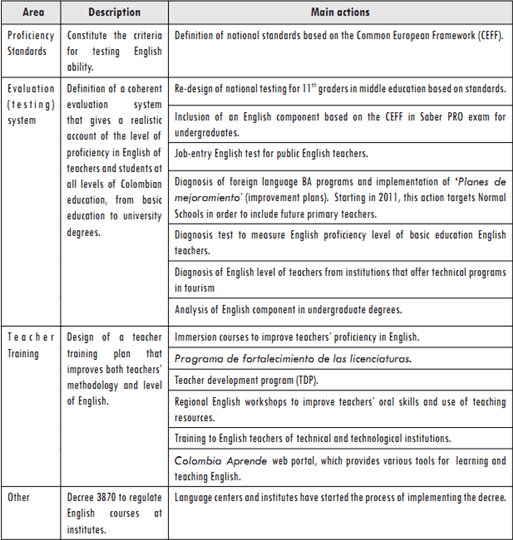
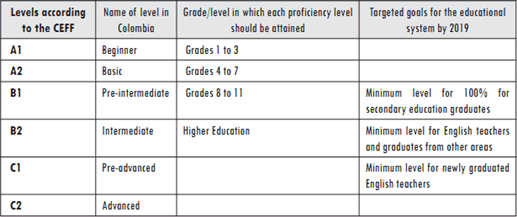
<body><![CDATA[<p>The overarching goal of the PNB is to position Colombia as a competitive participant in a globalized world. Accordingly, the PNB states that widespread knowledge of a foreign language will increase Colombian economic growth and competitiveness, provide citizens access to better job opportunities, and foster national intercultural awareness and openness. To achieve these goals, the PNB seeks to develop citizens who are able to communicate in English, at internationally comparable standards (Ministerio de Educaci&oacute;n Nacional, 2005a, 2006b, 2006c). This general level of competence is based on the Common European Framework of Reference (henceforth CEFF) (Council of Europe, 2001) and the Colombian national standards that were developed from it. The goals the PNB targets range from the basic level in the CEFF (A1), to one of the highest (C1), depending on the population the policy is expected to influence. <a href="#t01">Table 1</a> shows the details.</p>     <p>&nbsp;</p>     <p align="center"><b>Table 1:</b> Language proficiency goals of PNB (Ministerio de Educaci&oacute;n Nacional, 2006b)</p>     <p align="center"><a name="t01"></a><img src="/img/revistas/ikala/v17n2/v17n2a6t1.gif"></p>     <p>&nbsp;</p>     <p>As <a href="#t01">Table 1</a> shows, the expected proficiency for the different levels of the educational system increases as the educational roles change. For example, the minimum targeted level for the last grade of Colombian secondary education (i.e. 11<sup>th</sup> grade) is B1 from the CEFF, corresponding to the preintermediate level in the Colombian standards. B1 describes an <i>independent user</i> of the language at the <i>threshold</i> level (Council of Europe, 2001). This means that 11<sup>th</sup> graders should be able to communicate in English, both orally and in writing, in different situations and domains such as those related to travel, work, school, informal settings, among others (Ministerio de Educaci&oacute;n Nacional, 2006b). For newly graduated English teachers, however, the targeted level is C1 in the CEFF or, what is the same, pre-advanced in the Colombian standards. Thus, newly graduated teachers should be able to both understand and produce complex and demanding texts and use the language ''flexibly and effectively for social, academic and professional purposes'' (Council of Europe, 2001, p. 24). The deadline that the Ministry has established for reaching these language proficiency goals is 2019 (Ministerio de Educaci&oacute;n Nacional, 2006b, 2006c).</p>     <p><b>4.3 By What Means?</b></p>     <p> The PNB has used different implementation mechanisms and strategies that cover three areas: proficiency standards for basic (grades 1<sup>st</sup> to 9<sup>th</sup>) and middle (grades 10<sup>th</sup> and 11<sup>th</sup>) education, a comprehensive testing system, and teacher training (Ministerio de Educaci&oacute;n Nacional, 2005a, 2006b, 2006c). <a href="#t02">Table 2</a> presents a summary of most of the different programs and actions that the PNB had designed and implemented by the end of 2011 for each one of the three areas we just mentioned. </p>     <p>&nbsp;</p> </font>     <p align="center"><font size="2" face="Verdana, Arial, Helvetica, sans-serif"><b>Table 2:</b> Summary of PNB' s policy areas</font></p>     ]]></body>
<body><![CDATA[<p align="center"><font size="2" face="Verdana, Arial, Helvetica, sans-serif"><a name="t02"></a><img src="/img/revistas/ikala/v17n2/v17n2a6t2.gif"></font></p>     <p>&nbsp;</p>     <p>&nbsp;</p> <font face="Verdana, Arial, Helvetica, sans-serif" size="2">     <p><a href="#t02">Table 2</a> shows that the PNB policy has targeted formal education in general, from primary to higher education. This includes EFL teacher training programs as well as English learning in other professional areas of higher education. The policy has also started to involve Normal Schools in order to train future primary school teachers to teach English. The PNB has included the regulation of language institutes and the courses they offer as well, which makes the CEFF compulsory for the preparation of English courses in these centers (Ministerio de Educaci&oacute;n Nacional, 2006a). As <a href="#t02">Table 2</a> also shows, EFL teachers' professional development figures prominendy in the PNB policy, seeking to improve teachers' English proficiency and instructional ability.    Results from the diagnosis stage of this area showed that 65.4% of the 11,000 teachers that were evaluated had a basic level of English (A2), whereas the rest of them had either an intermediate level or, to a lesser extent, an advanced one (C&aacute;rdenas, 2006; Ministerio de Educaci&oacute;n Nacional, 2005b). A diploma course that has been offered to in-service secondary school teachers is another central action within this area. This course is offered in partnership with universities and local authorities and is called the Teacher Development Program or TDP. The teacher preparation area of the policy has also included a nation-wide initiative to improve foreign language BA programs. As far as we know, however, no national unified data has been yet provided that reports the results of these two last actions and describes the conditions under which those programs operate.</p>     <p>Concerning teaching conditions, most state schools are under resourced to provide meaningful and effective instruction, a situation that has been criticized by many voices in the Colombian academia (C&aacute;rdenas, 2006, 2007; S&aacute;nchez &amp; Obando, 2008) and recognized by the Ministry itself (Cely, 2009). Added to this, English teaching in primary state schools is mostly done by content-area teachers who have a limited command of English and have received little training in language education (Cely, 2009).</p>     <p><b>4.4 Under what Social Conditions ? </b></p>     <p><b>4.4.1. Labor market demand for English speakers. </b>Our analysis of the job offers available in Colombia through SENA, Computrabajo.com, and Elempleo.com suggests that the Colombian labor market rarely requires proficiency in English for job allocation, as <a href="#t03">Table 3</a> shows. <a href="#t03">Table 3</a> presents the total job offers made through SENA offices from 2007 to 2011 and the number of those offers that specified knowledge of English as one of the requirements for application.</p>     <p>&nbsp;</p>     <p align="center"><b>Table 3:</b> Job offers through SENA<a name="en3"></a><a href="#n3"><sup>3</sup></a>  requiring proficiency in English from 2007 to 2011</p>     <p align="center"><a name="t03"></a><img src="/img/revistas/ikala/v17n2/v17n2a6t3.gif"></p>     ]]></body>
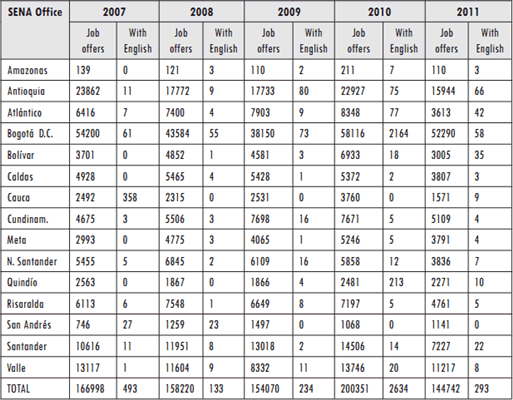
<body><![CDATA[<p>&nbsp;</p>     <p>As <a href="#t03">Table 3</a> shows, 493 openings out of 166,998  required knowledge of English in 2007.  This  amount corresponds to 0.29% of the total job  openings for that year.  In 2008, the amount  of openings requiring knowledge of English  decreased to 133 (0.08%).  In 2009, only 234 offers  requiring English proficiency were listed by SENA,  corresponding to 0.15% of the total applications.   However, we found a different situation in 2010  with 2634 job openings that required English  (1.31%), the highest demand over the last four  years.  Until August 2011, these job openings  amounted to 293(0.20%) a total of 144,742.   <a href="#t03">Table  3</a> also shows that most of the job offers requiring  knowledge of English have concentrated in Bogot&aacute;  and Antioquia during the 5-year period analyzed.   However, the number of offers has increased in  Atl&aacute;ntico, Bolivar, and Santander during the last  two years.  Interestingly, the number of openings  requiring English proficiency was high in Cauca  during 2007, with 358 openings, and in Quindio  during 2010 with 213 openings.  Unfortunately,  there was no data available to explain the reasons  for these situations, nor for recent increases in  Atl&aacute;ntico, Bolivar, and Santander. </p>     <p>An on-line query of the two major job-hunting  web pages carried out in September 2011 yielded a  similar situation to that found in the data provided  by SENA.  Of the 17,993 job offers posted in  Elempleo.com at the time of query, only 6.75 %  required demonstrable proficiency in English.  The  situation was less favorable at Computrabajo.com,  where there were 61.352 job offers but only 228  (0.37%) of them included this requisite.  Analysis  of the geographical distribution of these offers  showed that the majority of them occurred again in  Bogot&aacute; and Medell&iacute;n, probably as a result of these  being the most populated cities in the country. </p>     <p><b>4.4.2. Occupational rate and English proficiency.</b>   Another important factor that influences the  PNB goals is the occupational rate in Colombia.   According to DANE (2012), the unemployment  rate for 2011 was 10.8%, the lowest in recent  years.  The area currently offering the most jobs is commerce, restaurants and hotels (26%), followed  by social, personal, and community services  (19.4%) and by agriculture, forestry, fishing,  hunting, and cattle industry (18.2%).  From these,  only the area of commerce, hotels and restaurants  has been historically associated with the use of a  second language (Tochon, 2009) because they are  related to tourism.  However, tourism in Colombia  has not traditionally been a strong economic area  and the number of visitors coming from English  speaking countries still seems low.  We shall return  to this later. </p>     <p><b>4.4.3. Chances of interlingual contact.</b>   In this  study we used the notion of mobility, understood  as traveling, to account for the chances of  intercultural and interlingual contact between  Colombians and English speakers.  Historically,  processes of language shift have been associated  with contact among people with different  language backgrounds.   In this respect, the  analysis of the number of Colombians traveling to  English speaking countries yearly, or the number  of people visiting Colombia from those countries,  suggests that the chance of interlingual contact  in Colombia seems too low to trigger widespread  proficiency in English as envisioned by the PNB.</p>     <p>Although the mobility of Colombians to other  countries increased to 2.4 million for 2007,  according to DANE (2007) the majority of  those traveling or migrating (55.4% for 2007)  did so to Spanish speaking countries like Spain  or Venezuela.    The migration of Colombians to  English speaking countries represented 34.6%  during 2007, the United States being the preferred  destination (32%).  This last figure, however, is  not a very reliable indicator of interlingual contact  for different reasons.  First, the total number of  Colombians traveling to other countries annually  has been traditionally low, representing no more  than 3 million people yearly (2007), which  suggests that there is little mobility in general in a  population of 46 million.  Second, knowledge of  English is not a requirement for traveling to the  United States or other English speaking countries.</p>     <p>Besides, the number of Spanish speakers has  increased dramatically in those countries in recent  years, rendering knowledge of English almost  unnecessary for communication in some areas  (Garc&iacute;a &amp; Kleinfgen, 2010).  More data describing  where people actually travel within those countries  and the need of English for traveling to those  specific places will be needed to arrive at a more  detailed picture of this situation. </p>     <p>Complementarily, the number of visitors coming  to Colombia from English speaking countries  does not constitute a significant case of language  contact, and therefore is far from offering a  supportive atmosphere for bilingualism.  Until  October 2011, the largest number of international  visitors, 775,272 in total, came to Bogota, Medell&iacute;n  and Cartagena.  From these, 19.5% of visitors  came from the United States, while 61.96% came  from Spanish speaking countries in Latin America  (DANE, 2011a).  The unavailability of data  concerning virtual language contact, such as the  one that may be occurring through the internet,  impeded a more integral analysis of this important  aspect.  However, the most recent statistics show  that internet access in Colombia is not yet a  widespread resource, accounting for only 19% of  the population (DANE, 2011c).  The chances of  using English outside the classroom with others  Colombians who speak this language seem to be  scarce as well, since the number of nationals who  speak this language is still low, only 4% according  to the 2005 census (DANE, 2011b).</p>     <p>To sum up, the previous findings show that the  Colombian labor market demands for English- speaking  workers is low, that the unemployment  rate is high, that  some  of the areas of major  economic growth provide little support for  bilingualism, and that the mobility of Colombians  to English speaking countries and that of  English speaking foreigners visiting Colombia  constitutes an weak case of language contact, at  best.  The implications of this situation, as well  as the characteristics of the policy as such, will be  discussed in the next section.</p>     <p>&nbsp;</p> </font>     ]]></body>
<body><![CDATA[<p><font size="3" face="Verdana, Arial, Helvetica, sans-serif"><b>5. DISCUSSION </b></font></p> <font face="Verdana, Arial, Helvetica, sans-serif" size="2">     <p>The PNB represents an overt (Shohamy, 2006)  case of language acquisition planning:  Its goal  is to promote English learning by focusing on its  potential users.  Specifically, the PNB attempts  to increase the number of primary, secondary,  and university students who can use English  for communication.   To this end, the PNB has  concentrated on the educational level taking the  following route:  First, the teachers' and students'  English level was diagnosed, this was followed by  the design of the PNB in its three areas, and finally  the different actions and strategies that each of  these areas involved have been carried out (see  <a href="#t02">Table 2</a> above).  Seen from this perspective, the  PNB constitutes a case of top-down, traditional  social policy where a governmental body is in  charge of planning, financing, and enacting a  program to target a particular social process  (Canto, 2008; Sottoli, 2002). </p>     <p>Additionally, the PNB policy has taken a problem- solving orientation to language planning (Ricento  &amp; Hornberger, 1996).  This means that it  originated from an unsatisfactory situation in need  of a solution, represented in this case by teachers'  and students' low level of English and teachers'  inappropriate teaching methodology.  Thus, the  PNB has been directed to ''fix'' the problem, as the  official discourse reads: ''After finding out about the  English proficiency level of teachers and students,  and about the methodology used by teachers, the  Ministry and local secretaries of Education found  deficiencies and decided to plan different actions  to improve them'' (Ministerio de Educaci&oacute;n  Nacional, 2005a, p. 1).  Whereas we agree that  Colombian EFL teachers' pedagogic and linguistic  skills are a major concern, the problem-solving  orientation of the PNB policy seems problematic.   First, this orientation overlooks other areas that  have a crucial role to play for achieving bilingualism  in Colombia, such as the availability of resources  for teaching, time allocated to instruction, trained  and proficient English teachers in primary grades  (S&aacute;nchez &amp; Obando, 2008), or the affordances and limitations teaching contexts offer (Herazo  &amp; Donato, in press).  And second, it unfairly puts  the burden of the success or failure of the PNB on  the teachers' and the educational system alone.   In other cases of foreign language planning (see  Spolsky &amp; Shohamy, 1997), the initial diagnosis  stage and subsequent implementation included  the public, commercial, and other sectors.  This  contributed to generating governance (Canto,  2008) around the policy, adding many more hands  in its advancement, and yielded a more realistic  picture of the language situation that the policy  was intended to influence.</p>     <p>The findings presented above suggest that the  social factors analyzed in this paper offer little  opportunity and incentive for developing  bilingualism in Colombia in the span of time  envisioned by the Colombian Ministry of  Education.  As a case in point, the payoff of knowing  English is almost inexistent for accessing the labor  market, since only a very small percentage of jobs  require bilingual proficiency and most of them  are located in Bogot&aacute;, Colombia's capital.  Were  this trend to continue, the desired bilingualism, if  achieved, would be an urban phenomenon mostly,  deepening the social educational inequity between  cities and rural areas that has traditionally existed  in Colombia and Latin America in general (De  Ferranti, Perry, Ferreira, &amp; Walton, 2004).  The  link of the PNB to the labor market is a crucial  factor because, as Samoilovich (2008) points out,  the success of educational initiatives to promote  equity relies heavily on the availability of the  jobs education is supposed to prepare students  for.  In this sense, we adhere to the position taken  by different authors and scholars like C&aacute;rdenas  (2007), Grin, Regina and &Oacute; Riag&aacute;in (2003),  and Shohamy (2006), and elegantly described by  Cooper (1989):  ''No matter how accomplished  the schools are in imparting language acquisition,  they are unlikely to lead to the language use outside  the classroom unless there are practical reasons for  such use.'' (p. 161; italics in original).</p>     <p>As several authors have expressed (cf. Cooper,  1989; Ricento &amp; Hornberger, 1996; Shohamy, 2006), language policies are usually carried out  to achieve nonlinguistic purposes, the attainment  of a better economic situation being one of the  most common.  The Colombian PNB policy  seems to be one of those cases.  In our opinion,  this does not make the PNB lose its legitimacy or  ''most of its cultural and cognitive development  motivations'' as Usma (2009a, p. 133) has argued.   On the contrary, economic incentives have  been fundamental to guarantee learning of new  languages by large groups of people in successful  cases of foreign language policy, like those from  the Netherlands or the European Union (Grin et  al., 2003; Renique, 1997).  In the case of the PNB,  the economic payoffs of proficiency in English,  given the minimal labor market demand for  English-proficient workers, seem still insufficient  to provide the necessary incentive for attaining  the overarching bilingual goals the PNB has  envisioned.    This situation, however, may change  in the immediate future due to Colombia's recent  free commerce treaties with English speaking  countries like Canada and the United States.   Unfortunately, these treaties were in a preliminary  stage at the time of writing this article and data  are not yet available to describe the bilingualism  benefits or drawbacks of such treaties in more  detail.</p>     <p>Together with the economic reasons, mobility  and the chances of interlingual contact provide  incentive and opportunity for the learning of  a foreign language.  For instance, mobility was  part of the rationale behind the declaration of  the official languages of the European Union and  constitutes one of the reasons why the learning of  foreign languages is common and mostly effective  in this context.  With that in mind, the Council  of Europe implemented strategies to account for  the learning and knowledge of foreign languages  (Tochon, 2009) such as the language portfolio and  the language passport, or Europass (Council of  Europe, 2001).  Conversely, our analysis suggests  that the mobility of Colombians and their chances  of interlingual contact with English speakers may  be too few and far between to provide opportunity and incentive for learning English. The data  available, unfortunately, impeded a deeper analysis  of the type of interlingual contact that is facilitated  by the internet.</p>     <p>The previous labor market and interlingual contact  conditions, although unfavorable for bilingualism  in the immediate future, do not mean that the  PNB educational policy is inappropriate or that  it should be abandoned entirely.  Education, after  all, is the main condition for development and  poverty reduction in any society.  Additionally,  although the learning of English in schools occurs  under little social opportunity and incentive,  it might be the case that the proficiency that is  attained in classrooms could become available at  a later time (Ellis, 2003), under social conditions  that justify them.  What we mean is that educating  for bilingualism in classrooms, if successful, may  contribute to increasing the social capital of  Colombians in the long run, provided the societal  conditions discussed here and the quality issues  associated with education in Colombia improve.</p>     <p>It is also the case that large-scale educational  innovation takes a long time to have recognizable  effects (McDonald, Klein, &amp; Riordan, 2009), which  may make it difficult to arrive at a conclusive position  concerning the effectiveness of the PNB.  We are  also aware that the Ministry of Education cannot  be held directly responsible for what happens at the  level of society beyond the educational system.  As  the PNB officials have manifested, ''very little will  be achieved if the efforts for teaching the language  do not match the explicit demand for English  competencies as a requirement for jobs or for  accessing higher levels of education'' (Ministerio  de Educaci&oacute;n Nacional, 2006c, p. 3). Our point  is that the practical conditions of use Cooper  (1989) talks about &#8211;and that the Colombian  Ministry of Education recognizes&#8211; seem rather  unclear in the Colombian case.  Our call, then, is   for policy implementation beyond the educational  sector in order to generate more opportunity and  incentive for using English, making the PNB goals  more feasible.  The next section presents some  recommendations along those lines.</p>     <p>&nbsp;</p> </font>     <p><font size="3" face="Verdana, Arial, Helvetica, sans-serif"><b>6. CONCLUSIONS</b></font></p> <font face="Verdana, Arial, Helvetica, sans-serif" size="2">     ]]></body>
<body><![CDATA[<p> The purpose of this paper was to describe and  analyze the Colombian Programa Nacional de  Bilinguismo (PNB) vis a vis  some of the societal  conditions in which it is nested.   To this end we  first presented a description of this policy followed  by a conceptualization of it in terms of LPP and  social policy constructs.  We then discussed two of  the current societal factors that appear to influence  this policy in the Colombian case, namely the labor  market demands for English speaking workers  and the chances of intercultural and interlingual  contact, a product of mobility.  Our main claim  has been that the current conditions regarding  these two factors provide little opportunity and  incentive to advance bilingualism in Colombia as  envisioned by the PNB.  However, our research  is limited by the availability of data regarding  both factors; a more detailed and comprehensive  analysis of them will allow for more conclusive  interpretations &#8211;for example, by comparing the  need for English proficiency between professional  and technical job openings or analyzing bilingual  language practices through the internet.</p>     <p>We have also made clear that the state of affairs  concerning labor market demands and mobility  seems beyond the current scope of the policy.   However, proactive policy action by the Ministry  of Education in alliance with other sectors seems  possible.  The recent governmental initiative to  develop a database of professionals who speak  English appears to be a promising step in that  direction (see <a href="http://www.ispeak.gov.co" target="_blank">www.ispeak.gov.co</a>).  Additionally,  opening policy making to a variety of social actors  may guarantee higher levels of governance that  could increase the success of this policy.  We would  like to offer a few proposals regarding these issues.</p>     <p>As a social and public policy, the PNB could  be improved if alliances were made with the  commercial sector, one of the direct beneficiaries  of bilingualism.  This gains much more importance  in a moment when Colombia's commercial  agreement with Canada and The United States will  soon be operational.  For example, companies that would benefit the most from a bilingual workforce  could provide economic incentive (e.g. cash  bonuses) to bilingual employees.  Additionally,  and for the same reasons, the commercial sector  could start privately funded initiatives to advance  bilingualism in the work force and in the public at  large, by contributing to increasing opportunities  for learning English.</p>     <p>Additionally to overcoming the challenges  associated with current teaching and learning  conditions discussed by different authors (cf.  C&aacute;rdenas, 2006, 2007), the PNB could spur the  creation of innovative opportunities for students  to use the new language outside the classroom.   For example, community language centers similar  to those the British Council promotes in different  parts of the world could be established through  partnerships among universities, local authorities,  and national educational actors.  Their role would  be to take English use and learning beyond school  walls, making it a social intent. </p>     <p>Unfortunately, the discussion this paper presents  has been limited by access to relevant data and  lack of consideration of other social factors  that play a crucial role in language policy and  planning.  For instance, a study of the linguistic  environment in which the PNB is inserted is  necessary in order to improve the policy and  avoid unnecessary competition for resources with  minority language communities.  Additionally, the  opportunities that the free market treaties with the  English speaking countries might offer need to be  considered and realistically assessed.  Furthermore,  a more comprehensive study of the Colombian  language use situation concerning English and  other languages use is urgent.  The inclusion  of a more detailed language component in the  next national census could be the most logical  option to attain this goal.  This last aspect could  include a study of the language use networks,  the realistic language needs of the commercial  sector, and the identification of different socially  based opportunities for encouraging a robust and  comprehensive bilingualism policy in Colombia.</p>     <p>&nbsp;</p> </font>     <p><font size="3" face="Verdana, Arial, Helvetica, sans-serif"><b>REFERENCES</b></font></p> <font face="Verdana, Arial, Helvetica, sans-serif" size="2">     <!-- ref --><p>1. Ayala, J., &amp; &Aacute;lvarez, J.  (2005). A perspective of the  implications of the common European framework:  implemention in the Colombian socio-cultural  context. <i>Colombian Applied Linguistics Journal</i>,  7, 7-26.    &nbsp;&nbsp;&nbsp;&nbsp;&nbsp;&nbsp;&nbsp;&nbsp;[&#160;<a href="javascript:void(0);" onclick="javascript: window.open('/scielo.php?script=sci_nlinks&ref=000100&pid=S0123-3432201200020000600001&lng=','','width=640,height=500,resizable=yes,scrollbars=1,menubar=yes,');">Links</a>&#160;]<!-- end-ref -->  </p>     <!-- ref --><p>2. Bogot&aacute; city Council (2005). Bogot&aacute; Biling&uuml;e Diez A&ntilde;os,  Retrieved from: <a href="http://www.alcaldiabogota.gov.co/sisjur/normas/Norma1.jsp?i=18098" target="_blank">http://www.alcaldiabogota.gov.co/sisjur/normas/Norma1.jsp?i=18098</a> &nbsp;&nbsp;&nbsp;&nbsp;&nbsp;&nbsp;&nbsp;&nbsp;[&#160;<a href="javascript:void(0);" onclick="javascript: window.open('/scielo.php?script=sci_nlinks&ref=000102&pid=S0123-3432201200020000600002&lng=','','width=640,height=500,resizable=yes,scrollbars=1,menubar=yes,');">Links</a>&#160;]<!-- end-ref --><!-- ref --><p>3. Bongaerts, T., &amp; de Bot, K. (Eds.). (1997). <i>Perspectives  on foreign-language policy:  studies in honour  of Theo van Els</i>. Amsterdam, Netherlands;  Philadelphia, PA: John Benjamins.    &nbsp;&nbsp;&nbsp;&nbsp;&nbsp;&nbsp;&nbsp;&nbsp;[&#160;<a href="javascript:void(0);" onclick="javascript: window.open('/scielo.php?script=sci_nlinks&ref=000103&pid=S0123-3432201200020000600003&lng=','','width=640,height=500,resizable=yes,scrollbars=1,menubar=yes,');">Links</a>&#160;]<!-- end-ref --> </p>     <!-- ref --><p>4. Canto, M. (2008). Gobernanza y participaci&oacute;n ciudadana  en las pol&iacute;ticas p&uacute;blicas frente al reto del  desarrollo. <i>Politica y Cultura</i>, 30, 9-37.    &nbsp;&nbsp;&nbsp;&nbsp;&nbsp;&nbsp;&nbsp;&nbsp;[&#160;<a href="javascript:void(0);" onclick="javascript: window.open('/scielo.php?script=sci_nlinks&ref=000105&pid=S0123-3432201200020000600004&lng=','','width=640,height=500,resizable=yes,scrollbars=1,menubar=yes,');">Links</a>&#160;]<!-- end-ref -->  </p>     <!-- ref --><p>5. C&aacute;rdenas, M.  (2006). <i>Bilingual Colombia: are we  ready for it? What is needed?</i> Paper presented  at the 19th Annual English Australia Education  Conference Perth, Australia.    &nbsp;&nbsp;&nbsp;&nbsp;&nbsp;&nbsp;&nbsp;&nbsp;[&#160;<a href="javascript:void(0);" onclick="javascript: window.open('/scielo.php?script=sci_nlinks&ref=000107&pid=S0123-3432201200020000600005&lng=','','width=640,height=500,resizable=yes,scrollbars=1,menubar=yes,');">Links</a>&#160;]<!-- end-ref --></p>     <!-- ref --><p>6. C&aacute;rdenas, M.  (2007). Language policies and classroom  realities: bridging the gap. ASOCOPI Newsletter,  6 - 7. Retrieved from <a href="http://asocopi.org/files/newsletter_march_2007.pdf" target="_blank">http://asocopi.org/files/newsletter_march_2007.pdf</a> &nbsp;&nbsp;&nbsp;&nbsp;&nbsp;&nbsp;&nbsp;&nbsp;[&#160;<a href="javascript:void(0);" onclick="javascript: window.open('/scielo.php?script=sci_nlinks&ref=000109&pid=S0123-3432201200020000600006&lng=','','width=640,height=500,resizable=yes,scrollbars=1,menubar=yes,');">Links</a>&#160;]<!-- end-ref --><!-- ref --><p>7. Cely, R. (2009).<i> Perfil del docente de ingl&eacute;s.</i> Paper  presented at the Congreso Nacional de  Biling&uuml;ismo,  Armenia, Colombia.    &nbsp;&nbsp;&nbsp;&nbsp;&nbsp;&nbsp;&nbsp;&nbsp;[&#160;<a href="javascript:void(0);" onclick="javascript: window.open('/scielo.php?script=sci_nlinks&ref=000110&pid=S0123-3432201200020000600007&lng=','','width=640,height=500,resizable=yes,scrollbars=1,menubar=yes,');">Links</a>&#160;]<!-- end-ref --> </p>     <!-- ref --><p>8. Cooper, R.  (1989).  <i>Language planning and social  change</i>. Cambridge, England: Cambridge  University Press.    &nbsp;&nbsp;&nbsp;&nbsp;&nbsp;&nbsp;&nbsp;&nbsp;[&#160;<a href="javascript:void(0);" onclick="javascript: window.open('/scielo.php?script=sci_nlinks&ref=000112&pid=S0123-3432201200020000600008&lng=','','width=640,height=500,resizable=yes,scrollbars=1,menubar=yes,');">Links</a>&#160;]<!-- end-ref --> </p>     <!-- ref --><p>9. Council of Europe. (2001).  <i>Common European  framework of reference for languages: learning,  teaching, assessment</i>. Cambridge, England:  Cambridge University Press.    &nbsp;&nbsp;&nbsp;&nbsp;&nbsp;&nbsp;&nbsp;&nbsp;[&#160;<a href="javascript:void(0);" onclick="javascript: window.open('/scielo.php?script=sci_nlinks&ref=000114&pid=S0123-3432201200020000600009&lng=','','width=640,height=500,resizable=yes,scrollbars=1,menubar=yes,');">Links</a>&#160;]<!-- end-ref --> </p>     <!-- ref --><p>10. DANE. (2007). <i>Anuario estad&iacute;stico: Entradas y salidas  internacionales Colombia</i>.  Bogot&aacute;, Colombia:  DANE.    &nbsp;&nbsp;&nbsp;&nbsp;&nbsp;&nbsp;&nbsp;&nbsp;[&#160;<a href="javascript:void(0);" onclick="javascript: window.open('/scielo.php?script=sci_nlinks&ref=000116&pid=S0123-3432201200020000600010&lng=','','width=640,height=500,resizable=yes,scrollbars=1,menubar=yes,');">Links</a>&#160;]<!-- end-ref --> </p>     <!-- ref --><p>11. DANE. (2011a). <i>Anuario estad&iacute;stico: Entradas y salidas  internacionales Colombia</i>.  Bogot&aacute;, Colombia:  DANE.    &nbsp;&nbsp;&nbsp;&nbsp;&nbsp;&nbsp;&nbsp;&nbsp;[&#160;<a href="javascript:void(0);" onclick="javascript: window.open('/scielo.php?script=sci_nlinks&ref=000118&pid=S0123-3432201200020000600011&lng=','','width=640,height=500,resizable=yes,scrollbars=1,menubar=yes,');">Links</a>&#160;]<!-- end-ref --></p>     <!-- ref --><p>12. DANE. (2011b).  <i>Censo de poblaci&oacute;n 2005</i>.  Retrieved from <a href="http://www.dane.gov.co/index.php?option=com_content&view=article&id=307&Itemid=124" target="_blank">http://www.dane.gov.co/index.php?option=com_content&amp;view=article&amp;id=307&amp;Itemid=124</a> &nbsp;&nbsp;&nbsp;&nbsp;&nbsp;&nbsp;&nbsp;&nbsp;[&#160;<a href="javascript:void(0);" onclick="javascript: window.open('/scielo.php?script=sci_nlinks&ref=000120&pid=S0123-3432201200020000600012&lng=','','width=640,height=500,resizable=yes,scrollbars=1,menubar=yes,');">Links</a>&#160;]<!-- end-ref --><!-- ref --><p>13. DANE. (2011c). <i>Indicadores b&aacute;sicos de tecnolog&iacute;as de  la informaci&oacute;n y la comunicaci&oacute;n: A&ntilde;o 2010</i>.   Bogot&aacute;, Colombia: DANE.    &nbsp;&nbsp;&nbsp;&nbsp;&nbsp;&nbsp;&nbsp;&nbsp;[&#160;<a href="javascript:void(0);" onclick="javascript: window.open('/scielo.php?script=sci_nlinks&ref=000121&pid=S0123-3432201200020000600013&lng=','','width=640,height=500,resizable=yes,scrollbars=1,menubar=yes,');">Links</a>&#160;]<!-- end-ref --> </p>     ]]></body>
<body><![CDATA[<!-- ref --><p>14. DANE. (2012).  <i>Principales indicadores del mercado  laboral: enero de 2012</i>.  Bogot&aacute;, Colombia.    &nbsp;&nbsp;&nbsp;&nbsp;&nbsp;&nbsp;&nbsp;&nbsp;[&#160;<a href="javascript:void(0);" onclick="javascript: window.open('/scielo.php?script=sci_nlinks&ref=000123&pid=S0123-3432201200020000600014&lng=','','width=640,height=500,resizable=yes,scrollbars=1,menubar=yes,');">Links</a>&#160;]<!-- end-ref --> </p>     <!-- ref --><p>15. De Ferranti, D., Perry, G., Ferreira, F., &amp; Walton, M.  (2004). <i>Inequality in Latin America: breaking  with history?</i> Washington, DC: The World Bank.    &nbsp;&nbsp;&nbsp;&nbsp;&nbsp;&nbsp;&nbsp;&nbsp;[&#160;<a href="javascript:void(0);" onclick="javascript: window.open('/scielo.php?script=sci_nlinks&ref=000125&pid=S0123-3432201200020000600015&lng=','','width=640,height=500,resizable=yes,scrollbars=1,menubar=yes,');">Links</a>&#160;]<!-- end-ref --> </p>     <!-- ref --><p>16. De Mej&iacute;a, A.  (2006). Bilingual education in Colombia:  towards a recognition of languages, cultures,  and identities.<i> Colombian Applied Linguistics  Journal</i>, 8, 152-168.    &nbsp;&nbsp;&nbsp;&nbsp;&nbsp;&nbsp;&nbsp;&nbsp;[&#160;<a href="javascript:void(0);" onclick="javascript: window.open('/scielo.php?script=sci_nlinks&ref=000127&pid=S0123-3432201200020000600016&lng=','','width=640,height=500,resizable=yes,scrollbars=1,menubar=yes,');">Links</a>&#160;]<!-- end-ref -->  </p>     <!-- ref --><p>17. Duff, P. (2008).  <i>Case study research in Applied  Linguistics</i>. New York, NY: Lawrence Erlbaum  Associates.    &nbsp;&nbsp;&nbsp;&nbsp;&nbsp;&nbsp;&nbsp;&nbsp;[&#160;<a href="javascript:void(0);" onclick="javascript: window.open('/scielo.php?script=sci_nlinks&ref=000129&pid=S0123-3432201200020000600017&lng=','','width=640,height=500,resizable=yes,scrollbars=1,menubar=yes,');">Links</a>&#160;]<!-- end-ref --> </p>     <!-- ref --><p>18. Ellis, R. (2003).  <i>Task-based language learning and  teaching</i>. Oxford, England: Oxford University  Press.    &nbsp;&nbsp;&nbsp;&nbsp;&nbsp;&nbsp;&nbsp;&nbsp;[&#160;<a href="javascript:void(0);" onclick="javascript: window.open('/scielo.php?script=sci_nlinks&ref=000131&pid=S0123-3432201200020000600018&lng=','','width=640,height=500,resizable=yes,scrollbars=1,menubar=yes,');">Links</a>&#160;]<!-- end-ref --> </p>     ]]></body>
<body><![CDATA[<!-- ref --><p>19. Fasold, R.  (1984).  <i>The sociolinguistics of society</i>.  Oxford, England; New York, NY: B. Blackwell.    &nbsp;&nbsp;&nbsp;&nbsp;&nbsp;&nbsp;&nbsp;&nbsp;[&#160;<a href="javascript:void(0);" onclick="javascript: window.open('/scielo.php?script=sci_nlinks&ref=000133&pid=S0123-3432201200020000600019&lng=','','width=640,height=500,resizable=yes,scrollbars=1,menubar=yes,');">Links</a>&#160;]<!-- end-ref --> </p>     <!-- ref --><p>20. Garc&iacute;a, O., &amp; Kleinfgen, J.  (2010). <i>Emergent bilinguals:  policies, programs, and practices for English  language learners</i>. New York, NY: Teachers  College, Columbia University.    &nbsp;&nbsp;&nbsp;&nbsp;&nbsp;&nbsp;&nbsp;&nbsp;[&#160;<a href="javascript:void(0);" onclick="javascript: window.open('/scielo.php?script=sci_nlinks&ref=000135&pid=S0123-3432201200020000600020&lng=','','width=640,height=500,resizable=yes,scrollbars=1,menubar=yes,');">Links</a>&#160;]<!-- end-ref --> </p>     <!-- ref --><p>21. George, A., &amp; Bennett, A. (2005). <i>Case studies and  theory development in the social sciences</i>.  Cambridge, Mass: MIT Press.    &nbsp;&nbsp;&nbsp;&nbsp;&nbsp;&nbsp;&nbsp;&nbsp;[&#160;<a href="javascript:void(0);" onclick="javascript: window.open('/scielo.php?script=sci_nlinks&ref=000137&pid=S0123-3432201200020000600021&lng=','','width=640,height=500,resizable=yes,scrollbars=1,menubar=yes,');">Links</a>&#160;]<!-- end-ref --> </p>     <!-- ref --><p>22. Gonz&aacute;lez, A. (2007). Professional development of EFL  teachers in Colombia: between colonial and local  practices. <i>&Iacute;kala, revista de lenguaje y cultura</i>,  12(18), 309-332.    &nbsp;&nbsp;&nbsp;&nbsp;&nbsp;&nbsp;&nbsp;&nbsp;[&#160;<a href="javascript:void(0);" onclick="javascript: window.open('/scielo.php?script=sci_nlinks&ref=000139&pid=S0123-3432201200020000600022&lng=','','width=640,height=500,resizable=yes,scrollbars=1,menubar=yes,');">Links</a>&#160;]<!-- end-ref -->  </p>     <!-- ref --><p>23. Gonz&aacute;lez, A. (2009). On alternative and additional  certifications in English language teaching: the  case of Colombian EFL teachers' professional  development. <i>&Iacute;kala, revista de lenguaje y  cultura</i>,14(22), 184-209.    &nbsp;&nbsp;&nbsp;&nbsp;&nbsp;&nbsp;&nbsp;&nbsp;[&#160;<a href="javascript:void(0);" onclick="javascript: window.open('/scielo.php?script=sci_nlinks&ref=000141&pid=S0123-3432201200020000600023&lng=','','width=640,height=500,resizable=yes,scrollbars=1,menubar=yes,');">Links</a>&#160;]<!-- end-ref -->  </p>     ]]></body>
<body><![CDATA[<!-- ref --><p>24. Grin, F., Regina, J., &amp; &Oacute; Riag&aacute;in, D. (2003). <i>Language  policy evaluation and the european charter for  regional or minority languages</i>. Basingstoke,  England; New York, N.Y: Palgrave Macmillan.    &nbsp;&nbsp;&nbsp;&nbsp;&nbsp;&nbsp;&nbsp;&nbsp;[&#160;<a href="javascript:void(0);" onclick="javascript: window.open('/scielo.php?script=sci_nlinks&ref=000143&pid=S0123-3432201200020000600024&lng=','','width=640,height=500,resizable=yes,scrollbars=1,menubar=yes,');">Links</a>&#160;]<!-- end-ref --> </p>     <!-- ref --><p>25. Guerrero, C. (2010). The portrayal of EFL teachers in  official discourse: the perpetuation of disdain.  <i>PROFILE</i>, 12(2), 33-49.    &nbsp;&nbsp;&nbsp;&nbsp;&nbsp;&nbsp;&nbsp;&nbsp;[&#160;<a href="javascript:void(0);" onclick="javascript: window.open('/scielo.php?script=sci_nlinks&ref=000145&pid=S0123-3432201200020000600025&lng=','','width=640,height=500,resizable=yes,scrollbars=1,menubar=yes,');">Links</a>&#160;]<!-- end-ref -->  </p>     <!-- ref --><p>26. Herazo, J., &amp; Donato, R. (in press). Mediating meaning  in interaction: researching the connection between professional development and teacher  practice. In B., Yoon &amp; H., Kim (Eds.),<i> Teachers'  roles in second language learning: Classroom  applications of sociocultural theory</i>.    &nbsp;&nbsp;&nbsp;&nbsp;&nbsp;&nbsp;&nbsp;&nbsp;[&#160;<a href="javascript:void(0);" onclick="javascript: window.open('/scielo.php?script=sci_nlinks&ref=000147&pid=S0123-3432201200020000600026&lng=','','width=640,height=500,resizable=yes,scrollbars=1,menubar=yes,');">Links</a>&#160;]<!-- end-ref --> </p>     <!-- ref --><p>27. Hornberger, N. (1994). Literacy and language planning.  <i>Language and Education</i>, 8(1/2), 75 - 86.    &nbsp;&nbsp;&nbsp;&nbsp;&nbsp;&nbsp;&nbsp;&nbsp;[&#160;<a href="javascript:void(0);" onclick="javascript: window.open('/scielo.php?script=sci_nlinks&ref=000149&pid=S0123-3432201200020000600027&lng=','','width=640,height=500,resizable=yes,scrollbars=1,menubar=yes,');">Links</a>&#160;]<!-- end-ref -->  </p>     <!-- ref --><p>28. Hornberger, N. (2006). Frameworks and models in  language planning. In T., Ricento (Ed.),  <i>An  introduction to language policy: Theory and  method. Malden</i>, MA: Blackwell Publishing Ltd.    &nbsp;&nbsp;&nbsp;&nbsp;&nbsp;&nbsp;&nbsp;&nbsp;[&#160;<a href="javascript:void(0);" onclick="javascript: window.open('/scielo.php?script=sci_nlinks&ref=000151&pid=S0123-3432201200020000600028&lng=','','width=640,height=500,resizable=yes,scrollbars=1,menubar=yes,');">Links</a>&#160;]<!-- end-ref --> </p>     ]]></body>
<body><![CDATA[<!-- ref --><p>29. McDonald, J., Klein, E., &amp; Riordan, M. (2009). <i>Going  to scale with new school desings: reinventing  high school</i>. New York, NY; London, England:  Teachers College Press.    &nbsp;&nbsp;&nbsp;&nbsp;&nbsp;&nbsp;&nbsp;&nbsp;[&#160;<a href="javascript:void(0);" onclick="javascript: window.open('/scielo.php?script=sci_nlinks&ref=000153&pid=S0123-3432201200020000600029&lng=','','width=640,height=500,resizable=yes,scrollbars=1,menubar=yes,');">Links</a>&#160;]<!-- end-ref --> </p>     <!-- ref --><p>30. Ministerio de Educaci&oacute;n Nacional. (2005a). <i>Bases para  una naci&oacute;n biling&uuml;e y competitiva</i>. Retrieved  from <a href="http://www.mineducacion.gov.co/1621/propertyvalue-32266.html" target="_blank">http://www.mineducacion.gov.co/1621/propertyvalue-32266.html</a> &nbsp;&nbsp;&nbsp;&nbsp;&nbsp;&nbsp;&nbsp;&nbsp;[&#160;<a href="javascript:void(0);" onclick="javascript: window.open('/scielo.php?script=sci_nlinks&ref=000155&pid=S0123-3432201200020000600030&lng=','','width=640,height=500,resizable=yes,scrollbars=1,menubar=yes,');">Links</a>&#160;]<!-- end-ref --><!-- ref --><p>31. Ministerio de Educaci&oacute;n Nacional. (2005b). <i>Colombia  Aprende</i>. Retrieved from <a href="http://www.colombiaaprende.edu.co/html/productos/1685/article-158720.html" target="_blank">http://www.colombiaaprende.edu.co/html/productos/1685/article-158720.html</a> &nbsp;&nbsp;&nbsp;&nbsp;&nbsp;&nbsp;&nbsp;&nbsp;[&#160;<a href="javascript:void(0);" onclick="javascript: window.open('/scielo.php?script=sci_nlinks&ref=000156&pid=S0123-3432201200020000600031&lng=','','width=640,height=500,resizable=yes,scrollbars=1,menubar=yes,');">Links</a>&#160;]<!-- end-ref --><!-- ref --><p>32. Ministerio de Educaci&oacute;n Nacional. (2006a).  Decreto  3870. Retrieved from <a href="http://www.mineducacion.gov.co/1621/article-112277.html" target="_blank">http://www.mineducacion.gov.co/1621/article-112277.html</a> &nbsp;&nbsp;&nbsp;&nbsp;&nbsp;&nbsp;&nbsp;&nbsp;[&#160;<a href="javascript:void(0);" onclick="javascript: window.open('/scielo.php?script=sci_nlinks&ref=000157&pid=S0123-3432201200020000600032&lng=','','width=640,height=500,resizable=yes,scrollbars=1,menubar=yes,');">Links</a>&#160;]<!-- end-ref --><!-- ref --><p>33. Ministerio de Educaci&oacute;n Nacional. (2006b). <i>Est&aacute;ndares  b&aacute;sicos de competencias en lenguas extranjeras:  Ingl&eacute;s</i>. Bogot&aacute;, Colombia: Ministerio de  Educaci&oacute;n Nacional.    &nbsp;&nbsp;&nbsp;&nbsp;&nbsp;&nbsp;&nbsp;&nbsp;[&#160;<a href="javascript:void(0);" onclick="javascript: window.open('/scielo.php?script=sci_nlinks&ref=000158&pid=S0123-3432201200020000600033&lng=','','width=640,height=500,resizable=yes,scrollbars=1,menubar=yes,');">Links</a>&#160;]<!-- end-ref --> </p>     <!-- ref --><p>34. Ministerio de Educaci&oacute;n Nacional. (2006c). <i>Vision 2019:  Educaci&oacute;n propuesta de discusi&oacute;n</i>.  Bogot&aacute;,  Colombia: Ministerio de Educacion Nacional.    &nbsp;&nbsp;&nbsp;&nbsp;&nbsp;&nbsp;&nbsp;&nbsp;[&#160;<a href="javascript:void(0);" onclick="javascript: window.open('/scielo.php?script=sci_nlinks&ref=000160&pid=S0123-3432201200020000600034&lng=','','width=640,height=500,resizable=yes,scrollbars=1,menubar=yes,');">Links</a>&#160;]<!-- end-ref --> </p>     <!-- ref --><p>35. Ministry of Culture (2009).<i> Government bill language  for all</i>.  Stockholm, Sweden.    &nbsp;&nbsp;&nbsp;&nbsp;&nbsp;&nbsp;&nbsp;&nbsp;[&#160;<a href="javascript:void(0);" onclick="javascript: window.open('/scielo.php?script=sci_nlinks&ref=000162&pid=S0123-3432201200020000600035&lng=','','width=640,height=500,resizable=yes,scrollbars=1,menubar=yes,');">Links</a>&#160;]<!-- end-ref -->  </p>     <!-- ref --><p>36. Paulston, C. (1987). Catal&aacute;n and Occitan: comparative  test cases for a theory of language maintenance  and shift.<i> International Journal of Sociology of  Language</i>, 31-62.    &nbsp;&nbsp;&nbsp;&nbsp;&nbsp;&nbsp;&nbsp;&nbsp;[&#160;<a href="javascript:void(0);" onclick="javascript: window.open('/scielo.php?script=sci_nlinks&ref=000164&pid=S0123-3432201200020000600036&lng=','','width=640,height=500,resizable=yes,scrollbars=1,menubar=yes,');">Links</a>&#160;]<!-- end-ref -->  </p>     <!-- ref --><p>37.  Payne, M. (2007). Foreign language planning:  towards  a supporting framework. <i>Language problems &amp;  language planning</i>, 31(3), 235-256.    &nbsp;&nbsp;&nbsp;&nbsp;&nbsp;&nbsp;&nbsp;&nbsp;[&#160;<a href="javascript:void(0);" onclick="javascript: window.open('/scielo.php?script=sci_nlinks&ref=000166&pid=S0123-3432201200020000600037&lng=','','width=640,height=500,resizable=yes,scrollbars=1,menubar=yes,');">Links</a>&#160;]<!-- end-ref -->  </p>     <!-- ref --><p>38. Quintero, A. (2007). The place of language teachers'  decision making in the hierarchy of planning  functions in the language-teaching operation. <i>ASOCOPI Newsletter</i>, 8-9. Retrieved from <a href="http://asocopi.org/files/newsletter_march_2007.pdf" target="_blank">http://asocopi.org/files/newsletter_march_2007.pdf</a> &nbsp;&nbsp;&nbsp;&nbsp;&nbsp;&nbsp;&nbsp;&nbsp;[&#160;<a href="javascript:void(0);" onclick="javascript: window.open('/scielo.php?script=sci_nlinks&ref=000168&pid=S0123-3432201200020000600038&lng=','','width=640,height=500,resizable=yes,scrollbars=1,menubar=yes,');">Links</a>&#160;]<!-- end-ref --><!-- ref --><p>39. Renique, A. (1997). NAP as a basis for a coherent  FLT policy. In T., Bongaerts, &amp; K., Bot (Eds.), <i>Perspectives on foreign-language policy: studies in honour of Theo van Els</i>. Amsterdam,  Netherlands; Philadelphia, PA: John Benjamins.    &nbsp;&nbsp;&nbsp;&nbsp;&nbsp;&nbsp;&nbsp;&nbsp;[&#160;<a href="javascript:void(0);" onclick="javascript: window.open('/scielo.php?script=sci_nlinks&ref=000169&pid=S0123-3432201200020000600039&lng=','','width=640,height=500,resizable=yes,scrollbars=1,menubar=yes,');">Links</a>&#160;]<!-- end-ref --> </p>     <!-- ref --><p>40. Ricento, T. (2000). Historical and theoretical perspectives  in language policy and planning.  <i>Journal of  Sociolinguistics</i>, 4(2), 196 - 213.    &nbsp;&nbsp;&nbsp;&nbsp;&nbsp;&nbsp;&nbsp;&nbsp;[&#160;<a href="javascript:void(0);" onclick="javascript: window.open('/scielo.php?script=sci_nlinks&ref=000171&pid=S0123-3432201200020000600040&lng=','','width=640,height=500,resizable=yes,scrollbars=1,menubar=yes,');">Links</a>&#160;]<!-- end-ref -->  </p>     ]]></body>
<body><![CDATA[<!-- ref --><p>41. Ricento, T., &amp; Hornberger, N. (1996). Language  planning and policy and the ELT professional. <i>TESOL Quarterly</i>, 30(3), 401-427.    &nbsp;&nbsp;&nbsp;&nbsp;&nbsp;&nbsp;&nbsp;&nbsp;[&#160;<a href="javascript:void(0);" onclick="javascript: window.open('/scielo.php?script=sci_nlinks&ref=000173&pid=S0123-3432201200020000600041&lng=','','width=640,height=500,resizable=yes,scrollbars=1,menubar=yes,');">Links</a>&#160;]<!-- end-ref -->  </p>     <!-- ref --><p>42. Samoilovich, D. (2008). Pathways to innovation:  rethinking the government of public universities  in Latin America. In A., Gazzola, &amp; A.,  Didriksson (Eds.), <i>Trends in higher education in  Latin America and the Caribbean</i> (pp. 307-366).  Caracas, Venezuela: UNESCO IESALC.    &nbsp;&nbsp;&nbsp;&nbsp;&nbsp;&nbsp;&nbsp;&nbsp;[&#160;<a href="javascript:void(0);" onclick="javascript: window.open('/scielo.php?script=sci_nlinks&ref=000175&pid=S0123-3432201200020000600042&lng=','','width=640,height=500,resizable=yes,scrollbars=1,menubar=yes,');">Links</a>&#160;]<!-- end-ref --> </p>     <!-- ref --><p>43. S&aacute;nchez, A., &amp; Obando, G. (2008). Is Colombia ready  for ''bilingualism''? <i>PROFILE</i>, 9, 181-195.    &nbsp;&nbsp;&nbsp;&nbsp;&nbsp;&nbsp;&nbsp;&nbsp;[&#160;<a href="javascript:void(0);" onclick="javascript: window.open('/scielo.php?script=sci_nlinks&ref=000177&pid=S0123-3432201200020000600043&lng=','','width=640,height=500,resizable=yes,scrollbars=1,menubar=yes,');">Links</a>&#160;]<!-- end-ref -->  </p>     <!-- ref --><p>44. Shohamy, E. (2006).<i> Language policy: hidden agendas  and new approaches</i>. London, England;  New  York, NY: Routledge.    &nbsp;&nbsp;&nbsp;&nbsp;&nbsp;&nbsp;&nbsp;&nbsp;[&#160;<a href="javascript:void(0);" onclick="javascript: window.open('/scielo.php?script=sci_nlinks&ref=000179&pid=S0123-3432201200020000600044&lng=','','width=640,height=500,resizable=yes,scrollbars=1,menubar=yes,');">Links</a>&#160;]<!-- end-ref --> </p>     <!-- ref --><p>45. Sottoli, S. (2002). La pol&iacute;tica social en Am&eacute;rica Latina:  Diez dimensiones para el an&aacute;lisis y el dise&ntilde;o de  pol&iacute;ticas, <i>Papeles de Poblaci&oacute;n</i>, 34, 43-63.    &nbsp;&nbsp;&nbsp;&nbsp;&nbsp;&nbsp;&nbsp;&nbsp;[&#160;<a href="javascript:void(0);" onclick="javascript: window.open('/scielo.php?script=sci_nlinks&ref=000181&pid=S0123-3432201200020000600045&lng=','','width=640,height=500,resizable=yes,scrollbars=1,menubar=yes,');">Links</a>&#160;]<!-- end-ref --> </p>     ]]></body>
<body><![CDATA[<!-- ref --><p>46. Spolsky, B., &amp; Shohamy, E. (1997). Planning foreign  language education: an Israeli perspective. In  T., Bongaerts, &amp; K., Bot (Eds.), <i>Perspectives  on foreign-language policy:  studies in honour  of Theo van Els</i>. Amsterdam, Netherlands;  Philadelphia, USA: John Benjamins.    &nbsp;&nbsp;&nbsp;&nbsp;&nbsp;&nbsp;&nbsp;&nbsp;[&#160;<a href="javascript:void(0);" onclick="javascript: window.open('/scielo.php?script=sci_nlinks&ref=000183&pid=S0123-3432201200020000600046&lng=','','width=640,height=500,resizable=yes,scrollbars=1,menubar=yes,');">Links</a>&#160;]<!-- end-ref --> </p>     <!-- ref --><p>47. Tochon, F. (2009). The key to global understanding:  world languages education why schools need to  adapt.  <i>Review of Educational Research</i>, 79(2),  650 - 681. doi: 10.3102/0034654308325898 &nbsp;&nbsp;&nbsp;&nbsp;&nbsp;&nbsp;&nbsp;&nbsp;[&#160;<a href="javascript:void(0);" onclick="javascript: window.open('/scielo.php?script=sci_nlinks&ref=000185&pid=S0123-3432201200020000600047&lng=','','width=640,height=500,resizable=yes,scrollbars=1,menubar=yes,');">Links</a>&#160;]<!-- end-ref --><!-- ref --><p>48. Usma, J. (2009a). Education and language policy in  Colombia: Exploring processes of inclusion,  exclusion, and stratification in times of global  reform. <i>PROFILE</i>, 11, 123-141.    &nbsp;&nbsp;&nbsp;&nbsp;&nbsp;&nbsp;&nbsp;&nbsp;[&#160;<a href="javascript:void(0);" onclick="javascript: window.open('/scielo.php?script=sci_nlinks&ref=000186&pid=S0123-3432201200020000600048&lng=','','width=640,height=500,resizable=yes,scrollbars=1,menubar=yes,');">Links</a>&#160;]<!-- end-ref -->  </p>     <!-- ref --><p>49. Usma, J. (2009b). Globalization and language and  education reform in Colombia: A critical outlook.  <i>&Iacute;kala, revista de lenguaje y cultura</i>, 14(22), 19-42.    &nbsp;&nbsp;&nbsp;&nbsp;&nbsp;&nbsp;&nbsp;&nbsp;[&#160;<a href="javascript:void(0);" onclick="javascript: window.open('/scielo.php?script=sci_nlinks&ref=000188&pid=S0123-3432201200020000600049&lng=','','width=640,height=500,resizable=yes,scrollbars=1,menubar=yes,');">Links</a>&#160;]<!-- end-ref -->  </p>     <!-- ref --><p>50. Valencia, S. (2007). Implications of ''biling&uuml;ismo'' and  globalization processes in Colombia: insights  from research on ELT policy and practice. <i>ASOCOPI Newsletter</i>, 14-15. Retrieved from  <a href="http://asocopi.org/files/newsletter_march_2007.pdf" target="_blank">http://asocopi.org/files/newsletter_march_2007.pdf</a>&nbsp;&nbsp;&nbsp;&nbsp;&nbsp;&nbsp;&nbsp;&nbsp;[&#160;<a href="javascript:void(0);" onclick="javascript: window.open('/scielo.php?script=sci_nlinks&ref=000190&pid=S0123-3432201200020000600050&lng=','','width=640,height=500,resizable=yes,scrollbars=1,menubar=yes,');">Links</a>&#160;]<!-- end-ref --><p>&nbsp;</p> </font>     <p><font size="3" face="Verdana, Arial, Helvetica, sans-serif"><b>AUTHORS' NOTES</b> </font></p> <font face="Verdana, Arial, Helvetica, sans-serif" size="2">     ]]></body>
<body><![CDATA[<p><a name="n1"></a><a href="#en1">1</a>  see <a href="http://www.chilehablaingles.com/" target="_blank">http://www.chilehablaingles.com/</a> for more details on this program</p>     <p><a name="n2"></a><a href="#en2">2</a>  see also Quintero (2007) and Valencia (2007) for related comments</p>     <p><a name="n3"></a><a href="#en3">3</a> This information was provided by the SENA through the Colombian Labor Observatory. For ease of presentation, we have omitted from the table all the SENA offices that listed less than 10 job offers in total for the 2007-2011 period. However, information for those offices was kept in the total for all offices at the bottom of the table. Data for 2011 includes job offers available until August of the same year.</p> </font>      ]]></body><back>
<ref-list>
<ref id="B1">
<label>1</label><nlm-citation citation-type="journal">
<person-group person-group-type="author">
<name>
<surname><![CDATA[Ayala]]></surname>
<given-names><![CDATA[J.]]></given-names>
</name>
<name>
<surname><![CDATA[Álvarez]]></surname>
<given-names><![CDATA[J.]]></given-names>
</name>
</person-group>
<article-title xml:lang="en"><![CDATA[A perspective of the implications of the common European framework: implemention in the Colombian socio-cultural context]]></article-title>
<source><![CDATA[Colombian Applied Linguistics Journal]]></source>
<year>2005</year>
<volume>7</volume>
<page-range>7-26</page-range></nlm-citation>
</ref>
<ref id="B2">
<label>2</label><nlm-citation citation-type="">
<collab>Bogotá city Council</collab>
<source><![CDATA[Bogotá Bilingüe Diez Años]]></source>
<year>2005</year>
</nlm-citation>
</ref>
<ref id="B3">
<label>3</label><nlm-citation citation-type="book">
<person-group person-group-type="author">
<name>
<surname><![CDATA[Bongaerts]]></surname>
<given-names><![CDATA[T.]]></given-names>
</name>
<name>
<surname><![CDATA[de Bot]]></surname>
<given-names><![CDATA[K.]]></given-names>
</name>
</person-group>
<source><![CDATA[Perspectives on foreign-language policy: studies in honour of Theo van Els]]></source>
<year>1997</year>
<publisher-loc><![CDATA[Amsterdam^ePAPhiladelphia PA]]></publisher-loc>
<publisher-name><![CDATA[John Benjamins]]></publisher-name>
</nlm-citation>
</ref>
<ref id="B4">
<label>4</label><nlm-citation citation-type="journal">
<person-group person-group-type="author">
<name>
<surname><![CDATA[Canto]]></surname>
<given-names><![CDATA[M]]></given-names>
</name>
</person-group>
<article-title xml:lang="es"><![CDATA[Gobernanza y participación ciudadana en las políticas públicas frente al reto del desarrollo]]></article-title>
<source><![CDATA[Politica y Cultura]]></source>
<year>2008</year>
<volume>30</volume>
<page-range>9-37</page-range></nlm-citation>
</ref>
<ref id="B5">
<label>5</label><nlm-citation citation-type="confpro">
<person-group person-group-type="author">
<name>
<surname><![CDATA[Cárdenas]]></surname>
<given-names><![CDATA[M.]]></given-names>
</name>
</person-group>
<source><![CDATA[Bilingual Colombia: are we ready for it? What is needed?]]></source>
<year>2006</year>
<conf-name><![CDATA[19th Annual English Australia Education Conference Perth]]></conf-name>
<conf-loc> </conf-loc>
</nlm-citation>
</ref>
<ref id="B6">
<label>6</label><nlm-citation citation-type="book">
<person-group person-group-type="author">
<name>
<surname><![CDATA[Cárdenas]]></surname>
<given-names><![CDATA[M.]]></given-names>
</name>
</person-group>
<source><![CDATA[Language policies and classroom realities: bridging the gap]]></source>
<year>2007</year>
<publisher-name><![CDATA[ASOCOPI Newsletter, 6 - 7]]></publisher-name>
</nlm-citation>
</ref>
<ref id="B7">
<label>7</label><nlm-citation citation-type="confpro">
<person-group person-group-type="author">
<name>
<surname><![CDATA[Cely]]></surname>
<given-names><![CDATA[R.]]></given-names>
</name>
</person-group>
<source><![CDATA[Perfil del docente de inglés]]></source>
<year>2009</year>
<conf-name><![CDATA[ Congreso Nacional de Bilingüismo]]></conf-name>
<conf-loc>Armenia </conf-loc>
</nlm-citation>
</ref>
<ref id="B8">
<label>8</label><nlm-citation citation-type="book">
<person-group person-group-type="author">
<name>
<surname><![CDATA[Cooper]]></surname>
<given-names><![CDATA[R.]]></given-names>
</name>
</person-group>
<source><![CDATA[Language planning and social change]]></source>
<year>1989</year>
<publisher-loc><![CDATA[Cambridge ]]></publisher-loc>
<publisher-name><![CDATA[Cambridge University Press]]></publisher-name>
</nlm-citation>
</ref>
<ref id="B9">
<label>9</label><nlm-citation citation-type="book">
<collab>Council of Europe</collab>
<source><![CDATA[Common European framework of reference for languages: learning, teaching, assessment]]></source>
<year>2001</year>
<publisher-loc><![CDATA[Cambridge ]]></publisher-loc>
<publisher-name><![CDATA[Cambridge University Press]]></publisher-name>
</nlm-citation>
</ref>
<ref id="B10">
<label>10</label><nlm-citation citation-type="book">
<collab>DANE</collab>
<source><![CDATA[Anuario estadístico: Entradas y salidas internacionales Colombia]]></source>
<year>2007</year>
<publisher-loc><![CDATA[Bogotá ]]></publisher-loc>
<publisher-name><![CDATA[DANE]]></publisher-name>
</nlm-citation>
</ref>
<ref id="B11">
<label>11</label><nlm-citation citation-type="book">
<collab>DANE</collab>
<source><![CDATA[Anuario estadístico: Entradas y salidas internacionales Colombia]]></source>
<year>2011</year>
<publisher-loc><![CDATA[Bogotá ]]></publisher-loc>
<publisher-name><![CDATA[DANE]]></publisher-name>
</nlm-citation>
</ref>
<ref id="B12">
<label>12</label><nlm-citation citation-type="book">
<collab>DANE</collab>
<source><![CDATA[Censo de población 2005]]></source>
<year>2011</year>
<publisher-name><![CDATA[http://www.dane.gov.co/index.php?option=com_contentview=articleid=307Itemid=124]]></publisher-name>
</nlm-citation>
</ref>
<ref id="B13">
<label>13</label><nlm-citation citation-type="book">
<collab>DANE</collab>
<source><![CDATA[Indicadores básicos de tecnologías de la información y la comunicación: Año 2010]]></source>
<year>2011</year>
<publisher-loc><![CDATA[Bogotá ]]></publisher-loc>
<publisher-name><![CDATA[DANE]]></publisher-name>
</nlm-citation>
</ref>
<ref id="B14">
<label>14</label><nlm-citation citation-type="">
<collab>DANE</collab>
<source><![CDATA[Principales indicadores del mercado laboral: enero de 2012]]></source>
<year>2012</year>
<publisher-loc><![CDATA[Bogotá ]]></publisher-loc>
</nlm-citation>
</ref>
<ref id="B15">
<label>15</label><nlm-citation citation-type="book">
<person-group person-group-type="author">
<name>
<surname><![CDATA[De Ferranti]]></surname>
<given-names><![CDATA[D.]]></given-names>
</name>
<name>
<surname><![CDATA[Perry]]></surname>
<given-names><![CDATA[G.]]></given-names>
</name>
<name>
<surname><![CDATA[Ferreira]]></surname>
<given-names><![CDATA[F.]]></given-names>
</name>
<name>
<surname><![CDATA[Walton]]></surname>
<given-names><![CDATA[M.]]></given-names>
</name>
</person-group>
<source><![CDATA[Inequality in Latin America: breaking with history?]]></source>
<year>2004</year>
<publisher-loc><![CDATA[Washington^eDC DC]]></publisher-loc>
<publisher-name><![CDATA[The World Bank]]></publisher-name>
</nlm-citation>
</ref>
<ref id="B16">
<label>16</label><nlm-citation citation-type="journal">
<person-group person-group-type="author">
<name>
<surname><![CDATA[De Mejía]]></surname>
<given-names><![CDATA[A]]></given-names>
</name>
</person-group>
<article-title xml:lang="en"><![CDATA[Bilingual education in Colombia: towards a recognition of languages, cultures, and identities]]></article-title>
<source><![CDATA[Colombian Applied Linguistics Journal]]></source>
<year>2006</year>
<volume>8</volume>
<page-range>152-168</page-range></nlm-citation>
</ref>
<ref id="B17">
<label>17</label><nlm-citation citation-type="book">
<person-group person-group-type="author">
<name>
<surname><![CDATA[Duff]]></surname>
<given-names><![CDATA[P.]]></given-names>
</name>
</person-group>
<source><![CDATA[Case study research in Applied Linguistics]]></source>
<year>2008</year>
<publisher-loc><![CDATA[New York^eNY NY]]></publisher-loc>
<publisher-name><![CDATA[Lawrence Erlbaum Associates]]></publisher-name>
</nlm-citation>
</ref>
<ref id="B18">
<label>18</label><nlm-citation citation-type="book">
<person-group person-group-type="author">
<name>
<surname><![CDATA[Ellis]]></surname>
<given-names><![CDATA[R.]]></given-names>
</name>
</person-group>
<source><![CDATA[Task-based language learning and teaching]]></source>
<year>2003</year>
<publisher-loc><![CDATA[Oxford ]]></publisher-loc>
<publisher-name><![CDATA[Oxford University Press]]></publisher-name>
</nlm-citation>
</ref>
<ref id="B19">
<label>19</label><nlm-citation citation-type="book">
<person-group person-group-type="author">
<name>
<surname><![CDATA[Fasold]]></surname>
<given-names><![CDATA[R.]]></given-names>
</name>
</person-group>
<source><![CDATA[The sociolinguistics of society]]></source>
<year>1984</year>
<publisher-loc><![CDATA[Oxford^eNYNew York NY]]></publisher-loc>
<publisher-name><![CDATA[B. Blackwell]]></publisher-name>
</nlm-citation>
</ref>
<ref id="B20">
<label>20</label><nlm-citation citation-type="book">
<person-group person-group-type="author">
<name>
<surname><![CDATA[García]]></surname>
<given-names><![CDATA[O.]]></given-names>
</name>
<name>
<surname><![CDATA[Kleinfgen]]></surname>
<given-names><![CDATA[J.]]></given-names>
</name>
</person-group>
<source><![CDATA[Emergent bilinguals: policies, programs, and practices for English language learners]]></source>
<year>2010</year>
<publisher-loc><![CDATA[New York^eNY NY]]></publisher-loc>
<publisher-name><![CDATA[Teachers College, Columbia University]]></publisher-name>
</nlm-citation>
</ref>
<ref id="B21">
<label>21</label><nlm-citation citation-type="book">
<person-group person-group-type="author">
<name>
<surname><![CDATA[George]]></surname>
<given-names><![CDATA[A.]]></given-names>
</name>
<name>
<surname><![CDATA[Bennett]]></surname>
<given-names><![CDATA[A.]]></given-names>
</name>
</person-group>
<source><![CDATA[Case studies and theory development in the social sciences]]></source>
<year>2005</year>
<publisher-loc><![CDATA[Cambridge^eMass Mass]]></publisher-loc>
<publisher-name><![CDATA[MIT Press]]></publisher-name>
</nlm-citation>
</ref>
<ref id="B22">
<label>22</label><nlm-citation citation-type="journal">
<person-group person-group-type="author">
<name>
<surname><![CDATA[González]]></surname>
<given-names><![CDATA[A]]></given-names>
</name>
</person-group>
<article-title xml:lang="en"><![CDATA[Professional development of EFL teachers in Colombia: between colonial and local practices]]></article-title>
<source><![CDATA[Íkala, revista de lenguaje y cultura]]></source>
<year>2007</year>
<volume>12</volume>
<numero>18</numero>
<issue>18</issue>
<page-range>309-332</page-range></nlm-citation>
</ref>
<ref id="B23">
<label>23</label><nlm-citation citation-type="journal">
<person-group person-group-type="author">
<name>
<surname><![CDATA[González]]></surname>
<given-names><![CDATA[A]]></given-names>
</name>
</person-group>
<article-title xml:lang="en"><![CDATA[On alternative and additional certifications in English language teaching: the case of Colombian EFL teachers' professional development]]></article-title>
<source><![CDATA[Íkala, revista de lenguaje y cultura]]></source>
<year>2009</year>
<volume>14</volume>
<numero>22</numero>
<issue>22</issue>
<page-range>184-209</page-range></nlm-citation>
</ref>
<ref id="B24">
<label>24</label><nlm-citation citation-type="book">
<person-group person-group-type="author">
<name>
<surname><![CDATA[Grin]]></surname>
<given-names><![CDATA[F.]]></given-names>
</name>
<name>
<surname><![CDATA[Regina]]></surname>
<given-names><![CDATA[J.]]></given-names>
</name>
<name>
<surname><![CDATA[Ó Riagáin]]></surname>
<given-names><![CDATA[D.]]></given-names>
</name>
</person-group>
<source><![CDATA[Language policy evaluation and the european charter for regional or minority languages]]></source>
<year>2003</year>
<edition>New York</edition>
<publisher-loc><![CDATA[Basingstoke^eN.Y N.Y]]></publisher-loc>
<publisher-name><![CDATA[Palgrave Macmillan]]></publisher-name>
</nlm-citation>
</ref>
<ref id="B25">
<label>25</label><nlm-citation citation-type="journal">
<person-group person-group-type="author">
<name>
<surname><![CDATA[Guerrero]]></surname>
<given-names><![CDATA[C]]></given-names>
</name>
</person-group>
<article-title xml:lang="en"><![CDATA[The portrayal of EFL teachers in official discourse: the perpetuation of disdain]]></article-title>
<source><![CDATA[PROFILE]]></source>
<year>2010</year>
<volume>12</volume>
<numero>2</numero>
<issue>2</issue>
<page-range>33-49</page-range></nlm-citation>
</ref>
<ref id="B26">
<label>26</label><nlm-citation citation-type="">
<person-group person-group-type="author">
<name>
<surname><![CDATA[Herazo]]></surname>
<given-names><![CDATA[J.]]></given-names>
</name>
<name>
<surname><![CDATA[Donato]]></surname>
<given-names><![CDATA[R.]]></given-names>
</name>
</person-group>
<article-title xml:lang="en"><![CDATA[Mediating meaning in interaction: researching the connection between professional development and teacher practice]]></article-title>
<person-group person-group-type="editor">
<name>
<surname><![CDATA[Yoon]]></surname>
<given-names><![CDATA[B.]]></given-names>
</name>
<name>
<surname><![CDATA[Kim]]></surname>
<given-names><![CDATA[H.]]></given-names>
</name>
</person-group>
<source><![CDATA[Teachers' roles in second language learning: Classroom applications of sociocultural theory]]></source>
<year></year>
</nlm-citation>
</ref>
<ref id="B27">
<label>27</label><nlm-citation citation-type="journal">
<person-group person-group-type="author">
<name>
<surname><![CDATA[Hornberger]]></surname>
<given-names><![CDATA[N]]></given-names>
</name>
</person-group>
<article-title xml:lang="en"><![CDATA[Literacy and language planning]]></article-title>
<source><![CDATA[Language and Education]]></source>
<year>1994</year>
<volume>8</volume>
<numero>1/2</numero>
<issue>1/2</issue>
<page-range>75 - 86</page-range></nlm-citation>
</ref>
<ref id="B28">
<label>28</label><nlm-citation citation-type="book">
<person-group person-group-type="author">
<name>
<surname><![CDATA[Hornberger]]></surname>
<given-names><![CDATA[N.]]></given-names>
</name>
</person-group>
<article-title xml:lang="en"><![CDATA[Frameworks and models in language planning]]></article-title>
<person-group person-group-type="editor">
<name>
<surname><![CDATA[Ricento]]></surname>
<given-names><![CDATA[T.]]></given-names>
</name>
</person-group>
<source><![CDATA[An introduction to language policy: Theory and method]]></source>
<year>2006</year>
<publisher-loc><![CDATA[Malden^eMA MA]]></publisher-loc>
<publisher-name><![CDATA[Blackwell Publishing Ltd]]></publisher-name>
</nlm-citation>
</ref>
<ref id="B29">
<label>29</label><nlm-citation citation-type="book">
<person-group person-group-type="author">
<name>
<surname><![CDATA[McDonald]]></surname>
<given-names><![CDATA[J.]]></given-names>
</name>
<name>
<surname><![CDATA[Klein]]></surname>
<given-names><![CDATA[E.]]></given-names>
</name>
<name>
<surname><![CDATA[Riordan]]></surname>
<given-names><![CDATA[M.]]></given-names>
</name>
</person-group>
<source><![CDATA[Going to scale with new school desings: reinventing high school]]></source>
<year>2009</year>
<publisher-loc><![CDATA[New York^eNYLondon NY]]></publisher-loc>
<publisher-name><![CDATA[Teachers College Press]]></publisher-name>
</nlm-citation>
</ref>
<ref id="B30">
<label>30</label><nlm-citation citation-type="">
<collab>Ministerio de Educación Nacional</collab>
<source><![CDATA[Bases para una nación bilingüe y competitiva]]></source>
<year>2005</year>
</nlm-citation>
</ref>
<ref id="B31">
<label>31</label><nlm-citation citation-type="">
<collab>Ministerio de Educación Nacional</collab>
<source><![CDATA[Colombia Aprende]]></source>
<year>2005</year>
</nlm-citation>
</ref>
<ref id="B32">
<label>32</label><nlm-citation citation-type="">
<collab>Ministerio de Educación Nacional</collab>
<source><![CDATA[Decreto 3870]]></source>
<year>2006</year>
</nlm-citation>
</ref>
<ref id="B33">
<label>33</label><nlm-citation citation-type="book">
<collab>Ministerio de Educación Nacional</collab>
<source><![CDATA[Estándares básicos de competencias en lenguas extranjeras: Inglés]]></source>
<year>2006</year>
<publisher-loc><![CDATA[Bogotá ]]></publisher-loc>
<publisher-name><![CDATA[Ministerio de Educación Nacional]]></publisher-name>
</nlm-citation>
</ref>
<ref id="B34">
<label>34</label><nlm-citation citation-type="book">
<collab>Ministerio de Educación Nacional</collab>
<source><![CDATA[Vision 2019: Educación propuesta de discusión]]></source>
<year>2006</year>
<publisher-loc><![CDATA[Bogotá ]]></publisher-loc>
<publisher-name><![CDATA[Ministerio de Educacion Nacional]]></publisher-name>
</nlm-citation>
</ref>
<ref id="B35">
<label>35</label><nlm-citation citation-type="">
<collab>Ministry of Culture</collab>
<source><![CDATA[Government bill language for all]]></source>
<year>2009</year>
<publisher-loc><![CDATA[Stockholm ]]></publisher-loc>
</nlm-citation>
</ref>
<ref id="B36">
<label>36</label><nlm-citation citation-type="journal">
<person-group person-group-type="author">
<name>
<surname><![CDATA[Paulston]]></surname>
<given-names><![CDATA[C]]></given-names>
</name>
</person-group>
<article-title xml:lang="en"><![CDATA[Catalán and Occitan: comparative test cases for a theory of language maintenance and shift]]></article-title>
<source><![CDATA[International Journal of Sociology of Language]]></source>
<year>1987</year>
<page-range>31-62</page-range></nlm-citation>
</ref>
<ref id="B37">
<label>37</label><nlm-citation citation-type="journal">
<person-group person-group-type="author">
<name>
<surname><![CDATA[Payne]]></surname>
<given-names><![CDATA[M]]></given-names>
</name>
</person-group>
<article-title xml:lang="en"><![CDATA[Foreign language planning: towards a supporting framework]]></article-title>
<source><![CDATA[Language problems & language planning]]></source>
<year>2007</year>
<volume>31</volume>
<numero>3</numero>
<issue>3</issue>
<page-range>235-256</page-range></nlm-citation>
</ref>
<ref id="B38">
<label>38</label><nlm-citation citation-type="journal">
<person-group person-group-type="author">
<name>
<surname><![CDATA[Quintero]]></surname>
<given-names><![CDATA[A.]]></given-names>
</name>
</person-group>
<article-title xml:lang="en"><![CDATA[The place of language teachers' decision making in the hierarchy of planning functions in the language-teaching operation]]></article-title>
<source><![CDATA[ASOCOPI Newsletter]]></source>
<year>2007</year>
<volume>8-9</volume>
</nlm-citation>
</ref>
<ref id="B39">
<label>39</label><nlm-citation citation-type="book">
<person-group person-group-type="author">
<name>
<surname><![CDATA[Renique]]></surname>
<given-names><![CDATA[A.]]></given-names>
</name>
</person-group>
<article-title xml:lang="en"><![CDATA[NAP as a basis for a coherent FLT policy]]></article-title>
<person-group person-group-type="editor">
<name>
<surname><![CDATA[Bongaerts]]></surname>
<given-names><![CDATA[T.]]></given-names>
</name>
<name>
<surname><![CDATA[Bot]]></surname>
<given-names><![CDATA[K.]]></given-names>
</name>
</person-group>
<source><![CDATA[Perspectives on foreign-language policy: studies in honour of Theo van Els]]></source>
<year>1997</year>
<publisher-loc><![CDATA[Amsterdam^ePAPhiladelphia PA]]></publisher-loc>
<publisher-name><![CDATA[John Benjamins]]></publisher-name>
</nlm-citation>
</ref>
<ref id="B40">
<label>40</label><nlm-citation citation-type="journal">
<person-group person-group-type="author">
<name>
<surname><![CDATA[Ricento]]></surname>
<given-names><![CDATA[T]]></given-names>
</name>
</person-group>
<article-title xml:lang="en"><![CDATA[Historical and theoretical perspectives in language policy and planning]]></article-title>
<source><![CDATA[Journal of Sociolinguistics]]></source>
<year>2000</year>
<volume>4</volume>
<numero>2</numero>
<issue>2</issue>
<page-range>196 - 213</page-range></nlm-citation>
</ref>
<ref id="B41">
<label>41</label><nlm-citation citation-type="journal">
<person-group person-group-type="author">
<name>
<surname><![CDATA[Ricento]]></surname>
<given-names><![CDATA[T.]]></given-names>
</name>
<name>
<surname><![CDATA[Hornberger]]></surname>
<given-names><![CDATA[N.]]></given-names>
</name>
</person-group>
<article-title xml:lang="en"><![CDATA[Language planning and policy and the ELT professional]]></article-title>
<source><![CDATA[TESOL Quarterly]]></source>
<year>1996</year>
<volume>30</volume>
<numero>3</numero>
<issue>3</issue>
<page-range>401-427</page-range></nlm-citation>
</ref>
<ref id="B42">
<label>42</label><nlm-citation citation-type="book">
<person-group person-group-type="author">
<name>
<surname><![CDATA[Samoilovich]]></surname>
<given-names><![CDATA[D.]]></given-names>
</name>
</person-group>
<article-title xml:lang="en"><![CDATA[Pathways to innovation: rethinking the government of public universities in Latin America]]></article-title>
<person-group person-group-type="editor">
<name>
<surname><![CDATA[Gazzola]]></surname>
<given-names><![CDATA[A.]]></given-names>
</name>
<name>
<surname><![CDATA[Didriksson]]></surname>
<given-names><![CDATA[A.]]></given-names>
</name>
</person-group>
<source><![CDATA[Trends in higher education in Latin America and the Caribbean]]></source>
<year>2008</year>
<page-range>307-366</page-range><publisher-loc><![CDATA[Caracas ]]></publisher-loc>
<publisher-name><![CDATA[UNESCO IESALC]]></publisher-name>
</nlm-citation>
</ref>
<ref id="B43">
<label>43</label><nlm-citation citation-type="journal">
<person-group person-group-type="author">
<name>
<surname><![CDATA[Sánchez]]></surname>
<given-names><![CDATA[A.]]></given-names>
</name>
<name>
<surname><![CDATA[Obando]]></surname>
<given-names><![CDATA[G.]]></given-names>
</name>
</person-group>
<article-title xml:lang="en"><![CDATA[Is Colombia ready for ''bilingualism''?]]></article-title>
<source><![CDATA[PROFILE]]></source>
<year>2008</year>
<volume>9</volume>
<page-range>181-195</page-range></nlm-citation>
</ref>
<ref id="B44">
<label>44</label><nlm-citation citation-type="book">
<person-group person-group-type="author">
<name>
<surname><![CDATA[Shohamy]]></surname>
<given-names><![CDATA[E.]]></given-names>
</name>
</person-group>
<source><![CDATA[Language policy: hidden agendas and new approaches]]></source>
<year>2006</year>
<publisher-loc><![CDATA[London^eNYNew York NY]]></publisher-loc>
<publisher-name><![CDATA[Routledge]]></publisher-name>
</nlm-citation>
</ref>
<ref id="B45">
<label>45</label><nlm-citation citation-type="journal">
<person-group person-group-type="author">
<name>
<surname><![CDATA[Sottoli]]></surname>
<given-names><![CDATA[S]]></given-names>
</name>
</person-group>
<article-title xml:lang="es"><![CDATA[La política social en América Latina: Diez dimensiones para el análisis y el diseño de políticas]]></article-title>
<source><![CDATA[Papeles de Población]]></source>
<year>2002</year>
<volume>34</volume>
<page-range>43-63</page-range></nlm-citation>
</ref>
<ref id="B46">
<label>46</label><nlm-citation citation-type="book">
<person-group person-group-type="author">
<name>
<surname><![CDATA[Spolsky]]></surname>
<given-names><![CDATA[B.]]></given-names>
</name>
<name>
<surname><![CDATA[Shohamy]]></surname>
<given-names><![CDATA[E.]]></given-names>
</name>
</person-group>
<article-title xml:lang="en"><![CDATA[Planning foreign language education: an Israeli perspective]]></article-title>
<person-group person-group-type="editor">
<name>
<surname><![CDATA[Bongaerts]]></surname>
<given-names><![CDATA[T.]]></given-names>
</name>
<name>
<surname><![CDATA[Bot]]></surname>
<given-names><![CDATA[K.]]></given-names>
</name>
</person-group>
<source><![CDATA[Perspectives on foreign-language policy: studies in honour of Theo van Els]]></source>
<year>1997</year>
<publisher-loc><![CDATA[AmsterdamPhiladelphia ]]></publisher-loc>
<publisher-name><![CDATA[John Benjamins]]></publisher-name>
</nlm-citation>
</ref>
<ref id="B47">
<label>47</label><nlm-citation citation-type="journal">
<person-group person-group-type="author">
<name>
<surname><![CDATA[Tochon]]></surname>
<given-names><![CDATA[F]]></given-names>
</name>
</person-group>
<article-title xml:lang="en"><![CDATA[The key to global understanding: world languages education why schools need to adapt]]></article-title>
<source><![CDATA[Review of Educational Research]]></source>
<year>2009</year>
<volume>79</volume>
<numero>2</numero>
<issue>2</issue>
<page-range>650 - 681</page-range></nlm-citation>
</ref>
<ref id="B48">
<label>48</label><nlm-citation citation-type="journal">
<person-group person-group-type="author">
<name>
<surname><![CDATA[Usma]]></surname>
<given-names><![CDATA[J]]></given-names>
</name>
</person-group>
<article-title xml:lang="en"><![CDATA[Education and language policy in Colombia: Exploring processes of inclusion, exclusion, and stratification in times of global reform]]></article-title>
<source><![CDATA[PROFILE]]></source>
<year>2009</year>
<month>a</month>
<volume>11</volume>
<page-range>123-141</page-range></nlm-citation>
</ref>
<ref id="B49">
<label>49</label><nlm-citation citation-type="journal">
<person-group person-group-type="author">
<name>
<surname><![CDATA[Usma]]></surname>
<given-names><![CDATA[J]]></given-names>
</name>
</person-group>
<article-title xml:lang="en"><![CDATA[Globalization and language and education reform in Colombia: A critical outlook]]></article-title>
<source><![CDATA[Íkala, revista de lenguaje y cultura]]></source>
<year>2009</year>
<month>b</month>
<volume>14</volume>
<numero>22</numero>
<issue>22</issue>
<page-range>19-42</page-range></nlm-citation>
</ref>
<ref id="B50">
<label>50</label><nlm-citation citation-type="journal">
<person-group person-group-type="author">
<name>
<surname><![CDATA[Valencia]]></surname>
<given-names><![CDATA[S.]]></given-names>
</name>
</person-group>
<article-title xml:lang="en"><![CDATA[Implications of ''bilingüismo'' and globalization processes in Colombia: insights from research on ELT policy and practice]]></article-title>
<source><![CDATA[ASOCOPI Newsletter]]></source>
<year>2007</year>
<volume>14-15</volume>
</nlm-citation>
</ref>
</ref-list>
</back>
</article>