<?xml version="1.0" encoding="ISO-8859-1"?><article xmlns:mml="http://www.w3.org/1998/Math/MathML" xmlns:xlink="http://www.w3.org/1999/xlink" xmlns:xsi="http://www.w3.org/2001/XMLSchema-instance">
<front>
<journal-meta>
<journal-id>0123-3432</journal-id>
<journal-title><![CDATA[Íkala, Revista de Lenguaje y Cultura]]></journal-title>
<abbrev-journal-title><![CDATA[Íkala]]></abbrev-journal-title>
<issn>0123-3432</issn>
<publisher>
<publisher-name><![CDATA[Escuela de Idiomas, Universidad de Antioquia]]></publisher-name>
</publisher>
</journal-meta>
<article-meta>
<article-id>S0123-34322012000300003</article-id>
<title-group>
<article-title xml:lang="en"><![CDATA[THE ROLE OF THE FIRST LANGUAGE IN HYBRID SPANISH AS A FOREIGN LANGUAGE CLASSES: A SIN OR A TOOL?]]></article-title>
<article-title xml:lang="es"><![CDATA[EL PAPEL DE LA PRIMERA LENGUA EN CLASES SEMIPRESENCIALES DE ESPAÑOL COMO LENGUA EXTRANJERA: &iquest;UN PECADO O UNA HERRAMIENTA?]]></article-title>
</title-group>
<contrib-group>
<contrib contrib-type="author">
<name>
<surname><![CDATA[Colombo]]></surname>
<given-names><![CDATA[Laura]]></given-names>
</name>
<xref ref-type="aff" rid="A01"/>
</contrib>
</contrib-group>
<aff id="A01">
<institution><![CDATA[,postdoctoral fellowship  ]]></institution>
<addr-line><![CDATA[ ]]></addr-line>
</aff>
<pub-date pub-type="pub">
<day>00</day>
<month>12</month>
<year>2012</year>
</pub-date>
<pub-date pub-type="epub">
<day>00</day>
<month>12</month>
<year>2012</year>
</pub-date>
<volume>17</volume>
<numero>3</numero>
<fpage>245</fpage>
<lpage>262</lpage>
<copyright-statement/>
<copyright-year/>
<self-uri xlink:href="http://www.scielo.org.co/scielo.php?script=sci_arttext&amp;pid=S0123-34322012000300003&amp;lng=en&amp;nrm=iso"></self-uri><self-uri xlink:href="http://www.scielo.org.co/scielo.php?script=sci_abstract&amp;pid=S0123-34322012000300003&amp;lng=en&amp;nrm=iso"></self-uri><self-uri xlink:href="http://www.scielo.org.co/scielo.php?script=sci_pdf&amp;pid=S0123-34322012000300003&amp;lng=en&amp;nrm=iso"></self-uri><abstract abstract-type="short" xml:lang="en"><p><![CDATA[The use of the first language (L1) in the foreign language classroom has been highly contested in the last decades. This paper discusses the use of L1 in online activities in hybrid lower-level Spanish as a foreign language (SFL) courses, with a focus on threaded discussions about cultural topics. I first discuss the use of L1 in foreign language (FL) teaching. Second, I present Vygotsky's (1978) postulates about learning, and Cole and Engeström's (2001) activity theory. Third, I conduct an activity analysis of the SFL class to further narrow it down to L1 use in the discussion boards. By looking at the discussion boards through the lens of sociocultural theories, I claim that the use of L1 is a necessary cognitive tool for fostering inter-cultural learning through online discussions in SFL classes.]]></p></abstract>
<abstract abstract-type="short" xml:lang="es"><p><![CDATA[El uso de la lengua materna o primera lengua (L1) en clases de lengua extranjera ha generado controversia en las últimas décadas. Este artículo discute el uso de L1 en cursos semipresenciales del nivel inicial de Español como Lengua Extranjera (ELE), centrándose en foros de discusión en línea sobre temas culturales. Luego de discutir el uso de L1 en la enseñanza de lenguas extranjeras, se presentan los postulados de Vygotsky (1978) sobre el aprendizaje y la teoría de la actividad propuesta por Cole y Engeström (2001). A continuación, se analiza la clase ELE como un sistema de actividad, acotando el mismo al uso de L1 en foros de discusión en línea. Se concluye que, desde el marco conceptual de las teorías socioculturales, es necesario el uso de L1 en los foros de discusión en línea ya que constituye una herramienta cognitiva necesaria para fomentar el aprendizaje intercultural.]]></p></abstract>
<kwd-group>
<kwd lng="en"><![CDATA[first language use]]></kwd>
<kwd lng="en"><![CDATA[sociocultural theories]]></kwd>
<kwd lng="en"><![CDATA[Spanish as a foreign language]]></kwd>
<kwd lng="en"><![CDATA[online discussions]]></kwd>
<kwd lng="en"><![CDATA[culture teaching]]></kwd>
<kwd lng="es"><![CDATA[uso de la primera lengua]]></kwd>
<kwd lng="es"><![CDATA[teorías socioculturales]]></kwd>
<kwd lng="es"><![CDATA[Español como lengua extranjera]]></kwd>
<kwd lng="es"><![CDATA[discusiones en línea]]></kwd>
<kwd lng="es"><![CDATA[enseñanza de la cultura]]></kwd>
</kwd-group>
</article-meta>
</front><body><![CDATA[ <p align="right"><font size="2" face="Verdana, Arial, Helvetica, sans-serif"><b>ART&Iacute;CULOS DE INVESTIGACI&Oacute;N</b></font></p>     <p align="center">&nbsp;</p>     <p align="center"><b><font size="4" face="Verdana, Arial, Helvetica, sans-serif">THE ROLE OF THE FIRST LANGUAGE IN HYBRID SPANISH AS A FOREIGN LANGUAGE CLASSES: A SIN  OR A TOOL?</font></b></p>     <p align="center">&nbsp;</p>     <p align="center"><b><font size="3" face="Verdana, Arial, Helvetica, sans-serif">EL PAPEL DE LA PRIMERA LENGUA EN CLASES SEMIPRESENCIALES DE ESPA&Ntilde;OL COMO  LENGUA EXTRANJERA: &iquest;UN PECADO O UNA HERRAMIENTA?</font></b></p>     <p>&nbsp;</p>     <p>&nbsp;</p>     <p><font size="2" face="Verdana, Arial, Helvetica, sans-serif"><b>Laura Colombo*</b></font></p>     <p><font size="2" face="Verdana, Arial, Helvetica, sans-serif"> * holds a PhD in Language, Literacy  and Culture from the University of  Maryland, United States. She currently  has a postdoctoral fellowship for  the National Council of Technical  and Scientific Research in Argentina.  Mailing address: 25 de mayo 210 -  1er piso, Instituto de Ling&uuml;&iacute;stica, CP  (1002), CABA, Argentina.  E-mail: <a href="mailto:violetalaura@umbc.edu">violetalaura@umbc.edu</a>. </font></p>     <p>&nbsp;</p>     ]]></body>
<body><![CDATA[<p><font size="2" face="Verdana, Arial, Helvetica, sans-serif">Received: 06-03-12 / Reviewed: 08-07-12 / Accepted: 08-23-12 / Published: 12-01-12</font></p>     <p>&nbsp;</p>     <p><font size="2" face="Verdana, Arial, Helvetica, sans-serif"><b>How to reference this article: </b>Colombo, L. (2012). The role of the first language in hybrid Spanish as a  foreign language classes: A sin or a tool?<i> &Iacute;kala, revista de lenguaje y cultura</i>, 17(3), 245-262.</font></p>     <p>&nbsp;</p> <hr size="1" noshade>     <p><font size="2" face="Verdana, Arial, Helvetica, sans-serif"><b>ABSTRACT</b></font></p>     <p><font size="2" face="Verdana, Arial, Helvetica, sans-serif">The use of the first language (L1) in the foreign language classroom has been  highly contested in the last decades. This paper discusses the use of L1 in online  activities in hybrid lower-level Spanish as a foreign language (SFL) courses, with a  focus on threaded discussions about cultural topics. I first discuss the use of L1 in  foreign language (FL) teaching. Second, I present Vygotsky's (1978) postulates  about learning, and Cole and Engestr&ouml;m's (2001) activity theory. Third, I  conduct an activity analysis of the SFL class to further narrow it down to L1 use  in the discussion boards. By looking at the discussion boards through the lens of  sociocultural theories, I claim that the use of L1 is a necessary cognitive tool for  fostering inter-cultural learning through online discussions in SFL classes. </font></p>     <p><font size="2" face="Verdana, Arial, Helvetica, sans-serif"><b>Keywords:</b> first language use, sociocultural theories, Spanish as a foreign  language, online discussions, culture teaching </font></p> <hr size="1" noshade>     <p><font size="2" face="Verdana, Arial, Helvetica, sans-serif"><b>RESUMEN</b></font></p>     <p><font size="2" face="Verdana, Arial, Helvetica, sans-serif">El uso de la lengua materna o primera lengua (L1) en clases de lengua extranjera  ha generado controversia en las &uacute;ltimas d&eacute;cadas. Este art&iacute;culo discute el uso de L1  en cursos semipresenciales del nivel inicial de Espa&ntilde;ol como Lengua Extranjera  (ELE), centr&aacute;ndose en foros de discusi&oacute;n en l&iacute;nea sobre temas culturales. Luego  de discutir el uso de L1 en la ense&ntilde;anza de lenguas extranjeras, se presentan los  postulados de Vygotsky (1978) sobre el aprendizaje y la teor&iacute;a de la actividad  propuesta por Cole y Engestr&ouml;m (2001). A continuaci&oacute;n, se analiza la clase  ELE como un sistema de actividad, acotando el mismo al uso de L1 en foros  de discusi&oacute;n en l&iacute;nea. Se concluye que, desde el marco conceptual de las teor&iacute;as  socioculturales, es necesario el uso de L1 en los foros de discusi&oacute;n en l&iacute;nea ya  que constituye una herramienta cognitiva necesaria para fomentar el aprendizaje  intercultural. </font></p>     <p><font size="2" face="Verdana, Arial, Helvetica, sans-serif"><b>Palabras clave:</b> uso de la primera lengua, teor&iacute;as socioculturales, Espa&ntilde;ol como  lengua extranjera, discusiones en l&iacute;nea, ense&ntilde;anza de la cultura</font></p> <hr size="1" noshade>     ]]></body>
<body><![CDATA[<p>&nbsp;</p>     <p>&nbsp;</p>     <p><font size="3" face="Verdana, Arial, Helvetica, sans-serif"><b>1. L1 USE IN THE FACE-TO-FACE (F2F)  FL CLASSROOM</b></font></p>     <p><font size="2" face="Verdana, Arial, Helvetica, sans-serif">L1 use in foreign language study has appeared in the scholarly  narratives of SLA and FLT as the greatest crime of the learner,  a sin to be avoided at all costs (Belz, 2003a, p. 211)</font></p>     <p>&nbsp;</p>     <p><font size="2" face="Verdana, Arial, Helvetica, sans-serif">The use of L1 in the f2f<a name="en1"></a><a href="#n1"><sup>1</sup></a> FL classroom has been  contested, advocated and even ignored by  different teaching methodologies and theoretical  frameworks. According to Ellis (2001) ''the  dismissal of a significant role for the learner's L1  in L2 &#91;second language&#93; learning &#91;...&#93; occurred  when behaviorist models of language learning  were rejected'' (p. 126). When the <i>Direct Method </i>emerged as a reaction to the <i>Grammar Translation</i>  method, it also brought with it the exclusive use  of L2 in foreign language teaching (Auerbach,  1993, p. 15; Omaggio-Hadley, 2001, p. 57). This  avoidance of L1 in the classroom and in teaching  materials has persisted until the present day.  </font></p>     <p><font size="2" face="Verdana, Arial, Helvetica, sans-serif">According to Cook (2001), current methods  in language teaching such as the communicative  language teaching and task-based learning  methods do not directly ban L1 use, nonetheless  the L1 is only mentioned ''when advice is given  on how to minimize its use'' (p. 404). As a matter  of fact, Ballman, Liskin-Gasparro, and Mandell  (2001) illustrate this position when they assert that  ''it is imperative that Spanish &#91;L2&#93; be the primary  language used in the classroom'' (p. 63) and even  devote a whole section of their book to explaining  how to avoid L1 use. </font></p>     <p><font size="2" face="Verdana, Arial, Helvetica, sans-serif">In addition, Cook (2001) relates the banning and  the omission of L1 in the classroom to, among  other things, one of the basic assumptions that  constituted the foundations of language teaching  in the twentieth century: the ''monolingual  principle'' (p. 404). However, this principle did  not enjoy absolute homogeneity since at least three  methods proposed a systematic use of L1 in the  classroom: New Current Method, Community  Language Learning, and Dodson's Bilingual  Method. Cook further postulates that L1 is actually  used in every FL classroom, even in those where its  use is banned or not accepted. However, the idea  that L2 teachers should avoid using L1 in their L2  classes still prevails (Moore, 2002). In short, except  the few aforementioned methods, L1 avoidance  has constituted the main paradigm in language  teaching methodologies in the last decades.  </font></p>     <p><font size="2" face="Verdana, Arial, Helvetica, sans-serif">L1's place in teaching methodologies is similar to  its place in language teaching research. According  to Chavez (2003), ''L1 use makes not only for poor  pedagogical practice but for a questionable research  focus'' (p. 166). As a result, studies centering on L1  are fairly new (Ellis, 2001) and most of them stress  how to reduce its use in the classroom, giving L1 a  marginal place in FL research.  </font></p>     <p><font size="2" face="Verdana, Arial, Helvetica, sans-serif">Early studies focused on the L1  <i>transfer</i> role  analyzed the positive or negative influence that the  L1 had on the L2. Some studies showed a negative  transfer from L1 to L2 (for example Schweers,  1995) while others demonstrated a positive  transfer of writing and literacy skills (Berman,  1994; Crerand, 1993; Pennington &amp; So, 1993;  Sasaki &amp; Hirose, 1996) in L1 to L2. Furthermore,  it was found that the cross-linguistic transfer can  be bi-directional, with students applying writing  strategies acquired in L2 composition when  writing in L1 (Akyel &amp; Kami&#351;li, 1996).  Research centered on negative or positive transfer  is based on what Cook (2001) calls ''language  compartmentalization'' (p. 407) which entails the  assumption that L1 and L2 are compartmentalized  in two different systems that influence each  other. Actually, most of the aforementioned  studies measured separately L1 abilities and later  contrasted them with L2 use, trying to define how  these two separate processes would influence each  other. This correlates with the <i>monolingual principle</i>  that Cook (2001, p. 405) claims has dominated language teaching in the twentieth century and  has led to L1 avoidance in the classroom. </font></p>     ]]></body>
<body><![CDATA[<p><font size="2" face="Verdana, Arial, Helvetica, sans-serif">Research  also  exists on  L1 use in f2f oral   interactions in the classroom, focusing on the  amount of L1 used by teachers and students  as well as the functions and contexts of usage.  Findings indicate that teachers and students  tend to use more L2 in the classroom. However,  researchers insist that L2 should be used even  in those situations where the L1 was preferred  (Burnett, 1998; Duff &amp; Polio, 1990) or propose  to identify the functions with which L1 use is  strongly associated to systematize its use (Levine,  2003; Macaro, 2001). </font></p>     <p><font size="2" face="Verdana, Arial, Helvetica, sans-serif">Further studies that analyzed L1 use in  f2f classroom interactions made use of the  sociolinguistic notion of code-switching. These  studies conceive L1 use as related to discourse  functions and students' identities (Legenhausen,  1991; Liebscher &amp; Dailey-O'Cain, 2005) as  well as to types of audience (Hancock, 1997).  Therefore, contrary to what is commonly believed  (see for example Poulisee &amp; Bongaerts, 1994)  L1 is not seen only as a compensatory strategy  when students lack L2 knowledge. Instead, these  studies see code-switching in the classroom as  fulfilling communication purposes and starting  out negotiations of content and form that enrich  the learning process (Moore, 2002). </font></p>     <p><font size="2" face="Verdana, Arial, Helvetica, sans-serif">To a larger or lesser degree, studies that draw on  the notion of code-switching profess that L1  should be used in the classroom only if it does not  hinder L2 development. If L1 use is accepted in  the classroom, it should be defined when and how  to better use it. According to Chavez (2003) this  position is based on the mistaken assumption that  there is a lineal and direct relationship between L1  use and L2 development, with a decrease in L1 use  leading in a straightforward manner to an increase  in L2 proficiency and vice versa. In addition to  studies centered on language positive or negative  transfer and to those studies based on the oral  use of L1 in the classroom, there exists a bulk of  research around L1 use in composing processes.  </font></p>     <p><font size="2" face="Verdana, Arial, Helvetica, sans-serif">Process theories about writing and cognitivist  approaches to the composing process that  emerged at the end of the 90s opened the door for  research centered on L1 use while composing in  L2. Contrary to research based on transfer across  languages and L1 use in the classroom, research  centered on the composing process in L2 considers  that ''the L2 writing process is a bilingual event''  (Wang &amp; Wen, 2002, p. 239) and that L1 is a  natural intervening factor. Most of these studies  used think-aloud protocols to examine the role that  L1 played in the cognitive processes that lie beneath  the L2 composing process. Findings indicate that  the amount of L1 use is associated with the type  and level of demand of the task (Qi, 1998; Wang &amp;  Wen, 2002; Woodall, 2002), students' proficiency  level (Qi, 1998; Wang &amp; Wen, 2002; Whalen &amp;  M&eacute;nard, 1995; Woodall, 2002), as well as with the  functions attributed to L1 in the composing process  (Qi, 1998; Wang &amp; Wen, 2002). In addition, the  majority of these studies did not conceptualize  L1 as something that has to be avoided but as a  resource for the L2 composing process and for  research methodologies<a name="en2"></a><a href="#n2"><sup>2</sup></a> . L1 use, thus, was seen as  something natural and beneficial. Nevertheless, as  Belz (2003a) states, ''the limit of its usefulness lies  in the ways in which it can serve the acquisition  of the L2'' (p. 215). Among these studies lies a  conceptualization of L1 use as a ''crutch'' in the  composing process, especially when cognitive  demands are high (for example, Woodall, 2002, p.  8). Therefore, there is a possibility that not even  one of these studies envisions the use of L1 as a  ''conscious discourse strategy'' (Belz, 2003a, p.  214) and they picture learners as having a ''deficit''.  Accordingly, L1 use appears as a factor that would  desirably disappear with the development of L2  proficiency. </font></p>     <p><font size="2" face="Verdana, Arial, Helvetica, sans-serif">Another theory that framed research on L1  use is sociocultural theory. Most of the studies  based on sociocultural theory revolve around the  analysis of collaborative interactions and focus  on the oral discourse produced by students when  solving a specific task. Similar to research based on  writing processes, these studies also conceptualized  L1 use as a mediating cognitive tool. Nevertheless,  as Ant&oacute;n and DiCamilla (1998) notice, none of the  early studies ''focuse&#91;d&#93; on the role of L1 in their  subjects' interactions'' (p. 320). As an illustration,  it is only in the discussion section that De Guerrero  and Villamil (1994) mention the uses of L1 in  their analysis of the social-cognitive dimensions  during L2 peer review in an EFL classroom. The  authors acknowledge that L1 has a ''powerful role  as an instrument of task control'' (De Guerrero  &amp; Villamil, 1994, p. 492) and that most of the  students interacted using L1. Notwithstanding,  they do not signal the use of L1 in the transcripts  of the conversations they offer as examples in their  paper. Along the same line, Brooks and Donato  (1994) also comment on L1 use in their analysis  of collaborative tasks among English-speaking  students in a Spanish as a Foreign Language (SFL)  classroom. They state that L1 use ''facilitates  L2 production and allows the learners both to  initiate and sustain verbal interaction with one  another'' (p. 268). Swain and Lapkin (1998), like  De Guerrero and Villamil, only mention in their  discussion section the use of L1, stating that it  is used by the learners as a mediational tool for  producing in L2.</font></p>     <p><font size="2" face="Verdana, Arial, Helvetica, sans-serif">The role of L1 as a meditational tool is also  recognized by Swain (2000), who acknowledges  that ''the use of the first language to mediate  second language learning creates a situation  where the use of language as a mediating tool  is particularly clear'' (p. 114). In 2000, Swain  and Lapkin analyzed the uses of the L1 in task- based learning but they conducted their study  on bilingual immersion programs and not on  the FL classroom. The only authors that to  my knowledge have centered their analysis  specifically on L1 use in the FL classroom are  Ant&oacute;n and DiCamilla (1998). These authors studied how adult English-speaking students in  a beginning SFL course used their L1 (English)  when working in dyads to produce texts in L2  (Spanish). They identified several cognitive and  social functions for L1 use. They asserted that ''use  of L1 is beneficial for language learning, since it  acts as a critical psychological tool that enables  learners to construct language tasks'' (p. 337). As it  can be observed, studies informed by sociocultural  theories have re-framed the role of L1 in the FL  classroom. These studies showed that L1 use is not  something that must be avoided at all costs in the  FL classroom but that it serves as a mediating tool  in L2 acquisition.</font></p>     <p><font size="2" face="Verdana, Arial, Helvetica, sans-serif">In summary, L1 use has had a marginal place  among teaching methodologies and research  on FL teaching. As reported by Cook (2001),  only three teaching methodologies in the past  (New Current Method, Community Language  Learning, and Dodson's Bilingual Method) have  advocated for a systematic use of the L1 in the FL  classroom. In addition, as showed in the literature  review, when L1 use has been researched, it has  been conceptualized as: (1) a separate system  that transfers negatively or positively to L2; (2)  as something that must be avoided or, in the best  of the cases, minimized; and (3) as an intervening  factor in composing processes that would desirably  disappear with the increase of L2 proficiency. It is  just recently that L1 use has been brought into  attention by sociocultural theories of learning as a  cognitive tool that can lead to L2 acquisition. As  Chavez (2003) claims, ''while the issue of L1 use  is probably still far from being palatable to all, at  least it is beginning to reach a broader audience''  (p. 166). However, as previously stated, there  is limited research on the use of L1 in the f2f  classroom as a tool that can enhance L2 learning.</font></p>     <p>&nbsp;</p>     <p><font size="3" face="Verdana, Arial, Helvetica, sans-serif"><b>2. L1 USE IN THE ONLINE FL  CLASSROOM: ARE WE STILL SINNERS?</b></font></p>     <p><font size="2" face="Verdana, Arial, Helvetica, sans-serif">The lack of research on and the marginal place of L1  use in FL research are even more pronounced  when we turn to the field of computer mediated  communication (CMC) in FL language teaching. </font></p>     ]]></body>
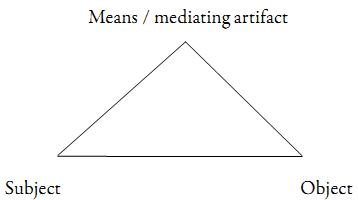
<body><![CDATA[<p><font size="2" face="Verdana, Arial, Helvetica, sans-serif">There seems to be a lack of studies that analyze L1 use  in the FL online classroom. This may be due to the  fact that most research has praised the advantages of  using CMC in the FL classroom as a tool that allows  access to authentic materials and native speakers.  Therefore, most works are based on the possibilities  that multimedia and web technologies open to  get students in contact with native speakers of the  target language, especially when used to promote  inter-cultural learning. </font></p>     <p><font size="2" face="Verdana, Arial, Helvetica, sans-serif">There are some studies that are not focused on  but only report on the use of L1 in CMC in the  FL classroom. For example, Oskoz and Elola  (2008) state that in O'Dowd's (2003) and Belz's  (2003b) studies, students used their L1 but only  when correcting their partners' errors. Along the  same lines, Bauer, deBenedette, Furstenberg,  Levet, and Waryn (2006) mention that in the  <i>Cultura</i> project<a name="en3"></a><a href="#n3"><sup>3</sup></a>  ''all students write in their L1 on  the forums'' (p. 31). However, the authors also  assert that this ''is an important and frequently  misunderstood aspect of Cultura'' (p. 31) and they  proceed to offer a rather lengthy explanation that  justifies L1 use in the discussion boards. Oskoz's  and Elola's (2008) study also reports the use of L1  in CMC in the FL classroom. Similar to Bauer  and colleagues, the authors devote a section of the  paper to justify L1 use in CMC by claiming that it  constitutes a mediating tool between the L1 and  the L2 culture. The use of L1, the authors assert,  allows learners to reflect on their understanding  of their own and others' culture, which leads to a  process of interpretation and discovery. As it can  be observed, studies on CMC in the FL classroom  show a similar trend to those centered on f2f FL  instruction: L1 use continues to be a sin. And  again, those that openly advocate for L1 use in  CMC in FL education frame their ''justification''  in sociocultural theory.</font></p>     <p><font size="2" face="Verdana, Arial, Helvetica, sans-serif">In the following section, I present Vygotsky's  (1978) ideas about learning and Cole and  Engestr&ouml;m's (2001) activity theory in order to  later apply it to the analysis of L1 use in discussion  forums of SFL classes. </font></p>     <p>&nbsp;</p>     <p><font size="3" face="Verdana, Arial, Helvetica, sans-serif"><b>3. CAN SOCIOCULTURAL THEORIES OF  LEARNING ABSOLVE US?</b></font></p>     <p><font size="2" face="Verdana, Arial, Helvetica, sans-serif">Sociocultural theory is based on Vygotsky's work.  Central to his theory is the concept of mediation  (also see Wertsch, 1997). Vygotsky (1978) argues  that not only physical but also semiotic tools  mediate human action: ''the most significant  moment in the course of intellectual development,  which gives birth to the purely human forms of  practical and abstract intelligence, occurs when  speech and practical activity, two previously  completely independent lines of development,  converge'' (p. 24). Language is seen as ''a  particularly powerful semiotic tool'' that ''mediates  our physical and mental activities'' (Swain, 2000,  p. 104). That is, as humans, we do not act directly  on the world but our actions are always mediated. </font></p>     <p><font size="2" face="Verdana, Arial, Helvetica, sans-serif">Therefore, in sociocultural theory, the unit of  analysis is not the individual or a ''specific mental  processes in vacuo'' (Wertsch, 1997, p. 5) but tool- mediated action. According to Vygotsky (1978),  the dialectical unit of ''practical intelligence and  sign use'' constitutes ''the very essence of complex  human behavior'' (p. 24). This is what Cole and  Engestr&ouml;m (2001) call ''the classical mediational  triangle'' (p. 6), which ''fail&#91;s&#93; to account for the  collective nature of human activities, or activities  systems'' (p. 7). The authors, thus, propose activity  systems as the basic unit of analysis to understand  the development of human cognition and define  this term by expanding the mediational triangle  depicted in <a href="#f1">Figure 1</a>. </font></p>     <p>&nbsp;</p>     <p align="center"><font size="2" face="Verdana, Arial, Helvetica, sans-serif"><a name="f1"></a><img src="/img/revistas/ikala/v17n3/v17n3a3f1.gif"></font></p>     <p align="center"><font size="2" face="Verdana, Arial, Helvetica, sans-serif"><b>Figure 1</b>: The classical mediational triangle</font></p>     ]]></body>
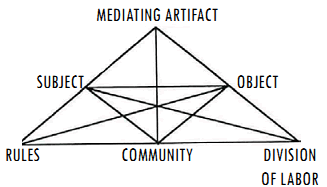
<body><![CDATA[<p>&nbsp;</p>     <p><font size="2" face="Verdana, Arial, Helvetica, sans-serif">According to Cole and Engestr&ouml;m (2001),  activity systems are inherently social and they are  in constant change. In their representation of the  activity system, the authors see as mediated more  than just the relation between subject and object.  They propose a cultural-historical framework to  analyze cognition as a distributed phenomenon  and thus add three components to the activity  system: rules, community, and division of labor  (see <a href="#f2">Figure 2</a>).</font></p>     <p>&nbsp;</p>     <p align="center"><font size="2" face="Verdana, Arial, Helvetica, sans-serif"><a name="f2"></a><img src="/img/revistas/ikala/v17n3/v17n3a3f2.gif"></font></p>     <p align="center"><font size="2" face="Verdana, Arial, Helvetica, sans-serif"><b>Figure 2:</b> The basic mediational triangle  expanded (Cole &amp; Engestr&ouml;m, 2001, p. 8)</font></p>     <p>&nbsp;</p>     <p><font size="2" face="Verdana, Arial, Helvetica, sans-serif">These authors describe their representation of the  activity system as follows:</font></p>     <blockquote>         <p><font size="2" face="Verdana, Arial, Helvetica, sans-serif">First, the  fact that individuals (''subject'') are  constituted in communities is indicated by the point  labeled ''community'' &#91;...&#93; the relations between subject  and community are mediated, on the one hand, by the  group's full collection of ''mediating artifacts'' and, on  the other hand, by ''rules'' (the norms and sanctions that  specify and regulate the expected correct procedures  and acceptable interactions among the participants).  Communities, in turn, imply a ''division of labor,'' the  continuously negotiated distribution of tasks, powers  and responsibilities among the participants of the  activity system. (Cole &amp; Engestr&ouml;m, 2001, p. 7)</font></p> </blockquote>          <p><font size="2" face="Verdana, Arial, Helvetica, sans-serif">Conceptualizing human action in this framework  allows us to broaden our analysis of L1 use in FL  education. In this sense, we are not only centering  our analysis on the mediated action of learners  using L1 as a cognitive tool to achieve specific  functions that allow L2 acquisition within a given  task, but we are also situating the systematic use of  L1 within the FL classroom as a means to inter- cultural learning. </font></p>     ]]></body>
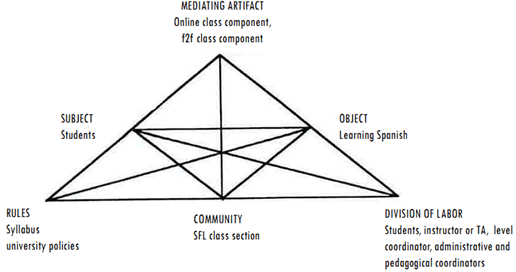
<body><![CDATA[<p><font size="2" face="Verdana, Arial, Helvetica, sans-serif">In the following section, applying Cole and  Engestr&ouml;m's theory, I first describe lower-level  Spanish classes at a mid-size public university on  the East Coast of the United States as activity  systems. Then, I conduct an activity analysis of L1  use in the discussion boards as part of these SFL  classes. </font></p>     <p>&nbsp;</p>     <p><font size="3" face="Verdana, Arial, Helvetica, sans-serif"><b>4. L1 AS A TOOL VERSION </b></font></p>     <p><font size="2" face="Verdana, Arial, Helvetica, sans-serif"><b>Description of the SFL courses as activity  systems</b></font></p>     <p><font size="2" face="Verdana, Arial, Helvetica, sans-serif">The lower-level SFL courses (first, second, and  third semester courses) at this mid-size public  university located on the East Coast of the United  States are part of the undergraduate General  Foundation Requirements (GFR) and Spanish is  the most commonly taught second language at the  university. This leads to a highly centralized and  structuralized division of labor with its consequent  rules. With one or two exceptions, the lower- level SFL courses are taught by graduate teaching  assistants (TAs) and part-time instructors. These  are standardized classes and TAs and instructors  follow a centralized curriculum. Most of the rules  for each class/activity system are in the syllabus  and framed at a broader level by the general  institutional policies of the university. Instructors  and TAs meet weekly with a level coordinator  to develop teaching and assessment materials.  The level coordinator acts as a liaison with the  pedagogical coordinator and the administrative  coordinator. The pedagogical coordinator  supervises and evaluates the materials produced  during the meetings. The previous illustrates ''the distribution of tasks, powers and responsibilities  among the participants'' (Cole &amp; Engestr&ouml;m,  2001, p. 7) that constitute the division of labor in  this activity system. </font></p>     <p><font size="2" face="Verdana, Arial, Helvetica, sans-serif">An example of one of the rules that ''specify and  regulate the expected correct procedures'' (Cole  &amp; Engestr&ouml;m, 2001, p. 7) revolves around L2  use. Almost exclusive use of L2 is encouraged in  the orientation sessions that TAs and part-time  professors receive before the beginning of the  semester. In addition, L2 use is also encouraged in  the language methodology course that TAs take  during their first semester teaching. Finally, the  syllabus states that the course will be conducted in  Spanish. </font></p>     <p><font size="2" face="Verdana, Arial, Helvetica, sans-serif">The course delivery format used in these classes  is an important mediating artifact that regulates  the subject(s) activities. The lower-level SFL  courses are offered using the hybrid delivery  format which combines  traditional  and online  teaching approaches, meaning f2f instruction is  complemented with an online component of the  classes. The course management software used to  support the internet-based component is Blackboard Academic Suite<sup>TM</sup>  (2007). During the course of the  semester, classes meet two or three times a week  for two and a half hours. Online activities are done  outside of class hours. In Blackboard, in addition to  the online activities, students can find the syllabus,  materials posted by their TAs or instructors (not  all of them use this feature), their grades, and links  to websites with Spanish learning resources such  as self-check exercises and online dictionaries.  Online activities count as 15% of students' final  grade, with 7.5% associated with four online  chat activities and 7.5% to participation in four  discussion boards. At the beginning of the semester  (usually during the second week of classes) the class  is held in a computer-equipped room and students  are trained by instructors and TAs on how to use  Blackboard. Additionally, students are also given  handouts on how to complete the online activities.  Students are required to use Spanish when  completing the chats, though they participate in  the discussion boards using their L1<a name="en4"></a><a href="#n4"><sup>4</sup></a> . </font></p>     <p><font size="2" face="Verdana, Arial, Helvetica, sans-serif">The following <a href="#f3">figure</a> represents a lower-level SFL  class at the mentioned university as an activity  system.</font></p>     <p>&nbsp;</p>     <p align="center"><font size="2" face="Verdana, Arial, Helvetica, sans-serif"><a name="f3"></a><img src="/img/revistas/ikala/v17n3/v17n3a3f3.gif"></font></p>     ]]></body>
<body><![CDATA[<p align="center"><font size="2" face="Verdana, Arial, Helvetica, sans-serif"><b>Figure 3</b>: The SFL classroom as an activity system</font></p>     <p>&nbsp;</p>     <p><font size="2" face="Verdana, Arial, Helvetica, sans-serif">As it can be observed in <a href="#f3">Figure 3</a>, the online  component of the class at this level acts as a  mediating artifact between the subjects and the  object. At the same time, it interacts with the other  components of the activity system. It is embedded  in the community defined as the specific section  of SFL, in which participants share an objective,  rules, and where there exists a division of labor.  Although neither the level coordinators nor the  pedagogical and administrative coordinators  are physically present in each class section, the  products of their work influence the way this  community functions. For this reason, I added the  coordinators in <a href="#f3">Figure 3</a>. </font></p>     <p><font size="2" face="Verdana, Arial, Helvetica, sans-serif">In the following section, I explain and analyze the  use of the discussion boards within the lower-level  SFL classes and justify L1 use in them. </font></p>     <p><font size="2" face="Verdana, Arial, Helvetica, sans-serif"><b>Discussion boards and inter-cultural learning</b></font></p>     <p><font size="2" face="Verdana, Arial, Helvetica, sans-serif">As described in the previous section, the students'  objective (learning Spanish) is mediated by the f2f  and online components of the class. The online  component is divided into two kinds of activities:  the chats and the participation in the discussion  boards. In these SFL classes, the discussion boards  are the mediating artifact through which students  are expected to reflect on their understanding of  their own and the others' culture. Therefore, the  object of the discussion boards is inter-cultural  learning. The following <a href="#f4">figure</a> represents the  activity system in which students are involved  when participating in the discussion boards, which  at the same time is nested in the class activity  system.</font></p>     <p><font size="2" face="Verdana, Arial, Helvetica, sans-serif">As depicted in <a href="#f4">Figure 4</a>, the rules for participating  in the discussion board are stated in the handouts  that the students are given at the beginning of  the semester in the training session (Appendix A  contains the handout). In addition to ''specif&#91;ing&#93;  and regulat&#91;ing&#93;'' (Cole &amp; Engestr&ouml;m, 2001, p. 7)  students' participation in the discussion boards,  the handout also states the object of this activity  in which each section of the SFL classes (the  community) will be involved. In this community,  there is a division of labor in which students  and teacher have ''specific tasks, powers and  responsibilities'' (Cole &amp; Engestr&ouml;m, 2001, p. 7).  In addition, in this activity system the discussion  board as a mediating artifact can be decomposed  into different ''layers''. The first and broader layer is  constituted by the discussion board as a task to be  fulfilled as part of the SFL course where students  are expected to engage in a dialogue with their  peers in order to discuss and reflect on cultural  issues (for a more detailed description see the section ''Pedagogical rationale'' in Appendix A).  The second layer is constituted by the discussion  board as an online technological tool that as  such influences the ongoing dialogue among the  participants. As it will be shown in the following  section, both of these elements endorse the use of  L1 in the discussion boards. </font></p>     <p>&nbsp;</p>     <p align="center"><font size="2" face="Verdana, Arial, Helvetica, sans-serif"><a name="f4"><img src="/img/revistas/ikala/v17n3/v17n3a3f4.gif"></a></font></p>     <p align="center"><font size="2" face="Verdana, Arial, Helvetica, sans-serif"><b>Figure 4</b>: The discussion boards activity system in the SFL class</font></p>     ]]></body>
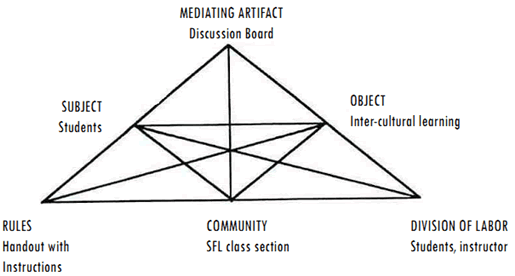
<body><![CDATA[<p>&nbsp;</p>     <p><font size="2" face="Verdana, Arial, Helvetica, sans-serif"><b>L1 as an inter-cultural learning tool in the  discussion boards: Not a sin anymore. </b></font></p>     <p><font size="2" face="Verdana, Arial, Helvetica, sans-serif">The inclusion of inter-cultural learning as one of  the objectives of FL instruction has developed  rapidly in the last years (Belz &amp; Thorne, 2006;  Knutson, 2006; O'Dowd, 2003). Inter-cultural  learning is related to the development of cross- cultural awareness and is based on the assumption  that ''students cannot learn about values of  another culture (C2) without considering those of  their own'' (Knutson, 2006, p. 592). This entails  ''broadening their horizon &#91;...&#93; by the discussion  of cultural differences which may challenge their  beliefs and values beyond the level of comfort''  (Dubriel, 2006, p. 238). Accordingly, the object  of the discussion boards in these SFL classes is to  offer students a space where they reflect not only  on similarities and differences among cultures but  also on others' and their own social identities. In  order to achieve this, students should be able to  ''express their views fully and in detail, formulate  questions and hypothesis clearly, and provide  complex, nuanced information'' (Bauer et. al, 2006,  p. 35). This is not an easy task to be accomplished  by students who are in beginning or intermediate  FL classes. It is at this point where the use of L1  as a mediational means becomes imperative to  achieve the object of the task. In this regard,  Knutson (2006) proposes that ''it is certainly  feasible to judiciously integrate the L1'' in the FL  classroom if ''the activities or situations in which  the L1 can be used are completely routinized &#91;sic&#93;  and predictable'' (p. 605). The online environment  in which the discussions are held, then, provides  a physical and symbolic ''space'' where the use  of L1 is accepted in the aforementioned SFL  classes. In this sense, L1 usage is institutionalized  and conceived as a mediational tool that allows  students to achieve the object of the discussion  boards: inter-cultural learning.</font></p>     <p><font size="2" face="Verdana, Arial, Helvetica, sans-serif">In addition to the nature of the task, the medium in  which the discussions are held also supports the use  of the L1. Belz and Thorne (2006) recognize that  Internet-mediated intercultural foreign language  education presents challenges ''especially in text- based media bereft of paralinguistic meaning  signals'' (Belz &amp; Thorne, 2006, p. xvi). The fact  that in the online discussion the main (if not the  sole) means through which the dialogue is carried  out is written language adds a level of complexity.  Thus, to carry out a discussion in a second language  and in a written medium is not an easy task even  in L1. As Sengupta (2001) asserts, ''in terms of  the very nature of networked communication  &#91;...&#93; discourse patterns may need adjusting to take  into account the fact that there was no non-verbal  contextual support'' (p. 123). Therefore, when the  language output needs to be written, students may  lack the sufficient linguistic flexibility needed to  communicate complex thoughts in writing.</font></p>     <p><font size="2" face="Verdana, Arial, Helvetica, sans-serif">This linguistic flexibility is not only related to  language proficiency but also to the  <i>cultures-of- use</i> that are embedded in online communication.  As Thorne (2003) defines it, cultures-of-use are  the ''historically sedimented characteristics that  accrue to a CMC tool from its everyday use &#91;...&#93;  artifacts embody historical processes that shape,  and are shaped by, human activity'' (p. 40). In this  sense, the discussion board as a mediating artifact  is not neutral. First, as a mediational means, it  carries a functionality that is tied to its materiality  and influences our actions: when participating in a  discussion board, typically we type on a keyboard,  read on the screen, etc. Second, the discussion board  as a mediational means also ''takes its functionality  from its histories of use'' (Thorne, 2003, p. 40).  Scripted in the history of use of the SFL classes'  discussion boards is the fact that the students are  participating in an institutionally framed online  space. This institutional frame is materialized in  the interface of the management system used at  the university (Blackboard), which at the time influences the way students act when using this  mediational tool. If students were to participate in  the discussion boards using their L2, they would  be facing two contradictory objects: using the L2  and fully expressing their views. Most predictably,  students would solve this contradiction by focusing  their efforts in appropriately using the L2, which  would contradict the object of the discussion  boards: inter-cultural learning. </font></p>     <p><font size="2" face="Verdana, Arial, Helvetica, sans-serif">Therefore, the L1 use becomes necessary not only  because of the object of the discussion boards in  the activity system of the SFL classes but also due  to the nature of the medium through which this  object is achieved. In addition, conceptualizing  L1 use as a cognitive tool that allows students  to achieve the inter-cultural learning object also  allows us to broaden the horizons of FL courses. As  Knutson (2006) states, ''the understanding of self  as culturally determined is closely associated with  the humanistic values L2  <i>education</i> is designed  to promote, and it is a valuable asset for lifelong  learning as well'' (p. 599). It is in this sense that the  object of language courses at the university level is  undeniably linked to promoting in our students a  broader understanding of their cultural selves and  others.  </font></p>     <p><font size="2" face="Verdana, Arial, Helvetica, sans-serif">If we are asking our students to take a step back and  evaluate their own cultural assumptions in order  to be able to critically evaluate others' culture,  as educators, we should follow a similar path.  Therefore, as educators and researchers, we should  recognize that ''theoretical mindsets and narratives  &#91;...&#93; are historically situated <i>constructs</i> that are  influenced by a host of socio-cultural factors''  (Belz, 2003a, p. 211). As shown in the first sections  of this paper, it is in these historically constituted  narratives that the use of L1 in the FL classroom  has been considered a sin in teaching and research  settings. It was the purpose of this paper to show  that sociocultural theories offer us an opportunity  to go beyond these narratives and evaluate the  constructs that mediate our pedagogical and  research practices. The activity analysis of our  classes allowed us to acknowledge inter-cultural  learning as the object of the discussion board  activity systems and therefore we stopped seeing  L1 use as a sin. Once we recognized that in asking  students to use L2 we were asking them to achieve  two contradictory objects in the discussion  board system, we decided to institutionalize the  use of L1 in our classes. Given the nature of the  task, the medium in which it was performed and  the pedagogical objectives that we embraced, we  framed L1 in such a way it became a cognitive tool  to facilitate inter-cultural learning. In order to do  this, we needed to take a step back and evaluate  the constructs that mediated our pedagogical and  research practices, challenging and changing them  through theory. </font></p>     <p>&nbsp;</p> <hr size="1" noshade>     <p><font size="3" face="Verdana, Arial, Helvetica, sans-serif"><b>AUTHOR'S NOTES</b> </font></p>     <p><font size="2" face="Verdana, Arial, Helvetica, sans-serif"><a name="n1"></a><a href="#en1">1</a>  I define face to face classroom (f2f ) as in-class sessions where teacher and students are physically present in the same place.</font></p>     ]]></body>
<body><![CDATA[<p><font size="2" face="Verdana, Arial, Helvetica, sans-serif"><a name="n2"></a><a href="#en2">2</a>  When working with think-aloud protocols, most of the subjects externalize their composing process using their L1.</font></p>     <p><font size="2" face="Verdana, Arial, Helvetica, sans-serif"><a name="n3"></a><a href="#en3">3</a>  The  <i>Cultura</i> project is an intercultural project that makes use of internet communication tools to develop students'  understanding of the values and attitudes embedded in a foreign culture.</font></p>     <p><font size="2" face="Verdana, Arial, Helvetica, sans-serif"><a name="n4"></a><a href="#en4">4</a>  The term L1 is used here as opposed to L2. In the classes described in this section L1 means English since they are taught at  an American university. However, no assumption is made that all students are native-English speakers. </font></p> <hr size="1" noshade>     <p>&nbsp;</p>     <p><font size="3" face="Verdana, Arial, Helvetica, sans-serif"><b>REFERENCES</b></font></p>     <!-- ref --><p><font size="2" face="Verdana, Arial, Helvetica, sans-serif"> 1. Akyel, A., &amp; Kami&#351;li, S. (1996). <i>Composing in first  and second languages: Possible effects of EFL  writing instruction</i>. Paper presented at the Balkan  Conference on English Language Teaching of the  International Association of Teachers of English  as a Foreign Language, September 5-7, Istambul,  Turkey.    &nbsp;&nbsp;&nbsp;&nbsp;&nbsp;&nbsp;&nbsp;&nbsp;[&#160;<a href="javascript:void(0);" onclick="javascript: window.open('/scielo.php?script=sci_nlinks&ref=000098&pid=S0123-3432201200030000300001&lng=','','width=640,height=500,resizable=yes,scrollbars=1,menubar=yes,');">Links</a>&#160;]<!-- end-ref -->  </font></p>     <!-- ref --><p><font size="2" face="Verdana, Arial, Helvetica, sans-serif">2. Ant&oacute;n, M., &amp; DiCamilla, F. (1998). Socio-cognitive  functions of L1 collaborative interaction in the  L2 classroom. <i>The Canadian Modern Language  Review</i>, 54(3), 314-342.    &nbsp;&nbsp;&nbsp;&nbsp;&nbsp;&nbsp;&nbsp;&nbsp;[&#160;<a href="javascript:void(0);" onclick="javascript: window.open('/scielo.php?script=sci_nlinks&ref=000100&pid=S0123-3432201200030000300002&lng=','','width=640,height=500,resizable=yes,scrollbars=1,menubar=yes,');">Links</a>&#160;]<!-- end-ref --> </font></p>     <!-- ref --><p><font size="2" face="Verdana, Arial, Helvetica, sans-serif">3. Auerbach, E. (1993). Reexamining English only in the  ESL classroom. <i>TESOL Quarterly</i>, 27(1), 9-32.    &nbsp;&nbsp;&nbsp;&nbsp;&nbsp;&nbsp;&nbsp;&nbsp;[&#160;<a href="javascript:void(0);" onclick="javascript: window.open('/scielo.php?script=sci_nlinks&ref=000102&pid=S0123-3432201200030000300003&lng=','','width=640,height=500,resizable=yes,scrollbars=1,menubar=yes,');">Links</a>&#160;]<!-- end-ref --> </font></p>     <!-- ref --><p><font size="2" face="Verdana, Arial, Helvetica, sans-serif">4. Ballman, T., Liskin-Gasparro, J., &amp; Mandell, P.  (2001). <i>The communicative classroom: AATSP  Professional Development (Vol. 2)</i>. Boston, MA:  Heinle &amp; Heinle.    &nbsp;&nbsp;&nbsp;&nbsp;&nbsp;&nbsp;&nbsp;&nbsp;[&#160;<a href="javascript:void(0);" onclick="javascript: window.open('/scielo.php?script=sci_nlinks&ref=000104&pid=S0123-3432201200030000300004&lng=','','width=640,height=500,resizable=yes,scrollbars=1,menubar=yes,');">Links</a>&#160;]<!-- end-ref --> </font></p>     <!-- ref --><p><font size="2" face="Verdana, Arial, Helvetica, sans-serif">5. Bauer, B., deBenedette, L., Furstenberg, G., Levet, S.,  &amp; Waryn, S. (2006). The Cultura project. In J.,  Belz, &amp; S., Thorne (Eds.),<i> Internet-mediated  intercultural foreign language education</i> (pp. 31- 62). Boston, MA: Thomson Heinle.    &nbsp;&nbsp;&nbsp;&nbsp;&nbsp;&nbsp;&nbsp;&nbsp;[&#160;<a href="javascript:void(0);" onclick="javascript: window.open('/scielo.php?script=sci_nlinks&ref=000106&pid=S0123-3432201200030000300005&lng=','','width=640,height=500,resizable=yes,scrollbars=1,menubar=yes,');">Links</a>&#160;]<!-- end-ref --></font></p>     <!-- ref --><p><font size="2" face="Verdana, Arial, Helvetica, sans-serif">6.Belz, J. (2003a). Identity, deficiency, and L1 use in  foreign language study. In C., Blyth (Ed.),  <i>The  sociolinguistics of foreign language classrooms:  Contributions of the native, near-native and the  non-native speaker</i> (pp. 209-250). Boston, MA:  Heinle &amp; Heinle.    &nbsp;&nbsp;&nbsp;&nbsp;&nbsp;&nbsp;&nbsp;&nbsp;[&#160;<a href="javascript:void(0);" onclick="javascript: window.open('/scielo.php?script=sci_nlinks&ref=000108&pid=S0123-3432201200030000300006&lng=','','width=640,height=500,resizable=yes,scrollbars=1,menubar=yes,');">Links</a>&#160;]<!-- end-ref --> </font></p>     <!-- ref --><p><font size="2" face="Verdana, Arial, Helvetica, sans-serif">7. Belz, J. (2003b). Linguistic perspectives on the  development of intercultural competence in  telecollaboration.  <i>Language Learning and  Technology</i>, 7(2), 68-117. Retrieved from <a href="http://llt.msu.edu/vol7num2/belz/default.html" target="_blank">http://llt.msu.edu/vol7num2/belz/default.html</a> </font>&nbsp;&nbsp;&nbsp;&nbsp;&nbsp;&nbsp;&nbsp;&nbsp;[&#160;<a href="javascript:void(0);" onclick="javascript: window.open('/scielo.php?script=sci_nlinks&ref=000110&pid=S0123-3432201200030000300007&lng=','','width=640,height=500,resizable=yes,scrollbars=1,menubar=yes,');">Links</a>&#160;]<!-- end-ref --><!-- ref --><p><font size="2" face="Verdana, Arial, Helvetica, sans-serif">8. Belz, J., &amp; Thorne, S. (2006). Internet-mediated  intercultural foreign language education and the  intercultural speaker (Introduction). In J. Belz, &amp;  S. Thorne (Eds.), <i>Internet-mediated intercultural  foreign language education</i> (pp. x-xxv). Boston,  MA: Thomson Heinle.    &nbsp;&nbsp;&nbsp;&nbsp;&nbsp;&nbsp;&nbsp;&nbsp;[&#160;<a href="javascript:void(0);" onclick="javascript: window.open('/scielo.php?script=sci_nlinks&ref=000111&pid=S0123-3432201200030000300008&lng=','','width=640,height=500,resizable=yes,scrollbars=1,menubar=yes,');">Links</a>&#160;]<!-- end-ref -->  </font></p>     ]]></body>
<body><![CDATA[<!-- ref --><p><font size="2" face="Verdana, Arial, Helvetica, sans-serif">9. Berman, R. (1994).  EFL essay writing: L1 versus  L2 instruction. Paper presented at the Annual  Meeting of TESOL, March 8-12, Baltimore, MD.    &nbsp;&nbsp;&nbsp;&nbsp;&nbsp;&nbsp;&nbsp;&nbsp;[&#160;<a href="javascript:void(0);" onclick="javascript: window.open('/scielo.php?script=sci_nlinks&ref=000113&pid=S0123-3432201200030000300009&lng=','','width=640,height=500,resizable=yes,scrollbars=1,menubar=yes,');">Links</a>&#160;]<!-- end-ref -->  </font></p>     <!-- ref --><p><font size="2" face="Verdana, Arial, Helvetica, sans-serif">10. <i>Blackboard Academic Suite Brochure</i>  (2007).  Retrieved from <a href="http://www.blackboard.com/clientcollateral/Academic_Suite_Brochure_ New.pdf" target="_blank">http://www.blackboard.com/clientcollateral/Academic_Suite_Brochure_ New.pdf</a> </font>&nbsp;&nbsp;&nbsp;&nbsp;&nbsp;&nbsp;&nbsp;&nbsp;[&#160;<a href="javascript:void(0);" onclick="javascript: window.open('/scielo.php?script=sci_nlinks&ref=000115&pid=S0123-3432201200030000300010&lng=','','width=640,height=500,resizable=yes,scrollbars=1,menubar=yes,');">Links</a>&#160;]<!-- end-ref --><!-- ref --><p><font size="2" face="Verdana, Arial, Helvetica, sans-serif">11. Brooks, F., &amp; Donato, R. (1994). Vygotskyan approaches  to understanding foreign language learner  discourse during communicative tasks. <i>Hispania</i>,  77, 262-274.    &nbsp;&nbsp;&nbsp;&nbsp;&nbsp;&nbsp;&nbsp;&nbsp;[&#160;<a href="javascript:void(0);" onclick="javascript: window.open('/scielo.php?script=sci_nlinks&ref=000116&pid=S0123-3432201200030000300011&lng=','','width=640,height=500,resizable=yes,scrollbars=1,menubar=yes,');">Links</a>&#160;]<!-- end-ref -->   </font></p>     <!-- ref --><p><font size="2" face="Verdana, Arial, Helvetica, sans-serif">12. Burnett, J. (1998). Language alternation in a computer- equipped foreign language classroom: The  intersection of teacher beliefs, language, and  technology.  <i>The Canadian Modern Language  Review</i>, 55(1), 97-123.    &nbsp;&nbsp;&nbsp;&nbsp;&nbsp;&nbsp;&nbsp;&nbsp;[&#160;<a href="javascript:void(0);" onclick="javascript: window.open('/scielo.php?script=sci_nlinks&ref=000118&pid=S0123-3432201200030000300012&lng=','','width=640,height=500,resizable=yes,scrollbars=1,menubar=yes,');">Links</a>&#160;]<!-- end-ref -->  </font></p>     <!-- ref --><p><font size="2" face="Verdana, Arial, Helvetica, sans-serif">13. Chavez, M. (2003). The diglossic foreign-language  classroom: Learners' views on L1 and L2  functions. In C., Blyth (Ed.), <i>The sociolinguistics  of foreign language classrooms: Contributions  of the native, near-native and the non-native  speaker</i> (pp. 163-208). Boston, MA: Heinle &amp;  Heinle.    &nbsp;&nbsp;&nbsp;&nbsp;&nbsp;&nbsp;&nbsp;&nbsp;[&#160;<a href="javascript:void(0);" onclick="javascript: window.open('/scielo.php?script=sci_nlinks&ref=000120&pid=S0123-3432201200030000300013&lng=','','width=640,height=500,resizable=yes,scrollbars=1,menubar=yes,');">Links</a>&#160;]<!-- end-ref --> </font></p>     <!-- ref --><p><font size="2" face="Verdana, Arial, Helvetica, sans-serif">14. Cole, M., &amp; Engestr&ouml;m, C. (2001). A cultural-historical  approach to distributed cognition. In G., Salomon  (Ed.), <i>Distributed cognitions: Psychological  and educational considerations</i> (pp. 1-46). New  York, NY: Cambridge University Press.    &nbsp;&nbsp;&nbsp;&nbsp;&nbsp;&nbsp;&nbsp;&nbsp;[&#160;<a href="javascript:void(0);" onclick="javascript: window.open('/scielo.php?script=sci_nlinks&ref=000122&pid=S0123-3432201200030000300014&lng=','','width=640,height=500,resizable=yes,scrollbars=1,menubar=yes,');">Links</a>&#160;]<!-- end-ref --> </font></p>     <!-- ref --><p><font size="2" face="Verdana, Arial, Helvetica, sans-serif">15. Cook, V. (2001). Using the first language in the  classroom.  <i>The Canadian Modern Language  Review</i>, 57(3), 402-423.    &nbsp;&nbsp;&nbsp;&nbsp;&nbsp;&nbsp;&nbsp;&nbsp;[&#160;<a href="javascript:void(0);" onclick="javascript: window.open('/scielo.php?script=sci_nlinks&ref=000124&pid=S0123-3432201200030000300015&lng=','','width=640,height=500,resizable=yes,scrollbars=1,menubar=yes,');">Links</a>&#160;]<!-- end-ref --> </font></p>     <!-- ref --><p><font size="2" face="Verdana, Arial, Helvetica, sans-serif">16. Crerand, M. (1993).  <i>From first language literacy to  second language proficiency to second language  literacy: the act of writing in a foreign language context</i>. Paper presented at the Annual Meeting of  the American Educational Research Association,  April 12-16, Atlanta, GA.    &nbsp;&nbsp;&nbsp;&nbsp;&nbsp;&nbsp;&nbsp;&nbsp;[&#160;<a href="javascript:void(0);" onclick="javascript: window.open('/scielo.php?script=sci_nlinks&ref=000126&pid=S0123-3432201200030000300016&lng=','','width=640,height=500,resizable=yes,scrollbars=1,menubar=yes,');">Links</a>&#160;]<!-- end-ref --></font></p>     <!-- ref --><p><font size="2" face="Verdana, Arial, Helvetica, sans-serif">17. De Guerrero, M., &amp; Villamil, O. (1994). Social-cognitive  dimensions of interaction in L2 peer revision. <i>The  Modern Language Journal</i>, 78(4), 484-496.    &nbsp;&nbsp;&nbsp;&nbsp;&nbsp;&nbsp;&nbsp;&nbsp;[&#160;<a href="javascript:void(0);" onclick="javascript: window.open('/scielo.php?script=sci_nlinks&ref=000128&pid=S0123-3432201200030000300017&lng=','','width=640,height=500,resizable=yes,scrollbars=1,menubar=yes,');">Links</a>&#160;]<!-- end-ref --> </font></p>     <!-- ref --><p><font size="2" face="Verdana, Arial, Helvetica, sans-serif">18. Dubriel, S. (2006). Gaining perspective on culture  through CALL. In L., Ducate, &amp; N., Arnold (Eds.), <i>Calling on CALL: from theory and research to  new directions in foreign language teaching</i> (pp.  237-268). San Marcos, TX: CALICO.    &nbsp;&nbsp;&nbsp;&nbsp;&nbsp;&nbsp;&nbsp;&nbsp;[&#160;<a href="javascript:void(0);" onclick="javascript: window.open('/scielo.php?script=sci_nlinks&ref=000130&pid=S0123-3432201200030000300018&lng=','','width=640,height=500,resizable=yes,scrollbars=1,menubar=yes,');">Links</a>&#160;]<!-- end-ref --> </font></p>     <!-- ref --><p><font size="2" face="Verdana, Arial, Helvetica, sans-serif">19. Duff, P., &amp; Polio, C. (1990). How much foreign language  is there in the foreign language classroom. <i>The  Modern Language Journal</i>, 74, 154-166.    &nbsp;&nbsp;&nbsp;&nbsp;&nbsp;&nbsp;&nbsp;&nbsp;[&#160;<a href="javascript:void(0);" onclick="javascript: window.open('/scielo.php?script=sci_nlinks&ref=000132&pid=S0123-3432201200030000300019&lng=','','width=640,height=500,resizable=yes,scrollbars=1,menubar=yes,');">Links</a>&#160;]<!-- end-ref --> </font></p>     <!-- ref --><p><font size="2" face="Verdana, Arial, Helvetica, sans-serif">20. Ellis, R. (2001). SLA research and language teaching.  New York, NY: Oxford University Press.    &nbsp;&nbsp;&nbsp;&nbsp;&nbsp;&nbsp;&nbsp;&nbsp;[&#160;<a href="javascript:void(0);" onclick="javascript: window.open('/scielo.php?script=sci_nlinks&ref=000134&pid=S0123-3432201200030000300020&lng=','','width=640,height=500,resizable=yes,scrollbars=1,menubar=yes,');">Links</a>&#160;]<!-- end-ref -->  </font></p>     <!-- ref --><p><font size="2" face="Verdana, Arial, Helvetica, sans-serif">21. Hancock, M. (1997). Behind classroom code switching:  layering and language choice in L2 learner  interaction. <i>TESOL Quarterly,</i> 31(2), 217-235.    &nbsp;&nbsp;&nbsp;&nbsp;&nbsp;&nbsp;&nbsp;&nbsp;[&#160;<a href="javascript:void(0);" onclick="javascript: window.open('/scielo.php?script=sci_nlinks&ref=000136&pid=S0123-3432201200030000300021&lng=','','width=640,height=500,resizable=yes,scrollbars=1,menubar=yes,');">Links</a>&#160;]<!-- end-ref --> </font></p>     <!-- ref --><p><font size="2" face="Verdana, Arial, Helvetica, sans-serif">22. Knutson, E. (2006). Cross-cultural awareness for second/ foreign language learners. <i>The Canadian Modern  Language Review,</i> 62(4), 591-610.    &nbsp;&nbsp;&nbsp;&nbsp;&nbsp;&nbsp;&nbsp;&nbsp;[&#160;<a href="javascript:void(0);" onclick="javascript: window.open('/scielo.php?script=sci_nlinks&ref=000138&pid=S0123-3432201200030000300022&lng=','','width=640,height=500,resizable=yes,scrollbars=1,menubar=yes,');">Links</a>&#160;]<!-- end-ref --> </font></p>     <!-- ref --><p><font size="2" face="Verdana, Arial, Helvetica, sans-serif">23. Legenhausen, L. (1991). Code-switching in learner's  discourse. <i>IRAL</i>, 29(1), 61-73.    &nbsp;&nbsp;&nbsp;&nbsp;&nbsp;&nbsp;&nbsp;&nbsp;[&#160;<a href="javascript:void(0);" onclick="javascript: window.open('/scielo.php?script=sci_nlinks&ref=000140&pid=S0123-3432201200030000300023&lng=','','width=640,height=500,resizable=yes,scrollbars=1,menubar=yes,');">Links</a>&#160;]<!-- end-ref -->  </font></p>     <!-- ref --><p><font size="2" face="Verdana, Arial, Helvetica, sans-serif">24. Levine, G. (2003). Student and instructor beliefs and  attitudes about target language use, first language  use, and anxiety: report of a questionnaire study.  <i>The Modern Language Journal</i>, 87(3), 343-364.    &nbsp;&nbsp;&nbsp;&nbsp;&nbsp;&nbsp;&nbsp;&nbsp;[&#160;<a href="javascript:void(0);" onclick="javascript: window.open('/scielo.php?script=sci_nlinks&ref=000142&pid=S0123-3432201200030000300024&lng=','','width=640,height=500,resizable=yes,scrollbars=1,menubar=yes,');">Links</a>&#160;]<!-- end-ref -->  </font></p>     <!-- ref --><p><font size="2" face="Verdana, Arial, Helvetica, sans-serif">25. Liebscher, G., &amp; Dailey-O'Cain, J. (2005). Learner  code-switching in the content-based foreign  language classroom. <i>The Modern Language  Journal</i>, 89(2), 234-247.    &nbsp;&nbsp;&nbsp;&nbsp;&nbsp;&nbsp;&nbsp;&nbsp;[&#160;<a href="javascript:void(0);" onclick="javascript: window.open('/scielo.php?script=sci_nlinks&ref=000144&pid=S0123-3432201200030000300025&lng=','','width=640,height=500,resizable=yes,scrollbars=1,menubar=yes,');">Links</a>&#160;]<!-- end-ref -->  </font></p>     <!-- ref --><p><font size="2" face="Verdana, Arial, Helvetica, sans-serif">26. Macaro, E. (2001). Analysing student teachers'  codeswitching in foreign language classrooms:  theories and decision making.  <i>The Modern  Language Journal</i>, 85(4), 531-548.    &nbsp;&nbsp;&nbsp;&nbsp;&nbsp;&nbsp;&nbsp;&nbsp;[&#160;<a href="javascript:void(0);" onclick="javascript: window.open('/scielo.php?script=sci_nlinks&ref=000146&pid=S0123-3432201200030000300026&lng=','','width=640,height=500,resizable=yes,scrollbars=1,menubar=yes,');">Links</a>&#160;]<!-- end-ref --> </font></p>     <!-- ref --><p><font size="2" face="Verdana, Arial, Helvetica, sans-serif">27. Moore, D. (2002). Code-switching and learning in the  classroom.<i> International Journal of Bilingual  Education and Bilingualism</i>, 5(5), 279-293.    &nbsp;&nbsp;&nbsp;&nbsp;&nbsp;&nbsp;&nbsp;&nbsp;[&#160;<a href="javascript:void(0);" onclick="javascript: window.open('/scielo.php?script=sci_nlinks&ref=000148&pid=S0123-3432201200030000300027&lng=','','width=640,height=500,resizable=yes,scrollbars=1,menubar=yes,');">Links</a>&#160;]<!-- end-ref --> </font></p>     <!-- ref --><p><font size="2" face="Verdana, Arial, Helvetica, sans-serif">28. O'Dowd, R. (2003). Understanding the ''Other Side'':  intercultural learning in a Spanish e-mail  exchange.  <i>Language Learning and Technology</i>,  7(2), 118-144. Retrieved from <a href="http://llt.msu.edu/vol7num2/odowd" target="_blank">http://llt.msu.edu/vol7num2/odowd</a> </font>&nbsp;&nbsp;&nbsp;&nbsp;&nbsp;&nbsp;&nbsp;&nbsp;[&#160;<a href="javascript:void(0);" onclick="javascript: window.open('/scielo.php?script=sci_nlinks&ref=000150&pid=S0123-3432201200030000300028&lng=','','width=640,height=500,resizable=yes,scrollbars=1,menubar=yes,');">Links</a>&#160;]<!-- end-ref --><!-- ref --><p><font size="2" face="Verdana, Arial, Helvetica, sans-serif">29. Omaggio-Hadley, A. (2001).  <i>Teaching language in  context</i>. Boston, MA: Heinle &amp; Heinle.    &nbsp;&nbsp;&nbsp;&nbsp;&nbsp;&nbsp;&nbsp;&nbsp;[&#160;<a href="javascript:void(0);" onclick="javascript: window.open('/scielo.php?script=sci_nlinks&ref=000151&pid=S0123-3432201200030000300029&lng=','','width=640,height=500,resizable=yes,scrollbars=1,menubar=yes,');">Links</a>&#160;]<!-- end-ref --> </font></p>     ]]></body>
<body><![CDATA[<!-- ref --><p><font size="2" face="Verdana, Arial, Helvetica, sans-serif">30. Oskoz, A., &amp; Elola, I. (2008). Blogging: fostering  intercultural competence development in foreign  language and study abroad contexts. <i>Foreign Language Annals</i>, 41(3), 454-477.    &nbsp;&nbsp;&nbsp;&nbsp;&nbsp;&nbsp;&nbsp;&nbsp;[&#160;<a href="javascript:void(0);" onclick="javascript: window.open('/scielo.php?script=sci_nlinks&ref=000153&pid=S0123-3432201200030000300030&lng=','','width=640,height=500,resizable=yes,scrollbars=1,menubar=yes,');">Links</a>&#160;]<!-- end-ref --></font></p>     <!-- ref --><p><font size="2" face="Verdana, Arial, Helvetica, sans-serif">31. Pennington, M., &amp; So, S. (1993). Comparing writing  process and product across two languages: a  study of 6 Singaporean university student writers. <i>Journal of Second Language Writing</i>, 2(1), 41-63.    &nbsp;&nbsp;&nbsp;&nbsp;&nbsp;&nbsp;&nbsp;&nbsp;[&#160;<a href="javascript:void(0);" onclick="javascript: window.open('/scielo.php?script=sci_nlinks&ref=000155&pid=S0123-3432201200030000300031&lng=','','width=640,height=500,resizable=yes,scrollbars=1,menubar=yes,');">Links</a>&#160;]<!-- end-ref --> </font></p>     <!-- ref --><p><font size="2" face="Verdana, Arial, Helvetica, sans-serif">32. Poulisse, N., &amp; Bongaerts, T. (1994). First language  use in second language production. <i>Applied  Linguistics</i>, 15(1), 36-57.    &nbsp;&nbsp;&nbsp;&nbsp;&nbsp;&nbsp;&nbsp;&nbsp;[&#160;<a href="javascript:void(0);" onclick="javascript: window.open('/scielo.php?script=sci_nlinks&ref=000157&pid=S0123-3432201200030000300032&lng=','','width=640,height=500,resizable=yes,scrollbars=1,menubar=yes,');">Links</a>&#160;]<!-- end-ref --> </font></p>     <!-- ref --><p><font size="2" face="Verdana, Arial, Helvetica, sans-serif">33. Qi, D. (1998). An inquiry into language-switching in  second language composing processes.  <i>The  Canadian Modern Language Review</i>, 54(3),  413-435.    &nbsp;&nbsp;&nbsp;&nbsp;&nbsp;&nbsp;&nbsp;&nbsp;[&#160;<a href="javascript:void(0);" onclick="javascript: window.open('/scielo.php?script=sci_nlinks&ref=000159&pid=S0123-3432201200030000300033&lng=','','width=640,height=500,resizable=yes,scrollbars=1,menubar=yes,');">Links</a>&#160;]<!-- end-ref --> </font></p>     <!-- ref --><p><font size="2" face="Verdana, Arial, Helvetica, sans-serif">34. Sasaki, M., &amp; Hirose, K. (1996). Explanatory variables  for EFL students' expository writing. <i>Language  Learning</i>, 46(1), 137-174.    &nbsp;&nbsp;&nbsp;&nbsp;&nbsp;&nbsp;&nbsp;&nbsp;[&#160;<a href="javascript:void(0);" onclick="javascript: window.open('/scielo.php?script=sci_nlinks&ref=000161&pid=S0123-3432201200030000300034&lng=','','width=640,height=500,resizable=yes,scrollbars=1,menubar=yes,');">Links</a>&#160;]<!-- end-ref --> </font></p>     ]]></body>
<body><![CDATA[<!-- ref --><p><font size="2" face="Verdana, Arial, Helvetica, sans-serif">35. Schweers, C. (1995).  <i>He uses a square shirt: First  language transfer in the writing of Hispanic  ESL learners. Viewpoints</i>. (ERIC Document  Reproduction Service No. ED 386924) </font>&nbsp;&nbsp;&nbsp;&nbsp;&nbsp;&nbsp;&nbsp;&nbsp;[&#160;<a href="javascript:void(0);" onclick="javascript: window.open('/scielo.php?script=sci_nlinks&ref=000163&pid=S0123-3432201200030000300035&lng=','','width=640,height=500,resizable=yes,scrollbars=1,menubar=yes,');">Links</a>&#160;]<!-- end-ref --><!-- ref --><p><font size="2" face="Verdana, Arial, Helvetica, sans-serif">36. Sengupta, S. (2001). Exchanging ideas with peers in  network-based classrooms: an aid or a pain?<i> Language Learning and Techonology</i>, 5(1).  103-134.    &nbsp;&nbsp;&nbsp;&nbsp;&nbsp;&nbsp;&nbsp;&nbsp;[&#160;<a href="javascript:void(0);" onclick="javascript: window.open('/scielo.php?script=sci_nlinks&ref=000164&pid=S0123-3432201200030000300036&lng=','','width=640,height=500,resizable=yes,scrollbars=1,menubar=yes,');">Links</a>&#160;]<!-- end-ref -->  </font></p>     <!-- ref --><p><font size="2" face="Verdana, Arial, Helvetica, sans-serif">37. Swain, M. (2000). The output hypothesis and beyond:  Mediating acquisition through collaborative  dialogue. In J. Lantolf (Ed.), <i>Sociocultural theory  &amp; second language learning</i>.  New York, NY:  Oxford University Press.    &nbsp;&nbsp;&nbsp;&nbsp;&nbsp;&nbsp;&nbsp;&nbsp;[&#160;<a href="javascript:void(0);" onclick="javascript: window.open('/scielo.php?script=sci_nlinks&ref=000166&pid=S0123-3432201200030000300037&lng=','','width=640,height=500,resizable=yes,scrollbars=1,menubar=yes,');">Links</a>&#160;]<!-- end-ref -->  </font></p>     <!-- ref --><p><font size="2" face="Verdana, Arial, Helvetica, sans-serif">38. Swain, M., &amp; Lapkin, S. (1998). Interaction and second  language learning: two adolescent French  immersion students working together. <i>The  Modern Language Journal</i>, 82(3), 320-337.    &nbsp;&nbsp;&nbsp;&nbsp;&nbsp;&nbsp;&nbsp;&nbsp;[&#160;<a href="javascript:void(0);" onclick="javascript: window.open('/scielo.php?script=sci_nlinks&ref=000168&pid=S0123-3432201200030000300038&lng=','','width=640,height=500,resizable=yes,scrollbars=1,menubar=yes,');">Links</a>&#160;]<!-- end-ref --> </font></p>     <!-- ref --><p><font size="2" face="Verdana, Arial, Helvetica, sans-serif">39. Swain, M., &amp; Lapkin, S. (2000). Task-based second  language learning: the uses of the first language. <i>Language Teaching Research</i>, 4(3), 251-274.    &nbsp;&nbsp;&nbsp;&nbsp;&nbsp;&nbsp;&nbsp;&nbsp;[&#160;<a href="javascript:void(0);" onclick="javascript: window.open('/scielo.php?script=sci_nlinks&ref=000170&pid=S0123-3432201200030000300039&lng=','','width=640,height=500,resizable=yes,scrollbars=1,menubar=yes,');">Links</a>&#160;]<!-- end-ref --> </font></p>     <!-- ref --><p><font size="2" face="Verdana, Arial, Helvetica, sans-serif">40. Thorne, S. (2003). Artifacts and cultures-of-use in  intercultural communication. <i>Language Learning  and Technology</i>, 7(2). 38-67. Retrieved from  <a href="http://llt.msu.edu/vol7num2/thorne/" target="_blank">http://llt.msu.edu/vol7num2/thorne/</a></font>&nbsp;&nbsp;&nbsp;&nbsp;&nbsp;&nbsp;&nbsp;&nbsp;[&#160;<a href="javascript:void(0);" onclick="javascript: window.open('/scielo.php?script=sci_nlinks&ref=000172&pid=S0123-3432201200030000300040&lng=','','width=640,height=500,resizable=yes,scrollbars=1,menubar=yes,');">Links</a>&#160;]<!-- end-ref --><!-- ref --><p><font size="2" face="Verdana, Arial, Helvetica, sans-serif">41. Vygotsky, L. (1978). <i>Mind in society</i>. Cambridge, MA:  Harvard University Press.    &nbsp;&nbsp;&nbsp;&nbsp;&nbsp;&nbsp;&nbsp;&nbsp;[&#160;<a href="javascript:void(0);" onclick="javascript: window.open('/scielo.php?script=sci_nlinks&ref=000173&pid=S0123-3432201200030000300041&lng=','','width=640,height=500,resizable=yes,scrollbars=1,menubar=yes,');">Links</a>&#160;]<!-- end-ref -->  </font></p>     <!-- ref --><p><font size="2" face="Verdana, Arial, Helvetica, sans-serif">42. Wang, W., &amp; Wen, Q. (2002). L1 use in the L2 composing  process: an exploratory study of 16 Chinese EFL  writers. <i>Journal of Second Language Writing</i>, 11,  225-246.    &nbsp;&nbsp;&nbsp;&nbsp;&nbsp;&nbsp;&nbsp;&nbsp;[&#160;<a href="javascript:void(0);" onclick="javascript: window.open('/scielo.php?script=sci_nlinks&ref=000175&pid=S0123-3432201200030000300042&lng=','','width=640,height=500,resizable=yes,scrollbars=1,menubar=yes,');">Links</a>&#160;]<!-- end-ref --> </font></p>     <!-- ref --><p><font size="2" face="Verdana, Arial, Helvetica, sans-serif">43. Wertsch, J. (1997). <i>Voices of the mind: a sociocultural  approach to mediated action</i>. Cambridge, MA:  Harvard University Press.    &nbsp;&nbsp;&nbsp;&nbsp;&nbsp;&nbsp;&nbsp;&nbsp;[&#160;<a href="javascript:void(0);" onclick="javascript: window.open('/scielo.php?script=sci_nlinks&ref=000177&pid=S0123-3432201200030000300043&lng=','','width=640,height=500,resizable=yes,scrollbars=1,menubar=yes,');">Links</a>&#160;]<!-- end-ref --> </font></p>     <!-- ref --><p><font size="2" face="Verdana, Arial, Helvetica, sans-serif">44. Whalen, K., &amp; M&eacute;nard, N. (1995). L1 and L2 writers'  strategic and linguistic knowledge: a model of  multiple-level discourse processing.<i> Language  Learning</i>, 45(3), 381-418.    &nbsp;&nbsp;&nbsp;&nbsp;&nbsp;&nbsp;&nbsp;&nbsp;[&#160;<a href="javascript:void(0);" onclick="javascript: window.open('/scielo.php?script=sci_nlinks&ref=000179&pid=S0123-3432201200030000300044&lng=','','width=640,height=500,resizable=yes,scrollbars=1,menubar=yes,');">Links</a>&#160;]<!-- end-ref --> </font></p>     <!-- ref --><p><font size="2" face="Verdana, Arial, Helvetica, sans-serif">45. Woodall, B. (2002). Language-switching: using the first  language while writing in a second language.  <i>Journal of Second Language Writing</i>, 11, 7-28.    &nbsp;&nbsp;&nbsp;&nbsp;&nbsp;&nbsp;&nbsp;&nbsp;[&#160;<a href="javascript:void(0);" onclick="javascript: window.open('/scielo.php?script=sci_nlinks&ref=000181&pid=S0123-3432201200030000300045&lng=','','width=640,height=500,resizable=yes,scrollbars=1,menubar=yes,');">Links</a>&#160;]<!-- end-ref --></font></p>     ]]></body>
<body><![CDATA[<p>&nbsp;</p>     <p>&nbsp;</p>     <p><font size="3" face="Verdana, Arial, Helvetica, sans-serif"><b>APPENDIX A: INSTRUCTIONS FOR PARTICIPATING IN THE ONLINE DISCUSSION BOARDS</b></font></p>     <p><font size="2" face="Verdana, Arial, Helvetica, sans-serif"><b><i>Pedagogical rationale</i></b></font></p>     <p><font size="2" face="Verdana, Arial, Helvetica, sans-serif">The purpose of the discussion boards is for you  and your classmates to have the opportunity to  talk about cultural customs in the US and the  Spanish speaking countries. We encourage you  to not only discuss about cultural differences that  can be found in Spanish-speaking countries and  the US but also to open a space for debate about  the American culture itself. We do believe that  language and culture are interrelated to each other  and, therefore, learning a language other than yours  also demands understanding the culture where the  language is used. Thinking about differences and  similarities between your culture and the target  culture will help you to better express yourself  in a second language. In order to allow you to  fully express your thoughts and feelings, you will  participate in the Discussion Boards in English.  However, we encourage you to use some words  in Spanish. For example, if you are talking about  bullfighting, it would be good if you use the words  ''corrida de toros'' or ''torero'' since they are related  to events that belong to a specific culture.  </font></p>     <p><font size="2" face="Verdana, Arial, Helvetica, sans-serif">For the <b>Discussion Board</b> activity, you will read  descriptions of attitudes, ideas and practices which  may vary in different cultures or countries. After  reflecting on these, you will post your own ideas,  insights and reactions to the cultural variations  presented, and also comment on the ideas of other  students. You have to complete  five discussion  boards. </font></p>     <p><font size="2" face="Verdana, Arial, Helvetica, sans-serif"><b>The process is the following:</b></font></p> <ol>       <li><font size="2" face="Verdana, Arial, Helvetica, sans-serif">  You will read and answer the prompt  provided by your instructor. When answering  that question, you will provide additional  information. The information will come from  <b>websites, journals, books, newspapers and  other resources</b>. You do  not have to copy  and paste information, but reflect on it and provide thought out comment to the retrieved  information. You will also ask the group critical  thinking questions. </font></li>       <li><font size="2" face="Verdana, Arial, Helvetica, sans-serif">  You will answer at least to one classmate.  In your posting you will express agreement  or disagreement, explain why (with specific  information), and answer questions. </font></li>     </ol>     ]]></body>
<body><![CDATA[<p><font size="2" face="Verdana, Arial, Helvetica, sans-serif"><b>What is expected from the threaded discussions</b></font></p> <ul>       <li><font size="2" face="Verdana, Arial, Helvetica, sans-serif">	 Evidence of reading postings, understanding  and thinking about others' responses.</font></li>       <li><font size="2" face="Verdana, Arial, Helvetica, sans-serif">	 Introduction of factual, conceptual  knowledge to the discussion (personal  experiences are welcome but are not the  exclusive focus of the conversation).  </font></li>       <li><font size="2" face="Verdana, Arial, Helvetica, sans-serif">	 Postings that describe, analyze, compare  findings. </font></li>       <li><font size="2" face="Verdana, Arial, Helvetica, sans-serif">	 Clarity and comprehensiveness of threaded  discussion.  </font></li>       <li><font size="2" face="Verdana, Arial, Helvetica, sans-serif"> Identifiable sources.  </font></li>       <li><font size="2" face="Verdana, Arial, Helvetica, sans-serif">	 Good critical thinking questions.</font></li>     </ul>     <p><font size="2" face="Verdana, Arial, Helvetica, sans-serif"><b>What is not accepted from the threaded  discussions</b></font></p> <ul>       <li><font size="2" face="Verdana, Arial, Helvetica, sans-serif">	 Duplication of information. </font></li>       ]]></body>
<body><![CDATA[<li><font size="2" face="Verdana, Arial, Helvetica, sans-serif"> Providing exclusively personal information.  </font></li>       <li><font size="2" face="Verdana, Arial, Helvetica, sans-serif"> Postings such as ''I agree with you''.  </font></li>       <li><font size="2" face="Verdana, Arial, Helvetica, sans-serif"> Questions such as ''what do you think?'',  ''have you been in that situation?'' </font></li>     </ul>     <p><font size="2" face="Verdana, Arial, Helvetica, sans-serif"><b>Netiquette </b></font></p>     <p><font size="2" face="Verdana, Arial, Helvetica, sans-serif">When you address your classmates, be respectful.  Do not post messages that are deliberately hostile  or insulting. Avoid using inappropriate words and  pay attention to your spelling. Remember that  in a discussion board, you are what you write!  Personalize your posts: when replying someone,  add the name of the person you are replying to and  sign your posts.</font></p>     <p><font size="2" face="Verdana, Arial, Helvetica, sans-serif"><b>How to participate in the discussion boards </b></font></p>     <p><font size="2" face="Verdana, Arial, Helvetica, sans-serif">1. Go to Blackboard and log in. You can access blackboard from <i>My UMBC</i> or you can type in your  browser <i>blackboard.umbc.edu</i> and the following screen will appear:</font></p>     <p align="center"><font size="2" face="Verdana, Arial, Helvetica, sans-serif"><img src="/img/revistas/ikala/v17n3/v17n3a3f5.gif"></font></p>     <p><font size="2" face="Verdana, Arial, Helvetica, sans-serif">2. Click on LOGIN </font></p>     ]]></body>
<body><![CDATA[<p><font size="2" face="Verdana, Arial, Helvetica, sans-serif">3. You will see a list of courses that you are enrolled in. Click on your Spanish Course.  </font></p>     <p><font size="2" face="Verdana, Arial, Helvetica, sans-serif">4. Click on COMUNICACI&Oacute;N </font></p>     <p align="center"><font size="2" face="Verdana, Arial, Helvetica, sans-serif"><img src="/img/revistas/ikala/v17n3/v17n3a3f6.gif"></font></p>     <p><font size="2" face="Verdana, Arial, Helvetica, sans-serif">5. Click on DISCUSSION BOARD</font></p>     <p align="center"><font size="2" face="Verdana, Arial, Helvetica, sans-serif"><img src="/img/revistas/ikala/v17n3/v17n3a3f7.gif"></font></p>     <p><font size="2" face="Verdana, Arial, Helvetica, sans-serif">6. Read the prompt and then, click on THE TITLE OF THE PROMPT</font></p>     <p align="center"><font size="2" face="Verdana, Arial, Helvetica, sans-serif"><img src="/img/revistas/ikala/v17n3/v17n3a3f8.gif"></font></p>     <p><font size="2" face="Verdana, Arial, Helvetica, sans-serif">7. If you are the first person who posts in the Discussion Board, you can only add a new thread. To post  a new thread Click on THREAD</font></p>     <p align="center"><font size="2" face="Verdana, Arial, Helvetica, sans-serif"><img src="/img/revistas/ikala/v17n3/v17n3a3f9.gif"></font></p>     <p><font size="2" face="Verdana, Arial, Helvetica, sans-serif">8. Here is where you type your thread. Be sure to provide a pertinent subject. Remember that this is what  your classmates will see when they access the discussion board. The subject is the title of your post, so it  should summarize it. Try to avoid obvious subjects like ''Discussion board #1''. When you finish writing  your post, click on SUBMIT</font></p>     ]]></body>
<body><![CDATA[<p align="center"><font size="2" face="Verdana, Arial, Helvetica, sans-serif"><img src="/img/revistas/ikala/v17n3/v17n3a3f10.gif"></font></p>     <p><font size="2" face="Verdana, Arial, Helvetica, sans-serif">10. To reply to a classmate, follow steps 1 to 6. You will see the subject of the threads that your classmates  posted. To read your classmates' posts, click on THE TITLE OF THE THREAD.</font></p>     <p align="center"><font size="2" face="Verdana, Arial, Helvetica, sans-serif"><img src="/img/revistas/ikala/v17n3/v17n3a3f11.gif"></font></p>     <p><font size="2" face="Verdana, Arial, Helvetica, sans-serif">11. After you click on the title of the thread, you can read your classmates posts and you can reply to  them. To reply to a post, click on REPLY.</font></p>     <p align="center"><font size="2" face="Verdana, Arial, Helvetica, sans-serif"><img src="/img/revistas/ikala/v17n3/v17n3a3f12.gif"></font></p>     <p><font size="2" face="Verdana, Arial, Helvetica, sans-serif">12. The following screen will appear. You can choose to see your classmate's post while you are replying  to it by clicking on SHOW ORIGINAL POST. Write your reply, and click on SUBMIT</font></p>     <p align="center"><font size="2" face="Verdana, Arial, Helvetica, sans-serif"><img src="/img/revistas/ikala/v17n3/v17n3a3f13.gif"></font></p>     <p><font size="2" face="Verdana, Arial, Helvetica, sans-serif"><b>Grading</b> </font></p>     <p><font size="2" face="Verdana, Arial, Helvetica, sans-serif">The following rubric will be used by your instructor to evaluate your participation in the Discussion  boards: </font></p>     <p align="center"><font size="2" face="Verdana, Arial, Helvetica, sans-serif"><img src="/img/revistas/ikala/v17n3/v17n3a3t1.gif"></font></p>     ]]></body>
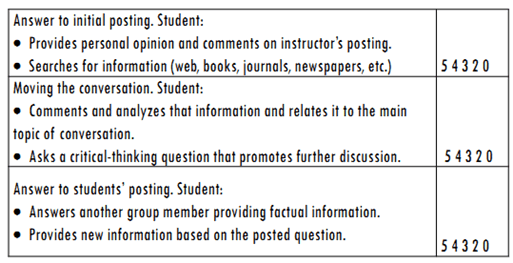
<body><![CDATA[<p>&nbsp;</p>      ]]></body><back>
<ref-list>
<ref id="B1">
<label>1</label><nlm-citation citation-type="">
<person-group person-group-type="author">
<name>
<surname><![CDATA[Akyel]]></surname>
<given-names><![CDATA[A.]]></given-names>
</name>
<name>
<surname><![CDATA[Kami&#351;li]]></surname>
<given-names><![CDATA[S.]]></given-names>
</name>
</person-group>
<source><![CDATA[Composing in first and second languages: Possible effects of EFL writing instruction]]></source>
<year>1996</year>
<publisher-loc><![CDATA[Istambul ]]></publisher-loc>
</nlm-citation>
</ref>
<ref id="B2">
<label>2</label><nlm-citation citation-type="journal">
<person-group person-group-type="author">
<name>
<surname><![CDATA[Antón]]></surname>
<given-names><![CDATA[M.]]></given-names>
</name>
<name>
<surname><![CDATA[DiCamilla]]></surname>
<given-names><![CDATA[F.]]></given-names>
</name>
</person-group>
<article-title xml:lang="en"><![CDATA[Socio-cognitive functions of L1 collaborative interaction in the L2 classroom]]></article-title>
<source><![CDATA[The Canadian Modern Language Review]]></source>
<year>1998</year>
<volume>54</volume>
<numero>3</numero>
<issue>3</issue>
<page-range>314-342</page-range></nlm-citation>
</ref>
<ref id="B3">
<label>3</label><nlm-citation citation-type="journal">
<person-group person-group-type="author">
<name>
<surname><![CDATA[Auerbach]]></surname>
<given-names><![CDATA[E]]></given-names>
</name>
</person-group>
<article-title xml:lang="en"><![CDATA[Reexamining English only in the ESL classroom]]></article-title>
<source><![CDATA[TESOL Quarterly]]></source>
<year>1993</year>
<volume>27</volume>
<numero>1</numero>
<issue>1</issue>
<page-range>9-32</page-range></nlm-citation>
</ref>
<ref id="B4">
<label>4</label><nlm-citation citation-type="book">
<person-group person-group-type="author">
<name>
<surname><![CDATA[Ballman]]></surname>
<given-names><![CDATA[T.]]></given-names>
</name>
<name>
<surname><![CDATA[Liskin-Gasparro]]></surname>
<given-names><![CDATA[J.]]></given-names>
</name>
<name>
<surname><![CDATA[Mandell]]></surname>
<given-names><![CDATA[P.]]></given-names>
</name>
</person-group>
<source><![CDATA[The communicative classroom: AATSP Professional Development]]></source>
<year>2001</year>
<volume>2</volume>
<publisher-loc><![CDATA[Boston^eMA MA]]></publisher-loc>
<publisher-name><![CDATA[Heinle & Heinle]]></publisher-name>
</nlm-citation>
</ref>
<ref id="B5">
<label>5</label><nlm-citation citation-type="book">
<person-group person-group-type="author">
<name>
<surname><![CDATA[Bauer]]></surname>
<given-names><![CDATA[B.]]></given-names>
</name>
<name>
<surname><![CDATA[deBenedette]]></surname>
<given-names><![CDATA[L.]]></given-names>
</name>
<name>
<surname><![CDATA[Furstenberg]]></surname>
<given-names><![CDATA[G.]]></given-names>
</name>
<name>
<surname><![CDATA[Levet]]></surname>
<given-names><![CDATA[S.]]></given-names>
</name>
<name>
<surname><![CDATA[Waryn]]></surname>
<given-names><![CDATA[S.]]></given-names>
</name>
</person-group>
<article-title xml:lang="en"><![CDATA[The Cultura project]]></article-title>
<person-group person-group-type="editor">
<name>
<surname><![CDATA[Belz]]></surname>
<given-names><![CDATA[J.]]></given-names>
</name>
<name>
<surname><![CDATA[Thorne]]></surname>
<given-names><![CDATA[S.]]></given-names>
</name>
</person-group>
<source><![CDATA[Internet-mediated intercultural foreign language education]]></source>
<year>2006</year>
<page-range>31- 62</page-range><publisher-loc><![CDATA[Boston^eMA MA]]></publisher-loc>
<publisher-name><![CDATA[Thomson Heinle]]></publisher-name>
</nlm-citation>
</ref>
<ref id="B6">
<label>6</label><nlm-citation citation-type="book">
<person-group person-group-type="author">
<name>
<surname><![CDATA[Belz]]></surname>
<given-names><![CDATA[J.]]></given-names>
</name>
</person-group>
<article-title xml:lang="en"><![CDATA[Identity, deficiency, and L1 use in foreign language study]]></article-title>
<person-group person-group-type="editor">
<name>
<surname><![CDATA[Blyth]]></surname>
<given-names><![CDATA[C.]]></given-names>
</name>
</person-group>
<source><![CDATA[The sociolinguistics of foreign language classrooms: Contributions of the native, near-native and the non-native speaker]]></source>
<year>2003</year>
<month>a</month>
<page-range>209-250</page-range><publisher-loc><![CDATA[Boston^eMA MA]]></publisher-loc>
<publisher-name><![CDATA[Heinle & Heinle]]></publisher-name>
</nlm-citation>
</ref>
<ref id="B7">
<label>7</label><nlm-citation citation-type="journal">
<person-group person-group-type="author">
<name>
<surname><![CDATA[Belz]]></surname>
<given-names><![CDATA[J]]></given-names>
</name>
</person-group>
<article-title xml:lang="en"><![CDATA[Linguistic perspectives on the development of intercultural competence in telecollaboration]]></article-title>
<source><![CDATA[Language Learning and Technology]]></source>
<year>2003</year>
<month>b</month>
<volume>7</volume>
<numero>2</numero>
<issue>2</issue>
<page-range>68-117</page-range></nlm-citation>
</ref>
<ref id="B8">
<label>8</label><nlm-citation citation-type="book">
<person-group person-group-type="author">
<name>
<surname><![CDATA[Belz]]></surname>
<given-names><![CDATA[J.]]></given-names>
</name>
<name>
<surname><![CDATA[Thorne]]></surname>
<given-names><![CDATA[S.]]></given-names>
</name>
</person-group>
<article-title xml:lang="en"><![CDATA[Internet-mediated intercultural foreign language education and the intercultural speaker (Introduction)]]></article-title>
<person-group person-group-type="editor">
<name>
<surname><![CDATA[Belz]]></surname>
<given-names><![CDATA[J.]]></given-names>
</name>
<name>
<surname><![CDATA[Thorne]]></surname>
<given-names><![CDATA[S.]]></given-names>
</name>
</person-group>
<source><![CDATA[Internet-mediated intercultural foreign language education]]></source>
<year>2006</year>
<page-range>x-xxv</page-range><publisher-loc><![CDATA[Boston^eMA MA]]></publisher-loc>
<publisher-name><![CDATA[Thomson Heinle]]></publisher-name>
</nlm-citation>
</ref>
<ref id="B9">
<label>9</label><nlm-citation citation-type="">
<person-group person-group-type="author">
<name>
<surname><![CDATA[Berman]]></surname>
<given-names><![CDATA[R]]></given-names>
</name>
</person-group>
<source><![CDATA[EFL essay writing: L1 versus L2 instruction]]></source>
<year>1994</year>
<publisher-loc><![CDATA[Baltimore^eMD MD]]></publisher-loc>
</nlm-citation>
</ref>
<ref id="B10">
<label>10</label><nlm-citation citation-type="">
<source><![CDATA[Blackboard Academic Suite Brochure]]></source>
<year>2007</year>
</nlm-citation>
</ref>
<ref id="B11">
<label>11</label><nlm-citation citation-type="journal">
<person-group person-group-type="author">
<name>
<surname><![CDATA[Brooks]]></surname>
<given-names><![CDATA[F.]]></given-names>
</name>
<name>
<surname><![CDATA[Donato]]></surname>
<given-names><![CDATA[R.]]></given-names>
</name>
</person-group>
<article-title xml:lang="en"><![CDATA[Vygotskyan approaches to understanding foreign language learner discourse during communicative tasks]]></article-title>
<source><![CDATA[Hispania]]></source>
<year>1994</year>
<volume>77</volume>
<page-range>262-274</page-range></nlm-citation>
</ref>
<ref id="B12">
<label>12</label><nlm-citation citation-type="journal">
<person-group person-group-type="author">
<name>
<surname><![CDATA[Burnett]]></surname>
<given-names><![CDATA[J]]></given-names>
</name>
</person-group>
<article-title xml:lang="en"><![CDATA[Language alternation in a computer- equipped foreign language classroom: The intersection of teacher beliefs, language, and technology]]></article-title>
<source><![CDATA[The Canadian Modern Language Review]]></source>
<year>1998</year>
<volume>55</volume>
<numero>1</numero>
<issue>1</issue>
<page-range>97-123</page-range></nlm-citation>
</ref>
<ref id="B13">
<label>13</label><nlm-citation citation-type="book">
<person-group person-group-type="author">
<name>
<surname><![CDATA[Chavez]]></surname>
<given-names><![CDATA[M.]]></given-names>
</name>
</person-group>
<article-title xml:lang="en"><![CDATA[The diglossic foreign-language classroom: Learners' views on L1 and L2 functions]]></article-title>
<person-group person-group-type="editor">
<name>
<surname><![CDATA[Blyth]]></surname>
<given-names><![CDATA[C.]]></given-names>
</name>
</person-group>
<source><![CDATA[The sociolinguistics of foreign language classrooms: Contributions of the native, near-native and the non-native speaker]]></source>
<year>2003</year>
<page-range>163-208</page-range><publisher-loc><![CDATA[Boston^eMA MA]]></publisher-loc>
<publisher-name><![CDATA[Heinle & Heinle]]></publisher-name>
</nlm-citation>
</ref>
<ref id="B14">
<label>14</label><nlm-citation citation-type="book">
<person-group person-group-type="author">
<name>
<surname><![CDATA[Cole]]></surname>
<given-names><![CDATA[M.]]></given-names>
</name>
<name>
<surname><![CDATA[Engeström]]></surname>
<given-names><![CDATA[C.]]></given-names>
</name>
</person-group>
<article-title xml:lang="en"><![CDATA[A cultural-historical approach to distributed cognition]]></article-title>
<person-group person-group-type="editor">
<name>
<surname><![CDATA[Salomon]]></surname>
<given-names><![CDATA[G.]]></given-names>
</name>
</person-group>
<source><![CDATA[Distributed cognitions: Psychological and educational considerations]]></source>
<year>2001</year>
<page-range>1-46</page-range><publisher-loc><![CDATA[New York^eNY NY]]></publisher-loc>
<publisher-name><![CDATA[Cambridge University Press]]></publisher-name>
</nlm-citation>
</ref>
<ref id="B15">
<label>15</label><nlm-citation citation-type="journal">
<person-group person-group-type="author">
<name>
<surname><![CDATA[Cook]]></surname>
<given-names><![CDATA[V]]></given-names>
</name>
</person-group>
<article-title xml:lang="en"><![CDATA[Using the first language in the classroom]]></article-title>
<source><![CDATA[The Canadian Modern Language Review]]></source>
<year>2001</year>
<volume>57</volume>
<numero>3</numero>
<issue>3</issue>
<page-range>402-423</page-range></nlm-citation>
</ref>
<ref id="B16">
<label>16</label><nlm-citation citation-type="">
<person-group person-group-type="author">
<name>
<surname><![CDATA[Crerand]]></surname>
<given-names><![CDATA[M.]]></given-names>
</name>
</person-group>
<source><![CDATA[From first language literacy to second language proficiency to second language literacy: the act of writing in a foreign language context]]></source>
<year>1993</year>
<publisher-loc><![CDATA[Atlanta^eGA GA]]></publisher-loc>
</nlm-citation>
</ref>
<ref id="B17">
<label>17</label><nlm-citation citation-type="journal">
<person-group person-group-type="author">
<name>
<surname><![CDATA[De Guerrero]]></surname>
<given-names><![CDATA[M.]]></given-names>
</name>
<name>
<surname><![CDATA[Villamil]]></surname>
<given-names><![CDATA[O.]]></given-names>
</name>
</person-group>
<article-title xml:lang="en"><![CDATA[Social-cognitive dimensions of interaction in L2 peer revision]]></article-title>
<source><![CDATA[The Modern Language Journal]]></source>
<year>1994</year>
<volume>78</volume>
<numero>4</numero>
<issue>4</issue>
<page-range>484-496</page-range></nlm-citation>
</ref>
<ref id="B18">
<label>18</label><nlm-citation citation-type="book">
<person-group person-group-type="author">
<name>
<surname><![CDATA[Dubriel]]></surname>
<given-names><![CDATA[S.]]></given-names>
</name>
</person-group>
<article-title xml:lang="en"><![CDATA[Gaining perspective on culture through CALL]]></article-title>
<person-group person-group-type="editor">
<name>
<surname><![CDATA[Ducate]]></surname>
<given-names><![CDATA[L.]]></given-names>
</name>
<name>
<surname><![CDATA[Arnold]]></surname>
<given-names><![CDATA[N.]]></given-names>
</name>
</person-group>
<source><![CDATA[Calling on CALL: from theory and research to new directions in foreign language teaching]]></source>
<year>2006</year>
<page-range>237-268</page-range><publisher-loc><![CDATA[San Marcos^eTX TX]]></publisher-loc>
<publisher-name><![CDATA[CALICO]]></publisher-name>
</nlm-citation>
</ref>
<ref id="B19">
<label>19</label><nlm-citation citation-type="journal">
<person-group person-group-type="author">
<name>
<surname><![CDATA[Duff]]></surname>
<given-names><![CDATA[P.]]></given-names>
</name>
<name>
<surname><![CDATA[Polio]]></surname>
<given-names><![CDATA[C.]]></given-names>
</name>
</person-group>
<article-title xml:lang="en"><![CDATA[How much foreign language is there in the foreign language classroom]]></article-title>
<source><![CDATA[The Modern Language Journal]]></source>
<year>1990</year>
<volume>74</volume>
<page-range>154-166</page-range></nlm-citation>
</ref>
<ref id="B20">
<label>20</label><nlm-citation citation-type="book">
<person-group person-group-type="author">
<name>
<surname><![CDATA[Ellis]]></surname>
<given-names><![CDATA[R.]]></given-names>
</name>
</person-group>
<source><![CDATA[SLA research and language teaching]]></source>
<year>2001</year>
<publisher-loc><![CDATA[New York^eNY NY]]></publisher-loc>
<publisher-name><![CDATA[Oxford University Press]]></publisher-name>
</nlm-citation>
</ref>
<ref id="B21">
<label>21</label><nlm-citation citation-type="journal">
<person-group person-group-type="author">
<name>
<surname><![CDATA[Hancock]]></surname>
<given-names><![CDATA[M]]></given-names>
</name>
</person-group>
<article-title xml:lang="en"><![CDATA[Behind classroom code switching: layering and language choice in L2 learner interaction]]></article-title>
<source><![CDATA[TESOL Quarterly]]></source>
<year>1997</year>
<volume>31</volume>
<numero>2</numero>
<issue>2</issue>
<page-range>217-235</page-range></nlm-citation>
</ref>
<ref id="B22">
<label>22</label><nlm-citation citation-type="journal">
<person-group person-group-type="author">
<name>
<surname><![CDATA[Knutson]]></surname>
<given-names><![CDATA[E]]></given-names>
</name>
</person-group>
<article-title xml:lang="en"><![CDATA[Cross-cultural awareness for second/ foreign language learners]]></article-title>
<source><![CDATA[The Canadian Modern Language Review]]></source>
<year>2006</year>
<volume>62</volume>
<numero>4</numero>
<issue>4</issue>
<page-range>591-610</page-range></nlm-citation>
</ref>
<ref id="B23">
<label>23</label><nlm-citation citation-type="journal">
<person-group person-group-type="author">
<name>
<surname><![CDATA[Legenhausen]]></surname>
<given-names><![CDATA[L]]></given-names>
</name>
</person-group>
<article-title xml:lang="en"><![CDATA[Code-switching in learner's discourse]]></article-title>
<source><![CDATA[IRAL]]></source>
<year>1991</year>
<volume>29</volume>
<numero>1</numero>
<issue>1</issue>
<page-range>61-73</page-range></nlm-citation>
</ref>
<ref id="B24">
<label>24</label><nlm-citation citation-type="journal">
<person-group person-group-type="author">
<name>
<surname><![CDATA[Levine]]></surname>
<given-names><![CDATA[G]]></given-names>
</name>
</person-group>
<article-title xml:lang="en"><![CDATA[Student and instructor beliefs and attitudes about target language use, first language use, and anxiety: report of a questionnaire study]]></article-title>
<source><![CDATA[The Modern Language Journal]]></source>
<year>2003</year>
<volume>87</volume>
<numero>3</numero>
<issue>3</issue>
<page-range>343-364</page-range></nlm-citation>
</ref>
<ref id="B25">
<label>25</label><nlm-citation citation-type="journal">
<person-group person-group-type="author">
<name>
<surname><![CDATA[Liebscher]]></surname>
<given-names><![CDATA[G.]]></given-names>
</name>
<name>
<surname><![CDATA[Dailey-O'Cain]]></surname>
<given-names><![CDATA[J.]]></given-names>
</name>
</person-group>
<article-title xml:lang="en"><![CDATA[Learner code-switching in the content-based foreign language classroom]]></article-title>
<source><![CDATA[The Modern Language Journal]]></source>
<year>2005</year>
<volume>89</volume>
<numero>2</numero>
<issue>2</issue>
<page-range>234-247</page-range></nlm-citation>
</ref>
<ref id="B26">
<label>26</label><nlm-citation citation-type="journal">
<person-group person-group-type="author">
<name>
<surname><![CDATA[Macaro]]></surname>
<given-names><![CDATA[E]]></given-names>
</name>
</person-group>
<article-title xml:lang="en"><![CDATA[Analysing student teachers' codeswitching in foreign language classrooms: theories and decision making]]></article-title>
<source><![CDATA[The Modern Language Journal]]></source>
<year>2001</year>
<volume>85</volume>
<numero>4</numero>
<issue>4</issue>
<page-range>531-548</page-range></nlm-citation>
</ref>
<ref id="B27">
<label>27</label><nlm-citation citation-type="journal">
<person-group person-group-type="author">
<name>
<surname><![CDATA[Moore]]></surname>
<given-names><![CDATA[D]]></given-names>
</name>
</person-group>
<article-title xml:lang="en"><![CDATA[Code-switching and learning in the classroom]]></article-title>
<source><![CDATA[International Journal of Bilingual Education and Bilingualism]]></source>
<year>2002</year>
<volume>5</volume>
<numero>5</numero>
<issue>5</issue>
<page-range>279-293</page-range></nlm-citation>
</ref>
<ref id="B28">
<label>28</label><nlm-citation citation-type="journal">
<person-group person-group-type="author">
<name>
<surname><![CDATA[O'Dowd]]></surname>
<given-names><![CDATA[R.]]></given-names>
</name>
</person-group>
<article-title xml:lang="en"><![CDATA[Understanding the ''Other Side'': intercultural learning in a Spanish e-mail exchange]]></article-title>
<source><![CDATA[Language Learning and Technology]]></source>
<year>2003</year>
<volume>7</volume>
<numero>2</numero>
<issue>2</issue>
<page-range>118-144</page-range></nlm-citation>
</ref>
<ref id="B29">
<label>29</label><nlm-citation citation-type="book">
<person-group person-group-type="author">
<name>
<surname><![CDATA[Omaggio-Hadley]]></surname>
<given-names><![CDATA[A.]]></given-names>
</name>
</person-group>
<source><![CDATA[Teaching language in context]]></source>
<year>2001</year>
<publisher-loc><![CDATA[Boston^eMA MA]]></publisher-loc>
<publisher-name><![CDATA[Heinle & Heinle]]></publisher-name>
</nlm-citation>
</ref>
<ref id="B30">
<label>30</label><nlm-citation citation-type="journal">
<person-group person-group-type="author">
<name>
<surname><![CDATA[Oskoz]]></surname>
<given-names><![CDATA[A.]]></given-names>
</name>
<name>
<surname><![CDATA[Elola]]></surname>
<given-names><![CDATA[I.]]></given-names>
</name>
</person-group>
<article-title xml:lang="en"><![CDATA[Blogging: fostering intercultural competence development in foreign language and study abroad contexts]]></article-title>
<source><![CDATA[Foreign Language Annals]]></source>
<year>2008</year>
<volume>41</volume>
<numero>3</numero>
<issue>3</issue>
<page-range>454-477</page-range></nlm-citation>
</ref>
<ref id="B31">
<label>31</label><nlm-citation citation-type="journal">
<person-group person-group-type="author">
<name>
<surname><![CDATA[Pennington]]></surname>
<given-names><![CDATA[M.]]></given-names>
</name>
<name>
<surname><![CDATA[So]]></surname>
<given-names><![CDATA[S.]]></given-names>
</name>
</person-group>
<article-title xml:lang="en"><![CDATA[Comparing writing process and product across two languages: a study of 6 Singaporean university student writers]]></article-title>
<source><![CDATA[Journal of Second Language Writing]]></source>
<year>1993</year>
<volume>2</volume>
<numero>1</numero>
<issue>1</issue>
<page-range>41-63</page-range></nlm-citation>
</ref>
<ref id="B32">
<label>32</label><nlm-citation citation-type="journal">
<person-group person-group-type="author">
<name>
<surname><![CDATA[Poulisse]]></surname>
<given-names><![CDATA[N.]]></given-names>
</name>
<name>
<surname><![CDATA[Bongaerts]]></surname>
<given-names><![CDATA[T.]]></given-names>
</name>
</person-group>
<article-title xml:lang="en"><![CDATA[First language use in second language production]]></article-title>
<source><![CDATA[Applied Linguistics]]></source>
<year>1994</year>
<volume>15</volume>
<numero>1</numero>
<issue>1</issue>
<page-range>36-57</page-range></nlm-citation>
</ref>
<ref id="B33">
<label>33</label><nlm-citation citation-type="journal">
<person-group person-group-type="author">
<name>
<surname><![CDATA[Qi]]></surname>
<given-names><![CDATA[D]]></given-names>
</name>
</person-group>
<article-title xml:lang="en"><![CDATA[An inquiry into language-switching in second language composing processes]]></article-title>
<source><![CDATA[The Canadian Modern Language Review]]></source>
<year>1998</year>
<volume>54</volume>
<numero>3</numero>
<issue>3</issue>
<page-range>413-435</page-range></nlm-citation>
</ref>
<ref id="B34">
<label>34</label><nlm-citation citation-type="journal">
<person-group person-group-type="author">
<name>
<surname><![CDATA[Sasaki]]></surname>
<given-names><![CDATA[M.]]></given-names>
</name>
<name>
<surname><![CDATA[Hirose]]></surname>
<given-names><![CDATA[K.]]></given-names>
</name>
</person-group>
<article-title xml:lang="en"><![CDATA[Explanatory variables for EFL students' expository writing]]></article-title>
<source><![CDATA[Language Learning]]></source>
<year>1996</year>
<volume>46</volume>
<numero>1</numero>
<issue>1</issue>
<page-range>137-174</page-range></nlm-citation>
</ref>
<ref id="B35">
<label>35</label><nlm-citation citation-type="">
<person-group person-group-type="author">
<name>
<surname><![CDATA[Schweers]]></surname>
<given-names><![CDATA[C.]]></given-names>
</name>
</person-group>
<source><![CDATA[He uses a square shirt: First language transfer in the writing of Hispanic ESL learners. Viewpoints]]></source>
<year>1995</year>
</nlm-citation>
</ref>
<ref id="B36">
<label>36</label><nlm-citation citation-type="journal">
<person-group person-group-type="author">
<name>
<surname><![CDATA[Sengupta]]></surname>
<given-names><![CDATA[S]]></given-names>
</name>
</person-group>
<article-title xml:lang="en"><![CDATA[Exchanging ideas with peers in network-based classrooms: an aid or a pain?]]></article-title>
<source><![CDATA[Language Learning and Techonology]]></source>
<year>2001</year>
<volume>5</volume>
<numero>1</numero>
<issue>1</issue>
<page-range>103-134</page-range></nlm-citation>
</ref>
<ref id="B37">
<label>37</label><nlm-citation citation-type="book">
<person-group person-group-type="author">
<name>
<surname><![CDATA[Swain]]></surname>
<given-names><![CDATA[M.]]></given-names>
</name>
</person-group>
<article-title xml:lang="en"><![CDATA[The output hypothesis and beyond: Mediating acquisition through collaborative dialogue]]></article-title>
<person-group person-group-type="editor">
<name>
<surname><![CDATA[Lantolf]]></surname>
<given-names><![CDATA[J.]]></given-names>
</name>
</person-group>
<source><![CDATA[Sociocultural theory & second language learning]]></source>
<year>2000</year>
<publisher-loc><![CDATA[New York^eNY NY]]></publisher-loc>
<publisher-name><![CDATA[Oxford University Press]]></publisher-name>
</nlm-citation>
</ref>
<ref id="B38">
<label>38</label><nlm-citation citation-type="journal">
<person-group person-group-type="author">
<name>
<surname><![CDATA[Swain]]></surname>
<given-names><![CDATA[M.]]></given-names>
</name>
<name>
<surname><![CDATA[Lapkin]]></surname>
<given-names><![CDATA[S.]]></given-names>
</name>
</person-group>
<article-title xml:lang="en"><![CDATA[Interaction and second language learning: two adolescent French immersion students working together]]></article-title>
<source><![CDATA[The Modern Language Journal]]></source>
<year>1998</year>
<volume>82</volume>
<numero>3</numero>
<issue>3</issue>
<page-range>320-337</page-range></nlm-citation>
</ref>
<ref id="B39">
<label>39</label><nlm-citation citation-type="journal">
<person-group person-group-type="author">
<name>
<surname><![CDATA[Swain]]></surname>
<given-names><![CDATA[M.]]></given-names>
</name>
<name>
<surname><![CDATA[Lapkin]]></surname>
<given-names><![CDATA[S.]]></given-names>
</name>
</person-group>
<article-title xml:lang="en"><![CDATA[Task-based second language learning: the uses of the first language]]></article-title>
<source><![CDATA[Language Teaching Research]]></source>
<year>2000</year>
<volume>4</volume>
<numero>3</numero>
<issue>3</issue>
<page-range>251-274</page-range></nlm-citation>
</ref>
<ref id="B40">
<label>40</label><nlm-citation citation-type="journal">
<person-group person-group-type="author">
<name>
<surname><![CDATA[Thorne]]></surname>
<given-names><![CDATA[S.]]></given-names>
</name>
</person-group>
<article-title xml:lang="en"><![CDATA[Artifacts and cultures-of-use in intercultural communication]]></article-title>
<source><![CDATA[Language Learning and Technology]]></source>
<year>2003</year>
<volume>7</volume>
<numero>2</numero>
<issue>2</issue>
<page-range>38-67</page-range></nlm-citation>
</ref>
<ref id="B41">
<label>41</label><nlm-citation citation-type="book">
<person-group person-group-type="author">
<name>
<surname><![CDATA[Vygotsky]]></surname>
<given-names><![CDATA[L.]]></given-names>
</name>
</person-group>
<source><![CDATA[Mind in society]]></source>
<year>1978</year>
<publisher-loc><![CDATA[Cambridge^eMA MA]]></publisher-loc>
<publisher-name><![CDATA[Harvard University Press]]></publisher-name>
</nlm-citation>
</ref>
<ref id="B42">
<label>42</label><nlm-citation citation-type="journal">
<person-group person-group-type="author">
<name>
<surname><![CDATA[Wang]]></surname>
<given-names><![CDATA[W]]></given-names>
</name>
<name>
<surname><![CDATA[Wen]]></surname>
<given-names><![CDATA[Q.]]></given-names>
</name>
</person-group>
<article-title xml:lang="en"><![CDATA[L1 use in the L2 composing process: an exploratory study of 16 Chinese EFL writers]]></article-title>
<source><![CDATA[Journal of Second Language Writing]]></source>
<year>2002</year>
<volume>11</volume>
<page-range>225-246</page-range></nlm-citation>
</ref>
<ref id="B43">
<label>43</label><nlm-citation citation-type="book">
<person-group person-group-type="author">
<name>
<surname><![CDATA[Wertsch]]></surname>
<given-names><![CDATA[J.]]></given-names>
</name>
</person-group>
<source><![CDATA[Voices of the mind: a sociocultural approach to mediated action]]></source>
<year>1997</year>
<publisher-loc><![CDATA[Cambridge^eMA MA]]></publisher-loc>
<publisher-name><![CDATA[Harvard University Press]]></publisher-name>
</nlm-citation>
</ref>
<ref id="B44">
<label>44</label><nlm-citation citation-type="journal">
<person-group person-group-type="author">
<name>
<surname><![CDATA[Whalen]]></surname>
<given-names><![CDATA[K.]]></given-names>
</name>
<name>
<surname><![CDATA[Ménard]]></surname>
<given-names><![CDATA[N.]]></given-names>
</name>
</person-group>
<article-title xml:lang="en"><![CDATA[L1 and L2 writers' strategic and linguistic knowledge: a model of multiple-level discourse processing]]></article-title>
<source><![CDATA[Language Learning]]></source>
<year>1995</year>
<volume>45</volume>
<numero>3</numero>
<issue>3</issue>
<page-range>381-418</page-range></nlm-citation>
</ref>
<ref id="B45">
<label>45</label><nlm-citation citation-type="journal">
<person-group person-group-type="author">
<name>
<surname><![CDATA[Woodall]]></surname>
<given-names><![CDATA[B]]></given-names>
</name>
</person-group>
<article-title xml:lang="en"><![CDATA[Language-switching: using the first language while writing in a second language]]></article-title>
<source><![CDATA[Journal of Second Language Writing]]></source>
<year>2002</year>
<volume>11</volume>
<page-range>7-28</page-range></nlm-citation>
</ref>
</ref-list>
</back>
</article>