<?xml version="1.0" encoding="ISO-8859-1"?><article xmlns:mml="http://www.w3.org/1998/Math/MathML" xmlns:xlink="http://www.w3.org/1999/xlink" xmlns:xsi="http://www.w3.org/2001/XMLSchema-instance">
<front>
<journal-meta>
<journal-id>0123-3432</journal-id>
<journal-title><![CDATA[Íkala, Revista de Lenguaje y Cultura]]></journal-title>
<abbrev-journal-title><![CDATA[Íkala]]></abbrev-journal-title>
<issn>0123-3432</issn>
<publisher>
<publisher-name><![CDATA[Escuela de Idiomas, Universidad de Antioquia]]></publisher-name>
</publisher>
</journal-meta>
<article-meta>
<article-id>S0123-34322012000300006</article-id>
<title-group>
<article-title xml:lang="en"><![CDATA[ERRORS IN THE USE OF ENGLISH TENSES]]></article-title>
<article-title xml:lang="es"><![CDATA[ERRORES EN EL USO DE LOS TIEMPOS VERBALES EN INGLÉS]]></article-title>
</title-group>
<contrib-group>
<contrib contrib-type="author">
<name>
<surname><![CDATA[Garrido]]></surname>
<given-names><![CDATA[Carmen Gloria]]></given-names>
</name>
<xref ref-type="aff" rid="A01"/>
</contrib>
<contrib contrib-type="author">
<name>
<surname><![CDATA[Rosado Romero]]></surname>
<given-names><![CDATA[Cristina]]></given-names>
</name>
<xref ref-type="aff" rid="A02"/>
</contrib>
</contrib-group>
<aff id="A01">
<institution><![CDATA[,Universidad San Sebastián  ]]></institution>
<addr-line><![CDATA[Concepción ]]></addr-line>
<country>Chile</country>
</aff>
<aff id="A02">
<institution><![CDATA[,Universidad San Sebastián  ]]></institution>
<addr-line><![CDATA[ ]]></addr-line>
<country>Chile</country>
</aff>
<pub-date pub-type="pub">
<day>00</day>
<month>12</month>
<year>2012</year>
</pub-date>
<pub-date pub-type="epub">
<day>00</day>
<month>12</month>
<year>2012</year>
</pub-date>
<volume>17</volume>
<numero>3</numero>
<fpage>285</fpage>
<lpage>296</lpage>
<copyright-statement/>
<copyright-year/>
<self-uri xlink:href="http://www.scielo.org.co/scielo.php?script=sci_arttext&amp;pid=S0123-34322012000300006&amp;lng=en&amp;nrm=iso"></self-uri><self-uri xlink:href="http://www.scielo.org.co/scielo.php?script=sci_abstract&amp;pid=S0123-34322012000300006&amp;lng=en&amp;nrm=iso"></self-uri><self-uri xlink:href="http://www.scielo.org.co/scielo.php?script=sci_pdf&amp;pid=S0123-34322012000300006&amp;lng=en&amp;nrm=iso"></self-uri><abstract abstract-type="short" xml:lang="en"><p><![CDATA[This article presents the results of an error analysis investigation carried out in Concepción, Chile, with a group of forty-eight native speakers of Spanish studying to become EFL teachers at Universidad San Sebastián. All participants were first year students who had studied English tenses and aspects for a year. The objectives of this investigation were the identification of students' errors regarding the use of tenses and aspects in English, the design of a hierarchy of difficulty and the explanation of main errors. According to the results obtained, after a year of formal instruction, students still showed problems with the correct use of English tenses and aspects. The main problem was accurately matching tenses and aspects to different contexts. Findings provide useful information to design remedial programmes to help students become successful in the use of English tenses and aspects.]]></p></abstract>
<abstract abstract-type="short" xml:lang="es"><p><![CDATA[Este artículo presenta los resultados de una investigación basada en el análisis de errores realizada en Concepción, Chile, con un grupo de cuarenta y ocho hablantes de español que estudian Pedagogía en Inglés en la Universidad San Sebastián. Todos los participantes eran alumnos de primer año que habían estudiado tiempos verbales y aspectos del inglés durante un año. El trabajo tuvo como objetivos la identificación de errores en relación al uso de tiempos verbales y aspectos en inglés; el diseño de una jerarquía de dificultades y la explicación de los principales errores. De acuerdo con los resultados, después de un año, los alumnos presentan problemas con el uso correcto de los tiempos verbales y aspectos, siendo el uso de acuerdo al contexto el mayor problema. Los resultados de esta investigación entregan información para el diseño de programas que ayuden a los alumnos a usar con éxito los tiempos y aspectos del inglés.]]></p></abstract>
<kwd-group>
<kwd lng="en"><![CDATA[grammar]]></kwd>
<kwd lng="en"><![CDATA[tenses]]></kwd>
<kwd lng="en"><![CDATA[errors]]></kwd>
<kwd lng="en"><![CDATA[context]]></kwd>
<kwd lng="en"><![CDATA[formation]]></kwd>
<kwd lng="en"><![CDATA[difficulties]]></kwd>
<kwd lng="es"><![CDATA[gramática]]></kwd>
<kwd lng="es"><![CDATA[tiempos verbales]]></kwd>
<kwd lng="es"><![CDATA[errores]]></kwd>
<kwd lng="es"><![CDATA[contexto]]></kwd>
<kwd lng="es"><![CDATA[formación]]></kwd>
<kwd lng="es"><![CDATA[dificultades]]></kwd>
</kwd-group>
</article-meta>
</front><body><![CDATA[ <p align="right"><font size="2" face="Verdana, Arial, Helvetica, sans-serif"><b>REPORTES DE CASO</b></font></p>     <p>&nbsp;</p>     <p align="center"><font size="4" face="Verdana, Arial, Helvetica, sans-serif"><b>ERRORS IN THE USE OF ENGLISH TENSES  </b></font></p>     <p align="center">&nbsp;</p>     <p align="center"><font size="3" face="Verdana, Arial, Helvetica, sans-serif"><b>ERRORES EN EL USO DE LOS TIEMPOS VERBALES EN INGL&Eacute;S</b></font><font size="2" face="Verdana, Arial, Helvetica, sans-serif"><b></b></font></p>     <p>&nbsp;</p>     <p>&nbsp;</p>     <p><font size="2" face="Verdana, Arial, Helvetica, sans-serif"><b>Carmen Gloria Garrido*;   Cristina Rosado Romero**  </b></font></p>     <p>&nbsp;</p>     <p><font size="2" face="Verdana, Arial, Helvetica, sans-serif">* holds a Master Degree in Education  from Universidad de Concepci&oacute;n,  Chile.  She currently works as full  time professor at Universidad San  Sebasti&aacute;n, Chile. Mailing address:  Camilo Henr&iacute;quez 2710. Depto 401- A, Concepci&oacute;n, Chile. Post code:  4080655. E-mail: <a href="mailto:Carmen.garrido@uss.cl">Carmen.garrido@uss.cl</a></font></p>     ]]></body>
<body><![CDATA[<p><font size="2" face="Verdana, Arial, Helvetica, sans-serif">** is an English-Spanish translator from  Universidad de Concepci&oacute;n, Chile.   She currently works as a professor at  Universidad San Sebasti&aacute;n, Chile.  E-mail: <a href="mailto:crosador@docenteuss.cl">crosador@docenteuss.cl</a></font></p>     <p>&nbsp;</p>     <p><font size="2" face="Verdana, Arial, Helvetica, sans-serif">Received: 04-28-11 / Reviewed: 05-21-12 / Accepted: 08-23-12 /  Published: 12-01-12</font></p>     <p>&nbsp;</p>     <p><font size="2" face="Verdana, Arial, Helvetica, sans-serif"><b>How to reference this article: Garrido, C., &amp; Rosado, C.</b> (2012). Errors in the use of English tenses.  <i>&Iacute;kala, revista de lenguaje y cultura</i>, 17(3), 285-296.</font></p>     <p>&nbsp;</p> <hr size="1" noshade>     <p><font size="2" face="Verdana, Arial, Helvetica, sans-serif"><b>ABSTRACT</b></font></p>     <p><font size="2" face="Verdana, Arial, Helvetica, sans-serif">This article presents the results of an error analysis investigation carried out  in Concepci&oacute;n, Chile, with a group of forty-eight native speakers of Spanish  studying to become EFL teachers at Universidad San Sebasti&aacute;n. All participants  were first year students who had studied English tenses and aspects for a year. The  objectives of this investigation were the identification of students' errors regarding  the use of tenses and aspects in English, the design of a hierarchy of difficulty and  the explanation of main errors. According to the results obtained, after a year of  formal instruction, students still showed problems with the correct use of English  tenses and aspects. The main problem was accurately matching tenses and aspects  to different contexts. Findings provide useful information to design remedial  programmes to help students become successful in the use of English tenses and  aspects. </font></p>     <p><font size="2" face="Verdana, Arial, Helvetica, sans-serif"><b>Keywords: </b>grammar, tenses, errors, context, formation, difficulties</font></p> <hr size="1" noshade>     <p><font size="2" face="Verdana, Arial, Helvetica, sans-serif"><b>RESUMEN</b></font></p>     ]]></body>
<body><![CDATA[<p><font size="2" face="Verdana, Arial, Helvetica, sans-serif">Este art&iacute;culo presenta los resultados de una investigaci&oacute;n basada en el an&aacute;lisis  de errores realizada en Concepci&oacute;n, Chile, con un grupo de cuarenta y ocho  hablantes de espa&ntilde;ol que estudian Pedagog&iacute;a en Ingl&eacute;s en la Universidad San  Sebasti&aacute;n. Todos los participantes eran alumnos de primer a&ntilde;o que hab&iacute;an  estudiado tiempos verbales y aspectos del ingl&eacute;s durante un a&ntilde;o. El trabajo tuvo  como objetivos la identificaci&oacute;n de errores en relaci&oacute;n al uso de tiempos verbales y  aspectos en ingl&eacute;s; el dise&ntilde;o de una jerarqu&iacute;a de dificultades y la explicaci&oacute;n de los  principales errores. De acuerdo con los resultados, despu&eacute;s de un a&ntilde;o, los alumnos  presentan problemas con el uso correcto de los tiempos verbales y aspectos,  siendo el uso de acuerdo al contexto el mayor problema. Los resultados de esta  investigaci&oacute;n entregan informaci&oacute;n para el dise&ntilde;o de programas que ayuden a los  alumnos a usar con &eacute;xito los tiempos y aspectos del ingl&eacute;s. </font></p>     <p><font size="2" face="Verdana, Arial, Helvetica, sans-serif"><b>Palabras claves: </b>gram&aacute;tica, tiempos verbales, errores, contexto, formaci&oacute;n,  dificultades</font></p> <hr size="1" noshade>     <p>&nbsp;</p>     <p>&nbsp;</p>     <p><font size="3" face="Verdana, Arial, Helvetica, sans-serif"><b>1. INTRODUCTION, LITERATURE  REVIEW, RESEARCH QUESTIONS </b></font></p>     <p><font size="2" face="Verdana, Arial, Helvetica, sans-serif"><b>Introduction </b></font></p>     <p><font size="2" face="Verdana, Arial, Helvetica, sans-serif">Future English teachers studying at Universidad  San Sebasti&aacute;n (USS) study grammar from the first  semester onward. In the first year, they take English  Grammar and Lexis I and English Grammar and  Lexis II (each course lasts one semester). In both  courses, they study the use and formation of English  tenses and aspects. They have class twice a week for  a period of eighty minutes. At the end of English  Grammar and Lexis II, students are expected to use  English tenses and aspects accurately. However, a  high percentage of students (more than 60%) has  failed the subject English Grammar and Lexis II in  the last three years. This situation shows there is a  problem to be solved. Because the emphasis of the  syllabus is on tenses and aspects, it can be inferred  that the main problem lies in the errors made by  students in the use of English tenses and aspects. </font></p>     <p><font size="2" face="Verdana, Arial, Helvetica, sans-serif">The objectives of this investigation were (1) the  identification of students' errors regarding the use  of tenses and aspects in English, (2) the design of  a hierarchy of difficulty and (3) the explanation  of main errors to provide information about the  difficulties students encounter when learning the  formation and use of English tenses and aspects.  This information can be used to design materials  to help students succeed in the process of learning  to use tenses and aspects accurately. </font></p>     <p><font size="2" face="Verdana, Arial, Helvetica, sans-serif">This study follows the Corder (1971) error analysis  model. The model consists of a comparison  between the utterances made by a learner of the  target language and the same utterances made by  an adult native speaker of that target language and  establishes a set of steps to carry out error analysis.  In this study, categories are established following  Dulay, Burt and Krashen's surface taxonomy  (1982). This taxonomy classifies errors into four  categories: omission, addition, misformation and  misordering. </font></p>     <p><font size="2" face="Verdana, Arial, Helvetica, sans-serif">The study of errors is important since errors  permit the description of developmental stages  in the acquisition of a second/foreign language.  For learners themselves, errors are indispensable,  because the making of errors can be regarded as  a device the learner uses in order to learn. From a  pedagogical perspective, errors can give invaluable  information in relation to the difficulties students  encounter when learning English as a second or  foreign language. </font></p>     ]]></body>
<body><![CDATA[<p><font size="2" face="Verdana, Arial, Helvetica, sans-serif"><b>Literature review</b></font></p>     <p><font size="2" face="Verdana, Arial, Helvetica, sans-serif"> Error analysis (EA) was established by Stephen Pit  Corder and colleagues in the 1960s and ''consists of  a set of procedures for identifying, describing and  explaining learners' errors'' (Ellis &amp; Barkhuizen,  2005, p. 51). According to Corder (1981),  learners' errors are significant in three ways: first,  they give information about the language a learner  is using; second, they provide information on  how a language is learnt and finally, they provide  information to the learner himself or herself since  errors can be regarded as a device the learner uses in  order to learn. Error analysis also has pedagogical  benefits because it gives useful input for designing  and carrying out the teaching/learning process. </font></p>     <p><font size="2" face="Verdana, Arial, Helvetica, sans-serif">Error analysis became a common method of getting  information about learners' language during the  early 1970s as an alternative method to contrastive  analysis which was based on behaviourist theories  and therefore claimed that the difficulties in  mastering certain structures in a second language  (L2) were only based on the differences between  the learners' mother language (L1) and the second  language (L2). Error analysis has become less used  mainly because it has some limitations. First, it  only focuses on learners' errors and not on what  learners can do right. According to Brown (2000),  another disadvantage of EA is the fact that it  overemphasizes production data. James (1998)  and Tarone (1981) have also shown that EA fails  to account for avoidance strategy. Despite these  drawbacks, error analysis is still considered a  useful tool to gather information about learners' language. Erdogan (2005), for example, states  that ''error analysis enables teachers to find out the  sources of errors and take pedagogical precautions  towards them'' (p. 262). For Mahmoud (2011),  EA constitutes a link between language learning  and teaching that can be exploited in initial as well  as remedial teaching. As these authors illustrate,  EA can become a useful tool to improve language  teaching and, consequently, student learning.</font></p>     <p><font size="2" face="Verdana, Arial, Helvetica, sans-serif">When conducting research based on error analysis,  a distinction between errors and mistakes must be  made. Mistakes are unsystematic, due to memory  lapses, physical states (tiredness) or psychological  conditions while errors are systematic and  correspond to the underlying knowledge of the  language or transitional competence. An error  is ''a linguistic form or combination of forms,  which in the same context and under similar  conditions of production, would, in all likelihood,  not be produced by the speakers' native speaker  counterparts'' (Lennon, 1991, p. 182). An error,  therefore, reflects the learner's competence in L2.  According to Brown (2000), a mistake can be self- corrected while an error cannot. This means, given  the time and opportunity, the student should be  able to correct his/her mistake(s).  </font></p>     <p><font size="2" face="Verdana, Arial, Helvetica, sans-serif">Corder (1981) establishes four steps to carry out  error analysis research: collection of learners'  speech sample, identification of errors, the  description of the errors that have been identified  and finally the explanation of learner's errors. </font></p>     <p><font size="2" face="Verdana, Arial, Helvetica, sans-serif">In the first step, researchers collect a sample of  learner language. Because the type of sample that is  collected may influence the nature and distribution  of the errors observed, it is important to describe  the type of discourse collected and whether  learners had time to plan their production or not. </font></p>     <p><font size="2" face="Verdana, Arial, Helvetica, sans-serif">The identification of errors is the second step.  It involves a comparison between what the  learner has produced and what a native speaker  counterpart would produce in the same context.  Every utterance/sentence produced by the learner  is assumed to be erroneous. Those utterances that  are shown to be well-formed through a comparison  with a native speaker's sample are eliminated. The  remaining utterances/sentences are the ones that  contain errors. </font></p>     <p><font size="2" face="Verdana, Arial, Helvetica, sans-serif">Once errors have been identified, the next step is  describing learners' errors. To do so, it is necessary  to have descriptive categories to classify and record  the frequency of the errors that have been identified.  There are different categories for describing errors.  Corder (1981) classifies errors into two categories:  overt and covert errors. ''Overtly erroneous  utterances are unquestionably ungrammatical at  the sentence level. Covertly erroneous utterances  are grammatically well-formed at the sentence level,  but are not interpretable within the context of  communication'' (Brown, 2000, p. 220). Dulay, Burt  and Krashen's (1982) surface structure taxonomy is  based on the ways surface structures are altered in  erroneous utterances/sentences. According to this  taxonomy, there are four principal ways in which  learners modify target forms:  <i>omission,  addition,  misformation </i>and<i> misordering</i>. Errors of omission  refer to an element which should be present but  has been omitted. Addition is the presence of an  element which should not be part of the sentence  or utterance. Misformation is the use of the wrong  form or morpheme or structure. Misordering errors  are incorrect placement of a morpheme or group of  morphemes in an utterance.  </font></p>     <p><font size="2" face="Verdana, Arial, Helvetica, sans-serif">The last step is the explanation of learners'  errors. Even though the explanation of errors is  still highly speculative because of the complex  psychological and neurological process involved  in language learning, experts have identified three  major processes: interlingual transfer, intralingual  transfer and context of learning. Interlingual  errors are explained as the results of mother  tongue influences. Intralingual errors reflect  the operation of learning strategies that can be  considered universal. According to James (1998)  these strategies can be classified as false analogy,  misanalysis, incomplete rule application, exploiting  redundancy, overlooking co-occurrence restrictions  and system simplification. Finally, context of  learning refers to the learning experience. The non-occurrence or low frequency of errors could be the  result of a successful teaching. On the other hand,  a high frequency of errors could be the result of  inappropriate teaching methods and materials.</font></p>     <p><font size="2" face="Verdana, Arial, Helvetica, sans-serif">Error analysis focuses on the errors learners  make and is based on the comparison of learners'  utterances/sentences in the target language and  a native's utterances/sentences. Although error  analysis has some drawbacks, it can help us to see  how a learner's production deviates from target  language forms and get information about the  difficulties students face when learning a second  or foreign language. With this information,  instructors can plan the teaching/learning process  to help students become successful in the task of  learning a foreign or second language.</font></p>     ]]></body>
<body><![CDATA[<p><font size="2" face="Verdana, Arial, Helvetica, sans-serif"><b>Research questions </b></font></p> <ol>       <li><font size="2" face="Verdana, Arial, Helvetica, sans-serif">  What are the most frequent errors in the  written discourse of first year USS English  Pedagogy students regarding English tenses? </font></li>       <li><font size="2" face="Verdana, Arial, Helvetica, sans-serif">  What are the different categories of errors in  the written discourse of first year USS English  Pedagogy students regarding English tenses? </font></li>       <li><font size="2" face="Verdana, Arial, Helvetica, sans-serif">  What are the error hierarchies in the written  discourse regarding English tenses of first year  USS English Pedagogy students?</font></li>     </ol>     <p>&nbsp;</p>     <p><font size="3" face="Verdana, Arial, Helvetica, sans-serif"><b>2. METHOD</b></font></p>     <p><font size="2" face="Verdana, Arial, Helvetica, sans-serif"><b>Participants </b></font></p>     <p><font size="2" face="Verdana, Arial, Helvetica, sans-serif">A group of forty-eight native speakers of Spanish  studying to become EFL teachers at Universidad  San Sebasti&aacute;n participated in this study. All  participants were first year students who had  studied English tenses and aspects for a year in their  English and Grammar &amp; Lexis classes (English  Grammar and Lexis I and English Grammar and  Lexis II). They studied tenses and aspects in both  courses, though these topics were particularly  emphasized in English Grammar and Lexis II. </font></p>     <p><font size="2" face="Verdana, Arial, Helvetica, sans-serif"><b>Instruments, materials, apparatus </b></font></p>     ]]></body>
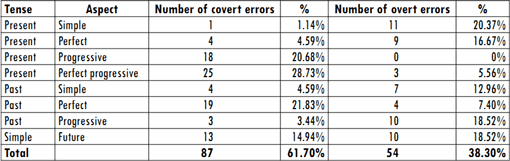
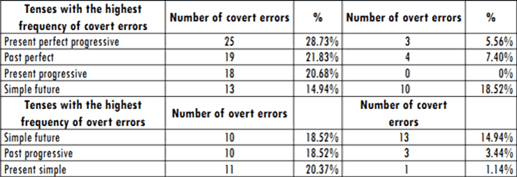
<body><![CDATA[<p><font size="2" face="Verdana, Arial, Helvetica, sans-serif">Following Corder (1981), the first step was to  collect a sample of learner language. To collect this  sample, students were asked to translate a letter  from Spanish into English (see Appendix 1). The  translation required the correct use of all tenses  studied in class (simple present, present continuous,  present perfect, present perfect continuous, simple  past, past continuous, past perfect and simple  future).</font></p>     <p><font size="2" face="Verdana, Arial, Helvetica, sans-serif"> This activity was one of the final evaluations  of Grammar and Lexis II. Students had eighty  minutes to plan, write the translation of the letter  and check mistakes.</font></p>     <p><font size="2" face="Verdana, Arial, Helvetica, sans-serif"><b>Data analysis</b></font></p>     <p><font size="2" face="Verdana, Arial, Helvetica, sans-serif"> A translation into English of the letter written  in Spanish was prepared and those sentences  containing tenses studied in class which differed  from the reconstructed version were identified.  The analysis considered only errors in the use  of English tenses and aspects. The next step  was the analysis of erroneous sentences. Since  English Grammar and Lexis I &amp; II were taught  by two different teachers (one of them was also an  English-Spanish translator), both teachers were  responsible for the analysis of errors. Each teacher  worked individually and then shared results. In  case of discrepancy, the other teacher was asked  his opinion and errors were further analysed until  agreement was reached. The first step was the  classification of errors into two main categories:  overt and covert errors. Overt errors were further  classified using Dulay, Burt and Krashen's (1982)  Surface Structure Taxonomy. Consequently,  errors were classified into the following categories:  omission, addition, misformation and misordering.</font></p>     <p><font size="2" face="Verdana, Arial, Helvetica, sans-serif">Once errors were classified into the different  categories, type and frequency of errors were  recorded. In the last step the source of the errors  was explained. Because of the type of sample  collected and the information gathered, only  two processes were identified: interlingual and  intralingual errors.</font></p>     <p>&nbsp;</p>     <p><font size="3" face="Verdana, Arial, Helvetica, sans-serif"><b>3. RESULTS AND DISCUSSION </b></font></p>     <p><font size="2" face="Verdana, Arial, Helvetica, sans-serif">Following Corder (1981), errors were first  classified into overt and covert errors (see <a href="#t01">Table  1</a>). Both covert and overt errors were further  analysed and even though the explanation of  errors is speculative, explanations that could guide  the teaching learning process were given by the  researchers.</font></p>     <p><font size="2" face="Verdana, Arial, Helvetica, sans-serif">According to the analysis, covert errors show the  highest frequency. In this category, tenses with  the highest frequency of errors correspond to the  present perfect progressive (28.73%), past perfect  (21.83%), present progressive (20.68%) and  simple future (14.94%). </font></p>     <p><font size="2" face="Verdana, Arial, Helvetica, sans-serif">The problem with present perfect progressive is  not the choice of tense, but the choice of aspect  (100% of errors corresponds to this type of  error). A similar situation can be seen with the  use of present progressive, with 94.44% of errors  corresponding to wrong choice of aspect. Following  James' (1998) classification of intralingual errors,  the wrong choice of aspect can be categorized as  system simplification because students consider  the correct choice of tense as enough to express the  writer's perspective on the time of an event.</font></p>     ]]></body>
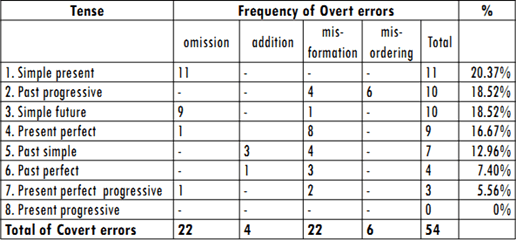
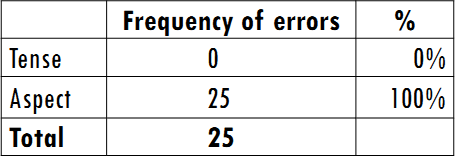
<body><![CDATA[<p><font size="2" face="Verdana, Arial, Helvetica, sans-serif">The students showed problems with the choice of  tense regarding the use of past perfect and simple  future, both with 100% of errors corresponding  to wrong choice of tense. Students used present  perfect instead of past perfect. This error can be  explained as false analogy because students seem  to be overgeneralizing the use of present perfect.  As to the wrong choice of future, the error can be  explained as interference of L1 because in students'  native language, the simple present would be used  for the same context.</font></p>     <p><font size="2" face="Verdana, Arial, Helvetica, sans-serif">Respect to overt errors (54 errors), the tenses with  the highest frequency of errors are the simple  present (20.37%), past progressive (18.5%), simple  future (18.5%) and present perfect (16.7%). The  present progressive is the only tense with zero  errors of this type.</font></p>     <p><font size="2" face="Verdana, Arial, Helvetica, sans-serif">One-hundred per cent of errors using simple  present corresponds to the omission of the third  person  s. This type of error can be labelled as  exploiting redundancy, which means students are  omitting characteristics of language that do not  change the meaning of the utterance.</font></p>     <p><font size="2" face="Verdana, Arial, Helvetica, sans-serif">The most frequent error for the past progressive  (18.5%) corresponds to misordering. After  analysing students' answers, it can be concluded  that there is interference from L1 because the  structure of students' answers corresponds to the  structure of sentences grammatically accepted in  Spanish.</font></p>     <p><font size="2" face="Verdana, Arial, Helvetica, sans-serif">Even though the simple future appears with a high  frequency of errors (18.5%), most of those errors  correspond to the formation of the simple present  since students chose this tense for the given  context.</font></p>     <p><font size="2" face="Verdana, Arial, Helvetica, sans-serif">Finally, the present perfect (16.67%) also shows a  high frequency of errors. The most frequent error  is misformation (use of infinitive instead of past  participle form of an irregular verb). This means  there is incomplete rule application.</font></p>     <p><font size="2" face="Verdana, Arial, Helvetica, sans-serif">The high frequency of covert errors indicates  that students have problems with the correct  use of aspect. Remedial tasks to raise students'  awareness of the importance of aspect should be  implemented. Also, exercises contrasting the use  of present perfect and past perfect could help  students use these tenses appropriately. Finally,  some contrastive analysis between English and  Spanish could help students internalize the use of  simple future in English.</font></p>     <p><font size="2" face="Verdana, Arial, Helvetica, sans-serif">The analysis of overt errors in students' work  suggests a need for drilling and more time devoted  to weak aspects detected such as the omission of  third person s, the wrong order of elements and the  incorrect use of past participle form of irregular  verbs. Again, some contrastive analysis between  English and Spanish could help students learn  the patterns for word order in the formation of  English tenses.</font></p>     <p>&nbsp;</p>     <p align="center"><font size="2" face="Verdana, Arial, Helvetica, sans-serif"><b>Table 1:</b> Frequency of errors</font></p>     ]]></body>
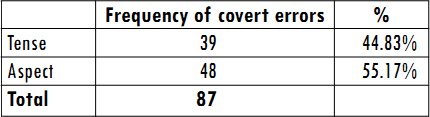
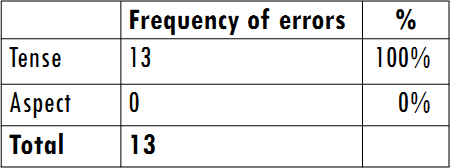
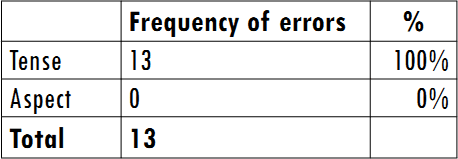
<body><![CDATA[<p align="center"><font size="2" face="Verdana, Arial, Helvetica, sans-serif"><a name="t01"></a><img src="/img/revistas/ikala/v17n3/v17n3a6t1.gif"></font></p>     <p>&nbsp;</p>     <p align="center"><font size="2" face="Verdana, Arial, Helvetica, sans-serif"><b>Table 2:</b> Tenses with the highest frequency of errors</font></p>     <p align="center"><font size="2" face="Verdana, Arial, Helvetica, sans-serif"><a name="t02"></a><img src="/img/revistas/ikala/v17n3/v17n3a6t2.gif"></font></p>     <p>&nbsp;</p>     <p><font size="2" face="Verdana, Arial, Helvetica, sans-serif"><b>COVERT ERRORS </b></font></p>     <p align="center"><font size="2" face="Verdana, Arial, Helvetica, sans-serif"><b>Table 3</b>: Total frequency of covert errors: tense and aspect</font></p>     <p align="center"><font size="2" face="Verdana, Arial, Helvetica, sans-serif"><a name="t03"></a><img src="/img/revistas/ikala/v17n3/v17n3a6t3.gif"></font></p>     <p>&nbsp;</p>     <p><font size="2" face="Verdana, Arial, Helvetica, sans-serif"><b>TENSE: PRESENT  </b></font></p>     ]]></body>
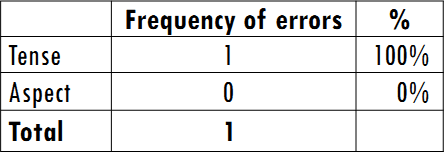
<body><![CDATA[<p><font size="2" face="Verdana, Arial, Helvetica, sans-serif"><b>Aspect: Simple </b></font></p>     <p><font size="2" face="Verdana, Arial, Helvetica, sans-serif">Expected answer: Hugo wants </font></p>     <p><font size="2" face="Verdana, Arial, Helvetica, sans-serif">Student's error: Hugo will want</font></p>     <p>&nbsp;</p>     <p align="center"><font size="2" face="Verdana, Arial, Helvetica, sans-serif"><b>Table 4:</b> Simple present frequency of errors</font></p>     <p align="center"><font size="2" face="Verdana, Arial, Helvetica, sans-serif"><a name="t04"></a><img src="/img/revistas/ikala/v17n3/v17n3a6t4.gif"></font></p>     <p>&nbsp;</p>     <p><font size="2" face="Verdana, Arial, Helvetica, sans-serif">As <a href="#t04">Table 4 </a>shows, only one student chose the  wrong tense regarding simple present. This means  most students have mastered the use of simple  present in English. </font></p>     <p><font size="2" face="Verdana, Arial, Helvetica, sans-serif"><b>Aspect: Progressive</b></font></p>     <p><font size="2" face="Verdana, Arial, Helvetica, sans-serif">Expected answer: I am writing ... </font></p>     ]]></body>
<body><![CDATA[<p><font size="2" face="Verdana, Arial, Helvetica, sans-serif">Students' errors: </font></p> <ul>       <li><font size="2" face="Verdana, Arial, Helvetica, sans-serif"> I write.  Frequency:15 </font></li>       <li><font size="2" face="Verdana, Arial, Helvetica, sans-serif"> I've written. Frequency:1 </font></li>       <li><font size="2" face="Verdana, Arial, Helvetica, sans-serif"> I've been writing. Frequency:1 </font></li>       <li><font size="2" face="Verdana, Arial, Helvetica, sans-serif"> I wrote. Frequency:1</font></li>     </ul>     <p>&nbsp;</p>     <p align="center"><font size="2" face="Verdana, Arial, Helvetica, sans-serif"><b>Table 5:</b> Present progressive frequency of errors</font></p>     <p align="center"><font size="2" face="Verdana, Arial, Helvetica, sans-serif"><a name="t05"></a><img src="/img/revistas/ikala/v17n3/v17n3a6t5.gif"></font></p>     <p>&nbsp;</p>     ]]></body>
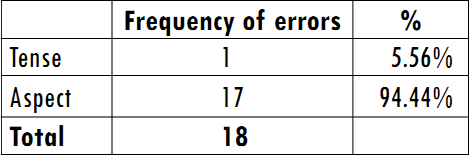
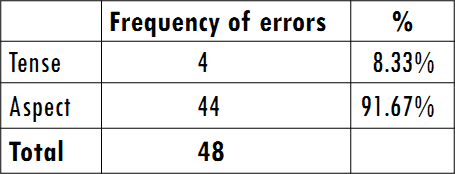
<body><![CDATA[<p><font size="2" face="Verdana, Arial, Helvetica, sans-serif">Eighteen (out of forty-eight) students had problems  identifying progressive aspect as the aspect a native  speaker would have used for the given context.  This number represents 94.44% of errors for the  expected answer ''I'm writing ...'' and 37.5% of all  covert errors, which means a significant number  of students have not learned the correct use of the  present progressive in English.</font></p>     <p><font size="2" face="Verdana, Arial, Helvetica, sans-serif"><b>Aspect: Perfect</b></font></p>     <p><font size="2" face="Verdana, Arial, Helvetica, sans-serif">Expected answer: You haven't written... </font></p>     <p><font size="2" face="Verdana, Arial, Helvetica, sans-serif">Students' errors:  </font></p> <ul>       <li><font size="2" face="Verdana, Arial, Helvetica, sans-serif"> You hadn't written. Frequency: 1 </font></li>       <li><font size="2" face="Verdana, Arial, Helvetica, sans-serif"> You didn't write. Frequency:1 </font></li>       <li><font size="2" face="Verdana, Arial, Helvetica, sans-serif"> You haven't been writing. Frequency:1 </font></li>       <li><font size="2" face="Verdana, Arial, Helvetica, sans-serif"> You are not writing. Frequency:1</font></li>     </ul>     <p>&nbsp;</p>     ]]></body>
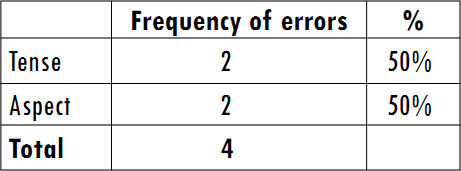
<body><![CDATA[<p align="center"><font size="2" face="Verdana, Arial, Helvetica, sans-serif"><b>Table 6:</b> Present perfect frequency of errors</font></p>     <p align="center"><font size="2" face="Verdana, Arial, Helvetica, sans-serif"><a name="t06"></a><img src="/img/revistas/ikala/v17n3/v17n3a6t6.gif"></font></p>     <p>&nbsp;</p>     <p><font size="2" face="Verdana, Arial, Helvetica, sans-serif">Only four students could not identify the present  perfect as the correct tense for the given context.  Those students seem to be confused with tense and  aspect.  </font></p>     <p>&nbsp;</p>     <p align="center"><font size="2" face="Verdana, Arial, Helvetica, sans-serif"><b>Table 7: </b>Present perfect progressive frequency of  errors</font></p>     <p align="center"><font size="2" face="Verdana, Arial, Helvetica, sans-serif"><a name="t07"></a><img src="/img/revistas/ikala/v17n3/v17n3a6t7.gif"></font></p>     <p>&nbsp;</p>     <p><font size="2" face="Verdana, Arial, Helvetica, sans-serif">This is the tense with the highest frequency  of errors. Students used continuous aspect  instead of the perfect continuous. This error  shows students can identify and use the tense but  confuse the use of perfect continuous and the use  of continuous aspects in English.</font></p>     <p><font size="2" face="Verdana, Arial, Helvetica, sans-serif"><b>PRESENT</b> </font></p>     ]]></body>
<body><![CDATA[<p><font size="2" face="Verdana, Arial, Helvetica, sans-serif"><b>Total frequency of errors </b></font></p>     <p>&nbsp;</p>     <p align="center"><font size="2" face="Verdana, Arial, Helvetica, sans-serif"><b>Table 8:</b> Present tenses total frequency of errors</font></p>     <p align="center"><font size="2" face="Verdana, Arial, Helvetica, sans-serif"><a name="t08"></a><img src="/img/revistas/ikala/v17n3/v17n3a6t8.gif"></font></p>     <p>&nbsp;</p>     <p><font size="2" face="Verdana, Arial, Helvetica, sans-serif"><b>TENSE: PAST  </b></font></p>     <p><font size="2" face="Verdana, Arial, Helvetica, sans-serif"><b>Aspect: Simple </b></font></p>     <p><font size="2" face="Verdana, Arial, Helvetica, sans-serif">Expected answer: Did you receive the letter? </font></p>     <p><font size="2" face="Verdana, Arial, Helvetica, sans-serif">Students' errors: </font></p> <ul>       <li><font size="2" face="Verdana, Arial, Helvetica, sans-serif"> Do you receive? Frequency:2 </font></li>       ]]></body>
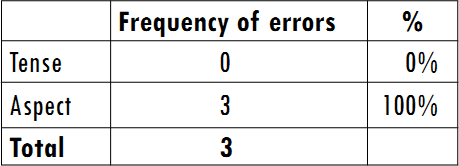
<body><![CDATA[<li><font size="2" face="Verdana, Arial, Helvetica, sans-serif"> Will you receive? Frequency:1 </font></li>       <li><font size="2" face="Verdana, Arial, Helvetica, sans-serif"> Had you received? Frequency:1</font></li>     </ul>     <p>&nbsp;</p>     <p align="center"><font size="2" face="Verdana, Arial, Helvetica, sans-serif"><b>Table 9:</b> Simple past frequency of errors</font></p>     <p align="center"><font size="2" face="Verdana, Arial, Helvetica, sans-serif"><a name="t09"></a><img src="/img/revistas/ikala/v17n3/v17n3a6t9.gif"></font></p>     <p>&nbsp;</p>     <p align="center"><font size="2" face="Verdana, Arial, Helvetica, sans-serif"><b>Table 10:</b> Past progressive frequency of errors</font></p>     <p align="center"><font size="2" face="Verdana, Arial, Helvetica, sans-serif"><a name="t10"></a><img src="/img/revistas/ikala/v17n3/v17n3a6t10.gif"></font></p>     <p>&nbsp;</p>     ]]></body>
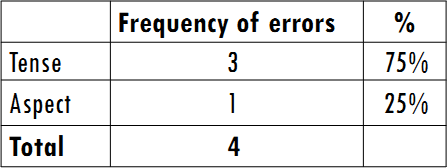
<body><![CDATA[<p><font size="2" face="Verdana, Arial, Helvetica, sans-serif">This tense represents one of the tenses with the  lowest frequency of covert errors. And even though  aspect is wrong, tense is correct, which means  students can identify the time of the situation.</font></p>     <p>&nbsp;</p>     <p><font size="2" face="Verdana, Arial, Helvetica, sans-serif"><b>Aspect: Perfect </b></font></p>     <p><font size="2" face="Verdana, Arial, Helvetica, sans-serif">Expected answer: I had never seen ... </font></p>     <p><font size="2" face="Verdana, Arial, Helvetica, sans-serif">Students' errors: </font></p> <ul>       <li><font size="2" face="Verdana, Arial, Helvetica, sans-serif"> I have never seen. Frequency:19</font></li>     </ul>     <p>&nbsp;</p>     <p align="center"><font size="2" face="Verdana, Arial, Helvetica, sans-serif"><b>Table 11: </b>Past perfect frequency of errors</font></p>     <p align="center"><font size="2" face="Verdana, Arial, Helvetica, sans-serif"><a name="t11"></a><img src="/img/revistas/ikala/v17n3/v17n3a6t11.gif"></font></p>     ]]></body>
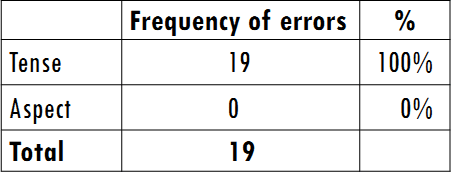
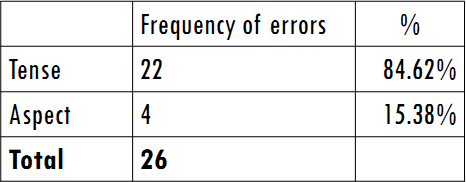
<body><![CDATA[<p>&nbsp;</p>     <p><font size="2" face="Verdana, Arial, Helvetica, sans-serif">This tense presents a high frequency of errors. All  students made the same mistake: they used present  perfect instead of past perfect. </font></p>     <p><font size="2" face="Verdana, Arial, Helvetica, sans-serif"><b>PAST  </b></font></p>     <p><font size="2" face="Verdana, Arial, Helvetica, sans-serif"><b>Total frequency of errors</b></font></p>     <p>&nbsp;</p>     <p align="center"><font size="2" face="Verdana, Arial, Helvetica, sans-serif"><b>Table 12: </b>Past tenses total frequency of errors</font></p>     <p align="center"><font size="2" face="Verdana, Arial, Helvetica, sans-serif"><a name="t12"></a><img src="/img/revistas/ikala/v17n3/v17n3a6t12.gif"></font></p>     <p>&nbsp;</p>     <p><font size="2" face="Verdana, Arial, Helvetica, sans-serif"><b>TENSE: FUTURE </b></font></p>     <p><font size="2" face="Verdana, Arial, Helvetica, sans-serif"><b>Aspect: Simple </b></font></p>     ]]></body>
<body><![CDATA[<p><font size="2" face="Verdana, Arial, Helvetica, sans-serif">Expected answer: When will you come to Europe? </font></p>     <p><font size="2" face="Verdana, Arial, Helvetica, sans-serif">Students' errors: </font></p> <ul>       <li><font size="2" face="Verdana, Arial, Helvetica, sans-serif">When do you come? Frequency: 13 </font></li>     </ul>     <p>&nbsp;</p>     <p align="center"><font size="2" face="Verdana, Arial, Helvetica, sans-serif"><b>Table 13: </b>Simple future frequency of errors</font></p>     <p align="center"><font size="2" face="Verdana, Arial, Helvetica, sans-serif"><a name="t13"></a><img src="/img/revistas/ikala/v17n3/v17n3a6t13.gif"></font></p>     <p>&nbsp;</p>     <p><font size="2" face="Verdana, Arial, Helvetica, sans-serif">The use of this tense is not clear for some students  who still confuse the use of the simple present  tense with the use of the simple future in English. </font></p>     <p>&nbsp;</p>     ]]></body>
<body><![CDATA[<p><font size="2" face="Verdana, Arial, Helvetica, sans-serif"><b>FUTURE </b></font></p>     <p><font size="2" face="Verdana, Arial, Helvetica, sans-serif"><b>Total frequency of errors </b></font></p>     <p>&nbsp;</p>     <p align="center"><font size="2" face="Verdana, Arial, Helvetica, sans-serif"><b>Table 14:</b> Future total frequency of errors</font></p>     <p align="center"><font size="2" face="Verdana, Arial, Helvetica, sans-serif"><a name="t14"></a><img src="/img/revistas/ikala/v17n3/v17n3a6t14.gif"></font></p>     <p>&nbsp;</p>     <p><font size="2" face="Verdana, Arial, Helvetica, sans-serif"><b>OVERT ERRORS </b></font></p>     <p><font size="2" face="Verdana, Arial, Helvetica, sans-serif">The highest frequency of overt errors corresponds  to the omission of an element. As the <a href="#t15">table</a> below  shows, the tense with the highest frequency of this  type of error is the simple present. </font></p>     <p>&nbsp;</p>     <p align="center"><font size="2" face="Verdana, Arial, Helvetica, sans-serif"><b>Table 15</b></font></p>     ]]></body>
<body><![CDATA[<p align="center"><font size="2" face="Verdana, Arial, Helvetica, sans-serif"><a name="t15"></a><img src="/img/revistas/ikala/v17n3/v17n3a6t15.gif"></font></p>     <p>&nbsp;</p>     <p><font size="2" face="Verdana, Arial, Helvetica, sans-serif"><b>TENSE: PRESENT  </b></font></p>     <p><font size="2" face="Verdana, Arial, Helvetica, sans-serif"><b>Aspect: Simple </b></font></p>     <p><font size="2" face="Verdana, Arial, Helvetica, sans-serif">Expected answer: Hugo wants ... </font></p>     <p><font size="2" face="Verdana, Arial, Helvetica, sans-serif">Students' errors: </font></p> <ul>       <li><font size="2" face="Verdana, Arial, Helvetica, sans-serif">  Hugo want. Type: Omission. Frequency: 11</font></li>     </ul>     <p><font size="2" face="Verdana, Arial, Helvetica, sans-serif">This type of error is a common one among Chilean  students learning English as a foreign language. It  can be explained as an intralingual error which is  overcome with time and practice.</font></p>     <p>&nbsp;</p>     ]]></body>
<body><![CDATA[<p><font size="2" face="Verdana, Arial, Helvetica, sans-serif"><b>TENSE: PRESENT  </b></font></p>     <p><font size="2" face="Verdana, Arial, Helvetica, sans-serif"><b>Aspect: Progressive</b></font></p>     <p><font size="2" face="Verdana, Arial, Helvetica, sans-serif">Expected answer: I am writing ... </font></p>     <p><font size="2" face="Verdana, Arial, Helvetica, sans-serif">No errors of the overt type.</font></p>     <p>&nbsp;</p>     <p><font size="2" face="Verdana, Arial, Helvetica, sans-serif"><b>TENSE: PRESENT </b></font></p>     <p><font size="2" face="Verdana, Arial, Helvetica, sans-serif"><b>Aspect: Perfect </b></font></p>     <p><font size="2" face="Verdana, Arial, Helvetica, sans-serif">Expected answer: You haven't written... </font></p>     <p><font size="2" face="Verdana, Arial, Helvetica, sans-serif">Students' errors:</font></p> <ul>       <li><font size="2" face="Verdana, Arial, Helvetica, sans-serif">You written. Type: Omission. Frequency: 1</font></li>       ]]></body>
<body><![CDATA[<li><font size="2" face="Verdana, Arial, Helvetica, sans-serif">  You don't have writing. Type: misformation.  Frequency: 1 </font></li>       <li><font size="2" face="Verdana, Arial, Helvetica, sans-serif">  You don't have writed. Type: misformation.  Frequency: 1 </font></li>       <li><font size="2" face="Verdana, Arial, Helvetica, sans-serif">  You haven't write. Type: misformation.  Frequency: 4 </font></li>       <li><font size="2" face="Verdana, Arial, Helvetica, sans-serif"> You haven't wroten. Type: misformation.  Frequency: 1 </font></li>       <li><font size="2" face="Verdana, Arial, Helvetica, sans-serif"> You hadn't write. Type: misformation.  Frequency: 1</font></li>     </ul>     <p><font size="2" face="Verdana, Arial, Helvetica, sans-serif">Results show students still have problems to form  the present perfect. The main problem in this case  is the past participle of the irregular verb write.</font></p>     <p>&nbsp;</p>     <p><font size="2" face="Verdana, Arial, Helvetica, sans-serif"><b>TENSE: PRESENT  Aspect: Perfect Progressive </b></font></p>     <p><font size="2" face="Verdana, Arial, Helvetica, sans-serif">Expected answer: I have been spending ...</font></p>     ]]></body>
<body><![CDATA[<p><font size="2" face="Verdana, Arial, Helvetica, sans-serif"> Students' errors:</font></p> <ul>       <li><font size="2" face="Verdana, Arial, Helvetica, sans-serif">I spending. Type: Omission. frequency: 1 </font></li>       <li><font size="2" face="Verdana, Arial, Helvetica, sans-serif">  I have been spend. Type: misformation.  Frequency: 1 </font></li>       <li><font size="2" face="Verdana, Arial, Helvetica, sans-serif"> I'm been spending. Type: misformation.  Frequency: 1</font></li>     </ul>     <p><font size="2" face="Verdana, Arial, Helvetica, sans-serif">This tense does not show a high frequency of  errors. </font></p>     <p>&nbsp;</p>     <p><font size="2" face="Verdana, Arial, Helvetica, sans-serif"><b>TENSE: PAST </b></font></p>     <p><font size="2" face="Verdana, Arial, Helvetica, sans-serif"><b>Aspect: Simple </b></font></p>     <p><font size="2" face="Verdana, Arial, Helvetica, sans-serif">Expected answer: Did you receive the letter? </font></p>     ]]></body>
<body><![CDATA[<p><font size="2" face="Verdana, Arial, Helvetica, sans-serif">Students' errors:</font></p> <ul>       <li><font size="2" face="Verdana, Arial, Helvetica, sans-serif">Did you received? Type:  addition. Frequency:  3 </font></li>       <li><font size="2" face="Verdana, Arial, Helvetica, sans-serif">  Do you received? Type:  misformation.  Frequency: 2 </font></li>       <li><font size="2" face="Verdana, Arial, Helvetica, sans-serif">  Are you receive? Type:  misformation.  Frequency: 1 </font></li>       <li><font size="2" face="Verdana, Arial, Helvetica, sans-serif"> Receive you? Type:  misformation. Frequency:  1</font></li>     </ul>     <p><font size="2" face="Verdana, Arial, Helvetica, sans-serif">When analysing the type of errors, it can be  inferred that some students do not have difficulties  with the formation of the simple past but with  the formation of the simple present because this  was the tense they chose for the given context.  Only three students need more practice with the  formation of questions. Therefore, this tense does  not show a high frequency of errors.</font></p>     <p>&nbsp;</p>     <p><font size="2" face="Verdana, Arial, Helvetica, sans-serif"><b>TENSE: PAST Aspect: Progressive </b></font></p>     <p><font size="2" face="Verdana, Arial, Helvetica, sans-serif">Expected answer: Our friend Franz was waiting  here...</font></p>     ]]></body>
<body><![CDATA[<p><font size="2" face="Verdana, Arial, Helvetica, sans-serif"> Students' errors:</font></p> <ul>       <li><font size="2" face="Verdana, Arial, Helvetica, sans-serif">Our friend have waited here. Type:  misformation. Frequency: 1</font></li>       <li><font size="2" face="Verdana, Arial, Helvetica, sans-serif">  Our friend have been waiting here. Type:  misformation.  Frequency: 2 </font></li>       <li><font size="2" face="Verdana, Arial, Helvetica, sans-serif">  Here were our friend waiting. Type:  misformation.  Frequency: 1 </font></li>       <li><font size="2" face="Verdana, Arial, Helvetica, sans-serif">  Here was waiting our friend. Type:  misordering.  Frequency: 5 </font></li>       <li><font size="2" face="Verdana, Arial, Helvetica, sans-serif"> Here was our friend waiting. Type:  misordering.  Frequency: 1</font></li>     </ul>     <p><font size="2" face="Verdana, Arial, Helvetica, sans-serif">The most recurrent type of error is not the  formation of the tense in terms of the elements  needed but the position of the subject.</font></p>     <p>&nbsp;</p>     <p><font size="2" face="Verdana, Arial, Helvetica, sans-serif"><b>TENSE: PAST Aspect: Past Perfect </b></font></p>     ]]></body>
<body><![CDATA[<p><font size="2" face="Verdana, Arial, Helvetica, sans-serif">Expected answer: I had never seen ...</font></p>     <p><font size="2" face="Verdana, Arial, Helvetica, sans-serif"> Students' errors:</font></p> <ul>       <li><font size="2" face="Verdana, Arial, Helvetica, sans-serif">I had never been seen. Type: addition.  Frequency: 1 </font></li>       <li><font size="2" face="Verdana, Arial, Helvetica, sans-serif">  I have never saw. Type: misformation.  Frequency: 1 </font></li>       <li><font size="2" face="Verdana, Arial, Helvetica, sans-serif"> I have never seeing. Type: misformation.  Frequency: 1 </font></li>       <li><font size="2" face="Verdana, Arial, Helvetica, sans-serif"> I had never sawn. Type: misformation.  Frequency: 1</font></li>     </ul>     <p><font size="2" face="Verdana, Arial, Helvetica, sans-serif">This tense does not present a high frequency of  errors but as with the present perfect there are errors in the formation of the perfect form of an  irregular verb.</font></p>     <p>&nbsp;</p>     <p><font size="2" face="Verdana, Arial, Helvetica, sans-serif"><b>TENSE: FUTURE Aspect: Simple  </b></font></p>     ]]></body>
<body><![CDATA[<p><font size="2" face="Verdana, Arial, Helvetica, sans-serif">Expected answer: When will you come to Europe? </font></p>     <p><font size="2" face="Verdana, Arial, Helvetica, sans-serif">Students' errors: </font></p> <ul>       <li><font size="2" face="Verdana, Arial, Helvetica, sans-serif">  When you come? Type: omission. Frequency:  9 </font></li>       <li><font size="2" face="Verdana, Arial, Helvetica, sans-serif"> When you will come? Type: misordering.  Frequency: 1</font></li>     </ul>     <p><font size="2" face="Verdana, Arial, Helvetica, sans-serif">In this tense, the most frequent errors are not  really errors in the formation of the future tense,  but errors in the correct formation of the simple  present which students chose as the correct tense  according to the context.</font></p>     <p>&nbsp;</p>     <p><font size="3" face="Verdana, Arial, Helvetica, sans-serif"><b>4. CONCLUSIONS </b></font></p>     <p><font size="2" face="Verdana, Arial, Helvetica, sans-serif">Error analysis attempts at identifying, describing  and explaining learners' errors, thereby providing  valuable information about the language the  learner is using. Even though error analysis has  some drawbacks, it is still a useful tool from a  pedagogical perspective. </font></p>     <p><font size="2" face="Verdana, Arial, Helvetica, sans-serif">This research used error analysis to study the way  first year English Pedagogy students use English  tenses and aspects. After analysing students' errors,  it can be concluded that the highest frequency of  errors corresponds to the covert type. </font></p>     ]]></body>
<body><![CDATA[<p><font size="2" face="Verdana, Arial, Helvetica, sans-serif">The wrong choice of aspect is the main type of  covert error. Present perfect progressive and present  progressive show a high frequency of this type of  error. From a pedagogical perspective, these results  suggest that it would be helpful to implement  remedial tasks to raise students' awareness of the  importance of aspect to convey meaning.</font></p>     <p><font size="2" face="Verdana, Arial, Helvetica, sans-serif">Utterances containing past perfect and simple  future also showed a high frequency of covert  errors, but the problem was not the wrong choice  of aspect but the wrong choice of tense. To  overcome problems using past perfect, we suggest  that teachers use exercises that contrast the use  of present perfect and past perfect since students seemed to overgeneralize the use of present perfect.  Finally, some contrastive analysis between English  and Spanish could help students internalize the  use of simple future in English.</font></p>     <p><font size="2" face="Verdana, Arial, Helvetica, sans-serif">Although the number of students who showed  difficulties with the formation of tenses (overt  errors) is not as significant as the number of  students who had problems using tenses and  aspects, it is an area that also needs to be analysed  in terms of the time and type of drilling students  need to be exposed to. The omission of the s for the  third person singular is the most frequent error.  The past participle form of irregular verbs and the  position of elements are still a problem for some  students.</font></p>     <p><font size="2" face="Verdana, Arial, Helvetica, sans-serif">As our research shows first year English Pedagogy  students face problems regarding the use of tenses  in English. Therefore, teaching methods and  materials should be revised in light of learners'  errors to find ways to help them learn the use of  tenses and aspects.</font></p>     <p><font size="2" face="Verdana, Arial, Helvetica, sans-serif">This study used error analysis to identify students'  errors in relation to the use and formation of  English tenses and aspects. Despite the fact that  error analysis has some drawbacks, it was an  useful tool to obtain information about students'  problems and to provide suggestions for improving  the teaching-learning process.</font></p>     <p>&nbsp;</p>     <p><font size="3" face="Verdana, Arial, Helvetica, sans-serif"><b>REFERENCES</b></font></p>     <!-- ref --><p><font size="2" face="Verdana, Arial, Helvetica, sans-serif">1. Brown, H. (2000).  <i>Principles of language learning  and teaching</i>. New York, NY: Addison Wesley  Longman.    &nbsp;&nbsp;&nbsp;&nbsp;&nbsp;&nbsp;&nbsp;&nbsp;[&#160;<a href="javascript:void(0);" onclick="javascript: window.open('/scielo.php?script=sci_nlinks&ref=000270&pid=S0123-3432201200030000600001&lng=','','width=640,height=500,resizable=yes,scrollbars=1,menubar=yes,');">Links</a>&#160;]<!-- end-ref --> </font></p>     <!-- ref --><p><font size="2" face="Verdana, Arial, Helvetica, sans-serif">2. Corder, S. (1971). Idiosyncratic dialects and error  analysis. <i>IRAL</i>, 9(1), 147-160.    &nbsp;&nbsp;&nbsp;&nbsp;&nbsp;&nbsp;&nbsp;&nbsp;[&#160;<a href="javascript:void(0);" onclick="javascript: window.open('/scielo.php?script=sci_nlinks&ref=000272&pid=S0123-3432201200030000600002&lng=','','width=640,height=500,resizable=yes,scrollbars=1,menubar=yes,');">Links</a>&#160;]<!-- end-ref --> </font></p>     <!-- ref --><p><font size="2" face="Verdana, Arial, Helvetica, sans-serif">3. Corder, S. (1981).  <i>Error analysis and interlanguage</i>.  Oxford, England: Oxford University Press.    &nbsp;&nbsp;&nbsp;&nbsp;&nbsp;&nbsp;&nbsp;&nbsp;[&#160;<a href="javascript:void(0);" onclick="javascript: window.open('/scielo.php?script=sci_nlinks&ref=000274&pid=S0123-3432201200030000600003&lng=','','width=640,height=500,resizable=yes,scrollbars=1,menubar=yes,');">Links</a>&#160;]<!-- end-ref --> </font></p>     <!-- ref --><p><font size="2" face="Verdana, Arial, Helvetica, sans-serif">4. Dulay, H., Burt, M., &amp; Krashen, S. (1982). <i>Language  two</i>. Oxford, England: Oxford University Press.    &nbsp;&nbsp;&nbsp;&nbsp;&nbsp;&nbsp;&nbsp;&nbsp;[&#160;<a href="javascript:void(0);" onclick="javascript: window.open('/scielo.php?script=sci_nlinks&ref=000276&pid=S0123-3432201200030000600004&lng=','','width=640,height=500,resizable=yes,scrollbars=1,menubar=yes,');">Links</a>&#160;]<!-- end-ref --> </font></p>     <!-- ref --><p><font size="2" face="Verdana, Arial, Helvetica, sans-serif">5. Ellis, R., &amp; Barkhuizen, G. (2005). <i>Analysing learner  language</i>. Oxford, England: Oxford University  Press.    &nbsp;&nbsp;&nbsp;&nbsp;&nbsp;&nbsp;&nbsp;&nbsp;[&#160;<a href="javascript:void(0);" onclick="javascript: window.open('/scielo.php?script=sci_nlinks&ref=000278&pid=S0123-3432201200030000600005&lng=','','width=640,height=500,resizable=yes,scrollbars=1,menubar=yes,');">Links</a>&#160;]<!-- end-ref --> </font></p>     <!-- ref --><p><font size="2" face="Verdana, Arial, Helvetica, sans-serif">6. Erdogan, V. (2005). Contribution of error analysis to  foreign language teaching.  <i>Mersin University  Journal of the Faculty of Education</i>,  1(2),  261-270.    &nbsp;&nbsp;&nbsp;&nbsp;&nbsp;&nbsp;&nbsp;&nbsp;[&#160;<a href="javascript:void(0);" onclick="javascript: window.open('/scielo.php?script=sci_nlinks&ref=000280&pid=S0123-3432201200030000600006&lng=','','width=640,height=500,resizable=yes,scrollbars=1,menubar=yes,');">Links</a>&#160;]<!-- end-ref --> </font></p>     <!-- ref --><p><font size="2" face="Verdana, Arial, Helvetica, sans-serif">7. James, C. (1998).   Errors in languages learning and  use:  Exploring error analysis. London, England:  Longman.    &nbsp;&nbsp;&nbsp;&nbsp;&nbsp;&nbsp;&nbsp;&nbsp;[&#160;<a href="javascript:void(0);" onclick="javascript: window.open('/scielo.php?script=sci_nlinks&ref=000282&pid=S0123-3432201200030000600007&lng=','','width=640,height=500,resizable=yes,scrollbars=1,menubar=yes,');">Links</a>&#160;]<!-- end-ref --> </font></p>     <!-- ref --><p><font size="2" face="Verdana, Arial, Helvetica, sans-serif">8. Lennon, P. (1991). Error and the very advanced learner.  <i>IRAL</i>, 29(1), 31-44.    &nbsp;&nbsp;&nbsp;&nbsp;&nbsp;&nbsp;&nbsp;&nbsp;[&#160;<a href="javascript:void(0);" onclick="javascript: window.open('/scielo.php?script=sci_nlinks&ref=000284&pid=S0123-3432201200030000600008&lng=','','width=640,height=500,resizable=yes,scrollbars=1,menubar=yes,');">Links</a>&#160;]<!-- end-ref -->  </font></p>     <!-- ref --><p><font size="2" face="Verdana, Arial, Helvetica, sans-serif">9. Mahmoud, A. (2011). The role of interlingual and  intralingual transfer in learner-centered EFL  vocabulary instruction.  <i>Arab World English  Journal</i>, 2(3), 28-49.    &nbsp;&nbsp;&nbsp;&nbsp;&nbsp;&nbsp;&nbsp;&nbsp;[&#160;<a href="javascript:void(0);" onclick="javascript: window.open('/scielo.php?script=sci_nlinks&ref=000286&pid=S0123-3432201200030000600009&lng=','','width=640,height=500,resizable=yes,scrollbars=1,menubar=yes,');">Links</a>&#160;]<!-- end-ref --> </font></p>     <!-- ref --><p><font size="2" face="Verdana, Arial, Helvetica, sans-serif">10. Tarone, E. (1981). Some thoughts on the notion of the  communication strategy.  <i>TESOL Quarterly</i>,  15(3), 285-295.    &nbsp;&nbsp;&nbsp;&nbsp;&nbsp;&nbsp;&nbsp;&nbsp;[&#160;<a href="javascript:void(0);" onclick="javascript: window.open('/scielo.php?script=sci_nlinks&ref=000288&pid=S0123-3432201200030000600010&lng=','','width=640,height=500,resizable=yes,scrollbars=1,menubar=yes,');">Links</a>&#160;]<!-- end-ref --></font></p>     <p>&nbsp;</p>     <p><font size="3" face="Verdana, Arial, Helvetica, sans-serif"><b>APPENDIX 1</b></font><font size="2" face="Verdana, Arial, Helvetica, sans-serif"><b></b></font></p>     <p><font size="2" face="Verdana, Arial, Helvetica, sans-serif"> Instrument used to gather information. </font></p>     ]]></body>
<body><![CDATA[<p><font size="2" face="Verdana, Arial, Helvetica, sans-serif"><i><b>Instructions:</b> </i></font></p>     <p><font size="2" face="Verdana, Arial, Helvetica, sans-serif">Translate the following letter into Spanish. Marks  will be assigned for the correct translation of  tenses. </font></p>     <p><font size="2" face="Verdana, Arial, Helvetica, sans-serif">Querida Ana: </font></p>     <p><font size="2" face="Verdana, Arial, Helvetica, sans-serif">Te escribo desde &Aacute;msterdam, donde estoy pasando  mis vacaciones con mi pololo, Hugo, desde hace  dos semanas. </font></p>     <p><font size="2" face="Verdana, Arial, Helvetica, sans-serif">El vuelo hasta aqu&iacute; estuvo bien, aunque tuvimos  un poco de turbulencia.  Salimos de Santiago el  17 de octubre a las 11:00 de la ma&ntilde;ana y llegamos  el 18 a las 7:00.  No hicimos escala en Sao Paulo  como otras veces, sino que fue un vuelo directo  hasta Par&iacute;s, donde tomamos otro avi&oacute;n hasta  &Aacute;msterdam.  Aqu&iacute; nos esperaba nuestro amigo  Franz para llevarnos a nuestro hotel. </font></p>     <p><font size="2" face="Verdana, Arial, Helvetica, sans-serif">Todo aqu&iacute; es maravilloso.  La gente es muy amable, la  comida es deliciosa y la arquitectura es sensacional.   Yo no hab&iacute;a visto nunca nada como esta ciudad y,  como sabes, he viajado bastante.  Estuve en Per&uacute;,  Brasil, Estados Unidos, Italia y Jap&oacute;n. </font></p>     <p><font size="2" face="Verdana, Arial, Helvetica, sans-serif">Ayer visitamos el Museo del Juguete.  Fue muy  emocionante ver tantas cosas con las que yo jugaba  cuando chica, pero lo que m&aacute;s me impact&oacute; fue ver  un Atari.  Mientras jugaba con &eacute;l, vino el guardia  y me dijo que estaba prohibido tocar los juguetes.   No me gust&oacute; que no me dejara divertirme.  Me dio  mucha verg&uuml;enza. </font></p>     <p><font size="2" face="Verdana, Arial, Helvetica, sans-serif">Hugo quiere visitar el Barrio Rojo, pero yo no.   Discutimos todo el tiempo acerca de eso. </font></p>     <p><font size="2" face="Verdana, Arial, Helvetica, sans-serif">En este momento me tomo un jugo en este  precioso caf&eacute; cerca del hotel.  Hugo conversa con la  camarera, que es preciosa.  Lo pasamos bien aqu&iacute;,  aunque &uacute;ltimamente me siento un poco celosa. </font></p>     <p><font size="2" face="Verdana, Arial, Helvetica, sans-serif">La pr&oacute;xima semana vamos a Dinamarca.  Franz nos  acompa&ntilde;a, ya que quiere reunirse con un socio all&aacute;.   Despu&eacute;s viajamos a Colonia, en Alemania, donde  yo tengo unos parientes, pero no nos quedaremos  all&iacute; mucho tiempo.  Creo que volvemos a Chile en  enero. </font></p>     ]]></body>
<body><![CDATA[<p><font size="2" face="Verdana, Arial, Helvetica, sans-serif">&iquest;C&oacute;mo est&aacute;s t&uacute;? &iquest;Cu&aacute;ndo vienes a Europa?  &iquest;Me  echas de menos?  &iquest;Recibiste el mail que te mand&eacute;  ayer?  T&uacute; no me has escrito &iquest;no es cierto?  Cu&eacute;ntame  c&oacute;mo andan las cosas ah&iacute;. </font></p>     <p><font size="2" face="Verdana, Arial, Helvetica, sans-serif">Tengo que irme.  Te veo en enero. </font></p>     <p><font size="2" face="Verdana, Arial, Helvetica, sans-serif">Cari&ntilde;os,</font></p>     <p><font size="2" face="Verdana, Arial, Helvetica, sans-serif"><b>Sentences considered for error analysis </b></font></p> <ol>       <li><font size="2" face="Verdana, Arial, Helvetica, sans-serif">Te escribo desde &Aacute;msterdam. </font></li>       <li><font size="2" face="Verdana, Arial, Helvetica, sans-serif">  Estoy pasando mis vacaciones desde hace dos  semanas </font></li>       <li><font size="2" face="Verdana, Arial, Helvetica, sans-serif"> Aqu&iacute; nos esperaba nuestro amigo Franz.</font></li>       <li><font size="2" face="Verdana, Arial, Helvetica, sans-serif">Yo no hab&iacute;a visto nunca nada como esta ciudad. </font></li>       <li><font size="2" face="Verdana, Arial, Helvetica, sans-serif">  Hugo quiere visitar el Barrio Rojo. </font></li>       <li><font size="2" face="Verdana, Arial, Helvetica, sans-serif">&iquest;Cu&aacute;ndo vienes a Europa? </font></li>       ]]></body>
<body><![CDATA[<li><font size="2" face="Verdana, Arial, Helvetica, sans-serif">&iquest;Recibiste el mail? </font></li>       <li><font size="2" face="Verdana, Arial, Helvetica, sans-serif"> T&uacute; no me has escrito.</font></li>     </ol>     <p>&nbsp;</p>      ]]></body><back>
<ref-list>
<ref id="B1">
<label>1</label><nlm-citation citation-type="book">
<person-group person-group-type="author">
<name>
<surname><![CDATA[Brown]]></surname>
<given-names><![CDATA[H.]]></given-names>
</name>
</person-group>
<source><![CDATA[Principles of language learning and teaching]]></source>
<year>2000</year>
<publisher-loc><![CDATA[New York^eNY NY]]></publisher-loc>
<publisher-name><![CDATA[Addison Wesley Longman]]></publisher-name>
</nlm-citation>
</ref>
<ref id="B2">
<label>2</label><nlm-citation citation-type="journal">
<person-group person-group-type="author">
<name>
<surname><![CDATA[Corder]]></surname>
<given-names><![CDATA[S.]]></given-names>
</name>
</person-group>
<article-title xml:lang="en"><![CDATA[Idiosyncratic dialects and error analysis]]></article-title>
<source><![CDATA[IRAL]]></source>
<year>1971</year>
<volume>9</volume>
<numero>1</numero>
<issue>1</issue>
<page-range>147-160</page-range></nlm-citation>
</ref>
<ref id="B3">
<label>3</label><nlm-citation citation-type="book">
<person-group person-group-type="author">
<name>
<surname><![CDATA[Corder]]></surname>
<given-names><![CDATA[S.]]></given-names>
</name>
</person-group>
<source><![CDATA[Error analysis and interlanguage]]></source>
<year>1981</year>
<publisher-loc><![CDATA[Oxford ]]></publisher-loc>
<publisher-name><![CDATA[Oxford University Press]]></publisher-name>
</nlm-citation>
</ref>
<ref id="B4">
<label>4</label><nlm-citation citation-type="book">
<person-group person-group-type="author">
<name>
<surname><![CDATA[Dulay]]></surname>
<given-names><![CDATA[H.]]></given-names>
</name>
<name>
<surname><![CDATA[Burt]]></surname>
<given-names><![CDATA[M.]]></given-names>
</name>
<name>
<surname><![CDATA[Krashen]]></surname>
<given-names><![CDATA[S.]]></given-names>
</name>
</person-group>
<source><![CDATA[Language two]]></source>
<year>1982</year>
<publisher-loc><![CDATA[Oxford ]]></publisher-loc>
<publisher-name><![CDATA[Oxford University Press]]></publisher-name>
</nlm-citation>
</ref>
<ref id="B5">
<label>5</label><nlm-citation citation-type="book">
<person-group person-group-type="author">
<name>
<surname><![CDATA[Ellis]]></surname>
<given-names><![CDATA[R.]]></given-names>
</name>
<name>
<surname><![CDATA[Barkhuizen]]></surname>
<given-names><![CDATA[G.]]></given-names>
</name>
</person-group>
<source><![CDATA[Analysing learner language]]></source>
<year>2005</year>
<publisher-loc><![CDATA[Oxford ]]></publisher-loc>
<publisher-name><![CDATA[Oxford University Press]]></publisher-name>
</nlm-citation>
</ref>
<ref id="B6">
<label>6</label><nlm-citation citation-type="journal">
<person-group person-group-type="author">
<name>
<surname><![CDATA[Erdogan]]></surname>
<given-names><![CDATA[V.]]></given-names>
</name>
</person-group>
<article-title xml:lang="en"><![CDATA[Contribution of error analysis to foreign language teaching]]></article-title>
<source><![CDATA[Mersin University Journal of the Faculty of Education]]></source>
<year>2005</year>
<volume>1</volume>
<numero>2</numero>
<issue>2</issue>
<page-range>261-270</page-range></nlm-citation>
</ref>
<ref id="B7">
<label>7</label><nlm-citation citation-type="book">
<person-group person-group-type="author">
<name>
<surname><![CDATA[James]]></surname>
<given-names><![CDATA[C.]]></given-names>
</name>
</person-group>
<source><![CDATA[Errors in languages learning and use: Exploring error analysis]]></source>
<year>1998</year>
<publisher-loc><![CDATA[London ]]></publisher-loc>
<publisher-name><![CDATA[Longman]]></publisher-name>
</nlm-citation>
</ref>
<ref id="B8">
<label>8</label><nlm-citation citation-type="journal">
<person-group person-group-type="author">
<name>
<surname><![CDATA[Lennon]]></surname>
<given-names><![CDATA[P.]]></given-names>
</name>
</person-group>
<article-title xml:lang="en"><![CDATA[Error and the very advanced learner]]></article-title>
<source><![CDATA[IRAL]]></source>
<year>1991</year>
<volume>29</volume>
<numero>1</numero>
<issue>1</issue>
<page-range>31-44</page-range></nlm-citation>
</ref>
<ref id="B9">
<label>9</label><nlm-citation citation-type="journal">
<person-group person-group-type="author">
<name>
<surname><![CDATA[Mahmoud]]></surname>
<given-names><![CDATA[A.]]></given-names>
</name>
</person-group>
<article-title xml:lang="en"><![CDATA[The role of interlingual and intralingual transfer in learner-centered EFL vocabulary instruction]]></article-title>
<source><![CDATA[Arab World English Journal]]></source>
<year>2011</year>
<volume>2</volume>
<numero>3</numero>
<issue>3</issue>
<page-range>28-49</page-range></nlm-citation>
</ref>
<ref id="B10">
<label>10</label><nlm-citation citation-type="journal">
<person-group person-group-type="author">
<name>
<surname><![CDATA[Tarone]]></surname>
<given-names><![CDATA[E.]]></given-names>
</name>
</person-group>
<article-title xml:lang="en"><![CDATA[Some thoughts on the notion of the communication strategy]]></article-title>
<source><![CDATA[TESOL Quarterly]]></source>
<year>1981</year>
<volume>15</volume>
<numero>3</numero>
<issue>3</issue>
<page-range>285-295</page-range></nlm-citation>
</ref>
</ref-list>
</back>
</article>