<?xml version="1.0" encoding="ISO-8859-1"?><article xmlns:mml="http://www.w3.org/1998/Math/MathML" xmlns:xlink="http://www.w3.org/1999/xlink" xmlns:xsi="http://www.w3.org/2001/XMLSchema-instance">
<front>
<journal-meta>
<journal-id>0123-3432</journal-id>
<journal-title><![CDATA[Íkala, Revista de Lenguaje y Cultura]]></journal-title>
<abbrev-journal-title><![CDATA[Íkala]]></abbrev-journal-title>
<issn>0123-3432</issn>
<publisher>
<publisher-name><![CDATA[Escuela de Idiomas, Universidad de Antioquia]]></publisher-name>
</publisher>
</journal-meta>
<article-meta>
<article-id>S0123-34322013000200008</article-id>
<title-group>
<article-title xml:lang="en"><![CDATA[ROLE-PLAYS VS. NATURAL DATA: ASKING FOR A DRINK AT A CAFETERIA IN PENINSULAR SPANISH]]></article-title>
<article-title xml:lang="es"><![CDATA[JUEGOS DE ROL VS. DATOS NATURALES: CÓMO PEDIR ALGO DE BEBER EN UNA CAFETERÍA EN ESPAÑOL PENINSULAR]]></article-title>
</title-group>
<contrib-group>
<contrib contrib-type="author">
<name>
<surname><![CDATA[Bataller]]></surname>
<given-names><![CDATA[Rebeca]]></given-names>
</name>
<xref ref-type="aff" rid="A01"/>
</contrib>
</contrib-group>
<aff id="A01">
<institution><![CDATA[,Gettysburg College  ]]></institution>
<addr-line><![CDATA[ ]]></addr-line>
</aff>
<pub-date pub-type="pub">
<day>00</day>
<month>08</month>
<year>2013</year>
</pub-date>
<pub-date pub-type="epub">
<day>00</day>
<month>08</month>
<year>2013</year>
</pub-date>
<volume>18</volume>
<numero>2</numero>
<fpage>111</fpage>
<lpage>126</lpage>
<copyright-statement/>
<copyright-year/>
<self-uri xlink:href="http://www.scielo.org.co/scielo.php?script=sci_arttext&amp;pid=S0123-34322013000200008&amp;lng=en&amp;nrm=iso"></self-uri><self-uri xlink:href="http://www.scielo.org.co/scielo.php?script=sci_abstract&amp;pid=S0123-34322013000200008&amp;lng=en&amp;nrm=iso"></self-uri><self-uri xlink:href="http://www.scielo.org.co/scielo.php?script=sci_pdf&amp;pid=S0123-34322013000200008&amp;lng=en&amp;nrm=iso"></self-uri><abstract abstract-type="short" xml:lang="en"><p><![CDATA[The purpose of this study is to compare the data collected, via two methods, from two groups of Peninsular Spanish native speakers in a service encounter scenario. The methods chosen are open role-plays and naturally occurring interactions, two frequently used approaches in the field of pragmatics. The naturalistic data from this study consisted of request-for-service transactions at cafeterias in Valencia, Spain; these were recorded with audio equipment and then analyzed at the illocutionary and discourse levels. The features analyzed were the strategies and mitigating devices used in all phases of the interactions. The structure and length of interactions from each dataset were also compared. The results of this comparative study indicate that the role-play data resembled the naturalistic interactions in some respects, but there were also some significant differences between the two datasets that may be attributed to the particular type of collection method.]]></p></abstract>
<abstract abstract-type="short" xml:lang="es"><p><![CDATA[El objetivo de este estudio es comparar aspectos pragmáticos de datos obtenidos por dos métodos de recolección de datos diferentes: los juegos de rol y las grabaciones de conversaciones reales. Los datos provienen de dos grupos de participantes nativo hablantes de español peninsular en un contexto de prestación de un servicio. Las conversaciones auténticas fueron recogidas en dos cafeterías situadas en el campus de la Universidad de Valencia, España. Las interacciones entre los clientes y los camareros fueron captadas con una grabadora digital y analizadas a nivel ilocutorio y discursivo. Los elementos analizados fueron las estrategias principales y los elementos de mitigación usados en distintas fases de las interacciones. La estructura y longitud de las interacciones en cada muestra fueron también analizadas y comparadas. Los resultados de este estudio comparativo indican que los datos obtenidos a partir del juego de rol son similares a las conversaciones ''reales'' en varios aspectos, sin embargo también hay diferencias significativas entre las dos muestras que pueden ser atribuidas al tipo de instrumento de recolección de datos utilizado.]]></p></abstract>
<kwd-group>
<kwd lng="en"><![CDATA[data collection methods]]></kwd>
<kwd lng="en"><![CDATA[role-play]]></kwd>
<kwd lng="en"><![CDATA[naturalistic interactions]]></kwd>
<kwd lng="en"><![CDATA[requests]]></kwd>
<kwd lng="es"><![CDATA[métodos de recolección de datos]]></kwd>
<kwd lng="es"><![CDATA[juegos de rol]]></kwd>
<kwd lng="es"><![CDATA[grabaciones de conversaciones reales]]></kwd>
<kwd lng="es"><![CDATA[peticiones]]></kwd>
</kwd-group>
</article-meta>
</front><body><![CDATA[ <p align="right"><font size="2" face="Verdana, Arial, Helvetica, sans-serif"><b>METHODOLOGICAL ARTICLES</b></font></p>     <p>&nbsp;</p>     <p align="center"><font size="4" face="Verdana, Arial, Helvetica, sans-serif"><b>ROLE-PLAYS VS. NATURAL DATA: ASKING FOR A DRINK  AT A CAFETERIA IN PENINSULAR SPANISH</b></font></p>     <p align="center">&nbsp;</p>     <p align="center"><b><font size="3" face="Verdana, Arial, Helvetica, sans-serif">JUEGOS DE ROL VS. DATOS NATURALES: C&Oacute;MO PEDIR ALGO DE BEBER EN UNA CAFETER&Iacute;A EN ESPA&Ntilde;OL PENINSULAR</font></b></p>     <p>&nbsp;</p>     <p><font size="2" face="Verdana, Arial, Helvetica, sans-serif"><b>Rebeca Bataller*</b></font></p>     <p><font size="2" face="Verdana, Arial, Helvetica, sans-serif">*  Department of Spanish, Gettysburg  College, Gettysburg. Mailing  address: 300 North Washington St.  Gettysburg, PA 17325-1400. E-mail:  <a href="mailto:rbataller@gettysburg.edu">rbataller@gettysburg.edu</a></font></p>     <p>&nbsp;</p>     <p><font size="2" face="Verdana, Arial, Helvetica, sans-serif">Received: 2013-04-23/ Reviewed: 2013-04-24 / Accepted: 2013-05-27 / Published: 2013-08-01</font></p>     ]]></body>
<body><![CDATA[<p>&nbsp;</p>     <p><font size="2" face="Verdana, Arial, Helvetica, sans-serif"><b>How to reference this article:</b> Bataller, R. (2013). Role-plays vs. natural data: asking for a drink at a  cafeteria in peninsular Spanish.<i> &Iacute;kala, revista de lenguaje y cultura</i>, 18(2), 111&#8211;126.</font></p>     <p>&nbsp;</p> <hr size="1" noshade>     <p><font size="2" face="Verdana, Arial, Helvetica, sans-serif"><b>ABSTRACT</b></font></p>     <p><font size="2" face="Verdana, Arial, Helvetica, sans-serif"> The purpose of this study is to compare the data collected, via two methods, from  two groups of Peninsular Spanish native speakers in a service encounter scenario.  The methods chosen are open role-plays and naturally occurring interactions, two  frequently used approaches in the field of pragmatics. The naturalistic data from  this study consisted of request-for-service transactions at cafeterias in Valencia,  Spain; these were recorded with audio equipment and then analyzed at the  illocutionary and discourse levels. The features analyzed were the strategies and  mitigating devices used in all phases of the interactions. The structure and length of  interactions from each dataset were also compared. The results of this comparative  study indicate that the role-play data resembled the naturalistic interactions in  some respects, but there were also some significant differences between the two  datasets that may be attributed to the particular type of collection method. </font></p>     <p><font size="2" face="Verdana, Arial, Helvetica, sans-serif"><b>Keywords:</b> data collection methods, role-play, naturalistic interactions, requests </font></p> <hr size="1" noshade>     <p><font size="2" face="Verdana, Arial, Helvetica, sans-serif"><b>RESUMEN</b></font></p>     <p><font size="2" face="Verdana, Arial, Helvetica, sans-serif">El objetivo de este estudio es comparar aspectos pragm&aacute;ticos de datos obtenidos  por dos m&eacute;todos de recolecci&oacute;n de datos diferentes: los juegos de rol y las  grabaciones de conversaciones reales. Los datos provienen de dos grupos de  participantes nativo hablantes de espa&ntilde;ol peninsular en un contexto de prestaci&oacute;n  de un servicio. Las conversaciones aut&eacute;nticas fueron recogidas en dos cafeter&iacute;as  situadas en el campus de la Universidad de Valencia, Espa&ntilde;a. Las  interacciones  entre los clientes y los camareros fueron captadas con una grabadora digital  y analizadas a nivel ilocutorio y discursivo. Los elementos analizados fueron  las estrategias principales y los elementos de mitigaci&oacute;n usados en distintas  fases de las interacciones. La estructura y longitud de las interacciones en cada  muestra  fueron tambi&eacute;n analizadas y comparadas. Los resultados de este estudio  comparativo indican que los datos obtenidos a partir del juego de rol son  similares a las conversaciones ''reales'' en varios aspectos, sin embargo tambi&eacute;n hay  diferencias significativas entre las dos muestras que pueden ser atribuidas al tipo  de instrumento de recolecci&oacute;n de datos utilizado. </font></p>     <p><font size="2" face="Verdana, Arial, Helvetica, sans-serif"><b>Palabras clave:</b> m&eacute;todos de recolecci&oacute;n de datos, juegos de rol, grabaciones de  conversaciones reales, peticiones</font></p> <hr size="1" noshade>     <p>&nbsp;</p>     ]]></body>
<body><![CDATA[<p>&nbsp;</p>     <p><font size="3" face="Verdana, Arial, Helvetica, sans-serif"><b>1. INTRODUCTION</b></font></p>     <p><font size="2" face="Verdana, Arial, Helvetica, sans-serif"> The comparison of data collection methods in  pragmatics research is a topic that has received  considerable attention in the last few decades (e.g.  Bataller and Shively, 2011; Beebe &amp; Cummings,  1996; F&eacute;lix-Brasdefer, 2003, 2007; Hartford  &amp;Bardovi-Harlig, 1992; Kasper, 2000; Golato,  2003; Kasper &amp; Dahl, 1991; Kasper &amp; Rose, 2002;  Rintell &amp; Mitchell, 1989; Tran, 2006). There are  several methods that can be used to collect pragmatics  data; however, role-plays, written questionnaires and  naturalistic data collected via audio recordings and  field notes are probably the most frequently used  and discussed in the literature. Some studies have  pointed out the advantages and disadvantages of  each of these methods, comparing them in terms of  their validity, comparability and practicality (F&eacute;lix- Brasdefer, 2003; Tran, 2006). Overall, this research  has found that role-plays and written questionnaires  are both valid methods of data collection and that  they are practical for collecting large amounts of  data and give good control of contextual variables.  However, researchers agree that naturally occurring  data is more valid as it represents what speakers  actually say in real-life interactions (e.g. Bataller &amp;  Shively, 2011; F&eacute;lix-Brasdefer, 2003). </font></p>     <p><font size="2" face="Verdana, Arial, Helvetica, sans-serif">Though several studies have compared role-plays  and questionnaires, there are far fewer that compare  role-plays with natural data. Furthermore, while  requests have been the focus of some method  studies (e.g. F&eacute;lix-Brasdefer, 2007; Kasanga, 1999),  to our knowledge, only Bataller and Shively (2011)  studied service encounter requests comparing two  methods of data collection. </font></p>     <p><font size="2" face="Verdana, Arial, Helvetica, sans-serif">Hence, the purpose of this study is to compare the  realization of transactional requests collected via an  open role-play and audio recordings of authentic  data, in addition to describing service encounter  interactions in cafeterias by university students  from Valencia, Spain. There are very few studies  analyzing service encounter requests in this context  in Peninsular Spanish (Placencia and Mancera  Rueda, 2011a, 2011b) and none of them focused  on this region of Spain (Valencia). </font></p>     <p>&nbsp;</p>     <p><font size="3" face="Verdana, Arial, Helvetica, sans-serif"><b>2. LITERATURE REVIEW</b></font></p>     <p><font size="2" face="Verdana, Arial, Helvetica, sans-serif">                                                                                                                        A variety of data collection methods has been  employed in pragmatics research. These include  written questionnaires, elicited and spontaneous  conversations, closed and open role-plays, diaries,  audio recordings and field notes (e.g. Cohen,  2004; Kasper and Dahl, 1991; Kasper, 2000). In  the following section we discuss what research has  discovered about three specific methods: the written  questionnaire or discourse completion task (DCT),  the role-play (RP) and naturally occurring data. We  then provide an overview of previous research on  service encounters in Peninsular Spanish. </font></p>     <p><font size="2" face="Verdana, Arial, Helvetica, sans-serif"><b>2.1. Elicited methods of data collection </b></font></p>     <p><font size="2" face="Verdana, Arial, Helvetica, sans-serif"><b><i>2.1.1. The written questionnaire (DCT)</i></b>.</font></p>     ]]></body>
<body><![CDATA[<p><font size="2" face="Verdana, Arial, Helvetica, sans-serif"> For decades the most frequently used method of  data collection in pragmatics was the DCT. In this  approach participants are given different scenarios  and they are asked to write in a given space what  they think they would say if they found themselves  in those scenarios in real life. This method has been  widely used in interlanguage pragmatics (Barron,  2000, 2003; Hoffman-Hicks, 1999; Kondo, 1997;  Matsumura, 2001; Rodriguez, 2001), and cross- cultural pragmatics studies (Ballesteros-Marin,  2002; Mir, 1993; Pinto, 2002), due to its ability to  collect large amounts of data in a short period of  time. However, the disadvantages of the DCTs in  comparison to other methods have also been widely  discussed. First, DCTs have been criticized for  representing what participants believe they should  say, and not necessarily what is actually said in real  life situations. Additionally, participants have time  to think about their responses, which are then less  spontaneous than those made orally (Barron, 2003). </font></p>     <p><font size="2" face="Verdana, Arial, Helvetica, sans-serif"><i><b>2.1.2. The Role-play (RP).</b></i></font></p>     <p><font size="2" face="Verdana, Arial, Helvetica, sans-serif"> In the last few decades, more and more researchers  analyzing speech acts have used RPs as a method  of data collection (Bataller, 2010; F&eacute;lix-Brasdefer,  2002, 2007; Garc&iacute;a, 1989, 1993, 1999; M&aacute;rquez-Reiter, 2000; Rintell, 1981; VonCanon, 2005).  As Tran (2006) explains, ''role-plays can be  defined as simulations of social interactions in  which participants assume and enact described  roles within specified situations'' (p. 3). There  are two types of RPs: closed and open. Closed  RPs involve one turn each by the participant  and the interlocutor, whereas open RPs allow  participants to take as many turns as they need  in order to complete the required task (Kasper &amp;  Dahl, 1991). </font></p>     <p><font size="2" face="Verdana, Arial, Helvetica, sans-serif">Several studies have noted that RPs are a more  valid measure of authentic language use compared  to DCTs (Eisenstein &amp; Bodman, 1993; F&eacute;lix- Brasdefer, 2003; Tran, 2006). As Kasper (2000)  points out, in comparison to questionnaire data,  RP data capture many of the discourse features  found in natural speech: intonation, pauses,  turn-taking, overlap and laughter, among others.  Role-play interactions also elicit more negotiation,  repetition and supportive moves in comparison  to written methods (Beebe &amp; Cummings, 1996;  F&eacute;lix-Brasdefer, 2003; Margalef-Boada, 1993). </font></p>     <p><font size="2" face="Verdana, Arial, Helvetica, sans-serif">Overall, research has shown that elicited methods  of data collection have advantages over natural  data regarding practicality, as they allow the  collection of large amounts of comparable data  (Kasper, 2000). Furthermore, there are certain  speech acts that would be very difficult to collect  via natural data because they occur infrequently  in spontaneous interactions or they are difficult  for researchers to collect (Billmyer &amp; Varghese,  2000; Cohen, 1996; Kasper &amp; Dahl, 1991). </font></p>     <p><font size="2" face="Verdana, Arial, Helvetica, sans-serif"><b><i>2.1.3. Natural data (ND).</i></b></font></p>     <p><font size="2" face="Verdana, Arial, Helvetica, sans-serif"> Naturally occurring speech clearly represents the  most valid measure of actual language use as it  shows ND with discourse features (Tran, 2004).  However, as previously stated, it does not allow  the researcher to exercise control over social  and contextual variables. This lack of control  makes it difficult to replicate the same scenario  and to compare speech samples from different  individuals or groups in a systematic manner  (Beebe &amp; Cummings, 1996; Tran, 2004). </font></p>     <p><font size="2" face="Verdana, Arial, Helvetica, sans-serif"><b><i>2.1.4. Comparison method studies.</i></b></font></p>     <p><font size="2" face="Verdana, Arial, Helvetica, sans-serif"> There are many studies that have compared DCT  and RP data (Beebe &amp; Cummings, 1996; Franch  and Lorenzo-Dus, 2008; Golato, 2003; Hartford  &amp; Bardovi-Harlig, 1992; Rintell &amp; Mitchell, 1989;  Rose, 1994; Yuan, 2001). Some of these studies  have noted that in the RP data nonnative speakers'  responses were longer because they included more  and longer supportive moves, as well as hesitations  (Margalef-Boada, 1993; Rintell &amp; Mitchell, 1989).  Rintell and Mitchell (1989, p. 266) suggested that  in RPs, their nonnative speaker participants may  have wished to be clearer and more polite to their  interlocutors and therefore they provided more  supporting moves, while this need did not apply  in DCT data. </font></p>     <p><font size="2" face="Verdana, Arial, Helvetica, sans-serif">Studies comparing DCTs and ND have found that  the ND was more direct and less elaborate than that  gathered from DCTs. Kasanga (1999) compared  natural requests with those elicited from DCTs of  a group of English learners from South Africa. She  found that in the ND learners were more direct and  used fewer supporting devices than in the DCTs.  As Kasanga stated, this could be the result of two  factors: on the one hand, in the DCT learners  had more time to think about their responses, and  may have used more devices to make their requests  more polite. In addition, the test-like format of  the DCT may have influenced learners' responses,  making them want to appear more formal. Omar  (1992) also found that in natural conversations  learners were more straightforward in their use of  greetings, cutting short the conversation openings,  while on the DCT they used more greeting  strategies as they may have wanted to demonstrate  their knowledge of these speech acts and forms.                               </font></p>     ]]></body>
<body><![CDATA[<p><font size="2" face="Verdana, Arial, Helvetica, sans-serif">Over the last two decades, some studies have  compared RPs with ND in different contexts  (Bataller &amp; Shively, 2011; Eisenstein &amp; Bodman,  1993; F&eacute;lix-Brasdefer, 2007; Hasall, 1997; Tran, 2004, 2006; Turnbull, 2001). Hassall (1997)  noted that L2 learners in RP situations used  information from the description of the situations  and as a result produced longer and more elaborate  responses than they would in real-life contexts.  Turnbull (2001) argued that RP participants  tended to make more verbose requests, repeating  themselves and asking for additional information  than participants in the ND. F&eacute;lix-Brasdefer  (2007) found that the requests in the natural  settings showed greater variability in prosodic  features, had longer requesting sequences, and  more idiomatic expressions than requests in  the RPs. Furthermore, the naturally-occurring  requests also displayed features that the RP data  did not show, such as the use of elliptic request  strategies and negation as a mitigator. In spite of  the differences, the similarities between the two  methods made the author state that ''the results  of the present study show that role-plays represent  an approximation to spoken discourse'' (F&eacute;lix- Brasdefer, 2007, p. 177). </font></p>     <p><font size="2" face="Verdana, Arial, Helvetica, sans-serif">Bataller and Shively (2011) analyzed the L2  learners' development of service encounter  requests after studying abroad for a semester in  Spain using RPs and naturalistic data. They found  that the RP data were similar to the naturalistic  data in terms of structure, sequence and turn  taking. In addition, they shared similarities in  the learners' development of request strategies.  However, they also found important differences,  such as greater variability and longer interactions  in the ND and some features and strategies that  only appeared in the natural interactions; for  example, use of small talk, server repetition and  well-wishing. In contrast, the RP participants used  want statements extensively and lacked lexical  specificity in some requests for beverages (e.g.,  quiero algo de beber 'I want something to drink');  they used alerters (e.g.,  perd&oacute;name 'excuse me'),  and showed a more frequent use of lexical and  syntactic mitigation. As the authors explained, the  description of the RP scenario that the students  were given to read probably accounted for their  use of the verb querer ('to want') and the lack of lexical specificity when requesting. Even though  both methods shared many similarities, RPs may  have ''the methodological disadvantage of being  susceptible to influence from the description of  the scenario and the fact that simulated interaction  may produce some seemingly inauthentic uses of  language'' (Bataller &amp; Shively, 2011,p. 48).</font></p>     <p><font size="2" face="Verdana, Arial, Helvetica, sans-serif">The present study aims to compare interactions  collected via open RPs with audio recordings  of authentic interactions of two groups of  Peninsular Spanish native speakers (NSs) making  transactional requests at cafeterias in Valencia,  Spain. To our knowledge, to date, only Bataller  and Shively (2011) have compared service  encounter requests using these two methods of  data collection. However, the participants and  pragmatic focus between the two studies differs  completely. Bataller and Shively analyzed L2  learners' pragmatic development, whereas the  present study aims to describe the interactions of  Peninsular Spanish NSs in this particular context. </font></p>     <p><font size="2" face="Verdana, Arial, Helvetica, sans-serif"><b>2.1.5. Service encounter requests in  Peninsular Spanish. </b></font></p>     <p><font size="2" face="Verdana, Arial, Helvetica, sans-serif">Service encounter interactions have been the focus  of several studies in a variety of languages during  the last two decades (Aston, 1995; Callahan,  2009; F&eacute;lix-Brasdefer, 2012; Garc&iacute;a, 1993; Hickey,  2005; Kerbrat-Orecchioni, 2005; Kidwell,  2000; M&aacute;rquez Reiter, 2005, 2006; Placencia  1998, 2004, 2005; Placencia &amp; Mancera Rueda,  2011a, 2011b; Traverso, 2001; V&eacute;lez, 1987). It is  important to note that, as Danblon et al. (2005)  explained, service encounters requests are different  from other types of requests because it is the hearer  (i.e. the service provider) and not the speaker (i.e.  the customer) who normally benefits from the  exchange, and, as a result, service employees use  more politeness markers than customers in order  to show friendliness, good manners and respect. </font></p>     <p><font size="2" face="Verdana, Arial, Helvetica, sans-serif">Within the last few years, research into service  encounters in the Hispanic world has rapidly  evolved. Studies have shown that even though there are similarities, cultural differences between  different regions can be apparent (F&eacute;lix-Brasdefer,  2007; Marquez-Reiter &amp; Placencia, 2004;  Placencia, 2005, 2008; Placencia &amp; Mancera  Rueda, 2011a, 2011b). There are only a few studies  that have described service encounter performance  in Spain (Placencia, 2005; Placencia &amp; Marcera  Rueda, 2011, 2011b). In a study of naturally  occurring corner-shop encounters in Madrid and  Quito, Placencia (2005) noted that in Madrid the  interactions frequently started with a brief opening  immediately followed by the request. The requests  were mostly done with few internal mitigators,  and using mainly direct strategies.</font></p>     <p><font size="2" face="Verdana, Arial, Helvetica, sans-serif">In another study, Placencia and Mancera Rueda  (2011a) analyzed naturally occurring requests in  two cafeterias in Seville that differed mainly in the  degree of familiarity between the establishment  providers and their clients. Even though they  found relevant differences between the two  contexts, overall, participants seemed to use mostly  direct request strategies and hardly any internal  mitigation in their requests for a service. The  present study also analyzes transactional requests  in cafeterias. However, it has a different approach  as it compares data obtained via two methods of  data collection, and it focuses on a different region  of Spain: Valencia. </font></p>     <p>&nbsp;</p>     <p><font size="3" face="Verdana, Arial, Helvetica, sans-serif"><b>3. RESEARCH DESIGN</b></font></p>     <p><font size="2" face="Verdana, Arial, Helvetica, sans-serif"><b>3.1. Participants </b></font></p>     ]]></body>
<body><![CDATA[<p><font size="2" face="Verdana, Arial, Helvetica, sans-serif">There were two groups of participants in the  present study. The RP group was formed by  36  NSs of Peninsular Spanish, 14 males and 22  females. They were all students from the University  of Valencia and their ages ranged from 18 to 24.  Their native language was Spanish; however, four  were Spanish-Valenciano bilingual speakers.  </font></p>     <p><font size="2" face="Verdana, Arial, Helvetica, sans-serif">The ND group consisted of 46 Peninsular Spanish  NSs with similar characteristics as the RP group. </font></p>     <p><font size="2" face="Verdana, Arial, Helvetica, sans-serif">Even though we could not collect their exact age,  we assumed they were all university students,  because the recordings were made at two different  cafeterias within the university campus where  clients are mostly students. Furthermore, in order  to ensure both datasets were similar, we excluded  those interactions with older customers who could  well have been professors or staff members from  the university. We also excluded those participants  who showed any degree of familiarity with the  bartender in order to keep a similar scenario to the  one described in the open RP.<a name="en1"></a><a href="#n1"><sup>1</sup></a></font></p>     <p><font size="2" face="Verdana, Arial, Helvetica, sans-serif"><b>3.2. Data collection methods </b></font></p>     <p><font size="2" face="Verdana, Arial, Helvetica, sans-serif">Two main methods of data collection were used  in the present study: an open RP and naturalistic  data composed of audio recordings made with a  digital recorder. </font></p>     <p><font size="2" face="Verdana, Arial, Helvetica, sans-serif"><i><b>3.2.1. The open role-play.</b></i></font></p>     <p><font size="2" face="Verdana, Arial, Helvetica, sans-serif">                                                                                                         In the open RP participants interacted with a  Peninsular Spanish NSs in six different scenarios,  only one of which is analyzed for the purpose of  this study. Before beginning the RP, participants  received a card with the following description of  the scenario in Spanish:</font></p>     <blockquote>       <p><font size="2" face="Verdana, Arial, Helvetica, sans-serif">Est&aacute;s en una cafeter&iacute;a cerca de la universidad porque  quieres beber algo (agua, una Coca-cola, un zumo,  un caf&eacute;...). Vas a la barra y le pides algo para beber a la  camarera, a la cual no conoces de nada. </font></p>       <p><font size="2" face="Verdana, Arial, Helvetica, sans-serif">(You are in a cafeteria close to the campus because you  want to get a drink (water, a Coke, some juice, coffee...).  You go up to the counter and order something to drink  from the person behind the counter. You do not know  her.)</font></p> </blockquote>     ]]></body>
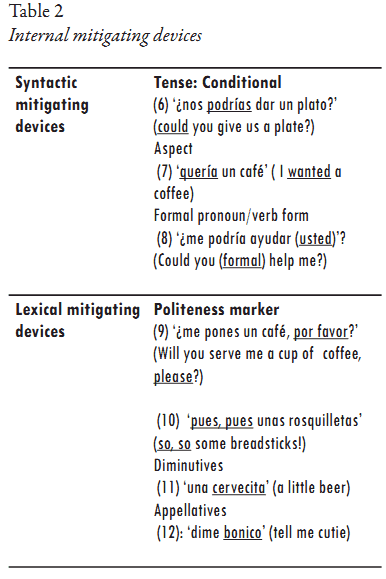
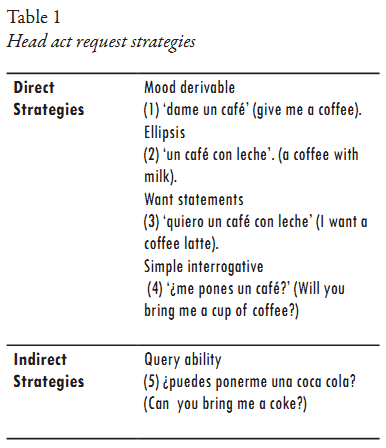
<body><![CDATA[<p><font size="2" face="Verdana, Arial, Helvetica, sans-serif">A 31-year-old Spanish female performed the  role of the bartender. The RPs took place in an  empty room at the University of Valencia, where  one participant at a time entered the room and   performed the RP, which was audio recorded.</font></p>     <p><font size="2" face="Verdana, Arial, Helvetica, sans-serif"><i><b>3.2.2. Naturalistic data.</b></i></font></p>     <p><font size="2" face="Verdana, Arial, Helvetica, sans-serif"> Natural data was collected via audio-recordings  that the researcher made at two cafeterias from  the university campus with a digital recorder. The  corpus used for the present study included a total  of 46 interactions between university students  and four bartenders (two men and two women). </font></p>     <p><font size="2" face="Verdana, Arial, Helvetica, sans-serif">The researcher obtained Institutional Review  Board (IRB) approval to make the audio  recordings and requested permission from the  establishments to tape them. The recorder was  placed on the counter and the researcher sat at  a nearby table in order to observe and take notes  of the clients' characteristics (e.g. age range and  gender).</font></p>     <p><font size="2" face="Verdana, Arial, Helvetica, sans-serif"><b> 3.3 Data analysis </b></font></p>     <p><font size="2" face="Verdana, Arial, Helvetica, sans-serif">After the data were transcribed, the interactions  were subdivided into three phases: the opening,  the request and the closing section. The main  strategies and internal mitigating devices were  analyzed and compared between the two  datasets. In addition, the structure and length<a name="en2"></a><a href="#n2"><sup>2</sup></a>  of  the interactions were contrasted.  </font></p>     <p><font size="2" face="Verdana, Arial, Helvetica, sans-serif">There were two opening strategies: greetings and  alerters, and three closing strategies: leave taking,  expressing gratitude and handing over money.  Request strategies and internal mitigating devices  were coded using a modified version of the  categories developed by Blum-Kulka et al. (1989),  shown in <a href="#t01">Tables 1</a> and <a href="#t02">2</a> below. An example of the  strategies used is provided. </font></p>     <p>&nbsp;</p>     <p align="center"><font size="2" face="Verdana, Arial, Helvetica, sans-serif"><a name="t01"></a><img src="/img/revistas/ikala/v18n2/v18n2a8t01.gif"></font></p>     <p>&nbsp;</p>     ]]></body>
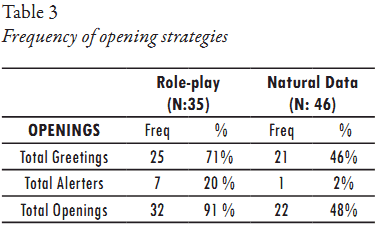
<body><![CDATA[<p align="center"><font size="2" face="Verdana, Arial, Helvetica, sans-serif"><a name="t02"></a><img src="/img/revistas/ikala/v18n2/v18n2a8t02.gif"></font></p>     <p>&nbsp;</p>     <p><font size="2" face="Verdana, Arial, Helvetica, sans-serif">After the strategies and the supporting devices  had been classified, the frequency of the strategies  used was calculated and compared between  both groups. In addition to the frequencies, a  qualitative description of different elements in  the interactions was included to complement the  quantitative analysis of the data. </font></p>     <p>&nbsp;</p>     <p><font size="3" face="Verdana, Arial, Helvetica, sans-serif"><b>4. RESULTS</b></font></p>     <p><font size="2" face="Verdana, Arial, Helvetica, sans-serif"><b>4.1. Results: the opening phase</b></font></p>     <p><font size="2" face="Verdana, Arial, Helvetica, sans-serif"> In order to establish contact with their  interlocutors, participants used either greetings  (e.g.  <i>hola</i> &#91;hello&#93;), alerters (e.g. <i>mira</i> &#91;look&#93;) or  no opening strategy at all.</font></p>     <p><font size="2" face="Verdana, Arial, Helvetica, sans-serif">As <a href="#t03">table 3</a> shows, the RP interactions used  opening strategies more frequently than those  from the ND (RP: 91%, ND: 48%). This result  shows that several real life interactions started  often directly with the request and did not  include an opening phase. This may have been a  result of the conditions in which the interactions  were recorded. In these particular cafeterias the  exchanges between bartender and customers were  often quick, because, at times, several people were  waiting to be served, and the main objective for  the bartender seemed to be to get the customer's  order in the most efficient manner, as example  (13) illustrates: <a name="en3"></a><a href="#n3"><sup>3</sup></a> </font></p>     <p><font size="2" face="Verdana, Arial, Helvetica, sans-serif">(13) BT: &iexcl;a ver, chavales!  (come on, guys!) </font></p>     <p><font size="2" face="Verdana, Arial, Helvetica, sans-serif">C: un bocadillo de anchoas (an anchovies  sandwich)</font></p>     ]]></body>
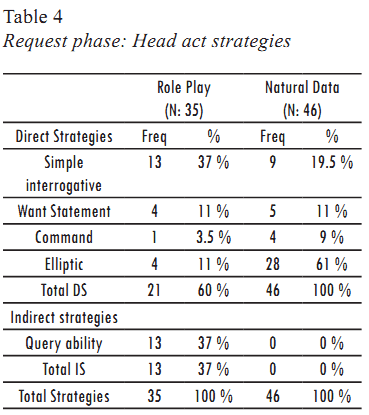
<body><![CDATA[<p>&nbsp;</p>     <p align="center"><font size="2" face="Verdana, Arial, Helvetica, sans-serif"><a name="t03"></a><img src="/img/revistas/ikala/v18n2/v18n2a8t03.gif"></font></p>     <p>&nbsp;</p>     <p><font size="2" face="Verdana, Arial, Helvetica, sans-serif">Regarding the type of opening strategy, both  groups preferred to use greetings (RP: 71%;  ND: 46%). Furthermore, both groups used  the same three strategies (<i>hola</i> &#91;hello&#93;, <i>buenas</i> &#91;good morning&#93;, and <i>hola, buenas! </i>&#91;hello, good  morning!&#93;). However, the frequency of use of each of these differed. The RP participants  used the compound formula <i>hola</i>, <i>buenos d&iacute;as</i>  (hello, good morning) more frequently (12  total or 34%), while in the naturalistic data,  the strategy <i>hola</i> (hello) (16 or 35%) was used  more often. </font></p>     <p><font size="2" face="Verdana, Arial, Helvetica, sans-serif">Alerters were more common in the RP (7 or 22%)  than in the ND (1 or 2%). Only in the RP data  were there cases where both greetings and alerters  appeared in the same opening phase, as example  (14) shows:</font></p>     <p><font size="2" face="Verdana, Arial, Helvetica, sans-serif">(14) C: <i>&iexcl;Hola! perdona!</i> (Hello! excuse me!)</font></p>     <p><font size="2" face="Verdana, Arial, Helvetica, sans-serif">In sum, there were some differences and a  few similarities between the openings of the  interactions. Role-play interactions almost always  included opening strategies, and these were  longer than those found in the ND. At times,  they included both alerters and greetings, and  compound formulas were more frequent than  simple ones. In contrast, 30% of the naturalistic  interactions did not include an opening phase,  and the most frequent greeting was the simple  formula <i>hola</i> (hello).</font></p>     <p><font size="2" face="Verdana, Arial, Helvetica, sans-serif"><b>4.2. Results: The request phase</b></font></p>     <p><font size="2" face="Verdana, Arial, Helvetica, sans-serif">The request phase appeared either right after  the opening sequence, or as the first move of the  interaction. <a href="#t04">Table 4</a> shows the type of head act  strategies<a name="en4"></a><a href="#n4"><sup>4</sup></a>  that each group of participants used in  the request phase. </font></p>     <p>&nbsp;</p>     ]]></body>
<body><![CDATA[<p align="center"><font size="2" face="Verdana, Arial, Helvetica, sans-serif"><a name="t04"></a><img src="/img/revistas/ikala/v18n2/v18n2a8t04.gif"></font></p>     <p>&nbsp;</p>     <p><font size="2" face="Verdana, Arial, Helvetica, sans-serif">As <a href="#t04">Table 4</a> shows, both groups of participants  used far more direct strategies than indirect ones:  RP 21 or 60%, and ND 46 or 100%. Moreover,  they both used the same type of direct strategies  (simple interrogatives, want statements, elliptics  and commands). However, they differed in the  frequency of use of each specific strategy. While in  the ND 28 or 61% were elliptics (e.g. <i>un caf&eacute; solo</i> &#91;a black coffee&#93;), this strategy was hardly used by  the RP group, (4 or 11%). Rather, they tended to use 'simple interrogatives', (12 or 34%), a strategy  rarely used in the naturalistic interactions (9 or  19.5%).</font></p>     <p><font size="2" face="Verdana, Arial, Helvetica, sans-serif">(15):  C: <i>&iquest;me pone una Coca-cola light? </i></font></p>     <p><font size="2" face="Verdana, Arial, Helvetica, sans-serif">(will you serve me a diet Coke?)</font></p>     <p><font size="2" face="Verdana, Arial, Helvetica, sans-serif">The other two direct strategies found in the data,  want statements and commands, were used with  much less frequency. Commands were more  frequent in the ND (4 or 9%), appearing only  once in the RPs.</font></p>     <p><font size="2" face="Verdana, Arial, Helvetica, sans-serif">(16) C: <i>ponme una Coca-cola </i>(bring me a Coke) &#91;command&#93;</font></p>     <p><font size="2" face="Verdana, Arial, Helvetica, sans-serif">Even though both groups used overall more  direct strategies, only the RP participants used  indirect ones, in 13 or 37% of the interactions.   The only instance in which a participant used an  indirect strategy in the ND was to ask a favor to  the bartender. This example was not counted as a  transactional request as there was no benefit for  the bartender.</font></p>     <p><font size="2" face="Verdana, Arial, Helvetica, sans-serif">(17)   C: <i>&iquest;nos podr&iacute;as dar un plato, por favor? </i></font></p>     <p><font size="2" face="Verdana, Arial, Helvetica, sans-serif">(Could you give us a plate, please?)</font></p>     ]]></body>
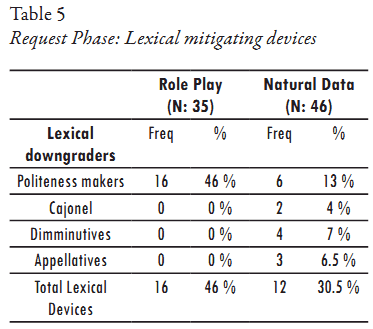
<body><![CDATA[<p><font size="2" face="Verdana, Arial, Helvetica, sans-serif">In sum, there were some similarities and some  relevant differences in the request phases of  the data collected by both methods of data  collection. While both groups used more direct  strategies, the most frequent one in the RP data  was the simple interrogative, and the elliptic in  the naturalistic interactions. Furthermore, only  the RP participants used indirect strategies, and  they did so quite frequently.</font></p>     <p><font size="2" face="Verdana, Arial, Helvetica, sans-serif"><b>4.3 Results: Lexical Internal mitigating  devices</b></font></p>     <p><font size="2" face="Verdana, Arial, Helvetica, sans-serif"><a href="#t05">Table 5</a> shows the type and frequency of use  of lexical downgraders that the two groups of  participants used in the request phase. </font></p>     <p>&nbsp;</p>     <p align="center"><font size="2" face="Verdana, Arial, Helvetica, sans-serif"><a name="t05"></a><img src="/img/revistas/ikala/v18n2/v18n2a8t05.gif"></font></p>     <p>&nbsp;</p>     <p><font size="2" face="Verdana, Arial, Helvetica, sans-serif">As we can observe from<a href="#t05"> table 5</a>, the range of lexical  internal mitigators was much greater in the ND.  While in the naturalistic interactions four types  of lexical internal mitigators were used: politeness  markers (e.g.  <i>por favor</i>, &#91;please&#93;), cajolers (e.g. <i>pues</i>, &#91;well&#93;,), diminutives (e.g. <i>bocadillito</i> &#91;a little  sandwich&#93;), and appellatives (e.g. <i>bonico</i>, &#91;cutie&#93;),  the politeness marker was the only one used by  the RP participants. The politeness marker was  the most frequently used device in both groups. It  appeared in 46% of the RP interactions, while it  was only used in 13% of the real-life interactions.  Cajolers (2 or 4%), diminutives (4 or 7%) and  appellatives (3 or 6.5%) were used occasionally  in the ND. As Garc&iacute;a (1993) notes, diminutives and appellatives can be categorized as strategies  that show solidarity and closeness towards the  interlocutor, while politeness markers may be  considered deference strategies. </font></p>     <p><font size="2" face="Verdana, Arial, Helvetica, sans-serif">Below are examples of the use of these lexical  mitigating devices. </font></p>     <p><font size="2" face="Verdana, Arial, Helvetica, sans-serif">(18) <i>&iquest;me pone una coca-cola, por favor?</i> (Will you  &#91;formal&#93; serve me a Coke, please?) </font></p>     <p><font size="2" face="Verdana, Arial, Helvetica, sans-serif">&#91;politeness marker, RP&#93;</font></p>     ]]></body>
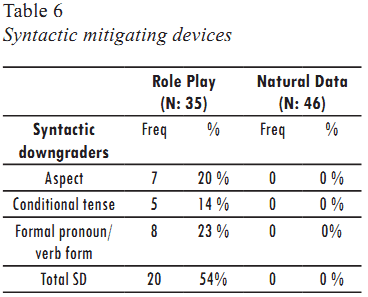
<body><![CDATA[<p><font size="2" face="Verdana, Arial, Helvetica, sans-serif">(19)  <i>una cervecita, por favor</i> (a  little beer,  please) &#91;diminutive, ND&#93;</font></p>     <p><font size="2" face="Verdana, Arial, Helvetica, sans-serif">(20) <i>pues, pues unas rosquilletas </i>(well, well  some breadsticks) &#91;cajoler, ND&#93;</font></p>     <p><font size="2" face="Verdana, Arial, Helvetica, sans-serif"><b>4.4. Syntactic mitigating devices</b></font></p>     <p><font size="2" face="Verdana, Arial, Helvetica, sans-serif"><a href="#t06">Table 6</a> shows the type and frequency of use of  syntactic downgraders that the two groups of  participants used in the request phase.</font></p>     <p>&nbsp;</p>     <p align="center"><font size="2" face="Verdana, Arial, Helvetica, sans-serif"><a name="t06"></a><img src="/img/revistas/ikala/v18n2/v18n2a8t06.gif"></font></p>     <p>&nbsp;</p>     <p><font size="2" face="Verdana, Arial, Helvetica, sans-serif">As <a href="#t06">table 6</a> shows, there was a clear difference in  the use of syntactic mitigating devices between  both datasets. While there were 20 instances of  internal mitigation in the RP interactions, no  syntactic mitigation was found in the ND. </font></p>     <p><font size="2" face="Verdana, Arial, Helvetica, sans-serif">Among the syntactic mitigating devices the RP  group used, the formal pronoun/verb form and  aspect were the most frequently used, followed by the conditional tense: </font></p>     <p><font size="2" face="Verdana, Arial, Helvetica, sans-serif">(21) <i><u>Quer&iacute;a</u> un zumo de naranja, por favor  </i>(I  <u>would like</u> an orange juice, please) &#91;aspect&#93;  </font></p>     ]]></body>
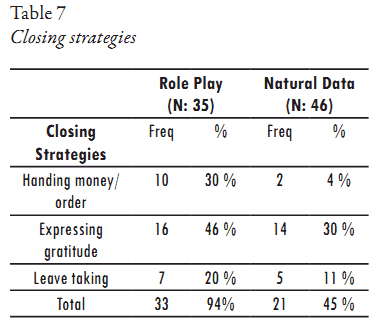
<body><![CDATA[<p><font size="2" face="Verdana, Arial, Helvetica, sans-serif">(22) <i>&iquest;<u>me podr&iacute;a</u> poner una Coca-cola? </i>(<u>could  you</u> (formal) serve me a Coke?)  &#91;conditional  tense and formal verb form&#93;</font></p>     <p><font size="2" face="Verdana, Arial, Helvetica, sans-serif">The lack of use of syntactic mitigation in the  ND does not surprise us as previous studies  have also noted a minimal use of internal  mitigation in service encounter requests in  Spain (Placencia &amp; Marcera Rueda, 2011a;  Placencia, 2005). </font></p>     <p><font size="2" face="Verdana, Arial, Helvetica, sans-serif">To sum up, there were both differences and  similarities in the request strategies used in the  interactions collected from both methods of  data collection. On the one hand, both datasets  presented more direct strategies than indirect  ones, and a more frequent use of the informal  pronominal pronoun  <i>t&uacute;</i> versus  <i>usted</i>. On the  other hand, the RP interactions showed more  deferential strategies, such as quite frequent  use of internal mitigating devices, presence of  the formal pronoun <i>usted</i>, and of a considerable  number of indirect requeststrategies.  However,  the naturalistic data presented more  solidarity  strategies, such as the use of only direct head  acts, internal mitigators expressing solidarity  (e.g. diminutives, appellatives) and the  presence of  the  informal  pronoun  <i>t&uacute;</i> in all  interactions.</font></p>     <p><font size="2" face="Verdana, Arial, Helvetica, sans-serif"><b>4.5. Results: The closing phase </b></font></p>     <p><font size="2" face="Verdana, Arial, Helvetica, sans-serif">After the request phase, the interactions usually  proceeded with a negotiation phase in which  the specifics of the order and the payment of  the order took place. This was often followed  by a closing phase that included strategies such  as gratitude expressions (e.g.  <i>gracias</i> &#91;thank  you&#93;), leave taking formulas (e.g. <i>adi&oacute;s</i> &#91;good  bye&#93;), or handing over money or the order (e.g. <i>toma</i> &#91;here you are&#93;). </font></p>     <p><font size="2" face="Verdana, Arial, Helvetica, sans-serif">As <a href="#t07">table 7</a> shows, while most RP interactions  ended with a closing strategy, only 45% of  the naturalistic ones did. However, the same  strategies were used in both datasets. Expression  of gratitude was the most frequent in both  datasets (RP: 46%; ND: 30%). Furthermore,  while in the RP there were more handing money/ product strategies, (30%), this strategy appeared  in just 4% of the ND interactions. Leave taking  strategies were used with a moderate frequency in  both datasets (RP: 20%, ND: 11%). </font></p>     <p align="center"><font size="2" face="Verdana, Arial, Helvetica, sans-serif"><img src="/img/revistas/ikala/v18n2/v18n2a8i01.gif"></font></p>     <p>&nbsp;</p>     <p align="center"><font size="2" face="Verdana, Arial, Helvetica, sans-serif"><a name="t07"></a><img src="/img/revistas/ikala/v18n2/v18n2a8t07.gif"></font></p>     <p>&nbsp;</p>     ]]></body>
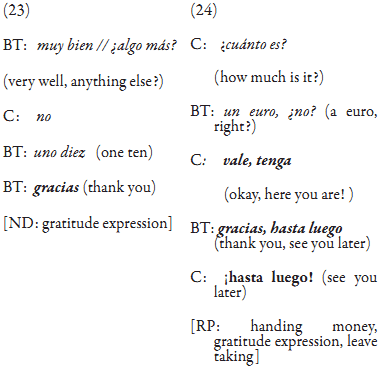
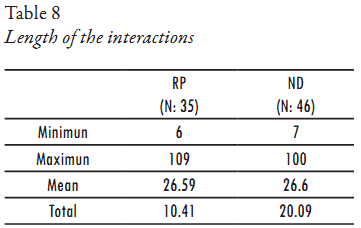
<body><![CDATA[<p><font size="2" face="Verdana, Arial, Helvetica, sans-serif">In terms of the structure of the closing phase,  we noted that the RP closings were longer, often  involving more than one strategy. In fact, 40% of  the RP interactions used more than one closing strategy, while only 17% of the ND exchanges  did. Examples (23) and (24) illustrate this  difference.</font></p>     <p><font size="2" face="Verdana, Arial, Helvetica, sans-serif">Overall, we can state that there were similarities  and some differences between the closing phases  from the data collected with each method of data  collection. While the same strategies were used in  both datasets, the RP interactions contained more  and longer closing phases than the naturalistic  ones as the examples above shows. </font></p>     <p><font size="2" face="Verdana, Arial, Helvetica, sans-serif"><b>4.6. Results: Length of the interactions</b></font></p>     <p><font size="2" face="Verdana, Arial, Helvetica, sans-serif"><a href="#t08">Table 8</a> shows the minimum and maximum  number of words per interaction from each group,  as well as the mean and standard deviation of the  number of words calculated from each dataset.</font></p>     <p>&nbsp;</p>     <p align="center"><font size="2" face="Verdana, Arial, Helvetica, sans-serif"><a name="t08"></a><img src="/img/revistas/ikala/v18n2/v18n2a8t08.gif"></font></p>     <p>&nbsp;</p>     <p><font size="2" face="Verdana, Arial, Helvetica, sans-serif">We see from<a href="#t08"> table 8</a> that the RP and naturalistic  interactions were similar in length (RP: 26.59;  ND: 26.26). However, looking at the standard  deviations, we observe that the naturalistic data  was more variable (ND: 20.09; RP: 10. 41).  This greater variability indicates that some of  the interactions were short and others long. This  difference in length of the naturalistic interactions  may come from the inclusion of non-transactional  talk in some of the exchanges. In fact, there were  five different episodes of non-transactional talk in  the naturalistic interactions, while there was none  in the RP. Example (25) includes the presence  of non-transactional talk in a natural interaction  between a student and a female bartender.</font></p>     <p><font size="2" face="Verdana, Arial, Helvetica, sans-serif">(25) </font></p>     <p><font size="2" face="Verdana, Arial, Helvetica, sans-serif">C:  <i><u>&iquest;me pones una napolitana de chocolate? </u></i></font></p>     ]]></body>
<body><![CDATA[<p><font size="2" face="Verdana, Arial, Helvetica, sans-serif">BT: <i><u>a ver, una napolitana </u></i></font></p>     <p><font size="2" face="Verdana, Arial, Helvetica, sans-serif">C:   <i><u>&iquest;cu&aacute;nto es? </u></i></font></p>     <p><font size="2" face="Verdana, Arial, Helvetica, sans-serif">BT: <u><i>uno veinticinc, &iquest;algo m&eacute;s?<a name="en5"></a></i></u><a href="#n5"><sup>5</sup></a> </font></p>     <p><font size="2" face="Verdana, Arial, Helvetica, sans-serif">C:   <i><u>no, no, de momento ya voy bien </u></i></font></p>     <p><font size="2" face="Verdana, Arial, Helvetica, sans-serif">BT: <i><u>ya, vas bien, ay! qu&eacute; buenas que est&aacute;n!, a m&iacute; me  encantan,  a m&iacute; las napolitanas de chocolate, uff,  yo cuando desayuno napolitana digo, a tomar por  saco!</u></i> </font></p>     <p><font size="2" face="Verdana, Arial, Helvetica, sans-serif">C:   <i><u>exacto</u></i> </font></p>     <p><font size="2" face="Verdana, Arial, Helvetica, sans-serif">BT: <u><i>que me vaya al culo, me da igual</i></u> </font></p>     <p><font size="2" face="Verdana, Arial, Helvetica, sans-serif">C:   <i><u>yo, como he acabado mi &uacute;ltimo examen, a comer  bien!</u></i> </font></p>     <p><font size="2" face="Verdana, Arial, Helvetica, sans-serif">(...)</font></p>     <p>&nbsp;</p>     ]]></body>
<body><![CDATA[<p><font size="2" face="Verdana, Arial, Helvetica, sans-serif">C:   will you give me a chocolate croissant? </font></p>     <p><font size="2" face="Verdana, Arial, Helvetica, sans-serif">BT: let's see, a chocolate croissant... </font></p>     <p><font size="2" face="Verdana, Arial, Helvetica, sans-serif">C:   how much is it? </font></p>     <p><font size="2" face="Verdana, Arial, Helvetica, sans-serif">BT: one twenty five. anything else? </font></p>     <p><font size="2" face="Verdana, Arial, Helvetica, sans-serif">C:   no, no, that'll do me fine.  </font></p>     <p><font size="2" face="Verdana, Arial, Helvetica, sans-serif">BT: <u>I know, that will do you fine! oh! they taste so  good, I love them! to me, chocolate croissants,  yum!, when I have a chocolate croissant for  breakfast, I say, to hell with diets! </u></font></p>     <p><font size="2" face="Verdana, Arial, Helvetica, sans-serif">C:   <u>exactly! </u></font></p>     <p><font size="2" face="Verdana, Arial, Helvetica, sans-serif">BT: <u>it can go to my butt, I don't care </u></font></p>     <p><font size="2" face="Verdana, Arial, Helvetica, sans-serif">C :  <u>I have finished my last exam, so I deserve to eat  something delicious.' </u></font></p>     <p><font size="2" face="Verdana, Arial, Helvetica, sans-serif">(...)</font></p>     ]]></body>
<body><![CDATA[<p><font size="2" face="Verdana, Arial, Helvetica, sans-serif">As Placencia and Mancera Rueda (2011b) note,  the use of non-transactional talk is common in  service encounter interactions, and often has the  effect of making the service a pleasant and even  entertaining encounter, as the present example  illustrates.</font></p>     <p>&nbsp;</p>     <p><font size="3" face="Verdana, Arial, Helvetica, sans-serif"><b>5. CONCLUSION</b></font></p>     <p><font size="2" face="Verdana, Arial, Helvetica, sans-serif">The present study compared service encounter  interactions recorded via two methods of data  collection: a role-play (RP) and audio recordings  of real life interactions (ND). The specific service  encounter analyzed was transactional requests  in a cafeteria performed by Peninsular Spanish  university students in Valencia, Spain. The main  goal of this study was to observe whether the RP  data was similar or not to the naturally occurring  interactions in this particular context. </font></p>     <p><font size="2" face="Verdana, Arial, Helvetica, sans-serif">The results of this study suggest that there were  some similarities and relevant differences in the  service encounter interactions recorded via the two  methods of data collection. In terms of the structure  and length of the interactions, both methods  brought similar results. Most conversations  included an opening, followed by the request phase,  negotiation about the order and a closing phase.  The main difference in terms of the structure was  the fact that most of the RP exchanges contained  an opening phase (91%) and a closing phase (94%),  while this was not the case in the natural exchanges,  with only 48% of the interactions including an  opening and 45% having a closing phase. The less  frequent use of opening and closing phases in a  considerable number of ND exchanges may be  explained by the effect of local conditions of real life  interactions in this type of establishment (e.g. noise or time constraints). As the researcher observed,  the cafeterias where the natural interactions  were collected were sometimes crowded and the  communication exchanges between providers  and clients were often made in the quickest way  possible. </font></p>     <p><font size="2" face="Verdana, Arial, Helvetica, sans-serif">Furthermore, even though the mean number of  words in both datasets was similar, the naturalistic  interactions were more variable in length than the  RPs. The use of small talk in some of the natural  interactions probably accounted for the longer  interactions in that dataset. Bataller and Shively  (2011) also found considerable variability in the  length of the ND, as well as more inconsistency  regarding the presence or absence of openings and  closings than in the RPs.</font></p>     <p><font size="2" face="Verdana, Arial, Helvetica, sans-serif">Regarding the strategies used in all phases of the  interactions, we also found some similarities and  clear differences between the data collected by  each method. First of all, in the opening section,  the interactions from both datasets started mainly  with greetings (e.g.  <i>hola</i> &#91;hello&#93;) rather than  alerters (e.g. <i>perdona</i> &#91;excuse me&#93;). However, the  openings in the RPs often included some alerters,  and longer compound formulas (e.g. <i>hola, buenas!</i> &#91;hello, good morning!&#93;) that were seldom found  in the ND. Placencia (2005) also noted that the  openings in the corner shop interactions in Madrid  were often short and did not include alerters, as  the results from the ND in this study show. </font></p>     <p><font size="2" face="Verdana, Arial, Helvetica, sans-serif">Another similarity between the datasets was  that both groups used more direct than indirect  strategies, as previous studies analyzing service  encounters in Peninsular Spanish have also found  (Placencia &amp; Mancera Rueda, 2011a; Placencia,  2005). However, there were differences in the  specific strategies used by each group. While  elliptics (e.g. <i>un caf&eacute;</i> &#91;a coffee&#93;) were more frequent  in the ND, simple interrogatives (e.g. <i>'&iquest;me pone un  caf&eacute;?</i> &#91;Will you bring me a coffee?&#93;) were preferred  in the RP. Comparing these two strategies, elliptics  could be regarded as more direct strategies, as they  do not make use of any linguistic feature to mitigate  the imposition of the request. On the other hand,  the simple interrogative may be considered a more  deferential and indirect strategy, because it has a  question-like structure that softens the imposition  of the request. A further difference between the  sets was the use of indirect strategies in the RP  while not occurring at all in the natural dataset.  As Placencia and Mancera Rueda (2011a) noted,  indirect requests are not commonly used in these  contexts in Peninsular Spanish. Hence, we believe  that the RP participants might have used them as  a result of the method they were using. As other  researchers have noted (Aston, 1995; Barron,  2003; Golato, 2003), in elicited methods of data  collection, participants may act as they think they  should in simulated situations, which may be  different from what they would actually do in a  real-life scenario.     The use of internal mitigation  was also different in each dataset. Although no use  of syntactic mitigation was noted in the ND, there  were 20 instances of syntactic internal mitigation  on the RP interactions. The use of the formal  pronoun  usted in 32% of the RP interactions  contributed to making their exchanges more  formal and deferential. <i>Usted</i> was never used in  the naturalistic data. Hence, the presence of <i>usted</i>  and other syntactic mitigating devices in the RP  data seems to demonstrate that RP participants  may have wished to sound more polite using these  deferential strategies than the ND participants. </font></p>     <p><font size="2" face="Verdana, Arial, Helvetica, sans-serif">Placencia (2005) and Placencia and Mancera Rueda  (2011a) reported the use of the informal pronoun  t&uacute; in most cases in the natural data collected from  their Peninsular Spanish participants. Therefore,  the results from the naturalistic data in this study  concur with those of previous research analyzing  Peninsular Spanish service encounter interactions.  There is actually an increasing use of <i>t&uacute;</i> versus  <i>usted</i>, particularly in the young generation in Spain  (Recuero, 2007; Blasco-Arroyo, 1994).  </font></p>     <p><font size="2" face="Verdana, Arial, Helvetica, sans-serif">Also, the only lexical mitigator used in the RP,  the politeness marker -e.g.  <i>por favor</i> (please)  can be considered a deferential strategy used to  soften the imposition of the request. Instead,  some of the lexical downgraders used in the ND  (e.g. diminutives) can be regarded as solidarity strategies that are used to display familiarity and in- group membership. In keeping with the ND from  the present study, Placencia (2005) and Placencia  and Mancera Rueda (2011a) noted only a slight  use of internal mitigation in the service encounter  interactions from their Peninsular Spanish data.</font></p>     ]]></body>
<body><![CDATA[<p><font size="2" face="Verdana, Arial, Helvetica, sans-serif">Overall, we can conclude that the ND from this  study was more direct than data from the RP, which  in comparison included more indirect strategies.  Furthermore, the naturally occurring interactions  contained more solidarity strategies (e.g. use of <i>t&uacute;</i> only, use of diminutives and appellatives, use of  only direct strategies, use of small talk), while the  RP participants used more deference (e.g. indirect  request strategies, politeness markers and syntactic  mitigation). Additionally, the ND was more  variable both in length and in structure of the  interactions. This may result from the conditions  in the real-life contexts where these interactions  took place (e.g. background noise, more than  one person ordering at once). Previous studies  analyzing similar service encounter interactions in  Peninsular Spanish produced comparable results to  our ND interactions (Placencia, 2005; Placencia &amp;  Mancera Rueda, 2011a). Hence, even though the  RP data approximated the naturalistic interactions,  it also presented some clear differences that may  have resulted from method effect. As previously  stated, participants may have acted as they thought  they should, but not as they actually would in real- life situations. </font></p>     <p><font size="2" face="Verdana, Arial, Helvetica, sans-serif">Thus, even though we agree with Felix-Brasdefer  (2007) when he states that role-plays represent an  approximation to spoken discourse, we would also suggest caution when interpreting results from  studies using elicited methods of data collection,  as some of the findings may be conditioned by  method effect. Furthermore, researchers using RPs  should pay close attention to the elaboration of  the scenarios and make their descriptions as clear  as possible in order to help participants imagine  the context that they have to represent in their  interactions.</font></p>     <p><font size="2" face="Verdana, Arial, Helvetica, sans-serif">This study has certain limitations that may have  influenced its results. As Placencia and Mancera- Rueda (2011a) explain, the collection of ND  also has some shortcomings, which involve the  difficulty of collecting personal information  from the participants. Hence, even though the  participants from both datasets shared similar  characteristics- they were young students at  university cafeterias- we could not verify the actual  age of the ND participants. Furthermore, even  though we tried to replicate the exact same context  as in the RP, it was not possible for us to control the  gender of the bartenders in the ND. In order to have  a similar number of interactions in both datasets,  we had to use all the interactions from the ND,  which included both female and male bartenders,  while in the RP only a female played the role of the  bartender. In spite of these differences, we believe  that both groups shared enough characteristics  to make a valid comparison of the datasets.  We  propose future studies using different age groups to  supply a broader perspective of service encounter  interactions. It would also be useful to collect data  from participants in different scenarios (e.g. type  of cafeteria, client, degree of familiarity) as any of  these factors may affect the result obtained.</font></p>     <p>&nbsp;</p> <hr size="1">     <p><font size="3" face="Verdana, Arial, Helvetica, sans-serif"><b>AUTHOR'S NOTES</b></font><font size="2" face="Verdana, Arial, Helvetica, sans-serif"><b></b></font></p>     <p><font size="2" face="Verdana, Arial, Helvetica, sans-serif"><a name="n1"></a><a href="#en1">1</a>  For a whole description of the role-play scenario, go to section (3.2.1) </font></p>     <p><font size="2" face="Verdana, Arial, Helvetica, sans-serif"><a name="n2"></a><a href="#en2">2</a>  Number of words per interaction</font></p>     <p><font size="2" face="Verdana, Arial, Helvetica, sans-serif"><a name="n3"></a><a href="#en3">3</a>  BT: bartender; C: client. </font></p>     <p><font size="2" face="Verdana, Arial, Helvetica, sans-serif"><a name="n4"></a><a href="#en4">4</a>  The head act strategy of a request refers to the actual strategy used to make the request</font></p>     <p><font size="2" face="Verdana, Arial, Helvetica, sans-serif"><a name="n5"></a><a href="#en5">5</a>  Valencia is a bilingual region of Spain where Catalan and Spanish are both spoken. The bartender uses Catalan in this turn  although the conversation started and continued in Spanish. </font></p> <hr size="1">     ]]></body>
<body><![CDATA[<p>&nbsp;</p>     <p>&nbsp;</p>     <p><font size="3" face="Verdana, Arial, Helvetica, sans-serif"><b>REFERENCES</b></font></p>     <!-- ref --><p><font size="2" face="Verdana, Arial, Helvetica, sans-serif">1. Aston, G. (1995). Say 'thank you': Some pragmatic  constraints in conversational closings.  <i>Applied  Linguistics</i>, 16(1), 57-85.    &nbsp;&nbsp;&nbsp;&nbsp;&nbsp;&nbsp;&nbsp;&nbsp;[&#160;<a href="javascript:void(0);" onclick="javascript: window.open('/scielo.php?script=sci_nlinks&ref=000186&pid=S0123-3432201300020000800001&lng=','','width=640,height=500,resizable=yes,scrollbars=1,menubar=yes,');">Links</a>&#160;]<!-- end-ref --> </font></p>     <!-- ref --><p><font size="2" face="Verdana, Arial, Helvetica, sans-serif">2. Barron, A. (2003).  <i>Acquisition in interlanguage  pragmatics: Learning how to do things with  words in a study abroad context</i>. Amsterdam,  Netherlands: John Benjamins.    &nbsp;&nbsp;&nbsp;&nbsp;&nbsp;&nbsp;&nbsp;&nbsp;[&#160;<a href="javascript:void(0);" onclick="javascript: window.open('/scielo.php?script=sci_nlinks&ref=000188&pid=S0123-3432201300020000800002&lng=','','width=640,height=500,resizable=yes,scrollbars=1,menubar=yes,');">Links</a>&#160;]<!-- end-ref --> </font></p>     <!-- ref --><p><font size="2" face="Verdana, Arial, Helvetica, sans-serif">3. Barron, A. (2000). Acquiring different strokes: A  longitudinal study of the development of L2  pragmatic context.  <i>German as a Foreign  Language Journal</i>, 2. 1-29.    &nbsp;&nbsp;&nbsp;&nbsp;&nbsp;&nbsp;&nbsp;&nbsp;[&#160;<a href="javascript:void(0);" onclick="javascript: window.open('/scielo.php?script=sci_nlinks&ref=000190&pid=S0123-3432201300020000800003&lng=','','width=640,height=500,resizable=yes,scrollbars=1,menubar=yes,');">Links</a>&#160;]<!-- end-ref --> </font></p>     <!-- ref --><p><font size="2" face="Verdana, Arial, Helvetica, sans-serif">4. Bataller, R.  (2010). Making a request for a service in  Spanish: Pragmatic development in the study  abroad setting. <i>Foreign Language Annals</i>, 43(1),  160-175.    &nbsp;&nbsp;&nbsp;&nbsp;&nbsp;&nbsp;&nbsp;&nbsp;[&#160;<a href="javascript:void(0);" onclick="javascript: window.open('/scielo.php?script=sci_nlinks&ref=000192&pid=S0123-3432201300020000800004&lng=','','width=640,height=500,resizable=yes,scrollbars=1,menubar=yes,');">Links</a>&#160;]<!-- end-ref --> </font></p>     <!-- ref --><p><font size="2" face="Verdana, Arial, Helvetica, sans-serif">5. Bataller, R. and Shively, R. (2011).  Role-plays and  naturalistic data in pragmatics research: Service  encounters during study abroad.  <i>Journal of  Linguistics and Language Learning</i>, 2(1), 15-50.    &nbsp;&nbsp;&nbsp;&nbsp;&nbsp;&nbsp;&nbsp;&nbsp;[&#160;<a href="javascript:void(0);" onclick="javascript: window.open('/scielo.php?script=sci_nlinks&ref=000194&pid=S0123-3432201300020000800005&lng=','','width=640,height=500,resizable=yes,scrollbars=1,menubar=yes,');">Links</a>&#160;]<!-- end-ref --> </font></p>     <!-- ref --><p><font size="2" face="Verdana, Arial, Helvetica, sans-serif">6. Beebe, L. M. and Cummings M. C. (1996). Natural  speech act data versus written questionnaire data:  How data collection method affects speech act  performance. In S. M. Gass and J. Neu (Eds.),  <i>Speech acts across cultures: Challenges to  communication in a second language</i>, (pp. 65- 86). New York, NJ: Mouton de Gruyter.    &nbsp;&nbsp;&nbsp;&nbsp;&nbsp;&nbsp;&nbsp;&nbsp;[&#160;<a href="javascript:void(0);" onclick="javascript: window.open('/scielo.php?script=sci_nlinks&ref=000196&pid=S0123-3432201300020000800006&lng=','','width=640,height=500,resizable=yes,scrollbars=1,menubar=yes,');">Links</a>&#160;]<!-- end-ref --> </font></p>     <!-- ref --><p><font size="2" face="Verdana, Arial, Helvetica, sans-serif">7. Billmyer, K. and Varghese, M. (2000). Investigating  instrument-based pragmatic variability: Effects  of enhancing discourse completion tests. <i>Applied  Linguistics</i>, 21(4), 517-552.    &nbsp;&nbsp;&nbsp;&nbsp;&nbsp;&nbsp;&nbsp;&nbsp;[&#160;<a href="javascript:void(0);" onclick="javascript: window.open('/scielo.php?script=sci_nlinks&ref=000198&pid=S0123-3432201300020000800007&lng=','','width=640,height=500,resizable=yes,scrollbars=1,menubar=yes,');">Links</a>&#160;]<!-- end-ref --> </font></p>     <!-- ref --><p><font size="2" face="Verdana, Arial, Helvetica, sans-serif">8. Blasco-Arroyo, J. L. (1994-95).  T&uacute; y  usted: Dos  pronombres de cortes&iacute;a en el espa&ntilde;ol actual:  Datos de una comunidad peninsular. <i>Estudios de  Ling&uuml;&iacute;stica de la Universidad de Alicante</i>,  10,  21-44.    &nbsp;&nbsp;&nbsp;&nbsp;&nbsp;&nbsp;&nbsp;&nbsp;[&#160;<a href="javascript:void(0);" onclick="javascript: window.open('/scielo.php?script=sci_nlinks&ref=000200&pid=S0123-3432201300020000800008&lng=','','width=640,height=500,resizable=yes,scrollbars=1,menubar=yes,');">Links</a>&#160;]<!-- end-ref --> </font></p>     <!-- ref --><p><font size="2" face="Verdana, Arial, Helvetica, sans-serif">9. Blum-Kulka, S, House J. and Kasper, G. (Eds.). (1989).  <i>Cross-cultural pragmatics: Requests and  apologies</i>. Norwood, NJ: Ablex.    &nbsp;&nbsp;&nbsp;&nbsp;&nbsp;&nbsp;&nbsp;&nbsp;[&#160;<a href="javascript:void(0);" onclick="javascript: window.open('/scielo.php?script=sci_nlinks&ref=000202&pid=S0123-3432201300020000800009&lng=','','width=640,height=500,resizable=yes,scrollbars=1,menubar=yes,');">Links</a>&#160;]<!-- end-ref --></font></p>     <!-- ref --><p><font size="2" face="Verdana, Arial, Helvetica, sans-serif">10.  Callahan, L. (2009). <i>Spanish and English in US service  encounters</i>. Basingstoke, England: Palgrave  Macmillan.    &nbsp;&nbsp;&nbsp;&nbsp;&nbsp;&nbsp;&nbsp;&nbsp;[&#160;<a href="javascript:void(0);" onclick="javascript: window.open('/scielo.php?script=sci_nlinks&ref=000204&pid=S0123-3432201300020000800010&lng=','','width=640,height=500,resizable=yes,scrollbars=1,menubar=yes,');">Links</a>&#160;]<!-- end-ref --> </font></p>     <!-- ref --><p><font size="2" face="Verdana, Arial, Helvetica, sans-serif">11. Cohen, A. D. (1996). Speech acts. In S. L. Mckay and  N. H. Hornberger (Eds.),  <i>Sociolinguistics and  Language Teaching</i>  (pp. 383-420). Cambridge,  England: Cambridge University Press.    &nbsp;&nbsp;&nbsp;&nbsp;&nbsp;&nbsp;&nbsp;&nbsp;[&#160;<a href="javascript:void(0);" onclick="javascript: window.open('/scielo.php?script=sci_nlinks&ref=000206&pid=S0123-3432201300020000800011&lng=','','width=640,height=500,resizable=yes,scrollbars=1,menubar=yes,');">Links</a>&#160;]<!-- end-ref --> </font></p>     <!-- ref --><p><font size="2" face="Verdana, Arial, Helvetica, sans-serif">12. Cohen, A. D. (2004). Assessing speech acts in a second  language. In D. Boxer and A.D. Cohen (Eds.),  <i>Studying Speaking to Inform Second Language</i> <i>Learning</i> (pp. 302-327). Clevedon, England:  Multilingual Matters.    &nbsp;&nbsp;&nbsp;&nbsp;&nbsp;&nbsp;&nbsp;&nbsp;[&#160;<a href="javascript:void(0);" onclick="javascript: window.open('/scielo.php?script=sci_nlinks&ref=000208&pid=S0123-3432201300020000800012&lng=','','width=640,height=500,resizable=yes,scrollbars=1,menubar=yes,');">Links</a>&#160;]<!-- end-ref --></font></p>     <!-- ref --><p><font size="2" face="Verdana, Arial, Helvetica, sans-serif">13. Danblon, E., de Clerck, B. and van Noppen, J-P. (2005).  Politeness in Belgium: Face, distance and sincerity  in service-exchange rituals. In L. Hickey and M.  Stewart (Eds.), <i>Politeness in Europe </i>(pp. 45-57). Clevedon, England: Multilingual Matters.    &nbsp;&nbsp;&nbsp;&nbsp;&nbsp;&nbsp;&nbsp;&nbsp;[&#160;<a href="javascript:void(0);" onclick="javascript: window.open('/scielo.php?script=sci_nlinks&ref=000210&pid=S0123-3432201300020000800013&lng=','','width=640,height=500,resizable=yes,scrollbars=1,menubar=yes,');">Links</a>&#160;]<!-- end-ref --></font></p>     <!-- ref --><p><font size="2" face="Verdana, Arial, Helvetica, sans-serif">14.  Eisenstein, M. and Bodman, J. W. (1993). Expressing  gratitude in American English. In G.Kasper and  S. Blum-Kulka (Eds.), <i>Interlanguage Pragmatics </i>(pp. 64-81). New York, NJ: Oxford University  Press.    &nbsp;&nbsp;&nbsp;&nbsp;&nbsp;&nbsp;&nbsp;&nbsp;[&#160;<a href="javascript:void(0);" onclick="javascript: window.open('/scielo.php?script=sci_nlinks&ref=000212&pid=S0123-3432201300020000800014&lng=','','width=640,height=500,resizable=yes,scrollbars=1,menubar=yes,');">Links</a>&#160;]<!-- end-ref --> </font></p>     <!-- ref --><p><font size="2" face="Verdana, Arial, Helvetica, sans-serif">15. F&eacute;lix-Brasdefer, J. C. (2003). Validity in data collection  methods in pragmatics research. In P. Kempchinsky  and C. E. Pi&ntilde;eros (Eds.), <i>Theory, Practice,  and Acquisition. Papers from the 6th   Hispanic  Linguistics Symposium and the 5th Conference  on the Acquisition of Spanish and Portuguese</i> (pp.  239-257).    &nbsp;&nbsp;&nbsp;&nbsp;&nbsp;&nbsp;&nbsp;&nbsp;[&#160;<a href="javascript:void(0);" onclick="javascript: window.open('/scielo.php?script=sci_nlinks&ref=000214&pid=S0123-3432201300020000800015&lng=','','width=640,height=500,resizable=yes,scrollbars=1,menubar=yes,');">Links</a>&#160;]<!-- end-ref --> </font></p>     <!-- ref --><p><font size="2" face="Verdana, Arial, Helvetica, sans-serif">16. Somerville, MA: Cascadilla Press. F&eacute;lix-Brasdefer, J. C. (2007). Natural speech vs. elicited  data: A comparison of natural and role play  requests in Mexican Spanish. <i>Spanish in Context</i>,  4(2), 159-185.    &nbsp;&nbsp;&nbsp;&nbsp;&nbsp;&nbsp;&nbsp;&nbsp;[&#160;<a href="javascript:void(0);" onclick="javascript: window.open('/scielo.php?script=sci_nlinks&ref=000216&pid=S0123-3432201300020000800016&lng=','','width=640,height=500,resizable=yes,scrollbars=1,menubar=yes,');">Links</a>&#160;]<!-- end-ref --></font></p>     <!-- ref --><p><font size="2" face="Verdana, Arial, Helvetica, sans-serif">17.  F&eacute;lix-Brasdefer, J. C. (2012). Pragmatic variation by  gender in market service encounters in Mexico.  In J.C. F&eacute;lix-Brasdefer, J. C and D. Koike  (Eds.), <i>Pragmatic Variation in First and Second  Languages</i> (pp. 17-49). Amsterdam/Philadelphia,  Netherlands: John Benjamins.    &nbsp;&nbsp;&nbsp;&nbsp;&nbsp;&nbsp;&nbsp;&nbsp;[&#160;<a href="javascript:void(0);" onclick="javascript: window.open('/scielo.php?script=sci_nlinks&ref=000218&pid=S0123-3432201300020000800017&lng=','','width=640,height=500,resizable=yes,scrollbars=1,menubar=yes,');">Links</a>&#160;]<!-- end-ref --> </font></p>     <!-- ref --><p><font size="2" face="Verdana, Arial, Helvetica, sans-serif">18. Franch Bou, P. and Lorenzo-Dus, N. (2008). Natural  versus elicited data in cross-cultural speech act  realisation: The case of requests in Peninsular  Spanish and British English. <i>Spanish in Context</i>,  5(2), 246-277.    &nbsp;&nbsp;&nbsp;&nbsp;&nbsp;&nbsp;&nbsp;&nbsp;[&#160;<a href="javascript:void(0);" onclick="javascript: window.open('/scielo.php?script=sci_nlinks&ref=000220&pid=S0123-3432201300020000800018&lng=','','width=640,height=500,resizable=yes,scrollbars=1,menubar=yes,');">Links</a>&#160;]<!-- end-ref --> </font></p>     <!-- ref --><p><font size="2" face="Verdana, Arial, Helvetica, sans-serif">19. Garc&iacute;a, C. (1989). Disagreeing and requesting by  Americans and Venezuelans. <i>Linguistics and  Education</i>, 1, 299-322.    &nbsp;&nbsp;&nbsp;&nbsp;&nbsp;&nbsp;&nbsp;&nbsp;[&#160;<a href="javascript:void(0);" onclick="javascript: window.open('/scielo.php?script=sci_nlinks&ref=000222&pid=S0123-3432201300020000800019&lng=','','width=640,height=500,resizable=yes,scrollbars=1,menubar=yes,');">Links</a>&#160;]<!-- end-ref -->  </font></p>     <!-- ref --><p><font size="2" face="Verdana, Arial, Helvetica, sans-serif">20. Garc&iacute;a, C. (1993). Making a request for a service and  responding: A case of Peruvian style.<i> Journal of  Pragmatics</i>, 19, 127-152.    &nbsp;&nbsp;&nbsp;&nbsp;&nbsp;&nbsp;&nbsp;&nbsp;[&#160;<a href="javascript:void(0);" onclick="javascript: window.open('/scielo.php?script=sci_nlinks&ref=000224&pid=S0123-3432201300020000800020&lng=','','width=640,height=500,resizable=yes,scrollbars=1,menubar=yes,');">Links</a>&#160;]<!-- end-ref --> </font></p>     <!-- ref --><p><font size="2" face="Verdana, Arial, Helvetica, sans-serif">21. Garc&iacute;a, C. (1999). The three stages of Venezuelan  invitations and responses. <i>Multilingua</i>,  18,  391- 433.    &nbsp;&nbsp;&nbsp;&nbsp;&nbsp;&nbsp;&nbsp;&nbsp;[&#160;<a href="javascript:void(0);" onclick="javascript: window.open('/scielo.php?script=sci_nlinks&ref=000226&pid=S0123-3432201300020000800021&lng=','','width=640,height=500,resizable=yes,scrollbars=1,menubar=yes,');">Links</a>&#160;]<!-- end-ref --> </font></p>     <!-- ref --><p><font size="2" face="Verdana, Arial, Helvetica, sans-serif">22. Golato, A. (2003). Studying compliment responses: A  comparison of DCTs and recordings of naturally  occurring talk. <i>Applied Linguistics</i>, 24, 90-121.    &nbsp;&nbsp;&nbsp;&nbsp;&nbsp;&nbsp;&nbsp;&nbsp;[&#160;<a href="javascript:void(0);" onclick="javascript: window.open('/scielo.php?script=sci_nlinks&ref=000228&pid=S0123-3432201300020000800022&lng=','','width=640,height=500,resizable=yes,scrollbars=1,menubar=yes,');">Links</a>&#160;]<!-- end-ref --> </font></p>     <!-- ref --><p><font size="2" face="Verdana, Arial, Helvetica, sans-serif">23. Hartford, B. S. and Bardovi-Harlig, K. (1992).  Experimental and observational data in the study of interlanguage pragmatics. In L. F.  Bouton and Y. Kachru (Eds.),  Pragmatics and  Language Learning: Vol 3 (pp. 33-52). Urbana,  Il: University of Illinois at Urbana-Champaign.    &nbsp;&nbsp;&nbsp;&nbsp;&nbsp;&nbsp;&nbsp;&nbsp;[&#160;<a href="javascript:void(0);" onclick="javascript: window.open('/scielo.php?script=sci_nlinks&ref=000230&pid=S0123-3432201300020000800023&lng=','','width=640,height=500,resizable=yes,scrollbars=1,menubar=yes,');">Links</a>&#160;]<!-- end-ref --></font></p>     <!-- ref --><p><font size="2" face="Verdana, Arial, Helvetica, sans-serif">24. Hassall, T. (1997).  <i>Requests by Australian  learners of Indonesian</i> (Unpublished  doctoral  dissertation), Australia National  University, Canberra, Australia.    &nbsp;&nbsp;&nbsp;&nbsp;&nbsp;&nbsp;&nbsp;&nbsp;[&#160;<a href="javascript:void(0);" onclick="javascript: window.open('/scielo.php?script=sci_nlinks&ref=000232&pid=S0123-3432201300020000800024&lng=','','width=640,height=500,resizable=yes,scrollbars=1,menubar=yes,');">Links</a>&#160;]<!-- end-ref --> </font></p>     <!-- ref --><p><font size="2" face="Verdana, Arial, Helvetica, sans-serif">25. Hickey, L. (2005). Politeness in Spain: Thanks but no  'Thanks'. In L. Hickey and M. Stewart (Eds.),  <i>Politeness in Europe</i> (pp. 317-330). Clevedon,  England: Multilingual Matters.    &nbsp;&nbsp;&nbsp;&nbsp;&nbsp;&nbsp;&nbsp;&nbsp;[&#160;<a href="javascript:void(0);" onclick="javascript: window.open('/scielo.php?script=sci_nlinks&ref=000234&pid=S0123-3432201300020000800025&lng=','','width=640,height=500,resizable=yes,scrollbars=1,menubar=yes,');">Links</a>&#160;]<!-- end-ref --></font></p>     <!-- ref --><p><font size="2" face="Verdana, Arial, Helvetica, sans-serif">26. Hoffman-Hicks, S. (1999). <i>A Longitudinal Study of L2  French Pragmatic Competence: Study Abroad vs.  FL Classroom Learners</i>.  (Unpublished doctoral  dissertation). Indiana University,  Bloomington,  IN.    &nbsp;&nbsp;&nbsp;&nbsp;&nbsp;&nbsp;&nbsp;&nbsp;[&#160;<a href="javascript:void(0);" onclick="javascript: window.open('/scielo.php?script=sci_nlinks&ref=000236&pid=S0123-3432201300020000800026&lng=','','width=640,height=500,resizable=yes,scrollbars=1,menubar=yes,');">Links</a>&#160;]<!-- end-ref --> </font></p>     <!-- ref --><p><font size="2" face="Verdana, Arial, Helvetica, sans-serif">27. Kasanga, L. A. (1999). Pragmatic competence: A  longitudinal observation.  <i>Indian Journal of  Applied Linguistics</i>,  25, 87-104.    &nbsp;&nbsp;&nbsp;&nbsp;&nbsp;&nbsp;&nbsp;&nbsp;[&#160;<a href="javascript:void(0);" onclick="javascript: window.open('/scielo.php?script=sci_nlinks&ref=000238&pid=S0123-3432201300020000800027&lng=','','width=640,height=500,resizable=yes,scrollbars=1,menubar=yes,');">Links</a>&#160;]<!-- end-ref --> </font></p>     <!-- ref --><p><font size="2" face="Verdana, Arial, Helvetica, sans-serif">28. Kasper, G. (2000). Data collection in pragmatics research.  In H. Spencer-Oatey (Ed.), <i>Culturally speaking:  Managing rapport through talk across cultures </i>(pp. 316-369). London, England: Continuum.    &nbsp;&nbsp;&nbsp;&nbsp;&nbsp;&nbsp;&nbsp;&nbsp;[&#160;<a href="javascript:void(0);" onclick="javascript: window.open('/scielo.php?script=sci_nlinks&ref=000240&pid=S0123-3432201300020000800028&lng=','','width=640,height=500,resizable=yes,scrollbars=1,menubar=yes,');">Links</a>&#160;]<!-- end-ref --> </font></p>     <!-- ref --><p><font size="2" face="Verdana, Arial, Helvetica, sans-serif">29. Kasper, G. and Dahl, M. (1991). Research methods in  interlanguage pragmatics.  <i>Studies in Second  Language Acquisition</i>, 13, 215-247.    &nbsp;&nbsp;&nbsp;&nbsp;&nbsp;&nbsp;&nbsp;&nbsp;[&#160;<a href="javascript:void(0);" onclick="javascript: window.open('/scielo.php?script=sci_nlinks&ref=000242&pid=S0123-3432201300020000800029&lng=','','width=640,height=500,resizable=yes,scrollbars=1,menubar=yes,');">Links</a>&#160;]<!-- end-ref --> </font></p>     <!-- ref --><p><font size="2" face="Verdana, Arial, Helvetica, sans-serif">30. Kasper, G. and Rose, K. R. (2002). Pragmatic  Development in a Second Language. In R. Young  (Series Ed.),<i> Language Learning Monograph  Series</i>. Blackwell Publishing.    &nbsp;&nbsp;&nbsp;&nbsp;&nbsp;&nbsp;&nbsp;&nbsp;[&#160;<a href="javascript:void(0);" onclick="javascript: window.open('/scielo.php?script=sci_nlinks&ref=000244&pid=S0123-3432201300020000800030&lng=','','width=640,height=500,resizable=yes,scrollbars=1,menubar=yes,');">Links</a>&#160;]<!-- end-ref --> </font></p>     <!-- ref --><p><font size="2" face="Verdana, Arial, Helvetica, sans-serif">31. Kerbrat-Orecchioni, C. (2005). Politeness in France:  How to buy bread politely. In L. Hickey and M.  Stewart (eds.), <i>Politeness in Europe </i>(pp. 29-44).  Clevedon, England: Multilingual Matters.    &nbsp;&nbsp;&nbsp;&nbsp;&nbsp;&nbsp;&nbsp;&nbsp;[&#160;<a href="javascript:void(0);" onclick="javascript: window.open('/scielo.php?script=sci_nlinks&ref=000246&pid=S0123-3432201300020000800031&lng=','','width=640,height=500,resizable=yes,scrollbars=1,menubar=yes,');">Links</a>&#160;]<!-- end-ref --> </font></p>     <!-- ref --><p><font size="2" face="Verdana, Arial, Helvetica, sans-serif">32. Kidwell, M. (2000). Common ground in cross-cultural  communication: Sequential and institutional  contexts in front desk service encounters. <i>Issues  in Applied Linguistics</i>, 11(1), 17-37.    &nbsp;&nbsp;&nbsp;&nbsp;&nbsp;&nbsp;&nbsp;&nbsp;[&#160;<a href="javascript:void(0);" onclick="javascript: window.open('/scielo.php?script=sci_nlinks&ref=000248&pid=S0123-3432201300020000800032&lng=','','width=640,height=500,resizable=yes,scrollbars=1,menubar=yes,');">Links</a>&#160;]<!-- end-ref --> </font></p>     <!-- ref --><p><font size="2" face="Verdana, Arial, Helvetica, sans-serif">33. Kondo, S. (1997). The development of pragmatic  competence by Japanese learners of English:  Longitudinal study on interlanguage apologies.  <i>Sophia Linguistica</i>, 41, 265- 284.    &nbsp;&nbsp;&nbsp;&nbsp;&nbsp;&nbsp;&nbsp;&nbsp;[&#160;<a href="javascript:void(0);" onclick="javascript: window.open('/scielo.php?script=sci_nlinks&ref=000250&pid=S0123-3432201300020000800033&lng=','','width=640,height=500,resizable=yes,scrollbars=1,menubar=yes,');">Links</a>&#160;]<!-- end-ref --> </font></p>     <!-- ref --><p><font size="2" face="Verdana, Arial, Helvetica, sans-serif">34. Margalef-Boada, T. (1993).  <i>Research Methods in  Interlanguage Pragmatics: An Inquiry into Data  Collection Procedures </i>(Unpublished doctoral  dissertation), Indiana University, Bloomington,  IN.    &nbsp;&nbsp;&nbsp;&nbsp;&nbsp;&nbsp;&nbsp;&nbsp;[&#160;<a href="javascript:void(0);" onclick="javascript: window.open('/scielo.php?script=sci_nlinks&ref=000252&pid=S0123-3432201300020000800034&lng=','','width=640,height=500,resizable=yes,scrollbars=1,menubar=yes,');">Links</a>&#160;]<!-- end-ref --> </font></p>     <!-- ref --><p><font size="2" face="Verdana, Arial, Helvetica, sans-serif">35. M&aacute;rquez Reiter, R. (2000).<i> Linguistic politeness in  Britain and Uruguay: A contrastive study of requests and apologies</i>. Amsterdam, Netherlands:  John Benjamins.    &nbsp;&nbsp;&nbsp;&nbsp;&nbsp;&nbsp;&nbsp;&nbsp;[&#160;<a href="javascript:void(0);" onclick="javascript: window.open('/scielo.php?script=sci_nlinks&ref=000254&pid=S0123-3432201300020000800035&lng=','','width=640,height=500,resizable=yes,scrollbars=1,menubar=yes,');">Links</a>&#160;]<!-- end-ref --> </font></p>     <!-- ref --><p><font size="2" face="Verdana, Arial, Helvetica, sans-serif">36. M&aacute;rquez Reiter, R. (2005). Complaint calls to a caregiver  service company: The case of desahogo. <i>Intercultural Pragmatics</i> 2(4). 481-514.    &nbsp;&nbsp;&nbsp;&nbsp;&nbsp;&nbsp;&nbsp;&nbsp;[&#160;<a href="javascript:void(0);" onclick="javascript: window.open('/scielo.php?script=sci_nlinks&ref=000256&pid=S0123-3432201300020000800036&lng=','','width=640,height=500,resizable=yes,scrollbars=1,menubar=yes,');">Links</a>&#160;]<!-- end-ref --> </font></p>     <!-- ref --><p><font size="2" face="Verdana, Arial, Helvetica, sans-serif">37. M&aacute;rquez Reiter, R. (2006). Interactional closeness in  service calls to a Montevidean career   service  company. <i>Research on Language and Social  Interaction</i>, 39, 7-39.    &nbsp;&nbsp;&nbsp;&nbsp;&nbsp;&nbsp;&nbsp;&nbsp;[&#160;<a href="javascript:void(0);" onclick="javascript: window.open('/scielo.php?script=sci_nlinks&ref=000258&pid=S0123-3432201300020000800037&lng=','','width=640,height=500,resizable=yes,scrollbars=1,menubar=yes,');">Links</a>&#160;]<!-- end-ref --> </font></p>     <!-- ref --><p><font size="2" face="Verdana, Arial, Helvetica, sans-serif">38. M&aacute;rquez Reiter, R. and M. E. Placencia. (2004).  Displaying closeness and respectful distance in  Montevidean and Quite&ntilde;o service encounters. In  R. M&aacute;rquez Reiter and M. E. Placencia (Eds.), <i>Current Trends in the Pragmatics of Spanish </i>(pp. 121-156). Amsterdam, Netherlands: John  Benjamins.    &nbsp;&nbsp;&nbsp;&nbsp;&nbsp;&nbsp;&nbsp;&nbsp;[&#160;<a href="javascript:void(0);" onclick="javascript: window.open('/scielo.php?script=sci_nlinks&ref=000260&pid=S0123-3432201300020000800038&lng=','','width=640,height=500,resizable=yes,scrollbars=1,menubar=yes,');">Links</a>&#160;]<!-- end-ref --> </font></p>     <!-- ref --><p><font size="2" face="Verdana, Arial, Helvetica, sans-serif">39. Matsumura, S. (2001). Learning the rules for offering  advice: A quantitative approach to second  language socialization.  <i>Language Learning</i>,  51(4), 635-679.    &nbsp;&nbsp;&nbsp;&nbsp;&nbsp;&nbsp;&nbsp;&nbsp;[&#160;<a href="javascript:void(0);" onclick="javascript: window.open('/scielo.php?script=sci_nlinks&ref=000262&pid=S0123-3432201300020000800039&lng=','','width=640,height=500,resizable=yes,scrollbars=1,menubar=yes,');">Links</a>&#160;]<!-- end-ref --> </font></p>     <!-- ref --><p><font size="2" face="Verdana, Arial, Helvetica, sans-serif">40. Mir, M. (1993, April).  <i>Direct requests can also be  polite. </i>Paper presented at the Annual Meeting on  the International Conference on Pragmatics and  Language Learning, Champaign, IL </font>&nbsp;&nbsp;&nbsp;&nbsp;&nbsp;&nbsp;&nbsp;&nbsp;[&#160;<a href="javascript:void(0);" onclick="javascript: window.open('/scielo.php?script=sci_nlinks&ref=000264&pid=S0123-3432201300020000800040&lng=','','width=640,height=500,resizable=yes,scrollbars=1,menubar=yes,');">Links</a>&#160;]<!-- end-ref --><!-- ref --><p><font size="2" face="Verdana, Arial, Helvetica, sans-serif">41. Omar, A. (1991). How learners greet in Kiswahili: A  cross-sectional survey. In F. Lawrence Bouton  and Y.  Kachru (Eds.),<i> Pragmatics and language  learning: Vol. 2</i>, (pp. 20-32). Urbana, IL:  University of Illinois at Urbana-Champaign.    &nbsp;&nbsp;&nbsp;&nbsp;&nbsp;&nbsp;&nbsp;&nbsp;[&#160;<a href="javascript:void(0);" onclick="javascript: window.open('/scielo.php?script=sci_nlinks&ref=000265&pid=S0123-3432201300020000800041&lng=','','width=640,height=500,resizable=yes,scrollbars=1,menubar=yes,');">Links</a>&#160;]<!-- end-ref --> </font></p>     <!-- ref --><p><font size="2" face="Verdana, Arial, Helvetica, sans-serif">42. Pinto, D. R. (2002).  <i>Perd&oacute;name &iquest;Llevas mucho  esperando? Conventionalized language in L1 and  L2 Spanish </i>(Unpublished doctoral dissertation),  University of California, Davis, CA.    &nbsp;&nbsp;&nbsp;&nbsp;&nbsp;&nbsp;&nbsp;&nbsp;[&#160;<a href="javascript:void(0);" onclick="javascript: window.open('/scielo.php?script=sci_nlinks&ref=000267&pid=S0123-3432201300020000800042&lng=','','width=640,height=500,resizable=yes,scrollbars=1,menubar=yes,');">Links</a>&#160;]<!-- end-ref --> </font></p>     <!-- ref --><p><font size="2" face="Verdana, Arial, Helvetica, sans-serif">43. Placencia, M. E. (1998). Pragmatic variation: Ecuadorian  Spanish vs. Peninsular Spanish.<i> Spanish Applied  Linguistics</i>, 2, 71-106.    &nbsp;&nbsp;&nbsp;&nbsp;&nbsp;&nbsp;&nbsp;&nbsp;[&#160;<a href="javascript:void(0);" onclick="javascript: window.open('/scielo.php?script=sci_nlinks&ref=000269&pid=S0123-3432201300020000800043&lng=','','width=640,height=500,resizable=yes,scrollbars=1,menubar=yes,');">Links</a>&#160;]<!-- end-ref --> </font></p>     <!-- ref --><p><font size="2" face="Verdana, Arial, Helvetica, sans-serif">44. Placencia, M. E. (2004). Rapport-building activities  in corner shop interactions.  <i>Journal of  Sociolinguistics</i>, 8(2), 215-245.    &nbsp;&nbsp;&nbsp;&nbsp;&nbsp;&nbsp;&nbsp;&nbsp;[&#160;<a href="javascript:void(0);" onclick="javascript: window.open('/scielo.php?script=sci_nlinks&ref=000271&pid=S0123-3432201300020000800044&lng=','','width=640,height=500,resizable=yes,scrollbars=1,menubar=yes,');">Links</a>&#160;]<!-- end-ref --> </font></p>     ]]></body>
<body><![CDATA[<!-- ref --><p><font size="2" face="Verdana, Arial, Helvetica, sans-serif">45. Placencia, M. E. (2005). Pragmatic variation in corner store  interactions in Quito and Madrid. <i>Hispania</i>,  88,  583-598.    &nbsp;&nbsp;&nbsp;&nbsp;&nbsp;&nbsp;&nbsp;&nbsp;[&#160;<a href="javascript:void(0);" onclick="javascript: window.open('/scielo.php?script=sci_nlinks&ref=000273&pid=S0123-3432201300020000800045&lng=','','width=640,height=500,resizable=yes,scrollbars=1,menubar=yes,');">Links</a>&#160;]<!-- end-ref --> </font></p>     <!-- ref --><p><font size="2" face="Verdana, Arial, Helvetica, sans-serif">46. Placencia, M.E. and Marcera Rueda, A. (2011a.) Dame  un cortao de maquina cuando puedas: estrategias  de cortes&iacute;a en la realizaci&oacute;n de la transacci&oacute;n  verbal en bares de Sevilla. In C. Fuentes  Rodr&iacute;guez ; E. Alcaide Lara and E. Brenes Pe&ntilde;a  (Eds.) <i>Aproximaciones a la (Des)cortes&iacute;a Verbal  en Espa&ntilde;ol</i>. Fondo Hisp&aacute;nico de Ling&uuml;&iacute;stica y  Filolog&iacute;a 3. Berne:  Peter Lang, 491-508.    &nbsp;&nbsp;&nbsp;&nbsp;&nbsp;&nbsp;&nbsp;&nbsp;[&#160;<a href="javascript:void(0);" onclick="javascript: window.open('/scielo.php?script=sci_nlinks&ref=000275&pid=S0123-3432201300020000800046&lng=','','width=640,height=500,resizable=yes,scrollbars=1,menubar=yes,');">Links</a>&#160;]<!-- end-ref --></font></p>     <!-- ref --><p><font size="2" face="Verdana, Arial, Helvetica, sans-serif">47. Placencia, M.E. and Marcera Rueda, A. (2011b).  Vaya que chungo: Rapport building talk in  service encounters: The case of bars in Seville  at breakfast time. In <i>Spanish at Work Analyzing  Institutional Discourse Across the Spanish  Speaking World</i>, 192-207.    &nbsp;&nbsp;&nbsp;&nbsp;&nbsp;&nbsp;&nbsp;&nbsp;[&#160;<a href="javascript:void(0);" onclick="javascript: window.open('/scielo.php?script=sci_nlinks&ref=000277&pid=S0123-3432201300020000800047&lng=','','width=640,height=500,resizable=yes,scrollbars=1,menubar=yes,');">Links</a>&#160;]<!-- end-ref --> </font></p>     <!-- ref --><p><font size="2" face="Verdana, Arial, Helvetica, sans-serif">48. Recuero, S. (2007). Politeness Studies in Peninsular  Spanish. In M.E. Placencia and C. Garc&iacute;a (Eds.), <i>Research of Politeness in the Spanish-speaking  world</i>,  (pp. 21-33). New Jersey, NJ: Lawrence  Erbaum Associates.    &nbsp;&nbsp;&nbsp;&nbsp;&nbsp;&nbsp;&nbsp;&nbsp;[&#160;<a href="javascript:void(0);" onclick="javascript: window.open('/scielo.php?script=sci_nlinks&ref=000279&pid=S0123-3432201300020000800048&lng=','','width=640,height=500,resizable=yes,scrollbars=1,menubar=yes,');">Links</a>&#160;]<!-- end-ref --> </font></p>     <!-- ref --><p><font size="2" face="Verdana, Arial, Helvetica, sans-serif">49. Rintell, E. M. and Mitchell, C. J. (1989). Studying  requests and apologies: An inquiry into method.  In S. Blum-Kulka, J. House and G. Kasper  (eds.), <i>Cross-cultural pragmatics: Requests and  apologies</i> (pp 248-272). Norwood, NJ: Ablex.    &nbsp;&nbsp;&nbsp;&nbsp;&nbsp;&nbsp;&nbsp;&nbsp;[&#160;<a href="javascript:void(0);" onclick="javascript: window.open('/scielo.php?script=sci_nlinks&ref=000281&pid=S0123-3432201300020000800049&lng=','','width=640,height=500,resizable=yes,scrollbars=1,menubar=yes,');">Links</a>&#160;]<!-- end-ref --> </font></p>     ]]></body>
<body><![CDATA[<!-- ref --><p><font size="2" face="Verdana, Arial, Helvetica, sans-serif">50. Rodriguez, S. (2001). <i>The perception of requests  in Spanish by instructed learners of Spanish  in the second-foreign language contexts: A  longitudinal study of acquisition patterns </i>(Unpublished PhD Dissertation) Bloomington,  IN: University of Indiana.    &nbsp;&nbsp;&nbsp;&nbsp;&nbsp;&nbsp;&nbsp;&nbsp;[&#160;<a href="javascript:void(0);" onclick="javascript: window.open('/scielo.php?script=sci_nlinks&ref=000283&pid=S0123-3432201300020000800050&lng=','','width=640,height=500,resizable=yes,scrollbars=1,menubar=yes,');">Links</a>&#160;]<!-- end-ref --> </font></p>     <!-- ref --><p><font size="2" face="Verdana, Arial, Helvetica, sans-serif">51. Rose, K. (1994). On the validity of discourse  completion tests in non-western contexts.  <i>Applied Linguistics</i>, 15, 1-14.    &nbsp;&nbsp;&nbsp;&nbsp;&nbsp;&nbsp;&nbsp;&nbsp;[&#160;<a href="javascript:void(0);" onclick="javascript: window.open('/scielo.php?script=sci_nlinks&ref=000285&pid=S0123-3432201300020000800051&lng=','','width=640,height=500,resizable=yes,scrollbars=1,menubar=yes,');">Links</a>&#160;]<!-- end-ref --> </font></p>     <!-- ref --><p><font size="2" face="Verdana, Arial, Helvetica, sans-serif">52. Sifianou, M. and Antonopoulou, E. (2005). Politeness  in Greece: The politeness of involvement. In  L. Hickey and M. Stewart (eds.),  <i>Politeness  in Europe</i> (pp. 263-276). Clevedon, England:  Multilingual Matters.    &nbsp;&nbsp;&nbsp;&nbsp;&nbsp;&nbsp;&nbsp;&nbsp;[&#160;<a href="javascript:void(0);" onclick="javascript: window.open('/scielo.php?script=sci_nlinks&ref=000287&pid=S0123-3432201300020000800052&lng=','','width=640,height=500,resizable=yes,scrollbars=1,menubar=yes,');">Links</a>&#160;]<!-- end-ref --></font></p>     <!-- ref --><p><font size="2" face="Verdana, Arial, Helvetica, sans-serif">53. Tran, G. (2004). The naturalized role-play: An  innovative methodology in cross-cultural and  interlanguage pragmatics research.  <i>Reflections  on English Language Teaching</i>, 5(2), 124.    &nbsp;&nbsp;&nbsp;&nbsp;&nbsp;&nbsp;&nbsp;&nbsp;[&#160;<a href="javascript:void(0);" onclick="javascript: window.open('/scielo.php?script=sci_nlinks&ref=000289&pid=S0123-3432201300020000800053&lng=','','width=640,height=500,resizable=yes,scrollbars=1,menubar=yes,');">Links</a>&#160;]<!-- end-ref --> </font></p>     <!-- ref --><p><font size="2" face="Verdana, Arial, Helvetica, sans-serif">54. Tran, G. Q. (2007). The nature of pragmatic and  discourse transfer in compliment responses  in cross-cultural interaction. <i>The   Linguistics  Journal</i>, 3(3), 167-205.    &nbsp;&nbsp;&nbsp;&nbsp;&nbsp;&nbsp;&nbsp;&nbsp;[&#160;<a href="javascript:void(0);" onclick="javascript: window.open('/scielo.php?script=sci_nlinks&ref=000291&pid=S0123-3432201300020000800054&lng=','','width=640,height=500,resizable=yes,scrollbars=1,menubar=yes,');">Links</a>&#160;]<!-- end-ref --> </font></p>     ]]></body>
<body><![CDATA[<!-- ref --><p><font size="2" face="Verdana, Arial, Helvetica, sans-serif">55. Traverso, V. (2001). Syrian service encounters: A case  of shifting strategies within verbal exchange.  <i>Pragmatics</i>, 11(4), 421-444.    &nbsp;&nbsp;&nbsp;&nbsp;&nbsp;&nbsp;&nbsp;&nbsp;[&#160;<a href="javascript:void(0);" onclick="javascript: window.open('/scielo.php?script=sci_nlinks&ref=000293&pid=S0123-3432201300020000800055&lng=','','width=640,height=500,resizable=yes,scrollbars=1,menubar=yes,');">Links</a>&#160;]<!-- end-ref --> </font></p>     <!-- ref --><p><font size="2" face="Verdana, Arial, Helvetica, sans-serif">56. Turnbull, W. (2001). An appraisal of pragmatic  elicitation techniques for the social psychological  study of talk: The case of request refusals.  <i>Pragmatics</i>, 11(1). 31-61.    &nbsp;&nbsp;&nbsp;&nbsp;&nbsp;&nbsp;&nbsp;&nbsp;[&#160;<a href="javascript:void(0);" onclick="javascript: window.open('/scielo.php?script=sci_nlinks&ref=000295&pid=S0123-3432201300020000800056&lng=','','width=640,height=500,resizable=yes,scrollbars=1,menubar=yes,');">Links</a>&#160;]<!-- end-ref --> </font></p>     <!-- ref --><p><font size="2" face="Verdana, Arial, Helvetica, sans-serif">57. V&eacute;lez, J. A. (1987). <i>Contrasts in language use: A  conversational and ethnographic analysis of  service encounters in Austin and San Juan</i>.  (Unpublished doctoral dissertation), University  of Texas, Austin, TX.    &nbsp;&nbsp;&nbsp;&nbsp;&nbsp;&nbsp;&nbsp;&nbsp;[&#160;<a href="javascript:void(0);" onclick="javascript: window.open('/scielo.php?script=sci_nlinks&ref=000297&pid=S0123-3432201300020000800057&lng=','','width=640,height=500,resizable=yes,scrollbars=1,menubar=yes,');">Links</a>&#160;]<!-- end-ref --> </font></p>     <!-- ref --><p><font size="2" face="Verdana, Arial, Helvetica, sans-serif">58. Yuan, Y. (2001). An inquiry into empirical pragmatics  data-gathering methods: Written DCTs, oral  DCTs, field notes, and natural conversations.  <i>Journal of Pragmatics</i>, 33, 271-292.    &nbsp;&nbsp;&nbsp;&nbsp;&nbsp;&nbsp;&nbsp;&nbsp;[&#160;<a href="javascript:void(0);" onclick="javascript: window.open('/scielo.php?script=sci_nlinks&ref=000299&pid=S0123-3432201300020000800058&lng=','','width=640,height=500,resizable=yes,scrollbars=1,menubar=yes,');">Links</a>&#160;]<!-- end-ref --></font></p>     <p>&nbsp;</p>       ]]></body><back>
<ref-list>
<ref id="B1">
<label>1</label><nlm-citation citation-type="journal">
<person-group person-group-type="author">
<name>
<surname><![CDATA[Aston]]></surname>
<given-names><![CDATA[G.]]></given-names>
</name>
</person-group>
<article-title xml:lang="en"><![CDATA[Say 'thank you': Some pragmatic constraints in conversational closings]]></article-title>
<source><![CDATA[Applied Linguistics]]></source>
<year>1995</year>
<volume>16</volume>
<numero>1</numero>
<issue>1</issue>
<page-range>57-85</page-range></nlm-citation>
</ref>
<ref id="B2">
<label>2</label><nlm-citation citation-type="book">
<person-group person-group-type="author">
<name>
<surname><![CDATA[Barron]]></surname>
<given-names><![CDATA[A.]]></given-names>
</name>
</person-group>
<source><![CDATA[Acquisition in interlanguage pragmatics: Learning how to do things with words in a study abroad context]]></source>
<year>2003</year>
<publisher-loc><![CDATA[Amsterdam ]]></publisher-loc>
<publisher-name><![CDATA[John Benjamins]]></publisher-name>
</nlm-citation>
</ref>
<ref id="B3">
<label>3</label><nlm-citation citation-type="journal">
<person-group person-group-type="author">
<name>
<surname><![CDATA[Barron]]></surname>
<given-names><![CDATA[A.]]></given-names>
</name>
</person-group>
<article-title xml:lang="en"><![CDATA[Acquiring different strokes: A longitudinal study of the development of L2 pragmatic context]]></article-title>
<source><![CDATA[German as a Foreign Language Journal]]></source>
<year>2000</year>
<volume>2</volume>
<page-range>1-29</page-range></nlm-citation>
</ref>
<ref id="B4">
<label>4</label><nlm-citation citation-type="journal">
<person-group person-group-type="author">
<name>
<surname><![CDATA[Bataller]]></surname>
<given-names><![CDATA[R.]]></given-names>
</name>
</person-group>
<article-title xml:lang="en"><![CDATA[Making a request for a service in Spanish: Pragmatic development in the study abroad setting]]></article-title>
<source><![CDATA[Foreign Language Annals]]></source>
<year>2010</year>
<volume>43</volume>
<numero>1</numero>
<issue>1</issue>
<page-range>160-175</page-range></nlm-citation>
</ref>
<ref id="B5">
<label>5</label><nlm-citation citation-type="journal">
<person-group person-group-type="author">
<name>
<surname><![CDATA[Bataller]]></surname>
<given-names><![CDATA[R.]]></given-names>
</name>
<name>
<surname><![CDATA[Shively]]></surname>
<given-names><![CDATA[R.]]></given-names>
</name>
</person-group>
<article-title xml:lang="en"><![CDATA[Role-plays and naturalistic data in pragmatics research: Service encounters during study abroad]]></article-title>
<source><![CDATA[Journal of Linguistics and Language Learning]]></source>
<year>2011</year>
<volume>2</volume>
<numero>1</numero>
<issue>1</issue>
<page-range>15-50</page-range></nlm-citation>
</ref>
<ref id="B6">
<label>6</label><nlm-citation citation-type="book">
<person-group person-group-type="author">
<name>
<surname><![CDATA[Beebe]]></surname>
<given-names><![CDATA[L. M.]]></given-names>
</name>
<name>
<surname><![CDATA[Cummings]]></surname>
<given-names><![CDATA[M. C.]]></given-names>
</name>
</person-group>
<article-title xml:lang="en"><![CDATA[Natural speech act data versus written questionnaire data: How data collection method affects speech act performance]]></article-title>
<person-group person-group-type="editor">
<name>
<surname><![CDATA[Gass]]></surname>
<given-names><![CDATA[S. M.]]></given-names>
</name>
<name>
<surname><![CDATA[Neu]]></surname>
<given-names><![CDATA[J.]]></given-names>
</name>
</person-group>
<source><![CDATA[Speech acts across cultures: Challenges to communication in a second language]]></source>
<year>1996</year>
<page-range>65- 86</page-range><publisher-loc><![CDATA[New York^eNJ NJ]]></publisher-loc>
<publisher-name><![CDATA[Mouton de Gruyter]]></publisher-name>
</nlm-citation>
</ref>
<ref id="B7">
<label>7</label><nlm-citation citation-type="journal">
<person-group person-group-type="author">
<name>
<surname><![CDATA[Billmyer]]></surname>
<given-names><![CDATA[K.]]></given-names>
</name>
<name>
<surname><![CDATA[Varghese]]></surname>
<given-names><![CDATA[M.]]></given-names>
</name>
</person-group>
<article-title xml:lang="en"><![CDATA[Investigating instrument-based pragmatic variability: Effects of enhancing discourse completion tests]]></article-title>
<source><![CDATA[Applied Linguistics]]></source>
<year>2000</year>
<volume>21</volume>
<numero>4</numero>
<issue>4</issue>
<page-range>517-552</page-range></nlm-citation>
</ref>
<ref id="B8">
<label>8</label><nlm-citation citation-type="journal">
<person-group person-group-type="author">
<name>
<surname><![CDATA[Blasco-Arroyo]]></surname>
<given-names><![CDATA[J. L.]]></given-names>
</name>
</person-group>
<article-title xml:lang="es"><![CDATA[Tú y usted: Dos pronombres de cortesía en el español actual: Datos de una comunidad peninsular]]></article-title>
<source><![CDATA[Estudios de Lingüística de la Universidad de Alicante]]></source>
<year>1994</year>
<month>-9</month>
<day>5</day>
<volume>10</volume>
<page-range>21-44</page-range></nlm-citation>
</ref>
<ref id="B9">
<label>9</label><nlm-citation citation-type="book">
<person-group person-group-type="author">
<name>
<surname><![CDATA[Blum-Kulka]]></surname>
<given-names><![CDATA[S]]></given-names>
</name>
<name>
<surname><![CDATA[House]]></surname>
<given-names><![CDATA[J.]]></given-names>
</name>
<name>
<surname><![CDATA[Kasper]]></surname>
<given-names><![CDATA[G.]]></given-names>
</name>
</person-group>
<source><![CDATA[Cross-cultural pragmatics: Requests and apologies]]></source>
<year>1989</year>
<publisher-loc><![CDATA[Norwood^eNJ NJ]]></publisher-loc>
<publisher-name><![CDATA[Ablex]]></publisher-name>
</nlm-citation>
</ref>
<ref id="B10">
<label>10</label><nlm-citation citation-type="book">
<person-group person-group-type="author">
<name>
<surname><![CDATA[Callahan]]></surname>
<given-names><![CDATA[L.]]></given-names>
</name>
</person-group>
<source><![CDATA[Spanish and English in US service encounters]]></source>
<year>2009</year>
<publisher-loc><![CDATA[Basingstoke ]]></publisher-loc>
<publisher-name><![CDATA[Palgrave Macmillan]]></publisher-name>
</nlm-citation>
</ref>
<ref id="B11">
<label>11</label><nlm-citation citation-type="book">
<person-group person-group-type="author">
<name>
<surname><![CDATA[Cohen]]></surname>
<given-names><![CDATA[A. D.]]></given-names>
</name>
</person-group>
<article-title xml:lang="en"><![CDATA[Speech acts]]></article-title>
<person-group person-group-type="editor">
<name>
<surname><![CDATA[Mckay]]></surname>
<given-names><![CDATA[S. L.]]></given-names>
</name>
<name>
<surname><![CDATA[Hornberger]]></surname>
<given-names><![CDATA[N. H.]]></given-names>
</name>
</person-group>
<source><![CDATA[Sociolinguistics and Language Teaching]]></source>
<year>1996</year>
<page-range>383-420</page-range><publisher-loc><![CDATA[Cambridge ]]></publisher-loc>
<publisher-name><![CDATA[Cambridge University Press]]></publisher-name>
</nlm-citation>
</ref>
<ref id="B12">
<label>12</label><nlm-citation citation-type="book">
<person-group person-group-type="author">
<name>
<surname><![CDATA[Cohen]]></surname>
<given-names><![CDATA[A. D.]]></given-names>
</name>
</person-group>
<article-title xml:lang="en"><![CDATA[Assessing speech acts in a second language]]></article-title>
<person-group person-group-type="editor">
<name>
<surname><![CDATA[Boxer]]></surname>
<given-names><![CDATA[D.]]></given-names>
</name>
<name>
<surname><![CDATA[Cohen]]></surname>
<given-names><![CDATA[A.D.]]></given-names>
</name>
</person-group>
<source><![CDATA[Studying Speaking to Inform Second Language Learning]]></source>
<year>2004</year>
<page-range>302-327</page-range><publisher-loc><![CDATA[Clevedon ]]></publisher-loc>
<publisher-name><![CDATA[Multilingual Matters]]></publisher-name>
</nlm-citation>
</ref>
<ref id="B13">
<label>13</label><nlm-citation citation-type="book">
<person-group person-group-type="author">
<name>
<surname><![CDATA[Danblon]]></surname>
<given-names><![CDATA[E.]]></given-names>
</name>
<name>
<surname><![CDATA[de Clerck]]></surname>
<given-names><![CDATA[B.]]></given-names>
</name>
<name>
<surname><![CDATA[van Noppen]]></surname>
<given-names><![CDATA[J-P.]]></given-names>
</name>
</person-group>
<article-title xml:lang="en"><![CDATA[Politeness in Belgium: Face, distance and sincerity in service-exchange rituals]]></article-title>
<person-group person-group-type="editor">
<name>
<surname><![CDATA[Hickey]]></surname>
<given-names><![CDATA[L.]]></given-names>
</name>
<name>
<surname><![CDATA[Stewart]]></surname>
<given-names><![CDATA[M.]]></given-names>
</name>
</person-group>
<source><![CDATA[Politeness in Europe]]></source>
<year>2005</year>
<page-range>45-57</page-range><publisher-loc><![CDATA[Clevedon ]]></publisher-loc>
<publisher-name><![CDATA[Multilingual Matters]]></publisher-name>
</nlm-citation>
</ref>
<ref id="B14">
<label>14</label><nlm-citation citation-type="book">
<person-group person-group-type="author">
<name>
<surname><![CDATA[Eisenstein]]></surname>
<given-names><![CDATA[M]]></given-names>
</name>
<name>
<surname><![CDATA[Bodman]]></surname>
<given-names><![CDATA[J. W.]]></given-names>
</name>
</person-group>
<article-title xml:lang="en"><![CDATA[Expressing gratitude in American English]]></article-title>
<person-group person-group-type="editor">
<name>
<surname><![CDATA[Kasper]]></surname>
<given-names><![CDATA[G.]]></given-names>
</name>
<name>
<surname><![CDATA[Blum-Kulka]]></surname>
<given-names><![CDATA[S.]]></given-names>
</name>
</person-group>
<source><![CDATA[Interlanguage Pragmatics]]></source>
<year>1993</year>
<page-range>64-81</page-range><publisher-loc><![CDATA[New York^eNJ NJ]]></publisher-loc>
<publisher-name><![CDATA[Oxford University Press]]></publisher-name>
</nlm-citation>
</ref>
<ref id="B15">
<label>15</label><nlm-citation citation-type="confpro">
<person-group person-group-type="author">
<name>
<surname><![CDATA[Félix-Brasdefer]]></surname>
<given-names><![CDATA[J. C.]]></given-names>
</name>
</person-group>
<article-title xml:lang="en"><![CDATA[Validity in data collection methods in pragmatics research]]></article-title>
<person-group person-group-type="editor">
<name>
<surname><![CDATA[Kempchinsky]]></surname>
<given-names><![CDATA[P.]]></given-names>
</name>
<name>
<surname><![CDATA[Piñeros]]></surname>
<given-names><![CDATA[C. E.]]></given-names>
</name>
</person-group>
<source><![CDATA[Theory, Practice, and Acquisition]]></source>
<year>2003</year>
<conf-name><![CDATA[6th Hispanic Linguistics Symposium and the 5th Conference on the Acquisition of Spanish and Portuguese]]></conf-name>
<conf-loc> </conf-loc>
<page-range>239-257</page-range></nlm-citation>
</ref>
<ref id="B16">
<label>16</label><nlm-citation citation-type="journal">
<person-group person-group-type="author">
<name>
<surname><![CDATA[Somerville]]></surname>
<given-names><![CDATA[MA]]></given-names>
</name>
<name>
<surname><![CDATA[Félix-Brasdefer]]></surname>
<given-names><![CDATA[J. C.]]></given-names>
</name>
</person-group>
<article-title xml:lang="en"><![CDATA[Natural speech vs. elicited data: A comparison of natural and role play requests in Mexican Spanish]]></article-title>
<source><![CDATA[Spanish in Context]]></source>
<year>2007</year>
<volume>4</volume>
<numero>2</numero>
<issue>2</issue>
<page-range>159-185</page-range></nlm-citation>
</ref>
<ref id="B17">
<label>17</label><nlm-citation citation-type="book">
<person-group person-group-type="author">
<name>
<surname><![CDATA[Félix-Brasdefer]]></surname>
<given-names><![CDATA[J. C.]]></given-names>
</name>
</person-group>
<article-title xml:lang="en"><![CDATA[Pragmatic variation by gender in market service encounters in Mexico]]></article-title>
<person-group person-group-type="editor">
<name>
<surname><![CDATA[Félix-Brasdefer]]></surname>
<given-names><![CDATA[J.C.]]></given-names>
</name>
<name>
<surname><![CDATA[Koike]]></surname>
<given-names><![CDATA[D.]]></given-names>
</name>
</person-group>
<source><![CDATA[Pragmatic Variation in First and Second Languages]]></source>
<year>2012</year>
<page-range>17-49</page-range><publisher-loc><![CDATA[AmsterdamPhiladelphia ]]></publisher-loc>
<publisher-name><![CDATA[John Benjamins]]></publisher-name>
</nlm-citation>
</ref>
<ref id="B18">
<label>18</label><nlm-citation citation-type="journal">
<person-group person-group-type="author">
<name>
<surname><![CDATA[Franch Bou]]></surname>
<given-names><![CDATA[P.]]></given-names>
</name>
<name>
<surname><![CDATA[Lorenzo-Dus]]></surname>
<given-names><![CDATA[N.]]></given-names>
</name>
</person-group>
<article-title xml:lang="en"><![CDATA[Natural versus elicited data in cross-cultural speech act realisation: The case of requests in Peninsular Spanish and British English]]></article-title>
<source><![CDATA[Spanish in Context]]></source>
<year>2008</year>
<volume>5</volume>
<numero>2</numero>
<issue>2</issue>
<page-range>246-277</page-range></nlm-citation>
</ref>
<ref id="B19">
<label>19</label><nlm-citation citation-type="journal">
<person-group person-group-type="author">
<name>
<surname><![CDATA[García]]></surname>
<given-names><![CDATA[C.]]></given-names>
</name>
</person-group>
<article-title xml:lang="en"><![CDATA[Disagreeing and requesting by Americans and Venezuelans]]></article-title>
<source><![CDATA[Linguistics and Education]]></source>
<year>1989</year>
<volume>1</volume>
<page-range>299-322</page-range></nlm-citation>
</ref>
<ref id="B20">
<label>20</label><nlm-citation citation-type="journal">
<person-group person-group-type="author">
<name>
<surname><![CDATA[García]]></surname>
<given-names><![CDATA[C.]]></given-names>
</name>
</person-group>
<article-title xml:lang="en"><![CDATA[Making a request for a service and responding: A case of Peruvian style]]></article-title>
<source><![CDATA[Journal of Pragmatics]]></source>
<year>1993</year>
<volume>19</volume>
<page-range>127-152</page-range></nlm-citation>
</ref>
<ref id="B21">
<label>21</label><nlm-citation citation-type="journal">
<person-group person-group-type="author">
<name>
<surname><![CDATA[García]]></surname>
<given-names><![CDATA[C.]]></given-names>
</name>
</person-group>
<article-title xml:lang="en"><![CDATA[The three stages of Venezuelan invitations and responses]]></article-title>
<source><![CDATA[Multilingua]]></source>
<year>1999</year>
<volume>18</volume>
<page-range>391- 433</page-range></nlm-citation>
</ref>
<ref id="B22">
<label>22</label><nlm-citation citation-type="journal">
<person-group person-group-type="author">
<name>
<surname><![CDATA[Golato]]></surname>
<given-names><![CDATA[A.]]></given-names>
</name>
</person-group>
<article-title xml:lang="en"><![CDATA[Studying compliment responses: A comparison of DCTs and recordings of naturally occurring talk]]></article-title>
<source><![CDATA[Applied Linguistics]]></source>
<year>2003</year>
<volume>24</volume>
<page-range>90-121</page-range></nlm-citation>
</ref>
<ref id="B23">
<label>23</label><nlm-citation citation-type="book">
<person-group person-group-type="author">
<name>
<surname><![CDATA[Hartford]]></surname>
<given-names><![CDATA[B. S.]]></given-names>
</name>
<name>
<surname><![CDATA[Bardovi-Harlig]]></surname>
<given-names><![CDATA[K.]]></given-names>
</name>
</person-group>
<article-title xml:lang="en"><![CDATA[Experimental and observational data in the study of interlanguage pragmatics]]></article-title>
<person-group person-group-type="editor">
<name>
<surname><![CDATA[Bouton]]></surname>
<given-names><![CDATA[L. F.]]></given-names>
</name>
<name>
<surname><![CDATA[Kachru]]></surname>
<given-names><![CDATA[Y.]]></given-names>
</name>
</person-group>
<source><![CDATA[Pragmatics and Language Learning]]></source>
<year>1992</year>
<volume>3</volume>
<page-range>33-52</page-range><publisher-loc><![CDATA[Urbana^eIl Il]]></publisher-loc>
<publisher-name><![CDATA[University of Illinois at Urbana-Champaign]]></publisher-name>
</nlm-citation>
</ref>
<ref id="B24">
<label>24</label><nlm-citation citation-type="">
<person-group person-group-type="author">
<name>
<surname><![CDATA[Hassall]]></surname>
<given-names><![CDATA[T.]]></given-names>
</name>
</person-group>
<source><![CDATA[Requests by Australian learners of Indonesian]]></source>
<year>1997</year>
</nlm-citation>
</ref>
<ref id="B25">
<label>25</label><nlm-citation citation-type="book">
<person-group person-group-type="author">
<name>
<surname><![CDATA[Hickey]]></surname>
<given-names><![CDATA[L.]]></given-names>
</name>
</person-group>
<article-title xml:lang="en"><![CDATA[Politeness in Spain: Thanks but no 'Thanks']]></article-title>
<person-group person-group-type="editor">
<name>
<surname><![CDATA[Hickey]]></surname>
<given-names><![CDATA[L.]]></given-names>
</name>
<name>
<surname><![CDATA[Stewart]]></surname>
<given-names><![CDATA[M.]]></given-names>
</name>
</person-group>
<source><![CDATA[Politeness in Europe]]></source>
<year>2005</year>
<page-range>317-330</page-range><publisher-loc><![CDATA[Clevedon ]]></publisher-loc>
<publisher-name><![CDATA[Multilingual Matters]]></publisher-name>
</nlm-citation>
</ref>
<ref id="B26">
<label>26</label><nlm-citation citation-type="">
<person-group person-group-type="author">
<name>
<surname><![CDATA[Hoffman-Hicks]]></surname>
<given-names><![CDATA[S.]]></given-names>
</name>
</person-group>
<source><![CDATA[A Longitudinal Study of L2 French Pragmatic Competence: Study Abroad vs. FL Classroom Learners]]></source>
<year>1999</year>
</nlm-citation>
</ref>
<ref id="B27">
<label>27</label><nlm-citation citation-type="journal">
<person-group person-group-type="author">
<name>
<surname><![CDATA[Kasanga]]></surname>
<given-names><![CDATA[L. A.]]></given-names>
</name>
</person-group>
<article-title xml:lang="en"><![CDATA[Pragmatic competence: A longitudinal observation]]></article-title>
<source><![CDATA[Indian Journal of Applied Linguistics]]></source>
<year>1999</year>
<volume>25</volume>
<page-range>87-104</page-range></nlm-citation>
</ref>
<ref id="B28">
<label>28</label><nlm-citation citation-type="book">
<person-group person-group-type="author">
<name>
<surname><![CDATA[Kasper]]></surname>
<given-names><![CDATA[G.]]></given-names>
</name>
</person-group>
<article-title xml:lang="en"><![CDATA[Data collection in pragmatics research]]></article-title>
<person-group person-group-type="editor">
<name>
<surname><![CDATA[Spencer-Oatey]]></surname>
<given-names><![CDATA[H.]]></given-names>
</name>
</person-group>
<source><![CDATA[Culturally speaking: Managing rapport through talk across cultures]]></source>
<year>2000</year>
<page-range>316-369</page-range><publisher-loc><![CDATA[London ]]></publisher-loc>
<publisher-name><![CDATA[Continuum]]></publisher-name>
</nlm-citation>
</ref>
<ref id="B29">
<label>29</label><nlm-citation citation-type="journal">
<person-group person-group-type="author">
<name>
<surname><![CDATA[Kasper]]></surname>
<given-names><![CDATA[G.]]></given-names>
</name>
<name>
<surname><![CDATA[Dahl]]></surname>
<given-names><![CDATA[M.]]></given-names>
</name>
</person-group>
<article-title xml:lang="en"><![CDATA[Research methods in interlanguage pragmatics]]></article-title>
<source><![CDATA[Studies in Second Language Acquisition]]></source>
<year>1991</year>
<volume>13</volume>
<page-range>215-247</page-range></nlm-citation>
</ref>
<ref id="B30">
<label>30</label><nlm-citation citation-type="book">
<person-group person-group-type="author">
<name>
<surname><![CDATA[Kasper]]></surname>
<given-names><![CDATA[G.]]></given-names>
</name>
<name>
<surname><![CDATA[Rose]]></surname>
<given-names><![CDATA[K. R.]]></given-names>
</name>
</person-group>
<article-title xml:lang="en"><![CDATA[Pragmatic Development in a Second Language]]></article-title>
<person-group person-group-type="editor">
<name>
<surname><![CDATA[Young]]></surname>
<given-names><![CDATA[R.]]></given-names>
</name>
</person-group>
<source><![CDATA[Language Learning Monograph Series]]></source>
<year>2002</year>
<publisher-name><![CDATA[Blackwell Publishing]]></publisher-name>
</nlm-citation>
</ref>
<ref id="B31">
<label>31</label><nlm-citation citation-type="book">
<person-group person-group-type="author">
<name>
<surname><![CDATA[Kerbrat-Orecchioni]]></surname>
<given-names><![CDATA[C]]></given-names>
</name>
</person-group>
<article-title xml:lang="en"><![CDATA[Politeness in France: How to buy bread politely]]></article-title>
<person-group person-group-type="editor">
<name>
<surname><![CDATA[Hickey]]></surname>
<given-names><![CDATA[L.]]></given-names>
</name>
<name>
<surname><![CDATA[Stewart]]></surname>
<given-names><![CDATA[M.]]></given-names>
</name>
</person-group>
<source><![CDATA[Politeness in Europe]]></source>
<year>2005</year>
<page-range>29-44</page-range><publisher-loc><![CDATA[Clevedon ]]></publisher-loc>
<publisher-name><![CDATA[Multilingual Matters]]></publisher-name>
</nlm-citation>
</ref>
<ref id="B32">
<label>32</label><nlm-citation citation-type="journal">
<person-group person-group-type="author">
<name>
<surname><![CDATA[Kidwell]]></surname>
<given-names><![CDATA[M.]]></given-names>
</name>
</person-group>
<article-title xml:lang="en"><![CDATA[Common ground in cross-cultural communication: Sequential and institutional contexts in front desk service encounters]]></article-title>
<source><![CDATA[Issues in Applied Linguistics]]></source>
<year>2000</year>
<volume>11</volume>
<numero>1</numero>
<issue>1</issue>
<page-range>17-37</page-range></nlm-citation>
</ref>
<ref id="B33">
<label>33</label><nlm-citation citation-type="journal">
<person-group person-group-type="author">
<name>
<surname><![CDATA[Kondo]]></surname>
<given-names><![CDATA[S.]]></given-names>
</name>
</person-group>
<article-title xml:lang="en"><![CDATA[The development of pragmatic competence by Japanese learners of English: Longitudinal study on interlanguage apologies]]></article-title>
<source><![CDATA[Sophia Linguistica]]></source>
<year>1997</year>
<volume>41</volume>
<page-range>265- 284</page-range></nlm-citation>
</ref>
<ref id="B34">
<label>34</label><nlm-citation citation-type="">
<person-group person-group-type="author">
<name>
<surname><![CDATA[Margalef-Boada]]></surname>
<given-names><![CDATA[T.]]></given-names>
</name>
</person-group>
<source><![CDATA[Research Methods in Interlanguage Pragmatics: An Inquiry into Data Collection Procedures]]></source>
<year>1993</year>
</nlm-citation>
</ref>
<ref id="B35">
<label>35</label><nlm-citation citation-type="book">
<person-group person-group-type="author">
<name>
<surname><![CDATA[Márquez Reiter]]></surname>
<given-names><![CDATA[R.]]></given-names>
</name>
</person-group>
<source><![CDATA[Linguistic politeness in Britain and Uruguay: A contrastive study of requests and apologies]]></source>
<year>2000</year>
<publisher-loc><![CDATA[Amsterdam ]]></publisher-loc>
<publisher-name><![CDATA[John Benjamins]]></publisher-name>
</nlm-citation>
</ref>
<ref id="B36">
<label>36</label><nlm-citation citation-type="journal">
<person-group person-group-type="author">
<name>
<surname><![CDATA[Márquez Reiter]]></surname>
<given-names><![CDATA[R.]]></given-names>
</name>
</person-group>
<article-title xml:lang="en"><![CDATA[Complaint calls to a caregiver service company: The case of desahogo]]></article-title>
<source><![CDATA[Intercultural Pragmatics]]></source>
<year>2005</year>
<volume>2</volume>
<numero>4</numero>
<issue>4</issue>
<page-range>481-514</page-range></nlm-citation>
</ref>
<ref id="B37">
<label>37</label><nlm-citation citation-type="journal">
<person-group person-group-type="author">
<name>
<surname><![CDATA[Márquez Reiter]]></surname>
<given-names><![CDATA[R.]]></given-names>
</name>
</person-group>
<article-title xml:lang="en"><![CDATA[Interactional closeness in service calls to a Montevidean career service company]]></article-title>
<source><![CDATA[Research on Language and Social Interaction]]></source>
<year>2006</year>
<volume>39</volume>
<page-range>7-39</page-range></nlm-citation>
</ref>
<ref id="B38">
<label>38</label><nlm-citation citation-type="book">
<person-group person-group-type="author">
<name>
<surname><![CDATA[Márquez Reiter]]></surname>
<given-names><![CDATA[R.]]></given-names>
</name>
<name>
<surname><![CDATA[Placencia]]></surname>
<given-names><![CDATA[M. E.]]></given-names>
</name>
</person-group>
<article-title xml:lang="en"><![CDATA[Displaying closeness and respectful distance in Montevidean and Quiteño service encounters]]></article-title>
<person-group person-group-type="editor">
<name>
<surname><![CDATA[Márquez Reiter]]></surname>
<given-names><![CDATA[R.]]></given-names>
</name>
<name>
<surname><![CDATA[Placencia]]></surname>
<given-names><![CDATA[M. E.]]></given-names>
</name>
</person-group>
<source><![CDATA[Current Trends in the Pragmatics of Spanish]]></source>
<year>2004</year>
<page-range>121-156</page-range><publisher-loc><![CDATA[Amsterdam ]]></publisher-loc>
<publisher-name><![CDATA[John Benjamins]]></publisher-name>
</nlm-citation>
</ref>
<ref id="B39">
<label>39</label><nlm-citation citation-type="journal">
<person-group person-group-type="author">
<name>
<surname><![CDATA[Matsumura]]></surname>
<given-names><![CDATA[S.]]></given-names>
</name>
</person-group>
<article-title xml:lang="en"><![CDATA[Learning the rules for offering advice: A quantitative approach to second language socialization]]></article-title>
<source><![CDATA[Language Learning]]></source>
<year>2001</year>
<volume>51</volume>
<numero>4</numero>
<issue>4</issue>
<page-range>635-679</page-range></nlm-citation>
</ref>
<ref id="B40">
<label>40</label><nlm-citation citation-type="confpro">
<person-group person-group-type="author">
<name>
<surname><![CDATA[Mir]]></surname>
<given-names><![CDATA[M.]]></given-names>
</name>
</person-group>
<source><![CDATA[Direct requests can also be polite]]></source>
<year>1993</year>
<month>, </month>
<day>Ap</day>
<conf-name><![CDATA[ Annual Meeting on the International Conference on Pragmatics and Language Learning]]></conf-name>
<conf-loc>Champaign IL</conf-loc>
</nlm-citation>
</ref>
<ref id="B41">
<label>41</label><nlm-citation citation-type="book">
<person-group person-group-type="author">
<name>
<surname><![CDATA[Omar]]></surname>
<given-names><![CDATA[A.]]></given-names>
</name>
</person-group>
<article-title xml:lang="en"><![CDATA[How learners greet in Kiswahili: A cross-sectional survey]]></article-title>
<person-group person-group-type="editor">
<name>
<surname><![CDATA[Lawrence Bouton]]></surname>
<given-names><![CDATA[F.]]></given-names>
</name>
<name>
<surname><![CDATA[Kachru]]></surname>
<given-names><![CDATA[Y.]]></given-names>
</name>
</person-group>
<source><![CDATA[Pragmatics and language learning]]></source>
<year>1991</year>
<volume>2</volume>
<page-range>20-32</page-range><publisher-loc><![CDATA[Urbana^eIL IL]]></publisher-loc>
<publisher-name><![CDATA[University of Illinois at Urbana-Champaign]]></publisher-name>
</nlm-citation>
</ref>
<ref id="B42">
<label>42</label><nlm-citation citation-type="">
<person-group person-group-type="author">
<name>
<surname><![CDATA[Pinto]]></surname>
<given-names><![CDATA[D. R.]]></given-names>
</name>
</person-group>
<source><![CDATA[Perdóname &iquest;Llevas mucho esperando? Conventionalized language in L1 and L2 Spanish]]></source>
<year>2002</year>
</nlm-citation>
</ref>
<ref id="B43">
<label>43</label><nlm-citation citation-type="journal">
<person-group person-group-type="author">
<name>
<surname><![CDATA[Placencia]]></surname>
<given-names><![CDATA[M. E.]]></given-names>
</name>
</person-group>
<article-title xml:lang="en"><![CDATA[Pragmatic variation: Ecuadorian Spanish vs. Peninsular Spanish]]></article-title>
<source><![CDATA[Spanish Applied Linguistics]]></source>
<year>1998</year>
<volume>2</volume>
<page-range>71-106</page-range></nlm-citation>
</ref>
<ref id="B44">
<label>44</label><nlm-citation citation-type="journal">
<person-group person-group-type="author">
<name>
<surname><![CDATA[Placencia]]></surname>
<given-names><![CDATA[M. E.]]></given-names>
</name>
</person-group>
<article-title xml:lang="en"><![CDATA[Rapport-building activities in corner shop interactions]]></article-title>
<source><![CDATA[Journal of Sociolinguistics]]></source>
<year>2004</year>
<volume>8</volume>
<numero>2</numero>
<issue>2</issue>
<page-range>215-245</page-range></nlm-citation>
</ref>
<ref id="B45">
<label>45</label><nlm-citation citation-type="journal">
<person-group person-group-type="author">
<name>
<surname><![CDATA[Placencia]]></surname>
<given-names><![CDATA[M. E.]]></given-names>
</name>
</person-group>
<article-title xml:lang="en"><![CDATA[Pragmatic variation in corner store interactions in Quito and Madrid]]></article-title>
<source><![CDATA[Hispania]]></source>
<year>2005</year>
<volume>88</volume>
<page-range>583-598</page-range></nlm-citation>
</ref>
<ref id="B46">
<label>46</label><nlm-citation citation-type="book">
<person-group person-group-type="author">
<name>
<surname><![CDATA[Placencia]]></surname>
<given-names><![CDATA[M.E.]]></given-names>
</name>
<name>
<surname><![CDATA[Marcera Rueda]]></surname>
<given-names><![CDATA[A.]]></given-names>
</name>
</person-group>
<article-title xml:lang="es"><![CDATA[Dame un cortao de maquina cuando puedas: estrategias de cortesía en la realización de la transacción verbal en bares de Sevilla]]></article-title>
<person-group person-group-type="editor">
<name>
<surname><![CDATA[Fuentes Rodríguez]]></surname>
<given-names><![CDATA[C]]></given-names>
</name>
<name>
<surname><![CDATA[Alcaide Lara]]></surname>
<given-names><![CDATA[E]]></given-names>
</name>
<name>
<surname><![CDATA[Brenes Peña]]></surname>
<given-names><![CDATA[E]]></given-names>
</name>
</person-group>
<source><![CDATA[Aproximaciones a la (Des)cortesía Verbal en Español]]></source>
<year>2011</year>
<page-range>491-508</page-range><publisher-loc><![CDATA[Berne ]]></publisher-loc>
<publisher-name><![CDATA[Peter Lang]]></publisher-name>
</nlm-citation>
</ref>
<ref id="B47">
<label>47</label><nlm-citation citation-type="">
<person-group person-group-type="author">
<name>
<surname><![CDATA[Placencia]]></surname>
<given-names><![CDATA[M.E.]]></given-names>
</name>
<name>
<surname><![CDATA[Marcera Rueda]]></surname>
<given-names><![CDATA[A.]]></given-names>
</name>
</person-group>
<article-title xml:lang="en"><![CDATA[Vaya que chungo: Rapport building talk in service encounters: The case of bars in Seville at breakfast time]]></article-title>
<source><![CDATA[Spanish at Work Analyzing Institutional Discourse Across the Spanish Speaking World]]></source>
<year>2011</year>
<page-range>192-207</page-range></nlm-citation>
</ref>
<ref id="B48">
<label>48</label><nlm-citation citation-type="book">
<person-group person-group-type="author">
<name>
<surname><![CDATA[Recuero]]></surname>
<given-names><![CDATA[S.]]></given-names>
</name>
</person-group>
<article-title xml:lang="en"><![CDATA[Politeness Studies in Peninsular Spanish]]></article-title>
<person-group person-group-type="editor">
<name>
<surname><![CDATA[Placencia]]></surname>
<given-names><![CDATA[M.E.]]></given-names>
</name>
<name>
<surname><![CDATA[García]]></surname>
<given-names><![CDATA[C.]]></given-names>
</name>
</person-group>
<source><![CDATA[Research of Politeness in the Spanish-speaking world]]></source>
<year>2007</year>
<page-range>21-33</page-range><publisher-loc><![CDATA[New Jersey^eNJ NJ]]></publisher-loc>
<publisher-name><![CDATA[Lawrence Erbaum Associates]]></publisher-name>
</nlm-citation>
</ref>
<ref id="B49">
<label>49</label><nlm-citation citation-type="book">
<person-group person-group-type="author">
<name>
<surname><![CDATA[Rintell]]></surname>
<given-names><![CDATA[E. M.]]></given-names>
</name>
<name>
<surname><![CDATA[Mitchell]]></surname>
<given-names><![CDATA[C. J.]]></given-names>
</name>
</person-group>
<article-title xml:lang="en"><![CDATA[Studying requests and apologies: An inquiry into method]]></article-title>
<person-group person-group-type="editor">
<name>
<surname><![CDATA[Blum-Kulka]]></surname>
<given-names><![CDATA[S.]]></given-names>
</name>
<name>
<surname><![CDATA[House]]></surname>
<given-names><![CDATA[J.]]></given-names>
</name>
<name>
<surname><![CDATA[Kasper]]></surname>
<given-names><![CDATA[G.]]></given-names>
</name>
</person-group>
<source><![CDATA[Cross-cultural pragmatics: Requests and apologies]]></source>
<year>1989</year>
<page-range>248-272</page-range><publisher-loc><![CDATA[Norwood^eNJ NJ]]></publisher-loc>
<publisher-name><![CDATA[Ablex]]></publisher-name>
</nlm-citation>
</ref>
<ref id="B50">
<label>50</label><nlm-citation citation-type="">
<person-group person-group-type="author">
<name>
<surname><![CDATA[Rodriguez]]></surname>
<given-names><![CDATA[S.]]></given-names>
</name>
</person-group>
<source><![CDATA[The perception of requests in Spanish by instructed learners of Spanish in the second-foreign language contexts: A longitudinal study of acquisition patterns]]></source>
<year>2001</year>
</nlm-citation>
</ref>
<ref id="B51">
<label>51</label><nlm-citation citation-type="journal">
<person-group person-group-type="author">
<name>
<surname><![CDATA[Rose]]></surname>
<given-names><![CDATA[K.]]></given-names>
</name>
</person-group>
<article-title xml:lang="en"><![CDATA[On the validity of discourse completion tests in non-western contexts]]></article-title>
<source><![CDATA[Applied Linguistics]]></source>
<year>1994</year>
<volume>15</volume>
<page-range>1-14</page-range></nlm-citation>
</ref>
<ref id="B52">
<label>52</label><nlm-citation citation-type="book">
<person-group person-group-type="author">
<name>
<surname><![CDATA[Sifianou]]></surname>
<given-names><![CDATA[M.]]></given-names>
</name>
<name>
<surname><![CDATA[Antonopoulou]]></surname>
<given-names><![CDATA[E.]]></given-names>
</name>
</person-group>
<article-title xml:lang="en"><![CDATA[Politeness in Greece: The politeness of involvement]]></article-title>
<person-group person-group-type="editor">
<name>
<surname><![CDATA[Hickey]]></surname>
<given-names><![CDATA[L.]]></given-names>
</name>
<name>
<surname><![CDATA[Stewart]]></surname>
<given-names><![CDATA[M.]]></given-names>
</name>
</person-group>
<source><![CDATA[Politeness in Europe]]></source>
<year>2005</year>
<page-range>263-276</page-range><publisher-loc><![CDATA[Clevedon ]]></publisher-loc>
<publisher-name><![CDATA[Multilingual Matters]]></publisher-name>
</nlm-citation>
</ref>
<ref id="B53">
<label>53</label><nlm-citation citation-type="journal">
<person-group person-group-type="author">
<name>
<surname><![CDATA[Tran]]></surname>
<given-names><![CDATA[G.]]></given-names>
</name>
</person-group>
<article-title xml:lang="en"><![CDATA[The naturalized role-play: An innovative methodology in cross-cultural and interlanguage pragmatics research]]></article-title>
<source><![CDATA[Reflections on English Language Teaching]]></source>
<year>2004</year>
<volume>5</volume>
<numero>2</numero>
<issue>2</issue>
<page-range>124</page-range></nlm-citation>
</ref>
<ref id="B54">
<label>54</label><nlm-citation citation-type="journal">
<person-group person-group-type="author">
<name>
<surname><![CDATA[Tran]]></surname>
<given-names><![CDATA[G. Q.]]></given-names>
</name>
</person-group>
<article-title xml:lang="en"><![CDATA[The nature of pragmatic and discourse transfer in compliment responses in cross-cultural interaction]]></article-title>
<source><![CDATA[The Linguistics Journal]]></source>
<year>2007</year>
<volume>3</volume>
<numero>3</numero>
<issue>3</issue>
<page-range>167-205</page-range></nlm-citation>
</ref>
<ref id="B55">
<label>55</label><nlm-citation citation-type="journal">
<person-group person-group-type="author">
<name>
<surname><![CDATA[Traverso]]></surname>
<given-names><![CDATA[V.]]></given-names>
</name>
</person-group>
<article-title xml:lang="en"><![CDATA[Syrian service encounters: A case of shifting strategies within verbal exchange]]></article-title>
<source><![CDATA[Pragmatics]]></source>
<year>2001</year>
<volume>11</volume>
<numero>4</numero>
<issue>4</issue>
<page-range>421-444</page-range></nlm-citation>
</ref>
<ref id="B56">
<label>56</label><nlm-citation citation-type="journal">
<person-group person-group-type="author">
<name>
<surname><![CDATA[Turnbull]]></surname>
<given-names><![CDATA[W.]]></given-names>
</name>
</person-group>
<article-title xml:lang="en"><![CDATA[An appraisal of pragmatic elicitation techniques for the social psychological study of talk: The case of request refusals]]></article-title>
<source><![CDATA[Pragmatics]]></source>
<year>2001</year>
<volume>11</volume>
<numero>1</numero>
<issue>1</issue>
<page-range>31-61</page-range></nlm-citation>
</ref>
<ref id="B57">
<label>57</label><nlm-citation citation-type="">
<person-group person-group-type="author">
<name>
<surname><![CDATA[Vélez]]></surname>
<given-names><![CDATA[J. A.]]></given-names>
</name>
</person-group>
<source><![CDATA[Contrasts in language use: A conversational and ethnographic analysis of service encounters in Austin and San Juan]]></source>
<year>1987</year>
</nlm-citation>
</ref>
<ref id="B58">
<label>58</label><nlm-citation citation-type="journal">
<person-group person-group-type="author">
<name>
<surname><![CDATA[Yuan]]></surname>
<given-names><![CDATA[Y.]]></given-names>
</name>
</person-group>
<article-title xml:lang="en"><![CDATA[An inquiry into empirical pragmatics data-gathering methods: Written DCTs, oral DCTs, field notes, and natural conversations]]></article-title>
<source><![CDATA[Journal of Pragmatics]]></source>
<year>2001</year>
<volume>33</volume>
<page-range>271-292</page-range></nlm-citation>
</ref>
</ref-list>
</back>
</article>