CREATING AND IMPLEMENTING A DIDACTIC SEQUENCE AS AN EDUCATIONAL STRATEGY FOR FOREIGN LANGUAGE TEACHING0
DISEÑO E IMPLEMENTACIÓN DE UNA SECUENCIA DIDÁCTICA COMO ESTRATEGIA EDUCATIVA PARA LA ENSEÑANZA DE UNA LENGUA EXTRANJERA
Betlem Soler Pardo*; Luis Sebastián Villacañas de Castro**; Eva Pich Ponce***
* Facultat de Magisteri Universitat de València Mailing Address: Avda Tarongers, 4 c.p. 46022, Valencia, Spain Email: betlem.soler@uv.es
** Facultat de Magisteri Universitat de València Mailing Address: Avda Tarongers, 4 c.p. 46022, Valencia, Spain Email: luis.villacanas@uv.es
]]> *** Departamento de Filología Francesa Universidad de Sevilla, Spain Mailing Address: C/ Palos de la Frontera s/n, c.p. 41004, Sevilla, Spain Email: epich@us.es
Received: 2013-01-15 / Reviewed: 2013-06-22 / Accepted: 2013-06-22 / Published: 2013-09-02
How to reference this article: Soler Pardo, B., Villacañas de Castro, L. S., & Pich Ponce, E. (2013). Creating and implementing a didactic sequence as an educational strategy for foreign language teaching. Íkala, revista de lenguaje y cultura, 18(3), 31–43.
ABSTRACT
This text focuses on a didactic sequence (DS) which was put into practice during the school year 2011–2012 with 6th grade students from the public school Jaume I ''El Conqueridor'' of Catarroja (Valencia) in the area of Teaching English as a Foreign Language (TEFL). The DS was applied to the teaching of an expository text, and different pedagogic strategies—vocabulary redundancy, familiarity with the ideas involved, and a checklist to encourage student autonomy—were implemented to allow students to experiment this practice as a coherent, cohesive process adapted to their needs. The final DS design stroke a balance between a grammatical and a purely ideational focus and, as a result, students were able to improve their acquaintance with, and use of, the main features of expository writing without becoming estranged in the learning process.
Keywords: didactic sequence, language didactics, teaching English as a Foreign Language, expository text, writing skills
RESUMEN
]]> Este texto gira en torno a una secuencia didáctica (SD) realizada durante el curso 2011–2012, en un grupo de 6º de primaria en la escuela pública Jaume I ''El Conqueridor'' de Catarroja, Valencia (España), en el área de Enseñanza de lengua extranjera (inglés). Tuvo por objeto familiarizar a los estudiantes con la escritura de textos expositivos. Una serie de estrategias pedagógicas (redundancia de vocabulario, familiaridad con las ideas presentadas, y el uso de una hoja de control que potenciase la autonomía del alumnado) se pusieron en práctica para que el desarrollo de los talleres se experimentase como un proceso cohesionado, unitario y coherente. El diseño final de la SD logró un equilibrio entre el énfasis gramatical y el puramente ideacional y, como resultado de esto, el alumnado mejoró su familiaridad y su uso de las características principales del texto expositivo sin perder nunca el interés durante el proceso de aprendizaje.Palabras clave: secuencia didáctica, didáctica de la lengua, enseñanza del inglés, texto expositivo, habilidades de escritura
Introduction
This article presents the use of a didactic sequence (DS) in the English as a Foreign Language (EFL) classroom. The sequence designed, and put into practice in class, was aimed at 6th grade students of primary school. As Singleton (1989) has pointed out, people exposed to the FL in childhood are more likely to ''surpass those whose exposure begins in adulthood'' (p. 266). The Critical Period Hypothesis has particularly emphasized the significance of age regarding pronunciation, and how learning a foreign language in childhood may lead to a ''higher ultimate attainment'' (Torras & Celaya, 2001, p. 104).
The communicative and the more recent task-based approaches have stressed the importance of spoken language in the learning process. If the four skills are contemplated in the communicative approach, writing is often considered and used as a support in the teaching of the spoken language, as Bartolí (2005, p. 2) has argued. The task-based approach confers a wider place to the learning of writing skills; however, writing activities are often relegated to the end of the unit and the text is frequently conceived as a means of putting into practice the linguistic items learnt throughout the sessions. Moreover, whereas First Language teaching conveys a great importance to the construction of the text and to the specificities of each text, the teaching of EFL often neglects this aspect and limits itself to the correct use of the English language in the composition.
The following didactic sequence attempts to overcome these deficiencies and, without neglecting the spoken language, considers the written text as a starting point. The written composition becomes not only an activity that opens and ends the sequence, but also a necessary step that indicates both to the students and the teacher those linguistic aspects that need to be worked on. Furthermore, the sequence introduces both the linguistic items needed by the students and some activities focused on the structure of expository texts. The aim is to make students aware of the specificities of this kind of texts so that they can construct a coherent and articulate written production in English. As they also study this type of compositions in the First Language classroom, this will allow them to establish connections between both languages and to understand the internal logic of a text.
The didactic sequence
]]> General characteristics.A didactic sequence is a group of learning activities set in a specific order which takes into account the student's progress. The didactic sequence starts with an initial production; it is followed by a series of workshops, and ends up with a final production. The first text is essential as it highlights the students' difficulties but also their capacities and their potential (Schneuwly & Bain, 1994, p. 90). Through the initial production, the teacher is able to see the students' previous knowledge. This first production or ''pre-text'', following Schnewly and Bain's (1994, p. 89) terminology, makes the students aware of their difficulties and helps the teacher understand the linguistic or structural aspects that need to be worked on throughout the workshops.
As Dolz (2009, pp. 11–12) has pointed out, one of the dangers of teaching is to focus exclusively on the contents of an established curriculum without adapting it to the students' actual needs and characteristics. With the initial production texts, on the contrary, the instructor is able to create and adapt the workshops of the DS according to the students' needs (Dolz, 1994, p. 31). The activities are based on the difficulties detected and are therefore seen by the students as meaningful. As Dolz and Schneuwly (2006) have shown, the notion of progress is essential in a didactic sequence since students become aware of their capacities and try to overcome their difficulties through the work done in the different sessions. In this approach, the teacher does not see mistakes as negative elements but as a necessary aspects of the learning process. Such perspective, however, demands that specific work be carried out on the part of the teacher for students to attain awareness of the didactic and pedagogical processes involved in a DS. This aspect of the DS will be further explored later on. Actually, if both parts are expected to arrive at a shared understanding of the process involved, the DS should not only appear as a coherent whole to the teacher who plans and organizes it, but also to the students who peform it. Hence, a set of strategies were aimed precisely at raising the students' awareness and also at developing the meta-didactic understanding of the activities and workshops being carried out during the DS because students also needed to integrate these strategies into a systematized whole and not experience them as disarticulated practices.
At the end of the sequence, students had to write a final production or written text. The final composition gives a purpose to the previous activities and highlights the progress made by the pupils. By comparing the initial and final productions, thus, both students and teacher can see whether improvement has taken place and therefore whether the workshops have been efficient or not. At the beginning of the sequence, students must be told the goals of the work they are going to carry out in the workshops. Schneuwly and Bain (1994) have explained that the DS, and particularly the final production, must be integrated within a project which provides it with a clear objective and a communicative dimension that should ideally go beyond the framework of the class (p. 88). This project or final task gives a meaning to the activities and thus increases the students' motivation. The teacher will see these activities as meaninful tools that may enable them to reach the final target.
DS applied to an expository text.
The content of a DS may be correspondingly adapted to fulfil a number of aims. This outline was designed with the definite purpose of facilitating a basic practical knowledge of the linguistic skills involved in an expository text. A technical characterization can be found in the studies of Álvarez Angulo (2001) and Martínez Laínez and Rodríguez Gonzalo (1995). Together with the information obtained through the initial productions, these references provided the researchers with concrete guidelines to build their DS. Álvarez Angulo (2001) defined an expositive–explicative text as one ''whose aim is to express information or ideas with an intention to show and explicate, or make more comprehensible, such information1 '' (p. 1). This aim can clearly be satisfied through a number of textual strategies, depending on which informative–explicative texts could be divided into the following structural types: the definition– description, the classification–typology, contrast or comparison, problem–solution, question–answer, cause–consequence, and illustration (pp. 17–22). Finally, regarding pragmatic and grammatical features related with such texts, Álvarez Angulo (2001) emphasized a wide set of characteristics among which it was decided that only the following could be expected to appear in the expository texts written by primary students: presence of intra-, meta- and inter-textual organizers, present tenses, use of descriptive adjectives, lexical precision in the use of nouns, and some logical connectors, especially those conveying identity and contrast (pp. 23–29 ).
Strategies to turn a didactic sequence into a meaningful experience for pupils
Our didactic sequence was carried out in the primary school ''Escola Jaume I el Conqueridor'' of Catarroja, a town close to Valencia. The research was done in collaboration with the teachers of the school who put the didactic sequence into practice in their classes. The importance of action research has been highlighted by scholars such as Elliott (1990) or Wallace (1998), who have shown its significance as a way of collecting and analyzing data. The approach is collaborative and provides an interesting framework for discussing workshop planning, concerns, and results. Indeed, throughout a didactic sequence the negotiation among scholars, schoolteachers, and pupils is essential in order to continually adjust the activities to the students' needs. The workshops and the activities should follow a progression (Dolz & Schneuwly, 2006). The activities integrate new information while consolidating and reinforcing previous knowledge. Moreover, the DS must take place within a maximum of 10 days. This short period of time is intended to reinforce the acquired competences.
In February 2012, the application of the DS took place in two 6th grade classes. Each class had around 30 pupils. The students had 2 English lessons of 50 minutes per week. The pupils' level of English varied significantly, mainly due to the fact that some of them attended English classes privately outside of school. This primary school is bilingual: curriculum is developed in Spanish and Catalan, the two official languages of the Valencian Comunity. English is the third language the students learn. Thus, the school constituted a perfect context in order to study language learning and explore the interferences between different languages during the learning process. In fact, in their initial productions, many pupils used literal translation and some even used words in their mother tongue whenever they did not know the English term. Despite the difficulties that 6th grade primary students faced when writing in the FL, they were all able to write simple sentences related to the topic.
]]> In order to help students integrate the expository function in their own communicative skills, a DS was designed as a means to measure their acquaintance with this function as well as the improvement, if any, that might result at the end of the sequence, as a consequence of their being exposed to the different workshops. As previously mentioned, the first aim was satisfied through the initial production. Students had not received any specific or previous preparation for it besides the contents their teacher had already introduced in class as part of the normal progress of their school course. The DS was designed to ensure that the workshops were well adjusted and attuned to the English contents the students had to cover during the school year as well as to avoid any inconvenience regarding student attainment of the normal objectives, which depended on their academic development. Additionally, the DS strove to facilitate the acquisition of those curricular contents and to strengthen them regardless of where students had learnt them. As a result, the students' encounter with the expository text in the initial production was neither foreign nor new. Even though they had already accomplished a similar task in their English lessons, pupils had not received a preparation as specific as these activities would come to offer them in such cases.The workshops following the initial production were designed with a double aim. The first one was for students to become familiarized with the characteristics attributed to a descriptive, expository text. According to a study by Martínez Laínez and Rodríguez Gonzalo (1995, pp. 42–43), a description consists of a transitional genre which lies between the expository text, on the one hand, and the historical narration, the myth or the fable, on the other hand, even though it shares a clear informative intention with the former. In the case of this DS, both the initial and the final production complied with the standards the authors attributed to the impressionistic description which ''on certain occasions appears in narrative texts'' (p. 42). At a different level, each workshop introduced the use of a specific characteristic of the descriptive function, in order for students to put all of them into practice in the context of the final production. The contents of each workshop will be defined in the following section, but what should be of interest now is to ascribe each of these workshops to the specific functions of the descriptive, expository text. Thus, the first workshop, for instance, looked forward to the students' knowledge of new vocabulary—in this case, new descriptive adjectives which should come handy at the moment of writing down the final production—. The second workshop, on the other hand, focused on consolidating the grammatical cohesion associated with the use of English verbs in the 1st and 3rd persons. The third one relied on descriptions found in traditional children's stories, in which students had to learn new specific vocabulary, to encounter the structures of real texts and also—via imitation—to gain knowledge of some of the traditional formulae used when describing such characters. Finally, the fourth workshop offered children the chance to look autonomously for information and to organize it around ''conceptual blocks, something which entails the use of vocabulary defined by abstraction and recurring nominalizations'' (Martínez Laínez & Rodríguez Gonzalo, 1995, p. 48). The latter is a common characteristic of expository texts in general, and together with a high frequency of the present tense and a ''communicative aim clearly directed at comprehension'', it imbeds description in the expository genre.2
All these items were revised with the help of a checklist, a tool that played an important role in the learning process. This checklist—which would contain the new vocabulary and structures they were learning—was created in order to remind students of the important elements they had to consider when writing the final production. The checklist made explicit the sense of cohesion underlying the complete DS and each of the workshops, since it was at the end of each workshop when students filled it in. As Schneuwly and Bain (1994, p. 97) have stated, students need to have a tool that allows them to sum up the main points developed through the DS. Thus, the checklist was conceived as a structuring device to help both students and teachers bear in mind the contents that had been introduced progressively through the different workshops. Furthermore, in order to engage them in their learning process, they had to complete the checklist by themselves. Upon finishing a workshop, they had to write down all the new items they had learnt and practiced throughout the session. The teacher had to supervise the process and see that everything was written down correctly. In this way, the checklist was constructed progressively and functioned as an ''accumulator of knowledge'' (Schneuwly & Bain, 1994, p. 98). Students could use it as a self-evaluation tool that helped them become aware of the learning that had already taken place. After all, as Schneuwly and Bain have explained, a checklist is useful not only to correct oneself when necessary, but also to evaluate one's progress (p. 99). The different parts of the checklist summarized the valuable information they had to pay attention to when writing the final text. However, in order to see the actual knowledge that had taken place throughout the sequence, students were not allowed to use this tool for the final production.
The workshops were created not only to boost the students' acquaintance with the general characteristics of the expository text—since the final production would conform to this specific typology although adapting it to a specific purpose—, but also for the activities to offer the best introduction possible to the requirements that would have to be met at the final production itself. Both conditions were satisfied insofar as the workshops presented students with vocabulary that would come out handy when writing the final text. Likewise, the teacher strived to reinforce the sense of continuity between the themes dealt with in the initial production, in the workshops and in the final production. This was done so that the students did not experiment the whole experience of the sequence as a fragmented or disconnected process. While the focus on the formal characteristics of the expository text at different moments of the sequence offered the backbone of the learning process, there was a risk that this formal survey did not provide the students with a sense of continuity or cohesion throughout. In order to compensate for this, the workshops dealt repeatedly with similar pools of knowledge and experience, used similar vocabulary and repeated certain basic ideas. This lexical and ideational continuity should also help students experience the DS as a coherent and cohesive whole, favoring their sense of home being in the otherwise alienating context of the research. In addition, it should not be forgotten that content is as instrumental as form, meaning that as important as grasping a know-how of the formal characteristics of exposition is growing an acquaintance with the ideas one plans to put forward (Gibbons, 2009). Without ideas, no exposition can result. The higher the students' mastery over the theme they have to cope with in the final production, the more confidence they would display, and the better the ideational level to be expected from their expository texts. Together with the focus on the formal dimension of a text, the need to insist on the ideational or content aspect was made explicit from the very onset of the sequence. In this regard, it may be worth noting that the degree of affinity and closeness between the theme of the final production and the content introduced in the workshops increased as the sequence progressed, and that it did so in the same degree as the workshops started to focus more on structural and content aspects of a text and less on grammar.
The experiential and ideational cohesion of the didactic sequence was further emphasized by the functional approach embraced. Students were soon made to know that their participation in these activities would result in a booklet in which all their final productions would be incorporated. This was the communicative and contextualized project which gave sense to the sequence and framed the students' effort within a meaningful, sociolinguistic purpose, as stated by Schneuwly and Bain (1994, p. 88).
Once the initial productions were reviewed by the researchers, the latter decided to strengthen the learning of new vocabulary, verbs, nouns and adjectives that would relate—according to their expectations—to the topic of the final production through the workshops. Longer and richer texts should accordingly result at the end of the sequence, for the texts initially written by the students definitely proved to be very brief, too simple and rather redundant. It was to tackle this insufficiency that researchers probed around the hypothesis that once students were able to assimilate more vocabulary and include more information in their expository–descriptive texts, they would also meet the challenge of building sentences whose structure did not limit itself to the basic Subject–Verb– Predicate pattern but included other punctuation signs or even connectors, at least the simple ones: and, but. Very few initial productions did this, hence the researchers' desire to place emphasis on this aspect.
Likewise, the researchers decided to concentrate only on the insistence of those mistakes found in the initial productions that resounded with the basic object of the sequence. The workshops focused on the gravest and most basic grammar mistakes, normally coming from the pupils with a lower level of English, but also on those faults which were more strictly related with the basic practical knowledge of an expository text. If the workshops were able to help students correct the latter, then it could reasonably be expected that the final productions would reap well-built expository texts, at least from those pupils with a higher English level. This means that workshops could be useful and have an impact on the performance of the diversely skilled pupils. At the same time as they offered support and scaffolding for some students to correct their basic errors, the workshops attempted to consolidate and develop those positive qualities that were already appreciated in many aspects of the texts.
Workshops, initial and final productions
The first element of the sequence was the initial production. It consisted of an expository text of a descriptive type, written around a pet. In order to exercise more control over these texts and obtain a certain degree of regularity, researchers provided the schoolteacher with the following instructions she should give students. It was written in the clearest of manners, for the children to obtain a precise and straightforward idea of what they were being asked for, as well as of the context of the activity.
]]> Quería pediros que prestaseis atención. Hoy vamos a hacer una actividad diferente. Unos compañeros de la universidad (Luis, Eva y Betlem) nos han pedido un favor. Quieren que escribamos un texto en inglés sobre vuestro animal favorito, que puede ser vuestra mascota. ¿Cuántos de vosotros tenéis mascota? Bien, entonces podéis describir qué come, cómo es, cómo se llama (si es que tiene nombre), qué le gusta hacer, dónde vive, si tiene familia, etc. Aquellos de vosotros que no tengáis mascota, podéis escribir sobre vuestro animal favorito e imaginar cómo es, qué come, qué le gusta hacer, etc., y siempre escribiendo en tercera persona (por ejemplo, ''This animal likes eating meat''). Atención: es muy importante que no digáis qué animal es (si en un perro, un gato, una tortuga, un pájaro), ¿de acuerdo? Porque después leeremos lo que habéis escrito a vuestros compañeros y ellos tendrán que adivinar de qué animal se trata.The activity was framed within a playful and communicative aim which had to do with guessing the riddle that the resulting texts posed. Like the overall context in which the sequence was set, the riddle was conceived as a strategy to boost the students' enthusiasm and participation in the first workshop of the sequence. They should see a wider purpose to the activity other than having to write another text. It must be noted that (regardless of the quality of the resulting texts and of their mistakes) the purpose was understood by all, so the instructions fulfilled their role. Those students whose texts included the type of pet they were speaking about, only did so at the end, once the main body of the text was over; thus it enabled their description to be used as a riddle, the aim assigned. The main problems identified in the initial productions were the following:
Texts proved to be too brief, simple and redundant; sentences followed the basic Subject– Verb–Predicate pattern and made scarce use of connectors (which was one of the main traits of expository texts); students made mistakes with the 3rd person (''It live in the water and in the sun . . . Pepa wheight 1kg . . . It eat bread''*), especially when making use of the verbs to have and to like: ''It have got long ears . . . She have got four little legs . . . like he touched the ear . . . It likes be on the water . . . It like swims all day . . . She like swims . . . It doesn't like play whith my rabbit . . . I likes to go though ell park.''* Problems with the possessive forms also arose: ''Your [instead of its] skin are green and dark.''*
Regarding the activities proposed to complete the DS, four workshops or exercises were designed:
The first workshop was designed to reinforce the use of some structures—already known by the students—related to physical and psychological descriptions. While revising the different ways to describe a person physically, the pupils also learnt new vocabulary that they could use alongside with terms they already knew. The adjectives introduced in this activity by way of flashcards were: rude, sweet, polite, messy, clumsy, grumpy, clever, intelligent, hard-working, bold. The vocabulary already known by the pupils, but that needed to be revised, consisted mainly of the following words: old, young, clean, dirty, short, tall, big, small, rich, poor, thin, fat, pretty, beautiful, weak, strong. After this first activity, the teacher introduced the structure to have and centred the dialogue on the physical description of the pictures. She asked questions such as ''Has she or he got blue eyes/a big nose/a round face/long or short hair?'' Again, the pupils had to answer orally as these activities were meant not only to introduce new vocabulary, but also to foster communication.
For the second workshop, ten exercises had to be completed by the students in which they could practise and develop some grammar points. Then, throughout this exercise, students revised verbs such as to like in the 1st and 3rd person singular when followed by an -ing verb or by a noun. All sentences could be formulated in the affirmative or in the negative so the pupils could become familiar with all forms. As an additional element, the Wh-question what, followed by an auxiliary verb do/does in the present, was introduced when practising questions related to likes and dislikes. The second half of this workshop consisted of revising the verb to live in both the 1st and the 3rd person singular with examples such as ''Where do/ does you/he live?'' and its corresponding answer which, again, could be in the affirmative or in the negative. The teacher also introduced short answers such as ''yes, I/he/she do/does'' or, in the negative, ''no, I/he/she don't/doesn't'' so that the students were able to understand the differences between longer and shorter replies. Thus, the pupils were able to revise the verb to live in all its forms, and they also had the chance to practise these sentences with their partners in order to check whether the structure had been understood clearly.
In the third workshop, the students learned new vocabulary and new expressions in English that they would later use in the final production. In addition, the selected topic was the same they would write about in the final text. The latter would consist of describing a fictional character; therefore, the third workshop was designed around the characters appearing in the Grimm's fairly tales. Pupils were divided into groups of five or six, and each of them were given a paragraph which offered a brief description in English of the main fictional characters of the following tales: Hansel and Gretel, The Sleeping Beauty, Little Red Riding Hood, Snow White, The Little Mermaid, The Emperor's New Clothes. All six tales were simplified and adapted to the students' level by the researchers and the teachers. The group read the adapted text given and, then, started to carry out the different activities related to that passage. Theses activities consisted of a series of exercises in which students had to do a fill-in-the-gaps exercise. Once this was carried out, they had to read it aloud in class, and the remaining groups had to guess the fictional character they were talking about. In this manner, by reading aloud students practised pronunciation. In addition and to make the activity more entertaining, pupils were asked to draw a picture of this fictional character, and show it to the rest of their peers.
For the fourth workshop, students were asked to pick a fictional character. Once they had selected it, the teacher led them to the computers' room in order to do some research on the net about this character's life. In this manner, students could gather information about their heroes and heroines. Then, under the teacher's supervision, they looked for drawings, pictures, commentaries and any other aspects related to their characters. In addition, in order to guide this activity, a list with some questions was given to the students so that they could search for specific information. The purpose of this was that students answered all the questions in English, with the help of a dictionary, basing their responses on their fictional character. The benefits of this activity relied on the fact that pupils were already looking for information about the character they would base their final production on. As a consequence, they would concentrate on the linguistic aspect of the language, and the formal characteristics of an expository text only, since the content had been dealt with previously.
The final production consisted of a description, written in English, of a fictional character. Whereas students were free to choose which pet to write about in the initial production, this time indications were made for them to dwell on the same character they had carried out their research on during the previous workshop. As the set of instructions made clear, students were told that their description of a fictional character (or a fantastic character, as indicated in the instructions) would offer a point of departure for carrying out other tasks and activities. First, each student would read their description out loud to the rest of the class, so that—as happened in the earlier production—their classmates would have to guess who the character was. Secondly, with the aim of improving their English pronunciation, they would have the opportunity, during a different session, to read their final production while their voice was being recorded by the program Audacity. They would be able to listen to themselves speaking English. Through this activity, they became more conscious of their way of pronouncing and reading a text. It is commonplace to emphasize how the use of ICT in the English classroom motivates the students and makes them focus on particular aspects of the language. In this case, the use of Audacity allowed them to develop the audio version of the text several times and to choose the one they liked best. They had to pronounce every word correctly, bearing in mind not only the pronunciation of the individual words, but also the intonation of the sentence. Thirdly, as already noted, their texts would be typed, edited and gathered to form a booklet that would remain in the classroom library for the rest of the course and the years to come, for future students to see. The booklet could also include some drawings made by the pupils to illustrate their texts. The communicative objective of the didactic sequence would be fully achieved and the students would have the feeling that their efforts had been made for a real purpose. However, to prevent their own interest from swerving too much towards these future activities, only the latter was included in the set of instructions, as can be read next:
¿Recordáis lo que hicimos el otro día? Nos fuimos a la sala de ordenadores para que buscaseis información sobre vuestro personaje fantástico favorito. Pues bien, hoy quiero que os acordéis de todas las cosas que descubristeis esa tarde y escribáis un texto en inglés describiendo a ese personaje. ¿Qué podéis poner? Pues cosas que tengan que ver con él. Primero escribid en letras grandes cómo se llama vuestro personaje, en la parte de arriba de la página; y después, debajo, decid cómo es (por dentro y por fuera —no os olvidéis de hablar de su carácter y de sus sentimientos también), qué gustos tiene, qué le gusta hacer, qué no le gusta, cómo se comporta, si tiene amigos, a qué se dedica, y todas las cosas que recordéis acerca de él. Tenéis que acordaros, también, de todo lo que hemos aprendido estos días sobre cómo hacer una descripción en inglés; acordaos de usar bien los adjetivos, de cómo se usa el ''he likes'', ''she likes'' y la tercera persona. Después pondremos todos estos textos juntos, os pediré que dibujéis también a vuestro personaje favorito, y publicaremos un libro muy grande para tenerlo en clase y poderlo leer; y enseñárselo a los otros alumnos de quinto y sexto para que ellos también lo lean y vean lo bien que escribís en inglés. ¿Tenéis alguna pregunta? ¿No? Pues coged cada uno una página en blanco, un lápiz, y vamos a empezar.
]]>Results, analysis and conclusion
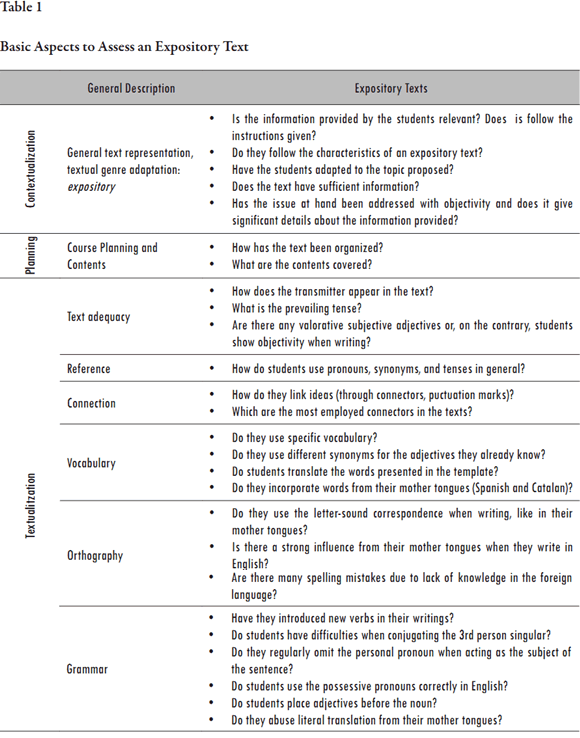
The assessment criteria presented here was designed to assess students' abilities and improvements by means of questions that allowed to determine the results accomplished over this study. The main goal was to corroborate how much progress students had achieved after the completion of the didactic sequence in relation to the composition of an expository text. The above mentioned questions were integrated into table 1 (see the appendix). Of the 68 texts culled for this study, a sample of 20 㬆 initial productions and 10 final productions, from which 5 corresponded to low-level texts and the other 5 corresponded to better written texts— was selected to analyze in detail.
After evaluating all samples, the four workshops proposed to correct the errors of initial productions had a positive impact on the final texts, since a gradual progress in some specific aspects of language was clearly visible. In general, results showed that students were able to produce simple and rational descriptions based on the conventions of an expository text, and unlike with the initial productions, the final texts followed a logical and coherent structure. There was an overall improvement in all students despite their English level; however, this improvement was manifested differently in each one of them. For example, final productions showed an increase in the number of lines compared to the initial production, and students used fewer schematic sentences. Text length ranged from four to five lines in the initial productions but reached seven to nine in the final ones. This increase could be a result of pupils feeling more familiar with the terms, after carrying out all workshops, and thus more eager and enthusiastic to write more lines in a less schematic way. It was a general improvement which also affected students with a lower English level.
In contrast, final productions still contained a lack of connectors, and/but being the only ones employed. To cite some examples:
''He's very funny and naughty'';
''Sponge Bob is square and yellow'';
''Arenita, an intelligent squirrel, is strong but little pretty''*
''He always goes with his dad to the field, but one day . . .''*
Of the 10 texts analysed for the final production, 5 proved to be rather informative given the pupils' level of ability. Students introduced more significant and evaluative elements in the final production than in the initial text; for instance, they used more colours (yellow, pink, blonde, brown, black, green, blue); shapes (square, rectangular); and new vocabulary (starfish, sponge, pineapple, friendly, enthusiasm, stupid, pretty, intelligent) based on the characteristics of their favourite fictional characters. This knowledge was enhanced in the first workshop, in which students learned new items and revised old ones related to physical and psychological descriptions. Likewise, words from their mother tongues (Spanish and Catalan) were almost completely eradicated in the final production due to work developed in the initial Workshop, in Workshop 2, and in Workshop 3, which helped them achieve certain lexical skills that proved to be useful in the final production. However, regarding spelling, there was still a significant number of mistakes caused by the lack of knowledge of the English language. Students' phonetic difficulties to master English were expected, since spelling acquisition can only be accomplished after a long term process. In addition, the letter-sound correspondence interfered with the students' production since they tried to reproduce words as they heard them from a Spanish and Catalan orthographic system. Words were written by analogy with these two languages as shown in the following examples: ''gis'' when meaning his, or ''epol'' for apple.
]]> Regarding grammar, the verbs most employed in the final productions were to be, to have, and to like. Students still used verbs they already knew and were reluctant to introduce new ones such as to live, a verb that they had practised in Workshop 2 and 3, or to love and to give, both practised in Workshop 3. Additionally, initial and final productions were written in the present tense and in the third singular person. This became the most common error encountered in the initial texts because it involved the use of the s. Although this issue was integrated in Workshop 2, and pupils were aware of it—their work during this workshop showed it—, they still found it difficult to add an -s in the third person singular, and sometimes failed in achieving this goal.''Sponge Bob live in Bikini Bottom'';
''A farmer and his wife lives in a small village'';
''She wear astronaut clothes''
In contrast, they understood that, although their mother tongues did not require the addition of a personal pronoun next to the verb (since this information is already marked in Spanish and Catalan verbal forms), this is not the case in the English language, so they should use personal pronouns in their final productions:
''She has got long plaits'';
''She sings very well'';
''He wears a white T-shirt'';
''He is funny and he can't be quiet''.
In addition, students seemed to encounter difficulties with the use of possessive pronouns and adjective collocations. Besides, pupils still abused literal translation from their mother tongues, which sometimes resulted in ungrammatical texts:
]]> ''The hair has short'';*''Not like water'';*
''I like the food of the Consum no Mercadona'';*
''He is a bear very funny.''*
As for the use of like and live in, the students' school teacher explained that Workshop 2 greatly helped students understand the I/he like/s and I/he live/s in structures, since most students continued using both correctly.
This indicates that the didactic sequence proved to be useful for students' learning expository texts. Some of the 6th grade students' gains after having implemented the DS were: the way students write sentences is now more coherent; students introduce the subject (personal pronoun) in the final production while in the initial texts many sentences were left without it, and they also include a verb. In turn, pupils continue to have problems with the verb to like when it precedes a verb (e.g. I like going to the market), and pupils still have problems regarding linguistic and syntactic borrowings. However, they do not seem to have any problems in understanding a similar structure with a noun (e.g. I like Maths), and they now recognize the structure to live in, which they have learnt during the didactic sequence.
In view of the above, the DS responded adequately to the four points by offering workshops that, in so far as they dwelled both in grammar and more communicative aims like telling stories, were capable of motivating both high-level and low-level students disregarding of their different backgrounds. However, despite the fact that all pupils participated actively in the workshops, the results showed differences in the completion of the goals proposed. The solution may have relied on attention to diversity, an external variable that must be taken into account since groups are rarely homogeneous: (a) there are different learning paces; (b) different skills; (c) they have a different background; and finally (d) they have different attitudes in class. As a result, low-level students wrote longer texts and showed certain degree of improvement in the final productions and, in turn, high-level students wrote better descriptive-expository texts since they employed more connectors, used richer vocabulary, made fewer grammatical mistakes, in sum, they wrote a more coherent text. Yet it could be anticipated that, eventually, the sequence could produce even better results if the following revisions were taken into account: (a) shorter workshops; (b) more reading exercises; (c) more speaking exercises—in sum, a more communicative approach, which has proven to be more suitable for a wider range of students, especially for those who do not reach the average grasp of grammar expected for their age.
AUTHOR'S NOTES
0 This study is part of the research project ''Dificultats d'escriptura amb textos argumentatius i explicatius i intervenció didàctica. Una aproximació des de tres llengües'' (UV-INV-AE11-42019), whose main researcher is Dr. Paulina Ribera, from the Universitat de València (Spain).
]]> 1 Our translation.2 It may be worth mentioning, however, that the impressionistic description does not include in one of the characteristics highlighted in the expository archetype, such as the ''abundance of connectors of the ordering and logical type'' (Martínez Laínez & Rodríguez Gonzalo, 1995, p. 48).
REFERENCES
1. Álvarez Angulo, T. (2001). Textos expositivo-explicativos y argumentativos [Expositive-Explicative and Argumentative Texts]. Barcelona, Spain: Octaedro. [ Links ]
2. Bartolí, M. (2005). La pronunciación en la clase de lenguas extranjeras [The Significance of Pronunciation in the Foreign Language Classroom]. Phonica, 1, 1–27 [ Links ]
3. Dolz, J. (1994). Seqüències didàctiques i ensenyament de la llengua: més enllà dels projectes de lectura i d'escriptura [Didactic Sequences and Language Teaching : Beyond Reading and Writing]. Articles de didàctica de la llengua i de la literatura, 2, 21–34. [ Links ]
]]>4. Dolz, J. (2009, August). Los cinco grandes retos de la formación del profesorado de lenguas [Five Major Challenges for Language Teacher Training]. V SIGET. UCS: Universidade de Caxias do Sul. Caxias do sul: Brasil. [ Links ]
5. Dolz, J., & Schneuwly B. (2006). Per a un ensenyament de l'oral. Iniciació als géneres formals a l'escola [Learning Oral Skills. Introduction to Formal Genres in School]. Valencia, Spain: Biblioteca Sanchis. [ Links ]
6. Elliott, J. (1990). La investigación-acción en educación [Action-Research in Education]. Madrid, España: Ediciones Morata. [ Links ]
7. Gibbons, P. (2009). English Learners, Academic Literacy, and Thinking. Learning in the Challenge Zone. Portsmouth, England: Heinemann. [ Links ]
8. Martínez Laínez, A., & Rodríguez Gonzalo, C. (1995). Els textos expositius des d'una perspectiva didáctica [Expositive Texts from a Didactic Perspective]. Articles de Didàctica de la Llengua i de la Literatura, 4, 41–54. [ Links ]
]]>9. Schneuwly, B., & Bain, D. (1994). Mecanismes de regulació de les activitats textuals: estratègies d'intervenció en les sequències didàctiques [Regulation Mechanism of Textual Activities: Intervention Strategies for Didactic Sequences]. Articles de didàctica de la llengua i la literatura, 2, 87–104. [ Links ]
10. Singleton, D. (1989). Language acquisition. The age factor. Clevedon, Avon, England: Multilingual Matters. [ Links ]
11. Torras, M. R., & Celaya, M. L. (2001). Age-related Differences in the Development of Written Production. An Empirical Study of EFL School Learners. International Journal of English Studies, 1(2), 103–126. [ Links ]
12. Wallace, M. J. (1998). Action Research for Language Teachers. Cambridge, England: Cambridge University Press. [ Links ]
APPENDIX
]]>
]]>