<?xml version="1.0" encoding="ISO-8859-1"?><article xmlns:mml="http://www.w3.org/1998/Math/MathML" xmlns:xlink="http://www.w3.org/1999/xlink" xmlns:xsi="http://www.w3.org/2001/XMLSchema-instance">
<front>
<journal-meta>
<journal-id>0123-3432</journal-id>
<journal-title><![CDATA[Íkala, Revista de Lenguaje y Cultura]]></journal-title>
<abbrev-journal-title><![CDATA[Íkala]]></abbrev-journal-title>
<issn>0123-3432</issn>
<publisher>
<publisher-name><![CDATA[Escuela de Idiomas, Universidad de Antioquia]]></publisher-name>
</publisher>
</journal-meta>
<article-meta>
<article-id>S0123-34322014000100002</article-id>
<title-group>
<article-title xml:lang="en"><![CDATA[ASSESSING THE SO CALLED MARKED INFLECTIONAL FEATURES OF NIGERIAN ENGLISH: A SECOND LANGUAGE ACQUISITION THEORY ACCOUNT]]></article-title>
<article-title xml:lang="es"><![CDATA[EVALUACIÓN DE LAS LLAMADAS CARACTERÍSTICAS INFLEXIONALES MARCADAS DEL INGLÉS NIGERIANO: UN CASO RELACIONADO CON LA TEORÍA DE ADQUISICIÓN DE UNA SEGUNDA LENGUA]]></article-title>
<article-title xml:lang="fr"><![CDATA[EVALUATION DES TRAITS FLEXIONNELS SAILLANTS DE L'ANGLAIS NIGÉRIEN: UN CAS POUR LA THÉORIE D'ACQUISITION D'UNE LANGUE SECONDE]]></article-title>
</title-group>
<contrib-group>
<contrib contrib-type="author">
<name>
<surname><![CDATA[Oshodi]]></surname>
<given-names><![CDATA[Boluwaji]]></given-names>
</name>
<xref ref-type="aff" rid="A01"/>
</contrib>
</contrib-group>
<aff id="A01">
<institution><![CDATA[,Universiti Malaysia Sarawak  ]]></institution>
<addr-line><![CDATA[ ]]></addr-line>
</aff>
<pub-date pub-type="pub">
<day>00</day>
<month>04</month>
<year>2014</year>
</pub-date>
<pub-date pub-type="epub">
<day>00</day>
<month>04</month>
<year>2014</year>
</pub-date>
<volume>19</volume>
<numero>1</numero>
<fpage>15</fpage>
<lpage>26</lpage>
<copyright-statement/>
<copyright-year/>
<self-uri xlink:href="http://www.scielo.org.co/scielo.php?script=sci_arttext&amp;pid=S0123-34322014000100002&amp;lng=en&amp;nrm=iso"></self-uri><self-uri xlink:href="http://www.scielo.org.co/scielo.php?script=sci_abstract&amp;pid=S0123-34322014000100002&amp;lng=en&amp;nrm=iso"></self-uri><self-uri xlink:href="http://www.scielo.org.co/scielo.php?script=sci_pdf&amp;pid=S0123-34322014000100002&amp;lng=en&amp;nrm=iso"></self-uri><abstract abstract-type="short" xml:lang="en"><p><![CDATA[There are conflicting claims among scholars on whether the structural outputs of the types of English spoken in countries where English is used as a second language gives such speech forms the status of varieties of English. This study examined those morphological features considered to be marked features of the variety spoken in Nigeria according to Kirkpatrick (2011) and the variety spoken in Malaysia by considering the claims of the Missing Surface Inflection Hypothesis (MSIH) a Second Language Acquisition theory which accounts for the cause of the variable use of such inflections among L2 learners. Results from oral and written composition tasks administered on selected undergraduate students of Nigerian and Malaysian universities revealed that what is regarded as morphological features are actually a deviation from the L2 target forms. According to the MSIH the variability in the use of such inflections is due to problems of lexical retrieval a psycholinguistic problem which manifests among L2 learners of English generally which results in wrong surface representations.]]></p></abstract>
<abstract abstract-type="short" xml:lang="es"><p><![CDATA[Existen posturas contrarias entre los estudiosos con respecto a si las características estructurales de los tipos de inglés que se hablan en países donde éste se utiliza como segunda lengua les da el estatus de variante. Esta investigación analiza dichas características morfológicas consideradas como marcadas en el inglés que se habla en Nigeria tal y como lo establece Kirpatrick (2011) y la variante de inglés que se habla en Malaysia considerando los presupuestos de la Hipótesis de Inflexión Superficial Ausente (MSIH, por sus siglas en inglés), una teoría de adquisición de segunda lengua que da cuenta de la causa del uso variable de dichas inflexiones entre los aprendices de L2. Resultados de tareas de producción oral y escrita asignadas a estudiantes de pregrado de universidades en Nigeria y Malasia muestran que las que se consideran características morfológicas son de hecho desviaciones de las formas de la L2. De acuerdo a la MSIH, la variabilidad de tales inflexiones se debe a los problemas de recuperación léxica, un problema psicolingüístico que se manifiesta entre los aprendices de inglés como L2, dando generalmente como resultado representaciones superficiales erróneas.]]></p></abstract>
<abstract abstract-type="short" xml:lang="fr"><p><![CDATA[Il existe des perspectives contraires quant au statut à donner aux variétés de l'anglais qui se manifestent par des output structurels manifestés dans des types d'anglais parlés dans des pays où l'anglais est utilisé comme langue seconde. Cette étude analyse les traits morphologiques considérés selon Kirkpatrick (2011) comme traits saillants de la variété de l'anglais parlé au Nigeria. Elle s'intéresse aussi à la variété de l'anglais parlée en Malaisie en s'appuyant sur les hypothèses des inflexions absentes en surface (MSIH), une théorie d'acquisition de langue seconde qui prend en compte la cause des variations d'usage de ces inflexions chez les apprenants d'une langue seconde. Les résultats de tâches orales et écrites appliquées à des étudiants nigériens et malaisiens en licence ont montré que les traits morphologiques sont en fait un écart par rapport aux formes de la langue seconde. Selon la théorie MSIH, les variations quant à l'emploi de ces inflexions sont dues aux difficultés pour récupérer le lexique, difficulté psycholinguistique qui se présente généralement chez des apprenants de l'anglais langue seconde et dont la cause est les représentations de surface inexactes.]]></p></abstract>
<kwd-group>
<kwd lng="en"><![CDATA[varieties of English]]></kwd>
<kwd lng="en"><![CDATA[second language]]></kwd>
<kwd lng="en"><![CDATA[inflections]]></kwd>
<kwd lng="en"><![CDATA[interlanguage]]></kwd>
<kwd lng="es"><![CDATA[variantes del inglés]]></kwd>
<kwd lng="es"><![CDATA[segunda lengua]]></kwd>
<kwd lng="es"><![CDATA[inflexiones]]></kwd>
<kwd lng="es"><![CDATA[interlenguaje]]></kwd>
<kwd lng="fr"><![CDATA[variétés de l'anglais]]></kwd>
<kwd lng="fr"><![CDATA[langue seconde]]></kwd>
<kwd lng="fr"><![CDATA[inflexions]]></kwd>
<kwd lng="fr"><![CDATA[interlangue]]></kwd>
</kwd-group>
</article-meta>
</front><body><![CDATA[ <p align="right"><font size="2" face="Verdana, Arial, Helvetica, sans-serif"><b>EMPIRICAL STUDIES</b></font></p>     <p>&nbsp;</p>     <p align="center"><b><font size="4" face="Verdana, Arial, Helvetica, sans-serif">ASSESSING THE SO CALLED MARKED INFLECTIONAL  FEATURES OF NIGERIAN ENGLISH: A SECOND  LANGUAGE ACQUISITION THEORY ACCOUNT</font></b></p>     <p>&nbsp;</p>     <p align="center"><b><font size="3" face="Verdana, Arial, Helvetica, sans-serif">EVALUACI&Oacute;N DE LAS LLAMADAS CARACTER&Iacute;STICAS INFLEXIONALES MARCADAS DEL INGL&Eacute;S  NIGERIANO: UN CASO RELACIONADO CON LA TEOR&Iacute;A DE ADQUISICI&Oacute;N DE UNA SEGUNDA  LENGUA</font></b><font size="3" face="Verdana, Arial, Helvetica, sans-serif"></font></p>     <p>&nbsp;</p>     <p align="center"><b><font size="3" face="Verdana, Arial, Helvetica, sans-serif">EVALUATION DES TRAITS FLEXIONNELS SAILLANTS DE L'ANGLAIS NIG&Eacute;RIEN: UN CAS POUR  LA TH&Eacute;ORIE D'ACQUISITION D'UNE LANGUE SECONDE</font></b></p>     <p>&nbsp;</p>     <p>&nbsp;</p>     <p><font size="2" face="Verdana, Arial, Helvetica, sans-serif"><b>Boluwaji Oshodi </b></font></p>     ]]></body>
<body><![CDATA[<p><font size="2" face="Verdana, Arial, Helvetica, sans-serif">Universiti Malaysia Sarawak Kota  Samarahan Sarawak Malaysia &amp;  Adekunle Ajasin University Akungba  Akoko Nigeria Department of  Linguistics and Languages Adekunle  Ajasin University   P. M. B. 001Akungba Akoko Nigeria E-mail:<a href="mailto:bolu_oshodi@yahoo.com">bolu_oshodi@yahoo.com</a></font></p>     <p>&nbsp;</p>     <p><font size="2" face="Verdana, Arial, Helvetica, sans-serif">Received: 2013-02-01 / Reviewed: 2013-09-16 / Accepted: 2014-02-01</font></p>     <p>&nbsp;</p>     <p><font size="2" face="Verdana, Arial, Helvetica, sans-serif"><b>How to reference this article:</b> Oshodi, B. (2014). Assessing the so Called Marked Inflectional Features  of Nigerian English: A Second Language Acquisition Theory Account.  <i>&Iacute;kala, Revista de Lenguaje y  Cultura,</i> <i>19</i>(1), 15-26.</font></p>     <p>&nbsp;</p>     <p>&nbsp;</p> <hr size="1" noshade>     <p><font size="2" face="Verdana, Arial, Helvetica, sans-serif"><b>ABSTRACT</b> </font></p>     <p><font size="2" face="Verdana, Arial, Helvetica, sans-serif">There are conflicting claims among scholars on whether the structural outputs  of the types of English spoken in countries where English is used as a second  language gives such speech forms the status of varieties of English. This study  examined those morphological features considered to be marked features of  the variety spoken in Nigeria according to Kirkpatrick (2011) and the variety  spoken in Malaysia by considering the claims of the Missing Surface Inflection  Hypothesis (MSIH) a Second Language Acquisition theory which accounts for  the cause of the variable use of such inflections among L2 learners. Results from  oral and written composition tasks administered on selected undergraduate  students of Nigerian and Malaysian universities revealed that what is regarded  as morphological features are actually a deviation from the L2 target forms.  According to the MSIH the variability in the use of such inflections is due to  problems of lexical retrieval a psycholinguistic problem which manifests among  L2 learners of English generally which results in wrong surface representations. </font></p>     <p><font size="2" face="Verdana, Arial, Helvetica, sans-serif"><b>Keywords:</b> varieties of English, second language, inflections, interlanguage</font></p> <hr size="1" noshade>     ]]></body>
<body><![CDATA[<p><font size="2" face="Verdana, Arial, Helvetica, sans-serif"><b>RESUMEN</b></font></p>     <p><font size="2" face="Verdana, Arial, Helvetica, sans-serif">Existen posturas contrarias entre los estudiosos con respecto a si las caracter&iacute;sticas  estructurales de los tipos de ingl&eacute;s que se hablan en pa&iacute;ses donde &eacute;ste se utiliza  como segunda lengua les da el estatus de variante. Esta investigaci&oacute;n analiza  dichas caracter&iacute;sticas morfol&oacute;gicas consideradas como marcadas en el ingl&eacute;s que  se habla en Nigeria tal y como lo establece Kirpatrick (2011) y la variante de  ingl&eacute;s que se habla en Malaysia considerando los presupuestos de la Hip&oacute;tesis  de Inflexi&oacute;n Superficial Ausente (MSIH, por sus siglas en ingl&eacute;s), una teor&iacute;a  de adquisici&oacute;n de segunda lengua que da cuenta de la causa del uso variable de  dichas inflexiones entre los aprendices de L2. Resultados de tareas de producci&oacute;n  oral y escrita asignadas a estudiantes de pregrado de universidades en Nigeria y  Malasia muestran que las que se consideran caracter&iacute;sticas morfol&oacute;gicas son de  hecho desviaciones de las formas de la L2. De acuerdo a la MSIH, la variabilidad  de tales inflexiones se debe a los problemas de recuperaci&oacute;n l&eacute;xica, un problema psicoling&uuml;&iacute;stico que se manifiesta entre los aprendices de ingl&eacute;s como L2, dando  generalmente como resultado representaciones superficiales err&oacute;neas. </font></p>     <p><font size="2" face="Verdana, Arial, Helvetica, sans-serif"><b>Palabras clave:</b> variantes del ingl&eacute;s, segunda lengua, inflexiones, interlenguaje.</font></p> <hr size="1" noshade>     <p><font size="2" face="Verdana, Arial, Helvetica, sans-serif"><b>R&Eacute;SUM&Eacute;</b></font></p>     <p><font size="2" face="Verdana, Arial, Helvetica, sans-serif"> Il existe des perspectives contraires quant au statut &agrave; donner aux vari&eacute;t&eacute;s de  l'anglais qui se manifestent par des output structurels manifest&eacute;s dans des types  d'anglais parl&eacute;s dans des pays o&ugrave; l'anglais est utilis&eacute; comme langue seconde.  Cette &eacute;tude analyse les traits morphologiques consid&eacute;r&eacute;s selon Kirkpatrick  (2011) comme traits saillants de la vari&eacute;t&eacute; de l'anglais parl&eacute; au Nigeria. Elle  s'int&eacute;resse aussi &agrave; la vari&eacute;t&eacute; de l'anglais parl&eacute;e en Malaisie en s'appuyant sur les  hypoth&egrave;ses des inflexions absentes en surface (MSIH), une th&eacute;orie d'acquisition  de langue seconde qui prend en compte la cause des variations d'usage de ces  inflexions chez les apprenants d'une langue seconde. Les r&eacute;sultats de t&acirc;ches  orales et &eacute;crites appliqu&eacute;es &agrave; des &eacute;tudiants nig&eacute;riens et malaisiens en licence  ont montr&eacute; que les traits morphologiques sont en fait un &eacute;cart par rapport  aux formes de la langue seconde. Selon la th&eacute;orie MSIH, les variations quant  &agrave; l'emploi de ces inflexions sont dues aux difficult&eacute;s pour r&eacute;cup&eacute;rer le lexique,  difficult&eacute; psycholinguistique qui se pr&eacute;sente g&eacute;n&eacute;ralement chez des apprenants  de l'anglais langue seconde et dont la cause est les repr&eacute;sentations de surface  inexactes. </font></p>     <p><font size="2" face="Verdana, Arial, Helvetica, sans-serif"><b>Mots-cl&eacute;s:</b> vari&eacute;t&eacute;s de l'anglais, langue seconde, inflexions, interlangue.</font></p> <hr size="1" noshade>     <p>&nbsp;</p>     <p>&nbsp;</p>     <p><font size="3" face="Verdana, Arial, Helvetica, sans-serif"><b>INTRODUCTION</b></font></p>     <p><font size="2" face="Verdana, Arial, Helvetica, sans-serif">A lot of writers have written about the existence  of varieties of English which have been given  different names like world Englishes, New  Englishes, Modern Englishes, etc. Some have even  made reference to the fact that a variety known as  Nigerian English (NE) actually exists, such linguists  include Alo &amp; Mesthrie (2008), Adegbija (1989),  Adetugbo (1979), Bamiro (1991), Kachru (1987,  1992a), Kujore (1985), Salami (1968), and Gut &amp;  Fuchs (2013). According to Ogu (1992), Walsh  (1967) was among the first to draw attention to the  existence of a variety of English Language known as  ''Nigerian English'' (NE henceforth). Ogu (1992)  quoted Walsh as saying that: ''The varieties of  English spoken by educated Nigerians, no matter  what their language, have enough features in  common to mark off a general type, which may be  called Nigerian English'' (p. 88).</font></p>     ]]></body>
<body><![CDATA[<p><font size="2" face="Verdana, Arial, Helvetica, sans-serif">Kirkpatrick (2011) observed that NE has some  marked features, which distinguish it from  other Englishes. Some of these so called marked  features involved the ''omission'' and ''misuse'' of  those inflections found in the area of 'inflectional  morphology' which are used for tense marking, such  as &#8212;<i>s</i> on third person singular verb, &#8212;<i>ed</i> which  expresses past,  &#8212;<i>ing</i> which shows continuous  and &#8212;<i>en</i> which is used for past participle. These  inflectional morphemes are sometimes omitted  and misused by Nigerian L2 English in obligatory  contexts (i.e. contexts in which adult native speakers  of English would use them).</font></p>     <p><font size="2" face="Verdana, Arial, Helvetica, sans-serif">According to the Encyclopedia of Malaysian  Languages and Literature (2004), Malaysia  English can be categorized into three types;  <i>Collector, Mesolithic</i> and  <i>Basile</i> while Roslie &amp;  Ting Su Hie (1994) also grouped it into three;  ME Type I, ME Type II and Colloquial Malaysian  English (CME). The above observation by Roslie  &amp; Ting Su Hie also affirms that in Malaysia just  like in Nigeria a variety of English peculiar to  Malaysian L2 English also exists. This simply  implies that the above scholars see the kinds of  English spoken in these contexts (Nigeria and Malaysia) which are regarded as deviant forms of  Received Pronunciation (RP) in this present study  as having certain features, which qualify them as  varieties of English. It is this issue that this study  seeks to address with particular focus on certain  inflections that are said to constitute a feature in  the claimed Nigerian variety.</font></p>     <p>&nbsp;</p>     <p><font size="3" face="Verdana, Arial, Helvetica, sans-serif"><b>THE MARKEDNESS CONCEPT IN L2  ACQUISITION</b></font></p>     <p><font size="2" face="Verdana, Arial, Helvetica, sans-serif">Markedness has been employed in various senses  in SLA literature. According to McCarthy  (2007), ''unmarked'' forms in L2 are thought to  be those that are more basic or general, use less  structure, are acquired first, and are typologically  more frequent, whereas ''marked'' forms are  more complex, use more structure, are acquired  late, and are typologically more rare (Battistella,  1990, p. 3). There is considerable difficulty in  defining this term. McCarthy (2007) observed  that markedness can be defined in terms of  meaning and distribution. Thus the focus will  be on the meanings of morphology, rather than  on morpho-phonology. Markedness theory deals  with oppositions in language. From early studies  in structural linguistics (e.g. Jakobson 1984),  oppositions in language are very often not best  characterized as mere opposites. Instead, one  term within an opposed pair is more general than  the other. The more general term is unmarked,  whereas the more complex term is marked. Thus,  unmarked forms have a dual function: they can  mean the opposite of a marked term, but they  can also mean the absence of signalization of the  marked term. An example from tense that comes  from Battistella (1990, pp. 3-4) is given below.</font></p>     <p><font size="2" face="Verdana, Arial, Helvetica, sans-serif">1   </font> <ol type="a">     <li><font size="2" face="Verdana, Arial, Helvetica, sans-serif">I wear sneakers.</font></li>     <li><font size="2" face="Verdana, Arial, Helvetica, sans-serif">I arrive home Sunday </font></li>     <li><font size="2" face="Verdana, Arial, Helvetica, sans-serif">So then I say to him, ''Shut up!''</font></li>     </ol>     ]]></body>
<body><![CDATA[<p><font size="2" face="Verdana, Arial, Helvetica, sans-serif">Examples (1a-c) show that past and present tenses  do not behave as mere opposites. Instead, past  tense unambiguously signals past time, whereas  the present tense is not necessarily specified for  time. In (a) example, present tense demonstrates a range of temporal meanings: it is used to indicate  a habitual reading that is independent of time.  Examples (b) and (c) show how to signal the  future, and to signal the past respectively.</font></p>     <p><font size="2" face="Verdana, Arial, Helvetica, sans-serif">If the above definition and explanation of  markedness is applied to the context in which it  was used by Kirkpatrick (2011) in defence of such  features as peculiar to NE, it implies that the verbal  inflections  <i>(&#8212;s, &#8212;ed, &#8212;ing </i>and<i> &#8212;en</i>) are more  complex, use more structure, are acquired late, and  are typologically more rare than other morphological  features in the interlanguage grammar of Nigerian  L2 English. It would also imply that such features are  restricted only to Nigerian L2 English and should  not be found among any other L2 speakers of English  from other L2 settings i.e. countries.</font></p>     <p>&nbsp;</p>     <p><font size="3" face="Verdana, Arial, Helvetica, sans-serif"><b>TENSE MARKING AND AGREEMENT IN ENGLISH  YOR&Ugrave;B&Aacute; AND MALAY </b></font></p>     <p><font size="2" face="Verdana, Arial, Helvetica, sans-serif">The identified inflections  (<i>&#8212;s, &#8212;ed, &#8212;ing</i> and  <i>&#8212;en</i>) are all distinct morphemes attached to  root verbs to indicate various tenses in English.  According to Yusuf (1998), tense is a feature  marked in all languages of the world. However,  the pattern and the features involved vary from  one language to the other. For a clear picture of the  issue under discussion, we shall briefly examine the  pattern of tense marking and agreement relations  in the three languages in focus in this study i.e.  English, Yor&ugrave;b&aacute; and Malay.</font></p>     <p><font size="2" face="Verdana, Arial, Helvetica, sans-serif">In English, tense is marked with inflections on  verbs, consider the following examples:</font></p> <ol>     <li><font size="2" face="Verdana, Arial, Helvetica, sans-serif">  John  <b>work-s</b> in the garden (simple present  tense)</font></li>     <li><font size="2" face="Verdana, Arial, Helvetica, sans-serif">John is <b>work-ing</b> in the garden (present  continuous tense) </font></li>     <li><font size="2" face="Verdana, Arial, Helvetica, sans-serif">John <b>work-ed</b> in the garden (past tense)</font></li>     </ol>     ]]></body>
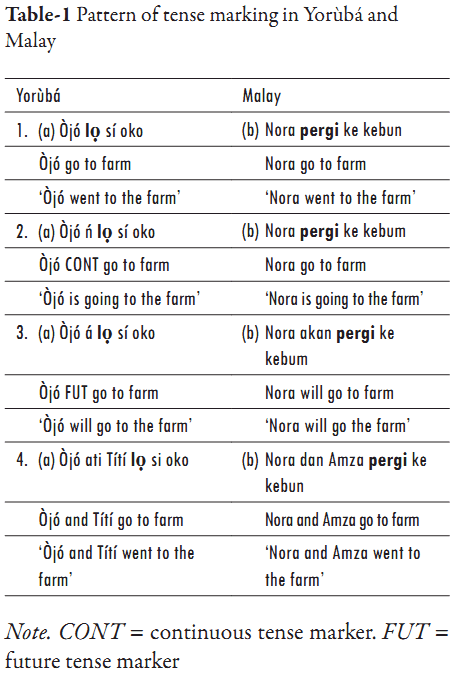
<body><![CDATA[<p><font size="2" face="Verdana, Arial, Helvetica, sans-serif">Examples (1-3) contain verbs with regular  inflection. Example (2) also reflects subject-verb  agreement, consider the following examples:</font></p>     <p><font size="2" face="Verdana, Arial, Helvetica, sans-serif">4.  John and Mary  eat everyday (simple present  tense)</font></p>     <p><font size="2" face="Verdana, Arial, Helvetica, sans-serif">5.  John has <b>eat-en</b> rice (past participle) 6.  John and Mary have <b>eat-en</b> rice (past participle)</font></p>     <p><font size="2" face="Verdana, Arial, Helvetica, sans-serif">In (4), the verb <i>eat</i> is uninflected because the subject  Noun Phrase (NP)<a name="en1"></a><a href="#n1"><sup>1</sup></a>  is plural ( John and Mary). In  (5) the auxiliary <i>has</i> (singular) was used alongside  the inflected verb <i>eaten</i> because the subject ( John) is  singular while in (6), the auxiliary verb <i>have</i> (plural)  was used because of the plural subject ( John and  Mary). However, in both Yor&ugrave;b&aacute;<a name="en2"></a><a href="#n2"><sup>2</sup></a>  and Malay<a name="en3"></a><a href="#n3"><sup>3</sup></a>  verbs  are never inflected for tense marking and there is  no agreement relation between subjects and verbs,  consider the following examples in <a href="#t01">table 1</a>:</font></p>     <p>&nbsp;</p>     <p align="center"><font size="2" face="Verdana, Arial, Helvetica, sans-serif"><a name="t01"></a><img src="/img/revistas/ikala/v19n1/v19n1a2t1.gif"></font></p>     <p>&nbsp;</p>     <p><font size="2" face="Verdana, Arial, Helvetica, sans-serif">In examples (1a-4b), the verbs  <i>l&#7885;</i> 'go' (Yor&ugrave;b&aacute;)  and <i>pergi</i> 'go' (Malay) remain the same without  being inflected in all contexts of tense marking,  simple present in (1a and b), present continuous  tense in&nbsp; (2a and b) and future tense in (3 a and  b) while&nbsp; in (4&nbsp; a&nbsp; and b), there is no agreement  relationship between subject Noun Phrases (NPs)  and the verbs as the&nbsp;verbs <i>l&#7885;</i> and <i>pergi</i> 'go' remain  the same even when the subject NPs (<i>&Ograve;j&oacute; and T&iacute;t&iacute;</i>)  in the Yor&ugrave;b&aacute; sentences and (<i>Nora and Hamza</i>) in  the Malay&nbsp;sentences were plural. These examples  show that the concept of tense marking through  inflections and agreement relations which are  attested in English are lacking in both Yor&ugrave;b&aacute;  and Malay as shown in examples (1-6). The above  examples also revealed the significant and clear  differences in&nbsp; tense and agreement concepts as  they operate in English, Yor&ugrave;b&aacute; and Malay.</font></p>     <p>&nbsp;</p>     <p><font size="3" face="Verdana, Arial, Helvetica, sans-serif"><b>A SECOND LANGUAGE ACQUISITION THEORY  ACCOUNT</b></font></p>     ]]></body>
<body><![CDATA[<p><font size="2" face="Verdana, Arial, Helvetica, sans-serif">It should be noted that the above morphemes  identified by Kirkpatrick (2011) as marked  features of Nigerian English have been identified  in Second Language Acquisition (SLA) circle as  having variable use in the interlanguage grammars  of second language (L2) learners of English  (Lardiere 1998a, &amp; 1998b) and Hazenadar (2007)  with subjects who have Chinese and Turkish as  L1. According to Prevost and White (2000) and  McCarthy (2007), similar inflectional morphemes  which mark tenses in inflectional languages like  French and Spanish have also been identified  in the interlanguage grammars of L2 learners  of these languages; the phenomenon is known  in SLA literature as <i>morphological variability</i>. It  involves the misuse, overuse as well as omission of  such morphemes by L2 learners in their attempt  to acquire the L2 morphological inflections.  According to Selinker (1972), this type of grammar  produced by L2 learners which is in between the  L1 and the target L2 a cognitive creation of L2  learners en-route the&nbsp;L2 target form is known as  interlanguage grammar.</font></p>     <p><font size="2" face="Verdana, Arial, Helvetica, sans-serif">Various hypotheses have been proposed to account  for the phenomenon of morphological variability  particularly the likely cause of what has come  to be regarded as a ''phenomenon'' (McCarthy  2007: 4) among L2 learners which cuts across  every level of L2 learners including advanced  and near native ones as observed by Prevost and  White (2000). One of the hypotheses that have  received a lot of attention in terms of evaluation  of this particular concept is the Missing Surface  Inflection Hypothesis (MSIH). This hypothesis  shall be evaluated in the next section.</font></p>     <p>&nbsp;</p>     <p><font size="3" face="Verdana, Arial, Helvetica, sans-serif"><b>THE MISSING SURFACE INFLECTION HYPOTHESIS</b></font></p>     <p><font size="2" face="Verdana, Arial, Helvetica, sans-serif"> The MSIH was developed by Haznedar and  Schwartz (1997) and has been propagated by SLA  scholars Like Prevost and White (2000), Lardiere  (1998a and b), Ionin and Wexler (2002) and Geckin  and Hazenadar (2008). The MSIH claims that  second language learners' (adults) interlanguage  grammars are not impaired<a name="en4"></a><a href="#n4"><sup>4</sup></a> . It claims that abstract  properties may be present in the interlanguage  grammar without being systematically realized  morphologically. More specifically, L2 learners  may have problems accessing morphology or  mapping morphology and syntax. This view also  holds that infinitival forms are used as default finite  forms, which imply that verbs that look nonfinite  on the surface may occur in finite positions. In  simple terms, the MSIH claims that adult L2  learners have access to&nbsp;Universal Grammar<a name="en5"></a><a href="#n5"><sup>5</sup></a> (UG) and are not limited to only those features and  parameters instantiated in their L1. It is assumed  that L2 learners have unconscious knowledge of the  functional projections and feature values underlying  Tense, Agreement, Number, and Determiner.  However, they exhibit variability with respect to  inflectional morphology either through omission  or making inappropriate substitution of one kind  of inflection for another. The underlying syntactic  representations are correct, however, the resulting  surface functional morphology is not target-like  due to surface mapping problems (Slabakova  2009:&nbsp; 280). In other words failure to produce  consistent inflection is attributed to difficulties  in accessing the relevant lexical items by which  inflection is realized particularly in oral production  due to communicative pressure.</font></p>     <p><font size="2" face="Verdana, Arial, Helvetica, sans-serif">The implication of the above observation by the  MSIH is that what is being regarded as a feature  of Nigerian English actually emanated due to L2  acquisition factors. This means that such factors  are not peculiar to Nigerian learners and users of  English as L2 alone but to all learners and users  of English as L2 generally. This study attempts to  verify and substantiate the claim of the MSIH by  examining production and comprehension data  obtained from two separate groups of L2 learners  of English with each group comprising of Nigerian  and Malaysian<a name="en6"></a><a href="#n6"><sup>6</sup></a>  undergraduate university students  who all acquired and use English as L2.</font></p>     <p>&nbsp;</p>     <p><font size="3" face="Verdana, Arial, Helvetica, sans-serif"><b>METHODOLOGY</b></font></p>     <p><font size="2" face="Verdana, Arial, Helvetica, sans-serif">This section presents and discusses the procedures  involved in the research design. It introduces  and expatiates on the research question, the background of the subjects, as well as the method  of data collection and analysis.</font></p>     <p><font size="2" face="Verdana, Arial, Helvetica, sans-serif"><b>General objective</b></font></p>     ]]></body>
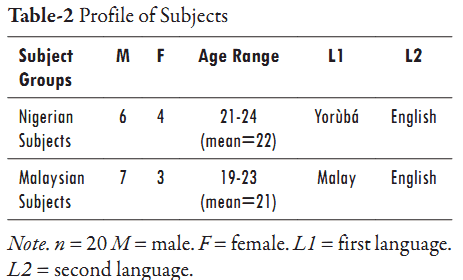
<body><![CDATA[<p><font size="2" face="Verdana, Arial, Helvetica, sans-serif"> The general objective of this study is to examine the  occurrence of the verbal inflectional morphemes  (&#8212;s, &#8212;ing, &#8212;ed and &#8212;en) in the speech patterns  of adult L2 English from Nigeria and Malaysia  to see if such features are truly peculiar to the  Nigerian group in order to verify whether or not  they are features of Nigerian English or they are  universal features of L2 learners of English.</font></p>     <p><font size="2" face="Verdana, Arial, Helvetica, sans-serif"><b>Research question</b></font></p>     <p><font size="2" face="Verdana, Arial, Helvetica, sans-serif">The main research question which this study seeks  to answer is: do the missing overt inflections on  verbs in the interlanguage grammars of Nigerian  L2 English constitute marked feature which is  peculiar to Nigerian English alone? To answer this question, the following hypothesis  is proposed: Those acclaimed marked inflectional features  should occur only in the interlanguage grammars  of Nigerian L2 English. This hypothesis would be tested with two sets  of data collected from Nigerian and Malaysian  university undergraduate students who have  English as their L2.</font></p>     <p><font size="2" face="Verdana, Arial, Helvetica, sans-serif"><b>Sampling</b></font></p>     <p><font size="2" face="Verdana, Arial, Helvetica, sans-serif">The data for this study were collected from  twenty subjects, ten (10) Nigerian University  undergraduate students in Nigeria and ten (10)  Malaysian undergraduate students in Malaysia.  The Nigerian subjects have Yor&ugrave;b&aacute; as their native  language (L1). All the Malaysian subjects have  Malay as their L1. Two types of data were collected  and examined: oral and written. For the oral data,  the participants were each given different topics  and were given two weeks to collect facts on them  after which they made oral presentations on the  given topic in the classroom. The participants were all adult L2 learners above twenty years who  already had a full and perfect knowledge of their  L1s. They had studied English for over ten years  in formal contexts when these data were collected.</font></p>     <p>&nbsp;</p>     <p align="center"><font size="2" face="Verdana, Arial, Helvetica, sans-serif"><a name="t02"></a><img src="/img/revistas/ikala/v19n1/v19n1a2t2.gif"></font></p>     <p>&nbsp;</p>     <p><font size="2" face="Verdana, Arial, Helvetica, sans-serif"><b>Instrument</b></font></p>     <p><font size="2" face="Verdana, Arial, Helvetica, sans-serif">The production test consisted of various topics  which include: My faculty, My Department, My  Course of study, My University, among others.  Each subject was given twenty minutes to make  the presentation in class in the presence of their  colleagues. The comprehension data were collected  through a short written composition on the topic  ''A day I will never forget''; it was conducted in the  class and lasted for a period of 45 minutes.</font></p>     ]]></body>
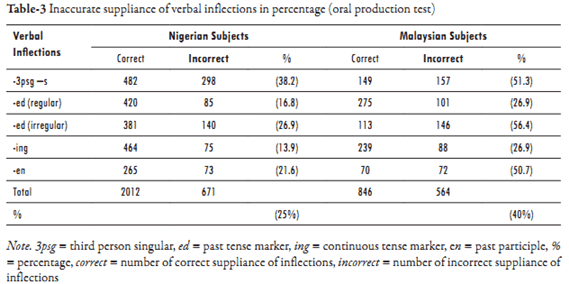
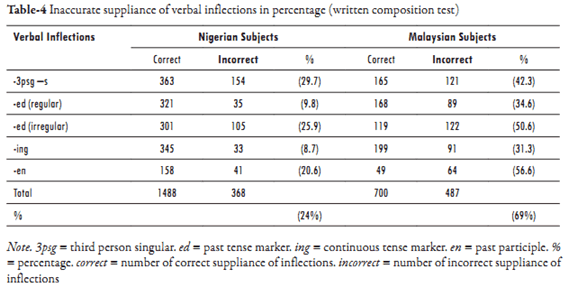
<body><![CDATA[<p><font size="2" face="Verdana, Arial, Helvetica, sans-serif"><b>Data Analysis</b></font></p>     <p><font size="2" face="Verdana, Arial, Helvetica, sans-serif">For data analysis, focus was on the suppliance of the  inflectional morphemes i.e. <i>&#8212;s, &#8212;ed, &#8212;ing</i>, and  <i>&#8212;en</i> in obligatory contexts. The inflections were  scored as correct when they were used correctly in  obligatory contexts and scored incorrect whenever  they were omitted or incorrectly supplied in  obligatory contexts.</font></p>     <p><font size="2" face="Verdana, Arial, Helvetica, sans-serif"><b>Results</b></font></p>     <p><font size="2" face="Verdana, Arial, Helvetica, sans-serif">The main results which interest us have to do with  the pattern and the systematicity of suppliance  of the inflections particularly as they occur in  the interlanguage grammars of the two groups  of Nigerian and Malaysian subjects and not  really their frequency of occurrence. However,  the results based on the frequency of occurrence  of the target inflections were calculated and  presented in percentages for each group with  focus on the percentage of  <i>inaccurate suppliance</i>  in obligatory contexts. This is done to establish  the actual knowledge of these inflections as  exhibited in the interlanguage grammars of  all subjects. The results are presented below in  <a href="#t03">tables 3</a> and <a href="#t04">4</a>.</font></p>     <p>&nbsp;</p>     <p align="center"><font size="2" face="Verdana, Arial, Helvetica, sans-serif"><a name="t03"></a><img src="/img/revistas/ikala/v19n1/v19n1a2t3.gif"></font></p>     <p>&nbsp;</p>     <p align="center"><font size="2" face="Verdana, Arial, Helvetica, sans-serif"><a name="t04"></a><img src="/img/revistas/ikala/v19n1/v19n1a2t4.gif"></font></p>     <p>&nbsp;</p>     <p><font size="2" face="Verdana, Arial, Helvetica, sans-serif"><a href="#t05">Table 5</a> shows the examples of the pattern of occurrence of the inflections (i.e. their wrong suppliance in  obligatory contexts) from all the 20 subjects involved in this study with examples taken from both the  oral and written production tasks.</font></p>     ]]></body>
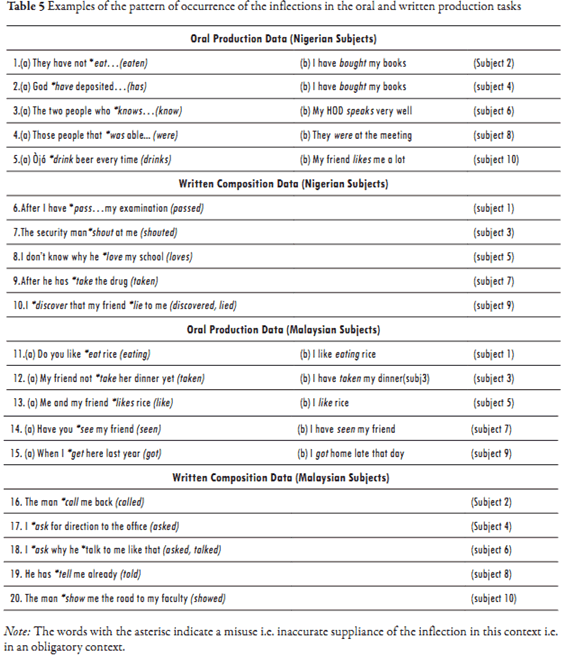
<body><![CDATA[<p>&nbsp;</p>     <p align="center"><font size="2" face="Verdana, Arial, Helvetica, sans-serif"><a name="t05"></a><img src="/img/revistas/ikala/v19n1/v19n1a2t5.gif"></font></p>     <p>&nbsp;</p>     <p><font size="3" face="Verdana, Arial, Helvetica, sans-serif"><b>FINDINGS</b></font></p>     <p><font size="2" face="Verdana, Arial, Helvetica, sans-serif">It was observed from the frequency of suppliance&nbsp;of  the inflections that the rate of correct suppliance  exceeded the rate of incomplete suppliance (at  least in most cases), for example in table 3 (oral  production) the overall rate of inaccurate suppliance  for the Nigerian subjects was 25% and 40% for  the Malaysian subjects while in table 4 (written  composition) the overall rate of inaccurate suppliance  was 24.7% for the Nigerian subjects and 69.5% for  the Malaysian subjects. In spite of the inaccurate  level of suppliance which was still high particularly  among the Malaysian subjects, the level of accuracy  in obligatory contexts clearly showed that both the  Nigerian and Malaysian subjects have the knowledge  of the English inflections in their language faculty  and their target was to supply the inflections in all  obligatory contexts and the inaccurate suppliance  was due to some factors one of which was evaluated  in this study as proposed by the MSIH.</font></p>     <p><font size="2" face="Verdana, Arial, Helvetica, sans-serif">However, based on the major aim of this study which  is to verify whether the inflections investigated  are actually features of Nigerian English or such  features exist in the interlanguage grammars  of other L2 English, for instance Malaysian L2  English, the focus would be to establish whether  there are similarities or differences in the pattern  of occurrence i.e. suppliance of these so called  marked features (inflections) in the interlanguage grammars of the two groups of subjects as shown  in both oral production and written data.</font></p>     <p><font size="2" face="Verdana, Arial, Helvetica, sans-serif">The various examples revealed that the Nigerian  subjects committed errors of omission and inaccurate  suppliance of these inflections in obligatory contexts.  However, in the same discourse as shown in the  (b) examples in the examples cited under the oral  composition data, the same subjects constructed  sentences in which the inflectional morphemes  were correctly supplied in obligatory contexts. One  important observation noticed in the examples of  both the Nigerian and Malaysian subjects in both  oral production and written composition was that  similar errors committed by the Nigerian subjects  were also committed by the Malaysian subjects in the  same contexts; again like their Nigerian counterparts  as shown in the (b) examples under oral production,  they still constructed sentences in the same discourse  where the inflections were accurately supplied. Most  importantly, it was discovered from the examples  given that all the twenty subjects committed error  of morphological variability at a point in the course  of supplying the inflections in either oral or written  form.</font></p>     <p>&nbsp;</p>     <p><font size="3" face="Verdana, Arial, Helvetica, sans-serif"><b>DISCUSSION</b></font></p>     <p><font size="2" face="Verdana, Arial, Helvetica, sans-serif">The main objective of this study is to verify whether  the missing inflections on the verbs actually constitute  a feature which is peculiar to a particular group of learners of English as L2 i.e. Nigerian learners of  English as claimed by the likes of Kirkpatrick. From  the data, the assertion that they are marked features  of Nigerian English appears faulty and cannot  be substantiated. For example, if the inconsistent  suppliance of the inflections actually constitutes a  feature peculiar to  Nigerian L2 English speakers  alone as claimed by Kirkpatrick (2011), similar  inconsistent use would not have been found in the  interlanguage grammar of Malaysian L2 English  as well. However, the same forms of omission and  inaccurate suppliance of the inflections exhibited  by the Nigerian subjects were also exhibited by the  Malaysian subjects in virtually the same contexts of  occurrence. As observed by the MSIH, the variable  use of inflections among L2 learners of English is  not peculiar to verbs alone but also occurs on nouns  Lardiere (1998a) and White (2003) as L2 learners  usually inflect them variably (sometimes they do  sometimes they don't) for plural marking.</font></p>     ]]></body>
<body><![CDATA[<p><font size="2" face="Verdana, Arial, Helvetica, sans-serif">The above facts have made it clear that what  Kirkpatrick (2011) referred to as marked features  of Nigerian English (in the area of inflectional  morphology) with respect to the inconsistent  suppliance of the overt inflections in obligatory  contexts are actually deviations from the target L2  forms as established by the MSIH to be purely due to  L2 acquisition issues. The MSIH makes it clear that,  those inflections were omitted but not deliberately,  and the fact that they were supplied correctly in other  similar contexts (see the tables and various examples  cited above) clearly supports the claim of the MSIH  as regards the reason for this inconsistency. </font></p>     <p><font size="2" face="Verdana, Arial, Helvetica, sans-serif">The non-suppliance came as a result of pressure  of retrieving the inflections from their language  faculty which led to their inability to map those  inflections to the surface level bearing in mind  that both Yor&ugrave;b&aacute; and Malay which are the L1s  of the participants do not inflect verbs for tense  (see examples 8-11) and since they already have  the full knowledge of their L1s, configuring  and retrieving new features from their language  faculty usually present some difficulties for them.  Also, the MSIH rightly claim that while present morphemes would occur in past contexts, past  morphemes are not expected to occur in present  contexts, this was shown in the omission of the  use of the third person singular -s on verbs as well  as the use of present tense verbs in past contexts  but not the other way round; past tense verbs were  not used in present contexts. </font></p>     <p><font size="2" face="Verdana, Arial, Helvetica, sans-serif">The conceptual issue from the standpoint of SLA  which is being propagated through the MSIH is  that, the Nigerian L2 English have problems with  the inflections because their L1 does not inflect verbs  for tense marking. Since learners have the tendency  to learn differently they also have the tendency to  exhibit different interlanguage grammars. Selinker  (1972) refers to interlanguage as ''the intermediate  states or intermediate grammars of a learner's  language as it moves towards the target language.  It is a product of a creative process driven by inner  forces and interaction, influenced by L1 and input  from the target language''. The interlanguage has  some peculiar characteristics which include frequent  changes, it is governed by some innate rules as well  as the L1; it also reduces complex grammaticality  in form. Above all, it is used for a smaller range of  communicative needs. The fact that the interlanguage  grammar exhibits frequent changes as well as reduces  complex grammaticality confirmed the claim of the  MSIH and also explains why both the Nigerian  and Malaysian L2 English omitted and misused the  inflections in certain obligatory contexts.</font></p>     <p><font size="2" face="Verdana, Arial, Helvetica, sans-serif">Slabakova (2009) observed that the variable  use of inflections which was erroneously tagged  marked features of Nigerian English by the likes of  Kirkpatrick is actually a deviation from the target  L2 form. Slabakova believes it is an issue which has  to do with how L2 learners process such features  in their language faculty and try to configure them  correctly to the surface representation something  which usually presents problems because their L1  is always active in the process.</font></p>     <p>&nbsp;</p>     <p><font size="3" face="Verdana, Arial, Helvetica, sans-serif"><b>CONCLUSION</b></font></p>     <p><font size="2" face="Verdana, Arial, Helvetica, sans-serif">In this study, an attempt was made to investigate  the claim that the inconsistent use of certain morphological inflections constitutes a feature  which marks them as a variety of English  peculiar to Nigerian L2 English. However, the  comparison of results from data collected from  adults L2 English in Nigeria and Malaysia two L2  English contexts clearly revealed that the claim of  Kirkpatrick (2011) cannot be substantiated as it  was confirmed that such variable use of inflection  is not peculiar to Nigerian L2 English alone. It is  a form of interlanguage grammar peculiar to all  second language learners of English whose L1  lacks inflections and definitely not a feature of  ''Nigerian English''.</font></p>     <p><font size="2" face="Verdana, Arial, Helvetica, sans-serif">The issue of the existence of Nigerian English has  been a contentious issue among scholars, while  writers like Adegbija (1989), Bamiro (1991),  Alo &amp; Mesthrie (2008) and Gut &amp; Fuchs (2013)  believe it does exist there are those who vehemently  oppose its existence, scholars like Theo Vincent  (1974), sees it as ''bad English.'' Likewise, Salami  (1968) contends that what has been identified  as Nigerian English is in reality ''errors of usage.''  Thus, the position taken by writers such as Salami  (1968) and Theo Vincent (1974) that what is  considered as features of Nigerian English (at  least in the area of inflectional morphology) is  indeed an error of usage. This is evident with facts  from the variable use of morphological inflections  which cuts across different L2 learners and users of  English as revealed in this study by the data from  adult Malaysian L2 English. However, there is the  need to examine other grammatical areas in order  to make a categorical statement on this issue.</font></p>     <p>&nbsp;</p>     <p><font size="3" face="Verdana, Arial, Helvetica, sans-serif"><b>REFERENCES</b></font></p>     ]]></body>
<body><![CDATA[<!-- ref --><p><font size="2" face="Verdana, Arial, Helvetica, sans-serif">1. Adegbija, E. (1989). Lexico-semantic variation in Nigerian  English,&nbsp;<i>World Englishes</i>. Vol. 8, No.2, pp. 165-177.    &nbsp;&nbsp;&nbsp;&nbsp;&nbsp;&nbsp;&nbsp;&nbsp;[&#160;<a href="javascript:void(0);" onclick="javascript: window.open('/scielo.php?script=sci_nlinks&ref=000113&pid=S0123-3432201400010000200001&lng=','','width=640,height=500,resizable=yes,scrollbars=1,menubar=yes,');">Links</a>&#160;]<!-- end-ref --> </font></p>     <!-- ref --><p><font size="2" face="Verdana, Arial, Helvetica, sans-serif">2. Adetugbo, A. (1979). Appropriateness in Nigerian  English &amp; Nigerian English and communicative  competence. In E. Ubahakwe (Ed.), <i>Varieties and  functions of&nbsp;English in Nigeria</i>, pp. 137-165 &amp; 167-183 respectively. Ibadan: African Universities Press.    &nbsp;&nbsp;&nbsp;&nbsp;&nbsp;&nbsp;&nbsp;&nbsp;[&#160;<a href="javascript:void(0);" onclick="javascript: window.open('/scielo.php?script=sci_nlinks&ref=000115&pid=S0123-3432201400010000200002&lng=','','width=640,height=500,resizable=yes,scrollbars=1,menubar=yes,');">Links</a>&#160;]<!-- end-ref --> </font></p>     <!-- ref --><p><font size="2" face="Verdana, Arial, Helvetica, sans-serif">3. Alo, M., &amp; Mesthrie, R. (2008). Nigerian English:  morphology and syntax. In R. Mesthrie, (Ed.), <i>Varieties of English, Africa, South and Southeast Asia</i>,  (pp.&nbsp;323-339). Berlin: Mouton de Gruyter.    &nbsp;&nbsp;&nbsp;&nbsp;&nbsp;&nbsp;&nbsp;&nbsp;[&#160;<a href="javascript:void(0);" onclick="javascript: window.open('/scielo.php?script=sci_nlinks&ref=000117&pid=S0123-3432201400010000200003&lng=','','width=640,height=500,resizable=yes,scrollbars=1,menubar=yes,');">Links</a>&#160;]<!-- end-ref --></font></p>     <!-- ref --><p><font size="2" face="Verdana, Arial, Helvetica, sans-serif">4. Bamiro, E. (1991). Nigerian Englishes in Nigerian English  literature,&nbsp;<i>World&nbsp;Englishes</i>. Vol. 10, No. 1, pp. 7-17.    &nbsp;&nbsp;&nbsp;&nbsp;&nbsp;&nbsp;&nbsp;&nbsp;[&#160;<a href="javascript:void(0);" onclick="javascript: window.open('/scielo.php?script=sci_nlinks&ref=000119&pid=S0123-3432201400010000200004&lng=','','width=640,height=500,resizable=yes,scrollbars=1,menubar=yes,');">Links</a>&#160;]<!-- end-ref --> </font></p>     <!-- ref --><p><font size="2" face="Verdana, Arial, Helvetica, sans-serif">5. Bamiro, E. (1991). The social and functional power of  Nigerian English,&nbsp;<i>World&nbsp;Englishes</i>. Vol. 10, No. 3,  pp. 275-286.    &nbsp;&nbsp;&nbsp;&nbsp;&nbsp;&nbsp;&nbsp;&nbsp;[&#160;<a href="javascript:void(0);" onclick="javascript: window.open('/scielo.php?script=sci_nlinks&ref=000121&pid=S0123-3432201400010000200005&lng=','','width=640,height=500,resizable=yes,scrollbars=1,menubar=yes,');">Links</a>&#160;]<!-- end-ref --> </font></p>     ]]></body>
<body><![CDATA[<!-- ref --><p><font size="2" face="Verdana, Arial, Helvetica, sans-serif">6. Battistella, E. L. (1990). <i>Markedness: The evaluative  superstructure of language</i>. Albany, NY: SUNY Press.    &nbsp;&nbsp;&nbsp;&nbsp;&nbsp;&nbsp;&nbsp;&nbsp;[&#160;<a href="javascript:void(0);" onclick="javascript: window.open('/scielo.php?script=sci_nlinks&ref=000123&pid=S0123-3432201400010000200006&lng=','','width=640,height=500,resizable=yes,scrollbars=1,menubar=yes,');">Links</a>&#160;]<!-- end-ref --> </font></p>     <!-- ref --><p><font size="2" face="Verdana, Arial, Helvetica, sans-serif">7. Chomsky, N. (1986). Knowledge of language: its origin,  nature and use. New York, Praeger.    &nbsp;&nbsp;&nbsp;&nbsp;&nbsp;&nbsp;&nbsp;&nbsp;[&#160;<a href="javascript:void(0);" onclick="javascript: window.open('/scielo.php?script=sci_nlinks&ref=000125&pid=S0123-3432201400010000200007&lng=','','width=640,height=500,resizable=yes,scrollbars=1,menubar=yes,');">Links</a>&#160;]<!-- end-ref --> </font></p>     <!-- ref --><p><font size="2" face="Verdana, Arial, Helvetica, sans-serif">8. Geckin, V., &amp; Hazenadar, B. (2008). The morphology/ syntax interface in child L2 acquisition: evidence  from verbal morphology. <i>Current trends in child  second language acquisition: A generative perspective</i>.  In B, Haznedar &amp; E. Gavruseva (Eds.), 237-270.  Amsterdam: John Benjamins.    &nbsp;&nbsp;&nbsp;&nbsp;&nbsp;&nbsp;&nbsp;&nbsp;[&#160;<a href="javascript:void(0);" onclick="javascript: window.open('/scielo.php?script=sci_nlinks&ref=000127&pid=S0123-3432201400010000200008&lng=','','width=640,height=500,resizable=yes,scrollbars=1,menubar=yes,');">Links</a>&#160;]<!-- end-ref --> </font></p>     <!-- ref --><p><font size="2" face="Verdana, Arial, Helvetica, sans-serif">9. Gut, U., &amp; Fuchs. R. (2013). Progressive aspect in Nigerian  English. <i>Journal of English linguistics 41</i>(3), 243-276.    &nbsp;&nbsp;&nbsp;&nbsp;&nbsp;&nbsp;&nbsp;&nbsp;[&#160;<a href="javascript:void(0);" onclick="javascript: window.open('/scielo.php?script=sci_nlinks&ref=000129&pid=S0123-3432201400010000200009&lng=','','width=640,height=500,resizable=yes,scrollbars=1,menubar=yes,');">Links</a>&#160;]<!-- end-ref -->  </font></p>     <!-- ref --><p><font size="2" face="Verdana, Arial, Helvetica, sans-serif">10. Hazenadar, B. (2007). The acquisition of tense-aspect in  child language English. <i>Second Language Research  23</i>, (4) 383-417.    &nbsp;&nbsp;&nbsp;&nbsp;&nbsp;&nbsp;&nbsp;&nbsp;[&#160;<a href="javascript:void(0);" onclick="javascript: window.open('/scielo.php?script=sci_nlinks&ref=000131&pid=S0123-3432201400010000200010&lng=','','width=640,height=500,resizable=yes,scrollbars=1,menubar=yes,');">Links</a>&#160;]<!-- end-ref --> </font></p>     ]]></body>
<body><![CDATA[<!-- ref --><p><font size="2" face="Verdana, Arial, Helvetica, sans-serif">11. Haznedar, B., &amp; Schwartz, B. (1997). Are there optional  infinitives in child L2 acquisition?  In <i>Proceedings  of the 21st  annual Boston University conference on  language development</i>. In E. Hughs, &amp; A. Greenhill  (Eds.), 257-268. Sommerville, MA: Cascadilla Press.    &nbsp;&nbsp;&nbsp;&nbsp;&nbsp;&nbsp;&nbsp;&nbsp;[&#160;<a href="javascript:void(0);" onclick="javascript: window.open('/scielo.php?script=sci_nlinks&ref=000133&pid=S0123-3432201400010000200011&lng=','','width=640,height=500,resizable=yes,scrollbars=1,menubar=yes,');">Links</a>&#160;]<!-- end-ref --> </font></p>     <!-- ref --><p><font size="2" face="Verdana, Arial, Helvetica, sans-serif">12. Ionin, T., &amp; Wexler, K. (2002). Why is 'is' easier than '-s'?  Acquisition of tense/agreement morphology by  child second language learners of English. <i>Second  Language Research, 18</i>, 95-136.    &nbsp;&nbsp;&nbsp;&nbsp;&nbsp;&nbsp;&nbsp;&nbsp;[&#160;<a href="javascript:void(0);" onclick="javascript: window.open('/scielo.php?script=sci_nlinks&ref=000135&pid=S0123-3432201400010000200012&lng=','','width=640,height=500,resizable=yes,scrollbars=1,menubar=yes,');">Links</a>&#160;]<!-- end-ref --> </font></p>     <!-- ref --><p><font size="2" face="Verdana, Arial, Helvetica, sans-serif">13. Jakobson, R. (1984). Shifters, verbal categories and the  Russian verb. <i>Selected writings</i>, Vol. 2: Word and  Language, 130-147. The Hague: Mouton.    &nbsp;&nbsp;&nbsp;&nbsp;&nbsp;&nbsp;&nbsp;&nbsp;[&#160;<a href="javascript:void(0);" onclick="javascript: window.open('/scielo.php?script=sci_nlinks&ref=000137&pid=S0123-3432201400010000200013&lng=','','width=640,height=500,resizable=yes,scrollbars=1,menubar=yes,');">Links</a>&#160;]<!-- end-ref --> </font></p>     <!-- ref --><p><font size="2" face="Verdana, Arial, Helvetica, sans-serif">14. Kachru, B. (1987). The alchemy of English: The speed,  functions and models of non-native Englishes,&nbsp;<i>World  Englishes</i>. Vol.&nbsp;8, No. 2, pp.239-241. Reviewed. by J.  Fishman.    &nbsp;&nbsp;&nbsp;&nbsp;&nbsp;&nbsp;&nbsp;&nbsp;[&#160;<a href="javascript:void(0);" onclick="javascript: window.open('/scielo.php?script=sci_nlinks&ref=000139&pid=S0123-3432201400010000200014&lng=','','width=640,height=500,resizable=yes,scrollbars=1,menubar=yes,');">Links</a>&#160;]<!-- end-ref -->&nbsp; </font></p>     <!-- ref --><p><font size="2" face="Verdana, Arial, Helvetica, sans-serif">15. Kachru, B. (1992a). World Englishes. In <i>Language Teaching</i>.  Cambridge: Cambridge University Press.    &nbsp;&nbsp;&nbsp;&nbsp;&nbsp;&nbsp;&nbsp;&nbsp;[&#160;<a href="javascript:void(0);" onclick="javascript: window.open('/scielo.php?script=sci_nlinks&ref=000141&pid=S0123-3432201400010000200015&lng=','','width=640,height=500,resizable=yes,scrollbars=1,menubar=yes,');">Links</a>&#160;]<!-- end-ref --> </font></p>     ]]></body>
<body><![CDATA[<!-- ref --><p><font size="2" face="Verdana, Arial, Helvetica, sans-serif">16. Kirkpatrick, A. (2011). World Englishes. In J. Simpson  (Ed.),  <i>Handbook of Applied Linguistics</i>.  London:  Routledge: 373-387.    &nbsp;&nbsp;&nbsp;&nbsp;&nbsp;&nbsp;&nbsp;&nbsp;[&#160;<a href="javascript:void(0);" onclick="javascript: window.open('/scielo.php?script=sci_nlinks&ref=000143&pid=S0123-3432201400010000200016&lng=','','width=640,height=500,resizable=yes,scrollbars=1,menubar=yes,');">Links</a>&#160;]<!-- end-ref -->  </font></p>     <!-- ref --><p><font size="2" face="Verdana, Arial, Helvetica, sans-serif">17. Kujore, O. (1985).&nbsp; <i>English usage: Some notable Nigerian  variations</i>. Ibadan: Evans Brothers Ltd.    &nbsp;&nbsp;&nbsp;&nbsp;&nbsp;&nbsp;&nbsp;&nbsp;[&#160;<a href="javascript:void(0);" onclick="javascript: window.open('/scielo.php?script=sci_nlinks&ref=000145&pid=S0123-3432201400010000200017&lng=','','width=640,height=500,resizable=yes,scrollbars=1,menubar=yes,');">Links</a>&#160;]<!-- end-ref --> </font></p>     <!-- ref --><p><font size="2" face="Verdana, Arial, Helvetica, sans-serif">18. Lardiere, D. (1998a). Case and tense in fossilized steady  state grammar. <i>Second Language Research, 14,</i> 1-26.    &nbsp;&nbsp;&nbsp;&nbsp;&nbsp;&nbsp;&nbsp;&nbsp;[&#160;<a href="javascript:void(0);" onclick="javascript: window.open('/scielo.php?script=sci_nlinks&ref=000147&pid=S0123-3432201400010000200018&lng=','','width=640,height=500,resizable=yes,scrollbars=1,menubar=yes,');">Links</a>&#160;]<!-- end-ref --></font></p>     <!-- ref --><p><font size="2" face="Verdana, Arial, Helvetica, sans-serif">19. Lardiere, D. (1998b). Dissociating syntax from morphology  in a divergent L2 end-state grammar.  <i>Second  Language Research, 14</i>, 359-375.    &nbsp;&nbsp;&nbsp;&nbsp;&nbsp;&nbsp;&nbsp;&nbsp;[&#160;<a href="javascript:void(0);" onclick="javascript: window.open('/scielo.php?script=sci_nlinks&ref=000149&pid=S0123-3432201400010000200019&lng=','','width=640,height=500,resizable=yes,scrollbars=1,menubar=yes,');">Links</a>&#160;]<!-- end-ref --> </font></p>     <!-- ref --><p><font size="2" face="Verdana, Arial, Helvetica, sans-serif">20. McCarthy, C. L. (2007). Morphological variability in second  language Spanish. PhD Dissertation. Department of  Linguistics McGill University Montreal Canada.    &nbsp;&nbsp;&nbsp;&nbsp;&nbsp;&nbsp;&nbsp;&nbsp;[&#160;<a href="javascript:void(0);" onclick="javascript: window.open('/scielo.php?script=sci_nlinks&ref=000151&pid=S0123-3432201400010000200020&lng=','','width=640,height=500,resizable=yes,scrollbars=1,menubar=yes,');">Links</a>&#160;]<!-- end-ref --> </font></p>     ]]></body>
<body><![CDATA[<!-- ref --><p><font size="2" face="Verdana, Arial, Helvetica, sans-serif">21. Ogu, J. (1992).&nbsp; <i>A Historical survey of English and the  Nigerian situation</i>. Lagos: Krafts Books Ltd.    &nbsp;&nbsp;&nbsp;&nbsp;&nbsp;&nbsp;&nbsp;&nbsp;[&#160;<a href="javascript:void(0);" onclick="javascript: window.open('/scielo.php?script=sci_nlinks&ref=000153&pid=S0123-3432201400010000200021&lng=','','width=640,height=500,resizable=yes,scrollbars=1,menubar=yes,');">Links</a>&#160;]<!-- end-ref --> </font></p>     <!-- ref --><p><font size="2" face="Verdana, Arial, Helvetica, sans-serif">22. Omar, A. (Ed.). (2004). <i>The Encyclopedia of Malaysia:  Languages &amp; literature</i>.  (9 Vol.). Michigan:  Archipelago Press.    &nbsp;&nbsp;&nbsp;&nbsp;&nbsp;&nbsp;&nbsp;&nbsp;[&#160;<a href="javascript:void(0);" onclick="javascript: window.open('/scielo.php?script=sci_nlinks&ref=000155&pid=S0123-3432201400010000200022&lng=','','width=640,height=500,resizable=yes,scrollbars=1,menubar=yes,');">Links</a>&#160;]<!-- end-ref --> </font></p>     <!-- ref --><p><font size="2" face="Verdana, Arial, Helvetica, sans-serif">23. Prevost, P., &amp; White, L. (2000). Missing surface inflection  or impairment in second language acquisition?  Evidence from tense and agreement. <i>Second  Language Research, 16</i>, 103-133.    &nbsp;&nbsp;&nbsp;&nbsp;&nbsp;&nbsp;&nbsp;&nbsp;[&#160;<a href="javascript:void(0);" onclick="javascript: window.open('/scielo.php?script=sci_nlinks&ref=000157&pid=S0123-3432201400010000200023&lng=','','width=640,height=500,resizable=yes,scrollbars=1,menubar=yes,');">Links</a>&#160;]<!-- end-ref --> </font></p>     <!-- ref --><p><font size="2" face="Verdana, Arial, Helvetica, sans-serif">24. Roslie, T., &amp; Ting, Su Hie, (1994). Malaysian English:  Exploring the possibility of standardization. <i>Perttanika Journal of social science and humanities</i>,  Vol, 2, (1). 69-76.    &nbsp;&nbsp;&nbsp;&nbsp;&nbsp;&nbsp;&nbsp;&nbsp;[&#160;<a href="javascript:void(0);" onclick="javascript: window.open('/scielo.php?script=sci_nlinks&ref=000159&pid=S0123-3432201400010000200024&lng=','','width=640,height=500,resizable=yes,scrollbars=1,menubar=yes,');">Links</a>&#160;]<!-- end-ref --> </font></p>     <!-- ref --><p><font size="2" face="Verdana, Arial, Helvetica, sans-serif">25. Selinker, L. (1972). Interlanguage.  <i>International Review of  Applied Linguistics, 10</i>, 209-231.    &nbsp;&nbsp;&nbsp;&nbsp;&nbsp;&nbsp;&nbsp;&nbsp;[&#160;<a href="javascript:void(0);" onclick="javascript: window.open('/scielo.php?script=sci_nlinks&ref=000161&pid=S0123-3432201400010000200025&lng=','','width=640,height=500,resizable=yes,scrollbars=1,menubar=yes,');">Links</a>&#160;]<!-- end-ref --> </font></p>     ]]></body>
<body><![CDATA[<!-- ref --><p><font size="2" face="Verdana, Arial, Helvetica, sans-serif">26. Salami, A. (1968). Defining a standard Nigerian English.  Journal of the Nigerian English Studies Association  (2)1, 99-106.    &nbsp;&nbsp;&nbsp;&nbsp;&nbsp;&nbsp;&nbsp;&nbsp;[&#160;<a href="javascript:void(0);" onclick="javascript: window.open('/scielo.php?script=sci_nlinks&ref=000163&pid=S0123-3432201400010000200026&lng=','','width=640,height=500,resizable=yes,scrollbars=1,menubar=yes,');">Links</a>&#160;]<!-- end-ref --> </font></p>     <!-- ref --><p><font size="2" face="Verdana, Arial, Helvetica, sans-serif">27. Slabakova, R. (2009). What is easy and what is hard to  acquire in a second language. In <i>Proceedings of the 10th   generative approaches to second language acquisition  conference</i>. In M. Bowles, T. Ionin, S. Montrul, &amp;  A. Tremblay, (Eds.), 280-294. Somerville, MA:  Cascadilla Proceedings Project.    &nbsp;&nbsp;&nbsp;&nbsp;&nbsp;&nbsp;&nbsp;&nbsp;[&#160;<a href="javascript:void(0);" onclick="javascript: window.open('/scielo.php?script=sci_nlinks&ref=000165&pid=S0123-3432201400010000200027&lng=','','width=640,height=500,resizable=yes,scrollbars=1,menubar=yes,');">Links</a>&#160;]<!-- end-ref --> </font></p>     <!-- ref --><p><font size="2" face="Verdana, Arial, Helvetica, sans-serif">28. Walsh, N. (1967). Distinguishing types and varieties of  English in Nigeria.&nbsp; <i>Journal of&nbsp; the Nigerian English  Studies Association</i>&nbsp;(2)2, 47-55.    &nbsp;&nbsp;&nbsp;&nbsp;&nbsp;&nbsp;&nbsp;&nbsp;[&#160;<a href="javascript:void(0);" onclick="javascript: window.open('/scielo.php?script=sci_nlinks&ref=000167&pid=S0123-3432201400010000200028&lng=','','width=640,height=500,resizable=yes,scrollbars=1,menubar=yes,');">Links</a>&#160;]<!-- end-ref --> </font></p>     <!-- ref --><p><font size="2" face="Verdana, Arial, Helvetica, sans-serif">29. White, L, (2003). <i>Second language acquisition and universal  grammar</i>. Cambridge University Press.    &nbsp;&nbsp;&nbsp;&nbsp;&nbsp;&nbsp;&nbsp;&nbsp;[&#160;<a href="javascript:void(0);" onclick="javascript: window.open('/scielo.php?script=sci_nlinks&ref=000169&pid=S0123-3432201400010000200029&lng=','','width=640,height=500,resizable=yes,scrollbars=1,menubar=yes,');">Links</a>&#160;]<!-- end-ref --></font></p>     <p>&nbsp;</p>     <p><font size="3" face="Verdana, Arial, Helvetica, sans-serif"><b>NOTES</b> </font></p>     ]]></body>
<body><![CDATA[<p><font size="2" face="Verdana, Arial, Helvetica, sans-serif"><a name="n1"></a><a href="#en1">1</a>  The Noun Phrase (NP) is always the subject (performer)  or object (receiver) of the action described in the sentence  it could be a noun or pronoun. </font></p>     <p><font size="2" face="Verdana, Arial, Helvetica, sans-serif"><a name="n2"></a><a href="#en2">2</a> Yor&ugrave;b&aacute; is one of the three national languages in Nigeria;  it is the native language of the Nigerian subjects </font></p>     <p><font size="2" face="Verdana, Arial, Helvetica, sans-serif"><a name="n3"></a><a href="#en3">3</a>  Malay is the national as well as official language in  Malaysia; it is the native language of the Malaysian  subjects</font></p>     <p><font size="2" face="Verdana, Arial, Helvetica, sans-serif"><a name="n4"></a><a href="#en4">4</a> The MSIH was actually proposed as a contradictory  response to the FFFH (Failed Functional Feature  Hypothesis) of (Beck 1998). The FFFH claims that  L2 learners exhibit inflectional variability due to syntactic  impairment i.e. their inability to acquire those inflections  features which were not instantiated in their L1  </font></p>     <p><font size="2" face="Verdana, Arial, Helvetica, sans-serif"><a name="n5"></a><a href="#en5">5</a>  According to Chomsky (1986) Universal Grammar (UG)  is defined as  a complex abstract system of grammatical  knowledge bridged by an innate mental faculty that is  part of the human unique biological endowment that is  designed purposely for the task of language acquisition  known as LAD (Language Acquisition Device). This  language faculty is what is referred to as Universal  Grammar. UG is assumed to be fully active among L1 acquiring children while its role among adults acquiring  L2 is controversial  </font></p>     <p><font size="2" face="Verdana, Arial, Helvetica, sans-serif"><a name="n6"></a><a href="#en6">6</a>  The Malaysian data were specifically added in order  to draw a comparison with the Nigerian data which  would enable us to make categorical statement about  the true status of the inflectional elements in general  terms as regards whether their pattern of occurrence in  the Nigerian speech variety truly constitutes a feature  peculiar to Nigerian L2 English </font></p>      ]]></body><back>
<ref-list>
<ref id="B1">
<label>1</label><nlm-citation citation-type="journal">
<person-group person-group-type="author">
<name>
<surname><![CDATA[Adegbija]]></surname>
<given-names><![CDATA[E]]></given-names>
</name>
</person-group>
<article-title xml:lang="en"><![CDATA[Lexico-semantic variation in Nigerian English]]></article-title>
<source><![CDATA[World Englishes]]></source>
<year>1989</year>
<volume>8</volume><volume>2</volume>
<page-range>165-177</page-range></nlm-citation>
</ref>
<ref id="B2">
<label>2</label><nlm-citation citation-type="book">
<person-group person-group-type="author">
<name>
<surname><![CDATA[Adetugbo]]></surname>
<given-names><![CDATA[A]]></given-names>
</name>
</person-group>
<article-title xml:lang="en"><![CDATA[Appropriateness in Nigerian English & Nigerian English and communicative competence]]></article-title>
<person-group person-group-type="editor">
<name>
<surname><![CDATA[Ubahakwe]]></surname>
<given-names><![CDATA[E]]></given-names>
</name>
</person-group>
<source><![CDATA[Varieties and functions of English in Nigeria]]></source>
<year>1979</year>
<page-range>137-165 & 167-183</page-range><publisher-loc><![CDATA[Ibadan ]]></publisher-loc>
<publisher-name><![CDATA[African Universities Press]]></publisher-name>
</nlm-citation>
</ref>
<ref id="B3">
<label>3</label><nlm-citation citation-type="book">
<person-group person-group-type="author">
<name>
<surname><![CDATA[Alo]]></surname>
<given-names><![CDATA[M]]></given-names>
</name>
<name>
<surname><![CDATA[Mesthrie]]></surname>
<given-names><![CDATA[R]]></given-names>
</name>
</person-group>
<article-title xml:lang="en"><![CDATA[Nigerian English: morphology and syntax]]></article-title>
<person-group person-group-type="editor">
<name>
<surname><![CDATA[Mesthrie]]></surname>
<given-names><![CDATA[R]]></given-names>
</name>
</person-group>
<source><![CDATA[Varieties of English, Africa, South and Southeast Asia]]></source>
<year>2008</year>
<page-range>323-339</page-range><publisher-loc><![CDATA[Berlin ]]></publisher-loc>
<publisher-name><![CDATA[Mouton de Gruyter]]></publisher-name>
</nlm-citation>
</ref>
<ref id="B4">
<label>4</label><nlm-citation citation-type="journal">
<person-group person-group-type="author">
<name>
<surname><![CDATA[Bamiro]]></surname>
<given-names><![CDATA[E]]></given-names>
</name>
</person-group>
<article-title xml:lang="en"><![CDATA[Nigerian Englishes in Nigerian English literature]]></article-title>
<source><![CDATA[World Englishes]]></source>
<year>1991</year>
<volume>10</volume>
<numero>1</numero>
<issue>1</issue>
<page-range>7-17</page-range></nlm-citation>
</ref>
<ref id="B5">
<label>5</label><nlm-citation citation-type="journal">
<person-group person-group-type="author">
<name>
<surname><![CDATA[Bamiro]]></surname>
<given-names><![CDATA[E]]></given-names>
</name>
</person-group>
<article-title xml:lang="en"><![CDATA[The social and functional power of Nigerian English]]></article-title>
<source><![CDATA[World Englishes]]></source>
<year>1991</year>
<volume>10</volume>
<numero>3</numero>
<issue>3</issue>
<page-range>275-286</page-range></nlm-citation>
</ref>
<ref id="B6">
<label>6</label><nlm-citation citation-type="book">
<person-group person-group-type="author">
<name>
<surname><![CDATA[Battistella]]></surname>
<given-names><![CDATA[E. L]]></given-names>
</name>
</person-group>
<source><![CDATA[Markedness: The evaluative superstructure of language]]></source>
<year>1990</year>
<publisher-loc><![CDATA[Albany^eNY NY]]></publisher-loc>
<publisher-name><![CDATA[SUNY Press]]></publisher-name>
</nlm-citation>
</ref>
<ref id="B7">
<label>7</label><nlm-citation citation-type="book">
<person-group person-group-type="author">
<name>
<surname><![CDATA[Chomsky]]></surname>
<given-names><![CDATA[N]]></given-names>
</name>
</person-group>
<source><![CDATA[Knowledge of language: its origin, nature and use]]></source>
<year>1986</year>
<publisher-loc><![CDATA[New York ]]></publisher-loc>
<publisher-name><![CDATA[Praeger]]></publisher-name>
</nlm-citation>
</ref>
<ref id="B8">
<label>8</label><nlm-citation citation-type="book">
<person-group person-group-type="author">
<name>
<surname><![CDATA[Geckin]]></surname>
<given-names><![CDATA[V]]></given-names>
</name>
<name>
<surname><![CDATA[Hazenadar]]></surname>
<given-names><![CDATA[B]]></given-names>
</name>
</person-group>
<article-title xml:lang="en"><![CDATA[The morphology/ syntax interface in child L2 acquisition: evidence from verbal morphology]]></article-title>
<source><![CDATA[Current trends in child second language acquisition: A generative perspective]]></source>
<year>2008</year>
<page-range>237-270</page-range><publisher-loc><![CDATA[Amsterdam ]]></publisher-loc>
<publisher-name><![CDATA[John Benjamins]]></publisher-name>
</nlm-citation>
</ref>
<ref id="B9">
<label>9</label><nlm-citation citation-type="journal">
<person-group person-group-type="author">
<name>
<surname><![CDATA[Gut]]></surname>
<given-names><![CDATA[U]]></given-names>
</name>
<name>
<surname><![CDATA[Fuchs]]></surname>
<given-names><![CDATA[R]]></given-names>
</name>
</person-group>
<article-title xml:lang="en"><![CDATA[Progressive aspect in Nigerian English]]></article-title>
<source><![CDATA[Journal of English linguistics]]></source>
<year>2013</year>
<volume>41</volume>
<numero>3</numero>
<issue>3</issue>
<page-range>243-276</page-range></nlm-citation>
</ref>
<ref id="B10">
<label>10</label><nlm-citation citation-type="journal">
<person-group person-group-type="author">
<name>
<surname><![CDATA[Hazenadar]]></surname>
<given-names><![CDATA[B]]></given-names>
</name>
</person-group>
<article-title xml:lang="en"><![CDATA[The acquisition of tense-aspect in child language English]]></article-title>
<source><![CDATA[Second Language Research]]></source>
<year>2007</year>
<volume>23</volume>
<page-range>(4) 383-417</page-range></nlm-citation>
</ref>
<ref id="B11">
<label>11</label><nlm-citation citation-type="book">
<person-group person-group-type="author">
<name>
<surname><![CDATA[Haznedar]]></surname>
<given-names><![CDATA[B]]></given-names>
</name>
<name>
<surname><![CDATA[Schwartz]]></surname>
<given-names><![CDATA[B]]></given-names>
</name>
</person-group>
<source><![CDATA[Are there optional infinitives in child L2 acquisition?]]></source>
<year>1997</year>
<page-range>257-268</page-range><publisher-loc><![CDATA[Sommerville^eMA MA]]></publisher-loc>
<publisher-name><![CDATA[Cascadilla Press]]></publisher-name>
</nlm-citation>
</ref>
<ref id="B12">
<label>12</label><nlm-citation citation-type="journal">
<person-group person-group-type="author">
<name>
<surname><![CDATA[Ionin]]></surname>
<given-names><![CDATA[T]]></given-names>
</name>
<name>
<surname><![CDATA[Wexler]]></surname>
<given-names><![CDATA[K]]></given-names>
</name>
</person-group>
<article-title xml:lang="en"><![CDATA[Why is 'is' easier than '-s'? Acquisition of tense/agreement morphology by child second language learners of English]]></article-title>
<source><![CDATA[Second Language Research]]></source>
<year>2002</year>
<volume>18</volume>
<page-range>95-136</page-range></nlm-citation>
</ref>
<ref id="B13">
<label>13</label><nlm-citation citation-type="book">
<person-group person-group-type="author">
<name>
<surname><![CDATA[Jakobson]]></surname>
<given-names><![CDATA[R]]></given-names>
</name>
</person-group>
<article-title xml:lang="en"><![CDATA[Shifters, verbal categories and the Russian verb]]></article-title>
<source><![CDATA[Selected writings]]></source>
<year>1984</year>
<volume>2</volume>
<page-range>130-147</page-range><publisher-loc><![CDATA[The Hague ]]></publisher-loc>
<publisher-name><![CDATA[Word and LanguageMouton]]></publisher-name>
</nlm-citation>
</ref>
<ref id="B14">
<label>14</label><nlm-citation citation-type="journal">
<person-group person-group-type="author">
<name>
<surname><![CDATA[Kachru]]></surname>
<given-names><![CDATA[B]]></given-names>
</name>
</person-group>
<article-title xml:lang="en"><![CDATA[The alchemy of English: The speed, functions and models of non-native Englishes]]></article-title>
<source><![CDATA[World Englishes]]></source>
<year>1987</year>
<volume>8</volume>
<numero>2</numero>
<issue>2</issue>
<page-range>239-241</page-range></nlm-citation>
</ref>
<ref id="B15">
<label>15</label><nlm-citation citation-type="book">
<person-group person-group-type="author">
<name>
<surname><![CDATA[Kachru]]></surname>
<given-names><![CDATA[B]]></given-names>
</name>
</person-group>
<article-title xml:lang="en"><![CDATA[World Englishes]]></article-title>
<source><![CDATA[Language Teaching]]></source>
<year>1992</year>
<month>a</month>
<publisher-loc><![CDATA[Cambridge ]]></publisher-loc>
<publisher-name><![CDATA[Cambridge University Press]]></publisher-name>
</nlm-citation>
</ref>
<ref id="B16">
<label>16</label><nlm-citation citation-type="book">
<person-group person-group-type="author">
<name>
<surname><![CDATA[Kirkpatrick]]></surname>
<given-names><![CDATA[A]]></given-names>
</name>
</person-group>
<article-title xml:lang="en"><![CDATA[World Englishes]]></article-title>
<person-group person-group-type="editor">
<name>
<surname><![CDATA[Simpson]]></surname>
<given-names><![CDATA[J]]></given-names>
</name>
</person-group>
<source><![CDATA[Handbook of Applied Linguistics]]></source>
<year>2011</year>
<page-range>373-387</page-range><publisher-loc><![CDATA[London ]]></publisher-loc>
<publisher-name><![CDATA[Routledge]]></publisher-name>
</nlm-citation>
</ref>
<ref id="B17">
<label>17</label><nlm-citation citation-type="book">
<person-group person-group-type="author">
<name>
<surname><![CDATA[Kujore]]></surname>
<given-names><![CDATA[O]]></given-names>
</name>
</person-group>
<source><![CDATA[English usage: Some notable Nigerian variations]]></source>
<year>1985</year>
<publisher-loc><![CDATA[Ibadan ]]></publisher-loc>
<publisher-name><![CDATA[Evans Brothers Ltd]]></publisher-name>
</nlm-citation>
</ref>
<ref id="B18">
<label>18</label><nlm-citation citation-type="journal">
<person-group person-group-type="author">
<name>
<surname><![CDATA[Lardiere]]></surname>
<given-names><![CDATA[D]]></given-names>
</name>
</person-group>
<article-title xml:lang="en"><![CDATA[Case and tense in fossilized steady state grammar]]></article-title>
<source><![CDATA[Second Language Research]]></source>
<year>1998</year>
<month>a</month>
<volume>14</volume>
<page-range>1-26</page-range></nlm-citation>
</ref>
<ref id="B19">
<label>19</label><nlm-citation citation-type="journal">
<person-group person-group-type="author">
<name>
<surname><![CDATA[Lardiere]]></surname>
<given-names><![CDATA[D]]></given-names>
</name>
</person-group>
<article-title xml:lang="en"><![CDATA[Dissociating syntax from morphology in a divergent L2 end-state grammar]]></article-title>
<source><![CDATA[Second Language Research]]></source>
<year>1998</year>
<month>b</month>
<volume>14</volume>
<page-range>359-375</page-range></nlm-citation>
</ref>
<ref id="B20">
<label>20</label><nlm-citation citation-type="book">
<person-group person-group-type="author">
<name>
<surname><![CDATA[McCarthy]]></surname>
<given-names><![CDATA[C. L]]></given-names>
</name>
</person-group>
<source><![CDATA[Morphological variability in second language Spanish]]></source>
<year>2007</year>
<publisher-name><![CDATA[Department of Linguistics McGill University Montreal Canada]]></publisher-name>
</nlm-citation>
</ref>
<ref id="B21">
<label>21</label><nlm-citation citation-type="book">
<person-group person-group-type="author">
<name>
<surname><![CDATA[Ogu]]></surname>
<given-names><![CDATA[J]]></given-names>
</name>
</person-group>
<source><![CDATA[A Historical survey of English and the Nigerian situation]]></source>
<year>1992</year>
<publisher-loc><![CDATA[Lagos ]]></publisher-loc>
<publisher-name><![CDATA[Krafts Books Ltd]]></publisher-name>
</nlm-citation>
</ref>
<ref id="B22">
<label>22</label><nlm-citation citation-type="book">
<person-group person-group-type="author">
<name>
<surname><![CDATA[Omar]]></surname>
<given-names><![CDATA[A]]></given-names>
</name>
</person-group>
<source><![CDATA[The Encyclopedia of Malaysia: Languages & literature]]></source>
<year>2004</year>
<volume>9</volume>
<publisher-loc><![CDATA[Michigan ]]></publisher-loc>
<publisher-name><![CDATA[Archipelago Press]]></publisher-name>
</nlm-citation>
</ref>
<ref id="B23">
<label>23</label><nlm-citation citation-type="journal">
<person-group person-group-type="author">
<name>
<surname><![CDATA[Prevost]]></surname>
<given-names><![CDATA[P]]></given-names>
</name>
<name>
<surname><![CDATA[White]]></surname>
<given-names><![CDATA[L]]></given-names>
</name>
</person-group>
<article-title xml:lang="en"><![CDATA[Missing surface inflection or impairment in second language acquisition? Evidence from tense and agreement]]></article-title>
<source><![CDATA[Second Language Research]]></source>
<year>2000</year>
<volume>16</volume>
<page-range>103-133</page-range></nlm-citation>
</ref>
<ref id="B24">
<label>24</label><nlm-citation citation-type="journal">
<person-group person-group-type="author">
<name>
<surname><![CDATA[Roslie]]></surname>
<given-names><![CDATA[T]]></given-names>
</name>
<name>
<surname><![CDATA[Ting]]></surname>
<given-names><![CDATA[Su Hie]]></given-names>
</name>
</person-group>
<article-title xml:lang="en"><![CDATA[Malaysian English: Exploring the possibility of standardization]]></article-title>
<source><![CDATA[Perttanika Journal of social science and humanities]]></source>
<year>1994</year>
<volume>2</volume>
<numero>1</numero>
<issue>1</issue>
<page-range>69-76</page-range></nlm-citation>
</ref>
<ref id="B25">
<label>25</label><nlm-citation citation-type="journal">
<person-group person-group-type="author">
<name>
<surname><![CDATA[Selinker]]></surname>
<given-names><![CDATA[L]]></given-names>
</name>
</person-group>
<article-title xml:lang="en"><![CDATA[Interlanguage]]></article-title>
<source><![CDATA[International Review of Applied Linguistics]]></source>
<year>1972</year>
<volume>10</volume>
<page-range>209-231</page-range></nlm-citation>
</ref>
<ref id="B26">
<label>26</label><nlm-citation citation-type="journal">
<person-group person-group-type="author">
<name>
<surname><![CDATA[Salami]]></surname>
<given-names><![CDATA[A]]></given-names>
</name>
</person-group>
<article-title xml:lang="en"><![CDATA[Defining a standard Nigerian English]]></article-title>
<source><![CDATA[Journal of the Nigerian English Studies Association]]></source>
<year>1968</year>
<volume>(2)1</volume>
<page-range>99-106</page-range></nlm-citation>
</ref>
<ref id="B27">
<label>27</label><nlm-citation citation-type="confpro">
<person-group person-group-type="author">
<name>
<surname><![CDATA[Slabakova]]></surname>
<given-names><![CDATA[R]]></given-names>
</name>
</person-group>
<source><![CDATA[What is easy and what is hard to acquire in a second language]]></source>
<year>2009</year>
<conf-name><![CDATA[ Proceedings of the 10th generative approaches to second language acquisition conference]]></conf-name>
<conf-loc> </conf-loc>
<page-range>280-294</page-range><publisher-loc><![CDATA[Somerville^eMA MA]]></publisher-loc>
<publisher-name><![CDATA[Cascadilla Proceedings Project]]></publisher-name>
</nlm-citation>
</ref>
<ref id="B28">
<label>28</label><nlm-citation citation-type="journal">
<person-group person-group-type="author">
<name>
<surname><![CDATA[Walsh]]></surname>
<given-names><![CDATA[N]]></given-names>
</name>
</person-group>
<article-title xml:lang="en"><![CDATA[Distinguishing types and varieties of English in Nigeria]]></article-title>
<source><![CDATA[Journal of the Nigerian English Studies Association]]></source>
<year>1967</year>
<volume>2</volume>
<numero>2</numero>
<issue>2</issue>
<page-range>47-55</page-range></nlm-citation>
</ref>
<ref id="B29">
<label>29</label><nlm-citation citation-type="book">
<person-group person-group-type="author">
<name>
<surname><![CDATA[White]]></surname>
<given-names><![CDATA[L]]></given-names>
</name>
</person-group>
<source><![CDATA[Second language acquisition and universal grammar]]></source>
<year>2003</year>
<publisher-name><![CDATA[Cambridge University Press]]></publisher-name>
</nlm-citation>
</ref>
</ref-list>
</back>
</article>