<?xml version="1.0" encoding="ISO-8859-1"?><article xmlns:mml="http://www.w3.org/1998/Math/MathML" xmlns:xlink="http://www.w3.org/1999/xlink" xmlns:xsi="http://www.w3.org/2001/XMLSchema-instance">
<front>
<journal-meta>
<journal-id>0123-3432</journal-id>
<journal-title><![CDATA[Íkala, Revista de Lenguaje y Cultura]]></journal-title>
<abbrev-journal-title><![CDATA[Íkala]]></abbrev-journal-title>
<issn>0123-3432</issn>
<publisher>
<publisher-name><![CDATA[Escuela de Idiomas, Universidad de Antioquia]]></publisher-name>
</publisher>
</journal-meta>
<article-meta>
<article-id>S0123-34322014000100005</article-id>
<title-group>
<article-title xml:lang="en"><![CDATA[LINGUISTIC HEGEMONY OF THE ENGLISH LANGUAGE IN NIGERIA]]></article-title>
<article-title xml:lang="es"><![CDATA[HEGEMONÍA LINGÜÍSTICA DE LA LENGUA INGLESA EN NIGERIA]]></article-title>
<article-title xml:lang="fr"><![CDATA[HÉGÉMONIE LINGUISTIQUE DE L'ANGLAIS AU NIGERIA]]></article-title>
</title-group>
<contrib-group>
<contrib contrib-type="author">
<name>
<surname><![CDATA[Mustapha]]></surname>
<given-names><![CDATA[Abolaji Samuel]]></given-names>
</name>
<xref ref-type="aff" rid="A01"/>
</contrib>
</contrib-group>
<aff id="A01">
<institution><![CDATA[,Lagos State University Department of English ]]></institution>
<addr-line><![CDATA[ ]]></addr-line>
<country>Nigeria</country>
</aff>
<pub-date pub-type="pub">
<day>00</day>
<month>04</month>
<year>2014</year>
</pub-date>
<pub-date pub-type="epub">
<day>00</day>
<month>04</month>
<year>2014</year>
</pub-date>
<volume>19</volume>
<numero>1</numero>
<fpage>83</fpage>
<lpage>97</lpage>
<copyright-statement/>
<copyright-year/>
<self-uri xlink:href="http://www.scielo.org.co/scielo.php?script=sci_arttext&amp;pid=S0123-34322014000100005&amp;lng=en&amp;nrm=iso"></self-uri><self-uri xlink:href="http://www.scielo.org.co/scielo.php?script=sci_abstract&amp;pid=S0123-34322014000100005&amp;lng=en&amp;nrm=iso"></self-uri><self-uri xlink:href="http://www.scielo.org.co/scielo.php?script=sci_pdf&amp;pid=S0123-34322014000100005&amp;lng=en&amp;nrm=iso"></self-uri><abstract abstract-type="short" xml:lang="en"><p><![CDATA[the subject of linguistic hegemony and language dominance has been taken up in many studies since the wake of the twentieth century. The common denominator among these studies appears to be the linguistic hegemony of the English language as a global language and the survival of the other languages of the world. This paper critically reviews the trend that has been reported in Nigeria and re-assesses some of the proposed resistance mechanisms in literature. The aim is to proffer solutions to the reported domination of English and its effect on Nigeria's local languages. The author believes that some views about the linguistic hegemony of English might have been exaggerated thereby influencing some suggested resistance mechanisms. Thus, this paper proposes a context-sensitive and pragmatic resistant mechanism that might place the hegemony of English in the right perspective and thus conserve local languages in multilingual societies, especially in Nigeria.]]></p></abstract>
<abstract abstract-type="short" xml:lang="es"><p><![CDATA[el asunto de la hegemonía y predominancia lingüística se ha discutido en muchos estudios desde los inicios del siglo XX. El común denominador entre tales estudios parece ser la hegemonía lingüística del inglés como idioma global y la supervivencia de los otros idiomas del mundo. Este artículo revisa de manera crítica la tendencia que se ha reportado en Nigeria y reevalúa algunos de los mecanismos de resistencia propuestos en la literatura. El propósito es ofrecer soluciones al mencionado dominio del inglés y sus efectos en los idiomas locales de Nigeria. El autor considera que algunas miradas, a propósito de la hegemonía del inglés, pueden haberse exagerado, influenciando así algunos mecanismos de resistencia sugeridos. Así, este artículo propone un mecanismo de resistencia pragmático y ajustado al contexto que podría poner la hegemonía del inglés en la perspectiva adecuada y por lo tanto, preservar los idiomas locales en las sociedades multilingües, especialmente en Nigeria.]]></p></abstract>
<abstract abstract-type="short" xml:lang="fr"><p><![CDATA[la problématique de l'hégémonie linguistique et la dominance linguistique ont fait l'objet de beaucoup d'études depuis l'éveil du vingtième siècle. Ces études semblent s'accorder sur l'hégémonie linguistique de l'anglais en tant que langue globale et sur la survie des autres langues. Cet article propose de reprendre de façon critique les tendances produites au Nigéria et reformule certaines propositions de mécanismes de résistance en littérature. Son but est de proposer des solutions aux arguments sur la dominance de l'anglais dans ce pays et ses conséquences sur la survie des langues locales nigériennes. L'auteur croit que certains points de vue sur l'hégémonie linguistique de l'anglais en ont quelque peu exagéré les effets et par là, influencé des moyens de résistances. Il propose des mécanismes de résistance contextualisés et pragmatiques qui seraient susceptibles de réinterpréter l'hégémonie de l'anglais et ainsi, préserver les langues locales des sociétés multilingues comme celle du Nigéria.]]></p></abstract>
<kwd-group>
<kwd lng="en"><![CDATA[Hegemony]]></kwd>
<kwd lng="en"><![CDATA[English]]></kwd>
<kwd lng="en"><![CDATA[global]]></kwd>
<kwd lng="en"><![CDATA[dominance]]></kwd>
<kwd lng="en"><![CDATA[resistance]]></kwd>
<kwd lng="en"><![CDATA[Nigerian languages]]></kwd>
<kwd lng="es"><![CDATA[hegemonía]]></kwd>
<kwd lng="es"><![CDATA[global]]></kwd>
<kwd lng="es"><![CDATA[inglés]]></kwd>
<kwd lng="es"><![CDATA[dominio]]></kwd>
<kwd lng="es"><![CDATA[resistencia]]></kwd>
<kwd lng="es"><![CDATA[lenguas nigerianas]]></kwd>
<kwd lng="fr"><![CDATA[hégémonie]]></kwd>
<kwd lng="fr"><![CDATA[anglais global]]></kwd>
<kwd lng="fr"><![CDATA[dominance]]></kwd>
<kwd lng="fr"><![CDATA[résistance]]></kwd>
<kwd lng="fr"><![CDATA[langues nigériennes]]></kwd>
</kwd-group>
</article-meta>
</front><body><![CDATA[ <p align="right"><font size="2" face="Verdana, Arial, Helvetica, sans-serif"><b>THEORETICAL ARTICLES</b></font></p>     <p>&nbsp;</p>     <p align="center"><font size="4" face="Verdana, Arial, Helvetica, sans-serif"><b>LINGUISTIC HEGEMONY OF THE ENGLISH LANGUAGE  IN NIGERIA </b></font></p>     <p align="center">&nbsp;</p>     <p align="center"><font size="3" face="Verdana, Arial, Helvetica, sans-serif"><b>HEGEMON&Iacute;A LING&Uuml;&Iacute;STICA DE LA LENGUA INGLESA EN NIGERIA</b></font></p>     <p align="center">&nbsp;</p>     <p align="center"><font size="3" face="Verdana, Arial, Helvetica, sans-serif"><b>H&Eacute;G&Eacute;MONIE LINGUISTIQUE DE L'ANGLAIS AU NIGERIA</b></font></p>     <p>&nbsp;</p>     <p>&nbsp;</p>     <p><font size="2" face="Verdana, Arial, Helvetica, sans-serif"><b>Abolaji Samuel Mustapha</b>*</font></p>     ]]></body>
<body><![CDATA[<p><font size="2" face="Verdana, Arial, Helvetica, sans-serif">* Department of English,   Lagos State University,   Ojo, Lagos, Nigeria GSM 00234 E-mail: <a href="mailto:abolajimustapha@hotmail.com">abolajimustapha@hotmail.com</a></font></p>     <p>&nbsp;</p>     <p><font size="2" face="Verdana, Arial, Helvetica, sans-serif">Received: 2013-05-22 / Reviewed: 2013-11-15 / Accepted: 2014-03-01</font></p>     <p>&nbsp;</p>     <p><font size="2" face="Verdana, Arial, Helvetica, sans-serif"><b>How to reference this article:</b> Mustapha, A.S. (2014). Linguistic Hegemony of the English Language  in Nigeria. <i>&Iacute;kala, Revista de Lenguaje y Cultura, 19</i>(1), 83-97.</font></p>     <p>&nbsp;</p> <hr size="1" noshade>     <p><font size="2" face="Verdana, Arial, Helvetica, sans-serif"><b>ABSTRACT</b></font></p>     <p><font size="2" face="Verdana, Arial, Helvetica, sans-serif"> the subject of linguistic hegemony and language dominance has been taken  up in many studies since the wake of the twentieth century. The common  denominator among these studies appears to be the linguistic hegemony of the  English language as a global language and the survival of the other languages  of the world. This paper critically reviews the trend that has been reported  in Nigeria and re-assesses some of the proposed resistance mechanisms in  literature. The aim is to proffer solutions to the reported domination of English  and its effect on Nigeria's local languages. The author believes that some views  about the linguistic hegemony of English might have been exaggerated thereby  influencing some suggested resistance mechanisms. Thus, this paper proposes  a context-sensitive and pragmatic resistant mechanism that might place the  hegemony of English in the right perspective and thus conserve local languages  in multilingual societies, especially in Nigeria. </font></p>     <p><font size="2" face="Verdana, Arial, Helvetica, sans-serif"><b>Keywords:</b> Hegemony, English, global, dominance, resistance, Nigerian  languages</font></p> <hr size="1" noshade>     <p><font size="2" face="Verdana, Arial, Helvetica, sans-serif"><b>RESUMEN</b></font></p>     ]]></body>
<body><![CDATA[<p><font size="2" face="Verdana, Arial, Helvetica, sans-serif">el asunto de la hegemon&iacute;a y predominancia ling&uuml;&iacute;stica se ha discutido en  muchos estudios desde los inicios del siglo XX. El com&uacute;n denominador entre  tales estudios parece ser la hegemon&iacute;a ling&uuml;&iacute;stica del ingl&eacute;s como idioma global  y la supervivencia de los otros idiomas del mundo. Este art&iacute;culo revisa de manera  cr&iacute;tica la tendencia que se ha reportado en Nigeria y reeval&uacute;a algunos de los  mecanismos de resistencia propuestos en la literatura. El prop&oacute;sito es ofrecer  soluciones al mencionado dominio del ingl&eacute;s y sus efectos en los idiomas locales  de Nigeria. El autor considera que algunas miradas, a prop&oacute;sito de la hegemon&iacute;a  del ingl&eacute;s, pueden haberse exagerado, influenciando as&iacute; algunos mecanismos de  resistencia sugeridos. As&iacute;, este art&iacute;culo propone un mecanismo de resistencia  pragm&aacute;tico y ajustado al contexto que podr&iacute;a poner la hegemon&iacute;a del ingl&eacute;s  en la perspectiva adecuada y por lo tanto, preservar los idiomas locales en las  sociedades multiling&uuml;es, especialmente en Nigeria. </font></p>     <p><font size="2" face="Verdana, Arial, Helvetica, sans-serif"><b>Palabras clave:</b> hegemon&iacute;a, global, ingl&eacute;s, dominio, resistencia, lenguas  nigerianas.</font></p> <hr size="1" noshade>     <p><font size="2" face="Verdana, Arial, Helvetica, sans-serif"><b>R&Eacute;SUM&Eacute;</b></font></p>     <p><font size="2" face="Verdana, Arial, Helvetica, sans-serif"> la probl&eacute;matique de l'h&eacute;g&eacute;monie linguistique et la dominance linguistique  ont fait l'objet de beaucoup d'&eacute;tudes depuis l'&eacute;veil du vingti&egrave;me si&egrave;cle. Ces  &eacute;tudes semblent s'accorder sur l'h&eacute;g&eacute;monie linguistique de l'anglais en tant  que langue globale et sur la survie des autres langues. Cet article propose de  reprendre de fa&ccedil;on critique les tendances produites au Nig&eacute;ria et reformule  certaines propositions de m&eacute;canismes de r&eacute;sistance en litt&eacute;rature. Son but est  de proposer des solutions aux arguments sur la dominance de l'anglais dans ce  pays et ses cons&eacute;quences sur la survie des langues locales nig&eacute;riennes. L'auteur  croit que certains points de vue sur l'h&eacute;g&eacute;monie linguistique de l'anglais en  ont quelque peu exag&eacute;r&eacute; les effets et par l&agrave;, influenc&eacute; des moyens de r&eacute;sistances.  Il propose des m&eacute;canismes de r&eacute;sistance contextualis&eacute;s et pragmatiques qui  seraient susceptibles de r&eacute;interpr&eacute;ter l'h&eacute;g&eacute;monie de l'anglais et ainsi, pr&eacute;server  les langues locales des soci&eacute;t&eacute;s multilingues comme celle du Nig&eacute;ria. </font></p>     <p><font size="2" face="Verdana, Arial, Helvetica, sans-serif"><b>Mots-cl&eacute;s:</b> h&eacute;g&eacute;monie, anglais global, dominance, r&eacute;sistance, langues  nig&eacute;riennes.</font></p> <hr size="1" noshade>     <p>&nbsp;</p>     <p>&nbsp;</p>     <p><font size="3" face="Verdana, Arial, Helvetica, sans-serif"><b>INTRODUCCI&Oacute;N</b></font></p>     <p><font size="2" face="Verdana, Arial, Helvetica, sans-serif">This paper examines the dominance of the English  language and the reported endangerment of the  other local languages of the world. It reviews some  of the debates on the subject and argues for the  adoption of the ''paradox of linguistic hegemony,''  which appears to be a promising resistance  mechanism particularly in Nigeria where the local  languages are threatened as a result of the English  language dominance.</font></p>     <p><font size="2" face="Verdana, Arial, Helvetica, sans-serif">The paper is divided into two major sections  &#8211; (i) the hegemony of the English language  in local and international contexts, and (ii)  proposed resistance mechanism. The thesis is  that any proposed resistance mechanism must  be context-sensitive and pragmatic in order to  meet the present and remote needs of the speech  communities concerned.</font></p>     ]]></body>
<body><![CDATA[<p>&nbsp;</p>     <p><font size="3" face="Verdana, Arial, Helvetica, sans-serif"><b>LANGUAGE HEGEMONY</b></font></p>     <p><font size="2" face="Verdana, Arial, Helvetica, sans-serif">The word 'hegemony' might be traced to its  root meaning in Greek, 'to lead'. Some scholars  have thrown light on the concept of hegemony.  For example, Suarez's (2002) philosophical  framework of hegemony explores the power  relations between dominant and minority  groups, particularly the means by which the  dominant group or the leading group secures its  position (p.&nbsp;513). Using the Gramscian concept  of hegemony, Suarez (2002) argues that whether  moral or intellectual leadership, hegemony is  established through consent and persuasion via the  processes of leadership without force, leadership  through legitimatization and leadership through  consensual rule, which are the fundamental  processes of hegemony (Gramci, 1971).</font></p>     <p><font size="2" face="Verdana, Arial, Helvetica, sans-serif">On the same concept, Fontana (1993) argues  that the total system of hegemony requires  that the leading group secures its position via  the willingness and consent of the minority  group and that this consent is secured through  the manufacturing of mass consent, a mass  belief of the naturalness and correctness of this social order. The manufacturing of this consent  relies predominantly on systematic, consistent  persuasion through media, and through  institutions; and this persuasion will infiltrate  ideas and beliefs of normalcy in daily life, so that  they permeate and guide human interactions.  According to Tietze &amp; Dick (2012), hegemony  means the rule of one social group over another  that is achieved when the dominant group  successfully projects its own particular ways of  seeing the world, human and social relationships,  such that those who are actually subordinated  by these views, come to accept them as being  ''common sense'' or natural; the dominated  group internalizes the norms and ideology of  the dominant group, even though this is not  necessarily in their interests, (p. 2).</font></p>     <p><font size="2" face="Verdana, Arial, Helvetica, sans-serif">These frameworks reveal how dominant languages  assume their place and thrive in many parts of the  world. Also they provide insights on how current  dominant languages operate not only worldwide  but in local communities of nations and regions.  The frameworks suggest that one of&nbsp; the main  ways of doing this is by self-projection&nbsp;of certain  cultural values of a nation or people to the  detriment of the others. This is often executed in  systematic way with the intention to subdue the  other nation/people to a state of subordination  and inferiority. An understanding of these models  of hegemony and how hegemony operates would  be explored further in this paper. </font></p>     <p>&nbsp;</p>     <p><font size="3" face="Verdana, Arial, Helvetica, sans-serif"><b>LINGUISTIC HEGEMONY AND THE ENGLISH  LANGUAGE</b></font></p>     <p><font size="2" face="Verdana, Arial, Helvetica, sans-serif">Linguistic hegemony has been identified and  defined as what is achieved when dominant groups  create a consensus by convincing others to accept  their language norms and usage as standard or  paradigmatic. According to Wiley (2000), linguistic  hegemony is also said to be ensured when some  people or their agents can convince those who fail  to meet those standards to view their failure as being  the result of the inadequacy of their own language  (p. 113). Thus, an extremely linguistic hegemony is proposed by Suarez (2002) in a situation where  ''linguistic minorities will believe in and participate  in the subjugation of the minority language to the  dominant, to the point where just the dominant  language remains'' (p.&nbsp;514).</font></p>     <p><font size="2" face="Verdana, Arial, Helvetica, sans-serif">Linguistic hegemony literature reveals the  process of this subjugation. Amongst them are  international scientific collaboration (Kaplan,  1993), presentation of the dominant language as  an instrument/tool (Suarez, 2002), globalization/ internationalization, naturalisation (taken for  granted), and dissemination of knowledge among  others. Suarez (2002) notes that daily forms of  linguistic hegemony include the use of the media,  institutions and social relationships that associate  linguistic minorities with inferiority, lower self-esteem, and belittlement (p. 514). Suarez's  quotation of Phillipson (1999) elaborates how  linguistic hegemony exerts itself:</font></p>     <blockquote>       ]]></body>
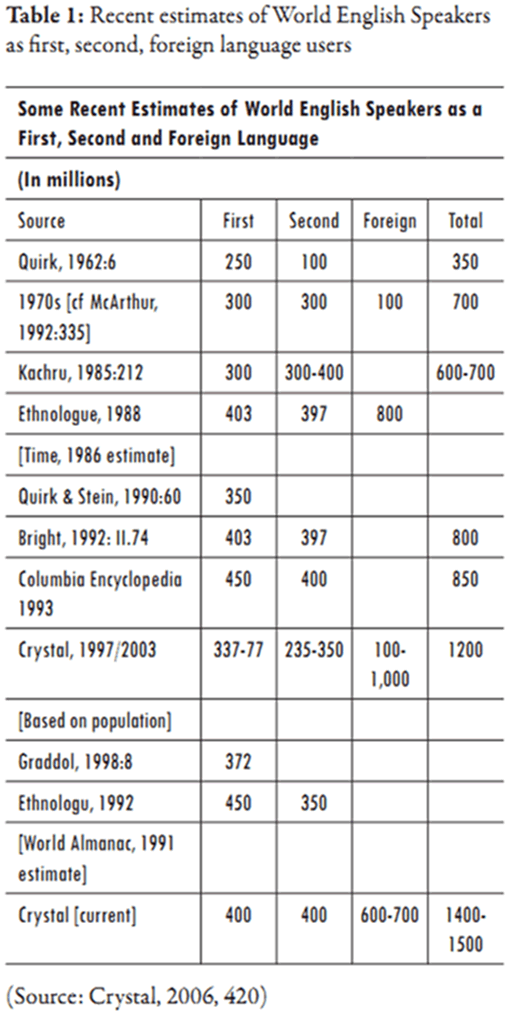
<body><![CDATA[<p><font size="2" face="Verdana, Arial, Helvetica, sans-serif">The top language benefits through the image-making  of the ads of transnational corporations and the  connotations of English with success and hedonism. These symbols are reinforced by an ideology that  glorifies the dominant language and serves to  stigmatize others, this hierarchy being rationalised  and internalized as normal and natural, rather than  as expression of hegemonic values and interests (p. 4).</font></p> </blockquote>     <p><font size="2" face="Verdana, Arial, Helvetica, sans-serif">Similarly, Awonusi (2004) observes:</font></p>     <blockquote><font size="2" face="Verdana, Arial, Helvetica, sans-serif">Hegemony with relation to language connotes a fairly  complex interplay of a number of variables such as  power (socioeconomic power of its users), control  (how the powerful users of a particular language use it  as a weapon of linguistic domination of communities  especially those that are multilingual or multicultural),  legitimacy (the dependence on a language as the basis  of social and political acceptance) and influence (the  exercise of power &#8211; oftentimes in its coercive form -and, sometimes, diplomacy such that the influence  of a language is enhanced either from policies such  as those of expansionism on the one hand or those of  socio-political co-operation on the other hand (p. 4).</font></blockquote>      <p><font size="2" face="Verdana, Arial, Helvetica, sans-serif">These observations of how linguistic hegemony  asserts itself are insightful and useful for  investigating the hegemony of the English  language in any community of the world where it is used as a second language, a foreign language, an  international language or among English language  learners. In what follows, we shall examine the  hegemony of the English language in some parts  of the world with particular reference to Nigeria. </font></p>     <p><font size="2" face="Verdana, Arial, Helvetica, sans-serif">The linguistic hegemony of the English language  as a global language has generated heated debates  in literature. Phillipson (1992) postulated  linguistic imperialism with a particular focus  on the spread and use of English on the bases  of historicity and politics through the British  Council and specialists in the language. Capturing  the English linguistic imperialism, he said: ''The  dominance of English is asserted and maintained  by the establishment and continuous reconstitution  of structural and cultural inequalities between  English and other languages'' (p. 47). Many have  argued that the English language is the first and  foremost formative basis of hegemonic practices.  This argument is based on the widespread  agreement in various disciplines and the spread  of English as the uncontested global lingua franca  (Crystal, 2003) cited in Tietze &amp; Dicki (2012).  It is the global language, the international lingua  franca (p. 2). Tsuda says that English is the <i>de  facto</i> international language of international  communication.</font></p>     <p><font size="2" face="Verdana, Arial, Helvetica, sans-serif">Talking about the dominant status of English as  today's most prevalent language, Ammon (1992)  admits that English commands the largest number  of speakers around the world (1.5billion), and the  only language with official status in over 60 nations  of the world. Ammon also says that English is the  dominant language in scientific communication  -with 70-80% academic publications in the  language-, the  <i>de facto</i> official and working  language in most international organizations, and  the most taught second/foreign language across  the world (pp.&nbsp;78-81). English as an international  language (EIL) has also been introduced as  bachelor's and master's degree programmes  in some universities (Matsuda, 2012). These  observations corroborate the reported place  of English in international politics, relations, education, intercultural communication, and  consequently, endorsing its dominance and global  influence.</font></p>     <p><font size="2" face="Verdana, Arial, Helvetica, sans-serif">Thus, the English language that was, once  confined to some limited tribes in the British  Isles but narrowly escaped extinction under the  influence of the French language, has emerged  today to become second to only one language  in the world, that is the Chinese (in terms of  speakers-population). In terms of geographical  coverage, English might be considered a global  language that is second to none. It has not only  resisted the influence of some world powers'  languages such as Latin, Greek, and French but  it has also acquired a high status among national  languages of former British colonies where the  local people shed off British colonial powers  but maintained former lords' language. Today,  statistics show the following about the English  language amongst its users as native speakers  (ENL) in the United Kingdom, the United States  of America, New Zealand, Australia, Trinidad  and Tobago, parts of Canada. The statistics also  show second language speakers of English ESL)  in Nigeria, Ghana, the Gambia, Zimbabwe,  Tanzania, India, Pakistan, Singapore, Hong Kong;  foreign language users (EFL) in Germany, France,  Sweden, China; and English language learners  (ELL). These classifications are sometimes helpful  in distinguishing users of English. First, the native  speakers (England, The United States of America,  and the others); second, former British colonies  such as India, Pakistan, Nigeria, Ghana, Hong  Kong who are today in ''possession of English  in the postcolonial era'' and have 'domesticated'  English to suit their socio-cultural environment as  second language users; and third, foreign language  users where British rule has never been experience  but the use of English is being encouraged. The  second group's varieties of English are native  to their users because ''they possess legitimate  endonormative varieties when they use English  in a number of domains.'' Thus, they are part of  the 'global Englishes' and their varieties are norm-evolving unlike foreign language users of English who are norm-dependent and rely on British  and American English for their norm (for more  discussion on these classifications, see Quirk,  1990; Kachru, 1991; Mollin, 2007; Sabec, 2003.)</font></p>     <p><font size="2" face="Verdana, Arial, Helvetica, sans-serif"><a href="#t01">Table 1</a> shows the rapid and steady increase in the  number of speakers of English whether as first  language speakers, second language and foreign  language speakers. It is interesting to note that  the increase is rapid among foreign users that have  been described as the expanding circle group.</font></p>     <p>&nbsp;</p>     <p align="center"><font size="2" face="Verdana, Arial, Helvetica, sans-serif"><a name="t01"></a><img src="/img/revistas/ikala/v19n1/v19n1a5t1.gif"></font></p>     ]]></body>
<body><![CDATA[<p>&nbsp;</p>     <p><font size="2" face="Verdana, Arial, Helvetica, sans-serif">Accordingly, it has been noted that people's beliefs  that English is the international lingua franca sometimes override reality and give even more  power to English in the global context. According to  Matsuda (2012), the status of English as the default  international language - both actual and imagined  - makes it popular in foreign language programmes  around the world (pp. 2-3). However, Crystal  (2003) postulates ''A language achieves a genuinely  global status when its special role is recognized not  only in the countries where it is spoken by a large  number of people as their mother tongue, but also  beyond'' (p. 3). English satisfies this criterion. Ortiz  (2011) says that in the global market of linguistic  goods, English becomes the language of global  modernity. Based on this status, some scholars have  justified the hegemony of English.</font></p>     <p><font size="2" face="Verdana, Arial, Helvetica, sans-serif">For example, Ortiz (2011) noted that in spite of  the obstacles, the dominance of English in the  social sciences continues. She asserts:</font></p>     <p><font size="2" face="Verdana, Arial, Helvetica, sans-serif">There is a consolidation of certain scientific  styles, global in scale, that favour the English  language. This is the case, for example, in the use  of databases whose production is conditioned by  various factors, such as technical factors, costs, and  market distribution. Between 1980 and 1996 in  the Social science citation index database, English  language publications count for between 85% and  96% of all articles (p. 34).</font></p>     <p><font size="2" face="Verdana, Arial, Helvetica, sans-serif">Counting the positive roles that English  plays internationally, Kubota (2012) observes  that in expanding circle countries, people  who can afford to travel and study abroad  or enjoy border-crossing experiences tend to  be socioeconomically privileged individuals.  Where English is not used for everyday  communication, acquiring English proficiency  tends to be an elitist accomplishment. By outer  circle, we refer to Kachru (1985) classification of  speakers of English into three &#8211; native speakers  of English as inner circle, second language  users of English as out circle, and expanding  circle for those speakers who use English as a  foreign language. In addition, English as an  international language indeed functions to make border-crossing communication active, critical  and reflective engagement in communication  across diverse ethnic, racial, linguistic and  socio-economic difference possible. English no  doubts plays an important role as a lingua franca  in various communicative contexts (pp.&nbsp;62-63).  Seidlhofer (2005) writes that ''English as a  lingua franca' (ELF) has emerged as a way of  referring to communication in English between  speakers with different first languages'' (p. 339).  Thus, De Swaan (2001) explains: ''English ... allows us to reach everyone who counts in the  field of natural sciences, advanced technology,  mass entertainment and corporate affairs.  English has come to serve a number of linking  functions, in fact, in almost all of them and  almost everywhere'' (p. 79).</font></p>     <p><font size="2" face="Verdana, Arial, Helvetica, sans-serif">Considering its international coverage that no  other living language has been able to rival for  many decades, there is no doubt that the English  language has established its hegemony although  the history of some previous world languages  should caution any writer to be modest in  applauding the success of English and predicting  its future. However, the process through which  the English language exerts itself as the dominant  language or global language is a subject of debate.  If we group the nations of the world into two,  nations that were former British colonies and  nations that never came under its imperialism  or colonisation, it might help account for the  dominance of English in some countries. In this  paper, we are concerned with the nations that  were once under the rule of the British Empire,  and in particular Nigeria is given attention.</font></p>     <p><font size="2" face="Verdana, Arial, Helvetica, sans-serif">Before accounting for English domination, the  writer cautions the way in which scholars might  want to view the impact of English throughout the  world. The author believes that it might be unfair  to ignore the positive impact and the roles that  the language has played and is playing in Nigeria  and perhaps in the world at large, although studies  on the hegemony of English have reported its  negative impacts on other languages.</font></p>     <p><font size="2" face="Verdana, Arial, Helvetica, sans-serif">The literature on hegemony of the English language  among users of English as a second language is very  robust (Adegbite, 2003; Adeyemi, 2008; Awonusi,  2004; Babalola, 2002; Bamgbose, 1998; Guo &amp;  Beckett, 2007; Ngugi wa, 1981; Nwachukwu, 2003;  Nwajeh, 2003; Okwudishu, 2006; Pennycook,  1994; Salawu, 2006; Suarez, 2002; Shumann, 2012;  Tietze &amp; Dick, 2012; Tsuda, 1992 among others).  However, the common denominator among these  studies appears to be the linguistic hegemony of  English and its negative effect on many other world  languages.</font></p>     <p><font size="2" face="Verdana, Arial, Helvetica, sans-serif">Thus, in spite of the important place it occupies, the  hegemony of the English language has come under  sharp criticism and resistance. For example, Awonusi  (2004) observes that the hegemony of English has  been criticized for going beyond the supposedly  neutral function as lingua franca that brings  speakers of different indigenous languages together  (pp. 13-14). Stutnabb-Kangas (2000) argued that  globalisation results in Englishisation, which plays  a divisive role in the world that those cheerleaders  of globalisation fail to acknowledge and analyse.  Awonusi (2004) notes that this ideological position  of English presents the language as a capitalist tool,  i.e., a market-driven construct within a linguistic  English language industry, which becomes an  expansionist language that threatens the continued  development and vitality of other languages. This  is not an isolated voice. Recently in education,  Shumann (2012) wrote in late 2011, President Hu  Jin-tao of China published a controversial essay in  which he highlighted what he saw as a culture of war  between China and the West - primarily with the  English-speaking world. He identified the United  States - like the United Kingdom before it - as a  force that ''exploits its strength to export cultural  products throughout the world.'' He likened these  cultural products to opium.</font></p>     <p><font size="2" face="Verdana, Arial, Helvetica, sans-serif">At the local level, e.g., in Africa, scholars have  commented on the negative impact of the  dominance of the English language. For example,  Adeyemi (2008) noted that in the wake of the  hegemonic influence of foreign languages like English and French, African languages in these  modern times are being marginalised in terms  of acquisition, learning, and use (p. 14). Other  scholars have reported similar position in their  works. For example, it has been observed that the  neglect of indigenous languages in Nigeria could  be attributed to the fatal effects of interventions  like the slave trade, colonialism, and advent of  foreign religions. Bamgbose (1999) noted that  the subordinate status of African languages in  relation to the imported European languages  is one phenomenon that exists in almost every  country in Sub-Saharan Africa (p. 13).</font></p>     ]]></body>
<body><![CDATA[<p><font size="2" face="Verdana, Arial, Helvetica, sans-serif">Unfortunately, efforts to revitalize African local  languages, as some scholars have reported, have  recorded little or no success. In fact, Adeyemi  (2008) holds that achieving this goal in Africa has  turned out to be a wishful fantasy in view of the  apparent disuse of African local languages in our  development processes (p. 17). This scenario is  repeated in Sonaiya's (2007) observation that ''... what continues to be of great concern to many in  Africa is the fact that even after independence not  only are European languages still being maintained  within the educational system, but very little is  being done to develop African languages which  had suffered over a century of neglect'' (p. 18).</font></p>     <p><font size="2" face="Verdana, Arial, Helvetica, sans-serif">However, the other school of thought that tends  to cheer the dominance of English opines that  there are factors that justify its hegemonic status.  Thus, the general claim in literature is that going  by the rapid development, acceptance and use of  English in Nigeria, the local languages are not only  being endangered but also there is a widespread  language shift that might lead to language loss if  practical steps are not taken in time.</font></p>     <p><font size="2" face="Verdana, Arial, Helvetica, sans-serif">To address the reported endangered African  languages and propose any resistance mechanisms,  it might be necessary to assess the process of the  linguistic hegemony of English in Nigeria first.  Although it might be difficult to objectively  account for the process of linguistic hegemony of  the English language in Nigeria using Grimscian concept of hegemony, however, it might offer  some insights. The Grimscian concept claims  that hegemony exerts itself through the process  of ''consent and persuasion via the processes of  leadership without force, leadership through  legitimation and leadership through consensual  rule'' (for the history of English in Nigeria, see  Spencer, 1971; Bamgbose, 1996; Banjo, 1996).  Bamgbose (1999) observed that the root of  the subordinate status of African languages in  relation to the imported European languages can  be traced mainly to colonial language policies that  spelt total proscription of use, benign neglect,  grudging acceptance, and tolerance of African  languages (p.&nbsp;13). </font></p>     <p><font size="2" face="Verdana, Arial, Helvetica, sans-serif">However, post-colonial era events and the adoption  of the English language as the official language and de  facto lingua franca across the multi-ethnolinguistic  community after Nigeria gained independence  from its former lords might be argued to have  followed the Grimscian concept. From whichever  historical account of the introduction of English  in Nigeria, the current dominance of the language  on the indigenous languages in Nigeria in terms of  status and functions might be less controversial.  Thus, some scholars have justified the hegemony of  the English language in Nigeria on of its widespread  usage and acceptability. </font></p>     <p><font size="2" face="Verdana, Arial, Helvetica, sans-serif">There is no doubt that English enjoys an  unparalleled status and usage among the educated  class and in the nation as a whole. English is the  <i>dominant</i> official language, the language of the  media, the court, the legislature, language of  instruction, and of politics. In spite of this prestige  and these functions, an empirical enquiry into  the statistics of the educated (literate in English)  and uneducated users in Nigeria might question  the validity of the reported widespread usage and  acceptance in&nbsp; the country. In other words, if the  population of those who are literate in English  is compared with the illiterate population, the  differences may not support the claim that the  English language enjoys widespread usage and  acceptability. </font></p>     <p><font size="2" face="Verdana, Arial, Helvetica, sans-serif">Similarly, the language attitude of the people must  be surveyed in order to arrive at its acceptability  in the country. Otherwise, we might be providing  an exaggerated picture that faintly reflects what  obtains in urban centres where you find a (lesser  population compared with rural dwellers). For  example, according to Euromonitor International  (2010) as of 2009, 53% of Nigeria's population  speak English: ''the vast majority of these 53%  speak Nigerian Pidgin - an English-based Pidgin  or Creole.'' Perhaps, Nigerian Pidgin can be  more widely accepted and in use than any other  language in Nigeria (Osakwe, 2005).</font></p>     <p><font size="2" face="Verdana, Arial, Helvetica, sans-serif">However, it cannot be denied that like other  languages of the world, Nigerian languages (aside  from Nigerian English) are negatively impacted by  the dominance of English as the ''hegemonic and  neocolonialist language''. Certain consequences  of the dominance of English have been indicated  in the literature. Amongst them are linguistic and  communicative inequality - a great disadvantage  of the speakers of languages other than English;  discrimination against the non-English speaking  people and those who are not proficient in  English; colonization of the consciousness of the  non-English speakers, causing them to develop  linguistic, cultural, and psychological dependence  upon, and identification with, the English  language, its culture and people (Tsuda, 2012).</font></p>       <blockquote>         <p><font size="2" face="Verdana, Arial, Helvetica, sans-serif">Thus, in literature, some suggestions have been made  on how to curb or resist the linguistic hegemony of  the English language because of its negative impacts,  which among others are ''inequality, discrimination,  colonization of the mind as well as Americanization,  transnationalization, and commercialization of our  contemporary life,'' as well as language endangerment,  language shift and language loss.</font></p>   </blockquote>     <p><font size="2" face="Verdana, Arial, Helvetica, sans-serif">However, consideration should be given to a  germane question that Suarez (2002, p. 515)  raises: ''Within the context of heritage language  use in a democratic society, to what extent will  individuals maintain their heritage language when  there are incentives and opportunities to shift,  as presented through hegemonic ideologies in a given community?'' Our response to this question  guides our proposed resistance mechanism.</font></p>     ]]></body>
<body><![CDATA[<p>&nbsp;</p>     <p><font size="3" face="Verdana, Arial, Helvetica, sans-serif"><b>RESISTING THE DOMINANCE OF THE ENGLISH  LANGUAGE</b></font></p>     <p><font size="2" face="Verdana, Arial, Helvetica, sans-serif">Resisting the hegemony of English has been  suggested in literature in many ways. For example,  Tsuda (1994) describes the ecology of language as  a counter-strategy to the hegemony of English:</font></p>     <blockquote><font size="2" face="Verdana, Arial, Helvetica, sans-serif">Tsuda's paradigm serves as a theory or perspective for  promoting a more equal language and communication  policy of the world which is based on the theoretical  positions of human rights, equality in communication,  multilingualism, maintenance of languages and  cultures, protection of national sovereignties,  promotion of foreign language education (pp. 58-59).</font></blockquote>      <p><font size="2" face="Verdana, Arial, Helvetica, sans-serif">She calls on scholars in international and  intercultural communication to subject the  hegemony of English to academic enquiry. The call  is also extended&nbsp;to professionals in English language  teaching to&nbsp; incorporate the ecology of language  paradigm into the contents and methods of  teaching as well as teacher education and to speakers  of English (native and non-native) to educate  themselves on the philosophy of the ecology of  language in order to become sensitive to the ethical  aspects of international communication.</font></p>     <p><font size="2" face="Verdana, Arial, Helvetica, sans-serif">Perhaps as a response to this call, Suarez (2002)  suggests individual's awareness of, and resistance  towards, linguistic hegemony, and heritage  language maintenance (language use motivated  by antihegemonic ideologies). While at first it  may seem that to resist linguistic hegemony is to  resist the dominant language; this would not be a  successful resistance. In fact, successful resistance  may lie in the usefulness of the dominant language.  As Eriksen (1992) states, ''perhaps paradoxically,  cultural minorities may have to assimilate culturally  in important respects in order to present their  case effectively and thereby retain their minority  identity'' (p. 313). Eriksen (1992) continues:</font></p>     <blockquote><font size="2" face="Verdana, Arial, Helvetica, sans-serif">Any opposition against the use of dominant language  is inherently paradoxical. With no knowledge of these  languages, one remains parochial and powerless. The paradox, then, of linguistic hegemony is that one must  buy into it, or acquiesce on some level in order to resist  it. Resistance is not through monolingualism in the  minority language, but rather through bilingualism.  Proficiency in both languages is the successful strategy  of resistance (p. 319).</font></blockquote>      <p><font size="2" face="Verdana, Arial, Helvetica, sans-serif">However, Kaplan (1993) observes that to some  extent, the hegemony of English seems to militate  against bilingualism even though ultimately it  probably does not. In Nigeria, ''English holds on  to this power via hegemonic means: English as the  language of usefulness is unquestioned. Incentives  and rewards for learning English are offered''  (p.&nbsp;151). </font></p>     <p><font size="2" face="Verdana, Arial, Helvetica, sans-serif">An appropriate application of Suarez's (2002)  paradox to Nigeria's situation may lie in a blend  of heritage language maintenance and English language learning. Suarez's (2002) paradoxical  strategy of linguistic hegemony resistance  recommends that in order to be successful, resistance  necessitates acquiescence to this hegemony on a  certain level, namely proficiency in the dominant  language that at the same time fuels the conviction  towards heritage language maintenance. Suarez  (2002) argues that the effectiveness of linguistic  hegemony notwithstanding, linguistic minority  groups can and maintain minority languages  over time (p.&nbsp; 514). Other factors that might aid  maintenance of heritage languages that have been  identified in the literature include ethnolinguistic  vitality of the language group (Yagmur et al., 1999),  language as a symbol of a stigmatised ethnic group  (Brankston &amp; Henry, 1998), modernization, and  occupational and education mobility (Priestly,  1994), establishment of ethnic identity (Koenig,  1980), political and social attitudes (Frank, 1993),  network-situated strategies of social reproduction  (O Riagain, 1994), and native language use as a  resistance to linguistic hegemony (Shannon, 1995).</font></p>     <p><font size="2" face="Verdana, Arial, Helvetica, sans-serif">Focusing on her resistance mechanism, Suarez  (2002) adopts Van Deusen-Scholl's (2000) working  definition of heritage language, which says that  a heritage language speaker is one who has been  exposed to a language other than the dominant  language in the home, often a minority language within a nation-state. In this case, while English as  a global language should be duly acknowledged and  utilized for maximized benefits such as administrative  convenience and economy, international politics and  diplomacy, inter-tribal communication, technology  and education, families and other institutions in  the country should promote the learning and use of  local languages vigorously. This pragmatic approach  is illustrated by one of the two groups that constitute  Suarez's (2002) study of family portraits of family  language choice. Suarez's (2002) describes the two  family groups:</font></p>     ]]></body>
<body><![CDATA[<blockquote><font size="2" face="Verdana, Arial, Helvetica, sans-serif">...they (<i>both family groups</i>) wish for themselves and  for their children a chance of a better life, a chance for  better educational, economic, and social opportunities.  However, families who are shifting to English seem  to view the simultaneous maintenance of Spanish as  potentially blocking the achievement of these goals.  On the other hand, the families who have decided to  maintain Spanish seem to challenge the legitimation  of English by challenging the very notion that  English needs to supplant Spanish. They counter this  legitimation of English by emphasising that Spanish is  just as important for achieving the promises of a better  life. These families seem to understand that opportunity,  and their children's opportunity, is in learning English  and in maintaining Spanish. Their opportunity is in  accessing English and in retaining their ethnicity. The  families who are maintaining Spanish at home suggest an  awareness of the paradox of linguistic hegemony that the  promises of 'English-only can actually only be yielded  by bilingualism, by becoming fluent in the dominant  language and by maintaining the heritage language and  culture (p. 528).</font></blockquote>      <p><font size="2" face="Verdana, Arial, Helvetica, sans-serif">It appears that the language practice among many  educated Nigerians tends to shift towards English-only because of their belief that maintenance of local  languages might block the achievement of a better  life. However, to stem the tide of language shift  towards English in Nigeria, the paradox of linguistic  hegemony which fosters bilingualism might be  promising although the kind of bilingualism that we  recommend here appears to be the opposite of what  Jubril's (2007) describes as ''... a transitional stage  towards language shift or language loss'' (p. 285).</font></p>     <p><font size="2" face="Verdana, Arial, Helvetica, sans-serif">Therefore, we suggest the use of ''resistance'' in a  special sense to call for concerted efforts that will help remove all kinds of self-imposed negative  attitudes towards indigenous and local languages,  and promote their use in their domain. Thus, while  endorsing Suarez's paradox of linguistic hegemony  as an effective way of resisting the linguistic  hegemony of the English language especially  in Nigeria where the dominance of the English  language on the indigenous languages might have  been exaggerated, we call for the promotion of  bilingualism or plurilingualism of English and  local languages. This would involve accepting,  popularizing, and institutionalizing of the latter.</font></p>     <p>&nbsp;</p>     <p><font size="3" face="Verdana, Arial, Helvetica, sans-serif"><b>PROMOTION OF LOCAL LANGUAGES</b></font></p>     <p><font size="2" face="Verdana, Arial, Helvetica, sans-serif">We have stressed a need to promote Nigeria's  local languages within the purview of Suarez's  paradox of linguistic hegemony described earlier  in section 5. This approach maintains a middle  course between radical pro-English activists (who  do not see any good in promoting local languages)  and pro-local language activists who would rather  see the fall of English not only in their region  but in the world at large barring its native homes.  However, there are other evidences that support a  need to promote local languages.</font></p>     <p><font size="2" face="Verdana, Arial, Helvetica, sans-serif">Evidence of language shift and eventual language  loss in Nigeria are sociolinguistic realities that  arevery threatening. In a multilingual society  where features of polyglossia (division of language  function), high language(s) and low language(s)  are in place, the survival low language(s) are not  only threatened but are also suppressed to the  background and may suffer extinction, there is  a need to promote local languages. This is the  situation in Nigeria where its over 400 languages  might be difficult to maintain if these linguistic  phenomena (language endangerment and language  shift) are not curtailed.</font></p>     <p><font size="2" face="Verdana, Arial, Helvetica, sans-serif">Another linguistic phenomenon in a multilingual  setting is language conflict. This is a natural  occurrence among languages and/or language  speakers that compete for dominance and/or  survival. According to Kembo-Sure &amp; Webb (2000),  conflict linguistics deal with situations in which two or more languages or varieties of languages that are  in contact with each other and (used in the same  communities) are also in a state of competition, that  is, in a relationship of tension. Such tension may  lead to one language dominating or threatening the  existence of the other languages (p. 110). Studies  on the language situation in Nigeria also report  that there is competition among the local languages  especially between the languages of the majority  ethnic groups and the languages of the minority  ethnic groups on the one hand. On the other  hand, there is a relative low competition between  Nigerian Pidgin and the English language, although  traditionally it is held that English occupies such a  very prestigious position in the language choice of  the people that no other language can be said to be  in competition with it.</font></p>     <p><font size="2" face="Verdana, Arial, Helvetica, sans-serif">However, one unavoidable effect of language  competition is tension among speakers of the  different languages because speakers of dominant  languages would feel marginalized. Obododimma  (2004) captures the tension thus: ''the languages of  the majorities in Nigeria have often featured as the  coveted languages of power, particularly because their  native speakers often dominate and exercise control  at social, political and professional levels''(p.&nbsp;286).</font></p>     <p><font size="2" face="Verdana, Arial, Helvetica, sans-serif">Another factor that has empirical backing is  connected with some of the gains of promoting  local languages. Empirical studies in and outside  Nigeria show that contrary to the general belief that  first language competence impedes the learning of  second language, the opposite is the case. In other  words, promoting the learning of English only at the  expense of the local languages will not improve the  performance of second language learners of English or  their overall educational performance. For example,  Kembo-Sure and Webb (2000) noted that research  has shown that maximum education benefits from  bilingualism are possible only when children are  trained to a level where they are bilinguals, i.e. where  competence in the first language is comparable to  that in the second language (p. 129). This position is  upheld in other studies (Cummins, 1984; Mustapha,  2012) that refer to this submission as the threshold  level for L2 users and learners.</font></p>     ]]></body>
<body><![CDATA[<p><font size="2" face="Verdana, Arial, Helvetica, sans-serif">The implication of these studies is that if competence  in the first language is inadequate, there will be no  advantage when the second language is introduced.  In fact, there will be difficulty in mastering second  language skills, thereby leading to educational  failure. By extension, if competence in the first  language becomes weaker than competence in the  second language as a result of neglect in education,  the chances are that it will be further weakened by  the switch to the second language.</font></p>     <p><font size="2" face="Verdana, Arial, Helvetica, sans-serif">The importance of threshold factor stressed  in the preceding paragraph is associated with  another factor which stresses the importance of  strengthening mother tongue education in order to  provide a solid literacy base for later education in  European languages (Kembo-Sure &amp; Webb, 2000).  Kembo (2000) argues that cognitive and affective  development occurs more effectively when  learners know language very well (p. 289), which  is usually the first language. By extension, learning,  in general, but including second language and  foreign language learning occurs more effectively  if the required cognitive development has already  occurred through the use of a first language as  a language of learning. Thus, Cummins (1984)  showed that (i) optimal first language education  provides a rich cognitive preparation for the  acquisition of a second language and (ii) the literacy  skills already acquired in the first language (and, of  course, the&nbsp;cognitive skills) provide easy transition  to the second language medium education.</font></p>     <p><font size="2" face="Verdana, Arial, Helvetica, sans-serif">It must be noted that these reasons are not  intended to take a position that suggests that  the adopted European language(s) should be  disregarded. In fact, going by any objective  assessments of communication importance, it is  nearly impossible to relegate the English language  without paying the price. It has been stressed in  literature that the use of European languages has  brought them enormous advantages, such as access  to the knowledge, creativity, and entertainment of  the entire Western world, as well as participation  in global trade and commerce. In fact, European  languages have become an integral part of the lives of the African people, (in this case Nigerians) and  are indeed resources to be nurtured and developed.</font></p>     <p><font size="2" face="Verdana, Arial, Helvetica, sans-serif">However, these advantages should not be  overstretched to undermine the use of local  languages and the peoples' cultural identities and  heritages. A similar position is taken by Okorie  (2008) that language and vis-&agrave;-vis the indigenous  language of a people, is a fundamental aspect of  their identity, with which they are not only known  but can express themselves or communicate with  one another (p. 123). Thus local languages must  be promoted among their speakers. To stem the  tide of our local language endangerment and avert  language shift, language loss and the attendant  consequence of loss of identity, we argue that our  local languages ought to be promoted. </font></p>     <p><font size="2" face="Verdana, Arial, Helvetica, sans-serif">Finally, those in favour of promoting Nigerian  languages have argued that the greater use of African  languages will lead to the growth of&nbsp;more balanced  citizens, both culturally and educationally since  those trained in their mother tongues seem to  have a more positive self-image and greater respect  for other languages and their speakers. Kembo-Sure &amp; Webb, (2000) reported that bilinguals  have also been shown to be more culturally  flexible, as they are socially more balanced and  accommodating than monolinguals. Kembo-Sure  &amp; Webb (2000) have argued that there are fewer  chances of political and cultural polarity if people  are exposed to more languages than if there are  barriers against certain languages. Thus, African  communities have more to gain by being bilingual,  especially as they have been accurately described  as culturally and linguistically pluralistic, which  stresses the importance of bilingual education and  the teaching of indigenous languages in schools.  Kembo-Sure &amp; Webb (2000) advocate harnessing  linguistic resources as a move towards cultural and  political harmony and economic development in  Africa. Kembo states the following (2000):</font></p>     <blockquote><font size="2" face="Verdana, Arial, Helvetica, sans-serif">If people of Africa want to give themselves a realistic  opportunity to develop to their full potential  educationally, economically, and politically, and to  contribute to the resolution of their many problems, the issue of language in education must be addressed  (p. 286).</font></blockquote>      <p><font size="2" face="Verdana, Arial, Helvetica, sans-serif">However, in this paper, the stance of the author is  that practical steps must be taken to promote our  local languages although there is a need to maximally  explore the offers of European languages&nbsp;- (in this  case, English), to foster our status economically,  politically, socially and culturally among the comity  of nations. A similar position is taken by Kembo-Sure &amp; Webb (2000, p. 122):</font></p>     <blockquote>       <p><font size="2" face="Verdana, Arial, Helvetica, sans-serif">The standardization or popularization of the local  varieties of European languages should not mean  that indigenous language are once more relegated to  inferior positions. On the contrary, the acceptance  and recognition of European varieties require a  parallel recognition and popularization of the local  languages, so that they too can gain respectability.  They must be assigned more important roles in the  public institutions, including the mass media schools,  and churches. They must also be used in the provision  of government services. This way, people will develop  more positive attitudes to them, and their vitality can  be enhanced (p. 122).</font></p> </blockquote>     <p><font size="2" face="Verdana, Arial, Helvetica, sans-serif">In the light of our discussion thus far, and the  recommendations of others on the need to  promote Nigeria's local languages, we suggest the  following steps:</font></p> <ol>         ]]></body>
<body><![CDATA[<li><font size="2" face="Verdana, Arial, Helvetica, sans-serif">The integration of local languages in the  curriculum for our primary, secondary, and  tertiary education &#8211; as a school subject;</font></li>         <li><font size="2" face="Verdana, Arial, Helvetica, sans-serif">Required communicative competence in local  languages for employees in state, national,  and international offices (including political  assignments and /posts) in Nigeria and  Nigerian diplomatic offices abroad similar  to English requirement for employees in the  United Kingdom; </font></li>         <li><font size="2" face="Verdana, Arial, Helvetica, sans-serif">The use of local languages for announcements  in local and international airports -on board to  and from Nigeria-; airlines owned by Nigerians  should adopt the use of local languages before  translating to other world languages; </font></li>         <li><font size="2" face="Verdana, Arial, Helvetica, sans-serif">Local language centres (including websites)  should be set up in foreign countries where Nigerians are domiciled (The Nigerian Council)  to enable their children to learn local languages; </font></li>         <li><font size="2" face="Verdana, Arial, Helvetica, sans-serif"> Universities, polytechnics, and colleges of  education in Nigeria and bodies involved in  the promotion of local languages should offer  scholarships and research grants for courses  and research in the local languages across the  nation. While there are research centres outside  of the country that give research grants and  scholarships for studies in our local languages,  the author of this paper is not aware of such  institutions in Nigeria. </font></li>       </ol>   <font size="2" face="Verdana, Arial, Helvetica, sans-serif">The author of this paper believes that implementing  these steps would help popularize and institutionalize  our local languages not only on paper but also in  practical terms, thereby according them functional  prestige and status. In some countries where some  of these measures are in place such as (South Africa  and Tanzania), many of the local languages are  thriving. In addition, the suggested measures, in this  paper, stress the acceptance of local languages, which  implies an obligation to popularize them through  the mass media, the educational system, publishing  houses, and government administration. It also  means producing dictionaries and style manuals  for the languages, and printing textbooks that  promote&nbsp;the languages.   </p>   </font>     <p>&nbsp;</p>     <p><font size="3" face="Verdana, Arial, Helvetica, sans-serif"><b>CONCLUSION</b></font></p>     <p><font size="2" face="Verdana, Arial, Helvetica, sans-serif">In light of the hegemony of the English language  and its effects on other world languages especially  local languages in Nigeria, this paper calls for  institutional support of Nigeria's local languages  similar to Kiswahili in Tanzania and in Kenya.  Such support will accord our local languages an  enhanced status and more respect nationally  and perhaps give the less-educated what Kebb &amp;  Kembo-Sure (2000) call 'a sense of worth'. Local  languages must be given greater functional status  in Nigeria's educational systems, the civil service,  and the media and national life of the citizenry.  It has been stressed that when our local languages  are promoted among their native speakers,  well-balanced citizens that are educationally, culturally and socially well-grounded, flexible,  and accommodating enough to narrow political,  ethnic, and cultural polarity in the multi-ethnic  society would be the end-product.</font></p>     <p><font size="2" face="Verdana, Arial, Helvetica, sans-serif">In conclusion, this paper calls for what has  been referred to as language revalorization  programme (Webb, 1994), which is aimed at  raising the functional usefulness, the prestige,  and the social status of our local languages as  a resistance mechanism patterned after the -  ''paradox of linguistic hegemony'' framework.  In addition, since English plays a very important  role in our modern world (both nationally and  internationally), its learning and use must be  maintained. Similarly, indigenous languages play  a role in national integration, and are important  element of socio-cultural identity. Thus, they  must be accorded commensurate recognition in  use among their speakers.</font></p>     ]]></body>
<body><![CDATA[<p>&nbsp;</p>     <p><font size="3" face="Verdana, Arial, Helvetica, sans-serif"><b>REFERENCES</b></font></p>     <!-- ref --><p><font size="2" face="Verdana, Arial, Helvetica, sans-serif">1. Adegbite, W. (2003). Enlightenment and attitudes of the  Nigerian elite on the roles of languages in Nigeria.  <i>Language, Culture and Curriculum 16</i>(2), 185-196.    &nbsp;&nbsp;&nbsp;&nbsp;&nbsp;&nbsp;&nbsp;&nbsp;[&#160;<a href="javascript:void(0);" onclick="javascript: window.open('/scielo.php?script=sci_nlinks&ref=000115&pid=S0123-3432201400010000500001&lng=','','width=640,height=500,resizable=yes,scrollbars=1,menubar=yes,');">Links</a>&#160;]<!-- end-ref --> </font></p>     <!-- ref --><p><font size="2" face="Verdana, Arial, Helvetica, sans-serif">2. Adeyemi, A. (2008). Empowering African languages:  Rethinking the strategies. <i>The Journal of Pan African  Studies, 23</i>, 14-32.    &nbsp;&nbsp;&nbsp;&nbsp;&nbsp;&nbsp;&nbsp;&nbsp;[&#160;<a href="javascript:void(0);" onclick="javascript: window.open('/scielo.php?script=sci_nlinks&ref=000117&pid=S0123-3432201400010000500002&lng=','','width=640,height=500,resizable=yes,scrollbars=1,menubar=yes,');">Links</a>&#160;]<!-- end-ref --> </font></p>     <!-- ref --><p><font size="2" face="Verdana, Arial, Helvetica, sans-serif">3. Ammon, U. (1992). Gengo-to Sono Chii. Translated by Y.  Hieda and H. Yamashita. Tokyo: Sangensha.    &nbsp;&nbsp;&nbsp;&nbsp;&nbsp;&nbsp;&nbsp;&nbsp;[&#160;<a href="javascript:void(0);" onclick="javascript: window.open('/scielo.php?script=sci_nlinks&ref=000119&pid=S0123-3432201400010000500003&lng=','','width=640,height=500,resizable=yes,scrollbars=1,menubar=yes,');">Links</a>&#160;]<!-- end-ref --> </font></p>     <!-- ref --><p><font size="2" face="Verdana, Arial, Helvetica, sans-serif">4. Awonusi, S. (2004). Globalization and hegemonic English in  Nigeria: Identity conflicts and linguistic pluralism.  In Oni, D. et al (Eds.) <i>Nigeria and Globalization</i>  (pp. 85-102). Lagos: Centre for Blacks and African  Arts Civilization.    &nbsp;&nbsp;&nbsp;&nbsp;&nbsp;&nbsp;&nbsp;&nbsp;[&#160;<a href="javascript:void(0);" onclick="javascript: window.open('/scielo.php?script=sci_nlinks&ref=000121&pid=S0123-3432201400010000500004&lng=','','width=640,height=500,resizable=yes,scrollbars=1,menubar=yes,');">Links</a>&#160;]<!-- end-ref --> </font></p>     ]]></body>
<body><![CDATA[<!-- ref --><p><font size="2" face="Verdana, Arial, Helvetica, sans-serif">5. Awonusi, S. Linguistic hegemony and the plight of minority  languages in Nigeria. Retrieved From <a href="http://www.reseau-amerique-latine.fr/ceisal-bruxelles/ESE/ESE-7-AWONUSI.pdf" target="_blank">http://www.reseau-amerique-latine.fr/ceisal-bruxelles/ESE/ESE-7-AWONUSI.pdf</a> 27.3.2013 </font>&nbsp;&nbsp;&nbsp;&nbsp;&nbsp;&nbsp;&nbsp;&nbsp;[&#160;<a href="javascript:void(0);" onclick="javascript: window.open('/scielo.php?script=sci_nlinks&ref=000123&pid=S0123-3432201400010000500005&lng=','','width=640,height=500,resizable=yes,scrollbars=1,menubar=yes,');">Links</a>&#160;]<!-- end-ref --><!-- ref --><p><font size="2" face="Verdana, Arial, Helvetica, sans-serif">6. Babalola, E. T. (2002). The development and preservation  of Nigerian languages and cultures: The role  of the Local Government. Studia Anglica  Posnaniensia: <i>International Review of English  Studies</i>.  Retrieved from &#91;www document&#93; URL: <a href="http://www.thefreelibrary.com/The+development+and+preservation+of+Nigerian+languages+and+cultures:...-a09557178810/10/2007" target="_blank">http://www.thefreelibrary.com/The+development+and+preservation+of+Nigerian+languages+and+cultures:...-a09557178810/10/2007</a></font>&nbsp;&nbsp;&nbsp;&nbsp;&nbsp;&nbsp;&nbsp;&nbsp;[&#160;<a href="javascript:void(0);" onclick="javascript: window.open('/scielo.php?script=sci_nlinks&ref=000124&pid=S0123-3432201400010000500006&lng=','','width=640,height=500,resizable=yes,scrollbars=1,menubar=yes,');">Links</a>&#160;]<!-- end-ref --><!-- ref --><p><font size="2" face="Verdana, Arial, Helvetica, sans-serif">7. Bamgbose, A. (1996). Post-imperial English in Nigeria  1940-1990. In Fishman, J. A. Conrad, A. W. &amp;  Rubal-Lopez, A. (Eds.) <i>Post-Imperial English</i> (pp.&nbsp;357-372). Berlin: Mouton de Gruyter.    &nbsp;&nbsp;&nbsp;&nbsp;&nbsp;&nbsp;&nbsp;&nbsp;[&#160;<a href="javascript:void(0);" onclick="javascript: window.open('/scielo.php?script=sci_nlinks&ref=000125&pid=S0123-3432201400010000500007&lng=','','width=640,height=500,resizable=yes,scrollbars=1,menubar=yes,');">Links</a>&#160;]<!-- end-ref --> </font></p>     <!-- ref --><p><font size="2" face="Verdana, Arial, Helvetica, sans-serif">8. Bamgbose, A. (1998). Language as a resource: An African  perspective. In Read, M. J. &amp; Webb, V. (Eds).  Working Papers in the Role of the African Languages  in Democratic South Africa. R <a href="http://www.up.ac.za/academic/libarts/crpl/1998-03-05-Bamgbose.pdf" target="_blank">http://www.up.ac.za/academic/libarts/crpl/1998-03-05-Bamgbose.pdf</a> 30.5.2007 </font>&nbsp;&nbsp;&nbsp;&nbsp;&nbsp;&nbsp;&nbsp;&nbsp;[&#160;<a href="javascript:void(0);" onclick="javascript: window.open('/scielo.php?script=sci_nlinks&ref=000127&pid=S0123-3432201400010000500008&lng=','','width=640,height=500,resizable=yes,scrollbars=1,menubar=yes,');">Links</a>&#160;]<!-- end-ref --><!-- ref --><p><font size="2" face="Verdana, Arial, Helvetica, sans-serif">9. Bamgbose, A. (1999). African language development and  language planning. <i>Social Dynamics, 25</i>(1), 13-30.    &nbsp;&nbsp;&nbsp;&nbsp;&nbsp;&nbsp;&nbsp;&nbsp;[&#160;<a href="javascript:void(0);" onclick="javascript: window.open('/scielo.php?script=sci_nlinks&ref=000128&pid=S0123-3432201400010000500009&lng=','','width=640,height=500,resizable=yes,scrollbars=1,menubar=yes,');">Links</a>&#160;]<!-- end-ref --> </font></p>     <!-- ref --><p><font size="2" face="Verdana, Arial, Helvetica, sans-serif">10. Banjo, A. L. (1996). <i>Making a Virtue of Necessity: An  Overview of the English Language in Nigeria</i>. Ibadan:  Ibadan University Press.    &nbsp;&nbsp;&nbsp;&nbsp;&nbsp;&nbsp;&nbsp;&nbsp;[&#160;<a href="javascript:void(0);" onclick="javascript: window.open('/scielo.php?script=sci_nlinks&ref=000130&pid=S0123-3432201400010000500010&lng=','','width=640,height=500,resizable=yes,scrollbars=1,menubar=yes,');">Links</a>&#160;]<!-- end-ref --> </font></p>     <!-- ref --><p><font size="2" face="Verdana, Arial, Helvetica, sans-serif">11. Brankston, C. &amp; Henry, J. (1998). The silence of the Gators:  Cajun ethnicity and intergenerational transmission  of Louisiana French. <i>Journal of Multilingual and  Multicultural Development, 19</i>, 1-23.    &nbsp;&nbsp;&nbsp;&nbsp;&nbsp;&nbsp;&nbsp;&nbsp;[&#160;<a href="javascript:void(0);" onclick="javascript: window.open('/scielo.php?script=sci_nlinks&ref=000132&pid=S0123-3432201400010000500011&lng=','','width=640,height=500,resizable=yes,scrollbars=1,menubar=yes,');">Links</a>&#160;]<!-- end-ref --> </font></p>     <!-- ref --><p><font size="2" face="Verdana, Arial, Helvetica, sans-serif">12. Crystal, D. (2003). <i>English as a World Language</i>. London:  Penguin.    &nbsp;&nbsp;&nbsp;&nbsp;&nbsp;&nbsp;&nbsp;&nbsp;[&#160;<a href="javascript:void(0);" onclick="javascript: window.open('/scielo.php?script=sci_nlinks&ref=000134&pid=S0123-3432201400010000500012&lng=','','width=640,height=500,resizable=yes,scrollbars=1,menubar=yes,');">Links</a>&#160;]<!-- end-ref --> </font></p>     <!-- ref --><p><font size="2" face="Verdana, Arial, Helvetica, sans-serif">13. Crystal, D. (2006). English worldwide. In R. Hogg &amp; D.  Denison (Eds.). <i>A history of the English language</i>  (pp.420-439). London, England: Routledge.    &nbsp;&nbsp;&nbsp;&nbsp;&nbsp;&nbsp;&nbsp;&nbsp;[&#160;<a href="javascript:void(0);" onclick="javascript: window.open('/scielo.php?script=sci_nlinks&ref=000136&pid=S0123-3432201400010000500013&lng=','','width=640,height=500,resizable=yes,scrollbars=1,menubar=yes,');">Links</a>&#160;]<!-- end-ref --> </font></p>     <!-- ref --><p><font size="2" face="Verdana, Arial, Helvetica, sans-serif">14. Cummings, J. (1984). <i>Bilingualism  and  special  education:  Issues in  assessment  and  pedagogy</i>. San Diego:  College-Hill Press.    &nbsp;&nbsp;&nbsp;&nbsp;&nbsp;&nbsp;&nbsp;&nbsp;[&#160;<a href="javascript:void(0);" onclick="javascript: window.open('/scielo.php?script=sci_nlinks&ref=000138&pid=S0123-3432201400010000500014&lng=','','width=640,height=500,resizable=yes,scrollbars=1,menubar=yes,');">Links</a>&#160;]<!-- end-ref --> </font></p>     <!-- ref --><p><font size="2" face="Verdana, Arial, Helvetica, sans-serif">15. De Swaan, A. (2001). <i>Words of the world: The global  language system</i>. Malden, Mass: Polity Press.    &nbsp;&nbsp;&nbsp;&nbsp;&nbsp;&nbsp;&nbsp;&nbsp;[&#160;<a href="javascript:void(0);" onclick="javascript: window.open('/scielo.php?script=sci_nlinks&ref=000140&pid=S0123-3432201400010000500015&lng=','','width=640,height=500,resizable=yes,scrollbars=1,menubar=yes,');">Links</a>&#160;]<!-- end-ref --> </font></p>     <!-- ref --><p><font size="2" face="Verdana, Arial, Helvetica, sans-serif">16. Eriksen, T. H. (1992). Linguistic hegemony and minority  resistance. <i>International Peace Research Institute, 29</i>,  313-332.    &nbsp;&nbsp;&nbsp;&nbsp;&nbsp;&nbsp;&nbsp;&nbsp;[&#160;<a href="javascript:void(0);" onclick="javascript: window.open('/scielo.php?script=sci_nlinks&ref=000142&pid=S0123-3432201400010000500016&lng=','','width=640,height=500,resizable=yes,scrollbars=1,menubar=yes,');">Links</a>&#160;]<!-- end-ref --> </font></p>     <!-- ref --><p><font size="2" face="Verdana, Arial, Helvetica, sans-serif">17. Euromonitor International (2000). The Benefits of the  English language for individuals and societies:  quantitative indicators from Cameroon, Nigeria,  Rwanda, Bangladesh and Pakistan. <a href="http://www.englishagenda.britishcouncil.org/books.resource-packs/benefits-english-language-individuals-and-societies" target="_blank">http://www.englishagenda.britishcouncil.org/books.resource-packs/benefits-english-language-individuals-and-societies</a> </font>&nbsp;&nbsp;&nbsp;&nbsp;&nbsp;&nbsp;&nbsp;&nbsp;[&#160;<a href="javascript:void(0);" onclick="javascript: window.open('/scielo.php?script=sci_nlinks&ref=000144&pid=S0123-3432201400010000500017&lng=','','width=640,height=500,resizable=yes,scrollbars=1,menubar=yes,');">Links</a>&#160;]<!-- end-ref --><!-- ref --><p><font size="2" face="Verdana, Arial, Helvetica, sans-serif">18. Fafunwa,  Babs (1974). <i>History  ofeEducation  in  Nigeria</i>.  London: Allen and Unwin.    &nbsp;&nbsp;&nbsp;&nbsp;&nbsp;&nbsp;&nbsp;&nbsp;[&#160;<a href="javascript:void(0);" onclick="javascript: window.open('/scielo.php?script=sci_nlinks&ref=000145&pid=S0123-3432201400010000500018&lng=','','width=640,height=500,resizable=yes,scrollbars=1,menubar=yes,');">Links</a>&#160;]<!-- end-ref --> </font></p>     <!-- ref --><p><font size="2" face="Verdana, Arial, Helvetica, sans-serif">19. Fontana, B. (1993). <i>Hegemony and power: On the relation  between Gramsci and Machiavelli</i>. Minneapolis:  University of Minnesota Press.    &nbsp;&nbsp;&nbsp;&nbsp;&nbsp;&nbsp;&nbsp;&nbsp;[&#160;<a href="javascript:void(0);" onclick="javascript: window.open('/scielo.php?script=sci_nlinks&ref=000147&pid=S0123-3432201400010000500019&lng=','','width=640,height=500,resizable=yes,scrollbars=1,menubar=yes,');">Links</a>&#160;]<!-- end-ref --> </font></p>     <!-- ref --><p><font size="2" face="Verdana, Arial, Helvetica, sans-serif">20. Frank, D. (1993). Political, religious, and economic  factors affecting language choice in Saint Lucia.  <i>International Journal of the Sociology of Language,  102</i>, 39-56.    &nbsp;&nbsp;&nbsp;&nbsp;&nbsp;&nbsp;&nbsp;&nbsp;[&#160;<a href="javascript:void(0);" onclick="javascript: window.open('/scielo.php?script=sci_nlinks&ref=000149&pid=S0123-3432201400010000500020&lng=','','width=640,height=500,resizable=yes,scrollbars=1,menubar=yes,');">Links</a>&#160;]<!-- end-ref --></font></p>     <!-- ref --><p><font size="2" face="Verdana, Arial, Helvetica, sans-serif">21. Gramci, A. (1971).  <i>Selections from the Prison Notebooks.  Quintin Hoare and Geoffrey Nowell Smith</i>. New  York: International Publishers.    &nbsp;&nbsp;&nbsp;&nbsp;&nbsp;&nbsp;&nbsp;&nbsp;[&#160;<a href="javascript:void(0);" onclick="javascript: window.open('/scielo.php?script=sci_nlinks&ref=000151&pid=S0123-3432201400010000500021&lng=','','width=640,height=500,resizable=yes,scrollbars=1,menubar=yes,');">Links</a>&#160;]<!-- end-ref --> </font></p>     ]]></body>
<body><![CDATA[<!-- ref --><p><font size="2" face="Verdana, Arial, Helvetica, sans-serif">22. Guo, Y. &amp; Beckett, G. H. (2007). The hegemony of English  as a global language: Reclaiming local knowledge and  culture in China. <i>Convergence, 40</i>(1/2), 117-132.    &nbsp;&nbsp;&nbsp;&nbsp;&nbsp;&nbsp;&nbsp;&nbsp;[&#160;<a href="javascript:void(0);" onclick="javascript: window.open('/scielo.php?script=sci_nlinks&ref=000153&pid=S0123-3432201400010000500022&lng=','','width=640,height=500,resizable=yes,scrollbars=1,menubar=yes,');">Links</a>&#160;]<!-- end-ref --> </font></p>     <!-- ref --><p><font size="2" face="Verdana, Arial, Helvetica, sans-serif">23. Jibril, M. (2007). New directions in African linguistics.  In Akinrinade, S. , D. Fasina, J. Famakinwa &amp; D.  O. Ogungbile (Eds.) <i>Rethinking the Humanities  in Africa</i> (pp. 281-290). Ile-Ife: Faculty of Arts,  Obafemi Awolowo University.    &nbsp;&nbsp;&nbsp;&nbsp;&nbsp;&nbsp;&nbsp;&nbsp;[&#160;<a href="javascript:void(0);" onclick="javascript: window.open('/scielo.php?script=sci_nlinks&ref=000155&pid=S0123-3432201400010000500023&lng=','','width=640,height=500,resizable=yes,scrollbars=1,menubar=yes,');">Links</a>&#160;]<!-- end-ref --> </font></p>     <!-- ref --><p><font size="2" face="Verdana, Arial, Helvetica, sans-serif">24. Kachru, Braj, B. 1995. Standards, codification and  sociolinguistic realism: The English language in the  Outer Circle. In R. Quirk and H. Widdowson (Eds.) <i>English in the World: Teaching and Learning the  Language and Literatures</i> (pp 11-30). Cambridge:  Cambridge University Press.    &nbsp;&nbsp;&nbsp;&nbsp;&nbsp;&nbsp;&nbsp;&nbsp;[&#160;<a href="javascript:void(0);" onclick="javascript: window.open('/scielo.php?script=sci_nlinks&ref=000157&pid=S0123-3432201400010000500024&lng=','','width=640,height=500,resizable=yes,scrollbars=1,menubar=yes,');">Links</a>&#160;]<!-- end-ref --> </font></p>     <!-- ref --><p><font size="2" face="Verdana, Arial, Helvetica, sans-serif">25. Kachru, Braj B. (1991). Liberation linguistics and the Quirk  concern.<i> Engilsh Today, 7</i>(1), 3-13.    &nbsp;&nbsp;&nbsp;&nbsp;&nbsp;&nbsp;&nbsp;&nbsp;[&#160;<a href="javascript:void(0);" onclick="javascript: window.open('/scielo.php?script=sci_nlinks&ref=000159&pid=S0123-3432201400010000500025&lng=','','width=640,height=500,resizable=yes,scrollbars=1,menubar=yes,');">Links</a>&#160;]<!-- end-ref --> </font></p>     <!-- ref --><p><font size="2" face="Verdana, Arial, Helvetica, sans-serif">26. Kaplan, R. B. (1993). The hegemony of English in science  and technology. <i>Journal of Multilingual and  Multicultural Development, 14</i>, 151-172.    &nbsp;&nbsp;&nbsp;&nbsp;&nbsp;&nbsp;&nbsp;&nbsp;[&#160;<a href="javascript:void(0);" onclick="javascript: window.open('/scielo.php?script=sci_nlinks&ref=000161&pid=S0123-3432201400010000500026&lng=','','width=640,height=500,resizable=yes,scrollbars=1,menubar=yes,');">Links</a>&#160;]<!-- end-ref --> </font></p>     ]]></body>
<body><![CDATA[<!-- ref --><p><font size="2" face="Verdana, Arial, Helvetica, sans-serif">27. Kembo, Jane (2000). ''Language in education and language  learning in Africa. In Webb and Kembo-Sure (Eds.)  <i>African Voices: The Introduction to the languages and  linguistics of Africa</i> (pp. 286-311). Oxford: Oxford  University Press.    &nbsp;&nbsp;&nbsp;&nbsp;&nbsp;&nbsp;&nbsp;&nbsp;[&#160;<a href="javascript:void(0);" onclick="javascript: window.open('/scielo.php?script=sci_nlinks&ref=000163&pid=S0123-3432201400010000500027&lng=','','width=640,height=500,resizable=yes,scrollbars=1,menubar=yes,');">Links</a>&#160;]<!-- end-ref --> </font></p>     <!-- ref --><p><font size="2" face="Verdana, Arial, Helvetica, sans-serif">28. Koenig, E. L. (1980). Ethnicity: The key variable in a case  study of language maintenance and language shift. <i>Ethnicity, 7</i>, 1-14.    &nbsp;&nbsp;&nbsp;&nbsp;&nbsp;&nbsp;&nbsp;&nbsp;[&#160;<a href="javascript:void(0);" onclick="javascript: window.open('/scielo.php?script=sci_nlinks&ref=000165&pid=S0123-3432201400010000500028&lng=','','width=640,height=500,resizable=yes,scrollbars=1,menubar=yes,');">Links</a>&#160;]<!-- end-ref -->  </font></p>     <!-- ref --><p><font size="2" face="Verdana, Arial, Helvetica, sans-serif">29. Matsuda, A. (2012). <i>Principles and practices of teaching  English as an international language</i>. Bristol:  Multilingual Matters.    &nbsp;&nbsp;&nbsp;&nbsp;&nbsp;&nbsp;&nbsp;&nbsp;[&#160;<a href="javascript:void(0);" onclick="javascript: window.open('/scielo.php?script=sci_nlinks&ref=000167&pid=S0123-3432201400010000500029&lng=','','width=640,height=500,resizable=yes,scrollbars=1,menubar=yes,');">Links</a>&#160;]<!-- end-ref --> </font></p>     <!-- ref --><p><font size="2" face="Verdana, Arial, Helvetica, sans-serif">30. Mollin, Sandra (2007). New variety or learner English?  Criteria for variety status and the case of Euro  English. <i>English World-Wide, 28</i>(2), 167-185.    &nbsp;&nbsp;&nbsp;&nbsp;&nbsp;&nbsp;&nbsp;&nbsp;[&#160;<a href="javascript:void(0);" onclick="javascript: window.open('/scielo.php?script=sci_nlinks&ref=000169&pid=S0123-3432201400010000500030&lng=','','width=640,height=500,resizable=yes,scrollbars=1,menubar=yes,');">Links</a>&#160;]<!-- end-ref --> </font></p>     <!-- ref --><p><font size="2" face="Verdana, Arial, Helvetica, sans-serif">31. Mustapha, A. S. (2012). Bilinguals and monolinguals'  performance in English language in Nigeria.  <i>International Journal of English Research, 1</i>(1), 78-87.    &nbsp;&nbsp;&nbsp;&nbsp;&nbsp;&nbsp;&nbsp;&nbsp;[&#160;<a href="javascript:void(0);" onclick="javascript: window.open('/scielo.php?script=sci_nlinks&ref=000171&pid=S0123-3432201400010000500031&lng=','','width=640,height=500,resizable=yes,scrollbars=1,menubar=yes,');">Links</a>&#160;]<!-- end-ref --> </font></p>     ]]></body>
<body><![CDATA[<!-- ref --><p><font size="2" face="Verdana, Arial, Helvetica, sans-serif">32. Ngugi wa, T. (1981). <i>Decolonizing the mind: The politics of  language in African literature</i>. London: James Carey.    &nbsp;&nbsp;&nbsp;&nbsp;&nbsp;&nbsp;&nbsp;&nbsp;[&#160;<a href="javascript:void(0);" onclick="javascript: window.open('/scielo.php?script=sci_nlinks&ref=000173&pid=S0123-3432201400010000500032&lng=','','width=640,height=500,resizable=yes,scrollbars=1,menubar=yes,');">Links</a>&#160;]<!-- end-ref --> </font></p>     <!-- ref --><p><font size="2" face="Verdana, Arial, Helvetica, sans-serif">33. Nwachukwu, P. A. (2003). Four decades of linguistics in  Nigeria: Achievements, issues and principles. In  N. Ozo-mekuri (Ed.) <i>Four Decades in the study of  languages and linguistics in Nigeria</i>.(pp 13-25). Aba:  National Institute of Nigerian Languages.    &nbsp;&nbsp;&nbsp;&nbsp;&nbsp;&nbsp;&nbsp;&nbsp;[&#160;<a href="javascript:void(0);" onclick="javascript: window.open('/scielo.php?script=sci_nlinks&ref=000175&pid=S0123-3432201400010000500033&lng=','','width=640,height=500,resizable=yes,scrollbars=1,menubar=yes,');">Links</a>&#160;]<!-- end-ref --> </font></p>     <!-- ref --><p><font size="2" face="Verdana, Arial, Helvetica, sans-serif">34. Obododimma, Oha (2004). National politics and the  deconstruction of linguistic subjectivity in Nigeria.  In Segun Awonusi and E. A. Babalola (Eds) <i>The Domestication of English in Nigeria</i>, (pp 280 &#8211; 297).  Lagos: University of Lagos Press.    &nbsp;&nbsp;&nbsp;&nbsp;&nbsp;&nbsp;&nbsp;&nbsp;[&#160;<a href="javascript:void(0);" onclick="javascript: window.open('/scielo.php?script=sci_nlinks&ref=000177&pid=S0123-3432201400010000500034&lng=','','width=640,height=500,resizable=yes,scrollbars=1,menubar=yes,');">Links</a>&#160;]<!-- end-ref --></font></p>     <!-- ref --><p><font size="2" face="Verdana, Arial, Helvetica, sans-serif">35. Okorie, O. (2008). Language culture and power: tripartite  assets for developing human capital and self-reliance  in Nigeria.  <i>Journal  of  Nigerian  Languages  and  Culture, 10</i>(2), 123-134.    &nbsp;&nbsp;&nbsp;&nbsp;&nbsp;&nbsp;&nbsp;&nbsp;[&#160;<a href="javascript:void(0);" onclick="javascript: window.open('/scielo.php?script=sci_nlinks&ref=000179&pid=S0123-3432201400010000500035&lng=','','width=640,height=500,resizable=yes,scrollbars=1,menubar=yes,');">Links</a>&#160;]<!-- end-ref --> </font></p>     <!-- ref --><p><font size="2" face="Verdana, Arial, Helvetica, sans-serif">36. O Riagain, P. (1994). Language maintenance and language  shift as strategies of social reproduction. <i>Journal of  Multilingual and Multicultural Development  15</i>,  179-197.    &nbsp;&nbsp;&nbsp;&nbsp;&nbsp;&nbsp;&nbsp;&nbsp;[&#160;<a href="javascript:void(0);" onclick="javascript: window.open('/scielo.php?script=sci_nlinks&ref=000181&pid=S0123-3432201400010000500036&lng=','','width=640,height=500,resizable=yes,scrollbars=1,menubar=yes,');">Links</a>&#160;]<!-- end-ref --> </font></p>     ]]></body>
<body><![CDATA[<!-- ref --><p><font size="2" face="Verdana, Arial, Helvetica, sans-serif">37. Ortiz, R. (2011). The hegemony of the English  language and the social sciences. Retrieved from <a href="http://Isa-global-dialogue.net/the-hegemony-of-the-english-language-and-the-social-sciences/" target="_blank">Isa-global-dialogue.net/the-hegemony-of-the-english-language-and-the-social-sciences/</a> </font>&nbsp;&nbsp;&nbsp;&nbsp;&nbsp;&nbsp;&nbsp;&nbsp;[&#160;<a href="javascript:void(0);" onclick="javascript: window.open('/scielo.php?script=sci_nlinks&ref=000183&pid=S0123-3432201400010000500037&lng=','','width=640,height=500,resizable=yes,scrollbars=1,menubar=yes,');">Links</a>&#160;]<!-- end-ref --><!-- ref --><p><font size="2" face="Verdana, Arial, Helvetica, sans-serif">38. Phillipson, R. (1992).  <i>Linguistic imperialism</i>. London:  Oxford University Press.    &nbsp;&nbsp;&nbsp;&nbsp;&nbsp;&nbsp;&nbsp;&nbsp;[&#160;<a href="javascript:void(0);" onclick="javascript: window.open('/scielo.php?script=sci_nlinks&ref=000184&pid=S0123-3432201400010000500038&lng=','','width=640,height=500,resizable=yes,scrollbars=1,menubar=yes,');">Links</a>&#160;]<!-- end-ref --> </font></p>     <!-- ref --><p><font size="2" face="Verdana, Arial, Helvetica, sans-serif">39. Phillipson, R. (1999). International languages and  international human rights. In M. Kontra, R.  Phillipson, T. Skutnabb-Kangas and T. Varady  (Eds.) <i>Language: A right and a resource</i>. (pp 25-46).  Budapest: Central European University Press.    &nbsp;&nbsp;&nbsp;&nbsp;&nbsp;&nbsp;&nbsp;&nbsp;[&#160;<a href="javascript:void(0);" onclick="javascript: window.open('/scielo.php?script=sci_nlinks&ref=000186&pid=S0123-3432201400010000500039&lng=','','width=640,height=500,resizable=yes,scrollbars=1,menubar=yes,');">Links</a>&#160;]<!-- end-ref --> </font></p>     <!-- ref --><p><font size="2" face="Verdana, Arial, Helvetica, sans-serif">40. Priestly, T. (1994). Effects of educational and social  mobility on language maintenance, language  attitudes and language structure: The case of Sele in  Carinthia. <i>Journal of Multilingual and Multicultural  Development, 15</i>, 199-217.    &nbsp;&nbsp;&nbsp;&nbsp;&nbsp;&nbsp;&nbsp;&nbsp;[&#160;<a href="javascript:void(0);" onclick="javascript: window.open('/scielo.php?script=sci_nlinks&ref=000188&pid=S0123-3432201400010000500040&lng=','','width=640,height=500,resizable=yes,scrollbars=1,menubar=yes,');">Links</a>&#160;]<!-- end-ref --> </font></p>     <!-- ref --><p><font size="2" face="Verdana, Arial, Helvetica, sans-serif">41. Quirk, R. (1990). Language varieties and standard usage.  English Today, 21, 3-10.    &nbsp;&nbsp;&nbsp;&nbsp;&nbsp;&nbsp;&nbsp;&nbsp;[&#160;<a href="javascript:void(0);" onclick="javascript: window.open('/scielo.php?script=sci_nlinks&ref=000190&pid=S0123-3432201400010000500041&lng=','','width=640,height=500,resizable=yes,scrollbars=1,menubar=yes,');">Links</a>&#160;]<!-- end-ref --> </font></p>     <!-- ref --><p><font size="2" face="Verdana, Arial, Helvetica, sans-serif">42. Sabec, N. (2003). English at the crossroads: The inner  circle versus the expanding circle. In B. Kettleman  &amp; G. Marko (Eds.), <i>Expanding circles, transcending  disciplines, and multimodal texts</i>. (pp. 79-86). Tubingen: Gunter Narr Verlag.    &nbsp;&nbsp;&nbsp;&nbsp;&nbsp;&nbsp;&nbsp;&nbsp;[&#160;<a href="javascript:void(0);" onclick="javascript: window.open('/scielo.php?script=sci_nlinks&ref=000192&pid=S0123-3432201400010000500042&lng=','','width=640,height=500,resizable=yes,scrollbars=1,menubar=yes,');">Links</a>&#160;]<!-- end-ref --></font></p>     <!-- ref --><p><font size="2" face="Verdana, Arial, Helvetica, sans-serif">43. Seidlhofer, B.  (2005). English as a lingua franca.  <i>ELT Journal,  59</i>(4), 339-340.    &nbsp;&nbsp;&nbsp;&nbsp;&nbsp;&nbsp;&nbsp;&nbsp;[&#160;<a href="javascript:void(0);" onclick="javascript: window.open('/scielo.php?script=sci_nlinks&ref=000194&pid=S0123-3432201400010000500043&lng=','','width=640,height=500,resizable=yes,scrollbars=1,menubar=yes,');">Links</a>&#160;]<!-- end-ref --> </font></p>     <!-- ref --><p><font size="2" face="Verdana, Arial, Helvetica, sans-serif">44. Shannon, S. 1995. The hegemony of English: A case study  of one bilingual classroom as a site of resistance. <i>Linguistics and Education 7</i>, 175-200.    &nbsp;&nbsp;&nbsp;&nbsp;&nbsp;&nbsp;&nbsp;&nbsp;[&#160;<a href="javascript:void(0);" onclick="javascript: window.open('/scielo.php?script=sci_nlinks&ref=000196&pid=S0123-3432201400010000500044&lng=','','width=640,height=500,resizable=yes,scrollbars=1,menubar=yes,');">Links</a>&#160;]<!-- end-ref --> </font></p>     <!-- ref --><p><font size="2" face="Verdana, Arial, Helvetica, sans-serif">45. Shumann, E. (2012). Effects of English hegemony on  Education. Retrieved from <a href="http://l2mastery.com/blog/languages/english-language/effects-of-english-hegemony-on-education 26/7/2012" target="_blank">http://l2mastery.com/blog/languages/english-language/effects-of-english-hegemony-on-education 26/7/2012</a>.    &nbsp;&nbsp;&nbsp;&nbsp;&nbsp;&nbsp;&nbsp;&nbsp;[&#160;<a href="javascript:void(0);" onclick="javascript: window.open('/scielo.php?script=sci_nlinks&ref=000198&pid=S0123-3432201400010000500045&lng=','','width=640,height=500,resizable=yes,scrollbars=1,menubar=yes,');">Links</a>&#160;]<!-- end-ref --> </font></p>     <!-- ref --><p><font size="2" face="Verdana, Arial, Helvetica, sans-serif">46. Skutnabb-Kangas, T &amp; Phillipson, R. (1995). <i>Linguistic Human Rights: Overcoming Linguistic  Discrimination</i>. Berlin: Mouton de Gruyter.    &nbsp;&nbsp;&nbsp;&nbsp;&nbsp;&nbsp;&nbsp;&nbsp;[&#160;<a href="javascript:void(0);" onclick="javascript: window.open('/scielo.php?script=sci_nlinks&ref=000200&pid=S0123-3432201400010000500046&lng=','','width=640,height=500,resizable=yes,scrollbars=1,menubar=yes,');">Links</a>&#160;]<!-- end-ref --></font></p>     <!-- ref --><p><font size="2" face="Verdana, Arial, Helvetica, sans-serif">47. Sonaiya, C. (2007). Language matters: Exploring the  dimensions of multilingualism. Obafemi Awolowo  University, Ile-Ife: Inaugural Lecture Series 199. Ile  Ife: Obafemi Awolowo, University Press Limited.    &nbsp;&nbsp;&nbsp;&nbsp;&nbsp;&nbsp;&nbsp;&nbsp;[&#160;<a href="javascript:void(0);" onclick="javascript: window.open('/scielo.php?script=sci_nlinks&ref=000202&pid=S0123-3432201400010000500047&lng=','','width=640,height=500,resizable=yes,scrollbars=1,menubar=yes,');">Links</a>&#160;]<!-- end-ref --> </font></p>     <!-- ref --><p><font size="2" face="Verdana, Arial, Helvetica, sans-serif">48. Suarez, D. (2002). The paradox of linguistic hegemony and  the maintenance of Spanish as a heritage language  language in the United States. <i>Journal of Multilingual  and Multicultural Development, 23</i>(6), 512-530.    &nbsp;&nbsp;&nbsp;&nbsp;&nbsp;&nbsp;&nbsp;&nbsp;[&#160;<a href="javascript:void(0);" onclick="javascript: window.open('/scielo.php?script=sci_nlinks&ref=000204&pid=S0123-3432201400010000500048&lng=','','width=640,height=500,resizable=yes,scrollbars=1,menubar=yes,');">Links</a>&#160;]<!-- end-ref --> </font></p>     <!-- ref --><p><font size="2" face="Verdana, Arial, Helvetica, sans-serif">49. Tietze. S., &amp; Dick, P. (2012). The victorious English language:  Hegemonic practices in the management academy. <i>Journal of Management Inquiry, 20</i>(10), 1-13.    &nbsp;&nbsp;&nbsp;&nbsp;&nbsp;&nbsp;&nbsp;&nbsp;[&#160;<a href="javascript:void(0);" onclick="javascript: window.open('/scielo.php?script=sci_nlinks&ref=000206&pid=S0123-3432201400010000500049&lng=','','width=640,height=500,resizable=yes,scrollbars=1,menubar=yes,');">Links</a>&#160;]<!-- end-ref --> </font></p>     <!-- ref --><p><font size="2" face="Verdana, Arial, Helvetica, sans-serif">50. Tsudo, Y. The hegemony of English and strategies for  linguistic pluralism: Proposing the ecology of  language paradigm. Retrieved from <a href="http://miresperanto.com/en/english_as_intern/hegemony_of_english.html" target="_blank">http://miresperanto.com/en/english_as_intern/hegemony_of_english.html</a> 26/07/2012 </font>&nbsp;&nbsp;&nbsp;&nbsp;&nbsp;&nbsp;&nbsp;&nbsp;[&#160;<a href="javascript:void(0);" onclick="javascript: window.open('/scielo.php?script=sci_nlinks&ref=000208&pid=S0123-3432201400010000500050&lng=','','width=640,height=500,resizable=yes,scrollbars=1,menubar=yes,');">Links</a>&#160;]<!-- end-ref --><!-- ref --><p><font size="2" face="Verdana, Arial, Helvetica, sans-serif">51. Tsuda, Y. (1992). Dominance of English and linguistic  discrimination. <i>Media Development, 39</i>(1), 32-34.    &nbsp;&nbsp;&nbsp;&nbsp;&nbsp;&nbsp;&nbsp;&nbsp;[&#160;<a href="javascript:void(0);" onclick="javascript: window.open('/scielo.php?script=sci_nlinks&ref=000209&pid=S0123-3432201400010000500051&lng=','','width=640,height=500,resizable=yes,scrollbars=1,menubar=yes,');">Links</a>&#160;]<!-- end-ref --> </font></p>     <!-- ref --><p><font size="2" face="Verdana, Arial, Helvetica, sans-serif">52. Uwajeh, M. C. K. (2003). The marginalization of indigenous  Nigerian languages in Nigeria. In Ozo-kekuri, N. (Ed.) <i>Four Decades in the Study of Languages and Linguistics  in Nigeria</i>. (pp 103-116). Port Harcourt: Department  of Linguistics and Communication Studies.    &nbsp;&nbsp;&nbsp;&nbsp;&nbsp;&nbsp;&nbsp;&nbsp;[&#160;<a href="javascript:void(0);" onclick="javascript: window.open('/scielo.php?script=sci_nlinks&ref=000211&pid=S0123-3432201400010000500052&lng=','','width=640,height=500,resizable=yes,scrollbars=1,menubar=yes,');">Links</a>&#160;]<!-- end-ref --> </font></p>     ]]></body>
<body><![CDATA[<!-- ref --><p><font size="2" face="Verdana, Arial, Helvetica, sans-serif">53. Van Deusen-Scholl, N. (2000). Toward a definition of  heritage language: Pedagogical and sociopolitical  considerations. Unpublished paper presented at  the American Association of Applied Linguistics  (AAAL), Vancouver, British Columbia.    &nbsp;&nbsp;&nbsp;&nbsp;&nbsp;&nbsp;&nbsp;&nbsp;[&#160;<a href="javascript:void(0);" onclick="javascript: window.open('/scielo.php?script=sci_nlinks&ref=000213&pid=S0123-3432201400010000500053&lng=','','width=640,height=500,resizable=yes,scrollbars=1,menubar=yes,');">Links</a>&#160;]<!-- end-ref --> </font></p>     <!-- ref --><p><font size="2" face="Verdana, Arial, Helvetica, sans-serif">54. Webb, Vic (1994). Revalorizing the autochthonous  languages of Africa. In Putz, M. (ed.) <i>Language  Contact and Language Conflict</i>. (pp 181-203).  Amsterdam: John Benjamins.    &nbsp;&nbsp;&nbsp;&nbsp;&nbsp;&nbsp;&nbsp;&nbsp;[&#160;<a href="javascript:void(0);" onclick="javascript: window.open('/scielo.php?script=sci_nlinks&ref=000215&pid=S0123-3432201400010000500054&lng=','','width=640,height=500,resizable=yes,scrollbars=1,menubar=yes,');">Links</a>&#160;]<!-- end-ref --> </font></p>     <!-- ref --><p><font size="2" face="Verdana, Arial, Helvetica, sans-serif">55. Webb, Vic and Kembo-Sure (2000). Languages in  competition. In V. Kembo and Kembo-Sure (Eds.), <i>African  Voices</i>, (pp 109-132). Oxford: Oxford  University Press.    &nbsp;&nbsp;&nbsp;&nbsp;&nbsp;&nbsp;&nbsp;&nbsp;[&#160;<a href="javascript:void(0);" onclick="javascript: window.open('/scielo.php?script=sci_nlinks&ref=000217&pid=S0123-3432201400010000500055&lng=','','width=640,height=500,resizable=yes,scrollbars=1,menubar=yes,');">Links</a>&#160;]<!-- end-ref --> </font></p>     <!-- ref --><p><font size="2" face="Verdana, Arial, Helvetica, sans-serif">56. Wiley, T. G. (2000). Language planning and policy. In  McKay, S. L. and N. H. Hornberger, N. H. (Eds.) <i>Sociolinguistics and Language Teaching</i> (pp 103-147).  Cambridge: Cambridge University Press.    &nbsp;&nbsp;&nbsp;&nbsp;&nbsp;&nbsp;&nbsp;&nbsp;[&#160;<a href="javascript:void(0);" onclick="javascript: window.open('/scielo.php?script=sci_nlinks&ref=000219&pid=S0123-3432201400010000500056&lng=','','width=640,height=500,resizable=yes,scrollbars=1,menubar=yes,');">Links</a>&#160;]<!-- end-ref --> </font></p>     <!-- ref --><p><font size="2" face="Verdana, Arial, Helvetica, sans-serif">57. Yagmur, K., De Bot, K. &amp; Korzillus, (1999). Language  attrition, language shift and ethnolinguistic vitality  of Turkish in Australia. <i>Journal of Multilingual and  Multicultural Development, 20</i>, 51-69.    &nbsp;&nbsp;&nbsp;&nbsp;&nbsp;&nbsp;&nbsp;&nbsp;[&#160;<a href="javascript:void(0);" onclick="javascript: window.open('/scielo.php?script=sci_nlinks&ref=000221&pid=S0123-3432201400010000500057&lng=','','width=640,height=500,resizable=yes,scrollbars=1,menubar=yes,');">Links</a>&#160;]<!-- end-ref --></font></p>     ]]></body>
<body><![CDATA[ ]]></body><back>
<ref-list>
<ref id="B1">
<label>1</label><nlm-citation citation-type="journal">
<person-group person-group-type="author">
<name>
<surname><![CDATA[Adegbite]]></surname>
<given-names><![CDATA[W]]></given-names>
</name>
</person-group>
<article-title xml:lang="en"><![CDATA[Enlightenment and attitudes of the Nigerian elite on the roles of languages in Nigeria]]></article-title>
<source><![CDATA[Language]]></source>
<year>2003</year>
<volume>Culture and Curriculum, 16</volume>
<numero>2</numero>
<issue>2</issue>
<page-range>185-196</page-range></nlm-citation>
</ref>
<ref id="B2">
<label>2</label><nlm-citation citation-type="journal">
<person-group person-group-type="author">
<name>
<surname><![CDATA[Adeyemi]]></surname>
<given-names><![CDATA[A]]></given-names>
</name>
</person-group>
<article-title xml:lang="en"><![CDATA[Empowering African languages: Rethinking the strategies]]></article-title>
<source><![CDATA[The Journal of Pan African Studies]]></source>
<year>2008</year>
<volume>23</volume>
<page-range>14-32</page-range></nlm-citation>
</ref>
<ref id="B3">
<label>3</label><nlm-citation citation-type="book">
<person-group person-group-type="author">
<name>
<surname><![CDATA[Ammon]]></surname>
<given-names><![CDATA[U]]></given-names>
</name>
</person-group>
<source><![CDATA[Gengo-to Sono Chii]]></source>
<year>1992</year>
<publisher-loc><![CDATA[Tokyo ]]></publisher-loc>
<publisher-name><![CDATA[Sangensha]]></publisher-name>
</nlm-citation>
</ref>
<ref id="B4">
<label>4</label><nlm-citation citation-type="book">
<person-group person-group-type="author">
<name>
<surname><![CDATA[Awonusi]]></surname>
<given-names><![CDATA[S]]></given-names>
</name>
</person-group>
<article-title xml:lang="en"><![CDATA[Globalization and hegemonic English in Nigeria: Identity conflicts and linguistic pluralism]]></article-title>
<person-group person-group-type="editor">
<name>
<surname><![CDATA[Oni]]></surname>
<given-names><![CDATA[D]]></given-names>
</name>
</person-group>
<source><![CDATA[Nigeria and Globalization]]></source>
<year>2004</year>
<page-range>85-102</page-range><publisher-loc><![CDATA[Lagos ]]></publisher-loc>
<publisher-name><![CDATA[Centre for Blacks and African Arts Civilization]]></publisher-name>
</nlm-citation>
</ref>
<ref id="B5">
<label>5</label><nlm-citation citation-type="">
<person-group person-group-type="author">
<name>
<surname><![CDATA[Awonusi]]></surname>
<given-names><![CDATA[S]]></given-names>
</name>
</person-group>
<source><![CDATA[Linguistic hegemony and the plight of minority languages in Nigeria]]></source>
<year></year>
</nlm-citation>
</ref>
<ref id="B6">
<label>6</label><nlm-citation citation-type="">
<person-group person-group-type="author">
<name>
<surname><![CDATA[Babalola]]></surname>
<given-names><![CDATA[E. T]]></given-names>
</name>
</person-group>
<source><![CDATA[The development and preservation of Nigerian languages and cultures: The role of the Local Government. Studia Anglica Posnaniensia: International Review of English Studies]]></source>
<year>2002</year>
</nlm-citation>
</ref>
<ref id="B7">
<label>7</label><nlm-citation citation-type="book">
<person-group person-group-type="author">
<name>
<surname><![CDATA[Bamgbose]]></surname>
<given-names><![CDATA[A]]></given-names>
</name>
</person-group>
<article-title xml:lang="en"><![CDATA[Post-imperial English in Nigeria 1940-1990]]></article-title>
<person-group person-group-type="editor">
<name>
<surname><![CDATA[Fishman]]></surname>
<given-names><![CDATA[J. A]]></given-names>
</name>
<name>
<surname><![CDATA[Conrad]]></surname>
<given-names><![CDATA[A. W]]></given-names>
</name>
<name>
<surname><![CDATA[Rubal-Lopez]]></surname>
<given-names><![CDATA[A]]></given-names>
</name>
</person-group>
<source><![CDATA[Post-Imperial English]]></source>
<year>1996</year>
<page-range>357-372</page-range><publisher-loc><![CDATA[Berlin ]]></publisher-loc>
<publisher-name><![CDATA[Mouton de Gruyter]]></publisher-name>
</nlm-citation>
</ref>
<ref id="B8">
<label>8</label><nlm-citation citation-type="">
<person-group person-group-type="author">
<name>
<surname><![CDATA[Bamgbose]]></surname>
<given-names><![CDATA[A]]></given-names>
</name>
</person-group>
<article-title xml:lang="en"><![CDATA[Language as a resource: An African perspective]]></article-title>
<person-group person-group-type="editor">
<name>
<surname><![CDATA[Read]]></surname>
<given-names><![CDATA[M. J]]></given-names>
</name>
<name>
<surname><![CDATA[Webb]]></surname>
<given-names><![CDATA[V]]></given-names>
</name>
</person-group>
<source><![CDATA[Working Papers in the Role of the African Languages in Democratic South Africa]]></source>
<year>1998</year>
</nlm-citation>
</ref>
<ref id="B9">
<label>9</label><nlm-citation citation-type="journal">
<person-group person-group-type="author">
<name>
<surname><![CDATA[Bamgbose]]></surname>
<given-names><![CDATA[A]]></given-names>
</name>
</person-group>
<article-title xml:lang="en"><![CDATA[African language development and language planning]]></article-title>
<source><![CDATA[Social Dynamics]]></source>
<year>1999</year>
<volume>25</volume>
<numero>1</numero>
<issue>1</issue>
<page-range>13-30</page-range></nlm-citation>
</ref>
<ref id="B10">
<label>10</label><nlm-citation citation-type="book">
<person-group person-group-type="author">
<name>
<surname><![CDATA[Banjo]]></surname>
<given-names><![CDATA[A. L]]></given-names>
</name>
</person-group>
<source><![CDATA[Making a Virtue of Necessity: An Overview of the English Language in Nigeria]]></source>
<year>1996</year>
<publisher-loc><![CDATA[Ibadan ]]></publisher-loc>
<publisher-name><![CDATA[Ibadan University Press]]></publisher-name>
</nlm-citation>
</ref>
<ref id="B11">
<label>11</label><nlm-citation citation-type="journal">
<person-group person-group-type="author">
<name>
<surname><![CDATA[Brankston]]></surname>
<given-names><![CDATA[C]]></given-names>
</name>
<name>
<surname><![CDATA[Henry]]></surname>
<given-names><![CDATA[J]]></given-names>
</name>
</person-group>
<article-title xml:lang="en"><![CDATA[The silence of the Gators: Cajun ethnicity and intergenerational transmission of Louisiana French]]></article-title>
<source><![CDATA[Journal of Multilingual and Multicultural Development]]></source>
<year>1998</year>
<volume>19</volume>
<page-range>1-23</page-range></nlm-citation>
</ref>
<ref id="B12">
<label>12</label><nlm-citation citation-type="book">
<person-group person-group-type="author">
<name>
<surname><![CDATA[Crystal]]></surname>
<given-names><![CDATA[D]]></given-names>
</name>
</person-group>
<source><![CDATA[English as a World Language]]></source>
<year>2003</year>
<publisher-loc><![CDATA[London ]]></publisher-loc>
<publisher-name><![CDATA[Penguin]]></publisher-name>
</nlm-citation>
</ref>
<ref id="B13">
<label>13</label><nlm-citation citation-type="book">
<person-group person-group-type="author">
<name>
<surname><![CDATA[Crystal]]></surname>
<given-names><![CDATA[D]]></given-names>
</name>
</person-group>
<article-title xml:lang="en"><![CDATA[English worldwide]]></article-title>
<person-group person-group-type="editor">
<name>
<surname><![CDATA[Hogg]]></surname>
<given-names><![CDATA[R]]></given-names>
</name>
<name>
<surname><![CDATA[Denison]]></surname>
<given-names><![CDATA[D]]></given-names>
</name>
</person-group>
<source><![CDATA[A history of the English language]]></source>
<year>2006</year>
<page-range>420-439</page-range><publisher-loc><![CDATA[London ]]></publisher-loc>
<publisher-name><![CDATA[Routledge]]></publisher-name>
</nlm-citation>
</ref>
<ref id="B14">
<label>14</label><nlm-citation citation-type="book">
<person-group person-group-type="author">
<name>
<surname><![CDATA[Cummings]]></surname>
<given-names><![CDATA[J]]></given-names>
</name>
</person-group>
<source><![CDATA[Bilingualism and special education: Issues in assessment and pedagogy]]></source>
<year>1984</year>
<publisher-loc><![CDATA[San Diego ]]></publisher-loc>
<publisher-name><![CDATA[College-Hill Press]]></publisher-name>
</nlm-citation>
</ref>
<ref id="B15">
<label>15</label><nlm-citation citation-type="book">
<person-group person-group-type="author">
<name>
<surname><![CDATA[De Swaan]]></surname>
<given-names><![CDATA[A]]></given-names>
</name>
</person-group>
<source><![CDATA[Words of the world: The global language system]]></source>
<year>2001</year>
<publisher-loc><![CDATA[Malden^eMass Mass]]></publisher-loc>
<publisher-name><![CDATA[Polity Press]]></publisher-name>
</nlm-citation>
</ref>
<ref id="B16">
<label>16</label><nlm-citation citation-type="journal">
<person-group person-group-type="author">
<name>
<surname><![CDATA[Eriksen]]></surname>
<given-names><![CDATA[T. H]]></given-names>
</name>
</person-group>
<article-title xml:lang="en"><![CDATA[Linguistic hegemony and minority resistance]]></article-title>
<source><![CDATA[International Peace Research Institute]]></source>
<year>1992</year>
<volume>29</volume>
<page-range>313-332</page-range></nlm-citation>
</ref>
<ref id="B17">
<label>17</label><nlm-citation citation-type="">
<collab>Euromonitor International</collab>
<source><![CDATA[The Benefits of the English language for individuals and societies: quantitative indicators from Cameroon, Nigeria, Rwanda, Bangladesh and Pakistan]]></source>
<year>2000</year>
</nlm-citation>
</ref>
<ref id="B18">
<label>18</label><nlm-citation citation-type="book">
<person-group person-group-type="author">
<name>
<surname><![CDATA[Fafunwa]]></surname>
<given-names><![CDATA[Babs]]></given-names>
</name>
</person-group>
<source><![CDATA[History ofeEducation in Nigeria]]></source>
<year>1974</year>
<publisher-loc><![CDATA[London ]]></publisher-loc>
<publisher-name><![CDATA[Allen and Unwin]]></publisher-name>
</nlm-citation>
</ref>
<ref id="B19">
<label>19</label><nlm-citation citation-type="book">
<person-group person-group-type="author">
<name>
<surname><![CDATA[Fontana]]></surname>
<given-names><![CDATA[B]]></given-names>
</name>
</person-group>
<source><![CDATA[Hegemony and power: On the relation between Gramsci and Machiavelli]]></source>
<year>1993</year>
<publisher-loc><![CDATA[Minneapolis ]]></publisher-loc>
<publisher-name><![CDATA[University of Minnesota Press]]></publisher-name>
</nlm-citation>
</ref>
<ref id="B20">
<label>20</label><nlm-citation citation-type="journal">
<person-group person-group-type="author">
<name>
<surname><![CDATA[Frank]]></surname>
<given-names><![CDATA[D]]></given-names>
</name>
</person-group>
<article-title xml:lang="en"><![CDATA[Political, religious, and economic factors affecting language choice in Saint Lucia]]></article-title>
<source><![CDATA[International Journal of the Sociology of Language]]></source>
<year>1993</year>
<volume>102</volume>
<page-range>39-56</page-range></nlm-citation>
</ref>
<ref id="B21">
<label>21</label><nlm-citation citation-type="book">
<person-group person-group-type="author">
<name>
<surname><![CDATA[Gramci]]></surname>
<given-names><![CDATA[A]]></given-names>
</name>
</person-group>
<source><![CDATA[Selections from the Prison Notebooks. Quintin Hoare and Geoffrey Nowell Smith]]></source>
<year>1971</year>
<publisher-loc><![CDATA[New York ]]></publisher-loc>
<publisher-name><![CDATA[International Publishers]]></publisher-name>
</nlm-citation>
</ref>
<ref id="B22">
<label>22</label><nlm-citation citation-type="journal">
<person-group person-group-type="author">
<name>
<surname><![CDATA[Guo]]></surname>
<given-names><![CDATA[Y]]></given-names>
</name>
<name>
<surname><![CDATA[Beckett]]></surname>
<given-names><![CDATA[G. H]]></given-names>
</name>
</person-group>
<article-title xml:lang="en"><![CDATA[The hegemony of English as a global language: Reclaiming local knowledge and culture in China]]></article-title>
<source><![CDATA[Convergence]]></source>
<year>2007</year>
<volume>40</volume>
<numero>1/2</numero>
<issue>1/2</issue>
<page-range>117-132</page-range></nlm-citation>
</ref>
<ref id="B23">
<label>23</label><nlm-citation citation-type="book">
<person-group person-group-type="author">
<name>
<surname><![CDATA[Jibril]]></surname>
<given-names><![CDATA[M]]></given-names>
</name>
</person-group>
<article-title xml:lang="en"><![CDATA[New directions in African linguistics]]></article-title>
<person-group person-group-type="editor">
<name>
<surname><![CDATA[Akinrinade]]></surname>
<given-names><![CDATA[S. , D]]></given-names>
</name>
<name>
<surname><![CDATA[Fasina]]></surname>
<given-names><![CDATA[J]]></given-names>
</name>
</person-group>
<source><![CDATA[Rethinking the Humanities in Africa]]></source>
<year>2007</year>
<page-range>281-290</page-range><publisher-name><![CDATA[Faculty of Arts, Obafemi Awolowo University]]></publisher-name>
</nlm-citation>
</ref>
<ref id="B24">
<label>24</label><nlm-citation citation-type="book">
<person-group person-group-type="author">
<name>
<surname><![CDATA[Kachru]]></surname>
<given-names><![CDATA[Braj, B]]></given-names>
</name>
</person-group>
<article-title xml:lang="en"><![CDATA[Standards, codification and sociolinguistic realism: The English language in the Outer Circle]]></article-title>
<person-group person-group-type="editor">
<name>
<surname><![CDATA[Quirk]]></surname>
<given-names><![CDATA[R]]></given-names>
</name>
<name>
<surname><![CDATA[Widdowson]]></surname>
<given-names><![CDATA[H]]></given-names>
</name>
</person-group>
<source><![CDATA[English in the World: Teaching and Learning the Language and Literatures]]></source>
<year>1995</year>
<page-range>11-30</page-range><publisher-loc><![CDATA[Cambridge ]]></publisher-loc>
<publisher-name><![CDATA[Cambridge University Press]]></publisher-name>
</nlm-citation>
</ref>
<ref id="B25">
<label>25</label><nlm-citation citation-type="journal">
<person-group person-group-type="author">
<name>
<surname><![CDATA[Kachru]]></surname>
<given-names><![CDATA[Braj B]]></given-names>
</name>
</person-group>
<article-title xml:lang="en"><![CDATA[Liberation linguistics and the Quirk concern]]></article-title>
<source><![CDATA[Engilsh Today]]></source>
<year>1991</year>
<volume>7</volume>
<numero>1</numero>
<issue>1</issue>
<page-range>3-13</page-range></nlm-citation>
</ref>
<ref id="B26">
<label>26</label><nlm-citation citation-type="journal">
<person-group person-group-type="author">
<name>
<surname><![CDATA[Kaplan]]></surname>
<given-names><![CDATA[R. B]]></given-names>
</name>
</person-group>
<article-title xml:lang="en"><![CDATA[The hegemony of English in science and technology]]></article-title>
<source><![CDATA[Journal of Multilingual and Multicultural Development]]></source>
<year>1993</year>
<volume>14</volume>
<page-range>151-172</page-range></nlm-citation>
</ref>
<ref id="B27">
<label>27</label><nlm-citation citation-type="book">
<person-group person-group-type="author">
<name>
<surname><![CDATA[Kembo]]></surname>
<given-names><![CDATA[Jane]]></given-names>
</name>
</person-group>
<article-title xml:lang="en"><![CDATA[Language in education and language learning in Africa]]></article-title>
<collab>Webb and Kembo-Sure</collab>
<source><![CDATA[African Voices: The Introduction to the languages and linguistics of Africa]]></source>
<year>2000</year>
<page-range>286-311</page-range><publisher-loc><![CDATA[Oxford ]]></publisher-loc>
<publisher-name><![CDATA[Oxford University Press]]></publisher-name>
</nlm-citation>
</ref>
<ref id="B28">
<label>28</label><nlm-citation citation-type="journal">
<person-group person-group-type="author">
<name>
<surname><![CDATA[Koenig]]></surname>
<given-names><![CDATA[E. L]]></given-names>
</name>
</person-group>
<article-title xml:lang="en"><![CDATA[Ethnicity: The key variable in a case study of language maintenance and language shift]]></article-title>
<source><![CDATA[Ethnicity]]></source>
<year>1980</year>
<volume>7</volume>
<page-range>1-14</page-range></nlm-citation>
</ref>
<ref id="B29">
<label>29</label><nlm-citation citation-type="book">
<person-group person-group-type="author">
<name>
<surname><![CDATA[Matsuda]]></surname>
<given-names><![CDATA[A]]></given-names>
</name>
</person-group>
<source><![CDATA[Principles and practices of teaching English as an international language]]></source>
<year>2012</year>
<publisher-loc><![CDATA[Bristol ]]></publisher-loc>
<publisher-name><![CDATA[Multilingual Matters]]></publisher-name>
</nlm-citation>
</ref>
<ref id="B30">
<label>30</label><nlm-citation citation-type="journal">
<person-group person-group-type="author">
<name>
<surname><![CDATA[Mollin]]></surname>
<given-names><![CDATA[Sandra]]></given-names>
</name>
</person-group>
<article-title xml:lang="en"><![CDATA[New variety or learner English? Criteria for variety status and the case of Euro English]]></article-title>
<source><![CDATA[English World-Wide]]></source>
<year>2007</year>
<volume>28</volume>
<numero>2</numero>
<issue>2</issue>
<page-range>167-185</page-range></nlm-citation>
</ref>
<ref id="B31">
<label>31</label><nlm-citation citation-type="journal">
<person-group person-group-type="author">
<name>
<surname><![CDATA[Mustapha]]></surname>
<given-names><![CDATA[A. S]]></given-names>
</name>
</person-group>
<article-title xml:lang="en"><![CDATA[Bilinguals and monolinguals' performance in English language in Nigeria]]></article-title>
<source><![CDATA[International Journal of English Research]]></source>
<year>2012</year>
<volume>1</volume>
<numero>1</numero>
<issue>1</issue>
<page-range>78-87</page-range></nlm-citation>
</ref>
<ref id="B32">
<label>32</label><nlm-citation citation-type="book">
<person-group person-group-type="author">
<name>
<surname><![CDATA[Ngugi wa]]></surname>
<given-names><![CDATA[T]]></given-names>
</name>
</person-group>
<source><![CDATA[Decolonizing the mind: The politics of language in African literature]]></source>
<year>1981</year>
<publisher-loc><![CDATA[London ]]></publisher-loc>
<publisher-name><![CDATA[James Carey]]></publisher-name>
</nlm-citation>
</ref>
<ref id="B33">
<label>33</label><nlm-citation citation-type="book">
<person-group person-group-type="author">
<name>
<surname><![CDATA[Nwachukwu]]></surname>
<given-names><![CDATA[P. A]]></given-names>
</name>
</person-group>
<article-title xml:lang="en"><![CDATA[Four decades of linguistics in Nigeria: Achievements, issues and principles]]></article-title>
<person-group person-group-type="editor">
<name>
<surname><![CDATA[N]]></surname>
<given-names><![CDATA[Ozo-mekuri]]></given-names>
</name>
</person-group>
<source><![CDATA[Four Decades in the study of languages and linguistics in Nigeria]]></source>
<year>2003</year>
<page-range>13-25</page-range><publisher-loc><![CDATA[Aba ]]></publisher-loc>
<publisher-name><![CDATA[National Institute of Nigerian Languages]]></publisher-name>
</nlm-citation>
</ref>
<ref id="B34">
<label>34</label><nlm-citation citation-type="book">
<person-group person-group-type="author">
<name>
<surname><![CDATA[Obododimma]]></surname>
<given-names><![CDATA[Oha]]></given-names>
</name>
</person-group>
<article-title xml:lang="en"><![CDATA[National politics and the deconstruction of linguistic subjectivity in Nigeria]]></article-title>
<person-group person-group-type="editor">
<name>
<surname><![CDATA[Awonusi]]></surname>
<given-names><![CDATA[Segun]]></given-names>
</name>
<name>
<surname><![CDATA[Babalola]]></surname>
<given-names><![CDATA[E. A]]></given-names>
</name>
</person-group>
<source><![CDATA[The Domestication of English in Nigeria]]></source>
<year>2004</year>
<page-range>280 - 297</page-range><publisher-loc><![CDATA[Lagos ]]></publisher-loc>
<publisher-name><![CDATA[University of Lagos Press]]></publisher-name>
</nlm-citation>
</ref>
<ref id="B35">
<label>35</label><nlm-citation citation-type="journal">
<person-group person-group-type="author">
<name>
<surname><![CDATA[Okorie]]></surname>
<given-names><![CDATA[O]]></given-names>
</name>
</person-group>
<article-title xml:lang="en"><![CDATA[Language culture and power: tripartite assets for developing human capital and self-reliance in Nigeria]]></article-title>
<source><![CDATA[Journal of Nigerian Languages and Culture]]></source>
<year>2008</year>
<volume>10</volume>
<numero>2</numero>
<issue>2</issue>
<page-range>123-134</page-range></nlm-citation>
</ref>
<ref id="B36">
<label>36</label><nlm-citation citation-type="journal">
<person-group person-group-type="author">
<name>
<surname><![CDATA[O Riagain]]></surname>
<given-names><![CDATA[P]]></given-names>
</name>
</person-group>
<article-title xml:lang="en"><![CDATA[Language maintenance and language shift as strategies of social reproduction]]></article-title>
<source><![CDATA[Journal of Multilingual and Multicultural Development]]></source>
<year>1994</year>
<volume>15</volume>
<page-range>179-197</page-range></nlm-citation>
</ref>
<ref id="B37">
<label>37</label><nlm-citation citation-type="">
<person-group person-group-type="author">
<name>
<surname><![CDATA[Ortiz]]></surname>
<given-names><![CDATA[R]]></given-names>
</name>
</person-group>
<source><![CDATA[The hegemony of the English language and the social sciences]]></source>
<year>2011</year>
</nlm-citation>
</ref>
<ref id="B38">
<label>38</label><nlm-citation citation-type="book">
<person-group person-group-type="author">
<name>
<surname><![CDATA[Phillipson]]></surname>
<given-names><![CDATA[R]]></given-names>
</name>
</person-group>
<source><![CDATA[Linguistic imperialism]]></source>
<year>1992</year>
<publisher-loc><![CDATA[London ]]></publisher-loc>
<publisher-name><![CDATA[Oxford University Press]]></publisher-name>
</nlm-citation>
</ref>
<ref id="B39">
<label>39</label><nlm-citation citation-type="book">
<person-group person-group-type="author">
<name>
<surname><![CDATA[Phillipson]]></surname>
<given-names><![CDATA[R]]></given-names>
</name>
</person-group>
<article-title xml:lang="en"><![CDATA[International languages and international human rights]]></article-title>
<person-group person-group-type="editor">
<name>
<surname><![CDATA[Kontra]]></surname>
<given-names><![CDATA[M]]></given-names>
</name>
<name>
<surname><![CDATA[Phillipson]]></surname>
<given-names><![CDATA[R]]></given-names>
</name>
<name>
<surname><![CDATA[Skutnabb-Kangas]]></surname>
<given-names><![CDATA[T]]></given-names>
</name>
<name>
<surname><![CDATA[Varady]]></surname>
<given-names><![CDATA[T]]></given-names>
</name>
</person-group>
<source><![CDATA[Language: A right and a resource]]></source>
<year>1999</year>
<page-range>25-46</page-range><publisher-loc><![CDATA[Budapest ]]></publisher-loc>
<publisher-name><![CDATA[Central European University Press]]></publisher-name>
</nlm-citation>
</ref>
<ref id="B40">
<label>40</label><nlm-citation citation-type="journal">
<person-group person-group-type="author">
<name>
<surname><![CDATA[Priestly]]></surname>
<given-names><![CDATA[T]]></given-names>
</name>
</person-group>
<article-title xml:lang="en"><![CDATA[Effects of educational and social mobility on language maintenance, language attitudes and language structure: The case of Sele in Carinthia]]></article-title>
<source><![CDATA[Journal of Multilingual and Multicultural Development]]></source>
<year>1994</year>
<volume>15</volume>
<page-range>199-217</page-range></nlm-citation>
</ref>
<ref id="B41">
<label>41</label><nlm-citation citation-type="journal">
<person-group person-group-type="author">
<name>
<surname><![CDATA[Quirk]]></surname>
<given-names><![CDATA[R]]></given-names>
</name>
</person-group>
<article-title xml:lang="en"><![CDATA[Language varieties and standard usage]]></article-title>
<source><![CDATA[English Today]]></source>
<year>1990</year>
<volume>21</volume>
<page-range>3-10</page-range></nlm-citation>
</ref>
<ref id="B42">
<label>42</label><nlm-citation citation-type="book">
<person-group person-group-type="author">
<name>
<surname><![CDATA[Sabec]]></surname>
<given-names><![CDATA[N]]></given-names>
</name>
</person-group>
<article-title xml:lang="en"><![CDATA[English at the crossroads: The inner circle versus the expanding circle]]></article-title>
<person-group person-group-type="editor">
<name>
<surname><![CDATA[Kettleman]]></surname>
<given-names><![CDATA[B]]></given-names>
</name>
<name>
<surname><![CDATA[Marko]]></surname>
<given-names><![CDATA[G]]></given-names>
</name>
</person-group>
<source><![CDATA[Expanding circles, transcending disciplines, and multimodal texts]]></source>
<year>2003</year>
<page-range>79-86</page-range><publisher-loc><![CDATA[Tubingen ]]></publisher-loc>
<publisher-name><![CDATA[Gunter Narr Verlag]]></publisher-name>
</nlm-citation>
</ref>
<ref id="B43">
<label>43</label><nlm-citation citation-type="journal">
<person-group person-group-type="author">
<name>
<surname><![CDATA[Seidlhofer]]></surname>
<given-names><![CDATA[B]]></given-names>
</name>
</person-group>
<article-title xml:lang="en"><![CDATA[English as a lingua franca]]></article-title>
<source><![CDATA[ELT Journal]]></source>
<year>2005</year>
<volume>59</volume>
<numero>4</numero>
<issue>4</issue>
<page-range>339-340</page-range></nlm-citation>
</ref>
<ref id="B44">
<label>44</label><nlm-citation citation-type="journal">
<person-group person-group-type="author">
<name>
<surname><![CDATA[Shannon]]></surname>
<given-names><![CDATA[S]]></given-names>
</name>
</person-group>
<article-title xml:lang="en"><![CDATA[The hegemony of English: A case study of one bilingual classroom as a site of resistance]]></article-title>
<source><![CDATA[Linguistics and Education]]></source>
<year>1995</year>
<volume>7</volume>
<page-range>175-200</page-range></nlm-citation>
</ref>
<ref id="B45">
<label>45</label><nlm-citation citation-type="">
<person-group person-group-type="author">
<name>
<surname><![CDATA[Shumann]]></surname>
<given-names><![CDATA[E]]></given-names>
</name>
</person-group>
<source><![CDATA[Effects of English hegemony on Education]]></source>
<year>2012</year>
</nlm-citation>
</ref>
<ref id="B46">
<label>46</label><nlm-citation citation-type="book">
<person-group person-group-type="author">
<name>
<surname><![CDATA[Skutnabb-Kangas]]></surname>
<given-names><![CDATA[T]]></given-names>
</name>
<name>
<surname><![CDATA[Phillipson]]></surname>
<given-names><![CDATA[R]]></given-names>
</name>
</person-group>
<source><![CDATA[Linguistic Human Rights: Overcoming Linguistic Discrimination]]></source>
<year>1995</year>
<publisher-loc><![CDATA[Berlin ]]></publisher-loc>
<publisher-name><![CDATA[Mouton de Gruyter]]></publisher-name>
</nlm-citation>
</ref>
<ref id="B47">
<label>47</label><nlm-citation citation-type="book">
<person-group person-group-type="author">
<name>
<surname><![CDATA[Sonaiya]]></surname>
<given-names><![CDATA[C]]></given-names>
</name>
</person-group>
<source><![CDATA[Language matters: Exploring the dimensions of multilingualism. Obafemi Awolowo University, Ile-Ife: Inaugural Lecture Series 199]]></source>
<year>2007</year>
<publisher-loc><![CDATA[Ile Ife ]]></publisher-loc>
<publisher-name><![CDATA[Obafemi Awolowo, University Press Limited]]></publisher-name>
</nlm-citation>
</ref>
<ref id="B48">
<label>48</label><nlm-citation citation-type="journal">
<person-group person-group-type="author">
<name>
<surname><![CDATA[Suarez]]></surname>
<given-names><![CDATA[D]]></given-names>
</name>
</person-group>
<article-title xml:lang="en"><![CDATA[The paradox of linguistic hegemony and the maintenance of Spanish as a heritage language language in the United States]]></article-title>
<source><![CDATA[Journal of Multilingual and Multicultural Development]]></source>
<year>2002</year>
<volume>23</volume>
<numero>6</numero>
<issue>6</issue>
<page-range>512-530</page-range></nlm-citation>
</ref>
<ref id="B49">
<label>49</label><nlm-citation citation-type="journal">
<person-group person-group-type="author">
<name>
<surname><![CDATA[Tietze]]></surname>
<given-names><![CDATA[S]]></given-names>
</name>
<name>
<surname><![CDATA[Dick]]></surname>
<given-names><![CDATA[P]]></given-names>
</name>
</person-group>
<article-title xml:lang="en"><![CDATA[The victorious English language: Hegemonic practices in the management academy]]></article-title>
<source><![CDATA[Journal of Management Inquiry]]></source>
<year>2012</year>
<volume>20</volume>
<numero>10</numero>
<issue>10</issue>
<page-range>1-13</page-range></nlm-citation>
</ref>
<ref id="B50">
<label>50</label><nlm-citation citation-type="">
<person-group person-group-type="author">
<name>
<surname><![CDATA[Tsudo]]></surname>
<given-names><![CDATA[Y]]></given-names>
</name>
</person-group>
<source><![CDATA[The hegemony of English and strategies for linguistic pluralism: Proposing the ecology of language paradigm]]></source>
<year></year>
</nlm-citation>
</ref>
<ref id="B51">
<label>51</label><nlm-citation citation-type="journal">
<person-group person-group-type="author">
<name>
<surname><![CDATA[Tsuda]]></surname>
<given-names><![CDATA[Y]]></given-names>
</name>
</person-group>
<article-title xml:lang="en"><![CDATA[Dominance of English and linguistic discrimination]]></article-title>
<source><![CDATA[Media Development]]></source>
<year>1992</year>
<volume>39</volume>
<numero>1</numero>
<issue>1</issue>
<page-range>32-34</page-range></nlm-citation>
</ref>
<ref id="B52">
<label>52</label><nlm-citation citation-type="book">
<person-group person-group-type="author">
<name>
<surname><![CDATA[Uwajeh]]></surname>
<given-names><![CDATA[M. C. K]]></given-names>
</name>
</person-group>
<article-title xml:lang="en"><![CDATA[The marginalization of indigenous Nigerian languages in Nigeria]]></article-title>
<person-group person-group-type="editor">
<name>
<surname><![CDATA[Ozo-kekuri]]></surname>
<given-names><![CDATA[N]]></given-names>
</name>
</person-group>
<source><![CDATA[Four Decades in the Study of Languages and Linguistics in Nigeria]]></source>
<year>2003</year>
<page-range>103-116</page-range><publisher-loc><![CDATA[Port Harcourt ]]></publisher-loc>
<publisher-name><![CDATA[Department of Linguistics and Communication Studies]]></publisher-name>
</nlm-citation>
</ref>
<ref id="B53">
<label>53</label><nlm-citation citation-type="book">
<person-group person-group-type="author">
<name>
<surname><![CDATA[Van Deusen-Scholl]]></surname>
<given-names><![CDATA[N]]></given-names>
</name>
</person-group>
<source><![CDATA[Toward a definition of heritage language: Pedagogical and sociopolitical considerations]]></source>
<year>2000</year>
<publisher-loc><![CDATA[Vancouver ]]></publisher-loc>
<publisher-name><![CDATA[British Columbia]]></publisher-name>
</nlm-citation>
</ref>
<ref id="B54">
<label>54</label><nlm-citation citation-type="book">
<person-group person-group-type="author">
<name>
<surname><![CDATA[Webb]]></surname>
<given-names><![CDATA[Vic]]></given-names>
</name>
</person-group>
<article-title xml:lang="en"><![CDATA[Revalorizing the autochthonous languages of Africa]]></article-title>
<person-group person-group-type="editor">
<name>
<surname><![CDATA[Putz]]></surname>
<given-names><![CDATA[M]]></given-names>
</name>
</person-group>
<source><![CDATA[Language Contact and Language Conflict]]></source>
<year>1994</year>
<page-range>181-203</page-range><publisher-loc><![CDATA[Amsterdam ]]></publisher-loc>
<publisher-name><![CDATA[John Benjamins]]></publisher-name>
</nlm-citation>
</ref>
<ref id="B55">
<label>55</label><nlm-citation citation-type="book">
<collab>Webb, Vic and Kembo-Sure</collab>
<article-title xml:lang="en"><![CDATA[Languages in competition]]></article-title>
<collab>V. Kembo and Kembo-Sure</collab>
<source><![CDATA[African Voices]]></source>
<year>2000</year>
<page-range>109-132</page-range><publisher-loc><![CDATA[Oxford ]]></publisher-loc>
<publisher-name><![CDATA[Oxford University Press]]></publisher-name>
</nlm-citation>
</ref>
<ref id="B56">
<label>56</label><nlm-citation citation-type="book">
<person-group person-group-type="author">
<name>
<surname><![CDATA[Wiley]]></surname>
<given-names><![CDATA[T. G]]></given-names>
</name>
</person-group>
<article-title xml:lang="en"><![CDATA[Language planning and policy]]></article-title>
<person-group person-group-type="editor">
<name>
<surname><![CDATA[McKay]]></surname>
<given-names><![CDATA[S. L]]></given-names>
</name>
<name>
<surname><![CDATA[Hornberger]]></surname>
<given-names><![CDATA[N. H]]></given-names>
</name>
</person-group>
<source><![CDATA[Sociolinguistics and Language Teaching]]></source>
<year>2000</year>
<page-range>103-147</page-range><publisher-loc><![CDATA[Cambridge ]]></publisher-loc>
<publisher-name><![CDATA[Cambridge University Press]]></publisher-name>
</nlm-citation>
</ref>
<ref id="B57">
<label>57</label><nlm-citation citation-type="journal">
<person-group person-group-type="author">
<name>
<surname><![CDATA[Yagmur]]></surname>
<given-names><![CDATA[K]]></given-names>
</name>
<name>
<surname><![CDATA[De Bot]]></surname>
<given-names><![CDATA[K]]></given-names>
</name>
</person-group>
<article-title xml:lang="en"><![CDATA[Language attrition, language shift and ethnolinguistic vitality of Turkish in Australia]]></article-title>
<source><![CDATA[Journal of Multilingual and Multicultural Development]]></source>
<year>1999</year>
<volume>20</volume>
<page-range>51-69</page-range></nlm-citation>
</ref>
</ref-list>
</back>
</article>
