EMPIRICAL STUDIES
DOI: 10.17533/udea.ikala.v20n1a02
Fostering Reading Comprehension and Self-Directed Learning in a Collaborative Strategic Reading (CSR) Setting
Fomentando la Comprensión de Lectura y el Aprendizaje Autodirigido en un Ambiente de Lectura Estratégica Colaborativa (LEC)
Promotion de la Compréhension Écrite et de l'apprentissage Autogéré dans un Environnement de Lecture Stratégique Concertée (LSC)
]]>
Jenny Mendieta*; Libardo Múnera**; Tatiana Olmos***; Clara Onatra****; Patricia Pérez*****; Elizabeth Rojas******
* Universidad de La Sabana Chía, Cundinamarca. Mailing Address: Campus del Puente del Común, Km. 7, Autopista Norte de Bogotá. E-mail: jenny.mendieta@unisabana.edu.co
** Institución Educativa José Antonio Galán Mailing Address: Carrera 44 A CL 93-89 Medellín, Antioquia E-mail: erasurish@hotmail.com
*** Universidad de Córdoba, Montería Mailing Address: Carrera 6 N.° 76-103, Montería E-mail: tatiana067@hotmail.com
**** Universidad Nacional de Colombia Mailing Address: Carrera 45 N.° 26-85, Bogotá E-mail: clarabemol@yahoo.com
***** Institución Educativa Policarpa Salavarrieta, Sincelejo, Sucre Mailing Address: Carrera 18 N.° 11C-38 Barrio Fátima, Sincelejo E-mail: pamaper25@hotmail.com
****** Universidad La Gran Colombia, Bogotá Mailing Address: Carrera 6 N.° 12 B-40, Bogotá E-mail: erojasvanegas@gmail.com
Received: 2015-02-10 ]]>
Accepted: 2015-03-27How to reference this article: Mendieta, J., Múnera, L., Olmos, T., Onatra, C., Pérez, P., & Rojas, E. (2015). Fostering reading comprehension and self-directed learning in a collaborative strategic reading (CSR) setting. Íkala, Revista de Lenguaje y Cultura, 20 (1), 15-42. doi: 10.17533/udea.ikala.v20n1a02
ABSTRACT
This research project was carried out at five public educational institutions by a group of English teacher-researchers based in different regions of Colombia. Due to a shared concern about the development of reading skills and self-regulation in the L2 classroom, a multiple case action research study was designed to examine whether the use of Collaborative Strategic Reading (CSR) (Klingner, Vaughn & Schumm, 1998; Klingner & Vaughn, 1998) could foster reading comprehension in learners and at the same time help them become self-directed learners. Student pre and post questionnaires, reading tests and learning logs, as well as teacher's journals constituted the data collection methods used during the study. Results indicate that the use of CSR impacted participants' learning attitudes and habits positively.
Keywords: collaborative strategic reading; collaborative work; reading comprehension; reading strategies; self-directed learning
RESUMEN
Este proyecto de investigación se llevó a cabo en cinco instituciones educativas públicas por un grupo de docentes-investigadores de inglés que residen en diferentes regiones de Colombia. Debido a una preocupación compartida con relación al desarrollo de habilidades de lectura y de autorregulación en el aula, un estudio (múltiple) de investigación-acción fue diseñado para examinar si el uso de la lectura estratégica colaborativa (CSR en inglés) (Klingner, Vaughn & Schumm, 1998; Klingner & Vaughn, 1998) podría fomentar la comprensión de lectura en los estudiantes y al mismo tiempo ayudarles a convertirse en aprendices autodirigidos. Cuestionarios y pruebas de lectura realizados antes y después de la implementación por los estudiantes, el diario de aprendizaje de los estudiantes, y los diarios del profesor constituyeron los métodos de recopilación de datos utilizados en el estudio. Los resultados indican que el uso de la lectura estratégica colaborativa generó un impacto positivo en las actitudes y hábitos de aprendizaje de los estudiantes.
Palabras clave: aprendizaje auto-dirigido; comprensión de lectura; estrategias de lectura; lectura estratégica colaborativa; trabajo colaborativo
RÉSUMÉ
]]> Ce projet de recherche a été réalisé dans cinq établissements scolaires publics par un groupe d'enseignants-chercheurs d'anglais habitant dans différentes régions de la Colombie. Dû à l'inquiétude commune pour le développement de la lecture et l'autorégulation dans la classe L2, une étude multiple de rechercheaction a été créée dans le but de déterminer si l'utilisation de la Lecture Stratégique Concertée (CSR en anglais) (Klingner, Vaughn & Schumm, 1998; Klingner & Vaughn, 1998) pourrait promouvoir la compréhension écrite chez les élèves et en même temps les aider à devenir des apprenants autonomes. Les méthodes de collecte d'information employées dans cette étude comportent des questionnaires et des tests de lecture réalisés auprès des élèves avant et après la mise en place du projet, et les journaux personnels des enseignants et ceux d'apprentissage des élèves. Les résultats reflètent que l'utilisation du CSR a eu un impact positif sur les attitudes et habitudes d'apprentissage des participants.Mots-clés: lecture stratégique concertée; travail collaboratif; la compréhension écrite; stratégies de lecture; l'apprentissage autonome
Introduction
With the unrelenting trend toward globalization, which manifests itself in greater international trade, travel, Internet use, and mass entertainment, the need to be able to understand English continues to increase every. As noted by Graddol (2006), English will soon be seen in many countries as a basic communicative skill rather than as a foreign language. As part of the process of learning to communicate in English, reading becomes a skill of significant importance as learners must be able to identify the purpose of the wide variety of written material they often come across through books, the media and the web. Yet, as is well-known, not all readers are able to comprehend texts effectively and interact with them from a critical perspective.
Research on L1 and L2 reading suggests that there are number of reasons why reading comprehension might fail. Twining (1991), for instance, notes that comprehension problems might be related with: a) failure to understand a word, b) failure to understand a sentence, c) failure to understand how sentences relate to one another, d) failure to understand how the information fits together in a meaningful way (organization), and e) lack of interest and concentration. Other investigators have highlighted the role of schemata (background structures) (Carrel & Eisterhold, 1983) and the effect of the cultural familiarity of texts (Carrel, 1983, 1987) in reading comprehension and recall. Emphasized research has also the important role of schemata in comprehending stories ( Johnson, 1980; Kintsch and Green, 1978; Lipson, 1983; Mandler, 1978). These cognitive factors alongside difficulties with phonological awareness (Alderson, 2009) and fluency -rapid word recognition and reading rate- (Grabe, 2009; Nation, 2005) might result in learners struggling to understand texts.
Comprehension may also be constrained by other factors such as a lack of opportunities to engage in extensive and intensive reading (Grabe, 2009; Nation, 1997, 2009), and limited literacy engagement (Guthrie, 2004); that is, limited time on task, enthusiasm and enjoyment of reading, strategies used to achieve deep comprehension, and diversity of literacy practices developed in and out of school. The literature has also drawn attention to the fact that learners might be unaware of what their strengths and weaknesses in reading are, or might not know how to monitor their reading process (Zhang, 2010).
Reading comprehension problems might also be associated with learners' motivation to read in the L1 and L2 (Takase, 2007) and overdependence on the teacher or lack of learner autonomy (Chomchaiya & Dunworth, 2008). The role of learners' attitudes towards the L2 learning process and the influence of the sociocultural context in which reading activities take place have equally been highlighted by researchers (Abu-Rabia, 1998). Reading comprehension problems and an absence of self-regulated learning practices were the two main issues that a group of five teacherresearchers observed in their English classrooms, and which motivated them to conduct this action research study.
As Noorizah and Zaini (2009) suggest, it is important to make students aware of the fact that learning does not only involve having knowledge of a particular strategy, skill or linguistic unit (competence), but rather making appropriate use of that knowledge (performance). In the particular case of reading, one of the best ways to foster such a sense of awareness is to help students reflect on the way they address the learning of vocabulary and the reading of texts in the target language, as well as to teach them how to become strategic readers, so they can not only understand and interpret texts more effectively, but also monitor their own reading process.
]]> Hence, in order to help students monitor their own reading practices and enhance their reading performance, this group of teacher-researchers decided to implement a Collaborative Strategic Reading (CSR) (Klingner & Vaughn, 1998) approach in their language classrooms. CRS offers learners the opportunity to work in small cooperative groups in order to develop specific reading comprehension estrategies connected with effective reading comprehension, and to interact with others using the target language. According to Swanson et al. (2011, p. 1), CSR addresses three prevailing educational challenges: a) how to teach text comprehension strategies that improve students' reading comprehension, b) how to adequately include struggling readers in text-related learning using grade-level text, and c) how to provide opportunities for English language learners to interact effectively with peers and enhance their achievement-reasons why the teacher-researchers decided to adopt this approach, and asked themselves the following research questions:
Research Questions
• To what extent does the use of Collaborative Strategic Reading foster reading comprehension in English language learners?
• How does the use of this approach facilitate and enhance language learners' self-direction?
Before discussing how these two research questions were addressed, it is of importance to examine first the theoretical constructs that guided this study.
Theoretical Framework
Reading comprehension and reading strategies.
As Bondanza and Treewater (1998) suggest, reading is a process that demands active participation from the reader. Meaning does not automatically go from the page to the reader, but instead, it is a complex negotiation among the text, the reader and his or her purpose for reading. When reading a text, readers have to interpret what is written as well as establish what the author wants to transmit. In so doing, they combine their background knowledge about the topic of the text with what has been actually written.
]]> Reading comprehension is thus "building bridges between the new text and the known... by means of a dialogue between writer and reader" (Pearson & Johnson, 1978, cited in Salinger, 1988, p. 24). The "known" includes all what the reader knows about language processing (reading skills and vocabulary) and about the topic presented to him or her. The "new" includes what authors know about their topics and how they present that information. The "new" may include novel information, concepts and terminology that readers can learn and add to their knowledge base. However, if learners lack sufficient background experience or ability to interact with new information, they will find the new material hard to understand.Readers therefore ought to ask questions about new words and concepts, make comparisons, and draw on their prior knowledge to achieve comprehension (Duke, 2006). They should also seek the most direct path to meaning by: a) using techniques or strategies for reducing uncertainty, b) being selective about the use of the cues available, and c) drawing deeply on prior conceptual and linguistic competence (Carrel, 1988). A good reader is thus a strategic reader. As stated by Abidin (2012), "the more complex the texts are, the more strategies are supposed to be implemented and the readers who use strategies comprehend better texts than those who do not" (p. 197). According to Grabe (2009), the strategic reader is one who:
Automatically and routinely applies combinations of effective and appropriate strategies depending on reading goals, reading tasks, and strategic processing abilities. The strategic reader is aware of his or her comprehension effectiveness in relation to reading goals and applies a set of strategies appropriately to enhance the comprehension of difficult texts. (p. 222)
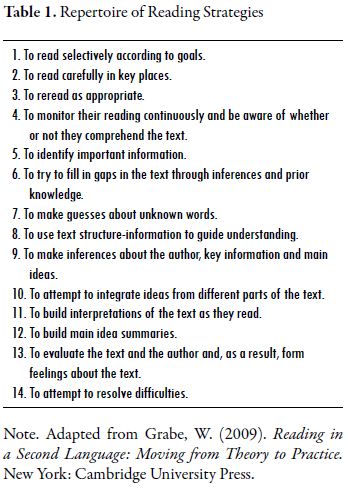
Grabe (2009) also notes that good readers articulate this repertoire of strategies, "flexibly applying them before they read a text, while they are reading and after they conclude a first reading of a document" (p. 228). Table 1 illustrates some of these strategies:
As it can be observed, efficient reading is more than extracting key ideas from texts; it is also engaging in extensive practice and learning about the skills that are essential to good comprehension. Evidently, one of the best places for this learning to take place is the classroom. By having instructional conversations about the reading process, teaching students about effective reading habits and the use of reading strategies, and providing focused attention to the language itself (Cummins, 2012), the process they follow to achieve understanding is likely to become easier and more effective.
As pointed out by Foorman, Francis, Fletcher, Schantschneider and Mehta (1998), students who are taught about decoding and analytical skills in a more direct and explicit fashion might improve faster than those students taught in a more implicit fashion. This is so as the routinization of many strategic responses to text difficulties "allows for fluent processing and a minimization of active problem solving interruptions to the comprehension process" (Grabe, 2009, p. 240). Explicit strategy instruction is thus of vital importance in the process of reading, as it helps readers move from conscious control of reading strategies to unconscious use of reading skills (Anderson, 2009, p.134).
However, it should be noted that the process of reading is often socially interactive (Guthrie, 2004) and scaffolding and guided support are necessary for learners to achieve higher levels of competence. Therefore, developing reading strategies through a pedagogical approach that emphasizes "learner participation and interaction in the classroom" has been recently regarded in the literature as highly suitable (Zhang, 2008, p. 92). Collaborative Strategic Reading, which aims to teach students to use reading comprehension strategies by combining direct strategy instruction with active collaborative work, can be considered one such suitable approach.
]]> Collaborative strategic reading (CSR).What is CSR? Klingner and Vaughn (1998) were the first authors to develop the concept of Collaborative Strategic Reading, where collaborative learning ( Johnson & Johnson, 1987) and reciprocal teaching (Palincsar & Brown, 1984) were blended to promote content learning, language acquisition and reading comprehension in diverse classrooms (Klingner, Vaughn & Schumm, 1998). CSR is a model aimed to teach students how to use comprehension strategies while working cooperatively. Although originally developed to enhance comprehension skills in struggling readers and ESL students with learning disabilities (Kingler & Vaughn, 1996, 1998), CSR has also yielded positive outcomes for average and high-achieving students (Klingner & Vaughn, 2000; Klingner, Vaughn, Arguelles, Hughes & Leftwich, 2004).
Strategies include: a) previewing the text; b) giving ongoing feedback by deciding "click" (I get it) or "clunk" (I don't get it) at the end of each paragraph; c) "getting the gist" of the most important parts of the text; and d) "wrapping up" key ideas. In CSR students are engaged to work in small groups (three to five) and apply the four reading strategies: Preview, Click & Clunk, Get the Gist and Wrap Up. According to Abidin and Riswanto (2012, p. 61), the strategies have the following purposes:
• Preview. To allow students to generate interest and activate background knowledge in order to predict what they will learn through the text.
• Click & Clunk. To encourage students to self-monitor and control their understanding of words, concepts and ideas.
• Get the Gist. To help students identify the main ideas of the text in order to confirm their understanding of the information.
• Wrap Up. To provide students with an opportunity to apply metacognitive strategies like planning, monitoring and evaluating to further extend comprehension.
CSR is a reading model worth implementing in the classroom for a number of reasons. CSR not only teaches readers with cognitive (top down and bottom up) approaches, but it also teaches them how to use strategies metacognitively. In CSR, readers are encouraged to activate their prior knowledge by giving an overall look at the text, while looking at non linguistics features such as charts, pictures and diagrams. They are also provided with information on how to decode new words, get the gist of texts, and summarize ideas- strategies that are fundamental to achieve comprehension (Dogan, 2002).
CSR also engages students to work collaboratively in small groups so they have the opportunity to discuss and share ideas as well as develop their social skills. As argued by Johnson & Johnson (1987, p. 28), collaborative learning techniques can benefit students in:
1. Promoting student and academic achievement. ]]>
2. Increasing students' retention.The collaborative learning concept involved in CSR encourages students to be active as well as cooperative in achieving common learning goals. CSR allows students to learn how to implement reading fix-up strategies in a more effective way, as there is room for collaborative scaffolding to take place. Each student has a role to perform within the group and each of these roles helps the group to successfully achieve their reading goals. Considering that students can help each other while working in groups, in CSR students are likely to "improve reading comprehension and increase conceptual learning in ways that maximize [their] involvement" (Abidin & Riswanto, 2012, p. 62).
Research has shown that the implementation of CSR can help students' improve their reading comprehension and vocabulary knowledge, develop cooperative skills and enrich content area learning. In the case of English language learners (ELL's) studying in bilingual contexts, the use of this approach is particularly beneficial since the type of peer interaction it promotes increases opportunities for meaningful communication about academic content and allows pupils to draw on native language support from bilingual peers (Klingner & Vaughn, 1999).
During group discussions, students are likely to assist one another in understanding the meaning of challenging words, getting the main idea, asking and answering questions, and establishing relationships between what they are learning and their previous knowledge (Klingner & Vaughn, 2000). The structure of CSR helps ELL's to have frequent opportunities to integrate lesson concepts with language practice and become active participants in their groups (Klingner, Boardman, Eppolito & Schonewise, 2012).
A number of studies conducted in English as a foreign language (EFL) contexts also indicate that CSR can have a positive effect on language learners' reading comprehension, especially in relation to the processes of getting the main idea and finding the supporting details (Fan, 2010), and overcoming vocabulary-related problems that occur during the reading process (Karabuga & Kaya, 2013). EFL learners also show strong preference for communicative and cooperative reading approaches since activities such as group discussions facilitate the reading process and help them feel more competent (Zoghi, Mustapha, Maasum & Mohd, 2010; Karabuga & Kaya, 2013).
]]> All in all, by participating in a CSR environment, language learners can improve their reading comprehension skills not only through teachers' modeling and the use of fix-up strategies, but also through the help of their peers. In this process of learning how to use strategies collaboratively, students also learn how to monitor their own reading process and become aware of the importance of transferring such metacognitive knowledge to other learning situations. By learning how to take control over their own learning process, students might also start tracing a path to become more self-directed learners.Self-direction.
Since Knowles published his work on Self- Directed Learning (SDL) in 1975, the concept of "Andragogy", more recently referred to as selfdirection, has been widely discussed in both general education and language education literature. Andragogy refers to the ability adults have to learn, with or without others' help, and engage in an evolving process of self-directed inquiry. Such learning is not motivated by a grade, but by an inner desire of solving real problems and thus it is a continuous process where individuals become "lifelong learners" (Knowles, 1975). Authors like Garrison (1997) define SDL as a process where learners are able to combine "external management (contextual control), internal monitoring (cognitive responsibility), and motivational (entering and task) factors associated with learning in an educational context" (p. 20). In other words, self-directed learners are those learners who are able to take responsibility for their learning and work collaboratively on the construction of concepts, and who develop skills to self-manage learning goals, resources, learning strategies, external support and self-assessment.
Nonetheless, as mentioned by Lowry (1989), selfdirectedness depends only on the person who is in charge of carrying it out. This person is who decides what should be learned, what methods should be used and how the process should be measured. Therefore, when individuals or learners are not independent, confident or resourceful enough, they might find it difficult to engage in SDL. This complex issue of learners being more or less able to self-regulate is further explored by Grow (1991) in the Staged Self-Directed Learning Model (SSDL).
Grow states that "being a dependent learner is not wrong, whether that dependency is temporary or permanent, yet this does not mean that selfdirection is not desirable. In fact, self-direction can be learned and it can be taught" (1991, p. 127). Thus, in his Staged Self-Directed Learning Model, Grow explores the concept of "Situational Leadership", which mixes management strategies with teaching strategies in order to help students to be more self-managed (Table 2).
In discussing the stages of the SSDL model, Grow (1991) draws attention to the fact that there can be a mismatch between students' and teachers' learning stages. For instance, a stage 1 student could be frustrated if a stage 3 or stage 4 teacher directed him. Likewise, a stage 4 student might feel frustration when participating in a teachercentered learning environment. The SSDL model also presents a non-linear progression of the four stages. According to Grow (1991), a class may not be linear as students are placed in different stages of self-direction. Thus, it is possible for an S3 class to loop back to S1 or S2 stages when necessary and then return to a S3 stage.
Self-direction, however, also implies a process of interdependence. Accordingly, it could be argued that by incorporating collaborative learning elements into the classroom rather than focusing on individualistic behaviors and personal efforts (Braman, 1998, cited in Khodabandehiou et al., 2012), teachers can help learners succeed in their path towards self-regulation. Classrooms that implement collaboration, like the CSR classroom, are likely to help students increase their independence in that the main goal of such a classroom is to train learners to become selfdirected thinkers who are able to teamwork and solve problems among themselves.
To promote self-direction in the reading classroom, as Khodabandehiou, Jahandar, Seyedi and Dolat (2012) contend, teachers must thus "engage students [in the use of ] specific strategies that will help them solve problems in their own contexts, by themselves, without being told" (para. 5). Unfortunately, approaches such as CSR, which can help learners become less dependent on the teacher and thus facilitate learner autonomy (Karabuga & Kaya, 2013), have not been widely implemented in the Colombian context. Research examining the role of CSR, either in the mainstream or EFL classroom, seems to be nonexistent up to now; this is an additional reason for the design of this study.
Type of Study
]]> Action research was chosen as the most suitable methodological approach to answer the research questions previously mentioned. Action research occurs through a dynamic and complementary process, which consists of four essential moments: planning, action, observation and reflection. It gives teachers the opportunity to observe learners, collect and interpret data with the intention of having a broad understanding of the events that occur inside the classroom and reflecting on how students can become better learners (Kemmis & Mc Taggart, 1988, cited in Burns, 1999, p. 34). The main goal in action research is to foster a positive change in educational processes; in other words, to facilitate improvements in teaching practices and to achieve better learning outcomes.
Participants and General Procedures
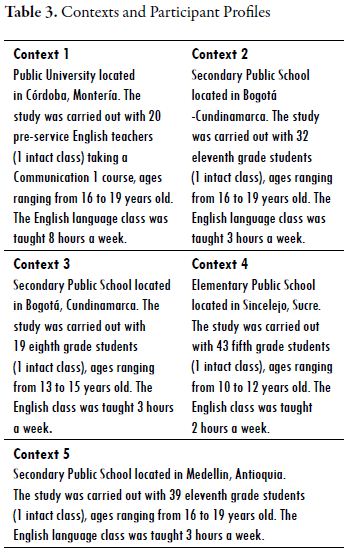
This action research study took place at five public educational institutions in 2012 in different regions in Colombia, with students whose English proficiency level was A1 according to the Common European Framework. As noted earlier, this study was conducted by a group of five teacher-researchers; therefore, the students who participated in the implementation of CSR (See Table 3) belonged to one of the courses that each researcher was teaching at their educational institution during the 2012 academic year. The teacher-researchers selected the EFL students in these classes due to their overall low performance in reading comprehension activities.
Participants (or their parents if under 18) signed consent forms in which they agreed to participate in the project. School officials also signed consent forms authorizing researchers to conduct the study. The study was conducted during a period of three to four months. The time allocated to the implementation was dependent on the curriculum goals and timeline of each institution and the number of hours dedicated to the study of the L2. In addition to the time devoted to ethics (student participation approval) and piloting reliability procedures, general data collection processes consisted of: a) pre-test/ initial questionnaire, b) CSR student training workshop, c) CSR implementation sessions, d) post-test/ final questionnaire, and e) wrap-up session. Between five to eight instructional sessions were devoted to the implementation phase of study, as shown in Table 4. Because strategy transfer and the development of self-regulated skills were part of the objectives of the study, a number of independent reading tasks (four on average) were also carried out by the learners.
Data Collection Methods
The teacher-researchers used a series of data collection instruments in order to gather information about the impact of CSR on learners' reading comprehension skills and self-directed learning attitudes and behaviors. As noted above, the data collection methods chosen to conduct this research project were a pre and post student questionnaire, a pre and a post reading test, teacher journals and student learning logs. An evaluative wrap-up session, video recorded in some contexts, was also part of the data collection methods used.
]]> Questionnaire.Two student questionnaires (in Spanish) were administered during the study, one before and the other after the implementation. They were composed of 20 Likert Scale statements. Both questionnaires contained questions aimed to examine students' use of reading strategies and were adapted from the Survey of Reading Strategies (Mokhtari & Sheorey, 2002) and the Metacognitive Strategy Awareness and Reading Comprehension Questionnaire (Carrel, 1989) (See Appendix). The final questionnaire included an additional section aimed to capture students' opinions about the usefulness of CSR and whether they perceived it had fostered their reading comprehension and self-directed learning skills. Pilot test reliability and content and face validity were the measures used during the design and testing of the questionnaires.
Reading test.
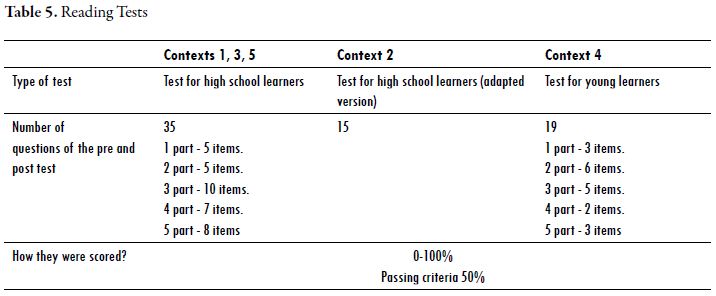
Two reading tests were also part of the research design. A pre-test was administered before the implementation in order to have an initial record of student's reading performance and to design the intervention according to their actual needs. The pre-test was also piloted in order to know if instructions were clear and if the test was easy to follow. After the implementation, a post-test was administered in order to determine whether students had made progress on their reading skills. For both pre and post-test, participants from contexts 1, 2 and 5 (eleven graders and first year undergraduate students) took a mock version of the reading section of a test from a recognized publishing house.
This test was chosen considering that it was specifically designed to assess elementary and young learners' English language knowledge. The reading section of this test assesses learners' ability to understand simple written information such as signs, brochures, newspapers and magazines. The test shows whether students can read and choose the correct words and answers, put a conversation in the correct order and choose the correct words to compete a text. Different formats, namely, multiple-choice questions (MCQ's), right/wrong/ do not say (T/F/DS), and gapped sentences, comprised the test. Participants from context 3 (ninth graders) took an adapted version of this test (designed by the teacher-researcher) given that the results of the piloting process indicated that some of the test questions were beyond students' linguistic knowledge (grammar and vocabulary). Participants from context 4 (fifth graders) were assessed based on items from two tests of the same publishing house which evaluate young learners' skills in the English language. In these tests, children have to match pictures with definitions, match short definitions to words, read picture descriptions, fill-in gapped texts, among others.
The same number of sections and questions were implemented in all pre- and post-tests so that they were comparable (See Table 4). The reliability estimates for the test used with high school students (reading section) is calculated at .91 (Cronbach's Alpha), and for the tests used with young learners at .83 and .87, respectively. The scores achieved by students were calculated by adding up the total number of correct responses in each section, with 50% of correct answers being considered as the passing criteria. Unfortunately, due to time constraints and other limitations, such test reliability measures could not be estimated for the test used in Context 3, which might explain some of the differences observed in reading performance across contexts, and which will be discussed in the findings section.
CSR learning log.
Learning logs (designed by CSR advocates) were used by students in class while working in groups and at home when reading independently in order to keep track of their learning and reading process.
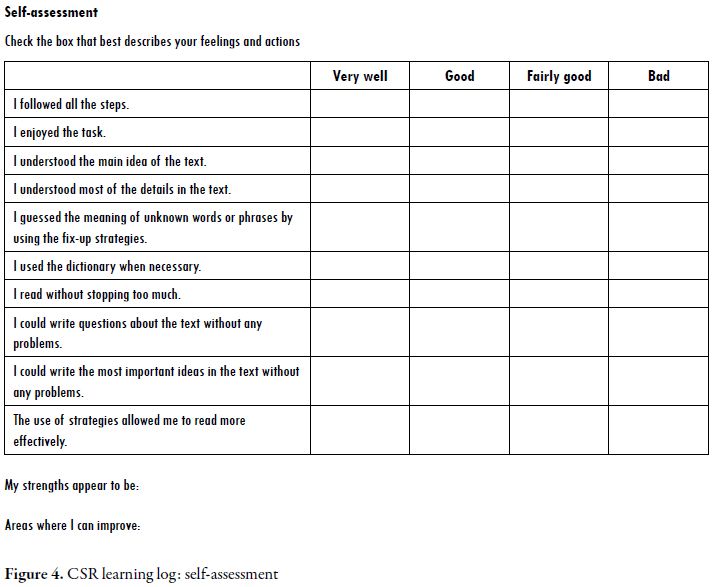
]]> They allowed researchers to gather information related to the manner in which students applied each reading fix up strategy, how they selfevaluated their and their peer's rate of success in the use of the CSR model, and whether they were able to identify their weaknesses and strengths at the end of each session. Although the log was filled in collaboratively, every student in each group had his or her own learning log. In most research contexts, each lesson was accompanied by a reading task that ought to be carried out at home independently; therefore, an independent learning log was also used. Students kept learning logs for both in-class and independent reading activities in portfolios.
Teacher journal.
Teacher-researchers used this instrument with the intention of recording learners' behaviors, reactions and feelings towards the CSR approach, as well as their own thoughts pertaining to the events observed during the lessons. They specifically noted down aspects related to the nature of the interactions taking place among students while working in groups, students' responses to the reading activities carried out in class and at home, as well as any indication of self-regulated learning. To guide this reflection process, the teacher-researchers divided the journal in three-categories: Teacher actions, students' responses, and teacher reflections and observations. The latter allowed them to reflect on the impact of their instructional actions on a lesson-by-lesson basis and thus make further adjustments to the implementation routine and materials if necessary.
Didactic materials.
In addition to the data collection methods, there were different instructional resources that were employed during the implementation. The first didactic resource that was used was the introductory workshop. Through this workshop the CSR model was explained to students. During this initial week of the implementation, students had the opportunity to practice the four strategies involved in the approach and rehearse the roles they were going to take within the groups. It was after learners had received enough guidance and training in the CSR model that they began working in their learning groups. Each researcher designed between five to seven classroom reading tasks that, as noted above, were implemented in a period of about four months.
The selection of the reading materials was based on the following criteria: (1) level of difficulty, (2) level of interest, and (3) variety of topics related to the real world. These reading tasks, which also fulfilled the goals of the language curriculum of each institution, were developed through the use of the leaning log. During the in-class sessions, other resources such as clunk cards, role cards, and a fix-up strategies poster were also used. For the independent reading tasks, students were provided with a web page through which they could autonomously select the texts they wanted to read at home.
Pedagogical Intervention
In each of the implementation sessions, the researchers followed the CSR stages described above: a) Preview, b) Clink and clunk and Get the gist, and c) Wrap-up. The learning log was the instrument used to implement this reading cycle. In the first part of the CSR learning log (Fig. 1), before reading: preview, students were asked to active their prior knowledge and make predictions about the text. Students looked at headings, words in bold face, pictures, tables, graphs, and other key information in order to brainstorm what they knew about the topic and predict what they would learn about it (Klingner & Vaughn, 1998).
In the second stage of CSR and second part of the log, during reading (Fig. 2), two steps were followed: Click and Clunk and Get the Gist. In the former, students identified and recorded the clunks they experienced while reading (word or words that impeded understanding) and then, by using the sequence of fix-up strategies, tried to decode them. These are the fix-up strategies used in this study (Klingner & Vaughn, 1998, p. 34):
]]> • Re-read the sentence without the word. Think about what information provided would help you understand the meaning of the word."Clunk cards" were used as prompts to remind students of various fix-up strategies. Students initially applied fix-up strategies with teacher support, and then they used them in their groups. Students were also asked to recognize the general idea of each paragraph of the body of the text: get the gist. In this stage, as argued by Abidin and Riswanto (2012), students learn to ask themselves: What is the most important person, place, or thing? What is the most important idea about the person, place or thing? The teacher also asks students to re-state in their own words the most important point of the text in order to ensure they have understood what they have read. This strategy can improve students' understanding and memory.
In the third stage and third section of the log, wrap up: after reading, learners constructed their own questions to check for understanding and then summarized what they had learned (Fig. 3). Students generated questions to ask other classmates about important ideas from the passage they had just read.
Considering the interest of the researchers in promoting not only reading comprehension but also self-direction, the previous reading cycle was followed by a self-assessment section (Fig. 4). As a result, in the final part of the learning log, students rated their own learning experience to determine if they had succeeded or not in the use of the CSR model and if it had helped them improve their understanding of the text. It is important to note here that this self-assessment section was not included in the learning log that was originally proposed by CSR advocates. The group of teacher-researchers designed it and decided to include it in the log.
Collaborative work in CSR.
The collaborative learning concept that is fundamental to CSR aims for students to be active, as well as cooperative in achieving common learning goals. According to Klingner and Vaughn (1998, p. 35), roles are an important aspect of CSR since collaborative learning seems to work best when all group members have been assigned a meaningful task. These two authors therefore propose the roles to be assigned and followed in every group reading activity in Figure 5:
As stated by Klingner and Vaughn, "roles are explicitly taught by the classroom teacher. Initially, students use cue cards with prompts that specify how to carry out the different roles. As students become confident in how to fulfill their roles, they are encouraged to set aside the cue cards to enable more natural discussion to take place" (2000, p. 74). After students had learned to apply the strategies through teacher-facilitated activities, the teacher-researchers asked the to get together to organize groups of five. Then each student in each team chose or was assigned a specific role so as to implement the strategies more effectively.
]]>Data Analysis
The data collected for this study was both quantitative and qualitative in nature. The questionnaires and reading tests that were administered before and after the implementation constituted to a great extent the quantitative data, while the in-class and independent learning logs, the evaluative section added to the post questionnaire, and the teacher's journal constituted the qualitative data. Once statistical information was retrieved from questionnaires and tests, grounded theory was used in the analysis of qualitative information. Researchers began the analysis of the data by exploring the responses students provided in the initial questionnaire and the scores they obtained in the pre-reading test. Then, they analyzed what students wrote in the learning logs and what was reported in the teacher's journal. Finally, the information that emerged from the final questionnaire and the scores obtained in the post reading test were analyzed and comparisons were established.
During the qualitative data analysis process, the researchers followed a variety of coding procedures through which data were broken down, conceptualized, and put back together in new ways. Open coding, axial coding and selective coding, the coding procedures proposed by Corbin and Strauss (1990), were the stages followed. During the open coding phase, charts and matrices were designed in order to organize the data obtained from the learning logs and journals, look for key themes, and select and name categories. Memos were also written in order to reflect upon the most relevant aspects of each of the categories identified. During the axial coding stage, data were put together in new ways by establishing causal relationships between categories. Connections between categories and sub-categories were made explicit. Finally, selective coding was conducted. During selective coding, a core category was identified, which led the researchers to better represent the phenomena under study and answer the research questions.
Findings
Despite the fact that CSR was implemented with varying results, by establishing statistical comparisons and doing qualitative analysis, it was possible for the researchers to answer the research questions positively. Data confirmed that: a) reading performance can be improved through CSR, b) students show more commitment and interest towards learning when participating in a collaborative classroom, c) problem-solving and teamwork skills can be developed through a CSR classroom, and d) self-direction can be fostered through independent work and the development of self-monitoring tasks. Findings revealed that CSR is likely to bring about positive results in the reading performance, team work skills and selfregulated attitudes of EFL learners of different ages and educational levels. Due to space constraints, however, the discussion of the findings identified won't be presented through data samples from each of the contexts, but through a selection of the most representative excerpts1.
Developing reading performance and teamwork skills.
The first aim of this study was to explore the impact of CSR on students' reading performance; therefore, it will be the first aspect discussed in this section. The implementation of CSR yielded mixed results in terms of reading performance across the five contexts. While in three of the contexts tests results indicated a statistically significant difference, in the other two, results showed the opposite. Due to the fact that the reading tests that were administered during the study were different for Contexts 2 and 4, comparisons in terms of reading performance cannot be established across all five settings. Nevertheless, the differences observed between pre and post testing show interesting aspects about the implementation of CSR with EFL learners that are worth discussing.
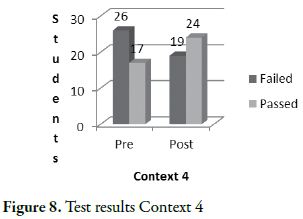
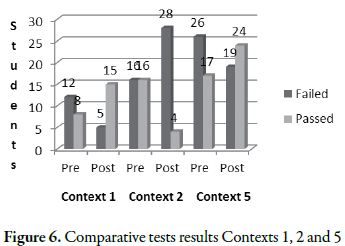
As shown in Figures 6 to 8, results in the reading tests reveal that students in Contexts 1, 3 and 4 improved their reading performance after the implementation. By comparing results between pre and post-tests, specifically the total number of students that passed and failed the tests, each of these three teacher-researchers noticed that students' overall reading performance had increased. While 40% and 21% of the student population passed the pre-test in Context 1(1st year college students) and Context 3 (ninth graders) respectively, 39 % of the students passed the examination in Context 4 (fifth graders). Conversely, 75% and 89% of the student population passed the post-test in Contexts 1 and 3, and 55 % of the students did so in Context 4. Despite the tests used were different, these results provide evidence of the potential impact that CSR can have on the reading performance of students whose ages and education levels are different.
]]>
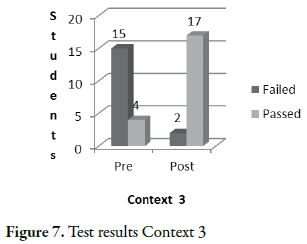
The cyclical nature of Collaborative Strategic Reading (CSR), where learners learned to use a set of metacognitive reading comprehension strategies by using them repetitively, could be considered one of the reasons for the change. Receiving explicit instruction on reading strategies and using them in collaborative settings also appears to have helped students learn how to understand new information and words, and how to identify and cope with reading problems more effectively.
Interestingly, however, results in reading tests from students in Contexts 2 and 5 (eleventh graders), and who took the same test as students in Context 1, indicate that there was no significant difference between pre-and post-testing, and in fact statistics show negative results. Compared to other data sources, this instrument did not show improvement in students' reading process. This situation seems to have occurred due to a number of reasons. On the one hand, in the case of Context 2, testing conditions were not identical. While students were willing to sit the pre-test, for the post-test, they were worried about other school matters, which seemed to have affected their levels of concentration.
On the other hand, the reading test chosen for these contexts was above students' knowledge in certain language areas, which might explain why even though the strategy proved to be useful in other sources of data, figures were not affected positively in the post-test. Although the selection of the test was performed in accordance with the syllabus of the subject area and the characteristics of the population, in Contexts 2 and 5, students' language knowledge was lower than originally anticipated by their teachers. The fact that the test used in Context 3 was modified by the teacherresearcher and that the students in Context 1 engaged in CSR more frequently (twice a week) might also explain why the results in these two settings were significantly higher. Lastly, and perhaps more importantly, the nature of CSR reading tasks may have not matched those of the reading tests. Although students worked with expository and narrative texts of the kind included in the examinations, some of the tasks such as right/wrong/does not say and gapped sentences and texts were not common to the CSR environment.
Nevertheless, besides the possible impact of test selection, time on task (number of interventions) and pre and post testing conditions on students' results in the post-test, an analysis of questionnaire data shows that there was indeed a positive change in the habits and reading skills of some students. A comparison of the answers reported in pre and post questionnaires revealed, for instance, an increase in students' awareness and use of reading strategies (See Figure 9).
]]> As shown in Figure 9, there were less than five students in Contexts 1, 2, 3 and 5 who replied "always" and "usually" in the pre-questionnaire when asked about their use of the underlining strategy. These numbers, however, show an upward trend in the post-questionnaire with more students replying "always" and "usually". Of particular interest is the number of students who replied "never" in Contexts 2 and 5 in the prequestionnaire (15 and 10 respectively) and the number who replied "usually" and "sometimes" in the post-questionnaire. Considering the results that these students achieved in the readings tests, this information may be considered of great importance.As can be observed, students from most contexts did not make use of certain reading strategies on a regular basis prior to the implementation. Nevertheless, after having participated in the CSR classroom, they became aware of the value of such strategies and thus chose to use them on a more frequent basis. The number of students (over 15) in Context 4 who replied "always" in the post-questionnaire can also be seen to indicate that these young learners had started to use the strategy in most, if not all, L2 reading situations.
This illustrates not only the potential positive impact of CSR on the development of students' metacognition, but also the need for explicit strategy instruction in the language classroom. Students' opinions about their reading performance also give evidence of the benefits of the CSR classroom. As illustrated below, the word "improvement", explicitly stated by students from two different contexts, suggests that the use of fix-up strategies helped them achieve a better understanding of written texts, but most importantly, re-conceptualize how they perceived themselves as EFL readers:
"I used the strategies taught in class. I understood the general idea of the texts, and as a result, my reading comprehension improved."
(Context 2. Post-questionnaire, Student 2, Sep. 25, 2012)
"Thanks to the set of fix-up strategies, my reading comprehension improved a lot. In the end it was not that hard, on the contrary, it got easier and easier." (Context 3. Post-questionnaire, Student 4, Oct. 22, 2012)
Instruction about and use of reading strategies is not something new to language classrooms.
Nevertheless, what distinguishes CSR from other reading approaches, and what seems to be the underlying cause of its contribution to the EFL classroom, is the role of collaboration. By collaboratively reading texts and explicitly talking about the use of reading strategies, students learned about the importance of identifying a lack of understanding and working out a solution.
As suggested by Palincsar and Brown (1984, cited in Fan, 2010, p. 6), the instructional framework of CSR is based on the assumption that reading comprehension can be promoted and reinforced through peer collaboration. Peer-collaboration allows for collaborative scaffolding to take place, which might have a positive effect on the quality of the reading experience of those students with difficulties. As evinced in the following excerpt, collaborative reading permitted students to help each other in the understanding of texts and in the achievement of common reading goals:
]]>T: Do you like working in groups?
S4: I like working in groups because each time we have difficulties or some of us do not understand something, there are others who know more, so we are all able to learn together.
S5: I like working in groups because we can help each other.
(Context 4. After Intervention Wrap-up Session)
Moreover, the skills and knowledge gained about reading through teamwork were more easily transferred to out-of-classroom spaces, as shown in the following extract:
]]> Together with their gains in reading comprehension, students also developed their group work skills- something which had not been anticipated at the outset of the study. Nonetheless, this was not easy for everybody. In a collaborative reading environment there is always the risk that some students won't be able to achieve the established reading objectives due to poor teamwork skills or a lack of interest. This situation occurred specifically in Context 4 in the early stages of the implementation. The teacher-researcher experienced some trouble since young learners found it difficult to fulfill their roles and collaborate with their partners:T: What about the independent work? Was it more difficult than the task you performed in groups?
S 1: Independent work became easier because we had already understood the strategies in class with our group, and so this helped us to better understand the texts. Also, the independent learning log was useful because we paid attention to each reading section, identified the clunks, made questions, and got the main idea of the text.
(Context 1. After Intervention Wrap-up Session)
"I am really worried about some children's attitudes toward the activities. I realized that they are not used to working together this way. Children interact with others in a complicated way. They make bad judgments about those partners who are shy or who do not participate in a group activity."
(Context 4. Teacher Journal, Implementation 2)
During the initial interventions, most children expressed their disagreement about working in groups, especially with certain peers. Their complaints were related to partners' lack of participation and bad behavior. Students from this context spent more time adapting to the CSR model than students in the other contexts; however, they gradually learned how to collaborate and thus started showing a positive attitude towards group reading activities. As time passed, they became more autonomous and felt better working in groups:
"In this opportunity I decided to omit the introduction that I always do at the beginning of every class. Surprisingly, all children got together in groups and started to make specific arrangements for the development of the activity. I realized that complains have decreased significantly. Learners were engaged, worked together and showed a good attitude towards the activity. They were familiar with the learning log."
(Context 4. Teacher Journal, Implementation 3)
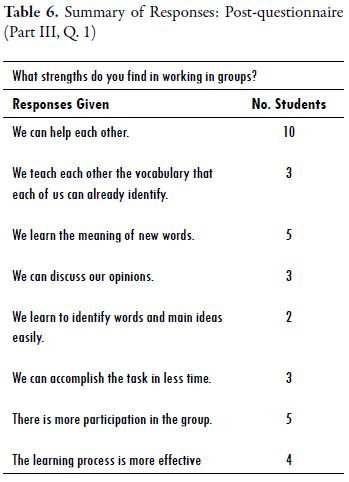
This change in attitudes seemed to have occurred as a result of the ongoing guidance that was provided by the teacher during the CSR sessions, the well-defined roles this approach involves, but above all, the opportunity learners had to become familiar with the resources and the fix-up strategies and to gain control of the reading process. By gradually taking control of the learning activities and keeping track of their reading progress, students seemed to have learned how to work effectively with their peers. A further indication of the potential impact of CSR on learners' teamwork and problem-solving skills was observed in Context 5 (See Table 6).
]]>As shown in Table 6, through collaboration and peer-scaffolding, students appeared to have learned to: a) support each other, b) benefit from each other's vocabulary knowledge in the L2, c) learn how to work out the meaning of new words, d) learn to exchange ideas and opinions, e) identify the most important ideas of texts, and f ) monitor their reading performance, among others. The fact that they learned to support each other was the aspect that was mentioned with more frequency, however. As suggested in the literature, collaborative learning is not only reduced to the learning of content, but it promotes tolerance, respect for others, critical thinking, analysis and synthesis -lifelong learning skills which are needed in the different environments in which students operate on a daily basis.
Interestingly, by participating in a collaborative reading classroom, students not only learned how to improve their reading performance and how to deal with reading and group work problems, they also developed an interest in both reading and language learning and increased their ownership over their learning process showing interest towards reading and taking control of the learning process.
By carefully implementing the CSR stages, learners' ability to comprehend texts and effectively work in groups can be significantly enhanced, and this in turn might result in higher levels of motivation and engagement. As illustrated below, teaching students how to collaborate and play a specific role within their group appeared to have helped them develop positive expectations and higher levels of commitment towards their learning:
]]> Knowing they were responsible for specific tasks within the groups, students' confidence also seemed to have increased. Taking on a role and being in charge of something motivated some students to read more and helped them construct a more positive image as language readers. A change in attitudes towards reading was promoted once recognition within groups was achieved:"I am scared because I may do it wrong, but I know that if I learn the new method, I can improve.
I already want to know how to do it to start putting it into practice."
(Context 3. Learning Log, Student 15, Implementation 1, July, 9, 2012)
"I liked that in my team everyone cooperated actively and performed their roles effectively"
(Context 2. Post Questionnaire, Student 13, Implementation 4, October, 2013)
"I felt important because I had to find the clunks and everybody was paying attention to me."
(Context 3. Learning Log, Student 12, Implementation 2, July, 13, 2012)
"I was not confident about my performance before, but not anymore. Now I read in English a lot."
(Context 3. Post-questionnaire, Student 8, Oct.22, 2012)
An increasing interest in reading and learning was also observed in the comments students wrote in the independent logs they filled out weekly. By having students read texts of their interest at home, not only did teachers encourage extensive reading and strategy transfer, but they also engendered higher levels of interest. To achieve this goal, as noted above, online sources and print texts were recommended to students so they had the option to choose what to read at home. As seen in Table 7, although some students' interest towards both reading and English was not observable at first, after realizing the multiple benefits of the CSR model, a gradual change in their attitudes became evident.
Interestingly, when reflecting on their reading performance, these two students went beyond an assessment of their reading skill to consider their attitudes towards the learning of English. Carrying out reading tasks in collaborative and independent settings on a regular basis, and recording their thoughts in the learning log seem to have given them the opportunity to identify, after some time, the usefulness of the use of strategies to enhance reading comprehension, as well as the importance of learning English for their life projects.
On the whole, it could be argued that CSR, if implemented effectively, may increase students' sense of personal and collective achievement and result in higher levels of motivation and interest. Likewise, including self-assessment tasks as part of in-class reading instruction and encouraging students to reflect on their progress can offer them the possibility to learn how to take ownership of not only their reading but overall language learning process. As Boud (1988, cited in Cotterall, 1995) states, "the main characteristic of autonomy as an aspect to learn is that students take some significant responsibility for their own learning over and above responding to instruction" (p. 23).
Through the use of CSR, students in this study were given the opportunity to become more strategic readers and self-directed learners. By taking the risk of doing things by themselves, students became independent learners who relied more on their own (group and individual) knowledge and skills and less on teachers' directions. Thanks to the use of a pre-established set of strategies and their participation in collaborative scaffolding, self-assessment and independent reading activities, students gradually moved from a stage of dependence (reliance on teacher's knowledge) towards a stage of both interdependence (reliance on peer's and one's knowledge) and independence (reliance on one's knowledge and skills).
]]> From these different activities, two were of particular importance: the use of the self-assessment checklist and the development of independent reading tasks. The data excerpts below show that these activities took students through a guided process of selfregulated learning:T: Guys, in relation to the self-assessment part: How did you feel? Have you ever done self-assessment with any other activity?
Ss: Well, we used to do it with the book "Interchange Intro" but in a general way, not with a particular strategy like reading. Doing the self-assessment after each reading activity was nice because we analyzed how well we felt doing each task, if we liked it or not, whether we understood most of the details or if the use of the dictionary was necessary, and also the reading speed.
(Context 1. After Intervention Wrap-up Session.)
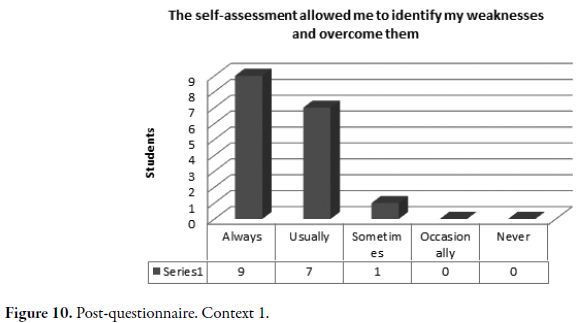
Excerpts from the wrap-up session also illustrate how the use of the self-assessment checklist encouraged students to reflect on their reading process by reporting how they had felt during the development of the task and whether that had achieved comprehension or mostly faced comprehension problems. As indicated in Figure 10, students also seem to have become more aware of the importance of self-assessing their own work in order to identify their weak spots and try to overcome them:
While engaging in self-assessment encouraged students to identify areas where they could improve, carrying out independent reading tasks provided an opportunity to work on them. By working on their own, students realized they were able to make decisions that allowed them to cope effectively with their comprehension problems. The knowledge about strategic reading they had gained through teamwork seemed to have prepared them to perform confidently in other reading contexts. In the excerpt below participants describe their feelings and opinions about the development of the work they carried out at home:
]]> T: Well, let's talk about your work at home. How did you develop activities at home?S5: At home we had to do by ourselves what we did in groups in the classroom. At home no one helped us with any questions, though I asked my sister for help at times.
S6: My mother supported me and encouraged me by telling me I could do it alone. This and what I learned in class helped me to read the texts by myself.
(Context 4. After Intervention Wrap-up Session.)
In brief, it could be argued that the self-assessment activities included in the log and the culture of independent learning instilled by the teacher helped students realize the importance of employing "strategies to reach a goal, self-assessing one's effectiveness in reaching that goal, and then self-regulating in response to the self-assessment" (Peirce, 2004, para. 7). In this project, there were four components that made it possible for students to learn how to become self-directed readers and learners: firstly, the use of reading and metacognitive strategies; secondly, collaborative work; thirdly, ongoing self-assessment; and lastly, independent practice.
Conclusions
As mentioned earlier, the aims of this study were to measure the extent to which the CSR approach had an influence on students' self-direction and reading performance. Results indicate that the use of CSR impacted participants' reading performance and learning attitudes and habits positively. Participants developed effective reading comprehension skills, learned to participate in a collaborative reading environment, responded positively to the development of the self-assessment tasks that were part of the implementation, and as result showed an increasing interest and commitment towards their own learning. Findings suggest that by being able to manage, monitor, and assess their own reading process, students not only learned how to better comprehend texts, but they also challenged their beliefs and misconceptions about reading and the learning of English in general. They also learned about the importance of knowing how to face reading and language learning problems on their own and how to become more independent language learners and effective team players.
During the interventions, teachers' actions played an important role, however. Training on strategies, modeling and constant recycling and guidance were carried out by all teacher-researchers throughout the implementation in order to equip students with the necessary tools to work and read on their own. With all these elements and activities being part of the classroom, it was possible for students to improve their reading comprehension, first when working in groups and then when working individually. While it is not possible to argue that in a four-month period of time students increased their performance considerably in each of the five contexts, students did indicate facing less comprehension problems as a result of the knowledge they had gained about reading and other monitoring and self-regulation strategies.
Interesting results were also observed in contexts in which participants were eleventh graders and in which the Pruebas Saber 11 was an additional reason motivating the design of the study. Even though this state exam was not a source of data for the researchers in Contexts 2 and 5, it is important to state that these results were actually enhanced. In Context 2, for instance, the mean was 41.81 in 2011 and 43.55 in 2012, according to the Icfes website. This shows that participants could have possibly benefited from their participation in the project and that the use of fix-up strategies might have helped them discover the meaning of unknown words and in turn increase their understanding of main ideas and details.
]]> To sum up, it can be stated that the use of Collaborative Strategic Reading did foster reading comprehension in English language learning and enhance language learners' self-direction in public institutions in different contexts in Colombia. As suggested in the literature, EFL learners need to be challenged to understand and undertake English language learning as an ongoing reflective process that involves self-observation, analysis and evaluation of progress. Learners who are able to identify their needs, formulate goals, identify resources, select and implement strategies, and assess their outcomes are more likely to succeed at learning.Pedagogical implications.
This study has implications for different educational agents, starting with the learners and continuing up to school officials. Based on the positive results obtained across the five contexts, it is possible to highlight a number of implications that the implementation of CSR can bring about.
Students.
In CSR, students are trained to use reading strategies to become more competent readers; therefore, they have a greater chance to improve their reading ability progressively and increase the repertoire of reading strategies they use. When the CSR model is understood, learners can start to state clearer reading goals and establish a direct path to get to them efficiently and self-directly.
Teachers and/or curriculum leaders.
Teacher-researchers in this study also learned from this project. They discovered the value of incorporating strategy instruction into the EFL classroom, particularly in a collaborative format. Although in some contexts students' performance in the post-test did not increase as expected, the implementation of CSR led to a number of gains that the teacher-researchers had not anticipated. There were significant observable gains in students' ability to deal with comprehension problems on their own and work with others despite the fact that they were elementary language learners and many of them studied in under-resource school settings. Positive changes in students' image as competent readers and English language users and an increase in their interest in reading in the L2 were equally evidenced. Having decided to do this study out of a concern for students low performance, the results are encouraging and have motivated the teacher-researchers to continue using CSR in their classrooms.
Institutions.
On adopting CSR, schools can design long-term interdisciplinary projects aimed to foster students' autonomous learning and effective reading. CSR can also help teachers shift from a teacher-centered to a student-centered classroom, as this approach requires encouraging students to become aware and take control of their reading process. If CSR is used across the curriculum throughout the school year, perhaps it is more likely that students develop better comprehension skills and positive attitudes towards learning. Better comprehension skills might also result in better test scores across all subject areas.
Limitations
]]> The current research study has contributed to support the development of reading comprehension in the English classroom and has fostered the use of reading comprehension strategies selfdirected. However, during the implementation there were some limitations that are related to, among other things, pre and post testing and the time allocated to the intervention. Measuring learners' reading performance is not an easy task, as reading comprehension is a complex phenomenon influenced by a host of personal and external factors. As a result, careful consideration should be given to the test selected for this purpose and the conditions in which it is administered, as well as to students' language proficiency. If the reading test is well-above students' linguistic knowledge, it might be difficult to observe any difference between pre and post-testing. The possibility to include control and experimental groups should also be taken into consideration given that most of research on CSR has been conducted under these circumstances. Time was also considered by the teacher-researchers as a variable affecting the outcomes of the implementation. It is therefore recommended to implement CSR for a longer period of time since engaging students in more reading sessions might probably yield better results.
Suggestions for Further Research
This study on CSR might be the starting point for further research related to a variety of themes. Studies might be conducted in order to establish or further examine whether students are able to increase their time on task, vocabulary repertoire and critical thinking skills through the collaborative use of strategies. Teacher-researchers are also advised to use the cooperative learning rubric suggested by CSR advocates in order to incorporate students' voices about team work dynamics as well as explore their ability to assess their peers, and which was not included in this project due to time constraints. Finally, it would be advantageous to develop a study to assess the impact of CSR over a longer period of time, or to examine whether learners implement this approach in reading comprehension activities assigned in contexts other than the language classroom.
NOTES
1. All data were gathered in Spanish, but for the purpose of this publication, they were translated into English.
References
Abidin, M. J. Z., & Riswanto, R. (2012). Collaborative Strategic Reading (CSR) within cognitive and metacognitive strategies perspectives. European Journal of Business and Management, 4(1), 61-69. [ Links ]
Anderson, N. (2009). ACTIVE reading: The research base for a pedagogical approach in the reading classroom. In H. Zhao & N. Anderson (Eds.), Second language reading research and instruction: Crossing the boundaries (pp. 117-143). Michigan: University of Michigan Press. [ Links ]
Bondanza, A., & Treewater, A. (1998). Means of improving reading comprehension. Washington: ERIC Clearinghouse. [ Links ]
Burns, A. (1999). Collaborative action research for English language learners. UK: Cambridge University Press. [ Links ]
Carrel, P. L. (1983). Some issues of studying the role of schemata, or background knowledge, in L2 comprehension. Reading in a Foreign Language, 1, 81-92. [ Links ]
Carrell, P.L. (1987). Content and formal schemata in EL2 reading. TESOL Quarterly, 37, 461-482. [ Links ]
Carrell, P. L. (1988). Some causes of text-boundedness and schema interference in ESL reading. In P. L. Carrell, J. Devine, & D. E. Eskey (Eds.), Interactive approaches to second language reading (pp. 101- 113). New York: Cambridge University Press. [ Links ]
Carrell, P. L., & Eisterhold, J. (1983). Schema theory and ESL reading pedagogy. TESOL Quarterly, 17, 553-573. [ Links ]
Cotterall, S. (1995). Developing a course strategy for learner autonomy. ELT Journal, 49 (3), 219-227. [ Links ]
Corbin, J., & Strauss, A. (1990). Grounded theory research: Procedures, canons, and evaluative criteria. Qualitative Sociology, 13 (1), 3-21. [ Links ]
Chomchaiya, C., & Dunworth, K. (2008). Identification of learning barriers affecting English reading comprehension instruction, as perceived by ESL undergraduate in Thailand. Australia: Edith Cowan University. [ Links ]
Cummins, J. (2012). The intersection of cognitive and sociocultural factors in the development of reading comprehension among immigrant students. Read and Writing, 25, 1973-1990. [ Links ]
Dogan, B. (2002). The Effects of Strategy Teaching on Reading Comprehension Motivation and Retention in Cooperative and Traditional Classes. Unpublished Doctorate thesis, Dokuz Eylul University. Institute of Educational Sciences, Izmir, Turkey. [ Links ]
Duke, N. (2006, February). Reading comprehension instruction for students who are learning to read: Challenges in curricularizing comprehension in the primary grades. Paper presented at the K-12 Literacy Training Meeting with representatives from the comprehensive regional centers, Boston, MA. Retrieved from: http://www.centeroninstruction.org/files/Reading%20Curricularizing%20Comprehension%20In%20the%20Primary%20Grades.pdf [ Links ]
Fauziah, H. (2003). Metacognitive strategy awareness and reading comprehension. The English Teacher, 32, 16-33. [ Links ]
Fan, Y. C. (2010). The effect of comprehension strategy instruction on EFL Learners' Reading Comprehension. Asian Social Science, 6(8), 19-29. [ Links ]
]]>Foorman, B., Francis, D., Fletcher, J., Schantschneider, C., & Mehta, P. (1998). The role of instruction in learning to read: Preventing reading failure in at-risk children. Journal of Educational Psychology, 90, 37-55. [ Links ]
Garrison, D. R. (1997). Self-directed learning: Toward a comprehensive model. Adult Education Quarterly, 48(1), 18-33. [ Links ]
Graddol, D. (2006). English next: Why global English may mean the end of "English as a foreign language". London: The British Council. [ Links ]
Grow, G. (1991). Teaching learners to be self-directed. Adult Education Quarterly, 41(3), 125-149. [ Links ]
Guthrie, J. T. (2004). Teaching for literacy engagement. Journal of Literacy Research, 36, 1-30. [ Links ]25-149.
]]>Johnson, D.W. & Johnson, R.T. (1987). Learning and alone (2nd ed), Englewood Cliffs, NJ: Prentice Hall. [ Links ]
Karabuga, F., & Kaya, E. S. (2013). Collaborative strategic reading practice with adult EFL learners: A collaborative and reflective approach to reading. Procedia-Social and Behavioral Sciences, 106, 621-630. [ Links ]
Khodabandehiou, M., Jahandar, S., Seyedi, G., & Dolat, R. (2012). The impact of self-directed learning strategies on reading comprehension. International Journal of Scientific and Engineering Research, 3(7), 1-9. [ Links ]
Klingner, J. K., & Vaughn, S. (1996). Reciprocal teaching of reading comprehension strategies for students with learning disabilities who use English as a second language. Elementary School Journal, 96(3), 275-293. [ Links ]
Klingner, J. & Vaughn, S. (1998). Using collaborative strategic reading. Teaching Exceptional Children, 30(6), 32-37. [ Links ]
]]>Klingner, J. K., Vaughn, S., & Schumm, J. S. (1998). Collaborative strategic reading during social studies in heterogeneous fourth-grade classrooms. Elementary School Journal, 99, 3-21. [ Links ]
Klingner, J. & Vaughn, S. (2000). The helping behaviors of fifth graders while using collaborative strategic reading during ESL content classes. TESOL Quarterly, 34(1), 69-98. [ Links ]
Klingner, J. K., Boardman, A. G., Eppolito, A. M., & Schonewise, E. A. (2012). Supporting adolescent English language learners' reading in the content areas. Learning Disabilities: A Contemporary Journal, 10(1), 35-64. [ Links ]
Klingner, J. K., Vaughn, S., Arguelles, M. E., Hughes, M. T., & Leftwich, S. A. (2004). Collaborative strategic reading "real-world" lessons from classroom teachers. Remedial and Special Education, 25(5), 291-302. [ Links ]
Knowles, M. (1975). Self-Directed learning: A guide for learners and teachers. New York: Association Press. [ Links ]
]]>Lowry, C. M. (1989). Supporting and facilitating selfdirected learning. Adult, Career and Vocational Education, 93, 1-6. [ Links ]
Mokhtari, K., & Sheorey, R. (2002). Measuring ESL students' awareness of reading strategies. Journal of Developmental Education, 25 (3). 2-10. [ Links ]
Nation, I. S. P. (1997). The language learning benefits of extensive reading. The Language Teacher, 21(5), 13-16. [ Links ]
Nation, I. S. P. (2005). Reading faster. Pasaa, 36, 21-37. [ Links ]
Nation, I. S. P. (2009). Teaching ESL/EFL reading and writing. New York: Routledge. [ Links ]
]]>Noorizah, M. N., & Zaini, A. (2009). Exploring the vocabulary learning strategies of EFL learners. Paper presented at the 7th International Conference on Language and Culture: Creating and Fostering Global Communities. Conference Proceedings, University Kebangsaan Malaysia (UKM), Malaysia. Retrieved from http://www.ukm.my/solls09/Proceeding/PDF/noorizah%20and%20zaini.pdf [ Links ]
Palincsar, A. & Brown, A. (1984). Reciprocal teaching of comprehension-fostering and comprehensionmonitoring activities. Cognition and Instruction, 1 (2), 117-175. [ Links ]
Peirce, W. (2004). Metacognition: study strategies, monitoring, and motivation. Retrieved from: http://academic.pgcc.edu/~wpeirce/MCCCTR/metacognition.html [ Links ]
Salinger, T. (1988). Language arts and literacy for young children. University of Virginia: Merrill publishing company. [ Links ]Swanson, E., Mohammed, S., Gould, A., Vaughn, S., Klingner, J., Roberts, G., Solis, M. (2011, March). The effects of collaborative strategic reading instruction on the reading comprehension of middle school students: Year 2 replication. Paper presented at The SREE Spring 2011 Conference, Building an Education Science: Investigating Mechanisms, Washington, D.C. Retrieved from: https://www.sree.org/conferences/2011/program/ [ Links ]
Takase, A. (2007). Japanese high school students' motivation for extensive L2 reading. Reading in a Foreign Language, 19 (1), 1-18. [ Links ]
Twining, W. L. (1991). Issues of Self-Determination. London: Aberdeen University Press. [ Links ]
]]>Zhang, L. J. (2008). Constructivist pedagogy in strategic reading instruction: Exploring pathways to learner development in the English as a second language (ESL) classroom. Instructional Science, 36, 89-116. [ Links ]
Zhang, L.J. (2010). A dynamic metacognitive systems account of Chinese university students' knowledge about EFL reading. TESOL Quarterly, 44, 320-353. [ Links ]
Zoghi, M., Mustapha, R., Maasum, T., & Mohd, N. R. (2010). Collaborative Strategic Reading with University EFL Learners. Journal of College Reading and Learning, 41(1), 67-94. [ Links ]
]]>