CASE STUDIES
DOI: 10.17533/udea.ikala.v20n2a07
Food for Thought: The Translation of Culinary References in Animation*
Alimento para la Reflexión: La Traducción de Referencias Culinarias en la Animación
Nourrir la Pensée: La Traduction des Références Culinaires dans l'Animation
]]>
Pilar González–Vera*
* Universidad de Zaragoza, EINA (Universidad de Zaragoza) Mailing address: Calle María de Luna 3, 50018 Zaragoza, España E–mail: pilargv@unizar.es
Received: 2014–08–28
Accepted: 2015–02–23
How to reference this article: González–Vera, P. (2015). Food for Thought: the translation of culinary references in animation. Íkala, Revista de Lenguaje y Cultura, 20(2), 247–264. doi: 10.17533/udea.ikala.v20n2a07
ABSTRACT
Food has traditionally been a cultural symbol reflecting historical roots in every country. It is precisely those cultural bonds that have made the translation of culinary references so difficult. The translation of food–related terms requires translators to consider, on the one hand, the cultural associations embedded in these terms, their meaning and function in the ST and, on the other hand, the translatability of the terms in the TT. As a socio–cultural phenomenon, food plays a fundamental role in the process of globalization in which we are immersed. We cannot disregard the fact that cultures are merging and that the introduction of new food terminology in our lexicon provides irrefutable evidence of globalization and acculturation.
]]> This paper focuses on the analysis of the role of food and its translation in the process of globalization. It analyses the relationship between food and culture in animated films like the Shrek saga, The princess and the frog, or Brave –films where food is not the focal point, but where it serves different purposes, such as acculturation, recreation of cultural identities and stereotypes, or humour. The analysis includes a study of the translation techniques applied in the dubbed versions of these films and their relationship to the process of domestication and foreignization in order to assess the social implications in texts aimed at a young audience.Keywords: audiovisual translation, culinary references, culture, domestication, foreignization
RESUMEN
La comida ha sido tradicionalmente un símbolo cultural que refleja raíces históricas en cada país. Son precisamente estos lazos culturales lo que hace tan difícil la traducción de referencias culinarias. La traducción de términos relacionados con la comida requiere que los traductores consideren, por una parte, las asociaciones culturales arraigadas en estos términos, su significado y función en el texto fuente y, por otra parte, la traductibilidad de los términos en el texto meta. Como fenómeno sociocultural, la comida juega un papel fundamental en el proceso de globalización en el que estamos inmersos. No se puede obviar el hecho de que las culturas se están fusionando y que la introducción de nueva terminología culinaria en nuestro lexicón es una evidencia irrefutable de la globalización y la aculturación. Este artículo se centra en el análisis del papel de la comida y su traducción en el proceso de globalización. Analiza la relación entre comida y cultura en películas de animación como la saga de Shrek, Tiana y el sapo o Brave; películas donde la comida no es el foco de atención, sino que responde a distintos intereses como la aculturación, la recreación de identidades culturales y estereotipos o la producción de humor. El análisis incluye un estudio de las técnicas de traducción empleadas en las versiones dobladas y su relación en el proceso de domesticación y extranjerización para valorar las implicaciones sociales en los textos dirigidos a una joven audiencia.
Palabras clave: traducción audiovisual, referencias culinarias, cultura, domesticación, extranjerización
RÉSUMÉ
La nourriture a traditionnellement été un symbole culturel qui reflète les racines historiques de chaque pays. Ce sont précisément ces liens culturels qui ont rendu la traduction de références culinaires si difficile. La traduction des termes liés à la nourriture nécessite que le traducteur considère, d'un côté, les références culturelles ancrées dans ces termes, leur signification et leur fonction dans le texte source; d'un autre côté, la possibilité de traduction des termes dans le texte cible. En tant que phénomène socioculturel, la nourriture joue un rôle fondamental dans le processus de globalisation dans lequel nous sommes plongés. Nous ne pouvons pas ne pas prendre en compte le fait que les cultures fusionnent et que l'introduction d'une nouvelle terminologie culinaire dans notre lexique fournit une preuve irréfutable de la globalisation et de l'acculturation. Cet article se concentre sur l'analyse du rôle de la nourriture et de sa traduction dans le processus de globalisation. Il analyse la relation entre nourriture et culture dans des films d'animations tels que la saga Shrek, La princesse et la grenouille ou Brave; films où la nourriture n'est pas le point central mais où elle sert différents intérêts tel que l'acculturation, la recréation d'identités culturelles et de stéréotypes, ou la production d'humour. L'analyse inclut une étude des techniques de traduction appliquées aux versions doublées de ces films, et leur relation avec le processus de domestication et de transformations étrangères, de manière à évaluer les implications sociales dans les textes destinés à une audience jeune.
Mots–clés: traduction audiovisuelle, références culinaires, la culture, domestication et de transformations étrangères
]]> Introducción
This study presents an analysis of the translation of culinary references in the Spanish dubbed versions of six animated films from two of the most representative studios: the four films that compose the Shrek saga (Shrek (2001), Shrek 2 (2004), Shrek the Third (2007) and Shrek Forever After (2010)) by DreamWorks; and The princess and the frog (2009) and Brave (2012) by Disney. Drawing examples from these, this paper aims to analyse the translation of cultural references about foodstuff focusing on the different functions they may perform. In order to do so, this contribution begins by presenting the bonds between food, culture and language and the representation of culture through cultural references in audiovisual texts.
This introduction of cultural references is accompanied by the presentation of techniques applied to their translation and their relationship with the process of domestication and foreignization in the target text (TT). The relevance of culinary references in animation forms the focus of the following section where the analysis of this type of reference in the six films is carried out, distinguishing between their main functions. In each case the techniques applied to their translation as well as their domesticating or foreignising approach are discussed. Finally, the results are interpreted and commented on in the final conclusions.
Food, culture and language.
Living in a global village and immersed in a process of globalization which, according to Valero Garcés (2003, p. 715), implies the existence of just one more easily accessible society, has contributed to the rapid spread of cultures. In this new conception of the world, audiovisual texts may be regarded as a tremendously influential and powerful vehicle for transferring values, ideas and information. They are highly complex products, which offer a cultural representation of the world through language, images and music. Examples of this are the cultural references that pepper films, TV series, videogames, and so on. As a recurrent motif, cultural references have become one of the main focuses of interest for scholars who have been presenting different taxonomies throughout the history of translation studies. Within the classifications of cultural references, food has always occupied a significant position, as can be seen in the taxonomies proposed by Franco Aixelá (1996), Agost (1999), Vandeweghe (2005), Igareda (2011).
The introduction of cultural references in audiovisual texts is in large part not only responsible for the spread of other cultural systems, but it is also the source of many translators' difficulties, such as whether to translate them or not. The cultural asymmetry between two linguistic communities, which may imply misunderstanding or unacceptability on the part of the target cultural system, is commented on by Franco Aixelá (1996, p. 57) who asserts that culture–specific items (CSI):
does not exist of itself, but as the result of a conflict arising from any linguistically represented reference in a source text which, when transferred to a target language, poses a translation problem due to the non–existence or to the different value (whether determined by ideology, usage, frequency, etc.) of the given item in the target language culture.
The solution for the translation of cultural references depends on the importance of these within the text. Although there are instances in which context contributes to the solving of comprehension problems (Agost, 1999, p. 100), the translator plays a crucial part in this transference. In the particular case of culinary references, the translator may rely on approximate descriptions or metaphors that evoke the meanings attached to the source references. However, as Orel (2013) states, food ''is a very particular ingredient of culture that cannot be always expressed with metaphors when translated''. Fortunately, irrefutable evidence of globalization and acculturation has been seen in the introduction of new foreign food terminology in our lexicon, making these concepts more accessible to other cultures.
In addition, the translatability of culinary terms in some cases seems to be unfeasible and it is not surprising that certain words are simply left in the original language. Part of this difficulty lies in the implicit socio–cultural associations related to food. The paradigm of the relationship between language and culture, supported by Nida (2000), can be transposed to food and culture with scholars like Castro Paniagua (2000) defending the idea that food is just as a much a part of culture as language. Therefore, food represents culture in the same way as language does. This association is also observed by Chiaro (2008), who suggests a phenomenon similar to translocation (Cronin, 2007) that takes place in language and food. According to Chiaro (2008, p. 196), language and food are so inextricably linked to culture that its transposition will inevitably display physical diversity in comparison to the original and it will always remain somehow 'foreign'. Thus, despite living in a global village, ''individual cultures continue to behave in their own specific way'' (Chiaro, 2008, p. 196). This struggle between foreign and domestic nuances is perceived in the different approaches when rendering cultural references from one culture to another. In this regard, Pedersen (2007) distinguishes between source language–oriented (SL) techniques, which result in a foreignised TT, and target language (TL)–oriented techniques that domesticate the TT, bringing the text closer to the target audience (see figure 1).
]]> These translation techniques are defined in the following terms:1) Loan: the source text word or phrase is incorporated in the target language and text, because no translation is possible and both languages use the exact same word.
2) Calque: is a literal translation.
3) Explicitation: tries to make the source text more accessible [...] either through specification using a hyponym, or by generalization, using a hypernym or superordinate.
4) Substitution: a variant on explicitation, [...] when [...] constraints do not allow for the insertion of a rather long term, even if it exists in the target culture and a hypernym or hyponym would therefore not really be required, a reference is substituted with another one which deviates more or less from the source one.
5) Transposition: a cultural concept from one culture is replaced by a cultural concept from another.
6) Lexical recreation: or the invention of a neologism in the target language.
7) Compensation: making up for a translational loss in one exchange by overtranslating or adding something in another.
8) Omission: or deletions
9) Addition: especially in passages containing cultural references that are expected to cause comprehension problems, but are essential for a good understanding of the programme. (Díaz–Cintas and Remael, 2007, pp. 202–207)
]]>Culinary References in Animated Films. Analysis of their Translation into the Spanish Dubbing of the Shrek Saga, The Princess and the Frog, and Brave
Culinary references are one of the most representative cultural references due to their popular nature. Being an essential commodity for human being, it is understandable that food has a steady presence, in one form or another, in all representations of life. Films offer an example of the portrayal of reality and, therefore, the introduction of culinary references as part of that depiction is to be expected. In the case of animated films the occurrence of culinary references is more than justified, if one takes into account that these films, principally aimed at a very young audience, have a didactic purpose. Animated films become a window on the world for the child, who discovers new realities and learns about cultural norms through them. Thus, one can explain the substantial number of references to foodstuff in this type of films.
In terms of cultural representation, food can perform various functions in audiovisual texts. Food is sometimes introduced as a natural element in the film discourse. It is not surprising to find food representations in audiovisual texts where there is a deliberate tendency to mimic the natural manner and spontaneity of real discourses (Baños–Piñero, 2009; Chaume, 2001). In this way, culinary references may be used simply to contribute to the narration of the story. In other cases, food may also be a conveyor of humour or due to the cultural bonds attributed to certain foodstuffs, they may lead to strengthening ties between foodstuffs and stereotypes.
The following case study presents an analysis of all the culinary references observed in six animated films and their translations for Spanish dubbed versions. These films have been selected for the significant number of cultural references they contain and, in particular, for the central role that culinary references play in them. The Shrek saga, telling the adventures of a grumpy but kindhearted ogre, mimics traditional fairy tales both by the way in which the story is told and the recurrent allusions to fairy–tale characters found throughout the films. This saga that turns the traditional fairy tale upside down is also characterized by the recurrent and tongue in cheek use of cultural references which significantly contribute to the transformation of the animated film into a product also appealing to adults. Culinary references are equally numerous and crucial in The Princess and the Frog, a Disney animated comedy loosely based on the Brothers Grimm's fairy tale The Frog Prince. It tells the story of Tiana, a hardworking waitress who is transformed into a frog when she kisses a frog which is under a spell. The film with strong and clear links to American culture is full of references to New Orleans, Louisiana life, jazz and Cajun cuisine. The last film in this corpus, Brave, narrates the story of Merida, a Scottish princess who defies tradition. Set in the Scottish Highlands the film is peppered with meaningful references to the Celtic culture and cuisine.
After isolating culinary references found in the films, it has been observed that they respond to four main functions. Firstly, a group of culinary references that have just a narrative function, that is, references that are introduced as winks to the audience in order to involve them in the film; secondly, culinary references used with a humorous purpose were also found in the films analysed; thirdly, these films contained culinary references that foster the building of stereotypes; and fourthly, some of the culinary references of these films contribute to the setting of the scene.
In order to see whether there is a relationship between the function of the culinary references and the techniques applied for their translation, this study carries out an analysis of the translation of the culinary references which is followed by a discussion of the translation techniques used for the culinary references according to the function they perform in the film (narrative function, humorous function, stereotyping function and contextualising function). Finally, the overall conclusions on the translation techniques preferred in the case of culinary references are presented.
Culinary references in discourse.
As previously stated, cultural references are intrinsically linked with language and can appear in conversation performing a narrative function, in other words, making the text more colourful and lively. This function is observed in many of the culinary references contained in Shrek, Shrek 2, Shrek the Third and Shrek Forever After. Table 1 presents those cases of culinary references that have just a narrative function:
Regarding the type of techniques applied to the translation of food references, a tendency towards TL–oriented techniques is observed. The translators opt –in 7 out of 9 cases– for TL–oriented techniques, transposition being the preferred one. By contrast, the translators rely on SL–oriented techniques in only 4 cases, 3 loans and 1 calque. The preference for TL–oriented techniques seems to respond to an attempt to bring the film closer to the target audience. A previous analysis of the techniques applied to other cultural references in the Spanish dubbed version of the Shrek saga (Gonzalez–Vera, 2010) revealed that a considerable number of source cultural references were replaced with others that were more familiar to the target audience. Therefore, it is not surprising to see how the same approach has been followed for the translation of food references. In this aim to ''Spanishize'' the text, two examples (examples 1, and 9) stand out.
]]>
In examples 1 and 9, the translators opt for replacing two different pastries, waffles and croissants, with the same Spanish pastry, churros. In example 1, Donkey who wants to bond with Shrek proposes to make waffles, an emblematic American breakfast, which is prepared on special occasions. There the translator opts for the domestication of the original cultural reference by using the typical Spanish snack churros, which is often eaten with hot chocolate after a big night out. With this translation, the translator complies with Orel's (2013) quote about translating food: ''you have to really understand both cultures. Not just the words, not just the ingredients or the dishes out of context, but you have to understand it on a much broader perspective'' (Rick Bayless, quoted in Orel, 2013). Although no comprehension problems would be found in the case of a literal translation, the translator opts to transfer the connotations attached to having waffles and churros in both cultures instead of translating them.
Churros is also the translator's choice for the translation of another pastry in example 9, where one of the Three Little Pigs reproaches his brothers for not sharing croissants. The typical French breakfast pastry is rendered into churros in the TT. However, this domestication does not respond to explanatory or contextualization needs, since croissant is an internationally known cookery term, but to a deliberate intention to bring the story closer to the target viewer, as occurs in example 1. Moreover, the translator could have opted, in this case, for a representative German pastry like Strüddle instead of an emblematic Spanish pastry like churros, if she had wanted to reinforce the portrayal of the pigs as Germans by their strong German accent.
Apart from these examples, it is worth mentioning the translation for the culinary reference Monte Cristo in example 4. In the original version, the source audience quickly relates Monte Cristo to a sandwich recipe from the United States. However, this reference would be confusing for the target audience that would associate it to an expensive sort of a Cuban cigar instead of a fried turkey, ham, and Swiss cheese sandwich. Its translation as a cigar would not be appropriate firstly because visual synchronization would be disrupted, as there is no cigar in the image; and secondly, because the indecorous image of the Fairy Godmother asking for a cigar would not be suitable, taking into consideration the target young audience. Thus, the culinary reference is translated as sándwich de pavo [a turkey sandwich], a translation that maintains both the culinary nature of the reference and its main ingredient.
Culinary references in humour.
Culinary references, as happens with other cultural references, can become the gist of humour. In these cases the translator may opt for a functional translation in which the humorous function prevails over the mere allusion to the cultural reference. This approach is observed in the translation of the foodstuff references found in Shrek 2, Shrek the Third and Shrek Forever After (see table 2).
In Shrek 2 (example 10) humour is the result of anachronism based on food references. The scene presents Fairy Godmother, Prince Charming and the King in a limousine that stops at the Friar's Fat Boy to order their meals. The first reference is found in one of the first shots in the sequence that shows a giant billboard of a boy on which ''Friar's Fat Boy'' can be read. This graphic element has the aim of mocking the American ''Big Boy'' brand that is symbolised by the iconic Big Boy character, famous for its onion rings. The relationship between the names of the two brands and the resemblance between the big Friar's Fat Boy and the Big Boy symbol would be familiar to the source audience, but may not be to the target audience. However the American influence of this franchise restaurant can be perceived thanks to certain features, like the American–style menu served therein.
In this instance, the source audience finds elements like ''the Medieval Meal'' and ''curly fries''. The former is a clear reference to one of the most successful meals of McDonald's, the largest American fast food restaurant chain, and the latter to one of the representative products sold by this company. Humour relies on the anachronism provoked by the medieval touch given to the current McDonald's Happy Meal and on the funny situation of Prince Charming ordering this children's menu that includes a toy. However, the literal translation into Spanish, ''menú medieval'', does not fully reflect the ulterior motive of the ST of identifying Prince Charming as a spoilt and immature boy nor with the McDonald's allusion. This could have been resolved by keeping the original source reference; since ''Happy Meal'' could be considered a representative case of a global product of the McDonald's multinational. Despite the changes that occur in the translocation of products of this multinational from source to target culture (Chiaro, 2008, p. 197), there is no variation either in the concept or the name given to ''Happy Meal'' in the different countries where it is sold. Furthermore, the transposition of ''curly fries'', a kind of French fries characterized by their spring–like shape and found in fast food restaurants, into ''unas bravas'' stands out. Both, the choice of such a representative Spanish dish, which consists of fried potatoes in hot sauce, and the use of the colloquial way in which this dish is usually ordered by Spaniards, ''unas bravas'' instead of the whole form ''unas patatas bravas'', contributes to a total domestication of the TT giving the target audience the idea that they are seeing a Spanish production.
The example also contains other culinary references, but oddly enough they are not American but Mexican. The influence of Mexican food on the States is due, to a large extent, to their geographical proximity. The geographical and cultural boundaries blurred by food make it unsurprising to find products such as ''wraps'', ''no mayo, chilli rings'' and ''sourdough soft taco'' in the States and, consequently, in American products, like films. These references have been translated by means of SL–oriented techniques such as loan (''fajitas''), calque (''aros extra de chile'') and TL–oriented techniques, like substitution (''quesadilla'', ''burrito''). However, in all these cases the techniques have stressed Mexican dishes, which in the end become typical of American fast–food restaurants. The omission of ''mayo'' in the TT can be to compensate for the length of the translation of ''chilli rings''. In the same way of keeping the synchrony between the original and dubbed versions, ''sourdough soft taco'' has been translated into ''quesadilla'' and ''burrito''. While the source reference may be obscure to the Spanish audience, the other two dishes are easily found in Spanish supermarkets in the international cuisine shelves and therefore they can be easily associated with Mexican food.
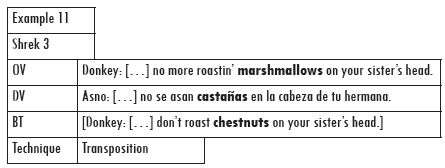
]]> Moreover, humour can be the effect of the description of a funny situation as in the following example. In example 11, Donkey tells his dragonson, Banana, not to roast marshmallows on his sister's head. The comic effect is produced by the image depicted by Donkey of his mischievous halfdragon, half–donkey son roasting marshmallows with his fiery breath on his sister's head. The picture described is the typical representation popularized by American films of a group of friends having fun around a bonfire and roasting marshmallows. This ritual associated with American culture is replaced in the TT by another more representative of the Spanish culture, which is roasting chestnuts. The winter scene of women roasting chestnuts in cauldrons in the street is more meaningful for the Spaniards as this scene forms part of their culture, and therefore the same humorous effect is achieved among the target audience who can imagine Donkey's naughty son fooling around and burning his sister with his breath.
Sometimes, food references can be used to create a play on words, which according to Delabastita are:
the general name for the various textual phenomena in which structural features of the language(s) used are exploited in order to bring about a communicatively significant confrontation of two (or more) linguistic structures with more or less similar forms and more or less different meanings. (1996, p. 128)
One type of wordplay is portmanteau, ''a label for the coinage that packs two meanings into one word'' (Nash, 1985, p. 143). It is the result of blending, a word formation process in which parts of different words are combined to make up a new word. This is what happens in example 12. The scene shows Rumpelstiltskin offering Shrek a drink with an eyeball on a cocktail stick instead of an olive, which is reminiscent of the typical way of serving a martini. The joke is based on the disgusting image of the eyeball in the Martiniglass and the name Rumpelstiltskin coins for this cocktail of gin and vermouth, 'eyeball–tini'. Rumpelstiltskin makes up the name of the drink linking 'eyeball', the image shown on screen, with the ending of the renowned vermouth brand name Martini. The image of the eyeball in the cocktail is as crucial in making up a new comic word in the ST as it is in the TT. The translator opts for lexical recreation, inventing a neologism in the TT with the same comic purpose as in the ST. Although the technique of lexical recreation is TL–oriented, we can observe how the TT includes the English adjective 'dry'. This demonstrates that Spanish and American cultures are subject to globalization and, therefore, they share more and more references, facilitating the translator's task. This allows the translator to play with the name of the cocktail 'dry–martini', keeping the English term 'dry' and creating the neologism ojini, which follows the same technique applied in the ST, that is, adding the ending of the brand name Martini to the word ojo [eyeball].
Culinary references in national stereotypes.
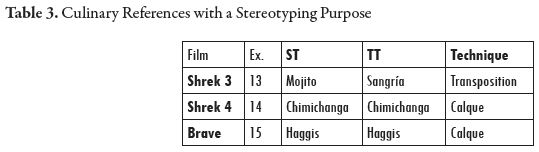
]]> In animated films as in motion pictures, there is an intention to transmit a hegemonic form of perception that is achieved by the depiction of ''other peoples and cultures through internationally known stereotypes, which require no effort and no time to be understood, as well as [by] counterbalancing these stereotypes with stronger references to a more powerful and ''impressive'' narrating culture'' (Di Giovanni, 2007, p. 96).Thus, it is not surprising to find different forms that contribute to the stereotyping of characters in films. In the same way, national stereotyping has been used as a strategy in the promotion of foreign food (Chiaro, 2004), so too has foreign food been used as a form of national stereotyping. Thus, stereotyped characters are constructed via the association of the character with certain culinary references that are bonded to a particular culture, as can be seen in Shrek 2, Shrek the Third and Brave (see table 3).
An interesting example appears in Shrek the Third. In this film Puss in Boots, voiced by Spanish actor Antonio Banderas in both American and Spanish versions, is portrayed as a Latin lover. His Latin characterisation is not only achieved by his accent, but also by the introduction of Spanish words in his discourse (González–Vera, 2012). Among these words, a reference from the culinary world is found in example 13 where Puss in Boots depicts an idyllic scene of two bachelors with no commitments enjoying a fishing trip. In this depiction Puss refers to ''an ice–cold pitcher of mojitos'', the allusion to this Cuban drink evokes, on the one hand, the exoticism and relaxation associated with the Caribbean and, on the other hand, Puss' Latino character. The transposition of the term into ''sangría'' in the TT maintains the connotations attributed to the source reference but brings the text closer to the target audience who sees in ''sangría'' a referent that represents its own culture. This drink, which is basically a red wine punch, has a stronger resonance for the Spanish audience. It is usually drunk at friends' reunions in summer time and therefore Spaniards regard it as a key element in the gathering of friends and of holidays. Thus, the cultural values embedded in it are able to transfer the original idea of ''mojito'', as well as to ''Spanishise'' the text.
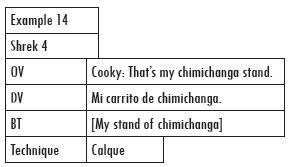
One of the effects of globalization has been the discovery of gastronomic difference (Chiaro, 2008, p. 196), and we cannot forget that difference is the base of stereotypes. Stereotypes can be defined as images or verbal expressions that somehow attach to a person or a social group without being filtered through logical reasoning (Calefato, 1997, pp. 69–73) and thereby distinguishing them from other groups. Sometimes difference can result in exoticism depending on the country of origin of the culinary dish. This is the case of example 14, where the exoticism conveyed by chimichanga is stressed by the use of a South–American accent. The foreign flavour of the term chimichanga is also reinforced in the dubbed version thanks to the use of a South– American accent that becomes an innuendo about the Mexican origin of this deep–fried burrito and to the use of the translation technique of loan. Furthermore, no additional explanation about the term is required. Although the term chimichanga is still a little bit obscure, in audiovisual texts the audience may count on visual signs that help them to understand the meaning (Martínez Sierra, 2009). The image of the cook setting up a fast food stand in the middle of the battlefield and saying that it would be for after the battle is more than enough for both the English and the Spanish audiences to understand what the cook is talking about when he refers to chimichanga.
Among the uses of culinary terms employed to define the stereotypical images of characters, there is an interesting example in Brave, a film that tells the story of Merida, a rebellious princess who lives surrounded by Celtic myths and who defies tradition when she does not want to get married. When the clans of Macintosh, MacGuffin and Dingwall arrive to compete in the Highland Games for her hand, Merida, who plays with bows and arrows, decides to compete for her freedom. This Disney production is full of allusions that reinforce preconceived national stereotypes and an example of this is the reference to the Scottish national dish ''haggis''. This typical dish of lamb viscera has strong Scottish roots and is eaten on special occasions like Burn's night. However, many people and especially those who do not share the same culture may find the ingredients of this dish disgusting. In the film, Merida transmits this feeling of repulsion, by refusing to eat it. She refuses haggis in the same way she refuses the traditions of her country. Her defiant attitude towards the dish and Scottish traditions contrasts with her mother's. Her mother, Elinor, is portrayed as the guardian of Scottish culture and in her attempt to preserve traditions she tries to justify that haggis is not so bad going against the generally accepted opinion that haggis is repellent. The translator's choice to use a loan for this Scottish dish in the TT is justified by the aim of the film to foster Scottish culture and traditions and to contribute to the dissemination of the Scottish culture.

Culinary references in setting the scene.
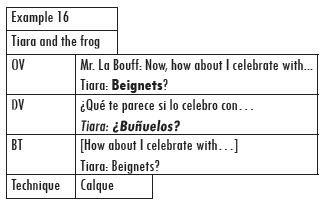
Cuisine can also form the cornerstone in the contextualisation of a scene. An interesting example of this can be found in Tiara and the frog where the continuous references to Cajun and Creole cuisine become the thread of the action. The film takes place in the mid–1920's in the French colony of New Orleans during the celebration of Mardi Gras. Mardi Gras refers to ''shrove Tuesday often observed (as in New Orleans) with parades and festivities'' (Mardi Gras, s.f.). This North American celebration, which arrived as a French Catholic tradition in the late 17th century (Mardi Gras, s.f.), has been related to beignets and, according to Kaufman (2009) it was French colonists of the 18th century who brought the recipe and custom of making beignets to New Orleans. This typical dessert is translated into the Spanish calque ''buñuelos'', in example 16. Although the celebration of Mardi Gras may be remote for the target audience, the term ''buñuelos'' may be associated with Easter by the Spanish audience. At least, in this way the relationship between the dish and the season in which the action takes place coincides, since in the Spanish culture there is a tradition of having ''buñuelos'' at Easter, the season of Mardi Gras.
The other four typical dishes associated with the Cajun cuisine appear in the source text (ST): gumbo (examples 17–25), étouffeé (example 21), jambalaya (example 21) and muffulettas (example 21). The translation technique of loan applied for ''gumbo'', which is considered the official cuisine of Lousiana (Nobles, 2009, p. 98), is the same applied in the cases of étouffeé, jambalaya and muffulettas, which are also typical Cajun dishes. The non–translation of these references reinforces the foreign flavour transmitted in the film. However, some cultural connotations could be lost in the TT were it not for the visual aid provided in the texts. Gumbo is associated with the socio–economic class of the protagonist, Tiara. The economical nature of the dish may not go unnoticed by the target audience thanks to the visual image of Tiara and her working class neighbours gathered around a gumbo pot and the fact that references to gumbo are always made by or related to members of the working class. Thus, gumbo is an example of how culinary references are able to connote extra cultural values, thereby becoming complex signs of meaning.
Discussion
This paper has attempted to analyse the different uses of culinary references in six animated films from two prominent studios, as well as the role of translation in the transmission of these references from the ST in English to the TT dubbed in Spanish. In order to do so, the Shrek saga, Tiara and the frog and Brave have been studied with particular attention paid to the different roles that the allusions to foodstuffs play in these productions.
Taking the role of the culinary references into consideration, four main functions have been distinguished in these films: (1) being a discursive element, (2) a comical resource, (3) a way of stereotyping, and (4) a contextualising motif. After the analysis, the following results have been observed (see figure 2).
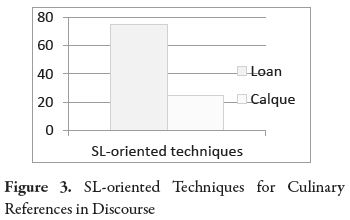
]]> Regarding the techniques applied for the translation of culinary references in discourse, the translators have preferred SL–oriented techniques in 55.6% of the cases, loan being their first option (80%), followed by calque (20%) (see figure 3); and TL–oriented techniques in 44.4% of the total examples with two techniques employed –transposition (75%) and generalization (25%) (see figure 4). The preference of loan instead of calque is revealing, as it can support the idea of living in a global village where cultures become merged. Whereas calque clearly shows the foreign nature of the reference, loan looks as if the term has been adopted by the target culture while still keeping foreign nuances. As far as TL–oriented techniques are is concerned, the preference for transposition in the analysed films seems to respond to the intention of bringing the films closer to the Spanish audience, Spanishing the texts with references so typical of the Spanish culture, like churros that make the films look as if they were Spanish.
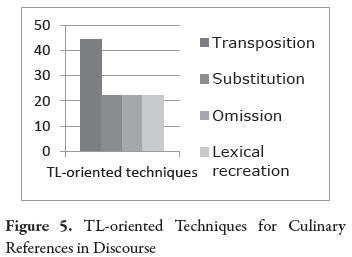
By contrast, in the case of the translation of culinary references with a humorous purpose there is a tendency towards TL–oriented techniques (55.6%). This seems to be justified by the functional approach taken in which the original function of the reference in the text prevails (see figure 2). A wider variety of techniques is observed in the case of the TL–oriented, the creativity of the translators being crucial to achieve the initial aim (see figure 5). However, it is observed that the same SL–oriented techniques applied for culinary references in discourse, loan (50%) and calque (50%), are also used for humour thanks, to a great extent, to the familiarity of the target audience with the source references (Fig. 6).
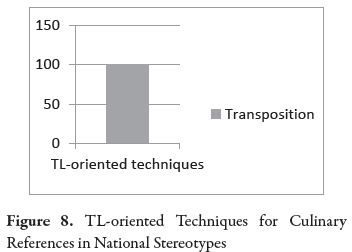
]]> Finally, a predisposition towards SL–oriented techniques is found in culinary references whose aim is to stereotype and contextualise the scene (figure 2). With regard to stereotyping, this may be justified by the need to provide characters with a national identity that distinguishes them from the others, calque being the technique used as it is the one that more clearly points to the foreign essence of the character (figure 7). Besides, the domestication in culinary references, and especially the preference for transposition in these cases (figure 8), seems to be aligned to the preference for domesticating techniques observed in the translation of the numerous other cultural references in the case of the Shrek saga. This general tendency makes the text more accessible to the Spanish audience and results in the Spanishisation of the Shrek saga.
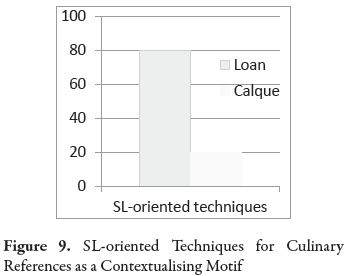
Likewise, the choice of SL–oriented techniques for contextualising also responds to the need to maintain the relationship between the term and its connotations (figure 2). The change of the culinary reference set against that background would imply the loss of all the meaning imbued by it. The examples that serve this function belong to The princess and the frog, where the scene takes place in New Orleans and all references revolve around it. The technique applied in the majority of cases was calque (80%) and loan was the other technique used for the remaining 20% (figure 9).
The use of loan for the translation of ''beignet'' can be explained by the existence of the same product and connotations in the target culture.
]]> Conclusions
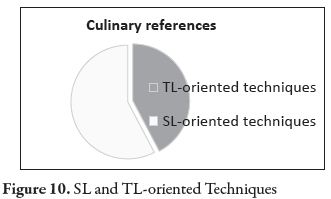
In order to conclude, if one considers the techniques applied for the translation of culinary references without considering their purpose in the text, a tendency towards SL–oriented techniques (57.7%) can be observed in the analysed films (figure 10). This preference can be explained as a side effect of globalisation, since over recent years, countries like Spain have been undergoing a continuous process of foreignisation by means of food. The increasing number of restaurants which offer typical dishes from other countries has contributed to the spreading of these foreign cultures, particularly, as food is regarded as one of the most significant and effective ways of getting to know other cultures. However, the similar percentage (42.3%) of TL–oriented techniques found in these films seems to respond either to their humorous function, or to the need to understand what the names of dishes mean, making their meaning more accessible; for example, in the cases of culinary references in the discourse. Thus, it can be seen how the argument in most debates on linguistic translation is generally reduced to domestication vs. foreignization (Venuti, 1995). As Chiaro suggests, this is not only related to the so–called process of globalization, but also to the function these references perform in the text (2008, p. 198).
NOTES
* This study was possible thanks to research projects Swift H46 (2014– 2015), financed by Diputación General de Aragón (DGA) and 2014 SGR 27 financed by AGAUR.
References
Agost, R. (1999). Traducción y doblaje: Palabras, voces e imágenes. Barcelona: Ariel. [ Links ]
Baños–Piñero, R. (2009). Estudio descriptivo–contrastivo del discurso oral prefabricado en un corpus audiovisual comparable en español: oralidad prefabricada de producción propia y de producción ajena. In P. Cantos Gómez & A. Sánchez Pérez (eds.), Panorama de investigaciones basadas en corpus (pp. 399–413). Murcia: Asociación Española de Lingüística del Corpus, University of Murcia. [ Links ]
Calefato, P. (1997). Sociosemiotica. Bari: Garphis. [ Links ]
Castro Paniagua, F. (2000). English–Spanish translation, through a cross–cultural interpretation approach. New York: University Press of America. [ Links ]
Chaume, F. (2001). La pretendida oralidad de los textos audiovisuales. In R. Agost & F. Chaume (eds.), La traducción en los medios audiovisuales (pp. 77–88). Castelló: Publicacions de la Universitat Jaume I. [ Links ]
Chiaro, D. (2004). Translational and marketing communication: A comparison of print and web advertising of Italian agro–food products. The Translator, 10(2), 313–328. [ Links ]
Chiaro, D. (2008). A taste of otherness eating and thinking globally. European Journal of English Studies, 12(2), 195–209. [ Links ]
Cronin, M. (2007). Translation in our time: Local voices, global movements'. Keynote lecture. MultimeDialecTranslation. University of Bologna at Forli, 11–12 May. [ Links ]
Delabastita, D. (1996). Introduction. In D. Delabastita (ed.). The Translator. Studies in Intercultural Communication 2(2), Special issue: Wordplay and translation (pp. 127–139). Manchester: St Jerome. [ Links ]
Di Giovanni, E. (2007). Disney films: reflections of the other and the self. Revista de Estudios Culturales de la Universidad Jaume I, 4, 91–109. [ Links ]
Díaz–Cintas, J. & Remael, A. (2007). Audiovisual translation: Subtitling. Manchester: St Jerome. [ Links ]
Franco Aixelá, J. (1996). Culture–specific items in translation. In R. Alvarez & C. A. Vidal (eds.), Translation/Power/Subversion (pp. 52–78). Clevedon: Multilingual Matters. [ Links ]
Gonzalez–Vera, P. (2010). The translation of recent digital animated movies. The case of DreamWorks' films Antz, Shrek and Shrek 2 and Shark Tale. PhD Thesis defended at the Faculty of Arts in the University of Zaragoza, Zaragoza, Spain. [ Links ]
González–Vera, P. (2012). The translation of linguistic stereotypes in animated films: a case study of DreamWorks' Shrek and Shark Tale. JoSTrans, 17, 104–123. [ Links ]
Igareda, P. (2011). Categorización temática del análisis cultural: una propuesta para la traducción. Ikala 16(27), 11–32. [ Links ]
Kaufman, C. (2009, February). Where does the New Orleans' Mardi Gras beignet come from? Prandial Post. Online newsletter of the International Association of Culinary Professionals (IACP). [ Links ]
Mardi Gras. Definition. Retrieved from http://www.merriam-webster.com/dictionary/mardi%20gras [ Links ]
Martínez Sierra, J. J. (2009). El papel del elemento visual en la traducción del humor en textos audiovisuales: ¿Un problema o una ayuda? Trans 13, 139–148. [ Links ]
Nash, W. (1985). The language of humour: Style and technique in comic discourse. London: Longman. [ Links ]
New Orleans and Mardi Gras History Timeline. Retrieved from http://www.mardigrasdigest.com/html/mardi_gras_history_timeline.htm [ Links ]
Nida, E. (2000). Principles of correspondence. In L. Venuti, The translation studies reader (pp. 126–140). London: Routledge. [ Links ]
Nobles, C. L. (2009). Gumbo. In S. Tucker & F. Starr (eds.). New Orleans cuisine: Fourteen signature dishes and their histories (pp. 98–116). Mississippi: University Press of Mississippi. [ Links ]
Orel, B. (2013). The language of food. M/C Journal, 16(3). Retrieved from http://www.journal.mediaculture.org.au/index.php/mcjournal/article/viewArticle/636 [ Links ]
Pedersen, J. (2007). How is culture rendered in subtitles? In H. Gerzymisch–Arbogast & S. Nauert (eds.), MuTra 2005 –Challenges of multidimensional translation: Conference proceedings (pp. 1–18). Saarbrücken: Advanced Translation Research Center (ATRC). [ Links ]
Valero Garcés, C. (2003). El papel de la LIJ en la sociedad actual. In A. I. Labra Cenitagoya, E. Laso y León, & J. S. Fernández Vázquez (eds.), Realismo social y mundos imaginarios: Una convivencia para el siglo XXI (pp. 715–721). Madrid: Universidad Alcalá de Henares. [ Links ]
Vandeweghe, W. (2005). Duotekse. Inleiding tot vertaling en vertaalstudie. Gent: Academia Press. [ Links ]
Venuti, L. (1995). The translator's invisibility. A history of translation. London: Routledge. [ Links ]
]]> ]]>