EMPIRICAL STUDIES
DOI:10.17533/udea.ikala.v20n3a04
The Paradox of the Practicum: Affinity to and Resistance towards Teaching
Las Paradojas de la Práctica: Empatía y Resistencia con la Profesión Docente
Les Paradoxes du Stage d'Enseignement: de l'Affinité et de la Résistance face au Métier de Professeur
]]>
José Alberto Fajardo Castañeda*; Iván Ricardo Miranda Montenegro**
* Profesor asociado UPTC, coordinador académico Doctorado en Lenguaje y Cultura, Grupo de investigación ENLETAWA Universidad Pedagógica y Tecnológica de Colombia Email: albertofajardocas@hotmail.com Mailing address: Calle 15 N°. 39–25 Duitama, Boyacá, Colombia
** Profesor UPTC, seccional Sogamoso. Grupo de investigación ENLETAWA Universidad Pedagógica y Tecnológica de Colombia Email: ivan2m2002@yahoo.com Mailing address: Calle 4 Sur N°. 15–134 Sogamoso, Cundinamarca, Colombia
Received: 2014–02–16
Accepted: 2015–07–22
How to reference this article: Fajardo Castañeda, J. A. y Miranda Montenegro, I. R. (2015). The paradox of the practicum: Affinity to and resistance towards teaching. Íkala, Revista de Lenguaje y Cultura, 20(3), 329–341. doi: 10.17533/udea.ikala.v20n3a04
The sense of affinity to teaching profession among a group of five Colombian pre–service teachers manifested as a result of their practicum is explored in this paper. The impact that a four month teaching experience caused in their professional development was at the center of this exploratory study. Interviews and online blogs were the research methods used for data collection while content analysis was the analytical approach. How the practicum influenced prospective teachers' professional future agendas led two contrasting findings: alignment with or resistance to teaching profession. This study can shed light on the conceptualisation and understanding of how teachers come to be.
Keywords: practicum, professional affiliation, resistance
RESUMEN
El sentido de afinidad con la profesión docente que un grupo de cinco maestros en formación manifestaron como resultado de la práctica pedagógica se explora en este artículo. El impacto que una experiencia de enseñanza de cuatro meses tuvo sobre sus expectativas de desarrollo profesional constituyó el eje central de este estudio exploratorio. Entrevistas y diarios virtuales fueron los métodos usados para la recolección de los datos, mientras que el análisis del contenido fue el enfoque analítico. La manera como la práctica docente impactó las agendas profesionales para el futuro de los maestros en formación sugirió dos resultados distintos: empatía y resistencia con la profesión docente. Este artículo podría arrojar algunas luces sobre la conceptualización y la comprensión de la forma como se llega a ser docente.
Palabras clave: práctica docente, afinidad profesional, resistencia
RÉSUMÉ
Cet article explore le sentiment d'affinité avec la profession d'enseignant, d'un groupe de cinq stagiaires professeurs. L'axe central de cette étude exploratoire consiste à établir l'impact qu'un stage de quatre mois a eu sur les perspectives de développement professionnel du groupe. Pour la collecte de données, on a mené des interviews et des journaux numériques, tandis que pour l'analyse du contenu on a utilisé l'approche analytique. On observe que le stage professionnel a influencé l'avenir des futurs enseignants sous deux optiques: d'un côté l'empathie et de l'autre la résistance envers la profession. L'article cherche à éclairer quelques aspects à propos de la conceptualisation et de la compréhension de la manière dont on devient enseignant.
Mots–clés: stage d'enseignement, affinité professionnelle, résistance
]]>
Introduction
The importance of teaching practicum for teachers acquiring a professional sense of affinity and agency emerges as an issue of unquestionable connection to a teacher's retention and effectiveness. Teacher education programmes may do an effort here in order to create a supportive atmosphere involving supervisors, mentors, and teacher educators as a strategy that might contribute towards preparing beginning teachers for professional development and growth.
Most prospective teachers choose teaching driven by dreams, ideals, or expectations. Whether or not these are fulfilled has been explored in the literature on teacher education (Wideen, Mayer– Smith, & Moon, 1998; Darling–Hammond, 2003). Beijaard (1995) and Nias (1996) argued that teachers' experiences at school strongly determined their motivations, attitudes, and engagement. They also found that teachers seemed to reflect a sense of positive and stable affiliation when they constructed a good relationship with pupils and the organisation of the institutions that they worked for; and the lack of either of those factors was claimed to cause career instability and a negative impact on their motivation.
Studies that attempt to answer the question of what keeps teachers on the teaching profession identify issues connected with job satisfaction, supportive environments or successful student learning (Nieto, 2003; Yost, 2006). There are surely many sources of teachers' arguments for sustaining their professional affiliation, but there are also trends well documented in the literature that account for teachers' early retirement or disenchantment with teaching profession (Nias, 1996; Beijaard, 1995; Inman & Marlow, 2004; Clandinin, Downey & Huber, 2009).
There is abundant evidence of teachers' early retirement in spite of the rising worldwide demand for qualified teachers (Darling–Hammond, 2003; Johnson & Birkeland, 2003; Inman & Marlow, 2004; Kelly, 2004; Clandinin et al., 2009).Those who decide to stay in the profession are motivated, for example, by factors such as parental or administrative support, skills and knowledge, or professional ownership (Bobeck, 2002). Yost (2006) explored the difficulties that ten beginning teachers encountered in their first year of practice, and found that teaching success partly depended on the acknowledgment of their teaching potential and skills, as well as their capacity to create positive learning environments.
Clandinin et al. (2009) reported increasing numbers of teachers leaving their jobs in Canada each year, where nearly 46% of early career teachers left teaching after 4 years of practice. Although the explanation of job dissatisfaction was not conclusive, teachers' narratives reveal that they were 'no longer able to 'live by' their stories of the shifting professional knowledge landscapes' (Clandinin et al., 2009. p. 146). Other studies found explanations for leaving related to issues connected to low salaries, limited opportunities for professional development and decision making, class size or stuffy institutional atmospheres (Inman & Marlow, 2004). The impact of practice and experience on a teacher's sense of commitment, efficacy, or ascription to teaching profession seems to have a direct connection to these factors.
Lasky (2005) introduced the notion of professional vulnerability, which seems to explain some of the tensions that teachers experience in the course of their careers, defining it as 'a multidimensional, multifaceted emotional experience that individuals can feel in an array of contexts' (p. 91). Lasky explored the way teachers cope with the demands of new reforms and educational policies. She surveyed and interviewed four in–service teachers in Ontario, Canada, and her findings indicate that teachers' sense of agency, purpose and professional identity were significantly influenced by macro socio–political and economic factors. An issue such as budget reduction or economic recession, among others, can have a major impact on teachers' identity. Not being able to achieve learning goals or build rapport with students may also strongly affect their sense of career affiliation and lead to professional vulnerability.
Brown (2005) conducted research while investigating the experience of two American mathematics teachers at an early stage of their professional careers that had entered teaching in their forties. Interview data indicated that the research participants experienced isolation, frustration, a sense of not doing the right thing, and a lack of mentoring or guidance. Problems regarding the curriculum, work overload, lack of respect for teachers, and resistance to innovation were also found. Although these tensions might be common in teachers' daily experience, this study highlights them as important factors that teacher education programmes should not ignore, and the situations described might not be too different from what pre–service teachers experience during the time of their practicum.
While research into in–service teachers' professional development has been highly productive, studies of what happens with preservice teachers during their practicum have been scarce. Farrell (2001) conducted a case study with a trainee foreign language teacher in Singapore, introducing the term socialisation, which 'means the process of becoming a member of a specific group, the teaching profession' (p. 49). Farrell's study was methodologically similar to the present exploratory study and findings indicated consistent communication problems between cooperating teachers and pre–service teachers, as well as 'a weak support structure for trainee teachers at the school during this socialisation process' (p. 49). The results also address other issues regarding the lack of school–based mentors support and guidance. This seems to be due to an absence of training in mentoring roles.
]]> Entering the teaching profession challenges beginning teachers' professional motivation and affiliation at different levels: classroom, institutional demands, curriculum, professional knowledge, further qualification, or policies, for example. These issues may have a profound impact on the way teachers construct their professional engagement. What student teachers experience during the practicum has a great impact on their sense of professional engagement. During this time, they face the direct demands of an institution in terms of, for example, schedules, classroom management, lesson planning, staff meetings, or teaching observation and assessment. Due to the fact that the group of student teachers participating in this study were at an early stage of their professional career development, this exploratory research looks at personal factors reflected in the interaction between professional practice and the way they did or did not align themselves with the teaching profession.
Method
Context.
This study was implemented at a public university in Colombia. Five research participants were selected for this exploratory study: three female and two male final year students in the Foreign Language Programme (FLP). They were prospective primary school teachers who worked with mixed classes at public schools in Tunja, Colombia. Their identities were protected using pseudonyms selected from a list of common English first names: Christine (C), Julie ( J), Sarah (S), Nicholas (N), and Jacob ( J).
Aim and research question.
To estimate the impact of the practicum on studentteachers' sense of affinity to the teaching profession.
Research question.
What is the impact of the practicum on preservice teachers' sense of affinity to the teaching profession?
Data gathering and analysis.
]]> A qualitative exploratory study was chosen to investigate the connection between the practicum and the participants' sense of affiliation with the teaching profession. The data were gathered over a four–month period in 2012. Two methods were used, namely, interviews and online blogs. Interviewing was split into two: one before the practicum started. The aim was to explore their sense of identification with the teaching profession. The latter was carried out in the last week of the practicum. The aim was to see the effect that it caused on their professional sense of affiliation with teaching. Both were planned as semi–structured interviews or professional dialogues, which were carried out in Spanish as it was believed to provide a more confident and fluent conversation. The dialogues were transcribed verbatim.The second method was on–line blogs that research participants wrote on a regular basis about their teaching experiences during the practicum. The blogs were planned as a key instrument for data collection in the attempt to gain insights into affective factors that might not be visible in the data yielded by interviews. From the process of regularly–posted entries, the data gathered allowed lived stories to be interpreted. The blog entries were written in Spanish in order to facilitate linguistic confidence. Excerpts chosen for this paper were translated into English. The research participants were asked to post a weekly blog entry. The first two entries were agreed to include information on each pre–service teacher's profile and background. Then a more general approach evolved and the topic of each entry was oriented towards describing the most rewarding and/or frustrating teaching experiences during the week, how they impacted on him/her and what was learnt. Quotations were taken, categorised and coded from the blog content.
The data gathered were analysed under the principles of Content analysis. Once the data were collected, the next step was to identify the key concepts or themes across text. Excerpts were then chosen from the three set of data that were collected. What was manifested in the entry interview with what was stated in the exit interview, plus some more references taken from the online blogs were then contrasted as a path to answer the research question. Themes focused on what the corpus stated, their visible and palpable components (Kondracki, Wellman, & Amundson, 2002). Concepts were then labelled with codes, which consist of groups with similar themes. These themes formed categories. For analytical purposes, excerpts will appear displayed as, for example, Christine, EI, where E stands for entry and I for interview1.
Findings
The sense of affiliation with the teaching profession that a group of pre–service teachers manifested in this exploratory study is presented in this section. The comparison between what they expressed in the interview before the practicum and what was expressed in the online blogs or the interview at the end of the teaching experience are analysed below. The interpretation of excerpts taken from the corpus gathered are organised into two emerging categories: Affiliation with and resistance to teaching profession. To do this, samples of each one are presented in turn.
Affinity to teaching.
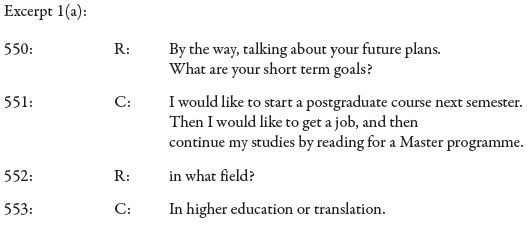
Christine commented from data in the exit interview –excerpt 1(a)– that a postgraduate was among her short–term priorities (I would like to start a postgraduate course next semester). It is perhaps interesting to note here that, for her, furthering her studies was even more important than getting a job (Then I would like to get a job). She went on to re–confirm the need for further qualifications (by reading for a Master programme). The data here clearly suggest that Christine explicitly included teaching as a part of her goals for the future. Even though she suggested an important step forward (higher education or translation), she was aware of her need for professional development.
]]> (Christine, ExI).
In excerpt 1(b) below, from data in the online blog entry 3, Christine provided a possible explanation of her commitment to teaching. She was aware of the need to be informed about 'fundamental questions' closely related to the field of teaching (large group management, didactics of English as a foreign language, and learning styles). What Christine may have been saying here is that becoming a teacher is a process strongly related to further stages of qualification and development. Christine's affiliation to teaching was manifested here in that her future professional goals were closely congruent with teaching as a profession.
Excerpt 1(b):
I have been committed to informing myself about large group management, the didactics of English as a foreign language, and learning styles. They are fundamental questions for me to be answered.
(Christine, BgE3).
Julie also showed a sense of professional affiliation. In excerpt 2(a) –in data in the exit interview– she commented on two of her short–term professional goals: a trip to the USA and a postgraduate course. She was aware that she was to finish her teaching practicum period 'soon'. After that, she planned to go to the USA with a specific professional purpose (It will help me a lot to improve my English). Target language improvement had become her first priority; a subsequent postgraduate course also showing her direct commitment to education (I would like to read for a postgraduate course in educational administration). The data here show that Julie's professional goals included at least a two–year plan. The explanation for such a sense of alignment is explored in the excerpt below.
(Julie,ExI).
In excerpt 2(b) below Julie provided some more insight into the possible explanation of her professional affinity to teaching. She acknowledged her pupils' engagement and learning motivation (I observed today that they were all truly following me), and then introduced the important teaching principles of her lesson. The notion of correct 'pronunciation', for example, was fundamental. This may explain to some extent her priority to go to America and improve her English. Julie's plan to read for a postgraduate programme in school administration would also represent an important sign of her alignment with the teaching of languages and the way she envisioned later stages of her professional growth.
]]> Excerpt 2(b):I observed today that they were all truly following me. They seemed to be motivated. They were repeating the tongue twister correctly. Their pronunciation was correct, which was one of the lesson aims.
(Julie, P.BgE4).
By contemplating images of ideal working environments, another student teacher projected forward her sense of career development. Sarah commented on her wish to work in her own institution (I would like to have my own language institute). The data here clearly show that teaching had become part of her future professional agenda. She did not only described herself as a teacher but specified characteristics of her imagined language institute to teach 'critical thinking and multicultural awareness'. As the researcher asked her to expand a little more on this idea, she went further mentioning a bilingual setting with pupils 'learning and using new technologies'. The data here provide clear evidence about Sarah's priority to become fully involved in teaching.
(Sarah, ExI).
To recap, a sense of professional affiliation with teaching was expressed by three research participants. Christine, Julie and Sarah described well–grounded expectations about enhancing their academic qualifications and creating particular teaching environments. The sources of their affiliation seem to be significantly explained by positive experiences gained before and during their teaching practicum. The data also suggest that the effects of the four–month teaching experience had a different impact on other pre–service teachers. A sense of resistance to teaching is examined below.
Resistance to teaching.
The interpretation of some excerpts taken from the corpus gathered sheds some light into the negative effects of the practicum on some of the research participants' expectations about teaching career. Jacob demonstrated a wellgrounded motivation in the period before his teaching practicum. In excerpt 4(a) below, he manifested a sense of achievement in his previous course (things went pretty good). He also expressed a combination of positive attitudes and feelings about his next teaching stage (I am ready to take my real teaching). He was aware that his teaching practicum was a time to be a 'real' teacher. Commonly–occurring themes also emerged related to language teaching: 'working with kids', enjoying 'teaching', loving 'teaching English and lesson planning'. Jacob's positive attitudes generated great expectations and encouraged him to take this final training stage with great determination.
]]>(Jacob, EI).
In excerpt 4(b) below, Jacob's level of motivation dropped when he faced non–harmonious teaching environments (children are very naughty). He went on to describe a series of examples of pupils' misbehaviour: fighting, being rude and aggressive, among others. Although there is no explicit reference here to the impact that this behaviour may have had on his own future professional engagement, at least in the first month of his practicum (My motivation has dropped dramatically).
Excerpt 4(b):
Children are really naughty. They behave badly. They fight with each other; they are rude and aggressive. They throw pens at other children's faces; they spit at each other, and they do not respect student teachers. My motivation has dropped dramatically.
(Jacob,BgE3).
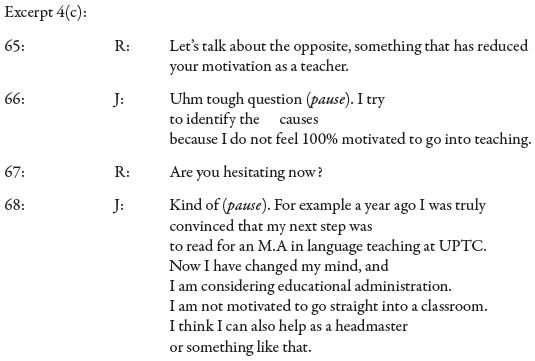
In excerpt 4(c), Jacob's agenda for the future appears to have been re–scheduled. This was different from what he thought before his teaching practicum (I was truly convinced that my next step was to read for the M.A in language teaching). Although he was still really committed to serving in areas related to education (I am considering educational administration), his wish for classroom involvement had declined steeply (I am not motivated to go straight into a classroom). The data here clearly show the negative effects of classroom experience during the teaching practicum (I think I can also help as a headmaster or something like that). Jacob's sense of identity as a teacher has been questioned and he is looking for some other professional alternatives. Jacob's motivation in his entry interview and that reflected in his exit interview were entirely different. Having pursued teaching for quite a long time, he was then suddenly aware that his own future story had to be re–imagined. This change seems to be significantly explained by his struggle to deal with a context where pupils' misbehaviour and lack of learning engagement affected his future professional goals in teaching.
(Jacob, ExI).
]]> Nicholas suggested a well–grounded affiliation with teaching in excerpt 5(a) below. He first acknowledged that choosing teaching was a good decision. He also highlighted his strong alignment with his professional choice (I am absolutely sure choosing language teaching was right). Then he stated that it would also give him 'plenty of opportunities'. Although he did not specify what kind of opportunities, he suggested that they were 'not only in Colombia'. This statement clearly confirms that he saw teaching from a wider perspective. By expanding on his trip to the USA, he reasserted his professional engagement with teaching (I realised it is a real profession, that teaching is all that I wished for). This wellgrounded sense of identity is compared next with the results of specific experiences.
(Nicholas, EI).
In excerpt 5(b), Nicholas commented on being observed by his university supervisor. Apart from this being the first lesson his university supervisor had observed, she was unaware of the research that was underway (She does not know about the project I am carrying out). He claimed to have a clear explanation of what he was doing (I know what I am doing), but Nicholas' discourse reflected disagreement with his supervisor's perceptions of the lesson (I was disappointed when she said that the lesson was a total mess). While her feedback, in his opinion, only touched on superficial aspects of the lesson and ignored the essentials (all she said was: you did not follow the lesson plan, the lesson was interrupted, there was too much Spanish). He also highlighted that her comment clashed with his own understanding of teaching languages to young learners (But I cannot torture the kids by talking only in English). The data here clearly suggest that his perceptions of teaching had changed because of his tutor's feedback.
Excerpt 5(b):
This is the first time she observes me. She does not know about the project I am carrying out. I was disappointed when she said that the lesson was a total mess. I know what I am doing. But all she said was: you did not follow the lesson plan, the lesson was interrupted, there was too much Spanish. But I cannot torture the kids by talking only in English.
(Nicholas, BgE5).
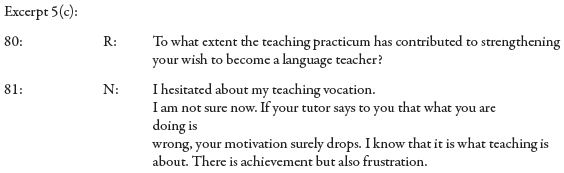
In excerpt 5(c), Nicholas illustrates how practice had an impact on his sense of career development (I hesitated about my teaching vocation). There is clear connection between his teaching feedback and his professional representation (If your tutor says to you that what you are doing is wrong, your motivation surely drops). However, Nicholas appeared to fully understand the unavoidable tensions which arise in the teaching profession (I know that it is what teaching is about). This quotation raises some interesting questions about understanding identity as a process involving both stable and unstable representations which may vary between being 'absolutely sure' at times and 'not sure now' or with conflicting perceptions of 'achievement' and 'frustration'.
]]>(Nicholas,ExI).
In summary, this second finding provided some insights about the contrasting effect of the practicum. While Jacob's classroom experience forced him to see his career development in a context beyond the classroom, Nicholas' strong teaching affiliation before his teaching practicum was slightly damaged as a result of his supervisor's feedback. The purpose of this study aims in exploring the impact of teaching experience in perspectives of professional growth and development. Two main findings affinity to and resistance towards the teaching profession lie at the centre for discussion, which are explored now.
Discussion
It is commonplace across teacher education literature that practice plays an important role in the process of constructing the meaning of teaching (Nias, 1996; Beijaard, 1995; Farrell, 2001; Clandinin et al., 2009). Although practice is generally acknowledged as experience in institutions and classroom, teaching experiences, relationships with pupils and other members of staff, teaching resources, budgets and educational policies have been identified as possible causes of affiliation or disaffiliation with teaching (Lasky, 2005; Yost, 2006; Clandinin et al., 2009).
It is beyond the scope of this study to examine several contextual factors that might impact the sense of affiliation with teaching. The research question attempted to explore the impact of practicum on pre–service teachers' sense of commitment after a period of time when they experienced the transition between being students of teaching and becoming teachers themselves. The results generally suggested a well–grounded affiliation with their profession. They exhibited positive and stable identities as they constructed good relationships with pupils and the institution they worked at.
Findings gave an important insight into how their first teaching experience had a great impact. This might be reflected in a wish to improve their qualifications at the level of postgraduate education (excerpts 1a & 1b), to travel to an English speaking country in order to improve their communicative skills (excerpt 2a), and to contemplate images of ideal working environments (excerpt 3). These points are in line with the findings of similar studies (e.g. Beijaard, 1995; Nieto, 2003; Yost, 2006).
]]> Findings also showed how the four–month teaching experience had a negative impact on two student teachers. While a strong motivation for teaching was manifested by one student teacher before the practicum (excerpt 4a), this dramatically declined as a result of factors such as pupils' misbehaviour (excerpt 4b), and such that his professional expectations now lay beyond the classroom (excerpt 4c). Although one participating teacher showed disaffiliation with classroom practice and rather envisaged his role in areas such as school administration (excerpt 4c), the data gave insights into student teachers' identification as teachers.
A sense of resistance to teaching was also manifested in another participating teacher. While he showed a strong interest in the profession before his teaching practicum started (excerpt 5a), this was transformed somewhat as a result of his supervisor's feedback (excerpt 5b). He manifested conflicting perceptions and frustration and felt that his motivation had dropped dramatically (excerpt 5c). At face value, this could suggest a need for changes both in the structure and purpose of teaching mentoring, and the need to encourage higher levels of thinking. Evidence of similar findings has been reported elsewhere (e.g. Farell, 2001; Brown, 2005) in studies reporting about pre–service teachers' feelings of frustration, lack of guidance, and communication problems with their supervisors. These two broad ideas are discussed briefly below but, again, they warrant further research.
Mentoring is generally acknowledged to involve 'on–going supportive relationships' between mentors and mentees (Peeler & Beverley, 2003, p. 1). There has been a growing acceptance of the need for guidance of a newcomer into the teaching profession by an experienced and more reliable professional, who helps 'them to appropriate the skills and knowledge they require' (Ball, 2000; cited in Peeler and Beverley, 2003, p. 1). This conception explicitly implies that a newcomer –a pre–service or first year in–service teacher– lacks skills and teaching knowledge, an argument which is not accepted here. Instead it is argued with a high level of certainty that the findings in this exploratory research show that the participating teachers manifested wellgrounded teaching skills and knowledge. Put simply, mentoring needs to be understood as a fundamental step to be taken in order to help a new teacher understand the transition into the profession. This necessarily entails cooperation and negotiation. To do this, teacher education could bridge the gap by working constantly even before the practicum starts.
Conclusion
The exploration of the nature of teachers' professional affiliation with teaching showed that the practicum has a great impact. While prospective teachers come to their profession with plenty of dreams, aspirations, and ideals, the requirements of a demanding profession bring about varied levels of frustration and disenchantment. The integration of trainers and trainees is recommended in order to improve affiliation and commitment with the teaching profession. By the same token, pre–service and in–service teachers need to see their job as an opportunity to enhance not only their personal life, but also the lives of several learners. This entails understanding how to improve quality in education. This necessarily involves a sense of job satisfaction and engagement. It is also worth noting that this task not only concerns teachers but also, for example, those designing teacher education programmes, policy–makers, educational authorities, and trainers. This new reality challenges trainers to maximise teachers' preparation beyond the restricted level of becoming technicians of education.
NOTES
1 Other labels included: ExI (Exit interview), BE1 (Blog Entry 1), and R (Researcher).
]]> References
Beijaard, D. (1995). Teachers' prior experiences and actual perceptions of professional identity. Teachers and Teaching, 1(2), 281–294. [ Links ]
Bobeck, B. L. (2002). Teacher Resiliency: A key to career longevity. The Clearing House, 75(4), 202–205. [ Links ]
Brown, S. W. (2005). Emily and Rebecca: A tale of two teachers. Teaching and Teacher Education, 21(6), 637–648. [ Links ]
Clandinin, D. J., Downey, C. A., & Huber, J. (2009). Attending to changing landscapes: Shaping the interwoven identities of teachers and teacher educators. Asia–Pacific Journal of Teacher Education, 37(2), 141–154. [ Links ]
Darling–Hammond, L. (2003). Keeping good teachers: Why it matters, what leaders can do. Educational Leadership, 60(8), 7–13. [ Links ]
Farrell, T. S. (2001). English language teacher socialisation during the practicum. Prospect, 16(1), 46–62. [ Links ]
Inman, D., & Marlow, L. (2004). Teacher retention: Why do beginning teachers remain in the profession?. Education, 124(4), 605–614. [ Links ]
Johnson, S. M., & Birkeland, S. E. (2003).The schools that teachers choose. Educational Leadership, 60(8), 20–24. [ Links ]
Kelly, L. M. (2004). Why induction matters. Journal of Teacher Education, 55, 438–448. [ Links ]
Kondracki, N.L., Wellman, N.S., & Amundson, D.R. (2002). Content analysis: Review of methods and their application in nutrition education. Journal of Nutrition Education and Behaviour, 34(4), 224–230. [ Links ]
Lasky, S. (2005). A socio–cultural approach to understanding teacher identity, agency and professional vulnerability in a context of secondary school reform. Teaching and Teacher Education, 21(8), 899–916. [ Links ]
Nias, J. (1996). Thinking about feeling: the emotions in teaching. Cambridge Journal of Education, 26 (3), 293–306. [ Links ]
Nieto, S. (2003).What keeps teachers going? New York, Teachers College Press. [ Links ]
Peeler, E., & Beverley, J. (2003). Mentoring: Bridging the identity crisis for beginner Teachers.NZARE\ AARE Conference Auckland. [ Links ]
Ryan, Mary E. & Healy, Annah, H. (2009). It's not all about school: ways of disrupting pre–service teachers' perceptions of pedagogy and communication. Teaching and Teacher Education, 25(3), 424–429. [ Links ]
Wideen, M., Mayer–Smith, J., & Moon, B. (1998). A critical analysis of the research on learning to teach: Making the case for an ecological perspective inquiry. Review of Educational Research, 68(2), 130–178. [ Links ]
Yost, D. (2006). Reflection and self–efficacy: Enhancing the retention of qualified teachers from a teacher education perspective. Teachers Education Quarterly, (Fall), 59–76. [ Links ]
]]>