<?xml version="1.0" encoding="ISO-8859-1"?><article xmlns:mml="http://www.w3.org/1998/Math/MathML" xmlns:xlink="http://www.w3.org/1999/xlink" xmlns:xsi="http://www.w3.org/2001/XMLSchema-instance">
<front>
<journal-meta>
<journal-id>0123-5923</journal-id>
<journal-title><![CDATA[Estudios Gerenciales]]></journal-title>
<abbrev-journal-title><![CDATA[estud.gerenc.]]></abbrev-journal-title>
<issn>0123-5923</issn>
<publisher>
<publisher-name><![CDATA[Universidad Icesi]]></publisher-name>
</publisher>
</journal-meta>
<article-meta>
<article-id>S0123-59232003000300003</article-id>
<title-group>
<article-title xml:lang="en"><![CDATA[VALUATION RELATIONSHIPS UNDER GROWTH]]></article-title>
</title-group>
<contrib-group>
<contrib contrib-type="author">
<name>
<surname><![CDATA[BENAVIDES FRANCO]]></surname>
<given-names><![CDATA[JULIÁN]]></given-names>
</name>
<xref ref-type="aff" rid="A01"/>
</contrib>
</contrib-group>
<aff id="A01">
<institution><![CDATA[,Universidad Icesi  ]]></institution>
<addr-line><![CDATA[ ]]></addr-line>
</aff>
<pub-date pub-type="pub">
<day>00</day>
<month>09</month>
<year>2003</year>
</pub-date>
<pub-date pub-type="epub">
<day>00</day>
<month>09</month>
<year>2003</year>
</pub-date>
<volume>19</volume>
<numero>88</numero>
<fpage>49</fpage>
<lpage>66</lpage>
<copyright-statement/>
<copyright-year/>
<self-uri xlink:href="http://www.scielo.org.co/scielo.php?script=sci_arttext&amp;pid=S0123-59232003000300003&amp;lng=en&amp;nrm=iso"></self-uri><self-uri xlink:href="http://www.scielo.org.co/scielo.php?script=sci_abstract&amp;pid=S0123-59232003000300003&amp;lng=en&amp;nrm=iso"></self-uri><self-uri xlink:href="http://www.scielo.org.co/scielo.php?script=sci_pdf&amp;pid=S0123-59232003000300003&amp;lng=en&amp;nrm=iso"></self-uri><abstract abstract-type="short" xml:lang="es"><p><![CDATA[Uno de los tópicos más importantes en valoración es la relación apropiada entre flujos de caja y tasas de retorno. Yo reviso esta relación con la premisa, por Myers (1974), de que el costo de la deuda es la tasa de descuento apropiada para el escudo fiscal. Diferentes hipótesis han sido estudiadas para el riesgo del escudo fiscal; cada una de ellas produce diferentes resultados de valoración, especialmente cuando el crecimiento está presente. Una diferencia entre los resultados que yo obtengo y los resultados de otros es la presencia del crecimiento en las expresiones para las tasas de descuento, lo cual puede ser utilizado para estimar la validez empírica de cada uno de los métodos propuestos.]]></p></abstract>
<abstract abstract-type="short" xml:lang="en"><p><![CDATA[One of the most important topics on valuation is the appropriate relationships between cash flows and rate of returns. I review those relationships under the premise, by Myers (1974), of the cost of debt as the right discount for the tax shield. Different hypotheses have been advanced for the tax shield risk, each one producing different valuation results, especially when growth is present. The consequences of some common mistakes on valuation are explored. One difference between the results I obtain and results by others is the presence of growth in the expressions for the discount rates, which can be used to asses the empirical validity of each of the approaches.]]></p></abstract>
<kwd-group>
<kwd lng="es"><![CDATA[Costo de capital]]></kwd>
<kwd lng="es"><![CDATA[tasa de descuento sobre el patrimonio]]></kwd>
<kwd lng="es"><![CDATA[valor del escudo fiscal]]></kwd>
<kwd lng="es"><![CDATA[beta apalancado]]></kwd>
<kwd lng="en"><![CDATA[Cost of capital]]></kwd>
<kwd lng="en"><![CDATA[return on equity]]></kwd>
<kwd lng="en"><![CDATA[tax shield value]]></kwd>
<kwd lng="en"><![CDATA[levered beta]]></kwd>
</kwd-group>
</article-meta>
</front><body><![CDATA[   <font size="2" face="verdana">        <p align="right"><font size="4"><b>VALUATION RELATIONSHIPS  UNDER GROWTH</b></font></p>      <p align="right">JULI&Aacute;N BENAVIDES FRANCO</p>      <p align="right">Ingeniero El&eacute;ctrico (Universidad de los Andes, 1988). Especializaciones en Finanzas y  Administraci&oacute;n de la Universidad Icesi; M&aacute;ster of Management (Tulane University, EE.UU.,  2001); Ph.D.(C) in Business (Tulane University, EE.UU.); director del Departamento de Finanzas  y profesor de tiempo completo de la Universidad Icesi; consultor de empresas privadas y  p&uacute;blicas; miembro del Centro Icesi de Gobierno Organizacional.</p>      <p align="right">Fecha de recepci&oacute;n: 16&#45;6&#45;2003 Fecha de aceptaci&oacute;n: 9&#45;10&#45;2003</p>    <hr />      <p><b>SUMARIO</b></p>      <p>Uno de los t&oacute;picos m&aacute;s importantes  en valoraci&oacute;n es la relaci&oacute;n apropiada  entre flujos de caja y tasas de retorno.  Yo reviso esta relaci&oacute;n con la  premisa, por Myers (1974), de que el  costo de la deuda es la tasa de descuento  apropiada para el escudo fiscal.  Diferentes hip&oacute;tesis han sido estudiadas  para el riesgo del escudo fiscal;  cada una de ellas produce diferentes  resultados de valoraci&oacute;n, especialmente  cuando el crecimiento  est&aacute; presente. Una diferencia entre  los resultados que yo obtengo y los  resultados de otros es la presencia  del crecimiento en las expresiones  para las tasas de descuento, lo cual  puede ser utilizado para estimar la  validez emp&iacute;rica de cada uno de los  m&eacute;todos propuestos.</p>      <p><b>PALABRAS CLAVES:</b></p>      <p>Costo de capital, tasa de descuento  sobre el patrimonio, valor del escudo  fiscal, beta apalancado.</p>      <p><b>Clasificaci&oacute;n: A</b></p>      ]]></body>
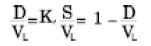
<body><![CDATA[<p><b>ABSTRACT</b></p>      <p>One of the most important topics on  valuation is the appropriate relationships  between cash flows and rate  of returns. I review those relationships  under the premise, by Myers  (1974), of the cost of debt as the right  discount for the tax shield. Different  hypotheses have been advanced for the tax shield risk, each one producing  different valuation results, especially  when growth is present. The  consequences of some common mistakes  on valuation are explored. One  difference between the results I obtain  and results by others is the presence  of growth in the expressions for  the discount rates, which can be used  to asses the empirical validity of each  of the approaches.</p>      <p><b>KEYWORDS:</b></p>      <p>Cost of capital, return on equity, tax  shield value, levered beta.</p>    <hr />        <p>I review the calculations of the appropriate  rates of return for free cash flows  under alternative assumptions.  One of the most contested assertions  on this issue is the appropriate rate  of return for the tax shield. Different  assumptions led to differences on valuation.  The seminal contributions of  Modigliani and Miller (M&amp;M) (1958  &amp; 1963) generated tractable ways to  deal with cash flows and rates of return.  In their 1963 correction M&amp;M  discounted the sure tax shield of a  perpetuity with the risk free rate,  which was the debt interest rate, and  established an enduring paradigm for  this term. Myers (1974) argue that  the appropriate rate of return for the  tax shield is the debt rate, taking distance  of M&amp;M but producing a similar  result for perpetuities. Harris and  Pringle (1985) suggest, instead, that  the tax shield bears the operational  risk, which means that the appropriate  discount rate is k<sub>0</sub>, the discount  rate for the firm&acute;s assets. Fernandez  (2003) define the Tax shield as the difference  in taxes paid by the unlevered  firm and the levered firm, and for  the case of unlevered firms arrive to  the same answer of M&amp;M and Myers.</p>      <p>I go through the valuation r/elationships  for the case of growing perpetuities  and finish the paper with somen  suggestions of how to solve the ongoing  debate. Growing perpetuities are  more realistic models of firm&acute;s cash  flows, firms always grow, or at least  they always forecast grow. I derive  somewhat modified versions of the  relationship between the weighted  average cost of capital (kWACC) and  the cost of equity (kS) and the valuation  consequences of the modified  assumptions. The results critically  depend on the appropriate rate of return  for the tax shield. The predicted  effects on the betas can be used to  shed some light on the ongoing controversy  about the appropriate rate  of return for the tax shields.</p>      <p>I finish my discussion with the most  general case with the relevant relationships  solved period by period.</p>      <p>The basic assumptions I use are:</p>      <p>1. The capital structure is constant:</p>      <p><img src="/img/revistas/eg/v19n88/n88a03e1.jpg" /></p>        ]]></body>
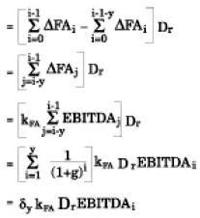
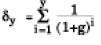
<body><![CDATA[<p>2. The tax rate T is constant</p>      <p>I begin with the most fundamental  equations:</p>      <p>Let EBITDAi be earnings before interests,  taxes, depreciation and amortization  for period i, Dep= Depreciation,  D=Debt, k<sub>D</sub>=Cost of Debt, T=Tax  rate, &Delta;Nwc= Increment in net working  capital and &Delta;FA=Increment in  fixed assets.</p>      <p>Then ECF<sub>i</sub> = (EBITDA<sub>i</sub> &#45; Dep<sub>i</sub> &#45;  D<sub>i</sub>k<sub>D</sub>)(1&#45;T)+ Dep<sub>i</sub> + gD<sub>i</sub> &#45; &Delta;Nwc<sub>i</sub> &#45; &Delta;FA<sub>i</sub>  is the equity cash flow and FCF<sub>i</sub> =  (EBITDA<sub>i</sub> &#45; Dep<sub>i</sub>)(1&#45;T) + Dep<sub>i</sub> &#45; &Delta;Nwc<sub>i</sub> &#45; &Delta;FA<sub>i</sub> is the free cash flow. The relationship  between both is FCF<sub>i</sub> = ECF<sub>i</sub>+D<sub>i</sub> k<sub>D</sub> (1 &#45; T) &#45; gD<sub>i</sub></p>      <p>To simplify things I suppose &Delta;Nwc<sub>i</sub> =  k<sub>w</sub>EBITDA<sub>i</sub>; &Delta;FA<sub>i</sub> = k<sub>FA</sub>EBITDA<sub>i</sub>. The  free cash flow becomes FCF<sub>i</sub> = (EBITDA<sub>i</sub>)(1 &#45; T &#45; k<sub>w</sub> &#45; k<sub>FA</sub>) + TDep<sub>i</sub></p>      <p>Under this approach Dep<sub>i</sub> also becomes  proportional to EBITDA<sub>i</sub>:</p>        <p>Let D<sub>r</sub>=1/y (y=years for full depreciation),  suppose D<sub>r</sub> is constant over the  years (for 10 years depreciation,  D<sub>r</sub>=10%); TGA= Total gross assets,  FDA= Fully depreciated assets, then:  Dep<sub>i</sub>=[TGA<sub>i</sub>&#45;1&#45;FDA<sub>i</sub>&#45;1]D<sub>r</sub></p>      <p>For i&gt;y,</p>      <p><img src="/img/revistas/eg/v19n88/n88a03e2.jpg" /></p>      <p>Where &delta;<sub>y</sub> <img src="/img/revistas/eg/v19n88/n88a03e3.jpg" />    </p>    ]]></body>
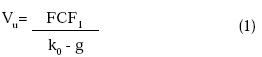
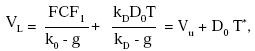
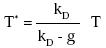
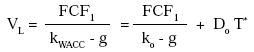
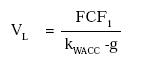
<body><![CDATA[<p>The FCF<sub>i</sub> becomes FCF<sub>i</sub> = EBITDA<sub>i</sub>  (1 &#45; T &#45; k<sub>w</sub> &#45; k<sub>FA</sub> (1 &#45; &delta;<sub>y</sub> TD<sub>r</sub>)). If g is the  EBITDA growing percentage, we  have FCF<sub>i+1</sub> = FCF<sub>i</sub>(1+g). In this scenario  (an infinite growing perpetuity)  the unlevered firm value, when k<sub>0</sub>  is less than g, is:</p>      <p><a name="ecua1"><img src="/img/revistas/eg/v19n88/n88a03e4.jpg" /></a></p>        <p>k<sub>0</sub> is the discount rate for the firm  assets, under a cero leverage policy  (more on this rate follows). When leverage  is greater than cero, the firm  value results from the combined  effects on the cash flows to debt holders  and shareholders. As per assumption  1, the debt increases at the  same rate (g) that the cash flows, then  D<sub>i+1</sub>=D<sub>i</sub>(1+g).<a href="#nota1"><sub>1</sub></a></p>      <p>The cash flow to the debt holders is:  DCF<sub>i</sub> = &#45;gD<sub>i</sub> + k<sub>D</sub>D<sub>i</sub></p>      <p>Then cash flow to the investors, shareholders  (ECF) and debt holders  (DCF) is:</p>      <p>CF(V<sub>L</sub>)<sub>i</sub> = ECF<sub>i</sub> + DCF<sub>i</sub> = (EBITDA<sub>i</sub> &#45; Dep<sub>i</sub> &#45; D<sub>i</sub> k<sub>D</sub>) (1&#45;T)+ Dep<sub>i</sub>  + gD<sub>i</sub> &#45; &Delta;Nwc<sub>i</sub> &#45; &Delta;FA<sub>i</sub> &#45;gD<sub>i</sub> + k<sub>D</sub>D<sub>i</sub>  = FCF<sub>i</sub> + k<sub>D</sub>D<sub>i</sub>T<a href="#nota2"><sup>2</sup></a></p>      <p>CF(V<sub>L</sub>) = FCF<sub>1</sub> + k<sub>D</sub>D<sub>0</sub>T, discounting  the flows at the appropriate<a href="#nota3"><sup>3</sup></a> rates  yields:</p>      <p><img src="/img/revistas/eg/v19n88/n88a03e5.jpg" /> Where <img src="/img/revistas/eg/v19n88/n88a03e6.jpg" /></p>        <p>Fern&aacute;ndez (2003) arrives to a different  expression for the Tax Shield: <img src="/img/revistas/eg/v19n88/n88a03e7.jpg" /> He avoids cash flows and employs valuation equi valences.</p>        <p>k<sub>D</sub> is the interest rate for the firm  debt, here I assume that this rate is  the same rate that the debt holders  are receiving. Under certain conditions  these rates differ. The convergence  condition is more severe, it requires  that g &lt; k<sub>D</sub>.<a href="#nota4"><sup>4</sup></a> The second term D<sub>0</sub>T*,  is known as the tax shield, except  that the effective tax rate is higher,  yielding a higher firm value.</p>      ]]></body>
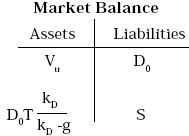
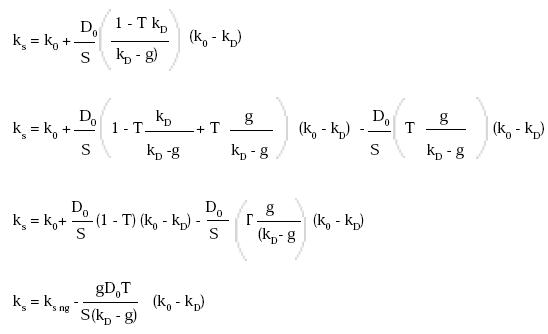
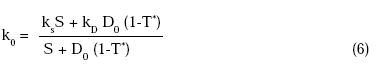
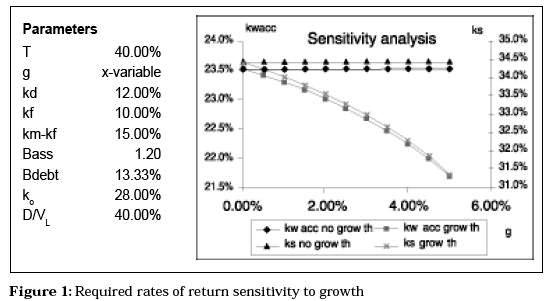
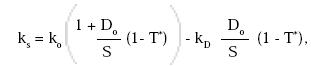
<body><![CDATA[<p>A market balance at t=0 follows</p>      <p><img src="/img/revistas/eg/v19n88/n88a03e8.jpg" /></p>          <p>Solving the accounting identity for  V<sub>U</sub>, we find an additional definition  for the unlevered firm:</p>      <p><a name="ecua3"><img src="/img/revistas/eg/v19n88/n88a03e40.jpg" /></a></p>        <p><b>k<sub>S</sub>, the equity cost for the levered  firm</b></p>      <p>Now we have enough tools to find k<sub>S</sub>.  The cash flows produced by the assets  and by the liabilities should be  the same, then it must be that V<sub>U</sub> k<sub>0</sub> + D<sub>0</sub> T* k<sub>D</sub> = Sk<sub>s</sub> + D<sub>0</sub>k<sub>D</sub>,<a href="#nota5"><sup>5</sup></a> replacing  V<sub>U</sub> with <a href="#ecua3">equation 3</a> and solving  for k<sub>S</sub>, we obtain:</p>      <p><a name="ecua4"><img src="/img/revistas/eg/v19n88/n88a03e9.jpg" /></a></p>        <p>The above result is the familiar definition  of k<sub>S</sub>, modified by the new effective  tax rate. Interestingly, increasing  flows reduce the required rate of return  for the shareholders (<a href="#figura1">Figure 1</a>),  when k<sub>0</sub> &gt; k<sub>D</sub>. We can also express this  result as a combination of the standard  equity cost with no growth k<sub>S ng</sub>  and the growth effect.</p>      <p><img src="/img/revistas/eg/v19n88/n88a03e10.jpg" /></p>        <p>As long as k<sub>0</sub> &gt; k<sub>D</sub>, the growth effect  is negative. Lets proceed to check if  under these conditions continue to  hold another basic financial result:  That discounting the unlevered flows  at the weighted average cost of capital  yields the same number that discounting  the unlevered flows at the  required rate of return for the firm  assets plus the increased tax shield.  To do this, is enough to find what definition  of k<sub>WACC</sub> solves the following  equality:</p>      ]]></body>
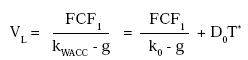
<body><![CDATA[<p><img src="/img/revistas/eg/v19n88/n88a03e11.jpg" /></p>        <p>First multiply both sides of the equality by <img src="/img/revistas/eg/v19n88/n88a03e12.jpg" />    the result is</p>      <p><img src="/img/revistas/eg/v19n88/n88a03e13.jpg" /></p>          <p>The last result is the same (by <a href="#ecua1">equation 1</a>) that <img src="/img/revistas/eg/v19n88/n88a03e14.jpg" /></p>          <p>Replacing V<sub>U</sub> by <a href="#ecua3">equation 3</a> yields</p>      <p><a name="ecua5"><img src="/img/revistas/eg/v19n88/n88a03e15.jpg" /></a></p>          <p>Solving <a href="#ecua4">equation 4</a> for k<sub>0</sub> results in</p>      <p><img src="/img/revistas/eg/v19n88/n88a03e16.jpg" /></p>        <p>We use this result in the <a href="#ecua5">equation 5</a> and solve for k<sub>WACC</sub>:</p>      <p><img src="/img/revistas/eg/v19n88/n88a03e17.jpg" /></p>        ]]></body>
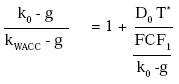
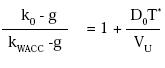
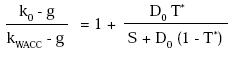
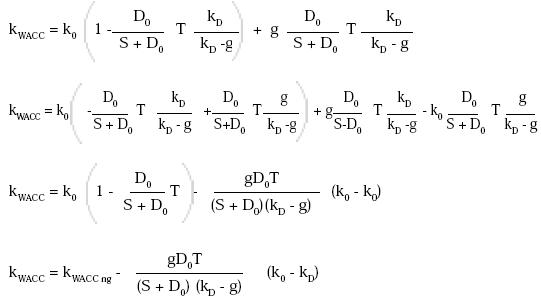
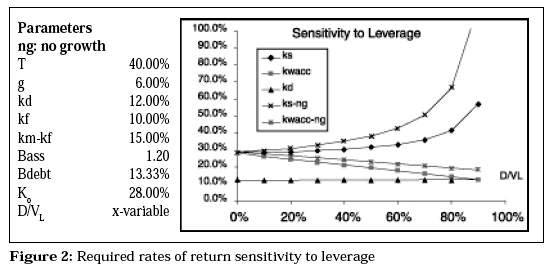
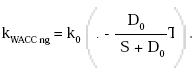
<body><![CDATA[<p>Here we find that the old expression  for k<sub>WACC</sub> continues to hold (which  means the results are coherent).  Please note that here the tax rate is  not the modified expression we defined  above; the change confines to the  calculation of k<sub>s</sub>. The result is that  growing firms have lower k<sub>WACC</sub>. To  see what are the effects on k<sub>WACC</sub> of  the growing perpetuity let express it  as a function of k<sub>0</sub>  </p>    <p><a name="ecua8"><img src="/img/revistas/eg/v19n88/n88a03e18.jpg" /></a></p>        <p>The previous equation shows that the  effects of the constant growth are two  fold. First, is a decreasing effect caused  by the interaction of k<sub>0</sub> and T*  and, second, an increasing effect  through the interaction of g and T*.  Under no growth we have <img src="/img/revistas/eg/v19n88/n88a03e19.jpg" /> With that in mind, modifying <a href="#ecua8">equation 8</a> yields<a href="#nota6"><sup>6</sup></a></p>      <p><img src="/img/revistas/eg/v19n88/n88a03e21.jpg" /></p>        <p>As we saw before, under normal conditions (k <sub>0</sub> &gt; k <sub>D</sub>) the decreasing effect  dominates (<a href="#figura1">Figure 1</a>).</p>      <p>The effects of leverage on the different  required rates of return (<a href="#figura2">Figure  2</a>) shows how the k<sub>WACC</sub> decreases at  a higher rate with constant growth  and the k<sub>s</sub> increases at a lower rate.  Again the benefits of growth are significant.</p>      <p>It is noteworthy to understand that  only with the corrections here developed  continue to hold the equality</p>      <p><img src="/img/revistas/eg/v19n88/n88a03e22.jpg" /></p>      <p>    <center><a name="figura1"><img src="/img/revistas/eg/v19n88/n88a03f1.jpg" /></a></center></p>      ]]></body>
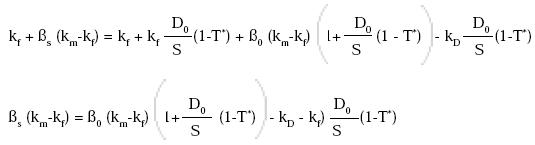
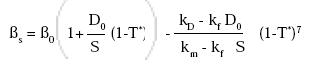
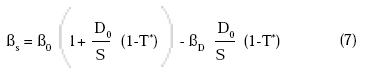
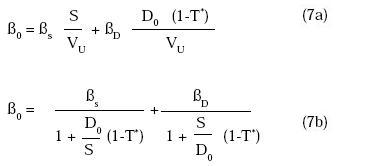
<body><![CDATA[<p>    <center><a name="figura2"><img src="/img/revistas/eg/v19n88/n88a03f2.jpg" /></a></center></p>        <p><font size="3"><b>MODIFIED BETA  CALCULATIONS</b></font></p>      <p>The fundamental equation of CAPM  permit us to find some additional  equivalences. By the CAPM we have  k<sub>s</sub> = k<sub>f</sub> + &beta;<sub>s</sub> (k<sub>m</sub> &#45; k<sub>f</sub>)and k<sub>o</sub> = k<sub>f</sub> + &beta;<sub>o</sub>  (k<sub>m</sub> &#45; k<sub>f</sub>), where the meaning of the  different terms correspond to the  usual ones. Rewriting <a href="#ecua4">equation 4</a>  yields:</p>      <p><img src="/img/revistas/eg/v19n88/n88a03e23.jpg" /> combining it with the former  CAPM equations produces:</p>      <p><img src="/img/revistas/eg/v19n88/n88a03e24.jpg" /></p>        <p>reordering terms gives the following result:</p>      <p><img src="/img/revistas/eg/v19n88/n88a03e25.jpg" /></p>      <p><img src="/img/revistas/eg/v19n88/n88a03e26.jpg" /></p>     <p><font size="1"><sup>7</sup>Most of the time the second term of this equation is ignored, the unique occasion when this practice is right is for k<sub>D</sub>=k<sub>F</sub>, which implies that &beta;<sub>D</sub>=0.</font></p>     ]]></body>
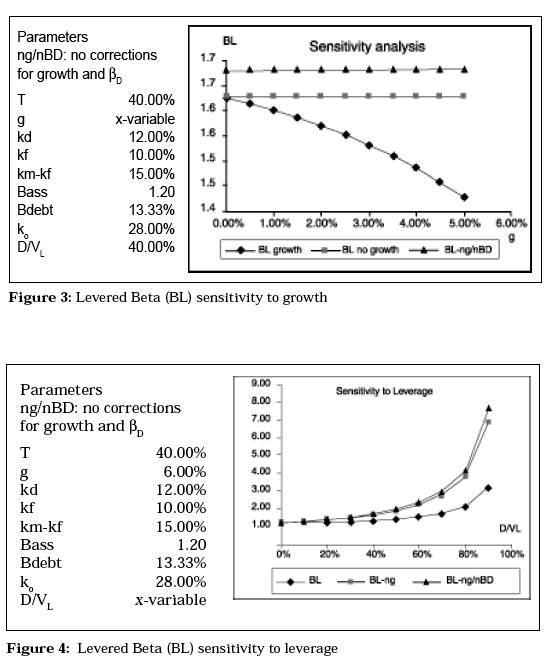
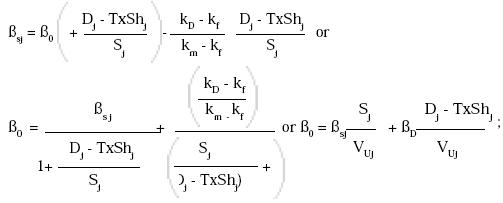
<body><![CDATA[<p>By CAMP <img src="/img/revistas/eg/v19n88/n88a03e27.jpg" /> Then <img src="/img/revistas/eg/v19n88/n88a03e41.jpg" /></p>     <p>Or</p>    <p> <img src="/img/revistas/eg/v19n88/n88a03e28.jpg" /></p>       <p>The previous equations also shows  that we have to reformulate our beta  calculations when considering constant  growth. <a href="#figura3">Figures 3 and 4</a> illustrate  the consequences of ignoring  the corrections here contemplated.  Note how the practice of ignoring &beta;<sub>D</sub>  increases the gap.</p>      <p>    <center><a name="figura3"><img src="/img/revistas/eg/v19n88/n88a03f3.jpg" /></a></center></p>      <p><font size="3"><b>OPERATIONAL REMARKS</b></font></p>     <p>The next paragraphs explore different  approaches that use the concepts  developed above. In particular  they cover:</p>  <ol>    <li>The valuation consequences of ignoring  T*</li>      <li>Tax shield estimation for constant  debt but increasing CF, which  means a variable capital structure.</li>      ]]></body>
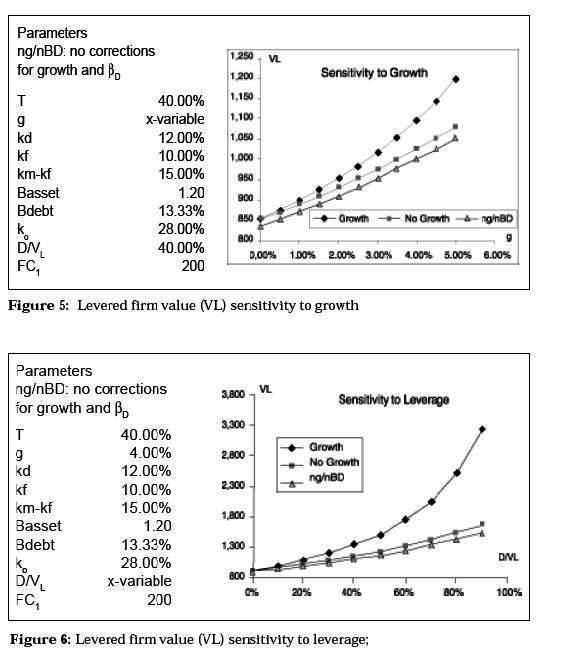
<body><![CDATA[<li>How to use market betas.</li>      <li>A valuation approach.</li>    </ol>  <ol>    <li><b>Valuation Consequences</b></li>      <p>Here I performed sensitivity analysis  to growth rates and leverage similar  to those performed for the required  rates of return and betas. Not  surprisingly the consequences of ignoring  the adjustments lead to undervaluation,  that increases with  growth and leverage.</p>      <p>The valuation formula we use is <img src="/img/revistas/eg/v19n88/n88a03e29.jpg" /> an infinite growing perpetuity.</p>      <p>    <center><a name="figura5"><img src="/img/revistas/eg/v19n88/n88a03f4.jpg" /></a></center></p>      <li><b>Tax shield estimation for  constant debt</b></li>      <p>Under this scenario the basic assumptions  does not hold and we cannot  use a unique k<sub>WACC</sub> to discount the  cash flows, because it is changing  each period. The only option left is to  estimate the tax shield directly. If the  debt is increasing but a different rate  (g<sub>1</sub>), it is still possible to use the same  technique. For the estimation of the  tax shield in the general case see the  valuation example.</p>      ]]></body>
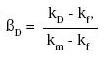
<body><![CDATA[<li><b>Market Betas</b></li>      <p>The use of market betas is implicitly  explained in the previous section.  Here the lesson it is do not forget the  correction for &beta;<sub>D</sub> or its proxy (k<sub>D</sub>&#45;k<sub>f</sub>)/(k<sub>m</sub>&#45;k<sub>f</sub>). Measuring &beta;<sub>0</sub> correctly implies to adjust for the cost of debt.</p>      <li><b>Valuation Example</b></li>      <p>How we implement a working model  of these developments. The answer is  that real calculations should use expressions  that very each period; then  the firm value needs to be solved backwards.  Suppose the estimations of  FC cover period 1 to period m, after  that a constant growth g<sub>L</sub> is expected.<a href="#nota8"><sup>8</sup></a> For any period j&le;m holds</p>      <p><img src="/img/revistas/eg/v19n88/n88a03e30.jpg" /></p>      <p>The Tax Shield is</p>      <p><img src="/img/revistas/eg/v19n88/n88a03e31.jpg" /></p>      <p>V<sub>Lj</sub> = V<sub>Uj</sub> + TxSh<sub>j</sub> = S<sub>j</sub> + D<sub>j</sub>, which gives us an expression for the unlevered firm  for the period j:</p>      <p>V<sub>Uj</sub> = S<sub>j</sub> + D<sub>j</sub> &#45; TxSh<sub>j</sub></p>      <p>The cash flows produced by the assets and the liabilities should be the same,  then</p>      ]]></body>
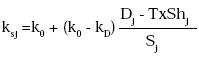
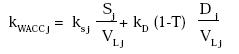
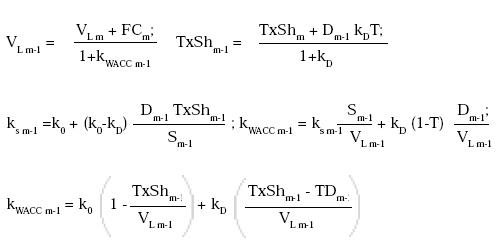
<body><![CDATA[<p>S<sub>j</sub> k<sub>sj</sub> + D<sub>j</sub> k<sub>D</sub> = V<sub>Uj</sub>k<sub>0</sub> + TxSh<sub>j</sub>k<sub>D</sub> = (S<sub>j</sub>+D<sub>j</sub> &#45; TxSh<sub>j</sub>) k<sub>0</sub> + TxSh<sub>j</sub> k<sub>D</sub></p>    </ol>        <p>Even though we suppose that k<sub>D</sub>, T  and K<sub>0</sub> are constant over time, this is  not required and a subindex can be  incorporated for a complete generalization.  The assumption 1 (A constant  leverage) is also relaxed for periods  less than m (which applies to  m+1 cash flows). Solving for k<sub>sj</sub> yields</p>     <p><img src="/img/revistas/eg/v19n88/n88a03e32.jpg" /></p>       <p>Now for each period holds:</p>      <p><img src="/img/revistas/eg/v19n88/n88a03e33.jpg" /></p>      <p>Again the expression for k<sub>WACCj</sub> is</p>     <p><img src="/img/revistas/eg/v19n88/n88a03e34.jpg" /></p>       <p>Each period has a set of simultaneous  equations; implementing those equations  in a spreadsheet produces circularities,  which are solved through  iterations.<a href="#nota9"><sup>9</sup></a></p>      <p>The implementation, which is illustrated  in <a href="#tabla1">Table 1</a>, begins when the  forecasted flows begin to growth at a  constant rate. Here holds all the  equations we deduced in the above  paragraphs:<a href="#nota10"><sup>10</sup></a></p>     ]]></body>
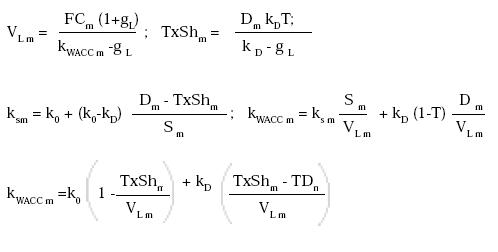
<body><![CDATA[<p><img src="/img/revistas/eg/v19n88/n88a03e35.jpg" /></p>       <p>To solve the equations system, some inputs are required:</p>      <p>FC<sub>m</sub>, T, k<sub>D</sub>,k<sub>0</sub>,g<sub>L</sub> and either D<sub>m</sub> or the target leverage D<sub>m</sub>/S<sub>m</sub>.</p>      <p>Now we go backwards to solve the equations for the period m&#45;1:</p>     <p><img src="/img/revistas/eg/v19n88/n88a03e36.jpg" /></p>       <p>The same formulas apply for the periods  m&#45;2 to 0. The algorithm stops  when we reach the period 0.</p>      <p>Having sketched the approach, the  numerical example is worked.</p>      <p>The <a href="#tabla1">Table 1</a> shows how this technique  produces similar valuations (period  by period): (1) through the direct  discount of the free cash flows with  k<sub>WACCj</sub>; and (2) through the discount  of free cash flows with k<sub>0</sub> plus the Tax  Shield (The Adjusted Present Value  proposed by Myers). The result holds  for k<sub>D</sub>, k<sub>0</sub> and T not constant.</p>      <p>With this methodology the effect on  k<sub>s</sub> of the growing perpetuity only  affects the period m. Given that the  terminal value is not a negligible part  of the firm value, the economic effects  of this correction continue to be significant.</p>       <p>Finally, following the same procedure outlined before, we have:</p>     ]]></body>
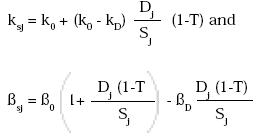
<body><![CDATA[<p><img src="/img/revistas/eg/v19n88/n88a03e37.jpg" /> for the operational model we develop.</p>        <p>Another history results if we accept  the correction to the M&amp;M model proposed  by Harris and Pringle (1985).  For them the tax shield bears the assets  risk (k<sub>0</sub>) not the debt risk. In this  universe k<sub>sj</sub> = k<sub>0</sub> + (k<sub>0</sub> &#45; k<sub>D</sub>) D<sub>j</sub> S<sub>j</sub> and  the effect of growth is not explicitly  incorporated to the expression of k<sub>s j</sub>,  here the effect is indirect and only  present when the leverage is not constant  (or the amount of debt is constant).  As expected the valuation results  are lower and the difference increases  with the distance between k<sub>0</sub>  and k<sub>D</sub>. The corresponding expressions  for the betas are:</p>     <p><img src="/img/revistas/eg/v19n88/n88a03e38.jpg" /></p>       <p>The Fernandez (2003) model also  doesn&acute;t incorporates the effect of  growth in their cost of capital or beta,  the equations are:</p>     <p><img src="/img/revistas/eg/v19n88/n88a03e39.jpg" /></p>       <p>He critics M&amp;M (1963) and Myers  (1974) on the grounds of k<sub>s</sub>&lt;k<sub>0</sub> for  some values of g, but all the models growing perpetuities (including  Fernandez) depend critically this  measure. question if expected  growth should reduce cost  capital is important, here we differentiate operational risk and its required  return from growth. Myers (1974) approach correct, capital: Are investors more prone  to invest in firms with high growth,  other things equal (specially assets  risk)? answer yes (which  sounds reasonable) empirical  data confirm it.</p>      <p>    <center><a name="tabla1"><a href="/img/revistas/eg/v19n88/n88a03t1.jpg" target="_blank"><b>TABLE 1</b></a></a></center></p>      <p><font size="3"><b>CONCLUSIONS</b></font></p>      <p>The equations have worked  present a coherent system that preserves  under conditions equality  V<sub>L</sub> = V<sub>u</sub> + TS. They also show higher continuing constant produces lower equity. conclusion true, Among working same business  (similar k<sub>0</sub>), those equity risk. On side, corrections by Harris Pringle (1985) or Fernandez  (2003) holds, the cost of equity  shouldn&acute;t be affected As it  has been stated before, tax shield  becomes risky when leverage  increases firm size does  not isolate market adjustments. The tax shield also  depends of the firm&acute;s ability collect it, even  after losses.</p>        ]]></body>
<body><![CDATA[<p>A empirical test seems appropriate; after all, corporations always forecast growth. That test is feasible. Firms with higher growth should have a lower k<sub>WACC</sub>. Measuring k<sub>WACC</sub> does not depend of how k<sub>s</sub> is stated. We can estimate k<sub>s</sub> through its CAPM definition k<sub>s</sub> = k<sub>f</sub> + &beta;<sub>s</sub>(k<sub>m</sub> &#45; k<sub>f</sub>). The cost of debt does not change and can be ignored. Controlling for industry and size should be enough to see how the predictions deals with reality.</p>       <p><b>FOOTNOTES</b></p>      <p><a name="nota1">1. </a>To check this assertion is enough to note that VL<sub>i+1</sub>=VL<sub>i</sub>(1+g), without FCF<sub>i+1</sub>. Given that the debt proportion is constant, it follows that D grows at the same rate. Interest payments are due at the end of period.</p>     <p><a name="nota2">2. </a>Under Fernandez (2003) approach:</p>     <p>Tax Shield=T<sub>xU</sub> &#45; T<sub>xL</sub> = EBITDA(1&#45;&delta;<sub>y</sub>k<sub>FA</sub>D<sub>r</sub>)T&#45; [EBITDA(1&#45;&delta;<sub>y</sub>k<sub>FA</sub>D<sub>r</sub>) + k<sub>D</sub>D]T = k<sub>D</sub>DT.</p>     <p>The result is the same. The key difference is that for Fernandez Tx<sub>U</sub> and Tx<sub>L</sub> have different risk and should be discounted independently, under the assumptions of this paper that doesn’t hold.</p>     <p><a name="nota3">3. </a>As I said, the discount rate for the tax shield is an unsolved issue on valuation, here I assume that this rate is the debt rate as Myers (1974).</p>     <p><a name="nota4">4. </a>It is not difficult to conceive firms with g &gt; k<sub>D</sub>, the only attenuant is that it is difficult to maintain indefinite growth rates higher than the cost of debt.</p>     <p><a name="nota5">5. </a>The result is the same if the equation is written for increasing flows V<sub>U</sub> (k<sub>0</sub>&#45;g)+D<sub>0</sub>T* (k<sub>D</sub>&#45;g) = S(k<sub>s</sub>&#45;g)+D<sub>0</sub>(k<sub>D</sub>&#45;g).</p>     <p><a name="nota6">6. </a>A simpler approach is to note that. </p>     ]]></body>
<body><![CDATA[<p></p>    <p><img src="/img/revistas/eg/v19n88/n88a03e20.jpg" /></p>     <p><a name="nota8">8. </a>The idea here is to present a methodology where the calculations are applied for the different periods.</p>     <p><a name="nota9">9. </a>To activate that feature in Excel go to Tools, choose Options, then Calculations; check in the Iterations box. See Velez and Tham (2001).</p>     <p><a name="nota10">10. </a>Implicitly we went back to assumption 1 (constant leverage).</p>   <hr />      <p><font size="3"><b>BIBLIOGRAPHY</b></font></p>      <!-- ref --><p>Fern&aacute;ndez, Pablo. 2004. <i>The value of tax shields is NOT equal to the present value of tax shields</i>. Journal of Financial Economics, 73(1). &nbsp;&nbsp;&nbsp;&nbsp;&nbsp;&nbsp;&nbsp;&nbsp;[&#160;<a href="javascript:void(0);" onclick="javascript: window.open('/scielo.php?script=sci_nlinks&ref=000159&pid=S0123-5923200300030000300001&lng=','','width=640,height=500,resizable=yes,scrollbars=1,menubar=yes,');">Links</a>&#160;]<!-- end-ref --><!-- ref --><p>Harris, Robert S. and John J. Pringle. 1985. <i>Risk&#45;adjusted discount ratesextensions from the average&#45;risk case</i>. The Journal of Financial Research 8, 237&#45;244.&nbsp;&nbsp;&nbsp;&nbsp;&nbsp;&nbsp;&nbsp;&nbsp;[&#160;<a href="javascript:void(0);" onclick="javascript: window.open('/scielo.php?script=sci_nlinks&ref=000160&pid=S0123-5923200300030000300002&lng=','','width=640,height=500,resizable=yes,scrollbars=1,menubar=yes,');">Links</a>&#160;]<!-- end-ref --><!-- ref --><p>Modigliani, Merton and Merton Miler. 1958. <i>The cost of capital, corporation finance and the theory of investment</i>. American Economic Review 48, 261&#45; 297.&nbsp;&nbsp;&nbsp;&nbsp;&nbsp;&nbsp;&nbsp;&nbsp;[&#160;<a href="javascript:void(0);" onclick="javascript: window.open('/scielo.php?script=sci_nlinks&ref=000161&pid=S0123-5923200300030000300003&lng=','','width=640,height=500,resizable=yes,scrollbars=1,menubar=yes,');">Links</a>&#160;]<!-- end-ref --><!-- ref --><p>Modigliani, Merton and Merton Miler. 1963. <i>Corporate income taxes and the cost of capital: a correction</i>. American Economic Review 48, 261&#45;297.&nbsp;&nbsp;&nbsp;&nbsp;&nbsp;&nbsp;&nbsp;&nbsp;[&#160;<a href="javascript:void(0);" onclick="javascript: window.open('/scielo.php?script=sci_nlinks&ref=000162&pid=S0123-5923200300030000300004&lng=','','width=640,height=500,resizable=yes,scrollbars=1,menubar=yes,');">Links</a>&#160;]<!-- end-ref --><!-- ref --><p>Myers, Stewart C. 1974. <i>Interactions of corporate financing qand investment decision&#45;Implications for capital budgeting</i>. The Journal of Finance 29, 1&#45;25.&nbsp;&nbsp;&nbsp;&nbsp;&nbsp;&nbsp;&nbsp;&nbsp;[&#160;<a href="javascript:void(0);" onclick="javascript: window.open('/scielo.php?script=sci_nlinks&ref=000163&pid=S0123-5923200300030000300005&lng=','','width=640,height=500,resizable=yes,scrollbars=1,menubar=yes,');">Links</a>&#160;]<!-- end-ref --><!-- ref --><p>Ross, Stephen A., Randolph W. Westerfield and Jeffery Jaffe. 1999. <i>Corporate Finance</i>, 5th Edition. Boston: Irwin McGraw&#45;Hill&nbsp;&nbsp;&nbsp;&nbsp;&nbsp;&nbsp;&nbsp;&nbsp;[&#160;<a href="javascript:void(0);" onclick="javascript: window.open('/scielo.php?script=sci_nlinks&ref=000164&pid=S0123-5923200300030000300006&lng=','','width=640,height=500,resizable=yes,scrollbars=1,menubar=yes,');">Links</a>&#160;]<!-- end-ref --> ]]></body><back>
<ref-list>
<ref id="B1">
<nlm-citation citation-type="journal">
<person-group person-group-type="author">
<name>
<surname><![CDATA[Fernández]]></surname>
<given-names><![CDATA[Pablo]]></given-names>
</name>
</person-group>
<article-title xml:lang="en"><![CDATA[The value of tax shields is NOT equal to the present value of tax shields]]></article-title>
<source><![CDATA[Journal of Financial Economics]]></source>
<year>2004</year>
<volume>73</volume>
<numero>1</numero>
<issue>1</issue>
</nlm-citation>
</ref>
<ref id="B2">
<nlm-citation citation-type="journal">
<person-group person-group-type="author">
<name>
<surname><![CDATA[Harris]]></surname>
<given-names><![CDATA[Robert S.]]></given-names>
</name>
<name>
<surname><![CDATA[Pringle]]></surname>
<given-names><![CDATA[John J.]]></given-names>
</name>
</person-group>
<article-title xml:lang="en"><![CDATA[Risk-adjusted discount ratesextensions from the average-risk case]]></article-title>
<source><![CDATA[The Journal of Financial Research]]></source>
<year>1985</year>
<volume>8</volume>
<page-range>237-244</page-range></nlm-citation>
</ref>
<ref id="B3">
<nlm-citation citation-type="journal">
<person-group person-group-type="author">
<name>
<surname><![CDATA[Modigliani]]></surname>
<given-names><![CDATA[Merton]]></given-names>
</name>
<name>
<surname><![CDATA[Merton]]></surname>
<given-names><![CDATA[Miler]]></given-names>
</name>
</person-group>
<article-title xml:lang="en"><![CDATA[The cost of capital, corporation finance and the theory of investment]]></article-title>
<source><![CDATA[American Economic Review]]></source>
<year>1958</year>
<volume>48</volume>
<page-range>261- 297</page-range></nlm-citation>
</ref>
<ref id="B4">
<nlm-citation citation-type="journal">
<person-group person-group-type="author">
<name>
<surname><![CDATA[Modigliani]]></surname>
<given-names><![CDATA[Merton]]></given-names>
</name>
<name>
<surname><![CDATA[Merton]]></surname>
<given-names><![CDATA[Miler]]></given-names>
</name>
</person-group>
<article-title xml:lang="en"><![CDATA[Corporate income taxes and the cost of capital: a correction]]></article-title>
<source><![CDATA[American Economic Review]]></source>
<year>1963</year>
<volume>48</volume>
<page-range>261-297</page-range></nlm-citation>
</ref>
<ref id="B5">
<nlm-citation citation-type="journal">
<person-group person-group-type="author">
<name>
<surname><![CDATA[Myers]]></surname>
<given-names><![CDATA[Stewart C.]]></given-names>
</name>
</person-group>
<article-title xml:lang="en"><![CDATA[Interactions of corporate financing qand investment decision-Implications for capital budgeting]]></article-title>
<source><![CDATA[The Journal of Finance]]></source>
<year>1974</year>
<volume>29</volume>
<page-range>1-25</page-range></nlm-citation>
</ref>
<ref id="B6">
<nlm-citation citation-type="book">
<person-group person-group-type="author">
<name>
<surname><![CDATA[Ross]]></surname>
<given-names><![CDATA[Stephen A.]]></given-names>
</name>
<name>
<surname><![CDATA[Westerfield]]></surname>
<given-names><![CDATA[Randolph W.]]></given-names>
</name>
<name>
<surname><![CDATA[Jaffe]]></surname>
<given-names><![CDATA[Jeffery]]></given-names>
</name>
</person-group>
<source><![CDATA[Corporate Finance]]></source>
<year>1999</year>
<edition>5th</edition>
<publisher-loc><![CDATA[Boston ]]></publisher-loc>
<publisher-name><![CDATA[Irwin McGraw-Hill]]></publisher-name>
</nlm-citation>
</ref>
</ref-list>
</back>
</article>