<?xml version="1.0" encoding="ISO-8859-1"?><article xmlns:mml="http://www.w3.org/1998/Math/MathML" xmlns:xlink="http://www.w3.org/1999/xlink" xmlns:xsi="http://www.w3.org/2001/XMLSchema-instance">
<front>
<journal-meta>
<journal-id>0123-5923</journal-id>
<journal-title><![CDATA[Estudios Gerenciales]]></journal-title>
<abbrev-journal-title><![CDATA[estud.gerenc.]]></abbrev-journal-title>
<issn>0123-5923</issn>
<publisher>
<publisher-name><![CDATA[Universidad Icesi]]></publisher-name>
</publisher>
</journal-meta>
<article-meta>
<article-id>S0123-59232006000400001</article-id>
<title-group>
<article-title xml:lang="en"><![CDATA[TENDER OFFERS IN SOUTH AMERICA: ARE ABNORMAL RETURNS REALLY HIGH?]]></article-title>
</title-group>
<contrib-group>
<contrib contrib-type="author">
<name>
<surname><![CDATA[FUENZALIDA]]></surname>
<given-names><![CDATA[DARCY]]></given-names>
</name>
<xref ref-type="aff" rid="A01"/>
</contrib>
<contrib contrib-type="author">
<name>
<surname><![CDATA[MONGRUT]]></surname>
<given-names><![CDATA[SAMUEL]]></given-names>
</name>
<xref ref-type="aff" rid="A02"/>
</contrib>
<contrib contrib-type="author">
<name>
<surname><![CDATA[NASH]]></surname>
<given-names><![CDATA[MAURICIO]]></given-names>
</name>
<xref ref-type="aff" rid="A03"/>
</contrib>
<contrib contrib-type="author">
<name>
<surname><![CDATA[TAPIA]]></surname>
<given-names><![CDATA[JUAN]]></given-names>
</name>
<xref ref-type="aff" rid="A04"/>
</contrib>
</contrib-group>
<aff id="A01">
<institution><![CDATA[,Universidad Federico Santa María Departamento de Industrias ]]></institution>
<addr-line><![CDATA[Valparaíso ]]></addr-line>
<country>Chile</country>
</aff>
<aff id="A02">
<institution><![CDATA[,EGADE Tecnológico de Monterrey Departamento de Finanzas ]]></institution>
<addr-line><![CDATA[ ]]></addr-line>
<country>México</country>
</aff>
<aff id="A03">
<institution><![CDATA[,Banco Santander  ]]></institution>
<addr-line><![CDATA[Santiago ]]></addr-line>
<country>Chile</country>
</aff>
<aff id="A04">
<institution><![CDATA[,Universidad Federico Santa María Departamento de Industrias ]]></institution>
<addr-line><![CDATA[Valparaíso ]]></addr-line>
<country>Chile</country>
</aff>
<pub-date pub-type="pub">
<day>00</day>
<month>12</month>
<year>2006</year>
</pub-date>
<pub-date pub-type="epub">
<day>00</day>
<month>12</month>
<year>2006</year>
</pub-date>
<volume>22</volume>
<numero>101</numero>
<fpage>13</fpage>
<lpage>36</lpage>
<copyright-statement/>
<copyright-year/>
<self-uri xlink:href="http://www.scielo.org.co/scielo.php?script=sci_arttext&amp;pid=S0123-59232006000400001&amp;lng=en&amp;nrm=iso"></self-uri><self-uri xlink:href="http://www.scielo.org.co/scielo.php?script=sci_abstract&amp;pid=S0123-59232006000400001&amp;lng=en&amp;nrm=iso"></self-uri><self-uri xlink:href="http://www.scielo.org.co/scielo.php?script=sci_pdf&amp;pid=S0123-59232006000400001&amp;lng=en&amp;nrm=iso"></self-uri><abstract abstract-type="short" xml:lang="en"><p><![CDATA[Different studies in developed capital markets have found positive abnormal returns of at least 15% during the announcement date of a tender offer. Although there are almost no studies for South American stock markets, some studies reported positive abnormal returns, ranging from 25% to 50%, related to the announcement of the first tender offer. In this study one argues that estimated positive abnormal returns in emerging markets are high because studies have assumed a completely segmented capital market by applying the market model with a local stock market index. By allowing for partial integration among five South American emerging markets, one shows that there are in fact positive abnormal returns previously, during, and after the announcement date of the first tender offer. However, the positive abnormal return associated to the announcement date is in the order of 8%. A slightly higher abnormal return is obtained using a market model that accounts for partial integration and downside risk. These results prompt towards a lower positive abnormal return in the sample of South American firms studied.]]></p></abstract>
<abstract abstract-type="short" xml:lang="es"><p><![CDATA[Diferentes estudios realizados en mercados de capital desarrollados han revelado tasas de retorno positivas inusuales de por lo menos 15% durante la fecha de anuncio de la oferta pública de adquisición de acciones. Aunque casi no se han llevado a cabo estudios sobre los mercados bursátiles en Sudamérica, algunos estudios han reportado tasas de retorno positivas inusuales en un rango del 25% al 50%, las cuales están relacionadas con el anuncio de la primera oferta de adquisición. En el presente estudio, se argumenta que las tasas de retorno positivas inusuales estimadas en los mercados emergentes son altas porque los estudios se han basado en un mercado de capitales totalmente segmentado aplicando el modelo de mercado y utilizando un índice del mercado bursátil local. Al considerar la integración parcial entre los cinco mercados emergentes en Sudamérica, se demuestra que efectivamente existen tasas de retorno positivas inusuales antes, durante y después de la fecha de anuncio de la primera oferta de adquisición. Sin embargo, el retorno positivo inusual asociado a la fecha del anuncio se encuentra en el orden del 8%. Utilizando un modelo de mercado que considere la integración parcial y el riesgo a la baja, se obtiene una tasa de retorno inusual ligeramente mayor. Estos resultados señalan una menor tasa de retorno positiva inusual en la muestra de las empresas sudamericanas incluidas en el estudio.]]></p></abstract>
<kwd-group>
<kwd lng="en"><![CDATA[Tender offer]]></kwd>
<kwd lng="en"><![CDATA[abnormal return]]></kwd>
<kwd lng="en"><![CDATA[emerging market]]></kwd>
<kwd lng="es"><![CDATA[Oferta de adquisición]]></kwd>
<kwd lng="es"><![CDATA[retorno inusual]]></kwd>
<kwd lng="es"><![CDATA[mercado emergente]]></kwd>
</kwd-group>
</article-meta>
</front><body><![CDATA[   <font size="2" face="verdana">      <p align="right"><font size="4"><b>TENDER OFFERS IN SOUTH AMERICA:  ARE ABNORMAL RETURNS REALLY  HIGH?</b></font></p>      <p align="right">DARCY FUENZALIDA<sup>1</sup>, SAMUEL MONGRUT<sup>2</sup>, MAURICIO NASH<sup>3</sup>, JUAN TAPIA<sup>4</sup></p>        <p align="right"><sup>1</sup> Doctor en Ciencias Empresariales de la Universidad de Lleida, Espa&ntilde;a. Mag&iacute;ster en Econom&iacute;a de la  Universidad Cat&oacute;lica de Chile e Ingeniero Civil Qu&iacute;mico de la Universidad Federico Santa Mar&iacute;a, Chile.  Profesor del Departamento de Industrias de la Universidad Federico Santa Mar&iacute;a, Valpara&iacute;so, Chile.  <a href="mailto:darcy.fuenzalida@usm.cl">darcy.fuenzalida@usm.cl</a></p>      <p align="right"><sup>2</sup> Doctor en Ciencias Econ&oacute;micas y Empresariales, Universidad de Barcelona, Espa&ntilde;a. Mag&iacute;ster en Econom&iacute;a,  Universidad de Maastricht, Holanda. Licenciado en Administraci&oacute; de Empresas, Universidad del Pac&iacute;fico,  Per&uacute;. Profesor de Finanzas de EGADE Tecnol&oacute;gico de Monterrey, M&eacute;xico.  <a href="mailto:mongrut_sa@up.edu.pe">mongrut_sa@up.edu.pe</a></p>      <p align="right"><sup>3</sup> MBA, Mag&iacute;ster en Gesti&oacute;n Empresarial, Ingeniero en Control de Gesti&oacute;n y Contador Auditor.  Se desempe&ntilde;a como funcionario en el Banco Santander Santiago, Chile.  <a href="mauricio.nash@usm.cl">mauricio.nash@usm.cl</a></p>      <p align="right"><sup>4</sup> Ingeniero Comercial de la Universidad Federico Santa Mar&iacute;a de Chile. Profesor e investigador en el  Departamento de Industrias de la Universidad Federico Santa Mar&iacute;a, Valpara&iacute;so, Chile.  <a href="mailto:juan.tapia@usm.cl">juan.tapia@usm.cl</a></p>        <p align="right">Fecha de recepci&oacute;n: 6-3-2006  Fecha de aceptaci&oacute;n 28-8-2006</p>  <hr />      <p><b>ABSTRACT</b></p>      <p>Different studies in developed capital  markets have found positive abnormal  returns of at least 15% during the  announcement date of a tender offer.  Although there are almost no studies  for South American stock markets,  some studies reported positive abnormal  returns, ranging from 25% to  50%, related to the announcement of  the first tender offer. In this study one  argues that estimated positive abnormal  returns in emerging markets are  high because studies have assumed a  completely segmented capital market  by applying the market model with a  local stock market index. By allowing  for partial integration among five  South American emerging markets,  one shows that there are in fact  positive abnormal returns previously,  during, and after the announcement  date of the first tender offer. However,  the positive abnormal return  associated to the announcement  date is in the order of 8%. A slightly  higher abnormal return is obtained  using a market model that accounts  for partial integration and downside  risk. These results prompt towards  a lower positive abnormal return in  the sample of South American firms  studied.</p>      ]]></body>
<body><![CDATA[<p><b>KEY WORDS</b></p>      <p>Tender offer, abnormal return, emerging market.</p>      <p>JEL code: C12, C32 and G34</p>      <p><b>RESUMEN</b></p>      <p>Diferentes estudios realizados en  mercados de capital desarrollados  han revelado tasas de retorno positivas  inusuales de por lo menos 15%  durante la fecha de anuncio de la  oferta p&uacute;blica de adquisici&oacute;n de acciones.  Aunque casi no se han llevado  a cabo estudios sobre los mercados  burs&aacute;tiles en Sudam&eacute;rica, algunos  estudios han reportado tasas de retorno  positivas inusuales en un rango  del 25% al 50%, las cuales est&aacute;n relacionadas  con el anuncio de la primera  oferta de adquisici&oacute;n. En el presente  estudio, se argumenta que las tasas  de retorno positivas inusuales estimadas  en los mercados emergentes  son altas porque los estudios se han  basado en un mercado de capitales  totalmente segmentado aplicando el  modelo de mercado y utilizando un  &iacute;ndice del mercado burs&aacute;til local. Al  considerar la integraci&oacute;n parcial entre  los cinco mercados emergentes en  Sudam&eacute;rica, se demuestra que efectivamente  existen tasas de retorno  positivas inusuales antes, durante  y despu&eacute;s de la fecha de anuncio de  la primera oferta de adquisici&oacute;n. Sin  embargo, el retorno positivo inusual  asociado a la fecha del anuncio se  encuentra en el orden del 8%. Utilizando  un modelo de mercado que  considere la integraci&oacute;n parcial y el  riesgo a la baja, se obtiene una tasa de  retorno inusual ligeramente mayor.  Estos resultados se&ntilde;alan una menor  tasa de retorno positiva inusual en la  muestra de las empresas sudamericanas  incluidas en el estudio.</p>      <p><b>PALABRAS CLAVE</b></p>      <p>Oferta de adquisici&oacute;n, retorno inusual, mercado emergente</p> <hr />      <p><b><font size="3">1. INTRODUCTION</font></b></p>      <p>There have been numerous studies in  the field of tender offers and on the  necessary premia to get corporate  control in the process of takeover  in developed capital markets, but  almost none for South American stock  markets. International evidence,  mainly in the United States, shows  that there are high positive abnormal  returns for the target company at the  moment of announcing the tender  offer.</p>      <p>The objective of this study is to show  that positive abnormal returns related  to the first tender offer are in fact  lower than previous estimates if one  allows capital markets to be partially  integrated instead of completely  segmented. Recently, Stulz (1999),  and Bekaert and Harvey (2003)  have shown that after financial  liberalization in emerging markets,  their expected returns must fall  because their relative volatility with  respect to the world volatility must  be higher than their correlations  with the world market returns. Stulz  (1999) has shown that this is the  necessary and sufficient condition for  globalization to reduce to reduce the  risk premium of an small country (in  this case an emerging market). This is  the case even when emerging markets  are more sensitive to world events due  to their financial liberalizations.<a href="#1"><sup>1</sup></a> To  the extent that local and world events  play a meaningful role in explaining  stock returns in emerging markets  there will be less variation to explain  and therefore abnormal returns must  be lower than otherwise.</p>      ]]></body>
<body><![CDATA[<p>In this research, one shows that  accounting for partial integration  among five South American stock  markets yields positive abnormal  returns, which are lower than the ones  estimated by previous studies. In order  to show this, one uses 17 tender offers  that have been accomplished during  the period 1998-2002 across five South  American stock markets (Argentina,  Brazil, Chile, Peru and Venezuela).  In particular, one is interested in  answering the following research  questions: Do target South American  firms offer positive abnormal returns  around the announcement date of  their first tender offer in a situation  of partial integration? Does one find  evidence of information leakage  during the days previous to the  announcement date of the first tender  offer? Is there evidence of stock  market overreaction?<a href="#2"><sup>2</sup></a></p>      <p>In particular, an hybrid multifactor  Capital Asset Pricing Model (CAPM)  is used as a market model. This is  in fact just one way to represent a  situation of partial integration. As  pointed by Bodnar et al. (2003), a  situation of partial integration is  very difficult to represent because  in this situation every investor  has access to an incomplete but  well-defined list of stocks. In order  to specify this situation one needs  information about all individuals and  available securities for them. Hence,  it may be possible that a situation of partial integration does not  correspond to the hybrid multifactor  CAPM. However, since the hybrid  multifactor CAPM is a strange  mix of the full-integration and the  full-segmentation CAPM, it may be  taken as a first approximation to a  situation of partial integration.</p>      <p>The paper has been divided into six  sections. The next section discusses  the existing empirical evidence  concerning tender offers, while  the third section reviews the main  aspects related to event studies. The  sample criteria and data description  appears in the fourth section, while  the methodology and results are  discussed in the fifth section. The last  section concludes the paper.</p>      <p><b><font size="3">2. TENDER OFFERS: EMPIRICAL  EVIDENCE</font></b></p>      <p>A takeover refers to transfer of  control of a firm from one group  of shareholders to another group  of shareholders. The controlling  shareholders of the bidder company  wish to acquire the company to  the controlling shareholders of a  target company. This change in the  controlling interest of a corporation  can be accomplished either through a  friendly acquisition or an unfriendly,  hostile, bid. A hostile takeover (with  the aim of replacing current existing  management) is usually attempted  through a public tender offer (Harvey  and Mongerson, 2006).</p>      <p>A tender offer is a general offer  made publicly and directly to a firm&#39;s  shareholders to buy their stock at a  price well above the current value  market price (Harvey and Mongerson,  2006).</p>      <p>The empirical evidence concerning  tender offers is vast, so this section  summarizes the most relevant studies  for the purposes of this research.</p>      <p>Dodd and Ruback conducted one of  the earliest studies concerning tender  offers in (1977). These authors studied  172 companies traded at the New York  Stock Exchange (NYSE) covering the  period between 1958 and 1976. The  objective of their study was to analyze  the premium obtained by target  companies on the announcement date  of a tender offer and whether this  premium was different for successful  and unsuccessful bids. Using the  market model, these authors found  that abnormal returns of target  companies acquired via successful  bids was about 21%, while it was  19% for the case of unsuccessful bids.  Later on, Jensen and Ruback (1983)  conducted several studies between  1977 and 1983 and concluded that  takeover in their sample have offered  positive abnormal returns ranging  between 16% and 30%.</p>      <p>Through the years several authors  have found similar results for the  NYSE and the NASDAQ. In this  sense, Bredley et al. (1983) reported  a premium ranging between 23%  and 60% for target companies at  the NYSE. Jarrel et al. (1988)  studied 663 cases of successful  tender offers between 1962 and  1985 and came to the conclusion  that positive abnormal returns for  target companies averaged 30%. Furthermore, Asquith (1988) found  a positive abnormal return of 19%  on NASDAQ target companies  10 days prior to a tender offer  announcement, result that prompts  to information leakage.</p>      <p>Zingales (2000) studied the magnitude  of the average premium paid for  voting shares in countries where  such information is available. Such  average premium varies enormously  from country to country. In most of  them it ranges between 10% and  25%, with Israel (45%) and Italy  (82%) as the main exceptions. This  variation can be explained by the  characteristics of each country, with  a probable effect on the ability to  derive private gains from company  control. Zingales concludes that as  both local legislation and supervision  improve, the premia on controlling  stock will tend to be lower. Another  interesting result was obtained by  Moloney (2002) who found that,  on average, the bidder company  rewards the target company between  15% and 50% over the market price  of the target company prior to the  announcement of the tender offer. He  concluded that there is a high positive  abnormal return in the case of hostile  bids and that there is a low positive  abnormal return when ownership is  highly concentrated and absorbed.</p>      ]]></body>
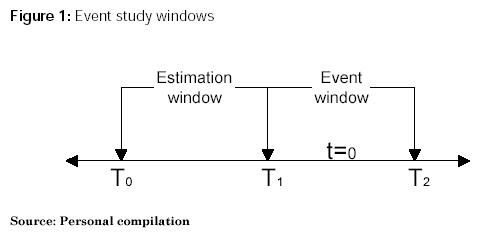
<body><![CDATA[<p>Although there are almost no studies  for South American emerging  markets, an interesting piece of  evidence was offered by Fuenzalida  and Nash (2003) whom studied 14  Chilean companies during the years  1995 and 2002. They conclude that  there is evidence of positive abnormal  returns on the announcement date of  a tender offer of about 26%. Besides,  these positive abnormal returns are  lower in the case of public companies  operating under the Tender Offer  Law in Chile.<a href="#3"><sup>3</sup></a></p>      <p><b><font size="3">3. ISSUES IN EVENT STUDIES</font></b></p>      <p>In conducting event studies there  are several issues that one needs  to account for. In this section, one  reviews the main stages of the  procedure. Five issues are discussed:  event definition, selection criteria,  estimation of abnormal returns,  estimation of model parameters and  tests for detecting abnormal returns. The following subsections will discuss  each one in turn.</p>      <p><b>3.1 Event definition</b></p>    <p>The best results with an event  study are obtained when the exact  date of the event is identified. In order to do this it is crucial  to identify the event subject at  hand: e.g. the announcement date  of a merger, an acquisition, an  earnings announcement, a change  in the debt rating, the adoption of  an ISO standard, etc. Then, the  estimation and event windows must  be determined (See <a href="#figura1">Figure 1</a>).<a href="#4"><sup>4</sup></a></sup></p>      <p>    <center><a name="#figura1"></a><img src="/img/revistas/eg/v22n101/n101a01f1.jpg" /></center></p>      <p>Using the same notation as Campbell  et al. (1997), one defines t=0 as  the event date when the announcement  occurs, the interval [T1+1,  T2] is the event window with length  L2=T2-T1-1, while the interval  [T0+1, T1] is the estimation window  with length L1=T1-T0-1. When the study is being conducted with daily  data, the estimation window usually  is between 100 and 300 trading days  (Peterson 1989).</p>      <p>The length of the event window usually  depends on the ability to date precisely  the announcement date. If one is able  to date it with precision, the event  window will be short and the tests to  detect abnormal returns will be more  powerful. Nevertheless, the length of  the event window normally ranges  between 21 and 121 days (Peterson  1989). Note that the event window  includes the event announcement day,  which occurs at t=0.</p>      <p><b>3.2 Selection criteria</b></p>      ]]></body>
<body><![CDATA[<p>This step is certainly a very important  one since it is easy to introduce a  selection bias in the definition of  the sample of firms to be studied. In  emerging markets the main tradeoff  that one must make is between  having quantitatively more firms in  the sample, but with several firms  subject to thin trading or having less  number of firms, but actively traded.  In the first case, one needs to use a  procedure to test for abnormal returns  in the presence of thin trading, while  in the second case one has to avoid as  much as possible any selection bias in  the sample.</p>      <p>This tradeoff is due to the low number  of actively traded or liquid stocks in  emerging markets. For example, the  percentage of actively traded stocks,  as a fraction of the total number of  traded stocks per year was between  5% and 19% at the Lima Stock  Exchange (LSE) during the period  1991-2002 (Mongrut 2006).</p>      <p>Thin trading or non-synchronous  trading means that whenever a  market shock occurs, it will not be  incorporated immediately into the  price of a thin traded stock because  it is not being traded. If one does not  consider the effect of thin trading, there  will be a serious bias in the moments  and comoments of asset returns (for  example, the beta parameters of thin  traded stocks will be lower than the  beta parameters of actively traded  stocks). The reason for this is that  time series of stock prices are taken  to be recorded at time intervals of one  length when in fact they are recorded  at other irregular time intervals  (Campbell et al., 1997).</p>      <p>Different ways to deal with the  problem of thin trading have been suggested by Scholes and Williams  (1977), Dimson (1979), and Cohen  et al. (1983) in the context of market  risk estimation. Each one of them  tried to give an estimation of the  market risk parameter (beta) in the  presence of thin trading. However,  as reported by Brown and Warner  (1985), there is little to gain by  using the procedures of Scholes and  Williams (1977), and Dimson (1979)  in testing abnormal returns.</p>      <p>What happens if one only includes  few firms actively traded in the  sample? A small number of firms  will not represent a problem because  parametric tests statistics used to  detect abnormal returns converge  to their asymptotic values rather  quickly (Brown and Warner 1985). This implies that even in the presence  of abnormal returns that do not obey a  normal distribution, one can still use  parametric tests invoking the Central  Limit Theorem. The real problem is  the potential for a selection bias. In  our study, there could be observed and  unobserved common characteristics  among these few firms that make  them more prone to become a target  for a tender offer. In this sense, one  cannot draw inferences for the total  population of tender offers. This issue  will be addressed again in the fifth  section.</p>      <p><b>3.3 Estimation of abnormal  returns</b></p>      <p>There are mainly three models to  estimate abnormal returns: the  constant-mean return model, the  market model, and the market  adjusted model.<a href="#5"><sup>5</sup></a> Nevertheless,  in this research only the market  model is used. In the following  sections one discusses the market  model in tow alternative scenarios:  full-segmentation of capital markets  and partial integration.</p>      <p><b>3.3.1 The market model with  full-segmentation</b></p>      <p>The market model with full-segmentation  states that:</p>      <p><img src="/img/revistas/eg/v22n101/n101a01e1.jpg" /></p>      ]]></body>
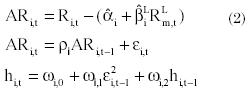
<body><![CDATA[<p>Where<a href="#6"><sup>6</sup></a></p>     <p>AR<sub>i,t</sub> : Abnormal return of stock &quot;i&quot; in period &quot;t&quot;</p>     <p>R<sub>i,t</sub> : Realized return of stock &quot;i&quot; in period &quot;t&quot;</p>     <p>R<sup>L</sup><sub>m,t</sub> : Return of a local market index in period &quot;t&quot;</p>      <p>The market model adjusts for the stock return for the local systematic risk in estimating the abnormal return. In this way, the variance of the abnormal return will be reduced because one is removing the portion of the return that is related to the local market index. Popular choices for the market index are the local equally weighted market index and the local value weighted market index. However, the former index is more likely to detect abnormal returns because it has been shown that is more correlated with market returns (Peterson 1989).</p>     <p>Usually, the model parameters (alpha and beta) are estimated using Ordinary Least Squares (OLS) during the estimation window. The OLS estimation of equation (1) relies on two crucial assumptions: the variance of the abnormal return is constant through time and there is no time series correlation among the abnormal returns. Hence, the model implies absence of heteroskedasticity and serial correlation. Unfortunately, these assumptions are usually not met. In particular, thin trading could generate times series dependence or serial correlation.</p>     <p>If there is heteroskedasticity and serial correlation in abnormal returns it is better to use a different method to estimate the model parameters such as the Generalized Autoregressive Conditionally Heteroskedastic Model (GARCH). The GARCH (1,1) is expressed in the following way (2):</p>     <p><img src="/img/revistas/eg/v22n101/n101a01e2.jpg" /></p>     <p>Where:</p>     <p><img src="/img/revistas/eg/v22n101/n101a01e3.jpg" /></p>      ]]></body>
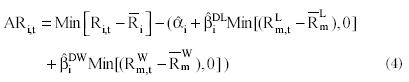
<body><![CDATA[<p>Furthermore, event clustering within the same time period could generate another problem: cross-correlation among abnormal returns of different stocks. Although, Brown and Warner (1985) have noted that, unless the potential bias is substantial, it is better to assume cross-sectional independence, it is wise to avoid event clustering otherwise the statistical power of the tests will diminish.</p>     <p>Another problem is a variance increase use to the event announcement. This also generates the problem of heteroskedasticity. If one uses the variance of the estimation window instead of the variance of the event window, the tests statistics will yield too many rejections of the null hypothesis that the cumulative average abnormal return is equal to zero. A way to deal with this problem is by using the standardized cross-sectional test proposed by Boehmer et al. (1991).</p>     <p>The OLS estimation of the model parameters also relies on the assumption that abnormal returns are normally distributed. There is considerable evidence that daily stock returns (raw returns), and their respective abnormal returns, are right skewed and leptokurtic (fat tails) (Fama 1976). In emerging markets stock returns are considerable more skewed and leptokurtic than in developed markets (Bekaert et al., 1998). Although, the parametric tests statistics converge rather quickly to a normal distribution, it is advisable to estimate the model parameters using a procedure that allows for the non-normality in the cross-section of abnormal returns, such as the Theil procedure proposed by Dombrow et al. (2000) or to use a non-parametric test to test for abnormal returns. In particular, one may use two nonparametric tests: the sign test analyzed by Cowan (1992) or the rank test proposed by Corrado (1989).</p>     <p><b><i>3.3.2 The market model with partial integration</i></b></p>     <p>Emerging markets are not completely segmented, but rather partially integrated (Bodnar et al., 2003). In such a situation a better way to specify abnormal returns is by using a hybrid version of the market model where local and world events play a role in explaining stock returns:</p>     <p><img src="/img/revistas/eg/v22n101/n101a01e4.jpg" /></p>     <p>Where:</p>     <p><img src="/img/revistas/eg/v22n101/n101a01e5.jpg" />Return of a global market index in period &quot;t&quot;.<a href="·7"><sup>7</sup></a></p>     <p>This model can be estimated using OLS or the GARCH procedure, but given the high volatility of emerging markets it is better to use the later procedure instead of the former to estimate the model parameters within the estimation window.</p>     <p>As previously stated, stock returns in emerging markets are non-normal because they are usually right skewed. In other words, investors in these markets face substantial downside risk (Estrada, 2000). In this sense, Estrada (2002) proposed a modification of the traditional Capital Asset Pricing Model (CAPM) in order to allow for downside risk, the result was the D-CAPM. This model states that what matters to expected returns in emerging markets is the downside systematic risk or downside beta as opposed to the total systematic risk or beta from the traditional CAPM.</p>     ]]></body>
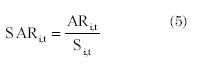
<body><![CDATA[<p>The ex-post version of a hybrid D-CAPM can be used to estimate abnormal returns. This version is expressed in the following way:</p>     <p><img src="/img/revistas/eg/v22n101/n101a01e6.jpg" /></p>     <p>In this version one is considering partial integration and downside risk simultaneously. Furthermore, given the non-normality of emerging market stock returns, the parameters of model 3 and 4 can be estimated using the GARCH procedure.</p>     <p><b>3.4 Tests for abnormal returns</b></p>     <p>Once abnormal returns have been estimated for each stock, using one or more models, one has to test whether abnormal returns are statistically significant or not. This task can be performed for each day or for a time interval during the event window. The test for each day aims to test whether individual cumulative abnormal returns are statistically significant, while the test for a time interval aims to determine the statistical significance of cumulative average abnormal returns during a selected time interval for a group of stocks.</p>     <p>Two main situations can arise: only one event occurs per stock or each stock is subject to the occurrence of many events within the selected time interval. In both cases, one may use parametric and nonparametric tests statistics. The choice of one or more test statistics depends on the situation faced by the researcher. In emerging markets the situation usually is far from ideal, so the best way to proceed is by using a combination of parametric and nonparametric tests.</p>     <p>Parametric tests use standardized abnormal returns to align event period abnormal returns&rsquo; volatility with its estimation period volatility and to prevent stocks with large volatility to dominate test statistis (Boehmer et al., 1991). The standardized abnormal return is given in the following way:</p>     <p><img src="/img/revistas/eg/v22n101/n101a01e7.jpg" /></p>     <p>Where:</p>     <p>SAR<sub>i,t</sub>: Standardized abnormal return for stock &quot;i&quot; within the event window</p>     ]]></body>
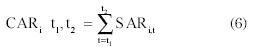
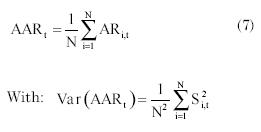
<body><![CDATA[<p>S<sub>i,t</sub>: Standard error</p>     <p>Now, one can cumulate abnormal return for each stock within the time interval [t1,t2] in the following way:</p>     <p><img src="/img/revistas/eg/v22n101/n101a01e8.jpg" /></p>     <p>The standard error involves information from the estimation window and from the event window because it must include the standard error of the estimate (from the estimation window) and the standard error of the forecast (from the event window).</p>     <p>Parametric tests can be defined to test for abnormal returns per each stock at any given date, but in this research one is interested in detecting aggregate abnormal performance for a give period or time interval. In this sense, one must define parametric and nonparametric test accordingly.</p>     <p>In order to aggregate abnormal returns across several stocks and events for a selected time interval [t1, t2] (within the event window), the first step is to aggregate the individual abnormal returns considering N events. The average abnormal return for period &quot;t&quot; is as follows:</p>     <p><img src="/img/revistas/eg/v22n101/n101a01e9.jpg" /></p>     <p>The next step is to aggregate the average abnormal returns through the selected time interval. The result is as follows:</p>     <p><img src="/img/revistas/eg/v22n101/n101a01e10.jpg" /></p>     <p><img src="/img/revistas/eg/v22n101/n101a01e11.jpg" /></p>     ]]></body>
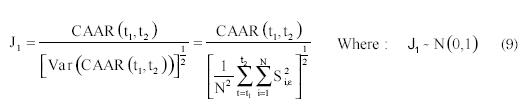
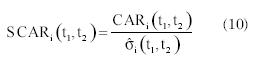
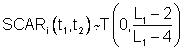
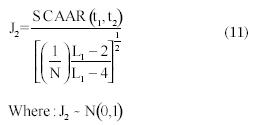
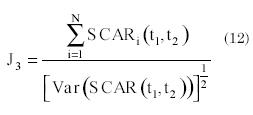
<body><![CDATA[<p>The variance of CAAR assumes that different event windows do not overlap to each other (i.e. no event clustering), so one may avoid covariance terms. Then, in order to test the null hypothesis that cumulative average abnormal returns are zero, one uses the following test statistic (MacKinlay 1997 and Campbell et al., 1997):</p> <img src="/img/revistas/eg/v22n101/n101a01e12.jpg" />      <p>Whenever one considers that cumulative abnormal returns vary across securities, it is suitable to give equal weight to the realized cumulative abnormal return of each security. This is what J1 does.</p>     <p>Another possibility is to consider constant abnormal returns across securities. In this case it is more appropriate to give more weight to the securities with the lower abnormal return variance so that the power of the test will improve. In order to construct a test consistent with this possibility one must first construct a test statistic for each security using the standardized cumulative abnormal return within the selected time interval [t1, t2] (Patell, 1976):</p>     <p><img src="/img/revistas/eg/v22n101/n101a01e13.jpg" /></p>     <p>Where:</p>     <p><img src="/img/revistas/eg/v22n101/n101a01e14.jpg" /></p>     <p>The standardized cumulative abnormal return has a Student-T distribution with a null expectation. As long as the length of the estimation window increases (L1>30), the distribution for this test converges to the standard normal distribution (Cowan and Sergeant 1996). Now, by aggregating expression 10 through the number of events within the selected time interval (Campbell et al., 1997):</p>     <p><img src="/img/revistas/eg/v22n101/n101a01e15.jpg" /></p>     <p>One obtains the second parametric test statistic:</p>     <p><img src="/img/revistas/eg/v22n101/n101a01e16.jpg" /></p>     ]]></body>
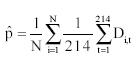
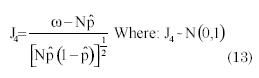
<body><![CDATA[<p>SCAAR(t<sub>1</sub>,t<sub>2</sub>): Average standardized cumulative abnormal return for the event window [t<sub>1</sub>,t<sub>2</sub>]</p>     <p>Brown and Warner (1985) report that the Patell&rsquo;s test (expression 10) is well specified under a variety of conditions. Furthermore, there is little to gain by using a more complicated test unless there is a serious problem like an increase in the variance of abnormal returns (induced by the event) or unusually high cross-correlation. If the variance of abnormal returns increases on the event date the Patell&rsquo;s test rejects the null hypothesis more often than the nominal significant level (Cowan and Sergeant 1996). In other words, event-related variance increases cause these tests to report a price reaction more often than expected (Cowan 1992). In order to avoid this problem, one may use the Boehmer et al. (1991) test or better known as the BMP test:</p>     <p><img src="/img/revistas/eg/v22n101/n101a01e17.jpg" /></p>     <p>Where:</p>     <p><img src="/img/revistas/eg/v22n101/n101a01e18.jpg" /></p>     <p>Due to the fact that the BMP test works with data from the event window, it can consider any event-induced variance and it is not affected by the problem of thin trading. Furthermore, the test is essentially unaffected by the presence of event-date clustering (Boehmer et al., 1991).</p>     <p>Concerning the problem of non-normality, one may try to tackle this problem using a nonparametric test, which does not rely on this assumption. Here, there are two choices either the generalized sign test or the rank test from Corrado (1989). In general the rank test is more powerful than the generalized sign test in detecting abnormal returns, however in the presence of event induced variance different authors favor the generalized sign test. Besides, given that in the presence of non-normality both test are well specified and equally powerful, in this research one has favor the generalized sign test over the rank test.</p>     <p>The generalized sign test aims to determine whether the number of securities with positive cumulative abnormal returns in the event window exceeds the expected number in the absence of abnormal security performance (Cowan 1992). The expected number of positive abnormal returns along 214-day estimation period is given by:</p>     <p><img src="/img/revistas/eg/v22n101/n101a01e19.jpg" /></p>     <p>In the above expression, the dummy variable &quot;D&quot; takes the value of one whenever there is a positive abnormal return for security &quot;i&quot; on day &quot;t&quot;, otherwise is zero. Now, if one defines &quot;&omega;&quot; as the number of securities in the event window with a positive cumulative abnormal return, one may write the generalized sign test statistic (S) in the following way:</p>     ]]></body>
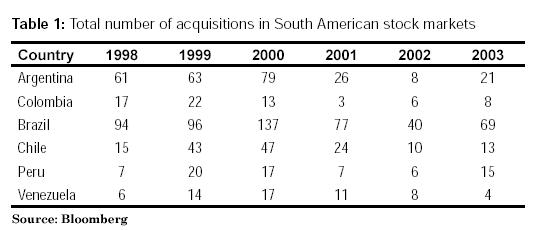
<body><![CDATA[<p><img src="/img/revistas/eg/v22n101/n101a01e20.jpg" /></p>     <p>These four tests (three parametric and one nonparametric) will be used in the empirical part of this research.</p>     <p><b><font size="3">4. SAMPLE CRITERIA AND DATA DESCRIPTION</font></b></p>     <p><a href="#tabla1">Table 1</a> shows the total number of acquisitions in six South American capital markets. Only a small fraction of the total number of acquisitions fulfilled our sample criteria. The criteria to select a particular acquisition were based upon the following five requirements: the type of acquisition must be a tender offer, only target firms that have been subject to a first tender offer during the period 01/01/1998 to 12/31/2003 were selected, each firm in the sample must have a market presence of at least 60% during the estimation period and non-missing observations for the event period, there must be no other news besides the announcement of the tender offer during the analyzed period, and securities with overlapping event periods are excluded from the analysis unless they belong to different industries.</p>     <p>    <center><a name="#tabla1"></a><img src="/img/revistas/eg/v22n101/n101a01t1.jpg" /></center></p>     <p>The above period of analysis was chosen because no acquisition fulfilled our sample criteria during the three previous years: 1995-1997. The requirement of a market presence of at least 60% during the estimation period was meant to include as much firms as possible. However, as <a href="#tabla2">Table 2</a> shows only one firm had such low market presence, the remaining firms had more than 80% presence.</p>     <p>    <center><a name="#tabla2"></a><img src="/img/revistas/eg/v22n101/n101a01t2.jpg" /></center></p>     <p>The indicator of presence is definned as follows:</p>     ]]></body>
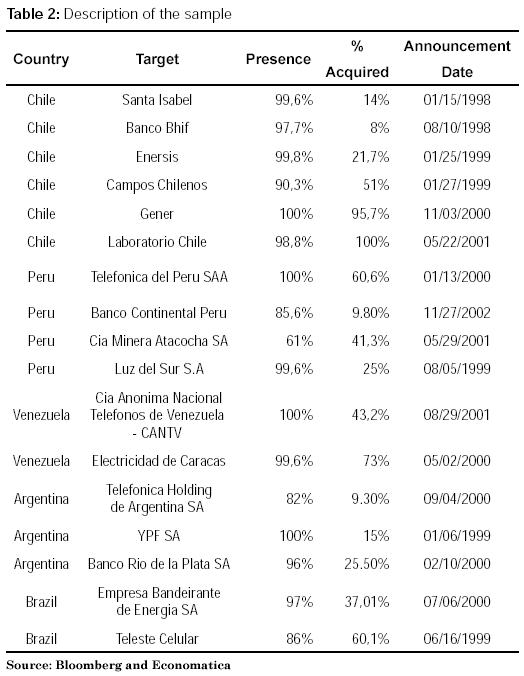
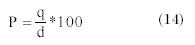
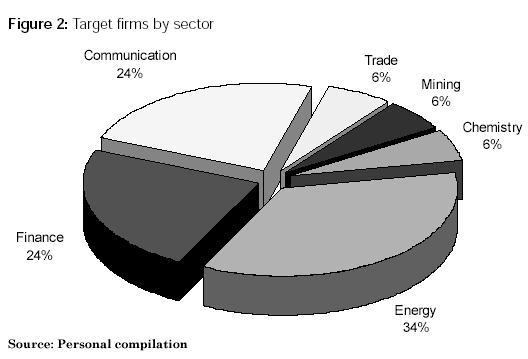
<body><![CDATA[<p><img src="/img/revistas/eg/v22n101/n101a01e21.jpg" /></p>     <p>Where:</p>     <p>q: Number of days in which there were at least 1 trade of the stock within the selected period</p>     <p>d: Total number of days within the selected period</p>     <p>Missing quotes were treated in the way suggested by Brown and Warner (1985): the missing quote and the succeeding period quote were removed from the analysis. This method attains the greatest sample size without affecting the identification of abnormal performance (Peterson 1989). The remaining two criteria were established to avoid any confounding effects and any cross-correlation due to event clustering, respectively.</p>     <p>Applying the above selection criteria yield only 17 companies, which are reported in <a href="#tabla2">Table 2</a>. Two observations are in order: there was no firm in Colombia able to fulfill the sample criteria, and there was no firm able to fulfill the sample requirements in 2003. Therefore, our results only apply for the period 1998-2002.</p>     <p>Given the small sample size cause of concern is the possibility for a selection bias. In particular, one may wonder if there are observed and unobserved common characteristics among these few firms that make them more prone to become a target for a tender offer. However, as <a href="#tabla2">Table 2</a> shows, it seems to be no selection bias due to observable variables. Indeed, target firms are based in different countries, the percentage acquired varies widely, bidder firms come from different countries (not reported), and target firms belong to different industries (see <a href="#figura2">Figure 2</a>).<a href="#8"><sup>8</sup></a></p>    <p>    <center><a name="#figura2"></a><img src="/img/revistas/eg/v22n101/n101a01f2.jpg" /></center></p>      <p><b><font size="3">5. METHODOLOGY AND RESULTS</font></b></p>     ]]></body>
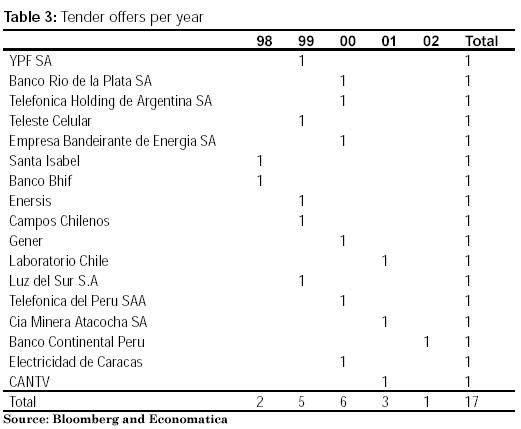
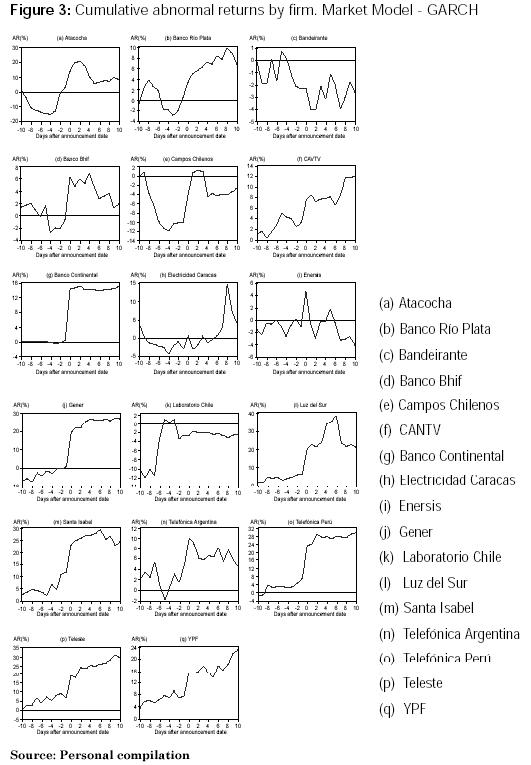
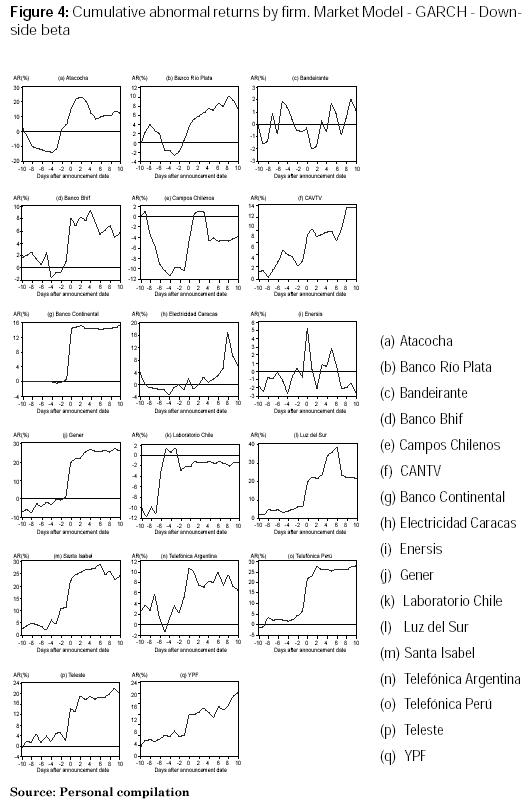
<body><![CDATA[<p>This section explains briefly the different steps used in this research to determine the daily abnormal performance of stock returns. The event under study is the announcement of a tender offer from the bidder firm to the target firm. In this sense, one is interested in the announcement date of the tender offer instead of the effective date where the acquisition was made.</p>     <p>Around the announcement date reported in <a href="#tabla2">Table 2</a>, one has defined an estimation period of 214 days and an event period of 30 days where 20 days were defined prior to the announcement date and 10 days after this date. Hence, there are 245 days per stock including the announcement date.<a href="#9"><sup>9</sup></a></p>     <p>The market model was used to estimate daily abnormal returns per stock.<a href="#10"><sup>10</sup></a> However, due to the fact that one is working with target firms from different countries, one needs to control for differences in the level of market integration across the five capital markets considered. Hence, it has been decided to use a hybrid version of the market model with and without downside risk. In other words equations 3 and 4 were used to estimate daily abnormal returns. The hybrid market model does not include currency risk, so one implicitly assumes that the influence of this risk upon stock prices is small.<a href="#11"><sup>11</sup></a></p>     <p>In order to account for the possibility of heteroskedasticity and serial correlation among abnormal returns, equations 3 and 4 were estimated using the GARCH (1,1) procedure. Furthermore, confounding effects were avoided, as well as event clustering unless stocks belong to different industries. <a href="#tabla3">Table 3</a> shows potential event clustering in years 1998-2001, but from <a href="#tabla2">Table 2</a> one may see that only in years 1999 and 2001 there is event clustering. However, it is unlikely to find cross-correlation because in 1999 and 2001 firms belong to different industries and in 2001 they even belong to different countries.</p>      <p>    <center><a name="#tabla3"></a><img src="/img/revistas/eg/v22n101/n101a01t3.jpg" /></center></p>      <p>Following the suggestions by many authors, one has used parametric and nonparametric tests were used to detect aggregate abnormal performance. Three parametric tests were used (J1, J2 and J3) and one nonparametric test (J4). The first two tests were used because they have some ability to detect abnormal performance even with small sample sizes, while the BMP test (J3) was used to account for event-induced variance. The generalized sign test (J4) served to account for non-normality in the cross-section of abnormal returns.</p>     <p>A major concern in working with a small sample size is the possibility that one firm (an outlier) drives the results. Figures <a href="#figura3">3</a> and <a href="#figura4">4</a> the cumulative abnormal returns for each firm in the sample according to the two models used to estimate abnormal returns (in both figures firms were ordered from left to right). It is not true that positive abnormal returns are present only in one or two firms. In both Figures, more than 80% of the firms report positive cumulative abnormal returns (See <a href="#tabla3">Table 3</a>).</p>     <p>    <center><a name="#figura3"></a><img src="/img/revistas/eg/v22n101/n101a01f3.jpg" /></center></p>     ]]></body>
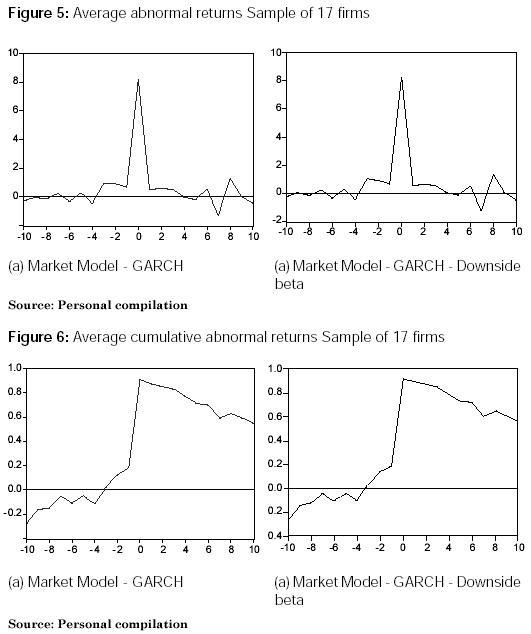
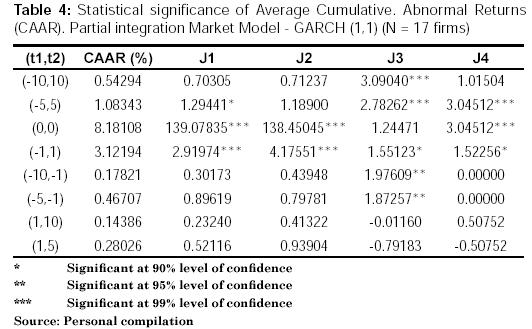
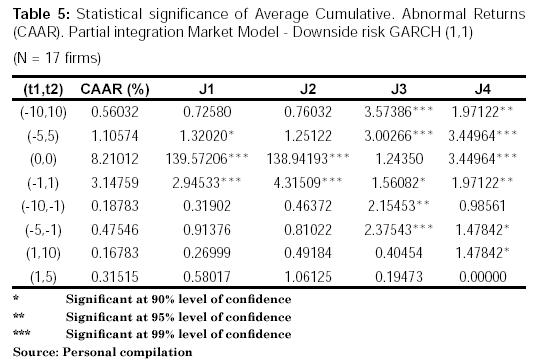
<body><![CDATA[<p>    <center><a name="#figura4"></a><img src="/img/revistas/eg/v22n101/n101a01f4.jpg" /></center></p>     <p>Another important problem is the possibility for an event-induced variance increase. From Figures <a href="#figura5">5</a> and <a href="#figura5">6</a>, there seems to be an event-induced variance, so one needs to account for this problem. It is also remarkable the similarity among the results of both specifications with and without downside risk. However, as expected, abnormal returns with the partial integration model with downside risk are higher than the ones obtained with the model without downside risk.</p>     <p>    <center><a name="#figura5"></a><img src="/img/revistas/eg/v22n101/n101a01f5.jpg" /></center></p>      <p>Tables <a href="#tabla4">4</a> and <a href="#tabla5">5</a> report the statistical significance of average cumulative abnormal returns. Parametric tests J1 and J2 show statistically significant positive abnormal returns ranging between 3.1% and 8.2% for one day before and one day after the announcement of the first tender offer. This result isrobust across both specifications. Furthermore, the BMP test (J3) is able to detect positive abnormal returns ranging between 0.18% and 8.2% for different windows mainly before the announcement date. However, abnormal performance due to information leakage is of low magnitude because abnormal returns range between 0.18% and 0.48%. It is worth noting that the partial integration model with downside risk yield more significant abnormal returns than the partial integration model without downside risk.(See Table <a href="#tabla4">4</a>-<a href="#tabla5">5</a>).</p>     <p>    <center><a name="#tabla4"></a><img src="/img/revistas/eg/v22n101/n101a01t4.jpg" /></center></p>     <p>    <center><a name="#tabla5"></a><img src="/img/revistas/eg/v22n101/n101a01t5.jpg" /></center></p>     ]]></body>
<body><![CDATA[<p>The performance of the partial integration market model with downside risk even improves when the generalized sign test is used. In this case, the generalized sign test is able to detect not only positive abnormal performance before, but also after the announcement date of a tender offer. Nevertheless, the market overreaction is of low magnitude (0.17%).</p>     <p>In general, the results show a positive abnormal return of about 8% for the announcement date of a tender offer and low positive abnormal returns for the days before and after the announcement date.</p>     <p><b><font size="3">6. CONCLUSION</font></b></p>     <p>Consistent with the previous literature, the results obtained show that tender offers in South America do convey good news to the market in the way of positive abnormal performance for the announcement date. However, the reported abnormal performance (8%) is substantially lower than the one reported by the studies reviewed in the introductory part.</p>     <p>The reason for the above result lies in the different views about South American stock markets. In this research, one believes in the view of partially integrated capital markets instead of the full-segmented view. In this scenario stock returns are also sensitive to world events, so abnormal returns cannot be as large as in the case of a full-segmented capital market.</p>     <p>The results also show traces of information leakage and market overreaction. This is consistent with previous literature about stock market efficiency in South American stock markets. For instance, Mongrut (2002) finds short-term overreaction at the LSE. However, the information leakage seems more robust across model specifications than market overreaction.</p>     <p>The later result is not strange because the days previous to the announcement date of the tender offer are contaminated by the negotiations between the target and the bidder company, and the speculation about the acquisition. Hence, it is likely that some information is filtered to the market.</p> </font>     <p><font size="2" face="verdana">Although this study has presented evidence of positive abnormal performance surrounding the first announcement of a tender offer, several questions remain unanswered: How one may improve the model used in this study to characterize a situation of partial integration? How do abnormal returns relate to the firm ownership concentration? How do they relate to successful and unsuccessful bids? These questions add to a large list of unsolved issues in emerging markets that one hope are going to be addressed in the near future.</font></p>          <font size="2" face="verdana">    <p></p>    <p><b>References</b></p>      ]]></body>
<body><![CDATA[<p><a name="#1">1.</a> In fact, the emerging market covariance and correlation with the world return may increase due to the  financial liberalization.</p>      <p><a name="#2">2.</a> We only discuss the results related to target firms because we found no evidence of positive or negative  abnormal returns in the sample of bidder firms (not reported).</p>      <p><a name="#3">3.</a> Fuenzalida and Nash (2004) have shown that the Tender Offer Law in Chile has depressed the Stock  Exchange because it forces the acquisition of 100% of a given stock package when 2/3 of the stock ownership  is reached. This situation generates an incentive to turn diffusely held firms into closely held firms  and eventually leave the Stock Exchange.</p>      <p><a name="#4">4.</a> All Figures and Tables are own elaboration unless otherwise stated.</p>      <p><a name="#5">5.</a> Brown and Weinstein (1985) have concluded that there is little value to gain in using a multifactor model  (such as the Arbitrage Pricing Theory-APT) versus the market model. Furthermore, Dyckman et al. (1984)  have concluded that the market model is more suitable for detecting abnormal performance.</p>      <p><a name="#6">6.</a> The data corresponding to stocks was obtained from Economatica for each country in US$ dollars. One  also uses the Morgan Stanley Capital International (MSCI) Stock Market Indexes.</p>      <p><a name="#7">7.</a>The Global Market Index is the one provided by the MSCI.</p>     <p><a name="#8">8.</a>The total number of acquisitions is based on the effective date of the acquisition instead of the announcement date of the acquisition.</p>     <p><a name="#9">9.</a> It was not possible to work with a bigger number of days for the estimation period because the number of stocks would fall. Conversely, a lower number of days for the estimation period would damage the significance of the estimation of the model&rsquo;s parameters.</p>     <p><a name="#10">10.</a> Other models such as the constant-mean return model and the market-adjusted model were not used because there is no way to account for differences in market integration.</p>     ]]></body>
<body><![CDATA[<p><a name="#11">11.</a> In the presence of substantial currency risk, it would have been better to use the International Capital Asset Pricing Model (ICAPM) analyzed by Bodnar et al. (2003).</p> <hr />     <p>The authors are grateful to Alex Saldaña and Carlos Barrientos for outstanding research assistance.</p>     <p><b><font size="3">BIBLIOGRAPHIC</font></b></p>     <!-- ref --><p>1. Asquith, D. (1988) Evidence on theories of volume, Bid-Ask spreads and return premia among NASDAQ targets of tender offers bids, Doctoral Research Paper, UCLA. Los Angeles, Estados Unidos.&nbsp;&nbsp;&nbsp;&nbsp;&nbsp;&nbsp;&nbsp;&nbsp;[&#160;<a href="javascript:void(0);" onclick="javascript: window.open('/scielo.php?script=sci_nlinks&ref=000176&pid=S0123-5923200600040000100001&lng=','','width=640,height=500,resizable=yes,scrollbars=1,menubar=yes,');">Links</a>&#160;]<!-- end-ref --><!-- ref --><p>2. Bekaert, G., and Harvey, C. (2003) Emerging markets finance. Journal of Empirical Finance, 10, 3-55.&nbsp;&nbsp;&nbsp;&nbsp;&nbsp;&nbsp;&nbsp;&nbsp;[&#160;<a href="javascript:void(0);" onclick="javascript: window.open('/scielo.php?script=sci_nlinks&ref=000177&pid=S0123-5923200600040000100002&lng=','','width=640,height=500,resizable=yes,scrollbars=1,menubar=yes,');">Links</a>&#160;]<!-- end-ref --><!-- ref --><p>3. Bekaert, G., Erb, C., Harvey, C. and Viskanta, T. (1998) Distributional characteristics of emerging market returns and asset allocation. Journal of Portfolio Management, 102-116.&nbsp;&nbsp;&nbsp;&nbsp;&nbsp;&nbsp;&nbsp;&nbsp;[&#160;<a href="javascript:void(0);" onclick="javascript: window.open('/scielo.php?script=sci_nlinks&ref=000178&pid=S0123-5923200600040000100003&lng=','','width=640,height=500,resizable=yes,scrollbars=1,menubar=yes,');">Links</a>&#160;]<!-- end-ref --><!-- ref --><p>4. Bodnar, G., Dumas, B., and Marston, R. (2003) Cross-border valuation: The international cost of equity capital. National Bureau of Economic Research (NBER) working paper 10115.&nbsp;&nbsp;&nbsp;&nbsp;&nbsp;&nbsp;&nbsp;&nbsp;[&#160;<a href="javascript:void(0);" onclick="javascript: window.open('/scielo.php?script=sci_nlinks&ref=000179&pid=S0123-5923200600040000100004&lng=','','width=640,height=500,resizable=yes,scrollbars=1,menubar=yes,');">Links</a>&#160;]<!-- end-ref --><!-- ref --><p>5. Boehmer, E., Musumeci, J., and Poulsen, A. (1991) Event-study methodology under conditions of event-induced variance. Journal of Financial Economics, 30, 253-272.&nbsp;&nbsp;&nbsp;&nbsp;&nbsp;&nbsp;&nbsp;&nbsp;[&#160;<a href="javascript:void(0);" onclick="javascript: window.open('/scielo.php?script=sci_nlinks&ref=000180&pid=S0123-5923200600040000100005&lng=','','width=640,height=500,resizable=yes,scrollbars=1,menubar=yes,');">Links</a>&#160;]<!-- end-ref --><!-- ref --><p>6. Bredley, M., Desai, A., and Kim, H. (1983), The rationale behind Interfirm Tender Offers, Journal of Financial Economics, 11, 183-206.&nbsp;&nbsp;&nbsp;&nbsp;&nbsp;&nbsp;&nbsp;&nbsp;[&#160;<a href="javascript:void(0);" onclick="javascript: window.open('/scielo.php?script=sci_nlinks&ref=000181&pid=S0123-5923200600040000100006&lng=','','width=640,height=500,resizable=yes,scrollbars=1,menubar=yes,');">Links</a>&#160;]<!-- end-ref --><!-- ref --><p>7. Brown, S. and Warner, J. (1985) Using daily stock returns: The case of event studies. Journal of Financial Economics, 14, 3-31.&nbsp;&nbsp;&nbsp;&nbsp;&nbsp;&nbsp;&nbsp;&nbsp;[&#160;<a href="javascript:void(0);" onclick="javascript: window.open('/scielo.php?script=sci_nlinks&ref=000182&pid=S0123-5923200600040000100007&lng=','','width=640,height=500,resizable=yes,scrollbars=1,menubar=yes,');">Links</a>&#160;]<!-- end-ref --><!-- ref --><p>8. Brown, S. and Weinstein, M. (1985) Derived factors in event studies. Journal of Financial Economics, 14, 491-495.&nbsp;&nbsp;&nbsp;&nbsp;&nbsp;&nbsp;&nbsp;&nbsp;[&#160;<a href="javascript:void(0);" onclick="javascript: window.open('/scielo.php?script=sci_nlinks&ref=000183&pid=S0123-5923200600040000100008&lng=','','width=640,height=500,resizable=yes,scrollbars=1,menubar=yes,');">Links</a>&#160;]<!-- end-ref --><!-- ref --><p>9. Campbell, J., Lo, A. and MacKinlay, C. (1997) The econometrics of financial markets. Princeton University Press, New Jersey.&nbsp;&nbsp;&nbsp;&nbsp;&nbsp;&nbsp;&nbsp;&nbsp;[&#160;<a href="javascript:void(0);" onclick="javascript: window.open('/scielo.php?script=sci_nlinks&ref=000184&pid=S0123-5923200600040000100009&lng=','','width=640,height=500,resizable=yes,scrollbars=1,menubar=yes,');">Links</a>&#160;]<!-- end-ref --><!-- ref --><p>10. Cohen, H., Hawawini, G., Maier, S., Schwartz, R., and Whitcomb, D. (1983) Estimating and adjusting for the intervalling effect bias in beta. Management Science, 29, 135-148.&nbsp;&nbsp;&nbsp;&nbsp;&nbsp;&nbsp;&nbsp;&nbsp;[&#160;<a href="javascript:void(0);" onclick="javascript: window.open('/scielo.php?script=sci_nlinks&ref=000185&pid=S0123-5923200600040000100010&lng=','','width=640,height=500,resizable=yes,scrollbars=1,menubar=yes,');">Links</a>&#160;]<!-- end-ref --><!-- ref --><p>11. Corrado, C. (1989) A nonparametric test for abnormal security-price performance in event studies. Journal of Financial Economics, 23, 385-395.&nbsp;&nbsp;&nbsp;&nbsp;&nbsp;&nbsp;&nbsp;&nbsp;[&#160;<a href="javascript:void(0);" onclick="javascript: window.open('/scielo.php?script=sci_nlinks&ref=000186&pid=S0123-5923200600040000100011&lng=','','width=640,height=500,resizable=yes,scrollbars=1,menubar=yes,');">Links</a>&#160;]<!-- end-ref --><!-- ref --><p>12. Cowan, A. (1992) Nonparametric event study tests. Review of Quantitative Finance and Accounting, 2, 343-358.&nbsp;&nbsp;&nbsp;&nbsp;&nbsp;&nbsp;&nbsp;&nbsp;[&#160;<a href="javascript:void(0);" onclick="javascript: window.open('/scielo.php?script=sci_nlinks&ref=000187&pid=S0123-5923200600040000100012&lng=','','width=640,height=500,resizable=yes,scrollbars=1,menubar=yes,');">Links</a>&#160;]<!-- end-ref --><!-- ref --><p>13. Cowan, A. and Sergeant, A. (1996) Trading frequency and event study test specification. Journal of Banking and Finance, 20, 1731-1757.&nbsp;&nbsp;&nbsp;&nbsp;&nbsp;&nbsp;&nbsp;&nbsp;[&#160;<a href="javascript:void(0);" onclick="javascript: window.open('/scielo.php?script=sci_nlinks&ref=000188&pid=S0123-5923200600040000100013&lng=','','width=640,height=500,resizable=yes,scrollbars=1,menubar=yes,');">Links</a>&#160;]<!-- end-ref --><!-- ref --><p>14. Dimson, E. (1979) Risk measurement when shares are subject to infrequent trading. Journal of Financial Economics, 7, 197-226.&nbsp;&nbsp;&nbsp;&nbsp;&nbsp;&nbsp;&nbsp;&nbsp;[&#160;<a href="javascript:void(0);" onclick="javascript: window.open('/scielo.php?script=sci_nlinks&ref=000189&pid=S0123-5923200600040000100014&lng=','','width=640,height=500,resizable=yes,scrollbars=1,menubar=yes,');">Links</a>&#160;]<!-- end-ref --><!-- ref --><p>15. Dodd, P., and Ruback, R. (1977) Tender offers and stockholders returns: An empirical analysis, Journal of Financial Economics, 5, 351-373.&nbsp;&nbsp;&nbsp;&nbsp;&nbsp;&nbsp;&nbsp;&nbsp;[&#160;<a href="javascript:void(0);" onclick="javascript: window.open('/scielo.php?script=sci_nlinks&ref=000190&pid=S0123-5923200600040000100015&lng=','','width=640,height=500,resizable=yes,scrollbars=1,menubar=yes,');">Links</a>&#160;]<!-- end-ref --><!-- ref --><p>16. Dombrow J., Rodriguez, M. and Sirmans, C. (2000) A complete nonparametric event study approach. Review of Quantitative Finance and Accounting, 14, 361-380.&nbsp;&nbsp;&nbsp;&nbsp;&nbsp;&nbsp;&nbsp;&nbsp;[&#160;<a href="javascript:void(0);" onclick="javascript: window.open('/scielo.php?script=sci_nlinks&ref=000191&pid=S0123-5923200600040000100016&lng=','','width=640,height=500,resizable=yes,scrollbars=1,menubar=yes,');">Links</a>&#160;]<!-- end-ref --><!-- ref --><p>17. Dyckman, T., Philbrick, D., and Stephan, J. (1984) A comparison of event study methodologies using daily stock returns: A simulation approach. Journal of Accounting Research, 22, 1-30.&nbsp;&nbsp;&nbsp;&nbsp;&nbsp;&nbsp;&nbsp;&nbsp;[&#160;<a href="javascript:void(0);" onclick="javascript: window.open('/scielo.php?script=sci_nlinks&ref=000192&pid=S0123-5923200600040000100017&lng=','','width=640,height=500,resizable=yes,scrollbars=1,menubar=yes,');">Links</a>&#160;]<!-- end-ref --><!-- ref --><p>18. Estrada, J. (2000) The cost of equity in emerging markets: A downside risk approach. Emerging Markets Quarterly, 4, 19-30.&nbsp;&nbsp;&nbsp;&nbsp;&nbsp;&nbsp;&nbsp;&nbsp;[&#160;<a href="javascript:void(0);" onclick="javascript: window.open('/scielo.php?script=sci_nlinks&ref=000193&pid=S0123-5923200600040000100018&lng=','','width=640,height=500,resizable=yes,scrollbars=1,menubar=yes,');">Links</a>&#160;]<!-- end-ref --><!-- ref --><p>19. Estrada, J. (2002) Systematic risk in emerging markets: The D-CAPM. IESE working paper.&nbsp;&nbsp;&nbsp;&nbsp;&nbsp;&nbsp;&nbsp;&nbsp;[&#160;<a href="javascript:void(0);" onclick="javascript: window.open('/scielo.php?script=sci_nlinks&ref=000194&pid=S0123-5923200600040000100019&lng=','','width=640,height=500,resizable=yes,scrollbars=1,menubar=yes,');">Links</a>&#160;]<!-- end-ref --><!-- ref --><p>20. Fama, E. (1976) Foundations of finance. New York: Basic Books, Inc.&nbsp;&nbsp;&nbsp;&nbsp;&nbsp;&nbsp;&nbsp;&nbsp;[&#160;<a href="javascript:void(0);" onclick="javascript: window.open('/scielo.php?script=sci_nlinks&ref=000195&pid=S0123-5923200600040000100020&lng=','','width=640,height=500,resizable=yes,scrollbars=1,menubar=yes,');">Links</a>&#160;]<!-- end-ref --><!-- ref --><p>21. Fuenzalida, D., and Nash, M. (2003) Efecto de la Ley de OPA en el retorno de la acci&oacute;n en Chile. Mexican Journal of Economics and Finance, 2 (4), 305-320.&nbsp;&nbsp;&nbsp;&nbsp;&nbsp;&nbsp;&nbsp;&nbsp;[&#160;<a href="javascript:void(0);" onclick="javascript: window.open('/scielo.php?script=sci_nlinks&ref=000196&pid=S0123-5923200600040000100021&lng=','','width=640,height=500,resizable=yes,scrollbars=1,menubar=yes,');">Links</a>&#160;]<!-- end-ref --><!-- ref --><p>22. Fuenzalida, D., and Nash, M. (2004) Different Legislations Regarding OPAs. Estudios Gerenciales, 91, Abril-Junio, 13-34.&nbsp;&nbsp;&nbsp;&nbsp;&nbsp;&nbsp;&nbsp;&nbsp;[&#160;<a href="javascript:void(0);" onclick="javascript: window.open('/scielo.php?script=sci_nlinks&ref=000197&pid=S0123-5923200600040000100022&lng=','','width=640,height=500,resizable=yes,scrollbars=1,menubar=yes,');">Links</a>&#160;]<!-- end-ref --><!-- ref --><p>23. Harvey, C. and Morgenson, G. (2006) Dictionary of Money and Investing: The Essential A-to-Z Guide to the Language of the New Market. The New York Times Ed.&nbsp;&nbsp;&nbsp;&nbsp;&nbsp;&nbsp;&nbsp;&nbsp;[&#160;<a href="javascript:void(0);" onclick="javascript: window.open('/scielo.php?script=sci_nlinks&ref=000198&pid=S0123-5923200600040000100023&lng=','','width=640,height=500,resizable=yes,scrollbars=1,menubar=yes,');">Links</a>&#160;]<!-- end-ref --><!-- ref --><p>24. Jarrell, G., Brickley, J., and Netter, J. (1988) The market for Corporate Control: The empirical evidence since 1980. Journal of Economic Perspectives 2, (1), 49-68.&nbsp;&nbsp;&nbsp;&nbsp;&nbsp;&nbsp;&nbsp;&nbsp;[&#160;<a href="javascript:void(0);" onclick="javascript: window.open('/scielo.php?script=sci_nlinks&ref=000199&pid=S0123-5923200600040000100024&lng=','','width=640,height=500,resizable=yes,scrollbars=1,menubar=yes,');">Links</a>&#160;]<!-- end-ref --><!-- ref --><p>25. Jensen, M. and Ruback, R. (1983) The market for corporate control: The scientific evidence, Journal of Financial Economics, 11, 5-50.&nbsp;&nbsp;&nbsp;&nbsp;&nbsp;&nbsp;&nbsp;&nbsp;[&#160;<a href="javascript:void(0);" onclick="javascript: window.open('/scielo.php?script=sci_nlinks&ref=000200&pid=S0123-5923200600040000100025&lng=','','width=640,height=500,resizable=yes,scrollbars=1,menubar=yes,');">Links</a>&#160;]<!-- end-ref --><!-- ref --><p>26. MacKinlay, C. (1997) Event studies in economics and finance. Journal of Economic Literature, 35 (1), 13-39.&nbsp;&nbsp;&nbsp;&nbsp;&nbsp;&nbsp;&nbsp;&nbsp;[&#160;<a href="javascript:void(0);" onclick="javascript: window.open('/scielo.php?script=sci_nlinks&ref=000201&pid=S0123-5923200600040000100026&lng=','','width=640,height=500,resizable=yes,scrollbars=1,menubar=yes,');">Links</a>&#160;]<!-- end-ref --><!-- ref --><p>27. Moloney (2002) The Market for Corporate Control, Clemson University, 18th document.&nbsp;&nbsp;&nbsp;&nbsp;&nbsp;&nbsp;&nbsp;&nbsp;[&#160;<a href="javascript:void(0);" onclick="javascript: window.open('/scielo.php?script=sci_nlinks&ref=000202&pid=S0123-5923200600040000100027&lng=','','width=640,height=500,resizable=yes,scrollbars=1,menubar=yes,');">Links</a>&#160;]<!-- end-ref --><!-- ref --><p>28. Mongrut, S. (2002) Market efficiency: An empirical survey in Peru and other selected countries. Apuntes 51, Segundo semestre, 49-85.&nbsp;&nbsp;&nbsp;&nbsp;&nbsp;&nbsp;&nbsp;&nbsp;[&#160;<a href="javascript:void(0);" onclick="javascript: window.open('/scielo.php?script=sci_nlinks&ref=000203&pid=S0123-5923200600040000100028&lng=','','width=640,height=500,resizable=yes,scrollbars=1,menubar=yes,');">Links</a>&#160;]<!-- end-ref --><!-- ref --><p>29. Mongrut, S. (2006) Tasas de descuento en Latinoam&eacute;rica: hechos y desaf&iacute;os. Documento de discusi&oacute;n No. 9, centro de investigaci&oacute;n de la Universidad del Pac&iacute;fico.&nbsp;&nbsp;&nbsp;&nbsp;&nbsp;&nbsp;&nbsp;&nbsp;[&#160;<a href="javascript:void(0);" onclick="javascript: window.open('/scielo.php?script=sci_nlinks&ref=000204&pid=S0123-5923200600040000100029&lng=','','width=640,height=500,resizable=yes,scrollbars=1,menubar=yes,');">Links</a>&#160;]<!-- end-ref --><!-- ref --><p>30. Patell, J. (1976) Corporate forecasts of earnings per share and stock price behavior: Empirical tests. Journal of Accounting Research, 14, 246-276.&nbsp;&nbsp;&nbsp;&nbsp;&nbsp;&nbsp;&nbsp;&nbsp;[&#160;<a href="javascript:void(0);" onclick="javascript: window.open('/scielo.php?script=sci_nlinks&ref=000205&pid=S0123-5923200600040000100030&lng=','','width=640,height=500,resizable=yes,scrollbars=1,menubar=yes,');">Links</a>&#160;]<!-- end-ref --><!-- ref --><p>31. Peterson, P. (1989) Event studies: A review of issues and methodology. Quarterly Journal of Business and Economics, 28 (3), 36-66.&nbsp;&nbsp;&nbsp;&nbsp;&nbsp;&nbsp;&nbsp;&nbsp;[&#160;<a href="javascript:void(0);" onclick="javascript: window.open('/scielo.php?script=sci_nlinks&ref=000206&pid=S0123-5923200600040000100031&lng=','','width=640,height=500,resizable=yes,scrollbars=1,menubar=yes,');">Links</a>&#160;]<!-- end-ref --><!-- ref --><p>32. Scholes, M. and Williams, J. (1977) Estimating betas from nonsynchronous data. Journal of Financial Economics 5, 309-327.&nbsp;&nbsp;&nbsp;&nbsp;&nbsp;&nbsp;&nbsp;&nbsp;[&#160;<a href="javascript:void(0);" onclick="javascript: window.open('/scielo.php?script=sci_nlinks&ref=000207&pid=S0123-5923200600040000100032&lng=','','width=640,height=500,resizable=yes,scrollbars=1,menubar=yes,');">Links</a>&#160;]<!-- end-ref --><!-- ref --><p>33. Stulz, R. (1999) Globalization of equity markets and the cost of capital. National Bureau of Economics Research (NBER) working paper 7021.&nbsp;&nbsp;&nbsp;&nbsp;&nbsp;&nbsp;&nbsp;&nbsp;[&#160;<a href="javascript:void(0);" onclick="javascript: window.open('/scielo.php?script=sci_nlinks&ref=000208&pid=S0123-5923200600040000100033&lng=','','width=640,height=500,resizable=yes,scrollbars=1,menubar=yes,');">Links</a>&#160;]<!-- end-ref --><!-- ref --><p>34. Zingales. L (2000) ¿Por qu&eacute; vale la pena tener el control de la empresa? Mastering Management 6, Diario Estrategia de Chile.&nbsp;&nbsp;&nbsp;&nbsp;&nbsp;&nbsp;&nbsp;&nbsp;[&#160;<a href="javascript:void(0);" onclick="javascript: window.open('/scielo.php?script=sci_nlinks&ref=000209&pid=S0123-5923200600040000100034&lng=','','width=640,height=500,resizable=yes,scrollbars=1,menubar=yes,');">Links</a>&#160;]<!-- end-ref --> ]]></body><back>
<ref-list>
<ref id="B1">
<label>1</label><nlm-citation citation-type="">
<person-group person-group-type="author">
<name>
<surname><![CDATA[Asquith]]></surname>
<given-names><![CDATA[D.]]></given-names>
</name>
</person-group>
<source><![CDATA[Evidence on theories of volume, Bid-Ask spreads and return premia among NASDAQ targets of tender offers bids]]></source>
<year>1988</year>
</nlm-citation>
</ref>
<ref id="B2">
<label>2</label><nlm-citation citation-type="journal">
<person-group person-group-type="author">
<name>
<surname><![CDATA[Bekaert]]></surname>
<given-names><![CDATA[G.]]></given-names>
</name>
<name>
<surname><![CDATA[Harvey]]></surname>
<given-names><![CDATA[C.]]></given-names>
</name>
</person-group>
<article-title xml:lang="en"><![CDATA[Emerging markets finance]]></article-title>
<source><![CDATA[Journal of Empirical Finance]]></source>
<year>2003</year>
<volume>10</volume>
<page-range>3-55</page-range></nlm-citation>
</ref>
<ref id="B3">
<label>3</label><nlm-citation citation-type="journal">
<person-group person-group-type="author">
<name>
<surname><![CDATA[Bekaert]]></surname>
<given-names><![CDATA[G.]]></given-names>
</name>
<name>
<surname><![CDATA[Erb]]></surname>
<given-names><![CDATA[C.]]></given-names>
</name>
<name>
<surname><![CDATA[Harvey]]></surname>
<given-names><![CDATA[C.]]></given-names>
</name>
<name>
<surname><![CDATA[Viskanta]]></surname>
<given-names><![CDATA[T.]]></given-names>
</name>
</person-group>
<article-title xml:lang="en"><![CDATA[Distributional characteristics of emerging market returns and asset allocation]]></article-title>
<source><![CDATA[Journal of Portfolio Management]]></source>
<year>1998</year>
<page-range>102-116</page-range></nlm-citation>
</ref>
<ref id="B4">
<label>4</label><nlm-citation citation-type="book">
<person-group person-group-type="author">
<name>
<surname><![CDATA[Bodnar]]></surname>
<given-names><![CDATA[G.]]></given-names>
</name>
<name>
<surname><![CDATA[Dumas]]></surname>
<given-names><![CDATA[B.]]></given-names>
</name>
<name>
<surname><![CDATA[Marston]]></surname>
<given-names><![CDATA[R.]]></given-names>
</name>
</person-group>
<source><![CDATA[Cross-border valuation: The international cost of equity capital]]></source>
<year>2003</year>
<publisher-name><![CDATA[National Bureau of Economic Research (NBER) working paper]]></publisher-name>
</nlm-citation>
</ref>
<ref id="B5">
<label>5</label><nlm-citation citation-type="journal">
<person-group person-group-type="author">
<name>
<surname><![CDATA[Boehmer]]></surname>
<given-names><![CDATA[E.]]></given-names>
</name>
<name>
<surname><![CDATA[Musumeci]]></surname>
<given-names><![CDATA[J.]]></given-names>
</name>
<name>
<surname><![CDATA[Poulsen]]></surname>
<given-names><![CDATA[A.]]></given-names>
</name>
</person-group>
<article-title xml:lang="en"><![CDATA[Event-study methodology under conditions of event-induced variance]]></article-title>
<source><![CDATA[Journal of Financial Economics]]></source>
<year>1991</year>
<volume>30</volume>
<page-range>253-272</page-range></nlm-citation>
</ref>
<ref id="B6">
<label>6</label><nlm-citation citation-type="journal">
<person-group person-group-type="author">
<name>
<surname><![CDATA[Bredley]]></surname>
<given-names><![CDATA[M.]]></given-names>
</name>
<name>
<surname><![CDATA[Desai]]></surname>
<given-names><![CDATA[A.]]></given-names>
</name>
<name>
<surname><![CDATA[Kim]]></surname>
<given-names><![CDATA[H.]]></given-names>
</name>
</person-group>
<article-title xml:lang="en"><![CDATA[The rationale behind Interfirm Tender Offers]]></article-title>
<source><![CDATA[Journal of Financial Economics]]></source>
<year>1983</year>
<volume>11</volume>
<page-range>183-206</page-range></nlm-citation>
</ref>
<ref id="B7">
<label>7</label><nlm-citation citation-type="journal">
<person-group person-group-type="author">
<name>
<surname><![CDATA[Brown]]></surname>
<given-names><![CDATA[S.]]></given-names>
</name>
<name>
<surname><![CDATA[Warner]]></surname>
<given-names><![CDATA[J.]]></given-names>
</name>
</person-group>
<article-title xml:lang="en"><![CDATA[Using daily stock returns: The case of event studies]]></article-title>
<source><![CDATA[Journal of Financial Economics]]></source>
<year>1985</year>
<volume>14</volume>
<page-range>3-31</page-range></nlm-citation>
</ref>
<ref id="B8">
<label>8</label><nlm-citation citation-type="journal">
<person-group person-group-type="author">
<name>
<surname><![CDATA[Brown]]></surname>
<given-names><![CDATA[S.]]></given-names>
</name>
<name>
<surname><![CDATA[Weinstein]]></surname>
<given-names><![CDATA[M.]]></given-names>
</name>
</person-group>
<article-title xml:lang="en"><![CDATA[Derived factors in event studies]]></article-title>
<source><![CDATA[Journal of Financial Economics]]></source>
<year>1985</year>
<volume>14</volume>
<page-range>491-495</page-range></nlm-citation>
</ref>
<ref id="B9">
<label>9</label><nlm-citation citation-type="book">
<person-group person-group-type="author">
<name>
<surname><![CDATA[Campbell]]></surname>
<given-names><![CDATA[J.]]></given-names>
</name>
<name>
<surname><![CDATA[Lo]]></surname>
<given-names><![CDATA[A.]]></given-names>
</name>
<name>
<surname><![CDATA[MacKinlay]]></surname>
<given-names><![CDATA[C.]]></given-names>
</name>
</person-group>
<source><![CDATA[The econometrics of financial markets]]></source>
<year>1997</year>
<publisher-loc><![CDATA[New Jersey ]]></publisher-loc>
<publisher-name><![CDATA[Princeton University Press]]></publisher-name>
</nlm-citation>
</ref>
<ref id="B10">
<label>10</label><nlm-citation citation-type="journal">
<person-group person-group-type="author">
<name>
<surname><![CDATA[Cohen]]></surname>
<given-names><![CDATA[H.]]></given-names>
</name>
<name>
<surname><![CDATA[Hawawini]]></surname>
<given-names><![CDATA[G.]]></given-names>
</name>
<name>
<surname><![CDATA[Maier]]></surname>
<given-names><![CDATA[S.]]></given-names>
</name>
<name>
<surname><![CDATA[Schwartz]]></surname>
<given-names><![CDATA[R.]]></given-names>
</name>
<name>
<surname><![CDATA[Whitcomb]]></surname>
<given-names><![CDATA[D.]]></given-names>
</name>
</person-group>
<article-title xml:lang="en"><![CDATA[Estimating and adjusting for the intervalling effect bias in beta]]></article-title>
<source><![CDATA[Management Science]]></source>
<year>1983</year>
<volume>29</volume>
<page-range>135-148</page-range></nlm-citation>
</ref>
<ref id="B11">
<label>11</label><nlm-citation citation-type="journal">
<person-group person-group-type="author">
<name>
<surname><![CDATA[Corrado]]></surname>
<given-names><![CDATA[C.]]></given-names>
</name>
</person-group>
<article-title xml:lang="en"><![CDATA[A nonparametric test for abnormal security-price performance in event studies]]></article-title>
<source><![CDATA[Journal of Financial Economics]]></source>
<year>1989</year>
<volume>23</volume>
<page-range>385-395</page-range></nlm-citation>
</ref>
<ref id="B12">
<label>12</label><nlm-citation citation-type="journal">
<person-group person-group-type="author">
<name>
<surname><![CDATA[Cowan]]></surname>
<given-names><![CDATA[A.]]></given-names>
</name>
</person-group>
<article-title xml:lang="en"><![CDATA[Nonparametric event study tests]]></article-title>
<source><![CDATA[Review of Quantitative Finance and Accounting]]></source>
<year>1992</year>
<volume>2</volume>
<page-range>343-358</page-range></nlm-citation>
</ref>
<ref id="B13">
<label>13</label><nlm-citation citation-type="journal">
<person-group person-group-type="author">
<name>
<surname><![CDATA[Cowan]]></surname>
<given-names><![CDATA[A.]]></given-names>
</name>
<name>
<surname><![CDATA[Sergeant]]></surname>
<given-names><![CDATA[A.]]></given-names>
</name>
</person-group>
<article-title xml:lang="en"><![CDATA[Trading frequency and event study test specification]]></article-title>
<source><![CDATA[Journal of Banking and Finance]]></source>
<year>1996</year>
<volume>20</volume>
<page-range>1731-1757</page-range></nlm-citation>
</ref>
<ref id="B14">
<label>14</label><nlm-citation citation-type="journal">
<person-group person-group-type="author">
<name>
<surname><![CDATA[Dimson]]></surname>
<given-names><![CDATA[E.]]></given-names>
</name>
</person-group>
<article-title xml:lang="en"><![CDATA[Risk measurement when shares are subject to infrequent trading]]></article-title>
<source><![CDATA[Journal of Financial Economics]]></source>
<year>1979</year>
<volume>7</volume>
<page-range>197-226</page-range></nlm-citation>
</ref>
<ref id="B15">
<label>15</label><nlm-citation citation-type="journal">
<person-group person-group-type="author">
<name>
<surname><![CDATA[Dodd]]></surname>
<given-names><![CDATA[P.]]></given-names>
</name>
<name>
<surname><![CDATA[Ruback]]></surname>
<given-names><![CDATA[R.]]></given-names>
</name>
</person-group>
<article-title xml:lang="en"><![CDATA[Tender offers and stockholders returns: An empirical analysis]]></article-title>
<source><![CDATA[Journal of Financial Economics]]></source>
<year>1977</year>
<volume>5</volume>
<page-range>351-373</page-range></nlm-citation>
</ref>
<ref id="B16">
<label>16</label><nlm-citation citation-type="journal">
<person-group person-group-type="author">
<name>
<surname><![CDATA[Dombrow]]></surname>
<given-names><![CDATA[J.]]></given-names>
</name>
<name>
<surname><![CDATA[Rodriguez]]></surname>
<given-names><![CDATA[M.]]></given-names>
</name>
<name>
<surname><![CDATA[Sirmans]]></surname>
<given-names><![CDATA[C.]]></given-names>
</name>
</person-group>
<article-title xml:lang="en"><![CDATA[A complete nonparametric event study approach]]></article-title>
<source><![CDATA[Review of Quantitative Finance and Accounting]]></source>
<year>2000</year>
<volume>14</volume>
<page-range>361-380</page-range></nlm-citation>
</ref>
<ref id="B17">
<label>17</label><nlm-citation citation-type="journal">
<person-group person-group-type="author">
<name>
<surname><![CDATA[Dyckman]]></surname>
<given-names><![CDATA[T.]]></given-names>
</name>
<name>
<surname><![CDATA[Philbrick]]></surname>
<given-names><![CDATA[D.]]></given-names>
</name>
<name>
<surname><![CDATA[Stephan]]></surname>
<given-names><![CDATA[J.]]></given-names>
</name>
</person-group>
<article-title xml:lang="en"><![CDATA[A comparison of event study methodologies using daily stock returns: A simulation approach]]></article-title>
<source><![CDATA[Journal of Accounting Research]]></source>
<year>1984</year>
<volume>22</volume>
<page-range>1-30</page-range></nlm-citation>
</ref>
<ref id="B18">
<label>18</label><nlm-citation citation-type="journal">
<person-group person-group-type="author">
<name>
<surname><![CDATA[Estrada]]></surname>
<given-names><![CDATA[J.]]></given-names>
</name>
</person-group>
<article-title xml:lang="en"><![CDATA[The cost of equity in emerging markets: A downside risk approach]]></article-title>
<source><![CDATA[Emerging Markets Quarterly]]></source>
<year>2000</year>
<volume>4</volume>
<page-range>19-30</page-range></nlm-citation>
</ref>
<ref id="B19">
<label>19</label><nlm-citation citation-type="book">
<person-group person-group-type="author">
<name>
<surname><![CDATA[Estrada]]></surname>
<given-names><![CDATA[J.]]></given-names>
</name>
</person-group>
<source><![CDATA[Systematic risk in emerging markets: The D-CAPM]]></source>
<year>2002</year>
<publisher-name><![CDATA[IESE working paper]]></publisher-name>
</nlm-citation>
</ref>
<ref id="B20">
<label>20</label><nlm-citation citation-type="book">
<person-group person-group-type="author">
<name>
<surname><![CDATA[Fama]]></surname>
<given-names><![CDATA[E.]]></given-names>
</name>
</person-group>
<source><![CDATA[Foundations of finance]]></source>
<year>1976</year>
<publisher-loc><![CDATA[New York ]]></publisher-loc>
<publisher-name><![CDATA[Basic Books, Inc.]]></publisher-name>
</nlm-citation>
</ref>
<ref id="B21">
<label>21</label><nlm-citation citation-type="journal">
<person-group person-group-type="author">
<name>
<surname><![CDATA[Fuenzalida]]></surname>
<given-names><![CDATA[D.]]></given-names>
</name>
<name>
<surname><![CDATA[Nash]]></surname>
<given-names><![CDATA[M.]]></given-names>
</name>
</person-group>
<article-title xml:lang="en"><![CDATA[Efecto de la Ley de OPA en el retorno de la acción en Chile]]></article-title>
<source><![CDATA[Mexican Journal of Economics and Finance]]></source>
<year>2003</year>
<volume>2</volume>
<numero>4</numero>
<issue>4</issue>
<page-range>305-320</page-range></nlm-citation>
</ref>
<ref id="B22">
<label>22</label><nlm-citation citation-type="journal">
<person-group person-group-type="author">
<name>
<surname><![CDATA[Fuenzalida]]></surname>
<given-names><![CDATA[D.]]></given-names>
</name>
<name>
<surname><![CDATA[Nash]]></surname>
<given-names><![CDATA[M.]]></given-names>
</name>
</person-group>
<article-title xml:lang="en"><![CDATA[Different Legislations Regarding OPAs]]></article-title>
<source><![CDATA[Estudios Gerenciales]]></source>
<year>2004</year>
<numero>91</numero>
<issue>91</issue>
<page-range>13-34</page-range></nlm-citation>
</ref>
<ref id="B23">
<label>23</label><nlm-citation citation-type="book">
<person-group person-group-type="author">
<name>
<surname><![CDATA[Harvey]]></surname>
<given-names><![CDATA[C.]]></given-names>
</name>
<name>
<surname><![CDATA[Morgenson]]></surname>
<given-names><![CDATA[G.]]></given-names>
</name>
</person-group>
<source><![CDATA[Dictionary of Money and Investing: The Essential A-to-Z Guide to the Language of the New Market]]></source>
<year>2006</year>
<publisher-name><![CDATA[The New York Times Ed]]></publisher-name>
</nlm-citation>
</ref>
<ref id="B24">
<label>24</label><nlm-citation citation-type="journal">
<person-group person-group-type="author">
<name>
<surname><![CDATA[Jarrell]]></surname>
<given-names><![CDATA[G.]]></given-names>
</name>
<name>
<surname><![CDATA[Brickley]]></surname>
<given-names><![CDATA[J.]]></given-names>
</name>
<name>
<surname><![CDATA[Netter]]></surname>
<given-names><![CDATA[J.]]></given-names>
</name>
</person-group>
<article-title xml:lang="en"><![CDATA[The market for Corporate Control: The empirical evidence since 1980]]></article-title>
<source><![CDATA[Journal of Economic Perspectives]]></source>
<year>1988</year>
<volume>2</volume>
<numero>1</numero>
<issue>1</issue>
<page-range>49-68</page-range></nlm-citation>
</ref>
<ref id="B25">
<label>25</label><nlm-citation citation-type="journal">
<person-group person-group-type="author">
<name>
<surname><![CDATA[Jensen]]></surname>
<given-names><![CDATA[M.]]></given-names>
</name>
<name>
<surname><![CDATA[Ruback]]></surname>
<given-names><![CDATA[R.]]></given-names>
</name>
</person-group>
<article-title xml:lang="en"><![CDATA[The market for corporate control: The scientific evidence]]></article-title>
<source><![CDATA[Journal of Financial Economics]]></source>
<year>1983</year>
<volume>11</volume>
<page-range>5-50</page-range></nlm-citation>
</ref>
<ref id="B26">
<label>26</label><nlm-citation citation-type="journal">
<person-group person-group-type="author">
<name>
<surname><![CDATA[MacKinlay]]></surname>
<given-names><![CDATA[C.]]></given-names>
</name>
</person-group>
<article-title xml:lang="en"><![CDATA[Event studies in economics and finance]]></article-title>
<source><![CDATA[Journal of Economic Literature]]></source>
<year>1997</year>
<volume>35</volume>
<numero>1</numero>
<issue>1</issue>
<page-range>13-39</page-range></nlm-citation>
</ref>
<ref id="B27">
<label>27</label><nlm-citation citation-type="book">
<person-group person-group-type="author">
<name>
<surname><![CDATA[Moloney]]></surname>
</name>
</person-group>
<source><![CDATA[The Market for Corporate Control]]></source>
<year>2002</year>
<publisher-name><![CDATA[Clemson University]]></publisher-name>
</nlm-citation>
</ref>
<ref id="B28">
<label>28</label><nlm-citation citation-type="journal">
<person-group person-group-type="author">
<name>
<surname><![CDATA[Mongrut]]></surname>
<given-names><![CDATA[S.]]></given-names>
</name>
</person-group>
<article-title xml:lang="en"><![CDATA[Market efficiency: An empirical survey in Peru and other selected countries]]></article-title>
<source><![CDATA[Apuntes 51]]></source>
<year>2002</year>
<numero>Segundo semestre</numero>
<issue>Segundo semestre</issue>
<page-range>49-85</page-range></nlm-citation>
</ref>
<ref id="B29">
<label>29</label><nlm-citation citation-type="book">
<person-group person-group-type="author">
<name>
<surname><![CDATA[Mongrut]]></surname>
<given-names><![CDATA[S.]]></given-names>
</name>
</person-group>
<source><![CDATA[Tasas de descuento en Latinoamérica: hechos y desafíos]]></source>
<year>2006</year>
<publisher-name><![CDATA[centro de investigación de la Universidad del Pacífico]]></publisher-name>
</nlm-citation>
</ref>
<ref id="B30">
<label>30</label><nlm-citation citation-type="journal">
<person-group person-group-type="author">
<name>
<surname><![CDATA[Patell]]></surname>
<given-names><![CDATA[J.]]></given-names>
</name>
</person-group>
<article-title xml:lang="en"><![CDATA[Corporate forecasts of earnings per share and stock price behavior: Empirical tests]]></article-title>
<source><![CDATA[Journal of Accounting Research]]></source>
<year>1976</year>
<numero>14</numero>
<issue>14</issue>
<page-range>246-276</page-range></nlm-citation>
</ref>
<ref id="B31">
<label>31</label><nlm-citation citation-type="journal">
<person-group person-group-type="author">
<name>
<surname><![CDATA[Peterson]]></surname>
<given-names><![CDATA[P.]]></given-names>
</name>
</person-group>
<article-title xml:lang="en"><![CDATA[Event studies: A review of issues and methodology]]></article-title>
<source><![CDATA[Quarterly Journal of Business and Economics]]></source>
<year>1989</year>
<volume>28</volume>
<numero>3</numero>
<issue>3</issue>
<page-range>36-66</page-range></nlm-citation>
</ref>
<ref id="B32">
<label>32</label><nlm-citation citation-type="journal">
<person-group person-group-type="author">
<name>
<surname><![CDATA[Scholes]]></surname>
<given-names><![CDATA[M.]]></given-names>
</name>
<name>
<surname><![CDATA[Williams]]></surname>
<given-names><![CDATA[J.]]></given-names>
</name>
</person-group>
<article-title xml:lang="en"><![CDATA[Estimating betas from nonsynchronous data]]></article-title>
<source><![CDATA[Journal of Financial Economics]]></source>
<year>1977</year>
<numero>5</numero>
<issue>5</issue>
<page-range>309-327</page-range></nlm-citation>
</ref>
<ref id="B33">
<label>33</label><nlm-citation citation-type="">
<person-group person-group-type="author">
<name>
<surname><![CDATA[Stulz]]></surname>
<given-names><![CDATA[R.]]></given-names>
</name>
</person-group>
<source><![CDATA[Globalization of equity markets and the cost of capital]]></source>
<year>1999</year>
</nlm-citation>
</ref>
<ref id="B34">
<label>34</label><nlm-citation citation-type="book">
<person-group person-group-type="author">
<name>
<surname><![CDATA[Zingales]]></surname>
<given-names><![CDATA[L]]></given-names>
</name>
</person-group>
<source><![CDATA[¿Por qué vale la pena tener el control de la empresa?]]></source>
<year>2000</year>
<publisher-name><![CDATA[Diario Estrategia de Chile]]></publisher-name>
</nlm-citation>
</ref>
</ref-list>
</back>
</article>