<?xml version="1.0" encoding="ISO-8859-1"?><article xmlns:mml="http://www.w3.org/1998/Math/MathML" xmlns:xlink="http://www.w3.org/1999/xlink" xmlns:xsi="http://www.w3.org/2001/XMLSchema-instance">
<front>
<journal-meta>
<journal-id>0123-5923</journal-id>
<journal-title><![CDATA[Estudios Gerenciales]]></journal-title>
<abbrev-journal-title><![CDATA[estud.gerenc.]]></abbrev-journal-title>
<issn>0123-5923</issn>
<publisher>
<publisher-name><![CDATA[Universidad Icesi]]></publisher-name>
</publisher>
</journal-meta>
<article-meta>
<article-id>S0123-59232013000100002</article-id>
<title-group>
<article-title xml:lang="en"><![CDATA[Poor and distressed, but happy: situational and cultural moderators of the relationship between wealth and happiness]]></article-title>
<article-title xml:lang="es"><![CDATA[Pobres y afligidos pero felices: efectos moderadores de índole cultural y situacional en la relación entre riqueza y felicidad]]></article-title>
<article-title xml:lang="pt"><![CDATA[Pobres e angustiados, mas felizes: moderadores situacionais e culturais da relação entre riqueza e felicidade]]></article-title>
</title-group>
<contrib-group>
<contrib contrib-type="author">
<name>
<surname><![CDATA[Borrero]]></surname>
<given-names><![CDATA[Silvio]]></given-names>
</name>
<xref ref-type="aff" rid="A01"/>
</contrib>
<contrib contrib-type="author">
<name>
<surname><![CDATA[Bolena Escobar]]></surname>
<given-names><![CDATA[Ana]]></given-names>
</name>
<xref ref-type="aff" rid="A02"/>
</contrib>
<contrib contrib-type="author">
<name>
<surname><![CDATA[Cortés]]></surname>
<given-names><![CDATA[Aura María]]></given-names>
</name>
<xref ref-type="aff" rid="A03"/>
</contrib>
<contrib contrib-type="author">
<name>
<surname><![CDATA[Maya]]></surname>
<given-names><![CDATA[Luis Carlos]]></given-names>
</name>
<xref ref-type="aff" rid="A04"/>
</contrib>
</contrib-group>
<aff id="A01">
<institution><![CDATA[,Universidad Icesi Departamento de Gestión Organizacional ]]></institution>
<addr-line><![CDATA[Cali ]]></addr-line>
<country>Colombia</country>
</aff>
<aff id="A02">
<institution><![CDATA[,Universidad Icesi Economía y Negocios Internacionales ]]></institution>
<addr-line><![CDATA[Cali ]]></addr-line>
<country>Colombia</country>
</aff>
<aff id="A03">
<institution><![CDATA[,Universidad Icesi Economía y Negocios Internacionales ]]></institution>
<addr-line><![CDATA[Cali ]]></addr-line>
<country>Colombia</country>
</aff>
<aff id="A04">
<institution><![CDATA[,Universidad Icesi  ]]></institution>
<addr-line><![CDATA[Cali ]]></addr-line>
<country>Colombia</country>
</aff>
<pub-date pub-type="pub">
<day>00</day>
<month>03</month>
<year>2013</year>
</pub-date>
<pub-date pub-type="epub">
<day>00</day>
<month>03</month>
<year>2013</year>
</pub-date>
<volume>29</volume>
<numero>126</numero>
<fpage>2</fpage>
<lpage>11</lpage>
<copyright-statement/>
<copyright-year/>
<self-uri xlink:href="http://www.scielo.org.co/scielo.php?script=sci_arttext&amp;pid=S0123-59232013000100002&amp;lng=en&amp;nrm=iso"></self-uri><self-uri xlink:href="http://www.scielo.org.co/scielo.php?script=sci_abstract&amp;pid=S0123-59232013000100002&amp;lng=en&amp;nrm=iso"></self-uri><self-uri xlink:href="http://www.scielo.org.co/scielo.php?script=sci_pdf&amp;pid=S0123-59232013000100002&amp;lng=en&amp;nrm=iso"></self-uri><abstract abstract-type="short" xml:lang="en"><p><![CDATA[Evidence on the relationship between wealth and happiness is mixed, hinting that there are situational or individual factors that account for the variability in results. This paper contends that wealth is in fact related to happiness. More specifically, it is proposed that poverty - as well as other adverse situations- has an undermining effect on happiness, and that this effect is attenuated by a collectivist orientation. Analyses of variance (ANOVAs) using data on happiness, wealth and culture from 197 countries, supplemented by a meta- analysis of empirical studies that explore the relationship between wealth and perceptions of happiness, support the hypothesized relationship between adversity and happiness, and the moderating effect that collectivism has on such relationship.]]></p></abstract>
<abstract abstract-type="short" xml:lang="es"><p><![CDATA[La evidencia sobre la relación entre riqueza y felicidad es confusa, sugiriendo que existen factores situacionales o individuales que explicarían la variabilidad de resultados. Este trabajo propone que la riqueza sí está relacionada con la felicidad. Más específicamente, se propone que la pobreza -al igual que otras situaciones adversas- tiene un efecto negativo sobre la felicidad, y que este efecto se ve atenuado por una orientación colectivista. Análisis de varianza, usando datos de felicidad, riqueza y cultura de 197 países, complementados por un metanálisis de estudios empíricos que exploran la relación entre riqueza y felicidad, soportan la relación hipotetizadas entre adversidad y felicidad, y el efecto moderador que el colectivismo tiene sobre tal relación.]]></p></abstract>
<abstract abstract-type="short" xml:lang="pt"><p><![CDATA[A evidência sobre a relação entre riqueza e felicidade é confusa, sugerindo que existem factores situacionais ou individuais que explicam a variabilidade de resultados. Este trabalho propõe que a riqueza está relacionada com a felicidade. Mais especificamente, propõe-se que a pobreza - tal como outras situações adversas - tem um efeito negativo sobre a felicidade, e que este efeito é atenuado por uma orientação colectivista. Análise de variância (ANOVAs) utilizando dados de felicidade, riqueza e cultura de 197 países, complementados por uma meta-análise de estudos empíricos que exploram a relação entre riqueza e felicidade, suportam a relação hipotética entre adversidade e felicidade e o efeito moderador que o colectivismo tem sobre tal relação.]]></p></abstract>
<kwd-group>
<kwd lng="en"><![CDATA[Wealth]]></kwd>
<kwd lng="en"><![CDATA[Poverty]]></kwd>
<kwd lng="en"><![CDATA[Happiness]]></kwd>
<kwd lng="en"><![CDATA[Adversity]]></kwd>
<kwd lng="en"><![CDATA[Collectivism]]></kwd>
<kwd lng="es"><![CDATA[Riqueza]]></kwd>
<kwd lng="es"><![CDATA[Pobreza]]></kwd>
<kwd lng="es"><![CDATA[Felicidad]]></kwd>
<kwd lng="es"><![CDATA[Adversidad]]></kwd>
<kwd lng="es"><![CDATA[Colectivismo]]></kwd>
<kwd lng="pt"><![CDATA[Riqueza]]></kwd>
<kwd lng="pt"><![CDATA[Pobreza]]></kwd>
<kwd lng="pt"><![CDATA[Felicidade]]></kwd>
<kwd lng="pt"><![CDATA[Adversidade]]></kwd>
<kwd lng="pt"><![CDATA[Colectivismo]]></kwd>
</kwd-group>
</article-meta>
</front><body><![CDATA[   <font size="2" face="Verdana, Arial, Helvetica, sans-serif">      <P align="right"><b>ART&Iacute;CULOS</b></P>      <P>&nbsp;</P>      <P align="center"><font size="4"><b>Poor and distressed, but happy: situational and cultural   moderators of the relationship between wealth and happiness</b></font></P>      <P>&nbsp;</P>      <P align="center"><font size="3"><b>Pobres y afligidos pero felices: efectos moderadores de   &iacute;ndole cultural y situacional en la relaci&oacute;n entre riqueza y   felicidad</b></font></P>      <P>&nbsp;</P>      <P align="center"><font size="3"><B>Pobres e angustiados, mas felizes: moderadores situacionais e culturais da   rela&ccedil;&atilde;o entre riqueza e felicidade</B></font></P>      <P>&nbsp;</P>      <P>&nbsp;</P>      ]]></body>
<body><![CDATA[<P><b>Silvio Borrero<SUP>a</SUP>, Ana Bolena Escobar<SUP>b</SUP>, Aura Mar&iacute;a   Cort&eacute;s<SUP>c</SUP>, Luis Carlos Maya<SUP>d</SUP> </b></P>      <P><SUP>a</SUP>Jefe del Departamento de Gesti&oacute;n Organizacional, Universidad   Icesi, Cali, Colombia </P>      <P><SUP>b</SUP>Directora de Econom&iacute;a y Negocios Internacionales, Universidad   Icesi, Cali, Colombia </P>      <P><SUP>c</SUP>Estudiante de Econom&iacute;a y Negocios Internacionales, Universidad   Icesi, Cali, Colombia</P>      <P><SUP>d</SUP>Estudiante de Administraci&oacute;n de Empresas, Universidad Icesi,   Cali, Colombia</P>      <P>&nbsp;</P>      <P>*Autor para correspondencia: Departamento de Gesti&oacute;n Organizacional,   Universidad Icesi, Calle 18 N.&deg; 122-135, Cali, Colombia <I>Correo   electr&oacute;nico:</I> <A href="mailto:sborrero@icesi.edu.co">sborrero@icesi.edu.co</A> (S. Borrero).</P>      <P>&nbsp;</P>      <P><I>Historia del art&iacute;culo:    <BR></I>Recibido el 4 de julio de 2011    ]]></body>
<body><![CDATA[<BR>Aceptado   el 22 de marzo de 2013</P>      <P>&nbsp;</P>  <hr noshade>      <P><B>Abstract</B></P>      <P>Evidence on the relationship between wealth and happiness   is mixed, hinting that there are situational or individual factors that account   for the variability in results. This paper contends that wealth is in fact   related to happiness. More specifically, it is proposed that poverty - as well as   other adverse situations-  has an undermining effect on happiness, and that this   effect is attenuated by a collectivist orientation. Analyses of variance   (ANOVAs) using data on happiness, wealth and culture from 197 countries,   supplemented by a meta- analysis of empirical studies that explore the   relationship between wealth and perceptions of happiness, support the   hypothesized relationship between adversity and happiness, and the moderating   effect that collectivism has on such relationship.</P>      <P><B>Keywords: </B>Wealth,     Poverty,     Happiness,     Adversity,   Collectivism.</P>      <P>Clasificaci&oacute;n JEL: M31</P>  <hr noshade>      <P><B>Resumen</B></P>      <P>La evidencia sobre la relaci&oacute;n entre riqueza y felicidad   es confusa, sugiriendo que existen factores situacionales o individuales que   explicar&iacute;an la variabilidad de resultados. Este trabajo propone que la riqueza   s&iacute; est&aacute; relacionada con la felicidad. M&aacute;s espec&iacute;ficamente, se propone que la   pobreza &#8211;al igual que otras situaciones adversas&#8211; tiene un efecto negativo sobre   la felicidad, y que este efecto se ve atenuado por una orientaci&oacute;n colectivista.   An&aacute;lisis de varianza, usando datos de felicidad, riqueza y cultura de 197   pa&iacute;ses, complementados por un metan&aacute;lisis de estudios emp&iacute;ricos que exploran la   relaci&oacute;n entre riqueza y felicidad, soportan la relaci&oacute;n hipotetizadas entre   adversidad y felicidad, y el efecto moderador que el colectivismo tiene sobre   tal relaci&oacute;n.</P>      <P><B>Palabras Clave:</B>  Riqueza, Pobreza,     Felicidad,     Adversidad,   Colectivismo. </P>      <P><i>JEL Clasification: M31</i></P>    <hr noshade>      ]]></body>
<body><![CDATA[<P><b>Resumo</b></P>      <P>A evid&ecirc;ncia sobre a rela&ccedil;&atilde;o entre riqueza e felicidade &eacute; confusa, sugerindo   que existem factores situacionais ou individuais que explicam a variabilidade de   resultados. Este trabalho prop&otilde;e que a riqueza est&aacute; relacionada com a   felicidade. Mais especificamente, prop&otilde;e-se que a pobreza - tal como outras   situa&ccedil;&otilde;es adversas - tem um efeito negativo sobre a felicidade, e que este   efeito &eacute; atenuado por uma orienta&ccedil;&atilde;o colectivista. An&aacute;lise de vari&acirc;ncia (ANOVAs)   utilizando dados de felicidade, riqueza e cultura de 197 pa&iacute;ses, complementados   por uma meta-an&aacute;lise de estudos emp&iacute;ricos que exploram a rela&ccedil;&atilde;o entre riqueza e   felicidade, suportam a rela&ccedil;&atilde;o hipot&eacute;tica entre adversidade e felicidade e o   efeito moderador que o colectivismo tem sobre tal rela&ccedil;&atilde;o.</P>      <P><b>Palavras-chave:</b> Riqueza Pobreza Felicidade Adversidade   Colectivismo</P>      <P><I>Classifica&ccedil;&atilde;o JEL: M31</I></P>  <hr noshade>      <P>&nbsp;</P>      <P align="right">''I don't care too much for money, money can't buy me love'' Paul McCartney,     1964.</P>      <P>&nbsp;</P>      <P>&nbsp;</P>      <P><B>1. Introduction</B></P>      <P>Lay people's beliefs, philosophies, religions, and folklore tend to dismiss   wealth or material well-being as valid sources of such central human affects as   love or happiness. And yet, there is significant evidence supporting the notion   that happiness does relate to economic well-being, such that increasing wealth   is positively associated with enhanced perceptions of happiness   (Csikszentmihalyi, 1999; Diener, Diener &amp; Diener, 1995; Mentzakis &amp;   Moro, 2009; Michaelson, Abdallah, Steuer, Thompson, Marks, Aked, et al., 2009).   Such evidence, however, is often mixed or openly contradictory. Many studies   suggest that there is no direct relationship between wealth and happiness, that   returns in happiness diminish as people accumulate more and more possessions   (Csikszentmihalyi, 2000a; Van Boven, 2005), and that happiness could actually   decrease after a certain threshold in the level of material well-being. Overall,   increasing income and correspondingly intensive consumerism have proven quite   ineffective&#8211;or at least inefficient&#8211;in improving people's happiness over time   (Myers, 2000). This intriguing paradox has called for alternative, and often   opposing, economical (Easterlin, 1974, 2001; Frey &amp; Stutzer, 2002; Tella   &amp; MacCulloch, 2008; Tideman, 2001; Veenhoven &amp; Hagerty, 2006),   psychological (Buchanan, 1991; Day &amp; Maltby, 2003; Deci &amp; Ryan, 2000;   Diener &amp; Selicman, 2006; Steel &amp; Ones, 2002), or sociological (Ahuvia,   2002; Csikszentmihalyi, 2000b; Diener &amp; Diener, 1996; Lynn &amp; Steel,   2006; Van Boven, 2005) explanations that attempt to identify situational or   individual factors that moderate the basic relationship between richness and   happiness.</P>      ]]></body>
<body><![CDATA[<P>Based on a literature review, this paper contends that wealth is in fact   related with happiness, albeit not linearly. That is, increasing wealth is   indeed related to increasing perceptions of happiness, especially if you are   <I>not</I> very wealthy. More specifically, it is proposed that poverty&#8211;as well   as other adverse situations, such as violence or social turmoil&#8211;has an   undermining effect on happiness. This negative relationship between adversity   and happiness, however, is attenuated by a collectivist orientation, such that   collectivist people achieve higher levels of happiness than more individualist   people under adverse environmental conditions. To test these assertions,   analyses of variance (ANOVAs) were conducted using data on happiness, wealth and   culture from 197 countries. Results from these analyses were further extended by   means of a meta-analysis of empirical studies that explore the relationship   between wealth and perceptions of happiness at a national level. Taken together,   results from both studies support the hypothesized (negative) relationship   between adversity and happiness, and the moderating effect that collectivism has   on such relationship. This paper discusses potential implications of these   results, proposes generalizations and extrapolations to other areas, and   suggests future venues to further develop this research.</P>      <P>&nbsp;</P>      <P><font size="3"><B>2. Theoretical and empirical antecedents</B></font></P>      <P>Much more than a simple feeling or emotion, happiness is a state of mind that   should be sought actively by means of reason and conscious actions, making it   the consequent reward for a balanced and harmonious life and the natural goal   for a lifespan of virtuous discipline (McMahon, 2006). An elusive goal, indeed;   the quest for happiness is as old as mankind, and philosophers and scholars have   been (unsuccessfully?) trying to grasp its meaning for millennia. Despite   thousands of pages on the subject, happiness remains a diffuse construct, and it   could have as many definitions as there are authors devoted to its study.   Previous research has alternatively&#8211; and interchangeably&#8211;used ''satisfaction'',   ''subjective well-being'' (SWB), and ''happiness'' as analogous concepts (Borrero,   2010). Furthermore, happiness is associated with both an objective   self-assessment of the personal situation and the environmental conditions, and   with a subsequent subjective feeling of well-being (Veenhoven, Linley &amp;   Joseph, 2004). Consistent with these views, and adhering to recent studies that   assume that SWB or reported satisfaction with life are proxies for happiness   (Steel &amp; Ones, 2002), this paper deems happiness as synonymous to life   satisfaction or SWB.</P>      <P><I>2.1. Wealth versus happiness</I></P>      <P>Happiness is a cognitive and affective self-evaluation of a person's life   (Diener et al., 1995). For this evaluation to be positive (i.e., for someone to   be happy), a person has to exert free will and feel that she is in control   (Reich &amp; Diener, 1994). Inevitably, in a world influenced by material   well-being, control relates directly to wealth: being in control implies having   the means to do it. Studies on happiness, therefore, tend to approach happiness   in a utilitarian fashion that attributes a causal effect of wealth on happiness   (Csikszentmihalyi, 1999, 2000b). Results are mixed, however: whereas in many   cultures there is a positive relationship between improvements in life   conditions and higher SWB, there is also plenty of evidence showing that   happiness is not proportional to the number of possessions, and there is a   threshold past which no further improvement in happiness perceptions is gained,   regardless of higher income or material standards (Easterlin, 1974, 2001), a   phenomenon that is usually referred to as the ''Easterlin Paradox''.</P>      <P>Still, many people persist in acquiring more and more things in an often   futile attempt to be happier, especially in materialist, western-world   countries. Even if some of these people do feel happier when they increase their   material standards, the cost/benefit relationship becomes progressively   unfavorable. That is, exacerbated materialism and consumerism have proven to be   ineffective&#8211;or at least, inefficient&#8211;as a means to produce happiness (Borrero,   2010; Sujan, 2008), as shown by the Easterlin Paradox. A possible explanation   for this failure comes from needs theories that assert that people are   inherently dissatisfied (Csikszentmihalyi, 1999, 2000a). Rather than feeling   satisfied, as soon as a person attains a material goal she will naturally look   for a higher (more costly) goal. This will cause dissatisfaction, not only   because there will always be something more to look for, but also because of   social comparison, given that there will always be someone else with a higher   income or more possessions than her. So, even if material well-being contributes   to increased happiness, it is clearly insufficient and something else is missing   (Van Boven, 2005). If behavior is mainly driven by existentialist needs (Maslow,   1962), any increase in material well-being will contribute to satisfy survival   and subsistence needs and will therefore make people happier. </P>      <P>Once these basic needs are satisfied, however, fulfillment of higher-order   needs will become more important, which could account for the diminishing   returns of increasing wealth. Also, there could be a point where security, a   classic lower-order need, might suffer as a consequence of accumulating goods.   Ironically, rising aspirations, relative income differences and security gains   might cause wealthy people to feel insecure (i.e., unhappy) because they are   worried about protecting all their possessions, which would explain why some   people actually feel unhappier when they become richer (Graham, 2009). As income   increases, aspirations also increase, such that relative&#8211;rather than   absolute&#8211;levels of income matter determine well being, once basic needs are   met.</P>      <P><I>2.2. Adversity versus happiness</I></P>      <P>On the other hand, purchasing things can sometimes substitute for more   meaningful activities that help people cope with adverse situations. After the   9/11 attacks, for instance, US citizens bought goods in record quantities,   following a presidential directive to ''go out shopping'' (Arndt, Solomon, Kasser   &amp; Sheldon, 2004). When consumers went out shopping, many were satisfying a   short-term goal of getting pleasure from buying things, in lieu of more   meaningful experiences that could effectively deal with the distress of a   terrorist threat, such as gathering with family and kin, or seeking refuge in   intellectual or spiritual experiences. This calls for some research on the   direct effect that distressful or otherwise adverse situations can have on   people's happiness, and how people deal with such adversity. Take Colombia, for   instance, a country that has also had to deal with ongoing terrorist threats. It   is unlikely that buying things would be Colombians' first option to deal with a   terrorist threat. Interestingly, a relatively poor country like Colombia scores   consistently higher than the US in several happiness ratings (Diener et al.,   1995; Inglehart, 2007; NEF, 2007; Veenhoven &amp; Kalmijn, 2005), suggesting   that there are cultural characteristics that help people cope with adversity and   help them feel happy, and that have to be included in the analyses for a better   understanding of the phenomenon. That is, the mixed results concerning wealth as   a predictor of happiness could be related to situational or cultural   specificities that account for a large percentage of the variance in happiness   perception (Howell &amp; Howell, 2008). This paper investigates how culture   interacts with both situation and income, and what impact this has on   happiness.</P>      ]]></body>
<body><![CDATA[<P><I>2.3. Collectivism versus happiness</I></P>      <P>A promising approach for a better understanding of the relationship between   national culture, wealth, happiness and adversity, involves contrasting   happiness-wealth patterns in different countries within an   individualist/collectivist framework (Hofstede, 1980, 1983, 2007).   Collectivism&#8211;and its opposite, individualism&#8211;refers to the degree to which   individuals are integrated into groups (Triandis, 1989). Whereas in   individualist cultures social ties are loose, everyone is expected to look after   herself, and individual success is praised, collectivist cultures promote   integrated groups, extended families, and loyalty.</P>      <P>Given this bipolar dimension, it is tempting to assume that people living in   a collectivist setting, surrounded by friends and family, are more likely to   feel happy than individualist people, which would explain why a poor&#8211;and highly   collectivist&#8211;country like Colombia achieves higher happiness ratings than a   rich&#8211;and highly individualist&#8211;country like the US. It is not that simple,   though. Intriguingly, some previous studies have found that collectivism is not   necessarily associated with higher perceptions of happiness, and that   individualist cultures are actually happier (Diener et al., 1995). Similar to   the mixed results pertaining wealth and happiness, these counterintuitive   results suggest that the relationship is more complex, and that the   interaction(s) between collectivism and other factors could better explain the   variance in happiness perceptions than simply looking at main effects. This   notion is further suggested by the fact that the lower end of the   wealth-happiness spectrum shows much more variability both in perceptions of   happiness and in types of culture than the opposite end (Borrero, 2010). Whereas   rich nations tend to be clearly individualist, poor countries tend to be   collectivist but not so distinctively. Such wider dispersion found among poor   nations, relative to the wealthier ones, indicates that wealth or collectivism   are not enough by themselves to determine how happy people are.</P>      <P>Cross-cultural research might shed some light on this issue. For instance, it   has been suggested that collectivism works as a survival mechanism in poor   countries, helping people cope with the adverse situations they have to face   every day (Ahuvia, 2002). In the absence of government-provided safety nets,   friends and kin matter more to well-being than health, employment or personal   assets (Graham, 2009). In wealthier countries, however, a collectivist   orientation would be inconsistent with the prevailing cultural pressures to   achieve personal and economic success on an individual basis. That is, whereas   collectivism might contribute to happiness in poor countries, it could actually   make individualist people unhappier, especially if they have to face an adverse   situation. In other words, provided you are an individualist, money could   actually buy you some happiness.</P>      <P>&nbsp;</P>      <P><font size="3"><B>3. The present research</B></font></P>      <P>In short, there is a positive relationship between wealth and happiness, and   this relationship is stronger in poor(er) nations given the relative   dissatisfaction of existentialist needs. As explained by hierarchical needs   theories, any improvement in income levels will result in more happiness for   poor people, but increasing wealth will eventually reach a point where   satisfaction of sheer basic needs will give way to higher-order priorities.   Therefore, the positive relationship between wealth and happiness is not linear   but rather the result of a logarithmic function of wealth (Deaton, 2008;   Stevenson &amp; Wolfers, 2008), such that progressively higher levels of income   result in decreasing yields of happiness, until a plateau is reached when no   significant improvement in happiness can be achieved by means of additional   wealth. That is,</P>      <P><I>H1: wealth is positively related to happiness.    <BR>H1a: the positive   relationship between wealth and happiness is stronger for less wealthy people   than for wealthier people.</I></P>      <P>Although needs theory helps explain the diminishing returns effect on the   relationship between wealth and happiness, the wider dispersion in happiness   measures at the poorer end of the spectrum suggests that there are other   situational or personal variables involved in this relationship, and that need   theory by itself is insufficient to solve the Easterlin riddle. Given the role   that collectivism has shown as a survival mechanism in poor countries, this   paper extends these findings to suggest that, more generally, collectivism is a   compensating mechanism not only for lack of material standards but for other   forms of adversity as well. That is, adverse situations, in general, such as   poverty or living in a turbulent environment, have an undermining effect on   happiness. Therefore,</P>      ]]></body>
<body><![CDATA[<P><I>H2: adversity is negatively related to happiness.    <BR>H2a: poverty is   negatively related to happiness.    <BR>H2b: turmoil is negatively related to   happiness.</I></P>      <P>A collectivist orientation, however, acting as a social survival mechanism,   compensates for such adverse environments and result in an increased perceptions   of happiness, relative to an individualist orientation. Therefore,</P>      <P><I>H3: the negative relationship between adversity and happiness is   negatively moderated by collectivism.    <BR>H3a: the negative relationship between   poverty and happiness is negatively moderated by collectivism.    <BR>H3b: the   negative relationship between turmoil and happiness is negatively moderated by   collectivism.</I></P>      <P>&nbsp;</P>      <P><font size="3"><B>4. Methodology</B></font></P>      <P><I>4.1. Study 1 - Global data analysis</I></P>      ]]></body>
<body><![CDATA[<P>To test the hypotheses, data on happiness, wealth and culture, at the   national level, were searched and retrieved from publicly available databases.   Measures on happiness, life satisfaction, Gross Domestic Product (GDP), Gross   National Income (GNI), violence/ peace indexes, and collectivism/individualism   were computed and contrasted by means of regression analysis and ANOVAs. In   total, data from 197 countries were included in the analyses. Available data   varied across variables, with a maximum of 194 measures for intentional homicide   rate (a proxy for turmoil) and a minimum of 65 for collectivism. Besides testing   the direct effect of wealth and adversity on happiness, the study tested the   moderation of collectivism on these relationships. Descriptive statistics,   correlations, OLS regressions and ANOVAs were conducted using SAS and STATA   software.</P>      <P><I>4.1.1. Study 1 - Operationalization</I></P>      <P>National <I>Happiness</I> (<I>HAPP</I>) is the criterion. Consistent with   previous research (Steel &amp; Ones, 2002), <I>Life Satisfaction</I> (<I>LS</I>)   was chosen as an indicator of national happiness. Values for <I>LS</I> were   obtained from the Happy Planet Index (HPI) (NEF, 2009), the World Database of   Happiness (WDH) (Veenhoven, 2007), and the World Values Survey (WVS) (Inglehart,   2007; WVS, 2009). National <I>Happiness (HAPP) </I>is the criterion. Consistent   with previous research (Steel &amp; Ones, 2002), <I>Life Satisfaction (LS)   </I>was chosen as an indicator of national happiness. Values for <I>LS</I> were   obtained from the Happy Planet Index (HPI) (NEF, 2009), the World Database of   Happiness (WDH) (Veenhoven, 2007), and the World Values Survey (2009)   (Inglehart, 2007).</P>      <P>Wealth (<I>WLTH</I>) and adversity (<I>ADV</I>) are the predictors. Wealth   was indicated by <I>Gross Domestic Product per capita (GDP)</I> and by <I>Gross   National Income per capita (GNI)</I> from the World Bank's (WB) database (WB,   2010, 2011). Adversity was proxied by the <I>Global Peace Index   </I>(<I>GPI</I>), a composite measure computed from 23 indicators that include   measures of internal and external wars, criminality, political instability,   imprisonment, military and police forces, and weapons industry (Institute for   Economics and Peace, 2011).</P>      <P>National<I> Culture (CULT)</I> is the moderator, on a 0 (most individualist)   to 100 (most collectivist) scale, obtained from Hofstede's cultural dimensions   (Hofstede, 2011).</P>      <P><I>4.1.2. Study 1 - Data analysis</I></P>      <P>Descriptive statistics and pair-wise correlation coefficients were obtained   for all relevant variables, and predictors and criterion values were plotted in   scatter-plot graphs. To test for the hypothesized main effects and moderation   testing (Baron &amp; Kenny, 1986), the criterion (<I>HAPP</I>) was regressed on   its original predictor (<I>WLTH</I>), its potential moderator (<I>CULT</I>), and   the interaction between these variables. Considering that the relationship   between wealth and happiness is better described as a function of the logarithm   of per capita income, rather than absolute income (Deaton, 2008; Stevenson &amp;   Wolfers, 2008), the wealth term in the regression equation was computed as   <I>lnWLTH</I> (log of wealth), both for the direct relationship between wealth   and happiness as for its hypothesized interaction with cultural orientation.   That is, a linear regression was conducted using <I>lnWLTH</I> as the   independent term. Per this model, the effect of <I>lnWLTH</I> on <I>HAPP</I> is   linear, even though the predicted effect of <I>WLTH</I> on <I>HAPP</I> is not   linear, so an OLS regression is still an appropriate choice (UCLA, 2012). The   complete regression equation is therefore,</P>      <P align=center><img src="/img/revistas/eg/v29n126/v29n126a02f1.jpg"></P>      <P>where the &beta;<I><SUB>i</SUB></I> terms are the parameter coefficients and &epsilon; is   the error term. Given the possible existence of heteroskedasticity because of   the cross-sectional nature of the data, which might invalidate the tests of   significance if the modeling errors are assumed to be uncorrelated and normally   distributed, the regression analysis was corrected per White's test (White,   1980).</P>      <P>Analyses of variance were also conducted for the standardized values of   wealth (<I>ZWLTH</I>) and adversity (<I>ZADV</I>), obtained by centering   <I>WLTH</I> and <I>ADV</I> about their means and then dividing them by their   standard deviation (SD). This facilitates plotting and interpretation of effects   at meaningful values such as the mean&#8211;which takes a value of zero&#8211;or at specific   values of +/- SD (Dawson &amp; Richter, 2006; Waller, Williams, Tangari &amp;   Burton, 2010; West, Aiken &amp; Krull, 1996). The ANOVAs thus permit contrasting   the significance and relative effect of the moderator on the relationships   between the predictors and the criterion, by plotting the least squares means   (LSM) at -1 SD and +1 SD, respectively, about a standardized mean of   <I>ZWLTH=0</I> or <I>ZADV=0</I>.</P>      ]]></body>
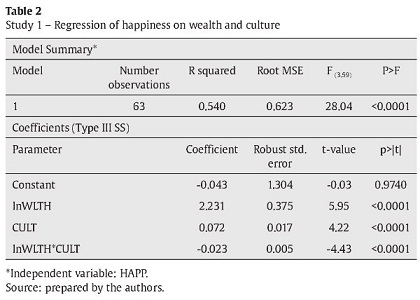
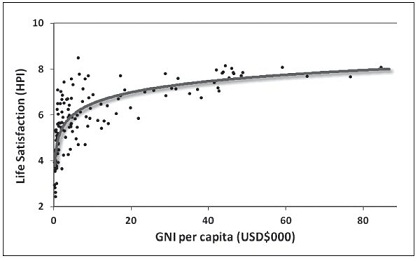
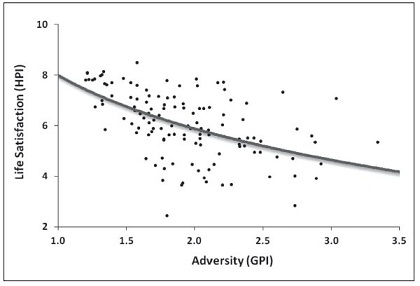
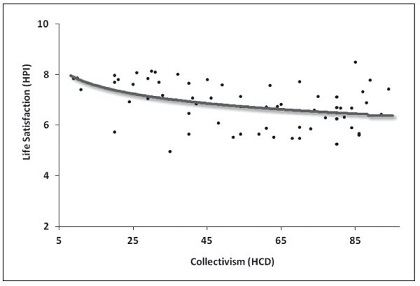
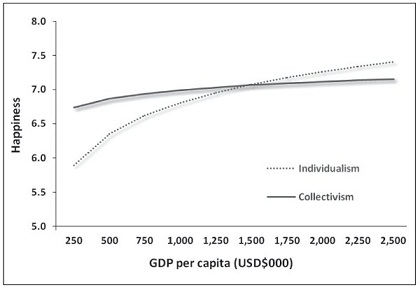
<body><![CDATA[<P><I>4.1.3. Study 1 - Results</I></P>      <P><a href="/img/revistas/eg/v29n126/v29n126a02f2.jpg" target="_blank">Table 1</a> summarizes the descriptive stats and pair-wise correlations for all   relevant variables. The direct relationships between the most relevant variables   are illustrated in the scatter-plots in <a href="#f1">Figures 1</a>-<a href="#f3">3</a>. Measures for <I>LS</I> were   consistent across the HPI (NEF, 2009), WDH (Veenhoven, 2007), and WVS   (Inglehart, 2007; WVS, 2009) indexes. Likewise, <I>GDP</I> and <I>GNI</I>   yielded consistent results. For subsequent regression and ANOVA analyses,   happiness (<I>HAPP</I>) is defined by the HPI's <I>LS</I> scores and wealth   (<I>WLTH</I>) by <I>GDP</I>, given their larger number of observations, and   adversity (<I>ADV</I>) is defined by <I>GPI</I>.</P>     <P align=center><a name="f1"></a><img src="/img/revistas/eg/v29n126/v29n126a02f3.jpg"></P>     <P align=center><B>Figure 1.</B> Study 1 - Scatter-plot of the relationship  between wealth and happiness. Sour prepared by the authors.</P>     <P align=center><a name="f2"></a><img src="/img/revistas/eg/v29n126/v29n126a02f4.jpg"></P>     <P align=center><B>Figure 2.</B> Study 1 - Scatter-plot of the relationship  between adversity and happiness. Sour prepared by the authors.</P>     <P align=center><a name="f3"></a><img src="/img/revistas/eg/v29n126/v29n126a02f6.jpg"></P>      <P align=center><B>Figure 3.</B> Study 1 - Scatter-plot of the relationship   between culture and happiness. Sour prepared by the authors.</P>      <P>&nbsp;</P>     <P>Regressing <I>HAPP</I> on the predictor, the moderator and their       interactions, per the regression equation (1), and correcting for       heteroskedasticity, yielded the results summarized in <a href="#t2">Table 2</a>. Replacing the       resulting coefficients in the corresponding terms in the regression equation       (1), and plotting only the significant terms on a wealth versus happiness chart       at +/-1 SD values of CULT (to plot individualism versus collectivism at       different values of wealth), yields the curves shown in <a href="#f4">Figure 4</a>.</P>     ]]></body>
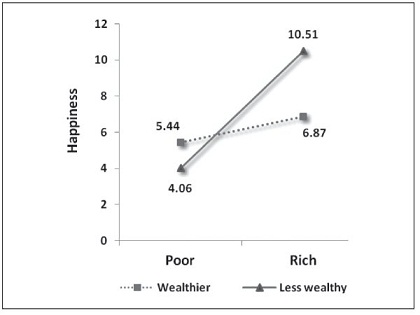
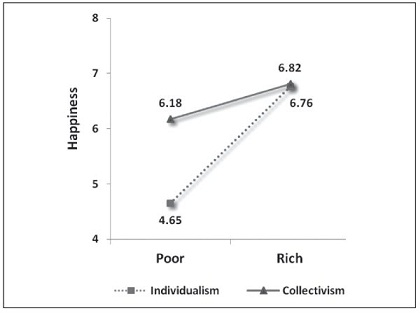
<body><![CDATA[<P align=center><a name="t2"></a><img src="/img/revistas/eg/v29n126/v29n126a02f5.jpg"></P>      <P align=center><a name="f4"></a><img src="/img/revistas/eg/v29n126/v29n126a02f7.jpg"></P>      <P align=center><B>Figure 4.</B> Study 1 - Happiness vs. wealth, moderated by   culture. Sour prepared by the authors.</P>      <P>Conducting an ANOVA with happiness (<I>HAPP</I>, continuous) as criterion and   relative wealth (wealthier or less wealthy) x standardized wealth (<I>ZWLTH</I>,   continuous) as predictors, revealed a main effect of both relative wealth   (F<SUB>(1,137)</SUB>=11.68, p&lt;0.001, n=141) and wealth measured continuously   (F<SUB>(1,137)</SUB>=100.90, p&lt;0.001, n=141) on happiness, qualified by a   significant interaction between both variables (F=41.10<SUB>(1,137)</SUB>,   p&lt;0.001, n=141). Simple slope analysis shows that, amongst poor countries   (<I>ZWLTH</I> = -1 SD), the less wealthy nations are unhappier than the   wealthier nations (4.06 vs. 5.44, respectively; t<SUB>(140)</SUB>=3.32,   p&lt;0.01). The opposite phenomenon happens amongst rich countries (<I>ZWLTH</I>   = +1 SD), where less wealthy nations are significantly happier than the   wealthier ones (10.51 vs. 6.87, respectively; t<SUB>(140)</SUB>=6.15,   p&lt;0.001). These results are shown in <a href="#f5">Figure 5</a>.</P>      <P align=center><a name="f5"></a><img src="/img/revistas/eg/v29n126/v29n126a02f8.jpg"></P>      <P align=center><B>Figure 5.</B> Study 1 - National income vs. happiness,   moderated by relative wealth. Sour prepared by the authors.</P>      <P>&nbsp;</P>     <P>By other side conducting an ANOVA with happiness (<I>HAPP</I>, continuous) as       criterion and national cultural orientation (collectivism or individualism) x       standardized wealth (<I>ZWLTH</I>, continuous) as predictors, revealed a main       effect of both culture (F<SUB>(1,137)</SUB>=20.85, p&lt;0.001, n=141) and wealth       (F<SUB>(1,137)</SUB>=34.22, p&lt;0.001, n=141) on happiness, qualified by a       significant interaction between both variables (F=9.86<SUB>(1,137)</SUB>,       p&lt;0.01, n=141). Simple slope analysis shows that, amongst poor countries       (<I>ZWLTH</I> = -1 SD), collectivist nations are significantly happier than       individualist nations (6.18 vs. 4.65, respectively; t<SUB>(140)</SUB>=5.39,       p&lt;0.001). For rich countries (<I>ZWLTH</I> = +1 SD) there is no significant       difference (6.82 vs. 6.77, respectively; t<SUB>(140)</SUB>=0.18, n.s.). These       results are shown in <a href="#f6">Figure 6</a>.</P>     <P align=center><a name="f6"></a><img src="/img/revistas/eg/v29n126/v29n126a02f9.jpg"></P>      <P align=center><B>Figure 6.</B> Study 1 - Wealth vs. happiness, moderated by   cultural orientation. Sour prepared by the authors.</P>      ]]></body>
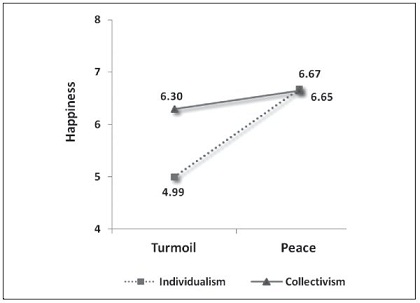
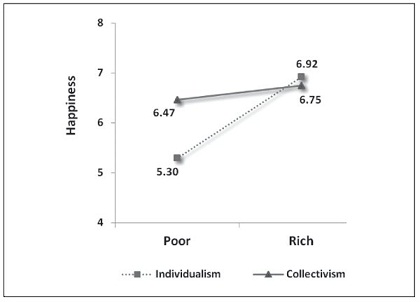
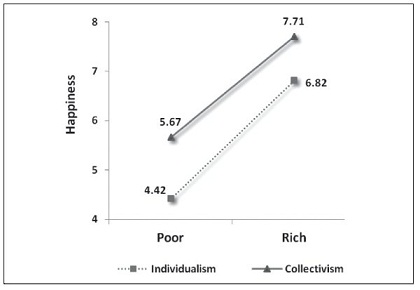
<body><![CDATA[<P>&nbsp;</P>     <P>The calculated of an ANOVA with happiness (<I>HAPP</I>, continuous) as       criterion and national cultural orientation (collectivism or individualism) x       standardized adversity (<I>ZADV</I>, continuous) as predictors, revealed a main       effect of both culture (F<SUB>(1,121)</SUB>=8.87, p&lt;0.01, n=125) and       adversity (F<SUB>(1,121)</SUB>=17.06, p&lt;0.001, n=125) on happiness, qualified       by a significant interaction between both variables (F=7.25<SUB>(1,121)</SUB>,       p&lt;0.01, n=125). Simple slope analysis shows that, in turbulent environments       (<I>ZADV</I> = +1 SD), collectivists are significantly happier than       individualists (6.30 vs. 4.99, respectively; t<SUB>(124)</SUB>=4.03, p&lt;.001).       In peaceful environments (<I>ZADV</I> = -1 SD) there is no significant       difference (6.67 vs. 6.65, respectively; t<SUB>(124)</SUB>=0.07, n.s.). These       results are shown in <a href="#f7">Figure 7</a>.</P>     <P align=center><a name="f7"></a><img src="/img/revistas/eg/v29n126/v29n126a02f10.jpg"></P>      <P align=center><B>Figure 7.</B> Study 1 - Adversity vs. happiness, moderated by   cultural orientation. Sour prepared by the authors.</P>      <P>&nbsp;</P>     <P>A final ANOVA was conducted to assess the complete model previously tested by       means of linear regression, using happiness (<I>HAPP</I>, continuous) as       criterion and national cultural orientation (<I>CULT</I>, continuous) x       adversity (<I>ADV</I>, continuous) x wealth (<I>WLTH</I>, continuous) as       predictors. The ANOVA revealed significant effects on happiness only for the       <I>WLTH*CULT</I> (F<SUB>(1,53)</SUB>=-2.46, p&lt;0.05, n=61) and <I>WLTH*ADV*CULT</I> (F<SUB>(1,53)</SUB>=2.13, p&lt;0.05, n=61) interactions.       Replicating the ANOVA with cultural orientation (collectivism or individualism)       x standardized adversity (<I>ZADV</I>, continuous) x standardized wealth       (<I>ZWLTH</I>, continuous) as predictors revealed only main effects of culture       (F<SUB>(1,115)</SUB>=12.70, p&lt;0.001, n=123) and wealth       (F<SUB>(1,115)</SUB>=14.98, p&lt;0.001, n=123). Although interactions did not       yield significance in this complete model, simple slope analysis shows that, in       poor and peaceful nations (<I>ZWLTH</I> = -1 SD and <I>ZADV</I> = -1 SD),       collectivists are significantly happier than individualists (6.47 vs. 5.30,       respectively; t<SUB>(122)</SUB>=2.27, p&lt;0.05), whereas in rich and peaceful       nations (<I>ZWLTH</I> = +1 SD and <I>ZADV</I> = -1 SD) there is no significant       difference (6.75 vs. 6.92, respectively; t<SUB>(122)</SUB>=.51, n.s.). On the       other side, in poor and turbulent nations (<I>ZWLTH</I> = +1 SD and <I>ZADV</I>       = -1 SD), collectivists are significantly happier than individualists (5.67 vs.       4.42, respectively; t<SUB>(122)</SUB>=2.43, p&lt;0.05); in rich and turbulent       nations (<I>ZWLTH</I> = +1 SD and <I>ZADV</I> = +1 SD), collectivists are       apparently happier than individualists, but results are not significant (7.71       vs. 6.82, respectively; t<SUB>(122)</SUB>=0.87, n.s.). These results are shown       in <a href="#f8">Figures 8</a> and <a href="#f9">9</a>.</P>     <P align=center><a name="f8"></a><img src="/img/revistas/eg/v29n126/v29n126a02f11.jpg"></P>      <P align=center><B>Figure 8.</B> Study 1 - Wealth vs. happiness in a peaceful   environment, moderated by culture. Sour prepared by the authors.</P>      <P align=center><a name="f9"></a><img src="/img/revistas/eg/v29n126/v29n126a02f12.jpg"></P>      <P align=center><B>Figure 9.</B> Study 1-Wealth vs. happiness in a turbulent   environment, moderated by culture. Sour prepared by the authors.</P>      ]]></body>
<body><![CDATA[<P>&nbsp;</P>     <P><I>4.1.4. Study 1 - Discussion</I></P>     <P>The Pearson product correlations shown in <a href="/img/revistas/eg/v29n126/v29n126a02f2.jpg" target="_blank">Table 1</a>, supplemented by the   scatterplots in <a href="#f1">Figures 1</a>-<a href="#f3">3</a>, indicate a positive relationship between all   measures of happiness and both measures of wealth, at a national level, thus   supporting hypothesis H1 and H2a. Happiness is also negatively related with   adversity, as measured by GPI, thus supporting hypothesis H2b. More generally,   the positive relationship with wealth (or, conversely, the negative relationship   with poverty) and the negative relationship with environmental turbulence   provide support for the more general notion that adversity is negatively related   to happiness (H2). Interestingly, collectivism seems to undermine happiness, a   counterintuitive result that replicates some previous research (Graham, 2009;   Ng, Ho &amp; Wong, 2003). In sum, per these correlations, poorer nations are   apparently unhappier, more turbulent and more collectivist than wealthier   nations.</P>      <P>The regression analysis in <a href="#t2">Table 2</a> reveals a positive non-linear relationship   between wealth and happiness, indicated by a significant main effect of the   logarithm of income (<I>lnGDP</I>) on happiness. That is, the positive   relationship between wealth and happiness is stronger at low income levels than   at high income levels, indicating that poor nations do become happier as their   wealth increase but that there are decreasing returns as wealth reaches very   high levels, thus supporting hypothesis H1 and H1a. The non-linear relationship   is further qualified by the significant 2-way interaction of cultural   orientation with the predictor. <a href="#f4">Figure 4</a> illustrates this non-linear   relationship and the moderating effect that collectivism has on the relationship   between wealth and happiness. Per this graph, it is evident that collectivism   attenuates adverse (poor) conditions, thus supporting hypotheses H3 and H3a.   Interestingly, individualism seems to be a better option for higher income   levels than collectivism, something predicted by previous research (Graham,   2009).</P>      <P>Results from the correlational and regression analyses were further qualified   by the ANOVAs. The significant 2-way interaction between national income and   relative wealth, and the corresponding slope analysis in <a href="#f5">Figure 5</a>, not only   shows that happiness does increase as income increases (hypotheses H1 and H2a),   but also that less wealthy nations derive more happiness from increasing wealth,   relative to wealthier nations, thus supporting hypothesis H1a. Likewise, the   ANOVA in <a href="#f6">Figure 6</a> indicates not only a positive relationship between wealth and   happiness (H1 and H2a), but also a significant interaction between wealth and   culture, supporting the thesis that collectivism helps poor people cope with   poverty (hypothesis H3a). Similarly, the ANOVA in <a href="#f7">Figure 7</a> indicates a positive   relationship between wealth and happiness (H1 and H2a) and a significant   interaction between adversity and culture, supporting the thesis that   collectivism helps people cope with turmoil (hypothesis H3b) and, more   generally, with different kinds of adverse conditions (H3). The ANOVA on the   complete model, including 2 and 3-way interactions between wealth, adversity and   happiness, yield further support to hypothesis H1, H2a, H3, H3a and H3b,   suggesting that collectivism is a powerful moderator of adverse   environments.</P>      <P><I>4.2. Study 2 - Meta-Analysis</I></P>      <P>The hypothesized relationships were also tested by meta-analyzing   correlational studies on the relationship between happiness and wealth, and by   assessing the moderating effect of an adverse environment or a collectivist   orientation within these studies. The meta-analytic procedure followed the RBNL   (Raju, Burke Normand and Langlois) procedure, that yields statistical   significance tests based on confidence intervals about the mean of adjusted   correlations (Burke, 1984; Burke, Landis &amp; Murphy, 2003b; Raju, Burke,   Normand &amp; Langlois, 1991). The RBNL procedure is especially appropriate to   test for moderation, which is done by considering the variance of the   correlation coefficients and using sub-group analyses based on the moderation   variables median-splits (Cortina, 2003; Sagie &amp; Koslowsky, 1993).</P>      <P>This meta-analysis used data collected in a previous meta-analysis that   explored the relationship between wealth (as indicated by economic status,   national income or GDP) and SWB (or equivalent measures of happiness) in   developing countries throughout the world (Howell &amp; Howell, 2008). This   meta-analysis included a total of 111 effect sizes from independent samples in   54 countries, which were matched in the present study to each country's   collectivism measure to come up with two sub-groups by median split. Separate   meta-analyses were conducted for each sub-group to test for moderation.</P>      <P><I>4.2.1. Study 2 - Operationalization</I></P>      <P>The effect sizes reported by Howell and Howell (2008) were used to analize   the relationship between SWB and wealth. These effect sizes were supplemented in   the present meta-analysis with <I>National Culture (CULT)</I> as a moderator,   per Hofstede's (2011) collectivism/ individualism scores.</P>      ]]></body>
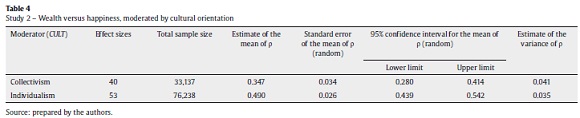
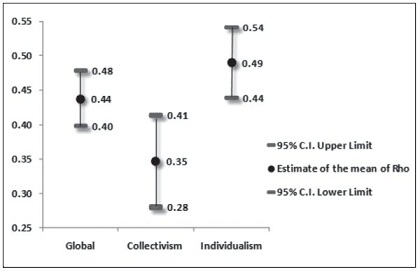
<body><![CDATA[<P><I>4.2.2. Study 2 - Data analysis</I></P>      <P>The meta-analysis complied with standard meta-analytic procedures (Lipsey   &amp; Wilson, 2001), and was conducted by means of the VG2M simulator developed   by Raju et al. (1991) for validity generalization. This application uses sample   size, observed correlation coefficients (or equivalent effect sizes), range   restriction, predictor reliability, and criterion reliability as input for every   effect size. Range restriction was not relevant for this meta-analysis so 1.0   was used as the default range restriction value. Cronbach's alpha or other valid   measure of internal reliability reported for each study is usually used as a   measure of criterion or predictor reliability. However, as the studies   meta-analyzed lacked such information, reliability was estimated with the VG2M   simulator per the Raju, Burke, Normand and Langlois (RBNL) mathematical model   (Raju et al., 1991).</P>      <P>To test the hypothesized relationship between wealth and happiness, all   effect studies in the meta-analysis were meta-analyzed. This analysis basically   replicated Howell and Howell's (2008) central analysis using a different   approach. Although many meta-analyzers use assumed artifact distribution tables   (Pearlman, Schmidt &amp; Hunter, 1980; Schmidt &amp; Hunter, 1977), this   procedure has been criticized for its assumption that statistical artifacts and   situational variables are orthogonal, and for assuming that all effect sizes   come from the same population when they estimate missing values (Burke, 1984;   Burke, Landis &amp; Murphy, 2003a; Burke et al., 2003b). Instead, the present   study chose the alternative RBNL approach, that allows statistical significance   testing by using confidence intervals about the adjusted correlation mean (Raju   et al., 1991; Sagie &amp; Koslowsky, 1993). The RBNL procedure is especially   suited for dealing with statistical artifacts based on a sample, such as   predictor or criterion reliability values, and for moderation testing. To   establish potential moderation, the variance of &rho; was considered. To test for   the hypothesized moderators, sub-group meta-analyses were conducted separately   (Cortina, 2003). Sub-groups were generated by median-split per cultural   orientation (collectivism or individualism). The resulting sub-groups were   meta-analyzed separately, generating confidence intervals that allow comparison   to determine moderation.</P>      <P><I>4.2.3. Study 2 - Results</I></P>      <P>For each effect size, the meta-analysis simulation yielded corrected correlation coefficients (&rho;),estimated mean of &rho;, sample variance,   standard error of the mean of &rho;, estimate of the variance of &rho;, 95% confidence   intervals about the mean of &rho;, 90% lower credibility value, and percent of   variance accounted by artifacts. <a href="#t3">Table 3</a> summarizes the most relevant results of   the first simulation, ran for the entire dataset.</P>      <P align=center><a name="t3"></a><img src="/img/revistas/eg/v29n126/v29n126a02f14.jpg"></P>      <P>To test for moderation of collectivism on the relationship between wealth and   happiness, two sub-groups (collectivism and individualism) were generated. To do   so, the dataset was split about the cultural orientation (<I>CULT</I>) median   value, and separate meta-analyses were ran for each sub-group. Results are   summarized in <a href="#t4">Table 4</a> and <a href="#f10">Figure 10</a>.</P>      <P align=center><a name="t4"></a><img src="/img/revistas/eg/v29n126/v29n126a02f15.jpg"></P>      <P align=center><a name="f10"></a><img src="/img/revistas/eg/v29n126/v29n126a02f13.jpg"></P>      <P align=center><B>Figure 10.</B> Study 2 - Wealth vs. happiness, moderated by   cultural orientation. Sour prepared by the authors.</P>      ]]></body>
<body><![CDATA[<P>&nbsp;</P>     <P><I>4.2.4. Study 2 - Discussion</I></P>     <P>All the estimates of the mean of &rho; in all the meta-analyses performed are   significant and directionally consistent with the relationships hypothesized   between happiness and wealth. That is, wealth is positively related with   happiness (or poverty is negatively related with happiness) in all cases and   sub-groups, which supports hypotheses H1 and H2a. Significance in each case is   indicated by the confidence intervals that do <I>not</I> encompass zero and by   the relatively small estimates of the variance of &rho;, which indicate that the   statistical artifacts tested account for a sizable percentage of the criterion   variance.</P>      <P>Consistent with the predictions, moderation testing shows a stronger mean of   &rho; for individualists than for collectivists, with significant relationships in   both cases. Moderation is evidenced by the fact that the two sub-groups'   confidence intervals do not overlap, which indicates a significant effect of   collectivism on the relationship between wealth and happiness. Therefore,   hypothesis H3a is supported.</P>      <P><I>4.3. General discussion</I></P>      <P>This paper set out to investigate alternative explanations for the intriguing   contrasts between poor and rich nations in terms of happiness perceptions. Based   on the literature reviewed and empirical antecedents, hypotheses on the   relationship between wealth, adversity and cultural orientation were proposed,   to be tested by means of linear regressions, ANOVAs, and meta-analysis. Taken   together, the results provide support for all the hypotheses: using current   data, the results replicate the behavior predicted by the Easterlin paradox at a   national level, indicating that there is a non-linear relationship previously   observed between wealth and happiness and that collectivism does help coping   with adversity, in general, and with poverty and environmental turmoil in   particular.</P>      <P>It could be argued that the steeper slope in (un)happiness changes observed   at low income levels, relative to higher incomes, has already been explained by   needs theories. Hierarchical needs models, however, have failed to offer a   comprehensive explanation for this paradoxical behavior, and have only managed   to offer a partial explanation, at the most. By focusing on the poorer (more   adverse) side of the curve, the present research digs into the nuances of this   phenomenon, thus providing additional explanations to the paradox. That is, by   viewing the relationship as one between <I>poverty</I> (or <I>adversity</I>) and   <I>unhappiness</I>, rather than one between <I>wealth</I> (or <I>prosperity</I>)   and <I>happiness</I>, this work offers a clue to gain further insight on these   matters. Indeed, once the investigators start thinking along such   adversity-unhappiness terms, the relationship appears much less paradoxical than   it has been traditionally presented.</P>      <P>Moreover, the role of collectivism as a moderator of the relationship has   only been marginally addressed in previous investigations. This paper expands   extant knowledge by providing additional evidence, not only on the significant   role that collectivism plays in explaining why relatively poorer countries can   achieve higher levels of happiness that wealthier ones, but also on the   importance of collectivism as a defense or inoculation mechanism against varied   forms of adversity.</P>      <P>The fact that the regression and ANOVA results were further supported by the   meta-analytic comparison is particularly noteworthy, especially considering   possible limitations in the meta-analysis. That is, the nations meta-analyzed   are all developing countries, with a consequent dominance of societies that are   poor, collectivist <I>and</I> violent. This bias seriously restricts the   effectiveness of the contrasting approach chosen hereby, and it is likely that a   more comprehensive study, that encompass not only developing countries but also   wealthy first-world countries would show even stronger moderation effects.</P>      <P>&nbsp;</P>      ]]></body>
<body><![CDATA[<P><font size="3"><B>5. Conclusions</B></font></P>      <P>This paper extends the basic thesis that collectivism helps poor people deal   with poverty to a more general notion, by providing evidence on the significant   role that collectivism plays in helping people deal with different types of   adversity. Moreover, the moderating role of collectivism helps people achieve   high levels of happiness even when facing seriously adverse situations. The   implications of these findings are potentially valuable in marketing, economy   and other fields. Understanding the role of collectivism or individualism can   help decision makers fine-tune policies and programs, in order to maximize   people's well-being, within their particular cultural and socio-economic   context.</P>      <P>Focusing on the poorer end of the spectrum&#8211;and viewing the relationship   between wealth and happiness rather as one between poverty and   (un)happiness&#8211;helps understanding the underlying mechanisms and contributes to a   better explanation of the Easterlin paradox. That is, poor countries clearly   reduce their adversity (understood as poverty) as their wealth increase, which   accounts for their rapidly increasing happiness as a function of national   income. Given that adversity is not significantly reduced any more by increasing   income once someone is already rich, it can be argued that the flattening of the   curve coincides with a threshold in the perception of security or peace. It   follows that in nations that are not only rich but also peaceful, increasing   income becomes relatively less effective in reducing adversity and thus money   becomes ineffective in producing more happiness. This inference is also   consistent with exceptional cases such as the US that show decreasing happiness   at higher levels of national income (Biswas-Diener, 2006). If such prosperous   years in the US are atypically accompanied by increasing turmoil (rising crime   rates, violence and terrorism), the perception of overall adversity might be   overriding wealth as a predictor of happiness and eventually undermining   Americans' perception of happiness. Such a situation is likely exacerbated   because of the individualism prevalent amongst the US citizens (Hofstede, 2011).   Likewise, other apparently contradictory findings, such as the consistently high   happiness ratings of poor and violent countries, like Colombia (NEF, 2009; WVS,   2009) for instance, might be explained because of the protective effect of   collectivism.</P>      <P>Integrating extant views on happiness, national culture and adversity, this   work expected to extend extant knowledge on the economics of happiness and to   collect supporting evidence for the notion that sheer wealth is not enough to   produce happiness across all conditions, and that material wealth and   consumption have to be balanced by a sense of security and/or belonging. This   paper also allows inferences on the relative superiority of collectivism over   individualism in generating long-lasting satisfaction with life, to an extent   that material well-being is no longer relevant and even adversity can be   overcome to achieve happiness. It follows that an intentional approach towards   collectivism might be fit into public policies and programs aimed at improving   national happiness and well-being.</P>      <P>Before advancing any prescriptive inferences along these lines, however, at   least two practical limitations posed by the present study must be addressed.   First, it could be argued that findings from nationwide aggregate data might not   translate to individuals, thus hindering any useful application to public   policy. Second, the findings achieved so far do not demonstrate causality, which   thus sheds doubt on their prescriptive value. Future research will address these   limitations by testing the hypotheses hereby discussed at an individual level of   analysis, attempting to validate extant happiness scales by administering custom   individual surveys across varied socio-economic strata, and by crossing these   measures with individual (collective/ individualist) differences and varying   adversity conditions. This will be achieved by exposing undergraduate students   from two universities, in Colombia and the US, to hypothetical hostile or   friendly scenarios, and by contrasting their responses to these hypothetical   conditions with their individual happiness perceptions and their cultural   leanings towards individualism or collectivism. Testing the hypothesized   relationships under such experimental conditions will effectively control not   only for the main effects but also for situational specificity, will increase   the internal validity of this investigation, and should allow inferring   causality on the already supported relationship between adversity, culture and   happiness. Also, to the extent that the hypotheses hereby presented are tested   under more varied cultural and personal contexts, this research's external   validity will also benefit from such an experimental approach.</P>      <P>In short, future studies should provide additional insight into the   specificities that make it possible for some people to actually buy   happiness.</P>          <P>&nbsp;</P>      <P><font size="3"><B>References</B></font></P>      <!-- ref --><P>Ahuvia, A. C. (2002). Individualism/collectivism and cultures of happiness: A   theoretical conjecture on the relationship between consumption, culture and   subjective well-being at the national level. <I>Journal of Happiness Studies,   3</I>(1), 23-36.    &nbsp;&nbsp;&nbsp;&nbsp;&nbsp;&nbsp;&nbsp;&nbsp;[&#160;<a href="javascript:void(0);" onclick="javascript: window.open('/scielo.php?script=sci_nlinks&ref=000151&pid=S0123-5923201300010000200001&lng=','','width=640,height=500,resizable=yes,scrollbars=1,menubar=yes,');">Links</a>&#160;]<!-- end-ref --></P>      ]]></body>
<body><![CDATA[<!-- ref --><P>Arndt, J., Solomon, S., Kasser, T. &amp; Sheldon, K. M. (2004). The Urge to   Splurge: A Terror Management Account of Materialism and Consumer Behavior.   <I>Journal of Consumer Psychology, 14</I>(3), 198-212.    &nbsp;&nbsp;&nbsp;&nbsp;&nbsp;&nbsp;&nbsp;&nbsp;[&#160;<a href="javascript:void(0);" onclick="javascript: window.open('/scielo.php?script=sci_nlinks&ref=000153&pid=S0123-5923201300010000200002&lng=','','width=640,height=500,resizable=yes,scrollbars=1,menubar=yes,');">Links</a>&#160;]<!-- end-ref --></P>      <!-- ref --><P>Baron, R. M. &amp; Kenny, D. A. (1986). The moderator-mediator variable   distinction in social psychological research: Conceptual, strategic, and   statistical considerations. <I>Journal of Personality and Social Psychology,   51</I>(6), 1173-1182.    &nbsp;&nbsp;&nbsp;&nbsp;&nbsp;&nbsp;&nbsp;&nbsp;[&#160;<a href="javascript:void(0);" onclick="javascript: window.open('/scielo.php?script=sci_nlinks&ref=000155&pid=S0123-5923201300010000200003&lng=','','width=640,height=500,resizable=yes,scrollbars=1,menubar=yes,');">Links</a>&#160;]<!-- end-ref --></P>      <!-- ref --><P>Biswas-Diener, R. (2006). The Search for Happiness. <I>Science &amp; Spirit,   17</I>(2), 28-33.    &nbsp;&nbsp;&nbsp;&nbsp;&nbsp;&nbsp;&nbsp;&nbsp;[&#160;<a href="javascript:void(0);" onclick="javascript: window.open('/scielo.php?script=sci_nlinks&ref=000157&pid=S0123-5923201300010000200004&lng=','','width=640,height=500,resizable=yes,scrollbars=1,menubar=yes,');">Links</a>&#160;]<!-- end-ref --></P>      <!-- ref --><P>Borrero, S. (2010). The Happiness-to-Consumption Ratio: An Alternative   Approach in the Quest for Happiness. <I>Estudios Gerenciales, 26</I>(115),   15-35.    &nbsp;&nbsp;&nbsp;&nbsp;&nbsp;&nbsp;&nbsp;&nbsp;[&#160;<a href="javascript:void(0);" onclick="javascript: window.open('/scielo.php?script=sci_nlinks&ref=000159&pid=S0123-5923201300010000200005&lng=','','width=640,height=500,resizable=yes,scrollbars=1,menubar=yes,');">Links</a>&#160;]<!-- end-ref --></P>      <!-- ref --><P>Buchanan, R. (1991). Flow: the psychology of optimal experience (book   review). <I>Design Issues, 8,</I> 80-81.    &nbsp;&nbsp;&nbsp;&nbsp;&nbsp;&nbsp;&nbsp;&nbsp;[&#160;<a href="javascript:void(0);" onclick="javascript: window.open('/scielo.php?script=sci_nlinks&ref=000161&pid=S0123-5923201300010000200006&lng=','','width=640,height=500,resizable=yes,scrollbars=1,menubar=yes,');">Links</a>&#160;]<!-- end-ref --></P>      ]]></body>
<body><![CDATA[<!-- ref --><P>Burke, M. J. (1984). Validity generalization: A review and critique of the   correlation model. <I>Personnel Psychology, 37</I>(1), 93-115.    &nbsp;&nbsp;&nbsp;&nbsp;&nbsp;&nbsp;&nbsp;&nbsp;[&#160;<a href="javascript:void(0);" onclick="javascript: window.open('/scielo.php?script=sci_nlinks&ref=000163&pid=S0123-5923201300010000200007&lng=','','width=640,height=500,resizable=yes,scrollbars=1,menubar=yes,');">Links</a>&#160;]<!-- end-ref --></P>      <!-- ref --><P>Burke, M. J., Landis, R. S. &amp; Murphy, K. R. (2003a). Construct Validity   Issues in Applications of Meta-Analytic Procedures. <I>Validity generalization:   A critical review.</I> (pp. 287-300). Mahwah, NJ, US: Lawrence Erlbaum   Associates Publishers.    &nbsp;&nbsp;&nbsp;&nbsp;&nbsp;&nbsp;&nbsp;&nbsp;[&#160;<a href="javascript:void(0);" onclick="javascript: window.open('/scielo.php?script=sci_nlinks&ref=000165&pid=S0123-5923201300010000200008&lng=','','width=640,height=500,resizable=yes,scrollbars=1,menubar=yes,');">Links</a>&#160;]<!-- end-ref --></P>      <!-- ref --><P>Burke, M. J., Landis, R. S. &amp; Murphy, K. R. (2003b). Methodological and   conceptual challenges in conducting and interpreting meta-analyses. <I>Validity   generalization: A critical review.</I> (pp. 287-309). Mahwah, NJ, US: Lawrence   Erlbaum Associates Publishers.    &nbsp;&nbsp;&nbsp;&nbsp;&nbsp;&nbsp;&nbsp;&nbsp;[&#160;<a href="javascript:void(0);" onclick="javascript: window.open('/scielo.php?script=sci_nlinks&ref=000167&pid=S0123-5923201300010000200009&lng=','','width=640,height=500,resizable=yes,scrollbars=1,menubar=yes,');">Links</a>&#160;]<!-- end-ref --></P>      <!-- ref --><P>Cortina, J. M. (2003). Apples and Oranges (and Pears, Oh My!): The Search for   Moderators in Meta-Analysis. <I>Organizational Research Methods, 6</I>(4),   415-439.    &nbsp;&nbsp;&nbsp;&nbsp;&nbsp;&nbsp;&nbsp;&nbsp;[&#160;<a href="javascript:void(0);" onclick="javascript: window.open('/scielo.php?script=sci_nlinks&ref=000169&pid=S0123-5923201300010000200010&lng=','','width=640,height=500,resizable=yes,scrollbars=1,menubar=yes,');">Links</a>&#160;]<!-- end-ref --></P>      <!-- ref --><P>Csikszentmihalyi, M. (1999). If we are so rich, why aren't we happy?   <I>American Psychologist, 54</I>(10), 821-827.    &nbsp;&nbsp;&nbsp;&nbsp;&nbsp;&nbsp;&nbsp;&nbsp;[&#160;<a href="javascript:void(0);" onclick="javascript: window.open('/scielo.php?script=sci_nlinks&ref=000171&pid=S0123-5923201300010000200011&lng=','','width=640,height=500,resizable=yes,scrollbars=1,menubar=yes,');">Links</a>&#160;]<!-- end-ref --></P>      ]]></body>
<body><![CDATA[<!-- ref --><P>Csikszentmihalyi, M. (2000a). The Costs and Benefits of Consuming. <I>Journal   of Consumer Research, 27</I>(2), 267-272.    &nbsp;&nbsp;&nbsp;&nbsp;&nbsp;&nbsp;&nbsp;&nbsp;[&#160;<a href="javascript:void(0);" onclick="javascript: window.open('/scielo.php?script=sci_nlinks&ref=000173&pid=S0123-5923201300010000200012&lng=','','width=640,height=500,resizable=yes,scrollbars=1,menubar=yes,');">Links</a>&#160;]<!-- end-ref --></P>      <!-- ref --><P>Csikszentmihalyi, M. (2000b). Happiness, flow, and economic equality. <I>The   American Psychologist, 55</I>(10), 1163-1164.    &nbsp;&nbsp;&nbsp;&nbsp;&nbsp;&nbsp;&nbsp;&nbsp;[&#160;<a href="javascript:void(0);" onclick="javascript: window.open('/scielo.php?script=sci_nlinks&ref=000175&pid=S0123-5923201300010000200013&lng=','','width=640,height=500,resizable=yes,scrollbars=1,menubar=yes,');">Links</a>&#160;]<!-- end-ref --></P>      <!-- ref --><P>Dawson, J. F. &amp; Richter, A. W. (2006). Probing three-way interactions in   moderated multiple regression: Development and application of a slope difference   test. <I>Journal of Applied Psychology, 91</I>(4), 917-926.    &nbsp;&nbsp;&nbsp;&nbsp;&nbsp;&nbsp;&nbsp;&nbsp;[&#160;<a href="javascript:void(0);" onclick="javascript: window.open('/scielo.php?script=sci_nlinks&ref=000177&pid=S0123-5923201300010000200014&lng=','','width=640,height=500,resizable=yes,scrollbars=1,menubar=yes,');">Links</a>&#160;]<!-- end-ref --></P>      <!-- ref --><P>Day, L. &amp; Maltby, J. (2003). Belief in good luck and psychological   well-being: the mediating role of optimism and irrational beliefs. <I>The   Journal of Psychology, 137</I>(1), 99-110.    &nbsp;&nbsp;&nbsp;&nbsp;&nbsp;&nbsp;&nbsp;&nbsp;[&#160;<a href="javascript:void(0);" onclick="javascript: window.open('/scielo.php?script=sci_nlinks&ref=000179&pid=S0123-5923201300010000200015&lng=','','width=640,height=500,resizable=yes,scrollbars=1,menubar=yes,');">Links</a>&#160;]<!-- end-ref --></P>      <!-- ref --><P>Deaton, A. (2008). Income, Health, and Well-Being around the World: Evidence   from the Gallup World Poll. <I>Journal of Economic Perspectives, 22</I>(2),   53-72.    &nbsp;&nbsp;&nbsp;&nbsp;&nbsp;&nbsp;&nbsp;&nbsp;[&#160;<a href="javascript:void(0);" onclick="javascript: window.open('/scielo.php?script=sci_nlinks&ref=000181&pid=S0123-5923201300010000200016&lng=','','width=640,height=500,resizable=yes,scrollbars=1,menubar=yes,');">Links</a>&#160;]<!-- end-ref --></P>      ]]></body>
<body><![CDATA[<!-- ref --><P>Deci, E. L. &amp; Ryan, R. M. (2000). The 'What' and 'Why' of Goal Pursuits:   Human Needs and the Self-Determination of Behavior. <I>Psychological Inquiry,   11</I>(4), 227.    &nbsp;&nbsp;&nbsp;&nbsp;&nbsp;&nbsp;&nbsp;&nbsp;[&#160;<a href="javascript:void(0);" onclick="javascript: window.open('/scielo.php?script=sci_nlinks&ref=000183&pid=S0123-5923201300010000200017&lng=','','width=640,height=500,resizable=yes,scrollbars=1,menubar=yes,');">Links</a>&#160;]<!-- end-ref --></P>      <!-- ref --><P>Diener, E. &amp; Diener, C. (1996). Most People are Happy. <I>Psychological   Science, 7</I>(3), 181-185.    &nbsp;&nbsp;&nbsp;&nbsp;&nbsp;&nbsp;&nbsp;&nbsp;[&#160;<a href="javascript:void(0);" onclick="javascript: window.open('/scielo.php?script=sci_nlinks&ref=000185&pid=S0123-5923201300010000200018&lng=','','width=640,height=500,resizable=yes,scrollbars=1,menubar=yes,');">Links</a>&#160;]<!-- end-ref --></P>      <!-- ref --><P>Diener, E., Diener, M. &amp; Diener, C. (1995). Factors predicting the   subjective well-being of nations. <I>Journal of Personality and Social   Psychology, 69</I>(5), 851-864.    &nbsp;&nbsp;&nbsp;&nbsp;&nbsp;&nbsp;&nbsp;&nbsp;[&#160;<a href="javascript:void(0);" onclick="javascript: window.open('/scielo.php?script=sci_nlinks&ref=000187&pid=S0123-5923201300010000200019&lng=','','width=640,height=500,resizable=yes,scrollbars=1,menubar=yes,');">Links</a>&#160;]<!-- end-ref --></P>      <!-- ref --><P>Diener, E. &amp; Selicman, M. E. P. (2006). Measure for measure: the case for   a national well-being index. <I>Science &amp; Spirit, 17</I>(2), 36-37.    &nbsp;&nbsp;&nbsp;&nbsp;&nbsp;&nbsp;&nbsp;&nbsp;[&#160;<a href="javascript:void(0);" onclick="javascript: window.open('/scielo.php?script=sci_nlinks&ref=000189&pid=S0123-5923201300010000200020&lng=','','width=640,height=500,resizable=yes,scrollbars=1,menubar=yes,');">Links</a>&#160;]<!-- end-ref --></P>      <!-- ref --><P>Easterlin, R. A. (1974). Does economic growth improve the human lot? Some   empirical evidence. In P. A. David &amp; W. R. Levin (Eds.), <I>Nations and   households in economic growth</I> (pp. 98-125). Palo Alto, CA: Stanford   University Press.    &nbsp;&nbsp;&nbsp;&nbsp;&nbsp;&nbsp;&nbsp;&nbsp;[&#160;<a href="javascript:void(0);" onclick="javascript: window.open('/scielo.php?script=sci_nlinks&ref=000191&pid=S0123-5923201300010000200021&lng=','','width=640,height=500,resizable=yes,scrollbars=1,menubar=yes,');">Links</a>&#160;]<!-- end-ref --></P>      ]]></body>
<body><![CDATA[<!-- ref --><P>Easterlin, R. A. (2001). Income and Happiness: Towards a Unified Theory.   <I>The Economic Journal, 111</I>(473), 465-484.    &nbsp;&nbsp;&nbsp;&nbsp;&nbsp;&nbsp;&nbsp;&nbsp;[&#160;<a href="javascript:void(0);" onclick="javascript: window.open('/scielo.php?script=sci_nlinks&ref=000193&pid=S0123-5923201300010000200022&lng=','','width=640,height=500,resizable=yes,scrollbars=1,menubar=yes,');">Links</a>&#160;]<!-- end-ref --></P>      <!-- ref --><P>Frey, B. S. &amp; Stutzer, A. (2002). What Can Economists Learn from   Happiness Research? <I>Journal of Economic Literature, 40</I>(2), 402-435.    &nbsp;&nbsp;&nbsp;&nbsp;&nbsp;&nbsp;&nbsp;&nbsp;[&#160;<a href="javascript:void(0);" onclick="javascript: window.open('/scielo.php?script=sci_nlinks&ref=000195&pid=S0123-5923201300010000200023&lng=','','width=640,height=500,resizable=yes,scrollbars=1,menubar=yes,');">Links</a>&#160;]<!-- end-ref --></P>      <!-- ref --><P>Graham, C. (2009). <I>Happiness Around the World: The Paradox of Happy   Peasants and Miserable Millionaires</I>. New York, NY: Oxford University   Press.    &nbsp;&nbsp;&nbsp;&nbsp;&nbsp;&nbsp;&nbsp;&nbsp;[&#160;<a href="javascript:void(0);" onclick="javascript: window.open('/scielo.php?script=sci_nlinks&ref=000197&pid=S0123-5923201300010000200024&lng=','','width=640,height=500,resizable=yes,scrollbars=1,menubar=yes,');">Links</a>&#160;]<!-- end-ref --></P>      <!-- ref --><P>Hofstede, G. (1980). Motivation, Leadership, and Organization: Do American   Theories Apply Abroad? <I>Organizational Dynamics, 9</I>(1), 42-63.    &nbsp;&nbsp;&nbsp;&nbsp;&nbsp;&nbsp;&nbsp;&nbsp;[&#160;<a href="javascript:void(0);" onclick="javascript: window.open('/scielo.php?script=sci_nlinks&ref=000199&pid=S0123-5923201300010000200025&lng=','','width=640,height=500,resizable=yes,scrollbars=1,menubar=yes,');">Links</a>&#160;]<!-- end-ref --></P>      <!-- ref --><P>Hofstede, G. (1983). The Cultural Relativity of Organizational Practices and   Theories <I>Journal of International Business Studies, 14</I>(2), 75-89.    &nbsp;&nbsp;&nbsp;&nbsp;&nbsp;&nbsp;&nbsp;&nbsp;[&#160;<a href="javascript:void(0);" onclick="javascript: window.open('/scielo.php?script=sci_nlinks&ref=000201&pid=S0123-5923201300010000200026&lng=','','width=640,height=500,resizable=yes,scrollbars=1,menubar=yes,');">Links</a>&#160;]<!-- end-ref --></P>      ]]></body>
<body><![CDATA[<!-- ref --><P>Hofstede, G. (2007). Hofstede Scores. <I>Geert Hofstede Cultural   Dimensions.</I> Retrieved December 10, 2007, from   <a href="http://www.geert-hofstede.com/" target="_blank">http://www.geert-hofstede.com/</a>.    &nbsp;&nbsp;&nbsp;&nbsp;&nbsp;&nbsp;&nbsp;&nbsp;[&#160;<a href="javascript:void(0);" onclick="javascript: window.open('/scielo.php?script=sci_nlinks&ref=000203&pid=S0123-5923201300010000200027&lng=','','width=640,height=500,resizable=yes,scrollbars=1,menubar=yes,');">Links</a>&#160;]<!-- end-ref --></P>      <!-- ref --><P>Hofstede, G. (2011). Hofstede Scores. <I>Geert Hofstede Cultural   Dimensions.</I> Retrieved July 11, 2011. Disponible en:   <a href="http://www.geert-hofstede.com/" target="_blank">http://www.geert-hofstede.com/</a>.    &nbsp;&nbsp;&nbsp;&nbsp;&nbsp;&nbsp;&nbsp;&nbsp;[&#160;<a href="javascript:void(0);" onclick="javascript: window.open('/scielo.php?script=sci_nlinks&ref=000205&pid=S0123-5923201300010000200028&lng=','','width=640,height=500,resizable=yes,scrollbars=1,menubar=yes,');">Links</a>&#160;]<!-- end-ref --></P>      <!-- ref --><P>Howell, R. T. &amp; Howell, C. J. (2008). The relation of economic status to   subjective well-being in developing countries: A meta-analysis. <I>Psychological   Bulletin, 134</I>(4), 536-560.    &nbsp;&nbsp;&nbsp;&nbsp;&nbsp;&nbsp;&nbsp;&nbsp;[&#160;<a href="javascript:void(0);" onclick="javascript: window.open('/scielo.php?script=sci_nlinks&ref=000207&pid=S0123-5923201300010000200029&lng=','','width=640,height=500,resizable=yes,scrollbars=1,menubar=yes,');">Links</a>&#160;]<!-- end-ref --></P>      <!-- ref --><P>Inglehart, R. (2007). World Values Survey Online Data Analysis. <I>World   Values Survey.</I> Retrieved December 10, 2007. Disponible en:   <a href="http://www.worldvaluessurvey.org/" target="_blank">http://www.worldvaluessurvey.org/</a>.    &nbsp;&nbsp;&nbsp;&nbsp;&nbsp;&nbsp;&nbsp;&nbsp;[&#160;<a href="javascript:void(0);" onclick="javascript: window.open('/scielo.php?script=sci_nlinks&ref=000209&pid=S0123-5923201300010000200030&lng=','','width=640,height=500,resizable=yes,scrollbars=1,menubar=yes,');">Links</a>&#160;]<!-- end-ref --> </P>     <!-- ref --><P>Institute for Economics and Peace (2011).       Global Peace Index. Retrieved July 22, 2011. Disponible en:       <a href="http://www.economicsandpeace.org/" target="_blank">http://www.economicsandpeace.org/</a>.    &nbsp;&nbsp;&nbsp;&nbsp;&nbsp;&nbsp;&nbsp;&nbsp;[&#160;<a href="javascript:void(0);" onclick="javascript: window.open('/scielo.php?script=sci_nlinks&ref=000211&pid=S0123-5923201300010000200031&lng=','','width=640,height=500,resizable=yes,scrollbars=1,menubar=yes,');">Links</a>&#160;]<!-- end-ref --></P>     ]]></body>
<body><![CDATA[<!-- ref --><P>Lipsey, M. W. &amp; Wilson, D. B. (2001). <I>Practical Meta-Analysis</I>.   Thousand Oaks, CA: Sage.    &nbsp;&nbsp;&nbsp;&nbsp;&nbsp;&nbsp;&nbsp;&nbsp;[&#160;<a href="javascript:void(0);" onclick="javascript: window.open('/scielo.php?script=sci_nlinks&ref=000213&pid=S0123-5923201300010000200032&lng=','','width=640,height=500,resizable=yes,scrollbars=1,menubar=yes,');">Links</a>&#160;]<!-- end-ref --><!-- ref --> Lynn, M. &amp; Steel, P. (2006). National Differences   in Subjective Well-Being: The Interactive Effects of Extraversion and   Neuroticism. <I>Journal of Happiness Studies, 7</I>(2), 155-165.    &nbsp;&nbsp;&nbsp;&nbsp;&nbsp;&nbsp;&nbsp;&nbsp;[&#160;<a href="javascript:void(0);" onclick="javascript: window.open('/scielo.php?script=sci_nlinks&ref=000214&pid=S0123-5923201300010000200033&lng=','','width=640,height=500,resizable=yes,scrollbars=1,menubar=yes,');">Links</a>&#160;]<!-- end-ref --></P>      <!-- ref --><P>Maslow, A. (1962). <I>Toward a psychology of being</I>. Princeton, NJ US: D   Van Nostrand.    &nbsp;&nbsp;&nbsp;&nbsp;&nbsp;&nbsp;&nbsp;&nbsp;[&#160;<a href="javascript:void(0);" onclick="javascript: window.open('/scielo.php?script=sci_nlinks&ref=000216&pid=S0123-5923201300010000200034&lng=','','width=640,height=500,resizable=yes,scrollbars=1,menubar=yes,');">Links</a>&#160;]<!-- end-ref --></P>      <!-- ref --><P>McMahon, D. M. (2006). <I>Happiness: A history</I>. New York, NY US: Atlantic   Monthly Press.    &nbsp;&nbsp;&nbsp;&nbsp;&nbsp;&nbsp;&nbsp;&nbsp;[&#160;<a href="javascript:void(0);" onclick="javascript: window.open('/scielo.php?script=sci_nlinks&ref=000218&pid=S0123-5923201300010000200035&lng=','','width=640,height=500,resizable=yes,scrollbars=1,menubar=yes,');">Links</a>&#160;]<!-- end-ref --></P>      <!-- ref --><P>Mentzakis, E. &amp; Moro, M. (2009). The poor, the rich and the happy:   Exploring the link between income and subjective well-being. <I>Journal of   Socio-Economics, 38</I>(1), 147-158.    &nbsp;&nbsp;&nbsp;&nbsp;&nbsp;&nbsp;&nbsp;&nbsp;[&#160;<a href="javascript:void(0);" onclick="javascript: window.open('/scielo.php?script=sci_nlinks&ref=000220&pid=S0123-5923201300010000200036&lng=','','width=640,height=500,resizable=yes,scrollbars=1,menubar=yes,');">Links</a>&#160;]<!-- end-ref --></P>      <!-- ref --><P>Michaelson, J., Abdallah, S., Steuer, N., Thompson, S., Marks, N., Aked, J.,   et al. (2009). National Accounts of Well-being: bringing real wealth onto the   balance sheet: New Economics Foundation.    &nbsp;&nbsp;&nbsp;&nbsp;&nbsp;&nbsp;&nbsp;&nbsp;[&#160;<a href="javascript:void(0);" onclick="javascript: window.open('/scielo.php?script=sci_nlinks&ref=000222&pid=S0123-5923201300010000200037&lng=','','width=640,height=500,resizable=yes,scrollbars=1,menubar=yes,');">Links</a>&#160;]<!-- end-ref --></P>      <!-- ref --><P>Myers, D. G. (2000). Wanting More in an Age of Plenty. <I>Christianity Today,   44</I>(5), 94.    &nbsp;&nbsp;&nbsp;&nbsp;&nbsp;&nbsp;&nbsp;&nbsp;[&#160;<a href="javascript:void(0);" onclick="javascript: window.open('/scielo.php?script=sci_nlinks&ref=000224&pid=S0123-5923201300010000200038&lng=','','width=640,height=500,resizable=yes,scrollbars=1,menubar=yes,');">Links</a>&#160;]<!-- end-ref --></P>      <!-- ref --><P>NEF. (2007). The (Un)Happy Planet Index: An Index of Human Well-Being and   Environmental Impact. <I>The Happy Planet Report.</I> Retrieved July 15, 2007.   Disponible en: <A   href="http://www.neweconomics.org/gen/z_sys_PublicationDetail.aspx?pid=225" target="_blank">http://www.neweconomics.org/gen/z_sys_PublicationDetail.aspx?pid=225</A>.    &nbsp;&nbsp;&nbsp;&nbsp;&nbsp;&nbsp;&nbsp;&nbsp;[&#160;<a href="javascript:void(0);" onclick="javascript: window.open('/scielo.php?script=sci_nlinks&ref=000226&pid=S0123-5923201300010000200039&lng=','','width=640,height=500,resizable=yes,scrollbars=1,menubar=yes,');">Links</a>&#160;]<!-- end-ref --></P>      <!-- ref --><P>NEF. (2009). The (Un)Happy Planet Index 2.0: Why good lives don't have to   cost the Earth. <I>The Happy Planet Index</I>. Retrieved July 11, 2011.   Disponible en: <a href="http://www.happyplanetindex.org/learn/download-report.html" target="_blank">http://www.happyplanetindex.org/learn/download-report.html</a>.    &nbsp;&nbsp;&nbsp;&nbsp;&nbsp;&nbsp;&nbsp;&nbsp;[&#160;<a href="javascript:void(0);" onclick="javascript: window.open('/scielo.php?script=sci_nlinks&ref=000228&pid=S0123-5923201300010000200040&lng=','','width=640,height=500,resizable=yes,scrollbars=1,menubar=yes,');">Links</a>&#160;]<!-- end-ref --></P>      <!-- ref --><P>Ng, A. K., Ho, D. Y. F. &amp; Wong, S. S. (2003). In search of the good ife:   A cultural odyssey in the east and west. <I>Genetic, Social, and General   Psychology Monographs, 129</I>(4), 317-363.    &nbsp;&nbsp;&nbsp;&nbsp;&nbsp;&nbsp;&nbsp;&nbsp;[&#160;<a href="javascript:void(0);" onclick="javascript: window.open('/scielo.php?script=sci_nlinks&ref=000230&pid=S0123-5923201300010000200041&lng=','','width=640,height=500,resizable=yes,scrollbars=1,menubar=yes,');">Links</a>&#160;]<!-- end-ref --></P>      <!-- ref --><P>Pearlman, K., Schmidt, F. L. &amp; Hunter, J. E. (1980). Validity   Generalization Results for Tests Used to Predict Job Proficiency and Training   Success in Clerical Occupations. <I>Journal of Applied Psychology, 65</I>(4),   373-406.    &nbsp;&nbsp;&nbsp;&nbsp;&nbsp;&nbsp;&nbsp;&nbsp;[&#160;<a href="javascript:void(0);" onclick="javascript: window.open('/scielo.php?script=sci_nlinks&ref=000232&pid=S0123-5923201300010000200042&lng=','','width=640,height=500,resizable=yes,scrollbars=1,menubar=yes,');">Links</a>&#160;]<!-- end-ref --></P>      <!-- ref --><P>Raju, N. S., Burke, M. J., Normand, J. &amp; Langlois, G. M. (1991). A new   meta-analytic approach. <I>Journal of Applied Psychology, 76</I>(3),   432-446.    &nbsp;&nbsp;&nbsp;&nbsp;&nbsp;&nbsp;&nbsp;&nbsp;[&#160;<a href="javascript:void(0);" onclick="javascript: window.open('/scielo.php?script=sci_nlinks&ref=000234&pid=S0123-5923201300010000200043&lng=','','width=640,height=500,resizable=yes,scrollbars=1,menubar=yes,');">Links</a>&#160;]<!-- end-ref --></P>      <!-- ref --><P>Reich, J. &amp; Diener, E. (1994). The road to happiness. (Cover story).   <I>Psychology Today, 27</I>(4), 32.    &nbsp;&nbsp;&nbsp;&nbsp;&nbsp;&nbsp;&nbsp;&nbsp;[&#160;<a href="javascript:void(0);" onclick="javascript: window.open('/scielo.php?script=sci_nlinks&ref=000236&pid=S0123-5923201300010000200044&lng=','','width=640,height=500,resizable=yes,scrollbars=1,menubar=yes,');">Links</a>&#160;]<!-- end-ref --></P>      <!-- ref --><P>Sagie, A. &amp; Koslowsky, M. (1993). Detecting Moderators with   Meta-Analysis: An Evaluation and Comparison of Techniques. <I>Personnel   Psychology, 46</I>(3), 629-640.    &nbsp;&nbsp;&nbsp;&nbsp;&nbsp;&nbsp;&nbsp;&nbsp;[&#160;<a href="javascript:void(0);" onclick="javascript: window.open('/scielo.php?script=sci_nlinks&ref=000238&pid=S0123-5923201300010000200045&lng=','','width=640,height=500,resizable=yes,scrollbars=1,menubar=yes,');">Links</a>&#160;]<!-- end-ref --></P>      <!-- ref --><P>Schmidt, F. L. &amp; Hunter, J. E. (1977). Development of a general solution   to the problem of validity generalization. <I>Journal of Applied Psychology,   62</I>(5), 529-540.    &nbsp;&nbsp;&nbsp;&nbsp;&nbsp;&nbsp;&nbsp;&nbsp;[&#160;<a href="javascript:void(0);" onclick="javascript: window.open('/scielo.php?script=sci_nlinks&ref=000240&pid=S0123-5923201300010000200046&lng=','','width=640,height=500,resizable=yes,scrollbars=1,menubar=yes,');">Links</a>&#160;]<!-- end-ref --></P>      <!-- ref --><P>Steel, P. &amp; Ones, D. S. (2002). Personality and happiness: A   national-level analysis. <I>Journal of Personality and Social Psychology,   83</I>(3), 767-781.    &nbsp;&nbsp;&nbsp;&nbsp;&nbsp;&nbsp;&nbsp;&nbsp;[&#160;<a href="javascript:void(0);" onclick="javascript: window.open('/scielo.php?script=sci_nlinks&ref=000242&pid=S0123-5923201300010000200047&lng=','','width=640,height=500,resizable=yes,scrollbars=1,menubar=yes,');">Links</a>&#160;]<!-- end-ref --></P>      <!-- ref --><P>Stevenson, B. &amp; Wolfers, J. (2008). Economic Growth and Subjective   Well-Being: Reassessing the Easterlin Paradox. <I>Brookings Papers on Economic   Activity, </I>(1), 1-87.    &nbsp;&nbsp;&nbsp;&nbsp;&nbsp;&nbsp;&nbsp;&nbsp;[&#160;<a href="javascript:void(0);" onclick="javascript: window.open('/scielo.php?script=sci_nlinks&ref=000244&pid=S0123-5923201300010000200048&lng=','','width=640,height=500,resizable=yes,scrollbars=1,menubar=yes,');">Links</a>&#160;]<!-- end-ref --></P>      <!-- ref --><P>Sujan, H. (2008). <I>Increasing the Happiness to Consumption Ratio: What do   Simple Folks Do?</I> Paper presented at the Society for Consumer Psychology   2008, Winter Conference.    &nbsp;&nbsp;&nbsp;&nbsp;&nbsp;&nbsp;&nbsp;&nbsp;[&#160;<a href="javascript:void(0);" onclick="javascript: window.open('/scielo.php?script=sci_nlinks&ref=000246&pid=S0123-5923201300010000200049&lng=','','width=640,height=500,resizable=yes,scrollbars=1,menubar=yes,');">Links</a>&#160;]<!-- end-ref --></P>      <!-- ref --><P>Tella, R. D. &amp; MacCulloch, R. (2008). Gross national happiness as an   answer to the Easterlin Paradox? <I>Journal of Development Economics, 86</I>(1),   22-42.    &nbsp;&nbsp;&nbsp;&nbsp;&nbsp;&nbsp;&nbsp;&nbsp;[&#160;<a href="javascript:void(0);" onclick="javascript: window.open('/scielo.php?script=sci_nlinks&ref=000248&pid=S0123-5923201300010000200050&lng=','','width=640,height=500,resizable=yes,scrollbars=1,menubar=yes,');">Links</a>&#160;]<!-- end-ref --></P>      <!-- ref --><P>Tideman, S. G. (2001). Gross National Happiness: Towards Buddhist Economics   &#91;online&#93;. Disponible en: <a href="http://www.stephensp.0catch.com/articles/grossnatl%20 happylongbuddhist.doc" target="_blank">http://www.stephensp.0catch.com/articles/grossnatl%20   happylongbuddhist.doc</a>.    &nbsp;&nbsp;&nbsp;&nbsp;&nbsp;&nbsp;&nbsp;&nbsp;[&#160;<a href="javascript:void(0);" onclick="javascript: window.open('/scielo.php?script=sci_nlinks&ref=000250&pid=S0123-5923201300010000200051&lng=','','width=640,height=500,resizable=yes,scrollbars=1,menubar=yes,');">Links</a>&#160;]<!-- end-ref --></P>      <!-- ref --><P>Triandis, H. C. (1989). The self and social behavior in differing cultural   contexts. <I>Psychological Review, 96</I>(3), 506-520.    &nbsp;&nbsp;&nbsp;&nbsp;&nbsp;&nbsp;&nbsp;&nbsp;[&#160;<a href="javascript:void(0);" onclick="javascript: window.open('/scielo.php?script=sci_nlinks&ref=000252&pid=S0123-5923201300010000200052&lng=','','width=640,height=500,resizable=yes,scrollbars=1,menubar=yes,');">Links</a>&#160;]<!-- end-ref --></P>      <!-- ref --><P>UCLA. (2012). Stat Computing. <I>Statistical Consulting Services.</I>   Retrieved May 7th, 2012.    &nbsp;&nbsp;&nbsp;&nbsp;&nbsp;&nbsp;&nbsp;&nbsp;[&#160;<a href="javascript:void(0);" onclick="javascript: window.open('/scielo.php?script=sci_nlinks&ref=000254&pid=S0123-5923201300010000200053&lng=','','width=640,height=500,resizable=yes,scrollbars=1,menubar=yes,');">Links</a>&#160;]<!-- end-ref --></P>      <!-- ref --><P>Van Boven, L. (2005). Experientialism, Materialism, and the Pursuit of   Happiness. <I>Review of General Psychology, 9</I>(2), 132-142.    &nbsp;&nbsp;&nbsp;&nbsp;&nbsp;&nbsp;&nbsp;&nbsp;[&#160;<a href="javascript:void(0);" onclick="javascript: window.open('/scielo.php?script=sci_nlinks&ref=000256&pid=S0123-5923201300010000200054&lng=','','width=640,height=500,resizable=yes,scrollbars=1,menubar=yes,');">Links</a>&#160;]<!-- end-ref --></P>      <!-- ref --><P>Veenhoven, R. (2007). World Database of Happiness: Continuous register of   scientific research on subjective appreciation of life. <I>World Database of   Happiness.</I> Retrieved July 15, 2007, en:   <a href="http://worlddatabaseofhappiness.eur.nl/" target="_blank">http://worlddatabaseofhappiness.eur.nl/</a>.    &nbsp;&nbsp;&nbsp;&nbsp;&nbsp;&nbsp;&nbsp;&nbsp;[&#160;<a href="javascript:void(0);" onclick="javascript: window.open('/scielo.php?script=sci_nlinks&ref=000258&pid=S0123-5923201300010000200055&lng=','','width=640,height=500,resizable=yes,scrollbars=1,menubar=yes,');">Links</a>&#160;]<!-- end-ref --></P>      <!-- ref --><P>Veenhoven, R. &amp; Hagerty, M. (2006). Rising Happiness in Nations   1946-2004: A Reply to Easterlin. <I>Social Indicators Research, 79</I>(3),   421-436.    &nbsp;&nbsp;&nbsp;&nbsp;&nbsp;&nbsp;&nbsp;&nbsp;[&#160;<a href="javascript:void(0);" onclick="javascript: window.open('/scielo.php?script=sci_nlinks&ref=000260&pid=S0123-5923201300010000200056&lng=','','width=640,height=500,resizable=yes,scrollbars=1,menubar=yes,');">Links</a>&#160;]<!-- end-ref --></P>      <!-- ref --><P>Veenhoven, R. &amp; Kalmijn, W. (2005). Inequality-adjusted happiness in   nations: Egalitarianism and utilitarianism married in a new index of societal   performance. <I>Journal of Happiness Studies, 6</I>(4), 421-455.    &nbsp;&nbsp;&nbsp;&nbsp;&nbsp;&nbsp;&nbsp;&nbsp;[&#160;<a href="javascript:void(0);" onclick="javascript: window.open('/scielo.php?script=sci_nlinks&ref=000262&pid=S0123-5923201300010000200057&lng=','','width=640,height=500,resizable=yes,scrollbars=1,menubar=yes,');">Links</a>&#160;]<!-- end-ref --></P>      <!-- ref --><P>Veenhoven, R., Linley, P. A. &amp; Joseph, S. (2004). Happiness as a Public   Policy Aim: The Greatest Happiness Principle. <I>Positive psychology in   practice</I> (pp. 658-678). Hoboken, NJ US: John Wiley &amp; Sons Inc.    &nbsp;&nbsp;&nbsp;&nbsp;&nbsp;&nbsp;&nbsp;&nbsp;[&#160;<a href="javascript:void(0);" onclick="javascript: window.open('/scielo.php?script=sci_nlinks&ref=000264&pid=S0123-5923201300010000200058&lng=','','width=640,height=500,resizable=yes,scrollbars=1,menubar=yes,');">Links</a>&#160;]<!-- end-ref --></P>      <!-- ref --><P>Waller, M., Williams, B., Tangari, A. &amp; Burton, S. (2010). Marketing at   the retail shelf: an examination of moderating effects of logistics on SKU   market share. <I>Journal of the Academy of Marketing Science, 38</I>(1),   105-117.    &nbsp;&nbsp;&nbsp;&nbsp;&nbsp;&nbsp;&nbsp;&nbsp;[&#160;<a href="javascript:void(0);" onclick="javascript: window.open('/scielo.php?script=sci_nlinks&ref=000266&pid=S0123-5923201300010000200059&lng=','','width=640,height=500,resizable=yes,scrollbars=1,menubar=yes,');">Links</a>&#160;]<!-- end-ref --></P>      <!-- ref --><P>World Bank. (2010). The Changing Wealth of Nations. <I>World Bank Data   Catalog.</I> Retrieved July 11, 2011, en:   <a href="http://siteresources.worldbank.org/DATASTATISTICS/ Resources/GDP.pdf" target="_blank">http://siteresources.worldbank.org/DATASTATISTICS/ Resources/GDP.pdf</a>.    &nbsp;&nbsp;&nbsp;&nbsp;&nbsp;&nbsp;&nbsp;&nbsp;[&#160;<a href="javascript:void(0);" onclick="javascript: window.open('/scielo.php?script=sci_nlinks&ref=000268&pid=S0123-5923201300010000200060&lng=','','width=640,height=500,resizable=yes,scrollbars=1,menubar=yes,');">Links</a>&#160;]<!-- end-ref --></P>      <!-- ref --><P>World Bank. (2011). GNI per capita, Atlas method (current US$). <I>World Bank   Data Catalog.</I> Retrieved July 11, 2011, en:   http://data.worldbank.org/indicator/NY.GNP. PCAP.CD&nbsp;&nbsp;&nbsp;&nbsp;&nbsp;&nbsp;&nbsp;&nbsp;[&#160;<a href="javascript:void(0);" onclick="javascript: window.open('/scielo.php?script=sci_nlinks&ref=000270&pid=S0123-5923201300010000200061&lng=','','width=640,height=500,resizable=yes,scrollbars=1,menubar=yes,');">Links</a>&#160;]<!-- end-ref --><!-- ref --><P>West, S. G., Aiken, L. S. &amp; Krull, J. L. (1996). Experimental Personality   Designs: Analyzing Categorical by Continuous Variable Interactions. <I>Journal   of Personality, 64</I>(1), 1-48.    &nbsp;&nbsp;&nbsp;&nbsp;&nbsp;&nbsp;&nbsp;&nbsp;[&#160;<a href="javascript:void(0);" onclick="javascript: window.open('/scielo.php?script=sci_nlinks&ref=000271&pid=S0123-5923201300010000200062&lng=','','width=640,height=500,resizable=yes,scrollbars=1,menubar=yes,');">Links</a>&#160;]<!-- end-ref --></P>      ]]></body>
<body><![CDATA[<!-- ref --><P>White, H. (1980). Using least squares to approximate unknown regression   functions. <I>International Economic Review, 21</I>(1), 149.    &nbsp;&nbsp;&nbsp;&nbsp;&nbsp;&nbsp;&nbsp;&nbsp;[&#160;<a href="javascript:void(0);" onclick="javascript: window.open('/scielo.php?script=sci_nlinks&ref=000273&pid=S0123-5923201300010000200063&lng=','','width=640,height=500,resizable=yes,scrollbars=1,menubar=yes,');">Links</a>&#160;]<!-- end-ref --></P>      <!-- ref --><P>World Values Surveys. (2009). Subjective well-being in 97 countries. En W. V.   Survey (Ed.), <I>1995-2007 World Values Survey</I>: World Values   Survey.    &nbsp;&nbsp;&nbsp;&nbsp;&nbsp;&nbsp;&nbsp;&nbsp;[&#160;<a href="javascript:void(0);" onclick="javascript: window.open('/scielo.php?script=sci_nlinks&ref=000275&pid=S0123-5923201300010000200064&lng=','','width=640,height=500,resizable=yes,scrollbars=1,menubar=yes,');">Links</a>&#160;]<!-- end-ref --></P>  </font>       ]]></body><back>
<ref-list>
<ref id="B1">
<nlm-citation citation-type="journal">
<person-group person-group-type="author">
<name>
<surname><![CDATA[Ahuvia]]></surname>
<given-names><![CDATA[A. C]]></given-names>
</name>
</person-group>
<article-title xml:lang="en"><![CDATA[Individualism/collectivism and cultures of happiness: A theoretical conjecture on the relationship between consumption, culture and subjective well-being at the national level]]></article-title>
<source><![CDATA[Journal of Happiness Studies]]></source>
<year>2002</year>
<volume>3</volume>
<numero>1</numero>
<issue>1</issue>
<page-range>23-36</page-range></nlm-citation>
</ref>
<ref id="B2">
<nlm-citation citation-type="journal">
<person-group person-group-type="author">
<name>
<surname><![CDATA[Arndt]]></surname>
<given-names><![CDATA[J]]></given-names>
</name>
<name>
<surname><![CDATA[Solomon]]></surname>
<given-names><![CDATA[S]]></given-names>
</name>
<name>
<surname><![CDATA[Kasser]]></surname>
<given-names><![CDATA[T]]></given-names>
</name>
<name>
<surname><![CDATA[Sheldon]]></surname>
<given-names><![CDATA[K. M]]></given-names>
</name>
</person-group>
<article-title xml:lang="en"><![CDATA[The Urge to Splurge: A Terror Management Account of Materialism and Consumer Behavior]]></article-title>
<source><![CDATA[Journal of Consumer Psychology]]></source>
<year>2004</year>
<volume>14</volume>
<numero>3</numero>
<issue>3</issue>
<page-range>198-212</page-range></nlm-citation>
</ref>
<ref id="B3">
<nlm-citation citation-type="journal">
<person-group person-group-type="author">
<name>
<surname><![CDATA[Baron]]></surname>
<given-names><![CDATA[R. M]]></given-names>
</name>
<name>
<surname><![CDATA[Kenny]]></surname>
<given-names><![CDATA[D. A]]></given-names>
</name>
</person-group>
<article-title xml:lang="en"><![CDATA[The moderator-mediator variable distinction in social psychological research: Conceptual, strategic, and statistical considerations]]></article-title>
<source><![CDATA[Journal of Personality and Social Psychology]]></source>
<year>1986</year>
<volume>51</volume>
<numero>6</numero>
<issue>6</issue>
<page-range>1173-1182</page-range></nlm-citation>
</ref>
<ref id="B4">
<nlm-citation citation-type="journal">
<person-group person-group-type="author">
<name>
<surname><![CDATA[Biswas-Diener]]></surname>
<given-names><![CDATA[R]]></given-names>
</name>
</person-group>
<article-title xml:lang="en"><![CDATA[The Search for Happiness]]></article-title>
<source><![CDATA[Science & Spirit]]></source>
<year>2006</year>
<volume>17</volume>
<numero>2</numero>
<issue>2</issue>
<page-range>28-33</page-range></nlm-citation>
</ref>
<ref id="B5">
<nlm-citation citation-type="journal">
<person-group person-group-type="author">
<name>
<surname><![CDATA[Borrero]]></surname>
<given-names><![CDATA[S]]></given-names>
</name>
</person-group>
<article-title xml:lang="en"><![CDATA[The Happiness-to-Consumption Ratio: An Alternative Approach in the Quest for Happiness]]></article-title>
<source><![CDATA[Estudios Gerenciales]]></source>
<year>2010</year>
<volume>26</volume>
<numero>115</numero>
<issue>115</issue>
<page-range>15-35</page-range></nlm-citation>
</ref>
<ref id="B6">
<nlm-citation citation-type="journal">
<person-group person-group-type="author">
<name>
<surname><![CDATA[Buchanan]]></surname>
<given-names><![CDATA[R]]></given-names>
</name>
</person-group>
<article-title xml:lang="en"><![CDATA[Flow: the psychology of optimal experience (book review)]]></article-title>
<source><![CDATA[Design Issues]]></source>
<year>1991</year>
<volume>8</volume>
<page-range>80-81</page-range></nlm-citation>
</ref>
<ref id="B7">
<nlm-citation citation-type="journal">
<person-group person-group-type="author">
<name>
<surname><![CDATA[Burke]]></surname>
<given-names><![CDATA[M. J]]></given-names>
</name>
</person-group>
<article-title xml:lang="en"><![CDATA[Validity generalization: A review and critique of the correlation model]]></article-title>
<source><![CDATA[Personnel Psychology]]></source>
<year>1984</year>
<volume>37</volume>
<numero>1</numero>
<issue>1</issue>
<page-range>93-115</page-range></nlm-citation>
</ref>
<ref id="B8">
<nlm-citation citation-type="book">
<person-group person-group-type="author">
<name>
<surname><![CDATA[Burke]]></surname>
<given-names><![CDATA[M. J.]]></given-names>
</name>
<name>
<surname><![CDATA[Landis]]></surname>
<given-names><![CDATA[R. S]]></given-names>
</name>
<name>
<surname><![CDATA[Murphy]]></surname>
<given-names><![CDATA[K. R]]></given-names>
</name>
</person-group>
<article-title xml:lang="en"><![CDATA[Construct Validity Issues in Applications of Meta-Analytic Procedures]]></article-title>
<source><![CDATA[Validity generalization: A critical review]]></source>
<year>2003</year>
<month>a</month>
<page-range>287-300</page-range><publisher-loc><![CDATA[Mahwah^eNJ NJ]]></publisher-loc>
<publisher-name><![CDATA[Lawrence Erlbaum Associates Publishers]]></publisher-name>
</nlm-citation>
</ref>
<ref id="B9">
<nlm-citation citation-type="book">
<person-group person-group-type="author">
<name>
<surname><![CDATA[Burke]]></surname>
<given-names><![CDATA[M. J.]]></given-names>
</name>
<name>
<surname><![CDATA[Landis]]></surname>
<given-names><![CDATA[R. S.]]></given-names>
</name>
<name>
<surname><![CDATA[Murphy]]></surname>
<given-names><![CDATA[K. R]]></given-names>
</name>
</person-group>
<article-title xml:lang="en"><![CDATA[Methodological and conceptual challenges in conducting and interpreting meta-analyses]]></article-title>
<source><![CDATA[Validity generalization: A critical review]]></source>
<year>2003</year>
<month>b</month>
<page-range>287-309</page-range><publisher-loc><![CDATA[Mahwah^eNJ NJ]]></publisher-loc>
<publisher-name><![CDATA[Lawrence Erlbaum Associates Publishers]]></publisher-name>
</nlm-citation>
</ref>
<ref id="B10">
<nlm-citation citation-type="journal">
<person-group person-group-type="author">
<name>
<surname><![CDATA[Cortina]]></surname>
<given-names><![CDATA[J. M]]></given-names>
</name>
</person-group>
<article-title xml:lang="en"><![CDATA[Apples and Oranges (and Pears, Oh My!): The Search for Moderators in Meta-Analysis]]></article-title>
<source><![CDATA[Organizational Research Methods]]></source>
<year>2003</year>
<volume>6</volume>
<numero>4</numero>
<issue>4</issue>
<page-range>415-439</page-range></nlm-citation>
</ref>
<ref id="B11">
<nlm-citation citation-type="journal">
<person-group person-group-type="author">
<name>
<surname><![CDATA[Csikszentmihalyi]]></surname>
<given-names><![CDATA[M]]></given-names>
</name>
</person-group>
<article-title xml:lang="en"><![CDATA[If we are so rich, why aren't we happy?]]></article-title>
<source><![CDATA[American Psychologist]]></source>
<year>1999</year>
<volume>54</volume>
<numero>10</numero>
<issue>10</issue>
<page-range>821-827</page-range></nlm-citation>
</ref>
<ref id="B12">
<nlm-citation citation-type="journal">
<person-group person-group-type="author">
<name>
<surname><![CDATA[Csikszentmihalyi]]></surname>
<given-names><![CDATA[M]]></given-names>
</name>
</person-group>
<article-title xml:lang="en"><![CDATA[The Costs and Benefits of Consuming]]></article-title>
<source><![CDATA[Journal of Consumer Research]]></source>
<year>2000</year>
<month>a</month>
<volume>27</volume>
<numero>2</numero>
<issue>2</issue>
<page-range>267-272</page-range></nlm-citation>
</ref>
<ref id="B13">
<nlm-citation citation-type="journal">
<person-group person-group-type="author">
<name>
<surname><![CDATA[Csikszentmihalyi]]></surname>
<given-names><![CDATA[M]]></given-names>
</name>
</person-group>
<article-title xml:lang="en"><![CDATA[Happiness, flow, and economic equality]]></article-title>
<source><![CDATA[The American Psychologist]]></source>
<year>2000</year>
<month>b</month>
<volume>55</volume>
<numero>10</numero>
<issue>10</issue>
<page-range>1163-1164</page-range></nlm-citation>
</ref>
<ref id="B14">
<nlm-citation citation-type="journal">
<person-group person-group-type="author">
<name>
<surname><![CDATA[Dawson]]></surname>
<given-names><![CDATA[J. F]]></given-names>
</name>
<name>
<surname><![CDATA[Richter]]></surname>
<given-names><![CDATA[A. W]]></given-names>
</name>
</person-group>
<article-title xml:lang="en"><![CDATA[Probing three-way interactions in moderated multiple regression: Development and application of a slope difference test]]></article-title>
<source><![CDATA[Journal of Applied Psychology]]></source>
<year>2006</year>
<volume>91</volume>
<numero>4</numero>
<issue>4</issue>
<page-range>917-926</page-range></nlm-citation>
</ref>
<ref id="B15">
<nlm-citation citation-type="journal">
<person-group person-group-type="author">
<name>
<surname><![CDATA[Day]]></surname>
<given-names><![CDATA[L]]></given-names>
</name>
<name>
<surname><![CDATA[Maltby]]></surname>
<given-names><![CDATA[J]]></given-names>
</name>
</person-group>
<article-title xml:lang="en"><![CDATA[Belief in good luck and psychological well-being: the mediating role of optimism and irrational beliefs]]></article-title>
<source><![CDATA[The Journal of Psychology]]></source>
<year>2003</year>
<volume>137</volume>
<numero>1</numero>
<issue>1</issue>
<page-range>99-110</page-range></nlm-citation>
</ref>
<ref id="B16">
<nlm-citation citation-type="journal">
<person-group person-group-type="author">
<name>
<surname><![CDATA[Deaton]]></surname>
<given-names><![CDATA[A]]></given-names>
</name>
</person-group>
<article-title xml:lang="en"><![CDATA[Income, Health, and Well-Being around the World: Evidence from the Gallup World Poll]]></article-title>
<source><![CDATA[Journal of Economic Perspectives]]></source>
<year>2008</year>
<volume>22</volume>
<numero>2</numero>
<issue>2</issue>
<page-range>53-72</page-range></nlm-citation>
</ref>
<ref id="B17">
<nlm-citation citation-type="journal">
<person-group person-group-type="author">
<name>
<surname><![CDATA[Deci]]></surname>
<given-names><![CDATA[E. L]]></given-names>
</name>
<name>
<surname><![CDATA[Ryan]]></surname>
<given-names><![CDATA[R. M]]></given-names>
</name>
</person-group>
<article-title xml:lang="en"><![CDATA[The 'What' and 'Why' of Goal Pursuits: Human Needs and the Self-Determination of Behavior]]></article-title>
<source><![CDATA[Psychological Inquiry]]></source>
<year>2000</year>
<volume>11</volume>
<numero>4</numero>
<issue>4</issue>
<page-range>227</page-range></nlm-citation>
</ref>
<ref id="B18">
<nlm-citation citation-type="journal">
<person-group person-group-type="author">
<name>
<surname><![CDATA[Diener]]></surname>
<given-names><![CDATA[E]]></given-names>
</name>
<name>
<surname><![CDATA[Diener]]></surname>
<given-names><![CDATA[C]]></given-names>
</name>
</person-group>
<article-title xml:lang="en"><![CDATA[Most People are Happy]]></article-title>
<source><![CDATA[Psychological Science]]></source>
<year>1996</year>
<volume>7</volume>
<numero>3</numero>
<issue>3</issue>
<page-range>181-185</page-range></nlm-citation>
</ref>
<ref id="B19">
<nlm-citation citation-type="journal">
<person-group person-group-type="author">
<name>
<surname><![CDATA[Diener]]></surname>
<given-names><![CDATA[E]]></given-names>
</name>
<name>
<surname><![CDATA[Diener]]></surname>
<given-names><![CDATA[M]]></given-names>
</name>
<name>
<surname><![CDATA[Diener]]></surname>
<given-names><![CDATA[C]]></given-names>
</name>
</person-group>
<article-title xml:lang="en"><![CDATA[Factors predicting the subjective well-being of nations]]></article-title>
<source><![CDATA[Journal of Personality and Social Psychology]]></source>
<year>1995</year>
<volume>69</volume>
<numero>5</numero>
<issue>5</issue>
<page-range>851-864</page-range></nlm-citation>
</ref>
<ref id="B20">
<nlm-citation citation-type="journal">
<person-group person-group-type="author">
<name>
<surname><![CDATA[Diener]]></surname>
<given-names><![CDATA[E]]></given-names>
</name>
<name>
<surname><![CDATA[Selicman]]></surname>
<given-names><![CDATA[M. E. P]]></given-names>
</name>
</person-group>
<article-title xml:lang="en"><![CDATA[Measure for measure: the case for a national well-being index]]></article-title>
<source><![CDATA[Science & Spirit]]></source>
<year>2006</year>
<volume>17</volume>
<numero>2</numero>
<issue>2</issue>
<page-range>36-37</page-range></nlm-citation>
</ref>
<ref id="B21">
<nlm-citation citation-type="book">
<person-group person-group-type="author">
<name>
<surname><![CDATA[Easterlin]]></surname>
<given-names><![CDATA[R. A.]]></given-names>
</name>
</person-group>
<article-title xml:lang="en"><![CDATA[Does economic growth improve the human lot?: Some empirical evidence]]></article-title>
<person-group person-group-type="editor">
<name>
<surname><![CDATA[David]]></surname>
<given-names><![CDATA[P. A.]]></given-names>
</name>
<name>
<surname><![CDATA[Levin]]></surname>
<given-names><![CDATA[W. R.]]></given-names>
</name>
</person-group>
<source><![CDATA[Nations and households in economic growth]]></source>
<year>1974</year>
<page-range>98-125</page-range><publisher-loc><![CDATA[Palo Alto^eCA CA]]></publisher-loc>
<publisher-name><![CDATA[Stanford University Press]]></publisher-name>
</nlm-citation>
</ref>
<ref id="B22">
<nlm-citation citation-type="journal">
<person-group person-group-type="author">
<name>
<surname><![CDATA[Easterlin]]></surname>
<given-names><![CDATA[R. A]]></given-names>
</name>
</person-group>
<article-title xml:lang="en"><![CDATA[Income and Happiness: Towards a Unified Theory]]></article-title>
<source><![CDATA[The Economic Journal]]></source>
<year>2001</year>
<volume>111</volume>
<numero>473</numero>
<issue>473</issue>
<page-range>465-484</page-range></nlm-citation>
</ref>
<ref id="B23">
<nlm-citation citation-type="journal">
<person-group person-group-type="author">
<name>
<surname><![CDATA[Frey]]></surname>
<given-names><![CDATA[B. S]]></given-names>
</name>
<name>
<surname><![CDATA[Stutzer]]></surname>
<given-names><![CDATA[A]]></given-names>
</name>
</person-group>
<article-title xml:lang="en"><![CDATA[What Can Economists Learn from Happiness Research?]]></article-title>
<source><![CDATA[Journal of Economic Literature]]></source>
<year>2002</year>
<volume>40</volume>
<numero>2</numero>
<issue>2</issue>
<page-range>402-435</page-range></nlm-citation>
</ref>
<ref id="B24">
<nlm-citation citation-type="book">
<person-group person-group-type="author">
<name>
<surname><![CDATA[Graham]]></surname>
<given-names><![CDATA[C.]]></given-names>
</name>
</person-group>
<source><![CDATA[Happiness Around the World: The Paradox of Happy Peasants and Miserable Millionaires]]></source>
<year>2009</year>
<publisher-loc><![CDATA[New York^eNY NY]]></publisher-loc>
<publisher-name><![CDATA[Oxford University Press]]></publisher-name>
</nlm-citation>
</ref>
<ref id="B25">
<nlm-citation citation-type="journal">
<person-group person-group-type="author">
<name>
<surname><![CDATA[Hofstede]]></surname>
<given-names><![CDATA[G]]></given-names>
</name>
</person-group>
<article-title xml:lang="en"><![CDATA[Motivation, Leadership, and Organization: Do American Theories Apply Abroad?]]></article-title>
<source><![CDATA[Organizational Dynamics]]></source>
<year>1980</year>
<volume>9</volume>
<numero>1</numero>
<issue>1</issue>
<page-range>42-63</page-range></nlm-citation>
</ref>
<ref id="B26">
<nlm-citation citation-type="journal">
<person-group person-group-type="author">
<name>
<surname><![CDATA[Hofstede]]></surname>
<given-names><![CDATA[G]]></given-names>
</name>
</person-group>
<article-title xml:lang="en"><![CDATA[The Cultural Relativity of Organizational Practices and Theories]]></article-title>
<source><![CDATA[Journal of International Business Studies]]></source>
<year>1983</year>
<volume>14</volume>
<numero>2</numero>
<issue>2</issue>
<page-range>75-89</page-range></nlm-citation>
</ref>
<ref id="B27">
<nlm-citation citation-type="">
<person-group person-group-type="author">
<name>
<surname><![CDATA[Hofstede]]></surname>
<given-names><![CDATA[G.]]></given-names>
</name>
</person-group>
<source><![CDATA[Hofstede Scores]]></source>
<year>2007</year>
</nlm-citation>
</ref>
<ref id="B28">
<nlm-citation citation-type="">
<person-group person-group-type="author">
<name>
<surname><![CDATA[Hofstede]]></surname>
<given-names><![CDATA[G.]]></given-names>
</name>
</person-group>
<source><![CDATA[Hofstede Scores]]></source>
<year>2011</year>
</nlm-citation>
</ref>
<ref id="B29">
<nlm-citation citation-type="journal">
<person-group person-group-type="author">
<name>
<surname><![CDATA[Howell]]></surname>
<given-names><![CDATA[R. T]]></given-names>
</name>
<name>
<surname><![CDATA[Howell]]></surname>
<given-names><![CDATA[C. J]]></given-names>
</name>
</person-group>
<article-title xml:lang="en"><![CDATA[The relation of economic status to subjective well-being in developing countries: A meta-analysis]]></article-title>
<source><![CDATA[Psychological Bulletin]]></source>
<year>2008</year>
<volume>134</volume>
<numero>4</numero>
<issue>4</issue>
<page-range>536-560</page-range></nlm-citation>
</ref>
<ref id="B30">
<nlm-citation citation-type="">
<person-group person-group-type="author">
<name>
<surname><![CDATA[Inglehart]]></surname>
<given-names><![CDATA[R.]]></given-names>
</name>
</person-group>
<source><![CDATA[World Values Survey Online Data Analysis]]></source>
<year>2007</year>
</nlm-citation>
</ref>
<ref id="B31">
<nlm-citation citation-type="">
<collab>Institute for Economics and Peace</collab>
<source><![CDATA[Global Peace Index]]></source>
<year>2011</year>
</nlm-citation>
</ref>
<ref id="B32">
<nlm-citation citation-type="book">
<person-group person-group-type="author">
<name>
<surname><![CDATA[Lipsey]]></surname>
<given-names><![CDATA[M. W]]></given-names>
</name>
<name>
<surname><![CDATA[Wilson]]></surname>
<given-names><![CDATA[D. B.]]></given-names>
</name>
</person-group>
<source><![CDATA[Practical Meta-Analysis]]></source>
<year>2001</year>
<publisher-loc><![CDATA[Thousand Oaks^eCA CA]]></publisher-loc>
<publisher-name><![CDATA[Sage]]></publisher-name>
</nlm-citation>
</ref>
<ref id="B33">
<nlm-citation citation-type="journal">
<person-group person-group-type="author">
<name>
<surname><![CDATA[Lynn]]></surname>
<given-names><![CDATA[M]]></given-names>
</name>
<name>
<surname><![CDATA[Steel]]></surname>
<given-names><![CDATA[P]]></given-names>
</name>
</person-group>
<article-title xml:lang="en"><![CDATA[National Differences in Subjective Well-Being: The Interactive Effects of Extraversion and Neuroticism]]></article-title>
<source><![CDATA[Journal of Happiness Studies]]></source>
<year>2006</year>
<volume>7</volume>
<numero>2</numero>
<issue>2</issue>
<page-range>155-165</page-range></nlm-citation>
</ref>
<ref id="B34">
<nlm-citation citation-type="book">
<person-group person-group-type="author">
<name>
<surname><![CDATA[Maslow]]></surname>
<given-names><![CDATA[A.]]></given-names>
</name>
</person-group>
<source><![CDATA[Toward a psychology of being]]></source>
<year>1962</year>
<publisher-loc><![CDATA[Princeton^eNJ NJ]]></publisher-loc>
<publisher-name><![CDATA[D Van Nostrand]]></publisher-name>
</nlm-citation>
</ref>
<ref id="B35">
<nlm-citation citation-type="book">
<person-group person-group-type="author">
<name>
<surname><![CDATA[McMahon]]></surname>
<given-names><![CDATA[D. M.]]></given-names>
</name>
</person-group>
<source><![CDATA[Happiness: A history]]></source>
<year>2006</year>
<publisher-loc><![CDATA[New York^eNY NY]]></publisher-loc>
<publisher-name><![CDATA[Atlantic Monthly Press]]></publisher-name>
</nlm-citation>
</ref>
<ref id="B36">
<nlm-citation citation-type="journal">
<person-group person-group-type="author">
<name>
<surname><![CDATA[Mentzakis]]></surname>
<given-names><![CDATA[E]]></given-names>
</name>
<name>
<surname><![CDATA[Moro]]></surname>
<given-names><![CDATA[M]]></given-names>
</name>
</person-group>
<article-title xml:lang="en"><![CDATA[The poor, the rich and the happy: Exploring the link between income and subjective well-being]]></article-title>
<source><![CDATA[Journal of Socio-Economics]]></source>
<year>2009</year>
<volume>38</volume>
<numero>1</numero>
<issue>1</issue>
<page-range>147-158</page-range></nlm-citation>
</ref>
<ref id="B37">
<nlm-citation citation-type="book">
<person-group person-group-type="author">
<name>
<surname><![CDATA[Michaelson]]></surname>
<given-names><![CDATA[J.]]></given-names>
</name>
<name>
<surname><![CDATA[Abdallah]]></surname>
<given-names><![CDATA[S.]]></given-names>
</name>
<name>
<surname><![CDATA[Steuer]]></surname>
<given-names><![CDATA[N.]]></given-names>
</name>
<name>
<surname><![CDATA[Thompson]]></surname>
<given-names><![CDATA[S.]]></given-names>
</name>
<name>
<surname><![CDATA[Marks]]></surname>
<given-names><![CDATA[N.]]></given-names>
</name>
<name>
<surname><![CDATA[Aked]]></surname>
<given-names><![CDATA[J.]]></given-names>
</name>
</person-group>
<source><![CDATA[National Accounts of Well-being: bringing real wealth onto the balance sheet]]></source>
<year>2009</year>
<publisher-name><![CDATA[New Economics Foundation]]></publisher-name>
</nlm-citation>
</ref>
<ref id="B38">
<nlm-citation citation-type="journal">
<person-group person-group-type="author">
<name>
<surname><![CDATA[Myers]]></surname>
<given-names><![CDATA[D. G]]></given-names>
</name>
</person-group>
<article-title xml:lang="en"><![CDATA[Wanting More in an Age of Plenty]]></article-title>
<source><![CDATA[Christianity Today]]></source>
<year>2000</year>
<volume>44</volume>
<numero>5</numero>
<issue>5</issue>
<page-range>94</page-range></nlm-citation>
</ref>
<ref id="B39">
<nlm-citation citation-type="journal">
<collab>NEF</collab>
<article-title xml:lang="en"><![CDATA[The (Un)Happy Planet Index: An Index of Human Well-Being and Environmental Impact]]></article-title>
<source><![CDATA[The Happy Planet Report]]></source>
<year>2007</year>
</nlm-citation>
</ref>
<ref id="B40">
<nlm-citation citation-type="journal">
<collab>NEF</collab>
<article-title xml:lang="en"><![CDATA[The (Un)Happy Planet Index 2.0: Why good lives don't have to cost the Earth]]></article-title>
<source><![CDATA[The Happy Planet Index]]></source>
<year>2009</year>
</nlm-citation>
</ref>
<ref id="B41">
<nlm-citation citation-type="journal">
<person-group person-group-type="author">
<name>
<surname><![CDATA[Ng]]></surname>
<given-names><![CDATA[A. K]]></given-names>
</name>
<name>
<surname><![CDATA[Ho]]></surname>
<given-names><![CDATA[D. Y. F]]></given-names>
</name>
<name>
<surname><![CDATA[Wong]]></surname>
<given-names><![CDATA[S. S]]></given-names>
</name>
</person-group>
<article-title xml:lang="en"><![CDATA[In search of the good ife: A cultural odyssey in the east and west]]></article-title>
<source><![CDATA[Genetic, Social, and General Psychology Monographs]]></source>
<year>2003</year>
<volume>129</volume>
<numero>4</numero>
<issue>4</issue>
<page-range>317-363</page-range></nlm-citation>
</ref>
<ref id="B42">
<nlm-citation citation-type="journal">
<person-group person-group-type="author">
<name>
<surname><![CDATA[Pearlman]]></surname>
<given-names><![CDATA[K]]></given-names>
</name>
<name>
<surname><![CDATA[Schmidt]]></surname>
<given-names><![CDATA[F. L]]></given-names>
</name>
<name>
<surname><![CDATA[Hunter]]></surname>
<given-names><![CDATA[J. E]]></given-names>
</name>
</person-group>
<article-title xml:lang="en"><![CDATA[Validity Generalization Results for Tests Used to Predict Job Proficiency and Training Success in Clerical Occupations]]></article-title>
<source><![CDATA[Journal of Applied Psychology]]></source>
<year>1980</year>
<volume>65</volume>
<numero>4</numero>
<issue>4</issue>
<page-range>373-406</page-range></nlm-citation>
</ref>
<ref id="B43">
<nlm-citation citation-type="journal">
<person-group person-group-type="author">
<name>
<surname><![CDATA[Raju]]></surname>
<given-names><![CDATA[N. S]]></given-names>
</name>
<name>
<surname><![CDATA[Burke]]></surname>
<given-names><![CDATA[M. J]]></given-names>
</name>
<name>
<surname><![CDATA[Normand]]></surname>
<given-names><![CDATA[J]]></given-names>
</name>
<name>
<surname><![CDATA[Langlois]]></surname>
<given-names><![CDATA[G. M]]></given-names>
</name>
</person-group>
<article-title xml:lang="en"><![CDATA[A new meta-analytic approach]]></article-title>
<source><![CDATA[Journal of Applied Psychology]]></source>
<year>1991</year>
<volume>76</volume>
<numero>3</numero>
<issue>3</issue>
<page-range>432-446</page-range></nlm-citation>
</ref>
<ref id="B44">
<nlm-citation citation-type="journal">
<person-group person-group-type="author">
<name>
<surname><![CDATA[Reich]]></surname>
<given-names><![CDATA[J]]></given-names>
</name>
<name>
<surname><![CDATA[Diener]]></surname>
<given-names><![CDATA[E]]></given-names>
</name>
</person-group>
<article-title xml:lang="en"><![CDATA[The road to happiness]]></article-title>
<source><![CDATA[(Cover story). Psychology Today]]></source>
<year>1994</year>
<volume>27</volume>
<numero>4</numero>
<issue>4</issue>
<page-range>32</page-range></nlm-citation>
</ref>
<ref id="B45">
<nlm-citation citation-type="journal">
<person-group person-group-type="author">
<name>
<surname><![CDATA[Sagie]]></surname>
<given-names><![CDATA[A]]></given-names>
</name>
<name>
<surname><![CDATA[Koslowsky]]></surname>
<given-names><![CDATA[M]]></given-names>
</name>
</person-group>
<article-title xml:lang="en"><![CDATA[Detecting Moderators with Meta-Analysis: An Evaluation and Comparison of Techniques]]></article-title>
<source><![CDATA[Personnel Psychology]]></source>
<year>1993</year>
<volume>46</volume>
<numero>3</numero>
<issue>3</issue>
<page-range>629-640</page-range></nlm-citation>
</ref>
<ref id="B46">
<nlm-citation citation-type="journal">
<person-group person-group-type="author">
<name>
<surname><![CDATA[Schmidt]]></surname>
<given-names><![CDATA[F. L]]></given-names>
</name>
<name>
<surname><![CDATA[Hunter]]></surname>
<given-names><![CDATA[J. E]]></given-names>
</name>
</person-group>
<article-title xml:lang="en"><![CDATA[Development of a general solution to the problem of validity generalization]]></article-title>
<source><![CDATA[Journal of Applied Psychology]]></source>
<year>1977</year>
<volume>62</volume>
<numero>5</numero>
<issue>5</issue>
<page-range>529-540</page-range></nlm-citation>
</ref>
<ref id="B47">
<nlm-citation citation-type="journal">
<person-group person-group-type="author">
<name>
<surname><![CDATA[Steel]]></surname>
<given-names><![CDATA[P]]></given-names>
</name>
<name>
<surname><![CDATA[Ones]]></surname>
<given-names><![CDATA[D. S]]></given-names>
</name>
</person-group>
<article-title xml:lang="en"><![CDATA[Personality and happiness: A national-level analysis]]></article-title>
<source><![CDATA[Journal of Personality and Social Psychology]]></source>
<year>2002</year>
<volume>83</volume>
<numero>3</numero>
<issue>3</issue>
<page-range>767-781</page-range></nlm-citation>
</ref>
<ref id="B48">
<nlm-citation citation-type="journal">
<person-group person-group-type="author">
<name>
<surname><![CDATA[Stevenson]]></surname>
<given-names><![CDATA[B]]></given-names>
</name>
<name>
<surname><![CDATA[Wolfers]]></surname>
<given-names><![CDATA[J]]></given-names>
</name>
</person-group>
<article-title xml:lang="en"><![CDATA[Economic Growth and Subjective Well-Being: Reassessing the Easterlin Paradox]]></article-title>
<source><![CDATA[Brookings Papers on Economic Activity]]></source>
<year>2008</year>
<volume>(1)</volume>
<page-range>1-87</page-range></nlm-citation>
</ref>
<ref id="B49">
<nlm-citation citation-type="">
<person-group person-group-type="author">
<name>
<surname><![CDATA[Sujan]]></surname>
<given-names><![CDATA[H.]]></given-names>
</name>
</person-group>
<source><![CDATA[Increasing the Happiness to Consumption Ratio: What do Simple Folks Do?]]></source>
<year>2008</year>
</nlm-citation>
</ref>
<ref id="B50">
<nlm-citation citation-type="journal">
<person-group person-group-type="author">
<name>
<surname><![CDATA[Tella]]></surname>
<given-names><![CDATA[R. D]]></given-names>
</name>
<name>
<surname><![CDATA[MacCulloch]]></surname>
<given-names><![CDATA[R]]></given-names>
</name>
</person-group>
<article-title xml:lang="en"><![CDATA[Gross national happiness as an answer to the Easterlin Paradox?]]></article-title>
<source><![CDATA[Journal of Development Economics]]></source>
<year>2008</year>
<volume>86</volume>
<numero>1</numero>
<issue>1</issue>
<page-range>22-42</page-range></nlm-citation>
</ref>
<ref id="B51">
<nlm-citation citation-type="">
<person-group person-group-type="author">
<name>
<surname><![CDATA[Tideman]]></surname>
<given-names><![CDATA[S. G.]]></given-names>
</name>
</person-group>
<source><![CDATA[Gross National Happiness: Towards Buddhist Economics]]></source>
<year>2001</year>
</nlm-citation>
</ref>
<ref id="B52">
<nlm-citation citation-type="journal">
<person-group person-group-type="author">
<name>
<surname><![CDATA[Triandis]]></surname>
<given-names><![CDATA[H. C]]></given-names>
</name>
</person-group>
<article-title xml:lang="en"><![CDATA[The self and social behavior in differing cultural contexts]]></article-title>
<source><![CDATA[Psychological Review]]></source>
<year>1989</year>
<volume>96</volume>
<numero>3</numero>
<issue>3</issue>
<page-range>506-520</page-range></nlm-citation>
</ref>
<ref id="B53">
<nlm-citation citation-type="">
<collab>UCLA</collab>
<source><![CDATA[Stat Computing. Statistical Consulting Services]]></source>
<year>2012</year>
</nlm-citation>
</ref>
<ref id="B54">
<nlm-citation citation-type="journal">
<person-group person-group-type="author">
<name>
<surname><![CDATA[Van Boven]]></surname>
<given-names><![CDATA[L]]></given-names>
</name>
</person-group>
<article-title xml:lang="en"><![CDATA[Experientialism, Materialism, and the Pursuit of Happiness]]></article-title>
<source><![CDATA[Review of General Psychology]]></source>
<year>2005</year>
<volume>9</volume>
<numero>2</numero>
<issue>2</issue>
<page-range>132-142</page-range></nlm-citation>
</ref>
<ref id="B55">
<nlm-citation citation-type="">
<person-group person-group-type="author">
<name>
<surname><![CDATA[Veenhoven]]></surname>
<given-names><![CDATA[R.]]></given-names>
</name>
</person-group>
<source><![CDATA[World Database of Happiness: Continuous register of scientific research on subjective appreciation of life]]></source>
<year>2007</year>
</nlm-citation>
</ref>
<ref id="B56">
<nlm-citation citation-type="journal">
<person-group person-group-type="author">
<name>
<surname><![CDATA[Veenhoven]]></surname>
<given-names><![CDATA[R]]></given-names>
</name>
<name>
<surname><![CDATA[Hagerty]]></surname>
<given-names><![CDATA[M]]></given-names>
</name>
</person-group>
<article-title xml:lang="en"><![CDATA[Rising Happiness in Nations 1946-2004: A Reply to Easterlin]]></article-title>
<source><![CDATA[Social Indicators Research]]></source>
<year>2006</year>
<volume>79</volume>
<numero>3</numero>
<issue>3</issue>
<page-range>421-436</page-range></nlm-citation>
</ref>
<ref id="B57">
<nlm-citation citation-type="journal">
<person-group person-group-type="author">
<name>
<surname><![CDATA[Veenhoven]]></surname>
<given-names><![CDATA[R]]></given-names>
</name>
<name>
<surname><![CDATA[Kalmijn]]></surname>
<given-names><![CDATA[W]]></given-names>
</name>
</person-group>
<article-title xml:lang="en"><![CDATA[Inequality-adjusted happiness in nations: Egalitarianism and utilitarianism married in a new index of societal performance]]></article-title>
<source><![CDATA[Journal of Happiness Studies]]></source>
<year>2005</year>
<volume>6</volume>
<numero>4</numero>
<issue>4</issue>
<page-range>421-455</page-range></nlm-citation>
</ref>
<ref id="B58">
<nlm-citation citation-type="book">
<person-group person-group-type="author">
<name>
<surname><![CDATA[Veenhoven]]></surname>
<given-names><![CDATA[R.]]></given-names>
</name>
<name>
<surname><![CDATA[Linley]]></surname>
<given-names><![CDATA[P. A.]]></given-names>
</name>
<name>
<surname><![CDATA[Joseph]]></surname>
<given-names><![CDATA[S.]]></given-names>
</name>
</person-group>
<article-title xml:lang="en"><![CDATA[Happiness as a Public Policy Aim: The Greatest Happiness Principle]]></article-title>
<source><![CDATA[Positive psychology in practice]]></source>
<year>2004</year>
<page-range>658-678</page-range><publisher-loc><![CDATA[Hoboken^eNJ NJ]]></publisher-loc>
<publisher-name><![CDATA[John Wiley & Sons Inc]]></publisher-name>
</nlm-citation>
</ref>
<ref id="B59">
<nlm-citation citation-type="journal">
<person-group person-group-type="author">
<name>
<surname><![CDATA[Waller]]></surname>
<given-names><![CDATA[M]]></given-names>
</name>
<name>
<surname><![CDATA[Williams]]></surname>
<given-names><![CDATA[B]]></given-names>
</name>
<name>
<surname><![CDATA[Tangari]]></surname>
<given-names><![CDATA[A]]></given-names>
</name>
<name>
<surname><![CDATA[Burton]]></surname>
<given-names><![CDATA[S]]></given-names>
</name>
</person-group>
<article-title xml:lang="en"><![CDATA[Marketing at the retail shelf: an examination of moderating effects of logistics on SKU market share]]></article-title>
<source><![CDATA[Journal of the Academy of Marketing Science]]></source>
<year>2010</year>
<volume>38</volume>
<numero>1</numero>
<issue>1</issue>
<page-range>105-117</page-range></nlm-citation>
</ref>
<ref id="B60">
<nlm-citation citation-type="">
<collab>World Bank</collab>
<source><![CDATA[The Changing Wealth of Nations]]></source>
<year>2010</year>
</nlm-citation>
</ref>
<ref id="B61">
<nlm-citation citation-type="">
<collab>World Bank</collab>
<source><![CDATA[GNI per capita, Atlas method (current US$)]]></source>
<year>2011</year>
</nlm-citation>
</ref>
<ref id="B62">
<nlm-citation citation-type="journal">
<person-group person-group-type="author">
<name>
<surname><![CDATA[West]]></surname>
<given-names><![CDATA[S. G]]></given-names>
</name>
<name>
<surname><![CDATA[Aiken]]></surname>
<given-names><![CDATA[L. S]]></given-names>
</name>
<name>
<surname><![CDATA[Krull]]></surname>
<given-names><![CDATA[J. L]]></given-names>
</name>
</person-group>
<article-title xml:lang="en"><![CDATA[Experimental Personality Designs: Analyzing Categorical by Continuous Variable Interactions]]></article-title>
<source><![CDATA[Journal of Personality]]></source>
<year>1996</year>
<volume>64</volume>
<numero>1</numero>
<issue>1</issue>
<page-range>1-48</page-range></nlm-citation>
</ref>
<ref id="B63">
<nlm-citation citation-type="journal">
<person-group person-group-type="author">
<name>
<surname><![CDATA[White]]></surname>
<given-names><![CDATA[H]]></given-names>
</name>
</person-group>
<article-title xml:lang="en"><![CDATA[Using least squares to approximate unknown regression functions]]></article-title>
<source><![CDATA[International Economic Review]]></source>
<year>1980</year>
<volume>21</volume>
<numero>1</numero>
<issue>1</issue>
<page-range>149</page-range></nlm-citation>
</ref>
<ref id="B64">
<nlm-citation citation-type="book">
<collab>World Values Surveys</collab>
<article-title xml:lang="en"><![CDATA[Subjective well-being in 97 countries]]></article-title>
<person-group person-group-type="author">
<name>
<surname><![CDATA[Survey]]></surname>
<given-names><![CDATA[W. V.]]></given-names>
</name>
</person-group>
<source><![CDATA[1995-2007 World Values Survey]]></source>
<year>2009</year>
<publisher-name><![CDATA[World Values Survey]]></publisher-name>
</nlm-citation>
</ref>
</ref-list>
</back>
</article>