<?xml version="1.0" encoding="ISO-8859-1"?><article xmlns:mml="http://www.w3.org/1998/Math/MathML" xmlns:xlink="http://www.w3.org/1999/xlink" xmlns:xsi="http://www.w3.org/2001/XMLSchema-instance">
<front>
<journal-meta>
<journal-id>0124-0064</journal-id>
<journal-title><![CDATA[Revista de Salud Pública]]></journal-title>
<abbrev-journal-title><![CDATA[Rev. salud pública]]></abbrev-journal-title>
<issn>0124-0064</issn>
<publisher>
<publisher-name><![CDATA[Instituto de Salud Publica, Facultad de Medicina - Universidad Nacional de Colombia]]></publisher-name>
</publisher>
</journal-meta>
<article-meta>
<article-id>S0124-00642005000200005</article-id>
<title-group>
<article-title xml:lang="en"><![CDATA[Cost effectiveness of diagnostic laparoscopy in reproductive aged females suffering from non-specific acute low abdominal pain]]></article-title>
<article-title xml:lang="es"><![CDATA[Costo efectividad del diagnóstico por laparoscopia del dolor abdominal bajo agudo inespecífico, en mujeres en edad reproductiva]]></article-title>
</title-group>
<contrib-group>
<contrib contrib-type="author">
<name>
<surname><![CDATA[Gaitán]]></surname>
<given-names><![CDATA[Hernando]]></given-names>
</name>
<xref ref-type="aff" rid="A01"/>
</contrib>
<contrib contrib-type="author">
<name>
<surname><![CDATA[Eslava-Schmalbach]]></surname>
<given-names><![CDATA[Javier]]></given-names>
</name>
<xref ref-type="aff" rid="A02"/>
</contrib>
<contrib contrib-type="author">
<name>
<surname><![CDATA[Gómez]]></surname>
<given-names><![CDATA[Pio]]></given-names>
</name>
<xref ref-type="aff" rid="A03"/>
</contrib>
</contrib-group>
<aff id="A01">
<institution><![CDATA[,Universidad Nacional de Colombia Departamento de Ginecología y Obstetricia M. Sc. Epidemiología Clínica]]></institution>
<addr-line><![CDATA[ ]]></addr-line>
</aff>
<aff id="A02">
<institution><![CDATA[,Universidad Nacional de Colombia M. Sc. Epidemiología Clínica Instituto de Investigaciones Clínicas]]></institution>
<addr-line><![CDATA[ ]]></addr-line>
</aff>
<aff id="A03">
<institution><![CDATA[,Universidad Nacional de Colombia Departamento de Ginecología y Obstetricia ]]></institution>
<addr-line><![CDATA[ ]]></addr-line>
</aff>
<pub-date pub-type="pub">
<day>00</day>
<month>07</month>
<year>2005</year>
</pub-date>
<pub-date pub-type="epub">
<day>00</day>
<month>07</month>
<year>2005</year>
</pub-date>
<volume>7</volume>
<numero>2</numero>
<fpage>166</fpage>
<lpage>179</lpage>
<copyright-statement/>
<copyright-year/>
<self-uri xlink:href="http://www.scielo.org.co/scielo.php?script=sci_arttext&amp;pid=S0124-00642005000200005&amp;lng=en&amp;nrm=iso"></self-uri><self-uri xlink:href="http://www.scielo.org.co/scielo.php?script=sci_abstract&amp;pid=S0124-00642005000200005&amp;lng=en&amp;nrm=iso"></self-uri><self-uri xlink:href="http://www.scielo.org.co/scielo.php?script=sci_pdf&amp;pid=S0124-00642005000200005&amp;lng=en&amp;nrm=iso"></self-uri><abstract abstract-type="short" xml:lang="en"><p><![CDATA[OBJECTIVE: To compare the costs and effectiveness of early laparoscopy with those of conventional diagnostic methods based on clinical and paraclinical observation and diagnostic images for ascertaining the cause of non-specific acute low abdominal pain (NSALAP) in females of reproductive age from the third-party payers' (TPP) point of view. METHODS: Population: 110 reproductive aged females suffering from NSALAP. Place: Instituto Materno Infantil, perinatal and maternal attention referral hospital in Bogotá, Colombia. Research design: cost-effectiveness study of a controlled clinical trial carried out in 1998 and 1999. Outcomes to be measured: effectiveness, direct medical costs (in Colombian pesos and their equivalent in US dollars (USD-December 2004) from length of hospital stay, diagnostic procedures carried out, medical visits and managing complications. Analysis: Cost-effectiveness incremental ratio, analysing sensitivity in five different scenarios. RESULTS: Early diagnostic laparoscopy was more cost-effective in 4 out of the 5 possible scenarios. Savings varying from $21.875 to $69.834 (USD 9.42 and USD 30.1) were made per unit of increased effectiveness. CONCLUSION: Early diagnostic laparoscopy was cost-effective in 4 out of 5 scenarios dealing with managing NSALAP in reproductive aged females.]]></p></abstract>
<abstract abstract-type="short" xml:lang="es"><p><![CDATA[OBJETIVO: Comparar los costos y la efectividad entre la laparoscopia temprana y el método diagnostico convencional basado en la observación clínica y paraclínica, e imágenes diagnósticas, para aclarar la causa del dolor abdominal bajo agudo no específico (DABNE), en mujeres en edad reproductiva, desde el punto de vista del tercer pagador. MÉTODOS: Población: 110 mujeres en edad reproductiva con DABNE atendidas en el Instituto Materno Infantil, hospital de referencia de atención materno perinatal ubicado en Bogotá, Colombia; Diseño: Estudio costo efectividad realizado sobre un Experimento clínico controlado realizado entre 1998 y 1999; Se evaluaron: la efectividad, costos médicos directos (en pesos colombianos y su equivalente en dólares americanos -USD-, a diciembre de 2004) dados por estancia hospitalaria, procedimientos diagnósticos realizados, visitas médicas, y manejo de las complicaciones. Se determinó la razón incremental de costo-efectividad, y se hizo análisis de sensibilidad en cinco escenarios diferentes. RESULTADOS: La laparoscopia diagnóstica temprana es mas costo efectiva en cuatro de cinco escenarios posibles. Por cada unidad de efectividad incrementada se produce un ahorro que varía entre $21 875 y $69 834 (USD 9,42 y USD 30,1). CONCLUSIÓN: La laparoscopia diagnóstica temprana es costo efectiva en 4 de 5 escenarios en el manejo del DABNE en mujeres en edad reproductiva.]]></p></abstract>
<kwd-group>
<kwd lng="en"><![CDATA[Cost effectiveness]]></kwd>
<kwd lng="en"><![CDATA[cost analysis]]></kwd>
<kwd lng="en"><![CDATA[pelvic pain]]></kwd>
<kwd lng="en"><![CDATA[laparoscopy]]></kwd>
<kwd lng="en"><![CDATA[women's health]]></kwd>
<kwd lng="es"><![CDATA[Efectividad]]></kwd>
<kwd lng="es"><![CDATA[costo y análisis de costo]]></kwd>
<kwd lng="es"><![CDATA[dolor pélvico]]></kwd>
<kwd lng="es"><![CDATA[laparoscopia]]></kwd>
<kwd lng="es"><![CDATA[salud de las mujeres]]></kwd>
</kwd-group>
</article-meta>
</front><body><![CDATA[ <p align="right"><font face="Verdana" size="2"><b>ARTÍCULOS/INVESTIGACIÓN</b></font></p>     <p>&nbsp;</p>     <p><font face="Verdana" size="4"><b>Cost effectiveness of diagnostic laparoscopy    in reproductive aged females suffering from non-specific acute low abdominal    pain</b></font></p>     <p>&nbsp;</p>     <p><font size="3" face="Verdana"><b>Costo efectividad del diagnóstico por laparoscopia    del dolor abdominal bajo agudo inespecífico, en mujeres en edad reproductiva</b></font></p>     <p>&nbsp;</p>     <p>&nbsp;</p>     <p><font size="2" face="Verdana"><b>Hernando Gaitán<sup>I</sup>; Javier Eslava-Schmalbach<sup>II</sup>;    Pio Gómez<sup>III</sup></b></font></p>     <p><font size="2" face="Verdana"><sup>I</sup>Médico. M. Sc. Epidemiología Clínica    Clinical Epidemiology Departamento de Ginecología y Obstetricia, Universidad    Nacional de Colombia. E-mail: <a href="mailto:hggaitand@unal.edu.co">hggaitand@unal.edu.co</a>    <br>   <sup>II</sup>Médico. M. Sc. Epidemiología Clínica. Departamento de Cirugía,    Instituto de Investigaciones Clínicas, Universidad Nacional de Colombia. E-mail:    <a href="mailto:jheslavas@unal.edu.co">jheslavas@unal.edu.co</a>    ]]></body>
<body><![CDATA[<br>   <sup>III</sup>Médico. Especialista en Obstetricia y Ginecología Departamento    de Ginecología y Obstetricia, Universidad Nacional de Colombia. E-mail: <a href="mailto:pigomezs@unal.edu.co">pigomezs@unal.edu.co</a></font></p>     <p>&nbsp;</p>     <p>&nbsp;</p> <hr size="1" noshade>     <p><font size="2" face="Verdana"><b>ABSTRACT</b></font></p>     <p><font face="Verdana" size="2"><b>OBJECTIVE:</b> To compare the costs and effectiveness    of early laparoscopy with those of conventional diagnostic methods based on    clinical and paraclinical observation and diagnostic images for ascertaining    the cause of non-specific acute low abdominal pain (NSALAP) in females of reproductive    age from the third-party payers' (TPP) point of view.    <br>   <b>METHODS:</b> Population: 110 reproductive aged females suffering from NSALAP.    Place: Instituto Materno Infantil, perinatal and maternal attention referral    hospital in Bogotá, Colombia. Research design: cost-effectiveness study of a    controlled clinical trial carried out in 1998 and 1999. Outcomes to be measured:    effectiveness, direct medical costs (in Colombian pesos and their equivalent    in US dollars (USD-December 2004) from length of hospital stay, diagnostic procedures    carried out, medical visits and managing complications. Analysis: Cost-effectiveness    incremental ratio, analysing sensitivity in five different scenarios.    <br>   <b>RESULTS:</b> Early diagnostic laparoscopy was more cost-effective in 4 out    of the 5 possible scenarios. Savings varying from $21.875 to $69.834 (USD 9.42    and USD 30.1) were made per unit of increased effectiveness.    <br>   <b>CONCLUSION:</b> Early diagnostic laparoscopy was cost-effective in 4 out    of 5 scenarios dealing with managing NSALAP in reproductive aged females.</font></p>     <p><font face="Verdana" size="2"><b>Key words:</b> Cost effectiveness, cost analysis,    pelvic pain, laparoscopy, women's health (<i>source: DeCS, NLM</i>).</font></p> <hr size="1" noshade>     <p><font face="Verdana" size="2"><b>RESUMEN</b></font></p>     ]]></body>
<body><![CDATA[<p><font face="Verdana" size="2"><b>OBJETIVO:</b> Comparar los costos y la efectividad    entre la laparoscopia temprana y el método diagnostico convencional basado en    la observación clínica y paraclínica, e imágenes diagnósticas, para aclarar    la causa del dolor abdominal bajo agudo no específico (DABNE), en mujeres en    edad reproductiva, desde el punto de vista del tercer pagador.    <br>   <b>M&Eacute;TODOS:</b> Población: 110 mujeres en edad reproductiva con DABNE    atendidas en el Instituto Materno Infantil, hospital de referencia de atención    materno perinatal ubicado en Bogotá, Colombia; Diseño: Estudio costo efectividad    realizado sobre un Experimento clínico controlado realizado entre 1998 y 1999;    Se evaluaron: la efectividad, costos médicos directos (en pesos colombianos    y su equivalente en dólares americanos -USD-, a diciembre de 2004) dados por    estancia hospitalaria, procedimientos diagnósticos realizados, visitas médicas,    y manejo de las complicaciones. Se determinó la razón incremental de costo-efectividad,    y se hizo análisis de sensibilidad en cinco escenarios diferentes.    <br>   <b>RESULTADOS:</b> La laparoscopia diagnóstica temprana es mas costo efectiva    en cuatro de cinco escenarios posibles. Por cada unidad de efectividad incrementada    se produce un ahorro que varía entre $21 875 y $69 834 (USD 9,42 y USD 30,1).    <br>   <b>CONCLUSI&Oacute;N:</b> La laparoscopia diagnóstica temprana es costo efectiva    en 4 de 5 escenarios en el manejo del DABNE en mujeres en edad reproductiva.</font></p>     <p><font face="Verdana" size="2"><b>Palabras-clave:</b> Efectividad, costo y análisis    de costo, dolor pélvico, laparoscopia, salud de las mujeres (<i>fuente: DeCS,    BIREME</i>).</font></p> <hr size="1" noshade>     <p>&nbsp;</p>     <p>&nbsp;</p>     <p><font face="Verdana" size="2">Acute low abdominal pain is a common reason for    reproductive aged females to become hospitalised. 67% of patients suffering    from acute abdominal pain present non-specific clinical pictures, this being    much more frequent in females (1). A conventional diagnostic approach for determining    the cause of pain is based on clinical observation, laboratory tests and diagnostic    images (2-6). An alternative approach uses early laparoscopy for making a visual    diagnosis of the abdominal-pelvic cavity in an attempt to identify the affected    organ (2, 7-9). A situation thus occurs where it becomes necessary to compare    two competing diagnostic technologies, understood as such because they are used    for the same purpose and are mutually exclusive in the same patient (10), neither    one having been shown to be superior over the other in our setting (11)</font></p>     <p><font face="Verdana" size="2"> Each method's effectiveness has to be evaluated    when making this comparison; the number of relevant diagnoses, the associated    complications and the costs associated with each method must be evaluated. These    must be born in mind by society in general, institutions and third-party payers    (TPP) since they must become more efficient in handling the scare resources    available (12) and provide better quality attention. Laparoscopy represents    a case of special attention due to the technique's great spread which has not    always been preceded by suitable evaluation.</font></p>     <p><font face="Verdana" size="2"> Our purpose was to carry out an economic analysis    from the TPP point of view by comparing both methods' diagnostics costs and    effectiveness in terms of dealing with the health of patients suffering from    non-specific low acute abdominal (NSALAP), since this investment could lead    to greater costs, having equal or less effectiveness, or reduce costs and improve    effectiveness.</font></p>     ]]></body>
<body><![CDATA[<p>&nbsp;</p>     <p><font size="3" face="Verdana"><b>METHODS</b></font></p>     <p><font face="Verdana" size="2"> A randomised clinical trial was carried out    in the Instituto Materno Infantil between November 1997 and February 2000 for    comparing the effectiveness of early laparoscopy (new procedure) and the conventional    diagnostic method (standard procedure) in females suffering from NSALAP. This    is a referral hospital dealing with maternal, perinatal and gynaecological entities    (11).</font></p>     <p><font face="Verdana" size="2"> The costs incurred by both methods in reaching    a diagnosis were considered from the TPP point of view. TPP have an important    influence on prices paid to health institutions for surgical procedures in the    health market in Colombia.</font></p>     <p><font face="Verdana" size="2"> Direct medical costs before diagnosis was made    were taken in to account. All costs were related to clarifying the cause of    pain. Intra-hospital procedures for making a diagnosis or providing treatment    for complications were considered as well as the length of stay associated with    them and treatment received which was considered to be unnecessary as it had    been based on an erroneous initial diagnosis. The costs of tests which are not    routinely used in studying the cause of pain such as endometry biopsy, cervical    or endometry cultures were not included, nor were base entity surgical or medical    treatment or direct non-medical costs (transport, etc). The number of therapeutic    procedures which could be done by laparoscopy avoiding interventions which used    to be done by laparotomy was taken into account as being added value. Data were    taken from the case report format especially designed for the study and the    clinical history. They were estimated from the tariffs for paying the obligatory    traffic accident insurance (SOAT). Its tariffs have been homologated for paying    for services contracted by the local health entity (Secretaria Distrital de    Salud de Bogotá).</font></p>     <p><font face="Verdana" size="2"> The costs at constant prices for 2004 were calculated    on tariffs for 1998, adjustments being made for increased consumer price indices    for 1998 to 2003 in the following way: a 16,7% increase in 1998, 9,2% for 1999,    8,7% for 2000, 7,6% for 2001, 6,9% for 2002 and 6,4% for 2003. The consumer    price index is the basis for readjusting SOAT tariffs in Colombia. A value of    20% per year was taken for calculating depreciation of equipment. No discount    was applied since both diagnostic methods were applied for a short pe-riod of    time, meaning that the effect of neither could be fully ascertained.</font></p>     <p><font face="Verdana" size="2"> The data for constructing the scenarios when    analysing sensitivity were obtained from the available medical literature in    relation to length of say, number of diagnostic exams and complications. Expert    opinion was consulted when information could not be obtained for the test.</font></p>     <p><font face="Verdana" size="2"> The representative market rate on December 20<sup>th</sup>    2004 was taken for estimating the cost in US dollars (i.e. $2 320 Colombian    pesos per US dollar).</font></p>     <p><font face="Verdana" size="2"> Defining the terms: Non-specific low abdominal    pain: pain about which two observers disagree regarding base diagnosis following    six hours' observation or which does not follow a particular disease's classical    course; Conventional diagnostic method (standard procedure): diagnosis based    on clinical evaluation and diagnostic tests done in parallel or sequentially,    the patient being strictly observed. This could include surgical interventions    such as precision laparotomy; Laparoscopic method (new procedure): diagnosis    based on visualising the abdominal-pelvic cavity and structures contained there,    done immediately after the first 6 hours from being admitted and during the    first 24 hours of being hospitalised; Diagnostic effectiveness: a method's ability    to make an exact diagnosis of a particular disease; Analysis of sensitivity:    a strategy used for evaluating the stability of conclusions drawn from analysis    when some of the variables (costs, discount rate) change; Scenario: different    suppositions constructed for analysing sensitivity (13) using extreme values    for a particular variable, obtained from the literature or experts' consensus    for evaluating conclusions' stability; Intention to diagnose: analysing the    effectiveness of a diagnosis carried out according to patients' initial assignation    and taking a particular institution's conditions of daily life into account;    Medical direct costs: Hospitalisation costs, Operating room costs for laparoscopy    and laparotomy, laboratory costs and those for images and other diagnostic interventions,    taking into account the amount paid for lab tests, costs regarding complications.</font></p>     <p><font face="Verdana" size="2"> Indirect or direct non-medical costs such as    transport and incapacity were not taken indo account since TPPs do not assume    responsibility for paying them in this particular case. Given that only costs    for establishing the diagnosis were included, then those produced by treating    the base non-complicated entity were not included nor when a complication was    present during the first 24 hours of hospitalisation.</font></p>     ]]></body>
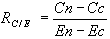
<body><![CDATA[<p><font face="Verdana" size="2">Analysis</font></p>     <p><font face="Verdana" size="2"> The costs above mentioned were taken into account    for calculating individual cost (for both the new and standard procedures).    1998 was taken as the base year for estimating costs and effectiveness. Total    mean cost per patient and per group was estimated for analysing cost effectiveness.</font></p>     <p><font face="Verdana" size="2"> Mann Whitney U test was used for comparing the    costs in each group, given the tendency of data to have an abnormal distribution    (14). Intention to diagnose analysis assuming costs of laparotomy in the standard    procedure group, even though some patients were subjected to the new procedure    for ethical reasons (12).</font></p>     <p><font face="Verdana" size="2"> Cost effectiveness was analysed by cost-effectiveness    incremental ratio, obtained by comparing costs/natural outcomes between the    groups as follows (15):</font></p>     <p><font face="Verdana" size="2"><img src="/img/revistas/rsap/v7n2/v7n2a05eq01.gif">    <br>   Where C<sub>n</sub>: new procedure costs, C<sub>c</sub>: standard procedure    costs.    <br>   E<sub>n</sub>: new procedure effectiveness, E<sub>c</sub>: standard procedure    effectiveness.</font></p>     <p><font face="Verdana" size="2"> Incremental cost analysis presented the increase    in costs for each increase in effectiveness (15).</font></p>     <p><font face="Verdana" size="2"> Analysis of sensitivity: The two actual scenarios    were compared, also the best and worst scenarios for both methods and, the best    scenario for the standard procedure compared to the worst scenario for the new    procedure and vice versa.</font></p>     <p><font face="Verdana" size="2"> The sensitivity of the effectiveness of both    methods was analysed according to the best and worst published scenarios. STATA    (version 8.1) software was used for statistical analysis.</font></p>     ]]></body>
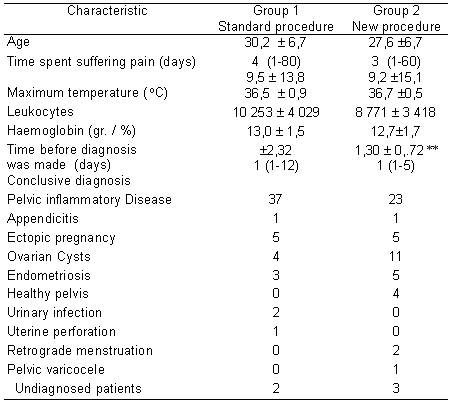
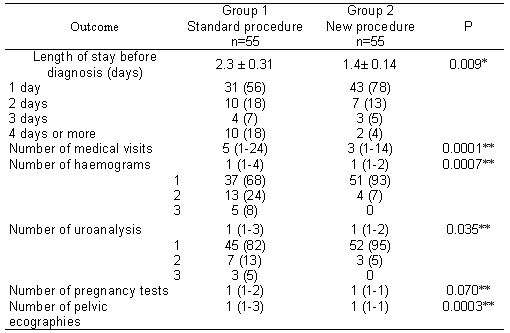
<body><![CDATA[<p>&nbsp;</p>     <p><font size="3" face="Verdana"><b>RESULTS</b></font></p>     <p><font face="Verdana" size="2"> 110 females suffering from non-specific acute    low abdominal pain were admitted between November 1997 and February 2000. <a href="#tab01">Table    1</a> shows patients' base characteristics and final diagnosis. Laparoscopy    provided 82% correct diagnoses; standard procedure was 78% effective (11).</font></p>     <p><a name="tab01"></a></p>     <p>&nbsp;</p>     <p align="center"><font face="Verdana" size="2"><b>Table 1.</b> Base characteristics    and final diagnosis in 110 females suffering    <br>   from non-specific pain in the Instituto Materno Infantil - Bogotá, Colombia</font></p>     <p align="center"><img src="/img/revistas/rsap/v7n2/v7n2a05tab1.gif"></p>     <p>&nbsp;</p>     <p><font face="Verdana" size="2"><a href="#tab02">Table 2</a> shows the distribution    of resources used for achieving a final diagnosis. Length of stay needed the    greatest amount of resources, the greatest number of medical visits and the    greatest number of haemograms and ecographies were requested for the standard    procedure group.</font></p>     ]]></body>
<body><![CDATA[<p><a name="tab02"></a></p>     <p>&nbsp;</p>     <p align="center"><font face="Verdana" size="2"><b>Table 2.</b> Length of stay,    medical visits and laboratory exams according    <br>   to diagnostic method in patients suffering non-chronic pelvic pain in the    <br>   Instituto Materno Infantil - Bogota, Colombia</font></p>     <p align="center"><img src="/img/revistas/rsap/v7n2/v7n2a05tab2.gif">    <br>   <font face="Verdana" size="2">Mean ± standard deviation; Number (%); Median    (range);    <br>   * T-Student test was used for normal distribution variables;    <br>   ** Mann Whitney U test was used for abnormal distribution variables.    <br>   Significance level: 0.01; Number of patients related to outcome (percentage)</font></p>     ]]></body>
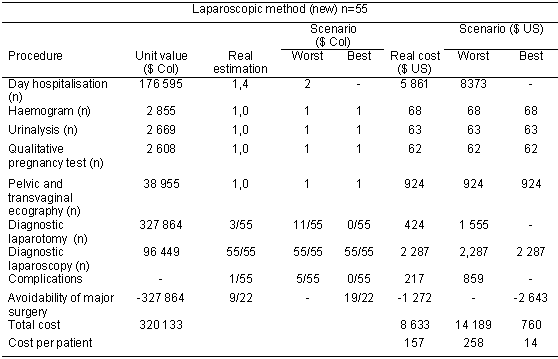
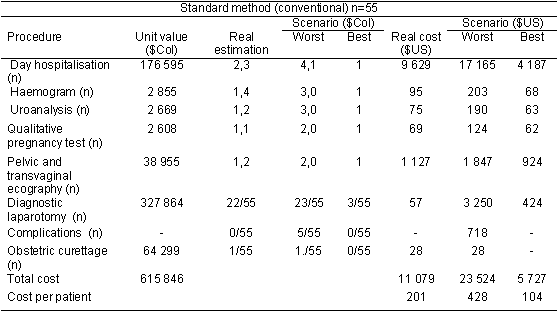
<body><![CDATA[<p>&nbsp;</p>     <p><font face="Verdana" size="2"> <i>Sensitivity Analysis:</i> The best scenario    when analysing cost sensitivity for the standard procedure was considered to    be a one-day stay, just base ex-ams being done and that there was no complication    requiring laparotomy or uterine curettage. The series having the least number    of entities presenting NSALAP revealed a series of 41 patients, having unexplained    abdominal pain, 5% of them requiring surgery (16).</font></p>     <p><font face="Verdana" size="2"> The worst scenario for the standard procedure    considered a 4,1 day-stay for patients having non-specific abdominal pain described    in a series of 100 patients (1) Regarding laboratory tests or diagnostic images,    it was assumed that three haemograms, two uroanalyses, two qualitative pregnancy    tests and two pelvic and transvaginal ecographies would be requested for the    longest stay.</font></p>     <p><font face="Verdana" size="2"> The greatest numbers of patients possibly requiring    surgery were found ranging from 41%, in a series of 100 cases of patients having    suspected appendicitis or gynaecological pathology, surgery was performed on    41 patients (17), to 62% in a series of 119 patients suffering from acute abdomi-nal    pain studied (18). The frequency given by the former publication was chosen    as its population was similar that being studied here.</font></p>     <p><font face="Verdana" size="2"> Regarding complications, a 10% frequency in    delay was determined for establishing secondary complications as being the cause    of pain. This figure was obtained by considering a 6% frequency of perforated    appendicitis. The foregoing must be added to 1,5% of patients having ectopic    pregnancy could present complications and 2,5% of patients having slight EPI    could present secondary complications when diagnosis is delayed. Such a figure    is similar to that referred to by Nevez in patients suffering from acute abdominal    pain (19). An average of two days' prolonged hospital stay was estimated and    that 4 out of each 5 patients having complications would require open surgery    for treating their complications.</font></p>     <p><font face="Verdana" size="2"> The best scenario for the laparoscopic method    considered that there would be no hospitalisation costs because a patient is    treated as an outpatient, bearing in mind that a patient presenting a gynaecological    pathology can be handled as an outpatient. Only initial exams would be done,    no complications would arise and that up to 85% of major surgery could be avoided    if operation laparoscopy were done immediately.</font></p>     <p><font face="Verdana" size="2">For constructing the new procedure's worst scenario.was    obtained by considering a two-day stay for post-operation care taken from a    study published on a series of 19 patients (20). A 10% complication frequency    reported (19), with 20% laparotomy frequency was considered, since laparoscopy    did not provide sufficient information (21), without which major surgery could    be avoided due to technical limitations, particular norms applying to a particular    service and the low frequency of a pathology requiring therapeutic surgical    procedures. Regarding complications, it was considered that all patients presenting    serious complications would require laparotomy for completing the procedure    and examining the cavity for discarding vascular or visceral complications.    It was also considered that hospitalisation would be prolonged by two days for    managing such complication.</font></p>     <p><font face="Verdana" size="2"><a href="#tab03a">Tables 3a</a> and <a href="#tab03b">3b</a>    shows hospital costs in Colombian pesos and US dollars (US$) for each procedure    related to average stay, lab test and pelvic ultrasounds used in each method,    the number of surgical interventions carried out in each group and procedures    avoided, as well as the number of procedures in the best and worst scenarios.    Total average costs per patient in each group were obtained from this data.</font></p>     <p><a name="tab03a"></a></p>     <p>&nbsp;</p>     ]]></body>
<body><![CDATA[<p align="center"><font face="Verdana" size="2"><b>Table 3a.</b> Real estimation    of costs for different procedures according to the    <br>   standard diagnostic method, used in a series of 110 patients suffering from    <br>   non-specific low abdominal pain in the Instituto Materno Infantil - Bogota,    Colombia</font></p>     <p align="center"><img src="/img/revistas/rsap/v7n2/v7n2a05tab3a.gif"></p>     <p>&nbsp;</p>     <p><a name="tab03b"></a></p>     <p>&nbsp;</p>     <p align="center"><font face="Verdana" size="2"><b>Table 3b.</b> Real estimation    of costs for different procedures according for    <br>   Laparoscopic diagnostic method, used in a series of 110 patients suffering from    <br>   non-specific low abdominal pain in the Instituto Materno Infantil - Bogotá,    Colombia</font></p>     ]]></body>
<body><![CDATA[<p align="center"><img src="/img/revistas/rsap/v7n2/v7n2a05tab3b.gif"></p>     <p>&nbsp;</p>     <p><font face="Verdana" size="2"> Overall comparison of costs between both methods    revealed no statistically significant differences in the real scenario (p =    0,74 Mann Whitney U test); however, lower hospital costs were observed in the    group of patients submitted to laparoscopy. The cost-effectiveness incremental    ratio, of the two methods being studied was analysed in the different scenarios,    taking the foregoing information into account.</font></p>     <p><font face="Verdana" size="2"> Scenario 1: actual scenario, data obtained from    the study.</font></p>     <p><img src="/img/revistas/rsap/v7n2/v7n2a05eq02.gif"></p>     <p><font face="Verdana" size="2">Laparoscopy would be less expensive and more    effective. The TPP would save $25 792 per patient (USD 11,1) for each unit of    diagnostic effectiveness increasing with laparoscopy.</font></p>     <p><font face="Verdana" size="2">Scenario 2: the best scenario for both methods:</font></p>     <p><img src="/img/revistas/rsap/v7n2/v7n2a05eq03.gif"></p>     <p><font face="Verdana" size="2"> Laparoscopy would be less expensive and more    effective. The TPP would save $ 69 834 ($USD 30,1) for each unit of diagnostic    effectiveness increasing with laparoscopy.</font></p>     <p><font face="Verdana" size="2">Scenario 3: the worst scenario for both methods:</font></p>     ]]></body>
<body><![CDATA[<p><img src="/img/revistas/rsap/v7n2/v7n2a05eq04.gif"></p>     <p><font face="Verdana" size="2">Laparoscopy would be less expensive and more    effective. The TPP would save $ 21 875 (US$ 9,4) by using laparoscopy for checking    a diagnosis, per increase in each unit of effectiveness.</font></p>     <p><font face="Verdana" size="2"> Scenario 4: the best scenario for new procedure    cf worst standard procedure scenario:</font></p>     <p><img src="/img/revistas/rsap/v7n2/v7n2a05eq05.gif"></p>     <p><font face="Verdana" size="2">Laparoscopy would be less expensive and more    effective. The TPP would save $30 006 (US$ 12,9) by using laparoscopy for checking    a diagnosis, for each increased unit of effectiveness.</font></p>     <p><font face="Verdana" size="2"> Scenario 5: worst new procedure scenario <i>cf</i>    best standard procedure scenario:</font></p>     <p><img src="/img/revistas/rsap/v7n2/v7n2a05eq06.gif"></p>     <p><font face="Verdana" size="2"> Laparoscopy would be more costly and less effective..    The hospital would have been paid $35 696 (USD 15,3) more for each unit of reduced    effectiveness in this situation.</font></p>     <p><font face="Verdana" size="2"> The new procedure would be more cost-effective    than the standard procedure for patients suffering from NSALAP in two scenarios.    This was equally effective in two scenarios but led to minimising costs in the    study of patients suffering NSALAP. The new procedure was not cost-effective    in one scenario since it reduced effectiveness at greater cost.</font></p>     <p>&nbsp;</p>     ]]></body>
<body><![CDATA[<p><font size="3" face="Verdana"><b>DISCUSSION</b></font></p>     <p><font face="Verdana" size="2"> The economic study of implementing programmes    for attention, diagnosis or therapeutic intervention has become a current need    given health systems' limited resources whether provided by government or private    agencies.</font></p>     <p><font face="Verdana" size="2"> This type of approach provides another tool    for evaluating the performance of strategic alternatives, especially when they    are mutually exclusive since applying one method doe not allow the other to    be applied, as is the case when applying early endoscopic diagnostic technology.</font></p>     <p><font face="Verdana" size="2"> Diagnostic technologies could be evaluated from    the point of view of their diagnostic validity (sensitivity and specificity),    reliability (intra- or inter-observer agreement) and effectiveness, understood    as being the suitable use of an intervention according to a specific situation    (22). In this case, it would be a technology's performance for diagnostic use    and the cost effectiveness or analysis of the cost of implementing this new    technology related to the increase in expected or acceptable minimum exactitude    given this new application of technology.</font></p>     <p><font face="Verdana" size="2">Cost-effectiveness studies can be based on information    obtained from revising the literature for constructing some theoretical scenarios    or based on controlled clinical trials (CCT) evaluating the effectiveness provided    by data emerging from the real scenario of daily life in the area of work and    resort to secondary sources of information in the literature for assembling    the best and worst scenarios in which the technology to be evaluated is to be    analysed (13). The methodology based on CCT is used in this study, providing    greater validity for the estimates made.</font></p>     <p><font face="Verdana" size="2"> Their application is limited since diagnostic    evaluation methods depend on institutional protocols and the tacit knowledge    at hospitals' disposal, known as "the medical school", meaning that this could    vary the number of exams requested. Other factors limiting results being generalised    are the curve of experience, the degree of available technological development    and the value of services which are contracted by TPPs.</font></p>     <p><font face="Verdana" size="2"> However, contracted services can be calculated    from tariffs recognised by each TPP in each institution, based on information    provided regarding aspects such as the number of procedures carried out, days    being hospitalised and medical visits required. They do allow modifications    to be introduced to best and worst performance scenarios, given the characteristics    common to an institution with which it is wished to contract.</font></p>     <p><font face="Verdana" size="2"> As this evaluation was made from a TPP point    of view, it could have been desirable to estimate indirect costs such as the    cost of incapacity and reduced productivity; however, this was beyond the scope    of the present study.</font></p>     <p><font face="Verdana" size="2"> This study showed that the new procedure was    more cost-effective (at SOAT tariffs) than the standard procedure for studying    reproductive aged females suffering from non-specific abdominal pain from the    TPP point of view in 4 out of 5 scenarios. This study thus provides useful information    for decision-makers for helping to implement new programmes <img src="/img/revistas/rsap/v7n2/triangulo.gif" align="absmiddle"></font></p>     <p>&nbsp;</p>     ]]></body>
<body><![CDATA[<p><font size="3" face="Verdana"><b>REFERENCES</b></font></p>     <!-- ref --><p><font face="Verdana" size="2">1. Sheridan WG, White AT, Havard T, Crosby DL.    Non-specific abdominal pain: the resource implications. Ann R Coll Surg Engl    1992;74:181-185.</font>&nbsp;&nbsp;&nbsp;&nbsp;&nbsp;&nbsp;&nbsp;&nbsp;[&#160;<a href="javascript:void(0);" onclick="javascript: window.open('/scielo.php?script=sci_nlinks&ref=000124&pid=S0124-0064200500020000500001&lng=','','width=640,height=500,resizable=yes,scrollbars=1,menubar=yes,');">Links</a>&#160;]<!-- end-ref --><!-- ref --><p><font face="Verdana" size="2">2. Sellors J, Mahony J, Goldsmith C, Rath D,    Mander R, Hunter B, <i>et al</i>. The accuracy of clinical findings and laparoscopy    in pelvic inflammatory disease. Am J Obstet Gynecol 1991;164:113-20</font>&nbsp;&nbsp;&nbsp;&nbsp;&nbsp;&nbsp;&nbsp;&nbsp;[&#160;<a href="javascript:void(0);" onclick="javascript: window.open('/scielo.php?script=sci_nlinks&ref=000125&pid=S0124-0064200500020000500002&lng=','','width=640,height=500,resizable=yes,scrollbars=1,menubar=yes,');">Links</a>&#160;]<!-- end-ref --><!-- ref --><p><font face="Verdana" size="2">3. Brown DL, Doulbilet PM. Transvaginal sonography    for diagnosing ectopic pregnancy. Positive criteria and performance characteristics.    L Ultrasound Med 1994;13:259-266</font>&nbsp;&nbsp;&nbsp;&nbsp;&nbsp;&nbsp;&nbsp;&nbsp;[&#160;<a href="javascript:void(0);" onclick="javascript: window.open('/scielo.php?script=sci_nlinks&ref=000126&pid=S0124-0064200500020000500003&lng=','','width=640,height=500,resizable=yes,scrollbars=1,menubar=yes,');">Links</a>&#160;]<!-- end-ref --><!-- ref --><p><font face="Verdana" size="2">4. Hoffman J, Rasmussen O. Aids in the diagnosis    of acute appendicitis. Br. J. Surgery 1989;76:774-779.</font>&nbsp;&nbsp;&nbsp;&nbsp;&nbsp;&nbsp;&nbsp;&nbsp;[&#160;<a href="javascript:void(0);" onclick="javascript: window.open('/scielo.php?script=sci_nlinks&ref=000127&pid=S0124-0064200500020000500004&lng=','','width=640,height=500,resizable=yes,scrollbars=1,menubar=yes,');">Links</a>&#160;]<!-- end-ref --><!-- ref --><p><font face="Verdana" size="2">5. Olsen JB, Myrén CJ, Haahr PE. Randomized study    of the value of laparoscopy before appendicectomy. Br. J. Surgery 1993;80:922-923.</font>&nbsp;&nbsp;&nbsp;&nbsp;&nbsp;&nbsp;&nbsp;&nbsp;[&#160;<a href="javascript:void(0);" onclick="javascript: window.open('/scielo.php?script=sci_nlinks&ref=000128&pid=S0124-0064200500020000500005&lng=','','width=640,height=500,resizable=yes,scrollbars=1,menubar=yes,');">Links</a>&#160;]<!-- end-ref --><!-- ref --><p><font face="Verdana" size="2">6. Sarfati MR, Hunter GC, Witzke DB, Bebb GG,    Smythe SH, Boyan <i>et al</i>. Impact of adjunctive testing on the diagnosis    and clinical course of patients with acute appendicitis. Am J of Surgery 166:660-665.</font>&nbsp;&nbsp;&nbsp;&nbsp;&nbsp;&nbsp;&nbsp;&nbsp;[&#160;<a href="javascript:void(0);" onclick="javascript: window.open('/scielo.php?script=sci_nlinks&ref=000129&pid=S0124-0064200500020000500006&lng=','','width=640,height=500,resizable=yes,scrollbars=1,menubar=yes,');">Links</a>&#160;]<!-- end-ref --><!-- ref --><p><font face="Verdana" size="2">7. Spirtos NM, Eisenkop SM, Spirtos TW, Poliakin    RI, Hibbard LT.. Laparoscopy. A diagnosis aid in cases of suspected appendicitis.    Its use in women of reproductive age. Am. J. Obstet Gynecol 1987;156:90-94.</font>&nbsp;&nbsp;&nbsp;&nbsp;&nbsp;&nbsp;&nbsp;&nbsp;[&#160;<a href="javascript:void(0);" onclick="javascript: window.open('/scielo.php?script=sci_nlinks&ref=000130&pid=S0124-0064200500020000500007&lng=','','width=640,height=500,resizable=yes,scrollbars=1,menubar=yes,');">Links</a>&#160;]<!-- end-ref --><!-- ref --><p><font face="Verdana" size="2">8. Decadt B, Sussman L, Lewis MP, Secker A, Cohen    L, Rogers C, <i>et al</i>. Randomized clinical trial of early laparoscopy in    the management of acute non-specific abdominal pain. Br. J. Surg 1999;86:1383-1386.</font>&nbsp;&nbsp;&nbsp;&nbsp;&nbsp;&nbsp;&nbsp;&nbsp;[&#160;<a href="javascript:void(0);" onclick="javascript: window.open('/scielo.php?script=sci_nlinks&ref=000131&pid=S0124-0064200500020000500008&lng=','','width=640,height=500,resizable=yes,scrollbars=1,menubar=yes,');">Links</a>&#160;]<!-- end-ref --><!-- ref --><p><font face="Verdana" size="2">9. Llanio R. Laparoscopia de urgencias. 1<sup>st</sup>    edition, La Habana, Editorial Científico Técnico, 1977.</font>&nbsp;&nbsp;&nbsp;&nbsp;&nbsp;&nbsp;&nbsp;&nbsp;[&#160;<a href="javascript:void(0);" onclick="javascript: window.open('/scielo.php?script=sci_nlinks&ref=000132&pid=S0124-0064200500020000500009&lng=','','width=640,height=500,resizable=yes,scrollbars=1,menubar=yes,');">Links</a>&#160;]<!-- end-ref --><!-- ref --><p><font face="Verdana" size="2">10. Petitti DB. Competing technologies. Implications    for costs and complexity of medical care. N. Eng. J. Med 1986;315:1480-1483.</font>&nbsp;&nbsp;&nbsp;&nbsp;&nbsp;&nbsp;&nbsp;&nbsp;[&#160;<a href="javascript:void(0);" onclick="javascript: window.open('/scielo.php?script=sci_nlinks&ref=000133&pid=S0124-0064200500020000500010&lng=','','width=640,height=500,resizable=yes,scrollbars=1,menubar=yes,');">Links</a>&#160;]<!-- end-ref --><!-- ref --><p><font face="Verdana" size="2">11. Gaitán H, Angel E, Sanchez J, Gomez I, Sanchez    L, Agudelo C. Laparoscopic diagnosis of acute lower abdominal pain in women    of reproductive age. Int J Gynaecol Obstet 2002 Feb;76(2):149-58.</font>&nbsp;&nbsp;&nbsp;&nbsp;&nbsp;&nbsp;&nbsp;&nbsp;[&#160;<a href="javascript:void(0);" onclick="javascript: window.open('/scielo.php?script=sci_nlinks&ref=000134&pid=S0124-0064200500020000500011&lng=','','width=640,height=500,resizable=yes,scrollbars=1,menubar=yes,');">Links</a>&#160;]<!-- end-ref --><!-- ref --><p><font face="Verdana" size="2">12. Law 100 /1993. Concerning the Colombian social    security system, República de Colombia.</font>&nbsp;&nbsp;&nbsp;&nbsp;&nbsp;&nbsp;&nbsp;&nbsp;[&#160;<a href="javascript:void(0);" onclick="javascript: window.open('/scielo.php?script=sci_nlinks&ref=000135&pid=S0124-0064200500020000500012&lng=','','width=640,height=500,resizable=yes,scrollbars=1,menubar=yes,');">Links</a>&#160;]<!-- end-ref --><!-- ref --><p><font face="Verdana" size="2">13. Petitti, D. Overview of the methods, Chapter    2, in Petitti D. Meta-analysis, decision analysis and cost effectiveness analysis.    Methods for quantitative synthesis in medicine. 2<sup>nd</sup> edition, Oxford    University Press, New York, 2000, p.30-31).</font>&nbsp;&nbsp;&nbsp;&nbsp;&nbsp;&nbsp;&nbsp;&nbsp;[&#160;<a href="javascript:void(0);" onclick="javascript: window.open('/scielo.php?script=sci_nlinks&ref=000136&pid=S0124-0064200500020000500013&lng=','','width=640,height=500,resizable=yes,scrollbars=1,menubar=yes,');">Links</a>&#160;]<!-- end-ref --><!-- ref --><p><font face="Verdana" size="2">14. Diehr P, Yanez D, Ash A, Hornbrook M, Lin    DY.. Methods for analyzing health care utilization and costs. Annu Rev Public    Health 1999;20:125-144.</font>&nbsp;&nbsp;&nbsp;&nbsp;&nbsp;&nbsp;&nbsp;&nbsp;[&#160;<a href="javascript:void(0);" onclick="javascript: window.open('/scielo.php?script=sci_nlinks&ref=000137&pid=S0124-0064200500020000500014&lng=','','width=640,height=500,resizable=yes,scrollbars=1,menubar=yes,');">Links</a>&#160;]<!-- end-ref --><!-- ref --><p><font face="Verdana" size="2">15. Petitti DB. Advanced cost-effectiveness analysis    Chapter 12. In Petitti DB. Meta-analysis, decision analysis and cost-effectiveness    analysis. 1<sup>st</sup> edition, Oxford University Press, New York, 1994.</font>&nbsp;&nbsp;&nbsp;&nbsp;&nbsp;&nbsp;&nbsp;&nbsp;[&#160;<a href="javascript:void(0);" onclick="javascript: window.open('/scielo.php?script=sci_nlinks&ref=000138&pid=S0124-0064200500020000500015&lng=','','width=640,height=500,resizable=yes,scrollbars=1,menubar=yes,');">Links</a>&#160;]<!-- end-ref --><!-- ref --><p><font face="Verdana" size="2">16. Champault G, Lauroy J, Guillon P, Benoit    J, Rizk N, Boutelier J. What are abdominal painful syndromes of unexplained    origin? Prospective study: 99 patients followed for three years&#93;. Ann Chir.    1996;50(3):258-62.</font>&nbsp;&nbsp;&nbsp;&nbsp;&nbsp;&nbsp;&nbsp;&nbsp;[&#160;<a href="javascript:void(0);" onclick="javascript: window.open('/scielo.php?script=sci_nlinks&ref=000139&pid=S0124-0064200500020000500016&lng=','','width=640,height=500,resizable=yes,scrollbars=1,menubar=yes,');">Links</a>&#160;]<!-- end-ref --><!-- ref --><p><font face="Verdana" size="2">17. Rao PM, Feltmate CM, Rhea JT, Schulick AH,    Novelline RA.. Helical computed tomography in differentiating appendicitis and    acute gynecological conditions. Obstet Gynecol 1999;93:417-421.</font>&nbsp;&nbsp;&nbsp;&nbsp;&nbsp;&nbsp;&nbsp;&nbsp;[&#160;<a href="javascript:void(0);" onclick="javascript: window.open('/scielo.php?script=sci_nlinks&ref=000140&pid=S0124-0064200500020000500017&lng=','','width=640,height=500,resizable=yes,scrollbars=1,menubar=yes,');">Links</a>&#160;]<!-- end-ref --><!-- ref --><p><font face="Verdana" size="2">18. Salky BA, Edye MB. The role of laparoscopy    in the diagnosis and treatment of abdominal pain syndromes. Surgical Endoscopy    1998;12:911-914.</font>&nbsp;&nbsp;&nbsp;&nbsp;&nbsp;&nbsp;&nbsp;&nbsp;[&#160;<a href="javascript:void(0);" onclick="javascript: window.open('/scielo.php?script=sci_nlinks&ref=000141&pid=S0124-0064200500020000500018&lng=','','width=640,height=500,resizable=yes,scrollbars=1,menubar=yes,');">Links</a>&#160;]<!-- end-ref --><!-- ref --><p><font face="Verdana" size="2">19. Navez B, d'Udekem Y, Cambier E, Richir C,    de Pierpont B, Guiot P. Laparoscopy for management of non traumatic acute abdomen.    World J Surg 1995;19:382-386.</font>&nbsp;&nbsp;&nbsp;&nbsp;&nbsp;&nbsp;&nbsp;&nbsp;[&#160;<a href="javascript:void(0);" onclick="javascript: window.open('/scielo.php?script=sci_nlinks&ref=000142&pid=S0124-0064200500020000500019&lng=','','width=640,height=500,resizable=yes,scrollbars=1,menubar=yes,');">Links</a>&#160;]<!-- end-ref --><!-- ref --><p><font face="Verdana" size="2">20. Taylor EW, Kennedy CA, Dunham RH, Bloch JH.    Diagnosis laparoscopy in women with acute abdominal pain. Surg Laparosc Endosc    1995;5:125-128.</font>&nbsp;&nbsp;&nbsp;&nbsp;&nbsp;&nbsp;&nbsp;&nbsp;[&#160;<a href="javascript:void(0);" onclick="javascript: window.open('/scielo.php?script=sci_nlinks&ref=000143&pid=S0124-0064200500020000500020&lng=','','width=640,height=500,resizable=yes,scrollbars=1,menubar=yes,');">Links</a>&#160;]<!-- end-ref --><!-- ref --><p><font face="Verdana" size="2">21. Cuesta MA, Eijsbouts QA, Gordijn RV, et al.    Diagnosis laparoscopy in patients with acute abdomen of uncertain etiology.    Surg Endosc 1998;12:915-917.</font>&nbsp;&nbsp;&nbsp;&nbsp;&nbsp;&nbsp;&nbsp;&nbsp;[&#160;<a href="javascript:void(0);" onclick="javascript: window.open('/scielo.php?script=sci_nlinks&ref=000144&pid=S0124-0064200500020000500021&lng=','','width=640,height=500,resizable=yes,scrollbars=1,menubar=yes,');">Links</a>&#160;]<!-- end-ref --><!-- ref --><p><font face="Verdana" size="2">22. Roper WL, Winkenwerder W, Hackbarth GM, Krakauer    H. Effectiveness in health care. An initiative to evaluate and improve medical    practice. N Engl J Med 1988;319:1197-202.</font>&nbsp;&nbsp;&nbsp;&nbsp;&nbsp;&nbsp;&nbsp;&nbsp;[&#160;<a href="javascript:void(0);" onclick="javascript: window.open('/scielo.php?script=sci_nlinks&ref=000145&pid=S0124-0064200500020000500022&lng=','','width=640,height=500,resizable=yes,scrollbars=1,menubar=yes,');">Links</a>&#160;]<!-- end-ref --><p>&nbsp;</p>     <p>&nbsp;</p>     <p><font size="2" face="Verdana">Recibido 31 Enero 2005 / Enviado para Modificación    25 Febrero 2005 / Aceptado 8 Junio 2005</font></p>      ]]></body><back>
<ref-list>
<ref id="B1">
<label>1</label><nlm-citation citation-type="journal">
<person-group person-group-type="author">
<name>
<surname><![CDATA[Sheridan]]></surname>
<given-names><![CDATA[WG]]></given-names>
</name>
<name>
<surname><![CDATA[White]]></surname>
<given-names><![CDATA[AT]]></given-names>
</name>
<name>
<surname><![CDATA[Havard]]></surname>
<given-names><![CDATA[T]]></given-names>
</name>
<name>
<surname><![CDATA[Crosby]]></surname>
<given-names><![CDATA[DL]]></given-names>
</name>
</person-group>
<article-title xml:lang="en"><![CDATA[Non-specific abdominal pain: the resource implications]]></article-title>
<source><![CDATA[Ann R Coll Surg Engl]]></source>
<year>1992</year>
<volume>74</volume>
<page-range>181-185</page-range></nlm-citation>
</ref>
<ref id="B2">
<label>2</label><nlm-citation citation-type="journal">
<person-group person-group-type="author">
<name>
<surname><![CDATA[Sellors]]></surname>
<given-names><![CDATA[J]]></given-names>
</name>
<name>
<surname><![CDATA[Mahony]]></surname>
<given-names><![CDATA[J]]></given-names>
</name>
<name>
<surname><![CDATA[Goldsmith]]></surname>
<given-names><![CDATA[C]]></given-names>
</name>
<name>
<surname><![CDATA[Rath]]></surname>
<given-names><![CDATA[D]]></given-names>
</name>
<name>
<surname><![CDATA[Mander]]></surname>
<given-names><![CDATA[R]]></given-names>
</name>
<name>
<surname><![CDATA[Hunter]]></surname>
<given-names><![CDATA[B]]></given-names>
</name>
</person-group>
<article-title xml:lang="en"><![CDATA[The accuracy of clinical findings and laparoscopy in pelvic inflammatory disease]]></article-title>
<source><![CDATA[Am J Obstet Gynecol]]></source>
<year>1991</year>
<volume>164</volume>
<page-range>113-20</page-range></nlm-citation>
</ref>
<ref id="B3">
<label>3</label><nlm-citation citation-type="journal">
<person-group person-group-type="author">
<name>
<surname><![CDATA[Brown]]></surname>
<given-names><![CDATA[DL]]></given-names>
</name>
<name>
<surname><![CDATA[Doulbilet]]></surname>
<given-names><![CDATA[PM]]></given-names>
</name>
</person-group>
<article-title xml:lang="en"><![CDATA[Transvaginal sonography for diagnosing ectopic pregnancy: Positive criteria and performance characteristics]]></article-title>
<source><![CDATA[L Ultrasound Med]]></source>
<year>1994</year>
<volume>13</volume>
<page-range>259-266</page-range></nlm-citation>
</ref>
<ref id="B4">
<label>4</label><nlm-citation citation-type="journal">
<person-group person-group-type="author">
<name>
<surname><![CDATA[Hoffman]]></surname>
<given-names><![CDATA[J]]></given-names>
</name>
<name>
<surname><![CDATA[Rasmussen]]></surname>
<given-names><![CDATA[O]]></given-names>
</name>
</person-group>
<article-title xml:lang="en"><![CDATA[Aids in the diagnosis of acute appendicitis]]></article-title>
<source><![CDATA[Br. J. Surgery]]></source>
<year>1989</year>
<volume>76</volume>
<page-range>774-779</page-range></nlm-citation>
</ref>
<ref id="B5">
<label>5</label><nlm-citation citation-type="journal">
<person-group person-group-type="author">
<name>
<surname><![CDATA[Olsen]]></surname>
<given-names><![CDATA[JB]]></given-names>
</name>
<name>
<surname><![CDATA[Myrén]]></surname>
<given-names><![CDATA[CJ]]></given-names>
</name>
<name>
<surname><![CDATA[Haahr]]></surname>
<given-names><![CDATA[PE]]></given-names>
</name>
</person-group>
<article-title xml:lang="en"><![CDATA[Randomized study of the value of laparoscopy before appendicectomy]]></article-title>
<source><![CDATA[Br. J. Surgery]]></source>
<year>1993</year>
<volume>80</volume>
<page-range>922-923</page-range></nlm-citation>
</ref>
<ref id="B6">
<label>6</label><nlm-citation citation-type="journal">
<person-group person-group-type="author">
<name>
<surname><![CDATA[Sarfati]]></surname>
<given-names><![CDATA[MR]]></given-names>
</name>
<name>
<surname><![CDATA[Hunter]]></surname>
<given-names><![CDATA[GC]]></given-names>
</name>
<name>
<surname><![CDATA[Witzke]]></surname>
<given-names><![CDATA[DB]]></given-names>
</name>
<name>
<surname><![CDATA[Bebb]]></surname>
<given-names><![CDATA[GG]]></given-names>
</name>
<name>
<surname><![CDATA[Smythe]]></surname>
<given-names><![CDATA[SH]]></given-names>
</name>
</person-group>
<article-title xml:lang="en"><![CDATA[Impact of adjunctive testing on the diagnosis and clinical course of patients with acute appendicitis]]></article-title>
<source><![CDATA[Am J of Surgery]]></source>
<year></year>
<volume>166</volume>
<page-range>660-665</page-range></nlm-citation>
</ref>
<ref id="B7">
<label>7</label><nlm-citation citation-type="journal">
<person-group person-group-type="author">
<name>
<surname><![CDATA[Spirtos]]></surname>
<given-names><![CDATA[NM]]></given-names>
</name>
<name>
<surname><![CDATA[Eisenkop]]></surname>
<given-names><![CDATA[SM]]></given-names>
</name>
<name>
<surname><![CDATA[Spirtos]]></surname>
<given-names><![CDATA[TW]]></given-names>
</name>
<name>
<surname><![CDATA[Poliakin]]></surname>
<given-names><![CDATA[RI]]></given-names>
</name>
<name>
<surname><![CDATA[Hibbard]]></surname>
<given-names><![CDATA[LT.]]></given-names>
</name>
</person-group>
<article-title xml:lang="en"><![CDATA[Laparoscopy: A diagnosis aid in cases of suspected appendicitis. Its use in women of reproductive age]]></article-title>
<source><![CDATA[Am. J. Obstet Gynecol]]></source>
<year>1987</year>
<volume>156</volume>
<page-range>90-94</page-range></nlm-citation>
</ref>
<ref id="B8">
<label>8</label><nlm-citation citation-type="journal">
<person-group person-group-type="author">
<name>
<surname><![CDATA[Decadt]]></surname>
<given-names><![CDATA[B]]></given-names>
</name>
<name>
<surname><![CDATA[Sussman]]></surname>
<given-names><![CDATA[L]]></given-names>
</name>
<name>
<surname><![CDATA[Lewis]]></surname>
<given-names><![CDATA[MP]]></given-names>
</name>
<name>
<surname><![CDATA[Secker]]></surname>
<given-names><![CDATA[A]]></given-names>
</name>
<name>
<surname><![CDATA[Cohen]]></surname>
<given-names><![CDATA[L]]></given-names>
</name>
<name>
<surname><![CDATA[Rogers]]></surname>
<given-names><![CDATA[C]]></given-names>
</name>
</person-group>
<article-title xml:lang="en"><![CDATA[Randomized clinical trial of early laparoscopy in the management of acute non-specific abdominal pain]]></article-title>
<source><![CDATA[Br. J. Surg]]></source>
<year>1999</year>
<volume>86</volume>
<page-range>1383-1386</page-range></nlm-citation>
</ref>
<ref id="B9">
<label>9</label><nlm-citation citation-type="">
<person-group person-group-type="author">
<name>
<surname><![CDATA[Llanio]]></surname>
<given-names><![CDATA[R]]></given-names>
</name>
</person-group>
<source><![CDATA[Laparoscopia de urgencias]]></source>
<year>1977</year>
<edition>1</edition>
<publisher-loc><![CDATA[La Habana ]]></publisher-loc>
</nlm-citation>
</ref>
<ref id="B10">
<label>10</label><nlm-citation citation-type="journal">
<person-group person-group-type="author">
<name>
<surname><![CDATA[Petitti]]></surname>
<given-names><![CDATA[DB]]></given-names>
</name>
</person-group>
<article-title xml:lang="en"><![CDATA[Competing technologies: Implications for costs and complexity of medical care]]></article-title>
<source><![CDATA[N. Eng. J. Med]]></source>
<year>1986</year>
<volume>315</volume>
<page-range>1480-1483</page-range></nlm-citation>
</ref>
<ref id="B11">
<label>11</label><nlm-citation citation-type="journal">
<person-group person-group-type="author">
<name>
<surname><![CDATA[Gaitán]]></surname>
<given-names><![CDATA[H]]></given-names>
</name>
<name>
<surname><![CDATA[Angel]]></surname>
<given-names><![CDATA[E]]></given-names>
</name>
<name>
<surname><![CDATA[Sanchez]]></surname>
<given-names><![CDATA[J]]></given-names>
</name>
<name>
<surname><![CDATA[Gomez]]></surname>
<given-names><![CDATA[I]]></given-names>
</name>
<name>
<surname><![CDATA[Sanchez]]></surname>
<given-names><![CDATA[L]]></given-names>
</name>
<name>
<surname><![CDATA[Agudelo]]></surname>
<given-names><![CDATA[C]]></given-names>
</name>
</person-group>
<article-title xml:lang="en"><![CDATA[Laparoscopic diagnosis of acute lower abdominal pain in women of reproductive age]]></article-title>
<source><![CDATA[Int J Gynaecol Obstet]]></source>
<year>2002</year>
<month> F</month>
<day>eb</day>
<volume>76</volume>
<numero>2</numero>
<issue>2</issue>
<page-range>149-58</page-range></nlm-citation>
</ref>
<ref id="B12">
<label>12</label><nlm-citation citation-type="">
<collab>Law</collab>
<source><![CDATA[Concerning the Colombian social security system]]></source>
<year>1993</year>
</nlm-citation>
</ref>
<ref id="B13">
<label>13</label><nlm-citation citation-type="book">
<person-group person-group-type="author">
<name>
<surname><![CDATA[Petitti]]></surname>
<given-names><![CDATA[D]]></given-names>
</name>
</person-group>
<person-group person-group-type="editor">
<name>
<surname><![CDATA[Petitti]]></surname>
<given-names><![CDATA[D]]></given-names>
</name>
</person-group>
<source><![CDATA[Meta-analysis, decision analysis and cost effectiveness analysis: Methods for quantitative synthesis in medicine]]></source>
<year>2000</year>
<edition>2</edition>
<page-range>30-31</page-range><publisher-loc><![CDATA[New York ]]></publisher-loc>
<publisher-name><![CDATA[Oxford University Press]]></publisher-name>
</nlm-citation>
</ref>
<ref id="B14">
<label>14</label><nlm-citation citation-type="journal">
<person-group person-group-type="author">
<name>
<surname><![CDATA[Diehr]]></surname>
<given-names><![CDATA[P]]></given-names>
</name>
<name>
<surname><![CDATA[Yanez]]></surname>
<given-names><![CDATA[D]]></given-names>
</name>
<name>
<surname><![CDATA[Ash]]></surname>
<given-names><![CDATA[A]]></given-names>
</name>
<name>
<surname><![CDATA[Hornbrook]]></surname>
<given-names><![CDATA[M]]></given-names>
</name>
<name>
<surname><![CDATA[Lin]]></surname>
<given-names><![CDATA[DY]]></given-names>
</name>
</person-group>
<article-title xml:lang="en"><![CDATA[Methods for analyzing health care utilization and costs]]></article-title>
<source><![CDATA[Annu Rev Public Health]]></source>
<year>1999</year>
<volume>20</volume>
<page-range>125-144</page-range></nlm-citation>
</ref>
<ref id="B15">
<label>15</label><nlm-citation citation-type="book">
<person-group person-group-type="author">
<name>
<surname><![CDATA[Petitti]]></surname>
<given-names><![CDATA[DB]]></given-names>
</name>
</person-group>
<person-group person-group-type="editor">
<name>
<surname><![CDATA[Petitti]]></surname>
<given-names><![CDATA[DB]]></given-names>
</name>
</person-group>
<source><![CDATA[Meta-analysis, decision analysis and cost-effectiveness analysis]]></source>
<year>1994</year>
<edition>1</edition>
<publisher-loc><![CDATA[New York ]]></publisher-loc>
<publisher-name><![CDATA[Oxford University Press]]></publisher-name>
</nlm-citation>
</ref>
<ref id="B16">
<label>16</label><nlm-citation citation-type="journal">
<person-group person-group-type="author">
<name>
<surname><![CDATA[Champault]]></surname>
<given-names><![CDATA[G]]></given-names>
</name>
<name>
<surname><![CDATA[Lauroy]]></surname>
<given-names><![CDATA[J]]></given-names>
</name>
<name>
<surname><![CDATA[Guillon]]></surname>
<given-names><![CDATA[P]]></given-names>
</name>
<name>
<surname><![CDATA[Benoit]]></surname>
<given-names><![CDATA[J]]></given-names>
</name>
<name>
<surname><![CDATA[Rizk]]></surname>
<given-names><![CDATA[N]]></given-names>
</name>
<name>
<surname><![CDATA[Boutelier]]></surname>
<given-names><![CDATA[J]]></given-names>
</name>
</person-group>
<article-title xml:lang="en"><![CDATA[What are abdominal painful syndromes of unexplained origin?: Prospective study: 99 patients followed for three years]]></article-title>
<source><![CDATA[Ann Chir]]></source>
<year>1996</year>
<volume>50</volume>
<numero>3</numero>
<issue>3</issue>
<page-range>258-62</page-range></nlm-citation>
</ref>
<ref id="B17">
<label>17</label><nlm-citation citation-type="journal">
<person-group person-group-type="author">
<name>
<surname><![CDATA[Rao]]></surname>
<given-names><![CDATA[PM]]></given-names>
</name>
<name>
<surname><![CDATA[Feltmate]]></surname>
<given-names><![CDATA[CM]]></given-names>
</name>
<name>
<surname><![CDATA[Rhea]]></surname>
<given-names><![CDATA[JT]]></given-names>
</name>
<name>
<surname><![CDATA[Schulick]]></surname>
<given-names><![CDATA[AH]]></given-names>
</name>
<name>
<surname><![CDATA[Novelline]]></surname>
<given-names><![CDATA[RA.]]></given-names>
</name>
</person-group>
<article-title xml:lang="en"><![CDATA[Helical computed tomography in differentiating appendicitis and acute gynecological conditions]]></article-title>
<source><![CDATA[Obstet Gynecol]]></source>
<year>1999</year>
<volume>93</volume>
<page-range>417-421</page-range></nlm-citation>
</ref>
<ref id="B18">
<label>18</label><nlm-citation citation-type="journal">
<person-group person-group-type="author">
<name>
<surname><![CDATA[Salky]]></surname>
<given-names><![CDATA[BA]]></given-names>
</name>
<name>
<surname><![CDATA[Edye]]></surname>
<given-names><![CDATA[MB]]></given-names>
</name>
</person-group>
<article-title xml:lang="en"><![CDATA[The role of laparoscopy in the diagnosis and treatment of abdominal pain syndromes]]></article-title>
<source><![CDATA[Surgical Endoscopy]]></source>
<year>1998</year>
<volume>12</volume>
<page-range>911-914</page-range></nlm-citation>
</ref>
<ref id="B19">
<label>19</label><nlm-citation citation-type="journal">
<person-group person-group-type="author">
<name>
<surname><![CDATA[Navez]]></surname>
<given-names><![CDATA[B]]></given-names>
</name>
<name>
<surname><![CDATA[d'Udekem]]></surname>
<given-names><![CDATA[Y]]></given-names>
</name>
<name>
<surname><![CDATA[Cambier]]></surname>
<given-names><![CDATA[E]]></given-names>
</name>
<name>
<surname><![CDATA[Richir]]></surname>
<given-names><![CDATA[C]]></given-names>
</name>
<name>
<surname><![CDATA[de Pierpont]]></surname>
<given-names><![CDATA[B]]></given-names>
</name>
<name>
<surname><![CDATA[Guiot]]></surname>
<given-names><![CDATA[P]]></given-names>
</name>
</person-group>
<article-title xml:lang="en"><![CDATA[Laparoscopy for management of non traumatic acute abdomen]]></article-title>
<source><![CDATA[World J Surg]]></source>
<year>1995</year>
<volume>19</volume>
<page-range>382-386</page-range></nlm-citation>
</ref>
<ref id="B20">
<label>20</label><nlm-citation citation-type="journal">
<person-group person-group-type="author">
<name>
<surname><![CDATA[Taylor]]></surname>
<given-names><![CDATA[EW]]></given-names>
</name>
<name>
<surname><![CDATA[Kennedy]]></surname>
<given-names><![CDATA[CA]]></given-names>
</name>
<name>
<surname><![CDATA[Dunham]]></surname>
<given-names><![CDATA[RH]]></given-names>
</name>
<name>
<surname><![CDATA[Bloch]]></surname>
<given-names><![CDATA[JH]]></given-names>
</name>
</person-group>
<article-title xml:lang="en"><![CDATA[Diagnosis laparoscopy in women with acute abdominal pain]]></article-title>
<source><![CDATA[Surg Laparosc Endosc]]></source>
<year>1995</year>
<volume>5</volume>
<page-range>125-128</page-range></nlm-citation>
</ref>
<ref id="B21">
<label>21</label><nlm-citation citation-type="journal">
<person-group person-group-type="author">
<name>
<surname><![CDATA[Cuesta]]></surname>
<given-names><![CDATA[MA]]></given-names>
</name>
<name>
<surname><![CDATA[Eijsbouts]]></surname>
<given-names><![CDATA[QA]]></given-names>
</name>
<name>
<surname><![CDATA[Gordijn]]></surname>
<given-names><![CDATA[RV]]></given-names>
</name>
</person-group>
<article-title xml:lang="en"><![CDATA[Diagnosis laparoscopy in patients with acute abdomen of uncertain etiology]]></article-title>
<source><![CDATA[Surg Endosc]]></source>
<year>1998</year>
<volume>12</volume>
<page-range>915-917</page-range></nlm-citation>
</ref>
<ref id="B22">
<label>22</label><nlm-citation citation-type="journal">
<person-group person-group-type="author">
<name>
<surname><![CDATA[Roper]]></surname>
<given-names><![CDATA[WL]]></given-names>
</name>
<name>
<surname><![CDATA[Winkenwerder]]></surname>
<given-names><![CDATA[W]]></given-names>
</name>
<name>
<surname><![CDATA[Hackbarth]]></surname>
<given-names><![CDATA[GM]]></given-names>
</name>
<name>
<surname><![CDATA[Krakauer]]></surname>
<given-names><![CDATA[H]]></given-names>
</name>
</person-group>
<article-title xml:lang="en"><![CDATA[Effectiveness in health care: An initiative to evaluate and improve medical practice]]></article-title>
<source><![CDATA[N Engl J Med]]></source>
<year>1988</year>
<volume>319</volume>
<page-range>1197-202</page-range></nlm-citation>
</ref>
</ref-list>
</back>
</article>