<?xml version="1.0" encoding="ISO-8859-1"?><article xmlns:mml="http://www.w3.org/1998/Math/MathML" xmlns:xlink="http://www.w3.org/1999/xlink" xmlns:xsi="http://www.w3.org/2001/XMLSchema-instance">
<front>
<journal-meta>
<journal-id>0124-0064</journal-id>
<journal-title><![CDATA[Revista de Salud Pública]]></journal-title>
<abbrev-journal-title><![CDATA[Rev. salud pública]]></abbrev-journal-title>
<issn>0124-0064</issn>
<publisher>
<publisher-name><![CDATA[Instituto de Salud Publica, Facultad de Medicina - Universidad Nacional de Colombia]]></publisher-name>
</publisher>
</journal-meta>
<article-meta>
<article-id>S0124-00642005000200009</article-id>
<title-group>
<article-title xml:lang="en"><![CDATA[Agreement between Medline searches using the Medline-CD-Rom and Internet PubMed, BioMedNet, Medscape and Gateway search-engines]]></article-title>
<article-title xml:lang="es"><![CDATA[Concordancia de las búsquedas de Medline utilizando el Medline en disco compacto y los motores de búsqueda de PubMed, BioMedNet, Medscape y Gateway]]></article-title>
</title-group>
<contrib-group>
<contrib contrib-type="author">
<name>
<surname><![CDATA[Caro-Rojas]]></surname>
<given-names><![CDATA[Rosa Ángela]]></given-names>
</name>
<xref ref-type="aff" rid="A01"/>
</contrib>
<contrib contrib-type="author">
<name>
<surname><![CDATA[Eslava-Schmalbach]]></surname>
<given-names><![CDATA[Javier H.]]></given-names>
</name>
<xref ref-type="aff" rid="A02"/>
</contrib>
</contrib-group>
<aff id="A01">
<institution><![CDATA[,Secretaría Distrital de Salud  ]]></institution>
<addr-line><![CDATA[Bogotá, D.C. ]]></addr-line>
<country>Colombia</country>
</aff>
<aff id="A02">
<institution><![CDATA[,Universidad Nacional de Colombia Instituto de Investigaciones Clínicas Departamento de Cirugía]]></institution>
<addr-line><![CDATA[ ]]></addr-line>
</aff>
<pub-date pub-type="pub">
<day>00</day>
<month>07</month>
<year>2005</year>
</pub-date>
<pub-date pub-type="epub">
<day>00</day>
<month>07</month>
<year>2005</year>
</pub-date>
<volume>7</volume>
<numero>2</numero>
<fpage>214</fpage>
<lpage>226</lpage>
<copyright-statement/>
<copyright-year/>
<self-uri xlink:href="http://www.scielo.org.co/scielo.php?script=sci_arttext&amp;pid=S0124-00642005000200009&amp;lng=en&amp;nrm=iso"></self-uri><self-uri xlink:href="http://www.scielo.org.co/scielo.php?script=sci_abstract&amp;pid=S0124-00642005000200009&amp;lng=en&amp;nrm=iso"></self-uri><self-uri xlink:href="http://www.scielo.org.co/scielo.php?script=sci_pdf&amp;pid=S0124-00642005000200009&amp;lng=en&amp;nrm=iso"></self-uri><abstract abstract-type="short" xml:lang="en"><p><![CDATA[OBJECTIVES: To compare the information obtained from the Medline database using Internet commercial search engines with that obtained from a compact disc (Medline-CD). METHODS: An agreement study was carried out based on 101 clinical scenarios provided by specialists in internal medicine, pharmacy, gynaecology-obstetrics, surgery and paediatrics. 175 search strategies were employed using the connector AND plus text within quotation marks. The search was limited to 1991-1999. Internet search-engines were selected by common criteria. Identical search strategies were independently applied to and masked from Internet search engines, as well as the Medline-CD. RESULTS: 3,488 articles were obtained using 129 search strategies. Agreement with the Medline-CD was 54% for PubMed, 57% for Gateway, 54% for Medscape and 65% for BioMedNet. The highest agreement rate for a given speciality (paediatrics) was 78,1% for BioMedNet, having greater -/- than +/+ agreement. CONCLUSIONS: Even though free access to Medline has encouraged the boom and growth of evidence-based medicine, these results must be considered within the context of which search engine was selected for doing the searches. The internet search engines studied showed a poor agreement with the Medline-CD, the rate of agreement differing according to speciality, thus significantly affecting searches and their reproducibility. Software designed for conducting Medline database searches, including the Medline-CD, must be standardised and validated.]]></p></abstract>
<abstract abstract-type="short" xml:lang="es"><p><![CDATA[OBJETIVOS: Comparar la información obtenida de la base de datos Medline a través de los motores de búsqueda de Internet comerciales, con aquella obtenida de la base de datos en disco compacto (Medline-CD). MÉTODOS: Estudio de concordancia en los resultados de las búsquedas, hechas a partir de 101 escenarios clínicos sugeridos por especialistas de medicina interna, farmacia, ginecología y obstetricia, cirugía y pediatría. Se realizaron 175 estrategias de búsqueda utilizando el conector AND y texto entrecomillado. La búsqueda se limitó al periodo 1991-1999. Los motores de búsqueda de Internet se seleccionaron a partir de criterios comunes. Las estrategias de búsqueda fueron idénticas y se aplicaron de manera independiente y enmascarada tanto en los motores de búsqueda de Internet como en Medline-CD. RESULTADOS: Se obtuvieron 3 488 artículos utilizando 129 estrategias de búsqueda. La concordancia con Medline-CD fue del 54% PubMed, 57% Gateway, 54% Medscape and 65% BioMedNet. El mayor nivel de acuerdo por especialidad (pediatría) fue de 78,1% para BioMedNet, teniendo mayor acuerdo -/- que +/+. CONCLUSIONES: Aunque el acceso libre a Medline ha potencializado el desarrollo de la Medicina Basada en Evidencia, los resultados de las búsquedas deben ser considerados a la luz de cuáles motores de búsqueda se utilizaron. Los diferentes motores de búsqueda tuvieron una pobre concordancia con Medline-CD, siendo diferencial el nivel de acuerdo, por especialidad. Esto afecta la reproducibilidad de las estrategias de búsqueda. Todo el software que se utilice para llevar a cabo búsquedas en la base de datos Medline, incluido el de Medline-CD, debe ser estandarizado y validado.]]></p></abstract>
<kwd-group>
<kwd lng="en"><![CDATA[Medline]]></kwd>
<kwd lng="en"><![CDATA[Databases]]></kwd>
<kwd lng="en"><![CDATA[PubMed]]></kwd>
<kwd lng="en"><![CDATA[reproducibility of results]]></kwd>
<kwd lng="en"><![CDATA[information storage and retrieval]]></kwd>
<kwd lng="en"><![CDATA[evidence-based medicine]]></kwd>
<kwd lng="es"><![CDATA[Medline]]></kwd>
<kwd lng="es"><![CDATA[PubMed]]></kwd>
<kwd lng="es"><![CDATA[Bases de Datos]]></kwd>
<kwd lng="es"><![CDATA[Reproducibilidad de resultados]]></kwd>
<kwd lng="es"><![CDATA[recuperación]]></kwd>
<kwd lng="es"><![CDATA[información]]></kwd>
<kwd lng="es"><![CDATA[medicina basada en evidencia]]></kwd>
</kwd-group>
</article-meta>
</front><body><![CDATA[ <p align="right"><font face="Verdana" size="2"><b>ARTICULOS/INVESTIGACI&Oacute;N</b></font></p>     <p>&nbsp;</p>     <p><font face="Verdana" size="4"><b>Agreement between Medline searches using the    Medline-CD-Rom and Internet PubMed, BioMedNet, Medscape and Gateway search-engines</b></font></p>     <p>&nbsp;</p>     <p><font face="Verdana" size="3"><b>Concordancia de las búsquedas de Medline utilizando    el Medline en disco compacto y los motores de búsqueda de PubMed, BioMedNet,    Medscape y Gateway</b></font></p>     <p>&nbsp;</p>     <p>&nbsp;</p>     <p><font size="2" face="Verdana"><b>Rosa Ángela Caro-Rojas<sup>I</sup>; Javier    H. Eslava-Schmalbach<sup>II</sup></b></font></p>     <p><font size="2" face="Verdana"><sup>I</sup>Química Farmacéutica, Secretaría    Distrital de Salud, Bogotá, D.C. Colombia.E-mail: <a href="mailto:angelacaror@hotmail.com">angelacaror@hotmail.com</a>    <br>   <sup>II</sup>Médico. M. Sc. Epidemiología Clínica. Departamento de Cirugía,    Instituto de Investigaciones Clínicas, Universidad Nacional de Colombia. E-mail:    <a href="mailto:jheslavas@unal.edu.co">jheslavas@unal.edu.co</a></font></p>     ]]></body>
<body><![CDATA[<p>&nbsp;</p>     <p>&nbsp;</p> <hr size="1" noshade>     <p><font size="2" face="Verdana"><b>ABSTRACT</b></font></p>     <p><font face="Verdana" size="2"><b> OBJECTIVES:</b> To compare the information    obtained from the Medline database using Internet commercial search engines    with that obtained from a compact disc (Medline-CD).    <br>   <b>METHODS:</b> An agreement study was carried out based on 101 clinical scenarios    provided by specialists in internal medicine, pharmacy, gynaecology-obstetrics,    surgery and paediatrics. 175 search strategies were employed using the connector    <i>AND</i> plus text within quotation marks. The search was limited to 1991-1999.    Internet search-engines were selected by common criteria. Identical search strategies    were independently applied to and masked from Internet search engines, as well    as the Medline-CD.    <br>   <b>RESULTS:</b> 3,488 articles were obtained using 129 search strategies. Agreement    with the Medline-CD was 54% for PubMed, 57% for Gateway, 54% for Medscape and    65% for BioMedNet. The highest agreement rate for a given speciality (paediatrics)    was 78,1% for BioMedNet, having greater -/- than +/+ agreement.    <br>   <b>CONCLUSIONS:</b> Even though free access to Medline has encouraged the boom    and growth of evidence-based medicine, these results must be considered within    the context of which search engine was selected for doing the searches. The    internet search engines studied showed a poor agreement with the Medline-CD,    the rate of agreement differing according to speciality, thus significantly    affecting searches and their reproducibility. Software designed for conducting    Medline database searches, including the Medline-CD, must be standardised and    validated.</font></p>     <p><font face="Verdana" size="2"><b> Key words:</b> Medline, Databases, PubMed,    reproducibility of results, information storage and retrieval, evidence-based    medicine (<i>source: MeSH, NLM</i>).</font></p> <hr size="1" noshade>     <p><font size="2" face="Verdana"><b>RESUMEN</b></font></p>     <p><font face="Verdana" size="2"><b>OBJETIVOS:</b> Comparar la información obtenida    de la base de datos Medline a través de los motores de búsqueda de Internet    comerciales, con aquella obtenida de la base de datos en disco compacto (Medline-CD).    ]]></body>
<body><![CDATA[<br>   <b>M&Eacute;TODOS:</b> Estudio de concordancia en los resultados de las búsquedas,    hechas a partir de 101 escenarios clínicos sugeridos por especialistas de medicina    interna, farmacia, ginecología y obstetricia, cirugía y pediatría. Se realizaron    175 estrategias de búsqueda utilizando el conector <i>AND</i> y texto entrecomillado.    La búsqueda se limitó al periodo 1991-1999. Los motores de búsqueda de Internet    se seleccionaron a partir de criterios comunes. Las estrategias de búsqueda    fueron idénticas y se aplicaron de manera independiente y enmascarada tanto    en los motores de búsqueda de Internet como en Medline-CD.    <br>   <b>RESULTADOS:</b> Se obtuvieron 3 488 artículos utilizando 129 estrategias    de búsqueda. La concordancia con Medline-CD fue del 54% PubMed, 57% Gateway,    54% Medscape and 65% BioMedNet. El mayor nivel de acuerdo por especialidad (pediatría)    fue de 78,1% para BioMedNet, teniendo mayor acuerdo -/- que +/+.    <br>   <b>CONCLUSIONES:</b> Aunque el acceso libre a Medline ha potencializado el desarrollo    de la Medicina Basada en Evidencia, los resultados de las búsquedas deben ser    considerados a la luz de cuáles motores de búsqueda se utilizaron. Los diferentes    motores de búsqueda tuvieron una pobre concordancia con Medline-CD, siendo diferencial    el nivel de acuerdo, por especialidad. Esto afecta la reproducibilidad de las    estrategias de búsqueda. Todo el software que se utilice para llevar a cabo    búsquedas en la base de datos Medline, incluido el de Medline-CD, debe ser estandarizado    y validado.</font></p>     <p><font face="Verdana" size="2"><b>Palabras-clave:</b> Medline, PubMed, Bases    de Datos, Reproducibilidad de resultados, recuperación, información, medicina    basada en evidencia (<i>fuente: DeCS, BIREME</i>).</font></p> <hr size="1" noshade>     <p>&nbsp;</p>     <p>&nbsp;</p>     <p><font face="Verdana" size="2">The boom in evidence-based medicine (EBM) has    meant that people working in the field of health can review the literature looking    for better evidence to sustain their decisions. Medline is one of the most frequently    used sources of information today (1-3), providing the source of reference for    those articles which may be used by doctors when taking clinical action. Internet    is the main tool for gaining access to Medline as it is fast and economic; it    also allows wide scale searches to be made from 1966 to date (when using some    search engines). Advanced searches can be made with <i>AND, OR, NOT</i> connectors    (4) and abstracts may be obtained for articles of interest found during a particular    search.</font></p>     <p><font face="Verdana" size="2"> The number of servers enabling Medline searches    has grown; however, each has different restrictions regarding their use in terms    of the range of years available for a search, advanced search availability,    etc., making each one heterogeneous. There were 37 referenced servers enabling    access to Medline in 1998 (5). However, the software enabling searches to be    made has not been developed as part of a standard process applicable to all    servers; it has resulted from local efforts regarding each server. It has thus    become very important for those using the literature and those software developers    who make the searches to know whether information provided by servers enabling    searches concerning Medline data-bases has sufficient agreement with results    obtained from searches using original CDs. The quality of information obtained    from different general access data sources in the network has been frequently    evaluated (1,6); such evaluation has provided poor results in terms of the quality    of such information being provided from several sources.</font></p>     <p><font face="Verdana" size="2"> This study evaluated agreement between information    obtained by using free Internet search engines operating from Medline databases    respecting that information obtained in searches using a Medline compact disc    (Medline-CD) to find out which of them had greater agreement according to search    specialisation. We did not find another agreement evaluation between information    provided by search engines facilitating such searches in Medline and Medline-CD.    Software developed for such end, included Medline-CD's, (in different places)    has still not been standardised, being dependant on each server's local development    and maintenance.</font></p>     <p>&nbsp;</p>     ]]></body>
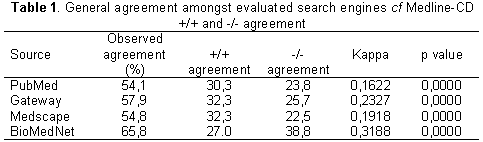
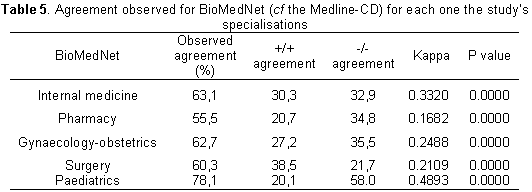
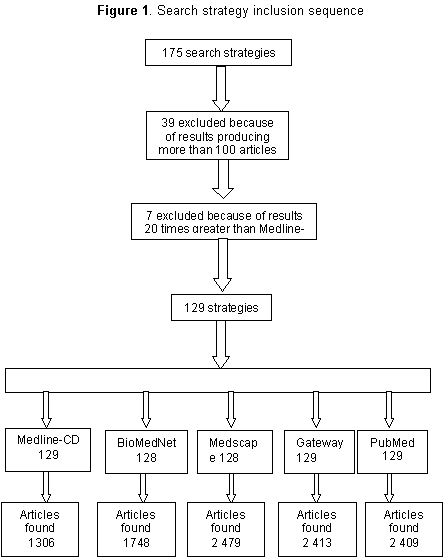
<body><![CDATA[<p><font size="3" face="Verdana"><b>METHODOLOGY</b></font></p>     <p><font face="Verdana" size="2"> Agreement was studied between NCBI PubMed (7)    (PubMed), NLM Gateway-Medline/PubMed (8) (Gateway), Medscape-Medline Search    (9) (Medscape), BioMedNet (10) (BioMedNet), with Sylver Platter Int. Medline    (11) (Medline-CD) suppliers. Inclusion criteria for these search engines were:    having free access via Internet; having Medline database available from 1966    to October 2001; being widely used; allowing advanced searches to be made; and    allowing searches to be made through operators using connectors and limiters.    The period spanning 1991 and 1999 was imposed as a limit restricting searches,    as this coincided with the Internet boom and with some editorially uniform manuscript    standardisation processes. Including search engines having databases available    from 1966 guaranteed that the search engines were as similar as possible.</font></p>     <p><font face="Verdana" size="2"> Experts in each area (internal medicine, gynaecology-obstetrics,    surgery, paediatrics and pharmacy) constructed 20 relevant clinical questions    which were transformed into answerable questions in terms of EBM (12). Each    question generated at least one strategy in terms of its search which was identically    reproduced in each chosen server and the reference CD. These strategies included    the <i>AND</i> operator and using text within inverted commas when required.    101 questions were included. The doctors drew up two different search strategies    using 74 questions and one search strategy having 27 questions, leading to 175    search strategies being obtained (similarly used in each search engine and the    Medline-CD).</font></p>     <p><font face="Verdana" size="2"> Sample size was estimated, taking into account    a 5% alpha error, 20% beta error, 85% probability of correct classification    and 0.1 difference between expected and observed agreement, implying a minimum    1 202 articles which had to be found by the search engines and the Medline-CD    (13).</font></p>     <p><font face="Verdana" size="2"> After a search strategy had been decided upon,    each search engine was accessed and a search ordered of Medline (where necessary).    Advanced searches were then ordered, limited to 1991-1999. No limits were imposed    in terms of author, type of publication, language or other parameter. The query    box or search box initially offered by the search engine was used; no other    type of search tool was used (i.e. those offering greater search exactitude).    This does not mean that search engines were not exploited to their maximum potential,    but rather that they were tested according to general searches which might be    made when using a CD (no advanced search tools being available) by a non-expert    user. This strategy, additionally, increased the potential comparability between    different search engines. All searches were done by one of the authors.</font></p>     <p><font face="Verdana" size="2"> Search results were then ordered according to    specialisation, question number and search strategy. Search strategy inclusion    criteria were those suggested by the doctors consulted. Exclusion criteria stated    that a search would generate more than 100 articles or when search engine results    produced 20 or more times the number of articles found on the Medline-CD.</font></p>     <p><font face="Verdana" size="2"> All articles produced by any search involved    in the study were filed so that there was no probability of observer bias (demanding    blind sampling). Each article found by whichever search engine (3 488 articles)    was used as a unit of measurement and agreement between search engines and Medline-CD.    Each article was classified as being found or not found by a particular search    engine; this information was then included in a database. Other variables which    were included were search strategy code, specialisation and Medline-CD strategy    result. Those articles repeatedly found by another strategy were included as    being new ones, with the respective results by search engines for this different    strategy. Each article was analysed from this database to verify whether it    had been identified by the Medline-CD and by each search engine; agreement could    then be established. 2*2 Tables were then produced and agreement measured using    unweighted Kappa values for dichotomous variables. A +/+ and -/- agreement was    measured. A +/+ agreement means a concordance between the search engine tested    and Medline-CD to find the same articles and a -/- agreement means a concordance    between both, in not to find articles with each one of the search strategies.    Each clinical area included was also tested. Stata software (v. 6.0) was used    for the above analysis.</font></p>     <p>&nbsp;</p>     <p><font size="3" face="Verdana"><b>RESULTS</b></font></p>     <p><font face="Verdana" size="2"> 46 out of the 175 search strategies initially    suggested by the doctors were excluded (<a href="#fig01">Figure 1</a>). A search    strategy for BioMedNet and another for Medscape were excluded as they produced    more than 100 articles (<a href="#fig01">Figure 1</a>).</font></p>     ]]></body>
<body><![CDATA[<p><a name="fig01"></a></p>     <p>&nbsp;</p>     <p align="center"><img src="/img/revistas/rsap/v7n2/v7n2a09fig1.gif"></p>     <p>&nbsp;</p>     <p><font face="Verdana" size="2"> BioMedNet and Gateway had the greatest general    agreement with the Medline-CD (<a href="#tab01">Table 1</a>).</font></p>     <p><a name="tab01"></a></p>     <p>&nbsp;</p>     <p align="center"><img src="/img/revistas/rsap/v7n2/v7n2a09tab1.gif"></p>     <p>&nbsp;</p>     <p><font face="Verdana" size="2"><a href="#tab02">Tables 2</a>, <a href="#tab03">3</a>,    <a href="#tab04">4</a> and <a href="#tab05">5</a> show agreement in different    specialisations observed for each search engine. Search engines showing the    highest specialisation agreement values were as follows: 63,1% for internal    medicine using BioMedNet; 55,4% for pharmacy using BioMedNet; 75,9% for gynaecology-obstetrics    using Medscape; 66,4% for surgery using Medscape; and 78% for paediatrics using    BioMedNet.</font></p>     ]]></body>
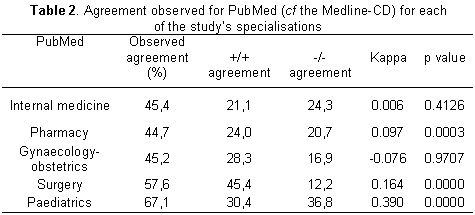
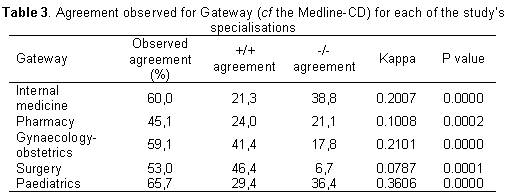
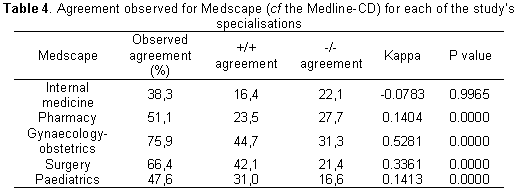
<body><![CDATA[<p><a name="tab02"></a></p>     <p>&nbsp;</p>     <p align="center"><img src="/img/revistas/rsap/v7n2/v7n2a09tab2.gif"></p>     <p>&nbsp;</p>     <p><a name="tab03"></a></p>     <p>&nbsp;</p>     <p align="center"><img src="/img/revistas/rsap/v7n2/v7n2a09tab3.gif"></p>     <p>&nbsp;</p>     <p><a name="tab04"></a></p>     <p>&nbsp;</p>     ]]></body>
<body><![CDATA[<p align="center"><img src="/img/revistas/rsap/v7n2/v7n2a09tab4.gif"></p>     <p>&nbsp;</p>     <p><a name="tab05"></a></p>     <p>&nbsp;</p>     <p align="center"><img src="/img/revistas/rsap/v7n2/v7n2a09tab5.gif"></p>     <p>&nbsp;</p>     <p><font face="Verdana" size="2">Gateway had the greatest +/+ agreement, whilst    BioMedNet had the best -/- agreement. BioMedNet had most +/+ agreement for internal    medicine, Gateway having most -/-agreement. PubMed and Gateway had greater +/+    agreement for pharmacy, BioMedNet having the greatest -/- agreement. Medscape    had the greatest +/+ agreement for gynaecology-obstetrics, BioMedNet having    the greatest -/- agreement. Gateway had the greatest +/+ agreement for surgery,    BioMedNet having the greatest -/- agreement. Medscape had the greatest +/+ agreement    for paediatrics, BioMedNet having the greatest -/- agreement.</font></p>     <p>&nbsp;</p>     <p><font size="3" face="Verdana"><b>DISCUSSION</b></font></p>     <p><font face="Verdana" size="2"> Doctors frequently use books edited by experts    concerning specific themes as their sources for consultation to keep abreast    of current developments in their fields; they also have to read specialised    journals. As well as being laborious, this practice does not always generate    answers to those questions posed; it is often divorced from clinical scenarios    or those not easily found in journals read by doctors, meaning that it cannot    be readily applied to resolving questions concerning patients (14). Summaries    have thus been produced in physical medium permitting manual searches of information    available during a particular year concerning a specific theme (15). This tool    has become popular with the availability of mass-media information, now available    magnetically (one of these being Medline).</font></p>     ]]></body>
<body><![CDATA[<p><font face="Verdana" size="2"> The Internet network has allowed numerous users    to have instantaneous access to information (which can be immediately available),    making several free-access servers available in Internet for searching medical    databases (i.e. Medline). A lot of questionable quality information is dispersed    through the network and periodical publications so that doctors are subjected    to vast amounts of information which is of very little use, thus facilitating    EBM's arrival onto the scene. This represents an attempt to ensure that all    diagnostic, prognostic and therapeutical decisions should be based on solid    numerical tests proceeding from the best clinical-epidemiological research (16).    Using EBM is still not simple as training is required in such process, even    more so when many obstacles are found in obtaining information, such as the    type of source to be consulted, where such sources can be found, the order of    consulting sources and problems related to handling computers (17).</font></p>     <p><font face="Verdana" size="2"> Several experts have concluded (considering    that regulating information available on the Internet is extremely difficult)    that it is necessary to train or guide a consumer in finding the most reliable    information available on the network (18). Other authors have focused more on    the consumer than the source of information itself by carrying out studies regarding    consumer trends concerning those sources of information which they consult,    the way it is consulted and the tools used (19-21).</font></p>     <p><font face="Verdana" size="2"> Medline-CD's sensitivity for detecting articles    has already been evaluated when compared against a gold standard (i.e. a manual    search). It was determined that the Medline-CD had 82% sensitivity in 1988 when    a manual search was made of all ophthalmology journals and 87% when the gold    standard was a manual search of indexed journals in the same specialisation    (22). This revealed an important problem when defining the gold standard for    this type of study and how a particular test's operational characteristics change    when defining it is discretely varied. This study was designed on agreement,    given that the Medline-CD could not be considered as being a gold standard in    itself (based on the results of such evaluation).</font></p>     <p><font face="Verdana" size="2"> Levels of agreement with the Medline-CD estimated    in this work were low when employing search engines commonly used by doctors.    This was worrying, considering that the scenario dealt with the Medline-CD having    82% sensitivity when compared to manual search and that error between available    search engines and through Internet and the Medline-CD must be added to this    error. Searches generally showed better behaviour for BioMedNet regarding specialisation,    but at the expense of greater -/- agreement (<a href="#tab05">Table 5</a>).</font></p>     <p><font face="Verdana" size="2"> +/+ rather than -/- agreement is preferable    for a doctor. Not obtaining the information needed to answer his/her question    (i.e. greater -/- agreement) due to poor selection of search engine can result    in not finding articles relevant to a correct, systematic answer. It is thus    assumed that finding greater +/+ than -/- agreement is preferable, even though    general agreement may be high. If a reference for comparison (in this case Medline-CD)    is responsible for low agreement (and not the search engines which are being    evaluated), then having low agreement is attributed to just the search engine,    when responsibility should really be shared.</font></p>     <p><font face="Verdana" size="2"> Greater +/+ and -/- agreement can be used for    evaluating information offered by search engines. The BioMedNet search engine    had greater -/- agreement than the other search engines, even though it presented    high agreement respecting the Medline-CD; thus, although its agreement might    have been high, its performance would not benefit a doctor interested in +/+    agreement.</font></p>     <p><font face="Verdana" size="2"> Given the information obtained through this    study, agreement values were seen to be very low (54,1% - 65,8 %) respecting    those desired (greater than 85%) (23). This is even more worrying when it is    supposed that accessing the same database by different routes supposes that    the same information will be found when using identical strategies. It thus    becomes important to evaluate the quality of the software produced and/or maintained    by webpages providing this service when determining whether the lack of results'    reproducibility has been produced by their own inherent characteristics. It    was observed that search engines have different behaviour (in terms of agreement)    regarding each specialisation. The Medscape search engine (generally presenting    54,8% agreement) presented the highest gynaecology-obstetrics value (75,9%).   </font></p>     <p><font face="Verdana" size="2"> Servers' advanced options refined a search by    offering limiters and suggested indications for obtaining better results. Such    options are very useful if the theme to be sought is broadly known and the operator    has gained experience from making previous searches, enabling more sensitive    strategies to be employed for a particular theme (as done and designed in this    project). Laymen generally do not use these tools correctly in daily life, carrying    out searches limited by just temporal aspects.</font></p>     <p><font face="Verdana" size="2"> Limitations</font></p>     <p><font face="Verdana" size="2">It is probable that excluding search strategies    having more than 100 results might also have excluded results having better    +/+ agreement which could have improved the results' final agreement. However,    given the conditions of real life, a search strategy generating such a quantity    of articles for a doctor to review becomes practically inapplicable. Additionally,    selective exclusion of articles could have affected Medscape and BioMedNet search    agreement, given that such searches were excluded for having more than 100 results    in the same search, increasing the possibility that there could have been more    agreement with the Medline-CD. However, these two search engines presented the    best behaviour. These results cannot be generalised to other search engines,    other operators, nor can they be compared with those resulting from a manual    search.</font></p>     ]]></body>
<body><![CDATA[<p><font face="Verdana" size="2"> Conclusions</font></p>     <p><font face="Verdana" size="2">Even though the availability of free access to    Medline has favoured the boom in EBM, the results of this work must be considered    within the context of choosing the access route for making the searches. Internet    search engines revealed poor agreement; such agreement was differential according    to specialisation, prompting poor reproducibility when using these search engines.    It is thus possible that constructing in-house software for each search engine    significantly affected results produced by whatever type of search process in    the intent to find answers to questions related to the medical profession.</font></p>     <p><font face="Verdana" size="2"> The results thus show that when making a general    search, having no limitations (except temporal ones) and using correctly carried    out search strategies, then the search engines having the best general agreement    were BioMedNet and Gateway. BioMedNet had better -/- agreement than the other    search engines and Gateway had better +/+ agreement. Given these results, new    search engines' maintenance and validation processes must become standardised    in the future to know <i>a priori</i> the expected level of search agreement,    as the error expected for the Medline-CD (against a manual search) as well as    the error committed by the search engine in selecting the information must be    added.</font></p>     <p><font face="Verdana" size="2"> The most concordant search engine will have    to be used for now, whilst the process for creating new search engines having    a less error is being standardised. It is consequently left in the doctors'    hands to reflect on what they want from a search process (i.e. whether they    wish to use a search engine having greater general agreement, greater +/+ agreement    or greater -/- agreement) &#149;</font></p>     <p><font size="2" face="Verdana"><b>Acknowledgements.</b> We would like to thank    Hernando Gaitán, Rodrigo Pardo and Jason Garry for revising the manuscript and    Jairo Echeverry for providing methodological support. We should also like to    thank those people in PubMed (Eugenia Posey-Marcos), BioMedNet (Mark Merifield)    and Gateway customer services (Margaret McGhee), for providing information about    their respective search software.</font></p>     <p>&nbsp;</p>     <p><font size="3" face="Verdana"><b>REFERENCES</b></font></p>     <!-- ref --><p><font face="Verdana" size="2">1. Wilson P. How to find the good and avoid the    bad or ugly: a short guide to tools for rating quality of health information    on the internet. BMJ. 2002;324:598–602</font>&nbsp;&nbsp;&nbsp;&nbsp;&nbsp;&nbsp;&nbsp;&nbsp;[&#160;<a href="javascript:void(0);" onclick="javascript: window.open('/scielo.php?script=sci_nlinks&ref=000090&pid=S0124-0064200500020000900001&lng=','','width=640,height=500,resizable=yes,scrollbars=1,menubar=yes,');">Links</a>&#160;]<!-- end-ref --><!-- ref --><p><font face="Verdana" size="2">2. Bowden VM, Kromer ME, and Tobia RC. Assessment    of physicians' information needs in five Texas counties. Bull Med Libr Assoc.    1994 Apr; 82(2):189–96.</font>&nbsp;&nbsp;&nbsp;&nbsp;&nbsp;&nbsp;&nbsp;&nbsp;[&#160;<a href="javascript:void(0);" onclick="javascript: window.open('/scielo.php?script=sci_nlinks&ref=000091&pid=S0124-0064200500020000900002&lng=','','width=640,height=500,resizable=yes,scrollbars=1,menubar=yes,');">Links</a>&#160;]<!-- end-ref --><!-- ref --><p><font face="Verdana" size="2">3. Modlin M. Medical questions? Medline has answers.    American Libraries. 1999; 29(10): 40-43.</font>&nbsp;&nbsp;&nbsp;&nbsp;&nbsp;&nbsp;&nbsp;&nbsp;[&#160;<a href="javascript:void(0);" onclick="javascript: window.open('/scielo.php?script=sci_nlinks&ref=000092&pid=S0124-0064200500020000900003&lng=','','width=640,height=500,resizable=yes,scrollbars=1,menubar=yes,');">Links</a>&#160;]<!-- end-ref --><!-- ref --><p><font face="Verdana" size="2">4. Haynes RB, Wilczynski NL, McKibbon KA, Walker-Dilks    CJ, Sinclair JC. Developing optimal search strategies for detecting clinically    sound studies in MEDLINE. J Am Med Inform Assoc. 1994; 1: 447 – 458</font>&nbsp;&nbsp;&nbsp;&nbsp;&nbsp;&nbsp;&nbsp;&nbsp;[&#160;<a href="javascript:void(0);" onclick="javascript: window.open('/scielo.php?script=sci_nlinks&ref=000093&pid=S0124-0064200500020000900004&lng=','','width=640,height=500,resizable=yes,scrollbars=1,menubar=yes,');">Links</a>&#160;]<!-- end-ref --><p><font face="Verdana" size="2">5. Felix Free Medline Page. Updated 6th October,    1998. &#91;Internet&#93;. Available at <a href="http://www.akdeniz.edu.tr/tip/gcerrahi/drfelix" target="_blank">http://www.akdeniz.edu.tr/tip/gcerrahi/drfelix</a>.    Visited in September, 2001 at <a href="http://www.beaker.iupui.edu/drfelix" target="_blank">http://www.beaker.iupui.edu/drfelix</a></font></p>     <!-- ref --><p><font face="Verdana" size="2">6. Self PC, Sayed EN, Henry JK. Bridging the    information gap" for Virginia public health nurses. Public Health Nurs. 1997    Jun;14(3):151-5.</font>&nbsp;&nbsp;&nbsp;&nbsp;&nbsp;&nbsp;&nbsp;&nbsp;[&#160;<a href="javascript:void(0);" onclick="javascript: window.open('/scielo.php?script=sci_nlinks&ref=000095&pid=S0124-0064200500020000900005&lng=','','width=640,height=500,resizable=yes,scrollbars=1,menubar=yes,');">Links</a>&#160;]<!-- end-ref --><p><font face="Verdana" size="2">7. National Library of Medicine, PubMed. &#91;Internet&#93;    Available at <a href="http://www.ncbi.nlm.nih.gov/entrez/query.fcgi?db=PubMed" target="_blank">http://www.ncbi.nlm.nih.gov/entrez/query.fcgi?db=PubMed</a>.    Visited in September, 2001</font></p>     <p><font face="Verdana" size="2">8. National Library of Medicine, Gateway. &#91;Internet&#93;.    Available at <a href="http://gateway.nlm.nih.gov/gw/Cmd" target="_blank">http://gateway.nlm.nih.gov/gw/Cmd</a>.    Visited in October, 2001</font></p>     <p><font face="Verdana" size="2">9. WebMD Medscape Health Network, Medline. &#91;Internet&#93;.    Available at <a href="http://www.medscape.com/px/urlinfo" target="_blank">http://www.medscape.com/px/urlinfo</a>.    Visited in October, 2001</font></p>     <p><font face="Verdana" size="2">10. ScienceDirect®, trademark of Elsevier B.V.,    Medline. &#91;Internet&#93;. Available at <a href="http://www.bmn.com/" target="_blank">http://www.bmn.com/</a>.    Visited in September, 2001</font></p>     <!-- ref --><p><font face="Verdana" size="2">11. Silver Platter International N.V. Adobe Systems    Incorporated. 1991-1999.</font>&nbsp;&nbsp;&nbsp;&nbsp;&nbsp;&nbsp;&nbsp;&nbsp;[&#160;<a href="javascript:void(0);" onclick="javascript: window.open('/scielo.php?script=sci_nlinks&ref=000100&pid=S0124-0064200500020000900006&lng=','','width=640,height=500,resizable=yes,scrollbars=1,menubar=yes,');">Links</a>&#160;]<!-- end-ref --><!-- ref --><p><font face="Verdana" size="2">12. Sackett D, Straus S, Richardson S, Rosenberg    W, Haynes R. Evidence Based Medicine. How to Practice and Teach. 2nd. Edition.    New York: Churchill Livingstone. 2000. p.p. 29-65.</font>&nbsp;&nbsp;&nbsp;&nbsp;&nbsp;&nbsp;&nbsp;&nbsp;[&#160;<a href="javascript:void(0);" onclick="javascript: window.open('/scielo.php?script=sci_nlinks&ref=000101&pid=S0124-0064200500020000900007&lng=','','width=640,height=500,resizable=yes,scrollbars=1,menubar=yes,');">Links</a>&#160;]<!-- end-ref --><!-- ref --><p><font face="Verdana" size="2">13. Pérez A, Rodríguez N, Fabián J, Ramírez G.    Software: Tamaño de la Muestra. Versión 1.1. Pontificia Universidad Javeriana.    Facultad de Medicina. Unidad de Epidemiología Clínica y Estadística.</font>&nbsp;&nbsp;&nbsp;&nbsp;&nbsp;&nbsp;&nbsp;&nbsp;[&#160;<a href="javascript:void(0);" onclick="javascript: window.open('/scielo.php?script=sci_nlinks&ref=000102&pid=S0124-0064200500020000900008&lng=','','width=640,height=500,resizable=yes,scrollbars=1,menubar=yes,');">Links</a>&#160;]<!-- end-ref --><!-- ref --><p><font face="Verdana" size="2">14. Sackett D, Straus S, Richardson S, Rosenberg    W, Haynes R. Evidence Based Medicine. How to Practice and Teach. 2nd. Edition.    New York: Churchill Livingstone; 2000. p. 1-5.</font>&nbsp;&nbsp;&nbsp;&nbsp;&nbsp;&nbsp;&nbsp;&nbsp;[&#160;<a href="javascript:void(0);" onclick="javascript: window.open('/scielo.php?script=sci_nlinks&ref=000103&pid=S0124-0064200500020000900009&lng=','','width=640,height=500,resizable=yes,scrollbars=1,menubar=yes,');">Links</a>&#160;]<!-- end-ref --><p><font face="Verdana" size="2">15. Cumulated Index Medicus. Available only in    print. National Library of Medicine. &#91;Internet&#93;. Available at <a href="http://www.nlm.nih.gov/tsd/serials/" target="_blank">http://www.nlm.nih.gov/tsd/serials/</a>.    Visited in October, 2001</font></p>     <!-- ref --><p><font face="Verdana" size="2">16. Guyatt G. Preface. In Guyatt G, Rennie D.    Users' Guides to the Medical Literature: A Manual for Evidence-Based Clinical    Practice. Chicago: American Medical Association, 2002. 736 p.</font>&nbsp;&nbsp;&nbsp;&nbsp;&nbsp;&nbsp;&nbsp;&nbsp;[&#160;<a href="javascript:void(0);" onclick="javascript: window.open('/scielo.php?script=sci_nlinks&ref=000105&pid=S0124-0064200500020000900010&lng=','','width=640,height=500,resizable=yes,scrollbars=1,menubar=yes,');">Links</a>&#160;]<!-- end-ref --><!-- ref --><p><font face="Verdana" size="2">17. Ely JW, Osheroff JA, Ebell M, Chambliss ML,    Vinson D, Stevermer J, Pifer E. Obstacles to answering doctors' questions about    patient care with evidence: qualitative study. BMJ. 2002;324:710.</font>&nbsp;&nbsp;&nbsp;&nbsp;&nbsp;&nbsp;&nbsp;&nbsp;[&#160;<a href="javascript:void(0);" onclick="javascript: window.open('/scielo.php?script=sci_nlinks&ref=000106&pid=S0124-0064200500020000900011&lng=','','width=640,height=500,resizable=yes,scrollbars=1,menubar=yes,');">Links</a>&#160;]<!-- end-ref --><!-- ref --><p><font face="Verdana" size="2">18. Purcell G, Wilson P, Delamothe T. The quality    of health information on the Internet. BMJ. 2002; 324: 557-558.</font>&nbsp;&nbsp;&nbsp;&nbsp;&nbsp;&nbsp;&nbsp;&nbsp;[&#160;<a href="javascript:void(0);" onclick="javascript: window.open('/scielo.php?script=sci_nlinks&ref=000107&pid=S0124-0064200500020000900012&lng=','','width=640,height=500,resizable=yes,scrollbars=1,menubar=yes,');">Links</a>&#160;]<!-- end-ref --><!-- ref --><p><font face="Verdana" size="2">19. Gagliardi A, Jadad AR. Examination of instruments    used to rate quality of health information on the Internet: chronicle of a voyage    with an unclear destination. BMJ. 2002; 324: 569-573.</font>&nbsp;&nbsp;&nbsp;&nbsp;&nbsp;&nbsp;&nbsp;&nbsp;[&#160;<a href="javascript:void(0);" onclick="javascript: window.open('/scielo.php?script=sci_nlinks&ref=000108&pid=S0124-0064200500020000900013&lng=','','width=640,height=500,resizable=yes,scrollbars=1,menubar=yes,');">Links</a>&#160;]<!-- end-ref --><!-- ref --><p><font face="Verdana" size="2">20. Eysenbach G, Köhler C. How do consumers search    for and appraise health information on the world wide web? Qualitative study    using focus groups, usability tests and in-depth interviews. BMJ. 2002; 324:    573-577.</font>&nbsp;&nbsp;&nbsp;&nbsp;&nbsp;&nbsp;&nbsp;&nbsp;[&#160;<a href="javascript:void(0);" onclick="javascript: window.open('/scielo.php?script=sci_nlinks&ref=000109&pid=S0124-0064200500020000900014&lng=','','width=640,height=500,resizable=yes,scrollbars=1,menubar=yes,');">Links</a>&#160;]<!-- end-ref --><!-- ref --><p><font face="Verdana" size="2">21. Wilson P, Risk A. How to find the good and    avoid the bad or ugly: a short guide to tools for rating quality of health information    on the Internet &#149; Commentary: On the way to quality. BMJ. 2002; 324: 598-602.</font>&nbsp;&nbsp;&nbsp;&nbsp;&nbsp;&nbsp;&nbsp;&nbsp;[&#160;<a href="javascript:void(0);" onclick="javascript: window.open('/scielo.php?script=sci_nlinks&ref=000110&pid=S0124-0064200500020000900015&lng=','','width=640,height=500,resizable=yes,scrollbars=1,menubar=yes,');">Links</a>&#160;]<!-- end-ref --><!-- ref --><p><font face="Verdana" size="2">22. Dikersin K, Scherer R, Lefebvre C. Systematic    Reviews: identifying relevant studies for systematic reviews. BMJ. 1994;309:    1286-1291.</font>&nbsp;&nbsp;&nbsp;&nbsp;&nbsp;&nbsp;&nbsp;&nbsp;[&#160;<a href="javascript:void(0);" onclick="javascript: window.open('/scielo.php?script=sci_nlinks&ref=000111&pid=S0124-0064200500020000900016&lng=','','width=640,height=500,resizable=yes,scrollbars=1,menubar=yes,');">Links</a>&#160;]<!-- end-ref --><!-- ref --><p><font face="Verdana" size="2">23. Streiner D, Norman G. Health Measurement    Scales. Oxford University Press Inc: New York; 1998. p.121.</font>&nbsp;&nbsp;&nbsp;&nbsp;&nbsp;&nbsp;&nbsp;&nbsp;[&#160;<a href="javascript:void(0);" onclick="javascript: window.open('/scielo.php?script=sci_nlinks&ref=000112&pid=S0124-0064200500020000900017&lng=','','width=640,height=500,resizable=yes,scrollbars=1,menubar=yes,');">Links</a>&#160;]<!-- end-ref --><p>&nbsp;</p>     <p>&nbsp;</p>     <p><font face="Verdana" size="2">Recibido 6 Diciembre 2004 / Enviado para Modificación    25 Abril 2005 / Aceptado 25 Mayo 2005</font></p>      ]]></body><back>
<ref-list>
<ref id="B1">
<label>1</label><nlm-citation citation-type="journal">
<person-group person-group-type="author">
<name>
<surname><![CDATA[Wilson]]></surname>
<given-names><![CDATA[P.]]></given-names>
</name>
</person-group>
<article-title xml:lang="en"><![CDATA[How to find the good and avoid the bad or ugly: a short guide to tools for rating quality of health information on the internet]]></article-title>
<source><![CDATA[BMJ]]></source>
<year>2002</year>
<volume>324</volume>
<page-range>598-602</page-range></nlm-citation>
</ref>
<ref id="B2">
<label>2</label><nlm-citation citation-type="journal">
<person-group person-group-type="author">
<name>
<surname><![CDATA[Bowden]]></surname>
<given-names><![CDATA[VM]]></given-names>
</name>
<name>
<surname><![CDATA[Kromer]]></surname>
<given-names><![CDATA[ME]]></given-names>
</name>
<name>
<surname><![CDATA[Tobia]]></surname>
<given-names><![CDATA[RC]]></given-names>
</name>
</person-group>
<article-title xml:lang="en"><![CDATA[Assessment of physicians' information needs in five Texas counties]]></article-title>
<source><![CDATA[Bull Med Libr Assoc]]></source>
<year>1994</year>
<month> A</month>
<day>pr</day>
<volume>82</volume>
<numero>2</numero>
<issue>2</issue>
<page-range>189-96</page-range></nlm-citation>
</ref>
<ref id="B3">
<label>3</label><nlm-citation citation-type="journal">
<person-group person-group-type="author">
<name>
<surname><![CDATA[Modlin]]></surname>
<given-names><![CDATA[M]]></given-names>
</name>
</person-group>
<article-title xml:lang="en"><![CDATA[Medical questions?: Medline has answers]]></article-title>
<source><![CDATA[American Libraries]]></source>
<year>1999</year>
<volume>29</volume>
<numero>10</numero>
<issue>10</issue>
<page-range>40-43</page-range></nlm-citation>
</ref>
<ref id="B4">
<label>4</label><nlm-citation citation-type="journal">
<person-group person-group-type="author">
<name>
<surname><![CDATA[Haynes]]></surname>
<given-names><![CDATA[RB]]></given-names>
</name>
<name>
<surname><![CDATA[Wilczynski]]></surname>
<given-names><![CDATA[NL]]></given-names>
</name>
<name>
<surname><![CDATA[McKibbon]]></surname>
<given-names><![CDATA[KA]]></given-names>
</name>
<name>
<surname><![CDATA[Walker-Dilks]]></surname>
<given-names><![CDATA[CJ]]></given-names>
</name>
<name>
<surname><![CDATA[Sinclair]]></surname>
<given-names><![CDATA[JC]]></given-names>
</name>
</person-group>
<article-title xml:lang="en"><![CDATA[Developing optimal search strategies for detecting clinically sound studies in MEDLINE]]></article-title>
<source><![CDATA[J Am Med Inform Assoc]]></source>
<year>1994</year>
<volume>1</volume>
<page-range>447 - 458</page-range></nlm-citation>
</ref>
<ref id="B5">
<label>6</label><nlm-citation citation-type="journal">
<person-group person-group-type="author">
<name>
<surname><![CDATA[Self]]></surname>
<given-names><![CDATA[PC]]></given-names>
</name>
<name>
<surname><![CDATA[Sayed]]></surname>
<given-names><![CDATA[EN]]></given-names>
</name>
<name>
<surname><![CDATA[Henry]]></surname>
<given-names><![CDATA[JK]]></given-names>
</name>
</person-group>
<article-title xml:lang="en"><![CDATA[Bridging the information gap" for Virginia public health nurses]]></article-title>
<source><![CDATA[Public Health Nurs]]></source>
<year>1997</year>
<month> J</month>
<day>un</day>
<volume>14</volume>
<numero>3</numero>
<issue>3</issue>
<page-range>151-5</page-range></nlm-citation>
</ref>
<ref id="B6">
<label>11</label><nlm-citation citation-type="">
<collab>^dSilver Platter International N.V.</collab>
<collab>Adobe Systems Incorporated</collab>
<source><![CDATA[]]></source>
<year>1999</year>
</nlm-citation>
</ref>
<ref id="B7">
<label>12</label><nlm-citation citation-type="book">
<person-group person-group-type="author">
<name>
<surname><![CDATA[Sackett]]></surname>
<given-names><![CDATA[D]]></given-names>
</name>
<name>
<surname><![CDATA[Straus]]></surname>
<given-names><![CDATA[S]]></given-names>
</name>
<name>
<surname><![CDATA[Richardson]]></surname>
<given-names><![CDATA[S]]></given-names>
</name>
<name>
<surname><![CDATA[Rosenberg]]></surname>
<given-names><![CDATA[W]]></given-names>
</name>
<name>
<surname><![CDATA[Haynes]]></surname>
<given-names><![CDATA[R]]></given-names>
</name>
</person-group>
<source><![CDATA[Evidence Based Medicine: How to Practice and Teach]]></source>
<year>2000</year>
<edition>2</edition>
<page-range>29-65</page-range><publisher-loc><![CDATA[New York ]]></publisher-loc>
<publisher-name><![CDATA[Churchill Livingstone]]></publisher-name>
</nlm-citation>
</ref>
<ref id="B8">
<label>13</label><nlm-citation citation-type="book">
<person-group person-group-type="author">
<name>
<surname><![CDATA[Pérez]]></surname>
<given-names><![CDATA[A]]></given-names>
</name>
<name>
<surname><![CDATA[Rodríguez]]></surname>
<given-names><![CDATA[N]]></given-names>
</name>
<name>
<surname><![CDATA[Fabián]]></surname>
<given-names><![CDATA[J]]></given-names>
</name>
<name>
<surname><![CDATA[Ramírez]]></surname>
<given-names><![CDATA[G]]></given-names>
</name>
</person-group>
<article-title xml:lang="es"><![CDATA[Software: Tamaño de la Muestra: Versión 1.1]]></article-title>
<source><![CDATA[]]></source>
<year></year>
<publisher-name><![CDATA[Pontificia Universidad Javeriana. Facultad de MedicinaUnidad de Epidemiología Clínica y Estadística]]></publisher-name>
</nlm-citation>
</ref>
<ref id="B9">
<label>14</label><nlm-citation citation-type="book">
<person-group person-group-type="author">
<name>
<surname><![CDATA[Sackett]]></surname>
<given-names><![CDATA[D]]></given-names>
</name>
<name>
<surname><![CDATA[Straus]]></surname>
<given-names><![CDATA[S]]></given-names>
</name>
<name>
<surname><![CDATA[Richardson]]></surname>
<given-names><![CDATA[S]]></given-names>
</name>
<name>
<surname><![CDATA[Rosenberg]]></surname>
<given-names><![CDATA[W]]></given-names>
</name>
<name>
<surname><![CDATA[Haynes]]></surname>
<given-names><![CDATA[R]]></given-names>
</name>
</person-group>
<source><![CDATA[Evidence Based Medicine: How to Practice and Teach]]></source>
<year>2000</year>
<edition>2</edition>
<page-range>1-5</page-range><publisher-loc><![CDATA[New York ]]></publisher-loc>
<publisher-name><![CDATA[Churchill Livingstone]]></publisher-name>
</nlm-citation>
</ref>
<ref id="B10">
<label>16</label><nlm-citation citation-type="book">
<person-group person-group-type="author">
<name>
<surname><![CDATA[Guyatt]]></surname>
<given-names><![CDATA[G]]></given-names>
</name>
</person-group>
<article-title xml:lang="en"><![CDATA[Preface]]></article-title>
<person-group person-group-type="editor">
<name>
<surname><![CDATA[Guyatt]]></surname>
<given-names><![CDATA[G]]></given-names>
</name>
<name>
<surname><![CDATA[Rennie]]></surname>
<given-names><![CDATA[D]]></given-names>
</name>
</person-group>
<source><![CDATA[Users' Guides to the Medical Literature: A Manual for Evidence-Based Clinical Practice]]></source>
<year>2002</year>
<publisher-loc><![CDATA[Chicago ]]></publisher-loc>
<publisher-name><![CDATA[American Medical Association]]></publisher-name>
</nlm-citation>
</ref>
<ref id="B11">
<label>17</label><nlm-citation citation-type="journal">
<person-group person-group-type="author">
<name>
<surname><![CDATA[Ely]]></surname>
<given-names><![CDATA[JW]]></given-names>
</name>
<name>
<surname><![CDATA[Osheroff]]></surname>
<given-names><![CDATA[JA]]></given-names>
</name>
<name>
<surname><![CDATA[Ebell]]></surname>
<given-names><![CDATA[M]]></given-names>
</name>
<name>
<surname><![CDATA[Chambliss]]></surname>
<given-names><![CDATA[ML]]></given-names>
</name>
<name>
<surname><![CDATA[Vinson]]></surname>
<given-names><![CDATA[D]]></given-names>
</name>
<name>
<surname><![CDATA[Stevermer]]></surname>
<given-names><![CDATA[J]]></given-names>
</name>
<name>
<surname><![CDATA[Pifer]]></surname>
<given-names><![CDATA[E]]></given-names>
</name>
</person-group>
<article-title xml:lang="en"><![CDATA[Obstacles to answering doctors' questions about patient care with evidence: qualitative study]]></article-title>
<source><![CDATA[BMJ]]></source>
<year>2002</year>
<volume>324</volume>
</nlm-citation>
</ref>
<ref id="B12">
<label>18</label><nlm-citation citation-type="journal">
<person-group person-group-type="author">
<name>
<surname><![CDATA[Purcell]]></surname>
<given-names><![CDATA[G]]></given-names>
</name>
<name>
<surname><![CDATA[Wilson]]></surname>
<given-names><![CDATA[P]]></given-names>
</name>
<name>
<surname><![CDATA[Delamothe]]></surname>
<given-names><![CDATA[T]]></given-names>
</name>
</person-group>
<article-title xml:lang="en"><![CDATA[The quality of health information on the Internet]]></article-title>
<source><![CDATA[BMJ]]></source>
<year>2002</year>
<volume>324</volume>
<page-range>557-558</page-range></nlm-citation>
</ref>
<ref id="B13">
<label>19</label><nlm-citation citation-type="journal">
<person-group person-group-type="author">
<name>
<surname><![CDATA[Gagliardi]]></surname>
<given-names><![CDATA[A]]></given-names>
</name>
<name>
<surname><![CDATA[Jadad]]></surname>
<given-names><![CDATA[AR]]></given-names>
</name>
</person-group>
<article-title xml:lang="en"><![CDATA[Examination of instruments used to rate quality of health information on the Internet: chronicle of a voyage with an unclear destination]]></article-title>
<source><![CDATA[BMJ]]></source>
<year>2002</year>
<volume>324</volume>
<page-range>569-573</page-range></nlm-citation>
</ref>
<ref id="B14">
<label>20</label><nlm-citation citation-type="journal">
<person-group person-group-type="author">
<name>
<surname><![CDATA[Eysenbach]]></surname>
<given-names><![CDATA[G]]></given-names>
</name>
<name>
<surname><![CDATA[Köhler]]></surname>
<given-names><![CDATA[C]]></given-names>
</name>
</person-group>
<article-title xml:lang="en"><![CDATA[How do consumers search for and appraise health information on the world wide web?: Qualitative study using focus groups, usability tests and in-depth interviews]]></article-title>
<source><![CDATA[BMJ]]></source>
<year>2002</year>
<volume>324</volume>
<page-range>573-577</page-range></nlm-citation>
</ref>
<ref id="B15">
<label>21</label><nlm-citation citation-type="journal">
<person-group person-group-type="author">
<name>
<surname><![CDATA[Wilson]]></surname>
<given-names><![CDATA[P]]></given-names>
</name>
<name>
<surname><![CDATA[Risk]]></surname>
<given-names><![CDATA[A]]></given-names>
</name>
</person-group>
<article-title xml:lang="en"><![CDATA[How to find the good and avoid the bad or ugly: a short guide to tools for rating quality of health information on the Internet: Commentary: On the way to quality]]></article-title>
<source><![CDATA[BMJ]]></source>
<year>2002</year>
<volume>324</volume>
<page-range>598-602</page-range></nlm-citation>
</ref>
<ref id="B16">
<label>22</label><nlm-citation citation-type="journal">
<person-group person-group-type="author">
<name>
<surname><![CDATA[Dikersin]]></surname>
<given-names><![CDATA[K]]></given-names>
</name>
<name>
<surname><![CDATA[Scherer]]></surname>
<given-names><![CDATA[R]]></given-names>
</name>
<name>
<surname><![CDATA[Lefebvre]]></surname>
<given-names><![CDATA[C]]></given-names>
</name>
</person-group>
<article-title xml:lang="en"><![CDATA[Systematic Reviews: identifying relevant studies for systematic reviews]]></article-title>
<source><![CDATA[BMJ]]></source>
<year>1994</year>
<volume>309</volume>
<page-range>1286-1291</page-range></nlm-citation>
</ref>
<ref id="B17">
<label>23</label><nlm-citation citation-type="book">
<person-group person-group-type="author">
<name>
<surname><![CDATA[Streiner]]></surname>
<given-names><![CDATA[D]]></given-names>
</name>
<name>
<surname><![CDATA[Norman]]></surname>
<given-names><![CDATA[G]]></given-names>
</name>
</person-group>
<source><![CDATA[Health Measurement Scales]]></source>
<year>1998</year>
<publisher-loc><![CDATA[New York ]]></publisher-loc>
<publisher-name><![CDATA[Oxford University Press Inc]]></publisher-name>
</nlm-citation>
</ref>
</ref-list>
</back>
</article>