<?xml version="1.0" encoding="ISO-8859-1"?><article xmlns:mml="http://www.w3.org/1998/Math/MathML" xmlns:xlink="http://www.w3.org/1999/xlink" xmlns:xsi="http://www.w3.org/2001/XMLSchema-instance">
<front>
<journal-meta>
<journal-id>0124-4108</journal-id>
<journal-title><![CDATA[Perspectivas en Nutrición Humana]]></journal-title>
<abbrev-journal-title><![CDATA[Perspect Nut Hum]]></abbrev-journal-title>
<issn>0124-4108</issn>
<publisher>
<publisher-name><![CDATA[Universidad de Antioquia]]></publisher-name>
</publisher>
</journal-meta>
<article-meta>
<article-id>S0124-41082013000100001</article-id>
<title-group>
<article-title xml:lang="en"><![CDATA[Antioxidant and antiproliferative activity of ethanolic and aqueous extracts from leaves and fruits juice Passiflora edulis]]></article-title>
<article-title xml:lang="es"><![CDATA[Actividad antioxidante y antiproliferativa de extractos etanólico y acuoso de las hojas y el jugo del fruto de Passiflora edulis]]></article-title>
</title-group>
<contrib-group>
<contrib contrib-type="author">
<name>
<surname><![CDATA[Aguillón Osma]]></surname>
<given-names><![CDATA[Johanny]]></given-names>
</name>
<xref ref-type="aff" rid="A01"/>
</contrib>
<contrib contrib-type="author">
<name>
<surname><![CDATA[Maldonado]]></surname>
<given-names><![CDATA[María Elena]]></given-names>
</name>
<xref ref-type="aff" rid="A02"/>
</contrib>
<contrib contrib-type="author">
<name>
<surname><![CDATA[Loango Chamorro]]></surname>
<given-names><![CDATA[Nelsy]]></given-names>
</name>
<xref ref-type="aff" rid="A01"/>
</contrib>
<contrib contrib-type="author">
<name>
<surname><![CDATA[Arango Varela]]></surname>
<given-names><![CDATA[Sandra Sulay]]></given-names>
</name>
<xref ref-type="aff" rid="A03"/>
</contrib>
<contrib contrib-type="author">
<name>
<surname><![CDATA[Landázuri]]></surname>
<given-names><![CDATA[Patricia]]></given-names>
</name>
<xref ref-type="aff" rid="A01"/>
</contrib>
</contrib-group>
<aff id="A01">
<institution><![CDATA[,Universidad del Quindío Facultad de Ciencias de la Salud ]]></institution>
<addr-line><![CDATA[Armenia ]]></addr-line>
<country>Colombia</country>
</aff>
<aff id="A02">
<institution><![CDATA[,Universidad de Antioquia Escuela de Nutrición y Dietética ]]></institution>
<addr-line><![CDATA[Medellín ]]></addr-line>
<country>Colombia</country>
</aff>
<aff id="A03">
<institution><![CDATA[,Instituto Tecnológico Metropolitano Facultad de Ingeniería ]]></institution>
<addr-line><![CDATA[Medellín ]]></addr-line>
<country>Colombia</country>
</aff>
<pub-date pub-type="pub">
<day>00</day>
<month>06</month>
<year>2013</year>
</pub-date>
<pub-date pub-type="epub">
<day>00</day>
<month>06</month>
<year>2013</year>
</pub-date>
<volume>15</volume>
<numero>1</numero>
<fpage>13</fpage>
<lpage>25</lpage>
<copyright-statement/>
<copyright-year/>
<self-uri xlink:href="http://www.scielo.org.co/scielo.php?script=sci_arttext&amp;pid=S0124-41082013000100001&amp;lng=en&amp;nrm=iso"></self-uri><self-uri xlink:href="http://www.scielo.org.co/scielo.php?script=sci_abstract&amp;pid=S0124-41082013000100001&amp;lng=en&amp;nrm=iso"></self-uri><self-uri xlink:href="http://www.scielo.org.co/scielo.php?script=sci_pdf&amp;pid=S0124-41082013000100001&amp;lng=en&amp;nrm=iso"></self-uri><abstract abstract-type="short" xml:lang="en"><p><![CDATA[Background: Extracts from a variety of fruit trees have been used for therapeutic applications for preventing oxidative stress associated to chronic diseases. Objective: To investigate the antioxidant and antiproliferative activity of ethanolic and aqueous extracts from leaves and fruits of Passiflora edulis. Materials and methods: A preliminary phytochemical screening was performed; antioxidant activity was evaluated through DPPH assay, the scavenging activity for hydroxyl radical, antihemolytic activity and total phenolic content; cytotoxic and antiproliferative activities were evaluated by MTT and sulforhodamine B assays respectively in colon adenocarcinoma SW480 cells and their metastatic-derived SW620 cells. Results: Phytochemical analyses revealed presence of tannins, flavonoids and cardiotonic glycosides. Ethanolic extract from leaves showed the best antioxidant activity (EC50 = 0.096 mg/ml) in the DPPH assay and the juice (EC50 = 0.022 mg/ml) for the Hydroxyl free radical-scavenging activity. All extracts inhibited more than 98% the hemolysis induced by H2O2. The aqueous extract from leaves showed the highest cytotoxic activity against SW480 and SW620 cells. Conclusions: Findings from this study suggest that P. edulis is a potential source of phytochemical compounds with antioxidant and antiproliferative properties.]]></p></abstract>
<abstract abstract-type="short" xml:lang="es"><p><![CDATA[Antecedentes: extractos de varios árboles frutales se han utilizado en diferentes aplicaciones terapéuticas para prevenir el estrés oxidativo asociado a enfermedades crónicas. Objetivo: investigar la actividad antioxidante y antiproliferativa de extractos etanólico y acuosos de las hojas y del fruto de Passiflora edulis. Materiales y métodos: se realizó marcha fitoquímica preliminar, la actividad antioxidante se evaluó por DPPH, actividad de remoción de radicales hidroxilo, actividad antihemolítica y contenido fenólico total. En células de adenocarcinoma de colon SW480 y sus derivadas metastásicas SW620 se evaluó la actividad citotóxica y antiproliferativa por el método de MTT y sulforodamina B respectivamente. Resultados: el análisis fitoquímico reveló la presencia de taninos, flavonoides y glicósidos cardiotónicos. El extracto etanólico de las hojas mostró la mayor actividad antioxidante (EC50 = 0,096 mg/ml) por DPPH y el jugo (EC50 = 0,022 mg/ml) para remover el radical hidroxilo. Todos los extractos inhibieron más del 98% la hemólisis inducida por H2O2. El extracto acuoso de las hojas mostró la mayor actividad citotóxica y antiproliferativa contra células SW480 y SW620. Conclusiones: los hallazgos de este estudio sugieren que P. edulis es una fuente potencial de compuestos fitoquímicos con propiedades antioxidante y antiproliferativa.]]></p></abstract>
<kwd-group>
<kwd lng="en"><![CDATA[Passiflora edulis]]></kwd>
<kwd lng="en"><![CDATA[antioxidant]]></kwd>
<kwd lng="en"><![CDATA[antiproliferative]]></kwd>
<kwd lng="en"><![CDATA[cytotoxic]]></kwd>
<kwd lng="es"><![CDATA[Passiflora edulis]]></kwd>
<kwd lng="es"><![CDATA[antioxidante]]></kwd>
<kwd lng="es"><![CDATA[antiproliferativo]]></kwd>
<kwd lng="es"><![CDATA[citotóxico]]></kwd>
</kwd-group>
</article-meta>
</front><body><![CDATA[  <font face="Verdana, Arial, Helvetica, sans-serif" size="2">     <p align="right"> <b>RESEARCH</b></p>     <p>&nbsp;</p>     <p align="center"><font size="4"><b>Antioxidant and antiproliferative activity of  ethanolic and aqueous extracts from leaves and fruits juice <i>Passiflora edulis</i></b></font></p>     <p>&nbsp;</p>     <p align="center"><b><font size="3"> Actividad  antioxidante y antiproliferativa de extractos etan&oacute;lico y acuoso  de las hojas y el jugo del fruto de <i>Passiflora  edulis</i></font></b></p>     <p>&nbsp;</p>     <p>&nbsp;</p>     <p><b>Johanny Aguill&oacute;n Osma<sup>1</sup>; Mar&iacute;a Elena Maldonado<sup>2</sup>; Nelsy Loango Chamorro<sup>1</sup>; Sandra Sulay Arango Varela<sup>3</sup>; Patricia Land&aacute;zuri<sup>1</sup></b> </p>     <p>&nbsp;</p>     ]]></body>
<body><![CDATA[<p> 1 Grupo de  Estudio en Enfermedades Cardiovasculares y Metab&oacute;licas (GECAVYME). Facultad de  Ciencias de la Salud, Universidad del Quind&iacute;o. Armenia-Colombia. <a href="mailto:jaguillon@uniquindio.edu.co">jaguillon@uniquindio.edu.co</a></p>     <p> 2 Grupo de  Investigaci&oacute;n Impacto de los Componentes Alimentarios en la Salud (ICAS).  Escuela de Nutrici&oacute;n y Diet&eacute;tica, Universidad de Antioquia. Medell&iacute;n-Colombia. </p>         <p> 3 Grupo  Sinergia. Facultad de Ingenier&iacute;a, Instituto Tecnol&oacute;gico Metropolitano.  Medell&iacute;n-Colombia.</p>         <p>&nbsp;</p>     <p>Como citar este  art&iacute;culo: Aguill&oacute;n Osma J, Maldonado ME, Loango N, Arango Varela SS, Land&aacute;zuri  P. Antioxidant and antiproliferative activity of ethanolic and aqueous extracts  from leaves and fruits juice <i>Passiflora  edulis. </i>Perspect Nutr Humana. 2013;15:</p>      <p align="center">&nbsp;</p>     <p align="center"><i>Art&iacute;culo recibido: 12  de diciembre de 2012; Aprobado: 20 de marzo de 2013</i></p>     <p>&nbsp;</p> <hr noshade size="1">     <p><b>ABSTRACT</b></p>     <p><b>Background</b>:  Extracts from a variety of fruit trees have been used for therapeutic  applications for preventing oxidative stress associated to chronic diseases. <b>Objective</b>: To investigate the  antioxidant and antiproliferative activity of ethanolic and aqueous extracts  from leaves and fruits of <i>Passiflora  edulis</i>. <b>Materials and methods</b>: A  preliminary phytochemical screening was performed; antioxidant activity was evaluated  through DPPH assay, the scavenging activity for hydroxyl radical, antihemolytic  activity and total phenolic content; cytotoxic and antiproliferative activities  were evaluated by MTT and sulforhodamine B assays respectively in colon  adenocarcinoma SW480 cells and their metastatic-derived SW620 cells. <b>Results</b>: Phytochemical analyses  revealed presence of tannins, flavonoids and cardiotonic glycosides. Ethanolic  extract from leaves showed the best antioxidant activity (EC<sub>50</sub> =  0.096 mg/ml) in the DPPH assay and the juice (EC<sub>50</sub> = 0.022 mg/ml)  for the Hydroxyl free  radical-scavenging activity. All extracts inhibited more than 98% the hemolysis  induced by H<sub>2</sub>O<sub>2</sub>. The aqueous extract from leaves  showed the highest cytotoxic activity against SW480 and SW620 cells. <b>Conclusions</b>: Findings from this study  suggest that <i>P. edulis</i> is a potential  source of phytochemical compounds with antioxidant and antiproliferative  properties.</p>     ]]></body>
<body><![CDATA[<p><b>Key  words</b>: <i>Passiflora  edulis,</i> antioxidant, antiproliferative, cytotoxic.</p> <hr noshade size="1">     <p><b>RESUMEN</b></p>     <p><b>Antecedentes</b>:  extractos de varios &aacute;rboles frutales se han utilizado en diferentes  aplicaciones terap&eacute;uticas para prevenir el estr&eacute;s oxidativo asociado a  enfermedades cr&oacute;nicas. <b>Objetivo</b>:  investigar la actividad antioxidante y antiproliferativa de extractos etan&oacute;lico  y acuosos de las hojas y del fruto de <i>Passiflora  edulis</i>. <b>Materiales y m&eacute;todos</b>: se  realiz&oacute; marcha fitoqu&iacute;mica preliminar, la actividad antioxidante se evalu&oacute; por  DPPH, actividad de remoci&oacute;n de radicales hidroxilo, actividad antihemol&iacute;tica y  contenido fen&oacute;lico total. En c&eacute;lulas de adenocarcinoma de colon SW480 y sus  derivadas metast&aacute;sicas SW620 se evalu&oacute; la actividad citot&oacute;xica y  antiproliferativa por el m&eacute;todo de MTT y sulforodamina B respectivamente. <b>Resultados</b>: el an&aacute;lisis fitoqu&iacute;mico  revel&oacute; la presencia de taninos, flavonoides y glic&oacute;sidos cardiot&oacute;nicos. El  extracto etan&oacute;lico de las hojas mostr&oacute; la mayor actividad antioxidante (EC<sub>50</sub>  = 0,096 mg/ml) por DPPH y el jugo (EC<sub>50</sub> = 0,022 mg/ml) para remover  el radical hidroxilo. Todos los  extractos inhibieron m&aacute;s del 98% la hem&oacute;lisis inducida por H<sub>2</sub>O<sub>2</sub>.  El extracto acuoso de las hojas mostr&oacute; la mayor actividad citot&oacute;xica y  antiproliferativa contra c&eacute;lulas SW480 y SW620. <b>Conclusiones</b>: los hallazgos de este estudio sugieren que <i>P. edulis</i> es una fuente potencial de  compuestos fitoqu&iacute;micos con propiedades antioxidante y antiproliferativa.</p>     <p><b>Palabras  clave</b>: <i>Passiflora  edulis,</i> antioxidante, antiproliferativo, citot&oacute;xico. </p> <hr noshade size="1">     <p>&nbsp;</p>     <p>&nbsp;</p>     <p><font size="3"><b>INTRODUCTION</b></font></p>     <p>Oxidative stress has been associated with cancer,  among other diseases. This process is caused by an imbalance between the  production of reactive oxygen species (ROS) and the availability of biological  antioxidants, which leads to cell damage (1).</p>     <p> Phytochemicals constitute an important class of plant-derived  compounds with beneficial health properties because of their antioxidant and  free-radical scavenging abilities among other biological properties (2). The  most abundantly occurring plant-derived antioxidants are polyphenols (3).  Although scientific interest in these compounds is relatively recent, these have  been used for centuries as a strategic alternative for the prevention and / or combined  treatment of various diseases (4).</p>     <p> Antioxidants may protect against cancer through different  mechanisms involving up-regulation of antioxidant enzymes, repair of nuclear DNA,  and apoptosis (5). <i>Passiflora edulis </i>is  a Brazilian native plant, known as passion fruit which belongs to  Passifloraceas (6). Different parts of this plant have been used in traditional  medicine for the treatment of insomnia, sedation, epilepsy, hypnotic, hypertension,  diuretic, reduction of cholesterol and triglycerides, bronchitis, asthma, colds,  antispasmodic, stomach pain, tetanus, boils, and intestinal tumors (7-10). Currently, plant-derived antioxidants have become an interesting  focus of research, with the aim of finding compounds that provide cellular  protection against oxidative stress and cancer development. Therefore, this  study we investigated the antioxidant and antiproliferative activity of ethanolic  and aqueous extracts from leaves and fruits of <i>Passiflora edulis</i> (passion fruit).</p>     ]]></body>
<body><![CDATA[<p>&nbsp;</p>     <p><font size="3">  <b>MATERIALS AND METHODS</b></font></p>     <p><b>Extracts preparation: </b>Healthy <i>P. edulis</i> leaves and  fruits were collected between 6:00 and 8:00 am on Mirador farm in the village  of La Herradura, municipality of La Tebaida, Armenia, Quind&iacute;o (4.4376&deg; N,  75.8489&deg; W), 1165 msnm. The specimens were identified by the Herbarium of  Universidad del Quind&iacute;o (collection number: 33974). Plant samples were  transported to laboratory in sealed plastic bags and washed in distilled water.  Leaves were dried at 40&deg;C until they reached a constant weight and pulverized  with a mill. The ethanolic extract was obtained using the leaves' powder in 96%  ethanol (EtOH). The chlorophyll was separated with EtOH/water (11). The leaves  aqueous extract was prepared dissolving the leaves powder in distilled water at  40&deg;C and filtered. The resulting ethanolic and aqueous extracts were evaporated  in a Heidolph &reg; rotary evaporator. A stock solution was prepared in 20% solution  and stored at 4&deg;C until use. To obtain the juice, fruits pulp and seeds were  sieved (pore size 1 mm), the pulp was evaporated to dryness in a Heidolph &reg;  rotary evaporator and dissolved in distilled water to obtain a stock solution  of 1mg/ml stored at 4&deg;C until use.</p>     <p>   <b>Preliminary phytochemical screening: </b>This qualitative test was performed to identify secondary metabolites (tannins, flavonoids,  quinones, sterols, saponins, cardiotonic glycosides and carotenoids) (12). </p>     <p>   <b>DPPH Radical scavenging activity: </b>This assay was performed according to the method of  Brand-Williams et al. (13) modified by Gunjan et al. (14). For each extract at 0.1  mg/ml; 0.2 mg/ml; 0.5 mg/ml and 1 mg/ml a DPPH solution (0.2 mM in methanol) was  added (Sigma-Aldrich, United States). The mixture was incubated in darkness at 20<i>&deg;</i>C for 40 min. Absorbance was measured at 517 nm using methanol as a blank.  A positive control,  butylated hydroxy toluene (BHT), was used in methanol at the same  concentrations of the extracts. Distilled water was used as a negative control.  The percentage  inhibition level of DPPHby the different extracts was calculated  according to the following equation: % Radical scavenging = &#91;(A<sub>C</sub> &#8211; A)/ A<sub>C</sub>&#93; x 100 where Acis the absorbance of the negative control and  Ais the absorbance of  sample (extract or BHT).  </p>     <p>   <b>Antihemolytic activity:</b>Was evaluated according to the procedure described by Nabavi et al.  (15). Briefly, blood samples from healthy volunteer donors for hemolytic  diseases were obtained by venipuncture in tubes without anticoagulant. Blood  was centrifuged at 2500 rpm for 10 min, plasma and leukocytes were removed.  Erythrocytes were washed three times with phosphate buffered saline (PBS) pH  7.4. A 5% (v/v) suspension of erythrocytes in PBS was added each extracts at  0.1 mg/ml, 0.2 mg/ml , 0.5 mg/ml and 1mg/ml, incubated at 37&ordm;C for 3 hours.  After centrifuge mixture reactions, supernatant was obtained and diluted in  PBS. Absorbance of resulting hemoglobin in supernatants was measured at 540 nm.  Erythrocytes in PBS and vitamin C were used as negative and positive controls,  respectively (Sigma-Aldrich, United States). The percentage inhibition of  hemolysis was calculated using the following equation: % Inhibition of  hemolysis = &#91;(Ac - A) / Ac&#93; x 100. Where Ac is the absorbance of negative  control and A is the absorbance of the sample (extract or vitamin C). </p>     <p>   <b>Total phenolic content: </b>Was performed using the Folin-Ciocalteau method (14). To each extract, Folin-Ciocalteau reagent (Sigma-Aldrich, United States) and 7.5% Na<sub>2</sub>CO<sub>3</sub> were  added, mixed and incubated at 40&deg;C for 15 minutes. The absorbance of samples  was measured at 765 nm using 7.5% Na<sub>2</sub>CO<sub>3</sub> as the blank. Data were expressed as mg gallic acid equivalents in  gram of extract (mg GAE eq / g extract), according to a calibration curve. </p>     <p>   <b>Hydroxyl free radical-scavenging activity (HRSA): </b>Was measured according to the method of Yang et al.  (16). Briefly, to each extract at different concentrations was added 2 mM FeSO<sub>4</sub>,  6 mM salicylic acid, and 0.0 1% H<sub>2</sub>O<sub>2</sub>, incubated at 37&deg;C  for 1 hour. Ascorbic acid was used as a positive control (Sigma-Aldrich, United  States). The control containing all reagents but sample was used as a blank.  The HRSA was determined by measuring the absorbance at 510 nm. The percentage  of HRSA was calculated with the following equation: % HRSA = &#91;(A0 - As) / A0&#93; x  100. Where A0 is the absorbance of negative control and As is the absorbance of  samples (extract or ascorbic acid). </p>     <p>   <b>Total antioxidant capacity: </b>Was determined according to the method of Prieto et al.  (17). For each extract at different concentrations 0.6 M sulfuric acid, 28 mm  sodium phosphate and 4 mM ammonium molybdate were added and incubated at 95&deg;C  for 90 minutes. The absorbance was measured at 695 nm against a blank. Antioxidant  total capacity was expressed as mg equivalents of gram Butyl Hydroxytoluene (mg  equiv/g BHT) (Sigma-Aldrich, United States), against a calibration curve.</p>     <p>   <b>Cell culture: </b>SW480 and SW620  cells were obtained from the European Collection of Animal Cell Culture (ECACC,  Salisbury, UK). They were cultured according to a previously described procedure  (18). Briefly, cells were cultured in medium DMEM supplemented with 10% horse  serum (HS), 100 U/ml penicillin, 100 &mu;g/ml streptomycin, and 1%  non-essential amino acids (Invitrogen, Cergy-Pontoise, France). For all  experiments, cells were switched to assay medium containing 3% HS, and 10 &mu;g/ml  insulin, 5 &mu;g/ml transferrin, and 5 ng/ml selenium (Invitrogen) for  extracts administration 24 h after seeding. </p>     ]]></body>
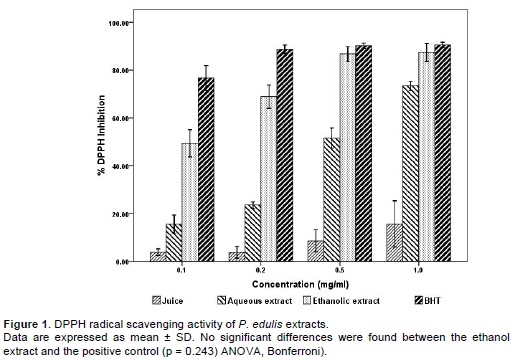
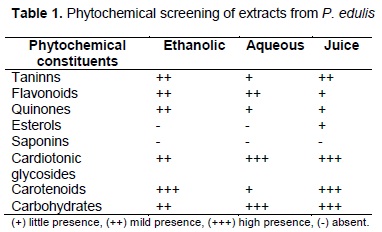
<body><![CDATA[<p>   <b>MTT assay:</b> Cytotoxic activity of extracts was performed in SW480  and SW620 (19). This method is based on the conversion of tetrazolium salt to  formazan which is proportional to viable cells, a product generated by the activity of  mitochondrial dehydrogenases. In brief, 3000 viable cells from each cell line were seeded in a 96-well  cell culture plate after 24 hours, then the medium was replaced with fresh assay medium containing  dilutions of extracts (0 -  400 ug/ml) dissolved in DMSO or 0.1% DMSO final concentrations, respectively for 72 h. Then, a MTT  solution (5 mg/ml) was added to each well and incubated at 37&deg;C for 4 hours in darkness. The formazan  crystals were dissolved by adding acidified isopropanol (0.4 N HCl) to each  well shaking continuously in darkness at room temperature (RT). Absorbance was  measured at a 540 nm and  750 nm reference wavelength. The concentration able to kill 50% of cells (IC50) was calculated using GraphPad Prism 5.0 (GraphPad Software Inc., San Diego, CA). The absorbance  of control group (non-treated cells) was considered as 100% viability. The percent  inhibition was calculated using the following equation: % Inhibition = &#91;1-  (ODt/ ODc)&#93; x 100. Where ODt is the optical density (OD) of treated cells, and  ODc for control (non-treated cells). </p>     <p>   <b>Sulforhodamina B  (SRB) assay:</b> The  effect of extracts on growth cells was studied by using the SRB assay according  to Goss&eacute; et al. (20), a colorimetric assay based on staining of total cellular  protein from cells with SRB dye. In brief, 3000 viable cells from each cell  line were exposed to extracts for 24 hours after seeding and incubated for  different times. Control cells were treated with 0.1%  DMSO. Culture media were replaced every 48 hours. The cell culture was  stopped by the addition of trichloroacetic acid (50% v/v), and cell proteins were determined by staining with 0.4%  (w/v) SRB (Sigma-Aldrich,  United States). The relationship between cell number (protein content/well) and  absorbance is linear from 0 to 2x10⁵ cells per well. All experiments were performed in triplicate. </p>     <p>   <b>Statistical analysis:</b> Data were presented as mean &plusmn; standard deviation (SD) of at least three independent experiments. Linear regression  analysis was used to calculate effective concentration (EC<sub>50</sub>) or  IC<sub>50</sub> and inhibition percentage correlation (dose-response). Statistical  differences between groups were evaluated using ANOVA with repeated measures and  p values were adjusted by Bonferroni correction (P &lt; 0.05) using GraphPad Prism 5.0 (GraphPad Software Inc., San Diego,  CA). </p>     <p>&nbsp;</p>     <p>  <font size="3"> <b>RESULTS </b></font></p>     <p>   <b>Preliminary phytochemical screening:</b> <a href="#t1">Table 1</a> shows presence of tannins,  flavonoids, quinones, carotenoids, cardiotonic glycosides and sugars in all  extracts. Saponins were absent in all extracts. Sterols just were present in  the juice. </p>       <p align="center"><a name="t1"></a><img src="/img/revistas/penh/v15n1/v15n1a1t1.jpg"></p>     <p>&nbsp;</p>     <p>   <b>DPPH Radical Scavenging Activity: </b><a href="#f1">Figure 1</a> shows the percentage of scavenging  is directly proportional to the concentration of each extract (ethanolic: r<sup>2</sup> =  0.672 (p &lt;0.008), aqueous: r<sup>2</sup> = 0.906  (p &lt;0.001); juice: r<sup>2</sup> = 0.413 (p  = 0.051)). The ethanolic extract  showed the strongest activity (87.4%), followed by the aqueous extract (73.4%)  and the juice (15.6%), being statistically  significant between them (p &lt;0.016). No statistical difference was observed between the results obtained with the ethanol  extract and positive control (p = 0.243). The EC50 for the ethanolic, aqueous and juice extracts was  respectively 0.096 mg/ml, 0.448  mg/ml and 3.5 mg/ml.  In addition, the ethanolic extract at  0.5 mg/ml and 1.0  mg/ml showed a DPPH value similar  to the positive control (BHT) considered  a highly effective antioxidant. </p>       <p align="center"><a name="f1"></a><img src="/img/revistas/penh/v15n1/v15n1a1f1.jpg"></p>     ]]></body>
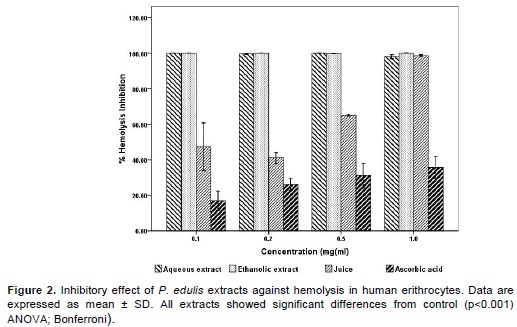
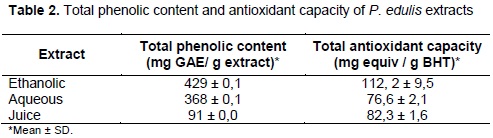
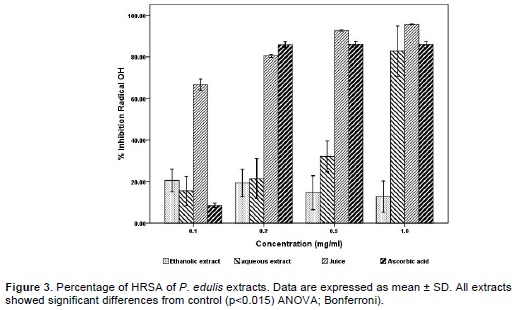
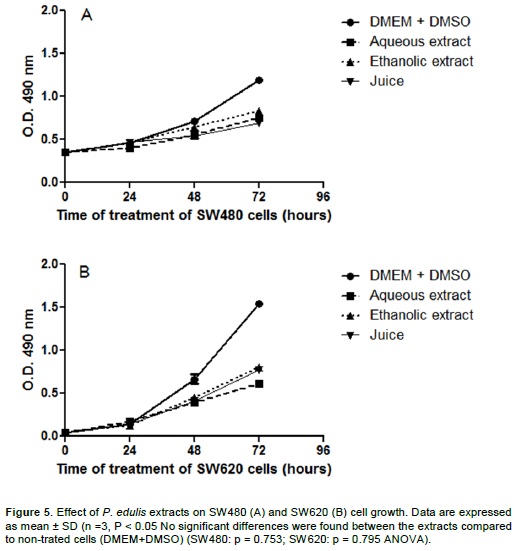
<body><![CDATA[<p>&nbsp;</p>     <p>   <b>Antihemolytic activity: </b>In <a href="#f2">figure 2</a>, ethanolic and aqueous extracts shows more ability to  inhibit the hemolysis H<sub>2</sub>O<sub>2</sub>-induced than positive control.  The antihemolytic activity of juice was the lowest compared to the other  extracts and significantly different respect to positive control (p &lt;0.001).  In addition, the antihemolytic effect using the juice was dose-dependent. </p>       <p align="center"><a name="f2"></a><img src="/img/revistas/penh/v15n1/v15n1a1f2.jpg"></p>     <p>&nbsp;</p>     <p>   <b>Total phenolic content:</b> <a href="#t2">Table 2</a> shows that the ethanolic and aqueous extracts presented the highest  concentration of phenolic compounds, 429 and 368 mg GAE/g extract respectively.</p>       <p align="center"><a name="t2"></a><img src="/img/revistas/penh/v15n1/v15n1a1t2.jpg"></p>     <p>&nbsp;</p>     <p>   <b>Hydroxyl free radical-scavenging activity: </b>In <a href="#f3">figure 3</a> the juice showed the highest HRSA in a  dose-dependent way, being the highest scavenging activity 95.7% at 1 mg/ml.  Furthermore, the juice at 0.5 mg/ml and 1 mg/ml showed HRSA higher than  ascorbic acid (positive control); in this study, all the extracts showed significant differences with respect to  control (p = 0.015). The  HRSA of aqueous extract was 82.7% at 1 mg/ml; whereas the ethanolic extract was  20.5% at 0.1 mg/ml, where the HRSA decreased as well as ethanolic extract  concentration increased. The EC<sub>50</sub> for juice was 0.22 mg/ml and for  aqueous extract was 0.835 mg/ml.</p>       <p align="center"><a name="f3"></a><img src="/img/revistas/penh/v15n1/v15n1a1f3.jpg"></p>     <p>&nbsp;</p>     ]]></body>
<body><![CDATA[<p>   <b>Total antioxidant capacity:</b> Results presented in <a href="#t2">table 2</a> show that ethanolic extract presented the  highest total antioxidant activity, 1.46 and 1.36 fold increase compared to the  aqueous extract and juice, respectively. </p>     <p>   <b>Effect of on SW480 and SW620 cell viability and cell growth:</b> Cytotoxic and antiproliferative activities were  evaluated in order to elucidate if the effect of extracts is directly  correlated to the induction of cell death or to the suppression of cell  proliferation. The effect of <i>P. edulis</i> extracts on SW480 and SW620 cells viability was investigated using MTT assay. As  shown in <a href="#f4">figure 4</a> the viability effect on SW480 and SW620 decreased as the  concentration of each extract also increased from 50 to 500 &micro;g/ml. This effect  was similar in both cell lines and no significant difference was found between  treatments in each cell line compared to control (non-treated cells). The IC<sub>50</sub>  value in SW480 cells for ethanolic extract was 524 &micro;g/ml for aqueous and 444  &micro;g/ml for juice. In SW620 cells, IC<sub>50</sub> value for ethanolic, aqueous extracts  and juice was 442 &micro;g/ml, 340 &micro;g/ml and 415 &micro;g/ml respectively. </p>       <p align="center"><a name="f4"></a><img src="/img/revistas/penh/v15n1/v15n1a1f4.jpg"></p>     <p>&nbsp;</p>     <p>   The effect of all extracts on SW480 and SW620 cell growth  is presented in <a href="#f5">figure 5</a>, as OD at 490 nm treated or not. The OD in SW480 cell  proteins (<a href="#f5">Figure 5A</a>) was reduced by 30% and 40% with ethanolic and aqueous and  juice extracts, respectively. In SW620 cells, OD was reduced by 60, 50 and 48%  after treatment with aqueous, juice and ethanolic extracts, respectively. However,  no statistical  difference was observed between SW480 (p  = 0.753) and SW620 (p = 0.795) cells treated with each extract compared to the  respective non-treated cells (DMSO 0.01%). </p>       <p align="center"><a name="f5"></a><img src="/img/revistas/penh/v15n1/v15n1a1f5.jpg"></p>     <p>&nbsp;</p>     <p>  <font size="3"> <b>DISCUSSION</b></font></p>     <p>   In recent years, biomedical interest in  flavonoids and tannins present in plant-derived material has increased because  of their antioxidant properties applied in the prevention of certain  oxidative-stress associated diseases such as cardiovascular,  cancer, neurodegenerative, and diabetes. The antioxidant  property of flavonoids is attributed to phenolic rings that are able to accept  an electron to form relatively stable phenoxyl  radicals which protects the cell from damage caused by ROS (21).</p>     <p>   In the preliminary phytochemical screening of <i>P. edulis</i> extracts, the presence of tannins  and flavonoids were found, which may be the compounds responsible for the  antioxidant activity described here because of its well-known ability for scavenging  ROS (3). The DPPH assay suggests a direct interaction between ROS and  phytochemicals present in <i>P. edulis</i> extracts due to the high level energy and kinetic instability of ROS. This is not only  attributed to the blocking action of polyphenols but by interacting with their  precursors such as superoxide anion and hydrogen peroxide which lead to the hydroxyl  radical synthesis which is considered the most potent oxidant. </p>     ]]></body>
<body><![CDATA[<p>   In this study, <i>P.  edulis</i> extracts showed an important antioxidant activity observed even at  relatively low concentrations and higher than ascorbic acid, which is  considered one of the best known antioxidants. The DPPH radical scavenging  assay showed an important antioxidant activity of ethanolic extract (EC<sub>50</sub>:  0.096 mg/ml) indicating inhibition at at the lowest concentration (0.1 mg/ml)  more than 50% of DPPH radical. This may be attributed to the presence of  flavonoids and quinones in the extract that are able to transfer electrons to  DPPH radical and stabilize it, consequently inhibiting their oxidant action. This  EC<sub>50</sub> value is better than one reported by Sunitha and Devaki (22)  (EC<sub>50</sub> = 0.875 mg/ml) and Vasco et al. (23) for ethanolic extract of  leaves from <i>P. edulis</i> using the same  antioxidant activity test, being the highest value of inhibition of DPPH  radical 58.17% (22) and 6% at 1 mg/ml (23) indicating a low scavenging  efficiency. The EC50 value closest to the result reported here for  the antioxidant activity of ethanolic extract of leaves from <i>P. edulis</i> was presented by Rojas (21),  0.124 mg/ml. On the other hand, Ripa et al. (24) showed a higher antioxidant  activity for this plant, however the solvents used to obtain the extracts are  cytotoxic, this is an aspect to be considered for possible therapeutic  applications; these discrepancies between the studies may be due  to differences in the concentrations of the secondary metabolites in each of the extracts, originated in organic and mineral composition of the soil in which the  plants were grown  (25).</p>     <p>   On other hand, phenolic compounds have also been  identified as antioxidants by their ability to inhibit lipid-oxidation  processes (26). In our study, the total phenolic content of the ethanolic  extract (0.429 mg gallic acid/mg extract) was higher to that described by  Rodriguez et al. (27) (phenolic 0.35 mg gallic acid/g extract) and Vasco et al.  (23) (0.061 mg GAE/g extract) in methanolic extract indicating a low scavenging  efficiency. Moreover, the correlation between the ability of each extract to  inhibit DPPH radical with their respective total phenolic content was directly  proportional (p = 0.009, r<sup>2 </sup>= 0.9998) and a similar finding was reported by  Rudnicki et al. (28) in methanol extracts of leaves from <i>P. edulis</i>.</p>     <p>   Although passion fruit juice showed DPPH and  antihemolytic activities, the total phenolic content and total antioxidant  capacity was the lowest compared to the other extracts. However the juice  showed the highest HRSA (EC<sub>50</sub> = 0.022 mg/ml and 95.3% inhibition)  which could be attributed to the presence of sterols in juice but not in  ethanolic and aqueous extracts, which have an important affinity and  specificity to scavenge hydroxyl radicals compared to flavonoids and tannins (28).  A similar result was reported by Murcia et al. (29) who found that the passion  fruit juice inhibits 98.9% hydroxyl free radical, whereas Ferreres et al. (30)  found an EC<sub>50</sub> &gt; 7 mg/ml value for HRSA in methanolic extract of  leaves from <i>P. edulis</i>. </p>     <p>   Related to the antihemolytic activity of <i>P. edulis</i> there are not previous  reports, although some studies with extracts from <i>Mangifera indica</i> are able to inhibit 81.7% hemolysis (31) this was lower  what was observed here with all <i>P. edulis</i> extracts (antihemolytic activity &gt; 98%). Moreover, &alpha;-tochopherol was  reported to inhibit hemolytic activity by 20.7% at 0.1 mg/ml (32). These  results could support future pre-clinical studies that evaluate the  antihemolytic activity of these extracts against cardiovascular disease, anemia  or medical procedures such as hemodialysis in chronic kidney disease.</p>     <p>   In regards to the cytotoxic and antiproliferative  activities of <i>P. edulis</i> extracts,  they presented a dose-dependent response in human colon adenocarcinoma SW480  cells and their derived metastatic SW620 cells. The highest inhibition on SW480  and SW620 cell proliferation was observed with the aqueous extract from leaves,  followed by the juice and ethanolic extracts (340 &#8211; 524 mg/ml) which suggests that the extracts contain  compounds that may confer antiproliferative activity. However, the National  Cancer Institute (NCI) in the United States uses if an antiproliferative  extract criterion of IC<sub>50</sub> <u>&lt;</u> 30 &micro;g/ml for cancer cells (33). Using NCI  criterion, this suggests that the extracts evaluated here present low activity.  In accordance to our study, de Neira (34) found that different fractions of <i>P. edulis</i> juice (whole juice, ethanol  fraction, carotenoids and polyphenols hydro soluble fraction) inhibited growth  of human T cell leukemia MOLT-4 and induced cytotoxicity at 185 - 34800 &micro;g/ml  after 72 h of treatment. Also, Silva et al. (35) reported that an aqueous  fraction rich in polysaccharides of <i>P. edulis  f. flavicarpa</i> was able to inhibit by 40.6%-48.7% the proliferation of human  colon adenocarcinoma cell line HCT-8 at concentrations above 100 &micro;g/ml. Thus, taking  together these data suggest that the antiproliferative and cytotoxic effect of  extracts of <i>P. edulis</i> at  concentrations greater than 100 &micro;g/ml could be a specific characteristic of  this plant. </p>     <p>   The cytotoxic and antiproliferative activities  observed in the aqueous and juice extracts might be attributed to the high  presence of cardiotonic glycosides, compared to the ethanolic extract, which  have showed antiproliferative and apoptotic effects on various types of cancer cells such as endometrial, ovarian (36), breast  (37), leukemia (38), colon, bladder and gastric (39-40), prostate cancer, and glioblastoma  (40-41). To confirm this hypothesis, further analyses are required to evaluate  the anticancerigen activity of cardiotonic glycosides-enriched fractions obtained  from <i>P. edulis</i>. </p>     <p>   Several studies on antioxidant  activity of extracts rich in polyphenols  have shown protective effects against  lipid peroxidation. This is of particular importance, because the oxidation of fatty acids of the membrane affects membrane proteins (enzymes, receptors) causing them to lose their functionality;  lipid peroxidation appears to have  an important role in the pathogenesis  of various diseases, especially neurodegenerative and cardiovascular diseases  (42).</p>     <p>   In conclusion this study showed that  ethanolic and aqueous extracts of <i>P.  edulis</i> present a considerable antioxidant activity even at low  concentrations which suggest that daily consumption of passion fruit could  be an effective substitute for ascorbic acid and to achieve  an antioxidant effect as obtained in  this study. Respect to the effect on viability and cell growth on  colon cancer cells, the highest activity inhibition on cell proliferation was  observed using the aqueous extract and juice, which may be candidates for further  analysis with polyphenols and/or cardiotonic glycosides-enriched fractions to  determine their anticancer activity and useful for chemoprevention of this  disease.</p>     <p>&nbsp;</p>     <p>  <font size="3"> <b>CONFLICTS OF INTEREST</b></font> </p>     ]]></body>
<body><![CDATA[<p>   The authors declare that they did not incur in any conflict of interest  during the present study.</p>     <p>&nbsp;</p>     <p> <font size="3">  <b>ACKNOWLEDGMENTS</b> </font></p>     <p>   The authors want to thank the Master  course in Biomedical Science from Universidad del Quind&iacute;o (Colombia), the  Instituto Tecnol&oacute;gico Metropolitano (ITM) and Universidad de Antioquia for  their financial support. In addition, special thanks to Alejandra Mar&iacute;a Giraldo  for her valuable collaboration as well as to all the members from the  participating laboratories..</p>     <p>&nbsp;</p>     <p><font size="3"> <b>REFERENCES </b></font></p>     <!-- ref --><p>1. Dabrowska C, Moya M. Vitaminas y  antioxidantes. Madrid: Sanidad y Ediciones; 2009. p.2-34.    &nbsp;&nbsp;&nbsp;&nbsp;&nbsp;&nbsp;&nbsp;&nbsp;[&#160;<a href="javascript:void(0);" onclick="javascript: window.open('/scielo.php?script=sci_nlinks&ref=000089&pid=S0124-4108201300010000100001&lng=','','width=640,height=500,resizable=yes,scrollbars=1,menubar=yes,');">Links</a>&#160;]<!-- end-ref --></p>     <!-- ref --><p>2. Mart&iacute;nez  S, Gonz&aacute;lez J, Culebras JM, Tu&ntilde;&oacute;n MJ. Los flavonoides: propiedades y acciones  antioxidante: revisi&oacute;n. Nutr Hosp.2002;17:271-8.    &nbsp;&nbsp;&nbsp;&nbsp;&nbsp;&nbsp;&nbsp;&nbsp;[&#160;<a href="javascript:void(0);" onclick="javascript: window.open('/scielo.php?script=sci_nlinks&ref=000091&pid=S0124-4108201300010000100002&lng=','','width=640,height=500,resizable=yes,scrollbars=1,menubar=yes,');">Links</a>&#160;]<!-- end-ref --></p>      ]]></body>
<body><![CDATA[<!-- ref --><p>3. Sokmen M, Angelova M, Krumova E, Pashova S, Ivancheva  S, Sokmen A, et al. In vitro antioxidant activity of poliphenol extracts with  antiviral properties from <i>Geranium  sanguineum L.</i> Life Sci. 2005;76:2981-93.    &nbsp;&nbsp;&nbsp;&nbsp;&nbsp;&nbsp;&nbsp;&nbsp;[&#160;<a href="javascript:void(0);" onclick="javascript: window.open('/scielo.php?script=sci_nlinks&ref=000093&pid=S0124-4108201300010000100003&lng=','','width=640,height=500,resizable=yes,scrollbars=1,menubar=yes,');">Links</a>&#160;]<!-- end-ref --></p>     <!-- ref --><p>4. Posada  M, Pineda V, Agudelo G. Los antioxidantes de los alimentos y su relaci&oacute;n con  las enfermedades cr&oacute;nicas. Perspect Nutr  Humana.2002;7:1-22.    &nbsp;&nbsp;&nbsp;&nbsp;&nbsp;&nbsp;&nbsp;&nbsp;[&#160;<a href="javascript:void(0);" onclick="javascript: window.open('/scielo.php?script=sci_nlinks&ref=000095&pid=S0124-4108201300010000100004&lng=','','width=640,height=500,resizable=yes,scrollbars=1,menubar=yes,');">Links</a>&#160;]<!-- end-ref --></p>      <!-- ref --><p>5. Nijveldt R, Nood E, Hoorn D, Boelens P, Norren K,  Leeuwen A. Flavonoids: a review of probable mechanisms of action and potential  applications. Am J Clin Nutr. 2001;74:418-25.    &nbsp;&nbsp;&nbsp;&nbsp;&nbsp;&nbsp;&nbsp;&nbsp;[&#160;<a href="javascript:void(0);" onclick="javascript: window.open('/scielo.php?script=sci_nlinks&ref=000097&pid=S0124-4108201300010000100005&lng=','','width=640,height=500,resizable=yes,scrollbars=1,menubar=yes,');">Links</a>&#160;]<!-- end-ref --></p>     <!-- ref --><p>6. Sita SP. Morphology and pharmacology of <i>Passiflora edulis</i>: a review. JHerbal Med Toxicol.2009;3:1-6.    &nbsp;&nbsp;&nbsp;&nbsp;&nbsp;&nbsp;&nbsp;&nbsp;[&#160;<a href="javascript:void(0);" onclick="javascript: window.open('/scielo.php?script=sci_nlinks&ref=000099&pid=S0124-4108201300010000100006&lng=','','width=640,height=500,resizable=yes,scrollbars=1,menubar=yes,');">Links</a>&#160;]<!-- end-ref --></p>      <!-- ref --><p>7. Bum E, Ngah E, Ekoundi C, Dong C, Mbomo R,  Rakotonirina S, et al. Sedative and  anticonvulsant properties of <i>Passiflora  edulis: </i>dried leaves decoction in mice. Afr J Trad Compl Alternative  Med.2004;1:63-71.    &nbsp;&nbsp;&nbsp;&nbsp;&nbsp;&nbsp;&nbsp;&nbsp;[&#160;<a href="javascript:void(0);" onclick="javascript: window.open('/scielo.php?script=sci_nlinks&ref=000101&pid=S0124-4108201300010000100007&lng=','','width=640,height=500,resizable=yes,scrollbars=1,menubar=yes,');">Links</a>&#160;]<!-- end-ref --></p>     ]]></body>
<body><![CDATA[<!-- ref --><p>8. Kamaldeep D, Sanju D, Anupam S. <i>Passiflora:</i> a review update. J Ethnopharmacol. 2004;94:1-23.    &nbsp;&nbsp;&nbsp;&nbsp;&nbsp;&nbsp;&nbsp;&nbsp;[&#160;<a href="javascript:void(0);" onclick="javascript: window.open('/scielo.php?script=sci_nlinks&ref=000103&pid=S0124-4108201300010000100008&lng=','','width=640,height=500,resizable=yes,scrollbars=1,menubar=yes,');">Links</a>&#160;]<!-- end-ref --></p>      <!-- ref --><p>9. Movafegh A, Alizadeh R, Hajimohamadi F, Esfehani F,  Nejatfar M. Preoperative oral <i>Passiflora  r</i>educes anxiety in ambulatory surgery patients: A double-blind,  placebo-controlled study. Int Anesth Res Soc.2008;106:1728-32.    &nbsp;&nbsp;&nbsp;&nbsp;&nbsp;&nbsp;&nbsp;&nbsp;[&#160;<a href="javascript:void(0);" onclick="javascript: window.open('/scielo.php?script=sci_nlinks&ref=000105&pid=S0124-4108201300010000100009&lng=','','width=640,height=500,resizable=yes,scrollbars=1,menubar=yes,');">Links</a>&#160;]<!-- end-ref --></p>     <!-- ref --><p>10. Santos KC, Tessaro SM, Davet S, Weber M, Monteiro RM,  Moraes C. Sedative and anxiolytic effects of methanolic extract from the leaves  of <i>Passiflora actinia</i>. Braz Arch Biol  Technol. 2006;49:565-73.    &nbsp;&nbsp;&nbsp;&nbsp;&nbsp;&nbsp;&nbsp;&nbsp;[&#160;<a href="javascript:void(0);" onclick="javascript: window.open('/scielo.php?script=sci_nlinks&ref=000107&pid=S0124-4108201300010000100010&lng=','','width=640,height=500,resizable=yes,scrollbars=1,menubar=yes,');">Links</a>&#160;]<!-- end-ref --></p>      <!-- ref --><p>11. Puricelli L, Dell I,  Sartor L, Garbisa S, Caniato R. Preliminary evaluation of inhibition of  matrix-metalloproteinase MMP-2 and MMP-9 by <i>Passiflora  edulis </i>and<i> P. foetida </i>aqueous  extracts. Fitoterapia. 2003;74:302-4.    &nbsp;&nbsp;&nbsp;&nbsp;&nbsp;&nbsp;&nbsp;&nbsp;[&#160;<a href="javascript:void(0);" onclick="javascript: window.open('/scielo.php?script=sci_nlinks&ref=000109&pid=S0124-4108201300010000100011&lng=','','width=640,height=500,resizable=yes,scrollbars=1,menubar=yes,');">Links</a>&#160;]<!-- end-ref --></p>     <!-- ref --><p>12. Bilbao  M. An&aacute;lisis fitoqu&iacute;mico preliminar: qu&iacute;mica de productos naturales. Armenia: Universidad del Quind&iacute;o; 1997.    &nbsp;&nbsp;&nbsp;&nbsp;&nbsp;&nbsp;&nbsp;&nbsp;[&#160;<a href="javascript:void(0);" onclick="javascript: window.open('/scielo.php?script=sci_nlinks&ref=000111&pid=S0124-4108201300010000100012&lng=','','width=640,height=500,resizable=yes,scrollbars=1,menubar=yes,');">Links</a>&#160;]<!-- end-ref --></p>      ]]></body>
<body><![CDATA[<!-- ref --><p>13. Brand-Williams W, Cuvelier ME, Berset C. Use of a free  radical method to evaluate antioxidant activity. Food Sci Technol. 1995;28:25-30.    &nbsp;&nbsp;&nbsp;&nbsp;&nbsp;&nbsp;&nbsp;&nbsp;[&#160;<a href="javascript:void(0);" onclick="javascript: window.open('/scielo.php?script=sci_nlinks&ref=000113&pid=S0124-4108201300010000100013&lng=','','width=640,height=500,resizable=yes,scrollbars=1,menubar=yes,');">Links</a>&#160;]<!-- end-ref --></p>     <!-- ref --><p>14. Gunjan G, Rajkumar R, Ashok K, Lanzar M. Therapeutic  potential of polar and non-polar extracts of <i>Cyanthillium cinereum </i>in vitro. Evid Based Compl Alternative Med. 2011;10:1-11.    &nbsp;&nbsp;&nbsp;&nbsp;&nbsp;&nbsp;&nbsp;&nbsp;[&#160;<a href="javascript:void(0);" onclick="javascript: window.open('/scielo.php?script=sci_nlinks&ref=000115&pid=S0124-4108201300010000100014&lng=','','width=640,height=500,resizable=yes,scrollbars=1,menubar=yes,');">Links</a>&#160;]<!-- end-ref --></p>     <!-- ref --><p>15. Nabavi SF, Ebrahimzadeh M, Nabavi S, Eslami B.  Antioxidant activity of flower, stem and leaf extracts of <i>Ferula gummosa</i> Boiss. Grasas Aceites. 2011;61:244-50.    &nbsp;&nbsp;&nbsp;&nbsp;&nbsp;&nbsp;&nbsp;&nbsp;[&#160;<a href="javascript:void(0);" onclick="javascript: window.open('/scielo.php?script=sci_nlinks&ref=000117&pid=S0124-4108201300010000100015&lng=','','width=640,height=500,resizable=yes,scrollbars=1,menubar=yes,');">Links</a>&#160;]<!-- end-ref --></p>     <!-- ref --><p>16. Yang G, Wang D, Tang W, Chen X, Fan L, Zhang F, et al.  Anti-inflammatory and antioxidant activities of Oxytropis falcate fractions and  its possible anti-inflammatory mechanism. Chinese J Nat Med. 2010;8:285-92.    &nbsp;&nbsp;&nbsp;&nbsp;&nbsp;&nbsp;&nbsp;&nbsp;[&#160;<a href="javascript:void(0);" onclick="javascript: window.open('/scielo.php?script=sci_nlinks&ref=000119&pid=S0124-4108201300010000100016&lng=','','width=640,height=500,resizable=yes,scrollbars=1,menubar=yes,');">Links</a>&#160;]<!-- end-ref --> </p>     <!-- ref --><p>17. Prieto P, Pineda M, Aguilar M. Spectrophotometric  quantitation of antioxidant capacity through the formation of a  phosphomolybdenum complex: Specific application to the determination of vitamin  E. Anal Biochem. 1999;269:337-41.    &nbsp;&nbsp;&nbsp;&nbsp;&nbsp;&nbsp;&nbsp;&nbsp;[&#160;<a href="javascript:void(0);" onclick="javascript: window.open('/scielo.php?script=sci_nlinks&ref=000121&pid=S0124-4108201300010000100017&lng=','','width=640,height=500,resizable=yes,scrollbars=1,menubar=yes,');">Links</a>&#160;]<!-- end-ref --></p>     ]]></body>
<body><![CDATA[<!-- ref --><p>18. Maldonado M, Bousserouel S, Goss&eacute; F, Minker C,  Lobstein A, Raul F. Differential induction of apoptosis by apple procyanidins  in trail-sensitive human colon tumor cells and derived trail-resistant  metastatic cells. J Cancer Mol. 2009;5:21-30.    &nbsp;&nbsp;&nbsp;&nbsp;&nbsp;&nbsp;&nbsp;&nbsp;[&#160;<a href="javascript:void(0);" onclick="javascript: window.open('/scielo.php?script=sci_nlinks&ref=000123&pid=S0124-4108201300010000100018&lng=','','width=640,height=500,resizable=yes,scrollbars=1,menubar=yes,');">Links</a>&#160;]<!-- end-ref --></p>     <!-- ref --><p>19. Rahman A, Choudhary MI, Thomsen WJ. Bioassay techniques  for drug development. Netherlands: Harwood Academic Publishers; 2001. p.34-5.    &nbsp;&nbsp;&nbsp;&nbsp;&nbsp;&nbsp;&nbsp;&nbsp;[&#160;<a href="javascript:void(0);" onclick="javascript: window.open('/scielo.php?script=sci_nlinks&ref=000125&pid=S0124-4108201300010000100019&lng=','','width=640,height=500,resizable=yes,scrollbars=1,menubar=yes,');">Links</a>&#160;]<!-- end-ref --></p>     <!-- ref --><p>20. Goss&eacute; F, Guyot S, Roussi S, Lobstein A, Fischer B,  Seiler N, et al. Chemopreventive properties of apple procyanidins on human  colon cancer-derived metastatic SW620 cells and in a rat model of colon  carcinogenesis, Carcinogenesis. 2005;26:1291-5.    &nbsp;&nbsp;&nbsp;&nbsp;&nbsp;&nbsp;&nbsp;&nbsp;[&#160;<a href="javascript:void(0);" onclick="javascript: window.open('/scielo.php?script=sci_nlinks&ref=000127&pid=S0124-4108201300010000100020&lng=','','width=640,height=500,resizable=yes,scrollbars=1,menubar=yes,');">Links</a>&#160;]<!-- end-ref --> </p>     <!-- ref --><p>21. Rojas JP. Estudio precl&iacute;nico y cl&iacute;nico de la  seguridad y la actividad antihipertensiva de <i>Passiflora edulis</i> sims (maracuy&aacute;). Tesis Doctor en Farmacia y  Bioqu&iacute;mica. Lima: Universidad Nacional de San Marcos; 2009.    &nbsp;&nbsp;&nbsp;&nbsp;&nbsp;&nbsp;&nbsp;&nbsp;[&#160;<a href="javascript:void(0);" onclick="javascript: window.open('/scielo.php?script=sci_nlinks&ref=000129&pid=S0124-4108201300010000100021&lng=','','width=640,height=500,resizable=yes,scrollbars=1,menubar=yes,');">Links</a>&#160;]<!-- end-ref --></p>     <!-- ref --><p>22. Sunitha M, Devaki K.  Antioxidant activity of <i>Passiflora edulis</i> Sims leaves. Indian J Pharm Sci. 2009;71:310-1.    &nbsp;&nbsp;&nbsp;&nbsp;&nbsp;&nbsp;&nbsp;&nbsp;[&#160;<a href="javascript:void(0);" onclick="javascript: window.open('/scielo.php?script=sci_nlinks&ref=000131&pid=S0124-4108201300010000100022&lng=','','width=640,height=500,resizable=yes,scrollbars=1,menubar=yes,');">Links</a>&#160;]<!-- end-ref --></p>     ]]></body>
<body><![CDATA[<!-- ref --><p>23. Vasco C, Ruales J, Kamal-Eldin A. Total phenolic  compounds and antioxidant capacities of major fruits from Ecuador. Food Chem.  2008;111:816-23.    &nbsp;&nbsp;&nbsp;&nbsp;&nbsp;&nbsp;&nbsp;&nbsp;[&#160;<a href="javascript:void(0);" onclick="javascript: window.open('/scielo.php?script=sci_nlinks&ref=000133&pid=S0124-4108201300010000100023&lng=','','width=640,height=500,resizable=yes,scrollbars=1,menubar=yes,');">Links</a>&#160;]<!-- end-ref --></p>     <!-- ref --><p>24. Ripa F, Haque M,  Nahar L, Islam M. Antibacterial, cytotoxic and antioxidant activity of <i>Passiflora edulis</i> Sims. Eur  J Sci Res.2009;31:590-8.    &nbsp;&nbsp;&nbsp;&nbsp;&nbsp;&nbsp;&nbsp;&nbsp;[&#160;<a href="javascript:void(0);" onclick="javascript: window.open('/scielo.php?script=sci_nlinks&ref=000135&pid=S0124-4108201300010000100024&lng=','','width=640,height=500,resizable=yes,scrollbars=1,menubar=yes,');">Links</a>&#160;]<!-- end-ref --></p>     <!-- ref --><p>25. Garc&iacute;a D, Ojeda F. Evaluaci&oacute;n de los  principales factores que influyen en la composici&oacute;n fitoqu&iacute;mica de <i>Morus alba </i>(Linn.). II polifenoles  totales. Pastos Forrajes. 2004;27:59-64.    &nbsp;&nbsp;&nbsp;&nbsp;&nbsp;&nbsp;&nbsp;&nbsp;[&#160;<a href="javascript:void(0);" onclick="javascript: window.open('/scielo.php?script=sci_nlinks&ref=000137&pid=S0124-4108201300010000100025&lng=','','width=640,height=500,resizable=yes,scrollbars=1,menubar=yes,');">Links</a>&#160;]<!-- end-ref --></p>     <!-- ref --><p>26. Murillo E, Lombo O, Tique M, M&eacute;ndez J.  Potencial antioxidante de Bauhinia <i>kalbreyeri Harms</i> (Fabaceae). Inform  Tecnol.2007;18:65-74.    &nbsp;&nbsp;&nbsp;&nbsp;&nbsp;&nbsp;&nbsp;&nbsp;[&#160;<a href="javascript:void(0);" onclick="javascript: window.open('/scielo.php?script=sci_nlinks&ref=000139&pid=S0124-4108201300010000100026&lng=','','width=640,height=500,resizable=yes,scrollbars=1,menubar=yes,');">Links</a>&#160;]<!-- end-ref --></p>     <!-- ref --><p>27. Rodr&iacute;guez L, L&oacute;pez L, Garc&iacute;a M. Determinaci&oacute;n  de la composici&oacute;n qu&iacute;mica y actividad antioxidante en distintos estados de madurez  de frutas de consumo habitual en Colombia, mora (<i>Rubus glaucus B</i>),  maracuy&aacute; (<i>Passiflora edulis</i>), guayaba  (<i>Psidium guajava L)</i> y papayuela (<i>Carica cundinamarcensis</i>). Rev Asoc Col  Ciencia Tecnol Alimentos. 2010;21:16-34.    &nbsp;&nbsp;&nbsp;&nbsp;&nbsp;&nbsp;&nbsp;&nbsp;[&#160;<a href="javascript:void(0);" onclick="javascript: window.open('/scielo.php?script=sci_nlinks&ref=000141&pid=S0124-4108201300010000100027&lng=','','width=640,height=500,resizable=yes,scrollbars=1,menubar=yes,');">Links</a>&#160;]<!-- end-ref --></p>     ]]></body>
<body><![CDATA[<!-- ref --><p>28. Rudnicki  M, Fonseca J, Dal-Pizzol F. Propiedades antioxidantes de los extractos de <i>Passiflora  alata Dryander</i> y de <i>Passiflora edulis Sims</i>. Porto Alegre: Universidad Federal Do Rio Grande Do Sul; 2005.    &nbsp;&nbsp;&nbsp;&nbsp;&nbsp;&nbsp;&nbsp;&nbsp;[&#160;<a href="javascript:void(0);" onclick="javascript: window.open('/scielo.php?script=sci_nlinks&ref=000143&pid=S0124-4108201300010000100028&lng=','','width=640,height=500,resizable=yes,scrollbars=1,menubar=yes,');">Links</a>&#160;]<!-- end-ref --> </p>     <!-- ref --><p>29. Murcia M, Jim&eacute;nez A, Mart&iacute;nez M. Evaluation of the antioxidant  properties of mediterranean and tropical fruits compared with common food  additives. J Food Protec. 2001;64:2037-46.    &nbsp;&nbsp;&nbsp;&nbsp;&nbsp;&nbsp;&nbsp;&nbsp;[&#160;<a href="javascript:void(0);" onclick="javascript: window.open('/scielo.php?script=sci_nlinks&ref=000145&pid=S0124-4108201300010000100029&lng=','','width=640,height=500,resizable=yes,scrollbars=1,menubar=yes,');">Links</a>&#160;]<!-- end-ref --> </p>     <!-- ref --><p>30. Ferreres F, Sousa C, Valentao P, Andrade P, Seabra R,  Gil A. New C-Deoxyhexosyl flavones and antioxidant properties of <i>Passiflora  edulis</i> leaf extract. J Agric Food Chem. 2007;55:10187-93.    &nbsp;&nbsp;&nbsp;&nbsp;&nbsp;&nbsp;&nbsp;&nbsp;[&#160;<a href="javascript:void(0);" onclick="javascript: window.open('/scielo.php?script=sci_nlinks&ref=000147&pid=S0124-4108201300010000100030&lng=','','width=640,height=500,resizable=yes,scrollbars=1,menubar=yes,');">Links</a>&#160;]<!-- end-ref --></p>     <!-- ref --><p>31. Ajila C, Prasada U. Protection against hydrogen  peroxide induced oxidative damage in rat erythrocytes by <i>Mangifera indica</i> L.peel extract. Food Chem Toxicol. 2008;46:303-9.    &nbsp;&nbsp;&nbsp;&nbsp;&nbsp;&nbsp;&nbsp;&nbsp;[&#160;<a href="javascript:void(0);" onclick="javascript: window.open('/scielo.php?script=sci_nlinks&ref=000149&pid=S0124-4108201300010000100031&lng=','','width=640,height=500,resizable=yes,scrollbars=1,menubar=yes,');">Links</a>&#160;]<!-- end-ref --></p>     <!-- ref --><p>32. Zhu Q, Holt R, Lazarus S, Orozco T, Keen C. Inhibitory  effects of cocoa flavanols and procyanidin oligomers on free radical induced  erythrocyte hemolysis. Exp Biol Med. 2002;227:321-9.    &nbsp;&nbsp;&nbsp;&nbsp;&nbsp;&nbsp;&nbsp;&nbsp;[&#160;<a href="javascript:void(0);" onclick="javascript: window.open('/scielo.php?script=sci_nlinks&ref=000151&pid=S0124-4108201300010000100032&lng=','','width=640,height=500,resizable=yes,scrollbars=1,menubar=yes,');">Links</a>&#160;]<!-- end-ref --></p>     ]]></body>
<body><![CDATA[<!-- ref --><p>33. Suffness M, Pezzuto JM. Assays related to cancer drug  discovery. In: Hostettmann K, ed. Methods in plant biochemistry: assays for  bioactivity. London: Academic; 1990. p.71-133.    &nbsp;&nbsp;&nbsp;&nbsp;&nbsp;&nbsp;&nbsp;&nbsp;[&#160;<a href="javascript:void(0);" onclick="javascript: window.open('/scielo.php?script=sci_nlinks&ref=000153&pid=S0124-4108201300010000100033&lng=','','width=640,height=500,resizable=yes,scrollbars=1,menubar=yes,');">Links</a>&#160;]<!-- end-ref --> </p>     <!-- ref --><p>34. De Neira CM. The effects of yellos passion fruit<i>, Passiflora edulis</i> Flavicarpa,  phytochemicals on cell cycle arrest and apoptosis of leukemia lymphoma MOLT-4  cell line. Thesis for Master Science. Florida: University of Florida; 2003.    &nbsp;&nbsp;&nbsp;&nbsp;&nbsp;&nbsp;&nbsp;&nbsp;[&#160;<a href="javascript:void(0);" onclick="javascript: window.open('/scielo.php?script=sci_nlinks&ref=000155&pid=S0124-4108201300010000100034&lng=','','width=640,height=500,resizable=yes,scrollbars=1,menubar=yes,');">Links</a>&#160;]<!-- end-ref --></p>     <!-- ref --><p>35. Silva D, Freitas A, Barros F, Lins K, Alves A, Alencar  N, et al. Polysaccharide isolated from <i>Passiflora edulis:</i> Characterization and  antitumor properties. Carbohydr Polymer. 2012;87:139-45.    &nbsp;&nbsp;&nbsp;&nbsp;&nbsp;&nbsp;&nbsp;&nbsp;[&#160;<a href="javascript:void(0);" onclick="javascript: window.open('/scielo.php?script=sci_nlinks&ref=000157&pid=S0124-4108201300010000100035&lng=','','width=640,height=500,resizable=yes,scrollbars=1,menubar=yes,');">Links</a>&#160;]<!-- end-ref --></p>     <!-- ref --><p>36. Takai N, Ueda T, Nishida M, Nasu K, Narahara H.  Bufalin induces growth inhibition, cell cycle arrest and apoptosis in human  endometrial and ovarian cancer cells. Int J Mol Med. 2008;21:637-43.    &nbsp;&nbsp;&nbsp;&nbsp;&nbsp;&nbsp;&nbsp;&nbsp;[&#160;<a href="javascript:void(0);" onclick="javascript: window.open('/scielo.php?script=sci_nlinks&ref=000159&pid=S0124-4108201300010000100036&lng=','','width=640,height=500,resizable=yes,scrollbars=1,menubar=yes,');">Links</a>&#160;]<!-- end-ref --></p>     <!-- ref --><p>37. Yan S, Qu X, Xu C, Zhu Z, Zhang L, Xu L, et al.  Down-regulation of Cbl-b by bufalin results in up-regulation of DR4/DR5 and  sensitization of TRAIL-induced apoptosis in breast cancer cells. J Cancer Res  Clin Oncol. 2012;138:1279-89.    &nbsp;&nbsp;&nbsp;&nbsp;&nbsp;&nbsp;&nbsp;&nbsp;[&#160;<a href="javascript:void(0);" onclick="javascript: window.open('/scielo.php?script=sci_nlinks&ref=000161&pid=S0124-4108201300010000100037&lng=','','width=640,height=500,resizable=yes,scrollbars=1,menubar=yes,');">Links</a>&#160;]<!-- end-ref --></p>     ]]></body>
<body><![CDATA[<!-- ref --><p>38. Kawazoe N, Aiuchi T, Masuda Y, Nakajo S, Nakaya K.  Induction of apoptosis by bufalin in human tumor cells is associated with a  change of intracellular concentration of Na+ ions. J Biochem. 1996;126:278-86.    &nbsp;&nbsp;&nbsp;&nbsp;&nbsp;&nbsp;&nbsp;&nbsp;[&#160;<a href="javascript:void(0);" onclick="javascript: window.open('/scielo.php?script=sci_nlinks&ref=000163&pid=S0124-4108201300010000100038&lng=','','width=640,height=500,resizable=yes,scrollbars=1,menubar=yes,');">Links</a>&#160;]<!-- end-ref --></p>     <!-- ref --><p>39. Zhu Z, Sun H, Ma G, Wang Z, Li E, Liu Y. Bufalin induces  lung cancer cell apoptosis via the inhibition of PI3K/Akt pathway. Int J Mol Sci. 2012;13:2025-35.    &nbsp;&nbsp;&nbsp;&nbsp;&nbsp;&nbsp;&nbsp;&nbsp;[&#160;<a href="javascript:void(0);" onclick="javascript: window.open('/scielo.php?script=sci_nlinks&ref=000165&pid=S0124-4108201300010000100039&lng=','','width=640,height=500,resizable=yes,scrollbars=1,menubar=yes,');">Links</a>&#160;]<!-- end-ref --></p>     <!-- ref --><p>40 .Perrone A, Capasso A, Festa M, Kemertelidze E, Pizza  C, Skhirtladze A, et al. Antiproliferative  steroidal glycosides from <i>Digitalis  ciliata</i>. Fitoterapia. 2012;83:554-62.    &nbsp;&nbsp;&nbsp;&nbsp;&nbsp;&nbsp;&nbsp;&nbsp;[&#160;<a href="javascript:void(0);" onclick="javascript: window.open('/scielo.php?script=sci_nlinks&ref=000167&pid=S0124-4108201300010000100040&lng=','','width=640,height=500,resizable=yes,scrollbars=1,menubar=yes,');">Links</a>&#160;]<!-- end-ref --> </p>     <!-- ref --><p>41. Elbaz H, Stueckle T, Wang Y, O'Doherty G, Lowry D,  Sargent L, et al. Digitoxin and a synthetic monosaccharide analog inhibit cell  viability in lung cancer cells. Toxicol Appl Pharmacol. 2012;258:51-60.    &nbsp;&nbsp;&nbsp;&nbsp;&nbsp;&nbsp;&nbsp;&nbsp;[&#160;<a href="javascript:void(0);" onclick="javascript: window.open('/scielo.php?script=sci_nlinks&ref=000169&pid=S0124-4108201300010000100041&lng=','','width=640,height=500,resizable=yes,scrollbars=1,menubar=yes,');">Links</a>&#160;]<!-- end-ref --></p>     <!-- ref --><p>42. Rudniki M, Oliveira M, Pereira T, Regginatto F,  Pizzol F, Fonseca J. Antioxidant and antiglycation properties of <i>Passiflora edulis</i> extracts. Food Chem.  2007;100:719-24.    &nbsp;&nbsp;&nbsp;&nbsp;&nbsp;&nbsp;&nbsp;&nbsp;[&#160;<a href="javascript:void(0);" onclick="javascript: window.open('/scielo.php?script=sci_nlinks&ref=000171&pid=S0124-4108201300010000100042&lng=','','width=640,height=500,resizable=yes,scrollbars=1,menubar=yes,');">Links</a>&#160;]<!-- end-ref --></p>     ]]></body>
<body><![CDATA[<p>&nbsp;</p> </font>      ]]></body><back>
<ref-list>
<ref id="B1">
<label>1</label><nlm-citation citation-type="book">
<person-group person-group-type="author">
<name>
<surname><![CDATA[Dabrowska]]></surname>
<given-names><![CDATA[C]]></given-names>
</name>
<name>
<surname><![CDATA[Moya]]></surname>
<given-names><![CDATA[M]]></given-names>
</name>
</person-group>
<source><![CDATA[Vitaminas y antioxidantes]]></source>
<year>2009</year>
<page-range>2-34</page-range><publisher-loc><![CDATA[Madrid ]]></publisher-loc>
<publisher-name><![CDATA[Sanidad y Ediciones]]></publisher-name>
</nlm-citation>
</ref>
<ref id="B2">
<label>2</label><nlm-citation citation-type="journal">
<person-group person-group-type="author">
<name>
<surname><![CDATA[Martínez]]></surname>
<given-names><![CDATA[S]]></given-names>
</name>
<name>
<surname><![CDATA[González]]></surname>
<given-names><![CDATA[J]]></given-names>
</name>
<name>
<surname><![CDATA[Culebras]]></surname>
<given-names><![CDATA[JM]]></given-names>
</name>
<name>
<surname><![CDATA[Tuñón]]></surname>
<given-names><![CDATA[MJ]]></given-names>
</name>
</person-group>
<article-title xml:lang="es"><![CDATA[Los flavonoides: propiedades y acciones antioxidante: revisión]]></article-title>
<source><![CDATA[Nutr Hosp]]></source>
<year>2002</year>
<volume>17</volume>
<numero>27</numero>
<issue>27</issue>
<page-range>1-8</page-range></nlm-citation>
</ref>
<ref id="B3">
<label>3</label><nlm-citation citation-type="journal">
<person-group person-group-type="author">
<name>
<surname><![CDATA[Sokmen]]></surname>
<given-names><![CDATA[M]]></given-names>
</name>
<name>
<surname><![CDATA[Angelova]]></surname>
<given-names><![CDATA[M]]></given-names>
</name>
<name>
<surname><![CDATA[Krumova]]></surname>
<given-names><![CDATA[E]]></given-names>
</name>
<name>
<surname><![CDATA[Pashova]]></surname>
<given-names><![CDATA[S]]></given-names>
</name>
<name>
<surname><![CDATA[Ivancheva]]></surname>
<given-names><![CDATA[S]]></given-names>
</name>
<name>
<surname><![CDATA[Sokmen]]></surname>
<given-names><![CDATA[A]]></given-names>
</name>
</person-group>
<article-title xml:lang="en"><![CDATA[In vitro antioxidant activity of poliphenol extracts with antiviral properties from Geranium sanguineum L]]></article-title>
<source><![CDATA[Life Sci]]></source>
<year>2005</year>
<volume>76</volume>
<page-range>2981-93</page-range></nlm-citation>
</ref>
<ref id="B4">
<label>4</label><nlm-citation citation-type="journal">
<person-group person-group-type="author">
<name>
<surname><![CDATA[Posada]]></surname>
<given-names><![CDATA[M]]></given-names>
</name>
<name>
<surname><![CDATA[Pineda]]></surname>
<given-names><![CDATA[V]]></given-names>
</name>
<name>
<surname><![CDATA[Agudelo]]></surname>
<given-names><![CDATA[G]]></given-names>
</name>
</person-group>
<article-title xml:lang="es"><![CDATA[Los antioxidantes de los alimentos y su relación con las enfermedades crónicas]]></article-title>
<source><![CDATA[Perspect Nutr Humana]]></source>
<year>2002</year>
<volume>7</volume>
<page-range>1-22</page-range></nlm-citation>
</ref>
<ref id="B5">
<label>5</label><nlm-citation citation-type="journal">
<person-group person-group-type="author">
<name>
<surname><![CDATA[Nijveldt]]></surname>
<given-names><![CDATA[R]]></given-names>
</name>
<name>
<surname><![CDATA[Nood]]></surname>
<given-names><![CDATA[E]]></given-names>
</name>
<name>
<surname><![CDATA[Hoorn]]></surname>
<given-names><![CDATA[D]]></given-names>
</name>
<name>
<surname><![CDATA[Boelens]]></surname>
<given-names><![CDATA[P]]></given-names>
</name>
<name>
<surname><![CDATA[Norren]]></surname>
<given-names><![CDATA[K]]></given-names>
</name>
<name>
<surname><![CDATA[Leeuwen]]></surname>
<given-names><![CDATA[A]]></given-names>
</name>
</person-group>
<article-title xml:lang="en"><![CDATA[Flavonoids: a review of probable mechanisms of action and potential applications]]></article-title>
<source><![CDATA[Am J Clin Nutr]]></source>
<year>2001</year>
<volume>74</volume>
<page-range>418-25</page-range></nlm-citation>
</ref>
<ref id="B6">
<label>6</label><nlm-citation citation-type="journal">
<person-group person-group-type="author">
<name>
<surname><![CDATA[Sita]]></surname>
<given-names><![CDATA[SP]]></given-names>
</name>
</person-group>
<article-title xml:lang="en"><![CDATA[Morphology and pharmacology of Passiflora edulis: a review]]></article-title>
<source><![CDATA[JHerbal Med Toxicol]]></source>
<year>2009</year>
<volume>3</volume>
<page-range>1-6</page-range></nlm-citation>
</ref>
<ref id="B7">
<label>7</label><nlm-citation citation-type="journal">
<person-group person-group-type="author">
<name>
<surname><![CDATA[Bum]]></surname>
<given-names><![CDATA[E]]></given-names>
</name>
<name>
<surname><![CDATA[Ngah]]></surname>
<given-names><![CDATA[E]]></given-names>
</name>
<name>
<surname><![CDATA[Ekoundi]]></surname>
<given-names><![CDATA[C]]></given-names>
</name>
<name>
<surname><![CDATA[Dong]]></surname>
</name>
<name>
<surname><![CDATA[Mbomo]]></surname>
<given-names><![CDATA[R]]></given-names>
</name>
<name>
<surname><![CDATA[Rakotonirina]]></surname>
<given-names><![CDATA[S]]></given-names>
</name>
</person-group>
<article-title xml:lang="en"><![CDATA[Sedative and anticonvulsant properties of Passiflora edulis: dried leaves decoction in mice]]></article-title>
<source><![CDATA[Afr J Trad Compl Alternative Med]]></source>
<year>2004</year>
<volume>1</volume>
<page-range>63-71</page-range></nlm-citation>
</ref>
<ref id="B8">
<label>8</label><nlm-citation citation-type="journal">
<person-group person-group-type="author">
<name>
<surname><![CDATA[Kamaldeep]]></surname>
<given-names><![CDATA[D]]></given-names>
</name>
<name>
<surname><![CDATA[Sanju]]></surname>
<given-names><![CDATA[D]]></given-names>
</name>
<name>
<surname><![CDATA[Anupam]]></surname>
<given-names><![CDATA[S]]></given-names>
</name>
</person-group>
<article-title xml:lang="en"><![CDATA[Passiflora: a review update]]></article-title>
<source><![CDATA[J Ethnopharmacol]]></source>
<year>2004</year>
<volume>94</volume>
<page-range>1-23</page-range></nlm-citation>
</ref>
<ref id="B9">
<label>9</label><nlm-citation citation-type="journal">
<person-group person-group-type="author">
<name>
<surname><![CDATA[Movafegh]]></surname>
<given-names><![CDATA[A]]></given-names>
</name>
<name>
<surname><![CDATA[Alizadeh]]></surname>
<given-names><![CDATA[R]]></given-names>
</name>
<name>
<surname><![CDATA[Hajimohamadi]]></surname>
<given-names><![CDATA[F]]></given-names>
</name>
<name>
<surname><![CDATA[Esfehani]]></surname>
<given-names><![CDATA[F]]></given-names>
</name>
<name>
<surname><![CDATA[Nejatfar]]></surname>
<given-names><![CDATA[M]]></given-names>
</name>
</person-group>
<article-title xml:lang="en"><![CDATA[Preoperative oral Passiflora reduces anxiety in ambulatory surgery patients: A double-blind, placebo-controlled study]]></article-title>
<source><![CDATA[Int Anesth Res Soc]]></source>
<year>2008</year>
<volume>106</volume>
<page-range>1728-32</page-range></nlm-citation>
</ref>
<ref id="B10">
<label>10</label><nlm-citation citation-type="journal">
<person-group person-group-type="author">
<name>
<surname><![CDATA[Santos]]></surname>
<given-names><![CDATA[KC]]></given-names>
</name>
<name>
<surname><![CDATA[Tessaro]]></surname>
<given-names><![CDATA[SM]]></given-names>
</name>
<name>
<surname><![CDATA[Davet]]></surname>
<given-names><![CDATA[S]]></given-names>
</name>
<name>
<surname><![CDATA[Weber]]></surname>
<given-names><![CDATA[M]]></given-names>
</name>
<name>
<surname><![CDATA[Monteiro]]></surname>
<given-names><![CDATA[RM]]></given-names>
</name>
<name>
<surname><![CDATA[Moraes]]></surname>
<given-names><![CDATA[C]]></given-names>
</name>
</person-group>
<article-title xml:lang="en"><![CDATA[Sedative and anxiolytic effects of methanolic extract from the leaves of Passiflora actinia]]></article-title>
<source><![CDATA[Braz Arch Biol Technol]]></source>
<year>2006</year>
<volume>49</volume>
<page-range>565-73</page-range></nlm-citation>
</ref>
<ref id="B11">
<label>11</label><nlm-citation citation-type="journal">
<person-group person-group-type="author">
<name>
<surname><![CDATA[Puricelli]]></surname>
<given-names><![CDATA[L]]></given-names>
</name>
<name>
<surname><![CDATA[Dell]]></surname>
<given-names><![CDATA[I]]></given-names>
</name>
<name>
<surname><![CDATA[Sartor]]></surname>
<given-names><![CDATA[L]]></given-names>
</name>
<name>
<surname><![CDATA[Garbisa]]></surname>
<given-names><![CDATA[S]]></given-names>
</name>
<name>
<surname><![CDATA[Caniato]]></surname>
<given-names><![CDATA[R]]></given-names>
</name>
</person-group>
<article-title xml:lang="en"><![CDATA[Preliminary evaluation of inhibition of matrix-metalloproteinase MMP-2 and MMP-9 by Passiflora edulis and P. foetida aqueous extracts]]></article-title>
<source><![CDATA[Fitoterapia]]></source>
<year>2003</year>
<volume>74</volume>
<page-range>302-4</page-range></nlm-citation>
</ref>
<ref id="B12">
<label>12</label><nlm-citation citation-type="book">
<person-group person-group-type="author">
<name>
<surname><![CDATA[Bilbao]]></surname>
<given-names><![CDATA[M]]></given-names>
</name>
</person-group>
<source><![CDATA[Análisis fitoquímico preliminar: química de productos naturales]]></source>
<year>1997</year>
<publisher-loc><![CDATA[Armenia ]]></publisher-loc>
<publisher-name><![CDATA[Universidad del Quindío]]></publisher-name>
</nlm-citation>
</ref>
<ref id="B13">
<label>13</label><nlm-citation citation-type="journal">
<person-group person-group-type="author">
<name>
<surname><![CDATA[Brand-Williams]]></surname>
<given-names><![CDATA[W]]></given-names>
</name>
<name>
<surname><![CDATA[Cuvelier]]></surname>
<given-names><![CDATA[ME]]></given-names>
</name>
<name>
<surname><![CDATA[Berset]]></surname>
<given-names><![CDATA[C]]></given-names>
</name>
</person-group>
<article-title xml:lang="en"><![CDATA[Use of a free radical method to evaluate antioxidant activity]]></article-title>
<source><![CDATA[Food Sci Technol]]></source>
<year>1995</year>
<volume>28</volume>
<page-range>25-30</page-range></nlm-citation>
</ref>
<ref id="B14">
<label>14</label><nlm-citation citation-type="journal">
<person-group person-group-type="author">
<name>
<surname><![CDATA[Gunjan]]></surname>
<given-names><![CDATA[G]]></given-names>
</name>
<name>
<surname><![CDATA[Rajkumar]]></surname>
<given-names><![CDATA[R]]></given-names>
</name>
<name>
<surname><![CDATA[Ashok]]></surname>
<given-names><![CDATA[K]]></given-names>
</name>
<name>
<surname><![CDATA[Lanzar]]></surname>
<given-names><![CDATA[M]]></given-names>
</name>
</person-group>
<article-title xml:lang="en"><![CDATA[Therapeutic potential of polar and non-polar extracts of Cyanthillium cinereum in vitro]]></article-title>
<source><![CDATA[Evid Based Compl Alternative Med]]></source>
<year>2011</year>
<volume>10</volume>
<page-range>1-11</page-range></nlm-citation>
</ref>
<ref id="B15">
<label>15</label><nlm-citation citation-type="journal">
<person-group person-group-type="author">
<name>
<surname><![CDATA[Nabavi]]></surname>
<given-names><![CDATA[SF]]></given-names>
</name>
<name>
<surname><![CDATA[Ebrahimzadeh]]></surname>
<given-names><![CDATA[M]]></given-names>
</name>
<name>
<surname><![CDATA[Nabavi]]></surname>
<given-names><![CDATA[S]]></given-names>
</name>
<name>
<surname><![CDATA[Eslami]]></surname>
<given-names><![CDATA[B]]></given-names>
</name>
</person-group>
<article-title xml:lang="en"><![CDATA[Antioxidant activity of flower, stem and leaf extracts of Ferula gummosa Boiss]]></article-title>
<source><![CDATA[Grasas Aceites]]></source>
<year>2011</year>
<volume>61</volume>
<page-range>244-50</page-range></nlm-citation>
</ref>
<ref id="B16">
<label>16</label><nlm-citation citation-type="journal">
<person-group person-group-type="author">
<name>
<surname><![CDATA[Yang]]></surname>
<given-names><![CDATA[G]]></given-names>
</name>
<name>
<surname><![CDATA[Wang]]></surname>
<given-names><![CDATA[D]]></given-names>
</name>
<name>
<surname><![CDATA[Tang]]></surname>
<given-names><![CDATA[W]]></given-names>
</name>
<name>
<surname><![CDATA[Chen]]></surname>
<given-names><![CDATA[X]]></given-names>
</name>
<name>
<surname><![CDATA[Fan]]></surname>
<given-names><![CDATA[L]]></given-names>
</name>
<name>
<surname><![CDATA[Zhang]]></surname>
<given-names><![CDATA[F]]></given-names>
</name>
</person-group>
<article-title xml:lang="en"><![CDATA[Anti-inflammatory and antioxidant activities of Oxytropis falcate fractions and its possible anti-inflammatory mechanism]]></article-title>
<source><![CDATA[Chinese J Nat Med]]></source>
<year>2010</year>
<volume>8</volume>
<page-range>285-92</page-range></nlm-citation>
</ref>
<ref id="B17">
<label>17</label><nlm-citation citation-type="journal">
<person-group person-group-type="author">
<name>
<surname><![CDATA[Prieto]]></surname>
<given-names><![CDATA[P]]></given-names>
</name>
<name>
<surname><![CDATA[Pineda]]></surname>
<given-names><![CDATA[M]]></given-names>
</name>
<name>
<surname><![CDATA[Aguilar]]></surname>
<given-names><![CDATA[M]]></given-names>
</name>
</person-group>
<article-title xml:lang="en"><![CDATA[Spectrophotometric quantitation of antioxidant capacity through the formation of a phosphomolybdenum complex: Specific application to the determination of vitamin E]]></article-title>
<source><![CDATA[Anal Biochem]]></source>
<year>1999</year>
<volume>269</volume>
<page-range>337-41</page-range></nlm-citation>
</ref>
<ref id="B18">
<label>18</label><nlm-citation citation-type="journal">
<person-group person-group-type="author">
<name>
<surname><![CDATA[Maldonado]]></surname>
<given-names><![CDATA[M]]></given-names>
</name>
<name>
<surname><![CDATA[Bousserouel]]></surname>
<given-names><![CDATA[S]]></given-names>
</name>
<name>
<surname><![CDATA[Gossé]]></surname>
<given-names><![CDATA[F]]></given-names>
</name>
<name>
<surname><![CDATA[Minker]]></surname>
<given-names><![CDATA[C]]></given-names>
</name>
<name>
<surname><![CDATA[Lobstein]]></surname>
<given-names><![CDATA[A]]></given-names>
</name>
<name>
<surname><![CDATA[Raul]]></surname>
<given-names><![CDATA[F]]></given-names>
</name>
</person-group>
<article-title xml:lang="en"><![CDATA[Differential induction of apoptosis by apple procyanidins in trail-sensitive human colon tumor cells and derived trail-resistant metastatic cells]]></article-title>
<source><![CDATA[J Cancer Mol]]></source>
<year>2009</year>
<volume>5</volume>
<page-range>21-30</page-range></nlm-citation>
</ref>
<ref id="B19">
<label>19</label><nlm-citation citation-type="book">
<person-group person-group-type="author">
<name>
<surname><![CDATA[Rahman]]></surname>
<given-names><![CDATA[A]]></given-names>
</name>
<name>
<surname><![CDATA[Choudhary]]></surname>
<given-names><![CDATA[MI]]></given-names>
</name>
<name>
<surname><![CDATA[Thomsen]]></surname>
<given-names><![CDATA[WJ]]></given-names>
</name>
</person-group>
<source><![CDATA[Bioassay techniques for drug development]]></source>
<year>2001</year>
<page-range>34-5</page-range><publisher-name><![CDATA[Harwood Academic Publishers]]></publisher-name>
</nlm-citation>
</ref>
<ref id="B20">
<label>20</label><nlm-citation citation-type="journal">
<person-group person-group-type="author">
<name>
<surname><![CDATA[Gossé]]></surname>
<given-names><![CDATA[F]]></given-names>
</name>
<name>
<surname><![CDATA[Guyot]]></surname>
<given-names><![CDATA[S]]></given-names>
</name>
<name>
<surname><![CDATA[Roussi]]></surname>
<given-names><![CDATA[S]]></given-names>
</name>
<name>
<surname><![CDATA[Lobstein]]></surname>
<given-names><![CDATA[A]]></given-names>
</name>
<name>
<surname><![CDATA[Fischer]]></surname>
<given-names><![CDATA[B]]></given-names>
</name>
<name>
<surname><![CDATA[Seiler]]></surname>
<given-names><![CDATA[N]]></given-names>
</name>
</person-group>
<article-title xml:lang="en"><![CDATA[Chemopreventive properties of apple procyanidins on human colon cancer-derived metastatic SW620 cells and in a rat model of colon carcinogenesis]]></article-title>
<source><![CDATA[Carcinogenesis]]></source>
<year>2005</year>
<volume>26</volume>
<page-range>1291-5</page-range></nlm-citation>
</ref>
<ref id="B21">
<label>21</label><nlm-citation citation-type="">
<person-group person-group-type="author">
<name>
<surname><![CDATA[Rojas]]></surname>
<given-names><![CDATA[JP]]></given-names>
</name>
</person-group>
<source><![CDATA[Estudio preclínico y clínico de la seguridad y la actividad antihipertensiva de Passiflora edulis sims (maracuyá)]]></source>
<year></year>
</nlm-citation>
</ref>
<ref id="B22">
<label>22</label><nlm-citation citation-type="journal">
<person-group person-group-type="author">
<name>
<surname><![CDATA[Sunitha]]></surname>
<given-names><![CDATA[M]]></given-names>
</name>
<name>
<surname><![CDATA[Devaki]]></surname>
<given-names><![CDATA[K]]></given-names>
</name>
</person-group>
<article-title xml:lang="en"><![CDATA[Antioxidant activity of Passiflora edulis Sims leaves]]></article-title>
<source><![CDATA[Indian J Pharm Sci]]></source>
<year>2009</year>
<volume>71</volume>
<page-range>310-1</page-range></nlm-citation>
</ref>
<ref id="B23">
<label>23</label><nlm-citation citation-type="journal">
<person-group person-group-type="author">
<name>
<surname><![CDATA[Vasco]]></surname>
<given-names><![CDATA[C]]></given-names>
</name>
<name>
<surname><![CDATA[Ruales]]></surname>
<given-names><![CDATA[J]]></given-names>
</name>
<name>
<surname><![CDATA[Kamal-Eldin]]></surname>
<given-names><![CDATA[A]]></given-names>
</name>
</person-group>
<article-title xml:lang="en"><![CDATA[Total phenolic compounds and antioxidant capacities of major fruits from Ecuador]]></article-title>
<source><![CDATA[Food Chem]]></source>
<year>2008</year>
<volume>111</volume>
<page-range>816-23</page-range></nlm-citation>
</ref>
<ref id="B24">
<label>24</label><nlm-citation citation-type="journal">
<person-group person-group-type="author">
<name>
<surname><![CDATA[Ripa]]></surname>
<given-names><![CDATA[F]]></given-names>
</name>
<name>
<surname><![CDATA[Haque]]></surname>
<given-names><![CDATA[M]]></given-names>
</name>
<name>
<surname><![CDATA[Nahar]]></surname>
<given-names><![CDATA[L]]></given-names>
</name>
<name>
<surname><![CDATA[Islam]]></surname>
<given-names><![CDATA[M]]></given-names>
</name>
</person-group>
<article-title xml:lang="en"><![CDATA[Antibacterial, cytotoxic and antioxidant activity of Passiflora edulis Sims]]></article-title>
<source><![CDATA[Eur J Sci Res]]></source>
<year>2009</year>
<volume>31</volume>
<page-range>590-8</page-range></nlm-citation>
</ref>
<ref id="B25">
<label>25</label><nlm-citation citation-type="journal">
<person-group person-group-type="author">
<name>
<surname><![CDATA[García]]></surname>
<given-names><![CDATA[D]]></given-names>
</name>
<name>
<surname><![CDATA[Ojeda]]></surname>
<given-names><![CDATA[F]]></given-names>
</name>
</person-group>
<article-title xml:lang="es"><![CDATA[Evaluación de los principales factores que influyen en la composición fitoquímica de Morus alba (Linn.). II polifenoles totales]]></article-title>
<source><![CDATA[Pastos Forrajes]]></source>
<year>2004</year>
<volume>27</volume>
<page-range>59-64</page-range></nlm-citation>
</ref>
<ref id="B26">
<label>26</label><nlm-citation citation-type="journal">
<person-group person-group-type="author">
<name>
<surname><![CDATA[Murillo]]></surname>
<given-names><![CDATA[E]]></given-names>
</name>
<name>
<surname><![CDATA[Lombo]]></surname>
<given-names><![CDATA[O]]></given-names>
</name>
<name>
<surname><![CDATA[Tique]]></surname>
<given-names><![CDATA[M]]></given-names>
</name>
<name>
<surname><![CDATA[Méndez]]></surname>
<given-names><![CDATA[J]]></given-names>
</name>
</person-group>
<article-title xml:lang="es"><![CDATA[Potencial antioxidante de Bauhinia kalbreyeri Harms (Fabaceae)]]></article-title>
<source><![CDATA[Inform Tecnol]]></source>
<year>2007</year>
<volume>18</volume>
<page-range>65-74</page-range></nlm-citation>
</ref>
<ref id="B27">
<label>27</label><nlm-citation citation-type="journal">
<person-group person-group-type="author">
<name>
<surname><![CDATA[Rodríguez]]></surname>
<given-names><![CDATA[L]]></given-names>
</name>
<name>
<surname><![CDATA[López]]></surname>
<given-names><![CDATA[L]]></given-names>
</name>
<name>
<surname><![CDATA[García]]></surname>
<given-names><![CDATA[M]]></given-names>
</name>
</person-group>
<article-title xml:lang="es"><![CDATA[Determinación de la composición química y actividad antioxidante en distintos estados de madurez de frutas de consumo habitual en Colombia, mora (Rubus glaucus B), maracuyá (Passiflora edulis), guayaba (Psidium guajava L) y papayuela (Carica cundinamarcensis)]]></article-title>
<source><![CDATA[Rev Asoc Col Ciencia Tecnol Alimentos]]></source>
<year>2010</year>
<volume>21</volume>
<page-range>16-34</page-range></nlm-citation>
</ref>
<ref id="B28">
<label>28</label><nlm-citation citation-type="book">
<person-group person-group-type="author">
<name>
<surname><![CDATA[Rudnicki]]></surname>
<given-names><![CDATA[M]]></given-names>
</name>
<name>
<surname><![CDATA[Fonseca]]></surname>
<given-names><![CDATA[J]]></given-names>
</name>
<name>
<surname><![CDATA[Dal-Pizzol]]></surname>
<given-names><![CDATA[F]]></given-names>
</name>
</person-group>
<source><![CDATA[Propiedades antioxidantes de los extractos de Passiflora alata Dryander y de Passiflora edulis Sims]]></source>
<year>2005</year>
<publisher-loc><![CDATA[Porto Alegre ]]></publisher-loc>
<publisher-name><![CDATA[Universidad Federal Do Rio Grande Do Sul]]></publisher-name>
</nlm-citation>
</ref>
<ref id="B29">
<label>29</label><nlm-citation citation-type="journal">
<person-group person-group-type="author">
<name>
<surname><![CDATA[Murcia]]></surname>
<given-names><![CDATA[M]]></given-names>
</name>
<name>
<surname><![CDATA[Jiménez]]></surname>
<given-names><![CDATA[A]]></given-names>
</name>
<name>
<surname><![CDATA[Martínez]]></surname>
<given-names><![CDATA[M]]></given-names>
</name>
</person-group>
<article-title xml:lang="en"><![CDATA[Evaluation of the antioxidant properties of mediterranean and tropical fruits compared with common food additives]]></article-title>
<source><![CDATA[J Food Protec]]></source>
<year>2001</year>
<volume>64</volume>
<page-range>2037-46</page-range></nlm-citation>
</ref>
<ref id="B30">
<label>30</label><nlm-citation citation-type="journal">
<person-group person-group-type="author">
<name>
<surname><![CDATA[Ferreres]]></surname>
<given-names><![CDATA[F]]></given-names>
</name>
<name>
<surname><![CDATA[Sousa]]></surname>
<given-names><![CDATA[C]]></given-names>
</name>
<name>
<surname><![CDATA[Valentao]]></surname>
<given-names><![CDATA[P]]></given-names>
</name>
<name>
<surname><![CDATA[Andrade]]></surname>
<given-names><![CDATA[P]]></given-names>
</name>
<name>
<surname><![CDATA[Seabra]]></surname>
<given-names><![CDATA[R]]></given-names>
</name>
<name>
<surname><![CDATA[Gil]]></surname>
<given-names><![CDATA[A]]></given-names>
</name>
</person-group>
<article-title xml:lang="en"><![CDATA[New C-Deoxyhexosyl flavones and antioxidant properties of Passiflora edulis leaf extract]]></article-title>
<source><![CDATA[J Agric Food Chem]]></source>
<year>2007</year>
<volume>55</volume>
<page-range>10187-93</page-range></nlm-citation>
</ref>
<ref id="B31">
<label>31</label><nlm-citation citation-type="journal">
<person-group person-group-type="author">
<name>
<surname><![CDATA[Ajila]]></surname>
<given-names><![CDATA[C]]></given-names>
</name>
<name>
<surname><![CDATA[Prasada]]></surname>
<given-names><![CDATA[U]]></given-names>
</name>
</person-group>
<article-title xml:lang="en"><![CDATA[Protection against hydrogen peroxide induced oxidative damage in rat erythrocytes by Mangifera indica L.peel extract]]></article-title>
<source><![CDATA[Food Chem Toxicol]]></source>
<year>2008</year>
<volume>46</volume>
<page-range>303-9</page-range></nlm-citation>
</ref>
<ref id="B32">
<label>32</label><nlm-citation citation-type="journal">
<person-group person-group-type="author">
<name>
<surname><![CDATA[Zhu]]></surname>
<given-names><![CDATA[Q]]></given-names>
</name>
<name>
<surname><![CDATA[Holt]]></surname>
<given-names><![CDATA[R]]></given-names>
</name>
<name>
<surname><![CDATA[Lazarus]]></surname>
<given-names><![CDATA[S]]></given-names>
</name>
<name>
<surname><![CDATA[Orozco]]></surname>
<given-names><![CDATA[T]]></given-names>
</name>
<name>
<surname><![CDATA[Keen]]></surname>
<given-names><![CDATA[C]]></given-names>
</name>
</person-group>
<article-title xml:lang="en"><![CDATA[Inhibitory effects of cocoa flavanols and procyanidin oligomers on free radical induced erythrocyte hemolysis]]></article-title>
<source><![CDATA[Exp Biol Med]]></source>
<year>2002</year>
<volume>227</volume>
<page-range>321-9</page-range></nlm-citation>
</ref>
<ref id="B33">
<label>33</label><nlm-citation citation-type="book">
<person-group person-group-type="author">
<name>
<surname><![CDATA[Suffness]]></surname>
<given-names><![CDATA[M]]></given-names>
</name>
<name>
<surname><![CDATA[Pezzuto]]></surname>
<given-names><![CDATA[JM]]></given-names>
</name>
</person-group>
<article-title xml:lang="en"><![CDATA[Assays related to cancer drug discovery]]></article-title>
<person-group person-group-type="editor">
<name>
<surname><![CDATA[Hostettmann]]></surname>
<given-names><![CDATA[K]]></given-names>
</name>
</person-group>
<source><![CDATA[Methods in plant biochemistry: assays for bioactivity]]></source>
<year>1990</year>
<page-range>71-133</page-range><publisher-loc><![CDATA[London ]]></publisher-loc>
<publisher-name><![CDATA[Academic]]></publisher-name>
</nlm-citation>
</ref>
<ref id="B34">
<label>34</label><nlm-citation citation-type="">
<person-group person-group-type="author">
<name>
<surname><![CDATA[De Neira]]></surname>
<given-names><![CDATA[CM]]></given-names>
</name>
</person-group>
<source><![CDATA[The effects of yellos passion fruit, Passiflora edulis Flavicarpa, phytochemicals on cell cycle arrest and apoptosis of leukemia lymphoma MOLT-4 cell line]]></source>
<year></year>
</nlm-citation>
</ref>
<ref id="B35">
<label>35</label><nlm-citation citation-type="journal">
<person-group person-group-type="author">
<name>
<surname><![CDATA[Silva]]></surname>
<given-names><![CDATA[D]]></given-names>
</name>
<name>
<surname><![CDATA[Freitas]]></surname>
<given-names><![CDATA[A]]></given-names>
</name>
<name>
<surname><![CDATA[Barros]]></surname>
<given-names><![CDATA[F]]></given-names>
</name>
<name>
<surname><![CDATA[Lins]]></surname>
<given-names><![CDATA[K]]></given-names>
</name>
<name>
<surname><![CDATA[Alves]]></surname>
<given-names><![CDATA[A]]></given-names>
</name>
<name>
<surname><![CDATA[Alencar]]></surname>
<given-names><![CDATA[N]]></given-names>
</name>
</person-group>
<article-title xml:lang="en"><![CDATA[Polysaccharide isolated from Passiflora edulis: Characterization and antitumor properties]]></article-title>
<source><![CDATA[Carbohydr Polymer]]></source>
<year>2012</year>
<volume>87</volume>
<page-range>139-45</page-range></nlm-citation>
</ref>
<ref id="B36">
<label>36</label><nlm-citation citation-type="journal">
<person-group person-group-type="author">
<name>
<surname><![CDATA[Takai]]></surname>
<given-names><![CDATA[N]]></given-names>
</name>
<name>
<surname><![CDATA[Ueda]]></surname>
<given-names><![CDATA[T]]></given-names>
</name>
<name>
<surname><![CDATA[Nishida]]></surname>
<given-names><![CDATA[M]]></given-names>
</name>
<name>
<surname><![CDATA[Nasu]]></surname>
<given-names><![CDATA[K]]></given-names>
</name>
<name>
<surname><![CDATA[Narahara]]></surname>
<given-names><![CDATA[H]]></given-names>
</name>
</person-group>
<article-title xml:lang="en"><![CDATA[Bufalin induces growth inhibition, cell cycle arrest and apoptosis in human endometrial and ovarian cancer cells]]></article-title>
<source><![CDATA[Int J Mol Med]]></source>
<year>2008</year>
<volume>21</volume>
<page-range>637-43</page-range></nlm-citation>
</ref>
<ref id="B37">
<label>37</label><nlm-citation citation-type="journal">
<person-group person-group-type="author">
<name>
<surname><![CDATA[Yan]]></surname>
<given-names><![CDATA[S]]></given-names>
</name>
<name>
<surname><![CDATA[Qu]]></surname>
<given-names><![CDATA[X]]></given-names>
</name>
<name>
<surname><![CDATA[Xu]]></surname>
<given-names><![CDATA[C]]></given-names>
</name>
<name>
<surname><![CDATA[Zhu]]></surname>
<given-names><![CDATA[Z]]></given-names>
</name>
<name>
<surname><![CDATA[Zhang]]></surname>
<given-names><![CDATA[L]]></given-names>
</name>
<name>
<surname><![CDATA[Xu]]></surname>
<given-names><![CDATA[L]]></given-names>
</name>
</person-group>
<article-title xml:lang="en"><![CDATA[Down-regulation of Cbl-b by bufalin results in up-regulation of DR4/DR5 and sensitization of TRAIL-induced apoptosis in breast cancer cells]]></article-title>
<source><![CDATA[J Cancer Res Clin Oncol]]></source>
<year>2012</year>
<volume>138</volume>
<page-range>1279-89</page-range></nlm-citation>
</ref>
<ref id="B38">
<label>38</label><nlm-citation citation-type="journal">
<person-group person-group-type="author">
<name>
<surname><![CDATA[Kawazoe]]></surname>
<given-names><![CDATA[N]]></given-names>
</name>
<name>
<surname><![CDATA[Aiuchi]]></surname>
<given-names><![CDATA[T]]></given-names>
</name>
<name>
<surname><![CDATA[Masuda]]></surname>
<given-names><![CDATA[Y]]></given-names>
</name>
<name>
<surname><![CDATA[Nakajo]]></surname>
<given-names><![CDATA[S]]></given-names>
</name>
<name>
<surname><![CDATA[Nakaya]]></surname>
<given-names><![CDATA[K]]></given-names>
</name>
</person-group>
<article-title xml:lang="en"><![CDATA[Induction of apoptosis by bufalin in human tumor cells is associated with a change of intracellular concentration of Na+ ions]]></article-title>
<source><![CDATA[J Biochem]]></source>
<year>1996</year>
<volume>126</volume>
<page-range>278-86</page-range></nlm-citation>
</ref>
<ref id="B39">
<label>39</label><nlm-citation citation-type="journal">
<person-group person-group-type="author">
<name>
<surname><![CDATA[Zhu]]></surname>
<given-names><![CDATA[Z]]></given-names>
</name>
<name>
<surname><![CDATA[Sun]]></surname>
<given-names><![CDATA[H]]></given-names>
</name>
<name>
<surname><![CDATA[Ma]]></surname>
<given-names><![CDATA[G]]></given-names>
</name>
<name>
<surname><![CDATA[Wang]]></surname>
<given-names><![CDATA[Z]]></given-names>
</name>
<name>
<surname><![CDATA[Li]]></surname>
<given-names><![CDATA[E]]></given-names>
</name>
<name>
<surname><![CDATA[Liu]]></surname>
<given-names><![CDATA[Y]]></given-names>
</name>
</person-group>
<article-title xml:lang="en"><![CDATA[Bufalin induces lung cancer cell apoptosis via the inhibition of PI3K/Akt pathway]]></article-title>
<source><![CDATA[Int J Mol Sci]]></source>
<year>2012</year>
<volume>13</volume>
<page-range>2025-35</page-range></nlm-citation>
</ref>
<ref id="B40">
<label>40</label><nlm-citation citation-type="journal">
<person-group person-group-type="author">
<name>
<surname><![CDATA[Perrone]]></surname>
<given-names><![CDATA[A]]></given-names>
</name>
<name>
<surname><![CDATA[Capasso]]></surname>
<given-names><![CDATA[A]]></given-names>
</name>
<name>
<surname><![CDATA[Festa]]></surname>
<given-names><![CDATA[M]]></given-names>
</name>
<name>
<surname><![CDATA[Kemertelidze]]></surname>
<given-names><![CDATA[E]]></given-names>
</name>
<name>
<surname><![CDATA[Pizza]]></surname>
<given-names><![CDATA[C]]></given-names>
</name>
<name>
<surname><![CDATA[Skhirtladze]]></surname>
<given-names><![CDATA[A]]></given-names>
</name>
</person-group>
<article-title xml:lang="en"><![CDATA[Antiproliferative steroidal glycosides from Digitalis ciliata]]></article-title>
<source><![CDATA[Fitoterapia]]></source>
<year>2012</year>
<volume>83</volume>
<page-range>554-62</page-range></nlm-citation>
</ref>
<ref id="B41">
<label>41</label><nlm-citation citation-type="journal">
<person-group person-group-type="author">
<name>
<surname><![CDATA[Elbaz]]></surname>
<given-names><![CDATA[H]]></given-names>
</name>
<name>
<surname><![CDATA[Stueckle]]></surname>
<given-names><![CDATA[T]]></given-names>
</name>
<name>
<surname><![CDATA[Wang]]></surname>
<given-names><![CDATA[Y]]></given-names>
</name>
<name>
<surname><![CDATA[O'Doherty]]></surname>
<given-names><![CDATA[G]]></given-names>
</name>
<name>
<surname><![CDATA[Lowry]]></surname>
<given-names><![CDATA[D]]></given-names>
</name>
<name>
<surname><![CDATA[Sargent]]></surname>
<given-names><![CDATA[L]]></given-names>
</name>
</person-group>
<article-title xml:lang="en"><![CDATA[Digitoxin and a synthetic monosaccharide analog inhibit cell viability in lung cancer cells]]></article-title>
<source><![CDATA[Toxicol Appl Pharmacol]]></source>
<year>2012</year>
<volume>258</volume>
<page-range>51-60</page-range></nlm-citation>
</ref>
<ref id="B42">
<label>42</label><nlm-citation citation-type="journal">
<person-group person-group-type="author">
<name>
<surname><![CDATA[Rudniki]]></surname>
<given-names><![CDATA[M]]></given-names>
</name>
<name>
<surname><![CDATA[Oliveira]]></surname>
<given-names><![CDATA[M]]></given-names>
</name>
<name>
<surname><![CDATA[Pereira]]></surname>
<given-names><![CDATA[T]]></given-names>
</name>
<name>
<surname><![CDATA[Regginatto]]></surname>
<given-names><![CDATA[F]]></given-names>
</name>
<name>
<surname><![CDATA[Pizzol]]></surname>
<given-names><![CDATA[F]]></given-names>
</name>
<name>
<surname><![CDATA[Fonseca]]></surname>
<given-names><![CDATA[J]]></given-names>
</name>
</person-group>
<article-title xml:lang="en"><![CDATA[Antioxidant and antiglycation properties of Passiflora edulis extracts]]></article-title>
<source><![CDATA[Food Chem]]></source>
<year>2007</year>
<volume>100</volume>
<numero>7</numero>
<issue>7</issue>
<page-range>19-24</page-range></nlm-citation>
</ref>
</ref-list>
</back>
</article>