<?xml version="1.0" encoding="ISO-8859-1"?><article xmlns:mml="http://www.w3.org/1998/Math/MathML" xmlns:xlink="http://www.w3.org/1999/xlink" xmlns:xsi="http://www.w3.org/2001/XMLSchema-instance">
<front>
<journal-meta>
<journal-id>0304-2847</journal-id>
<journal-title><![CDATA[Revista Facultad Nacional de Agronomía Medellín]]></journal-title>
<abbrev-journal-title><![CDATA[Rev. Fac. Nac. Agron. Medellín]]></abbrev-journal-title>
<issn>0304-2847</issn>
<publisher>
<publisher-name><![CDATA[Facultad de Ciencias Agrarias - Universidad Nacional de Colombia]]></publisher-name>
</publisher>
</journal-meta>
<article-meta>
<article-id>S0304-28472006000100001</article-id>
<title-group>
<article-title xml:lang="en"><![CDATA[A REVIEW OF Ceratocystis sensu stricto WITH SPECIAL REFERENCE TO THE SPECIES COMPLEXES C. coerulescens AND C. fimbriata]]></article-title>
<article-title xml:lang="es"><![CDATA[REVISIÓN DE Ceratocystis sensu stricto CON ESPECIAL REFERENCIA A LOS COMPLEJOS DE LAS ESPECIES C. coerulescens Y C. fimbriata]]></article-title>
</title-group>
<contrib-group>
<contrib contrib-type="author">
<name>
<surname><![CDATA[Marín Montoya]]></surname>
<given-names><![CDATA[Mauricio]]></given-names>
</name>
<xref ref-type="aff" rid="A01"/>
</contrib>
<contrib contrib-type="author">
<name>
<surname><![CDATA[Wingfield]]></surname>
<given-names><![CDATA[Michael J.]]></given-names>
</name>
<xref ref-type="aff" rid="A02"/>
</contrib>
</contrib-group>
<aff id="A01">
<institution><![CDATA[,Universidad Nacional de Colombia, Sede Medellín Escuela de Biociencias ]]></institution>
<addr-line><![CDATA[Medellín ]]></addr-line>
<country>Colombia</country>
</aff>
<aff id="A02">
<institution><![CDATA[,University of Pretoria Department of Microbiology and Plant Pathology Forestry and Agricultural Biotechnology Institute]]></institution>
<addr-line><![CDATA[Pretoria ]]></addr-line>
<country>South Africa</country>
</aff>
<pub-date pub-type="pub">
<day>00</day>
<month>06</month>
<year>2006</year>
</pub-date>
<pub-date pub-type="epub">
<day>00</day>
<month>06</month>
<year>2006</year>
</pub-date>
<volume>59</volume>
<numero>1</numero>
<fpage>3045</fpage>
<lpage>3375</lpage>
<copyright-statement/>
<copyright-year/>
<self-uri xlink:href="http://www.scielo.org.co/scielo.php?script=sci_arttext&amp;pid=S0304-28472006000100001&amp;lng=en&amp;nrm=iso"></self-uri><self-uri xlink:href="http://www.scielo.org.co/scielo.php?script=sci_abstract&amp;pid=S0304-28472006000100001&amp;lng=en&amp;nrm=iso"></self-uri><self-uri xlink:href="http://www.scielo.org.co/scielo.php?script=sci_pdf&amp;pid=S0304-28472006000100001&amp;lng=en&amp;nrm=iso"></self-uri><abstract abstract-type="short" xml:lang="en"><p><![CDATA[The genus Ceratocystis sensu stricto Ellis & Halst. includes many economically important plant pathogens of both angiosperms and gymnosperms, worldwide. Diseases caused by these fungi include vascular wilts, sap stains on logs and lumber, stem cankers and rots of roots, stems and fruits. Most Ceratocystis species are well adapted to dispersal by insects. Many species produce volatile metabolites with fruity odors that attract a wide range of insects to infected tissues. However, the degree of this association between insects and Ceratocystis species is highly variable, ranging from a mutualistic relationship such as that between C. polonica, C. laricicola and C. rufipennis and their specific bark beetle vectors, to nonspecific associations, as are found in the case of C. paradoxa, C. fagacearum and C. fimbriata, with nitidulid beetles, flies and ambrosia beetles. The high degree of morphological similarity found amongst these fungi probably results from convergent evolution driven by selection for insect dispersal, and has made it difficult to clearly define the boundaries between species of Ceratocystis. During the course of the last decade, the use of phylogenetic studies based on comparisons of DNA sequence data has contributed substantially to clarify the taxonomy of this group of fungi. These studies have led to the conclusion that some Ceratocystis species thought to be single entities in the past actually represent complexes of cryptic species. This review is primarily intended to provide an introduction to experimental studies presented on species of Ceratocystis sensu stricto. However, in order to provide a firm background to this fungal genus, a brief outline is presented on related fungi that can broadly be referred to as the ophiostomatoid fungi.]]></p></abstract>
<abstract abstract-type="short" xml:lang="es"><p><![CDATA[El género Ceratocystis sensu stricto incluye un alto número de hongos fitopatógenos de plantas angiospermas y gimnospermas en diversas regiones del mundo. Entre las principales enfermedades causadas por estos hongos se destacan los marchitamientos vasculares, manchado de maderas, chancros y pudriciones radiculares, de tallos y frutos. Muchas especies producen metabolitos volátiles con olores que atraen una amplia variedad de insectos a los tejidos vegetales infectados, sin embargo, el grado de asociación entre los insectos y las diferentes especies de Ceratocystis es altamente variable, presentandose asociaciones mutualistas tales como aquellas entre C. polonica, C. laricicola y C. rufipenni e insectos escolítidos, así como también relaciones no específicas como en los casos de C. paradoxa, C. fagacearum y C. fimbriata con nitidúlidos, moscas y diversos coleópteros. El alto grado de similitud morfológica encontrada entre estos hongos hace difícil la definición de los límites entre las especies de Ceratocystis. Durante la pasada década, la utilización de estudios filogenéticos basados en comparaciones de DNA ha contribuido sustancialmente a clarificar la taxonomía de este grupo de hongos, así por ejemplo, dichos estudios han permitido concluir que algunas especies de Ceratocystis realmente representan complejos de especies crípticas. Esta revisión tiene como objetivo principal proveer una introducción a los estudios experimentales desarrollados para las especies de Ceratocystis sensu stricto y brevemente discutir aspectos relacionados con los denominados hongos ophiostomatoides.]]></p></abstract>
<kwd-group>
<kwd lng="en"><![CDATA[Ophiostomatoid fungi]]></kwd>
<kwd lng="en"><![CDATA[phylogenetic analysis]]></kwd>
<kwd lng="en"><![CDATA[cryptic species]]></kwd>
<kwd lng="en"><![CDATA[forest pathology]]></kwd>
<kwd lng="es"><![CDATA[Hongos ophiostomatoides]]></kwd>
<kwd lng="es"><![CDATA[análisis filogenético]]></kwd>
<kwd lng="es"><![CDATA[especies cripticas]]></kwd>
<kwd lng="es"><![CDATA[patología forestal]]></kwd>
</kwd-group>
</article-meta>
</front><body><![CDATA[ <p><font size="4" face="Verdana, Arial, Helvetica, sans-serif"><b>A REVIEW OF <i>Ceratocystis sensu       stricto</i> WITH SPECIAL REFERENCE TO THE SPECIES COMPLEXES <i>C. coerulescens </i>AND <i>C.       fimbriata</i></b></font></p>     <p><font size="2" face="Verdana, Arial, Helvetica, sans-serif"><b><i>REVISIÓN         DE Ceratocystis sensu stricto CON ESPECIAL REFERENCIA A LOS COMPLEJOS       DE LAS ESPECIES C. coerulescens Y C. fimbriata</i></b></font></p>     <p>&nbsp;</p>     <p><font size="2" face="Verdana, Arial, Helvetica, sans-serif"><b>Mauricio Marín     Montoya<sup>1</sup> y Michael J.   Wingfield<sup>2</sup></b></font></p>     <p>&nbsp;</p>     <p><font size="2" face="Verdana, Arial, Helvetica, sans-serif"><sup><b><i>1</i></b></sup> <i>Profesor       Asistente, Universidad Nacional de Colombia, Sede Medellín. Escuela de Biociencias.  A.A.   3840, Medellín, Colombia.   <<a href="mailto:mamarinm@unalmed.edu.co">mamarinm@unalmed.edu.co</a>>    <br> </i></font><i><font size="2" face="Verdana, Arial, Helvetica, sans-serif"><sup><b>2</b></sup> Director.  Forestry   and Agricultural Biotechnology Institute (FABI).  Department of Microbiology   and Plant Pathology. University of Pretoria, Pretoria, South Africa . <<a href="mailto:mike.wingfield@fabi. up.ac.za">mike.wingfield@fabi.   up.ac.za</a>></font></i></p>     <p>&nbsp;</p>     <p><font size="2" face="Verdana, Arial, Helvetica, sans-serif"><b>Recibido: Agosto 18 de 2005;   aceptado: Febrero 16 de 2006.</b></font></p> <hr>     <p><font size="2" face="Verdana, Arial, Helvetica, sans-serif"><b><i>ABSTRACT </i></b></font></p>     ]]></body>
<body><![CDATA[<p><font size="2" face="Verdana, Arial, Helvetica, sans-serif"><i>The genus <b>Ceratocystis sensu stricto</b> Ellis &amp; Halst</i>. <i>includes     many economically important plant pathogens of both angiosperms and gymnosperms,     worldwide. Diseases caused by these fungi include vascular wilts, sap stains     on logs and lumber, stem cankers and rots of roots, stems and fruits. Most     Ceratocystis species are well adapted to dispersal by insects. Many species     produce volatile metabolites with fruity odors that attract a wide range     of insects to infected tissues. However, the degree of this association between     insects and <b>Ceratocystis</b> species is highly variable, ranging from     a mutualistic relationship such as that between <b>C. polonica</b>, <b>C.     laricicola</b> and <b>C.</b> <b>rufipennis</b> and their specific bark beetle     vectors, to nonspecific associations, as are found in the case of <b>C.     paradoxa</b>, <b>C. fagacearum</b> and <b>C. fimbriata,</b> with nitidulid     beetles, flies and ambrosia beetles. The high degree of morphological similarity     found amongst these fungi probably results from convergent evolution driven     by selection for insect dispersal, and has made it difficult to clearly define     the boundaries between species of <b>Ceratocystis</b>. During the course     of the last decade, the use of phylogenetic studies based on comparisons     of DNA sequence data has contributed substantially to clarify the taxonomy     of this group of fungi. These studies have led to the conclusion that some <b>Ceratocystis</b> species     thought to be single entities in the past actually represent complexes of     cryptic species. This review is primarily intended to provide an introduction     to experimental studies presented on species of <b>Ceratocystis</b> <b>sensu     stricto</b>. However, in order to provide a firm background to this fungal     genus, a brief outline is presented on related fungi that can broadly be     referred to as the ophiostomatoid fungi.</i></font></p>     <p><font size="2" face="Verdana, Arial, Helvetica, sans-serif"><b>Key words: </b>Ophiostomatoid fungi, phylogenetic   analysis, cryptic species, forest pathology.</font></p> <hr>     <p><font size="2" face="Verdana, Arial, Helvetica, sans-serif"><b><i>RESUMEN</i></b></font></p>     <p><font size="2" face="Verdana, Arial, Helvetica, sans-serif"><i>El género Ceratocystis sensu stricto incluye     un alto número de hongos fitopatógenos de plantas angiospermas y gimnospermas     en diversas regiones del mundo. Entre las principales enfermedades causadas     por estos hongos se destacan los marchitamientos vasculares, manchado de     maderas, chancros y pudriciones radiculares, de tallos y frutos. Muchas especies     producen metabolitos volátiles con olores que atraen una amplia variedad     de insectos a los tejidos vegetales infectados, sin embargo, el grado de     asociación entre los insectos y las diferentes especies de <b>Ceratocystis </b>es     altamente variable, presentandose asociaciones mutualistas tales como aquellas     entre <b>C. polonica, C. laricicola</b> y <b>C. rufipenni</b> e insectos     escolítidos, así como también relaciones no específicas como en los casos     de <b>C. paradoxa</b>, <b>C. fagacearum</b> y <b>C. fimbriata</b> con nitidúlidos,     moscas y diversos coleópteros. El alto grado de similitud morfológica encontrada     entre estos hongos hace difícil la definición de los límites entre las especies     de <b>Ceratocystis</b>. Durante la pasada década, la utilización de estudios     filogenéticos basados en comparaciones de DNA ha contribuido sustancialmente     a clarificar la taxonomía de este grupo de hongos, así por ejemplo, dichos     estudios han permitido concluir que algunas especies de <b>Ceratocystis</b> realmente     representan complejos de especies crípticas. Esta revisión tiene como objetivo     principal proveer una introducción a los estudios experimentales desarrollados     para las especies de <b>Ceratocystis</b> sensu stricto y brevemente discutir     aspectos relacionados con los denominados hongos ophiostomatoides. </i></font></p>     <p><font size="2" face="Verdana, Arial, Helvetica, sans-serif"><b>Palabras claves:</b> Hongos   ophiostomatoides, análisis filogenético, especies cripticas, patología forestal.</font></p> <hr>     <p><font size="2" face="Verdana, Arial, Helvetica, sans-serif"><b><a name="indice"></a><a href="#1"><img src="/img/revistas/rfnam/v59n1/down.gif" border="0"></a> CONCLUSIONS    <br>       <a href="#2"><img src="/img/revistas/rfnam/v59n1/down.gif" border="0"></a> ACKNOWLEDGEMENTS    <br>     <a href="#3"><img src="/img/revistas/rfnam/v59n1/down.gif" border="0"></a> REFERENCES</b></font></p> <hr>     <p>&nbsp;</p>     <p><font size="2" face="Verdana, Arial, Helvetica, sans-serif">The ophiostomatoid fungi include more than 100 species   of ascomycetes that share morphological characteristics and adaptation to   dispersal by insects and other arthropods (Wingfield <i>et al.</i> 1993, Harrington   1993a, Kile 1993). These fungi are found on a wide variety of substrates in   tropical, subtropical and temperate regions of the world. Ecologically, they   occupy a wide range of niches, ranging from saprotrophs to primary pathogens   of both angiosperm and gymnosperm plants. Some species are agents of sap stain   on conifers and hardwood trees, while others are aggressive pathogens of economically   important agronomic crops (e.g. sweet potato, tobacco, coffee, citrus, cacao,   pineapple, sugarcane, rubber) or forest trees (e.g. oak, elm, eucalyptus and   plane trees) (Upadhyay 1981 1993, Wingfield <i>et al</i>. 1993). In addition,   several ophiostomatoid fungi cause virulent systemic diseases in humans and   animals (Summerbell <i>et al</i>. 1993). </font></p>     ]]></body>
<body><![CDATA[<p><font size="2" face="Verdana, Arial, Helvetica, sans-serif">Morphologically, the ophiostomatoid fungi are characterised   by spherical ascomatal bases with elongated necks, deliquescent asci borne   irregularly throughout the centrum of the ascocarps, and singlecelled ascospores   that lack germpores, often have ornamented sheaths and are produced in a mucilagenous   matrix that exudes in sticky droplets through ostioles at the apices of the   necks. The many different anamorph states found among the ophiostomatoid fungi   all have holoblastic conidium development, but display a variety of conidiophore   and conidial forms (Hunt 1956, Upadhyay 1981 1993, Spatafora and Blackwell   1994). The sticky spore masses (including the conidial masses produced by some   species) facilitate insect dispersal, as they easily adhere to the insect bodies   (Malloch and Blackwell 1993). The high degree of morphological similarity found   amongst these fungi is probably a result of convergent evolution, driven by   selection for insect dispersal (Spatafora and Blackwell 1994). </font></p>     <p><font size="2" face="Verdana, Arial, Helvetica, sans-serif">The morphological similarity among the ophiostomatoid   fungi made it difficult to establish valuable taxonomic characters to delimitate   them at both lower (species, genera) and higher (families, orders) taxonomic   levels (Spatafora and Blackwell 1994). Consequently, controversial and often   confusing taxonomic debates have surrounded their classification. This confusion   stems back to even 1891, when Halsted and Fairchild misinterpreted the ascocarps   of the first described species, <i>Ceratocystis fimbriata</i> Ellis   &amp; Halst. as pycnidia (Nannfeldt 1932, Hunt 1956, Griffin 1968, De Hoog   1974, Benny and Kimbrough 1980, Upadhyay 1981, De Hoog and Scheffer 1984, Von   Arx and Van Der Walt 1988). Indeed the term "ophiostomatoid fungi" to   some extent illustrates this confusion and emerged from a meeting of scientists   in 1990 who recognised that genera such as <i>Ophiostoma</i> and <i>Ceratocystis</i> were   phyologenetically unrelated but morphologically and ecologically similar (Wingfield <i>et   al</i>. 1993).</font></p>     <p><font size="2" face="Verdana, Arial, Helvetica, sans-serif">Fifteen genera have historically been grouped within   what are considered to be ophiostomatoid fungi. Some of these genera such as <i>Ceratocystis</i> Ellis &amp; Halstead   and <i>Ophiostoma</i> H. &amp; P. Sydow, have been widely   accepted, whereas others have had limited recognition and have later been   considered as synonyms or invalid genera (e.g. <i>Ceratocystiopsis</i> pad. &amp; Kendrick, <i>Endoconidiophora</i> Münch, <i>Europhium</i> Parker)   (Wingfield, Seifert and Webber 1993). To complicate matters further, more than   15 hyphomycete genera with a wide range of conidiophores, conidium ontogeny,   and conidial forms, have been linked to the ophiostomatoid fungi (Upadhyay   and Kendrick 1975, Upadhyay 1981,1993). </font></p>     <p><font size="2" face="Verdana, Arial, Helvetica, sans-serif">A major theme of the taxonomic debates surrounding   the ophiostomatoid fungi has been whether they represent one or several genera,   and more specifically whether <i>Ceratocystis</i> and <i>Ophiostoma</i> should   be treated as congeneric (Hunt 1956, Griffin 1968, Olchowecki and Reid 1974,   Upadhyay 1981 1993) or as distinct genera (De Hoog 1974, De Hoog and Scheffer   1984, Wingfield, Van Wyk y Marasas 1988). However, more recent phylogenetic   analyses based on DNA sequence comparisons have demonstrated unequivocally   that despite their morphologically similar teleomorphs, these genera are phylogenetically   unrelated even at the ordinal level, with <i>Ceratocystis</i> residing in the   Microascales and <i>Ophiostoma</i> being more closely related to species in   the Diaporthales (Hausner <i>et al</i>. 1993a, b, Spatafora and Blackwell 1994,   Wingfield, Viljoen, y Wingfield 1999). Currently, five genera are accepted   to belong to the wider group referred to as ophiostomatoid fungi. These include <i>Ceratocystis</i>, <i>Ophiostoma</i>,<i> Ceratocystiopsis</i>, <i>Gondwanamyces</i> Marais &amp; Wingfield   and <i>Cornuvesica</i> Viljoen &amp;   Winfield (Wingfield, Seifert and Webber 1993, Upadhyay 1993, Marais <i>et al</i>.   1998, Viljoen, Wingfield and Wingfield 2000). This is despite the fact that   they represent polyphyletic lineages. </font></p>     <p><font size="2" face="Verdana, Arial, Helvetica, sans-serif"><b><i>Ceratocystis. </i></b>The name <i>Ceratocystis     sensu lato</i> has been used collectively for all the ophiostomatoid fungi,     while <i>Ceratocystis sensu stricto</i> is used exclusively for species with     anamorphs in the formgenus <i>Thielaviopsis</i> Went emend. Paulin,     Harrington et, McNew (Wingfield <i>et al</i>. 1993, Paulin-Mahady, Harrington,     y McNew 2002). These anamorphs are distinguished by conidium development     of ring wall building (enteroblastic conidiogenesis) (Minter, Kirk y Sutton     1983, Minter 1987), and were recently transferred from the genus <i>Chalara</i> (Corda)     Rabenh. to <i>Thielaviopsis</i> based on analysis of sequence data from the     ribosomal RNA (rRNA) operon (Paulin-Mahady, Harrington y McNew 2002). Species     of <i>Ceratocystis sensu stricto</i> can also be distinguished from other     ophiostomatoid fungi by the lack of cellulose and rhamnose in their cell     walls (Spencer and Gorin 1971, Jewell 1974, Weijman and De Hoog 1975) and     their sensitivity to the antibiotic cycloheximide (Harrington 1981). </font></p>     <p><font size="2" face="Verdana, Arial, Helvetica, sans-serif"><b><i>Ophiostoma.</i></b> Fungi     residing in the genus <i>Ophiostoma</i> are characterised by having cellulose and rhamnose   in their cell walls and being tolerant to cycloheximide in culture (Harrington   1981, De Hoog and Scheffer 1984). The anamorphs of these species are accommodated   in several hyphomy cete genera, such as <i>Leptographium </i>Lagerberg &amp; Melin, <i>Pesotum</i> Crane &amp; Schocknecht, <i>Sporothrix</i> Hektoen &amp; Perkins:   Nicot &amp; Mariat, <i>Knoxdaviesia</i> Wingfield, van Wyk &amp;   Marasas and <i>Hyalorhinocladiella</i> Upadhyay &amp; Kendrick (Wingfield <i>et   al</i>. 1993, Okada <i>et al</i>. 1998, Hausner, Reid y Klassen 2000, Jacobs   and Wingfield 2001). In all these genera conidium development occurs exogenically   through apical wall building (holoblastic conidiogenesis) (Minter, Kirk y Sutton   1982). </font></p>     <p><font size="2" face="Verdana, Arial, Helvetica, sans-serif"><b><i>Ceratocystiopsis.</i></b> The     genus <i>Ceratocystiopsis</i> was   established to accommodate ophiostomatoid fungi with elongate or falcate ascospores   surrounded by a falcate sheath with attenuated ends (Upadhyay and Kendrick   1975, Upadhyay 1981, Wingfield 1993). Anamorphs of these species are formed   by both enteroblastic and holoblastic conidiogenesis and have included <i>Sporothrix,   Hyalorhinocladiella, Chalara</i> and <i>Knoxdaviesia</i> states. However, the   validity of this genus remains uncertain, as morphological and molecular data   have shown that most species should be included within <i>Ophiostoma</i> (Wingfield   1993, Hausner, Reid y Klassen 1993a 1993 b) but that others with <i>Knoxdaviesia</i> and <i>Chalara</i> anamorphs   reside in genera such as <i>Gondwanamyces</i> and <i>Cornuvesica</i>, respectively   (Marais <i>et al. </i>1998, Viljoen <i>et al</i>. 2000) that are unrelated   to <i>Ophiostoma</i>. </font></p>     <p><font size="2" face="Verdana, Arial, Helvetica, sans-serif"><b><i>Gondwanamyces         and Cornuvesica.</i></b> The   genus <i>Gondwanamyces</i> was recently established to accommodate two ophiostomatoid   species with <i>Knoxdaviesa</i> anamorphs (<i>Ceratocystiopsis</i> <i>proteae</i> Wingfield,   Van Wyk &amp; Marasas and <i>Ophiostoma capense</i> Wingfield &amp; Van Wyk)   (Marais <i>et al</i>. 1998). <i>Cornuvesica</i> was erected to include the   former species <i>Ceratocystiopsis falcata</i> (Wright &amp; Cain) Upadhyay,   which has a <i>Chalara </i>like anamorph but is phylogenetically unrelated   to <i>Ceratocystis sensu stricto </i>(Hausner, Reid y Klassen 1993b , Viljoen,   Wingfield y Wingfield 2000). </font></p>     <p><font size="2" face="Verdana, Arial, Helvetica, sans-serif"><b><i>Ceratocystis         sensu stricto.</i></b> The   genus <i>Ceratocystis sensu stricto</i> includes many economically important   plant pathogens that especially occur in tropical and subtropical regions   of the world. Most species require wounds in order to infect their hosts, and   their pathogenicity varies widely from weakly virulent fungi to very aggressive   pathogens. Some species have even a saprotrophic life style (<i>Ceratocystis   moniliformis</i> (Hedgc.) C. Moreau). Diseases caused by these fungi include   vascular wilts, sap and lumber stains, stem cankers and rots of roots, stems   and fruits (Kile 1993, Harrington, Wingfield and Kile 1996).  </font></p>     <p><font size="2" face="Verdana, Arial, Helvetica, sans-serif">The most virulent <i>Ceratocystis</i> species generally   cause vascular wilts and stem cankers of trees and other woody plants. For   example, <i>Ceratocystis fagacearum</i> (Bretz) Hunt causes the disease known   as oak wilt of <i>Quercus</i> spp. in North America (Henry <i>et al</i>. 1944), <i>Ceratocystis   fimbriata</i> causes wilt and cankerstain diseases on a wide range of hosts   including cocoa (<i>Theobroma cacao </i>L<i>.</i>) (Schieber 1969), coffee   (<i>Coffea arabica </i>L.) (Pontis 1951) and plane trees (<i>Platanus</i> spp.)   (Walter 1946, Panconesi 1981), <i>Chalara autralis</i> Walker &amp;   Kile cause a serious wilt disease of <i>Nothofagus cunninghamii </i>(Hook.)   Oerst (Kile and Walker 1987) and <i>Ceratocystis polonica</i> (Siemaszko)   Moreau displays relatively high levels of virulence to Norway spruce (<i>Picea   abies </i>L. Karst.) and other spruce species in Eurasia (Siemaszko 1939, Solheim   1986 1988, Krokene and Solheim 1998, Kirisits 2001). </font></p>     ]]></body>
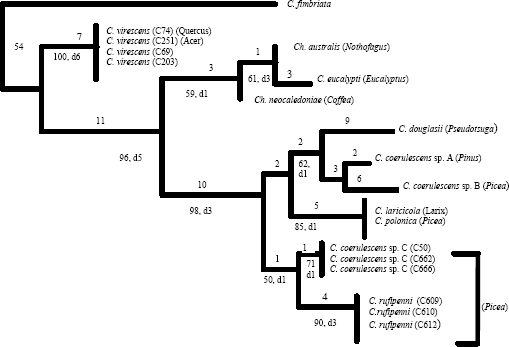
<body><![CDATA[<p><font size="2" face="Verdana, Arial, Helvetica, sans-serif">Weaker pathogens     include agents of sap stain of lumber such as <i>Ceratocystis coerulescens</i> (Münch)     Bakshi on conifers and <i>Ceratocystis douglasii</i> (Davidson) Wingfield &amp; Harrington     on Douglas fir (<i>Pseudotsuga menziesii</i> (Mirb.) Franco) (Münch 1907,     Harrington, Wingfield and Kile 1996, Wingfield, Harrington and Solheim 1997,     Harrington and Wingfield 1998). Other weak pathogens include species producing     lumber stain in hardwoods such as <i>Ceratocystis virescens </i>(Davidson)     C. Moreau on maple (<i>Acer saccharum</i> Marsh.) (Davidson 1944) and <i>Ceratocystis   eucalypti </i>Yuan &amp; Kile on <i>Eucalyptus</i> spp. (Kile <i>et al</i>.   1996). </font></p>     <p><font size="2" face="Verdana, Arial, Helvetica, sans-serif">Likewise,   various annual crop plants are also seriously affected by <i>Ceratocystis</i> species. <i>Ceratocystis   paradoxa </i>(Dade) Moreau causes tissue rot on sugar cane (<i>Saccharum officinarum </i>L.), <i>Musa </i>spp.   and <i>Cocus nucifera</i> L. (Kile 1993). Similarly, <i>Ceratocystis adiposa</i> (Hedgcock)   Moreau incites tissue rot on sugar cane ( Butler 1906) and <i>Ceratocystis   radicicola</i> (Bliss) Moreau causes a root rot on date palms (<i>Phoenix</i> <i>dactylifera </i>L.)   (Bliss 1941). </font></p>     <p><font size="2" face="Verdana, Arial, Helvetica, sans-serif">Members of the genus <i>Ceratocystis</i> have several   means of transmission and dispersal, in addition to being vectored by insects.   Species producing chlamydospores are usually soilborne (Rossetto and Ribeiro   1990, Kile 1993), whereas those that sporulate aerially are dispersed by wind   and water splash (Baker and Thomas 1946, Vigouroux and Stojadinovic 1990).   Species that cause vascular wilts and woodstain can also be transmitted through   root grafts (Gibbs and French 1980, Accordi 1986) and by pruning tools. This   is especially important for the spread of <i>Ceratocystis</i> pathogens in   agricultural crops and forest plantations (Walter, Rex and Schreiber 1952,   Matasci and Gessler 1997). </font></p>     <p><font size="2" face="Verdana, Arial, Helvetica, sans-serif">Most <i>Ceratocystis</i> species are well adapted   to dispersal by insects. Many species produce volatile metabolites with sweet   fruity odours that attract a wide range of insects to infected tissues (Hanssen   1993, Kile 1993). However, the intimacy ot the association between insects   and <i>Ceratocystis </i>species is highly variable. Species such as <i>C. polonica,</i> <i>Ceratocystis   laricicola </i>Redfern   &amp; Minter and <i>Ceratocystis rufipenni </i>Wingfield, Harrington &amp; Solheim,   seem to have a mutualistic relationship with their bark beetle vectors (Redfern <i>et   al</i>. 1987, Solheim 1988, Wingfield, Harrington and Solheim 1997). On the   other hand, species such as <i>C. paradoxa </i>(Chang and Jensen 1974), <i>C.   fagacearum</i> (Juzwik and French 1983, Appel, Kurdyla and Lewis Junior 1990), <i>C.   fimbriata</i> (Crone and Bachelder 1961, Hinds 1972) and <i>C. moniliformis </i>(Hinds   and Davidson 1972) have nonspecific associations with fungivorous or sapfeeding   insects such as nitidulid beetles (Coleoptera: Nitidulidae), flies (Diptera:   Drosophilae) and ambrosia beetles (Peplinski and Merril 1974, Kile 1993). </font></p>     <p><font size="2" face="Verdana, Arial, Helvetica, sans-serif">Different modes of reproduction are found among <i>Ceratocystis</i> species,   including heterothallism, homothallism and exclusive asexual reproduction   (Harrington, Steimel and Kile 1998). Genetic studies have shown that sexuality   in these species is controlled by two matingtype genes designated MAT-1 and   MAT-2 (Harrington and McNew 1997,1998). In strictly heterothallic species,   such as <i>C. eucalypti</i> and <i>C. fagacearum</i>, sexual progeny are only   produced upon mating of strains representing different mating types (Kile <i>et   al</i>. 1996, Harrington, Steimel and Kile 1998). Other species, such as <i>Ch.   australis</i> and <i>Chalara neocaledoniae</i> Kiffer &amp; Delon, are known   only by their anamorph states, and supposedly only reproduce asexually (Kile <i>et   al</i>. 1996, Harrington, Steimel and Kile 1998). However, most <i>Ceratocystis</i> species,   including among others, <i>C. fimbriata</i>, <i>C. coerulescens</i>, <i>C.   virescens</i>, <i>C. polonica</i> and <i>Ceratocystis pinicola </i>Harrington   &amp; Wingfield<i>,</i> are homothallic and also undergo unidirectional mating   type switching (Harrington and McNew 1997,1998). In these species, selffertile   strains that contain both mating type idiomorphs give rise to both selffertile   and selfsterile strains. The latter contain only the MAT-1 gene, and these   MAT-1 strains can cross with the selffertile strains. Progeny of selfing and   crossing events segregate in a 1:1 ratio, with half the ascorpores being selffertile   (MAT-1 and MAT-2) and the other half selfsterile (MAT-1). It has been shown   that self sterile strains are produced as the result of a deletion of the MAT-2   idiomorph, which then results in the expression of only the MAT-1 mating type   (Witthuhn <i>et al</i>. 2000).</font></p>     <p><font size="2" face="Verdana, Arial, Helvetica, sans-serif">The close morphological similarity between many <i>Ceratocystis</i> species   contributes to poorly defined species boundaries within the genus (Harrington,   Wingfield and Kile 1996). Phylogenetic studies using DNA sequence data from   the rRNA operon (Wingfield <i>et al</i>. 1994, Visser <i>et al</i>. 1995, Wingfield <i>et   al</i>. 1996, Witthuhn <i>et al</i>. 1998, 1999, Barnes <i>et al</i>. 2003),   mating type genes (Witthuhn <i>et al</i>. 2000, Harrington <i>et al</i>. 2002)   and microsatellite DNA regions (Barnes <i>et al</i>. 2001) have suggested that   some <i>Ceratocystis</i> species that have been regarded as single entities   in the past, actually represent complexes of cryptic species. Two of these   species complexes, the <i>C. coerulescens</i> and <i>C. fimbriata</i> complex,   are treated in more detail below (<a href="#fig01">Figure 1</a>).</font></p>       <p align="center"><font size="2" face="Verdana, Arial, Helvetica, sans-serif"><b><a name="fig01"></a><img src="/img/revistas/rfnam/v59n1/a01fig01.gif">    <br>   Figure 1.</b> Phylogeny of the <i>Ceratocystis     coerulescens</i> species complex and its relationship with <i>Ceratocystis     fimbriata</i>. The phylogenetic tree was produced from the DNA sequence of     a 565 bp region of the ribosomal RNA operon using PAUP (Witthuhn et al. 1998).</font></p>       <p><font size="2" face="Verdana, Arial, Helvetica, sans-serif"><b><i>Ceratocystis coerulescens</i> complex.</b> Eleven   species have been grouped in the <i>Ceratocystis</i> <i>coerulescens</i> complex.   These species have similar morphology and are closely related based on DNA   sequence data and isozyme profiles (Harrington, Wingfield and Kile 1996, Harrington   and Wingfield 1998, Witthuhn <i>et al</i>. 1999, 2000). Seven species cause   sap stain on conifers in the family Pinaceae, while four species are pathogens   or incite sap stain on hardwood trees. Phylogenetic analysis using sequences   of the rRNA operon and MAT-2 HMG box have shown that the species occurring   on conifers form a single monophyletic clade, with the hardwood species as   their basal ancestor (Witthuhn <i>et al</i>. 1998, 2000). It has thus been   suggested that adaptation to conifer hosts occurred once in the evolutionary   history of <i>Ceratocystis</i> (Witthuhn <i>et al</i>. 1998, 2000). </font></p>     <p><font size="2" face="Verdana, Arial, Helvetica, sans-serif"><i>Ceratocystis coerulescens </i>was     the first species described in the group colonizing conifers (Münch 1907). This fungus   causes bluestain of spruce and pine sapwood in Europe and North America (Münch   1907, Harrington, Wingfield and Kile 1996, Harrington and Wingfield 1998). <i>Ceratocystis   pinicola</i> occurs in Britain and is an agent of bluestain on pine logs and   lumber (Gibbs 1993, Harrington and Wingfield 1998). <i>Ceratocystis rufipenni </i>was   described from Engelmann spruce (<i>Picea engelmannii </i>Parry ex Engelm.)   and white spruce (<i>Picea glauca</i> (Moench) Voss) infested by the North   American spruce bark beetle, <i>Dendroctonus rufipennis </i>Kirby in British   Columbia (Wingfield, Harrington and Solheim 1997). It is virulent on   Sitka spruce (<i>Picea sitchensis </i>(Bong.) Carr.) and can kill trees that   have been inoculated in sufficiently high dosages (Solheim and Safranyik 1997). <i>Ceratocystis   resinifera </i>Harrington &amp; Wingfield has been found in continental Europe   and North America and colonizes wounds of live spruce trees (Harrington, Wingfield   and Kile 1996, Harrington and Wingfield 1998). <i>Ceratocystis douglasii</i> has   originally been recognized as a form of <i>C. coerulescens</i> (Davidson 1953),   but has subsequently been described as a new species (Wingfield, Harrington   and Solheim 1997). This fungus stains the sapwood of Douglas-fir in   western North America, and appears to be restricted to the natural range f   its host (Wingfield, Harrington and Solheim 1997, Harrington and Wingfield   1998). <i>Ceratocystis</i> <i>laricicola </i>infests larch (<i>Larix </i>spp.)   and has a mutualistic association with the bark beetle <i>Ips cembrae</i> Heer   in Europe and Japan (Redfern <i>et al</i>. 1987, Yamaoka <i>et al</i>. 1998,   Kirisits 2001, Stauffer <i>et al</i>. 2001). The remaining species in   the conifer subgroup is <i>C. polonica, </i>which is a pathogen and agent of   bluestain on Norway spruce and other spruce species in Europe and Japan (Solheim   1986, Yamaoka <i>et al</i>. 1997). This <i>Ceratocystis</i> species is primarily   vectored by the aggressive bark beetle <i>Ips typographus</i> L. (Siemaszko   1939, Furniss, Solheim and Christiansen 1990)<i>. </i>In addition, <i>Ips typographus</i> f. <i>japonicus</i> Niijima   in Japan (Yamaoka <i>et al</i>. 1997) as well as <i>Ips amitinus</i> Eichhoff   (Kirisits 2001) and <i>Ips duplicatus</i> Sahlberg (Krokene and Solheim 1996)   in Europe have recently been identified as important vectors of <i>C. polonica</i>.</font></p>     ]]></body>
<body><![CDATA[<p><font size="2" face="Verdana, Arial, Helvetica, sans-serif">The four <i>Ceratocystis</i> species occurring   on hardwoods include <i>C. virescens</i> that causes sapstreak in maple and   other hardwood species in eastern North America (Davidson 1944, Harrington   and Wingfield 1998), <i>C. eucalypti</i> that is a wound colonist on <i>Eucalyptus</i> spp.   in Tasmania and Victoria, Australia (Kile <i>et al</i>. 1996), and two asexual   species occurring in Australia , <i>Ch. australis </i>and <i>Ch. neocaledoniae</i>.   The first of these is a virulent pathogen causing myrtle wilt on <i>Nothofagus   cunninghamii </i>in Tasmania (Kile <i>et al</i>. 1996). The latter species   produces a vascular wilt disease on coffee (<i>Coffea robusta </i> Linden ex   Wild.) and guava trees (<i>Psidium guajava </i>L.) (Kile and Walker 1987).</font></p>     <p><font size="2" face="Verdana, Arial, Helvetica, sans-serif">The <i>Ceratocystis</i> species   occurring on hardwoods and conifers can be distinguished morphologically, based   on conidiophore characteristics. The hardwood group has tapering and proliferating   phialides, while the conifer species lack these phialide characters (Harrington,   Wingfield and Kile 1996). The conifer species can be reliably subdivided into   two morphologically well defined groups: <i>C. coerulescens sensu lato,</i> where   the ascospores are surrounded by an even sheath that is wider at the ends than   at the sides, and <i>C. polonica sensu lato</i>, where ascospore sheaths are   wider at the sides than at the ends (Harrington and Wingfield 1998). Within <i>Ceratocystis   coerulescens sensu lato</i> on conifers, small morphological differences exist   (Harrington and Wingfield 1998), however, unequivocal separation of the entire   conifer colonizing species is practically only possible through isozyme and   DNA sequence comparisons (Harrington, Wingfield and Kile 1996, Witthuhn <i>et   al</i>. 1998, 2000, Harrington <i>et al</i>. 2002). <ins cite="mailto:Mike%20Wingfield" datetime="2003-08-05T14:59"> </ins></font></p>     <p><font size="2" face="Verdana, Arial, Helvetica, sans-serif"><b><i>Ceratocystis polonica sensu lato. </i></b>As discussed   above, species in the <i>C. coerulescens</i> complex have been widely studied   during the course of the past decade. These studies have included several phenotypic   and genotypic characters (Harrington, Wingfield and Kile 1996, Harrington   and McNew 1998, Witthuhn <i>et al</i>. 1998, 2000, Harrington and Wingfield   1998, Harrington <i>et al</i>. 2002). They have added considerable resolution   to the taxonomy of nine of these species, but problems have remained in distinguishing   between <i>C. polonica</i> and <i>C. laricicola. </i></font></p>     <p><font size="2" face="Verdana, Arial, Helvetica, sans-serif"><i>Ceratocystis       polonica</i> was first isolated   from Norway spruce in Poland and described by Siemaszko 1939 as <i>Ophiostoma   polonicum. </i>Visser <i>et al</i>. 1995 reported the presence of a <i>Chalara</i> (<i>Thielaviopsis</i>)   anamorph in cultures of <i>O. polonicum</i>, and this characteristic, together   with DNA sequence comparisons, clearly showed that this fungus is a species   of <i>Ceratocystis</i>. <i>Ceratocystis laricicola</i>, on the other hand,   was correctly described by Redfern <i>et al</i>. 1987. It was, however, not   compared with <i>C. polonica, </i>probably due to the fact that <i>C. polonica</i> was   not recognised as having a <i>Chalara</i> state at the time when <i>C. laricicola</i> was   described (Harrington and Wingfield 1998). Later studies showed the two species   were morphologically indistinguishable (Harrington and Wingfield 1998), had   identical ITS sequences (Witthuhn <i>et al</i>. 1998), and a low level of isozyme   variation (Harrington, Wingfield and Kile 1996). However, they represent distinct   ecological entities (Siemaszko 1939, Solheim 1986, Redfern <i>et al</i>. 1987)   and are true biological species, as interspecific crosses between MAT-1 and   MAT-2 strains of both species fail to produce viable progeny (Harrington and   McNew 1998, Harrington <i>et al</i>. 2002). </font></p>     <p><font size="2" face="Verdana, Arial, Helvetica, sans-serif">These two fungi,     together with <i>C. rufipenni</i> are   especially important for forestry, because they are associated with aggressive   tree-killing bark beetles. <i>Ceratocystis polonica</i> is a mutualistic associate   of the Eurasian spruce bark beetle, <i>I. typographus</i>, which is a highly   destructive pest of Norway spruce throughout Eurasia (Postner 1974, Chrisiansen   and Bakke 1988). Since the 18<sup>th</sup> century <i>I. typographus</i> has   caused large-scale outbreaks with millions of killed trees (Klimetzek and Yue   1997) in Scandinavia and central Europe (Postner 1974, Christiansen and Bakke   1988, Führer 1996, Kirisits 2001). The most recent and still ongoing outbreak   of<i>I. typographus</i> in central and western Europe started around   1992 and has been triggered by destructive windthrows, followed by years with   warm and dry climate (Führer 1996, Kirisits 2001). From 1985 to 1994, the <i>I.   typographus</i> – <i>C. polonica</i> complex has been responsible for losses   of about 14,1 million cubic meters of spruce wood in Austria, Switzerland and   the German province Baden-Württemberg alone (Führer 1996).</font></p>     <p><font size="2" face="Verdana, Arial, Helvetica, sans-serif"><i>Ceratocystis laricicola</i> is vectored by the   eight spined larch bark beetle, <i>I. cembrae </i>(Redfern <i>et al</i>. 1987,   Yamaoka <i>et al</i>. 1998, Stauffer <i>et al</i>. 2001, Kirisits 2001), which   is distributed across continental Europe and Asia (Postner 1974, Pfeffer 1995)   and has been introduced to Scotland and Denmark (Crooke and Bevan 1957, Redfern   et al. 1987, Stauffer <i>et al</i>. 2001). This bark beetle is regarded as   a secondary although important pest of larch and plays a particularly important   role in regions outside the natural range of European larch (Schimitschek 1931,   Postner 1974, Stauffer <i>et al</i>. 2001). For example, <i>I. cembrae</i> and <i>C.   laricicola</i> have become principal pests of larch in Scotland, after their   introduction in 1955 with imported timber from Germany (Crooke and Bevan 1957,   Redfern <i>et al</i>. 1987). </font></p>     <p><font size="2" face="Verdana, Arial, Helvetica, sans-serif">Mass inoculation experiments that aim to mimic natural   massattacks by bark beetles, have demonstrated that both <i>C. polonica </i>(Christiansen   1985, Solheim 1988, Kirisits 1998, Krokene and Solheim 1998, Yamaoka, Takahashi   and Iguchi 2000, Kirisits and Offenthaler 2002) and <i>C. laricicola</i> (Redfern <i>et   al</i>. 1987, Yamaoka <i>et al</i>. 1998, Kirisits 2001) are able to kill their   respective host trees. It is thought that through the mutualistic association   between these bark beetles and the specific <i>Ceratocystis</i> spp. that they   carry, the fungus increases the impact of each beetle attack and thereby contributes   to exhaust the host defences and makes the tree suitable for barkbeetle reproduction   (Whitney 1982, Harrington 1993b, Paine, Raffa and Harrington 1997). Reciprocally,   these fungi benefit by being dispersed and introduced into suitable host trees   by their beetle vectors (Whitney 1982, Malloch and Blackwell 1993, Krokene   1996). Ironically, the less virulent pathogenic <i>Ophiostoma</i> spp. associated   with these insects (Solheim 1986, Krokene 1996, Krokene and Solheim 1998, Kirisits   2001, Viiri 2002) gain the same dispersal advantage, simply by being present   in this environment.</font></p>     <p><font size="2" face="Verdana, Arial, Helvetica, sans-serif">Mechanisms of fungal colonization and host responses have   been particularly well studied in the <i>C. polonica</i> – Norway spruce system.   Fungal succession studies have shown that <i>C. polonica</i> is the first species   to invade the sapwood after<i>I. typographus</i> has attacked a tree   (Solheim 1992). This is probably due to its rapid growth and its ability to   tolerate the low oxygen levels found in living sapwood (Solheim 1991). However,   not all isolates of <i>C. polonica </i>have the same ability to kill trees   and to induce intensive blue-stain in the spwood of its host tree. Isolates   with low levels of virulence have been reported from independent mass inoculation   experiments in Austria (Kirisits and Anglberger 1999, Baier <i>et al</i>. 2002)   and Norway (Krokene and Solheim 2001). Kirisits and Anglberger 1999 considered   the low level of virulence as a general characteristic of the particular isolate   used in their experiment. Likewise, in the Norwegian study loss of pathogenicity   was attributed to senescence of the isolates after several transfers of cultures   during routine storage or, alternatively, to long periods of storage of the   isolates (Krokene and Solheim 2001). However, mycoviral infections, such as   those reported in the forest tree pathogens <i>Ophiostoma novoulmi </i>(Rogers,   Buck, and Braiser 1987, Cole <i>et al</i>. 1998) and <i>Cryphonectria parasitica </i>(Nuss   1992, 2000), might have been involved but were not considered. </font></p>     <p><font size="2" face="Verdana, Arial, Helvetica, sans-serif">Spruce trees infected     by <i>C. polonica</i> respond   in several ways to contain the fungus. Responses such as cellular proliferation,   mobilization of polyphenolic parenchyma cells, formation of traumatic resin   ducts, lignification (Nagy <i>et al</i>. 2000, Evensen <i>et al</i>. 2000,   Krokene, Solheim and Christiansen 2003) as well as translocation of starch   reserves (Christiansen and Ericsson 1986) have been shown to be part of the   defence mechanisms. Further more, experiments have shown that preinoculation   of spruce trees with non lethal dosages of <i>C. polonica</i> inoculum induces   disease resistance that protects trees against subsequent mass infections   of the same fungus (Christiansen <i>et al</i>. 1999, Krokene and Solheim 2001).   The mechanisms underlying this induced resistance differ from the systemic   acquired resistance (SAR) present in angiosperms, since it is non-systemic   and non-specific (Krokene, Solheim and Christiansen 2003). The induced resistance   of Norway spruce is due to anatomical and biochemical reactions in the phloem   and the sapwood, in which polyphenolic parenchyma cells and traumatic resin   ducts are involved (Krokene, Solheim and Christiansen 2003). Different necrotizing   fungi, chemical elicitors and even mechanical wounding can activate a similar   defence response compared to that induced by pretreatment with <i>C. polonica</i> (Christiansen <i>et   al</i>. 1999, Krokene and Solheim 2001, Franceschi, Krekling and Christiansen   2002).</font></p>     <p><font size="2" face="Verdana, Arial, Helvetica, sans-serif"><b>The<i> Ceratocystis fimbriata</i> complex. </b><i>Ceratocystis     fimbriata</i> was first reported causing rot of sweet potato (<i>Ipomoea</i> <i>batatas</i> L.)     in 1890 in New Jersey, USA (Halsted 1890). It is the type species of the     genus <i>Ceratocystis </i>and as in the case of other <i>Ceratocystis</i> species,     its taxonomy was unclear for more than fifty years. Saccardo 1892 reclassified     this fungus as <i>Sphaeronaema fimbriatum</i>, while Zimmerman 1900     described a strain of <i>C. fimbriata</i> causing coffee canker in Java (     Indonesia ) as a separate species, <i>Rostrella coffea </i>Zimmermann. Elliott     1923 renamed <i>C. fimbriata</i> as <i>Ceratostomella fimbriata</i>, but     when Nannfeldt 1932 erected the family Ophiostomataceae, the species was     transferred to the genus <i>Ophiostoma</i>, and later, based on the presence of endoconida     (now recognised as the <i>Thielaviopsis</i> state) to <i>Endoconidiophora</i> (Davidson     1935). The name <i>Ceratocystis fimbriata</i> was recognized again by Bakshi     1950, who revived the generic name <i>Ceratocystis </i>and considered <i>Ophiostoma</i>, <i>Endoconidiophora</i>, <i>Rostrella</i>, <i>Linostoma</i> and <i>Grosmannia </i>as     synonyms of <i>Ceratocystis</i>. When Hunt 1956 accepted Bakshi’s     1950 amendment, the name <i>C. fimbriata </i>became widely accepted (Griffin     1968, Von Arx 1974, Upadhyay 1981). </font></p>     ]]></body>
<body><![CDATA[<p><font size="2" face="Verdana, Arial, Helvetica, sans-serif">Morphologically, <i>C. fimbriata </i>is characterised   by perithecia with long necks that taper towards the tips and terminate in   8 to 15 convergent ostiolar hyphae. Perithecial bases are dark and globose,   surrounded by a dense network of hyphae. Asci are evanescent in the early stages   of development, while ascospores are characteristically hatshaped and exuded   through the perithecial necks in sticky masses (Hunt 1956, Upadhyay 1981).   The fungus also produces chains of cylindrical conidia and aleurioconidia (chlamydospores)   that play an important role in the survival of this fungus in the soil (Pontis   1951, Webster and Butler 1967, Accordi 1989). The anamorph of <i>C. fimbriata</i> has   for many years been accommodated in <i>Chalara</i> (Hunt 1956, Nag Raj and   Kendrick 1975, Upadhyay 1981), but recently, based on a phylogenetic analysis   of DNA sequence data, has been recognised as best residing in <i>Thielaviopsis </i>(Paulin-Mahady <i>et   al</i>. 2002). </font></p>     <p><font size="2" face="Verdana, Arial, Helvetica, sans-serif"><i>Ceratocystis fimbriata</i> is one of the most   aggressive plant pathogens in the genus <i>Ceratocystis</i>, causing wilt,   cankerstain diseases as well as tissue rot on a wide variety of perennial   as well as agronomic crop plants, worldwide (Kile 1993). More than 30 economically   important plants are attacked by this pathogen (Baker and Harrington 2000)   including, among others, plane trees (Walter, Rex and Schreiber 1952, Panconesi   1981), <i>Eucalyptus</i> spp. (Roux <i>et al</i>. 1999, Roux <i>et al</i>.   2001), aspen (<i>Populus tremuloides</i> Michx.) (Zalasky 1965, Hinds 1972),   rubber (<i>Hevea brasiliensis </i>(Wiild: Juss.) Mull-Arg.) (Silveira <i>et   al</i>. 1994), mango (<i>Mangifera indica </i>L<i>.</i>) (Batista 1960), almond   (<i>Prunus amygdalus</i> Batsch.) (De Vay <i>et al</i>. 1968, Teviotdale and   Harper 1991), <i>Syngonium</i> spp. (Walker <i>et al</i>. 1988) and pimento   trees (<i>Pimenta officinalis</i> L.) (Leather 1966). </font></p>     <p><font size="2" face="Verdana, Arial, Helvetica, sans-serif"><i>Ceratocystis fimbriata</i> is particularly important   in Latin America, where it causes substantial losses in three of the main perennial   crops that are grown in this region: coffee, cocoa and citrus (<i>Citrus</i> spp.).   Coffee canker has been reported from Colombia (Obregon 1936), Venezuela (Pontis   1951), Guatemala (Szkolnik 1951) and Costa Rica (Echandi and Segall 1956).   Symptoms of diseased plants include yellowing of foliage, dieback and wilt.   When the outer surface of the stem bark of infected trees is removed, dark   lesions are obvious and these usually extend downwards towards the roots and   girdle the trunks, causing tree death (Pontis 1951, Castro 1991). Coffee canker   has become one of the most important threats to coffee production in Colombia   , where more than 800000 hectares of this crop are planted (Castro 1998). The   principal mode of ingress for <i>C. fimbriata </i>into coffee trunks is through   mechanical wounds (Pontis 1951). The fungus is easily transported on agricultural   tools or with soil. Thus, a major factor associated with spread of coffee   canker in Colombia is infection through wounds on the lower stems made by the   shoes of farmers needing to secure themselves on the steep slopes on which   coffee is cultivated (Castro 1991). </font></p>     <p><font size="2" face="Verdana, Arial, Helvetica, sans-serif"><i>Ceratocystis fimbriata</i> was first reported   on cacao in Ecuador in 1918, causing a serious wilt disease (Desrosiers 1958).   This disease was subsequently found in Venezuela (Malaguti 1952), Colombia   (Idrobo 1958), Trinidad (Goberdhan 1959), Costa Rica (Havord 1962) and the   Dominican Republic (Schieber 1969). Recently, cacao wilt disease has also been   detected in Brazil, in plantations from South Bahia (Bezerra 1997). Cacao wilt   is frequently associated with wounds made by machetes and other tools. The   mycelium and spores enter the xylem and ray parenchyma cells through such fresh   wounds, and cause dark reddish to purple staining that may develop into a vascular   wilt. Externally, the disease is easily recognized because wilted leaves become   dry, curled and remain attached to the trees for several weeks (Montes de Oca   1975). The incidence of cacao wilt has been reduced significantly in Latin   America in recent years, especially because resistant varieties have become   widely available for planting (Delgado and Echandi 1965, Ocampo, Mafla and   Victoria 1982, Simmonds 1994).</font></p>     <p><font size="2" face="Verdana, Arial, Helvetica, sans-serif">The first report of <i>C. fimbriata</i> in citrus   orchards was made in 1981, when it caused serious dieback on lime trees (<i>Citrus   aurantifolia </i>(Christm.) Swing) in the central region of Colombia (Instituto   Colombiano Agropecuario 1993). Three years later, it was also found on lemon   trees (<i>Citrus limon </i>Burmman)   in Argentina (Contreras and Marmelioz 1984). By 1994, about 10% of the citrus   trees in Colombia had been killed by the pathogen (Mourichon 1994). The disease   is characterised by a general yellowing of the foliage, followed by heavy defoliation   and prominent shoot proliferation. Internally, brown to reddish lesions are   evident in the stele of the trunk, and, as the disease progresses, lesions   converge and become flame shaped, black in colour, and trees are eventually   killed (Mourichon 1994). </font></p>     <p><font size="2" face="Verdana, Arial, Helvetica, sans-serif">The taxonomic complexity of what has been referred   to as <i>C</i>. <i>fimbriata</i> in Latin America became evident in a recent   study based on ITS sequence comparisons and microsatellite analysis (Barnes <i>et   al</i>. 2001). Isolates of <i>C. fimbriata</i> from coffee in Colombia were   found to reside in two genetically isolated groups that might represent different   species. However, apart from this study and scattered information that is not   widely available in the scientific literature, very little is known regarding   the biology, ecology or genetic background of <i>C. fimbriata</i> in Latin   America. For example, in countries such as Colombia and Costa Rica , several   native hosts (e.g. <i>Inga</i> sp., <i>Herrania</i> sp., <i>Annona</i> <i>muricata </i>L., <i>Caryodendron</i> <i>orinocense </i>Karst.)   are infected by this pathogen (Montes de Oca 1975, Pardo-Cardona 1995 and Buriticá 1999),   but their role as alternative hosts and sources of inoculum for susceptible   agricultural crops remains uncertain. </font></p>     <p><font size="2" face="Verdana, Arial, Helvetica, sans-serif"><i>Ceratocystis fimbriata </i>has long been recognised   as a variable fungus consisting of distinct, hostspecialized strains (Webster   and Butler 1967, Harrington 2000). The best studied of these host specific   races is <i>C. fimbriata</i> <i>forma specialis platani</i>, which causes a   canker stain disease of plane trees in the Northern hemisphere (Walter, Rex   and Schreiber 1952, Santini and Capretti 2000). Similarly, reciprocal inoculation   experiments have demonstrated the existence of hostspecific isolates on pimento   (Leather 1966), sweet potato (Kojima and Uritani 1976), <i>Syngonium</i> (Vogelzang   and Scott 1991) and cocoa (Baker and Harrington 2000). Earlier genetic analyses   indicated that such hostspecialized isolates could represent distinct, but   closely related species (Olsen and Martin 1949, Webster and Butler 1967). The   view that the host is an important factor separating strains of <i>C. fimbriata   sensu lato </i>has recently also been confirmed based on DNA sequence data   (Wingfield <i>et al</i>. 1996, Witthuhn <i>et al</i>. 1998, Santini and Capretti   2000, Barnes <i>et al</i>. 2001 2003).   Witthuhn <i>et al</i>. 1999 found   that isolates of <i>C. fimbriata</i> from <i>Populus</i> spp., <i>Prunus</i> spp.   and <i>Platanus</i> spp. could be separated based on RFLP analysis of the ITS   regions of the rRNA operon. Similar results were obtained by Santini and Capretti   2000 and Barnes <i>et al</i>. 2001, using RAPD / minisatellite markers and   microsatellite markers, respectively. Thus, <i>C. fimbriata</i> strains from   different hosts and geographical regions grouped in separated clades in accordance   with their respective hosts and origins. </font></p>     <p><font size="2" face="Verdana, Arial, Helvetica, sans-serif">The view that <i>C.       fimbriata</i> may represent   a complex of cryptic species has gained further support by the recent description   of two new <i>Ceratocystis</i> species that probably used to be treated within <i>C.   fimbriata</i>. <i>Ceratocystis albofundus</i> Wingfield, De Beer &amp; Morris   was reported causing wilt and dieback of <i>Acacia mearnsii </i>Wildeman in   South Africa (Morris, Wingfield and De Beer 1993, De Beer 1994). Detailed morphological   and molecular comparisons showed that the fungus represents a distinct <i>Ceratocystis</i> species   that is characterised by light-coloured perithecial bases, dark necks, divergent   ostiolar hyphae and distinct ITS sequences (Wingfield <i>et al</i>. 1996, Roux <i>et   al</i>. 1999). The other new species from wounds on <i>Eucalyptus </i>in Australia   has recently been described as <i>Ceratocystis pirilliformis </i>Barnes   &amp; Wingfield (Barnes <i>et al</i>. 2003). This species has hatshaped ascospores   similar to those found in <i>C. fimbriata</i>, but differs from this species   in its pearshaped perithecial bases. Phylogenetic analysis of the rRNA ITS   regions also supported the definition of this fungus as a new <i>Ceratocystis</i> species   (Barnes <i>et al</i>. 2003).</font></p>     <p>&nbsp;</p>     <p><font size="3" face="Verdana, Arial, Helvetica, sans-serif"><b><a name="1"></a>CONCLUSIONS</b> <a href="#indice"><img src="/img/revistas/rfnam/v59n1/up.gif" border="0"></a></font></p>     ]]></body>
<body><![CDATA[<p><font size="2" face="Verdana, Arial, Helvetica, sans-serif">Selection pressure     for insect dispersion has resulted in convergent morphological characteristics     in the ophiostomatoid fungi, which has made it difficult to establish reliable     taxonomic characters for this group of fungi. Thus, the classification of     these fungi has been the subject of substantial debate since the first ophiostomatoid     species was described in 1890. In recent years, phylogenetic analyses using     DNA sequence data have provided new clarity to classification of these fungi     and have facilitated more accurate identification of them.</font></p>     <p><font size="2" face="Verdana, Arial, Helvetica, sans-serif">The genus <i>Ceratocystis sensu stricto</i> is   reserved for those ophiostomatoid fungi that have <i>Thielaviopsis</i> anamorphs,   that are intolerant to the antibiotic cycloheximide in culture and that lack   cellulose and rhamnose in their cell walls. Some of these species are economically   important plant pathogens of both agricultural crops and forest plantation   trees. As species of <i>Ceratocystis</i> have been more intensively studied,   it has become evident that some of the species in fact represent a complex   of several hostspecialized forms and cryptic taxa. This has important implications,   especially in designing for quarantine measures against these pathogens.</font></p>     <p><font size="2" face="Verdana, Arial, Helvetica, sans-serif">Nine of the eleven species thus far identified in the <i>C.     coerulescens</i> complex have been unequivocally delimited using a wide variety     of phenotypic and genotypic characteristics. Nevertheless, problems have     been experienced in separate <i>C. polonica </i>and <i>C. laricicola</i>.     This is because they are morphologically indistinguishable, have similar     isozyme profiles and identical ITS sequences. Both species are associated     with aggressive conifer bark beetles and are able to kill their hosts, which     justifies a more intensive study of them. Improved taxonomy of these species     and an extended knowledge regarding their population characteristics would     expand our understanding of their epidemiological relationships with insect     vectors and host trees. </font></p>     <p><font size="2" face="Verdana, Arial, Helvetica, sans-serif"><i>Ceratocystis fimbriata</i> represents     one of the most virulent and economically important vascular pathogens in     many agricultural crops and forest trees. Genetic and pathological studies     have suggested that this fungus comprises a complex of several hostspecialized     forms. Two of these “forms” have   already been described as new species based on molecular and detailed morphological   comparisons. It is clear that further investigations are required to delimitate   other species within this complex of important plant pathogens.</font></p>     <p><font size="2" face="Verdana, Arial, Helvetica, sans-serif">Much literature has been generated for <i>Ceratocystis     sensu stricto</i>. During the last decade, research dealing with these fungi     was especially focused in understanding the phylogenetic relationships amongst <i>Ceratocystis</i> species.     However, a few studies deal with the population biology of <i>Ceratocystis</i> species.     The knowledge of the level of variability and degree of genetic structure     of natural populations of plant pathogens is important to establish hypothesis     regarding their origin, movement and reproduction strategies. This information     is likely to be required in the planning and implementation of management     strategies against diseases caused by species of <i>Ceratocystis</i>, including     generation of resistant plant material, development of quarantine strategies     and appropriate use of chemical control measures. </font></p>     <p>&nbsp;</p>     <p><font size="3" face="Verdana, Arial, Helvetica, sans-serif"><b><a name="2"></a>ACKNOWLEDGEMENTS</b> <a href="#indice"><img src="/img/revistas/rfnam/v59n1/up.gif" border="0"></a></font></p>     <p><font size="2" face="Verdana, Arial, Helvetica, sans-serif">We wish to express     our gratitude to Prof. Brenda Wingfield, Dr. Oliver Preisig and Dr. Thomas     Kirisits for their critic review of this manuscript.  Financial support was provided by the National Research   Foundation (NRF) of South Africa, the University of Pretoria, the Forestry   and Agricultural Biotechnology Institute (FABI), the members of the Tree Pathology   Cooperative Program (TPCP), the National Center of Coffee Research (Cenicafé,   Colombia) and the Institute of Forest Entomology, Forest Pathology and Forest   Protection, Universität für Bodenkultur Wien (IFFF-BOKU), Austria. </font></p>     <p>&nbsp;</p>     <p><font size="3" face="Verdana, Arial, Helvetica, sans-serif"><b><a name="3"></a>REFERENCES</b> <a href="#indice"><img src="/img/revistas/rfnam/v59n1/up.gif" border="0"></a></font></p>     ]]></body>
<body><![CDATA[<!-- ref --><p><font size="2" face="Verdana, Arial, Helvetica, sans-serif">Accordi, S. M. 1986. Diffusione de <i>Ceratocystis     fimbriata </i>f. <i>platani</i> attraverso le anastomosi radicali. In: Informatore     Fitopatologico. Vol. 36, no. 11; p. 53-58.</font>&nbsp;&nbsp;&nbsp;&nbsp;&nbsp;&nbsp;&nbsp;&nbsp;[&#160;<a href="javascript:void(0);" onclick="javascript: window.open('/scielo.php?script=sci_nlinks&ref=000073&pid=S0304-2847200600010000100001&lng=','','width=640,height=500,resizable=yes,scrollbars=1,menubar=yes,');">Links</a>&#160;]<!-- end-ref --><!-- ref --><p><font size="2" face="Verdana, Arial, Helvetica, sans-serif">________. 1989. Sopravivenza nel terreno di <i>Ceratocystis     fimbriata</i> f. sp. <i>platani</i>. In: Informatore Fitopatologico. Vol.     39, no. 5; p. 57-62.</font>&nbsp;&nbsp;&nbsp;&nbsp;&nbsp;&nbsp;&nbsp;&nbsp;[&#160;<a href="javascript:void(0);" onclick="javascript: window.open('/scielo.php?script=sci_nlinks&ref=000074&pid=S0304-2847200600010000100002&lng=','','width=640,height=500,resizable=yes,scrollbars=1,menubar=yes,');">Links</a>&#160;]<!-- end-ref --><!-- ref --><p><font size="2" face="Verdana, Arial, Helvetica, sans-serif">Appel, D. N., Kurdyla, T. and Lewis, R., Jr. 1990.   Nitidulids as vectors of the oak wilt fungus and other <i>Ceratocystis</i> spp.   in Texas. In: European Journal of Forest Pathology. Vol. 20; p. 412-417.</font>&nbsp;&nbsp;&nbsp;&nbsp;&nbsp;&nbsp;&nbsp;&nbsp;[&#160;<a href="javascript:void(0);" onclick="javascript: window.open('/scielo.php?script=sci_nlinks&ref=000075&pid=S0304-2847200600010000100003&lng=','','width=640,height=500,resizable=yes,scrollbars=1,menubar=yes,');">Links</a>&#160;]<!-- end-ref --><!-- ref --><p><font size="2" face="Verdana, Arial, Helvetica, sans-serif">Baier, P., Führer,     E., Kirisits, T. and Rosner, S. 2002. Defence reactions of Norway spruce     against bark beetles and the associated fungus <i>Ceratocystis polonica</i> in     secondary pure and mixed species stands. In: Forest Ecology and Management.   Vol. 159; p. 73-86.</font>&nbsp;&nbsp;&nbsp;&nbsp;&nbsp;&nbsp;&nbsp;&nbsp;[&#160;<a href="javascript:void(0);" onclick="javascript: window.open('/scielo.php?script=sci_nlinks&ref=000076&pid=S0304-2847200600010000100004&lng=','','width=640,height=500,resizable=yes,scrollbars=1,menubar=yes,');">Links</a>&#160;]<!-- end-ref --><!-- ref --><p><font size="2" face="Verdana, Arial, Helvetica, sans-serif">Baker, K. F. and Thomas, E. H. 1946. Failure of   bud and graft unions of rose induced by <i>Chalaropsis thielavioides</i>. In:   Phytopathology<i>. </i>Vol. 36; p. 281-291.</font>&nbsp;&nbsp;&nbsp;&nbsp;&nbsp;&nbsp;&nbsp;&nbsp;[&#160;<a href="javascript:void(0);" onclick="javascript: window.open('/scielo.php?script=sci_nlinks&ref=000077&pid=S0304-2847200600010000100005&lng=','','width=640,height=500,resizable=yes,scrollbars=1,menubar=yes,');">Links</a>&#160;]<!-- end-ref --><!-- ref --><p><font size="2" face="Verdana, Arial, Helvetica, sans-serif">________    and Harrington, T. C. 2000. Hostspecialized <i>Ceratocystis fimbriata</i> on   cacao, sweet potato and sycamore. In: Inoculum. Vol. 51, no. 6; p. 3-7.</font>&nbsp;&nbsp;&nbsp;&nbsp;&nbsp;&nbsp;&nbsp;&nbsp;[&#160;<a href="javascript:void(0);" onclick="javascript: window.open('/scielo.php?script=sci_nlinks&ref=000078&pid=S0304-2847200600010000100006&lng=','','width=640,height=500,resizable=yes,scrollbars=1,menubar=yes,');">Links</a>&#160;]<!-- end-ref --><!-- ref --><p><font size="2" face="Verdana, Arial, Helvetica, sans-serif">Baker, K. F. and     Thomas, E. H. 2001. <i>Ceratocystis     fimbriata.</i> Available in Internet: <a href="http://www.public.iastate.edu/~tcharrin/CABIinfo.html" target="ventana">http://www.public.iastate.edu/~tcharrin/CABIinfo.html</a>.     [Consulted: October 2003]</font>&nbsp;&nbsp;&nbsp;&nbsp;&nbsp;&nbsp;&nbsp;&nbsp;[&#160;<a href="javascript:void(0);" onclick="javascript: window.open('/scielo.php?script=sci_nlinks&ref=000079&pid=S0304-2847200600010000100007&lng=','','width=640,height=500,resizable=yes,scrollbars=1,menubar=yes,');">Links</a>&#160;]<!-- end-ref --><!-- ref --><p><font size="2" face="Verdana, Arial, Helvetica, sans-serif">Bakshi, B. K. 1950. Fungi associated with ambrosia   beetles in Great Britain . In: Transactions of the British Mycological Society.   Vol. 33, no. 1-2; p. 111-120.</font>&nbsp;&nbsp;&nbsp;&nbsp;&nbsp;&nbsp;&nbsp;&nbsp;[&#160;<a href="javascript:void(0);" onclick="javascript: window.open('/scielo.php?script=sci_nlinks&ref=000080&pid=S0304-2847200600010000100008&lng=','','width=640,height=500,resizable=yes,scrollbars=1,menubar=yes,');">Links</a>&#160;]<!-- end-ref --><!-- ref --><p><font size="2" face="Verdana, Arial, Helvetica, sans-serif">Barnes, I., Gaur, A., Burgess, T., Roux, J., Wingfield,   B. D. and Wingfield, M. J. 2001. Microsatellite markers reflect intraspecific   relationships between isolates of the vascular wilt pathogen <i>Ceratocystis   fimbriata</i>. In: Molecular Plant Pathology. Vol. 2, no. 6; p. 319-325.</font>&nbsp;&nbsp;&nbsp;&nbsp;&nbsp;&nbsp;&nbsp;&nbsp;[&#160;<a href="javascript:void(0);" onclick="javascript: window.open('/scielo.php?script=sci_nlinks&ref=000081&pid=S0304-2847200600010000100009&lng=','','width=640,height=500,resizable=yes,scrollbars=1,menubar=yes,');">Links</a>&#160;]<!-- end-ref --><!-- ref --><p><font size="2" face="Verdana, Arial, Helvetica, sans-serif">________, Roux, J., Wingfield, B. D., Dudzinski,   M. J., Old, K. M. and Wingfield, M. J. 2003. <i>Ceratocystis pirilliformis</i>,   a new species from <i>Eucalyptus nitens</i> in Australia . In: Mycologia. Vol.95;   no. 5; p. 865-871.</font>&nbsp;&nbsp;&nbsp;&nbsp;&nbsp;&nbsp;&nbsp;&nbsp;[&#160;<a href="javascript:void(0);" onclick="javascript: window.open('/scielo.php?script=sci_nlinks&ref=000082&pid=S0304-2847200600010000100010&lng=','','width=640,height=500,resizable=yes,scrollbars=1,menubar=yes,');">Links</a>&#160;]<!-- end-ref --><!-- ref --><p><font size="2" face="Verdana, Arial, Helvetica, sans-serif">Batista, A. C. 1960. <i>Ceratocystis     fimbriata</i> Ell. &amp; Halst. sobre <i>Mangifera indica</i> L. In: Instituto     de Micologia da Universidade do Recife. p. 1-46. (Publicação no. 244).</font>&nbsp;&nbsp;&nbsp;&nbsp;&nbsp;&nbsp;&nbsp;&nbsp;[&#160;<a href="javascript:void(0);" onclick="javascript: window.open('/scielo.php?script=sci_nlinks&ref=000083&pid=S0304-2847200600010000100011&lng=','','width=640,height=500,resizable=yes,scrollbars=1,menubar=yes,');">Links</a>&#160;]<!-- end-ref --><!-- ref --><p><font size="2" face="Verdana, Arial, Helvetica, sans-serif">Benny, G. L. and Kimbrough,   J. W. 1980. A synopsis of the orders and families of Plectomycetes with keys   to genera. In: Mycotaxon. Vol. 12, no. 1; p. 1-91.</font>&nbsp;&nbsp;&nbsp;&nbsp;&nbsp;&nbsp;&nbsp;&nbsp;[&#160;<a href="javascript:void(0);" onclick="javascript: window.open('/scielo.php?script=sci_nlinks&ref=000084&pid=S0304-2847200600010000100012&lng=','','width=640,height=500,resizable=yes,scrollbars=1,menubar=yes,');">Links</a>&#160;]<!-- end-ref --><!-- ref --><p><font size="2" face="Verdana, Arial, Helvetica, sans-serif">Bezerra, J. L.     1997. <i>Ceratocystis fimbriata</i> causing   death of budded cocoa seedlings in Bahia, Brazil . In: Incoped Newsletter.   Vol. 1; p. 6.</font>&nbsp;&nbsp;&nbsp;&nbsp;&nbsp;&nbsp;&nbsp;&nbsp;[&#160;<a href="javascript:void(0);" onclick="javascript: window.open('/scielo.php?script=sci_nlinks&ref=000085&pid=S0304-2847200600010000100013&lng=','','width=640,height=500,resizable=yes,scrollbars=1,menubar=yes,');">Links</a>&#160;]<!-- end-ref --><!-- ref --><p><font size="2" face="Verdana, Arial, Helvetica, sans-serif">Bliss, D. E. 1941. A new species of <i>Ceratostomella</i> on   the date palm. In: Mycologia. Vol. 33, no. 2; 468-482.</font>&nbsp;&nbsp;&nbsp;&nbsp;&nbsp;&nbsp;&nbsp;&nbsp;[&#160;<a href="javascript:void(0);" onclick="javascript: window.open('/scielo.php?script=sci_nlinks&ref=000086&pid=S0304-2847200600010000100014&lng=','','width=640,height=500,resizable=yes,scrollbars=1,menubar=yes,');">Links</a>&#160;]<!-- end-ref --><!-- ref --><p><font size="2" face="Verdana, Arial, Helvetica, sans-serif">Buriticá, P. 1999. Patógenos y enfermedades de   las plantas de importancia económica en Colombia. Bogotá: ICA. 329 p.</font>&nbsp;&nbsp;&nbsp;&nbsp;&nbsp;&nbsp;&nbsp;&nbsp;[&#160;<a href="javascript:void(0);" onclick="javascript: window.open('/scielo.php?script=sci_nlinks&ref=000087&pid=S0304-2847200600010000100015&lng=','','width=640,height=500,resizable=yes,scrollbars=1,menubar=yes,');">Links</a>&#160;]<!-- end-ref --><!-- ref --><p><font size="2" face="Verdana, Arial, Helvetica, sans-serif"> Butler, E. J.     1906. Fungus diseases of sugar cane in Bengal. India Department of Agriculture   In: Memories, Botanical Series, no.1; p.1-53.</font>&nbsp;&nbsp;&nbsp;&nbsp;&nbsp;&nbsp;&nbsp;&nbsp;[&#160;<a href="javascript:void(0);" onclick="javascript: window.open('/scielo.php?script=sci_nlinks&ref=000088&pid=S0304-2847200600010000100016&lng=','','width=640,height=500,resizable=yes,scrollbars=1,menubar=yes,');">Links</a>&#160;]<!-- end-ref --><!-- ref --><p><font size="2" face="Verdana, Arial, Helvetica, sans-serif">Castro, B. 1991.     Nuevas recomendaciones para el control de la llaga macana del cafeto. In:     Avances Técnicos Cenicafé, no. 160;   p. 1-4. </font>&nbsp;&nbsp;&nbsp;&nbsp;&nbsp;&nbsp;&nbsp;&nbsp;[&#160;<a href="javascript:void(0);" onclick="javascript: window.open('/scielo.php?script=sci_nlinks&ref=000089&pid=S0304-2847200600010000100017&lng=','','width=640,height=500,resizable=yes,scrollbars=1,menubar=yes,');">Links</a>&#160;]<!-- end-ref --><!-- ref --><p><font size="2" face="Verdana, Arial, Helvetica, sans-serif">________. 1998.     Evaluación del daño económico   ocasionado por la llaga macana del cafeto. In: Cenicafé. Informe anual de actividades   1997-1998<i>. </i>Centro Nacional de Investigaciones de Café, Cenicafé, Chinchiná.   10 p.</font>&nbsp;&nbsp;&nbsp;&nbsp;&nbsp;&nbsp;&nbsp;&nbsp;[&#160;<a href="javascript:void(0);" onclick="javascript: window.open('/scielo.php?script=sci_nlinks&ref=000090&pid=S0304-2847200600010000100018&lng=','','width=640,height=500,resizable=yes,scrollbars=1,menubar=yes,');">Links</a>&#160;]<!-- end-ref --><!-- ref --><p><font size="2" face="Verdana, Arial, Helvetica, sans-serif">Chang, V. C. S. and Jensen, L. 1974. Transmission   of the pineapple disease organism of sugarcane by nitidulid beetles in Hawaii.   In: Journal of Economical Entomology. Vol. 67, no. 2; p. 190-192.</font>&nbsp;&nbsp;&nbsp;&nbsp;&nbsp;&nbsp;&nbsp;&nbsp;[&#160;<a href="javascript:void(0);" onclick="javascript: window.open('/scielo.php?script=sci_nlinks&ref=000091&pid=S0304-2847200600010000100019&lng=','','width=640,height=500,resizable=yes,scrollbars=1,menubar=yes,');">Links</a>&#160;]<!-- end-ref --><!-- ref --><p><font size="2" face="Verdana, Arial, Helvetica, sans-serif">Christiansen, E. 1985. <i>Ips/ Ceratocystis in</i>fection   of Norway spruce: what is a deadly dosage? In: Zeithchrift Für Angewandte Entomologie.   Vol. 99; p. 6-11.</font>&nbsp;&nbsp;&nbsp;&nbsp;&nbsp;&nbsp;&nbsp;&nbsp;[&#160;<a href="javascript:void(0);" onclick="javascript: window.open('/scielo.php?script=sci_nlinks&ref=000092&pid=S0304-2847200600010000100020&lng=','','width=640,height=500,resizable=yes,scrollbars=1,menubar=yes,');">Links</a>&#160;]<!-- end-ref --><!-- ref --><p><font size="2" face="Verdana, Arial, Helvetica, sans-serif">Christiansen, E. and Ericsson, A. 1986. Starch   reserves in <i>Picea abies</i> in relation to defense reaction against a bark   beetle transmitted bluestain fungus, <i>Ceratocystis polonica</i>. In: Canadian   Journal of Forest Research. Vol. 16; p. 78-83.</font>&nbsp;&nbsp;&nbsp;&nbsp;&nbsp;&nbsp;&nbsp;&nbsp;[&#160;<a href="javascript:void(0);" onclick="javascript: window.open('/scielo.php?script=sci_nlinks&ref=000093&pid=S0304-2847200600010000100021&lng=','','width=640,height=500,resizable=yes,scrollbars=1,menubar=yes,');">Links</a>&#160;]<!-- end-ref --><!-- ref --><p><font size="2" face="Verdana, Arial, Helvetica, sans-serif">________ and Bakke, A. 1988. The spruce bark beetle of Eurasia. p. 479-503.   In: Dynamics of forest insect populations: pattern, causes, implications.   New York: Plenum Press.</font>&nbsp;&nbsp;&nbsp;&nbsp;&nbsp;&nbsp;&nbsp;&nbsp;[&#160;<a href="javascript:void(0);" onclick="javascript: window.open('/scielo.php?script=sci_nlinks&ref=000094&pid=S0304-2847200600010000100022&lng=','','width=640,height=500,resizable=yes,scrollbars=1,menubar=yes,');">Links</a>&#160;]<!-- end-ref --><!-- ref --><p><font size="2" face="Verdana, Arial, Helvetica, sans-serif">________, Krokene, P., Berryman, A. A., Franceschi,   V. R., Krekling, T., Lieutier, F., Lonneborg, A. and Solheim, H. 1999. Mechanical   injury and fungal infection induce acquired resistance in Norway spruce. In:   Tree Physiology. Vol. 19; p. 399-403.</font>&nbsp;&nbsp;&nbsp;&nbsp;&nbsp;&nbsp;&nbsp;&nbsp;[&#160;<a href="javascript:void(0);" onclick="javascript: window.open('/scielo.php?script=sci_nlinks&ref=000095&pid=S0304-2847200600010000100023&lng=','','width=640,height=500,resizable=yes,scrollbars=1,menubar=yes,');">Links</a>&#160;]<!-- end-ref --><!-- ref --><p><font size="2" face="Verdana, Arial, Helvetica, sans-serif">Contreras, J. and Marmelioz, L. 1984. <i>Ceratocystis     fimbriata</i> Ellis &amp; Halst., a new lemon tree pathogen. p. 432-435.     In: V International Cirus Congress. (5: 1984 : São Paulo, Brazil ). Proceedings.     Sao Paulo: International Society of Citriculture. </font>&nbsp;&nbsp;&nbsp;&nbsp;&nbsp;&nbsp;&nbsp;&nbsp;[&#160;<a href="javascript:void(0);" onclick="javascript: window.open('/scielo.php?script=sci_nlinks&ref=000096&pid=S0304-2847200600010000100024&lng=','','width=640,height=500,resizable=yes,scrollbars=1,menubar=yes,');">Links</a>&#160;]<!-- end-ref --><!-- ref --><p><font size="2" face="Verdana, Arial, Helvetica, sans-serif">Crone, L. J. and Bachelder, S. 1961. Insect transmission   of canker stain fungus, <i>Ceratocystis</i> <i>fimbriata</i> f. sp. <i>platani</i>.   In: Phytopathology. Vol. 51; p. 576.</font>&nbsp;&nbsp;&nbsp;&nbsp;&nbsp;&nbsp;&nbsp;&nbsp;[&#160;<a href="javascript:void(0);" onclick="javascript: window.open('/scielo.php?script=sci_nlinks&ref=000097&pid=S0304-2847200600010000100025&lng=','','width=640,height=500,resizable=yes,scrollbars=1,menubar=yes,');">Links</a>&#160;]<!-- end-ref --><!-- ref --><p><font size="2" face="Verdana, Arial, Helvetica, sans-serif">Crooke, M. and Bevan, D. 1957. Note of the first   British occurrence of <i>Ips cembrae</i> Heer (Col. Scolytidae). In: Forestry.   Vol. 30; p. 21-28.</font>&nbsp;&nbsp;&nbsp;&nbsp;&nbsp;&nbsp;&nbsp;&nbsp;[&#160;<a href="javascript:void(0);" onclick="javascript: window.open('/scielo.php?script=sci_nlinks&ref=000098&pid=S0304-2847200600010000100026&lng=','','width=640,height=500,resizable=yes,scrollbars=1,menubar=yes,');">Links</a>&#160;]<!-- end-ref --><!-- ref --><p><font size="2" face="Verdana, Arial, Helvetica, sans-serif">Davidson, R. W. 1935. Fungi causing stain in logs   and lumber in the southern states, including five new species. In: Journal   of Agricultural Research. Vol. 50; p. 789-807.</font>&nbsp;&nbsp;&nbsp;&nbsp;&nbsp;&nbsp;&nbsp;&nbsp;[&#160;<a href="javascript:void(0);" onclick="javascript: window.open('/scielo.php?script=sci_nlinks&ref=000099&pid=S0304-2847200600010000100027&lng=','','width=640,height=500,resizable=yes,scrollbars=1,menubar=yes,');">Links</a>&#160;]<!-- end-ref --><!-- ref --><p><font size="2" face="Verdana, Arial, Helvetica, sans-serif">________. 1944. Two American hardwood species   of <i>Endoconidiophora</i> described as new. In: Mycologia. Vol. 34; p. 650-662.</font>&nbsp;&nbsp;&nbsp;&nbsp;&nbsp;&nbsp;&nbsp;&nbsp;[&#160;<a href="javascript:void(0);" onclick="javascript: window.open('/scielo.php?script=sci_nlinks&ref=000100&pid=S0304-2847200600010000100028&lng=','','width=640,height=500,resizable=yes,scrollbars=1,menubar=yes,');">Links</a>&#160;]<!-- end-ref --><!-- ref --><p><font size="2" face="Verdana, Arial, Helvetica, sans-serif">________. 1953.Two common lumber staining fungi   in the western United States . In: Mycologia. Vol. 45; p. 579-586.</font>&nbsp;&nbsp;&nbsp;&nbsp;&nbsp;&nbsp;&nbsp;&nbsp;[&#160;<a href="javascript:void(0);" onclick="javascript: window.open('/scielo.php?script=sci_nlinks&ref=000101&pid=S0304-2847200600010000100029&lng=','','width=640,height=500,resizable=yes,scrollbars=1,menubar=yes,');">Links</a>&#160;]<!-- end-ref --><!-- ref --><p><font size="2" face="Verdana, Arial, Helvetica, sans-serif">De Beer, C. 1994. <i>Ceratocystis fimbriata</i> with   special reference to its occurrence as a pathogen of <i>Acacia mearnsii</i> in   South Africa . Bloemfontein, South Africa . Thesis Magister Scientiae. University   of the Orange Free State.</font>&nbsp;&nbsp;&nbsp;&nbsp;&nbsp;&nbsp;&nbsp;&nbsp;[&#160;<a href="javascript:void(0);" onclick="javascript: window.open('/scielo.php?script=sci_nlinks&ref=000102&pid=S0304-2847200600010000100030&lng=','','width=640,height=500,resizable=yes,scrollbars=1,menubar=yes,');">Links</a>&#160;]<!-- end-ref --><!-- ref --><p><font size="2" face="Verdana, Arial, Helvetica, sans-serif">De Hoog, G. S. 1974. The genera <i>Blastobotrys</i>, <i>Sporothrix</i>, <i>Calcarisporium</i> and <i>Calcarisporiella</i> gen.   nov. In: Studies in Mycology. Vol. 7; p. 1-84. </font>&nbsp;&nbsp;&nbsp;&nbsp;&nbsp;&nbsp;&nbsp;&nbsp;[&#160;<a href="javascript:void(0);" onclick="javascript: window.open('/scielo.php?script=sci_nlinks&ref=000103&pid=S0304-2847200600010000100031&lng=','','width=640,height=500,resizable=yes,scrollbars=1,menubar=yes,');">Links</a>&#160;]<!-- end-ref --><!-- ref --><p><font size="2" face="Verdana, Arial, Helvetica, sans-serif">________ and Scheffer R. J. 1984. <i>Ceratocystis</i> versus <i>Ophiostoma</i>:   a reappraisal. In: Mycologia. Vol. 76; p. 292-299.</font>&nbsp;&nbsp;&nbsp;&nbsp;&nbsp;&nbsp;&nbsp;&nbsp;[&#160;<a href="javascript:void(0);" onclick="javascript: window.open('/scielo.php?script=sci_nlinks&ref=000104&pid=S0304-2847200600010000100032&lng=','','width=640,height=500,resizable=yes,scrollbars=1,menubar=yes,');">Links</a>&#160;]<!-- end-ref --><!-- ref --><p><font size="2" face="Verdana, Arial, Helvetica, sans-serif">De Vay, J.E, Lukezic, F.L., English, H., Trujillo,   E.E. and Moller, W.J. 1968. <i>Ceratocystis</i> canker of deciduous fruit trees.   In: Phytopathology. Vol. 58; p. 949-954.</font>&nbsp;&nbsp;&nbsp;&nbsp;&nbsp;&nbsp;&nbsp;&nbsp;[&#160;<a href="javascript:void(0);" onclick="javascript: window.open('/scielo.php?script=sci_nlinks&ref=000105&pid=S0304-2847200600010000100033&lng=','','width=640,height=500,resizable=yes,scrollbars=1,menubar=yes,');">Links</a>&#160;]<!-- end-ref --><!-- ref --><p><font size="2" face="Verdana, Arial, Helvetica, sans-serif">Delgado, J. C.     and Echandi, E. 1965. Evaluación   de la resistencia de especies y clones de cacao al mal del machete provocado   por <i>Ceratocystis fimbriata</i>. In: Turrialba. Vol. 15; p. 286-289.</font>&nbsp;&nbsp;&nbsp;&nbsp;&nbsp;&nbsp;&nbsp;&nbsp;[&#160;<a href="javascript:void(0);" onclick="javascript: window.open('/scielo.php?script=sci_nlinks&ref=000106&pid=S0304-2847200600010000100034&lng=','','width=640,height=500,resizable=yes,scrollbars=1,menubar=yes,');">Links</a>&#160;]<!-- end-ref --><!-- ref --><p><font size="2" face="Verdana, Arial, Helvetica, sans-serif">Desrosiers, R. 1958. El problema de la <i>Cerastomella</i> en   el Ecuador. p. 67-70. In: Conferencia Interamericana de cacao. Palmira, Colombia:   Ministerio de Agricultura, División de Investigaciones Agropecuarias. </font>&nbsp;&nbsp;&nbsp;&nbsp;&nbsp;&nbsp;&nbsp;&nbsp;[&#160;<a href="javascript:void(0);" onclick="javascript: window.open('/scielo.php?script=sci_nlinks&ref=000107&pid=S0304-2847200600010000100035&lng=','','width=640,height=500,resizable=yes,scrollbars=1,menubar=yes,');">Links</a>&#160;]<!-- end-ref --><!-- ref --><p><font size="2" face="Verdana, Arial, Helvetica, sans-serif">Echandi, E. and Segall, R. H.   1956. Trunk, branch and stem canker of coffee trees. In: Plant Disease Reporter.   Vol. 40; p. 916-918.</font>&nbsp;&nbsp;&nbsp;&nbsp;&nbsp;&nbsp;&nbsp;&nbsp;[&#160;<a href="javascript:void(0);" onclick="javascript: window.open('/scielo.php?script=sci_nlinks&ref=000108&pid=S0304-2847200600010000100036&lng=','','width=640,height=500,resizable=yes,scrollbars=1,menubar=yes,');">Links</a>&#160;]<!-- end-ref --><!-- ref --><p><font size="2" face="Verdana, Arial, Helvetica, sans-serif">Elliott, J. A. 1923. The ascigerous stage of the   sweet potato black rot fungus. In: Phytopathology. Vol. 13; p. 56.</font>&nbsp;&nbsp;&nbsp;&nbsp;&nbsp;&nbsp;&nbsp;&nbsp;[&#160;<a href="javascript:void(0);" onclick="javascript: window.open('/scielo.php?script=sci_nlinks&ref=000109&pid=S0304-2847200600010000100037&lng=','','width=640,height=500,resizable=yes,scrollbars=1,menubar=yes,');">Links</a>&#160;]<!-- end-ref --><!-- ref --><p><font size="2" face="Verdana, Arial, Helvetica, sans-serif">Evensen, P. C.,     Solheim, H., Høiland, K. and Stenersen,   J. 2000. Induced resistance of Norway spruce, variation of phenolic compounds   and their effects on fungal pathogens. In: European Journal of Forest Pahology.   Vol.30, no. 2; p. 97-108.</font>&nbsp;&nbsp;&nbsp;&nbsp;&nbsp;&nbsp;&nbsp;&nbsp;[&#160;<a href="javascript:void(0);" onclick="javascript: window.open('/scielo.php?script=sci_nlinks&ref=000110&pid=S0304-2847200600010000100038&lng=','','width=640,height=500,resizable=yes,scrollbars=1,menubar=yes,');">Links</a>&#160;]<!-- end-ref --><!-- ref --><p><font size="2" face="Verdana, Arial, Helvetica, sans-serif">Franceschi, V. R., Krekling, T. and Christiansen,   E. 2002. Application of methyl jasmonate on <i>Picea abies</i> (Pinaceae) stems   induces defense related responses in phloem and xylem. In: American Journal   of Botany. Vol. 89, no. 1; p. 578-586.</font>&nbsp;&nbsp;&nbsp;&nbsp;&nbsp;&nbsp;&nbsp;&nbsp;[&#160;<a href="javascript:void(0);" onclick="javascript: window.open('/scielo.php?script=sci_nlinks&ref=000111&pid=S0304-2847200600010000100039&lng=','','width=640,height=500,resizable=yes,scrollbars=1,menubar=yes,');">Links</a>&#160;]<!-- end-ref --><!-- ref --><p><font size="2" face="Verdana, Arial, Helvetica, sans-serif">Führer, E. 1996.     Entomologische aspekte der umwandlung montaner fichtenforste. In: Entomologia     Generalis. Vol. 21, no.1-2;   p. 1-15.</font>&nbsp;&nbsp;&nbsp;&nbsp;&nbsp;&nbsp;&nbsp;&nbsp;[&#160;<a href="javascript:void(0);" onclick="javascript: window.open('/scielo.php?script=sci_nlinks&ref=000112&pid=S0304-2847200600010000100040&lng=','','width=640,height=500,resizable=yes,scrollbars=1,menubar=yes,');">Links</a>&#160;]<!-- end-ref --><!-- ref --><p><font size="2" face="Verdana, Arial, Helvetica, sans-serif">Furniss, M. M., Solheim, H. and Christiansen, E.   1990. Transmission of bluestain fungi by <i>Ips typographus</i> (Coleoptera:   Scolytidae) in Norway spruce. In: Annals of the Entomological Society of America   . Vol. 83; no. 2; p. 712-716.</font>&nbsp;&nbsp;&nbsp;&nbsp;&nbsp;&nbsp;&nbsp;&nbsp;[&#160;<a href="javascript:void(0);" onclick="javascript: window.open('/scielo.php?script=sci_nlinks&ref=000113&pid=S0304-2847200600010000100041&lng=','','width=640,height=500,resizable=yes,scrollbars=1,menubar=yes,');">Links</a>&#160;]<!-- end-ref --><!-- ref --><p><font size="2" face="Verdana, Arial, Helvetica, sans-serif">Gibbs, J. N. and     French, D. W. 1980. Transmission of oak wilt. In: USDA Forestry Service Research   Paper NC, no. 185; 17 p.</font>&nbsp;&nbsp;&nbsp;&nbsp;&nbsp;&nbsp;&nbsp;&nbsp;[&#160;<a href="javascript:void(0);" onclick="javascript: window.open('/scielo.php?script=sci_nlinks&ref=000114&pid=S0304-2847200600010000100042&lng=','','width=640,height=500,resizable=yes,scrollbars=1,menubar=yes,');">Links</a>&#160;]<!-- end-ref --><!-- ref --><p><font size="2" face="Verdana, Arial, Helvetica, sans-serif">________. 1993. The biology of ophiostomatoid fungi   causing sapstain in trees and freshly cut logs. pp. 153-160. In: Wingfield,   M.J., Seifert, K.A. and Webber J.A., eds. <i>Ceratocystis</i> and <i>Ophiostoma</i>:   taxonomy, ecology and pathogenicity. St. Paul, Minnesota: APS Press. </font>&nbsp;&nbsp;&nbsp;&nbsp;&nbsp;&nbsp;&nbsp;&nbsp;[&#160;<a href="javascript:void(0);" onclick="javascript: window.open('/scielo.php?script=sci_nlinks&ref=000115&pid=S0304-2847200600010000100043&lng=','','width=640,height=500,resizable=yes,scrollbars=1,menubar=yes,');">Links</a>&#160;]<!-- end-ref --><!-- ref --><p><font size="2" face="Verdana, Arial, Helvetica, sans-serif">Goberdhan, L. 1959. The present situation of Ceratostomella   disease of cacao in Trinidad. In: Caribbean Commonwealth Publication Exchange   Service, Cocoa. Vol. 89, 4 p.</font>&nbsp;&nbsp;&nbsp;&nbsp;&nbsp;&nbsp;&nbsp;&nbsp;[&#160;<a href="javascript:void(0);" onclick="javascript: window.open('/scielo.php?script=sci_nlinks&ref=000116&pid=S0304-2847200600010000100044&lng=','','width=640,height=500,resizable=yes,scrollbars=1,menubar=yes,');">Links</a>&#160;]<!-- end-ref --><!-- ref --><p><font size="2" face="Verdana, Arial, Helvetica, sans-serif">Griffin, H. D. 1968. The genus <i>Ceratocystis</i> in Ontario.   In: Canadian Journal of Botany. Vol. 46, no. 5; p. 689-718.</font>&nbsp;&nbsp;&nbsp;&nbsp;&nbsp;&nbsp;&nbsp;&nbsp;[&#160;<a href="javascript:void(0);" onclick="javascript: window.open('/scielo.php?script=sci_nlinks&ref=000117&pid=S0304-2847200600010000100045&lng=','','width=640,height=500,resizable=yes,scrollbars=1,menubar=yes,');">Links</a>&#160;]<!-- end-ref --><!-- ref --><p><font size="2" face="Verdana, Arial, Helvetica, sans-serif">Halsted, B. D. 1890. Some fungus diseases of the   sweet potato. In: New Jersey Agricultural College Experiment Station Bulletin,   no. 76; p. 7-14.</font>&nbsp;&nbsp;&nbsp;&nbsp;&nbsp;&nbsp;&nbsp;&nbsp;[&#160;<a href="javascript:void(0);" onclick="javascript: window.open('/scielo.php?script=sci_nlinks&ref=000118&pid=S0304-2847200600010000100046&lng=','','width=640,height=500,resizable=yes,scrollbars=1,menubar=yes,');">Links</a>&#160;]<!-- end-ref --><!-- ref --><p><font size="2" face="Verdana, Arial, Helvetica, sans-serif">Halsted, B. D.     and Fairchild, D.G. 1891. Sweet-potato black rot (<i>Ceratocystis fimbriata</i>,     Ell. &amp;   Halst.). In: Journal of Mycology. Vol. 7; p. 1-11.</font>&nbsp;&nbsp;&nbsp;&nbsp;&nbsp;&nbsp;&nbsp;&nbsp;[&#160;<a href="javascript:void(0);" onclick="javascript: window.open('/scielo.php?script=sci_nlinks&ref=000119&pid=S0304-2847200600010000100047&lng=','','width=640,height=500,resizable=yes,scrollbars=1,menubar=yes,');">Links</a>&#160;]<!-- end-ref --><!-- ref --><p><font size="2" face="Verdana, Arial, Helvetica, sans-serif">Hanssen, H. P. 1993. Volatile metabolites produced   by species of <i>Ophiostoma</i> and <i>Ceratocystis</i>. pp. 161-172. In: Wingfield,   M.J., Seifert, K.A. and Webber J.A., eds. <i>Ceratocystis</i> and <i>Ophiostoma</i>:   taxonomy, ecology and pathogenicity.St. Paul, Minnesota: APS.</font>&nbsp;&nbsp;&nbsp;&nbsp;&nbsp;&nbsp;&nbsp;&nbsp;[&#160;<a href="javascript:void(0);" onclick="javascript: window.open('/scielo.php?script=sci_nlinks&ref=000120&pid=S0304-2847200600010000100048&lng=','','width=640,height=500,resizable=yes,scrollbars=1,menubar=yes,');">Links</a>&#160;]<!-- end-ref --><!-- ref --><p><font size="2" face="Verdana, Arial, Helvetica, sans-serif">Harrington, T. C. 1981. Cycloheximide sensitivity   as a taxonomic character in <i>Ceratocystis</i>. In: Mycologia. Vol. 73; p.   1123-1129.</font>&nbsp;&nbsp;&nbsp;&nbsp;&nbsp;&nbsp;&nbsp;&nbsp;[&#160;<a href="javascript:void(0);" onclick="javascript: window.open('/scielo.php?script=sci_nlinks&ref=000121&pid=S0304-2847200600010000100049&lng=','','width=640,height=500,resizable=yes,scrollbars=1,menubar=yes,');">Links</a>&#160;]<!-- end-ref --><!-- ref --><p><font size="2" face="Verdana, Arial, Helvetica, sans-serif">________. 1993a. Biology and   taxonomy of fungi associated with bark beetles. p. 37-58. In: Beetlepathogen   interactions in conifer forests San Diego: Academic Press.</font>&nbsp;&nbsp;&nbsp;&nbsp;&nbsp;&nbsp;&nbsp;&nbsp;[&#160;<a href="javascript:void(0);" onclick="javascript: window.open('/scielo.php?script=sci_nlinks&ref=000122&pid=S0304-2847200600010000100050&lng=','','width=640,height=500,resizable=yes,scrollbars=1,menubar=yes,');">Links</a>&#160;]<!-- end-ref --><!-- ref --><p><font size="2" face="Verdana, Arial, Helvetica, sans-serif">________. 1993b. Diseases of conifers caused by   species of <i>Ophiostoma</i> and <i>Leptographium</i>. pp. 161-172. In: Wingfield,   M.J., Seifert, K.A. and Webber J.A., eds. <i>Ceratocystis</i> and <i>Ophiostoma</i>:   taxonomy, ecology and pathogenicity. St. Paul, Minnesota: APS Press, </font>&nbsp;&nbsp;&nbsp;&nbsp;&nbsp;&nbsp;&nbsp;&nbsp;[&#160;<a href="javascript:void(0);" onclick="javascript: window.open('/scielo.php?script=sci_nlinks&ref=000123&pid=S0304-2847200600010000100051&lng=','','width=640,height=500,resizable=yes,scrollbars=1,menubar=yes,');">Links</a>&#160;]<!-- end-ref --><!-- ref --><p><font size="2" face="Verdana, Arial, Helvetica, sans-serif">Harrington, T. C. Steimel, J., Wingfield, M.J.   and Kile, G.A. 1996. Isozyme variation and species delimitation in the <i>Ceratocystis   coerulescens</i> complex. In: Mycologia. Vol. 88; p. 104-113.</font>&nbsp;&nbsp;&nbsp;&nbsp;&nbsp;&nbsp;&nbsp;&nbsp;[&#160;<a href="javascript:void(0);" onclick="javascript: window.open('/scielo.php?script=sci_nlinks&ref=000124&pid=S0304-2847200600010000100052&lng=','','width=640,height=500,resizable=yes,scrollbars=1,menubar=yes,');">Links</a>&#160;]<!-- end-ref --><!-- ref --><p><font size="2" face="Verdana, Arial, Helvetica, sans-serif">________ and McNew, D. L. 1997. Selffertility   and unidirectional matingtype switching in <i>Ceratocystis coerulescens</i>,   a filamentous ascomycete. In: Current Genetics. Vol. 32; p. 52-59.</font>&nbsp;&nbsp;&nbsp;&nbsp;&nbsp;&nbsp;&nbsp;&nbsp;[&#160;<a href="javascript:void(0);" onclick="javascript: window.open('/scielo.php?script=sci_nlinks&ref=000125&pid=S0304-2847200600010000100053&lng=','','width=640,height=500,resizable=yes,scrollbars=1,menubar=yes,');">Links</a>&#160;]<!-- end-ref --><!-- ref --><p><font size="2" face="Verdana, Arial, Helvetica, sans-serif">Harrington, T.     C.  and     McNew, D. L. 1998. Partial interfertility among the <i>Ceratocystis</i> species on conifers. In: Fungal   Genetics and Biology. Vol. 25; p. 44-53.</font>&nbsp;&nbsp;&nbsp;&nbsp;&nbsp;&nbsp;&nbsp;&nbsp;[&#160;<a href="javascript:void(0);" onclick="javascript: window.open('/scielo.php?script=sci_nlinks&ref=000126&pid=S0304-2847200600010000100054&lng=','','width=640,height=500,resizable=yes,scrollbars=1,menubar=yes,');">Links</a>&#160;]<!-- end-ref --><!-- ref --><p><font size="2" face="Verdana, Arial, Helvetica, sans-serif">________ and Wingfield, M. J. 1998. The <i>Ceratocystis</i> species   on conifers. In: Canadian Journal of Botany. Vol. 76; p. 1446-1457.</font>&nbsp;&nbsp;&nbsp;&nbsp;&nbsp;&nbsp;&nbsp;&nbsp;[&#160;<a href="javascript:void(0);" onclick="javascript: window.open('/scielo.php?script=sci_nlinks&ref=000127&pid=S0304-2847200600010000100055&lng=','','width=640,height=500,resizable=yes,scrollbars=1,menubar=yes,');">Links</a>&#160;]<!-- end-ref --><!-- ref --><p><font size="2" face="Verdana, Arial, Helvetica, sans-serif">________, Steimel, J. and Kile, G. 1998. Genetic   variation in three <i>Ceratocystis</i> species with outcrossing, selfing and   asexual reproductive strategies. In: European Journal of Forest Pathology.   Vol. 28; p. 217-226.</font>&nbsp;&nbsp;&nbsp;&nbsp;&nbsp;&nbsp;&nbsp;&nbsp;[&#160;<a href="javascript:void(0);" onclick="javascript: window.open('/scielo.php?script=sci_nlinks&ref=000128&pid=S0304-2847200600010000100056&lng=','','width=640,height=500,resizable=yes,scrollbars=1,menubar=yes,');">Links</a>&#160;]<!-- end-ref --><!-- ref --><p><font size="2" face="Verdana, Arial, Helvetica, sans-serif">________. 2000. Host specialization and speciation in the   American wilt pathogen <i>Ceratocystis fimbriata</i>. In: Fitopatologia Brasileira.   Vol. 25S; p. 262-263.</font>&nbsp;&nbsp;&nbsp;&nbsp;&nbsp;&nbsp;&nbsp;&nbsp;[&#160;<a href="javascript:void(0);" onclick="javascript: window.open('/scielo.php?script=sci_nlinks&ref=000129&pid=S0304-2847200600010000100057&lng=','','width=640,height=500,resizable=yes,scrollbars=1,menubar=yes,');">Links</a>&#160;]<!-- end-ref --><!-- ref --><p><font size="2" face="Verdana, Arial, Helvetica, sans-serif">________, Pashenova, N. V., McNew, D. L., Steimel,   J. and Konstantinov, M. Yu. 2002. Species delimitation and host specialization   of <i>Ceratocystis laricicola</i> and <i>C. polonica</i> to larch and spruce.   In: Plant Disease. Vol. 86, no. 4; p. 418-422.</font>&nbsp;&nbsp;&nbsp;&nbsp;&nbsp;&nbsp;&nbsp;&nbsp;[&#160;<a href="javascript:void(0);" onclick="javascript: window.open('/scielo.php?script=sci_nlinks&ref=000130&pid=S0304-2847200600010000100058&lng=','','width=640,height=500,resizable=yes,scrollbars=1,menubar=yes,');">Links</a>&#160;]<!-- end-ref --><!-- ref --><p><font size="2" face="Verdana, Arial, Helvetica, sans-serif">Hausner, G., Reid, J. and Klassen, G. R. 1993a. On the phylogeny of <i>Ophiostoma</i>, <i>Ceratocystis</i> <i>s.s</i>.   and <i>Microascus</i>, and relationships within <i>Ophiostoma</i> based on   partial ribosomal DNA sequences. In: Canadian Journal of Botany. Vol. 71;   p. 1249-1265.</font>&nbsp;&nbsp;&nbsp;&nbsp;&nbsp;&nbsp;&nbsp;&nbsp;[&#160;<a href="javascript:void(0);" onclick="javascript: window.open('/scielo.php?script=sci_nlinks&ref=000131&pid=S0304-2847200600010000100059&lng=','','width=640,height=500,resizable=yes,scrollbars=1,menubar=yes,');">Links</a>&#160;]<!-- end-ref --><!-- ref --><p><font size="2" face="Verdana, Arial, Helvetica, sans-serif">Hausner, G.,  Reid,     J. and Klassen, G. R. 1993b. On the subdivision of <i>Ceratocystis</i> <i>s.l</i>., based on partial ribosomal   DNA sequences. In: Canadian Journal of Botany. Vol. 71; p. 52-63.</font>&nbsp;&nbsp;&nbsp;&nbsp;&nbsp;&nbsp;&nbsp;&nbsp;[&#160;<a href="javascript:void(0);" onclick="javascript: window.open('/scielo.php?script=sci_nlinks&ref=000132&pid=S0304-2847200600010000100060&lng=','','width=640,height=500,resizable=yes,scrollbars=1,menubar=yes,');">Links</a>&#160;]<!-- end-ref --><!-- ref --><p><font size="2" face="Verdana, Arial, Helvetica, sans-serif">________, Reid, J. and Klassen, R. 2000. On the   phylogeny of members of <i>Ceratocystis</i> s.s. and <i>Ophiostoma</i> that   posses different anamorphic states, with emphasis on the anamorph genus <i>Leptographium</i>,   based on partial ribosomal DNA sequences. In: Canadian Journal of Botany. Vol.   78; p. 903-916. </font>&nbsp;&nbsp;&nbsp;&nbsp;&nbsp;&nbsp;&nbsp;&nbsp;[&#160;<a href="javascript:void(0);" onclick="javascript: window.open('/scielo.php?script=sci_nlinks&ref=000133&pid=S0304-2847200600010000100061&lng=','','width=640,height=500,resizable=yes,scrollbars=1,menubar=yes,');">Links</a>&#160;]<!-- end-ref --><!-- ref --><p><font size="2" face="Verdana, Arial, Helvetica, sans-serif">Havord, G. 1962.     Problemas esenciales en las investigaciones en cultivos perennes. 6 p. In:     Seminario sobre Diseños   Estadísticos y Técnicas Experimentales con Cultivos Perennes. (1962: Turrialba,   Costa Rica). Turrialba, Costa Rica: IICA.</font>&nbsp;&nbsp;&nbsp;&nbsp;&nbsp;&nbsp;&nbsp;&nbsp;[&#160;<a href="javascript:void(0);" onclick="javascript: window.open('/scielo.php?script=sci_nlinks&ref=000134&pid=S0304-2847200600010000100062&lng=','','width=640,height=500,resizable=yes,scrollbars=1,menubar=yes,');">Links</a>&#160;]<!-- end-ref --><!-- ref --><p><font size="2" face="Verdana, Arial, Helvetica, sans-serif">Henry, B. W., Moses, C.S., Richards, C.A. and Riker,   A.J. 1944. Oak wilt, its significance, symptoms and cause. In: Phytopathology.   Vol. 34; p. 636-647.</font>&nbsp;&nbsp;&nbsp;&nbsp;&nbsp;&nbsp;&nbsp;&nbsp;[&#160;<a href="javascript:void(0);" onclick="javascript: window.open('/scielo.php?script=sci_nlinks&ref=000135&pid=S0304-2847200600010000100063&lng=','','width=640,height=500,resizable=yes,scrollbars=1,menubar=yes,');">Links</a>&#160;]<!-- end-ref --><!-- ref --><p><font size="2" face="Verdana, Arial, Helvetica, sans-serif">Hinds, T. E. 1972. Insect transmission of <i>Ceratocystis</i> species   associated with aspen cankers. In: Phytopathology. Vol. 62; p. 221-225.</font>&nbsp;&nbsp;&nbsp;&nbsp;&nbsp;&nbsp;&nbsp;&nbsp;[&#160;<a href="javascript:void(0);" onclick="javascript: window.open('/scielo.php?script=sci_nlinks&ref=000136&pid=S0304-2847200600010000100064&lng=','','width=640,height=500,resizable=yes,scrollbars=1,menubar=yes,');">Links</a>&#160;]<!-- end-ref --><!-- ref --><p><font size="2" face="Verdana, Arial, Helvetica, sans-serif">________ and Davidson, R.W. 1972. <i>Ceratocystis</i> species   associated with spen cankers. Phytopathology. Vol. 62; p. 221-225.</font>&nbsp;&nbsp;&nbsp;&nbsp;&nbsp;&nbsp;&nbsp;&nbsp;[&#160;<a href="javascript:void(0);" onclick="javascript: window.open('/scielo.php?script=sci_nlinks&ref=000137&pid=S0304-2847200600010000100065&lng=','','width=640,height=500,resizable=yes,scrollbars=1,menubar=yes,');">Links</a>&#160;]<!-- end-ref --><!-- ref --><p><font size="2" face="Verdana, Arial, Helvetica, sans-serif">Hunt, J. 1956. Taxonomy of the genus <i>Ceratocystis</i>.   In: Lloydia. Vol.19; p.1-58. </font>&nbsp;&nbsp;&nbsp;&nbsp;&nbsp;&nbsp;&nbsp;&nbsp;[&#160;<a href="javascript:void(0);" onclick="javascript: window.open('/scielo.php?script=sci_nlinks&ref=000138&pid=S0304-2847200600010000100066&lng=','','width=640,height=500,resizable=yes,scrollbars=1,menubar=yes,');">Links</a>&#160;]<!-- end-ref --><!-- ref --><p><font size="2" face="Verdana, Arial, Helvetica, sans-serif">Idrobo, M. S. 1958. El complejo <i>Xyleborus</i>-<i>Ceratostomella </i>en   Colombia. p. 73-79. In: Conferencia Intermericana de Cacao. Ministerio de Agricultura,   División de Investigaciones Agropecuarias, Palmira, Colombia. </font>&nbsp;&nbsp;&nbsp;&nbsp;&nbsp;&nbsp;&nbsp;&nbsp;[&#160;<a href="javascript:void(0);" onclick="javascript: window.open('/scielo.php?script=sci_nlinks&ref=000139&pid=S0304-2847200600010000100067&lng=','','width=640,height=500,resizable=yes,scrollbars=1,menubar=yes,');">Links</a>&#160;]<!-- end-ref --><!-- ref --><p><font size="2" face="Verdana, Arial, Helvetica, sans-serif">Instituto Colombiano     Agropecuario, ICA. 1993. La enfermedad pudrición basal   de los cítricos. pp. 1-5. In: Programa de Frutales ICA. Acta de reunión sobre   la enfermedad conocida como pudrición basal de los cítricos. Palmira, Colombia   : ICA.</font>&nbsp;&nbsp;&nbsp;&nbsp;&nbsp;&nbsp;&nbsp;&nbsp;[&#160;<a href="javascript:void(0);" onclick="javascript: window.open('/scielo.php?script=sci_nlinks&ref=000140&pid=S0304-2847200600010000100068&lng=','','width=640,height=500,resizable=yes,scrollbars=1,menubar=yes,');">Links</a>&#160;]<!-- end-ref --><!-- ref --><p><font size="2" face="Verdana, Arial, Helvetica, sans-serif">Jacobs, K. and Wingfield, M. J. 2001. <i>Leptographium</i> species: tree   pathogens, insects associates, and agents of bluestain. St. Paul, Minnesota,   USA : APS Press.</font>&nbsp;&nbsp;&nbsp;&nbsp;&nbsp;&nbsp;&nbsp;&nbsp;[&#160;<a href="javascript:void(0);" onclick="javascript: window.open('/scielo.php?script=sci_nlinks&ref=000141&pid=S0304-2847200600010000100069&lng=','','width=640,height=500,resizable=yes,scrollbars=1,menubar=yes,');">Links</a>&#160;]<!-- end-ref --><!-- ref --><p><font size="2" face="Verdana, Arial, Helvetica, sans-serif">Jewell, T. R. 1974. A qualitative study of cellulose   distribution in <i>Ceratocystis</i> and <i>Europhium</i>. In: Mycologia. Vol.   66; p. 139-146.</font>&nbsp;&nbsp;&nbsp;&nbsp;&nbsp;&nbsp;&nbsp;&nbsp;[&#160;<a href="javascript:void(0);" onclick="javascript: window.open('/scielo.php?script=sci_nlinks&ref=000142&pid=S0304-2847200600010000100070&lng=','','width=640,height=500,resizable=yes,scrollbars=1,menubar=yes,');">Links</a>&#160;]<!-- end-ref --><!-- ref --><p><font size="2" face="Verdana, Arial, Helvetica, sans-serif">Juzwik, J. and French, D. W. 1983. <i>Ceratocystis fagacearum</i> and <i>C.     piceae</i> on the surfaces of free-flying and fungus-mat-inhabiting nitidulids.     In: Phytopathology. Vol. 73; p. 1164-1168.</font>&nbsp;&nbsp;&nbsp;&nbsp;&nbsp;&nbsp;&nbsp;&nbsp;[&#160;<a href="javascript:void(0);" onclick="javascript: window.open('/scielo.php?script=sci_nlinks&ref=000143&pid=S0304-2847200600010000100071&lng=','','width=640,height=500,resizable=yes,scrollbars=1,menubar=yes,');">Links</a>&#160;]<!-- end-ref --><!-- ref --><p><font size="2" face="Verdana, Arial, Helvetica, sans-serif">Kile, G. A. and Walker, J. 1987. <i>Chalara     australis</i> sp. nov. (Hyphomycetes), a vascular pathogen of <i>Nothofagus     cunninghamii</i> (Fagaceae) in Australia and its relationship to other <i>Chalara</i> species.     In: Australian Journal of Botany. Vol. 35; p. 1-32. </font>&nbsp;&nbsp;&nbsp;&nbsp;&nbsp;&nbsp;&nbsp;&nbsp;[&#160;<a href="javascript:void(0);" onclick="javascript: window.open('/scielo.php?script=sci_nlinks&ref=000144&pid=S0304-2847200600010000100072&lng=','','width=640,height=500,resizable=yes,scrollbars=1,menubar=yes,');">Links</a>&#160;]<!-- end-ref --><!-- ref --><p><font size="2" face="Verdana, Arial, Helvetica, sans-serif">________. 1993. Plant diseases caused by species   of <i>Ceratocystis sensu</i> <i>stricto</i> and <i>Chalara.</i> pp. 173-183.   In: Wingfield, M. J., Seifert, K. A. and Webber J. A., eds. <i>Ceratocystis</i> and <i>Ophiostoma</i>:   taxonomy, ecology and pathogenicity. St. Paul, Minnesota: APS Press.</font>&nbsp;&nbsp;&nbsp;&nbsp;&nbsp;&nbsp;&nbsp;&nbsp;[&#160;<a href="javascript:void(0);" onclick="javascript: window.open('/scielo.php?script=sci_nlinks&ref=000145&pid=S0304-2847200600010000100073&lng=','','width=640,height=500,resizable=yes,scrollbars=1,menubar=yes,');">Links</a>&#160;]<!-- end-ref --><!-- ref --><p><font size="2" face="Verdana, Arial, Helvetica, sans-serif">Kile, G. A., Harrington, T. C., Yuan, Z. Q., Dudzinski,   M .J. and Old, K. M. 1996. <i>Ceratocystis eucalypti</i> sp. nov., a vascular   stain fungus from eucalypts in Australia . In: Mycological Research.   Vol.100; p. 571-579.</font>&nbsp;&nbsp;&nbsp;&nbsp;&nbsp;&nbsp;&nbsp;&nbsp;[&#160;<a href="javascript:void(0);" onclick="javascript: window.open('/scielo.php?script=sci_nlinks&ref=000146&pid=S0304-2847200600010000100074&lng=','','width=640,height=500,resizable=yes,scrollbars=1,menubar=yes,');">Links</a>&#160;]<!-- end-ref --><!-- ref --><p><font size="2" face="Verdana, Arial, Helvetica, sans-serif">Kirisits, T. 1998. Pathogenicity of three bluestain   fungi associated with the bark beetle <i>Ips typographus</i> to Norway spruce   in Austria . In: Österreichische Zeitschrift für Pilzkunde<i>. </i>Vol. 7;   p. 191-201.</font>&nbsp;&nbsp;&nbsp;&nbsp;&nbsp;&nbsp;&nbsp;&nbsp;[&#160;<a href="javascript:void(0);" onclick="javascript: window.open('/scielo.php?script=sci_nlinks&ref=000147&pid=S0304-2847200600010000100075&lng=','','width=640,height=500,resizable=yes,scrollbars=1,menubar=yes,');">Links</a>&#160;]<!-- end-ref --><!-- ref --><p><font size="2" face="Verdana, Arial, Helvetica, sans-serif">Kirisits, T. and Anglberger, H. 1999. Report on   a strain of the pathogenic blue-stain fungus <i>Ceratocystis polonica</i> with   low virulence. In: Österreichische Zeitschrift für Pilzkunde. Vol.   8; p. 157-167.</font>&nbsp;&nbsp;&nbsp;&nbsp;&nbsp;&nbsp;&nbsp;&nbsp;[&#160;<a href="javascript:void(0);" onclick="javascript: window.open('/scielo.php?script=sci_nlinks&ref=000148&pid=S0304-2847200600010000100076&lng=','','width=640,height=500,resizable=yes,scrollbars=1,menubar=yes,');">Links</a>&#160;]<!-- end-ref --><!-- ref --><p><font size="2" face="Verdana, Arial, Helvetica, sans-serif">________ 2001. Studies on the association of   ophiostomatoid fungi with bark beetles in Austria with special emphasis on <i>Ips   typographus</i> and <i>Ips cembrae</i> and their associated fungi <i>Ceratocystis   polonica</i> and <i>Ceratocystis  laricicola.</i> Vienna, Austria, 69 h. Rerum   Naturalium Technicarum Doctor Thesis. Universität für Bodenkultur Wien (BOKU).Institute   of Forest Entomology, Forest Pathology and Forest Protection.</font>&nbsp;&nbsp;&nbsp;&nbsp;&nbsp;&nbsp;&nbsp;&nbsp;[&#160;<a href="javascript:void(0);" onclick="javascript: window.open('/scielo.php?script=sci_nlinks&ref=000149&pid=S0304-2847200600010000100077&lng=','','width=640,height=500,resizable=yes,scrollbars=1,menubar=yes,');">Links</a>&#160;]<!-- end-ref --><!-- ref --><p><font size="2" face="Verdana, Arial, Helvetica, sans-serif"> Kirisits, T.     and Offenthaler I. 2002. Xylem sap flow of Norway spruce after inoculation     with the blue-stain fungus <i>Ceratocystis   polonica</i>. In: Plant Pathology. Vol. 51; 359-364.</font>&nbsp;&nbsp;&nbsp;&nbsp;&nbsp;&nbsp;&nbsp;&nbsp;[&#160;<a href="javascript:void(0);" onclick="javascript: window.open('/scielo.php?script=sci_nlinks&ref=000150&pid=S0304-2847200600010000100078&lng=','','width=640,height=500,resizable=yes,scrollbars=1,menubar=yes,');">Links</a>&#160;]<!-- end-ref --><!-- ref --><p><font size="2" face="Verdana, Arial, Helvetica, sans-serif"> Klimetzek, K.     D. and Yue, C. 1997. Climate and forest insect outbreaks. In: Biologia, Bratislava.   Vol. 52, no. 2; p. 153-157.</font>&nbsp;&nbsp;&nbsp;&nbsp;&nbsp;&nbsp;&nbsp;&nbsp;[&#160;<a href="javascript:void(0);" onclick="javascript: window.open('/scielo.php?script=sci_nlinks&ref=000151&pid=S0304-2847200600010000100079&lng=','','width=640,height=500,resizable=yes,scrollbars=1,menubar=yes,');">Links</a>&#160;]<!-- end-ref --><!-- ref --><p><font size="2" face="Verdana, Arial, Helvetica, sans-serif">Kojima, M. and Uritani, I. 1976. Possible involvement   of furanoter penoid phytoalexins in establishing host-parasite specificity   between sweet potato and various strains of <i>Ceratocystis</i> <i>fimbriata</i>.   In: Physiological Plant Pathology. Vol. 8, no. 1; p. 97-111.</font>&nbsp;&nbsp;&nbsp;&nbsp;&nbsp;&nbsp;&nbsp;&nbsp;[&#160;<a href="javascript:void(0);" onclick="javascript: window.open('/scielo.php?script=sci_nlinks&ref=000152&pid=S0304-2847200600010000100080&lng=','','width=640,height=500,resizable=yes,scrollbars=1,menubar=yes,');">Links</a>&#160;]<!-- end-ref --><!-- ref --><p><font size="2" face="Verdana, Arial, Helvetica, sans-serif">Krokene, P. 1996. The role of blue-stain fungi   in tree-killing by bark beetles. Oslo. 116 h. Doctor Science thesis. University   of Oslo. Division of Zoology, Department of Biology.</font>&nbsp;&nbsp;&nbsp;&nbsp;&nbsp;&nbsp;&nbsp;&nbsp;[&#160;<a href="javascript:void(0);" onclick="javascript: window.open('/scielo.php?script=sci_nlinks&ref=000153&pid=S0304-2847200600010000100081&lng=','','width=640,height=500,resizable=yes,scrollbars=1,menubar=yes,');">Links</a>&#160;]<!-- end-ref --><!-- ref --><p><font size="2" face="Verdana, Arial, Helvetica, sans-serif">________ and Solheim, H. 1996. Fungal associates   of five bark beetle species colonizing Norway spruce. In: Canadian Journal   of Forest Research. Vol. 26; p. 2115-2122.</font>&nbsp;&nbsp;&nbsp;&nbsp;&nbsp;&nbsp;&nbsp;&nbsp;[&#160;<a href="javascript:void(0);" onclick="javascript: window.open('/scielo.php?script=sci_nlinks&ref=000154&pid=S0304-2847200600010000100082&lng=','','width=640,height=500,resizable=yes,scrollbars=1,menubar=yes,');">Links</a>&#160;]<!-- end-ref --><!-- ref --><p><font size="2" face="Verdana, Arial, Helvetica, sans-serif">________ and ________ 1998. Phytopathogenicity   of four blue-stain fungi associated with aggressive and nonaggressive bark   beetles. In: Phytopathology. Vol. 88; p. 39-44.</font>&nbsp;&nbsp;&nbsp;&nbsp;&nbsp;&nbsp;&nbsp;&nbsp;[&#160;<a href="javascript:void(0);" onclick="javascript: window.open('/scielo.php?script=sci_nlinks&ref=000155&pid=S0304-2847200600010000100083&lng=','','width=640,height=500,resizable=yes,scrollbars=1,menubar=yes,');">Links</a>&#160;]<!-- end-ref --><!-- ref --><p><font size="2" face="Verdana, Arial, Helvetica, sans-serif">Krokene, P., Christiansen, E., Solheim, H., Franceschi,   V.R. and Berryman, A.A. 1999. Induced resistance to pathogenic fungi in Norway   spruce. In: Plant Physiology. Vol. 121; p. 565-569.</font>&nbsp;&nbsp;&nbsp;&nbsp;&nbsp;&nbsp;&nbsp;&nbsp;[&#160;<a href="javascript:void(0);" onclick="javascript: window.open('/scielo.php?script=sci_nlinks&ref=000156&pid=S0304-2847200600010000100084&lng=','','width=640,height=500,resizable=yes,scrollbars=1,menubar=yes,');">Links</a>&#160;]<!-- end-ref --><!-- ref --><p><font size="2" face="Verdana, Arial, Helvetica, sans-serif">________ and Solheim, H. 2001. Loss of pathogenicity   in the blue-stain fungus <i>Ceratocystis</i> <i>polonica</i>. In: Plant Pathology.   Vol. 50; p. 497-502.</font>&nbsp;&nbsp;&nbsp;&nbsp;&nbsp;&nbsp;&nbsp;&nbsp;[&#160;<a href="javascript:void(0);" onclick="javascript: window.open('/scielo.php?script=sci_nlinks&ref=000157&pid=S0304-2847200600010000100085&lng=','','width=640,height=500,resizable=yes,scrollbars=1,menubar=yes,');">Links</a>&#160;]<!-- end-ref --><!-- ref --><p><font size="2" face="Verdana, Arial, Helvetica, sans-serif">________, Solheim, H. and Christiansen, E. 2001.   Induction of disease resistance in Norway spruce (<i>Picea abies</i>) by necrotizing   fungi. In: Plant Pathology. Vol. 50; p., 230-233.</font>&nbsp;&nbsp;&nbsp;&nbsp;&nbsp;&nbsp;&nbsp;&nbsp;[&#160;<a href="javascript:void(0);" onclick="javascript: window.open('/scielo.php?script=sci_nlinks&ref=000158&pid=S0304-2847200600010000100086&lng=','','width=640,height=500,resizable=yes,scrollbars=1,menubar=yes,');">Links</a>&#160;]<!-- end-ref --><!-- ref --><p><font size="2" face="Verdana, Arial, Helvetica, sans-serif">________, Solheim, H. and Christiansen, E. 2003.   Inducible anatomical defense responses in Norway spruce stems and their possible   role in induced resistance. In: Tree Physiology. Vol. 23, no. 3; p. 191-197.</font>&nbsp;&nbsp;&nbsp;&nbsp;&nbsp;&nbsp;&nbsp;&nbsp;[&#160;<a href="javascript:void(0);" onclick="javascript: window.open('/scielo.php?script=sci_nlinks&ref=000159&pid=S0304-2847200600010000100087&lng=','','width=640,height=500,resizable=yes,scrollbars=1,menubar=yes,');">Links</a>&#160;]<!-- end-ref --><!-- ref --><p><font size="2" face="Verdana, Arial, Helvetica, sans-serif">Leather, R. I. 1966. A canker and wilt disease   of pimento (<i>Pimenta officinalis</i>) caused by <i>Ceratocystis fimbriata</i> in   Jamaica . In: Transactions of the British Mycological Society. Vol. 49; p.   213-218.</font>&nbsp;&nbsp;&nbsp;&nbsp;&nbsp;&nbsp;&nbsp;&nbsp;[&#160;<a href="javascript:void(0);" onclick="javascript: window.open('/scielo.php?script=sci_nlinks&ref=000160&pid=S0304-2847200600010000100088&lng=','','width=640,height=500,resizable=yes,scrollbars=1,menubar=yes,');">Links</a>&#160;]<!-- end-ref --><!-- ref --><p><font size="2" face="Verdana, Arial, Helvetica, sans-serif">Malaguti, G. 1952. <i>Ceratostomella fimbriata</i> en   el cacao de Venezuela. In: Acta Científica Venezolana. Vol. 3; p. 94-97.</font>&nbsp;&nbsp;&nbsp;&nbsp;&nbsp;&nbsp;&nbsp;&nbsp;[&#160;<a href="javascript:void(0);" onclick="javascript: window.open('/scielo.php?script=sci_nlinks&ref=000161&pid=S0304-2847200600010000100089&lng=','','width=640,height=500,resizable=yes,scrollbars=1,menubar=yes,');">Links</a>&#160;]<!-- end-ref --><!-- ref --><p><font size="2" face="Verdana, Arial, Helvetica, sans-serif">Malloch, D. and Blackwell, M. 1993. Dispersal biology   of the ophios- tomatoid fungi. p. 195-206. In: Wingfield, M.J., Seifert, K.A.   and Webber J.A., eds <i>Ceratocystis</i> and <i>Ophiostoma</i>: taxonomy, ecology   and pathogenicity. St. Paul, Minnesota: APS Press.</font>&nbsp;&nbsp;&nbsp;&nbsp;&nbsp;&nbsp;&nbsp;&nbsp;[&#160;<a href="javascript:void(0);" onclick="javascript: window.open('/scielo.php?script=sci_nlinks&ref=000162&pid=S0304-2847200600010000100090&lng=','','width=640,height=500,resizable=yes,scrollbars=1,menubar=yes,');">Links</a>&#160;]<!-- end-ref --><!-- ref --><p><font size="2" face="Verdana, Arial, Helvetica, sans-serif">Marais, G. J., Wingfield, M. J., Viljoen, C. D.   and Wingfield, B. D. 1998. A new ophiostomatoid genus from <i>Protea</i> infructescences.   In: Mycologia. Vol. 90; p. 136-141.</font>&nbsp;&nbsp;&nbsp;&nbsp;&nbsp;&nbsp;&nbsp;&nbsp;[&#160;<a href="javascript:void(0);" onclick="javascript: window.open('/scielo.php?script=sci_nlinks&ref=000163&pid=S0304-2847200600010000100091&lng=','','width=640,height=500,resizable=yes,scrollbars=1,menubar=yes,');">Links</a>&#160;]<!-- end-ref --><!-- ref --><p><font size="2" face="Verdana, Arial, Helvetica, sans-serif">Matasci, M. and Gessler, C. 1997. Ein pilz bedroht   die existenz der platane. In: Acta Veterinaria Hungarita. Vol. 45; p. 69-75.</font>&nbsp;&nbsp;&nbsp;&nbsp;&nbsp;&nbsp;&nbsp;&nbsp;[&#160;<a href="javascript:void(0);" onclick="javascript: window.open('/scielo.php?script=sci_nlinks&ref=000164&pid=S0304-2847200600010000100092&lng=','','width=640,height=500,resizable=yes,scrollbars=1,menubar=yes,');">Links</a>&#160;]<!-- end-ref --><!-- ref --><p><font size="2" face="Verdana, Arial, Helvetica, sans-serif">Minter, D. W., Kirk, P. M. and Sutton, B. C. 1983.   Thalic phialides. In: Transactions of the British Mycological Society. Vol.   80; p. 39-66.</font>&nbsp;&nbsp;&nbsp;&nbsp;&nbsp;&nbsp;&nbsp;&nbsp;[&#160;<a href="javascript:void(0);" onclick="javascript: window.open('/scielo.php?script=sci_nlinks&ref=000165&pid=S0304-2847200600010000100093&lng=','','width=640,height=500,resizable=yes,scrollbars=1,menubar=yes,');">Links</a>&#160;]<!-- end-ref --><!-- ref --><p><font size="2" face="Verdana, Arial, Helvetica, sans-serif">________, ________ and Sutton, B. C. 1982. Holoblastic   phialides. In: Transactions of the British Mycological Society. Vol. 79; p.   75-93.</font>&nbsp;&nbsp;&nbsp;&nbsp;&nbsp;&nbsp;&nbsp;&nbsp;[&#160;<a href="javascript:void(0);" onclick="javascript: window.open('/scielo.php?script=sci_nlinks&ref=000166&pid=S0304-2847200600010000100094&lng=','','width=640,height=500,resizable=yes,scrollbars=1,menubar=yes,');">Links</a>&#160;]<!-- end-ref --><!-- ref --><p><font size="2" face="Verdana, Arial, Helvetica, sans-serif">Minter, D. W. 1987. The significance   of conidiogenesis in pleoanamorphy. p. 241-262. In: Pleomorphic fungi. Tokyo,   Amsterdan: Elsevier. </font>&nbsp;&nbsp;&nbsp;&nbsp;&nbsp;&nbsp;&nbsp;&nbsp;[&#160;<a href="javascript:void(0);" onclick="javascript: window.open('/scielo.php?script=sci_nlinks&ref=000167&pid=S0304-2847200600010000100095&lng=','','width=640,height=500,resizable=yes,scrollbars=1,menubar=yes,');">Links</a>&#160;]<!-- end-ref --><!-- ref --><p><font size="2" face="Verdana, Arial, Helvetica, sans-serif">Montes de Oca, H. A. 1975. Estudio de la resistencia   a<i> Ceratocystis fimbriata </i>Ellis &amp; Halst., en híbridos y clones de   cacao (<i>Theobroma cacao </i>L.), utilizando dos métodos de evaluación. Turrialba.   Thesis Magister Scientiae. Instituto Interamericano de Ciencias Agrícolas   de la OEA, Costa Rica.</font>&nbsp;&nbsp;&nbsp;&nbsp;&nbsp;&nbsp;&nbsp;&nbsp;[&#160;<a href="javascript:void(0);" onclick="javascript: window.open('/scielo.php?script=sci_nlinks&ref=000168&pid=S0304-2847200600010000100096&lng=','','width=640,height=500,resizable=yes,scrollbars=1,menubar=yes,');">Links</a>&#160;]<!-- end-ref --><!-- ref --><p><font size="2" face="Verdana, Arial, Helvetica, sans-serif">Morris, M. J., Wingfield, M J. and De Beer, C.   1993. Gummosis and wilt of <i>Acacia mearnsii </i>in South Africa caused by <i>Ceratocystis   fimbriata</i>. In: Plant Pathology. Vol. 42; p. 814-817.</font>&nbsp;&nbsp;&nbsp;&nbsp;&nbsp;&nbsp;&nbsp;&nbsp;[&#160;<a href="javascript:void(0);" onclick="javascript: window.open('/scielo.php?script=sci_nlinks&ref=000169&pid=S0304-2847200600010000100097&lng=','','width=640,height=500,resizable=yes,scrollbars=1,menubar=yes,');">Links</a>&#160;]<!-- end-ref --><!-- ref --><p><font size="2" face="Verdana, Arial, Helvetica, sans-serif">Mourichon, X. 1994. Serious citrus dieback in Colombia   caused by <i>Ceratocystis fimbriata</i>. In: Fruits. Vol. 49, no. 5/6; p. 415-416.</font>&nbsp;&nbsp;&nbsp;&nbsp;&nbsp;&nbsp;&nbsp;&nbsp;[&#160;<a href="javascript:void(0);" onclick="javascript: window.open('/scielo.php?script=sci_nlinks&ref=000170&pid=S0304-2847200600010000100098&lng=','','width=640,height=500,resizable=yes,scrollbars=1,menubar=yes,');">Links</a>&#160;]<!-- end-ref --><!-- ref --><p><font size="2" face="Verdana, Arial, Helvetica, sans-serif">Münch, E. 1907. Die Blaufaule des nadelholzes.   I-II. In: Naturwissen-schaftliche Zeitschrift für Forst- und Landwirtschaft.   Vol. 5; p. 531-573.</font>&nbsp;&nbsp;&nbsp;&nbsp;&nbsp;&nbsp;&nbsp;&nbsp;[&#160;<a href="javascript:void(0);" onclick="javascript: window.open('/scielo.php?script=sci_nlinks&ref=000171&pid=S0304-2847200600010000100099&lng=','','width=640,height=500,resizable=yes,scrollbars=1,menubar=yes,');">Links</a>&#160;]<!-- end-ref --><!-- ref --><p><font size="2" face="Verdana, Arial, Helvetica, sans-serif">Nag Raj, T. R. and Kendrick,   W. B. 1975. A monograph of <i>Chalara</i> and allied genera. Waterloo: Wilfred   Laurier University Press. 200 p.</font>&nbsp;&nbsp;&nbsp;&nbsp;&nbsp;&nbsp;&nbsp;&nbsp;[&#160;<a href="javascript:void(0);" onclick="javascript: window.open('/scielo.php?script=sci_nlinks&ref=000172&pid=S0304-2847200600010000100100&lng=','','width=640,height=500,resizable=yes,scrollbars=1,menubar=yes,');">Links</a>&#160;]<!-- end-ref --><!-- ref --><p><font size="2" face="Verdana, Arial, Helvetica, sans-serif">Nagy, N. E., Franceschi, V. R., Solheim, H., Krekling,   T. and Christiansen, E. 2000. Wound-induced traumatic resin duct development   in stems of Norway spruce (Pinaceae): anatomy and cytochemical traits. In:   American Journal of Botany. Vol. 87: p. 302-313.</font>&nbsp;&nbsp;&nbsp;&nbsp;&nbsp;&nbsp;&nbsp;&nbsp;[&#160;<a href="javascript:void(0);" onclick="javascript: window.open('/scielo.php?script=sci_nlinks&ref=000173&pid=S0304-2847200600010000100101&lng=','','width=640,height=500,resizable=yes,scrollbars=1,menubar=yes,');">Links</a>&#160;]<!-- end-ref --><!-- ref --><p><font size="2" face="Verdana, Arial, Helvetica, sans-serif">Nannfeldt, J.     A. 1932. Studien über   die morphologie und Systematik der nichtlichenisierten inoperculaten Dyscomyceten.   In: Nova Acta Regiae Societatis Scientiarum Upsaliensis. Ser. 4. Vol. 8; p.   1-368.</font>&nbsp;&nbsp;&nbsp;&nbsp;&nbsp;&nbsp;&nbsp;&nbsp;[&#160;<a href="javascript:void(0);" onclick="javascript: window.open('/scielo.php?script=sci_nlinks&ref=000174&pid=S0304-2847200600010000100102&lng=','','width=640,height=500,resizable=yes,scrollbars=1,menubar=yes,');">Links</a>&#160;]<!-- end-ref --><!-- ref --><p><font size="2" face="Verdana, Arial, Helvetica, sans-serif">Nuss, D. L. 1992. Biological control of chestnut   blight: an example of virus-mediated attenuation of fungal pathogenesis. In:   Microbiological Reviews. Vol. 56, no. 4; p. 561-576.</font>&nbsp;&nbsp;&nbsp;&nbsp;&nbsp;&nbsp;&nbsp;&nbsp;[&#160;<a href="javascript:void(0);" onclick="javascript: window.open('/scielo.php?script=sci_nlinks&ref=000175&pid=S0304-2847200600010000100103&lng=','','width=640,height=500,resizable=yes,scrollbars=1,menubar=yes,');">Links</a>&#160;]<!-- end-ref --><!-- ref --><p><font size="2" face="Verdana, Arial, Helvetica, sans-serif">Nuss, D. L. 2000. Hypovirulence and chestnut blight:   from the field to the laboratory and back. p. 149-170. In: Fungal pathology.   Netherlands: Kluwer Academic Publishers. </font>&nbsp;&nbsp;&nbsp;&nbsp;&nbsp;&nbsp;&nbsp;&nbsp;[&#160;<a href="javascript:void(0);" onclick="javascript: window.open('/scielo.php?script=sci_nlinks&ref=000176&pid=S0304-2847200600010000100104&lng=','','width=640,height=500,resizable=yes,scrollbars=1,menubar=yes,');">Links</a>&#160;]<!-- end-ref --><!-- ref --><p><font size="2" face="Verdana, Arial, Helvetica, sans-serif">Obregon, R. 1936.     Un amarillamiento del cafeto. In: Boletin Agrícola de la Sociedad Antioqueña   de Agricultura, no. 9; 725-732.</font>&nbsp;&nbsp;&nbsp;&nbsp;&nbsp;&nbsp;&nbsp;&nbsp;[&#160;<a href="javascript:void(0);" onclick="javascript: window.open('/scielo.php?script=sci_nlinks&ref=000177&pid=S0304-2847200600010000100105&lng=','','width=640,height=500,resizable=yes,scrollbars=1,menubar=yes,');">Links</a>&#160;]<!-- end-ref --><!-- ref --><p><font size="2" face="Verdana, Arial, Helvetica, sans-serif">Ocampo, R. F.,     Mafla, B. G. and Victoria, K. J. I. 1982. Mejoramiento genético para resistencia     a <i>Ceratocystis fimbriata</i> en   cacao (<i>Theobroma cacao</i> L.). p. 725-730. In: VIII International Cocoa   Research Conference. (1982: Cartagena, Colombia). Proceedings. Cartagena:   Cocoa Producers’ Alliance, Cartagena, Colombia. </font>&nbsp;&nbsp;&nbsp;&nbsp;&nbsp;&nbsp;&nbsp;&nbsp;[&#160;<a href="javascript:void(0);" onclick="javascript: window.open('/scielo.php?script=sci_nlinks&ref=000178&pid=S0304-2847200600010000100106&lng=','','width=640,height=500,resizable=yes,scrollbars=1,menubar=yes,');">Links</a>&#160;]<!-- end-ref --><!-- ref --><p><font size="2" face="Verdana, Arial, Helvetica, sans-serif">Okada, G., Seifert, K. A., Takematsu, A., Yamaoka,   Y., Miyazaki, S. and Tubaki, K. 1998. A molecular phylogenetic reappraisal   of the <i>Graphium</i> complex based on 18S rDNA sequences. In: Canadian Journal   of Botany. Vol.76; p. 1495-1506.</font>&nbsp;&nbsp;&nbsp;&nbsp;&nbsp;&nbsp;&nbsp;&nbsp;[&#160;<a href="javascript:void(0);" onclick="javascript: window.open('/scielo.php?script=sci_nlinks&ref=000179&pid=S0304-2847200600010000100107&lng=','','width=640,height=500,resizable=yes,scrollbars=1,menubar=yes,');">Links</a>&#160;]<!-- end-ref --><!-- ref --><p><font size="2" face="Verdana, Arial, Helvetica, sans-serif">Olchowecki, A. and Reid, J. 1974. Taxonomy of the   genus <i>Ceratocystis</i> in Manitoba. In: Canadian Journal of Botany. Vol.   52; p. 1675-1711.</font>&nbsp;&nbsp;&nbsp;&nbsp;&nbsp;&nbsp;&nbsp;&nbsp;[&#160;<a href="javascript:void(0);" onclick="javascript: window.open('/scielo.php?script=sci_nlinks&ref=000180&pid=S0304-2847200600010000100108&lng=','','width=640,height=500,resizable=yes,scrollbars=1,menubar=yes,');">Links</a>&#160;]<!-- end-ref --><!-- ref --><p><font size="2" face="Verdana, Arial, Helvetica, sans-serif">Olsen, E. O. and Martin, W. J. 1949. Relationship   of <i>Ceratostomella fimbriata</i> from <i>Hevea</i> rubber tree and sweet   potato. In: Phytopathology. Vol. 39; p.17-30.</font>&nbsp;&nbsp;&nbsp;&nbsp;&nbsp;&nbsp;&nbsp;&nbsp;[&#160;<a href="javascript:void(0);" onclick="javascript: window.open('/scielo.php?script=sci_nlinks&ref=000181&pid=S0304-2847200600010000100109&lng=','','width=640,height=500,resizable=yes,scrollbars=1,menubar=yes,');">Links</a>&#160;]<!-- end-ref --><!-- ref --><p><font size="2" face="Verdana, Arial, Helvetica, sans-serif">Paine, T. D., Raffa, K. and Harrington, T. C. 1997.   Interactions among scolytid bark beetles, their associated fungi, and live   host conifers. In: Annual Review of Entomology. Vol. 42; p. 179-206. </font>&nbsp;&nbsp;&nbsp;&nbsp;&nbsp;&nbsp;&nbsp;&nbsp;[&#160;<a href="javascript:void(0);" onclick="javascript: window.open('/scielo.php?script=sci_nlinks&ref=000182&pid=S0304-2847200600010000100110&lng=','','width=640,height=500,resizable=yes,scrollbars=1,menubar=yes,');">Links</a>&#160;]<!-- end-ref --><!-- ref --><p><font size="2" face="Verdana, Arial, Helvetica, sans-serif">Panconesi, A. 1981. <i>Ceratocystis fimbriata </i>of   plane trees in Italy : biological aspects and control possibility. In: European   Journal of Forest Pathology. Vol. 11, no. 1; p. 385-395.</font>&nbsp;&nbsp;&nbsp;&nbsp;&nbsp;&nbsp;&nbsp;&nbsp;[&#160;<a href="javascript:void(0);" onclick="javascript: window.open('/scielo.php?script=sci_nlinks&ref=000183&pid=S0304-2847200600010000100111&lng=','','width=640,height=500,resizable=yes,scrollbars=1,menubar=yes,');">Links</a>&#160;]<!-- end-ref --><!-- ref --><p><font size="2" face="Verdana, Arial, Helvetica, sans-serif">Pardo-Cardona,     V. M. 1995. Hongos fitopatógenos de Colombia.   Medellín: Universidad Nacional de Colombia.</font>&nbsp;&nbsp;&nbsp;&nbsp;&nbsp;&nbsp;&nbsp;&nbsp;[&#160;<a href="javascript:void(0);" onclick="javascript: window.open('/scielo.php?script=sci_nlinks&ref=000184&pid=S0304-2847200600010000100112&lng=','','width=640,height=500,resizable=yes,scrollbars=1,menubar=yes,');">Links</a>&#160;]<!-- end-ref --><!-- ref --><p><font size="2" face="Verdana, Arial, Helvetica, sans-serif">Paulin-Mahady, A. E., Harrington, T. C. and McNew,   D. 2002. Phylogenetic and taxonomic evaluation of <i>Chalara</i>, <i>Chalaropsis</i>,   and <i>Thielaviopsis</i> anamorphs associated with <i>Ceratocystis</i>. In:   Mycologia. Vol. 94; p. 62-72.</font>&nbsp;&nbsp;&nbsp;&nbsp;&nbsp;&nbsp;&nbsp;&nbsp;[&#160;<a href="javascript:void(0);" onclick="javascript: window.open('/scielo.php?script=sci_nlinks&ref=000185&pid=S0304-2847200600010000100113&lng=','','width=640,height=500,resizable=yes,scrollbars=1,menubar=yes,');">Links</a>&#160;]<!-- end-ref --><!-- ref --><p><font size="2" face="Verdana, Arial, Helvetica, sans-serif">Peplinski, J. D. and Merrill, W. 1974. Nonsurvival   of <i>Ceratocystis fagacearum </i>in frass of oak bark beetles and ambrosia   beetles. In: Phytopathology. Vol. 64; p. 1528-1530.</font>&nbsp;&nbsp;&nbsp;&nbsp;&nbsp;&nbsp;&nbsp;&nbsp;[&#160;<a href="javascript:void(0);" onclick="javascript: window.open('/scielo.php?script=sci_nlinks&ref=000186&pid=S0304-2847200600010000100114&lng=','','width=640,height=500,resizable=yes,scrollbars=1,menubar=yes,');">Links</a>&#160;]<!-- end-ref --><!-- ref --><p><font size="2" face="Verdana, Arial, Helvetica, sans-serif">Pfeffer, A. 1995.     Zentral- und West-paläarktische Borken- und Kern-käfer. Basel: c/o aturhistorishes   Museum Basel. 310 p.</font>&nbsp;&nbsp;&nbsp;&nbsp;&nbsp;&nbsp;&nbsp;&nbsp;[&#160;<a href="javascript:void(0);" onclick="javascript: window.open('/scielo.php?script=sci_nlinks&ref=000187&pid=S0304-2847200600010000100115&lng=','','width=640,height=500,resizable=yes,scrollbars=1,menubar=yes,');">Links</a>&#160;]<!-- end-ref --><!-- ref --><p><font size="2" face="Verdana, Arial, Helvetica, sans-serif">Pontis, R. E. 1951. A canker disease of the coffee   tree in Colombia and Venezuela . In: Phytopathology. Vol. 41; p. 179-184.</font>&nbsp;&nbsp;&nbsp;&nbsp;&nbsp;&nbsp;&nbsp;&nbsp;[&#160;<a href="javascript:void(0);" onclick="javascript: window.open('/scielo.php?script=sci_nlinks&ref=000188&pid=S0304-2847200600010000100116&lng=','','width=640,height=500,resizable=yes,scrollbars=1,menubar=yes,');">Links</a>&#160;]<!-- end-ref --><!-- ref --><p><font size="2" face="Verdana, Arial, Helvetica, sans-serif">Postner, M. 1974.     Scolytidae (Ipidae) Borkenkäfer. In: Schwenke, W., ed. Die Forstschädlinge   Europas. Hamburg, Berlin: Paul Parey Verlag.</font>&nbsp;&nbsp;&nbsp;&nbsp;&nbsp;&nbsp;&nbsp;&nbsp;[&#160;<a href="javascript:void(0);" onclick="javascript: window.open('/scielo.php?script=sci_nlinks&ref=000189&pid=S0304-2847200600010000100117&lng=','','width=640,height=500,resizable=yes,scrollbars=1,menubar=yes,');">Links</a>&#160;]<!-- end-ref --><!-- ref --><p><font size="2" face="Verdana, Arial, Helvetica, sans-serif">Redfern, D. B., Stoakley, J.T., Steele, H. and   Minter, D.W. 1987. Dieback and death of larch caused by <i>Ceratocystis laricicola</i> sp.   nov. following attack by <i>Ips</i> <i>cembrae</i>. In: Plant Pathology Vol.   36; p. 467-480.</font>&nbsp;&nbsp;&nbsp;&nbsp;&nbsp;&nbsp;&nbsp;&nbsp;[&#160;<a href="javascript:void(0);" onclick="javascript: window.open('/scielo.php?script=sci_nlinks&ref=000190&pid=S0304-2847200600010000100118&lng=','','width=640,height=500,resizable=yes,scrollbars=1,menubar=yes,');">Links</a>&#160;]<!-- end-ref --><!-- ref --><p><font size="2" face="Verdana, Arial, Helvetica, sans-serif"> Rogers, H. J., Buck, K. W. and Braiser, C. M.   1987. A mitochondrial target for double-stranded RNA in diseased isolates of   the fungus that causes Dutch elm disease. In: Nature. Vol. 329; p. 558-560.</font>&nbsp;&nbsp;&nbsp;&nbsp;&nbsp;&nbsp;&nbsp;&nbsp;[&#160;<a href="javascript:void(0);" onclick="javascript: window.open('/scielo.php?script=sci_nlinks&ref=000191&pid=S0304-2847200600010000100119&lng=','','width=640,height=500,resizable=yes,scrollbars=1,menubar=yes,');">Links</a>&#160;]<!-- end-ref --><!-- ref --><p><font size="2" face="Verdana, Arial, Helvetica, sans-serif">Rossetto, C. J. and Ribeiro,   I. J. A. 1990. Seca da mangueira. Part 12: Recomendacoes de controle. In:   Revista de Agricultura. Vol. 65; p. 173-180.</font>&nbsp;&nbsp;&nbsp;&nbsp;&nbsp;&nbsp;&nbsp;&nbsp;[&#160;<a href="javascript:void(0);" onclick="javascript: window.open('/scielo.php?script=sci_nlinks&ref=000192&pid=S0304-2847200600010000100120&lng=','','width=640,height=500,resizable=yes,scrollbars=1,menubar=yes,');">Links</a>&#160;]<!-- end-ref --><!-- ref --><p><font size="2" face="Verdana, Arial, Helvetica, sans-serif">Roux, J., Wingfield, M. J., Wingfield, B. D., Bouillet,   J. P. and Alfenas, A. C. 1999. A serious new disease of <i>Eucalyptus</i> caused   by <i>Ceratocystis fimbriata</i> in Central Africa. In: Forest Pathology. Vol.30,   175-184.</font>&nbsp;&nbsp;&nbsp;&nbsp;&nbsp;&nbsp;&nbsp;&nbsp;[&#160;<a href="javascript:void(0);" onclick="javascript: window.open('/scielo.php?script=sci_nlinks&ref=000193&pid=S0304-2847200600010000100121&lng=','','width=640,height=500,resizable=yes,scrollbars=1,menubar=yes,');">Links</a>&#160;]<!-- end-ref --><!-- ref --><p><font size="2" face="Verdana, Arial, Helvetica, sans-serif">________, Countinho, T. A., Mujuni Byabashaija,   D. and Wingfield, M. J. 2001. Diseases of plantation <i>Eucalyptus</i> in Uganda   . In: South African journal of Science. Vol. 97, no.1/2; p. 16-18.</font>&nbsp;&nbsp;&nbsp;&nbsp;&nbsp;&nbsp;&nbsp;&nbsp;[&#160;<a href="javascript:void(0);" onclick="javascript: window.open('/scielo.php?script=sci_nlinks&ref=000194&pid=S0304-2847200600010000100122&lng=','','width=640,height=500,resizable=yes,scrollbars=1,menubar=yes,');">Links</a>&#160;]<!-- end-ref --><!-- ref --><p><font size="2" face="Verdana, Arial, Helvetica, sans-serif">Saccardo, P. A. 1892. Em: <i>Sylloge     fungorum</i>. Vol.10; p. 215-216. </font>&nbsp;&nbsp;&nbsp;&nbsp;&nbsp;&nbsp;&nbsp;&nbsp;[&#160;<a href="javascript:void(0);" onclick="javascript: window.open('/scielo.php?script=sci_nlinks&ref=000195&pid=S0304-2847200600010000100123&lng=','','width=640,height=500,resizable=yes,scrollbars=1,menubar=yes,');">Links</a>&#160;]<!-- end-ref --><!-- ref --><p><font size="2" face="Verdana, Arial, Helvetica, sans-serif">Santini, A. and Capretti, P. 2000. Analysis of   the Italian population of <i>Ceratocystis fimbriata</i> f. sp. <i>platani</i> using   RAPD and minisatellite markers. In: Plant Pathology. Vol. 49; p. 461-467.</font>&nbsp;&nbsp;&nbsp;&nbsp;&nbsp;&nbsp;&nbsp;&nbsp;[&#160;<a href="javascript:void(0);" onclick="javascript: window.open('/scielo.php?script=sci_nlinks&ref=000196&pid=S0304-2847200600010000100124&lng=','','width=640,height=500,resizable=yes,scrollbars=1,menubar=yes,');">Links</a>&#160;]<!-- end-ref --><!-- ref --><p><font size="2" face="Verdana, Arial, Helvetica, sans-serif">Schieber, E. 1969.     Enfermedad del cacao “mal de   machete” provocada por <i>Ceratocystis fimbriata </i>en la Republica Dominicana.   In: Turrialba. Vol. 19, no. 3; p. 340-344.</font>&nbsp;&nbsp;&nbsp;&nbsp;&nbsp;&nbsp;&nbsp;&nbsp;[&#160;<a href="javascript:void(0);" onclick="javascript: window.open('/scielo.php?script=sci_nlinks&ref=000197&pid=S0304-2847200600010000100125&lng=','','width=640,height=500,resizable=yes,scrollbars=1,menubar=yes,');">Links</a>&#160;]<!-- end-ref --><!-- ref --><p><font size="2" face="Verdana, Arial, Helvetica, sans-serif">Schimitschek,     E. 1931. Der achtzähnige Lärchenborkenkäfer <i>Ips     cembrae</i> Heer – Zur Kenntnis seiner Biologie und   Ökologie sowie seines Lebensvereins. In: Zeitschrift für Angewandte Entomologie.   Vol. 17; p. 253-344.</font>&nbsp;&nbsp;&nbsp;&nbsp;&nbsp;&nbsp;&nbsp;&nbsp;[&#160;<a href="javascript:void(0);" onclick="javascript: window.open('/scielo.php?script=sci_nlinks&ref=000198&pid=S0304-2847200600010000100126&lng=','','width=640,height=500,resizable=yes,scrollbars=1,menubar=yes,');">Links</a>&#160;]<!-- end-ref --><!-- ref --><p><font size="2" face="Verdana, Arial, Helvetica, sans-serif">Siemaszko, W.     1939. Zespoly grzybów towarzyszacych   kornikom polskim. In: Planta Polonica. Vol. 7; p. 1-54.</font>&nbsp;&nbsp;&nbsp;&nbsp;&nbsp;&nbsp;&nbsp;&nbsp;[&#160;<a href="javascript:void(0);" onclick="javascript: window.open('/scielo.php?script=sci_nlinks&ref=000199&pid=S0304-2847200600010000100127&lng=','','width=640,height=500,resizable=yes,scrollbars=1,menubar=yes,');">Links</a>&#160;]<!-- end-ref --><!-- ref --><p><font size="2" face="Verdana, Arial, Helvetica, sans-serif">Silveira, A., Cardoso, R., Brignani, N., Ortolani,   A. and Godoy, G. 1994. Caracterizacao do prejuizo provocado pelo mofo cinzento   (<i>Ceratocystis fimbriata</i>) em painés de seringueira (<i>Hevea brasiliensis</i>).   In: Summa Phytopathologica. Vol. 20; p. 196-199.</font>&nbsp;&nbsp;&nbsp;&nbsp;&nbsp;&nbsp;&nbsp;&nbsp;[&#160;<a href="javascript:void(0);" onclick="javascript: window.open('/scielo.php?script=sci_nlinks&ref=000200&pid=S0304-2847200600010000100128&lng=','','width=640,height=500,resizable=yes,scrollbars=1,menubar=yes,');">Links</a>&#160;]<!-- end-ref --><!-- ref --><p><font size="2" face="Verdana, Arial, Helvetica, sans-serif">Simmonds, N. W.     1994. Horizontal resistance to cocoa diseases. In: Cocoa Growers’ Bulletin   no. 47; p. 42-52.</font>&nbsp;&nbsp;&nbsp;&nbsp;&nbsp;&nbsp;&nbsp;&nbsp;[&#160;<a href="javascript:void(0);" onclick="javascript: window.open('/scielo.php?script=sci_nlinks&ref=000201&pid=S0304-2847200600010000100129&lng=','','width=640,height=500,resizable=yes,scrollbars=1,menubar=yes,');">Links</a>&#160;]<!-- end-ref --><!-- ref --><p><font size="2" face="Verdana, Arial, Helvetica, sans-serif">Solheim, H. 1986. Species of Ophiostomataceae   isolated from <i>Picea abies</i> infested by the bark beetle<i> Ips typographus</i>.   In: Nordic Journal of Botany. Vol. 6; p. 199-207.</font>&nbsp;&nbsp;&nbsp;&nbsp;&nbsp;&nbsp;&nbsp;&nbsp;[&#160;<a href="javascript:void(0);" onclick="javascript: window.open('/scielo.php?script=sci_nlinks&ref=000202&pid=S0304-2847200600010000100130&lng=','','width=640,height=500,resizable=yes,scrollbars=1,menubar=yes,');">Links</a>&#160;]<!-- end-ref --><!-- ref --><p><font size="2" face="Verdana, Arial, Helvetica, sans-serif">Solheim, H. 1988. Pathogenicity of some <i>Ips     typographus</i>-associated blue-stain fungi to Norway spruce. In: Meddelelser     fra Norsk Institutt for Skogforskning.Vol. 40; p. 1-11.</font>&nbsp;&nbsp;&nbsp;&nbsp;&nbsp;&nbsp;&nbsp;&nbsp;[&#160;<a href="javascript:void(0);" onclick="javascript: window.open('/scielo.php?script=sci_nlinks&ref=000203&pid=S0304-2847200600010000100131&lng=','','width=640,height=500,resizable=yes,scrollbars=1,menubar=yes,');">Links</a>&#160;]<!-- end-ref --><!-- ref --><p><font size="2" face="Verdana, Arial, Helvetica, sans-serif">Solheim, H. 1991. Oxygen deficiency and spruce   resin inhibition of growth of blue stain fungi associated with <i>Ips typographus</i>.   In: Mycological Research. Vol. 95; p. 1387-1392.</font>&nbsp;&nbsp;&nbsp;&nbsp;&nbsp;&nbsp;&nbsp;&nbsp;[&#160;<a href="javascript:void(0);" onclick="javascript: window.open('/scielo.php?script=sci_nlinks&ref=000204&pid=S0304-2847200600010000100132&lng=','','width=640,height=500,resizable=yes,scrollbars=1,menubar=yes,');">Links</a>&#160;]<!-- end-ref --><!-- ref --><p><font size="2" face="Verdana, Arial, Helvetica, sans-serif">________. 1992. Fungal succession in sapwood of   Norway spruce infested by the bark beetle <i>Ips typographus</i>. In: European   Journal of Forest Pathology. Vol. 22; p. 136-148.</font>&nbsp;&nbsp;&nbsp;&nbsp;&nbsp;&nbsp;&nbsp;&nbsp;[&#160;<a href="javascript:void(0);" onclick="javascript: window.open('/scielo.php?script=sci_nlinks&ref=000205&pid=S0304-2847200600010000100133&lng=','','width=640,height=500,resizable=yes,scrollbars=1,menubar=yes,');">Links</a>&#160;]<!-- end-ref --><!-- ref --><p><font size="2" face="Verdana, Arial, Helvetica, sans-serif">Solheim, H. and Safranyik, L. 1997. Pathogenicity   of the spruce beetle associated blue-stain fungi, <i>Ceratocystis rufipenni</i> and <i>Leptographium   abietinum</i> to Sitka spruce. In: Canadian Journal of Forest Research. Vol.   27; p. 1336-1341.</font>&nbsp;&nbsp;&nbsp;&nbsp;&nbsp;&nbsp;&nbsp;&nbsp;[&#160;<a href="javascript:void(0);" onclick="javascript: window.open('/scielo.php?script=sci_nlinks&ref=000206&pid=S0304-2847200600010000100134&lng=','','width=640,height=500,resizable=yes,scrollbars=1,menubar=yes,');">Links</a>&#160;]<!-- end-ref --><!-- ref --><p><font size="2" face="Verdana, Arial, Helvetica, sans-serif">Spatafora, J. W. and Blackwell, M. 1994. The polyphyletic   origins of ophiostomatoid fungi. In: Mycological Research. Vol. 98; p. 1-9. </font>&nbsp;&nbsp;&nbsp;&nbsp;&nbsp;&nbsp;&nbsp;&nbsp;[&#160;<a href="javascript:void(0);" onclick="javascript: window.open('/scielo.php?script=sci_nlinks&ref=000207&pid=S0304-2847200600010000100135&lng=','','width=640,height=500,resizable=yes,scrollbars=1,menubar=yes,');">Links</a>&#160;]<!-- end-ref --><!-- ref --><p><font size="2" face="Verdana, Arial, Helvetica, sans-serif">Spencer, J. F. T. and Gorin, P. A. J. 1971. Systematics   of the genera <i>Ceratocystis</i> and <i>Graphium</i>. Proton magnetic resonance   spectra of the mannose-containing polysaccharides as an aid in classification.   In: Mycologia. Vol. 63; p. 387-402.</font>&nbsp;&nbsp;&nbsp;&nbsp;&nbsp;&nbsp;&nbsp;&nbsp;[&#160;<a href="javascript:void(0);" onclick="javascript: window.open('/scielo.php?script=sci_nlinks&ref=000208&pid=S0304-2847200600010000100136&lng=','','width=640,height=500,resizable=yes,scrollbars=1,menubar=yes,');">Links</a>&#160;]<!-- end-ref --><!-- ref --><p><font size="2" face="Verdana, Arial, Helvetica, sans-serif">Stauffer, C., Kirisits, T., Nussbaumer, C., Pavlin,   R. and Wingfield, M. J. 2001. Phylogenetic relationships between the European   and Asian eight spined larch bark beetle populations (Coleoptera, Scolytidae)   inferred from DNA sequences and fungal associates. In: European Journal of   Entomology. Vol. 98; p. 99-105.</font>&nbsp;&nbsp;&nbsp;&nbsp;&nbsp;&nbsp;&nbsp;&nbsp;[&#160;<a href="javascript:void(0);" onclick="javascript: window.open('/scielo.php?script=sci_nlinks&ref=000209&pid=S0304-2847200600010000100137&lng=','','width=640,height=500,resizable=yes,scrollbars=1,menubar=yes,');">Links</a>&#160;]<!-- end-ref --><!-- ref --><p><font size="2" face="Verdana, Arial, Helvetica, sans-serif">Summerbell, R. C., Kane, J., Krajden, S. and Duke,   E. E. 1993. Medically important <i>Sporothrix</i> species and related ophiostomatoid   fungi. pp. 185-192. In: Wingfield, M. J., Seifert, K. A. and Webber J. A.,   eds. <i>Ceratocystis</i> and <i>Ophiostoma</i>: taxonomy, ecology and pathogenicity.   St. Paul, Minnesota: APS. </font>&nbsp;&nbsp;&nbsp;&nbsp;&nbsp;&nbsp;&nbsp;&nbsp;[&#160;<a href="javascript:void(0);" onclick="javascript: window.open('/scielo.php?script=sci_nlinks&ref=000210&pid=S0304-2847200600010000100138&lng=','','width=640,height=500,resizable=yes,scrollbars=1,menubar=yes,');">Links</a>&#160;]<!-- end-ref --><!-- ref --><p><font size="2" face="Verdana, Arial, Helvetica, sans-serif">Szkolnik, M. 1951. Coffee trunk and stem canker   in Guatemala . In: Plant Disease Reporter. Vol. 35; p. 500-501.</font>&nbsp;&nbsp;&nbsp;&nbsp;&nbsp;&nbsp;&nbsp;&nbsp;[&#160;<a href="javascript:void(0);" onclick="javascript: window.open('/scielo.php?script=sci_nlinks&ref=000211&pid=S0304-2847200600010000100139&lng=','','width=640,height=500,resizable=yes,scrollbars=1,menubar=yes,');">Links</a>&#160;]<!-- end-ref --><!-- ref --><p><font size="2" face="Verdana, Arial, Helvetica, sans-serif">Teviotdale, B. L. and Harper, D. H. 1991. Infection   of pruning and small bark wounds in almond by <i>Ceratocystis fimbriata</i>.   In: Plant Disease. Vol. 75; p. 1026-1030.</font>&nbsp;&nbsp;&nbsp;&nbsp;&nbsp;&nbsp;&nbsp;&nbsp;[&#160;<a href="javascript:void(0);" onclick="javascript: window.open('/scielo.php?script=sci_nlinks&ref=000212&pid=S0304-2847200600010000100140&lng=','','width=640,height=500,resizable=yes,scrollbars=1,menubar=yes,');">Links</a>&#160;]<!-- end-ref --><!-- ref --><p><font size="2" face="Verdana, Arial, Helvetica, sans-serif">Upadhyay, H. P. 1993. Classification of the ophiostomatoid   fungi. p. 7-13. In: Wingfield, M.J., Seifert, K. A. and Webber J. A., eds. <i>Ceratocystis</i> and <i>Ophiostoma</i>:   taxonomy, ecology and pathogenicity. APS Press, St. Paul, Minnesota.</font>&nbsp;&nbsp;&nbsp;&nbsp;&nbsp;&nbsp;&nbsp;&nbsp;[&#160;<a href="javascript:void(0);" onclick="javascript: window.open('/scielo.php?script=sci_nlinks&ref=000213&pid=S0304-2847200600010000100141&lng=','','width=640,height=500,resizable=yes,scrollbars=1,menubar=yes,');">Links</a>&#160;]<!-- end-ref --><!-- ref --><p><font size="2" face="Verdana, Arial, Helvetica, sans-serif">________. 1981. A monograph of <i>Ceratocystis</i> and <i>Ceratocystiopsis</i>.   Athens, USA : University of Georgia. </font>&nbsp;&nbsp;&nbsp;&nbsp;&nbsp;&nbsp;&nbsp;&nbsp;[&#160;<a href="javascript:void(0);" onclick="javascript: window.open('/scielo.php?script=sci_nlinks&ref=000214&pid=S0304-2847200600010000100142&lng=','','width=640,height=500,resizable=yes,scrollbars=1,menubar=yes,');">Links</a>&#160;]<!-- end-ref --><!-- ref --><p><font size="2" face="Verdana, Arial, Helvetica, sans-serif">________ and Kendrick, W. B. 1975. Prodromus for   a revision of <i>Ceratocystis</i> (Microascales, Ascomycetes) and its conidial   states. In: Mycologia. Vol. 67; p.798-805.</font>&nbsp;&nbsp;&nbsp;&nbsp;&nbsp;&nbsp;&nbsp;&nbsp;[&#160;<a href="javascript:void(0);" onclick="javascript: window.open('/scielo.php?script=sci_nlinks&ref=000215&pid=S0304-2847200600010000100143&lng=','','width=640,height=500,resizable=yes,scrollbars=1,menubar=yes,');">Links</a>&#160;]<!-- end-ref --><!-- ref --><p><font size="2" face="Verdana, Arial, Helvetica, sans-serif">Vigouroux, A.     and Stojadinovic, B. 1990. Possibilities d’infection du platane pour <i>Ceratocystis fimbriata </i>f. <i>platani</i> après   contamination de l’eau ou se developpent des recines blesses. In: European   Journal of Forest Pathology. Vol. 17; p. 181-184.</font>&nbsp;&nbsp;&nbsp;&nbsp;&nbsp;&nbsp;&nbsp;&nbsp;[&#160;<a href="javascript:void(0);" onclick="javascript: window.open('/scielo.php?script=sci_nlinks&ref=000216&pid=S0304-2847200600010000100144&lng=','','width=640,height=500,resizable=yes,scrollbars=1,menubar=yes,');">Links</a>&#160;]<!-- end-ref --><!-- ref --><p><font size="2" face="Verdana, Arial, Helvetica, sans-serif">Viiri,H.2002.   Interactions between host trees and fungi associated with   the spruce bark beetle (Ips typographus). Suonenjoki,   48 h. Philosophiae Doctor Thesis.    University of Joensuu, The Finnish Forest Research   Institute, Suonenjoki, Finland.</font>&nbsp;&nbsp;&nbsp;&nbsp;&nbsp;&nbsp;&nbsp;&nbsp;[&#160;<a href="javascript:void(0);" onclick="javascript: window.open('/scielo.php?script=sci_nlinks&ref=000217&pid=S0304-2847200600010000100145&lng=','','width=640,height=500,resizable=yes,scrollbars=1,menubar=yes,');">Links</a>&#160;]<!-- end-ref --><!-- ref --><p><font size="2" face="Verdana, Arial, Helvetica, sans-serif">Viljoen, C. D., Wingfield, B. D. and Wingfield,     M. J. 2000. Computer aided systematic evaluation of morphological characters     of the ophiostomatoid fungi. In: Mycotaxon. Vol. 74; p. 217-239.</font>&nbsp;&nbsp;&nbsp;&nbsp;&nbsp;&nbsp;&nbsp;&nbsp;[&#160;<a href="javascript:void(0);" onclick="javascript: window.open('/scielo.php?script=sci_nlinks&ref=000218&pid=S0304-2847200600010000100146&lng=','','width=640,height=500,resizable=yes,scrollbars=1,menubar=yes,');">Links</a>&#160;]<!-- end-ref --><!-- ref --><p><font size="2" face="Verdana, Arial, Helvetica, sans-serif">Visser, C., Wingfield, M. J., Wingfield, B. D.   and Yamaoka, Y. 1995. <i>Ophiostoma polonicum</i> is a species of <i>Ceratocystis   sensu stricto</i>. In: Systematic and Applied Microbiology. Vol. 18; p. 403-409.</font>&nbsp;&nbsp;&nbsp;&nbsp;&nbsp;&nbsp;&nbsp;&nbsp;[&#160;<a href="javascript:void(0);" onclick="javascript: window.open('/scielo.php?script=sci_nlinks&ref=000219&pid=S0304-2847200600010000100147&lng=','','width=640,height=500,resizable=yes,scrollbars=1,menubar=yes,');">Links</a>&#160;]<!-- end-ref --><!-- ref --><p><font size="2" face="Verdana, Arial, Helvetica, sans-serif">Vogelzang, B. K. and Scott, E. S. 1991. <i>Ceratocystis fimbriata</i>,   causal agent of basal rot of <i>Syngonium</i> cultivars, and host range studies   of isolates of <i>C. fimbriata</i> in Australia . In: Australasian Plant Pathology.   Vol. 19, 82-89.</font>&nbsp;&nbsp;&nbsp;&nbsp;&nbsp;&nbsp;&nbsp;&nbsp;[&#160;<a href="javascript:void(0);" onclick="javascript: window.open('/scielo.php?script=sci_nlinks&ref=000220&pid=S0304-2847200600010000100148&lng=','','width=640,height=500,resizable=yes,scrollbars=1,menubar=yes,');">Links</a>&#160;]<!-- end-ref --><!-- ref --><p><font size="2" face="Verdana, Arial, Helvetica, sans-serif">Von Arx, J. A. 1974. The genera   of fungi sporulating in pure culture. 2ed. Cramer, Vaduz. 315 p.</font>&nbsp;&nbsp;&nbsp;&nbsp;&nbsp;&nbsp;&nbsp;&nbsp;[&#160;<a href="javascript:void(0);" onclick="javascript: window.open('/scielo.php?script=sci_nlinks&ref=000221&pid=S0304-2847200600010000100149&lng=','','width=640,height=500,resizable=yes,scrollbars=1,menubar=yes,');">Links</a>&#160;]<!-- end-ref --><!-- ref --><p><font size="2" face="Verdana, Arial, Helvetica, sans-serif">________ and van der Walt, J.   P. 1988. Ophiostomatales and Endomycetales. pp. 167-176. In: The expanding   realm of yeastlike fungi. Proceedings of an International Symposium on the   Perspectives of Taxonomy, Ecology and Phylogeny of Yeast and Yeastlike Fungi.   The Netherlands : Elsevier Science.</font>&nbsp;&nbsp;&nbsp;&nbsp;&nbsp;&nbsp;&nbsp;&nbsp;[&#160;<a href="javascript:void(0);" onclick="javascript: window.open('/scielo.php?script=sci_nlinks&ref=000222&pid=S0304-2847200600010000100150&lng=','','width=640,height=500,resizable=yes,scrollbars=1,menubar=yes,');">Links</a>&#160;]<!-- end-ref --><!-- ref --><p><font size="2" face="Verdana, Arial, Helvetica, sans-serif">    Walker, J.M., Tesoriero, L., Pascoe, I. and Forsberg, L. I. 1988. Basal rot     of <i>Syngonium</i> cultivars and the first record of <i>Ceratocystis fimbriata</i> from     Australia . In: Australasian Plant Pathology. Vol. 17; p. 22-23.</font>&nbsp;&nbsp;&nbsp;&nbsp;&nbsp;&nbsp;&nbsp;&nbsp;[&#160;<a href="javascript:void(0);" onclick="javascript: window.open('/scielo.php?script=sci_nlinks&ref=000223&pid=S0304-2847200600010000100151&lng=','','width=640,height=500,resizable=yes,scrollbars=1,menubar=yes,');">Links</a>&#160;]<!-- end-ref --><!-- ref --><p><font size="2" face="Verdana, Arial, Helvetica, sans-serif">Walter, J. M. 1946. Canker stain of plane trees.   In: USDA Circular No. 742.</font>&nbsp;&nbsp;&nbsp;&nbsp;&nbsp;&nbsp;&nbsp;&nbsp;[&#160;<a href="javascript:void(0);" onclick="javascript: window.open('/scielo.php?script=sci_nlinks&ref=000224&pid=S0304-2847200600010000100152&lng=','','width=640,height=500,resizable=yes,scrollbars=1,menubar=yes,');">Links</a>&#160;]<!-- end-ref --><!-- ref --><p><font size="2" face="Verdana, Arial, Helvetica, sans-serif">________, Rex, E. G. and Schreiber, R. 1952. The rate of progress and destructiveness   of canker stain of plane trees. In: Phytopathology. Vol. 42; p. 236-239.</font>&nbsp;&nbsp;&nbsp;&nbsp;&nbsp;&nbsp;&nbsp;&nbsp;[&#160;<a href="javascript:void(0);" onclick="javascript: window.open('/scielo.php?script=sci_nlinks&ref=000225&pid=S0304-2847200600010000100153&lng=','','width=640,height=500,resizable=yes,scrollbars=1,menubar=yes,');">Links</a>&#160;]<!-- end-ref --><!-- ref --><p><font size="2" face="Verdana, Arial, Helvetica, sans-serif">Webster, R. and Butler, E. 1967. A morphological and biological concept   of the species <i>Ceratocystis fimbriata</i>. In: Canadian Journal of Botany.   Vol. 45; p. 1457-1468.</font>&nbsp;&nbsp;&nbsp;&nbsp;&nbsp;&nbsp;&nbsp;&nbsp;[&#160;<a href="javascript:void(0);" onclick="javascript: window.open('/scielo.php?script=sci_nlinks&ref=000226&pid=S0304-2847200600010000100154&lng=','','width=640,height=500,resizable=yes,scrollbars=1,menubar=yes,');">Links</a>&#160;]<!-- end-ref --><!-- ref --><p><font size="2" face="Verdana, Arial, Helvetica, sans-serif">Weijman, A. C. M. and De Hoog, G. S. 1975. On the subdivision of the genus <i>Ceratocystis</i>.   In: Antonie van Leeuwenhoek. Vol. 41; p. 353-360.</font>&nbsp;&nbsp;&nbsp;&nbsp;&nbsp;&nbsp;&nbsp;&nbsp;[&#160;<a href="javascript:void(0);" onclick="javascript: window.open('/scielo.php?script=sci_nlinks&ref=000227&pid=S0304-2847200600010000100155&lng=','','width=640,height=500,resizable=yes,scrollbars=1,menubar=yes,');">Links</a>&#160;]<!-- end-ref --><!-- ref --><p><font size="2" face="Verdana, Arial, Helvetica, sans-serif">Whitney, H. S. 1982. Relationships   between bark beetles and symbiotic organisms. p. 183-211. In: Bark beetles   in North American conifers. Austin, USA : University of Texas Press.</font>&nbsp;&nbsp;&nbsp;&nbsp;&nbsp;&nbsp;&nbsp;&nbsp;[&#160;<a href="javascript:void(0);" onclick="javascript: window.open('/scielo.php?script=sci_nlinks&ref=000228&pid=S0304-2847200600010000100156&lng=','','width=640,height=500,resizable=yes,scrollbars=1,menubar=yes,');">Links</a>&#160;]<!-- end-ref --><!-- ref --><p><font size="2" face="Verdana, Arial, Helvetica, sans-serif">Wingfield, B. D., Grant, W. S. Wolfaardt, J. F.   and Wingfield, M. J. 1994. Ribosomal RNA sequence phylogeny is not congruent   with ascospore morphology among species in <i>Ceratocystis sensu stricto</i>.   In: Molecular Biology and Evolution. Vol. 11; p. 376-383. </font>&nbsp;&nbsp;&nbsp;&nbsp;&nbsp;&nbsp;&nbsp;&nbsp;[&#160;<a href="javascript:void(0);" onclick="javascript: window.open('/scielo.php?script=sci_nlinks&ref=000229&pid=S0304-2847200600010000100157&lng=','','width=640,height=500,resizable=yes,scrollbars=1,menubar=yes,');">Links</a>&#160;]<!-- end-ref --><!-- ref --><p><font size="2" face="Verdana, Arial, Helvetica, sans-serif">________, Viljoen, C. D. and Wingfield, M .J. 1999.   Phylogenetic relationships of ophiostomatoid fungi associated with <i>Protea</i> <i>infructescences</i> in   South Africa . In: Mycological Research. Vol. 103, no. 12; p. 1616-1620.</font>&nbsp;&nbsp;&nbsp;&nbsp;&nbsp;&nbsp;&nbsp;&nbsp;[&#160;<a href="javascript:void(0);" onclick="javascript: window.open('/scielo.php?script=sci_nlinks&ref=000230&pid=S0304-2847200600010000100158&lng=','','width=640,height=500,resizable=yes,scrollbars=1,menubar=yes,');">Links</a>&#160;]<!-- end-ref --><!-- ref --><p><font size="2" face="Verdana, Arial, Helvetica, sans-serif">Wingfield, M. J., van Wyk, P. S. and Marasas, W.   F. O. 1988. <i>Ceratocystiopsis proteae</i> sp. nov., with a new anamorph   genus. In: Mycologia. Vol. 80; p. 23-30.</font>&nbsp;&nbsp;&nbsp;&nbsp;&nbsp;&nbsp;&nbsp;&nbsp;[&#160;<a href="javascript:void(0);" onclick="javascript: window.open('/scielo.php?script=sci_nlinks&ref=000231&pid=S0304-2847200600010000100159&lng=','','width=640,height=500,resizable=yes,scrollbars=1,menubar=yes,');">Links</a>&#160;]<!-- end-ref --><!-- ref --><p><font size="2" face="Verdana, Arial, Helvetica, sans-serif">________. 1993. Problems delineating the genus <i>Ceratocystiopsis</i>.   pp. 21-25. In: Wingfield, M.J., Seifert, K.A. and Webber J.A., eds<i>. Ceratocystis</i> and <i>Ophiostoma</i>:   taxonomy, ecology and pathogenicity. St. Paul, Minnesota: APS Press, </font>&nbsp;&nbsp;&nbsp;&nbsp;&nbsp;&nbsp;&nbsp;&nbsp;[&#160;<a href="javascript:void(0);" onclick="javascript: window.open('/scielo.php?script=sci_nlinks&ref=000232&pid=S0304-2847200600010000100160&lng=','','width=640,height=500,resizable=yes,scrollbars=1,menubar=yes,');">Links</a>&#160;]<!-- end-ref --><!-- ref --><p><font size="2" face="Verdana, Arial, Helvetica, sans-serif">Wingfield, M. J., Seifert, K A. and Webber, J.   F, (eds). 1993. <i>Ophiostoma</i> and <i>Ceratocystis</i>: Taxonomy, ecology   and pathogenicity. St. Paul, Minnesota, USA : APS Press.</font>&nbsp;&nbsp;&nbsp;&nbsp;&nbsp;&nbsp;&nbsp;&nbsp;[&#160;<a href="javascript:void(0);" onclick="javascript: window.open('/scielo.php?script=sci_nlinks&ref=000233&pid=S0304-2847200600010000100161&lng=','','width=640,height=500,resizable=yes,scrollbars=1,menubar=yes,');">Links</a>&#160;]<!-- end-ref --><!-- ref --><p><font size="2" face="Verdana, Arial, Helvetica, sans-serif">________, De Beer, C., Visser, C. and Wingfield,   B. D. 1996. A new <i>Ceratocystis</i> species defined using morphological   and ribosomal DNA sequence comparisons. In: Systematic and Applied Microbiology.   Vol. 19; p. 191-202.</font>&nbsp;&nbsp;&nbsp;&nbsp;&nbsp;&nbsp;&nbsp;&nbsp;[&#160;<a href="javascript:void(0);" onclick="javascript: window.open('/scielo.php?script=sci_nlinks&ref=000234&pid=S0304-2847200600010000100162&lng=','','width=640,height=500,resizable=yes,scrollbars=1,menubar=yes,');">Links</a>&#160;]<!-- end-ref --><!-- ref --><p><font size="2" face="Verdana, Arial, Helvetica, sans-serif">________, Harrington, T. C. and Solheim, H. 1997.   Two new species in the <i>Ceratocystis</i> <i>coerulescens</i> complex from   conifers in western North America. In: Canadian Journal of Botany. Vol. 75;   p. 827-834.</font>&nbsp;&nbsp;&nbsp;&nbsp;&nbsp;&nbsp;&nbsp;&nbsp;[&#160;<a href="javascript:void(0);" onclick="javascript: window.open('/scielo.php?script=sci_nlinks&ref=000235&pid=S0304-2847200600010000100163&lng=','','width=640,height=500,resizable=yes,scrollbars=1,menubar=yes,');">Links</a>&#160;]<!-- end-ref --><!-- ref --><p><font size="2" face="Verdana, Arial, Helvetica, sans-serif">Witthuhn, R. C., Wingfield, B. D., Wingfield, M.   J., Wolfaardt, M. and Harrington, T. C. 1998. Monophyly of the conifer species   in the <i>Ceratocystis</i> <i>coerulescens</i> complex based on DNA sequence   data. In: Mycologia. Vol. 90; p. 96-101.</font>&nbsp;&nbsp;&nbsp;&nbsp;&nbsp;&nbsp;&nbsp;&nbsp;[&#160;<a href="javascript:void(0);" onclick="javascript: window.open('/scielo.php?script=sci_nlinks&ref=000236&pid=S0304-2847200600010000100164&lng=','','width=640,height=500,resizable=yes,scrollbars=1,menubar=yes,');">Links</a>&#160;]<!-- end-ref --><!-- ref --><p><font size="2" face="Verdana, Arial, Helvetica, sans-serif">Witthuhn, R. C.,, Wingfield, B. D., Wingfield,   M. J. and Harrington, T. C. 1999. PCR-based identification and phylogeny of   species of <i>Ceratocystis sensu stricto</i>. In: Mycological Research Vol.   103, no. 6; p. 743-749.</font>&nbsp;&nbsp;&nbsp;&nbsp;&nbsp;&nbsp;&nbsp;&nbsp;[&#160;<a href="javascript:void(0);" onclick="javascript: window.open('/scielo.php?script=sci_nlinks&ref=000237&pid=S0304-2847200600010000100165&lng=','','width=640,height=500,resizable=yes,scrollbars=1,menubar=yes,');">Links</a>&#160;]<!-- end-ref --><!-- ref --><p><font size="2" face="Verdana, Arial, Helvetica, sans-serif">Witthuhn, R. C., Harrington, T. C., Steimel, J.   P., Wingfield, B. D. and Wingfield, M. J. 2000. Comparison of isozymes, rDNA   spacer regions and MAT-2 DNA sequences as phylogenetic characters in the analysis   of the <i>Ceratocystis coerulescens</i> <i>complex.</i> In: Mycologia. Vol.   92, no. 4; p. 447-452.</font>&nbsp;&nbsp;&nbsp;&nbsp;&nbsp;&nbsp;&nbsp;&nbsp;[&#160;<a href="javascript:void(0);" onclick="javascript: window.open('/scielo.php?script=sci_nlinks&ref=000238&pid=S0304-2847200600010000100166&lng=','','width=640,height=500,resizable=yes,scrollbars=1,menubar=yes,');">Links</a>&#160;]<!-- end-ref --><!-- ref --><p><font size="2" face="Verdana, Arial, Helvetica, sans-serif">Witthuhn, R. C., Wingfield, M. J., Takahashi, I.   and Solheim, H. 1997. Ophiostomatoid fungi associated with the spruce bark   beetle <i>Ips typographus</i> f. <i>japonicus</i> in Japan . In: Mycological.   Research. Vol. 101, no. 10; p. 1215-1227.</font>&nbsp;&nbsp;&nbsp;&nbsp;&nbsp;&nbsp;&nbsp;&nbsp;[&#160;<a href="javascript:void(0);" onclick="javascript: window.open('/scielo.php?script=sci_nlinks&ref=000239&pid=S0304-2847200600010000100167&lng=','','width=640,height=500,resizable=yes,scrollbars=1,menubar=yes,');">Links</a>&#160;]<!-- end-ref --><!-- ref --><p><font size="2" face="Verdana, Arial, Helvetica, sans-serif">Yamaoka, Y., Wingfield, M., Ohsawa, M. and Kuroda,   Y. 1998. Ophiostomatoid fungi associated with <i>Ips cembrae</i> in Japan   and their pathogenicity to Japanese larch. In: Mycoscience Vol. 39, no. 1;   p. 367-378.</font>&nbsp;&nbsp;&nbsp;&nbsp;&nbsp;&nbsp;&nbsp;&nbsp;[&#160;<a href="javascript:void(0);" onclick="javascript: window.open('/scielo.php?script=sci_nlinks&ref=000240&pid=S0304-2847200600010000100168&lng=','','width=640,height=500,resizable=yes,scrollbars=1,menubar=yes,');">Links</a>&#160;]<!-- end-ref --><!-- ref --><p><font size="2" face="Verdana, Arial, Helvetica, sans-serif">________, Takahashi, I. and Iguchi, K. 2000. Virulence   of ophiostomatoid fungi associated with the spruce bark beetle <i>Ips typographus</i> f. <i>japonicus</i> in   Yezo spruce. In: Journal of Forest Research. Vol. 35, no. 5; p. 87-94.</font>&nbsp;&nbsp;&nbsp;&nbsp;&nbsp;&nbsp;&nbsp;&nbsp;[&#160;<a href="javascript:void(0);" onclick="javascript: window.open('/scielo.php?script=sci_nlinks&ref=000241&pid=S0304-2847200600010000100169&lng=','','width=640,height=500,resizable=yes,scrollbars=1,menubar=yes,');">Links</a>&#160;]<!-- end-ref --><!-- ref --><p><font size="2" face="Verdana, Arial, Helvetica, sans-serif">Zalasky, H. 1965. Process of <i>Ceratocystis fimbriata</i> infection   in Aspen. In: Canadian Journal of Botany. Vol. 43; p. 1157-1162.</font>&nbsp;&nbsp;&nbsp;&nbsp;&nbsp;&nbsp;&nbsp;&nbsp;[&#160;<a href="javascript:void(0);" onclick="javascript: window.open('/scielo.php?script=sci_nlinks&ref=000242&pid=S0304-2847200600010000100170&lng=','','width=640,height=500,resizable=yes,scrollbars=1,menubar=yes,');">Links</a>&#160;]<!-- end-ref --><!-- ref --><p><font size="2" face="Verdana, Arial, Helvetica, sans-serif">Zimmerman, A. 1900. Ueber den Krebs von <i>Coffea     arabica</i>, verursacht durch <i>Rostrella coffeae </i>gen. et sp. n. In:     Bulletin of the Institute of Botanical Gardens Buitenzorg. Vol. 4; p. 19-22.</font>&nbsp;&nbsp;&nbsp;&nbsp;&nbsp;&nbsp;&nbsp;&nbsp;[&#160;<a href="javascript:void(0);" onclick="javascript: window.open('/scielo.php?script=sci_nlinks&ref=000243&pid=S0304-2847200600010000100171&lng=','','width=640,height=500,resizable=yes,scrollbars=1,menubar=yes,');">Links</a>&#160;]<!-- end-ref --> ]]></body><back>
<ref-list>
<ref id="B1">
<nlm-citation citation-type="journal">
<person-group person-group-type="author">
<name>
<surname><![CDATA[Accordi]]></surname>
<given-names><![CDATA[S. M.]]></given-names>
</name>
</person-group>
<article-title xml:lang="fr"><![CDATA[Diffusione de Ceratocystis fimbriata f. platani attraverso le anastomosi radicali]]></article-title>
<source><![CDATA[Informatore Fitopatologico]]></source>
<year>1986</year>
<volume>36</volume>
<numero>11</numero>
<issue>11</issue>
<page-range>53-58</page-range></nlm-citation>
</ref>
<ref id="B2">
<nlm-citation citation-type="journal">
<person-group person-group-type="author">
<name>
<surname><![CDATA[Accordi]]></surname>
<given-names><![CDATA[S. M.]]></given-names>
</name>
</person-group>
<article-title xml:lang="fr"><![CDATA[Sopravivenza nel terreno di Ceratocystis fimbriata f. sp. platani.]]></article-title>
<source><![CDATA[Informatore Fitopatologico]]></source>
<year>1989</year>
<volume>39</volume>
<numero>5</numero>
<issue>5</issue>
<page-range>57-62</page-range></nlm-citation>
</ref>
<ref id="B3">
<nlm-citation citation-type="journal">
<person-group person-group-type="author">
<name>
<surname><![CDATA[Appel]]></surname>
<given-names><![CDATA[D. N.]]></given-names>
</name>
<name>
<surname><![CDATA[Kurdyla]]></surname>
<given-names><![CDATA[T.]]></given-names>
</name>
<name>
<surname><![CDATA[Lewis]]></surname>
<given-names><![CDATA[R., Jr]]></given-names>
</name>
</person-group>
<article-title xml:lang="en"><![CDATA[Nitidulids as vectors of the oak wilt fungus and other Ceratocystis spp. in Texas.]]></article-title>
<source><![CDATA[European Journal of Forest Pathology]]></source>
<year>1990</year>
<volume>20</volume>
<page-range>412-417</page-range></nlm-citation>
</ref>
<ref id="B4">
<nlm-citation citation-type="journal">
<person-group person-group-type="author">
<name>
<surname><![CDATA[Baier]]></surname>
<given-names><![CDATA[P.]]></given-names>
</name>
<name>
<surname><![CDATA[Führer]]></surname>
<given-names><![CDATA[E.]]></given-names>
</name>
<name>
<surname><![CDATA[Kirisits]]></surname>
<given-names><![CDATA[T.]]></given-names>
</name>
<name>
<surname><![CDATA[Rosner]]></surname>
<given-names><![CDATA[S.]]></given-names>
</name>
</person-group>
<article-title xml:lang="en"><![CDATA[Defence reactions of Norway spruce against bark beetles and the associated fungus Ceratocystis polonica in secondary pure and mixed species stands]]></article-title>
<source><![CDATA[Forest Ecology and Management]]></source>
<year>2002</year>
<volume>159</volume>
<page-range>73-86</page-range></nlm-citation>
</ref>
<ref id="B5">
<nlm-citation citation-type="journal">
<person-group person-group-type="author">
<name>
<surname><![CDATA[Baker]]></surname>
<given-names><![CDATA[K. F.]]></given-names>
</name>
<name>
<surname><![CDATA[Thomas]]></surname>
<given-names><![CDATA[E. H.]]></given-names>
</name>
</person-group>
<article-title xml:lang="en"><![CDATA[Failure of bud and graft unions of rose induced by Chalaropsis thielavioides]]></article-title>
<source><![CDATA[Phytopathology]]></source>
<year>1946</year>
<volume>36</volume>
<page-range>281-291</page-range></nlm-citation>
</ref>
<ref id="B6">
<nlm-citation citation-type="journal">
<person-group person-group-type="author">
<name>
<surname><![CDATA[Baker]]></surname>
<given-names><![CDATA[K. F.]]></given-names>
</name>
<name>
<surname><![CDATA[Harrington]]></surname>
<given-names><![CDATA[T. C.]]></given-names>
</name>
</person-group>
<article-title xml:lang="en"><![CDATA[Hostspecialized Ceratocystis fimbriata on cacao, sweet potato and sycamore]]></article-title>
<source><![CDATA[Inoculum]]></source>
<year>2000</year>
<volume>51</volume>
<numero>6</numero>
<issue>6</issue>
<page-range>3-7</page-range></nlm-citation>
</ref>
<ref id="B7">
<nlm-citation citation-type="">
<person-group person-group-type="author">
<name>
<surname><![CDATA[Baker]]></surname>
<given-names><![CDATA[K. F.]]></given-names>
</name>
<name>
<surname><![CDATA[Thomas]]></surname>
<given-names><![CDATA[E. H.]]></given-names>
</name>
</person-group>
<source><![CDATA[Ceratocystis fimbriata]]></source>
<year>2001</year>
</nlm-citation>
</ref>
<ref id="B8">
<nlm-citation citation-type="journal">
<person-group person-group-type="author">
<name>
<surname><![CDATA[Bakshi]]></surname>
<given-names><![CDATA[B. K.]]></given-names>
</name>
</person-group>
<article-title xml:lang="en"><![CDATA[Fungi associated with ambrosia beetles in Great Britain]]></article-title>
<source><![CDATA[Transactions of the British Mycological Society]]></source>
<year>1950</year>
<volume>33</volume>
<numero>1-2</numero>
<issue>1-2</issue>
<page-range>111-120</page-range></nlm-citation>
</ref>
<ref id="B9">
<nlm-citation citation-type="journal">
<person-group person-group-type="author">
<name>
<surname><![CDATA[Barnes]]></surname>
<given-names><![CDATA[I.]]></given-names>
</name>
<name>
<surname><![CDATA[Gaur]]></surname>
<given-names><![CDATA[A.]]></given-names>
</name>
<name>
<surname><![CDATA[Burgess]]></surname>
<given-names><![CDATA[T.]]></given-names>
</name>
<name>
<surname><![CDATA[Roux]]></surname>
<given-names><![CDATA[J.]]></given-names>
</name>
<name>
<surname><![CDATA[Wingfield]]></surname>
<given-names><![CDATA[B. D.]]></given-names>
</name>
<name>
<surname><![CDATA[Wingfield]]></surname>
<given-names><![CDATA[M. J.]]></given-names>
</name>
</person-group>
<article-title xml:lang="en"><![CDATA[Microsatellite markers reflect intraspecific relationships between isolates of the vascular wilt pathogen Ceratocystis fimbriata]]></article-title>
<source><![CDATA[Molecular Plant Pathology]]></source>
<year>2001</year>
<volume>2</volume>
<numero>6</numero>
<issue>6</issue>
<page-range>319-325</page-range></nlm-citation>
</ref>
<ref id="B10">
<nlm-citation citation-type="journal">
<person-group person-group-type="author">
<name>
<surname><![CDATA[Barnes]]></surname>
<given-names><![CDATA[I.]]></given-names>
</name>
<name>
<surname><![CDATA[Roux]]></surname>
<given-names><![CDATA[J.]]></given-names>
</name>
<name>
<surname><![CDATA[Wingfield]]></surname>
<given-names><![CDATA[B. D.]]></given-names>
</name>
<name>
<surname><![CDATA[Dudzinski]]></surname>
<given-names><![CDATA[M. J.]]></given-names>
</name>
<name>
<surname><![CDATA[Old]]></surname>
<given-names><![CDATA[K. M.]]></given-names>
</name>
<name>
<surname><![CDATA[Wingfield]]></surname>
<given-names><![CDATA[M. J.]]></given-names>
</name>
</person-group>
<article-title xml:lang="en"><![CDATA[Ceratocystis pirilliformis, a new species from Eucalyptus nitens in Australia]]></article-title>
<source><![CDATA[Mycologia]]></source>
<year>2003</year>
<volume>95</volume>
<numero>5</numero>
<issue>5</issue>
<page-range>865-871</page-range></nlm-citation>
</ref>
<ref id="B11">
<nlm-citation citation-type="">
<person-group person-group-type="author">
<name>
<surname><![CDATA[Batista]]></surname>
<given-names><![CDATA[A. C.]]></given-names>
</name>
</person-group>
<article-title xml:lang="en"><![CDATA[Ceratocystis fimbriata Ell. & Halst. sobre Mangifera indica L.]]></article-title>
<source><![CDATA[Instituto de Micologia da Universidade do Recife]]></source>
<year>1960</year>
<page-range>1-46</page-range></nlm-citation>
</ref>
<ref id="B12">
<nlm-citation citation-type="journal">
<person-group person-group-type="author">
<name>
<surname><![CDATA[Benny]]></surname>
<given-names><![CDATA[G. L.]]></given-names>
</name>
<name>
<surname><![CDATA[Kimbrough]]></surname>
<given-names><![CDATA[J. W.]]></given-names>
</name>
</person-group>
<article-title xml:lang="en"><![CDATA[A synopsis of the orders and families of Plectomycetes with keys to genera]]></article-title>
<source><![CDATA[Mycotaxon]]></source>
<year>1980</year>
<volume>12</volume>
<numero>1</numero>
<issue>1</issue>
<page-range>1-91</page-range></nlm-citation>
</ref>
<ref id="B13">
<nlm-citation citation-type="">
<person-group person-group-type="author">
<name>
<surname><![CDATA[Bezerra]]></surname>
<given-names><![CDATA[J. L.]]></given-names>
</name>
</person-group>
<article-title xml:lang="en"><![CDATA[Ceratocystis fimbriata causing death of budded cocoa seedlings in Bahia, Brazil]]></article-title>
<source><![CDATA[Incoped Newsletter]]></source>
<year>1997</year>
<volume>1</volume>
</nlm-citation>
</ref>
<ref id="B14">
<nlm-citation citation-type="journal">
<person-group person-group-type="author">
<name>
<surname><![CDATA[Bliss]]></surname>
<given-names><![CDATA[D. E.]]></given-names>
</name>
</person-group>
<article-title xml:lang="en"><![CDATA[A new species of Ceratostomella on the date palm]]></article-title>
<source><![CDATA[Mycologia]]></source>
<year>1941</year>
<volume>33</volume>
<numero>2</numero>
<issue>2</issue>
<page-range>468-482</page-range></nlm-citation>
</ref>
<ref id="B15">
<nlm-citation citation-type="book">
<person-group person-group-type="author">
<name>
<surname><![CDATA[Buriticá]]></surname>
<given-names><![CDATA[P.]]></given-names>
</name>
</person-group>
<source><![CDATA[Patógenos y enfermedades de las plantas de importancia económica en Colombia]]></source>
<year>1999</year>
<publisher-loc><![CDATA[Bogotá ]]></publisher-loc>
<publisher-name><![CDATA[ICA]]></publisher-name>
</nlm-citation>
</ref>
<ref id="B16">
<nlm-citation citation-type="journal">
<person-group person-group-type="author">
<name>
<surname><![CDATA[Butler]]></surname>
<given-names><![CDATA[E. J.]]></given-names>
</name>
</person-group>
<article-title xml:lang="en"><![CDATA[Fungus diseases of sugar cane in Bengal]]></article-title>
<source><![CDATA[Memories, Botanical Series]]></source>
<year>1906</year>
<numero>1</numero>
<issue>1</issue>
<page-range>1-53</page-range></nlm-citation>
</ref>
<ref id="B17">
<nlm-citation citation-type="journal">
<person-group person-group-type="author">
<name>
<surname><![CDATA[Castro]]></surname>
<given-names><![CDATA[B.]]></given-names>
</name>
</person-group>
<article-title xml:lang="es"><![CDATA[Nuevas recomendaciones para el control de la llaga macana del cafeto]]></article-title>
<source><![CDATA[Avances Técnicos Cenicafé]]></source>
<year>1991</year>
<numero>160</numero>
<issue>160</issue>
<page-range>1-4</page-range></nlm-citation>
</ref>
<ref id="B18">
<nlm-citation citation-type="">
<person-group person-group-type="author">
<name>
<surname><![CDATA[Castro]]></surname>
<given-names><![CDATA[B.]]></given-names>
</name>
</person-group>
<article-title xml:lang="es"><![CDATA[Evaluación del daño económico ocasionado por la llaga macana del cafeto]]></article-title>
<collab>Cenicafé</collab>
<source><![CDATA[Informe anual de actividades 1997-1998]]></source>
<year>1998</year>
<publisher-loc><![CDATA[Chinchiná ]]></publisher-loc>
</nlm-citation>
</ref>
<ref id="B19">
<nlm-citation citation-type="journal">
<person-group person-group-type="author">
<name>
<surname><![CDATA[Chang, V.]]></surname>
<given-names><![CDATA[C. S.]]></given-names>
</name>
<name>
<surname><![CDATA[Jensen]]></surname>
<given-names><![CDATA[L.]]></given-names>
</name>
</person-group>
<article-title xml:lang="en"><![CDATA[Transmission of the pineapple disease organism of sugarcane by nitidulid beetles in Hawaii]]></article-title>
<source><![CDATA[Journal of Economical Entomology]]></source>
<year>1974</year>
<volume>67</volume>
<numero>2</numero>
<issue>2</issue>
<page-range>190-192</page-range></nlm-citation>
</ref>
<ref id="B20">
<nlm-citation citation-type="journal">
<person-group person-group-type="author">
<name>
<surname><![CDATA[Christiansen]]></surname>
<given-names><![CDATA[E.]]></given-names>
</name>
</person-group>
<article-title xml:lang="en"><![CDATA[Ips/ Ceratocystis infection of Norway spruce: what is a deadly dosage?]]></article-title>
<source><![CDATA[Zeithchrift Für Angewandte Entomologie]]></source>
<year>1985</year>
<volume>99</volume>
<page-range>6-11</page-range></nlm-citation>
</ref>
<ref id="B21">
<nlm-citation citation-type="journal">
<person-group person-group-type="author">
<name>
<surname><![CDATA[Christiansen]]></surname>
<given-names><![CDATA[E.]]></given-names>
</name>
<name>
<surname><![CDATA[Ericsson]]></surname>
<given-names><![CDATA[A.]]></given-names>
</name>
</person-group>
<article-title xml:lang="en"><![CDATA[Starch reserves in Picea abies in relation to defense reaction against a bark beetle transmitted bluestain fungus, Ceratocystis polonica]]></article-title>
<source><![CDATA[Canadian Journal of Forest Research]]></source>
<year>1986</year>
<volume>16</volume>
<page-range>78-83</page-range></nlm-citation>
</ref>
<ref id="B22">
<nlm-citation citation-type="book">
<person-group person-group-type="author">
<name>
<surname><![CDATA[Christiansen]]></surname>
<given-names><![CDATA[E.]]></given-names>
</name>
<name>
<surname><![CDATA[Bakke]]></surname>
<given-names><![CDATA[A.]]></given-names>
</name>
</person-group>
<article-title xml:lang="en"><![CDATA[The spruce bark beetle of Eurasia]]></article-title>
<source><![CDATA[Dynamics of forest insect populations: pattern, causes, implications]]></source>
<year>1988</year>
<page-range>479-503</page-range><publisher-loc><![CDATA[New York ]]></publisher-loc>
<publisher-name><![CDATA[Plenum Press]]></publisher-name>
</nlm-citation>
</ref>
<ref id="B23">
<nlm-citation citation-type="journal">
<person-group person-group-type="author">
<name>
<surname><![CDATA[Christiansen]]></surname>
<given-names><![CDATA[E.]]></given-names>
</name>
<name>
<surname><![CDATA[Krokene]]></surname>
<given-names><![CDATA[P.]]></given-names>
</name>
<name>
<surname><![CDATA[Berryman]]></surname>
<given-names><![CDATA[A. A.]]></given-names>
</name>
<name>
<surname><![CDATA[Franceschi]]></surname>
<given-names><![CDATA[V. R.]]></given-names>
</name>
<name>
<surname><![CDATA[Krekling]]></surname>
<given-names><![CDATA[T.]]></given-names>
</name>
<name>
<surname><![CDATA[Lieutier]]></surname>
<given-names><![CDATA[F.]]></given-names>
</name>
<name>
<surname><![CDATA[Lonneborg]]></surname>
<given-names><![CDATA[A.]]></given-names>
</name>
<name>
<surname><![CDATA[Solheim]]></surname>
<given-names><![CDATA[H.]]></given-names>
</name>
</person-group>
<article-title xml:lang="en"><![CDATA[Mechanical injury and fungal infection induce acquired resistance in Norway spruce]]></article-title>
<source><![CDATA[Tree Physiology]]></source>
<year>1999</year>
<volume>19</volume>
<page-range>399-403</page-range></nlm-citation>
</ref>
<ref id="B24">
<nlm-citation citation-type="confpro">
<person-group person-group-type="author">
<name>
<surname><![CDATA[Contreras]]></surname>
<given-names><![CDATA[J.]]></given-names>
</name>
<name>
<surname><![CDATA[Marmelioz]]></surname>
<given-names><![CDATA[L.]]></given-names>
</name>
</person-group>
<article-title xml:lang="en"><![CDATA[Ceratocystis fimbriata Ellis & Halst., a new lemon tree pathogen]]></article-title>
<source><![CDATA[]]></source>
<year>1984</year>
<conf-name><![CDATA[5 International Cirus Congress]]></conf-name>
<conf-date>1984</conf-date>
<conf-loc>São Paulo </conf-loc>
<page-range>432-435</page-range></nlm-citation>
</ref>
<ref id="B25">
<nlm-citation citation-type="journal">
<person-group person-group-type="author">
<name>
<surname><![CDATA[Crone]]></surname>
<given-names><![CDATA[L. J.]]></given-names>
</name>
<name>
<surname><![CDATA[Bachelder]]></surname>
<given-names><![CDATA[S.]]></given-names>
</name>
</person-group>
<article-title xml:lang="en"><![CDATA[Insect transmission of canker stain fungus, Ceratocystis fimbriata f. sp. platani.]]></article-title>
<source><![CDATA[Phytopathology]]></source>
<year>1961</year>
<volume>51</volume>
<page-range>576</page-range></nlm-citation>
</ref>
<ref id="B26">
<nlm-citation citation-type="journal">
<person-group person-group-type="author">
<name>
<surname><![CDATA[Crooke]]></surname>
<given-names><![CDATA[M.]]></given-names>
</name>
<name>
<surname><![CDATA[Bevan]]></surname>
<given-names><![CDATA[D.]]></given-names>
</name>
</person-group>
<article-title xml:lang="en"><![CDATA[Note of the first British occurrence of Ips cembrae Heer (Col. Scolytidae)]]></article-title>
<source><![CDATA[Forestry]]></source>
<year>1957</year>
<volume>30</volume>
<page-range>21-28</page-range></nlm-citation>
</ref>
<ref id="B27">
<nlm-citation citation-type="journal">
<person-group person-group-type="author">
<name>
<surname><![CDATA[Davidson]]></surname>
<given-names><![CDATA[R. W.]]></given-names>
</name>
</person-group>
<article-title xml:lang="en"><![CDATA[Fungi causing stain in logs and lumber in the southern states, including five new species]]></article-title>
<source><![CDATA[Journal of Agricultural Research]]></source>
<year>1935</year>
<volume>50</volume>
<page-range>789-807</page-range></nlm-citation>
</ref>
<ref id="B28">
<nlm-citation citation-type="journal">
<person-group person-group-type="author">
<name>
<surname><![CDATA[Davidson]]></surname>
<given-names><![CDATA[R. W.]]></given-names>
</name>
</person-group>
<article-title xml:lang="en"><![CDATA[Two American hardwood species of Endoconidiophora described as new]]></article-title>
<source><![CDATA[Mycologia]]></source>
<year>1944</year>
<volume>34</volume>
<page-range>650-662</page-range></nlm-citation>
</ref>
<ref id="B29">
<nlm-citation citation-type="journal">
<person-group person-group-type="author">
<name>
<surname><![CDATA[Davidson]]></surname>
<given-names><![CDATA[R. W.]]></given-names>
</name>
</person-group>
<article-title xml:lang="en"><![CDATA[Two common lumber staining fungi in the western United States]]></article-title>
<source><![CDATA[Mycologia]]></source>
<year>1953</year>
<volume>45</volume>
<page-range>579-586</page-range></nlm-citation>
</ref>
<ref id="B30">
<nlm-citation citation-type="">
<person-group person-group-type="author">
<name>
<surname><![CDATA[De Beer]]></surname>
<given-names><![CDATA[C.]]></given-names>
</name>
</person-group>
<source><![CDATA[Ceratocystis fimbriata with special reference to its occurrence as a pathogen of Acacia mearnsii in South Africa]]></source>
<year>1994</year>
<publisher-loc><![CDATA[Bloemfontein ]]></publisher-loc>
</nlm-citation>
</ref>
<ref id="B31">
<nlm-citation citation-type="">
<person-group person-group-type="author">
<name>
<surname><![CDATA[De Hoog]]></surname>
<given-names><![CDATA[G. S.]]></given-names>
</name>
</person-group>
<article-title xml:lang="en"><![CDATA[The genera Blastobotrys, Sporothrix, Calcarisporium and Calcarisporiella gen. nov.]]></article-title>
<source><![CDATA[Studies in Mycology]]></source>
<year>1974</year>
<volume>7</volume>
<page-range>1-84</page-range></nlm-citation>
</ref>
<ref id="B32">
<nlm-citation citation-type="journal">
<person-group person-group-type="author">
<name>
<surname><![CDATA[De Hoog]]></surname>
<given-names><![CDATA[G. S.]]></given-names>
</name>
<name>
<surname><![CDATA[Scheffer]]></surname>
<given-names><![CDATA[R. J.]]></given-names>
</name>
</person-group>
<article-title xml:lang="en"><![CDATA[Ceratocystis versus Ophiostoma: a reappraisal]]></article-title>
<source><![CDATA[Mycologia]]></source>
<year>1984</year>
<volume>76</volume>
<page-range>292-299</page-range></nlm-citation>
</ref>
<ref id="B33">
<nlm-citation citation-type="journal">
<person-group person-group-type="author">
<name>
<surname><![CDATA[De Vay]]></surname>
<given-names><![CDATA[J. E]]></given-names>
</name>
<name>
<surname><![CDATA[Lukezic]]></surname>
<given-names><![CDATA[F. L.]]></given-names>
</name>
<name>
<surname><![CDATA[English]]></surname>
<given-names><![CDATA[H.]]></given-names>
</name>
<name>
<surname><![CDATA[Trujillo]]></surname>
<given-names><![CDATA[E. E.]]></given-names>
</name>
<name>
<surname><![CDATA[Moller]]></surname>
<given-names><![CDATA[W. J.]]></given-names>
</name>
</person-group>
<article-title xml:lang="en"><![CDATA[Ceratocystis canker of deciduous fruit trees]]></article-title>
<source><![CDATA[Phytopathology]]></source>
<year>1968</year>
<volume>58</volume>
<page-range>949-954</page-range></nlm-citation>
</ref>
<ref id="B34">
<nlm-citation citation-type="journal">
<person-group person-group-type="author">
<name>
<surname><![CDATA[Delgado]]></surname>
<given-names><![CDATA[J. C.]]></given-names>
</name>
<name>
<surname><![CDATA[Echandi]]></surname>
<given-names><![CDATA[E.]]></given-names>
</name>
</person-group>
<article-title xml:lang="es"><![CDATA[Evaluación de la resistencia de especies y clones de cacao al mal del machete provocado por Ceratocystis fimbriata]]></article-title>
<source><![CDATA[Turrialba]]></source>
<year>1965</year>
<volume>15</volume>
<page-range>286-289</page-range></nlm-citation>
</ref>
<ref id="B35">
<nlm-citation citation-type="confpro">
<person-group person-group-type="author">
<name>
<surname><![CDATA[Desrosiers]]></surname>
<given-names><![CDATA[R.]]></given-names>
</name>
</person-group>
<article-title xml:lang="en"><![CDATA[El problema de la Cerastomella en el Ecuador]]></article-title>
<source><![CDATA[]]></source>
<year>1958</year>
<conf-name><![CDATA[ Conferencia Interamericana de cacao]]></conf-name>
<conf-loc>Palmira </conf-loc>
<page-range>67-70</page-range></nlm-citation>
</ref>
<ref id="B36">
<nlm-citation citation-type="">
<person-group person-group-type="author">
<name>
<surname><![CDATA[Echandi]]></surname>
<given-names><![CDATA[E.]]></given-names>
</name>
<name>
<surname><![CDATA[Segall]]></surname>
<given-names><![CDATA[R. H.]]></given-names>
</name>
</person-group>
<article-title xml:lang="en"><![CDATA[Trunk, branch and stem canker of coffee trees]]></article-title>
<source><![CDATA[Plant Disease Reporter]]></source>
<year>1956</year>
<volume>40</volume>
<page-range>916-918</page-range></nlm-citation>
</ref>
<ref id="B37">
<nlm-citation citation-type="journal">
<person-group person-group-type="author">
<name>
<surname><![CDATA[Elliott]]></surname>
<given-names><![CDATA[J. A.]]></given-names>
</name>
</person-group>
<article-title xml:lang="en"><![CDATA[The ascigerous stage of the sweet potato black rot fungus]]></article-title>
<source><![CDATA[Phytopathology]]></source>
<year>1923</year>
<volume>13</volume>
<page-range>56</page-range></nlm-citation>
</ref>
<ref id="B38">
<nlm-citation citation-type="journal">
<person-group person-group-type="author">
<name>
<surname><![CDATA[Evensen]]></surname>
<given-names><![CDATA[P. C.]]></given-names>
</name>
<name>
<surname><![CDATA[Solheim]]></surname>
<given-names><![CDATA[H.]]></given-names>
</name>
<name>
<surname><![CDATA[Høiland]]></surname>
<given-names><![CDATA[K.]]></given-names>
</name>
<name>
<surname><![CDATA[Stenersen]]></surname>
<given-names><![CDATA[J.]]></given-names>
</name>
</person-group>
<article-title xml:lang="en"><![CDATA[Induced resistance of Norway spruce, variation of phenolic compounds and their effects on fungal pathogens]]></article-title>
<source><![CDATA[European Journal of Forest Pahology]]></source>
<year>2000</year>
<volume>30</volume>
<numero>2</numero>
<issue>2</issue>
<page-range>97-108</page-range></nlm-citation>
</ref>
<ref id="B39">
<nlm-citation citation-type="journal">
<person-group person-group-type="author">
<name>
<surname><![CDATA[Franceschi]]></surname>
<given-names><![CDATA[V. R.]]></given-names>
</name>
<name>
<surname><![CDATA[Krekling]]></surname>
<given-names><![CDATA[T.]]></given-names>
</name>
<name>
<surname><![CDATA[Christiansen]]></surname>
<given-names><![CDATA[E.]]></given-names>
</name>
</person-group>
<article-title xml:lang="en"><![CDATA[Application of methyl jasmonate on Picea abies (Pinaceae) stems induces defense related responses in phloem and xylem]]></article-title>
<source><![CDATA[American Journal of Botany]]></source>
<year>2002</year>
<volume>89</volume>
<numero>1</numero>
<issue>1</issue>
<page-range>578-586</page-range></nlm-citation>
</ref>
<ref id="B40">
<nlm-citation citation-type="journal">
<person-group person-group-type="author">
<name>
<surname><![CDATA[Führer]]></surname>
<given-names><![CDATA[E.]]></given-names>
</name>
</person-group>
<article-title xml:lang="de"><![CDATA[Entomologische aspekte der umwandlung montaner fichtenforste]]></article-title>
<source><![CDATA[Entomologia Generalis]]></source>
<year>1996</year>
<volume>21</volume>
<numero>1-2</numero>
<issue>1-2</issue>
<page-range>1-15</page-range></nlm-citation>
</ref>
<ref id="B41">
<nlm-citation citation-type="journal">
<person-group person-group-type="author">
<name>
<surname><![CDATA[Furniss]]></surname>
<given-names><![CDATA[M. M.]]></given-names>
</name>
<name>
<surname><![CDATA[Solheim]]></surname>
<given-names><![CDATA[H.]]></given-names>
</name>
<name>
<surname><![CDATA[Christiansen]]></surname>
<given-names><![CDATA[E.]]></given-names>
</name>
</person-group>
<article-title xml:lang="en"><![CDATA[Transmission of bluestain fungi by Ips typographus (Coleoptera: Scolytidae) in Norway spruce]]></article-title>
<source><![CDATA[Annals of the Entomological Society of America]]></source>
<year>1990</year>
<volume>83</volume>
<numero>2</numero>
<issue>2</issue>
<page-range>712-716</page-range></nlm-citation>
</ref>
<ref id="B42">
<nlm-citation citation-type="">
<person-group person-group-type="author">
<name>
<surname><![CDATA[Gibbs]]></surname>
<given-names><![CDATA[J. N.]]></given-names>
</name>
<name>
<surname><![CDATA[French]]></surname>
<given-names><![CDATA[D. W.]]></given-names>
</name>
</person-group>
<article-title xml:lang="en"><![CDATA[Transmission of oak wilt]]></article-title>
<source><![CDATA[USDA Forestry Service Research Paper NC]]></source>
<year>1980</year>
</nlm-citation>
</ref>
<ref id="B43">
<nlm-citation citation-type="book">
<person-group person-group-type="author">
<name>
<surname><![CDATA[Gibbs]]></surname>
<given-names><![CDATA[J. N.]]></given-names>
</name>
</person-group>
<article-title xml:lang="en"><![CDATA[The biology of ophiostomatoid fungi causing sapstain in trees and freshly cut logs]]></article-title>
<person-group person-group-type="editor">
<name>
<surname><![CDATA[Wingfield]]></surname>
<given-names><![CDATA[M. J.]]></given-names>
</name>
<name>
<surname><![CDATA[Seifert]]></surname>
<given-names><![CDATA[K. A.]]></given-names>
</name>
<name>
<surname><![CDATA[Webber]]></surname>
<given-names><![CDATA[J. A.]]></given-names>
</name>
</person-group>
<source><![CDATA[Ceratocystis and Ophiostoma:: taxonomy, ecology and pathogenicity]]></source>
<year>1993</year>
<page-range>153-160</page-range><publisher-loc><![CDATA[St. Paul^eMinnesota Minnesota]]></publisher-loc>
<publisher-name><![CDATA[APS Press]]></publisher-name>
</nlm-citation>
</ref>
<ref id="B44">
<nlm-citation citation-type="">
<person-group person-group-type="author">
<name>
<surname><![CDATA[Goberdhan]]></surname>
<given-names><![CDATA[L.]]></given-names>
</name>
</person-group>
<article-title xml:lang="en"><![CDATA[The present situation of Ceratostomella disease of cacao in Trinidad]]></article-title>
<collab>Caribbean Commonwealth Publication Exchange Service</collab>
<source><![CDATA[Cocoa]]></source>
<year>1959</year>
<volume>89</volume>
</nlm-citation>
</ref>
<ref id="B45">
<nlm-citation citation-type="journal">
<person-group person-group-type="author">
<name>
<surname><![CDATA[Griffin]]></surname>
<given-names><![CDATA[H. D.]]></given-names>
</name>
</person-group>
<article-title xml:lang="en"><![CDATA[The genus Ceratocystis in Ontario]]></article-title>
<source><![CDATA[Canadian Journal of Botany]]></source>
<year>1968</year>
<volume>46</volume>
<numero>5</numero>
<issue>5</issue>
<page-range>689-718</page-range></nlm-citation>
</ref>
<ref id="B46">
<nlm-citation citation-type="journal">
<person-group person-group-type="author">
<name>
<surname><![CDATA[Halsted]]></surname>
<given-names><![CDATA[B. D.]]></given-names>
</name>
</person-group>
<article-title xml:lang="en"><![CDATA[Some fungus diseases of the sweet potato]]></article-title>
<source><![CDATA[New Jersey Agricultural College Experiment Station Bulletin]]></source>
<year>1890</year>
<numero>76</numero>
<issue>76</issue>
<page-range>7-14</page-range></nlm-citation>
</ref>
<ref id="B47">
<nlm-citation citation-type="">
<person-group person-group-type="author">
<name>
<surname><![CDATA[Halsted]]></surname>
<given-names><![CDATA[B. D.]]></given-names>
</name>
</person-group>
<source><![CDATA[]]></source>
<year></year>
</nlm-citation>
</ref>
<ref id="B48">
<nlm-citation citation-type="book">
<person-group person-group-type="author">
<name>
<surname><![CDATA[Hanssen]]></surname>
<given-names><![CDATA[H. P.]]></given-names>
</name>
</person-group>
<article-title xml:lang="en"><![CDATA[Volatile metabolites produced by species of Ophiostoma and Ceratocystis.]]></article-title>
<person-group person-group-type="editor">
<name>
<surname><![CDATA[Wingfield]]></surname>
<given-names><![CDATA[M. J.]]></given-names>
</name>
<name>
<surname><![CDATA[Seifert]]></surname>
<given-names><![CDATA[K. A.]]></given-names>
</name>
<name>
<surname><![CDATA[Webber]]></surname>
<given-names><![CDATA[J. A.]]></given-names>
</name>
</person-group>
<source><![CDATA[Ceratocystis and Ophiostoma: taxonomy, ecology and pathogenicity]]></source>
<year>1993</year>
<page-range>161-172</page-range><publisher-loc><![CDATA[St. Paul^eMinnesota Minnesota]]></publisher-loc>
<publisher-name><![CDATA[APS]]></publisher-name>
</nlm-citation>
</ref>
<ref id="B49">
<nlm-citation citation-type="journal">
<person-group person-group-type="author">
<name>
<surname><![CDATA[Harrington]]></surname>
<given-names><![CDATA[T. C.]]></given-names>
</name>
</person-group>
<article-title xml:lang="en"><![CDATA[Cycloheximide sensitivity as a taxonomic character in Ceratocystis]]></article-title>
<source><![CDATA[Mycologia]]></source>
<year>1981</year>
<volume>73</volume>
<page-range>1123-1129</page-range></nlm-citation>
</ref>
<ref id="B50">
<nlm-citation citation-type="book">
<person-group person-group-type="author">
<name>
<surname><![CDATA[Harrington]]></surname>
<given-names><![CDATA[T. C.]]></given-names>
</name>
</person-group>
<article-title xml:lang="en"><![CDATA[Biology and taxonomy of fungi associated with bark beetles]]></article-title>
<source><![CDATA[Beetlepathogen interactions in conifer forests]]></source>
<year>1993</year>
<month>a</month>
<page-range>37-58</page-range><publisher-loc><![CDATA[San Diego ]]></publisher-loc>
<publisher-name><![CDATA[Academic Press]]></publisher-name>
</nlm-citation>
</ref>
<ref id="B51">
<nlm-citation citation-type="book">
<person-group person-group-type="author">
<name>
<surname><![CDATA[Harrington]]></surname>
<given-names><![CDATA[T. C.]]></given-names>
</name>
</person-group>
<article-title xml:lang="en"><![CDATA[Diseases of conifers caused by species of Ophiostoma and Leptographium]]></article-title>
<person-group person-group-type="editor">
<name>
<surname><![CDATA[Wingfield]]></surname>
<given-names><![CDATA[M. J.]]></given-names>
</name>
<name>
<surname><![CDATA[Seifert]]></surname>
<given-names><![CDATA[K. A.]]></given-names>
</name>
<name>
<surname><![CDATA[Webber]]></surname>
<given-names><![CDATA[J. A.]]></given-names>
</name>
</person-group>
<source><![CDATA[Ceratocystis and Ophiostoma: taxonomy, ecology and pathogenicity]]></source>
<year>1993</year>
<month>b</month>
<page-range>161-172</page-range><publisher-loc><![CDATA[St. Paul^eMinnesota Minnesota]]></publisher-loc>
<publisher-name><![CDATA[APS Press]]></publisher-name>
</nlm-citation>
</ref>
<ref id="B52">
<nlm-citation citation-type="">
<person-group person-group-type="author">
<name>
<surname><![CDATA[Harrington]]></surname>
<given-names><![CDATA[T. C.]]></given-names>
</name>
<name>
<surname><![CDATA[Steimel]]></surname>
<given-names><![CDATA[J.]]></given-names>
</name>
</person-group>
<source><![CDATA[]]></source>
<year></year>
</nlm-citation>
</ref>
<ref id="B53">
<nlm-citation citation-type="journal">
<person-group person-group-type="author">
<name>
<surname><![CDATA[Harrington]]></surname>
<given-names><![CDATA[T. C.]]></given-names>
</name>
<name>
<surname><![CDATA[McNew]]></surname>
<given-names><![CDATA[D. L.]]></given-names>
</name>
</person-group>
<article-title xml:lang="en"><![CDATA[Selffertility and unidirectional matingtype switching in Ceratocystis coerulescens, a filamentous ascomycete]]></article-title>
<source><![CDATA[Current Genetics]]></source>
<year>1997</year>
<volume>32</volume>
<page-range>52-59</page-range></nlm-citation>
</ref>
<ref id="B54">
<nlm-citation citation-type="journal">
<person-group person-group-type="author">
<name>
<surname><![CDATA[Harrington]]></surname>
<given-names><![CDATA[T. C.]]></given-names>
</name>
<name>
<surname><![CDATA[McNew]]></surname>
<given-names><![CDATA[D. L.]]></given-names>
</name>
</person-group>
<article-title xml:lang="en"><![CDATA[Partial interfertility among the Ceratocystis species on conifers]]></article-title>
<source><![CDATA[Fungal Genetics and Biology]]></source>
<year>1998</year>
<volume>25</volume>
<page-range>44-53</page-range></nlm-citation>
</ref>
<ref id="B55">
<nlm-citation citation-type="journal">
<person-group person-group-type="author">
<name>
<surname><![CDATA[Harrington]]></surname>
<given-names><![CDATA[T. C.]]></given-names>
</name>
<name>
<surname><![CDATA[Wingfield]]></surname>
<given-names><![CDATA[M. J.]]></given-names>
</name>
</person-group>
<article-title xml:lang="en"><![CDATA[The Ceratocystis species on conifers]]></article-title>
<source><![CDATA[Canadian Journal of Botany]]></source>
<year>1998</year>
<volume>76</volume>
<page-range>1446-1457</page-range></nlm-citation>
</ref>
<ref id="B56">
<nlm-citation citation-type="journal">
<person-group person-group-type="author">
<name>
<surname><![CDATA[Harrington]]></surname>
<given-names><![CDATA[T. C.]]></given-names>
</name>
<name>
<surname><![CDATA[Steimel]]></surname>
<given-names><![CDATA[J.]]></given-names>
</name>
<name>
<surname><![CDATA[Kile]]></surname>
<given-names><![CDATA[G.]]></given-names>
</name>
</person-group>
<article-title xml:lang="en"><![CDATA[Genetic variation in three Ceratocystis species with outcrossing, selfing and asexual reproductive strategies]]></article-title>
<source><![CDATA[European Journal of Forest Pathology]]></source>
<year>1998</year>
<volume>28</volume>
<page-range>217-226</page-range></nlm-citation>
</ref>
<ref id="B57">
<nlm-citation citation-type="journal">
<person-group person-group-type="author">
<name>
<surname><![CDATA[Harrington]]></surname>
<given-names><![CDATA[T. C.]]></given-names>
</name>
</person-group>
<article-title xml:lang="en"><![CDATA[Host specialization and speciation in the American wilt pathogen Ceratocystis fimbriata]]></article-title>
<source><![CDATA[Fitopatologia Brasileira]]></source>
<year>2000</year>
<volume>25S</volume>
<page-range>262-263</page-range></nlm-citation>
</ref>
<ref id="B58">
<nlm-citation citation-type="journal">
<person-group person-group-type="author">
<name>
<surname><![CDATA[Harrington]]></surname>
<given-names><![CDATA[T. C.]]></given-names>
</name>
<name>
<surname><![CDATA[Pashenova]]></surname>
<given-names><![CDATA[N. V.]]></given-names>
</name>
<name>
<surname><![CDATA[McNew]]></surname>
<given-names><![CDATA[D. L.]]></given-names>
</name>
<name>
<surname><![CDATA[Steimel]]></surname>
<given-names><![CDATA[J.]]></given-names>
</name>
<name>
<surname><![CDATA[Konstantinov]]></surname>
<given-names><![CDATA[M. Yu.]]></given-names>
</name>
</person-group>
<article-title xml:lang="en"><![CDATA[Species delimitation and host specialization of Ceratocystis laricicola and C. polonica to larch and spruce]]></article-title>
<source><![CDATA[Plant Disease]]></source>
<year>2002</year>
<volume>86</volume>
<numero>4</numero>
<issue>4</issue>
<page-range>418-422</page-range></nlm-citation>
</ref>
<ref id="B59">
<nlm-citation citation-type="journal">
<person-group person-group-type="author">
<name>
<surname><![CDATA[Hausner]]></surname>
<given-names><![CDATA[G.]]></given-names>
</name>
<name>
<surname><![CDATA[Reid]]></surname>
<given-names><![CDATA[J.]]></given-names>
</name>
<name>
<surname><![CDATA[Klassen]]></surname>
<given-names><![CDATA[G. R.]]></given-names>
</name>
</person-group>
<article-title xml:lang="en"><![CDATA[On the phylogeny of Ophiostoma, Ceratocystis s.s. and Microascus, and relationships within Ophiostoma based on partial ribosomal DNA sequences]]></article-title>
<source><![CDATA[Canadian Journal of Botany]]></source>
<year>1993</year>
<month>a</month>
<volume>71</volume>
<page-range>1249-1265</page-range></nlm-citation>
</ref>
<ref id="B60">
<nlm-citation citation-type="journal">
<person-group person-group-type="author">
<name>
<surname><![CDATA[Hausner]]></surname>
<given-names><![CDATA[G.]]></given-names>
</name>
<name>
<surname><![CDATA[Reid]]></surname>
<given-names><![CDATA[J.]]></given-names>
</name>
<name>
<surname><![CDATA[Klassen]]></surname>
<given-names><![CDATA[G. R.]]></given-names>
</name>
</person-group>
<article-title xml:lang="en"><![CDATA[On the subdivision of Ceratocystis s.l., based on partial ribosomal DNA sequences]]></article-title>
<source><![CDATA[Canadian Journal of Botany]]></source>
<year>1993</year>
<month>b</month>
<volume>71</volume>
<page-range>52-63</page-range></nlm-citation>
</ref>
<ref id="B61">
<nlm-citation citation-type="journal">
<person-group person-group-type="author">
<name>
<surname><![CDATA[Hausner]]></surname>
<given-names><![CDATA[G.]]></given-names>
</name>
<name>
<surname><![CDATA[Reid]]></surname>
<given-names><![CDATA[J.]]></given-names>
</name>
<name>
<surname><![CDATA[Klassen]]></surname>
<given-names><![CDATA[R.]]></given-names>
</name>
</person-group>
<article-title xml:lang="en"><![CDATA[On the phylogeny of members of Ceratocystis s.s. and Ophiostoma that posses different anamorphic states, with emphasis on the anamorph genus Leptographium, based on partial ribosomal DNA sequences]]></article-title>
<source><![CDATA[Canadian Journal of Botany]]></source>
<year>2000</year>
<volume>78</volume>
<page-range>903-916</page-range></nlm-citation>
</ref>
<ref id="B62">
<nlm-citation citation-type="confpro">
<person-group person-group-type="author">
<name>
<surname><![CDATA[Havord]]></surname>
<given-names><![CDATA[G.]]></given-names>
</name>
</person-group>
<article-title xml:lang="en"><![CDATA[Problemas esenciales en las investigaciones en cultivos perennes]]></article-title>
<source><![CDATA[]]></source>
<year>1962</year>
<conf-name><![CDATA[ Seminario sobre Diseños Estadísticos y Técnicas Experimentales con Cultivos Perennes]]></conf-name>
<conf-date>1962</conf-date>
<conf-loc>Turrialba </conf-loc>
<page-range>6 p.</page-range></nlm-citation>
</ref>
<ref id="B63">
<nlm-citation citation-type="journal">
<person-group person-group-type="author">
<name>
<surname><![CDATA[Henry]]></surname>
<given-names><![CDATA[B. W.]]></given-names>
</name>
<name>
<surname><![CDATA[Moses]]></surname>
<given-names><![CDATA[C. S.]]></given-names>
</name>
<name>
<surname><![CDATA[Richards]]></surname>
<given-names><![CDATA[C. A.]]></given-names>
</name>
<name>
<surname><![CDATA[Riker]]></surname>
<given-names><![CDATA[A. J.]]></given-names>
</name>
</person-group>
<article-title xml:lang="en"><![CDATA[Oak wilt, its significance, symptoms and cause]]></article-title>
<source><![CDATA[Phytopathology]]></source>
<year>1944</year>
<volume>34</volume>
<page-range>636-647</page-range></nlm-citation>
</ref>
<ref id="B64">
<nlm-citation citation-type="journal">
<person-group person-group-type="author">
<name>
<surname><![CDATA[Hinds]]></surname>
<given-names><![CDATA[T. E.]]></given-names>
</name>
</person-group>
<article-title xml:lang="en"><![CDATA[Insect transmission of Ceratocystis species associated with aspen cankers]]></article-title>
<source><![CDATA[Phytopathology]]></source>
<year>1972</year>
<volume>62</volume>
<page-range>221-225</page-range></nlm-citation>
</ref>
<ref id="B65">
<nlm-citation citation-type="journal">
<person-group person-group-type="author">
<name>
<surname><![CDATA[Hinds]]></surname>
<given-names><![CDATA[T. E.]]></given-names>
</name>
<name>
<surname><![CDATA[Davidson]]></surname>
<given-names><![CDATA[R. W.]]></given-names>
</name>
</person-group>
<article-title xml:lang="en"><![CDATA[Ceratocystis species associated with spen cankers]]></article-title>
<source><![CDATA[Phytopathology]]></source>
<year>1972</year>
<volume>62</volume>
<page-range>221-225</page-range></nlm-citation>
</ref>
<ref id="B66">
<nlm-citation citation-type="journal">
<person-group person-group-type="author">
<name>
<surname><![CDATA[Hunt]]></surname>
<given-names><![CDATA[J.]]></given-names>
</name>
</person-group>
<article-title xml:lang="en"><![CDATA[Taxonomy of the genus Ceratocystis]]></article-title>
<source><![CDATA[Lloydia]]></source>
<year>1956</year>
<volume>19</volume>
<page-range>1-58</page-range></nlm-citation>
</ref>
<ref id="B67">
<nlm-citation citation-type="confpro">
<person-group person-group-type="author">
<name>
<surname><![CDATA[Idrobo]]></surname>
<given-names><![CDATA[M. S.]]></given-names>
</name>
</person-group>
<article-title xml:lang="es"><![CDATA[El complejo Xyleborus-Ceratostomella en Colombia]]></article-title>
<source><![CDATA[]]></source>
<year>1958</year>
<conf-name><![CDATA[ Conferencia Intermericana de Cacao]]></conf-name>
<conf-loc>Palmira </conf-loc>
<page-range>73-79</page-range></nlm-citation>
</ref>
<ref id="B68">
<nlm-citation citation-type="">
<collab>Instituto Colombiano Agropecuario</collab>
<article-title xml:lang="es"><![CDATA[La enfermedad pudrición basal de los cítricos]]></article-title>
<source><![CDATA[]]></source>
<year>1993</year>
<page-range>1-5</page-range></nlm-citation>
</ref>
<ref id="B69">
<nlm-citation citation-type="book">
<person-group person-group-type="author">
<name>
<surname><![CDATA[Jacobs]]></surname>
<given-names><![CDATA[K.]]></given-names>
</name>
<name>
<surname><![CDATA[Wingfield]]></surname>
<given-names><![CDATA[M. J.]]></given-names>
</name>
</person-group>
<source><![CDATA[Leptographium species: tree pathogens, insects associates, and agents of bluestain.]]></source>
<year>2001</year>
<publisher-loc><![CDATA[St. Paul^eMinnesota Minnesota]]></publisher-loc>
<publisher-name><![CDATA[APS Press]]></publisher-name>
</nlm-citation>
</ref>
<ref id="B70">
<nlm-citation citation-type="journal">
<person-group person-group-type="author">
<name>
<surname><![CDATA[Jewell]]></surname>
<given-names><![CDATA[T. R.]]></given-names>
</name>
</person-group>
<article-title xml:lang="en"><![CDATA[A qualitative study of cellulose distribution in Ceratocystis and Europhium]]></article-title>
<source><![CDATA[Mycologia]]></source>
<year>1974</year>
<volume>66</volume>
<page-range>139-146</page-range></nlm-citation>
</ref>
<ref id="B71">
<nlm-citation citation-type="journal">
<person-group person-group-type="author">
<name>
<surname><![CDATA[Juzwik]]></surname>
<given-names><![CDATA[J.]]></given-names>
</name>
<name>
<surname><![CDATA[French]]></surname>
<given-names><![CDATA[D. W.]]></given-names>
</name>
</person-group>
<article-title xml:lang="en"><![CDATA[Ceratocystis fagacearum and C. piceae on the surfaces of free-flying and fungus-mat-inhabiting nitidulids]]></article-title>
<source><![CDATA[Phytopathology]]></source>
<year>1983</year>
<volume>73</volume>
<page-range>1164-1168</page-range></nlm-citation>
</ref>
<ref id="B72">
<nlm-citation citation-type="journal">
<person-group person-group-type="author">
<name>
<surname><![CDATA[Kile]]></surname>
<given-names><![CDATA[G. A.]]></given-names>
</name>
<name>
<surname><![CDATA[Walker]]></surname>
<given-names><![CDATA[J.]]></given-names>
</name>
</person-group>
<article-title xml:lang="en"><![CDATA[Chalara australis sp. nov. (Hyphomycetes), a vascular pathogen of Nothofagus cunninghamii (Fagaceae) in Australia and its relationship to other Chalara species]]></article-title>
<source><![CDATA[Australian Journal of Botany]]></source>
<year>1987</year>
<volume>35</volume>
<page-range>1-32</page-range></nlm-citation>
</ref>
<ref id="B73">
<nlm-citation citation-type="book">
<person-group person-group-type="author">
<name>
<surname><![CDATA[Kile]]></surname>
<given-names><![CDATA[G. A.]]></given-names>
</name>
</person-group>
<article-title xml:lang="en"><![CDATA[Plant diseases caused by species of Ceratocystis sensu stricto and Chalara]]></article-title>
<person-group person-group-type="editor">
<name>
<surname><![CDATA[Wingfield]]></surname>
<given-names><![CDATA[M. J.]]></given-names>
</name>
<name>
<surname><![CDATA[Seifert]]></surname>
<given-names><![CDATA[K. A.]]></given-names>
</name>
<name>
<surname><![CDATA[Webber]]></surname>
<given-names><![CDATA[J. A.]]></given-names>
</name>
</person-group>
<source><![CDATA[Ceratocystis and Ophiostoma: taxonomy, ecology and pathogenicity]]></source>
<year>1993</year>
<page-range>173-183</page-range><publisher-loc><![CDATA[St. Paul^eMinnesota Minnesota]]></publisher-loc>
<publisher-name><![CDATA[APS Press]]></publisher-name>
</nlm-citation>
</ref>
<ref id="B74">
<nlm-citation citation-type="journal">
<person-group person-group-type="author">
<name>
<surname><![CDATA[Kile]]></surname>
<given-names><![CDATA[G. A.]]></given-names>
</name>
<name>
<surname><![CDATA[Harrington]]></surname>
<given-names><![CDATA[T. C.]]></given-names>
</name>
<name>
<surname><![CDATA[Yuan]]></surname>
<given-names><![CDATA[Z. Q.]]></given-names>
</name>
<name>
<surname><![CDATA[Dudzinski]]></surname>
<given-names><![CDATA[M. J.]]></given-names>
</name>
<name>
<surname><![CDATA[Old]]></surname>
<given-names><![CDATA[K. M.]]></given-names>
</name>
</person-group>
<article-title xml:lang="en"><![CDATA[Ceratocystis eucalypti sp. nov., a vascular stain fungus from eucalypts in Australia]]></article-title>
<source><![CDATA[Mycological Research]]></source>
<year>1996</year>
<volume>100</volume>
<page-range>571-579</page-range></nlm-citation>
</ref>
<ref id="B75">
<nlm-citation citation-type="journal">
<person-group person-group-type="author">
<name>
<surname><![CDATA[Kirisits]]></surname>
<given-names><![CDATA[T.]]></given-names>
</name>
</person-group>
<article-title xml:lang="en"><![CDATA[Pathogenicity of three bluestain fungi associated with the bark beetle Ips typographus to Norway spruce in Austria]]></article-title>
<source><![CDATA[Österreichische Zeitschrift für Pilzkunde]]></source>
<year>1998</year>
<volume>7</volume>
<page-range>191-201</page-range></nlm-citation>
</ref>
<ref id="B76">
<nlm-citation citation-type="journal">
<person-group person-group-type="author">
<name>
<surname><![CDATA[Kirisits]]></surname>
<given-names><![CDATA[T.]]></given-names>
</name>
<name>
<surname><![CDATA[Anglberger]]></surname>
<given-names><![CDATA[H.]]></given-names>
</name>
</person-group>
<article-title xml:lang="en"><![CDATA[Report on a strain of the pathogenic blue-stain fungus Ceratocystis polonica with low virulence]]></article-title>
<source><![CDATA[Österreichische Zeitschrift für Pilzkunde]]></source>
<year>1999</year>
<volume>8</volume>
<page-range>157-167</page-range></nlm-citation>
</ref>
<ref id="B77">
<nlm-citation citation-type="">
<person-group person-group-type="author">
<name>
<surname><![CDATA[Kirisits]]></surname>
<given-names><![CDATA[T.]]></given-names>
</name>
</person-group>
<person-group person-group-type="editor">
<name>
</name>
</person-group>
<source><![CDATA[Studies on the association of ophiostomatoid fungi with bark beetles in Austria with special emphasis on Ips typographus and Ips cembrae and their associated fungi Ceratocystis polonica and Ceratocystis laricicola]]></source>
<year>2001</year>
<publisher-loc><![CDATA[Vienna ]]></publisher-loc>
</nlm-citation>
</ref>
<ref id="B78">
<nlm-citation citation-type="journal">
<person-group person-group-type="author">
<name>
<surname><![CDATA[Kirisits]]></surname>
<given-names><![CDATA[T.]]></given-names>
</name>
<name>
<surname><![CDATA[Offenthaler]]></surname>
<given-names><![CDATA[I.]]></given-names>
</name>
</person-group>
<article-title xml:lang="en"><![CDATA[Xylem sap flow of Norway spruce after inoculation with the blue-stain fungus Ceratocystis polonica]]></article-title>
<source><![CDATA[Plant Pathology]]></source>
<year>2002</year>
<volume>51</volume>
<page-range>359-364</page-range></nlm-citation>
</ref>
<ref id="B79">
<nlm-citation citation-type="journal">
<person-group person-group-type="author">
<name>
<surname><![CDATA[Klimetzek]]></surname>
<given-names><![CDATA[K. D.]]></given-names>
</name>
<name>
<surname><![CDATA[Yue]]></surname>
<given-names><![CDATA[C.]]></given-names>
</name>
</person-group>
<article-title xml:lang="en"><![CDATA[Climate and forest insect outbreaks]]></article-title>
<source><![CDATA[Biologia, Bratislava]]></source>
<year>1997</year>
<volume>52</volume>
<numero>2</numero>
<issue>2</issue>
<page-range>153-157</page-range></nlm-citation>
</ref>
<ref id="B80">
<nlm-citation citation-type="journal">
<person-group person-group-type="author">
<name>
<surname><![CDATA[Kojima]]></surname>
<given-names><![CDATA[M.]]></given-names>
</name>
<name>
<surname><![CDATA[Uritani]]></surname>
<given-names><![CDATA[I.]]></given-names>
</name>
</person-group>
<article-title xml:lang="en"><![CDATA[Possible involvement of furanoter penoid phytoalexins in establishing host-parasite specificity between sweet potato and various strains of Ceratocystis fimbriata]]></article-title>
<source><![CDATA[Physiological Plant Pathology]]></source>
<year>1976</year>
<volume>8</volume>
<numero>1</numero>
<issue>1</issue>
<page-range>97-111</page-range></nlm-citation>
</ref>
<ref id="B81">
<nlm-citation citation-type="">
<person-group person-group-type="author">
<name>
<surname><![CDATA[Krokene]]></surname>
<given-names><![CDATA[P.]]></given-names>
</name>
</person-group>
<source><![CDATA[The role of blue-stain fungi in tree-killing by bark beetles]]></source>
<year>1996</year>
<publisher-loc><![CDATA[Oslo ]]></publisher-loc>
</nlm-citation>
</ref>
<ref id="B82">
<nlm-citation citation-type="journal">
<person-group person-group-type="author">
<name>
<surname><![CDATA[Krokene]]></surname>
<given-names><![CDATA[P.]]></given-names>
</name>
<name>
<surname><![CDATA[Solheim]]></surname>
<given-names><![CDATA[H.]]></given-names>
</name>
</person-group>
<article-title xml:lang="en"><![CDATA[Fungal associates of five bark beetle species colonizing Norway spruce]]></article-title>
<source><![CDATA[Canadian Journal of Forest Research]]></source>
<year>1996</year>
<volume>26</volume>
<page-range>2115-2122</page-range></nlm-citation>
</ref>
<ref id="B83">
<nlm-citation citation-type="journal">
<person-group person-group-type="author">
<name>
<surname><![CDATA[Solheim]]></surname>
<given-names><![CDATA[H.]]></given-names>
</name>
<name>
<surname><![CDATA[Krokene]]></surname>
<given-names><![CDATA[P.]]></given-names>
</name>
</person-group>
<article-title xml:lang="en"><![CDATA[Phytopathogenicity of four blue-stain fungi associated with aggressive and nonaggressive bark beetles]]></article-title>
<source><![CDATA[Phytopathology]]></source>
<year>1998</year>
<volume>88</volume>
<page-range>39-44</page-range></nlm-citation>
</ref>
<ref id="B84">
<nlm-citation citation-type="journal">
<person-group person-group-type="author">
<name>
<surname><![CDATA[Krokene]]></surname>
<given-names><![CDATA[P.]]></given-names>
</name>
<name>
<surname><![CDATA[Christiansen]]></surname>
<given-names><![CDATA[E.]]></given-names>
</name>
<name>
<surname><![CDATA[Solheim]]></surname>
<given-names><![CDATA[H.]]></given-names>
</name>
<name>
<surname><![CDATA[Franceschi]]></surname>
<given-names><![CDATA[V. R.]]></given-names>
</name>
<name>
<surname><![CDATA[Berryman]]></surname>
<given-names><![CDATA[A. A.]]></given-names>
</name>
</person-group>
<article-title xml:lang="en"><![CDATA[Induced resistance to pathogenic fungi in Norway spruce]]></article-title>
<source><![CDATA[Plant Physiology]]></source>
<year>1999</year>
<volume>121</volume>
<page-range>565-569</page-range></nlm-citation>
</ref>
<ref id="B85">
<nlm-citation citation-type="journal">
<person-group person-group-type="author">
<name>
<surname><![CDATA[Krokene]]></surname>
<given-names><![CDATA[P.]]></given-names>
</name>
<name>
<surname><![CDATA[Solheim]]></surname>
<given-names><![CDATA[H.]]></given-names>
</name>
</person-group>
<article-title xml:lang="en"><![CDATA[Loss of pathogenicity in the blue-stain fungus Ceratocystis polonica]]></article-title>
<source><![CDATA[Plant Pathology]]></source>
<year>2001</year>
<volume>50</volume>
<page-range>497-502</page-range></nlm-citation>
</ref>
<ref id="B86">
<nlm-citation citation-type="journal">
<person-group person-group-type="author">
<name>
<surname><![CDATA[Krokene]]></surname>
<given-names><![CDATA[P.]]></given-names>
</name>
<name>
<surname><![CDATA[Solheim]]></surname>
<given-names><![CDATA[H.]]></given-names>
</name>
<name>
<surname><![CDATA[Christiansen]]></surname>
<given-names><![CDATA[E.]]></given-names>
</name>
</person-group>
<article-title xml:lang="en"><![CDATA[Induction of disease resistance in Norway spruce (Picea abies) by necrotizing fungi]]></article-title>
<source><![CDATA[Plant Pathology]]></source>
<year>2001</year>
<volume>50</volume>
<page-range>230-233</page-range></nlm-citation>
</ref>
<ref id="B87">
<nlm-citation citation-type="journal">
<person-group person-group-type="author">
<name>
<surname><![CDATA[Krokene]]></surname>
<given-names><![CDATA[P.]]></given-names>
</name>
<name>
<surname><![CDATA[Solheim]]></surname>
<given-names><![CDATA[H.]]></given-names>
</name>
<name>
<surname><![CDATA[Christiansen]]></surname>
<given-names><![CDATA[E.]]></given-names>
</name>
</person-group>
<article-title xml:lang="en"><![CDATA[Inducible anatomical defense responses in Norway spruce stems and their possible role in induced resistance]]></article-title>
<source><![CDATA[Tree Physiology]]></source>
<year>2003</year>
<volume>23</volume>
<numero>3</numero>
<issue>3</issue>
<page-range>191-197</page-range></nlm-citation>
</ref>
<ref id="B88">
<nlm-citation citation-type="journal">
<person-group person-group-type="author">
<name>
<surname><![CDATA[Leather]]></surname>
<given-names><![CDATA[R. I.]]></given-names>
</name>
</person-group>
<article-title xml:lang="en"><![CDATA[A canker and wilt disease of pimento (Pimenta officinalis) caused by Ceratocystis fimbriata in Jamaica]]></article-title>
<source><![CDATA[Transactions of the British Mycological Society]]></source>
<year>1966</year>
<volume>49</volume>
<page-range>213-218</page-range></nlm-citation>
</ref>
<ref id="B89">
<nlm-citation citation-type="journal">
<person-group person-group-type="author">
<name>
<surname><![CDATA[Malaguti]]></surname>
<given-names><![CDATA[G.]]></given-names>
</name>
</person-group>
<article-title xml:lang="en"><![CDATA[Ceratostomella fimbriata en el cacao de Venezuela]]></article-title>
<source><![CDATA[Acta Científica Venezolana]]></source>
<year>1952</year>
<volume>3</volume>
<page-range>94-97</page-range></nlm-citation>
</ref>
<ref id="B90">
<nlm-citation citation-type="book">
<person-group person-group-type="author">
<name>
<surname><![CDATA[Malloch]]></surname>
<given-names><![CDATA[D.]]></given-names>
</name>
<name>
<surname><![CDATA[Blackwell]]></surname>
<given-names><![CDATA[M.]]></given-names>
</name>
</person-group>
<article-title xml:lang="en"><![CDATA[Dispersal biology of the ophios- tomatoid fungi.]]></article-title>
<person-group person-group-type="editor">
<name>
<surname><![CDATA[Wingfield]]></surname>
<given-names><![CDATA[M.J.]]></given-names>
</name>
<name>
<surname><![CDATA[Seifert]]></surname>
<given-names><![CDATA[K.A.]]></given-names>
</name>
<name>
<surname><![CDATA[Webber]]></surname>
<given-names><![CDATA[J.A.]]></given-names>
</name>
</person-group>
<source><![CDATA[Ceratocystis and Ophiostoma: taxonomy, ecology and pathogenicity]]></source>
<year>1993</year>
<page-range>195-206</page-range><publisher-loc><![CDATA[St. Paul^eMinnesota Minnesota]]></publisher-loc>
<publisher-name><![CDATA[APS Press]]></publisher-name>
</nlm-citation>
</ref>
<ref id="B91">
<nlm-citation citation-type="journal">
<person-group person-group-type="author">
<name>
<surname><![CDATA[Marais]]></surname>
<given-names><![CDATA[G. J.]]></given-names>
</name>
<name>
<surname><![CDATA[Wingfield]]></surname>
<given-names><![CDATA[M. J.]]></given-names>
</name>
<name>
<surname><![CDATA[Viljoen]]></surname>
<given-names><![CDATA[C. D.]]></given-names>
</name>
<name>
<surname><![CDATA[Wingfield]]></surname>
<given-names><![CDATA[B. D.]]></given-names>
</name>
</person-group>
<article-title xml:lang="en"><![CDATA[A new ophiostomatoid genus from Protea infructescences]]></article-title>
<source><![CDATA[Mycologia]]></source>
<year>1998</year>
<volume>90</volume>
<page-range>136-141</page-range></nlm-citation>
</ref>
<ref id="B92">
<nlm-citation citation-type="journal">
<person-group person-group-type="author">
<name>
<surname><![CDATA[Matasci]]></surname>
<given-names><![CDATA[M.]]></given-names>
</name>
<name>
<surname><![CDATA[Gessler]]></surname>
<given-names><![CDATA[C.]]></given-names>
</name>
</person-group>
<article-title xml:lang="hu"><![CDATA[Ein pilz bedroht die existenz der platane]]></article-title>
<source><![CDATA[Acta Veterinaria Hungarita]]></source>
<year>1997</year>
<volume>45</volume>
<page-range>69-75</page-range></nlm-citation>
</ref>
<ref id="B93">
<nlm-citation citation-type="journal">
<person-group person-group-type="author">
<name>
<surname><![CDATA[Minter]]></surname>
<given-names><![CDATA[D. W.]]></given-names>
</name>
<name>
<surname><![CDATA[Kirk]]></surname>
<given-names><![CDATA[P. M.]]></given-names>
</name>
<name>
<surname><![CDATA[Sutton]]></surname>
<given-names><![CDATA[B. C.]]></given-names>
</name>
</person-group>
<article-title xml:lang="en"><![CDATA[Thalic phialides]]></article-title>
<source><![CDATA[Transactions of the British Mycological Society]]></source>
<year>1983</year>
<volume>80</volume>
<page-range>39-66</page-range></nlm-citation>
</ref>
<ref id="B94">
<nlm-citation citation-type="journal">
<person-group person-group-type="author">
<name>
<surname><![CDATA[Kirk]]></surname>
<given-names><![CDATA[P. M.]]></given-names>
</name>
<name>
<surname><![CDATA[Minter]]></surname>
<given-names><![CDATA[D. W.]]></given-names>
</name>
<name>
<surname><![CDATA[Sutton]]></surname>
<given-names><![CDATA[B. C.]]></given-names>
</name>
</person-group>
<article-title xml:lang="en"><![CDATA[Holoblastic phialides]]></article-title>
<source><![CDATA[Transactions of the British Mycological Society]]></source>
<year>1982</year>
<volume>79</volume>
<page-range>75-93</page-range></nlm-citation>
</ref>
<ref id="B95">
<nlm-citation citation-type="book">
<person-group person-group-type="author">
<name>
<surname><![CDATA[Minter]]></surname>
<given-names><![CDATA[D. W.]]></given-names>
</name>
</person-group>
<article-title xml:lang="en"><![CDATA[The significance of conidiogenesis in pleoanamorphy]]></article-title>
<source><![CDATA[Pleomorphic fungi]]></source>
<year>1987</year>
<publisher-loc><![CDATA[Amsterdan ]]></publisher-loc>
<publisher-name><![CDATA[Elsevier]]></publisher-name>
</nlm-citation>
</ref>
<ref id="B96">
<nlm-citation citation-type="">
<person-group person-group-type="author">
<name>
<surname><![CDATA[Montes de Oca]]></surname>
<given-names><![CDATA[H. A.]]></given-names>
</name>
</person-group>
<source><![CDATA[Estudio de la resistencia a Ceratocystis fimbriata Ellis & Halst., en híbridos y clones de cacao (Theobroma cacao L.), utilizando dos métodos de evaluación]]></source>
<year>1975</year>
<publisher-loc><![CDATA[Turrialba ]]></publisher-loc>
</nlm-citation>
</ref>
<ref id="B97">
<nlm-citation citation-type="journal">
<person-group person-group-type="author">
<name>
<surname><![CDATA[Morris]]></surname>
<given-names><![CDATA[M. J.]]></given-names>
</name>
<name>
<surname><![CDATA[Wingfield]]></surname>
<given-names><![CDATA[M J.]]></given-names>
</name>
<name>
<surname><![CDATA[De Beer]]></surname>
<given-names><![CDATA[C.]]></given-names>
</name>
</person-group>
<article-title xml:lang="en"><![CDATA[Gummosis and wilt of Acacia mearnsii in South Africa caused by Ceratocystis fimbriata]]></article-title>
<source><![CDATA[Plant Pathology]]></source>
<year>1993</year>
<volume>42</volume>
<page-range>814-817</page-range></nlm-citation>
</ref>
<ref id="B98">
<nlm-citation citation-type="journal">
<person-group person-group-type="author">
<name>
<surname><![CDATA[Mourichon]]></surname>
<given-names><![CDATA[X.]]></given-names>
</name>
</person-group>
<article-title xml:lang="en"><![CDATA[Serious citrus dieback in Colombia caused by Ceratocystis fimbriata]]></article-title>
<source><![CDATA[Fruits]]></source>
<year>1994</year>
<volume>49</volume>
<numero>5/6</numero>
<issue>5/6</issue>
<page-range>415-416</page-range></nlm-citation>
</ref>
<ref id="B99">
<nlm-citation citation-type="journal">
<person-group person-group-type="author">
<name>
<surname><![CDATA[Münch]]></surname>
<given-names><![CDATA[E.]]></given-names>
</name>
</person-group>
<article-title xml:lang="en"><![CDATA[Die Blaufaule des nadelholzes]]></article-title>
<source><![CDATA[Naturwissen-schaftliche Zeitschrift für Forst- und Landwirtschaft]]></source>
<year>1907</year>
<volume>5</volume>
<page-range>531-573</page-range></nlm-citation>
</ref>
<ref id="B100">
<nlm-citation citation-type="book">
<person-group person-group-type="author">
<name>
<surname><![CDATA[Nag Raj]]></surname>
<given-names><![CDATA[T. R.]]></given-names>
</name>
<name>
<surname><![CDATA[Kendrick]]></surname>
<given-names><![CDATA[W. B.]]></given-names>
</name>
</person-group>
<source><![CDATA[A monograph of Chalara and allied genera. Waterloo]]></source>
<year>1975</year>
<publisher-name><![CDATA[Wilfred Laurier University Press]]></publisher-name>
</nlm-citation>
</ref>
<ref id="B101">
<nlm-citation citation-type="journal">
<person-group person-group-type="author">
<name>
<surname><![CDATA[Nagy]]></surname>
<given-names><![CDATA[N. E.]]></given-names>
</name>
<name>
<surname><![CDATA[Franceschi]]></surname>
<given-names><![CDATA[V. R.]]></given-names>
</name>
<name>
<surname><![CDATA[Solheim]]></surname>
<given-names><![CDATA[H.]]></given-names>
</name>
<name>
<surname><![CDATA[Krekling]]></surname>
<given-names><![CDATA[T.]]></given-names>
</name>
<name>
<surname><![CDATA[Christiansen]]></surname>
<given-names><![CDATA[E.]]></given-names>
</name>
</person-group>
<article-title xml:lang="en"><![CDATA[Wound-induced traumatic resin duct development in stems of Norway spruce (Pinaceae): anatomy and cytochemical traits]]></article-title>
<source><![CDATA[American Journal of Botany]]></source>
<year>2000</year>
<volume>87</volume>
<page-range>302-313</page-range></nlm-citation>
</ref>
<ref id="B102">
<nlm-citation citation-type="journal">
<person-group person-group-type="author">
<name>
<surname><![CDATA[Nannfeldt]]></surname>
<given-names><![CDATA[J. A.]]></given-names>
</name>
</person-group>
<article-title xml:lang="en"><![CDATA[Studien über die morphologie und Systematik der nichtlichenisierten inoperculaten Dyscomyceten]]></article-title>
<source><![CDATA[Nova Acta Regiae Societatis Scientiarum Upsaliensis]]></source>
<year>1932</year>
<volume>8</volume>
</nlm-citation>
</ref>
<ref id="B103">
<nlm-citation citation-type="journal">
<person-group person-group-type="author">
<name>
<surname><![CDATA[Nuss]]></surname>
<given-names><![CDATA[D. L.]]></given-names>
</name>
</person-group>
<article-title xml:lang="en"><![CDATA[Biological control of chestnut blight: an example of virus-mediated attenuation of fungal pathogenesis]]></article-title>
<source><![CDATA[Microbiological Reviews]]></source>
<year>1992</year>
<volume>56</volume>
<numero>4</numero>
<issue>4</issue>
<page-range>561-576</page-range></nlm-citation>
</ref>
<ref id="B104">
<nlm-citation citation-type="book">
<person-group person-group-type="author">
<name>
<surname><![CDATA[Nuss]]></surname>
<given-names><![CDATA[D. L.]]></given-names>
</name>
</person-group>
<article-title xml:lang="en"><![CDATA[Hypovirulence and chestnut blight: from the field to the laboratory and back]]></article-title>
<source><![CDATA[Fungal pathology]]></source>
<year>2000</year>
<page-range>149-170</page-range><publisher-name><![CDATA[Kluwer Academic Publishers]]></publisher-name>
</nlm-citation>
</ref>
<ref id="B105">
<nlm-citation citation-type="journal">
<person-group person-group-type="author">
<name>
<surname><![CDATA[Obregon]]></surname>
<given-names><![CDATA[R.]]></given-names>
</name>
</person-group>
<article-title xml:lang="es"><![CDATA[Un amarillamiento del cafeto]]></article-title>
<source><![CDATA[Boletin Agrícola de la Sociedad Antioqueña de Agricultura]]></source>
<year>1936</year>
<numero>9</numero>
<issue>9</issue>
<page-range>725-732</page-range></nlm-citation>
</ref>
<ref id="B106">
<nlm-citation citation-type="confpro">
<person-group person-group-type="author">
<name>
<surname><![CDATA[Ocampo]]></surname>
<given-names><![CDATA[R. F.]]></given-names>
</name>
<name>
<surname><![CDATA[Mafla]]></surname>
<given-names><![CDATA[B. G.]]></given-names>
</name>
<name>
<surname><![CDATA[Victoria, K.]]></surname>
<given-names><![CDATA[J. I.]]></given-names>
</name>
</person-group>
<article-title xml:lang="es"><![CDATA[Mejoramiento genético para resistencia a Ceratocystis fimbriata en cacao (Theobroma cacao L.)]]></article-title>
<source><![CDATA[]]></source>
<year>1982</year>
<conf-name><![CDATA[ VIII International Cocoa Research Conference]]></conf-name>
<conf-date>1982</conf-date>
<conf-loc>Cartagena </conf-loc>
<page-range>725-730</page-range></nlm-citation>
</ref>
<ref id="B107">
<nlm-citation citation-type="journal">
<person-group person-group-type="author">
<name>
<surname><![CDATA[Okada]]></surname>
<given-names><![CDATA[G.]]></given-names>
</name>
<name>
<surname><![CDATA[Seifert]]></surname>
<given-names><![CDATA[K. A.]]></given-names>
</name>
<name>
<surname><![CDATA[Takematsu]]></surname>
<given-names><![CDATA[A.]]></given-names>
</name>
<name>
<surname><![CDATA[Yamaoka]]></surname>
<given-names><![CDATA[Y.]]></given-names>
</name>
<name>
<surname><![CDATA[Miyazaki]]></surname>
<given-names><![CDATA[S.]]></given-names>
</name>
<name>
<surname><![CDATA[Tubaki]]></surname>
<given-names><![CDATA[K.]]></given-names>
</name>
</person-group>
<article-title xml:lang="en"><![CDATA[A molecular phylogenetic reappraisal of the Graphium complex based on 18S rDNA sequences]]></article-title>
<source><![CDATA[Canadian Journal of Botany]]></source>
<year>1998</year>
<volume>76</volume>
<page-range>1495-1506</page-range></nlm-citation>
</ref>
<ref id="B108">
<nlm-citation citation-type="journal">
<person-group person-group-type="author">
<name>
<surname><![CDATA[Olchowecki]]></surname>
<given-names><![CDATA[A.]]></given-names>
</name>
<name>
<surname><![CDATA[Reid]]></surname>
<given-names><![CDATA[J.]]></given-names>
</name>
</person-group>
<article-title xml:lang="en"><![CDATA[Taxonomy of the genus Ceratocystis in Manitoba]]></article-title>
<source><![CDATA[Canadian Journal of Botany]]></source>
<year>1974</year>
<volume>52</volume>
<page-range>1675-1711</page-range></nlm-citation>
</ref>
<ref id="B109">
<nlm-citation citation-type="journal">
<person-group person-group-type="author">
<name>
<surname><![CDATA[Olsen]]></surname>
<given-names><![CDATA[E. O.]]></given-names>
</name>
<name>
<surname><![CDATA[Martin]]></surname>
<given-names><![CDATA[W. J.]]></given-names>
</name>
</person-group>
<article-title xml:lang="en"><![CDATA[Relationship of Ceratostomella fimbriata from Hevea rubber tree and sweet potato]]></article-title>
<source><![CDATA[Phytopathology]]></source>
<year>1949</year>
<volume>39</volume>
<page-range>17-30</page-range></nlm-citation>
</ref>
<ref id="B110">
<nlm-citation citation-type="journal">
<person-group person-group-type="author">
<name>
<surname><![CDATA[Paine]]></surname>
<given-names><![CDATA[T. D.]]></given-names>
</name>
<name>
<surname><![CDATA[Raffa]]></surname>
<given-names><![CDATA[K.]]></given-names>
</name>
<name>
<surname><![CDATA[Harrington]]></surname>
<given-names><![CDATA[T. C.]]></given-names>
</name>
</person-group>
<article-title xml:lang="en"><![CDATA[Interactions among scolytid bark beetles, their associated fungi, and live host conifers]]></article-title>
<source><![CDATA[Annual Review of Entomology]]></source>
<year>1997</year>
<volume>42</volume>
<page-range>179-206</page-range></nlm-citation>
</ref>
<ref id="B111">
<nlm-citation citation-type="journal">
<person-group person-group-type="author">
<name>
<surname><![CDATA[Panconesi]]></surname>
<given-names><![CDATA[A.]]></given-names>
</name>
</person-group>
<article-title xml:lang="en"><![CDATA[Ceratocystis fimbriata of plane trees in Italy: biological aspects and control possibility]]></article-title>
<source><![CDATA[European Journal of Forest Pathology]]></source>
<year>1981</year>
<volume>11</volume>
<numero>1</numero>
<issue>1</issue>
<page-range>385-395</page-range></nlm-citation>
</ref>
<ref id="B112">
<nlm-citation citation-type="book">
<person-group person-group-type="author">
<name>
<surname><![CDATA[Pardo Cardona]]></surname>
<given-names><![CDATA[V. M.]]></given-names>
</name>
</person-group>
<source><![CDATA[Hongos fitopatógenos de Colombia]]></source>
<year>1995</year>
<publisher-loc><![CDATA[Medellín ]]></publisher-loc>
<publisher-name><![CDATA[Universidad Nacional de Colombia]]></publisher-name>
</nlm-citation>
</ref>
<ref id="B113">
<nlm-citation citation-type="journal">
<person-group person-group-type="author">
<name>
<surname><![CDATA[Paulin Mahady]]></surname>
<given-names><![CDATA[A. E.]]></given-names>
</name>
<name>
<surname><![CDATA[Harrington]]></surname>
<given-names><![CDATA[T. C.]]></given-names>
</name>
<name>
<surname><![CDATA[McNew]]></surname>
<given-names><![CDATA[D.]]></given-names>
</name>
</person-group>
<article-title xml:lang="en"><![CDATA[Phylogenetic and taxonomic evaluation of Chalara, Chalaropsis, and Thielaviopsis anamorphs associated with Ceratocystis]]></article-title>
<source><![CDATA[Mycologia]]></source>
<year>2002</year>
<volume>94</volume>
<page-range>62-72</page-range></nlm-citation>
</ref>
<ref id="B114">
<nlm-citation citation-type="journal">
<person-group person-group-type="author">
<name>
<surname><![CDATA[Peplinski]]></surname>
<given-names><![CDATA[J. D.]]></given-names>
</name>
<name>
<surname><![CDATA[Merrill]]></surname>
<given-names><![CDATA[W.]]></given-names>
</name>
</person-group>
<article-title xml:lang="en"><![CDATA[Nonsurvival of Ceratocystis fagacearum in frass of oak bark beetles and ambrosia beetles]]></article-title>
<source><![CDATA[Phytopathology]]></source>
<year>1974</year>
<volume>64</volume>
<page-range>1528-1530</page-range></nlm-citation>
</ref>
<ref id="B115">
<nlm-citation citation-type="">
<person-group person-group-type="author">
<name>
<surname><![CDATA[Pfeffer]]></surname>
<given-names><![CDATA[A.]]></given-names>
</name>
</person-group>
<source><![CDATA[Zentral- und West-paläarktische Borken- und Kern-käfer]]></source>
<year>1995</year>
</nlm-citation>
</ref>
<ref id="B116">
<nlm-citation citation-type="journal">
<person-group person-group-type="author">
<name>
<surname><![CDATA[Pontis]]></surname>
<given-names><![CDATA[R. E.]]></given-names>
</name>
</person-group>
<article-title xml:lang="en"><![CDATA[A canker disease of the coffee tree in Colombia and Venezuela]]></article-title>
<source><![CDATA[Phytopathology]]></source>
<year>1951</year>
<volume>41</volume>
<page-range>179-184</page-range></nlm-citation>
</ref>
<ref id="B117">
<nlm-citation citation-type="book">
<person-group person-group-type="author">
<name>
<surname><![CDATA[Postner]]></surname>
<given-names><![CDATA[M.]]></given-names>
</name>
</person-group>
<article-title xml:lang="de"><![CDATA[Scolytidae (Ipidae) Borkenkäfer]]></article-title>
<person-group person-group-type="editor">
<name>
<surname><![CDATA[Schwenke]]></surname>
<given-names><![CDATA[W.]]></given-names>
</name>
</person-group>
<source><![CDATA[Die Forstschädlinge Europas]]></source>
<year>1974</year>
<publisher-loc><![CDATA[Hamburg^eBerlin Berlin]]></publisher-loc>
<publisher-name><![CDATA[Paul Parey Verlag]]></publisher-name>
</nlm-citation>
</ref>
<ref id="B118">
<nlm-citation citation-type="journal">
<person-group person-group-type="author">
<name>
<surname><![CDATA[Redfern]]></surname>
<given-names><![CDATA[D. B.]]></given-names>
</name>
<name>
<surname><![CDATA[Stoakley]]></surname>
<given-names><![CDATA[J.T.]]></given-names>
</name>
<name>
<surname><![CDATA[Steele]]></surname>
<given-names><![CDATA[H.]]></given-names>
</name>
<name>
<surname><![CDATA[Minter]]></surname>
<given-names><![CDATA[D.W.]]></given-names>
</name>
</person-group>
<article-title xml:lang="en"><![CDATA[Dieback and death of larch caused by Ceratocystis laricicola sp. nov. following attack by Ips cembrae]]></article-title>
<source><![CDATA[Plant Pathology]]></source>
<year>1987</year>
<volume>36</volume>
<page-range>467-480</page-range></nlm-citation>
</ref>
<ref id="B119">
<nlm-citation citation-type="journal">
<person-group person-group-type="author">
<name>
<surname><![CDATA[Rogers]]></surname>
<given-names><![CDATA[H. J.]]></given-names>
</name>
<name>
<surname><![CDATA[Buck]]></surname>
<given-names><![CDATA[K. W.]]></given-names>
</name>
<name>
<surname><![CDATA[Braiser]]></surname>
<given-names><![CDATA[C. M.]]></given-names>
</name>
</person-group>
<article-title xml:lang="en"><![CDATA[A mitochondrial target for double-stranded RNA in diseased isolates of the fungus that causes Dutch elm disease]]></article-title>
<source><![CDATA[Nature]]></source>
<year>1987</year>
<volume>329</volume>
<page-range>558-560</page-range></nlm-citation>
</ref>
<ref id="B120">
<nlm-citation citation-type="journal">
<person-group person-group-type="author">
<name>
<surname><![CDATA[Rossetto]]></surname>
<given-names><![CDATA[C. J.]]></given-names>
</name>
<name>
<surname><![CDATA[Ribeiro]]></surname>
<given-names><![CDATA[I. J.]]></given-names>
</name>
</person-group>
<article-title xml:lang="pt"><![CDATA[Seca da mangueira: Part 12: Recomendacoes de controle]]></article-title>
<source><![CDATA[Revista de Agricultura]]></source>
<year>1990</year>
<volume>65</volume>
<page-range>173-180</page-range></nlm-citation>
</ref>
<ref id="B121">
<nlm-citation citation-type="journal">
<person-group person-group-type="author">
<name>
<surname><![CDATA[Roux]]></surname>
<given-names><![CDATA[J.]]></given-names>
</name>
<name>
<surname><![CDATA[Wingfield]]></surname>
<given-names><![CDATA[M. J.]]></given-names>
</name>
<name>
<surname><![CDATA[Wingfield]]></surname>
<given-names><![CDATA[B. D.]]></given-names>
</name>
<name>
<surname><![CDATA[Bouillet]]></surname>
<given-names><![CDATA[J. P.]]></given-names>
</name>
<name>
<surname><![CDATA[Alfenas]]></surname>
<given-names><![CDATA[A. C.]]></given-names>
</name>
</person-group>
<article-title xml:lang="en"><![CDATA[A serious new disease of Eucalyptus caused by Ceratocystis fimbriata in Central Africa]]></article-title>
<source><![CDATA[Forest Pathology]]></source>
<year>1999</year>
<volume>30</volume>
<page-range>175-184</page-range></nlm-citation>
</ref>
<ref id="B122">
<nlm-citation citation-type="journal">
<person-group person-group-type="author">
<name>
<surname><![CDATA[Roux]]></surname>
<given-names><![CDATA[J.]]></given-names>
</name>
<name>
<surname><![CDATA[Countinho]]></surname>
<given-names><![CDATA[T. A.]]></given-names>
</name>
<name>
<surname><![CDATA[Mujuni Byabashaija]]></surname>
<given-names><![CDATA[D.]]></given-names>
</name>
<name>
<surname><![CDATA[Wingfield]]></surname>
<given-names><![CDATA[M. J.]]></given-names>
</name>
</person-group>
<article-title xml:lang="en"><![CDATA[Diseases of plantation Eucalyptus in Uganda]]></article-title>
<source><![CDATA[South African journal of Science]]></source>
<year>2001</year>
<volume>97</volume>
<numero>1/2</numero>
<issue>1/2</issue>
<page-range>16-18</page-range></nlm-citation>
</ref>
<ref id="B123">
<nlm-citation citation-type="journal">
<source><![CDATA[Sylloge fungorum]]></source>
<year></year>
<volume>10</volume>
<page-range>215-216</page-range></nlm-citation>
</ref>
<ref id="B124">
<nlm-citation citation-type="journal">
<person-group person-group-type="author">
<name>
<surname><![CDATA[Santini]]></surname>
<given-names><![CDATA[A.]]></given-names>
</name>
<name>
<surname><![CDATA[Capretti]]></surname>
<given-names><![CDATA[P.]]></given-names>
</name>
</person-group>
<article-title xml:lang="en"><![CDATA[Analysis of the Italian population of Ceratocystis fimbriata f. sp. platani using RAPD and minisatellite markers]]></article-title>
<source><![CDATA[Plant Pathology]]></source>
<year>2000</year>
<volume>49</volume>
<page-range>461-467</page-range></nlm-citation>
</ref>
<ref id="B125">
<nlm-citation citation-type="journal">
<person-group person-group-type="author">
<name>
<surname><![CDATA[Schieber]]></surname>
<given-names><![CDATA[E.]]></given-names>
</name>
</person-group>
<article-title xml:lang="es"><![CDATA[Enfermedad del cacao "mal de machete" provocada por Ceratocystis fimbriata en la Republica Dominicana]]></article-title>
<source><![CDATA[Turrialba]]></source>
<year>1969</year>
<volume>19</volume>
<numero>3</numero>
<issue>3</issue>
<page-range>340-344</page-range></nlm-citation>
</ref>
<ref id="B126">
<nlm-citation citation-type="journal">
<person-group person-group-type="author">
<name>
<surname><![CDATA[Schimitschek]]></surname>
<given-names><![CDATA[E.]]></given-names>
</name>
</person-group>
<article-title xml:lang="de"><![CDATA[Der achtzähnige Lärchenborkenkäfer Ips cembrae Heer - Zur Kenntnis seiner Biologie und Ökologie sowie seines Lebensvereins]]></article-title>
<source><![CDATA[Zeitschrift für Angewandte Entomologie]]></source>
<year>1931</year>
<volume>17</volume>
<page-range>253-344</page-range></nlm-citation>
</ref>
<ref id="B127">
<nlm-citation citation-type="">
<person-group person-group-type="author">
<name>
<surname><![CDATA[Siemaszko]]></surname>
<given-names><![CDATA[W.]]></given-names>
</name>
</person-group>
<article-title xml:lang="pl"><![CDATA[Zespoly grzybów towarzyszacych kornikom polskim]]></article-title>
<source><![CDATA[Planta Polonica]]></source>
<year>1939</year>
<volume>7</volume>
<page-range>1-54</page-range></nlm-citation>
</ref>
<ref id="B128">
<nlm-citation citation-type="journal">
<person-group person-group-type="author">
<name>
<surname><![CDATA[Silveira]]></surname>
<given-names><![CDATA[A.]]></given-names>
</name>
<name>
<surname><![CDATA[Cardoso]]></surname>
<given-names><![CDATA[R.]]></given-names>
</name>
<name>
<surname><![CDATA[Brignani]]></surname>
<given-names><![CDATA[N.]]></given-names>
</name>
<name>
<surname><![CDATA[Ortolani]]></surname>
<given-names><![CDATA[A.]]></given-names>
</name>
<name>
<surname><![CDATA[Godoy]]></surname>
<given-names><![CDATA[G.]]></given-names>
</name>
</person-group>
<source><![CDATA[Summa Phytopathologica]]></source>
<year>1994</year>
<volume>20</volume>
<page-range>196-199</page-range></nlm-citation>
</ref>
<ref id="B129">
<nlm-citation citation-type="journal">
<person-group person-group-type="author">
<name>
<surname><![CDATA[Simmonds]]></surname>
<given-names><![CDATA[N. W.]]></given-names>
</name>
</person-group>
<article-title xml:lang="en"><![CDATA[Horizontal resistance to cocoa diseases]]></article-title>
<source><![CDATA[Cocoa Growers' Bulletin]]></source>
<year>1994</year>
<numero>47</numero>
<issue>47</issue>
<page-range>42-52</page-range></nlm-citation>
</ref>
<ref id="B130">
<nlm-citation citation-type="journal">
<person-group person-group-type="author">
<name>
<surname><![CDATA[Solheim]]></surname>
<given-names><![CDATA[H.]]></given-names>
</name>
</person-group>
<article-title xml:lang="en"><![CDATA[Species of Ophiostomataceae isolated from Picea abies infested by the bark beetle Ips typographus]]></article-title>
<source><![CDATA[Nordic Journal of Botany]]></source>
<year>1986</year>
<volume>6</volume>
<page-range>199-207</page-range></nlm-citation>
</ref>
<ref id="B131">
<nlm-citation citation-type="journal">
<person-group person-group-type="author">
<name>
<surname><![CDATA[Solheim]]></surname>
<given-names><![CDATA[H.]]></given-names>
</name>
</person-group>
<article-title xml:lang="en"><![CDATA[Pathogenicity of some Ips typographus-associated blue-stain fungi to Norway spruce]]></article-title>
<source><![CDATA[Meddelelser fra Norsk Institutt for Skogforskning]]></source>
<year>1988</year>
<volume>40</volume>
<page-range>1-11</page-range></nlm-citation>
</ref>
<ref id="B132">
<nlm-citation citation-type="journal">
<person-group person-group-type="author">
<name>
<surname><![CDATA[Solheim]]></surname>
<given-names><![CDATA[H.]]></given-names>
</name>
</person-group>
<article-title xml:lang="en"><![CDATA[Oxygen deficiency and spruce resin inhibition of growth of blue stain fungi associated with Ips typographus]]></article-title>
<source><![CDATA[Mycological Research]]></source>
<year>1991</year>
<volume>95</volume>
<page-range>1387-1392</page-range></nlm-citation>
</ref>
<ref id="B133">
<nlm-citation citation-type="journal">
<person-group person-group-type="author">
<name>
<surname><![CDATA[Solheim]]></surname>
<given-names><![CDATA[H.]]></given-names>
</name>
</person-group>
<article-title xml:lang="en"><![CDATA[Fungal succession in sapwood of Norway spruce infested by the bark beetle Ips typographus]]></article-title>
<source><![CDATA[European Journal of Forest Pathology]]></source>
<year>1992</year>
<volume>22</volume>
<page-range>136-148</page-range></nlm-citation>
</ref>
<ref id="B134">
<nlm-citation citation-type="journal">
<person-group person-group-type="author">
<name>
<surname><![CDATA[Solheim]]></surname>
<given-names><![CDATA[H.]]></given-names>
</name>
<name>
<surname><![CDATA[Safranyik]]></surname>
<given-names><![CDATA[L.]]></given-names>
</name>
</person-group>
<article-title xml:lang="en"><![CDATA[Pathogenicity of the spruce beetle associated blue-stain fungi, Ceratocystis rufipenni and Leptographium abietinum to Sitka spruce]]></article-title>
<source><![CDATA[Canadian Journal of Forest Research]]></source>
<year>1997</year>
<volume>27</volume>
<page-range>1336-1341</page-range></nlm-citation>
</ref>
<ref id="B135">
<nlm-citation citation-type="journal">
<person-group person-group-type="author">
<name>
<surname><![CDATA[Spatafora]]></surname>
<given-names><![CDATA[J. W.]]></given-names>
</name>
<name>
<surname><![CDATA[Blackwell]]></surname>
<given-names><![CDATA[M.]]></given-names>
</name>
</person-group>
<article-title xml:lang="en"><![CDATA[The polyphyletic origins of ophiostomatoid fungi]]></article-title>
<source><![CDATA[Mycological Research]]></source>
<year>1994</year>
<volume>98</volume>
<page-range>1-9</page-range></nlm-citation>
</ref>
<ref id="B136">
<nlm-citation citation-type="journal">
<person-group person-group-type="author">
<name>
<surname><![CDATA[Spencer, J.]]></surname>
<given-names><![CDATA[F. T.]]></given-names>
</name>
<name>
<surname><![CDATA[Gorin, P.]]></surname>
<given-names><![CDATA[A. J.]]></given-names>
</name>
</person-group>
<article-title xml:lang="en"><![CDATA[Systematics of the genera Ceratocystis and Graphium. Proton magnetic resonance spectra of the mannose-containing polysaccharides as an aid in classification]]></article-title>
<source><![CDATA[Mycologia]]></source>
<year>1971</year>
<volume>63</volume>
<page-range>387-402</page-range></nlm-citation>
</ref>
<ref id="B137">
<nlm-citation citation-type="journal">
<person-group person-group-type="author">
<name>
<surname><![CDATA[Stauffer]]></surname>
<given-names><![CDATA[C.]]></given-names>
</name>
<name>
<surname><![CDATA[Kirisits]]></surname>
<given-names><![CDATA[T.]]></given-names>
</name>
<name>
<surname><![CDATA[Nussbaumer]]></surname>
<given-names><![CDATA[C.]]></given-names>
</name>
<name>
<surname><![CDATA[Pavlin]]></surname>
<given-names><![CDATA[R.]]></given-names>
</name>
<name>
<surname><![CDATA[Wingfield]]></surname>
<given-names><![CDATA[M. J.]]></given-names>
</name>
</person-group>
<article-title xml:lang="en"><![CDATA[Phylogenetic relationships between the European and Asian eight spined larch bark beetle populations (Coleoptera, Scolytidae) inferred from DNA sequences and fungal associates]]></article-title>
<source><![CDATA[European Journal of Entomology]]></source>
<year>2001</year>
<volume>98</volume>
<page-range>99-105</page-range></nlm-citation>
</ref>
<ref id="B138">
<nlm-citation citation-type="book">
<person-group person-group-type="author">
<name>
<surname><![CDATA[Summerbell]]></surname>
<given-names><![CDATA[R. C.]]></given-names>
</name>
<name>
<surname><![CDATA[Kane]]></surname>
<given-names><![CDATA[J.]]></given-names>
</name>
<name>
<surname><![CDATA[Krajden]]></surname>
<given-names><![CDATA[S.]]></given-names>
</name>
<name>
<surname><![CDATA[Duke]]></surname>
<given-names><![CDATA[E. E.]]></given-names>
</name>
</person-group>
<article-title xml:lang="en"><![CDATA[Medically important Sporothrix species and related ophiostomatoid fungi]]></article-title>
<person-group person-group-type="editor">
<name>
<surname><![CDATA[Wingfield]]></surname>
<given-names><![CDATA[M. J.]]></given-names>
</name>
<name>
<surname><![CDATA[Seifert]]></surname>
<given-names><![CDATA[K. A.]]></given-names>
</name>
<name>
<surname><![CDATA[Webber]]></surname>
<given-names><![CDATA[J. A.]]></given-names>
</name>
</person-group>
<source><![CDATA[Ceratocystis and Ophiostoma: taxonomy, ecology and pathogenicity]]></source>
<year>1993</year>
<page-range>185-192</page-range><publisher-loc><![CDATA[St. Paul^eMinnesota Minnesota]]></publisher-loc>
<publisher-name><![CDATA[APS]]></publisher-name>
</nlm-citation>
</ref>
<ref id="B139">
<nlm-citation citation-type="journal">
<person-group person-group-type="author">
<name>
<surname><![CDATA[Szkolnik]]></surname>
<given-names><![CDATA[M.]]></given-names>
</name>
</person-group>
<article-title xml:lang="en"><![CDATA[Coffee trunk and stem canker in Guatemala]]></article-title>
<source><![CDATA[Plant Disease Reporter]]></source>
<year>1951</year>
<volume>35</volume>
<page-range>500-501</page-range></nlm-citation>
</ref>
<ref id="B140">
<nlm-citation citation-type="journal">
<person-group person-group-type="author">
<name>
<surname><![CDATA[Teviotdale]]></surname>
<given-names><![CDATA[B. L.]]></given-names>
</name>
<name>
<surname><![CDATA[Harper]]></surname>
<given-names><![CDATA[D. H.]]></given-names>
</name>
</person-group>
<article-title xml:lang="en"><![CDATA[Infection of pruning and small bark wounds in almond by Ceratocystis fimbriata]]></article-title>
<source><![CDATA[Plant Disease]]></source>
<year>1991</year>
<volume>75</volume>
<page-range>1026-1030</page-range></nlm-citation>
</ref>
<ref id="B141">
<nlm-citation citation-type="book">
<person-group person-group-type="author">
<name>
<surname><![CDATA[Upadhyay]]></surname>
<given-names><![CDATA[H. P.]]></given-names>
</name>
</person-group>
<article-title xml:lang="en"><![CDATA[Classification of the ophiostomatoid fungi]]></article-title>
<person-group person-group-type="editor">
<name>
<surname><![CDATA[Wingfield]]></surname>
<given-names><![CDATA[M.J.]]></given-names>
</name>
<name>
<surname><![CDATA[Seifert]]></surname>
<given-names><![CDATA[K. A.]]></given-names>
</name>
<name>
<surname><![CDATA[Webber]]></surname>
<given-names><![CDATA[J. A.]]></given-names>
</name>
</person-group>
<source><![CDATA[Ceratocystis and Ophiostoma: taxonomy, ecology and pathogenicity]]></source>
<year>1993</year>
<page-range>7-13</page-range><publisher-loc><![CDATA[St. Paul^eMinnesota Minnesota]]></publisher-loc>
<publisher-name><![CDATA[APS Press]]></publisher-name>
</nlm-citation>
</ref>
<ref id="B142">
<nlm-citation citation-type="book">
<person-group person-group-type="author">
<name>
<surname><![CDATA[Upadhyay]]></surname>
<given-names><![CDATA[H. P.]]></given-names>
</name>
</person-group>
<person-group person-group-type="editor">
<name>
</name>
</person-group>
<source><![CDATA[A monograph of Ceratocystis and Ceratocystiopsis]]></source>
<year>1981</year>
<publisher-loc><![CDATA[Athens ]]></publisher-loc>
<publisher-name><![CDATA[University of Georgia]]></publisher-name>
</nlm-citation>
</ref>
<ref id="B143">
<nlm-citation citation-type="journal">
<person-group person-group-type="author">
<name>
<surname><![CDATA[Upadhyay]]></surname>
<given-names><![CDATA[H. P.]]></given-names>
</name>
<name>
<surname><![CDATA[Kendrick]]></surname>
<given-names><![CDATA[W. B.]]></given-names>
</name>
</person-group>
<article-title xml:lang="en"><![CDATA[Prodromus for a revision of Ceratocystis (Microascales, Ascomycetes) and its conidial states]]></article-title>
<source><![CDATA[Mycologia]]></source>
<year>1975</year>
<volume>67</volume>
<page-range>798-805</page-range></nlm-citation>
</ref>
<ref id="B144">
<nlm-citation citation-type="journal">
<person-group person-group-type="author">
<name>
<surname><![CDATA[Vigouroux]]></surname>
<given-names><![CDATA[A.]]></given-names>
</name>
<name>
<surname><![CDATA[Stojadinovic]]></surname>
<given-names><![CDATA[B.]]></given-names>
</name>
</person-group>
<article-title xml:lang="fr"><![CDATA[Possibilities d'infection du platane pour Ceratocystis fimbriata f. platani après contamination de l'eau ou se developpent des recines blesses]]></article-title>
<source><![CDATA[European Journal of Forest Pathology]]></source>
<year>1990</year>
<volume>17</volume>
<page-range>181-184</page-range></nlm-citation>
</ref>
<ref id="B145">
<nlm-citation citation-type="">
<person-group person-group-type="author">
<name>
<surname><![CDATA[Viiri]]></surname>
<given-names><![CDATA[H.]]></given-names>
</name>
</person-group>
<source><![CDATA[Interactions between host trees and fungi associated with the spruce bark beetle (Ips typographus)]]></source>
<year>2002</year>
<publisher-loc><![CDATA[Suonenjoki ]]></publisher-loc>
</nlm-citation>
</ref>
<ref id="B146">
<nlm-citation citation-type="journal">
<person-group person-group-type="author">
<name>
<surname><![CDATA[Viljoen]]></surname>
<given-names><![CDATA[C. D.]]></given-names>
</name>
<name>
<surname><![CDATA[Wingfield]]></surname>
<given-names><![CDATA[B. D.]]></given-names>
</name>
<name>
<surname><![CDATA[Wingfield]]></surname>
<given-names><![CDATA[M. J.]]></given-names>
</name>
</person-group>
<article-title xml:lang="en"><![CDATA[Computer aided systematic evaluation of morphological characters of the ophiostomatoid fungi]]></article-title>
<source><![CDATA[Mycotaxon]]></source>
<year>2000</year>
<volume>74</volume>
<page-range>217-239</page-range></nlm-citation>
</ref>
<ref id="B147">
<nlm-citation citation-type="journal">
<person-group person-group-type="author">
<name>
<surname><![CDATA[Visser]]></surname>
<given-names><![CDATA[C.]]></given-names>
</name>
<name>
<surname><![CDATA[Wingfield]]></surname>
<given-names><![CDATA[M. J.]]></given-names>
</name>
<name>
<surname><![CDATA[Wingfield]]></surname>
<given-names><![CDATA[B. D.]]></given-names>
</name>
<name>
<surname><![CDATA[Yamaoka]]></surname>
<given-names><![CDATA[Y.]]></given-names>
</name>
</person-group>
<article-title xml:lang="en"><![CDATA[Ophiostoma polonicum is a species of Ceratocystis sensu stricto]]></article-title>
<source><![CDATA[Systematic and Applied Microbiology]]></source>
<year>1995</year>
<volume>18</volume>
<page-range>403-409</page-range></nlm-citation>
</ref>
<ref id="B148">
<nlm-citation citation-type="journal">
<person-group person-group-type="author">
<name>
<surname><![CDATA[Vogelzang]]></surname>
<given-names><![CDATA[B. K.]]></given-names>
</name>
<name>
<surname><![CDATA[Scott]]></surname>
<given-names><![CDATA[E. S.]]></given-names>
</name>
</person-group>
<article-title xml:lang="en"><![CDATA[Ceratocystis fimbriata, causal agent of basal rot of Syngonium cultivars, and host range studies of isolates of C. fimbriata in Australia]]></article-title>
<source><![CDATA[Australasian Plant Pathology]]></source>
<year>1991</year>
<volume>19</volume>
<page-range>82-89</page-range></nlm-citation>
</ref>
<ref id="B149">
<nlm-citation citation-type="">
<person-group person-group-type="author">
<name>
<surname><![CDATA[Von Arx]]></surname>
<given-names><![CDATA[J. A.]]></given-names>
</name>
</person-group>
<source><![CDATA[The genera of fungi sporulating in pure culture]]></source>
<year>1974</year>
<edition>2ed</edition>
</nlm-citation>
</ref>
<ref id="B150">
<nlm-citation citation-type="book">
<person-group person-group-type="author">
<name>
<surname><![CDATA[Von Arx]]></surname>
<given-names><![CDATA[J. A.]]></given-names>
</name>
<name>
<surname><![CDATA[van der Walt]]></surname>
<given-names><![CDATA[J. P.]]></given-names>
</name>
</person-group>
<article-title xml:lang="en"><![CDATA[Ophiostomatales and Endomycetales]]></article-title>
<source><![CDATA[The expanding realm of yeastlike fungi: Proceedings of an International Symposium on the Perspectives of Taxonomy, Ecology and Phylogeny of Yeast and Yeastlike Fungi]]></source>
<year>1988</year>
<page-range>167-176</page-range><publisher-name><![CDATA[Elsevier Science]]></publisher-name>
</nlm-citation>
</ref>
<ref id="B151">
<nlm-citation citation-type="journal">
<person-group person-group-type="author">
<name>
<surname><![CDATA[Walker]]></surname>
<given-names><![CDATA[J.M.]]></given-names>
</name>
<name>
<surname><![CDATA[Tesoriero]]></surname>
<given-names><![CDATA[L.]]></given-names>
</name>
<name>
<surname><![CDATA[Pascoe]]></surname>
<given-names><![CDATA[I.]]></given-names>
</name>
<name>
<surname><![CDATA[Forsberg]]></surname>
<given-names><![CDATA[L. I.]]></given-names>
</name>
</person-group>
<article-title xml:lang="en"><![CDATA[Basal rot of Syngonium cultivars and the first record of Ceratocystis fimbriata from Australia]]></article-title>
<source><![CDATA[Australasian Plant Pathology]]></source>
<year>1988</year>
<volume>17</volume>
<page-range>22-23</page-range></nlm-citation>
</ref>
<ref id="B152">
<nlm-citation citation-type="">
<person-group person-group-type="author">
<name>
<surname><![CDATA[Walter]]></surname>
<given-names><![CDATA[J. M.]]></given-names>
</name>
</person-group>
<article-title xml:lang="en"><![CDATA[Canker stain of plane trees]]></article-title>
<source><![CDATA[USDA Circular No. 742]]></source>
<year>1946</year>
</nlm-citation>
</ref>
<ref id="B153">
<nlm-citation citation-type="journal">
<person-group person-group-type="author">
<name>
<surname><![CDATA[Walter]]></surname>
<given-names><![CDATA[J. M.]]></given-names>
</name>
<name>
<surname><![CDATA[Rex]]></surname>
<given-names><![CDATA[E. G.]]></given-names>
</name>
<name>
<surname><![CDATA[Schreiber]]></surname>
<given-names><![CDATA[R.]]></given-names>
</name>
</person-group>
<article-title xml:lang="en"><![CDATA[The rate of progress and destructiveness of canker stain of plane trees]]></article-title>
<source><![CDATA[Phytopathology]]></source>
<year>1952</year>
<volume>42</volume>
<page-range>236-239</page-range></nlm-citation>
</ref>
<ref id="B154">
<nlm-citation citation-type="journal">
<person-group person-group-type="author">
<name>
<surname><![CDATA[Webster]]></surname>
<given-names><![CDATA[R.]]></given-names>
</name>
<name>
<surname><![CDATA[Butler]]></surname>
<given-names><![CDATA[E.]]></given-names>
</name>
</person-group>
<article-title xml:lang="en"><![CDATA[A morphological and biological concept of the species Ceratocystis fimbriata]]></article-title>
<source><![CDATA[Canadian Journal of Botany]]></source>
<year>1967</year>
<volume>45</volume>
<page-range>1457-1468</page-range></nlm-citation>
</ref>
<ref id="B155">
<nlm-citation citation-type="journal">
<person-group person-group-type="author">
<name>
<surname><![CDATA[Weijman, A.]]></surname>
<given-names><![CDATA[C. M.]]></given-names>
</name>
<name>
<surname><![CDATA[De Hoog]]></surname>
<given-names><![CDATA[G. S.]]></given-names>
</name>
</person-group>
<article-title xml:lang="en"><![CDATA[On the subdivision of the genus Ceratocystis]]></article-title>
<source><![CDATA[Antonie van Leeuwenhoek]]></source>
<year>1975</year>
<volume>41</volume>
<page-range>353-360</page-range></nlm-citation>
</ref>
<ref id="B156">
<nlm-citation citation-type="book">
<person-group person-group-type="author">
<name>
<surname><![CDATA[Whitney]]></surname>
<given-names><![CDATA[H. S.]]></given-names>
</name>
</person-group>
<article-title xml:lang="en"><![CDATA[Relationships between bark beetles and symbiotic organisms]]></article-title>
<source><![CDATA[Bark beetles in North American conifers]]></source>
<year>1982</year>
<page-range>183-211</page-range><publisher-loc><![CDATA[Austin ]]></publisher-loc>
<publisher-name><![CDATA[University of Texas Press]]></publisher-name>
</nlm-citation>
</ref>
<ref id="B157">
<nlm-citation citation-type="journal">
<person-group person-group-type="author">
<name>
<surname><![CDATA[Wingfield]]></surname>
<given-names><![CDATA[B. D.]]></given-names>
</name>
<name>
<surname><![CDATA[Grant]]></surname>
<given-names><![CDATA[W. S.]]></given-names>
</name>
<name>
<surname><![CDATA[Wolfaardt]]></surname>
<given-names><![CDATA[J. F.]]></given-names>
</name>
<name>
<surname><![CDATA[Wingfield]]></surname>
<given-names><![CDATA[M. J.]]></given-names>
</name>
</person-group>
<article-title xml:lang="en"><![CDATA[Ribosomal RNA sequence phylogeny is not congruent with ascospore morphology among species in Ceratocystis sensu stricto]]></article-title>
<source><![CDATA[Molecular Biology and Evolution]]></source>
<year>1994</year>
<volume>11</volume>
<page-range>376-383</page-range></nlm-citation>
</ref>
<ref id="B158">
<nlm-citation citation-type="journal">
<person-group person-group-type="author">
<name>
<surname><![CDATA[Wingfield]]></surname>
<given-names><![CDATA[B. D.]]></given-names>
</name>
<name>
<surname><![CDATA[Viljoen]]></surname>
<given-names><![CDATA[C. D.]]></given-names>
</name>
<name>
<surname><![CDATA[Wingfield]]></surname>
<given-names><![CDATA[M. J.]]></given-names>
</name>
</person-group>
<article-title xml:lang="en"><![CDATA[Phylogenetic relationships of ophiostomatoid fungi associated with Protea infructescences in South Africa]]></article-title>
<source><![CDATA[Mycological Research]]></source>
<year>1999</year>
<volume>103</volume>
<numero>12</numero>
<issue>12</issue>
<page-range>1616-1620</page-range></nlm-citation>
</ref>
<ref id="B159">
<nlm-citation citation-type="journal">
<person-group person-group-type="author">
<name>
<surname><![CDATA[Wingfield]]></surname>
<given-names><![CDATA[M. J.]]></given-names>
</name>
<name>
<surname><![CDATA[van Wyk]]></surname>
<given-names><![CDATA[P. S.]]></given-names>
</name>
<name>
<surname><![CDATA[Marasas, W.]]></surname>
<given-names><![CDATA[F. O.]]></given-names>
</name>
</person-group>
<article-title xml:lang="en"><![CDATA[Ceratocystiopsis proteae sp. nov., with a new anamorph genus]]></article-title>
<source><![CDATA[Mycologia]]></source>
<year>1988</year>
<volume>80</volume>
<page-range>23-30</page-range></nlm-citation>
</ref>
<ref id="B160">
<nlm-citation citation-type="book">
<person-group person-group-type="author">
<name>
<surname><![CDATA[Wingfield]]></surname>
<given-names><![CDATA[M. J.]]></given-names>
</name>
</person-group>
<article-title xml:lang="en"><![CDATA[Problems delineating the genus Ceratocystiopsis]]></article-title>
<person-group person-group-type="editor">
<name>
<surname><![CDATA[Wingfield]]></surname>
<given-names><![CDATA[M.J.]]></given-names>
</name>
<name>
<surname><![CDATA[Seifert]]></surname>
<given-names><![CDATA[K.A.]]></given-names>
</name>
<name>
<surname><![CDATA[Webber]]></surname>
<given-names><![CDATA[J.A.]]></given-names>
</name>
</person-group>
<source><![CDATA[Ceratocystis and Ophiostoma: taxonomy, ecology and pathogenicity]]></source>
<year>1993</year>
<publisher-loc><![CDATA[St. Paul^eMinnesota Minnesota]]></publisher-loc>
<publisher-name><![CDATA[APS Press]]></publisher-name>
</nlm-citation>
</ref>
<ref id="B161">
<nlm-citation citation-type="book">
<person-group person-group-type="author">
<name>
<surname><![CDATA[Wingfield]]></surname>
<given-names><![CDATA[M. J.]]></given-names>
</name>
<name>
<surname><![CDATA[Seifert]]></surname>
<given-names><![CDATA[K A.]]></given-names>
</name>
<name>
<surname><![CDATA[Webber]]></surname>
<given-names><![CDATA[J. F]]></given-names>
</name>
</person-group>
<source><![CDATA[Ophiostoma and Ceratocystis: Taxonomy, ecology and pathogenicity]]></source>
<year>1993</year>
<publisher-loc><![CDATA[St. Paul^eMinnesota Minnesota]]></publisher-loc>
<publisher-name><![CDATA[APS Press]]></publisher-name>
</nlm-citation>
</ref>
<ref id="B162">
<nlm-citation citation-type="journal">
<person-group person-group-type="author">
<name>
<surname><![CDATA[Wingfield]]></surname>
<given-names><![CDATA[M. J.]]></given-names>
</name>
<name>
<surname><![CDATA[De Beer]]></surname>
<given-names><![CDATA[C.]]></given-names>
</name>
<name>
<surname><![CDATA[Visser]]></surname>
<given-names><![CDATA[C.]]></given-names>
</name>
<name>
<surname><![CDATA[Wingfield]]></surname>
<given-names><![CDATA[B. D.]]></given-names>
</name>
</person-group>
<article-title xml:lang="en"><![CDATA[A new Ceratocystis species defined using morphological and ribosomal DNA sequence comparisons]]></article-title>
<source><![CDATA[Systematic and Applied Microbiology]]></source>
<year>1996</year>
<volume>19</volume>
<page-range>191-202</page-range></nlm-citation>
</ref>
<ref id="B163">
<nlm-citation citation-type="journal">
<person-group person-group-type="author">
<name>
<surname><![CDATA[Wingfield]]></surname>
<given-names><![CDATA[M. J.]]></given-names>
</name>
<name>
<surname><![CDATA[Harrington]]></surname>
<given-names><![CDATA[T. C.]]></given-names>
</name>
<name>
<surname><![CDATA[Solheim]]></surname>
<given-names><![CDATA[H.]]></given-names>
</name>
</person-group>
<article-title xml:lang="en"><![CDATA[Two new species in the Ceratocystis coerulescens complex from conifers in western North America]]></article-title>
<source><![CDATA[Canadian Journal of Botany]]></source>
<year>1997</year>
<volume>75</volume>
<page-range>827-834</page-range></nlm-citation>
</ref>
<ref id="B164">
<nlm-citation citation-type="journal">
<person-group person-group-type="author">
<name>
<surname><![CDATA[Witthuhn]]></surname>
<given-names><![CDATA[R. C.]]></given-names>
</name>
<name>
<surname><![CDATA[Wingfield]]></surname>
<given-names><![CDATA[B. D.]]></given-names>
</name>
<name>
<surname><![CDATA[Wingfield]]></surname>
<given-names><![CDATA[M. J.]]></given-names>
</name>
<name>
<surname><![CDATA[Wolfaardt]]></surname>
<given-names><![CDATA[M.]]></given-names>
</name>
<name>
<surname><![CDATA[Harrington]]></surname>
<given-names><![CDATA[T. C.]]></given-names>
</name>
</person-group>
<article-title xml:lang="en"><![CDATA[Monophyly of the conifer species in the Ceratocystis coerulescens complex based on DNA sequence data]]></article-title>
<source><![CDATA[Mycologia]]></source>
<year>1998</year>
<volume>90</volume>
<page-range>96-101</page-range></nlm-citation>
</ref>
<ref id="B165">
<nlm-citation citation-type="journal">
<person-group person-group-type="author">
<name>
<surname><![CDATA[Witthuhn]]></surname>
<given-names><![CDATA[R. C.]]></given-names>
</name>
<name>
<surname><![CDATA[Wingfield]]></surname>
<given-names><![CDATA[B. D.]]></given-names>
</name>
<name>
<surname><![CDATA[Wingfield]]></surname>
<given-names><![CDATA[M. J.]]></given-names>
</name>
<name>
<surname><![CDATA[Harrington]]></surname>
<given-names><![CDATA[T. C.]]></given-names>
</name>
</person-group>
<article-title xml:lang="en"><![CDATA[PCR-based identification and phylogeny of species of Ceratocystis sensu stricto]]></article-title>
<source><![CDATA[Mycological Research]]></source>
<year>1999</year>
<volume>103</volume>
<numero>6</numero>
<issue>6</issue>
<page-range>743-749</page-range></nlm-citation>
</ref>
<ref id="B166">
<nlm-citation citation-type="journal">
<person-group person-group-type="author">
<name>
<surname><![CDATA[Witthuhn]]></surname>
<given-names><![CDATA[R. C.]]></given-names>
</name>
<name>
<surname><![CDATA[Harrington]]></surname>
<given-names><![CDATA[T. C.]]></given-names>
</name>
<name>
<surname><![CDATA[Steimel]]></surname>
<given-names><![CDATA[J. P.]]></given-names>
</name>
<name>
<surname><![CDATA[Wingfield]]></surname>
<given-names><![CDATA[B. D.]]></given-names>
</name>
<name>
<surname><![CDATA[Wingfield]]></surname>
<given-names><![CDATA[M. J.]]></given-names>
</name>
</person-group>
<article-title xml:lang="en"><![CDATA[Comparison of isozymes, rDNA spacer regions and MAT-2 DNA sequences as phylogenetic characters in the analysis of the Ceratocystis coerulescens complex]]></article-title>
<source><![CDATA[Mycologia]]></source>
<year>2000</year>
<volume>92</volume>
<numero>4</numero>
<issue>4</issue>
<page-range>447-452</page-range></nlm-citation>
</ref>
<ref id="B167">
<nlm-citation citation-type="journal">
<person-group person-group-type="author">
<name>
<surname><![CDATA[Witthuhn]]></surname>
<given-names><![CDATA[R. C.]]></given-names>
</name>
<name>
<surname><![CDATA[Wingfield]]></surname>
<given-names><![CDATA[M. J.]]></given-names>
</name>
<name>
<surname><![CDATA[Takahashi]]></surname>
<given-names><![CDATA[I.]]></given-names>
</name>
<name>
<surname><![CDATA[Solheim]]></surname>
<given-names><![CDATA[H.]]></given-names>
</name>
</person-group>
<article-title xml:lang="en"><![CDATA[Ophiostomatoid fungi associated with the spruce bark beetle Ips typographus f. japonicus in Japan]]></article-title>
<source><![CDATA[Mycological. Research]]></source>
<year>1997</year>
<volume>101</volume>
<numero>10</numero>
<issue>10</issue>
<page-range>1215-1227</page-range></nlm-citation>
</ref>
<ref id="B168">
<nlm-citation citation-type="journal">
<person-group person-group-type="author">
<name>
<surname><![CDATA[Yamaoka]]></surname>
<given-names><![CDATA[Y.]]></given-names>
</name>
<name>
<surname><![CDATA[Wingfield]]></surname>
<given-names><![CDATA[M.]]></given-names>
</name>
<name>
<surname><![CDATA[Ohsawa]]></surname>
<given-names><![CDATA[M.]]></given-names>
</name>
<name>
<surname><![CDATA[Kuroda]]></surname>
<given-names><![CDATA[Y.]]></given-names>
</name>
</person-group>
<article-title xml:lang="en"><![CDATA[Ophiostomatoid fungi associated with Ips cembrae in Japan and their pathogenicity to Japanese larch]]></article-title>
<source><![CDATA[Mycoscience]]></source>
<year>1998</year>
<volume>39</volume>
<numero>1</numero>
<issue>1</issue>
<page-range>367-378</page-range></nlm-citation>
</ref>
<ref id="B169">
<nlm-citation citation-type="journal">
<person-group person-group-type="author">
<name>
<surname><![CDATA[Yamaoka]]></surname>
<given-names><![CDATA[Y.]]></given-names>
</name>
<name>
<surname><![CDATA[Takahashi]]></surname>
<given-names><![CDATA[I.]]></given-names>
</name>
<name>
<surname><![CDATA[Iguchi]]></surname>
<given-names><![CDATA[K.]]></given-names>
</name>
</person-group>
<article-title xml:lang="en"><![CDATA[Virulence of ophiostomatoid fungi associated with the spruce bark beetle Ips typographus f. japonicus in Yezo spruce]]></article-title>
<source><![CDATA[Journal of Forest Research]]></source>
<year>2000</year>
<volume>35</volume>
<numero>5</numero>
<issue>5</issue>
<page-range>87-94</page-range></nlm-citation>
</ref>
<ref id="B170">
<nlm-citation citation-type="journal">
<person-group person-group-type="author">
<name>
<surname><![CDATA[Zalasky]]></surname>
<given-names><![CDATA[H.]]></given-names>
</name>
</person-group>
<article-title xml:lang="en"><![CDATA[Process of Ceratocystis fimbriata infection in Aspen]]></article-title>
<source><![CDATA[Canadian Journal of Botany]]></source>
<year>1965</year>
<volume>43</volume>
<page-range>1157-1162</page-range></nlm-citation>
</ref>
<ref id="B171">
<nlm-citation citation-type="journal">
<person-group person-group-type="author">
<name>
<surname><![CDATA[Zimmerman]]></surname>
<given-names><![CDATA[A.]]></given-names>
</name>
</person-group>
<article-title xml:lang="fr"><![CDATA[Ueber den Krebs von Coffea arabica, verursacht durch Rostrella coffeae gen. et sp. n]]></article-title>
<source><![CDATA[Bulletin of the Institute of Botanical Gardens Buitenzorg]]></source>
<year>1900</year>
<volume>4</volume>
<page-range>19-22</page-range></nlm-citation>
</ref>
</ref-list>
</back>
</article>