<?xml version="1.0" encoding="ISO-8859-1"?><article xmlns:mml="http://www.w3.org/1998/Math/MathML" xmlns:xlink="http://www.w3.org/1999/xlink" xmlns:xsi="http://www.w3.org/2001/XMLSchema-instance">
<front>
<journal-meta>
<journal-id>0304-2847</journal-id>
<journal-title><![CDATA[Revista Facultad Nacional de Agronomía Medellín]]></journal-title>
<abbrev-journal-title><![CDATA[Rev. Fac. Nac. Agron. Medellín]]></abbrev-journal-title>
<issn>0304-2847</issn>
<publisher>
<publisher-name><![CDATA[Facultad de Ciencias Agrarias - Universidad Nacional de Colombia]]></publisher-name>
</publisher>
</journal-meta>
<article-meta>
<article-id>S0304-28472006000200002</article-id>
<title-group>
<article-title xml:lang="es"><![CDATA[UTILIZACIÓN DE UN ENSAYO DE DILUCIÓN EN MICROPLATOS PARA MEDIR LA ACTIVIDAD ANTIFÚNGICA DE SUSTANCIAS CONTRA Mycosphaerella fijiensis, MORELET.]]></article-title>
<article-title xml:lang="en"><![CDATA[USE OF A MICRO TITLE PLATE DILUTION ASSAY TO MEASURE ACTIVITY OF ANTIFUNGAL COMPOUNDS AGAINST Mycosphaerella Fijiensis, MORELET.]]></article-title>
</title-group>
<contrib-group>
<contrib contrib-type="author">
<name>
<surname><![CDATA[Peláez Montoya]]></surname>
<given-names><![CDATA[Jorge Enrique]]></given-names>
</name>
<xref ref-type="aff" rid="A01"/>
</contrib>
<contrib contrib-type="author">
<name>
<surname><![CDATA[Vásquez David]]></surname>
<given-names><![CDATA[Luz Estella]]></given-names>
</name>
<xref ref-type="aff" rid="A02"/>
</contrib>
<contrib contrib-type="author">
<name>
<surname><![CDATA[Díaz Brito]]></surname>
<given-names><![CDATA[Thais Judith]]></given-names>
</name>
<xref ref-type="aff" rid="A03"/>
</contrib>
<contrib contrib-type="author">
<name>
<surname><![CDATA[Castañeda Sánchez]]></surname>
<given-names><![CDATA[Darío Antonio]]></given-names>
</name>
<xref ref-type="aff" rid="A04"/>
</contrib>
<contrib contrib-type="author">
<name>
<surname><![CDATA[Rodríguez Beltrán]]></surname>
<given-names><![CDATA[Esperanza]]></given-names>
</name>
<xref ref-type="aff" rid="A05"/>
</contrib>
<contrib contrib-type="author">
<name>
<surname><![CDATA[Arango Isaza]]></surname>
<given-names><![CDATA[Rafael Eduardo]]></given-names>
</name>
<xref ref-type="aff" rid="A06"/>
</contrib>
</contrib-group>
<aff id="A01">
<institution><![CDATA[,Corporación para Investigaciones Biológicas Unidad de Biotecnología Vegetal ]]></institution>
<addr-line><![CDATA[ ]]></addr-line>
</aff>
<aff id="A02">
<institution><![CDATA[,Corporación para Investigaciones Biológicas Unidad de Biotecnología Vegetal ]]></institution>
<addr-line><![CDATA[ ]]></addr-line>
</aff>
<aff id="A03">
<institution><![CDATA[,Corporación para Investigaciones Biológicas Unidad de Biotecnología Vegetal ]]></institution>
<addr-line><![CDATA[ ]]></addr-line>
</aff>
<aff id="A04">
<institution><![CDATA[,Corporación Asociación de Bananeros de Colombia AUGURA Centro de Investigaciones del Banano CENIBANANO ]]></institution>
<addr-line><![CDATA[ ]]></addr-line>
</aff>
<aff id="A05">
<institution><![CDATA[,Corporación para Investigaciones Biológicas Unidad de Biotecnología Vegetal ]]></institution>
<addr-line><![CDATA[ ]]></addr-line>
</aff>
<aff id="A06">
<institution><![CDATA[,Universidad Nacional de Colombia, Sede Medellín Escuela de Biociencias Escuela de Biociencias]]></institution>
<addr-line><![CDATA[ ]]></addr-line>
</aff>
<pub-date pub-type="pub">
<day>00</day>
<month>12</month>
<year>2006</year>
</pub-date>
<pub-date pub-type="epub">
<day>00</day>
<month>12</month>
<year>2006</year>
</pub-date>
<volume>59</volume>
<numero>2</numero>
<fpage>3425</fpage>
<lpage>3433</lpage>
<copyright-statement/>
<copyright-year/>
<self-uri xlink:href="http://www.scielo.org.co/scielo.php?script=sci_arttext&amp;pid=S0304-28472006000200002&amp;lng=en&amp;nrm=iso"></self-uri><self-uri xlink:href="http://www.scielo.org.co/scielo.php?script=sci_abstract&amp;pid=S0304-28472006000200002&amp;lng=en&amp;nrm=iso"></self-uri><self-uri xlink:href="http://www.scielo.org.co/scielo.php?script=sci_pdf&amp;pid=S0304-28472006000200002&amp;lng=en&amp;nrm=iso"></self-uri><abstract abstract-type="short" xml:lang="en"><p><![CDATA[Black Sigatoka, caused by the fungus Mycosphaerella fijiensis is the most important disease in banana plantations. The fungus is controlled mainly by fungicide applications with an annual cost of about 350 million dollars in Latin and Central America. Due to the appearance of resistant strains and to the economical and environmental impact caused by the extensive use of fungicides, accurate methods are necessary for monitoring the fungal sensitivity to these agents. In this paper we describe the standarization of a method based on microplate dilutions that measures IC50 of different antifungal compounds against single ascospore cultures of M. fijiensis. The method was used to measure the sensitivity of 30 strains collected from different regions in Colombia against Propiconazol, Benomyl and Azoxystrobin. Used at a larger scale, this method could be useful to monitor M. fijiensis sensitivity against fungicides and to search for new compounds with activity against the fungus.]]></p></abstract>
<abstract abstract-type="short" xml:lang="es"><p><![CDATA[La Sigatoka negra, causada por el hongo Mycosphaerella fijiensis, es la enfermedad más importante que afecta plantaciones de banano y plátano. El hongo es controlado principalmente mediante fungicidas químicos con un costo anual de cerca de 350 millones de dólares para América latina y 25 millones de dólares para Colombia. Debido al desarrollo de cepas del hongo resistentes a los fungicidas y a las consecuencias que para el medio ambiente tiene su uso intensivo, es importante el desarrollo de métodos que permitan monitorear de una manera precisa la aparición de resistencia. También es de gran utilidad disponer de un método que permita evaluar en forma sencilla la actividad de nuevas sustancias contra el hongo. En este artículo describimos la estandarización de un método basado en diluciones en microplatos que permite determinar la IC50 de diversos compuestos antifungicos contra cultivos monospóricos de M. fijiensis. Para su validación, el método fue utilizado para medir la sensibilidad de 30 aislamientos, obtenidos de diversas regiones en Colombia, a los fungicidas Propiconazol, Benomyl y Azoxystrobin. Este método es útil para supervisar sensibilidad del M. fijiensis. a los fungicidas químicos y para buscar nuevos compuestos con actividad contra el hongo.]]></p></abstract>
<kwd-group>
<kwd lng="en"><![CDATA[Mycosphaerella fijiensis]]></kwd>
<kwd lng="en"><![CDATA[antifungal activity assay]]></kwd>
<kwd lng="en"><![CDATA[fungicide resistance]]></kwd>
<kwd lng="es"><![CDATA[Mycosphaerella fijiensis]]></kwd>
<kwd lng="es"><![CDATA[ensayo de la actividad antifungica]]></kwd>
<kwd lng="es"><![CDATA[resistencia del fungicida]]></kwd>
</kwd-group>
</article-meta>
</front><body><![CDATA[ <p><font size="4" face="Verdana, Arial, Helvetica, sans-serif"><b><i>UTILIZACIÓN DE UN ENSAYO DE       DILUCIÓN EN MICROPLATOS PARA MEDIR LA ACTIVIDAD ANTIFÚNGICA DE SUSTANCIAS       CONTRA Mycosphaerella fijiensis, </i>MORELET.</b></font></p>     <p><font size="2" face="Verdana, Arial, Helvetica, sans-serif"><b>USE OF A MICRO TITLE PLATE DILUTION ASSAY TO MEASURE ACTIVITY OF ANTIFUNGAL   COMPOUNDS AGAINST <i>Mycosphaerella Fijiensis</i>, MORELET. &nbsp; </b></font></p>     <p>&nbsp;</p>     <p><font size="2" face="Verdana, Arial, Helvetica, sans-serif"><b>Jorge Enrique   Peláez Montoya<sup>1</sup>; Luz Estella Vásquez David<sup>2</sup>; Thais Judith   Díaz Brito<sup>3</sup>;   Darío Antonio Castañeda Sánchez<sup>4</sup>;  Esperanza Rodríguez Beltrán<sup>5</sup> and   Rafael Eduardo Arango Isaza<sup>6</sup> </b></font></p>     <p>&nbsp;</p>     <p><font size="2" face="Verdana, Arial, Helvetica, sans-serif"><sup><i><b>1</b></i></sup><i> Investigador.       Unidad de Biotecnología Vegetal, Corporación para Investigaciones Biológicas, CIB,   Carrera 72ª No. 78B- 141, Medellín, Colombia. &lt;<a href="mailto:cib@cib.org.co">cib@cib.org.co</a>&gt;    <br>   <sup><b>2</b></sup> Investigadora. Unidad   de Biotecnología Vegetal, Corporación para Investigaciones Biológicas, CIB,   Carrera 72ª No. 78B- 141, Medellín, Colombia. &lt;<a href="mailto:lvasquez@cib.org.co">lvasquez@cib.org.co</a>&gt;    <br>   <sup><b>3</b></sup> Investigadora. Unidad   de Biotecnología Vegetal, Corporación para Investigaciones Biológicas, CIB,   Carrera 72ª No. 78B- 141, Medellín, Colombia. &lt;<a href="mailto:cib@cib.org.co">cib@cib.org.co</a>&gt;    <br>   <sup><b>4</b></sup> Investigador. Centro de Investigaciones del   Banano CENIBANANO, Asociación de Bananeros de Colombia AUGURA, Conjunto residencial   Los Almendros, Urabá, Colombia.&lt;<a href="mailto:dacastanedas@gmail.com">dacastanedas@gmail.com</a>&gt;    <br>   <sup><b>5</b></sup> Investigadora. Unidad   de Biotecnología Vegetal, Corporación para Investigaciones Biológicas, CIB,   Carrera 72ª No. 78B- 141, Medellín, Colombia. &lt;<a href="mailto:erodriguez@cib.org.co">erodriguez@cib.org.co</a>&gt;    ]]></body>
<body><![CDATA[<br>   <sup><b>6</b></sup> Profesor Asociado. Universidad   Nacional de Colombia, Sede Medellín. Escuela de Biociencias. Facultad de Ciencias.   A.A. 3840, Medellín, Colombia. &lt;<a href="mailto:rafaelarango@une.net.co">rafaelarango@une.net.co</a>&gt;</i></font></p>     <p>&nbsp;</p>     <p><font size="2" face="Verdana, Arial, Helvetica, sans-serif"><b>Recibido: Junio 14 de 2005; aceptado: Julio 11 de 2006.</b></font></p> <hr> <font size="2" face="Verdana, Arial, Helvetica, sans-serif"><i><b>ABSTRACT</b></i></font>     <p><font size="2" face="Verdana, Arial, Helvetica, sans-serif"><i>Black Sigatoka, caused by the fungus </i><b><i>Mycosphaerella   fijiensis</i></b><i> is the most important disease in banana plantations.     The fungus is controlled mainly by fungicide applications with an annual     cost of about 350 million dollars in Latin and Central America. Due to     the appearance of resistant strains and to the economical and environmental     impact caused by the extensive use of fungicides, accurate methods are     necessary for monitoring the fungal sensitivity to these agents. In this     paper we describe the standarization of a method based on microplate dilutions     that measures IC50 of different antifungal compounds against single ascospore     cultures of <b>M. fijiensis</b>. The method was used to measure the sensitivity     of 30 strains collected from different regions in Colombia against Propiconazol,     Benomyl and Azoxystrobin. Used at a larger scale, this method could be     useful to monitor <b>M. fijiensis</b> sensitivity against fungicides and     to search for new compounds with activity against the fungus.</i></font></p>     <p><font size="2" face="Verdana, Arial, Helvetica, sans-serif"><b>Key words:</b> <i>Mycosphaerella fijiensis</i>,   antifungal activity assay, fungicide resistance.</font></p> <hr>     <p><font size="2" face="Verdana, Arial, Helvetica, sans-serif"><b><i>RESUMEN</i></b></font></p>     <p><font size="2" face="Verdana, Arial, Helvetica, sans-serif"><i>La Sigatoka negra, causada por el hongo <b>Mycosphaerella       fijiensis</b>, es la enfermedad más importante que afecta plantaciones       de banano y plátano. El hongo es controlado principalmente mediante fungicidas       químicos con un costo anual de cerca de 350 millones de dólares para América       latina y 25 millones de dólares para Colombia. Debido al desarrollo de       cepas del hongo resistentes a los fungicidas y a las consecuencias que       para el medio ambiente tiene su uso intensivo, es importante el desarrollo       de métodos que permitan monitorear de una manera precisa la aparición de       resistencia. También es de gran utilidad disponer de un método que permita       evaluar en forma sencilla la actividad de nuevas sustancias contra el hongo.       En este artículo describimos la estandarización de un método basado en       diluciones en microplatos que permite determinar la IC50 de diversos compuestos       antifungicos contra cultivos monospóricos de M. fijiensis.       Para su validación, el método fue utilizado para medir la sensibilidad       de 30 aislamientos, obtenidos de diversas regiones en Colombia, a los fungicidas       Propiconazol, Benomyl y Azoxystrobin. Este método es útil para supervisar       sensibilidad del </i><b><i>M. fijiensis.</i></b><i> a los       fungicidas químicos y para buscar nuevos compuestos con actividad contra       el hongo.</i></font></p>     <p><font size="2" face="Verdana, Arial, Helvetica, sans-serif"><b>Palabras claves</b>:<i> Mycosphaerella fijiensis</i>,   ensayo de la actividad antifungica, resistencia del fungicida.</font></p> <hr>     <p><font size="2" face="Verdana, Arial, Helvetica, sans-serif"><b><a name="indice"></a><a href="#1"><img src="/img/revistas/rfnam/v59n2/down.gif" border="0"></a> MATERIALS       AND METHODS    <br>   <a href="#2"><img src="/img/revistas/rfnam/v59n2/down.gif" border="0"></a> RESULTS    ]]></body>
<body><![CDATA[<br>   <a href="#3"><img src="/img/revistas/rfnam/v59n2/down.gif" border="0"></a> DISCUSSION    <br>   <a href="#4"><img src="/img/revistas/rfnam/v59n2/down.gif" border="0"></a> ACKNOWLEDGMENTS    <br> <a href="#5"><img src="/img/revistas/rfnam/v59n2/down.gif" border="0"></a> BIBLIOGRAPHY</b></font></p> <hr>     <p><font size="2" face="Verdana, Arial, Helvetica, sans-serif">Bananas and plantains constitute an important source   of food for million of people in the world, including Africa, Southeast Asia,   South and Central America. These crops are constantly affected by black sigatoka,   disease caused by the fungus <i>Mycosphaerella fijiensis</i> (Fullerton 1995,   Stover and Simmonds 1987) which causes loses from 18 to 50% of the total production   costs (Gaulh 1994, Pérez 1996, Stover 1980). Black sigatoka is controlled mainly   by fungicides representing costs of about 350 million dollars per year, in   Central and South America (Molina and Krausz 1989, Stierle <i>et al.</i> 1991).   In Colombia , an average of 20 - 30 cycles fungicide applications per year,   which correspond to about 2.200.000 gallons and a cost of about US$ 30 million   a year (Augura 2000). This situation is becoming worse since the number of   chemical groups used to control the disease is low, allowing the fungus to   develop resistance against such chemical compounds. Due to the economical and   environmental impact caused by the extensive use of fungicides, sensitive and   accurate methods are necessary for monitoring the <i>M. fijiensis</i> sensitivity   against fungicides and to find new compounds with activity against the fungus.</font></p>     <p><font size="2" face="Verdana, Arial, Helvetica, sans-serif">The main systemic     fungicides used to control black sigatoka disease have been Bencimidazols,     Triazoles, strobirulines and Morfolines. In 1991- 1992 a wide resistance     to Benomyl was reported in Costa Rica , situation which increased the use     of Propiconazol (Guzman and Romero 1997). Loss of sensitivity to Triazols     was found in Belize, Guatemala, Honduras, Costa Rica, Mexico, Panamá and   Cameroon (Cronshaw, Lorenz and Mappes 1994). More recently, widespread loss   of sensitivity to Azoxystrobin (Sierotzki 2000) has been found. Until now,   no loss of sensitivity has been reported for Tridemorph.</font></p>     <p><font size="2" face="Verdana, Arial, Helvetica, sans-serif">Methods for monitoring resistance to fungicides,   to control black sigatoka, were initially developed for Bencimidazols and   were later modified for Triazols and Morpholines (Anon 1998). Basically they   consist of the measurement of ascospore germination after discharge from <i>M.   fijiensis</i> infected leaves on agar water plates, supplemented with different   fungicide concentrations (DuPont Latin America, 1983). Another method uses   monosporic cultures made in PDA from ascospores discharged on agar water  and   then subcultured in PDA plus different fungicide concentrations; fungus growth   is determined by measuring the colony diameter (Romero 1995). Although these   methods are easy to carry out and give results relatively fast, they are tedious   to perform and inaccurate because the data collection mainly depends on the   criteria of the technician. </font></p>     <p><font size="2" face="Verdana, Arial, Helvetica, sans-serif">In this work we described an automated and semiquantitative   method to estimate <i>M. fijiensis</i> sensitivity to different antifungal   compounds. The fungus is cultured in liquid media amended with different concentrations   of the compound and incubated in ELISA 96 wells microplates. The growth of   the fungus is monitored at different times by measuring its<sup> OD595&#951;m</sup> in   an ELISA reader. This method offers an alternative way to monitor resistance   and is useful to corroborate results found with other techniques as it can   give more accurate results when a strain is suspected to be resistant.</font></p>     <p>&nbsp;</p>     <p><font size="3" face="Verdana, Arial, Helvetica, sans-serif"><b><a name="1"></a>MATERIALS AND METHODS </b></font><font size="3" face="Verdana, Arial, Helvetica, sans-serif"><a href="#indice"><img src="/img/revistas/rfnam/v59n2/up.gif" border="0"></a></font></p>     <p><font size="2" face="Verdana, Arial, Helvetica, sans-serif"><b><i>Isolation of</i> <i>M. fijiensis. </i></b>Fresh   and dry leaf samples from banana plants on different stages of infection with <i>M.   fijiensis</i> were collected during 1998 and 1999 from several Colombian Bananas   and plantains producer regions ( Santa Marta, Tame and Urabá). The leaf samples   were allowed to discharge ascospores on water agar plates to produce monosporic   cultures according to the method described by Stover 1969. Single germinated   ascospores were transferred to potato dextrose agar (PDA) (BBL- Becton Dickinson   USA ) and incubated at 27 ºC for 20 days.</font></p> <font size="2" face="Verdana, Arial, Helvetica, sans-serif">Antifungal agents.  The following three antifungal agents were used: Propiconazol (Tilt<sup>®</sup> 25EC; Ciba, Basel, Switzerland ), Benomyl (Benlate<sup>®</sup>, E. I. DuPont de Nemours) and Azoxystrobin (Bankit<sup>®</sup> Syngenta). Benomyl was supplied by the manufacturer as standard powder and a stock solution at 5000 mg/l was prepared with sterile distilled water. Stock solutions of Propiconazol, Azoxystrobin and Benomyl were prepared from liquid suspensions, at 50, 100 mg/l and 1000 mg/l in sterile distilled water respectively.</font>     ]]></body>
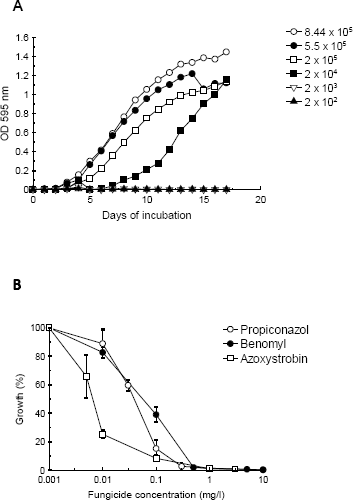
<body><![CDATA[<p><font size="2" face="Verdana, Arial, Helvetica, sans-serif">From each compound, several dilutions   were prepared in sterile distilled water as follows: 0, 0,01; 0,1; 0,5; 1;   5; and 10 mg/l of Benomyl, 0, 0,01; 0,03; 0,1; 0,3; 1 and 10 mg/l of Propiconazol,   0; <sup>0,005; 0,01; 0,1; 1,0; 3,0 and 10 mg/l of</sup> Azoxystrobin.</font></p> <font size="2" face="Verdana, Arial, Helvetica, sans-serif"><i>Inoculum preparation.</i> Fresh monosporic subcultures of different <i>M. fijiensis</i> strains grown for 15 –20 days at 27 °C in Potato Dextrose Agar PDA (BBL, Becton Dickinson Cockeysville, USA) were used as source to obtain the inoculum. Micelium from those subcultures were resuspended in sterile distilled water. The suspension was then fragmented by vortexing with glass beans of 6mm diam. (Schott, Wertheim Germany) and vortexed during 1- 2 min. followed by filtration with sterile &quot;etamine&quot; cloth (100&#956;m pore) to obtain uniform miceliar fragments. Concentration of miceliar fragments was measured by Neubaver chamber (1/10 mm deep, bright line - Boeco, Germany) and adjusted to 2 x 10<sup>4</sup>, 2 x 10<sup>5</sup> and 2 x 10<sup>6</sup> miceliar fragments /ml with water, to test the best working inoculum dilution. &nbsp; <i>Microplate technique.</i>  Standardization of the technique was performed with strain No. 981111 chosen at random, in sterile, flat- bottomed 96- well microplates with low evaporation lid (Falcon- Becton Dickinson). Each well was filled with 50 &#956;l of Sabouraud broth (BBL<sup>TM</sup> Becton Dickinson, Sparks, MD, USA ), 50 &#956;l of the fungal inoculum and 50 &#956;l of the different drug dilutions. Wells filled with 50 &#956;l of Sabouraud medium, 50 &#956;l H2O and 50 &#956;l inoculum were used as positive control. Blanks consisted of 50 &#956;l of Sabouraud medium and 100 &#956;l H20. The microplates were incubated at 27&#730;C for several days. Miceliar growth was measured by spectrophotometer (Biorad model 550). Readings of the OD595 &#951;m were taken for the suspensions in each well were taken daily and up to 17 days. <i>Analysis of the results.</i> Growth percentage was determined using a control that did not receive antifungal treatment and its growth was considered as 100 %. Growth percentage was calculated with the formula: % Growth = (mean growth in each sample/ mean growth in the control)x 100. Data was plotted as percentage of growth inhibition against the logarithm of the fungicide concentration. IC50 was calculated using a curve fitting program (Kyplot version 1.0 beta 8 program) with the formula Y = 100x (A1/X+A1) where Y = % of fungal growth, X = fungicide concentration and A1 = IC50. Restrictive random blocks with different repetition numbers and three repetition per each fungicide product was used as experimental design. Different concentrations (seven for each one) were used in these experiments, a blank and a control, all of them with four repetitions.</font><font face="Verdana, Arial, Helvetica, sans-serif">     <p><font size="2"><b><i>Statistical Analysis</i>. </b>Statistical   analysis of samples was done with a one way analysis of variance with significance   level of 95 %.</font></p>     <p>&nbsp;</p> <font size="3"><b><a name="2"></a>RESULTS</b></font><font size="2"> </font><font size="3" face="Verdana, Arial, Helvetica, sans-serif"><a href="#indice"><img src="/img/revistas/rfnam/v59n2/up.gif" border="0"></a></font><font size="2">     <p><i>M. fijiensis</i> strains were   obtained from single ascospores collected after discharge from infected leaves   on a Petri dish and subcultured on PDA. All isolates used were confirmed as <i>M.   fijiensis</i> by a PCR based method as previously described (Johanson 1993).   Cultures were grown on solid PDA from approximately 20 days until enough mycelium   was available for performing micro plate assays.</p> Inuoculum preparation. We tested two different methods for inoculum preparation. The first method was based on a spectrophotometric assay as has been recommended for filamentous fungi (EspinelIngroff and Kerkering 1991). However this method proved difficult to implement for M. fijiensis and showed a high degree of variability of the inoculum size (data not shown). The second method consisted in counting mycelial fragments with a Neubaver chamber and adjusting fragment concentrations to a desired number (2,5 x 10<sup>5</sup>). This method gave consistent results and was therefore adopted for all the assays.     <p><b><i>Fungal Growth curves</i></b><i>. </i>Several   growth curves of the fungus with inoculum sizes of 2 x 10<sup>2</sup> 2 x 10<sup>4</sup> 2   x10<sup>5</sup> 5 x 10<sup>5</sup> and 15 x 10<sup>5</sup> hyphal fragments   /ml were performed in order to determine which was the best one. As seen in   <a href="#fig01">Figure 1A</a>, adequate growth is seen from inoculum sizes of 2 x 10<sup>5</sup> and   up while there is very little or no growth with 2 x 10<sup>4</sup> and 2 x   10<sup>2</sup>. Fungal growth is rather slow, with an initial lag phase of   about 5 days, followed by a long log phase from the 5th to the 12th day approximately   and reaching a stationary phase from the day 17. Based on these data we decided   to use a 12 day incubation time for growth inhibition assays.</p> </font></font>     <p align="center"><font size="2" face="Verdana, Arial, Helvetica, sans-serif"><b><a name="fig01"></a><img src="/img/revistas/rfnam/v59n2/a02fig01.gif">    <br>   Figure       1.</b>&nbsp; A. growth curve of <i>M. fijiensis</i> in microtiter wells       using Sabouraud broth and different inoculum concentrations. Each microtiter       well was filled with 50 &#956;l of culture media, and 50 &#956;l of the       fungal inoculum. O.D. readings were taken daily at 595 nm. B. growth inhibition       curves of <i>M. fijiensis</i> with different concentrations of antifungal       agents. Each well was filled with 50 &#956;l of Sabouraud broth, 50 &#956;l       of the fungal inoculum and 50 &#956;l of the different drug dilutions.       O.D. readings were taken after 8 days of incubation&nbsp; at 27 &#730;C. </font></p> <font face="Verdana, Arial, Helvetica, sans-serif"><font size="2">     <p>Growth inhibition assays. Assays to determine growth inhibition by the antifungal   agents were setup using different concentrations of the chemical agents and   performing O.D. readings at fixed incubation times. The concentrations chosen   for each compound varied and were based on concentrations recommended by manufacturers   for ascospore germination inhibition assays.  As seen in <a href="#fig01">figure   1B</a> all compounds   tested gave clear inhibition curves which allowed determination of IC50s. <i>Measurement     of IC50 values of isolates collected at different geographical locations. </i>In   order to test the microplate dilution assay and see if we could find significant   differences among strains, we measured IC50 values for 30 <i>M. fijiensis</i> isolates   collected in two different years from several regions in Colombia . Overall,   IC50 values were 0,038 mg/l (+/- 0,023) for propiconazol, 0,045 mg/l (+/-0,022)   for benzymidazole and 0,021 (+/- 0,014) for strobirulin.  As seen in <a href="#tab01">Table   1</a> no statistical difference was found in IC50 values of isolates from different   geographic regions or from isolates collected at different years (<a href="#tab02">Table   2</a>). &nbsp;  </p>     <p align="center"><b><a name="tab01"></a>Table 1.</b>&nbsp; IC50 (mg/ml) averages obtained by the   microplate technique of Benomyl, Propiconazol and Azoxystrobin from all the   strains collected in different Colombian regions.&nbsp; In parenthesis the   Standard deviations of each value.    <br>   <img src="/img/revistas/rfnam/v59n2/a02tab01.gif"></p>     ]]></body>
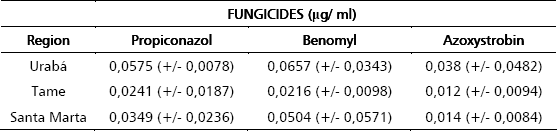
<body><![CDATA[<p align="center"><b><a name="tab02"></a>Table 2.</b>&nbsp; IC50 (mg/ml) averages obtained by the   microplate technique of Benomyl, Propiconazol and Azoxystrobin from all the   strains collected in different years.&nbsp;&nbsp; In parenthesis the Standard   deviations of each value.    <br>   <img src="/img/revistas/rfnam/v59n2/a02tab02.gif"></p>     <p align="center">&nbsp;</p> </font></font>     <p><font size="3" face="Verdana, Arial, Helvetica, sans-serif"><b><a name="3"></a>DISCUSSION </b></font><font size="3" face="Verdana, Arial, Helvetica, sans-serif"><a href="#indice"><img src="/img/revistas/rfnam/v59n2/up.gif" border="0"></a></font></p> <font face="Verdana, Arial, Helvetica, sans-serif"><font size="2">     <p>Regular methods for determination of fungicide   sensitivity to <i>M. fijiensis</i> are time consuming and some times inaccurate   due to the ability and interpretation by the technician. The method described   here offers the advantage of accuracy in the results because it avoids the   subjectivity involved in deciding the presence of spore germination inhibition.   Additionally, it allows determination of IC50 values for individual singleascospore,   cultures which would permit accurate determination of variation sensitivities   within populations. Another method that determines IC50 values based on measurement   of young colony diameter, has been used to study susceptibility of <i>M. fijiensis</i> to   propiconazol (Romero 1997). However, this method has the limitation that size   and viability of mycelial  fragments  are difficult to standardize and <i>M.     fijiensis</i> colonies grow very slowly and are difficult to measure.</p>     <p>Errors on readings of the automated method presented   here can occur due to the nature of the fungal suspension used as inoculum.   It is possible that using conidia instead of mycelial fragments could diminish   the assay’s variability. Nevertheless, fidelity of the results increases when   the number of replica wells is increased.</p>     <p>Using the microplate dilution method we demonstrated   the effect on fungal growth of three fungicides (Benomyl, Propiconazol and   Azoxystrobin) commonly used to control <i>M. fijiensis</i> in banana and plantain   fields. In general, all the three fungicides showed consistent dose dependent   growth inhibition which allowed the determination of IC50 values. The results   of the IC50s (<a href="#tab01">Table 1</a>) shows that all the fungicides used had good growth inhibitory   activity against <i>M. fijiensis</i>. These results are in agreement with the   IC50s obtained from <i>M. fijiensis</i> isolated form different Colombian regions   (<a href="#tab01">Table 1</a>) in two years (<a href="#tab02">Table 2</a>). </p>     <p>The number of samples used in this study does not   allow making accurate conclusions about the resistance status of the fungal   populations studied in the different regions. However, as the method can be   easily scaled up, it has the potential to be used to follow fungal sensitivities   of populations if an appropriate number of fungal strains and good sampling   strategies are used. Furthermore, once a strain is identified as less sensitive   or resistant to a compound, the method allows to accurately measure the level   of resistance of the individual strain. This method also allows the screening   of new antifungal compounds against the fungus.</p>     <p>&nbsp;</p> <b><font size="3"><a name="4"></a>ACKNOWLEDGMENTS</font></b> </font><font size="3" face="Verdana, Arial, Helvetica, sans-serif"><a href="#indice"><img src="/img/revistas/rfnam/v59n2/up.gif" border="0"></a></font><font size="2">     <p>This work was supported in part by the Fondo Colombiano   de Investigaciones Científicas (Colciencias), Colombia grant No. 2213-05-157-97,   The Corporación para Investigaciones Biológicas, CIB and the Postgraduate Program   in Biotechnology of The Universidad Nacional de Colombia, Sede Medellín. We   thanks Dr. Lucia Afanador Kafuri and Dr. Nadya Cardona Bustos for reviewing   and improving the manuscript. </p>     ]]></body>

<body><![CDATA[<p>&nbsp;</p> </font></font>     <p><font size="3" face="Verdana, Arial, Helvetica, sans-serif"><b><a name="5"></a>BIBLIOGRAPHY</b></font> <font size="3" face="Verdana, Arial, Helvetica, sans-serif"><a href="#indice"><img src="/img/revistas/rfnam/v59n2/up.gif" border="0"></a></font></p> <font face="Verdana, Arial, Helvetica, sans-serif"><font size="2">     <!-- ref --><p>Carta informativa Augura (Colombia).   Boletín no. 210 Medellín: Augura.  p.18.&nbsp;&nbsp;&nbsp;&nbsp;&nbsp;&nbsp;&nbsp;&nbsp;[&#160;<a href="javascript:void(0);" onclick="javascript: window.open('/scielo.php?script=sci_nlinks&ref=000055&pid=S0304-2847200600020000200001&lng=','','width=640,height=500,resizable=yes,scrollbars=1,menubar=yes,');">Links</a>&#160;]<!-- end-ref --><!-- ref --><p>5a  Reunión del Grupo de Trabajo de Banano de FRAC.  1998.   Miami, 21-23 de Enero de 1998.  Organizada por Rohm and Haas&nbsp;&nbsp;&nbsp;&nbsp;&nbsp;&nbsp;&nbsp;&nbsp;[&#160;<a href="javascript:void(0);" onclick="javascript: window.open('/scielo.php?script=sci_nlinks&ref=000056&pid=S0304-2847200600020000200002&lng=','','width=640,height=500,resizable=yes,scrollbars=1,menubar=yes,');">Links</a>&#160;]<!-- end-ref --><!-- ref --><p>Cronshaw, K; Lorenz G. and Mappes, D. 1994. Monitoring   results of <i>Mycosphaerella fijiensis</i> to tridemorph. p. 315-321. En:   Heany, S., Slawson, D., Holloman, D. W., Smith, M., Russell, P. E. and Parry,   D. W., eds. Fungicide resistance. En: British Crop Protection Council Monograph.   No. 60.&nbsp;&nbsp;&nbsp;&nbsp;&nbsp;&nbsp;&nbsp;&nbsp;[&#160;<a href="javascript:void(0);" onclick="javascript: window.open('/scielo.php?script=sci_nlinks&ref=000057&pid=S0304-2847200600020000200003&lng=','','width=640,height=500,resizable=yes,scrollbars=1,menubar=yes,');">Links</a>&#160;]<!-- end-ref --><!-- ref --><p>Du Pont. 1983.  Black and yellow sigatokas: improved   identification and management techniques. Florida, U.S.: Du Pont Latin America,   Coral Gables. 17 p.&nbsp;&nbsp;&nbsp;&nbsp;&nbsp;&nbsp;&nbsp;&nbsp;[&#160;<a href="javascript:void(0);" onclick="javascript: window.open('/scielo.php?script=sci_nlinks&ref=000058&pid=S0304-2847200600020000200004&lng=','','width=640,height=500,resizable=yes,scrollbars=1,menubar=yes,');">Links</a>&#160;]<!-- end-ref --><!-- ref --><p>Espinel-Ingroff, A. and Kerkering, T. M. 1991.   Spectrophotometric method of inoculom preparation for the in vitro susceptibility   testing of filamentous fungi. En: Journal of Clinical Microbiology. Vol. 29,   no. 2; p. 393-394.&nbsp;&nbsp;&nbsp;&nbsp;&nbsp;&nbsp;&nbsp;&nbsp;[&#160;<a href="javascript:void(0);" onclick="javascript: window.open('/scielo.php?script=sci_nlinks&ref=000059&pid=S0304-2847200600020000200005&lng=','','width=640,height=500,resizable=yes,scrollbars=1,menubar=yes,');">Links</a>&#160;]<!-- end-ref --><!-- ref --><p> Fullerton, R. H. and Olsen, T. I. 1995. Pathogenic   variability of <i>Mycosphaerella fijiensis</i> Morelet, cause of black sigatoka   in banana and plantain. En: New Zealand Journal of Crop and Horticultural Science.   Vol. 23, no. 1; p. 39-48. &nbsp;&nbsp;&nbsp;&nbsp;&nbsp;&nbsp;&nbsp;&nbsp;[&#160;<a href="javascript:void(0);" onclick="javascript: window.open('/scielo.php?script=sci_nlinks&ref=000060&pid=S0304-2847200600020000200006&lng=','','width=640,height=500,resizable=yes,scrollbars=1,menubar=yes,');">Links</a>&#160;]<!-- end-ref --><!-- ref --><p>Gaulh, F. 1994. Epidemiology and ecology of black   sigatoka (<i>Mycosphaerella fijiensis</i> Morelet) in plantain and banana   in Costa Rica, Central America. Montpellier, France : INIBAP. 120 p.&nbsp;&nbsp;&nbsp;&nbsp;&nbsp;&nbsp;&nbsp;&nbsp;[&#160;<a href="javascript:void(0);" onclick="javascript: window.open('/scielo.php?script=sci_nlinks&ref=000061&pid=S0304-2847200600020000200007&lng=','','width=640,height=500,resizable=yes,scrollbars=1,menubar=yes,');">Links</a>&#160;]<!-- end-ref --><!-- ref --><p>Guzmán, M. y Romero, R. 1997. Comparación de los   fungicidas azoxistrobina, propiconazole y diefeconazole en el control de la   sigatoka negra (<i>Mycosphaerella fijiensis</i> Morelet), en banano (Musa AAA).   En: Corbana. Vol. 22, no. 47; p.  49-59.&nbsp;&nbsp;&nbsp;&nbsp;&nbsp;&nbsp;&nbsp;&nbsp;[&#160;<a href="javascript:void(0);" onclick="javascript: window.open('/scielo.php?script=sci_nlinks&ref=000062&pid=S0304-2847200600020000200008&lng=','','width=640,height=500,resizable=yes,scrollbars=1,menubar=yes,');">Links</a>&#160;]<!-- end-ref --><!-- ref --><p>Johanson A. and Jeger M. 1993. Use of PCR for detection   of <i>Mycosphaerella fijiensis</i> and <i>Mycosphaerella musicola</i>, the   causal agents of sigatoka leaf spot in banana and plantain. En<i>: </i>Mycology   Research. Vol. 97, no.6; p. 670-674.&nbsp;&nbsp;&nbsp;&nbsp;&nbsp;&nbsp;&nbsp;&nbsp;[&#160;<a href="javascript:void(0);" onclick="javascript: window.open('/scielo.php?script=sci_nlinks&ref=000063&pid=S0304-2847200600020000200009&lng=','','width=640,height=500,resizable=yes,scrollbars=1,menubar=yes,');">Links</a>&#160;]<!-- end-ref --><!-- ref --><p>Molina, G. and Kraus, J. P. 1989. A phytotoxic   activity in extracts of cultures of <i>Mycosphaerella fijiensis </i>var. difformis   and its use to evaluate host resistance to black sigatoka. En: Plant Disease.   Vol. 73, no. 2; p. 142-143.&nbsp;&nbsp;&nbsp;&nbsp;&nbsp;&nbsp;&nbsp;&nbsp;[&#160;<a href="javascript:void(0);" onclick="javascript: window.open('/scielo.php?script=sci_nlinks&ref=000064&pid=S0304-2847200600020000200010&lng=','','width=640,height=500,resizable=yes,scrollbars=1,menubar=yes,');">Links</a>&#160;]<!-- end-ref --><!-- ref --><p>Pérez L. 1996. Manual para el control integrado   de la sigatoka negra (<i>Mycosphaerella fijiensis</i>) y sigatoka amarilla   (<i>Mycosphaerella musicola</i> Leach Mulder) en banano y plátano. FAO. Ministerio   de Agricultura de la República de Cuba. 54 p.&nbsp;&nbsp;&nbsp;&nbsp;&nbsp;&nbsp;&nbsp;&nbsp;[&#160;<a href="javascript:void(0);" onclick="javascript: window.open('/scielo.php?script=sci_nlinks&ref=000065&pid=S0304-2847200600020000200011&lng=','','width=640,height=500,resizable=yes,scrollbars=1,menubar=yes,');">Links</a>&#160;]<!-- end-ref --><!-- ref --><p>Romero, R. A. and Sutton, T. B. 1997. Sensitivity   of <i>Mycosphaerella fijiensis</i>, causal agent of black Sigatoka of banana,   to propiconazole. En<i>: </i>Phytopathology.  Vol. 87; p. 96-100.&nbsp;&nbsp;&nbsp;&nbsp;&nbsp;&nbsp;&nbsp;&nbsp;[&#160;<a href="javascript:void(0);" onclick="javascript: window.open('/scielo.php?script=sci_nlinks&ref=000066&pid=S0304-2847200600020000200012&lng=','','width=640,height=500,resizable=yes,scrollbars=1,menubar=yes,');">Links</a>&#160;]<!-- end-ref --><!-- ref --><p>Sierotzki, H., Parisi, S., Steinfeld, U., Tenzer, I., Poirey, S. and Gisi, U. 2000. Mode of resistance to respiratory inhibitors at the cytocrhome Bc1 enzyme complex of <i>Mycosphaerella Fijiensis</i> field isolates. En: Pest Management Science. Vol. 56, no. 10; p. 833-841.&nbsp;&nbsp;&nbsp;&nbsp;&nbsp;&nbsp;&nbsp;&nbsp;[&#160;<a href="javascript:void(0);" onclick="javascript: window.open('/scielo.php?script=sci_nlinks&ref=000067&pid=S0304-2847200600020000200013&lng=','','width=640,height=500,resizable=yes,scrollbars=1,menubar=yes,');">Links</a>&#160;]<!-- end-ref --><!-- ref --><p>Stierle, A. A., Upadhyay, R., Hershenhorn, J.,   Strobel, G. A. and Molina, G. 1991. The phytotoxins of <i>Mycosphaerella fijiensis</i>,   the causative agent of black sigatoka disease of bananas and plantains. En<i>:</i> Experientia   Vol. 47, no. 8; p. 853-895.&nbsp;&nbsp;&nbsp;&nbsp;&nbsp;&nbsp;&nbsp;&nbsp;[&#160;<a href="javascript:void(0);" onclick="javascript: window.open('/scielo.php?script=sci_nlinks&ref=000068&pid=S0304-2847200600020000200014&lng=','','width=640,height=500,resizable=yes,scrollbars=1,menubar=yes,');">Links</a>&#160;]<!-- end-ref --><!-- ref --><p>Stover, R. H. 1969. The <i>Mycosphaerella </i>species   associated with banana leaf spots. En: Tropical Agriculture ( Trinidad).   Vol. 46; p. 325-332.&nbsp;&nbsp;&nbsp;&nbsp;&nbsp;&nbsp;&nbsp;&nbsp;[&#160;<a href="javascript:void(0);" onclick="javascript: window.open('/scielo.php?script=sci_nlinks&ref=000069&pid=S0304-2847200600020000200015&lng=','','width=640,height=500,resizable=yes,scrollbars=1,menubar=yes,');">Links</a>&#160;]<!-- end-ref --><!-- ref --><p>________. 1980. Sigatoka leaf spot of banana and   plantains. <i>En:</i> Plant Disease. Vol. 64, no. 8; p. 750-755.&nbsp;&nbsp;&nbsp;&nbsp;&nbsp;&nbsp;&nbsp;&nbsp;[&#160;<a href="javascript:void(0);" onclick="javascript: window.open('/scielo.php?script=sci_nlinks&ref=000070&pid=S0304-2847200600020000200016&lng=','','width=640,height=500,resizable=yes,scrollbars=1,menubar=yes,');">Links</a>&#160;]<!-- end-ref --><!-- ref --><p>________ and Simmonds, N. W. 1987. Bananas 3ed.   New York: Longman Scientific and Technical. 468 p.&nbsp;&nbsp;&nbsp;&nbsp;&nbsp;&nbsp;&nbsp;&nbsp;[&#160;<a href="javascript:void(0);" onclick="javascript: window.open('/scielo.php?script=sci_nlinks&ref=000071&pid=S0304-2847200600020000200017&lng=','','width=640,height=500,resizable=yes,scrollbars=1,menubar=yes,');">Links</a>&#160;]<!-- end-ref --> ]]></body><back>
<ref-list>
<ref id="B1">
<nlm-citation citation-type="book">
<source><![CDATA[Carta informativa Augura ( Colombia ): Boletín no. 210]]></source>
<year></year>
<publisher-loc><![CDATA[Medellín ]]></publisher-loc>
<publisher-name><![CDATA[Augura]]></publisher-name>
</nlm-citation>
</ref>
<ref id="B2">
<nlm-citation citation-type="confpro">
<source><![CDATA[]]></source>
<year></year>
<conf-name><![CDATA[ 5a Reunión del Grupo de Trabajo de Banano de FRAC.]]></conf-name>
<conf-date>1998</conf-date><conf-date>21-23 de Enero de 1998</conf-date>
<conf-loc>Miami </conf-loc>
</nlm-citation>
</ref>
<ref id="B3">
<nlm-citation citation-type="">
<person-group person-group-type="author">
<name>
<surname><![CDATA[Cronshaw]]></surname>
<given-names><![CDATA[K]]></given-names>
</name>
<name>
<surname><![CDATA[Lorenz]]></surname>
<given-names><![CDATA[G.]]></given-names>
</name>
<name>
<surname><![CDATA[Mappes]]></surname>
<given-names><![CDATA[D.]]></given-names>
</name>
</person-group>
<article-title xml:lang="en"><![CDATA[Monitoring results of Mycosphaerella fijiensis to tridemorph]]></article-title>
<person-group person-group-type="editor">
<name>
<surname><![CDATA[Heany]]></surname>
<given-names><![CDATA[S.]]></given-names>
</name>
<name>
<surname><![CDATA[Slawson]]></surname>
<given-names><![CDATA[D.]]></given-names>
</name>
<name>
<surname><![CDATA[Holloman]]></surname>
<given-names><![CDATA[D. W.]]></given-names>
</name>
<name>
<surname><![CDATA[Smith]]></surname>
<given-names><![CDATA[M.]]></given-names>
</name>
<name>
<surname><![CDATA[Russell]]></surname>
<given-names><![CDATA[P. E.]]></given-names>
</name>
<name>
<surname><![CDATA[Parry]]></surname>
<given-names><![CDATA[D. W.]]></given-names>
</name>
</person-group>
<source><![CDATA[Fungicide resistance]]></source>
<year>1994</year>
<page-range>315-321</page-range></nlm-citation>
</ref>
<ref id="B4">
<nlm-citation citation-type="book">
<collab>Du Pont</collab>
<source><![CDATA[Black and yellow sigatokas: improved identification and management techniques]]></source>
<year>1983</year>
<publisher-loc><![CDATA[Florida ]]></publisher-loc>
<publisher-name><![CDATA[Du Pont Latin America]]></publisher-name>
</nlm-citation>
</ref>
<ref id="B5">
<nlm-citation citation-type="journal">
<person-group person-group-type="author">
<name>
<surname><![CDATA[Espinel-Ingroff]]></surname>
<given-names><![CDATA[A.]]></given-names>
</name>
<name>
<surname><![CDATA[Kerkering]]></surname>
<given-names><![CDATA[T. M.]]></given-names>
</name>
</person-group>
<article-title xml:lang="en"><![CDATA[Spectrophotometric method of inoculom preparation for the in vitro susceptibility testing of filamentous fungi]]></article-title>
<source><![CDATA[Journal of Clinical Microbiology]]></source>
<year>1991</year>
<volume>29</volume>
<numero>2</numero>
<issue>2</issue>
<page-range>393-394</page-range></nlm-citation>
</ref>
<ref id="B6">
<nlm-citation citation-type="journal">
<person-group person-group-type="author">
<name>
<surname><![CDATA[Fullerton]]></surname>
<given-names><![CDATA[R. H.]]></given-names>
</name>
<name>
<surname><![CDATA[Olsen]]></surname>
<given-names><![CDATA[T. I.]]></given-names>
</name>
</person-group>
<article-title xml:lang="en"><![CDATA[Pathogenic variability of Mycosphaerella fijiensis Morelet, cause of black sigatoka in banana and plantain]]></article-title>
<source><![CDATA[New Zealand Journal of Crop and Horticultural Science]]></source>
<year>1995</year>
<volume>23</volume>
<numero>1</numero>
<issue>1</issue>
<page-range>39-48</page-range></nlm-citation>
</ref>
<ref id="B7">
<nlm-citation citation-type="book">
<person-group person-group-type="author">
<name>
<surname><![CDATA[Gaulh]]></surname>
<given-names><![CDATA[F.]]></given-names>
</name>
</person-group>
<source><![CDATA[Epidemiology and ecology of black sigatoka (Mycosphaerella fijiensis Morelet) in plantain and banana in Costa Rica , Central America]]></source>
<year>1994</year>
<publisher-loc><![CDATA[Montpellier ]]></publisher-loc>
<publisher-name><![CDATA[INIBAP]]></publisher-name>
</nlm-citation>
</ref>
<ref id="B8">
<nlm-citation citation-type="journal">
<person-group person-group-type="author">
<name>
<surname><![CDATA[Guzmán]]></surname>
<given-names><![CDATA[M.]]></given-names>
</name>
<name>
<surname><![CDATA[Romero]]></surname>
<given-names><![CDATA[R.]]></given-names>
</name>
</person-group>
<article-title xml:lang="es"><![CDATA[Comparación de los fungicidas azoxistrobina, propiconazole y diefeconazole en el control de la sigatoka negra (Mycosphaerella fijiensis Morelet), en banano (Musa AAA)]]></article-title>
<source><![CDATA[Corbana]]></source>
<year>1997</year>
<volume>22</volume>
<numero>47</numero>
<issue>47</issue>
<page-range>49-59</page-range></nlm-citation>
</ref>
<ref id="B9">
<nlm-citation citation-type="journal">
<person-group person-group-type="author">
<name>
<surname><![CDATA[Johanson]]></surname>
<given-names><![CDATA[A.]]></given-names>
</name>
<name>
<surname><![CDATA[Jeger]]></surname>
<given-names><![CDATA[M.]]></given-names>
</name>
</person-group>
<article-title xml:lang="en"><![CDATA[Use of PCR for detection of Mycosphaerella fijiensis and Mycosphaerella musicola, the causal agents of sigatoka leaf spot in banana and plantain.]]></article-title>
<source><![CDATA[Mycology Research]]></source>
<year>1993</year>
<volume>97</volume>
<numero>6</numero>
<issue>6</issue>
<page-range>670-674</page-range></nlm-citation>
</ref>
<ref id="B10">
<nlm-citation citation-type="journal">
<person-group person-group-type="author">
<name>
<surname><![CDATA[Molina]]></surname>
<given-names><![CDATA[G.]]></given-names>
</name>
<name>
<surname><![CDATA[Kraus]]></surname>
<given-names><![CDATA[J. P.]]></given-names>
</name>
</person-group>
<article-title xml:lang="en"><![CDATA[A phytotoxic activity in extracts of cultures of Mycosphaerella fijiensis var. difformis and its use to evaluate host resistance to black sigatoka.]]></article-title>
<source><![CDATA[Plant Disease.]]></source>
<year>1989</year>
<volume>73</volume>
<numero>2</numero>
<issue>2</issue>
<page-range>142-143</page-range></nlm-citation>
</ref>
<ref id="B11">
<nlm-citation citation-type="book">
<person-group person-group-type="author">
<name>
<surname><![CDATA[Pérez]]></surname>
<given-names><![CDATA[L.]]></given-names>
</name>
</person-group>
<source><![CDATA[Manual para el control integrado de la sigatoka negra (Mycosphaerella fijiensis) y sigatoka amarilla (Mycosphaerella musicola Leach Mulder) en banano y plátano]]></source>
<year>1996</year>
<publisher-name><![CDATA[Ministerio de Agricultura de la República de Cuba]]></publisher-name>
</nlm-citation>
</ref>
<ref id="B12">
<nlm-citation citation-type="journal">
<person-group person-group-type="author">
<name>
<surname><![CDATA[Romero]]></surname>
<given-names><![CDATA[R. A.]]></given-names>
</name>
<name>
<surname><![CDATA[Sutton]]></surname>
<given-names><![CDATA[T. B.]]></given-names>
</name>
</person-group>
<article-title xml:lang="en"><![CDATA[Sensitivity of Mycosphaerella fijiensis, causal agent of black Sigatoka of banana, to propiconazole.]]></article-title>
<source><![CDATA[Phytopathology]]></source>
<year>1997</year>
<volume>87</volume>
<page-range>96-100</page-range></nlm-citation>
</ref>
<ref id="B13">
<nlm-citation citation-type="journal">
<person-group person-group-type="author">
<name>
<surname><![CDATA[Sierotzki]]></surname>
<given-names><![CDATA[H.]]></given-names>
</name>
<name>
<surname><![CDATA[Parisi]]></surname>
<given-names><![CDATA[S.]]></given-names>
</name>
<name>
<surname><![CDATA[Steinfeld]]></surname>
<given-names><![CDATA[U.]]></given-names>
</name>
<name>
<surname><![CDATA[Tenzer]]></surname>
<given-names><![CDATA[I.]]></given-names>
</name>
<name>
<surname><![CDATA[Poirey]]></surname>
<given-names><![CDATA[S.]]></given-names>
</name>
<name>
<surname><![CDATA[Gisi]]></surname>
<given-names><![CDATA[U.]]></given-names>
</name>
</person-group>
<article-title xml:lang="en"><![CDATA[Mode of resistance to respiratory inhibitors at the cytocrhome Bc1 enzyme complex of Mycosphaerella Fijiensis field isolates.]]></article-title>
<source><![CDATA[Pest Management Science]]></source>
<year>2000</year>
<volume>56</volume>
<numero>10</numero>
<issue>10</issue>
<page-range>833-841</page-range></nlm-citation>
</ref>
<ref id="B14">
<nlm-citation citation-type="journal">
<person-group person-group-type="author">
<name>
<surname><![CDATA[Stierle]]></surname>
<given-names><![CDATA[A. A.]]></given-names>
</name>
<name>
<surname><![CDATA[Upadhyay]]></surname>
<given-names><![CDATA[R.]]></given-names>
</name>
<name>
<surname><![CDATA[Hershenhorn]]></surname>
<given-names><![CDATA[J.]]></given-names>
</name>
<name>
<surname><![CDATA[Strobel]]></surname>
<given-names><![CDATA[G. A.]]></given-names>
</name>
<name>
<surname><![CDATA[Molina]]></surname>
<given-names><![CDATA[G.]]></given-names>
</name>
</person-group>
<article-title xml:lang="en"><![CDATA[The phytotoxins of Mycosphaerella fijiensis, the causative agent of black sigatoka disease of bananas and plantains.]]></article-title>
<source><![CDATA[Experientia]]></source>
<year>1991</year>
<volume>47</volume>
<numero>8</numero>
<issue>8</issue>
<page-range>853-895</page-range></nlm-citation>
</ref>
<ref id="B15">
<nlm-citation citation-type="journal">
<person-group person-group-type="author">
<name>
<surname><![CDATA[Stover]]></surname>
<given-names><![CDATA[R. H.]]></given-names>
</name>
</person-group>
<article-title xml:lang="en"><![CDATA[The Mycosphaerella species associated with banana leaf spots.]]></article-title>
<source><![CDATA[Tropical Agriculture]]></source>
<year>1969</year>
<volume>46</volume>
<page-range>325-332</page-range><publisher-loc><![CDATA[Trinidad ]]></publisher-loc>
</nlm-citation>
</ref>
<ref id="B16">
<nlm-citation citation-type="journal">
<person-group person-group-type="author">
<name>
<surname><![CDATA[Stover]]></surname>
<given-names><![CDATA[R. H.]]></given-names>
</name>
</person-group>
<article-title xml:lang="en"><![CDATA[Sigatoka leaf spot of banana and plantains.]]></article-title>
<source><![CDATA[Plant Disease]]></source>
<year>1980</year>
<volume>64</volume>
<numero>8</numero>
<issue>8</issue>
<page-range>750-755</page-range></nlm-citation>
</ref>
<ref id="B17">
<nlm-citation citation-type="book">
<person-group person-group-type="author">
<name>
<surname><![CDATA[Stover]]></surname>
<given-names><![CDATA[R. H.]]></given-names>
</name>
</person-group>
<person-group person-group-type="editor">
<name>
</name>
<name>
<surname><![CDATA[Simmonds]]></surname>
<given-names><![CDATA[N. W.]]></given-names>
</name>
</person-group>
<source><![CDATA[Bananas]]></source>
<year>1987</year>
<edition>3ed</edition>
<page-range>468 p.</page-range><publisher-loc><![CDATA[New York ]]></publisher-loc>
<publisher-name><![CDATA[Longman Scientific and Technical]]></publisher-name>
</nlm-citation>
</ref>
</ref-list>
</back>
</article>