<?xml version="1.0" encoding="ISO-8859-1"?><article xmlns:mml="http://www.w3.org/1998/Math/MathML" xmlns:xlink="http://www.w3.org/1999/xlink" xmlns:xsi="http://www.w3.org/2001/XMLSchema-instance">
<front>
<journal-meta>
<journal-id>0304-2847</journal-id>
<journal-title><![CDATA[Revista Facultad Nacional de Agronomía Medellín]]></journal-title>
<abbrev-journal-title><![CDATA[Rev. Fac. Nac. Agron. Medellín]]></abbrev-journal-title>
<issn>0304-2847</issn>
<publisher>
<publisher-name><![CDATA[Facultad de Ciencias Agrarias - Universidad Nacional de Colombia]]></publisher-name>
</publisher>
</journal-meta>
<article-meta>
<article-id>S0304-28472007000100001</article-id>
<title-group>
<article-title xml:lang="en"><![CDATA[A REVIEW ON BENEFICIAL EFFECTS OF RHIZOSPHERE BACTERIA ON SOIL NUTRIENT AVAILABILITY AND PLANT NUTRIENT UPTAKE]]></article-title>
<article-title xml:lang="es"><![CDATA[EFECTOS BENEFICOS DE BACTERIAS RIZOSFÉRICAS EN LA DISPONIBILIDAD DE NUTRIENTES EN EL SUELO Y LA ABSORCIÓN DE NUTRIENTES POR LAS PLANTAS]]></article-title>
</title-group>
<contrib-group>
<contrib contrib-type="author">
<name>
<surname><![CDATA[Osorio Vega]]></surname>
<given-names><![CDATA[Nelson Walter]]></given-names>
</name>
<xref ref-type="aff" rid="A01"/>
</contrib>
</contrib-group>
<aff id="A01">
<institution><![CDATA[,. Universidad Nacional de Colombia, Sede Medellín Facultad de Ciencias ]]></institution>
<addr-line><![CDATA[ ]]></addr-line>
</aff>
<pub-date pub-type="pub">
<day>00</day>
<month>06</month>
<year>2007</year>
</pub-date>
<pub-date pub-type="epub">
<day>00</day>
<month>06</month>
<year>2007</year>
</pub-date>
<volume>60</volume>
<numero>1</numero>
<fpage>3621</fpage>
<lpage>3643</lpage>
<copyright-statement/>
<copyright-year/>
<self-uri xlink:href="http://www.scielo.org.co/scielo.php?script=sci_arttext&amp;pid=S0304-28472007000100001&amp;lng=en&amp;nrm=iso"></self-uri><self-uri xlink:href="http://www.scielo.org.co/scielo.php?script=sci_abstract&amp;pid=S0304-28472007000100001&amp;lng=en&amp;nrm=iso"></self-uri><self-uri xlink:href="http://www.scielo.org.co/scielo.php?script=sci_pdf&amp;pid=S0304-28472007000100001&amp;lng=en&amp;nrm=iso"></self-uri><abstract abstract-type="short" xml:lang="en"><p><![CDATA[This paper is a review of the benefits of rhizosphere bacteria on plant nutrition. The interaction between plant and phosphate-solubilizing- bacteria is explained in more detail and used as model to illustrate the role that rhizosphere bacteria play on soil nutrient availability. Environmental conditions of rhizosphere and mycorrhizosphere are also discussed. Plants can release carbohydrates, aminoacids, lipids, and vitamins trough their roots to stimulate microorganisms in the soil. The soil volume affected by these root exudates, aproximately 2 mm from the root surface, is termed rhizosphere. Rhizosphere bacteria participate in the geochemical cycling of nutrients and determine their availability for plants and soil microbial community. For instance, in the rhizosphere there are organisms able to fix N2 forming specialized structures (e.g., Rhizobium and related genera) or simply establishing associative relationships (e.g. Azospirillium, Acetobacter). On the other hand, bacterial ammonifiers and nitrifiers are responsible for the conversion of organic N compounds into inorganic forms (NH4+ and NO3-) which are available for plants. Rhizosphere bacteria can also enhance the solubility of insoluble minerals that control the availability of phosphorus (native or applied) using for that organic acids or producing phosphatases that act on organic phosphorus pools. The availability of sulfur, iron and manganese are also affected by redox reactions carried out by rhizosphere bacteria. Likewise, chelating agents can control the availability of micronutrients and participate in mechanisms of biocontrol of plant pathogens. Due to these and other benefits on plant growth, some rhizosphere bacteria have been called Plant Growth Promoting Rhizobacteria (PGPR). The benefits of PGPR have also been obtained, and even enhanced, in presence of mycorrhizal fungi. Some authors have employed the term "mycorrhizosphere" to describe the part of the soil affected by these interactions.]]></p></abstract>
<abstract abstract-type="short" xml:lang="es"><p><![CDATA[Este artículo se constituye en una revisión de los beneficios de bacterias rizosféricas sobre la nutrición vegetal. La interacción entre planta y bacterias solubilizadoras de fosfato es explicada en mayor detalle y usada como modelo para ilustrar el rol que algunas bacterias de la rizosfera juegan en la disponibilidad de nutrientes en el suelo. Las condiciones ambientales de la rizosfera también se discuten con detalle. Los beneficios de estas bacterias han sido obtenidos, y mejorados, en presencia de hongos formadores de micorrizas. Algunos autores han acuñado el termino "micorrizosfera" para describir la parte del suelo afectada por estas interacciones. Las plantas pueden liberar carbohidratos, aminoácidos, lípidos y vitaminas, entre otros, a través de sus raíces y estimular con ello la actividad y el número de microorganismos del suelo que las rodea. Este volumen de suelo afectado por tales exudados, aproximadamente 2 mm desde la superficie de la raíz, es llamado rizosfera. Las bacterias rizosfericas participan en el ciclo geoquímico de nutrientes y determinan su disponibilidad para las plantas y la comunidad microbial del suelo. Por ejemplo, en la rizosfera algunas bacterias fijan N2 simbiótica o asociativamente, otras son importantes en la conversión del nitrógeno de compuestos orgánicos a formas inorgánicas (NH4+ y NO3-) disponibles para las plantas. También es relevante la habilidad de algunas bacterias rizosféricas para disolver fosfatos insolubles (nativo y aplicado) a través de ácidos orgánicos, mientras que otras son más activas en la liberación de fosfato de compuestos orgánicos mediante enzimas fosfatasas. Por otro lado, la disponibilidad del azufre, hierro, manganeso es afectada por reacciones bioquímicas de oxido-reducción llevadas a cabo por bacterias de la rizosfera. De la misma manera, agentes quelatantes liberados por estas bacterias controlan la disponibilidad y absorción de micronutrientes y participan en el biocontrol de patógenos de plantas. Debido a estos beneficios sobre la nutrición y el crecimiento vegetal estas bacterias rizosfericas han sido llamadas "rizobacterias promotoras del crecimiento vegetal" (PGPR, por sus siglas en inglés).]]></p></abstract>
<kwd-group>
<kwd lng="en"><![CDATA[rhizosphere]]></kwd>
<kwd lng="en"><![CDATA[plant growth promoting rhizobacteria]]></kwd>
<kwd lng="en"><![CDATA[phosphate solubilizing microorganisms]]></kwd>
<kwd lng="en"><![CDATA[nutrient cycling]]></kwd>
<kwd lng="es"><![CDATA[rizosfera]]></kwd>
<kwd lng="es"><![CDATA[rizobacterias promotoras del crecimiento vegetal]]></kwd>
<kwd lng="es"><![CDATA[microorganismos solubilizadores de fosfato]]></kwd>
<kwd lng="es"><![CDATA[ciclo de nutrientes]]></kwd>
</kwd-group>
</article-meta>
</front><body><![CDATA[ <p><font size="4" face="Verdana, Arial, Helvetica, sans-serif"><b>A REVIEW ON BENEFICIAL EFFECTS     OF RHIZOSPHERE BACTERIA ON SOIL NUTRIENT AVAILABILITY AND PLANT NUTRIENT     UPTAKE</b></font></p>     <p><font size="2" face="Verdana, Arial, Helvetica, sans-serif"><b><i>EFECTOS         BENEFICOS DE BACTERIAS RIZOSF&Eacute;RICAS EN LA DISPONIBILIDAD DE NUTRIENTES EN EL SUELO Y LA ABSORCI&Oacute;N DE NUTRIENTES POR LAS PLANTAS</i></b></font></p>     <p>&nbsp;</p>     <p><font size="2" face="Verdana, Arial, Helvetica, sans-serif"><b>Nelson Walter Osorio Vega<sup>1</sup></b></font></p>     <p>&nbsp;</p>     <p><font size="2" face="Verdana, Arial, Helvetica, sans-serif"><b><sup>1</sup></b> <i>Profesor       Asociado. Universidad Nacional de Colombia, Sede Medell&iacute;n. Facultad de Ciencias. A.A. 3840, Medell&iacute;n, Colombia. &lt;<a href="mailto:nwosorio@unalmed.edu.co">nwosorio@unalmed.edu.co</a>&gt;</i></font></p>     <p>&nbsp;</p>     <p><font size="2" face="Verdana, Arial, Helvetica, sans-serif"><b>Recibido: Octubre 26 de 2006; aceptado: mayo 8 de 2007.</b></font></p> <hr>     <p><font size="2" face="Verdana, Arial, Helvetica, sans-serif"><b><i>ABSTRACT</i></b></font></p>     <p><font size="2" face="Verdana, Arial, Helvetica, sans-serif"><i>This paper is a review of the benefits of rhizosphere bacteria on plant     nutrition. The interaction between plant and phosphate-solubilizing- bacteria     is explained in more detail and used as model to illustrate the role that     rhizosphere bacteria play on soil nutrient availability. Environmental conditions     of rhizosphere and mycorrhizosphere are also discussed. Plants can release     carbohydrates, aminoacids, lipids, and vitamins trough their roots to stimulate     microorganisms in the soil. The soil volume affected by these root exudates,     aproximately 2 mm from the root surface, is termed rhizosphere. Rhizosphere     bacteria participate in the geochemical cycling of nutrients and determine     their availability for plants and soil microbial community. For instance,     in the rhizosphere there are organisms able to fix N<sub>2</sub> forming     specialized structures (e.g., Rhizobium and related genera) or simply establishing     associative relationships (e.g. Azospirillium, Acetobacter). On the other     hand, bacterial ammonifiers and nitrifiers are responsible for the conversion     of organic N compounds into inorganic forms (NH<sub>4</sub><sup>+</sup> and     NO<sub>3</sub><sup>-</sup>) which are available for plants. Rhizosphere bacteria     can also enhance the solubility of insoluble minerals that control the availability     of phosphorus (native or applied) using for that organic acids or producing     phosphatases that act on organic phosphorus pools. The availability of sulfur,     iron and manganese are also affected by redox reactions carried out by rhizosphere     bacteria. Likewise, chelating agents can control the availability of micronutrients     and participate in mechanisms of biocontrol of plant pathogens. Due to these     and other benefits on plant growth, some rhizosphere bacteria have been called     Plant Growth Promoting Rhizobacteria (PGPR). The benefits of PGPR have also     been obtained, and even enhanced, in presence of mycorrhizal fungi. Some     authors have employed the term “mycorrhizosphere” to describe the part of     the soil affected by these interactions.</i></font></p>     ]]></body>
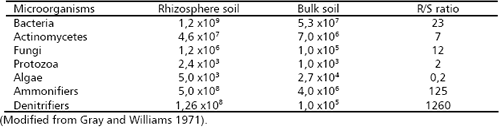
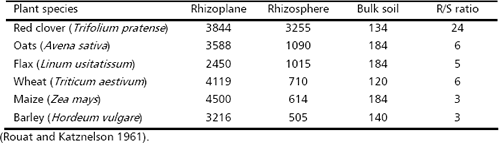
<body><![CDATA[<p><font size="2" face="Verdana, Arial, Helvetica, sans-serif"><b>Key words</b>: rhizosphere, plant growth promoting rhizobacteria, phosphate   solubilizing microorganisms, nutrient cycling.</font></p> <hr>     <p><font size="2" face="Verdana, Arial, Helvetica, sans-serif"><b><i>RESUMEN</i></b></font></p>     <p><font size="2" face="Verdana, Arial, Helvetica, sans-serif"><i>Este artículo se constituye en una revisión     de los beneficios de bacterias rizosféricas sobre la nutrición vegetal. La     interacción entre planta y bacterias solubilizadoras de fosfato es explicada     en mayor detalle y usada como modelo para ilustrar el rol que algunas bacterias     de la rizosfera juegan en la disponibilidad de nutrientes en el suelo. Las     condiciones ambientales de la rizosfera también se discuten con detalle.     Los beneficios de estas bacterias han sido obtenidos, y mejorados, en presencia     de hongos formadores de micorrizas. Algunos autores han acuñado el termino “micorrizosfera” para     describir la parte del suelo afectada por estas interacciones. Las     plantas pueden liberar carbohidratos, aminoácidos, lípidos y vitaminas, entre     otros, a través de sus raíces y estimular con ello la actividad y el número     de microorganismos del suelo que las rodea. Este volumen de suelo afectado     por tales exudados, aproximadamente 2 mm desde la superficie de la raíz,     es llamado rizosfera. Las bacterias rizosfericas participan en el ciclo geoquímico     de nutrientes y determinan su disponibilidad para las plantas y la comunidad     microbial del suelo. Por ejemplo, en la rizosfera algunas bacterias fijan     N<sub>2</sub> simbiótica o asociativamente, otras son importantes en la conversión     del nitrógeno de compuestos orgánicos a formas inorgánicas (NH<sub>4</sub><sup>+</sup> y     NO<sub>3</sub><sup>-</sup>) disponibles para las plantas. También es relevante     la habilidad de algunas bacterias rizosféricas para disolver fosfatos insolubles     (nativo y aplicado) a través de ácidos orgánicos, mientras que otras son     más activas en la liberación de fosfato de compuestos orgánicos mediante     enzimas fosfatasas. Por otro lado, la disponibilidad del azufre, hierro,     manganeso es afectada por reacciones bioquímicas de oxido-reducción llevadas     a cabo por bacterias de la rizosfera. De la misma manera, agentes quelatantes     liberados por estas bacterias controlan la disponibilidad y absorción de     micronutrientes y participan en el biocontrol de patógenos de plantas. Debido     a estos beneficios sobre la nutrición y el crecimiento vegetal estas bacterias     rizosfericas han sido llamadas   “rizobacterias promotoras del crecimiento vegetal” (PGPR, por sus siglas en   inglés).</i></font></p>     <p><font size="2" face="Verdana, Arial, Helvetica, sans-serif"><b>Palabras claves:</b> rizosfera, rizobacterias   promotoras del crecimiento vegetal, microorganismos solubilizadores de fosfato,   ciclo de nutrientes.</font></p> <hr>     <p><font size="2" face="Verdana, Arial, Helvetica, sans-serif"><a name="indice"></a><a href="#1"><b><img src="/img/revistas/rfnam/v60n1/down.gif" border="0"></b></a><b> CONCLUSIONS    <br>           <a href="#2"><img src="/img/revistas/rfnam/v60n1/down.gif" border="0"></a> ACKNOWLEDGEMENTS    <br>       <a href="#3"><img src="/img/revistas/rfnam/v60n1/down.gif" border="0"></a> REFERENCES</b></font></p> <hr>     <p>&nbsp;</p>     <p><font size="2" face="Verdana, Arial, Helvetica, sans-serif"><b><i>Rhizosphere</i>. </b>The rhizosphere   is the region of soil that is immediately near to the root surface and that   is affected by root exudates (Kennedy 1999); it was described for first time   by Lorenz Hiltner 1904. There are different types of substances that diffuse   from the roots and that stimulate the microbial activity, such as carbohydrates   (sugars and oligo-saccharides), organic acids, vitamins, nucleotides, flavonoids,   enzymes, hormones, and volatile compounds (Prescott, Harley and Klein 1999). </font></p>     <p><font size="2" face="Verdana, Arial, Helvetica, sans-serif">The result is     a dense and active microbial population that interacts with the roots and     within it. The rhizosphere effect on the soil microbial population can be     measured comparing the population density (colonies forming units, CFU) between     the rhizosphere soil (R) and the bulk soil (S), for which the “R/S ratio” is     employed (Atlas and Bartha 1997). The rhizosphere effect is higher for bacteria     followed by fungi (<a href="#tab01">Table 1</a>) and even higher for some functional groups of     bacteria (e.g., ammonifiers, denitrifiers). By contrast algae exhibit more     number in the bulk soil than in the rhizosphere. The type of plant can also     affect the R/S ratio, which can be associated with the amount and type of   root exudates (<a href="#tab02">Table 2</a>). </font></p>     ]]></body>
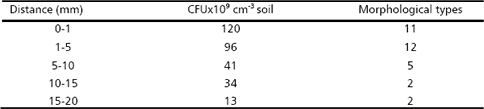
<body><![CDATA[<p align="center"><font size="2" face="Verdana, Arial, Helvetica, sans-serif"><b><a name="tab01"></a>Table       1.</b> Number of microorganisms (CFU g<sup>-1 </sup>soil) in the rhizosphere       (R) of wheat (<i>Triticum aestivum</i> L.) and bulk soil (S) and their       R/S ratio. </font>    <br> <img src="/img/revistas/rfnam/v60n1/a01tab01.gif"></p>     <p align="center"><font size="2" face="Verdana, Arial, Helvetica, sans-serif"><b><a name="tab02"></a>Table       2.</b> Number of bacteria (CFUx10<sup>6</sup> g<sup>-1 </sup>soil or root       dry mass) in the rhizoplane and rhizosphere of different plants, and in       the bulk soil (S) and their R/S ratio </font>    <br> <img src="/img/revistas/rfnam/v60n1/a01tab02.gif"></p>     <p><font size="2" face="Verdana, Arial, Helvetica, sans-serif">There are also     differences between the population density at the root surface (rhizoplane)     and the rhizosphere. Although on the rhizoplane there are numerous microorganisms     only 4-10 % of its total surface area is in physical contact with soil microorganisms     (Bowen 1980). Differences in the type of soil were not found in the literature,     but some soils or media that exhibit severe constrains for microbial growth     (e.g., acidic and Alrich soils that abundant in the tropics) can exhibit     R/S ratio higher for bacteria and other microorganisms. On the other hand,     Gilbert, Handelsman, and Parke 1994 pointed out that a lower R/S effect is     associated with suppressive soils for root pathogens, in that sense the microbial     activity of non-rhizosphere microorganisms can also play an important role     in plant disease control.</font></p>       <p><font size="2" face="Verdana, Arial, Helvetica, sans-serif">This lower R/S     effect seem to be involved in the experiments of Zhang, Dick, and Hoitink     1996 who found less severity of   “root rot” (caused by <i>Pythium</i> <i>ultimum</i> and <i>P. aphanidermatum</i>)   and “leaf-anthracnose” (<i>Colletotrichum orbiculare</i>) of cucumber plants   grown in compostrich medium (suppressive) than those grown in sphagnum peat   (conducive). The extent of the rhizosphere varies with the plant and the soil,   but it is widely accepted that it covers at least 2 mm from the rhizoplane.   Some authors have shown that the influence can be at least up to 10 mm (<a href="#tab03">Table   3</a>). The diversity of microorganisms is also variable, close to the rhizoplane   there is a diverse community but as the distance from the rhizoplane increases   the diversity is lower. Papavizas and Davey 1961 found similar effects on rhizosphere   actinomycetes and fungi, this seems to be associated with the concentration   of carbon in the soil solution (root exudates), which decreases from the rhizoplane   (Yeates and Darrah 1991).</font></p>       <p align="center"><font size="2" face="Verdana, Arial, Helvetica, sans-serif"><b><a name="tab03"></a>Table 3.</b> Number of bacteria at increasing   distances from the root surface (Paul and Clark, 1996).    <br> </font><img src="/img/revistas/rfnam/v60n1/a02tab03.gif"></p>       <p><font size="2" face="Verdana, Arial, Helvetica, sans-serif">The release of root exudates can be affected by   several factors in the plant, soil and environment. According to Bowen and   Rovira 1999, plants can released between 10-30 % of photosynthates through   the root system. Whipps and Lynch 1986 reviewed this subject and found that   a same factor (e.g., water stress, low soil pH, chemical applied to foliage)   produced increase or decrease in the release of organic compounds in different   plants. Roots also secret polysaccharides mucilage and loses cap cells detached   from the root tip when it grows through the soil (McCully 1999), releasing   thus more carbonaceous compounds into the rhizosphere. </font></p>     <p><font size="2" face="Verdana, Arial, Helvetica, sans-serif">The physical-chemical conditions that predominant   in the rhizosphere are useful to understand the role that plays microorganisms,   particularly bacteria on soil nutrient availability. The concentration of   oxygen in the rhizosphere is very low due to the high demand of oxygen required   for the respiration of carbonaceous compounds and the highly dense microbial   population. Consequently, the concentration of CO<sub>2</sub> is high. These   conditions create an ambient anaerobic, and reduction reactions are favored.   It is evident from the <a href="#tab01">Table 1</a> where the denitrifiers (anaerobic bacteria)   had a higher R/S ratio (1260) facilitating the reduction of some elements such   as nitrogen, sulfur, iron and manganese.</font></p>     ]]></body>
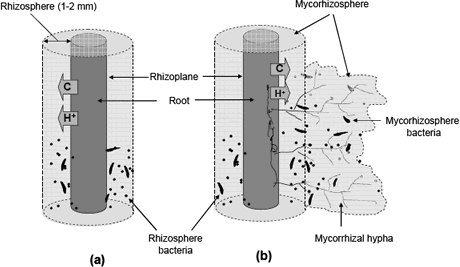
<body><![CDATA[<p><font size="2" face="Verdana, Arial, Helvetica, sans-serif">The rhizosphere pH is usually lower than the bulk   soil in 1-2 units. Several mechanisms are responsible of this effect: (i) production   of CO<sub>2</sub> by respiration processes, (ii) pump of H<sup>+</sup> in nutrient   uptake by plant and microbes, (iii) release of organic acids by roots and microbes,   (iv) Organic matter decomposition, and (v) N<sub>2</sub> fixation by the symbiosis <i>Rhizobium</i>legume   (Marschner 1997). The effects can also vary with the soil buffer capacity and   the type of plant involved. Acid conditions favor the solubilization of soil   minerals (e.g., calcium phosphates) (Bowen and Rovira 1999). The characteristics   of the rhizosphere vary with plant species and soil conditions. The rhizosphere   of flooded rice exhibits an environment more aerobic than the bulk soil. The   aerenquima tissue of rice plants permits the transport of O<sub>2</sub> to   the roots and its release into the rhizosphere (Marschner 1997). This facilitates   the oxidation of Fe and Mn that given the reductive conditions of flooded soils   tend to increase their availability up to levels that become toxic for plants. </font></p>     <p><font size="2" face="Verdana, Arial, Helvetica, sans-serif"><i>Mycorrhizosphere</i>.     Most land plants form a symbiotic association with soil fungi called mycorrhiza     (myco= fungus, rhiza= root) (Sylvia 1999). The mycorrhizal association favors     water and nutrient uptake, particularly P, Cu and Zn; soil structure development     and stability, and biological control of plant pathogens (Marschner and Dell     1994). It is recognized that the mycorrhizal association is a natural strategy     that most plants have developed in their evolution process since their establishment     on the earth’s surface (Paul and   Clark 1996).</font></p>     <p><font size="2" face="Verdana, Arial, Helvetica, sans-serif">The fungal hypha     is practically an extension of the root system that increases the volume     of soil explored (Brady and Weil 1999). The mycorrhizal hypha also release     carbonaceous compounds into the surrounding soil forming a niche called “mycorrhizosphere” (Rambelli     1973, Linderman 1988). It is important differentiate between two niches.     Usually, the benefits of rhizosphere microorganisms are increase in presence   of the mycorrhizal symbiosis.</font></p>     <p><font size="2" face="Verdana, Arial, Helvetica, sans-serif"><i>Plant growth promoting rhizobacteria (PGPR).</i> Rhizosphere bacteria   can enhance the plant growth and crop yield by different ways. The acronym   PGPR has been widely used to group these microbes (Bowen and Rovira 1999).   Recently, Bashan and Holguin 1998 proposed the division of PGPR in two classifications:   Biocontrol-Plant Growth Promoting Bacteria (Biocontrol-PGPB) and PGPB. These   authors affirm that this separation is important in order to differentiate   the mechanisms employed by these bacteria to promote the growth of plants.   Biocontrol-PGPB are strictly those bacteria that participate in the biocontrol   of plant pathogens while PGPB are bacteria that has other functions different   to biocontrol (e.g., nutritional, hormonal). Also they suggested replace the   term rhizobacteria for simply bacteria, because some bacteria can promote the   plant growth but they are not inhabitants of the rhizosphere. </font></p>     <p><font size="2" face="Verdana, Arial, Helvetica, sans-serif">This paper deals     with rhizosphere bacteria whose effects are associated with plant nutrition.     Although Bashan and Holguin’s proposal is interesting,   it is very difficult to separate the effects of both categories. </font></p>     <p><font size="2" face="Verdana, Arial, Helvetica, sans-serif"><i>Nitrogen fixation</i>.  Nitrogen     is one of the most limiting plant nutrients for plant growth (Havlin <i>et al</i>. 1999). Some rhizosphere bacteria have   the ability to fix N<sub>2</sub> into organic forms that can then be used by   plants. The rhizosphere conditions favor the N<sub>2</sub> fixation because   it is carried out by heterotrophic bacteria that use organic compounds as source   of electrons for the reduction of N<sub>2</sub>. Prominent among these microorganisms   are the N<sub>2</sub> fixers of the genera <i>Rhizobium, Bradyrrhizobium, Mesorhizobium,   Allorhizobium, Sinorhizobium</i>, and <i>Mesorhizobium</i> that form symbiosis   with legumes. In this case the concentration of O<sub>2</sub> is regulated   by hemoglobin and the supply of carbonaceous compounds occurs in the interior   of nodules avoiding thus competition of other microorganisms (Graham 1999).   They are perhaps the most studied interaction between plant and bacteria. </font></p>       <p align="center"><font size="2" face="Verdana, Arial, Helvetica, sans-serif"><b><a name="fig01"></a><img src="/img/revistas/rfnam/v60n1/a01fig01.gif">    <br>   Figure 1.</b> Schematic illustration of rhizosphere (a) and mycorhizosphere   (b).</font></p>       <p><font size="2" face="Verdana, Arial, Helvetica, sans-serif">Another N<sub>2</sub> fixer is <i>Azotobacter</i> <i>paspali,</i> which   grows in the rhizosphere of tropical grasses, such as <i>Paspalum notatum</i> c.v.   batatais and <i>Digitaria</i> species, with which exhibit certain degree of   specificity (Zuberer 1999). Although fixation of 5- 25 kg N ha<sup>-1</sup> year<sup>-1</sup> are   widely accepted, values as high as 90 kg N ha<sup>-1</sup> year<sup>–1</sup> have   been reported. <i>Acetobacter diazotrophicus</i> is a N<sub>2</sub> fixer that   can grow inside of the root tissue (‘endorhizosphere’) of sugarcane, including   vascular tissues where can achieve number of 10 <sup>6 </sup>cells g<sup>-1</sup> of   these tissues. For its particular location, <i>A. diazotrophicus</i> has the   advantage of a supply of carbon without microbial competition and apparently   can tolerate high concentration of O<sub>2</sub> than other bacteria. Sugarcane   can derive as much as 100- 150 kg N ha<sup>-1</sup> from this association.</font></p>     <p><font size="2" face="Verdana, Arial, Helvetica, sans-serif">One of the most studied associative symbioses   is that formed by <i>Azospirillum</i> spp. and roots of numerous grasses, including   important cereal crops (Okon 1994, Chanway 1997). Increases in the plant growth   and yield by 5-30 % have been reported. The benefits seem to be due to the   stimulation of nutrient uptake, production of plant growth regulators (auxins,   giberrellins, and cytokinins), rather than to N<sub>2</sub> fixation. Bashan,   Rojas and Puente 1999 and Carillo-Garcia <i>et al</i>. 2000, have reported   that cactus species inoculated with <i>A. brasilense</i> improved their establishment   and development in desert soils.</font></p>     ]]></body>
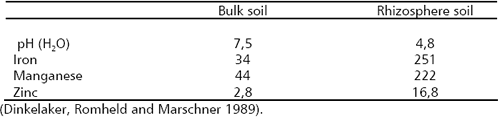
<body><![CDATA[<p><font size="2" face="Verdana, Arial, Helvetica, sans-serif">Other non symbiotic N<sub>2 </sub>fixing     bacteria <i>Azotobacter     chrococcum</i>, <i>Bacillus polymyxa</i>, and <i>Clostridium pasteurianum</i> had     increased seedling vigor of corn, wheat, and tomato and promoted earlier     flowering of tomato (Rovira 1963). Perhaps the response was also due to hormonal     effects and not to N<sub>2</sub> fixation.</font></p>     <p><font size="2" face="Verdana, Arial, Helvetica, sans-serif">Positive responses in plant growth with N<sub>2</sub> fixers   can be expected in soils where N supply is limited. For instance, desert soils   (Aridisols in the U.S. soil taxonomy; Buol <i>et al</i>. 1997) have very low   organic matter and lack available water that restricts plant growth. The positive   results of Bashan, Rojas, and Puente 1999 and Carillo-Garcia <i>et al.</i> 2000,   support this affirmation. Other types of soils (e.g., ash volcanic soils) with   low N supply could be conducive for N<sub>2</sub> fixers. Similarly, eroded   soils that have lost the soil organic matter from their surface or that have   been burned soils can be rehabilitated for plant growth using rhizosphere N<sub>2</sub> fixers.   When legumes are employed the inoculation with their symbiotic partners (<i>Rhizobium</i> species   or related genera) can improve the establishment of plants. In the cases of   nonlegumes, the results of the inoculation with freeliving N<sub>2</sub> fixers,   such as <i>Azospirillium</i> and <i>Azotobacter</i>, are uncertain. Successful   results have been obtained when these rhizosphere bacteria are combined with   plants that have high efficiency in the photosynthesis (C<sub>4</sub> plants),   thus the C supply for these heterotrophic bacteria might be satisfactory. </font></p>     <p><font size="2" face="Verdana, Arial, Helvetica, sans-serif"><b><i>Manganese. </i></b>The     availability of manganese (Mn) in the rhizosphere is affected by two major     factors: redox condition and pH (Bohn, McNeal and O’Connor 1985). In oxidized     soils manganese is present in its oxidized form, Mn<sup>4+</sup>, in the lowsoluble mineral Pryolusite.   Some rhizosphere bacteria (<i>Bacillus, Pseudomonas, and Geobacter</i>) can   reduce oxidized Mn<sup>4+</sup> to Mn<sup>2+</sup>, which is the chemical form   that is metabolically useful for plants. The reaction is as follows: </font></p>     <p><img src="/img/revistas/rfnam/v60n1/a01eq01.gif"></p>     <p><font size="2" face="Verdana, Arial, Helvetica, sans-serif">In this reaction two points are important, the   reduction of Mn requires electrons and protons. Electrons are supplied by the   decomposition of carbonaceous compounds and protons can be supplied by the   proton excretion system of root cells (Marschner 1997). Consequently, the activity   of Mn-reducers is highly favored in the rhizosphere. Applications of organic   matter also can favor the reduction of Mn ( Hue, Vega and Silva 2001). In alkaline   soils where Mn usually is insoluble the rhizosphere effect is beneficial, but   in acidic soils with abundance of Mn-minerals (e.g., Wahiawa soil in the Oahu   Island, Hue <i>et al</i>. 1998) excessive reduction of Mn can induce Mn toxicity   in sensitive plants. Arines, Porto and Vilarino 1992, found that the   mycorrhizosphere can reduce the activity of Mn-reducers and favor the Mn oxidation,   which can be favorable for the management of Mn-rich soils.</font></p>     <p><font size="2" face="Verdana, Arial, Helvetica, sans-serif">Mn plays an important role in the resistance of   plants to plant disease. Mn, as well as Cu, is required for the synthesis of   lignin, which increase the resistance of the root tissues to the penetration   of pathogens, consequently Mn-deficient plants are more susceptible to the   attack of plant pathogens. <i>Gaeumannomyces</i> <i>graminis</i>, like many   other soilborne pathogenic fungi, is a powerful oxidizer of Mn that impairs   the lignification of root at infection sites (Graham and Webb 1991).</font></p>     <p><font size="2" face="Verdana, Arial, Helvetica, sans-serif">Effective rhizosphere Mn-reducers (e.g., <i>Pseudomonas</i> sp.)   could have beneficial effects not only on plant nutrition but also on biocontrol   of pathogens (Marschner 1997).</font></p>     <p><font size="2" face="Verdana, Arial, Helvetica, sans-serif">In addition, roots and rhizosphere bacteria can   produce chelating-agents (phenolic compounds, organic acids) that form soluble   complex with Mn and other elements avoiding the reprecipitation of Mn (Marschner   1997).</font></p>     <p><font size="2" face="Verdana, Arial, Helvetica, sans-serif">In contrast, in flooded soils where the availability   of Mn<sup>2+</sup> can be high, the Mn-oxidization by rhizosphere bacteria   would favor plant growth. Rice roots release O<sub>2 </sub>in the rhizosphere   avoiding Mn-toxic effects. On the other hand, Mn-oxidizing bacteria in the   rhizosphere of plants grown in M-deficient soils can play an important role   in plant disease control (Gilbert, Handelsman and Parke 1994). By reversing   reaction (1), these bacteria reduce the availability of Mn<sup>2+</sup> for   fungal pathogens limiting its ability to attack roots.</font></p>     <p><font size="2" face="Verdana, Arial, Helvetica, sans-serif"><b><i>Iron</i>. </b>The     dynamics of iron in the rhizosphere is very similar to that of manganese     (Bohn, McNeal, and O’Connor 1985). Soil Fe is present in oxidized forms Fe<sup>3+</sup> as a component   of the structure of insoluble minerals Goethite (FeOOH) or hematite (Fe<sub>2</sub>O<sub>3</sub>)   (Lindsay 1979). Rhizosphere bacteria (<i>Bacillus, Pseudomonas, Geobacter,   Alcaligenes, Clostridium, </i>and <i>Entero-bacter)</i> can reduce Fe<sup>3+</sup> to   Fe<sup>2+</sup>, the form required by plants. Electrons and protons are available   in the rhizosphere and consequently iron is reduced, however it can be reprecipitated   (Mullen 1999). The reactions of reduction are as follows:</font></p>     ]]></body>

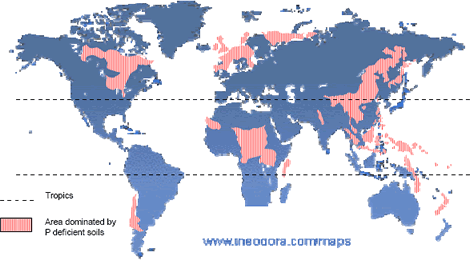
<body><![CDATA[<p><img src="/img/revistas/rfnam/v60n1/a01eq0203.gif"></p>     <p><font size="2" face="Verdana, Arial, Helvetica, sans-serif">Under Fe-deficiency, rhizosphere bacteria, particularly   fluorescent <i>Pseudomonas</i>, produce chelating agents (side-rophores) that   form soluble complexes with Fe<sup>2+</sup> and that are available for these   bacteria (Marschner 1997). Scher 1986, found in <i>Fusarium</i>-suppressive   soils that <i>Pseudomonas putida</i> produced a siderophore that sequestered   iron. The complex siderophore-Fe can only be used by <i>P</i>. <i>putida</i> but   no by <i>Fusarium, </i>which requires iron to synthesize enzymes that degrade   the plant cell walls. However, when Fe-EDTA (an iron fertilizer) was applied,   the biocontrol was lost because <i>Fusarium</i> could use this fertilizer. </font></p>     <p><font size="2" face="Verdana, Arial, Helvetica, sans-serif">A strong Fe-chelating     agent, EDDA enhanced the effect of <i>P. putida</i>. Van Peer <i>et al</i>.     (1990) found similar effects with EDDHA. Again, mechanisms related with nutritional     effects participate in the biocontrol of plant pathogens. On the other hand,     iron is a component of heme groups in catalase and peroxidaes enzymes, which     are required in the synthesis of lignin (Marschner 1997). Lignification of     wall cells is a common response of plants when are challenged by plant pathogens.     Iron deficiency plants can be more vulnerable to plant pathogens. In <a href="#tab04">Table   4</a> the rhizosphere   effects on pH and the availability of Fe, Mn and Zn are presented.</font></p>       <p align="center"><font size="2" face="Verdana, Arial, Helvetica, sans-serif"><b><a name="tab04"></a>Table 4.</b> Soil pH and micronutrient availability   (DTPA-extractable, mmol kg<sup>-1</sup> soil) in bulk soil and rhizosphere   of white lupin (<i>Lupinus</i> <i>albus</i>).</font>    <br> <img src="/img/revistas/rfnam/v60n1/a02tab04.gif"></p>       <p><font size="2" face="Verdana, Arial, Helvetica, sans-serif"><i>Solubilization of phosphates by rhizosphere bacteria.</i>  In     recent years, great attention has been dedicated to study the role that soil     microorganisms play in the dynamics of phosphate (P), particularly those     able to solubilize insoluble P forms (Rao 1992). These microorganisms are     bacteria and fungi that inhabitant the rhizosphere (Barea and Azcon 1975,     Bowen and Rovira 1999). Most soil bacteria can solubilize insoluble phosphates,     particularly active are those that belong to the genera <i>Pseudomonas, Enterobacter </i>and <i>Bacillus </i>as   well as some soil fungi, <i>Penicillium </i>and <i>Aspergillus</i> (Domey and   Lipmann 1988, Patgiri and Bezbaruah 1990, Rao 1992, Rokade and Patil 1993,   Whitelaw 2000). Some researchers prefer to use fungal P-solubilizers arguing   that bacterial strains can lost their ability to solubilize P after several   cycles of <i>in vitro</i> culture (Whitelaw, 2000), but this point is quite   controversial.</font></p>     <p><font size="2" face="Verdana, Arial, Helvetica, sans-serif">The mechanisms involved in the microbial solubilization   of P are the production of organic acids and the release of protons to the   soil solution (Kim, McDonald and Jordan 1997). Inoculation with phosphate solubilizing   rhizosphere bacteria (PSRB) and other soil microorganisms, such as arbuscular   mycorrhizal fungi (AMF), might enhance even more the benefits of this P solubilization. </font></p>     <p><font size="2" face="Verdana, Arial, Helvetica, sans-serif"><i>Why to study PSRB?.</i> One     of the most important problems in tropical agriculture is the low-soil-phosphate     (P) availability. Many of the tropical soils are highly weathered and have     a high P fixation capacity that makes their management more difficult (Sanchez     1976). Sanchez and Logan 1992, estimated that 1018 million ha in the tropics     have a high P fixation capacity. In tropical America there are 659 million     ha affected, 210 in Africa, and 199 in Asia (<a href="#fig02">Figure 2</a>). The term “P-fixation” is     used in reference to a series of complex reactions that remove bioavailable     soil P from the soil solution, where roots directly take up plant nutrients     (Barber 1995). Such reactions consist in the sorption of phosphates on the     solid surface of soil colloids and in the precipitation of phosphates with     some cations in the soil solution (Havlin <i>et al</i>.   1999).</font></p>       <p align="center"><font size="2" face="Verdana, Arial, Helvetica, sans-serif"><b><a name="fig02"></a><img src="/img/revistas/rfnam/v60n1/a01fig02.gif">    <br>   Figure     2.</b> Phosphate-deficient soils in the world (adapted from Van Wambeke     1976).</font></p>       ]]></body>
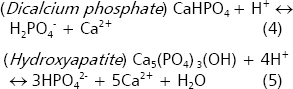
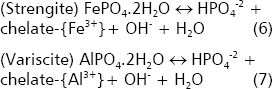
<body><![CDATA[<p><font size="2" face="Verdana, Arial, Helvetica, sans-serif">Phosphate sorption is caused mainly by the presence   of crystalline or non-crystalline hydrous-oxides of iron and aluminum in highly   weathered soils of humid regions and acid savannas (Mattlingly 1975). Allophane   (a non-crystalline aluminum-silicate) and humus-Al/Fe complexes are the responsible   of the P sorption in soils derived from volcanic parent materials (Schwertmann   and Herbillon 1992, Shonji, Nanzyo and Dahlgren 1993).</font></p>     <p><font size="2" face="Verdana, Arial, Helvetica, sans-serif">The precipitation of P in acidic soils occur with   active forms of aluminum (Al<sup>3+</sup>, Al(OH)<sup>2+</sup>, Al(OH)<sub>2</sub><sup>+</sup>)   and iron (Fe<sup>2,,3+</sup>). In calcareous soils, P is sorbed on the surface   of calcium carbonate (Mattingly 1975) or precipitated with calcium (Ca<sup>2+</sup>)   (Bohn, McNeal and O’Connor 1985). The predominance of these mechanisms depends   on the degree of soil weathering and soil pH. In past decades, several strategies   have been employed to reduce the P fixation. These consist of use of high rates   of P fertilizers, selection of fertilizers, time and method of application,   combination with amendments and other fertilizers, use of soil tests, etc.   (Engelstad and Terman, 1980). However, the efficiency of P fertilizers is still   low (5-10 %) (Havlin <i>et al</i>. 1999). Currently, there are environmental   concerns in regard to the high levels of P fertilization (Brady and Weil 1997).   Rock phosphates (apatite) are fertilizers amply recommended for soils with   high P fixation capacity because other more soluble sources are quickly fixed.   However, rock phosphates are extremely insoluble, particularly in alkaline   soils, and a little more reactivity is always desired (Hammond and Leon 1992,   Chien and Hammond 1978).</font></p>     <p><font size="2" face="Verdana, Arial, Helvetica, sans-serif"><i>Mechanisms of P solubilization by rhizosphere bacteria. </i>Several   mechanisms have been proposed to explain the P solubilization by PSRB, they   are associated with the release of organic and inorganic acids, and the excretion   of protons that accompanies to the NH<sub>4</sub><sup>+</sup> assimilation   (Kucey 1983, Roos and Luckner1984, AbdAlla 1994, Illmer, Barbato and  Schinner   1995, Asea, Kucey  and Stewart 1988, Whitelaw 2000). In addition, the release   of phosphatase enzymes that mineralize organic P compounds has been also suggested   as another mechanism involved (Stevenson 1986). Azam and Memon 1996, affirm   that <i>Nitrosomonas</i> and <i>Thiobacillus</i> mobilized inorganic phosphates   by producing nitric and sulfuric acid. Equally, phosphates may be released   from solid compounds by carbonic acid formed as a result of the decomposition   of organic residues (Memon 1996).</font></p>     <p><font size="2" face="Verdana, Arial, Helvetica, sans-serif">Many organic acids are effective in solubilizing   soil phosphates, these acids are produced by rhizosphere microorgansims (Marschner   1997). Bolan <i>et al</i>. 1994, studied the influence of the addition of organic   acids on high P-fixing soils. These acids decreased the P sorption on the   clay surfaces, favored the solubilization of rock phosphate, and increased   dry matter of ryegrass (<i>Lolium rigidium</i>) and plant P uptake. Hue 1991,   found similar results in the availability of P when added organic acids on   tropical soils in Hawaii and concluded that the efficiency of P fertilizers   might be enhanced if these are added with organic acids or, more practically   with green manures or animal wastes.</font></p>     <p><font size="2" face="Verdana, Arial, Helvetica, sans-serif">Kim, McDonald and Jordan 1997, point out that   the production of organic acid was the major mechanism involved in the solubilization   of hydroxyapatite (rock phosphate) by the PSRB <i>Enterobacter agglomerans</i>,   but other mechanisms might be involved. Under <i>in vit</i>ro conditions, the   pH of the growth medium has decreased as a result of the release of organic   acids by PSRB. Some of the organic acids commonly found are gluconic acid (Di-Simine,   Sayer and Gadd 1998, Bar-Yosef <i>et al</i>. 1999), oxalic acid, citric acid   (Kim, McDonald and Jordan 1997), lactic acid, tartaric acid, aspartic acid   (Venkateswarlu <i>et al</i>. 1984). These acids are the product of the microbial   metabolism, mostly by oxidative respiration or by fermentation of organic   carbon sources (e.g., glucose) (Atlas and Bartha 1997, Prescott, Harley and   Klein 1999). Such biological reactions occur in the rhizosphere where carbonaceous   compounds are used by PSRB and the phosphate released is taken up by the roots   or mycorrhiza symbiosis.</font></p>     <p><font size="2" face="Verdana, Arial, Helvetica, sans-serif">When PSRB are inoculated to neutral or alkaline   soils, the acid production decreases the rhizosphere pH, favoring thus the   solubility of calcium phosphates and apatites. If the activity of H<sup>+</sup> increases   in the reactants of the reactions (4) and (5), these reactions proceed. In   addition, the sequestering of Ca by organic anions favors the reactions.</font></p>     <p><img src="/img/revistas/rfnam/v60n1/a01eq0405.gif"></p>     <p><font size="2" face="Verdana, Arial, Helvetica, sans-serif">In acid soils, the minerals variscite and strengite   control the solubility of phosphate (Lindsay 1979). The presence of organic   acids propitiates the formation of complexes with Al and Fe ions, which in   turn facilitates the dissolution of these minerals. If Fe<sup>3+</sup> and   Al<sup>3+</sup> are sequestered via chelation with organic anions the reactions   6 and 7 proceed to the right. However, this point is controversial because   the reduction in soil pH might also solubilize other iron and aluminum minerals   that would reprecipitate again phosphates to form newly strengite and variscite   (Lindsay 1979).</font></p>     <p><img src="/img/revistas/rfnam/v60n1/a01eq0607.gif"></p>     <p><font size="2" face="Verdana, Arial, Helvetica, sans-serif">On the other hand, organic anions produced by   PSRB can also compete with phosphates for fixation sites on the surface of   soil colloids. He and Zhu 1997, 1998 demonstrated that sorbed phosphates on   the surfaces of kaolynite, goethite, montmorillonite and amorphous Aloxides   were displaced by microbial activity presumably using organic acids.</font></p>     ]]></body>
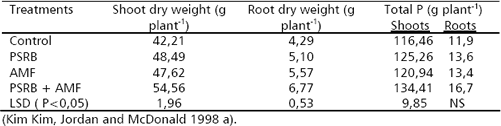
<body><![CDATA[<p><font size="2" face="Verdana, Arial, Helvetica, sans-serif"><i>Experiences with PSRB.</i> The     inoculation with <i>Bacillus     megatherium var. phosphaticum</i> in Russian soils (Mollisols) has     been the best known reference of massive use of PSRB (Stevenson 1986). However,     trials carried out in many locations demonstrated little consistency, which     it is not surprising due to the diversity of factors involved. In fact, similar     contradictions may be found in the response of crops where P fertilizers     have been applied (Sumner 1987). In some cases, the inoculation with known     PSRB has enhanced the plant growth without affecting plant P uptake. Freitas,     Banerjee and Germida 1997, found that the inoculation with the PSRB’s <i>Bacillus     thuringiensis, B. brevis, B. megatherium, B. polymyxa, B. sphaericus and     Xanthomonas maltophila</i> increased the growth and yield of canola (<i>Brassica     napus</i>), but they did not increase the plant P uptake. PSRB can also release     substances that promote root growth such as hormones, enzymes, antibiotics;     enhance availability of other nutrients (e.g. Mn and Fe), and exert biocontrol     of plant pathogens (Rao 1992, Premono <i>et al</i>. 1994, Toro <i>et al</i>.     1996, Bashan and Holguin 1998, Azcon and Barea 1996, Kopler, Lifshitz and     Schroth 1988, Frankenberg and Arshad 1995). The efficiency of PSRB has been     questioned because: (i) organic substances required for these microorganisms     are scarce in nonrhizosphere microsites, (ii) antagonism and competition     with other microorganisms in the rhizosphere, and (iii) low translocation     of solubilized phosphates through soil because they can be again refixed     by soil components (Tinker 1980, Bolan 1991, Azcon and Barea 1996).</font></p>     <p><font size="2" face="Verdana, Arial, Helvetica, sans-serif"><b><i>Mycorrhizosphere         and PSRB</i>. </b>There   are several advantages with the combined use of arbuscular mycorrhizal fungi   (AMF) and PSRB. First, mycorrhizal plants can release a higher amount of carbonaceous   substances into their rhizosphere (‘mycorrhizosphere’) than nonmycorrhizal   plants (Rambelli 1973, Linderman 1988). Second, the extensive net formed around   the roots by the mycorrhizal hyphae can efficiently facilitate the uptake of   phosphate released by PSRB, avoiding thus its refixation. As long as the PSRB   remain in the rhizosphere (or mycorrhizosphere), there is a great opportunity   to satisfy their C requirement and deliver phosphates into the soil solution   (<a href="#fig03">Figure 3</a>).   Kim, Jordan and McDonald 1998 a, b, studied   the effect of individual and dual inoculation of <i>Enterobacter agglomerans</i> (PSRB)   and <i>Glomus   etunicatum</i> (AMF) on tomato growth and P uptake. They found that there was   a synergistic effect when both microorganisms were inoculated (<a href="#tab05">Table   5</a>).</font></p>     <p align="center"><font size="2" face="Verdana, Arial, Helvetica, sans-serif"><b><a name="fig03"></a><img src="/img/revistas/rfnam/v60n1/a01fig03.gif">    <br>   Figure       3.</b> Diagram presentation of the solubilization of phosphates in the mycorrhizosphere and the mycorrhizal P uptake.</font></p>     <p align="center"><font size="2" face="Verdana, Arial, Helvetica, sans-serif"><b><a name="tab05"></a>Table   5.</b> Effects of <i>E. agglomerans</i> (PSRB) and <i>G. etunicatum </i>(AMF)   inoculation on tomato plant growth and P uptake (75 days after inoculation). </font>    <br>   <img src="/img/revistas/rfnam/v60n1/a02tab05.gif"></p>     <p><font size="2" face="Verdana, Arial, Helvetica, sans-serif">Alkaline phosphatase activity was higher in the   treatment with <i>G. etunicatum</i> as well as the combination <i>G. etunicatum </i>+ <i>E.   agglomerans.</i> There was higher P concentration in the rhizosphere and higher   oxalic acid production when both microorganisms were concurrently inoculated.   In this experiment glucose was applied as an energy source to increase the   release of organic acids by PSRB.</font></p>       <p><font size="2" face="Verdana, Arial, Helvetica, sans-serif">Similar synergistic effects have been found in   sunflower (<i>Helianthus annuus</i>) with the triple inoculation of <i>Azotobacter   chroococcum, Penicillium glaucum</i> and <i>Glomus fasciculatum</i> (Gururaj and Mallikarjunaiah   1995); in cotton with the inoculation of <i>Pseudomonas striata</i> and <i>Azospirillum</i> sp.   (Prathiba, Alagawadi and Sreenivasa 1995); in rice favorable effects were also   reported with <i>P. striata</i> and <i>Bacillus polymyxa</i> (Mohod, Gupta   and Chavan 1991); in chili (<i>Capsicum annuum</i>) with <i>G. fasciculatum</i> or <i>G.   macrocarpum</i> and <i>P. striata</i> (Sreenivasa and Krishnaraj 1992); in   wheat with <i>P. putida, P. aeruginosa </i>and<i> P. fluorescens </i>in combination   with <i>G. clarum.</i> Gaur <i>et al</i>. 1990 found the same type of   response in wheat with <i>P. striata</i> and <i>G. fasciculatum</i>. In other   experiment with wheat, Gaur <i>et al</i>. 1990 obtained positive results with   the combination of two PSRB, <i>P. striata and Agrobacterium radiobacter</i>,   with <i>G. fasciculatum</i> and <i>Gigaspora margarita</i>, the greatest plant   growth was obtained when these microbes and fertilizers were added.</font></p>       <p><font size="2" face="Verdana, Arial, Helvetica, sans-serif"><i>PSRB-AMF and rhizobia.</i> Kopler, Lifshitz and Schroth 1988 found more   legume-<i>Rhizobium</i> nodulation when also added <i>Pseudomonas</i> spp.   Sturz <i>et al</i>. 1997 found that the nodulation of <i>Rhizobium leguminosarum</i> b.v. <i>trifolii</i> was   promoted on red clover (<i>Trifolium pratense</i>) when it was coinoculated   with <i>Bacillus insolitus</i>, <i>B. brevis</i> or <i>Agrobacterium rhizogenes.</i> Similar   results were obtained with the inoculation of <i>G. mosseae</i> and <i>Azorhizobium   caulinodans</i> in <i>Sesbania rostrata </i>(Rahman and Parsons 1997). </font></p>     <p><font size="2" face="Verdana, Arial, Helvetica, sans-serif">In soybean the combination of <i>Bradyrhizobium japonicum</i>, <i>P. fluorescens</i> and <i>G.     mosseae</i> have given equally good results (Shabayey, Smolin and Mudrick     1996). Such results are likely due to a higher P uptake promoted by the PSRB     and AMF, which may satisfy the high P requirements of the symbiotic N<sub>2</sub> fixing     process (Azcon and Barea 1996, Young, Chen and Chao 1990). </font></p>     ]]></body>
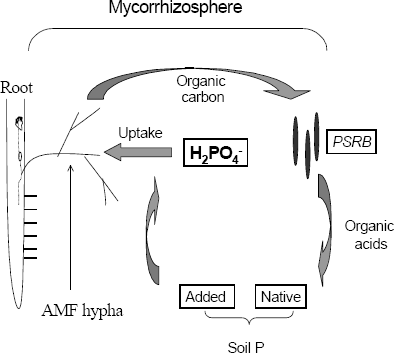
<body><![CDATA[<p><font size="2" face="Verdana, Arial, Helvetica, sans-serif">Apparently, there is a certain degree of specificity   among the PSRB, AMF and P source. Toro, Azcon and Herrera 1996 studied the   effect of the combination of AMF (<i>Glomus spp.</i>) and eight PSRB on the   growth and P nutrition of a tropical legume, kudzu (<i>Pueraria phaseoloides</i>).   PSRB were isolated from an Oxisol and were characterized by their ability to   solubilize rock phosphate, iron phosphate and aluminum phosphate. In general,   when kudzu-<i>Rhizobium</i>-AMF were coinoculated with PSRB there was an increase   in the plant growth, yield and nutritional status. However, such synergism   was not observed in all combinations. For instance, <i>Azospirillum</i> sp., <i>Bacillus</i> sp.,   and <i>Enterobacter </i>sp. had a higher effect when were coinoculated with <i>G.   Mosseae.</i> <i>Pseudomonas</i> sp. and an unidentified isolate had a better   performance when were combined with <i>G. fasciculatum</i>. On the other hand,   Fe-phosphate solubilizers were more effective alone, while Al<sup>-</sup> and   rock phosphate-solubilizers performed better when were concurrently inoculated   with AMF.</font></p>     <p><font size="2" face="Verdana, Arial, Helvetica, sans-serif">Germide and Walley 1996, pointed out that is also   possible to observe no effects or even unfavorable effects with PSRB inoculation.   This seems to be caused by alteration in the rooting patterns (root distribution   and root length), reduction in the AMF colonization of roots. Baas 1990 affirms   that multiple inoculation of microorganisms might cause competition among them   for rhizosphere exudates and with the host plant for the uptake of available   P.</font></p>     <p><font size="2" face="Verdana, Arial, Helvetica, sans-serif"><b><i>Prospective research on PSRB.</i></b> In   a series of elegant experiments, De la Fuente and Herrera 1999, isolated the   gene that codes the overproduction of citrate synthetase in the TCA cycle of   a strain of <i>Pseudomonas aeruginosa </i>(a known PSRB). This gene was then   transferred to tobacco cells of plants that not exhibit Al tolerance. Transgenic   plants were produced high amounts of citric acid and citrate and grew in solutions   with high concentration of Al. The process was successfully replicated with   papaya plants. Although these experiments were oriented to enhance the Al   tolerance of these plants, it is directly associated with the mechanisms proposed   for the solubilization of soil phosphates. </font></p>     <p><font size="2" face="Verdana, Arial, Helvetica, sans-serif">Currently, the fungal inoculum <i>Penicillium     bilaii</i> is commercially available in North America with the name of Provide<sup>TM</sup>,     which has been successfully tested to enhance plant P uptake of several plants     (Whitelaw 2000). Little research on phosphate solubilizers has been carried     in tropical soils that usually exhibit a higher P fixation capacity than     temperate soils. Recently, Osorio and Habte (unpublished) isolated several     phosphate solubilizers including bacteria from the rhizosphere of <i>L. leucocephala</i> naturally     grown in three Hawaiian soils (Tantalus, Wahiawa and Kaena soil series).     The most effective P solubilizer was a fungus identified as <i>Mortierella </i>sp.,     which in turn was the most efficient producer of acidity in an in <i>vitro     test</i>, several effective PSRB were also isolated (not yet identified).</font></p>     <p><font size="2" face="Verdana, Arial, Helvetica, sans-serif">It is uncertain if many of the mechanisms proposed for the PSRB operate at   the same level of effectiveness in diverse soils with variable mineralogy.   PSRB have also been used in the industry of P fertilizers. Usually rock phosphates   are slightly acidulated with inorganic acids to increase its reactivity (Chien   and Hammond 1978), or used as raw material to produce more soluble fertilizers   for which strong acids are added (Young and Davies 1980). It is an expensive   process due to the high cost of inorganic acids. Bar-Yosef <i>et al</i>. 1999   found that <i>Pseudomonas cepacia</i>, a known PSRB, was very efficient to   oxide glucose and to produce gluconic and 2-keto-gluconic acids in a reactor   containing rock phosphate. Once the acids were dissociated, protons reacted   with rock phosphate and released phosphate ions that were then precipitates   with Ca to form soluble fertilizers (super-phosphates). Thus, PSRB yield benefits   not only in their natural niche, the rhizosphere, but also in other environments. </font></p>     <p>&nbsp;</p>     <p><font size="2" face="Verdana, Arial, Helvetica, sans-serif"><b><a name="1" id="1"></a>CONCLUSIONS</b> <a href="#indice"><img src="/img/revistas/rfnam/v60n1/up.gif" border="0"></a></font></p>     <p><font size="2" face="Verdana, Arial, Helvetica, sans-serif">Phosphate solubilizing rhizosphere bacteria has   a high potential to be used in the management of P deficient soils. PSRB may   be coinoculated with AMF generating synergistic effects on plant growth and   P uptake. The compatibility between PSRB and AMF seems to have certain degree   of specificity, for which is recommended to investigate what are the more effective   combinations. The mechanisms of P solubilization by PSRB are associated with   the production of organic and inorganic acids, proton excretion, and phosphatase   activity. Organic acids are produced by the oxidation of carbonaceous originated   in the rhizosphere, from the soil organic matter or added as manure. Organic   acids decrease the rhizosphere pH favoring the solubility of precipitated P   forms. Organic anions can also compete or even replace phosphate sorbed on   the surfaces of soil clays, they also can chelate Al and Fe avoiding thus the   precipitation of phosphate. </font></p>     <p>&nbsp;</p>     <p><font size="3" face="Verdana, Arial, Helvetica, sans-serif"><b><a name="2"></a>ACKNOWLEDGEMENTS</b> <a href="#indice"><img src="/img/revistas/rfnam/v60n1/up.gif" border="0"></a></font></p>     ]]></body>
<body><![CDATA[<p><font size="2" face="Verdana, Arial, Helvetica, sans-serif">The author thanks     Dr. Anne Alvarez and Dr. Francoise Robert from the University of Hawaii,     HI, USA , and Dr. Mauricio Marin Montoya from the Universidad Nacional de   Colombia, Sede Medellín for reading the manuscript.</font></p>     <p>&nbsp;</p>     <p><font size="3" face="Verdana, Arial, Helvetica, sans-serif"><b><a name="3"></a>REFERENCES </b><a href="#indice"><img src="/img/revistas/rfnam/v60n1/up.gif" border="0"></a></font></p>     <!-- ref --><p><font size="2" face="Verdana, Arial, Helvetica, sans-serif">Abd-Alla, M. H. 1994. Use of organic phosphorus   by <i>Rhizobium legumino-sarum</i> biovar <i>viceae</i> phosphatases.   In: Biology and Fertility of Soils. Vol. 18, no. 3; p. 216-218.</font>&nbsp;&nbsp;&nbsp;&nbsp;&nbsp;&nbsp;&nbsp;&nbsp;[&#160;<a href="javascript:void(0);" onclick="javascript: window.open('/scielo.php?script=sci_nlinks&ref=000096&pid=S0304-2847200700010000100001&lng=','','width=640,height=500,resizable=yes,scrollbars=1,menubar=yes,');">Links</a>&#160;]<!-- end-ref --><!-- ref --><p><font size="2" face="Verdana, Arial, Helvetica, sans-serif">Arines, J.; Porto,     M. E. and Vilariño, A. 1992.   Effect of manganese on vesicular-arbuscular mycorrhizal development in red   clover plant and soil Mn-oxidizing bacteria. In: Mycorrhiza, Vol. 1, no. 3;   p. 127-131.</font>&nbsp;&nbsp;&nbsp;&nbsp;&nbsp;&nbsp;&nbsp;&nbsp;[&#160;<a href="javascript:void(0);" onclick="javascript: window.open('/scielo.php?script=sci_nlinks&ref=000097&pid=S0304-2847200700010000100002&lng=','','width=640,height=500,resizable=yes,scrollbars=1,menubar=yes,');">Links</a>&#160;]<!-- end-ref --><!-- ref --><p><font size="2" face="Verdana, Arial, Helvetica, sans-serif">Asea, P. E. A.; Kucey, R. M. N., and Stewart,   J. W. B. 1988. Inorganic phosphate solubilisation by 2 <i>Penicillium</i> species   in solution culture and soil. In: Soil Biology and Biochemistry. Vol. 20; p.   459-464.</font>&nbsp;&nbsp;&nbsp;&nbsp;&nbsp;&nbsp;&nbsp;&nbsp;[&#160;<a href="javascript:void(0);" onclick="javascript: window.open('/scielo.php?script=sci_nlinks&ref=000098&pid=S0304-2847200700010000100003&lng=','','width=640,height=500,resizable=yes,scrollbars=1,menubar=yes,');">Links</a>&#160;]<!-- end-ref --><!-- ref --><p><font size="2" face="Verdana, Arial, Helvetica, sans-serif">Atlas, R. and Bartha, R. 1997. Microbial ecology.   New York: Addison Wesley Longman. 694 p.</font>&nbsp;&nbsp;&nbsp;&nbsp;&nbsp;&nbsp;&nbsp;&nbsp;[&#160;<a href="javascript:void(0);" onclick="javascript: window.open('/scielo.php?script=sci_nlinks&ref=000099&pid=S0304-2847200700010000100004&lng=','','width=640,height=500,resizable=yes,scrollbars=1,menubar=yes,');">Links</a>&#160;]<!-- end-ref --><!-- ref --><p><font size="2" face="Verdana, Arial, Helvetica, sans-serif">Azam, F. and Memom,     G. H. 1996. Soil organisms. p. 200-232. In: Bashir, E. and Bantel, R., eds.     Soil Science. Islamabad:  National   Book Foundation. </font>&nbsp;&nbsp;&nbsp;&nbsp;&nbsp;&nbsp;&nbsp;&nbsp;[&#160;<a href="javascript:void(0);" onclick="javascript: window.open('/scielo.php?script=sci_nlinks&ref=000100&pid=S0304-2847200700010000100005&lng=','','width=640,height=500,resizable=yes,scrollbars=1,menubar=yes,');">Links</a>&#160;]<!-- end-ref --><!-- ref --><p><font size="2" face="Verdana, Arial, Helvetica, sans-serif">Azcon, C. and     Barea, J. M. 1996. Interactions of arbuscular mycorrhiza with rhizosphere     microorganisms. p. 47-68 p. In: Guerrero, E., ed. Mycorrhiza. biological     soil resource. Santafé de Bogotá,   Colombia : FEN.</font>&nbsp;&nbsp;&nbsp;&nbsp;&nbsp;&nbsp;&nbsp;&nbsp;[&#160;<a href="javascript:void(0);" onclick="javascript: window.open('/scielo.php?script=sci_nlinks&ref=000101&pid=S0304-2847200700010000100006&lng=','','width=640,height=500,resizable=yes,scrollbars=1,menubar=yes,');">Links</a>&#160;]<!-- end-ref --><!-- ref --><p><font size="2" face="Verdana, Arial, Helvetica, sans-serif"> Barber, S. A.     1995. Soil nutrient bio-availability. New York: John Wiley and Sons.  414   p.</font>&nbsp;&nbsp;&nbsp;&nbsp;&nbsp;&nbsp;&nbsp;&nbsp;[&#160;<a href="javascript:void(0);" onclick="javascript: window.open('/scielo.php?script=sci_nlinks&ref=000102&pid=S0304-2847200700010000100007&lng=','','width=640,height=500,resizable=yes,scrollbars=1,menubar=yes,');">Links</a>&#160;]<!-- end-ref --><!-- ref --><p><font size="2" face="Verdana, Arial, Helvetica, sans-serif">Barea, J. M. and     Azcon, R. 1975. Possible synergistic interactions between endogone and phosphate-solubilizing     bacteria in low-phosphate soils.  p. 409-417 p. In: Mosse, B. and Tinker,   P. B., eds. Endomycorrhizas. London: Academic Press. </font>&nbsp;&nbsp;&nbsp;&nbsp;&nbsp;&nbsp;&nbsp;&nbsp;[&#160;<a href="javascript:void(0);" onclick="javascript: window.open('/scielo.php?script=sci_nlinks&ref=000103&pid=S0304-2847200700010000100008&lng=','','width=640,height=500,resizable=yes,scrollbars=1,menubar=yes,');">Links</a>&#160;]<!-- end-ref --><!-- ref --><p><font size="2" face="Verdana, Arial, Helvetica, sans-serif">Bar-Yosef, B.; Rogers, R. D.; Wolfram, J. H. and   Richman, E. 1999. <i>Pseudomonas cepacia</i>-mediated rock phosphate   solubilization in kaolinite and montmorillonite suspensions. In: Soil Science   Society of America Journal. Vol. 63; p. 1703-1708.</font>&nbsp;&nbsp;&nbsp;&nbsp;&nbsp;&nbsp;&nbsp;&nbsp;[&#160;<a href="javascript:void(0);" onclick="javascript: window.open('/scielo.php?script=sci_nlinks&ref=000104&pid=S0304-2847200700010000100009&lng=','','width=640,height=500,resizable=yes,scrollbars=1,menubar=yes,');">Links</a>&#160;]<!-- end-ref --><!-- ref --><p><font size="2" face="Verdana, Arial, Helvetica, sans-serif">Bashan, Y. and Holguin, G. 1998. Proposal for   the division of plant growth promoting rhizobacteria into two classifications:   Biocontrol-PGPB and PGPB. In: Soil Biology and Biochemistry. Vol. 30, no. 8;   p. 1225-1228.</font>&nbsp;&nbsp;&nbsp;&nbsp;&nbsp;&nbsp;&nbsp;&nbsp;[&#160;<a href="javascript:void(0);" onclick="javascript: window.open('/scielo.php?script=sci_nlinks&ref=000105&pid=S0304-2847200700010000100010&lng=','','width=640,height=500,resizable=yes,scrollbars=1,menubar=yes,');">Links</a>&#160;]<!-- end-ref --><!-- ref --><p><font size="2" face="Verdana, Arial, Helvetica, sans-serif">________; Rojas, A. and Puente, M. E. 1999. Improved   establishment and development of three cactus species inoculated with <i>Azospirillum   brasilense</i> transplanted into disturbed urban desert soils. In: Canadian   Journal of Microbiology. Vol. 45, no. 12; p. 441-451.</font>&nbsp;&nbsp;&nbsp;&nbsp;&nbsp;&nbsp;&nbsp;&nbsp;[&#160;<a href="javascript:void(0);" onclick="javascript: window.open('/scielo.php?script=sci_nlinks&ref=000106&pid=S0304-2847200700010000100011&lng=','','width=640,height=500,resizable=yes,scrollbars=1,menubar=yes,');">Links</a>&#160;]<!-- end-ref --><!-- ref --><p><font size="2" face="Verdana, Arial, Helvetica, sans-serif">Bass, R. 1990. Effects of <i>Glomus fasciculatum</i> and   isolated rhizosphere microorganisms on growth and phosphate uptake of <i>Plantago   major</i> spp. <i>pleiosperma</i>. In: Plant and Soil. Vol. 124, no. 2; p.   187-193.</font>&nbsp;&nbsp;&nbsp;&nbsp;&nbsp;&nbsp;&nbsp;&nbsp;[&#160;<a href="javascript:void(0);" onclick="javascript: window.open('/scielo.php?script=sci_nlinks&ref=000107&pid=S0304-2847200700010000100012&lng=','','width=640,height=500,resizable=yes,scrollbars=1,menubar=yes,');">Links</a>&#160;]<!-- end-ref --><!-- ref --><p><font size="2" face="Verdana, Arial, Helvetica, sans-serif">Bohn, H.; McNeal,     B., and O’Connor, G. 1985. Soil   chemistry. New York: John Wiley and Sons. 341 p.</font>&nbsp;&nbsp;&nbsp;&nbsp;&nbsp;&nbsp;&nbsp;&nbsp;[&#160;<a href="javascript:void(0);" onclick="javascript: window.open('/scielo.php?script=sci_nlinks&ref=000108&pid=S0304-2847200700010000100013&lng=','','width=640,height=500,resizable=yes,scrollbars=1,menubar=yes,');">Links</a>&#160;]<!-- end-ref --><!-- ref --><p><font size="2" face="Verdana, Arial, Helvetica, sans-serif">Bolan, N. S. 1991. A critical review on the role of mycorrhizal fungi   in the uptake of phosphorus by plants. In: Plant and Soil. Vol. 134, no. 2;   p. 189-207.</font>&nbsp;&nbsp;&nbsp;&nbsp;&nbsp;&nbsp;&nbsp;&nbsp;[&#160;<a href="javascript:void(0);" onclick="javascript: window.open('/scielo.php?script=sci_nlinks&ref=000109&pid=S0304-2847200700010000100014&lng=','','width=640,height=500,resizable=yes,scrollbars=1,menubar=yes,');">Links</a>&#160;]<!-- end-ref --><!-- ref --><p><font size="2" face="Verdana, Arial, Helvetica, sans-serif">________; Naidu, R.; Mahimairaja, S. and Baskaran,   S. 1994. Influence of low-molecular-weight organic acids on the solubilization   of phosphates. In: Biology and Fertility of Soils. Vol. 18, no. 4; p. 311-319.</font>&nbsp;&nbsp;&nbsp;&nbsp;&nbsp;&nbsp;&nbsp;&nbsp;[&#160;<a href="javascript:void(0);" onclick="javascript: window.open('/scielo.php?script=sci_nlinks&ref=000110&pid=S0304-2847200700010000100015&lng=','','width=640,height=500,resizable=yes,scrollbars=1,menubar=yes,');">Links</a>&#160;]<!-- end-ref --><!-- ref --><p><font size="2" face="Verdana, Arial, Helvetica, sans-serif">Bowen, G. D. 1980. Misconceptions, concepts, and   approaches in rhizosphere biology, 283-304 p. In: Ellwood, D. C.; Hedger, J.   N.; Lathan. M. J.; Lynch, J. M., and Slater, J. H., eds. Contemporary microbial   ecology. London: Academic Press. </font>&nbsp;&nbsp;&nbsp;&nbsp;&nbsp;&nbsp;&nbsp;&nbsp;[&#160;<a href="javascript:void(0);" onclick="javascript: window.open('/scielo.php?script=sci_nlinks&ref=000111&pid=S0304-2847200700010000100016&lng=','','width=640,height=500,resizable=yes,scrollbars=1,menubar=yes,');">Links</a>&#160;]<!-- end-ref --><!-- ref --><p><font size="2" face="Verdana, Arial, Helvetica, sans-serif">________ and Rovira, A. D. 1999. The rhizosphere   and its management to improve plant growth. In: Advances in Agronomy. Vol.   66; p. 1-102. </font>&nbsp;&nbsp;&nbsp;&nbsp;&nbsp;&nbsp;&nbsp;&nbsp;[&#160;<a href="javascript:void(0);" onclick="javascript: window.open('/scielo.php?script=sci_nlinks&ref=000112&pid=S0304-2847200700010000100017&lng=','','width=640,height=500,resizable=yes,scrollbars=1,menubar=yes,');">Links</a>&#160;]<!-- end-ref --><!-- ref --><p><font size="2" face="Verdana, Arial, Helvetica, sans-serif"> Brady, N. C. and Weil, R. R. 1999. The nature and properties of soils.   12<sup>th</sup> ed. Upper Saddle River, N.J.: Prentice Hall, 881 p. </font>&nbsp;&nbsp;&nbsp;&nbsp;&nbsp;&nbsp;&nbsp;&nbsp;[&#160;<a href="javascript:void(0);" onclick="javascript: window.open('/scielo.php?script=sci_nlinks&ref=000113&pid=S0304-2847200700010000100018&lng=','','width=640,height=500,resizable=yes,scrollbars=1,menubar=yes,');">Links</a>&#160;]<!-- end-ref --><!-- ref --><p><font size="2" face="Verdana, Arial, Helvetica, sans-serif">Buol, S.; Hole,     F. D.; McCraken, R. J. and Southard, R. J. 1997. Soil genesis and classification.     Iowa State University Press, Ames.  527   p.</font>&nbsp;&nbsp;&nbsp;&nbsp;&nbsp;&nbsp;&nbsp;&nbsp;[&#160;<a href="javascript:void(0);" onclick="javascript: window.open('/scielo.php?script=sci_nlinks&ref=000114&pid=S0304-2847200700010000100019&lng=','','width=640,height=500,resizable=yes,scrollbars=1,menubar=yes,');">Links</a>&#160;]<!-- end-ref --><!-- ref --><p><font size="2" face="Verdana, Arial, Helvetica, sans-serif">Carillo-Garcia, A.; Bashan, Y.; Diaz, E., and   Bethlenfalvay, G. J. 2000. Effects of resource-island soils, competition, and   inoculation with <i>Azospirillium </i>on survival and growth of <i>Pachycereus   pringlei</i>, the giant cactus of the Sonoran desert. In: Restoration Ecology.   Vol. 8, no. 1; p. 65-73.</font>&nbsp;&nbsp;&nbsp;&nbsp;&nbsp;&nbsp;&nbsp;&nbsp;[&#160;<a href="javascript:void(0);" onclick="javascript: window.open('/scielo.php?script=sci_nlinks&ref=000115&pid=S0304-2847200700010000100020&lng=','','width=640,height=500,resizable=yes,scrollbars=1,menubar=yes,');">Links</a>&#160;]<!-- end-ref --><!-- ref --><p><font size="2" face="Verdana, Arial, Helvetica, sans-serif">Chanway, C.P. 1997. Inoculation of tree roots   with plant promoting soil bacteria: an emerging technology for reforestation.   In: Forest Science. Vol. 43, no. 1; p. 99-112.</font>&nbsp;&nbsp;&nbsp;&nbsp;&nbsp;&nbsp;&nbsp;&nbsp;[&#160;<a href="javascript:void(0);" onclick="javascript: window.open('/scielo.php?script=sci_nlinks&ref=000116&pid=S0304-2847200700010000100021&lng=','','width=640,height=500,resizable=yes,scrollbars=1,menubar=yes,');">Links</a>&#160;]<!-- end-ref --><!-- ref --><p><font size="2" face="Verdana, Arial, Helvetica, sans-serif">Chien, S. H. and     Hammond, L. L. 1978. A comparison of various laboratory methods for predicting     the agronomic potential of phosphate rocks for direct application. In: Soil   Science Society of America Journal. Vol.  42; p. 935-939.</font>&nbsp;&nbsp;&nbsp;&nbsp;&nbsp;&nbsp;&nbsp;&nbsp;[&#160;<a href="javascript:void(0);" onclick="javascript: window.open('/scielo.php?script=sci_nlinks&ref=000117&pid=S0304-2847200700010000100022&lng=','','width=640,height=500,resizable=yes,scrollbars=1,menubar=yes,');">Links</a>&#160;]<!-- end-ref --><!-- ref --><p><font size="2" face="Verdana, Arial, Helvetica, sans-serif">De la Fuente, J. M. and Herrera, L. 1999. Advances   in the understanding of aluminum toxicity and the development of aluminum tolerant   transgenic plants. In: Advances in Agronomy. Vol. 66; p. 103-121.</font>&nbsp;&nbsp;&nbsp;&nbsp;&nbsp;&nbsp;&nbsp;&nbsp;[&#160;<a href="javascript:void(0);" onclick="javascript: window.open('/scielo.php?script=sci_nlinks&ref=000118&pid=S0304-2847200700010000100023&lng=','','width=640,height=500,resizable=yes,scrollbars=1,menubar=yes,');">Links</a>&#160;]<!-- end-ref --><!-- ref --><p><font size="2" face="Verdana, Arial, Helvetica, sans-serif">Dinkelaker, B.; Romheld, V. and Marschner, H.   1989. Citric acid excretion and precipitation of calcium citrate in the rhizosphere   of white lupin (<i>Lupinus</i> <i>albus</i>). In: Plant Cell Environment. Vol.   12, no. 3; p. 285-292. </font>&nbsp;&nbsp;&nbsp;&nbsp;&nbsp;&nbsp;&nbsp;&nbsp;[&#160;<a href="javascript:void(0);" onclick="javascript: window.open('/scielo.php?script=sci_nlinks&ref=000119&pid=S0304-2847200700010000100024&lng=','','width=640,height=500,resizable=yes,scrollbars=1,menubar=yes,');">Links</a>&#160;]<!-- end-ref --><!-- ref --><p><font size="2" face="Verdana, Arial, Helvetica, sans-serif">Di-Simine, C. D.; Sayer, J. A., and Gadd., G.   M. 1998. Solubilization of zinc phosphate by a strain of <i>Pseudomonas fluorescens</i> isolated   from a forest soil. In: Biology and Fertility of Soils. Vol. 28, no. 1; p.   87-94.</font>&nbsp;&nbsp;&nbsp;&nbsp;&nbsp;&nbsp;&nbsp;&nbsp;[&#160;<a href="javascript:void(0);" onclick="javascript: window.open('/scielo.php?script=sci_nlinks&ref=000120&pid=S0304-2847200700010000100025&lng=','','width=640,height=500,resizable=yes,scrollbars=1,menubar=yes,');">Links</a>&#160;]<!-- end-ref --><!-- ref --><p><font size="2" face="Verdana, Arial, Helvetica, sans-serif">Domey, S. and     Lipmann, G. 1988. Stimulation of plant growth by phosphate, solubilizing     bacteria. In: Vancura, V. and Kunc, F., eds. Interrelationships between microorganisms     and plants in soil.  In:   Developments in Agricultural and Managed Forest Ecology. Vol. 17; p. 457-461.</font>&nbsp;&nbsp;&nbsp;&nbsp;&nbsp;&nbsp;&nbsp;&nbsp;[&#160;<a href="javascript:void(0);" onclick="javascript: window.open('/scielo.php?script=sci_nlinks&ref=000121&pid=S0304-2847200700010000100026&lng=','','width=640,height=500,resizable=yes,scrollbars=1,menubar=yes,');">Links</a>&#160;]<!-- end-ref --><!-- ref --><p><font size="2" face="Verdana, Arial, Helvetica, sans-serif">Engelstad, O.     P. and Terman, G. L. 1980. Agronomic effectiveness of phosphate fertilizers.     p. 311-332. In: Khasawneh, F. E.; Sample, E. and Kamprath, E., eds. The role     of phosphorus in agriculture. Madison, WI:  American   Society of Agronomy.</font>&nbsp;&nbsp;&nbsp;&nbsp;&nbsp;&nbsp;&nbsp;&nbsp;[&#160;<a href="javascript:void(0);" onclick="javascript: window.open('/scielo.php?script=sci_nlinks&ref=000122&pid=S0304-2847200700010000100027&lng=','','width=640,height=500,resizable=yes,scrollbars=1,menubar=yes,');">Links</a>&#160;]<!-- end-ref --><!-- ref --><p><font size="2" face="Verdana, Arial, Helvetica, sans-serif">Frankenberg, W. T. and Arshad, M. 1995. Phytohormones   in soils: microbial production and function. New York: Dekker. 503 p.</font>&nbsp;&nbsp;&nbsp;&nbsp;&nbsp;&nbsp;&nbsp;&nbsp;[&#160;<a href="javascript:void(0);" onclick="javascript: window.open('/scielo.php?script=sci_nlinks&ref=000123&pid=S0304-2847200700010000100028&lng=','','width=640,height=500,resizable=yes,scrollbars=1,menubar=yes,');">Links</a>&#160;]<!-- end-ref --><!-- ref --><p><font size="2" face="Verdana, Arial, Helvetica, sans-serif">Freitas, J. R.; Banerjee, M. R., and Germida,   J. J. 1997. Phosphate solubilizing rhizobacteria enhance the growth and yield   but not phosphorus uptake of canola (<i>Brassica napus</i> L.). In: Biology   and Fertility of Soils. Vol. 24, no. 4; p. 358-364.</font>&nbsp;&nbsp;&nbsp;&nbsp;&nbsp;&nbsp;&nbsp;&nbsp;[&#160;<a href="javascript:void(0);" onclick="javascript: window.open('/scielo.php?script=sci_nlinks&ref=000124&pid=S0304-2847200700010000100029&lng=','','width=640,height=500,resizable=yes,scrollbars=1,menubar=yes,');">Links</a>&#160;]<!-- end-ref --><!-- ref --><p><font size="2" face="Verdana, Arial, Helvetica, sans-serif">Gaur, A.; Rana, J.; Jalali, B. and Chand, H. 1990.   Role of VA mycorrhizae, phosphate solubilizing bacteria and their interactions   on growth and up-take of nutrients by wheat crops. p. 105-106. In: The National   Conference on Mycorrhizae (1990: Hisar, India ) Proceeding. Hisar, India :   Trends in Mycorrhizal Research. </font>&nbsp;&nbsp;&nbsp;&nbsp;&nbsp;&nbsp;&nbsp;&nbsp;[&#160;<a href="javascript:void(0);" onclick="javascript: window.open('/scielo.php?script=sci_nlinks&ref=000125&pid=S0304-2847200700010000100030&lng=','','width=640,height=500,resizable=yes,scrollbars=1,menubar=yes,');">Links</a>&#160;]<!-- end-ref --><!-- ref --><p><font size="2" face="Verdana, Arial, Helvetica, sans-serif">Germida, J. J. and Walley, F. L. 1996. Plant growth   promoting rhizobacteria alter rooting patterns and arbuscular mycorrhizal fungi   colonization of fields-grown spring wheat. In: Biology and Fertility of Soils.   Vol. 23, no.2; p. 113-120.</font>&nbsp;&nbsp;&nbsp;&nbsp;&nbsp;&nbsp;&nbsp;&nbsp;[&#160;<a href="javascript:void(0);" onclick="javascript: window.open('/scielo.php?script=sci_nlinks&ref=000126&pid=S0304-2847200700010000100031&lng=','','width=640,height=500,resizable=yes,scrollbars=1,menubar=yes,');">Links</a>&#160;]<!-- end-ref --><!-- ref --><p><font size="2" face="Verdana, Arial, Helvetica, sans-serif">Gilbert, G. S.;     Handelsman, J. and Parke,  J.   L. 1994.  Root camouflage and disease control. In: Phytopathology. Vol. 84;   p. 222-225. </font>&nbsp;&nbsp;&nbsp;&nbsp;&nbsp;&nbsp;&nbsp;&nbsp;[&#160;<a href="javascript:void(0);" onclick="javascript: window.open('/scielo.php?script=sci_nlinks&ref=000127&pid=S0304-2847200700010000100032&lng=','','width=640,height=500,resizable=yes,scrollbars=1,menubar=yes,');">Links</a>&#160;]<!-- end-ref --><!-- ref --><p><font size="2" face="Verdana, Arial, Helvetica, sans-serif">Graham, P. H.     1999. Biological dinitrogen fixation: symbiotic. p. 322-368. In: Sylvia,     D.;  Fuhrmann J.;  Hartel, P. and Zuberer,   D., eds. Principles and applications of soil microbiology. Upper Saddle River,   N.J:  Prentice Hall. 550 p.</font>&nbsp;&nbsp;&nbsp;&nbsp;&nbsp;&nbsp;&nbsp;&nbsp;[&#160;<a href="javascript:void(0);" onclick="javascript: window.open('/scielo.php?script=sci_nlinks&ref=000128&pid=S0304-2847200700010000100033&lng=','','width=640,height=500,resizable=yes,scrollbars=1,menubar=yes,');">Links</a>&#160;]<!-- end-ref --><!-- ref --><p><font size="2" face="Verdana, Arial, Helvetica, sans-serif">Graham, R. D. and Webb, M. J. 1991. Micronutrients   and plant disease resistance and tolerance in plants. p. 329-370. In: Morvedt,   J.; Cox, F. R.; Shuman, L. M. and Welch, R. M., eds. Micronutrients in agriculture.   Madison, WI: Soil Science Society of America, (Books series No. 4). </font>&nbsp;&nbsp;&nbsp;&nbsp;&nbsp;&nbsp;&nbsp;&nbsp;[&#160;<a href="javascript:void(0);" onclick="javascript: window.open('/scielo.php?script=sci_nlinks&ref=000129&pid=S0304-2847200700010000100034&lng=','','width=640,height=500,resizable=yes,scrollbars=1,menubar=yes,');">Links</a>&#160;]<!-- end-ref --><!-- ref --><p><font size="2" face="Verdana, Arial, Helvetica, sans-serif">Gray , T. R. G. and Williams, S. T. 1971. Soil   microorganisms. Edinburgh: Oliver and Boyd. 240 p. </font>&nbsp;&nbsp;&nbsp;&nbsp;&nbsp;&nbsp;&nbsp;&nbsp;[&#160;<a href="javascript:void(0);" onclick="javascript: window.open('/scielo.php?script=sci_nlinks&ref=000130&pid=S0304-2847200700010000100035&lng=','','width=640,height=500,resizable=yes,scrollbars=1,menubar=yes,');">Links</a>&#160;]<!-- end-ref --><!-- ref --><p><font size="2" face="Verdana, Arial, Helvetica, sans-serif">Gururaj, R. and Mallikarjunaiah, R. 1995. Interactions   among<i> Azotobacter chroococcum, Penicillium glaucum </i>and<i> Glomus fasciculatum</i> and   their effect on the growth and yield of sunflower. In: Helia. Vol. 18, no.   23; p. 73-84.</font>&nbsp;&nbsp;&nbsp;&nbsp;&nbsp;&nbsp;&nbsp;&nbsp;[&#160;<a href="javascript:void(0);" onclick="javascript: window.open('/scielo.php?script=sci_nlinks&ref=000131&pid=S0304-2847200700010000100036&lng=','','width=640,height=500,resizable=yes,scrollbars=1,menubar=yes,');">Links</a>&#160;]<!-- end-ref --><!-- ref --><p><font size="2" face="Verdana, Arial, Helvetica, sans-serif">Hammond, L. and Leon, L. 1992. Evaluation of the North Caroline natural   phosphate as a phosphoric fertilizer. In: Suelos Ecuatoriales. Vol. 22, no.1;   p. 143-150.</font>&nbsp;&nbsp;&nbsp;&nbsp;&nbsp;&nbsp;&nbsp;&nbsp;[&#160;<a href="javascript:void(0);" onclick="javascript: window.open('/scielo.php?script=sci_nlinks&ref=000132&pid=S0304-2847200700010000100037&lng=','','width=640,height=500,resizable=yes,scrollbars=1,menubar=yes,');">Links</a>&#160;]<!-- end-ref --><!-- ref --><p><font size="2" face="Verdana, Arial, Helvetica, sans-serif">Havlin, J.; Beaton,     J.; Tisdale, S. L. and Osorio, N. W. 1999. Soil fertility and fertilizers.   Upper Saddle River, NJ: Prentice Hall.  499 p.</font>&nbsp;&nbsp;&nbsp;&nbsp;&nbsp;&nbsp;&nbsp;&nbsp;[&#160;<a href="javascript:void(0);" onclick="javascript: window.open('/scielo.php?script=sci_nlinks&ref=000133&pid=S0304-2847200700010000100038&lng=','','width=640,height=500,resizable=yes,scrollbars=1,menubar=yes,');">Links</a>&#160;]<!-- end-ref --><!-- ref --><p><font size="2" face="Verdana, Arial, Helvetica, sans-serif">He, Z. L. and Zhu, J. 1997. Transformation and   bioavailability of specifically sorbed phosphate on variable charge mineral   soils. In: Biology and Fertility of Soils. Vol. 25, no. 2; p. 175-181.</font>&nbsp;&nbsp;&nbsp;&nbsp;&nbsp;&nbsp;&nbsp;&nbsp;[&#160;<a href="javascript:void(0);" onclick="javascript: window.open('/scielo.php?script=sci_nlinks&ref=000134&pid=S0304-2847200700010000100039&lng=','','width=640,height=500,resizable=yes,scrollbars=1,menubar=yes,');">Links</a>&#160;]<!-- end-ref --><!-- ref --><p><font size="2" face="Verdana, Arial, Helvetica, sans-serif">________ and Zhu, J. 1998. Microbial utilization   and transformation of phosphate adsorbed by variable charge minerals. In: Soil   Biology and Biochemistry. Vol. 30, no. 7; p. 917-923. </font>&nbsp;&nbsp;&nbsp;&nbsp;&nbsp;&nbsp;&nbsp;&nbsp;[&#160;<a href="javascript:void(0);" onclick="javascript: window.open('/scielo.php?script=sci_nlinks&ref=000135&pid=S0304-2847200700010000100040&lng=','','width=640,height=500,resizable=yes,scrollbars=1,menubar=yes,');">Links</a>&#160;]<!-- end-ref --><!-- ref --><p><font size="2" face="Verdana, Arial, Helvetica, sans-serif">Hiltner, L. 1904.     Uber neure Erfahrungen und probleme auf dem gebiet der bockenbakteriologie     und unter besonderer bercksichtigung der grundungung un brache. In: Arbeiten     Deutscher Landwirtschafts Gesellschaft.  Vol.   98; p. 59-78.</font>&nbsp;&nbsp;&nbsp;&nbsp;&nbsp;&nbsp;&nbsp;&nbsp;[&#160;<a href="javascript:void(0);" onclick="javascript: window.open('/scielo.php?script=sci_nlinks&ref=000136&pid=S0304-2847200700010000100041&lng=','','width=640,height=500,resizable=yes,scrollbars=1,menubar=yes,');">Links</a>&#160;]<!-- end-ref --><!-- ref --><p><font size="2" face="Verdana, Arial, Helvetica, sans-serif"> Hue. N. V. 1991. Effects of organic acids/anions   on P sorption and phytoavailability in soils with different mineralogies.   In: Soil Science. Vol. 152; p. 463-471.</font>&nbsp;&nbsp;&nbsp;&nbsp;&nbsp;&nbsp;&nbsp;&nbsp;[&#160;<a href="javascript:void(0);" onclick="javascript: window.open('/scielo.php?script=sci_nlinks&ref=000137&pid=S0304-2847200700010000100042&lng=','','width=640,height=500,resizable=yes,scrollbars=1,menubar=yes,');">Links</a>&#160;]<!-- end-ref --><!-- ref --><p><font size="2" face="Verdana, Arial, Helvetica, sans-serif">________; Silva, J.; Uehara, G.; Hamasaki, R.   T.; Uchida, R. and Bunn, P. 1998. Managing manganese toxicity in former sugarcane   soils of Oahu. Honolulu: University of Hawaii, Cooperative Extension Service.   7 p.</font>&nbsp;&nbsp;&nbsp;&nbsp;&nbsp;&nbsp;&nbsp;&nbsp;[&#160;<a href="javascript:void(0);" onclick="javascript: window.open('/scielo.php?script=sci_nlinks&ref=000138&pid=S0304-2847200700010000100043&lng=','','width=640,height=500,resizable=yes,scrollbars=1,menubar=yes,');">Links</a>&#160;]<!-- end-ref --><!-- ref --><p><font size="2" face="Verdana, Arial, Helvetica, sans-serif">Hue. N. V.; Vega, S., and Silva, J. 2001. Manganese   toxicity in a Hawaiian Oxisol affected by soil pH and organic amendments.   In: Soil Science Society of America Journal. Vol. 65, no. 1; p. 153-160.</font>&nbsp;&nbsp;&nbsp;&nbsp;&nbsp;&nbsp;&nbsp;&nbsp;[&#160;<a href="javascript:void(0);" onclick="javascript: window.open('/scielo.php?script=sci_nlinks&ref=000139&pid=S0304-2847200700010000100044&lng=','','width=640,height=500,resizable=yes,scrollbars=1,menubar=yes,');">Links</a>&#160;]<!-- end-ref --><!-- ref --><p><font size="2" face="Verdana, Arial, Helvetica, sans-serif">Ilmer, P.; Barbato, A. and Schinner. F. 1995.   Solubilization of hardly soluble ALPO<sub>4</sub> with P-solubilizing microorganisms.   In: Soil Biology and Bio-chemistry. Vol. 27, no. 3; p. 265-270.</font>&nbsp;&nbsp;&nbsp;&nbsp;&nbsp;&nbsp;&nbsp;&nbsp;[&#160;<a href="javascript:void(0);" onclick="javascript: window.open('/scielo.php?script=sci_nlinks&ref=000140&pid=S0304-2847200700010000100045&lng=','','width=640,height=500,resizable=yes,scrollbars=1,menubar=yes,');">Links</a>&#160;]<!-- end-ref --><!-- ref --><p><font size="2" face="Verdana, Arial, Helvetica, sans-serif">Kenedy, A. 1999. The rhizosphere and spermosphere,   389-407 p. In: Sylvia, D.; Fuhrmann, J.; Hartel, P., and Zuberer, D., eds.   Principles and applications of soil microbiology. Upper Saddle River, NJ: Prentice   Hall. 499 p. </font>&nbsp;&nbsp;&nbsp;&nbsp;&nbsp;&nbsp;&nbsp;&nbsp;[&#160;<a href="javascript:void(0);" onclick="javascript: window.open('/scielo.php?script=sci_nlinks&ref=000141&pid=S0304-2847200700010000100046&lng=','','width=640,height=500,resizable=yes,scrollbars=1,menubar=yes,');">Links</a>&#160;]<!-- end-ref --><!-- ref --><p><font size="2" face="Verdana, Arial, Helvetica, sans-serif"> Kim, K. Y.; McDonald,     G. A., and Jordan, D. 1997. Solubilization of hydroxyapatite by <i>Enterobacter</i> <i>agglomerans</i> and   cloned <i>Escherichia coli</i> in culture medium. In: Biology and Fertility   of Soils. Vol. 24, no. 4; p. 347-352.</font>&nbsp;&nbsp;&nbsp;&nbsp;&nbsp;&nbsp;&nbsp;&nbsp;[&#160;<a href="javascript:void(0);" onclick="javascript: window.open('/scielo.php?script=sci_nlinks&ref=000142&pid=S0304-2847200700010000100047&lng=','','width=640,height=500,resizable=yes,scrollbars=1,menubar=yes,');">Links</a>&#160;]<!-- end-ref --><!-- ref --><p><font size="2" face="Verdana, Arial, Helvetica, sans-serif">Kim, K. Y.; Jordan, D., and McDonald, G. A. 1998a.   Effect of phosphate solubilizing bacteria and vesicular-arbuscular mycorrhizae   on tomato growth and soil microbial activity. In: Biology and Fertility of   Soils. Vol. 26, no. 2; p. 79-87.</font>&nbsp;&nbsp;&nbsp;&nbsp;&nbsp;&nbsp;&nbsp;&nbsp;[&#160;<a href="javascript:void(0);" onclick="javascript: window.open('/scielo.php?script=sci_nlinks&ref=000143&pid=S0304-2847200700010000100048&lng=','','width=640,height=500,resizable=yes,scrollbars=1,menubar=yes,');">Links</a>&#160;]<!-- end-ref --><!-- ref --><p><font size="2" face="Verdana, Arial, Helvetica, sans-serif">________; ________ and ________. 1998b. <i>Enterobacter     agglomerans</i>, phosphate solubilizing bacteria and microbial activity in     soil. Effect of carbon sources. Soil Biology and Biochemistry. Vol. 30; no.     8; p. 995-1003.</font>&nbsp;&nbsp;&nbsp;&nbsp;&nbsp;&nbsp;&nbsp;&nbsp;[&#160;<a href="javascript:void(0);" onclick="javascript: window.open('/scielo.php?script=sci_nlinks&ref=000144&pid=S0304-2847200700010000100049&lng=','','width=640,height=500,resizable=yes,scrollbars=1,menubar=yes,');">Links</a>&#160;]<!-- end-ref --><!-- ref --><p><font size="2" face="Verdana, Arial, Helvetica, sans-serif">Kopler, J.; Lifshitz, R., and Schroth, M. 1988. <i>Pseudomonas</i> inoculants   to benefit plant production. In: ISI. Atlas of Sciences: Animal and Plant Sciences.   Vol. 1, no.1; p. 60-64.</font>&nbsp;&nbsp;&nbsp;&nbsp;&nbsp;&nbsp;&nbsp;&nbsp;[&#160;<a href="javascript:void(0);" onclick="javascript: window.open('/scielo.php?script=sci_nlinks&ref=000145&pid=S0304-2847200700010000100050&lng=','','width=640,height=500,resizable=yes,scrollbars=1,menubar=yes,');">Links</a>&#160;]<!-- end-ref --><!-- ref --><p><font size="2" face="Verdana, Arial, Helvetica, sans-serif">Kucey, R. M. N. 1983. Phosphate solubilising bacteria and fungi in various   cultivated and virgin Alberta soils. In: Canadian Journal of Soil Science,   Vol. 63; p. 671-678. </font>&nbsp;&nbsp;&nbsp;&nbsp;&nbsp;&nbsp;&nbsp;&nbsp;[&#160;<a href="javascript:void(0);" onclick="javascript: window.open('/scielo.php?script=sci_nlinks&ref=000146&pid=S0304-2847200700010000100051&lng=','','width=640,height=500,resizable=yes,scrollbars=1,menubar=yes,');">Links</a>&#160;]<!-- end-ref --><!-- ref --><p><font size="2" face="Verdana, Arial, Helvetica, sans-serif">Linderman, R. G. 1988. Mycorrhizal interaction   with the rhizosphere microflora: The mycorhizosphere effect<i>. </i>In: Phytopathology,   78, no. 3; p. 366-371.</font>&nbsp;&nbsp;&nbsp;&nbsp;&nbsp;&nbsp;&nbsp;&nbsp;[&#160;<a href="javascript:void(0);" onclick="javascript: window.open('/scielo.php?script=sci_nlinks&ref=000147&pid=S0304-2847200700010000100052&lng=','','width=640,height=500,resizable=yes,scrollbars=1,menubar=yes,');">Links</a>&#160;]<!-- end-ref --><!-- ref --><p><font size="2" face="Verdana, Arial, Helvetica, sans-serif">Lindsay, W. 1979. Chemical equilibria in soils.   New York: John Wiley and Sons. 449 p.</font>&nbsp;&nbsp;&nbsp;&nbsp;&nbsp;&nbsp;&nbsp;&nbsp;[&#160;<a href="javascript:void(0);" onclick="javascript: window.open('/scielo.php?script=sci_nlinks&ref=000148&pid=S0304-2847200700010000100053&lng=','','width=640,height=500,resizable=yes,scrollbars=1,menubar=yes,');">Links</a>&#160;]<!-- end-ref --><!-- ref --><p><font size="2" face="Verdana, Arial, Helvetica, sans-serif">Marschner, H. 1997. Mineral nutrition of higher   plants. London: Academic Press. 889 p.</font>&nbsp;&nbsp;&nbsp;&nbsp;&nbsp;&nbsp;&nbsp;&nbsp;[&#160;<a href="javascript:void(0);" onclick="javascript: window.open('/scielo.php?script=sci_nlinks&ref=000149&pid=S0304-2847200700010000100054&lng=','','width=640,height=500,resizable=yes,scrollbars=1,menubar=yes,');">Links</a>&#160;]<!-- end-ref --><!-- ref --><p><font size="2" face="Verdana, Arial, Helvetica, sans-serif">Marschner, H.     and Dell, B. 1994. Nutrient uptake in mycorrhizal symbiosis. p. 89-102.  In: Robson, A. D.; Abott, L. K., and Malaccjuk, N.,   eds. Management of mycorrhizas in agriculture, horticulture and forestry. Netherlands   :  Academic Publishers. 252 p.</font>&nbsp;&nbsp;&nbsp;&nbsp;&nbsp;&nbsp;&nbsp;&nbsp;[&#160;<a href="javascript:void(0);" onclick="javascript: window.open('/scielo.php?script=sci_nlinks&ref=000150&pid=S0304-2847200700010000100055&lng=','','width=640,height=500,resizable=yes,scrollbars=1,menubar=yes,');">Links</a>&#160;]<!-- end-ref --><!-- ref --><p><font size="2" face="Verdana, Arial, Helvetica, sans-serif">Mattingly, G. E. G. 1975. Labile phosphate in   soils. In: Soil Science. Vol. 119; p. 369-375.</font>&nbsp;&nbsp;&nbsp;&nbsp;&nbsp;&nbsp;&nbsp;&nbsp;[&#160;<a href="javascript:void(0);" onclick="javascript: window.open('/scielo.php?script=sci_nlinks&ref=000151&pid=S0304-2847200700010000100056&lng=','','width=640,height=500,resizable=yes,scrollbars=1,menubar=yes,');">Links</a>&#160;]<!-- end-ref --><!-- ref --><p><font size="2" face="Verdana, Arial, Helvetica, sans-serif">McCully, M. 1999. Roots in soil: unearthing the   complexities of roots and their rhizospheres. In: Annual Review of Plant Physiology   and Plant Molecular Biology. Vol. 50; p. 695-718.</font>&nbsp;&nbsp;&nbsp;&nbsp;&nbsp;&nbsp;&nbsp;&nbsp;[&#160;<a href="javascript:void(0);" onclick="javascript: window.open('/scielo.php?script=sci_nlinks&ref=000152&pid=S0304-2847200700010000100057&lng=','','width=640,height=500,resizable=yes,scrollbars=1,menubar=yes,');">Links</a>&#160;]<!-- end-ref --><!-- ref --><p><font size="2" face="Verdana, Arial, Helvetica, sans-serif">Memon, K. S. 1996. Soil and fertilizer phosphorus.   p. 291-316. In: Bashir, E. and Bantel, R., eds. Soil science. Islamabad: National   Book Foundation. </font>&nbsp;&nbsp;&nbsp;&nbsp;&nbsp;&nbsp;&nbsp;&nbsp;[&#160;<a href="javascript:void(0);" onclick="javascript: window.open('/scielo.php?script=sci_nlinks&ref=000153&pid=S0304-2847200700010000100058&lng=','','width=640,height=500,resizable=yes,scrollbars=1,menubar=yes,');">Links</a>&#160;]<!-- end-ref --><!-- ref --><p><font size="2" face="Verdana, Arial, Helvetica, sans-serif">Mohod, S.; Gupta,     D. N., and Chavan, A. S. 1991. Effects of P solubilizing organisms on yield     and N uptake by rice. In: Journal of Maharashtra Agricultural Universities.   Vol. 16, no. 2; p.  229-231.</font>&nbsp;&nbsp;&nbsp;&nbsp;&nbsp;&nbsp;&nbsp;&nbsp;[&#160;<a href="javascript:void(0);" onclick="javascript: window.open('/scielo.php?script=sci_nlinks&ref=000154&pid=S0304-2847200700010000100059&lng=','','width=640,height=500,resizable=yes,scrollbars=1,menubar=yes,');">Links</a>&#160;]<!-- end-ref --><!-- ref --><p><font size="2" face="Verdana, Arial, Helvetica, sans-serif">Mullen, M. 1999.     Transformation of other elements. p. 369-386. In: Sylvia, D.; Fuhrmann, J.;     Hartel, P. and Zuberer, D. Principles and applications of soil microbiology.   Upper Saddle River, NJ:  Prentice Hall.</font>&nbsp;&nbsp;&nbsp;&nbsp;&nbsp;&nbsp;&nbsp;&nbsp;[&#160;<a href="javascript:void(0);" onclick="javascript: window.open('/scielo.php?script=sci_nlinks&ref=000155&pid=S0304-2847200700010000100060&lng=','','width=640,height=500,resizable=yes,scrollbars=1,menubar=yes,');">Links</a>&#160;]<!-- end-ref --><!-- ref --><p><font size="2" face="Verdana, Arial, Helvetica, sans-serif">Okon, Y. 1994. <i>Azospirillium</i>/plant associations.   Boca Raton, Fl.: CRC Press, 192 p.</font>&nbsp;&nbsp;&nbsp;&nbsp;&nbsp;&nbsp;&nbsp;&nbsp;[&#160;<a href="javascript:void(0);" onclick="javascript: window.open('/scielo.php?script=sci_nlinks&ref=000156&pid=S0304-2847200700010000100061&lng=','','width=640,height=500,resizable=yes,scrollbars=1,menubar=yes,');">Links</a>&#160;]<!-- end-ref --><!-- ref --><p><font size="2" face="Verdana, Arial, Helvetica, sans-serif">Papavizas, G. C. and Davey, C. B. 1961. Extent   and nature of the rhizosphere of <i>Lupinus</i>.  In: Plant and Soil. Vol.   14; p. 215-236.</font>&nbsp;&nbsp;&nbsp;&nbsp;&nbsp;&nbsp;&nbsp;&nbsp;[&#160;<a href="javascript:void(0);" onclick="javascript: window.open('/scielo.php?script=sci_nlinks&ref=000157&pid=S0304-2847200700010000100062&lng=','','width=640,height=500,resizable=yes,scrollbars=1,menubar=yes,');">Links</a>&#160;]<!-- end-ref --><!-- ref --><p><font size="2" face="Verdana, Arial, Helvetica, sans-serif">Patgiri, I. and Bezbaruah, B. 1990. Strains contributing   to phosphorus mobilization in acid soils. In: Indian Journal of Agricultural   Sciences. Vol. 60, no. 3; p. 197-200.</font>&nbsp;&nbsp;&nbsp;&nbsp;&nbsp;&nbsp;&nbsp;&nbsp;[&#160;<a href="javascript:void(0);" onclick="javascript: window.open('/scielo.php?script=sci_nlinks&ref=000158&pid=S0304-2847200700010000100063&lng=','','width=640,height=500,resizable=yes,scrollbars=1,menubar=yes,');">Links</a>&#160;]<!-- end-ref --><!-- ref --><p><font size="2" face="Verdana, Arial, Helvetica, sans-serif">Paul, E. A. and     Clark, F. E. 1996. Soil microbiology and biochemistry. San Diego, CA: Academic     Press.  340   p.</font>&nbsp;&nbsp;&nbsp;&nbsp;&nbsp;&nbsp;&nbsp;&nbsp;[&#160;<a href="javascript:void(0);" onclick="javascript: window.open('/scielo.php?script=sci_nlinks&ref=000159&pid=S0304-2847200700010000100064&lng=','','width=640,height=500,resizable=yes,scrollbars=1,menubar=yes,');">Links</a>&#160;]<!-- end-ref --><!-- ref --><p><font size="2" face="Verdana, Arial, Helvetica, sans-serif">Prathibha, C. K.; Alagawadi, A. and Sreenivasa,   M. 1995. Establishment of inoculated organisms in rhizosphere and their influence   on nutrient uptake and yield cotton. In: Journal of Agricultural Sciences.   Vol. 8, no.1; p. 22-27.</font>&nbsp;&nbsp;&nbsp;&nbsp;&nbsp;&nbsp;&nbsp;&nbsp;[&#160;<a href="javascript:void(0);" onclick="javascript: window.open('/scielo.php?script=sci_nlinks&ref=000160&pid=S0304-2847200700010000100065&lng=','','width=640,height=500,resizable=yes,scrollbars=1,menubar=yes,');">Links</a>&#160;]<!-- end-ref --><!-- ref --><p><font size="2" face="Verdana, Arial, Helvetica, sans-serif">Premono, E.; Anas, I.; Soepardi, G.; Hadioetomo,   R.; Saono, S., and Sisworo, W. 1994. Isolation and selection of phosphate-solubilizing   microorganisms from a sugarcane plantation. In: Majalah Perusahaan Gula. Vol.   30, no. 3-4; p. 25-29.</font>&nbsp;&nbsp;&nbsp;&nbsp;&nbsp;&nbsp;&nbsp;&nbsp;[&#160;<a href="javascript:void(0);" onclick="javascript: window.open('/scielo.php?script=sci_nlinks&ref=000161&pid=S0304-2847200700010000100066&lng=','','width=640,height=500,resizable=yes,scrollbars=1,menubar=yes,');">Links</a>&#160;]<!-- end-ref --><!-- ref --><p><font size="2" face="Verdana, Arial, Helvetica, sans-serif">Prescott, L.,     Harley, J. and Klein, D. A. 1999. Microbiology. Boston: Mc Graw-Hill. 962     p.</font>&nbsp;&nbsp;&nbsp;&nbsp;&nbsp;&nbsp;&nbsp;&nbsp;[&#160;<a href="javascript:void(0);" onclick="javascript: window.open('/scielo.php?script=sci_nlinks&ref=000162&pid=S0304-2847200700010000100067&lng=','','width=640,height=500,resizable=yes,scrollbars=1,menubar=yes,');">Links</a>&#160;]<!-- end-ref --><!-- ref --><p><font size="2" face="Verdana, Arial, Helvetica, sans-serif">Rahman, M. K. and Parsons, J. W. 1997. Effects   of inoculation with <i>Glomus mosseae, Azorhizobium caulinodans</i> and rock   phosphate on the growth of and nitrogen and phosphorus accumulation in<i> Sesbania   rostrata</i>.  In: Biology and Fertility of Soils. Vol. 25, no.1; p. 47-52.</font>&nbsp;&nbsp;&nbsp;&nbsp;&nbsp;&nbsp;&nbsp;&nbsp;[&#160;<a href="javascript:void(0);" onclick="javascript: window.open('/scielo.php?script=sci_nlinks&ref=000163&pid=S0304-2847200700010000100068&lng=','','width=640,height=500,resizable=yes,scrollbars=1,menubar=yes,');">Links</a>&#160;]<!-- end-ref --><!-- ref --><p><font size="2" face="Verdana, Arial, Helvetica, sans-serif">Rambelli, A. 1973.     The rhizosphere of mycorrhizae. p. 299-343  In: Marks, G. C. and Kozlowski, T. T., eds. Ectomycorrhyzae, their   ecology and physiology.     New York and London: Academic Press.</font>&nbsp;&nbsp;&nbsp;&nbsp;&nbsp;&nbsp;&nbsp;&nbsp;[&#160;<a href="javascript:void(0);" onclick="javascript: window.open('/scielo.php?script=sci_nlinks&ref=000164&pid=S0304-2847200700010000100069&lng=','','width=640,height=500,resizable=yes,scrollbars=1,menubar=yes,');">Links</a>&#160;]<!-- end-ref --><!-- ref --><p><font size="2" face="Verdana, Arial, Helvetica, sans-serif">Rao, N. S. 1992. Biofertilizers in agriculture.   Rotterdam: AA Balkema. 188 p.</font>&nbsp;&nbsp;&nbsp;&nbsp;&nbsp;&nbsp;&nbsp;&nbsp;[&#160;<a href="javascript:void(0);" onclick="javascript: window.open('/scielo.php?script=sci_nlinks&ref=000165&pid=S0304-2847200700010000100070&lng=','','width=640,height=500,resizable=yes,scrollbars=1,menubar=yes,');">Links</a>&#160;]<!-- end-ref --><!-- ref --><p><font size="2" face="Verdana, Arial, Helvetica, sans-serif">Rokade, S. M. and Patil, P. 1993. Phosphate solubilizing   microorganisms: a review. In: Journal of Maharashtra Agricultural Universities.   Vol. 18, no. 1; p. 93-101.</font>&nbsp;&nbsp;&nbsp;&nbsp;&nbsp;&nbsp;&nbsp;&nbsp;[&#160;<a href="javascript:void(0);" onclick="javascript: window.open('/scielo.php?script=sci_nlinks&ref=000166&pid=S0304-2847200700010000100071&lng=','','width=640,height=500,resizable=yes,scrollbars=1,menubar=yes,');">Links</a>&#160;]<!-- end-ref --><!-- ref --><p><font size="2" face="Verdana, Arial, Helvetica, sans-serif">Roos, W. and Luckner, M. 1984. Relationships between   proton extrusion and fluxes of ammonium ions and organic acids in <i>Penicillium   cyclopium</i>. In: Journal of General Microbiology. Vol. 130, no. 4; p. 1007-1014.</font>&nbsp;&nbsp;&nbsp;&nbsp;&nbsp;&nbsp;&nbsp;&nbsp;[&#160;<a href="javascript:void(0);" onclick="javascript: window.open('/scielo.php?script=sci_nlinks&ref=000167&pid=S0304-2847200700010000100072&lng=','','width=640,height=500,resizable=yes,scrollbars=1,menubar=yes,');">Links</a>&#160;]<!-- end-ref --><!-- ref --><p><font size="2" face="Verdana, Arial, Helvetica, sans-serif">Rouat, J. W. and Katznelson, H. 1961. A study   of the bacteria on the root surface and in the rhizosphere soil of crop plants.   In: Journal of Applied Bacteriology. Vol. 24, no. 2; p. 164-171. </font>&nbsp;&nbsp;&nbsp;&nbsp;&nbsp;&nbsp;&nbsp;&nbsp;[&#160;<a href="javascript:void(0);" onclick="javascript: window.open('/scielo.php?script=sci_nlinks&ref=000168&pid=S0304-2847200700010000100073&lng=','','width=640,height=500,resizable=yes,scrollbars=1,menubar=yes,');">Links</a>&#160;]<!-- end-ref --><!-- ref --><p><font size="2" face="Verdana, Arial, Helvetica, sans-serif">Rovira, A. D. 1963. Microbial inoculation of plants.     <st2:Sn  w:st="on">Part</st2:Sn>     <st2:Sn w:st="on">I.</st2:Sn>   Establishment of freeliving nitrogen fixing bacteria in the rhizosphere and   their effects on maize, tomato, and wheat. In: Plant and Soil. Vol. 19, no.   1; p. 304-314.</font>&nbsp;&nbsp;&nbsp;&nbsp;&nbsp;&nbsp;&nbsp;&nbsp;[&#160;<a href="javascript:void(0);" onclick="javascript: window.open('/scielo.php?script=sci_nlinks&ref=000169&pid=S0304-2847200700010000100074&lng=','','width=640,height=500,resizable=yes,scrollbars=1,menubar=yes,');">Links</a>&#160;]<!-- end-ref --><!-- ref --><p><font size="2" face="Verdana, Arial, Helvetica, sans-serif">Salih, H. M.;     Yahya, A. I;  Abdul-Rahem, A. M.   and Munam, B. H. 1989. Availability of phosphorus in a calcareous soil treated   with rock phosphate or superphosphate as affected by phosphate-dissolving fungi.   In: Plant and Soil. Vol. 120, no. 1; p. 181-185.</font>&nbsp;&nbsp;&nbsp;&nbsp;&nbsp;&nbsp;&nbsp;&nbsp;[&#160;<a href="javascript:void(0);" onclick="javascript: window.open('/scielo.php?script=sci_nlinks&ref=000170&pid=S0304-2847200700010000100075&lng=','','width=640,height=500,resizable=yes,scrollbars=1,menubar=yes,');">Links</a>&#160;]<!-- end-ref --><!-- ref --><p><font size="2" face="Verdana, Arial, Helvetica, sans-serif">Sanchez, P. 1976. Properties and management of   soils in the tropics. New York: John Wiley and Sons. 618 p.</font>&nbsp;&nbsp;&nbsp;&nbsp;&nbsp;&nbsp;&nbsp;&nbsp;[&#160;<a href="javascript:void(0);" onclick="javascript: window.open('/scielo.php?script=sci_nlinks&ref=000171&pid=S0304-2847200700010000100076&lng=','','width=640,height=500,resizable=yes,scrollbars=1,menubar=yes,');">Links</a>&#160;]<!-- end-ref --><!-- ref --><p><font size="2" face="Verdana, Arial, Helvetica, sans-serif">________ and Logan,     T. 1992. Myths and science about the chemistry and fertility of soils in     the tropics. p. 35-46.  In: Lal,   R. and Sanchez, P., eds. Myths and science of soils of the tropics. Madison,   WI: Soil Science Society of America .</font>&nbsp;&nbsp;&nbsp;&nbsp;&nbsp;&nbsp;&nbsp;&nbsp;[&#160;<a href="javascript:void(0);" onclick="javascript: window.open('/scielo.php?script=sci_nlinks&ref=000172&pid=S0304-2847200700010000100077&lng=','','width=640,height=500,resizable=yes,scrollbars=1,menubar=yes,');">Links</a>&#160;]<!-- end-ref --><!-- ref --><p><font size="2" face="Verdana, Arial, Helvetica, sans-serif">Scher, F. M. 1986. Biological control of <i>Fusarium</i> wilts   by <i>Pseudomonas</i> <i>putida</i> and its enhancement by EDDA. p. 109-117.   In: Swinburne, T., ed. Iron, sidero-phores, and plant diseases. New York: Plenum.</font>&nbsp;&nbsp;&nbsp;&nbsp;&nbsp;&nbsp;&nbsp;&nbsp;[&#160;<a href="javascript:void(0);" onclick="javascript: window.open('/scielo.php?script=sci_nlinks&ref=000173&pid=S0304-2847200700010000100078&lng=','','width=640,height=500,resizable=yes,scrollbars=1,menubar=yes,');">Links</a>&#160;]<!-- end-ref --><!-- ref --><p><font size="2" face="Verdana, Arial, Helvetica, sans-serif">Schwertmann, U.     and Herbillon, A. J. 1992. Some aspects of fertility associated with the     mineralogy of highly weathered tropical soils. p. 47-60.  In: Lal, R. and Sanchez, P., eds. Myths and science of soils   of the tropics. Madison, WI:  Soil Science Society of America .</font>&nbsp;&nbsp;&nbsp;&nbsp;&nbsp;&nbsp;&nbsp;&nbsp;[&#160;<a href="javascript:void(0);" onclick="javascript: window.open('/scielo.php?script=sci_nlinks&ref=000174&pid=S0304-2847200700010000100079&lng=','','width=640,height=500,resizable=yes,scrollbars=1,menubar=yes,');">Links</a>&#160;]<!-- end-ref --><!-- ref --><p><font size="2" face="Verdana, Arial, Helvetica, sans-serif">Shabayey, V. P.; Smolin, V. Y., and Mudrick. 1996.   Nitrogen fixation and CO<sub>2</sub> exchange in soybeans inoculated with mixed   cultures of different microorganisms. In: Biology and Fertility of Soils.   Vol. 23, no. 1; p. 425-430.</font>&nbsp;&nbsp;&nbsp;&nbsp;&nbsp;&nbsp;&nbsp;&nbsp;[&#160;<a href="javascript:void(0);" onclick="javascript: window.open('/scielo.php?script=sci_nlinks&ref=000175&pid=S0304-2847200700010000100080&lng=','','width=640,height=500,resizable=yes,scrollbars=1,menubar=yes,');">Links</a>&#160;]<!-- end-ref --><!-- ref --><p><font size="2" face="Verdana, Arial, Helvetica, sans-serif">Shonji, S.; Nanzyo,   M. and Dahlgren, R. 1993. Volcanic ash soils. Amsterdam: Elsevier.  288 p. </font>&nbsp;&nbsp;&nbsp;&nbsp;&nbsp;&nbsp;&nbsp;&nbsp;[&#160;<a href="javascript:void(0);" onclick="javascript: window.open('/scielo.php?script=sci_nlinks&ref=000176&pid=S0304-2847200700010000100081&lng=','','width=640,height=500,resizable=yes,scrollbars=1,menubar=yes,');">Links</a>&#160;]<!-- end-ref --><!-- ref --><p><font size="2" face="Verdana, Arial, Helvetica, sans-serif">Sreenivasa, M. and Krishnaraj, M. 1992. Synergistic   interaction between VA mycorrhizal fungi and a phosphate solubilizing bacterium   in chili. In: Zentralblatt fur mikrobiologie. Vol. 147, no. 1-2; p. 126-130.</font>&nbsp;&nbsp;&nbsp;&nbsp;&nbsp;&nbsp;&nbsp;&nbsp;[&#160;<a href="javascript:void(0);" onclick="javascript: window.open('/scielo.php?script=sci_nlinks&ref=000177&pid=S0304-2847200700010000100082&lng=','','width=640,height=500,resizable=yes,scrollbars=1,menubar=yes,');">Links</a>&#160;]<!-- end-ref --><!-- ref --><p><font size="2" face="Verdana, Arial, Helvetica, sans-serif">Stevenson, F.   J. 1986. Cycles of soil. New York: John Wiley and Sons.  380 p.</font>&nbsp;&nbsp;&nbsp;&nbsp;&nbsp;&nbsp;&nbsp;&nbsp;[&#160;<a href="javascript:void(0);" onclick="javascript: window.open('/scielo.php?script=sci_nlinks&ref=000178&pid=S0304-2847200700010000100083&lng=','','width=640,height=500,resizable=yes,scrollbars=1,menubar=yes,');">Links</a>&#160;]<!-- end-ref --><!-- ref --><p><font size="2" face="Verdana, Arial, Helvetica, sans-serif">Sturtz, A. V.;     Christie, B. R.; Matheson, B. G. and Nowak, J. 1997. Biodiversity of endophytic     bacteria which colonize red clover nodules, roots, stems and foliage and     their influence on host growth. In: Biology and Fertility of Soils, 25, no.   1;  13-19.</font>&nbsp;&nbsp;&nbsp;&nbsp;&nbsp;&nbsp;&nbsp;&nbsp;[&#160;<a href="javascript:void(0);" onclick="javascript: window.open('/scielo.php?script=sci_nlinks&ref=000179&pid=S0304-2847200700010000100084&lng=','','width=640,height=500,resizable=yes,scrollbars=1,menubar=yes,');">Links</a>&#160;]<!-- end-ref --><!-- ref --><p><font size="2" face="Verdana, Arial, Helvetica, sans-serif">Sumner, M. 1987. Field experimentation: changing   to meet current and future needs. p. 119-132. In: Brown, J. R., ed. Soil testing:   sampling, correlation, calibration and interpretation. Madison, WI: Soil Science   Society of America . </font>&nbsp;&nbsp;&nbsp;&nbsp;&nbsp;&nbsp;&nbsp;&nbsp;[&#160;<a href="javascript:void(0);" onclick="javascript: window.open('/scielo.php?script=sci_nlinks&ref=000180&pid=S0304-2847200700010000100085&lng=','','width=640,height=500,resizable=yes,scrollbars=1,menubar=yes,');">Links</a>&#160;]<!-- end-ref --><!-- ref --><p><font size="2" face="Verdana, Arial, Helvetica, sans-serif">Sylvia, D. 1999. Mycorrhizal symbioses. p. 408-426.   In: Sylvia, D.; Fuhrmann, J.; Hartel, P. and Zuberer D., eds. Principles and   applications of soil microbiology. Upper Saddle River, NJ: Prentice Hall.</font>&nbsp;&nbsp;&nbsp;&nbsp;&nbsp;&nbsp;&nbsp;&nbsp;[&#160;<a href="javascript:void(0);" onclick="javascript: window.open('/scielo.php?script=sci_nlinks&ref=000181&pid=S0304-2847200700010000100086&lng=','','width=640,height=500,resizable=yes,scrollbars=1,menubar=yes,');">Links</a>&#160;]<!-- end-ref --><!-- ref --><p><font size="2" face="Verdana, Arial, Helvetica, sans-serif">Tinker, P.B. 1980. Role of rhizosphere microorganisms   in phosphorus uptake by plants. p. 617-654. In: Khasawneh, F. E.; Sample, E.   C. and Kamprath, E. J., eds. The role of phosphorus in agriculture. Madison,   WI: Soil Science Society of America . </font>&nbsp;&nbsp;&nbsp;&nbsp;&nbsp;&nbsp;&nbsp;&nbsp;[&#160;<a href="javascript:void(0);" onclick="javascript: window.open('/scielo.php?script=sci_nlinks&ref=000182&pid=S0304-2847200700010000100087&lng=','','width=640,height=500,resizable=yes,scrollbars=1,menubar=yes,');">Links</a>&#160;]<!-- end-ref --><!-- ref --><p><font size="2" face="Verdana, Arial, Helvetica, sans-serif">Toro, M.; Azcon, R. and Herrera, R. 1996. Effects   on yield and nutrition of mycorrhizal and nodulated <i>Pueraria phaseoloides</i> exerted   by P-solubilizing rhizobacteria. In: Biology and Fertility of Soils. Vol. 21,   no. 1-2; p. 23-29.</font>&nbsp;&nbsp;&nbsp;&nbsp;&nbsp;&nbsp;&nbsp;&nbsp;[&#160;<a href="javascript:void(0);" onclick="javascript: window.open('/scielo.php?script=sci_nlinks&ref=000183&pid=S0304-2847200700010000100088&lng=','','width=640,height=500,resizable=yes,scrollbars=1,menubar=yes,');">Links</a>&#160;]<!-- end-ref --><!-- ref --><p><font size="2" face="Verdana, Arial, Helvetica, sans-serif">Van Peer, R.; Van Kiuik, A. J.; Rattin, K. H.   and Schippers, B. 1990. Control of <i>Fusarium</i> wilt in carnation grown   on rockwool by <i>Pseudomonas</i> sp. strain WCS417a and by Fe-EDDA. In: Netherlands   Journal of Plant Pathology. Vol. 96, no. 5; p. 119-132. </font>&nbsp;&nbsp;&nbsp;&nbsp;&nbsp;&nbsp;&nbsp;&nbsp;[&#160;<a href="javascript:void(0);" onclick="javascript: window.open('/scielo.php?script=sci_nlinks&ref=000184&pid=S0304-2847200700010000100089&lng=','','width=640,height=500,resizable=yes,scrollbars=1,menubar=yes,');">Links</a>&#160;]<!-- end-ref --><!-- ref --><p><font size="2" face="Verdana, Arial, Helvetica, sans-serif">Van Wambeke, A. 1976. Formation, distribution,   and consequences of acid soils in agricultural development. p. 15-24. In: Wright,   M. J., ed. Plant adaptation to mineral stress in problem soils.Washington,   D.C.: Technical Assistance Bureau, Agency for International Development. </font>&nbsp;&nbsp;&nbsp;&nbsp;&nbsp;&nbsp;&nbsp;&nbsp;[&#160;<a href="javascript:void(0);" onclick="javascript: window.open('/scielo.php?script=sci_nlinks&ref=000185&pid=S0304-2847200700010000100090&lng=','','width=640,height=500,resizable=yes,scrollbars=1,menubar=yes,');">Links</a>&#160;]<!-- end-ref --><!-- ref --><p><font size="2" face="Verdana, Arial, Helvetica, sans-serif">Venkateswarlu,     B.;  Rao, A. V.; Raina P. and Ahmad, N. (1984). Evaluation   of phosphorus solubilization by microorganisms isolated from arid soil. In:   Journal of Indian Society of Soil Science Vol. 32,  no. 2; p. 273–277</font>&nbsp;&nbsp;&nbsp;&nbsp;&nbsp;&nbsp;&nbsp;&nbsp;[&#160;<a href="javascript:void(0);" onclick="javascript: window.open('/scielo.php?script=sci_nlinks&ref=000186&pid=S0304-2847200700010000100091&lng=','','width=640,height=500,resizable=yes,scrollbars=1,menubar=yes,');">Links</a>&#160;]<!-- end-ref --><!-- ref --><p><font size="2" face="Verdana, Arial, Helvetica, sans-serif">Whipps, J. M. and Lynch, J. M. 1986. The influence   of the rhizosphere on crop productivity. In: Advances in Microbial Ecology.   Vol. 9; p. 187-244. </font>&nbsp;&nbsp;&nbsp;&nbsp;&nbsp;&nbsp;&nbsp;&nbsp;[&#160;<a href="javascript:void(0);" onclick="javascript: window.open('/scielo.php?script=sci_nlinks&ref=000187&pid=S0304-2847200700010000100092&lng=','','width=640,height=500,resizable=yes,scrollbars=1,menubar=yes,');">Links</a>&#160;]<!-- end-ref --><!-- ref --><p><font size="2" face="Verdana, Arial, Helvetica, sans-serif">Whitelaw, M. A. 2000. Growth promotion of plants   inoculated with phosphate solubilizing fungi<i>. </i>In: Advances in   Agronomy. Vol. 69; p. 99-151.</font>&nbsp;&nbsp;&nbsp;&nbsp;&nbsp;&nbsp;&nbsp;&nbsp;[&#160;<a href="javascript:void(0);" onclick="javascript: window.open('/scielo.php?script=sci_nlinks&ref=000188&pid=S0304-2847200700010000100093&lng=','','width=640,height=500,resizable=yes,scrollbars=1,menubar=yes,');">Links</a>&#160;]<!-- end-ref --><!-- ref --><p><font size="2" face="Verdana, Arial, Helvetica, sans-serif">Yeates, G. and Darrah, P. R. 1991. Microbial changes   in a model rhizosphere. In: Soil Biology and Biochemistry. Vol. 23, no. 10;   p. 963-971.</font>&nbsp;&nbsp;&nbsp;&nbsp;&nbsp;&nbsp;&nbsp;&nbsp;[&#160;<a href="javascript:void(0);" onclick="javascript: window.open('/scielo.php?script=sci_nlinks&ref=000189&pid=S0304-2847200700010000100094&lng=','','width=640,height=500,resizable=yes,scrollbars=1,menubar=yes,');">Links</a>&#160;]<!-- end-ref --><!-- ref --><p><font size="2" face="Verdana, Arial, Helvetica, sans-serif">Young, C. C.; Chen, C. L., and Chao, C. C. 1990.   Effect of <i>Rhizobium</i>, vesicular-arbuscular mycorrhiza and phosphate solubilizing   bacteria on yield and mineral phosphorus uptake of crops in subtropical-tropical.   In: Transactions of the 14<sup>th</sup> International Congress of Soil Science.     Kyoto, Japan : ICSS. III. p. 55-60.</font>&nbsp;&nbsp;&nbsp;&nbsp;&nbsp;&nbsp;&nbsp;&nbsp;[&#160;<a href="javascript:void(0);" onclick="javascript: window.open('/scielo.php?script=sci_nlinks&ref=000190&pid=S0304-2847200700010000100095&lng=','','width=640,height=500,resizable=yes,scrollbars=1,menubar=yes,');">Links</a>&#160;]<!-- end-ref --><!-- ref --><p><font size="2" face="Verdana, Arial, Helvetica, sans-serif">Young, R. and     C. Davies. 1980. Phosphate fertilizers and process technology. p. 195-226.     In: Khasawneh, F. E.; Sample, E. and Kamprath, E., eds. The role of phosphorus     in agriculture. Madison, WI:  Soil Science   Society of America .</font>&nbsp;&nbsp;&nbsp;&nbsp;&nbsp;&nbsp;&nbsp;&nbsp;[&#160;<a href="javascript:void(0);" onclick="javascript: window.open('/scielo.php?script=sci_nlinks&ref=000191&pid=S0304-2847200700010000100096&lng=','','width=640,height=500,resizable=yes,scrollbars=1,menubar=yes,');">Links</a>&#160;]<!-- end-ref --><!-- ref --><p><font size="2" face="Verdana, Arial, Helvetica, sans-serif">Zhang, W., Dick,     W. A. and Hoitink,  H. A. J.   1996. Compostinduced systemic acquired resistance in cucumber to <i>Pythium</i> root   rot and anthracnose. In: Phytopathology. Vol. 86; p. 1066-1070. </font>&nbsp;&nbsp;&nbsp;&nbsp;&nbsp;&nbsp;&nbsp;&nbsp;[&#160;<a href="javascript:void(0);" onclick="javascript: window.open('/scielo.php?script=sci_nlinks&ref=000192&pid=S0304-2847200700010000100097&lng=','','width=640,height=500,resizable=yes,scrollbars=1,menubar=yes,');">Links</a>&#160;]<!-- end-ref --><!-- ref --><p><font size="2" face="Verdana, Arial, Helvetica, sans-serif">Zuberer, D. A.     1999. Biological dinitrogen fixation: introduction and non-symbiotic. p.     295-321. In: Sylvia, D.; Fuhrmann, J.; Hartel, P. and Zuberer, D., eds. Principles     and applications of soil microbiology. Upper Saddle River, NJ:  Prentice   Hall</font>&nbsp;&nbsp;&nbsp;&nbsp;&nbsp;&nbsp;&nbsp;&nbsp;[&#160;<a href="javascript:void(0);" onclick="javascript: window.open('/scielo.php?script=sci_nlinks&ref=000193&pid=S0304-2847200700010000100098&lng=','','width=640,height=500,resizable=yes,scrollbars=1,menubar=yes,');">Links</a>&#160;]<!-- end-ref --><p>&nbsp;</p>      ]]></body><back>
<ref-list>
<ref id="B1">
<nlm-citation citation-type="journal">
<person-group person-group-type="author">
<name>
<surname><![CDATA[Abd-Alla]]></surname>
<given-names><![CDATA[M. H.]]></given-names>
</name>
</person-group>
<article-title xml:lang="en"><![CDATA[Use of organic phosphorus by Rhizobium legumino-sarum biovar viceae phosphatases.]]></article-title>
<source><![CDATA[Biology and Fertility of Soils]]></source>
<year>1994</year>
<volume>18</volume>
<numero>3</numero>
<issue>3</issue>
<page-range>216-218</page-range></nlm-citation>
</ref>
<ref id="B2">
<nlm-citation citation-type="journal">
<person-group person-group-type="author">
<name>
<surname><![CDATA[Arines]]></surname>
<given-names><![CDATA[J.]]></given-names>
</name>
<name>
<surname><![CDATA[Porto]]></surname>
<given-names><![CDATA[M. E.]]></given-names>
</name>
<name>
<surname><![CDATA[Vilariño]]></surname>
<given-names><![CDATA[A.]]></given-names>
</name>
</person-group>
<article-title xml:lang="en"><![CDATA[Effect of manganese on vesicular-arbuscular mycorrhizal development in red clover plant and soil Mn-oxidizing bacteria]]></article-title>
<source><![CDATA[Mycorrhiza]]></source>
<year>1992</year>
<volume>1</volume>
<numero>3</numero>
<issue>3</issue>
<page-range>127-131</page-range></nlm-citation>
</ref>
<ref id="B3">
<nlm-citation citation-type="journal">
<person-group person-group-type="author">
<name>
<surname><![CDATA[Asea]]></surname>
<given-names><![CDATA[P. E. A.]]></given-names>
</name>
<name>
<surname><![CDATA[Kucey]]></surname>
<given-names><![CDATA[R. M. N.]]></given-names>
</name>
<name>
<surname><![CDATA[Stewart]]></surname>
<given-names><![CDATA[J. W. B.]]></given-names>
</name>
</person-group>
<article-title xml:lang="en"><![CDATA[Inorganic phosphate solubilisation by 2 Penicillium species in solution culture and soil.]]></article-title>
<source><![CDATA[Soil Biology and Biochemistry]]></source>
<year>1988</year>
<volume>20</volume>
<page-range>459-464</page-range></nlm-citation>
</ref>
<ref id="B4">
<nlm-citation citation-type="book">
<person-group person-group-type="author">
<name>
<surname><![CDATA[Atlas]]></surname>
<given-names><![CDATA[R.]]></given-names>
</name>
<name>
<surname><![CDATA[Bartha]]></surname>
<given-names><![CDATA[R.]]></given-names>
</name>
</person-group>
<source><![CDATA[Microbial ecology]]></source>
<year>1997</year>
<publisher-loc><![CDATA[New York ]]></publisher-loc>
<publisher-name><![CDATA[Addison Wesley Longman]]></publisher-name>
</nlm-citation>
</ref>
<ref id="B5">
<nlm-citation citation-type="book">
<person-group person-group-type="author">
<name>
<surname><![CDATA[Azam]]></surname>
<given-names><![CDATA[F.]]></given-names>
</name>
<name>
<surname><![CDATA[Memom]]></surname>
<given-names><![CDATA[G. H.]]></given-names>
</name>
</person-group>
<article-title xml:lang="en"><![CDATA[Soil organisms]]></article-title>
<person-group person-group-type="editor">
<name>
<surname><![CDATA[Bashir]]></surname>
<given-names><![CDATA[E.]]></given-names>
</name>
<name>
<surname><![CDATA[Bantel]]></surname>
<given-names><![CDATA[R.]]></given-names>
</name>
</person-group>
<source><![CDATA[Soil Science]]></source>
<year>1996</year>
<page-range>200-232</page-range><publisher-loc><![CDATA[Islamabad ]]></publisher-loc>
<publisher-name><![CDATA[National Book Foundation]]></publisher-name>
</nlm-citation>
</ref>
<ref id="B6">
<nlm-citation citation-type="book">
<person-group person-group-type="author">
<name>
<surname><![CDATA[Azcon]]></surname>
<given-names><![CDATA[C.]]></given-names>
</name>
<name>
<surname><![CDATA[Barea]]></surname>
<given-names><![CDATA[J. M.]]></given-names>
</name>
</person-group>
<article-title xml:lang="en"><![CDATA[Interactions of arbuscular mycorrhiza with rhizosphere microorganisms.]]></article-title>
<person-group person-group-type="editor">
<name>
<surname><![CDATA[Guerrero]]></surname>
<given-names><![CDATA[E.]]></given-names>
</name>
</person-group>
<source><![CDATA[Mycorrhiza: biological soil resource]]></source>
<year>1996</year>
<page-range>p. 47-68</page-range><publisher-loc><![CDATA[Santafé de Bogotá ]]></publisher-loc>
<publisher-name><![CDATA[FEN]]></publisher-name>
</nlm-citation>
</ref>
<ref id="B7">
<nlm-citation citation-type="book">
<person-group person-group-type="author">
<name>
<surname><![CDATA[Barber]]></surname>
<given-names><![CDATA[S. A.]]></given-names>
</name>
</person-group>
<source><![CDATA[Soil nutrient bio-availability.]]></source>
<year>1995</year>
<publisher-loc><![CDATA[New York ]]></publisher-loc>
<publisher-name><![CDATA[John Wiley and Sons]]></publisher-name>
</nlm-citation>
</ref>
<ref id="B8">
<nlm-citation citation-type="book">
<person-group person-group-type="author">
<name>
<surname><![CDATA[Barea]]></surname>
<given-names><![CDATA[J. M.]]></given-names>
</name>
<name>
<surname><![CDATA[Azcon]]></surname>
<given-names><![CDATA[R.]]></given-names>
</name>
</person-group>
<article-title xml:lang="en"><![CDATA[Possible synergistic interactions between endogone and phosphate-solubilizing bacteria in low-phosphate soils.]]></article-title>
<person-group person-group-type="editor">
<name>
<surname><![CDATA[Mosse]]></surname>
<given-names><![CDATA[B.]]></given-names>
</name>
<name>
<surname><![CDATA[Tinker]]></surname>
<given-names><![CDATA[P. B.]]></given-names>
</name>
</person-group>
<source><![CDATA[Endomycorrhizas]]></source>
<year>1975</year>
<page-range>409-417 p.</page-range><publisher-loc><![CDATA[London ]]></publisher-loc>
<publisher-name><![CDATA[Academic Press]]></publisher-name>
</nlm-citation>
</ref>
<ref id="B9">
<nlm-citation citation-type="journal">
<person-group person-group-type="author">
<name>
<surname><![CDATA[Bar-Yosef]]></surname>
<given-names><![CDATA[B.]]></given-names>
</name>
<name>
<surname><![CDATA[Rogers]]></surname>
<given-names><![CDATA[R. D.]]></given-names>
</name>
<name>
<surname><![CDATA[Wolfram]]></surname>
<given-names><![CDATA[J. H.]]></given-names>
</name>
<name>
<surname><![CDATA[Richman]]></surname>
<given-names><![CDATA[E.]]></given-names>
</name>
</person-group>
<article-title xml:lang="en"><![CDATA[Pseudomonas cepacia-mediated rock phosphate solubilization in kaolinite and montmorillonite suspensions.]]></article-title>
<source><![CDATA[Soil Science Society of America Journal.]]></source>
<year>1999</year>
<volume>63</volume>
<page-range>1703-1708</page-range></nlm-citation>
</ref>
<ref id="B10">
<nlm-citation citation-type="journal">
<person-group person-group-type="author">
<name>
<surname><![CDATA[Bashan]]></surname>
<given-names><![CDATA[Y.]]></given-names>
</name>
<name>
<surname><![CDATA[Holguin]]></surname>
<given-names><![CDATA[G.]]></given-names>
</name>
</person-group>
<article-title xml:lang="en"><![CDATA[Proposal for the division of plant growth promoting rhizobacteria into two classifications: Biocontrol-PGPB and PGPB]]></article-title>
<source><![CDATA[Soil Biology and Biochemistry.]]></source>
<year>1998</year>
<volume>30</volume>
<numero>8</numero>
<issue>8</issue>
<page-range>1225-1228</page-range></nlm-citation>
</ref>
<ref id="B11">
<nlm-citation citation-type="journal">
<person-group person-group-type="author">
<name>
<surname><![CDATA[Bashan]]></surname>
<given-names><![CDATA[Y.]]></given-names>
</name>
<name>
<surname><![CDATA[Rojas]]></surname>
<given-names><![CDATA[A.]]></given-names>
</name>
<name>
<surname><![CDATA[Puente]]></surname>
<given-names><![CDATA[M. E.]]></given-names>
</name>
</person-group>
<article-title xml:lang="en"><![CDATA[Improved establishment and development of three cactus species inoculated with Azospirillum brasilense transplanted into disturbed urban desert soils.]]></article-title>
<source><![CDATA[Canadian Journal of Microbiology.]]></source>
<year>1999</year>
<volume>45</volume>
<numero>12</numero>
<issue>12</issue>
<page-range>p. 441-451</page-range></nlm-citation>
</ref>
<ref id="B12">
<nlm-citation citation-type="journal">
<person-group person-group-type="author">
<name>
<surname><![CDATA[Bass]]></surname>
<given-names><![CDATA[R.]]></given-names>
</name>
</person-group>
<article-title xml:lang="en"><![CDATA[Effects of Glomus fasciculatum and isolated rhizosphere microorganisms on growth and phosphate uptake of Plantago major spp. pleiosperma.]]></article-title>
<source><![CDATA[Plant and Soil.]]></source>
<year>1990</year>
<volume>124</volume>
<numero>2</numero>
<issue>2</issue>
<page-range>p. 187-193</page-range></nlm-citation>
</ref>
<ref id="B13">
<nlm-citation citation-type="book">
<person-group person-group-type="author">
<name>
<surname><![CDATA[Bohn]]></surname>
<given-names><![CDATA[H.]]></given-names>
</name>
<name>
<surname><![CDATA[McNeal]]></surname>
<given-names><![CDATA[B.]]></given-names>
</name>
<name>
<surname><![CDATA[O'Connor]]></surname>
<given-names><![CDATA[G.]]></given-names>
</name>
</person-group>
<source><![CDATA[Soil chemistry]]></source>
<year>1985</year>
<publisher-loc><![CDATA[New York ]]></publisher-loc>
<publisher-name><![CDATA[John Wiley and Sons]]></publisher-name>
</nlm-citation>
</ref>
<ref id="B14">
<nlm-citation citation-type="journal">
<person-group person-group-type="author">
<name>
<surname><![CDATA[Bolan]]></surname>
<given-names><![CDATA[N. S.]]></given-names>
</name>
</person-group>
<article-title xml:lang="en"><![CDATA[A critical review on the role of mycorrhizal fungi in the uptake of phosphorus by plants.]]></article-title>
<source><![CDATA[Plant and Soil]]></source>
<year>1991</year>
<volume>134</volume>
<numero>2</numero>
<issue>2</issue>
<page-range>p. 189-207</page-range></nlm-citation>
</ref>
<ref id="B15">
<nlm-citation citation-type="journal">
<person-group person-group-type="author">
<name>
<surname><![CDATA[Bolan]]></surname>
<given-names><![CDATA[N. S.]]></given-names>
</name>
<name>
<surname><![CDATA[Naidu]]></surname>
<given-names><![CDATA[R.]]></given-names>
</name>
<name>
<surname><![CDATA[Mahimairaja]]></surname>
<given-names><![CDATA[S.]]></given-names>
</name>
<name>
<surname><![CDATA[Baskaran]]></surname>
<given-names><![CDATA[S.]]></given-names>
</name>
</person-group>
<article-title xml:lang="en"><![CDATA[Influence of low-molecular-weight organic acids on the solubilization of phosphates.]]></article-title>
<source><![CDATA[Biology and Fertility of Soils.]]></source>
<year>1994</year>
<volume>18</volume>
<numero>4</numero>
<issue>4</issue>
<page-range>311-319</page-range></nlm-citation>
</ref>
<ref id="B16">
<nlm-citation citation-type="">
<person-group person-group-type="author">
<name>
<surname><![CDATA[Bowen]]></surname>
<given-names><![CDATA[G. D.]]></given-names>
</name>
</person-group>
<article-title xml:lang="en"><![CDATA[Misconceptions, concepts, and approaches in rhizosphere biology]]></article-title>
<person-group person-group-type="editor">
<name>
<surname><![CDATA[Ellwood]]></surname>
<given-names><![CDATA[D. C.]]></given-names>
</name>
<name>
<surname><![CDATA[Hedger]]></surname>
<given-names><![CDATA[J. N.]]></given-names>
</name>
<name>
<surname><![CDATA[Lathan]]></surname>
<given-names><![CDATA[M. J.]]></given-names>
</name>
<name>
<surname><![CDATA[Lynch]]></surname>
<given-names><![CDATA[J. M.]]></given-names>
</name>
<name>
<surname><![CDATA[Slater]]></surname>
<given-names><![CDATA[J. H.]]></given-names>
</name>
</person-group>
<source><![CDATA[]]></source>
<year>1980</year>
<page-range>283-304 p.</page-range></nlm-citation>
</ref>
<ref id="B17">
<nlm-citation citation-type="journal">
<person-group person-group-type="author">
<name>
<surname><![CDATA[Bowen]]></surname>
<given-names><![CDATA[G. D.]]></given-names>
</name>
<name>
<surname><![CDATA[Rovira]]></surname>
<given-names><![CDATA[A. D.]]></given-names>
</name>
</person-group>
<article-title xml:lang="en"><![CDATA[The rhizosphere and its management to improve plant growth.]]></article-title>
<source><![CDATA[Advances in Agronomy.]]></source>
<year>1999</year>
<volume>66</volume>
<page-range>1-102</page-range></nlm-citation>
</ref>
<ref id="B18">
<nlm-citation citation-type="book">
<person-group person-group-type="author">
<name>
<surname><![CDATA[Brady]]></surname>
<given-names><![CDATA[N. C.]]></given-names>
</name>
<name>
<surname><![CDATA[Weil]]></surname>
<given-names><![CDATA[R. R.]]></given-names>
</name>
</person-group>
<source><![CDATA[The nature and properties of soils]]></source>
<year>1999</year>
<edition>12th</edition>
<publisher-loc><![CDATA[Upper Saddle River^eN.J. N.J.]]></publisher-loc>
<publisher-name><![CDATA[Prentice Hall]]></publisher-name>
</nlm-citation>
</ref>
<ref id="B19">
<nlm-citation citation-type="book">
<person-group person-group-type="author">
<name>
<surname><![CDATA[Buol]]></surname>
<given-names><![CDATA[S.]]></given-names>
</name>
<name>
<surname><![CDATA[Hole]]></surname>
<given-names><![CDATA[F. D.]]></given-names>
</name>
<name>
<surname><![CDATA[McCraken]]></surname>
<given-names><![CDATA[R. J.]]></given-names>
</name>
<name>
<surname><![CDATA[Southard]]></surname>
<given-names><![CDATA[R. J.]]></given-names>
</name>
</person-group>
<source><![CDATA[Soil genesis and classification.]]></source>
<year>1997</year>
<publisher-name><![CDATA[Iowa State University PressAmes]]></publisher-name>
</nlm-citation>
</ref>
<ref id="B20">
<nlm-citation citation-type="journal">
<person-group person-group-type="author">
<name>
<surname><![CDATA[Carillo-Garcia]]></surname>
<given-names><![CDATA[A.]]></given-names>
</name>
<name>
<surname><![CDATA[Bashan]]></surname>
<given-names><![CDATA[Y.]]></given-names>
</name>
<name>
<surname><![CDATA[Diaz]]></surname>
<given-names><![CDATA[E.]]></given-names>
</name>
<name>
<surname><![CDATA[Bethlenfalvay]]></surname>
<given-names><![CDATA[G. J.]]></given-names>
</name>
</person-group>
<article-title xml:lang="en"><![CDATA[Effects of resource-island soils, competition, and inoculation with Azospirillium on survival and growth of Pachycereus pringlei, the giant cactus of the Sonoran desert.]]></article-title>
<source><![CDATA[Restoration Ecology]]></source>
<year>2000</year>
<volume>8</volume>
<numero>1</numero>
<issue>1</issue>
<page-range>65-73</page-range></nlm-citation>
</ref>
<ref id="B21">
<nlm-citation citation-type="journal">
<person-group person-group-type="author">
<name>
<surname><![CDATA[Chanway]]></surname>
<given-names><![CDATA[C. P.]]></given-names>
</name>
</person-group>
<article-title xml:lang="en"><![CDATA[Inoculation of tree roots with plant promoting soil bacteria: an emerging technology for reforestation.]]></article-title>
<source><![CDATA[Forest Science.]]></source>
<year>1997</year>
<volume>43</volume>
<numero>1</numero>
<issue>1</issue>
<page-range>99-112</page-range></nlm-citation>
</ref>
<ref id="B22">
<nlm-citation citation-type="journal">
<person-group person-group-type="author">
<name>
<surname><![CDATA[Chien]]></surname>
<given-names><![CDATA[S. H.]]></given-names>
</name>
<name>
<surname><![CDATA[Hammond]]></surname>
<given-names><![CDATA[L. L.]]></given-names>
</name>
</person-group>
<article-title xml:lang="en"><![CDATA[A comparison of various laboratory methods for predicting the agronomic potential of phosphate rocks for direct application.]]></article-title>
<source><![CDATA[Soil Science Society of America Journal]]></source>
<year>1978</year>
<volume>42</volume>
<page-range>935-939</page-range></nlm-citation>
</ref>
<ref id="B23">
<nlm-citation citation-type="journal">
<person-group person-group-type="author">
<name>
<surname><![CDATA[De la Fuente]]></surname>
<given-names><![CDATA[J. M.]]></given-names>
</name>
<name>
<surname><![CDATA[Herrera]]></surname>
<given-names><![CDATA[L.]]></given-names>
</name>
</person-group>
<article-title xml:lang="en"><![CDATA[Advances in the understanding of aluminum toxicity and the development of aluminum tolerant transgenic plants.]]></article-title>
<source><![CDATA[Advances in Agronomy.]]></source>
<year>1999</year>
<volume>66</volume>
<page-range>103-121</page-range></nlm-citation>
</ref>
<ref id="B24">
<nlm-citation citation-type="journal">
<person-group person-group-type="author">
<name>
<surname><![CDATA[Dinkelaker]]></surname>
<given-names><![CDATA[B.]]></given-names>
</name>
<name>
<surname><![CDATA[Romheld]]></surname>
<given-names><![CDATA[V.]]></given-names>
</name>
<name>
<surname><![CDATA[Marschner]]></surname>
<given-names><![CDATA[H.]]></given-names>
</name>
</person-group>
<article-title xml:lang="en"><![CDATA[Citric acid excretion and precipitation of calcium citrate in the rhizosphere of white lupin (Lupinus albus).]]></article-title>
<source><![CDATA[Plant Cell Environment.]]></source>
<year>1989</year>
<volume>12</volume>
<numero>3</numero>
<issue>3</issue>
<page-range>285-292</page-range></nlm-citation>
</ref>
<ref id="B25">
<nlm-citation citation-type="journal">
<person-group person-group-type="author">
<name>
<surname><![CDATA[Di-Simine]]></surname>
<given-names><![CDATA[C. D.]]></given-names>
</name>
<name>
<surname><![CDATA[Sayer]]></surname>
<given-names><![CDATA[J. A.]]></given-names>
</name>
<name>
<surname><![CDATA[Gadd]]></surname>
<given-names><![CDATA[G. M.]]></given-names>
</name>
</person-group>
<article-title xml:lang="en"><![CDATA[Solubilization of zinc phosphate by a strain of Pseudomonas fluorescens isolated from a forest soil.]]></article-title>
<source><![CDATA[Biology and Fertility of Soils.]]></source>
<year>1998</year>
<volume>28</volume>
<numero>1</numero>
<issue>1</issue>
<page-range>87-94</page-range></nlm-citation>
</ref>
<ref id="B26">
<nlm-citation citation-type="journal">
<person-group person-group-type="author">
<name>
<surname><![CDATA[Domey]]></surname>
<given-names><![CDATA[S.]]></given-names>
</name>
<name>
<surname><![CDATA[Lipmann]]></surname>
<given-names><![CDATA[G.]]></given-names>
</name>
</person-group>
<article-title xml:lang="en"><![CDATA[Stimulation of plant growth by phosphate, solubilizing bacteria.]]></article-title>
<source><![CDATA[Developments in Agricultural and Managed Forest Ecology.]]></source>
<year>1988</year>
<volume>17</volume>
<page-range>457-461</page-range></nlm-citation>
</ref>
<ref id="B27">
<nlm-citation citation-type="">
<person-group person-group-type="author">
<name>
<surname><![CDATA[Engelstad]]></surname>
<given-names><![CDATA[O. P.]]></given-names>
</name>
<name>
<surname><![CDATA[Terman]]></surname>
<given-names><![CDATA[G. L.]]></given-names>
</name>
</person-group>
<article-title xml:lang="en"><![CDATA[Agronomic effectiveness of phosphate fertilizers.]]></article-title>
<person-group person-group-type="editor">
<name>
<surname><![CDATA[Khasawneh]]></surname>
<given-names><![CDATA[F. E.]]></given-names>
</name>
<name>
<surname><![CDATA[Sample]]></surname>
<given-names><![CDATA[E.]]></given-names>
</name>
<name>
<surname><![CDATA[Kamprath]]></surname>
<given-names><![CDATA[E.]]></given-names>
</name>
</person-group>
<collab>American Society of Agronomy</collab>
<source><![CDATA[The role of phosphorus in agriculture]]></source>
<year>1980</year>
<page-range>311-332</page-range><publisher-loc><![CDATA[Madison^eWI WI]]></publisher-loc>
</nlm-citation>
</ref>
<ref id="B28">
<nlm-citation citation-type="book">
<person-group person-group-type="author">
<name>
<surname><![CDATA[Frankenberg]]></surname>
<given-names><![CDATA[W. T.]]></given-names>
</name>
<name>
<surname><![CDATA[Arshad]]></surname>
<given-names><![CDATA[M.]]></given-names>
</name>
</person-group>
<source><![CDATA[Phytohormones in soils: microbial production and function]]></source>
<year>1995</year>
<publisher-loc><![CDATA[New York ]]></publisher-loc>
<publisher-name><![CDATA[Dekker]]></publisher-name>
</nlm-citation>
</ref>
<ref id="B29">
<nlm-citation citation-type="journal">
<person-group person-group-type="author">
<name>
<surname><![CDATA[Freitas]]></surname>
<given-names><![CDATA[J. R.]]></given-names>
</name>
<name>
<surname><![CDATA[Banerjee]]></surname>
<given-names><![CDATA[M. R.]]></given-names>
</name>
<name>
<surname><![CDATA[Germida]]></surname>
<given-names><![CDATA[J. J.]]></given-names>
</name>
</person-group>
<article-title xml:lang="en"><![CDATA[Phosphate solubilizing rhizobacteria enhance the growth and yield but not phosphorus uptake of canola (Brassica napus L.)]]></article-title>
<source><![CDATA[Biology and Fertility of Soils.]]></source>
<year>1997</year>
<volume>24</volume>
<numero>4</numero>
<issue>4</issue>
<page-range>p. 358-364</page-range></nlm-citation>
</ref>
<ref id="B30">
<nlm-citation citation-type="confpro">
<person-group person-group-type="author">
<name>
<surname><![CDATA[Gaur]]></surname>
<given-names><![CDATA[A.]]></given-names>
</name>
<name>
<surname><![CDATA[Rana]]></surname>
<given-names><![CDATA[J.]]></given-names>
</name>
<name>
<surname><![CDATA[Jalali]]></surname>
<given-names><![CDATA[B.]]></given-names>
</name>
<name>
<surname><![CDATA[Chand]]></surname>
<given-names><![CDATA[H.]]></given-names>
</name>
</person-group>
<article-title xml:lang="en"><![CDATA[Role of VA mycorrhizae, phosphate solubilizing bacteria and their interactions on growth and up-take of nutrients by wheat crops.]]></article-title>
<source><![CDATA[]]></source>
<year>1990</year>
<conf-name><![CDATA[ The National Conference on Mycorrhizae]]></conf-name>
<conf-date>1990</conf-date>
<conf-loc>Hisar </conf-loc>
<page-range>105-106</page-range></nlm-citation>
</ref>
<ref id="B31">
<nlm-citation citation-type="journal">
<person-group person-group-type="author">
<name>
<surname><![CDATA[Germida]]></surname>
<given-names><![CDATA[J. J.]]></given-names>
</name>
<name>
<surname><![CDATA[Walley]]></surname>
<given-names><![CDATA[F. L.]]></given-names>
</name>
</person-group>
<article-title xml:lang="en"><![CDATA[Plant growth promoting rhizobacteria alter rooting patterns and arbuscular mycorrhizal fungi colonization of fields-grown spring wheat.]]></article-title>
<source><![CDATA[Biology and Fertility of Soils.]]></source>
<year>1996</year>
<volume>23</volume>
<numero>2</numero>
<issue>2</issue>
<page-range>p. 113-120</page-range></nlm-citation>
</ref>
<ref id="B32">
<nlm-citation citation-type="journal">
<person-group person-group-type="author">
<name>
<surname><![CDATA[Gilbert]]></surname>
<given-names><![CDATA[G. S.]]></given-names>
</name>
<name>
<surname><![CDATA[Handelsman]]></surname>
<given-names><![CDATA[J.]]></given-names>
</name>
<name>
<surname><![CDATA[Parke]]></surname>
<given-names><![CDATA[J. L.]]></given-names>
</name>
</person-group>
<article-title xml:lang="en"><![CDATA[Root camouflage and disease control.]]></article-title>
<source><![CDATA[Phytopathology]]></source>
<year>1994</year>
<volume>84</volume>
<page-range>222-225</page-range></nlm-citation>
</ref>
<ref id="B33">
<nlm-citation citation-type="book">
<person-group person-group-type="author">
<name>
<surname><![CDATA[Graham]]></surname>
<given-names><![CDATA[P. H.]]></given-names>
</name>
</person-group>
<article-title xml:lang="en"><![CDATA[Biological dinitrogen fixation: symbiotic.]]></article-title>
<person-group person-group-type="editor">
<name>
<surname><![CDATA[Sylvia]]></surname>
<given-names><![CDATA[D.]]></given-names>
</name>
<name>
<surname><![CDATA[Fuhrmann]]></surname>
<given-names><![CDATA[J.]]></given-names>
</name>
<name>
<surname><![CDATA[Hartel]]></surname>
<given-names><![CDATA[P.]]></given-names>
</name>
<name>
<surname><![CDATA[Zuberer]]></surname>
<given-names><![CDATA[D.]]></given-names>
</name>
</person-group>
<source><![CDATA[Principles and applications of soil microbiology]]></source>
<year>1999</year>
<page-range>322-368</page-range><publisher-loc><![CDATA[Upper Saddle River^eN.J N.J]]></publisher-loc>
<publisher-name><![CDATA[Prentice Hall]]></publisher-name>
</nlm-citation>
</ref>
<ref id="B34">
<nlm-citation citation-type="">
<person-group person-group-type="author">
<name>
<surname><![CDATA[Graham]]></surname>
<given-names><![CDATA[R. D.]]></given-names>
</name>
<name>
<surname><![CDATA[Webb]]></surname>
<given-names><![CDATA[M. J.]]></given-names>
</name>
</person-group>
<article-title xml:lang="en"><![CDATA[Micronutrients and plant disease resistance and tolerance in plants.]]></article-title>
<person-group person-group-type="editor">
<name>
<surname><![CDATA[Morvedt]]></surname>
<given-names><![CDATA[J.]]></given-names>
</name>
<name>
<surname><![CDATA[Cox]]></surname>
<given-names><![CDATA[F. R.]]></given-names>
</name>
<name>
<surname><![CDATA[Shuman]]></surname>
<given-names><![CDATA[L. M.]]></given-names>
</name>
<name>
<surname><![CDATA[Welch]]></surname>
<given-names><![CDATA[R. M.]]></given-names>
</name>
</person-group>
<collab>Soil Science Society of America</collab>
<source><![CDATA[Micronutrients in agriculture]]></source>
<year>1991</year>
<page-range>p. 329-370.</page-range><publisher-loc><![CDATA[Madison^eWI WI]]></publisher-loc>
</nlm-citation>
</ref>
<ref id="B35">
<nlm-citation citation-type="book">
<person-group person-group-type="author">
<name>
<surname><![CDATA[Gray]]></surname>
<given-names><![CDATA[T. R. G.]]></given-names>
</name>
<name>
<surname><![CDATA[Williams]]></surname>
<given-names><![CDATA[S. T.]]></given-names>
</name>
</person-group>
<source><![CDATA[Soil microorganisms]]></source>
<year>1971</year>
<page-range>240 p.</page-range><publisher-loc><![CDATA[Edinburgh ]]></publisher-loc>
<publisher-name><![CDATA[Oliver and Boyd]]></publisher-name>
</nlm-citation>
</ref>
<ref id="B36">
<nlm-citation citation-type="journal">
<person-group person-group-type="author">
<name>
<surname><![CDATA[Gururaj]]></surname>
<given-names><![CDATA[R.]]></given-names>
</name>
<name>
<surname><![CDATA[Mallikarjunaiah]]></surname>
<given-names><![CDATA[R.]]></given-names>
</name>
</person-group>
<article-title xml:lang="en"><![CDATA[Interactions among Azotobacter chroococcum, Penicillium glaucum and Glomus fasciculatum and their effect on the growth and yield of sunflower]]></article-title>
<source><![CDATA[Helia]]></source>
<year>1995</year>
<volume>18</volume>
<numero>23</numero>
<issue>23</issue>
<page-range>73-84</page-range></nlm-citation>
</ref>
<ref id="B37">
<nlm-citation citation-type="journal">
<person-group person-group-type="author">
<name>
<surname><![CDATA[Hammond]]></surname>
<given-names><![CDATA[L.]]></given-names>
</name>
<name>
<surname><![CDATA[Leon]]></surname>
<given-names><![CDATA[L.]]></given-names>
</name>
</person-group>
<article-title xml:lang="en"><![CDATA[Evaluation of the North Caroline natural phosphate as a phosphoric fertilizer.]]></article-title>
<source><![CDATA[Suelos Ecuatoriales]]></source>
<year>1992</year>
<volume>22</volume>
<numero>1</numero>
<issue>1</issue>
<page-range>p. 143-150</page-range></nlm-citation>
</ref>
<ref id="B38">
<nlm-citation citation-type="book">
<person-group person-group-type="author">
<name>
<surname><![CDATA[Havlin]]></surname>
<given-names><![CDATA[J.]]></given-names>
</name>
<name>
<surname><![CDATA[Beaton]]></surname>
<given-names><![CDATA[J.]]></given-names>
</name>
<name>
<surname><![CDATA[Tisdale]]></surname>
<given-names><![CDATA[S. L.]]></given-names>
</name>
<name>
<surname><![CDATA[Osorio]]></surname>
<given-names><![CDATA[N. W.]]></given-names>
</name>
</person-group>
<source><![CDATA[Soil fertility and fertilizers]]></source>
<year>1999</year>
<publisher-loc><![CDATA[Upper Saddle River^eNJ NJ]]></publisher-loc>
<publisher-name><![CDATA[Prentice Hall]]></publisher-name>
</nlm-citation>
</ref>
<ref id="B39">
<nlm-citation citation-type="journal">
<person-group person-group-type="author">
<name>
<surname><![CDATA[He]]></surname>
<given-names><![CDATA[Z. L.]]></given-names>
</name>
<name>
<surname><![CDATA[Zhu]]></surname>
<given-names><![CDATA[J.]]></given-names>
</name>
</person-group>
<article-title xml:lang="en"><![CDATA[Transformation and bioavailability of specifically sorbed phosphate on variable charge mineral soils.]]></article-title>
<source><![CDATA[Biology and Fertility of Soils]]></source>
<year>1997</year>
<volume>25</volume>
<numero>2</numero>
<issue>2</issue>
<page-range>175-181</page-range></nlm-citation>
</ref>
<ref id="B40">
<nlm-citation citation-type="journal">
<person-group person-group-type="author">
<name>
<surname><![CDATA[He]]></surname>
<given-names><![CDATA[Z. L.]]></given-names>
</name>
<name>
<surname><![CDATA[Zhu]]></surname>
<given-names><![CDATA[J.]]></given-names>
</name>
</person-group>
<article-title xml:lang="en"><![CDATA[Microbial utilization and transformation of phosphate adsorbed by variable charge minerals.]]></article-title>
<source><![CDATA[Soil Biology and Biochemistry]]></source>
<year>1998</year>
<volume>30</volume>
<numero>7</numero>
<issue>7</issue>
<page-range>917-923</page-range></nlm-citation>
</ref>
<ref id="B41">
<nlm-citation citation-type="journal">
<person-group person-group-type="author">
<name>
<surname><![CDATA[Hiltner]]></surname>
<given-names><![CDATA[L.]]></given-names>
</name>
</person-group>
<article-title xml:lang="de"><![CDATA[Uber neure Erfahrungen und probleme auf dem gebiet der bockenbakteriologie und unter besonderer bercksichtigung der grundungung un brache]]></article-title>
<source><![CDATA[Arbeiten Deutscher Landwirtschafts Gesellschaft]]></source>
<year>1904</year>
<volume>98</volume>
<page-range>59-78</page-range></nlm-citation>
</ref>
<ref id="B42">
<nlm-citation citation-type="journal">
<person-group person-group-type="author">
<name>
<surname><![CDATA[Hue]]></surname>
<given-names><![CDATA[N. V.]]></given-names>
</name>
</person-group>
<article-title xml:lang="en"><![CDATA[Effects of organic acids/anions on P sorption and phytoavailability in soils with different mineralogies.]]></article-title>
<source><![CDATA[Soil Science]]></source>
<year>1991</year>
<volume>152</volume>
<page-range>463-471</page-range></nlm-citation>
</ref>
<ref id="B43">
<nlm-citation citation-type="">
<person-group person-group-type="author">
<name>
<surname><![CDATA[Hue]]></surname>
<given-names><![CDATA[N. V.]]></given-names>
</name>
</person-group>
<person-group person-group-type="editor">
<name>
</name>
<name>
<surname><![CDATA[Silva]]></surname>
<given-names><![CDATA[J.]]></given-names>
</name>
<name>
<surname><![CDATA[Uehara]]></surname>
<given-names><![CDATA[G.]]></given-names>
</name>
<name>
<surname><![CDATA[Hamasaki]]></surname>
<given-names><![CDATA[R. T.]]></given-names>
</name>
<name>
<surname><![CDATA[Uchida]]></surname>
<given-names><![CDATA[R.]]></given-names>
</name>
<name>
<surname><![CDATA[Bunn]]></surname>
<given-names><![CDATA[P.]]></given-names>
</name>
</person-group>
<collab>University of Hawaii^dCooperative Extension Service</collab>
<source><![CDATA[Managing manganese toxicity in former sugarcane soils of Oahu]]></source>
<year>1998</year>
<page-range>7 p.</page-range><publisher-loc><![CDATA[Honolulu ]]></publisher-loc>
</nlm-citation>
</ref>
<ref id="B44">
<nlm-citation citation-type="journal">
<person-group person-group-type="author">
<name>
<surname><![CDATA[Hue]]></surname>
<given-names><![CDATA[N. V.]]></given-names>
</name>
<name>
<surname><![CDATA[Vega]]></surname>
<given-names><![CDATA[S.]]></given-names>
</name>
<name>
<surname><![CDATA[Silva]]></surname>
<given-names><![CDATA[J.]]></given-names>
</name>
</person-group>
<article-title xml:lang="en"><![CDATA[Manganese toxicity in a Hawaiian Oxisol affected by soil pH and organic amendments.]]></article-title>
<source><![CDATA[Soil Science Society of America Journal]]></source>
<year>2001</year>
<volume>65</volume>
<numero>1</numero>
<issue>1</issue>
<page-range>153-160</page-range></nlm-citation>
</ref>
<ref id="B45">
<nlm-citation citation-type="journal">
<person-group person-group-type="author">
<name>
<surname><![CDATA[Ilmer]]></surname>
<given-names><![CDATA[P.]]></given-names>
</name>
<name>
<surname><![CDATA[Barbato]]></surname>
<given-names><![CDATA[A.]]></given-names>
</name>
<name>
<surname><![CDATA[Schinner]]></surname>
<given-names><![CDATA[F.]]></given-names>
</name>
</person-group>
<article-title xml:lang="en"><![CDATA[Solubilization of hardly soluble ALPO4 with P-solubilizing microorganisms.]]></article-title>
<source><![CDATA[Soil Biology and Bio-chemistry]]></source>
<year>1995</year>
<volume>27</volume>
<numero>3</numero>
<issue>3</issue>
<page-range>p. 265-270</page-range></nlm-citation>
</ref>
<ref id="B46">
<nlm-citation citation-type="book">
<person-group person-group-type="author">
<name>
<surname><![CDATA[Kenedy]]></surname>
<given-names><![CDATA[A.]]></given-names>
</name>
</person-group>
<article-title xml:lang="en"><![CDATA[The rhizosphere and spermosphere]]></article-title>
<person-group person-group-type="editor">
<name>
<surname><![CDATA[Sylvia]]></surname>
<given-names><![CDATA[D.]]></given-names>
</name>
<name>
<surname><![CDATA[Fuhrmann]]></surname>
<given-names><![CDATA[J.]]></given-names>
</name>
<name>
<surname><![CDATA[Hartel]]></surname>
<given-names><![CDATA[P.]]></given-names>
</name>
<name>
<surname><![CDATA[Zuberer]]></surname>
<given-names><![CDATA[D.]]></given-names>
</name>
</person-group>
<source><![CDATA[Principles and applications of soil microbiology]]></source>
<year>1999</year>
<page-range>389-407</page-range><publisher-loc><![CDATA[Upper Saddle River^eNJ NJ]]></publisher-loc>
<publisher-name><![CDATA[Prentice Hall]]></publisher-name>
</nlm-citation>
</ref>
<ref id="B47">
<nlm-citation citation-type="journal">
<person-group person-group-type="author">
<name>
<surname><![CDATA[Kim]]></surname>
<given-names><![CDATA[K. Y.]]></given-names>
</name>
<name>
<surname><![CDATA[McDonald]]></surname>
<given-names><![CDATA[G. A.]]></given-names>
</name>
<name>
<surname><![CDATA[Jordan]]></surname>
<given-names><![CDATA[D.]]></given-names>
</name>
</person-group>
<article-title xml:lang="en"><![CDATA[Solubilization of hydroxyapatite by Enterobacter agglomerans and cloned Escherichia coli in culture medium]]></article-title>
<source><![CDATA[Biology and Fertility of Soils]]></source>
<year>1997</year>
<volume>24</volume>
<numero>4</numero>
<issue>4</issue>
<page-range>347-352</page-range></nlm-citation>
</ref>
<ref id="B48">
<nlm-citation citation-type="journal">
<person-group person-group-type="author">
<name>
<surname><![CDATA[Kim]]></surname>
<given-names><![CDATA[K. Y.]]></given-names>
</name>
<name>
<surname><![CDATA[Jordan]]></surname>
<given-names><![CDATA[D.]]></given-names>
</name>
<name>
<surname><![CDATA[McDonald]]></surname>
<given-names><![CDATA[G. A.]]></given-names>
</name>
</person-group>
<article-title xml:lang="en"><![CDATA[Effect of phosphate solubilizing bacteria and vesicular-arbuscular mycorrhizae on tomato growth and soil microbial activity.]]></article-title>
<source><![CDATA[Biology and Fertility of Soils]]></source>
<year>1998</year>
<month>a</month>
<volume>26</volume>
<numero>2</numero>
<issue>2</issue>
<page-range>79-87</page-range></nlm-citation>
</ref>
<ref id="B49">
<nlm-citation citation-type="journal">
<person-group person-group-type="author">
<name>
<surname><![CDATA[McDonald]]></surname>
<given-names><![CDATA[G. A.]]></given-names>
</name>
<name>
<surname><![CDATA[Jordan]]></surname>
<given-names><![CDATA[D.]]></given-names>
</name>
<name>
<surname><![CDATA[Kim]]></surname>
<given-names><![CDATA[K. Y.]]></given-names>
</name>
</person-group>
<article-title xml:lang="en"><![CDATA[Enterobacter agglomerans, phosphate solubilizing bacteria and microbial activity in soil. Effect of carbon sources.]]></article-title>
<source><![CDATA[Soil Biology and Biochemistry]]></source>
<year>1998</year>
<month>b</month>
<volume>30</volume>
<numero>8</numero>
<issue>8</issue>
<page-range>995-1003</page-range></nlm-citation>
</ref>
<ref id="B50">
<nlm-citation citation-type="journal">
<person-group person-group-type="author">
<name>
<surname><![CDATA[Kopler]]></surname>
<given-names><![CDATA[J.]]></given-names>
</name>
<name>
<surname><![CDATA[Lifshitz]]></surname>
<given-names><![CDATA[R.]]></given-names>
</name>
<name>
<surname><![CDATA[Schroth]]></surname>
<given-names><![CDATA[M.]]></given-names>
</name>
</person-group>
<article-title xml:lang="en"><![CDATA[Pseudomonas inoculants to benefit plant production.]]></article-title>
<source><![CDATA[Atlas of Sciences: Animal and Plant Sciences]]></source>
<year>1988</year>
<volume>1</volume>
<numero>1</numero>
<issue>1</issue>
<page-range>60-64</page-range></nlm-citation>
</ref>
<ref id="B51">
<nlm-citation citation-type="journal">
<person-group person-group-type="author">
<name>
<surname><![CDATA[Kucey]]></surname>
<given-names><![CDATA[R. M. N.]]></given-names>
</name>
</person-group>
<article-title xml:lang="en"><![CDATA[Phosphate solubilising bacteria and fungi in various cultivated and virgin Alberta soils.]]></article-title>
<source><![CDATA[Canadian Journal of Soil Science]]></source>
<year>1983</year>
<volume>63</volume>
<page-range>671-678</page-range></nlm-citation>
</ref>
<ref id="B52">
<nlm-citation citation-type="journal">
<person-group person-group-type="author">
<name>
<surname><![CDATA[Linderman]]></surname>
<given-names><![CDATA[R. G.]]></given-names>
</name>
</person-group>
<article-title xml:lang="en"><![CDATA[Mycorrhizal interaction with the rhizosphere microflora: The mycorhizosphere effect]]></article-title>
<source><![CDATA[Phytopathology]]></source>
<year>1988</year>
<volume>78</volume>
<numero>3</numero>
<issue>3</issue>
<page-range>366-371</page-range></nlm-citation>
</ref>
<ref id="B53">
<nlm-citation citation-type="book">
<person-group person-group-type="author">
<name>
<surname><![CDATA[Lindsay]]></surname>
<given-names><![CDATA[W.]]></given-names>
</name>
</person-group>
<source><![CDATA[Chemical equilibria in soils]]></source>
<year>1979</year>
<publisher-loc><![CDATA[New York ]]></publisher-loc>
<publisher-name><![CDATA[John Wiley and Sons]]></publisher-name>
</nlm-citation>
</ref>
<ref id="B54">
<nlm-citation citation-type="book">
<person-group person-group-type="author">
<name>
<surname><![CDATA[Marschner]]></surname>
<given-names><![CDATA[H.]]></given-names>
</name>
</person-group>
<source><![CDATA[Mineral nutrition of higher plants]]></source>
<year>1997</year>
<publisher-loc><![CDATA[London ]]></publisher-loc>
<publisher-name><![CDATA[Academic Press]]></publisher-name>
</nlm-citation>
</ref>
<ref id="B55">
<nlm-citation citation-type="book">
<person-group person-group-type="author">
<name>
<surname><![CDATA[Marschner]]></surname>
<given-names><![CDATA[H.]]></given-names>
</name>
<name>
<surname><![CDATA[Dell]]></surname>
<given-names><![CDATA[B.]]></given-names>
</name>
</person-group>
<article-title xml:lang="en"><![CDATA[Nutrient uptake in mycorrhizal symbiosis]]></article-title>
<person-group person-group-type="editor">
<name>
<surname><![CDATA[Robson]]></surname>
<given-names><![CDATA[A. D.]]></given-names>
</name>
<name>
<surname><![CDATA[Abott]]></surname>
<given-names><![CDATA[L. K.]]></given-names>
</name>
<name>
<surname><![CDATA[Malaccjuk]]></surname>
<given-names><![CDATA[N.]]></given-names>
</name>
</person-group>
<source><![CDATA[Management of mycorrhizas in agriculture, horticulture and forestry]]></source>
<year>1994</year>
<page-range>89-102</page-range><publisher-name><![CDATA[Academic Publishers]]></publisher-name>
</nlm-citation>
</ref>
<ref id="B56">
<nlm-citation citation-type="journal">
<person-group person-group-type="author">
<name>
<surname><![CDATA[Mattingly]]></surname>
<given-names><![CDATA[G. E. G.]]></given-names>
</name>
</person-group>
<article-title xml:lang="en"><![CDATA[Labile phosphate in soils.]]></article-title>
<source><![CDATA[Soil Science]]></source>
<year>1975</year>
<volume>119</volume>
<page-range>369-375</page-range></nlm-citation>
</ref>
<ref id="B57">
<nlm-citation citation-type="journal">
<person-group person-group-type="author">
<name>
<surname><![CDATA[McCully]]></surname>
<given-names><![CDATA[M.]]></given-names>
</name>
</person-group>
<article-title xml:lang="en"><![CDATA[Roots in soil: unearthing the complexities of roots and their rhizospheres.]]></article-title>
<source><![CDATA[Annual Review of Plant Physiology and Plant Molecular Biology]]></source>
<year>1999</year>
<volume>50</volume>
<page-range>695-718</page-range></nlm-citation>
</ref>
<ref id="B58">
<nlm-citation citation-type="book">
<person-group person-group-type="author">
<name>
<surname><![CDATA[Memon]]></surname>
<given-names><![CDATA[K. S.]]></given-names>
</name>
</person-group>
<article-title xml:lang="en"><![CDATA[Soil and fertilizer phosphorus.]]></article-title>
<person-group person-group-type="editor">
<name>
<surname><![CDATA[Bashir]]></surname>
<given-names><![CDATA[E.]]></given-names>
</name>
<name>
<surname><![CDATA[Bantel]]></surname>
<given-names><![CDATA[R.]]></given-names>
</name>
</person-group>
<source><![CDATA[Soil science]]></source>
<year>1996</year>
<page-range>291-316</page-range><publisher-loc><![CDATA[Islamabad ]]></publisher-loc>
<publisher-name><![CDATA[National Book Foundation]]></publisher-name>
</nlm-citation>
</ref>
<ref id="B59">
<nlm-citation citation-type="journal">
<person-group person-group-type="author">
<name>
<surname><![CDATA[Mohod]]></surname>
<given-names><![CDATA[S.]]></given-names>
</name>
<name>
<surname><![CDATA[Gupta]]></surname>
<given-names><![CDATA[D. N.]]></given-names>
</name>
<name>
<surname><![CDATA[Chavan]]></surname>
<given-names><![CDATA[A. S.]]></given-names>
</name>
</person-group>
<article-title xml:lang="en"><![CDATA[Effects of P solubilizing organisms on yield and N uptake by rice.]]></article-title>
<source><![CDATA[Journal of Maharashtra Agricultural Universities]]></source>
<year>1991</year>
<volume>16</volume>
<numero>2</numero>
<issue>2</issue>
<page-range>229-231</page-range></nlm-citation>
</ref>
<ref id="B60">
<nlm-citation citation-type="book">
<person-group person-group-type="author">
<name>
<surname><![CDATA[Mullen]]></surname>
<given-names><![CDATA[M.]]></given-names>
</name>
</person-group>
<article-title xml:lang="en"><![CDATA[Transformation of other elements.]]></article-title>
<person-group person-group-type="editor">
<name>
<surname><![CDATA[Sylvia]]></surname>
<given-names><![CDATA[D.]]></given-names>
</name>
<name>
<surname><![CDATA[Fuhrmann]]></surname>
<given-names><![CDATA[J.]]></given-names>
</name>
<name>
<surname><![CDATA[Hartel]]></surname>
<given-names><![CDATA[P.]]></given-names>
</name>
<name>
<surname><![CDATA[Zuberer]]></surname>
<given-names><![CDATA[D.]]></given-names>
</name>
</person-group>
<source><![CDATA[Principles and applications of soil microbiology]]></source>
<year>1999</year>
<page-range>369-386</page-range><publisher-loc><![CDATA[Upper Saddle River^eNJ NJ]]></publisher-loc>
<publisher-name><![CDATA[Prentice Hall]]></publisher-name>
</nlm-citation>
</ref>
<ref id="B61">
<nlm-citation citation-type="book">
<person-group person-group-type="author">
<name>
<surname><![CDATA[Okon]]></surname>
<given-names><![CDATA[Y.]]></given-names>
</name>
</person-group>
<source><![CDATA[Azospirillium/plant associations]]></source>
<year>1994</year>
<publisher-loc><![CDATA[Boca Raton^eFl Fl]]></publisher-loc>
<publisher-name><![CDATA[CRC Press]]></publisher-name>
</nlm-citation>
</ref>
<ref id="B62">
<nlm-citation citation-type="journal">
<person-group person-group-type="author">
<name>
<surname><![CDATA[Papavizas]]></surname>
<given-names><![CDATA[G. C.]]></given-names>
</name>
<name>
<surname><![CDATA[Davey]]></surname>
<given-names><![CDATA[C. B.]]></given-names>
</name>
</person-group>
<article-title xml:lang="en"><![CDATA[Extent and nature of the rhizosphere of Lupinus.]]></article-title>
<source><![CDATA[Plant and Soil]]></source>
<year>1961</year>
<volume>14</volume>
<page-range>215-236</page-range></nlm-citation>
</ref>
<ref id="B63">
<nlm-citation citation-type="journal">
<person-group person-group-type="author">
<name>
<surname><![CDATA[Patgiri]]></surname>
<given-names><![CDATA[I.]]></given-names>
</name>
<name>
<surname><![CDATA[Bezbaruah]]></surname>
<given-names><![CDATA[B.]]></given-names>
</name>
</person-group>
<article-title xml:lang="en"><![CDATA[Strains contributing to phosphorus mobilization in acid soils.]]></article-title>
<source><![CDATA[Indian Journal of Agricultural Sciences]]></source>
<year>1990</year>
<volume>60</volume>
<numero>3</numero>
<issue>3</issue>
<page-range>197-200</page-range></nlm-citation>
</ref>
<ref id="B64">
<nlm-citation citation-type="book">
<person-group person-group-type="author">
<name>
<surname><![CDATA[Paul]]></surname>
<given-names><![CDATA[E. A.]]></given-names>
</name>
<name>
<surname><![CDATA[Clark]]></surname>
<given-names><![CDATA[F. E.]]></given-names>
</name>
</person-group>
<source><![CDATA[Soil microbiology and biochemistry]]></source>
<year>1996</year>
<page-range>340 p.</page-range><publisher-loc><![CDATA[San Diego^eCA CA]]></publisher-loc>
<publisher-name><![CDATA[Academic Press]]></publisher-name>
</nlm-citation>
</ref>
<ref id="B65">
<nlm-citation citation-type="journal">
<person-group person-group-type="author">
<name>
<surname><![CDATA[Prathibha]]></surname>
<given-names><![CDATA[C. K.]]></given-names>
</name>
<name>
<surname><![CDATA[Alagawadi]]></surname>
<given-names><![CDATA[A.]]></given-names>
</name>
<name>
<surname><![CDATA[Sreenivasa]]></surname>
<given-names><![CDATA[M.]]></given-names>
</name>
</person-group>
<article-title xml:lang="en"><![CDATA[Establishment of inoculated organisms in rhizosphere and their influence on nutrient uptake and yield cotton.]]></article-title>
<source><![CDATA[Journal of Agricultural Sciences]]></source>
<year>1995</year>
<volume>8</volume>
<numero>1</numero>
<issue>1</issue>
<page-range>22-27</page-range></nlm-citation>
</ref>
<ref id="B66">
<nlm-citation citation-type="journal">
<person-group person-group-type="author">
<name>
<surname><![CDATA[Premono]]></surname>
<given-names><![CDATA[E.]]></given-names>
</name>
<name>
<surname><![CDATA[Anas]]></surname>
<given-names><![CDATA[I.]]></given-names>
</name>
<name>
<surname><![CDATA[Soepardi]]></surname>
<given-names><![CDATA[G.]]></given-names>
</name>
<name>
<surname><![CDATA[Hadioetomo]]></surname>
<given-names><![CDATA[R.]]></given-names>
</name>
<name>
<surname><![CDATA[Saono]]></surname>
<given-names><![CDATA[S.]]></given-names>
</name>
<name>
<surname><![CDATA[Sisworo]]></surname>
<given-names><![CDATA[W.]]></given-names>
</name>
</person-group>
<article-title xml:lang="en"><![CDATA[Isolation and selection of phosphate-solubilizing microorganisms from a sugarcane plantation.]]></article-title>
<source><![CDATA[Majalah Perusahaan Gula]]></source>
<year>1994</year>
<volume>30</volume>
<numero>3-4</numero>
<issue>3-4</issue>
<page-range>25-29</page-range></nlm-citation>
</ref>
<ref id="B67">
<nlm-citation citation-type="book">
<person-group person-group-type="author">
<name>
<surname><![CDATA[Prescott]]></surname>
<given-names><![CDATA[L.]]></given-names>
</name>
<name>
<surname><![CDATA[Harley]]></surname>
<given-names><![CDATA[J.]]></given-names>
</name>
<name>
<surname><![CDATA[Klein]]></surname>
<given-names><![CDATA[D. A.]]></given-names>
</name>
</person-group>
<source><![CDATA[Microbiology]]></source>
<year>1999</year>
<publisher-loc><![CDATA[Boston ]]></publisher-loc>
<publisher-name><![CDATA[Mc Graw-Hill]]></publisher-name>
</nlm-citation>
</ref>
<ref id="B68">
<nlm-citation citation-type="journal">
<person-group person-group-type="author">
<name>
<surname><![CDATA[Rahman]]></surname>
<given-names><![CDATA[M. K.]]></given-names>
</name>
<name>
<surname><![CDATA[Parsons]]></surname>
<given-names><![CDATA[J. W.]]></given-names>
</name>
</person-group>
<article-title xml:lang="en"><![CDATA[Effects of inoculation with Glomus mosseae, Azorhizobium caulinodans and rock phosphate on the growth of and nitrogen and phosphorus accumulation in Sesbania rostrata.]]></article-title>
<source><![CDATA[Biology and Fertility of Soils]]></source>
<year>1997</year>
<volume>25</volume>
<numero>1</numero>
<issue>1</issue>
<page-range>47-52</page-range></nlm-citation>
</ref>
<ref id="B69">
<nlm-citation citation-type="book">
<person-group person-group-type="author">
<name>
<surname><![CDATA[Rambelli]]></surname>
<given-names><![CDATA[A.]]></given-names>
</name>
</person-group>
<article-title xml:lang="en"><![CDATA[The rhizosphere of mycorrhizae]]></article-title>
<person-group person-group-type="editor">
<name>
<surname><![CDATA[Marks]]></surname>
<given-names><![CDATA[G. C.]]></given-names>
</name>
<name>
<surname><![CDATA[Kozlowski]]></surname>
<given-names><![CDATA[T. T.]]></given-names>
</name>
</person-group>
<source><![CDATA[Ectomycorrhyzae, their ecology and physiology]]></source>
<year>1973</year>
<page-range>299-343</page-range><publisher-loc><![CDATA[New York and London ]]></publisher-loc>
<publisher-name><![CDATA[Academic Press]]></publisher-name>
</nlm-citation>
</ref>
<ref id="B70">
<nlm-citation citation-type="book">
<person-group person-group-type="author">
<name>
<surname><![CDATA[Rao]]></surname>
<given-names><![CDATA[N. S.]]></given-names>
</name>
</person-group>
<source><![CDATA[Biofertilizers in agriculture]]></source>
<year>1992</year>
<publisher-loc><![CDATA[Rotterdam ]]></publisher-loc>
<publisher-name><![CDATA[AA Balkema]]></publisher-name>
</nlm-citation>
</ref>
<ref id="B71">
<nlm-citation citation-type="journal">
<person-group person-group-type="author">
<name>
<surname><![CDATA[Rokade]]></surname>
<given-names><![CDATA[S. M.]]></given-names>
</name>
<name>
<surname><![CDATA[Patil]]></surname>
<given-names><![CDATA[P.]]></given-names>
</name>
</person-group>
<article-title xml:lang="en"><![CDATA[Phosphate solubilizing microorganisms: a review]]></article-title>
<source><![CDATA[Journal of Maharashtra Agricultural Universities]]></source>
<year>1993</year>
<volume>18</volume>
<numero>1</numero>
<issue>1</issue>
<page-range>93-101</page-range></nlm-citation>
</ref>
<ref id="B72">
<nlm-citation citation-type="journal">
<person-group person-group-type="author">
<name>
<surname><![CDATA[Roos]]></surname>
<given-names><![CDATA[W.]]></given-names>
</name>
<name>
<surname><![CDATA[Luckner]]></surname>
<given-names><![CDATA[M.]]></given-names>
</name>
</person-group>
<article-title xml:lang="en"><![CDATA[Relationships between proton extrusion and fluxes of ammonium ions and organic acids in Penicillium cyclopium.]]></article-title>
<source><![CDATA[Journal of General Microbiology]]></source>
<year>1984</year>
<volume>130</volume>
<numero>4</numero>
<issue>4</issue>
<page-range>1007-1014</page-range></nlm-citation>
</ref>
<ref id="B73">
<nlm-citation citation-type="journal">
<person-group person-group-type="author">
<name>
<surname><![CDATA[Rouat]]></surname>
<given-names><![CDATA[J. W.]]></given-names>
</name>
<name>
<surname><![CDATA[Katznelson]]></surname>
<given-names><![CDATA[H.]]></given-names>
</name>
</person-group>
<article-title xml:lang="en"><![CDATA[A study of the bacteria on the root surface and in the rhizosphere soil of crop plants.]]></article-title>
<source><![CDATA[Journal of Applied Bacteriology]]></source>
<year>1961</year>
<volume>24</volume>
<numero>2</numero>
<issue>2</issue>
<page-range>164-171</page-range></nlm-citation>
</ref>
<ref id="B74">
<nlm-citation citation-type="journal">
<person-group person-group-type="author">
<name>
<surname><![CDATA[Rovira]]></surname>
<given-names><![CDATA[A. D.]]></given-names>
</name>
</person-group>
<article-title xml:lang="en"><![CDATA[Microbial inoculation of plants.: Part I. Establishment of freeliving nitrogen fixing bacteria in the rhizosphere and their effects on maize, tomato, and wheat.]]></article-title>
<source><![CDATA[Plant and Soil]]></source>
<year>1963</year>
<volume>19</volume>
<numero>1</numero>
<issue>1</issue>
<page-range>304-314</page-range></nlm-citation>
</ref>
<ref id="B75">
<nlm-citation citation-type="journal">
<person-group person-group-type="author">
<name>
<surname><![CDATA[Salih]]></surname>
<given-names><![CDATA[H. M.]]></given-names>
</name>
<name>
<surname><![CDATA[Yahya]]></surname>
<given-names><![CDATA[A. I]]></given-names>
</name>
<name>
<surname><![CDATA[Abdul-Rahem]]></surname>
<given-names><![CDATA[A. M.]]></given-names>
</name>
<name>
<surname><![CDATA[Munam]]></surname>
<given-names><![CDATA[B. H.]]></given-names>
</name>
</person-group>
<article-title xml:lang="en"><![CDATA[Availability of phosphorus in a calcareous soil treated with rock phosphate or superphosphate as affected by phosphate-dissolving fungi.]]></article-title>
<source><![CDATA[Plant and Soil]]></source>
<year>1989</year>
<volume>120</volume>
<numero>1</numero>
<issue>1</issue>
<page-range>181-185</page-range></nlm-citation>
</ref>
<ref id="B76">
<nlm-citation citation-type="book">
<person-group person-group-type="author">
<name>
<surname><![CDATA[Sanchez]]></surname>
<given-names><![CDATA[P.]]></given-names>
</name>
</person-group>
<source><![CDATA[Properties and management of soils in the tropics]]></source>
<year>1976</year>
<publisher-loc><![CDATA[New York ]]></publisher-loc>
<publisher-name><![CDATA[John Wiley and Sons]]></publisher-name>
</nlm-citation>
</ref>
<ref id="B77">
<nlm-citation citation-type="">
<person-group person-group-type="author">
<name>
<surname><![CDATA[________]]></surname>
</name>
<name>
<surname><![CDATA[Logan]]></surname>
<given-names><![CDATA[T.]]></given-names>
</name>
</person-group>
<article-title xml:lang="en"><![CDATA[Myths and science about the chemistry and fertility of soils in the tropics.]]></article-title>
<person-group person-group-type="editor">
<name>
<surname><![CDATA[Lal]]></surname>
<given-names><![CDATA[R.]]></given-names>
</name>
<name>
<surname><![CDATA[Sanchez]]></surname>
<given-names><![CDATA[P.]]></given-names>
</name>
</person-group>
<collab>Soil Science Society of America</collab>
<source><![CDATA[Myths and science of soils of the tropics]]></source>
<year>1992</year>
<page-range>35-46</page-range><publisher-loc><![CDATA[Madison^eWI WI]]></publisher-loc>
</nlm-citation>
</ref>
<ref id="B78">
<nlm-citation citation-type="book">
<person-group person-group-type="author">
<name>
<surname><![CDATA[Scher]]></surname>
<given-names><![CDATA[F. M.]]></given-names>
</name>
</person-group>
<article-title xml:lang="en"><![CDATA[Biological control of Fusarium wilts by Pseudomonas putida and its enhancement by EDDA.]]></article-title>
<person-group person-group-type="editor">
<name>
<surname><![CDATA[Swinburne]]></surname>
<given-names><![CDATA[T.]]></given-names>
</name>
</person-group>
<source><![CDATA[Iron, sidero-phores, and plant diseases]]></source>
<year>1986</year>
<page-range>109-117</page-range><publisher-loc><![CDATA[New York ]]></publisher-loc>
<publisher-name><![CDATA[Plenum]]></publisher-name>
</nlm-citation>
</ref>
<ref id="B79">
<nlm-citation citation-type="">
<person-group person-group-type="author">
<name>
<surname><![CDATA[Schwertmann]]></surname>
<given-names><![CDATA[U.]]></given-names>
</name>
<name>
<surname><![CDATA[Herbillon]]></surname>
<given-names><![CDATA[A. J.]]></given-names>
</name>
</person-group>
<article-title xml:lang="en"><![CDATA[Some aspects of fertility associated with the mineralogy of highly weathered tropical soils.]]></article-title>
<person-group person-group-type="editor">
<name>
<surname><![CDATA[Lal]]></surname>
<given-names><![CDATA[R.]]></given-names>
</name>
<name>
<surname><![CDATA[Sanchez]]></surname>
<given-names><![CDATA[P.]]></given-names>
</name>
</person-group>
<collab>Soil Science Society of America</collab>
<source><![CDATA[Myths and science of soils of the tropics]]></source>
<year>1992</year>
<page-range>47-60</page-range><publisher-loc><![CDATA[Madison^eWI WI]]></publisher-loc>
</nlm-citation>
</ref>
<ref id="B80">
<nlm-citation citation-type="journal">
<person-group person-group-type="author">
<name>
<surname><![CDATA[Shabayey]]></surname>
<given-names><![CDATA[V. P.]]></given-names>
</name>
<name>
<surname><![CDATA[Smolin]]></surname>
<given-names><![CDATA[V. Y.]]></given-names>
</name>
<name>
<surname><![CDATA[Mudrick]]></surname>
</name>
</person-group>
<article-title xml:lang="en"><![CDATA[Nitrogen fixation and CO2 exchange in soybeans inoculated with mixed cultures of different microorganisms]]></article-title>
<source><![CDATA[Biology and Fertility of Soils]]></source>
<year>1996</year>
<volume>23</volume>
<numero>1</numero>
<issue>1</issue>
<page-range>425-430</page-range></nlm-citation>
</ref>
<ref id="B81">
<nlm-citation citation-type="book">
<person-group person-group-type="author">
<name>
<surname><![CDATA[Shonji]]></surname>
<given-names><![CDATA[S.]]></given-names>
</name>
<name>
<surname><![CDATA[Nanzyo]]></surname>
<given-names><![CDATA[M.]]></given-names>
</name>
<name>
<surname><![CDATA[Dahlgren]]></surname>
<given-names><![CDATA[R.]]></given-names>
</name>
</person-group>
<source><![CDATA[Volcanic ash soils]]></source>
<year>1993</year>
<publisher-loc><![CDATA[Amsterdam ]]></publisher-loc>
<publisher-name><![CDATA[Elsevier]]></publisher-name>
</nlm-citation>
</ref>
<ref id="B82">
<nlm-citation citation-type="journal">
<person-group person-group-type="author">
<name>
<surname><![CDATA[Sreenivasa]]></surname>
<given-names><![CDATA[M.]]></given-names>
</name>
<name>
<surname><![CDATA[Krishnaraj]]></surname>
<given-names><![CDATA[M.]]></given-names>
</name>
</person-group>
<article-title xml:lang="en"><![CDATA[Synergistic interaction between VA mycorrhizal fungi and a phosphate solubilizing bacterium in chili.]]></article-title>
<source><![CDATA[Zentralblatt fur mikrobiologie]]></source>
<year>1992</year>
<volume>147</volume>
<numero>1-2</numero>
<issue>1-2</issue>
<page-range>126-130</page-range></nlm-citation>
</ref>
<ref id="B83">
<nlm-citation citation-type="book">
<person-group person-group-type="author">
<name>
<surname><![CDATA[Stevenson]]></surname>
<given-names><![CDATA[F. J.]]></given-names>
</name>
</person-group>
<source><![CDATA[Cycles of soil]]></source>
<year>1986</year>
<publisher-loc><![CDATA[New York ]]></publisher-loc>
<publisher-name><![CDATA[John Wiley and Sons]]></publisher-name>
</nlm-citation>
</ref>
<ref id="B84">
<nlm-citation citation-type="journal">
<person-group person-group-type="author">
<name>
<surname><![CDATA[Sturtz]]></surname>
<given-names><![CDATA[A. V.]]></given-names>
</name>
<name>
<surname><![CDATA[Christie]]></surname>
<given-names><![CDATA[B. R.]]></given-names>
</name>
<name>
<surname><![CDATA[Matheson]]></surname>
<given-names><![CDATA[B. G.]]></given-names>
</name>
<name>
<surname><![CDATA[Nowak]]></surname>
<given-names><![CDATA[J.]]></given-names>
</name>
</person-group>
<article-title xml:lang="en"><![CDATA[Biodiversity of endophytic bacteria which colonize red clover nodules, roots, stems and foliage and their influence on host growth.]]></article-title>
<source><![CDATA[Biology and Fertility of Soils]]></source>
<year>1997</year>
<volume>25</volume>
<numero>1</numero>
<issue>1</issue>
<page-range>13-19</page-range></nlm-citation>
</ref>
<ref id="B85">
<nlm-citation citation-type="">
<person-group person-group-type="author">
<name>
<surname><![CDATA[Sumner]]></surname>
<given-names><![CDATA[M.]]></given-names>
</name>
</person-group>
<article-title xml:lang="en"><![CDATA[Field experimentation: changing to meet current and future needs]]></article-title>
<person-group person-group-type="editor">
<name>
<surname><![CDATA[Brown]]></surname>
<given-names><![CDATA[J. R.]]></given-names>
</name>
</person-group>
<collab>Soil Science Society of America</collab>
<source><![CDATA[Soil testing: sampling, correlation, calibration and interpretation]]></source>
<year>1987</year>
<page-range>119-132</page-range><publisher-loc><![CDATA[Madison^eWI WI]]></publisher-loc>
</nlm-citation>
</ref>
<ref id="B86">
<nlm-citation citation-type="book">
<person-group person-group-type="author">
<name>
<surname><![CDATA[Sylvia]]></surname>
<given-names><![CDATA[D.]]></given-names>
</name>
</person-group>
<article-title xml:lang="en"><![CDATA[Mycorrhizal symbioses.]]></article-title>
<person-group person-group-type="editor">
<name>
<surname><![CDATA[Sylvia]]></surname>
<given-names><![CDATA[D.]]></given-names>
</name>
<name>
<surname><![CDATA[Fuhrmann]]></surname>
<given-names><![CDATA[J.]]></given-names>
</name>
<name>
<surname><![CDATA[Hartel]]></surname>
<given-names><![CDATA[P.]]></given-names>
</name>
<name>
<surname><![CDATA[Zuberer]]></surname>
<given-names><![CDATA[D.]]></given-names>
</name>
</person-group>
<source><![CDATA[Principles and applications of soil microbiology]]></source>
<year>1999</year>
<page-range>408-426</page-range><publisher-loc><![CDATA[Upper Saddle River^eNJ NJ]]></publisher-loc>
<publisher-name><![CDATA[Prentice Hall]]></publisher-name>
</nlm-citation>
</ref>
<ref id="B87">
<nlm-citation citation-type="">
<person-group person-group-type="author">
<name>
<surname><![CDATA[Tinker]]></surname>
<given-names><![CDATA[P.B.]]></given-names>
</name>
</person-group>
<article-title xml:lang="en"><![CDATA[Role of rhizosphere microorganisms in phosphorus uptake by plants.]]></article-title>
<person-group person-group-type="editor">
<name>
<surname><![CDATA[Khasawneh]]></surname>
<given-names><![CDATA[F. E.]]></given-names>
</name>
<name>
<surname><![CDATA[Sample]]></surname>
<given-names><![CDATA[E. C.]]></given-names>
</name>
<name>
<surname><![CDATA[Kamprath]]></surname>
<given-names><![CDATA[E. J.]]></given-names>
</name>
</person-group>
<collab>Soil Science Society of America</collab>
<source><![CDATA[The role of phosphorus in agriculture]]></source>
<year>1980</year>
<page-range>617-654</page-range><publisher-loc><![CDATA[Madison^eWI WI]]></publisher-loc>
</nlm-citation>
</ref>
<ref id="B88">
<nlm-citation citation-type="journal">
<person-group person-group-type="author">
<name>
<surname><![CDATA[Toro]]></surname>
<given-names><![CDATA[M.]]></given-names>
</name>
<name>
<surname><![CDATA[Azcon]]></surname>
<given-names><![CDATA[R.]]></given-names>
</name>
<name>
<surname><![CDATA[Herrera]]></surname>
<given-names><![CDATA[R.]]></given-names>
</name>
</person-group>
<article-title xml:lang="en"><![CDATA[Effects on yield and nutrition of mycorrhizal and nodulated Pueraria phaseoloides exerted by P-solubilizing rhizobacteria.]]></article-title>
<source><![CDATA[Biology and Fertility of Soils]]></source>
<year>1996</year>
<volume>21</volume>
<numero>1-2</numero>
<issue>1-2</issue>
<page-range>23-29</page-range></nlm-citation>
</ref>
<ref id="B89">
<nlm-citation citation-type="journal">
<person-group person-group-type="author">
<name>
<surname><![CDATA[Van Peer]]></surname>
<given-names><![CDATA[R.]]></given-names>
</name>
<name>
<surname><![CDATA[Van Kiuik]]></surname>
<given-names><![CDATA[A. J.]]></given-names>
</name>
<name>
<surname><![CDATA[Rattin]]></surname>
<given-names><![CDATA[K. H.]]></given-names>
</name>
<name>
<surname><![CDATA[Schippers]]></surname>
<given-names><![CDATA[B.]]></given-names>
</name>
</person-group>
<article-title xml:lang="en"><![CDATA[Control of Fusarium wilt in carnation grown on rockwool by Pseudomonas sp. strain WCS417a and by Fe-EDDA.]]></article-title>
<source><![CDATA[Netherlands Journal of Plant Pathology]]></source>
<year>1990</year>
<volume>96</volume>
<numero>5</numero>
<issue>5</issue>
<page-range>119-132</page-range></nlm-citation>
</ref>
<ref id="B90">
<nlm-citation citation-type="">
<person-group person-group-type="author">
<name>
<surname><![CDATA[Van Wambeke]]></surname>
<given-names><![CDATA[A.]]></given-names>
</name>
</person-group>
<article-title xml:lang="en"><![CDATA[Formation, distribution, and consequences of acid soils in agricultural development.]]></article-title>
<person-group person-group-type="editor">
<name>
<surname><![CDATA[Wright]]></surname>
<given-names><![CDATA[M. J.]]></given-names>
</name>
</person-group>
<source><![CDATA[Plant adaptation to mineral stress in problem soils]]></source>
<year>1976</year>
<page-range>15-24</page-range><publisher-loc><![CDATA[Washington^eD.C. D.C.]]></publisher-loc>
</nlm-citation>
</ref>
<ref id="B91">
<nlm-citation citation-type="journal">
<person-group person-group-type="author">
<name>
<surname><![CDATA[Venkateswarlu]]></surname>
<given-names><![CDATA[B.]]></given-names>
</name>
<name>
<surname><![CDATA[Rao]]></surname>
<given-names><![CDATA[A. V.]]></given-names>
</name>
<name>
<surname><![CDATA[Raina]]></surname>
<given-names><![CDATA[P.]]></given-names>
</name>
<name>
<surname><![CDATA[Ahmad]]></surname>
<given-names><![CDATA[N.]]></given-names>
</name>
</person-group>
<article-title xml:lang="en"><![CDATA[Evaluation of phosphorus solubilization by microorganisms isolated from arid soil.]]></article-title>
<source><![CDATA[Journal of Indian Society of Soil Science]]></source>
<year>1984</year>
<volume>32</volume>
<numero>2</numero>
<issue>2</issue>
<page-range>273-277</page-range></nlm-citation>
</ref>
<ref id="B92">
<nlm-citation citation-type="journal">
<person-group person-group-type="author">
<name>
<surname><![CDATA[Whipps]]></surname>
<given-names><![CDATA[J. M.]]></given-names>
</name>
<name>
<surname><![CDATA[Lynch]]></surname>
<given-names><![CDATA[J. M.]]></given-names>
</name>
</person-group>
<article-title xml:lang="en"><![CDATA[The influence of the rhizosphere on crop productivity.]]></article-title>
<source><![CDATA[Advances in Microbial Ecology]]></source>
<year>1986</year>
<volume>9</volume>
<page-range>187-244</page-range></nlm-citation>
</ref>
<ref id="B93">
<nlm-citation citation-type="journal">
<person-group person-group-type="author">
<name>
<surname><![CDATA[Whitelaw]]></surname>
<given-names><![CDATA[M. A.]]></given-names>
</name>
</person-group>
<article-title xml:lang="en"><![CDATA[Growth promotion of plants inoculated with phosphate solubilizing fungi]]></article-title>
<source><![CDATA[Advances in Agronomy]]></source>
<year>2000</year>
<volume>69</volume>
<page-range>99-151</page-range></nlm-citation>
</ref>
<ref id="B94">
<nlm-citation citation-type="journal">
<person-group person-group-type="author">
<name>
<surname><![CDATA[Yeates]]></surname>
<given-names><![CDATA[G.]]></given-names>
</name>
<name>
<surname><![CDATA[Darrah]]></surname>
<given-names><![CDATA[P. R.]]></given-names>
</name>
</person-group>
<article-title xml:lang="en"><![CDATA[Microbial changes in a model rhizosphere.]]></article-title>
<source><![CDATA[Soil Biology and Biochemistry]]></source>
<year>1991</year>
<volume>23</volume>
<numero>10</numero>
<issue>10</issue>
<page-range>963-971</page-range></nlm-citation>
</ref>
<ref id="B95">
<nlm-citation citation-type="">
<person-group person-group-type="author">
<name>
<surname><![CDATA[Young]]></surname>
<given-names><![CDATA[C. C.]]></given-names>
</name>
<name>
<surname><![CDATA[Chen]]></surname>
<given-names><![CDATA[C. L.]]></given-names>
</name>
<name>
<surname><![CDATA[Chao]]></surname>
<given-names><![CDATA[C. C.]]></given-names>
</name>
</person-group>
<article-title xml:lang="en"><![CDATA[Effect of Rhizobium, vesicular-arbuscular mycorrhiza and phosphate solubilizing bacteria on yield and mineral phosphorus uptake of crops in subtropical-tropical.]]></article-title>
<source><![CDATA[Transactions of the 14th International Congress of Soil Science]]></source>
<year>1990</year>
<page-range>55-60</page-range><publisher-loc><![CDATA[Kyoto ]]></publisher-loc>
</nlm-citation>
</ref>
<ref id="B96">
<nlm-citation citation-type="">
<person-group person-group-type="author">
<name>
<surname><![CDATA[Young]]></surname>
<given-names><![CDATA[R.]]></given-names>
</name>
<name>
<surname><![CDATA[Davies]]></surname>
<given-names><![CDATA[C.]]></given-names>
</name>
</person-group>
<article-title xml:lang="en"><![CDATA[Phosphate fertilizers and process technology]]></article-title>
<person-group person-group-type="editor">
<name>
<surname><![CDATA[Khasawneh]]></surname>
<given-names><![CDATA[F. E.]]></given-names>
</name>
<name>
<surname><![CDATA[Sample]]></surname>
<given-names><![CDATA[E.]]></given-names>
</name>
<name>
<surname><![CDATA[Kamprath]]></surname>
<given-names><![CDATA[E.]]></given-names>
</name>
</person-group>
<collab>Soil Science Society of America</collab>
<source><![CDATA[The role of phosphorus in agriculture]]></source>
<year>1980</year>
<page-range>195-226</page-range><publisher-loc><![CDATA[Madison^eWI WI]]></publisher-loc>
</nlm-citation>
</ref>
<ref id="B97">
<nlm-citation citation-type="journal">
<person-group person-group-type="author">
<name>
<surname><![CDATA[Zhang]]></surname>
<given-names><![CDATA[W.]]></given-names>
</name>
<name>
<surname><![CDATA[Dick]]></surname>
<given-names><![CDATA[W. A.]]></given-names>
</name>
<name>
<surname><![CDATA[Hoitink]]></surname>
<given-names><![CDATA[H. A. J.]]></given-names>
</name>
</person-group>
<article-title xml:lang="en"><![CDATA[Compostinduced systemic acquired resistance in cucumber to Pythium root rot and anthracnose.]]></article-title>
<source><![CDATA[Phytopathology]]></source>
<year>1996</year>
<volume>86</volume>
<page-range>1066-1070</page-range></nlm-citation>
</ref>
<ref id="B98">
<nlm-citation citation-type="book">
<person-group person-group-type="author">
<name>
<surname><![CDATA[Zuberer]]></surname>
<given-names><![CDATA[D. A.]]></given-names>
</name>
</person-group>
<article-title xml:lang="en"><![CDATA[Biological dinitrogen fixation: introduction and non-symbiotic.]]></article-title>
<person-group person-group-type="editor">
<name>
<surname><![CDATA[Sylvia]]></surname>
<given-names><![CDATA[D.]]></given-names>
</name>
<name>
<surname><![CDATA[Fuhrmann]]></surname>
<given-names><![CDATA[J.]]></given-names>
</name>
<name>
<surname><![CDATA[Hartel]]></surname>
<given-names><![CDATA[P.]]></given-names>
</name>
<name>
<surname><![CDATA[Zuberer]]></surname>
<given-names><![CDATA[D.]]></given-names>
</name>
</person-group>
<source><![CDATA[Principles and applications of soil microbiology]]></source>
<year>1999</year>
<page-range>295-321</page-range><publisher-loc><![CDATA[Upper Saddle River^eNJ NJ]]></publisher-loc>
<publisher-name><![CDATA[Prentice Hall]]></publisher-name>
</nlm-citation>
</ref>
</ref-list>
</back>
</article>