<?xml version="1.0" encoding="ISO-8859-1"?><article xmlns:mml="http://www.w3.org/1998/Math/MathML" xmlns:xlink="http://www.w3.org/1999/xlink" xmlns:xsi="http://www.w3.org/2001/XMLSchema-instance">
<front>
<journal-meta>
<journal-id>0304-2847</journal-id>
<journal-title><![CDATA[Revista Facultad Nacional de Agronomía Medellín]]></journal-title>
<abbrev-journal-title><![CDATA[Rev. Fac. Nac. Agron. Medellín]]></abbrev-journal-title>
<issn>0304-2847</issn>
<publisher>
<publisher-name><![CDATA[Facultad de Ciencias Agrarias - Universidad Nacional de Colombia]]></publisher-name>
</publisher>
</journal-meta>
<article-meta>
<article-id>S0304-28472007000200001</article-id>
<title-group>
<article-title xml:lang="en"><![CDATA[MULTIFUNCTIONAL AGRICULTURE AND INTEGRATION OF FARMING PRODUCTION SYSTEMS WITHIN AGRIBUSINESS CHAINS]]></article-title>
<article-title xml:lang="es"><![CDATA[LA AGRICULTURA MULTIFUNCIONAL Y LA INTEGRACION DE LOS SISTEMAS DE PRODUCCION AGROPECUARIA DENTRO DE LAS CADENAS AGROINDUSTRIALES]]></article-title>
</title-group>
<contrib-group>
<contrib contrib-type="author">
<name>
<surname><![CDATA[Cotes Torres]]></surname>
<given-names><![CDATA[Alejandro]]></given-names>
</name>
<xref ref-type="aff" rid="A01"/>
</contrib>
<contrib contrib-type="author">
<name>
<surname><![CDATA[Urbina Rojas]]></surname>
<given-names><![CDATA[Nicolás]]></given-names>
</name>
<xref ref-type="aff" rid="A02"/>
</contrib>
<contrib contrib-type="author">
<name>
<surname><![CDATA[Cotes Torres]]></surname>
<given-names><![CDATA[José Miguel]]></given-names>
</name>
<xref ref-type="aff" rid="A03"/>
</contrib>
</contrib-group>
<aff id="A01">
<institution><![CDATA[,Universidad Nacional de Colombia, Sede Bogotá Facultad de Medicina Veterinaria y Zootecnia ]]></institution>
<addr-line><![CDATA[Bogotá ]]></addr-line>
<country>Colombia</country>
</aff>
<aff id="A02">
<institution><![CDATA[,Universidad Nacional de Colombia, Sede Bogotá Facultad de Medicina Veterinaria y Zootecnia ]]></institution>
<addr-line><![CDATA[Bogotá ]]></addr-line>
<country>Colombia</country>
</aff>
<aff id="A03">
<institution><![CDATA[,Universidad Nacional de Colombia, Sede Medellín Facultad de Ciencias Agropecuarias ]]></institution>
<addr-line><![CDATA[Medellín ]]></addr-line>
<country>Colombia</country>
</aff>
<pub-date pub-type="pub">
<day>00</day>
<month>12</month>
<year>2007</year>
</pub-date>
<pub-date pub-type="epub">
<day>00</day>
<month>12</month>
<year>2007</year>
</pub-date>
<volume>60</volume>
<numero>2</numero>
<fpage>3839</fpage>
<lpage>3857</lpage>
<copyright-statement/>
<copyright-year/>
<self-uri xlink:href="http://www.scielo.org.co/scielo.php?script=sci_arttext&amp;pid=S0304-28472007000200001&amp;lng=en&amp;nrm=iso"></self-uri><self-uri xlink:href="http://www.scielo.org.co/scielo.php?script=sci_abstract&amp;pid=S0304-28472007000200001&amp;lng=en&amp;nrm=iso"></self-uri><self-uri xlink:href="http://www.scielo.org.co/scielo.php?script=sci_pdf&amp;pid=S0304-28472007000200001&amp;lng=en&amp;nrm=iso"></self-uri><abstract abstract-type="short" xml:lang="en"><p><![CDATA[Nowadays is recognized that the agriculture goes beyond that only the food production, so the concept of agricultural multifunctionality is introduced in order to describe this fact, recovering the true sense of the agriculture, and classifying its functions in three groups: 1) food security, 2) environment, and 3) socio-cultural. In each one of these functions, the agricultural production systems generate two categories of products: a) the traditional outputs (commodities), such as food, fibers and energy, and b) the non traditional outputs (non-commodities), which included aspects related with the environment and territory, employment, human resources and work, food safety and quality, animal welfare, food security and economic autonomy of the rural regions among others. Finally, we explore the evolution that agricultural production systems have had from a productivist focus toward a model where the new paradigm is the multifunctional agriculture, where the developing countries could have an important place.]]></p></abstract>
<abstract abstract-type="short" xml:lang="es"><p><![CDATA[El presente artículo inicialmente aborda el concepto de multifuncionalidad de la agricultura, donde encontramos que actualmente se reconoce que la agricultura va mas allá de la simple producción de alimentos, clasificando sus principales funciones en tres ejes temáticos: 1) seguridad alimentaria, 2) medio ambiente, y 3) socio-cultural. En cada una de estas funciones se evidencia que los sistemas de producción agropecuaria generan dos categorías de productos: a) productos tradicionales ("commodities"), como son los alimentos, las fibras y la energía, y b) productos no tradicionales ("non-commodities"), los cuales incluyen aspectos relacionados con el medio ambiente y territorio, la generación de empleo, el manejo del recurso humano y de las condiciones laborales, la gestión de la calidad de los alimentos, el bienestar animal, la autonomía económica de las regiones rurales y su seguridad alimentaria, entre otros. Finalmente, se tiene en cuenta la evolución que han tenido los sistemas de producción agropecuaria pasando de un enfoque productivista, hacia un modelo donde el nuevo paradigma es la agricultura multifuncional, donde los países en vías de desarrollo pueden tener un papel importante.]]></p></abstract>
<kwd-group>
<kwd lng="en"><![CDATA[agrifood system]]></kwd>
<kwd lng="en"><![CDATA[developing countries]]></kwd>
<kwd lng="en"><![CDATA[economic development]]></kwd>
<kwd lng="en"><![CDATA[international foods trade]]></kwd>
<kwd lng="en"><![CDATA[non-commodities agricultural outputs]]></kwd>
<kwd lng="es"><![CDATA[Sistema agroalimentario]]></kwd>
<kwd lng="es"><![CDATA[países en vías de desarrollo]]></kwd>
<kwd lng="es"><![CDATA[desarrollo económico]]></kwd>
<kwd lng="es"><![CDATA[comercio internacional de alimentos]]></kwd>
<kwd lng="es"><![CDATA[productos agrícolas no tradicionales]]></kwd>
</kwd-group>
</article-meta>
</front><body><![CDATA[  <font face="verdana" size="2"> <font size="4" face="Verdana, Arial, Helvetica, sans-serif"><b>MULTIFUNCTIONAL       AGRICULTURE AND INTEGRATION OF FARMING PRODUCTION SYSTEMS WITHIN AGRIBUSINESS     CHAINS</b></font></p>     <p><font size="3" face="Verdana, Arial, Helvetica, sans-serif"><b><i>LA AGRICULTURA         MULTIFUNCIONAL Y LA INTEGRACION DE LOS SISTEMAS DE PRODUCCION AGROPECUARIA DENTRO DE LAS CADENAS AGROINDUSTRIALES</i></b></font></p>     <p>&nbsp;</p>     <p><font size="2" face="Verdana, Arial, Helvetica, sans-serif"><b>Alejandro   Cotes Torres<sup>1</sup>; Nicolás Urbina Rojas<sup>2</sup> and José Miguel   Cotes Torres<sup>3</sup></b></font></p>     <p>&nbsp;</p>     <p><font size="2" face="Verdana, Arial, Helvetica, sans-serif"><b><sup><i>1</i></sup></b><i> Profesor       Asistente. Universidad Nacional de Colombia, Sede Bogotá. Facultad   de Medicina Veterinaria y Zootecnia. A.A. 14490, Bogotá, Colombia.   &lt;<a href="mailto:acotest@unal.edu.co">acotest@unal.edu.co</a>&gt;    <br>   <b><sup>2</sup></b> Profesor Asociado. Universidad Nacional de Colombia, Sede   Bogotá. Facultad   de Medicina Veterinaria y Zootecnia. A.A. 14490, Bogotá, Colombia.  &lt;<a href="mailto:nurbinar@unal.edu.co">nurbinar@unal.edu.co</a>&gt;    <br>   <b><sup>3</sup></b> Profesor Asistente. Universidad Nacional de Colombia,   Sede Medellín. Facultad   de Ciencias Agropecuarias.  A.A. 1779. Medellín. Colombia. &lt;<a href="mailto:jmcotes@unalmed.edu.co">jmcotes@unalmed.edu.co</a>&gt;</i></font></p>     <p>&nbsp;</p>     <p><font size="2" face="Verdana, Arial, Helvetica, sans-serif"><b>Recibido:   Julio 31 de 2007; aceptado:octubre 2 de 2007.</b></font></p> <hr>     ]]></body>
<body><![CDATA[<p><font size="2" face="Verdana, Arial, Helvetica, sans-serif"><b><i>ABSTRACT</i></b></font></p>     <p><font size="2" face="Verdana, Arial, Helvetica, sans-serif"><i>Nowadays is recognized that the agriculture goes beyond     that only the food production, so the concept of agricultural multifunctionality     is introduced in order to describe this fact, recovering the true sense of     the agriculture, and classifying its functions in three groups: 1) food security,     2) environment, and 3) socio-cultural. In each one of these functions, the     agricultural production systems generate two categories of products: a) the     traditional outputs (commodities), such as food, fibers and energy, and b)     the non traditional outputs (non-commodities), which included aspects related     with the environment and territory, employment, human resources and work,     food safety and quality, animal welfare, food security and economic autonomy     of the rural regions among others. Finally, we explore the evolution that     agricultural production systems have had from a productivist focus toward     a model where the new paradigm is the multifunctional agriculture, where     the developing countries could have an important place.</i></font></p>     <p><font size="2" face="Verdana, Arial, Helvetica, sans-serif"><b>Key words</b>: agrifood system, developing countries,   economic development, international foods trade, non-commodities agricultural   outputs.</font></p> <hr>     <p><font size="2" face="Verdana, Arial, Helvetica, sans-serif"><b><i>RESUMEN</i></b></font></p>     <p><font size="2" face="Verdana, Arial, Helvetica, sans-serif"><i>El presente       artículo inicialmente aborda el concepto     de multifuncionalidad de la agricultura, donde encontramos que actualmente     se reconoce que la agricultura va mas allá de la simple producción de alimentos,     clasificando sus principales funciones en tres ejes temáticos: 1) seguridad     alimentaria, 2) medio ambiente, y 3) socio-cultural. En cada una de estas     funciones se evidencia que los sistemas de producción agropecuaria generan     dos categorías de productos: a) productos tradicionales (“commodities”),     como son los alimentos, las fibras y la energía, y b) productos no tradicionales     (“non-commodities”), los cuales incluyen aspectos relacionados con el medio     ambiente y territorio, la generación de empleo, el manejo del recurso humano     y de las condiciones laborales, la gestión de la calidad de los alimentos,     el bienestar animal, la autonomía económica de las regiones rurales y su     seguridad alimentaria, entre otros. Finalmente, se tiene en cuenta la evolución     que han tenido los sistemas de producción agropecuaria pasando de un enfoque     productivista, hacia un modelo donde el nuevo paradigma es la agricultura     multifuncional, donde los países en vías de desarrollo pueden tener un papel importante.</i></font></p>     <p><font size="2" face="Verdana, Arial, Helvetica, sans-serif"><b>Palabras claves:</b> Sistema   agroalimentario, países en vías de desarrollo, desarrollo económico, comercio   internacional de alimentos, productos agrícolas no tradicionales</font></p> <hr>     <p><font size="2" face="Verdana, Arial, Helvetica, sans-serif"><b><a name="indice"></a><a href="#1"><img src="/img/revistas/rfnam/v60n2/down.gif"></a> NEW   TRENDS OF THE AGRICULTURE    <br>   <a href="#2"><img src="/img/revistas/rfnam/v60n2/down.gif"></a> FOOD   SECURITY FUNCTION    <br>   <a href="#3"><img src="/img/revistas/rfnam/v60n2/down.gif"></a> ENVIRONMENTAL   FUNCTION    <br>   <a href="#4"><img src="/img/revistas/rfnam/v60n2/down.gif"></a> SOCIO-CULTURAL   FUNCTION    ]]></body>
<body><![CDATA[<br>   <a href="#5"><img src="/img/revistas/rfnam/v60n2/down.gif"></a> EVOLUTION   OF PRODUCTION MODELS IN THE AGRIFOOD SYSTEM    <br>   <a href="#6"><img src="/img/revistas/rfnam/v60n2/down.gif"></a> THE   MULTIFUNCTIONAL AGRICULTURE CONCEPT AND ITS IMPACT ON INTERNATIONAL FOOD TRADE    <br>   <a href="#7"><img src="/img/revistas/rfnam/v60n2/down.gif"></a> AGRIFOOD   SYSTEM TRENDS    <br>   <a href="#8"><img src="/img/revistas/rfnam/v60n2/down.gif"></a> CONCLUSIONS    <br>   <a href="#9"><img src="/img/revistas/rfnam/v60n2/down.gif"></a> ACKNOWLEDGEMENT    <br>   <a href="#10"><img src="/img/revistas/rfnam/v60n2/down.gif"></a> BIBLIOGRAPHY</b></font></p> <hr>     <p>&nbsp;</p>     <p><font size="2" face="Verdana, Arial, Helvetica, sans-serif">Multifunctional     agriculture is considered to be a future way of agriculture, at least in     Europe. The basic idea behind multifunctionality is that agricultural production     provides not only food and fiber but also different non-market commodities,     with characteristics of externalities and/or public goods. In the most broadest     definition these non-market commodities or elements of multifunctional agriculture     are: the impacts of agriculture on the environmental state of rural areas,     rural landscape, biodiversity on and close to farm land, contribution of     agriculture to the socioeconomic viability of the countryside and rural employment,     food safety, national food security, welfare of production animals and agricultures’ cultural   and historical heritage (Arovuori and Kola, 2005).</font></p>     <p><font size="2" face="Verdana, Arial, Helvetica, sans-serif">More than thirty years have gone since Ray Goldberg introduced   the concept of agribusiness, which had a great impact for academics, business   and government agents. The bridge between the traditional views, focused exclusively   on sector impacts, towards the adoption of the agribusiness concept, focusing   on dynamic intersector relations, is still far from being fully implemented.   Many professionals and academics still think in terms of the independent functioning   of agriculture, industry and distribution, in the food, fiber and energy markets,   very frequently missing the really important dynamic elements. In doing so,   our strategies tend to be short-sighted and the final outcomes are so to speak,   inefficient, both at the governmental and private levels (Zylbersztajn, 1999).</font></p>     <p>&nbsp;</p>     ]]></body>
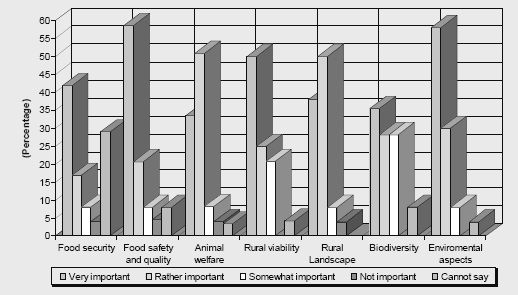
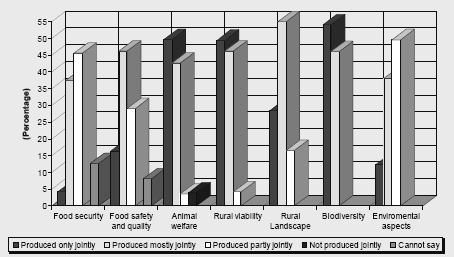
<body><![CDATA[<p><font size="3" face="Verdana, Arial, Helvetica, sans-serif"><b>NEW TRENDS OF THE AGRICULTURE</b><a name="1"></a> <a href="#indice"><img src="/img/revistas/rfnam/v60n2/up.gif"></a></font></p>     <p><font size="2" face="Verdana, Arial, Helvetica, sans-serif">As a consequence     to the inherent complexity of the agriculture, we can say that the humanity     in order to study the agriculture world divided it in two big disciplines;     the “Fitotechnique” (or   Agronomy) that approaches the problem of the production, transformation and   distribution of the products of vegetable origin and their derived; and the “Zootechnique”   (or Animal Science), which study the problem of the production, transformation   and distribution of the products of animal origin and their derived (Cotes   and Cotes, 2005). For the above mentioned, the concept of agriculture multifunctionality   should be understood as the concept which is applied not only to vegetable   and animal production systems but also is extended along of agrifood system,   which is the direct consequence of the agriculture complexity, mentioned previously.</font></p>     <p><font size="2" face="Verdana, Arial, Helvetica, sans-serif">So, on the basis     of the concepts of human domination over nature, and of experimental science     pioneered by Francis Bacon (1561-1626), and following the age of Enlightenment,     the agricultural revolution, along with the industrial revolution, led during     the 19th century to a rationalization of the agricultural production, including     that of animal production. The last 60 years saw the progress of industrialization     of this sector, together with a transition from a rural to an urban social     structure, disconnecting the major part of the population from the agricultural     production process (Marie, 2006). During this period, progress has been made     in food security and self-sufficiency in terms of quantity, costs for the     consumer, security of the products of animal origin and their physical quality     (such as standardization, or marketability). The increased intensification     of animal production together with the accelerated introduction of new biotechnologies     over the last two decades resulted in an increased detrimental environmental     impact, deep food and sanitary crises (such as BSE, FMD, contaminants in     meat), and a distrust of the population (Cunningham, 2003; Hodges, 2003).     As a consequence, a new demand is now emerging, centred on what could be     named “subjective quality”, stressing on the ethical and sustainable   aspects of livestock production along the agribusiness chains.</font></p>     <p><font size="2" face="Verdana, Arial, Helvetica, sans-serif">In this sense, roles of livestock keeping revolve   around storing wealth, contributing to food and nutritional security, providing   draught power, transport and manure, and serving traditional social functions   (Holmann <i>et al</i>., 2005).</font></p>     <p><font size="2" face="Verdana, Arial, Helvetica, sans-serif">However, agricultural   activities, apart from producing food and fiber and other products for which   there is a market and which therefore have a monetary value, also involve externalities   for which there are no identified markets - i.e. they are subject to market   failure. Such externalities may be positive or negative. Of course, all economic   activities to some degree share this characteristic, although it seems that   agriculture is unique in the range of externalities ascribed to it. Such externalities   also may be termed public goods (or public bads, if negative) as opposed to   private goods. The distinction is important in as much as public goods (or   bads) and their associated market failures may justify government intervention   to ensure or control their supply through subsidies or regulation or taxation.   In practice agriculture is often held to produce a public good, in order to   justify continued intervention by the State, although strictly speaking there   are no grounds for such a claim (Food and Agriculture Organization of the United   Nations (FAO) 2000).</font></p>     <p><font size="2" face="Verdana, Arial, Helvetica, sans-serif">To speak about     economic and social impacts of agribusiness in national economies is a real     challenge for anyone who has closely followed the recent developments of     agribusiness. Not only because we know very little about the impact of agribusiness     on modern economies, but also because we feel that we have a certain role     to play at turn of the century and the millennium, in terms of improving     the quality of countries’ life in the southern hemisphere,   and this task has a strong link with agribusiness issues (Zylbersztajn, 1999).</font></p>     <p><font size="2" face="Verdana, Arial, Helvetica, sans-serif">Until relatively     recently, it was agriculture’s negative environmental externalities   - pollution of surface and ground water and air, loss of habitats and biodiversity,   soil erosion, etc - which received most attention from policymakers, involving   taxes or regulations to correct for market failures. Now it is being increasingly   argued that agriculture also produces positive externalities, alternatively   known as multiple functions, the related market failures of which merit policy   interventions such as subsidies or other means of agricultural support to ensure   their continued “production” (FAO, 2000).</font></p>     <p><font size="2" face="Verdana, Arial, Helvetica, sans-serif">The production or provision of these non-commodity outputs   was assessed important as a whole, while environmental aspects, animal welfare,   and food safety and quality being the most important (<a href="#fig01">Figure   1</a>). However, an   issue of clear measurement of these elements arises. The most common example   was how to measure the desired rural landscape, while there can be found several   types of landscapes, which are desirable on the basis of historical, cultural   or national conditions. The provision of food security was also considered   important, but it can be ensured by the combination of domestic production   and international trade (Arovuori and Kola, 2005).</font></p>       <p align="center"><a name="fig01"></a><img src="/img/revistas/rfnam/v60n2/a01fig01.gif">    <br>   <font size="2" face="Verdana, Arial, Helvetica, sans-serif"><b>Figure   1.</b> Importance of guaranteeing the production of some “non-commodities”   agricultural outputs. (Adapted from Arovuori and Kola 2005).</font></p>       ]]></body>
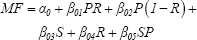
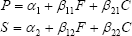
<body><![CDATA[<p><font size="2" face="Verdana, Arial, Helvetica, sans-serif">Vandermeulen, <i>et     al</i>. (2006) has carried out approaches to measure some elements that express     the agriculture multifunctional, through the following model:</font></p>     <p><img src="/img/revistas/rfnam/v60n2/a01eq01.gif"></p>     <p><font size="2" face="Verdana, Arial, Helvetica, sans-serif">where:</font></p>     <blockquote>       <p><font size="2" face="Verdana, Arial, Helvetica, sans-serif">MF: is the multifunctional farming system (dummy)    <br>     P: is the promotion of agriculture     outputs (categorical)    <br>     S: is the level of services (categorical) in the region    <br>     R: is the region (dummy)    <br>     So, the variables “P” and “S” are     defined by the following models (Vandermeulen, <i>et al.</i>, 2006):</font></p> </blockquote>     <p><img src="/img/revistas/rfnam/v60n2/a01eq02.gif"></p>     ]]></body>
<body><![CDATA[<p><font size="2" face="Verdana, Arial, Helvetica, sans-serif">where:</font></p>     <blockquote>       <p><font size="2" face="Verdana, Arial, Helvetica, sans-serif">F: is the farmers’ participation       in local rural policy (categorical),    <br>     C: is   the citizens’ participation in local rural policy     (categorical).</font></p> </blockquote>     <p><font size="2" face="Verdana, Arial, Helvetica, sans-serif">The idea behind this model is that the presence of multifunctional   farming systems directly depends on regional and local policy, and also that   this presence is indirectly influenced by the degree of participation of farmers   and citizens in local policies or in other words the presence of multifunctional   farming systems is embedded in a local environment which may be supportive   or not (Vandermeulen <i>et al.,</i> 2006). This is especially important to   Latin American countries, where the agribusiness sector is the most important   of their economies, so should be an obligation of their leads to formulate   a policy according with the multiple functions of the agriculture to improve   the quality life of their people.</font></p>     <p><font size="2" face="Verdana, Arial, Helvetica, sans-serif">There is a broad     consensus on what these multiple functions are, although there are a variety     of taxonomies by which they are organized. The main point is that they should     be genuine externalities and not simply extensions of agriculture’s economic     primary function of producing food, fiber, etc, although they may be in joint     supply with them. If this strict definition is applied, the following is   a shortlist of functions (FAO, 2000):</font></p> <ul>    <li><font size="2" face="Verdana, Arial, Helvetica, sans-serif">Food security,       including nutritional and food safety aspects, sometimes termed “strategic” functions.</font></li>       <li><font size="2" face="Verdana, Arial, Helvetica, sans-serif">Environmental: protection     of natural resources, including natural habitats and biodiversity and so     contributing to the sustainability of food production systems; disaster prevention     (floods and landslides); protecting rural landscapes. </font></li>       <li><font size="2" face="Verdana, Arial, Helvetica, sans-serif">Social and cultural:     linked to employment and income generation in rural areas and hence sustaining     the viability of rural communities and maintaining rural society.</font></li>     </ul>     ]]></body>
<body><![CDATA[<p><font size="2" face="Verdana, Arial, Helvetica, sans-serif">Some of these     functions are interrelated or synergistic. For example, protecting rural     landscapes may promote tourism and hence generate employment and so maintain     rural communities. Some observers contend that agriculture’s multiple functions cannot be separated   and therefore must be performed “on the same spot”, but that would rule out   the use of tradable permits between agricultural regions. These positive externalities   or multiple functions have also been described in general international usage   as non-trade concerns (NTCs) for example, in Article 20 of the Agreement on   Agriculture. However, as has been seen, when the multifaceted issue of food   security is opened up, as it was at the Rome Summit in 1996, there are several   clear links between trade and food security (FAO, 2000).</font></p>     <p><font size="2" face="Verdana, Arial, Helvetica, sans-serif">Setting such semantic   considerations aside, the next step is to examine what are NTCs commonly cited   under the three headings above - food security, environment and social - and   relate them to the Rome Plan of Action and particularly its Commitment Three[1]   which, as noted above, sets out to pursue, <i>inter alia,</i> sustainable food   and agricultural policies and practices, considering the multifunctional character   of agriculture. A pertinent observation at this point is that some of the main   proponents of NTCs are industrialized countries, in particular those with what   may be termed “difficult” agricultural production environments (harsh climate,   mountainous terrain, etc) and with an enduring rural tradition and concern   for the conservation of rural landscapes. They also possess the financial means   to subsidies their agricultural sectors and their populations generally spend   a small share of their disposable income on food (FAO, 2000).</font></p>     <p>&nbsp;</p>     <p><font size="3" face="Verdana, Arial, Helvetica, sans-serif"><b><a name="2"></a>FOOD SECURITY FUNCTION</b> <a href="#indice"><img src="/img/revistas/rfnam/v60n2/up.gif"></a></font></p>     <p><font size="2" face="Verdana, Arial, Helvetica, sans-serif">This objective     or peacetime function receives high priority in several industrialized countries,     mainly for strategic reasons because their food security as such, in normal     conditions, is hardly in question. For example, Norway recognizes that because     of high food production costs, it would be much more cost-efficient for several     countries, including Norway , under ordinary circumstances, to rely entirely     on world markets for their food supplies. However, based on historical experience     and due to the uncertainty associated with future international supplies,     national production policies have been and will always be a central element     in Norway 's food security policy. National stocking of food can only partly     compensate for the risk that a tight international food supply situation     may be of long duration. This risk applies not only to a situation of war     but also to peacetime crises such as plant and animal diseases, extensive   radioactive fallout, or major shifts in global demand and supply. Food security   policies based on a minimum level of self-sufficiency, by preserving the capacity   to produce, can be regarded as a risk insurance, with the public costs involved   related to the population's risk aversion and its willingness to pay for that   insurance (Royal Ministry of Agriculture of Norway (R.M.A.N.) 1998).</font></p>     <p><font size="2" face="Verdana, Arial, Helvetica, sans-serif">In this sense, FAO   (2002) makes the following reflection: Does food security in fact increase   with the level of self-sufficiency? It can indeed be argued that a policy of   self-sufficiency is likely to make domestic food prices more rather than less   unstable. Also, by promoting food self-sufficiency, the agricultural sector   is likely to become more dependent on inputs with high import content, particularly   with regard to energy. In turn, energy, i.e. fuel, is more likely than food   commodities to be subject to effective trade embargoes or sudden price hikes.   Yet political support for a food self-sufficiency policy still remains strong   in some countries. However, the government response could be a more rational   food security policy based on a range of options. Such a policy would be based   on an assessment of the main sources of food supply uncertainty: firstly, unforeseen   variations in supply caused by natural events - adverse weather or outbreaks   of pests and diseases of important food crops in major producing countries;   secondly, man-made events such as hostilities or disasters (such as another   Chernobyl) of a sufficient magnitude to affect trade flows; and thirdly, political   interventions short of war such as trade embargoes. In the face of such uncertainties,   there is a range of possible policy interventions, other than only promoting   self-sufficiency; they relate to consumption (e.g. promoting the substitution   between foods), production (e.g. making it more responsive to a sudden need   to increase supply), storage and marketing (strengthening supplier-importer   links).</font></p>     <p>&nbsp;</p>     <p><font size="3" face="Verdana, Arial, Helvetica, sans-serif"><b><a name="3"></a>ENVIRONMENTAL FUNCTION</b> <a href="#indice"><img src="/img/revistas/rfnam/v60n2/up.gif"></a></font></p>     <p><font size="2" face="Verdana, Arial, Helvetica, sans-serif">The potential     for agriculture to yield environmental services is now widely recognized     among the OECD countries. Thus a recent OECD paper states: The provision     of environmental benefits and amenities is increasingly seen as an element     of the “multifunctionality” of   the agricultural sector (Organization for Economic Cooperation and Development   (OECD) 1998). The word “amenities” is significant because it differentiates   the industrialized and developing country concerns, with those of the former   focusing primarily on protecting agricultural landscapes and those of the latter   focusing on the resource protecting services - prevention of soil erosion and   watershed protection; for example, without which food security may be threatened.   In this way the Commitment Three, agreed among 186 Heads of State in the World   Food Summit, November 13 1996, is of key importance because it is concerned   with the expansion of food production (and hence with the issue of a certain   degree of self-sufficiency in food), and with the sustainability of policies   (and hence with the natural resource-use aspects of food production); it also   refers specifically to the multifunctional character of agriculture, but without   explicitly stating what that involves (FAO, 2000).</font></p>     <p>&nbsp;</p>     ]]></body>
<body><![CDATA[<p><font size="3" face="Verdana, Arial, Helvetica, sans-serif"><b><a name="4"></a>SOCIO-CULTURAL FUNCTION</b> <a href="#indice"><img src="/img/revistas/rfnam/v60n2/up.gif"></a></font></p>     <p><font size="2" face="Verdana, Arial, Helvetica, sans-serif">Again, the respective   industrialized developing country interpretations of this function are nuanced   differently. The former are primarily concerned with avoiding the depopulation   of the countryside which uncontrolled social and economic forces would probably   bring about. They are also concerned with maintaining populated rural landscapes   and viable rural communities for tourism purposes while also noting that an   agrarian structure based on many relatively small, owner-occupied family farms   is more conducive to social stability and cultural preservation than one dominated   by relatively few large holdings (FAO, 2000).</font></p>     <p><font size="2" face="Verdana, Arial, Helvetica, sans-serif">On the other hand,     the “livestock ladder” may     allow the poor to progress from modest livestock holdings, such as a few     poultry, to acquiring sheep and goats or pigs, or even cattle (International     Livestock Research Institute (ILRI), 2003). Livestock production provides     a constant flow of income and reduces the vulnerability of agricultural production   (Holmann <i>et al</i>., 2005).</font></p>     <p><font size="2" face="Verdana, Arial, Helvetica, sans-serif">Food security     also is thought to be promoted by a decentralized, evenly distributed, production     structure. The developing countries, and many developed countries also, tend     to refer to agriculture as being a traditional “way of life” which   has cultural and societal connotations. Rapid rural-urban migration is also   cited as a potential disruptive force in a developing country society, contributing   to urban unemployment, crime. Increasingly, discussions on the multifunctionality   of agriculture have come to take on a “normative” stance. They do so by implying   that there is some desirable typology of agriculture or agricultural and rural   development paradigm that would maximize these functions or positive externalities.   This typology has become known as “multifunctional agriculture” (FAO, 2000).</font></p>     <p><font size="2" face="Verdana, Arial, Helvetica, sans-serif">It is pertinent to   ask, while not denying the validity of certain of the arguments for a multifunctional   agriculture; what is the appropriate area of policy to achieve the benefits   or services sought: food, agricultural, rural, social, and regional? In all   of these areas of policy, international trade has a bearing, of course. Another   issue is: Are all of the functions listed above in joint supply with agriculture's   primary function of producing food, fiber, etc.? In other words, is it necessary   to produce these products to achieve the externalities sought? The answer must   be: not always (FAO 2000).</font></p>     <p>&nbsp;</p>     <p><font size="3" face="Verdana, Arial, Helvetica, sans-serif"><b><a name="5"></a>EVOLUTION OF PRODUCTION MODELS IN   THE AGRIFOOD SYSTEM</b> <a href="#indice"><img src="/img/revistas/rfnam/v60n2/up.gif"></a></font></p>     <p><font size="2" face="Verdana, Arial, Helvetica, sans-serif">Theoretical considerations   formulated by Davis and Golberg (1957), and by Malassis (1973), the agrifood   system is understood as the total sum of operations of readiness and supply   of inputs, of production in the agricultural units, of storage, transformation   and distribution of foods (Cribb, 2004).</font></p>     <p><font size="2" face="Verdana, Arial, Helvetica, sans-serif">It is fair to     say that -in the Anglo-American context at least- the last 15 years have     seen the emergence of some of the most interesting and challenging theoretical     debates about the nature, changes and future trajectories of modern agricultural     regimes and rural areas from a variety of economic, social, political and     environmental stances (Burtton and Wilson, 2006). The most powerful concept     to emerge from these debates has undoubtedly been the notion that modern     agricultural regimes have moved from “productivism”   to “post-productivism” (e.g. Cloke and Goodwin, 1992; Marsden <i>et al</i>.,   1993), and more recently from productivism to multifunctional agricultural   regimes (e.g. Wilson, 2001; Potter and Burney, 2002). While the productivist   era placed great emphasis on maximum food production and the predominant role   of the countryside as a site for production of food and fiber, the post-productivist   era has been characterized by a reduced emphasis on food production and an   increased emphasis on the countryside as a place of “consumption” with high   environmental sustainability. Much recent literature has attempted to conceptualize   the possible transition from productivism to post-productivism to multifunctionality   (Cloke and Goodwin, 1992; Marsden <i>et al</i>., 1993; Wilson, 2001; Evans,   Morris and Winter, 2002). However, problems have emerged with the implied linearity   of the productivist/post-productivist transition model, and it has been argued   that this bipolar assumption does not fully encapsulate the diversity, non-linearity   and spatial heterogeneity that can currently be observed in modern agricultural   regimes ( Wilson, 2001). As a result, the notion of a “multifunctional agricultural   regime” has been suggested as an “alternative end-point” that acknowledges   that productivist and post-productivist action and thought can occur simultaneously   spatially as well as temporally (Potter and Burney, 2002; Wilson and Rigg,   2003).</font></p>     <p><font size="2" face="Verdana, Arial, Helvetica, sans-serif">So, multifunctional     agricultural regimes are characterized by a “territorialization” of agricultural regimes, with intensively farmed   regions (often in the lowlands) geared towards productivist food and fiber   output, and post-productivist farming regions (often in the uplands) aimed   at extensification, wildlife and habitat preservation and sustainable countryside   management that also includes non-agricultural pursuits (e.g. recreation, “consumption” of   nature, diversification, etc.).</font></p>       ]]></body>
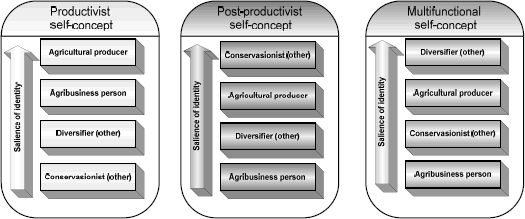
<body><![CDATA[<p><font size="2" face="Verdana, Arial, Helvetica, sans-serif">In <a href="#fig02">Figure       2</a>, for     the productivist selfconcept, roles that typify production dominate and non-productivist     roles involving diversification and emphasis on conservation are viewed negatively.     These counter-identities may thus be seen by the productivist farmer as part     of the “other”. In the post-productivist   self-concept, production roles, while still important, are of lesser salience.   Identities based on roles that emphasize outright commercialism at the expense   of the environment or smaller-scale approaches to agriculture (i.e. agribusiness   approaches) are seen as part of the “other”. For multifunctional self-concepts,   there is no notion of “otherness”. Multifunctionality emphasizes the ability   for all identities to coexist. while one identity will be salient, there are   no approaches to agriculture which the farmer actively opposes. In effect,   the distance in terms of salience of identities may be negliglible (Burtton   and Wilson, 2006).</font></p>     <p align="center"><a name="fig02"></a><img src="/img/revistas/rfnam/v60n2/a01fig02.gif">    <br> <font size="2" face="Verdana, Arial, Helvetica, sans-serif"><b>Figure 2.</b> Hypothetical conceptualization of productivist, post-productivist and multifunctional farmer self concepts (Adapted from Burtton and Wilson, 2006)</font></p>     <p><font size="2" face="Verdana, Arial, Helvetica, sans-serif">On the other hand,   for Hollander 2004, the concept of multifunctionality emerged in the context   of increasing pressure from the WTO that is perceived as threatening to rural   land-based economies and their associated landscapes.</font></p>     <p>&nbsp;</p>     <p><font size="3" face="Verdana, Arial, Helvetica, sans-serif"><b><a name="6"></a>THE MULTIFUNCTIONAL     AGRICULTURE CONCEPT AND  ITS IMPACT ON INTERNATIONAL FOOD TRADE</b> <a href="#indice"><img src="/img/revistas/rfnam/v60n2/up.gif"></a></font></p>     <p><font size="2" face="Verdana, Arial, Helvetica, sans-serif">Multifunctionality has emerged as a key policy concept in   the WTO agriculture negotiations, defining the terms of an important debate   about non-trade concerns in the liberalization of agricultural trade and the   extent to which it is legitimate to compromise GATT disciplines in the interests   of domestic policy considerations. It has many dimensions, touching on the   contribution of agriculture to rural development, food security and animal   welfare (Potter and Burney, 2002).</font></p>     <p><font size="2" face="Verdana, Arial, Helvetica, sans-serif">The European Union     Agricultural Commissioner defined   “multifunctionality” as the link “between sustainable agriculture, food safety,   territorial balance, main-training the landscape and the environment and what   is particularly important for developing countries, food security” (Hollander   2004). Thus, “multifunctionality” entered the lexicon of globalization at the   close of the century as part of the conceptual apparatus and the discursive   strategies deployed to debate and negotiate neoliberal agricultural trade policies   in domestic and international forum. Some proponents of the multifunctional   model emphasized European distinctiveness, whereas others provided a more generic   statement. Because the concept emerged in defense of the perceived particularities   of European rurality, it has been characterized as “a model that reflects the   specific history, cultures and choices of European society” (Givord, 2000;   mentioned by Hollander, 2004).</font></p>     <p><font size="2" face="Verdana, Arial, Helvetica, sans-serif">In the parlance     of WTO negotiations, “multifunctionality” provides   the philosophical underpinnings to argue for the expansion of the Green Box,   the category of policy measures not subject to multilateral sanction because   they are decoupled from production and therefore not considered to be trade   distorting. Multifunctionality provides a strategic opening in which to recognize   the landscape functions of agriculture and rural settlement, so that the resultant   social and ecological complexity can be defined as public goods and maintained   through state policies. It represents a shift in emphasis from the negative   to the positive environmental externalities of agricultural production to argue   for recognition of the social and/or environmental goods that are “jointly   produced” along with agricultural products (Swinbank 2002). The response at   the international level has varied according to the interests and alignments   of various states. For example, Japan, South Korea, Norway, and Switzerland   , with the EU have formed the “Friends of Multifunctionality” to emphasize “non-trade” aspects   of agricultural production in multilateral negotiations. In contrast, multifunctionality   has provoked a critical response from the Cairns Group, which regards it as “a   smokescreen for the continuation of protectionist agricultural policies” (Potter   and Burney, 2002).</font></p>     <p><font size="2" face="Verdana, Arial, Helvetica, sans-serif">As the above mentioned     consequence, Arovuori and Kola (2005), find that around the European population’s 95 % is agree with having some subsidy   type for the agriculture and this way to maintain the production of “non commodities”,   while 90 % thinks is justifiable, the application of these subsidies for the   production of foods, fibers or traditional products in the primary sector.   Additionally, only the 30% thinks that the subsidies or helps to the agriculture   should decrease, while the rest of the population considers that they should   stay.</font></p>     ]]></body>
<body><![CDATA[<p><font size="2" face="Verdana, Arial, Helvetica, sans-serif">According to the     policy model being promoted by the United State of America and some other     friends of multifunctionality, the phenomenon of joint production in agriculture     means that it is necessary to maintain certain widely flung systems of farming     across rural space in order to sustain valued agricultural landscapes and     the biodiversity they contain. On this view, the liberalization of agricultural     markets and the restructuring of agricultural production, especially in marginal     areas, may have undesirable environmental consequences that need to be anticipated     in the design of domestic subsidies. The model envisages the continued need     for multifunctional instruments that support farmers’ incomes in marginal     areas in order to ensure continued occupancy of rural land and thus the proper   management of farmed landscapes (Potter and Burney, 2002).</font></p>     <p><font size="2" face="Verdana, Arial, Helvetica, sans-serif">Alliances for     and against multifunctionality, and government and NGO position statements,     have two distinct versions of the concept, which are labeled “weak” and “strong” multifunctionality.     Weak conceptualizations of multifunctionality tend to defend a limited set     of national interests in the agricultural sector. Strong versions challenge     the current structure and logic of trade liberalization as regulated by various     GATT agreements and the WTO and view multifunctionality as a path to radical   reform (Hollander, 2004).</font></p>     <p>&nbsp;</p>     <p><font size="3" face="Verdana, Arial, Helvetica, sans-serif"><b><a name="7"></a>AGRIFOOD SYSTEM TRENDS</b> <a href="#indice"><img src="/img/revistas/rfnam/v60n2/up.gif"></a></font></p>     <p><font size="2" face="Verdana, Arial, Helvetica, sans-serif">The increasing pressure of urbani-zation results in incentives   to develop new activities and to valorize the so-called multifunctional nature   of agricultural farms (Vandermeulen <i>et al.,</i> 2006; Van der Ploeg, 2003).   This multifunctional nature of farming is defined by the OECD (Maier and Shobayashi,   2001) as the joint production of commodities (food and fibers, transformed   products, marketable products) and non commodities such as food security and   safety, water protection, rural way of life, soil conservation, rural landscape,   biological diversity or health (Durand and Van Huylenbroeck, 2003). In fact,   all forms of farming are intrinsically multifunctional because whatever production   models or systems applied a bundle of commodity and non-commodity outputs ranging   from social, environmental, economic to cultural goods and services is produced   (Hall and Rossillo-Calle, 1999). The difference is that in an urbanized environment   these non-commodities are more valued by the citizens resulting in a pressure   on traditional farming systems. But as certain production systems may result   in a higher production of desired non-commodity outputs than others, a shift   towards more multifunctional farming systems might contribute to dealing with   the pressures of urbanization (Meert <i>et al</i>., 2005). Not only the farmers   might benefit from multifunctionality, but it also contributes, as Marsden   (1999) writes, to a more consumer oriented countryside, in which different   services and goods are produced and delivered and which respond to the increasing   demand for a countryside oriented towards leisure, especially in the vicinity   of larger urban centers (Goetgeluk and Schotten, 2000; Deelstra, Boyd, and   Van den Biggelaar, 2001). </font></p>     <p><font size="2" face="Verdana, Arial, Helvetica, sans-serif">This pressure on conventional farming systems is, according   to Heimlich and Barnard 1997, coming from two specific impacts of urbanization.   On the one hand, urbanization influences the market environment and in particular   the prices for labor, land, and other primary inputs. On the other hand, the   local institutional environment is influenced by conditions imposed by an increasing   number of non-rural inhabitants. Examples of this institutional influence are   more restrictive rules on farming (e.g. environmental regulations, licenses)   and other policy priorities for open zones resulting in less protection of   zones dedicated to agriculture.</font></p>     <p><font size="2" face="Verdana, Arial, Helvetica, sans-serif">As can be seen in <a href="#fig03">Figure       3</a>, rural landscape and biodiversity   on and close to farm land are most often regarded as pure elements of multifunctionality.   However, besides agriculture, environmental aspects and rural viability are   also due to other rural industries. Food safety and quality is, to a large   extent, guaranteed already in the primary production, but it is at least an   equally important issue for the processing stage. Welfare of production animals   is an issue at the farm level, but transportation of animals may have even   more harmful effects on animal welfare (Arovuori and Kola, 2005). </font></p>       <p align="center"><a name="fig03"></a><img src="/img/revistas/rfnam/v60n2/a01fig03.gif">    <br>   <font size="2" face="Verdana, Arial, Helvetica, sans-serif"><b>Figure   3.</b> Multifunctional elements produced jointly with agricultural production (Adapted   from Arovuori and Kola, 2005)</font></p>       <p><font size="2" face="Verdana, Arial, Helvetica, sans-serif">In relation with     the animal welfare issue, its definitions are numerous and depend on the     components taken into consideration. Biological functions (Broom, 1991) may     be considered as central, giving rise to   “objective” indicators such as productivity, behavior, physiological parameters,   anatomy and health. An alternative approach concerns the affective states of   the animal: feelings, pain, suffering (Duncan and Fraser, 1997). Still another   approach concerns living conditions respecting the “natural”   conditions of a given species and allowing the species specific behavior to   be experienced (Rollin, 1993). The diversity of scientific dimensions of animal   welfare consequently requires a multidisciplinary approach and a balance of   science with philosophical components. In that sense, animal welfare is a mixture   of science and values (Fraser, 2004).</font></p>     ]]></body>
<body><![CDATA[<p><font size="2" face="Verdana, Arial, Helvetica, sans-serif">Furthermore, it is also necessary for the social acceptability   of the animal production sector, which remains a significant (and central)   component of rural development. In this sense, animal ethics is a critical   element of the sustainability of livestock production systems and, more than   a constraint, it should be considered as an opportunity to fit the expectations   of the society (Marie, 2006).</font></p>     <p><font size="2" face="Verdana, Arial, Helvetica, sans-serif">On the other hand,     the US policymakers do not use   “multifunctionality” with the same interest in cultural diversity and ecological   complexity that their European counterparts do (Hollander, 2004). For example,   the US Department of Agriculture (USDA) report on multifunctionality omits   any reference to questions of biodiversity or landscape heterogeneity, reducing   agro environmental goods to “scenic vistas”   (Bohman <i>et al</i>., 1999).</font></p>     <p><font size="2" face="Verdana, Arial, Helvetica, sans-serif">In the European case for example, the <i>“Contrat Territorial     d’Exploitation”</i> (CTE) is a contract arrangement committing the entire     farm, for a period of five years. “It must be based on a project involving     the entire farm. Through this project the farmer agrees to develop multiple-functional     farming activities. These should contribute not only to farm production and     creation of added value, but also protect and manage natural resources, landscapes     and biological biodiversity, whilst giving stability to land areas and employment” (Ministere     Français d'Agriculture (M.F.A) 1999).</font></p>     <p><font size="2" face="Verdana, Arial, Helvetica, sans-serif">So, when local policymakers   promote actively local agriculture, farmers will be more encouraged to start   direct marketing, processing of farm products or set up farm-tourism activities   (Vandermeulen<i> et al</i>., 2006). This trend could be an opportunity to developing   countries, especially for Latin American; because for example, Colombia is   one of the most biodiverse countries in the world, second only to Brazil that   is seven times larger (Chará and Murgueitio, 2005). In less than 1% of the   land, Colombia has more than 10% of world species. In relation with the number   of species in the world, it is estimated that Colombia has 15% of the orchids,   20% of the birds, 7% of the mammals, 15% of the primates, 6% of the reptiles,   10% of the amphibians and 20% of the butterflies in a relatively small area   (McNeely, <i>et al</i>., 1990; Instituto Alexander von Humboldt, 2003).</font></p>     <p><font size="2" face="Verdana, Arial, Helvetica, sans-serif">Keeping in mind a holistic approach, the CTE of France,   contain two fundamental elements. The first of them is a socioeconomic section,   in which are included the aspects related with the employment, the human resources   and work, product quality, animal well-being, economics issues and autonomy   of the rural regions. The other element is environmental and territorial section,   where the main concerns are; the preservation of the water, soils, air, biodiversity,   landscape and cultural heritage, the prevention of the natural risks, and the   optimization of the use of the energy resources (Gafsi <i>et al</i>., 2006).</font></p>     <p><font size="2" face="Verdana, Arial, Helvetica, sans-serif">Finally, several researchers (e.g. Meert <i>et al</i>.,   2005) have demonstrated that the diversification and participation in agroenvironmental   programs may be adequate preventive survival strategies to be developed by   farmers who are not possible to expand their farm business (Vandermeulen <i>et   al.</i>, 2006). Additionally, these preventive practices contribute towards   a more consumer-oriented countryside (Marsden, 1999).</font></p>     <p>&nbsp;</p>     <p><font size="3" face="Verdana, Arial, Helvetica, sans-serif"><b><a name="8"></a>CONCLUSIONS</b> <a href="#indice"><img src="/img/revistas/rfnam/v60n2/up.gif"></a></font></p>     <p><font size="2" face="Verdana, Arial, Helvetica, sans-serif">Nowadays, is more   accepted that agriculture provides not only food and fibers but also generates   a non-commodities outputs which have been more valued in the last years by   the population of industrialized countries, especially keeping in mind that   most of the population of those countries lives in the cities, and the fact   of preserve the environment and the rural sector becomes something so important   and ideologically fair for most of their inhabitants. Probably, the same trend   will increase in developing countries in the next years.</font></p>     <p><font size="2" face="Verdana, Arial, Helvetica, sans-serif">The non-commodities outputs, could be an alternative of   social and economic development for many of the agricultural production systems   around the world; especially for Latin American countries which have a natural   wealth in their agriculture-ecosystems and biodiversity of fauna and flora;   which could be used through entrepreneur projects in order to foment the farm-tourism   activities to get the benefits that these non-commodities offer to the human   welfare. These indeed will be a change in the paradigm from an agriculture   eminently governed by a productivist model, toward a model that accepts and   develops a multifunctional agriculture in developing countries, which should   let to join the diversity of points of view and interests of the stakeholders   within agribusiness chains.</font></p>     ]]></body>
<body><![CDATA[<p><font size="2" face="Verdana, Arial, Helvetica, sans-serif">The concept agribusiness system,   recover the true sense of the agriculture and remain us that it is necessary   a holistic view in order to carry out their main objective, which is not other   different than to provide welfare and health to the humanity, through the efficient   and economic use of the natural, animals and vegetables resources. That true   essence of agriculture nowadays is manifested through the concept of the multifunctionality   itself, and therefore, both the managers and the agricultural professionals   should be agents of development in each one of their countries. In this sense,   as agricultural engineers as animal scientist are called in first instance   to assume this challenge, especially in Latin America, where agribusiness chains   are fundamental part of the national economy; projecting the agricultural production   systems toward the satisfaction of the necessities of the final consumers,   and forgetting the old paradigm of some centuries ago, where the important   issue was just to produce; which unfortunately separated to the primary sector   of the marketing issue and food distribution system.</font></p>     <p><font size="2" face="Verdana, Arial, Helvetica, sans-serif">Because of the increase   importance that non-commodities have taken in the last years; it will be the   main threat for Latin American countries, who many times claim that subsidies   and aids received by agricultural producers in the industrialized countries   disappear. In fact, the trend of developed countries is to maintain the subsidies   policies, independently of the terms in that agreements of free trade are negotiated.</font></p>     <p><font size="2" face="Verdana, Arial, Helvetica, sans-serif">There are many non-commodities   (for example, environmental aspects and food security), which are not necessarily   guaranteed having a lot of farming production systems; so regional and national   policies intervene in favor their existence. This constitutes an interesting   element of discussion, because it suggests the complexity that exists among   the commodities and non-commodities agricultural outputs.</font></p>     <p>&nbsp;</p>     <p><font size="3" face="Verdana, Arial, Helvetica, sans-serif"><b><a name="9"></a>ACKNOWLEDGEMENT</b> <a href="#indice"><img src="/img/revistas/rfnam/v60n2/up.gif"></a></font></p>     <p><font size="2" face="Verdana, Arial, Helvetica, sans-serif">The authors wish     to express their gratefulness to the “<i>Universidad     Nacional de Colombia</i>” because of the support given to the Management     and Economy Research Group of Agribusiness Chains (GIAECA), which was fundamental     to carry out this paper; which has been written within the Project Nº 6010001     of the Research Division of Bogotá (DIB) of this university.</font></p>     <p>&nbsp;</p>     <p><font size="3" face="Verdana, Arial, Helvetica, sans-serif"><b><a name="10"></a>BIBLIOGRAPHY</b> <a href="#indice"><img src="/img/revistas/rfnam/v60n2/up.gif"></a></font></p>     <!-- ref --><p><font size="2" face="Verdana, Arial, Helvetica, sans-serif">Arovuori, K. and     J. Kola. 2005. Policies and measures for multifunctional agriculture: experts’ insight. Int.   Food and Agribusiness Mgt. Rev.  8(3): 21-51.</font>&nbsp;&nbsp;&nbsp;&nbsp;&nbsp;&nbsp;&nbsp;&nbsp;[&#160;<a href="javascript:void(0);" onclick="javascript: window.open('/scielo.php?script=sci_nlinks&ref=000121&pid=S0304-2847200700020000100001&lng=','','width=640,height=500,resizable=yes,scrollbars=1,menubar=yes,');">Links</a>&#160;]<!-- end-ref --><!-- ref --><p><font size="2" face="Verdana, Arial, Helvetica, sans-serif">Bohman, M.; J. Cooper, D. Mullarkey,   M.A. Normile, D. Skully, S. Vogel, and E. Young, 1999. The Use and abuse of   multifunctionality. Economic Research Service/ USDA, United State of America   25 p.</font>&nbsp;&nbsp;&nbsp;&nbsp;&nbsp;&nbsp;&nbsp;&nbsp;[&#160;<a href="javascript:void(0);" onclick="javascript: window.open('/scielo.php?script=sci_nlinks&ref=000122&pid=S0304-2847200700020000100002&lng=','','width=640,height=500,resizable=yes,scrollbars=1,menubar=yes,');">Links</a>&#160;]<!-- end-ref --><!-- ref --><p><font size="2" face="Verdana, Arial, Helvetica, sans-serif">Broom, D. M. 1991.   Animal welfare: concepts and measurement. J. Animal Sci.  69:4167-4175.</font>&nbsp;&nbsp;&nbsp;&nbsp;&nbsp;&nbsp;&nbsp;&nbsp;[&#160;<a href="javascript:void(0);" onclick="javascript: window.open('/scielo.php?script=sci_nlinks&ref=000123&pid=S0304-2847200700020000100003&lng=','','width=640,height=500,resizable=yes,scrollbars=1,menubar=yes,');">Links</a>&#160;]<!-- end-ref --><!-- ref --><p><font size="2" face="Verdana, Arial, Helvetica, sans-serif">Burtton, R. and G.A. Wilson.   2006. Injecting social psychology theory into conceptualizations of agricultural   agency: towards a post-productivist farmer self-identity? J. Rural Studies   22(1):95-115.</font>&nbsp;&nbsp;&nbsp;&nbsp;&nbsp;&nbsp;&nbsp;&nbsp;[&#160;<a href="javascript:void(0);" onclick="javascript: window.open('/scielo.php?script=sci_nlinks&ref=000124&pid=S0304-2847200700020000100004&lng=','','width=640,height=500,resizable=yes,scrollbars=1,menubar=yes,');">Links</a>&#160;]<!-- end-ref --><!-- ref --><p><font size="2" face="Verdana, Arial, Helvetica, sans-serif">Chará, J. and     E. Murgueitio. 2005. The role of silvopastoral systems in the rehabilitation     of Andean stream habitats. Livestock Res. Rural Dev. 17 (2) Art. # 20. In:   <a href="http://www.cipav.org.co/lrrd/lrrd17/2/char17020.htm" target="ventana">http://www.cipav.org.co/lrrd/lrrd17/2/char17020.htm</a>; consulted: may 2007.</font>&nbsp;&nbsp;&nbsp;&nbsp;&nbsp;&nbsp;&nbsp;&nbsp;[&#160;<a href="javascript:void(0);" onclick="javascript: window.open('/scielo.php?script=sci_nlinks&ref=000125&pid=S0304-2847200700020000100005&lng=','','width=640,height=500,resizable=yes,scrollbars=1,menubar=yes,');">Links</a>&#160;]<!-- end-ref --><!-- ref --><p><font size="2" face="Verdana, Arial, Helvetica, sans-serif">Cloke, P. and M. Goodwin. 1992.   Conceptualizing countryside change: from post-Fordism to rural structured coherence.   Trans. Inst. Brit. Geographers. 17:321-336.</font>&nbsp;&nbsp;&nbsp;&nbsp;&nbsp;&nbsp;&nbsp;&nbsp;[&#160;<a href="javascript:void(0);" onclick="javascript: window.open('/scielo.php?script=sci_nlinks&ref=000126&pid=S0304-2847200700020000100006&lng=','','width=640,height=500,resizable=yes,scrollbars=1,menubar=yes,');">Links</a>&#160;]<!-- end-ref --><!-- ref --><p><font size="2" face="Verdana, Arial, Helvetica, sans-serif">Cotes, A. y J.M.     Cotes. 2005. El problema de la sostenibilidad dentro de la complejidad de   los sistemas de producción agropecuarios. Rev. Fac. Nal. Agr. Medellín 58(2):2813-2825.</font>&nbsp;&nbsp;&nbsp;&nbsp;&nbsp;&nbsp;&nbsp;&nbsp;[&#160;<a href="javascript:void(0);" onclick="javascript: window.open('/scielo.php?script=sci_nlinks&ref=000127&pid=S0304-2847200700020000100007&lng=','','width=640,height=500,resizable=yes,scrollbars=1,menubar=yes,');">Links</a>&#160;]<!-- end-ref --><!-- ref --><p><font size="2" face="Verdana, Arial, Helvetica, sans-serif">Cribb, A. 2004.     Sistema agroalimentar brasileiro e biotecnología moderna: oportunidades e perspectivas. Cad. Ciênc.  Tecnol.   Brasilia 21(1):169-195.</font>&nbsp;&nbsp;&nbsp;&nbsp;&nbsp;&nbsp;&nbsp;&nbsp;[&#160;<a href="javascript:void(0);" onclick="javascript: window.open('/scielo.php?script=sci_nlinks&ref=000128&pid=S0304-2847200700020000100008&lng=','','width=640,height=500,resizable=yes,scrollbars=1,menubar=yes,');">Links</a>&#160;]<!-- end-ref --><!-- ref --><p><font size="2" face="Verdana, Arial, Helvetica, sans-serif">Cunningham, E.P. 2003. After BSE - A future for the european   livestock sector. Wageningen Academic Publishers, The Netherlands . 104 p. </font>&nbsp;&nbsp;&nbsp;&nbsp;&nbsp;&nbsp;&nbsp;&nbsp;[&#160;<a href="javascript:void(0);" onclick="javascript: window.open('/scielo.php?script=sci_nlinks&ref=000129&pid=S0304-2847200700020000100009&lng=','','width=640,height=500,resizable=yes,scrollbars=1,menubar=yes,');">Links</a>&#160;]<!-- end-ref --><!-- ref --><p><font size="2" face="Verdana, Arial, Helvetica, sans-serif"> Davis, J.H. and R. A. Goldberg.   1957. A concept of agribusiness: division of research graduate school of business   administration. Harvard University, Boston, USA . 136 p.</font>&nbsp;&nbsp;&nbsp;&nbsp;&nbsp;&nbsp;&nbsp;&nbsp;[&#160;<a href="javascript:void(0);" onclick="javascript: window.open('/scielo.php?script=sci_nlinks&ref=000130&pid=S0304-2847200700020000100010&lng=','','width=640,height=500,resizable=yes,scrollbars=1,menubar=yes,');">Links</a>&#160;]<!-- end-ref --><!-- ref --><p><font size="2" face="Verdana, Arial, Helvetica, sans-serif">Deelstra, T., D. Boyd and M.   Van den Biggelaar. 2001. Multifunctional land use: an opportunity for promoting   urban agriculture in Europe. Urban Agr. Mag. (4):33-35.</font>&nbsp;&nbsp;&nbsp;&nbsp;&nbsp;&nbsp;&nbsp;&nbsp;[&#160;<a href="javascript:void(0);" onclick="javascript: window.open('/scielo.php?script=sci_nlinks&ref=000131&pid=S0304-2847200700020000100011&lng=','','width=640,height=500,resizable=yes,scrollbars=1,menubar=yes,');">Links</a>&#160;]<!-- end-ref --><!-- ref --><p><font size="2" face="Verdana, Arial, Helvetica, sans-serif"> Duncan, I. and D. Fraser. 1997. Under-standing animal welfare.   p. 19-31. In: M.C. Appleby and B.O. Hughes (eds.). Animal welfare. CAB Int.,   London. </font>&nbsp;&nbsp;&nbsp;&nbsp;&nbsp;&nbsp;&nbsp;&nbsp;[&#160;<a href="javascript:void(0);" onclick="javascript: window.open('/scielo.php?script=sci_nlinks&ref=000132&pid=S0304-2847200700020000100012&lng=','','width=640,height=500,resizable=yes,scrollbars=1,menubar=yes,');">Links</a>&#160;]<!-- end-ref --><!-- ref --><p><font size="2" face="Verdana, Arial, Helvetica, sans-serif">Durand, G. and G. Van Huylenbroeck.   2003. Multifunctionality and rural development: a general framework. p. 1-16.   In: G. Van Huylenbroeck and G. Durand (eds.). Multifunctional agriculture:   a new paradigm for european agriculture and rural development. Ashgate Publishing,   Hampshire, England .</font>&nbsp;&nbsp;&nbsp;&nbsp;&nbsp;&nbsp;&nbsp;&nbsp;[&#160;<a href="javascript:void(0);" onclick="javascript: window.open('/scielo.php?script=sci_nlinks&ref=000133&pid=S0304-2847200700020000100013&lng=','','width=640,height=500,resizable=yes,scrollbars=1,menubar=yes,');">Links</a>&#160;]<!-- end-ref --><!-- ref --><p><font size="2" face="Verdana, Arial, Helvetica, sans-serif">Evans, N.,   C. Morris and M. Winter. 2002. Conceptualizing agriculture: a critique of post-productivism   as the new orthodoxy. Prog. Hum. Geogr. 26(3):313-332.</font>&nbsp;&nbsp;&nbsp;&nbsp;&nbsp;&nbsp;&nbsp;&nbsp;[&#160;<a href="javascript:void(0);" onclick="javascript: window.open('/scielo.php?script=sci_nlinks&ref=000134&pid=S0304-2847200700020000100014&lng=','','width=640,height=500,resizable=yes,scrollbars=1,menubar=yes,');">Links</a>&#160;]<!-- end-ref --><!-- ref --><p><font size="2" face="Verdana, Arial, Helvetica, sans-serif">Fraser, D. 2004. Applying science to animal welfare standards<i>. </i>p.   121-127<em>. In: Proc. Global Conference on Animal Welfare: An OIE   Initiative.</em> 23-25 Feb. 2004<em>.</em> <em>Paris, France.</em></font>&nbsp;&nbsp;&nbsp;&nbsp;&nbsp;&nbsp;&nbsp;&nbsp;[&#160;<a href="javascript:void(0);" onclick="javascript: window.open('/scielo.php?script=sci_nlinks&ref=000135&pid=S0304-2847200700020000100015&lng=','','width=640,height=500,resizable=yes,scrollbars=1,menubar=yes,');">Links</a>&#160;]<!-- end-ref --><!-- ref --><p><font size="2" face="Verdana, Arial, Helvetica, sans-serif">Food and Agriculture Organization   of the United Nations. 2000. Agriculture, trade and food security: issues and   options in the WTO negotiations from the perspective of developing countries.   v.1. FAO, Rome. 136 p.</font>&nbsp;&nbsp;&nbsp;&nbsp;&nbsp;&nbsp;&nbsp;&nbsp;[&#160;<a href="javascript:void(0);" onclick="javascript: window.open('/scielo.php?script=sci_nlinks&ref=000136&pid=S0304-2847200700020000100016&lng=','','width=640,height=500,resizable=yes,scrollbars=1,menubar=yes,');">Links</a>&#160;]<!-- end-ref --><!-- ref --><p><font size="2" face="Verdana, Arial, Helvetica, sans-serif">Gafsi, M., B. Legagneux, G. Nguyen   and P. Robin. 2006. Towards sustainable farming systems: Effectiveness and   deficiency of the French procedure of sustainable agriculture. Agr. Syst. 90(1-3):226-242.</font>&nbsp;&nbsp;&nbsp;&nbsp;&nbsp;&nbsp;&nbsp;&nbsp;[&#160;<a href="javascript:void(0);" onclick="javascript: window.open('/scielo.php?script=sci_nlinks&ref=000137&pid=S0304-2847200700020000100017&lng=','','width=640,height=500,resizable=yes,scrollbars=1,menubar=yes,');">Links</a>&#160;]<!-- end-ref --><!-- ref --><p><font size="2" face="Verdana, Arial, Helvetica, sans-serif">Goetgeluk, R. and K. Schotten.   2000. Rural land use in perspectives: the feasibility of physical planning   scenarios p. 29-50. In: Hillebrand, H., R. Goetgeluk and H. Hetsen (eds.).   Plurality and rurality: the role of the countryside in urbanised regions. v.   1. Lei, Den Haag, Wageningen, UR. </font>&nbsp;&nbsp;&nbsp;&nbsp;&nbsp;&nbsp;&nbsp;&nbsp;[&#160;<a href="javascript:void(0);" onclick="javascript: window.open('/scielo.php?script=sci_nlinks&ref=000138&pid=S0304-2847200700020000100018&lng=','','width=640,height=500,resizable=yes,scrollbars=1,menubar=yes,');">Links</a>&#160;]<!-- end-ref --><!-- ref --><p><font size="2" face="Verdana, Arial, Helvetica, sans-serif">Hall, D. and F. Rossillo-Calle, 1999. The multifunctional   character of agriculture on land: bioenergy. p. 43-78. In: FAO - Conference   on the Multifunctional Character of Agriculture and Land. 12-17 Sep. 1999.   Maastricht, The Netherlands . </font>&nbsp;&nbsp;&nbsp;&nbsp;&nbsp;&nbsp;&nbsp;&nbsp;[&#160;<a href="javascript:void(0);" onclick="javascript: window.open('/scielo.php?script=sci_nlinks&ref=000139&pid=S0304-2847200700020000100019&lng=','','width=640,height=500,resizable=yes,scrollbars=1,menubar=yes,');">Links</a>&#160;]<!-- end-ref --><!-- ref --><p><font size="2" face="Verdana, Arial, Helvetica, sans-serif">Heimlich, R. E. and C. H. Barnard.   1997. Agricultural adaptation to urbanization?: farm types and agricultural   sustainability in US metropolitan areas. p. 143. In: Audirac, I., (ed.). Rural   sustainable development in America . Wiley, New York. pp. 283-303.</font>&nbsp;&nbsp;&nbsp;&nbsp;&nbsp;&nbsp;&nbsp;&nbsp;[&#160;<a href="javascript:void(0);" onclick="javascript: window.open('/scielo.php?script=sci_nlinks&ref=000140&pid=S0304-2847200700020000100020&lng=','','width=640,height=500,resizable=yes,scrollbars=1,menubar=yes,');">Links</a>&#160;]<!-- end-ref --><!-- ref --><p><font size="2" face="Verdana, Arial, Helvetica, sans-serif">Hodges, J. 2003. Livestock, ethics and quality of life.   J. Animal Sci. 81(11): 2908-2911.</font>&nbsp;&nbsp;&nbsp;&nbsp;&nbsp;&nbsp;&nbsp;&nbsp;[&#160;<a href="javascript:void(0);" onclick="javascript: window.open('/scielo.php?script=sci_nlinks&ref=000141&pid=S0304-2847200700020000100021&lng=','','width=640,height=500,resizable=yes,scrollbars=1,menubar=yes,');">Links</a>&#160;]<!-- end-ref --><!-- ref --><p><font size="2" face="Verdana, Arial, Helvetica, sans-serif">Holmann,   F., L. Rivas, N. Urbina, B. Rivera, L. A. Giraldo, S. Guzman, M. Martinez,   A. Medina, and G. Ramirez. 2005. The role of livestock in poverty alleviation:   an analysis of Colombia. <em>Livestock Res. Rural Dev. 17 (2) Art. # 11.</em> In:   <a href="http://www.cipav.org.co/lrrd/lrrd17/1/holm17011.htm" target="ventana">http://www.cipav.org.co/lrrd/lrrd17/1/holm17011.htm</a>; consulted: may 2007. </font>&nbsp;&nbsp;&nbsp;&nbsp;&nbsp;&nbsp;&nbsp;&nbsp;[&#160;<a href="javascript:void(0);" onclick="javascript: window.open('/scielo.php?script=sci_nlinks&ref=000142&pid=S0304-2847200700020000100022&lng=','','width=640,height=500,resizable=yes,scrollbars=1,menubar=yes,');">Links</a>&#160;]<!-- end-ref --><!-- ref --><p><font size="2" face="Verdana, Arial, Helvetica, sans-serif">Hollander,   G.M. 2004. Agricultural trade liberalization, multifunctionality, and sugar   in the south Florida landscape.  Geoforum 35(3):299-312.</font>&nbsp;&nbsp;&nbsp;&nbsp;&nbsp;&nbsp;&nbsp;&nbsp;[&#160;<a href="javascript:void(0);" onclick="javascript: window.open('/scielo.php?script=sci_nlinks&ref=000143&pid=S0304-2847200700020000100023&lng=','','width=640,height=500,resizable=yes,scrollbars=1,menubar=yes,');">Links</a>&#160;]<!-- end-ref --><!-- ref --><p><font size="2" face="Verdana, Arial, Helvetica, sans-serif">Instituto Alexander     von Humboldt 2003. Biodiversidad en Colombia. In: <a href="http://www.humboldt.org.co/biodiversidad.htm" target="ventana">http://www.humboldt.org.co/biodiversidad.htm</a>;   consulted: 30 may. 2007.</font>&nbsp;&nbsp;&nbsp;&nbsp;&nbsp;&nbsp;&nbsp;&nbsp;[&#160;<a href="javascript:void(0);" onclick="javascript: window.open('/scielo.php?script=sci_nlinks&ref=000144&pid=S0304-2847200700020000100024&lng=','','width=640,height=500,resizable=yes,scrollbars=1,menubar=yes,');">Links</a>&#160;]<!-- end-ref --><!-- ref --><p><font size="2" face="Verdana, Arial, Helvetica, sans-serif">International     Livestock Research Institute. 2003. Livestock, a pathway out of poverty:   ILRI's strategy to 2010. ILRI, Nairobi, Kenya .  24 p. &nbsp;</font>&nbsp;&nbsp;&nbsp;&nbsp;&nbsp;&nbsp;&nbsp;&nbsp;[&#160;<a href="javascript:void(0);" onclick="javascript: window.open('/scielo.php?script=sci_nlinks&ref=000145&pid=S0304-2847200700020000100025&lng=','','width=640,height=500,resizable=yes,scrollbars=1,menubar=yes,');">Links</a>&#160;]<!-- end-ref --><!-- ref --><p><font size="2" face="Verdana, Arial, Helvetica, sans-serif">McNeely, M.; W. Reid, R. Mittermeier, and T. Werner. 1990.   Conserving the world's biological diversity. World Resources Institute, Conservation   International, WWF-US and World Banks, Washington, USA. 174 p.</font>&nbsp;&nbsp;&nbsp;&nbsp;&nbsp;&nbsp;&nbsp;&nbsp;[&#160;<a href="javascript:void(0);" onclick="javascript: window.open('/scielo.php?script=sci_nlinks&ref=000146&pid=S0304-2847200700020000100026&lng=','','width=640,height=500,resizable=yes,scrollbars=1,menubar=yes,');">Links</a>&#160;]<!-- end-ref --><!-- ref --><p><font size="2" face="Verdana, Arial, Helvetica, sans-serif">Maier. L. and M. Shobayashi.   2001. Multifunctionality: towards an analytical framework. OECD Publications   Service, Paris, France. 157 p.</font>&nbsp;&nbsp;&nbsp;&nbsp;&nbsp;&nbsp;&nbsp;&nbsp;[&#160;<a href="javascript:void(0);" onclick="javascript: window.open('/scielo.php?script=sci_nlinks&ref=000147&pid=S0304-2847200700020000100027&lng=','','width=640,height=500,resizable=yes,scrollbars=1,menubar=yes,');">Links</a>&#160;]<!-- end-ref --><!-- ref --><p><font size="2" face="Verdana, Arial, Helvetica, sans-serif">Malassis, L. 1973. Économie agroalimentaire   T. 1: économie de la consommation et de la production agroalimentaire. Paris,   France.  402 p.</font>&nbsp;&nbsp;&nbsp;&nbsp;&nbsp;&nbsp;&nbsp;&nbsp;[&#160;<a href="javascript:void(0);" onclick="javascript: window.open('/scielo.php?script=sci_nlinks&ref=000148&pid=S0304-2847200700020000100028&lng=','','width=640,height=500,resizable=yes,scrollbars=1,menubar=yes,');">Links</a>&#160;]<!-- end-ref --><!-- ref --><p><font size="2" face="Verdana, Arial, Helvetica, sans-serif">Marie, M. 2006.     Ethics: The new challenge for animal agriculture. Livestock Sci. Article     in press. In: doi:10.1016/j. livsci.2006.05.006; consulted:  sep.   2006.</font>&nbsp;&nbsp;&nbsp;&nbsp;&nbsp;&nbsp;&nbsp;&nbsp;[&#160;<a href="javascript:void(0);" onclick="javascript: window.open('/scielo.php?script=sci_nlinks&ref=000149&pid=S0304-2847200700020000100029&lng=','','width=640,height=500,resizable=yes,scrollbars=1,menubar=yes,');">Links</a>&#160;]<!-- end-ref --><!-- ref --><p><font size="2" face="Verdana, Arial, Helvetica, sans-serif">Marsden, T., J.     Murdoch,&nbsp;P.M.   Lowe, R. Munton&nbsp;and A. Flynn. 1993. Constructing the countryside. 1<sup>st</sup> ed.   UCL Press, London, UK . 220 p.</font>&nbsp;&nbsp;&nbsp;&nbsp;&nbsp;&nbsp;&nbsp;&nbsp;[&#160;<a href="javascript:void(0);" onclick="javascript: window.open('/scielo.php?script=sci_nlinks&ref=000150&pid=S0304-2847200700020000100030&lng=','','width=640,height=500,resizable=yes,scrollbars=1,menubar=yes,');">Links</a>&#160;]<!-- end-ref --><!-- ref --><p><font size="2" face="Verdana, Arial, Helvetica, sans-serif">Marsden, T. 1999. Rural futures:   the consumption countryside and its regulation. Sociologia Ruralis 39(4):501-526.</font>&nbsp;&nbsp;&nbsp;&nbsp;&nbsp;&nbsp;&nbsp;&nbsp;[&#160;<a href="javascript:void(0);" onclick="javascript: window.open('/scielo.php?script=sci_nlinks&ref=000151&pid=S0304-2847200700020000100031&lng=','','width=640,height=500,resizable=yes,scrollbars=1,menubar=yes,');">Links</a>&#160;]<!-- end-ref --><!-- ref --><p><font size="2" face="Verdana, Arial, Helvetica, sans-serif">Meert, H., G. Van Huylenbroeck,   T.Vernimmen, M. Bourgeois and E. Van Hecke. 2005. Farm household survival strategies   and diversification on marginal farms. J. Rural Studies 21(1):81-97.</font>&nbsp;&nbsp;&nbsp;&nbsp;&nbsp;&nbsp;&nbsp;&nbsp;[&#160;<a href="javascript:void(0);" onclick="javascript: window.open('/scielo.php?script=sci_nlinks&ref=000152&pid=S0304-2847200700020000100032&lng=','','width=640,height=500,resizable=yes,scrollbars=1,menubar=yes,');">Links</a>&#160;]<!-- end-ref --><!-- ref --><p><font size="2" face="Verdana, Arial, Helvetica, sans-serif">French Ministry     of Agriculture. 1999. Mise enœuvre des contrats territoriaux d’exploitation. Circulaire DEPSE/SDEA/   N°C99-7030, du 17 Novembre 1999, Paris, France. 24 p. </font>&nbsp;&nbsp;&nbsp;&nbsp;&nbsp;&nbsp;&nbsp;&nbsp;[&#160;<a href="javascript:void(0);" onclick="javascript: window.open('/scielo.php?script=sci_nlinks&ref=000153&pid=S0304-2847200700020000100033&lng=','','width=640,height=500,resizable=yes,scrollbars=1,menubar=yes,');">Links</a>&#160;]<!-- end-ref --><!-- ref --><p><font size="2" face="Verdana, Arial, Helvetica, sans-serif">Organization for     Economic Cooperation and Development 1998. Agricultural Policy: the need     for further reform&quot;.   In: Meeting of the Committee for Agriculture at Ministerial Level. 5-6 March   1998.  Directorate for Food, Agriculture and Fisheries – OECD,Paris, France   . 18 p. </font>&nbsp;&nbsp;&nbsp;&nbsp;&nbsp;&nbsp;&nbsp;&nbsp;[&#160;<a href="javascript:void(0);" onclick="javascript: window.open('/scielo.php?script=sci_nlinks&ref=000154&pid=S0304-2847200700020000100034&lng=','','width=640,height=500,resizable=yes,scrollbars=1,menubar=yes,');">Links</a>&#160;]<!-- end-ref --><!-- ref --><p><font size="2" face="Verdana, Arial, Helvetica, sans-serif">Potter, C. and J. Burney. 2002.   Agricultural multifunctionality in the WTO - legitimate non-trade concern or   disguised protectionism? J. Rural Studies 18(1):35-47.</font>&nbsp;&nbsp;&nbsp;&nbsp;&nbsp;&nbsp;&nbsp;&nbsp;[&#160;<a href="javascript:void(0);" onclick="javascript: window.open('/scielo.php?script=sci_nlinks&ref=000155&pid=S0304-2847200700020000100035&lng=','','width=640,height=500,resizable=yes,scrollbars=1,menubar=yes,');">Links</a>&#160;]<!-- end-ref --><!-- ref --><p><font size="2" face="Verdana, Arial, Helvetica, sans-serif">Rollin, B. E.     1993. Animal welfare, science and value. J. Agr. Environ. Ethics.  6 suppl.   2:44-50.</font>&nbsp;&nbsp;&nbsp;&nbsp;&nbsp;&nbsp;&nbsp;&nbsp;[&#160;<a href="javascript:void(0);" onclick="javascript: window.open('/scielo.php?script=sci_nlinks&ref=000156&pid=S0304-2847200700020000100036&lng=','','width=640,height=500,resizable=yes,scrollbars=1,menubar=yes,');">Links</a>&#160;]<!-- end-ref --><!-- ref --><p><font size="2" face="Verdana, Arial, Helvetica, sans-serif">Royal Ministry of Agriculture   of Norway 1998. Non-trade concerns in a multifunctional agriculture: implications   for agricultural policy and the multilateral trade system. R.M.A.N., Oslo,   Norway . 15 p. (Document mimeographed by Office: Akersgata 59).</font>&nbsp;&nbsp;&nbsp;&nbsp;&nbsp;&nbsp;&nbsp;&nbsp;[&#160;<a href="javascript:void(0);" onclick="javascript: window.open('/scielo.php?script=sci_nlinks&ref=000157&pid=S0304-2847200700020000100037&lng=','','width=640,height=500,resizable=yes,scrollbars=1,menubar=yes,');">Links</a>&#160;]<!-- end-ref --><!-- ref --><p><font size="2" face="Verdana, Arial, Helvetica, sans-serif">Swinbank, A. 2002. Multifunctionality:   the concept and its international acceptability. J. Royal Agr. Soc. England   . 163:141-148.</font>&nbsp;&nbsp;&nbsp;&nbsp;&nbsp;&nbsp;&nbsp;&nbsp;[&#160;<a href="javascript:void(0);" onclick="javascript: window.open('/scielo.php?script=sci_nlinks&ref=000158&pid=S0304-2847200700020000100038&lng=','','width=640,height=500,resizable=yes,scrollbars=1,menubar=yes,');">Links</a>&#160;]<!-- end-ref --><!-- ref --><p><font size="2" face="Verdana, Arial, Helvetica, sans-serif">Vandermeulen,     V., A. Verspecht, G. Van Huylenbroeck, H. Meert,  A. Boulanger, and E. Van     Hecke. 2006. The importance of the institutional environment on multifunctional     farming systems in the peri-urban area of Brussels. Land Use Policy 23(4):   486-501.</font>&nbsp;&nbsp;&nbsp;&nbsp;&nbsp;&nbsp;&nbsp;&nbsp;[&#160;<a href="javascript:void(0);" onclick="javascript: window.open('/scielo.php?script=sci_nlinks&ref=000159&pid=S0304-2847200700020000100039&lng=','','width=640,height=500,resizable=yes,scrollbars=1,menubar=yes,');">Links</a>&#160;]<!-- end-ref --><!-- ref --><p><font size="2" face="Verdana, Arial, Helvetica, sans-serif">Van Der Ploeg, J.D. 2003. The   virtual farmer: past, present and future of the Dutch peasantry. Royal Van   Gorcum Publisher under the auspices of Circle of European Studies (CERES) and   Wageningen University, Netherlands . 444 p.</font>&nbsp;&nbsp;&nbsp;&nbsp;&nbsp;&nbsp;&nbsp;&nbsp;[&#160;<a href="javascript:void(0);" onclick="javascript: window.open('/scielo.php?script=sci_nlinks&ref=000160&pid=S0304-2847200700020000100040&lng=','','width=640,height=500,resizable=yes,scrollbars=1,menubar=yes,');">Links</a>&#160;]<!-- end-ref --><!-- ref --><p><font size="2" face="Verdana, Arial, Helvetica, sans-serif">Wilson, G.A. 2001.     From productivism to post-productivism and back again? Exploring the (un)changed     natural and mental landscapes of european agriculture. Trans Inst. Brit.     Geogr.    26(1):77-102.</font>&nbsp;&nbsp;&nbsp;&nbsp;&nbsp;&nbsp;&nbsp;&nbsp;[&#160;<a href="javascript:void(0);" onclick="javascript: window.open('/scielo.php?script=sci_nlinks&ref=000161&pid=S0304-2847200700020000100041&lng=','','width=640,height=500,resizable=yes,scrollbars=1,menubar=yes,');">Links</a>&#160;]<!-- end-ref --><!-- ref --><p><font size="2" face="Verdana, Arial, Helvetica, sans-serif">Wilson, G.A. and J. Rigg. 2006.   Post-productivist agricultural regimes and the south: discordant concepts?   Prog. Human Geogr. 27(5):605-631.</font>&nbsp;&nbsp;&nbsp;&nbsp;&nbsp;&nbsp;&nbsp;&nbsp;[&#160;<a href="javascript:void(0);" onclick="javascript: window.open('/scielo.php?script=sci_nlinks&ref=000162&pid=S0304-2847200700020000100042&lng=','','width=640,height=500,resizable=yes,scrollbars=1,menubar=yes,');">Links</a>&#160;]<!-- end-ref --><!-- ref --><p><font size="2" face="Verdana, Arial, Helvetica, sans-serif">Zylbersztajn,     D. 1999. The economic and social impacts of agribusiness on the national     economy. p 1-10. In: I Economist Conference - First Agribusiness and Food     Industry Summit Mercosur for the World.     Buenos Aires, Argentina . (Series of thematic Studies 005/99).</font>&nbsp;&nbsp;&nbsp;&nbsp;&nbsp;&nbsp;&nbsp;&nbsp;[&#160;<a href="javascript:void(0);" onclick="javascript: window.open('/scielo.php?script=sci_nlinks&ref=000163&pid=S0304-2847200700020000100043&lng=','','width=640,height=500,resizable=yes,scrollbars=1,menubar=yes,');">Links</a>&#160;]<!-- end-ref --> ]]></body><back>
<ref-list>
<ref id="B1">
<nlm-citation citation-type="journal">
<person-group person-group-type="author">
<name>
<surname><![CDATA[Arovuori]]></surname>
<given-names><![CDATA[K.]]></given-names>
</name>
<name>
<surname><![CDATA[Kola]]></surname>
<given-names><![CDATA[J.]]></given-names>
</name>
</person-group>
<article-title xml:lang="en"><![CDATA[Policies and measures for multifunctional agriculture: experts' insight]]></article-title>
<source><![CDATA[Int. Food and Agribusiness Mgt. Rev.]]></source>
<year>2005</year>
<volume>8</volume>
<numero>3</numero>
<issue>3</issue>
<page-range>21-51</page-range></nlm-citation>
</ref>
<ref id="B2">
<nlm-citation citation-type="">
<person-group person-group-type="author">
<name>
<surname><![CDATA[Bohman]]></surname>
<given-names><![CDATA[M.]]></given-names>
</name>
<name>
<surname><![CDATA[Cooper]]></surname>
<given-names><![CDATA[J.]]></given-names>
</name>
<name>
<surname><![CDATA[Mullarkey]]></surname>
<given-names><![CDATA[D.]]></given-names>
</name>
<name>
<surname><![CDATA[Normile]]></surname>
<given-names><![CDATA[M.A.]]></given-names>
</name>
<name>
<surname><![CDATA[Skully]]></surname>
<given-names><![CDATA[D.]]></given-names>
</name>
<name>
<surname><![CDATA[Vogel]]></surname>
<given-names><![CDATA[S.]]></given-names>
</name>
<name>
<surname><![CDATA[Young]]></surname>
<given-names><![CDATA[E.]]></given-names>
</name>
</person-group>
<source><![CDATA[The Use and abuse of multifunctionality]]></source>
<year>1999</year>
</nlm-citation>
</ref>
<ref id="B3">
<nlm-citation citation-type="journal">
<person-group person-group-type="author">
<name>
<surname><![CDATA[Broom]]></surname>
<given-names><![CDATA[D. M.]]></given-names>
</name>
</person-group>
<article-title xml:lang="en"><![CDATA[Animal welfare: concepts and measurement]]></article-title>
<source><![CDATA[J. Animal Sci.]]></source>
<year>1991</year>
<volume>69</volume>
<page-range>4167-4175</page-range></nlm-citation>
</ref>
<ref id="B4">
<nlm-citation citation-type="journal">
<person-group person-group-type="author">
<name>
<surname><![CDATA[Burtton]]></surname>
<given-names><![CDATA[R.]]></given-names>
</name>
<name>
<surname><![CDATA[Wilson]]></surname>
<given-names><![CDATA[G.A.]]></given-names>
</name>
</person-group>
<article-title xml:lang="en"><![CDATA[Injecting social psychology theory into conceptualizations of agricultural agency: towards a post-productivist farmer self-identity?]]></article-title>
<source><![CDATA[J. Rural Studies]]></source>
<year>2006</year>
<volume>22</volume>
<numero>1</numero>
<issue>1</issue>
<page-range>95-115</page-range></nlm-citation>
</ref>
<ref id="B5">
<nlm-citation citation-type="journal">
<person-group person-group-type="author">
<name>
<surname><![CDATA[Chará]]></surname>
<given-names><![CDATA[J.]]></given-names>
</name>
<name>
<surname><![CDATA[Murgueitio]]></surname>
<given-names><![CDATA[E.]]></given-names>
</name>
</person-group>
<article-title xml:lang="en"><![CDATA[The role of silvopastoral systems in the rehabilitation of Andean stream habitats]]></article-title>
<source><![CDATA[Livestock Res. Rural Dev]]></source>
<year>2005</year>
<volume>17</volume>
<numero>2</numero>
<issue>2</issue>
</nlm-citation>
</ref>
<ref id="B6">
<nlm-citation citation-type="journal">
<person-group person-group-type="author">
<name>
<surname><![CDATA[Cloke]]></surname>
<given-names><![CDATA[P.]]></given-names>
</name>
<name>
<surname><![CDATA[Goodwin]]></surname>
<given-names><![CDATA[M.]]></given-names>
</name>
</person-group>
<article-title xml:lang="en"><![CDATA[Conceptualizing countryside change: from post-Fordism to rural structured coherence]]></article-title>
<source><![CDATA[Trans. Inst. Brit. Geographers]]></source>
<year>1992</year>
<volume>17</volume>
<page-range>321-336</page-range></nlm-citation>
</ref>
<ref id="B7">
<nlm-citation citation-type="journal">
<person-group person-group-type="author">
<name>
<surname><![CDATA[Cotes]]></surname>
<given-names><![CDATA[A.]]></given-names>
</name>
<name>
<surname><![CDATA[Cotes]]></surname>
<given-names><![CDATA[J.M.]]></given-names>
</name>
</person-group>
<article-title xml:lang="es"><![CDATA[El problema de la sostenibilidad dentro de la complejidad de los sistemas de producción agropecuarios]]></article-title>
<source><![CDATA[Rev. Fac. Nal. Agr. Medellín]]></source>
<year>2005</year>
<volume>58</volume>
<numero>2</numero>
<issue>2</issue>
<page-range>2813-2825</page-range></nlm-citation>
</ref>
<ref id="B8">
<nlm-citation citation-type="journal">
<person-group person-group-type="author">
<name>
<surname><![CDATA[Cribb]]></surname>
<given-names><![CDATA[A.]]></given-names>
</name>
</person-group>
<article-title xml:lang="pt"><![CDATA[Sistema agroalimentar brasileiro e biotecnología moderna: oportunidades e perspectivas]]></article-title>
<source><![CDATA[Cad. Ciênc. Tecnol. Brasilia]]></source>
<year>2004</year>
<volume>21</volume>
<numero>1</numero>
<issue>1</issue>
<page-range>169-195</page-range></nlm-citation>
</ref>
<ref id="B9">
<nlm-citation citation-type="book">
<person-group person-group-type="author">
<name>
<surname><![CDATA[Cunningham]]></surname>
<given-names><![CDATA[E.P.]]></given-names>
</name>
</person-group>
<source><![CDATA[After BSE: A future for the european livestock sector]]></source>
<year>2003</year>
<publisher-name><![CDATA[Wageningen Academic Publishers]]></publisher-name>
</nlm-citation>
</ref>
<ref id="B10">
<nlm-citation citation-type="book">
<person-group person-group-type="author">
<name>
<surname><![CDATA[Davis]]></surname>
<given-names><![CDATA[J.H.]]></given-names>
</name>
<name>
<surname><![CDATA[Goldberg]]></surname>
<given-names><![CDATA[R. A.]]></given-names>
</name>
</person-group>
<source><![CDATA[A concept of agribusiness: division of research graduate school of business administration]]></source>
<year>1957</year>
<publisher-loc><![CDATA[Boston ]]></publisher-loc>
<publisher-name><![CDATA[Harvard University]]></publisher-name>
</nlm-citation>
</ref>
<ref id="B11">
<nlm-citation citation-type="journal">
<person-group person-group-type="author">
<name>
<surname><![CDATA[Deelstra]]></surname>
<given-names><![CDATA[T.]]></given-names>
</name>
<name>
<surname><![CDATA[Boyd]]></surname>
<given-names><![CDATA[D.]]></given-names>
</name>
<name>
<surname><![CDATA[Van den Biggelaar]]></surname>
<given-names><![CDATA[M.]]></given-names>
</name>
</person-group>
<article-title xml:lang="en"><![CDATA[Multifunctional land use: an opportunity for promoting urban agriculture in Europe]]></article-title>
<source><![CDATA[Urban Agr. Mag]]></source>
<year>2001</year>
<volume>4</volume>
<page-range>33-35</page-range></nlm-citation>
</ref>
<ref id="B12">
<nlm-citation citation-type="book">
<person-group person-group-type="author">
<name>
<surname><![CDATA[Duncan]]></surname>
<given-names><![CDATA[I.]]></given-names>
</name>
<name>
<surname><![CDATA[Fraser]]></surname>
<given-names><![CDATA[D.]]></given-names>
</name>
</person-group>
<article-title xml:lang="en"><![CDATA[Under-standing animal welfare]]></article-title>
<person-group person-group-type="editor">
<name>
<surname><![CDATA[Appleby]]></surname>
<given-names><![CDATA[M.C.]]></given-names>
</name>
<name>
<surname><![CDATA[Hughes]]></surname>
<given-names><![CDATA[B.O.]]></given-names>
</name>
</person-group>
<source><![CDATA[Animal welfare]]></source>
<year>1997</year>
<page-range>19-31</page-range><publisher-loc><![CDATA[London ]]></publisher-loc>
<publisher-name><![CDATA[CAB Int.]]></publisher-name>
</nlm-citation>
</ref>
<ref id="B13">
<nlm-citation citation-type="book">
<person-group person-group-type="author">
<name>
<surname><![CDATA[Durand]]></surname>
<given-names><![CDATA[G.]]></given-names>
</name>
<name>
<surname><![CDATA[Van Huylenbroeck]]></surname>
<given-names><![CDATA[G.]]></given-names>
</name>
</person-group>
<article-title xml:lang="en"><![CDATA[Multifunctionality and rural development: a general framework]]></article-title>
<person-group person-group-type="editor">
<name>
<surname><![CDATA[Van Huylenbroeck]]></surname>
<given-names><![CDATA[G.]]></given-names>
</name>
<name>
<surname><![CDATA[Durand]]></surname>
<given-names><![CDATA[G.]]></given-names>
</name>
</person-group>
<source><![CDATA[Multifunctional agriculture: a new paradigm for european agriculture and rural development]]></source>
<year>2003</year>
<page-range>1-16</page-range><publisher-loc><![CDATA[Hampshire ]]></publisher-loc>
<publisher-name><![CDATA[Ashgate Publishing]]></publisher-name>
</nlm-citation>
</ref>
<ref id="B14">
<nlm-citation citation-type="journal">
<person-group person-group-type="author">
<name>
<surname><![CDATA[Evans]]></surname>
<given-names><![CDATA[N.]]></given-names>
</name>
<name>
<surname><![CDATA[Morris]]></surname>
<given-names><![CDATA[C.]]></given-names>
</name>
<name>
<surname><![CDATA[Winter]]></surname>
<given-names><![CDATA[M.]]></given-names>
</name>
</person-group>
<article-title xml:lang="en"><![CDATA[Conceptualizing agriculture: a critique of post-productivism as the new orthodoxy]]></article-title>
<source><![CDATA[Prog. Hum. Geogr.]]></source>
<year>2002</year>
<volume>26</volume>
<numero>3</numero>
<issue>3</issue>
<page-range>313-332</page-range></nlm-citation>
</ref>
<ref id="B15">
<nlm-citation citation-type="confpro">
<person-group person-group-type="author">
<name>
<surname><![CDATA[Fraser]]></surname>
<given-names><![CDATA[D.]]></given-names>
</name>
</person-group>
<article-title xml:lang="en"><![CDATA[Applying science to animal welfare standards]]></article-title>
<source><![CDATA[]]></source>
<year>2004</year>
<conf-name><![CDATA[ Proc. Global Conference on Animal Welfare: An OIE Initiative]]></conf-name>
<conf-date>23-25 Feb. 2004</conf-date>
<conf-loc>Paris </conf-loc>
</nlm-citation>
</ref>
<ref id="B16">
<nlm-citation citation-type="">
<collab>Food and Agriculture Organization of the United Nations</collab>
<source><![CDATA[Agriculture, trade and food security: issues and options in the WTO negotiations from the perspective of developing countries]]></source>
<year>2000</year>
<publisher-loc><![CDATA[Rome ]]></publisher-loc>
</nlm-citation>
</ref>
<ref id="B17">
<nlm-citation citation-type="journal">
<person-group person-group-type="author">
<name>
<surname><![CDATA[Gafsi]]></surname>
<given-names><![CDATA[M.]]></given-names>
</name>
<name>
<surname><![CDATA[Legagneux]]></surname>
<given-names><![CDATA[B.]]></given-names>
</name>
<name>
<surname><![CDATA[Nguyen]]></surname>
<given-names><![CDATA[G.]]></given-names>
</name>
<name>
<surname><![CDATA[Robin]]></surname>
<given-names><![CDATA[P.]]></given-names>
</name>
</person-group>
<article-title xml:lang="en"><![CDATA[Towards sustainable farming systems: Effectiveness and deficiency of the French procedure of sustainable agriculture]]></article-title>
<source><![CDATA[Agr. Syst.]]></source>
<year>2006</year>
<volume>90</volume>
<page-range>226-242</page-range></nlm-citation>
</ref>
<ref id="B18">
<nlm-citation citation-type="">
<person-group person-group-type="author">
<name>
<surname><![CDATA[Goetgeluk]]></surname>
<given-names><![CDATA[R.]]></given-names>
</name>
<name>
<surname><![CDATA[Schotten]]></surname>
<given-names><![CDATA[K.]]></given-names>
</name>
</person-group>
<article-title xml:lang="en"><![CDATA[Rural land use in perspectives: the feasibility of physical planning scenarios]]></article-title>
<person-group person-group-type="editor">
<name>
<surname><![CDATA[Hillebrand]]></surname>
<given-names><![CDATA[H.]]></given-names>
</name>
<name>
<surname><![CDATA[Goetgeluk]]></surname>
<given-names><![CDATA[R.]]></given-names>
</name>
<name>
<surname><![CDATA[Hetsen]]></surname>
<given-names><![CDATA[H.]]></given-names>
</name>
</person-group>
<source><![CDATA[Plurality and rurality: the role of the countryside in urbanised regions]]></source>
<year>2000</year>
<volume>1</volume>
<page-range>29-50</page-range></nlm-citation>
</ref>
<ref id="B19">
<nlm-citation citation-type="confpro">
<person-group person-group-type="author">
<name>
<surname><![CDATA[Hall]]></surname>
<given-names><![CDATA[D.]]></given-names>
</name>
<name>
<surname><![CDATA[Rossillo-Calle]]></surname>
<given-names><![CDATA[F.]]></given-names>
</name>
</person-group>
<article-title xml:lang="en"><![CDATA[The multifunctional character of agriculture on land: bioenergy]]></article-title>
<source><![CDATA[]]></source>
<year>1999</year>
<conf-name><![CDATA[ Conference on the Multifunctional Character of Agriculture and Land]]></conf-name>
<conf-date>12-17 Sep. 1999</conf-date>
<conf-loc> </conf-loc>
<page-range>43-78</page-range></nlm-citation>
</ref>
<ref id="B20">
<nlm-citation citation-type="book">
<person-group person-group-type="author">
<name>
<surname><![CDATA[Heimlich]]></surname>
<given-names><![CDATA[R. E.]]></given-names>
</name>
<name>
<surname><![CDATA[Barnard]]></surname>
<given-names><![CDATA[C. H.]]></given-names>
</name>
</person-group>
<article-title xml:lang="en"><![CDATA[Agricultural adaptation to urbanization?: farm types and agricultural sustainability in US metropolitan areas]]></article-title>
<person-group person-group-type="editor">
<name>
<surname><![CDATA[Audirac]]></surname>
<given-names><![CDATA[I.]]></given-names>
</name>
</person-group>
<source><![CDATA[Rural sustainable development in America]]></source>
<year>1997</year>
<page-range>283-303</page-range><publisher-loc><![CDATA[New York ]]></publisher-loc>
<publisher-name><![CDATA[Wiley]]></publisher-name>
</nlm-citation>
</ref>
<ref id="B21">
<nlm-citation citation-type="journal">
<person-group person-group-type="author">
<name>
<surname><![CDATA[Hodges]]></surname>
<given-names><![CDATA[J.]]></given-names>
</name>
</person-group>
<article-title xml:lang="en"><![CDATA[Livestock, ethics and quality of life]]></article-title>
<source><![CDATA[J. Animal Sci.]]></source>
<year>2003</year>
<volume>81</volume>
<numero>11</numero>
<issue>11</issue>
<page-range>2908-2911</page-range></nlm-citation>
</ref>
<ref id="B22">
<nlm-citation citation-type="">
<person-group person-group-type="author">
<name>
<surname><![CDATA[Holmann]]></surname>
<given-names><![CDATA[F.]]></given-names>
</name>
<name>
<surname><![CDATA[Rivas]]></surname>
<given-names><![CDATA[L.]]></given-names>
</name>
<name>
<surname><![CDATA[Urbina]]></surname>
<given-names><![CDATA[N.]]></given-names>
</name>
<name>
<surname><![CDATA[Rivera]]></surname>
<given-names><![CDATA[B.]]></given-names>
</name>
<name>
<surname><![CDATA[Giraldo]]></surname>
<given-names><![CDATA[L. A.]]></given-names>
</name>
<name>
<surname><![CDATA[Guzman]]></surname>
<given-names><![CDATA[S.]]></given-names>
</name>
<name>
<surname><![CDATA[Martinez]]></surname>
<given-names><![CDATA[M.]]></given-names>
</name>
<name>
<surname><![CDATA[Medina]]></surname>
<given-names><![CDATA[A.]]></given-names>
</name>
<name>
<surname><![CDATA[Ramirez]]></surname>
<given-names><![CDATA[G.]]></given-names>
</name>
</person-group>
<source><![CDATA[The role of livestock in poverty alleviation: an analysis of Colombia]]></source>
<year>2005</year>
</nlm-citation>
</ref>
<ref id="B23">
<nlm-citation citation-type="journal">
<person-group person-group-type="author">
<name>
<surname><![CDATA[Hollander]]></surname>
<given-names><![CDATA[G.M.]]></given-names>
</name>
</person-group>
<article-title xml:lang="en"><![CDATA[Agricultural trade liberalization, multifunctionality, and sugar in the south Florida landscape]]></article-title>
<source><![CDATA[Geoforum]]></source>
<year>2004</year>
<volume>35</volume>
<numero>3</numero>
<issue>3</issue>
<page-range>299-312</page-range></nlm-citation>
</ref>
<ref id="B24">
<nlm-citation citation-type="">
<collab>Instituto Alexander von Humboldt</collab>
<source><![CDATA[Biodiversidad en Colombia]]></source>
<year>2003</year>
</nlm-citation>
</ref>
<ref id="B25">
<nlm-citation citation-type="">
<collab>International Livestock Research Institute</collab>
<source><![CDATA[Livestock, a pathway out of poverty: ILRI's strategy to 2010]]></source>
<year>2003</year>
<publisher-loc><![CDATA[Nairobi ]]></publisher-loc>
</nlm-citation>
</ref>
<ref id="B26">
<nlm-citation citation-type="">
<person-group person-group-type="author">
<name>
<surname><![CDATA[McNeely]]></surname>
<given-names><![CDATA[M.]]></given-names>
</name>
<name>
<surname><![CDATA[Reid]]></surname>
<given-names><![CDATA[W.]]></given-names>
</name>
<name>
<surname><![CDATA[Mittermeier]]></surname>
<given-names><![CDATA[R.]]></given-names>
</name>
<name>
<surname><![CDATA[Werner]]></surname>
<given-names><![CDATA[T.]]></given-names>
</name>
</person-group>
<source><![CDATA[Conserving the world's biological diversity]]></source>
<year>1990</year>
<publisher-loc><![CDATA[Washington ]]></publisher-loc>
</nlm-citation>
</ref>
<ref id="B27">
<nlm-citation citation-type="book">
<person-group person-group-type="author">
<name>
<surname><![CDATA[Maier]]></surname>
<given-names><![CDATA[L.]]></given-names>
</name>
<name>
<surname><![CDATA[Shobayashi]]></surname>
<given-names><![CDATA[M.]]></given-names>
</name>
</person-group>
<source><![CDATA[Multifunctionality: towards an analytical framework]]></source>
<year>2001</year>
<publisher-loc><![CDATA[Paris ]]></publisher-loc>
<publisher-name><![CDATA[OECD Publications Service]]></publisher-name>
</nlm-citation>
</ref>
<ref id="B28">
<nlm-citation citation-type="">
<person-group person-group-type="author">
<name>
<surname><![CDATA[Malassis]]></surname>
<given-names><![CDATA[L.]]></given-names>
</name>
</person-group>
<source><![CDATA[Économie agroalimentaire T. 1: économie de la consommation et de la production agroalimentaire]]></source>
<year>1973</year>
<publisher-loc><![CDATA[Paris ]]></publisher-loc>
</nlm-citation>
</ref>
<ref id="B29">
<nlm-citation citation-type="">
<person-group person-group-type="author">
<name>
<surname><![CDATA[Marie]]></surname>
<given-names><![CDATA[M.]]></given-names>
</name>
</person-group>
<article-title xml:lang="en"><![CDATA[Ethics: The new challenge for animal agriculture]]></article-title>
<source><![CDATA[]]></source>
<year>2006</year>
</nlm-citation>
</ref>
<ref id="B30">
<nlm-citation citation-type="book">
<person-group person-group-type="author">
<name>
<surname><![CDATA[Marsden]]></surname>
<given-names><![CDATA[T.]]></given-names>
</name>
<name>
<surname><![CDATA[Murdoch]]></surname>
<given-names><![CDATA[J.]]></given-names>
</name>
<name>
<surname><![CDATA[Lowe]]></surname>
<given-names><![CDATA[P.M.]]></given-names>
</name>
<name>
<surname><![CDATA[Munton]]></surname>
<given-names><![CDATA[R.]]></given-names>
</name>
<name>
<surname><![CDATA[Flynn]]></surname>
<given-names><![CDATA[A.]]></given-names>
</name>
</person-group>
<source><![CDATA[Constructing the countryside]]></source>
<year>1993</year>
<edition>1</edition>
<publisher-loc><![CDATA[London ]]></publisher-loc>
<publisher-name><![CDATA[UCL Press]]></publisher-name>
</nlm-citation>
</ref>
<ref id="B31">
<nlm-citation citation-type="journal">
<person-group person-group-type="author">
<name>
<surname><![CDATA[Marsden]]></surname>
<given-names><![CDATA[T.]]></given-names>
</name>
</person-group>
<article-title xml:lang="en"><![CDATA[Rural futures: the consumption countryside and its regulation]]></article-title>
<source><![CDATA[Sociologia Ruralis]]></source>
<year>1999</year>
<volume>39</volume>
<numero>4</numero>
<issue>4</issue>
<page-range>501-526</page-range></nlm-citation>
</ref>
<ref id="B32">
<nlm-citation citation-type="journal">
<person-group person-group-type="author">
<name>
<surname><![CDATA[Meert]]></surname>
<given-names><![CDATA[H.]]></given-names>
</name>
<name>
<surname><![CDATA[Van Huylenbroeck]]></surname>
<given-names><![CDATA[G.]]></given-names>
</name>
<name>
<surname><![CDATA[Vernimmen]]></surname>
<given-names><![CDATA[T.]]></given-names>
</name>
<name>
<surname><![CDATA[Bourgeois]]></surname>
<given-names><![CDATA[M.]]></given-names>
</name>
<name>
<surname><![CDATA[Van Hecke]]></surname>
<given-names><![CDATA[E.]]></given-names>
</name>
</person-group>
<article-title xml:lang="en"><![CDATA[Farm household survival strategies and diversification on marginal farms]]></article-title>
<source><![CDATA[J. Rural Studies]]></source>
<year>2005</year>
<volume>21</volume>
<numero>1</numero>
<issue>1</issue>
<page-range>81-97</page-range></nlm-citation>
</ref>
<ref id="B33">
<nlm-citation citation-type="">
<collab>French Ministry of Agriculture</collab>
<source><![CDATA[Mise enœuvre des contrats territoriaux d'exploitation]]></source>
<year>1999</year>
<publisher-loc><![CDATA[Paris ]]></publisher-loc>
</nlm-citation>
</ref>
<ref id="B34">
<nlm-citation citation-type="">
<collab>Organization for Economic Cooperation and Development</collab>
<article-title xml:lang="en"><![CDATA[Agricultural Policy: the need for further reform]]></article-title>
<source><![CDATA[Meeting of the Committee for Agriculture at Ministerial Level]]></source>
<year>1998</year>
<publisher-loc><![CDATA[Paris ]]></publisher-loc>
</nlm-citation>
</ref>
<ref id="B35">
<nlm-citation citation-type="journal">
<person-group person-group-type="author">
<name>
<surname><![CDATA[Potter]]></surname>
<given-names><![CDATA[C.]]></given-names>
</name>
<name>
<surname><![CDATA[Burney]]></surname>
<given-names><![CDATA[J.]]></given-names>
</name>
</person-group>
<article-title xml:lang="en"><![CDATA[Agricultural multifunctionality in the WTO: legitimate non-trade concern or disguised protectionism?]]></article-title>
<source><![CDATA[J. Rural Studies]]></source>
<year>2002</year>
<volume>18</volume>
<numero>1</numero>
<issue>1</issue>
<page-range>35-47</page-range></nlm-citation>
</ref>
<ref id="B36">
<nlm-citation citation-type="journal">
<person-group person-group-type="author">
<name>
<surname><![CDATA[Rollin]]></surname>
<given-names><![CDATA[B. E.]]></given-names>
</name>
</person-group>
<article-title xml:lang="en"><![CDATA[Animal welfare, science and value]]></article-title>
<source><![CDATA[J. Agr. Environ. Ethics]]></source>
<year>1993</year>
<numero>2^s6</numero>
<issue>2^s6</issue>
<supplement>6</supplement>
<page-range>44-50</page-range></nlm-citation>
</ref>
<ref id="B37">
<nlm-citation citation-type="book">
<collab>Royal Ministry of Agriculture of Norway</collab>
<source><![CDATA[Non-trade concerns in a multifunctional agriculture: implications for agricultural policy and the multilateral trade system]]></source>
<year>1998</year>
<publisher-loc><![CDATA[Oslo ]]></publisher-loc>
<publisher-name><![CDATA[R.M.A.N.]]></publisher-name>
</nlm-citation>
</ref>
<ref id="B38">
<nlm-citation citation-type="journal">
<person-group person-group-type="author">
<name>
<surname><![CDATA[Swinbank]]></surname>
<given-names><![CDATA[A.]]></given-names>
</name>
</person-group>
<article-title xml:lang="en"><![CDATA[Multifunctionality: the concept and its international acceptability]]></article-title>
<source><![CDATA[J. Royal Agr. Soc. England]]></source>
<year>2002</year>
<numero>163</numero>
<issue>163</issue>
<page-range>141-148</page-range></nlm-citation>
</ref>
<ref id="B39">
<nlm-citation citation-type="journal">
<person-group person-group-type="author">
<name>
<surname><![CDATA[Vandermeulen]]></surname>
<given-names><![CDATA[V.]]></given-names>
</name>
<name>
<surname><![CDATA[Verspecht]]></surname>
<given-names><![CDATA[A.]]></given-names>
</name>
<name>
<surname><![CDATA[Van Huylenbroeck]]></surname>
<given-names><![CDATA[G.]]></given-names>
</name>
<name>
<surname><![CDATA[Meert]]></surname>
<given-names><![CDATA[H.]]></given-names>
</name>
<name>
<surname><![CDATA[Boulanger]]></surname>
<given-names><![CDATA[A.]]></given-names>
</name>
<name>
<surname><![CDATA[Van Hecke]]></surname>
<given-names><![CDATA[E.]]></given-names>
</name>
</person-group>
<article-title xml:lang="en"><![CDATA[The importance of the institutional environment on multifunctional farming systems in the peri-urban area of Brussels]]></article-title>
<source><![CDATA[Land Use Policy]]></source>
<year>2006</year>
<volume>23</volume>
<numero>4</numero>
<issue>4</issue>
<page-range>486-501</page-range></nlm-citation>
</ref>
<ref id="B40">
<nlm-citation citation-type="">
<person-group person-group-type="author">
<name>
<surname><![CDATA[Van Der Ploeg]]></surname>
<given-names><![CDATA[J.D.]]></given-names>
</name>
</person-group>
<source><![CDATA[The virtual farmer: past, present and future of the Dutch peasantry]]></source>
<year>2003</year>
</nlm-citation>
</ref>
<ref id="B41">
<nlm-citation citation-type="journal">
<person-group person-group-type="author">
<name>
<surname><![CDATA[Wilson]]></surname>
<given-names><![CDATA[G.A.]]></given-names>
</name>
</person-group>
<article-title xml:lang="en"><![CDATA[From productivism to post-productivism and back again?: Exploring the (un)changed natural and mental landscapes of european agriculture]]></article-title>
<source><![CDATA[Trans Inst. Brit. Geogr.]]></source>
<year>2001</year>
<volume>26</volume>
<numero>1</numero>
<issue>1</issue>
<page-range>77-102</page-range></nlm-citation>
</ref>
<ref id="B42">
<nlm-citation citation-type="journal">
<person-group person-group-type="author">
<name>
<surname><![CDATA[Wilson]]></surname>
<given-names><![CDATA[G.A.]]></given-names>
</name>
<name>
<surname><![CDATA[Rigg]]></surname>
<given-names><![CDATA[J.]]></given-names>
</name>
</person-group>
<article-title xml:lang="en"><![CDATA[Post-productivist agricultural regimes and the south: discordant concepts?]]></article-title>
<source><![CDATA[Prog. Human Geogr.]]></source>
<year>2006</year>
<volume>27</volume>
<numero>5</numero>
<issue>5</issue>
<page-range>605-631</page-range></nlm-citation>
</ref>
<ref id="B43">
<nlm-citation citation-type="confpro">
<person-group person-group-type="author">
<name>
<surname><![CDATA[Zylbersztajn]]></surname>
<given-names><![CDATA[D.]]></given-names>
</name>
</person-group>
<article-title xml:lang="en"><![CDATA[The economic and social impacts of agribusiness on the national economy]]></article-title>
<source><![CDATA[]]></source>
<year>1999</year>
<conf-name><![CDATA[ I Economist Conference - First Agribusiness and Food Industry Summit Mercosur for the World]]></conf-name>
<conf-loc>Buenos Aires </conf-loc>
<page-range>1-10</page-range></nlm-citation>
</ref>
</ref-list>
</back>
</article>