<?xml version="1.0" encoding="ISO-8859-1"?><article xmlns:mml="http://www.w3.org/1998/Math/MathML" xmlns:xlink="http://www.w3.org/1999/xlink" xmlns:xsi="http://www.w3.org/2001/XMLSchema-instance">
<front>
<journal-meta>
<journal-id>0304-2847</journal-id>
<journal-title><![CDATA[Revista Facultad Nacional de Agronomía Medellín]]></journal-title>
<abbrev-journal-title><![CDATA[Rev. Fac. Nac. Agron. Medellín]]></abbrev-journal-title>
<issn>0304-2847</issn>
<publisher>
<publisher-name><![CDATA[Facultad de Ciencias Agrarias - Universidad Nacional de Colombia]]></publisher-name>
</publisher>
</journal-meta>
<article-meta>
<article-id>S0304-28472007000200003</article-id>
<title-group>
<article-title xml:lang="en"><![CDATA[POTATO EARLY BLIGHT EPIDEMICS AND COMPARISON OF METHODS TO DETERMINE ITS INITIAL SYMPTOMS IN A POTATO FIELD]]></article-title>
<article-title xml:lang="pt"><![CDATA[EPIDEMIA DE PINTA-PRETA DA BATATA E COMPARAÇÃO DE MÉTODOS PARA DETERMINAR O INÍCIO DOS SINTOMAS DA DOENÇA NA CULTURA DE BATATA EM CAMPO]]></article-title>
</title-group>
<contrib-group>
<contrib contrib-type="author">
<name>
<surname><![CDATA[Campo Arana]]></surname>
<given-names><![CDATA[Rodrigo Orlando]]></given-names>
</name>
<xref ref-type="aff" rid="A01"/>
</contrib>
<contrib contrib-type="author">
<name>
<surname><![CDATA[Zambolim]]></surname>
<given-names><![CDATA[Laércio]]></given-names>
</name>
<xref ref-type="aff" rid="A02"/>
</contrib>
<contrib contrib-type="author">
<name>
<surname><![CDATA[Costa]]></surname>
<given-names><![CDATA[Luiz Claudio]]></given-names>
</name>
<xref ref-type="aff" rid="A02"/>
</contrib>
</contrib-group>
<aff id="A01">
<institution><![CDATA[,Universidad de Córdoba Facultad de Ciencias Agrícolas ]]></institution>
<addr-line><![CDATA[Montería ]]></addr-line>
<country>Colombia</country>
</aff>
<aff id="A02">
<institution><![CDATA[,Universidade Federal de Viçosa Departamento de Fitopatologia ]]></institution>
<addr-line><![CDATA[Vicosa ]]></addr-line>
<country>Brasil</country>
</aff>
<aff id="A03">
<institution><![CDATA[,Universidade Federal de Viçosa Departamento de Fitopatologia ]]></institution>
<addr-line><![CDATA[Vicosa ]]></addr-line>
<country>Brasill</country>
</aff>
<pub-date pub-type="pub">
<day>00</day>
<month>12</month>
<year>2007</year>
</pub-date>
<pub-date pub-type="epub">
<day>00</day>
<month>12</month>
<year>2007</year>
</pub-date>
<volume>60</volume>
<numero>2</numero>
<fpage>3877</fpage>
<lpage>3890</lpage>
<copyright-statement/>
<copyright-year/>
<self-uri xlink:href="http://www.scielo.org.co/scielo.php?script=sci_arttext&amp;pid=S0304-28472007000200003&amp;lng=en&amp;nrm=iso"></self-uri><self-uri xlink:href="http://www.scielo.org.co/scielo.php?script=sci_abstract&amp;pid=S0304-28472007000200003&amp;lng=en&amp;nrm=iso"></self-uri><self-uri xlink:href="http://www.scielo.org.co/scielo.php?script=sci_pdf&amp;pid=S0304-28472007000200003&amp;lng=en&amp;nrm=iso"></self-uri><abstract abstract-type="short" xml:lang="en"><p><![CDATA[The influence of an early blight epidemic on potato tuber yield was evaluated in three field experiments during 2000 to 2002 crop seasons under Viçosa, Minas Gerais state growing conditions. Through a disease severity gradient method, used four different dosages of fungicide chloratalonil were obtained four epidemic levels with severity range of D1 (maximum), plot without fungicide treatment, to D4 (minimum), plot with fully dosage fungicide commercial recommended, were obtained, which allowed for comparison of the epidemic effect on plant growth and tuber yield, and indicated the time for initiating of the first early blight (Alternaria solani) lesions on potato foliage The disease was predicted by using the methods based either degree days (DD) with base temperature of 7ºC and physiological days (PD) having minimum, optimum and maximum temperature of 7, 21 and 30ºC, respectively, accumulated during the period between planting and the first symptom appearance. Plots with higher disease levels along the gradient had significantly loss tuber yield in all trials. The highest yield reduction of 49,6; 52,7 and 58,2% occurred in D1, plots without fungicide treatment, during the years 2000, 2001 and 2002, respectively. The epidemic prediction through accumulated DD or PD did not indicate the appropriate time to initiate the epidemic control. However, the PD method that predicted the first symptoms between 240 and 333 accumulated PDs was found to be more adequate. The data revealed that green leaf area and tuber yield reduction caused by the early blight is dependent upon the disease severity. Compared to the others, the PD method appears to be most suitable to determine when the disease will establish, and thus can be recommended to initiate the disease management at 250 accumulated PDs, under disease-favorable climatic conditions.]]></p></abstract>
<abstract abstract-type="short" xml:lang="pt"><p><![CDATA[Três experimentos foram montados entre os anos de 2000 e 2002, em condições de campo, de Viçosa, estado de Minas Gerais, com a finalidade de avaliar o efeito de epidemias de pinta-preta (Alternaria solani) na produção de batata (Solanum tuberosum) e determinar o inicio de sintomas da pinta preta na cultura de batata. Usando o método de gradiente de severidade da doença, foram obtidas em cada experimento quatro epidemias da doença, com diferentes severidades, desde D1 até D4, em ordem decrescente, o que permitiu comparar o efeito das epidemias no crescimento da planta e na produção de tubérculos, bem como determinar o momento de se iniciar o controle da doença. Tendo como base o tempo desde o plantio até o aparecimento dos primeiros sintomas da epidemia, foram avaliados os seguintes métodos para previsão da doença: dias acumulados (DA); graus-dia acumulados (GD), tendo como temperatura-base 7ºC; e dias fisiológicos acumulados (DF), tendo como temperatura mínima 7ºC, máxima de 30ºC e ótima de 21ºC. O estabelecimento do gradiente da doença mostrou diferenças significativas na produção em cada experimento. As maiores reduções na produção dos tubérculos ocorreram na parcela não tratada com fungicida D1, com 49,6% em 2000; 52,7% em 2001; e 58,2% em 2002. A previsão da epidemia utilizando-se os métodos DA e GD não indicou o momento certo para iniciar o controle da epidemia. O método DF foi o mais adequado, estabelecendo-se o primeiro sintoma entre 240 e 333 DF. Conclui-se que a pinta-preta, dependendo da severidade, afeta a área foliar e a produção de tubérculos. Dos métodos para determinar o estabelecimento da pinta-preta, o DF apresentou o maior potencial, recomendando-se seu uso para iniciar o manejo da doença aos 250 DF após o plantio, sempre e quando as condições ambientais favorecem o estabelecimento do patógeno.]]></p></abstract>
<kwd-group>
<kwd lng="en"><![CDATA[Degree day]]></kwd>
<kwd lng="en"><![CDATA[physiologic day]]></kwd>
<kwd lng="en"><![CDATA[epidemiology]]></kwd>
<kwd lng="en"><![CDATA[forecasting]]></kwd>
<kwd lng="pt"><![CDATA[grau dia]]></kwd>
<kwd lng="pt"><![CDATA[dia fisiologico]]></kwd>
<kwd lng="pt"><![CDATA[epidemiologia]]></kwd>
<kwd lng="pt"><![CDATA[previsão]]></kwd>
</kwd-group>
</article-meta>
</front><body><![CDATA[  <font face="verdana" size="2">     <p><font size="4" face="Verdana, Arial, Helvetica, sans-serif"><b>POTATO EARLY       BLIGHT EPIDEMICS AND COMPARISON OF METHODS TO DETERMINE ITS INITIAL SYMPTOMS     IN A POTATO FIELD </b></font></p>     <p><font size="3" face="Verdana, Arial, Helvetica, sans-serif"><b><i>EPIDEMIA         DE PINTA-PRETA DA BATATA E COMPARAÇÃO DE MÉTODOS PARA DETERMINAR O INÍCIO DOS SINTOMAS DA DOENÇA NA CULTURA DE BATATA EM CAMPO</i></b></font></p>     <p>&nbsp;</p>     <p><font size="2" face="Verdana, Arial, Helvetica, sans-serif"><b>Rodrigo Orlando   Campo Arana<sup>1</sup>; Laércio Zambolim<sup>2</sup> y Luiz Claudio Costa<sup>3</sup></b></font></p>     <p>&nbsp;</p>     <p><font size="2" face="Verdana, Arial, Helvetica, sans-serif"><b><sup><i>1</i></sup></b><i> Profesor       Titular.  Universidad   de Córdoba, Montería. Facultad de Ciencias Agrícolas.  Ciudad Universitaria   Carrera 6 No. 76-103. Código Postal: 354,  Montería, Colombia.   &lt;<a href="mailto:rcampo@sinu.unicordoba.edu.co">rcampo@sinu.unicordoba.edu.co</a>&gt;    <br>   <b><sup>2</sup></b>  Professor Titular. Universidade   Federal de Viçosa. Centro de Ciências Agrárias. Departamento de Fitopatologia.  Av.   P. H. Rolfs, s/n  Centro 36.571-000 - Vicosa, MG- Brasil, &lt;<a href="mailto:zambolim@ufv.br">zambolim@ufv.br</a>&gt;    <br>   <b><sup>3</sup></b> Professor Adjunto IV. Universidade   Federal de Viçosa.Centro de Ciências Agrárias. Departamento. Engenharia Agrícola.   Campus Universitário 36.570-000 - Vicosa, MG – Brasill. &lt;<a href="mailto:costa@ufv.br">costa@ufv.br</a>&gt;</i></font></p>     <p>&nbsp;</p>     ]]></body>
<body><![CDATA[<p><font size="2" face="Verdana, Arial, Helvetica, sans-serif"><b>Recibido: Marzo 1 de 2007; aceptado: Septiembre 6 de   2007.</b></font></p>     <p>&nbsp;</p> <hr>     <p><font size="2" face="Verdana, Arial, Helvetica, sans-serif"><b><i>ABSTRACT</i></b></font></p>     <p><font size="2" face="Verdana, Arial, Helvetica, sans-serif"><i>The influence       of an early blight epidemic on potato tuber yield was evaluated in three       field experiments during 2000 to 2002 crop seasons under Viçosa, Minas       Gerais state growing conditions. Through a disease severity gradient method,       used four different dosages of fungicide chloratalonil were obtained four       epidemic levels with severity range of D1 (maximum), plot without fungicide       treatment, to D4 (minimum), plot with fully dosage fungicide commercial       recommended, were obtained, which allowed for comparison of the epidemic       effect on plant growth and tuber yield, and indicated the time for initiating       of the first early blight (<b>Alternaria solani</b>)     lesions on potato foliage The disease was predicted by using the methods     based either degree days (DD) with base temperature of 7<sup>o</sup>C and     physiological days (PD) having minimum, optimum and maximum temperature of     7, 21 and 30<sup>o</sup>C, respectively, accumulated during the period between     planting and the first symptom appearance. Plots with higher disease levels     along the gradient had significantly loss tuber yield in all trials. The     highest yield reduction of 49,6; 52,7 and 58,2% occurred in D1, plots without     fungicide treatment, during the years 2000, 2001 and 2002, respectively.     The epidemic prediction through accumulated DD or PD did not indicate the     appropriate time to initiate the epidemic control. However, the PD method     that predicted the first symptoms between 240 and 333 accumulated PDs was     found to be more adequate. The data revealed that green leaf area and tuber     yield reduction caused by the early blight is dependent upon the disease     severity. Compared to the others, the PD method appears to be most suitable     to determine when the disease will establish, and thus can be recommended     to initiate the disease management at 250 accumulated PDs, under disease-favorable     climatic conditions. </i></font></p>     <p><font size="2" face="Verdana, Arial, Helvetica, sans-serif"><b>Key words</b>: Degree day, physiologic day, epidemiology,   forecasting.</font></p> <hr>     <p><font size="2" face="Verdana, Arial, Helvetica, sans-serif"><b><i>RESUMO</i></b></font></p>     <p><font size="2" face="Verdana, Arial, Helvetica, sans-serif"><i>Três experimentos foram montados entre os anos     de 2000 e 2002, em condições de campo, de Viçosa, estado de Minas Gerais,     com a finalidade de avaliar o efeito de epidemias de pinta-preta (<b>Alternaria     solani</b>) na produção de batata (<b>Solanum tuberosum</b>) e determinar     o inicio de sintomas da pinta preta na cultura de batata. Usando o método     de gradiente de severidade da doença, foram obtidas em cada experimento quatro     epidemias da doença, com diferentes severidades, desde D1 até D4, em ordem     decrescente, o que permitiu comparar o efeito das epidemias no crescimento     da planta e na produção de tubérculos, bem como determinar o momento de se     iniciar o controle da doença. Tendo como base o tempo desde o plantio até o     aparecimento dos primeiros sintomas da epidemia, foram avaliados os seguintes     métodos para previsão da doença: dias acumulados (DA); graus-dia acumulados     (GD), tendo como temperatura-base 7<sup>o</sup>C; e dias fisiológicos acumulados     (DF), tendo como temperatura mínima 7<sup> o</sup>C, máxima de 30<sup> o</sup>C     e ótima de 21<sup>o</sup>C. O estabelecimento do gradiente da doença mostrou     diferenças significativas na produção em cada experimento. As maiores reduções     na produção dos tubérculos ocorreram na parcela não tratada com fungicida     D1, com 49,6% em 2000; 52,7% em 2001; e 58,2% em 2002. A previsão da epidemia     utilizando-se os métodos DA e GD não indicou o momento certo para iniciar     o controle da epidemia. O método DF foi o mais adequado, estabelecendo-se     o primeiro sintoma entre 240 e 333 DF. Conclui-se que a pinta-preta, dependendo     da severidade, afeta a área foliar e a produção de tubérculos. Dos métodos     para determinar o estabelecimento da pinta-preta, o DF apresentou o maior     potencial, recomendando-se seu uso para iniciar o manejo da doença aos 250     DF após o plantio, sempre e quando as condições ambientais favorecem o estabelecimento     do patógeno. </i></font></p>     <p><font size="2" face="Verdana, Arial, Helvetica, sans-serif"><b>Palabras chaves:</b> grau dia, dia fisiologico, epidemiologia, previsão.  </font></p> <hr>     <p><font size="2" face="Verdana, Arial, Helvetica, sans-serif"><b><a name="indice"></a><a href="#1"><img src="/img/revistas/rfnam/v60n2/down.gif"></a> MATERIALS   AND METHODS    <br>   <a href="#2"><img src="/img/revistas/rfnam/v60n2/down.gif"></a> RESULTS    ]]></body>
<body><![CDATA[<br>   <a href="#3"><img src="/img/revistas/rfnam/v60n2/down.gif"></a> DISCUSSION    <br> <a href="#4"><img src="/img/revistas/rfnam/v60n2/down.gif"></a> BIBLIOGRAPHY</b></font></p> <hr>     <p><font size="2" face="Verdana, Arial, Helvetica, sans-serif">Early blight caused by (<i>Alternaria solani</i> Sorauer)   is the major disease of potato crops (<i>Solanum tuberosum </i>L.) grown in   warm to hot climates, above 20°C in Israel epidemic intensity and frequency   decrease gradually with distance from the desert to the Mediterranean climatic   zone (Rotem, 1981). This disease can reduce tuber yield by more than 20% (Johnson   and Teng, 1990; Shtienberg <i>et al</i>., 1996), but losses of about 50% have   been reported from Brazil (Campo <i>et al</i>. 2001).</font></p>     <p><font size="2" face="Verdana, Arial, Helvetica, sans-serif">Early blight is one the major causes of defoliation   of potatoes in the Northeastern United States the increased disease severity   is favored by alternating wet and dry conditions in the plant canopy (Franc,   Harrison, and Lahman, 1988); however, inoculum buildup is slow because young   and middle-aged plants have low susceptibility to infection being disease influenced   by the crop age. Young plants are relatively resistant, but the susceptibility   increases gradually and continuously from the initiation of tuber formation   so that mature plants are most susceptible to the disease (Campo <i>et al.,</i> 2001;   Johnson and Teng, 1990; Rotem, 1981; Shtienberg <i>et al</i>., 1996). </font></p>     <p><font size="2" face="Verdana, Arial, Helvetica, sans-serif">The disease initially     appears on the older leaves causing premature senescence and leaf area reduction     (Johnson and Teng, 1990; Pelletier and Fry, 1989). The pathogen is highly     favored by temperatures between 20 and 28°C and relative humidity over 90%     (Nunes 1983, Pelletier and Fry 1989). The epidemic severity increases by     alternating dry and moist periods, common in hot climates especially, when     the crop is sprinkle irrigated (Franc, Harrison, and Lahman, 1988; Rotem,   1981 and Shtienberg <i>et al</i>., 1996).</font></p>     <p><font size="2" face="Verdana, Arial, Helvetica, sans-serif">Most approaches to control of foliar early blight   have depended on the use of protectant fungicides during the warm-hot weather,   but the criteria used to determine proper time of initial fungicide have varied   widely caused unnecessary sprays (Christ and Maczuga, 1989; Christ, 1991; Easton   and Nagle, 1985; Reis <i>et al</i>., 1999).</font></p>     <p><font size="2" face="Verdana, Arial, Helvetica, sans-serif"> Wisconsin growers normally begin spraying potatoes   for early blight when plants are 20 to 25 cm high and continue to be applied   until maturity, as suggested by Pscheidt and Stevenson 1986. However, this   practice requires a high number of sprays, reaching 12 in a crop season, which   increase the production cost and contaminates tubers and the environment. Since   the temperature and plant phenological stage are two of the most important   components for epidemic development, the prediction models considering these   two components are being successfully used to reduce fungicide sprays from   12 to 8 with efficient disease control ( Gent and Schwartz, 2003).</font></p>     <p><font size="2" face="Verdana, Arial, Helvetica, sans-serif">Research in Colorado     and San Luis has shown a model to determine fungicide spray initiation, based     on plant growth determined by degree days (DD) accumulated since planting     and first symptom appearance has been developed, required for appearance     of first lesions is 361 in San Luis and 625 DD in northeastern Colorado;     the model based upon accumulated degree days above 7,2°C (Franc, Harrison     and Lahman, 1988). The weekly fungicidal sprays were initiated after the   appearance of the first symptoms and continued until crop maturity. </font></p>     <p><font size="2" face="Verdana, Arial, Helvetica, sans-serif">Pscheidt and Stevenson (1986), used a model based on accumulated physiological   days (PD<sub>s</sub>), which were calculated considering the minimum, optimum   and maximum temperatures of 7, 21, and 30°C, respectively, and initiating the   sprays when the crop has accumulated 300 PDs after emergence. The use the physiological   days was effectively initiate weekly protectant sprays fungicides prove useful   for the control the early blight for Wisconsin potatoes growers.  </font></p>     <p><font size="2" face="Verdana, Arial, Helvetica, sans-serif">In Brazil , depending upon the region, potatoes   are grown throughout the year, therefore it is difficult to establish an adequate   disease management plan for each region using the conventional methods or models.   The objective of this study was to evaluate the effect of early-blight epidemic   on tuber yield and compare the methods that allow predicting initial early   blight disease in a potato field.</font></p>     ]]></body>
<body><![CDATA[<p>&nbsp;</p>     <p><font size="2" face="Verdana, Arial, Helvetica, sans-serif"><b><font size="3"><a name="1"></a>MATERIALS AND METHODS</font></b></font> <font size="3"><a href="#indice"><img src="/img/revistas/rfnam/v60n2/up.gif"></a></font></p>     <p><font size="2" face="Verdana, Arial, Helvetica, sans-serif">The study was     done in the fields of Universidade Federal de Viçosa, in Minas Gerais State,     during three consecutive years (September 2000, August 2001 and March 2002).     Four epidemic levels of the early blight were obtained in each trial from   natural inoculum from a potato crop planted at one end of the treatments. </font></p>     <p><font size="2" face="Verdana, Arial, Helvetica, sans-serif">The experimental area of 400 m<sup>2</sup> was   planted using seed potatoes (cultivar Bintje) of 40 to 60 g, with spacing of   25 cm between plants and 80 cm between rows, except in the year 2000 when the   row space was 75 cm. The experimental area was divided into four consecutive   6 x 5 m plots of 10 rows each of six-meter length. All plots were treated according   to the cultural practices of commercial fields as fertilization, insecticide   sprays, weed control and supplemental irrigation. Minimum, maximum and mean   daily temperatures were obtained from a nearby meteorological station. </font></p>     <p><font size="2" face="Verdana, Arial, Helvetica, sans-serif">To obtain different disease levels, was established   a disease gradients method. The change in disease intensity along a straight   line from one point to another is termed a disease gradient (Zadoks and Schein,   1979). The method used for obtain different severity between plots was the   use of fungicides at different rates and times (Sah and MacKenzie, 1987). </font></p>     <p><font size="2" face="Verdana, Arial, Helvetica, sans-serif">Four epidemic levels of the early blight were   obtained in each trial from natural inoculum from a potato crop planted at   one end of the treatments three weeks earlier on the north side of the main   experimental area (Nutter, 1989). The plants in this plot were naturally infected   with the pathogen from field and served as the main inoculum source for the   experimental plots. The experimental plots denominated as D1, D2, D3 and D4,   served as inoculum source for the next plot thus creating a disease severity   gradient of D1 (maximum severity) to D4 (lowest severity). As the first symptoms   appeared, plots were sprayed, at 14 day intervals, with chlorothalonil, in   the following fractions of the commercial product recommendation ( 1,7 kg <b>·</b> ha<sup>-   1 a.i. 750 g </sup><b>· </b>kg<sup>-1</sup>): D1= without fungicide (0x), D2   = 25% the dosage of fungicide D3 = 75% the dosage of fungicide, and D4= fully   dosage recommend.</font></p>     <p><font size="2" face="Verdana, Arial, Helvetica, sans-serif">A diagrammatic scale (Granovsky and Peterson,   1954) was used to evaluate the disease severity, at 10 to 15 day intervals.   Five plants were selected 30 days after planting in 2000 and 20 in the 2001   and 2002 years. The selection criteria were the homogeneity in height, canopy   and number of stems, in order to decrease the variation owing to differences   in growth (Causton, 1991). The disease severity was quantified in the upper,   middle and lower part of each plant and the means data were used to plot the   epidemic curve, estimate apparent infection rate (r) by linear regression,   the maximum severity (Ymax.), and the area under the disease progress curve   (AUDPC).</font></p>     <p><font size="2" face="Verdana, Arial, Helvetica, sans-serif">The disease progress     curves were transformed to determine the most appropriate model (exponential,     monomolecular, logistic, Gompertz), using the statistical program SAS. The     model adjustment to explain the “r” (apparent infection rate) was selected on the basis of the curve shape,   coefficient of determination “R<sup>2</sup>”, standard deviation of apparent   infection rate (r), the mean square of error and the standard residue. The   disease progress curve was adjusted to the logistic model using the following   equation (Campbell and Madden, 1990):</font></p>     <p><font size="2" face="Verdana, Arial, Helvetica, sans-serif"><img src="/img/revistas/rfnam/v60n2/a03eq01.gif"></font></p>     <p><font size="2" face="Verdana, Arial, Helvetica, sans-serif">where <i>Wt </i>= total severity, <i>Wmax</i> =     asymptotic estimate of maximum severity, A = antilog of intercept obtained     in the linear regression multiplied by (-1), B = apparent infection rate   and t = time in days.</font></p>     ]]></body>
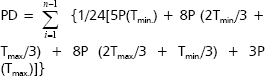
<body><![CDATA[<p><font size="2" face="Verdana, Arial, Helvetica, sans-serif">The disease effect     on the green leaf area (GLA) was evaluated between 54 and 60 days after planting     (DAP), maximum tuber fill stage. Five plants from each plot were harvested     and the leaf area was measured with the help of a leaf area meter (Model     Li – 3100, Li-Cor) and GLA was obtained by subtracting the   diseased areas. The tuber yield in each plot was estimated by harvesting the   20 plants, and compared at the confidence interval of <i>P</i>&lt;0,05. The   reduction in the leaf growth and the tuber yield were transformed to percentage   of relative yield obtained in D4, plot with fully fungicide protection, where   leaf growth and tuber yield reduction were minimum. </font></p>     <p><font size="2" face="Verdana, Arial, Helvetica, sans-serif"><b><i>Comparison of methods to predict the beginning       of the potato early blight</i>. </b>The planting date was used as       the starting points for determining accumulated days (AD), degree days       (DD) and physiological days (PD) accumulated till the appearance of the       first symptoms. Since these parameters showed a relationship with the plant       phenological stage at the tuber formation phase, AD, DD and PD, were used       not only to determine appearance of the first symptoms, but also for different       plant phenological stages through sampling five plants from each plot at       10-day intervals, from emergence to maturation.</font></p>     <p><font size="2" face="Verdana, Arial, Helvetica, sans-serif">The following formula was used to determine the   DD: </font></p>     <p><font size="2" face="Verdana, Arial, Helvetica, sans-serif"><img src="/img/revistas/rfnam/v60n2/a03eq02.gif"></font></p>     <p><font size="2" face="Verdana, Arial, Helvetica, sans-serif">where </font></p>     <blockquote>       <p><font size="2" face="Verdana, Arial, Helvetica, sans-serif">T is the temperature.</font></p> </blockquote>     <p><font size="2" face="Verdana, Arial, Helvetica, sans-serif">The PDs were determined through the following   equation ( Gent and Schwartz, 2003):</font></p>     <p><font size="2" face="Verdana, Arial, Helvetica, sans-serif"><img src="/img/revistas/rfnam/v60n2/a03eq03.gif"></font></p>     <p><font size="2" face="Verdana, Arial, Helvetica, sans-serif">where:</font></p>     ]]></body>

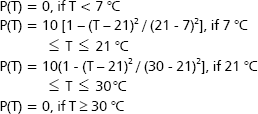
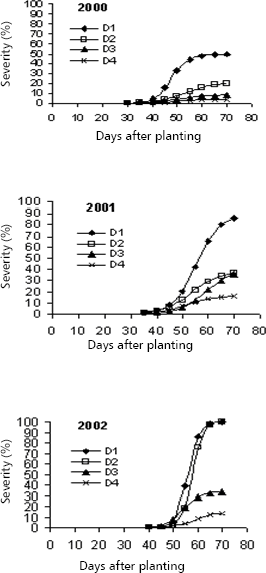
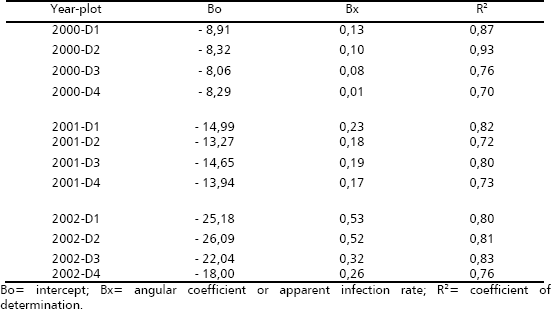
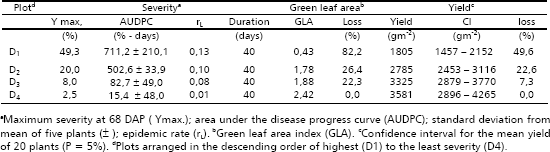
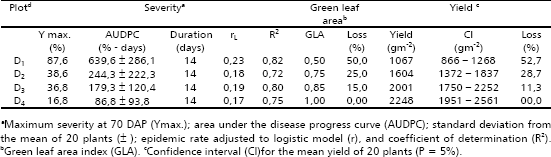
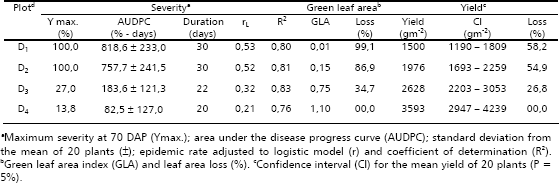
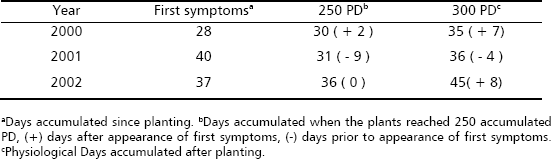
<body><![CDATA[<p><font size="2" face="Verdana, Arial, Helvetica, sans-serif"><img src="/img/revistas/rfnam/v60n2/a03eq04.gif"></font></p>     <p><font size="2" face="Verdana, Arial, Helvetica, sans-serif">This model is     based on the fact that the daily minimum temperature for potato growth is     7°C, the optimum is 21°   and the maximum is 30°C. The equation also considers that the plants are exposed   for three hours to maximum temperature, for five hours to minimum temperature   and for 16 hours between the two extremes. These data were confirmed in this   study by verifying the daily temperatures during the growing period (Gro Weatherlink   - Davis instruments).</font></p>     <p>&nbsp;</p>     <p><font size="3" face="Verdana, Arial, Helvetica, sans-serif"><b><a name="2"></a>RESULTS</b></font> <font size="3"><a href="#indice"><img src="/img/revistas/rfnam/v60n2/up.gif"></a></font></p>     <p><font size="2" face="Verdana, Arial, Helvetica, sans-serif">In all the three     trials the potato plant emergence started 15 after planting DAP and the tuberization     occurred between 30 and 35 DAP. The first early blight symptoms on the lower     leaves appeared in D1, plots without fungicide treatment, at the turberization     stage and thereafter the disease disseminated in varying intensities to the   entire experimental area. </font></p>     <p><font size="2" face="Verdana, Arial, Helvetica, sans-serif">The disease progress curves, adjusted to the logistic   model, of the three trials (<a href="#fig01">Figure 1</a>), showed differences among the plots,   in the apparent infection rate. The greater epidemic rate occurred in the plot   without fungicide treatment (D1), while the least epidemic rate occurred in   the plot fully fungicide-protected treatment D4 (<a href="#tab01">Table 1</a>). </font></p>     <p align="center"><font size="2" face="Verdana, Arial, Helvetica, sans-serif"><b><a name="fig01"></a><img src="/img/revistas/rfnam/v60n2/a03fig01.gif">    <br>   Figure       1.</b> The patterns of potato early blight epidemics caused by (<i>Alternaria       solani</i>) during 2000 to 2002. The highest disease severity occurred in plot D1 with a gradient to the lowest in plot D4. </font></p>     <p align="center"><font size="2" face="Verdana, Arial, Helvetica, sans-serif"><b><a name="tab01"></a>Table 1</b>. Summary of linear regressions   used to describe the early blight in a potato field, adjusted to the logistic   model during the years 2000 through 2002.</font>    <br>   <img src="/img/revistas/rfnam/v60n2/a03tab01.gif"></p>       ]]></body>
<body><![CDATA[<p><font size="2" face="Verdana, Arial, Helvetica, sans-serif"><b><i>Year 2000 trial</i></b>.     The first symptoms of early blight appeared at the beginning of tuberization,     i.e., 28 DAP; the epidemic has established at 37 DAP, and lasted for 40 days.     Plant mortality in plots D1 and D2 occurred 70 DAP. The maximum severity     of 49,3% in most  diseased  D1  plots   decreased  to </font></p>     <p><font size="2" face="Verdana, Arial, Helvetica, sans-serif">2,5% in the relatively healthy   D4 plots and the AUDPC increased with increasing disease severity (<a href="#tab02">Table   2</a>).   The epidemic rate in the four epidemics adjusted to logistic model, was higher   in D1 (r<sub>L</sub>= 0,13) and D2 (r<sub>L</sub>=0,10) plots and lowest in   D3 (r<sub>L</sub>= 0,08) and D4 (r<sub>L</sub>=0,01) plots. </font></p>     <p align="center"><font size="2" face="Verdana, Arial, Helvetica, sans-serif"><b><a name="tab02"></a>Table       2.</b> Potato early-blight epidemics and its effects on the green leaf       area index (GLA) and tuber yield during 2000.</font>    <br>       <img src="/img/revistas/rfnam/v60n2/a03tab02.gif"></p>     <p><font size="2" face="Verdana, Arial, Helvetica, sans-serif">In all plots, the different severities of early   blight epidemic variously affected the GLA and tuber yield. The GLA in the   plot D1 at 60 DAP was reduced by 82,2% and the tuber yield by 49,6%. There   was a relationship between GLA and tuber yield in all plots but the reduction   in GLA of 82,2% did not proportionately reduce the tuber yield (<a href="#tab02">Table   2</a>).</font></p>       <p><font size="2" face="Verdana, Arial, Helvetica, sans-serif"><b><i>Year 2001 trial</i>. </b>The epidemic   started at 47 DAP, which coincided with the beginning of tuberizations and   lasted for 14 days. Plant mortality in D1 and D2 plots started at 65 DAP, and   reduced the vegetative cycle by 25 days. The Ymax. of 87,5% in the most diseased   plot (D1) decreased to 16,8% in the healthiest D4 plot. The fastest epidemic   rate of r<sub>L</sub>= 0,23 occurred in the D1 plot and the slowest r<sub>L</sub>=   0,17 occurred in the D4 plot (<a href="#tab03">Table 3</a>).</font></p>       <p align="center"><font size="2" face="Verdana, Arial, Helvetica, sans-serif"><b><a name="tab03"></a>Table 3</b>. Potato early-blight epidemic and   its effects on the green leaf area index (GLA) and tuber yield during 2001</font>    <br>   <img src="/img/revistas/rfnam/v60n2/a03tab03.gif"></p>       <p><font size="2" face="Verdana, Arial, Helvetica, sans-serif">The effect of the epidemic differed on GLA (reduction   of 50%) and on tuber yield (reduction of 52,7%) in the D1 plot that had the   highest disease severity. In all three trials the maximum tuber yield loss,   ranging from 50 to 58%, occurred in D1 plots, where the defoliation reached   50 % at 55 DAP and 100% at 55 at 60 DAP. The minimum yield loss of 7,3% occurred   in the year 2000, when the plants had 22% defoliation (<a href="#tab03">Table   3</a>). </font></p>     <p><font size="2" face="Verdana, Arial, Helvetica, sans-serif"><b><i>Year 2002 trial</i>. </b>The epidemic   developed eight days after the initiation of tuberization (47 DAP) and lasted   for 30 days in plots D1 and D2 and for 20 days in D3 and D4. Premature plant   mortality occurred in plots D1 and D2 by 60 DAP. The vegetative cycle for D1   plots was reduced by 30 days and by 35 days for the D2 plots. The Ymax of 100%   in D1 plots can be compared to the Ymax of</font></p>     ]]></body>
<body><![CDATA[<p><font size="2" face="Verdana, Arial, Helvetica, sans-serif">13,8% in the D4 plots. The fastest epidemic rate   (r<sub>L</sub>= 0,53) occurred in D1 plots compared to the rate (r<sub>L</sub>=   0,26) in the D4 plots (<a href="#tab04">Table 4</a>). </font></p>     <p align="center"><font size="2" face="Verdana, Arial, Helvetica, sans-serif"><b><a name="tab04"></a>Table       4</b>. Epidemic of potato early blight and its effects on the green leaf       area index (GLA) and tuber yield in 2002.</font>    <br>       <img src="/img/revistas/rfnam/v60n2/a03tab04.gif"></p>     <p><font size="2" face="Verdana, Arial, Helvetica, sans-serif">The effect of epidemics of early blight on GLA and   tuber yield varied in a descending gradient from most diseased D1 plot to the   healthier D4 plot. The GLA at 54 DAP was reduced by 99% in D1 plot and the   tuber yield by 58,2%. There was a relationship between reduction in GLA and   yield loss in all plots (<a href="#tab04">Table 4</a>). </font></p>       <p><font size="2" face="Verdana, Arial, Helvetica, sans-serif"><b><i>Comparison of methods to predict the beginning       of the potato early blight</i></b>. The first symptoms of early blight       were observed 28, 40, and 37 DAP in 2000, 2001, and 2002, respectively.       In each case, however, the epidemics were well established eight days after       the first symptoms. This coincided with the beginning of tuberization.       The tuberization time differed among trials, being at 38, 45, and 41 DAP       in 2000, 2001, and 2002, respectively. This difference in the DAP for tuberization       did not allow for determination of AD for epidemic occurrence (<a href="#tab05">Table       5</a>).</font></p>       <p align="center"><font size="2" face="Verdana, Arial, Helvetica, sans-serif"><b><a name="tab05"></a>Table 5. </b>Determination of plant phenology   and of establishment of potato early blight epidemics in accumulated days (AD),   degree days (DD) and physiological days (PD) accumulated since planting, during   the years 2000 through 2002.</font>    <br>   <img src="/img/revistas/rfnam/v60n2/a03tab05.gif"></p>       <p><font size="2" face="Verdana, Arial, Helvetica, sans-serif">The number of DDs accumulated since the planting   date, required for disease initiation was 364, 313, 622 in 2000, 2001, and   2002, respectively, and the epidemic established, respectively, at 510, 608,   and 815 DDs. The range of DDs among the trials conducted at the same locality,   though at different times, does not allow its use to predict early blight. </font></p>     <p><font size="2" face="Verdana, Arial, Helvetica, sans-serif">The required number of PDs accumulated after planting   was of 239, 333, 254 in 2000, 2001, and 2002, respectively, and the epidemic   established at 305, 398, and 321 PDs, respectively. This narrow range of accumulated   PDs among different trials shows that this method has a good potential to predict   early blight epidemic initiation from 250 PDs. </font></p>     <p>&nbsp;</p>     ]]></body>
<body><![CDATA[<p><font size="2" face="Verdana, Arial, Helvetica, sans-serif"><b><font size="3"><a name="3"></a>DISCUSSION</font></b></font> <font size="3"><a href="#indice"><img src="/img/revistas/rfnam/v60n2/up.gif"></a></font></p>     <p><font size="2" face="Verdana, Arial, Helvetica, sans-serif">The different plot distances from the inoculum   source and the chlorothalonil sprays at different doses, permitted the establishment   of disease gradients, through which different epidemic patterns were obtained   in each of the three trials. A similar strategy was used by Zwankhuizen, Govers   and Zadoks (1998), to create disease gradients for potato late blight. </font></p>     <p><font size="2" face="Verdana, Arial, Helvetica, sans-serif">Despite high disease severity and high reduction   in yield, the early blight epidemic could be controlled by protecting the plants   at the right time with an appropriate dose of chlorothalonil. The protection   increased gradually as the fungicide dose increased from 25% to 100% of the   commercially recommended dose, thus confirming the efficacy of this fungicide   (Franc, Harrison and Lahman, 1988; Pscheidt and Stevenson, 1986).</font></p>     <p><font size="2" face="Verdana, Arial, Helvetica, sans-serif">The high disease intensity in 2001 and 2002 cannot   be attributed only to the favorable climatic conditions, but also to higher   external inoculum build-up due to the four successive potato plantings in the   same area, compared to the first year. Early blight is a polycyclic disease   and the pathogen has a high capacity to produce secondary inoculum. In this   case, the disease most likely was favored by the successive potato plantings   and the presence of other host crops, such as tomato, close to the experimental   area. </font></p>     <p><font size="2" face="Verdana, Arial, Helvetica, sans-serif">The GLA index was reduced significantly due to   early blight-induced necrosis and premature defoliation. This disease reduced   the vegetative cycle by 20 days (D1 plots) and 15 days (D2 plots). However,   the disease did not damage the stems and the tubers, as observed by Johnson   and Teng (1990), and yield reduction was caused by reduced tuber size and number   of tubers/plant (Shtienberg <i>et al</i>., 1996). </font></p>     <p><font size="2" face="Verdana, Arial, Helvetica, sans-serif">The early-blight induced defoliation by early   blight had a relationship to the yield loss in all the plots. James <i>et al</i>.   (1972), presumed that the tuber-filling process paralyzes when defoliation   reaches 75%, and considered this value as the critical point for yield loss   based on good correlations found in some tests. In the present study, defoliation   of 50% to 100% with yield loss of about 55% was observed.</font></p>     <p><font size="2" face="Verdana, Arial, Helvetica, sans-serif">Under the GLA index between 55 and 60 DAP was   highly correlated to tuber production. According to Rotem, Bashi and Kranz   (1983), potato yield loss can best be estimated by relating it the duration   of GLA from the beginning of tuber formation till senescence. In this work   with cultivar Bintje, maximum tuber filling (phenological stage IV, (Rowe,   1993) occurred between 55 and 60 DAP, which would permit selection of this   date as the critical point to construct models to estimate yield loss. It is   important to note that, in field conditions besides disease, other factors   such as temperature and soil moisture can affect plant yield. </font></p>     <p><font size="2" face="Verdana, Arial, Helvetica, sans-serif">The appearance of the first symptoms of early   blight on the lower leaves indicates the time when the disease-management plan   should be initiated, because the epidemic establishes within seven days thereafter.   This critical point for epidemic establishment is being used in other countries   to develop models for early-blight management (Franc, Harrison and Lahman,   1988; Gent and Schwartz, 2003; Pscheidt and Stevenson, 1986).</font></p>     <p><font size="2" face="Verdana, Arial, Helvetica, sans-serif">Predicting the moment of establishing the early   blight management plan for susceptible cultivars is important for integrated   management, by applying fungicides at the right moment. In the United States,   the use of a thermic unit model reduced the number of sprays from 12 to 8 (   Gent and Schwartz, 2003). </font></p>     <p><font size="2" face="Verdana, Arial, Helvetica, sans-serif">The data from this work showed that the prediction   based on ADs or DDs accumulated after planting was not satisfactory to determine   the initiation of disease management (<a href="#tab05">Table 5</a>). </font></p>     ]]></body>
<body><![CDATA[<p><font size="2" face="Verdana, Arial, Helvetica, sans-serif">In relation to the plant phenological stage, early   blight started eight days after the start of tuber formation. This stage, therefore,   can be considered as the critical point to start the epidemic management plan.   This would require plant sampling to determine beginning of tuberization, because   of high variability if this is based on the accumulated days. The tuber formation   is physiologically related to the seed-tuber age, and climatic conditions such   as photoperiod, temperature, nitrogen fertilization, etc. (Evans, 1983).</font></p>     <p><font size="2" face="Verdana, Arial, Helvetica, sans-serif">The methods with     the accumulated thermal units as in DD had high variability among the trials     because it is based solely on restricted plant growth at basal minimal temperature.     Thus, differences can appear depending upon the planting date. Similar results     were obtained by Franc, Harrison and Lahman (1988), who recommended the first     spray at 361 DDs in the Vally of São Luis and 625 DDs for the northeast region   of Colorado State (USA).</font></p>     <p><font size="2" face="Verdana, Arial, Helvetica, sans-serif">The method using accumulated PDs was more precise,   and appears to have greater potential to establish a disease-management plan   for the control of early blight. Accumulated PD considers temperature (maximum,   minimum, and optimum) required for plant growth, and therefore shows consistencies   with determination of disease appearance in crops planted at different localities   and at different dates. This method indicates, <i>a priori,</i> the first spray   at 250 PDs, before the epidemic establishes on lower leaves at 300 PDs (<a href="#tab06">Table   6</a>).</font></p>       <p align="center"><font size="2" face="Verdana, Arial, Helvetica, sans-serif"><b><a name="tab06"></a>Table 6.</b> Potato early blight prediction   model based on physiological days (PD) accumulated between planting and appearance   of first symptoms (2000 to 2002).</font>    <br>   <img src="/img/revistas/rfnam/v60n2/a03tab06.gif"></p>       <p><font size="2" face="Verdana, Arial, Helvetica, sans-serif">The first spray at 250 PDs, in the three trials,   to protect plants with chlorothalonil should have been done in the year 2000   trial, e.g., two days after the first symptoms appeared and before the start   of the epidemic. The 2001 and 2002 trials, the first symptoms appearead at   the start of the epidemic (<a href="#tab06">Table 6</a>). In the 2001 trial, when the first spray   was done at 300 PDs, the initial symptoms had not yet appeared, while in the   other years the epidemic had already been established, although disease severity   on the lower leaves was below 1%.</font></p>     <p><font size="2" face="Verdana, Arial, Helvetica, sans-serif">In general, early blight reduced GLA at the tuber   formation stage, presumably through necrosis and defoliation together with   reduction in tuber production. The PD-based method showed greater potential   for establishing a management plan for early blight; thus this can be recommended   to initiate a disease-management plan for cultivar Bintje, at 250 PDs, which   corresponds to the most susceptible stage, and under favorable climatic conditions   the epidemic manifests eight days after the appearance of first symptoms. </font></p>     <p>&nbsp;</p>     <p><font size="2" face="Verdana, Arial, Helvetica, sans-serif"><b><font size="3"><a name="4"></a>BIBLIOGRAPHY</font></b></font> <font size="3"><a href="#indice"><img src="/img/revistas/rfnam/v60n2/up.gif"></a></font></p>     <!-- ref --><p><font size="2" face="Verdana, Arial, Helvetica, sans-serif"> Campbell,   C.L. and L.V. Madden. 1990. Introduction to plant disease epidemiology. Wiley,   New York. 532 p.</font>&nbsp;&nbsp;&nbsp;&nbsp;&nbsp;&nbsp;&nbsp;&nbsp;[&#160;<a href="javascript:void(0);" onclick="javascript: window.open('/scielo.php?script=sci_nlinks&ref=000102&pid=S0304-2847200700020000300001&lng=','','width=640,height=500,resizable=yes,scrollbars=1,menubar=yes,');">Links</a>&#160;]<!-- end-ref --><!-- ref --><p><font size="2" face="Verdana, Arial, Helvetica, sans-serif">Campo, A.R.O.;   L. Zambolim, F.X.R.; Vale, L.C. Costa e C.A. Martyinez. 2001. Efeito da pinta   preta (<i>Alternaria solani</i>) no crescimento e produção da batata (<i>Solanum   tuberosum </i>L.). Fitopatol. Bras. Suppl. 26:450. </font>&nbsp;&nbsp;&nbsp;&nbsp;&nbsp;&nbsp;&nbsp;&nbsp;[&#160;<a href="javascript:void(0);" onclick="javascript: window.open('/scielo.php?script=sci_nlinks&ref=000103&pid=S0304-2847200700020000300002&lng=','','width=640,height=500,resizable=yes,scrollbars=1,menubar=yes,');">Links</a>&#160;]<!-- end-ref --><!-- ref --><p><font size="2" face="Verdana, Arial, Helvetica, sans-serif">Causton, D.R. 1991. Plant growth   analysis: the variability of relative growth rate within a sample. En: Ann.   Bot. 67:137-144. </font>&nbsp;&nbsp;&nbsp;&nbsp;&nbsp;&nbsp;&nbsp;&nbsp;[&#160;<a href="javascript:void(0);" onclick="javascript: window.open('/scielo.php?script=sci_nlinks&ref=000104&pid=S0304-2847200700020000300003&lng=','','width=640,height=500,resizable=yes,scrollbars=1,menubar=yes,');">Links</a>&#160;]<!-- end-ref --><!-- ref --><p><font size="2" face="Verdana, Arial, Helvetica, sans-serif">Christ, B.J.   and S.A Maczuga. 1989. The effect of fungicide schedules and inoculum levels   on early-blight severity and yield of potato. Plant Dis. 73(8): 695-698. </font>&nbsp;&nbsp;&nbsp;&nbsp;&nbsp;&nbsp;&nbsp;&nbsp;[&#160;<a href="javascript:void(0);" onclick="javascript: window.open('/scielo.php?script=sci_nlinks&ref=000105&pid=S0304-2847200700020000300004&lng=','','width=640,height=500,resizable=yes,scrollbars=1,menubar=yes,');">Links</a>&#160;]<!-- end-ref --><!-- ref --><p><font size="2" face="Verdana, Arial, Helvetica, sans-serif">Christ, B.J. 1991. Effect of disease Assesment method   on ranking potato cultivars for resistance to early-blight. Plant Dis. 75(4):353-356. </font>&nbsp;&nbsp;&nbsp;&nbsp;&nbsp;&nbsp;&nbsp;&nbsp;[&#160;<a href="javascript:void(0);" onclick="javascript: window.open('/scielo.php?script=sci_nlinks&ref=000106&pid=S0304-2847200700020000300005&lng=','','width=640,height=500,resizable=yes,scrollbars=1,menubar=yes,');">Links</a>&#160;]<!-- end-ref --><!-- ref --><p><font size="2" face="Verdana, Arial, Helvetica, sans-serif"> Easton, G.D. and M.E. Nagle.   1985. Lack of economic benefits by fungicides applied through center-pivot   irrigation system of <i>Alternaria</i> <i>solani </i>on potato. Plant Dis.  62(2):152-153. </font>&nbsp;&nbsp;&nbsp;&nbsp;&nbsp;&nbsp;&nbsp;&nbsp;[&#160;<a href="javascript:void(0);" onclick="javascript: window.open('/scielo.php?script=sci_nlinks&ref=000107&pid=S0304-2847200700020000300006&lng=','','width=640,height=500,resizable=yes,scrollbars=1,menubar=yes,');">Links</a>&#160;]<!-- end-ref --><!-- ref --><p><font size="2" face="Verdana, Arial, Helvetica, sans-serif">Evans, L.T.   1983. Fisiología de los cultivos. Hemisferio Sur, Buenos Aires, Argentina.   402 p.</font>&nbsp;&nbsp;&nbsp;&nbsp;&nbsp;&nbsp;&nbsp;&nbsp;[&#160;<a href="javascript:void(0);" onclick="javascript: window.open('/scielo.php?script=sci_nlinks&ref=000108&pid=S0304-2847200700020000300007&lng=','','width=640,height=500,resizable=yes,scrollbars=1,menubar=yes,');">Links</a>&#160;]<!-- end-ref --><!-- ref --><p><font size="2" face="Verdana, Arial, Helvetica, sans-serif">Franc, G.D., M.D. Harrison,   and L.M. Lahman. 1988. A simple day-degree model for initiating control of   potato early-blight in Colorado. Plant Dis. 72(10):851-854. </font>&nbsp;&nbsp;&nbsp;&nbsp;&nbsp;&nbsp;&nbsp;&nbsp;[&#160;<a href="javascript:void(0);" onclick="javascript: window.open('/scielo.php?script=sci_nlinks&ref=000109&pid=S0304-2847200700020000300008&lng=','','width=640,height=500,resizable=yes,scrollbars=1,menubar=yes,');">Links</a>&#160;]<!-- end-ref --><!-- ref --><p><font size="2" face="Verdana, Arial, Helvetica, sans-serif"> Gent, D. H.   and H. F. Schwartz. 2003. Validation of potato early-blight disease forecast   models for Colorado using various sources of meteorological data. Plant Dis.   87(1):78-82.</font>&nbsp;&nbsp;&nbsp;&nbsp;&nbsp;&nbsp;&nbsp;&nbsp;[&#160;<a href="javascript:void(0);" onclick="javascript: window.open('/scielo.php?script=sci_nlinks&ref=000110&pid=S0304-2847200700020000300009&lng=','','width=640,height=500,resizable=yes,scrollbars=1,menubar=yes,');">Links</a>&#160;]<!-- end-ref --><!-- ref --><p><font size="2" face="Verdana, Arial, Helvetica, sans-serif">Granovsky, A.A. and A.G. Peterson.   1954. Evaluation of potato leaf injury caused by leafhoppers, flea beetles,   and early-blight. J. Econ. Entomol. 47(5):894-903. </font>&nbsp;&nbsp;&nbsp;&nbsp;&nbsp;&nbsp;&nbsp;&nbsp;[&#160;<a href="javascript:void(0);" onclick="javascript: window.open('/scielo.php?script=sci_nlinks&ref=000111&pid=S0304-2847200700020000300010&lng=','','width=640,height=500,resizable=yes,scrollbars=1,menubar=yes,');">Links</a>&#160;]<!-- end-ref --><!-- ref --><p><font size="2" face="Verdana, Arial, Helvetica, sans-serif">James, W.C., C.S. Shih, W.A.   Hodgson, and L.C. Callbeck. 1972. The quantitative relationship between late   blight of potato and loss in tuber yield. Phytopathol. 62(1):92-96. </font>&nbsp;&nbsp;&nbsp;&nbsp;&nbsp;&nbsp;&nbsp;&nbsp;[&#160;<a href="javascript:void(0);" onclick="javascript: window.open('/scielo.php?script=sci_nlinks&ref=000112&pid=S0304-2847200700020000300011&lng=','','width=640,height=500,resizable=yes,scrollbars=1,menubar=yes,');">Links</a>&#160;]<!-- end-ref --><!-- ref --><p><font size="2" face="Verdana, Arial, Helvetica, sans-serif">Johnson, K.B. and P.S. Teng.   1990. Coupling a disease progress model for early-blight to model of potato   growth. Phytopathol. 80(4):416-425. </font>&nbsp;&nbsp;&nbsp;&nbsp;&nbsp;&nbsp;&nbsp;&nbsp;[&#160;<a href="javascript:void(0);" onclick="javascript: window.open('/scielo.php?script=sci_nlinks&ref=000113&pid=S0304-2847200700020000300012&lng=','','width=640,height=500,resizable=yes,scrollbars=1,menubar=yes,');">Links</a>&#160;]<!-- end-ref --><!-- ref --><p><font size="2" face="Verdana, Arial, Helvetica, sans-serif">Nunes, M.A.L.     1983. Parâmetros que expressam a   resistência da batateira (<i>Solanum tuberosum</i> L.) à “Pinta Preta” (<i>Alternaria   solani</i> (Ellis &amp;   Martin) Jones &amp; Grout). Dissertação Mestrado em Fitopatologia. Centro de   Ciências Agrárias. Universidade Federal de Viçosa. Vicosa, MG, Brasil. 58 h.</font>&nbsp;&nbsp;&nbsp;&nbsp;&nbsp;&nbsp;&nbsp;&nbsp;[&#160;<a href="javascript:void(0);" onclick="javascript: window.open('/scielo.php?script=sci_nlinks&ref=000114&pid=S0304-2847200700020000300013&lng=','','width=640,height=500,resizable=yes,scrollbars=1,menubar=yes,');">Links</a>&#160;]<!-- end-ref --><!-- ref --><p><font size="2" face="Verdana, Arial, Helvetica, sans-serif">Nutter Jr., F.W. 1989. Detection   and measurement of plant disease gradients in peanut with a multispectral radiometer.   Phytopathol. 79(9):958-963. </font>&nbsp;&nbsp;&nbsp;&nbsp;&nbsp;&nbsp;&nbsp;&nbsp;[&#160;<a href="javascript:void(0);" onclick="javascript: window.open('/scielo.php?script=sci_nlinks&ref=000115&pid=S0304-2847200700020000300014&lng=','','width=640,height=500,resizable=yes,scrollbars=1,menubar=yes,');">Links</a>&#160;]<!-- end-ref --><!-- ref --><p><font size="2" face="Verdana, Arial, Helvetica, sans-serif">Pelletier, J.R. and W.E. Fry,   1989. Characterization of resistance to early-blight in three potato cultivars:   incubation period, lesion expansion rate, and spore production. Phytopathol.   79(5):511-517. </font>&nbsp;&nbsp;&nbsp;&nbsp;&nbsp;&nbsp;&nbsp;&nbsp;[&#160;<a href="javascript:void(0);" onclick="javascript: window.open('/scielo.php?script=sci_nlinks&ref=000116&pid=S0304-2847200700020000300015&lng=','','width=640,height=500,resizable=yes,scrollbars=1,menubar=yes,');">Links</a>&#160;]<!-- end-ref --><!-- ref --><p><font size="2" face="Verdana, Arial, Helvetica, sans-serif">Pscheidt, J.W.   and W.R. Stevenson. 1986. Comparison of forecasting methods for control of   potato early-blight in Wisconsin. Plant Dis. 70(9):915-920. </font>&nbsp;&nbsp;&nbsp;&nbsp;&nbsp;&nbsp;&nbsp;&nbsp;[&#160;<a href="javascript:void(0);" onclick="javascript: window.open('/scielo.php?script=sci_nlinks&ref=000117&pid=S0304-2847200700020000300016&lng=','','width=640,height=500,resizable=yes,scrollbars=1,menubar=yes,');">Links</a>&#160;]<!-- end-ref --><!-- ref --><p><font size="2" face="Verdana, Arial, Helvetica, sans-serif">Reis, M.E.; C.A.     Madeiros, T.R. Casa e C. Mendes. 1999. Previsão de doenças de plantas: sistemas   para requeima e para pinta preta da batateira. Summa Phytopathol. 25(1):60-70. </font>&nbsp;&nbsp;&nbsp;&nbsp;&nbsp;&nbsp;&nbsp;&nbsp;[&#160;<a href="javascript:void(0);" onclick="javascript: window.open('/scielo.php?script=sci_nlinks&ref=000118&pid=S0304-2847200700020000300017&lng=','','width=640,height=500,resizable=yes,scrollbars=1,menubar=yes,');">Links</a>&#160;]<!-- end-ref --><!-- ref --><p><font size="2" face="Verdana, Arial, Helvetica, sans-serif">Rotem, J. 1981.   Fungal diseases of potato and tomate in the Negev region. Plant Dis. 65(4):315-318. </font>&nbsp;&nbsp;&nbsp;&nbsp;&nbsp;&nbsp;&nbsp;&nbsp;[&#160;<a href="javascript:void(0);" onclick="javascript: window.open('/scielo.php?script=sci_nlinks&ref=000119&pid=S0304-2847200700020000300018&lng=','','width=640,height=500,resizable=yes,scrollbars=1,menubar=yes,');">Links</a>&#160;]<!-- end-ref --><!-- ref --><p><font size="2" face="Verdana, Arial, Helvetica, sans-serif">Rotem, J.,   E. Bashi and J. Kranz. 1983. Studies of crop loss in potato blight caused by <i>Phytophthora   infestans</i>. Plant Pathol. 32(2):117-122. </font>&nbsp;&nbsp;&nbsp;&nbsp;&nbsp;&nbsp;&nbsp;&nbsp;[&#160;<a href="javascript:void(0);" onclick="javascript: window.open('/scielo.php?script=sci_nlinks&ref=000120&pid=S0304-2847200700020000300019&lng=','','width=640,height=500,resizable=yes,scrollbars=1,menubar=yes,');">Links</a>&#160;]<!-- end-ref --><!-- ref --><p><font size="2" face="Verdana, Arial, Helvetica, sans-serif">Rowe, R.C. 1993. Potato health   management: a holistic approach. p. 3-10. In: Randall, C.R. (ed.). Potato health   management. APS Press, Minnesota, USA . </font>&nbsp;&nbsp;&nbsp;&nbsp;&nbsp;&nbsp;&nbsp;&nbsp;[&#160;<a href="javascript:void(0);" onclick="javascript: window.open('/scielo.php?script=sci_nlinks&ref=000121&pid=S0304-2847200700020000300020&lng=','','width=640,height=500,resizable=yes,scrollbars=1,menubar=yes,');">Links</a>&#160;]<!-- end-ref --><!-- ref --><p><font size="2" face="Verdana, Arial, Helvetica, sans-serif">Sah, D.N. and D.R. Mackenzie.   1987. Methods of generation different levels of disease epidemics in loss experiments.   p. 90-96. In: Teng, P. (ed.). Crop loss assessment and pest management. APS   Press, Minnesota, USA .</font>&nbsp;&nbsp;&nbsp;&nbsp;&nbsp;&nbsp;&nbsp;&nbsp;[&#160;<a href="javascript:void(0);" onclick="javascript: window.open('/scielo.php?script=sci_nlinks&ref=000122&pid=S0304-2847200700020000300021&lng=','','width=640,height=500,resizable=yes,scrollbars=1,menubar=yes,');">Links</a>&#160;]<!-- end-ref --><!-- ref --><p><font size="2" face="Verdana, Arial, Helvetica, sans-serif">Shtienberg, D., D. Blachinsky,   G. Ben-Hador, and A. Dinoor. 1996. Effects of growing season and fungicide   type on the development of <i>Alternaria solani</i> and on potato yield. Plant   Dis. 80(9): 994-998. </font>&nbsp;&nbsp;&nbsp;&nbsp;&nbsp;&nbsp;&nbsp;&nbsp;[&#160;<a href="javascript:void(0);" onclick="javascript: window.open('/scielo.php?script=sci_nlinks&ref=000123&pid=S0304-2847200700020000300022&lng=','','width=640,height=500,resizable=yes,scrollbars=1,menubar=yes,');">Links</a>&#160;]<!-- end-ref --><!-- ref --><p><font size="2" face="Verdana, Arial, Helvetica, sans-serif">Zadoks, J.C and R.D. Schein.   1979. Epidemiology and plant disease management. Oxford University Press, Oxford.   448 p.</font>&nbsp;&nbsp;&nbsp;&nbsp;&nbsp;&nbsp;&nbsp;&nbsp;[&#160;<a href="javascript:void(0);" onclick="javascript: window.open('/scielo.php?script=sci_nlinks&ref=000124&pid=S0304-2847200700020000300023&lng=','','width=640,height=500,resizable=yes,scrollbars=1,menubar=yes,');">Links</a>&#160;]<!-- end-ref --><!-- ref --><p><font size="2" face="Verdana, Arial, Helvetica, sans-serif">Zwankhuizen, M.J.,     F. Govers and J.C. Zadoks. 1998. Development of potato late blight epidemics:   disease foci, disease gradients, and infection sources. Phytopathol.  88(8):754-762. </font>&nbsp;&nbsp;&nbsp;&nbsp;&nbsp;&nbsp;&nbsp;&nbsp;[&#160;<a href="javascript:void(0);" onclick="javascript: window.open('/scielo.php?script=sci_nlinks&ref=000125&pid=S0304-2847200700020000300024&lng=','','width=640,height=500,resizable=yes,scrollbars=1,menubar=yes,');">Links</a>&#160;]<!-- end-ref --> ]]></body><back>
<ref-list>
<ref id="B1">
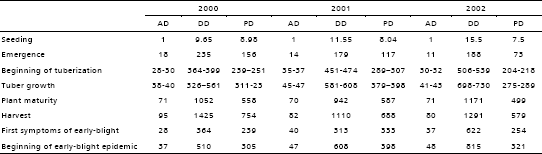
<nlm-citation citation-type="book">
<person-group person-group-type="author">
<name>
<surname><![CDATA[Campbell]]></surname>
<given-names><![CDATA[C.L.]]></given-names>
</name>
<name>
<surname><![CDATA[Madden]]></surname>
<given-names><![CDATA[L.V.]]></given-names>
</name>
</person-group>
<source><![CDATA[Introduction to plant disease epidemiology]]></source>
<year>1990</year>
<publisher-loc><![CDATA[New York ]]></publisher-loc>
<publisher-name><![CDATA[Wiley]]></publisher-name>
</nlm-citation>
</ref>
<ref id="B2">
<nlm-citation citation-type="journal">
<person-group person-group-type="author">
<name>
<surname><![CDATA[Campo]]></surname>
<given-names><![CDATA[A.R.O.]]></given-names>
</name>
<name>
<surname><![CDATA[Zambolim]]></surname>
<given-names><![CDATA[L.]]></given-names>
</name>
<name>
<surname><![CDATA[Vale]]></surname>
<given-names><![CDATA[F.X.R.]]></given-names>
</name>
<name>
<surname><![CDATA[Costa]]></surname>
<given-names><![CDATA[L.C.]]></given-names>
</name>
<name>
<surname><![CDATA[Martyinez]]></surname>
<given-names><![CDATA[C.A.]]></given-names>
</name>
</person-group>
<article-title xml:lang="en"><![CDATA[Efeito da pinta preta (Alternaria solani) no crescimento e produção da batata (Solanum tuberosum L.)]]></article-title>
<source><![CDATA[Fitopatol. Bras. Suppl.]]></source>
<year>2001</year>
<numero>26</numero>
<issue>26</issue>
</nlm-citation>
</ref>
<ref id="B3">
<nlm-citation citation-type="journal">
<person-group person-group-type="author">
<name>
<surname><![CDATA[Causton]]></surname>
<given-names><![CDATA[D.R.]]></given-names>
</name>
</person-group>
<article-title xml:lang="en"><![CDATA[Plant growth analysis: the variability of relative growth rate within a sample]]></article-title>
<source><![CDATA[Ann. Bot.]]></source>
<year>1991</year>
<numero>67</numero>
<issue>67</issue>
<page-range>137-144</page-range></nlm-citation>
</ref>
<ref id="B4">
<nlm-citation citation-type="journal">
<person-group person-group-type="author">
<name>
<surname><![CDATA[Christ]]></surname>
<given-names><![CDATA[B.J.]]></given-names>
</name>
<name>
<surname><![CDATA[Maczuga]]></surname>
<given-names><![CDATA[S.A]]></given-names>
</name>
</person-group>
<article-title xml:lang="en"><![CDATA[The effect of fungicide schedules and inoculum levels on early-blight severity and yield of potato]]></article-title>
<source><![CDATA[Plant Dis]]></source>
<year>1989</year>
<volume>73</volume>
<numero>8</numero>
<issue>8</issue>
<page-range>695-698</page-range></nlm-citation>
</ref>
<ref id="B5">
<nlm-citation citation-type="journal">
<person-group person-group-type="author">
<name>
<surname><![CDATA[Christ]]></surname>
<given-names><![CDATA[B.J.]]></given-names>
</name>
</person-group>
<article-title xml:lang="en"><![CDATA[Effect of disease Assesment method on ranking potato cultivars for resistance to early-blight]]></article-title>
<source><![CDATA[Plant Dis.]]></source>
<year>1991</year>
<volume>75</volume>
<numero>4</numero>
<issue>4</issue>
<page-range>353-356</page-range></nlm-citation>
</ref>
<ref id="B6">
<nlm-citation citation-type="journal">
<person-group person-group-type="author">
<name>
<surname><![CDATA[Easton]]></surname>
<given-names><![CDATA[G.D.]]></given-names>
</name>
<name>
<surname><![CDATA[Nagle]]></surname>
<given-names><![CDATA[M.E.]]></given-names>
</name>
</person-group>
<article-title xml:lang="en"><![CDATA[Lack of economic benefits by fungicides applied through center-pivot irrigation system of Alternaria solani on potato]]></article-title>
<source><![CDATA[Plant Dis.]]></source>
<year>1985</year>
<volume>62</volume>
<numero>2</numero>
<issue>2</issue>
<page-range>152-153</page-range></nlm-citation>
</ref>
<ref id="B7">
<nlm-citation citation-type="book">
<person-group person-group-type="author">
<name>
<surname><![CDATA[Evans]]></surname>
<given-names><![CDATA[L.T.]]></given-names>
</name>
</person-group>
<source><![CDATA[Fisiología de los cultivos]]></source>
<year>1983</year>
<publisher-loc><![CDATA[Buenos Aires ]]></publisher-loc>
<publisher-name><![CDATA[Hemisferio Sur]]></publisher-name>
</nlm-citation>
</ref>
<ref id="B8">
<nlm-citation citation-type="journal">
<person-group person-group-type="author">
<name>
<surname><![CDATA[Franc]]></surname>
<given-names><![CDATA[G.D.]]></given-names>
</name>
<name>
<surname><![CDATA[Harrison]]></surname>
<given-names><![CDATA[M.D.]]></given-names>
</name>
<name>
<surname><![CDATA[Lahman]]></surname>
<given-names><![CDATA[L.M.]]></given-names>
</name>
</person-group>
<article-title xml:lang="en"><![CDATA[A simple day-degree model for initiating control of potato early-blight in Colorado]]></article-title>
<source><![CDATA[Plant Dis.]]></source>
<year>1988</year>
<volume>72</volume>
<numero>10</numero>
<issue>10</issue>
<page-range>851-854</page-range></nlm-citation>
</ref>
<ref id="B9">
<nlm-citation citation-type="journal">
<person-group person-group-type="author">
<name>
<surname><![CDATA[Gent]]></surname>
<given-names><![CDATA[D. H.]]></given-names>
</name>
<name>
<surname><![CDATA[Schwartz]]></surname>
<given-names><![CDATA[H. F.]]></given-names>
</name>
</person-group>
<article-title xml:lang="en"><![CDATA[Validation of potato early-blight disease forecast models for Colorado using various sources of meteorological data]]></article-title>
<source><![CDATA[Plant Dis.]]></source>
<year>2003</year>
<volume>87</volume>
<numero>1</numero>
<issue>1</issue>
<page-range>78-82</page-range></nlm-citation>
</ref>
<ref id="B10">
<nlm-citation citation-type="journal">
<person-group person-group-type="author">
<name>
<surname><![CDATA[Granovsky]]></surname>
<given-names><![CDATA[A.A.]]></given-names>
</name>
<name>
<surname><![CDATA[Peterson]]></surname>
<given-names><![CDATA[A.G.]]></given-names>
</name>
</person-group>
<article-title xml:lang="en"><![CDATA[Evaluation of potato leaf injury caused by leafhoppers, flea beetles, and early-blight]]></article-title>
<source><![CDATA[J. Econ. Entomol.]]></source>
<year>1954</year>
<volume>47</volume>
<numero>5</numero>
<issue>5</issue>
<page-range>894-903</page-range></nlm-citation>
</ref>
<ref id="B11">
<nlm-citation citation-type="journal">
<person-group person-group-type="author">
<name>
<surname><![CDATA[James]]></surname>
<given-names><![CDATA[W.C.]]></given-names>
</name>
<name>
<surname><![CDATA[Shih]]></surname>
<given-names><![CDATA[C.S.]]></given-names>
</name>
<name>
<surname><![CDATA[Hodgson]]></surname>
<given-names><![CDATA[W.A.]]></given-names>
</name>
<name>
<surname><![CDATA[Callbeck]]></surname>
<given-names><![CDATA[L.C.]]></given-names>
</name>
</person-group>
<article-title xml:lang="en"><![CDATA[The quantitative relationship between late blight of potato and loss in tuber yield]]></article-title>
<source><![CDATA[Phytopathol]]></source>
<year>1972</year>
<volume>62</volume>
<numero>1</numero>
<issue>1</issue>
<page-range>92-96</page-range></nlm-citation>
</ref>
<ref id="B12">
<nlm-citation citation-type="journal">
<person-group person-group-type="author">
<name>
<surname><![CDATA[Johnson]]></surname>
<given-names><![CDATA[K.B.]]></given-names>
</name>
<name>
<surname><![CDATA[Teng]]></surname>
<given-names><![CDATA[P.S.]]></given-names>
</name>
</person-group>
<article-title xml:lang="en"><![CDATA[Coupling a disease progress model for early-blight to model of potato growth]]></article-title>
<source><![CDATA[Phytopathol]]></source>
<year>1990</year>
<volume>80</volume>
<numero>4</numero>
<issue>4</issue>
<page-range>416-425</page-range></nlm-citation>
</ref>
<ref id="B13">
<nlm-citation citation-type="">
<person-group person-group-type="author">
<name>
<surname><![CDATA[Nunes]]></surname>
<given-names><![CDATA[M.A.L.]]></given-names>
</name>
</person-group>
<collab>Universidade Federal de Viçosa</collab>
<source><![CDATA[Parâmetros que expressam a resistência da batateira (Solanum tuberosum L.) à "Pinta Preta" (Alternaria solani (Ellis & Martin) Jones & Grout): Dissertação Mestrado em Fitopatologia]]></source>
<year>1983</year>
<publisher-loc><![CDATA[Vicosa ]]></publisher-loc>
</nlm-citation>
</ref>
<ref id="B14">
<nlm-citation citation-type="journal">
<person-group person-group-type="author">
<name>
<surname><![CDATA[Nutter Jr.]]></surname>
<given-names><![CDATA[F.W.]]></given-names>
</name>
</person-group>
<article-title xml:lang="en"><![CDATA[Detection and measurement of plant disease gradients in peanut with a multispectral radiometer]]></article-title>
<source><![CDATA[Phytopathol]]></source>
<year>1989</year>
<volume>79</volume>
<numero>9</numero>
<issue>9</issue>
<page-range>958-963</page-range></nlm-citation>
</ref>
<ref id="B15">
<nlm-citation citation-type="journal">
<person-group person-group-type="author">
<name>
<surname><![CDATA[Pelletier]]></surname>
<given-names><![CDATA[J.R.]]></given-names>
</name>
<name>
<surname><![CDATA[Fry]]></surname>
<given-names><![CDATA[W.E.]]></given-names>
</name>
</person-group>
<article-title xml:lang="en"><![CDATA[Characterization of resistance to early-blight in three potato cultivars: incubation period, lesion expansion rate, and spore production]]></article-title>
<source><![CDATA[Phytopathol]]></source>
<year>1989</year>
<volume>79</volume>
<numero>5</numero>
<issue>5</issue>
<page-range>511-517</page-range></nlm-citation>
</ref>
<ref id="B16">
<nlm-citation citation-type="journal">
<person-group person-group-type="author">
<name>
<surname><![CDATA[Pscheidt]]></surname>
<given-names><![CDATA[J.W.]]></given-names>
</name>
<name>
<surname><![CDATA[Stevenson]]></surname>
<given-names><![CDATA[W.R.]]></given-names>
</name>
</person-group>
<article-title xml:lang="en"><![CDATA[Comparison of forecasting methods for control of potato early-blight in Wisconsin]]></article-title>
<source><![CDATA[Plant Dis.]]></source>
<year>1986</year>
<volume>70</volume>
<numero>9</numero>
<issue>9</issue>
<page-range>915-920</page-range></nlm-citation>
</ref>
<ref id="B17">
<nlm-citation citation-type="journal">
<person-group person-group-type="author">
<name>
<surname><![CDATA[Reis]]></surname>
<given-names><![CDATA[M.E.]]></given-names>
</name>
<name>
<surname><![CDATA[Madeiros]]></surname>
<given-names><![CDATA[C.A.]]></given-names>
</name>
<name>
<surname><![CDATA[Casa]]></surname>
<given-names><![CDATA[T.R.]]></given-names>
</name>
<name>
<surname><![CDATA[Mendes]]></surname>
<given-names><![CDATA[C.]]></given-names>
</name>
</person-group>
<article-title xml:lang="pt"><![CDATA[Previsão de doenças de plantas: sistemas para requeima e para pinta preta da batateira]]></article-title>
<source><![CDATA[Summa Phytopathol]]></source>
<year>1999</year>
<volume>25</volume>
<numero>1</numero>
<issue>1</issue>
<page-range>60-70</page-range></nlm-citation>
</ref>
<ref id="B18">
<nlm-citation citation-type="journal">
<person-group person-group-type="author">
<name>
<surname><![CDATA[Rotem]]></surname>
<given-names><![CDATA[J.]]></given-names>
</name>
</person-group>
<article-title xml:lang="en"><![CDATA[Fungal diseases of potato and tomate in the Negev region]]></article-title>
<source><![CDATA[Plant Dis.]]></source>
<year>1981</year>
<volume>65</volume>
<numero>4</numero>
<issue>4</issue>
<page-range>315-318</page-range></nlm-citation>
</ref>
<ref id="B19">
<nlm-citation citation-type="journal">
<person-group person-group-type="author">
<name>
<surname><![CDATA[Rotem]]></surname>
<given-names><![CDATA[J.]]></given-names>
</name>
<name>
<surname><![CDATA[Bashi]]></surname>
<given-names><![CDATA[E.]]></given-names>
</name>
<name>
<surname><![CDATA[Kranz]]></surname>
<given-names><![CDATA[J.]]></given-names>
</name>
</person-group>
<article-title xml:lang="en"><![CDATA[Studies of crop loss in potato blight caused by Phytophthora infestans]]></article-title>
<source><![CDATA[Plant Pathol]]></source>
<year>1983</year>
<volume>32</volume>
<numero>2</numero>
<issue>2</issue>
<page-range>117-122</page-range></nlm-citation>
</ref>
<ref id="B20">
<nlm-citation citation-type="book">
<person-group person-group-type="author">
<name>
<surname><![CDATA[Rowe]]></surname>
<given-names><![CDATA[R.C.]]></given-names>
</name>
</person-group>
<article-title xml:lang="en"><![CDATA[Potato health management: a holistic approach]]></article-title>
<person-group person-group-type="editor">
<name>
<surname><![CDATA[Randall]]></surname>
<given-names><![CDATA[C.R.]]></given-names>
</name>
</person-group>
<source><![CDATA[Potato health management]]></source>
<year>1993</year>
<page-range>3-10</page-range><publisher-loc><![CDATA[Minnesota ]]></publisher-loc>
<publisher-name><![CDATA[APS Press]]></publisher-name>
</nlm-citation>
</ref>
<ref id="B21">
<nlm-citation citation-type="book">
<person-group person-group-type="author">
<name>
<surname><![CDATA[Sah]]></surname>
<given-names><![CDATA[D.N.]]></given-names>
</name>
<name>
<surname><![CDATA[Mackenzie]]></surname>
<given-names><![CDATA[D.R.]]></given-names>
</name>
</person-group>
<article-title xml:lang="en"><![CDATA[Methods of generation different levels of disease epidemics in loss experiments]]></article-title>
<person-group person-group-type="editor">
<name>
<surname><![CDATA[Teng]]></surname>
<given-names><![CDATA[P.]]></given-names>
</name>
</person-group>
<source><![CDATA[Crop loss assessment and pest management]]></source>
<year>1987</year>
<publisher-loc><![CDATA[Minnesota ]]></publisher-loc>
<publisher-name><![CDATA[APS Press]]></publisher-name>
</nlm-citation>
</ref>
<ref id="B22">
<nlm-citation citation-type="journal">
<person-group person-group-type="author">
<name>
<surname><![CDATA[Shtienberg]]></surname>
<given-names><![CDATA[D.]]></given-names>
</name>
<name>
<surname><![CDATA[Blachinsky]]></surname>
<given-names><![CDATA[D.]]></given-names>
</name>
<name>
<surname><![CDATA[Ben-Hador]]></surname>
<given-names><![CDATA[G.]]></given-names>
</name>
<name>
<surname><![CDATA[Dinoor]]></surname>
<given-names><![CDATA[A]]></given-names>
</name>
</person-group>
<article-title xml:lang="en"><![CDATA[Effects of growing season and fungicide type on the development of Alternaria solani and on potato yield]]></article-title>
<source><![CDATA[Plant Dis.]]></source>
<year>1996</year>
<volume>80</volume>
<numero>9</numero>
<issue>9</issue>
<page-range>994-998</page-range></nlm-citation>
</ref>
<ref id="B23">
<nlm-citation citation-type="book">
<person-group person-group-type="author">
<name>
<surname><![CDATA[Zadoks]]></surname>
<given-names><![CDATA[J.C]]></given-names>
</name>
<name>
<surname><![CDATA[Schein]]></surname>
<given-names><![CDATA[R.D.]]></given-names>
</name>
</person-group>
<source><![CDATA[Epidemiology and plant disease management]]></source>
<year>1979</year>
<publisher-name><![CDATA[Oxford University PressOxford]]></publisher-name>
</nlm-citation>
</ref>
<ref id="B24">
<nlm-citation citation-type="journal">
<person-group person-group-type="author">
<name>
<surname><![CDATA[Zwankhuizen]]></surname>
<given-names><![CDATA[M.J.]]></given-names>
</name>
<name>
<surname><![CDATA[Govers]]></surname>
<given-names><![CDATA[F.]]></given-names>
</name>
<name>
<surname><![CDATA[Zadoks]]></surname>
<given-names><![CDATA[J.C.]]></given-names>
</name>
</person-group>
<article-title xml:lang="en"><![CDATA[Development of potato late blight epidemics: disease foci, disease gradients, and infection sources]]></article-title>
<source><![CDATA[Phytopathol]]></source>
<year>1998</year>
<volume>88</volume>
<numero>8</numero>
<issue>8</issue>
<page-range>754-762</page-range></nlm-citation>
</ref>
</ref-list>
</back>
</article>