<?xml version="1.0" encoding="ISO-8859-1"?><article xmlns:mml="http://www.w3.org/1998/Math/MathML" xmlns:xlink="http://www.w3.org/1999/xlink" xmlns:xsi="http://www.w3.org/2001/XMLSchema-instance">
<front>
<journal-meta>
<journal-id>0304-2847</journal-id>
<journal-title><![CDATA[Revista Facultad Nacional de Agronomía Medellín]]></journal-title>
<abbrev-journal-title><![CDATA[Rev. Fac. Nac. Agron. Medellín]]></abbrev-journal-title>
<issn>0304-2847</issn>
<publisher>
<publisher-name><![CDATA[Facultad de Ciencias Agrarias - Universidad Nacional de Colombia]]></publisher-name>
</publisher>
</journal-meta>
<article-meta>
<article-id>S0304-28472009000200001</article-id>
<title-group>
<article-title xml:lang="en"><![CDATA[CHARACTERIZATION OF Phytophthora infestans POPULATIONS IN ANTIOQUIA, COLOMBIA]]></article-title>
<article-title xml:lang="es"><![CDATA[CARACTERIZACIÓN DE LAS POBLACIONES DE Phytophthora infestan EN ANTIOQUIA, COLOMBIA]]></article-title>
</title-group>
<contrib-group>
<contrib contrib-type="author">
<name>
<surname><![CDATA[Gilchrist Ramelli]]></surname>
<given-names><![CDATA[Elizabeth]]></given-names>
</name>
<xref ref-type="aff" rid="A01"/>
</contrib>
<contrib contrib-type="author">
<name>
<surname><![CDATA[Jaramillo Villegas]]></surname>
<given-names><![CDATA[Sonia]]></given-names>
</name>
<xref ref-type="aff" rid="A02"/>
</contrib>
<contrib contrib-type="author">
<name>
<surname><![CDATA[Afanador Kafuri]]></surname>
<given-names><![CDATA[Lucia]]></given-names>
</name>
<xref ref-type="aff" rid="A03"/>
</contrib>
<contrib contrib-type="author">
<name>
<surname><![CDATA[Arango Isaza]]></surname>
<given-names><![CDATA[Rafael Eduardo]]></given-names>
</name>
<xref ref-type="aff" rid="A04"/>
</contrib>
</contrib-group>
<aff id="A01">
<institution><![CDATA[,Universidad Nacional de Colombia, Sede Medellín Facultad de Ciencias Agropecuarias ]]></institution>
<addr-line><![CDATA[Medellín ]]></addr-line>
<country>Colombia</country>
</aff>
<aff id="A02">
<institution><![CDATA[,Universidad Nacional de Colombia, Sede Medellín Facultad de Ciencias Agropecuarias ]]></institution>
<addr-line><![CDATA[Medellín ]]></addr-line>
<country>Colombia</country>
</aff>
<aff id="A03">
<institution><![CDATA[,Universidad Nacional de Colombia, Sede Medellín Facultad de Ciencias Agropecuarias ]]></institution>
<addr-line><![CDATA[Medellín ]]></addr-line>
<country>Colombia</country>
</aff>
<aff id="A04">
<institution><![CDATA[,Universidad Nacional de Colombia, Sede Medellín Facultad de Ciencias Agropecuarias ]]></institution>
<addr-line><![CDATA[Medellín ]]></addr-line>
<country>Colombia</country>
</aff>
<pub-date pub-type="pub">
<day>00</day>
<month>12</month>
<year>2009</year>
</pub-date>
<pub-date pub-type="epub">
<day>00</day>
<month>12</month>
<year>2009</year>
</pub-date>
<volume>62</volume>
<numero>2</numero>
<fpage>5031</fpage>
<lpage>5037</lpage>
<copyright-statement/>
<copyright-year/>
<self-uri xlink:href="http://www.scielo.org.co/scielo.php?script=sci_arttext&amp;pid=S0304-28472009000200001&amp;lng=en&amp;nrm=iso"></self-uri><self-uri xlink:href="http://www.scielo.org.co/scielo.php?script=sci_abstract&amp;pid=S0304-28472009000200001&amp;lng=en&amp;nrm=iso"></self-uri><self-uri xlink:href="http://www.scielo.org.co/scielo.php?script=sci_pdf&amp;pid=S0304-28472009000200001&amp;lng=en&amp;nrm=iso"></self-uri><abstract abstract-type="short" xml:lang="en"><p><![CDATA[From the Phytophthora infestans collection of the Universidad Nacional de Colombia, the isolates collected in different locations in Antioquia, Colombia between 1994 and 2000 were evaluated. These isolates were obtained from late blight lessons in different hosts. In 2000, these isolates were characterized by mating type, mitochondrial haplotype and virulence races. All isolates were of the A1 mating type and two mitochondrial haplotypes were identified: IIa, present in isolates from all the hosts tested, and Ib present only in isolates from tomato and water cucumber (Solanum muricatum). The Antioquia population of P. infestans showed a large complexity of virulence factors (10 out 11), especially those isolates collected from potato, while the tomato population was less complex. The A1 mating type and the mitochondrial haplotype IIa has been associated with the EC1 population that possibly is replacing the US1 population.]]></p></abstract>
<abstract abstract-type="short" xml:lang="es"><p><![CDATA[De la colección de Phytophthora infestans de la Universidad Nacional de Colombia, se evaluaron aquellos aislamientos provenientes de diferentes localidades de Antioquia, Colombia entre 1994 y 2000. Dichos aislamientos fueron obtenidos de lesiones de tizón tardío en diferentes hospederos. En el año 2000 se caracterizaron por el tipo de apareamiento, haplotipo mitocondrial y razas de virulencia. Todos los aislamientos correspondieron al tipo de apareamiento A1 y se presentaron dos haplotipos mitocondriales: IIa, en aislamientos de todos los hospederos evaluados, y Ib solamente en aislamientos colectados de tomate y pepino de agua (Solanum muricatum). La población antioqueña de P. infestans presenta una amplia complejidad de factores de virulencia (10 de 11), especialmente para los aislamientos colectados de papa, mientras que la población de tomate fue menos compleja. El tipo de apareamiento A1 y el haplotipo mitocondrial IIa han sido asociados a la población EC1 que posiblemente está desplazando la población US1.]]></p></abstract>
<kwd-group>
<kwd lng="en"><![CDATA[Late blight]]></kwd>
<kwd lng="en"><![CDATA[clonal lineage]]></kwd>
<kwd lng="en"><![CDATA[South America]]></kwd>
<kwd lng="en"><![CDATA[haplotypes]]></kwd>
<kwd lng="en"><![CDATA[mating type]]></kwd>
<kwd lng="es"><![CDATA[Tizón tardío]]></kwd>
<kwd lng="es"><![CDATA[linaje clonal]]></kwd>
<kwd lng="es"><![CDATA[Sur América]]></kwd>
<kwd lng="es"><![CDATA[haplotipos]]></kwd>
<kwd lng="es"><![CDATA[grupo de compatibilidad]]></kwd>
</kwd-group>
</article-meta>
</front><body><![CDATA[ <p><b><font size="4" face="Verdana, Arial, Helvetica, sans-serif">CHARACTERIZATION OF <i>Phytophthora infestans</i> POPULATIONS IN ANTIOQUIA, COLOMBIA</font></b></p>     <p><i><b><font size="3" face="Verdana, Arial, Helvetica, sans-serif">CARACTERIZACI&Oacute;N DE LAS POBLACIONES DE Phytophthora infestan EN ANTIOQUIA, COLOMBIA</font></b></i></p>     <p>&nbsp;</p>     <p><font size="2" face="Verdana, Arial, Helvetica, sans-serif"><b>Elizabeth Gilchrist Ramelli<sup>1</sup>; Sonia Jaramillo Villegas<sup>2</sup>; Lucia Afanador Kafuri<sup>3</sup> and Rafael Eduardo Arango Isaza<sup>4</sup></b></font></p>     <p>&nbsp;</p>     <p><font size="2" face="Verdana, Arial, Helvetica, sans-serif"><b><sup><i>1</i></sup></b><i> Ingeniera Agr&oacute;noma, D.Sc. Universidad Nacional de Colombia, Sede Medell&iacute;n. Facultad de Ciencias Agropecuarias. A.A. 1779. Medell&iacute;n, Colombia. &lt;<a href="mailto:elygilchrist@hotmail.com">elygilchrist@hotmail.com</a>&gt;    <br>   <b><sup>2</sup></b> Profesora Asociada. Universidad Nacional de Colombia, Sede Medell&iacute;n. Facultad de Ciencias Agropecuarias. A.A. 1779. Medell&iacute;n, Colombia. &lt;<a href="mailto:sjaramal@unalmed.edu.co">sjaramal@unalmed.edu.co</a>&gt;    <br>   <b><sup>3</sup></b> Profesora Asociada. Universidad Nacional de Colombia, Sede Medell&iacute;n. Facultad de Ciencias Agropecuarias. A.A. 1779. Medell&iacute;n, Colombia. &lt;<a href="mailto:lafanado@unal.edu.co">lafanado@unal.edu.co</a>&gt;    <br>   <b><sup>4</sup></b> Profesor Asociado. Universidad Nacional de Colombia, Sede Medell&iacute;n. Facultad de Ciencias Agropecuarias. A.A. 1779. Medell&iacute;n, Colombia</i></font><font size="2" face="Verdana, Arial, Helvetica, sans-serif"></font></p>     <p>&nbsp;</p>     ]]></body>
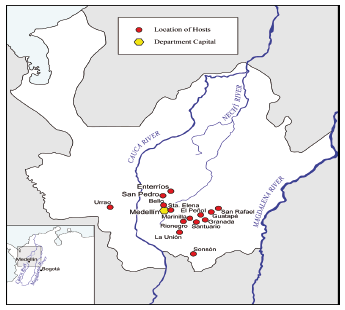
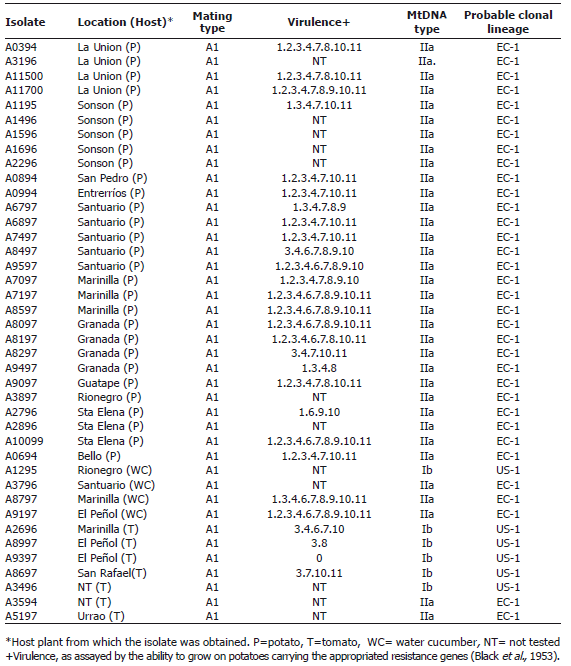
<body><![CDATA[<p><font size="2" face="Verdana, Arial, Helvetica, sans-serif"><b>Recibido: Abril 4 de 2008; Aceptado: Septiembre 7 de 2009.</b></font></p> <hr>     <p><font size="2" face="Verdana, Arial, Helvetica, sans-serif"><b><i>Abstract.</i></b> <i>From the <b>Phytophthora infestans</b> collection of the Universidad Nacional de Colombia, the isolates collected in different locations in Antioquia, Colombia between 1994 and 2000 were evaluated. These isolates were obtained from late blight lessons in different hosts. In 2000, these isolates were characterized by mating type, mitochondrial haplotype and virulence races. All isolates were of the A1 mating type and two mitochondrial haplotypes were identified: IIa, present in isolates from all the hosts tested, and Ib present only in isolates from tomato and water cucumber (<b>Solanum muricatum</b>). The Antioquia population of <b>P. infestans</b> showed a large complexity of virulence factors (10 out 11), especially those isolates collected from potato, while the tomato population was less complex. The A1 mating type and the mitochondrial haplotype IIa has been associated with the EC1 population that possibly is replacing the US1 population.</i></font></p>     <p><font size="2" face="Verdana, Arial, Helvetica, sans-serif"><b>Key words:</b> Late blight, clonal lineage, South America, haplotypes, mating type.</font></p>     <p><font size="2" face="Verdana, Arial, Helvetica, sans-serif"><b><i>Resumen. </i></b><i>De la colecci&oacute;n de <b>Phytophthora infestans</b> de la Universidad Nacional de Colombia, se evaluaron aquellos aislamientos provenientes de diferentes localidades de Antioquia, Colombia entre 1994 y 2000. Dichos aislamientos fueron obtenidos de lesiones de tiz&oacute;n tard&iacute;o en diferentes hospederos. En el a&ntilde;o 2000 se caracterizaron por el tipo de apareamiento, haplotipo mitocondrial y razas de virulencia. Todos los aislamientos correspondieron al tipo de apareamiento A1 y se presentaron dos haplotipos mitocondriales: IIa, en aislamientos de todos los hospederos evaluados, y Ib solamente en aislamientos colectados de tomate y pepino de agua (<b>Solanum muricatum</b>). La poblaci&oacute;n antioque&ntilde;a de <b>P. infestans</b> presenta una amplia complejidad de factores de virulencia (10 de 11), especialmente para los aislamientos colectados de papa, mientras que la poblaci&oacute;n de tomate fue menos compleja. El tipo de apareamiento A1 y el haplotipo mitocondrial IIa han sido asociados a la poblaci&oacute;n EC1 que posiblemente est&aacute; desplazando la poblaci&oacute;n US1.</i></font></p>     <p><font size="2" face="Verdana, Arial, Helvetica, sans-serif"><b>Palabras claves:</b> Tiz&oacute;n tard&iacute;o, linaje clonal, Sur Am&eacute;rica, haplotipos, grupo de compatibilidad.</font></p> <hr>     <p>&nbsp;</p>     <p><font size="2" face="Verdana, Arial, Helvetica, sans-serif">The oomycete <i>Phytophthora infestans </i>(Mont.) de Bary is the causal agent of several economically important diseases in potato and tomato. In tropical countries the pathogen infects other crops like water cucumber (<i>Solanum muricatum</i>), tamarillo (<i>S. betaceum</i>) and lulo (<i>Solanum quitoense</i>). The population of <i>P. infestans</i> is mostly composed of clonal lineages with distinct genotypes that can be characterized by RLFP&rsquo;s (<i>Restriction Fragment Length Polymorphism</i>), isozimes and mitochondrial haplotypes (Oyarzun <i>et al</i>., 1997; P&eacute;rez <i>et al.</i>, 2001).</font></p>     <p><font size="2" face="Verdana, Arial, Helvetica, sans-serif"><i>P. infestans</i> reproduces sexually if the two mating types A1 and A2 are present. Sexual reproduction is present in the entire world. It has been reported in Mexico (Forbes <i>et al.</i>, 1998; Garry <i>et al.,</i> 2005), Europe (Drenth <i>et al., </i>1994) and Asia (Ghimire <i>et al.,</i> 2003). It is also present in South Am&eacute;rica, specially in Venezuela (Brice&ntilde;o <i>et al.,</i> 2009) and in Colombia (Vargas <i>et al.,</i> 2009). The evidence confirms the asexual reproduction of <i>P. infestans</i>, since only one isolate of 840 collected in Venezuela presented fertility with A1. In Colombia, Vargas <i>et al.</i> (2009) found the A2 mating type in one isolate collected from <i>Physalis peruviana</i> L. However, this isolate generates oospores with the A1 mating type reference isolate, but this oospores are not infective (Restrepo Silvia, Universidad de los Andes, personal communication). In Ecuador, the US-1 genotype has been replaced by the EC-1 lineage, which is more pathogenic and less sensitive to the systemic fungicide metalaxyl (P&eacute;rez <i>et al</i>., 2001; Forbes <i>et al.</i>, 1996). In Colombia, US-1 and EC-1 clonal lineages have been reported (Griffith and Shaw, 1998; Forbes <i>et al.</i>, 1998; Vargas <i>et al.,</i> 2009). </font></p>     <p><font size="2" face="Verdana, Arial, Helvetica, sans-serif">The populations of <i>P. infestans</i> can be also studied in terms of their physiological races which are determined by the presence of one or more of the 11 known virulence genes. No correlation between physiological race and genotype has been found so far and several studies indicate that the complexity of virulence factors in the oomycete has increased with time (Tooley <i>et al.,</i> 1986). At the time of this research (1994-2000), there was a small amount of information available concerning the Colombian populations of <i>P. infestans</i> and the strategic geographical position of this country justifies a study on the structure of the population of this pathogen. Forty isolates of <i>P. infestans</i> collected from different hosts and locations in the north-central Colombian Andes (Antioquia department) were characterized by mating type, mitochondrial haplotype and physiological races. This work, carried out in 2000, enriches the study of populations of the pathogen in the South American continent and the rest of the world. </font></p>     <p>&nbsp;</p>     ]]></body>
<body><![CDATA[<p><b><font size="3" face="Verdana, Arial, Helvetica, sans-serif">MATERIALS AND METHODS</font></b></p>     <p><font size="2" face="Verdana, Arial, Helvetica, sans-serif">Sources of Phytophthora<i> infestans isolates.</i> Between 1994 and 2000, 40 isolates of<i> P. infestan</i>s were collected from affected plants of commercial growing fields and house garden of potato <i>Solanum tuberosum</i> cultivars (ICA Purac&eacute;, ICA Nevada, ICA Cumanday and Diacol Capiro), <i>Solanum phureja,</i> tomato and water cucumber. Isolates were taken from infected leaf tissue and collected in 14 different locations of the Antioquia department. Geographical origin (First letter of each isolate, A: Antioquia), year (last two numbers of each isolate), and host of each isolate were recorded (<a href="#tab01">Table 1</a>; <a href="#fig01">Figure 1</a>).</font></p>     <p align="center"><font size="2" face="Verdana, Arial, Helvetica, sans-serif"><a name="tab01"></a><b>Table 1.</b> Localization of <i>Phytophthora infestans</i> isolates from Antioquia-Colombia used in this study. Location from wich isolates were collected. Mating type, virulence factors, mitochondrial haplotype and clonal lineage for each isolate are indicated.</font>    <br>   <img src="/img/revistas/rfnam/v62n2/a01tab01.gif"></p>     <p align="center"><font size="2" face="Verdana, Arial, Helvetica, sans-serif"><a name="fig01"></a><b><img src="/img/revistas/rfnam/v62n2/a01fig01.gif">    <br>   Figure 1.</b> Map of Antioquia-Colombia, showing detailed locations where isolates of <i>Phytophthora infestans</i> were collected.</font></p>     <p><font size="2" face="Verdana, Arial, Helvetica, sans-serif">Media and culture conditions. All isolates of <i>P. infestans</i> were kept at 15-18 &ordm;C on Petri dishes containing rye agar (25 g of rye powder, 20 g of table sugar and 18 g of agar per liter). For the sexual compatibility assay the media was complemented with 0.05 g/l of b-sitosterol. For DNA extraction, mycelia were grown for 8 days in pea water broth (30 g of frozen peas and 20 g of table sugar per liter), harvested by filtration and stored at &ndash;20 &ordm;C.</font></p>     <p><font size="2" face="Verdana, Arial, Helvetica, sans-serif">Mating type. To avoid the introduction to the country of unknown mating type, at the date of this research, only the mating type A1 was used as a control. Mating type was determined by paring each isolate with a known A1 culture on rye-agar medium (Deahl <i>et al.,</i> 1991). Plates were incubated at 15 &ordm;C in the dark, during 30 days. Analysis consisted on checking each pairing for the formation of oospores under macro and microscopic examinations of micelia formed in the area of interaction between the isolates paired. A self-paring of each isolate was used as a control.</font></p>     <p><font size="2" face="Verdana, Arial, Helvetica, sans-serif">DNA extraction. DNA was extracted using the method of Afanador <i>et al.</i> (1993). Briefly, 100 mL of mycelium powder was incubated in a microcentrifuge tube with 400 mL of CTAB extraction buffer (CTAB 2% w/v, 100 mM Tris HCl, pH 8.0, 1.4 M NaCl, 20 mM EDTA pH 8.0), for 30 min at 65 &ordm;C, inverting the tubes every 8 min. Additional 400 mL of cloroform:isoamyl alcohol (24:1) were added, mixed by inversion during 15 min, followed by centrifugation at 20.000 CRF (Centrifugal Relative Force) during 10 min. This step was repeated, and followed by precipitation with isopropanol and resuspention in TE buffer.</font></p>     <p><font size="2" face="Verdana, Arial, Helvetica, sans-serif">Mitochondrial haplotypes. Mitochondrial haplotypes were determined by PCR-RFLP using primer pairs P1 (P1 forward and P1 reverse), P2 (P2 forward and P2 reverse) and P4 (P4 forward and P4 reverse) as described by Griffith and Shaw (1998). PCR (PTC-100TM MJ Research, Inc.) amplification conditions were as follows for all primer combinations: deoxynucleotide triphosphates dNTP&acute;s (Promega), 200 mM each, PCR buffer 1X (1 M KCl, 1 M Tris HCl pH 8.3, 1 M MgCl2), primers (Operon Technologies, Inc.) 0.34 mM each, bovine serum albumin, 160 mg/mL, <i>Taq </i>DNA polymerase (Promega) 0.2 mL (1U) and 2 a 10 ng of total DNA in 0.2 mL microcentrifuge tubes (final volume, 25 mL). PCR cycles were as follows: 1 cycle of 94 &ordm;C for 90 s; 40 cycles of 94 &ordm;C for 40s, 55 &ordm;C for 60s and 72 &ordm;C for 120s. </font></p>     ]]></body>
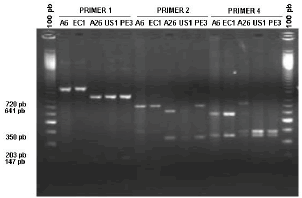
<body><![CDATA[<p><font size="2" face="Verdana, Arial, Helvetica, sans-serif">Five microliters of the amplified product was digested with the following restriction enzymes (Promega): P1 reactions with <i>Cfo</i>I, P2 with <i>Msp</i>I and P4 with<i> Eco</i>RI. Digested DNA (10 mL) was mixed with 5 mL of loading buffer and loaded into a 2% agarose gel in 1 X TBE buffer (containing 0.1 mg/mL of ethidium bromide). The gel was run at 80 vol. during 4 h. Restriction patterns were visualized with an UV transilluminator and the images were recorded by a gel documentation system (BIO-RAD, Gel Doc 1000). </font></p>     <p><font size="2" face="Verdana, Arial, Helvetica, sans-serif">Physiological races. The virulence specificity of a subset of 28 isolates was determined by inoculation of detached leaflets from the international set of differential potato cultivars provided by the Centro Internacional de la Papa (CIP), carrying the 11 known mayor (R) resistance genes. Briefly, leaflets collected from the middle part of each cultivar were inoculated in a moist chamber with 20 mL of sporangial suspension (approx. 5.000 sporangia/mL) placed on the abaxial surface of each leaflet. Each test included the susceptible cultivar Alfa (a) (containing no know R genes) as a control. The virulence assays were repeated at least twice.</font></p>     <p>&nbsp;</p>     <p><font size="3" face="Verdana, Arial, Helvetica, sans-serif"><b>RESULTS</b></font></p>     <p><font size="2" face="Verdana, Arial, Helvetica, sans-serif">Mating type. In all tests only mating type A1 was detected as indicated by the absence of oospores in the growing area between the isolates on all pairings.</font></p>     <p><font size="2" face="Verdana, Arial, Helvetica, sans-serif">Mitochondrial haplotypes. PCR-RFLP analysis revealed the presence of two mitochondrial haplotypes in the Antioquian population of <i>P. infestans</i>: haplotypes IIa and Ib (Table 1). The mitochondrial haplotype IIa was present in all potato isolates (29 samples), in 2 isolates from tomato and in 3 isolates from <i>water cucumber,</i> while the haplotype Ib was only present in 5 isolates from tomato and in one isolate from <i>water cucumber</i> (<a href="#fig02">Figure 2</a>). </font></p>     <p align="center"><font size="2" face="Verdana, Arial, Helvetica, sans-serif"><a name="fig02"></a><b><img src="/img/revistas/rfnam/v62n2/a01fig02.gif">    <br>   Figure 2.</b> Mitochondrial haplotypes of <i>Phytophthora infestans</i>, as analyzed by primer pairs P1, P2 y P4. From left to right 100 pb weight marker, A6, EC1, A26, US1, Pe3 samples amplified with P1, P2 and P4 primers, 100 pb weight marker.</font></p>     <p><font size="2" face="Verdana, Arial, Helvetica, sans-serif">Physiological races. Eighteen pathotypes were identified among 28 isolates tested, showing variation in the level of complexity of their races. The most common pathotype was presented on 21.42 % of the isolates, and infected ten of the eleven potato cultivars (1.2.3.4.6.7.8.9.10.11). One of the isolates coming from tomato had no virulence genes (Race 0). Virulence factor No. 5 was not present in any isolate. Furthermore, the isolates collected after 1997, infected the R9 cultivar, which indicates an increment in the pathogen complexity. The R3 cultivar was the most affected by the tested isolates, by a 26/28 proportion. To calculate the Shannon (HS) and Gleason (HG) diversity index, isolates were divided in two groups by date of collection: one was from 1994 to 1996, and the other from 1997 to 2000. This analysis showed an increase on diversity factors from HG =2.5 and HS=1.47 to HG =4.26 and HS=2.09. </font></p>     <p>&nbsp;</p>     ]]></body>
<body><![CDATA[<p><b><font size="3" face="Verdana, Arial, Helvetica, sans-serif">DISCUSSION</font></b></p>     <p><font size="2" face="Verdana, Arial, Helvetica, sans-serif">Forty isolates of <i>P. infestans</i> were analyzed in this work, which were collected from different <i>Solanum</i> hosts and locations of a north-central Colombian Andean region of the Antioquia department, South America. The isolates were tested for mating type, mitochondrial haplotype and virulence factors. </font></p>     <p><font size="2" face="Verdana, Arial, Helvetica, sans-serif">All isolates tested showed to be of the mating type A1 suggesting that the current population of <i>P. infestans</i> in Antioquia is clonal with asexual reproduction. To 2000, the presence of the A2 mating type of <i>P. infestans</i> in Colombia cannot be ruled out considering that is has been reported in Ecuador, in association with wild species of <i>Solanum </i>such as <i>S. brevifolium</i> y <i>S. tetrapetalum</i> (Ordo&ntilde;ez <i>et al</i>., 2000), in potato in Uruguay, Brazil, Bolivia and Argentina (Brommonschenkel 1988; Deahl <i>et al.</i>, 2003), and in Mexico and the United States (Deahl <i>et al.,</i> 1991; Goodwin <i>et al.,</i> 1992). In recent studies the A2 mating type has been reported in Colombia in <i>P. peruviana</i> (Vargas <i>et al.</i>, 2009).</font></p>     <p><font size="2" face="Verdana, Arial, Helvetica, sans-serif">These results suggest that it might be important to use a different sampling strategy to continue monitoring the Colombian population of <i>P. infestans,</i> increasing the range of hosts for sampling. This approach, combined with regulations on the importation of asexual seeds and the control of other host species, may avoid or retard the entrance of the infective A2 mating type and the probability to produce infective oospores with the A2 isolates currently present.</font></p>     <p><font size="2" face="Verdana, Arial, Helvetica, sans-serif">Two mitochondrial haplotypes of <i>P. infestans </i>are present in the population studied, the IIa haplotype which is related with the clonal lineage EC-1 (Oyarzun <i>et al</i>., 1997), and the Ib related with the US-1 (Griffith and Shaw, 1998). This finding is consistent with what has been found in Peru, where EC-1 populations have been replaced by US-1. This change in the population is probably due to the fact that EC-1 is resistant to the systemic fungicide metalaxyl, whereas US-1 is sensitive to it (P&eacute;rez <i>et al., </i>1998). In Marruecos, Sedegui <i>et al</i>. (2000) found changes on <i>P. infestans</i> population in potato, but not in tomato, which is in agreement with the results obtained in this study.</font></p>     <p><font size="2" face="Verdana, Arial, Helvetica, sans-serif">As seen in Table 1 the complexity of the <i>P. infestans</i> population in potato is higher that the one in tomato, and this could be associated with clonal lineage US-1 being less complex than EC-1 as has been found in Ecuador (Forbes <i>et al.</i>, 1997) and in Peru (P&eacute;rez <i>et al.,</i> 2001). Several works worldwide have shown that the isolates that correspond to the so called &ldquo;new&rdquo; (EC-1) population are more aggressive on their original host (Goodwin <i>et al.,</i> 1995; Lebreton <i>et al.</i>, 1999; Sedegui <i>et al.</i>, 2000), indicating that the pathogen is coevolving with its host and adapting to the agricultural practices that farmers are using in each region, such as the type of chemical control employed and the genetic make up of the cultivars. Furthermore, extensive potato crops with a single variety or a very narrow genetic base are highly susceptible to any adaptation in the microorganism.</font></p>     <p><font size="2" face="Verdana, Arial, Helvetica, sans-serif">From this study we can conclude that the <i>P. infestan</i>s population in Antioquia-Colombia up to 2000, was A1 mating type, composed mainly of the two mitochondrial haplotypes, IIa and Ib which are associated with the clonal lineages EC-1 and US-1, respectively. The clonal lineages present were very diverse on its virulence factors, specially the EC-1 population, which is more complex than the US-1 lineage. Our work contributes to the worldwide effort to characterize <i>P. infestans</i> and it specially gives some information on the pathogen populations in a place located in a strategic region in the South American continent, since Colombia is the crosspoint between South and Central America.</font></p>     <p>&nbsp;</p>     <p><b><font size="3" face="Verdana, Arial, Helvetica, sans-serif">ACKNOWLEDMENTS</font></b></p>     <p><font size="2" face="Verdana, Arial, Helvetica, sans-serif">This research was supported in part by COLCIENCIAS, Universidad Nacional de Colombia, Sede Medell&iacute;n and FEDEPAPA. Special thanks to Jos&eacute; Manual Gonzalez, for their cooperation with the map design.</font></p>     ]]></body>
<body><![CDATA[<p>&nbsp;</p>     <p><font size="3" face="Verdana, Arial, Helvetica, sans-serif"><b>BIBLIOGRAPHY</b></font></p>     <p><font size="2" face="Verdana, Arial, Helvetica, sans-serif">Afanador, L., S.D. Haley and J.D. Kelly. 1993. Adoption of a &ldquo;mini-prep&rdquo; DNA extraction method for RAPD marker analysis in common bean (<i>Phaseolus vulgaris </i>L.). Annual Report of the Bean Improvement Cooperative 36: 10-11. </font></p>     <!-- ref --><p><font size="2" face="Verdana, Arial, Helvetica, sans-serif">Black, W, C. Mastenbroek, W.R. Mills and L.C. Peterson. 1953. A proposal for an international nomenclature of races of <i>Phytophthora infestans </i>and genes controlling immunity in <i>Solanum demissum</i> derivates. Euphytica 2(3): 173-179.</font>&nbsp;&nbsp;&nbsp;&nbsp;&nbsp;&nbsp;&nbsp;&nbsp;[&#160;<a href="javascript:void(0);" onclick="javascript: window.open('/scielo.php?script=sci_nlinks&ref=000056&pid=S0304-2847200900020000100002&lng=','','width=640,height=500,resizable=yes,scrollbars=1,menubar=yes,');">Links</a>&#160;]<!-- end-ref --><!-- ref --><p><font size="2" face="Verdana, Arial, Helvetica, sans-serif">Brice&ntilde;o, A, M. San Rom&aacute;n, M. Moreno, G. Fermin, L. Cede&ntilde;o, K. Quintero and H. Pino. 2009. Population structure of <i>Phytophthora infestans</i> in the Venezuelan Andes (2004-2007). Acta Horticulturae (ISHS) 834:129-140.</font>&nbsp;&nbsp;&nbsp;&nbsp;&nbsp;&nbsp;&nbsp;&nbsp;[&#160;<a href="javascript:void(0);" onclick="javascript: window.open('/scielo.php?script=sci_nlinks&ref=000057&pid=S0304-2847200900020000100003&lng=','','width=640,height=500,resizable=yes,scrollbars=1,menubar=yes,');">Links</a>&#160;]<!-- end-ref --><!-- ref --><p><font size="2" face="Verdana, Arial, Helvetica, sans-serif">Brommonschenkel, S.H. 1988. Patogenicidae, compatibilidae, citogen&eacute;tica e padroes isoenzimaticos de isolados de <i>Phytophthora infestans</i> (Mont) De Bary do Brasil. Tese de Mestrado. Universidade Federal de Vicosa. Minas Gerais. Brasil - Janeiro. 82 p.</font>&nbsp;&nbsp;&nbsp;&nbsp;&nbsp;&nbsp;&nbsp;&nbsp;[&#160;<a href="javascript:void(0);" onclick="javascript: window.open('/scielo.php?script=sci_nlinks&ref=000058&pid=S0304-2847200900020000100004&lng=','','width=640,height=500,resizable=yes,scrollbars=1,menubar=yes,');">Links</a>&#160;]<!-- end-ref --><!-- ref --><p><font size="2" face="Verdana, Arial, Helvetica, sans-serif">Deahl, K.L., R.W. Goth, R. Young, S.L. Sinden and M.E. Gallegly. 1991. Occurrence of the A2 mating type of <i>Phytophthora infestans</i> in potato fields in the United States and Canada. American Journal of Potato Research 68(11): 717-725.</font>&nbsp;&nbsp;&nbsp;&nbsp;&nbsp;&nbsp;&nbsp;&nbsp;[&#160;<a href="javascript:void(0);" onclick="javascript: window.open('/scielo.php?script=sci_nlinks&ref=000059&pid=S0304-2847200900020000100005&lng=','','width=640,height=500,resizable=yes,scrollbars=1,menubar=yes,');">Links</a>&#160;]<!-- end-ref --><p><font size="2" face="Verdana, Arial, Helvetica, sans-serif">Deahl, K.L., M.C. Pagani, F.L. Vilaro, F.M. Perez, B. Moravec and L.R. Cooke. 2003. Characteristics of <i>Phytophthora infestans </i>isolates from Uruguay. European Journal of Plant Pathology 109(3): 277&ndash;281.</font></p>     <p><font size="2" face="Verdana, Arial, Helvetica, sans-serif">Drenth, A., I.C.Q. Tas and F. Govers. 1994. DNA fingerprinting uncovers a new sexually reproducing population of <i>Phytophthora infestans </i>in the Netherlands. European Journal of Plant Pathology 100: 97&ndash;107.</font></p>     <!-- ref --><p><font size="2" face="Verdana, Arial, Helvetica, sans-serif">Forbes, G.A., P.J. Oyarz&uacute;n, A. Poso and M.E. Ord&oacute;&ntilde;ez. 1996. Host specificity of late blight pathogen on potato and tomato in Ecuador. En: Centro Internacional de la Papa, <a href="http://www.cipotato.org/market-PgmRports/pr95-96/program3-prog35.htm" target="referencia">http://www.cipotato.org/market-PgmRports/pr95-96/program3-prog35.htm</a>; consulta: abril 2008.</font>&nbsp;&nbsp;&nbsp;&nbsp;&nbsp;&nbsp;&nbsp;&nbsp;[&#160;<a href="javascript:void(0);" onclick="javascript: window.open('/scielo.php?script=sci_nlinks&ref=000062&pid=S0304-2847200900020000100008&lng=','','width=640,height=500,resizable=yes,scrollbars=1,menubar=yes,');">Links</a>&#160;]<!-- end-ref --><!-- ref --><p><font size="2" face="Verdana, Arial, Helvetica, sans-serif">Forbes, G.A., X. Escobar, C. Ayala, J. Revelo, M.E. Ordo&ntilde;ez, B.A. Fry, K. Doucett and W.E. Fry. 1997. Population genetic structure of <i>Phytophthora infestans</i> in Ecuador. Phytopathology 87(4): 375-380.</font>&nbsp;&nbsp;&nbsp;&nbsp;&nbsp;&nbsp;&nbsp;&nbsp;[&#160;<a href="javascript:void(0);" onclick="javascript: window.open('/scielo.php?script=sci_nlinks&ref=000063&pid=S0304-2847200900020000100009&lng=','','width=640,height=500,resizable=yes,scrollbars=1,menubar=yes,');">Links</a>&#160;]<!-- end-ref --><!-- ref --><p><font size="2" face="Verdana, Arial, Helvetica, sans-serif">Forbes, G.A., S.B. Goodwin, A. Drenth, P. Oyarzun, M.E. Ordo&ntilde;ez and W.E. Fry. 1998. A global marker database for <i>Phytophthora infestans.</i> Plant Disease 82(7): 811-818.</font>&nbsp;&nbsp;&nbsp;&nbsp;&nbsp;&nbsp;&nbsp;&nbsp;[&#160;<a href="javascript:void(0);" onclick="javascript: window.open('/scielo.php?script=sci_nlinks&ref=000064&pid=S0304-2847200900020000100010&lng=','','width=640,height=500,resizable=yes,scrollbars=1,menubar=yes,');">Links</a>&#160;]<!-- end-ref --><p><font size="2" face="Verdana, Arial, Helvetica, sans-serif">Garry, G., G.A. Forbes, A. Salas, M. Santa Cruz, W.G. Perez and R.J. Nelson. 2005. Genetic diversity and host differentiation among isolates of <i>Phytophthora infestans </i>from cultivated potato and wild solanaceous hosts in Peru. Plant Pathology 54(6): 740&ndash;748.</font></p>     <p><font size="2" face="Verdana, Arial, Helvetica, sans-serif">Ghimire, S.R., K.D. Hyde, I.J. Hodgkiss, D.S. Shaw and E.C.Y. Liew. 2003. Variations in the <i>Phytophthora infestans </i>population in Nepal as revealed by nuclear and mitochondrial DNA polymorphisms. Phytopathology 93(2): 236&ndash;243.</font></p>     <!-- ref --><p><font size="2" face="Verdana, Arial, Helvetica, sans-serif">Goodwin, S.B., L.J. Spielman, J.M. Matuszak, S.N. Bergeron and W.E. Fry. 1992. Clonal diversity and genetic differentiation of <i>Phytophthora infestans </i>populations in northern and central Mexico. Phytopathology 82(9): 955-961.</font>&nbsp;&nbsp;&nbsp;&nbsp;&nbsp;&nbsp;&nbsp;&nbsp;[&#160;<a href="javascript:void(0);" onclick="javascript: window.open('/scielo.php?script=sci_nlinks&ref=000067&pid=S0304-2847200900020000100013&lng=','','width=640,height=500,resizable=yes,scrollbars=1,menubar=yes,');">Links</a>&#160;]<!-- end-ref --><!-- ref --><p><font size="2" face="Verdana, Arial, Helvetica, sans-serif">Goodwin, S.B., L.S. Sujkowski and W.G. Fry. 1995. Rapid evolution of pathogenicity within clonal lineages of the potato late blight disease fungus. Phytopathology 85(6): 669-676. </font>&nbsp;&nbsp;&nbsp;&nbsp;&nbsp;&nbsp;&nbsp;&nbsp;[&#160;<a href="javascript:void(0);" onclick="javascript: window.open('/scielo.php?script=sci_nlinks&ref=000068&pid=S0304-2847200900020000100014&lng=','','width=640,height=500,resizable=yes,scrollbars=1,menubar=yes,');">Links</a>&#160;]<!-- end-ref --><!-- ref --><p><font size="2" face="Verdana, Arial, Helvetica, sans-serif">Griffith, G.W. and D.S. Shaw. 1998. Polymorphisms in <i>Phytophthora infestans</i>: Four mitochondrial haplotypes are detected after PCR amplification of DNA from pure cultures or from host lesions. Applied and Environmental Microbiology 64(10): 4007-4014.</font>&nbsp;&nbsp;&nbsp;&nbsp;&nbsp;&nbsp;&nbsp;&nbsp;[&#160;<a href="javascript:void(0);" onclick="javascript: window.open('/scielo.php?script=sci_nlinks&ref=000069&pid=S0304-2847200900020000100015&lng=','','width=640,height=500,resizable=yes,scrollbars=1,menubar=yes,');">Links</a>&#160;]<!-- end-ref --><!-- ref --><p><font size="2" face="Verdana, Arial, Helvetica, sans-serif">Lebreton, L., J.M. Lucas and D. Andrivon. 1999. Aggressiveness and competitive fitness of <i>Phytophthora infestans</i> isolates collected from potato and tomato in France. Phytopathology 89(8): 679-686. </font>&nbsp;&nbsp;&nbsp;&nbsp;&nbsp;&nbsp;&nbsp;&nbsp;[&#160;<a href="javascript:void(0);" onclick="javascript: window.open('/scielo.php?script=sci_nlinks&ref=000070&pid=S0304-2847200900020000100016&lng=','','width=640,height=500,resizable=yes,scrollbars=1,menubar=yes,');">Links</a>&#160;]<!-- end-ref --><!-- ref --><p><font size="2" face="Verdana, Arial, Helvetica, sans-serif">Ordo&ntilde;ez, M.E., H.R. Hohl, A. Velasco, M.P. Ramon, P. Oyarazun, C.D. Smart, W.E. Fry, G.A. Forbes and L.J. Erselius. 2000. A novel population of <i>Phytophthora,</i> similar to <i>Phytophthora infestans</i>, attacks wild <i>Solanum</i> species in Ecuador. Phytopathology 90(2):197-202.</font>&nbsp;&nbsp;&nbsp;&nbsp;&nbsp;&nbsp;&nbsp;&nbsp;[&#160;<a href="javascript:void(0);" onclick="javascript: window.open('/scielo.php?script=sci_nlinks&ref=000071&pid=S0304-2847200900020000100017&lng=','','width=640,height=500,resizable=yes,scrollbars=1,menubar=yes,');">Links</a>&#160;]<!-- end-ref --><!-- ref --><p><font size="2" face="Verdana, Arial, Helvetica, sans-serif">Oyarzun, P.J., A. Pozo, M.E. Ordo&ntilde;ez and G.A. Forbes. 1997. Host specialization of <i>Phytophthora infestans</i> in Ecuador. International Potato Center, Quito, Ecuador. Phytopathology 87:S73. </font>&nbsp;&nbsp;&nbsp;&nbsp;&nbsp;&nbsp;&nbsp;&nbsp;[&#160;<a href="javascript:void(0);" onclick="javascript: window.open('/scielo.php?script=sci_nlinks&ref=000072&pid=S0304-2847200900020000100018&lng=','','width=640,height=500,resizable=yes,scrollbars=1,menubar=yes,');">Links</a>&#160;]<!-- end-ref --><!-- ref --><p><font size="2" face="Verdana, Arial, Helvetica, sans-serif">P&eacute;rez, W., S. Gamboa, M. Coca, R. Raymundo, R. Hijmans and R. Nelson. 1998. Characterization of <i>Phytophthora infestans</i> populations in Peru. In: International Potato Center (ed.). Impact on a Changing World. CIP Program Report 1997-1998.</font>&nbsp;&nbsp;&nbsp;&nbsp;&nbsp;&nbsp;&nbsp;&nbsp;[&#160;<a href="javascript:void(0);" onclick="javascript: window.open('/scielo.php?script=sci_nlinks&ref=000073&pid=S0304-2847200900020000100019&lng=','','width=640,height=500,resizable=yes,scrollbars=1,menubar=yes,');">Links</a>&#160;]<!-- end-ref --><!-- ref --><p><font size="2" face="Verdana, Arial, Helvetica, sans-serif">P&eacute;rez, W.G., S. Gamboa, Y.V. Falcon, M. Coca, R.M. Raymundo and J.R. Nelson. 2001. Genetic structure of Peruvian populations of <i>Phytophthora infestans</i>. Phythopathology 91(10): 956-965.</font>&nbsp;&nbsp;&nbsp;&nbsp;&nbsp;&nbsp;&nbsp;&nbsp;[&#160;<a href="javascript:void(0);" onclick="javascript: window.open('/scielo.php?script=sci_nlinks&ref=000074&pid=S0304-2847200900020000100020&lng=','','width=640,height=500,resizable=yes,scrollbars=1,menubar=yes,');">Links</a>&#160;]<!-- end-ref --><!-- ref --><p><font size="2" face="Verdana, Arial, Helvetica, sans-serif">Sedegui, M., R.B. Carrol, A.L. Morehart, T.A. Evans, S.H. Kim, R. Lakhdar and A. Arifi. 2000. Genetic structure of the <i>Phytophthora infestans</i> population in Morocco. Plant Disease 84(2): 173-176.</font>&nbsp;&nbsp;&nbsp;&nbsp;&nbsp;&nbsp;&nbsp;&nbsp;[&#160;<a href="javascript:void(0);" onclick="javascript: window.open('/scielo.php?script=sci_nlinks&ref=000075&pid=S0304-2847200900020000100021&lng=','','width=640,height=500,resizable=yes,scrollbars=1,menubar=yes,');">Links</a>&#160;]<!-- end-ref --><p><font size="2" face="Verdana, Arial, Helvetica, sans-serif">Tooley, P.W., J.A. Sweigard and W.E. Fry. 1986. Fitness and virulence of <i>Phytophthora infestans</i> isolates from sexual and asexual populations. Phytopathology 76(11):1209&ndash;1212.</font></p>     <!-- ref --><p><font size="2" face="Verdana, Arial, Helvetica, sans-serif">Vargas, A., A. Gonz&aacute;lez, D. Garnica, R. Sierra, L.M. Rodriguez, A. Pinz&oacute;n, M.C. C&eacute;spedes, A. Rojas, G. Ferm&iacute;n, M. Mar&iacute;n, L.E. Lagos, A. Bernal y S. Restrepo. 2009. <i>Phytophthora infestans</i>: gen&eacute;tica, gen&oacute;mica y bioinform&aacute;tica, la uni&oacute;n hace la fuerza. <a href="http://www.gobant.gov.co/organismos/agricultura/papa/cadena%20papa/investigaciones/Phytophthora%20infestans.pdf" target="referencia">http://www.gobant.gov.co/organismos/agricultura/papa/cadena%20papa/investigaciones/Phytophthora%20infestans.pdf</a>; consulta: junio 2009.</font>&nbsp;&nbsp;&nbsp;&nbsp;&nbsp;&nbsp;&nbsp;&nbsp;[&#160;<a href="javascript:void(0);" onclick="javascript: window.open('/scielo.php?script=sci_nlinks&ref=000077&pid=S0304-2847200900020000100023&lng=','','width=640,height=500,resizable=yes,scrollbars=1,menubar=yes,');">Links</a>&#160;]<!-- end-ref --> ]]></body><back>
<ref-list>
<ref id="B1">
<nlm-citation citation-type="journal">
<person-group person-group-type="author">
<name>
<surname><![CDATA[Afanador]]></surname>
<given-names><![CDATA[L.]]></given-names>
</name>
<name>
<surname><![CDATA[Haley]]></surname>
<given-names><![CDATA[S.D.]]></given-names>
</name>
<name>
<surname><![CDATA[Kelly]]></surname>
<given-names><![CDATA[J.D.]]></given-names>
</name>
</person-group>
<article-title xml:lang="en"><![CDATA[Adoption of a "mini-prep" DNA extraction method for RAPD marker analysis in common bean (Phaseolus vulgaris L.)]]></article-title>
<source><![CDATA[Annual Report of the Bean Improvement Cooperative]]></source>
<year>1993</year>
<volume>36</volume>
<page-range>10-11</page-range></nlm-citation>
</ref>
<ref id="B2">
<nlm-citation citation-type="journal">
<person-group person-group-type="author">
<name>
<surname><![CDATA[Black]]></surname>
<given-names><![CDATA[W]]></given-names>
</name>
<name>
<surname><![CDATA[Mastenbroek]]></surname>
<given-names><![CDATA[C.]]></given-names>
</name>
<name>
<surname><![CDATA[Mills]]></surname>
<given-names><![CDATA[W.R.]]></given-names>
</name>
<name>
<surname><![CDATA[Peterson]]></surname>
<given-names><![CDATA[L.C.]]></given-names>
</name>
</person-group>
<article-title xml:lang="en"><![CDATA[A proposal for an international nomenclature of races of Phytophthora infestans and genes controlling immunity in Solanum demissum derivates]]></article-title>
<source><![CDATA[Euphytica]]></source>
<year>1953</year>
<volume>2</volume>
<numero>3</numero>
<issue>3</issue>
<page-range>173-179</page-range></nlm-citation>
</ref>
<ref id="B3">
<nlm-citation citation-type="journal">
<person-group person-group-type="author">
<name>
<surname><![CDATA[Briceño]]></surname>
<given-names><![CDATA[A]]></given-names>
</name>
<name>
<surname><![CDATA[San Román]]></surname>
<given-names><![CDATA[M.]]></given-names>
</name>
<name>
<surname><![CDATA[Moreno]]></surname>
<given-names><![CDATA[M.]]></given-names>
</name>
<name>
<surname><![CDATA[Fermin]]></surname>
<given-names><![CDATA[G.]]></given-names>
</name>
<name>
<surname><![CDATA[Cedeño]]></surname>
<given-names><![CDATA[L.]]></given-names>
</name>
<name>
<surname><![CDATA[Quintero]]></surname>
<given-names><![CDATA[K.]]></given-names>
</name>
<name>
<surname><![CDATA[Pino]]></surname>
<given-names><![CDATA[H.]]></given-names>
</name>
</person-group>
<article-title xml:lang="en"><![CDATA[Population structure of Phytophthora infestans in the Venezuelan Andes (2004-2007)]]></article-title>
<source><![CDATA[Acta Horticulturae (ISHS)]]></source>
<year>2009</year>
<volume>834</volume>
<page-range>129-140</page-range></nlm-citation>
</ref>
<ref id="B4">
<nlm-citation citation-type="">
<person-group person-group-type="author">
<name>
<surname><![CDATA[Brommonschenkel]]></surname>
<given-names><![CDATA[S.H.]]></given-names>
</name>
</person-group>
<source><![CDATA[Patogenicidae, compatibilidae, citogenética e padroes isoenzimaticos de isolados de Phytophthora infestans (Mont) De Bary do Brasil]]></source>
<year>1988</year>
</nlm-citation>
</ref>
<ref id="B5">
<nlm-citation citation-type="journal">
<person-group person-group-type="author">
<name>
<surname><![CDATA[Deahl]]></surname>
<given-names><![CDATA[K.L.]]></given-names>
</name>
<name>
<surname><![CDATA[Goth]]></surname>
<given-names><![CDATA[R.W.]]></given-names>
</name>
<name>
<surname><![CDATA[Young]]></surname>
<given-names><![CDATA[R.]]></given-names>
</name>
<name>
<surname><![CDATA[Sinden]]></surname>
<given-names><![CDATA[S.L.]]></given-names>
</name>
<name>
<surname><![CDATA[Gallegly]]></surname>
<given-names><![CDATA[M.E.]]></given-names>
</name>
</person-group>
<article-title xml:lang="en"><![CDATA[Occurrence of the A2 mating type of Phytophthora infestans in potato fields in the United States and Canada]]></article-title>
<source><![CDATA[American Journal of Potato Research]]></source>
<year>1991</year>
<volume>68</volume>
<numero>11</numero>
<issue>11</issue>
<page-range>717-725</page-range></nlm-citation>
</ref>
<ref id="B6">
<nlm-citation citation-type="journal">
<person-group person-group-type="author">
<name>
<surname><![CDATA[Deahl]]></surname>
<given-names><![CDATA[K.L.]]></given-names>
</name>
<name>
<surname><![CDATA[Pagani]]></surname>
<given-names><![CDATA[M.C.]]></given-names>
</name>
<name>
<surname><![CDATA[Vilaro]]></surname>
<given-names><![CDATA[F.L.]]></given-names>
</name>
<name>
<surname><![CDATA[Perez]]></surname>
<given-names><![CDATA[F.M.]]></given-names>
</name>
<name>
<surname><![CDATA[Moravec]]></surname>
<given-names><![CDATA[B.]]></given-names>
</name>
<name>
<surname><![CDATA[Cooke]]></surname>
<given-names><![CDATA[L.R.]]></given-names>
</name>
</person-group>
<article-title xml:lang="en"><![CDATA[Characteristics of Phytophthora infestans isolates from Uruguay]]></article-title>
<source><![CDATA[European Journal of Plant Pathology]]></source>
<year>2003</year>
<volume>109</volume>
<numero>3</numero>
<issue>3</issue>
<page-range>277-281</page-range></nlm-citation>
</ref>
<ref id="B7">
<nlm-citation citation-type="journal">
<person-group person-group-type="author">
<name>
<surname><![CDATA[Drenth]]></surname>
<given-names><![CDATA[A.]]></given-names>
</name>
<name>
<surname><![CDATA[Tas]]></surname>
<given-names><![CDATA[I.C.Q.]]></given-names>
</name>
<name>
<surname><![CDATA[Govers]]></surname>
<given-names><![CDATA[F.]]></given-names>
</name>
</person-group>
<article-title xml:lang="en"><![CDATA[DNA fingerprinting uncovers a new sexually reproducing population of Phytophthora infestans in the Netherlands]]></article-title>
<source><![CDATA[European Journal of Plant Pathology]]></source>
<year>1994</year>
<volume>100</volume>
<page-range>97-107</page-range></nlm-citation>
</ref>
<ref id="B8">
<nlm-citation citation-type="book">
<person-group person-group-type="author">
<name>
<surname><![CDATA[Forbes]]></surname>
<given-names><![CDATA[G.A.]]></given-names>
</name>
<name>
<surname><![CDATA[Oyarzún]]></surname>
<given-names><![CDATA[P.J.]]></given-names>
</name>
<name>
<surname><![CDATA[Poso]]></surname>
<given-names><![CDATA[A.]]></given-names>
</name>
<name>
<surname><![CDATA[Ordóñez]]></surname>
<given-names><![CDATA[M.E.]]></given-names>
</name>
</person-group>
<source><![CDATA[Host specificity of late blight pathogen on potato and tomato in Ecuador]]></source>
<year>1996</year>
<publisher-name><![CDATA[Centro Internacional de la Papa]]></publisher-name>
</nlm-citation>
</ref>
<ref id="B9">
<nlm-citation citation-type="journal">
<person-group person-group-type="author">
<name>
<surname><![CDATA[Forbes]]></surname>
<given-names><![CDATA[G.A.]]></given-names>
</name>
<name>
<surname><![CDATA[Escobar]]></surname>
<given-names><![CDATA[X.]]></given-names>
</name>
<name>
<surname><![CDATA[Ayala]]></surname>
<given-names><![CDATA[C.]]></given-names>
</name>
<name>
<surname><![CDATA[Revelo]]></surname>
<given-names><![CDATA[J.]]></given-names>
</name>
<name>
<surname><![CDATA[Ordoñez]]></surname>
<given-names><![CDATA[M.E.]]></given-names>
</name>
<name>
<surname><![CDATA[Fry]]></surname>
<given-names><![CDATA[B.A.]]></given-names>
</name>
<name>
<surname><![CDATA[Doucett]]></surname>
<given-names><![CDATA[K.]]></given-names>
</name>
<name>
<surname><![CDATA[Fry]]></surname>
<given-names><![CDATA[W.E.]]></given-names>
</name>
</person-group>
<article-title xml:lang="en"><![CDATA[Population genetic structure of Phytophthora infestans in Ecuador]]></article-title>
<source><![CDATA[Phytopathology]]></source>
<year>1997</year>
<volume>87</volume>
<numero>4</numero>
<issue>4</issue>
<page-range>375-380</page-range></nlm-citation>
</ref>
<ref id="B10">
<nlm-citation citation-type="journal">
<person-group person-group-type="author">
<name>
<surname><![CDATA[Forbes]]></surname>
<given-names><![CDATA[G.A.]]></given-names>
</name>
<name>
<surname><![CDATA[Goodwin]]></surname>
<given-names><![CDATA[S.B.]]></given-names>
</name>
<name>
<surname><![CDATA[Drenth]]></surname>
<given-names><![CDATA[A.]]></given-names>
</name>
<name>
<surname><![CDATA[Oyarzun]]></surname>
<given-names><![CDATA[P.]]></given-names>
</name>
<name>
<surname><![CDATA[Ordoñez]]></surname>
<given-names><![CDATA[M.E.]]></given-names>
</name>
<name>
<surname><![CDATA[Fry]]></surname>
<given-names><![CDATA[W.E.]]></given-names>
</name>
</person-group>
<article-title xml:lang="en"><![CDATA[A global marker database for Phytophthora infestans]]></article-title>
<source><![CDATA[Plant Disease]]></source>
<year>1998</year>
<volume>82</volume>
<numero>7</numero>
<issue>7</issue>
<page-range>811-818</page-range></nlm-citation>
</ref>
<ref id="B11">
<nlm-citation citation-type="journal">
<person-group person-group-type="author">
<name>
<surname><![CDATA[Garry]]></surname>
<given-names><![CDATA[G.]]></given-names>
</name>
<name>
<surname><![CDATA[Forbes]]></surname>
<given-names><![CDATA[G.A.]]></given-names>
</name>
<name>
<surname><![CDATA[Salas]]></surname>
<given-names><![CDATA[A.]]></given-names>
</name>
<name>
<surname><![CDATA[Santa Cruz]]></surname>
<given-names><![CDATA[M.]]></given-names>
</name>
<name>
<surname><![CDATA[Perez]]></surname>
<given-names><![CDATA[W.G.]]></given-names>
</name>
<name>
<surname><![CDATA[Nelson]]></surname>
<given-names><![CDATA[R.J.]]></given-names>
</name>
</person-group>
<article-title xml:lang="en"><![CDATA[Genetic diversity and host differentiation among isolates of Phytophthora infestans from cultivated potato and wild solanaceous hosts in Peru]]></article-title>
<source><![CDATA[Plant Pathology]]></source>
<year>2005</year>
<volume>54</volume>
<numero>6</numero>
<issue>6</issue>
<page-range>740-748</page-range></nlm-citation>
</ref>
<ref id="B12">
<nlm-citation citation-type="journal">
<person-group person-group-type="author">
<name>
<surname><![CDATA[Ghimire]]></surname>
<given-names><![CDATA[S.R.]]></given-names>
</name>
<name>
<surname><![CDATA[Hyde]]></surname>
<given-names><![CDATA[K.D.]]></given-names>
</name>
<name>
<surname><![CDATA[Hodgkiss]]></surname>
<given-names><![CDATA[I.J.]]></given-names>
</name>
<name>
<surname><![CDATA[Shaw]]></surname>
<given-names><![CDATA[D.S.]]></given-names>
</name>
<name>
<surname><![CDATA[Liew]]></surname>
<given-names><![CDATA[E.C.Y.]]></given-names>
</name>
</person-group>
<article-title xml:lang="en"><![CDATA[Variations in the Phytophthora infestans population in Nepal as revealed by nuclear and mitochondrial DNA polymorphisms]]></article-title>
<source><![CDATA[Phytopathology]]></source>
<year>2003</year>
<volume>93</volume>
<numero>2</numero>
<issue>2</issue>
<page-range>236-243</page-range></nlm-citation>
</ref>
<ref id="B13">
<nlm-citation citation-type="journal">
<person-group person-group-type="author">
<name>
<surname><![CDATA[Goodwin]]></surname>
<given-names><![CDATA[S.B.]]></given-names>
</name>
<name>
<surname><![CDATA[Spielman]]></surname>
<given-names><![CDATA[L.J.]]></given-names>
</name>
<name>
<surname><![CDATA[Matuszak]]></surname>
<given-names><![CDATA[J.M.]]></given-names>
</name>
<name>
<surname><![CDATA[Bergeron]]></surname>
<given-names><![CDATA[S.N.]]></given-names>
</name>
<name>
<surname><![CDATA[Fry]]></surname>
<given-names><![CDATA[W.E.]]></given-names>
</name>
</person-group>
<article-title xml:lang="en"><![CDATA[Clonal diversity and genetic differentiation of Phytophthora infestans populations in northern and central Mexico]]></article-title>
<source><![CDATA[Phytopathology]]></source>
<year>1992</year>
<volume>82</volume>
<numero>9</numero>
<issue>9</issue>
<page-range>955-961</page-range></nlm-citation>
</ref>
<ref id="B14">
<nlm-citation citation-type="journal">
<person-group person-group-type="author">
<name>
<surname><![CDATA[Goodwin]]></surname>
<given-names><![CDATA[S.B.]]></given-names>
</name>
<name>
<surname><![CDATA[Sujkowski]]></surname>
<given-names><![CDATA[L.S.]]></given-names>
</name>
<name>
<surname><![CDATA[Fry]]></surname>
<given-names><![CDATA[W.G.]]></given-names>
</name>
</person-group>
<article-title xml:lang="en"><![CDATA[Rapid evolution of pathogenicity within clonal lineages of the potato late blight disease fungus]]></article-title>
<source><![CDATA[Phytopathology]]></source>
<year>1995</year>
<volume>85</volume>
<numero>6</numero>
<issue>6</issue>
<page-range>669-676</page-range></nlm-citation>
</ref>
<ref id="B15">
<nlm-citation citation-type="journal">
<person-group person-group-type="author">
<name>
<surname><![CDATA[Griffith]]></surname>
<given-names><![CDATA[G.W.]]></given-names>
</name>
<name>
<surname><![CDATA[Shaw]]></surname>
<given-names><![CDATA[D.S.]]></given-names>
</name>
</person-group>
<article-title xml:lang="en"><![CDATA[Polymorphisms in Phytophthora infestans: Four mitochondrial haplotypes are detected after PCR amplification of DNA from pure cultures or from host lesions]]></article-title>
<source><![CDATA[Applied and Environmental Microbiology]]></source>
<year>1998</year>
<volume>64</volume>
<numero>10</numero>
<issue>10</issue>
<page-range>4007-4014</page-range></nlm-citation>
</ref>
<ref id="B16">
<nlm-citation citation-type="journal">
<person-group person-group-type="author">
<name>
<surname><![CDATA[Lebreton]]></surname>
<given-names><![CDATA[L.]]></given-names>
</name>
<name>
<surname><![CDATA[Lucas]]></surname>
<given-names><![CDATA[J.M.]]></given-names>
</name>
<name>
<surname><![CDATA[Andrivon]]></surname>
<given-names><![CDATA[D.]]></given-names>
</name>
</person-group>
<article-title xml:lang="en"><![CDATA[Aggressiveness and competitive fitness of Phytophthora infestans isolates collected from potato and tomato in France]]></article-title>
<source><![CDATA[Phytopathology]]></source>
<year>1999</year>
<volume>89</volume>
<numero>8</numero>
<issue>8</issue>
<page-range>679-686</page-range></nlm-citation>
</ref>
<ref id="B17">
<nlm-citation citation-type="journal">
<person-group person-group-type="author">
<name>
<surname><![CDATA[Ordoñez]]></surname>
<given-names><![CDATA[M.E.]]></given-names>
</name>
<name>
<surname><![CDATA[Hohl]]></surname>
<given-names><![CDATA[H.R.]]></given-names>
</name>
<name>
<surname><![CDATA[Velasco]]></surname>
<given-names><![CDATA[A.]]></given-names>
</name>
<name>
<surname><![CDATA[Ramon]]></surname>
<given-names><![CDATA[M.P.]]></given-names>
</name>
<name>
<surname><![CDATA[Oyarazun]]></surname>
<given-names><![CDATA[P.]]></given-names>
</name>
<name>
<surname><![CDATA[Smart]]></surname>
<given-names><![CDATA[C.D.]]></given-names>
</name>
<name>
<surname><![CDATA[Fry]]></surname>
<given-names><![CDATA[W.E.]]></given-names>
</name>
<name>
<surname><![CDATA[Forbes]]></surname>
<given-names><![CDATA[G.A.]]></given-names>
</name>
<name>
<surname><![CDATA[Erselius]]></surname>
<given-names><![CDATA[L.J.]]></given-names>
</name>
</person-group>
<article-title xml:lang="en"><![CDATA[A novel population of Phytophthora, similar to Phytophthora infestans, attacks wild Solanum species in Ecuador]]></article-title>
<source><![CDATA[Phytopathology]]></source>
<year>2000</year>
<volume>90</volume>
<numero>2</numero>
<issue>2</issue>
<page-range>197-202</page-range></nlm-citation>
</ref>
<ref id="B18">
<nlm-citation citation-type="book">
<person-group person-group-type="author">
<name>
<surname><![CDATA[Oyarzun]]></surname>
<given-names><![CDATA[P.J.]]></given-names>
</name>
<name>
<surname><![CDATA[Pozo]]></surname>
<given-names><![CDATA[A.]]></given-names>
</name>
<name>
<surname><![CDATA[Ordoñez]]></surname>
<given-names><![CDATA[M.E.]]></given-names>
</name>
<name>
<surname><![CDATA[Forbes]]></surname>
<given-names><![CDATA[G.A.]]></given-names>
</name>
</person-group>
<source><![CDATA[Host specialization of Phytophthora infestans in Ecuador]]></source>
<year>1997</year>
<publisher-loc><![CDATA[Quito ]]></publisher-loc>
<publisher-name><![CDATA[International Potato Center]]></publisher-name>
</nlm-citation>
</ref>
<ref id="B19">
<nlm-citation citation-type="">
<person-group person-group-type="author">
<name>
<surname><![CDATA[Pérez]]></surname>
<given-names><![CDATA[W.]]></given-names>
</name>
<name>
<surname><![CDATA[Gamboa]]></surname>
<given-names><![CDATA[S.]]></given-names>
</name>
<name>
<surname><![CDATA[Coca]]></surname>
<given-names><![CDATA[M.]]></given-names>
</name>
<name>
<surname><![CDATA[Raymundo]]></surname>
<given-names><![CDATA[R.]]></given-names>
</name>
<name>
<surname><![CDATA[Hijmans]]></surname>
<given-names><![CDATA[R.]]></given-names>
</name>
<name>
<surname><![CDATA[Nelson]]></surname>
<given-names><![CDATA[R.]]></given-names>
</name>
</person-group>
<article-title xml:lang="en"><![CDATA[Characterization of Phytophthora infestans populations in Peru]]></article-title>
<collab>International Potato Center</collab>
<source><![CDATA[Impact on a Changing World]]></source>
<year>1998</year>
</nlm-citation>
</ref>
<ref id="B20">
<nlm-citation citation-type="journal">
<person-group person-group-type="author">
<name>
<surname><![CDATA[Pérez]]></surname>
<given-names><![CDATA[W.G.]]></given-names>
</name>
<name>
<surname><![CDATA[Gamboa]]></surname>
<given-names><![CDATA[S.]]></given-names>
</name>
<name>
<surname><![CDATA[Falcon]]></surname>
<given-names><![CDATA[Y.V.]]></given-names>
</name>
<name>
<surname><![CDATA[Coca]]></surname>
<given-names><![CDATA[M.]]></given-names>
</name>
<name>
<surname><![CDATA[Raymundo]]></surname>
<given-names><![CDATA[R.M.]]></given-names>
</name>
<name>
<surname><![CDATA[Nelson]]></surname>
<given-names><![CDATA[J.R.]]></given-names>
</name>
</person-group>
<article-title xml:lang="en"><![CDATA[Genetic structure of Peruvian populations of Phytophthora infestans]]></article-title>
<source><![CDATA[Phythopathology]]></source>
<year>2001</year>
<volume>91</volume>
<numero>10</numero>
<issue>10</issue>
<page-range>956-965</page-range></nlm-citation>
</ref>
<ref id="B21">
<nlm-citation citation-type="journal">
<person-group person-group-type="author">
<name>
<surname><![CDATA[Sedegui]]></surname>
<given-names><![CDATA[M.]]></given-names>
</name>
<name>
<surname><![CDATA[Carrol]]></surname>
<given-names><![CDATA[R.B.]]></given-names>
</name>
<name>
<surname><![CDATA[Morehart]]></surname>
<given-names><![CDATA[A.L.]]></given-names>
</name>
<name>
<surname><![CDATA[Evans]]></surname>
<given-names><![CDATA[T.A.]]></given-names>
</name>
<name>
<surname><![CDATA[Kim]]></surname>
<given-names><![CDATA[S.H.]]></given-names>
</name>
<name>
<surname><![CDATA[Lakhdar]]></surname>
<given-names><![CDATA[R.]]></given-names>
</name>
<name>
<surname><![CDATA[Arifi]]></surname>
<given-names><![CDATA[A.]]></given-names>
</name>
</person-group>
<article-title xml:lang="en"><![CDATA[Genetic structure of the Phytophthora infestans population in Morocco]]></article-title>
<source><![CDATA[Plant Disease]]></source>
<year>2000</year>
<volume>84</volume>
<numero>2</numero>
<issue>2</issue>
<page-range>173-176</page-range></nlm-citation>
</ref>
<ref id="B22">
<nlm-citation citation-type="journal">
<person-group person-group-type="author">
<name>
<surname><![CDATA[Tooley]]></surname>
<given-names><![CDATA[P.W.]]></given-names>
</name>
<name>
<surname><![CDATA[Sweigard]]></surname>
<given-names><![CDATA[J.A.]]></given-names>
</name>
<name>
<surname><![CDATA[Fry]]></surname>
<given-names><![CDATA[W.E.]]></given-names>
</name>
</person-group>
<article-title xml:lang="en"><![CDATA[Fitness and virulence of Phytophthora infestans isolates from sexual and asexual populations]]></article-title>
<source><![CDATA[Phytopathology]]></source>
<year>1986</year>
<volume>76</volume>
<numero>11</numero>
<issue>11</issue>
<page-range>1209-1212</page-range></nlm-citation>
</ref>
<ref id="B23">
<nlm-citation citation-type="">
<person-group person-group-type="author">
<name>
<surname><![CDATA[Vargas]]></surname>
<given-names><![CDATA[A.]]></given-names>
</name>
<name>
<surname><![CDATA[González]]></surname>
<given-names><![CDATA[A.]]></given-names>
</name>
<name>
<surname><![CDATA[Garnica]]></surname>
<given-names><![CDATA[D.]]></given-names>
</name>
<name>
<surname><![CDATA[Sierra]]></surname>
<given-names><![CDATA[R.]]></given-names>
</name>
<name>
<surname><![CDATA[Rodriguez]]></surname>
<given-names><![CDATA[L.M.]]></given-names>
</name>
<name>
<surname><![CDATA[Pinzón]]></surname>
<given-names><![CDATA[A.]]></given-names>
</name>
<name>
<surname><![CDATA[Céspedes]]></surname>
<given-names><![CDATA[M.C.]]></given-names>
</name>
<name>
<surname><![CDATA[Rojas]]></surname>
<given-names><![CDATA[A.]]></given-names>
</name>
<name>
<surname><![CDATA[Fermín]]></surname>
<given-names><![CDATA[G.]]></given-names>
</name>
<name>
<surname><![CDATA[Marín]]></surname>
<given-names><![CDATA[M.]]></given-names>
</name>
<name>
<surname><![CDATA[Lagos]]></surname>
<given-names><![CDATA[L.E.]]></given-names>
</name>
<name>
<surname><![CDATA[Bernal]]></surname>
<given-names><![CDATA[A.]]></given-names>
</name>
<name>
<surname><![CDATA[Restrepo]]></surname>
<given-names><![CDATA[S.]]></given-names>
</name>
</person-group>
<source><![CDATA[Phytophthora infestans: genética, genómica y bioinformática, la unión hace la fuerza]]></source>
<year>2009</year>
</nlm-citation>
</ref>
</ref-list>
</back>
</article>