<?xml version="1.0" encoding="ISO-8859-1"?><article xmlns:mml="http://www.w3.org/1998/Math/MathML" xmlns:xlink="http://www.w3.org/1999/xlink" xmlns:xsi="http://www.w3.org/2001/XMLSchema-instance">
<front>
<journal-meta>
<journal-id>0304-2847</journal-id>
<journal-title><![CDATA[Revista Facultad Nacional de Agronomía Medellín]]></journal-title>
<abbrev-journal-title><![CDATA[Rev. Fac. Nac. Agron. Medellín]]></abbrev-journal-title>
<issn>0304-2847</issn>
<publisher>
<publisher-name><![CDATA[Facultad de Ciencias Agrarias - Universidad Nacional de Colombia]]></publisher-name>
</publisher>
</journal-meta>
<article-meta>
<article-id>S0304-28472013000200001</article-id>
<title-group>
<article-title xml:lang="en"><![CDATA[Alternate Hosts of Spongospora subterranea f. sp. subetrranea Identification in Colombia by Bioassay]]></article-title>
<article-title xml:lang="es"><![CDATA[Identificación de Hospederos Alternos de Spongospora subterranea f. sp. subetrranea en Colombia por Bioensayos]]></article-title>
</title-group>
<contrib-group>
<contrib contrib-type="author">
<name>
<surname><![CDATA[Arcila Aristizabal]]></surname>
<given-names><![CDATA[Ivon Magaly]]></given-names>
</name>
<xref ref-type="aff" rid="A01"/>
</contrib>
<contrib contrib-type="author">
<name>
<surname><![CDATA[González Jaimes]]></surname>
<given-names><![CDATA[Elena Paola]]></given-names>
</name>
<xref ref-type="aff" rid="A02"/>
</contrib>
<contrib contrib-type="author">
<name>
<surname><![CDATA[Zuluaga Amaya]]></surname>
<given-names><![CDATA[Catalina María]]></given-names>
</name>
<xref ref-type="aff" rid="A03"/>
</contrib>
<contrib contrib-type="author">
<name>
<surname><![CDATA[Cotes Torres]]></surname>
<given-names><![CDATA[José Miguel]]></given-names>
</name>
<xref ref-type="aff" rid="A04"/>
</contrib>
</contrib-group>
<aff id="A01">
<institution><![CDATA[,Universidad Nacional de Colombia - Sede Medellín Facultad de Ciencias Agrarias Departamento de Ciencias Agronómicas]]></institution>
<addr-line><![CDATA[Medellín ]]></addr-line>
<country>Colombia</country>
</aff>
<aff id="A02">
<institution><![CDATA[,Politécnico Colombiano Jaime Isaza Cadavid Facultad de Ciencias Agrarias Laboratorio de Sanidad Vegetal]]></institution>
<addr-line><![CDATA[Medellín ]]></addr-line>
<country>Colombia</country>
</aff>
<aff id="A03">
<institution><![CDATA[,Politécnico Colombiano Jaime Isaza Cadavid Facultad de Ciencias Agrarias Laboratorio de Sanidad Vegetal]]></institution>
<addr-line><![CDATA[Medellín ]]></addr-line>
<country>Colombia</country>
</aff>
<aff id="A04">
<institution><![CDATA[,Universidad Nacional de Colombia - Sede Medellín Facultad de Ciencias Agrarias Departamento de Ciencias Agronómicas]]></institution>
<addr-line><![CDATA[Medellín ]]></addr-line>
<country>Colombia</country>
</aff>
<pub-date pub-type="pub">
<day>00</day>
<month>12</month>
<year>2013</year>
</pub-date>
<pub-date pub-type="epub">
<day>00</day>
<month>12</month>
<year>2013</year>
</pub-date>
<volume>66</volume>
<numero>2</numero>
<fpage>6987</fpage>
<lpage>6998</lpage>
<copyright-statement/>
<copyright-year/>
<self-uri xlink:href="http://www.scielo.org.co/scielo.php?script=sci_arttext&amp;pid=S0304-28472013000200001&amp;lng=en&amp;nrm=iso"></self-uri><self-uri xlink:href="http://www.scielo.org.co/scielo.php?script=sci_abstract&amp;pid=S0304-28472013000200001&amp;lng=en&amp;nrm=iso"></self-uri><self-uri xlink:href="http://www.scielo.org.co/scielo.php?script=sci_pdf&amp;pid=S0304-28472013000200001&amp;lng=en&amp;nrm=iso"></self-uri><abstract abstract-type="short" xml:lang="en"><p><![CDATA[Potato powdery scab, caused by Spongospora subterranea f. sp. subetrranea, is a disease that limits worldwide potato crop production. Incidence of the disease has been increasing in Colombia, thereby affecting tubers production, so far effective control methods have yet to be developed. The aim of this research was to establish the host range plants for Spongospora subterranea f. sp. subterranea by artificial inoculations. Thus, 33 species were inoculated with 1×10(6) sporosori.mL-1 solution for 12 days. The plants were then planted in field, evaluations were performed at 15, 30, 60, 90 and 120 days after inoculation, 10 plants of each species were selected for every evaluation, the roots were stained and the pathogenic structures were identified by microscopy. Morphological examination enabled the identification of trap plants species, which presented zoosporangia only; Type I hosts, which present sporosori only; and Type II hosts, which presented both sporosori and zoosporangia. Some of these hosts belonged to the Alliaceae, Apiaceae, Brassicaceae, Poaceae, Polygonaceae and Solanaceae families, thus extending the species range that can be reported as hosts of Spongospora subterranea f. sp. subterranea in Colombia.]]></p></abstract>
<abstract abstract-type="short" xml:lang="es"><p><![CDATA[El agente causal de la sarna polvosa de la papa, Spongospora subterranea f. sp. subetrranea es una de las enfermedades más limitantes de la producción del cultivo a nivel mundial. En Colombia, viene incrementando su incidencia al punto de disminuir la producción, sin llegar a encontrar métodos de control efectivos. En este estudio, se buscó establecer un rango de hospederos del patógeno a partir de inoculaciones por bioensayos. Así, plantas de 33 especies se inocularon en solución a una concentración de 1x10(6) quistosoros mL-1 durante 12 días; posteriormente, las plantas fueron sembradas en campo, realizando evaluaciones a los 15, 30, 60, 90 y 120 días después de inoculadas. En cada evaluación se seleccionaron diez plantas de cada especie, con el fin de hacer tinción de raíces e identificar al microscopio estructuras asociadas al patógeno. A partir de la identificación morfológica fue posible clasificar las especies como plantas trampa quienes sólo presentaron zoosporangios, hospedero Tipo I con presencia sólo de quistosoros y hospederos Tipo II quienes presentaron estructuras de zoosporangios y quistosoros. Algunos de éstos hospederos pertenecen a las familias Alliaceae, Apiaceae, Brassicaceae, Poaceae, Polygonaceae, Solanaceae, ampliándose así el rango de especies que pueden ser reportadas como hospederas de Spongospora subterranea f. sp. subterranea en Colombia.]]></p></abstract>
<kwd-group>
<kwd lng="en"><![CDATA[Powdery scab]]></kwd>
<kwd lng="en"><![CDATA[sporosori]]></kwd>
<kwd lng="en"><![CDATA[zoosporangium]]></kwd>
<kwd lng="en"><![CDATA[Solanum tuberosum]]></kwd>
<kwd lng="en"><![CDATA[trap plants]]></kwd>
<kwd lng="es"><![CDATA[Sarna polvosa]]></kwd>
<kwd lng="es"><![CDATA[quistosoros]]></kwd>
<kwd lng="es"><![CDATA[zoosporangios]]></kwd>
<kwd lng="es"><![CDATA[Solanum tuberosum]]></kwd>
<kwd lng="es"><![CDATA[plantas trampa]]></kwd>
</kwd-group>
</article-meta>
</front><body><![CDATA[ <p><font size="4" face="Verdana, Arial, Helvetica, sans-serif"> <b>Alternate Hosts of <i><i>Spongospora subterranea</i></i> f. sp. <i>subetrranea</i> Identification in Colombia by Bioassay</b></font></p>     <p><i><font size="3"><b><font face="Verdana, Arial, Helvetica, sans-serif">Identificaci&oacute;n de Hospederos Alternos de <i>Spongospora subterranea</i> f. sp. <i>subetrranea</i> en Colombia por Bioensayos</font></b></font></i></p>     <p>&nbsp;</p>     <p><font size="2" face="Verdana, Arial, Helvetica, sans-serif"><b>Ivon Magaly Arcila Aristizabal<sup>1</sup>; Elena Paola Gonz&aacute;lez Jaimes<sup>2</sup>; Catalina Mar&iacute;a Zuluaga Amaya<sup>3</sup> and Jos&eacute; Miguel Cotes Torres<sup>4</sup></b></font></p>     <p>&nbsp;</p>     <p><font size="2" face="Verdana, Arial, Helvetica, sans-serif"><b><sup><i>1</i></sup></b><i> Agronomist. Master's student, Universidad Nacional de Colombia - Sede Medell&iacute;n - Facultad de Ciencias Agrarias - Departamento de Ciencias Agron&oacute;micas - Grupo de Investigaci&oacute;n de Mejoramiento y Producci&oacute;n de Especies Andinas y Tropicales. Calle 59A No 63-20, Medell&iacute;n, Colombia. &lt;<a href="mailto:imarcila@unal.edu.co">imarcila@unal.edu.co</a>&gt;    <br>   <b><sup>2</sup></b> Assistant Professor. Polit&eacute;cnico Colombiano Jaime Isaza Cadavid - Facultad de Ciencias Agrarias - Laboratorio de Sanidad Vegetal. Carrera 48 No. 7-151, Medell&iacute;n, Colombia. &lt;<a href="mailto:epgonzalez@elpoli.edu.co">epgonzalez@elpoli.edu.co</a>&gt;    <br>   <b><sup>3</sup></b> Professional Professor. Polit&eacute;cnico Colombiano Jaime Isaza Cadavid - Facultad de Ciencias Agrarias - Laboratorio de Sanidad Vegetal. Carrera 48 No 7-151, Medell&iacute;n, Colombia. &lt;<a href="mailto:catazuluaga81@gmail.com">catazuluaga81@gmail.com</a>&gt;    <br>   <b><sup>4</sup></b> Associate Professor. Universidad Nacional de Colombia - Sede Medell&iacute;n- Facultad de Ciencias Agrarias - Departamento de Ciencias Agron&oacute;micas - Grupo de Investigaci&oacute;n de Mejoramiento y Producci&oacute;n de Especies Andinas y Tropicales. Calle 59A No 63 - 20, Medell&iacute;n, Colombia. &lt;<a href="mailto:jmcotes@unal.edu.co">jmcotes@unal.edu.co</a>&gt;</i></font></p>     <p>&nbsp;</p>     ]]></body>
<body><![CDATA[<p><font size="2" face="Verdana, Arial, Helvetica, sans-serif"><b>Received: November 30, 2012; Accepted: August 01, 2013.</b></font></p>     <p>&nbsp;</p> <hr>     <p><font size="2" face="Verdana, Arial, Helvetica, sans-serif"><b><i>Abstract.</i></b><i> Potato powdery scab, caused by <b><i>Spongospora subterranea</i></b> f. sp. <i>subetrranea</i>, is a disease that limits worldwide potato crop production. Incidence of the disease has been increasing in Colombia, thereby affecting tubers production, so far effective control methods have yet to be developed. The aim of this research was to establish the host range plants for <b><i>Spongospora subterranea</i></b> f. sp. <b>subterranea</b> by artificial inoculations. Thus, 33 species were inoculated with 1&times;10<sup>6</sup> sporosori.mL<sup>-1</sup> solution for 12 days. The plants were then planted in field, evaluations were performed at 15, 30, 60, 90 and 120 days after inoculation, 10 plants of each species were selected for every evaluation, the roots were stained and the pathogenic structures were identified by microscopy. Morphological examination enabled the identification of trap plants species, which presented zoosporangia only; Type I hosts, which present sporosori only; and Type II hosts, which presented both sporosori and zoosporangia. Some of these hosts belonged to the Alliaceae, Apiaceae, Brassicaceae, Poaceae, Polygonaceae and Solanaceae families, thus extending the species range that can be reported as hosts of <b><i>Spongospora subterranea</i></b> f. sp. <b>subterranea</b> in Colombia.</i></font></p>     <p><font size="2" face="Verdana, Arial, Helvetica, sans-serif"><b>Key words:</b> Powdery scab, sporosori, zoosporangium, Solanum tuberosum, trap plants.</font></p>     <p><font size="2" face="Verdana, Arial, Helvetica, sans-serif"><i><b>Resumen.</b> El agente causal de la sarna polvosa de la papa, <b><i>Spongospora subterranea</i></b> f. sp. <i>subetrranea</i> es una de las enfermedades m&aacute;s limitantes de la producci&oacute;n del cultivo a nivel mundial. En Colombia, viene incrementando su incidencia al punto de disminuir la producci&oacute;n, sin llegar a encontrar m&eacute;todos de control efectivos. En este estudio, se busc&oacute; establecer un rango de hospederos del pat&oacute;geno a partir de inoculaciones por bioensayos. As&iacute;, plantas de 33 especies se inocularon en soluci&oacute;n a una concentraci&oacute;n de 1x10<sup>6</sup> quistosoros mL<sup>-1</sup> durante 12 d&iacute;as; posteriormente, las plantas fueron sembradas en campo, realizando evaluaciones a los 15, 30, 60, 90 y 120 d&iacute;as despu&eacute;s de inoculadas. En cada evaluaci&oacute;n se seleccionaron diez plantas de cada especie, con el fin de hacer tinci&oacute;n de ra&iacute;ces e identificar al microscopio estructuras asociadas al pat&oacute;geno. A partir de la identificaci&oacute;n morfol&oacute;gica fue posible clasificar las especies como plantas trampa quienes s&oacute;lo presentaron zoosporangios, hospedero Tipo I con presencia s&oacute;lo de quistosoros y hospederos Tipo II quienes presentaron estructuras de zoosporangios y quistosoros. Algunos de &eacute;stos hospederos pertenecen a las familias Alliaceae, Apiaceae, Brassicaceae, Poaceae, Polygonaceae, Solanaceae, ampli&aacute;ndose as&iacute; el rango de especies que pueden ser reportadas como hospederas de <b><i>Spongospora subterranea</i></b> f. sp. <b>subterranea</b> en Colombia.</i></font></p>     <p><font size="2" face="Verdana, Arial, Helvetica, sans-serif"><b>Palabras clave:</b> Sarna polvosa, quistosoros, zoosporangios, Solanum tuberosum, plantas trampa.</font></p> <hr>     <p>&nbsp;</p>     <p><font size="2" face="Verdana, Arial, Helvetica, sans-serif">Plasmodiophorids are an order of zoospores eukaryotic characterized by their cruciform cellular divisions, biflagellate zoospores and the formation of environmentally resistant spores. They have a complex extrusome called the Rohr and Stachel, whose function is to infect host cells (Braselton, 1995; Webster and Webber, 2007). Today, there are 10 genera and 35 recognized species of Plasmodiophorids, some of which are important phytopathogens, such as <i><i>Spongospora subterranea</i></i> f. sp. <i>subetrranea</i> (Wallr.) Lagerh (the causal organism of potato powdery scab) and Plasmodiophora brassicae Woronin (the causal organism of clubroot) (Bulman <i>et al</i>., 2001). Additionally, some Plasmodiophorids species are vectors for virus-causing diseases, such as the potato mop top virus PMTV (Jones and Harrison, 1969). The PMTV virus can remain several years on tubers used as seeds, decreasing by factors as low precipitation or non <i>S. subetrranea</i> f. sp. <i>subetrranea</i> infected fields or infected with no virulent sporosori. However, there is a very close relation among S. <i>subetrranea</i> f. sp. <i>subetrranea</i> and PMTV (Carnegie <i>et al</i>., 2012).</font></p>     <p><font size="2" face="Verdana, Arial, Helvetica, sans-serif">The S. <i>subetrranea</i> f. sp. <i>subetrranea</i> plasmodium is characterized by its resistant spores aggregation, which can remain in the soil for several years and survive environmental stress (Harrison <i>et al</i>., 1997). These structures comprise 3 layers, which are known as W1, W2, and W3 and which provide greater resistance and survival over time (Merz, 1997). </font></p>     <p><font size="2" face="Verdana, Arial, Helvetica, sans-serif">Zoospore release (primary zoospores) is stimulated by water and roots exudates (Harrison <i>et al</i>., 1997; Merz, 2008; Montero-Ast&uacute;a and Rivera, 2005). Prior to infection, the spore encysts, releases its flagella and deposits its cellular contents being a mononuclear plasmodium the first post-infection structure. Following several divisions of this plasmodium, a zoosporangium is formed. At this stage, it may release a secondary zoospore that can infect other host cells or multiply until it forms resistance structures. It remains unclear whether S. <i>subetrranea</i> f. sp. <i>subetrranea</i> has a sexual phase; however, this sexual phase is assumed based on studies performed using P. brassicae. If the sexual phase in S. <i>subetrranea</i> f. sp. <i>subetrranea</i> is present, genetic variability would be expected within populations (Harrison <i>et al</i>., 1997; Jaramillo and Botero, 2007). A new Type III genetic group was discovered recently in Colombia (Osorio <i>et al</i>., 2012) which is different from the previously reported Type I and Type II groups (Bulman and Marshall, 1998; Qu and Christ, 2004; Merz, 2008); thus, a sexual phase may be assumed.</font></p>     ]]></body>
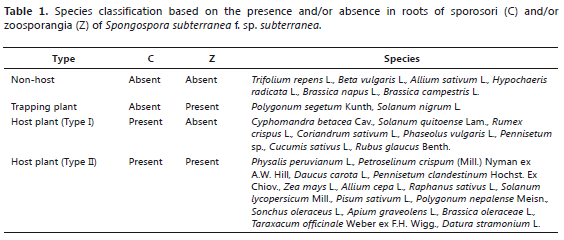
<body><![CDATA[<p><font size="2" face="Verdana, Arial, Helvetica, sans-serif">The disease symptoms include damage on roots and the surface of the potato tuber. The infected tissue may increase in size and also injure the parenchymal tissue in addition to the epidermis, reducing both production and tuber quality (Harrison <i>et al</i>., 1997). On tubers, symptoms are characterized by the formation of brown-colored pustules that have a powdery appearance. The appearance of these symptoms is due to the resistance spores that multiply in this tissue and are released at harvest time increasing the soil inoculum concentration. Galls may be observed in the roots or may be found on the apical meristems of adventitious roots or stolons (Harrison <i>et al</i>., 1997). Jaramillo <i>et al</i>. (2008) reported variation in the disease symptomatology in the potato-producing areas of Colombia, reporting a greater frequency of pustules in tubers on the Parda Pastusa and Diacol Capiro varieties in Cundinamarca, Boyac&aacute; and North Antioquia, whereas root galls of these varieties were noted in the Nari&ntilde;o and East Antioquia.</font></p>     <p><font size="2" face="Verdana, Arial, Helvetica, sans-serif">Until now, many studies have been focused on the control of potato powdery scab such as the use of antagonistic microorganisms by Hoyos <i>et al</i>. (2008), who proposed Trichoderma asperellum Samuels, Lieckf. &amp; Nirenberg as a bio-controlling microorganism for potato powder scab. Nevertheless, Gilchrist <i>et al</i>. (2009) evaluating the effect of T. asperellum strains on the incidence and severity of powdery scab, did not report any significant differences between plants treated with the microorganism compared with untreated plants. Similarly, Restrepo <i>et al</i>. (2009) evaluating T. harzianum Rifai, Mycorrhizae, Pseudomonas fluorescents Migula 1895 and pine shavings, found a positive effects on the incidence and severity reduction of the disease with all treatments. Other studies have focused on the application of commercial chemical products such as fluazinam, mancozeb, dichlorophen-Na, dichlofluanid, or a mixture of fluazinam + mancozeb before planting (Falloon <i>et al</i>., 1996), azoxystrobin, propamocarb, difenoconazole, pentachloronitrobenzene (PCNB) and plant extracts of Lippia origanoides Kunth and Calotropis procera (Ait.), which shows that those application reduced the incidence of powdery scab in harvested tubers. The plant extracts were the most effective against disease incidence and severity (Bittara <i>et al</i>., 2009). Larking and Griffin (2007) reported 15 to 40% reduction in powdery scab following prior application of green manure produced from Brassicas. This reduction was attributed to the sulfur compounds such as glucosinolates in these species. At the global level, the management of this disease is framed by the search for plant material showing resistance to the pathogen. Nevertheless, various management methods are necessary to control powdery scab (Falloon, 2008).</font></p>     <p><font size="2" face="Verdana, Arial, Helvetica, sans-serif">Reports of S. <i>subetrranea</i> f. sp. <i>subetrranea</i> infecting non-solanaceous plants have suggested that these alternative hosts could provide a means for the pathogen to survive and multiply over various periods of time (Falloon, 2008). Thus, one of the methods for detecting S. <i>subetrranea</i> f. sp. <i>subetrranea</i> includes the inoculation of plants using bioassays observing pathogenic structures inside the roots. Using this method, Merz (1989) detected S. <i>subetrranea</i> f. sp. <i>subetrranea</i> and quantified soil sporosori using a 3-stage protocol, the first of which is a pre-inoculation period in which the sporosori are suspended in a nutrient solution over 3 days to allow zoospores release. This stage is follow by a trapping stage where plants are inoculated over 2 days to assure roots infection and then a period of disease development where the plants are again suspended in nutrient solution over 7 days. Using this method, early detection of the disease and also the identification of potato varieties resistant to S. <i>subetrranea</i> f. sp. <i>subetrranea</i> was possible with the eventual goal of developing genetic improvement programs (Merz <i>et al</i>., 2004). In studies of early detection of S. <i>subetrranea</i> f. sp. <i>subetrranea</i>, the trapping period has been modified from 1 day (Nakayama <i>et al</i>., 2007) to 14 days (Qu and Christ, 2006) of inoculation, followed by observation of S. <i>subetrranea</i> f. sp. <i>subetrranea</i> structures in the roots of the inoculated plants. </font></p>     <p><font size="2" face="Verdana, Arial, Helvetica, sans-serif">Jones and Harrison (1972) reported species from the Chenopodiaceae, Aizoaceae, Brassicaceae, Caryophyllaceae, Gramineae and Leguminosae families as hosts of S. <i>subetrranea</i> f. sp. <i>subetrranea</i>. These authors observed only the zoosporangial stage of S. <i>subetrranea</i> f. sp. <i>subetrranea</i> at 38 and 45 days after inoculation on Chenopodium album, Matricaria matricarioides, Solanum nigrum, Urtica dioica, Poa annua, Lapsana communis and Rumex acetosella with sporosori drawn from tubers in nutrient solution. </font></p>     <p><font size="2" face="Verdana, Arial, Helvetica, sans-serif">Andersen <i>et al</i>. (2002) evaluated 17 weeds associated with potato crops in Denmark and reported <i>Artemisia vulgaris</i> L., <i>Chamomilla suaveolens</i> (Pursh) Rydb., <i>Chenopodium album</i> L., <i>Galium aparine</i> L., <i>Geranium pusitlum</i> L., <i>Matricaria inodora</i> L., <i>Polygonum avicular</i> L., P. <i>convolvulus</i>, L., R. <i>acetosella</i> L., <i>Solanum nigrum</i> L., <i>Sonchus arvensis</i> L., <i>Urtica urens</i> L. and <i>Viola tricolor</i> L. as <i>zoosporangial</i> hosts of S. <i>subetrranea</i> f. sp. <i>subetrranea</i>. Qu and Christ (2006) evaluated common crops and weeds in the United States and found that tomato (<i>Lycopersicon esculentum</i> L.), yellow mustard (<i>Brassica campestris</i> L.) and oat (<i>Avena sativa</i> L.) showed sporosori whereas <i>Amaranthus retroflexus</i> L., <i>Ambrosia artemisiifolia</i> L. <i>Raphanus sativus</i> L. <i>Brassica napus</i> L. <i>Chenopodium album</i> L., <i>Cyperus esculentus</i> L., <i>Trifolium pratense</i> L., <i>Phleum pratense</i> L., <i>Secale cereale</i> L., <i>Fagopyrum esculentum</i> and <i>Datura stramonium</i> L. were zoosporangial hosts indicating that these species may act as trapping plants. Trapping plants prevent the completion of the pathogen's life cycle, thus reducing the inoculum in the soil. These plants could contribute to integrated management of powdery scab if sown before the potato crop. White (1954) reported that <i>Datura stramonium</i> L. grown in infected soils reduced the severity of powdery scab by 79% after one potato harvest. Murakami <i>et al</i>. (2000) reported that <i>Raphanus sativus</i> L. var. longipinnatus reduced inoculum of P. brassicae by 71% in pots that were inoculated after sowing a susceptible plant compared with a test pot (R. sativus not sown) indicating that this plant may be used as a trapping plants for the management of cabbage clubroot. </font></p>     <p><font size="2" face="Verdana, Arial, Helvetica, sans-serif">More recently, Nitzan <i>et al</i>. (2009) reported Solanum sarrachoides Sendtn., which is an annual weed of irrigated crops in the US, as a host of S. <i>subetrranea</i> f. sp. <i>subetrranea</i> which had the ability to form galls increasing the soils inoculum. Similarly, in New Zealand, Shah <i>et al</i>. (2010) showed S. sarrachoides and Solanum nigrum L. as hosts of S. <i>subetrranea</i> f. sp. <i>subetrranea</i> and Meloidogyne fallax. Karssen concluded that these species most likely allowed the proliferation of zoospores from zoosporangia and the development of sporosori, thereby assisting the survival of the pathogen over many years. </font></p>     <p><font size="2" face="Verdana, Arial, Helvetica, sans-serif">This study attempted to use inoculations in bioassays to identify host plants of S. <i>subetrranea</i> f. sp. <i>subetrranea</i> that may be used within an integrated management program for this disease.</font></p>     <p>&nbsp;</p>     <p><font size="3" face="Verdana, Arial, Helvetica, sans-serif"><b>MATERIALS AND METHODS</b></font></p>     <p><font size="2" face="Verdana, Arial, Helvetica, sans-serif"><b><i>Localization and inoculated species.</i></b> The study was performed in the Paysand&uacute; Agrarian Station at the Universidad Nacional de Colombia, which is located in the Santa Elena Township, Medell&iacute;n City, and it is at an altitude of 2,500 masl with average annual temperature of 14 &deg;C. 33 species were evaluated in total, of which 22 are cultivatable, 11 are weeds associated with potato planting and two are commercial potato varieties (<a href="#tab01">Table 1</a>).</font></p>     ]]></body>
<body><![CDATA[<p align="center"><font size="2" face="Verdana, Arial, Helvetica, sans-serif"><a name="tab01"></a></font><img src="/img/revistas/rfnam/v66n2/v66n2a01tab01.gif"></p>     <p><font size="2" face="Verdana, Arial, Helvetica, sans-serif"><b><i>Inoculation by bioassays.</i></b> Using the Alzate <i>et al</i>. (2008) method, sporosori extracted from naturally infected soil were used, as the infested dry soil was passed through a series of mesh screens of 90 and 25 <font face="Symbol">m</font>m pore size. Samples were then counted using a Neubauer chamber and the concentration was adjusted to 1&times;10<sup>6</sup> sporosori.mL<sup>-1</sup>. Plants were propagated in peat, and inoculated when they showed two pairs of leaves. Plants remaining for 12 days in 150 mL of water in which the sporosori had been diluted. To guarantee sufficient development of the plants, after 8 days, Hoagland (Millner and Kitt, 1992) nutrient solution was added to return to the initial volume. The control plants (non-inoculated) were submerged in water with nutrient solution. As a control variable, two types of Solanum tuberosum spp. andigena were used. Once the inoculation period had passed, the plants were sown in 1 m2 plots. 50 plants of each species were inoculated and a similar number were used as controls. </font></p>     <p><font size="2" face="Verdana, Arial, Helvetica, sans-serif"><b><i>Evaluations.</i></b> Evaluations were performed at 15, 30, 60, 90 and 120 days post-inoculation depending on the life cycle of each species. 10 inoculated and 10 control plants per species were used for each evaluation. The roots of each plant were washed using tap water and then examined for the presence of galls. To observe pathogenic structures under a microscope, a portion of root was stained using 0.5% trypan blue as follows. The root was placed in a 10-mL Falcon tube and trypan blue was applied directly to the root until it was covered completely. For evaluation, five roots per sample were placed on a slide and observed using a Nikon&trade; E-200 light microscope at a total magnification of 100&times; and 400&times;.</font></p>     <p><font size="2" face="Verdana, Arial, Helvetica, sans-serif"><b><i>Data Analysis.</i></b> For data analysis, the time of the appearance of the first observed microscopic structures was used. The incidence of zoosporangia and sporosori was estimated for the evaluated plants using the following equation:</font></p>     <p><img src="/img/revistas/rfnam/v66n2/v66n2a01eq000.gif"></p>     <p><font size="2" face="Verdana, Arial, Helvetica, sans-serif">Where <b>&quot;n&quot;</b> is the number of plants showing zoosporangia and sporosori on their roots, and &quot;X&quot; is the total number of plants. A confidence interval of 95% was also calculated using the equation (Clopper and Pearson, 1934):</font></p>     <p><img src="/img/revistas/rfnam/v66n2/v66n2a01eq001.gif"></p>     <p><font size="2" face="Verdana, Arial, Helvetica, sans-serif">Where the critical distribution value F0.025 is calculated using the following degrees of freedom: V1=2(n-x+1), V2 =2x,       . Analysis was performed using the R program environment for data analysis (The R Development Core Team, 2012) and the Binomial package (Dorai-Raj, 2009).</font></p>     <p>&nbsp;</p>     <p><font size="3" face="Verdana, Arial, Helvetica, sans-serif"><b>RESULTS AND DISCUSSION</b></font></p>     ]]></body>
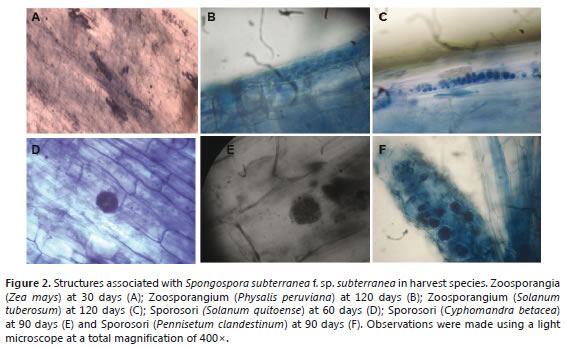
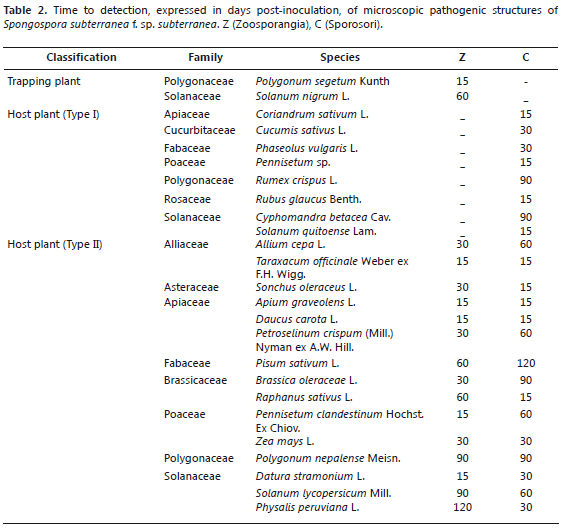
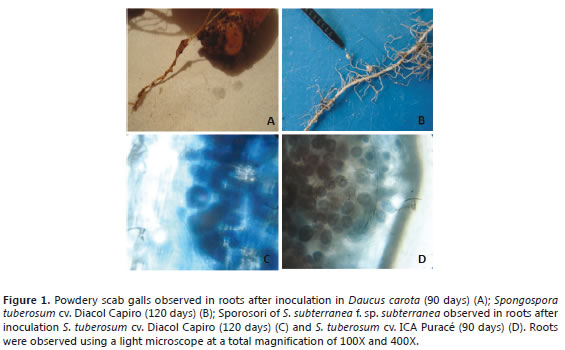
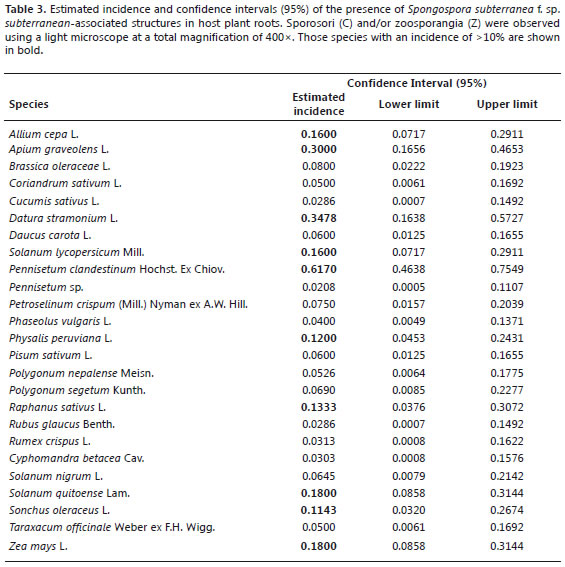
<body><![CDATA[<p><font size="2" face="Verdana, Arial, Helvetica, sans-serif"><b><i>Classification of species based on the pathogenic structures of S. subetrranea f. sp. subetrranea observed.</i></b> In this study, weeds and cultivated plants were classified as 1) non-hosts; 2) trapping plants; 3) host Type I; and 4) host Type II based on observed pathogenic structures of S. <i>subetrranea</i> f. sp. <i>subetrranea</i> in roots. The first category comprised plants where pathogenic structures were not found, the second includes plants that presented only zoosporangia, and hosts Type I and II were species presenting only sporosori or both zoosporangia and sporosori, respectively. Thus, of the 31 species evaluated, 6 were classified as non-hosts, 2 as trapping species, 8 as host Type I and 15 as host Type II (<a href="#tab01">Table 1</a>). </font></p>     <p><font size="2" face="Verdana, Arial, Helvetica, sans-serif"><b><i>Periods of detection of S. subetrranea f. sp. subetrranea zoosporangia and sporosori in host-plant roots.</i></b> P. <i>segetum</i> and S. <i>nigrum</i> species that were classified as trapping plants showed zoosporangia at 15 and 60 days, respectively. C. <i>sativum</i>, <i>Pennisetum</i> sp., R. <i>glaucus</i>, S. <i>quitoense</i>, T. <i>officinale</i>, A. <i>graveolens</i>, D. <i>carota</i>, S. <i>oleraceus</i> and R. <i>sativus</i>, classified as host plants Type I and II, showed resistance structures of S. <i>subetrranea</i> f. sp. <i>subetrranea</i> at 15 days. These results show that S. <i>subetrranea</i> f. sp. <i>subetrranea</i> colonizes and produces resistance structures within 15 days, demonstrating the susceptibility of various harvest species and weeds in Antioquia. Merz <i>et al</i>. (2004) observed zoosporangia at 3-4 days and the formation of mature galls 4 months after potato plants inoculation. In C. <i>sativus</i>, P. <i>vulgaris</i>, R. <i>crispus</i>, C. <i>betacea</i>, A. <i>cepa</i>, P. <i>crispum</i>, P. <i>sativum</i>, B. <i>oleraceae</i>, Z. <i>mays</i>, P. <i>nepalense</i>, S. <i>lycopersicum</i> and P. <i>peruvianum</i>, the infection was presented as a late infection and was observed after 30 days of inoculation. These results confirm the broad range of hosts for this Plasmodiophoromycete as reported previously by Jones and Harrison (1969; 1972) and Andersen <i>et al</i>. (2002) <a href="#tab02">Table 2</a>. S. <i>subetrranea</i> f. sp. <i>subetrranea</i> was not observed in non-inoculated plants, confirming the validity of the bioassays used.</font></p>     <p align="center"><font size="2" face="Verdana, Arial, Helvetica, sans-serif"><a name="tab02"></a></font><img src="/img/revistas/rfnam/v66n2/v66n2a01tab02.gif"></p>     <p><font size="2" face="Verdana, Arial, Helvetica, sans-serif">Besides presenting with both zoosporangia and sporosori, D. <i>carota</i> and S. <i>tuberosum</i> (Purac&eacute; and Diacol Capiro varieties) also showed galls at 90 and 120 days (<a href="#fig01">Figure 1</a>), symptom that was not observed among the other studied species. The absence of gall formation in the other plants, despite the bioassay inoculation, has previously been reported by Qu and Christ (2006) and Van de Graaf <i>et al</i>. (2007), where many species of plant were inoculated with different sporosori concentrations, including Estima potato variety. These plants became infected but did not develop galls in their roots. </font></p>     <p align="center"><font size="2" face="Verdana, Arial, Helvetica, sans-serif"><a name="fig01"></a></font><img src="/img/revistas/rfnam/v66n2/v66n2a01fig01.jpg"></p>     <p><font size="2" face="Verdana, Arial, Helvetica, sans-serif">Pathogenic structures were not observed in A. <i>sativum</i>, H. <i>radicata</i>, T. <i>repens</i>, B. <i>napus</i>, B. <i>campestris</i> and B. <i>vulgaris</i>, making them candidates for rotation within a disease management strategy because they will not increase the soil inoculum. Nevertheless, Harrison and Jones (1970) and Van de Graaf <i>et al</i>. (2007) have reported B. vulgaris as a host of S. <i>subetrranea</i> f. sp. <i>subetrranea</i>. A difference in the varieties studied should have led the differences between these studies and the present results. </font></p>     <p><font size="2" face="Verdana, Arial, Helvetica, sans-serif">Some of the plants evaluated in this study have been studied in other countries. For example, in Pakistan, Iftikhar and Ahmad (2005) attempted to find alternate hosts for S. <i>subetrranea</i> f. sp. <i>subetrranea</i>, inoculated cultivated plants in nutrient solution, they reported that in Z. <i>mays</i>, P. <i>sativum</i>, D. <i>stramonium</i>, R. <i>sativus</i> and B. <i>oleracea</i>, the zoosporangial stage was only observed. However, in our study sporosori in these species were identified. In Colombia, Zuluaga <i>et al</i>. (2010) also reported Z. mays as forming pathogenic structures associated with S. <i>subetrranea</i> f. sp. <i>subetrranea</i>. However, Qu and Christ (2006), did not include Z. mays as a host but did include B. napus, which is a species that did not show pathogen-related structures in our study. </font></p>     <p><font size="2" face="Verdana, Arial, Helvetica, sans-serif">Betancur <i>et al</i>. (2011), studying naturally infested lots in Antioquia, reported that P. nepalense, P. clandestinum, R. crispus and Z. mays showed S. <i>subetrranea</i> f. sp. <i>subetrranea</i>-associated structures, corroborating the results of our study. These species belong to the Asteraceae, Polygonaceae and Poaceae families, which had already been reported as host families for S. <i>subetrranea</i> f. sp. <i>subetrranea</i> by Jones and Harrison (1969) and Harrison and Jones (1970). Some species from the Poaceae family, such as P. clandestinum (Betancur <i>et al</i>., 2011) and Z. mays (Iftikhar and Ahmad 2005; Zuluaga <i>et al</i>., 2010), have been reported as hosts for S. <i>subetrranea</i> f. sp. <i>subetrranea</i> and are also hosts for the Polymyxa genus, indicating a greater affinity of this group of Plasmodia for these species.</font></p>     <p><font size="2" face="Verdana, Arial, Helvetica, sans-serif">A. <i>cepa</i>, A. <i>graveolens</i>, C. <i>sativum</i>, C. <i>sativus</i>, P. <i>crispum</i>, P. <i>vulgaris</i>, P. <i>peruviana</i>, R. <i>glaucus</i>, S. <i>quitoense</i> and T. <i>officinale</i> have not been reported previously as hosts for S. <i>subetrranea</i> f. sp. <i>subetrranea</i>. Thus, this study is the first report of these species as hosts of. S. <i>subetrranea</i>. These species belong to the Alliaceae, Rosaceae and Cucurbitaceae families, which have not neither been previously reported hosting S. <i>subetrranea</i> f. sp. <i>subetrranea</i>.</font></p>     <p><font size="2" face="Verdana, Arial, Helvetica, sans-serif">With regard to the structures associated with S. <i>subetrranea</i> f. sp. <i>subetrranea</i> found in roots, the structures were morphologically different depending upon the species. These differences may be due to the affinity of the pathogen to each plant or to a reaction to the pathogen-host interaction. Indeed, these causes may underlie the time to detection of structures and zoosporangia in Z. <i>mays</i>, P. <i>peruviana</i> and S. <i>tuberosum</i> where cytoplasmic fragmentation showed a greater separation in root cells of S. <i>tuberosum</i> than in other species (<a href="#fig02">Figure 2A</a>, <a href="#fig02">B</a>, <a href="#fig02">C</a>). Sporosori were grooved, irregular and hollow with a spongy appearance due to the cavities in its exterior surface and the network of internal canals. They may be round, as observed in this study (<a href="#fig02">Figure 2D</a>, <a href="#fig02">E</a>, <a href="#fig02">F</a>), or oval, elongated or completely irregular as reported by Montero-Ast&uacute;a and Rivera (2005). This diversity in sporosori shape and size was noted by Jaramillo <i>et al</i>. (2008) who reported differences in the size of sporosori from root galls compared with those from tuber pustules. Thus, differently shaped and sized structures may also occur in different host species.</font></p>     ]]></body>
<body><![CDATA[<p align="center"><font size="2" face="Verdana, Arial, Helvetica, sans-serif"><a name="fig02"></a></font><img src="/img/revistas/rfnam/v66n2/v66n2a01fig02.jpg"></p>     <p><font size="2" face="Verdana, Arial, Helvetica, sans-serif">Falloon <i>et al</i>. (2011), using light microscopy evaluated both diameter and zoospore number on each sporosori coming from 37 different inoculum country sources, founding that the average of zoospore diameter have a slight difference between the inoculum from Agraria (4 <font face="Symbol">m</font>m) and Estima (4.3 <font face="Symbol">m</font>m) varieties. However, the zoospore mean was 667 per sporosori varing from 155 to 1.526. The results of this study confirm that sporosori are a zoospore aggregation complex which are sponge-like with tunnel on the surface and the sporosori size is very different among the pathogen isolates from different countries and potato varieties. The result suggests that environmental conditions (more than host plant) affect the sporosori size of S subterranea f. sp. <i>subetrranea</i>n. </font></p>     <p><font size="2" face="Verdana, Arial, Helvetica, sans-serif"><b><i>Incidence of S. subetrranea f. sp. subetrranea sporosori and zoosporangia in host plant roots.</i></b> <a href="#tab03">Table 3</a> showed that significant differences were found (P&lt;0.05) in the incidence of zoosporangia and sporosori among A. <i>graveolens</i>, C. <i>sativus</i>, D. <i>carota</i>, P. <i>vulgaris</i>, P. <i>sativum</i>, R. <i>glaucus</i>, R. <i>crispus</i> and C. <i>betacea</i> where incidences of 0.3000, 0.0286, 0.0600, 0.0400, 0.0600, 0.0286, 0.0313 and 0.0303, respectively, were also observed. D. <i>stramonium</i>, <i>Pennisetum</i> sp., P. <i>vulgaris</i>, R. <i>glaucus</i>, R. <i>crispus</i> and C. <i>betacea</i> showed incidences of 0.3478, 0.0208, 0.0400, 0.0286, 0.0313 and 0.0303, respectively. </font></p>     <p align="center"><font size="2" face="Verdana, Arial, Helvetica, sans-serif"><a name="tab03"></a></font><img src="/img/revistas/rfnam/v66n2/v66n2a01tab03.jpg"></p>     <p><font size="2" face="Verdana, Arial, Helvetica, sans-serif">A. <i>cepa</i>, A. <i>graveolens</i>, D. <i>stramonium</i>, S. <i>lycopersicum</i>, P. <i>clandestinum</i>, P. <i>peruvianum</i>, R. <i>sativus</i>, S. <i>quitoense</i>, S. <i>oleraceus</i> and Z. <i>mays</i> showed the highest incidence rates (<a href="#tab03">Table 3</a>) when using a high incidence-threshold (&gt;10%) for plants infected with S. <i>subetrranea</i> f. sp. <i>subetrranea</i>.</font></p>     <p><font size="2" face="Verdana, Arial, Helvetica, sans-serif">Using this inoculation methodology, the incidence of S. <i>subetrranea</i> f. sp. <i>subetrranea</i> varies among species, reflecting the variability in resistance and susceptibility to infection as described by M&auml;k&auml;r&auml;inen <i>et al</i>. (1994), who evaluated the disease incidence in wild and harvested solanaceous species inoculating with infected soil and zoospores in suspension. Among the species S. <i>acaule</i>, S. <i>brevidens</i>, S. <i>tuberosum</i> and S. <i>sucrense</i>, S. <i>acaule</i> was considered to be the most resistant because it showed a lower infection incidence in roots of tested plants. </font></p>     <p><font size="2" face="Verdana, Arial, Helvetica, sans-serif">Thus, the use of some species in rotation with potato crops, for example P. <i>clandestinum</i> (pennisetum grass), which is the primary rotational crop used in potato producing regions in Colombia, may increase the levels of S. <i>subetrranea</i> f. sp. <i>subetrranea</i> inoculum in the field because, even though there is no galls formation it is able to produce sporosori inside roots, enabling the pathogen to remain in the soil until later planting of an additional potato crop. Similarly, the weeds R. <i>crispus</i> and P. <i>nepalense</i>, always found in potato crops, repeatedly increase inoculum and improve the process of reinfection. In contrast, A. sativum and B. vulgaris did not show pathogenic structures, and these species could be used to rotate with potatoes within a program of integrated disease management with the goal of reducing silent multiplication of the pathogen. </font></p>     <p><font size="2" face="Verdana, Arial, Helvetica, sans-serif">When compared with M&auml;k&auml;r&auml;inen <i>et al</i>. (1994) results, where inoculum from soil stored for 1 year led to a lower number of plants infected with S. <i>subetrranea</i> f. sp. <i>subetrranea</i> compared with a fresh inoculum, and Fornier <i>et al</i>. (1996), where exudates from different potato breeds stimulated the release of zoospores, it may be assumed that the survival of this pathogen over time is due to host plants which allow the repeated formation of resistance structures but not the persistence per se of the pathogen in the soil. Thus, the microorganism can infect different species and evade the plants mechanisms defense suggesting that species where resistance structures were found are a significant source of inoculum. This is especially true in the case of those plants associated with potato crops in Colombia, such as weeds or rotational crops. These crops may allow the maintenance, or even the slow increase of inoculum in soil while admit of pathogen resistance structures to remain viable and multiply for many years, thereby reinfecting new potato crops as reported by Harrison <i>et al</i>. (1997).</font></p>     <p><font size="2" face="Verdana, Arial, Helvetica, sans-serif">Following the proposal of Qu and Chist (2006), who classified as trapping plants, those plants inoculated with S. <i>subetrranea</i> f. sp. <i>subetrranea</i> showing only zoosporangial structures, i.e., plants that impeded follow up the life cycle of the pathogen and to form the resistance structures, thus in the current study P. segetum and S. nigrum may be classified as trapping plants. S. <i>subetrranea</i> f. sp. <i>subetrranea</i> may avoid plant basal resistance, enabling the entry of zoospore cellular material; however, it is possible that some resistance genes from S. nigrum and P. segetum trigger a hypersensitive response (Hammond-Kosack and Jones, 2000) impeding the sequel of the life cycle. With respect to the non-hosts, it is possible that these species show a basal resistance, cell wall rigidity and produced phytoalexins that control the infection and/or invasion of unadapted pathogens (Lipka <i>et al</i>., 2008). In plants reported as Type I and II hosts, it is possible that S. <i>subetrranea</i> f. sp. <i>subetrranea</i> evades host defense mechanisms and alters its metabolism thereby surviving and multiplying (Hammond-Kosack and Jones, 2000); however, more studies are required to understand this host-pathogen interactions. </font></p>     <p><font size="2" face="Verdana, Arial, Helvetica, sans-serif">Hern&aacute;ndez <i>et al</i>. (2012) evaluated the infection intensity of S. <i>subetrranea</i> f. sp. subteranea by conventional (bioassays) and molecular (qPCR) methods in two potato varieties (Iwa and Agria) resistant and susceptible to the pathogen, respectively. The evaluated parameters were zoosporangia intensity in roots, galls number and S subterranea f. sp. <i>subetrranea</i> DNA quantity on roots by qPCR. It was found that inoculation did not affect the growing of the plants, but it reduces on 38% root dry matter of the susceptible variety. The intensity of zoosporangia development was similar in both varieties, galls was higher on the susceptible one and <i>Spongospora subterranea</i> f. sp. <i>subetrranea</i> DNA root quantity detected was twice larger on susceptible than on resistant variety. Authors suggest that zoosporangia stage on host roots is directly affected by host resistance factors more than sporosori stage, even on galls and tubers. </font></p>     ]]></body>
<body><![CDATA[<p><font size="2" face="Verdana, Arial, Helvetica, sans-serif">In summary, this study showed a broad range of S. <i>subetrranea</i> f. sp. <i>subetrranea</i> host plants, been the Type I and II potential species that keep on the pathogen persistence in the soil thereby providing a inoculum source for new potato crops. In contrast, species classified as trapping plants may reduce S. <i>subetrranea</i> f. sp. <i>subetrranea</i> inoculum in soil if used within disease management strategies, such as crop rotation and the weeds management in potato production.</font></p>     <p>&nbsp;</p>     <p><font size="3" face="Verdana, Arial, Helvetica, sans-serif"><b>CONCLUSIONS</b></font></p>     <p><font size="2" face="Verdana, Arial, Helvetica, sans-serif">Bioassay inoculations allowed the identification of S. <i>subetrranea</i> f. sp. <i>subetrranea</i> associated structures, such as zoosporangia and sporosori, after 15 days in P. <i>segetum</i>, T. <i>officinale</i>, A. <i>graveolens</i>, D. <i>carota</i>, P. <i>clandestinum</i>, D. <i>stramonium</i>, C. <i>sativum</i>, <i>Pennisetum</i> sp., R. <i>glaucus</i>, S. <i>quitoense</i>, S. <i>oleraceae</i>, A. <i>graveolens</i>, D. <i>carota</i> and R. <i>sativus</i>. These data demonstrate the pathogen ability to induce early signs of infection and also the adaptation of this pathogen to different species, which may be a survival mechanism in the environment, thus confirming its broad hosts range.</font></p>     <p><font size="2" face="Verdana, Arial, Helvetica, sans-serif">Using bioassay inoculations, 3 types of hosts are reported based on pathogenic structures found in roots: 1) Trapping plants showed zoosporangia (P. segetum and Solanum sp.), 2) Type I hosts showed sporosori but not zoosporangia (C. <i>betacea</i>, S. <i>quitoense</i>, R. <i>crispus</i>, C. <i>sativum</i>, P. <i>vulgaris</i>, <i>Pennisetum</i> sp., C. <i>sativus</i> and R. <i>glaucus</i>) and 3) Type II hosts showed both structures (P. peruviana, P. crispum, D. carota, P. clandestinum, Z. mays, A. cepa, R. sativus, S. lycopersicum, P. sativum, P. nepalense, S. oleraceus, A. graveolens, B. oleraceae, T. officinale and D. stramonium). These results demonstrate that the pathogen can multiply and form resistance structures in Type I and II hosts. It does not have this multiplying ability in trapping plants, suggesting that these plants may help to reduce S. <i>subetrranea</i> f. sp. <i>subetrranea</i> inoculum in soil.</font></p>     <p>&nbsp;</p>     <p><font size="3" face="Verdana, Arial, Helvetica, sans-serif"><b>ACKNOWLEDGMENT</b></font></p>     <p><font size="2" face="Verdana, Arial, Helvetica, sans-serif">This research was supported by Ministerio de Agricultura y Desarrollo Rural (MADR), Asociaci&oacute;n Hortifrut&iacute;cola de Colombia (ASOHOFRUCOL), Polit&eacute;cnico Colombiano Jaime Isaza Cadavid, Universidad Nacional de Colombia Sede Medell&iacute;n and Federaci&oacute;n de Productores de Papa de Colombia (FEDEPAPA) into the project Uso de plantas trampa para la reducci&oacute;n de in&oacute;culo de <i>Spongospora subterranea</i>. The autors wish to thank members of research groups Sistemas Agr&iacute;colas Tropicales (COL0007149), and Mejoramiento y Producci&oacute;n de Especies Andinas y Tropicales (COL0039484) for their contribution to develop this research.</font></p>     <p>&nbsp;</p>     <p><font size="3" face="Verdana, Arial, Helvetica, sans-serif"><b>BIBLIOGRAPHY</b></font></p>     ]]></body>
<body><![CDATA[<!-- ref --><p><font size="2" face="Verdana, Arial, Helvetica, sans-serif">Alzate, D.E., L.M. Hoyos y E.P. Gonz&aacute;lez. 2008. Factores que inciden en la liberaci&oacute;n de zoosporas de <i>Spongospora subterranea</i> (Wallroth) Lagerheim f. sp. <i>subetrranea</i> Tomlinson. Revista Facultad Nacional de Agronom&iacute;a, Medell&iacute;n 61(2): 4503-4510.    &nbsp;&nbsp;&nbsp;&nbsp;&nbsp;&nbsp;&nbsp;&nbsp;[&#160;<a href="javascript:void(0);" onclick="javascript: window.open('/scielo.php?script=sci_nlinks&ref=000073&pid=S0304-2847201300020000100001&lng=','','width=640,height=500,resizable=yes,scrollbars=1,menubar=yes,');">Links</a>&#160;]<!-- end-ref --></font></p>     <!-- ref --><p><font size="2" face="Verdana, Arial, Helvetica, sans-serif">Andersen, B.A.B., M. Nicolaisen and N.M. Nielsen. 2002. Alternative hosts for potato mop-top virus, genus Pomovirus and its vector <i>Spongospora subterranea</i> f. sp. <i>subetrranea</i>. Potato Research 45(1): 37-43.    &nbsp;&nbsp;&nbsp;&nbsp;&nbsp;&nbsp;&nbsp;&nbsp;[&#160;<a href="javascript:void(0);" onclick="javascript: window.open('/scielo.php?script=sci_nlinks&ref=000075&pid=S0304-2847201300020000100002&lng=','','width=640,height=500,resizable=yes,scrollbars=1,menubar=yes,');">Links</a>&#160;]<!-- end-ref --></font></p>     <!-- ref --><p><font size="2" face="Verdana, Arial, Helvetica, sans-serif">Betancur, G.J., A.I. Arcila, A.C. Zuluaga and Gonz&aacute;lez, J.E. 2011. Identification of alternate <i>Spongospora subterranea</i> (Wallroth) Lagerheim f. sp. Subterranea hosts in natural conditions in la Union and Santa Rosa de Osos municipalities. p. 68. In: Proceedings of the XXX Colombian Congress and XVI Latin American Phytopathology Congress. Bogot&aacute;    &nbsp;&nbsp;&nbsp;&nbsp;&nbsp;&nbsp;&nbsp;&nbsp;[&#160;<a href="javascript:void(0);" onclick="javascript: window.open('/scielo.php?script=sci_nlinks&ref=000077&pid=S0304-2847201300020000100003&lng=','','width=640,height=500,resizable=yes,scrollbars=1,menubar=yes,');">Links</a>&#160;]<!-- end-ref -->.</font></p>     <!-- ref --><p><font size="2" face="Verdana, Arial, Helvetica, sans-serif">Bittara, R., D. Rodr&iacute;guez, M. Sanabria, J. Monroy and J. Rodr&iacute;guez. 2009. Evaluation of fungicides and plant products in combating potato powdery scab. &#91;Evaluaci&oacute;n de fungicidas and productos vegetales en el combate de la sarna polvorienta de la papa.&#93; Interscience 34(4): 265-269.    &nbsp;&nbsp;&nbsp;&nbsp;&nbsp;&nbsp;&nbsp;&nbsp;[&#160;<a href="javascript:void(0);" onclick="javascript: window.open('/scielo.php?script=sci_nlinks&ref=000079&pid=S0304-2847201300020000100004&lng=','','width=640,height=500,resizable=yes,scrollbars=1,menubar=yes,');">Links</a>&#160;]<!-- end-ref --></font></p>     <!-- ref --><p><font size="2" face="Verdana, Arial, Helvetica, sans-serif">Braselton, J.P. 1995. Current status of the Plasmodiophorids. Critical Reviews in Microbiology 21(4): 263-275.    &nbsp;&nbsp;&nbsp;&nbsp;&nbsp;&nbsp;&nbsp;&nbsp;[&#160;<a href="javascript:void(0);" onclick="javascript: window.open('/scielo.php?script=sci_nlinks&ref=000081&pid=S0304-2847201300020000100005&lng=','','width=640,height=500,resizable=yes,scrollbars=1,menubar=yes,');">Links</a>&#160;]<!-- end-ref --></font></p>     ]]></body>
<body><![CDATA[<!-- ref --><p><font size="2" face="Verdana, Arial, Helvetica, sans-serif">Bulman, S.R. and J.W. Marshall. 1998. Detection of <i>Spongospora subterranea</i> in potato tuber lesions using the polymerase chain reaction (PCR). Plant Pathology 47(6): 759-766.    &nbsp;&nbsp;&nbsp;&nbsp;&nbsp;&nbsp;&nbsp;&nbsp;[&#160;<a href="javascript:void(0);" onclick="javascript: window.open('/scielo.php?script=sci_nlinks&ref=000083&pid=S0304-2847201300020000100006&lng=','','width=640,height=500,resizable=yes,scrollbars=1,menubar=yes,');">Links</a>&#160;]<!-- end-ref --></font></p>     <!-- ref --><p><font size="2" face="Verdana, Arial, Helvetica, sans-serif">Bulman, S.R., S.F. Kuhn, J.W. Marshall and E. Schnepf. 2001. A phylogenetic analysis of the SSU rRNA from members of the Plasmodiophorida and Phagomyxida. Protist 152 (1): 43-51.    &nbsp;&nbsp;&nbsp;&nbsp;&nbsp;&nbsp;&nbsp;&nbsp;[&#160;<a href="javascript:void(0);" onclick="javascript: window.open('/scielo.php?script=sci_nlinks&ref=000085&pid=S0304-2847201300020000100007&lng=','','width=640,height=500,resizable=yes,scrollbars=1,menubar=yes,');">Links</a>&#160;]<!-- end-ref --></font></p>     <!-- ref --><p><font size="2" face="Verdana, Arial, Helvetica, sans-serif">Carnegie, S.F., T. Davey and G.S. Saddler. 2012. Prevalence and distribution of potato mop-top virus in Scotland. Plant Pathology 61(4): 623-631.    &nbsp;&nbsp;&nbsp;&nbsp;&nbsp;&nbsp;&nbsp;&nbsp;[&#160;<a href="javascript:void(0);" onclick="javascript: window.open('/scielo.php?script=sci_nlinks&ref=000087&pid=S0304-2847201300020000100008&lng=','','width=640,height=500,resizable=yes,scrollbars=1,menubar=yes,');">Links</a>&#160;]<!-- end-ref --></font></p>     <!-- ref --><p><font size="2" face="Verdana, Arial, Helvetica, sans-serif">Clopper, C.J. and E.S. Pearson. 1934. The use of confidence or fiducial limits illustrated in the case of the binomial. Biometrika 26(4): 404-413.    &nbsp;&nbsp;&nbsp;&nbsp;&nbsp;&nbsp;&nbsp;&nbsp;[&#160;<a href="javascript:void(0);" onclick="javascript: window.open('/scielo.php?script=sci_nlinks&ref=000089&pid=S0304-2847201300020000100009&lng=','','width=640,height=500,resizable=yes,scrollbars=1,menubar=yes,');">Links</a>&#160;]<!-- end-ref --></font></p>     <!-- ref --><p><font size="2" face="Verdana, Arial, Helvetica, sans-serif">Dorai-Raj, S. 2009. Binomial confidence intervals for several parametrizations. R packages 1.0-5. Available at: <a href="http://CRAN.R-proyect.org/package=binom/index.html" target="referencia">http://CRAN.R-proyect.org/package=binom/index.html</a>; consulta: octubre 2012.    &nbsp;&nbsp;&nbsp;&nbsp;&nbsp;&nbsp;&nbsp;&nbsp;[&#160;<a href="javascript:void(0);" onclick="javascript: window.open('/scielo.php?script=sci_nlinks&ref=000091&pid=S0304-2847201300020000100010&lng=','','width=640,height=500,resizable=yes,scrollbars=1,menubar=yes,');">Links</a>&#160;]<!-- end-ref --></font></p>     ]]></body>
<body><![CDATA[<!-- ref --><p><font size="2" face="Verdana, Arial, Helvetica, sans-serif">Falloon, R.E. 2008. Control of powdery scab of potato: Towards integrated disease management. American Journal Potato Research 85(4): 253-260.    &nbsp;&nbsp;&nbsp;&nbsp;&nbsp;&nbsp;&nbsp;&nbsp;[&#160;<a href="javascript:void(0);" onclick="javascript: window.open('/scielo.php?script=sci_nlinks&ref=000093&pid=S0304-2847201300020000100011&lng=','','width=640,height=500,resizable=yes,scrollbars=1,menubar=yes,');">Links</a>&#160;]<!-- end-ref --></font></p>     <!-- ref --><p><font size="2" face="Verdana, Arial, Helvetica, sans-serif">Falloon, R.E., A.R. Wallace, M. Braithwaite, R.A. Genet, H.M. Nott, J.D. Fletcher and W.F. Braam. 1996. Assessment of seed tuber, in-furrow, and foliar chemical treatments for control of powdery scab (<i>Spongospora subterranea</i> f sp subterranea) of potato. New Zealand Journal of Crop and Horticultural Science 24(4): 341-353.    &nbsp;&nbsp;&nbsp;&nbsp;&nbsp;&nbsp;&nbsp;&nbsp;[&#160;<a href="javascript:void(0);" onclick="javascript: window.open('/scielo.php?script=sci_nlinks&ref=000095&pid=S0304-2847201300020000100012&lng=','','width=640,height=500,resizable=yes,scrollbars=1,menubar=yes,');">Links</a>&#160;]<!-- end-ref --></font></p>     <!-- ref --><p><font size="2" face="Verdana, Arial, Helvetica, sans-serif">Falloon R.E., U. Merz, R.A. Lister, A.R. Wallace and S.P. Hayes. 2011. Morphological enumeration of resting spores in sporosori of <i>Spongospora subterranea</i>. Acta Protozoologica 50(1): 121-132.    &nbsp;&nbsp;&nbsp;&nbsp;&nbsp;&nbsp;&nbsp;&nbsp;[&#160;<a href="javascript:void(0);" onclick="javascript: window.open('/scielo.php?script=sci_nlinks&ref=000097&pid=S0304-2847201300020000100013&lng=','','width=640,height=500,resizable=yes,scrollbars=1,menubar=yes,');">Links</a>&#160;]<!-- end-ref --></font></p>     <!-- ref --><p><font size="2" face="Verdana, Arial, Helvetica, sans-serif">Fornier, N., A.A. Powell and P.J. Burgess. 1996. Factors affecting the release of primary zooapores from sporosori of <i>Spongospora subterranea</i> assessed using monoclonal antibody Elisa test plant viruses with fungal vectors. p. 89-92. In: Sherwood, J.L. (ed.). Proceedings of the Third Symposium of The International Working Group on Plant Viruses with Fungal Vectors. Dundee, Scotland. 192 p.    &nbsp;&nbsp;&nbsp;&nbsp;&nbsp;&nbsp;&nbsp;&nbsp;[&#160;<a href="javascript:void(0);" onclick="javascript: window.open('/scielo.php?script=sci_nlinks&ref=000099&pid=S0304-2847201300020000100014&lng=','','width=640,height=500,resizable=yes,scrollbars=1,menubar=yes,');">Links</a>&#160;]<!-- end-ref --></font></p>     <!-- ref --><p><font size="2" face="Verdana, Arial, Helvetica, sans-serif">Gilchrist, E., S. Jaramillo and S. Reynaldi. 2009. Effect of four isolates from the Trichoderma asperellum fungus on powdery scab in three types of soils. &#91;Efecto sobre la sarna polvosa de cuatro aislamientos del hongo Trichoderma asperellum en tres tipos de suelos.&#93;. Revista Facultad Nacional de Agronom&iacute;a Medell&iacute;n 62(1): 4783-4792.    &nbsp;&nbsp;&nbsp;&nbsp;&nbsp;&nbsp;&nbsp;&nbsp;[&#160;<a href="javascript:void(0);" onclick="javascript: window.open('/scielo.php?script=sci_nlinks&ref=000101&pid=S0304-2847201300020000100015&lng=','','width=640,height=500,resizable=yes,scrollbars=1,menubar=yes,');">Links</a>&#160;]<!-- end-ref --></font></p>     ]]></body>
<body><![CDATA[<!-- ref --><p><font size="2" face="Verdana, Arial, Helvetica, sans-serif">Hammond-Kosack, K and J. Jones. 2000. Chapter 21: Responses to plant pathogens. pp. 1102-1155. In: Buchanan, B., W. Gruissem and R. Jones. (ed.). Biochemistry and Molecular Biology of Plants. American Society of Plant Physiologist. Berkeley, California. 1.408 p.    &nbsp;&nbsp;&nbsp;&nbsp;&nbsp;&nbsp;&nbsp;&nbsp;[&#160;<a href="javascript:void(0);" onclick="javascript: window.open('/scielo.php?script=sci_nlinks&ref=000103&pid=S0304-2847201300020000100016&lng=','','width=640,height=500,resizable=yes,scrollbars=1,menubar=yes,');">Links</a>&#160;]<!-- end-ref --></font></p>     <!-- ref --><p><font size="2" face="Verdana, Arial, Helvetica, sans-serif">Harrison, B.D and R.A.C. Jones. 1970. Host range and some properties of potato mop-top virus. Annals of Applied Biology 65(3): 393-402.    &nbsp;&nbsp;&nbsp;&nbsp;&nbsp;&nbsp;&nbsp;&nbsp;[&#160;<a href="javascript:void(0);" onclick="javascript: window.open('/scielo.php?script=sci_nlinks&ref=000105&pid=S0304-2847201300020000100017&lng=','','width=640,height=500,resizable=yes,scrollbars=1,menubar=yes,');">Links</a>&#160;]<!-- end-ref --> </font></p>     <!-- ref --><p><font size="2" face="Verdana, Arial, Helvetica, sans-serif">Harrison, J.G., R.J. Searle and N.A. Williams. 1997. Powdery scab disease of potato -a review. Plant Pathology 46(1): 1-25.    &nbsp;&nbsp;&nbsp;&nbsp;&nbsp;&nbsp;&nbsp;&nbsp;[&#160;<a href="javascript:void(0);" onclick="javascript: window.open('/scielo.php?script=sci_nlinks&ref=000107&pid=S0304-2847201300020000100018&lng=','','width=640,height=500,resizable=yes,scrollbars=1,menubar=yes,');">Links</a>&#160;]<!-- end-ref --></font></p>     <!-- ref --><p><font size="2" face="Verdana, Arial, Helvetica, sans-serif">Hern&aacute;ndez M.L., R.E. Falloon, R.C. Butler, A.J. Conner, S.R. Bulman. 2013. <i>Spongospora subterranea</i> root infection assessed in two potato cultivars differing in susceptibility to tuber powdery scab. Plant Pathology 62(5): 1089-1096.    &nbsp;&nbsp;&nbsp;&nbsp;&nbsp;&nbsp;&nbsp;&nbsp;[&#160;<a href="javascript:void(0);" onclick="javascript: window.open('/scielo.php?script=sci_nlinks&ref=000109&pid=S0304-2847201300020000100019&lng=','','width=640,height=500,resizable=yes,scrollbars=1,menubar=yes,');">Links</a>&#160;]<!-- end-ref --></font></p>     <!-- ref --><p><font size="2" face="Verdana, Arial, Helvetica, sans-serif">Hoyos, C.L., P. Chaparro, M. Abramsky, I. Chet and S. Orduz. 2008. Evaluation of isolates of Trichoderma spp. against Rhizoctonia solani and Sclerotium rolfsii under in vitro and greenhouse conditions. Agronom&iacute;a Colombiana 26(3): 451-458.    &nbsp;&nbsp;&nbsp;&nbsp;&nbsp;&nbsp;&nbsp;&nbsp;[&#160;<a href="javascript:void(0);" onclick="javascript: window.open('/scielo.php?script=sci_nlinks&ref=000111&pid=S0304-2847201300020000100020&lng=','','width=640,height=500,resizable=yes,scrollbars=1,menubar=yes,');">Links</a>&#160;]<!-- end-ref --></font></p>     ]]></body>
<body><![CDATA[<!-- ref --><p><font size="2" face="Verdana, Arial, Helvetica, sans-serif">Iftikhar, S. and I. Ahmad. 2005. Alternate hosts of <i>Spongospora subterranea</i> f. sp. <i>subetrranea</i>, the causal organism of powdery scab of potato. Abstracts of papers presented at the 88th Annual Meeting of the Potato Association of America. Scottsbluff, Nebraska, August 8-12, 2004. American Journal of Potato Research 82(1): 57-97.    &nbsp;&nbsp;&nbsp;&nbsp;&nbsp;&nbsp;&nbsp;&nbsp;[&#160;<a href="javascript:void(0);" onclick="javascript: window.open('/scielo.php?script=sci_nlinks&ref=000113&pid=S0304-2847201300020000100021&lng=','','width=640,height=500,resizable=yes,scrollbars=1,menubar=yes,');">Links</a>&#160;]<!-- end-ref --></font></p>     <!-- ref --><p><font size="2" face="Verdana, Arial, Helvetica, sans-serif">Jaramillo, S. and J.M. Botero. 2007. Response of different <i>Spongospora subterranea</i> f. sp. <i>subetrranea</i> populations to rotation between potato varieties (Solanum tuberosum ssp. andigena).&#91;Respuesta de diferentes poblaciones de <i>Spongospora subterranea</i> f. sp. <i>subetrranea</i> a la rotaci&oacute;n entre dos variedades de papa (Solanum tuberosum ssp. andigena).&#93; Revista Facultad Nacional de Agronom&iacute;a Medell&iacute;n 60(2): 3859 - 3876.    &nbsp;&nbsp;&nbsp;&nbsp;&nbsp;&nbsp;&nbsp;&nbsp;[&#160;<a href="javascript:void(0);" onclick="javascript: window.open('/scielo.php?script=sci_nlinks&ref=000115&pid=S0304-2847201300020000100022&lng=','','width=640,height=500,resizable=yes,scrollbars=1,menubar=yes,');">Links</a>&#160;]<!-- end-ref --></font></p>     <!-- ref --><p><font size="2" face="Verdana, Arial, Helvetica, sans-serif">Jaramillo, S., G.A. P&eacute;rez, and L. Hoyos. 2008. Morphological variations of <i>Spongospora subterranea</i> (Wallr.) Lagerh f. sp. Subterranea Sporosori. &#91;Variaci&oacute;n morfol&oacute;gica de quistosoros de <i>Spongospora subterranea</i> (Wallr.) Lagerh f. sp. <i>subetrranea</i>.&#93; Revista Facultad Nacional de Agronom&iacute;a Medell&iacute;n 61(2): 4511- 4517.    &nbsp;&nbsp;&nbsp;&nbsp;&nbsp;&nbsp;&nbsp;&nbsp;[&#160;<a href="javascript:void(0);" onclick="javascript: window.open('/scielo.php?script=sci_nlinks&ref=000117&pid=S0304-2847201300020000100023&lng=','','width=640,height=500,resizable=yes,scrollbars=1,menubar=yes,');">Links</a>&#160;]<!-- end-ref --></font></p>     <!-- ref --><p><font size="2" face="Verdana, Arial, Helvetica, sans-serif">Jones, R.A.C. and B.D. Harrison. 1969. The behaviour of potato mop-top virus in soil, and evidence for its transmission by <i>Spongospora subterranea</i> (Wallr.) Lagerh. Annals of Applied Biology 63(1): 1-17.    &nbsp;&nbsp;&nbsp;&nbsp;&nbsp;&nbsp;&nbsp;&nbsp;[&#160;<a href="javascript:void(0);" onclick="javascript: window.open('/scielo.php?script=sci_nlinks&ref=000119&pid=S0304-2847201300020000100024&lng=','','width=640,height=500,resizable=yes,scrollbars=1,menubar=yes,');">Links</a>&#160;]<!-- end-ref --></font></p>     <!-- ref --><p><font size="2" face="Verdana, Arial, Helvetica, sans-serif">Jones, R.A.C. and B.D. Harrison. 1972. Ecological studies on potato mop-top in Scotland. Annals Applied Biology 71(1): 47-57.    &nbsp;&nbsp;&nbsp;&nbsp;&nbsp;&nbsp;&nbsp;&nbsp;[&#160;<a href="javascript:void(0);" onclick="javascript: window.open('/scielo.php?script=sci_nlinks&ref=000121&pid=S0304-2847201300020000100025&lng=','','width=640,height=500,resizable=yes,scrollbars=1,menubar=yes,');">Links</a>&#160;]<!-- end-ref --></font></p>     ]]></body>
<body><![CDATA[<!-- ref --><p><font size="2" face="Verdana, Arial, Helvetica, sans-serif">Larkin, R. and T. Griffin. 2007. Control of soilborne potato diseases using Brassica green manures. Crop Protection 26(7): 1067-1077.    &nbsp;&nbsp;&nbsp;&nbsp;&nbsp;&nbsp;&nbsp;&nbsp;[&#160;<a href="javascript:void(0);" onclick="javascript: window.open('/scielo.php?script=sci_nlinks&ref=000123&pid=S0304-2847201300020000100026&lng=','','width=640,height=500,resizable=yes,scrollbars=1,menubar=yes,');">Links</a>&#160;]<!-- end-ref --></font></p>     <!-- ref --><p><font size="2" face="Verdana, Arial, Helvetica, sans-serif">Lipka, U., R. Fuchs and V. Lipka. 2008. Arabidopsis non-host resistance to powdery mildews. Current Opinion in Plant Biology 11(4): 404-411.    &nbsp;&nbsp;&nbsp;&nbsp;&nbsp;&nbsp;&nbsp;&nbsp;[&#160;<a href="javascript:void(0);" onclick="javascript: window.open('/scielo.php?script=sci_nlinks&ref=000125&pid=S0304-2847201300020000100027&lng=','','width=640,height=500,resizable=yes,scrollbars=1,menubar=yes,');">Links</a>&#160;]<!-- end-ref --></font></p>     <!-- ref --><p><font size="2" face="Verdana, Arial, Helvetica, sans-serif">M&auml;k&auml;r&auml;inen, E., H. Rita, E. Teperi and P.T. Valkonen. 1994. Resistance to <i>Spongospora subterranea</i> in tuber-bearing and non tuber-bearing Solanum spp. Potato Research 37(2): 123-127.    &nbsp;&nbsp;&nbsp;&nbsp;&nbsp;&nbsp;&nbsp;&nbsp;[&#160;<a href="javascript:void(0);" onclick="javascript: window.open('/scielo.php?script=sci_nlinks&ref=000127&pid=S0304-2847201300020000100028&lng=','','width=640,height=500,resizable=yes,scrollbars=1,menubar=yes,');">Links</a>&#160;]<!-- end-ref --></font></p>     <!-- ref --><p><font size="2" face="Verdana, Arial, Helvetica, sans-serif">Merz, U. 1989. Infectivity, inoculum density and germination of <i>Spongospora subterranea</i> resting spores: a solution-culture test system. Bulletin OEPP/EPPO 19(3): 585-592.    &nbsp;&nbsp;&nbsp;&nbsp;&nbsp;&nbsp;&nbsp;&nbsp;[&#160;<a href="javascript:void(0);" onclick="javascript: window.open('/scielo.php?script=sci_nlinks&ref=000129&pid=S0304-2847201300020000100029&lng=','','width=640,height=500,resizable=yes,scrollbars=1,menubar=yes,');">Links</a>&#160;]<!-- end-ref --></font></p>     <!-- ref --><p><font size="2" face="Verdana, Arial, Helvetica, sans-serif">Merz, U. 1997. Microscopical observations of the primary zoospores of <i>Spongospora subterranea</i> f. sp. <i>subetrranea</i>. Plant Pathology 46(5): 670-674.    &nbsp;&nbsp;&nbsp;&nbsp;&nbsp;&nbsp;&nbsp;&nbsp;[&#160;<a href="javascript:void(0);" onclick="javascript: window.open('/scielo.php?script=sci_nlinks&ref=000131&pid=S0304-2847201300020000100030&lng=','','width=640,height=500,resizable=yes,scrollbars=1,menubar=yes,');">Links</a>&#160;]<!-- end-ref --></font></p>     ]]></body>
<body><![CDATA[<!-- ref --><p><font size="2" face="Verdana, Arial, Helvetica, sans-serif">Merz, U. 2008. Powdery scab of potato-occurrence, life cycle and epidemiology. American Journal of Potato Research 85(4): 241-246.    &nbsp;&nbsp;&nbsp;&nbsp;&nbsp;&nbsp;&nbsp;&nbsp;[&#160;<a href="javascript:void(0);" onclick="javascript: window.open('/scielo.php?script=sci_nlinks&ref=000133&pid=S0304-2847201300020000100031&lng=','','width=640,height=500,resizable=yes,scrollbars=1,menubar=yes,');">Links</a>&#160;]<!-- end-ref --></font></p>     <!-- ref --><p><font size="2" face="Verdana, Arial, Helvetica, sans-serif">Merz, U, V. Mart&iacute;nez and R. Schw&auml;rzel. 2004. The potential for the rapid screening of potato cultivars (Solanum tuberosum) for resistance to powdery scab (<i>Spongospora subterranea</i>) using a laboratory bioassay. European Journal of Plant Pathology 110(1): 71-77.    &nbsp;&nbsp;&nbsp;&nbsp;&nbsp;&nbsp;&nbsp;&nbsp;[&#160;<a href="javascript:void(0);" onclick="javascript: window.open('/scielo.php?script=sci_nlinks&ref=000135&pid=S0304-2847201300020000100032&lng=','','width=640,height=500,resizable=yes,scrollbars=1,menubar=yes,');">Links</a>&#160;]<!-- end-ref --></font></p>     <!-- ref --><p><font size="2" face="Verdana, Arial, Helvetica, sans-serif">Millner, P.D. and D.G. Kitt. 1992. The Beltsville method for soiless production of vesicular-arbuscular mycorrhizal fungi. Mycorrhiza 2(1): 9-15.    &nbsp;&nbsp;&nbsp;&nbsp;&nbsp;&nbsp;&nbsp;&nbsp;[&#160;<a href="javascript:void(0);" onclick="javascript: window.open('/scielo.php?script=sci_nlinks&ref=000137&pid=S0304-2847201300020000100033&lng=','','width=640,height=500,resizable=yes,scrollbars=1,menubar=yes,');">Links</a>&#160;]<!-- end-ref --></font></p>     <!-- ref --><p><font size="2" face="Verdana, Arial, Helvetica, sans-serif">Montero-Ast&uacute;a, M and C. Rivera. 2005. Biology and economic significance of <i>Spongospora subterranea</i> f. sp. <i>subetrranea</i>, cause of potato powdery scab or mange. &#91;Biolog&iacute;a e importancia econ&oacute;mica de <i>Spongospora subterranea</i> f. sp. <i>subetrranea</i>, agente causal de la sarna polvorienta o ro&ntilde;a de la papa.&#93; Integrated Pest Management and Agroecology 1(74): 77-84.    &nbsp;&nbsp;&nbsp;&nbsp;&nbsp;&nbsp;&nbsp;&nbsp;[&#160;<a href="javascript:void(0);" onclick="javascript: window.open('/scielo.php?script=sci_nlinks&ref=000139&pid=S0304-2847201300020000100034&lng=','','width=640,height=500,resizable=yes,scrollbars=1,menubar=yes,');">Links</a>&#160;]<!-- end-ref --></font></p>     <!-- ref --><p><font size="2" face="Verdana, Arial, Helvetica, sans-serif">Murakami, H., S. Tsushima, T. Akimoto, K. Murakami, I. Goto and Y. Shishido. 2000. Effects of growing leafy daikon (Raphanus sativus) on populations of Plasmodiophora brassicae (clubroot). Plant Pathology 49(5): 584-589.    &nbsp;&nbsp;&nbsp;&nbsp;&nbsp;&nbsp;&nbsp;&nbsp;[&#160;<a href="javascript:void(0);" onclick="javascript: window.open('/scielo.php?script=sci_nlinks&ref=000141&pid=S0304-2847201300020000100035&lng=','','width=640,height=500,resizable=yes,scrollbars=1,menubar=yes,');">Links</a>&#160;]<!-- end-ref --></font></p>     ]]></body>
<body><![CDATA[<!-- ref --><p><font size="2" face="Verdana, Arial, Helvetica, sans-serif">Nakayama, T., M. Horita and T. Shimanuki. 2007. <i>Spongospora subterranea</i> soil contamination and its relationship to severity of powdery scab on potatoes. Journal of General Plant Pathology 73(4): 229-234.    &nbsp;&nbsp;&nbsp;&nbsp;&nbsp;&nbsp;&nbsp;&nbsp;[&#160;<a href="javascript:void(0);" onclick="javascript: window.open('/scielo.php?script=sci_nlinks&ref=000143&pid=S0304-2847201300020000100036&lng=','','width=640,height=500,resizable=yes,scrollbars=1,menubar=yes,');">Links</a>&#160;]<!-- end-ref --></font></p>     <!-- ref --><p><font size="2" face="Verdana, Arial, Helvetica, sans-serif">Nitzan, N., R. Boydston, D. Batchelor, J. Crosslin, L. Hamlin and C. Brown. 2009. Hairy Nightshade is an alternative host of <i>Spongospora subterranea</i>, the potato powdery scab pathogen. American Journal Potato Research 86(4): 297-303.    &nbsp;&nbsp;&nbsp;&nbsp;&nbsp;&nbsp;&nbsp;&nbsp;[&#160;<a href="javascript:void(0);" onclick="javascript: window.open('/scielo.php?script=sci_nlinks&ref=000145&pid=S0304-2847201300020000100037&lng=','','width=640,height=500,resizable=yes,scrollbars=1,menubar=yes,');">Links</a>&#160;]<!-- end-ref --></font></p>     <!-- ref --><p><font size="2" face="Verdana, Arial, Helvetica, sans-serif">Osorio, G.I., V.M. Orozco, S.P. Guti&eacute;rrez, J.E. Gonz&aacute;lez, y M.M. Mar&iacute;n, 2012. Variabilidad gen&eacute;tica de <i>Spongospora subterranea</i> f. sp. <i>subetrranea</i> en Colombia. Bioagro 24(3): 151-162.    &nbsp;&nbsp;&nbsp;&nbsp;&nbsp;&nbsp;&nbsp;&nbsp;[&#160;<a href="javascript:void(0);" onclick="javascript: window.open('/scielo.php?script=sci_nlinks&ref=000147&pid=S0304-2847201300020000100038&lng=','','width=640,height=500,resizable=yes,scrollbars=1,menubar=yes,');">Links</a>&#160;]<!-- end-ref --></font></p>     <!-- ref --><p><font size="2" face="Verdana, Arial, Helvetica, sans-serif">Qu, X.S. and B.J. Christ. 2006. The host range of <i>Spongospora subterranea</i> f. sp. <i>subetrranea</i> in the United States. American Journal Potato Research 83(4): 343-347.    &nbsp;&nbsp;&nbsp;&nbsp;&nbsp;&nbsp;&nbsp;&nbsp;[&#160;<a href="javascript:void(0);" onclick="javascript: window.open('/scielo.php?script=sci_nlinks&ref=000149&pid=S0304-2847201300020000100039&lng=','','width=640,height=500,resizable=yes,scrollbars=1,menubar=yes,');">Links</a>&#160;]<!-- end-ref --> </font></p>     <!-- ref --><p><font size="2" face="Verdana, Arial, Helvetica, sans-serif">Qu, X.S. and B.J. Christ. 2004. Genetic variation and phylogeny of <i>Spongospora subterranea</i> f. sp. <i>subetrranea</i> based on Ribosomal DNA Sequency Analysis. American Journal of Potato Research 81(6): 385-394.    &nbsp;&nbsp;&nbsp;&nbsp;&nbsp;&nbsp;&nbsp;&nbsp;[&#160;<a href="javascript:void(0);" onclick="javascript: window.open('/scielo.php?script=sci_nlinks&ref=000151&pid=S0304-2847201300020000100040&lng=','','width=640,height=500,resizable=yes,scrollbars=1,menubar=yes,');">Links</a>&#160;]<!-- end-ref --></font></p>     ]]></body>
<body><![CDATA[<!-- ref --><p><font size="2" face="Verdana, Arial, Helvetica, sans-serif">The R Development Core Team. 2012. R: A language and environment for statistical computing. Vienna, Austria. Available at: <a href="http://www.R-project.org" target="referencia">http://www.R-project.org</a></font>&nbsp;&nbsp;&nbsp;&nbsp;&nbsp;&nbsp;&nbsp;&nbsp;[&#160;<a href="javascript:void(0);" onclick="javascript: window.open('/scielo.php?script=sci_nlinks&ref=000153&pid=S0304-2847201300020000100041&lng=','','width=640,height=500,resizable=yes,scrollbars=1,menubar=yes,');">Links</a>&#160;]<!-- end-ref --><!-- ref --><p><font size="2" face="Verdana, Arial, Helvetica, sans-serif">Restrepo, A.F., S. Jaramillo and J.M. Cotes. 2009. Effect of microorganisms and a mycorrhizae consortium combined with pine shavings on the control of potato powdery scab (<i>Spongospora subterranea</i>). Revista Facultad Nacional de Agronom&iacute;a Medell&iacute;n 62(2): 5047-5054.    &nbsp;&nbsp;&nbsp;&nbsp;&nbsp;&nbsp;&nbsp;&nbsp;[&#160;<a href="javascript:void(0);" onclick="javascript: window.open('/scielo.php?script=sci_nlinks&ref=000154&pid=S0304-2847201300020000100042&lng=','','width=640,height=500,resizable=yes,scrollbars=1,menubar=yes,');">Links</a>&#160;]<!-- end-ref --></font></p>     <!-- ref --><p><font size="2" face="Verdana, Arial, Helvetica, sans-serif">Shah, F.A., R.E. Falloon and S.R. Bulman. 2010. Nightshade weeds (Solanum spp.) confirmed as hosts of the potato pathogens Meloidogyne fallax and <i>Spongospora subterranea</i> f. sp. <i>subetrranea</i>. Australasian Plant Pathology 39(6): 492-498.    &nbsp;&nbsp;&nbsp;&nbsp;&nbsp;&nbsp;&nbsp;&nbsp;[&#160;<a href="javascript:void(0);" onclick="javascript: window.open('/scielo.php?script=sci_nlinks&ref=000156&pid=S0304-2847201300020000100043&lng=','','width=640,height=500,resizable=yes,scrollbars=1,menubar=yes,');">Links</a>&#160;]<!-- end-ref --> </font></p>     <!-- ref --><p><font size="2" face="Verdana, Arial, Helvetica, sans-serif">Van de Graaf, P., S.J. Wale and A.K. Lees. 2007. Factors affecting the incidence and severity of <i>Spongospora subterranea</i>n infection and galling in potato roots. Plant Pathology 56(6): 1005-1013.    &nbsp;&nbsp;&nbsp;&nbsp;&nbsp;&nbsp;&nbsp;&nbsp;[&#160;<a href="javascript:void(0);" onclick="javascript: window.open('/scielo.php?script=sci_nlinks&ref=000158&pid=S0304-2847201300020000100044&lng=','','width=640,height=500,resizable=yes,scrollbars=1,menubar=yes,');">Links</a>&#160;]<!-- end-ref --></font></p>     <!-- ref --><p><font size="2" face="Verdana, Arial, Helvetica, sans-serif">Webster, J. and R. Weber. 2007. Introduction to the Fungi. Third edition. Cambridge University Press, New York. 841 p.    &nbsp;&nbsp;&nbsp;&nbsp;&nbsp;&nbsp;&nbsp;&nbsp;[&#160;<a href="javascript:void(0);" onclick="javascript: window.open('/scielo.php?script=sci_nlinks&ref=000160&pid=S0304-2847201300020000100045&lng=','','width=640,height=500,resizable=yes,scrollbars=1,menubar=yes,');">Links</a>&#160;]<!-- end-ref --> </font></p>     <!-- ref --><p><font size="2" face="Verdana, Arial, Helvetica, sans-serif">White, N.H. 1954. The use of decoy crops in the eradication of certain soil-borne plant diseases. Australian Journal Science 17: 18-19.    &nbsp;&nbsp;&nbsp;&nbsp;&nbsp;&nbsp;&nbsp;&nbsp;[&#160;<a href="javascript:void(0);" onclick="javascript: window.open('/scielo.php?script=sci_nlinks&ref=000162&pid=S0304-2847201300020000100046&lng=','','width=640,height=500,resizable=yes,scrollbars=1,menubar=yes,');">Links</a>&#160;]<!-- end-ref --></font></p>     <!-- ref --><p><font size="2" face="Verdana, Arial, Helvetica, sans-serif">Zuluaga, C., L.M. Villegas and E.P. Gonz&aacute;lez. 2010. Identification of <i>Spongospora subterranea</i> structures in different species in la Uni&oacute;n (Antioquia) Colombia. pp. 231-232. In: Proceedings of the XXIV Congress of the Latin American Potato Association- ALAP. Cusco, Per&uacute;    &nbsp;&nbsp;&nbsp;&nbsp;&nbsp;&nbsp;&nbsp;&nbsp;[&#160;<a href="javascript:void(0);" onclick="javascript: window.open('/scielo.php?script=sci_nlinks&ref=000164&pid=S0304-2847201300020000100047&lng=','','width=640,height=500,resizable=yes,scrollbars=1,menubar=yes,');">Links</a>&#160;]<!-- end-ref -->.</font></p>      ]]></body><back>
<ref-list>
<ref id="B1">
<nlm-citation citation-type="journal">
<person-group person-group-type="author">
<name>
<surname><![CDATA[Alzate]]></surname>
<given-names><![CDATA[D.E.]]></given-names>
</name>
<name>
<surname><![CDATA[Hoyos]]></surname>
<given-names><![CDATA[L.M.]]></given-names>
</name>
<name>
<surname><![CDATA[González]]></surname>
<given-names><![CDATA[E.P.]]></given-names>
</name>
</person-group>
<article-title xml:lang="es"><![CDATA[Factores que inciden en la liberación de zoosporas de Spongospora subterranea (Wallroth) Lagerheim f. sp. subetrranea Tomlinson]]></article-title>
<source><![CDATA[Revista Facultad Nacional de Agronomía, Medellín]]></source>
<year>2008</year>
<volume>61</volume>
<numero>2</numero>
<issue>2</issue>
<page-range>4503-451</page-range></nlm-citation>
</ref>
<ref id="B2">
<nlm-citation citation-type="journal">
<person-group person-group-type="author">
<name>
<surname><![CDATA[Andersen]]></surname>
<given-names><![CDATA[B.A.B.]]></given-names>
</name>
<name>
<surname><![CDATA[Nicolaisen]]></surname>
<given-names><![CDATA[M.]]></given-names>
</name>
<name>
<surname><![CDATA[Nielsen]]></surname>
<given-names><![CDATA[N.M.]]></given-names>
</name>
</person-group>
<article-title xml:lang="en"><![CDATA[Alternative hosts for potato mop-top virus, genus Pomovirus and its vector Spongospora subterranea f. sp. subetrranea]]></article-title>
<source><![CDATA[Potato Research]]></source>
<year>2002</year>
<volume>45</volume>
<numero>1</numero>
<issue>1</issue>
<page-range>37-43</page-range></nlm-citation>
</ref>
<ref id="B3">
<nlm-citation citation-type="confpro">
<person-group person-group-type="author">
<name>
<surname><![CDATA[Betancur]]></surname>
<given-names><![CDATA[G.J.]]></given-names>
</name>
<name>
<surname><![CDATA[Arcila]]></surname>
<given-names><![CDATA[A.I.]]></given-names>
</name>
<name>
<surname><![CDATA[Zuluaga]]></surname>
<given-names><![CDATA[A.C.]]></given-names>
</name>
<name>
<surname><![CDATA[González]]></surname>
<given-names><![CDATA[J.E.]]></given-names>
</name>
</person-group>
<article-title xml:lang="en"><![CDATA[Identification of alternate Spongospora subterranea (Wallroth) Lagerheim f. sp. Subterranea hosts in natural conditions in la Union and Santa Rosa de Osos municipalities]]></article-title>
<source><![CDATA[]]></source>
<year>2011</year>
<conf-name><![CDATA[ XXX Colombian Congress and XVI Latin American Phytopathology Congress]]></conf-name>
<conf-loc>Bogotá </conf-loc>
<page-range>68</page-range></nlm-citation>
</ref>
<ref id="B4">
<nlm-citation citation-type="journal">
<person-group person-group-type="author">
<name>
<surname><![CDATA[Bittara]]></surname>
<given-names><![CDATA[R.]]></given-names>
</name>
<name>
<surname><![CDATA[Rodríguez]]></surname>
<given-names><![CDATA[D.]]></given-names>
</name>
<name>
<surname><![CDATA[Sanabria]]></surname>
<given-names><![CDATA[M.]]></given-names>
</name>
<name>
<surname><![CDATA[Monroy]]></surname>
<given-names><![CDATA[J.]]></given-names>
</name>
<name>
<surname><![CDATA[Rodríguez]]></surname>
<given-names><![CDATA[J.]]></given-names>
</name>
</person-group>
<article-title xml:lang="en"><![CDATA[Evaluation of fungicides and plant products in combating potato powdery scab]]></article-title>
<source><![CDATA[Interscience]]></source>
<year>2009</year>
<volume>34</volume>
<numero>4</numero>
<issue>4</issue>
<page-range>265-269</page-range></nlm-citation>
</ref>
<ref id="B5">
<nlm-citation citation-type="journal">
<person-group person-group-type="author">
<name>
<surname><![CDATA[Braselton]]></surname>
<given-names><![CDATA[J.P.]]></given-names>
</name>
</person-group>
<article-title xml:lang="en"><![CDATA[Current status of the Plasmodiophorids]]></article-title>
<source><![CDATA[Critical Reviews in Microbiology]]></source>
<year>1995</year>
<volume>21</volume>
<numero>4</numero>
<issue>4</issue>
<page-range>263-275</page-range></nlm-citation>
</ref>
<ref id="B6">
<nlm-citation citation-type="journal">
<person-group person-group-type="author">
<name>
<surname><![CDATA[Bulman]]></surname>
<given-names><![CDATA[S.R.]]></given-names>
</name>
<name>
<surname><![CDATA[Marshall]]></surname>
<given-names><![CDATA[J.W.]]></given-names>
</name>
</person-group>
<article-title xml:lang="en"><![CDATA[Detection of Spongospora subterranea in potato tuber lesions using the polymerase chain reaction (PCR)]]></article-title>
<source><![CDATA[Plant Pathology]]></source>
<year>1998</year>
<volume>47</volume>
<numero>6</numero>
<issue>6</issue>
<page-range>759-766</page-range></nlm-citation>
</ref>
<ref id="B7">
<nlm-citation citation-type="journal">
<person-group person-group-type="author">
<name>
<surname><![CDATA[Bulman]]></surname>
<given-names><![CDATA[S.R.]]></given-names>
</name>
<name>
<surname><![CDATA[Kuhn]]></surname>
<given-names><![CDATA[S.F.]]></given-names>
</name>
<name>
<surname><![CDATA[Marshall]]></surname>
<given-names><![CDATA[J.W.]]></given-names>
</name>
<name>
<surname><![CDATA[Schnepf]]></surname>
<given-names><![CDATA[E.]]></given-names>
</name>
</person-group>
<article-title xml:lang="en"><![CDATA[A phylogenetic analysis of the SSU rRNA from members of the Plasmodiophorida and Phagomyxida]]></article-title>
<source><![CDATA[Protist]]></source>
<year>2001</year>
<volume>152</volume>
<numero>1</numero>
<issue>1</issue>
<page-range>43-51</page-range></nlm-citation>
</ref>
<ref id="B8">
<nlm-citation citation-type="journal">
<person-group person-group-type="author">
<name>
<surname><![CDATA[Carnegie]]></surname>
<given-names><![CDATA[S.F.]]></given-names>
</name>
<name>
<surname><![CDATA[Davey]]></surname>
<given-names><![CDATA[T.]]></given-names>
</name>
<name>
<surname><![CDATA[Saddler]]></surname>
<given-names><![CDATA[G.S.]]></given-names>
</name>
</person-group>
<article-title xml:lang="en"><![CDATA[Prevalence and distribution of potato mop-top virus in Scotland]]></article-title>
<source><![CDATA[Plant Pathology]]></source>
<year>2012</year>
<volume>61</volume>
<numero>4</numero>
<issue>4</issue>
<page-range>623-631</page-range></nlm-citation>
</ref>
<ref id="B9">
<nlm-citation citation-type="journal">
<person-group person-group-type="author">
<name>
<surname><![CDATA[Clopper]]></surname>
</name>
<name>
<surname><![CDATA[Pearson]]></surname>
<given-names><![CDATA[E.S.]]></given-names>
</name>
</person-group>
<article-title xml:lang="en"><![CDATA[The use of confidence or fiducial limits illustrated in the case of the binomial]]></article-title>
<source><![CDATA[Biometrika]]></source>
<year>1934</year>
<volume>26</volume>
<numero>4</numero>
<issue>4</issue>
<page-range>404-413</page-range></nlm-citation>
</ref>
<ref id="B10">
<nlm-citation citation-type="">
<person-group person-group-type="author">
<name>
<surname><![CDATA[Dorai-Raj]]></surname>
<given-names><![CDATA[S.]]></given-names>
</name>
</person-group>
<source><![CDATA[Binomial confidence intervals for several parametrizations: R packages 1.0-5]]></source>
<year>2009</year>
</nlm-citation>
</ref>
<ref id="B11">
<nlm-citation citation-type="journal">
<person-group person-group-type="author">
<name>
<surname><![CDATA[Falloon]]></surname>
<given-names><![CDATA[R.E.]]></given-names>
</name>
</person-group>
<article-title xml:lang="en"><![CDATA[Control of powdery scab of potato: Towards integrated disease management]]></article-title>
<source><![CDATA[American Journal Potato Research]]></source>
<year>2008</year>
<volume>85</volume>
<numero>4</numero>
<issue>4</issue>
<page-range>253-260</page-range></nlm-citation>
</ref>
<ref id="B12">
<nlm-citation citation-type="journal">
<person-group person-group-type="author">
<name>
<surname><![CDATA[Falloon]]></surname>
<given-names><![CDATA[R.E.]]></given-names>
</name>
<name>
<surname><![CDATA[Wallace]]></surname>
<given-names><![CDATA[A.R.]]></given-names>
</name>
<name>
<surname><![CDATA[Braithwaite]]></surname>
<given-names><![CDATA[M.]]></given-names>
</name>
<name>
<surname><![CDATA[Genet]]></surname>
<given-names><![CDATA[R.A.]]></given-names>
</name>
<name>
<surname><![CDATA[Nott]]></surname>
<given-names><![CDATA[H.M.]]></given-names>
</name>
<name>
<surname><![CDATA[Fletcher]]></surname>
<given-names><![CDATA[J.D.]]></given-names>
</name>
<name>
<surname><![CDATA[Braam]]></surname>
<given-names><![CDATA[W.F.]]></given-names>
</name>
</person-group>
<article-title xml:lang="en"><![CDATA[Assessment of seed tuber, in-furrow, and foliar chemical treatments for control of powdery scab (Spongospora subterranea f sp subterranea) of potato]]></article-title>
<source><![CDATA[New Zealand Journal of Crop and Horticultural Science]]></source>
<year>1996</year>
<volume>24</volume>
<numero>4</numero>
<issue>4</issue>
<page-range>341-353</page-range></nlm-citation>
</ref>
<ref id="B13">
<nlm-citation citation-type="journal">
<person-group person-group-type="author">
<name>
<surname><![CDATA[Falloon]]></surname>
<given-names><![CDATA[R.E.]]></given-names>
</name>
<name>
<surname><![CDATA[Merz]]></surname>
<given-names><![CDATA[U.]]></given-names>
</name>
<name>
<surname><![CDATA[Lister]]></surname>
<given-names><![CDATA[R.A.]]></given-names>
</name>
<name>
<surname><![CDATA[Wallace]]></surname>
<given-names><![CDATA[A.R.]]></given-names>
</name>
<name>
<surname><![CDATA[Hayes]]></surname>
<given-names><![CDATA[S.P.]]></given-names>
</name>
</person-group>
<article-title xml:lang="en"><![CDATA[Morphological enumeration of resting spores in sporosori of Spongospora subterranea]]></article-title>
<source><![CDATA[Acta Protozoologica]]></source>
<year>2011</year>
<volume>50</volume>
<numero>1</numero>
<issue>1</issue>
<page-range>121-132</page-range></nlm-citation>
</ref>
<ref id="B14">
<nlm-citation citation-type="">
<person-group person-group-type="author">
<name>
<surname><![CDATA[Fornier]]></surname>
<given-names><![CDATA[N.]]></given-names>
</name>
<name>
<surname><![CDATA[Powell]]></surname>
<given-names><![CDATA[A.A.]]></given-names>
</name>
<name>
<surname><![CDATA[Burgess]]></surname>
<given-names><![CDATA[P.J.]]></given-names>
</name>
</person-group>
<article-title xml:lang="en"><![CDATA[Factors affecting the release of primary zooapores from sporosori of Spongospora subterranea assessed using monoclonal antibody Elisa test plant viruses with fungal vectors.]]></article-title>
<person-group person-group-type="editor">
<name>
<surname><![CDATA[Sherwood]]></surname>
<given-names><![CDATA[J.L.]]></given-names>
</name>
</person-group>
<source><![CDATA[Proceedings of the Third Symposium of The International Working Group on Plant Viruses with Fungal Vectors]]></source>
<year>1996</year>
<page-range>89-92</page-range><publisher-loc><![CDATA[Dundee ]]></publisher-loc>
</nlm-citation>
</ref>
<ref id="B15">
<nlm-citation citation-type="journal">
<person-group person-group-type="author">
<name>
<surname><![CDATA[Gilchrist]]></surname>
<given-names><![CDATA[E.]]></given-names>
</name>
<name>
<surname><![CDATA[Jaramillo]]></surname>
<given-names><![CDATA[S.]]></given-names>
</name>
<name>
<surname><![CDATA[Reynaldi]]></surname>
<given-names><![CDATA[S.]]></given-names>
</name>
</person-group>
<article-title xml:lang="en"><![CDATA[Effect of four isolates from the Trichoderma asperellum fungus on powdery scab in three types of soils]]></article-title>
<source><![CDATA[Revista Facultad Nacional de Agronomía Medellín]]></source>
<year>2009</year>
<volume>62</volume>
<numero>1</numero>
<issue>1</issue>
<page-range>4783-4792</page-range></nlm-citation>
</ref>
<ref id="B16">
<nlm-citation citation-type="book">
<person-group person-group-type="author">
<name>
<surname><![CDATA[Hammond-Kosack]]></surname>
<given-names><![CDATA[K]]></given-names>
</name>
<name>
<surname><![CDATA[Jones]]></surname>
<given-names><![CDATA[J.]]></given-names>
</name>
</person-group>
<article-title xml:lang="en"><![CDATA[Chapter 21: Responses to plant pathogens]]></article-title>
<person-group person-group-type="editor">
<name>
<surname><![CDATA[Buchanan]]></surname>
<given-names><![CDATA[B.]]></given-names>
</name>
<name>
<surname><![CDATA[Gruissem]]></surname>
<given-names><![CDATA[W.]]></given-names>
</name>
<name>
<surname><![CDATA[Jones]]></surname>
<given-names><![CDATA[R.]]></given-names>
</name>
</person-group>
<source><![CDATA[Biochemistry and Molecular Biology of Plants]]></source>
<year>2000</year>
<page-range>1102-1155</page-range><publisher-loc><![CDATA[Berkeley^eCalifornia California]]></publisher-loc>
<publisher-name><![CDATA[American Society of Plant Physiologist]]></publisher-name>
</nlm-citation>
</ref>
<ref id="B17">
<nlm-citation citation-type="journal">
<person-group person-group-type="author">
<name>
<surname><![CDATA[Harrison]]></surname>
<given-names><![CDATA[B.D]]></given-names>
</name>
<name>
<surname><![CDATA[Jones]]></surname>
<given-names><![CDATA[R.A.C.]]></given-names>
</name>
</person-group>
<article-title xml:lang="en"><![CDATA[Host range and some properties of potato mop-top virus]]></article-title>
<source><![CDATA[Annals of Applied Biology]]></source>
<year>1970</year>
<volume>65</volume>
<numero>3</numero>
<issue>3</issue>
<page-range>393-402</page-range></nlm-citation>
</ref>
<ref id="B18">
<nlm-citation citation-type="journal">
<person-group person-group-type="author">
<name>
<surname><![CDATA[Harrison]]></surname>
<given-names><![CDATA[J.G.]]></given-names>
</name>
<name>
<surname><![CDATA[Searle]]></surname>
<given-names><![CDATA[R.J.]]></given-names>
</name>
<name>
<surname><![CDATA[Williams]]></surname>
<given-names><![CDATA[N.A.]]></given-names>
</name>
</person-group>
<article-title xml:lang="en"><![CDATA[Powdery scab disease of potato: a review]]></article-title>
<source><![CDATA[Plant Pathology]]></source>
<year>1997</year>
<volume>46</volume>
<numero>1</numero>
<issue>1</issue>
<page-range>1-25</page-range></nlm-citation>
</ref>
<ref id="B19">
<nlm-citation citation-type="journal">
<person-group person-group-type="author">
<name>
<surname><![CDATA[Hernández]]></surname>
<given-names><![CDATA[M.L.]]></given-names>
</name>
<name>
<surname><![CDATA[Falloon]]></surname>
<given-names><![CDATA[R.E.]]></given-names>
</name>
<name>
<surname><![CDATA[Butler]]></surname>
<given-names><![CDATA[R.C.]]></given-names>
</name>
<name>
<surname><![CDATA[Conner]]></surname>
<given-names><![CDATA[A.J.]]></given-names>
</name>
<name>
<surname><![CDATA[Bulman]]></surname>
<given-names><![CDATA[S.R.]]></given-names>
</name>
</person-group>
<article-title xml:lang="en"><![CDATA[Spongospora subterranea root infection assessed in two potato cultivars differing in susceptibility to tuber powdery scab]]></article-title>
<source><![CDATA[Plant Pathology]]></source>
<year>2013</year>
<volume>62</volume>
<numero>5</numero>
<issue>5</issue>
<page-range>1089-1096</page-range></nlm-citation>
</ref>
<ref id="B20">
<nlm-citation citation-type="journal">
<person-group person-group-type="author">
<name>
<surname><![CDATA[Hoyos]]></surname>
<given-names><![CDATA[C.L.]]></given-names>
</name>
<name>
<surname><![CDATA[Chaparro]]></surname>
<given-names><![CDATA[P.]]></given-names>
</name>
<name>
<surname><![CDATA[Abramsky]]></surname>
<given-names><![CDATA[M.]]></given-names>
</name>
<name>
<surname><![CDATA[Chet]]></surname>
<given-names><![CDATA[I.]]></given-names>
</name>
<name>
<surname><![CDATA[Orduz]]></surname>
<given-names><![CDATA[S.]]></given-names>
</name>
</person-group>
<article-title xml:lang="en"><![CDATA[Evaluation of isolates of Trichoderma spp. against Rhizoctonia solani and Sclerotium rolfsii under in vitro and greenhouse conditions]]></article-title>
<source><![CDATA[Agronomía Colombiana]]></source>
<year>2008</year>
<volume>26</volume>
<numero>3</numero>
<issue>3</issue>
<page-range>451-458</page-range></nlm-citation>
</ref>
<ref id="B21">
<nlm-citation citation-type="journal">
<person-group person-group-type="author">
<name>
<surname><![CDATA[Iftikhar]]></surname>
<given-names><![CDATA[S.]]></given-names>
</name>
<name>
<surname><![CDATA[Ahmad]]></surname>
<given-names><![CDATA[I.]]></given-names>
</name>
</person-group>
<article-title xml:lang="en"><![CDATA[Alternate hosts of Spongospora subterranea f. sp. subetrranea, the causal organism of powdery scab of potato]]></article-title>
<source><![CDATA[American Journal of Potato Research]]></source>
<year>2005</year>
<volume>82</volume>
<numero>1</numero>
<issue>1</issue>
<page-range>57-97</page-range></nlm-citation>
</ref>
<ref id="B22">
<nlm-citation citation-type="journal">
<person-group person-group-type="author">
<name>
<surname><![CDATA[Jaramillo]]></surname>
<given-names><![CDATA[S.]]></given-names>
</name>
<name>
<surname><![CDATA[Botero]]></surname>
<given-names><![CDATA[J.M.]]></given-names>
</name>
</person-group>
<article-title xml:lang="en"><![CDATA[Response of different Spongospora subterranea f. sp. subetrranea populations to rotation between potato varieties (Solanum tuberosum ssp. andigena)]]></article-title>
<source><![CDATA[Revista Facultad Nacional de Agronomía Medellín]]></source>
<year>2007</year>
<volume>60</volume>
<numero>2</numero>
<issue>2</issue>
<page-range>3859 - 3876</page-range></nlm-citation>
</ref>
<ref id="B23">
<nlm-citation citation-type="journal">
<person-group person-group-type="author">
<name>
<surname><![CDATA[Jaramillo]]></surname>
<given-names><![CDATA[S.]]></given-names>
</name>
<name>
<surname><![CDATA[Pérez]]></surname>
<given-names><![CDATA[G.A.]]></given-names>
</name>
<name>
<surname><![CDATA[Hoyos]]></surname>
<given-names><![CDATA[L.]]></given-names>
</name>
</person-group>
<article-title xml:lang="en"><![CDATA[Morphological variations of Spongospora subterranea (Wallr.) Lagerh f. sp. Subterranea Sporosori.]]></article-title>
<source><![CDATA[Revista Facultad Nacional de Agronomía Medellín]]></source>
<year>2008</year>
<volume>61</volume>
<numero>2</numero>
<issue>2</issue>
<page-range>4511- 4517</page-range></nlm-citation>
</ref>
<ref id="B24">
<nlm-citation citation-type="journal">
<person-group person-group-type="author">
<name>
<surname><![CDATA[Jones]]></surname>
<given-names><![CDATA[R.A.C.]]></given-names>
</name>
<name>
<surname><![CDATA[Harrison]]></surname>
<given-names><![CDATA[B.D.]]></given-names>
</name>
</person-group>
<article-title xml:lang="en"><![CDATA[The behaviour of potato mop-top virus in soil, and evidence for its transmission by Spongospora subterranea (Wallr.) Lagerh]]></article-title>
<source><![CDATA[Annals of Applied Biology]]></source>
<year>1969</year>
<volume>63</volume>
<numero>1</numero>
<issue>1</issue>
<page-range>1-17</page-range></nlm-citation>
</ref>
<ref id="B25">
<nlm-citation citation-type="journal">
<person-group person-group-type="author">
<name>
<surname><![CDATA[Jones]]></surname>
<given-names><![CDATA[R.A.C.]]></given-names>
</name>
<name>
<surname><![CDATA[Harrison]]></surname>
<given-names><![CDATA[B.D.]]></given-names>
</name>
</person-group>
<article-title xml:lang="en"><![CDATA[Ecological studies on potato mop-top in Scotland]]></article-title>
<source><![CDATA[Annals Applied Biology]]></source>
<year>1972</year>
<volume>71</volume>
<numero>1</numero>
<issue>1</issue>
<page-range>47-57</page-range></nlm-citation>
</ref>
<ref id="B26">
<nlm-citation citation-type="journal">
<person-group person-group-type="author">
<name>
<surname><![CDATA[Larkin]]></surname>
<given-names><![CDATA[R.]]></given-names>
</name>
<name>
<surname><![CDATA[Griffin]]></surname>
<given-names><![CDATA[T.]]></given-names>
</name>
</person-group>
<article-title xml:lang="en"><![CDATA[Control of soilborne potato diseases using Brassica green manures]]></article-title>
<source><![CDATA[Crop Protection]]></source>
<year>2007</year>
<volume>26</volume>
<numero>7</numero>
<issue>7</issue>
<page-range>1067-1077</page-range></nlm-citation>
</ref>
<ref id="B27">
<nlm-citation citation-type="journal">
<person-group person-group-type="author">
<name>
<surname><![CDATA[Lipka]]></surname>
<given-names><![CDATA[U.]]></given-names>
</name>
<name>
<surname><![CDATA[Fuchs]]></surname>
<given-names><![CDATA[R.]]></given-names>
</name>
<name>
<surname><![CDATA[Lipka]]></surname>
<given-names><![CDATA[V.]]></given-names>
</name>
</person-group>
<article-title xml:lang="en"><![CDATA[Arabidopsis non-host resistance to powdery mildews]]></article-title>
<source><![CDATA[Current Opinion in Plant Biology]]></source>
<year>2008</year>
<volume>11</volume>
<numero>4</numero>
<issue>4</issue>
<page-range>404-411</page-range></nlm-citation>
</ref>
<ref id="B28">
<nlm-citation citation-type="journal">
<person-group person-group-type="author">
<name>
<surname><![CDATA[Mäkäräinen]]></surname>
<given-names><![CDATA[E.]]></given-names>
</name>
<name>
<surname><![CDATA[Rita]]></surname>
<given-names><![CDATA[H.]]></given-names>
</name>
<name>
<surname><![CDATA[Teperi]]></surname>
<given-names><![CDATA[E.]]></given-names>
</name>
<name>
<surname><![CDATA[Valkonen]]></surname>
<given-names><![CDATA[P.T.]]></given-names>
</name>
</person-group>
<article-title xml:lang="en"><![CDATA[Resistance to Spongospora subterranea in tuber-bearing and non tuber-bearing Solanum spp.]]></article-title>
<source><![CDATA[Potato Research]]></source>
<year>1994</year>
<volume>37</volume>
<numero>2</numero>
<issue>2</issue>
<page-range>123-127</page-range></nlm-citation>
</ref>
<ref id="B29">
<nlm-citation citation-type="journal">
<person-group person-group-type="author">
<name>
<surname><![CDATA[Merz]]></surname>
<given-names><![CDATA[U.]]></given-names>
</name>
</person-group>
<article-title xml:lang="en"><![CDATA[Infectivity, inoculum density and germination of Spongospora subterranea resting spores: a solution-culture test system]]></article-title>
<source><![CDATA[Bulletin OEPP/EPPO]]></source>
<year>1989</year>
<volume>19</volume>
<numero>3</numero>
<issue>3</issue>
<page-range>585-592</page-range></nlm-citation>
</ref>
<ref id="B30">
<nlm-citation citation-type="journal">
<person-group person-group-type="author">
<name>
<surname><![CDATA[Merz]]></surname>
<given-names><![CDATA[U.]]></given-names>
</name>
</person-group>
<article-title xml:lang="en"><![CDATA[Microscopical observations of the primary zoospores of Spongospora subterranea f. sp. subetrranea.]]></article-title>
<source><![CDATA[Plant Pathology]]></source>
<year>1997</year>
<volume>46</volume>
<numero>5</numero>
<issue>5</issue>
<page-range>670-674</page-range></nlm-citation>
</ref>
<ref id="B31">
<nlm-citation citation-type="journal">
<person-group person-group-type="author">
<name>
<surname><![CDATA[Merz]]></surname>
<given-names><![CDATA[U.]]></given-names>
</name>
</person-group>
<article-title xml:lang="en"><![CDATA[Powdery scab of potato-occurrence, life cycle and epidemiology]]></article-title>
<source><![CDATA[American Journal of Potato Research]]></source>
<year>2008</year>
<volume>85</volume>
<numero>4</numero>
<issue>4</issue>
<page-range>241-246</page-range></nlm-citation>
</ref>
<ref id="B32">
<nlm-citation citation-type="journal">
<person-group person-group-type="author">
<name>
<surname><![CDATA[Merz]]></surname>
<given-names><![CDATA[U]]></given-names>
</name>
<name>
<surname><![CDATA[Martínez]]></surname>
<given-names><![CDATA[V.]]></given-names>
</name>
<name>
<surname><![CDATA[Schwärzel]]></surname>
<given-names><![CDATA[R.]]></given-names>
</name>
</person-group>
<article-title xml:lang="en"><![CDATA[The potential for the rapid screening of potato cultivars (Solanum tuberosum) for resistance to powdery scab (Spongospora subterranea) using a laboratory bioassay]]></article-title>
<source><![CDATA[European Journal of Plant Pathology]]></source>
<year>2004</year>
<volume>110</volume>
<numero>1</numero>
<issue>1</issue>
<page-range>71-77</page-range></nlm-citation>
</ref>
<ref id="B33">
<nlm-citation citation-type="journal">
<person-group person-group-type="author">
<name>
<surname><![CDATA[Millner]]></surname>
<given-names><![CDATA[P.D.]]></given-names>
</name>
<name>
<surname><![CDATA[Kitt]]></surname>
<given-names><![CDATA[D.G.]]></given-names>
</name>
</person-group>
<article-title xml:lang="en"><![CDATA[The Beltsville method for soiless production of vesicular-arbuscular mycorrhizal fungi]]></article-title>
<source><![CDATA[Mycorrhiza]]></source>
<year>1992</year>
<volume>2</volume>
<numero>1</numero>
<issue>1</issue>
<page-range>9-15</page-range></nlm-citation>
</ref>
<ref id="B34">
<nlm-citation citation-type="journal">
<person-group person-group-type="author">
<name>
<surname><![CDATA[Montero-Astúa]]></surname>
<given-names><![CDATA[M]]></given-names>
</name>
<name>
<surname><![CDATA[Rivera]]></surname>
<given-names><![CDATA[C.]]></given-names>
</name>
</person-group>
<article-title xml:lang="en"><![CDATA[Biology and economic significance of Spongospora subterranea f. sp. subetrranea, cause of potato powdery scab or mange]]></article-title>
<source><![CDATA[Integrated Pest Management and Agroecology]]></source>
<year>2005</year>
<volume>1</volume>
<numero>74</numero>
<issue>74</issue>
<page-range>77-84</page-range></nlm-citation>
</ref>
<ref id="B35">
<nlm-citation citation-type="journal">
<person-group person-group-type="author">
<name>
<surname><![CDATA[Murakami]]></surname>
<given-names><![CDATA[H.]]></given-names>
</name>
<name>
<surname><![CDATA[Tsushima]]></surname>
<given-names><![CDATA[S.]]></given-names>
</name>
<name>
<surname><![CDATA[Akimoto]]></surname>
<given-names><![CDATA[T.]]></given-names>
</name>
<name>
<surname><![CDATA[Murakami]]></surname>
<given-names><![CDATA[K.]]></given-names>
</name>
<name>
<surname><![CDATA[Goto]]></surname>
<given-names><![CDATA[I.]]></given-names>
</name>
<name>
<surname><![CDATA[Shishido]]></surname>
<given-names><![CDATA[Y.]]></given-names>
</name>
</person-group>
<article-title xml:lang="en"><![CDATA[Effects of growing leafy daikon (Raphanus sativus) on populations of Plasmodiophora brassicae (clubroot)]]></article-title>
<source><![CDATA[Plant Pathology]]></source>
<year>2000</year>
<volume>49</volume>
<numero>5</numero>
<issue>5</issue>
<page-range>584-589</page-range></nlm-citation>
</ref>
<ref id="B36">
<nlm-citation citation-type="journal">
<person-group person-group-type="author">
<name>
<surname><![CDATA[Nakayama]]></surname>
<given-names><![CDATA[T.]]></given-names>
</name>
<name>
<surname><![CDATA[Horita]]></surname>
<given-names><![CDATA[M.]]></given-names>
</name>
<name>
<surname><![CDATA[Shimanuki]]></surname>
<given-names><![CDATA[T.]]></given-names>
</name>
</person-group>
<article-title xml:lang="en"><![CDATA[Spongospora subterranea soil contamination and its relationship to severity of powdery scab on potatoes]]></article-title>
<source><![CDATA[Journal of General Plant Pathology]]></source>
<year>2007</year>
<volume>73</volume>
<numero>4</numero>
<issue>4</issue>
<page-range>229-234</page-range></nlm-citation>
</ref>
<ref id="B37">
<nlm-citation citation-type="journal">
<person-group person-group-type="author">
<name>
<surname><![CDATA[Nitzan]]></surname>
<given-names><![CDATA[N.]]></given-names>
</name>
<name>
<surname><![CDATA[Boydston]]></surname>
<given-names><![CDATA[R.]]></given-names>
</name>
<name>
<surname><![CDATA[Batchelor]]></surname>
<given-names><![CDATA[D.]]></given-names>
</name>
<name>
<surname><![CDATA[Crosslin]]></surname>
<given-names><![CDATA[J.]]></given-names>
</name>
<name>
<surname><![CDATA[Hamlin]]></surname>
<given-names><![CDATA[L.]]></given-names>
</name>
<name>
<surname><![CDATA[Brown]]></surname>
<given-names><![CDATA[C.]]></given-names>
</name>
</person-group>
<article-title xml:lang="en"><![CDATA[Hairy Nightshade is an alternative host of Spongospora subterranea, the potato powdery scab pathogen]]></article-title>
<source><![CDATA[American Journal Potato Research]]></source>
<year>2009</year>
<volume>86</volume>
<numero>4</numero>
<issue>4</issue>
<page-range>297-303</page-range></nlm-citation>
</ref>
<ref id="B38">
<nlm-citation citation-type="journal">
<person-group person-group-type="author">
<name>
<surname><![CDATA[Osorio]]></surname>
<given-names><![CDATA[G.I.]]></given-names>
</name>
<name>
<surname><![CDATA[Orozco]]></surname>
<given-names><![CDATA[V.M.]]></given-names>
</name>
<name>
<surname><![CDATA[Gutiérrez]]></surname>
<given-names><![CDATA[S.P.]]></given-names>
</name>
<name>
<surname><![CDATA[González]]></surname>
<given-names><![CDATA[J.E.]]></given-names>
</name>
<name>
<surname><![CDATA[Marín]]></surname>
<given-names><![CDATA[M.M.]]></given-names>
</name>
</person-group>
<article-title xml:lang="es"><![CDATA[Variabilidad genética de Spongospora subterranea f. sp. subetrranea en Colombia]]></article-title>
<source><![CDATA[Bioagro]]></source>
<year>2012</year>
<volume>24</volume>
<numero>3</numero>
<issue>3</issue>
<page-range>151-162</page-range></nlm-citation>
</ref>
<ref id="B39">
<nlm-citation citation-type="journal">
<person-group person-group-type="author">
<name>
<surname><![CDATA[Qu]]></surname>
<given-names><![CDATA[X.S.]]></given-names>
</name>
<name>
<surname><![CDATA[Christ]]></surname>
<given-names><![CDATA[B.J.]]></given-names>
</name>
</person-group>
<article-title xml:lang="en"><![CDATA[The host range of Spongospora subterranea f. sp. subetrranea in the United States]]></article-title>
<source><![CDATA[American Journal Potato Research]]></source>
<year>2006</year>
<volume>83</volume>
<numero>4</numero>
<issue>4</issue>
<page-range>343-347</page-range></nlm-citation>
</ref>
<ref id="B40">
<nlm-citation citation-type="journal">
<person-group person-group-type="author">
<name>
<surname><![CDATA[Qu]]></surname>
<given-names><![CDATA[X.S.]]></given-names>
</name>
<name>
<surname><![CDATA[Christ]]></surname>
<given-names><![CDATA[B.J.]]></given-names>
</name>
</person-group>
<article-title xml:lang="en"><![CDATA[Genetic variation and phylogeny of Spongospora subterranea f. sp. subetrranea based on Ribosomal DNA Sequency Analysis]]></article-title>
<source><![CDATA[American Journal of Potato Research]]></source>
<year>2004</year>
<volume>81</volume>
<numero>6</numero>
<issue>6</issue>
<page-range>385-394</page-range></nlm-citation>
</ref>
<ref id="B41">
<nlm-citation citation-type="">
<collab>The R Development Core Team</collab>
<source><![CDATA[R: A language and environment for statistical computing]]></source>
<year>2012</year>
<publisher-loc><![CDATA[Vienna ]]></publisher-loc>
</nlm-citation>
</ref>
<ref id="B42">
<nlm-citation citation-type="journal">
<person-group person-group-type="author">
<name>
<surname><![CDATA[Restrepo]]></surname>
<given-names><![CDATA[A.F.]]></given-names>
</name>
<name>
<surname><![CDATA[Jaramillo]]></surname>
<given-names><![CDATA[S.]]></given-names>
</name>
<name>
<surname><![CDATA[Cotes]]></surname>
<given-names><![CDATA[J.M.]]></given-names>
</name>
</person-group>
<article-title xml:lang="en"><![CDATA[Effect of microorganisms and a mycorrhizae consortium combined with pine shavings on the control of potato powdery scab (Spongospora subterranea)]]></article-title>
<source><![CDATA[Revista Facultad Nacional de Agronomía Medellín]]></source>
<year>2009</year>
<volume>62</volume>
<numero>2</numero>
<issue>2</issue>
<page-range>5047-5054</page-range></nlm-citation>
</ref>
<ref id="B43">
<nlm-citation citation-type="journal">
<person-group person-group-type="author">
<name>
<surname><![CDATA[Shah]]></surname>
<given-names><![CDATA[F.A.]]></given-names>
</name>
<name>
<surname><![CDATA[Falloon]]></surname>
<given-names><![CDATA[R.E.]]></given-names>
</name>
<name>
<surname><![CDATA[Bulman]]></surname>
<given-names><![CDATA[S.R.]]></given-names>
</name>
</person-group>
<article-title xml:lang="en"><![CDATA[Nightshade weeds (Solanum spp.) confirmed as hosts of the potato pathogens Meloidogyne fallax and Spongospora subterranea f. sp. subetrranea]]></article-title>
<source><![CDATA[Australasian Plant Pathology]]></source>
<year>2010</year>
<volume>39</volume>
<numero>6</numero>
<issue>6</issue>
<page-range>492-498</page-range></nlm-citation>
</ref>
<ref id="B44">
<nlm-citation citation-type="journal">
<person-group person-group-type="author">
<name>
<surname><![CDATA[Van de Graaf]]></surname>
<given-names><![CDATA[P.]]></given-names>
</name>
<name>
<surname><![CDATA[Wale]]></surname>
<given-names><![CDATA[S.J.]]></given-names>
</name>
<name>
<surname><![CDATA[Lees]]></surname>
<given-names><![CDATA[A.K.]]></given-names>
</name>
</person-group>
<article-title xml:lang="en"><![CDATA[Factors affecting the incidence and severity of Spongospora subterranean infection and galling in potato roots]]></article-title>
<source><![CDATA[Plant Pathology]]></source>
<year>2007</year>
<volume>56</volume>
<numero>6</numero>
<issue>6</issue>
<page-range>1005-1013</page-range></nlm-citation>
</ref>
<ref id="B45">
<nlm-citation citation-type="book">
<person-group person-group-type="author">
<name>
<surname><![CDATA[Webster]]></surname>
<given-names><![CDATA[J.]]></given-names>
</name>
<name>
<surname><![CDATA[Weber]]></surname>
<given-names><![CDATA[R.]]></given-names>
</name>
</person-group>
<source><![CDATA[Introduction to the Fungi]]></source>
<year>2007</year>
<edition>Third</edition>
<publisher-loc><![CDATA[New York ]]></publisher-loc>
<publisher-name><![CDATA[Cambridge University Press]]></publisher-name>
</nlm-citation>
</ref>
<ref id="B46">
<nlm-citation citation-type="journal">
<person-group person-group-type="author">
<name>
<surname><![CDATA[White]]></surname>
<given-names><![CDATA[N.H.]]></given-names>
</name>
</person-group>
<article-title xml:lang="en"><![CDATA[The use of decoy crops in the eradication of certain soil-borne plant diseases]]></article-title>
<source><![CDATA[Australian Journal Science]]></source>
<year>1954</year>
<volume>17</volume>
<page-range>18-19</page-range></nlm-citation>
</ref>
<ref id="B47">
<nlm-citation citation-type="confpro">
<person-group person-group-type="author">
<name>
<surname><![CDATA[Zuluaga]]></surname>
<given-names><![CDATA[C.]]></given-names>
</name>
<name>
<surname><![CDATA[Villegas]]></surname>
<given-names><![CDATA[L.M.]]></given-names>
</name>
<name>
<surname><![CDATA[González]]></surname>
<given-names><![CDATA[E.P.]]></given-names>
</name>
</person-group>
<article-title xml:lang="en"><![CDATA[Identification of Spongospora subterranea structures in different species in la Unión (Antioquia) Colombia]]></article-title>
<source><![CDATA[]]></source>
<year>2010</year>
<conf-name><![CDATA[XXIV Congress of the Latin American Potato Association- ALAP]]></conf-name>
<conf-loc>Cusco </conf-loc>
<page-range>231-232</page-range></nlm-citation>
</ref>
</ref-list>
</back>
</article>