<?xml version="1.0" encoding="ISO-8859-1"?><article xmlns:mml="http://www.w3.org/1998/Math/MathML" xmlns:xlink="http://www.w3.org/1999/xlink" xmlns:xsi="http://www.w3.org/2001/XMLSchema-instance">
<front>
<journal-meta>
<journal-id>0304-2847</journal-id>
<journal-title><![CDATA[Revista Facultad Nacional de Agronomía Medellín]]></journal-title>
<abbrev-journal-title><![CDATA[Rev. Fac. Nac. Agron. Medellín]]></abbrev-journal-title>
<issn>0304-2847</issn>
<publisher>
<publisher-name><![CDATA[Facultad de Ciencias Agrarias - Universidad Nacional de Colombia]]></publisher-name>
</publisher>
</journal-meta>
<article-meta>
<article-id>S0304-28472014000100008</article-id>
<article-id pub-id-type="doi">10.15446/rfnam.v67n1.42649</article-id>
<title-group>
<article-title xml:lang="en"><![CDATA[Evaluation of the Antioxidant Properties and Aromatic Profile During Maturation of The Blackberry (Rubus glaucus Benth) and The Bilberry (Vaccinium meridionale Swartz)]]></article-title>
<article-title xml:lang="es"><![CDATA[Evaluación de las Propiedades Antioxidantes y el Perfil Aromático Durante la Maduración de Mora (Rubus glaucus Benth) y Agraz (Vaccinium meridionale Swartz)]]></article-title>
</title-group>
<contrib-group>
<contrib contrib-type="author">
<name>
<surname><![CDATA[Bernal]]></surname>
<given-names><![CDATA[Luisa Juana]]></given-names>
</name>
<xref ref-type="aff" rid="A01"/>
</contrib>
<contrib contrib-type="author">
<name>
<surname><![CDATA[Melo]]></surname>
<given-names><![CDATA[Laura Angélica]]></given-names>
</name>
<xref ref-type="aff" rid="A02"/>
</contrib>
<contrib contrib-type="author">
<name>
<surname><![CDATA[Díaz Moreno]]></surname>
<given-names><![CDATA[Consuelo]]></given-names>
</name>
<xref ref-type="aff" rid="A03"/>
</contrib>
</contrib-group>
<aff id="A01">
<institution><![CDATA[,Universidad Nacional de Colombia - Sede Medellín Facultad de Ciencias Agrarias Departamento Ciencias Agronómicas]]></institution>
<addr-line><![CDATA[Medellín ]]></addr-line>
<country>Colombia</country>
</aff>
<aff id="A02">
<institution><![CDATA[,Universidad Nacional de Colombia - Sede Bogotá Sede Bogotá Departamento Ingeniería Química]]></institution>
<addr-line><![CDATA[Bogotá Colombia]]></addr-line>
</aff>
<aff id="A03">
<institution><![CDATA[,Universidad Nacional de Colombia - Sede Bogotá Instituto de Ciencia y Tecnología de Alimentos ]]></institution>
<addr-line><![CDATA[Bogotá ]]></addr-line>
<country>Colombia</country>
</aff>
<pub-date pub-type="pub">
<day>00</day>
<month>01</month>
<year>2014</year>
</pub-date>
<pub-date pub-type="epub">
<day>00</day>
<month>01</month>
<year>2014</year>
</pub-date>
<volume>67</volume>
<numero>1</numero>
<fpage>7209</fpage>
<lpage>7218</lpage>
<copyright-statement/>
<copyright-year/>
<self-uri xlink:href="http://www.scielo.org.co/scielo.php?script=sci_arttext&amp;pid=S0304-28472014000100008&amp;lng=en&amp;nrm=iso"></self-uri><self-uri xlink:href="http://www.scielo.org.co/scielo.php?script=sci_abstract&amp;pid=S0304-28472014000100008&amp;lng=en&amp;nrm=iso"></self-uri><self-uri xlink:href="http://www.scielo.org.co/scielo.php?script=sci_pdf&amp;pid=S0304-28472014000100008&amp;lng=en&amp;nrm=iso"></self-uri><abstract abstract-type="short" xml:lang="en"><p><![CDATA[The blackberry (Rubus glaucus Benth) and the bilberry (Vaccinium meridionale Swartz) are natural sources of antioxidants; they are known for their preventive role against degenerative diseases. In this study, the aromatic profile was evaluated using an electronic nose, including the antioxidant properties and the vitamin C, phenolic and anthocyanin contents during three stages of blackberry and bilberry ripening. A completely random statistical design was followed and the results presented differences in the aromatic profile: a higher anthocyanin content (1.59 mg of cyn-3-glu g-1 in the bilberry and 0.26 mg of cyn-3-glu g-1 in the blackberry) and total phenols (5.57 mg of caffeic acid g-1 bilberry and 2.68 mg caffeic acid g-1 blackberry). The behavior of the evaluated properties was independent in each of the fruits.]]></p></abstract>
<abstract abstract-type="short" xml:lang="es"><p><![CDATA[Los frutos como la mora (Rubus glaucus Benth) y el agraz (Vaccinium meridionale Swartz) son fuentes naturales de sustancias antioxidantes reconocidas por su papel preventivo en el desarrollo de enfermedades degenerativas. En este estudio se evaluó el perfil aromático por medio de nariz electrónica, las propiedades antioxidantes y el contenido de vitamina C, fenoles y antocianinas totales, durante tres estados de maduración de mora y agraz. El diseño estadístico que se siguió fue completamente aleatorio y los resultados muestran que las frutas en el último estado de madurez evaluado se diferencian por su perfil aromático, un contenido mayor de antocianinas (1,59 y 0,26 mg cyn-3-glu g-1 en agraz y mora, respectivamente) y fenoles totales (5,57 y 2,68 mg ácido caféico g-1 en agraz y mora, respectivamente). El comportamiento de las propiedades evaluadas es independiente en cada una de las frutas.]]></p></abstract>
<kwd-group>
<kwd lng="en"><![CDATA[Antioxidant activity]]></kwd>
<kwd lng="en"><![CDATA[electronic nose]]></kwd>
<kwd lng="en"><![CDATA[Folin-Ciocalteu]]></kwd>
<kwd lng="en"><![CDATA[FRAP]]></kwd>
<kwd lng="en"><![CDATA[TEAC]]></kwd>
<kwd lng="es"><![CDATA[Actividad antioxidante]]></kwd>
<kwd lng="es"><![CDATA[nariz electrónica]]></kwd>
<kwd lng="es"><![CDATA[Folin- Ciocalteu]]></kwd>
<kwd lng="es"><![CDATA[FRAP]]></kwd>
<kwd lng="es"><![CDATA[TEAC]]></kwd>
</kwd-group>
</article-meta>
</front><body><![CDATA[ <p><a href="http://dx.doi.org/10.15446/rfnam.v67n1.42649" target="_blank">http://dx.doi.org/10.15446/rfnam.v67n1.42649</a></p>     <p><font size="4" face="Verdana, Arial, Helvetica, sans-serif"><b>Evaluation of the Antioxidant Properties and Aromatic Profile During Maturation of The Blackberry (<i><i>Rubus</i> glaucus</i> Benth) and The Bilberry (<i><i>Vaccinium</i> meridionale</i> Swartz)</b></font></p>     <p><i><font size="3"><b><font face="Verdana, Arial, Helvetica, sans-serif">Evaluaci&oacute;n de las Propiedades Antioxidantes y el Perfil Arom&aacute;tico Durante la Maduraci&oacute;n de Mora (<i><i>Rubus</i> glaucus</i> Benth) y Agraz (<i><i>Vaccinium</i> meridionale</i> Swartz)</font></b></font></i></p>     <p>&nbsp;</p>     <p><b><font size="2" face="Verdana, Arial, Helvetica, sans-serif">Luisa Juana Bernal<sup>1</sup>; Laura Ang&eacute;lica Melo<sup>2</sup> and Consuelo D&iacute;az Moreno<sup>3</sup></font></b></p>     <p>&nbsp;</p>     <p><font size="2" face="Verdana, Arial, Helvetica, sans-serif"><b><sup>1</sup></b><i> Master Student. Universidad Nacional de Colombia - Sede Medell&iacute;n - Facultad de Ciencias Agrarias - Departamento Ciencias Agron&oacute;micas. A.A. 1779, Medell&iacute;n, Colombia. &lt;<a href="mailto:ljbernalr@unal.edu.co">ljbernalr@unal.edu.co</a>&gt;    <br>   </i><b><sup>2</sup></b><i> Chemical Engineering Student. Universidad Nacional de Colombia - Sede Bogot&aacute; - Facultad de Ingenier&iacute;a - Departamento Ingenier&iacute;a Qu&iacute;mica. Carrera 30 No. 45-03, Bogot&aacute;, Colombia. &lt;<a href="mailto:lamelot@unal.edu.co">lamelot@unal.edu.co</a>&gt;    <br>   </i><b><sup>3</sup></b><i> Associate Professor. Universidad Nacional de Colombia - Sede Bogot&aacute; - Instituto de Ciencia y Tecnolog&iacute;a de Alimentos ICTA. Carrera 30 No. 45-03, Bogot&aacute;, Colombia. &lt;<a href="mailto:acdiazmo@unal.edu.co">acdiazmo@unal.edu.co</a>&gt;</i></font></p>     <p>&nbsp;</p>     ]]></body>
<body><![CDATA[<p><font size="2" face="Verdana, Arial, Helvetica, sans-serif"><b>Received: October 25, 2012;   accepted: August 29, 2013.</b></font></p>     <p>&nbsp;</p> <hr>     <p><font size="2" face="Verdana, Arial, Helvetica, sans-serif"><b><i>Abstract.</i></b><i> The blackberry (<i><i>Rubus</i> glaucus</i> Benth) and the bilberry (<i><i>Vaccinium</i> meridionale</i> Swartz) are natural sources of antioxidants; they are known for their preventive role against degenerative diseases. In this study, the aromatic profile was evaluated using an electronic nose, including the antioxidant properties and the vitamin C, phenolic and anthocyanin contents during three stages of blackberry and bilberry ripening. A completely random statistical design was followed and the results presented differences in the aromatic profile: a higher  anthocyanin content (1.59 mg of cyn-3-glu g<sup>-1</sup> in the bilberry and 0.26 mg of cyn-3-glu g<sup>-1</sup> in the blackberry) and total phenols (5.57 mg of caffeic acid g<sup>-1</sup> bilberry and 2.68 mg caffeic acid g<sup>-1</sup> blackberry). The behavior of the evaluated properties was independent in each of the fruits.</i></font></p>     <p><font size="2" face="Verdana, Arial, Helvetica, sans-serif"><b>Keywords:</b> Antioxidant activity, electronic nose, Folin-Ciocalteu, FRAP, TEAC.</font></p>     <p><font size="2" face="Verdana, Arial, Helvetica, sans-serif"><b><i>Resumen.</i></b><i> Los frutos como la mora (<i><i>Rubus</i> glaucus</i> Benth) y el   agraz (<i><i>Vaccinium</i> meridionale</i> Swartz) son fuentes naturales   de sustancias antioxidantes reconocidas por su papel preventivo   en el desarrollo de enfermedades degenerativas. En este estudio   se evalu&oacute; el perfil arom&aacute;tico por medio de nariz electr&oacute;nica, las   propiedades antioxidantes y el contenido de vitamina C, fenoles y   antocianinas totales, durante tres estados de maduraci&oacute;n de mora   y agraz. El dise&ntilde;o estad&iacute;stico que se sigui&oacute; fue completamente   aleatorio y los resultados muestran que las frutas en el &uacute;ltimo   estado de madurez evaluado se diferencian por su perfil arom&aacute;tico,   un contenido mayor de antocianinas (1,59 y 0,26 mg cyn-3-glu   g<sup>-1</sup> en agraz y mora, respectivamente) y fenoles totales (5,57 y   2,68 mg &aacute;cido caf&eacute;ico g<sup>-1</sup> en agraz y mora, respectivamente). El   comportamiento de las propiedades evaluadas es independiente   en cada una de las frutas.</i></font></p>     <p><font size="2" face="Verdana, Arial, Helvetica, sans-serif"><b>Palabras clave: </b>Actividad antioxidante, nariz electr&oacute;nica, Folin-   Ciocalteu, FRAP, TEAC.</font></p> <hr>     <p>&nbsp;</p>     <p><font size="2" face="Verdana, Arial, Helvetica, sans-serif">The blackberry (<i><i>Rubus</i> glaucus</i> Benth) is a fruit composed of drupes and is characterized by its red-blue color and its aroma. It is a source of vitamins, minerals and phytochemicals. In Colombia, the most cultivated species is known as &quot;mora de Castilla&quot; (<i><i>Rubus</i> glaucus</i> Benth); harvest is constant during the whole year and is only influenced by the rainy season. For cultivation, altitudes between 1,800 and 2,000 masl are preferred. The climacteric character of this fruit is unclear and, additionally, it is a product that is difficult to handle due to its high perishability and sensitivity to mechanical damage (Perkins-Veazie <i>et al</i>., 2000).</font></p>     <p><font size="2" face="Verdana, Arial, Helvetica, sans-serif">The bilberry (<i><i>Vaccinium</i> meridionale</i> Swartz), also known as &quot;morti&ntilde;o&quot;, is a small shrub that has two harvests per year. The fruit is fleshy with numerous seeds, has a sour taste, and is characterized by a dark purple color when maturity is reached. It is found between 2,200 and 3,400 masl, with the Colombian regions of Boyac&aacute; and Antioquia being the areas where domestic production is focused (Ligarreto, 2011). It belongs to the same genus as blueberries and the climacteric fruits are harvested in the state of sensory maturity, which ensures the aroma and flavor characteristics that are desirable by consumers (Mitcham <i>et al</i>., 1998).</font></p>     <p><font size="2" face="Verdana, Arial, Helvetica, sans-serif">These red fruits are a natural source of antioxidants, with a predominant group of phenolic acids and flavonoids, the latter being responsible for the color (Pietta <i>et al</i>., 2003; Castrej&oacute;n <i>et al</i>., 2008). Antioxidants retard oxidation reactions, key deterioration reactions that result from the relocation of the aromatic rings that compose them (Balasundram <i>et al</i>., 2006).  In addition, recent studies have shown the importance of preventing degenerative diseases such as Alzheimer's and Parkinson (Wang and Stoner, 2008). It is a fact that the content of phenolic compounds in berries is affected by genetic differences, pre- and post-harvest conditions, and, also, the degree of maturity.</font></p>     ]]></body>
<body><![CDATA[<p><font size="2" face="Verdana, Arial, Helvetica, sans-serif">In fruits,  ripening control is important at the time of establishing the point of harvest, storage conditions and the evolution of the sensory characteristics. During this process, the biochemical changes undergone by the fruits give way to the generation of volatiles and changes in color, texture and flavor. A nondestructive method that provides results in real time is the electronic nose, an instrument that emulates the human olfactory process and that is comprised of a system that is sensitive to volatiles and another that is in charge of converting responses into electrical signals. Applications in this area have been numerous: peaches (Benedetti <i>et al</i>., 2008), pears (Brezmes <i>et al</i>., 2000), and apples (Pathange <i>et al</i>., 2006) have been analyzed and distinguished in different stages of ripening, postharvest operations (Torri <i>et al</i>., 2010) and fermentations (Bhattacharyya <i>et al</i>., 2007). In fruits such as berries, the available information is limited (Peris and Escuder-Gilabert, 2009); however, there is a report from Li <i>et al</i>., (2010), who employed bilberries for decease detection.</font></p>     <p><font size="2" face="Verdana, Arial, Helvetica, sans-serif">In Colombia, the blackberry and bilberry have gained commercial positioning among consumers as a food and a source of functional substances. So far, no studies have been conducted to evaluate changes in antioxidant properties and the aromatic profile during the ripening stage. This study aimed to evaluate changes in the antioxidant capacity by using spectrophotometric techniques and in the aromatic profile by using an instrumental measure of aroma in three ripening stages (green, intermediate and harvesting).</font></p>     <p>&nbsp;</p>     <p><font size="3" face="Verdana, Arial, Helvetica, sans-serif"><b>MATERIALS AND METHODS</b></font></p>     <p><font size="2" face="Verdana, Arial, Helvetica, sans-serif"><b><i>Samples.</i></b> The blackberries were collected from a crop located in the village of El Triunfo, Icononzo-Tolima and the bilberries were collected from wild bushes in the village of Arrayanes, Tinjac&aacute; - Boyac&aacute;. Three stages of ripening were selected that were associated with a subjective color indicator: green (G), where the fruits had developed their size and the surfaces had a green color with small yellow and pink areas; intermediate (I), characterized by a pink color with small yellow drupes on the surface of the blackberries and a red surface in the bilberries; and harvesting (H), the latter corresponded to the state of commercial maturity where the blackberries had developed a deep red color and the bilberries a purple tone. For every physicochemical analysis, a representative sample was taken for use in the corresponding procedure.</font></p>     <p><font size="2" face="Verdana, Arial, Helvetica, sans-serif"><b><i>Physical and chemical analyses.</i></b> For analyses of fruit characterization, official methods were employed:</font></p>     <p><font size="2" face="Verdana, Arial, Helvetica, sans-serif"><b><i>Moisture.</i></b> 10 g of sample were dried at 105 &ordm;C (ThermoHeraus&trade; Instruments Function Line Oven) for 4 hours. A.O.A.C. Official Method 934.06; A.O.A.C. Official Method 934.01. This measurement was performed in triplicate.</font></p>     <p><font size="2" face="Verdana, Arial, Helvetica, sans-serif"><b><i>Total soluble solids (TSS).</i></b> The content of &ordm;Brix was determined by using a refractometer according to Colombian Technical Standard NTC 4624. This measurement was performed in triplicate.</font></p>     <p><font size="2" face="Verdana, Arial, Helvetica, sans-serif"><b><i>pH and acidity.</i></b> A potentiometric titration was performed (SCHOTT Handy labpH11) according to the method described in the Colombian Technical Standard NTC 440 and A.O.A.C. Official Method 942.15.</font></p>     <p><font size="2" face="Verdana, Arial, Helvetica, sans-serif"><b><i>Aromatic profile determination.</i></b> An Airsense Analytics&trade; GmbH PEN3 Electronic Nose was employed with 10 semi-conductor metal oxide sensors - MOS (<a href="#tab01">Table 1</a>). 25 g of sample were weighed and kept in a plastic chamber with a hermetic seal that measured 11.0 x 10.6 x 10.6 cm and a cover that measured 3.8 x 11.2 x 11.2 cm at room temperature (15 &ordm;C approx.) for 5 min to stabilize the content of volatile compounds. The aromatic profile was evaluated in cycles of 150 s with an air chamber flow of 70 mL min-1 and a flow injection of 60 mL min-1. The sample analysis was performed randomly, leaving a time of 450 s for cleaning the sensors between each cycle of analysis in order to avoid the interference and undesirable effects on the responses resulting from the dragging of volatile residues from the previous sample (Zuluaga <i>et al</i>., 2011). </font></p>     ]]></body>
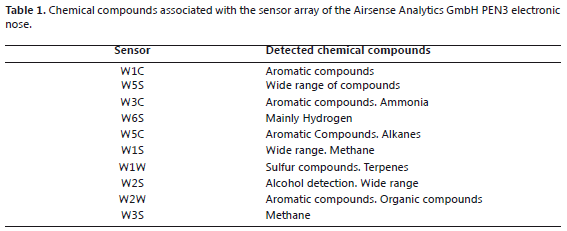
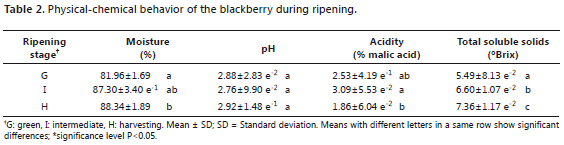
<body><![CDATA[<p align="center"><font size="2" face="Verdana, Arial, Helvetica, sans-serif"><a name="tab01"></a></font><img src="/img/revistas/rfnam/v67n1/v67n1a08tab01.gif"></p>     <p><font size="2" face="Verdana, Arial, Helvetica, sans-serif"><b><i>Vitamin C. </i></b>The extraction was carried out with distilled water; before injection, the solution was purified with a C18 cleaning cartridge. For the detection and quantification, HPLC chromatography was employed (Jasco&trade; Pump PU980, Detector UV/VIS975) with a Phenomenex Rezex&trade; ROA-Organic Acid H+ 8% ion exchange column, at a flow of 0.5 mL/min and with a mobile phase of H2SO4 4 mM at room temperature. The employed wavelength was 254 nm. The data were reported as <font face="Symbol">m</font>mol of vitamin C g<sup>-1</sup> of fresh fruit (Shui and Leong, 2002; Casta&ntilde;eda <i>et al</i>., 2009). 20 g of fruit were prepared and homogenized (Ultra-Turrax&trade; IKA T18 Basic), 20 mL of extraction solution were added and, then, vortex agitation and heating in a magnetic stirring plate were carried out. The mixture was centrifuged for 10 min (Tecnovetro&trade; 4235); this procedure was repeated twice with the solid. The extracts were brought to a volume of 100 mL by using the extraction solution. Each sample was performed in triplicate and stored at -18 &deg;C until analysis.</font></p>     <p><font size="2" face="Verdana, Arial, Helvetica, sans-serif"><b><i>Total anthocyanin content.</i></b> The differential pH method was employed. A.O.A.C. Official Method 2005.02. Results were reported as mg of cyaniding-3-glycoside (cyn-3-glu) g<sup>-1</sup> of fresh fruit.</font></p>     <p><font size="2" face="Verdana, Arial, Helvetica, sans-serif"><b><i>Total phenolic content.</i></b> The Folin-Ciocalteau reagent was used (Panreac, Spain). This is a method described by Vasco <i>et al</i>. (2008) and Oliveira <i>et al</i>. (2011). The wavelength at which the reading was taken was 765 nm and the quantification was done by reference to a calibration curve of caffeic acid, Sigma Aldrich, (R<sup>2</sup> = 0.995). The data were reported as mg of caffeic acid g<sup>-1</sup> of fresh fruit.</font></p>     <p><font size="2" face="Verdana, Arial, Helvetica, sans-serif"><b><i>Antioxidant capacity.</i></b> In TEAC, radical discoloration was read at 734 nm after a 6min reaction. Each extract was read in triplicate and the results were reported as <font face="Symbol">m</font>mol trolox g<sup>-1</sup> of fresh fruit with respect to a trolox 97% calibration curve, Sigma Aldrich&trade;, (R<sup>2</sup> = 0.989) (Murcia <i>et al</i>., 2009). </font></p>     <p><font size="2" face="Verdana, Arial, Helvetica, sans-serif">In FRAP, 330 <font face="Symbol">m</font>L of extract were mixed with 10 mL of a solution made from buffer acetate pH 3.6 (300 nM), TPTZ diluted in HCl (40 mM) and FeCl3 (20 mM) at a 10:1:1 ratio, respectively. The reaction was held for an hour and the reading was taken at 593 nm. Each extract was read in duplicate and the results were reported according to the Trolox calibration curve (R<sup>2</sup> = 0.996) in mmol trolox g<sup>-1</sup> of fresh fruit (Gorinstein <i>et al</i>., 2009; M&uuml;ller <i>et al</i>., 2010).</font></p>     <p><font size="2" face="Verdana, Arial, Helvetica, sans-serif"><b><i>Statistical analysis.</i></b> The data were analyzed using one-way analysis of variance ANOVA, in conjunction with a Tukey-Kramer's multiple comparison test, using an alpha of 0.05. In addition, the principal component analysis-PCA was performed as a multivariate technique for exploration of the data obtained with the electronic nose. The statistical analyses were carried out with the MATLAB software, v. 7.9 (MathWorks&trade;).</font></p>     <p>&nbsp;</p>     <p><font size="3" face="Verdana, Arial, Helvetica, sans-serif"><b>RESULTS AND DISCUSSION</b></font></p>     <p><font size="2" face="Verdana, Arial, Helvetica, sans-serif">The &quot;mora de Castilla&quot; is a fruit whose maturity is determined by changes in color, size, percentage of acidity and soluble solids content, according to NTC 4106. For this fruit, seven stages of maturation can be differentiated. The &deg; Brix of the samples evaluated correspond to the zero stage, a state corresponding to green; stage three: an intermediate state; and stage five: the harvest state. It could be observed (<a href="#tab02">Table 2</a>) that, as the fruits matured, humidity increased and the percentage of acidity decreased. No pH changes were noticeable in these states.</font></p>     ]]></body>
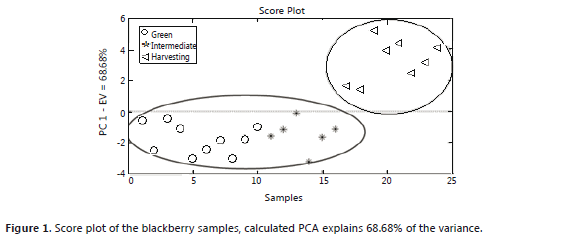
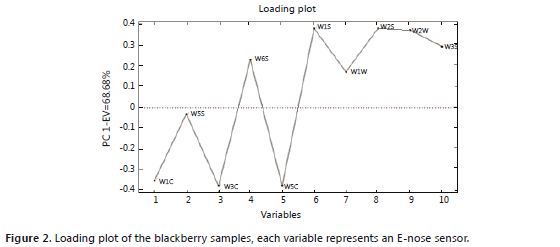
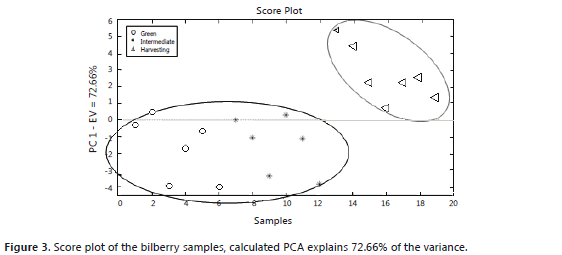
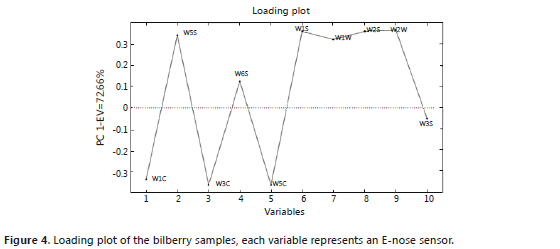
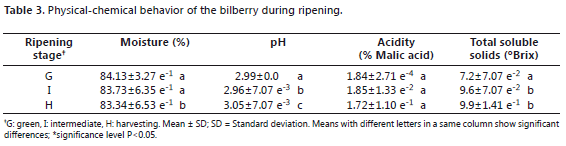
<body><![CDATA[<p align="center"><font size="2" face="Verdana, Arial, Helvetica, sans-serif"><a name="tab02"></a></font><img src="/img/revistas/rfnam/v67n1/v67n1a08tab02.gif"></p>     <p><font size="2" face="Verdana, Arial, Helvetica, sans-serif">In the bilberry, in addition to the obvious changes of color, parameters such as pH and concentration of soluble solids were indicators of fruit maturation (<a href="#tab03">Table 3</a>). The study of the bilberry is gaining strength given its wild characteristic. &Aacute;vila <i>et al</i>. (2007) reported, for the harvesting stage, acidity values close to 1.44%. The behavior of this fruit is similar to that of the cranberry, which belongs to the same genus (Castrej&oacute;n <i>et al</i>., 2008).</font></p>     <p align="center"><font size="2" face="Verdana, Arial, Helvetica, sans-serif"><a name="tab03"></a></font><img src="/img/revistas/rfnam/v67n1/v67n1a08tab03.gif"></p>     <p><font size="2" face="Verdana, Arial, Helvetica, sans-serif"><b><i>Aromatic profile. </i></b>The Release of aromatic compounds, together with the loss of the green color and acid flavor, is one of the changes that occur during the ripening of any fruit.</font></p>     <p><font size="2" face="Verdana, Arial, Helvetica, sans-serif">The principal component analysis for the blackberry (<a href="#fig01">Figures 1</a> and <a href="#fig02">2</a>) showed that the green and intermediate maturation stages are distinguished from the harvesting stage by the response of a group of sensors that perceive the presence of aromatic functional groups of low polarity: W1C, W5S, W3C and W5C (<a href="#tab01">Table 1</a>). In the harvesting stage, the presence of terpenes, alcohols, and aromatic compounds such as methanol can be considered because the group of sensors that  shows responses includes: W6S, W1S, W2S, W3S, W1W and W2W. These results agree with the findings of a study conducted with volatiles of ready-to-eat blackberries, where the presence of benzoic acid, 2-heptanol, terpene-4-ol, ethyl and methyl benzoate was reported (Meret <i>et al</i>., 2011); also, in the <i>Rubus</i> sp. genus, during maturation, the production of alcohols, aldehydes, esters and ketones is favored (Perkins-Vezzie <i>et al</i>., 2000). The bilberry (<a href="#fig03">Figures 3</a> and <a href="#fig04">4</a>) exhibited the same behavior as that of the blackberry; fruits in the harvesting stage can be differentiated from the other two stages by sensors that respond to volatile aromatic functional groups, alcohols and terpenes. Studies on the <i>Vaccinium</i> sp. genus report the presence of 1-hexanol, 2-hexen-1-ol, 2-hexenal, 2-butyl-1-octanol, hexadecanol, etc. (Diban, 2008). </font></p>     <p align="center"><font size="2" face="Verdana, Arial, Helvetica, sans-serif"><a name="fig01"></a></font><img src="/img/revistas/rfnam/v67n1/v67n1a08fig01.gif"></p>     <p align="center"><font size="2" face="Verdana, Arial, Helvetica, sans-serif"><a name="fig02"></a></font><img src="/img/revistas/rfnam/v67n1/v67n1a08fig02.gif"></p>     <p align="center"><font size="2" face="Verdana, Arial, Helvetica, sans-serif"><a name="fig03"></a></font><img src="/img/revistas/rfnam/v67n1/v67n1a08fig03.gif"></p>     <p align="center"><font size="2" face="Verdana, Arial, Helvetica, sans-serif"><a name="fig04"></a></font><img src="/img/revistas/rfnam/v67n1/v67n1a08fig04.gif"></p>     <p><font size="2" face="Verdana, Arial, Helvetica, sans-serif">Both score plots explain more than 50% of the variance of the groups in each case. In the loading plots, a difference between the aromatic profile of the blackberry and the bilberry is seen due to different responses from the group of sensors that actuates during ripening.</font></p>     ]]></body>
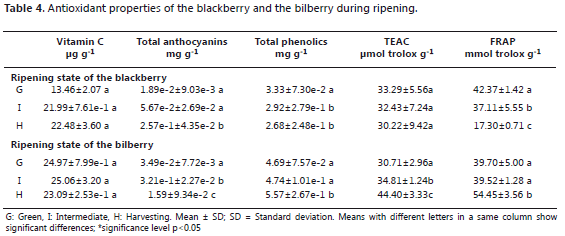
<body><![CDATA[<p><font size="2" face="Verdana, Arial, Helvetica, sans-serif"><b><i>Vitamin C content.</i></b> Vitamin C has biological activity as an antioxidant because the double bond and substitutions have two hydroxyl groups within the chemical structure, is synthesized in plants in response to stress conditions, and, additionally, its concentration is determined by genetic factors (Asard <i>et al</i>., 2004).</font></p>     <p><font size="2" face="Verdana, Arial, Helvetica, sans-serif">The evaluated samples contained between 13.46 and 22.48 <font face="Symbol">m</font>g of vitamin C g<sup>-1</sup> of blackberries and 23.09 and 25.06 <font face="Symbol">m</font>g of vitamin C g<sup>-1</sup> of bilberries (<a href="#tab04">Table 4</a>); there were no significant differences in either case, but the p value of the blackberries was close to the alpha value (P=0.057), suggesting that, for one of the stages of maturity, the content is different, statistical analysis according to the value found corresponds to the first stage of maturation, where it presented high variability. Contrary to expectations, the vitamin C content of the evaluated blackberry sample increased from state zero to state three. This could be explained by the non-climacteric behavior and the variability in agricultural practices and environmental conditions. </font></p>     <p align="center"><font size="2" face="Verdana, Arial, Helvetica, sans-serif"><a name="tab04"></a></font><img src="/img/revistas/rfnam/v67n1/v67n1a08tab04.gif"></p>     <p><font size="2" face="Verdana, Arial, Helvetica, sans-serif">It has been reported that there is an accumulation of vitamin C and phenolic compounds (Cocetta <i>et al</i>., 2012) in the <i>Vaccinium</i> sp genus. during ripening, a behavior corresponding to that found in the bilberry. Rodriguez <i>et al</i>. (2007) reported a higher content of vitamin C for this fruit in the harvesting stage, about 80 <font face="Symbol">m</font>g of vitamin C g<sup>-1</sup> of fresh fruit.</font></p>     <p><font size="2" face="Verdana, Arial, Helvetica, sans-serif">The vitamin C content of  the blackberry and the bilberry was considerably lower than that reported in the composition table of the USDA (2010); for the blackberry: 209.72 <font face="Symbol">m</font>g of vitamin C g<sup>-1</sup> of fresh fruit and for the blueberry: 97.24 <font face="Symbol">m</font>g of vitamin C g<sup>-1</sup> of fresh fruit. On the other hand, some Colombian fruits have a vitamin C content between 0.53 and 257 mg 100 g<sup>-1</sup> of fresh fruit (Contreras <i>et al</i>., 2011); the present data are outside this range, so it is important to note the differences that exist between families and the ecophysiological conditions of fruits, which determine composition and affect behavior patterns.</font></p>     <p><font size="2" face="Verdana, Arial, Helvetica, sans-serif"><b><i>Anthocyanins content.</i></b> The blackberry and the blueberry are sources of anthocyanins, the most important flavonoids responsible for attracting insects to plants and protecting them from various diseases and predators (Brown <i>et al</i>., 2006; Chemler <i>et al</i>., 2009). In general, the anthocyanin structure is linked to a sugar and can even be copolymerized, which affects the availability and quantification (AOAC, 2005) Different authors report that predominate anthocyanin in blackberry and blueberry is the cyn-3-glu (Dai <i>et al</i>., 2009; Garz&oacute;n <i>et al</i>., 2010).</font></p>     <p><font size="2" face="Verdana, Arial, Helvetica, sans-serif">During maturation, the increased anthocyanin content, in this way is synthesized from shikimic acid and malonic acid. (Chemler <i>et al</i>., 2009). In the case of the blackberry, there are no significant differences between the green and intermediate stages but an increase of nearly 14 times more than the initial value has been observed in the harvesting stage. This is comparable to that described by Chen <i>et al</i>. (2012) for the early stages of ripening, reporting a value of 0.106 mg cyn-3-glu g<sup>-1</sup> of fresh fruit and, for the subsequent maximum peak in the maturing state, 1.46 mg cyn-3-glu g<sup>-1</sup> of fresh fruit. The bilberry presents  significantly different contents in the three stages, with the harvesting stage having 45 times more anthocyanins than the green stage.</font></p>     <p><font size="2" face="Verdana, Arial, Helvetica, sans-serif">The contents of anthocyanins found in the blackberry and the bilberry allow for the comparison of the blackberry stage of harvesting  with the intermediate stage of the bilberry, leading to the conclusion that, among mature fruits, the bilberry is an important source of these bioactive compounds.</font></p>     <p><font size="2" face="Verdana, Arial, Helvetica, sans-serif"><b><i>Total phenolic content. </i></b>The concentrations of phenolic compounds and nutrients, vitamins, and minerals, among others, respond to multiple environmental and genetic factors. The composition of a food is never constant and it is not uncommon to find differences between fruits, even in the same crop. For example, it has been found that the leaves and fruits that are in direct contact with solar radiation have increased contents of phenolic compounds, vitamin C and carotenoids, in comparison to those found in the shade (Brown <i>et al</i>., 2006; Vicente <i>et al</i>., 2009). The total phenolic content in the case of the bilberry, at any stage of maturity, was greater than that of the blackberry and, while polyphenols increased in the bilberry, in the blackberry, they decreased. The variety of compounds present in each fruit may influence the final result, especially considering that the Folin-Ciocalteu method may not necessarily respond to polyphenolic substances such as aromatic amines or even ascorbic acid (Magalh&atilde;es <i>et al</i>., 2008).</font></p>     <p><font size="2" face="Verdana, Arial, Helvetica, sans-serif"><b><i>Antioxidant capacity.</i></b> The antioxidant power of a fruit can be measured by different in vitro methods, which give an idea of the ability of the sample to scavenge free radicals (Niki, 2010). Non-competitive methods employing ABTS&bull;+ and the complex &#91;Fe (II) (TPTZ)2&#93;+2 introduce a radical in the sample and quantify how much was inhibited by the substances present. During ripening, the bilberry increased its antioxidant capacity (<a href="#tab04">Table 4</a>), whereas the blackberry presented no evidence of significant changes (such as TEAC), similar to the findings of Livani <i>et al</i>. (2013), who studied two ripening stages of <i>Rubus</i> anatolicus with the DPPH radical. However, the FRAP data of the blackberry showed that the stage of harvesting had a lower antioxidant capacity than the green stage. Acosta-Montoya <i>et al</i>. (2011) evaluated samples of <i>Rubus</i> adenotrichus Schltdl with H-ORAC during ripening, finding that the antioxidant capacity increased while the total phenol content remained unchanged; these results show the differences that can be found among the same family and that might be associated with genetic characteristics or crop and postharvest conditions.</font></p>     ]]></body>
<body><![CDATA[<p>&nbsp;</p>     <p><font size="3" face="Verdana, Arial, Helvetica, sans-serif"><b>CONCLUSIONS</b></font></p>     <p><font size="2" face="Verdana, Arial, Helvetica, sans-serif">The behavior of the antioxidant properties during ripening in the blackberry and the bilberry are independent. In the blackberry, there was a decrease but, in the bilberry, an increase was evidenced, a better characteristics that makes the latter fruit an attractive food. The electronic nose allowed for the formation of the aromatic profile in different stages of maturity, revealing differences in the harvesting stage for both fruits.</font></p>     <p>&nbsp;</p>     <p><font size="3" face="Verdana, Arial, Helvetica, sans-serif"><b>ACKNOWLEDGEMENTS</b></font></p>     <p><font size="2" face="Verdana, Arial, Helvetica, sans-serif">The authors thank the Food Science and Technology Institute - ICTA of Universidad Nacional de Colombia and the Corporaci&oacute;n Colombiana de Investigaci&oacute;n Agropecuaria - CORPOICA. </font></p>     <p>&nbsp;</p>     <p><font size="3" face="Verdana, Arial, Helvetica, sans-serif"><b>BIBLIOGRAPHY </b></font></p>     <!-- ref --><p><font size="2" face="Verdana, Arial, Helvetica, sans-serif">Acosta-Montoya, &Oacute;., F. Vaillant, S. Cozzano, C. Mertz, A. P&eacute;rez and M. Castro. Phenolic content and antioxidant capacity of tropical highland blackberry (<i>Rubus</i> adenotrichus Schltdl.) during three edible maturity stages. Food Chemistry 119(4): 1497-1501.    &nbsp;&nbsp;&nbsp;&nbsp;&nbsp;&nbsp;&nbsp;&nbsp;[&#160;<a href="javascript:void(0);" onclick="javascript: window.open('/scielo.php?script=sci_nlinks&ref=000071&pid=S0304-2847201400010000800001&lng=','','width=640,height=500,resizable=yes,scrollbars=1,menubar=yes,');">Links</a>&#160;]<!-- end-ref --></font></p>     ]]></body>
<body><![CDATA[<!-- ref --><p><font size="2" face="Verdana, Arial, Helvetica, sans-serif">Asard, H., J.M. May and N. Smirnoff. 2004. Vitamin C, function and biochemistry in animals and plants. Garland Science, London, UK. 374 p.    &nbsp;&nbsp;&nbsp;&nbsp;&nbsp;&nbsp;&nbsp;&nbsp;[&#160;<a href="javascript:void(0);" onclick="javascript: window.open('/scielo.php?script=sci_nlinks&ref=000073&pid=S0304-2847201400010000800002&lng=','','width=640,height=500,resizable=yes,scrollbars=1,menubar=yes,');">Links</a>&#160;]<!-- end-ref --></font></p>     <!-- ref --><p><font size="2" face="Verdana, Arial, Helvetica, sans-serif">Association of Analytical Communities A.O.A.C. 2005. Determination of total monomeric anthocyanin pigment content of fruit juices, beverages, natural colorants, and wines by the pH differential method: collaborative study. Journal of AOAC International 88(5):1269-1278.    &nbsp;&nbsp;&nbsp;&nbsp;&nbsp;&nbsp;&nbsp;&nbsp;[&#160;<a href="javascript:void(0);" onclick="javascript: window.open('/scielo.php?script=sci_nlinks&ref=000075&pid=S0304-2847201400010000800003&lng=','','width=640,height=500,resizable=yes,scrollbars=1,menubar=yes,');">Links</a>&#160;]<!-- end-ref --></font></p>     <!-- ref --><p><font size="2" face="Verdana, Arial, Helvetica, sans-serif">&Aacute;vila, H., J. Cuspoca,  G. Fischer, G. Ligarreto and M. Quicazan. 2007. Caracterizaci&oacute;n fisicoqu&iacute;mica y organol&eacute;ptica del fruto de agraz (<i><i>Vaccinium</i> meridionale</i> Swartz) Almacenado 1 a 2 &ordm;C. Revista Facultad Nacional de Agronom&iacute;a, Medell&iacute;n 60(2): 4179-4193.    &nbsp;&nbsp;&nbsp;&nbsp;&nbsp;&nbsp;&nbsp;&nbsp;[&#160;<a href="javascript:void(0);" onclick="javascript: window.open('/scielo.php?script=sci_nlinks&ref=000077&pid=S0304-2847201400010000800004&lng=','','width=640,height=500,resizable=yes,scrollbars=1,menubar=yes,');">Links</a>&#160;]<!-- end-ref --></font></p>     <!-- ref --><p><font size="2" face="Verdana, Arial, Helvetica, sans-serif">Balasundram, N., K. Sundramand and S. Samman. 2006. Phenolic compounds in plants and agri-industrial by-products: Antioxidant activity, occurrence, and potential uses. Food Chemistry 99(1): 191-203.    &nbsp;&nbsp;&nbsp;&nbsp;&nbsp;&nbsp;&nbsp;&nbsp;[&#160;<a href="javascript:void(0);" onclick="javascript: window.open('/scielo.php?script=sci_nlinks&ref=000079&pid=S0304-2847201400010000800005&lng=','','width=640,height=500,resizable=yes,scrollbars=1,menubar=yes,');">Links</a>&#160;]<!-- end-ref --></font></p>     <!-- ref --><p><font size="2" face="Verdana, Arial, Helvetica, sans-serif">Benedetti, S., S. Buratti, A. Spinardi, S. Mannino and I. Mignani. 2008. Electronic nose as a non-destructive tool to characterise peach cultivars and to monitor their ripening stage during shelf-life. Postharvest Biology and Technology 47(2): 181-188.    &nbsp;&nbsp;&nbsp;&nbsp;&nbsp;&nbsp;&nbsp;&nbsp;[&#160;<a href="javascript:void(0);" onclick="javascript: window.open('/scielo.php?script=sci_nlinks&ref=000081&pid=S0304-2847201400010000800006&lng=','','width=640,height=500,resizable=yes,scrollbars=1,menubar=yes,');">Links</a>&#160;]<!-- end-ref --></font></p>     ]]></body>
<body><![CDATA[<!-- ref --><p><font size="2" face="Verdana, Arial, Helvetica, sans-serif">Bhattacharyya, N., S. Seth, B. Tudu, P. Tamuly, A. Jana, D. Ghosh, R. Bandyopadhyay, M. Bhuyan and S. Sabhapandit. 2007. Detection of optimum fermentation time for black tea manufacturing using electronic nose. Sensors and Actuators B: Chemical 122(2): 627-634.    &nbsp;&nbsp;&nbsp;&nbsp;&nbsp;&nbsp;&nbsp;&nbsp;[&#160;<a href="javascript:void(0);" onclick="javascript: window.open('/scielo.php?script=sci_nlinks&ref=000083&pid=S0304-2847201400010000800007&lng=','','width=640,height=500,resizable=yes,scrollbars=1,menubar=yes,');">Links</a>&#160;]<!-- end-ref --></font></p>     <!-- ref --><p><font size="2" face="Verdana, Arial, Helvetica, sans-serif">Brezmes, J., E. Llobet, X. Vilanova, G. Saizand and X. Correig. 2000. Fruit ripeness monitoring using an electronic nose. Sensors and Actuators B: Chemical 69(3): 223-229.    &nbsp;&nbsp;&nbsp;&nbsp;&nbsp;&nbsp;&nbsp;&nbsp;[&#160;<a href="javascript:void(0);" onclick="javascript: window.open('/scielo.php?script=sci_nlinks&ref=000085&pid=S0304-2847201400010000800008&lng=','','width=640,height=500,resizable=yes,scrollbars=1,menubar=yes,');">Links</a>&#160;]<!-- end-ref --></font></p>     <!-- ref --><p><font size="2" face="Verdana, Arial, Helvetica, sans-serif">Brown, J.E., V. Cheynier, M. Clifford, O. Dangles, K.M. Davies, C. Dufour, G.G.  Duthie, D. Ferreira, T.  Fossen, K.S. Gould, R.J. Grayer, K. Hostettmann, M. Jay, M. Jordheim, J.A. Kyle, C. Lister, J.P. Marais, A. Marston, K.E. Schwinn, D. Slade, K.M. Valant-Vetschera, N.C. Veitch, C.A. Williams, H. Wiseman and E. Wollenweber. 2006. Flavonoids: chemistry, biochemistry, and applications. Taylor and Francis Group, Boca Raton, USA. 1.212 p.    &nbsp;&nbsp;&nbsp;&nbsp;&nbsp;&nbsp;&nbsp;&nbsp;[&#160;<a href="javascript:void(0);" onclick="javascript: window.open('/scielo.php?script=sci_nlinks&ref=000087&pid=S0304-2847201400010000800009&lng=','','width=640,height=500,resizable=yes,scrollbars=1,menubar=yes,');">Links</a>&#160;]<!-- end-ref --></font></p>     <!-- ref --><p><font size="2" face="Verdana, Arial, Helvetica, sans-serif">Casta&ntilde;eda, A., M.D. Pacheco, M.E. P&aacute;ez, J.A. Rodr&iacute;guez and C.A. Gal&aacute;n. 2009. Chemical studies of anthocyanins: A review. Food Chemistry 113(4): 859-871.    &nbsp;&nbsp;&nbsp;&nbsp;&nbsp;&nbsp;&nbsp;&nbsp;[&#160;<a href="javascript:void(0);" onclick="javascript: window.open('/scielo.php?script=sci_nlinks&ref=000089&pid=S0304-2847201400010000800010&lng=','','width=640,height=500,resizable=yes,scrollbars=1,menubar=yes,');">Links</a>&#160;]<!-- end-ref --></font></p>     <!-- ref --><p><font size="2" face="Verdana, Arial, Helvetica, sans-serif">Castrej&oacute;n, A.D., I. Eichholz, S. Rohn, L.W. Kroh and S. Huyskens-Keil. 2008. Phenolic profile and antioxidant activity of highbush blueberry (<i>Vaccinium</i> corymbosum L.) during fruit maturation and ripening. Food Chemistry 109(3): 564-572.    &nbsp;&nbsp;&nbsp;&nbsp;&nbsp;&nbsp;&nbsp;&nbsp;[&#160;<a href="javascript:void(0);" onclick="javascript: window.open('/scielo.php?script=sci_nlinks&ref=000091&pid=S0304-2847201400010000800011&lng=','','width=640,height=500,resizable=yes,scrollbars=1,menubar=yes,');">Links</a>&#160;]<!-- end-ref --></font></p>     ]]></body>
<body><![CDATA[<!-- ref --><p><font size="2" face="Verdana, Arial, Helvetica, sans-serif">Chemler, J.A, K.M. Davies, V. de Freitas, S. Deroles, K.S. Gould, J.H. Hatier, M.A. Koffas, E. Leonard, S. Lev-Yadun, M.A. Lila, N. Mateus, T. Nakayama, S. Rasmussen, K. Saito, W.J. Steyn, M. Yamazaki and K. Yonekura-Sakakibara. 2009. Anthocyanins biosynthesis, functions, and applications. Springer, New York, USA. 345 p.    &nbsp;&nbsp;&nbsp;&nbsp;&nbsp;&nbsp;&nbsp;&nbsp;[&#160;<a href="javascript:void(0);" onclick="javascript: window.open('/scielo.php?script=sci_nlinks&ref=000093&pid=S0304-2847201400010000800012&lng=','','width=640,height=500,resizable=yes,scrollbars=1,menubar=yes,');">Links</a>&#160;]<!-- end-ref --></font></p>     <!-- ref --><p><font size="2" face="Verdana, Arial, Helvetica, sans-serif">Chen, Q., H. Yu, H. Tang and X. Wang. 2012. Identification and expression analysis of genes involved in anthocyanin and proanthocyanidin biosynthesis in the fruit of blackberry. Scientia Horticulturae 141(0): 61-68.    &nbsp;&nbsp;&nbsp;&nbsp;&nbsp;&nbsp;&nbsp;&nbsp;[&#160;<a href="javascript:void(0);" onclick="javascript: window.open('/scielo.php?script=sci_nlinks&ref=000095&pid=S0304-2847201400010000800013&lng=','','width=640,height=500,resizable=yes,scrollbars=1,menubar=yes,');">Links</a>&#160;]<!-- end-ref --></font></p>     <!-- ref --><p><font size="2" face="Verdana, Arial, Helvetica, sans-serif">Cocetta, G., K. Karppinen, M. Suokas, A. Hohtola, H. H&auml;ggman, A. Spinardi, I. Mignani and L. Jaakola.2012. Ascorbic acid metabolism during bilberry (<i>Vaccinium</i> myrtillus L.) fruit development. Journal of Plant Physiology 169(11): 1059-1065.    &nbsp;&nbsp;&nbsp;&nbsp;&nbsp;&nbsp;&nbsp;&nbsp;[&#160;<a href="javascript:void(0);" onclick="javascript: window.open('/scielo.php?script=sci_nlinks&ref=000097&pid=S0304-2847201400010000800014&lng=','','width=640,height=500,resizable=yes,scrollbars=1,menubar=yes,');">Links</a>&#160;]<!-- end-ref --></font></p>     <!-- ref --><p><font size="2" face="Verdana, Arial, Helvetica, sans-serif">Contreras, J., L. Calder&oacute;n,  E. Guerra and  B. Garc&iacute;a. Antioxidant capacity, phenolic content and vitamin C in pulp, peel and seed from 24 exotic fruits from Colombia. Food Research International 44(7): 2047-2053.    &nbsp;&nbsp;&nbsp;&nbsp;&nbsp;&nbsp;&nbsp;&nbsp;[&#160;<a href="javascript:void(0);" onclick="javascript: window.open('/scielo.php?script=sci_nlinks&ref=000099&pid=S0304-2847201400010000800015&lng=','','width=640,height=500,resizable=yes,scrollbars=1,menubar=yes,');">Links</a>&#160;]<!-- end-ref --></font></p>     <!-- ref --><p><font size="2" face="Verdana, Arial, Helvetica, sans-serif">Dai, J., A. Gupte, L. Gates and R.J. Mumper. 2009. A comprehensive study of anthocyanin-containing extracts from selected blackberry cultivars: Extraction methods, stability, anticancer properties and mechanisms. Food and Chemical Toxicology 47(4): 837-847.    &nbsp;&nbsp;&nbsp;&nbsp;&nbsp;&nbsp;&nbsp;&nbsp;[&#160;<a href="javascript:void(0);" onclick="javascript: window.open('/scielo.php?script=sci_nlinks&ref=000101&pid=S0304-2847201400010000800016&lng=','','width=640,height=500,resizable=yes,scrollbars=1,menubar=yes,');">Links</a>&#160;]<!-- end-ref --></font></p>     ]]></body>
<body><![CDATA[<!-- ref --><p><font size="2" face="Verdana, Arial, Helvetica, sans-serif">Diban G.N. 2008. Separaci&oacute;n de aromas en etapas del procesado de zumos de frutas y bebidas. Tesis de doctorado en Ingenier&iacute;a Qu&iacute;mica y Qu&iacute;mica Inorg&aacute;nica: Facultad de Ingenier&iacute;a. Universidad de Cantabria. 34 p.    &nbsp;&nbsp;&nbsp;&nbsp;&nbsp;&nbsp;&nbsp;&nbsp;[&#160;<a href="javascript:void(0);" onclick="javascript: window.open('/scielo.php?script=sci_nlinks&ref=000103&pid=S0304-2847201400010000800017&lng=','','width=640,height=500,resizable=yes,scrollbars=1,menubar=yes,');">Links</a>&#160;]<!-- end-ref --></font></p>     <!-- ref --><p><font size="2" face="Verdana, Arial, Helvetica, sans-serif">Garz&oacute;n, G.A., C.E. Narv&aacute;ez, K.M. Riedl and S.J. Schwartz. 2010. Chemical composition, anthocyanins, non-anthocyanin phenolics and antioxidant activity of wild bilberry (<i><i>Vaccinium</i> meridionale</i> Swartz) from Colombia. Food Chemistry 122(4): 980-986.    &nbsp;&nbsp;&nbsp;&nbsp;&nbsp;&nbsp;&nbsp;&nbsp;[&#160;<a href="javascript:void(0);" onclick="javascript: window.open('/scielo.php?script=sci_nlinks&ref=000105&pid=S0304-2847201400010000800018&lng=','','width=640,height=500,resizable=yes,scrollbars=1,menubar=yes,');">Links</a>&#160;]<!-- end-ref --></font></p>     <!-- ref --><p><font size="2" face="Verdana, Arial, Helvetica, sans-serif">Gorinstein, S., Z. Jastrzebski, H. Leontowicz, M. Leontowicz, J. Namiesnik, K. Najman, Y. S. Park, B. G. Heo, J. Y. Cho andJ. H. Bae. 2009. Comparative control of the bioactivity of some frequently consumed vegetables subjected to different processing conditions. Food Control 20(4): 407-413.    &nbsp;&nbsp;&nbsp;&nbsp;&nbsp;&nbsp;&nbsp;&nbsp;[&#160;<a href="javascript:void(0);" onclick="javascript: window.open('/scielo.php?script=sci_nlinks&ref=000107&pid=S0304-2847201400010000800019&lng=','','width=640,height=500,resizable=yes,scrollbars=1,menubar=yes,');">Links</a>&#160;]<!-- end-ref --></font></p>     <!-- ref --><p><font size="2" face="Verdana, Arial, Helvetica, sans-serif">Instituto Colombiano de Normas T&eacute;cnicas y Certificaci&oacute;n (ICONTEC). 1999. NTC 4624.  Jugos de frutas y hortalizas. Determinaci&oacute;n del contenido de s&oacute;lidos solubles. m&eacute;todo refractom&eacute;trico. Icontec, Bogot&aacute;    &nbsp;&nbsp;&nbsp;&nbsp;&nbsp;&nbsp;&nbsp;&nbsp;[&#160;<a href="javascript:void(0);" onclick="javascript: window.open('/scielo.php?script=sci_nlinks&ref=000109&pid=S0304-2847201400010000800020&lng=','','width=640,height=500,resizable=yes,scrollbars=1,menubar=yes,');">Links</a>&#160;]<!-- end-ref -->. </font></p>     <!-- ref --><p><font size="2" face="Verdana, Arial, Helvetica, sans-serif">Instituto Colombiano de Normas T&eacute;cnicas y Certificaci&oacute;n (ICONTEC). 1999.  NTC 440. Productos alimenticios. M&eacute;todos de ensayo. Icontec, Bogot&aacute;    &nbsp;&nbsp;&nbsp;&nbsp;&nbsp;&nbsp;&nbsp;&nbsp;[&#160;<a href="javascript:void(0);" onclick="javascript: window.open('/scielo.php?script=sci_nlinks&ref=000111&pid=S0304-2847201400010000800021&lng=','','width=640,height=500,resizable=yes,scrollbars=1,menubar=yes,');">Links</a>&#160;]<!-- end-ref -->. </font></p>     ]]></body>
<body><![CDATA[<!-- ref --><p><font size="2" face="Verdana, Arial, Helvetica, sans-serif">Instituto Colombiano de Normas T&eacute;cnicas y Certificaci&oacute;n (ICONTEC). 1999. NTC 4106. Frutas frescas. Mora de castilla. Especificaciones. Icontec, Bogot&aacute;    &nbsp;&nbsp;&nbsp;&nbsp;&nbsp;&nbsp;&nbsp;&nbsp;[&#160;<a href="javascript:void(0);" onclick="javascript: window.open('/scielo.php?script=sci_nlinks&ref=000113&pid=S0304-2847201400010000800022&lng=','','width=640,height=500,resizable=yes,scrollbars=1,menubar=yes,');">Links</a>&#160;]<!-- end-ref -->. </font></p>     <!-- ref --><p><font size="2" face="Verdana, Arial, Helvetica, sans-serif">Li, C., G.W. Krewer, P. Ji, H. Scherm and S.J. Kays. 2010. Gas sensor array for blueberry fruit disease detection and classification. Postharvest Biology and Technology 55(3): 144-149.    &nbsp;&nbsp;&nbsp;&nbsp;&nbsp;&nbsp;&nbsp;&nbsp;[&#160;<a href="javascript:void(0);" onclick="javascript: window.open('/scielo.php?script=sci_nlinks&ref=000115&pid=S0304-2847201400010000800023&lng=','','width=640,height=500,resizable=yes,scrollbars=1,menubar=yes,');">Links</a>&#160;]<!-- end-ref --></font></p>     <!-- ref --><p><font size="2" face="Verdana, Arial, Helvetica, sans-serif">Ligarreto, G.A. 2011. Agraz (<i><i>Vaccinium</i> meridionale</i> Swartz), algunas pr&aacute;cticas de cultivo y poscosecha. Bogot&aacute;, Colombia. Universidad Nacional de Colombia. Facultad de Agronom&iacute;a. Ministerio de Agricultura y Desarrollo Rural, Bogot&aacute; D.C. 23 p.    &nbsp;&nbsp;&nbsp;&nbsp;&nbsp;&nbsp;&nbsp;&nbsp;[&#160;<a href="javascript:void(0);" onclick="javascript: window.open('/scielo.php?script=sci_nlinks&ref=000117&pid=S0304-2847201400010000800024&lng=','','width=640,height=500,resizable=yes,scrollbars=1,menubar=yes,');">Links</a>&#160;]<!-- end-ref --></font></p>     <!-- ref --><p><font size="2" face="Verdana, Arial, Helvetica, sans-serif">Livani, F., M. Ghorbanli and A. Sateeyi. Changes in antioxidant activity and content of phenolic compounds during the ripening process of elm-leaved blackberry fruit. International Journal of Agronomy and Plant Production 4(1): 88-93.    &nbsp;&nbsp;&nbsp;&nbsp;&nbsp;&nbsp;&nbsp;&nbsp;[&#160;<a href="javascript:void(0);" onclick="javascript: window.open('/scielo.php?script=sci_nlinks&ref=000119&pid=S0304-2847201400010000800025&lng=','','width=640,height=500,resizable=yes,scrollbars=1,menubar=yes,');">Links</a>&#160;]<!-- end-ref --></font></p>     <!-- ref --><p><font size="2" face="Verdana, Arial, Helvetica, sans-serif">Magalh&atilde;es, L. M., M.A. Segundo, S. Reis and J.L. Lima. 2008. Methodological aspects about in vitro evaluation of antioxidant properties. Analytica Chimica Acta 613(1): 1-19.    &nbsp;&nbsp;&nbsp;&nbsp;&nbsp;&nbsp;&nbsp;&nbsp;[&#160;<a href="javascript:void(0);" onclick="javascript: window.open('/scielo.php?script=sci_nlinks&ref=000121&pid=S0304-2847201400010000800026&lng=','','width=640,height=500,resizable=yes,scrollbars=1,menubar=yes,');">Links</a>&#160;]<!-- end-ref --></font></p>     ]]></body>
<body><![CDATA[<!-- ref --><p><font size="2" face="Verdana, Arial, Helvetica, sans-serif">Meret, M., P. Brat, C. Mertz, M. Lebrun and Z. G&uuml;nata, 2011. Contribution to aroma potential of Andean blackberry (<i><i>Rubus</i> glaucus</i> Benth). Food Research International 44(1): 54-60.    &nbsp;&nbsp;&nbsp;&nbsp;&nbsp;&nbsp;&nbsp;&nbsp;[&#160;<a href="javascript:void(0);" onclick="javascript: window.open('/scielo.php?script=sci_nlinks&ref=000123&pid=S0304-2847201400010000800027&lng=','','width=640,height=500,resizable=yes,scrollbars=1,menubar=yes,');">Links</a>&#160;]<!-- end-ref --></font></p>     <!-- ref --><p><font size="2" face="Verdana, Arial, Helvetica, sans-serif">Mitcham, E., C. Crisosto and A. Kader. 1998. Bushberries: blackberry, blueberry, cranberry, raspberry: recommendations for maintaining postharvest quality. In: University of California, <a href="http://postharvest.ucdavis.edu/PFfruits/Bushberries/" target="referencia">http://postharvest.ucdavis.edu/PFfruits/Bushberries/</a>; accessed: May 2012.    &nbsp;&nbsp;&nbsp;&nbsp;&nbsp;&nbsp;&nbsp;&nbsp;[&#160;<a href="javascript:void(0);" onclick="javascript: window.open('/scielo.php?script=sci_nlinks&ref=000125&pid=S0304-2847201400010000800028&lng=','','width=640,height=500,resizable=yes,scrollbars=1,menubar=yes,');">Links</a>&#160;]<!-- end-ref --></font></p>     <!-- ref --><p><font size="2" face="Verdana, Arial, Helvetica, sans-serif">M&uuml;ller, L., S. Gnoyke, A.M. Popken and V. B&ouml;hm. 2010. Antioxidant capacity and related parameters of different fruit formulations. LWT - Food Science and Technology 43(6): 992-999.    &nbsp;&nbsp;&nbsp;&nbsp;&nbsp;&nbsp;&nbsp;&nbsp;[&#160;<a href="javascript:void(0);" onclick="javascript: window.open('/scielo.php?script=sci_nlinks&ref=000127&pid=S0304-2847201400010000800029&lng=','','width=640,height=500,resizable=yes,scrollbars=1,menubar=yes,');">Links</a>&#160;]<!-- end-ref --></font></p>     <!-- ref --><p><font size="2" face="Verdana, Arial, Helvetica, sans-serif">Murcia, A.M., A.M. Jim&eacute;nez and M. Mart&iacute;nez-Tom&eacute;. 2009. Vegetables antioxidant losses during industrial processing and refrigerated storage. Food Research International 42(8): 1046-1052.    &nbsp;&nbsp;&nbsp;&nbsp;&nbsp;&nbsp;&nbsp;&nbsp;[&#160;<a href="javascript:void(0);" onclick="javascript: window.open('/scielo.php?script=sci_nlinks&ref=000129&pid=S0304-2847201400010000800030&lng=','','width=640,height=500,resizable=yes,scrollbars=1,menubar=yes,');">Links</a>&#160;]<!-- end-ref --></font></p>     <!-- ref --><p><font size="2" face="Verdana, Arial, Helvetica, sans-serif">Niki, E. 2010. Assessment of Antioxidant Capacity in vitro and in vivo. Free Radical Biology and Medicine 49(4): 503-515.    &nbsp;&nbsp;&nbsp;&nbsp;&nbsp;&nbsp;&nbsp;&nbsp;[&#160;<a href="javascript:void(0);" onclick="javascript: window.open('/scielo.php?script=sci_nlinks&ref=000131&pid=S0304-2847201400010000800031&lng=','','width=640,height=500,resizable=yes,scrollbars=1,menubar=yes,');">Links</a>&#160;]<!-- end-ref --></font></p>     ]]></body>
<body><![CDATA[<!-- ref --><p><font size="2" face="Verdana, Arial, Helvetica, sans-serif">Oliveira, I., P. Baptista, R. Malheiro, S. Casal, A. Bento and J.A. Pereira. 2011. Influence of strawberry tree (Arbutus unedo L.) fruit ripening stage on chemical composition and antioxidant activity. Food Research International 44(5): 1401-1407.    &nbsp;&nbsp;&nbsp;&nbsp;&nbsp;&nbsp;&nbsp;&nbsp;[&#160;<a href="javascript:void(0);" onclick="javascript: window.open('/scielo.php?script=sci_nlinks&ref=000133&pid=S0304-2847201400010000800032&lng=','','width=640,height=500,resizable=yes,scrollbars=1,menubar=yes,');">Links</a>&#160;]<!-- end-ref --></font></p>     <!-- ref --><p><font size="2" face="Verdana, Arial, Helvetica, sans-serif">Pathange, L.P., P. Mallikarjunan, R.P. Marini, S. O'Keefeand and D. Vaughan. 2006. Non-destructive evaluation of apple maturity using an electronic nose system. Journal of Food Engineering 77(4): 1018-1023.    &nbsp;&nbsp;&nbsp;&nbsp;&nbsp;&nbsp;&nbsp;&nbsp;[&#160;<a href="javascript:void(0);" onclick="javascript: window.open('/scielo.php?script=sci_nlinks&ref=000135&pid=S0304-2847201400010000800033&lng=','','width=640,height=500,resizable=yes,scrollbars=1,menubar=yes,');">Links</a>&#160;]<!-- end-ref --></font></p>     <!-- ref --><p><font size="2" face="Verdana, Arial, Helvetica, sans-serif">Peris, M. and L. Escuder-Gilabert. 2009. A 21st century technique for food control: Electronic noses. Analytica Chimica Acta 638(1): 1-15.    &nbsp;&nbsp;&nbsp;&nbsp;&nbsp;&nbsp;&nbsp;&nbsp;[&#160;<a href="javascript:void(0);" onclick="javascript: window.open('/scielo.php?script=sci_nlinks&ref=000137&pid=S0304-2847201400010000800034&lng=','','width=640,height=500,resizable=yes,scrollbars=1,menubar=yes,');">Links</a>&#160;]<!-- end-ref --></font></p>     <!-- ref --><p><font size="2" face="Verdana, Arial, Helvetica, sans-serif">Perkins-Veazie, P., J.R. Clark, D.J. Huber and E.A. Baldwin. 2000. Ripening physiology in 'Navaho' Thornless blackberries: color, respiration, ethylene production, softening, and compositional changes. Journal of the American Society for Horticultural Science 125(3): 357-363.    &nbsp;&nbsp;&nbsp;&nbsp;&nbsp;&nbsp;&nbsp;&nbsp;[&#160;<a href="javascript:void(0);" onclick="javascript: window.open('/scielo.php?script=sci_nlinks&ref=000139&pid=S0304-2847201400010000800035&lng=','','width=640,height=500,resizable=yes,scrollbars=1,menubar=yes,');">Links</a>&#160;]<!-- end-ref --></font></p>     <!-- ref --><p><font size="2" face="Verdana, Arial, Helvetica, sans-serif">Pietta, P., M. Minoggio and L. Bramati. 2003. Plant polyphenols: structure, occurrence and bioactivity. pp: 257-312. In: Atta-Ur, R. (ed.). Studies in natural products chemistry. Elsevier, Amsterdam, The Netherlands. 491 p.    &nbsp;&nbsp;&nbsp;&nbsp;&nbsp;&nbsp;&nbsp;&nbsp;[&#160;<a href="javascript:void(0);" onclick="javascript: window.open('/scielo.php?script=sci_nlinks&ref=000141&pid=S0304-2847201400010000800036&lng=','','width=640,height=500,resizable=yes,scrollbars=1,menubar=yes,');">Links</a>&#160;]<!-- end-ref --></font></p>     ]]></body>
<body><![CDATA[<!-- ref --><p><font size="2" face="Verdana, Arial, Helvetica, sans-serif">Shui, G. and L.P. Leong. 2002. Separation and determination of organic acids and phenolic compounds in fruit juices and drinks by high-performance liquid chromatography. Journal of Chromatography A 977(1): 89-96.    &nbsp;&nbsp;&nbsp;&nbsp;&nbsp;&nbsp;&nbsp;&nbsp;[&#160;<a href="javascript:void(0);" onclick="javascript: window.open('/scielo.php?script=sci_nlinks&ref=000143&pid=S0304-2847201400010000800037&lng=','','width=640,height=500,resizable=yes,scrollbars=1,menubar=yes,');">Links</a>&#160;]<!-- end-ref --></font></p>     <!-- ref --><p><font size="2" face="Verdana, Arial, Helvetica, sans-serif">Torri, L., N. Sinelliand and S. Limbo. 2010. Shelf life evaluation of fresh-cut pineapple by using an electronic nose. Postharvest Biology and Technology 56(3): 239-245.    &nbsp;&nbsp;&nbsp;&nbsp;&nbsp;&nbsp;&nbsp;&nbsp;[&#160;<a href="javascript:void(0);" onclick="javascript: window.open('/scielo.php?script=sci_nlinks&ref=000145&pid=S0304-2847201400010000800038&lng=','','width=640,height=500,resizable=yes,scrollbars=1,menubar=yes,');">Links</a>&#160;]<!-- end-ref --></font></p>     <!-- ref --><p><font size="2" face="Verdana, Arial, Helvetica, sans-serif"> United States Department of Agriculture USDA. 2010. USDA National Nutrient Database for Standard Reference, Release 22 Nutrient Lists, <a href="http://www.ars.usda.gov/Services/docs.htm?docid=18877" target="referencia">http://www.ars.usda.gov/Services/docs.htm?docid=18877</a>; accessed: September 2010.    &nbsp;&nbsp;&nbsp;&nbsp;&nbsp;&nbsp;&nbsp;&nbsp;[&#160;<a href="javascript:void(0);" onclick="javascript: window.open('/scielo.php?script=sci_nlinks&ref=000147&pid=S0304-2847201400010000800039&lng=','','width=640,height=500,resizable=yes,scrollbars=1,menubar=yes,');">Links</a>&#160;]<!-- end-ref --></font></p>     <!-- ref --><p><font size="2" face="Verdana, Arial, Helvetica, sans-serif">Vasco, C., J. Rualesand and A. Kamal-Eldin. 2008. Total phenolic compounds and antioxidant capacities of major fruits from Ecuador. Food Chemistry 111(4): 816-823.    &nbsp;&nbsp;&nbsp;&nbsp;&nbsp;&nbsp;&nbsp;&nbsp;[&#160;<a href="javascript:void(0);" onclick="javascript: window.open('/scielo.php?script=sci_nlinks&ref=000149&pid=S0304-2847201400010000800040&lng=','','width=640,height=500,resizable=yes,scrollbars=1,menubar=yes,');">Links</a>&#160;]<!-- end-ref --></font></p>     <!-- ref --><p><font size="2" face="Verdana, Arial, Helvetica, sans-serif">Vicente, A., G.A. Manganaris, G. Sozzi and C. Cristoso. 2009. Nutritional quality of fruits and vegetables. pp: 57-106. In: Florkowski W., R. Shewfelt, B. Brueckner and S. Prussia. (eds.). Postharvest handling: a systems approach. Second edition. Academic Press, Massachusetts, USA. 640 p.    &nbsp;&nbsp;&nbsp;&nbsp;&nbsp;&nbsp;&nbsp;&nbsp;[&#160;<a href="javascript:void(0);" onclick="javascript: window.open('/scielo.php?script=sci_nlinks&ref=000151&pid=S0304-2847201400010000800041&lng=','','width=640,height=500,resizable=yes,scrollbars=1,menubar=yes,');">Links</a>&#160;]<!-- end-ref --></font></p>     ]]></body>
<body><![CDATA[<!-- ref --><p><font size="2" face="Verdana, Arial, Helvetica, sans-serif">Wang, L.S. and G.D. Stoner. 2008. Anthocyanins and their role in cancer prevention. Cancer Letters 269(2): 281-290.    &nbsp;&nbsp;&nbsp;&nbsp;&nbsp;&nbsp;&nbsp;&nbsp;[&#160;<a href="javascript:void(0);" onclick="javascript: window.open('/scielo.php?script=sci_nlinks&ref=000153&pid=S0304-2847201400010000800042&lng=','','width=640,height=500,resizable=yes,scrollbars=1,menubar=yes,');">Links</a>&#160;]<!-- end-ref --></font></p>     <!-- ref --><p><font size="2" face="Verdana, Arial, Helvetica, sans-serif">Zuluaga, C.M., A.C. Diaz and  M.C. Quicaz&aacute;n. 2011. Estandarizaci&oacute;n y validaci&oacute;n del m&eacute;todo de an&aacute;lisis del perfil arom&aacute;tico por nariz electr&oacute;nica. Ingenier&iacute;a e Investigaci&oacute;n 31(2): 65-73.    &nbsp;&nbsp;&nbsp;&nbsp;&nbsp;&nbsp;&nbsp;&nbsp;[&#160;<a href="javascript:void(0);" onclick="javascript: window.open('/scielo.php?script=sci_nlinks&ref=000155&pid=S0304-2847201400010000800043&lng=','','width=640,height=500,resizable=yes,scrollbars=1,menubar=yes,');">Links</a>&#160;]<!-- end-ref --></font></p>      ]]></body><back>
<ref-list>
<ref id="B1">
<nlm-citation citation-type="journal">
<person-group person-group-type="author">
<name>
<surname><![CDATA[Acosta-Montoya]]></surname>
<given-names><![CDATA[Ó.]]></given-names>
</name>
<name>
<surname><![CDATA[Vaillant]]></surname>
<given-names><![CDATA[F.]]></given-names>
</name>
<name>
<surname><![CDATA[Cozzano]]></surname>
<given-names><![CDATA[S.]]></given-names>
</name>
<name>
<surname><![CDATA[Mertz]]></surname>
<given-names><![CDATA[C.]]></given-names>
</name>
<name>
<surname><![CDATA[Pérez]]></surname>
<given-names><![CDATA[A.]]></given-names>
</name>
<name>
<surname><![CDATA[Castro]]></surname>
<given-names><![CDATA[M.]]></given-names>
</name>
</person-group>
<article-title xml:lang="en"><![CDATA[Phenolic content and antioxidant capacity of tropical highland blackberry (Rubus adenotrichus Schltdl.) during three edible maturity stages]]></article-title>
<source><![CDATA[Food Chemistry]]></source>
<year></year>
<volume>119</volume>
<numero>4</numero>
<issue>4</issue>
<page-range>1497-1501</page-range></nlm-citation>
</ref>
<ref id="B2">
<nlm-citation citation-type="book">
<person-group person-group-type="author">
<name>
<surname><![CDATA[Asard]]></surname>
<given-names><![CDATA[H.]]></given-names>
</name>
<name>
<surname><![CDATA[May]]></surname>
<given-names><![CDATA[J.M.]]></given-names>
</name>
<name>
<surname><![CDATA[Smirnoff]]></surname>
<given-names><![CDATA[N.]]></given-names>
</name>
</person-group>
<source><![CDATA[Vitamin C, function and biochemistry in animals and plants]]></source>
<year>2004</year>
<publisher-loc><![CDATA[London ]]></publisher-loc>
<publisher-name><![CDATA[Garland Science]]></publisher-name>
</nlm-citation>
</ref>
<ref id="B3">
<nlm-citation citation-type="journal">
<collab>Association of Analytical Communities</collab>
<article-title xml:lang="en"><![CDATA[Determination of total monomeric anthocyanin pigment content of fruit juices, beverages, natural colorants, and wines by the pH differential method: collaborative study]]></article-title>
<source><![CDATA[Journal of AOAC International]]></source>
<year>2005</year>
<volume>88</volume>
<numero>5</numero>
<issue>5</issue>
<page-range>1269-1278</page-range></nlm-citation>
</ref>
<ref id="B4">
<nlm-citation citation-type="journal">
<person-group person-group-type="author">
<name>
<surname><![CDATA[Ávila]]></surname>
<given-names><![CDATA[H.]]></given-names>
</name>
<name>
<surname><![CDATA[Cuspoca]]></surname>
<given-names><![CDATA[J.]]></given-names>
</name>
<name>
<surname><![CDATA[Fischer]]></surname>
<given-names><![CDATA[G.]]></given-names>
</name>
<name>
<surname><![CDATA[Ligarreto]]></surname>
<given-names><![CDATA[G.]]></given-names>
</name>
<name>
<surname><![CDATA[Quicazan]]></surname>
<given-names><![CDATA[M.]]></given-names>
</name>
</person-group>
<article-title xml:lang="es"><![CDATA[Caracterización fisicoquímica y organoléptica del fruto de agraz (Vaccinium meridionale Swartz) Almacenado 1 a 2 ºC.]]></article-title>
<source><![CDATA[Revista Facultad Nacional de Agronomía, Medellín]]></source>
<year>2007</year>
<volume>60</volume>
<numero>2</numero>
<issue>2</issue>
<page-range>4179-4193</page-range></nlm-citation>
</ref>
<ref id="B5">
<nlm-citation citation-type="journal">
<person-group person-group-type="author">
<name>
<surname><![CDATA[Balasundram]]></surname>
<given-names><![CDATA[N.]]></given-names>
</name>
<name>
<surname><![CDATA[Sundramand]]></surname>
<given-names><![CDATA[K.]]></given-names>
</name>
<name>
<surname><![CDATA[Samman]]></surname>
<given-names><![CDATA[S.]]></given-names>
</name>
</person-group>
<article-title xml:lang="en"><![CDATA[Phenolic compounds in plants and agri-industrial by-products: Antioxidant activity, occurrence, and potential uses]]></article-title>
<source><![CDATA[Food Chemistry]]></source>
<year>2006</year>
<volume>99</volume>
<numero>1</numero>
<issue>1</issue>
<page-range>191-203</page-range></nlm-citation>
</ref>
<ref id="B6">
<nlm-citation citation-type="journal">
<person-group person-group-type="author">
<name>
<surname><![CDATA[Benedetti]]></surname>
<given-names><![CDATA[S.]]></given-names>
</name>
<name>
<surname><![CDATA[Buratti]]></surname>
<given-names><![CDATA[S.]]></given-names>
</name>
<name>
<surname><![CDATA[Spinardi]]></surname>
<given-names><![CDATA[A.]]></given-names>
</name>
<name>
<surname><![CDATA[Mannino]]></surname>
<given-names><![CDATA[S.]]></given-names>
</name>
<name>
<surname><![CDATA[Mignani]]></surname>
<given-names><![CDATA[I.]]></given-names>
</name>
</person-group>
<article-title xml:lang="en"><![CDATA[Electronic nose as a non-destructive tool to characterise peach cultivars and to monitor their ripening stage during shelf-life]]></article-title>
<source><![CDATA[Postharvest Biology and Technology]]></source>
<year>2008</year>
<volume>47</volume>
<numero>2</numero>
<issue>2</issue>
<page-range>181-188</page-range></nlm-citation>
</ref>
<ref id="B7">
<nlm-citation citation-type="journal">
<person-group person-group-type="author">
<name>
<surname><![CDATA[Bhattacharyya]]></surname>
<given-names><![CDATA[N.]]></given-names>
</name>
<name>
<surname><![CDATA[Seth]]></surname>
<given-names><![CDATA[S.]]></given-names>
</name>
<name>
<surname><![CDATA[Tudu]]></surname>
<given-names><![CDATA[B.]]></given-names>
</name>
<name>
<surname><![CDATA[Tamuly]]></surname>
<given-names><![CDATA[P.]]></given-names>
</name>
<name>
<surname><![CDATA[Jana]]></surname>
<given-names><![CDATA[A.]]></given-names>
</name>
<name>
<surname><![CDATA[Ghosh]]></surname>
<given-names><![CDATA[D.]]></given-names>
</name>
<name>
<surname><![CDATA[Bandyopadhyay]]></surname>
<given-names><![CDATA[R.]]></given-names>
</name>
<name>
<surname><![CDATA[Bhuyan]]></surname>
<given-names><![CDATA[M.]]></given-names>
</name>
<name>
<surname><![CDATA[Sabhapandit]]></surname>
<given-names><![CDATA[S.]]></given-names>
</name>
</person-group>
<article-title xml:lang="en"><![CDATA[Detection of optimum fermentation time for black tea manufacturing using electronic nose]]></article-title>
<source><![CDATA[Sensors and Actuators B: Chemical]]></source>
<year>2007</year>
<volume>122</volume>
<numero>2</numero>
<issue>2</issue>
<page-range>627-634</page-range></nlm-citation>
</ref>
<ref id="B8">
<nlm-citation citation-type="journal">
<person-group person-group-type="author">
<name>
<surname><![CDATA[Brezmes]]></surname>
<given-names><![CDATA[J.]]></given-names>
</name>
<name>
<surname><![CDATA[Llobet]]></surname>
<given-names><![CDATA[E.]]></given-names>
</name>
<name>
<surname><![CDATA[Vilanova]]></surname>
<given-names><![CDATA[X.]]></given-names>
</name>
<name>
<surname><![CDATA[Saizand]]></surname>
<given-names><![CDATA[G.]]></given-names>
</name>
<name>
<surname><![CDATA[Correig]]></surname>
<given-names><![CDATA[X.]]></given-names>
</name>
</person-group>
<article-title xml:lang="en"><![CDATA[Fruit ripeness monitoring using an electronic nose]]></article-title>
<source><![CDATA[Sensors and Actuators B: Chemical]]></source>
<year>2000</year>
<volume>69</volume>
<numero>3</numero>
<issue>3</issue>
<page-range>223-229</page-range></nlm-citation>
</ref>
<ref id="B9">
<nlm-citation citation-type="book">
<person-group person-group-type="author">
<name>
<surname><![CDATA[Brown]]></surname>
<given-names><![CDATA[J.E.]]></given-names>
</name>
<name>
<surname><![CDATA[Cheynier]]></surname>
<given-names><![CDATA[V.]]></given-names>
</name>
<name>
<surname><![CDATA[Clifford]]></surname>
<given-names><![CDATA[M.]]></given-names>
</name>
<name>
<surname><![CDATA[Dangles]]></surname>
<given-names><![CDATA[O.]]></given-names>
</name>
<name>
<surname><![CDATA[Davies]]></surname>
<given-names><![CDATA[K.M.]]></given-names>
</name>
<name>
<surname><![CDATA[Dufour]]></surname>
<given-names><![CDATA[C.]]></given-names>
</name>
<name>
<surname><![CDATA[Duthie]]></surname>
<given-names><![CDATA[G.G.]]></given-names>
</name>
<name>
<surname><![CDATA[Ferreira]]></surname>
<given-names><![CDATA[D.]]></given-names>
</name>
<name>
<surname><![CDATA[Fossen]]></surname>
<given-names><![CDATA[T.]]></given-names>
</name>
<name>
<surname><![CDATA[Gould]]></surname>
<given-names><![CDATA[K.S.]]></given-names>
</name>
<name>
<surname><![CDATA[Grayer]]></surname>
<given-names><![CDATA[R.J.]]></given-names>
</name>
<name>
<surname><![CDATA[Hostettmann]]></surname>
<given-names><![CDATA[K.]]></given-names>
</name>
<name>
<surname><![CDATA[Jay]]></surname>
<given-names><![CDATA[M.]]></given-names>
</name>
<name>
<surname><![CDATA[Jordheim]]></surname>
<given-names><![CDATA[M.]]></given-names>
</name>
<name>
<surname><![CDATA[Kyle]]></surname>
<given-names><![CDATA[J.A.]]></given-names>
</name>
<name>
<surname><![CDATA[Lister]]></surname>
<given-names><![CDATA[C.]]></given-names>
</name>
<name>
<surname><![CDATA[Marais]]></surname>
<given-names><![CDATA[J.P.]]></given-names>
</name>
<name>
<surname><![CDATA[Marston]]></surname>
<given-names><![CDATA[A.]]></given-names>
</name>
<name>
<surname><![CDATA[Schwinn]]></surname>
<given-names><![CDATA[K.E.]]></given-names>
</name>
<name>
<surname><![CDATA[Slade]]></surname>
<given-names><![CDATA[D.]]></given-names>
</name>
<name>
<surname><![CDATA[Valant-Vetschera]]></surname>
<given-names><![CDATA[K.M.]]></given-names>
</name>
<name>
<surname><![CDATA[Veitch]]></surname>
<given-names><![CDATA[N.C.]]></given-names>
</name>
<name>
<surname><![CDATA[Williams]]></surname>
<given-names><![CDATA[C.A.]]></given-names>
</name>
<name>
<surname><![CDATA[Wiseman]]></surname>
<given-names><![CDATA[H.]]></given-names>
</name>
<name>
<surname><![CDATA[Wollenweber]]></surname>
<given-names><![CDATA[E.]]></given-names>
</name>
</person-group>
<source><![CDATA[Flavonoids: chemistry, biochemistry, and applications]]></source>
<year>2006</year>
<publisher-loc><![CDATA[Boca Raton ]]></publisher-loc>
<publisher-name><![CDATA[Taylor and Francis Group]]></publisher-name>
</nlm-citation>
</ref>
<ref id="B10">
<nlm-citation citation-type="journal">
<person-group person-group-type="author">
<name>
<surname><![CDATA[Castañeda]]></surname>
<given-names><![CDATA[A.]]></given-names>
</name>
<name>
<surname><![CDATA[Pacheco]]></surname>
<given-names><![CDATA[M.D.]]></given-names>
</name>
<name>
<surname><![CDATA[Páez]]></surname>
<given-names><![CDATA[M.E.]]></given-names>
</name>
<name>
<surname><![CDATA[Rodríguez]]></surname>
<given-names><![CDATA[J.A.]]></given-names>
</name>
<name>
<surname><![CDATA[Galán]]></surname>
<given-names><![CDATA[C.A.]]></given-names>
</name>
</person-group>
<article-title xml:lang="en"><![CDATA[Chemical studies of anthocyanins: A review]]></article-title>
<source><![CDATA[Food Chemistry]]></source>
<year>2009</year>
<volume>113</volume>
<numero>4</numero>
<issue>4</issue>
<page-range>859-871</page-range></nlm-citation>
</ref>
<ref id="B11">
<nlm-citation citation-type="journal">
<person-group person-group-type="author">
<name>
<surname><![CDATA[Castrejón]]></surname>
<given-names><![CDATA[A.D.]]></given-names>
</name>
<name>
<surname><![CDATA[Eichholz]]></surname>
<given-names><![CDATA[I.]]></given-names>
</name>
<name>
<surname><![CDATA[Rohn]]></surname>
<given-names><![CDATA[S.]]></given-names>
</name>
<name>
<surname><![CDATA[Kroh]]></surname>
<given-names><![CDATA[L.W.]]></given-names>
</name>
<name>
<surname><![CDATA[Huyskens-Keil]]></surname>
<given-names><![CDATA[S.]]></given-names>
</name>
</person-group>
<article-title xml:lang="en"><![CDATA[Phenolic profile and antioxidant activity of highbush blueberry (Vaccinium corymbosum L.) during fruit maturation and ripening]]></article-title>
<source><![CDATA[Food Chemistry]]></source>
<year>2008</year>
<volume>109</volume>
<numero>3</numero>
<issue>3</issue>
<page-range>564-572</page-range></nlm-citation>
</ref>
<ref id="B12">
<nlm-citation citation-type="book">
<person-group person-group-type="author">
<name>
<surname><![CDATA[Chemler]]></surname>
<given-names><![CDATA[J.A]]></given-names>
</name>
<name>
<surname><![CDATA[Davies]]></surname>
<given-names><![CDATA[K.M.]]></given-names>
</name>
<name>
<surname><![CDATA[Freitas]]></surname>
<given-names><![CDATA[V.]]></given-names>
</name>
<name>
<surname><![CDATA[Deroles]]></surname>
<given-names><![CDATA[S.]]></given-names>
</name>
<name>
<surname><![CDATA[Gould]]></surname>
<given-names><![CDATA[K.S.]]></given-names>
</name>
<name>
<surname><![CDATA[Hatier]]></surname>
<given-names><![CDATA[J.H.]]></given-names>
</name>
<name>
<surname><![CDATA[Koffas]]></surname>
<given-names><![CDATA[M.A.]]></given-names>
</name>
<name>
<surname><![CDATA[Leonard]]></surname>
<given-names><![CDATA[E.]]></given-names>
</name>
<name>
<surname><![CDATA[Lev-Yadun]]></surname>
<given-names><![CDATA[S.]]></given-names>
</name>
<name>
<surname><![CDATA[Lila]]></surname>
<given-names><![CDATA[M.A.]]></given-names>
</name>
<name>
<surname><![CDATA[Mateus]]></surname>
<given-names><![CDATA[N.]]></given-names>
</name>
<name>
<surname><![CDATA[Nakayama]]></surname>
<given-names><![CDATA[T.]]></given-names>
</name>
<name>
<surname><![CDATA[Rasmussen]]></surname>
<given-names><![CDATA[S.]]></given-names>
</name>
<name>
<surname><![CDATA[Saito]]></surname>
<given-names><![CDATA[K.]]></given-names>
</name>
<name>
<surname><![CDATA[Steyn]]></surname>
<given-names><![CDATA[W.J.]]></given-names>
</name>
<name>
<surname><![CDATA[Yamazaki]]></surname>
<given-names><![CDATA[M.]]></given-names>
</name>
<name>
<surname><![CDATA[Yonekura-Sakakibara]]></surname>
<given-names><![CDATA[K.]]></given-names>
</name>
</person-group>
<source><![CDATA[Anthocyanins biosynthesis, functions, and applications]]></source>
<year>2009</year>
<publisher-loc><![CDATA[New York ]]></publisher-loc>
<publisher-name><![CDATA[Springer]]></publisher-name>
</nlm-citation>
</ref>
<ref id="B13">
<nlm-citation citation-type="journal">
<person-group person-group-type="author">
<name>
<surname><![CDATA[Chen]]></surname>
<given-names><![CDATA[Q.]]></given-names>
</name>
<name>
<surname><![CDATA[Yu]]></surname>
<given-names><![CDATA[H.]]></given-names>
</name>
<name>
<surname><![CDATA[Tang]]></surname>
<given-names><![CDATA[H.]]></given-names>
</name>
<name>
<surname><![CDATA[Wang]]></surname>
<given-names><![CDATA[X.]]></given-names>
</name>
</person-group>
<article-title xml:lang="en"><![CDATA[Identification and expression analysis of genes involved in anthocyanin and proanthocyanidin biosynthesis in the fruit of blackberry]]></article-title>
<source><![CDATA[Scientia Horticulturae]]></source>
<year>2012</year>
<volume>141</volume>
<numero>0</numero>
<issue>0</issue>
<page-range>61-68</page-range></nlm-citation>
</ref>
<ref id="B14">
<nlm-citation citation-type="journal">
<person-group person-group-type="author">
<name>
<surname><![CDATA[Cocetta]]></surname>
<given-names><![CDATA[G.]]></given-names>
</name>
<name>
<surname><![CDATA[Karppinen]]></surname>
<given-names><![CDATA[K.]]></given-names>
</name>
<name>
<surname><![CDATA[Suokas]]></surname>
<given-names><![CDATA[M.]]></given-names>
</name>
<name>
<surname><![CDATA[Hohtola]]></surname>
<given-names><![CDATA[A.]]></given-names>
</name>
<name>
<surname><![CDATA[Häggman]]></surname>
<given-names><![CDATA[H.]]></given-names>
</name>
<name>
<surname><![CDATA[Spinardi]]></surname>
<given-names><![CDATA[A.]]></given-names>
</name>
<name>
<surname><![CDATA[Mignani]]></surname>
<given-names><![CDATA[I.]]></given-names>
</name>
<name>
<surname><![CDATA[Jaakola]]></surname>
<given-names><![CDATA[L.]]></given-names>
</name>
</person-group>
<article-title xml:lang="en"><![CDATA[Ascorbic acid metabolism during bilberry (Vaccinium myrtillus L.) fruit development]]></article-title>
<source><![CDATA[Journal of Plant Physiology]]></source>
<year>2012</year>
<volume>169</volume>
<numero>11</numero>
<issue>11</issue>
<page-range>1059-1065</page-range></nlm-citation>
</ref>
<ref id="B15">
<nlm-citation citation-type="journal">
<person-group person-group-type="author">
<name>
<surname><![CDATA[Contreras]]></surname>
<given-names><![CDATA[J.]]></given-names>
</name>
<name>
<surname><![CDATA[Calderón]]></surname>
<given-names><![CDATA[L.]]></given-names>
</name>
<name>
<surname><![CDATA[Guerra]]></surname>
<given-names><![CDATA[E.]]></given-names>
</name>
<name>
<surname><![CDATA[García]]></surname>
<given-names><![CDATA[B.]]></given-names>
</name>
</person-group>
<article-title xml:lang="en"><![CDATA[Antioxidant capacity, phenolic content and vitamin C in pulp, peel and seed from 24 exotic fruits from Colombia]]></article-title>
<source><![CDATA[Food Research International]]></source>
<year></year>
<volume>44</volume>
<numero>7</numero>
<issue>7</issue>
<page-range>2047-2053</page-range></nlm-citation>
</ref>
<ref id="B16">
<nlm-citation citation-type="journal">
<person-group person-group-type="author">
<name>
<surname><![CDATA[Dai]]></surname>
<given-names><![CDATA[J.]]></given-names>
</name>
<name>
<surname><![CDATA[Gupte]]></surname>
<given-names><![CDATA[A.]]></given-names>
</name>
<name>
<surname><![CDATA[Gates]]></surname>
<given-names><![CDATA[L.]]></given-names>
</name>
<name>
<surname><![CDATA[Mumper]]></surname>
<given-names><![CDATA[R.J.]]></given-names>
</name>
</person-group>
<article-title xml:lang="en"><![CDATA[A comprehensive study of anthocyanin-containing extracts from selected blackberry cultivars: Extraction methods, stability, anticancer properties and mechanisms]]></article-title>
<source><![CDATA[Food and Chemical Toxicology]]></source>
<year>2009</year>
<volume>47</volume>
<numero>4</numero>
<issue>4</issue>
<page-range>837-847</page-range></nlm-citation>
</ref>
<ref id="B17">
<nlm-citation citation-type="">
<person-group person-group-type="author">
<name>
<surname><![CDATA[Diban]]></surname>
<given-names><![CDATA[G.N.]]></given-names>
</name>
</person-group>
<source><![CDATA[Separación de aromas en etapas del procesado de zumos de frutas y bebidas]]></source>
<year>2008</year>
</nlm-citation>
</ref>
<ref id="B18">
<nlm-citation citation-type="journal">
<person-group person-group-type="author">
<name>
<surname><![CDATA[Garzón]]></surname>
<given-names><![CDATA[G.A.]]></given-names>
</name>
<name>
<surname><![CDATA[Narváez]]></surname>
<given-names><![CDATA[C.E.]]></given-names>
</name>
<name>
<surname><![CDATA[Riedl]]></surname>
<given-names><![CDATA[K.M.]]></given-names>
</name>
<name>
<surname><![CDATA[Schwartz]]></surname>
<given-names><![CDATA[S.J.]]></given-names>
</name>
</person-group>
<article-title xml:lang="en"><![CDATA[Chemical composition, anthocyanins, non-anthocyanin phenolics and antioxidant activity of wild bilberry (Vaccinium meridionale Swartz) from Colombia]]></article-title>
<source><![CDATA[Food Chemistry]]></source>
<year>2010</year>
<volume>122</volume>
<numero>4</numero>
<issue>4</issue>
<page-range>980-986</page-range></nlm-citation>
</ref>
<ref id="B19">
<nlm-citation citation-type="journal">
<person-group person-group-type="author">
<name>
<surname><![CDATA[Gorinstein]]></surname>
<given-names><![CDATA[S.]]></given-names>
</name>
<name>
<surname><![CDATA[Jastrzebski]]></surname>
<given-names><![CDATA[Z.]]></given-names>
</name>
<name>
<surname><![CDATA[Leontowicz]]></surname>
<given-names><![CDATA[H.]]></given-names>
</name>
<name>
<surname><![CDATA[Leontowicz]]></surname>
<given-names><![CDATA[M.]]></given-names>
</name>
<name>
<surname><![CDATA[Namiesnik]]></surname>
<given-names><![CDATA[J.]]></given-names>
</name>
<name>
<surname><![CDATA[Najman]]></surname>
<given-names><![CDATA[K.]]></given-names>
</name>
<name>
<surname><![CDATA[Park]]></surname>
<given-names><![CDATA[Y. S.]]></given-names>
</name>
<name>
<surname><![CDATA[Heo]]></surname>
<given-names><![CDATA[B. G.]]></given-names>
</name>
<name>
<surname><![CDATA[Cho]]></surname>
<given-names><![CDATA[J. Y.]]></given-names>
</name>
<name>
<surname><![CDATA[Bae]]></surname>
<given-names><![CDATA[J. H.]]></given-names>
</name>
</person-group>
<article-title xml:lang="en"><![CDATA[Comparative control of the bioactivity of some frequently consumed vegetables subjected to different processing conditions]]></article-title>
<source><![CDATA[Food Control]]></source>
<year>2009</year>
<volume>20</volume>
<numero>4</numero>
<issue>4</issue>
<page-range>407-413</page-range></nlm-citation>
</ref>
<ref id="B20">
<nlm-citation citation-type="book">
<collab>Instituto Colombiano de Normas Técnicas y Certificación</collab>
<source><![CDATA[NTC 4624. Jugos de frutas y hortalizas.: Determinación del contenido de sólidos solubles. método refractométrico]]></source>
<year>1999</year>
<publisher-loc><![CDATA[Bogotá ]]></publisher-loc>
<publisher-name><![CDATA[Icontec]]></publisher-name>
</nlm-citation>
</ref>
<ref id="B21">
<nlm-citation citation-type="book">
<collab>Instituto Colombiano de Normas Técnicas y Certificación</collab>
<source><![CDATA[NTC 440. Productos alimenticios: Métodos de ensayo]]></source>
<year>1999</year>
<publisher-loc><![CDATA[Bogotá ]]></publisher-loc>
<publisher-name><![CDATA[Icontec]]></publisher-name>
</nlm-citation>
</ref>
<ref id="B22">
<nlm-citation citation-type="book">
<collab>Instituto Colombiano de Normas Técnicas y Certificación</collab>
<source><![CDATA[NTC 4106. Frutas frescas: Mora de castilla. Especificaciones]]></source>
<year>1999</year>
<publisher-loc><![CDATA[Bogotá ]]></publisher-loc>
<publisher-name><![CDATA[Icontec]]></publisher-name>
</nlm-citation>
</ref>
<ref id="B23">
<nlm-citation citation-type="journal">
<person-group person-group-type="author">
<name>
<surname><![CDATA[Li]]></surname>
<given-names><![CDATA[C.]]></given-names>
</name>
<name>
<surname><![CDATA[Krewer]]></surname>
<given-names><![CDATA[G.W.]]></given-names>
</name>
<name>
<surname><![CDATA[Ji]]></surname>
<given-names><![CDATA[P.]]></given-names>
</name>
<name>
<surname><![CDATA[Scherm]]></surname>
<given-names><![CDATA[H.]]></given-names>
</name>
<name>
<surname><![CDATA[Kays]]></surname>
<given-names><![CDATA[S.J.]]></given-names>
</name>
</person-group>
<article-title xml:lang="en"><![CDATA[Gas sensor array for blueberry fruit disease detection and classification]]></article-title>
<source><![CDATA[Postharvest Biology and Technology]]></source>
<year>2010</year>
<volume>55</volume>
<numero>3</numero>
<issue>3</issue>
<page-range>144-149</page-range></nlm-citation>
</ref>
<ref id="B24">
<nlm-citation citation-type="book">
<person-group person-group-type="author">
<name>
<surname><![CDATA[Ligarreto]]></surname>
<given-names><![CDATA[G.A.]]></given-names>
</name>
</person-group>
<collab>Universidad Nacional de Colombia^dFacultad de Agronomía</collab>
<source><![CDATA[Agraz (Vaccinium meridionale Swartz), algunas prácticas de cultivo y poscosecha]]></source>
<year>2011</year>
<publisher-loc><![CDATA[Bogotá ]]></publisher-loc>
<publisher-name><![CDATA[Ministerio de Agricultura y Desarrollo Rural]]></publisher-name>
</nlm-citation>
</ref>
<ref id="B25">
<nlm-citation citation-type="journal">
<person-group person-group-type="author">
<name>
<surname><![CDATA[Livani]]></surname>
<given-names><![CDATA[F.]]></given-names>
</name>
<name>
<surname><![CDATA[Ghorbanli]]></surname>
<given-names><![CDATA[M.]]></given-names>
</name>
<name>
<surname><![CDATA[Sateeyi]]></surname>
<given-names><![CDATA[A.]]></given-names>
</name>
</person-group>
<article-title xml:lang="en"><![CDATA[Changes in antioxidant activity and content of phenolic compounds during the ripening process of elm-leaved blackberry fruit.]]></article-title>
<source><![CDATA[International Journal of Agronomy and Plant Production]]></source>
<year></year>
<volume>4</volume>
<numero>1</numero>
<issue>1</issue>
<page-range>88-93</page-range></nlm-citation>
</ref>
<ref id="B26">
<nlm-citation citation-type="journal">
<person-group person-group-type="author">
<name>
<surname><![CDATA[Magalhães]]></surname>
<given-names><![CDATA[L. M.]]></given-names>
</name>
<name>
<surname><![CDATA[Segundo]]></surname>
<given-names><![CDATA[M.A.]]></given-names>
</name>
<name>
<surname><![CDATA[Reis]]></surname>
<given-names><![CDATA[S.]]></given-names>
</name>
<name>
<surname><![CDATA[Lima]]></surname>
<given-names><![CDATA[J.L.]]></given-names>
</name>
</person-group>
<article-title xml:lang="en"><![CDATA[Methodological aspects about in vitro evaluation of antioxidant properties]]></article-title>
<source><![CDATA[Analytica Chimica Acta]]></source>
<year>2008</year>
<volume>613</volume>
<numero>1</numero>
<issue>1</issue>
<page-range>1-19</page-range></nlm-citation>
</ref>
<ref id="B27">
<nlm-citation citation-type="journal">
<person-group person-group-type="author">
<name>
<surname><![CDATA[Meret]]></surname>
<given-names><![CDATA[M.]]></given-names>
</name>
<name>
<surname><![CDATA[Brat]]></surname>
<given-names><![CDATA[P.]]></given-names>
</name>
<name>
<surname><![CDATA[Mertz]]></surname>
<given-names><![CDATA[C.]]></given-names>
</name>
<name>
<surname><![CDATA[Lebrun]]></surname>
<given-names><![CDATA[M.]]></given-names>
</name>
<name>
<surname><![CDATA[Günata]]></surname>
<given-names><![CDATA[Z.]]></given-names>
</name>
</person-group>
<article-title xml:lang="en"><![CDATA[Contribution to aroma potential of Andean blackberry (Rubus glaucus Benth)]]></article-title>
<source><![CDATA[Food Research International]]></source>
<year>2011</year>
<volume>44</volume>
<numero>1</numero>
<issue>1</issue>
<page-range>54-60</page-range></nlm-citation>
</ref>
<ref id="B28">
<nlm-citation citation-type="book">
<person-group person-group-type="author">
<name>
<surname><![CDATA[Mitcham]]></surname>
<given-names><![CDATA[E.]]></given-names>
</name>
<name>
<surname><![CDATA[Crisosto]]></surname>
<given-names><![CDATA[C.]]></given-names>
</name>
<name>
<surname><![CDATA[Kader]]></surname>
<given-names><![CDATA[A.]]></given-names>
</name>
</person-group>
<source><![CDATA[Bushberries: blackberry, blueberry, cranberry, raspberry: recommendations for maintaining postharvest quality]]></source>
<year>1998</year>
<publisher-name><![CDATA[University of California]]></publisher-name>
</nlm-citation>
</ref>
<ref id="B29">
<nlm-citation citation-type="journal">
<person-group person-group-type="author">
<name>
<surname><![CDATA[Müller]]></surname>
<given-names><![CDATA[L.]]></given-names>
</name>
<name>
<surname><![CDATA[Gnoyke]]></surname>
<given-names><![CDATA[S.]]></given-names>
</name>
<name>
<surname><![CDATA[Popken]]></surname>
<given-names><![CDATA[A.M.]]></given-names>
</name>
<name>
<surname><![CDATA[Böhm]]></surname>
<given-names><![CDATA[V.]]></given-names>
</name>
</person-group>
<article-title xml:lang="en"><![CDATA[Antioxidant capacity and related parameters of different fruit formulations]]></article-title>
<source><![CDATA[LWT - Food Science and Technology]]></source>
<year>2010</year>
<volume>43</volume>
<numero>6</numero>
<issue>6</issue>
<page-range>992-999</page-range></nlm-citation>
</ref>
<ref id="B30">
<nlm-citation citation-type="journal">
<person-group person-group-type="author">
<name>
<surname><![CDATA[Murcia]]></surname>
<given-names><![CDATA[A.M.]]></given-names>
</name>
<name>
<surname><![CDATA[Jiménez]]></surname>
<given-names><![CDATA[A.M.]]></given-names>
</name>
<name>
<surname><![CDATA[Martínez-Tomé]]></surname>
<given-names><![CDATA[M.]]></given-names>
</name>
</person-group>
<article-title xml:lang="en"><![CDATA[Vegetables antioxidant losses during industrial processing and refrigerated storage]]></article-title>
<source><![CDATA[Food Research International]]></source>
<year>2009</year>
<volume>42</volume>
<numero>8</numero>
<issue>8</issue>
<page-range>1046-1052</page-range></nlm-citation>
</ref>
<ref id="B31">
<nlm-citation citation-type="journal">
<person-group person-group-type="author">
<name>
<surname><![CDATA[Niki]]></surname>
<given-names><![CDATA[E.]]></given-names>
</name>
</person-group>
<article-title xml:lang="en"><![CDATA[Assessment of Antioxidant Capacity in vitro and in vivo]]></article-title>
<source><![CDATA[Free Radical Biology and Medicine]]></source>
<year>2010</year>
<volume>49</volume>
<numero>4</numero>
<issue>4</issue>
<page-range>503-515</page-range></nlm-citation>
</ref>
<ref id="B32">
<nlm-citation citation-type="journal">
<person-group person-group-type="author">
<name>
<surname><![CDATA[Oliveira]]></surname>
<given-names><![CDATA[I.]]></given-names>
</name>
<name>
<surname><![CDATA[Baptista]]></surname>
<given-names><![CDATA[P.]]></given-names>
</name>
<name>
<surname><![CDATA[Malheiro]]></surname>
<given-names><![CDATA[R.]]></given-names>
</name>
<name>
<surname><![CDATA[Casal]]></surname>
<given-names><![CDATA[S.]]></given-names>
</name>
<name>
<surname><![CDATA[Bento]]></surname>
<given-names><![CDATA[A.]]></given-names>
</name>
<name>
<surname><![CDATA[Pereira]]></surname>
<given-names><![CDATA[J.A.]]></given-names>
</name>
</person-group>
<article-title xml:lang="en"><![CDATA[Influence of strawberry tree (Arbutus unedo L.) fruit ripening stage on chemical composition and antioxidant activity.]]></article-title>
<source><![CDATA[Food Research International]]></source>
<year>2011</year>
<volume>44</volume>
<numero>5</numero>
<issue>5</issue>
<page-range>1401-1407</page-range></nlm-citation>
</ref>
<ref id="B33">
<nlm-citation citation-type="journal">
<person-group person-group-type="author">
<name>
<surname><![CDATA[Pathange]]></surname>
<given-names><![CDATA[L.P.]]></given-names>
</name>
<name>
<surname><![CDATA[Mallikarjunan]]></surname>
<given-names><![CDATA[P.]]></given-names>
</name>
<name>
<surname><![CDATA[Marini]]></surname>
<given-names><![CDATA[R.P.]]></given-names>
</name>
<name>
<surname><![CDATA[O'Keefeand]]></surname>
<given-names><![CDATA[S.]]></given-names>
</name>
<name>
<surname><![CDATA[Vaughan]]></surname>
<given-names><![CDATA[D.]]></given-names>
</name>
</person-group>
<article-title xml:lang="en"><![CDATA[Non-destructive evaluation of apple maturity using an electronic nose system]]></article-title>
<source><![CDATA[Journal of Food Engineering]]></source>
<year>2006</year>
<volume>77</volume>
<numero>4</numero>
<issue>4</issue>
<page-range>1018-1023</page-range></nlm-citation>
</ref>
<ref id="B34">
<nlm-citation citation-type="journal">
<person-group person-group-type="author">
<name>
<surname><![CDATA[Peris]]></surname>
<given-names><![CDATA[M.]]></given-names>
</name>
<name>
<surname><![CDATA[Escuder-Gilabert]]></surname>
<given-names><![CDATA[L.]]></given-names>
</name>
</person-group>
<article-title xml:lang="en"><![CDATA[A 21st century technique for food control: Electronic noses]]></article-title>
<source><![CDATA[Analytica Chimica Acta]]></source>
<year>2009</year>
<volume>638</volume>
<numero>1</numero>
<issue>1</issue>
<page-range>1-15</page-range></nlm-citation>
</ref>
<ref id="B35">
<nlm-citation citation-type="journal">
<person-group person-group-type="author">
<name>
<surname><![CDATA[Perkins-Veazie]]></surname>
<given-names><![CDATA[P.]]></given-names>
</name>
<name>
<surname><![CDATA[Clark]]></surname>
<given-names><![CDATA[J.R.]]></given-names>
</name>
<name>
<surname><![CDATA[Huber]]></surname>
<given-names><![CDATA[D.J.]]></given-names>
</name>
<name>
<surname><![CDATA[Baldwin]]></surname>
<given-names><![CDATA[E.A.]]></given-names>
</name>
</person-group>
<article-title xml:lang="en"><![CDATA[Ripening physiology in 'Navaho' Thornless blackberries: color, respiration, ethylene production, softening, and compositional changes]]></article-title>
<source><![CDATA[Journal of the American Society for Horticultural Science]]></source>
<year>2000</year>
<volume>125</volume>
<numero>3</numero>
<issue>3</issue>
<page-range>357-363</page-range></nlm-citation>
</ref>
<ref id="B36">
<nlm-citation citation-type="book">
<person-group person-group-type="author">
<name>
<surname><![CDATA[Pietta]]></surname>
<given-names><![CDATA[P.]]></given-names>
</name>
<name>
<surname><![CDATA[Minoggio]]></surname>
<given-names><![CDATA[M.]]></given-names>
</name>
<name>
<surname><![CDATA[Bramati]]></surname>
<given-names><![CDATA[L.]]></given-names>
</name>
</person-group>
<article-title xml:lang="en"><![CDATA[Plant polyphenols: structure, occurrence and bioactivity]]></article-title>
<person-group person-group-type="editor">
<name>
<surname><![CDATA[Atta-Ur]]></surname>
<given-names><![CDATA[R.]]></given-names>
</name>
</person-group>
<source><![CDATA[Studies in natural products chemistry]]></source>
<year>2003</year>
<page-range>257-312</page-range><publisher-loc><![CDATA[Amsterdam ]]></publisher-loc>
<publisher-name><![CDATA[Elsevier]]></publisher-name>
</nlm-citation>
</ref>
<ref id="B37">
<nlm-citation citation-type="journal">
<person-group person-group-type="author">
<name>
<surname><![CDATA[Shui]]></surname>
<given-names><![CDATA[G.]]></given-names>
</name>
<name>
<surname><![CDATA[Leong]]></surname>
<given-names><![CDATA[L.P.]]></given-names>
</name>
</person-group>
<article-title xml:lang="en"><![CDATA[Separation and determination of organic acids and phenolic compounds in fruit juices and drinks by high-performance liquid chromatography]]></article-title>
<source><![CDATA[Journal of Chromatography]]></source>
<year>2002</year>
<volume>A 977</volume>
<numero>1</numero>
<issue>1</issue>
<page-range>89-96</page-range></nlm-citation>
</ref>
<ref id="B38">
<nlm-citation citation-type="journal">
<person-group person-group-type="author">
<name>
<surname><![CDATA[Torri]]></surname>
<given-names><![CDATA[L.]]></given-names>
</name>
<name>
<surname><![CDATA[Sinelliand]]></surname>
<given-names><![CDATA[N.]]></given-names>
</name>
<name>
<surname><![CDATA[Limbo]]></surname>
<given-names><![CDATA[S.]]></given-names>
</name>
</person-group>
<article-title xml:lang="en"><![CDATA[Shelf life evaluation of fresh-cut pineapple by using an electronic nose]]></article-title>
<source><![CDATA[Postharvest Biology and Technology]]></source>
<year>2010</year>
<volume>56</volume>
<numero>3</numero>
<issue>3</issue>
<page-range>239-245</page-range></nlm-citation>
</ref>
<ref id="B39">
<nlm-citation citation-type="">
<collab>United States Department of Agriculture</collab>
<source><![CDATA[USDA National Nutrient Database for Standard Reference: Release 22 Nutrient Lists]]></source>
<year>2010</year>
</nlm-citation>
</ref>
<ref id="B40">
<nlm-citation citation-type="journal">
<person-group person-group-type="author">
<name>
<surname><![CDATA[Vasco]]></surname>
<given-names><![CDATA[C.]]></given-names>
</name>
<name>
<surname><![CDATA[Rualesand]]></surname>
<given-names><![CDATA[J.]]></given-names>
</name>
<name>
<surname><![CDATA[Kamal-Eldin]]></surname>
<given-names><![CDATA[A.]]></given-names>
</name>
</person-group>
<article-title xml:lang="en"><![CDATA[Total phenolic compounds and antioxidant capacities of major fruits from Ecuador]]></article-title>
<source><![CDATA[Food Chemistry]]></source>
<year>2008</year>
<volume>111</volume>
<numero>4</numero>
<issue>4</issue>
<page-range>816-823</page-range></nlm-citation>
</ref>
<ref id="B41">
<nlm-citation citation-type="book">
<person-group person-group-type="author">
<name>
<surname><![CDATA[Vicente]]></surname>
<given-names><![CDATA[A.]]></given-names>
</name>
<name>
<surname><![CDATA[Manganaris]]></surname>
<given-names><![CDATA[G.A.]]></given-names>
</name>
<name>
<surname><![CDATA[Sozzi]]></surname>
<given-names><![CDATA[G.]]></given-names>
</name>
<name>
<surname><![CDATA[Cristoso]]></surname>
<given-names><![CDATA[C.]]></given-names>
</name>
</person-group>
<article-title xml:lang="en"><![CDATA[Nutritional quality of fruits and vegetables.]]></article-title>
<person-group person-group-type="editor">
<name>
<surname><![CDATA[Florkowski]]></surname>
<given-names><![CDATA[W.]]></given-names>
</name>
<name>
<surname><![CDATA[Shewfelt]]></surname>
<given-names><![CDATA[R.]]></given-names>
</name>
<name>
<surname><![CDATA[Brueckner]]></surname>
<given-names><![CDATA[B.]]></given-names>
</name>
<name>
<surname><![CDATA[Prussia]]></surname>
<given-names><![CDATA[S.]]></given-names>
</name>
</person-group>
<source><![CDATA[Postharvest handling: a systems approach]]></source>
<year>2009</year>
<edition>Second</edition>
<page-range>57-106</page-range><publisher-loc><![CDATA[Massachusetts ]]></publisher-loc>
<publisher-name><![CDATA[Academic Press]]></publisher-name>
</nlm-citation>
</ref>
<ref id="B42">
<nlm-citation citation-type="journal">
<person-group person-group-type="author">
<name>
<surname><![CDATA[Wang]]></surname>
<given-names><![CDATA[L.S.]]></given-names>
</name>
<name>
<surname><![CDATA[Stoner]]></surname>
<given-names><![CDATA[G.D.]]></given-names>
</name>
</person-group>
<article-title xml:lang="en"><![CDATA[Anthocyanins and their role in cancer prevention]]></article-title>
<source><![CDATA[Cancer Letters]]></source>
<year>2008</year>
<volume>269</volume>
<numero>2</numero>
<issue>2</issue>
<page-range>281-290</page-range></nlm-citation>
</ref>
<ref id="B43">
<nlm-citation citation-type="journal">
<person-group person-group-type="author">
<name>
<surname><![CDATA[Zuluaga]]></surname>
<given-names><![CDATA[C.M.]]></given-names>
</name>
<name>
<surname><![CDATA[Diaz]]></surname>
<given-names><![CDATA[A.C.]]></given-names>
</name>
<name>
<surname><![CDATA[Quicazán]]></surname>
<given-names><![CDATA[M.C.]]></given-names>
</name>
</person-group>
<article-title xml:lang="es"><![CDATA[Estandarización y validación del método de análisis del perfil aromático por nariz electrónica]]></article-title>
<source><![CDATA[Ingeniería e Investigación]]></source>
<year>2011</year>
<volume>31</volume>
<numero>2</numero>
<issue>2</issue>
<page-range>65-73</page-range></nlm-citation>
</ref>
</ref-list>
</back>
</article>