<?xml version="1.0" encoding="ISO-8859-1"?><article xmlns:mml="http://www.w3.org/1998/Math/MathML" xmlns:xlink="http://www.w3.org/1999/xlink" xmlns:xsi="http://www.w3.org/2001/XMLSchema-instance">
<front>
<journal-meta>
<journal-id>0304-2847</journal-id>
<journal-title><![CDATA[Revista Facultad Nacional de Agronomía Medellín]]></journal-title>
<abbrev-journal-title><![CDATA[Rev. Fac. Nac. Agron. Medellín]]></abbrev-journal-title>
<issn>0304-2847</issn>
<publisher>
<publisher-name><![CDATA[Facultad de Ciencias Agrarias - Universidad Nacional de Colombia]]></publisher-name>
</publisher>
</journal-meta>
<article-meta>
<article-id>S0304-28472014000100010</article-id>
<article-id pub-id-type="doi">10.15446/rfnam.v67n1.42653</article-id>
<title-group>
<article-title xml:lang="en"><![CDATA[Physicochemical Evaluation of Cachama Fillets (Piaractus brachypomus) Preserved with Propolis during Storage]]></article-title>
<article-title xml:lang="es"><![CDATA[Evaluación Fisicoquímica de Filetes de Cachama (Piaractus brachypomus) Preservados con Propóleos durante el Almacenamiento]]></article-title>
</title-group>
<contrib-group>
<contrib contrib-type="author">
<name>
<surname><![CDATA[Suárez Mahecha]]></surname>
<given-names><![CDATA[Héctor]]></given-names>
</name>
<xref ref-type="aff" rid="A01"/>
</contrib>
<contrib contrib-type="author">
<name>
<surname><![CDATA[Jiménez Toquica]]></surname>
<given-names><![CDATA[Álvaro]]></given-names>
</name>
<xref ref-type="aff" rid="A02"/>
</contrib>
<contrib contrib-type="author">
<name>
<surname><![CDATA[Díaz Moreno]]></surname>
<given-names><![CDATA[Amanda Consuelo]]></given-names>
</name>
<xref ref-type="aff" rid="A03"/>
</contrib>
</contrib-group>
<aff id="A01">
<institution><![CDATA[,Universidad Nacional de Colombia - Sede Bogotá Instituto de Ciencia y Tecnología de Alimentos ]]></institution>
<addr-line><![CDATA[Bogotá ]]></addr-line>
<country>Colombia</country>
</aff>
<aff id="A02">
<institution><![CDATA[,Universidad Nacional de Colombia - Sede Bogotá  ]]></institution>
<addr-line><![CDATA[Bogotá ]]></addr-line>
<country>Colombia</country>
</aff>
<aff id="A03">
<institution><![CDATA[,Universidad Nacional de Colombia - Sede Bogotá Instituto de Ciencia y Tecnología de Alimentos ]]></institution>
<addr-line><![CDATA[Bogotá ]]></addr-line>
<country>Colombia</country>
</aff>
<pub-date pub-type="pub">
<day>00</day>
<month>01</month>
<year>2014</year>
</pub-date>
<pub-date pub-type="epub">
<day>00</day>
<month>01</month>
<year>2014</year>
</pub-date>
<volume>67</volume>
<numero>1</numero>
<fpage>7229</fpage>
<lpage>7236</lpage>
<copyright-statement/>
<copyright-year/>
<self-uri xlink:href="http://www.scielo.org.co/scielo.php?script=sci_arttext&amp;pid=S0304-28472014000100010&amp;lng=en&amp;nrm=iso"></self-uri><self-uri xlink:href="http://www.scielo.org.co/scielo.php?script=sci_abstract&amp;pid=S0304-28472014000100010&amp;lng=en&amp;nrm=iso"></self-uri><self-uri xlink:href="http://www.scielo.org.co/scielo.php?script=sci_pdf&amp;pid=S0304-28472014000100010&amp;lng=en&amp;nrm=iso"></self-uri><abstract abstract-type="short" xml:lang="en"><p><![CDATA[The bioactive compounds that propolis contains present diverse components that can diminish the deterioration of compounds such as fat and certain microorganisms that can affect fish fillets during refrigerated storage. The aim of this study was to evaluate the preserving capacity of ethanol extracts of propolis (EEP) in cachama fish fillets (Piaractus brachypomus). The treatments carried out were: (1) ethyl alcohol (96%) as the control; (2) 0.8% EEP; (3) 1.2% EEP; and (4) liquid smoke. Analyses were carried out for total volatile base nitrogen (TVBN), thiobarbituric acid reactive species-TBARS, pH and water loss for 0, 8, 16 and 24 days of storage at 4 ºC with vacuum packaging. The results presented the highest values of the TBARS and TVBN analyses for the liquid smoke treatment and the lowest values for the EEP treatments, demonstrating a significant difference between the treatments (P<0.05); however, the best water retention capacity was seen in the fillets treated with liquid smoke. The results for pH did not present significant differences between the treatments (P&gt;0.05) during the storage period. The results suggest that EEP can preserve physicochemical characteristics during the shelf life of refrigerated, vacuum packed cachama fillets.]]></p></abstract>
<abstract abstract-type="short" xml:lang="es"><p><![CDATA[Los compuestos bioactivos contenidos en propóleos presentan diversos componentes, que pueden disminuir el deterioro de compuestos como la grasa, y la cantidad de ciertos microorganismos, que pueden afectar filetes de pescado durante el almacenamiento bajo refrigeración. El objetivo de este trabajo fue evaluar la capacidad conservante de extractos etanólicos de propóleos (EEP) sobre filetes del pescado cachama (Piaractus brachypomus). Los tratamientos realizados fueron: (1) alcohol etílico (96%) como control; (2) EEP 0,8%; (3) EEP 1,2% y (4) humo líquido. Fueron realizados análisis para bases volátiles totales (BVTN), especies reactivas al ácido tiobarbitúrico-TBARS, pH y pérdida de agua durante los días 0, 8, 16 y 24 de almacenamiento a 4 ºC en empaque al vacío. Los resultados presentan los mayores valores para el análisis de TBARS y BVTN en el tratamiento con humo líquido y los menores valores para los tratamientos con EEP, mostrando diferencia significativa entre tratamientos (P<0,05); sin embargo, la mejor capacidad de retención de agua fue para los filetes de cachama tratados con humo líquido. El pH no presentó diferencias significativas entre tratamientos (P&gt;0,05) durante el periodo de almacenamiento. Los resultados sugieren que los EEP podrían preservar las características fisicoquímicas durante el tiempo de vida útil de filetes de cachama en empaque al vacío bajo refrigeración.]]></p></abstract>
<kwd-group>
<kwd lng="en"><![CDATA[Biopreservation]]></kwd>
<kwd lng="en"><![CDATA[fish]]></kwd>
<kwd lng="en"><![CDATA[ethanol extracts]]></kwd>
<kwd lng="en"><![CDATA[antioxidant]]></kwd>
<kwd lng="es"><![CDATA[Bioconservación]]></kwd>
<kwd lng="es"><![CDATA[pescado]]></kwd>
<kwd lng="es"><![CDATA[extractos etanólicos]]></kwd>
<kwd lng="es"><![CDATA[antioxidante]]></kwd>
</kwd-group>
</article-meta>
</front><body><![CDATA[ <p><a href="http://dx.doi.org/10.15446/rfnam.v67n1.42653" target="_blank">http://dx.doi.org/10.15446/rfnam.v67n1.42653</a></p>     <p><font size="4" face="Verdana, Arial, Helvetica, sans-serif"><b>Physicochemical Evaluation of Cachama Fillets (<i>Piaractus brachypomus</i>) Preserved with Propolis during Storage</b></font></p>     <p><i><font size="3"><b><font face="Verdana, Arial, Helvetica, sans-serif">Evaluaci&oacute;n Fisicoqu&iacute;mica de Filetes de Cachama (<i>Piaractus brachypomus</i>) Preservados con Prop&oacute;leos durante el Almacenamiento </font></b></font></i></p>     <p>&nbsp;</p>     <p><b><font size="2" face="Verdana, Arial, Helvetica, sans-serif">H&eacute;ctor Su&aacute;rez Mahecha<sup>1</sup>; &Aacute;lvaro Jim&eacute;nez Toquica<sup>2</sup> and Amanda Consuelo D&iacute;az Moreno<sup>3</sup></font></b></p>     <p>&nbsp;</p>     <p><font size="2" face="Verdana, Arial, Helvetica, sans-serif"><b><sup><i>1</i></sup></b><i> Associate Professor, Universidad Nacional de Colombia - Sede Bogot&aacute; - Instituto de Ciencia y Tecnolog&iacute;a de Alimentos - ICTA. Carrera 30  No. 45-03, Bogot&aacute;, Colombia. &lt;<a href="mailto:hsuarezm@unal.edu.co">hsuarezm@unal.edu.co</a>&gt;    <br>   <b><sup>2</sup></b> Chemist. Universidad Nacional de Colombia - Sede Bogot&aacute; - Posgrado en Ciencia y Tecnolog&iacute;a de Alimentos. Carrera 30  No. 45-03. Bogot&aacute;, Colombia. &lt;<a href="mailto:ajimenezt@unal.edu.co">ajimenezt@unal.edu.co</a>&gt;    <br>   <b><sup>3</sup></b> Associate Professor, Universidad Nacional de Colombia - Sede Bogot&aacute; - Instituto de Ciencia y Tecnolog&iacute;a de Alimentos - ICTA. Carrera 30  No. 45-03. Bogot&aacute;, Colombia.  &lt;<a href="mailto:amcdiazmo@unal.edu.co">amcdiazmo@unal.edu.co</a>&gt;</i></font></p>     <p>&nbsp;</p>     ]]></body>
<body><![CDATA[<p><font size="2" face="Verdana, Arial, Helvetica, sans-serif"><b>Recibido: Mayo 16 de 2013;  aceptado: Julio 07 de 2013.</b></font></p>     <p>&nbsp;</p> <hr>     <p><font size="2" face="Verdana, Arial, Helvetica, sans-serif"><i><b>Abstract. </b>The bioactive compounds that propolis contains present diverse components that can diminish the deterioration of compounds such as fat and certain microorganisms that can affect fish fillets during refrigerated storage. The aim of this study was to evaluate the preserving capacity of ethanol extracts of propolis (EEP) in cachama fish fillets (<b><i>Piaractus brachypomus</i></b>). The treatments carried out were: (1) ethyl alcohol (96%) as the control; (2) 0.8% EEP; (3) 1.2% EEP; and (4) liquid smoke. Analyses were carried out for total volatile base nitrogen (TVBN), thiobarbituric acid reactive species-TBARS, pH and water loss for 0, 8, 16 and 24 days of storage at 4 &ordm;C with vacuum packaging. The results presented the highest values of the TBARS and TVBN analyses for the liquid smoke treatment and the lowest values for the EEP treatments, demonstrating a significant difference between the treatments (P&lt;0.05); however, the best water retention capacity was seen in the fillets treated with liquid smoke. The results for pH did not present significant differences between the treatments (P&gt;0.05) during the storage period. The results suggest that EEP can preserve physicochemical characteristics during the shelf life of refrigerated, vacuum packed cachama fillets. </i></font></p>     <p><font size="2" face="Verdana, Arial, Helvetica, sans-serif"><b>Key words:</b> Biopreservation, fish, ethanol extracts, antioxidant.</font></p>     <p><font size="2" face="Verdana, Arial, Helvetica, sans-serif"><i><b>Resumen.</b> Los compuestos bioactivos contenidos en prop&oacute;leos presentan diversos componentes, que pueden disminuir el deterioro de compuestos como la grasa, y la cantidad de ciertos microorganismos, que pueden afectar filetes de pescado durante el almacenamiento bajo refrigeraci&oacute;n. El objetivo de este trabajo fue evaluar la capacidad conservante de extractos etan&oacute;licos de prop&oacute;leos (EEP) sobre filetes del pescado cachama (<b><i>Piaractus brachypomus</i></b>). Los tratamientos realizados fueron: (1) alcohol et&iacute;lico (96%) como control; (2) EEP 0,8%; (3) EEP 1,2% y (4) humo l&iacute;quido. Fueron realizados an&aacute;lisis para bases vol&aacute;tiles totales (BVTN), especies reactivas al &aacute;cido tiobarbit&uacute;rico-TBARS, pH y p&eacute;rdida de agua durante los d&iacute;as 0, 8, 16 y 24 de almacenamiento a 4 &ordm;C en empaque al vac&iacute;o. Los resultados presentan los mayores valores para el an&aacute;lisis de TBARS y BVTN en el tratamiento con humo l&iacute;quido y los menores valores para los tratamientos con EEP, mostrando diferencia significativa entre tratamientos (P&lt;0,05); sin embargo, la mejor capacidad de retenci&oacute;n de agua fue para los filetes de cachama tratados con humo l&iacute;quido. El pH no present&oacute; diferencias significativas entre tratamientos (P&gt;0,05) durante el periodo de almacenamiento. Los resultados sugieren que los EEP podr&iacute;an preservar las caracter&iacute;sticas fisicoqu&iacute;micas durante el tiempo de vida &uacute;til de filetes de cachama en empaque al vac&iacute;o bajo refrigeraci&oacute;n. </i></font></p>     <p><font size="2" face="Verdana, Arial, Helvetica, sans-serif"><b>Palabras clave:</b> Bioconservaci&oacute;n, pescado, extractos etan&oacute;licos, antioxidante.</font></p> <hr>     <p>&nbsp;</p>     <p><font size="2" face="Verdana, Arial, Helvetica, sans-serif">The white cachama (<i>Piaractus brachypomus</i>), native to the Orinoqu&iacute;a of Colombia, is an important fish species that is cultured in ponds, tanks, and reservoirs. Due to the pleasant sensory characteristics of the meat, it can be consumed in different forms: as a whole fish or fillets. The fresh meat is susceptible to a short shelf life, with bacterial attack being the principal cause of losses. In order to avoid the deterioration of fresh meat, various preservation systems have been used, such as: antioxidant chemicals, biotechnology, microbial polymers and natural antimicrobial agents (Zhou <i>et al</i>., 2011). Preservative compounds contained in the liquid smoke, may offer some advantages in the shelf life of meat and fish, as well as improve the sensory characteristics, although it is not clear conservation benefits in raw products (Stolyhwo and Sikorski, 2005).</font></p>     <p><font size="2" face="Verdana, Arial, Helvetica, sans-serif">Currently, biopreservation is a system that provides security and safety for food; furthermore, it is an alternative to the use of chemical preservatives (Su&aacute;rez <i>et al</i>., 2008). Food products are vulnerable to microbiological deterioration and alteration of sensory and physicochemical characteristics, for the latter, some chemical changes, such as the autoxidation of lipids, lower the quality of fish and agricultural products, generating undesirable odors, colors, aromas or flavors, and even lowering the nutritional value (Fern&aacute;ndez <i>et al</i>., 1997; Cai <i>et al</i>., 2011). Propolis is a natural resinous product, collected by honeybees from plant secretions and used for cover and protection in hives (Kalogeropoulos <i>et al</i>., 2009). Propolis is composed of 45% resin, 30% wax and fatty acids, 10% essential oils, 5% pollen and 10% organic compounds and minerals (Mohammadzadeh <i>et al</i>., 2007). </font></p>     <p><font size="2" face="Verdana, Arial, Helvetica, sans-serif">Propolis has different bioactive constituents such as terpenoids, flavonoids, phenolic acids, steroids, sugars and amino acids which act as antioxidant, antagonistic factors against the principal bacteria and fungi (Tylkowski <i>et al</i>., 2010; Palomino <i>et al</i>., 2010). Some polyphenol compounds, derived from caffeic acid and flavonoids in particular, are known to have strong antioxidant properties. The aim of this study was to test the antioxidant and preserving characteristics of propolis in cachama fillets. </font></p>     ]]></body>
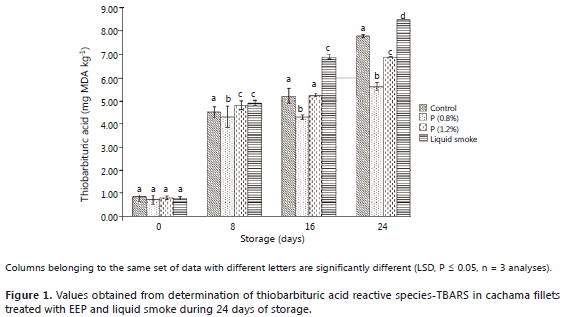
<body><![CDATA[<p>&nbsp;</p>     <p><font size="3" face="Verdana, Arial, Helvetica, sans-serif"><b>MATERIALS AND METHODS</b></font></p>     <p><font size="2" face="Verdana, Arial, Helvetica, sans-serif">Ethanol extract of propolis (EEP). 100 g of propolis were introduced in a precipitated glass, then 400 mL of ethanol 96% were added. The mixture was shaken during two hours, and was left at rest overnight, and then it was filtered. The residue was subjected to a secondary extraction with the same proportions as the first one. Finally the two extracts were mixed and frozen to precipitate other compounds. The supernatant eep was used to the assays and its solid concentration of 8% was established for the dry oven method. The predominant vegetation around the apiaries where the propolis were obtained consisting of, <i>Acacia decurrens</i>, <i>Dodonea viscosa</i>, <i>Hesperomeles godotiana</i>, <i>Prunus</i> sp., <i>Pirus malus</i>, <i>Fragaria</i> sp., <i>Toraxaxum officinalis</i>, <i>Sthacelp salviaefolia</i>.</font></p>     <p><font size="2" face="Verdana, Arial, Helvetica, sans-serif"><b><i>Preparation of the fillets. </i></b>Fish were provided by a commercial fish farm. Fillet samples (60 g) with skin were used. Transversal cuts were used to remove the intramuscular bones from the fillets. The following treatments were used: 1) Control, ethyl alcohol 96%; 2) EEP concentration 0.8 mg mL<sup>-1</sup>; 3) EEP concentration 1.2 mg mL<sup>-1</sup>; 4) Liquid smoke was purchased from a commercial smoke flavouring manufacturer (France). Liquid smoke was atomized by pressurized air in the fish fillet at ambient temperature with a vaporization device (Lutetia, France). The fillets were packed in vacuum sealed bags and stored at 4 oC for 24 days.</font></p>     <p><font size="2" face="Verdana, Arial, Helvetica, sans-serif"><b>Physicochemical analysis</b></font></p>     <p><font size="2" face="Verdana, Arial, Helvetica, sans-serif"><b><i>TBA assay.</i></b> Oxidation of lipids was assessed by the TBA (thiobarbituric acid) assay which is based on the reaction between TBA and MDA (malondialdehyde) and the production of a coloured pigment, the concentration of which can be calculated by measuring the absorbance at 532 nm. Some of the MDA is formed during the oxidation process; however, most of it is generated by the decomposition of lipid peroxides during the acid-heat treatment of the assay (Goulas and Kontominas, 2005). </font></p>     <p><font size="2" face="Verdana, Arial, Helvetica, sans-serif">Preparation of the thiobarbituric acid solution: 0.3 g of TBA (Merck, Germany) were transferred to a 150 mL beaker with 90 mL of distilled water. The beaker was placed in a 80 &ordm;C water bath until complete dissolution. The solution was then transferred to a 100 mL volumetric flask and brought to volume with distilled water. </font></p>     <p><font size="2" face="Verdana, Arial, Helvetica, sans-serif"><b><i>Determination of thiobarbituric acid reactive species-TBARS.</i></b> A 50 g sample of fish meat was minced after the addition of 6 mL of an ethanol solution of butylated hydroxytoluene (BHT, 1 g L<sup>-1</sup>) to prevent autoxidation. A 10 g homogenized fraction was transferred to a distillation tube and a drop of silicone antifoaming agent was added (Merck, Germany), along with 2.5 mL of 4 N HCL and 97.5 mL of distilled water. This sample was distilled and the first 50 mL of the distillate were collected. Afterwards, 5 mL of the distillate were added to 0.6 mL BHT (1 g L<sup>-1</sup>) and 5 mL of 0.021 M TBA in a screw-top test tube and heated in a water bath (90 &ordm;C) for 40 min to develop a pink color. Then, absorbance was determined at 532 nm in a Jasco V-530 spectrophotometer (Japan) using a control solution that contained 5 mL of distilled water, 5 mL of the TBA solution and 0.6 mL BHT (1 g L<sup>-1</sup>). The TBA values were expressed as mg of malonaldehyde (MDA)/kg sample. The MDA concentration was calculated from a calibration curve prepared using 1, 1, 3, 3-tetrametoxypropano (TMP) as a standard compound.</font></p>     <p><font size="2" face="Verdana, Arial, Helvetica, sans-serif"><b><i>Determination of total volatile base nitrogen (TVBN).</i></b> The method proposed by Goulas and Kontominas (2005) was used, in which a 10 g fish meat sample was ground with 50 mL of distilled water with a MoulinexTM processor (USA). This material was transferred to a 500 mL beaker with 200 mL of distilled water and distilled after the addition of 2 g of MgO and a drop of silicone antifoaming agent. A 250 mL Erlenmeyer flask was used to collect the distillate, which contained 25 mL of a 3% boric acid solution and 3 drops of Tashiro indicator (red methyl and blue methylene mixture). 125 mL of the distillate were collected. The boric acid solution turned green when it became alkaline due to the distillate of total volatile base nitrogen (TVBN). Afterwards, the solution was assessed with a 0.1 N hydrochloric acid solution. The quantity of TVBN at mg/100 g of fish meat was calculated from the volume of hydrochloric acid (V) and its concentration (C), using the following equation:</font></p>     <p><img src="/img/revistas/rfnam/v67n1/v67n1a10eq000.gif"></p>     ]]></body>
<body><![CDATA[<p><font size="2" face="Verdana, Arial, Helvetica, sans-serif"><b><i>pH. </i></b>The pH was determined with a Schott potentiometer (Lab 850, USA) with a combination electrode, with direct insertion into the sample. Three readings were taken at different points.</font></p>     <p><font size="2" face="Verdana, Arial, Helvetica, sans-serif"><b><i>Water loss.</i></b> Water loss was determined by modifying the equation proposed by Su&aacute;rez <i>et al</i>. (2008), where the fillets were weighed on the different sampling dates and related to the initial weight with the following equation: </font></p>     <p><img src="/img/revistas/rfnam/v67n1/v67n1a10eq001.gif"></p>     <p><font size="2" face="Verdana, Arial, Helvetica, sans-serif"><b><i>Experimental design and analysis of the data.</i></b> For the study of the preserving effects of propolis and liquid smoke in the treatments and storage time on the quality attributes of the fish fillets, a factorial design with two factors was used (time and preservation). Four levels of preservation (EEP 0.8, 1.2; liquid smoke and control) and seven levels of storage time (0, 4, 8, 12, 16, 20 and 24 days) were employed. The data were analyzed according to an ANOVA one-way, in conjunction with a Tukey multiple comparison test, with statistical significance defined as (P&le; 0.05). Different statistical analyses were carried out with MATLAB software V. 7.9 (Mathworks, U.S.A.).</font></p>     <p>&nbsp;</p>     <p><font size="3" face="Verdana, Arial, Helvetica, sans-serif"><b>RESULTS AND DISCUSSION</b></font></p>     <p><font size="2" face="Verdana, Arial, Helvetica, sans-serif"><b><i>Determination of thiobarbituric acid reactive species-TBARS.</i></b> <a href="#fig01">Figure 1</a> presents the results for the thiobarbituric acid analysis (TBA). The thiobarbituric acid values increased throughout the storage time in the three treatments, with the 0.8 mg mL<sup>-1</sup> of EEP treatment presenting the lowest values, followed by the 1.2 mg mL<sup>-1</sup> of EEP treatment.</font></p>     <p align="center"><font size="2" face="Verdana, Arial, Helvetica, sans-serif"><a name="fig01"></a></font><img src="/img/revistas/rfnam/v67n1/v67n1a10fig01.gif"></p>     <p><font size="2" face="Verdana, Arial, Helvetica, sans-serif">The TBA values indicated that the oxidation of lipids increased until 24 days, with significant differences between the treatments (P&lt;0.05). The treatments with 0.8 and 1.2 mg mL<sup>-1</sup> EEP demonstrated a lower increase in comparison with the control and liquid smoke, showing the antioxidant activity of propolis already reported by Chaillou and Nazareno (2009). TBA analysis has been widely used to calculate the degree of oxidation of lipids and the presence of substances reactive to TBA, taking into account factors of the second stage of autoxidation where peroxides are generally produced, which are oxidized to aldehydes and ketones.</font></p>     <p><font size="2" face="Verdana, Arial, Helvetica, sans-serif">In this sense, other studies (Kalogeropoulos <i>et al</i>., 2009) have determined that the principal components responsible for the antioxidant activity of propolis from Greece and Cypres correspond to phenolic acids, flavonoids, and anthraquinones. </font></p>     ]]></body>

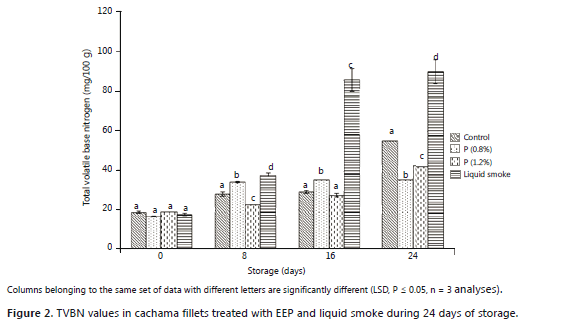
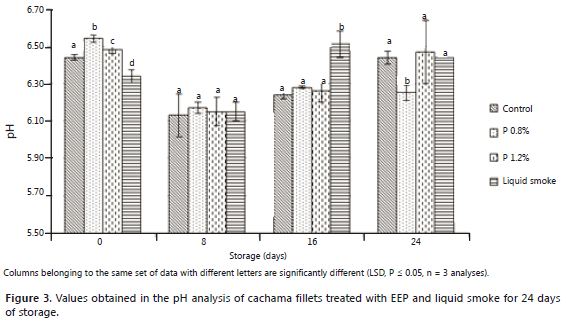
<body><![CDATA[<p><font size="2" face="Verdana, Arial, Helvetica, sans-serif">Similarly, other authors have stated that the antioxidant properties of propolis are mainly due to caffeic acid and its derivatives CAPE and DMAC. In addition, galangin, kaempferol and quercetin are compounds that are high in antioxidants. These results agree with the reports of Ahn <i>et al</i>. (2007).</font></p>     <p><font size="2" face="Verdana, Arial, Helvetica, sans-serif">On the other hand, the hydrophobic characteristics and cellular structure are responsible for the antioxidant activity of propolis, where they are located in the lipid bilayer region, without affecting the ordinate structure of the cellular membrane (Gregoris and Stevanato., 2010). </font></p>     <p><font size="2" face="Verdana, Arial, Helvetica, sans-serif"><b><i>Analysis of total volatile base nitrogen TVBN.</i></b> TThe TVBN values of the stored fish products indicated the formation of nitrogenated compounds produced by the activity of proteolyctic bacteria and native proteases in the fish meat, in this way, the TVBN value is one of the most used quality indices for fresh meat and refrigerated fish products (Kilincceker <i>et al</i>., 2009; Kostaki <i>et al</i>., 2009).</font></p>     <p><font size="2" face="Verdana, Arial, Helvetica, sans-serif">The changes in TVBN values for the cachama fillet samples during the storage period are seen in <a href="#fig02">figure 2</a>. All of the cachama fillet samples presented increases in TVBN levels. The highest TVBN values were seen in the liquid smoke treatment, surpassing the maximum acceptable value of 35-40 mg/100 g (Kostaki <i>et al</i>., 2009) at 6 days of storage. The lowest TVBN values were seen in the treatment with 0.8% propolis. Only the treatments with propolis maintained acceptable levels until 24 days of storage. </font></p>     <p align="center"><font size="2" face="Verdana, Arial, Helvetica, sans-serif"><a name="fig02"></a></font><img src="/img/revistas/rfnam/v67n1/v67n1a10fig02.gif"></p>     <p><font size="2" face="Verdana, Arial, Helvetica, sans-serif">TVBNs mainly include nitrogen from ammonia in freshwater fish, along with trimethylamine (TMA) and dimethylamine (DMA) in ocean fish (Limbo <i>et al</i>, 2009); these values reflect the extent of the degradation of proteins and non-protein nitrogen compounds (Kilincceker <i>et al</i>., 2009). The TVBN values found in this study, after 6 and 14 days of storage for the liquid smoke treatment and the control, respectively, were unacceptable and were associated with unpleasant odors from the meat (Kilincceker <i>et al</i>., 2009). In the present study, the gradual increase in TVBN was accompanied by a gradual decrease in fillet quality.</font></p>     <p><font size="2" face="Verdana, Arial, Helvetica, sans-serif">As seen in <a href="#fig02">Figure 2</a>, the TVBN levels of the cachama fillets treated with propolis increased more slowly than the control and the liquid smoke, although the difference between the treatments with propolis was not significant (P&gt;0.05). This finding could be due to the antimicrobial activity of the propolis and the reduction of the capacity of the bacteria to carry out oxidative deamination of non-protein nitrogen compounds (Fan <i>et al</i>., 2009). The ammonia compounds arising from decomposition is one of the principal ingredients responsible for the putrification of fish and has a typical fish odor (Kostaki <i>et al</i>., 2009). </font></p>     <p><font size="2" face="Verdana, Arial, Helvetica, sans-serif">The results obtained for the treatment of cachama fillets treated with liquid smoke do not agree with the results obtained by Alcicek (2011). The short duration of the liquid smoke treatment could be explained by the high values generated for TVBN by proteolysis, caused by the enzymatic activity and generated microbes (Kolsar&#305;c&#305; and Ozkaya, 1998), since the smoking was carried out by aspiration at room temperature, without the use of thermal processes. </font></p>     <p><font size="2" face="Verdana, Arial, Helvetica, sans-serif"><b><i>Determination of pH. </i></b><a href="#fig03">Figure 3</a> presents the results of the pH analysis. During the storage period, the pH values increased, oscillating between 6.1 and 6.5. No significant difference was found between the treatments (p&gt;0.05), however, high values were obtained for all the treatments except for the 0.8% propolis treatment. The results showed a decrease for all the treatments until 8 d of storage. Afterwards, the values were stable except for the liquid smoke treatment.</font></p>     <p align="center"><font size="2" face="Verdana, Arial, Helvetica, sans-serif"><a name="fig03"></a></font><img src="/img/revistas/rfnam/v67n1/v67n1a10fig03.gif"></p>     ]]></body>
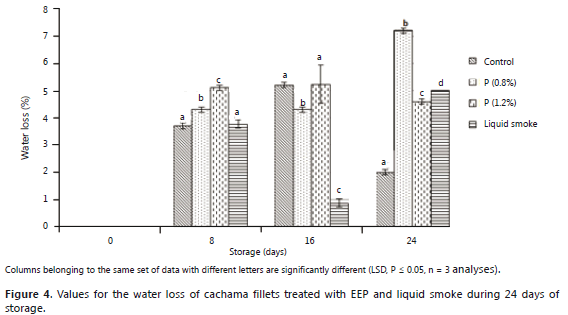
<body><![CDATA[<p><font size="2" face="Verdana, Arial, Helvetica, sans-serif">The decrease in pH until 8 d in all cases suggests the presence of lactic acid bacteria, due to the anaerobic conditions generated by the vacuum packaging producing lactic acid, which was responsible for the reduction in pH. From 16 days, the increase started due to the enzymatic denaturation of proteins which basically increased the pH values as storage time elapsed.</font></p>     <p><font size="2" face="Verdana, Arial, Helvetica, sans-serif">Similar results have been reported for other fish (Ozogul <i>et al</i>., 2005; Ocano-Higuera <i>et al</i>., 2009). This phenomenon is presumably due to the production of basic nitrogen compounds such as ammonia during bacterial growth (Mahmoud <i>et al</i>., 2007; Fan <i>et al</i>., 2009; Ayala <i>et al</i>., 2010). Furthermore, the increase in pH of a food matrix is related to the decomposition caused by microbial activity (Mahmoud <i>et al</i>., 2006). </font></p>     <p><font size="2" face="Verdana, Arial, Helvetica, sans-serif"><b><i>Water loss. </i></b>The results of the water loss analysis are presented in <a href="#fig04">Figure 4</a>. Significant differences were found (P&lt;0.05) during the storage period, presenting losses of 7% for the control and propolis concentrations of 0.8%, in contrast to the smaller losses for the treatments with 1.2% propolis and liquid smoke, 5% and 4.5% respectively. </font></p>     <p align="center"><font size="2" face="Verdana, Arial, Helvetica, sans-serif"><a name="fig04"></a></font><img src="/img/revistas/rfnam/v67n1/v67n1a10fig04.gif"></p>     <p><font size="2" face="Verdana, Arial, Helvetica, sans-serif">The properties of fish meat can be affected by myofibrillar protein denaturation. These changes depend on the original muscle conditions (Ocano-Higuera <i>et al</i>., 2006). Fish muscle usually has a decrease in pH and water retention capacity during storage (Flores and Bermell, 1984). The best results obtained in the liquid smoke treatment could be due to the phenol content of liquid smoke; these phenol derivatives can form dihydrogen bonds with water, which can influence the water retention capacity of meat (Martinez <i>et al</i>., 2004).</font></p>     <p>&nbsp;</p>     <p><font size="3" face="Verdana, Arial, Helvetica, sans-serif"><b>CONCLUSIONS</b></font></p>     <p><font size="2" face="Verdana, Arial, Helvetica, sans-serif">Ethanol extracts of propolis in concentration of 1.2 mg/ml can be an option in the conservation of fish chilled fillets as alternative to the use of chemical preservatives.</font></p>     <p>&nbsp;</p>     <p><font size="3" face="Verdana, Arial, Helvetica, sans-serif"><b>BIBLIOGRAFY</b></font></p>     ]]></body>
<body><![CDATA[<!-- ref --><p><font size="2" face="Verdana, Arial, Helvetica, sans-serif">Ahn, M. S. Kumazawa , Y. Usui, J. Nakamura, M. Matsuka, F. Zhu and T. Nakayama. 2007. Antioxidant activity and constituents of propolis collected in various areas of China. Food Chemistry 101(4): 1383-1392.    &nbsp;&nbsp;&nbsp;&nbsp;&nbsp;&nbsp;&nbsp;&nbsp;[&#160;<a href="javascript:void(0);" onclick="javascript: window.open('/scielo.php?script=sci_nlinks&ref=000063&pid=S0304-2847201400010001000001&lng=','','width=640,height=500,resizable=yes,scrollbars=1,menubar=yes,');">Links</a>&#160;]<!-- end-ref --> </font></p>     <!-- ref --><p><font size="2" face="Verdana, Arial, Helvetica, sans-serif">Alcicek, Z. 2011. The effects of thyme (Thymus vulgaris L.) oil concentration on liquid-smoked vacuum-packed rainbow trout (Oncorhynchus mykiss Walbaum, 1792) fillets during chilled storage. Food Chemistry 128(3): 683-688.    &nbsp;&nbsp;&nbsp;&nbsp;&nbsp;&nbsp;&nbsp;&nbsp;[&#160;<a href="javascript:void(0);" onclick="javascript: window.open('/scielo.php?script=sci_nlinks&ref=000065&pid=S0304-2847201400010001000002&lng=','','width=640,height=500,resizable=yes,scrollbars=1,menubar=yes,');">Links</a>&#160;]<!-- end-ref --></font></p>     <!-- ref --><p><font size="2" face="Verdana, Arial, Helvetica, sans-serif">Ayala, M.D., I. Abdel, M. Santaella, C. Mart&iacute;nez,  M.J. Periago, F. Gil, A. Blanco and O.L. Albors. 2010. Muscle tissue structural changes and texture development in sea bream, Sparus aurata L., during post-mortem storage. LWT-Food Science and Technology 43(3): 465-475.    &nbsp;&nbsp;&nbsp;&nbsp;&nbsp;&nbsp;&nbsp;&nbsp;[&#160;<a href="javascript:void(0);" onclick="javascript: window.open('/scielo.php?script=sci_nlinks&ref=000067&pid=S0304-2847201400010001000003&lng=','','width=640,height=500,resizable=yes,scrollbars=1,menubar=yes,');">Links</a>&#160;]<!-- end-ref --></font></p>     <!-- ref --><p><font size="2" face="Verdana, Arial, Helvetica, sans-serif">Cai, J., Q. Chen, X. Wan and J. Zhao. 2011. Determination of total volatile basic nitrogen (TVB-N) content and Warner-Bratzler shear force (WBSF) in pork using Fourier transform near infrared (FT-NIR) spectroscopy. Food Chemistry 126(3): 1354-1360.    &nbsp;&nbsp;&nbsp;&nbsp;&nbsp;&nbsp;&nbsp;&nbsp;[&#160;<a href="javascript:void(0);" onclick="javascript: window.open('/scielo.php?script=sci_nlinks&ref=000069&pid=S0304-2847201400010001000004&lng=','','width=640,height=500,resizable=yes,scrollbars=1,menubar=yes,');">Links</a>&#160;]<!-- end-ref --> </font></p>     <!-- ref --><p><font size="2" face="Verdana, Arial, Helvetica, sans-serif">Chaillou, L. and M.A. Nazareno. 2009. Bioactivity of propolis from Santiago del Estero, Argentina, related to their chemical composition. LWT - Food Science and Technology 42(8): 1422-1427.    &nbsp;&nbsp;&nbsp;&nbsp;&nbsp;&nbsp;&nbsp;&nbsp;[&#160;<a href="javascript:void(0);" onclick="javascript: window.open('/scielo.php?script=sci_nlinks&ref=000071&pid=S0304-2847201400010001000005&lng=','','width=640,height=500,resizable=yes,scrollbars=1,menubar=yes,');">Links</a>&#160;]<!-- end-ref --> </font></p>     ]]></body>
<body><![CDATA[<!-- ref --><p><font size="2" face="Verdana, Arial, Helvetica, sans-serif">Fan, W., J. Sun, Y. Chen, J. Qiu, Y. Zhang and Y. Chi. 2009) Effects of chitosan coating on quality and shelf life of silver carp during frozen storage. Food Chemistry 115(1): 66-70.    &nbsp;&nbsp;&nbsp;&nbsp;&nbsp;&nbsp;&nbsp;&nbsp;[&#160;<a href="javascript:void(0);" onclick="javascript: window.open('/scielo.php?script=sci_nlinks&ref=000073&pid=S0304-2847201400010001000006&lng=','','width=640,height=500,resizable=yes,scrollbars=1,menubar=yes,');">Links</a>&#160;]<!-- end-ref --></font></p>     <!-- ref --><p><font size="2" face="Verdana, Arial, Helvetica, sans-serif">Fern&aacute;ndez, J., J.A. P&eacute;rez and J.A. Fern&aacute;ndez-L&oacute;pez.  1997. Thiobarbituric acid test for monitoring lipid oxidation in meat. Food Chemistry 59(3): 345-353.    &nbsp;&nbsp;&nbsp;&nbsp;&nbsp;&nbsp;&nbsp;&nbsp;[&#160;<a href="javascript:void(0);" onclick="javascript: window.open('/scielo.php?script=sci_nlinks&ref=000075&pid=S0304-2847201400010001000007&lng=','','width=640,height=500,resizable=yes,scrollbars=1,menubar=yes,');">Links</a>&#160;]<!-- end-ref --> </font></p>     <!-- ref --><p><font size="2" face="Verdana, Arial, Helvetica, sans-serif">Flores, J. and S. Bermell. 1984. Propiedades funcionales de las prote&iacute;nas miofibrilares: capacidad de retenci&oacute;n de agua. Agroqu&iacute;mica y Tecnolog&iacute;a de Alimentos 24(2): 151-158.    &nbsp;&nbsp;&nbsp;&nbsp;&nbsp;&nbsp;&nbsp;&nbsp;[&#160;<a href="javascript:void(0);" onclick="javascript: window.open('/scielo.php?script=sci_nlinks&ref=000077&pid=S0304-2847201400010001000008&lng=','','width=640,height=500,resizable=yes,scrollbars=1,menubar=yes,');">Links</a>&#160;]<!-- end-ref --></font></p>     <!-- ref --><p><font size="2" face="Verdana, Arial, Helvetica, sans-serif">Goulas, A.E. and M.G. Kontominas. 2005. Effect of salting and smoking-method on the keeping quality of chub mackerel (Scomber japonicus): biochemical and sensory attributes. Food Chemical 93(3): 511-520.    &nbsp;&nbsp;&nbsp;&nbsp;&nbsp;&nbsp;&nbsp;&nbsp;[&#160;<a href="javascript:void(0);" onclick="javascript: window.open('/scielo.php?script=sci_nlinks&ref=000079&pid=S0304-2847201400010001000009&lng=','','width=640,height=500,resizable=yes,scrollbars=1,menubar=yes,');">Links</a>&#160;]<!-- end-ref --></font></p>     <!-- ref --><p><font size="2" face="Verdana, Arial, Helvetica, sans-serif">Gregoris, E. and R. Stevanato. 2010. Correlations between polyphenolic composition and antioxidant activity of Venetian-propolis. Food and Chemical Toxicology 48(1): 76-82.    &nbsp;&nbsp;&nbsp;&nbsp;&nbsp;&nbsp;&nbsp;&nbsp;[&#160;<a href="javascript:void(0);" onclick="javascript: window.open('/scielo.php?script=sci_nlinks&ref=000081&pid=S0304-2847201400010001000010&lng=','','width=640,height=500,resizable=yes,scrollbars=1,menubar=yes,');">Links</a>&#160;]<!-- end-ref --></font></p>     ]]></body>
<body><![CDATA[<!-- ref --><p><font size="2" face="Verdana, Arial, Helvetica, sans-serif">Kalogeropoulos, N., S.J. Konteles, E. Troullidou, I. Mourtzinos and V.T. Karathanos. 2009. Chemical composition, antioxidant activity and antimicrobial properties of propolis extracts from Greece and Cyprus. Food Chemistry 116(2): 452-461.    &nbsp;&nbsp;&nbsp;&nbsp;&nbsp;&nbsp;&nbsp;&nbsp;[&#160;<a href="javascript:void(0);" onclick="javascript: window.open('/scielo.php?script=sci_nlinks&ref=000083&pid=S0304-2847201400010001000011&lng=','','width=640,height=500,resizable=yes,scrollbars=1,menubar=yes,');">Links</a>&#160;]<!-- end-ref --> </font></p>     <!-- ref --><p><font size="2" face="Verdana, Arial, Helvetica, sans-serif">Kilincceker, O., I.S. Dogan and E. Kucukoner. 2009. Effect of edible coatings on the quality of frozen fish fillets. LWT - Food Science and Technology 42(4): 868-873.    &nbsp;&nbsp;&nbsp;&nbsp;&nbsp;&nbsp;&nbsp;&nbsp;[&#160;<a href="javascript:void(0);" onclick="javascript: window.open('/scielo.php?script=sci_nlinks&ref=000085&pid=S0304-2847201400010001000012&lng=','','width=640,height=500,resizable=yes,scrollbars=1,menubar=yes,');">Links</a>&#160;]<!-- end-ref --></font></p>     <!-- ref --><p><font size="2" face="Verdana, Arial, Helvetica, sans-serif">Kolsar&#305;c&#305;, N. and O. Ozkaya. 1998. Effect of smoking methods on shelf-life of rainbow trout (Salmo gairdneri). Turkish Journal of Veterinary and Animal Sciences 22(3): 273-284.    &nbsp;&nbsp;&nbsp;&nbsp;&nbsp;&nbsp;&nbsp;&nbsp;[&#160;<a href="javascript:void(0);" onclick="javascript: window.open('/scielo.php?script=sci_nlinks&ref=000087&pid=S0304-2847201400010001000013&lng=','','width=640,height=500,resizable=yes,scrollbars=1,menubar=yes,');">Links</a>&#160;]<!-- end-ref --></font></p>     <!-- ref --><p><font size="2" face="Verdana, Arial, Helvetica, sans-serif">Kostaki, M., V. Giatrakou, I.N. Savvaidis and M.G. Kontominas. 2009. Combined effect of MAP and thyme essential oil on the microbiological, chemical and sensory attributes of organically aquacultured sea bass (Dicentrarchus labrax) fillets. Food Microbiology 26(5): 475-482.    &nbsp;&nbsp;&nbsp;&nbsp;&nbsp;&nbsp;&nbsp;&nbsp;[&#160;<a href="javascript:void(0);" onclick="javascript: window.open('/scielo.php?script=sci_nlinks&ref=000089&pid=S0304-2847201400010001000014&lng=','','width=640,height=500,resizable=yes,scrollbars=1,menubar=yes,');">Links</a>&#160;]<!-- end-ref --></font></p>     <!-- ref --><p><font size="2" face="Verdana, Arial, Helvetica, sans-serif">Limbo, S., N. Sinelli, L. Torri and M. Riva. 2009. Freshness decay and shelf life predictive modelling of European sea bass (Dicentrarchus labrax) applying chemical methods and electronic nose. LWT - Food Science and Technology 42(5): 977-984.    &nbsp;&nbsp;&nbsp;&nbsp;&nbsp;&nbsp;&nbsp;&nbsp;[&#160;<a href="javascript:void(0);" onclick="javascript: window.open('/scielo.php?script=sci_nlinks&ref=000091&pid=S0304-2847201400010001000015&lng=','','width=640,height=500,resizable=yes,scrollbars=1,menubar=yes,');">Links</a>&#160;]<!-- end-ref --></font></p>     ]]></body>
<body><![CDATA[<!-- ref --><p><font size="2" face="Verdana, Arial, Helvetica, sans-serif">Mahmoud, B.S.M., Y. Kawai, K. Yamazaki, K.  Miyashita and T. Suzuki. 2007. Effect of treatment with electrolyzed NaCl solutions and essential oil compounds on the proximate composition, amino acid and fatty acid composition of carp fillets. Food Chemistry 101(4): 1492-1498.    &nbsp;&nbsp;&nbsp;&nbsp;&nbsp;&nbsp;&nbsp;&nbsp;[&#160;<a href="javascript:void(0);" onclick="javascript: window.open('/scielo.php?script=sci_nlinks&ref=000093&pid=S0304-2847201400010001000016&lng=','','width=640,height=500,resizable=yes,scrollbars=1,menubar=yes,');">Links</a>&#160;]<!-- end-ref --></font></p>     <!-- ref --><p><font size="2" face="Verdana, Arial, Helvetica, sans-serif">Mahmoud, B.S.M., K. Yamazaki, K. Miyashita, I.I. Shin and T. Suzuki. 2006. A new technology for fish preservation by combined treatment with electrolyzed NaCl solutions and essential oil compounds. Food Chemistry 99(4): 656-662.    &nbsp;&nbsp;&nbsp;&nbsp;&nbsp;&nbsp;&nbsp;&nbsp;[&#160;<a href="javascript:void(0);" onclick="javascript: window.open('/scielo.php?script=sci_nlinks&ref=000095&pid=S0304-2847201400010001000017&lng=','','width=640,height=500,resizable=yes,scrollbars=1,menubar=yes,');">Links</a>&#160;]<!-- end-ref --></font></p>     <!-- ref --><p><font size="2" face="Verdana, Arial, Helvetica, sans-serif">Mart&iacute;nez, O., J. Salmer&oacute;n, M.D. Guill&eacute;n and C. Casas. 2004. Texture profile analysis of meat products treated with commercial liquid smoke flavourings. Food Control 15(6): 457-46.    &nbsp;&nbsp;&nbsp;&nbsp;&nbsp;&nbsp;&nbsp;&nbsp;[&#160;<a href="javascript:void(0);" onclick="javascript: window.open('/scielo.php?script=sci_nlinks&ref=000097&pid=S0304-2847201400010001000018&lng=','','width=640,height=500,resizable=yes,scrollbars=1,menubar=yes,');">Links</a>&#160;]<!-- end-ref --></font></p>     <!-- ref --><p><font size="2" face="Verdana, Arial, Helvetica, sans-serif">Mohammadzadeh, S., M. Shariatpanahi, M. Hamedi, R. Ahmadkhaniha, N. Samadi and S.N. Ostad. 2007. Chemical composition, oral toxicity and antimicrobial activity of Iranian propolis. Food Chemistry 103(4): 1097-1103.    &nbsp;&nbsp;&nbsp;&nbsp;&nbsp;&nbsp;&nbsp;&nbsp;[&#160;<a href="javascript:void(0);" onclick="javascript: window.open('/scielo.php?script=sci_nlinks&ref=000099&pid=S0304-2847201400010001000019&lng=','','width=640,height=500,resizable=yes,scrollbars=1,menubar=yes,');">Links</a>&#160;]<!-- end-ref --> </font></p>     <!-- ref --><p><font size="2" face="Verdana, Arial, Helvetica, sans-serif">Oca&ntilde;o, V.M., A.N. Maeda, E. Marquez. D.F. Ca&ntilde;izales, F.J. Castillo, E. Ru&iacute;z, A.Z. Graciano and M. Plascencia. 2011. Freshness assessment of ray fish stored in ice by biochemical, chemical and physical methods. Food Chemistry 125(1): 49-54.    &nbsp;&nbsp;&nbsp;&nbsp;&nbsp;&nbsp;&nbsp;&nbsp;[&#160;<a href="javascript:void(0);" onclick="javascript: window.open('/scielo.php?script=sci_nlinks&ref=000101&pid=S0304-2847201400010001000020&lng=','','width=640,height=500,resizable=yes,scrollbars=1,menubar=yes,');">Links</a>&#160;]<!-- end-ref --></font></p>     ]]></body>
<body><![CDATA[<!-- ref --><p><font size="2" face="Verdana, Arial, Helvetica, sans-serif">Oca&ntilde;o, V.M., A.N. Maeda, M.E. Lugo and R. Pacheco. 2006. Postmortem biochemical and textural changes in the adductor muscle of catarina scallop stored at 0 oC. Journal of Food Biochemistry 30(4): 373-389.    &nbsp;&nbsp;&nbsp;&nbsp;&nbsp;&nbsp;&nbsp;&nbsp;[&#160;<a href="javascript:void(0);" onclick="javascript: window.open('/scielo.php?script=sci_nlinks&ref=000103&pid=S0304-2847201400010001000021&lng=','','width=640,height=500,resizable=yes,scrollbars=1,menubar=yes,');">Links</a>&#160;]<!-- end-ref --></font></p>     <!-- ref --><p><font size="2" face="Verdana, Arial, Helvetica, sans-serif">Oca&ntilde;o, V.M., E. M&aacute;rquez, M. Canizales, F.J. Castillo, R. Pacheco, M.E. Lugo, K.D. Garcia and A.Z. Graciano. 2009. Postmortem changes in cazon fish muscle stored on ice. Food Chemistry 116(4): 933-938.    &nbsp;&nbsp;&nbsp;&nbsp;&nbsp;&nbsp;&nbsp;&nbsp;[&#160;<a href="javascript:void(0);" onclick="javascript: window.open('/scielo.php?script=sci_nlinks&ref=000105&pid=S0304-2847201400010001000022&lng=','','width=640,height=500,resizable=yes,scrollbars=1,menubar=yes,');">Links</a>&#160;]<!-- end-ref --></font></p>     <!-- ref --><p><font size="2" face="Verdana, Arial, Helvetica, sans-serif">Ozogul, Y., G. Ozyurt, F. Ozogul, E. Kuley and A. Polat. 2005. Freshness assessment of European ell (Anguilla anguilla) by sensory, chemical and microbiological methods. Food Chemistry 92(4): 74-51.    &nbsp;&nbsp;&nbsp;&nbsp;&nbsp;&nbsp;&nbsp;&nbsp;[&#160;<a href="javascript:void(0);" onclick="javascript: window.open('/scielo.php?script=sci_nlinks&ref=000107&pid=S0304-2847201400010001000023&lng=','','width=640,height=500,resizable=yes,scrollbars=1,menubar=yes,');">Links</a>&#160;]<!-- end-ref --></font></p>     <!-- ref --><p><font size="2" face="Verdana, Arial, Helvetica, sans-serif">Palomino, L.R., J.P. Mart&iacute;nez, C.M. Garc&iacute;a, J.H. Gil y D.L. Durango. 2010. Caracterizaci&oacute;n fisicoqu&iacute;mica y actividad antimicrobiana del prop&oacute;leos en el municipio de La Uni&oacute;n (Antioquia, Colombia). Revista Facultad Nacional de Agronom&iacute;a Medell&iacute;n 63(1): 5373-5383.    &nbsp;&nbsp;&nbsp;&nbsp;&nbsp;&nbsp;&nbsp;&nbsp;[&#160;<a href="javascript:void(0);" onclick="javascript: window.open('/scielo.php?script=sci_nlinks&ref=000109&pid=S0304-2847201400010001000024&lng=','','width=640,height=500,resizable=yes,scrollbars=1,menubar=yes,');">Links</a>&#160;]<!-- end-ref --> </font></p>     <!-- ref --><p><font size="2" face="Verdana, Arial, Helvetica, sans-serif">Zhou, R., Y. Liu, J. Xie and X. Wang. 2011. Effects of combined treatment of electrolysed water and chitosan on the quality attributes and myofibril degradation in farmed obscure puffer fish (Takifugu obscurus) during refrigerated storage. Food Chemistry 129(4): 1660-1666.    &nbsp;&nbsp;&nbsp;&nbsp;&nbsp;&nbsp;&nbsp;&nbsp;[&#160;<a href="javascript:void(0);" onclick="javascript: window.open('/scielo.php?script=sci_nlinks&ref=000111&pid=S0304-2847201400010001000025&lng=','','width=640,height=500,resizable=yes,scrollbars=1,menubar=yes,');">Links</a>&#160;]<!-- end-ref --></font></p>     ]]></body>
<body><![CDATA[<!-- ref --><p><font size="2" face="Verdana, Arial, Helvetica, sans-serif">Su&aacute;rez, H., S. Pardo y M. Cortes. 2008. Calidad f&iacute;sico-qu&iacute;mica y atributos sensoriales de filetes sajados biopreservados de cachama, empacados al vac&iacute;o bajo refrigeraci&oacute;n. Revista Colombiana de Ciencias Pecuarias 21(3): 330-339.    &nbsp;&nbsp;&nbsp;&nbsp;&nbsp;&nbsp;&nbsp;&nbsp;[&#160;<a href="javascript:void(0);" onclick="javascript: window.open('/scielo.php?script=sci_nlinks&ref=000113&pid=S0304-2847201400010001000026&lng=','','width=640,height=500,resizable=yes,scrollbars=1,menubar=yes,');">Links</a>&#160;]<!-- end-ref --> </font></p>     <!-- ref --><p><font size="2" face="Verdana, Arial, Helvetica, sans-serif">Stolyhwo, A. and Z. Sikorski. 2005.  Polycyclic aromatic hydrocarbons in smoked fish-a critical review. Food Chemistry 91(2):&nbsp;303-311.    &nbsp;&nbsp;&nbsp;&nbsp;&nbsp;&nbsp;&nbsp;&nbsp;[&#160;<a href="javascript:void(0);" onclick="javascript: window.open('/scielo.php?script=sci_nlinks&ref=000115&pid=S0304-2847201400010001000027&lng=','','width=640,height=500,resizable=yes,scrollbars=1,menubar=yes,');">Links</a>&#160;]<!-- end-ref --> </font></p>     <!-- ref --><p><font size="2" face="Verdana, Arial, Helvetica, sans-serif">Tylkowski, B., B. Trusheva, V. Bankova, M. Giamberini, G. Peev and A. Nikolova. 2010. Extraction of biologically active compounds from propolis and concentration of extract by nanofiltration. Journal of Membrane Science 348 (1-2): 124-130.    &nbsp;&nbsp;&nbsp;&nbsp;&nbsp;&nbsp;&nbsp;&nbsp;[&#160;<a href="javascript:void(0);" onclick="javascript: window.open('/scielo.php?script=sci_nlinks&ref=000117&pid=S0304-2847201400010001000028&lng=','','width=640,height=500,resizable=yes,scrollbars=1,menubar=yes,');">Links</a>&#160;]<!-- end-ref --></font></p>      ]]></body><back>
<ref-list>
<ref id="B1">
<nlm-citation citation-type="journal">
<person-group person-group-type="author">
<name>
<surname><![CDATA[Ahn]]></surname>
<given-names><![CDATA[M.]]></given-names>
</name>
<name>
<surname><![CDATA[Kumazawa]]></surname>
<given-names><![CDATA[S.]]></given-names>
</name>
<name>
<surname><![CDATA[Usui]]></surname>
<given-names><![CDATA[Y.]]></given-names>
</name>
<name>
<surname><![CDATA[Nakamura]]></surname>
<given-names><![CDATA[J.]]></given-names>
</name>
<name>
<surname><![CDATA[Matsuka]]></surname>
<given-names><![CDATA[M.]]></given-names>
</name>
<name>
<surname><![CDATA[Zhu]]></surname>
<given-names><![CDATA[F.]]></given-names>
</name>
<name>
<surname><![CDATA[Nakayama]]></surname>
<given-names><![CDATA[T.]]></given-names>
</name>
</person-group>
<article-title xml:lang="en"><![CDATA[Antioxidant activity and constituents of propolis collected in various areas of China]]></article-title>
<source><![CDATA[Food Chemistry]]></source>
<year>2007</year>
<volume>101</volume>
<numero>4</numero>
<issue>4</issue>
<page-range>1383-1392</page-range></nlm-citation>
</ref>
<ref id="B2">
<nlm-citation citation-type="journal">
<person-group person-group-type="author">
<name>
<surname><![CDATA[Alcicek]]></surname>
<given-names><![CDATA[Z.]]></given-names>
</name>
</person-group>
<article-title xml:lang="en"><![CDATA[The effects of thyme (Thymus vulgaris L.) oil concentration on liquid-smoked vacuum-packed rainbow trout (Oncorhynchus mykiss Walbaum, 1792) fillets during chilled storage]]></article-title>
<source><![CDATA[Food Chemistry]]></source>
<year>2011</year>
<volume>128</volume>
<numero>3</numero>
<issue>3</issue>
<page-range>683-688</page-range></nlm-citation>
</ref>
<ref id="B3">
<nlm-citation citation-type="journal">
<person-group person-group-type="author">
<name>
<surname><![CDATA[Ayala]]></surname>
<given-names><![CDATA[M.D.]]></given-names>
</name>
<name>
<surname><![CDATA[Abdel]]></surname>
<given-names><![CDATA[I.]]></given-names>
</name>
<name>
<surname><![CDATA[Santaella]]></surname>
<given-names><![CDATA[M.]]></given-names>
</name>
<name>
<surname><![CDATA[Martínez]]></surname>
<given-names><![CDATA[C.]]></given-names>
</name>
<name>
<surname><![CDATA[Periago]]></surname>
<given-names><![CDATA[M.J.]]></given-names>
</name>
<name>
<surname><![CDATA[Gil]]></surname>
<given-names><![CDATA[F.]]></given-names>
</name>
<name>
<surname><![CDATA[Blanco]]></surname>
<given-names><![CDATA[A.]]></given-names>
</name>
<name>
<surname><![CDATA[Albors]]></surname>
<given-names><![CDATA[O.L.]]></given-names>
</name>
</person-group>
<article-title xml:lang="en"><![CDATA[Muscle tissue structural changes and texture development in sea bream, Sparus aurata L., during post-mortem storage.]]></article-title>
<source><![CDATA[LWT-Food Science and Technology]]></source>
<year>2010</year>
<volume>43</volume>
<numero>3</numero>
<issue>3</issue>
<page-range>465-475</page-range></nlm-citation>
</ref>
<ref id="B4">
<nlm-citation citation-type="journal">
<person-group person-group-type="author">
<name>
<surname><![CDATA[Cai]]></surname>
<given-names><![CDATA[J.]]></given-names>
</name>
<name>
<surname><![CDATA[Chen]]></surname>
<given-names><![CDATA[Q.]]></given-names>
</name>
<name>
<surname><![CDATA[Wan]]></surname>
<given-names><![CDATA[X.]]></given-names>
</name>
<name>
<surname><![CDATA[Zhao]]></surname>
<given-names><![CDATA[J.]]></given-names>
</name>
</person-group>
<article-title xml:lang="en"><![CDATA[Determination of total volatile basic nitrogen (TVB-N) content and Warner-Bratzler shear force (WBSF) in pork using Fourier transform near infrared (FT-NIR) spectroscopy]]></article-title>
<source><![CDATA[Food Chemistry]]></source>
<year>2011</year>
<volume>126</volume>
<numero>3</numero>
<issue>3</issue>
<page-range>1354-1360</page-range></nlm-citation>
</ref>
<ref id="B5">
<nlm-citation citation-type="journal">
<person-group person-group-type="author">
<name>
<surname><![CDATA[Chaillou]]></surname>
<given-names><![CDATA[L.]]></given-names>
</name>
<name>
<surname><![CDATA[Nazareno]]></surname>
<given-names><![CDATA[M.A.]]></given-names>
</name>
</person-group>
<article-title xml:lang="en"><![CDATA[Bioactivity of propolis from Santiago del Estero, Argentina, related to their chemical composition]]></article-title>
<source><![CDATA[LWT - Food Science and Technology]]></source>
<year>2009</year>
<volume>42</volume>
<numero>8</numero>
<issue>8</issue>
<page-range>1422-1427</page-range></nlm-citation>
</ref>
<ref id="B6">
<nlm-citation citation-type="journal">
<person-group person-group-type="author">
<name>
<surname><![CDATA[Fan]]></surname>
<given-names><![CDATA[W.]]></given-names>
</name>
<name>
<surname><![CDATA[Sun]]></surname>
<given-names><![CDATA[J.]]></given-names>
</name>
<name>
<surname><![CDATA[Chen]]></surname>
<given-names><![CDATA[Y.]]></given-names>
</name>
<name>
<surname><![CDATA[Qiu]]></surname>
<given-names><![CDATA[J.]]></given-names>
</name>
<name>
<surname><![CDATA[Zhang]]></surname>
<given-names><![CDATA[Y.]]></given-names>
</name>
<name>
<surname><![CDATA[Chi]]></surname>
<given-names><![CDATA[Y.]]></given-names>
</name>
</person-group>
<article-title xml:lang="en"><![CDATA[Effects of chitosan coating on quality and shelf life of silver carp during frozen storage]]></article-title>
<source><![CDATA[Food Chemistry]]></source>
<year>2009</year>
<volume>115</volume>
<numero>1</numero>
<issue>1</issue>
<page-range>66-70</page-range></nlm-citation>
</ref>
<ref id="B7">
<nlm-citation citation-type="journal">
<person-group person-group-type="author">
<name>
<surname><![CDATA[Fernández]]></surname>
<given-names><![CDATA[J.]]></given-names>
</name>
<name>
<surname><![CDATA[Pérez]]></surname>
<given-names><![CDATA[J.A.]]></given-names>
</name>
<name>
<surname><![CDATA[Fernández-López]]></surname>
<given-names><![CDATA[J.A.]]></given-names>
</name>
</person-group>
<article-title xml:lang="en"><![CDATA[Thiobarbituric acid test for monitoring lipid oxidation in meat]]></article-title>
<source><![CDATA[Food Chemistry]]></source>
<year>1997</year>
<volume>59</volume>
<numero>3</numero>
<issue>3</issue>
<page-range>345-353</page-range></nlm-citation>
</ref>
<ref id="B8">
<nlm-citation citation-type="journal">
<person-group person-group-type="author">
<name>
<surname><![CDATA[Flores]]></surname>
<given-names><![CDATA[J.]]></given-names>
</name>
<name>
<surname><![CDATA[Bermell]]></surname>
<given-names><![CDATA[S.]]></given-names>
</name>
</person-group>
<article-title xml:lang="es"><![CDATA[Propiedades funcionales de las proteínas miofibrilares: capacidad de retención de agua]]></article-title>
<source><![CDATA[Agroquímica y Tecnología de Alimentos]]></source>
<year>1984</year>
<volume>24</volume>
<numero>2</numero>
<issue>2</issue>
<page-range>151-158</page-range></nlm-citation>
</ref>
<ref id="B9">
<nlm-citation citation-type="journal">
<person-group person-group-type="author">
<name>
<surname><![CDATA[Goulas]]></surname>
<given-names><![CDATA[A.E.]]></given-names>
</name>
<name>
<surname><![CDATA[Kontominas]]></surname>
<given-names><![CDATA[M.G.]]></given-names>
</name>
</person-group>
<article-title xml:lang="en"><![CDATA[Effect of salting and smok­ing-method on the keeping quality of chub mackerel (Scomber japonicus): biochemical and sensory attributes.]]></article-title>
<source><![CDATA[Food Chemical]]></source>
<year>2005</year>
<volume>93</volume>
<numero>3</numero>
<issue>3</issue>
<page-range>511-520</page-range></nlm-citation>
</ref>
<ref id="B10">
<nlm-citation citation-type="journal">
<person-group person-group-type="author">
<name>
<surname><![CDATA[Gregoris]]></surname>
<given-names><![CDATA[E.]]></given-names>
</name>
<name>
<surname><![CDATA[Stevanato]]></surname>
<given-names><![CDATA[R.]]></given-names>
</name>
</person-group>
<article-title xml:lang="en"><![CDATA[Correlations between polyphenolic composition and antioxidant activity of Venetian-propolis]]></article-title>
<source><![CDATA[Food and Chemical Toxicology]]></source>
<year>2010</year>
<volume>48</volume>
<numero>1</numero>
<issue>1</issue>
<page-range>76-82</page-range></nlm-citation>
</ref>
<ref id="B11">
<nlm-citation citation-type="journal">
<person-group person-group-type="author">
<name>
<surname><![CDATA[Kalogeropoulos]]></surname>
<given-names><![CDATA[N.]]></given-names>
</name>
<name>
<surname><![CDATA[Konteles]]></surname>
<given-names><![CDATA[S.J.]]></given-names>
</name>
<name>
<surname><![CDATA[Troullidou]]></surname>
<given-names><![CDATA[E.]]></given-names>
</name>
<name>
<surname><![CDATA[Mourtzinos]]></surname>
<given-names><![CDATA[I.]]></given-names>
</name>
<name>
<surname><![CDATA[Karathanos]]></surname>
<given-names><![CDATA[V.T.]]></given-names>
</name>
</person-group>
<article-title xml:lang="en"><![CDATA[Chemical composition, antioxidant activity and antimicrobial properties of propolis extracts from Greece and Cyprus.]]></article-title>
<source><![CDATA[Food Chemistry]]></source>
<year>2009</year>
<volume>116</volume>
<numero>2</numero>
<issue>2</issue>
<page-range>452-461</page-range></nlm-citation>
</ref>
<ref id="B12">
<nlm-citation citation-type="journal">
<person-group person-group-type="author">
<name>
<surname><![CDATA[Kilincceker]]></surname>
<given-names><![CDATA[O.]]></given-names>
</name>
<name>
<surname><![CDATA[Dogan]]></surname>
<given-names><![CDATA[I.S.]]></given-names>
</name>
<name>
<surname><![CDATA[Kucukoner]]></surname>
<given-names><![CDATA[E.]]></given-names>
</name>
</person-group>
<article-title xml:lang="en"><![CDATA[Effect of edible coatings on the quality of frozen fish fillets]]></article-title>
<source><![CDATA[LWT - Food Science and Technology]]></source>
<year>2009</year>
<volume>42</volume>
<numero>4</numero>
<issue>4</issue>
<page-range>868-873</page-range></nlm-citation>
</ref>
<ref id="B13">
<nlm-citation citation-type="journal">
<person-group person-group-type="author">
<name>
<surname><![CDATA[Kolsar&#305;c&#305;]]></surname>
<given-names><![CDATA[N.]]></given-names>
</name>
<name>
<surname><![CDATA[Ozkaya]]></surname>
<given-names><![CDATA[O.]]></given-names>
</name>
</person-group>
<article-title xml:lang="en"><![CDATA[Effect of smoking methods on shelf-life of rainbow trout (Salmo gairdneri).]]></article-title>
<source><![CDATA[Turkish Journal of Veterinary and Animal Sciences]]></source>
<year>1998</year>
<volume>22</volume>
<numero>3</numero>
<issue>3</issue>
<page-range>273-284</page-range></nlm-citation>
</ref>
<ref id="B14">
<nlm-citation citation-type="journal">
<person-group person-group-type="author">
<name>
<surname><![CDATA[Kostaki]]></surname>
<given-names><![CDATA[M.]]></given-names>
</name>
<name>
<surname><![CDATA[Giatrakou]]></surname>
<given-names><![CDATA[V.]]></given-names>
</name>
<name>
<surname><![CDATA[Savvaidis]]></surname>
<given-names><![CDATA[I.N.]]></given-names>
</name>
<name>
<surname><![CDATA[Kontominas]]></surname>
<given-names><![CDATA[M.G.]]></given-names>
</name>
</person-group>
<article-title xml:lang="en"><![CDATA[Combined effect of MAP and thyme essential oil on the microbiological, chemical and sensory attributes of organically aquacultured sea bass (Dicentrarchus labrax) fillets]]></article-title>
<source><![CDATA[Food Microbiology]]></source>
<year>2009</year>
<volume>26</volume>
<numero>5</numero>
<issue>5</issue>
<page-range>475-482</page-range></nlm-citation>
</ref>
<ref id="B15">
<nlm-citation citation-type="journal">
<person-group person-group-type="author">
<name>
<surname><![CDATA[Limbo]]></surname>
<given-names><![CDATA[S.]]></given-names>
</name>
<name>
<surname><![CDATA[Sinelli]]></surname>
<given-names><![CDATA[N.]]></given-names>
</name>
<name>
<surname><![CDATA[Torri]]></surname>
<given-names><![CDATA[L.]]></given-names>
</name>
<name>
<surname><![CDATA[Riva]]></surname>
<given-names><![CDATA[M.]]></given-names>
</name>
</person-group>
<article-title xml:lang="en"><![CDATA[Freshness decay and shelf life predictive modelling of European sea bass (Dicentrarchus labrax) applying chemical methods and electronic nose]]></article-title>
<source><![CDATA[LWT - Food Science and Technology]]></source>
<year>2009</year>
<volume>42</volume>
<numero>5</numero>
<issue>5</issue>
<page-range>977-984</page-range></nlm-citation>
</ref>
<ref id="B16">
<nlm-citation citation-type="journal">
<person-group person-group-type="author">
<name>
<surname><![CDATA[Mahmoud]]></surname>
<given-names><![CDATA[B.S.M.]]></given-names>
</name>
<name>
<surname><![CDATA[Kawai]]></surname>
<given-names><![CDATA[Y.]]></given-names>
</name>
<name>
<surname><![CDATA[Yamazaki]]></surname>
<given-names><![CDATA[K.]]></given-names>
</name>
<name>
<surname><![CDATA[Miyashita]]></surname>
<given-names><![CDATA[K.]]></given-names>
</name>
<name>
<surname><![CDATA[Suzuki]]></surname>
<given-names><![CDATA[T.]]></given-names>
</name>
</person-group>
<article-title xml:lang="en"><![CDATA[Effect of treatment with electrolyzed NaCl solutions and essential oil compounds on the proximate composition, amino acid and fatty acid composition of carp fillets]]></article-title>
<source><![CDATA[Food Chemistry]]></source>
<year>2007</year>
<volume>101</volume>
<numero>4</numero>
<issue>4</issue>
<page-range>1492-1498</page-range></nlm-citation>
</ref>
<ref id="B17">
<nlm-citation citation-type="journal">
<person-group person-group-type="author">
<name>
<surname><![CDATA[Mahmoud]]></surname>
<given-names><![CDATA[B.S.M.]]></given-names>
</name>
<name>
<surname><![CDATA[Yamazaki]]></surname>
<given-names><![CDATA[K.]]></given-names>
</name>
<name>
<surname><![CDATA[Miyashita]]></surname>
<given-names><![CDATA[K.]]></given-names>
</name>
<name>
<surname><![CDATA[Shin]]></surname>
<given-names><![CDATA[I.I.]]></given-names>
</name>
<name>
<surname><![CDATA[Suzuki]]></surname>
<given-names><![CDATA[T.]]></given-names>
</name>
</person-group>
<article-title xml:lang="en"><![CDATA[A new technology for fish preservation by combined treatment with electrolyzed NaCl solutions and essential oil compounds]]></article-title>
<source><![CDATA[Food Chemistry]]></source>
<year>2006</year>
<volume>99</volume>
<numero>4</numero>
<issue>4</issue>
<page-range>656-662</page-range></nlm-citation>
</ref>
<ref id="B18">
<nlm-citation citation-type="journal">
<person-group person-group-type="author">
<name>
<surname><![CDATA[Martínez]]></surname>
<given-names><![CDATA[O.]]></given-names>
</name>
<name>
<surname><![CDATA[Salmerón]]></surname>
<given-names><![CDATA[J.]]></given-names>
</name>
<name>
<surname><![CDATA[Guillén]]></surname>
<given-names><![CDATA[M.D.]]></given-names>
</name>
<name>
<surname><![CDATA[Casas]]></surname>
<given-names><![CDATA[C.]]></given-names>
</name>
</person-group>
<article-title xml:lang="en"><![CDATA[Texture profile analysis of meat products treated with commercial liquid smoke flavourings]]></article-title>
<source><![CDATA[Food Control]]></source>
<year>2004</year>
<volume>15</volume>
<numero>6</numero>
<issue>6</issue>
<page-range>457-46</page-range></nlm-citation>
</ref>
<ref id="B19">
<nlm-citation citation-type="journal">
<person-group person-group-type="author">
<name>
<surname><![CDATA[Mohammadzadeh]]></surname>
<given-names><![CDATA[S.]]></given-names>
</name>
<name>
<surname><![CDATA[Shariatpanahi]]></surname>
<given-names><![CDATA[M.]]></given-names>
</name>
<name>
<surname><![CDATA[Hamedi]]></surname>
<given-names><![CDATA[M.]]></given-names>
</name>
<name>
<surname><![CDATA[Ahmadkhaniha]]></surname>
<given-names><![CDATA[R.]]></given-names>
</name>
<name>
<surname><![CDATA[Samadi]]></surname>
<given-names><![CDATA[N.]]></given-names>
</name>
<name>
<surname><![CDATA[Ostad]]></surname>
<given-names><![CDATA[S.N.]]></given-names>
</name>
</person-group>
<article-title xml:lang="en"><![CDATA[Chemical composition, oral toxicity and antimicrobial activity of Iranian propolis]]></article-title>
<source><![CDATA[Food Chemistry]]></source>
<year>2007</year>
<volume>103</volume>
<numero>4</numero>
<issue>4</issue>
<page-range>1097-1103</page-range></nlm-citation>
</ref>
<ref id="B20">
<nlm-citation citation-type="journal">
<person-group person-group-type="author">
<name>
<surname><![CDATA[Ocaño]]></surname>
<given-names><![CDATA[V.M.]]></given-names>
</name>
<name>
<surname><![CDATA[Maeda]]></surname>
<given-names><![CDATA[A.N.]]></given-names>
</name>
<name>
<surname><![CDATA[Marquez]]></surname>
<given-names><![CDATA[E.]]></given-names>
</name>
<name>
<surname><![CDATA[Cañizales]]></surname>
<given-names><![CDATA[D.F.]]></given-names>
</name>
<name>
<surname><![CDATA[Castillo]]></surname>
<given-names><![CDATA[F.J.]]></given-names>
</name>
<name>
<surname><![CDATA[Ruíz]]></surname>
<given-names><![CDATA[E.]]></given-names>
</name>
<name>
<surname><![CDATA[Graciano]]></surname>
<given-names><![CDATA[A.Z.]]></given-names>
</name>
<name>
<surname><![CDATA[Plascencia]]></surname>
<given-names><![CDATA[M.]]></given-names>
</name>
</person-group>
<article-title xml:lang="en"><![CDATA[Freshness assessment of ray fish stored in ice by biochemical, chemical and physical methods]]></article-title>
<source><![CDATA[Food Chemistry]]></source>
<year>2011</year>
<volume>125</volume>
<numero>1</numero>
<issue>1</issue>
<page-range>49-54</page-range></nlm-citation>
</ref>
<ref id="B21">
<nlm-citation citation-type="journal">
<person-group person-group-type="author">
<name>
<surname><![CDATA[Ocaño]]></surname>
<given-names><![CDATA[V.M.]]></given-names>
</name>
<name>
<surname><![CDATA[Maeda]]></surname>
<given-names><![CDATA[A.N.]]></given-names>
</name>
<name>
<surname><![CDATA[Lugo]]></surname>
<given-names><![CDATA[M.E.]]></given-names>
</name>
<name>
<surname><![CDATA[Pacheco]]></surname>
<given-names><![CDATA[R.]]></given-names>
</name>
</person-group>
<article-title xml:lang="en"><![CDATA[Postmortem biochemical and textural changes in the adductor muscle of catarina scallop stored at 0 oC.]]></article-title>
<source><![CDATA[Journal of Food Biochemistry]]></source>
<year>2006</year>
<volume>30</volume>
<numero>4</numero>
<issue>4</issue>
<page-range>373-389</page-range></nlm-citation>
</ref>
<ref id="B22">
<nlm-citation citation-type="journal">
<person-group person-group-type="author">
<name>
<surname><![CDATA[Ocaño]]></surname>
<given-names><![CDATA[V.M.]]></given-names>
</name>
<name>
<surname><![CDATA[Márquez]]></surname>
<given-names><![CDATA[E.]]></given-names>
</name>
<name>
<surname><![CDATA[Canizales]]></surname>
<given-names><![CDATA[M.]]></given-names>
</name>
<name>
<surname><![CDATA[Castillo]]></surname>
<given-names><![CDATA[F.J.]]></given-names>
</name>
<name>
<surname><![CDATA[Pacheco]]></surname>
<given-names><![CDATA[R.]]></given-names>
</name>
<name>
<surname><![CDATA[Lugo]]></surname>
<given-names><![CDATA[M.E.]]></given-names>
</name>
<name>
<surname><![CDATA[Garcia]]></surname>
<given-names><![CDATA[K.D.]]></given-names>
</name>
<name>
<surname><![CDATA[Graciano]]></surname>
<given-names><![CDATA[A.Z.]]></given-names>
</name>
</person-group>
<article-title xml:lang="en"><![CDATA[Postmortem changes in cazon fish muscle stored on ice]]></article-title>
<source><![CDATA[Food Chemistry]]></source>
<year>2009</year>
<volume>116</volume>
<numero>4</numero>
<issue>4</issue>
<page-range>933-938</page-range></nlm-citation>
</ref>
<ref id="B23">
<nlm-citation citation-type="journal">
<person-group person-group-type="author">
<name>
<surname><![CDATA[Ozogul]]></surname>
<given-names><![CDATA[Y.]]></given-names>
</name>
<name>
<surname><![CDATA[Ozyurt]]></surname>
<given-names><![CDATA[G.]]></given-names>
</name>
<name>
<surname><![CDATA[Ozogul]]></surname>
<given-names><![CDATA[F.]]></given-names>
</name>
<name>
<surname><![CDATA[Kuley]]></surname>
<given-names><![CDATA[E.]]></given-names>
</name>
<name>
<surname><![CDATA[Polat]]></surname>
<given-names><![CDATA[A.]]></given-names>
</name>
</person-group>
<article-title xml:lang="en"><![CDATA[Freshness assessment of European ell (Anguilla anguilla) by sensory, chemical and microbiological methods]]></article-title>
<source><![CDATA[Food Chemistry]]></source>
<year>2005</year>
<volume>92</volume>
<numero>4</numero>
<issue>4</issue>
<page-range>74-51</page-range></nlm-citation>
</ref>
<ref id="B24">
<nlm-citation citation-type="journal">
<person-group person-group-type="author">
<name>
<surname><![CDATA[Palomino]]></surname>
<given-names><![CDATA[L.R.]]></given-names>
</name>
<name>
<surname><![CDATA[Martínez]]></surname>
<given-names><![CDATA[J.P.]]></given-names>
</name>
<name>
<surname><![CDATA[García]]></surname>
<given-names><![CDATA[C.M.]]></given-names>
</name>
<name>
<surname><![CDATA[Gil]]></surname>
<given-names><![CDATA[J.H.]]></given-names>
</name>
<name>
<surname><![CDATA[Durango]]></surname>
<given-names><![CDATA[D.L.]]></given-names>
</name>
</person-group>
<article-title xml:lang="es"><![CDATA[Caracterización fisicoquímica y actividad antimicrobiana del propóleos en el municipio de La Unión (Antioquia, Colombia)]]></article-title>
<source><![CDATA[Revista Facultad Nacional de Agronomía Medellín]]></source>
<year>2010</year>
<volume>63</volume>
<numero>1</numero>
<issue>1</issue>
<page-range>5373-5383</page-range></nlm-citation>
</ref>
<ref id="B25">
<nlm-citation citation-type="journal">
<person-group person-group-type="author">
<name>
<surname><![CDATA[Zhou]]></surname>
<given-names><![CDATA[R.]]></given-names>
</name>
<name>
<surname><![CDATA[Liu]]></surname>
<given-names><![CDATA[Y.]]></given-names>
</name>
<name>
<surname><![CDATA[Xie]]></surname>
<given-names><![CDATA[J.]]></given-names>
</name>
<name>
<surname><![CDATA[Wang]]></surname>
<given-names><![CDATA[X.]]></given-names>
</name>
</person-group>
<article-title xml:lang="en"><![CDATA[Effects of combined treatment of electrolysed water and chitosan on the quality attributes and myofibril degradation in farmed obscure puffer fish (Takifugu obscurus) during refrigerated storage]]></article-title>
<source><![CDATA[Food Chemistry]]></source>
<year>2011</year>
<volume>129</volume>
<numero>4</numero>
<issue>4</issue>
<page-range>1660-1666</page-range></nlm-citation>
</ref>
<ref id="B26">
<nlm-citation citation-type="journal">
<person-group person-group-type="author">
<name>
<surname><![CDATA[Suárez]]></surname>
<given-names><![CDATA[H.]]></given-names>
</name>
<name>
<surname><![CDATA[Pardo]]></surname>
<given-names><![CDATA[S.]]></given-names>
</name>
<name>
<surname><![CDATA[Cortes]]></surname>
<given-names><![CDATA[M.]]></given-names>
</name>
</person-group>
<article-title xml:lang="es"><![CDATA[Calidad físico-química y atributos sensoriales de filetes sajados biopreservados de cachama, empacados al vacío bajo refrigeración.]]></article-title>
<source><![CDATA[Revista Colombiana de Ciencias Pecuarias]]></source>
<year>2008</year>
<volume>21</volume>
<numero>3</numero>
<issue>3</issue>
<page-range>330-339</page-range></nlm-citation>
</ref>
<ref id="B27">
<nlm-citation citation-type="journal">
<person-group person-group-type="author">
<name>
<surname><![CDATA[Stolyhwo]]></surname>
<given-names><![CDATA[A.]]></given-names>
</name>
<name>
<surname><![CDATA[Sikorski]]></surname>
<given-names><![CDATA[Z.]]></given-names>
</name>
</person-group>
<article-title xml:lang="en"><![CDATA[Polycyclic aromatic hydrocarbons in smoked fish-a critical review]]></article-title>
<source><![CDATA[Food Chemistry]]></source>
<year>2005</year>
<volume>91</volume>
<numero>2</numero>
<issue>2</issue>
<page-range>303-311</page-range></nlm-citation>
</ref>
<ref id="B28">
<nlm-citation citation-type="journal">
<person-group person-group-type="author">
<name>
<surname><![CDATA[Tylkowski]]></surname>
<given-names><![CDATA[B.]]></given-names>
</name>
<name>
<surname><![CDATA[Trusheva]]></surname>
<given-names><![CDATA[B.]]></given-names>
</name>
<name>
<surname><![CDATA[Bankova]]></surname>
<given-names><![CDATA[V.]]></given-names>
</name>
<name>
<surname><![CDATA[Giamberini]]></surname>
<given-names><![CDATA[M.]]></given-names>
</name>
<name>
<surname><![CDATA[Peev]]></surname>
<given-names><![CDATA[G.]]></given-names>
</name>
<name>
<surname><![CDATA[Nikolova]]></surname>
<given-names><![CDATA[A.]]></given-names>
</name>
</person-group>
<article-title xml:lang="en"><![CDATA[Extraction of biologically active compounds from propolis and concentration of extract by nanofiltration.]]></article-title>
<source><![CDATA[Journal of Membrane Science]]></source>
<year>2010</year>
<volume>348</volume>
<numero>1-2</numero>
<issue>1-2</issue>
<page-range>124-130</page-range></nlm-citation>
</ref>
</ref-list>
</back>
</article>