<?xml version="1.0" encoding="ISO-8859-1"?><article xmlns:mml="http://www.w3.org/1998/Math/MathML" xmlns:xlink="http://www.w3.org/1999/xlink" xmlns:xsi="http://www.w3.org/2001/XMLSchema-instance">
<front>
<journal-meta>
<journal-id>0304-2847</journal-id>
<journal-title><![CDATA[Revista Facultad Nacional de Agronomía Medellín]]></journal-title>
<abbrev-journal-title><![CDATA[Rev. Fac. Nac. Agron. Medellín]]></abbrev-journal-title>
<issn>0304-2847</issn>
<publisher>
<publisher-name><![CDATA[Facultad de Ciencias Agrarias - Universidad Nacional de Colombia]]></publisher-name>
</publisher>
</journal-meta>
<article-meta>
<article-id>S0304-28472015000100012</article-id>
<article-id pub-id-type="doi">10.15446/rfnam.v68n1.47839</article-id>
<title-group>
<article-title xml:lang="en"><![CDATA[Influence of Maltodextrin and Spray Drying Process Conditions on Sugarcane Juice Powder Quality]]></article-title>
<article-title xml:lang="es"><![CDATA[Influencia de la Maltodextrina y Condiciones del Proceso de Secado por Aspersión en la Calidad del Polvo de Jugo de Caña Panelera]]></article-title>
</title-group>
<contrib-group>
<contrib contrib-type="author">
<name>
<surname><![CDATA[Largo Avila]]></surname>
<given-names><![CDATA[Esteban]]></given-names>
</name>
<xref ref-type="aff" rid="A01"/>
</contrib>
<contrib contrib-type="author">
<name>
<surname><![CDATA[Cortes Rodríguez]]></surname>
<given-names><![CDATA[Misael]]></given-names>
</name>
<xref ref-type="aff" rid="A02"/>
</contrib>
<contrib contrib-type="author">
<name>
<surname><![CDATA[Ciro Velásquez]]></surname>
<given-names><![CDATA[Héctor José]]></given-names>
</name>
<xref ref-type="aff" rid="A03"/>
</contrib>
</contrib-group>
<aff id="A01">
<institution><![CDATA[,Universidad Nacional de Colombia Sede Medellín Facultad de Ciencias Agrarias]]></institution>
<addr-line><![CDATA[Medellín ]]></addr-line>
<country>Colombia</country>
</aff>
<aff id="A02">
<institution><![CDATA[,Universidad Nacional de Colombia Sede Medellín Facultad de Ciencias Agrarias]]></institution>
<addr-line><![CDATA[Medellín ]]></addr-line>
<country>Colombia</country>
</aff>
<aff id="A03">
<institution><![CDATA[,Universidad Nacional de Colombia Sede Medellín Facultad de Ciencias Agrarias]]></institution>
<addr-line><![CDATA[Medellín ]]></addr-line>
<country>Colombia</country>
</aff>
<pub-date pub-type="pub">
<day>00</day>
<month>01</month>
<year>2015</year>
</pub-date>
<pub-date pub-type="epub">
<day>00</day>
<month>01</month>
<year>2015</year>
</pub-date>
<volume>68</volume>
<numero>1</numero>
<fpage>7509</fpage>
<lpage>7520</lpage>
<copyright-statement/>
<copyright-year/>
<self-uri xlink:href="http://www.scielo.org.co/scielo.php?script=sci_arttext&amp;pid=S0304-28472015000100012&amp;lng=en&amp;nrm=iso"></self-uri><self-uri xlink:href="http://www.scielo.org.co/scielo.php?script=sci_abstract&amp;pid=S0304-28472015000100012&amp;lng=en&amp;nrm=iso"></self-uri><self-uri xlink:href="http://www.scielo.org.co/scielo.php?script=sci_pdf&amp;pid=S0304-28472015000100012&amp;lng=en&amp;nrm=iso"></self-uri><abstract abstract-type="short" xml:lang="en"><p><![CDATA[Food powder liquid extracts obtained from fruits and vegetables can be manufactured using spray drying technologies while maintaining the quality attributes that are required by the industrial sector. The aim of this study was to evaluate the effect of maltodextrin and spray drying process conditions on sugarcane juice powder. A central composite design was used with a response surface analysis of four factors: (A) maltodextrin (10-20%), (B) inlet air temperature (130-150 °C), (C) outlet air temperature (75-85 °C) and (D) atomization speed (22,000-26,000 rpm). Moisture, hygroscopicity, solubility, effective recovery and formation of deposits on the walls presented significant differences (P<0.05) with respect to all factors, while, for water activity, no statistical differences were observed. The optimization of the factors found for the drying operating conditions were: (A) 20%, (B) 130 °C, (C) 75 °C and (D) 22,000 rpm, respectively.]]></p></abstract>
<abstract abstract-type="short" xml:lang="es"><p><![CDATA[Polvos alimentarios de extractos líquidos obtenidos a partir de frutas y vegetales pueden ser manufacturados usando tecnologías de secado por aspersión y mantener los atributos de calidad requeridos en el sector industrial. El objetivo de este estudio fue evaluar el efecto de la adición de maltodextrina y las condiciones de procesamiento por secado por aspersión en la obtención de polvo de jugo de caña. Un diseño central compuesto y análisis mediante superficies de respuesta con cuatro factores estadísticos fue establecido: (A) maltodextrina (10-20%), (B) temperatura del aire de secado a la entrada (130-150 °C), (C) temperatura del aire a la salida (75-85 °C) y (D) velocidad del disco atomizador (22.000-26.000 rpm). Los resultados mostraron que las variables contenido de humedad del producto, solubilidad, recuperación efectiva y formación de depósitos de sólidos en la pared del secador son estadísticamente significativos (P<0,05) con respecto a los factores estudiados, mientras que la actividad de agua del producto seco final no muestra dependencia estadística significativa. Las condiciones de operación del secador por aspersión optimizadas en función de las propiedades fisicoquímicas del polvo y parámetros de operación del secador fueron (A) 20%, (B) 130 °C, (C) 75 °C and (D) 22.000 rpm.]]></p></abstract>
<kwd-group>
<kwd lng="en"><![CDATA[Sugar]]></kwd>
<kwd lng="en"><![CDATA[juice]]></kwd>
<kwd lng="en"><![CDATA[optimization]]></kwd>
<kwd lng="en"><![CDATA[quality]]></kwd>
<kwd lng="es"><![CDATA[Azúcar]]></kwd>
<kwd lng="es"><![CDATA[jugo]]></kwd>
<kwd lng="es"><![CDATA[calidad]]></kwd>
<kwd lng="es"><![CDATA[optimización]]></kwd>
</kwd-group>
</article-meta>
</front><body><![CDATA[ <p><font size="4" face="Verdana, Arial, Helvetica, sans-serif"><b>Influence of Maltodextrin and Spray Drying Process Conditions on Sugarcane Juice Powder Quality</b></font></p>     <p><i><font size="3"><b><font face="Verdana, Arial, Helvetica, sans-serif">Influencia de la Maltodextrina y Condiciones del Proceso de Secado por Aspersi&oacute;n en la Calidad del Polvo de Jugo de Ca&ntilde;a Panelera</font></b></font></i></p>     <p>&nbsp;</p>     <p><b><font size="2" face="Verdana, Arial, Helvetica, sans-serif">Esteban Largo Avila<sup>1</sup>; Misael Cortes Rodr&iacute;guez<sup>2</sup> and H&eacute;ctor Jos&eacute; Ciro Vel&aacute;squez<sup>3</sup></font></b></p>     <p>&nbsp;</p>     <p><font size="2" face="Verdana, Arial, Helvetica, sans-serif"><i><b><sup>1</sup></b> Agricultural Engineer, Universidad Nacional de Colombia - Sede Medell&iacute;n - Facultad de Ciencias Agrarias - Departamento de Ingenier&iacute;a Agr&iacute;cola y Alimentos. A.A. 1779. Medell&iacute;n, Colombia. &lt;<a href="mailto:elargo@unal.edu.co">elargo@unal.edu.co</a>&gt;    <br>   <b><sup>2</sup></b> Full Professor. Universidad Nacional de Colombia - Sede Medell&iacute;n - Facultad de Ciencias Agrarias -Departamento de Ingenier&iacute;a Agr&iacute;cola y Alimentos. A.A. 1779. Medell&iacute;n, Colombia.  &lt;<a href="mailto:mcortesro@unal.edu.co">mcortesro@unal.edu.co</a>&gt;    <br>   </i></font><i><font size="2" face="Verdana, Arial, Helvetica, sans-serif"><b><sup>3</sup></b> Associate Professor. Universidad Nacional de Colombia - Sede Medell&iacute;n - Facultad de Ciencias Agrarias - Departamento de Ingenier&iacute;a Agr&iacute;cola y Alimentos. A.A. 1779. Medell&iacute;n, Colombia. &lt;<a href="mailto:hjciro@unal.edu.co">hjciro@unal.edu.co</a>&gt;</font></i> </p>     <p>&nbsp;</p>     <p><font size="2" face="Verdana, Arial, Helvetica, sans-serif"><b>Received: January 17:2014; Accepted: April 30:2014.</b></font></p>     ]]></body>
<body><![CDATA[<p><b><font size="2" face="Verdana, Arial, Helvetica, sans-serif">doi</font></b><font size="2" face="Verdana, Arial, Helvetica, sans-serif">: <a href="http://dx.doi.org/10.15446/rfnam.v68n1.47839" target="_blank">http://dx.doi.org/10.15446/rfnam.v68n1.47839</a></font></p>     <p>&nbsp;</p> <hr>     <p><font size="2" face="Verdana, Arial, Helvetica, sans-serif"><i><b>Abstract. </b>Food powder liquid extracts obtained from fruits and vegetables can be manufactured using spray drying technologies while maintaining the quality attributes that are required by the industrial sector. The aim of this study was to evaluate the effect of maltodextrin and spray drying process conditions on sugarcane juice powder. A central composite design was used with a response surface analysis of  four factors: (A) maltodextrin (10-20%), (B) inlet air temperature (130-150 &deg;C), (C) outlet air temperature (75-85 &deg;C) and (D) atomization speed (22,000-26,000 rpm). Moisture, hygroscopicity, solubility, effective recovery and formation of deposits on the walls presented significant differences (P&lt;0.05) with respect to all factors, while, for water activity, no statistical differences were observed. The optimization of the factors found for the drying operating conditions were: (A) 20%, (B) 130 &deg;C, (C) 75 &deg;C and (D) 22,000 rpm, respectively.</i></font></p>     <p><font size="2" face="Verdana, Arial, Helvetica, sans-serif"><b>Key words:</b> Sugar, juice, optimization, quality.</font></p>     <p><font size="2" face="Verdana, Arial, Helvetica, sans-serif"><i><b>Resumen.</b> Polvos alimentarios de extractos l&iacute;quidos obtenidos a partir de frutas y vegetales pueden ser manufacturados usando tecnolog&iacute;as de secado por aspersi&oacute;n y mantener los atributos de calidad requeridos en el sector industrial. El objetivo de este estudio fue evaluar el efecto de la adici&oacute;n de maltodextrina y las condiciones de procesamiento por secado por aspersi&oacute;n en la obtenci&oacute;n de polvo de jugo de ca&ntilde;a. Un dise&ntilde;o central compuesto  y an&aacute;lisis mediante superficies de respuesta con cuatro factores estad&iacute;sticos fue establecido: (A) maltodextrina (10-20%), (B) temperatura del aire de secado a la entrada (130-150 &deg;C), (C) temperatura del aire a la salida  (75-85 &deg;C)  y  (D) velocidad del disco atomizador (22.000-26.000 rpm). Los resultados mostraron que  las variables contenido de humedad del producto, solubilidad, recuperaci&oacute;n efectiva y formaci&oacute;n de dep&oacute;sitos de s&oacute;lidos en la pared del secador son estad&iacute;sticamente significativos (P&lt;0,05) con respecto a los factores estudiados, mientras que la actividad de agua del producto seco final no muestra dependencia estad&iacute;stica significativa. Las condiciones de operaci&oacute;n del secador por aspersi&oacute;n optimizadas en funci&oacute;n de las propiedades fisicoqu&iacute;micas del polvo y par&aacute;metros de operaci&oacute;n del secador fueron (A) 20%, (B) 130 &deg;C, (C) 75 &deg;C and (D) 22.000 rpm.</i></font></p>     <p><font size="2" face="Verdana, Arial, Helvetica, sans-serif"><b>Palabras clave:</b> Az&uacute;car, jugo, calidad, optimizaci&oacute;n.</font></p> <hr>     <p>&nbsp;</p>     <p><font size="2" face="Verdana, Arial, Helvetica, sans-serif"><i>Saccharum officinarum </i>L., commonly known as sugarcane, is a monocot plant from the Gramineae family. It is a giant grass related to sorghum and corn whose stem corresponds to the anatomical and structural section of the plant that has a greater economic value. This part is also of interest for the production of sugar, jaggery and biofuel, due to its chemical composition (Osorio, 2007), wherein saccharose is the most important carbohydrate. Jaggery is one of the products obtained from sugarcane juice with several economical, social, environmental, cultural, nutrition and food security impacts in Colombia (Rodr&iacute;guez, 2002). Given the importance of the sugarcane industry to the Colombian economy, an alternative technology for the use of sugarcane juice is to obtain innocuous products with added value using spray drying. </font></p>     <p><font size="2" face="Verdana, Arial, Helvetica, sans-serif">Spray drying is by definition the transformation of a liquid system (solutions, dispersions, emulsions) into a dry particulate powder. The liquid system is atomized into droplets, which are dried through contact with a drying medium, usually air, at a high temperature. During the spray drying process, the droplets are reduced and the solvent (often water) is evaporated. Spray drying is commonly used in the food industry to ensure the microbiological stability of the products, reducing biological degradation and storage and transportation costs, obtaining a product with appropriate properties in terms of water activity, moisture content, pH, solubility, hygroscopicity, nutritional composition, glass transition temperature, color and fluidity, etc. (Fazaeli <i>et al</i>., 2012a; Chen and Patel 2008).</font></p>     <p><font size="2" face="Verdana, Arial, Helvetica, sans-serif">The processing conditions of the spray drying process can produce sticky products, especially when the composition of the feed is rich in sugars and acids. This could generate an adherence of particles to the internal wall of the drying chamber, creating agglomeration and a lower product yield (Hennigs <i>et al</i>., 2001; Bhandari and Howes, 2005). The use of maltodextrins, gums, pectins, vegetable fibers, and starches as an encapsulation agent in spray drying has been widely studied (Adhikari <i>et al</i>., 2003; Ersus and Yurdagel, 2007; Tonon <i>et al</i>., 2008; Osorio <i>et al</i>., 2011; Wang and Zhou, 2012). These additives improve the properties of the finished product because there are increases of the glass transition temperature (Tg) and more stability during storage (Bhandari <i>et al</i>., 1997; Fazaeli <i>et al</i>., 2012a).</font></p>     ]]></body>
<body><![CDATA[<p><font size="2" face="Verdana, Arial, Helvetica, sans-serif">Fruit and vegetable food powders with the quality attributes required by the commercial sector can be obtained using a spray drying technology. This can be achieved through experimental optimizations, evaluating the effects of independent variables (formulation and processing) on response variables. Statistical techniques have been used for designing experiments, providing an effective way to optimize process conditions in order to attain the desired quality in the finished product (Woo <i>et al</i>., 2010; Fazaeli <i>et al</i>., 2012b). The response surface methodology (RSM) is a successful tool using mathematical and statistical techniques for developing, improving, and optimizing processes that describes the relationship between a response and the independent variables (Myers and Montgomery, 2009). In recent years, the RSM has been used to optimize the processing conditions of spray drying for starch derivatives (Drusch and Schwarz, 2006), insulin (St&aring;hl <i>et al</i>., 2002), diclofenac sodium (Rattes and Pereira, 2007), acai extract (Tonon <i>et al</i>., 2008), acerola extract (Moreira <i>et al</i>., 2009), pomegranate juice (Youssefi <i>et al</i>., 2009) and mandarin oil (Bringas <i>et al</i>., 2011).</font></p>     <p><font size="2" face="Verdana, Arial, Helvetica, sans-serif">The aim of this study was to assess the effect of maltodextrin and the operating conditions of a spray drying process to obtain powder from sugarcane juice.</font></p>     <p>&nbsp;</p>     <p><font size="3" face="Verdana, Arial, Helvetica, sans-serif"><b>MATERIALS AND METHODS</b></font></p>     <p><font size="2" face="Verdana, Arial, Helvetica, sans-serif"><i><b>Raw material and spray drying processing</b></i><b>. </b>Concentrated sugarcane juice was obtained by an evaporation process carried out at a traditional sugarcane mill in a rural area (Girardota's town in the Department of Antioquia, Colombia) and stored under refrigeration at 4 &deg;C. The spray dryer was supplied with concentrated sugarcane juice at 40 &deg;Brix. The concentrated sugarcane juice was mixed with maltodextrin (DE of 19-20) and homogenized at 15,000 rpm for 5 min and filtered using a 500 &micro;m mesh.</font></p>     <p><font size="2" face="Verdana, Arial, Helvetica, sans-serif">The drying process was carried out using a spray dryer with an atomizer disk (Vibrasec S.A.) with a water evaporation capacity of 1.5 L h<sup>-1</sup> with the possibility to control the inlet and outlet air temperature and the atomizer disk speed, while the mass feed was kept constant. The drying equipment was operated under vacuum pressures and the powder was collected from the cyclone.</font></p>     <p><font size="2" face="Verdana, Arial, Helvetica, sans-serif"><i><b>Physical and physicochemical characterization</b></i><b>.</b> The water activity (a<sub>w</sub>) was determined with a dew point hygrometer at 25 &ordm;C (Aqualab&reg; series 3TE, Decagon Devices Inc.) (Cort&eacute;s <i>et al</i>., 2007). The moisture content (Xw) was determined using the 925.45 official method of the AOAC (2002). The pH was determined with a pH meter (Hanna&reg; pH 211) by submerging the electrodes in the sample after calibration using the 981.12 AOAC method. The soluble solids (&deg;Brix) was determined through refractometer readings using the 932.12 AOAC method.</font></p>     <p><font size="2" face="Verdana, Arial, Helvetica, sans-serif">The acidity (%) was determined through titration with NaOH 0.1N using phenolphthalein as the indicator. It was expressed as a percentage of citric acid per 100 g of the sample using the 942.15 AOAC method.</font></p>     <p><font size="2" face="Verdana, Arial, Helvetica, sans-serif">The solubility (%) was determined using the Eastman and Moore method (Cano <i>et al</i>., 2005) with some modifications. The powder sample (1 g) was homogenized in 50 mL of H<sub>2</sub>O and distilled in a vortex for 30 s. The solution was placed in a tube and centrifuged at 3,000 rpm for 5 min at 25 &deg;C. A 25 mL aliquot of the supernatant was transferred to pre-weighed Petri dishes. Then, it was immediately placed in an oven for drying at 105 &deg;C for 5 h. The solubility was calculated as the initial weight minus the final weight divided by the initial weight.</font></p>     <p><font size="2" face="Verdana, Arial, Helvetica, sans-serif">The hygroscopicity was determined using the gravimetric method. The samples (2-5 g) were placed inside a hermetic bottle with a constant relative humidity that was controlled with a supersaturated solution of KI (68.9% at 25 &deg;C) (Mart&iacute;nez <i>et al</i>., 1998). To verify the condition for equilibrium between the samples and the environment, the weight of the samples was determined until reaching constant weight (&plusmn; 0.001 g/g sample). The hygroscopicity was expressed in terms of moisture % (w.b).</font></p>     ]]></body>
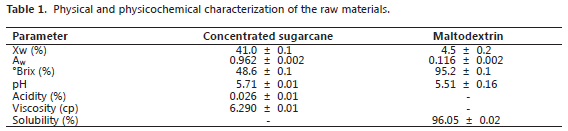
<body><![CDATA[<p><font size="2" face="Verdana, Arial, Helvetica, sans-serif">The particle size distribution was measured using a Mastersizer&reg; 2,000 laser light diffraction kit (Malvern Instruments Co.). The particle size was expressed as d(0.1), d(0.5) and d(0.9) (Finney <i>et al</i>., 2002; Jayasundera <i>et al</i>., 2011a).</font></p>     <p><font size="2" face="Verdana, Arial, Helvetica, sans-serif"><i><b>Effective recovery and formation of deposits in the drying chamber.</b></i> The effective recovery variable was determined in terms of percentage as the ratio of kg of solids in the powder obtained in the cyclone to the percentage of kg of solids in the feed. The formation of deposits was also measured in terms of percentage as the ratio of kg of powder attached to the inner wall of the dryer to the expected kg of product in the cyclone (Tonon <i>et al</i>., 2008)</font> </p>     <p><font size="2" face="Verdana, Arial, Helvetica, sans-serif"><i><b>Experiment design.</b></i> The experimental design consisted of a composite central design and the optimization process was performed using a response surface with four independent factors. The experimental design explored points located within the levels and also outside them. The factors were: (A) maltodextrin content (10 - 20%), which is the amount of maltodextrin in the formulation, (B) inlet air temperature (130 - 150 &deg;C), (C) outlet air temperature (75 - 85 &deg;C), which was controlled through the feed mass, and (D) atomizer disk speed (22,000 to 26,000 rpm). There were 8 axial points, 8 factor points and 6 central points, thus generating 22 experiments that were analyzed statistically using the Design Expert 8.0 software and an analysis of variance (ANOVA) with a significance level of 5%. The response variables to be optimized were: % effective recovery (maximum), % of deposit formation in the drying chamber (minimum), water activity (minimum), moisture content (minimum), solubility of the powder (maximum) and hygroscopicity level (minimum). A regression analysis was solved with a second-order polynomial model according to Equation 1:</font></p>     <p><font size="2" face="Verdana, Arial, Helvetica, sans-serif"></font><img src="/img/revistas/rfnam/v68n1/v68n1a12eq01.gif"></p>     <p><font size="2" face="Verdana, Arial, Helvetica, sans-serif">Where <font face="Symbol">b</font>0 is a intercept, <i><font face="Symbol">b</font></i><sub>A</sub>, <i><font face="Symbol">b</font></i><sub>B</sub>, <i><font face="Symbol">b</font></i><sub>C</sub> and <i><font face="Symbol">b</font></i><sub>D</sub> are the coefficients of each factor;  are the coefficients of the double interaction and <i><font face="Symbol">b</font></i><sub>AB</sub>, <i><font face="Symbol">b</font></i><sub>AC</sub>,<i> <font face="Symbol">b</font></i><sub>AD</sub>,<i> <font face="Symbol">b</font></i><sub>BC</sub>,<i> <font face="Symbol">b</font></i><sub>BD</sub>,<i> <font face="Symbol">b</font></i><sub>CD</sub> are coefficients defined by the interaction between the factors (Bezerra <i>et al</i>., 2008).</font></p>     <p><font size="2" face="Verdana, Arial, Helvetica, sans-serif"><i><b>Optimization and verification of model</b></i><b>. </b>The optimization process was performed using the methodology of response surface with a central composite experimental design with four factors: (A) maltodextrin (10 - 20%), which is the amount of maltodextrin in the formulation, (B) inlet air temperature (130 - 150 &deg;C), (C) outlet air temperature (75 - 85 &deg;C), which was controlled through the feed mass, and (D) atomizer disk speed (22,000 to 26,000 rpm). There were 8 axial points, 8 factorial points and 6 central points, thus generating 22 experiments. The Design Expert 8.0 software was used for the statistical analysis and a significance level of 5% was established </font></p>     <p><font size="2" face="Verdana, Arial, Helvetica, sans-serif">The following response variables were optimized: % effective recovery (maximum), % of deposit formation in the drying chamber (minimum), water activity (minimum), moisture content (minimum), powder solubility (maximum) and hygroscopicity level (minimum). Experimental data for the spray drying of the sugar cane juice were obtained by conducting the experiments under the recommended optimum conditions. Verification of the response surface model was performed by comparing the experimental value obtained from an independent set of samples with the predicted value obtained from the optimized model.</font></p>     <p>&nbsp;</p>     <p><font size="3" face="Verdana, Arial, Helvetica, sans-serif"><b>RESULTS AND DISCUSSION</b></font></p>     <p><font size="2" face="Verdana, Arial, Helvetica, sans-serif"><a href="#tab01">Table 1</a> shows the average values of the physicochemical and physical parameters of the concentrated sugarcane juice and maltodextrin. The results shows that the concentrated sugarcane juice used in the experiments was within the range of operating conditions of the spray drying equipment (&deg;Brix &lt;50% and viscosity &lt;600 cp). Furthermore, the drying process was more efficient because the sugarcane juice had a lower moisture content than the juice obtained from the initial extraction process (Guzm&aacute;n and Casta&ntilde;o, 2002). The maltodextrin was a powder with low moisture that exhibited good solubility and added no flavor or odor to the final product (Kenyon, 1995; Wang and Wang, 2000).</font></p>     ]]></body>
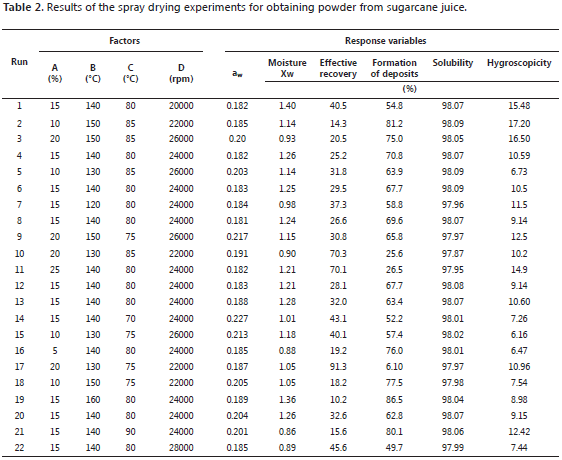
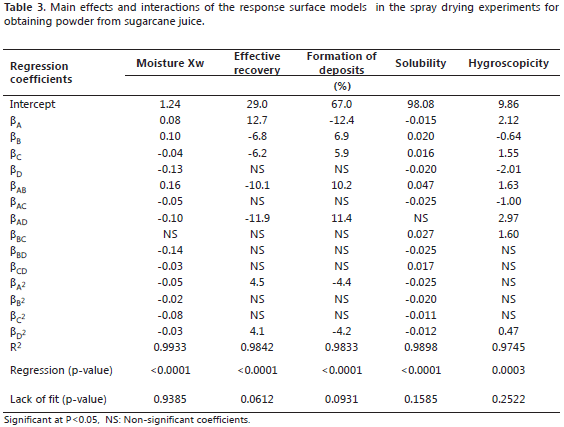
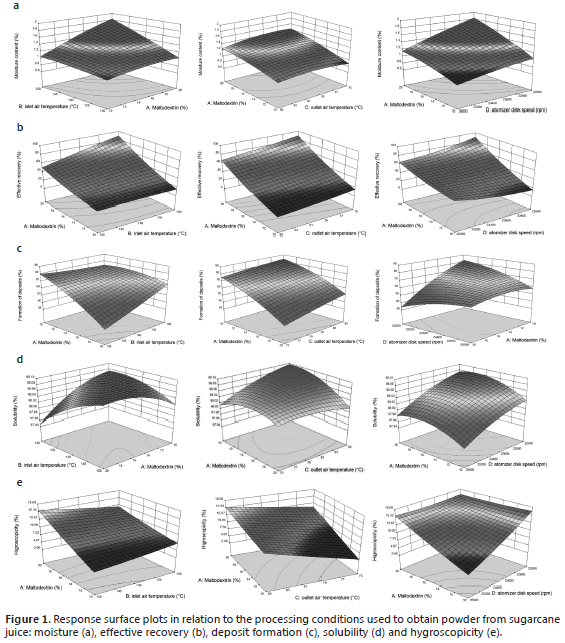
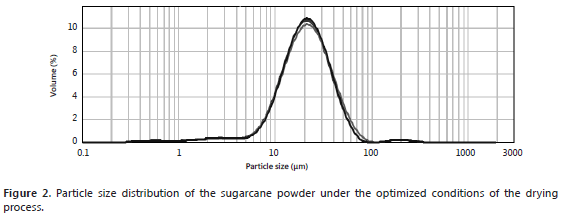
<body><![CDATA[<p align="center"><font size="2" face="Verdana, Arial, Helvetica, sans-serif"><a name="tab01"></a></font><img src="/img/revistas/rfnam/v68n1/v68n1a12tab01.gif"></p>     <p><font size="2" face="Verdana, Arial, Helvetica, sans-serif">For each experiment in the experimental design, three samples of the powder were taken when the system reached stable state conditions to observe the reproducibility. <a href="#tab02">Table 2</a> shows the average values and the standard deviation of the response variables according to the experimental design. <a href="#fig01">Figure 1</a> shows the response surface to moisture content (a), product recovery (b), deposit formation (c), solubility (d), and hygroscopicity (e) in relation to the studied factors. <a href="#tab03">Table 3</a> shows the coefficients of the polynomial model for the response variables according to equation 1. </font></p>     <p align="center"><font size="2" face="Verdana, Arial, Helvetica, sans-serif"><a name="tab02"></a></font><img src="/img/revistas/rfnam/v68n1/v68n1a12tab02.gif"></p>     <p align="center"><font size="2" face="Verdana, Arial, Helvetica, sans-serif"><a name="tab03"></a></font><img src="/img/revistas/rfnam/v68n1/v68n1a12tab03.gif"></p>     <p align="center"><font size="2" face="Verdana, Arial, Helvetica, sans-serif"><a name="fig01"></a></font><img src="/img/revistas/rfnam/v68n1/v68n1a12fig01.gif"></p>     <p><font size="2" face="Verdana, Arial, Helvetica, sans-serif">The minimum and maximum values obtained for the response variables were: moisture (0.86 - 1.40%), water activity (0.181 - 0.227), effective recovery (10.2 -91.3%), formation of deposits in the drying chambers (6.1 - 86.5%), solubility (97.87 - 98.09%), and hygroscopicity (6.16 - 17.2%). </font></p>     <p><font size="2" face="Verdana, Arial, Helvetica, sans-serif">The summarized ANOVA showed significant differences (P&lt;0.05) in terms of Xw with respect to factors A, B, C, D, and the interactions (but excluding the BC interaction). Nevertheless, this influence had low variability coefficients, as well as low average values (maximum value of 1.40%); this is consistent with the results found for aw, which showed no significant differences (P&gt;0.05) when compared with the factors and their interactions. This could be explained by the fact that, under all the evaluated processing conditions, the sugarcane powder had values that were close to the moisture of the monolayer. This suggests that the drying process was effective under the evaluated conditions. Additionally, the values obtained in this study are similar to those reported in other studies on sorption isotherms of granulated jaggery (1.41% d.b) (Lara <i>et al</i>., 2008) and lower than those obtained in studies on sugarcane juice powder with maltodextrin (Largo, 2012), where the adsorption forces were maximal due to a stronger energetic interaction between the absorbent agent (water in the environment) and the absorbate (powder of sugarcane), which generates more sorption heat (Martinez <i>et al</i>., 1998). On the other hand, these differences in Xw could be associated with the differences in the size of the atomized droplets, which modify the final moisture content values for the dry product and provide a distribution of particle sizes. In the case of the optimal point, which coincided with the conditions of experiment 17 (<a href="#tab02">Table 2</a>), the values were d10 = 9.5 &mu;m, d50= 20.9 &mu;m and d90 = 41.6 &mu;m (<a href="#fig02">Figure 2</a>). </font></p>     <p align="center"><font size="2" face="Verdana, Arial, Helvetica, sans-serif"><a name="fig02"></a></font><img src="/img/revistas/rfnam/v68n1/v68n1a12fig02.gif"></p>     <p><font size="2" face="Verdana, Arial, Helvetica, sans-serif">According to the results presented in <a href="#fig01">Figure 1</a>, the moisture content had a very complex behavior that depended on the combinations of the studied factors. Nevertheless, the obtained moisture content values exhibited low variability among the different experiments. It was observed (<a href="#fig01">Figure 1a</a>) that this parameter decreased under the following conditions: a. increasing the maltodextrin content  at  a low air inlet temperature (130 &deg;C) (higher total solids content and lower water content in the feed), b. decreasing the maltodextrin content  at high air inlet temperatures (150 &deg;C), c. increasing air inlet temperature at a low concentration of maltodextrin (10%) (higher  evaporation capacity with low relative humidity which produces  a higher driving force or chemical potential  between air and drop (water), d. decreasing the inlet air temperature at high concentrations of maltodextrin (20%) (lower content of water in the feed), e. increasing the air outlet temperature (lower mass flow rate), f.  increasing the rotation speed of the atomizer disk (smaller size of water droplet). Similar moisture content values have been reported in sugarcane powder (Guzm&aacute;n and Casta&ntilde;o, 2002), but studies on sugar-rich fruits  added with maltodextrin have reported higher moisture values (Chegini and Ghobadian, 2005; Kha <i>et al</i>., 2010; Gallo <i>et al</i>., 2011; Caparino <i>et al</i>., 2012).  On the other hand, similar behaviors have been observed in the spray drying of orange juice when the inlet air temperature was increased (Goula and Adamopoulos, 2010).  This has also been observed in formulations for sugar-rich foods when the moisture was reduced upon adding maltodextrin (Adhikari <i>et al</i>., 2009). </font></p>     <p><font size="2" face="Verdana, Arial, Helvetica, sans-serif">The effective recovery of the product showed statistically significant differences (P&lt;0.05) regarding factors A, B, and C, and interactions  AB, AD,  A<sup>2</sup>, and D<sup>2</sup>. The effective recovery was mainly reduced by increasing the inlet air temperature (factor B), this could be due to the fusion of existing carbohydrates (mainly saccharose, fructose, and glucose), which leads to an increase in the formation of deposits in the internal walls of the drying chamber. This phenomenon had statistically significant differences (P&lt;0.05) for factors A, B, and C, and interactions A<sup>2</sup>, D<sup>2</sup>, AB, and AD. The values for effective recovery and formation of deposits for sugarcane were positively affected by the solids contribution of the maltrodextrin in the dryer's mass feed; this happens mainly at low inlet air temperatures (around 130 &deg;C.) (Cai and Corke, 2000). Similar results have been reported for saccharose solutions which describe the behavior of sugar-rich foods (Bhandari <i>et al</i>., 1997; Jayasundera <i>et al</i>., 2011a).</font></p>     ]]></body>
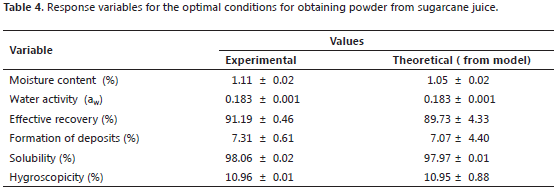
<body><![CDATA[<p><font size="2" face="Verdana, Arial, Helvetica, sans-serif">Recent studies have shown that applying alternative drying aids such as proteins and surfactants with a low molecular weight may improve the recovery and quality of powder produced using spray drying (Goula and Adamopoulos, 2008; Jayasundera <i>et al</i>., 2011a; Jayasundera <i>et al</i>., 2011b; Jayasundera <i>et al</i>., 2011c). The University of Sydney has developed a type of protein that increases the recovery of sugar-rich materials by up to 80% by simply adding a small amount (&lt;5%) in the fruit juice (Caparino <i>et al</i>., 2012).</font></p>     <p><font size="2" face="Verdana, Arial, Helvetica, sans-serif">The effective recovery of the product (<a href="#fig01">Figure 1b</a>) decreased as the  maltodextrin content decreased. The reason for this is that a lower content of total solids in the mass feed produces less density; less density in turn means that a lower viscosity could lead to higher values of radial speed, thus causing the droplets to collide with the internal walls of the drying chamber at a greater speed and intensity. This could produce more deposits and reduce the yield of the process (Masters, 1991). Furthermore, increases in inlet and outlet air temperatures also decrease effective recovery (because it means greater evaporation capacity and adhesion of the product to the internal walls of the drying chamber due to fusion of the material). Likewise, reducing the speed of the disk while using smaller amounts of maltodextrin (10%) also decreases the effective recovery (a larger droplet with high levels of moisture generates more interparticle cohesion, meaning that greater amounts of the product are stuck to the internal walls of the drying chamber). Finally, increasing the speed of the atomizer disk while using larger amounts of maltodextrin (20%) also reduces the effective recovery (raising the speed of the atomizer disk produces smaller droplets which, at lower levels of moisture, require less evaporating heat and cause outlet air temperature to be higher, thus leading to increased adhesion to the internal walls of the drying chamber). The results obtained for this optimization process were higher than those reported in other studies during the spray drying process performed on saccharose solutions (maximum value of 56%) (Bhandari <i>et al</i>., 1997) and sugarcane juice carried out using atomization (maximum value of 60.18%) (Guzm&aacute;n and Casta&ntilde;o, 2002).</font></p>     <p><font size="2" face="Verdana, Arial, Helvetica, sans-serif">It is important to take into account that adding maltodextrin to the dryer's mass feed (<a href="#fig01">Figure 1b</a>) caused an increase in the glass transition temperature (Tg) of the dry product. This is  because the yield of the process was higher at high maltodextrin concentrations, low inlet air temperatures (130 &deg;C), low outlet air temperature (75 &deg;C), and low atomizer disk speeds. This could be explained by the fact that low drying temperatures generate less deposits inside the drying chamber. Similar results were reported for orange (Shrestha <i>et al</i>., 2007) and  acai juice (Tonon <i>et al</i>., 2008).  Additionally, in a study on spray drying with grape juice, the authors concluded that increasing the inlet air temperature decreased the process yield (Papadakis <i>et al</i>., 2006).</font></p>     <p><font size="2" face="Verdana, Arial, Helvetica, sans-serif">The values for formation of deposits (<a href="#fig01">Figure 1c</a>) on the internal wall of the drying chamber were consistent with those of product recovery, since they decreased as the maltodextrin content increased  at low inlet and outlet air temperatures and atomizer disk speeds. Concentrated sugarcane juice is a very thermosensitive and sugar-rich food. Raising the inlet air temperature significantly reduces the process yield because the dry solid experiences a first-order transition upon fusion (Roos, 1995).</font></p>     <p><font size="2" face="Verdana, Arial, Helvetica, sans-serif">The solubility showed statistically significant differences (P&lt;0.05) when compared to all the factors and interactions, except for the AD interaction. This proves that the formulation for the dryer's mass feed and the operating variables for the drying process play a key role. Generally speaking, the solubility of the sugarcane powder was high (&gt;97%). The main reason is that sugars such as saccharose, glucose disaccharide, and fructose have high solubility; this is due to the high number of hydroxyl groups (OH) in the molecule (King <i>et al</i>., 1984; Dib-Taxi <i>et al</i>., 2003).  Furthermore, maltodextrin, a derivative of the starch obtained from corn, is an encapsulation agent widely used in spray drying processes given its high values of solubility in water and its high glass transition temperature (Desai and Park, 2005; Ersus and Yurdagel, 2007).  Instant solubility is directly related to the microstructure of the powder. A larger amorphous surface means that the powder will have more solubility in water; conversely, the presence of particles in a crystalline state results in lower solubility (Cano <i>et al</i>., 2005; Caparino <i>et al</i>., 2012).</font></p>     <p><font size="2" face="Verdana, Arial, Helvetica, sans-serif">Both moisture content and solubility were very dependent on the factors and their combinations. However, there were low variability coefficients. The solubility of the powder (<a href="#fig01">Figure 1d</a>) increased under the following conditions: when the maltodextrin content and the inlet and outlet air temperatures were high; when the maltodextrin content was low and the outlet air temperature was high (the high solubility of the maltodextrin and the thermal stress of the process might be generating a high and irregular specific surface, facilitating solvation during reconstitution), and when the atomizer disk speed was low and the maltodextrin concentration was medium (12 - 14%) (a larger particle size leads to a lower product temperature and a higher content of moisture, which could be causing agglomeration and increased apparent density in the product, which in turn cause more solubility and solvation). Similar results were reported for cape gooseberry (<i>Physalis peruviana</i> L.) powder with the addition of vitamins B9, C, iron, and soluble fiber (Hern&aacute;ndez, 2011), for apple juice (Ara&uacute;jo de Oliveira <i>et al</i>., 2009), and for saccharose powder with maltodextrin (Paramita <i>et al</i>., 2010).</font></p>     <p><font size="2" face="Verdana, Arial, Helvetica, sans-serif">The hygroscopicity showed significant statistical differences (P&lt;0.05) in terms of factors A, B, C, and D as well as interactions AB, AC, AD, BC, and D<sup>2</sup>. Particle size is an important parameter to determinate the surface area of the particles; smaller particles increase the surface area while the bigger particles decrease it. This leads to more water adsorption from the environment, depending on the active points in the dry matrix adsorption force (Nayak and Rastogi, 2010; Sudeep <i>et al</i>., 2010).  This situation may lead to agglomeration of the product during storage. The results for hygroscopicity show that  sugarcane powder is a hygroscopic product that can reach moisture levels ranging from 6 to 17% (w.b) in an environment whose relative humidity is 68.7%. </font></p>     <p><font size="2" face="Verdana, Arial, Helvetica, sans-serif">In general, the hygroscopicity (<a href="#fig01">Figure 1e</a>) of the sugarcane powder decreased when there was low content of maltodextrin, mainly when the system had a high inlet air temperature, low air outlet temperature, and high atomizer disk speed. These results are consistent with studies in which the physical changes occurring at low moisture levels with a high content of sugar in the dehydrated food included a high hygroscopicity. This could be due to the glass transition temperature Tg (Roos, 1993). Likewise, similar hygroscopicity values have been reported in studies on mango pulp drying using maltodextrin (Caparino <i>et al</i>., 2012) and tomato pulp (Goula and Adamopoulos, 2008).</font></p>     <p><font size="2" face="Verdana, Arial, Helvetica, sans-serif">Generally speaking, all the regression coefficients (R<sup>2</sup>) of the quadratic mathematical models that fit to the response variables were greater than 97%. This is very representative for determining these and other independent variables (factors) within the assessed ranges. </font></p>     <p><font size="2" face="Verdana, Arial, Helvetica, sans-serif"><i><b>Optimization process</b></i><b>.</b> In order to obtain  sugarcane juice powder while minimizing the  moisture content, formation of deposits in the dryer, and hygroscopicity level and maximizing the effective recovery and solubility, the optimal drying conditions were determined based on the combination of multiples responses. aw was not considered because it did not present any statistically significant differences. Multiple graphical and numerical optimizations were carried out using the Design Expert 8.0 software to determine the optimum level of the independent variables with desirable response goals. One optimal condition was obtained for several responses given the following operating conditions: percentage of maltodextrin in the formulation (20%), atomizer disk speed (22,000 rpm), inlet air temperature (130 &deg;C), and outlet air temperature (75 &deg;C). <a href="#tab04">Table 4</a> shows the values obtained at optimal experiment conditions and the values according to the polynomial model for each response variable. </font></p>     ]]></body>
<body><![CDATA[<p align="center"><font size="2" face="Verdana, Arial, Helvetica, sans-serif"><a name="tab04"></a></font><img src="/img/revistas/rfnam/v68n1/v68n1a12tab04.gif"></p>     <p><font size="2" face="Verdana, Arial, Helvetica, sans-serif"><i><b>Verification of the model</b></i><b>.</b> Three experiments were carried out under the recommended optimum conditions to test the adequacy of the response surface model in predicting the optimum response values. The observed experimental and predicted values are given in <a href="#tab04">Table 4</a>. The experimental response values were in agreement with the predicted values as no significant difference (P&gt;0.05) was found between the experimental values and the predicted values. </font></p>     <p>&nbsp;</p>     <p><font size="3" face="Verdana, Arial, Helvetica, sans-serif"><b>CONCLUSIONS</b></font></p>     <p><font size="2" face="Verdana, Arial, Helvetica, sans-serif">The response variables moisture, effective percentage of recovery, formation of deposits, solubility, and hygroscopicity were affected by the feed composition and the processing conditions for obtaining powder from sugarcane juice. The optimal independent variables for this process were: maltodextrin (20%) in the composition of the feed, atomizer disk speed (22,000 rpm), inlet air temperature (130 &deg;C) and outlet air temperature (75 &deg;C).</font></p>     <p><font size="2" face="Verdana, Arial, Helvetica, sans-serif">Since sugarcane powder is a sugar-rich food product, it is recognized as heat-sensitive and requires encapsulating additives such as maltodextrin for the spray drying process to be successful. The evaluated physicochemical properties for the sugarcane powder presented adequate quality characteristics that make it suitable for direct consumption or for reconstitution in water. Furthermore, it could also be used as an ingredient in food industries.</font></p>     <p>&nbsp;</p>     <p><font size="3" face="Verdana, Arial, Helvetica, sans-serif"><b>BIBLIOGRAPHY</b></font></p>     <!-- ref --><p><font size="2" face="Verdana, Arial, Helvetica, sans-serif">Adhikari, B., T. Howes, B.R. Bhandari and V. Truong. 2003. Characterization of the surface stickiness of fructose-maltodextrin solutions during drying. Drying Technology 21(1): 17-34.    &nbsp;&nbsp;&nbsp;&nbsp;&nbsp;&nbsp;&nbsp;&nbsp;[&#160;<a href="javascript:void(0);" onclick="javascript: window.open('/scielo.php?script=sci_nlinks&ref=000071&pid=S0304-2847201500010001200001&lng=','','width=640,height=500,resizable=yes,scrollbars=1,menubar=yes,');">Links</a>&#160;]<!-- end-ref --></font></p>     ]]></body>
<body><![CDATA[<!-- ref --><p><font size="2" face="Verdana, Arial, Helvetica, sans-serif">Adhikari, B., T. Howes, B.J. Wood and B.R. Bhandari. 2009. The effect of low molecular weight surfactants and proteins on surface stickiness of sucrose during powder formation through spray drying. Journal of Food Engineering 94(2): 135-146.    &nbsp;&nbsp;&nbsp;&nbsp;&nbsp;&nbsp;&nbsp;&nbsp;[&#160;<a href="javascript:void(0);" onclick="javascript: window.open('/scielo.php?script=sci_nlinks&ref=000073&pid=S0304-2847201500010001200002&lng=','','width=640,height=500,resizable=yes,scrollbars=1,menubar=yes,');">Links</a>&#160;]<!-- end-ref --></font></p>     <!-- ref --><p><font size="2" face="Verdana, Arial, Helvetica, sans-serif">Ara&uacute;jo de Oliveira, M., M. Geraldo Arraes, G. Wilane de Figueiredo, A.C. Rodrigues de Souza, E. Sousa de Brito and H.M. Cordeiro de Azeredo. 2009. Addition of cashew tree gum to maltodextrin-based carriers for spray drying of cashew apple juice. International Journal of Food Science and Technology 44(3): 641-645.    &nbsp;&nbsp;&nbsp;&nbsp;&nbsp;&nbsp;&nbsp;&nbsp;[&#160;<a href="javascript:void(0);" onclick="javascript: window.open('/scielo.php?script=sci_nlinks&ref=000075&pid=S0304-2847201500010001200003&lng=','','width=640,height=500,resizable=yes,scrollbars=1,menubar=yes,');">Links</a>&#160;]<!-- end-ref --></font></p>     <!-- ref --><p><font size="2" face="Verdana, Arial, Helvetica, sans-serif">Association of Official Analytical Chemists (AOAC). 2002. Official methods of analysis of AOAC International. 17th edition. 1st revision. Association of Analytical Communities, Gaithersburg, MD, USA,    &nbsp;&nbsp;&nbsp;&nbsp;&nbsp;&nbsp;&nbsp;&nbsp;[&#160;<a href="javascript:void(0);" onclick="javascript: window.open('/scielo.php?script=sci_nlinks&ref=000077&pid=S0304-2847201500010001200004&lng=','','width=640,height=500,resizable=yes,scrollbars=1,menubar=yes,');">Links</a>&#160;]<!-- end-ref --> </font></p>     <!-- ref --><p><font size="2" face="Verdana, Arial, Helvetica, sans-serif">Bezerra, M.A., R.E. Santelli, E.P. Oliveira, L.S. Villar and L.A Escaleiraa. 2008. Response surface methodology (RSM) as a tool for optimization in analytical chemistry. Talanta 76(5): 965-977.    &nbsp;&nbsp;&nbsp;&nbsp;&nbsp;&nbsp;&nbsp;&nbsp;[&#160;<a href="javascript:void(0);" onclick="javascript: window.open('/scielo.php?script=sci_nlinks&ref=000079&pid=S0304-2847201500010001200005&lng=','','width=640,height=500,resizable=yes,scrollbars=1,menubar=yes,');">Links</a>&#160;]<!-- end-ref --></font></p>     <!-- ref --><p><font size="2" face="Verdana, Arial, Helvetica, sans-serif">Bhandari, B.R., N. Datta and T. Howes. 1997. Problems associated with spray drying of sugar rich foods. Drying Technology 15(2): 671-684.    &nbsp;&nbsp;&nbsp;&nbsp;&nbsp;&nbsp;&nbsp;&nbsp;[&#160;<a href="javascript:void(0);" onclick="javascript: window.open('/scielo.php?script=sci_nlinks&ref=000081&pid=S0304-2847201500010001200006&lng=','','width=640,height=500,resizable=yes,scrollbars=1,menubar=yes,');">Links</a>&#160;]<!-- end-ref --></font></p>     ]]></body>
<body><![CDATA[<!-- ref --><p><font size="2" face="Verdana, Arial, Helvetica, sans-serif">Bhandari, B. and T. Howes. 2005. Relating the stickiness property of foods undergoing drying and dried products to their surface energetics. Drying Technology 23(4): 781-797.    &nbsp;&nbsp;&nbsp;&nbsp;&nbsp;&nbsp;&nbsp;&nbsp;[&#160;<a href="javascript:void(0);" onclick="javascript: window.open('/scielo.php?script=sci_nlinks&ref=000083&pid=S0304-2847201500010001200007&lng=','','width=640,height=500,resizable=yes,scrollbars=1,menubar=yes,');">Links</a>&#160;]<!-- end-ref --></font></p>     <!-- ref --><p><font size="2" face="Verdana, Arial, Helvetica, sans-serif">Bringas, M., I.E. Molina, G.A. Reineccius, O. L&oacute;pez and J.A. Pino. 2011. Influence of spray-dryer air temperatures on encapsulated mandarin oil. Drying Technology 29(5): 520-526.    &nbsp;&nbsp;&nbsp;&nbsp;&nbsp;&nbsp;&nbsp;&nbsp;[&#160;<a href="javascript:void(0);" onclick="javascript: window.open('/scielo.php?script=sci_nlinks&ref=000085&pid=S0304-2847201500010001200008&lng=','','width=640,height=500,resizable=yes,scrollbars=1,menubar=yes,');">Links</a>&#160;]<!-- end-ref --> </font></p>     <!-- ref --><p><font size="2" face="Verdana, Arial, Helvetica, sans-serif">Cai, Y.Z. and H. Corke. 2000. Production and properties of spray-dried amaranthus betacyanin pigments. Journal of Food Science 65(7): 1248-1252.    &nbsp;&nbsp;&nbsp;&nbsp;&nbsp;&nbsp;&nbsp;&nbsp;[&#160;<a href="javascript:void(0);" onclick="javascript: window.open('/scielo.php?script=sci_nlinks&ref=000087&pid=S0304-2847201500010001200009&lng=','','width=640,height=500,resizable=yes,scrollbars=1,menubar=yes,');">Links</a>&#160;]<!-- end-ref --> </font></p>     <!-- ref --><p><font size="2" face="Verdana, Arial, Helvetica, sans-serif">Cano, M., P.C. Stringheta, A.M. Ramos and J. Cal-Vidal. 2005. Effect of the carriers on the microstructure of mango powder obtained by spray drying and its functional characterization. Innovative Food Science and Emerging Technologies 6(4): 420-428.    &nbsp;&nbsp;&nbsp;&nbsp;&nbsp;&nbsp;&nbsp;&nbsp;[&#160;<a href="javascript:void(0);" onclick="javascript: window.open('/scielo.php?script=sci_nlinks&ref=000089&pid=S0304-2847201500010001200010&lng=','','width=640,height=500,resizable=yes,scrollbars=1,menubar=yes,');">Links</a>&#160;]<!-- end-ref --></font></p>     <!-- ref --><p><font size="2" face="Verdana, Arial, Helvetica, sans-serif">Caparino, O.A., J. Tang, C.I. Nindo, S.S. Sablani, J.R. Powers and J.K. Fellman. 2012. Effect of drying methods on the physical properties and microstructures of mango (Philippine 'Carabao' var.) powder. Journal of Food Engineering 111: 135-148.    &nbsp;&nbsp;&nbsp;&nbsp;&nbsp;&nbsp;&nbsp;&nbsp;[&#160;<a href="javascript:void(0);" onclick="javascript: window.open('/scielo.php?script=sci_nlinks&ref=000091&pid=S0304-2847201500010001200011&lng=','','width=640,height=500,resizable=yes,scrollbars=1,menubar=yes,');">Links</a>&#160;]<!-- end-ref --></font></p>     ]]></body>
<body><![CDATA[<!-- ref --><p><font size="2" face="Verdana, Arial, Helvetica, sans-serif">Chegini, G.R. and B. Ghobadian. 2005. Effect of spray-drying conditions on physical properties of orange juice powder. Drying Technology 23(3): 657-668.    &nbsp;&nbsp;&nbsp;&nbsp;&nbsp;&nbsp;&nbsp;&nbsp;[&#160;<a href="javascript:void(0);" onclick="javascript: window.open('/scielo.php?script=sci_nlinks&ref=000093&pid=S0304-2847201500010001200012&lng=','','width=640,height=500,resizable=yes,scrollbars=1,menubar=yes,');">Links</a>&#160;]<!-- end-ref --></font></p>     <!-- ref --><p><font size="2" face="Verdana, Arial, Helvetica, sans-serif">Chen, X.D. and K.C. Patel. 2008. Manufacturing better quality food powders from spray drying and subsequent treatments. Drying Technology 26(11): 1313-1318.    &nbsp;&nbsp;&nbsp;&nbsp;&nbsp;&nbsp;&nbsp;&nbsp;[&#160;<a href="javascript:void(0);" onclick="javascript: window.open('/scielo.php?script=sci_nlinks&ref=000095&pid=S0304-2847201500010001200013&lng=','','width=640,height=500,resizable=yes,scrollbars=1,menubar=yes,');">Links</a>&#160;]<!-- end-ref --></font></p>     <!-- ref --><p><font size="2" face="Verdana, Arial, Helvetica, sans-serif">Cort&eacute;s, M., L.F. Guardiola y R. Pacheco. 2007. Aplicaci&oacute;n de la ingenier&iacute;a de matrices en la fortificaci&oacute;n de mango (var. Tommy Atkins) con calcio. Revista Dyna 74(153): 19-26.    &nbsp;&nbsp;&nbsp;&nbsp;&nbsp;&nbsp;&nbsp;&nbsp;[&#160;<a href="javascript:void(0);" onclick="javascript: window.open('/scielo.php?script=sci_nlinks&ref=000097&pid=S0304-2847201500010001200014&lng=','','width=640,height=500,resizable=yes,scrollbars=1,menubar=yes,');">Links</a>&#160;]<!-- end-ref --> </font></p>     <!-- ref --><p><font size="2" face="Verdana, Arial, Helvetica, sans-serif">Desai, K.G. and H.J. Park. 2005. Encapsulation of vitamin C in tripolyphosphate cross-linked chitosan microspheres by spray drying. Journal of Microencapsulation 22(2): 179-192.    &nbsp;&nbsp;&nbsp;&nbsp;&nbsp;&nbsp;&nbsp;&nbsp;[&#160;<a href="javascript:void(0);" onclick="javascript: window.open('/scielo.php?script=sci_nlinks&ref=000099&pid=S0304-2847201500010001200015&lng=','','width=640,height=500,resizable=yes,scrollbars=1,menubar=yes,');">Links</a>&#160;]<!-- end-ref --></font></p>     <!-- ref --><p><font size="2" face="Verdana, Arial, Helvetica, sans-serif">Dib Taxi, C.M., H.C. Menezes, A.B. Santos and C.R. Grosso. 2003. Studry of the microencapsulation of camu-camu (<i>Myrciaria dubai</i>) juice. Journal of Microencapsulation 20(4): 443-448.    &nbsp;&nbsp;&nbsp;&nbsp;&nbsp;&nbsp;&nbsp;&nbsp;[&#160;<a href="javascript:void(0);" onclick="javascript: window.open('/scielo.php?script=sci_nlinks&ref=000101&pid=S0304-2847201500010001200016&lng=','','width=640,height=500,resizable=yes,scrollbars=1,menubar=yes,');">Links</a>&#160;]<!-- end-ref --></font></p>     ]]></body>
<body><![CDATA[<!-- ref --><p><font size="2" face="Verdana, Arial, Helvetica, sans-serif">Drusch, S. and K. Schwarz. 2006. Microencapsulation properties of two different types of n-octenylsuccinate-derivatised starch. European Food Research and Technology 222(1-2): 155-164.    &nbsp;&nbsp;&nbsp;&nbsp;&nbsp;&nbsp;&nbsp;&nbsp;[&#160;<a href="javascript:void(0);" onclick="javascript: window.open('/scielo.php?script=sci_nlinks&ref=000103&pid=S0304-2847201500010001200017&lng=','','width=640,height=500,resizable=yes,scrollbars=1,menubar=yes,');">Links</a>&#160;]<!-- end-ref --></font></p>     <!-- ref --><p><font size="2" face="Verdana, Arial, Helvetica, sans-serif">Ersus, S. and U. Yurdagel. 2007. Microencapsulation of anthocyanin pigments of black carrot (<i>Daucus carota</i> L.) by spray drier. Journal of Food Engineering 80(3): 805-812.    &nbsp;&nbsp;&nbsp;&nbsp;&nbsp;&nbsp;&nbsp;&nbsp;[&#160;<a href="javascript:void(0);" onclick="javascript: window.open('/scielo.php?script=sci_nlinks&ref=000105&pid=S0304-2847201500010001200018&lng=','','width=640,height=500,resizable=yes,scrollbars=1,menubar=yes,');">Links</a>&#160;]<!-- end-ref --> </font></p>     <!-- ref --><p><font size="2" face="Verdana, Arial, Helvetica, sans-serif">Fazaeli, M., Z. Emam-Djomeh, A.K. Ashtari and M. Omid. 2012a. Effect of process conditions and carrier concentration for improving drying yield and other quality attributes of spray dried black mulberry (<i>Morus nigra</i>) juice. International Journal of Food Engineering 8(1): 1-20.    &nbsp;&nbsp;&nbsp;&nbsp;&nbsp;&nbsp;&nbsp;&nbsp;[&#160;<a href="javascript:void(0);" onclick="javascript: window.open('/scielo.php?script=sci_nlinks&ref=000107&pid=S0304-2847201500010001200019&lng=','','width=640,height=500,resizable=yes,scrollbars=1,menubar=yes,');">Links</a>&#160;]<!-- end-ref --> </font></p>     <!-- ref --><p><font size="2" face="Verdana, Arial, Helvetica, sans-serif">Fazaeli, M., Z. Emam-Djomeh, A.K. Ashtari and M. Omid. 2012b. Effect of spray drying conditions and feed composition on the physical properties of black mulberry juice powder. Food and Bioproducts Processing 90(4): 667-675.    &nbsp;&nbsp;&nbsp;&nbsp;&nbsp;&nbsp;&nbsp;&nbsp;[&#160;<a href="javascript:void(0);" onclick="javascript: window.open('/scielo.php?script=sci_nlinks&ref=000109&pid=S0304-2847201500010001200020&lng=','','width=640,height=500,resizable=yes,scrollbars=1,menubar=yes,');">Links</a>&#160;]<!-- end-ref --></font></p>     <!-- ref --><p><font size="2" face="Verdana, Arial, Helvetica, sans-serif">Finney, J., R. Buffo and G.A. Reineccius. 2002. Effects of type of atomization and processing temperatures on the physical properties and stability of spray-dried flavors. Journal of Food Science 67(3): 1108-1114.    &nbsp;&nbsp;&nbsp;&nbsp;&nbsp;&nbsp;&nbsp;&nbsp;[&#160;<a href="javascript:void(0);" onclick="javascript: window.open('/scielo.php?script=sci_nlinks&ref=000111&pid=S0304-2847201500010001200021&lng=','','width=640,height=500,resizable=yes,scrollbars=1,menubar=yes,');">Links</a>&#160;]<!-- end-ref --></font></p>     ]]></body>
<body><![CDATA[<!-- ref --><p><font size="2" face="Verdana, Arial, Helvetica, sans-serif">Gallo, L., J.M. Llabot, D.B. Allemandi and P.J. Ver&oacute;nica. 2011. Influence of spray-drying operating conditions on <i>Rhamnus purshiana</i> (C&aacute;scara sagrada) extract powder physical properties. Powder Technology 208(1): 205-214.    &nbsp;&nbsp;&nbsp;&nbsp;&nbsp;&nbsp;&nbsp;&nbsp;[&#160;<a href="javascript:void(0);" onclick="javascript: window.open('/scielo.php?script=sci_nlinks&ref=000113&pid=S0304-2847201500010001200022&lng=','','width=640,height=500,resizable=yes,scrollbars=1,menubar=yes,');">Links</a>&#160;]<!-- end-ref --></font></p>     <!-- ref --><p><font size="2" face="Verdana, Arial, Helvetica, sans-serif">Goula, A.M. and K.G. Adamopoulos. 2010. A new technique for spray drying orange juice concentrate. Innovative Food Science and Emerging Technologies 11(2): 342-351.    &nbsp;&nbsp;&nbsp;&nbsp;&nbsp;&nbsp;&nbsp;&nbsp;[&#160;<a href="javascript:void(0);" onclick="javascript: window.open('/scielo.php?script=sci_nlinks&ref=000115&pid=S0304-2847201500010001200023&lng=','','width=640,height=500,resizable=yes,scrollbars=1,menubar=yes,');">Links</a>&#160;]<!-- end-ref --></font></p>     <!-- ref --><p><font size="2" face="Verdana, Arial, Helvetica, sans-serif">Goula, A.M. and K.G. Adamopoulos. 2008. Effect of maltodextrin addition during spray drying of tomato pulp in dehumidified air: I. drying kinetics and product recovery. Drying Technology 26(6): 714-725.    &nbsp;&nbsp;&nbsp;&nbsp;&nbsp;&nbsp;&nbsp;&nbsp;[&#160;<a href="javascript:void(0);" onclick="javascript: window.open('/scielo.php?script=sci_nlinks&ref=000117&pid=S0304-2847201500010001200024&lng=','','width=640,height=500,resizable=yes,scrollbars=1,menubar=yes,');">Links</a>&#160;]<!-- end-ref --></font></p>     <!-- ref --><p><font size="2" face="Verdana, Arial, Helvetica, sans-serif">Goula, A.M. and K.G. Adamopoulos. 2008. Effect of maltodextrin addition during spray drying of tomato pulp in dehumidified air: II. powder properties. Drying Technology 26(6): 726-737.    &nbsp;&nbsp;&nbsp;&nbsp;&nbsp;&nbsp;&nbsp;&nbsp;[&#160;<a href="javascript:void(0);" onclick="javascript: window.open('/scielo.php?script=sci_nlinks&ref=000119&pid=S0304-2847201500010001200025&lng=','','width=640,height=500,resizable=yes,scrollbars=1,menubar=yes,');">Links</a>&#160;]<!-- end-ref --></font></p>     <!-- ref --><p><font size="2" face="Verdana, Arial, Helvetica, sans-serif">Guzm&aacute;n, G. and J. Casta&ntilde;o. 2002. Secado por atomizaci&oacute;n del jugo de la ca&ntilde;a de az&uacute;car. Cenicaf&eacute; 53(4): 327-333.    &nbsp;&nbsp;&nbsp;&nbsp;&nbsp;&nbsp;&nbsp;&nbsp;[&#160;<a href="javascript:void(0);" onclick="javascript: window.open('/scielo.php?script=sci_nlinks&ref=000121&pid=S0304-2847201500010001200026&lng=','','width=640,height=500,resizable=yes,scrollbars=1,menubar=yes,');">Links</a>&#160;]<!-- end-ref --></font></p>     ]]></body>
<body><![CDATA[<!-- ref --><p><font size="2" face="Verdana, Arial, Helvetica, sans-serif">Hennigs, C., T.K. Kockel and T.A. Langrish. 2001. New measurements of the sticky behavior of skim milk powder. Drying Technology 19(3-4): 471-484.    &nbsp;&nbsp;&nbsp;&nbsp;&nbsp;&nbsp;&nbsp;&nbsp;[&#160;<a href="javascript:void(0);" onclick="javascript: window.open('/scielo.php?script=sci_nlinks&ref=000123&pid=S0304-2847201500010001200027&lng=','','width=640,height=500,resizable=yes,scrollbars=1,menubar=yes,');">Links</a>&#160;]<!-- end-ref --></font></p>     <!-- ref --><p><font size="2" face="Verdana, Arial, Helvetica, sans-serif">Hern&aacute;ndez, G., 2011. Desarrollo de un producto de uchuva (<i>Physalis peruviana</i> L.) en polvo secado por atomizaci&oacute;n adicionado con vitamina C, &aacute;cido f&oacute;lico, hierro y fibra soluble. Tesis Magister en Ciencia y Tecnolog&iacute;a de Alimentos. Facultad de Ciencias Agropecuarias. Universidad Nacional de Colombia, Medell&iacute;n. 101 p.    &nbsp;&nbsp;&nbsp;&nbsp;&nbsp;&nbsp;&nbsp;&nbsp;[&#160;<a href="javascript:void(0);" onclick="javascript: window.open('/scielo.php?script=sci_nlinks&ref=000125&pid=S0304-2847201500010001200028&lng=','','width=640,height=500,resizable=yes,scrollbars=1,menubar=yes,');">Links</a>&#160;]<!-- end-ref --> </font></p>     <!-- ref --><p><font size="2" face="Verdana, Arial, Helvetica, sans-serif">Jayasundera, M., B. Adhikari, R. Adhikari and P.  Aldred. 2011a. The effect of protein types and low molecular weight surfactants on spray drying of sugar-rich foods. Food Hydrocolloids 25(3): 459-469.    &nbsp;&nbsp;&nbsp;&nbsp;&nbsp;&nbsp;&nbsp;&nbsp;[&#160;<a href="javascript:void(0);" onclick="javascript: window.open('/scielo.php?script=sci_nlinks&ref=000127&pid=S0304-2847201500010001200029&lng=','','width=640,height=500,resizable=yes,scrollbars=1,menubar=yes,');">Links</a>&#160;]<!-- end-ref --></font></p>     <!-- ref --><p><font size="2" face="Verdana, Arial, Helvetica, sans-serif">Jayasundera, M., B. Adhikari, R. Adhikari and P. Aldred. 2011b. The effects of proteins and low molecular weight surfactants on spray drying of model sugar-rich foods: powder production and characterisation. Journal of Food Engineering 104(2): 259-271.    &nbsp;&nbsp;&nbsp;&nbsp;&nbsp;&nbsp;&nbsp;&nbsp;[&#160;<a href="javascript:void(0);" onclick="javascript: window.open('/scielo.php?script=sci_nlinks&ref=000129&pid=S0304-2847201500010001200030&lng=','','width=640,height=500,resizable=yes,scrollbars=1,menubar=yes,');">Links</a>&#160;]<!-- end-ref --> </font></p>     <!-- ref --><p><font size="2" face="Verdana, Arial, Helvetica, sans-serif">Jayasundera, M., B. Adhikari, R. Adhikari and P. Aldred. 2011c. Surface protein coverage and its implications on spray-drying of model sugar-rich foods: solubility, powder production and characterisation. Food Chemistry 128(4): 1003-1016.    &nbsp;&nbsp;&nbsp;&nbsp;&nbsp;&nbsp;&nbsp;&nbsp;[&#160;<a href="javascript:void(0);" onclick="javascript: window.open('/scielo.php?script=sci_nlinks&ref=000131&pid=S0304-2847201500010001200031&lng=','','width=640,height=500,resizable=yes,scrollbars=1,menubar=yes,');">Links</a>&#160;]<!-- end-ref --></font></p>     ]]></body>
<body><![CDATA[<!-- ref --><p><font size="2" face="Verdana, Arial, Helvetica, sans-serif">Kenyon, M.M. 1995. Modified starch, maltodextrin, and corn syrup solids as wall materials for food encapsulation. ACS Symposium Series 590: 42-50.    &nbsp;&nbsp;&nbsp;&nbsp;&nbsp;&nbsp;&nbsp;&nbsp;[&#160;<a href="javascript:void(0);" onclick="javascript: window.open('/scielo.php?script=sci_nlinks&ref=000133&pid=S0304-2847201500010001200032&lng=','','width=640,height=500,resizable=yes,scrollbars=1,menubar=yes,');">Links</a>&#160;]<!-- end-ref --></font></p>     <!-- ref --><p><font size="2" face="Verdana, Arial, Helvetica, sans-serif">Kha, T.C., M.H. Nguyen and P.H. Roach. 2010. Effects of spray drying conditions on the physicochemical and antioxidant properties of the Gac (<i>Momordica cochinchinensis</i>) fruit aril powder. Journal of Food Engineering 98(3): 385-392.    &nbsp;&nbsp;&nbsp;&nbsp;&nbsp;&nbsp;&nbsp;&nbsp;[&#160;<a href="javascript:void(0);" onclick="javascript: window.open('/scielo.php?script=sci_nlinks&ref=000135&pid=S0304-2847201500010001200033&lng=','','width=640,height=500,resizable=yes,scrollbars=1,menubar=yes,');">Links</a>&#160;]<!-- end-ref --> </font></p>     <!-- ref --><p><font size="2" face="Verdana, Arial, Helvetica, sans-serif">King, C.J., T.G. Kieckbusch and C.G. Greenwald. 1984. Food quality factors in spray drying. Advantages in Drying 3: 71-120.    &nbsp;&nbsp;&nbsp;&nbsp;&nbsp;&nbsp;&nbsp;&nbsp;[&#160;<a href="javascript:void(0);" onclick="javascript: window.open('/scielo.php?script=sci_nlinks&ref=000137&pid=S0304-2847201500010001200034&lng=','','width=640,height=500,resizable=yes,scrollbars=1,menubar=yes,');">Links</a>&#160;]<!-- end-ref --> </font></p>     <!-- ref --><p><font size="2" face="Verdana, Arial, Helvetica, sans-serif">Lara, N., D. Poaquiza and O. Acu&ntilde;a. 2008. Panela granulada: isotermas de sorci&oacute;n de humedad, modelos de ajuste y calor de sorci&oacute;n. 5 p. En: Memorias II Congreso Ecuatoriano de Ingenier&iacute;a en Alimentos y XI Jornadas de Ciencia y Tecnolog&iacute;a en Alimentos, Universidad T&eacute;cnica Particular de Loja, Ecuador.    &nbsp;&nbsp;&nbsp;&nbsp;&nbsp;&nbsp;&nbsp;&nbsp;[&#160;<a href="javascript:void(0);" onclick="javascript: window.open('/scielo.php?script=sci_nlinks&ref=000139&pid=S0304-2847201500010001200035&lng=','','width=640,height=500,resizable=yes,scrollbars=1,menubar=yes,');">Links</a>&#160;]<!-- end-ref --></font></p>     <!-- ref --><p><font size="2" face="Verdana, Arial, Helvetica, sans-serif">Largo, E. 2012. Desarrollo de un producto en polvo a partir del jugo de ca&ntilde;a panelera utilizando secado por aspersi&oacute;n. Tesis de Magister en Ciencia y Tecnolog&iacute;a de Alimentos, Facultad de Ciencias Agropecuarias. Universidad Nacional de Colombia-Medell&iacute;n, Colombia. 75 p.    &nbsp;&nbsp;&nbsp;&nbsp;&nbsp;&nbsp;&nbsp;&nbsp;[&#160;<a href="javascript:void(0);" onclick="javascript: window.open('/scielo.php?script=sci_nlinks&ref=000141&pid=S0304-2847201500010001200036&lng=','','width=640,height=500,resizable=yes,scrollbars=1,menubar=yes,');">Links</a>&#160;]<!-- end-ref --></font></p>     ]]></body>
<body><![CDATA[<!-- ref --><p><font size="2" face="Verdana, Arial, Helvetica, sans-serif">Mart&iacute;nez, N., A.M. Andr&eacute;s, A. Chiralt y P. Fito. 1998. Termodin&aacute;mica y cin&eacute;tica de sistemas alimento entorno. Universidad Polit&eacute;cnica de Valencia, servicio de publicaci&oacute;n, Valencia, Espa&ntilde;a. 371 p.    &nbsp;&nbsp;&nbsp;&nbsp;&nbsp;&nbsp;&nbsp;&nbsp;[&#160;<a href="javascript:void(0);" onclick="javascript: window.open('/scielo.php?script=sci_nlinks&ref=000143&pid=S0304-2847201500010001200037&lng=','','width=640,height=500,resizable=yes,scrollbars=1,menubar=yes,');">Links</a>&#160;]<!-- end-ref --></font></p>     <!-- ref --><p><font size="2" face="Verdana, Arial, Helvetica, sans-serif">Masters, K. 1991. Spray Drying Handbook.  Fifth edition. Longman Scientific and Technical. Essex, UK. 725 p.    &nbsp;&nbsp;&nbsp;&nbsp;&nbsp;&nbsp;&nbsp;&nbsp;[&#160;<a href="javascript:void(0);" onclick="javascript: window.open('/scielo.php?script=sci_nlinks&ref=000145&pid=S0304-2847201500010001200038&lng=','','width=640,height=500,resizable=yes,scrollbars=1,menubar=yes,');">Links</a>&#160;]<!-- end-ref --></font></p>     <!-- ref --><p><font size="2" face="Verdana, Arial, Helvetica, sans-serif">Moreira, G., M, Costa, A. De Souza, E. De Brito, M. De Medeiros and H. De Azeredo. 2009. Physical properties of spray dried acerola pomace extract as affected by temperature and drying aids. LWT- Food Science and Technology 42(2): 641-645.    &nbsp;&nbsp;&nbsp;&nbsp;&nbsp;&nbsp;&nbsp;&nbsp;[&#160;<a href="javascript:void(0);" onclick="javascript: window.open('/scielo.php?script=sci_nlinks&ref=000147&pid=S0304-2847201500010001200039&lng=','','width=640,height=500,resizable=yes,scrollbars=1,menubar=yes,');">Links</a>&#160;]<!-- end-ref --></font></p>     <!-- ref --><p><font size="2" face="Verdana, Arial, Helvetica, sans-serif">Myers, R.H. and D.C. Montgomery. 2009. Response surface methodology, process and product optimization using designed experiments.  Second edition, John Wiley and Sons, New York, USA. 793 p.    &nbsp;&nbsp;&nbsp;&nbsp;&nbsp;&nbsp;&nbsp;&nbsp;[&#160;<a href="javascript:void(0);" onclick="javascript: window.open('/scielo.php?script=sci_nlinks&ref=000149&pid=S0304-2847201500010001200040&lng=','','width=640,height=500,resizable=yes,scrollbars=1,menubar=yes,');">Links</a>&#160;]<!-- end-ref --></font></p>     <!-- ref --><p><font size="2" face="Verdana, Arial, Helvetica, sans-serif">Nayak, C.A. and N.K. Rastogi. 2010. Effect of selected additives on microencapsulation of anthocyanin by spray drying. Drying Technology 28(12): 1396-1404.    &nbsp;&nbsp;&nbsp;&nbsp;&nbsp;&nbsp;&nbsp;&nbsp;[&#160;<a href="javascript:void(0);" onclick="javascript: window.open('/scielo.php?script=sci_nlinks&ref=000151&pid=S0304-2847201500010001200041&lng=','','width=640,height=500,resizable=yes,scrollbars=1,menubar=yes,');">Links</a>&#160;]<!-- end-ref --></font></p>     ]]></body>
<body><![CDATA[<!-- ref --><p><font size="2" face="Verdana, Arial, Helvetica, sans-serif">Osorio, G. 2007. Buenas Pr&aacute;cticas Agr&iacute;colas -BPA- y Buenas Pr&aacute;cticas de Manufactura  -BPM- en la Producci&oacute;n de Ca&ntilde;a y Panela.  FAO CTP Print Ltda, Medell&iacute;n, Colombia. 200 p.    &nbsp;&nbsp;&nbsp;&nbsp;&nbsp;&nbsp;&nbsp;&nbsp;[&#160;<a href="javascript:void(0);" onclick="javascript: window.open('/scielo.php?script=sci_nlinks&ref=000153&pid=S0304-2847201500010001200042&lng=','','width=640,height=500,resizable=yes,scrollbars=1,menubar=yes,');">Links</a>&#160;]<!-- end-ref --></font></p>     <!-- ref --><p><font size="2" face="Verdana, Arial, Helvetica, sans-serif">Osorio, C., D. Forero and J. Carriazo. 2011. Characterisation and performance assessment of guava (<i>Psidium guajava</i> L.) microencapsulates obtained by spray-drying. Food Research International 44(5): 1174-1181.    &nbsp;&nbsp;&nbsp;&nbsp;&nbsp;&nbsp;&nbsp;&nbsp;[&#160;<a href="javascript:void(0);" onclick="javascript: window.open('/scielo.php?script=sci_nlinks&ref=000155&pid=S0304-2847201500010001200043&lng=','','width=640,height=500,resizable=yes,scrollbars=1,menubar=yes,');">Links</a>&#160;]<!-- end-ref --></font></p>     <!-- ref --><p><font size="2" face="Verdana, Arial, Helvetica, sans-serif">Papadakis, S.E., C. Gardeli and C. Tzia. 2006. Spray drying of raisin juice concentrate. Drying Technology 24(2): 173-180.    &nbsp;&nbsp;&nbsp;&nbsp;&nbsp;&nbsp;&nbsp;&nbsp;[&#160;<a href="javascript:void(0);" onclick="javascript: window.open('/scielo.php?script=sci_nlinks&ref=000157&pid=S0304-2847201500010001200044&lng=','','width=640,height=500,resizable=yes,scrollbars=1,menubar=yes,');">Links</a>&#160;]<!-- end-ref --></font></p>     <!-- ref --><p><font size="2" face="Verdana, Arial, Helvetica, sans-serif">Paramita, V., K. Iida, H. Yoshii and T. Furuta. 2010. Effect of additives on the morphology of spray-dried powder. Drying Technology 28(3): 323-329.    &nbsp;&nbsp;&nbsp;&nbsp;&nbsp;&nbsp;&nbsp;&nbsp;[&#160;<a href="javascript:void(0);" onclick="javascript: window.open('/scielo.php?script=sci_nlinks&ref=000159&pid=S0304-2847201500010001200045&lng=','','width=640,height=500,resizable=yes,scrollbars=1,menubar=yes,');">Links</a>&#160;]<!-- end-ref --></font></p>     <!-- ref --><p><font size="2" face="Verdana, Arial, Helvetica, sans-serif">Rattes, A. and W. Pereira. 2007. Spray drying conditions and encapsulating composition effects on formation and properties of sodium diclofenac microparticles. Powder Technology 171(1): 7-14.    &nbsp;&nbsp;&nbsp;&nbsp;&nbsp;&nbsp;&nbsp;&nbsp;[&#160;<a href="javascript:void(0);" onclick="javascript: window.open('/scielo.php?script=sci_nlinks&ref=000161&pid=S0304-2847201500010001200046&lng=','','width=640,height=500,resizable=yes,scrollbars=1,menubar=yes,');">Links</a>&#160;]<!-- end-ref --></font></p>     ]]></body>
<body><![CDATA[<!-- ref --><p><font size="2" face="Verdana, Arial, Helvetica, sans-serif">Rodr&iacute;guez, G. 2002. La multifuncionalidad de los sistemas agroalimentarios locales; un an&aacute;lisis desde la perspectiva de tres casos en Colombia. 23 p. En: Coloquio Internacional sobre Sistemas Agroalimentarios Localizados. Memorias. Montpellier, Francia.    &nbsp;&nbsp;&nbsp;&nbsp;&nbsp;&nbsp;&nbsp;&nbsp;[&#160;<a href="javascript:void(0);" onclick="javascript: window.open('/scielo.php?script=sci_nlinks&ref=000163&pid=S0304-2847201500010001200047&lng=','','width=640,height=500,resizable=yes,scrollbars=1,menubar=yes,');">Links</a>&#160;]<!-- end-ref --> </font></p>     <!-- ref --><p><font size="2" face="Verdana, Arial, Helvetica, sans-serif">Roos, Y.H. 1995. Phase Transitions in Foods. Academic Press, New York, USA. 360 p.    &nbsp;&nbsp;&nbsp;&nbsp;&nbsp;&nbsp;&nbsp;&nbsp;[&#160;<a href="javascript:void(0);" onclick="javascript: window.open('/scielo.php?script=sci_nlinks&ref=000165&pid=S0304-2847201500010001200048&lng=','','width=640,height=500,resizable=yes,scrollbars=1,menubar=yes,');">Links</a>&#160;]<!-- end-ref --></font></p>     <!-- ref --><p><font size="2" face="Verdana, Arial, Helvetica, sans-serif">Roos, Y.H. 1993. Water activity and physical state effects on amorphous food stability. Journal of Food Processing and Preservation 16(6): 433-447.    &nbsp;&nbsp;&nbsp;&nbsp;&nbsp;&nbsp;&nbsp;&nbsp;[&#160;<a href="javascript:void(0);" onclick="javascript: window.open('/scielo.php?script=sci_nlinks&ref=000167&pid=S0304-2847201500010001200049&lng=','','width=640,height=500,resizable=yes,scrollbars=1,menubar=yes,');">Links</a>&#160;]<!-- end-ref --></font></p>     <!-- ref --><p><font size="2" face="Verdana, Arial, Helvetica, sans-serif">Shrestha, A.K., T. Ua-arak, B.R. Adhikari, T. Howes and B.R. Bhandari. 2007. Glass transition behavior of spray dried orange juice powder measured by differential scanning calorimetry (DSC) and thermal mechanical compression test (TMCT). International Journal of Food Properties 10(3): 661-673.    &nbsp;&nbsp;&nbsp;&nbsp;&nbsp;&nbsp;&nbsp;&nbsp;[&#160;<a href="javascript:void(0);" onclick="javascript: window.open('/scielo.php?script=sci_nlinks&ref=000169&pid=S0304-2847201500010001200050&lng=','','width=640,height=500,resizable=yes,scrollbars=1,menubar=yes,');">Links</a>&#160;]<!-- end-ref --></font></p>     <!-- ref --><p><font size="2" face="Verdana, Arial, Helvetica, sans-serif">St&aring;hl, K., M. Claesson, P. Lilliehorn, H. Lind&eacute;n and K. B&auml;ckstr&ouml;m. 2002. The effect of process variables on the degradation and physical properties of spray dried insulin intended for inhalation. International Journal of Pharmaceutics 233(1-2): 227-237.    &nbsp;&nbsp;&nbsp;&nbsp;&nbsp;&nbsp;&nbsp;&nbsp;[&#160;<a href="javascript:void(0);" onclick="javascript: window.open('/scielo.php?script=sci_nlinks&ref=000171&pid=S0304-2847201500010001200051&lng=','','width=640,height=500,resizable=yes,scrollbars=1,menubar=yes,');">Links</a>&#160;]<!-- end-ref --></font></p>     ]]></body>
<body><![CDATA[<!-- ref --><p><font size="2" face="Verdana, Arial, Helvetica, sans-serif">Sudeep, G., T.N. Indira and S. Bhattacharya. 2010. Agglomeration of a model food powder: Effect of maltodextrin and gum arabic dispersions on flow behavior and compacted mass. Journal of Food Engineering 96: 222-228.    &nbsp;&nbsp;&nbsp;&nbsp;&nbsp;&nbsp;&nbsp;&nbsp;[&#160;<a href="javascript:void(0);" onclick="javascript: window.open('/scielo.php?script=sci_nlinks&ref=000173&pid=S0304-2847201500010001200052&lng=','','width=640,height=500,resizable=yes,scrollbars=1,menubar=yes,');">Links</a>&#160;]<!-- end-ref --></font></p>     <!-- ref --><p><font size="2" face="Verdana, Arial, Helvetica, sans-serif">Tonon, R., C. Brabet and M. Hubinger. 2008. Influence of process conditions on the physicochemical properties of acai (<i>Euterpe oleraceae</i> Mart.) powder produced by spray drying. Journal of Food Engineering 88(3): 411-418.    &nbsp;&nbsp;&nbsp;&nbsp;&nbsp;&nbsp;&nbsp;&nbsp;[&#160;<a href="javascript:void(0);" onclick="javascript: window.open('/scielo.php?script=sci_nlinks&ref=000175&pid=S0304-2847201500010001200053&lng=','','width=640,height=500,resizable=yes,scrollbars=1,menubar=yes,');">Links</a>&#160;]<!-- end-ref --></font></p>     <!-- ref --><p><font size="2" face="Verdana, Arial, Helvetica, sans-serif">Wang, W. and W. Zhou. 2012. Characterization of spray-dried soy sauce powders using maltodextrins as carrier. Journal of Food Engineering 109(3): 399-405.    &nbsp;&nbsp;&nbsp;&nbsp;&nbsp;&nbsp;&nbsp;&nbsp;[&#160;<a href="javascript:void(0);" onclick="javascript: window.open('/scielo.php?script=sci_nlinks&ref=000177&pid=S0304-2847201500010001200054&lng=','','width=640,height=500,resizable=yes,scrollbars=1,menubar=yes,');">Links</a>&#160;]<!-- end-ref --></font></p>     <!-- ref --><p><font size="2" face="Verdana, Arial, Helvetica, sans-serif">Wang, Y.J. and L. Wang. 2000. Structures and properties of commercial maltodextrins from corn, potato, and rice starches. Starch-St&auml;rke 52(8-9): 296-304.    &nbsp;&nbsp;&nbsp;&nbsp;&nbsp;&nbsp;&nbsp;&nbsp;[&#160;<a href="javascript:void(0);" onclick="javascript: window.open('/scielo.php?script=sci_nlinks&ref=000179&pid=S0304-2847201500010001200055&lng=','','width=640,height=500,resizable=yes,scrollbars=1,menubar=yes,');">Links</a>&#160;]<!-- end-ref --></font></p>     <!-- ref --><p><font size="2" face="Verdana, Arial, Helvetica, sans-serif">Woo, M., A. Mujumdar and W. Daud. 2010. Spray Drying Technology. pp. 51-72.  Chapter 2: Manipulating physical properties of powders. Published in Singapore, Singapore. 176 p.    &nbsp;&nbsp;&nbsp;&nbsp;&nbsp;&nbsp;&nbsp;&nbsp;[&#160;<a href="javascript:void(0);" onclick="javascript: window.open('/scielo.php?script=sci_nlinks&ref=000181&pid=S0304-2847201500010001200056&lng=','','width=640,height=500,resizable=yes,scrollbars=1,menubar=yes,');">Links</a>&#160;]<!-- end-ref --></font></p>     ]]></body>
<body><![CDATA[<!-- ref --><p><font size="2" face="Verdana, Arial, Helvetica, sans-serif">Youssefi, S., Z. Emam-Djomeh and S.M. Mousavi. 2009. Comparison of Artificial Neural Network (ANN) and Response Surface Methodology (RSM) in the prediction of quality parameters of spray-dried pomegranate juice. Drying Technology 27(7-8): 910-917.    &nbsp;&nbsp;&nbsp;&nbsp;&nbsp;&nbsp;&nbsp;&nbsp;[&#160;<a href="javascript:void(0);" onclick="javascript: window.open('/scielo.php?script=sci_nlinks&ref=000183&pid=S0304-2847201500010001200057&lng=','','width=640,height=500,resizable=yes,scrollbars=1,menubar=yes,');">Links</a>&#160;]<!-- end-ref --></font></p>      ]]></body><back>
<ref-list>
<ref id="B1">
<nlm-citation citation-type="journal">
<person-group person-group-type="author">
<name>
<surname><![CDATA[Adhikari]]></surname>
<given-names><![CDATA[B.]]></given-names>
</name>
<name>
<surname><![CDATA[Howes]]></surname>
<given-names><![CDATA[T.]]></given-names>
</name>
<name>
<surname><![CDATA[Bhandari]]></surname>
<given-names><![CDATA[B.R.]]></given-names>
</name>
<name>
<surname><![CDATA[Truong]]></surname>
<given-names><![CDATA[V.]]></given-names>
</name>
</person-group>
<article-title xml:lang="en"><![CDATA[Characterization of the surface stickiness of fructose-maltodextrin solutions during drying]]></article-title>
<source><![CDATA[Drying Technology]]></source>
<year>2003</year>
<volume>21</volume>
<numero>1</numero>
<issue>1</issue>
<page-range>17-34</page-range></nlm-citation>
</ref>
<ref id="B2">
<nlm-citation citation-type="journal">
<person-group person-group-type="author">
<name>
<surname><![CDATA[Adhikari]]></surname>
<given-names><![CDATA[B.]]></given-names>
</name>
<name>
<surname><![CDATA[Howes]]></surname>
<given-names><![CDATA[T.]]></given-names>
</name>
<name>
<surname><![CDATA[Wood]]></surname>
<given-names><![CDATA[B.J.]]></given-names>
</name>
<name>
<surname><![CDATA[Bhandari]]></surname>
<given-names><![CDATA[B.R.]]></given-names>
</name>
</person-group>
<article-title xml:lang="en"><![CDATA[The effect of low molecular weight surfactants and proteins on surface stickiness of sucrose during powder formation through spray drying]]></article-title>
<source><![CDATA[Journal of Food Engineering]]></source>
<year>2009</year>
<volume>94</volume>
<numero>2</numero>
<issue>2</issue>
<page-range>135-146</page-range></nlm-citation>
</ref>
<ref id="B3">
<nlm-citation citation-type="journal">
<person-group person-group-type="author">
<name>
<surname><![CDATA[Araújo de Oliveira]]></surname>
<given-names><![CDATA[M.]]></given-names>
</name>
<name>
<surname><![CDATA[Geraldo Arraes]]></surname>
<given-names><![CDATA[M.]]></given-names>
</name>
<name>
<surname><![CDATA[Wilane de Figueiredo]]></surname>
<given-names><![CDATA[G.]]></given-names>
</name>
<name>
<surname><![CDATA[Rodrigues de Souza]]></surname>
<given-names><![CDATA[A.C.]]></given-names>
</name>
<name>
<surname><![CDATA[Sousa de Brito]]></surname>
<given-names><![CDATA[E.]]></given-names>
</name>
<name>
<surname><![CDATA[Cordeiro de Azeredo]]></surname>
<given-names><![CDATA[H.M.]]></given-names>
</name>
</person-group>
<article-title xml:lang="en"><![CDATA[Addition of cashew tree gum to maltodextrin-based carriers for spray drying of cashew apple juice]]></article-title>
<source><![CDATA[International Journal of Food Science and Technology]]></source>
<year>2009</year>
<volume>44</volume>
<numero>3</numero>
<issue>3</issue>
<page-range>641-645</page-range></nlm-citation>
</ref>
<ref id="B4">
<nlm-citation citation-type="book">
<collab>Association of Official Analytical Chemists</collab>
<source><![CDATA[Official methods of analysis of AOAC International]]></source>
<year>2002</year>
<edition>17</edition>
<publisher-loc><![CDATA[Gaithersburg^eMD MD]]></publisher-loc>
<publisher-name><![CDATA[Association of Analytical Communities]]></publisher-name>
</nlm-citation>
</ref>
<ref id="B5">
<nlm-citation citation-type="journal">
<person-group person-group-type="author">
<name>
<surname><![CDATA[Bezerra]]></surname>
<given-names><![CDATA[M.A.]]></given-names>
</name>
<name>
<surname><![CDATA[Santelli]]></surname>
<given-names><![CDATA[R.E.]]></given-names>
</name>
<name>
<surname><![CDATA[Oliveira]]></surname>
<given-names><![CDATA[E.P.]]></given-names>
</name>
<name>
<surname><![CDATA[Villar]]></surname>
<given-names><![CDATA[L.S.]]></given-names>
</name>
<name>
<surname><![CDATA[Escaleiraa]]></surname>
<given-names><![CDATA[L.A]]></given-names>
</name>
</person-group>
<article-title xml:lang="en"><![CDATA[Response surface methodology (RSM) as a tool for optimization in analytical chemistry]]></article-title>
<source><![CDATA[Talanta]]></source>
<year>2008</year>
<volume>76</volume>
<numero>5</numero>
<issue>5</issue>
<page-range>965-977</page-range></nlm-citation>
</ref>
<ref id="B6">
<nlm-citation citation-type="journal">
<person-group person-group-type="author">
<name>
<surname><![CDATA[Bhandari]]></surname>
<given-names><![CDATA[B.R.]]></given-names>
</name>
<name>
<surname><![CDATA[Datta]]></surname>
<given-names><![CDATA[N.]]></given-names>
</name>
<name>
<surname><![CDATA[Howes]]></surname>
<given-names><![CDATA[T.]]></given-names>
</name>
</person-group>
<article-title xml:lang="en"><![CDATA[Problems associated with spray drying of sugar rich foods]]></article-title>
<source><![CDATA[Drying Technology]]></source>
<year>1997</year>
<volume>15</volume>
<numero>2</numero>
<issue>2</issue>
<page-range>671-684</page-range></nlm-citation>
</ref>
<ref id="B7">
<nlm-citation citation-type="journal">
<person-group person-group-type="author">
<name>
<surname><![CDATA[Bhandari]]></surname>
<given-names><![CDATA[B.]]></given-names>
</name>
<name>
<surname><![CDATA[Howes]]></surname>
<given-names><![CDATA[T.]]></given-names>
</name>
</person-group>
<article-title xml:lang="en"><![CDATA[Relating the stickiness property of foods undergoing drying and dried products to their surface energetics]]></article-title>
<source><![CDATA[Drying Technology]]></source>
<year>2005</year>
<volume>23</volume>
<numero>4</numero>
<issue>4</issue>
<page-range>781-797</page-range></nlm-citation>
</ref>
<ref id="B8">
<nlm-citation citation-type="journal">
<person-group person-group-type="author">
<name>
<surname><![CDATA[Bringas]]></surname>
<given-names><![CDATA[M.]]></given-names>
</name>
<name>
<surname><![CDATA[Molina]]></surname>
<given-names><![CDATA[I.E.]]></given-names>
</name>
<name>
<surname><![CDATA[Reineccius]]></surname>
<given-names><![CDATA[G.A.]]></given-names>
</name>
<name>
<surname><![CDATA[López]]></surname>
<given-names><![CDATA[O.]]></given-names>
</name>
<name>
<surname><![CDATA[Pino]]></surname>
<given-names><![CDATA[J.A.]]></given-names>
</name>
</person-group>
<article-title xml:lang="en"><![CDATA[Influence of spray-dryer air temperatures on encapsulated mandarin oil]]></article-title>
<source><![CDATA[Drying Technology]]></source>
<year>2011</year>
<volume>29</volume>
<numero>5</numero>
<issue>5</issue>
<page-range>520-526</page-range></nlm-citation>
</ref>
<ref id="B9">
<nlm-citation citation-type="journal">
<person-group person-group-type="author">
<name>
<surname><![CDATA[Cai]]></surname>
<given-names><![CDATA[Y.Z.]]></given-names>
</name>
<name>
<surname><![CDATA[Corke]]></surname>
<given-names><![CDATA[H.]]></given-names>
</name>
</person-group>
<article-title xml:lang="en"><![CDATA[Production and properties of spray-dried amaranthus betacyanin pigments]]></article-title>
<source><![CDATA[Journal of Food Science]]></source>
<year>2000</year>
<volume>65</volume>
<numero>7</numero>
<issue>7</issue>
<page-range>1248-1252</page-range></nlm-citation>
</ref>
<ref id="B10">
<nlm-citation citation-type="journal">
<person-group person-group-type="author">
<name>
<surname><![CDATA[Cano]]></surname>
<given-names><![CDATA[M.]]></given-names>
</name>
<name>
<surname><![CDATA[Stringheta]]></surname>
<given-names><![CDATA[P.C.]]></given-names>
</name>
<name>
<surname><![CDATA[Ramos]]></surname>
<given-names><![CDATA[A.M.]]></given-names>
</name>
<name>
<surname><![CDATA[Cal-Vidal]]></surname>
<given-names><![CDATA[J.]]></given-names>
</name>
</person-group>
<article-title xml:lang="en"><![CDATA[Effect of the carriers on the microstructure of mango powder obtained by spray drying and its functional characterization]]></article-title>
<source><![CDATA[Innovative Food Science and Emerging Technologies]]></source>
<year>2005</year>
<volume>6</volume>
<numero>4</numero>
<issue>4</issue>
<page-range>420-428</page-range></nlm-citation>
</ref>
<ref id="B11">
<nlm-citation citation-type="journal">
<person-group person-group-type="author">
<name>
<surname><![CDATA[Caparino]]></surname>
<given-names><![CDATA[O.A.]]></given-names>
</name>
<name>
<surname><![CDATA[Tang]]></surname>
<given-names><![CDATA[J.]]></given-names>
</name>
<name>
<surname><![CDATA[Nindo]]></surname>
<given-names><![CDATA[C.I.]]></given-names>
</name>
<name>
<surname><![CDATA[Sablani]]></surname>
<given-names><![CDATA[S.S.]]></given-names>
</name>
<name>
<surname><![CDATA[Powers]]></surname>
<given-names><![CDATA[J.R.]]></given-names>
</name>
<name>
<surname><![CDATA[Fellman]]></surname>
<given-names><![CDATA[J.K.]]></given-names>
</name>
</person-group>
<article-title xml:lang="en"><![CDATA[Effect of drying methods on the physical properties and microstructures of mango (Philippine 'Carabao' var.) powder]]></article-title>
<source><![CDATA[Journal of Food Engineering]]></source>
<year>2012</year>
<numero>111</numero>
<issue>111</issue>
<page-range>135-148</page-range></nlm-citation>
</ref>
<ref id="B12">
<nlm-citation citation-type="journal">
<person-group person-group-type="author">
<name>
<surname><![CDATA[Chegini]]></surname>
<given-names><![CDATA[G.R.]]></given-names>
</name>
<name>
<surname><![CDATA[Ghobadian]]></surname>
<given-names><![CDATA[B.]]></given-names>
</name>
</person-group>
<article-title xml:lang="en"><![CDATA[Effect of spray-drying conditions on physical properties of orange juice powder]]></article-title>
<source><![CDATA[Drying Technology]]></source>
<year>2005</year>
<volume>23</volume>
<numero>3</numero>
<issue>3</issue>
<page-range>657-668</page-range></nlm-citation>
</ref>
<ref id="B13">
<nlm-citation citation-type="journal">
<person-group person-group-type="author">
<name>
<surname><![CDATA[Chen]]></surname>
<given-names><![CDATA[X.D.]]></given-names>
</name>
<name>
<surname><![CDATA[Patel]]></surname>
<given-names><![CDATA[K.C.]]></given-names>
</name>
</person-group>
<article-title xml:lang="en"><![CDATA[Manufacturing better quality food powders from spray drying and subsequent treatments]]></article-title>
<source><![CDATA[Drying Technology]]></source>
<year>2008</year>
<volume>26</volume>
<numero>11</numero>
<issue>11</issue>
<page-range>1313-1318</page-range></nlm-citation>
</ref>
<ref id="B14">
<nlm-citation citation-type="journal">
<person-group person-group-type="author">
<name>
<surname><![CDATA[Cortés]]></surname>
<given-names><![CDATA[M.]]></given-names>
</name>
<name>
<surname><![CDATA[Guardiola]]></surname>
<given-names><![CDATA[L.F.]]></given-names>
</name>
<name>
<surname><![CDATA[Pacheco]]></surname>
<given-names><![CDATA[R.]]></given-names>
</name>
</person-group>
<article-title xml:lang="en"><![CDATA[Aplicación de la ingeniería de matrices en la fortificación de mango (var. Tommy Atkins) con calcio]]></article-title>
<source><![CDATA[Revista Dyna]]></source>
<year>2007</year>
<volume>74</volume>
<numero>153</numero>
<issue>153</issue>
<page-range>19-26</page-range></nlm-citation>
</ref>
<ref id="B15">
<nlm-citation citation-type="journal">
<person-group person-group-type="author">
<name>
<surname><![CDATA[Desai]]></surname>
<given-names><![CDATA[K.G.]]></given-names>
</name>
<name>
<surname><![CDATA[Park]]></surname>
<given-names><![CDATA[H.J.]]></given-names>
</name>
</person-group>
<article-title xml:lang="en"><![CDATA[Encapsulation of vitamin C in tripolyphosphate cross-linked chitosan microspheres by spray drying]]></article-title>
<source><![CDATA[Journal of Microencapsulation]]></source>
<year>2005</year>
<volume>22</volume>
<numero>2</numero>
<issue>2</issue>
<page-range>179-192</page-range></nlm-citation>
</ref>
<ref id="B16">
<nlm-citation citation-type="journal">
<person-group person-group-type="author">
<name>
<surname><![CDATA[Dib Taxi]]></surname>
<given-names><![CDATA[C.M.]]></given-names>
</name>
<name>
<surname><![CDATA[Menezes]]></surname>
<given-names><![CDATA[H.C.]]></given-names>
</name>
<name>
<surname><![CDATA[Santos]]></surname>
<given-names><![CDATA[A.B.]]></given-names>
</name>
<name>
<surname><![CDATA[Grosso]]></surname>
<given-names><![CDATA[C.R.]]></given-names>
</name>
</person-group>
<article-title xml:lang="en"><![CDATA[Studry of the microencapsulation of camu-camu (Myrciaria dubai) juice.]]></article-title>
<source><![CDATA[Journal of Microencapsulation]]></source>
<year>2003</year>
<volume>20</volume>
<numero>4</numero>
<issue>4</issue>
<page-range>443-448</page-range></nlm-citation>
</ref>
<ref id="B17">
<nlm-citation citation-type="journal">
<person-group person-group-type="author">
<name>
<surname><![CDATA[Drusch]]></surname>
<given-names><![CDATA[S.]]></given-names>
</name>
<name>
<surname><![CDATA[Schwarz]]></surname>
<given-names><![CDATA[K.]]></given-names>
</name>
</person-group>
<article-title xml:lang="en"><![CDATA[Microencapsulation properties of two different types of n-octenylsuccinate-derivatised starch]]></article-title>
<source><![CDATA[European Food Research and Technology]]></source>
<year>2006</year>
<volume>222</volume>
<numero>1-2</numero>
<issue>1-2</issue>
<page-range>155-164</page-range></nlm-citation>
</ref>
<ref id="B18">
<nlm-citation citation-type="journal">
<person-group person-group-type="author">
<name>
<surname><![CDATA[Ersus]]></surname>
<given-names><![CDATA[S.]]></given-names>
</name>
<name>
<surname><![CDATA[Yurdagel]]></surname>
<given-names><![CDATA[U.]]></given-names>
</name>
</person-group>
<article-title xml:lang="en"><![CDATA[Microencapsulation of anthocyanin pigments of black carrot (Daucus carota L.) by spray drier]]></article-title>
<source><![CDATA[Journal of Food Engineering]]></source>
<year>2007</year>
<volume>80</volume>
<numero>3</numero>
<issue>3</issue>
<page-range>805-812</page-range></nlm-citation>
</ref>
<ref id="B19">
<nlm-citation citation-type="journal">
<person-group person-group-type="author">
<name>
<surname><![CDATA[Fazaeli]]></surname>
<given-names><![CDATA[M.]]></given-names>
</name>
<name>
<surname><![CDATA[Emam-Djomeh]]></surname>
<given-names><![CDATA[Z.]]></given-names>
</name>
<name>
<surname><![CDATA[Ashtari]]></surname>
<given-names><![CDATA[A.K.]]></given-names>
</name>
<name>
<surname><![CDATA[Omid]]></surname>
<given-names><![CDATA[M.]]></given-names>
</name>
</person-group>
<article-title xml:lang="en"><![CDATA[Effect of process conditions and carrier concentration for improving drying yield and other quality attributes of spray dried black mulberry (Morus nigra) juice]]></article-title>
<source><![CDATA[International Journal of Food Engineering]]></source>
<year>2012</year>
<month>a</month>
<volume>8</volume>
<numero>1</numero>
<issue>1</issue>
<page-range>1-20</page-range></nlm-citation>
</ref>
<ref id="B20">
<nlm-citation citation-type="journal">
<person-group person-group-type="author">
<name>
<surname><![CDATA[Fazaeli]]></surname>
<given-names><![CDATA[M.]]></given-names>
</name>
<name>
<surname><![CDATA[Emam-Djomeh]]></surname>
<given-names><![CDATA[Z.]]></given-names>
</name>
<name>
<surname><![CDATA[Ashtari]]></surname>
<given-names><![CDATA[A.K.]]></given-names>
</name>
<name>
<surname><![CDATA[Omid]]></surname>
<given-names><![CDATA[M.]]></given-names>
</name>
</person-group>
<article-title xml:lang="en"><![CDATA[Effect of spray drying conditions and feed composition on the physical properties of black mulberry juice powder]]></article-title>
<source><![CDATA[Food and Bioproducts Processing]]></source>
<year>2012</year>
<month>b</month>
<volume>90</volume>
<numero>4</numero>
<issue>4</issue>
<page-range>667-675</page-range></nlm-citation>
</ref>
<ref id="B21">
<nlm-citation citation-type="journal">
<person-group person-group-type="author">
<name>
<surname><![CDATA[Finney]]></surname>
<given-names><![CDATA[J.]]></given-names>
</name>
<name>
<surname><![CDATA[Buffo]]></surname>
<given-names><![CDATA[R.]]></given-names>
</name>
<name>
<surname><![CDATA[Reineccius]]></surname>
<given-names><![CDATA[G.A.]]></given-names>
</name>
</person-group>
<article-title xml:lang="en"><![CDATA[Effects of type of atomization and processing temperatures on the physical properties and stability of spray-dried flavors]]></article-title>
<source><![CDATA[Journal of Food Science]]></source>
<year>2002</year>
<volume>67</volume>
<numero>3</numero>
<issue>3</issue>
<page-range>1108-1114</page-range></nlm-citation>
</ref>
<ref id="B22">
<nlm-citation citation-type="journal">
<person-group person-group-type="author">
<name>
<surname><![CDATA[Gallo]]></surname>
<given-names><![CDATA[L.]]></given-names>
</name>
<name>
<surname><![CDATA[Llabot]]></surname>
<given-names><![CDATA[J.M.]]></given-names>
</name>
<name>
<surname><![CDATA[Allemandi]]></surname>
<given-names><![CDATA[D.B.]]></given-names>
</name>
<name>
<surname><![CDATA[Verónica]]></surname>
<given-names><![CDATA[P.J.]]></given-names>
</name>
</person-group>
<article-title xml:lang="en"><![CDATA[Influence of spray-drying operating conditions on Rhamnus purshiana (Cáscara sagrada) extract powder physical properties]]></article-title>
<source><![CDATA[Powder Technology]]></source>
<year>2011</year>
<volume>208</volume>
<numero>1</numero>
<issue>1</issue>
<page-range>205-214</page-range></nlm-citation>
</ref>
<ref id="B23">
<nlm-citation citation-type="journal">
<person-group person-group-type="author">
<name>
<surname><![CDATA[Goula]]></surname>
<given-names><![CDATA[A.M.]]></given-names>
</name>
<name>
<surname><![CDATA[Adamopoulos]]></surname>
<given-names><![CDATA[K.G.]]></given-names>
</name>
</person-group>
<article-title xml:lang="en"><![CDATA[A new technique for spray drying orange juice concentrate]]></article-title>
<source><![CDATA[Innovative Food Science and Emerging Technologies]]></source>
<year>2010</year>
<volume>11</volume>
<numero>2</numero>
<issue>2</issue>
<page-range>342-351</page-range></nlm-citation>
</ref>
<ref id="B24">
<nlm-citation citation-type="journal">
<person-group person-group-type="author">
<name>
<surname><![CDATA[Goula]]></surname>
<given-names><![CDATA[A.M.]]></given-names>
</name>
<name>
<surname><![CDATA[Adamopoulos]]></surname>
<given-names><![CDATA[K.G.]]></given-names>
</name>
</person-group>
<article-title xml:lang="en"><![CDATA[Effect of maltodextrin addition during spray drying of tomato pulp in dehumidified air: I. drying kinetics and product recovery]]></article-title>
<source><![CDATA[Drying Technology]]></source>
<year>2008</year>
<volume>26</volume>
<numero>6</numero>
<issue>6</issue>
<page-range>714-725</page-range></nlm-citation>
</ref>
<ref id="B25">
<nlm-citation citation-type="journal">
<person-group person-group-type="author">
<name>
<surname><![CDATA[Goula]]></surname>
<given-names><![CDATA[A.M.]]></given-names>
</name>
<name>
<surname><![CDATA[Adamopoulos]]></surname>
<given-names><![CDATA[K.G.]]></given-names>
</name>
</person-group>
<article-title xml:lang="en"><![CDATA[Effect of maltodextrin addition during spray drying of tomato pulp in dehumidified air: II. powder properties]]></article-title>
<source><![CDATA[Drying Technology]]></source>
<year>2008</year>
<volume>26</volume>
<numero>6</numero>
<issue>6</issue>
<page-range>726-737</page-range></nlm-citation>
</ref>
<ref id="B26">
<nlm-citation citation-type="journal">
<person-group person-group-type="author">
<name>
<surname><![CDATA[Guzmán]]></surname>
<given-names><![CDATA[G.]]></given-names>
</name>
<name>
<surname><![CDATA[Castaño]]></surname>
<given-names><![CDATA[J.]]></given-names>
</name>
</person-group>
<article-title xml:lang="es"><![CDATA[Secado por atomización del jugo de la caña de azúcar]]></article-title>
<source><![CDATA[Cenicafé]]></source>
<year>2002</year>
<volume>53</volume>
<numero>4</numero>
<issue>4</issue>
<page-range>327-333</page-range></nlm-citation>
</ref>
<ref id="B27">
<nlm-citation citation-type="journal">
<person-group person-group-type="author">
<name>
<surname><![CDATA[Hennigs]]></surname>
<given-names><![CDATA[C.]]></given-names>
</name>
<name>
<surname><![CDATA[Kockel]]></surname>
<given-names><![CDATA[T.K.]]></given-names>
</name>
<name>
<surname><![CDATA[Langrish]]></surname>
<given-names><![CDATA[T.A.]]></given-names>
</name>
</person-group>
<article-title xml:lang="en"><![CDATA[New measurements of the sticky behavior of skim milk powder]]></article-title>
<source><![CDATA[Drying Technology]]></source>
<year>2001</year>
<volume>19</volume>
<page-range>3-4</page-range><page-range>471-484</page-range></nlm-citation>
</ref>
<ref id="B28">
<nlm-citation citation-type="">
<person-group person-group-type="author">
<name>
<surname><![CDATA[Hernández]]></surname>
<given-names><![CDATA[G.]]></given-names>
</name>
</person-group>
<source><![CDATA[Desarrollo de un producto de uchuva (Physalis peruviana L.) en polvo secado por atomización adicionado con vitamina C, ácido fólico, hierro y fibra soluble.]]></source>
<year>2011</year>
</nlm-citation>
</ref>
<ref id="B29">
<nlm-citation citation-type="journal">
<person-group person-group-type="author">
<name>
<surname><![CDATA[Jayasundera]]></surname>
<given-names><![CDATA[M.]]></given-names>
</name>
<name>
<surname><![CDATA[Adhikari]]></surname>
<given-names><![CDATA[B.]]></given-names>
</name>
<name>
<surname><![CDATA[Adhikari]]></surname>
<given-names><![CDATA[R.]]></given-names>
</name>
<name>
<surname><![CDATA[Aldred]]></surname>
<given-names><![CDATA[P.]]></given-names>
</name>
</person-group>
<article-title xml:lang="en"><![CDATA[The effect of protein types and low molecular weight surfactants on spray drying of sugar-rich foods]]></article-title>
<source><![CDATA[Food Hydrocolloids]]></source>
<year>2011</year>
<month>a</month>
<volume>25</volume>
<numero>3</numero>
<issue>3</issue>
<page-range>459-469</page-range></nlm-citation>
</ref>
<ref id="B30">
<nlm-citation citation-type="journal">
<person-group person-group-type="author">
<name>
<surname><![CDATA[Jayasundera]]></surname>
<given-names><![CDATA[M.]]></given-names>
</name>
<name>
<surname><![CDATA[Adhikari]]></surname>
<given-names><![CDATA[B.]]></given-names>
</name>
<name>
<surname><![CDATA[Adhikari]]></surname>
<given-names><![CDATA[R.]]></given-names>
</name>
<name>
<surname><![CDATA[Aldred]]></surname>
<given-names><![CDATA[P.]]></given-names>
</name>
</person-group>
<article-title xml:lang="en"><![CDATA[The effects of proteins and low molecular weight surfactants on spray drying of model sugar-rich foods: powder production and characterisation]]></article-title>
<source><![CDATA[Journal of Food Engineering]]></source>
<year>2011</year>
<month>b</month>
<volume>104</volume>
<numero>2</numero>
<issue>2</issue>
<page-range>259-271</page-range></nlm-citation>
</ref>
<ref id="B31">
<nlm-citation citation-type="journal">
<person-group person-group-type="author">
<name>
<surname><![CDATA[Jayasundera]]></surname>
<given-names><![CDATA[M.]]></given-names>
</name>
<name>
<surname><![CDATA[Adhikari]]></surname>
<given-names><![CDATA[B.]]></given-names>
</name>
<name>
<surname><![CDATA[Adhikari]]></surname>
<given-names><![CDATA[R.]]></given-names>
</name>
<name>
<surname><![CDATA[Aldred]]></surname>
<given-names><![CDATA[P.]]></given-names>
</name>
</person-group>
<article-title xml:lang="en"><![CDATA[Surface protein coverage and its implications on spray-drying of model sugar-rich foods: solubility, powder production and characterisation]]></article-title>
<source><![CDATA[Food Chemistry]]></source>
<year>2011</year>
<month>c</month>
<volume>128</volume>
<numero>4</numero>
<issue>4</issue>
<page-range>1003-1016</page-range></nlm-citation>
</ref>
<ref id="B32">
<nlm-citation citation-type="journal">
<person-group person-group-type="author">
<name>
<surname><![CDATA[Kenyon]]></surname>
<given-names><![CDATA[M.M.]]></given-names>
</name>
</person-group>
<article-title xml:lang="en"><![CDATA[Modified starch, maltodextrin, and corn syrup solids as wall materials for food encapsulation]]></article-title>
<source><![CDATA[ACS Symposium Series]]></source>
<year>1995</year>
<numero>590</numero>
<issue>590</issue>
<page-range>42-50</page-range></nlm-citation>
</ref>
<ref id="B33">
<nlm-citation citation-type="journal">
<person-group person-group-type="author">
<name>
<surname><![CDATA[Kha]]></surname>
<given-names><![CDATA[T.C.]]></given-names>
</name>
<name>
<surname><![CDATA[Nguyen]]></surname>
<given-names><![CDATA[M.H.]]></given-names>
</name>
<name>
<surname><![CDATA[Roach]]></surname>
<given-names><![CDATA[P.H.]]></given-names>
</name>
</person-group>
<article-title xml:lang="en"><![CDATA[Effects of spray drying conditions on the physicochemical and antioxidant properties of the Gac (Momordica cochinchinensis) fruit aril powder.]]></article-title>
<source><![CDATA[Journal of Food Engineering]]></source>
<year>2010</year>
<volume>98</volume>
<numero>3</numero>
<issue>3</issue>
<page-range>385-392</page-range></nlm-citation>
</ref>
<ref id="B34">
<nlm-citation citation-type="journal">
<person-group person-group-type="author">
<name>
<surname><![CDATA[King]]></surname>
<given-names><![CDATA[C.J.]]></given-names>
</name>
<name>
<surname><![CDATA[Kieckbusch]]></surname>
<given-names><![CDATA[T.G.]]></given-names>
</name>
<name>
<surname><![CDATA[Greenwald]]></surname>
<given-names><![CDATA[C.G.]]></given-names>
</name>
</person-group>
<article-title xml:lang="en"><![CDATA[Food quality factors in spray drying]]></article-title>
<source><![CDATA[Advantages in Drying]]></source>
<year>1984</year>
<numero>3</numero>
<issue>3</issue>
<page-range>71-120</page-range></nlm-citation>
</ref>
<ref id="B35">
<nlm-citation citation-type="confpro">
<person-group person-group-type="author">
<name>
<surname><![CDATA[Lara]]></surname>
<given-names><![CDATA[N.]]></given-names>
</name>
<name>
<surname><![CDATA[Poaquiza]]></surname>
<given-names><![CDATA[D.]]></given-names>
</name>
<name>
<surname><![CDATA[Acuña]]></surname>
<given-names><![CDATA[O.]]></given-names>
</name>
</person-group>
<article-title xml:lang="es"><![CDATA[Panela granulada: isotermas de sorción de humedad, modelos de ajuste y calor de sorción]]></article-title>
<source><![CDATA[]]></source>
<year>2008</year>
<conf-name><![CDATA[ II Congreso Ecuatoriano de Ingeniería en Alimentos y XI Jornadas de Ciencia y Tecnología en Alimentos]]></conf-name>
<conf-loc> </conf-loc>
</nlm-citation>
</ref>
<ref id="B36">
<nlm-citation citation-type="">
<person-group person-group-type="author">
<name>
<surname><![CDATA[Largo]]></surname>
<given-names><![CDATA[E.]]></given-names>
</name>
</person-group>
<source><![CDATA[Desarrollo de un producto en polvo a partir del jugo de caña panelera utilizando secado por aspersión]]></source>
<year>2012</year>
</nlm-citation>
</ref>
<ref id="B37">
<nlm-citation citation-type="book">
<person-group person-group-type="author">
<name>
<surname><![CDATA[Martínez]]></surname>
<given-names><![CDATA[N.]]></given-names>
</name>
<name>
<surname><![CDATA[Andrés]]></surname>
<given-names><![CDATA[A.M.]]></given-names>
</name>
<name>
<surname><![CDATA[Chiralt]]></surname>
<given-names><![CDATA[A.]]></given-names>
</name>
<name>
<surname><![CDATA[Fito]]></surname>
<given-names><![CDATA[P.]]></given-names>
</name>
</person-group>
<source><![CDATA[Termodinámica y cinética de sistemas alimento entorno]]></source>
<year>1998</year>
<publisher-loc><![CDATA[Valencia ]]></publisher-loc>
<publisher-name><![CDATA[Universidad Politécnica de Valencia]]></publisher-name>
</nlm-citation>
</ref>
<ref id="B38">
<nlm-citation citation-type="book">
<person-group person-group-type="author">
<name>
<surname><![CDATA[Masters]]></surname>
<given-names><![CDATA[K.]]></given-names>
</name>
</person-group>
<source><![CDATA[Spray Drying Handbook]]></source>
<year>1991</year>
<edition>Fifth</edition>
<publisher-loc><![CDATA[Essex ]]></publisher-loc>
<publisher-name><![CDATA[Longman Scientific and Technical]]></publisher-name>
</nlm-citation>
</ref>
<ref id="B39">
<nlm-citation citation-type="journal">
<person-group person-group-type="author">
<name>
<surname><![CDATA[Moreira]]></surname>
<given-names><![CDATA[G.]]></given-names>
</name>
<name>
<surname><![CDATA[Costa]]></surname>
<given-names><![CDATA[M]]></given-names>
</name>
<name>
<surname><![CDATA[De Souza]]></surname>
<given-names><![CDATA[A.]]></given-names>
</name>
<name>
<surname><![CDATA[De Brito]]></surname>
<given-names><![CDATA[E.]]></given-names>
</name>
<name>
<surname><![CDATA[De Medeiros]]></surname>
<given-names><![CDATA[M.]]></given-names>
</name>
<name>
<surname><![CDATA[De Azeredo]]></surname>
<given-names><![CDATA[H.]]></given-names>
</name>
</person-group>
<article-title xml:lang="en"><![CDATA[Physical properties of spray dried acerola pomace extract as affected by temperature and drying aids]]></article-title>
<source><![CDATA[LWT- Food Science and Technology]]></source>
<year>2009</year>
<volume>42</volume>
<numero>2</numero>
<issue>2</issue>
<page-range>641-645</page-range></nlm-citation>
</ref>
<ref id="B40">
<nlm-citation citation-type="book">
<person-group person-group-type="author">
<name>
<surname><![CDATA[Myers]]></surname>
<given-names><![CDATA[R.H.]]></given-names>
</name>
<name>
<surname><![CDATA[Montgomery]]></surname>
<given-names><![CDATA[D.C.]]></given-names>
</name>
</person-group>
<source><![CDATA[Response surface methodology, process and product optimization using designed experiments]]></source>
<year>2009</year>
<edition>Second</edition>
<publisher-loc><![CDATA[New York ]]></publisher-loc>
<publisher-name><![CDATA[John Wiley and Sons]]></publisher-name>
</nlm-citation>
</ref>
<ref id="B41">
<nlm-citation citation-type="journal">
<person-group person-group-type="author">
<name>
<surname><![CDATA[Nayak]]></surname>
<given-names><![CDATA[C.A.]]></given-names>
</name>
<name>
<surname><![CDATA[Rastogi]]></surname>
<given-names><![CDATA[N.K.]]></given-names>
</name>
</person-group>
<article-title xml:lang="en"><![CDATA[Effect of selected additives on microencapsulation of anthocyanin by spray drying]]></article-title>
<source><![CDATA[Drying Technology]]></source>
<year>2010</year>
<volume>28</volume>
<numero>12</numero>
<issue>12</issue>
<page-range>1396-1404</page-range></nlm-citation>
</ref>
<ref id="B42">
<nlm-citation citation-type="book">
<person-group person-group-type="author">
<name>
<surname><![CDATA[Osorio]]></surname>
<given-names><![CDATA[G.]]></given-names>
</name>
</person-group>
<source><![CDATA[Buenas Prácticas Agrícolas -BPA- y Buenas Prácticas de Manufactura -BPM- en la Producción de Caña y Panela]]></source>
<year>2007</year>
<publisher-loc><![CDATA[Medellín ]]></publisher-loc>
<publisher-name><![CDATA[FAO CTP Print Ltda]]></publisher-name>
</nlm-citation>
</ref>
<ref id="B43">
<nlm-citation citation-type="journal">
<person-group person-group-type="author">
<name>
<surname><![CDATA[Osorio]]></surname>
<given-names><![CDATA[C.]]></given-names>
</name>
<name>
<surname><![CDATA[Forero]]></surname>
<given-names><![CDATA[D.]]></given-names>
</name>
<name>
<surname><![CDATA[Carriazo]]></surname>
<given-names><![CDATA[J.]]></given-names>
</name>
</person-group>
<article-title xml:lang="en"><![CDATA[Characterisation and performance assessment of guava (Psidium guajava L.) microencapsulates obtained by spray-drying]]></article-title>
<source><![CDATA[Food Research International]]></source>
<year>2011</year>
<volume>44</volume>
<numero>5</numero>
<issue>5</issue>
<page-range>1174-1181</page-range></nlm-citation>
</ref>
<ref id="B44">
<nlm-citation citation-type="journal">
<person-group person-group-type="author">
<name>
<surname><![CDATA[Papadakis]]></surname>
<given-names><![CDATA[S.E.]]></given-names>
</name>
<name>
<surname><![CDATA[Gardeli]]></surname>
<given-names><![CDATA[C.]]></given-names>
</name>
<name>
<surname><![CDATA[Tzia]]></surname>
<given-names><![CDATA[C.]]></given-names>
</name>
</person-group>
<article-title xml:lang="en"><![CDATA[Spray drying of raisin juice concentrate]]></article-title>
<source><![CDATA[Drying Technology]]></source>
<year>2006</year>
<volume>24</volume>
<numero>2</numero>
<issue>2</issue>
<page-range>173-180</page-range></nlm-citation>
</ref>
<ref id="B45">
<nlm-citation citation-type="journal">
<person-group person-group-type="author">
<name>
<surname><![CDATA[Paramita]]></surname>
<given-names><![CDATA[V.]]></given-names>
</name>
<name>
<surname><![CDATA[Iida]]></surname>
<given-names><![CDATA[K.]]></given-names>
</name>
<name>
<surname><![CDATA[Yoshii]]></surname>
<given-names><![CDATA[H.]]></given-names>
</name>
<name>
<surname><![CDATA[Furuta]]></surname>
<given-names><![CDATA[T.]]></given-names>
</name>
</person-group>
<article-title xml:lang="en"><![CDATA[Effect of additives on the morphology of spray-dried powder]]></article-title>
<source><![CDATA[Drying Technology]]></source>
<year>2010</year>
<volume>28</volume>
<numero>3</numero>
<issue>3</issue>
<page-range>323-329</page-range></nlm-citation>
</ref>
<ref id="B46">
<nlm-citation citation-type="journal">
<person-group person-group-type="author">
<name>
<surname><![CDATA[Rattes]]></surname>
<given-names><![CDATA[A.]]></given-names>
</name>
<name>
<surname><![CDATA[Pereira]]></surname>
<given-names><![CDATA[W.]]></given-names>
</name>
</person-group>
<article-title xml:lang="en"><![CDATA[Spray drying conditions and encapsulating composition effects on formation and properties of sodium diclofenac microparticles]]></article-title>
<source><![CDATA[Powder Technology]]></source>
<year>2007</year>
<volume>171</volume>
<numero>1</numero>
<issue>1</issue>
<page-range>7-14</page-range></nlm-citation>
</ref>
<ref id="B47">
<nlm-citation citation-type="confpro">
<person-group person-group-type="author">
<name>
<surname><![CDATA[Rodríguez]]></surname>
<given-names><![CDATA[G.]]></given-names>
</name>
</person-group>
<article-title xml:lang="es"><![CDATA[La multifuncionalidad de los sistemas agroalimentarios locales; un análisis desde la perspectiva de tres casos en Colombia]]></article-title>
<source><![CDATA[]]></source>
<year>2002</year>
<conf-name><![CDATA[ Coloquio Internacional sobre Sistemas Agroalimentarios Localizados]]></conf-name>
<conf-loc>Montpellier </conf-loc>
</nlm-citation>
</ref>
<ref id="B48">
<nlm-citation citation-type="book">
<person-group person-group-type="author">
<name>
<surname><![CDATA[Roos]]></surname>
<given-names><![CDATA[Y.H.]]></given-names>
</name>
</person-group>
<source><![CDATA[Phase Transitions in Foods]]></source>
<year>1995</year>
<publisher-loc><![CDATA[New York ]]></publisher-loc>
<publisher-name><![CDATA[Academic Press]]></publisher-name>
</nlm-citation>
</ref>
<ref id="B49">
<nlm-citation citation-type="journal">
<person-group person-group-type="author">
<name>
<surname><![CDATA[Roos]]></surname>
<given-names><![CDATA[Y.H.]]></given-names>
</name>
</person-group>
<article-title xml:lang="en"><![CDATA[Water activity and physical state effects on amorphous food stability]]></article-title>
<source><![CDATA[Journal of Food Processing and Preservation]]></source>
<year>1993</year>
<volume>16</volume>
<numero>6</numero>
<issue>6</issue>
<page-range>433-447</page-range></nlm-citation>
</ref>
<ref id="B50">
<nlm-citation citation-type="journal">
<person-group person-group-type="author">
<name>
<surname><![CDATA[Shrestha]]></surname>
<given-names><![CDATA[A.K.]]></given-names>
</name>
<name>
<surname><![CDATA[Ua-arak]]></surname>
<given-names><![CDATA[T.]]></given-names>
</name>
<name>
<surname><![CDATA[Adhikari]]></surname>
<given-names><![CDATA[B.R.]]></given-names>
</name>
<name>
<surname><![CDATA[Howes]]></surname>
<given-names><![CDATA[T.]]></given-names>
</name>
<name>
<surname><![CDATA[Bhandari]]></surname>
<given-names><![CDATA[B.R.]]></given-names>
</name>
</person-group>
<article-title xml:lang="en"><![CDATA[Glass transition behavior of spray dried orange juice powder measured by differential scanning calorimetry (DSC) and thermal mechanical compression test (TMCT)]]></article-title>
<source><![CDATA[International Journal of Food Properties]]></source>
<year>2007</year>
<volume>10</volume>
<numero>3</numero>
<issue>3</issue>
<page-range>661-673</page-range></nlm-citation>
</ref>
<ref id="B51">
<nlm-citation citation-type="journal">
<person-group person-group-type="author">
<name>
<surname><![CDATA[Ståhl]]></surname>
<given-names><![CDATA[K.]]></given-names>
</name>
<name>
<surname><![CDATA[Claesson]]></surname>
<given-names><![CDATA[M.]]></given-names>
</name>
<name>
<surname><![CDATA[Lilliehorn]]></surname>
<given-names><![CDATA[P.]]></given-names>
</name>
<name>
<surname><![CDATA[Lindén]]></surname>
<given-names><![CDATA[H.]]></given-names>
</name>
<name>
<surname><![CDATA[Bäckström]]></surname>
<given-names><![CDATA[K.]]></given-names>
</name>
</person-group>
<article-title xml:lang="en"><![CDATA[The effect of process variables on the degradation and physical properties of spray dried insulin intended for inhalation]]></article-title>
<source><![CDATA[International Journal of Pharmaceutics]]></source>
<year>2002</year>
<volume>233</volume>
<numero>1-2</numero>
<issue>1-2</issue>
<page-range>227-237</page-range></nlm-citation>
</ref>
<ref id="B52">
<nlm-citation citation-type="journal">
<person-group person-group-type="author">
<name>
<surname><![CDATA[Sudeep]]></surname>
<given-names><![CDATA[G.]]></given-names>
</name>
<name>
<surname><![CDATA[Indira]]></surname>
<given-names><![CDATA[T.N.]]></given-names>
</name>
<name>
<surname><![CDATA[Bhattacharya]]></surname>
<given-names><![CDATA[S.]]></given-names>
</name>
</person-group>
<article-title xml:lang="en"><![CDATA[Agglomeration of a model food powder: Effect of maltodextrin and gum arabic dispersions on flow behavior and compacted mass]]></article-title>
<source><![CDATA[Journal of Food Engineering]]></source>
<year>2010</year>
<numero>96</numero>
<issue>96</issue>
<page-range>222-228</page-range></nlm-citation>
</ref>
<ref id="B53">
<nlm-citation citation-type="journal">
<person-group person-group-type="author">
<name>
<surname><![CDATA[Tonon]]></surname>
<given-names><![CDATA[R.]]></given-names>
</name>
<name>
<surname><![CDATA[Brabet]]></surname>
<given-names><![CDATA[C.]]></given-names>
</name>
<name>
<surname><![CDATA[Hubinger]]></surname>
<given-names><![CDATA[M.]]></given-names>
</name>
</person-group>
<article-title xml:lang="en"><![CDATA[Influence of process conditions on the physicochemical properties of acai (Euterpe oleraceae Mart.) powder produced by spray drying]]></article-title>
<source><![CDATA[Journal of Food Engineering]]></source>
<year>2008</year>
<volume>88</volume>
<numero>3</numero>
<issue>3</issue>
<page-range>411-418</page-range></nlm-citation>
</ref>
<ref id="B54">
<nlm-citation citation-type="journal">
<person-group person-group-type="author">
<name>
<surname><![CDATA[Wang]]></surname>
<given-names><![CDATA[W.]]></given-names>
</name>
<name>
<surname><![CDATA[Zhou]]></surname>
<given-names><![CDATA[W.]]></given-names>
</name>
</person-group>
<article-title xml:lang="en"><![CDATA[Characterization of spray-dried soy sauce powders using maltodextrins as carrier]]></article-title>
<source><![CDATA[Journal of Food Engineering]]></source>
<year>2012</year>
<volume>109</volume>
<numero>3</numero>
<issue>3</issue>
<page-range>399-405</page-range></nlm-citation>
</ref>
<ref id="B55">
<nlm-citation citation-type="journal">
<person-group person-group-type="author">
<name>
<surname><![CDATA[Wang]]></surname>
<given-names><![CDATA[Y.J.]]></given-names>
</name>
<name>
<surname><![CDATA[Wang]]></surname>
<given-names><![CDATA[L.]]></given-names>
</name>
</person-group>
<article-title xml:lang="en"><![CDATA[Structures and properties of commercial maltodextrins from corn, potato, and rice starches]]></article-title>
<source><![CDATA[Starch-Stärke]]></source>
<year>2000</year>
<volume>52</volume>
<numero>8-9</numero>
<issue>8-9</issue>
<page-range>296-304</page-range></nlm-citation>
</ref>
<ref id="B56">
<nlm-citation citation-type="">
<person-group person-group-type="author">
<name>
<surname><![CDATA[Woo]]></surname>
<given-names><![CDATA[M.]]></given-names>
</name>
<name>
<surname><![CDATA[Mujumdar]]></surname>
<given-names><![CDATA[A.]]></given-names>
</name>
<name>
<surname><![CDATA[Daud]]></surname>
<given-names><![CDATA[W.]]></given-names>
</name>
</person-group>
<source><![CDATA[Spray Drying Technology.]]></source>
<year>2010</year>
<page-range>51-72</page-range></nlm-citation>
</ref>
<ref id="B57">
<nlm-citation citation-type="journal">
<person-group person-group-type="author">
<name>
<surname><![CDATA[Youssefi]]></surname>
<given-names><![CDATA[S.]]></given-names>
</name>
<name>
<surname><![CDATA[Emam-Djomeh]]></surname>
<given-names><![CDATA[Z.]]></given-names>
</name>
<name>
<surname><![CDATA[Mousavi]]></surname>
<given-names><![CDATA[S.M.]]></given-names>
</name>
</person-group>
<article-title xml:lang="en"><![CDATA[Comparison of Artificial Neural Network (ANN) and Response Surface Methodology (RSM) in the prediction of quality parameters of spray-dried pomegranate juice]]></article-title>
<source><![CDATA[Drying Technology]]></source>
<year>2009</year>
<volume>27</volume>
<numero>7-8</numero>
<issue>7-8</issue>
<page-range>910-917</page-range></nlm-citation>
</ref>
</ref-list>
</back>
</article>