<?xml version="1.0" encoding="ISO-8859-1"?><article xmlns:mml="http://www.w3.org/1998/Math/MathML" xmlns:xlink="http://www.w3.org/1999/xlink" xmlns:xsi="http://www.w3.org/2001/XMLSchema-instance">
<front>
<journal-meta>
<journal-id>0304-2847</journal-id>
<journal-title><![CDATA[Revista Facultad Nacional de Agronomía Medellín]]></journal-title>
<abbrev-journal-title><![CDATA[Rev. Fac. Nac. Agron. Medellín]]></abbrev-journal-title>
<issn>0304-2847</issn>
<publisher>
<publisher-name><![CDATA[Facultad de Ciencias Agrarias - Universidad Nacional de Colombia]]></publisher-name>
</publisher>
</journal-meta>
<article-meta>
<article-id>S0304-28472016000100003</article-id>
<article-id pub-id-type="doi">10.15446/rfna.v69n1.54745</article-id>
<title-group>
<article-title xml:lang="en"><![CDATA[Life table of Orius insidiosus (Hemiptera: Anthocoridae) feeding on Sitotroga cerealella (Lepidoptera: Gelechiidae) eggs]]></article-title>
<article-title xml:lang="es"><![CDATA[Tabla de vida de Orius insidiosus (Hemiptera: Anthocoridae) alimentado con huevos de Sitotroga cerealella (Leideoptera: Gelechiidae)]]></article-title>
</title-group>
<contrib-group>
<contrib contrib-type="author">
<name>
<surname><![CDATA[Nieto]]></surname>
<given-names><![CDATA[Jhon Alexander Avellaneda]]></given-names>
</name>
<xref ref-type="aff" rid="A01"/>
</contrib>
<contrib contrib-type="author">
<name>
<surname><![CDATA[Rincon]]></surname>
<given-names><![CDATA[Fernando Cantor]]></given-names>
</name>
<xref ref-type="aff" rid="A01"/>
</contrib>
<contrib contrib-type="author">
<name>
<surname><![CDATA[Caicedo]]></surname>
<given-names><![CDATA[Daniel Rodríguez]]></given-names>
</name>
<xref ref-type="aff" rid="A01"/>
</contrib>
</contrib-group>
<aff id="A01">
<institution><![CDATA[,Universidad Militar Nueva Granada Facultad de Ciencias Básicas y Aplicadas ]]></institution>
<addr-line><![CDATA[Bogotá ]]></addr-line>
<country>Colombia</country>
</aff>
<pub-date pub-type="pub">
<day>00</day>
<month>01</month>
<year>2016</year>
</pub-date>
<pub-date pub-type="epub">
<day>00</day>
<month>01</month>
<year>2016</year>
</pub-date>
<volume>69</volume>
<numero>1</numero>
<fpage>7773</fpage>
<lpage>7782</lpage>
<copyright-statement/>
<copyright-year/>
<self-uri xlink:href="http://www.scielo.org.co/scielo.php?script=sci_arttext&amp;pid=S0304-28472016000100003&amp;lng=en&amp;nrm=iso"></self-uri><self-uri xlink:href="http://www.scielo.org.co/scielo.php?script=sci_abstract&amp;pid=S0304-28472016000100003&amp;lng=en&amp;nrm=iso"></self-uri><self-uri xlink:href="http://www.scielo.org.co/scielo.php?script=sci_pdf&amp;pid=S0304-28472016000100003&amp;lng=en&amp;nrm=iso"></self-uri><abstract abstract-type="short" xml:lang="en"><p><![CDATA[To use a natural enemy to control an insect pest, it is important to determine the biological parameters of the native populations of the predator. The goal of this study was determinate the biological parameters of O. insidiosus fed on Sitotroga cerealella eggs. A batch of 225 O. insidiosus eggs were laid into bean pods. The bean pods were kept in glass jars, and the eggs and first instar nymphs were counted daily. All nymphs were extracted and individualized in Petri dishes. The presence/absence of exuvie was observed daily as a way to assess the emergence of adults from the nymphal stage. Seventeen adult couples were placed into Petri dishes with a segment of bean pod. The bean pod segments were extracted and replaced daily, counting the number of eggs present on the pods. The life cycle, survival percentage, sex ratio, male/female longevity, pre ovoposition, ovoposition and post ovoposition periods were determined. Finally, fertility life table parameters were estimated. The nymphal development time was 12.0 ± 0.22 days, with 80.47% ± 3.23 survival, while the total development time was 15.0 ± 0.23 days, with 66.67% ± 1.90 survival. Of the total adults that emerged, 30.95% ± 2.38 were females. The female sex ratio was 0.75, and the oviposition period was 0.86 ± 9.21 days with a total fertility of 60.29 ± 7.39 eggs. The data estimated from the fertility life table were: Ro: 28.26, rm: 0.14, T: 24.26, ?: 1.13 and DT: 5.01.]]></p></abstract>
<abstract abstract-type="short" xml:lang="es"><p><![CDATA[To use a natural enemy to control an insect pest, it is important to determine the biological parameters of the native populations of the predator. The goal of this study was determinate the biological parameters of O. insidiosus fed on Sitotroga cerealella eggs. A batch of 225 O. insidiosus eggs were laid into bean pods. The bean pods were kept in glass jars, and the eggs and first instar nymphs were counted daily. All nymphs were extracted and individualized in Petri dishes. The presence/absence of exuvie was observed daily as a way to assess the emergence of adults from the nymphal stage. Seventeen adult couples were placed into Petri dishes with a segment of bean pod. The bean pod segments were extracted and replaced daily, counting the number of eggs present on the pods. The life cycle, survival percentage, sex ratio, male/female longevity, pre ovoposition, ovoposition and post ovoposition periods were determined. Finally, fertility life table parameters were estimated. The nymphal development time was 12.0 ± 0.22 days, with 80.47% ± 3.23 survival, while the total development time was 15.0 ± 0.23 days, with 66.67% ± 1.90 survival. Of the total adults that emerged, 30.95% ± 2.38 were females. The female sex ratio was 0.75, and the oviposition period was 0.86 ± 9.21 days with a total fertility of 60.29 ± 7.39 eggs. The data estimated from the fertility life table were: Ro: 28.26, rm: 0.14, T: 24.26, ?: 1.13 and DT: 5.01.]]></p></abstract>
<kwd-group>
<kwd lng="en"><![CDATA[Biological control]]></kwd>
<kwd lng="en"><![CDATA[Pirate bugs]]></kwd>
<kwd lng="en"><![CDATA[Stock colony]]></kwd>
<kwd lng="en"><![CDATA[Sabana de Bogotá]]></kwd>
<kwd lng="es"><![CDATA[Control biológico]]></kwd>
<kwd lng="es"><![CDATA[Antocóridos]]></kwd>
<kwd lng="es"><![CDATA[Pie de cría]]></kwd>
<kwd lng="es"><![CDATA[Sabana de Bogotá]]></kwd>
</kwd-group>
</article-meta>
</front><body><![CDATA[ <p><font size="1" face="Verdana, Arial, Helvetica, sans-serif"><b>DOI:</b> <a href="http://dx.doi.org/10.15446/rfna.v69n1.54745" target="_blank">http://dx.doi.org/10.15446/rfna.v69n1.54745</a></font></p>                                  <p><font size="4" face="Verdana, Arial, Helvetica, sans-serif"><b>Life table of <i>Orius insidiosus</i> (Hemiptera: Anthocoridae) feeding on <i>Sitotroga cerealella</i> (Lepidoptera: Gelechiidae) eggs</b></font></p>     <p><i><font size="3"><b><font face="Verdana, Arial, Helvetica, sans-serif">Tabla de vida de Orius insidiosus (Hemiptera: Anthocoridae) alimentado con huevos de Sitotroga cerealella (Leideoptera: Gelechiidae) </font></b></font></i></p>     <p>&nbsp;</p>     <p><font size="2" face="Verdana, Arial, Helvetica, sans-serif"><b>Jhon Alexander Avellaneda Nieto<sup>1</sup>, Fernando Cantor Rincon<sup>1</sup>, Daniel Rodr&iacute;guez Caicedo<sup>1</sup></b></font></p>     <p>&nbsp;</p>     <p><font size="2" face="Verdana, Arial, Helvetica, sans-serif"><b><sup><i>1</i></sup></b><i> Facultad de Ciencias B&aacute;sicas y Aplicadas - Universidad Militar Nueva Granada. Cra. 11 No. 101- 80,  Bogot&aacute;, Colombia. &lt;<a href="mailto:control.biologico@unimilitar.edu.co">control.biologico@unimilitar.edu.co</a>&gt;</i></font></p>     <p>&nbsp;</p>     <p><font size="2" face="Verdana, Arial, Helvetica, sans-serif"><b>Received: Received: June 2, 2015; Accepted: October 16, 2015</b></font></p>     <p><font size="1" face="Verdana, Arial, Helvetica, sans-seriff"><b>This work is licensed under a</b> <a rel="license" href="http://creativecommons.org/licenses/by-nc-nd/4.0/">Creative Commons Attribution-NonCommercial-NoDerivatives 4.0 International License</a>.</font><br /><a rel="license" href="http://creativecommons.org/licenses/by-nc-nd/4.0/"><img style="border-width:0" src="https://i.creativecommons.org/l/by-nc-nd/4.0/88x31.png" /></a></p> <hr>     ]]></body>
<body><![CDATA[<p><font size="2" face="Verdana, Arial, Helvetica, sans-serif"><b>ABSTRACT </b>    <br> To use a natural enemy to control an insect pest, it is important to determine the biological parameters of the native populations of the predator. The goal of this study was determinate the biological parameters of O. insidiosus fed on Sitotroga cerealella eggs. A batch of 225 O. insidiosus eggs were laid into bean pods. The bean pods were kept in glass jars, and the eggs and first instar nymphs were counted daily. All nymphs were extracted and individualized in Petri dishes. The presence/absence of exuvie was observed daily as a way to assess the emergence of adults from the nymphal stage. Seventeen adult couples were placed into Petri dishes with a segment of bean pod. The bean pod segments were extracted and replaced daily, counting the number of eggs present on the pods. The life cycle, survival percentage, sex ratio, male/female longevity, pre ovoposition, ovoposition and post ovoposition periods were determined. Finally, fertility life table parameters were estimated. The nymphal development time was 12.0 &plusmn; 0.22 days, with 80.47% &plusmn; 3.23 survival, while the total development time was 15.0 &plusmn; 0.23 days, with 66.67% &plusmn; 1.90 survival. Of the total adults that emerged, 30.95% &plusmn; 2.38 were females. The female sex ratio was 0.75, and the oviposition period was 0.86 &plusmn; 9.21 days with a total fertility of 60.29 &plusmn; 7.39 eggs. The data estimated from the fertility life table were: Ro: 28.26, rm: 0.14, T: 24.26, ?: 1.13 and DT: 5.01.</font></p>     <p><font size="2" face="Verdana, Arial, Helvetica, sans-serif"><b>Key words: </b>Biological control, Pirate bugs, Stock colony, Sabana de Bogot&aacute;.</font></p>     <p><font size="2" face="Verdana, Arial, Helvetica, sans-serif"><b>RESUMEN</b>    <br> To use a natural enemy to control an insect pest, it is important to determine the biological parameters of the native populations of the predator. The goal of this study was determinate the biological parameters of O. insidiosus fed on Sitotroga cerealella eggs. A batch of 225 O. insidiosus eggs were laid into bean pods. The bean pods were kept in glass jars, and the eggs and first instar nymphs were counted daily. All nymphs were extracted and individualized in Petri dishes. The presence/absence of exuvie was observed daily as a way to assess the emergence of adults from the nymphal stage. Seventeen adult couples were placed into Petri dishes with a segment of bean pod. The bean pod segments were extracted and replaced daily, counting the number of eggs present on the pods. The life cycle, survival percentage, sex ratio, male/female longevity, pre ovoposition, ovoposition and post ovoposition periods were determined. Finally, fertility life table parameters were estimated. The nymphal development time was 12.0 &plusmn; 0.22 days, with 80.47% &plusmn; 3.23 survival, while the total development time was 15.0 &plusmn; 0.23 days, with 66.67% &plusmn; 1.90 survival. Of the total adults that emerged, 30.95% &plusmn; 2.38 were females. The female sex ratio was 0.75, and the oviposition period was 0.86 &plusmn; 9.21 days with a total fertility of 60.29 &plusmn; 7.39 eggs. The data estimated from the fertility life table were: Ro: 28.26, rm: 0.14, T: 24.26, ?: 1.13 and DT: 5.01.</font></p>     <p><font size="2" face="Verdana, Arial, Helvetica, sans-serif"><b>Palabras claves: </b>Control biol&oacute;gico, Antoc&oacute;ridos, Pie de cr&iacute;a, Sabana de Bogot&aacute;.</font></p>     <p>&nbsp;</p>     <hr>         <p>&nbsp;</p>         <p><font size="2" face="Verdana, Arial, Helvetica, sans-serif">The western flower thrips <i>Frankliniella occidentalis</i> (Pergande) (Thysanoptera: Thripidae) is one of the most important agricultural pests worldwide (Kirk, 2003; Manners <i>et al</i>., 2013) due to its broad geographic range and high reproductive potential, allowing it to quickly produce large populations that can easily disperse over different crops (Castresana <i>et al</i>., 2008) in open field and greenhouse settings (Lewis, 1997).</font></p>     <p><font size="2" face="Verdana, Arial, Helvetica, sans-serif">The damage produced by this pest causes significant economic losses, depending on its level of attack, the control method employed and the suitability of such control method (Lewis, 1997). Different methods have been proposed for the control of <i>F. occidentalis.</i> The chemical method is widely used given its immediate effect on the pest population and its market availability. However, insecticides often do not generate the expected control because adults and immature stages have cryptic habits and can therefore feed and remain sheltered in the foliage, flower buds, developing fruits, and flower buds, which represent physical barriers against pesticides (Hansen <i>et al</i>., 2003; Helyer and Brobyn, 2008).</font></p>     ]]></body>
<body><![CDATA[<p><font size="2" face="Verdana, Arial, Helvetica, sans-serif">Chemical insecticides also have negative effects, such as promoting the selection of resistant populations. Bielza (2008) describes several studies showing the resistance of<i> F. occidentalis</i> to a large number of chemical insecticides, including organochlorines, organophosphates, carbamates, pyrethroids and espinosinoides. Inappropriate use of chemical insecticides also negatively impacts beneficial insects such as predators, parasitoids, pollinators, soil fauna and antagonists as well as human health, the environment and the economy, as these detrimental effects increase the production cost of the crops (Castresana <i>et al</i>., 2008).</font></p>     <p><font size="2" face="Verdana, Arial, Helvetica, sans-serif">On the other hand, biological control is a promising alternative to pesticides for the future management of <i>F. occidentalis</i> (Fransen and Tolsma, 1992), biological control is a pest control method that is friendly to the environment, harmless to human health and an excellent alternative to pesticide use in integrated pest management (IPM) programs (Rojas and Perea, 2003). In addition to pathogens and parasitoids, natural predators are currently the most used resource for the regulation of populations method for the control of thrips <i>F. occidentalis</i> (Ramakers <i>et al</i>., 1989).</font></p>     <p><font size="2" face="Verdana, Arial, Helvetica, sans-serif">The need to identify potential predators to be used as bioinputs for the control of thrips <i>F. occidentalis</i> has led to the discovery of different biological control agents, including predatory mites from the genus <i>Amblyseius</i> (Berlese) (Acari: Phytoseiidae) and predatory minute pirate bugs from the genus <i>Orius</i> (Wolff, 1811) (Hemiptera: Anthocoridae). Several species belonging to the Anthocoridae family have proven highly effective as biological control agents used against various greenhouse and field crop pests, such as <i>F. occidentalis</i> (Funderburk <i>et al</i>., 2000).</font></p>     <p><font size="2" face="Verdana, Arial, Helvetica, sans-serif">In order to ensure that the predator species can adapt to the environmental zones where it will be used as a control agent, studies assessing the biological parameters of <i>Orius insidiosus</i> must be performed on natural populations that can be found spontaneously in grasslands or hedges located near areas where they could be released for the control of <i>F. occidentalis.</i></font></p>     <p><font size="2" face="Verdana, Arial, Helvetica, sans-serif">The biological parameters of the predator are affected by the diet supplied during rearing, and several diets have been evaluated for raising different species of anthocorids. Kiman and Yeargan (1985) showed that <i>O. insidiosus</i> can survive on diets of pollen, vegetable juice and water. However, other studies have shown that anthocorids require animal prey to ensure effective reproduction and fertility (Zambrano, 2009). For this reason, many studies have evaluated the effect of diets based on the eggs, larvae and adults of different insects and have shown that lepidopteran eggs optimize the biological parameters of <i>Orius</i> sp. (Mendes <i>et al</i>., 2002; Saini <i>et al</i>., 2003; Zambrano, 2009; Sobhy <i>et al</i>., 2010).</font></p>     <p><font size="2" face="Verdana, Arial, Helvetica, sans-serif">Under this framework, the objective of this study was to set up a stock colony of <i>O. insidiosus</i> fed on <i>Sitotroga cereallela </i>(Olivier) (Lepidoptera: Gelechiidae) eggs and to use this stock colony to determine the survival curve, development time for different stages, sex ratio, longevity and fertility parameters of this species. These parameters could be important to optimize the rearing of <i>O. insidiosus</i>, this in order to use these parameters for the establishment a productive rearing for support possible integrated pest management.</font></p>     <p>&nbsp;</p>     <p><font size="3" face="Verdana, Arial, Helvetica, sans-serif"><b>MATERIALS AND METHODS</b></font></p>     <p><font size="2" face="Verdana, Arial, Helvetica, sans-serif">Experiments were conducted in a climate controlled room in the Biological Control Laboratory of the Militar Nueva Granada University (BCL UMNG) at 26 &plusmn; 1 &deg;C, 65 &plusmn; 10% RH, and with a 12L: 12D photoperiod.</font></p>         <p><font size="2" face="Verdana, Arial, Helvetica, sans-serif"><b>The rearing of <i>O. insidiosus    ]]></body>
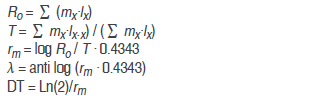
<body><![CDATA[<br>     </i></b></font><font size="2" face="Verdana, Arial, Helvetica, sans-serif">The <i>O. insidiosus </i>individuals used to establish stock colonies were collected on Red Clover (<i>Trifolium pratense</i>) in three areas of the Bogot&aacute; Savanna, Colombia: Cajic&aacute; (04&deg;56'28.0&quot;N and 74&deg;00'34.9&quot;W), Ch&iacute;a (04&deg;51'52.39&quot;N and 74&deg;02'24.60&quot;W), and Suba (04&deg;44'53.3&quot;N and 74&deg;05'56.5&quot;W). Each area was visited four times during a one month period. During each visit, the anthocorids were collected continuously for 1 hour by taking flower heads of <i>T. pratense</i> and shaking them rapidly on a plastic box about 3 times. The collected specimens were then aspirated.</font></p>     <p><font size="2" face="Verdana, Arial, Helvetica, sans-serif">The adults collected were transported in 50 mL plastic bottles to BCL UMNG, where they were kept in 500 cm3 cylindrical glass vials (7 cm diameter x 13 cm height) with 5 cm holes in the lids for ventilation. The vials were covered with a Swiss veil to prevent any individuals from escaping.</font></p>     <p><font size="2" face="Verdana, Arial, Helvetica, sans-serif">A piece of blotting paper was placed on the inner surface of each vial and was moistened three times per week to maintain the ambient moisture levels. Bean pods (<i>Phaseolus vulgaris</i> L. Var. Cerinza) were used as an oviposition substrate and were obtained directly from crops present in the UMNG greenhouses. Four pods were placed in each vial, and these were changed weekly. Anthocorids were fed three times per week <i>ad libitum</i> with <i>Sitotroga cereallela</i> eggs obtained from a breeding colony established at the BCL UMNG.</font></p>     <p><font size="2" face="Verdana, Arial, Helvetica, sans-serif"><b>Embryonic development time and survival of <i>O. insidiosus</i></b><i>    <br> </i></font><font size="2" face="Verdana, Arial, Helvetica, sans-serif">A cohort of <i>O. insidiosus </i>eggs was obtained from the stock colony previously established. To achieve this, a population of nine females and 3 males was placed into a 500 cm<sup>3 </sup>cylindrical glass vial (7 cm diameter x 13 cm height), with bean pods (<i>P. vulgaris</i>) as the oviposition substrate. For this test, 13 replicates were employed. After 24 hours, the adults were removed from the vials, and the eggs were counted for each of the replicates.</font></p>     <p><font size="2" face="Verdana, Arial, Helvetica, sans-serif">Units of 500 cm3 cylindrical glass vials (7 cm diameter x 13 cm height) containing a group of <i>P. vulgaris</i> pods and 30 <i>O. insidiosus</i> eggs were assembled. Seven replicates were used for determining the time of development and the embryonic survival. The number of eggs and first instar nymphs present in each of the replicates was counted every 24 hours. This count was conducted until all nymphs had hatched and/or the individuals in the egg stage died. Nymphs were found daily, extracted from the experimental units and used for testing their development time and survival.</font></p>     <p><font size="2" face="Verdana, Arial, Helvetica, sans-serif"><b>Development time, survival and sex ratio of<i> O. insidiosus    <br> </i></b></font><font size="2" face="Verdana, Arial, Helvetica, sans-serif">The first instar nymphs obtained from the previous test were housed individually to avoid cannibalism and/or mutual interference, which have been reported for the genus <i>Orius</i> in the absence of food and/or when individuals are maintained at high densities (Meiracker, 1999). First instar nymphs were individually placed in 60 mL Petri dishes (5 cm diameter x 1.5 cm height) containing a blotting paper disk (5 cm diameter), which was moistened daily. Each Petri dish was covered with <a href="http://www.alibaba.com/lldpe-stretch-wrap-manufacturers.html">Stretch Wrap</a> to prevent the nymphs from escaping. The nymphs were fed <i>ad libitum </i>with <i>S. cerealella </i>eggs three times per week.</font></p>     <p><font size="2" face="Verdana, Arial, Helvetica, sans-serif">The development time and apparent survival of the nymphs (given as the percentage of surviving individuals among individuals entering the developmental stage, as suggested by Sothwood and Henderson, 2000 were determined from daily observation. Experimental units were assessed with a stereoscope daily to determine the presence/absence of exuvie as an indicator of changes in the development stage. Also, the mortality and time span of each nymphal stage of development was assessed to measure the adult eclosion. Upon eclosion, adults were sexed by an observation of the abdominal region under the stereoscope and the pre imaging mortality (expressed as % of adults emerged), sex ratio (?/?) and percentage of females (?%) were determined.</font></p>     <p><font size="2" face="Verdana, Arial, Helvetica, sans-serif"><b>Fecundity life table and longevity of <i>O. insidiosus    ]]></body>
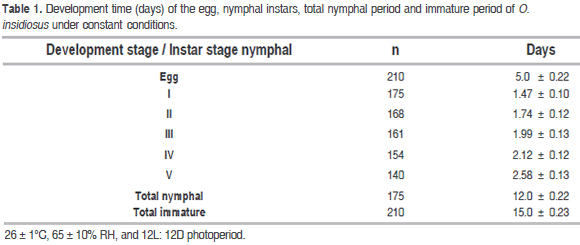
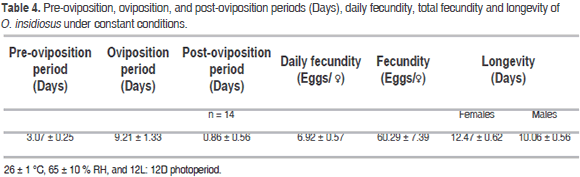
<body><![CDATA[<br> </i></b></font><font size="2" face="Verdana, Arial, Helvetica, sans-serif">Petri dishes of 60 mL (5 cm diameter x 1.5 cm height) were used as the experimental units. A piece of cotton (1 cm<sup>3</sup>) was placed in each petri dish and moistened daily, and a <i>P. vulgaris </i>pod section (4 cm long) was used as the oviposition substrate. <i>Sitotroga cerealella</i> eggs were provided as food <i>ad libitum</i> every third day.</font></p>     <p><font size="2" face="Verdana, Arial, Helvetica, sans-serif">Virgin females and males no more than 24 hours old were paired. A total of 17 couples were placed individually in an experimental unit. Bean pod sections were replaced daily. Males were replaced when they were found dead.</font> </p>     <p><font size="2" face="Verdana, Arial, Helvetica, sans-serif">Bean pods from each experimental unit were examined daily under a stereoscope to count the eggs laid. The pre oviposition period (age before the first oviposition), the oviposition period (the time elapsed from the first to the last egg oviposition), the post oviposition period (the time elapsed from the last egg oviposition to death), the total fecundity (the total number of eggs laid over the predator's lifetime), the daily fecundity (determined by dividing the total number of ovipositions by the oviposition period in days) and the longevity (the time elapsed from the first instar to death, or to adult eclosion) were registered for both males and females.</font></p>     <p><font size="2" face="Verdana, Arial, Helvetica, sans-serif"><b>Calculations of life table parameters    <br> </b></font><font size="2" face="Verdana, Arial, Helvetica, sans-serif">Previously determined data on some biological parameters of <i>O. insidiosus</i> (longevity and fecundity) were used for the life table analysis, as described in Southwood y Henderson (2000). These parameters included age (<i>x</i>), age specific survival rate (<i>l</i>x), age specific fecundity (<i>m</i>x), total number of females born at a given age <i>x</i> (<i>l</i>x<i>.m</i>x), net reproductive rate (<i>R</i>o), mean generation time (<i>T</i>), intrinsic rate of increase (<i>r</i>m), finite rate of increase (?), and doubling time (DT).</font></p>     <p><font size="2" face="Verdana, Arial, Helvetica, sans-serif">Population growth parameters (<i>R</i>o<i>, T, r</i>m<i>, </i>?, and DT) were calculated using the equations proposed by Southwood (1978):</font></p>         <p><font size="2" face="Verdana, Arial, Helvetica, sans-serif"><img src="/img/revistas/rfnam/v69n1/v69n1a03eq001.gif"></font></p>         <p>&nbsp;</p>     <p><font size="3" face="Verdana, Arial, Helvetica, sans-serif"><b>RESULTS AND DISCUSSION</b></font></p>         <p><font size="2" face="Verdana, Arial, Helvetica, sans-serif">The embryonic development time of <i>O. insidiosus</i> lasted an average of 5.0 &plusmn; 0.22 days (<a href="#tab01">Table 1</a>); this value was about a day higher than the embryonic development time obtained by other authors such as Tommasini <i>et al</i>. (2004) who obtained an embryonic development time of 4.02 &plusmn; 0.02 days in the same temperature and relative humidity. These results were similar to those obtained by Santana (2009), who measured a period of embryonic development of 4.0 &plusmn; 0.05 days at 24 &deg;C; in contrast, Meiracker (1999) measured an embryonic development time of 4.6 days at 25 &deg;C. Differences in the measured embryonic development time between this and other studies may be due to genetic variability in the populations of predators used in each study, the rearing background from which the adults were extracted, the environmental conditions used in the study and the nutritional value of the food source, as suggested by Iranipour <i>et al</i>. (2009).</font></p>         ]]></body>
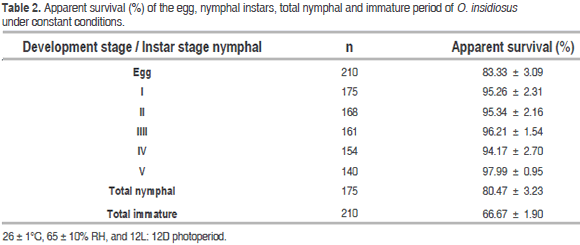
<body><![CDATA[<p align="center"><font size="2" face="Verdana, Arial, Helvetica, sans-serif"><a name="tab01"></a></font><img src="/img/revistas/rfnam/v69n1/v69n1a03tab01.gif"></p>     <p><font size="2" face="Verdana, Arial, Helvetica, sans-serif">Importantly, the nutritional quality and temperature are likely the two factors with the greatest influence on the adults employed for oviposition. Our adults were fed with <i>S. cerealella</i> eggs, unlike the adults used in the tests performed by Meiracker (1999); Tommasini <i>et al.</i> (2004); and Santana (2009), who all used <i>Ephestia kuehniella</i> eggs instead (Lepidoptera: Cambridae) (Zeller, 1879). According to Pratissoli and Parra (2000), <i>E. kuehniella</i> eggs are more nutritious than <i>S. cerealella </i>eggs, which could explain why the embryonic development time obtained in this study was longer than that obtained by the other authors, as the temperatures used in this study were similar to those used in the other cited studies.</font></p>         <p><font size="2" face="Verdana, Arial, Helvetica, sans-serif">The lowest survival rate among the immature stages of <i>O. insidiosus</i> were observed in the egg stage, with a survival of 88.33 &plusmn; 3.09% (<a href="#tab02">Table 2</a>). When evaluating the survival rate of the egg stage of <i>O. insidiosus</i>, some individuals were found to be dehydrated during the hatching phase. This may be because the egg stage and the first instar are more susceptible to dehydration, given their small size (Schmidt <i>et al</i>., 1998). Indeed, having a smaller body size means having a greater surface area/volume ratio and, thus, a higher probability of surface water loss and subsequent dehydration.</font></p>         <p align="center"><font size="2" face="Verdana, Arial, Helvetica, sans-serif"><a name="tab02"></a></font><img src="/img/revistas/rfnam/v69n1/v69n1a03tab02.gif"></p>     <p><font size="2" face="Verdana, Arial, Helvetica, sans-serif">Based on the above and considering that the development time obtained in this study for the egg stage was longer than for the other immature stages, we concluded that individuals in the egg stage had a lower chance of survival because they were more vulnerable to temperature changes and more likely to dehydrate. Richards and Schmidt (1996), who observed the highest hatching of <i>O. insidiosus</i> (100% RH), recommend mass rearing this predator in high humidity conditions to prevent egg dehydration.</font></p>     <p><font size="2" face="Verdana, Arial, Helvetica, sans-serif">Throughout the development of the nymphal stages of <i>O. insidiosus,</i> an increase in the time of each developmental stage were observed as individuals approached adulthood, resulting in values of 1.47 &plusmn; 0.10 days for the first instar stage to 2.58 &plusmn; 0.13 days for the fifth instar stage. The development time of the last nymphal stage was therefore the longest (<a href="#tab01">Table 1</a>).These results are consistent with the results obtained by Tommasini <i>et al</i>. (2004), who reported stage times of 2.0 &plusmn; 0.03 days for first instar and 3.6 &plusmn; 0.04 days for fifth instar, and by Brito <i>et al</i>. (2009), who reported stage times of 2.0 &plusmn; 0.05 days for first instar and 4.9 &plusmn; 0.12 days for fifth instar. </font></p>     <p><font size="2" face="Verdana, Arial, Helvetica, sans-serif">Consistently with Butler and O'Neil (2007), Brito <i>et al</i>. (2009), Santana (2009) and Tomassini <i>et al</i>. (2004), in the present study we found that the development time of the fifth instar is the longest. However, the time reported by these authors for this instar stage was longer than the time observed in our work. For instance, Butler and O'Neil (2007) obtained a development time for the fifth instar of 5.8 &plusmn; 0.34 days for nymphs fed with <i>E. kuehniella </i>eggs at 22 &deg;C, 65 RH and with a 18L:6D photoperiod. The closest result to that obtained in this study was reported by Tommasini <i>et al</i>. (2004), who recorded a development of 3.6 &plusmn; 0.10 days for the fifth instar.</font></p>     <p><font size="2" face="Verdana, Arial, Helvetica, sans-serif">The total nymphal developmental time of <i>O. insidiosus</i> (from first instar to adult) was 12.0 &plusmn; 0.22 days (<a href="#tab01">Table 1</a>), which differs from the results of other authors, who have reported both higher and lower values, depending on the diet and the temperature used. For example, Santana (2009) reported a time of 35.5 &plusmn; 0.62 days and 9.7 &plusmn; 0.62 days at 16 &deg;C and 28 &deg;C, respectively, while Brito <i>et al</i>. (2009) reported values of 14.5 &plusmn; 0.13 days, 14.9 &plusmn; 0.72 days and 15.6 &plusmn; 0.10 days for the nymphal development time, when the nymphs were fed <i>E. kuehniella </i>eggs, <i>Plutella xylostella</i> (Linnaeus, 1758) (Lepidoptera: Plutellidae) eggs and <i>P. xylostella</i> caterpillars, respectively.</font></p>     <p><font size="2" face="Verdana, Arial, Helvetica, sans-serif">The above results support the findings of Mendes <i>et al</i>. (2005), who reported that diet and temperature are the main factors influencing the nymphal development of <i>O. insidiosus</i>. Thus, these critical factors could modify the predator's behavior in field conditions. Therefore, it is important to assess whether this predator, when reared on <i>Sitotroga cerealella,</i> still prefers consuming thrips <i>F. occidentalis</i> over other prey in controlled and field conditions.</font></p>     <p><font size="2" face="Verdana, Arial, Helvetica, sans-serif">The total immature development time of <i>O. insidiosus</i> (from egg to adult) was 15.0 &plusmn; 0.23 days (<a href="#tab01">Table 1</a>), similar to that observed by Tommasini <i>et al</i>. (2004), who obtained a total time of 15.0 &plusmn; 0.10 days for <i>O. insidiosus</i> fed with <i>E. kuehniella</i> eggs and a time of 14.1 &plusmn; 0.07 days for<i> O. insidiosus</i> fed with <i>F. occidentalis</i> under the same temperature and relative humidity conditions used in the present study. In contrast, Brito <i>et al</i>. (2009) reported a total immature development time of 21.0 &plusmn; 0.13 days for <i>O. insidiosus </i>fed with <i>A. kuehniella </i>eggs under constant conditions (25 &plusmn; 1 &deg;C, 70 &plusmn; 10% RH and a 12L:12D photoperiod). The values obtained by these authors are higher than those observed in this study, even though their temperature, relative humidity and photoperiod conditions were very similar.</font></p>     ]]></body>
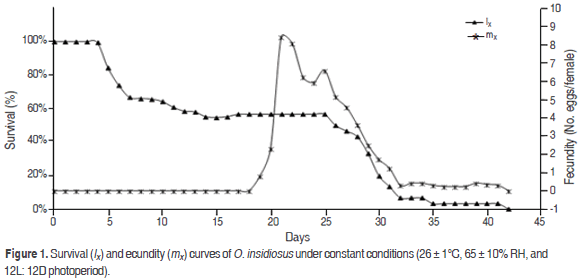
<body><![CDATA[<p><font size="2" face="Verdana, Arial, Helvetica, sans-serif">The apparent survival rates of the nymphal instars were similar between the first and fifth instar, at 95.26 &plusmn; 2.31% and 97.99 &plusmn; 3.23%, respectively (<a href="#tab02">Table 2</a>), this values were relatively high, as observed previously by Brito <i>et al</i>. (2009), who obtained apparent survival rates between 92 and 100% for all nymphal instars fed with <i>E. kuehniella</i> eggs. In a similar study, Mendes <i>et al</i>. (2005) reported apparent survival rates between 83 and 96%.</font></p>     <p><font size="2" face="Verdana, Arial, Helvetica, sans-serif">Mendes <i>et al</i>. (2005) reported a survival rate of 68.01 &plusmn; 5.5 % for the total nymphal period, which was lower than that found in our study (80.47 &plusmn; 3.23%, <a href="#tab02">Table 2</a>). However, the value obtained in our study was very similar to that reported by Brito <i>et al</i>. (2009) (80.0 &plusmn; 0.80 %). </font></p>     <p><font size="2" face="Verdana, Arial, Helvetica, sans-serif">The total immature survival rate of <i>O. insidiosus</i> observed in this study (66.67 &plusmn; 1.90%, <a href="#tab02">Table 2</a>), was also very similar to that obtained by Brito <i>et al</i>. (2009), who evaluated the nymphal and egg survival rates in separate trials and reported survivals of 80.0 &plusmn; 0.80% and 80.4 &plusmn; 0.72%, respectively, for a total immature survival rate of 60.4%.</font></p>     <p><font size="2" face="Verdana, Arial, Helvetica, sans-serif">The survivorship curve of <i>O. insidiosus</i> obtained in this study showed that survival fell after the fourth day. Slightly over 50% of the individuals survived to day 25 after the first oviposition (the eighth day after adult emergence), and from this day onward the average survival rate steadily declined to 0% at day 42 (<a href="#fig01">Figure 1</a>).</font></p>     <p align="center"><font size="2" face="Verdana, Arial, Helvetica, sans-serif"><a name="fig01"></a></font><img src="/img/revistas/rfnam/v69n1/v69n1a03fig01.gif"></p>     <p><font size="2" face="Verdana, Arial, Helvetica, sans-serif">Of the three types of survival curves used in the literature to describe different species, <i>O. insidiosus</i> development most closely follows a type II curve (<a href="#fig01">Figure 1</a>), meaning that a constant number of individuals died per unit time, such that a given individual has a constant probability of death over the course of its lifetime (P&aacute;ramo <i>et al</i>., 1986).</font></p>     <p><font size="2" face="Verdana, Arial, Helvetica, sans-serif">Type II curves were obtained by Tommasini <i>et al</i>. (2004) for individuals fed with <i>E. kuehniella</i> eggs and <i>F. occidentalis</i> adults, but this author found that only 50% of individuals in the adult stage survived until day 48 after emergence. Furthermore, the survival rate was 0% at day 68, which differs from our results.</font></p>     <p><font size="2" face="Verdana, Arial, Helvetica, sans-serif">From the 30 eggs (n = 7) of <i>O. insidiosus</i> with which this test began, 16.29 &plusmn; 1.06 individuals (54.29%) reached adulthood. Of these, 30.95% were females and 23.33% were males, corresponding to a sex ratio (% of females) of 0.75 (<a href="#tab03">Table 3</a>). These values were lower than the results reported by other authors. Tommasini <i>et al</i>. (2004) observed a sex ratio of 1.08, while Argolo <i>et al</i>. (2002); and Santana (2009) observed a sex ratio of 0.5 in laboratory conditions. These differences were probably caused by differential mortality or a differential hatching rate in Shapiro <i>et al</i>. (2009).</font></p>     <p align="center"><font size="2" face="Verdana, Arial, Helvetica, sans-serif"><a name="tab03"></a></font><img src="/img/revistas/rfnam/v69n1/v69n1a03tab03.gif"></p>     <p><font size="2" face="Verdana, Arial, Helvetica, sans-serif">Of the 17 couples used in the fecundity and longevity test, three did not show oviposition. Only females that oviposited were included in the results of the fecundity, daily fecundity, pre, post and oviposition periods. All females were included in the longevity assessment.</font></p>     ]]></body>
<body><![CDATA[<p><font size="2" face="Verdana, Arial, Helvetica, sans-serif">The phenomenon of no-oviposition not observed in three females of <i>O. insidiosus</i>, was likely due to female infertility. This phenomenon was reported by Richards and Schmidt (1996), who found that approximately 30% of the female <i>O. insidiosus</i> in the oviposition trials were infertile. This infertility may be due to several factors, such as genotypic effects in the populations used in the trials, the nutritional quality and the abiotic conditions under which the trials were conducted.</font></p>     <p><font size="2" face="Verdana, Arial, Helvetica, sans-serif">The pre oviposition period of <i>O. insidiosus</i> fed with eggs of <i>S. cerealella</i> was 3.07 &plusmn; 0.25 days (<a href="#tab04">Table 4</a>). This result obtained in this work are consistent with the result reported by Saini <i>et al</i>. (2003), who found a pre oviposition period of three days at both 25 &deg;C and 30 &deg;C for females fed the same diet used in this study. For females fed with <i>E. kuheniella</i> eggs, Brito <i>et al</i>. (2009) reported a pre oviposition period of 4.9 days, which is nearly two days longer than that observed in this study. Furthermore, Argolo <i>et al</i>. (2004) used the same diet and recorded a pre oviposition period of 3.3 days, while Meiracker (1994) recorded a pre oviposition period of 7.7 days for females raised under a 10L:14D photoperiod, suggesting that the pre oviposition period is affected by the diet photoperiod and temperature, as mentioned by Santana (2009).</font></p>     <p align="center"><font size="2" face="Verdana, Arial, Helvetica, sans-serif"><a name="tab04"></a></font><img src="/img/revistas/rfnam/v69n1/v69n1a03tab04.gif"></p>     <p><font size="2" face="Verdana, Arial, Helvetica, sans-serif">The oviposition period was 9.21 &plusmn; 1.33 days (<a href="#tab04">Table 4</a>). This time was 3.6 and 4.8 times shorter than the periods reported by Santana (2009) and Mendes (2002), respectively, who instead used <i>E. kuehniella</i> eggs as a food source. These results may indicate that the food type greatly influences oviposition period. However, Brito <i>et al</i>. (2009) that also used <i>E. kuehniella</i> eggs but obtained an oviposition period of 2.3 &plusmn; 0.22 days, which was four times shorter than what we observed, suggesting that other, as yet unidentified factors, might also influence the oviposition period of <i>O. insidiosus</i>. </font></p>     <p><font size="2" face="Verdana, Arial, Helvetica, sans-serif">The daily fecundity of <i>O. insidiosus</i> obtained in the present study was 6.92 eggs/day (<a href="#tab04">Table 4</a>), was higher than that reported by Mendes (2002) and Santana (2009), 3.47 and 4.10 eggs/day, respectively. The marked differences between their and our measured fecundity may be related to female longevity, which was markedly lower in our study (12.47 days) than in the work of Santana and Mendes (40.5 and 56.25 days, respectively).</font></p>     <p><font size="2" face="Verdana, Arial, Helvetica, sans-serif">Based on the data obtained from the life table, we plotted the fertility curve (<i>m</i>x), which was unimodal but irregular. As shown, the fecundity reached a peak production of 8.24 eggs/(female/day) on the fourth day after adult emergence. A second peak of 6.57 eggs occurred eight days after adult emergence. Subsequently, the number of eggs dropped until oviposition stopped (<a href="#fig01">Figure 1</a>). This fertility curve was very similar to that obtained by Saini <i>et al</i>. (2003).</font></p>     <p><font size="2" face="Verdana, Arial, Helvetica, sans-serif">Female longevity in this study was 12.47 days, which was approximately two days longer than the value recorded for males (<a href="#tab04">Table 4</a>). Saini <i>et al</i>. (2003) reported longevities of 13.5 to 20.1 days for females of <i>O. insidiosus </i>fed with <i>S. cerealella</i> eggs, which are closer to the values obtained in our study. Such longevity values could also affect the total fertility reported by the same author (between 39.4 and 86.5 eggs/female at 25 &deg;C with a different diet density), which were very similar to those obtained in this study (60.29 &plusmn; 7.39 eggs/female, <a href="#tab04">Table 4</a>). Moreover, their values were lower than those obtained by Mendes (2002); Tommasini <i>et al</i>. (2004) and Santana (2009), which were 195.3 &plusmn; 22.77, 144.3 &plusmn; 76.8 and 145.5 &plusmn; 15.37 eggs/female, respectively.</font></p>     <p><font size="2" face="Verdana, Arial, Helvetica, sans-serif">The differences between the male and female longevity observed in this study may be due to <i>O. insidiosus </i>males being more mobile in the rearing condition than the females (Shapiro <i>et al</i>. 2009). It is likely that their search for females for copulation requires greater energy expenditure, leading to a reduction in male longevity.</font></p>     <p><font size="2" face="Verdana, Arial, Helvetica, sans-serif">The fecundity life table parameters (<i>R</i>o, T, <i>r</i>m, TD, and ?) of <i>O. insidiosus</i> obtained in this study are a valuable resource for evaluating the biological performance of the insects and the effects of both biotic and abiotic factors on their development (Vacari <i>et al</i>., 2007). </font></p>     <p><font size="2" face="Verdana, Arial, Helvetica, sans-serif">The net reproductive rate (<i>R</i>o) obtained in this study (28.62) was higher than the net reproductive rates obtained by Brito <i>et al</i>. (2009), who reported rates of 2.40 and 6.61 for females fed with <i>E. kuehniella</i> and <i>P. xylostella</i> eggs, respectively. However, in a similar study, Tommasini <i>et al</i>. (2004) obtained values closer to those found in this study (17.9 and 30.1) when they fed the females with <i>F. occidentalis</i> adults and <i>E. kuehniella</i> eggs, respectively.</font></p>     ]]></body>
<body><![CDATA[<p><font size="2" face="Verdana, Arial, Helvetica, sans-serif">The mean generation time (T) recorded in this study was 24.26 days, meaning that the population can produce 15 generations in a single year. Similar values for the mean generation time were obtained by other authors using different diets. Tommasini <i>et al</i>. (2004) obtained a value of 24.9 days after feeding with <i>F. occidentalis</i> adults. Brito <i>et al</i>. (2009) reported a value of 27.26 and 24.29 days for females fed with <i>E. kuehniella</i> and <i>P. xylostella</i> eggs, respectively. Bluter and O'Neil (2007) reported a mean generation time of 23.44 days for females fed with soybean thrips <i>Neohydatothrips variabilis</i> (Beach) (Thysanoptera: Thripidae) and a value of 27.29 days when they were fed with a mixture of thrips and aphids <i>Aphis glycines</i> (Matsumura) (Hemiptera: Aphididae).</font></p>     <p><font size="2" face="Verdana, Arial, Helvetica, sans-serif">Bluter and O'Neil (2007) reported an intrinsic rate of increase (<i>r</i>m) of 0.094 for females fed with a mixed prey diet (1 individual of <i>N. variabilis</i> and 3 individuals of <i>A. glycines</i>), while Tommasini <i>et al</i>. (2004) instead reported a value of 0.101 for females fed with <i>E. kuehniella</i> eggs. These values of <i>r</i>m were different from those obtained in our study (0.14). This difference may be explained by the intrinsic rate of increase being strongly associated with the start time of the reproductive period. This means that individuals who begin to reproduce at an early age have a higher intrinsic rate of increase than those who begin to reproduce at a later age (Batista, 2006). This is consistent with differences in the reproductive period start times reported by Bluter and O'Neil (2007), Tommasini <i>et al</i>. (2004) and the values obtained in this study, which were 7.7, 3.7 and 3.07 days, respectively.</font></p>     <p><font size="2" face="Verdana, Arial, Helvetica, sans-serif">The doubling time (TD) required for the <i>O. insidiosus </i>population (TD) in this study was 5.01 days, which is nearly two days less than the doubling time reported by Brito <i>et al</i>. (2009) for females fed with <i>E. kuehniella</i> eggs. However, it was nearly two days longer than for females fed with <i>P. xylostella,</i> as reported by the same author.</font></p>         <p><font size="2" face="Verdana, Arial, Helvetica, sans-serif">Finally, the finite rate of increase (?) for <i>O. insidiosus</i> observed in this study was 1.13. Other studies have reported lower values for <i>O. insidiosus</i> females reared on different diets. For instance, Bortoli <i>et al</i>. (2008) reported a value of 1.09 using <i>Aphis gossypii</i> (Glover) (Hemiptera: Aphididae) adults on cotton cultivars as food, while the finite rates of increase observed by Brito <i>et al</i>. (2009) were 1.03 and 1.07 for females fed with <i>E. kuehniella</i> and <i>P. xylostella</i> eggs, respectively.</font></p>         <p>&nbsp;</p>     <p><font size="3" face="Verdana, Arial, Helvetica, sans-serif"><b>CONCLUSIONS</b></font></p>     <p><font size="2" face="Verdana, Arial, Helvetica, sans-serif">Based on the life table and life cycle parameters obtained in this work, we conclude that <i>S. cerealella</i> eggs are a viable alternative diet for rearing <i>O. insidiosus</i> under controlled conditions, although further studies are necessary to determine the factors other than diet that could affect longevity. A higher longevity would allow for an increase in the oviposition period and, therefore, the fecundity of individuals. It is also necessary to evaluate the functional response of <i>O. insidiosus </i>on thrips <i>F. occidentalis</i> to determine whether natural populations of anthocorids are a promising candidate for the control of thrips. This predator might be implemented in an improved integrated pest management program in the crops of the Bogot&aacute; Savanna.</font></p>         <p>&nbsp;</p>         <p><font size="3" face="Verdana, Arial, Helvetica, sans-serif"><b>ACKNOWLEDGMENTS</b></font></p>     <p><font size="2" face="Verdana, Arial, Helvetica, sans-serif">The authors are grateful to the Militar Nueva Granada University for providing financial support for this work. &quot;Product derived of project CIAS 1177, funded by the Vice-rectory for Research of the Militar Nueva Granada University&quot;.</font></p>         ]]></body>
<body><![CDATA[<p>&nbsp;</p>         <p><font size="3" face="Verdana, Arial, Helvetica, sans-serif"><b>REFERENCES</b></font></p>     <!-- ref --><p><font size="2" face="Verdana, Arial, Helvetica, sans-serif">Argolo, V.M., V.H. Bueno and L.C. Silveira. 2002. Influ&ecirc;ncia do fotoper&iacute;odo na reprodu&ccedil;&atilde;o e longevidade de Orius insidiosus (Say) (Heteroptera: Anthocoridae). Neotropical Entomology 31(2): 257-261. doi: 10.1590/s1519-566x2002000200013.    &nbsp;&nbsp;&nbsp;&nbsp;&nbsp;&nbsp;&nbsp;&nbsp;[&#160;<a href="javascript:void(0);" onclick="javascript: window.open('/scielo.php?script=sci_nlinks&ref=000095&pid=S0304-2847201600010000300001&lng=','','width=640,height=500,resizable=yes,scrollbars=1,menubar=yes,');">Links</a>&#160;]<!-- end-ref --></font></p>     <!-- ref --><p><font size="2" face="Verdana, Arial, Helvetica, sans-serif">Batista, W.B. 2006. Chapter 2: Din&aacute;mica de poblaciones. pp. 29-47. In: Van Esso, M. (ed.). Ecolog&iacute;a, ense&ntilde;anza con un enfoque novedoso. Editorial Facultad de Agronom&iacute;a y Editorial Novedades Educativas, Buenos Aires, Argentina. 176 p.    &nbsp;&nbsp;&nbsp;&nbsp;&nbsp;&nbsp;&nbsp;&nbsp;[&#160;<a href="javascript:void(0);" onclick="javascript: window.open('/scielo.php?script=sci_nlinks&ref=000097&pid=S0304-2847201600010000300002&lng=','','width=640,height=500,resizable=yes,scrollbars=1,menubar=yes,');">Links</a>&#160;]<!-- end-ref --></font></p>     <!-- ref --><p><font size="2" face="Verdana, Arial, Helvetica, sans-serif">Bielza, P. 2008. Insecticide resistance management strategies against the western flower thrips, Frankliniella occidentalis. Pest Management Science 64(11): 1131-1138. doi: 10.1002/ps.1620.    &nbsp;&nbsp;&nbsp;&nbsp;&nbsp;&nbsp;&nbsp;&nbsp;[&#160;<a href="javascript:void(0);" onclick="javascript: window.open('/scielo.php?script=sci_nlinks&ref=000099&pid=S0304-2847201600010000300003&lng=','','width=640,height=500,resizable=yes,scrollbars=1,menubar=yes,');">Links</a>&#160;]<!-- end-ref --></font></p>     <!-- ref --><p><font size="2" face="Verdana, Arial, Helvetica, sans-serif">Bortoli, S.A., J.E. Oliveira, R.F. Dos Santos and L.C. Silveira. 2008. Tabelas de vida de Orius insidiosus (say, 1832) (Hemiptera: Anthocoridae) predando Aphis gossypii glover, 1877 (Hemiptera: Aphididae) em diferentes cultivares de algodoeiro. Arquivos Do Instituto Biologico 75(2): 203-210.    &nbsp;&nbsp;&nbsp;&nbsp;&nbsp;&nbsp;&nbsp;&nbsp;[&#160;<a href="javascript:void(0);" onclick="javascript: window.open('/scielo.php?script=sci_nlinks&ref=000101&pid=S0304-2847201600010000300004&lng=','','width=640,height=500,resizable=yes,scrollbars=1,menubar=yes,');">Links</a>&#160;]<!-- end-ref --> </font></p>     ]]></body>
<body><![CDATA[<!-- ref --><p><font size="2" face="Verdana, Arial, Helvetica, sans-serif">Butler, C.D and R.J. O'Neil. 2007. Life history characteristics of Orius insidiosus (Say) fed diets of soybean aphid, Aphis glycines Matsumura and soybean thrips, Neohydatothrips variabilis (Beach). Biological control 40(3): 339-346. doi:  10.1016/j.biocontrol.2006.12.005.    &nbsp;&nbsp;&nbsp;&nbsp;&nbsp;&nbsp;&nbsp;&nbsp;[&#160;<a href="javascript:void(0);" onclick="javascript: window.open('/scielo.php?script=sci_nlinks&ref=000103&pid=S0304-2847201600010000300005&lng=','','width=640,height=500,resizable=yes,scrollbars=1,menubar=yes,');">Links</a>&#160;]<!-- end-ref --></font></p>     <!-- ref --><p><font size="2" face="Verdana, Arial, Helvetica, sans-serif">Brito, J.P., A.M. Vacari, R.T. Thuler and S.A. De Bortoli. 2009. Aspectos biol&oacute;gicos de Orius insidiosus (Say, 1832) predando ovos de Plutella xylostella (L., 1758) e Anagasta kuehniella (Zeller, 1879). Arquivos Do Instituto Biologico 76(4): 627-633.    &nbsp;&nbsp;&nbsp;&nbsp;&nbsp;&nbsp;&nbsp;&nbsp;[&#160;<a href="javascript:void(0);" onclick="javascript: window.open('/scielo.php?script=sci_nlinks&ref=000105&pid=S0304-2847201600010000300006&lng=','','width=640,height=500,resizable=yes,scrollbars=1,menubar=yes,');">Links</a>&#160;]<!-- end-ref --> </font></p>     <!-- ref --><p><font size="2" face="Verdana, Arial, Helvetica, sans-serif">Castresana, J., E. Gagliano, L. Puhl, S. Bado, L. Vianna and M. Castresana. 2008. Atracci&oacute;n del trips Frankliniella occidentalis (Pergande) (Thysanoptera: Thripidae) con trampas de luz en el cultivo de Gerbera jamessonii (G.). Idesia. 26(3): 51-56. doi:  10.4067/s0718-34292008000300006.    &nbsp;&nbsp;&nbsp;&nbsp;&nbsp;&nbsp;&nbsp;&nbsp;[&#160;<a href="javascript:void(0);" onclick="javascript: window.open('/scielo.php?script=sci_nlinks&ref=000107&pid=S0304-2847201600010000300007&lng=','','width=640,height=500,resizable=yes,scrollbars=1,menubar=yes,');">Links</a>&#160;]<!-- end-ref --></font></p>     <!-- ref --><p><font size="2" face="Verdana, Arial, Helvetica, sans-serif">Fransen, J.J and J. Tolsma. 1992. Releases of the minute pirate bug, Orius insidiosus (Say) (Hemiptera: Anthocoridae), against western flower thrips, Frankliniella occidentalis (Pergande), on chrysanthemum. Mededelingen Faculteit Landbouwwetenschappen Rijksuniversiteit Gent 57(2): 479- 489.    &nbsp;&nbsp;&nbsp;&nbsp;&nbsp;&nbsp;&nbsp;&nbsp;[&#160;<a href="javascript:void(0);" onclick="javascript: window.open('/scielo.php?script=sci_nlinks&ref=000109&pid=S0304-2847201600010000300008&lng=','','width=640,height=500,resizable=yes,scrollbars=1,menubar=yes,');">Links</a>&#160;]<!-- end-ref --> </font></p>     <!-- ref --><p><font size="2" face="Verdana, Arial, Helvetica, sans-serif">Funderburk, J., J. Stavisky and S. Olsen. 2000. Predation of Frankliniella occidentalis (Thysanoptera: Thripidae) in field peppers by Orius insidiosus (Hemiptera: Anthocoridae). Environmental Entomology 29(2): 376-382. doi:  10.1093/ee/29.2.376.    &nbsp;&nbsp;&nbsp;&nbsp;&nbsp;&nbsp;&nbsp;&nbsp;[&#160;<a href="javascript:void(0);" onclick="javascript: window.open('/scielo.php?script=sci_nlinks&ref=000111&pid=S0304-2847201600010000300009&lng=','','width=640,height=500,resizable=yes,scrollbars=1,menubar=yes,');">Links</a>&#160;]<!-- end-ref --></font></p>     ]]></body>
<body><![CDATA[<!-- ref --><p><font size="2" face="Verdana, Arial, Helvetica, sans-serif">Hansen, E., J. Funderburk, S. Reitz, S. Ramachandran, J. Eger and H. Mcauslane. 2003. Within-plant distribution of Frankliniella species (Thysanoptera: Thripidae) and Orius insidiosus (Heteroptera: Anthocoridae) in field pepper. Environmental Entomology 32(5): 1035-1044. doi:  10.1603/0046-225x-32.5.1035.    &nbsp;&nbsp;&nbsp;&nbsp;&nbsp;&nbsp;&nbsp;&nbsp;[&#160;<a href="javascript:void(0);" onclick="javascript: window.open('/scielo.php?script=sci_nlinks&ref=000113&pid=S0304-2847201600010000300010&lng=','','width=640,height=500,resizable=yes,scrollbars=1,menubar=yes,');">Links</a>&#160;]<!-- end-ref --></font></p>     <!-- ref --><p><font size="2" face="Verdana, Arial, Helvetica, sans-serif">Helyer, N.L and P.J. Brobyn. 2008. Chemical control of western flower thrips (Frankliniella occidentalis Pergande). Annals of Applied Biology 121(2): 219-231. doi:  10.1111/j.1744-7348.1992.tb03434.x.    &nbsp;&nbsp;&nbsp;&nbsp;&nbsp;&nbsp;&nbsp;&nbsp;[&#160;<a href="javascript:void(0);" onclick="javascript: window.open('/scielo.php?script=sci_nlinks&ref=000115&pid=S0304-2847201600010000300011&lng=','','width=640,height=500,resizable=yes,scrollbars=1,menubar=yes,');">Links</a>&#160;]<!-- end-ref --></font></p>     <!-- ref --><p><font size="2" face="Verdana, Arial, Helvetica, sans-serif">Iranipour, S., A. Farazmand, M. Saber and J.M. Mashhadi. 2009. Demography and life history of the egg parasitoid, Trichogramma brassicae, on two moths Anagasta kuehniella and Plodiainter punctella in the laboratory. Journal of Insect Science 9(1): 1-8. doi: 10.1673/031.009.5101.    &nbsp;&nbsp;&nbsp;&nbsp;&nbsp;&nbsp;&nbsp;&nbsp;[&#160;<a href="javascript:void(0);" onclick="javascript: window.open('/scielo.php?script=sci_nlinks&ref=000117&pid=S0304-2847201600010000300012&lng=','','width=640,height=500,resizable=yes,scrollbars=1,menubar=yes,');">Links</a>&#160;]<!-- end-ref --></font></p>     <!-- ref --><p><font size="2" face="Verdana, Arial, Helvetica, sans-serif">Kirk, W.D and L.I. Terry. 2003. The spread of the western flower thrips Frankliniella occidentalis (Pergande). Agricultural and Forest Entomology 5(4): 301-310. doi:  10.1046/j.1461-9563.2003.00192.x.    &nbsp;&nbsp;&nbsp;&nbsp;&nbsp;&nbsp;&nbsp;&nbsp;[&#160;<a href="javascript:void(0);" onclick="javascript: window.open('/scielo.php?script=sci_nlinks&ref=000119&pid=S0304-2847201600010000300013&lng=','','width=640,height=500,resizable=yes,scrollbars=1,menubar=yes,');">Links</a>&#160;]<!-- end-ref --></font></p>     <!-- ref --><p><font size="2" face="Verdana, Arial, Helvetica, sans-serif">Kiman, Z.B and K.V. Yeargan. 1985. Development and reproduction of the predator Orius insidiosus (hemiptera: Anthocoridae) reared on diets of selected plant and arthropod prey. Annals of the Entomological Society of America 78(1): 464-467. doi:  10.1093/aesa/78.4.464.    &nbsp;&nbsp;&nbsp;&nbsp;&nbsp;&nbsp;&nbsp;&nbsp;[&#160;<a href="javascript:void(0);" onclick="javascript: window.open('/scielo.php?script=sci_nlinks&ref=000121&pid=S0304-2847201600010000300014&lng=','','width=640,height=500,resizable=yes,scrollbars=1,menubar=yes,');">Links</a>&#160;]<!-- end-ref --></font></p>     ]]></body>
<body><![CDATA[<!-- ref --><p><font size="2" face="Verdana, Arial, Helvetica, sans-serif">Lewis, T. 1997. Chapter 1. Pest thrips in perspective. Pp. 1-13. In T. Lewis. (ed.). Thrips as crop pests. Centre for Agricultural Bioscience international, Oxon, United Kingdom.736 p. doi:  10.1017/s0007485399000139.    &nbsp;&nbsp;&nbsp;&nbsp;&nbsp;&nbsp;&nbsp;&nbsp;[&#160;<a href="javascript:void(0);" onclick="javascript: window.open('/scielo.php?script=sci_nlinks&ref=000123&pid=S0304-2847201600010000300015&lng=','','width=640,height=500,resizable=yes,scrollbars=1,menubar=yes,');">Links</a>&#160;]<!-- end-ref --></font></p>     <!-- ref --><p><font size="2" face="Verdana, Arial, Helvetica, sans-serif">L&oacute;pez, N.S. 2008. Evaluaci&oacute;n de mecanismos de resistencia a insecticidas en Frankliniella occidentalis (Pergande): implicaci&oacute;n de carboxilesterasas y acetilcolinesterasas. Ph.D. thesis. Departamento de Biolog&iacute;a Funcional y Antropolog&iacute;a F&iacute;sica. Universidad de Valencia, Valencia, Espa&ntilde;a. 176 p.    &nbsp;&nbsp;&nbsp;&nbsp;&nbsp;&nbsp;&nbsp;&nbsp;[&#160;<a href="javascript:void(0);" onclick="javascript: window.open('/scielo.php?script=sci_nlinks&ref=000125&pid=S0304-2847201600010000300016&lng=','','width=640,height=500,resizable=yes,scrollbars=1,menubar=yes,');">Links</a>&#160;]<!-- end-ref --></font></p>     <!-- ref --><p><font size="2" face="Verdana, Arial, Helvetica, sans-serif">Manners, A.G., B.R. DembowskI and M.A. Healey. 2013. Biological control of western flower thrips, Frankliniella occidentalis (Pergande) (Thysanoptera: Thripidae), in gerberas, chrysanthemums and roses. Australian Journal of Entomology 52(3): 246-258. doi: 10.1111/aen.12020.    &nbsp;&nbsp;&nbsp;&nbsp;&nbsp;&nbsp;&nbsp;&nbsp;[&#160;<a href="javascript:void(0);" onclick="javascript: window.open('/scielo.php?script=sci_nlinks&ref=000127&pid=S0304-2847201600010000300017&lng=','','width=640,height=500,resizable=yes,scrollbars=1,menubar=yes,');">Links</a>&#160;]<!-- end-ref --></font></p>     <!-- ref --><p><font size="2" face="Verdana, Arial, Helvetica, sans-serif">Meiracker, R. 1994. Induction and termination of diapause in Orius predatory bugs. Entomologia Experimentalis et Applicata 73(2): 127-137. doi: 10.1111/j.1570-7458.1994.tb01847.x.    &nbsp;&nbsp;&nbsp;&nbsp;&nbsp;&nbsp;&nbsp;&nbsp;[&#160;<a href="javascript:void(0);" onclick="javascript: window.open('/scielo.php?script=sci_nlinks&ref=000129&pid=S0304-2847201600010000300018&lng=','','width=640,height=500,resizable=yes,scrollbars=1,menubar=yes,');">Links</a>&#160;]<!-- end-ref --></font></p>     <!-- ref --><p><font size="2" face="Verdana, Arial, Helvetica, sans-serif">Meiracker, R.A. 1999. Biocontrol of western flower thrips by heteropteran bugs. PhD thesis. Institute for Biodiversity and Ecosystem Dynamics, Faculty of Sciencie, University of Amsterdam, Amsterdam, Holanda. 147 p.    &nbsp;&nbsp;&nbsp;&nbsp;&nbsp;&nbsp;&nbsp;&nbsp;[&#160;<a href="javascript:void(0);" onclick="javascript: window.open('/scielo.php?script=sci_nlinks&ref=000131&pid=S0304-2847201600010000300019&lng=','','width=640,height=500,resizable=yes,scrollbars=1,menubar=yes,');">Links</a>&#160;]<!-- end-ref --></font></p>     ]]></body>
<body><![CDATA[<!-- ref --><p><font size="2" face="Verdana, Arial, Helvetica, sans-serif">Mendes, S.M., V.H. Bueno., V.M. Argolo and L.C. Silvera. 2002. Type of prey influences biology and consumption rate of Orius insidiosus (Say) (Hemiptera, Anthocoridae). Revista Brasileira de Entomologia 46(1): 99-103. doi: 10.1590/s0085-56262002000100012.    &nbsp;&nbsp;&nbsp;&nbsp;&nbsp;&nbsp;&nbsp;&nbsp;[&#160;<a href="javascript:void(0);" onclick="javascript: window.open('/scielo.php?script=sci_nlinks&ref=000133&pid=S0304-2847201600010000300020&lng=','','width=640,height=500,resizable=yes,scrollbars=1,menubar=yes,');">Links</a>&#160;]<!-- end-ref --></font></p>     <!-- ref --><p><font size="2" face="Verdana, Arial, Helvetica, sans-serif">Mendes, S.M., V.H. Bueno and L.M. Carvalho. 2005. Desenvolvimento e exig&ecirc;ncias t&eacute;rmicas de Orius insidiosus (Say) (Hemiptera, Anthocoridae). Revista Brasileira de Entomologia, 49(4): 575-579. doi: 10.1590/s0085-56262005000400019.    &nbsp;&nbsp;&nbsp;&nbsp;&nbsp;&nbsp;&nbsp;&nbsp;[&#160;<a href="javascript:void(0);" onclick="javascript: window.open('/scielo.php?script=sci_nlinks&ref=000135&pid=S0304-2847201600010000300021&lng=','','width=640,height=500,resizable=yes,scrollbars=1,menubar=yes,');">Links</a>&#160;]<!-- end-ref --></font></p>     <!-- ref --><p><font size="2" face="Verdana, Arial, Helvetica, sans-serif">Ramakers, P.M., M. Disseveld and K. Peeters. 1989. Large scale introductions of phytoseiid predators to control thrips on cucumber. Mededelingen van de Faculteit der Landbouwwetenschappen van de Rijksuniversiteit te Gent, 54(3a): 923-929.    &nbsp;&nbsp;&nbsp;&nbsp;&nbsp;&nbsp;&nbsp;&nbsp;[&#160;<a href="javascript:void(0);" onclick="javascript: window.open('/scielo.php?script=sci_nlinks&ref=000137&pid=S0304-2847201600010000300022&lng=','','width=640,height=500,resizable=yes,scrollbars=1,menubar=yes,');">Links</a>&#160;]<!-- end-ref --></font></p>     <!-- ref --><p><font size="2" face="Verdana, Arial, Helvetica, sans-serif">Richards, P.C and J.M. Schmidt. 1996. Entomologia Experimentalis et Applicata 80(2): 325-333. doi: 10.1111/j.1570-7458.1996.tb00945.x.    &nbsp;&nbsp;&nbsp;&nbsp;&nbsp;&nbsp;&nbsp;&nbsp;[&#160;<a href="javascript:void(0);" onclick="javascript: window.open('/scielo.php?script=sci_nlinks&ref=000139&pid=S0304-2847201600010000300023&lng=','','width=640,height=500,resizable=yes,scrollbars=1,menubar=yes,');">Links</a>&#160;]<!-- end-ref --></font></p>     <!-- ref --><p><font size="2" face="Verdana, Arial, Helvetica, sans-serif">Rojas, E and E.I. Perea. 2003. Fusarium spp. en Trialeurodes vaporariorum (Homoptera: Aleyrodidae) de tabaco y fr&iacute;jol en Garc&iacute;a Rovira, Santander, Colombia. Revista Colombiana de Entomolog&iacute;a 29(2): 165-168.    &nbsp;&nbsp;&nbsp;&nbsp;&nbsp;&nbsp;&nbsp;&nbsp;[&#160;<a href="javascript:void(0);" onclick="javascript: window.open('/scielo.php?script=sci_nlinks&ref=000141&pid=S0304-2847201600010000300024&lng=','','width=640,height=500,resizable=yes,scrollbars=1,menubar=yes,');">Links</a>&#160;]<!-- end-ref --></font></p>     ]]></body>
<body><![CDATA[<!-- ref --><p><font size="2" face="Verdana, Arial, Helvetica, sans-serif">P&aacute;ramo, G., D. Corredor and M. S&aacute;nchez. 1986. Tabla de vida y par&aacute;metros poblacionales fundamentales de Tetranychus urticae Koch (Acari: Tetranychidae) sobre Rosa sp. en condiciones de laboratorio. Agronom&iacute;a Colombiana 3(1-2): 83-96. doi: 83-96 2357-3732 0120-9965.    &nbsp;&nbsp;&nbsp;&nbsp;&nbsp;&nbsp;&nbsp;&nbsp;[&#160;<a href="javascript:void(0);" onclick="javascript: window.open('/scielo.php?script=sci_nlinks&ref=000143&pid=S0304-2847201600010000300025&lng=','','width=640,height=500,resizable=yes,scrollbars=1,menubar=yes,');">Links</a>&#160;]<!-- end-ref --></font></p>     <!-- ref --><p><font size="2" face="Verdana, Arial, Helvetica, sans-serif">Pratissoli, D and J.R. Parra. 2000. Desenvolvimento e exig&ecirc;ncias t&eacute;rmicas de Trichogramma pretiosum Riley, criados em duas tra&ccedil;as do tomateiro. Pesquisa Agropecu&aacute;ria Brasileira 35(7)1281-1288. doi: 10.1590/S0100-204X2000000700001.    &nbsp;&nbsp;&nbsp;&nbsp;&nbsp;&nbsp;&nbsp;&nbsp;[&#160;<a href="javascript:void(0);" onclick="javascript: window.open('/scielo.php?script=sci_nlinks&ref=000145&pid=S0304-2847201600010000300026&lng=','','width=640,height=500,resizable=yes,scrollbars=1,menubar=yes,');">Links</a>&#160;]<!-- end-ref --></font></p>     <!-- ref --><p><font size="2" face="Verdana, Arial, Helvetica, sans-serif">Pratissoli, D., L.P. Dalvi, R.A. Polanczyk, G.A Santos, A.M Holtz and H.N. Otes. 2010. Caracter&iacute;sticas biol&oacute;gicas de Trichogramma exiguum em ovos de Anagasta kuehniella e Sitotroga cerealella. Idesa 28(1): 39-42. doi: 10.1590/s0100-204x2000000700001.    &nbsp;&nbsp;&nbsp;&nbsp;&nbsp;&nbsp;&nbsp;&nbsp;[&#160;<a href="javascript:void(0);" onclick="javascript: window.open('/scielo.php?script=sci_nlinks&ref=000147&pid=S0304-2847201600010000300027&lng=','','width=640,height=500,resizable=yes,scrollbars=1,menubar=yes,');">Links</a>&#160;]<!-- end-ref --></font></p>     <!-- ref --><p><font size="2" face="Verdana, Arial, Helvetica, sans-serif">Saini, E., V. Cervantes and L. Alvarado. 2003. Efecto de la dieta, temperatura y hacinamiento, sobre la fecundidad, fertilidad y longevidad de Orius insidiosus (Say) (Heteroptera: Anthocoridae). Revista de Investigaci&oacute;n Agropecuarias 32(2): 21-32.    &nbsp;&nbsp;&nbsp;&nbsp;&nbsp;&nbsp;&nbsp;&nbsp;[&#160;<a href="javascript:void(0);" onclick="javascript: window.open('/scielo.php?script=sci_nlinks&ref=000149&pid=S0304-2847201600010000300028&lng=','','width=640,height=500,resizable=yes,scrollbars=1,menubar=yes,');">Links</a>&#160;]<!-- end-ref --></font></p>     <!-- ref --><p><font size="2" face="Verdana, Arial, Helvetica, sans-serif">Santana, A.G. 2009. Biologia e tabela de vida de Orius insidiosus (Say, 1832) (Hemiptera: Anthocoridae) e de Frankliniella occidentalis (Pergande, 1895) (Thysanoptera: Thripidae) em temperaturas alternantes. Ph.D. Thesis. Departamento de Biolog&iacute;a. Universidad de Lavras, Minas Gerais, Brasil. 118 p.    &nbsp;&nbsp;&nbsp;&nbsp;&nbsp;&nbsp;&nbsp;&nbsp;[&#160;<a href="javascript:void(0);" onclick="javascript: window.open('/scielo.php?script=sci_nlinks&ref=000151&pid=S0304-2847201600010000300029&lng=','','width=640,height=500,resizable=yes,scrollbars=1,menubar=yes,');">Links</a>&#160;]<!-- end-ref --></font></p>     ]]></body>
<body><![CDATA[<!-- ref --><p><font size="2" face="Verdana, Arial, Helvetica, sans-serif">Schmidt, J.M., J.R. Taylor and J.A. Rosenheim. 1998. Cannibalism and intraguild predation in the predatory Heteroptera. pp. 133-169. In: Col. M. and J.R. Roberson. (eds.). Predatory Heteroptera: their ecology and use in biological control. Entomological Society of America, Lanham, EEUU. 233 p.    &nbsp;&nbsp;&nbsp;&nbsp;&nbsp;&nbsp;&nbsp;&nbsp;[&#160;<a href="javascript:void(0);" onclick="javascript: window.open('/scielo.php?script=sci_nlinks&ref=000153&pid=S0304-2847201600010000300030&lng=','','width=640,height=500,resizable=yes,scrollbars=1,menubar=yes,');">Links</a>&#160;]<!-- end-ref --></font></p>     <!-- ref --><p><font size="2" face="Verdana, Arial, Helvetica, sans-serif">Shapiro, J.P., P.D. Shirk, S.R Reitz and R. Koenig. 2009. Sympatry of Orius insidiosus and O. pumilio (Hemiptera: Anthocoridae) in North Central Florida. Florida Entomologist 92(2): 362-366. doi: 10.1653/024.092.0223.    &nbsp;&nbsp;&nbsp;&nbsp;&nbsp;&nbsp;&nbsp;&nbsp;[&#160;<a href="javascript:void(0);" onclick="javascript: window.open('/scielo.php?script=sci_nlinks&ref=000155&pid=S0304-2847201600010000300031&lng=','','width=640,height=500,resizable=yes,scrollbars=1,menubar=yes,');">Links</a>&#160;]<!-- end-ref --></font></p>     <!-- ref --><p><font size="2" face="Verdana, Arial, Helvetica, sans-serif">Sobhy, I.S., A.A. Sarhan, A.A. Shoukry, G.A. El-Kady, N.S. Mandour and S.R. Reitz. 2010. Development, consumption rates and reproductive biology of Orius albidipennis reared on various prey. Biological Control 55(6): 753-765. doi: 10.1007/s10526-010-9304-z.    &nbsp;&nbsp;&nbsp;&nbsp;&nbsp;&nbsp;&nbsp;&nbsp;[&#160;<a href="javascript:void(0);" onclick="javascript: window.open('/scielo.php?script=sci_nlinks&ref=000157&pid=S0304-2847201600010000300032&lng=','','width=640,height=500,resizable=yes,scrollbars=1,menubar=yes,');">Links</a>&#160;]<!-- end-ref --></font></p>     <!-- ref --><p><font size="2" face="Verdana, Arial, Helvetica, sans-serif">Southwood, T.R. 1978. Ecological methods. Second edition. Chapman and Hall, London. 524 p. doi: 10.1007/978-94-009-1225-0.    &nbsp;&nbsp;&nbsp;&nbsp;&nbsp;&nbsp;&nbsp;&nbsp;[&#160;<a href="javascript:void(0);" onclick="javascript: window.open('/scielo.php?script=sci_nlinks&ref=000159&pid=S0304-2847201600010000300033&lng=','','width=640,height=500,resizable=yes,scrollbars=1,menubar=yes,');">Links</a>&#160;]<!-- end-ref --></font></p>     <!-- ref --><p><font size="2" face="Verdana, Arial, Helvetica, sans-serif">Southwood, T.R and P.A. Henderson. 2000. Ecological Methods. Third edition. Blackwell Science, Oxford. 592 p.    &nbsp;&nbsp;&nbsp;&nbsp;&nbsp;&nbsp;&nbsp;&nbsp;[&#160;<a href="javascript:void(0);" onclick="javascript: window.open('/scielo.php?script=sci_nlinks&ref=000161&pid=S0304-2847201600010000300034&lng=','','width=640,height=500,resizable=yes,scrollbars=1,menubar=yes,');">Links</a>&#160;]<!-- end-ref --></font></p>     ]]></body>
<body><![CDATA[<!-- ref --><p><font size="2" face="Verdana, Arial, Helvetica, sans-serif">Tommasini, M.G., J.C. Van Lenteren and G. Burgio. 2004. Biological traits and predation capacity of four Orius species on two prey species. Bulletin of Insectology 57(2): 79-93.    &nbsp;&nbsp;&nbsp;&nbsp;&nbsp;&nbsp;&nbsp;&nbsp;[&#160;<a href="javascript:void(0);" onclick="javascript: window.open('/scielo.php?script=sci_nlinks&ref=000163&pid=S0304-2847201600010000300035&lng=','','width=640,height=500,resizable=yes,scrollbars=1,menubar=yes,');">Links</a>&#160;]<!-- end-ref --></font></p>     <!-- ref --><p><font size="2" face="Verdana, Arial, Helvetica, sans-serif">Vacari, A.M., A.K. Otuka and S.A. De Bortoli. 2007. Desenvolvimento de Podisus nigrispinus (Dallas, 1851) (Hemiptera: Pentatomidae) alimentado com lagartas de Diatraea saccharalis (Fabricius, 1794) (Lepidoptera: Crambidae). Arquivos do Instituto Biol&oacute;gico 74(3): 259-265.    &nbsp;&nbsp;&nbsp;&nbsp;&nbsp;&nbsp;&nbsp;&nbsp;[&#160;<a href="javascript:void(0);" onclick="javascript: window.open('/scielo.php?script=sci_nlinks&ref=000165&pid=S0304-2847201600010000300036&lng=','','width=640,height=500,resizable=yes,scrollbars=1,menubar=yes,');">Links</a>&#160;]<!-- end-ref --></font></p>     <!-- ref --><p><font size="2" face="Verdana, Arial, Helvetica, sans-serif">Zambrano, J.A. 2009. Evaluaci&oacute;n de cuatro raciones de huevos de Sitotroga cerealella como alimento de ninfas de Orius insidiosus (Say) (Hemiptera:Anthocoridae) y dos sustratos vegetales (Ipomoea batata y Bidens pilosa) para la oviposici&oacute;n de adultos en condiciones de laboratorio. Trabajo de grado Ingeniero Agr&oacute;nomo. Universidad de Zamorano, Honduras. 20 p.    &nbsp;&nbsp;&nbsp;&nbsp;&nbsp;&nbsp;&nbsp;&nbsp;[&#160;<a href="javascript:void(0);" onclick="javascript: window.open('/scielo.php?script=sci_nlinks&ref=000167&pid=S0304-2847201600010000300037&lng=','','width=640,height=500,resizable=yes,scrollbars=1,menubar=yes,');">Links</a>&#160;]<!-- end-ref --></font></p>      ]]></body><back>
<ref-list>
<ref id="B1">
<nlm-citation citation-type="journal">
<person-group person-group-type="author">
<name>
<surname><![CDATA[Argolo]]></surname>
<given-names><![CDATA[V.M.]]></given-names>
</name>
<name>
<surname><![CDATA[Bueno]]></surname>
<given-names><![CDATA[V.H.]]></given-names>
</name>
<name>
<surname><![CDATA[Silveira]]></surname>
<given-names><![CDATA[L.C.]]></given-names>
</name>
</person-group>
<article-title xml:lang="pt"><![CDATA[Influência do fotoperíodo na reprodução e longevidade de Orius insidiosus (Say) (Heteroptera: Anthocoridae)]]></article-title>
<source><![CDATA[Neotropical Entomology]]></source>
<year>2002</year>
<volume>31</volume>
<numero>2</numero>
<issue>2</issue>
<page-range>257-261</page-range></nlm-citation>
</ref>
<ref id="B2">
<nlm-citation citation-type="">
<person-group person-group-type="author">
<name>
<surname><![CDATA[Batista]]></surname>
<given-names><![CDATA[W.B.]]></given-names>
</name>
</person-group>
<article-title xml:lang="pt"><![CDATA[Chapter 2: Dinámica de poblaciones]]></article-title>
<person-group person-group-type="editor">
<name>
<surname><![CDATA[Van Esso]]></surname>
<given-names><![CDATA[M.]]></given-names>
</name>
</person-group>
<source><![CDATA[Ecología, enseñanza con un enfoque novedoso]]></source>
<year>2006</year>
<page-range>29-47</page-range><publisher-loc><![CDATA[Buenos Aires ]]></publisher-loc>
</nlm-citation>
</ref>
<ref id="B3">
<nlm-citation citation-type="journal">
<person-group person-group-type="author">
<name>
<surname><![CDATA[Bielza]]></surname>
<given-names><![CDATA[P.]]></given-names>
</name>
</person-group>
<article-title xml:lang="en"><![CDATA[Insecticide resistance management strategies against the western flower thrips, Frankliniella occidentalis]]></article-title>
<source><![CDATA[Pest Management Science]]></source>
<year>2008</year>
<volume>64</volume>
<numero>11</numero>
<issue>11</issue>
<page-range>1131-1138</page-range></nlm-citation>
</ref>
<ref id="B4">
<nlm-citation citation-type="journal">
<person-group person-group-type="author">
<name>
<surname><![CDATA[Bortoli]]></surname>
<given-names><![CDATA[S.A.]]></given-names>
</name>
<name>
<surname><![CDATA[Oliveira]]></surname>
<given-names><![CDATA[J.E.]]></given-names>
</name>
<name>
<surname><![CDATA[Santos]]></surname>
<given-names><![CDATA[R.F. Dos]]></given-names>
</name>
<name>
<surname><![CDATA[Silveira]]></surname>
<given-names><![CDATA[L.C.]]></given-names>
</name>
</person-group>
<article-title xml:lang="pt"><![CDATA[Tabelas de vida de Orius insidiosus (say, 1832) (Hemiptera: Anthocoridae) predando Aphis gossypii glover, 1877 (Hemiptera: Aphididae) em diferentes cultivares de algodoeiro]]></article-title>
<source><![CDATA[Arquivos Do Instituto Biologico]]></source>
<year>2008</year>
<volume>75</volume>
<numero>2</numero>
<issue>2</issue>
<page-range>203-210</page-range></nlm-citation>
</ref>
<ref id="B5">
<nlm-citation citation-type="journal">
<person-group person-group-type="author">
<name>
<surname><![CDATA[Butler]]></surname>
<given-names><![CDATA[C.D]]></given-names>
</name>
<name>
<surname><![CDATA[O'Neil]]></surname>
<given-names><![CDATA[R.J.]]></given-names>
</name>
</person-group>
<article-title xml:lang="en"><![CDATA[Life history characteristics of Orius insidiosus (Say) fed diets of soybean aphid, Aphis glycines Matsumura and soybean thrips, Neohydatothrips variabilis (Beach)]]></article-title>
<source><![CDATA[Biological control]]></source>
<year>2007</year>
<volume>40</volume>
<numero>3</numero>
<issue>3</issue>
<page-range>339-346</page-range></nlm-citation>
</ref>
<ref id="B6">
<nlm-citation citation-type="journal">
<person-group person-group-type="author">
<name>
<surname><![CDATA[Brito]]></surname>
<given-names><![CDATA[J.P.]]></given-names>
</name>
<name>
<surname><![CDATA[Vacari]]></surname>
<given-names><![CDATA[A.M.]]></given-names>
</name>
<name>
<surname><![CDATA[Thuler]]></surname>
<given-names><![CDATA[R.T.]]></given-names>
</name>
<name>
<surname><![CDATA[Bortoli]]></surname>
<given-names><![CDATA[S.A. De]]></given-names>
</name>
</person-group>
<article-title xml:lang="es"><![CDATA[Aspectos biológicos de Orius insidiosus (Say, 1832) predando ovos de Plutella xylostella (L., 1758) e Anagasta kuehniella (Zeller, 1879)]]></article-title>
<source><![CDATA[Arquivos Do Instituto Biologico]]></source>
<year>2009</year>
<volume>76</volume>
<numero>4</numero>
<issue>4</issue>
<page-range>627-633</page-range></nlm-citation>
</ref>
<ref id="B7">
<nlm-citation citation-type="journal">
<person-group person-group-type="author">
<name>
<surname><![CDATA[Castresana]]></surname>
<given-names><![CDATA[J.]]></given-names>
</name>
<name>
<surname><![CDATA[Gagliano]]></surname>
<given-names><![CDATA[E.]]></given-names>
</name>
<name>
<surname><![CDATA[Puhl]]></surname>
<given-names><![CDATA[L.]]></given-names>
</name>
<name>
<surname><![CDATA[Bado]]></surname>
<given-names><![CDATA[S.]]></given-names>
</name>
<name>
<surname><![CDATA[Vianna]]></surname>
<given-names><![CDATA[L.]]></given-names>
</name>
<name>
<surname><![CDATA[Castresana]]></surname>
<given-names><![CDATA[M.]]></given-names>
</name>
</person-group>
<article-title xml:lang="en"><![CDATA[Atracción del trips Frankliniella occidentalis (Pergande) (Thysanoptera: Thripidae) con trampas de luz en el cultivo de Gerbera jamessonii (G.)]]></article-title>
<source><![CDATA[Idesia]]></source>
<year>2008</year>
<volume>26</volume>
<numero>3</numero>
<issue>3</issue>
<page-range>51-56</page-range></nlm-citation>
</ref>
<ref id="B8">
<nlm-citation citation-type="journal">
<person-group person-group-type="author">
<name>
<surname><![CDATA[Fransen]]></surname>
<given-names><![CDATA[J.J]]></given-names>
</name>
<name>
<surname><![CDATA[Tolsma]]></surname>
<given-names><![CDATA[J.]]></given-names>
</name>
</person-group>
<article-title xml:lang="en"><![CDATA[Releases of the minute pirate bug, Orius insidiosus (Say) (Hemiptera: Anthocoridae), against western flower thrips, Frankliniella occidentalis (Pergande), on chrysanthemum]]></article-title>
<source><![CDATA[Mededelingen Faculteit Landbouwwetenschappen Rijksuniversiteit Gent]]></source>
<year>1992</year>
<volume>57</volume>
<numero>2</numero>
<issue>2</issue>
<page-range>479- 489</page-range></nlm-citation>
</ref>
<ref id="B9">
<nlm-citation citation-type="journal">
<person-group person-group-type="author">
<name>
<surname><![CDATA[Funderburk]]></surname>
<given-names><![CDATA[J.]]></given-names>
</name>
<name>
<surname><![CDATA[Stavisky]]></surname>
<given-names><![CDATA[J.]]></given-names>
</name>
<name>
<surname><![CDATA[Olsen]]></surname>
<given-names><![CDATA[S.]]></given-names>
</name>
</person-group>
<article-title xml:lang="en"><![CDATA[Predation of Frankliniella occidentalis (Thysanoptera: Thripidae) in field peppers by Orius insidiosus (Hemiptera: Anthocoridae)]]></article-title>
<source><![CDATA[Environmental Entomology]]></source>
<year>2000</year>
<volume>29</volume>
<numero>2</numero>
<issue>2</issue>
<page-range>376-382</page-range></nlm-citation>
</ref>
<ref id="B10">
<nlm-citation citation-type="journal">
<person-group person-group-type="author">
<name>
<surname><![CDATA[Hansen]]></surname>
<given-names><![CDATA[E.]]></given-names>
</name>
<name>
<surname><![CDATA[Funderburk]]></surname>
<given-names><![CDATA[J.]]></given-names>
</name>
<name>
<surname><![CDATA[Reitz]]></surname>
<given-names><![CDATA[S.]]></given-names>
</name>
<name>
<surname><![CDATA[Ramachandran]]></surname>
<given-names><![CDATA[S.]]></given-names>
</name>
<name>
<surname><![CDATA[Eger]]></surname>
<given-names><![CDATA[J.]]></given-names>
</name>
<name>
<surname><![CDATA[Mcauslane]]></surname>
<given-names><![CDATA[H.]]></given-names>
</name>
</person-group>
<article-title xml:lang="en"><![CDATA[Within-plant distribution of Frankliniella species (Thysanoptera: Thripidae) and Orius insidiosus (Heteroptera: Anthocoridae) in field pepper]]></article-title>
<source><![CDATA[Environmental Entomology]]></source>
<year>2003</year>
<volume>32</volume>
<numero>5</numero>
<issue>5</issue>
<page-range>1035-1044</page-range></nlm-citation>
</ref>
<ref id="B11">
<nlm-citation citation-type="journal">
<person-group person-group-type="author">
<name>
<surname><![CDATA[Helyer]]></surname>
<given-names><![CDATA[N.L]]></given-names>
</name>
<name>
<surname><![CDATA[Brobyn]]></surname>
<given-names><![CDATA[P.J.]]></given-names>
</name>
</person-group>
<article-title xml:lang="en"><![CDATA[Chemical control of western flower thrips (Frankliniella occidentalis Pergande)]]></article-title>
<source><![CDATA[Annals of Applied Biology]]></source>
<year>2008</year>
<volume>121</volume>
<numero>2</numero>
<issue>2</issue>
<page-range>219-231</page-range></nlm-citation>
</ref>
<ref id="B12">
<nlm-citation citation-type="journal">
<person-group person-group-type="author">
<name>
<surname><![CDATA[Iranipour]]></surname>
<given-names><![CDATA[S.]]></given-names>
</name>
<name>
<surname><![CDATA[Farazmand]]></surname>
<given-names><![CDATA[A.]]></given-names>
</name>
<name>
<surname><![CDATA[Saber]]></surname>
<given-names><![CDATA[M.]]></given-names>
</name>
<name>
<surname><![CDATA[Mashhadi]]></surname>
<given-names><![CDATA[J.M.]]></given-names>
</name>
</person-group>
<article-title xml:lang="en"><![CDATA[Demography and life history of the egg parasitoid, Trichogramma brassicae, on two moths Anagasta kuehniella and Plodiainter punctella in the laboratory]]></article-title>
<source><![CDATA[Journal of Insect Science]]></source>
<year>2009</year>
<volume>9</volume>
<numero>1</numero>
<issue>1</issue>
<page-range>1-8</page-range></nlm-citation>
</ref>
<ref id="B13">
<nlm-citation citation-type="journal">
<person-group person-group-type="author">
<name>
<surname><![CDATA[Kirk]]></surname>
<given-names><![CDATA[W.D]]></given-names>
</name>
<name>
<surname><![CDATA[Terry]]></surname>
<given-names><![CDATA[L.I.]]></given-names>
</name>
</person-group>
<article-title xml:lang="en"><![CDATA[The spread of the western flower thrips Frankliniella occidentalis (Pergande)]]></article-title>
<source><![CDATA[Agricultural and Forest Entomology]]></source>
<year>2003</year>
<volume>5</volume>
<numero>4</numero>
<issue>4</issue>
<page-range>301-310</page-range></nlm-citation>
</ref>
<ref id="B14">
<nlm-citation citation-type="journal">
<person-group person-group-type="author">
<name>
<surname><![CDATA[Kiman]]></surname>
<given-names><![CDATA[Z.B]]></given-names>
</name>
<name>
<surname><![CDATA[Yeargan]]></surname>
<given-names><![CDATA[K.V.]]></given-names>
</name>
</person-group>
<article-title xml:lang="en"><![CDATA[Development and reproduction of the predator Orius insidiosus (hemiptera: Anthocoridae) reared on diets of selected plant and arthropod prey]]></article-title>
<source><![CDATA[Annals of the Entomological Society of America]]></source>
<year>1985</year>
<volume>78</volume>
<numero>1</numero>
<issue>1</issue>
<page-range>464-467</page-range></nlm-citation>
</ref>
<ref id="B15">
<nlm-citation citation-type="book">
<person-group person-group-type="author">
<name>
<surname><![CDATA[Lewis]]></surname>
<given-names><![CDATA[T.]]></given-names>
</name>
</person-group>
<article-title xml:lang="en"><![CDATA[Chapter 1. Pest thrips in perspective]]></article-title>
<person-group person-group-type="editor">
<name>
<surname><![CDATA[Lewis.]]></surname>
<given-names><![CDATA[T.]]></given-names>
</name>
</person-group>
<source><![CDATA[Thrips as crop pests.]]></source>
<year>1997</year>
<page-range>1-13</page-range><publisher-loc><![CDATA[Oxon ]]></publisher-loc>
<publisher-name><![CDATA[Centre for Agricultural Bioscience international]]></publisher-name>
</nlm-citation>
</ref>
<ref id="B16">
<nlm-citation citation-type="">
<person-group person-group-type="author">
<name>
<surname><![CDATA[López]]></surname>
<given-names><![CDATA[N.S.]]></given-names>
</name>
</person-group>
<source><![CDATA[Evaluación de mecanismos de resistencia a insecticidas en Frankliniella occidentalis (Pergande): implicación de carboxilesterasas y acetilcolinesterasas]]></source>
<year>2008</year>
</nlm-citation>
</ref>
<ref id="B17">
<nlm-citation citation-type="journal">
<person-group person-group-type="author">
<name>
<surname><![CDATA[Manners]]></surname>
<given-names><![CDATA[A.G.]]></given-names>
</name>
<name>
<surname><![CDATA[DembowskI]]></surname>
<given-names><![CDATA[B.R.]]></given-names>
</name>
<name>
<surname><![CDATA[Healey]]></surname>
<given-names><![CDATA[M.A.]]></given-names>
</name>
</person-group>
<article-title xml:lang="en"><![CDATA[Biological controlof western flower thrips, Frankliniella occidentalis (Pergande) (Thysanoptera: Thripidae), in gerberas, chrysanthemums and roses]]></article-title>
<source><![CDATA[Australian Journal of Entomology]]></source>
<year>2013</year>
<volume>52</volume>
<numero>3</numero>
<issue>3</issue>
<page-range>246-258</page-range></nlm-citation>
</ref>
<ref id="B18">
<nlm-citation citation-type="journal">
<person-group person-group-type="author">
<name>
<surname><![CDATA[Meiracker]]></surname>
<given-names><![CDATA[R.]]></given-names>
</name>
</person-group>
<article-title xml:lang="en"><![CDATA[Induction and termination of diapause in Orius predatory bugs]]></article-title>
<source><![CDATA[Entomologia Experimentalis et Applicata]]></source>
<year>1994</year>
<volume>73</volume>
<numero>2</numero>
<issue>2</issue>
<page-range>127-137</page-range></nlm-citation>
</ref>
<ref id="B19">
<nlm-citation citation-type="">
<person-group person-group-type="author">
<name>
<surname><![CDATA[Meiracker]]></surname>
<given-names><![CDATA[R. A.]]></given-names>
</name>
</person-group>
<source><![CDATA[Biocontrol of western flower thrips by heteropteran bugs.]]></source>
<year>1999</year>
</nlm-citation>
</ref>
<ref id="B20">
<nlm-citation citation-type="journal">
<person-group person-group-type="author">
<name>
<surname><![CDATA[Mendes]]></surname>
<given-names><![CDATA[S.M.]]></given-names>
</name>
<name>
<surname><![CDATA[Bueno]]></surname>
<given-names><![CDATA[V.H.]]></given-names>
</name>
<name>
<surname><![CDATA[Argolo]]></surname>
<given-names><![CDATA[V.M.]]></given-names>
</name>
<name>
<surname><![CDATA[Silvera]]></surname>
<given-names><![CDATA[L.C.]]></given-names>
</name>
</person-group>
<article-title xml:lang="en"><![CDATA[Type of prey influences biology and consumption rate of Orius insidiosus (Say) (Hemiptera, Anthocoridae)]]></article-title>
<source><![CDATA[Revista Brasileira de Entomologia]]></source>
<year>2002</year>
<volume>46</volume>
<numero>1</numero>
<issue>1</issue>
<page-range>99-103</page-range></nlm-citation>
</ref>
<ref id="B21">
<nlm-citation citation-type="journal">
<person-group person-group-type="author">
<name>
<surname><![CDATA[Mendes]]></surname>
<given-names><![CDATA[S.M.]]></given-names>
</name>
<name>
<surname><![CDATA[Bueno]]></surname>
<given-names><![CDATA[V.H.]]></given-names>
</name>
<name>
<surname><![CDATA[Carvalho]]></surname>
<given-names><![CDATA[L.M.]]></given-names>
</name>
</person-group>
<article-title xml:lang="pt"><![CDATA[Desenvolvimento e exigências térmicas de Orius insidiosus (Say) (Hemiptera, Anthocoridae)]]></article-title>
<source><![CDATA[Revista Brasileira de Entomologia]]></source>
<year>2005</year>
<volume>49</volume>
<numero>4</numero>
<issue>4</issue>
<page-range>575-579</page-range></nlm-citation>
</ref>
<ref id="B22">
<nlm-citation citation-type="journal">
<person-group person-group-type="author">
<name>
<surname><![CDATA[Ramakers]]></surname>
<given-names><![CDATA[P.M.]]></given-names>
</name>
<name>
<surname><![CDATA[Disseveld]]></surname>
<given-names><![CDATA[M.]]></given-names>
</name>
<name>
<surname><![CDATA[Peeters]]></surname>
<given-names><![CDATA[K.]]></given-names>
</name>
</person-group>
<article-title xml:lang="en"><![CDATA[Large scale introductions of phytoseiid predators to control thrips on cucumber]]></article-title>
<source><![CDATA[Mededelingen van de Faculteit der Landbouwwetenschappen van de Rijksuniversiteit te Gent]]></source>
<year>1989</year>
<volume>54</volume>
<numero>3a</numero>
<issue>3a</issue>
<page-range>923-929</page-range></nlm-citation>
</ref>
<ref id="B23">
<nlm-citation citation-type="journal">
<person-group person-group-type="author">
<name>
<surname><![CDATA[Richards]]></surname>
<given-names><![CDATA[P.C]]></given-names>
</name>
<name>
<surname><![CDATA[Schmidt]]></surname>
<given-names><![CDATA[J.M.]]></given-names>
</name>
</person-group>
<source><![CDATA[Entomologia Experimentalis et Applicata]]></source>
<year>1996</year>
<volume>80</volume>
<numero>2</numero>
<issue>2</issue>
<page-range>325-333</page-range></nlm-citation>
</ref>
<ref id="B24">
<nlm-citation citation-type="journal">
<person-group person-group-type="author">
<name>
<surname><![CDATA[Rojas]]></surname>
<given-names><![CDATA[E]]></given-names>
</name>
<name>
<surname><![CDATA[Perea]]></surname>
<given-names><![CDATA[E.I.]]></given-names>
</name>
</person-group>
<article-title xml:lang="es"><![CDATA[Fusarium spp. en Trialeurodes vaporariorum (Homoptera: Aleyrodidae) de tabaco y fríjol en García Rovira, Santander, Colombia]]></article-title>
<source><![CDATA[Revista Colombiana de Entomología]]></source>
<year>2003</year>
<volume>29</volume>
<numero>2</numero>
<issue>2</issue>
<page-range>165-168</page-range></nlm-citation>
</ref>
<ref id="B25">
<nlm-citation citation-type="journal">
<person-group person-group-type="author">
<name>
<surname><![CDATA[Páramo]]></surname>
<given-names><![CDATA[G.]]></given-names>
</name>
<name>
<surname><![CDATA[Corredor]]></surname>
<given-names><![CDATA[D.]]></given-names>
</name>
<name>
<surname><![CDATA[Sánchez]]></surname>
<given-names><![CDATA[M.]]></given-names>
</name>
</person-group>
<article-title xml:lang="es"><![CDATA[Tabla de vida y parámetros poblacionales fundamentales de Tetranychus urticae Koch (Acari: Tetranychidae) sobre Rosa sp. en condiciones de laboratorio]]></article-title>
<source><![CDATA[Agronomía Colombiana]]></source>
<year>1986</year>
<volume>3</volume>
<numero>1-2</numero>
<issue>1-2</issue>
<page-range>83-96</page-range></nlm-citation>
</ref>
<ref id="B26">
<nlm-citation citation-type="journal">
<person-group person-group-type="author">
<name>
<surname><![CDATA[Pratissoli]]></surname>
<given-names><![CDATA[D]]></given-names>
</name>
<name>
<surname><![CDATA[Parra]]></surname>
<given-names><![CDATA[J.R.]]></given-names>
</name>
</person-group>
<article-title xml:lang="pt"><![CDATA[Desenvolvimento e exigências térmicas de Trichogramma pretiosum Riley, criados em duas traças do tomateiro]]></article-title>
<source><![CDATA[Pesquisa Agropecuária Brasileira]]></source>
<year>2000</year>
<volume>35</volume>
<numero>7</numero>
<issue>7</issue>
<page-range>1281-1288</page-range></nlm-citation>
</ref>
<ref id="B27">
<nlm-citation citation-type="journal">
<person-group person-group-type="author">
<name>
<surname><![CDATA[Pratissoli]]></surname>
<given-names><![CDATA[D]]></given-names>
</name>
<name>
<surname><![CDATA[Dalvi]]></surname>
<given-names><![CDATA[L.P.]]></given-names>
</name>
<name>
<surname><![CDATA[Polanczyk]]></surname>
<given-names><![CDATA[R.A.]]></given-names>
</name>
<name>
<surname><![CDATA[Santos]]></surname>
<given-names><![CDATA[G.A]]></given-names>
</name>
<name>
<surname><![CDATA[Holtz]]></surname>
<given-names><![CDATA[A.M]]></given-names>
</name>
<name>
<surname><![CDATA[Otes]]></surname>
<given-names><![CDATA[H.N.]]></given-names>
</name>
</person-group>
<article-title xml:lang="pt"><![CDATA[Características biológicas de Trichogramma exiguum em ovos de Anagasta kuehniella e Sitotroga cerealella]]></article-title>
<source><![CDATA[Idesa]]></source>
<year>2010</year>
<volume>28</volume>
<numero>1</numero>
<issue>1</issue>
<page-range>39-42</page-range></nlm-citation>
</ref>
<ref id="B28">
<nlm-citation citation-type="journal">
<person-group person-group-type="author">
<name>
<surname><![CDATA[Saini]]></surname>
<given-names><![CDATA[E.]]></given-names>
</name>
<name>
<surname><![CDATA[Cervantes]]></surname>
<given-names><![CDATA[V.]]></given-names>
</name>
<name>
<surname><![CDATA[Alvarado]]></surname>
<given-names><![CDATA[L.]]></given-names>
</name>
</person-group>
<article-title xml:lang="es"><![CDATA[Efecto de la dieta, temperatura y hacinamiento, sobre la fecundidad, fertilidad y longevidad de Orius insidiosus (Say) (Heteroptera: Anthocoridae)]]></article-title>
<source><![CDATA[Revista de Investigación Agropecuarias]]></source>
<year>2003</year>
<volume>32</volume>
<numero>^s2</numero>
<issue>^s2</issue>
<supplement>2</supplement>
<page-range>21-32</page-range></nlm-citation>
</ref>
<ref id="B29">
<nlm-citation citation-type="">
<person-group person-group-type="author">
<name>
<surname><![CDATA[Santana]]></surname>
<given-names><![CDATA[A.G.]]></given-names>
</name>
</person-group>
<source><![CDATA[Biologia e tabela de vida de Orius insidiosus (Say, 1832) (Hemiptera: Anthocoridae) e de Frankliniella occidentalis (Pergande, 1895) (Thysanoptera: Thripidae) em temperaturas alternantes.]]></source>
<year>2009</year>
</nlm-citation>
</ref>
<ref id="B30">
<nlm-citation citation-type="book">
<person-group person-group-type="author">
<name>
<surname><![CDATA[Schmidt]]></surname>
<given-names><![CDATA[J.M.]]></given-names>
</name>
<name>
<surname><![CDATA[Taylor]]></surname>
<given-names><![CDATA[J.R.]]></given-names>
</name>
<name>
<surname><![CDATA[Rosenheim]]></surname>
<given-names><![CDATA[J.A.]]></given-names>
</name>
</person-group>
<article-title xml:lang="en"><![CDATA[Cannibalism and intraguild predation in the predatory Heteroptera.]]></article-title>
<person-group person-group-type="editor">
<name>
<surname><![CDATA[Col.]]></surname>
<given-names><![CDATA[M.]]></given-names>
</name>
<name>
<surname><![CDATA[Roberson]]></surname>
<given-names><![CDATA[J.R.]]></given-names>
</name>
</person-group>
<source><![CDATA[Predatory Heteroptera: their ecology and use in biological control.]]></source>
<year>1998</year>
<page-range>133-169</page-range><publisher-loc><![CDATA[Lanham ]]></publisher-loc>
<publisher-name><![CDATA[Entomological Society of America]]></publisher-name>
</nlm-citation>
</ref>
<ref id="B31">
<nlm-citation citation-type="journal">
<person-group person-group-type="author">
<name>
<surname><![CDATA[Shapiro]]></surname>
<given-names><![CDATA[J.P.]]></given-names>
</name>
<name>
<surname><![CDATA[Shirk]]></surname>
<given-names><![CDATA[P.D.]]></given-names>
</name>
<name>
<surname><![CDATA[Reitz]]></surname>
<given-names><![CDATA[S.R]]></given-names>
</name>
<name>
<surname><![CDATA[Koenig]]></surname>
<given-names><![CDATA[R.]]></given-names>
</name>
</person-group>
<article-title xml:lang="en"><![CDATA[Sympatry of Orius insidiosus and O. pumilio (Hemiptera: Anthocoridae) in North Central Florid]]></article-title>
<source><![CDATA[Florida Entomologist]]></source>
<year>2009</year>
<volume>92</volume>
<numero>2</numero>
<issue>2</issue>
<page-range>362-366</page-range></nlm-citation>
</ref>
<ref id="B32">
<nlm-citation citation-type="journal">
<person-group person-group-type="author">
<name>
<surname><![CDATA[Sobhy]]></surname>
<given-names><![CDATA[I.S.]]></given-names>
</name>
<name>
<surname><![CDATA[Sarhan]]></surname>
<given-names><![CDATA[A.A.]]></given-names>
</name>
<name>
<surname><![CDATA[Shoukry]]></surname>
<given-names><![CDATA[A.A.]]></given-names>
</name>
<name>
<surname><![CDATA[El-Kady]]></surname>
<given-names><![CDATA[G.A.]]></given-names>
</name>
<name>
<surname><![CDATA[Mandour]]></surname>
<given-names><![CDATA[N.S.]]></given-names>
</name>
<name>
<surname><![CDATA[Reitz]]></surname>
<given-names><![CDATA[S.R.]]></given-names>
</name>
</person-group>
<article-title xml:lang="en"><![CDATA[Development, consumption rates and reproductive biology of Orius albidipennis reared on various prey]]></article-title>
<source><![CDATA[Biological Control]]></source>
<year>2010</year>
<volume>55</volume>
<numero>6</numero>
<issue>6</issue>
<page-range>753-765</page-range></nlm-citation>
</ref>
<ref id="B33">
<nlm-citation citation-type="book">
<person-group person-group-type="author">
<name>
<surname><![CDATA[Southwood]]></surname>
<given-names><![CDATA[T.R.]]></given-names>
</name>
</person-group>
<source><![CDATA[Ecological methods.]]></source>
<year>1978</year>
<edition>Second</edition>
<publisher-loc><![CDATA[London ]]></publisher-loc>
<publisher-name><![CDATA[Chapman and Hall]]></publisher-name>
</nlm-citation>
</ref>
<ref id="B34">
<nlm-citation citation-type="book">
<person-group person-group-type="author">
<name>
<surname><![CDATA[Southwood]]></surname>
<given-names><![CDATA[T.R]]></given-names>
</name>
<name>
<surname><![CDATA[Henderson]]></surname>
<given-names><![CDATA[P.A.]]></given-names>
</name>
</person-group>
<source><![CDATA[Ecological Methods]]></source>
<year>2000</year>
<edition>Third</edition>
<publisher-loc><![CDATA[Oxford ]]></publisher-loc>
<publisher-name><![CDATA[Blackwell Science]]></publisher-name>
</nlm-citation>
</ref>
<ref id="B35">
<nlm-citation citation-type="journal">
<person-group person-group-type="author">
<name>
<surname><![CDATA[Tommasini]]></surname>
<given-names><![CDATA[M.G.]]></given-names>
</name>
<name>
<surname><![CDATA[Lenteren]]></surname>
<given-names><![CDATA[J.C. Van]]></given-names>
</name>
<name>
<surname><![CDATA[Burgio]]></surname>
<given-names><![CDATA[G.]]></given-names>
</name>
</person-group>
<article-title xml:lang="en"><![CDATA[Biological traits and predation capacity of four Orius species on two prey species]]></article-title>
<source><![CDATA[Bulletin of Insectology]]></source>
<year>2004</year>
<volume>57</volume>
<numero>2</numero>
<issue>2</issue>
<page-range>79-93</page-range></nlm-citation>
</ref>
<ref id="B36">
<nlm-citation citation-type="journal">
<person-group person-group-type="author">
<name>
<surname><![CDATA[Vacari]]></surname>
<given-names><![CDATA[A.M.]]></given-names>
</name>
<name>
<surname><![CDATA[Otuka]]></surname>
<given-names><![CDATA[A.K.]]></given-names>
</name>
<name>
<surname><![CDATA[Bortoli]]></surname>
<given-names><![CDATA[S.A. De]]></given-names>
</name>
</person-group>
<article-title xml:lang="pt"><![CDATA[Desenvolvimento de Podisus nigrispinus (Dallas, 1851) (Hemiptera: Pentatomidae) alimentado com lagartas de Diatraea saccharalis (Fabricius, 1794) (Lepidoptera: Crambidae)]]></article-title>
<source><![CDATA[Arquivos do Instituto Biológico]]></source>
<year>2007</year>
<volume>74</volume>
<numero>3</numero>
<issue>3</issue>
<page-range>259-265</page-range></nlm-citation>
</ref>
<ref id="B37">
<nlm-citation citation-type="">
<person-group person-group-type="author">
<name>
<surname><![CDATA[Zambrano]]></surname>
<given-names><![CDATA[J.A.]]></given-names>
</name>
</person-group>
<source><![CDATA[Evaluación de cuatro raciones de huevos de Sitotroga cerealella como alimento de ninfas de Orius insidiosus (Say) (Hemiptera:Anthocoridae) y dos sustratos vegetales (Ipomoea batata y Bidens pilosa) para la oviposición de adultos en condiciones de laboratorio.]]></source>
<year>2009</year>
</nlm-citation>
</ref>
</ref-list>
</back>
</article>