<?xml version="1.0" encoding="ISO-8859-1"?><article xmlns:mml="http://www.w3.org/1998/Math/MathML" xmlns:xlink="http://www.w3.org/1999/xlink" xmlns:xsi="http://www.w3.org/2001/XMLSchema-instance">
<front>
<journal-meta>
<journal-id>0304-2847</journal-id>
<journal-title><![CDATA[Revista Facultad Nacional de Agronomía Medellín]]></journal-title>
<abbrev-journal-title><![CDATA[Rev. Fac. Nac. Agron. Medellín]]></abbrev-journal-title>
<issn>0304-2847</issn>
<publisher>
<publisher-name><![CDATA[Facultad de Ciencias Agrarias - Universidad Nacional de Colombia]]></publisher-name>
</publisher>
</journal-meta>
<article-meta>
<article-id>S0304-28472016000100007</article-id>
<article-id pub-id-type="doi">10.15446/rfna.v69n1.54749</article-id>
<title-group>
<article-title xml:lang="en"><![CDATA[Precipitation effects on soil characteristics in tropical rain forests of the Chocó biogeographical region]]></article-title>
<article-title xml:lang="es"><![CDATA[Efectos de la precipitación sobre las características del suelo en bosques lluviosos tropicales de la región del Chocó biogeográfico]]></article-title>
</title-group>
<contrib-group>
<contrib contrib-type="author">
<name>
<surname><![CDATA[Quinto-Mosquera]]></surname>
<given-names><![CDATA[Harley]]></given-names>
</name>
<xref ref-type="aff" rid="A01"/>
</contrib>
<contrib contrib-type="author">
<name>
<surname><![CDATA[Moreno-Hurtado]]></surname>
<given-names><![CDATA[Flavio]]></given-names>
</name>
<xref ref-type="aff" rid="A02"/>
</contrib>
</contrib-group>
<aff id="A01">
<institution><![CDATA[,Universidad Tecnológica del Chocó Diego Luis Córdoba Facultad de Ciencias Básicas ]]></institution>
<addr-line><![CDATA[Quibdó ]]></addr-line>
<country>Colombia</country>
</aff>
<aff id="A02">
<institution><![CDATA[,Universidad Nacional de Colombia Facultad de Ciencias Agrarias Departamento de Ciencias Forestales]]></institution>
<addr-line><![CDATA[Medellín ]]></addr-line>
<country>Colombia</country>
</aff>
<pub-date pub-type="pub">
<day>00</day>
<month>01</month>
<year>2016</year>
</pub-date>
<pub-date pub-type="epub">
<day>00</day>
<month>01</month>
<year>2016</year>
</pub-date>
<volume>69</volume>
<numero>1</numero>
<fpage>7813</fpage>
<lpage>7823</lpage>
<copyright-statement/>
<copyright-year/>
<self-uri xlink:href="http://www.scielo.org.co/scielo.php?script=sci_arttext&amp;pid=S0304-28472016000100007&amp;lng=en&amp;nrm=iso"></self-uri><self-uri xlink:href="http://www.scielo.org.co/scielo.php?script=sci_abstract&amp;pid=S0304-28472016000100007&amp;lng=en&amp;nrm=iso"></self-uri><self-uri xlink:href="http://www.scielo.org.co/scielo.php?script=sci_pdf&amp;pid=S0304-28472016000100007&amp;lng=en&amp;nrm=iso"></self-uri><abstract abstract-type="short" xml:lang="en"><p><![CDATA[Average annual precipitation (AAP) is one of the principal environmental factors that regulates processes in terrestrial ecosystems. The effect of AAP on the availability of edaphic nutrients is poorly understood, especially in tropical zones with high rainfall. In order to evaluate the effects of high AAP on the availability of soil N, P, and K, physicochemical parameters were measured in soils of three tropical rainforests in the Chocó biogeographical region with different AAPs (7,500, 8,000, and 10,000 mm yr-1). Furthermore, a bibliographical review was carried out that including studies for distinct tropical Ultisols and AAP ranging from 1,800 to 10,000 mm yr-1. The evaluated soils presented extreme acidity with high contents of Al, organic matter (OM) and total N, and low quantities of P, Mg, and Ca. The K concentrations were intermediate and the effective cation exchange capacity (ECEC) was low. On the other hand, in the evaluation of the influence of the AAP on the availability of N, P, and K in the soil, contrasting tendencies were observed. On one side, a positive curvilinear relationship was found between the availability of N and the increase in the AAP. On the other side, the available P content significantly decreased with increasing AAP. In conclusion, the excessive AAP resulted in increases in total N and low availability of P, thereby altering the dynamics of the nutrients and the carbon balance of the tropical forest.]]></p></abstract>
<abstract abstract-type="short" xml:lang="es"><p><![CDATA[La precipitación promedio anual (PPA) es uno de los principales factores ambientales que regula el funcionamiento de los ecosistemas terrestres. El efecto del incremento de la PPA sobre la disponibilidad de los nutrientes edáficos es aun pobremente comprendido, principalmente en zonas tropicales de alta pluviosidad. Para evaluar la influencia de la alta PPA sobre la disponibilidad de N, P y K en el suelo, se midieron parámetros fisicoquímicos del suelo en tres bosques lluviosos tropicales de la región del Chocó biogeográfico con diferente PPA (7.500, 8.000 y 10.000 mm año-1). Además, se realizó una revisión bibliográfica que incluyó datos de distintos Ultisoles tropicales en sitios con PPA entre 1.800 y 10.000 mm año-1. Los suelos en el Chocó biogeográfico fueron extremadamente ácidos, con altos contenidos de Al, materia orgánica (MO) y N total, y cantidades bajas de P, Mg y Ca. Los valores de K fueron intermedios y la CICE fue baja. Por otra parte, al evaluar la influencia de la PPA sobre la disponibilidad de N, P y K del suelo, se observaron tendencias contrastantes. De un lado, se encontró una tendencia curvilínea positiva entre la disponibilidad de N y el aumento en PPA. Por otro lado, el contenido de P disponible disminuyó significativamente con el incremento en PPA, mientras que el contenido de K edáfico no presentó una relación significativa con PPA. En conclusión, la PPA excesiva ocasionó incrementos en N total y baja disponibilidad de P, lo cual se altera la dinámica de nutrientes y el balance de carbono de los bosques húmedos tropicales]]></p></abstract>
<kwd-group>
<kwd lng="en"><![CDATA[Lixiviation]]></kwd>
<kwd lng="en"><![CDATA[Nutrient limitation]]></kwd>
<kwd lng="en"><![CDATA[Tropical rainforest]]></kwd>
<kwd lng="en"><![CDATA[Ultisol]]></kwd>
<kwd lng="en"><![CDATA[Lixiviación]]></kwd>
<kwd lng="en"><![CDATA[Limitación de nutrientes]]></kwd>
<kwd lng="en"><![CDATA[Bosques tropicales]]></kwd>
<kwd lng="en"><![CDATA[Ultisoles]]></kwd>
</kwd-group>
</article-meta>
</front><body><![CDATA[ <p><font size="1" face="Verdana, Arial, Helvetica, sans-serif"><b>DOI:</b> <a href="http://dx.doi.org/10.15446/rfna.v69n1.54749" target="_blank">http://dx.doi.org/10.15446/rfna.v69n1.54749</a></font></p>	     <p><b><font size="4" face="Verdana, Arial, Helvetica, sans-serif">Precipitation effects on soil characteristics in tropical rain forests of the Choc&oacute; biogeographical region</font></b></p>     <p><b><font size="3" face="Verdana, Arial, Helvetica, sans-serif"><b><i>Efectos de la precipitaci&oacute;n sobre las caracter&iacute;sticas del suelo en bosques lluviosos tropicales de la regi&oacute;n del Choc&oacute; biogeogr&aacute;fico</i></b></font></b></p>     <p>&nbsp;</p>     <p><font size="2" face="Verdana, Arial, Helvetica, sans-serif"><b>Harley Quinto-Mosquera<sup>1</sup> and Flavio Moreno-Hurtado<sup>2</sup></b></font></p>     <p>&nbsp;</p>             <p><font size="2" face="Verdana, Arial, Helvetica, sans-serif"><b><sup>1</sup></b><i> Programa de Biolog&iacute;a. Facultad de Ciencias B&aacute;sicas. Universidad Tecnol&oacute;gica del Choc&oacute; &quot;Diego Luis C&oacute;rdoba&quot;. A.A. 292, Quibd&oacute;, Colombia.    <br> </i><b><sup>2</sup></b><i> Departamento de Ciencias Forestales. Facultad de Ciencias Agrarias. Universidad Nacional de Colombia. A.A. 1779, Medell&iacute;n, Colombia. &lt;<a href="mailto:fhmoreno@unal.edu.co">fhmoreno@unal.edu.co</a>&gt;</i></font></p>     <p>&nbsp;</p>     <p><font size="2" face="Verdana, Arial, Helvetica, sans-serif"><b>Received: December 12, 2014; Accepted: September 16, 2015</b></font></p>             ]]></body>
<body><![CDATA[<p><font size="1" face="Verdana, Arial, Helvetica, sans-seriff"><b>This work is licensed under a</b> <a rel="license" href="http://creativecommons.org/licenses/by-nc-nd/4.0/">Creative Commons Attribution-NonCommercial-NoDerivatives 4.0 International License</a>.</font><br /><a rel="license" href="http://creativecommons.org/licenses/by-nc-nd/4.0/"><img style="border-width:0" src="https://i.creativecommons.org/l/by-nc-nd/4.0/88x31.png" /></a></p>         <hr>         <p><font size="2" face="Verdana, Arial, Helvetica, sans-serif"><b>ABSTRACT    <br>     </b></font><font size="2" face="Verdana, Arial, Helvetica, sans-serif">Average annual precipitation (AAP) is one of the principal environmental factors that regulates processes in terrestrial ecosystems. The effect of AAP on the availability of edaphic nutrients is poorly understood, especially in tropical zones with high rainfall. In order to evaluate the effects of high AAP on the availability of soil N, P, and K, physicochemical parameters were measured in soils of three tropical rainforests in the Choc&oacute; biogeographical region with different AAPs (7,500, 8,000, and 10,000 mm yr<sup>-1</sup>). Furthermore, a bibliographical review was carried out that including studies for distinct tropical Ultisols and AAP ranging from 1,800 to 10,000 mm yr<sup>-1</sup>. The evaluated soils presented extreme acidity with high contents of Al, organic matter (OM) and total N, and low quantities of P, Mg, and Ca. The K concentrations were intermediate and the effective cation exchange capacity (ECEC) was low. On the other hand, in the evaluation of the influence of the AAP on the availability of N, P, and K in the soil, contrasting tendencies were observed. On one side, a positive curvilinear relationship was found between the availability of N and the increase in the AAP. On the other side, the available P content significantly decreased with increasing AAP. In conclusion, the excessive AAP resulted in increases in total N and low availability of P, thereby altering the dynamics of the nutrients and the carbon balance of the tropical forest. </font></p>     <p><font size="2" face="Verdana, Arial, Helvetica, sans-serif"><b>Key words: </b>Lixiviation, Nutrient limitation, Tropical rainforest, Ultisol.</font></p>         <p><font size="2" face="Verdana, Arial, Helvetica, sans-serif"><b>RESUMEN</b>    <br>     La precipitaci&oacute;n promedio anual (PPA) es uno de los principales factores ambientales que regula el funcionamiento de los ecosistemas terrestres. El efecto del incremento de la PPA sobre la disponibilidad de los nutrientes ed&aacute;ficos es aun pobremente comprendido, principalmente en zonas tropicales de alta pluviosidad. Para evaluar la influencia de la alta PPA sobre la disponibilidad de N, P y K en el suelo, se midieron par&aacute;metros fisicoqu&iacute;micos del suelo en tres bosques lluviosos tropicales de la regi&oacute;n del Choc&oacute; biogeogr&aacute;fico con diferente PPA (7.500, 8.000 y 10.000 mm a&ntilde;o<sup>-1</sup>). Adem&aacute;s, se realiz&oacute; una revisi&oacute;n bibliogr&aacute;fica que incluy&oacute; datos de distintos Ultisoles tropicales en sitios con PPA entre 1.800 y 10.000 mm a&ntilde;o<sup>-1</sup>. Los suelos en el Choc&oacute; biogeogr&aacute;fico fueron extremadamente &aacute;cidos, con altos contenidos de Al, materia org&aacute;nica (MO) y N total, y cantidades bajas de P, Mg y Ca. Los valores de K fueron intermedios y la CICE fue baja. Por otra parte, al evaluar la influencia de la PPA sobre la disponibilidad de N, P y K del suelo, se observaron tendencias contrastantes. De un lado, se encontr&oacute; una tendencia curvil&iacute;nea positiva entre la disponibilidad de N y el aumento en PPA. Por otro lado, el contenido de P disponible disminuy&oacute; significativamente con el incremento en PPA, mientras que el contenido de K ed&aacute;fico no present&oacute; una relaci&oacute;n significativa con PPA. En conclusi&oacute;n, la PPA excesiva ocasion&oacute; incrementos en N total y baja disponibilidad de P, lo cual se altera la din&aacute;mica de nutrientes y el balance de carbono de los bosques h&uacute;medos tropicales.</font></p>     <p><font size="2" face="Verdana, Arial, Helvetica, sans-serif"><b>Palabras claves:</b> Lixiviaci&oacute;n, Limitaci&oacute;n de nutrientes, Bosques tropicales, Ultisoles.</font></p> <hr>     <p>&nbsp;</p>     <p><font size="2" face="Verdana, Arial, Helvetica, sans-serif">Average annual precipitation (AAP) is one of the principal environmental factors that regulate processes of terrestrial ecosystems (Chapin III <i>et al.</i>, 2002). The effect of variations in frequency, intensity, and seasonality of the AAP has been documented on fundamental processes such as photosynthesis (Salisbury and Ross, 1994), net primary productivity (NPP) (Schuur, 2003), development and meteorization of soils (Jenny, 1941; Buol <i>et al.</i>, 1981) and availability and recycling of nutrients (Schuur and Matson, 2001; Santiago <i>et al.</i>, 2005; Alvarez-Clare and Mack, 2011), among others. Increasing AAP increases depth of carbonates, inorganic nitrogen and clay, as well as soil acidity and losses of nutrients through lixiviation (Jenny, 1941; Austin and Vitousek, 1998). In addition, greater AAP changes the C/N ratio and the concentration of foliar nutrients, and reduces organic matter (OM) decomposition rates, mineralization of soil N and organic P, as well as nitrification (Schuur and Matson, 2001; Schuur, 2003; Santiago <i>et al.</i>, 2005; Alvarez-Clare and Mack, 2011; Posada and Schuur, 2011).</font></p>     <p><font size="2" face="Verdana, Arial, Helvetica, sans-serif">Soil nutrient availability affects soil fertility, photosynthesis, plant growth, and productivity of terrestrial ecosystems (Salisbury and Ross, 1994; Chapin III <i>et al.</i>, 2002). It has been documented that contents of N, P, and K limit the biological processes of tropical ecosystems (Tripler <i>et al.</i>, 2006; Elser <i>et al.</i>, 2007; LeBauer and Treseder, 2008; Vitousek <i>et al.</i>, 2010) and that AAP levels affect the availability of nutrients (Austin and Vitousek, 1998; Posada and Schuur, 2011). Evaluating the relationship between these two variables is vital for improving the understanding of the ecology of tropical rainforests, and particularly for understanding the effect of changing AAPs that may result from shifts in global climate. </font></p>         ]]></body>
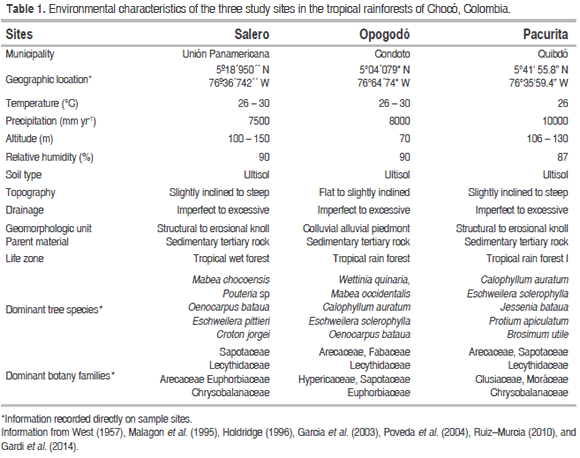
<body><![CDATA[<p><font size="2" face="Verdana, Arial, Helvetica, sans-serif">Results of studies on relationship between AAP and concentrations of N, P, and K in the soil of tropical forests are diverse. For example, Austin and Vitousek (1998) reported significant reductions of soil total N, available P, and exchangeable K with increasing AAP. Contrarily, Jenny (1941), Santiago <i>et al.</i> (2005) and Posada and Schuur (2011), reported increases in total soil N with increased AAP, whereas Alvarez-Clare and Mack (2011) did not find evidence of reduced edaphic P or N with an increase in AAP. A methodological limitation may have caused this variation because the majority of the studies were carried out in sites with AAPs under 5,000 mm yr<sup>-1</sup>. Only Posada and Schuur (2011) presented data from forests with AAP of up to 9,510 mm yr<sup>-1</sup>. </font></p>         <p><font size="2" face="Verdana, Arial, Helvetica, sans-serif">The central Pacific region of Colombia, which presents some of the highest AAPs in the world (&gt; 7000 mm yr<sup>-1</sup>) (Poveda <i>et al.</i>, 2004), offers a tremendous opportunity to evaluate hypotheses related to the influence of AAPs on N, P, and K concentrations in soils. As a result, this study is aimed to explore the relationship between edaphic concentrations of N, P, and K with the AAP of tropical rainforests and, in particular, the differences in the contents of these nutrients in soils of tropical rainforests of the Colombian Pacific region, which is subjected to high AAP levels. In order to accomplish these goals, the edaphic fertility of three tropical rainforests in the Colombian Pacific region was evaluated, and a bibliographic review was carried out that included data on the edaphic content of N, P, and K of Ultisol soils from low-altitude tropical rainforests. </font></p>         <p>&nbsp;</p>         <p><font size="3" face="Verdana, Arial, Helvetica, sans-serif"><b>MATERIALS AND METHODS</b></font></p>     <p><font size="2" face="Verdana, Arial, Helvetica, sans-serif"><b>Location    <br> </b></font><font size="2" face="Verdana, Arial, Helvetica, sans-serif">The study area is located in the tropical rainforests of the localities of Pacurita (municipality of Quibd&oacute;), Salero (municipality of Uni&oacute;n Panamericana) and Opogod&oacute; (municipality of Condoto), in the department of Choc&oacute;, Colombia. These locations form part of the ecogeographic subregion of the Central North of Choc&oacute; biogeographical area, which contains the high-altitude watersheds of the Atrato and San Juan rivers, with piedmont and low hills, and moist, terraced soils developed from transitional sedimentary rock. These sites are on tertiary sedimentary hills between 100 and 200 m in altitude and were formed by sedimentary rocks composed of sandy argillite, sandstone and limestone (Poveda <i>et al.</i>, 2004). The characteristics of the study sites are described in <a href="#tab01">Table 1</a>.</font></p>     <p align="center"><font size="2" face="Verdana, Arial, Helvetica, sans-serif"><a name="tab01"></a></font><img src="/img/revistas/rfnam/v69n1/v69n1a07tab01.gif"></p>     <p><font size="2" face="Verdana, Arial, Helvetica, sans-serif"><b>Plot Establishment    <br> </b></font><font size="2" face="Verdana, Arial, Helvetica, sans-serif">Seven permanent 1-ha plots were established between 2005 and 2013 using the BIOTROP methodology (Garc&iacute;a <i>et al.</i>, 2003; Melo and Vargas, 2003). The two plots in Salero consisted of 20 x 500 m rectangles and the other five plots established in Opogod&oacute; and Pacurita consisted of 100 x 100 m squares. These plots were divided into 25, 20 x 20 m sampling units (400 m<sup>2</sup>) in which soil samples were taken for the present study.</font></p>         <p><font size="2" face="Verdana, Arial, Helvetica, sans-serif"><b>Soil Analysis    ]]></body>
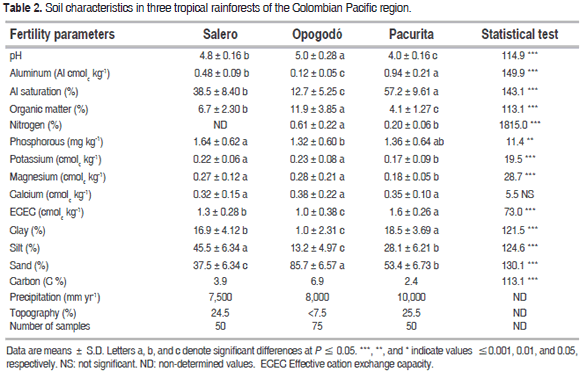
<body><![CDATA[<br>     </b></font><font size="2" face="Verdana, Arial, Helvetica, sans-serif">In order to evaluate soil fertility, compound soil samples were taken from each sampling unit that was a mixture of 5 samples taken at a depth of 20 cm from the four corners and the center of the sampling plots. In each of the seven plots, 25 compound samples were taken for a total of 175 samples. Clay, sand and silt percentage, pH, OM content, and N, P, K, Ca, Mg concentrations were analyzed using the following techniques: Bouyoucos for textural fractions, potentiometric in water solution (1:2) for pH, Walkley and Black for OM, Micro- Kjeldahl technique for total N, ascorbic acid in an UV-VIS spectrophotometer after extraction with the Bray II method for available P, atomic absorption for Ca, Mg, and K extracted with ammonium acetate (Osorio, 2014).</font></p>         <p><font size="2" face="Verdana, Arial, Helvetica, sans-serif">In order to relate the edaphic concentration of nutrients to the AAP, a bibliographic review was conducted including data from similar depth to the one used in this study (0-20cm) for Ultisols from tropical rainforests. The studies included in the analysis came from Alvarez-Clare and Mark (2011), Arag&atilde;o <i>et al.</i> (2009), John <i>et al.</i> (2007), Palmiotto <i>et al.</i> (2004), Powers <i>et al.</i> (2005), Ruokolainen <i>et al.</i> (2007), and Santiago <i>et al.</i> (2005). This analysis covered an AAP range of 1,800 to 10,000 mm yr<sup>-1</sup>, and altitudes between 50 and 900 m.</font></p>         <p><font size="2" face="Verdana, Arial, Helvetica, sans-serif"><b>Statistical analysis    <br>     </b></font><font size="2" face="Verdana, Arial, Helvetica, sans-serif">In order to compare the soil characteristics (texture, OM, pH, Al, N, P, Ca, K, Mg, ECEC) of the three study sites (Salero, Opogod&oacute; and Pacurita), the non-parametric test of Mann-Whitney was used for total N and the Kruskal Wallis test was used for the other soil characteristics because they did not comply with the assumptions of normality and homogeneity of variance for the data, as evaluated with the tests of Bartlett and Hartley. Spearman correlation analysis between sand percentage and other soil characteristics was used. Lineal and polynomial regression analyses were used to relate soil N, P, and K concentrations to AAP (Hoshmand, 1998). The analyses were carried out with the Statgraphics Centurion XV (StatisticalGraphics Corp., 2002) and The R Project for Statistical Computing (<a href="http://www.r-project.org/" target="_blank">www.r-project.org/</a>) software.</font></p>         <p>&nbsp;</p>         <p><font size="3" face="Verdana, Arial, Helvetica, sans-serif"><b>RESULTS AND DISCUSSION</b></font></p>         <p><font size="2" face="Verdana, Arial, Helvetica, sans-serif"><b>Characteristics of the rainforest soils of the Choc&oacute; biogeographical region    <br>     </b></font><font size="2" face="Verdana, Arial, Helvetica, sans-serif">The soils of the tropical rainforests Salero, Opogod&oacute; and Pacurita were extremely acidic, with high Al saturation in Salero (38.5%) and Pacurita (57.2%) and low in Opogod&oacute; (12.7%). Likewise, high concentrations of soil OM and total N were seen in the majority of the sampling units in Opogod&oacute; (OM = 11.9%; N = 0.61%). However, the soil P, Mg, and Ca were very low, while the values of K were intermediate and the ECEC was low in the three zones. </font></p>         <p><font size="2" face="Verdana, Arial, Helvetica, sans-serif">The low pH of soils from the forests of this study agreed with studies in low-altitude tropical rainforests (Buol <i>et al.</i>, 1981; Vitousek, 1984; Vitousek and Sanford, 1986; Malag&oacute;n <i>et al.</i>, 1995; Powers <i>et al</i>., 2005; Posada and Schuur, 2011). The acidic condition is mainly generated by the lixiviation of basic cations (Ca, Mg, K and Na) and the accumulation of acid cations (Al and H) because of environmental factors such as high AAP; among other causal factors of acidification in these soils are high OM contents that release carbonic acid and the symbiotic fixation of N<sub>2 </sub>that releases H<sup>+</sup> ions (Jenny, 1941; Sadzawka and Campillo, 1993). </font></p>         <p><font size="2" face="Verdana, Arial, Helvetica, sans-serif">With the exception of exchangeable Ca, all of the fertility parameters presented significant differences among sites (<a href="#tab02">Table 2</a>). The soils from Pacurita, which were subjected to the highest AAP (10,000 mm yr<sup>-1</sup>), presented higher acidity, clay contents, Al saturation, and ECEC, and lower concentrations of OM, total N, K, and Mg. The soils from Opogod&oacute;, which were subjected to the lowest precipitation among the studied sites (8,000 mm yr<sup>-1</sup>), presented higher contents of sand, OM, and total N. Finally, the soils of Salero,  registered high silt content.</font></p>         ]]></body>
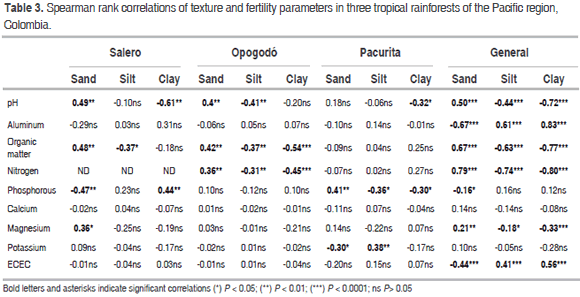
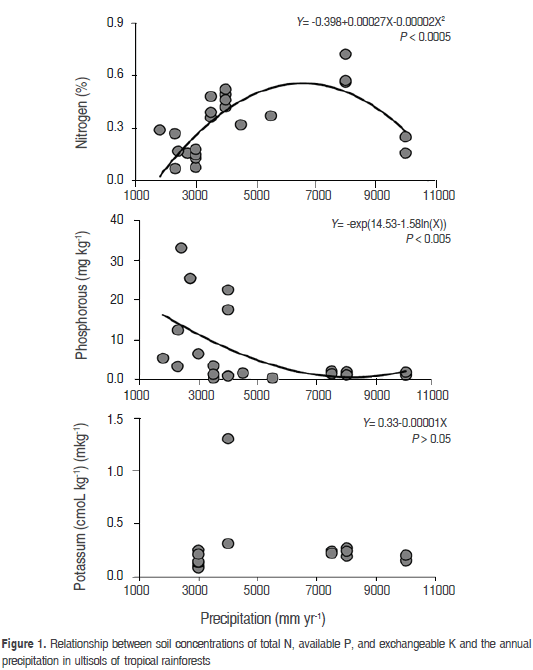
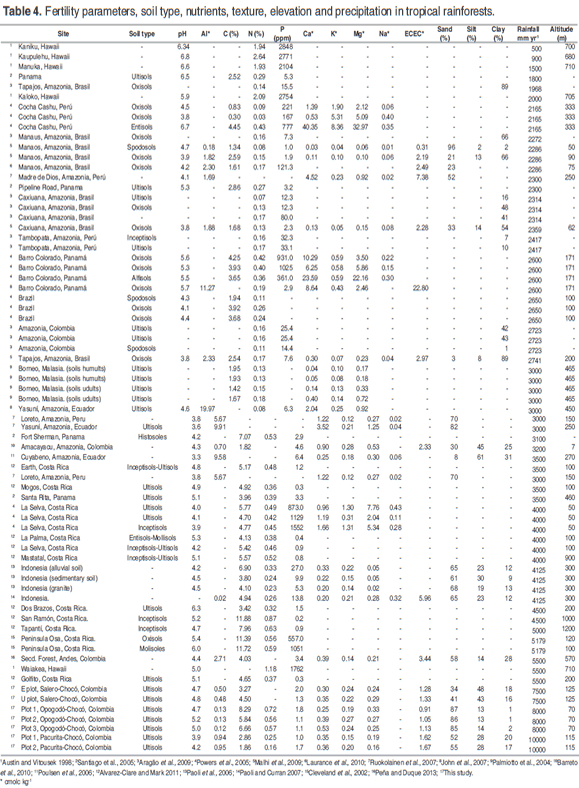
<body><![CDATA[<p align="center"><font size="2" face="Verdana, Arial, Helvetica, sans-serif"><a name="tab02"></a></font><img src="/img/revistas/rfnam/v69n1/v69n1a07tab02.gif"></p>     <p><font size="2" face="Verdana, Arial, Helvetica, sans-serif">The OM concentrations were high in the studied ecosystems of Choc&oacute;, with significant variations between sites, which can be attributed to differences in the AAP, but mainly due to litterfall (Unpublished data from a companion study) and topographical conditions (<a href="#tab02">Table 2</a>). For example, in Salero and Pacurita, the terrain presented higher sloping (topography&asymp;24.5%) and small hills that favor drainage and the mechanical dragging of OM over the soil by surface runoff; while in Opogod&oacute;, the topography was flatter (topography=7.5%), which reduces the loss of OM from the soil.</font></p>         <p><font size="2" face="Verdana, Arial, Helvetica, sans-serif">The high accumulation of OM in the soils of Salero, Pacurita, and Opogod&oacute; can be explained by the abundant AAP and its consequent lixiviation of soil, which have the potential of decreasing the decomposition rate of OM (Schuur 2001) and the foliar concentrations of N, P, Ca, and Mg, as well as increasing C/N ratio (Austin and Vitousek, 1998; Schuur and Matson, 2001; Santiago <i>et al.</i>, 2005; Posada and Schuur, 2011). The decomposing activity of microorganisms can be reduced by the low availability of nutrients (Kaspari <i>et al.</i>, 2008) and lack of oxygen in the soil (Schuur and Matson, 2001; Schuur, 2003). As a result, turnover time of organic C in the soil may increase (Posada and Schuur, 2011), and consequently greater amounts of OM accumulate. </font></p>         <p><font size="2" face="Verdana, Arial, Helvetica, sans-serif">In the soils of Pacurita and Opogod&oacute;, total N concentration was high, which was probably due to high biological fixation rates resulting from the abundance of legumes in these forests (Cleveland <i>et al.</i>, 1999). On the other hand, the concentrations of P, Mg, and Ca were very low, possibly due to the strong influence of the lixiviation caused by the intense rainfall (Jenny, 1941; Austin and Vitousek, 1998; Santiago <i>et al.</i>, 2005). These results suggest that nutrient inputs to the soil through the meteorization of the sedimentary rocks, the OM production, and the deposition by rain and foliage washing are not enough to compensate for the losses caused by lixiviation. Consequently, these forests seem to be limited by P, Mg, and Ca availability, which has significant effects on NPP, soil microbial activity, and nutrient recycling (Austin and Vitousek, 1998; Kaspari <i>et al.</i>, 2008).</font></p>         <p><font size="2" face="Verdana, Arial, Helvetica, sans-serif">Soil texture showed significant correlations with several soil parameters (<a href="#tab03">Table 3</a>). For example, putting together the data of the three plots, sand percentage was positively correlated with pH, OM, total N, and Mg; correlations were negative with Al, P, and ECEC. Inversely, the percentage of clay was negatively correlated with pH, OM, total N, and Mg, while with Al and ECEC the association was positive. However, the magnitude and direction of individual correlations varied among sites. According to these results, in general, the higher clay content in the soils, the more acidic and poorer in nutrients, which could occur because the exchange positions of soil matrix are occupied by Al, which displaces nutrients of such positions (Sadzawka and Campillo, 1993). Consequently, it is expected that forests in clayey soils show lower growth and productivity because of limitations imposed by lower nutrient levels (Kaspari <i>et al.</i>, 2008).</font></p>         <p align="center"><font size="2" face="Verdana, Arial, Helvetica, sans-serif"><a name="tab03"></a></font><img src="/img/revistas/rfnam/v69n1/v69n1a07tab03.gif"></p>     <p><font size="2" face="Verdana, Arial, Helvetica, sans-serif"><b>Influence of precipitation on the concentration of nutrients (N, P, and K) in the soil of tropical rainforests    <br> </b></font><font size="2" face="Verdana, Arial, Helvetica, sans-serif">A significant relationship was found between AAP and total soil N of ultisols of low-altitude tropical rainforests (<i>P </i>&lt; 0.001). The total N increased with increasing AAP, from 2,000 mm yr<sup>-1</sup> to 8,000 mm yr<sup>-1</sup>, but over this precipitation level, total N tended to decrease (<a href="#fig01">Figure 1</a>, <a href="#tab04">Table 4</a>). Under 8,000 mm yr<sup>-1</sup>, the total N increased linearly with rainfall, which agrees with results reported by Jenny (1941), Santiago <i>et al.</i> (2005), and Posada and Schuur (2011), who also documented increases in the soil N content with increased AAP. However, other authors reported different results: Austin and Vitousek (1998) and Schuur and Matson (2001) found that the total N decreased with increased rainfall, while Alvarez-Clare and Mack (2011) found a weak relationship between total N and rainfall in soils of Costa Rica. These differences in the association between AAP and total N are probably due to the influence of other environmental factors, occurring at the local level in each site that overcome the effect of AAP on the total available N in the soil. Among those factors are the variation of texture (see <a href="#tab03">Table 3</a>), litter quality, rates of OM decomposition (Austin and Vitousek, 1998; Santiago <i>et al.</i>, 2005), and availability of nutrients, which affect the biological fixation of N (Vitousek <i>et al.</i>, 2010). </font></p>         <p align="center"><font size="2" face="Verdana, Arial, Helvetica, sans-serif"><a name="fig01"></a></font><img src="/img/revistas/rfnam/v69n1/v69n1a07fig01.gif"></p>         <p align="center"><font size="2" face="Verdana, Arial, Helvetica, sans-serif"><a name="tab04"></a></font><img src="/img/revistas/rfnam/v69n1/v69n1a07tab04.gif"></p>     ]]></body>
<body><![CDATA[<p><font size="2" face="Verdana, Arial, Helvetica, sans-serif">The linear increase of total N with rainfall for precipitation under 8,000 mm yr<sup>-1 </sup>is probably because the lower decomposition rate of litter as well as nitrification and mineralization of N with increased AAP (Austin and Vitousek, 1998; Schuur and Matson, 2001; Santiago, 2003, Santiago <i>et al.</i>, 2005; Alvarez-Clare and Mack, 2011). As a result, N tends to accumulate on the soil. The reduction of the mineralization of N is perhaps due to the changes in the litter quality due to foliar washing of nutrients (Santiago <i>et al.</i>, 2005), to the anaerobic conditions, which can occur as a result of excessive rainfall (Wright <i>et al.</i>, 2001; Schuur and Matson, 2001), and to low availability of nutrients such as P and Ca due to lixiviation. This would affect the activity of aerobic soil microorganisms under conditions of high rainfall, as seen in the forests of Choc&oacute;.</font></p>         <p><font size="2" face="Verdana, Arial, Helvetica, sans-serif">When AAP surpassed 8000 mm yr<sup>-1</sup>, soil total N decreased. Unfortunately, there are no data in the literature for sites that have such a high precipitation, so it is not possible to compare our results. This result was unexpected, so we considered that local factors determine this behavior. In effect, as shown above, the terrain of the evaluated plots in this location present a topography with hills and ravines (<a href="#tab02">Table 2</a>), which favors the soil drainage, the lixiviation, and flow of nutrients and, as a consequence, increased the probability of mineralization and loss of edaphic N. </font></p>         <p><font size="2" face="Verdana, Arial, Helvetica, sans-serif">There was also a significant relationship between AAP and soil available P (<i>P</i> &lt; 0.001) (<a href="#fig01">Figure 1</a>, <a href="#tab04">Table 4</a>). Soil available P decreased with increased AAP in tropical areas of the world. Similar tendencies were reported by Austin and Vitousek (1998) and Santiago <i>et al.</i> (2005) in tropical soils. Contrary to this, Alvarez-Clare Mack (2011) did not find significant correlations between the extractable P in the soil and the AAP in tropical moist forest in Costa Rica. According to these authors, these differences were due to fact the total P was measured, which is less susceptible to changes in AAP, while the present study evaluated the available P. </font></p>         <p><font size="2" face="Verdana, Arial, Helvetica, sans-serif">Prior studies have documented that soil available P is determined by several environmental factors, including the meteorization rate of rocks, type of clay mineral, retention of oxides of Fe and Al, pH, texture, OM content, microorganism activity and lixiviation (Schlesinger, 1997; Osorio, 2014). The decrease of available P in the soil with the increased AAP showed in <a href="#fig01">Figure 1</a> was probably associated with various processes unleashed by high precipitation: firstly, the strong influence of lixiviation, which produces P losses that exceed the inputs from meteorization of rocks (Austin and Vitousek, 1998). Additionally, the high AAP give rise to the accumulation of acid cations (Al and H) and the formation of oxides and sesquioxides of Fe and Al in the soil (Sadzawka and Campillo, 1993), which tend to immobilize P by adsorption on the surface of these minerals (Schlesinger, 1997) and also by the formation of phosphates of Al and Fe (AlPO<sub>4</sub>·2H<sub>2</sub>O, FePO<sub>4</sub>·2H<sub>2</sub>O) when reacting with free ions of Fe<sup>3+</sup> and Al<sup>+</sup> in the soil solution.</font></p>         <p><font size="2" face="Verdana, Arial, Helvetica, sans-serif">Finally, the edaphic content of exchangeable K did not present a significant correlation with AAP (<i>P</i> &gt; 0.7) (<a href="#fig01">Figure 1</a>). Santiago <i>et al.</i> (2005) and Schuur and Matson (2001) did not observe correlations between the exchangeable K content and the AAP either. On the other hand, Austin and Vitousek (1998) found significant reductions in the edaphic concentration of exchangeable K with an increase in rainfall in the tropical soils of Hawaii. This decrease in soil K was probably caused by lixiviation that increased with rainfall (Austin and Vitousek, 1998), which can generate K losses of 120 - 250 kg ha<sup>-1</sup> yr<sup>-1</sup> in tropical soils (Osorio, 2014). The stability of the edaphic concentration of K with the increased AAP found in the present study was probably due to the total losses being compensated for by the inputs into the soil from the forest ecosystem. In effect, this ion is very soluble, resulting in high losses due to lixiviation in humid tropics, as well as high inputs to the soil due to washing from the forest canopy by rainfall, with values of 13 - 220 kg ha<sup>-1</sup> yr<sup>-1</sup> (Vitousek and Sanford, 1986). Additionally, K<sup>+</sup> is easily released to the soil from decomposing organic residues (Osorio, 2014). However, the lack of an effect of increased AAP on soil K deserves further mechanistic studies to test them.</font></p>         <p>&nbsp;</p>     <p><font size="3" face="Verdana, Arial, Helvetica, sans-serif"><b>CONCLUSIONS</b></font></p>     <p><font size="2" face="Verdana, Arial, Helvetica, sans-serif">The positive correlatsion between AAP and soil total N, as well as the inversely proportional relationship between AAP and available P concentration in soils of low tropical forests, suggest that the availability of P, contrary to that of N, is potentially limited by the AAP in these ecosystems. Likewise, if significant changes occur in the AAP of tropical rainforests resulting from the global climate change, the recycling of nutrients will be considerably affected in these ecosystems, which would have significant consequences for their dynamics.</font></p>         <p>&nbsp;</p>         <p><font size="3" face="Verdana, Arial, Helvetica, sans-serif"><b>ACKNOWLEGEMENTS</b></font></p>     ]]></body>
<body><![CDATA[<p><font size="2" face="Verdana, Arial, Helvetica, sans-serif">This research was co-financed by the Universidad Tecnol&oacute;gica del Choc&oacute; &quot;Diego Luis C&oacute;rdoba&quot;, the Universidad Nacional de Colombia Sede Medell&iacute;n and the Departamento Administrativo de Ciencia, Tecnolog&iacute;a e Innovaci&oacute;n - COLCIENCIAS (Agreement 0010-2013), within the project &quot;Evaluaci&oacute;n del efecto de la fertilizaci&oacute;n del suelo sobre la productividad primaria neta de bosques pluviales tropicales del departamento del Choc&oacute;.&quot; The fieldwork of biologist Danilza Marcela Bellido and the members of the research group Cambio Clim&aacute;tico y Biodiversidad and the comments provided by professor Nelson Walter Osorio Vega of the Universidad Nacional de Colombia, Medell&iacute;n campus, were essential to this study. We also appreciate the hospitality and collaboration in the field of the local people in the municipalities of Opogod&oacute;, Pacurita, and Salero. Finally, we are thankful with two anonymous referees who gave important inputs to improve the manuscript.</font></p>     <p>&nbsp;</p>     <p><font size="3" face="Verdana, Arial, Helvetica, sans-serif"><b>REFERENCES</b></font></p>     <!-- ref --><p><font size="2" face="Verdana, Arial, Helvetica, sans-serif">Alvarez-Clare S. and M.C. Mack. 2011. Influence of precipitation on soil and foliar nutrients across nine Costa Rican forests. Biotropica 43(4): 433-441. doi: 10.1111/j.1744-7429.2010.00732.x.    &nbsp;&nbsp;&nbsp;&nbsp;&nbsp;&nbsp;&nbsp;&nbsp;[&#160;<a href="javascript:void(0);" onclick="javascript: window.open('/scielo.php?script=sci_nlinks&ref=000066&pid=S0304-2847201600010000700001&lng=','','width=640,height=500,resizable=yes,scrollbars=1,menubar=yes,');">Links</a>&#160;]<!-- end-ref --> </font></p>         <!-- ref --><p><font size="2" face="Verdana, Arial, Helvetica, sans-serif">Arag&atilde;o, L.E.O., Y. Malhi, D.B. Metcalfe, J.E. Silva-Espejo, E. Jim&eacute;nez, D. Navarrete, S. Almeida, A.C.L. Costa, N. Salinas, O.L. Phillips, L.O. Anderson, T.R. Baker, P.H. Goncalvez, J. Huam&aacute;n-Ovalle, M. Mamani-Sol&oacute;rzano, P. Meir, A. Monteagudo, M.C. Pe&ntilde;uela, A. Prieto, C.A. Quesada, A. Rozas-D&aacute;vila, A. Rudas, J.A. Silva Junior, and R. V&aacute;squez. 2009. Above- and below-ground net primary productivity across ten Amazonian forests on contrasting soils. Biogeosciences Discuss., 6(1): 2441-2488. doi: 10.5194/bgd-6-2441-2009.    &nbsp;&nbsp;&nbsp;&nbsp;&nbsp;&nbsp;&nbsp;&nbsp;[&#160;<a href="javascript:void(0);" onclick="javascript: window.open('/scielo.php?script=sci_nlinks&ref=000068&pid=S0304-2847201600010000700002&lng=','','width=640,height=500,resizable=yes,scrollbars=1,menubar=yes,');">Links</a>&#160;]<!-- end-ref --> </font></p>         <!-- ref --><p><font size="2" face="Verdana, Arial, Helvetica, sans-serif">Austin A.T., and P.M. Vitousek 1998. Nutrient dynamics on a precipitation gradient in Hawaii. Oecologia 113(4): 519-529. Doi: 10.1007/s004420050405.    &nbsp;&nbsp;&nbsp;&nbsp;&nbsp;&nbsp;&nbsp;&nbsp;[&#160;<a href="javascript:void(0);" onclick="javascript: window.open('/scielo.php?script=sci_nlinks&ref=000070&pid=S0304-2847201600010000700003&lng=','','width=640,height=500,resizable=yes,scrollbars=1,menubar=yes,');">Links</a>&#160;]<!-- end-ref --> </font></p>         <!-- ref --><p><font size="2" face="Verdana, Arial, Helvetica, sans-serif">Barreto, J.S., A.J Duque, D. C&aacute;rdenas, and F.H. Moreno. 2010. Variaci&oacute;n flor&iacute;stica de especies arb&oacute;reas a escala local en un bosque de tierra firme en la Amazonia colombiana. Acta Amazonica 40(1): 179-188. doi: 10.1590/s0044-59672010000100023.    &nbsp;&nbsp;&nbsp;&nbsp;&nbsp;&nbsp;&nbsp;&nbsp;[&#160;<a href="javascript:void(0);" onclick="javascript: window.open('/scielo.php?script=sci_nlinks&ref=000072&pid=S0304-2847201600010000700004&lng=','','width=640,height=500,resizable=yes,scrollbars=1,menubar=yes,');">Links</a>&#160;]<!-- end-ref --> </font></p>         <!-- ref --><p><font size="2" face="Verdana, Arial, Helvetica, sans-serif">Buol, S.W., F.D. Hole and R.J. McCracken. 1981. G&eacute;nesis y Clasificaci&oacute;n de Suelos. Primera edici&oacute;n. Editorial Trillas S.A., M&eacute;xico D.F. M&eacute;xico. 417 p.    &nbsp;&nbsp;&nbsp;&nbsp;&nbsp;&nbsp;&nbsp;&nbsp;[&#160;<a href="javascript:void(0);" onclick="javascript: window.open('/scielo.php?script=sci_nlinks&ref=000074&pid=S0304-2847201600010000700005&lng=','','width=640,height=500,resizable=yes,scrollbars=1,menubar=yes,');">Links</a>&#160;]<!-- end-ref --> </font></p>         <!-- ref --><p><font size="2" face="Verdana, Arial, Helvetica, sans-serif">Chapin III, F.S., P.A. Matson, and H.A. Mooney. 2002. Principles of terrestrial ecosystem ecology. Springer-Verlag, New York,  United States of America. 436 p.    &nbsp;&nbsp;&nbsp;&nbsp;&nbsp;&nbsp;&nbsp;&nbsp;[&#160;<a href="javascript:void(0);" onclick="javascript: window.open('/scielo.php?script=sci_nlinks&ref=000076&pid=S0304-2847201600010000700006&lng=','','width=640,height=500,resizable=yes,scrollbars=1,menubar=yes,');">Links</a>&#160;]<!-- end-ref --> </font></p>         <!-- ref --><p><font size="2" face="Verdana, Arial, Helvetica, sans-serif">Cleveland, C.C.; A.R. Townsend, D.S. Schimel, H. Fisher, R.W. Howarth, L.O. Hedin, S.S. Perakis, E.F. Latty, J. C. Von Fischer, A. Elseroad, and M.F. Wasson. 1999. Global patterns of terrestrial biological nitrogen (N2) fixation in natural ecosystems. Global Biogeochem Cycles. 13(2): 623 - 645. doi: 10.1029/1999gb900014.    &nbsp;&nbsp;&nbsp;&nbsp;&nbsp;&nbsp;&nbsp;&nbsp;[&#160;<a href="javascript:void(0);" onclick="javascript: window.open('/scielo.php?script=sci_nlinks&ref=000078&pid=S0304-2847201600010000700007&lng=','','width=640,height=500,resizable=yes,scrollbars=1,menubar=yes,');">Links</a>&#160;]<!-- end-ref --> </font></p>         <!-- ref --><p><font size="2" face="Verdana, Arial, Helvetica, sans-serif">Cleveland, C.C., Townsend, A.R., and S.K. Schmidt. 2002. Phosphorus limitation of microbial processes in moist tropical forests: evidence from short-term laboratory incubations and field studies. Ecosystems 5(7): 0680-0691. doi: 10.1007/s10021-002-0202-9.    &nbsp;&nbsp;&nbsp;&nbsp;&nbsp;&nbsp;&nbsp;&nbsp;[&#160;<a href="javascript:void(0);" onclick="javascript: window.open('/scielo.php?script=sci_nlinks&ref=000080&pid=S0304-2847201600010000700008&lng=','','width=640,height=500,resizable=yes,scrollbars=1,menubar=yes,');">Links</a>&#160;]<!-- end-ref --> </font></p>         <!-- ref --><p><font size="2" face="Verdana, Arial, Helvetica, sans-serif">Elser, J.J., M.E.S. Bracken, E.E. Cleland, D.S. Gruner, W.S. Harpole, H. Hillebrand, J.T. Ngai, E.W. Seabloom, J.B. Shurin, and J.E. Smith. 2007. Global analysis of nitrogen and phosphorus limitation of primary producers in freshwater, marine and terrestrial ecosystems. Ecology Letters 10(12): 1135- 1142. doi: 10.1111/j.1461-0248.2007.01113.x.    &nbsp;&nbsp;&nbsp;&nbsp;&nbsp;&nbsp;&nbsp;&nbsp;[&#160;<a href="javascript:void(0);" onclick="javascript: window.open('/scielo.php?script=sci_nlinks&ref=000082&pid=S0304-2847201600010000700009&lng=','','width=640,height=500,resizable=yes,scrollbars=1,menubar=yes,');">Links</a>&#160;]<!-- end-ref --> </font></p>         <!-- ref --><p><font size="2" face="Verdana, Arial, Helvetica, sans-serif">Garc&iacute;a, F., Y. Ramos, J. Palacios, J.E. Arroyo, A. Mena, and M. Gonz&aacute;lez. 2003. SALERO Diversidad biol&oacute;gica de un bosque pluvial tropical (bp-T). Editorial Guadalupe Ltda, Bogot&aacute;, Colombia. 213 p.    &nbsp;&nbsp;&nbsp;&nbsp;&nbsp;&nbsp;&nbsp;&nbsp;[&#160;<a href="javascript:void(0);" onclick="javascript: window.open('/scielo.php?script=sci_nlinks&ref=000084&pid=S0304-2847201600010000700010&lng=','','width=640,height=500,resizable=yes,scrollbars=1,menubar=yes,');">Links</a>&#160;]<!-- end-ref --> </font></p>         <!-- ref --><p><font size="2" face="Verdana, Arial, Helvetica, sans-serif">Gardi, C., M. Angelini, S. Barcel&oacute;, J. Comerma, C. Cruz, A. Encina, A. Jones, P. Krasilnikov, M.L. Mendon&ccedil;a, L. Montanarella, O. Mu&ntilde;iz, P. Schad, M.I. Vara, and R. Vargas (eds). 2014. Atlas de suelos de Am&eacute;rica Latina y el Caribe, Comisi&oacute;n Europea - Oficina de Publicaciones de la Uni&oacute;n Europea, L-2995 Luxembourg, 176 pp.    &nbsp;&nbsp;&nbsp;&nbsp;&nbsp;&nbsp;&nbsp;&nbsp;[&#160;<a href="javascript:void(0);" onclick="javascript: window.open('/scielo.php?script=sci_nlinks&ref=000086&pid=S0304-2847201600010000700011&lng=','','width=640,height=500,resizable=yes,scrollbars=1,menubar=yes,');">Links</a>&#160;]<!-- end-ref --> </font></p>         <!-- ref --><p><font size="2" face="Verdana, Arial, Helvetica, sans-serif">Hoshmand, A.R. 1998. Statistical methods for environmental and agricultural sciences. Second edition. CRC Press LLC, New York, United States of America. 439. p.    &nbsp;&nbsp;&nbsp;&nbsp;&nbsp;&nbsp;&nbsp;&nbsp;[&#160;<a href="javascript:void(0);" onclick="javascript: window.open('/scielo.php?script=sci_nlinks&ref=000088&pid=S0304-2847201600010000700012&lng=','','width=640,height=500,resizable=yes,scrollbars=1,menubar=yes,');">Links</a>&#160;]<!-- end-ref --> </font></p>         <!-- ref --><p><font size="2" face="Verdana, Arial, Helvetica, sans-serif">Jenny H. 1941. Factors of soil formation. McGraw-Hill, New York. 271 p.    &nbsp;&nbsp;&nbsp;&nbsp;&nbsp;&nbsp;&nbsp;&nbsp;[&#160;<a href="javascript:void(0);" onclick="javascript: window.open('/scielo.php?script=sci_nlinks&ref=000090&pid=S0304-2847201600010000700013&lng=','','width=640,height=500,resizable=yes,scrollbars=1,menubar=yes,');">Links</a>&#160;]<!-- end-ref --> </font></p>         <!-- ref --><p><font size="2" face="Verdana, Arial, Helvetica, sans-serif">John, R.; J.W. Dalling, K.E. Harms, J.B. Yavitt, R.F. Stallard, M. Mirabello, S.P. Hubbell, R. Valencia, H. Navarrete, M. Vallejo, and R.B. Foster. 2007. Soil nutrients influence spatial distributions of tropical tree species. Proceedings of the National Academy of Sciences PNAS. 104 (3): 864 - 869. doi: 10.1073/pnas.0604666104.    &nbsp;&nbsp;&nbsp;&nbsp;&nbsp;&nbsp;&nbsp;&nbsp;[&#160;<a href="javascript:void(0);" onclick="javascript: window.open('/scielo.php?script=sci_nlinks&ref=000092&pid=S0304-2847201600010000700014&lng=','','width=640,height=500,resizable=yes,scrollbars=1,menubar=yes,');">Links</a>&#160;]<!-- end-ref --> </font></p>         <!-- ref --><p><font size="2" face="Verdana, Arial, Helvetica, sans-serif">Kaspari M, M.N. Garcia, K.E. Harms, M. Santana, S.J. Wright., and J.B. Yavitt. 2008. Multiple nutrients limit litterfall and decomposition in a tropical forest. Ecology Letters 11: 35-43. doi: 10.1111/j.1461-0248.2007.01124.x.    &nbsp;&nbsp;&nbsp;&nbsp;&nbsp;&nbsp;&nbsp;&nbsp;[&#160;<a href="javascript:void(0);" onclick="javascript: window.open('/scielo.php?script=sci_nlinks&ref=000094&pid=S0304-2847201600010000700015&lng=','','width=640,height=500,resizable=yes,scrollbars=1,menubar=yes,');">Links</a>&#160;]<!-- end-ref --> </font></p>         <!-- ref --><p><font size="2" face="Verdana, Arial, Helvetica, sans-serif">Laurance, S.G.W., W.F. Laurance, A. Andrade, P.M. Fearnside, K.E. Harms, A. Vicentini, and R.C.C. Luiz&atilde;o. 2010. Influence of soils and topography on Amazonian tree diversity: a landscape-scale study. Journal of Vegetation Science 21(1): 96-106. doi: 10.1111/j.1654-1103.2009.01122.x.    &nbsp;&nbsp;&nbsp;&nbsp;&nbsp;&nbsp;&nbsp;&nbsp;[&#160;<a href="javascript:void(0);" onclick="javascript: window.open('/scielo.php?script=sci_nlinks&ref=000096&pid=S0304-2847201600010000700016&lng=','','width=640,height=500,resizable=yes,scrollbars=1,menubar=yes,');">Links</a>&#160;]<!-- end-ref --> </font></p>         <!-- ref --><p><font size="2" face="Verdana, Arial, Helvetica, sans-serif">LeBauer, D.S. and K. Treseder. 2008. Nitrogen limitation of net primary productivity in terrestrial ecosystems is globally distributed. Ecology 89(2): 371-379. doi: 10.1890/06-2057.1.    &nbsp;&nbsp;&nbsp;&nbsp;&nbsp;&nbsp;&nbsp;&nbsp;[&#160;<a href="javascript:void(0);" onclick="javascript: window.open('/scielo.php?script=sci_nlinks&ref=000098&pid=S0304-2847201600010000700017&lng=','','width=640,height=500,resizable=yes,scrollbars=1,menubar=yes,');">Links</a>&#160;]<!-- end-ref --> </font></p>         <!-- ref --><p><font size="2" face="Verdana, Arial, Helvetica, sans-serif">Malagon D., C. Pulido, R.D. Llinas, C. Chamorro, y J. Fern&aacute;ndez. 1995. Suelos de Colombia. Origen, Evoluci&oacute;n, Clasificaci&oacute;n, Distribuci&oacute;n y uso. Instituto Geogr&aacute;fico Agust&iacute;n Codazzi. Subdirecci&oacute;n de Agrolog&iacute;a, Santafe de Bogot&aacute;, Colombia. 632 p.    &nbsp;&nbsp;&nbsp;&nbsp;&nbsp;&nbsp;&nbsp;&nbsp;[&#160;<a href="javascript:void(0);" onclick="javascript: window.open('/scielo.php?script=sci_nlinks&ref=000100&pid=S0304-2847201600010000700018&lng=','','width=640,height=500,resizable=yes,scrollbars=1,menubar=yes,');">Links</a>&#160;]<!-- end-ref --></font></p>         <!-- ref --><p><font size="2" face="Verdana, Arial, Helvetica, sans-serif">Malhi, Y., L.E.O.C. Arag&atilde;o, D.B. Metcalfe, R. Paiva, C.A. Quesada, S. Almeida, L. Anderson, P. Brando, J.Q. Chambers, A.C.L. Da Costa, L.R. Hutyra, P. Oliveira, S. Pati&ntilde;o, E.H. Pyle, A.L. Robertson, And L.M. Teixeira. 2009. Comprehensive assessment of carbon productivity, allocation and storage in three Amazonian forests. Global Change Biology 15(5): 1255-1274. doi: 10.1111/j.1365-2486.2008.01780.x.    &nbsp;&nbsp;&nbsp;&nbsp;&nbsp;&nbsp;&nbsp;&nbsp;[&#160;<a href="javascript:void(0);" onclick="javascript: window.open('/scielo.php?script=sci_nlinks&ref=000102&pid=S0304-2847201600010000700019&lng=','','width=640,height=500,resizable=yes,scrollbars=1,menubar=yes,');">Links</a>&#160;]<!-- end-ref --> </font></p>         <!-- ref --><p><font size="2" face="Verdana, Arial, Helvetica, sans-serif">Melo, O. and R.Vargas. 2003. Evaluaci&oacute;n Ecol&oacute;gica y Silvicultural de Ecosistemas Boscosos. Universidad del Tolima, CRQ, CARDER. CORPOCALDAS, CORTOLIMA. p. 235.    &nbsp;&nbsp;&nbsp;&nbsp;&nbsp;&nbsp;&nbsp;&nbsp;[&#160;<a href="javascript:void(0);" onclick="javascript: window.open('/scielo.php?script=sci_nlinks&ref=000104&pid=S0304-2847201600010000700020&lng=','','width=640,height=500,resizable=yes,scrollbars=1,menubar=yes,');">Links</a>&#160;]<!-- end-ref --> </font></p>         <!-- ref --><p><font size="2" face="Verdana, Arial, Helvetica, sans-serif">Osorio, N.W. 2014. Manejo de nutrientes en suelos del Tr&oacute;pico. Segunda edici&oacute;n. Universidad Nacional de Colombia, sede Medell&iacute;n, Medell&iacute;n, Colombia. p. 416.    &nbsp;&nbsp;&nbsp;&nbsp;&nbsp;&nbsp;&nbsp;&nbsp;[&#160;<a href="javascript:void(0);" onclick="javascript: window.open('/scielo.php?script=sci_nlinks&ref=000106&pid=S0304-2847201600010000700021&lng=','','width=640,height=500,resizable=yes,scrollbars=1,menubar=yes,');">Links</a>&#160;]<!-- end-ref --> </font></p>         <!-- ref --><p><font size="2" face="Verdana, Arial, Helvetica, sans-serif">Palmiotto, P.A., S.J. Davies, K.A. Vogt, M.S. Ashton, D.J. Vogt and P.S. Ashton. 2004. Soil-related habitat specialization in dipterocarp rain forest tree species in Borneo. Journal of Ecology. 92(4): 609 - 623. doi: 10.1111/j.0022-0477.2004.00894.x.    &nbsp;&nbsp;&nbsp;&nbsp;&nbsp;&nbsp;&nbsp;&nbsp;[&#160;<a href="javascript:void(0);" onclick="javascript: window.open('/scielo.php?script=sci_nlinks&ref=000108&pid=S0304-2847201600010000700022&lng=','','width=640,height=500,resizable=yes,scrollbars=1,menubar=yes,');">Links</a>&#160;]<!-- end-ref --> </font></p>         <!-- ref --><p><font size="2" face="Verdana, Arial, Helvetica, sans-serif">Paoli, G.D., L.M. Curran, and D.R. Zak. 2006. Soil nutrients and beta diversity in the Bornean Dipterocarpaceae: evidence for niche partitioning by tropical rain forest trees. Journal of  Ecology 94(1): 157-170. doi: 10.1111/j.1365-2745.2005.01077.x.    &nbsp;&nbsp;&nbsp;&nbsp;&nbsp;&nbsp;&nbsp;&nbsp;[&#160;<a href="javascript:void(0);" onclick="javascript: window.open('/scielo.php?script=sci_nlinks&ref=000110&pid=S0304-2847201600010000700023&lng=','','width=640,height=500,resizable=yes,scrollbars=1,menubar=yes,');">Links</a>&#160;]<!-- end-ref --> </font></p>         <!-- ref --><p><font size="2" face="Verdana, Arial, Helvetica, sans-serif">Paoli, G.D. and L.M. Curran. 2007. Soil nutrients limit fine litter production and tree growth in mature lowland forest of Southwestern Borneo. Ecosystems 10(3): 503-518. doi: 10.1007/s10021-007-9042-y.    &nbsp;&nbsp;&nbsp;&nbsp;&nbsp;&nbsp;&nbsp;&nbsp;[&#160;<a href="javascript:void(0);" onclick="javascript: window.open('/scielo.php?script=sci_nlinks&ref=000112&pid=S0304-2847201600010000700024&lng=','','width=640,height=500,resizable=yes,scrollbars=1,menubar=yes,');">Links</a>&#160;]<!-- end-ref --> </font></p>         <!-- ref --><p><font size="2" face="Verdana, Arial, Helvetica, sans-serif">Pe&ntilde;a, M.A., and A. Duque. 2013. Patterns of stocks of aboveground tree biomass, dynamics, and their determinants in secondary Andean forests. Forest Ecology and Management, 302(1): 54-61. doi: 10.1016/j.foreco.2013.03.025.    &nbsp;&nbsp;&nbsp;&nbsp;&nbsp;&nbsp;&nbsp;&nbsp;[&#160;<a href="javascript:void(0);" onclick="javascript: window.open('/scielo.php?script=sci_nlinks&ref=000114&pid=S0304-2847201600010000700025&lng=','','width=640,height=500,resizable=yes,scrollbars=1,menubar=yes,');">Links</a>&#160;]<!-- end-ref --> </font></p>         <!-- ref --><p><font size="2" face="Verdana, Arial, Helvetica, sans-serif">Posada J.M. and E.A.G. Schuur. 2011. Relationships among precipitation regime, nutrient availability, and carbon turnover in tropical rain forests. Oecologia 165(3): 783-795. doi: 10.1007/s00442-010-1881-0.    &nbsp;&nbsp;&nbsp;&nbsp;&nbsp;&nbsp;&nbsp;&nbsp;[&#160;<a href="javascript:void(0);" onclick="javascript: window.open('/scielo.php?script=sci_nlinks&ref=000116&pid=S0304-2847201600010000700026&lng=','','width=640,height=500,resizable=yes,scrollbars=1,menubar=yes,');">Links</a>&#160;]<!-- end-ref --> </font></p>         <!-- ref --><p><font size="2" face="Verdana, Arial, Helvetica, sans-serif">Poveda, I.C., C. Rojas, A. Rudas, and O. Rangel. 2004. El Choc&oacute; biogeogr&aacute;fico: Ambiente F&iacute;sico. In Rangel, O. (ed.), Colombia diversidad bi&oacute;tica IV El Choc&oacute; biogeogr&aacute;fico/ Costa Pac&iacute;fica. Instituto de Ciencias Naturales. Universidad Nacional de Colombia, Santafe de Bogot&aacute; D.C. 1024 p.    &nbsp;&nbsp;&nbsp;&nbsp;&nbsp;&nbsp;&nbsp;&nbsp;[&#160;<a href="javascript:void(0);" onclick="javascript: window.open('/scielo.php?script=sci_nlinks&ref=000118&pid=S0304-2847201600010000700027&lng=','','width=640,height=500,resizable=yes,scrollbars=1,menubar=yes,');">Links</a>&#160;]<!-- end-ref --> </font></p>         <!-- ref --><p><font size="2" face="Verdana, Arial, Helvetica, sans-serif">Powers, J., S. Treseder, and M.T. Lerdau. 2005. Fine roots, arbuscular mycorrhizal hyphae and soil nutrients in four Neotropical rain forests: patterns across large geographic distances. New Phytologist. 165(3): 913-921. doi: 10.1111/j.1469-8137.2004.01279.x.    &nbsp;&nbsp;&nbsp;&nbsp;&nbsp;&nbsp;&nbsp;&nbsp;[&#160;<a href="javascript:void(0);" onclick="javascript: window.open('/scielo.php?script=sci_nlinks&ref=000120&pid=S0304-2847201600010000700028&lng=','','width=640,height=500,resizable=yes,scrollbars=1,menubar=yes,');">Links</a>&#160;]<!-- end-ref --></font></p>         <!-- ref --><p><font size="2" face="Verdana, Arial, Helvetica, sans-serif">Poulsen, A.D., H. Tuomisto, and H. Balslev. 2006. Edaphic and floristic variation within a 1-ha plot of lowland amazonian rain forest1. Biotropica 38(4): 468-478. doi: 10.1111/j.1744-7429.2006.00168.x.    &nbsp;&nbsp;&nbsp;&nbsp;&nbsp;&nbsp;&nbsp;&nbsp;[&#160;<a href="javascript:void(0);" onclick="javascript: window.open('/scielo.php?script=sci_nlinks&ref=000122&pid=S0304-2847201600010000700029&lng=','','width=640,height=500,resizable=yes,scrollbars=1,menubar=yes,');">Links</a>&#160;]<!-- end-ref --> </font></p>         <!-- ref --><p><font size="2" face="Verdana, Arial, Helvetica, sans-serif">Ruiz - Murcia, J.F. 2010. Cambio clim&aacute;tico en temperatura, precipitaci&oacute;n y humedad relativa para colombia usando modelos meteorol&oacute;gicos de alta resoluci&oacute;n (Panorama 2011-2100). Instituto de Hidrolog&iacute;a, Meteorolog&iacute;a y Estudios Ambientales - IDEAM. Subdirecci&oacute;n de Meteorolog&iacute;a. Nota T&eacute;cnica IDEAM-METEO/005-2010., Bogot&aacute;, D.C., mayo 2010. p. 91.    &nbsp;&nbsp;&nbsp;&nbsp;&nbsp;&nbsp;&nbsp;&nbsp;[&#160;<a href="javascript:void(0);" onclick="javascript: window.open('/scielo.php?script=sci_nlinks&ref=000124&pid=S0304-2847201600010000700030&lng=','','width=640,height=500,resizable=yes,scrollbars=1,menubar=yes,');">Links</a>&#160;]<!-- end-ref --> </font></p>         <!-- ref --><p><font size="2" face="Verdana, Arial, Helvetica, sans-serif">Ruokolainen, K., H. Tuomisto, M.J. Mac&iacute;a, M.A. Higgins, and M. Yli-Halla. 2007. Are floristic and edaphic patterns in Amazonian rain forests congruent for trees, pteridophytes and Melastomataceae?. Journal of Tropical Ecology 23(1): 13-25. doi: 10.1017/s0266467406003889.    &nbsp;&nbsp;&nbsp;&nbsp;&nbsp;&nbsp;&nbsp;&nbsp;[&#160;<a href="javascript:void(0);" onclick="javascript: window.open('/scielo.php?script=sci_nlinks&ref=000126&pid=S0304-2847201600010000700031&lng=','','width=640,height=500,resizable=yes,scrollbars=1,menubar=yes,');">Links</a>&#160;]<!-- end-ref --> </font></p>         <!-- ref --><p><font size="2" face="Verdana, Arial, Helvetica, sans-serif">Sadzawka R.A. and R.R. Campillo. 1993. Problem&aacute;tica de la acidez de los suelos de la IX Regi&oacute;n. I. G&eacute;nesis y caracter&iacute;sticas del proceso. Investigaci&oacute;n y Progreso Agropecuario Carillanca. 12(3): 3-7.    &nbsp;&nbsp;&nbsp;&nbsp;&nbsp;&nbsp;&nbsp;&nbsp;[&#160;<a href="javascript:void(0);" onclick="javascript: window.open('/scielo.php?script=sci_nlinks&ref=000128&pid=S0304-2847201600010000700032&lng=','','width=640,height=500,resizable=yes,scrollbars=1,menubar=yes,');">Links</a>&#160;]<!-- end-ref --> </font></p>         <!-- ref --><p><font size="2" face="Verdana, Arial, Helvetica, sans-serif">Salisbury, F.B. and C.W. Ross. 1994. Fisiolog&iacute;a Vegetal. Cuarta edici&oacute;n. Grupo Editorial Iberoam&eacute;rica S.A., M&eacute;xico. D.F. p. 759.    &nbsp;&nbsp;&nbsp;&nbsp;&nbsp;&nbsp;&nbsp;&nbsp;[&#160;<a href="javascript:void(0);" onclick="javascript: window.open('/scielo.php?script=sci_nlinks&ref=000130&pid=S0304-2847201600010000700033&lng=','','width=640,height=500,resizable=yes,scrollbars=1,menubar=yes,');">Links</a>&#160;]<!-- end-ref --> </font></p>         <!-- ref --><p><font size="2" face="Verdana, Arial, Helvetica, sans-serif">Santiago, L.S., E.A.G. Schuur, and K. Silvera. 2005. Nutrient cycling and plant-soil feedbacks along a precipitation gradient in lowland Panama. Journal of Tropical Ecology 21(4): 461-470. doi: 10.1017/s0266467405002464.    &nbsp;&nbsp;&nbsp;&nbsp;&nbsp;&nbsp;&nbsp;&nbsp;[&#160;<a href="javascript:void(0);" onclick="javascript: window.open('/scielo.php?script=sci_nlinks&ref=000132&pid=S0304-2847201600010000700034&lng=','','width=640,height=500,resizable=yes,scrollbars=1,menubar=yes,');">Links</a>&#160;]<!-- end-ref --> </font></p>         <!-- ref --><p><font size="2" face="Verdana, Arial, Helvetica, sans-serif">Schlesinger, W.H. 1997. Biogeochemistry: An analysis of global change. Second edition. Academic Press, San Diego, California. USA. 588 p.    &nbsp;&nbsp;&nbsp;&nbsp;&nbsp;&nbsp;&nbsp;&nbsp;[&#160;<a href="javascript:void(0);" onclick="javascript: window.open('/scielo.php?script=sci_nlinks&ref=000134&pid=S0304-2847201600010000700035&lng=','','width=640,height=500,resizable=yes,scrollbars=1,menubar=yes,');">Links</a>&#160;]<!-- end-ref --> </font></p>         <!-- ref --><p><font size="2" face="Verdana, Arial, Helvetica, sans-serif">Schuur, E.A. 2003. Productivity and global climate revisited: the sensitivity of tropical forest growth to precipitation. Ecology 84:1165-1170. doi: 10.1890/0012-9658(2003)084&#91;1165:PAGCRT&#93;2.0.CO;2 </font>&nbsp;&nbsp;&nbsp;&nbsp;&nbsp;&nbsp;&nbsp;&nbsp;[&#160;<a href="javascript:void(0);" onclick="javascript: window.open('/scielo.php?script=sci_nlinks&ref=000136&pid=S0304-2847201600010000700036&lng=','','width=640,height=500,resizable=yes,scrollbars=1,menubar=yes,');">Links</a>&#160;]<!-- end-ref --><!-- ref --><p><font size="2" face="Verdana, Arial, Helvetica, sans-serif">Schuur, E.A.G. 2001. The effect of water on decomposition dynamics in mesic to wet Hawaiian montane forests. Ecosystems, 4(3): 259-273. doi: 10.1007/s10021-001-0008-1.    &nbsp;&nbsp;&nbsp;&nbsp;&nbsp;&nbsp;&nbsp;&nbsp;[&#160;<a href="javascript:void(0);" onclick="javascript: window.open('/scielo.php?script=sci_nlinks&ref=000137&pid=S0304-2847201600010000700037&lng=','','width=640,height=500,resizable=yes,scrollbars=1,menubar=yes,');">Links</a>&#160;]<!-- end-ref --> </font></p>         <!-- ref --><p><font size="2" face="Verdana, Arial, Helvetica, sans-serif">Schuur, E.A. and P.A. Matson, 2001. Net primary productivity and nutrient cycling across a mesic to wet precipitation gradient in Hawaiian montane forest. Oecologia 128(3): 431-442. doi: 10.1007/s004420100671.    &nbsp;&nbsp;&nbsp;&nbsp;&nbsp;&nbsp;&nbsp;&nbsp;[&#160;<a href="javascript:void(0);" onclick="javascript: window.open('/scielo.php?script=sci_nlinks&ref=000139&pid=S0304-2847201600010000700038&lng=','','width=640,height=500,resizable=yes,scrollbars=1,menubar=yes,');">Links</a>&#160;]<!-- end-ref --> </font></p>         <!-- ref --><p><font size="2" face="Verdana, Arial, Helvetica, sans-serif">Statistical Graphics Corp. 2002. Statgraphics Plus Centurium Version 5.1. <a href="http://www.Statgraphics.Com" target="_blank">www.Statgraphics.Com</a>. The R Project for Statistical Computing (<a href="http://www.r-project.org/" target="_blank">www.r-project.org/</a>) </font>&nbsp;&nbsp;&nbsp;&nbsp;&nbsp;&nbsp;&nbsp;&nbsp;[&#160;<a href="javascript:void(0);" onclick="javascript: window.open('/scielo.php?script=sci_nlinks&ref=000141&pid=S0304-2847201600010000700039&lng=','','width=640,height=500,resizable=yes,scrollbars=1,menubar=yes,');">Links</a>&#160;]<!-- end-ref --><!-- ref --><p><font size="2" face="Verdana, Arial, Helvetica, sans-serif">Tripler, C.E., S.S. Kaushal, G.E. Likens, and M.T. Walter. 2006. Patterns in potassium dynamics in forest ecosystems. Ecology Letters 9(4): 451-466. doi: 10.1111/j.1461-0248.2006.00891.x.    &nbsp;&nbsp;&nbsp;&nbsp;&nbsp;&nbsp;&nbsp;&nbsp;[&#160;<a href="javascript:void(0);" onclick="javascript: window.open('/scielo.php?script=sci_nlinks&ref=000142&pid=S0304-2847201600010000700040&lng=','','width=640,height=500,resizable=yes,scrollbars=1,menubar=yes,');">Links</a>&#160;]<!-- end-ref --> </font></p>         <!-- ref --><p><font size="2" face="Verdana, Arial, Helvetica, sans-serif">Vitousek, P.; S. Porder, B.Z. Houlton and O.A. Chadwick. 2010. Terrestrial phosphorus limitation: mechanisms, implications, and nitrogen-phosphorus interactions. Ecological Applications. 20(1): 5-15. doi: 10.1890/08-0127.1.    &nbsp;&nbsp;&nbsp;&nbsp;&nbsp;&nbsp;&nbsp;&nbsp;[&#160;<a href="javascript:void(0);" onclick="javascript: window.open('/scielo.php?script=sci_nlinks&ref=000144&pid=S0304-2847201600010000700041&lng=','','width=640,height=500,resizable=yes,scrollbars=1,menubar=yes,');">Links</a>&#160;]<!-- end-ref --> </font></p>         <!-- ref --><p><font size="2" face="Verdana, Arial, Helvetica, sans-serif">Vitousek P.M. 1984. Litterfall, nutrient cycling, and nutrient limitation in tropical forests. Ecology 65(1): 285-298. doi: 10.2307/1939481.    &nbsp;&nbsp;&nbsp;&nbsp;&nbsp;&nbsp;&nbsp;&nbsp;[&#160;<a href="javascript:void(0);" onclick="javascript: window.open('/scielo.php?script=sci_nlinks&ref=000146&pid=S0304-2847201600010000700042&lng=','','width=640,height=500,resizable=yes,scrollbars=1,menubar=yes,');">Links</a>&#160;]<!-- end-ref --> </font></p>         <!-- ref --><p><font size="2" face="Verdana, Arial, Helvetica, sans-serif">Vitousek, P.M., and R.L. Sanford Jr. 1986. Nutrient cycling in moist tropical forest. Annual Review of Ecology and Systematics 17 (1): 137-167. doi: 10.1146/annurev.es.17.110186.001033.    &nbsp;&nbsp;&nbsp;&nbsp;&nbsp;&nbsp;&nbsp;&nbsp;[&#160;<a href="javascript:void(0);" onclick="javascript: window.open('/scielo.php?script=sci_nlinks&ref=000148&pid=S0304-2847201600010000700043&lng=','','width=640,height=500,resizable=yes,scrollbars=1,menubar=yes,');">Links</a>&#160;]<!-- end-ref --> </font></p>         <!-- ref --><p><font size="2" face="Verdana, Arial, Helvetica, sans-serif">West, R. 1957. Las tierras bajas del Pac&iacute;fico colombiano. Instituto Colombiano de Antropolog&iacute;a. Imprenta Nacional de Colombia, Bogot&aacute;, D.C. 300 p.    &nbsp;&nbsp;&nbsp;&nbsp;&nbsp;&nbsp;&nbsp;&nbsp;[&#160;<a href="javascript:void(0);" onclick="javascript: window.open('/scielo.php?script=sci_nlinks&ref=000150&pid=S0304-2847201600010000700044&lng=','','width=640,height=500,resizable=yes,scrollbars=1,menubar=yes,');">Links</a>&#160;]<!-- end-ref --> </font></p>         <!-- ref --><p><font size="2" face="Verdana, Arial, Helvetica, sans-serif">Wright, R., B. Lockaby, and M.R. Walbridge. 2001. Phosphorus availability in an artificially flooded southeastern floodplain forest soil. Soil Science Society of America Journal 65(4): 1293-1302. doi: 10.2136/sssaj2001.6541293x.    &nbsp;&nbsp;&nbsp;&nbsp;&nbsp;&nbsp;&nbsp;&nbsp;[&#160;<a href="javascript:void(0);" onclick="javascript: window.open('/scielo.php?script=sci_nlinks&ref=000152&pid=S0304-2847201600010000700045&lng=','','width=640,height=500,resizable=yes,scrollbars=1,menubar=yes,');">Links</a>&#160;]<!-- end-ref --> </font></p>      ]]></body><back>
<ref-list>
<ref id="B1">
<nlm-citation citation-type="journal">
<person-group person-group-type="author">
<name>
<surname><![CDATA[Alvarez-Clare]]></surname>
<given-names><![CDATA[S.]]></given-names>
</name>
<name>
<surname><![CDATA[Mack.]]></surname>
<given-names><![CDATA[M.C.]]></given-names>
</name>
</person-group>
<article-title xml:lang="en"><![CDATA[Influence of precipitation on soil and foliar nutrients across nine Costa Rican forests.]]></article-title>
<source><![CDATA[Biotropica]]></source>
<year>2011</year>
<volume>43</volume>
<numero>4</numero>
<issue>4</issue>
<page-range>433-441</page-range></nlm-citation>
</ref>
<ref id="B2">
<nlm-citation citation-type="journal">
<person-group person-group-type="author">
<name>
<surname><![CDATA[Aragão]]></surname>
<given-names><![CDATA[L.E.O.]]></given-names>
</name>
<name>
<surname><![CDATA[Malhi]]></surname>
<given-names><![CDATA[Y.]]></given-names>
</name>
<name>
<surname><![CDATA[Metcalfe]]></surname>
<given-names><![CDATA[D.B.]]></given-names>
</name>
<name>
<surname><![CDATA[Silva-Espejo]]></surname>
<given-names><![CDATA[J.E.]]></given-names>
</name>
<name>
<surname><![CDATA[Jiménez]]></surname>
<given-names><![CDATA[E.]]></given-names>
</name>
<name>
<surname><![CDATA[Navarrete]]></surname>
<given-names><![CDATA[D.]]></given-names>
</name>
<name>
<surname><![CDATA[Almeida]]></surname>
<given-names><![CDATA[S.]]></given-names>
</name>
<name>
<surname><![CDATA[Costa]]></surname>
<given-names><![CDATA[A.C.L.]]></given-names>
</name>
<name>
<surname><![CDATA[Salinas]]></surname>
<given-names><![CDATA[N.]]></given-names>
</name>
<name>
<surname><![CDATA[Phillips]]></surname>
<given-names><![CDATA[O.L.]]></given-names>
</name>
<name>
<surname><![CDATA[Anderson]]></surname>
<given-names><![CDATA[L.O.]]></given-names>
</name>
<name>
<surname><![CDATA[Baker]]></surname>
<given-names><![CDATA[T.R.]]></given-names>
</name>
<name>
<surname><![CDATA[Goncalvez]]></surname>
<given-names><![CDATA[P.H.]]></given-names>
</name>
<name>
<surname><![CDATA[Huamán-Ovalle]]></surname>
<given-names><![CDATA[J.]]></given-names>
</name>
<name>
<surname><![CDATA[Mamani-Solórzano]]></surname>
<given-names><![CDATA[M.]]></given-names>
</name>
<name>
<surname><![CDATA[Meir]]></surname>
<given-names><![CDATA[P.]]></given-names>
</name>
<name>
<surname><![CDATA[Monteagudo]]></surname>
<given-names><![CDATA[A.]]></given-names>
</name>
<name>
<surname><![CDATA[Peñuela]]></surname>
<given-names><![CDATA[M.C.]]></given-names>
</name>
<name>
<surname><![CDATA[Prieto]]></surname>
<given-names><![CDATA[A.]]></given-names>
</name>
<name>
<surname><![CDATA[Quesada]]></surname>
<given-names><![CDATA[C.A.]]></given-names>
</name>
<name>
<surname><![CDATA[Rozas-Dávila]]></surname>
<given-names><![CDATA[A.]]></given-names>
</name>
<name>
<surname><![CDATA[Rudas]]></surname>
<given-names><![CDATA[A.]]></given-names>
</name>
<name>
<surname><![CDATA[Junior]]></surname>
<given-names><![CDATA[J.A. Silva]]></given-names>
</name>
<name>
<surname><![CDATA[Vásquez]]></surname>
<given-names><![CDATA[R.]]></given-names>
</name>
</person-group>
<article-title xml:lang="en"><![CDATA[Above- and below-ground net primary productivity across ten Amazonian forests on contrasting soils]]></article-title>
<source><![CDATA[Biogeosciences Discuss]]></source>
<year>2009</year>
<volume>6</volume>
<numero>1</numero>
<issue>1</issue>
<page-range>2441-2488</page-range></nlm-citation>
</ref>
<ref id="B3">
<nlm-citation citation-type="journal">
<person-group person-group-type="author">
<name>
<surname><![CDATA[Austin]]></surname>
<given-names><![CDATA[A.T.]]></given-names>
</name>
<name>
<surname><![CDATA[Vitousek]]></surname>
<given-names><![CDATA[P.M.]]></given-names>
</name>
</person-group>
<article-title xml:lang="en"><![CDATA[Nutrient dynamics on a precipitation gradient in Hawaii.]]></article-title>
<source><![CDATA[Oecologia]]></source>
<year>1998</year>
<volume>113</volume>
<numero>4</numero>
<issue>4</issue>
<page-range>519-529</page-range></nlm-citation>
</ref>
<ref id="B4">
<nlm-citation citation-type="journal">
<person-group person-group-type="author">
<name>
<surname><![CDATA[Barreto]]></surname>
<given-names><![CDATA[J.S.]]></given-names>
</name>
<name>
<surname><![CDATA[Duque]]></surname>
<given-names><![CDATA[A.J]]></given-names>
</name>
<name>
<surname><![CDATA[Cárdenas]]></surname>
<given-names><![CDATA[D.]]></given-names>
</name>
<name>
<surname><![CDATA[Moreno]]></surname>
<given-names><![CDATA[F.H.]]></given-names>
</name>
</person-group>
<article-title xml:lang="es"><![CDATA[Variación florística de especies arbóreas a escala local en un bosque de tierra firme en la Amazonia colombiana]]></article-title>
<source><![CDATA[Acta Amazonica]]></source>
<year>2010</year>
<volume>40</volume>
<numero>1</numero>
<issue>1</issue>
<page-range>179-188</page-range></nlm-citation>
</ref>
<ref id="B5">
<nlm-citation citation-type="book">
<person-group person-group-type="author">
<name>
<surname><![CDATA[Buol]]></surname>
<given-names><![CDATA[S.W.]]></given-names>
</name>
<name>
<surname><![CDATA[Hole]]></surname>
<given-names><![CDATA[F.D.]]></given-names>
</name>
<name>
<surname><![CDATA[McCracken.]]></surname>
<given-names><![CDATA[R.J.]]></given-names>
</name>
</person-group>
<source><![CDATA[Génesis y Clasificación de Suelos]]></source>
<year>1981</year>
<edition>Primera</edition>
<publisher-loc><![CDATA[México D.F. ]]></publisher-loc>
<publisher-name><![CDATA[Editorial Trillas S.A.]]></publisher-name>
</nlm-citation>
</ref>
<ref id="B6">
<nlm-citation citation-type="book">
<person-group person-group-type="author">
<name>
<surname><![CDATA[Chapin III]]></surname>
<given-names><![CDATA[F.S.]]></given-names>
</name>
<name>
<surname><![CDATA[Matson]]></surname>
<given-names><![CDATA[P.A.]]></given-names>
</name>
<name>
<surname><![CDATA[Mooney]]></surname>
<given-names><![CDATA[H.A.]]></given-names>
</name>
</person-group>
<source><![CDATA[Principles of terrestrial ecosystem ecology.]]></source>
<year>2002</year>
<publisher-loc><![CDATA[New York ]]></publisher-loc>
<publisher-name><![CDATA[Springer-Verlag]]></publisher-name>
</nlm-citation>
</ref>
<ref id="B7">
<nlm-citation citation-type="journal">
<person-group person-group-type="author">
<name>
<surname><![CDATA[Cleveland]]></surname>
<given-names><![CDATA[C.C.]]></given-names>
</name>
<name>
<surname><![CDATA[Townsend]]></surname>
<given-names><![CDATA[A.R.]]></given-names>
</name>
<name>
<surname><![CDATA[Schimel]]></surname>
<given-names><![CDATA[D.S.]]></given-names>
</name>
<name>
<surname><![CDATA[Fisher]]></surname>
<given-names><![CDATA[H.]]></given-names>
</name>
<name>
<surname><![CDATA[Howarth]]></surname>
<given-names><![CDATA[R.W.]]></given-names>
</name>
<name>
<surname><![CDATA[Hedin]]></surname>
<given-names><![CDATA[L.O.]]></given-names>
</name>
<name>
<surname><![CDATA[Perakis]]></surname>
<given-names><![CDATA[S.S.]]></given-names>
</name>
<name>
<surname><![CDATA[Latty]]></surname>
<given-names><![CDATA[E.F.]]></given-names>
</name>
<name>
<surname><![CDATA[Fischer]]></surname>
<given-names><![CDATA[J. C. Von]]></given-names>
</name>
<name>
<surname><![CDATA[Elseroad]]></surname>
<given-names><![CDATA[A.]]></given-names>
</name>
<name>
<surname><![CDATA[Wasson]]></surname>
<given-names><![CDATA[M.F.]]></given-names>
</name>
</person-group>
<article-title xml:lang="en"><![CDATA[Global patterns of terrestrial biological nitrogen (N2) fixation in natural ecosystems]]></article-title>
<source><![CDATA[Global Biogeochem Cycles.]]></source>
<year>1999</year>
<volume>13</volume>
<numero>2</numero>
<issue>2</issue>
<page-range>623 - 645</page-range></nlm-citation>
</ref>
<ref id="B8">
<nlm-citation citation-type="journal">
<person-group person-group-type="author">
<name>
<surname><![CDATA[Cleveland]]></surname>
<given-names><![CDATA[C.C.]]></given-names>
</name>
<name>
<surname><![CDATA[Townsend]]></surname>
<given-names><![CDATA[A.R.]]></given-names>
</name>
<name>
<surname><![CDATA[Schmidt.]]></surname>
<given-names><![CDATA[S.K.]]></given-names>
</name>
</person-group>
<article-title xml:lang="en"><![CDATA[Phosphorus limitation of microbial processes in moist tropical forests: evidence from short-term laboratory incubations and field studies.]]></article-title>
<source><![CDATA[Ecosystems]]></source>
<year>2002</year>
<volume>5</volume>
<numero>7</numero>
<issue>7</issue>
<page-range>0680-0691</page-range></nlm-citation>
</ref>
<ref id="B9">
<nlm-citation citation-type="journal">
<person-group person-group-type="author">
<name>
<surname><![CDATA[Elser]]></surname>
<given-names><![CDATA[J.J.]]></given-names>
</name>
<name>
<surname><![CDATA[Bracken]]></surname>
<given-names><![CDATA[M.E.S.]]></given-names>
</name>
<name>
<surname><![CDATA[Cleland]]></surname>
<given-names><![CDATA[E.E.]]></given-names>
</name>
<name>
<surname><![CDATA[Gruner]]></surname>
<given-names><![CDATA[D.S.]]></given-names>
</name>
<name>
<surname><![CDATA[Harpole]]></surname>
<given-names><![CDATA[W.S.]]></given-names>
</name>
<name>
<surname><![CDATA[Hillebrand]]></surname>
<given-names><![CDATA[H.]]></given-names>
</name>
<name>
<surname><![CDATA[Ngai]]></surname>
<given-names><![CDATA[J.T.]]></given-names>
</name>
<name>
<surname><![CDATA[Seabloom]]></surname>
<given-names><![CDATA[E.W.]]></given-names>
</name>
<name>
<surname><![CDATA[Shurin]]></surname>
<given-names><![CDATA[J.B.]]></given-names>
</name>
<name>
<surname><![CDATA[Smith]]></surname>
<given-names><![CDATA[J.E.]]></given-names>
</name>
</person-group>
<article-title xml:lang="en"><![CDATA[Global analysis of nitrogen and phosphorus limitation of primary producers in freshwater, marine and terrestrial ecosystems]]></article-title>
<source><![CDATA[Ecology Letters]]></source>
<year>2007</year>
<volume>10</volume>
<numero>12</numero>
<issue>12</issue>
<page-range>1135- 1142</page-range></nlm-citation>
</ref>
<ref id="B10">
<nlm-citation citation-type="book">
<person-group person-group-type="author">
<name>
<surname><![CDATA[García]]></surname>
<given-names><![CDATA[F.]]></given-names>
</name>
<name>
<surname><![CDATA[Ramos]]></surname>
<given-names><![CDATA[Y.]]></given-names>
</name>
<name>
<surname><![CDATA[Palacios]]></surname>
<given-names><![CDATA[J.]]></given-names>
</name>
<name>
<surname><![CDATA[Arroyo]]></surname>
<given-names><![CDATA[J.E.]]></given-names>
</name>
<name>
<surname><![CDATA[Mena]]></surname>
<given-names><![CDATA[A.]]></given-names>
</name>
<name>
<surname><![CDATA[González]]></surname>
<given-names><![CDATA[M.]]></given-names>
</name>
</person-group>
<source><![CDATA[SALERO Diversidad biológica de un bosque pluvial tropical (bp-T)]]></source>
<year>2003</year>
<publisher-loc><![CDATA[Bogotá ]]></publisher-loc>
<publisher-name><![CDATA[Editorial Guadalupe Ltda]]></publisher-name>
</nlm-citation>
</ref>
<ref id="B11">
<nlm-citation citation-type="">
<person-group person-group-type="author">
<name>
<surname><![CDATA[Gardi]]></surname>
<given-names><![CDATA[C.]]></given-names>
</name>
<name>
<surname><![CDATA[Angelini]]></surname>
<given-names><![CDATA[M.]]></given-names>
</name>
<name>
<surname><![CDATA[Barceló]]></surname>
<given-names><![CDATA[S.]]></given-names>
</name>
<name>
<surname><![CDATA[Comerma]]></surname>
<given-names><![CDATA[J.]]></given-names>
</name>
<name>
<surname><![CDATA[Cruz]]></surname>
<given-names><![CDATA[C.]]></given-names>
</name>
<name>
<surname><![CDATA[Encina]]></surname>
<given-names><![CDATA[A.]]></given-names>
</name>
<name>
<surname><![CDATA[Jones]]></surname>
<given-names><![CDATA[A.]]></given-names>
</name>
<name>
<surname><![CDATA[Krasilnikov]]></surname>
<given-names><![CDATA[P.]]></given-names>
</name>
<name>
<surname><![CDATA[Mendonça]]></surname>
<given-names><![CDATA[M.L.]]></given-names>
</name>
<name>
<surname><![CDATA[Montanarella]]></surname>
<given-names><![CDATA[L.]]></given-names>
</name>
<name>
<surname><![CDATA[Muñiz]]></surname>
<given-names><![CDATA[O.]]></given-names>
</name>
<name>
<surname><![CDATA[Schad]]></surname>
<given-names><![CDATA[P.]]></given-names>
</name>
<name>
<surname><![CDATA[Vara]]></surname>
<given-names><![CDATA[M.I.]]></given-names>
</name>
<name>
<surname><![CDATA[Vargas]]></surname>
<given-names><![CDATA[R.]]></given-names>
</name>
</person-group>
<collab>Comisión Europea^dOficina de Publicaciones de la Unión Europea</collab>
<source><![CDATA[Atlas de suelos de América Latina y el Caribe]]></source>
<year>2014</year>
</nlm-citation>
</ref>
<ref id="B12">
<nlm-citation citation-type="book">
<person-group person-group-type="author">
<name>
<surname><![CDATA[Hoshmand]]></surname>
<given-names><![CDATA[A.R.]]></given-names>
</name>
</person-group>
<source><![CDATA[Statistical methods for environmental and agricultural sciences.]]></source>
<year>1998</year>
<edition>Second</edition>
<publisher-loc><![CDATA[New York ]]></publisher-loc>
<publisher-name><![CDATA[CRC Press LLCUnited States of America]]></publisher-name>
</nlm-citation>
</ref>
<ref id="B13">
<nlm-citation citation-type="book">
<person-group person-group-type="author">
<name>
<surname><![CDATA[Jenny]]></surname>
<given-names><![CDATA[H.]]></given-names>
</name>
</person-group>
<source><![CDATA[Factors of soil formation.]]></source>
<year>1941</year>
<publisher-loc><![CDATA[New York ]]></publisher-loc>
<publisher-name><![CDATA[McGraw-Hill]]></publisher-name>
</nlm-citation>
</ref>
<ref id="B14">
<nlm-citation citation-type="journal">
<person-group person-group-type="author">
<name>
<surname><![CDATA[John]]></surname>
<given-names><![CDATA[R.]]></given-names>
</name>
<name>
<surname><![CDATA[Dalling]]></surname>
<given-names><![CDATA[J.W.]]></given-names>
</name>
<name>
<surname><![CDATA[Harms]]></surname>
<given-names><![CDATA[K.E.]]></given-names>
</name>
<name>
<surname><![CDATA[Yavitt]]></surname>
<given-names><![CDATA[J.B.]]></given-names>
</name>
<name>
<surname><![CDATA[Stallard]]></surname>
<given-names><![CDATA[R.F.]]></given-names>
</name>
<name>
<surname><![CDATA[Mirabello]]></surname>
<given-names><![CDATA[M.]]></given-names>
</name>
<name>
<surname><![CDATA[Hubbell]]></surname>
<given-names><![CDATA[S.P.]]></given-names>
</name>
<name>
<surname><![CDATA[Valencia]]></surname>
<given-names><![CDATA[R.]]></given-names>
</name>
<name>
<surname><![CDATA[Navarrete]]></surname>
<given-names><![CDATA[H.]]></given-names>
</name>
<name>
<surname><![CDATA[Vallejo]]></surname>
<given-names><![CDATA[M.]]></given-names>
</name>
<name>
<surname><![CDATA[Foster]]></surname>
<given-names><![CDATA[R.B.]]></given-names>
</name>
</person-group>
<article-title xml:lang="en"><![CDATA[Soil nutrients influence spatial distributions of tropical tree species]]></article-title>
<source><![CDATA[Proceedings of the National Academy of Sciences PNAS.]]></source>
<year>2007</year>
<volume>104</volume>
<numero>^s3</numero>
<issue>^s3</issue>
<supplement>3</supplement>
<page-range>864 - 869</page-range></nlm-citation>
</ref>
<ref id="B15">
<nlm-citation citation-type="journal">
<person-group person-group-type="author">
<name>
<surname><![CDATA[Kaspari]]></surname>
<given-names><![CDATA[M]]></given-names>
</name>
<name>
<surname><![CDATA[Garcia]]></surname>
<given-names><![CDATA[M.N.]]></given-names>
</name>
<name>
<surname><![CDATA[Harms]]></surname>
<given-names><![CDATA[K.E.]]></given-names>
</name>
<name>
<surname><![CDATA[Santana]]></surname>
<given-names><![CDATA[M.]]></given-names>
</name>
<name>
<surname><![CDATA[Wright]]></surname>
<given-names><![CDATA[S.J.]]></given-names>
</name>
<name>
<surname><![CDATA[Yavitt]]></surname>
<given-names><![CDATA[J.B.]]></given-names>
</name>
</person-group>
<article-title xml:lang="en"><![CDATA[Multiple nutrients limit litterfall and decomposition in a tropical forest]]></article-title>
<source><![CDATA[Ecology Letters]]></source>
<year>2008</year>
<numero>11</numero>
<issue>11</issue>
<page-range>35-43</page-range></nlm-citation>
</ref>
<ref id="B16">
<nlm-citation citation-type="journal">
<person-group person-group-type="author">
<name>
<surname><![CDATA[Laurance]]></surname>
<given-names><![CDATA[S.G.W.]]></given-names>
</name>
<name>
<surname><![CDATA[Laurance]]></surname>
<given-names><![CDATA[W.F.]]></given-names>
</name>
<name>
<surname><![CDATA[Andrade]]></surname>
<given-names><![CDATA[A.]]></given-names>
</name>
<name>
<surname><![CDATA[Fearnside]]></surname>
<given-names><![CDATA[P.M.]]></given-names>
</name>
<name>
<surname><![CDATA[Harms]]></surname>
<given-names><![CDATA[K.E.]]></given-names>
</name>
<name>
<surname><![CDATA[Vicentini]]></surname>
<given-names><![CDATA[A.]]></given-names>
</name>
<name>
<surname><![CDATA[Luizão]]></surname>
<given-names><![CDATA[R.C.C.]]></given-names>
</name>
</person-group>
<article-title xml:lang="en"><![CDATA[Influence of soils and topography on Amazonian tree diversity: a landscape-scale study]]></article-title>
<source><![CDATA[Journal of Vegetation Science]]></source>
<year>2010</year>
<volume>21</volume>
<numero>1</numero>
<issue>1</issue>
<page-range>96-106</page-range></nlm-citation>
</ref>
<ref id="B17">
<nlm-citation citation-type="journal">
<person-group person-group-type="author">
<name>
<surname><![CDATA[LeBauer]]></surname>
<given-names><![CDATA[D.S.]]></given-names>
</name>
<name>
<surname><![CDATA[Treseder.]]></surname>
<given-names><![CDATA[K.]]></given-names>
</name>
</person-group>
<article-title xml:lang="en"><![CDATA[Nitrogen limitation of net primary productivity in terrestrial ecosystems is globally distributed]]></article-title>
<source><![CDATA[Ecology]]></source>
<year>2008</year>
<volume>89</volume>
<numero>2</numero>
<issue>2</issue>
<page-range>371-379</page-range></nlm-citation>
</ref>
<ref id="B18">
<nlm-citation citation-type="">
<person-group person-group-type="author">
<name>
<surname><![CDATA[Malagon]]></surname>
<given-names><![CDATA[D.]]></given-names>
</name>
<name>
<surname><![CDATA[Pulido]]></surname>
<given-names><![CDATA[C.]]></given-names>
</name>
<name>
<surname><![CDATA[Llinas]]></surname>
<given-names><![CDATA[R.D.]]></given-names>
</name>
<name>
<surname><![CDATA[Chamorro]]></surname>
<given-names><![CDATA[C.]]></given-names>
</name>
<name>
<surname><![CDATA[Fernández]]></surname>
<given-names><![CDATA[J.]]></given-names>
</name>
</person-group>
<collab>Instituto Geográfico Agustín Codazzi^dSubdirección de Agrología</collab>
<source><![CDATA[Suelos de Colombia: Origen, Evolución, Clasificación, Distribución y uso.]]></source>
<year>1995</year>
<publisher-loc><![CDATA[Santafe de Bogotá ]]></publisher-loc>
</nlm-citation>
</ref>
<ref id="B19">
<nlm-citation citation-type="journal">
<person-group person-group-type="author">
<name>
<surname><![CDATA[Malhi]]></surname>
<given-names><![CDATA[Y.]]></given-names>
</name>
<name>
<surname><![CDATA[Aragão]]></surname>
<given-names><![CDATA[L.E.O.C.]]></given-names>
</name>
<name>
<surname><![CDATA[Metcalfe]]></surname>
<given-names><![CDATA[D.B.]]></given-names>
</name>
<name>
<surname><![CDATA[Paiva]]></surname>
<given-names><![CDATA[R.]]></given-names>
</name>
<name>
<surname><![CDATA[Quesada]]></surname>
<given-names><![CDATA[C.A.]]></given-names>
</name>
<name>
<surname><![CDATA[Almeida]]></surname>
<given-names><![CDATA[S.]]></given-names>
</name>
<name>
<surname><![CDATA[Anderson]]></surname>
<given-names><![CDATA[L.]]></given-names>
</name>
<name>
<surname><![CDATA[Brando]]></surname>
<given-names><![CDATA[P.]]></given-names>
</name>
<name>
<surname><![CDATA[Chambers]]></surname>
<given-names><![CDATA[J.Q.]]></given-names>
</name>
<name>
<surname><![CDATA[Costa]]></surname>
<given-names><![CDATA[A.C.L. Da]]></given-names>
</name>
<name>
<surname><![CDATA[Hutyra]]></surname>
<given-names><![CDATA[L.R.]]></given-names>
</name>
<name>
<surname><![CDATA[Oliveira]]></surname>
<given-names><![CDATA[P.]]></given-names>
</name>
<name>
<surname><![CDATA[Patiño]]></surname>
<given-names><![CDATA[S.]]></given-names>
</name>
<name>
<surname><![CDATA[Pyle]]></surname>
<given-names><![CDATA[E.H.]]></given-names>
</name>
<name>
<surname><![CDATA[Robertson]]></surname>
<given-names><![CDATA[A.L.]]></given-names>
</name>
<name>
<surname><![CDATA[Teixeira]]></surname>
<given-names><![CDATA[L.M.]]></given-names>
</name>
</person-group>
<article-title xml:lang="en"><![CDATA[Comprehensive assessment of carbon productivity, allocation and storage in three Amazonian forests]]></article-title>
<source><![CDATA[Global Change Biology]]></source>
<year>2009</year>
<volume>15</volume>
<numero>5</numero>
<issue>5</issue>
<page-range>1255-1274</page-range></nlm-citation>
</ref>
<ref id="B20">
<nlm-citation citation-type="book">
<person-group person-group-type="author">
<name>
<surname><![CDATA[Melo]]></surname>
<given-names><![CDATA[O.]]></given-names>
</name>
<name>
<surname><![CDATA[Vargas]]></surname>
<given-names><![CDATA[R.]]></given-names>
</name>
</person-group>
<source><![CDATA[Evaluación Ecológica y Silvicultural de Ecosistemas Boscosos.]]></source>
<year>2003</year>
<publisher-name><![CDATA[Universidad del TolimaCRQCARDERCORPOCALDASCORTOLIMA]]></publisher-name>
</nlm-citation>
</ref>
<ref id="B21">
<nlm-citation citation-type="">
<person-group person-group-type="author">
<name>
<surname><![CDATA[Osorio]]></surname>
<given-names><![CDATA[N.W.]]></given-names>
</name>
</person-group>
<collab>Universidad Nacional de Colombia^dsede Medellín</collab>
<source><![CDATA[Manejo de nutrientes en suelos del Trópico.]]></source>
<year>2014</year>
<edition>Segunda</edition>
<publisher-loc><![CDATA[Medellín ]]></publisher-loc>
</nlm-citation>
</ref>
<ref id="B22">
<nlm-citation citation-type="journal">
<person-group person-group-type="author">
<name>
<surname><![CDATA[Palmiotto]]></surname>
<given-names><![CDATA[P.A.]]></given-names>
</name>
<name>
<surname><![CDATA[Davies]]></surname>
<given-names><![CDATA[S.J.]]></given-names>
</name>
<name>
<surname><![CDATA[Vogt]]></surname>
<given-names><![CDATA[K.A.]]></given-names>
</name>
<name>
<surname><![CDATA[Ashton]]></surname>
<given-names><![CDATA[M.S.]]></given-names>
</name>
<name>
<surname><![CDATA[Vogt]]></surname>
<given-names><![CDATA[D.J.]]></given-names>
</name>
<name>
<surname><![CDATA[Ashton]]></surname>
<given-names><![CDATA[P.S.]]></given-names>
</name>
</person-group>
<article-title xml:lang="en"><![CDATA[Soil-related habitat specialization in dipterocarp rain forest tree species in Borneo]]></article-title>
<source><![CDATA[Journal of. Ecology]]></source>
<year>2004</year>
<volume>92</volume>
<numero>4</numero>
<issue>4</issue>
<page-range>609 - 623</page-range></nlm-citation>
</ref>
<ref id="B23">
<nlm-citation citation-type="journal">
<person-group person-group-type="author">
<name>
<surname><![CDATA[Paoli]]></surname>
<given-names><![CDATA[G.D.]]></given-names>
</name>
<name>
<surname><![CDATA[Curran]]></surname>
<given-names><![CDATA[L.M.]]></given-names>
</name>
<name>
<surname><![CDATA[Zak.]]></surname>
<given-names><![CDATA[D.R.]]></given-names>
</name>
</person-group>
<article-title xml:lang="en"><![CDATA[Soil nutrients and beta diversity in the Bornean Dipterocarpaceae: evidence for niche partitioning by tropical rain forest trees]]></article-title>
<source><![CDATA[Journal of Ecology]]></source>
<year>2006</year>
<volume>94</volume>
<numero>1</numero>
<issue>1</issue>
<page-range>157-170</page-range></nlm-citation>
</ref>
<ref id="B24">
<nlm-citation citation-type="journal">
<person-group person-group-type="author">
<name>
<surname><![CDATA[Paoli]]></surname>
<given-names><![CDATA[G.D.]]></given-names>
</name>
<name>
<surname><![CDATA[Curran]]></surname>
<given-names><![CDATA[L.M.]]></given-names>
</name>
</person-group>
<article-title xml:lang="en"><![CDATA[Soil nutrients limit fine litter production and tree growth in mature lowland forest of Southwestern Borneo]]></article-title>
<source><![CDATA[Ecosystems]]></source>
<year>2007</year>
<volume>10</volume>
<numero>3</numero>
<issue>3</issue>
<page-range>503-518</page-range></nlm-citation>
</ref>
<ref id="B25">
<nlm-citation citation-type="journal">
<person-group person-group-type="author">
<name>
<surname><![CDATA[Peña]]></surname>
<given-names><![CDATA[M.A.]]></given-names>
</name>
<name>
<surname><![CDATA[Duque]]></surname>
<given-names><![CDATA[A.]]></given-names>
</name>
</person-group>
<article-title xml:lang="en"><![CDATA[Patterns of stocks of aboveground tree biomass, dynamics, and their determinants in secondary Andean forests]]></article-title>
<source><![CDATA[Forest Ecology and Management]]></source>
<year>2013</year>
<volume>302</volume>
<numero>1</numero>
<issue>1</issue>
<page-range>54-61</page-range></nlm-citation>
</ref>
<ref id="B26">
<nlm-citation citation-type="journal">
<person-group person-group-type="author">
<name>
<surname><![CDATA[Posada]]></surname>
<given-names><![CDATA[J.M.]]></given-names>
</name>
<name>
<surname><![CDATA[Schuur]]></surname>
<given-names><![CDATA[E.A.G.]]></given-names>
</name>
</person-group>
<article-title xml:lang="en"><![CDATA[Relationships among precipitation regime, nutrient availability, and carbon turnover in tropical rain forests]]></article-title>
<source><![CDATA[Oecologia]]></source>
<year>2011</year>
<volume>165</volume>
<numero>3</numero>
<issue>3</issue>
<page-range>783-795</page-range></nlm-citation>
</ref>
<ref id="B27">
<nlm-citation citation-type="">
<person-group person-group-type="author">
<name>
<surname><![CDATA[Poveda]]></surname>
<given-names><![CDATA[I.C.]]></given-names>
</name>
<name>
<surname><![CDATA[Rojas]]></surname>
<given-names><![CDATA[C.]]></given-names>
</name>
<name>
<surname><![CDATA[Rudas]]></surname>
<given-names><![CDATA[A.]]></given-names>
</name>
<name>
<surname><![CDATA[Rangel.]]></surname>
<given-names><![CDATA[O.]]></given-names>
</name>
</person-group>
<article-title xml:lang="es"><![CDATA[El Chocó biogeográfico: Ambiente Físico]]></article-title>
<person-group person-group-type="editor">
<name>
<surname><![CDATA[Rangel]]></surname>
<given-names><![CDATA[O.]]></given-names>
</name>
</person-group>
<collab>Universidad Nacional de Colombia^dInstituto de Ciencias Naturales</collab>
<source><![CDATA[Colombia diversidad biótica IV El Chocó biogeográfico/ Costa Pacífica]]></source>
<year>2004</year>
<publisher-loc><![CDATA[Santafe de Bogotá D.C. ]]></publisher-loc>
</nlm-citation>
</ref>
<ref id="B28">
<nlm-citation citation-type="journal">
<person-group person-group-type="author">
<name>
<surname><![CDATA[Powers]]></surname>
<given-names><![CDATA[J.]]></given-names>
</name>
<name>
<surname><![CDATA[Treseder]]></surname>
<given-names><![CDATA[S.]]></given-names>
</name>
<name>
<surname><![CDATA[Lerdau]]></surname>
<given-names><![CDATA[M.T.]]></given-names>
</name>
</person-group>
<article-title xml:lang="en"><![CDATA[Fine roots, arbuscular mycorrhizal hyphae and soil nutrients in four Neotropical rain forests: patterns across large geographic distances]]></article-title>
<source><![CDATA[New Phytologist.]]></source>
<year>2005</year>
<volume>165</volume>
<numero>3</numero>
<issue>3</issue>
<page-range>913-921</page-range></nlm-citation>
</ref>
<ref id="B29">
<nlm-citation citation-type="journal">
<person-group person-group-type="author">
<name>
<surname><![CDATA[Poulsen]]></surname>
<given-names><![CDATA[A.D.]]></given-names>
</name>
<name>
<surname><![CDATA[Tuomisto]]></surname>
<given-names><![CDATA[H.]]></given-names>
</name>
<name>
<surname><![CDATA[Balslev.]]></surname>
<given-names><![CDATA[H.]]></given-names>
</name>
</person-group>
<article-title xml:lang="en"><![CDATA[Edaphic and floristic variation within a 1-ha plot of lowland amazonian rain forest1]]></article-title>
<source><![CDATA[Biotropica]]></source>
<year>2006</year>
<volume>38</volume>
<numero>4</numero>
<issue>4</issue>
<page-range>468-478</page-range></nlm-citation>
</ref>
<ref id="B30">
<nlm-citation citation-type="">
<person-group person-group-type="author">
<name>
<surname><![CDATA[Ruiz - Murcia]]></surname>
<given-names><![CDATA[J.F.]]></given-names>
</name>
</person-group>
<collab>Instituto de Hidrología, Meteorología y Estudios Ambientales^dSubdirección de Meteorología</collab>
<source><![CDATA[Cambio climático en temperatura, precipitación y humedad relativa para colombia usando modelos meteorológicos de alta resolución (Panorama 2011-2100)]]></source>
<year>2010</year>
<month>ma</month>
<day>yo</day>
<publisher-loc><![CDATA[Bogotá, D.C. ]]></publisher-loc>
</nlm-citation>
</ref>
<ref id="B31">
<nlm-citation citation-type="journal">
<person-group person-group-type="author">
<name>
<surname><![CDATA[Ruokolainen]]></surname>
<given-names><![CDATA[K.]]></given-names>
</name>
<name>
<surname><![CDATA[Tuomisto]]></surname>
<given-names><![CDATA[H.]]></given-names>
</name>
<name>
<surname><![CDATA[Macía]]></surname>
<given-names><![CDATA[M.J.]]></given-names>
</name>
<name>
<surname><![CDATA[Higgins]]></surname>
<given-names><![CDATA[M.A.]]></given-names>
</name>
<name>
<surname><![CDATA[Yli-Halla]]></surname>
<given-names><![CDATA[M.]]></given-names>
</name>
</person-group>
<article-title xml:lang="en"><![CDATA[Are floristic and edaphic patterns in Amazonian rain forests congruent for trees, pteridophytes and Melastomataceae?]]></article-title>
<source><![CDATA[Journal of Tropical Ecology]]></source>
<year>2007</year>
<volume>23</volume>
<numero>1</numero>
<issue>1</issue>
<page-range>13-25</page-range></nlm-citation>
</ref>
<ref id="B32">
<nlm-citation citation-type="journal">
<person-group person-group-type="author">
<name>
<surname><![CDATA[Sadzawka]]></surname>
<given-names><![CDATA[R.A.]]></given-names>
</name>
<name>
<surname><![CDATA[Campillo.]]></surname>
<given-names><![CDATA[R.R.]]></given-names>
</name>
</person-group>
<article-title xml:lang="es"><![CDATA[Problemática de la acidez de los suelos de la IX Región.: I. Génesis y características del proceso]]></article-title>
<source><![CDATA[Investigación y Progreso Agropecuario Carillanca]]></source>
<year>1993</year>
<volume>12</volume>
<numero>3</numero>
<issue>3</issue>
<page-range>3-7</page-range></nlm-citation>
</ref>
<ref id="B33">
<nlm-citation citation-type="book">
<person-group person-group-type="author">
<name>
<surname><![CDATA[Salisbury]]></surname>
<given-names><![CDATA[F.B.]]></given-names>
</name>
<name>
<surname><![CDATA[Ross.]]></surname>
<given-names><![CDATA[C.W.]]></given-names>
</name>
</person-group>
<source><![CDATA[Fisiología Vegetal.]]></source>
<year>1994</year>
<edition>Cuarta</edition>
<publisher-loc><![CDATA[México. D.F. ]]></publisher-loc>
<publisher-name><![CDATA[Grupo Editorial Iberoamérica S.A.]]></publisher-name>
</nlm-citation>
</ref>
<ref id="B34">
<nlm-citation citation-type="journal">
<person-group person-group-type="author">
<name>
<surname><![CDATA[Santiago]]></surname>
<given-names><![CDATA[L.S.]]></given-names>
</name>
<name>
<surname><![CDATA[Schuur]]></surname>
<given-names><![CDATA[E.A.G.]]></given-names>
</name>
<name>
<surname><![CDATA[Silvera.]]></surname>
<given-names><![CDATA[K.]]></given-names>
</name>
</person-group>
<article-title xml:lang="en"><![CDATA[Nutrient cycling and plant-soil feedbacks along a precipitation gradient in lowland Panama]]></article-title>
<source><![CDATA[Journal of Tropical Ecology]]></source>
<year>2005</year>
<volume>21</volume>
<numero>4</numero>
<issue>4</issue>
<page-range>461-470</page-range></nlm-citation>
</ref>
<ref id="B35">
<nlm-citation citation-type="book">
<person-group person-group-type="author">
<name>
<surname><![CDATA[Schlesinger]]></surname>
<given-names><![CDATA[W.H.]]></given-names>
</name>
</person-group>
<source><![CDATA[Biogeochemistry: An analysis of global change]]></source>
<year>1997</year>
<edition>Second</edition>
<publisher-loc><![CDATA[San Diego^eCalifornia California]]></publisher-loc>
<publisher-name><![CDATA[Academic Press]]></publisher-name>
</nlm-citation>
</ref>
<ref id="B36">
<nlm-citation citation-type="journal">
<person-group person-group-type="author">
<name>
<surname><![CDATA[Schuur]]></surname>
<given-names><![CDATA[E.A.]]></given-names>
</name>
</person-group>
<article-title xml:lang="en"><![CDATA[Productivity and global climate revisited: the sensitivity of tropical forest growth to precipitation]]></article-title>
<source><![CDATA[Ecology]]></source>
<year>2003</year>
<numero>84</numero>
<issue>84</issue>
<page-range>1165-1170</page-range></nlm-citation>
</ref>
<ref id="B37">
<nlm-citation citation-type="journal">
<person-group person-group-type="author">
<name>
<surname><![CDATA[Schuur]]></surname>
<given-names><![CDATA[E.A.G.]]></given-names>
</name>
</person-group>
<article-title xml:lang="en"><![CDATA[The effect of water on decomposition dynamics in mesic to wet Hawaiian montane forests]]></article-title>
<source><![CDATA[Ecosystems]]></source>
<year>2001</year>
<volume>4</volume>
<numero>3</numero>
<issue>3</issue>
<page-range>259-273</page-range></nlm-citation>
</ref>
<ref id="B38">
<nlm-citation citation-type="journal">
<person-group person-group-type="author">
<name>
<surname><![CDATA[Schuur]]></surname>
<given-names><![CDATA[E.A.]]></given-names>
</name>
<name>
<surname><![CDATA[Matson]]></surname>
<given-names><![CDATA[P.A.]]></given-names>
</name>
</person-group>
<article-title xml:lang="en"><![CDATA[Net primary productivity and nutrient cycling across a mesic to wet precipitation gradient in Hawaiian montane forest.]]></article-title>
<source><![CDATA[Oecologia]]></source>
<year>2001</year>
<volume>128</volume>
<numero>3</numero>
<issue>3</issue>
<page-range>431-442</page-range></nlm-citation>
</ref>
<ref id="B39">
<nlm-citation citation-type="">
<collab>Statistical Graphics Corp</collab>
<source><![CDATA[Statgraphics Plus Centurium Version 5.1.]]></source>
<year>2002</year>
</nlm-citation>
</ref>
<ref id="B40">
<nlm-citation citation-type="journal">
<person-group person-group-type="author">
<name>
<surname><![CDATA[Tripler]]></surname>
<given-names><![CDATA[C.E.]]></given-names>
</name>
<name>
<surname><![CDATA[Kaushal]]></surname>
<given-names><![CDATA[S.S.]]></given-names>
</name>
<name>
<surname><![CDATA[Likens]]></surname>
<given-names><![CDATA[G.E.]]></given-names>
</name>
<name>
<surname><![CDATA[Walter.]]></surname>
<given-names><![CDATA[M.T.]]></given-names>
</name>
</person-group>
<article-title xml:lang="en"><![CDATA[Patterns in potassium dynamics in forest ecosystems]]></article-title>
<source><![CDATA[Ecology Letters]]></source>
<year>2006</year>
<volume>9</volume>
<numero>4</numero>
<issue>4</issue>
<page-range>451-466</page-range></nlm-citation>
</ref>
<ref id="B41">
<nlm-citation citation-type="journal">
<person-group person-group-type="author">
<name>
<surname><![CDATA[Vitousek]]></surname>
<given-names><![CDATA[P.]]></given-names>
</name>
<name>
<surname><![CDATA[Porder]]></surname>
<given-names><![CDATA[S.]]></given-names>
</name>
<name>
<surname><![CDATA[Houlton]]></surname>
<given-names><![CDATA[B.Z.]]></given-names>
</name>
<name>
<surname><![CDATA[Chadwick]]></surname>
<given-names><![CDATA[O.A.]]></given-names>
</name>
</person-group>
<article-title xml:lang="en"><![CDATA[Terrestrial phosphorus limitation: mechanisms, implications, and nitrogen-phosphorus interactions]]></article-title>
<source><![CDATA[Ecological Applications.]]></source>
<year>2010</year>
<volume>20</volume>
<numero>1</numero>
<issue>1</issue>
<page-range>5-15</page-range></nlm-citation>
</ref>
<ref id="B42">
<nlm-citation citation-type="journal">
<person-group person-group-type="author">
<name>
<surname><![CDATA[Vitousek]]></surname>
<given-names><![CDATA[P.M.]]></given-names>
</name>
</person-group>
<article-title xml:lang="en"><![CDATA[Litterfall, nutrient cycling, and nutrient limitation in tropical forests.]]></article-title>
<source><![CDATA[Ecology]]></source>
<year>1984</year>
<volume>65</volume>
<numero>1</numero>
<issue>1</issue>
<page-range>285-298</page-range></nlm-citation>
</ref>
<ref id="B43">
<nlm-citation citation-type="journal">
<person-group person-group-type="author">
<name>
<surname><![CDATA[Vitousek]]></surname>
<given-names><![CDATA[P.M.]]></given-names>
</name>
<name>
<surname><![CDATA[Sanford Jr.]]></surname>
<given-names><![CDATA[R.L.]]></given-names>
</name>
</person-group>
<article-title xml:lang="en"><![CDATA[Nutrient cycling in moist tropical forest]]></article-title>
<source><![CDATA[Annual Review of Ecology and Systematics]]></source>
<year>1986</year>
<volume>17</volume>
<numero>1</numero>
<issue>1</issue>
<page-range>137-167</page-range></nlm-citation>
</ref>
<ref id="B44">
<nlm-citation citation-type="book">
<person-group person-group-type="author">
<name>
<surname><![CDATA[West]]></surname>
<given-names><![CDATA[R.]]></given-names>
</name>
</person-group>
<collab>Instituto Colombiano de Antropología</collab>
<source><![CDATA[Las tierras bajas del Pacífico colombiano]]></source>
<year>1957</year>
<publisher-loc><![CDATA[Bogotá, D.C. ]]></publisher-loc>
<publisher-name><![CDATA[Imprenta Nacional de Colombia]]></publisher-name>
</nlm-citation>
</ref>
<ref id="B45">
<nlm-citation citation-type="journal">
<person-group person-group-type="author">
<name>
<surname><![CDATA[Wright]]></surname>
<given-names><![CDATA[R.]]></given-names>
</name>
<name>
<surname><![CDATA[Lockaby]]></surname>
<given-names><![CDATA[B.]]></given-names>
</name>
<name>
<surname><![CDATA[Walbridge.]]></surname>
<given-names><![CDATA[M.R.]]></given-names>
</name>
</person-group>
<article-title xml:lang="en"><![CDATA[Phosphorus availability in an artificially flooded southeastern floodplain forest soil]]></article-title>
<source><![CDATA[Soil Science Society of America Journal]]></source>
<year>2001</year>
<volume>65</volume>
<numero>4</numero>
<issue>4</issue>
<page-range>1293-1302</page-range></nlm-citation>
</ref>
</ref-list>
</back>
</article>