<?xml version="1.0" encoding="ISO-8859-1"?><article xmlns:mml="http://www.w3.org/1998/Math/MathML" xmlns:xlink="http://www.w3.org/1999/xlink" xmlns:xsi="http://www.w3.org/2001/XMLSchema-instance">
<front>
<journal-meta>
<journal-id>0304-2847</journal-id>
<journal-title><![CDATA[Revista Facultad Nacional de Agronomía Medellín]]></journal-title>
<abbrev-journal-title><![CDATA[Rev. Fac. Nac. Agron. Medellín]]></abbrev-journal-title>
<issn>0304-2847</issn>
<publisher>
<publisher-name><![CDATA[Facultad de Ciencias Agrarias - Universidad Nacional de Colombia]]></publisher-name>
</publisher>
</journal-meta>
<article-meta>
<article-id>S0304-28472017000100002</article-id>
<article-id pub-id-type="doi">10.15446/rfna.v70n1.61762</article-id>
<title-group>
<article-title xml:lang="en"><![CDATA[Weed population dynamics in rice crops resulting from post-emergent herbicide applications]]></article-title>
<article-title xml:lang="es"><![CDATA[Dinámica poblacional de malezas en cultivos de arroz por aplicaciones herbicidas post-emergentes]]></article-title>
</title-group>
<contrib-group>
<contrib contrib-type="author">
<name>
<surname><![CDATA[Ramírez]]></surname>
<given-names><![CDATA[Javier]]></given-names>
</name>
<xref ref-type="aff" rid="A01"/>
</contrib>
<contrib contrib-type="author">
<name>
<surname><![CDATA[Hoyos]]></surname>
<given-names><![CDATA[Verónica]]></given-names>
</name>
<xref ref-type="aff" rid="A01"/>
</contrib>
<contrib contrib-type="author">
<name>
<surname><![CDATA[Plaza]]></surname>
<given-names><![CDATA[Guido]]></given-names>
</name>
<xref ref-type="aff" rid="A01"/>
</contrib>
</contrib-group>
<aff id="A01">
<institution><![CDATA[,Universidad Nacional de Colombia Facultad de Ciencias Agrarias ]]></institution>
<addr-line><![CDATA[Bogotá ]]></addr-line>
<country>Colombia</country>
</aff>
<pub-date pub-type="pub">
<day>00</day>
<month>01</month>
<year>2017</year>
</pub-date>
<pub-date pub-type="epub">
<day>00</day>
<month>01</month>
<year>2017</year>
</pub-date>
<volume>70</volume>
<numero>1</numero>
<fpage>8035</fpage>
<lpage>8043</lpage>
<copyright-statement/>
<copyright-year/>
<self-uri xlink:href="http://www.scielo.org.co/scielo.php?script=sci_arttext&amp;pid=S0304-28472017000100002&amp;lng=en&amp;nrm=iso"></self-uri><self-uri xlink:href="http://www.scielo.org.co/scielo.php?script=sci_abstract&amp;pid=S0304-28472017000100002&amp;lng=en&amp;nrm=iso"></self-uri><self-uri xlink:href="http://www.scielo.org.co/scielo.php?script=sci_pdf&amp;pid=S0304-28472017000100002&amp;lng=en&amp;nrm=iso"></self-uri><abstract abstract-type="short" xml:lang="en"><p><![CDATA[Studies on weed population dynamics are based on observing and recording changes in weed communities in response to effects of disturbances in crop management. The present study aimed to evaluate weed population dynamics in rice crops in Tolima, Colombia, resulting from post-emergent herbicide applications. Sampling was carried out in 0.1% of the cultivated area, marking out a 1 ha area in each commercial lot. Samples were taken before and after post-emergent applications. Evaluated variables were frequency, density, and cover. The data were analyzed using the Importance Value Index (IVI). Results demonstrated that Echinochloa colona was the most important weed of all of the evaluated zones, before and after post-emergent herbicide applications. Other notable species included Digitaria ciliaris, Cyperus iria and Ischaemum rugosum. Relative frequency variable was the most influential on the importance index of the species. Furthermore, herbicide applications generated changes in the community structure in the evaluated zones and in each evaluation.]]></p></abstract>
<abstract abstract-type="short" xml:lang="es"><p><![CDATA[Los estudios de dinámica de poblaciones se basan en el conocimiento y registro de cambios en las comunidades de malezas en respuesta a efectos de disturbio propios del manejo del cultivo. En el trabajo se evaluó la dinámica de poblaciones de malezas del cultivo de arroz en el departamento del Tolima, Colombia, por efecto de aplicaciones con herbicidas post-emergentes. Se muestreó el 0,1% del área sembrada, demarcando un área de 1 ha en cada lote comercial. Los muestreos se realizaron antes y después de las aplicaciones post-emergentes. Las variables evaluadas fueron frecuencia, densidad y cobertura y los datos se analizaron mediante el índice de valor de importancia (IVI). Los resultados muestran que Echinochloa colona fue la maleza más importante en todas las zonas evaluadas, antes y después de las aplicaciones herbicidas post-emergentes. Igualmente sobresalieron especies como, Digitaria ciliaris, Cyperus iria e Ischaemum rugosum. La frecuencia relativa fue la variable estimada más influyente en la determinación de la importancia de las especies. Las aplicaciones de herbicidas generaron cambios en la estructura de la comunidad en las zonas evaluadas y en cada evaluación.]]></p></abstract>
<kwd-group>
<kwd lng="en"><![CDATA[Weed control]]></kwd>
<kwd lng="en"><![CDATA[Echinochloa colona]]></kwd>
<kwd lng="en"><![CDATA[Community structure]]></kwd>
<kwd lng="en"><![CDATA[Importance Value Index (IVI)]]></kwd>
<kwd lng="es"><![CDATA[Control de malezas]]></kwd>
<kwd lng="es"><![CDATA[Echinochloa colona]]></kwd>
<kwd lng="es"><![CDATA[Estructura de la comunidad]]></kwd>
<kwd lng="es"><![CDATA[Índice de Valor de Importancia (IVI)]]></kwd>
</kwd-group>
</article-meta>
</front><body><![CDATA[ <p><font size="1" face="Verdana, Arial, Helvetica, sans-serif"><b>DOI:</b> <a href="http://dx.doi.org/10.15446/rfna.v70n1.61762" target="_blank">http://dx.doi.org/10.15446/rfna.v70n1.61762</a></font></p>     <p><font size="4" face="Verdana, Arial, Helvetica, sans-serif"><b>Weed population dynamics in rice crops resulting from post-emergent herbicide applications </b></font></p>     <p><i><font size="3"><b><font face="Verdana, Arial, Helvetica, sans-serif">Din&aacute;mica poblacional de malezas en cultivos de arroz por aplicaciones herbicidas post-emergentes</font></b></font></i></p>     <p>&nbsp;</p>     <p><font size="2" face="Verdana, Arial, Helvetica, sans-serif"><b>Javier Ram&iacute;rez<sup>1</sup>, Ver&oacute;nica Hoyos<sup>1</sup> and Guido Plaza<sup>1</sup></b><sup></sup></font></p>     <p>&nbsp;</p>     <p><font size="2" face="Verdana, Arial, Helvetica, sans-serif"><b><sup><i>1</i></sup></b><i> Facultad de Ciencias Agrarias. Universidad Nacional de Colombia. A.A. 14490, Bogot&aacute;, Colombia. &lt;<a href="mailto:javierramirezsuarez@gmail.com">javierramirezsuarez@gmail.com</a>&gt;</i></font></p>     <p>&nbsp;</p>     <p><font size="2" face="Verdana, Arial, Helvetica, sans-serif"><b>Received: May 26, 2016; Accepted: October 22, 2016 </b></font></p>     <p><font size="1" face="Verdana, Arial, Helvetica, sans-seriff"><b>This work is licensed under a</b> <a rel="license" href="http://creativecommons.org/licenses/by-nc-nd/4.0/">Creative Commons Attribution-NonCommercial-NoDerivatives 4.0 International License</a>.</font><br />   <a rel="license" href="http://creativecommons.org/licenses/by-nc-nd/4.0/"><img style="border-width:0" src="https://i.creativecommons.org/l/by-nc-nd/4.0/88x31.png" /></a></p> <hr>     ]]></body>
<body><![CDATA[<p><font size="2" face="Verdana, Arial, Helvetica, sans-serif"><b>ABSTRACT</b>    <br>   Studies on weed population dynamics are based on observing and recording changes in weed communities in response to effects of disturbances in crop management. The present study aimed to evaluate weed population dynamics in rice crops in Tolima, Colombia, resulting from post-emergent herbicide applications. Sampling was carried out in 0.1% of the cultivated area, marking out a 1 ha area in each commercial lot. Samples were taken before and after post-emergent applications. Evaluated variables were frequency, density, and cover. The data were analyzed using the Importance Value Index (IVI). Results demonstrated that <i>Echinochloa colona</i> was the most important weed of all of the evaluated zones, before and after post-emergent herbicide applications. Other notable species included <i>Digitaria ciliaris</i>, <i>Cyperus iria</i> and <i>Ischaemum rugosum</i>. Relative frequency variable was the most influential on the importance index of the species. Furthermore, herbicide applications generated changes in the community structure in the evaluated zones and in each evaluation.</font></p>     <p><font size="2" face="Verdana, Arial, Helvetica, sans-serif"><b>Key words:</b> Weed control, Echinochloa colona, Community structure, Importance Value Index (IVI)</font></p>     <p><font size="2" face="Verdana, Arial, Helvetica, sans-serif"><b>RESUMEN</b>    <br>   Los estudios de din&aacute;mica de poblaciones se basan en el conocimiento y registro de cambios en las comunidades de malezas en respuesta a efectos de disturbio propios del manejo del cultivo. En el trabajo se evalu&oacute; la din&aacute;mica de poblaciones de malezas del cultivo de arroz en el departamento del Tolima, Colombia, por efecto de aplicaciones con herbicidas post-emergentes. Se muestre&oacute; el 0,1% del &aacute;rea sembrada, demarcando un &aacute;rea de 1 ha en cada lote comercial. Los muestreos se realizaron antes y despu&eacute;s de las aplicaciones post-emergentes. Las variables evaluadas fueron frecuencia, densidad y cobertura y los datos se analizaron mediante el &iacute;ndice de valor de importancia (IVI). Los resultados muestran que <i>Echinochloa colona</i> fue la maleza m&aacute;s importante en todas las zonas evaluadas, antes y despu&eacute;s de las aplicaciones herbicidas post-emergentes. Igualmente sobresalieron especies como, <i>Digitaria ciliaris</i>, <i>Cyperus iria</i> e <i>Ischaemum rugosum</i>. La frecuencia relativa fue la variable estimada m&aacute;s influyente en la determinaci&oacute;n de la importancia de las especies. Las aplicaciones de herbicidas generaron cambios en la estructura de la comunidad en las zonas evaluadas y en cada evaluaci&oacute;n.</font></p>     <p><font size="2" face="Verdana, Arial, Helvetica, sans-serif"><b>Palabras claves: </b>Control de malezas, Echinochloa colona, Estructura de la comunidad, &Iacute;ndice de Valor de Importancia (IVI) </font></p> <hr>     <p>&nbsp;</p>     <p><font size="2" face="Verdana, Arial, Helvetica, sans-serif">Weeds are the principal limiting biological factor in global rice production, with losses that vary from country to country, depending on the cultivation system, predominant weed communities and weed control methods employed by the farmers (Labrada, 2003). Worldwide, it is estimated that weeds cause 9% of rice crop losses (Rodenburg and Johnson, 2009), with decreases in rice paddies of 94% to 96% in the Philippines (Chauhan and Johnson, 2011); in Colombia, losses of 30% to 73% have been reported (Cobb and Reade, 2010). Appropiate control methods in rice crops are essential to minimize the negative effect of weeds (Fuentes, 2010). </font></p>     <p><font size="2" face="Verdana, Arial, Helvetica, sans-serif">Use of herbicides has become the most used weed control method worldwide, on a large number of species. However, there are many concerns related to excessive use of herbicides. Although it does solve the problem of manual labor in many countries, incorrect use causes problems such as resistance in weeds, changes in weed populations, less availability of new broad-spectrum herbicides and environmental problems (Labrada, 2003; Singh, 2012).</font></p>     <p><font size="2" face="Verdana, Arial, Helvetica, sans-serif">Weed communities are affected by farming practices through variations in the flow of material, energy, and data. These changes modify the diversity and composition of species in weed communities, as well as abundance (biomass and density of individuals) (Holst <i>et al</i>., 2007; Poggio, 2012). </font></p>     ]]></body>
<body><![CDATA[<p><font size="2" face="Verdana, Arial, Helvetica, sans-serif">Population structure refers to organization of individuals within a population based on specific phenotypic and genotypic characteristics; therefore, studies on populations look at the variation that exists within them (Booth <i>et al</i>., 2003). These changes in populations or population dynamics refer to the changes in composition of a weed community, considering relative dominance of each species in the agroecosystem (Jakelaitis <i>et al</i>., 2003).</font></p>     <p><font size="2" face="Verdana, Arial, Helvetica, sans-serif">Mathematical models are widely used to study weed population dynamics in crops; these models can be developed for determined descriptions of populations, allowing for the creation of management strategies for the future (Holst <i>et al</i>., 2007). Calculating the Importance Value Index (IVI) leads to the description of population changes in communities. This index expresses the relationship between weed populations and community components that consider species frequency and dominance and number of individuals (Carvalho <i>et al</i>., 2008). Community studies and phytosociological studies of weeds compare populations over a time period, considering the consequences of management and relating them to results found in the field (Pitelli, 2000; Carvalho <i>et al</i>., 2008; Moreira <i>et al</i>., 2013). Numerous studies have calculated sociological parameters in order to establish the effects of management on the communities. Changes in the importance value index (IVI) of determined species have been reported by post-emergent herbicide applications (Jakelaitis <i>et al</i>., 2003), by establishment of associated plants (Moreira <i>et al.</i>, 2013), soil management systems (Soares <i>et al</i>., 2012), climatic conditions (Andreasen and Streibig, 2010), crop rotation practices (Erasmo <i>et al</i>., 2004) and soil management and use (Concen&ccedil;o e<i>t al</i>., 2011). </font></p>     <p><font size="2" face="Verdana, Arial, Helvetica, sans-serif">In response to these control practices, not all species present in an agricultural system are equally important because they do not interfere with the crop at the same level. Differences in frequency, density and growth habit lead to the detection of principal species that generate larger negative effects on the crop, along with secondary species. Therefore, implementation of weed management strategies in agroecosystems requires knowledge of the community structure (Pitelli, 2000) and, before designing a management program, priorities must be established for growth suppression of determined weeds that, in general terms, are more abundant and more competitive without ignoring secondary species (Erasmo <i>et al</i>., 2004).</font></p>     <p><font size="2" face="Verdana, Arial, Helvetica, sans-serif">This study aimed to determine the population dynamics of weeds in a rice crop resulting from the effect of post-emergent herbicide controls in Centro, Meseta and Norte zones of department of Tolima, Colombia, using a plant sociology approach.</font></p>     <p>&nbsp;</p>     <p><font size="3" face="Verdana, Arial, Helvetica, sans-serif"><b>MATE</b><b>RIALS AND METHODS</b></font></p>     <p><font size="2" face="Verdana, Arial, Helvetica, sans-serif">This study was carried out on commercial rice crops in the department of Tolima, Colombia. Field sampling was conducted in 96 hectares throughout the department, which is 0.1% of total area cultivated, according to the methodology proposed by Spiegel (1988). Hectares sampling by subregions, were distributed proportionally to the total area, 53% in Centro subregion (51 ha), 21% in Meseta (20 ha) and 26% in Norte (25 ha). One hectare was marked in each lot, within this area weeds and crop plants were evaluated through a sampling unit of 0.04 m2, which was throwed randomly five times. </font></p>     <p><font size="2" face="Verdana, Arial, Helvetica, sans-serif">The three times of evaluation were: first, 7 to 22 days after the sowing (d.a.s.) (before the first post-emergent application); second, 22 to 35 d.a.s. (after the first post-emergent application) an the last, 37 to 52 d.a.s. (after the second post-emergent application), according to the methodology reported by Plaza and Hernandez (2014). The herbicide applications evaluated were made by farmers according with particular recommendations for each field. As evaluated variables included frequency, density and percentage weed cover through DOMIN scale. Identification of weed species was made according with Fuentes <i>et al</i>. (2006a and 2006b) and Montealegre (2011). </font></p>     <p><font size="2" face="Verdana, Arial, Helvetica, sans-serif">Data analysis that allowed knowing population dynamics was through the calculation of the following phytosociological parameters: absolute density (Da), relative density (Dr), absolute frequency (Fa), relative frequency (Fr), cover (Ca), relative cover (Cr) and Importance Value Index (IVI), calculated by the sum of the relative values of each of the variables (Curtis and McIntosh, 1950; Mueller-Dombois and Ellenberg, 1974). </font></p>     <p>&nbsp;</p>     ]]></body>
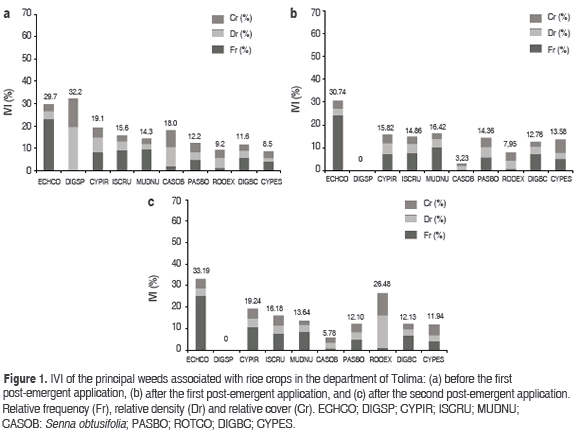
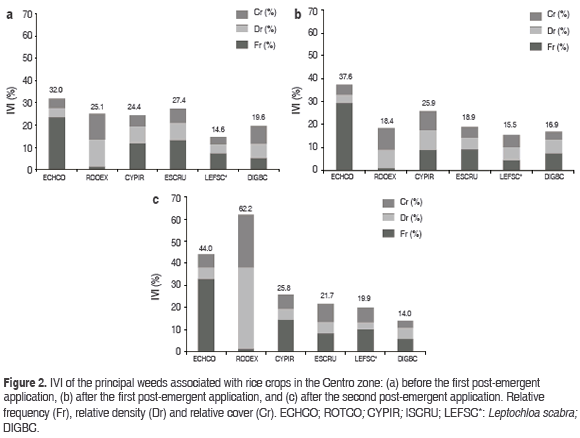
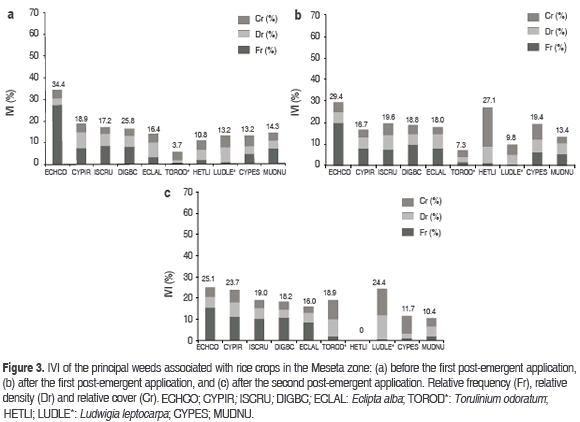
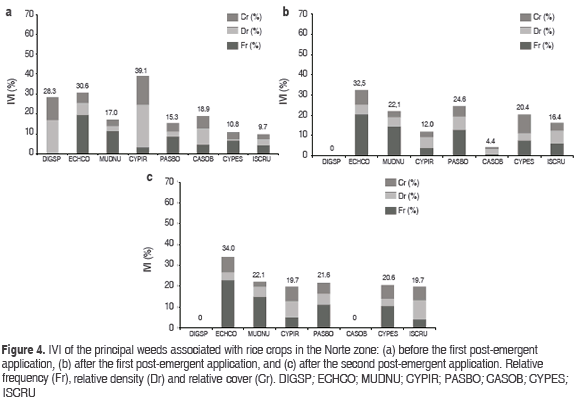
<body><![CDATA[<p><font size="3" face="Verdana, Arial, Helvetica, sans-serif"><b>RESULTS AND DISCUSSION</b></font></p>     <p><font size="2" face="Verdana, Arial, Helvetica, sans-serif">Weed communities of the rice crops in the department of Tolima included 42 species from 20 families and 31 genera. Centro zone contained 27 species (14 families and 21 genera), Meseta zone had 31 species (12 families and 23 genera) and Norte zone included 38 weed species (18 families and 29 genera) (Ram&iacute;rez <i>et al</i>., 2015).</font></p>     <p><font size="2" face="Verdana, Arial, Helvetica, sans-serif">Phytosociological analysis in the entire department presented ten species that represented 50% of the maximum IVI (<a href="#fig01">Figure 1</a>). Predominant species before first post-emergent application were <i>Digitaria ciliaris</i> (DIGSP) and <i>Echinochloa colona</i> (ECHCO), for which the variables with the most contribution to IVI were relative density and relative frequency, respectively (<a href="#fig01">Figure 1a</a>). After first post-emergent application, index for <i>D. ciliaris</i> decreased drastically (IVI=0), indicating that control was effective for this species, while importance of <i>E. colona</i> remained the same. Species <i>Murdannia nudiflora </i>(MUDNU), <i>Paspalum boscianum</i> (PASBO) and <i>Cyperus esculentus</i> (CYPES) registered increases in IVI after first application (<a href="#fig01">Figure 1b</a>). After second post-emergent application, in last evaluation, importance level of <i>Rottboellia cochinchinensis</i> (ROTCO) increased mainly due to its relative density. On the other hand, <i>E. colona</i> remained as the principal species, demonstrating that it was the most important weed in study area (<a href="#fig01">Figure 1c</a>). Our results are in agreement of those of Puentes (2003), who reported <i>E. colona</i> in 87% of evaluated lots, being the most frequent grass within weeds of rice crops in Tolima. </font></p>     <p align="center"><font size="2" face="Verdana, Arial, Helvetica, sans-serif"><a name="fig01"></a></font><img src="/img/revistas/rfnam/v70n1/v70n1a02fig01.gif"></p>     <p><font size="2" face="Verdana, Arial, Helvetica, sans-serif">Most notable component in determination of importance for more relevant species was relative frequency, before and after post-emergent applications (<a href="#fig01">Figure 1</a>). <i>E. colona</i> had the highest relative frequency in all evaluations with values of 23% before the first application, 24.2% after the first application, and 25.3% after the second post-emergent herbicide application. The importance of this species comes from its high competiveness, decreasing rice grain production by 86%, with reductions of 76% due to competition aboveground (aerial part) and 44% below the surface (radical) (Chauhan and Johnson, 2009a; Chauhan and Johnson, 2010). Results of this study indicated that frequency of this species within cultivation system determined its importance as a noxious plant, given its adaptation to environment and competition for resources with crops. Likewise, Norsworthy <i>et al</i>. (2001) stated that, in environments subjected to disturbances, weeds adapted to ecological conditions would exhibit higher frequencies.</font></p>     <p><font size="2" face="Verdana, Arial, Helvetica, sans-serif">Centro zone had six species that represented 50% of the maximum IVI (<a href="#fig02">Figure 2</a>). <i>E. colona</i> and <i>Ischaemum rugosum</i> (ISCRU) were the predominant species before first post-emergent application (<a href="#fig02">Figure 2a</a>). After this application, there was an increase in importance of <i>E. colona</i> and a decrease in importance of <i>I. rugosum</i> (2b). After second post-emergent application, <i>R. cochinchinensis</i> and <i>E. colona</i> were the principal species (<a href="#fig02">Figure 2c</a>); both registered increases in importance in regards to previous evaluation. According to Jakelaitis <i>et al</i>. (2003), increases in importance level of some weed populations cause decreases in importance of others when affected by control treatments, which decreases the diversity of species; situation presented in this study. </font></p>     <p align="center"><font size="2" face="Verdana, Arial, Helvetica, sans-serif"><a name="fig02"></a></font><img src="/img/revistas/rfnam/v70n1/v70n1a02fig02.gif"></p>     <p><font size="2" face="Verdana, Arial, Helvetica, sans-serif">Relative frequency component had the most influence on determination of importance of the relevant species, before and after the herbicide treatments in this region (<a href="#fig02">Figure 2</a>). <i>E. colona</i> was notable as the most frequent weed in the region with relative frequency values of 23.5%, 29.4% and 33.1%, for the three evaluation time points. On the other hand, in <i>R. cochinchinensis, </i>relative density was the component that contributed the most to its importance, mainly after the second post-emergent herbicide application, indicating little control of it with this control practice.</font></p>     <p><font size="2" face="Verdana, Arial, Helvetica, sans-serif">Phytosociological analysis of the weed community in the Meseta zone demonstrated that ten species represented 50% of the maximum IVI (<a href="#fig03">Figure 3</a>). Before first post-emergent application, <i>E. colona</i> was the most important species with highest IVI value (<a href="#fig03">Figure 3a</a>). After first post-emergent application, the only species with variation in IVI was <i>Heteranthera limosa </i>(HETLI), which had increases in its importance (<a href="#fig03">Figure 3b</a>); however, after second post-emergent application, importance of this species decreased to zero due to herbicide effectiveness and susceptibility of species (<a href="#fig03">Figure 3c</a>). <i>E. colona</i> continued to be the most important species in the region (<a href="#fig03">Figure 3c</a>); <i>Cyperus iria</i> (CYPIR) registered an increase in IVI, making it the second most important species at the start of reproductive phase of crops (<a href="#fig03">Figure 3c</a>).</font></p>     <p align="center"><font size="2" face="Verdana, Arial, Helvetica, sans-serif"><a name="fig03"></a></font><img src="/img/revistas/rfnam/v70n1/v70n1a02fig03.gif"></p>     ]]></body>
<body><![CDATA[<p><font size="2" face="Verdana, Arial, Helvetica, sans-serif">Relative frequency had the most influence on the determination of importance in principal species, such as <i>E. colona, C. iria, I. rugosum, Digitaria bicornis</i> (DIGBC) and<i> M. nudiflora, </i>before and after post-emergent applications (<a href="#fig03">Figure 3</a>). <i>E. colona</i> recorded the highest frequency at the three evaluations with 27.4%, 19.8% and 15.5%, respectively. Lower frequencies after herbicide applications have also been reported by Jakelaitis <i>et al</i>. (2003) and are possibly due to mortality generated by treatments (Mascarenhas<i> et al</i>., 2012). </font></p>     <p><font size="2" face="Verdana, Arial, Helvetica, sans-serif">In Norte zone, eight species represented 50% of maximum IVI value (<a href="#fig04">Figure 4</a>). <i>C. iria</i>, <i>E. colona</i> and <i>D. ciliaris</i> were the more important species in this region before first post-emergent application, as opposed to other regions; <i>C. iria</i> was the most important species with highest IVI (<a href="#fig04">Figure 4a</a>). After first herbicide treatment, IVI of <i>C. iria</i> and <i>D. ciliaris</i> decreased, while index of <i>E. colona</i> remained the same, making it the most important species at that time. Furthermore, increases were recorded for importance of <i>P. boscianum, M. nudiflora</i> and <i>C. esculentus</i> (<a href="#fig04">Figure 4b</a>). After second post-emergent application, <i>E. colona</i> continued to be the most important weed (<a href="#fig04">Figure 4c</a>). Like in other zones, relative frequency was the component that most contributed to importance of principal weeds, before and after post-emergent applications (<a href="#fig04">Figure 4</a>). <i>E. colona</i> had the highest frequency in all evaluations with values of 19.5%, 20.5% and 22.8%, respectively. In addition, participation of relative density was notable in importance of <i>D. ciliaris</i> and <i>C. iria </i>before first application (<a href="#fig04">Figure 4a</a>) and in importance of <i>C. iria</i> and <i>I. rugosum</i> after second post-emergent application (<a href="#fig04">Figure 4c</a>).</font></p>     <p align="center"><font size="2" face="Verdana, Arial, Helvetica, sans-serif"><a name="fig04"></a></font><img src="/img/revistas/rfnam/v70n1/v70n1a02fig04.gif"></p>     <p><font size="2" face="Verdana, Arial, Helvetica, sans-serif">In all zones, contribution from relative cover to importance of the species was limited. This was possibly due to low biomass accumulated by species at sampling times (early stages of development) and even when plants were able to emerge because the effect of herbicide applications impeded accumulation of biomass. Concen&ccedil;o <i>et al</i>. (2012) suggested that this effect on the cover could also be the result of competitiveness of the crop, blocking light from weed plantlets. </font></p>     <p><font size="2" face="Verdana, Arial, Helvetica, sans-serif">As stated above, results of this study showed that <i>E. colona</i> was the most frequent weed species and, commonly, the most important species in evaluated rice crops, before and after post-emergent applications. Its establishment after herbicide treatments, pre-sowing and pre-emergence, could have been due to complete adaptation to conditions of this environment because germination of its seeds is favored by moist environments (Chauhan and Johnson, 2009a). Germination of seeds occurs over 80% (Chauhan and Johnson, 2010) due to seed viability generally oscillates from 84% to 100% (Mendoza, 2007; Vega-Jarqu&iacute;n <i>et al</i>., 2010). Rao <i>et al</i>. (2007) suggested that adaptation level of species from <i>Echinochloa</i> genus to direct sowing conditions of rice crops is due to its versatility in germination of the seeds and in establishment of plantlets in response to changes in hydric regime. This situation high production of <i>E. colona</i> seeds (7,800 seeds per plant) (Chauhan and Johnson, 2010) and the end of effect of the post-emergent herbicide applications, possibly facilitated development of new individuals. Similarly, is known the susceptibility of genera <i>Echinochloa</i> to acquire resistance to different herbicides, this supported in 83 reports, of which 30% are <i>E. colona</i> (Heap, 2016). </font></p>     <p><font size="2" face="Verdana, Arial, Helvetica, sans-serif">Species from <i>Digitaria</i> and <i>Cyperus</i> genera, <i>Paspalum boscianum</i> and <i>Ischaemum rugosum, </i>were also notable as important species throughout evaluations in rice crops of Tolima, results that agree with those of Bakar and Nabi (2003), Rao <i>et al</i>. (2007) and Chauhan and Johnson (2009a and 2009b), in studies related to weed species in rice crops. Recording of new individuals and level of importance of the <i>Poaceae</i> species after use of specific herbicides for their control (Cobb and Reade, 2010; Clavijo, 2010) resulted from their level of adaptation to and infestation of lots. </font></p>     <p><font size="2" face="Verdana, Arial, Helvetica, sans-serif">Use of phytosociological parameters for study of population dynamics is common in weed control studies. Jakelaitis <i>et al.</i> (2003) evaluated population dynamics of weeds in maize and bean crops before and after herbicide applications and they found higher densities and frequencies of dicotyledonous species in both crops before application of herbicides; however, after selective herbicides application, <i>Cyperus rotundus</i> was the species with highest importance, dominance, and density in both crops. Vaz de Melo <i>et al</i>. (2007) reported similar results for weed populations in maize, where a change in floristic composition was evidenced in response to chemical and mechanical treatments. </font></p>     <p><font size="2" face="Verdana, Arial, Helvetica, sans-serif">Composition of weed populations in an agroecosystem is a reflection of characteristics of soil, climate, and agronomic practices, including herbicide application (Booth <i>et al</i>., 2003). Selective herbicides influence population dynamics of species in agroecosystems; these effects contribute to increases in density, dominance and relative importance of weeds. This is due to the fact that application of selective herbicides results in efficient control of some species, but deficient control of others, selecting for those for which there is not effective control (Jakelaitis <i>et al</i>., 2003). Andreasen and Streibig (2010) suggested that herbicides play an important role in determination of composition, diversity, and abundance of weeds. </font></p>     <p><font size="2" face="Verdana, Arial, Helvetica, sans-serif">Under the conditions of this study, herbicides more frequently used in first post-emergent application were inhibitors of the joining of microtubules (pendimethalin), inhibitors of photosystem II (propanil) and inhibitors of cellular division (butachlor). Herbicides more frequently used in the second post-emergent application were bispyribac sodium (ALS inhibitor), pendimethalin and propanil (Ram&iacute;rez and Plaza, 2015). Use of these agrochemicals, with a principal control spectrum that includes <i>Poaceae</i> weeds, possibly contributed to population changes that wereobserved in all zones, affecting to a large extent establishment and development of some susceptible species. It was observed that weeds from the <i>Cyperus</i> genus achieved establishment towards the end of control period, probably in response to lack of activity of these active ingredients on them. In this sense, changes in importance index and in components could be explained by specificity of control that herbicides had for some of populations. </font></p>     <p><font size="2" face="Verdana, Arial, Helvetica, sans-serif">Rao <i>et al</i>. (2007) stated that hydric condition of a rice crop is the main selecting factor for weed species. In this sense, Plaza and Hern&aacute;ndez (2014) and Puentes (2003) reported differences in terms of most important species of crops in zones with divergent hydric regimes. However, Rao <i>et al</i>. (2007) suggested that lack of crop rotation in rice fields, the introduction of practices such as direct sowing and, above all, repeated use herbicides are also causal factors of changes in weed populations in rice agroecosystems. </font></p>     ]]></body>
<body><![CDATA[<p>&nbsp;</p>     <p><font size="3" face="Verdana, Arial, Helvetica, sans-serif"><b>CONCLUSIONS </b></font></p>     <p><font size="2" face="Verdana, Arial, Helvetica, sans-serif">The methodology used in this study allowed to determine weed population dynamics, affected by chemical controls. For this study, the most relevant species was <i>E. colona</i>, both at department land zone level, and the variable that most influenced this result was relative frequency. The IVI and components values for some weeds after herbicide applications suggest adaptability and high number of weed seeds in the soil bank. The constant values of relative cover after post-emergent applications suggest sequential weed emergence and an acceptable control of sprayed individuals. Weed population dynamics in response to post-emergent applications have a common pattern between zones; it is related with the most important weeds and their importance after treatments.</font></p>     <p>&nbsp;</p>     <p><font size="3" face="Verdana, Arial, Helvetica, sans-serif"><b>REFERENCES</b></font></p>     <!-- ref --><p><font size="2" face="Verdana, Arial, Helvetica, sans-serif">Andreasen C and Streibig JC. 2010. Evaluation of changes in weed flora in arable fields of Nordic countries - based on Danish long-term surveys. Weed Research 51(3): 214-226. doi: 10.1111/j.1365-3180.2010.00836.x </font>&nbsp;&nbsp;&nbsp;&nbsp;&nbsp;&nbsp;&nbsp;&nbsp;[&#160;<a href="javascript:void(0);" onclick="javascript: window.open('/scielo.php?script=sci_nlinks&ref=3242045&pid=S0304-2847201700010000200001&lng=','','width=640,height=500,resizable=yes,scrollbars=1,menubar=yes,');">Links</a>&#160;]<!-- end-ref --><!-- ref --><p><font size="2" face="Verdana, Arial, Helvetica, sans-serif">Bakar BH and Nabi LAN. 2003. Seed germination; seedling establishment and growth patterns of wrinklegrass (Ischaemum rugosum Salisb.). Weed Biology and Management 3(1): 8-14. doi: 10.1046/j.1445-6664.2003.00075.x </font>&nbsp;&nbsp;&nbsp;&nbsp;&nbsp;&nbsp;&nbsp;&nbsp;[&#160;<a href="javascript:void(0);" onclick="javascript: window.open('/scielo.php?script=sci_nlinks&ref=3242046&pid=S0304-2847201700010000200002&lng=','','width=640,height=500,resizable=yes,scrollbars=1,menubar=yes,');">Links</a>&#160;]<!-- end-ref --><!-- ref --><p><font size="2" face="Verdana, Arial, Helvetica, sans-serif">Booth DB, Murphy SD and Swanton CJ. 2003. Weed ecology in natural and agricultural systems. First edition. CABI Publishing, Wallingford. 299 p.    &nbsp;&nbsp;&nbsp;&nbsp;&nbsp;&nbsp;&nbsp;&nbsp;[&#160;<a href="javascript:void(0);" onclick="javascript: window.open('/scielo.php?script=sci_nlinks&ref=3242047&pid=S0304-2847201700010000200003&lng=','','width=640,height=500,resizable=yes,scrollbars=1,menubar=yes,');">Links</a>&#160;]<!-- end-ref --></font></p>     <!-- ref --><p><font size="2" face="Verdana, Arial, Helvetica, sans-serif">Carvalho LB, Pitelli RA, Cec&iacute;lio Filho AB, Bianco S and Guzzo CD. 2008. Interfer&ecirc;ncia e estudo fitossociol&oacute;gico da comunidade infestante em beterraba de semeadura direta. Planta Daninha 26(2): 291-299. doi: 10.1590/S0100-83582008000200005</font>&nbsp;&nbsp;&nbsp;&nbsp;&nbsp;&nbsp;&nbsp;&nbsp;[&#160;<a href="javascript:void(0);" onclick="javascript: window.open('/scielo.php?script=sci_nlinks&ref=3242049&pid=S0304-2847201700010000200004&lng=','','width=640,height=500,resizable=yes,scrollbars=1,menubar=yes,');">Links</a>&#160;]<!-- end-ref --><!-- ref --><p><font size="2" face="Verdana, Arial, Helvetica, sans-serif">Chauhan BS and Johnson DE. 2009a. Seed germination ecology of junglerice (Echinochloa colona): a major weed of rice. Weed Science 57(3): 235-240. doi: 10.1614/WS-08-141.1</font>&nbsp;&nbsp;&nbsp;&nbsp;&nbsp;&nbsp;&nbsp;&nbsp;[&#160;<a href="javascript:void(0);" onclick="javascript: window.open('/scielo.php?script=sci_nlinks&ref=3242050&pid=S0304-2847201700010000200005&lng=','','width=640,height=500,resizable=yes,scrollbars=1,menubar=yes,');">Links</a>&#160;]<!-- end-ref --><!-- ref --><p><font size="2" face="Verdana, Arial, Helvetica, sans-serif">Chauhan BS and Johnson DE. 2009b. Ecological studies on Cyperus difformis; Cyperus iria and Fimbristylis miliacea: three troublesome annual sedge weeds of rice. Annals of Applied Biology 155(1): 103-112. doi: 10.1111/j.1744-7348.2009.00325.x </font>&nbsp;&nbsp;&nbsp;&nbsp;&nbsp;&nbsp;&nbsp;&nbsp;[&#160;<a href="javascript:void(0);" onclick="javascript: window.open('/scielo.php?script=sci_nlinks&ref=3242051&pid=S0304-2847201700010000200006&lng=','','width=640,height=500,resizable=yes,scrollbars=1,menubar=yes,');">Links</a>&#160;]<!-- end-ref --><!-- ref --><p><font size="2" face="Verdana, Arial, Helvetica, sans-serif">Chauhan BS and Johnson DE. 2010. Growth and Reproduction of Junglerice (Echinochloa colona) in Response to Water Stress. Weed Science 58(2): 132-135. doi: 10.1614/WS-D-09-00016.1 </font>&nbsp;&nbsp;&nbsp;&nbsp;&nbsp;&nbsp;&nbsp;&nbsp;[&#160;<a href="javascript:void(0);" onclick="javascript: window.open('/scielo.php?script=sci_nlinks&ref=3242052&pid=S0304-2847201700010000200007&lng=','','width=640,height=500,resizable=yes,scrollbars=1,menubar=yes,');">Links</a>&#160;]<!-- end-ref --><!-- ref --><p><font size="2" face="Verdana, Arial, Helvetica, sans-serif">Chauhan BS and Johnson DE. 2011. Row spacing and weed control timing affect yield of aerobic rice. Field Crops Research 121(1):  226-231.  doi: 10.1016/j.fcr.2010.12.008.    &nbsp;&nbsp;&nbsp;&nbsp;&nbsp;&nbsp;&nbsp;&nbsp;[&#160;<a href="javascript:void(0);" onclick="javascript: window.open('/scielo.php?script=sci_nlinks&ref=3242053&pid=S0304-2847201700010000200008&lng=','','width=640,height=500,resizable=yes,scrollbars=1,menubar=yes,');">Links</a>&#160;]<!-- end-ref --> </font></p>     <!-- ref --><p><font size="2" face="Verdana, Arial, Helvetica, sans-serif">Clavijo J. 2010. Acci&oacute;n de los herbicidas en un arrozal: modo y mecanismo. pp. 431-446. In: Deviogani V, Mart&iacute;nez CP and Motta F. Producci&oacute;n eco-eficiente del arroz en Am&eacute;rica Latina. CIAT-Centro Internacional de Agricultura Tropical, Cali, Colombia. 447 p.    &nbsp;&nbsp;&nbsp;&nbsp;&nbsp;&nbsp;&nbsp;&nbsp;[&#160;<a href="javascript:void(0);" onclick="javascript: window.open('/scielo.php?script=sci_nlinks&ref=3242055&pid=S0304-2847201700010000200009&lng=','','width=640,height=500,resizable=yes,scrollbars=1,menubar=yes,');">Links</a>&#160;]<!-- end-ref --> </font></p>     <!-- ref --><p><font size="2" face="Verdana, Arial, Helvetica, sans-serif">Cobb A and Reade J. 2010. Herbicides and plant physiology. 2 ed. John Wiley and Sons, Oxford.  277 p.    &nbsp;&nbsp;&nbsp;&nbsp;&nbsp;&nbsp;&nbsp;&nbsp;[&#160;<a href="javascript:void(0);" onclick="javascript: window.open('/scielo.php?script=sci_nlinks&ref=3242057&pid=S0304-2847201700010000200010&lng=','','width=640,height=500,resizable=yes,scrollbars=1,menubar=yes,');">Links</a>&#160;]<!-- end-ref --> </font></p>     <!-- ref --><p><font size="2" face="Verdana, Arial, Helvetica, sans-serif">Concen&ccedil;o G, Ceccon G, Sereia RC, Correira IVT and Galon L. 2012. Phytosociology in agricultural areas submitted to distinct wintercropping management. Planta Daninha 30(2): 297-304. doi: 10.1590/S0100-83582012000200008</font>&nbsp;&nbsp;&nbsp;&nbsp;&nbsp;&nbsp;&nbsp;&nbsp;[&#160;<a href="javascript:void(0);" onclick="javascript: window.open('/scielo.php?script=sci_nlinks&ref=3242059&pid=S0304-2847201700010000200011&lng=','','width=640,height=500,resizable=yes,scrollbars=1,menubar=yes,');">Links</a>&#160;]<!-- end-ref --><!-- ref --><p><font size="2" face="Verdana, Arial, Helvetica, sans-serif">Concen&ccedil;o G, Salton JC, Secretti ML, Mendes PB, Brevilieri RC and Galon L. 2011. Effect of long-term agricultural management systems on occurrence and composition of weed species. Planta Daninha 29(3): 515-522. doi: 10.1590/S0100-83582011000300005</font>&nbsp;&nbsp;&nbsp;&nbsp;&nbsp;&nbsp;&nbsp;&nbsp;[&#160;<a href="javascript:void(0);" onclick="javascript: window.open('/scielo.php?script=sci_nlinks&ref=3242060&pid=S0304-2847201700010000200012&lng=','','width=640,height=500,resizable=yes,scrollbars=1,menubar=yes,');">Links</a>&#160;]<!-- end-ref --><!-- ref --><p><font size="2" face="Verdana, Arial, Helvetica, sans-serif">Curtis T and Mcintosh RP. 1950. The Interrelations of Certain Analytic and Synthetic Phytosociological Characters. Ecology 31(3): 434-455. doi: 10.2307/1931497 </font>&nbsp;&nbsp;&nbsp;&nbsp;&nbsp;&nbsp;&nbsp;&nbsp;[&#160;<a href="javascript:void(0);" onclick="javascript: window.open('/scielo.php?script=sci_nlinks&ref=3242061&pid=S0304-2847201700010000200013&lng=','','width=640,height=500,resizable=yes,scrollbars=1,menubar=yes,');">Links</a>&#160;]<!-- end-ref --><!-- ref --><p><font size="2" face="Verdana, Arial, Helvetica, sans-serif">Erasmo EAL, Pinheiro LLA and Costa NV. 2004. Levantamento fitossociol&oacute;gico das comunidades de plantas infestantes em &aacute;reas de produ&ccedil;&atilde;o de arroz irrigado cultivado sob diferentes sistemas de manejo. Planta Daninha 22(2): 195-201. doi: 10.1590/S0100-83582004000200004</font>&nbsp;&nbsp;&nbsp;&nbsp;&nbsp;&nbsp;&nbsp;&nbsp;[&#160;<a href="javascript:void(0);" onclick="javascript: window.open('/scielo.php?script=sci_nlinks&ref=3242062&pid=S0304-2847201700010000200014&lng=','','width=640,height=500,resizable=yes,scrollbars=1,menubar=yes,');">Links</a>&#160;]<!-- end-ref --><!-- ref --><p><font size="2" face="Verdana, Arial, Helvetica, sans-serif">Fuentes C. 2010. Manejo de las malezas del arroz en Am&eacute;rica Latina: Problemas y soluciones. pp. 391-411. In: V. Deviogani., C.P. Mart&iacute;nez and F. Motta. Producci&oacute;n eco-eficiente del arroz en Am&eacute;rica Latina. CIAT-Centro Internacional de Agricultura Tropical, Cali, Colombia. 447 p.    &nbsp;&nbsp;&nbsp;&nbsp;&nbsp;&nbsp;&nbsp;&nbsp;[&#160;<a href="javascript:void(0);" onclick="javascript: window.open('/scielo.php?script=sci_nlinks&ref=3242063&pid=S0304-2847201700010000200015&lng=','','width=640,height=500,resizable=yes,scrollbars=1,menubar=yes,');">Links</a>&#160;]<!-- end-ref --> </font></p>     <!-- ref --><p><font size="2" face="Verdana, Arial, Helvetica, sans-serif">Fuentes CL, Osorio AS, Granados JC and Piedrahita W. 2006a. Flora arvense asociada con el cultivo del arroz en el departamento del Tolima-Colombia. Bayer CropScience S.A. y Universidad Nacional de Colombia, Bogot&aacute;, Colombia. 256 p.    &nbsp;&nbsp;&nbsp;&nbsp;&nbsp;&nbsp;&nbsp;&nbsp;[&#160;<a href="javascript:void(0);" onclick="javascript: window.open('/scielo.php?script=sci_nlinks&ref=3242065&pid=S0304-2847201700010000200016&lng=','','width=640,height=500,resizable=yes,scrollbars=1,menubar=yes,');">Links</a>&#160;]<!-- end-ref --> </font></p>     <!-- ref --><p><font size="2" face="Verdana, Arial, Helvetica, sans-serif">Fuentes CL, F&uacute;quene A, Perdomo EM and Pinto SC. 2006b. Pl&aacute;ntulas de especies arvenses frecuentes en la zona centro de Colombia. Universidad Nacional de Colombia, Bogot&aacute;, Colombia. 248 p.    &nbsp;&nbsp;&nbsp;&nbsp;&nbsp;&nbsp;&nbsp;&nbsp;[&#160;<a href="javascript:void(0);" onclick="javascript: window.open('/scielo.php?script=sci_nlinks&ref=3242067&pid=S0304-2847201700010000200017&lng=','','width=640,height=500,resizable=yes,scrollbars=1,menubar=yes,');">Links</a>&#160;]<!-- end-ref --></font></p>     <!-- ref --><p><font size="2" face="Verdana, Arial, Helvetica, sans-serif">Heap I. 2016. International survey of herbicide resistant weeds, <a href="http://www.weedscience.org" target="_blank">http://www.weedscience.org</a>; consulta: Octubre 2016.    &nbsp;&nbsp;&nbsp;&nbsp;&nbsp;&nbsp;&nbsp;&nbsp;[&#160;<a href="javascript:void(0);" onclick="javascript: window.open('/scielo.php?script=sci_nlinks&ref=3242069&pid=S0304-2847201700010000200018&lng=','','width=640,height=500,resizable=yes,scrollbars=1,menubar=yes,');">Links</a>&#160;]<!-- end-ref --> </font></p>     <!-- ref --><p><font size="2" face="Verdana, Arial, Helvetica, sans-serif">Holst N, Rasmussen IA and Bastiaans L. 2007. Field weed population dynamics: a review of model approaches and applications. European Weed Research Society 47: 1-14. doi: 10.1111/j.1365-3180.2007.00534.x</font>&nbsp;&nbsp;&nbsp;&nbsp;&nbsp;&nbsp;&nbsp;&nbsp;[&#160;<a href="javascript:void(0);" onclick="javascript: window.open('/scielo.php?script=sci_nlinks&ref=3242071&pid=S0304-2847201700010000200019&lng=','','width=640,height=500,resizable=yes,scrollbars=1,menubar=yes,');">Links</a>&#160;]<!-- end-ref --><!-- ref --><p><font size="2" face="Verdana, Arial, Helvetica, sans-serif">Jakelaitis A, Ferreira LR, Silva AA, Agnes EL, Miranda GV and Machado AFL. 2003. Din&acirc;mica populacional de plantas daninhas sob diferentes sistemas de manejo nas culturas de milho e feij&atilde;o. Planta Daninha 21(1): 71-79. doi: 10.1590/S0100-83582003000100009 </font>&nbsp;&nbsp;&nbsp;&nbsp;&nbsp;&nbsp;&nbsp;&nbsp;[&#160;<a href="javascript:void(0);" onclick="javascript: window.open('/scielo.php?script=sci_nlinks&ref=3242072&pid=S0304-2847201700010000200020&lng=','','width=640,height=500,resizable=yes,scrollbars=1,menubar=yes,');">Links</a>&#160;]<!-- end-ref --><!-- ref --><p><font size="2" face="Verdana, Arial, Helvetica, sans-serif">Labrada R. 2003. The need for improved weed management in rice. In: FAO. Sustainable rice production for food security. Proceedings of the 20th Session of the International Rice Commission. Bangkok, Thailand.    &nbsp;&nbsp;&nbsp;&nbsp;&nbsp;&nbsp;&nbsp;&nbsp;[&#160;<a href="javascript:void(0);" onclick="javascript: window.open('/scielo.php?script=sci_nlinks&ref=3242073&pid=S0304-2847201700010000200021&lng=','','width=640,height=500,resizable=yes,scrollbars=1,menubar=yes,');">Links</a>&#160;]<!-- end-ref --></font></p>     <!-- ref --><p><font size="2" face="Verdana, Arial, Helvetica, sans-serif">Mascarenhas MHT, Karam D and Lara JFR. 2012. Seletividade de herbicidas e din&acirc;mica populacional de plantas daninhas na cultura do girassol para a produ&ccedil;&atilde;o de biodiesel. Revista Brasileira de Herbicidas 11(2): 174-186. doi: 10.7824/rbh.v11i2.155</font>&nbsp;&nbsp;&nbsp;&nbsp;&nbsp;&nbsp;&nbsp;&nbsp;[&#160;<a href="javascript:void(0);" onclick="javascript: window.open('/scielo.php?script=sci_nlinks&ref=3242075&pid=S0304-2847201700010000200022&lng=','','width=640,height=500,resizable=yes,scrollbars=1,menubar=yes,');">Links</a>&#160;]<!-- end-ref --><!-- ref --><p><font size="2" face="Verdana, Arial, Helvetica, sans-serif">Mendoza CF. 2007. Evaluaci&oacute;n de las condiciones requeridas para la germinaci&oacute;n y m&eacute;todos de interrupci&oacute;n de dormancia en semillas de Echinochloa colona (L.) link, para su posible manejo ecol&oacute;gico. Tesis de pre-grado. Facultad de Agronom&iacute;a. Universidad Nacional Agraria. Managua. 41 p.    &nbsp;&nbsp;&nbsp;&nbsp;&nbsp;&nbsp;&nbsp;&nbsp;[&#160;<a href="javascript:void(0);" onclick="javascript: window.open('/scielo.php?script=sci_nlinks&ref=3242076&pid=S0304-2847201700010000200023&lng=','','width=640,height=500,resizable=yes,scrollbars=1,menubar=yes,');">Links</a>&#160;]<!-- end-ref --></font></p>     <!-- ref --><p><font size="2" face="Verdana, Arial, Helvetica, sans-serif">Montealegre FA. 2011. Morfolog&iacute;a de pl&aacute;ntulas de malezas de clima c&aacute;lido. Bogot&aacute;, Colombia: Federaci&oacute;n Nacional de Arroceros. 212 p.    &nbsp;&nbsp;&nbsp;&nbsp;&nbsp;&nbsp;&nbsp;&nbsp;[&#160;<a href="javascript:void(0);" onclick="javascript: window.open('/scielo.php?script=sci_nlinks&ref=3242078&pid=S0304-2847201700010000200024&lng=','','width=640,height=500,resizable=yes,scrollbars=1,menubar=yes,');">Links</a>&#160;]<!-- end-ref --> </font></p>     ]]></body>
<body><![CDATA[<!-- ref --><p><font size="2" face="Verdana, Arial, Helvetica, sans-serif">Moreira GM, Oliveira RM, Barrella TP, Fontan&eacute;tti A, Santos RHS and Ferreira FA. 2013. Fitossociologia de plantas daninhas do cafezal consorciado com leguminosas. Planta Daninha 31(2): 329-340. doi: 10.1590/S0100-83582013000200010 </font>&nbsp;&nbsp;&nbsp;&nbsp;&nbsp;&nbsp;&nbsp;&nbsp;[&#160;<a href="javascript:void(0);" onclick="javascript: window.open('/scielo.php?script=sci_nlinks&ref=3242080&pid=S0304-2847201700010000200025&lng=','','width=640,height=500,resizable=yes,scrollbars=1,menubar=yes,');">Links</a>&#160;]<!-- end-ref --><!-- ref --><p><font size="2" face="Verdana, Arial, Helvetica, sans-serif">Mueller-Dombois D and Ellenberg H. 1974. Aims and methods of vegetation ecology. John Wiley &amp; Sons. 547 p.    &nbsp;&nbsp;&nbsp;&nbsp;&nbsp;&nbsp;&nbsp;&nbsp;[&#160;<a href="javascript:void(0);" onclick="javascript: window.open('/scielo.php?script=sci_nlinks&ref=3242081&pid=S0304-2847201700010000200026&lng=','','width=640,height=500,resizable=yes,scrollbars=1,menubar=yes,');">Links</a>&#160;]<!-- end-ref --> </font></p>     <!-- ref --><p><font size="2" face="Verdana, Arial, Helvetica, sans-serif">Norsworthy JK, Burgos NR and Oliver LR. 2001. Differences in weed tolerance to glyphosate involve different mechanisms. Weed Technology 15(4): 725-731. doi: 101614/0890-037X(2001)015 &#91;0725:DIWTTG&#93; 2.0.CO;2</font>&nbsp;&nbsp;&nbsp;&nbsp;&nbsp;&nbsp;&nbsp;&nbsp;[&#160;<a href="javascript:void(0);" onclick="javascript: window.open('/scielo.php?script=sci_nlinks&ref=3242083&pid=S0304-2847201700010000200027&lng=','','width=640,height=500,resizable=yes,scrollbars=1,menubar=yes,');">Links</a>&#160;]<!-- end-ref --><!-- ref --><p><font size="2" face="Verdana, Arial, Helvetica, sans-serif">Poggio SL. 2012. Cambios flor&iacute;sticos en comunidades de malezas; un marco conceptual basado en reglas de ensamblaje. Ecolog&iacute;a Austral 22(2): 150-158.    &nbsp;&nbsp;&nbsp;&nbsp;&nbsp;&nbsp;&nbsp;&nbsp;[&#160;<a href="javascript:void(0);" onclick="javascript: window.open('/scielo.php?script=sci_nlinks&ref=3242084&pid=S0304-2847201700010000200028&lng=','','width=640,height=500,resizable=yes,scrollbars=1,menubar=yes,');">Links</a>&#160;]<!-- end-ref --> </font></p>     <!-- ref --><p><font size="2" face="Verdana, Arial, Helvetica, sans-serif">Pitelli RA. 2000. Estudos fitossociol&oacute;gicos em comunidades infestantes de agroecossistemas. Journal Conserb 1(2): 1-7.    &nbsp;&nbsp;&nbsp;&nbsp;&nbsp;&nbsp;&nbsp;&nbsp;[&#160;<a href="javascript:void(0);" onclick="javascript: window.open('/scielo.php?script=sci_nlinks&ref=3242086&pid=S0304-2847201700010000200029&lng=','','width=640,height=500,resizable=yes,scrollbars=1,menubar=yes,');">Links</a>&#160;]<!-- end-ref --> </font></p>     <!-- ref --><p><font size="2" face="Verdana, Arial, Helvetica, sans-serif">Plaza G and Hern&aacute;ndez FA. 2014. Effect of zone and crops rotation on Ischaemum rugosum and resistance to bispyribac-sodium in Ariari, Colombia. Planta Daninha 32(3): 591-599. doi: 10.1590/S0100-83582014000300015</font>&nbsp;&nbsp;&nbsp;&nbsp;&nbsp;&nbsp;&nbsp;&nbsp;[&#160;<a href="javascript:void(0);" onclick="javascript: window.open('/scielo.php?script=sci_nlinks&ref=3242088&pid=S0304-2847201700010000200030&lng=','','width=640,height=500,resizable=yes,scrollbars=1,menubar=yes,');">Links</a>&#160;]<!-- end-ref --><!-- ref --><p><font size="2" face="Verdana, Arial, Helvetica, sans-serif">Puentes BM. 2003. Flora arvense asociada al cultivo de arroz (Oryza sativa L.). Tesis de maestr&iacute;a en Ciencias Agrarias. Facultad de Agronom&iacute;a. Universidad Nacional de Colombia, Bogot&aacute;, Colombia. 118 p.    &nbsp;&nbsp;&nbsp;&nbsp;&nbsp;&nbsp;&nbsp;&nbsp;[&#160;<a href="javascript:void(0);" onclick="javascript: window.open('/scielo.php?script=sci_nlinks&ref=3242089&pid=S0304-2847201700010000200031&lng=','','width=640,height=500,resizable=yes,scrollbars=1,menubar=yes,');">Links</a>&#160;]<!-- end-ref --> </font></p>     <!-- ref --><p><font size="2" face="Verdana, Arial, Helvetica, sans-serif">Ram&iacute;rez JG and Plaza G. 2015. Effect of post-emergence herbicide applications on rice crop weed communities in Tolima, Colombia. Planta Daninha 33(3): 499-508. doi: 10.1590/S0100-83582015000300012 </font>&nbsp;&nbsp;&nbsp;&nbsp;&nbsp;&nbsp;&nbsp;&nbsp;[&#160;<a href="javascript:void(0);" onclick="javascript: window.open('/scielo.php?script=sci_nlinks&ref=3242091&pid=S0304-2847201700010000200032&lng=','','width=640,height=500,resizable=yes,scrollbars=1,menubar=yes,');">Links</a>&#160;]<!-- end-ref --><!-- ref --><p><font size="2" face="Verdana, Arial, Helvetica, sans-serif">Ram&iacute;rez J, Hoyos V and Plaza G. 2015. Phytosociology of weeds associated with rice crops in the department of Tolima, Colombia. Agronom&iacute;a Colombiana 33(1): 64-73. doi: 10.15446/agron.colomb.v33n1.46747</font>&nbsp;&nbsp;&nbsp;&nbsp;&nbsp;&nbsp;&nbsp;&nbsp;[&#160;<a href="javascript:void(0);" onclick="javascript: window.open('/scielo.php?script=sci_nlinks&ref=3242092&pid=S0304-2847201700010000200033&lng=','','width=640,height=500,resizable=yes,scrollbars=1,menubar=yes,');">Links</a>&#160;]<!-- end-ref --><!-- ref --><p><font size="2" face="Verdana, Arial, Helvetica, sans-serif">Rao AN, Johnson DE, Sivaprasad B, Ladha JK and Mortimer AM. 2007. Weed management in direct-seeded rice. Advances in Agronomy 93(1): 153-255. doi: 10.1016/S0065-2113(06)93004-1</font>&nbsp;&nbsp;&nbsp;&nbsp;&nbsp;&nbsp;&nbsp;&nbsp;[&#160;<a href="javascript:void(0);" onclick="javascript: window.open('/scielo.php?script=sci_nlinks&ref=3242093&pid=S0304-2847201700010000200034&lng=','','width=640,height=500,resizable=yes,scrollbars=1,menubar=yes,');">Links</a>&#160;]<!-- end-ref --><!-- ref --><p><font size="2" face="Verdana, Arial, Helvetica, sans-serif">Rodenburg J and Johnson E. 2009. Weed management in rice-based cropping systems in Africa. Advances in Agronomy 139: 149-218. doi: 10.1016/S0065-2113(09)03004-1</font>&nbsp;&nbsp;&nbsp;&nbsp;&nbsp;&nbsp;&nbsp;&nbsp;[&#160;<a href="javascript:void(0);" onclick="javascript: window.open('/scielo.php?script=sci_nlinks&ref=3242094&pid=S0304-2847201700010000200035&lng=','','width=640,height=500,resizable=yes,scrollbars=1,menubar=yes,');">Links</a>&#160;]<!-- end-ref --><!-- ref --><p><font size="2" face="Verdana, Arial, Helvetica, sans-serif">Singh B. 2012. Weed management in direct-seeded rice systems.  International Rice Research Institute, Los Ba&ntilde;os, Philippines. 20 p.    &nbsp;&nbsp;&nbsp;&nbsp;&nbsp;&nbsp;&nbsp;&nbsp;[&#160;<a href="javascript:void(0);" onclick="javascript: window.open('/scielo.php?script=sci_nlinks&ref=3242095&pid=S0304-2847201700010000200036&lng=','','width=640,height=500,resizable=yes,scrollbars=1,menubar=yes,');">Links</a>&#160;]<!-- end-ref --></font></p>     <!-- ref --><p><font size="2" face="Verdana, Arial, Helvetica, sans-serif">Soares MBB, Finoto EL, Bolonhezi D, Carrega W, Alves de Albuquerque JA and Pirotta MZ. 2012. Fitossociologia de plantas daninhas sob diferentes sistemas de manejo de solo em &aacute;reas de reforma de cana crua. Revista Agro@Mbiente On-Line 5(3): 173-181. doi: 10.18227/1982-8470ragro.v5i3.594 </font>&nbsp;&nbsp;&nbsp;&nbsp;&nbsp;&nbsp;&nbsp;&nbsp;[&#160;<a href="javascript:void(0);" onclick="javascript: window.open('/scielo.php?script=sci_nlinks&ref=3242097&pid=S0304-2847201700010000200037&lng=','','width=640,height=500,resizable=yes,scrollbars=1,menubar=yes,');">Links</a>&#160;]<!-- end-ref --><!-- ref --><p><font size="2" face="Verdana, Arial, Helvetica, sans-serif">Spiegel M. 1988. Estad&iacute;stica. 2 ed. McGraw Hill, Madrid. 369 p.    &nbsp;&nbsp;&nbsp;&nbsp;&nbsp;&nbsp;&nbsp;&nbsp;[&#160;<a href="javascript:void(0);" onclick="javascript: window.open('/scielo.php?script=sci_nlinks&ref=3242098&pid=S0304-2847201700010000200038&lng=','','width=640,height=500,resizable=yes,scrollbars=1,menubar=yes,');">Links</a>&#160;]<!-- end-ref --></font></p>     ]]></body>
<body><![CDATA[<!-- ref --><p><font size="2" face="Verdana, Arial, Helvetica, sans-serif">Vaz de Melo A, Galv&atilde;o JCC, Ferreira LR, Miranda GV, Tuffi Santos LD, Santos IC and Souza IV. 2007. Din&acirc;mica populacional de plantas daninhas em cultivo de milho-verde nos sistem&aacute;s org&acirc;nico e tradicional. Planta Daninha 25(3): 521-527. doi: 10.1590/S0100-83582007000300011 </font>&nbsp;&nbsp;&nbsp;&nbsp;&nbsp;&nbsp;&nbsp;&nbsp;[&#160;<a href="javascript:void(0);" onclick="javascript: window.open('/scielo.php?script=sci_nlinks&ref=3242100&pid=S0304-2847201700010000200039&lng=','','width=640,height=500,resizable=yes,scrollbars=1,menubar=yes,');">Links</a>&#160;]<!-- end-ref --><!-- ref --><p><font size="2" face="Verdana, Arial, Helvetica, sans-serif">Vega-Jarqu&iacute;n C, Hern&aacute;ndez RM, Salgado R, Fornos M and Mendoza CF 2010. Viabilidad, condiciones requeridas para la germinaci&oacute;n y m&eacute;todos de interrupci&oacute;n de dormancia en semillas de Echinochloa colona (L.) link. La Calera 10(15): 36-45. doi: 10.5377/calera.v10i15.666</font>&nbsp;&nbsp;&nbsp;&nbsp;&nbsp;&nbsp;&nbsp;&nbsp;[&#160;<a href="javascript:void(0);" onclick="javascript: window.open('/scielo.php?script=sci_nlinks&ref=3242101&pid=S0304-2847201700010000200040&lng=','','width=640,height=500,resizable=yes,scrollbars=1,menubar=yes,');">Links</a>&#160;]<!-- end-ref --> ]]></body><back>
<ref-list>
<ref id="B1">
<nlm-citation citation-type="journal">
<person-group person-group-type="author">
<name>
<surname><![CDATA[Andreasen]]></surname>
<given-names><![CDATA[C]]></given-names>
</name>
<name>
<surname><![CDATA[Streibig]]></surname>
<given-names><![CDATA[JC.]]></given-names>
</name>
</person-group>
<article-title xml:lang="en"><![CDATA[Evaluation of changes in weed flora in arable fields of Nordic countries: based on Danish long-term surveys.]]></article-title>
<source><![CDATA[Weed Research]]></source>
<year>2010</year>
<volume>51</volume>
<numero>3</numero>
<issue>3</issue>
<page-range>214-226</page-range></nlm-citation>
</ref>
<ref id="B2">
<nlm-citation citation-type="journal">
<person-group person-group-type="author">
<name>
<surname><![CDATA[Bakar]]></surname>
<given-names><![CDATA[BH]]></given-names>
</name>
<name>
<surname><![CDATA[Nabi]]></surname>
<given-names><![CDATA[LAN.]]></given-names>
</name>
</person-group>
<article-title xml:lang="en"><![CDATA[Seed germination; seedling establishment and growth patterns of wrinklegrass (Ischaemum rugosum Salisb.)]]></article-title>
<source><![CDATA[Weed Biology and Management]]></source>
<year>2003</year>
<volume>3</volume>
<numero>1</numero>
<issue>1</issue>
<page-range>8-14</page-range></nlm-citation>
</ref>
<ref id="B3">
<nlm-citation citation-type="book">
<person-group person-group-type="author">
<name>
<surname><![CDATA[Booth]]></surname>
<given-names><![CDATA[DB]]></given-names>
</name>
<name>
<surname><![CDATA[Murphy]]></surname>
<given-names><![CDATA[SD]]></given-names>
</name>
<name>
<surname><![CDATA[Swanton]]></surname>
<given-names><![CDATA[CJ.]]></given-names>
</name>
</person-group>
<source><![CDATA[Weed ecology in natural and agricultural systems.]]></source>
<year>2003</year>
<edition>First</edition>
<publisher-loc><![CDATA[Wallingford ]]></publisher-loc>
<publisher-name><![CDATA[CABI Publishing]]></publisher-name>
</nlm-citation>
</ref>
<ref id="B4">
<nlm-citation citation-type="journal">
<person-group person-group-type="author">
<name>
<surname><![CDATA[Carvalho]]></surname>
<given-names><![CDATA[LB]]></given-names>
</name>
<name>
<surname><![CDATA[Pitelli]]></surname>
<given-names><![CDATA[RA]]></given-names>
</name>
<name>
<surname><![CDATA[Cecílio Filho]]></surname>
<given-names><![CDATA[AB]]></given-names>
</name>
<name>
<surname><![CDATA[Bianco]]></surname>
<given-names><![CDATA[S]]></given-names>
</name>
<name>
<surname><![CDATA[Guzzo]]></surname>
<given-names><![CDATA[CD]]></given-names>
</name>
</person-group>
<article-title xml:lang="pt"><![CDATA[Interferência e estudo fitossociológico da comunidade infestante em beterraba de semeadura direta.]]></article-title>
<source><![CDATA[Planta Daninha]]></source>
<year>2008</year>
<volume>26</volume>
<numero>2</numero>
<issue>2</issue>
<page-range>291-299</page-range></nlm-citation>
</ref>
<ref id="B5">
<nlm-citation citation-type="journal">
<person-group person-group-type="author">
<name>
<surname><![CDATA[Chauhan]]></surname>
<given-names><![CDATA[BS]]></given-names>
</name>
<name>
<surname><![CDATA[Johnson]]></surname>
<given-names><![CDATA[DE.]]></given-names>
</name>
</person-group>
<article-title xml:lang="en"><![CDATA[Seed germination ecology of junglerice (Echinochloa colona): a major weed of rice]]></article-title>
<source><![CDATA[Weed Science]]></source>
<year>2009</year>
<month>a</month>
<volume>57</volume>
<numero>3</numero>
<issue>3</issue>
<page-range>235-240</page-range></nlm-citation>
</ref>
<ref id="B6">
<nlm-citation citation-type="journal">
<person-group person-group-type="author">
<name>
<surname><![CDATA[Chauhan]]></surname>
<given-names><![CDATA[BS]]></given-names>
</name>
<name>
<surname><![CDATA[Johnson]]></surname>
<given-names><![CDATA[DE.]]></given-names>
</name>
</person-group>
<article-title xml:lang="en"><![CDATA[Ecological studies on Cyperus difformis; Cyperus iria and Fimbristylis miliacea: three troublesome annual sedge weeds of rice]]></article-title>
<source><![CDATA[Annals of Applied Biology]]></source>
<year>2009</year>
<month>b</month>
<volume>155</volume>
<numero>1</numero>
<issue>1</issue>
<page-range>103-112</page-range></nlm-citation>
</ref>
<ref id="B7">
<nlm-citation citation-type="journal">
<person-group person-group-type="author">
<name>
<surname><![CDATA[Chauhan]]></surname>
<given-names><![CDATA[BS]]></given-names>
</name>
<name>
<surname><![CDATA[Johnson]]></surname>
<given-names><![CDATA[DE.]]></given-names>
</name>
</person-group>
<article-title xml:lang="en"><![CDATA[Growth and Reproduction of Junglerice (Echinochloa colona) in Response to Water Stress.]]></article-title>
<source><![CDATA[Weed Science]]></source>
<year>2010</year>
<volume>58</volume>
<numero>2</numero>
<issue>2</issue>
<page-range>132-135</page-range></nlm-citation>
</ref>
<ref id="B8">
<nlm-citation citation-type="journal">
<person-group person-group-type="author">
<name>
<surname><![CDATA[Chauhan]]></surname>
<given-names><![CDATA[BS]]></given-names>
</name>
<name>
<surname><![CDATA[Johnson]]></surname>
<given-names><![CDATA[DE.]]></given-names>
</name>
</person-group>
<article-title xml:lang="en"><![CDATA[Row spacing and weed control timing affect yield of aerobic rice.]]></article-title>
<source><![CDATA[Field Crops Research]]></source>
<year>2011</year>
<volume>121</volume>
<numero>1</numero>
<issue>1</issue>
<page-range>226-231</page-range></nlm-citation>
</ref>
<ref id="B9">
<nlm-citation citation-type="book">
<person-group person-group-type="author">
<name>
<surname><![CDATA[Clavijo]]></surname>
<given-names><![CDATA[J.]]></given-names>
</name>
</person-group>
<article-title xml:lang="es"><![CDATA[Acción de los herbicidas en un arrozal: modo y mecanismo.]]></article-title>
<person-group person-group-type="editor">
<name>
<surname><![CDATA[Deviogani]]></surname>
<given-names><![CDATA[V]]></given-names>
</name>
<name>
<surname><![CDATA[Martínez]]></surname>
<given-names><![CDATA[CP]]></given-names>
</name>
<name>
<surname><![CDATA[Motta]]></surname>
<given-names><![CDATA[F.]]></given-names>
</name>
</person-group>
<source><![CDATA[Producción eco-eficiente del arroz en América Latina.]]></source>
<year>2010</year>
<page-range>431-446</page-range><publisher-loc><![CDATA[Cali ]]></publisher-loc>
<publisher-name><![CDATA[CIAT-Centro Internacional de Agricultura Tropical]]></publisher-name>
</nlm-citation>
</ref>
<ref id="B10">
<nlm-citation citation-type="book">
<person-group person-group-type="author">
<name>
<surname><![CDATA[Cobb]]></surname>
<given-names><![CDATA[A]]></given-names>
</name>
<name>
<surname><![CDATA[Reade]]></surname>
<given-names><![CDATA[J.]]></given-names>
</name>
</person-group>
<source><![CDATA[Herbicides and plant physiology.]]></source>
<year>2010</year>
<edition>2</edition>
<publisher-loc><![CDATA[Oxford ]]></publisher-loc>
<publisher-name><![CDATA[John Wiley and Sons]]></publisher-name>
</nlm-citation>
</ref>
<ref id="B11">
<nlm-citation citation-type="journal">
<person-group person-group-type="author">
<name>
<surname><![CDATA[Concenço]]></surname>
<given-names><![CDATA[G]]></given-names>
</name>
<name>
<surname><![CDATA[Ceccon]]></surname>
<given-names><![CDATA[G]]></given-names>
</name>
<name>
<surname><![CDATA[Sereia]]></surname>
<given-names><![CDATA[RC]]></given-names>
</name>
<name>
<surname><![CDATA[Correira]]></surname>
<given-names><![CDATA[IVT]]></given-names>
</name>
<name>
<surname><![CDATA[Galon]]></surname>
<given-names><![CDATA[L.]]></given-names>
</name>
</person-group>
<article-title xml:lang="en"><![CDATA[Phytosociology in agricultural areas submitted to distinct wintercropping management]]></article-title>
<source><![CDATA[Planta Daninha]]></source>
<year>2012</year>
<volume>30</volume>
<numero>2</numero>
<issue>2</issue>
<page-range>297-304</page-range></nlm-citation>
</ref>
<ref id="B12">
<nlm-citation citation-type="journal">
<person-group person-group-type="author">
<name>
<surname><![CDATA[Concenço]]></surname>
<given-names><![CDATA[G]]></given-names>
</name>
<name>
<surname><![CDATA[Salton]]></surname>
<given-names><![CDATA[JC]]></given-names>
</name>
<name>
<surname><![CDATA[Secretti]]></surname>
<given-names><![CDATA[ML]]></given-names>
</name>
<name>
<surname><![CDATA[Mendes]]></surname>
<given-names><![CDATA[PB]]></given-names>
</name>
<name>
<surname><![CDATA[Brevilieri]]></surname>
<given-names><![CDATA[RC]]></given-names>
</name>
<name>
<surname><![CDATA[Galon]]></surname>
<given-names><![CDATA[L.]]></given-names>
</name>
</person-group>
<article-title xml:lang="en"><![CDATA[Effect of long-term agricultural management systems on occurrence and composition of weed species.]]></article-title>
<source><![CDATA[Planta Daninha]]></source>
<year>2011</year>
<volume>29</volume>
<numero>3</numero>
<issue>3</issue>
<page-range>515-522</page-range></nlm-citation>
</ref>
<ref id="B13">
<nlm-citation citation-type="journal">
<person-group person-group-type="author">
<name>
<surname><![CDATA[Curtis]]></surname>
<given-names><![CDATA[T]]></given-names>
</name>
<name>
<surname><![CDATA[Mcintosh]]></surname>
<given-names><![CDATA[RP.]]></given-names>
</name>
</person-group>
<article-title xml:lang="en"><![CDATA[The Interrelations of Certain Analytic and Synthetic Phytosociological Characters]]></article-title>
<source><![CDATA[Ecology]]></source>
<year>1950</year>
<volume>31</volume>
<numero>3</numero>
<issue>3</issue>
<page-range>434-455</page-range></nlm-citation>
</ref>
<ref id="B14">
<nlm-citation citation-type="journal">
<person-group person-group-type="author">
<name>
<surname><![CDATA[Erasmo]]></surname>
<given-names><![CDATA[EAL]]></given-names>
</name>
<name>
<surname><![CDATA[Pinheiro]]></surname>
<given-names><![CDATA[LLA]]></given-names>
</name>
<name>
<surname><![CDATA[Costa]]></surname>
<given-names><![CDATA[NV]]></given-names>
</name>
</person-group>
<article-title xml:lang="es"><![CDATA[Levantamento fitossociológico das comunidades de plantas infestantes em áreas de produção de arroz irrigado cultivado sob diferentes sistemas de manejo]]></article-title>
<source><![CDATA[Planta Daninha]]></source>
<year>2004</year>
<volume>22</volume>
<numero>2</numero>
<issue>2</issue>
<page-range>195-201</page-range></nlm-citation>
</ref>
<ref id="B15">
<nlm-citation citation-type="book">
<person-group person-group-type="author">
<name>
<surname><![CDATA[Fuentes]]></surname>
<given-names><![CDATA[C.]]></given-names>
</name>
</person-group>
<article-title xml:lang="es"><![CDATA[Manejo de las malezas del arroz en América Latina: Problemas y soluciones.]]></article-title>
<person-group person-group-type="editor">
<name>
<surname><![CDATA[Deviogani]]></surname>
<given-names><![CDATA[V.]]></given-names>
</name>
<name>
<surname><![CDATA[Martínez]]></surname>
<given-names><![CDATA[C.P.]]></given-names>
</name>
<name>
<surname><![CDATA[Motta.]]></surname>
<given-names><![CDATA[F.]]></given-names>
</name>
</person-group>
<source><![CDATA[Producción eco-eficiente del arroz en América Latina.]]></source>
<year>2010</year>
<page-range>391-411</page-range><publisher-loc><![CDATA[Cali ]]></publisher-loc>
<publisher-name><![CDATA[CIAT-Centro Internacional de Agricultura Tropical]]></publisher-name>
</nlm-citation>
</ref>
<ref id="B16">
<nlm-citation citation-type="book">
<person-group person-group-type="author">
<name>
<surname><![CDATA[Fuentes]]></surname>
<given-names><![CDATA[CL]]></given-names>
</name>
<name>
<surname><![CDATA[Osorio]]></surname>
<given-names><![CDATA[AS]]></given-names>
</name>
<name>
<surname><![CDATA[Granados]]></surname>
<given-names><![CDATA[JC]]></given-names>
</name>
<name>
<surname><![CDATA[Piedrahita]]></surname>
<given-names><![CDATA[W.]]></given-names>
</name>
</person-group>
<source><![CDATA[Flora arvense asociada con el cultivo del arroz en el departamento del Tolima-Colombia.]]></source>
<year>2006</year>
<month>a</month>
<publisher-loc><![CDATA[Bogotá ]]></publisher-loc>
<publisher-name><![CDATA[Bayer CropScience S.A.Universidad Nacional de Colombia]]></publisher-name>
</nlm-citation>
</ref>
<ref id="B17">
<nlm-citation citation-type="book">
<person-group person-group-type="author">
<name>
<surname><![CDATA[Fuentes]]></surname>
<given-names><![CDATA[CL]]></given-names>
</name>
<name>
<surname><![CDATA[Fúquene]]></surname>
<given-names><![CDATA[A]]></given-names>
</name>
<name>
<surname><![CDATA[Perdomo]]></surname>
<given-names><![CDATA[EM]]></given-names>
</name>
<name>
<surname><![CDATA[Pinto]]></surname>
<given-names><![CDATA[SC.]]></given-names>
</name>
</person-group>
<source><![CDATA[Plántulas de especies arvenses frecuentes en la zona centro de Colombia.]]></source>
<year>2006</year>
<month>b</month>
<publisher-loc><![CDATA[Bogotá ]]></publisher-loc>
<publisher-name><![CDATA[Universidad Nacional de Colombia]]></publisher-name>
</nlm-citation>
</ref>
<ref id="B18">
<nlm-citation citation-type="">
<person-group person-group-type="author">
<name>
<surname><![CDATA[Heap]]></surname>
<given-names><![CDATA[I.]]></given-names>
</name>
</person-group>
<source><![CDATA[International survey of herbicide resistant weeds]]></source>
<year>2016</year>
</nlm-citation>
</ref>
<ref id="B19">
<nlm-citation citation-type="journal">
<person-group person-group-type="author">
<name>
<surname><![CDATA[Holst]]></surname>
<given-names><![CDATA[N]]></given-names>
</name>
<name>
<surname><![CDATA[Rasmussen]]></surname>
<given-names><![CDATA[IA]]></given-names>
</name>
<name>
<surname><![CDATA[Bastiaans]]></surname>
<given-names><![CDATA[L.]]></given-names>
</name>
</person-group>
<article-title xml:lang="en"><![CDATA[Field weed population dynamics: a review of model approaches and applications]]></article-title>
<source><![CDATA[European Weed Research Society]]></source>
<year>2007</year>
<numero>47</numero>
<issue>47</issue>
<page-range>1-14</page-range></nlm-citation>
</ref>
<ref id="B20">
<nlm-citation citation-type="journal">
<person-group person-group-type="author">
<name>
<surname><![CDATA[Jakelaitis]]></surname>
<given-names><![CDATA[A]]></given-names>
</name>
<name>
<surname><![CDATA[Ferreira]]></surname>
<given-names><![CDATA[LR]]></given-names>
</name>
<name>
<surname><![CDATA[Silva]]></surname>
<given-names><![CDATA[AA]]></given-names>
</name>
<name>
<surname><![CDATA[Agnes]]></surname>
<given-names><![CDATA[EL]]></given-names>
</name>
<name>
<surname><![CDATA[Miranda]]></surname>
<given-names><![CDATA[GV]]></given-names>
</name>
<name>
<surname><![CDATA[Machado]]></surname>
<given-names><![CDATA[AFL.]]></given-names>
</name>
</person-group>
<article-title xml:lang="pt"><![CDATA[Dinâmica populacional de plantas daninhas sob diferentes sistemas de manejo nas culturas de milho e feijão.]]></article-title>
<source><![CDATA[Planta Daninha]]></source>
<year>2003</year>
<volume>21</volume>
<numero>1</numero>
<issue>1</issue>
<page-range>71-79</page-range></nlm-citation>
</ref>
<ref id="B21">
<nlm-citation citation-type="confpro">
<person-group person-group-type="author">
<name>
<surname><![CDATA[Labrada]]></surname>
<given-names><![CDATA[R.]]></given-names>
</name>
</person-group>
<article-title xml:lang="en"><![CDATA[The need for improved weed management in rice]]></article-title>
<collab>FAO</collab>
<source><![CDATA[Sustainable rice production for food security]]></source>
<year>2003</year>
<conf-name><![CDATA[20th Session of the International Rice Commission]]></conf-name>
<conf-loc>Bangkok </conf-loc>
</nlm-citation>
</ref>
<ref id="B22">
<nlm-citation citation-type="journal">
<person-group person-group-type="author">
<name>
<surname><![CDATA[Mascarenhas]]></surname>
<given-names><![CDATA[MHT]]></given-names>
</name>
<name>
<surname><![CDATA[Karam]]></surname>
<given-names><![CDATA[D]]></given-names>
</name>
<name>
<surname><![CDATA[Lara]]></surname>
<given-names><![CDATA[JFR.]]></given-names>
</name>
</person-group>
<article-title xml:lang="pt"><![CDATA[Seletividade de herbicidas e dinâmica populacional de plantas daninhas na cultura do girassol para a produção de biodiesel]]></article-title>
<source><![CDATA[Revista Brasileira de Herbicidas]]></source>
<year>2012</year>
<volume>11</volume>
<numero>2</numero>
<issue>2</issue>
<page-range>174-186</page-range></nlm-citation>
</ref>
<ref id="B23">
<nlm-citation citation-type="">
<person-group person-group-type="author">
<name>
<surname><![CDATA[Mendoza]]></surname>
<given-names><![CDATA[CF.]]></given-names>
</name>
</person-group>
<source><![CDATA[Evaluación de las condiciones requeridas para la germinación y métodos de interrupción de dormancia en semillas de Echinochloa colona (L.) link, para su posible manejo ecológico.]]></source>
<year>2007</year>
</nlm-citation>
</ref>
<ref id="B24">
<nlm-citation citation-type="book">
<person-group person-group-type="author">
<name>
<surname><![CDATA[Montealegre]]></surname>
<given-names><![CDATA[FA.]]></given-names>
</name>
</person-group>
<source><![CDATA[Morfología de plántulas de malezas de clima cálido.]]></source>
<year>2011</year>
<publisher-loc><![CDATA[Bogotá ]]></publisher-loc>
<publisher-name><![CDATA[Federación Nacional de Arroceros]]></publisher-name>
</nlm-citation>
</ref>
<ref id="B25">
<nlm-citation citation-type="journal">
<person-group person-group-type="author">
<name>
<surname><![CDATA[Moreira]]></surname>
<given-names><![CDATA[GM]]></given-names>
</name>
<name>
<surname><![CDATA[Oliveira]]></surname>
<given-names><![CDATA[RM]]></given-names>
</name>
<name>
<surname><![CDATA[Barrella]]></surname>
<given-names><![CDATA[TP]]></given-names>
</name>
<name>
<surname><![CDATA[Fontanétti]]></surname>
<given-names><![CDATA[A]]></given-names>
</name>
<name>
<surname><![CDATA[Santos]]></surname>
<given-names><![CDATA[RHS]]></given-names>
</name>
<name>
<surname><![CDATA[Ferreira]]></surname>
<given-names><![CDATA[FA]]></given-names>
</name>
</person-group>
<article-title xml:lang="pt"><![CDATA[Fitossociologia de plantas daninhas do cafezal consorciado com leguminosas]]></article-title>
<source><![CDATA[Planta Daninha]]></source>
<year>2013</year>
<volume>31</volume>
<numero>2</numero>
<issue>2</issue>
<page-range>329-340</page-range></nlm-citation>
</ref>
<ref id="B26">
<nlm-citation citation-type="book">
<person-group person-group-type="author">
<name>
<surname><![CDATA[Mueller-Dombois]]></surname>
<given-names><![CDATA[D]]></given-names>
</name>
<name>
<surname><![CDATA[Ellenberg]]></surname>
<given-names><![CDATA[H.]]></given-names>
</name>
</person-group>
<source><![CDATA[Aims and methods of vegetation ecology]]></source>
<year>1974</year>
<publisher-name><![CDATA[John Wiley & Sons.]]></publisher-name>
</nlm-citation>
</ref>
<ref id="B27">
<nlm-citation citation-type="journal">
<person-group person-group-type="author">
<name>
<surname><![CDATA[Norsworthy]]></surname>
<given-names><![CDATA[JK]]></given-names>
</name>
<name>
<surname><![CDATA[Burgos]]></surname>
<given-names><![CDATA[NR]]></given-names>
</name>
<name>
<surname><![CDATA[Oliver]]></surname>
<given-names><![CDATA[LR.]]></given-names>
</name>
</person-group>
<article-title xml:lang="en"><![CDATA[Differences in weed tolerance to glyphosate involve different mechanisms.]]></article-title>
<source><![CDATA[Weed Technology]]></source>
<year>2001</year>
<volume>15</volume>
<numero>4</numero>
<issue>4</issue>
<page-range>725-731</page-range></nlm-citation>
</ref>
<ref id="B28">
<nlm-citation citation-type="journal">
<person-group person-group-type="author">
<name>
<surname><![CDATA[Poggio]]></surname>
<given-names><![CDATA[SL.]]></given-names>
</name>
</person-group>
<article-title xml:lang="es"><![CDATA[Cambios florísticos en comunidades de malezas; un marco conceptual basado en reglas de ensamblaje.]]></article-title>
<source><![CDATA[Ecología Austral]]></source>
<year>2012</year>
<volume>22</volume>
<numero>2</numero>
<issue>2</issue>
<page-range>150-158</page-range></nlm-citation>
</ref>
<ref id="B29">
<nlm-citation citation-type="journal">
<person-group person-group-type="author">
<name>
<surname><![CDATA[Pitelli]]></surname>
<given-names><![CDATA[RA]]></given-names>
</name>
</person-group>
<article-title xml:lang="pt"><![CDATA[Estudos fitossociológicos em comunidades infestantes de agroecossistemas]]></article-title>
<source><![CDATA[Journal Conserb]]></source>
<year>2000</year>
<volume>1</volume>
<numero>2</numero>
<issue>2</issue>
<page-range>1-7</page-range></nlm-citation>
</ref>
<ref id="B30">
<nlm-citation citation-type="journal">
<person-group person-group-type="author">
<name>
<surname><![CDATA[Plaza]]></surname>
<given-names><![CDATA[G]]></given-names>
</name>
<name>
<surname><![CDATA[Hernández]]></surname>
<given-names><![CDATA[FA.]]></given-names>
</name>
</person-group>
<article-title xml:lang="en"><![CDATA[Effect of zone and crops rotation on Ischaemum rugosum and resistance to bispyribac-sodium in Ariari, Colombia.]]></article-title>
<source><![CDATA[Planta Daninha]]></source>
<year>2014</year>
<volume>32</volume>
<numero>3</numero>
<issue>3</issue>
<page-range>591-599</page-range></nlm-citation>
</ref>
<ref id="B31">
<nlm-citation citation-type="">
<person-group person-group-type="author">
<name>
<surname><![CDATA[Puentes]]></surname>
<given-names><![CDATA[BM.]]></given-names>
</name>
</person-group>
<source><![CDATA[Flora arvense asociada al cultivo de arroz (Oryza sativa L.).]]></source>
<year>2003</year>
</nlm-citation>
</ref>
<ref id="B32">
<nlm-citation citation-type="journal">
<person-group person-group-type="author">
<name>
<surname><![CDATA[Ramírez]]></surname>
<given-names><![CDATA[JG]]></given-names>
</name>
<name>
<surname><![CDATA[Plaza]]></surname>
<given-names><![CDATA[G]]></given-names>
</name>
</person-group>
<article-title xml:lang="en"><![CDATA[Effect of post-emergence herbicide applications on rice crop weed communities in Tolima, Colombia.]]></article-title>
<source><![CDATA[Planta Daninha]]></source>
<year>2015</year>
<volume>33</volume>
<numero>3</numero>
<issue>3</issue>
<page-range>499-508</page-range></nlm-citation>
</ref>
<ref id="B33">
<nlm-citation citation-type="journal">
<person-group person-group-type="author">
<name>
<surname><![CDATA[Ramírez]]></surname>
<given-names><![CDATA[J]]></given-names>
</name>
<name>
<surname><![CDATA[Hoyos]]></surname>
<given-names><![CDATA[V]]></given-names>
</name>
<name>
<surname><![CDATA[Plaza]]></surname>
<given-names><![CDATA[G]]></given-names>
</name>
</person-group>
<article-title xml:lang="en"><![CDATA[Phytosociology of weeds associated with rice crops in the department of Tolima, Colombia]]></article-title>
<source><![CDATA[Agronomía Colombian]]></source>
<year>2015</year>
<volume>33</volume>
<numero>1</numero>
<issue>1</issue>
<page-range>64-73</page-range></nlm-citation>
</ref>
<ref id="B34">
<nlm-citation citation-type="journal">
<person-group person-group-type="author">
<name>
<surname><![CDATA[Rao]]></surname>
<given-names><![CDATA[AN]]></given-names>
</name>
<name>
<surname><![CDATA[Johnson]]></surname>
<given-names><![CDATA[DE]]></given-names>
</name>
<name>
<surname><![CDATA[Sivaprasad]]></surname>
<given-names><![CDATA[B]]></given-names>
</name>
<name>
<surname><![CDATA[Ladha]]></surname>
<given-names><![CDATA[JK]]></given-names>
</name>
<name>
<surname><![CDATA[Mortimer]]></surname>
<given-names><![CDATA[AM.]]></given-names>
</name>
</person-group>
<article-title xml:lang="en"><![CDATA[Weed management in direct-seeded rice.]]></article-title>
<source><![CDATA[Advances in Agronomy]]></source>
<year>2007</year>
<volume>93</volume>
<numero>1</numero>
<issue>1</issue>
<page-range>153-255</page-range></nlm-citation>
</ref>
<ref id="B35">
<nlm-citation citation-type="journal">
<person-group person-group-type="author">
<name>
<surname><![CDATA[Rodenburg]]></surname>
<given-names><![CDATA[J]]></given-names>
</name>
<name>
<surname><![CDATA[Johnson]]></surname>
<given-names><![CDATA[E.]]></given-names>
</name>
</person-group>
<article-title xml:lang="en"><![CDATA[Weed management in rice-based cropping systems in Africa.]]></article-title>
<source><![CDATA[Advances in Agronomy]]></source>
<year>2009</year>
<numero>139</numero>
<issue>139</issue>
<page-range>149-218</page-range></nlm-citation>
</ref>
<ref id="B36">
<nlm-citation citation-type="book">
<person-group person-group-type="author">
<name>
<surname><![CDATA[Singh]]></surname>
<given-names><![CDATA[B.]]></given-names>
</name>
</person-group>
<source><![CDATA[Weed management in direct-seeded rice systems]]></source>
<year>2012</year>
<publisher-loc><![CDATA[Los Baños ]]></publisher-loc>
<publisher-name><![CDATA[International Rice Research Institute]]></publisher-name>
</nlm-citation>
</ref>
<ref id="B37">
<nlm-citation citation-type="journal">
<person-group person-group-type="author">
<name>
<surname><![CDATA[Soares]]></surname>
<given-names><![CDATA[MBB]]></given-names>
</name>
<name>
<surname><![CDATA[Finoto]]></surname>
<given-names><![CDATA[EL]]></given-names>
</name>
<name>
<surname><![CDATA[Bolonhezi]]></surname>
<given-names><![CDATA[D]]></given-names>
</name>
<name>
<surname><![CDATA[Carrega]]></surname>
<given-names><![CDATA[W]]></given-names>
</name>
<name>
<surname><![CDATA[Alves de Albuquerque]]></surname>
<given-names><![CDATA[JA]]></given-names>
</name>
<name>
<surname><![CDATA[Pirotta]]></surname>
<given-names><![CDATA[MZ.]]></given-names>
</name>
</person-group>
<article-title xml:lang="es"><![CDATA[Fitossociologia de plantas daninhas sob diferentes sistemas de manejo de solo em áreas de reforma de cana crua.]]></article-title>
<source><![CDATA[Revista Agro@Mbiente On-Line]]></source>
<year>2012</year>
<volume>5</volume>
<numero>3</numero>
<issue>3</issue>
<page-range>173-181</page-range></nlm-citation>
</ref>
<ref id="B38">
<nlm-citation citation-type="book">
<person-group person-group-type="author">
<name>
<surname><![CDATA[Spiegel]]></surname>
<given-names><![CDATA[M.]]></given-names>
</name>
</person-group>
<source><![CDATA[Estadística]]></source>
<year>1988</year>
<edition>2</edition>
<publisher-loc><![CDATA[Madrid ]]></publisher-loc>
<publisher-name><![CDATA[McGraw Hill]]></publisher-name>
</nlm-citation>
</ref>
<ref id="B39">
<nlm-citation citation-type="journal">
<person-group person-group-type="author">
<name>
<surname><![CDATA[Vaz de Melo]]></surname>
<given-names><![CDATA[A]]></given-names>
</name>
<name>
<surname><![CDATA[Galvão]]></surname>
<given-names><![CDATA[JCC]]></given-names>
</name>
<name>
<surname><![CDATA[Ferreira]]></surname>
<given-names><![CDATA[LR]]></given-names>
</name>
<name>
<surname><![CDATA[Miranda]]></surname>
<given-names><![CDATA[GV]]></given-names>
</name>
<name>
<surname><![CDATA[Tuffi Santos]]></surname>
<given-names><![CDATA[LD]]></given-names>
</name>
<name>
<surname><![CDATA[Santos]]></surname>
<given-names><![CDATA[IC]]></given-names>
</name>
<name>
<surname><![CDATA[Souza]]></surname>
<given-names><![CDATA[IV.]]></given-names>
</name>
</person-group>
<article-title xml:lang="pt"><![CDATA[Dinâmica populacional de plantas daninhas em cultivo de milho-verde nos sistemás orgânico e tradicional]]></article-title>
<source><![CDATA[Planta Daninha]]></source>
<year>2007</year>
<volume>25</volume>
<numero>3</numero>
<issue>3</issue>
<page-range>521-527</page-range></nlm-citation>
</ref>
<ref id="B40">
<nlm-citation citation-type="journal">
<person-group person-group-type="author">
<name>
<surname><![CDATA[Vega-Jarquín]]></surname>
<given-names><![CDATA[C]]></given-names>
</name>
<name>
<surname><![CDATA[Hernández]]></surname>
<given-names><![CDATA[RM]]></given-names>
</name>
<name>
<surname><![CDATA[Salgado]]></surname>
<given-names><![CDATA[R]]></given-names>
</name>
<name>
<surname><![CDATA[Fornos]]></surname>
<given-names><![CDATA[M]]></given-names>
</name>
<name>
<surname><![CDATA[Mendoza]]></surname>
<given-names><![CDATA[CF]]></given-names>
</name>
</person-group>
<article-title xml:lang="es"><![CDATA[Viabilidad, condiciones requeridas para la germinación y métodos de interrupción de dormancia en semillas de Echinochloa colona (L.) link.]]></article-title>
<source><![CDATA[La Calera]]></source>
<year>2010</year>
<volume>10</volume>
<numero>15</numero>
<issue>15</issue>
<page-range>36-45</page-range></nlm-citation>
</ref>
</ref-list>
</back>
</article>