<?xml version="1.0" encoding="ISO-8859-1"?><article xmlns:mml="http://www.w3.org/1998/Math/MathML" xmlns:xlink="http://www.w3.org/1999/xlink" xmlns:xsi="http://www.w3.org/2001/XMLSchema-instance">
<front>
<journal-meta>
<journal-id>0304-2847</journal-id>
<journal-title><![CDATA[Revista Facultad Nacional de Agronomía Medellín]]></journal-title>
<abbrev-journal-title><![CDATA[Rev. Fac. Nac. Agron. Medellín]]></abbrev-journal-title>
<issn>0304-2847</issn>
<publisher>
<publisher-name><![CDATA[Facultad de Ciencias Agrarias - Universidad Nacional de Colombia]]></publisher-name>
</publisher>
</journal-meta>
<article-meta>
<article-id>S0304-28472017000100005</article-id>
<article-id pub-id-type="doi">10.15446/rfna.v70n1.61765</article-id>
<title-group>
<article-title xml:lang="en"><![CDATA[Effect of post-harvest forestry residue management practices on the diversity of epigeal coleopterans]]></article-title>
<article-title xml:lang="es"><![CDATA[Efecto de prácticas de manejo de residuos post cosecha sobre la diversidad de coleópteros epigeos]]></article-title>
</title-group>
<contrib-group>
<contrib contrib-type="author">
<name>
<surname><![CDATA[Aliaga]]></surname>
<given-names><![CDATA[Priscila Ramírez]]></given-names>
</name>
<xref ref-type="aff" rid="A01"/>
</contrib>
<contrib contrib-type="author">
<name>
<surname><![CDATA[Fuentes]]></surname>
<given-names><![CDATA[Amanda Huerta]]></given-names>
</name>
<xref ref-type="aff" rid="A01"/>
</contrib>
<contrib contrib-type="author">
<name>
<surname><![CDATA[Araya]]></surname>
<given-names><![CDATA[Jaime E.]]></given-names>
</name>
<xref ref-type="aff" rid="A02"/>
</contrib>
</contrib-group>
<aff id="A01">
<institution><![CDATA[,Universidad de Chile Facultad de Ciencias Forestales y Conservación de la Naturaleza ]]></institution>
<addr-line><![CDATA[Santiago ]]></addr-line>
<country>Chile</country>
</aff>
<aff id="A02">
<institution><![CDATA[,Universidad de Chile Facultad de Ciencias Agronómicas ]]></institution>
<addr-line><![CDATA[Santiago ]]></addr-line>
<country>Chile</country>
</aff>
<pub-date pub-type="pub">
<day>00</day>
<month>01</month>
<year>2017</year>
</pub-date>
<pub-date pub-type="epub">
<day>00</day>
<month>01</month>
<year>2017</year>
</pub-date>
<volume>70</volume>
<numero>1</numero>
<fpage>8069</fpage>
<lpage>8075</lpage>
<copyright-statement/>
<copyright-year/>
<self-uri xlink:href="http://www.scielo.org.co/scielo.php?script=sci_arttext&amp;pid=S0304-28472017000100005&amp;lng=en&amp;nrm=iso"></self-uri><self-uri xlink:href="http://www.scielo.org.co/scielo.php?script=sci_abstract&amp;pid=S0304-28472017000100005&amp;lng=en&amp;nrm=iso"></self-uri><self-uri xlink:href="http://www.scielo.org.co/scielo.php?script=sci_pdf&amp;pid=S0304-28472017000100005&amp;lng=en&amp;nrm=iso"></self-uri><abstract abstract-type="short" xml:lang="en"><p><![CDATA[The aim of this work was to study the effect of post-harvest forestry residue management practices on the epigeal coleopterans diversity and abundance in a 1-yr old Pinus radiata plantation. Approximately 25-yr old P. radiata plantation was available, which was harvested by clear-cutting at the beginning of 2010 in Constitución, central Chile. Three post harvest residue management treatments were installed in a fully randomized design in blocks: 1) a control, where residues were intact left; 2) residue removed (> 2.5 cm diameter); and 3) burned. The coleopterans were sampled in spring and summer, using linear transects with pitfall traps. The abundance and richness, and diversity index of coleopterans were determined. A total of 23 species of 13 families were obtained. Both in the spring and summer, the treatment with residues left registered significantly greater abundance and species richness. In the residue management, the practices of intact leaving residue should be considered as the least impacting on diversity and abundance of epigeal coleopterans and is recommended for creating refugee areas to promote diversity of beetles in this area of study.]]></p></abstract>
<abstract abstract-type="short" xml:lang="es"><p><![CDATA[El objetivo de este trabajo fue estudiar el efecto de prácticas de manejo de residuos de post-cosecha en plantaciones de un año de Pinus radiata sobre la diversidad y abundancia de coleópteros epigeos. El estudio se realizó en Constitución, Chile central, donde existía una plantación de P. radiata de cerca de 25 años, que se cosechó con el método de tala rasa a comienzos de 2010. Se consideraron tres tratamientos de post-cosecha con un diseño completamente aleatorio en bloques: 1) uno control, con los residuos intactos; 2) con extracción de residuos (> 2,5 cm de diámetro); y 3) con quema. Los coleópteros se muestrearon en primavera y verano mediante transectos lineales con trampas de caída. Se determinó la abundancia y riqueza, y un índice de diversidad de coleópteros epigeos. Se obtuvieron un total de 23 especies de 13 familias. En primavera y verano, el tratamiento con residuos dejados intactos tuvo una abundancia y riqueza de especies significativamente mayor. Cuando se apliquen tratamientos de post-cosecha la práctica de dejar los residuos intactos debería ser considerada como la de menos impacto sobre la diversidad y abundancia de coleópteros epigeos y ser recomendada por crear áreas de refugio para promover la diversidad de coleópteros en esta área de estudio.]]></p></abstract>
<kwd-group>
<kwd lng="en"><![CDATA[Insects]]></kwd>
<kwd lng="en"><![CDATA[Pinus radiata]]></kwd>
<kwd lng="en"><![CDATA[Diversity]]></kwd>
<kwd lng="en"><![CDATA[Richness]]></kwd>
<kwd lng="en"><![CDATA[Abundance]]></kwd>
<kwd lng="es"><![CDATA[Insectos]]></kwd>
<kwd lng="es"><![CDATA[Pinus radiata]]></kwd>
<kwd lng="es"><![CDATA[Diversidad]]></kwd>
<kwd lng="es"><![CDATA[Riqueza]]></kwd>
<kwd lng="es"><![CDATA[Abundancia]]></kwd>
</kwd-group>
</article-meta>
</front><body><![CDATA[ <p><font size="1" face="Verdana, Arial, Helvetica, sans-serif"><b>DOI:</b> <a href="http://dx.doi.org/10.15446/rfna.v70n1.61765" target="_blank">http://dx.doi.org/10.15446/rfna.v70n1.61765</a></font></p>     <p><font size="4" face="Verdana, Arial, Helvetica, sans-serif"><b>Effect of post-harvest forestry residue management practices on the diversity of epigeal coleopterans</b></font></p>     <p><b><font size="3" face="Verdana, Arial, Helvetica, sans-serif"><i>Efecto de pr&aacute;cticas de manejo de residuos post cosecha sobre la diversidad de cole&oacute;pteros epigeos</i></font></b></p>     <p>&nbsp;</p>     <p><font size="2" face="Verdana, Arial, Helvetica, sans-serif"><b>Priscila Ram&iacute;rez Aliaga<sup>1</sup>, Amanda Huerta Fuentes<sup>1</sup> and Jaime E. Araya<sup>2</sup></b></font></p>     <p>&nbsp;</p>     <p><font size="2" face="Verdana, Arial, Helvetica, sans-serif"><sup> <i><b>1</b> </i></sup><i>Facultad de Ciencias Forestales y Conservaci&oacute;n de la Naturaleza. Universidad de Chile. Casilla 9206, Santiago, Chile. &lt;<a href="mailto:ahuertaf@gmail.com">ahuertaf@gmail.com</a>&gt;    <br>   <sup><b>2</b></sup> Facultad de Ciencias Agron&oacute;micas. Universidad de Chile. Casilla 1004, Santiago, Chile. </i></font></p>     <p>&nbsp;</p>     <p><font size="2" face="Verdana, Arial, Helvetica, sans-serif"><b>Received: April 4, 2016</b><b>; Accepted: October 27, 2016</b></font></p>     ]]></body>
<body><![CDATA[<p><font size="1" face="Verdana, Arial, Helvetica, sans-seriff"><b>This work is licensed under a</b> <a rel="license" href="http://creativecommons.org/licenses/by-nc-nd/4.0/">Creative Commons Attribution-NonCommercial-NoDerivatives 4.0 International License</a>.</font><br />   <a rel="license" href="http://creativecommons.org/licenses/by-nc-nd/4.0/"><img style="border-width:0" src="https://i.creativecommons.org/l/by-nc-nd/4.0/88x31.png" /></a></p> <hr>     <p><font size="2" face="Verdana, Arial, Helvetica, sans-serif"><b>ABSTRACT</b>    <br>   </font><font size="2" face="Verdana, Arial, Helvetica, sans-serif">The aim of this work was to study the effect of post-harvest forestry residue management practices on the epigeal coleopterans diversity and abundance in a 1-yr old <i>Pinus radiata</i> plantation. Approximately 25-yr old <i>P. radiata</i> plantation was available, which was harvested by clear-cutting at the beginning of 2010 in Constituci&oacute;n, central Chile. Three post harvest residue management treatments were installed in a fully randomized design in blocks: 1) a control, where residues were intact left; 2) residue removed (&gt; 2.5 cm diameter); and 3) burned. The coleopterans were sampled in spring and summer, using linear transects with pitfall traps. The abundance and richness, and diversity index of coleopterans were determined. A total of 23 species of 13 families were obtained. Both in the spring and summer, the treatment with residues left registered significantly greater abundance and species richness. In the residue management, the practices of intact leaving residue should be considered as the least impacting on diversity and abundance of epigeal coleopterans and is recommended for creating refugee areas to promote diversity of beetles in this area of study.</font></p>     <p><font size="2" face="Verdana, Arial, Helvetica, sans-serif"><b>Key words:</b> Insects, <i>Pinus radiata</i>, Diversity, Richness, Abundance.</font></p>     <p><font size="2" face="Verdana, Arial, Helvetica, sans-serif"><b>RESUMEN</b>    <br>   </font><font size="2" face="Verdana, Arial, Helvetica, sans-serif">El objetivo de este trabajo fue estudiar el efecto de pr&aacute;cticas de manejo de residuos de post-cosecha en plantaciones de un a&ntilde;o de <i>Pinus radiata</i> sobre la diversidad y abundancia de cole&oacute;pteros epigeos. El estudio se realiz&oacute; en Constituci&oacute;n, Chile central, donde exist&iacute;a una plantaci&oacute;n de <i>P. radiata</i> de cerca de 25 a&ntilde;os, que se cosech&oacute; con el m&eacute;todo de tala rasa a comienzos de 2010. Se consideraron tres tratamientos de post-cosecha con un dise&ntilde;o completamente aleatorio en bloques: 1) uno control, con los residuos intactos; 2) con extracci&oacute;n de residuos (&gt; 2,5 cm de di&aacute;metro); y 3) con quema. Los cole&oacute;pteros se muestrearon en primavera y verano mediante transectos lineales con trampas de ca&iacute;da. Se determin&oacute; la abundancia y riqueza, y un &iacute;ndice de diversidad de cole&oacute;pteros epigeos. Se obtuvieron un total de 23 especies de 13 familias. En primavera y verano, el tratamiento con residuos dejados intactos tuvo una abundancia y riqueza de especies significativamente mayor. Cuando se apliquen tratamientos de post-cosecha la pr&aacute;ctica de dejar los residuos intactos deber&iacute;a ser considerada como la de menos impacto sobre la diversidad y abundancia de cole&oacute;pteros epigeos y ser recomendada por crear &aacute;reas de refugio para promover la diversidad de cole&oacute;pteros en esta &aacute;rea de estudio.</font></p>     <p><font size="2" face="Verdana, Arial, Helvetica, sans-serif"><b>Palabras claves:</b> Insectos,<i>Pinus radiata,</i> Diversidad, Riqueza, Abundancia.</font></p> <hr>     <p>&nbsp;</p>     <p><font size="2" face="Verdana, Arial, Helvetica, sans-serif">Insects play important role in ecosystem functioning, and act as predators, pollinators, or decomposers of organic matter, and as indicators of biodiversity capable of reflecting the level of conservation, diversity, endemism, and degree of intervention or disturbance of the ecosystem (Coddington <i>et al</i>., 1991; Colwell and Coddington, 1994). Also most insects possess the ability of detecting changes in the functioning of forest ecosystems (Didham, 1997; Langor and Spence, 2006), and are very vulnerable to fragmentation and habitat loss. Similarly, habitat loss has strong effects on biodiversity, and is considered the most important factor in the extinction of populations and species (Fahrig, 2003). The negative effects of habitat loss refer not only to attributes of biodiversity, such as species richness (Steffan-Dewenter <i>et al</i>., 2002; Steffan-Dewenter, 2003), the abundance and distribution of populations (Best <i>et al</i>., 2001), and genetic diversity, but also to patterns or ecological processes that depend of biodiversity (Keller <i>et al</i>., 2005). The loss of biodiversity due to human activities has become one of the major environmental problems of global concern. Anthropogenic activities like habitat overuse, deforestation, pollution, and introduction of exotic species, among others, are the main forces of changes in community diversity and composition throughout the world (Spooner, 2005; Coates <i>et al</i>., 2006; Roe <i>et al</i>., 2006). Thus, the replacement of natural vegetation by forest plantations as those <i>Pinus radiata </i>D. Don, can be considered a building process of &quot;green deserts&quot; in which biodiversity is scarce when compared with those harboring native forests of the same geographic areas (Bonham <i>et al</i>., 2002).</font></p>     <p><font size="2" face="Verdana, Arial, Helvetica, sans-serif">Human endeavors, such as harvesting, modify forest composition and dynamics, affecting biodiversity. Different forest management systems influence the edaphic microarthropod fauna, which in turn is important to maintain the properties of the soil subsystem (Covarrubias and Contreras, 2004). Forest practices may have profound effects on population levels and species composition of diverse organism groups (Jact&eacute;l <i>et al</i>., 2005). Also, managing vegetation allows to control forest pests and to keep groups of undesired insects below damaging levels (Smith, 1990). Currently, in Chile, there are about 1,600,000 ha to <i>P. radiata</i> (INFOR, 2011). This large area represents a high risk for the propagation of pests and diseases, even though at world level, <i>P. radiata</i> is one of the forest species most resistant to sanitary problems (Clapp, 2001). Despite the extensive territory covered by forest plantations in the country, the effect of forest residue managements has been documented scarcely (Briones and Jerez, 2007). Most insects have the ability to detect changes in the functioning of forest ecosystems. This is evident when observing alterations in the distribution, abundance and composition in the communities of these organisms (Langor and Spence, 2006). Among the organisms most potentially affected by plantations of exotic species are epigeal (i.e. ground-dwelling) insects such as beetles and ants, given their high sensitivity to changes in ecosystems (Sackman <i>et al</i>., 2008). The epigeal coleopteran constitutes a taxonomically and ecologically diverse group, and hold documented potential as model organisms or indicators for ecological impact research (Paritsis and Aizen, 2008; Koivula, 2011; Roberge and Stenbacka, 2014). The hypothesis of this investigation was that the post-harvest residue managements affect the diversity of epigeal coleopterans by season. In this study we aim to examine if the post harvest residue management of <i>P. radiata</i> plantations affect the diversity of epigeal coleopterans in the Maule region of Chile. </font></p>     ]]></body>
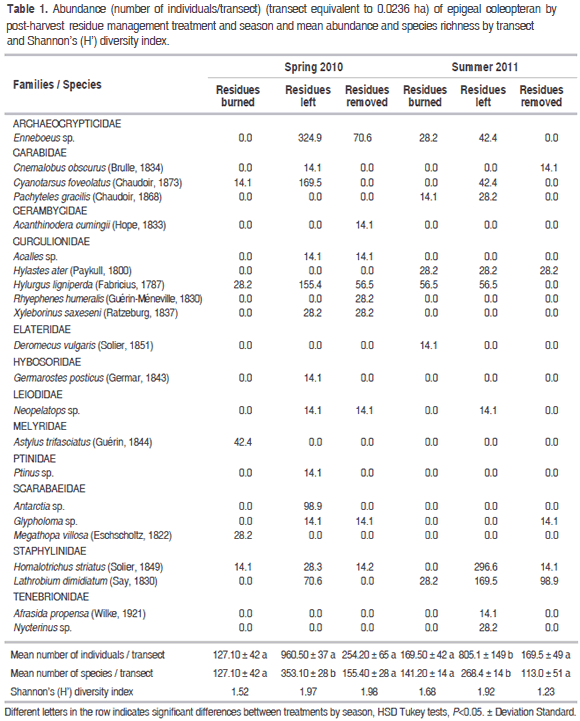
<body><![CDATA[<p>&nbsp;</p>     <p><font size="3" face="Verdana, Arial, Helvetica, sans-serif"><b>MATERIALS AND METHODS</b></font></p>     <p><font size="2" face="Verdana, Arial, Helvetica, sans-serif">The survey area is located in an approximately 25-yr old plantation of <i>P. radiata</i> (3 ha) (35&deg;43' - 35&deg;47'S; 72&deg;29' - 72&deg;31'W), which was harvested by clear-cutting at the beginning of 2010 in Constituci&oacute;n, Maule Region, central Chile. This area belongs to the Experiment Center Dr. Justo Pastor Le&oacute;n of the Faculty of Forestry Sciences and Nature Conservation, University of Chile<i>. </i>The area is located in the dry coastal Talca Province in the district of Agroclimatic Empedrado-Coronel, which is characterized by an average annual rainfall of 897 mm, with minimum and maximum temperature of 6 &deg;C and 24.4 &deg;C, respectively. The soils belong to the Constituci&oacute;n series, originating from metamorphic-granitic (Peralta, 1976). The study area is between coastal <i>Nothofagus glauca</i> and <i>Azara petiolaris</i>, and <i>N. glauca</i> and <i>Persea lingue</i> Mediterranean deciduous forests, being the first forest dominated by <i>N. glauca</i>,<i> Gevuina avellana</i>,<i> Lomatia hirsuta</i>, and <i>A. petiolaris </i>as major tree species, and the second forest dominated by <i>N. glauca</i>,<i> Nothofagus obliqua</i>,<i> G. avellana</i>, and <i>P. lingue </i>(Luebert and Pliscoff, 2006). In the study area original sclerophyllous forests and shrubs have been subjected to a profound transformation so that in some deeply disturbed places the original vegetation has been completely transformed into ruderal shrubs associated with the introduction of allochthonous species <i>Pinus radiata</i> plantations (Amigo <i>et al</i>., 2000; Luebert and Pliscoff, 2006).</font></p>     <p><font size="2" face="Verdana, Arial, Helvetica, sans-serif">In three different sites three post-harvest treatments (plots of 30m x 30m) were applied in a fully randomized design: i) a control in which harvest residues were left intact, ii) a in which harvest residues greater than 2.5 cm in diameter were removed, and iii) a in which all the harvest residues were burned (letting the fire to grow against the breeze or down the slope) (Julio, 2005). These three sites are separated around 20 m between them. Three linear transect were randomly selected in each one the three post harvest residue management treatments (experimental unit). In each linear transect of 20 m was delimited placing three pitfall traps within it at 0, 10 and 20 m of distance. Thus, a total of 27 pitfall traps (3 traps x 3 transects x 3 treatments) were finally disposed to examine the variation in epigeal coleopterans. The pitfall traps have a capacity of 750 mL being filled with 250 mL of 75% ethanol to preserve the specimens and 500 mL of distiller water with traces of detergent to decrease surface tension. The beetles were sampled in October 2010 (spring) and January 2011 (summer) due to temporal variations. It was considered that each pitfall trap had an activity radius of 5 m (P&eacute;fuar and P&eacute;rez, 1995), and then each transect was transformed to an area of 0.0236 ha. All the pitfall traps were removed 15 days after installation (Briones and Jerez, 2007). </font></p>     <p><font size="2" face="Verdana, Arial, Helvetica, sans-serif">The insects were stored in plastic vials with 70% ethanol and later counted and identified using taxonomic keys and by comparison with specimens in entomological collections in the Forest Entomology Laboratory, Faculty of Forestry Sciences and Nature Conservation, University of Chile, and the Entomology Institute, Metropolitan University of Education Sciences, in Santiago, Chile (Escobar, 2000). </font></p>     <p><font size="2" face="Verdana, Arial, Helvetica, sans-serif">The alpha diversity index of the epigeal coleopterans was determined for each treatment and season by calculation of means of relative abundance and specific richness (Moreno, 2001a). To determine the diversity of taxonomic groups the Shannon-Wiener (H') index was calculated (Magurran, 1988). In addition, a factorial ANOVA was used to determine statistical differences in species abundance and richness between residue treatments and season as factors. Finally, the HSD Tukey tests (<i>P</i>&lt;0.05) <i>a posteriori</i> was executed.</font></p>     <p>&nbsp;</p>     <p><font size="3" face="Verdana, Arial, Helvetica, sans-serif"><b>RESULTS AND DISCUSSION</b></font></p>     <p><font size="2" face="Verdana, Arial, Helvetica, sans-serif">With 27 traps we obtained 176 specimens that represent 23 species of 13 families of Coleoptera. Five most abundant species were <i>Enneboeus</i> sp. (Archaeocrypticidae), <i>Homalotrichus striatus</i>, <i>Cyanotarsus foveolatus </i>(Staphylinidae), <i>Lathrobium dimidiatum </i>(Staphylinidae) and <i>Hylurgus ligniperda </i>(Curculionidae). Some species are represented in nearly all treatments, as <i>Hylurgus liniperda</i> and <i>Homalotrichus striatus</i>. Few species are present only in one treatment and scarce abundance, as <i>Acanthinodera cumingii</i> (Cerambycidae), <i>Germarostes posticus </i>(Hybosoridae), <i>Deromecus vulgaris </i>(Elateridae) and <i>Afrasida propensa </i>(Tenebrionidae) (<a href="#tab01">Table 1</a>).</font></p>     <p align="center"><font size="2" face="Verdana, Arial, Helvetica, sans-serif"><a name="tab01"></a></font><img src="/img/revistas/rfnam/v70n1/v70n1a05tab01.gif"></p>     ]]></body>
<body><![CDATA[<p><font size="2" face="Verdana, Arial, Helvetica, sans-serif">The treatment is the only factor affecting abundance variations (F<sub>2,12</sub>=61.02, <i>P&lt;</i>0.001) while season factor and the &quot;treatment by season&quot; interaction term are not statistically significant (F<sub>1,12</sub>=1.06, <i>P</i>=0.32 and F<sub>2,12</sub>=0.82, <i>P</i>=0.45, respectively), showing that effect of the different treatments seem to not depend of the season. During spring, the treatment with residues left registered significantly greater species abundance than the other two (87% greater than the treatments with residues burned, and 73% more than that with the residues extracted). This trend also occurred during the summer, when the treatment with residues left continued to have a significantly greater abundance (79% greater than the treatments with residues burned or extracted). When comparing the abundance in each treatment between spring and summer no differences occurred between the treatment with residues burned, extracted or left (<a href="#tab01">Table 1</a>).</font></p>     <p><font size="2" face="Verdana, Arial, Helvetica, sans-serif">Similar results can be observed in the case of species richness. The species richness of epigeal coleopterans significantly differ between treatments (F<sub>2,12</sub>=23.56, <i>P&lt;</i>0.001), but no when the two seasons are compared (F<sub>1,12</sub>=2,97, <i>P</i>=0.11). During the spring, the treatment with residues left had a significantly greater richness than the other two treatments (64 and 56% greater than in the treatment with residues burned and extracted, respectively). During the summer, the treatment varied slightly, and the treatment with residues left continued having greater species richness, 47% greater than the treatment with residues burned and 58%, a significantly greater level than the treatment with the residues extracted, respectively. Again, the &quot;treatment by season&quot; interaction is not statistically significant (F<sub>2,12 </sub>=1.74, <i>P</i>=0.21) (<a href="#tab01">Table 1</a>).</font></p>     <p><font size="2" face="Verdana, Arial, Helvetica, sans-serif">Shannon's diversity index (H') did not register significant differences between species of epigeal coleopterans.The greatest abundance of epigeal coleopterans occurred in the treatment with residues left in both seasons, maybe because many species found there better habitat conditions and trophic resources necessary for survival (Grez <i>et al</i>., 2003; Correa and Roa, 2005). Work <i>et al</i>. (2013), evaluate the initial changes in the abundance, species richness and community composition of rove (Staphylinidae) and ground beetles (Carabidae), immediately following 1) stem-only harvesting, in which logging debris (e.i. tree tops and branches) are retained on site, and 2) whole-tree harvesting, in which stems, tops and branches are removed in mature balsam fir stands in Quebec, Canada. Catch rates in whole-tree harvesting were greater than stem-only harvesting sites; however, they were attributable to increased catches of only three species of Staphylinidae. </font></p>     <p><font size="2" face="Verdana, Arial, Helvetica, sans-serif">The greatest richness of epigeal coleopterans occurred in the treatment with residues left in both seasons, which may be due to the greater availability of food, favorable habitat and resource conditions preserved in this treatment, allowing for their establishment and survival, and resulting in an increased attraction for diverse species (Moreno, 2001b; Grez <i>et al</i>., 2003). The treatment with residues burned had the least species richness, probably because burning had a greater effect on natural habitat of insects affecting the ground and vegetation, thus the insects did not find the adequate conditions for establishment. Besides, insects are indirectly affected by fire given soil warming, increased metabolic activity and CO<sub>2</sub> emissions from litter and soil (Price <i>et al</i>., 2011).</font></p>     <p><font size="2" face="Verdana, Arial, Helvetica, sans-serif">The variation in abundance and species richness of epigeal coleopterans in both seasons could be caused by some species being univoltine while others may develop several life cycles in a year; an example is <i>Hylurgus ligniperda</i>, one of the most abundant species with not a seasonal cycle, as the females begin galleries any time of the year, although more frequently in the warmer months, with 10-12 wk cycles (Artigas, 1994).</font></p>     <p><font size="2" face="Verdana, Arial, Helvetica, sans-serif">The results obtained with the post-harvest treatments indicate that the effects of management of forest residues in harvest impacts on biodiversity and that different treatments influence biodiversity in diverse ways. The production process should consider preserving fragments of biodiversity reservoirs for preservation (Fisher and Lindenmayer, 2002; Tscharntke <i>et al</i>., 2002). Also, it is known that vegetation with residues possess a specific fauna and provides refugees for many sensitive species, and it is necessary to keep this in mind when anthropogenic changes of landscape occur. The preservation of biodiversity depends progressively on the protection of small areas and biota outside protected wild areas (Simonetti, 1998). This may be part of the strategies to follow to maintain biodiversity, particular in the region studied, that presents a high degree of endemism (Simonetti <i>et al</i>., 2002; Simonetti, 2006).</font></p>     <p>&nbsp;</p>     <p><font size="3" face="Verdana, Arial, Helvetica, sans-serif"><b>CONCLUSIONS</b></font></p>     <p><font size="2" face="Verdana, Arial, Helvetica, sans-serif">Both in the spring and summer, the treatment with residues left registered significantly greater abundance and species richness of epigeal  coleopterans. This treatment is then recommended in this area of study as it increases food availability and creates refugee site for beetles because of its greater vegetation cover, an important factor to promote their diversity. Then, when applying post-harvest residue management practices in this area of study is important to consider the treatment with the least alterations of the site, to generate adequate refugee areas to promote epigeal coleopteran diversity.</font></p>     <p>&nbsp;</p>     ]]></body>
<body><![CDATA[<p><font size="3" face="Verdana, Arial, Helvetica, sans-serif"><b>ACKNOWLEDGMENTS</b></font></p>     <p><font size="2" face="Verdana, Arial, Helvetica, sans-serif">Project financed by CORFO - INNOVA - BIOCOMSA.</font></p>     <p>&nbsp;</p>     <p><font size="3" face="Verdana, Arial, Helvetica, sans-serif"><b>REFERENCES</b> </font></p>     <!-- ref --><p><font size="2" face="Verdana, Arial, Helvetica, sans-serif">Amigo J, San Mart&iacute;n J y Garc&iacute;a L. 2000. Estudio fitosociol&oacute;gico de los bosques de <i>Nothofagus glauca</i> (Phil.) Krasser del Centro-Sur de Chile. Phytocoenologia 30:193-222.    &nbsp;&nbsp;&nbsp;&nbsp;&nbsp;&nbsp;&nbsp;&nbsp;[&#160;<a href="javascript:void(0);" onclick="javascript: window.open('/scielo.php?script=sci_nlinks&ref=3258555&pid=S0304-2847201700010000500001&lng=','','width=640,height=500,resizable=yes,scrollbars=1,menubar=yes,');">Links</a>&#160;]<!-- end-ref --></font></p>     <!-- ref --><p><font size="2" face="Verdana, Arial, Helvetica, sans-serif">Artigas J. 1994. Entomolog&iacute;a econ&oacute;mica: Insectos de inter&eacute;s agr&iacute;cola, forestal, m&eacute;dico y veterinario (nativos, introducidos y susceptibles de ser introducidos). Vol 2. Ediciones Universidad de Concepci&oacute;n, Concepci&oacute;n, Chile. 943 p.    &nbsp;&nbsp;&nbsp;&nbsp;&nbsp;&nbsp;&nbsp;&nbsp;[&#160;<a href="javascript:void(0);" onclick="javascript: window.open('/scielo.php?script=sci_nlinks&ref=3258557&pid=S0304-2847201700010000500002&lng=','','width=640,height=500,resizable=yes,scrollbars=1,menubar=yes,');">Links</a>&#160;]<!-- end-ref --></font></p>     <!-- ref --><p><font size="2" face="Verdana, Arial, Helvetica, sans-serif">Best L, Bergin T and Freemark K. 2001. Influence of landscape composition on bird use of rowcrop fields. Journal of Wildlife Management 65: 442-449. doi: 10.2307/3803096</font>&nbsp;&nbsp;&nbsp;&nbsp;&nbsp;&nbsp;&nbsp;&nbsp;[&#160;<a href="javascript:void(0);" onclick="javascript: window.open('/scielo.php?script=sci_nlinks&ref=3258559&pid=S0304-2847201700010000500003&lng=','','width=640,height=500,resizable=yes,scrollbars=1,menubar=yes,');">Links</a>&#160;]<!-- end-ref --><!-- ref --><p><font size="2" face="Verdana, Arial, Helvetica, sans-serif">Bonham K, Mesibov R and Bashford R. 2002. Diversity and abundance of some ground-dwelling invertebrates in plantation vs. native forests in Tasmania, Australia. Forest Ecology and Management 158: 237-247. doi: 10.1016/S0378-1127(00)00717-9</font>&nbsp;&nbsp;&nbsp;&nbsp;&nbsp;&nbsp;&nbsp;&nbsp;[&#160;<a href="javascript:void(0);" onclick="javascript: window.open('/scielo.php?script=sci_nlinks&ref=3258560&pid=S0304-2847201700010000500004&lng=','','width=640,height=500,resizable=yes,scrollbars=1,menubar=yes,');">Links</a>&#160;]<!-- end-ref --><!-- ref --><p><font size="2" face="Verdana, Arial, Helvetica, sans-serif">Briones R y Jerez V. 2007. Efecto de la edad de la plantaci&oacute;n de <i>Pinus radiata</i> en la abundancia de <i>Ceroglossus chilensis</i> (Coleoptera: Carabidae) en la Regi&oacute;n del B&iacute;ob&iacute;o, Chile. Bosque 28: 207-214.    &nbsp;&nbsp;&nbsp;&nbsp;&nbsp;&nbsp;&nbsp;&nbsp;[&#160;<a href="javascript:void(0);" onclick="javascript: window.open('/scielo.php?script=sci_nlinks&ref=3258561&pid=S0304-2847201700010000500005&lng=','','width=640,height=500,resizable=yes,scrollbars=1,menubar=yes,');">Links</a>&#160;]<!-- end-ref --></font></p>     <!-- ref --><p><font size="2" face="Verdana, Arial, Helvetica, sans-serif">Clapp R. 2001. Tree farming and forest conservation in Chile: Do replacement forests leave any originals behind? Society and Natural Resources: An International Journal 14: 341-356. doi: 10.1080/08941920119176</font>&nbsp;&nbsp;&nbsp;&nbsp;&nbsp;&nbsp;&nbsp;&nbsp;[&#160;<a href="javascript:void(0);" onclick="javascript: window.open('/scielo.php?script=sci_nlinks&ref=3258563&pid=S0304-2847201700010000500006&lng=','','width=640,height=500,resizable=yes,scrollbars=1,menubar=yes,');">Links</a>&#160;]<!-- end-ref --><!-- ref --><p><font size="2" face="Verdana, Arial, Helvetica, sans-serif">Coates F, Lunt I and Tremblay R. 2006. Effects of disturbance on population dynamics of the threatened orchid <i>Prasophyllum correctum</i> D.L. Jones and implications for grassland management in the south-eastern Australia<i>. </i>Biological Conservation 129: 59-69. doi: 10.1016/j.biocon.2005.06.037</font>&nbsp;&nbsp;&nbsp;&nbsp;&nbsp;&nbsp;&nbsp;&nbsp;[&#160;<a href="javascript:void(0);" onclick="javascript: window.open('/scielo.php?script=sci_nlinks&ref=3258564&pid=S0304-2847201700010000500007&lng=','','width=640,height=500,resizable=yes,scrollbars=1,menubar=yes,');">Links</a>&#160;]<!-- end-ref --><!-- ref --><p><font size="2" face="Verdana, Arial, Helvetica, sans-serif">Coddington J, Griswold C, Silva D, Pe&ntilde;aranda E and Scott S. 1991. Designing and testing samplings protocols to estimate biodiversity in tropical ecosistems. pp. 44-60. In: Duddley E. (ed.). The unity of evolutionary Biology: Proceedings of the Fourth International Congress of Systematic and Evolutionary Biology. Dioscorides Press, Portland OR. 1048 p. doi: 10.2307/2413587</font>&nbsp;&nbsp;&nbsp;&nbsp;&nbsp;&nbsp;&nbsp;&nbsp;[&#160;<a href="javascript:void(0);" onclick="javascript: window.open('/scielo.php?script=sci_nlinks&ref=3258565&pid=S0304-2847201700010000500008&lng=','','width=640,height=500,resizable=yes,scrollbars=1,menubar=yes,');">Links</a>&#160;]<!-- end-ref --><!-- ref --><p><font size="2" face="Verdana, Arial, Helvetica, sans-serif">Colwell R and Coddington J. 1994. Estimating terrestrial biodiversity through extrapolation. Philosophical Transactions of The Royal Society B: Biological Sciences 345: 101-118. doi: 10.1098/rstb.1994.0091.    &nbsp;&nbsp;&nbsp;&nbsp;&nbsp;&nbsp;&nbsp;&nbsp;[&#160;<a href="javascript:void(0);" onclick="javascript: window.open('/scielo.php?script=sci_nlinks&ref=3258566&pid=S0304-2847201700010000500009&lng=','','width=640,height=500,resizable=yes,scrollbars=1,menubar=yes,');">Links</a>&#160;]<!-- end-ref --></font></p>     <!-- ref --><p><font size="2" face="Verdana, Arial, Helvetica, sans-serif">Correa P y Roa A. 2005. Relaciones tr&oacute;ficas entre <i>Oncifelis guigna</i>, <i>Lycalopex culpaeus</i>, <i>Lycalopex griseus</i> y <i>Tyto alba</i> en un ambiente fragmentado de la zona central de Chile. Mastozoolog&iacute;a Neotropical 12: 57-60.    &nbsp;&nbsp;&nbsp;&nbsp;&nbsp;&nbsp;&nbsp;&nbsp;[&#160;<a href="javascript:void(0);" onclick="javascript: window.open('/scielo.php?script=sci_nlinks&ref=3258568&pid=S0304-2847201700010000500010&lng=','','width=640,height=500,resizable=yes,scrollbars=1,menubar=yes,');">Links</a>&#160;]<!-- end-ref --></font></p>     <!-- ref --><p><font size="2" face="Verdana, Arial, Helvetica, sans-serif">Covarrubias R. y Contreras A. 2004. Variaci&oacute;n en los microartr&oacute;podos del suelo, por manejos forestales de raleo selectivo y cortes en hoyos de luz. Bosque 25: 103-116.    &nbsp;&nbsp;&nbsp;&nbsp;&nbsp;&nbsp;&nbsp;&nbsp;[&#160;<a href="javascript:void(0);" onclick="javascript: window.open('/scielo.php?script=sci_nlinks&ref=3258570&pid=S0304-2847201700010000500011&lng=','','width=640,height=500,resizable=yes,scrollbars=1,menubar=yes,');">Links</a>&#160;]<!-- end-ref --> </font></p>     <!-- ref --><p><font size="2" face="Verdana, Arial, Helvetica, sans-serif">Didham R. 1997. An overview of invertebrate responses to forest fragmentation. pp. 303-320 In: Watt AD, Stork NE and Hunter MD (eds.). Forest and insects. Chapman and Hall, London.    &nbsp;&nbsp;&nbsp;&nbsp;&nbsp;&nbsp;&nbsp;&nbsp;[&#160;<a href="javascript:void(0);" onclick="javascript: window.open('/scielo.php?script=sci_nlinks&ref=3258572&pid=S0304-2847201700010000500012&lng=','','width=640,height=500,resizable=yes,scrollbars=1,menubar=yes,');">Links</a>&#160;]<!-- end-ref --> </font></p>     <!-- ref --><p><font size="2" face="Verdana, Arial, Helvetica, sans-serif">Escobar F. 2000. Diversidad de cole&oacute;pteros copr&oacute;fagos (Scarabaeidae: Scarabaeinae) en un mosaico de h&aacute;bitats en la Reserva Natural Nukak, Guaviare, Colombia. Acta Zool&oacute;gica Mexicana 79: 103-121</font>&nbsp;&nbsp;&nbsp;&nbsp;&nbsp;&nbsp;&nbsp;&nbsp;[&#160;<a href="javascript:void(0);" onclick="javascript: window.open('/scielo.php?script=sci_nlinks&ref=3258574&pid=S0304-2847201700010000500013&lng=','','width=640,height=500,resizable=yes,scrollbars=1,menubar=yes,');">Links</a>&#160;]<!-- end-ref --><!-- ref --><p><font size="2" face="Verdana, Arial, Helvetica, sans-serif">Fahrig L. 2003. Effects of habitat fragmentation on biodiversity. Annual Review of Ecology, Evolution and Systematics 34: 487-515. doi: 10.1146/annurev.ecolsys.34.011802.132419</font>&nbsp;&nbsp;&nbsp;&nbsp;&nbsp;&nbsp;&nbsp;&nbsp;[&#160;<a href="javascript:void(0);" onclick="javascript: window.open('/scielo.php?script=sci_nlinks&ref=3258575&pid=S0304-2847201700010000500014&lng=','','width=640,height=500,resizable=yes,scrollbars=1,menubar=yes,');">Links</a>&#160;]<!-- end-ref --><!-- ref --><p><font size="2" face="Verdana, Arial, Helvetica, sans-serif">Fischer J and Lindenmayer D. 2002. Small patches can be valuable for biodiversity conservation: two case studies on birds in southern Australia. Biological Conservation 106: 129-136. doi: 10.1016/S0006-3207(01)00241-5</font>&nbsp;&nbsp;&nbsp;&nbsp;&nbsp;&nbsp;&nbsp;&nbsp;[&#160;<a href="javascript:void(0);" onclick="javascript: window.open('/scielo.php?script=sci_nlinks&ref=3258576&pid=S0304-2847201700010000500015&lng=','','width=640,height=500,resizable=yes,scrollbars=1,menubar=yes,');">Links</a>&#160;]<!-- end-ref --><!-- ref --><p><font size="2" face="Verdana, Arial, Helvetica, sans-serif">Grez A, Moreno P y Elgueta M. 2003. Cole&oacute;pteros (Insecta: Coleoptera) epigeos asociados al bosque maulino y plantaciones de pino aleda&ntilde;as. Revista Chilena de Entomolog&iacute;a 29: 9-18.    &nbsp;&nbsp;&nbsp;&nbsp;&nbsp;&nbsp;&nbsp;&nbsp;[&#160;<a href="javascript:void(0);" onclick="javascript: window.open('/scielo.php?script=sci_nlinks&ref=3258577&pid=S0304-2847201700010000500016&lng=','','width=640,height=500,resizable=yes,scrollbars=1,menubar=yes,');">Links</a>&#160;]<!-- end-ref --></font></p>     <!-- ref --><p><font size="2" face="Verdana, Arial, Helvetica, sans-serif">INFOR (Instituto Forestal). 2011. Anuario Forestal 2011. Bolet&iacute;n Estad&iacute;stico No. 132. INFOR, Santiago, Chile. 136 p.    &nbsp;&nbsp;&nbsp;&nbsp;&nbsp;&nbsp;&nbsp;&nbsp;[&#160;<a href="javascript:void(0);" onclick="javascript: window.open('/scielo.php?script=sci_nlinks&ref=3258579&pid=S0304-2847201700010000500017&lng=','','width=640,height=500,resizable=yes,scrollbars=1,menubar=yes,');">Links</a>&#160;]<!-- end-ref --></font></p>     ]]></body>
<body><![CDATA[<!-- ref --><p><font size="2" face="Verdana, Arial, Helvetica, sans-serif">Jact&eacute;l H, Brockerhoff E and Duelli P. 2005. A test of the biodiversity - stability theory: meta-analysis of tree species diversity effects on the insect pest infestations, and re-examination of responsible factors. pp. 235-262. In: M. Scherer-Lorenzen , C. K&ouml;rner, E.D. Schulze. Forest diversity and function: temperate and boreal systems Ecological studies 176. DEU: Springer-Verlag. doi: 10.1007/3-540-26599-6_12</font>&nbsp;&nbsp;&nbsp;&nbsp;&nbsp;&nbsp;&nbsp;&nbsp;[&#160;<a href="javascript:void(0);" onclick="javascript: window.open('/scielo.php?script=sci_nlinks&ref=3258581&pid=S0304-2847201700010000500018&lng=','','width=640,height=500,resizable=yes,scrollbars=1,menubar=yes,');">Links</a>&#160;]<!-- end-ref --><!-- ref --><p><font size="2" face="Verdana, Arial, Helvetica, sans-serif">Julio G. 2005. Fundamentos del manejo del fuego. Quinta edici&oacute;n. Facultad de Ciencias Forestales, Universidad de Chile, Santiago, Chile. 329 p.    &nbsp;&nbsp;&nbsp;&nbsp;&nbsp;&nbsp;&nbsp;&nbsp;[&#160;<a href="javascript:void(0);" onclick="javascript: window.open('/scielo.php?script=sci_nlinks&ref=3258582&pid=S0304-2847201700010000500019&lng=','','width=640,height=500,resizable=yes,scrollbars=1,menubar=yes,');">Links</a>&#160;]<!-- end-ref --></font></p>     <!-- ref --><p><font size="2" face="Verdana, Arial, Helvetica, sans-serif">Keller I, Excoffier L and Largiad&egrave;r C. 2005. Estimation of effective population size and detection of a recent population decline coinciding with habitat fragmentation in a ground beetle. Journal of Evolutionary Biology 18: 90-100.    &nbsp;&nbsp;&nbsp;&nbsp;&nbsp;&nbsp;&nbsp;&nbsp;[&#160;<a href="javascript:void(0);" onclick="javascript: window.open('/scielo.php?script=sci_nlinks&ref=3258584&pid=S0304-2847201700010000500020&lng=','','width=640,height=500,resizable=yes,scrollbars=1,menubar=yes,');">Links</a>&#160;]<!-- end-ref --></font></p>     <!-- ref --><p><font size="2" face="Verdana, Arial, Helvetica, sans-serif">Koivula M. 2011. Useful model organisms, indicators, or both? Ground beetles (Coleoptera, Carabidae) reflecting environmental conditions. ZooKeys 100: 287-317. doi: 10.3897/zookeys.100.1533</font>&nbsp;&nbsp;&nbsp;&nbsp;&nbsp;&nbsp;&nbsp;&nbsp;[&#160;<a href="javascript:void(0);" onclick="javascript: window.open('/scielo.php?script=sci_nlinks&ref=3258586&pid=S0304-2847201700010000500021&lng=','','width=640,height=500,resizable=yes,scrollbars=1,menubar=yes,');">Links</a>&#160;]<!-- end-ref --><!-- ref --><p><font size="2" face="Verdana, Arial, Helvetica, sans-serif">Langor D and Spence J. 2006. Arthropods as ecological indicators of sustainability in Canadian forests. The Forestry Chronicle 82: 344-350.    &nbsp;&nbsp;&nbsp;&nbsp;&nbsp;&nbsp;&nbsp;&nbsp;[&#160;<a href="javascript:void(0);" onclick="javascript: window.open('/scielo.php?script=sci_nlinks&ref=3258587&pid=S0304-2847201700010000500022&lng=','','width=640,height=500,resizable=yes,scrollbars=1,menubar=yes,');">Links</a>&#160;]<!-- end-ref --></font></p>     <!-- ref --><p><font size="2" face="Verdana, Arial, Helvetica, sans-serif">Luebert F y Pliscoff P. 2006. Sinopsis bioclim&aacute;tica y vegetacional de Chile<i>.</i> Editorial Universitaria, Santiago, Chile. 316 p.    &nbsp;&nbsp;&nbsp;&nbsp;&nbsp;&nbsp;&nbsp;&nbsp;[&#160;<a href="javascript:void(0);" onclick="javascript: window.open('/scielo.php?script=sci_nlinks&ref=3258589&pid=S0304-2847201700010000500023&lng=','','width=640,height=500,resizable=yes,scrollbars=1,menubar=yes,');">Links</a>&#160;]<!-- end-ref --></font></p>     ]]></body>
<body><![CDATA[<!-- ref --><p><font size="2" face="Verdana, Arial, Helvetica, sans-serif">Magurran A. 1988. Ecological diversity and its measurement. Princeton University Press, New Jersey. 256 p.    &nbsp;&nbsp;&nbsp;&nbsp;&nbsp;&nbsp;&nbsp;&nbsp;[&#160;<a href="javascript:void(0);" onclick="javascript: window.open('/scielo.php?script=sci_nlinks&ref=3258591&pid=S0304-2847201700010000500024&lng=','','width=640,height=500,resizable=yes,scrollbars=1,menubar=yes,');">Links</a>&#160;]<!-- end-ref --></font></p>     <!-- ref --><p><font size="2" face="Verdana, Arial, Helvetica, sans-serif">Moreno C. 2001a. M&eacute;todos para medir la biodiversidad. Vol. I, Zaragoza, Espa&ntilde;a, M&amp;T-Manuales y Tesis SEA. 86 p.    &nbsp;&nbsp;&nbsp;&nbsp;&nbsp;&nbsp;&nbsp;&nbsp;[&#160;<a href="javascript:void(0);" onclick="javascript: window.open('/scielo.php?script=sci_nlinks&ref=3258593&pid=S0304-2847201700010000500025&lng=','','width=640,height=500,resizable=yes,scrollbars=1,menubar=yes,');">Links</a>&#160;]<!-- end-ref --></font></p>     <!-- ref --><p><font size="2" face="Verdana, Arial, Helvetica, sans-serif">Moreno P. 2001b. Efecto de la fragmentaci&oacute;n del bosque maulino sobre la composici&oacute;n, abundancia y distribuci&oacute;n de tama&ntilde;os corporales de cole&oacute;pteros epigeos. Memoria M&eacute;dico Veterinario. Santiago, Universidad de Chile, Facultad de Ciencias Veterinarias y Pecuarias. 71 p.    &nbsp;&nbsp;&nbsp;&nbsp;&nbsp;&nbsp;&nbsp;&nbsp;[&#160;<a href="javascript:void(0);" onclick="javascript: window.open('/scielo.php?script=sci_nlinks&ref=3258595&pid=S0304-2847201700010000500026&lng=','','width=640,height=500,resizable=yes,scrollbars=1,menubar=yes,');">Links</a>&#160;]<!-- end-ref --></font></p>     <!-- ref --><p><font size="2" face="Verdana, Arial, Helvetica, sans-serif">P&eacute;fuar J y P&eacute;rez R. 1995. Zoogeograf&iacute;a y variaci&oacute;n espacial y temporal de algunos vertebrados ep&iacute;geos de la zona xer&oacute;fila de la cuenca media del r&iacute;o Chama, M&eacute;rida, Venezuela. Ecotr&oacute;picos 8(1-2):15-38.    &nbsp;&nbsp;&nbsp;&nbsp;&nbsp;&nbsp;&nbsp;&nbsp;[&#160;<a href="javascript:void(0);" onclick="javascript: window.open('/scielo.php?script=sci_nlinks&ref=3258597&pid=S0304-2847201700010000500027&lng=','','width=640,height=500,resizable=yes,scrollbars=1,menubar=yes,');">Links</a>&#160;]<!-- end-ref --> </font></p>     <!-- ref --><p><font size="2" face="Verdana, Arial, Helvetica, sans-serif">Peralta M. 1976. Uso, clasificaci&oacute;n y conservaci&oacute;n de suelos. Ministerio de Agricultura, Servicio Agr&iacute;cola y Ganadero, Santiago, Chile. 340 p.    &nbsp;&nbsp;&nbsp;&nbsp;&nbsp;&nbsp;&nbsp;&nbsp;[&#160;<a href="javascript:void(0);" onclick="javascript: window.open('/scielo.php?script=sci_nlinks&ref=3258599&pid=S0304-2847201700010000500028&lng=','','width=640,height=500,resizable=yes,scrollbars=1,menubar=yes,');">Links</a>&#160;]<!-- end-ref --></font></p>     ]]></body>
<body><![CDATA[<!-- ref --><p><font size="2" face="Verdana, Arial, Helvetica, sans-serif">Paritsis J, Aizen MA. 2008. Effects of exotic conifer plantations on the biodiversity of understory plants, epigeal beetles and birds in <i>Nothofagus dombeyi</i> forests. Forest Ecology Managemet 255: 1575-1583. doi.org/10.1016/j.foreco.2007.11.015</font>&nbsp;&nbsp;&nbsp;&nbsp;&nbsp;&nbsp;&nbsp;&nbsp;[&#160;<a href="javascript:void(0);" onclick="javascript: window.open('/scielo.php?script=sci_nlinks&ref=3258601&pid=S0304-2847201700010000500029&lng=','','width=640,height=500,resizable=yes,scrollbars=1,menubar=yes,');">Links</a>&#160;]<!-- end-ref --><!-- ref --><p><font size="2" face="Verdana, Arial, Helvetica, sans-serif">Price P, Denno R, Eubanks M, Finke D and Kaplan I. 2011. Insect ecology. Behavior, population, and communities. Cambridge University Press, New York. 801 p.    &nbsp;&nbsp;&nbsp;&nbsp;&nbsp;&nbsp;&nbsp;&nbsp;[&#160;<a href="javascript:void(0);" onclick="javascript: window.open('/scielo.php?script=sci_nlinks&ref=3258602&pid=S0304-2847201700010000500030&lng=','','width=640,height=500,resizable=yes,scrollbars=1,menubar=yes,');">Links</a>&#160;]<!-- end-ref --></font></p>     <!-- ref --><p><font size="2" face="Verdana, Arial, Helvetica, sans-serif">Roe J, Gibson J and Kingsbury B. 2006. Beyond the wetland border: Estimating the impact of roads for two species of water snakes. Biological Conservation 130: 161-168. doi: 10.1016/j.biocon.2005.12.010</font>&nbsp;&nbsp;&nbsp;&nbsp;&nbsp;&nbsp;&nbsp;&nbsp;[&#160;<a href="javascript:void(0);" onclick="javascript: window.open('/scielo.php?script=sci_nlinks&ref=3258604&pid=S0304-2847201700010000500031&lng=','','width=640,height=500,resizable=yes,scrollbars=1,menubar=yes,');">Links</a>&#160;]<!-- end-ref --><!-- ref --><p><font size="2" face="Verdana, Arial, Helvetica, sans-serif">Roberge JM, Stenbacka F. 2014. Assemblages of epigaeic beetles and understory vegetation differ between stand of an introduced pine and its native congener in boreal forest. Forest Ecology and Management 318: 239-249. doi.org/10.1016/j.foreco.2014.01.026</font>&nbsp;&nbsp;&nbsp;&nbsp;&nbsp;&nbsp;&nbsp;&nbsp;[&#160;<a href="javascript:void(0);" onclick="javascript: window.open('/scielo.php?script=sci_nlinks&ref=3258605&pid=S0304-2847201700010000500032&lng=','','width=640,height=500,resizable=yes,scrollbars=1,menubar=yes,');">Links</a>&#160;]<!-- end-ref --><!-- ref --><p><font size="2" face="Verdana, Arial, Helvetica, sans-serif">Sackmann P, Corley J, Villalobos J. 2008. La importancia del manejo de las plantaciones de pinos en la conservaci&oacute;n de la diversidad de insectos ep&iacute;geos. pp. 1-15. In<i>:</i> Villacide J, Coreley J. (Eds). Manejo integrado de Plagas. Laboratorio de Ecolog&iacute;a de Insectos. Ediciones Instituto Nacional de Tecnolog&iacute;a Agropecuario, Bariloche, Argentina.    &nbsp;&nbsp;&nbsp;&nbsp;&nbsp;&nbsp;&nbsp;&nbsp;[&#160;<a href="javascript:void(0);" onclick="javascript: window.open('/scielo.php?script=sci_nlinks&ref=3258606&pid=S0304-2847201700010000500033&lng=','','width=640,height=500,resizable=yes,scrollbars=1,menubar=yes,');">Links</a>&#160;]<!-- end-ref --> </font></p>     <!-- ref --><p><font size="2" face="Verdana, Arial, Helvetica, sans-serif">Simonetti J. 1998. &Aacute;reas silvestres protegidas: &iquest;protegidas y protectoras? pp. 123-131. In: D&iacute;az-Pineda F, De Miguel J y Casado M (eds.). Diversidad biol&oacute;gica y cultura rural en la gesti&oacute;n ambiental del desarrollo. Ediciones Mundi-Prensa, Madrid.    &nbsp;&nbsp;&nbsp;&nbsp;&nbsp;&nbsp;&nbsp;&nbsp;[&#160;<a href="javascript:void(0);" onclick="javascript: window.open('/scielo.php?script=sci_nlinks&ref=3258608&pid=S0304-2847201700010000500034&lng=','','width=640,height=500,resizable=yes,scrollbars=1,menubar=yes,');">Links</a>&#160;]<!-- end-ref --> </font></p>     <!-- ref --><p><font size="2" face="Verdana, Arial, Helvetica, sans-serif">Simonetti J. 2006. Conservaci&oacute;n de biodiversidad en ambientes fragmentados: El caso del bosque Maulino. pp. 213-228. En: Grez A, Simonetti J y Bustamante R (eds.). Biodiversidad en ambientes fragmentados de Chile: patrones y procesos a diferentes escalas. Editorial Universitaria, Santiago, Chile.    &nbsp;&nbsp;&nbsp;&nbsp;&nbsp;&nbsp;&nbsp;&nbsp;[&#160;<a href="javascript:void(0);" onclick="javascript: window.open('/scielo.php?script=sci_nlinks&ref=3258610&pid=S0304-2847201700010000500035&lng=','','width=640,height=500,resizable=yes,scrollbars=1,menubar=yes,');">Links</a>&#160;]<!-- end-ref --></font></p>     <!-- ref --><p><font size="2" face="Verdana, Arial, Helvetica, sans-serif">Simonetti J, Grez A y Bustamante R. 2002. El valor de la matriz en la conservaci&oacute;n ambiental. Revista Ambiente y Desarrollo 18: 116-118.    &nbsp;&nbsp;&nbsp;&nbsp;&nbsp;&nbsp;&nbsp;&nbsp;[&#160;<a href="javascript:void(0);" onclick="javascript: window.open('/scielo.php?script=sci_nlinks&ref=3258612&pid=S0304-2847201700010000500036&lng=','','width=640,height=500,resizable=yes,scrollbars=1,menubar=yes,');">Links</a>&#160;]<!-- end-ref --></font></p>     <!-- ref --><p><font size="2" face="Verdana, Arial, Helvetica, sans-serif">Smith S. 1990. The greening of the forest: forest pest management into the 21st century. Proceedings of the Entomological Society of Ontario 121: 49-60.    &nbsp;&nbsp;&nbsp;&nbsp;&nbsp;&nbsp;&nbsp;&nbsp;[&#160;<a href="javascript:void(0);" onclick="javascript: window.open('/scielo.php?script=sci_nlinks&ref=3258614&pid=S0304-2847201700010000500037&lng=','','width=640,height=500,resizable=yes,scrollbars=1,menubar=yes,');">Links</a>&#160;]<!-- end-ref --></font></p>     <!-- ref --><p><font size="2" face="Verdana, Arial, Helvetica, sans-serif">Spooner P. 2005. Response of Acacia species to disturbance by roadworks in roadside environments in southern New South Wales, Australia. Biological Conservation 122: 231-242. doi: 10.1016/j.biocon.2004.07.012</font>&nbsp;&nbsp;&nbsp;&nbsp;&nbsp;&nbsp;&nbsp;&nbsp;[&#160;<a href="javascript:void(0);" onclick="javascript: window.open('/scielo.php?script=sci_nlinks&ref=3258616&pid=S0304-2847201700010000500038&lng=','','width=640,height=500,resizable=yes,scrollbars=1,menubar=yes,');">Links</a>&#160;]<!-- end-ref --><!-- ref --><p><font size="2" face="Verdana, Arial, Helvetica, sans-serif">Steffan-Dewenter I. 2003. Importance of habitat area and landscape context for species richness of bees and wasps in fragmented orchard meadows. Conservation Biology 17: 1036-1044. doi: 10.1046/j.1523-1739.2003.01575.x</font>&nbsp;&nbsp;&nbsp;&nbsp;&nbsp;&nbsp;&nbsp;&nbsp;[&#160;<a href="javascript:void(0);" onclick="javascript: window.open('/scielo.php?script=sci_nlinks&ref=3258617&pid=S0304-2847201700010000500039&lng=','','width=640,height=500,resizable=yes,scrollbars=1,menubar=yes,');">Links</a>&#160;]<!-- end-ref --><!-- ref --><p><font size="2" face="Verdana, Arial, Helvetica, sans-serif">Steffan-Dewenter I, M&uuml;nzenberg U, B&uuml;rger C, Thies C and Tscharntke T. 2002. Scale-dependent effects of landscape context on three pollinator guilds. Ecology 83: 1421-1432. doi: 10.1890/0012-9658(2002)083&#91;1421:SDEOLC&#93;2.0.CO;2</font>&nbsp;&nbsp;&nbsp;&nbsp;&nbsp;&nbsp;&nbsp;&nbsp;[&#160;<a href="javascript:void(0);" onclick="javascript: window.open('/scielo.php?script=sci_nlinks&ref=3258618&pid=S0304-2847201700010000500040&lng=','','width=640,height=500,resizable=yes,scrollbars=1,menubar=yes,');">Links</a>&#160;]<!-- end-ref --><!-- ref --><p><font size="2" face="Verdana, Arial, Helvetica, sans-serif">Tscharntke T, Steffan-Dewenter I, Kruess A and Thies C. 2002. Contribution of small habitat fragments to conservation of insect communities of grassland-cropland landscapes. Ecological Applications 12: 354-363. doi: 10.1890/1051-0761(2002)012&#91;0354:COSHFT&#93;2.0.CO;2</font>&nbsp;&nbsp;&nbsp;&nbsp;&nbsp;&nbsp;&nbsp;&nbsp;[&#160;<a href="javascript:void(0);" onclick="javascript: window.open('/scielo.php?script=sci_nlinks&ref=3258619&pid=S0304-2847201700010000500041&lng=','','width=640,height=500,resizable=yes,scrollbars=1,menubar=yes,');">Links</a>&#160;]<!-- end-ref --><!-- ref --><p><font size="2" face="Verdana, Arial, Helvetica, sans-serif">Work T, Klimaszewski J, Thiffault E, Bourdon C, Par&eacute; D, Bousquet Y, Venier L, Titus B. 2013. Initial responses of rove and ground beetles (Coleoptera, Staphylinidae, Carabidae) to removal of logging residues following clearcut harvesting in the boreal forest of Quebec, Canada. ZooKeys 258: 31-52. doi.org/10.3897/zookeys.258.4174 </font>&nbsp;&nbsp;&nbsp;&nbsp;&nbsp;&nbsp;&nbsp;&nbsp;[&#160;<a href="javascript:void(0);" onclick="javascript: window.open('/scielo.php?script=sci_nlinks&ref=3258620&pid=S0304-2847201700010000500042&lng=','','width=640,height=500,resizable=yes,scrollbars=1,menubar=yes,');">Links</a>&#160;]<!-- end-ref --> ]]></body><back>
<ref-list>
<ref id="B1">
<nlm-citation citation-type="journal">
<person-group person-group-type="author">
<name>
<surname><![CDATA[Amigo]]></surname>
<given-names><![CDATA[J]]></given-names>
</name>
<name>
<surname><![CDATA[San Martín]]></surname>
<given-names><![CDATA[J]]></given-names>
</name>
<name>
<surname><![CDATA[García]]></surname>
<given-names><![CDATA[L.]]></given-names>
</name>
</person-group>
<article-title xml:lang="es"><![CDATA[Estudio fitosociológico de los bosques de Nothofagus glauca (Phil.) Krasser del Centro-Sur de Chile.]]></article-title>
<source><![CDATA[Phytocoenologia]]></source>
<year>2000</year>
<numero>30</numero>
<issue>30</issue>
<page-range>193-222</page-range></nlm-citation>
</ref>
<ref id="B2">
<nlm-citation citation-type="book">
<person-group person-group-type="author">
<name>
<surname><![CDATA[Artigas]]></surname>
<given-names><![CDATA[J.]]></given-names>
</name>
</person-group>
<source><![CDATA[Entomología económica: Insectos de interés agrícola, forestal, médico y veterinario (nativos, introducidos y susceptibles de ser introducidos)]]></source>
<year>1994</year>
<volume>2</volume>
<publisher-loc><![CDATA[Concepción ]]></publisher-loc>
<publisher-name><![CDATA[Ediciones Universidad de Concepción]]></publisher-name>
</nlm-citation>
</ref>
<ref id="B3">
<nlm-citation citation-type="journal">
<person-group person-group-type="author">
<name>
<surname><![CDATA[Best]]></surname>
<given-names><![CDATA[L]]></given-names>
</name>
<name>
<surname><![CDATA[Bergin]]></surname>
<given-names><![CDATA[T]]></given-names>
</name>
<name>
<surname><![CDATA[Freemark]]></surname>
<given-names><![CDATA[K.]]></given-names>
</name>
</person-group>
<article-title xml:lang="en"><![CDATA[Influence of landscape composition on bird use of rowcrop fields.]]></article-title>
<source><![CDATA[Journal of Wildlife Management]]></source>
<year>2001</year>
<numero>65</numero>
<issue>65</issue>
<page-range>442-449</page-range></nlm-citation>
</ref>
<ref id="B4">
<nlm-citation citation-type="journal">
<person-group person-group-type="author">
<name>
<surname><![CDATA[Bonham]]></surname>
<given-names><![CDATA[K]]></given-names>
</name>
<name>
<surname><![CDATA[Mesibov]]></surname>
<given-names><![CDATA[R]]></given-names>
</name>
<name>
<surname><![CDATA[Bashford]]></surname>
<given-names><![CDATA[R.]]></given-names>
</name>
</person-group>
<article-title xml:lang="en"><![CDATA[Diversity and abundance of some ground-dwelling invertebrates in plantation vs. native forests in Tasmania, Australia.]]></article-title>
<source><![CDATA[Forest Ecology and Management]]></source>
<year>2002</year>
<numero>158</numero>
<issue>158</issue>
<page-range>237-247</page-range></nlm-citation>
</ref>
<ref id="B5">
<nlm-citation citation-type="journal">
<person-group person-group-type="author">
<name>
<surname><![CDATA[Briones]]></surname>
<given-names><![CDATA[R]]></given-names>
</name>
<name>
<surname><![CDATA[Jerez]]></surname>
<given-names><![CDATA[V.]]></given-names>
</name>
</person-group>
<article-title xml:lang="es"><![CDATA[Efecto de la edad de la plantación de Pinus radiata en la abundancia de Ceroglossus chilensis (Coleoptera: Carabidae) en la Región del Bíobío, Chile.]]></article-title>
<source><![CDATA[Bosque]]></source>
<year>2007</year>
<numero>28</numero>
<issue>28</issue>
<page-range>207-214</page-range></nlm-citation>
</ref>
<ref id="B6">
<nlm-citation citation-type="journal">
<person-group person-group-type="author">
<name>
<surname><![CDATA[Clapp]]></surname>
<given-names><![CDATA[R.]]></given-names>
</name>
</person-group>
<article-title xml:lang="en"><![CDATA[Tree farming and forest conservation in Chile: Do replacement forests leave any originals behind?]]></article-title>
<source><![CDATA[Society and Natural Resources: An International Journal]]></source>
<year>2001</year>
<numero>14</numero>
<issue>14</issue>
<page-range>341-356</page-range></nlm-citation>
</ref>
<ref id="B7">
<nlm-citation citation-type="journal">
<person-group person-group-type="author">
<name>
<surname><![CDATA[Coates]]></surname>
<given-names><![CDATA[F]]></given-names>
</name>
<name>
<surname><![CDATA[Lunt]]></surname>
<given-names><![CDATA[I]]></given-names>
</name>
<name>
<surname><![CDATA[Tremblay]]></surname>
<given-names><![CDATA[R.]]></given-names>
</name>
</person-group>
<article-title xml:lang="en"><![CDATA[Effects of disturbance on population dynamics of the threatened orchid Prasophyllum correctum D.L. Jones and implications for grassland management in the south-eastern Australia.]]></article-title>
<source><![CDATA[Biological Conservation]]></source>
<year>2006</year>
<numero>129</numero>
<issue>129</issue>
<page-range>59-69</page-range></nlm-citation>
</ref>
<ref id="B8">
<nlm-citation citation-type="book">
<person-group person-group-type="author">
<name>
<surname><![CDATA[Coddington]]></surname>
<given-names><![CDATA[J]]></given-names>
</name>
<name>
<surname><![CDATA[Griswold]]></surname>
<given-names><![CDATA[C]]></given-names>
</name>
<name>
<surname><![CDATA[Silva]]></surname>
<given-names><![CDATA[D]]></given-names>
</name>
<name>
<surname><![CDATA[Peñaranda]]></surname>
<given-names><![CDATA[E]]></given-names>
</name>
<name>
<surname><![CDATA[Scott]]></surname>
<given-names><![CDATA[S.]]></given-names>
</name>
</person-group>
<article-title xml:lang="en"><![CDATA[Designing and testing samplings protocols to estimate biodiversity in tropical ecosistems.]]></article-title>
<person-group person-group-type="editor">
<name>
<surname><![CDATA[Duddley]]></surname>
<given-names><![CDATA[E.]]></given-names>
</name>
</person-group>
<source><![CDATA[The unity of evolutionary Biology: Proceedings of the Fourth International Congress of Systematic and Evolutionary Biology.]]></source>
<year>1991</year>
<page-range>44-60</page-range><publisher-loc><![CDATA[Portland^eOR OR]]></publisher-loc>
<publisher-name><![CDATA[Dioscorides Press]]></publisher-name>
</nlm-citation>
</ref>
<ref id="B9">
<nlm-citation citation-type="journal">
<person-group person-group-type="author">
<name>
<surname><![CDATA[Colwell]]></surname>
<given-names><![CDATA[R]]></given-names>
</name>
<name>
<surname><![CDATA[Coddington]]></surname>
<given-names><![CDATA[J]]></given-names>
</name>
</person-group>
<article-title xml:lang="en"><![CDATA[Estimating terrestrial biodiversity through extrapolation.]]></article-title>
<source><![CDATA[Philosophical Transactions of The Royal Society B: Biological Sciences]]></source>
<year>1994</year>
<numero>345</numero>
<issue>345</issue>
<page-range>101-118</page-range></nlm-citation>
</ref>
<ref id="B10">
<nlm-citation citation-type="journal">
<person-group person-group-type="author">
<name>
<surname><![CDATA[Correa]]></surname>
<given-names><![CDATA[P]]></given-names>
</name>
<name>
<surname><![CDATA[Roa]]></surname>
<given-names><![CDATA[A.]]></given-names>
</name>
</person-group>
<article-title xml:lang="es"><![CDATA[Relaciones tróficas entre Oncifelis guigna, Lycalopex culpaeus, Lycalopex griseus y Tyto alba en un ambiente fragmentado de la zona central de Chile.]]></article-title>
<source><![CDATA[Mastozoología Neotropical]]></source>
<year>2005</year>
<numero>12</numero>
<issue>12</issue>
<page-range>57-60</page-range></nlm-citation>
</ref>
<ref id="B11">
<nlm-citation citation-type="journal">
<person-group person-group-type="author">
<name>
<surname><![CDATA[Covarrubias]]></surname>
<given-names><![CDATA[R.]]></given-names>
</name>
<name>
<surname><![CDATA[Contreras]]></surname>
<given-names><![CDATA[A.]]></given-names>
</name>
</person-group>
<article-title xml:lang="es"><![CDATA[Variación en los microartrópodos del suelo, por manejos forestales de raleo selectivo y cortes en hoyos de luz.]]></article-title>
<source><![CDATA[Bosque]]></source>
<year>2004</year>
<numero>25</numero>
<issue>25</issue>
<page-range>103-116</page-range></nlm-citation>
</ref>
<ref id="B12">
<nlm-citation citation-type="book">
<person-group person-group-type="author">
<name>
<surname><![CDATA[Didham]]></surname>
<given-names><![CDATA[R.]]></given-names>
</name>
</person-group>
<article-title xml:lang="en"><![CDATA[An overview of invertebrate responses to forest fragmentation.]]></article-title>
<person-group person-group-type="editor">
<name>
<surname><![CDATA[Watt]]></surname>
<given-names><![CDATA[AD]]></given-names>
</name>
<name>
<surname><![CDATA[Stork]]></surname>
<given-names><![CDATA[NE]]></given-names>
</name>
<name>
<surname><![CDATA[Hunter]]></surname>
<given-names><![CDATA[MD]]></given-names>
</name>
</person-group>
<source><![CDATA[Forest and insects]]></source>
<year>1997</year>
<page-range>303-320</page-range><publisher-loc><![CDATA[London ]]></publisher-loc>
<publisher-name><![CDATA[Chapman and Hall]]></publisher-name>
</nlm-citation>
</ref>
<ref id="B13">
<nlm-citation citation-type="journal">
<person-group person-group-type="author">
<name>
<surname><![CDATA[Escobar]]></surname>
<given-names><![CDATA[F.]]></given-names>
</name>
</person-group>
<article-title xml:lang="es"><![CDATA[Diversidad de coleópteros coprófagos (Scarabaeidae: Scarabaeinae) en un mosaico de hábitats en la Reserva Natural Nukak, Guaviare, Colombia.]]></article-title>
<source><![CDATA[Acta Zoológica Mexicana]]></source>
<year>2000</year>
<numero>79</numero>
<issue>79</issue>
<page-range>103-121</page-range></nlm-citation>
</ref>
<ref id="B14">
<nlm-citation citation-type="journal">
<person-group person-group-type="author">
<name>
<surname><![CDATA[Fahrig]]></surname>
<given-names><![CDATA[L.]]></given-names>
</name>
</person-group>
<article-title xml:lang="en"><![CDATA[Effects of habitat fragmentation on biodiversity.]]></article-title>
<source><![CDATA[Annual Review of Ecology, Evolution and Systematics]]></source>
<year>2003</year>
<numero>34</numero>
<issue>34</issue>
<page-range>487-515</page-range></nlm-citation>
</ref>
<ref id="B15">
<nlm-citation citation-type="journal">
<person-group person-group-type="author">
<name>
<surname><![CDATA[Fischer]]></surname>
<given-names><![CDATA[J]]></given-names>
</name>
<name>
<surname><![CDATA[Lindenmayer]]></surname>
<given-names><![CDATA[D.]]></given-names>
</name>
</person-group>
<article-title xml:lang="en"><![CDATA[Small patches can be valuable for biodiversity conservation: two case studies on birds in southern Australia.]]></article-title>
<source><![CDATA[Biological Conservation]]></source>
<year>2002</year>
<numero>106</numero>
<issue>106</issue>
<page-range>129-136</page-range></nlm-citation>
</ref>
<ref id="B16">
<nlm-citation citation-type="journal">
<person-group person-group-type="author">
<name>
<surname><![CDATA[Grez]]></surname>
<given-names><![CDATA[A]]></given-names>
</name>
<name>
<surname><![CDATA[Moreno]]></surname>
<given-names><![CDATA[P]]></given-names>
</name>
<name>
<surname><![CDATA[Elgueta]]></surname>
<given-names><![CDATA[M.]]></given-names>
</name>
</person-group>
<article-title xml:lang="es"><![CDATA[Coleópteros (Insecta: Coleoptera) epigeos asociados al bosque maulino y plantaciones de pino aledañas.]]></article-title>
<source><![CDATA[Revista Chilena de Entomología]]></source>
<year>2003</year>
<numero>29</numero>
<issue>29</issue>
<page-range>9-18</page-range></nlm-citation>
</ref>
<ref id="B17">
<nlm-citation citation-type="book">
<article-title xml:lang="es"><![CDATA[INFOR (Instituto Forestal).]]></article-title>
<source><![CDATA[Anuario Forestal 2011.: Boletín Estadístico No. 132]]></source>
<year>2011</year>
<publisher-loc><![CDATA[Santiago ]]></publisher-loc>
<publisher-name><![CDATA[INFOR]]></publisher-name>
</nlm-citation>
</ref>
<ref id="B18">
<nlm-citation citation-type="book">
<person-group person-group-type="author">
<name>
<surname><![CDATA[Jactél]]></surname>
<given-names><![CDATA[H]]></given-names>
</name>
<name>
<surname><![CDATA[Brockerhoff]]></surname>
<given-names><![CDATA[E]]></given-names>
</name>
<name>
<surname><![CDATA[Duelli]]></surname>
<given-names><![CDATA[P.]]></given-names>
</name>
</person-group>
<article-title xml:lang="en"><![CDATA[A test of the biodiversity - stability theory: meta-analysis of tree species diversity effects on the insect pest infestations, and re-examination of responsible factors]]></article-title>
<person-group person-group-type="editor">
<name>
<surname><![CDATA[Scherer-Lorenzen]]></surname>
<given-names><![CDATA[M.]]></given-names>
</name>
<name>
<surname><![CDATA[Körner]]></surname>
<given-names><![CDATA[C.]]></given-names>
</name>
<name>
<surname><![CDATA[Schulze]]></surname>
<given-names><![CDATA[E.D.]]></given-names>
</name>
</person-group>
<source><![CDATA[Forest diversity and function: temperate and boreal systems Ecological studies]]></source>
<year>2005</year>
<page-range>235-262</page-range><publisher-name><![CDATA[DEU: Springer-Verlag]]></publisher-name>
</nlm-citation>
</ref>
<ref id="B19">
<nlm-citation citation-type="">
<person-group person-group-type="author">
<name>
<surname><![CDATA[Julio]]></surname>
<given-names><![CDATA[G.]]></given-names>
</name>
</person-group>
<collab>Universidad de Chile^dFacultad de Ciencias Forestales</collab>
<source><![CDATA[Fundamentos del manejo del fuego]]></source>
<year>2005</year>
<edition>Quinta</edition>
<publisher-loc><![CDATA[Santiago ]]></publisher-loc>
</nlm-citation>
</ref>
<ref id="B20">
<nlm-citation citation-type="journal">
<person-group person-group-type="author">
<name>
<surname><![CDATA[Keller]]></surname>
<given-names><![CDATA[I]]></given-names>
</name>
<name>
<surname><![CDATA[Excoffier]]></surname>
<given-names><![CDATA[L]]></given-names>
</name>
<name>
<surname><![CDATA[Largiadèr]]></surname>
<given-names><![CDATA[C.]]></given-names>
</name>
</person-group>
<article-title xml:lang="en"><![CDATA[Estimation of effective population size and detection of a recent population decline coinciding with habitat fragmentation in a ground beetle.]]></article-title>
<source><![CDATA[Journal of Evolutionary Biology]]></source>
<year>2005</year>
<numero>18</numero>
<issue>18</issue>
<page-range>90-100</page-range></nlm-citation>
</ref>
<ref id="B21">
<nlm-citation citation-type="journal">
<person-group person-group-type="author">
<name>
<surname><![CDATA[Koivula]]></surname>
<given-names><![CDATA[M.]]></given-names>
</name>
</person-group>
<article-title xml:lang="en"><![CDATA[Useful model organisms, indicators, or both?: Ground beetles (Coleoptera, Carabidae) reflecting environmental conditions.]]></article-title>
<source><![CDATA[ZooKeys]]></source>
<year>2011</year>
<numero>100</numero>
<issue>100</issue>
<page-range>287-317</page-range></nlm-citation>
</ref>
<ref id="B22">
<nlm-citation citation-type="journal">
<person-group person-group-type="author">
<name>
<surname><![CDATA[Langor]]></surname>
<given-names><![CDATA[D]]></given-names>
</name>
<name>
<surname><![CDATA[Spence]]></surname>
<given-names><![CDATA[J.]]></given-names>
</name>
</person-group>
<article-title xml:lang="en"><![CDATA[Arthropods as ecological indicators of sustainability in Canadian forests.]]></article-title>
<source><![CDATA[The Forestry Chronicle]]></source>
<year>2006</year>
<numero>82</numero>
<issue>82</issue>
<page-range>344-350</page-range></nlm-citation>
</ref>
<ref id="B23">
<nlm-citation citation-type="book">
<person-group person-group-type="author">
<name>
<surname><![CDATA[Luebert]]></surname>
<given-names><![CDATA[F]]></given-names>
</name>
<name>
<surname><![CDATA[Pliscoff]]></surname>
<given-names><![CDATA[P.]]></given-names>
</name>
</person-group>
<source><![CDATA[Sinopsis bioclimática y vegetacional de Chile.]]></source>
<year>2006</year>
<publisher-loc><![CDATA[Santiago ]]></publisher-loc>
<publisher-name><![CDATA[Editorial Universitaria]]></publisher-name>
</nlm-citation>
</ref>
<ref id="B24">
<nlm-citation citation-type="book">
<person-group person-group-type="author">
<name>
<surname><![CDATA[Magurran]]></surname>
<given-names><![CDATA[A.]]></given-names>
</name>
</person-group>
<source><![CDATA[Ecological diversity and its measurement.]]></source>
<year>1988</year>
<publisher-loc><![CDATA[New Jersey ]]></publisher-loc>
<publisher-name><![CDATA[Princeton University Press]]></publisher-name>
</nlm-citation>
</ref>
<ref id="B25">
<nlm-citation citation-type="book">
<person-group person-group-type="author">
<name>
<surname><![CDATA[Moreno]]></surname>
<given-names><![CDATA[C.]]></given-names>
</name>
</person-group>
<source><![CDATA[Métodos para medir la biodiversidad.]]></source>
<year>2001</year>
<month>a</month>
<volume>I</volume>
<publisher-loc><![CDATA[Zaragoza ]]></publisher-loc>
<publisher-name><![CDATA[España, M & T-Manuales y Tesis SEA.]]></publisher-name>
</nlm-citation>
</ref>
<ref id="B26">
<nlm-citation citation-type="book">
<person-group person-group-type="author">
<name>
<surname><![CDATA[Moreno]]></surname>
<given-names><![CDATA[P]]></given-names>
</name>
</person-group>
<collab>Universidad de Chile^dFacultad de Ciencias Veterinarias y Pecuarias</collab>
<source><![CDATA[Efecto de la fragmentación del bosque maulino sobre la composición, abundancia y distribución de tamaños corporales de coleópteros epigeos.]]></source>
<year>2001</year>
<month>b</month>
<publisher-loc><![CDATA[Santiago ]]></publisher-loc>
<publisher-name><![CDATA[Memoria Médico Veterinario.]]></publisher-name>
</nlm-citation>
</ref>
<ref id="B27">
<nlm-citation citation-type="journal">
<person-group person-group-type="author">
<name>
<surname><![CDATA[Péfuar]]></surname>
<given-names><![CDATA[J]]></given-names>
</name>
<name>
<surname><![CDATA[Pérez]]></surname>
<given-names><![CDATA[R.]]></given-names>
</name>
</person-group>
<article-title xml:lang="es"><![CDATA[Zoogeografía y variación espacial y temporal de algunos vertebrados epígeos de la zona xerófila de la cuenca media del río Chama, Mérida, Venezuela]]></article-title>
<source><![CDATA[Ecotrópicos]]></source>
<year>1995</year>
<volume>8</volume>
<numero>1-2</numero>
<issue>1-2</issue>
<page-range>15-38</page-range></nlm-citation>
</ref>
<ref id="B28">
<nlm-citation citation-type="book">
<person-group person-group-type="author">
<name>
<surname><![CDATA[Peralta]]></surname>
<given-names><![CDATA[M.]]></given-names>
</name>
</person-group>
<source><![CDATA[Uso, clasificación y conservación de suelos.]]></source>
<year>1976</year>
<publisher-loc><![CDATA[Santiago ]]></publisher-loc>
<publisher-name><![CDATA[Ministerio de Agricultura, Servicio Agrícola y Ganadero]]></publisher-name>
</nlm-citation>
</ref>
<ref id="B29">
<nlm-citation citation-type="journal">
<person-group person-group-type="author">
<name>
<surname><![CDATA[Paritsis]]></surname>
<given-names><![CDATA[J]]></given-names>
</name>
<name>
<surname><![CDATA[Aizen]]></surname>
<given-names><![CDATA[MA.]]></given-names>
</name>
</person-group>
<article-title xml:lang="en"><![CDATA[Effects of exotic conifer plantations on the biodiversity of understory plants, epigeal beetles and birds in Nothofagus dombeyi forests.]]></article-title>
<source><![CDATA[Forest Ecology Managemet]]></source>
<year>2008</year>
<numero>255</numero>
<issue>255</issue>
<page-range>1575-1583</page-range></nlm-citation>
</ref>
<ref id="B30">
<nlm-citation citation-type="book">
<person-group person-group-type="author">
<name>
<surname><![CDATA[Price]]></surname>
<given-names><![CDATA[P]]></given-names>
</name>
<name>
<surname><![CDATA[Denno]]></surname>
<given-names><![CDATA[R]]></given-names>
</name>
<name>
<surname><![CDATA[Eubanks]]></surname>
<given-names><![CDATA[M]]></given-names>
</name>
<name>
<surname><![CDATA[Finke]]></surname>
<given-names><![CDATA[D]]></given-names>
</name>
<name>
<surname><![CDATA[Kaplan]]></surname>
<given-names><![CDATA[I.]]></given-names>
</name>
</person-group>
<source><![CDATA[Insect ecology. Behavior, population, and communities.]]></source>
<year>2011</year>
<publisher-loc><![CDATA[New York ]]></publisher-loc>
<publisher-name><![CDATA[Cambridge University Press]]></publisher-name>
</nlm-citation>
</ref>
<ref id="B31">
<nlm-citation citation-type="journal">
<person-group person-group-type="author">
<name>
<surname><![CDATA[Roe]]></surname>
<given-names><![CDATA[J]]></given-names>
</name>
<name>
<surname><![CDATA[Gibson]]></surname>
<given-names><![CDATA[J]]></given-names>
</name>
<name>
<surname><![CDATA[Kingsbury]]></surname>
<given-names><![CDATA[B.]]></given-names>
</name>
</person-group>
<article-title xml:lang="en"><![CDATA[Beyond the wetland border: Estimating the impact of roads for two species of water snakes.]]></article-title>
<source><![CDATA[Biological Conservation]]></source>
<year>2006</year>
<numero>130</numero>
<issue>130</issue>
<page-range>161-168</page-range></nlm-citation>
</ref>
<ref id="B32">
<nlm-citation citation-type="journal">
<person-group person-group-type="author">
<name>
<surname><![CDATA[Roberge]]></surname>
<given-names><![CDATA[JM]]></given-names>
</name>
<name>
<surname><![CDATA[Stenbacka]]></surname>
<given-names><![CDATA[F.]]></given-names>
</name>
</person-group>
<article-title xml:lang="en"><![CDATA[Assemblages of epigaeic beetles and understory vegetation differ between stand of an introduced pine and its native congener in boreal forest]]></article-title>
<source><![CDATA[Forest Ecology and Management]]></source>
<year>2014</year>
<numero>318</numero>
<issue>318</issue>
<page-range>239-249</page-range></nlm-citation>
</ref>
<ref id="B33">
<nlm-citation citation-type="book">
<person-group person-group-type="author">
<name>
<surname><![CDATA[Sackmann]]></surname>
<given-names><![CDATA[P]]></given-names>
</name>
<name>
<surname><![CDATA[Corley]]></surname>
<given-names><![CDATA[J]]></given-names>
</name>
<name>
<surname><![CDATA[Villalobos]]></surname>
<given-names><![CDATA[J.]]></given-names>
</name>
</person-group>
<article-title xml:lang="es"><![CDATA[La importancia del manejo de las plantaciones de pinos en la conservación de la diversidad de insectos epígeos.]]></article-title>
<person-group person-group-type="editor">
<name>
<surname><![CDATA[Villacide]]></surname>
<given-names><![CDATA[J]]></given-names>
</name>
<name>
<surname><![CDATA[Coreley]]></surname>
<given-names><![CDATA[J.]]></given-names>
</name>
</person-group>
<collab>Laboratorio de Ecología de Insectos</collab>
<source><![CDATA[Manejo integrado de Plagas]]></source>
<year>2008</year>
<page-range>1-15</page-range><publisher-loc><![CDATA[Bariloche ]]></publisher-loc>
<publisher-name><![CDATA[Ediciones Instituto Nacional de Tecnología Agropecuario]]></publisher-name>
</nlm-citation>
</ref>
<ref id="B34">
<nlm-citation citation-type="book">
<person-group person-group-type="author">
<name>
<surname><![CDATA[Simonetti]]></surname>
<given-names><![CDATA[J.]]></given-names>
</name>
</person-group>
<article-title xml:lang="es"><![CDATA[Áreas silvestres protegidas: ¿protegidas y protectoras?]]></article-title>
<person-group person-group-type="editor">
<name>
<surname><![CDATA[Díaz-Pineda]]></surname>
<given-names><![CDATA[F]]></given-names>
</name>
<name>
<surname><![CDATA[De Miguel]]></surname>
<given-names><![CDATA[J]]></given-names>
</name>
<name>
<surname><![CDATA[Casado]]></surname>
<given-names><![CDATA[M]]></given-names>
</name>
</person-group>
<source><![CDATA[Diversidad biológica y cultura rural en la gestión ambiental del desarrollo]]></source>
<year>1998</year>
<page-range>123-131</page-range><publisher-loc><![CDATA[Madrid ]]></publisher-loc>
<publisher-name><![CDATA[Ediciones Mundi-Prensa]]></publisher-name>
</nlm-citation>
</ref>
<ref id="B35">
<nlm-citation citation-type="book">
<person-group person-group-type="author">
<name>
<surname><![CDATA[Simonetti]]></surname>
<given-names><![CDATA[J.]]></given-names>
</name>
</person-group>
<article-title xml:lang="es"><![CDATA[Conservación de biodiversidad en ambientes fragmentados: El caso del bosque Maulino]]></article-title>
<person-group person-group-type="editor">
<name>
<surname><![CDATA[Grez]]></surname>
<given-names><![CDATA[A]]></given-names>
</name>
<name>
<surname><![CDATA[Simonetti]]></surname>
<given-names><![CDATA[J]]></given-names>
</name>
<name>
<surname><![CDATA[Bustamante]]></surname>
<given-names><![CDATA[R]]></given-names>
</name>
</person-group>
<source><![CDATA[Biodiversidad en ambientes fragmentados de Chile: patrones y procesos a diferentes escalas]]></source>
<year>2006</year>
<page-range>213-228</page-range><publisher-loc><![CDATA[Santiago ]]></publisher-loc>
<publisher-name><![CDATA[Editorial Universitaria]]></publisher-name>
</nlm-citation>
</ref>
<ref id="B36">
<nlm-citation citation-type="journal">
<person-group person-group-type="author">
<name>
<surname><![CDATA[Simonetti]]></surname>
<given-names><![CDATA[J]]></given-names>
</name>
<name>
<surname><![CDATA[Grez]]></surname>
<given-names><![CDATA[A]]></given-names>
</name>
<name>
<surname><![CDATA[Bustamante]]></surname>
<given-names><![CDATA[R]]></given-names>
</name>
</person-group>
<article-title xml:lang="es"><![CDATA[El valor de la matriz en la conservación ambiental]]></article-title>
<source><![CDATA[Revista Ambiente y Desarrollo]]></source>
<year>2002</year>
<numero>18</numero>
<issue>18</issue>
<page-range>116-118</page-range></nlm-citation>
</ref>
<ref id="B37">
<nlm-citation citation-type="journal">
<person-group person-group-type="author">
<name>
<surname><![CDATA[Smith]]></surname>
<given-names><![CDATA[S.]]></given-names>
</name>
</person-group>
<article-title xml:lang="en"><![CDATA[The greening of the forest: forest pest management into the 21st century.]]></article-title>
<source><![CDATA[Proceedings of the Entomological Society of Ontario]]></source>
<year>1990</year>
<numero>121</numero>
<issue>121</issue>
<page-range>49-60</page-range></nlm-citation>
</ref>
<ref id="B38">
<nlm-citation citation-type="journal">
<person-group person-group-type="author">
<name>
<surname><![CDATA[Spooner]]></surname>
<given-names><![CDATA[P.]]></given-names>
</name>
</person-group>
<article-title xml:lang="en"><![CDATA[Response of Acacia species to disturbance by roadworks in roadside environments in southern New South Wales, Australia.]]></article-title>
<source><![CDATA[Biological Conservation]]></source>
<year>2005</year>
<numero>122</numero>
<issue>122</issue>
<page-range>231-242</page-range></nlm-citation>
</ref>
<ref id="B39">
<nlm-citation citation-type="journal">
<person-group person-group-type="author">
<name>
<surname><![CDATA[Steffan-Dewenter]]></surname>
<given-names><![CDATA[I.]]></given-names>
</name>
</person-group>
<article-title xml:lang="en"><![CDATA[Importance of habitat area and landscape context for species richness of bees and wasps in fragmented orchard meadows.]]></article-title>
<source><![CDATA[Conservation Biology]]></source>
<year>2003</year>
<numero>17</numero>
<issue>17</issue>
<page-range>1036-1044</page-range></nlm-citation>
</ref>
<ref id="B40">
<nlm-citation citation-type="journal">
<person-group person-group-type="author">
<name>
<surname><![CDATA[Steffan-Dewenter]]></surname>
<given-names><![CDATA[I]]></given-names>
</name>
<name>
<surname><![CDATA[Münzenberg]]></surname>
<given-names><![CDATA[U]]></given-names>
</name>
<name>
<surname><![CDATA[Bürger]]></surname>
<given-names><![CDATA[C]]></given-names>
</name>
<name>
<surname><![CDATA[Thies]]></surname>
<given-names><![CDATA[C]]></given-names>
</name>
<name>
<surname><![CDATA[Tscharntke]]></surname>
<given-names><![CDATA[T.]]></given-names>
</name>
</person-group>
<article-title xml:lang="en"><![CDATA[Scale-dependent effects of landscape context on three pollinator guilds.]]></article-title>
<source><![CDATA[Ecology]]></source>
<year>2002</year>
<numero>83</numero>
<issue>83</issue>
<page-range>1421-1432</page-range></nlm-citation>
</ref>
<ref id="B41">
<nlm-citation citation-type="journal">
<person-group person-group-type="author">
<name>
<surname><![CDATA[Tscharntke]]></surname>
<given-names><![CDATA[T]]></given-names>
</name>
<name>
<surname><![CDATA[Steffan-Dewenter]]></surname>
<given-names><![CDATA[I]]></given-names>
</name>
<name>
<surname><![CDATA[Kruess]]></surname>
<given-names><![CDATA[A]]></given-names>
</name>
<name>
<surname><![CDATA[Thies]]></surname>
<given-names><![CDATA[C]]></given-names>
</name>
</person-group>
<article-title xml:lang="en"><![CDATA[Contribution of small habitat fragments to conservation of insect communities of grassland-cropland landscapes]]></article-title>
<source><![CDATA[Ecological Applications]]></source>
<year>2002</year>
<numero>12</numero>
<issue>12</issue>
<page-range>354-363</page-range></nlm-citation>
</ref>
<ref id="B42">
<nlm-citation citation-type="journal">
<person-group person-group-type="author">
<name>
<surname><![CDATA[Work]]></surname>
<given-names><![CDATA[T]]></given-names>
</name>
<name>
<surname><![CDATA[Klimaszewski]]></surname>
<given-names><![CDATA[J]]></given-names>
</name>
<name>
<surname><![CDATA[Thiffault]]></surname>
<given-names><![CDATA[E]]></given-names>
</name>
<name>
<surname><![CDATA[Bourdon]]></surname>
<given-names><![CDATA[C]]></given-names>
</name>
<name>
<surname><![CDATA[Paré]]></surname>
<given-names><![CDATA[D]]></given-names>
</name>
<name>
<surname><![CDATA[Bousquet]]></surname>
<given-names><![CDATA[Y]]></given-names>
</name>
<name>
<surname><![CDATA[Venier]]></surname>
<given-names><![CDATA[L]]></given-names>
</name>
<name>
<surname><![CDATA[Titus]]></surname>
<given-names><![CDATA[B]]></given-names>
</name>
</person-group>
<article-title xml:lang="en"><![CDATA[Initial responses of rove and ground beetles (Coleoptera, Staphylinidae, Carabidae) to removal of logging residues following clearcut harvesting in the boreal forest of Quebec, Canada.]]></article-title>
<source><![CDATA[ZooKeys]]></source>
<year>2013</year>
<numero>258</numero>
<issue>258</issue>
<page-range>31-52</page-range></nlm-citation>
</ref>
</ref-list>
</back>
</article>