<?xml version="1.0" encoding="ISO-8859-1"?><article xmlns:mml="http://www.w3.org/1998/Math/MathML" xmlns:xlink="http://www.w3.org/1999/xlink" xmlns:xsi="http://www.w3.org/2001/XMLSchema-instance">
<front>
<journal-meta>
<journal-id>0304-2847</journal-id>
<journal-title><![CDATA[Revista Facultad Nacional de Agronomía Medellín]]></journal-title>
<abbrev-journal-title><![CDATA[Rev. Fac. Nac. Agron. Medellín]]></abbrev-journal-title>
<issn>0304-2847</issn>
<publisher>
<publisher-name><![CDATA[Facultad de Ciencias Agrarias - Universidad Nacional de Colombia]]></publisher-name>
</publisher>
</journal-meta>
<article-meta>
<article-id>S0304-28472017000100007</article-id>
<article-id pub-id-type="doi">10.15446/rfna.v70n1.61766</article-id>
<title-group>
<article-title xml:lang="en"><![CDATA[Spatial distribution of the exchangeable base ratios in the soils of the R.U.T. irrigation district]]></article-title>
<article-title xml:lang="es"><![CDATA[Distribución espacial de las relaciones entre las bases de cambio en suelos del distrito de riego R.U.T.]]></article-title>
</title-group>
<contrib-group>
<contrib contrib-type="author">
<name>
<surname><![CDATA[López Martínez]]></surname>
<given-names><![CDATA[Carlos José]]></given-names>
</name>
<xref ref-type="aff" rid="A01"/>
</contrib>
<contrib contrib-type="author">
<name>
<surname><![CDATA[Echeverri]]></surname>
<given-names><![CDATA[Andrés]]></given-names>
</name>
<xref ref-type="aff" rid="A02"/>
</contrib>
<contrib contrib-type="author">
<name>
<surname><![CDATA[Menjivar Flores]]></surname>
<given-names><![CDATA[Juan Carlos]]></given-names>
</name>
<xref ref-type="aff" rid="A03"/>
</contrib>
</contrib-group>
<aff id="A01">
<institution><![CDATA[,Universidad Nacional de Colombia Facultad de Ciencias Agrícolas ]]></institution>
<addr-line><![CDATA[Palmira ]]></addr-line>
<country>Colombia</country>
</aff>
<aff id="A02">
<institution><![CDATA[,Universidad del Valle Escuela de Ingenieria de Recursos Naturales y del Ambiente ]]></institution>
<addr-line><![CDATA[Cali ]]></addr-line>
<country>Colombia</country>
</aff>
<aff id="A03">
<institution><![CDATA[,Universidad Nacional de Colombia Facultad de Ciencias Agrícolas ]]></institution>
<addr-line><![CDATA[Palmira ]]></addr-line>
<country>Colombia</country>
</aff>
<pub-date pub-type="pub">
<day>00</day>
<month>01</month>
<year>2017</year>
</pub-date>
<pub-date pub-type="epub">
<day>00</day>
<month>01</month>
<year>2017</year>
</pub-date>
<volume>70</volume>
<numero>1</numero>
<fpage>8077</fpage>
<lpage>8084</lpage>
<copyright-statement/>
<copyright-year/>
<self-uri xlink:href="http://www.scielo.org.co/scielo.php?script=sci_arttext&amp;pid=S0304-28472017000100007&amp;lng=en&amp;nrm=iso"></self-uri><self-uri xlink:href="http://www.scielo.org.co/scielo.php?script=sci_abstract&amp;pid=S0304-28472017000100007&amp;lng=en&amp;nrm=iso"></self-uri><self-uri xlink:href="http://www.scielo.org.co/scielo.php?script=sci_pdf&amp;pid=S0304-28472017000100007&amp;lng=en&amp;nrm=iso"></self-uri><abstract abstract-type="short" xml:lang="en"><p><![CDATA[One of the more important agricultural production centers in Colombia is the R.U.T. Irrigation District, located in the Valle de Cauca. This study evaluated the spatial distribution of ratios of Ca2+, Mg2+, Na+ and K+, along with the percentage of saturation of these bases in the cation exchange capacity. 100 samples were taken at two depths to determine the EC, pH, Ca2+, Mg2+, Na+ and K+. The interpolations were made using the Geostatistical Analyst extension of ArcGis 10.3.1. The best fit semivariogram model was used, obtaining a raster surface with values of each chemical property, with which the plans were generated. The central area of the (La Union) irrigation district was more affected, with percentages of exchangeable magnesium between 40% and 75%, an inverted Ca2+/Mg2+ ratio, and a low calcium saturation percentage. The ratios were high for Mg2+/K+, normal for K+/Mg2+, high for Ca2+/K+, and broad for (Ca2+ + Mg2+)/K+, indicating a probable potassium deficiency that affected fertility. An ionic imbalance in the exchange complex was evident in the main bases of change, which may indicate degradation processes for fertility.]]></p></abstract>
<abstract abstract-type="short" xml:lang="es"><p><![CDATA[Uno de los más importantes centros productivos agrícolas de Colombia es el Distrito de Riego R.U.T. localizado en el Valle del Cauca. El presente estudio evaluó la distribución espacial de las relaciones entre Ca2+, Mg2+, Na+ y K+, además del porcentaje de saturación de estas bases en la capacidad de intercambio de cationes. Se tomaron 100 muestras a dos profundidades, a las cuales se les determinó la CE, pH, Ca2+, Mg2+, Na+ y K+. Las interpolaciones se realizaron mediante el uso de la extensión Geostatistical Analyst del ArcGis 10.3.1 Se utilizó el modelo de semivariograma de mejor ajuste, obteniendo una superficie raster con valores de cada propiedad química, con los cuales se generaron los planos. La zona centro (La Unión) del distrito de Riego presentó mayor afectación con porcentajes de magnesio intercambiable entre 40% y 75%, relación Ca2+/Mg2+ invertida y porcentaje de saturación de calcio bajo. Las relaciones entre las bases de cambio Mg2+/K+ es alta, K+/Mg2+ normal, Ca2+/K+ alta, (Ca2+ + Mg2+)/K+ amplia, indicando probable deficiencia de potasio afectando la fertilidad. Se evidenció en las principales bases de cambio un desequilibrio iónico en el complejo de cambio, lo que puede estar indicando procesos de degradación en la fertilidad.]]></p></abstract>
<kwd-group>
<kwd lng="en"><![CDATA[Soil]]></kwd>
<kwd lng="en"><![CDATA[Fertility]]></kwd>
<kwd lng="en"><![CDATA[Nutrients]]></kwd>
<kwd lng="en"><![CDATA[Percentage of saturation]]></kwd>
<kwd lng="es"><![CDATA[Suelos]]></kwd>
<kwd lng="es"><![CDATA[Fertilidad]]></kwd>
<kwd lng="es"><![CDATA[Nutrientes]]></kwd>
<kwd lng="es"><![CDATA[Porcentajes de saturación]]></kwd>
</kwd-group>
</article-meta>
</front><body><![CDATA[ <p><font size="1" face="Verdana, Arial, Helvetica, sans-serif"><b>DOI:</b> <a href="http://dx.doi.org/10.15446/rfna.v70n1.61766" target="_blank">http://dx.doi.org/10.15446/rfna.v70n1.61766</a></font></p>     <p><b><font size="4" face="Verdana, Arial, Helvetica, sans-serif">Spatial distribution of the exchangeable base ratios in the soils of the R.U.T. irrigation district </font></b></p>     <p><i><font size="3"><b><font face="Verdana, Arial, Helvetica, sans-serif">Distribuci&oacute;n espacial de las relaciones entre las bases de cambio en suelos del distrito de riego R.U.T.</font></b></font></i></p>     <p>&nbsp;</p>     <p><font size="2" face="Verdana, Arial, Helvetica, sans-serif"><b>Carlos Jos&eacute; L&oacute;pez Mart&iacute;nez<sup>1</sup>, Andr&eacute;s Echeverri<sup>2</sup> and Juan Carlos Menjivar Flores<sup>3</sup></b></font></p>     <p>&nbsp;</p>     <p><font size="2" face="Verdana, Arial, Helvetica, sans-serif"><sup><b><i>1</i></b> </sup><i>Facultad de Ciencias Agr&iacute;colas. Universidad Nacional de Colombia. A.A. 237, Palmira, Colombia. &lt;<a href="mailto:cjlopez2218@gmail.com">cjlopez2218@gmail.com</a>&gt;    <br>   <sup><b>2</b> </sup>Escuela de Ingenieria de Recursos Naturales y del Ambiente. Universidad del Valle. A.A. 25360, Cali, Colombia    <br>   <sup><b>3</b></sup> Facultad de Ciencias Agr&iacute;colas. Universidad Nacional de Colombia. A.A. 237, Palmira, Colombia </i></font></p>     <p>&nbsp;</p>     ]]></body>
<body><![CDATA[<p><font size="2" face="Verdana, Arial, Helvetica, sans-serif"><b>Received: June 8, 2016; Accepted: August 29, 2016</b></font></p>     <p><font size="1" face="Verdana, Arial, Helvetica, sans-seriff"><b>This work is licensed under a</b> <a rel="license" href="http://creativecommons.org/licenses/by-nc-nd/4.0/">Creative Commons Attribution-NonCommercial-NoDerivatives 4.0 International License</a>.</font><br />   <a rel="license" href="http://creativecommons.org/licenses/by-nc-nd/4.0/"><img style="border-width:0" src="https://i.creativecommons.org/l/by-nc-nd/4.0/88x31.png" /></a></p> <hr>     <p><font size="2" face="Verdana, Arial, Helvetica, sans-serif"><b>ABSTRACT</b>    <br>   One of the more important agricultural production centers in Colombia is the R.U.T. Irrigation District, located in the Valle de Cauca. This study evaluated the spatial distribution of ratios of Ca<sup>2+</sup>, Mg<sup>2+</sup>, Na<sup>+</sup> and K<sup>+</sup>, along with the percentage of saturation of these bases in the cation exchange capacity. 100 samples were taken at two depths to determine the EC, pH, Ca<sup>2+</sup>, Mg<sup>2+</sup>, Na<sup>+</sup> and K<sup>+</sup>. The interpolations were made using the Geostatistical Analyst extension of ArcGis 10.3.1. The best fit semivariogram model was used, obtaining a raster surface with values of each chemical property, with which the plans were generated. The central area of the (La Union) irrigation district was more affected, with percentages of exchangeable magnesium between 40% and 75%, an inverted Ca<sup>2+</sup>/Mg<sup>2+</sup> ratio, and a low calcium saturation percentage. The ratios were high for Mg<sup>2+</sup>/K<sup>+</sup>, normal for K<sup>+</sup>/Mg<sup>2+</sup>, high for Ca<sup>2+</sup>/K<sup>+</sup>, and broad for (Ca<sup>2+</sup> + Mg<sup>2+</sup>)/K<sup>+</sup>, indicating a probable potassium deficiency that affected fertility. An ionic imbalance in the exchange complex was evident in the main bases of change, which may indicate degradation processes for fertility.</font></p>     <p><font size="2" face="Verdana, Arial, Helvetica, sans-serif"><b>Key words: </b>Soil, Fertility, Nutrients, Percentage of saturation</font>.</p>     <p><font size="2" face="Verdana, Arial, Helvetica, sans-serif"><b>RESUMEN</b>    <br>   Uno de los m&aacute;s importantes centros productivos agr&iacute;colas de Colombia es el Distrito de Riego R.U.T. localizado en el Valle del Cauca. El presente estudio evalu&oacute; la distribuci&oacute;n espacial de las relaciones entre Ca<sup>2+</sup>, Mg<sup>2+,</sup> Na<sup>+</sup> y K<sup>+</sup>, adem&aacute;s del porcentaje de saturaci&oacute;n de estas bases en la capacidad de intercambio de cationes. Se tomaron 100 muestras a dos profundidades, a las cuales se les determin&oacute; la CE, pH, Ca<sup>2+</sup>, Mg<sup>2+</sup>, Na<sup>+</sup> y K<sup>+</sup>. Las interpolaciones se realizaron mediante el uso de la extensi&oacute;n Geostatistical Analyst del ArcGis 10.3.1 Se utiliz&oacute; el modelo de semivariograma de mejor ajuste, obteniendo una superficie raster con valores de cada propiedad qu&iacute;mica, con los cuales se generaron los planos. La zona centro (La Uni&oacute;n) del distrito de Riego present&oacute; mayor afectaci&oacute;n con porcentajes de magnesio intercambiable entre 40% y 75%, relaci&oacute;n Ca<sup>2+</sup>/Mg<sup>2+</sup> invertida y porcentaje de saturaci&oacute;n de calcio bajo. Las relaciones entre las bases de cambio Mg<sup>2+</sup>/K<sup>+</sup> es alta, K<sup>+</sup>/Mg<sup>2+</sup> normal, Ca<sup>2+</sup>/K<sup>+</sup> alta, (Ca<sup>2+</sup> + Mg<sup>2+</sup>)/K<sup>+</sup> amplia, indicando probable deficiencia de potasio afectando la fertilidad. Se evidenci&oacute; en las principales bases de cambio un desequilibrio i&oacute;nico en el complejo de cambio, lo que puede estar indicando procesos de degradaci&oacute;n en la fertilidad.</font></p>     <p><font size="2" face="Verdana, Arial, Helvetica, sans-serif"><b>Palabras claves: </b>Suelos, Fertilidad, Nutrientes, Porcentajes de saturaci&oacute;n</font>.</p> <hr>     <p>&nbsp;</p>     <p><font size="2" face="Verdana, Arial, Helvetica, sans-serif">The soils in the north of Valle del Cauca are very fertile, making this area a productive zone of great importance for the agribusiness sector. The R.U.T irrigation district, located between the municipalities of Roldanillo, La Union and Toro, produces about 50% of the food for the Valle del Cauca and 12% of the food nationally (Urrutia, 2001). This makes it one of the more important production centers for fruit and vegetable in the country. Soils that are dedicated to large-scale agriculture require constant tilling, adjustment activities, preparation, fertilization and irrigation, among others; in this sense, they see permanent changes in their physical, chemical and biological properties (Garc&iacute;a, 2013).</font></p>     ]]></body>
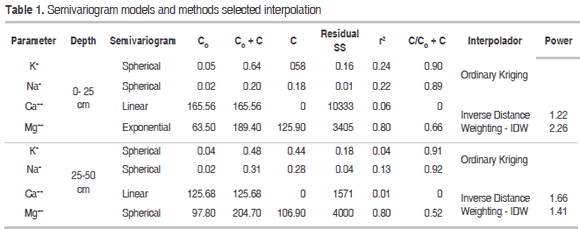
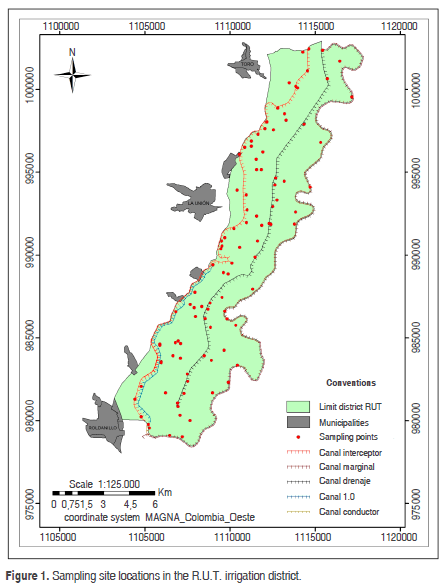
<body><![CDATA[<p><font size="2" face="Verdana, Arial, Helvetica, sans-serif">An important factor for success in agricultural production is that the soil used for the cultivation has excellent chemical properties, with exchangeable bases that are at suitable levels during development because high concentrations have ionic imbalances and limitations in the water uptake needed for normal growth (Castro and G&oacute;mez, 2010). An imbalanced nutrient ratio can cause inadequate development in crops, along with fungal problems, Aguirre <i>et al</i>. (2006) found that, when there is an imbalance of N, P and S (<i>Sclerotium cepivorum</i>) is present.</font></p>     <p><font size="2" face="Verdana, Arial, Helvetica, sans-serif">Well-nourished plants are the product of proper fertilization in the phenological stages of the crop, providing not only increases in production but also cultivation health (Marschner, 1995). Sadeghian et al. (2014) argued that the availability of elements in the soil is determined by the contents in the exchangeable phase and their relative proportion. A percentage can arise in relation to others in terms of the ability to remain in the CEC or ECEC, considering the competition that they exert on each other in the exchange complex or active sites of absorption in the plant roots.</font></p>     <p><font size="2" face="Verdana, Arial, Helvetica, sans-serif">In a study on soil fertility, the level of concentration of the elements available to plants is important, but their ratios are interesting because they affect the mineral nutrition of plants, which can promote or affect growth and performance (Puentes et al., 2016), but this type of research is rarely carried out.</font></p>     <p><font size="2" face="Verdana, Arial, Helvetica, sans-serif">Research has not conducted on the soils of the R.U.T irrigation district that would allow farmers to evaluate the behavior and relationship of exchangeable bases on scaled maps, considering that ideal contents may exist and an imbalance between them could affect production; therefore, the present work was carried out with the aim of evaluating the spatial distribution of the exchangeable bases, their ratios and their percentages of saturation in the CEC of soils that are very important to Colombia.</font></p>     <p>&nbsp;</p>     <p><font size="3" face="Verdana, Arial, Helvetica, sans-serif"><b>MATERIALS AND METHODS</b></font></p>     <p><font size="2" face="Verdana, Arial, Helvetica, sans-serif">The research was conducted in La Union, Roldanillo, Toro (R.U.T), irrigation district, in northern Valle del Cauca, Colombia, 4Â°27'15&quot; North latitude and 76Â°07&apos;27&quot; west longitude, with an area of 11,025 ha and an altitude of 965 m, an average temperature of 26 Â°C, average rainfall of 1015 mm year<sup>-1</sup> and average evaporation of 1145 mm year<sup>-1</sup>.</font></p>     <p><font size="2" face="Verdana, Arial, Helvetica, sans-serif">The sampling points were selected based on the study by IGAC-CVC (2004), considering the percentage distribution of the five taxonomic orders and 25 cartographic units that represent the area. Samples were taken at two depths (0-25 and 25-50 cm) and each sampled point was georeferenced (<a href="#fig01">Figure 1</a>). The evaluated properties in each sample were pH (potentiometric, 1:1 soil-water ratio), Ca2+, Mg2+, K+, Na+ and CEC in cmol<sup>+</sup> kg<sup>-1</sup>. (1N ammonium acetate, pH 7.0, with absorption atomic spectrophotometry -EAA ) (IGAC, 2006).</font></p>     <p align="center"><a name="fig01"></a><img src="/img/revistas/rfnam/v70n1/v70n1a07fig01.gif"></p>     <p><font size="2" face="Verdana, Arial, Helvetica, sans-serif">With the use of the Gamma Design (version 10) software, four semivariogram models (Linear, Gaussian, Exponential, Spherical) were built for the laboratory data obtained at the georeferenced sampling sites (pH, EC, Ca<sup>2+</sup>, Mg<sup>2+</sup>, K<sup>+</sup>, Na<sup>+</sup>). In order to select the best fit model, the parameters Residual Sum Square (RSS) and proportion of explained variance (C / Co +C) were used, where C was the explained variance or sill and Co was the variance that was not explained or nugget; the selected semivariogram model with best fit was the one with the lowest RSS value and a high proportion value of explained variance (<a href="#tab01">Table 1</a>).</font></p>     ]]></body>
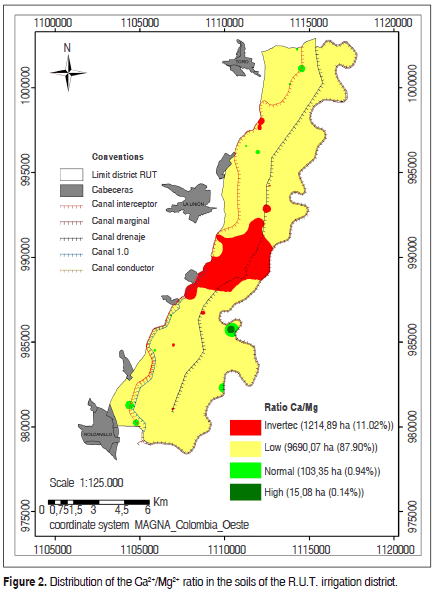
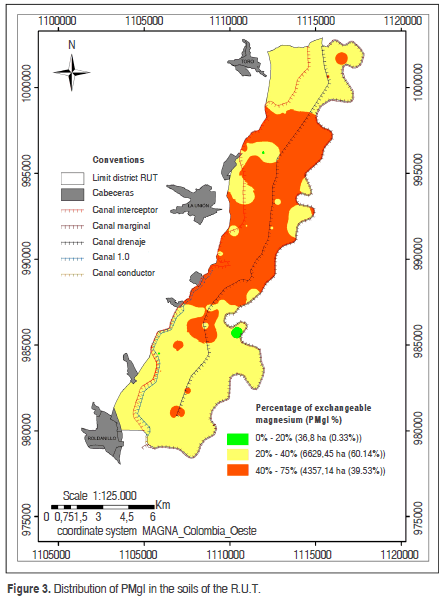
<body><![CDATA[<p align="center"><a name="tab01"></a><img src="/img/revistas/rfnam/v70n1/v70n1a07tab01.gif"></p>     <p><font size="2" face="Verdana, Arial, Helvetica, sans-serif">The selection of the interpolation method was done by taking into account the proportion of explained variance because, according to Oliver and Webster (2014), values greater than 75% indicate the existence of high geo-statistical correlation between the data; however, lower values indicate a lower correlation. For the former, geo-statistical methods are recommended and, for the latter, deterministic methods are used. The raster surface obtained with the Cross Validation Tool of ArcGis 10.3.1 Geostatistical Analyst was validated in order to contrast the model obtained with the actual data generated in this research.</font></p>     <p>&nbsp;</p>     <p><font size="3" face="Verdana, Arial, Helvetica, sans-serif"><b>RESULTS AND DISCUSSION</b></font></p>     <p><font size="2" face="Verdana, Arial, Helvetica, sans-serif"><b>Ca</b>2+<b>/Mg</b>2+ <b>Ratio    <br>   </b></font><font size="2" face="Verdana, Arial, Helvetica, sans-serif"><a href="#fig02">Figure 2</a> shows the spatial distribution of the Ca<sup>2+</sup>/Mg<sup>2+</sup> ratio in the soils of the irrigation district. The behavior at depth was similar in the south and north, presenting critical levels with levels lower than two (SCCS, 2013) in an area of 9,690 ha. The central zone had an inverted Ca<sup>2+</sup>/Mg<sup>2+ </sup>ratio in 1214 ha. This behavior was similar to the spatial distribution seen in <a href="#fig03">Figure 3</a>, where the percentages of exchangeable magnesium are high.</font></p>     <p align="center"><a name="fig02"></a><img src="/img/revistas/rfnam/v70n1/v70n1a07fig02.gif"></p>     <p align="center"><a name="fig03"></a><img src="/img/revistas/rfnam/v70n1/v70n1a07fig03.gif"></p>     <p><font size="2" face="Verdana, Arial, Helvetica, sans-serif">The results obtained agree with those of Madero et al. (2004), with the effect from magnesium seen in all of the flat areas of the Valle del Cauca for the Ca2+/Mg2+ ratios under two. Values under two in this base ratio could negatively affect crops, such as vegetables, oil palm, coffee and potatoes, among others (Castro and Gomez, 2013). This causes farmer to apply Ca2+ in their fertilization plans, seeking to establish a ratio with adequate levels for the crop, which could be in a range of 3-5 cmol+ kg-1 (SCCS, 2013). </font></p>     <p><font size="2" face="Verdana, Arial, Helvetica, sans-serif"><b>Mg2+/K+, K+/Mg2+, Ca2+/K+, (Ca2+ + Mg2+)/K+ Ratios    ]]></body>
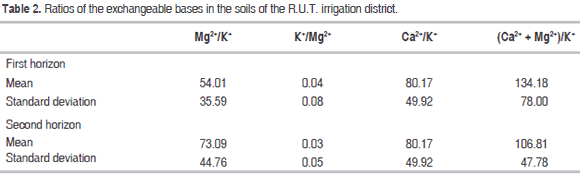
<body><![CDATA[<br>   </b></font><font size="2" face="Verdana, Arial, Helvetica, sans-serif"><a href="#tab01">Table 1</a> shows the ratios of the exchangeable bases in the soils of the irrigation district, where Mg<sup>2+</sup>/K<sup>+</sup> had values over ten, K<sup>+</sup>/Mg<sup>2+</sup> had values under two, Ca<sup>2+</sup>/K<sup>+</sup> had values over thirty, and (Ca<sup>2+</sup> + Mg<sup>2+</sup>)/K<sup>+</sup> had values over forty, indicating high levels of Ca<sup>2+</sup> and Mg<sup>2+</sup> in the exchange complex (Microfertiza, 2012), levels that could be affecting the availability of potassium in the soils. Hirzel (2008) reported on the induced lack of potassium for levels of K<sup>+</sup>/Mg<sup>2+</sup> less than 0.1. Navarro and Navarro (2003) stated that adequate proportions of Ca<sup>2+</sup>, Mg<sup>2+</sup> and K<sup>+</sup> in base ratios do not have antagonisms; however, if the K<sup>+</sup>/Mg<sup>2+</sup> ratio is less than unity, the Ca<sup>2+</sup>/K<sup>+</sup> ratio is greater than thirty, and the Ca<sup>2+</sup>/K<sup>+</sup> ratio is higher than ten, antagonisms are likely to appear. Castro and Gomez, (2013) suggested that, for soils with agricultural purposes, the ideal ratios would be 6:8 Mg<sup>2+</sup>/K<sup>+</sup>, 0.2:0.3 K<sup>+</sup>/Mg<sup>2+</sup>, 12:18 Ca<sup>2+</sup>/K<sup>+</sup> and 12:20 (Ca<sup>2+</sup> + Mg<sup>2+</sup>)/K<sup>+</sup>.</font></p>     <p><font size="2" face="Verdana, Arial, Helvetica, sans-serif">Undoubtedly, the ratios of the base balance presented a potassium deficiency in the soils of the irrigation district, which was probably attached to the clays (Borrero, 2005). Also, there may have been potassium absorption processes in the crops, without being replenished at adequate quantities to satisfy the nutritional requirements of the crop (Puerto <i>et al.,</i> 2014) and the additional contributions to the soil. This suggests that studies should be conducted with scientific rigor in the R.U.T soils concerning the ratio between the availability of cations and the ion exchange phase (Lince <i>et al.,</i> 2015) for nutritional plans for each crop, such as those in the northern part of the valley for growing peppers (<i>Capsicum</i> spp.) (Rodriguez <i>et al.,</i> 2010) and for the Isabella fox grape (<i>Vitis labrusca</i>) (Puerto <i>et al.,</i> 2014).</font></p>     <p align="center"><a name="tab02"></a><img src="/img/revistas/rfnam/v70n1/v70n1a07tab02.gif"></p>     <p><font size="2" face="Verdana, Arial, Helvetica, sans-serif"><b>Percentage of base saturation    <br>   </b></font><font size="2" face="Verdana, Arial, Helvetica, sans-serif"><a href="#tab03">Table 3</a> shows the levels of base saturation in the horizons; high Mg<sup>2+</sup> saturation percentages are evident (Microfertiza, 2012), leading to an imbalance in the ratios of the other bases. In order to avoid antagonisms, the soil exchange complex should be balanced with values of 55% - 65% Ca<sup>2+</sup>, 15% - 20% Mg<sup>2+</sup> and 3% - 5% Potassium (SCCS, 2013). High saturations for elements, such as Al (&gt;25%), Na (&gt;10%), and Mg (&gt;30%), generate a high chance of blockages and ionic imbalances (Castro and Gomez, 2013). Moreira <i>et al.</i> (2005) evaluated the behavior of exchangeable bases in an Oxisol cultivated with alfalfa (<i>Medicago sativa</i> L.) by applying different doses of lime, finding that the saturation of Ca<sup>2+</sup>, Mg<sup>2+</sup>, and K<sup>+</sup> correlated directly with the production. </font></p>     <p align="center"><a name="tab03"></a><img src="/img/revistas/rfnam/v70n1/v70n1a07tab03.gif"></p>     <p><font size="2" face="Verdana, Arial, Helvetica, sans-serif">The high percentages of saturation of Mg<sup>2+</sup> in the soils of the R.U.T irrigation district produced an effect on the physical properties of the soils (Torrente <i>et al.,</i> 2003), influencing the efficient delivery of water, preventing proper retention of available water for crops, moderate stability, and hydraulic conductivity with average performance (Sanchez, 2016). This should draw the attention of farmers in the district since this behavior must be affecting the normal development of crops and, therefore, the quality and final production. </font></p>     <p><font size="2" face="Verdana, Arial, Helvetica, sans-serif"><a href="#fig04">Figure 4</a> shows the spatial distribution of the calcium saturation percentage, being similar for depth. The medium level had the largest area with 6991 ha; the central area of the district had deficient levels in an area of 1809 ha; its spatial location was related to that seen in the maps of percentage of exchangeable magnesium, with high levels and an inverted Ca<sup>2+</sup>/Mg<sup>2+</sup> ratio. Ideal levels of Ca<sup>2+</sup> were seen in small zones distributed in the south and north, with less intensity in the central zone. The saturation percentage of Mg<sup>2+</sup> was high in 98% of the soils, in an area of 10,857 ha, and the saturation of potassium was deficient in 98.3% of the area (10,834 ha). The sodium saturation percentage was low in 100% of the soil.</font></p>     <p align="center"><a name="fig04"></a><img src="/img/revistas/rfnam/v70n1/v70n1a07fig04.gif"></p>     <p><font size="2" face="Verdana, Arial, Helvetica, sans-serif">The soils of the north part of the valley, including those of the R.U.T irrigation district, have been observed with good fertility (Madero <i>et al.,</i> 2011), but the evaluated results had different chemical conditions that may be detrimental to nutrient availability; high saturation percentages of magnesium in the soil make it necessary to apply calcium to reach a suitable Ca<sup>2+</sup>/Mg<sup>2+ </sup>ratio, which could be caused by increases in Ca<sup>2+</sup> in the soil, passing from 17.5 cmol<sup>+</sup> kg<sup>-1</sup> (CVC, 2004) to 35 cmol<sup>+</sup> kg<sup>-1</sup>, as seen in the results of this research. This may also occur due to lack of information that the farmers in the area have on how to mitigate the damage that may result from magnesium in large quantities in soils; however, the use of chemical fertilizers per se does not necessarily lead to degradation, but careless and non-technical management do (Garc&iacute;a, 2013). Studies should be conducted in the area to establish suitable management for the saturation of magnesium, whether or not by washing the magnesium ion to improve the physical conditions and chemical ratios. It is important to note that the availability of exchangeable bases for plants depends not only on the content in the exchange complex and in the solution, but also on the competition that can occur between these elements; this behavior can vary according to the cationic selectivity of soils (Sadeghian, 2014).</font></p>     ]]></body>
<body><![CDATA[<p>&nbsp;</p>     <p><font size="3" face="Verdana, Arial, Helvetica, sans-serif"><b>CONCLUSIONS</b></font></p>     <p><font size="2" face="Verdana, Arial, Helvetica, sans-serif">The spatial distribution of the evaluated bases of change showed that the central area of the R.U.T irrigation district had greater degradation problems; in addition, the saturation percentages were unbalanced, which was seen in the following ratios: Mg<sup>2+</sup>/K<sup>+</sup>, K<sup>+</sup>/Mg<sup>2+</sup>, Ca<sup>2+</sup>/K<sup>+</sup>, (Ca<sup>2+</sup> + Mg<sup>2+</sup>)/K<sup>+</sup> and Ca<sup>2+</sup>/Mg<sup>2+</sup> , affecting the soil fertility and crop development.</font></p>     <p><font size="2" face="Verdana, Arial, Helvetica, sans-serif">Further research is needed to approach the current problems of possible degradation in soil fertility from a scientific and technical viewpoint, especially focusing on the central area, which had the highest Percentage of exchangeable magnesium (PMgl) level and where the physical properties of the soils could be most affected.</font></p>     <p>&nbsp;</p>     <p><font size="3" face="Verdana, Arial, Helvetica, sans-serif"><b>REFERENCES</b></font></p>     <!-- ref --><p><font size="2" face="Verdana, Arial, Helvetica, sans-serif">Aguirre S, Menjivar J, y Piraneque N. 2006. Relaci&oacute;n entre la nutrici&oacute;n mineral y la severidad del da&ntilde;o ocasionado por pudrici&oacute;n blanca en cebolla de bulbo. Acta Agron&oacute;mica 55(4): 21-28.    &nbsp;&nbsp;&nbsp;&nbsp;&nbsp;&nbsp;&nbsp;&nbsp;[&#160;<a href="javascript:void(0);" onclick="javascript: window.open('/scielo.php?script=sci_nlinks&ref=3248526&pid=S0304-2847201700010000700001&lng=','','width=640,height=500,resizable=yes,scrollbars=1,menubar=yes,');">Links</a>&#160;]<!-- end-ref --></font></p>     <!-- ref --><p><font size="2" face="Verdana, Arial, Helvetica, sans-serif">Borrero J. 2005. Din&aacute;mica, disponibilidad y fijaci&oacute;n de potasio en tres suelos alcalinos del valle del r&iacute;o Cauca dedicados a la producci&oacute;n de ca&ntilde;a de az&uacute;car. Tesis MSc. Universidad Nacional de Colombia, Palmira. 155 p.    &nbsp;&nbsp;&nbsp;&nbsp;&nbsp;&nbsp;&nbsp;&nbsp;[&#160;<a href="javascript:void(0);" onclick="javascript: window.open('/scielo.php?script=sci_nlinks&ref=3248528&pid=S0304-2847201700010000700002&lng=','','width=640,height=500,resizable=yes,scrollbars=1,menubar=yes,');">Links</a>&#160;]<!-- end-ref --></font></p>     ]]></body>
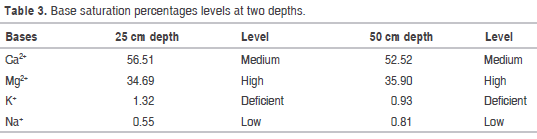
<body><![CDATA[<!-- ref --><p><font size="2" face="Verdana, Arial, Helvetica, sans-serif">Castro H y G&oacute;mez M. 2010. Fertilidad de suelos y Fertilizantes. En el libro Ciencia del suelo Principios b&aacute;sicos. Sociedad Colombiana de la Ciencia del Suelo, Bogot&aacute;, Colombia. p. 1-72.    &nbsp;&nbsp;&nbsp;&nbsp;&nbsp;&nbsp;&nbsp;&nbsp;[&#160;<a href="javascript:void(0);" onclick="javascript: window.open('/scielo.php?script=sci_nlinks&ref=3248530&pid=S0304-2847201700010000700003&lng=','','width=640,height=500,resizable=yes,scrollbars=1,menubar=yes,');">Links</a>&#160;]<!-- end-ref --></font></p>     <!-- ref --><p><font size="2" face="Verdana, Arial, Helvetica, sans-serif">Castro H y Gomez M. 2013. Fertilidad de suelos y Fertilizantes. En el libro Ciencia del Suelo Principios b&aacute;sicos. Sociedad Colombiana de la Ciencia del Suelo, Bogot&aacute;, Colombia. p 236.    &nbsp;&nbsp;&nbsp;&nbsp;&nbsp;&nbsp;&nbsp;&nbsp;[&#160;<a href="javascript:void(0);" onclick="javascript: window.open('/scielo.php?script=sci_nlinks&ref=3248532&pid=S0304-2847201700010000700004&lng=','','width=640,height=500,resizable=yes,scrollbars=1,menubar=yes,');">Links</a>&#160;]<!-- end-ref --></font></p>     <!-- ref --><p><font size="2" face="Verdana, Arial, Helvetica, sans-serif">Garc&iacute;a A. 2013. Manejo de la degradaci&oacute;n de suelos. F Silva, M Editor Sociedad Colombiana de la Ciencia del Suelo, Santaf&eacute; de Bogot&aacute;, D.E. 234 p.    &nbsp;&nbsp;&nbsp;&nbsp;&nbsp;&nbsp;&nbsp;&nbsp;[&#160;<a href="javascript:void(0);" onclick="javascript: window.open('/scielo.php?script=sci_nlinks&ref=3248534&pid=S0304-2847201700010000700005&lng=','','width=640,height=500,resizable=yes,scrollbars=1,menubar=yes,');">Links</a>&#160;]<!-- end-ref --></font></p>     <!-- ref --><p><font size="2" face="Verdana, Arial, Helvetica, sans-serif">Hirzel CJ. 2008. Diagn&oacute;stico nutricional y principios de fertilizaci&oacute;n en frutales y vides. Instituto de Investigaciones Agropecuarias. Centro Regional de Investigacion Quilamapu, Chillan, Chile. 296 p.    &nbsp;&nbsp;&nbsp;&nbsp;&nbsp;&nbsp;&nbsp;&nbsp;[&#160;<a href="javascript:void(0);" onclick="javascript: window.open('/scielo.php?script=sci_nlinks&ref=3248536&pid=S0304-2847201700010000700006&lng=','','width=640,height=500,resizable=yes,scrollbars=1,menubar=yes,');">Links</a>&#160;]<!-- end-ref --></font></p>     <!-- ref --><p><font size="2" face="Verdana, Arial, Helvetica, sans-serif"> Instituto Geogr&aacute;fico Agust&iacute;n Codazzi (IGAC) y Corporaci&oacute;n Aut&oacute;noma Regional del Valle del Cauca (CVC). 2004. Levantamiento de suelos y zonificaci&oacute;n de tierras del departamento del Valle del Cauca. IGAG, Bogot&aacute;, D.C. Colombia. 775 p.    &nbsp;&nbsp;&nbsp;&nbsp;&nbsp;&nbsp;&nbsp;&nbsp;[&#160;<a href="javascript:void(0);" onclick="javascript: window.open('/scielo.php?script=sci_nlinks&ref=3248538&pid=S0304-2847201700010000700007&lng=','','width=640,height=500,resizable=yes,scrollbars=1,menubar=yes,');">Links</a>&#160;]<!-- end-ref --></font></p>     ]]></body>
<body><![CDATA[<!-- ref --><p><font size="2" face="Verdana, Arial, Helvetica, sans-serif">Instituto Geogr&aacute;fico Agust&iacute;n Codazzi. 2006. M&eacute;todos anal&iacute;ticos del laboratorio de suelos. IGAC, Bogot&aacute;. 648 p.    &nbsp;&nbsp;&nbsp;&nbsp;&nbsp;&nbsp;&nbsp;&nbsp;[&#160;<a href="javascript:void(0);" onclick="javascript: window.open('/scielo.php?script=sci_nlinks&ref=3248540&pid=S0304-2847201700010000700008&lng=','','width=640,height=500,resizable=yes,scrollbars=1,menubar=yes,');">Links</a>&#160;]<!-- end-ref --></font></p>     <!-- ref --><p><font size="2" face="Verdana, Arial, Helvetica, sans-serif">Lince A, Rodr&iacute;guez N y Sadeghian S. 2015. Disponibilidad de Ca<sup>2+</sup>, Mg<sup>2+</sup> y K<sup>+</sup> en funci&oacute;n de las propiedades del suelo, zona cafetera central de Colombia. Revista de Investigaci&oacute;n Agraria y Ambiental 6(1): 29-42.    &nbsp;&nbsp;&nbsp;&nbsp;&nbsp;&nbsp;&nbsp;&nbsp;[&#160;<a href="javascript:void(0);" onclick="javascript: window.open('/scielo.php?script=sci_nlinks&ref=3248542&pid=S0304-2847201700010000700009&lng=','','width=640,height=500,resizable=yes,scrollbars=1,menubar=yes,');">Links</a>&#160;]<!-- end-ref --></font></p>     <!-- ref --><p><font size="2" face="Verdana, Arial, Helvetica, sans-serif">Madero E, Ram&iacute;rez J, Alzate &Aacute;, Escobar B, Garc&iacute;a L y Pe&ntilde;a M. 2011. Compactaci&oacute;n de suelos cultivados con ca&ntilde;a de az&uacute;car en la zona sur del Valle del Cauca. Parte I. Acta Agron&oacute;mica 60(3): 245-252.    &nbsp;&nbsp;&nbsp;&nbsp;&nbsp;&nbsp;&nbsp;&nbsp;[&#160;<a href="javascript:void(0);" onclick="javascript: window.open('/scielo.php?script=sci_nlinks&ref=3248544&pid=S0304-2847201700010000700010&lng=','','width=640,height=500,resizable=yes,scrollbars=1,menubar=yes,');">Links</a>&#160;]<!-- end-ref --></font></p>     <!-- ref --><p><font size="2" face="Verdana, Arial, Helvetica, sans-serif">Madero E, Malagon D y Garc&iacute;a A. 2004. Una Mirada al origen y las propiedades de los suelos magn&eacute;sicos en el Valle del Cauca-Colombia. Revista Acta Agron&oacute;mica 53(3): 1-21.    &nbsp;&nbsp;&nbsp;&nbsp;&nbsp;&nbsp;&nbsp;&nbsp;[&#160;<a href="javascript:void(0);" onclick="javascript: window.open('/scielo.php?script=sci_nlinks&ref=3248546&pid=S0304-2847201700010000700011&lng=','','width=640,height=500,resizable=yes,scrollbars=1,menubar=yes,');">Links</a>&#160;]<!-- end-ref --></font></p>     <!-- ref --><p><font size="2" face="Verdana, Arial, Helvetica, sans-serif">Marschner H. 1995. Mineral nutrition of higher plants. Second edition. Academic Press, London. 889 p</font>&nbsp;&nbsp;&nbsp;&nbsp;&nbsp;&nbsp;&nbsp;&nbsp;[&#160;<a href="javascript:void(0);" onclick="javascript: window.open('/scielo.php?script=sci_nlinks&ref=3248548&pid=S0304-2847201700010000700012&lng=','','width=640,height=500,resizable=yes,scrollbars=1,menubar=yes,');">Links</a>&#160;]<!-- end-ref --><!-- ref --><p><font size="2" face="Verdana, Arial, Helvetica, sans-serif">Microfertiza S.A. 2012. Manual t&eacute;cnico de fertilizaci&oacute;n de cultivos. Digiprint Editores E.U, Bogot&aacute;. Colombia. 36 p.    &nbsp;&nbsp;&nbsp;&nbsp;&nbsp;&nbsp;&nbsp;&nbsp;[&#160;<a href="javascript:void(0);" onclick="javascript: window.open('/scielo.php?script=sci_nlinks&ref=3248549&pid=S0304-2847201700010000700013&lng=','','width=640,height=500,resizable=yes,scrollbars=1,menubar=yes,');">Links</a>&#160;]<!-- end-ref --></font></p>     <!-- ref --><p><font size="2" face="Verdana, Arial, Helvetica, sans-serif">Moreira A, Carvalho JG De and Evangelista AR. 2005. Calcium and magnesium ratio in the fertility of a dystrophic dark red latosol cultivated with alfalfa. Ciencia e Agrotecnologia 29(4): 786-794.    &nbsp;&nbsp;&nbsp;&nbsp;&nbsp;&nbsp;&nbsp;&nbsp;[&#160;<a href="javascript:void(0);" onclick="javascript: window.open('/scielo.php?script=sci_nlinks&ref=3248551&pid=S0304-2847201700010000700014&lng=','','width=640,height=500,resizable=yes,scrollbars=1,menubar=yes,');">Links</a>&#160;]<!-- end-ref --></font></p>     <!-- ref --><p><font size="2" face="Verdana, Arial, Helvetica, sans-serif">Navarro S y Navarro G. 2003. Qu&iacute;mica agr&iacute;cola. El suelo y los elementos qu&iacute;micos esenciales para la vida vegetal. Segunda edici&oacute;n. Ediciones Mundi-Prensa, Madrid. 487 p.    &nbsp;&nbsp;&nbsp;&nbsp;&nbsp;&nbsp;&nbsp;&nbsp;[&#160;<a href="javascript:void(0);" onclick="javascript: window.open('/scielo.php?script=sci_nlinks&ref=3248553&pid=S0304-2847201700010000700015&lng=','','width=640,height=500,resizable=yes,scrollbars=1,menubar=yes,');">Links</a>&#160;]<!-- end-ref --></font></p>     <!-- ref --><p><font size="2" face="Verdana, Arial, Helvetica, sans-serif">Oliver MA and Webster R. 2014. A tutorial guide to geostatistics: Computing and modelling variograms and kriging. Catena 113: 56-69.    &nbsp;&nbsp;&nbsp;&nbsp;&nbsp;&nbsp;&nbsp;&nbsp;[&#160;<a href="javascript:void(0);" onclick="javascript: window.open('/scielo.php?script=sci_nlinks&ref=3248555&pid=S0304-2847201700010000700016&lng=','','width=640,height=500,resizable=yes,scrollbars=1,menubar=yes,');">Links</a>&#160;]<!-- end-ref --> </font></p>     <!-- ref --><p><font size="2" face="Verdana, Arial, Helvetica, sans-serif">Puentes Y, G&oacute;mez A and Menjivar J. 2016. Influence of the relationship among nutrients on yield of cocoa (Theobroma cacao L.) clones. Acta Agron&oacute;mica 65(2): 176-182. doi: 10.15446/acag.v65n2.47387</font>&nbsp;&nbsp;&nbsp;&nbsp;&nbsp;&nbsp;&nbsp;&nbsp;[&#160;<a href="javascript:void(0);" onclick="javascript: window.open('/scielo.php?script=sci_nlinks&ref=3248557&pid=S0304-2847201700010000700017&lng=','','width=640,height=500,resizable=yes,scrollbars=1,menubar=yes,');">Links</a>&#160;]<!-- end-ref --><!-- ref --><p><font size="2" face="Verdana, Arial, Helvetica, sans-serif">Puerto O, Mejia de Tafur S y Menjibar J. 2014. Influencia del potasio en el cultivo de la Vid (Vitis labrusca) cv. Isabella. Informador T&eacute;cnico (Colombia) 78(2): 148-154.    &nbsp;&nbsp;&nbsp;&nbsp;&nbsp;&nbsp;&nbsp;&nbsp;[&#160;<a href="javascript:void(0);" onclick="javascript: window.open('/scielo.php?script=sci_nlinks&ref=3248558&pid=S0304-2847201700010000700018&lng=','','width=640,height=500,resizable=yes,scrollbars=1,menubar=yes,');">Links</a>&#160;]<!-- end-ref --> </font></p>     ]]></body>
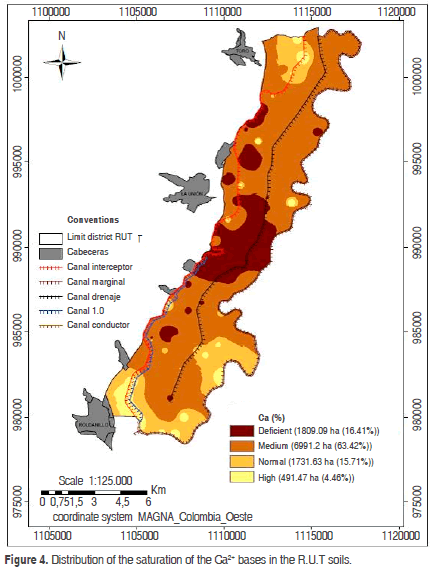
<body><![CDATA[<!-- ref --><p><font size="2" face="Verdana, Arial, Helvetica, sans-serif">Rodriguez E, Botero M y Menjivar J. 2010. Fertilizaci&oacute;n en nutrici&oacute;n rendimiento del aji (Capsicun spp) en el Valle del Cauca, Colombia. Acta Agron&oacute;mica 59(1): 55-94.    &nbsp;&nbsp;&nbsp;&nbsp;&nbsp;&nbsp;&nbsp;&nbsp;[&#160;<a href="javascript:void(0);" onclick="javascript: window.open('/scielo.php?script=sci_nlinks&ref=3248560&pid=S0304-2847201700010000700019&lng=','','width=640,height=500,resizable=yes,scrollbars=1,menubar=yes,');">Links</a>&#160;]<!-- end-ref --></font></p>     <!-- ref --><p><font size="2" face="Verdana, Arial, Helvetica, sans-serif">Sadeghian S. 2014. Manejo integrado de nutrientes para una caficultura sostenible. Suelos Ecuatoriales 44(2): 74-89.    &nbsp;&nbsp;&nbsp;&nbsp;&nbsp;&nbsp;&nbsp;&nbsp;[&#160;<a href="javascript:void(0);" onclick="javascript: window.open('/scielo.php?script=sci_nlinks&ref=3248562&pid=S0304-2847201700010000700020&lng=','','width=640,height=500,resizable=yes,scrollbars=1,menubar=yes,');">Links</a>&#160;]<!-- end-ref --></font></p>     <!-- ref --><p><font size="2" face="Verdana, Arial, Helvetica, sans-serif">S&aacute;nchez L. 2016. Distribuci&oacute;n espacial de las propiedades hidrodin&aacute;micas de los suelos del Distrito de Riego RUT. Tesis (Maestr&iacute;a). Universidad Nacional de Colombia, Palmira, Colombia.    &nbsp;&nbsp;&nbsp;&nbsp;&nbsp;&nbsp;&nbsp;&nbsp;[&#160;<a href="javascript:void(0);" onclick="javascript: window.open('/scielo.php?script=sci_nlinks&ref=3248564&pid=S0304-2847201700010000700021&lng=','','width=640,height=500,resizable=yes,scrollbars=1,menubar=yes,');">Links</a>&#160;]<!-- end-ref --></font></p>     <!-- ref --><p><font size="2" face="Verdana, Arial, Helvetica, sans-serif">Sociedad Colombiana de la Ciencia del Suelo. SCCS. 2013. Est&aacute;ndares generales para interpretar an&aacute;lisis de suelos con fines agr&iacute;colas. F. Silva M. Editor, Santaf&eacute; de Bogota, D. E. 257 p.    &nbsp;&nbsp;&nbsp;&nbsp;&nbsp;&nbsp;&nbsp;&nbsp;[&#160;<a href="javascript:void(0);" onclick="javascript: window.open('/scielo.php?script=sci_nlinks&ref=3248566&pid=S0304-2847201700010000700022&lng=','','width=640,height=500,resizable=yes,scrollbars=1,menubar=yes,');">Links</a>&#160;]<!-- end-ref --></font></p>     <!-- ref --><p><font size="2" face="Verdana, Arial, Helvetica, sans-serif">Torrente A, Garc&iacute;a A, Escobar Ch, Am&eacute;zquita E, y Sampayo J. 2003. Condiciones hidrof&iacute;sicas de suelos con alta saturaci&oacute;n de magnesio en el Valle del Cauca, Colombia. Acta Agronomica 52(1-4): 29-37.    &nbsp;&nbsp;&nbsp;&nbsp;&nbsp;&nbsp;&nbsp;&nbsp;[&#160;<a href="javascript:void(0);" onclick="javascript: window.open('/scielo.php?script=sci_nlinks&ref=3248568&pid=S0304-2847201700010000700023&lng=','','width=640,height=500,resizable=yes,scrollbars=1,menubar=yes,');">Links</a>&#160;]<!-- end-ref --> </font></p>     ]]></body>
<body><![CDATA[<!-- ref --><p><font size="2" face="Verdana, Arial, Helvetica, sans-serif">Urrutia N. 2011. Impacto Ola Invernal 2010-2011. Distrito de riego RUT. Evento internacional AGUA 2011: Ecosistemas y Sociedad, Cali, Colombia. 32 p.    &nbsp;&nbsp;&nbsp;&nbsp;&nbsp;&nbsp;&nbsp;&nbsp;[&#160;<a href="javascript:void(0);" onclick="javascript: window.open('/scielo.php?script=sci_nlinks&ref=3248570&pid=S0304-2847201700010000700024&lng=','','width=640,height=500,resizable=yes,scrollbars=1,menubar=yes,');">Links</a>&#160;]<!-- end-ref --></font></p>      ]]></body><back>
<ref-list>
<ref id="B1">
<nlm-citation citation-type="journal">
<person-group person-group-type="author">
<name>
<surname><![CDATA[Aguirre]]></surname>
<given-names><![CDATA[S]]></given-names>
</name>
<name>
<surname><![CDATA[Menjivar]]></surname>
<given-names><![CDATA[J]]></given-names>
</name>
<name>
<surname><![CDATA[Piraneque]]></surname>
<given-names><![CDATA[N.]]></given-names>
</name>
</person-group>
<article-title xml:lang="es"><![CDATA[Relación entre la nutrición mineral y la severidad del daño ocasionado por pudrición blanca en cebolla de bulbo.]]></article-title>
<source><![CDATA[Acta Agronómica]]></source>
<year>2006</year>
<volume>55</volume>
<numero>4</numero>
<issue>4</issue>
<page-range>21-28</page-range></nlm-citation>
</ref>
<ref id="B2">
<nlm-citation citation-type="">
<person-group person-group-type="author">
<name>
<surname><![CDATA[Borrero]]></surname>
<given-names><![CDATA[J.]]></given-names>
</name>
</person-group>
<source><![CDATA[Dinámica, disponibilidad y fijación de potasio en tres suelos alcalinos del valle del río Cauca dedicados a la producción de caña de azúcar.]]></source>
<year>2005</year>
</nlm-citation>
</ref>
<ref id="B3">
<nlm-citation citation-type="book">
<person-group person-group-type="author">
<name>
<surname><![CDATA[Castro]]></surname>
<given-names><![CDATA[H]]></given-names>
</name>
<name>
<surname><![CDATA[Gómez]]></surname>
<given-names><![CDATA[M.]]></given-names>
</name>
</person-group>
<article-title xml:lang="es"><![CDATA[Fertilidad de suelos y Fertilizantes.]]></article-title>
<source><![CDATA[libro Ciencia del suelo Principios básicos]]></source>
<year>2010</year>
<page-range>1-72</page-range><publisher-loc><![CDATA[Bogotá ]]></publisher-loc>
<publisher-name><![CDATA[Sociedad Colombiana de la Ciencia del Suelo]]></publisher-name>
</nlm-citation>
</ref>
<ref id="B4">
<nlm-citation citation-type="book">
<person-group person-group-type="author">
<name>
<surname><![CDATA[Castro]]></surname>
<given-names><![CDATA[H]]></given-names>
</name>
<name>
<surname><![CDATA[Gomez]]></surname>
<given-names><![CDATA[M.]]></given-names>
</name>
</person-group>
<article-title xml:lang="es"><![CDATA[Fertilidad de suelos y Fertilizantes.]]></article-title>
<source><![CDATA[libro Ciencia del Suelo Principios básicos.]]></source>
<year>2013</year>
<publisher-loc><![CDATA[Bogotá ]]></publisher-loc>
<publisher-name><![CDATA[Sociedad Colombiana de la Ciencia del Suelo]]></publisher-name>
</nlm-citation>
</ref>
<ref id="B5">
<nlm-citation citation-type="book">
<person-group person-group-type="author">
<name>
<surname><![CDATA[García]]></surname>
<given-names><![CDATA[A.]]></given-names>
</name>
</person-group>
<article-title xml:lang="es"><![CDATA[Manejo de la degradación de suelos.]]></article-title>
<person-group person-group-type="editor">
<name>
<surname><![CDATA[Silva]]></surname>
<given-names><![CDATA[F]]></given-names>
</name>
</person-group>
<source><![CDATA[]]></source>
<year>2013</year>
<publisher-loc><![CDATA[Santafé de Bogotá ]]></publisher-loc>
<publisher-name><![CDATA[Sociedad Colombiana de la Ciencia del Suelo]]></publisher-name>
</nlm-citation>
</ref>
<ref id="B6">
<nlm-citation citation-type="">
<person-group person-group-type="author">
<name>
<surname><![CDATA[Hirzel]]></surname>
<given-names><![CDATA[CJ.]]></given-names>
</name>
</person-group>
<collab>Centro Regional de Investigacion Quilamapu^dInstituto de Investigaciones Agropecuarias</collab>
<source><![CDATA[Diagnóstico nutricional y principios de fertilización en frutales y vides.]]></source>
<year>2008</year>
<publisher-loc><![CDATA[Chillan ]]></publisher-loc>
</nlm-citation>
</ref>
<ref id="B7">
<nlm-citation citation-type="book">
<collab>Instituto Geográfico Agustín Codazzi</collab>
<collab>Corporación Autónoma Regional del Valle del Cauca</collab>
<source><![CDATA[Levantamiento de suelos y zonificación de tierras del departamento del Valle del Cauca]]></source>
<year>2004</year>
<publisher-loc><![CDATA[Bogotá ]]></publisher-loc>
<publisher-name><![CDATA[IGAG]]></publisher-name>
</nlm-citation>
</ref>
<ref id="B8">
<nlm-citation citation-type="book">
<collab>Instituto Geográfico Agustín Codazzi</collab>
<source><![CDATA[Métodos analíticos del laboratorio de suelos.]]></source>
<year>2006</year>
<publisher-loc><![CDATA[Bogotá ]]></publisher-loc>
<publisher-name><![CDATA[IGAC]]></publisher-name>
</nlm-citation>
</ref>
<ref id="B9">
<nlm-citation citation-type="journal">
<person-group person-group-type="author">
<name>
<surname><![CDATA[Lince]]></surname>
<given-names><![CDATA[A]]></given-names>
</name>
<name>
<surname><![CDATA[Rodríguez]]></surname>
<given-names><![CDATA[N]]></given-names>
</name>
<name>
<surname><![CDATA[Sadeghian]]></surname>
<given-names><![CDATA[S.]]></given-names>
</name>
</person-group>
<article-title xml:lang="es"><![CDATA[Disponibilidad de Ca2+, Mg2+ y K+ en función de las propiedades del suelo, zona cafetera central de Colombia.]]></article-title>
<source><![CDATA[Revista de Investigación Agraria y Ambiental]]></source>
<year>2015</year>
<volume>6</volume>
<numero>1</numero>
<issue>1</issue>
<page-range>29-42</page-range></nlm-citation>
</ref>
<ref id="B10">
<nlm-citation citation-type="journal">
<person-group person-group-type="author">
<name>
<surname><![CDATA[Madero]]></surname>
<given-names><![CDATA[E]]></given-names>
</name>
<name>
<surname><![CDATA[Ramírez]]></surname>
<given-names><![CDATA[J]]></given-names>
</name>
<name>
<surname><![CDATA[Alzate]]></surname>
<given-names><![CDATA[Á]]></given-names>
</name>
<name>
<surname><![CDATA[Escobar]]></surname>
<given-names><![CDATA[B]]></given-names>
</name>
<name>
<surname><![CDATA[García]]></surname>
<given-names><![CDATA[L]]></given-names>
</name>
<name>
<surname><![CDATA[Peña]]></surname>
<given-names><![CDATA[M.]]></given-names>
</name>
</person-group>
<article-title xml:lang="es"><![CDATA[Compactación de suelos cultivados con caña de azúcar en la zona sur del Valle del Cauca.: Parte I]]></article-title>
<source><![CDATA[Acta Agronómica]]></source>
<year>2011</year>
<volume>60</volume>
<numero>3</numero>
<issue>3</issue>
<page-range>245-252</page-range></nlm-citation>
</ref>
<ref id="B11">
<nlm-citation citation-type="journal">
<person-group person-group-type="author">
<name>
<surname><![CDATA[Madero]]></surname>
<given-names><![CDATA[E]]></given-names>
</name>
<name>
<surname><![CDATA[Malagon]]></surname>
<given-names><![CDATA[D]]></given-names>
</name>
<name>
<surname><![CDATA[García]]></surname>
<given-names><![CDATA[A.]]></given-names>
</name>
</person-group>
<article-title xml:lang="es"><![CDATA[Una Mirada al origen y las propiedades de los suelos magnésicos en el Valle del Cauca-Colombia]]></article-title>
<source><![CDATA[Revista Acta Agronómica]]></source>
<year>2004</year>
<volume>53</volume>
<numero>3</numero>
<issue>3</issue>
<page-range>1-21</page-range></nlm-citation>
</ref>
<ref id="B12">
<nlm-citation citation-type="book">
<person-group person-group-type="author">
<name>
<surname><![CDATA[Marschner]]></surname>
<given-names><![CDATA[H.]]></given-names>
</name>
</person-group>
<source><![CDATA[Mineral nutrition of higher plants.]]></source>
<year>1995</year>
<edition>Second</edition>
<publisher-loc><![CDATA[London ]]></publisher-loc>
<publisher-name><![CDATA[Academic Press]]></publisher-name>
</nlm-citation>
</ref>
<ref id="B13">
<nlm-citation citation-type="book">
<person-group person-group-type="author">
<name>
<surname><![CDATA[Microfertiza]]></surname>
<given-names><![CDATA[S.A.]]></given-names>
</name>
</person-group>
<source><![CDATA[Manual técnico de fertilización de cultivos.]]></source>
<year>2012</year>
<publisher-loc><![CDATA[Bogotá ]]></publisher-loc>
<publisher-name><![CDATA[Digiprint Editores E.U]]></publisher-name>
</nlm-citation>
</ref>
<ref id="B14">
<nlm-citation citation-type="journal">
<person-group person-group-type="author">
<name>
<surname><![CDATA[Moreira]]></surname>
<given-names><![CDATA[A]]></given-names>
</name>
<name>
<surname><![CDATA[De]]></surname>
<given-names><![CDATA[Carvalho JG]]></given-names>
</name>
<name>
<surname><![CDATA[Evangelista]]></surname>
<given-names><![CDATA[AR.]]></given-names>
</name>
</person-group>
<article-title xml:lang="en"><![CDATA[Calcium and magnesium ratio in the fertility of a dystrophic dark red latosol cultivated with alfalfa.]]></article-title>
<source><![CDATA[Ciencia e Agrotecnologia]]></source>
<year>2005</year>
<volume>29</volume>
<numero>4</numero>
<issue>4</issue>
<page-range>786-794</page-range></nlm-citation>
</ref>
<ref id="B15">
<nlm-citation citation-type="book">
<person-group person-group-type="author">
<name>
<surname><![CDATA[Navarro]]></surname>
<given-names><![CDATA[S]]></given-names>
</name>
<name>
<surname><![CDATA[Navarro]]></surname>
<given-names><![CDATA[G.]]></given-names>
</name>
</person-group>
<source><![CDATA[Química agrícola.El suelo y los elementos químicos esenciales para la vida vegetal.]]></source>
<year>2003</year>
<edition>Segunda</edition>
<publisher-loc><![CDATA[Madrid ]]></publisher-loc>
<publisher-name><![CDATA[Ediciones Mundi-Prensa]]></publisher-name>
</nlm-citation>
</ref>
<ref id="B16">
<nlm-citation citation-type="journal">
<person-group person-group-type="author">
<name>
<surname><![CDATA[Oliver]]></surname>
<given-names><![CDATA[MA]]></given-names>
</name>
<name>
<surname><![CDATA[Webster]]></surname>
<given-names><![CDATA[R.]]></given-names>
</name>
</person-group>
<article-title xml:lang="en"><![CDATA[A tutorial guide to geostatistics: Computing and modelling variograms and kriging]]></article-title>
<source><![CDATA[Catena]]></source>
<year>2014</year>
<numero>113</numero>
<issue>113</issue>
<page-range>56-69</page-range></nlm-citation>
</ref>
<ref id="B17">
<nlm-citation citation-type="journal">
<person-group person-group-type="author">
<name>
<surname><![CDATA[Puentes]]></surname>
<given-names><![CDATA[Y]]></given-names>
</name>
<name>
<surname><![CDATA[Gómez]]></surname>
<given-names><![CDATA[A]]></given-names>
</name>
<name>
<surname><![CDATA[Menjivar]]></surname>
<given-names><![CDATA[J]]></given-names>
</name>
</person-group>
<article-title xml:lang="en"><![CDATA[Influence of the relationship among nutrients on yield of cocoa (Theobroma cacao L.) clones.]]></article-title>
<source><![CDATA[Acta Agronómica]]></source>
<year>2016</year>
<volume>65</volume>
<numero>2</numero>
<issue>2</issue>
<page-range>176-182</page-range></nlm-citation>
</ref>
<ref id="B18">
<nlm-citation citation-type="journal">
<person-group person-group-type="author">
<name>
<surname><![CDATA[Puerto]]></surname>
<given-names><![CDATA[O]]></given-names>
</name>
<name>
<surname><![CDATA[Mejia de Tafur]]></surname>
<given-names><![CDATA[S]]></given-names>
</name>
<name>
<surname><![CDATA[Menjibar]]></surname>
<given-names><![CDATA[J.]]></given-names>
</name>
</person-group>
<article-title xml:lang="es"><![CDATA[Influencia del potasio en el cultivo de la Vid (Vitis labrusca) cv. Isabella.]]></article-title>
<source><![CDATA[Informador Técnico]]></source>
<year>2014</year>
<volume>78</volume>
<numero>2</numero>
<issue>2</issue>
<page-range>148-154</page-range></nlm-citation>
</ref>
<ref id="B19">
<nlm-citation citation-type="journal">
<person-group person-group-type="author">
<name>
<surname><![CDATA[Rodriguez]]></surname>
<given-names><![CDATA[E]]></given-names>
</name>
<name>
<surname><![CDATA[Botero]]></surname>
<given-names><![CDATA[M]]></given-names>
</name>
<name>
<surname><![CDATA[Menjivar]]></surname>
<given-names><![CDATA[J]]></given-names>
</name>
</person-group>
<article-title xml:lang="es"><![CDATA[Fertilización en nutrición rendimiento del aji (Capsicun spp) en el Valle del Cauca, Colombia.]]></article-title>
<source><![CDATA[Acta Agronómica]]></source>
<year>2010</year>
<volume>59</volume>
<numero>1</numero>
<issue>1</issue>
<page-range>55-94</page-range></nlm-citation>
</ref>
<ref id="B20">
<nlm-citation citation-type="journal">
<person-group person-group-type="author">
<name>
<surname><![CDATA[Sadeghian]]></surname>
<given-names><![CDATA[S.]]></given-names>
</name>
</person-group>
<article-title xml:lang="es"><![CDATA[Manejo integrado de nutrientes para una caficultura sostenible]]></article-title>
<source><![CDATA[Suelos Ecuatoriales]]></source>
<year>2014</year>
<volume>44</volume>
<numero>2</numero>
<issue>2</issue>
<page-range>74-89</page-range></nlm-citation>
</ref>
<ref id="B21">
<nlm-citation citation-type="">
<person-group person-group-type="author">
<name>
<surname><![CDATA[Sánchez]]></surname>
<given-names><![CDATA[L.]]></given-names>
</name>
</person-group>
<source><![CDATA[Distribución espacial de las propiedades hidrodinámicas de los suelos del Distrito de Riego RUT.]]></source>
<year>2016</year>
</nlm-citation>
</ref>
<ref id="B22">
<nlm-citation citation-type="">
<person-group person-group-type="author">
<name>
<surname><![CDATA[Silva M.]]></surname>
<given-names><![CDATA[F.]]></given-names>
</name>
</person-group>
<collab>Sociedad Colombiana de la Ciencia del Suelo</collab>
<source><![CDATA[Estándares generales para interpretar análisis de suelos con fines agrícolas.]]></source>
<year>2013</year>
<publisher-loc><![CDATA[Santafé de Bogota ]]></publisher-loc>
</nlm-citation>
</ref>
<ref id="B23">
<nlm-citation citation-type="journal">
<person-group person-group-type="author">
<name>
<surname><![CDATA[Torrente]]></surname>
<given-names><![CDATA[A]]></given-names>
</name>
<name>
<surname><![CDATA[García]]></surname>
<given-names><![CDATA[A]]></given-names>
</name>
<name>
<surname><![CDATA[Ch]]></surname>
<given-names><![CDATA[Escobar]]></given-names>
</name>
<name>
<surname><![CDATA[Amézquita]]></surname>
<given-names><![CDATA[E]]></given-names>
</name>
<name>
<surname><![CDATA[Sampayo]]></surname>
<given-names><![CDATA[J.]]></given-names>
</name>
</person-group>
<article-title xml:lang="es"><![CDATA[Condiciones hidrofísicas de suelos con alta saturación de magnesio en el Valle del Cauca, Colombia.]]></article-title>
<source><![CDATA[Acta Agronomica]]></source>
<year>2003</year>
<volume>52</volume>
<numero>1-4</numero>
<issue>1-4</issue>
<page-range>29-37</page-range></nlm-citation>
</ref>
<ref id="B24">
<nlm-citation citation-type="confpro">
<person-group person-group-type="author">
<name>
<surname><![CDATA[Urrutia]]></surname>
<given-names><![CDATA[N.]]></given-names>
</name>
</person-group>
<article-title xml:lang="es"><![CDATA[Impacto Ola Invernal 2010-2011: Distrito de riego RUT]]></article-title>
<source><![CDATA[]]></source>
<year>2011</year>
<conf-name><![CDATA[ Evento internacional AGUA 2011: Ecosistemas y Sociedad]]></conf-name>
<conf-loc>Cali </conf-loc>
</nlm-citation>
</ref>
</ref-list>
</back>
</article>