<?xml version="1.0" encoding="ISO-8859-1"?><article xmlns:mml="http://www.w3.org/1998/Math/MathML" xmlns:xlink="http://www.w3.org/1999/xlink" xmlns:xsi="http://www.w3.org/2001/XMLSchema-instance">
<front>
<journal-meta>
<journal-id>0304-3584</journal-id>
<journal-title><![CDATA[Actualidades Biológicas]]></journal-title>
<abbrev-journal-title><![CDATA[Actu Biol]]></abbrev-journal-title>
<issn>0304-3584</issn>
<publisher>
<publisher-name><![CDATA[Instituto de Biología, Universidad de Antioquia]]></publisher-name>
</publisher>
</journal-meta>
<article-meta>
<article-id>S0304-35842008000100002</article-id>
<title-group>
<article-title xml:lang="en"><![CDATA[DNA EXTRACTION FROM HEAVY OIL CONTAMINATED MICROCOSMS AND RPOB GENE PCR AMPLIFICATION]]></article-title>
<article-title xml:lang="es"><![CDATA[EXTRACCIÓN DE ADN A PARTIR DE MICROCOSMOS CONTAMINADOS CON PETRÓLEO PESADO Y AMPLIFICACIÓN DEL GEN RPOB]]></article-title>
</title-group>
<contrib-group>
<contrib contrib-type="author">
<name>
<surname><![CDATA[Lozano-A.]]></surname>
<given-names><![CDATA[Lucía C.]]></given-names>
</name>
<xref ref-type="aff" rid="A01"/>
</contrib>
<contrib contrib-type="author">
<name>
<surname><![CDATA[Bautista]]></surname>
<given-names><![CDATA[María A.]]></given-names>
</name>
<xref ref-type="aff" rid="A01"/>
</contrib>
<contrib contrib-type="author">
<name>
<surname><![CDATA[Dussan-G.]]></surname>
<given-names><![CDATA[Jenny]]></given-names>
</name>
<xref ref-type="aff" rid="A01"/>
</contrib>
<contrib contrib-type="author">
<name>
<surname><![CDATA[Vives-Flórez]]></surname>
<given-names><![CDATA[Martha J.]]></given-names>
</name>
<xref ref-type="aff" rid="A01"/>
</contrib>
</contrib-group>
<aff id="A01">
<institution><![CDATA[,Universidad de los Andes Departamento de Ciencias Biológicas Centro de Investigaciones Microbiológicas]]></institution>
<addr-line><![CDATA[ ]]></addr-line>
</aff>
<pub-date pub-type="pub">
<day>00</day>
<month>01</month>
<year>2008</year>
</pub-date>
<pub-date pub-type="epub">
<day>00</day>
<month>01</month>
<year>2008</year>
</pub-date>
<volume>30</volume>
<numero>88</numero>
<fpage>7</fpage>
<lpage>14</lpage>
<copyright-statement/>
<copyright-year/>
<self-uri xlink:href="http://www.scielo.org.co/scielo.php?script=sci_arttext&amp;pid=S0304-35842008000100002&amp;lng=en&amp;nrm=iso"></self-uri><self-uri xlink:href="http://www.scielo.org.co/scielo.php?script=sci_abstract&amp;pid=S0304-35842008000100002&amp;lng=en&amp;nrm=iso"></self-uri><self-uri xlink:href="http://www.scielo.org.co/scielo.php?script=sci_pdf&amp;pid=S0304-35842008000100002&amp;lng=en&amp;nrm=iso"></self-uri><abstract abstract-type="short" xml:lang="en"><p><![CDATA[This work describes a new method for extracting genomic DNA from heavy oil-contaminated soils. This method combines soil washes using three washing solutions with enzymatic lysis (SW-EL method). The suitability of the SW-EL method was validated by extracting DNA from samples as small as 0.5 g from model microcosms comprising soil artificially contaminated with 1 and 10% (w/w) heavy petroleum and seeded with a bacterial consortium. Compared with an established protocol for lysis and DNA purification using the commercial kit GeneReleaserTM (Bioventures) (GRL method), the novel SW-EL method provided higher DNA yields. With the addition of GeneReleaser to the PCR reaction to function as a chelating resin, rpoB genes (serving as model genes) could be successfully amplified. The SW-EL method has potential to be of use for DNA-based analysis of microbial consortia present in heavy-oil contaminated soils.]]></p></abstract>
<abstract abstract-type="short" xml:lang="es"><p><![CDATA[Este trabajo describe un nuevo método de extracción de ADN genómico de suelo contaminado con petróleo pesado. El método combina lavados del suelo usando tres soluciones de lavado con lisis enzimática de las células (método SW-EL). El método SW-EL fue validado mediante la extracción de ADN de muestras de 0,5 g tomadas de microcosmos preparados con suelo artificialmente contaminado con petróleo pesado al 1 y 10% (p/p) e inoculados con un consorcio bacteriano. Comparado con un protocolo establecido de lisis y obtención de ADN usando el kit comercial Gene ReleaserTM (Bioventures) (método GRL), el nuevo método SW-EL permitió obtener mayor cantidad de ADN. Con la adición de Gene Releaser como resina quelante a la reacción de PCR, los genes rpoB (usados como modelo) fueron amplificados, indicando que el método SW-EL puede ser usado para analizar los consorcios microbianos presentes en suelos contaminados con petróleos pesados.]]></p></abstract>
<kwd-group>
<kwd lng="en"><![CDATA[DNA extraction]]></kwd>
<kwd lng="en"><![CDATA[heavy oil]]></kwd>
<kwd lng="en"><![CDATA[microcosms]]></kwd>
<kwd lng="en"><![CDATA[PCR amplification]]></kwd>
<kwd lng="en"><![CDATA[rpoB]]></kwd>
<kwd lng="es"><![CDATA[extracción de ADN]]></kwd>
<kwd lng="es"><![CDATA[amplificación PCR]]></kwd>
<kwd lng="es"><![CDATA[microcosmos]]></kwd>
<kwd lng="es"><![CDATA[petróleo pesado]]></kwd>
<kwd lng="es"><![CDATA[rpoB]]></kwd>
</kwd-group>
</article-meta>
</front><body><![CDATA[ <p align="right"><font size="2" face="Verdana, Arial, Helvetica, sans-serif"><b>ART&Iacute;CULOS DE INVESTIGACI&Oacute;N </b></font></p> <font face="Verdana, Arial, Helvetica, sans-serif" size="2">    <p align="right">&nbsp;</p> </font>     <p align="center"><b><font size="4" face="Verdana, Arial, Helvetica, sans-serif">DNA EXTRACTION FROM HEAVY OIL CONTAMINATED MICROCOSMS AND <em>RPOB</em> GENE PCR AMPLIFICATION </font></b></p> <font face="Verdana, Arial, Helvetica, sans-serif" size="2">     <p align="center">&nbsp;</p> </font>     <p align="center"><font size="3"><b><font face="Verdana, Arial, Helvetica, sans-serif">EXTRACCI&Oacute;N DE ADN A PARTIR DE MICROCOSMOS CONTAMINADOS CON PETR&Oacute;LEO PESADO Y AMPLIFICACI&Oacute;N DEL GEN <em>RPOB</em> </font></b></font></p> <font face="Verdana, Arial, Helvetica, sans-serif" size="2">    <p align="center">&nbsp;</p>     <p align="center">&nbsp;</p> </font>    <p align="left"><font size="2" face="Verdana, Arial, Helvetica, sans-serif"><b>Luc&iacute;a C.   Lozano&#8211;A.<sup>1;</sup> Mar&iacute;a A.   Bautista1, Jenny Dussan&#8211;G.<sup>1,   2</sup>, Martha J. Vives&#8211;Fl&oacute;rez<sup>1</sup> </b></font></p>     <p align="left">&nbsp;</p>      <p align="justify"><font size="2" face="Verdana, Arial, Helvetica, sans-serif"><sup>1</sup> Centro de Investigaciones Microbiol&oacute;gicas   (<b>CIMIC</b>). Departamento de Ciencias Biol&oacute;gicas, Universidad de los Andes.   A. A. 4976. Bogot&aacute;, Colombia. </font></p>     ]]></body>
<body><![CDATA[<p align="justify"><font size="2" face="Verdana, Arial, Helvetica, sans-serif"><sup>2</sup> Correo electr&oacute;nico:&lt;<a href="mailto:jdussan@uniandes.edu.co">jdussan@uniandes.edu.co</a>&gt; </font> </p> <font face="Verdana, Arial, Helvetica, sans-serif" size="2"> </font> <font face="Verdana, Arial, Helvetica, sans-serif" size="2">     <p align="justify">&nbsp;</p>     <p align="justify">&nbsp;</p> </font> <hr size="1" noshade> <font face="Verdana, Arial, Helvetica, sans-serif" size="2">     <p align="justify"><b>Abstract</b> </p>     <p align="justify">This work describes a new method for extracting genomic DNA from heavy oil&#8211;contaminated soils.   This method combines soil washes using three washing solutions with enzymatic lysis   (<b>SW&#8211;EL</b> method). The suitability of the SW&#8211;EL method was validated by extracting DNA from samples as small as 0.5 g from   model microcosms comprising soil artificially contaminated with 1 and 10% (w/w) heavy petroleum and seeded   with a bacterial consortium. Compared with an established protocol for lysis and DNA purification using   the commercial kit GeneReleaserTM (Bioventures)   (<b>GRL</b> method), the novel SW&#8211;EL method provided higher   DNA yields. With the addition of GeneReleaser to the PCR reaction to function as a chelating resin, <em>rpoB</em> genes (serving as model genes) could be successfully amplified. The SW&#8211;EL method has potential to be of use   for DNA&#8211;based analysis of microbial consortia present in heavy&#8211;oil contaminated soils. </p>     <p align="justify"><b>Key words:</b> DNA extraction, heavy oil, microcosms, PCR amplification, <em>rpoB.</em> </p> </font> <hr size="1" noshade> <font face="Verdana, Arial, Helvetica, sans-serif" size="2">     <p align="justify"><b>Resumen</b> </p>     <p align="justify">Este trabajo describe un nuevo m&eacute;todo de extracci&oacute;n de ADN gen&oacute;mico de suelo contaminado con   petr&oacute;leo pesado. El m&eacute;todo combina lavados del suelo usando tres soluciones de lavado con lisis enzim&aacute;tica de   las c&eacute;lulas (m&eacute;todo <b>SW&#8211;EL</b>). El m&eacute;todo SW&#8211;EL fue validado mediante la extracci&oacute;n de ADN de muestras de 0,5   g tomadas de microcosmos preparados con suelo artificialmente contaminado con petr&oacute;leo pesado al 1 y 10%   (p/p) e inoculados con un consorcio bacteriano. Comparado con un protocolo establecido de lisis y obtenci&oacute;n   de ADN usando el <em>kit</em> comercial Gene   ReleaserTM (Bioventures) (m&eacute;todo <b>GRL</b>), el nuevo m&eacute;todo SW&#8211;EL   permiti&oacute; obtener mayor cantidad de ADN. Con la adici&oacute;n de Gene Releaser como resina quelante a la reacci&oacute;n de   PCR, los genes <em>rpoB</em> (usados como modelo) fueron amplificados, indicando que el m&eacute;todo SW&#8211;EL puede ser   usado para analizar los consorcios microbianos presentes en suelos contaminados con petr&oacute;leos pesados. </p> </font>    <p align="justify"><font size="2" face="Verdana, Arial, Helvetica, sans-serif"><b>Palabras clave:</b> extracci&oacute;n de ADN, amplificaci&oacute;n PCR, microcosmos, petr&oacute;leo pesado, <em>rpoB</em>. </font></p>  <hr size="1" noshade> <font face="Verdana, Arial, Helvetica, sans-serif" size="2">     <p align="justify">&nbsp;</p>     ]]></body>
<body><![CDATA[<p align="justify">&nbsp;</p> </font>     <p align="justify"><font size="3" face="Verdana, Arial, Helvetica, sans-serif"><b>INTRODUCTION</b> </font></p> <font face="Verdana, Arial, Helvetica, sans-serif" size="2">     <p align="justify">Characterization of soil microbial communities   is often accomplished using molecular methods (Dallhof et al., 2000). These techniques are   useful for overcoming the inability to culture most of   the microorganisms found in environmental samples and the lack of sensitivity of traditional   microbiological methods (Yeates et al., 1998). However,   molecular methods are very susceptible to contaminants   that may interfere considerably with DNA recovery   from environmental samples. A common problem with DNA obtained from soil is the presence of   humic and fulvic acids, which have similar size   and charge characteristics as DNA, leading to the co&#8211;extraction of these compounds   (LaMontagne et al., 2002; Yeates et al., 1998). These   acids reduce the efficiency of DNA&#8211;DNA hybridization and inhibit Taq polymerase   activity (Fortin et al., 2004; Zhou et al., 1996).   DNA extraction from hydrocarbon&#8211;contaminated soils presents an even greater challenge because,   in addition to the usual soil contaminants, traces of organic substances and heavy metals   remain in the DNA extracts and reduce PCR amplification efficiency by degrading   or capturing nucleic acids or by inactivating DNA polymerase (Fortin et al., 2004).   Contaminants such as polycylic aromatic   hydrocarbons (<b>PAH's</b>) and heavy metals like copper and   lead (which are known to interfere with enzymatic activity) have often been found bound to   clay and humic materials in hydrocarbon&#8211;contaminated soil (Fortin et al., 2004) and   are often co&#8211;extracted with DNA. In order to study the diversity of a complex environment like   a hydrocarbon&#8211;contaminated soil through culture&#8211;independent techniques, efficient protocols   that eliminate these contaminants and yield good quality DNA must be developed. </p>     <p align="justify">Soil washing is a chemical treatment often   used to solubilize hydrocarbons and heavy metals,   in order to remove those contaminants from the   soil. Washing solutions usually contain chelating   or surfactant agents, acids, salts and/or redox substances (Dermont et al., 2008). EDTA   is recognized as an effective chelating agent to extract metals such as aluminum (Al),   copper (Cu), chromium (Cr), lead (Pb) and zinc   (Zn) (Dermont et al., 2008; Elsan et al., 2006).   EDTA can also enhance diesel fuel removal from   diesel fuel&#8211;contaminated soil (Zhang et al.,   2007). Triton X&#8211;100 can increase the solubilization   of hydrophobic organic compounds  such as PAH`s (Luning and Pritchard, 2002). </p>     <p align="justify">Existing DNA extraction methods   employ different approaches to eliminate PCR   inhibitors. Washing steps using   hexadecylmethylammonium bromide (<b>CTAB</b>) and polyethylene glycol   (<b>PEG</b>) precipitation are necessary to obtain   better quality DNA (LaMontagne et al., 2002; Zhou et al., 1996). Washing steps with   surfactants such as Triton X&#8211;100 and chelating agents   prior to cell lysis improve the recovery of nucleic   acids and are beneficial to obtain efficient PCR amplification of PAHs, PCBs and heavy   metals contaminated sediments (Fortin et al.,   2004). However, these steps tend to make DNA extraction protocols time&#8211;demanding,   tedious and costly. Commercial extraction kits have   been developed promising to alleviate inhibition problems with straight&#8211;forward and   simplified sample processing procedures.   GeneReleaserTM (BioVentures) accomplishes cell lysis,   can remove up to 75 ng of humic acids (Menking et al., 1999) and sequesters PCR   inhibitors increasing PCR yield and specificity   simplifying DNA amplifications  by avoiding the   lengthy protocols of DNA purification. </p>     <p align="justify">In the past, our group has isolated several   microbial consortia  successfully  used for   large&#8211;scale bioremediation processes of heavy oil&#8211;contaminated soils. However, monitoring   changes in bacterial communities during the   biodegradation process has been hampered by limited   technology. To further understand these bacterial   communities using molecular methods such as PCR&#8211;DGGE,   it would be desirable to develop an effective   method for extracting amplifiable bacterial DNA from   heavy oilcontaminated soil. The aim of this study was   to compare two protocols: the first uses a   combination of soil washes (Fortin et al., 2004) and   enzymatic lysis (Yeates et al<em>.,</em> 1998; Zhou et al.,   1996), followed by standard purification steps   using organic solvents. The second one is a modification of Marquez&#8211;Rocha et al.   (2005), which includes treatment with   GeneReleaserTM (BioVentures), a commercial product designed   for release genomic DNA and, according to the fabricant, that allows cell lysis directly in   the amplification tube on the thermocycler,   sequesters cell lysis products which might inhibit   polymerases and improves amplification yield and   specificity. DNA quality and purity was validated   by comparing the PCR amplification efficacies of   the DNA obtained by the two methods. Results showed that the combination of soil washes   and enzymatic lysis is suitable for DNA extraction   from 0.5 g of petroleum&#8211;contaminated soil, resulting   in good DNA yields. However, to obtain efficient PCR amplification, an additional DNA   purification step was necessary, using a chelating agent in   the PCR reaction.  </p>     <p align="justify">&nbsp;</p> </font>     <p align="justify"><font size="3" face="Verdana, Arial, Helvetica, sans-serif"><b>MATERIALS AND METHODS </b></font></p> <font face="Verdana, Arial, Helvetica, sans-serif" size="2">     <p align="justify"><b>Bacterial strains and microcosms   inoculation. </b>The strains <em>Pseudomonas </em>sp. PS60 and <em>Bacillus cereus </em>group O20B used to inoculate   the microcosms were isolated during a previous   study from a hydrocarbon&#8211;contaminated soil in Casanare (Colombia). Both strains were   identified on the basis of partial 16S rRNA gene   sequence (data not published). </p>     <p align="justify">Microcosms were set up as follows:   equal amounts (65 g each) of soil, sand and   poultry manure were mixed and distributed into   three different plastic containers; 1% (v/w) heavy   oil&#8211;16oAPI from Casanare, Colombia (5&ordm; 30'   30.4' N, 71&ordm; 45' 37' W) was added to   three microcosms, which were then separately inoculated with <em>Pseudomonas </em>sp. PS60, <em>B. cereus</em> O20B, or rested tap water (as   control). 10 ml rested tap water were added to   each microcosm to moisten and homogenize the system. Bacteria used for inoculation   were grown on plates of Plate Count Agar <b>PCA</b> (Scharlau) at 30 &deg;C for 16 hours; the   confluent growth obtained from a plate was collected,   and cell concentration was adjusted to obtain a   final cell count of 5 x 10⁸ CFU/g in the   microcosms.<b> </b>The procedure was repeated for the other   three microcosms containing 10% (v/w) heavy oil. All microcosms were kept at 30 &ordm;C and samples   of 0.5 g were taken at day 3 for DNA extraction and determination of bacterial   culturable population in PCA medium. </p>     ]]></body>
<body><![CDATA[<p align="justify"><b>Total DNA extraction.</b> <em>DNA extraction using <b>SW&#8211;EL</b> (Soil Washes&#8211;Enzymatic   Lysis).</em> This method combines two previously   reported protocols, which were modified and will be   referred to as the SW&#8211;EL protocol. Soil washes prior to   cell lysis were modified from Fortin et al. (2004). A   soil sample of 0.5 g was washed twice with 1 ml   solution 1 (50 mM Tris&#8211;HCl pH 8.0, 200 mM NaCl, 5   mM Na2EDTA, 0.05% Triton X&#8211;100) by vortexing   2 min and centrifuging for 3 min at 3,000 x g.   This was followed by washing with 1 ml solution 2   (50 mM Tris&#8211;HCl pH 8.0, 200 mM NaCl, 5 mM   Na2EDTA) and two washes with solution 3 (10   mM Tris&#8211;HCl pH 8.0, 0.1 mM Na2EDTA). </p>     <p align="justify">The DNA extraction method was based on   Yeates et al<em>.</em> (1998) and Zhou et al. (1996). One ml   of extraction buffer [CTAB 1%, 100 mM Tris&#8211;HCl (pH 8.0), 100 mM sodium EDTA (pH 8.0), 1.5 M   NaCl, proteinase K 0.05 mg/ml] was added to the   soil pellets and incubated at 37 &deg;C for 30 min   with shaking at 180 rpm. <b>SDS</b> (sodium dodecyl   sulfate) was added (0.2 ml; 10%), and the samples   were incubated at 65 &ordm;C for 90 min, and centrifuged   at 6,000 x <em>g</em> for 10 min at room temperature. </p>     <p align="justify">The supernatants were collected, and the soil   pellets were re&#8211;extracted with 1 ml of extraction   buffer, incubated at 65 &ordm;C for 10 min and centrifuged   as above. Half&#8211;volume of polyethylene glycol (30%)/sodium chloride (1.6 M) was added to   the supernatants, incubated at room temperature for   2 h and centrifuged at 10,000g for 20 min. The   nucleic acid pellets were resuspended in 0.2 ml of TE   (10 mM Tris&#8211;HCl, 1 mM sodium EDTA, pH 8.0), and potassium acetate was added to a   final concentration of 0.5 M. Samples were   transferred to ice for 5 min then centrifuged at 16,000 x <em>g</em> for 30 min at 4&deg; C. The DNA was purified with   phenol/chloroform 1:1 and chloroform/isoamyl alcohol 24:1 and precipitated with 0.6 volume   of isopropanol and left overnight at &#8211;20 &deg;C.   DNA was pelleted by centrifugation at 16,000 x <em>g</em> for 30 min and resuspended in 20&micro;l of   ultrapure water. Three &micro;l of purified DNA were loaded   onto a 0.7% agarose gel stained with ethidium   bromide and quantified using Gel&#8211;Doc Imaging   SystemTM (BioRad) with High Mass   LadderTM (Invitrogen, cat. 10496&#8211;016). The quality of the   extracted DNA was evaluated via the absorbance ratios   at 260nm/280nm and 260nm/230 nm. </p>     <p align="justify"><em>DNA extraction using <b>GRL</b> (Gene Releaser Lysis). </em>The other protocol we assayed   was modified from M&aacute;rquez&#8211;Rocha et al. (2005),   and will be here referred to as the GRL protocol.   Ten ml 0.2M NaCl were added to 0.5 g of soil and incubated at 30   oC for 15 min with shaking at 145 rpm. Particles were allowed to settle and   1 ml supernatant was centrifuged at 16,000 x <em>g</em> for 5 min. The pellets obtained from the   last centrifugation step were first washed with 50   &micro;l 0.2 M NaCl and then with 50 &micro;l distilled   water and resuspended in 20 &micro;l TE buffer (10 mM   Tris&#8211;HCl, pH 8.0; 1 mM EDTA, pH 8.0) and 20   &micro;l GeneReleaserTM (BioVentures), and vortexed   for 30 s. The samples were overlaid with 10 &micro;l   of sterile mineral oil and heated in a microwave   oven for 2 min, then centrifuged for 30 s. The supernatant (DNA&#8211;containing fraction)   was transferred to a sterile eppendorf tube. The   quality and the concentration of the extracted DNA   were analyzed as described for SW&#8211;EL protocol. </p>     <p align="justify"><b>Preparation of crude extracts. </b>Crude extracts of <em>Pseudomonas </em>sp. PS60 and <em>B. cereus </em>O20B were obtained from cultures in Luria&#8211;Bertani both   incubated at 30 oC for 14h and 140 rpm, which were boiled   for five min, and centrifuged. 0.9 &micro;l from the   supernatant was used as the source of DNA. </p>     <p align="justify"><b>PCR amplification. </b>DNA obtained with   SW&#8211;EL protocol, GRL protocol, or <em>Pseudomonas </em>sp. PS60 and <em>Bacillus cereus </em>O20B crude extracts was used for PCR amplification of   the <em>rpoB </em>gene. In the case of SW&#8211;EL method,   0.5 &micro;l of either undiluted DNA, 1/10 or 1/50 dilutions were used as template with and   without 4.5 &micro;l of GeneReleaserTM (BioVentures),   used here as a chelating agent according to Yeates   et al<em>.</em> (1998); reactions were overlaid with 10   ml of sterile mineral oil. The tubes were heated   on a microwave oven for 7 min. A beaker containing 100 ml of water was included as a   microwave sink. Tubes were incubated for 10 min at 80   oC in MyCyclerTM (Bio&#8211;Rad) before adding the   20 &micro;l PCR mix (to obtain a final reaction volume   of 25ul). For the GRL method, following manufacturer's instructions, 24 &micro;l PCR mix   were added to 1 ml of the supernatant (DNA&#8211;containing fraction). </p> </font>     <p align="justify"><font size="2" face="Verdana, Arial, Helvetica, sans-serif">Primers rpoB1698f (5&#8211;AACATCGGTTTGATCAAC&#8211;3) and rpoB2014r   (5&#8211;GTTGCATGTTGGTACCCAT&#8211;3) (Dahll&ouml;f et al., 2000) were used to amplify   the <em>rpoB</em> gene. 25 &micro;l reactions were   prepared containing 0.2 mM each dNTP&acute;s, 0.5 &micro;M of   each primer, 2.5 mM MgSO4, 2U Tucan <em>Taq </em>polymerase (Corpogen), 1X PCR buffer and   1X PCR Enhancer solution (Invitrogen). </font></p> <font face="Verdana, Arial, Helvetica, sans-serif" size="2">    <p align="justify">The amplification program consisted of   a denaturing step of 94 &deg;C for 5 min, 6 cycles   of denaturing for 30 s at 94 &deg;C, annealing for   1.5 min at 40 &deg;C, and a 1.5 min extension at 72   &deg;C, followed by 19 cycles at 94 &deg;C for 30 s, 1.5   min at 50 &deg;C, and a 1.5 min at 72 &deg;C. A final   extension step of 72&deg;C for 10 min was then   performed (Dahll&ouml;f et al., 2000). 3 &micro;l of PCR product   were run on a 1.2% agarose gel containing ethidium bromide and visualized using the Bio&#8211;Rad   Gel Doc imaging system. </p>     <p align="justify"><b>Sequencing of PCR   products.</b> PCR products after <em>rpo</em>B gene amplification from the   strains <em>Pseudomonas </em>sp. PS60 and <em>B. cereus </em>O20B were sequenced. PCR products were   purified (Wizard SV gel and PCR clean&#8211;up   systemTM, Promega) and sequenced using the   BigDye Terminator v3.1 Cycle Sequencing kit (ABI   Prism 310 sequencer, Applied Biosystems).   Resulting sequences were analyzed in GeneBank using   the Blast program (Altschul et al., 1997).  </p>     <p align="justify">&nbsp;</p> </font>     ]]></body>
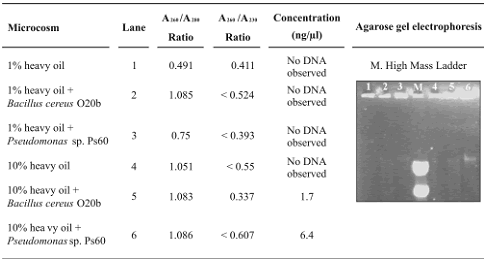
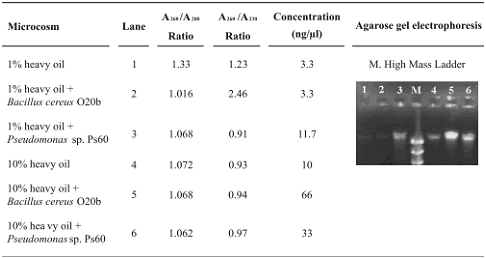
<body><![CDATA[<p align="justify"><font size="3" face="Verdana, Arial, Helvetica, sans-serif"><b>RESULTS AND DISCUSSION</b> </font></p> <font face="Verdana, Arial, Helvetica, sans-serif" size="2">     <p align="justify">Bacterial counts from microcosms in Plate   Count agar were as follows: control microcosm 1% oil 2   x 107 CFU/g, microcosm 1% oil + <em>B. cereus </em>O20b 1.6 x 10⁸ CFU/g, microcosm 1% oil   + <em>Pseudomonas </em>sp. Ps60 9.6 x 10⁷ CFU/g,   control microcosm 10% oil 1.5 x 10⁷ CFU/g,   microcosm 10% oil + <em>B. cereus </em>O20b 1.6 x   108 CFU/g, microcosm 10% oil + <em>Pseudomonas </em>sp. Ps60 3.4 x 10⁷ CFU/g. In all cases, and according to   what was expected, seeded microcosms showed higher bacterial populations. </p>     <p align="justify">Many DNA extraction methods for soils   are available, but very few are suitable for DNA extraction from hydrocarbon contaminated   soils. DNA recovery from substrates contaminated with hydrocarbons typically requires   more extensive purification strategies (Evans et   al., 2004; Fortin et al., 2004; Kasai et al.,   2005) and/or utilisation of purification resins   (M&aacute;rquez&#8211;Rocha et al., 2005) in order to obtain   high molecular weight DNA free from inhibitors for PCR amplification. We used   microcosms artificially contaminated with heavy petroleum   to evaluate two DNA extraction protocols: the SW&#8211;EL protocol employed a series of   soil washes before the enzymatic lysis of the   cells; the GRL protocol, consisted in a step of   NaCl washing followed by lysis using the   commercial product GeneReleaserTM. We obtained   better results with the SW&#8211;El protocol. With this method DNA was obtained from all   the microcosms (<a href="#tb01">table 1</a>). In contrast, with the   GRL protocol we recovered DNA only from the microcosms that were inoculated with   bacteria and contained 10% heavy oil (<a href="#tb02">table 2</a>). </p>     <p align="justify">&nbsp;</p> </font>     <p align="center"><font face="Verdana, Arial, Helvetica, sans-serif" size="2"><img src="/img/revistas/acbi/v30n88/a2tb01.gif"></font><a name="tb01"></a></p>     <p align="center"><font size="2" face="Verdana, Arial, Helvetica, sans-serif"><b>Table 1.</b> DNA obtained from heavy oil&#8211;contaminated microcosms using the <b>SW&#8211;EL</b> (Soil Washes&#8211;Enzymatic Lysis) method</font></p>     <p align="center">&nbsp;</p> <font size="2" face="Verdana, Arial, Helvetica, sans-serif">     <p align="center"><img src="/img/revistas/acbi/v30n88/a2tb02.gif"><a name="tb02"></a></p> </font>     <p align="center"><font size="2" face="Verdana, Arial, Helvetica, sans-serif">&nbsp;   <b>Table 2.</b> DNA obtained from heavy oil&#8211;contaminated microcosms using the <b>GRL</b> (Gene Releaser Lysis)method   </font></p>     <p align="center">&nbsp;</p>     ]]></body>
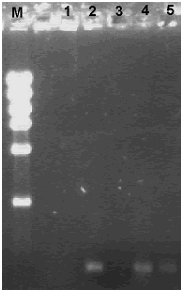
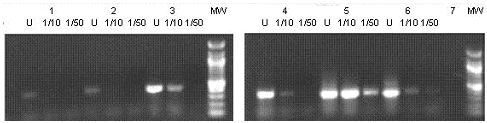
<body><![CDATA[<p align="justify"><font size="2" face="Verdana, Arial, Helvetica, sans-serif">DNA quantities obtained with the SW&#8211;EL   method were higher when compared with those   obtained with the extraction protocol GRL (tables <a href="#tb01">1</a> and   <a href="#tb02">2</a>). The <em>A</em>260/<em>A</em>230 ratios for the DNA from   SW&#8211;EL method were also better and the <em>A</em>260/<em>A</em>280 ratios were similar for both methods (tables <a href="#tb01">1</a> and   <a href="#tb02">2</a>). Higher <em>A</em>260/<em>A</em>230 ratios indicate that the DNA   is contaminated with lower amounts of humic acid&#8211;like compounds that probably were removed   via CTAB solution and ammonium acetate   precipitation in protocol SW&#8211;EL (Fortin et al., 2004; Zhou et   al., 1996). Washing steps increase the quantity   and quality of the resulting DNA from soils (Fortin et   al., 2004; Purohit et al., 2003); solution 1 used in   the SW&#8211;EL protocol contains Triton X&#8211;100, which increases the solubility of oils (Fortin et al   2004), and probably allows their removal. </font></p>     <p align="justify"><font size="2" face="Verdana, Arial, Helvetica, sans-serif">It is interesting that the 10%   hydrocarbon microcosms resulted in a larger quantity of   DNA than in 1% oil soil<b>;</b> these results cannot be   attributed to higher bacteria populations because bacterial cell counts were similar in the two   petroleum concentrations. Fortin et al. (2004) reported   that when the washes were incorporated before the   lysis<b>,</b> the amount of DNA recovered was reduced in   the less contaminated sediments possibly due to   the desorption of bacteria from the soil   hydrocarbons (Stelmack et al., 1999). </font></p>     <p align="justify"><font size="2" face="Verdana, Arial, Helvetica, sans-serif">The presence of inhibitors in the recovered   DNA was evaluated by amplification of a 368 bp   rpoB fragment. rpoB PCR products were obtained   from all undiluted DNA obtained with the SW&#8211;El   protocol, but only when GeneReleaser was present in the   PCR mix (<a href="#fig01">figure 1</a>); without GeneReleaser we did   not obtain amplicons with undiluted DNA (we did   obtain amplification using DNA diluted 1/10, data   not shown). Failure to amplify undiluted DNA was probably due to the presence of inhibitors   (PAHs, PCBs and heavy metals), according to   previous results reported by Fort&iacute;n et al. (2004),   PCR amplification was only successful when DNA dilutions were used as templates. </font></p>     <p align="justify">&nbsp;</p>     <p align="center"><font face="Verdana, Arial, Helvetica, sans-serif" size="2"><img src="/img/revistas/acbi/v30n88/a2fig01.gif"></font><a name="fig01"></a></p>     <p align="center"><font size="2" face="Verdana, Arial, Helvetica, sans-serif"><b>Figure 1.</b> Agarose gel electrophoresis of rpoB amplification products from undiluted   (<b>U</b>), dilution 1/10 (1/10), or 1/50 (1/50) DNA obtained from oil&#8211;contaminated microcosms using the <b>SW&#8211;EL</b> (Soil Washes&#8211;Enzymatic Lysis) method. <b>1. </b>1% heavy oil; <b>2.</b> 1% heavy oil + <em>Bacillus. cereus </em>O20b; <b>3.</b> 1% heavy oil + <em>Pseudomonas </em>sp. Ps60.; MW. 100pb ladder. <b>4.</b> 10% heavy oil; <b>5.</b> 10% heavy oil + <em>Bacillus. cereus </em>O20b; <b>6.</b> 10% heavy oil   +<em> Pseudomonas </em>sp. Ps60; <b>7. </b>Control without DNA; <b>MW.</b> 100pb ladder. </font></p>     <p align="center">&nbsp;</p>     <p align="justify"><font size="2" face="Verdana, Arial, Helvetica, sans-serif">It was possible to amplify the 368 bp <em>rpoB</em> fragment from the DNA extracted using the   GRL protocol (<a href="#fig02">figure 2</a>, lines 5 and 6); with this protocol the limitation was not the presence   of inhibitors but the low amount of DNA obtained (<a href="#tb02">table 2</a>). Previously, M&aacute;rquez&#8211;Rocha et   al. (2005) obtained amplification of the 16S rRNA gene from all 13 soil samples (obtained   from locations near to oil storage tanks in   Mexico) assayed using the same protocol. In our   case, maybe it is possible to enhance DNA recovery by increasing the amount of soil sample used. </font></p>     <p align="justify"><font size="2" face="Verdana, Arial, Helvetica, sans-serif">The minimal DNA concentration required   to obtain PCR products was 0.5 ng (we assayed 0.033&#8211;33 ng).The PCR product was   sequenced to verify its identity. For all cases it   corresponded to the <em>rpoB</em> gene sequence and   confirmed the genera of the bacteria used (table   3).Lysis strategies should be selected based on the   kind of DNA analyses that will follow the   extraction<b>;</b> for PCR amplification of a particular gene   the GRL method may be used, but for microbial diversity studies the SW&#8211;EL showed to be   more reliable since it provides higher DNA amounts and lower humic acids   contamination (represented by a lower 260<u>/</u>230 ratio). </font></p>     <p align="justify">&nbsp;</p>     ]]></body>
<body><![CDATA[<p align="center"><font size="2" face="Verdana, Arial, Helvetica, sans-serif"><img src="/img/revistas/acbi/v30n88/a2fig02.gif"></font><a name="fig02"></a></p>     <p align="center"><font size="2" face="Verdana, Arial, Helvetica, sans-serif"><b>Figure 2.</b> Agarose gel electrophoresis of rpoB   amplification products from DNA obtained from   oil&#8211;contaminated microcosms using the <b>GRL</b> (Gene Releaser Lysis)   method. <b>M.</b> DNA High mass ladder; <b>1.</b> Control without DNA; <b>2.</b> <em>Bacillus cereus </em>O20b; <b>3.</b> 10% heavy oil; <b>4.</b> 10% heavy oil + <em>Bacillus cereus </em>O20b; <b>5.</b> 10% heavy oil + <em>Pseudomonas </em>sp. Ps60. </font></p> <font size="2" face="Verdana, Arial, Helvetica, sans-serif">     <p align="center">&nbsp;</p> </font>     <p align="justify"><font size="3" face="Verdana, Arial, Helvetica, sans-serif"><b>CONCLUSIONS</b> </font></p> <font face="Verdana, Arial, Helvetica, sans-serif" size="2">     <p align="justify">The combination of soil washes and enzymatic   lysis is suitable for the DNA extraction from small   samples of heavy petroleum contaminated soil (0.5 g)   and, with the addition of a chelating resin, the <em>rpoB</em> gene could be amplified from landfarming treatments   in order to determine the presence of the oil   degrading bacteria by DGGE or other molecular analysis. </p>     <p align="justify">&nbsp;</p> </font>     <p align="justify"><font size="3" face="Verdana, Arial, Helvetica, sans-serif"><b>ACKNOWLEDGEMENTS</b> </font></p> <font face="Verdana, Arial, Helvetica, sans-serif" size="2">     <p align="justify">This work was supported by grants from   the Research Committee of Science Faculty, Andes University. We thank Engineer Hugo   Vladimir Ramirez and Perenco Limited S. A. for   providing us with heavy oil from Oil Field   Station, Casanare, Colombia. </p>     <p align="justify">&nbsp;</p> </font>     <p align="justify"><font size="3" face="Verdana, Arial, Helvetica, sans-serif"><b>REFERENCES</b> </font></p> <font face="Verdana, Arial, Helvetica, sans-serif" size="2">     ]]></body>
<body><![CDATA[<!-- ref --><p align="justify"><b>1.</b><b> Altschul SF, Madden TL, Sch&auml;ffer AA, Zhang J, Zhang   Z, Miller W, Lipman DJ.</b> 1997. Gapped BLAST and PSI&#8211;BLAST: a new generation of protein   database search programs. <em>Nucleic Acids   Research,</em> 25(17):3389&#8211;3402. &nbsp;&nbsp;&nbsp;&nbsp;&nbsp;&nbsp;&nbsp;&nbsp;[&#160;<a href="javascript:void(0);" onclick="javascript: window.open('/scielo.php?script=sci_nlinks&ref=000073&pid=S0304-3584200800010000200001&lng=','','width=640,height=500,resizable=yes,scrollbars=1,menubar=yes,');">Links</a>&#160;]<!-- end-ref --><!-- ref --><p align="justify"><b>2.</b><b> Dahll&ouml;f I, Baillie H, Kjelleberg   S.</b> 2000. rpoB&#8211;based microbial community analysis avoids   limitations inherent in 16S rRNA gene intraspecies heterogeneity. <em>Applied and Environmental Microbiology,</em> 66(8):3376&#8211;3380. &nbsp;&nbsp;&nbsp;&nbsp;&nbsp;&nbsp;&nbsp;&nbsp;[&#160;<a href="javascript:void(0);" onclick="javascript: window.open('/scielo.php?script=sci_nlinks&ref=000074&pid=S0304-3584200800010000200002&lng=','','width=640,height=500,resizable=yes,scrollbars=1,menubar=yes,');">Links</a>&#160;]<!-- end-ref --><!-- ref --><p align="justify"><b>3.</b><b> Dermont G, Bergeron M, Mercier G, Richer&#8211;Lafl&egrave;che   M. </b>2008. Soil washing for metal removal: A review   of physical/chemical technologies and field applications. <em>Journal of Hazardous Materials,</em> 152(1):1&#8211;31. &nbsp;&nbsp;&nbsp;&nbsp;&nbsp;&nbsp;&nbsp;&nbsp;[&#160;<a href="javascript:void(0);" onclick="javascript: window.open('/scielo.php?script=sci_nlinks&ref=000075&pid=S0304-3584200800010000200003&lng=','','width=640,height=500,resizable=yes,scrollbars=1,menubar=yes,');">Links</a>&#160;]<!-- end-ref --><!-- ref --><p align="justify"><b>4. Ehsan S, Prasher SO, Marshall WD. </b>2006. A washing procedure to mobilize mixed contaminants from   soil. II. Heavy metals. J<em>ournal of Environmental   Quality,</em> 35(6):2084&#8211;2091. &nbsp;&nbsp;&nbsp;&nbsp;&nbsp;&nbsp;&nbsp;&nbsp;[&#160;<a href="javascript:void(0);" onclick="javascript: window.open('/scielo.php?script=sci_nlinks&ref=000076&pid=S0304-3584200800010000200004&lng=','','width=640,height=500,resizable=yes,scrollbars=1,menubar=yes,');">Links</a>&#160;]<!-- end-ref --><!-- ref --><p align="justify"><b>5. </b><b>Evans FF, Seldin L, Sebastian GV, Kjelleberg   S, Holmstr&ouml;m C, Rosado AS. </b>2004. Influence   of petroleum contamination and biostimulation treatment on the diversity of Pseudomonas   spp. in soil microcosms as evaluated by 16S rRNA based&#8211;PCR and DGGE. <em>Letters in Applied Microbiology,</em> 38(2):93&#8211;98. &nbsp;&nbsp;&nbsp;&nbsp;&nbsp;&nbsp;&nbsp;&nbsp;[&#160;<a href="javascript:void(0);" onclick="javascript: window.open('/scielo.php?script=sci_nlinks&ref=000077&pid=S0304-3584200800010000200005&lng=','','width=640,height=500,resizable=yes,scrollbars=1,menubar=yes,');">Links</a>&#160;]<!-- end-ref --><!-- ref --><p align="justify"><b>6. </b><b>Fort&iacute;n N, Beaumier D, Lee K, Greer   CW.</b> 2004. Soil washing improves the recovery of total   community DNA from polluted and high organic   content sediments. <em>Journal of Microbiological   Methods,</em> 56(2):181&#8211;191. &nbsp;&nbsp;&nbsp;&nbsp;&nbsp;&nbsp;&nbsp;&nbsp;[&#160;<a href="javascript:void(0);" onclick="javascript: window.open('/scielo.php?script=sci_nlinks&ref=000078&pid=S0304-3584200800010000200006&lng=','','width=640,height=500,resizable=yes,scrollbars=1,menubar=yes,');">Links</a>&#160;]<!-- end-ref --><!-- ref --><p align="justify"><b>7. Kasai Y, Takahata Y, Hoaki T, Watanabe   K.</b> 2005. Physiological and molecular characterization of   a microbial community established in unsaturated, petroleum&#8211;contaminated soil. <em>Environmental Microbiology,</em> 7(6):806&#8211;818. &nbsp;&nbsp;&nbsp;&nbsp;&nbsp;&nbsp;&nbsp;&nbsp;[&#160;<a href="javascript:void(0);" onclick="javascript: window.open('/scielo.php?script=sci_nlinks&ref=000079&pid=S0304-3584200800010000200007&lng=','','width=640,height=500,resizable=yes,scrollbars=1,menubar=yes,');">Links</a>&#160;]<!-- end-ref --><!-- ref --><p align="justify"><b>8. LaMontagne MG, Michel FC, Holden PA, Reddy   CA.</b> 2002. Evaluation of extraction and   purification methods for obtaining PCR&#8211;amplifiable DNA   from compost for microbial community an&aacute;lisis. <em>Journal of Microbiological Methods,</em> 49(3):255&#8211;264. &nbsp;&nbsp;&nbsp;&nbsp;&nbsp;&nbsp;&nbsp;&nbsp;[&#160;<a href="javascript:void(0);" onclick="javascript: window.open('/scielo.php?script=sci_nlinks&ref=000080&pid=S0304-3584200800010000200008&lng=','','width=640,height=500,resizable=yes,scrollbars=1,menubar=yes,');">Links</a>&#160;]<!-- end-ref --><!-- ref --><p align="justify"><b>9. Luning Prak D, Pritchard   PH.</b> 2002. Solubilization of polycyclic aromatic hydrocarbon mixtures in   micellar nonionic surfactant solutions. <em>Water   Research,</em> 36(14):3463&#8211;3472 &nbsp;&nbsp;&nbsp;&nbsp;&nbsp;&nbsp;&nbsp;&nbsp;[&#160;<a href="javascript:void(0);" onclick="javascript: window.open('/scielo.php?script=sci_nlinks&ref=000081&pid=S0304-3584200800010000200009&lng=','','width=640,height=500,resizable=yes,scrollbars=1,menubar=yes,');">Links</a>&#160;]<!-- end-ref --><!-- ref --><p align="justify"><b>10. M&aacute;rquez&#8211;Rocha FJ, Olmos&#8211;Soto J,   Rosano&#8211;Hern&aacute;ndez MC, Muriel&#8211;Garc&iacute;a M. </b>2005. Determination of the hydrocarbon&#8211;degrading metabolic capabilities of   tropical bacterial isolates. <em>International Biodeterioration &amp;   Biodegradation,</em> 55(1):17&#8211;23. &nbsp;&nbsp;&nbsp;&nbsp;&nbsp;&nbsp;&nbsp;&nbsp;[&#160;<a href="javascript:void(0);" onclick="javascript: window.open('/scielo.php?script=sci_nlinks&ref=000082&pid=S0304-3584200800010000200010&lng=','','width=640,height=500,resizable=yes,scrollbars=1,menubar=yes,');">Links</a>&#160;]<!-- end-ref --><!-- ref --><p align="justify"><b>11. Menking DE. Emanuel PA, Valdes JJ, Kracke   SK.</b> 1999. Rapid cleanup of bacterial DNA from field   samples. <em>Resources Conservation and   Recycling,</em> 27(1&#8211;2):179&#8211;186. &nbsp;&nbsp;&nbsp;&nbsp;&nbsp;&nbsp;&nbsp;&nbsp;[&#160;<a href="javascript:void(0);" onclick="javascript: window.open('/scielo.php?script=sci_nlinks&ref=000083&pid=S0304-3584200800010000200011&lng=','','width=640,height=500,resizable=yes,scrollbars=1,menubar=yes,');">Links</a>&#160;]<!-- end-ref --><!-- ref --><p align="justify"><b>12. Purohit HJ, Kapley A, Moharikar AA, Narde   G.</b> 2003. A novel approach for extraction of   PCR&#8211;compatible DNA from activated sludge samples collected   from different biological effluent treatment plants. <em>Journal of Microbiological Methods,</em> 52(3):315&#8211;323. &nbsp;&nbsp;&nbsp;&nbsp;&nbsp;&nbsp;&nbsp;&nbsp;[&#160;<a href="javascript:void(0);" onclick="javascript: window.open('/scielo.php?script=sci_nlinks&ref=000084&pid=S0304-3584200800010000200012&lng=','','width=640,height=500,resizable=yes,scrollbars=1,menubar=yes,');">Links</a>&#160;]<!-- end-ref --><!-- ref --><p align="justify"><b>13. Stelmack PL, Gray MR, Pickard   MA.</b> 1999. Bacterial adhesion to soil contaminants in the presence   of surfactants. <em>Applied and Environmental Microbiology, </em>65(1):163&#8211;168. &nbsp;&nbsp;&nbsp;&nbsp;&nbsp;&nbsp;&nbsp;&nbsp;[&#160;<a href="javascript:void(0);" onclick="javascript: window.open('/scielo.php?script=sci_nlinks&ref=000085&pid=S0304-3584200800010000200013&lng=','','width=640,height=500,resizable=yes,scrollbars=1,menubar=yes,');">Links</a>&#160;]<!-- end-ref --><!-- ref --><p align="justify"><b>14. Yeates C, Gillings MR, Davison AD, Altavilla N, Veal   DA.</b> 1998. Methods for microbial DNA extraction from   soil for PCR amplification. <em>Biological Procedures   Online,</em> 1(1):40&#8211;47. &nbsp;&nbsp;&nbsp;&nbsp;&nbsp;&nbsp;&nbsp;&nbsp;[&#160;<a href="javascript:void(0);" onclick="javascript: window.open('/scielo.php?script=sci_nlinks&ref=000086&pid=S0304-3584200800010000200014&lng=','','width=640,height=500,resizable=yes,scrollbars=1,menubar=yes,');">Links</a>&#160;]<!-- end-ref --><!-- ref --><p align="justify"><b>15. Zhang W, Tsang DCW, Lo   IMC</b>. 2007. Removal of Pb and MDF from contaminated soils by EDTA&#8211; and   SDS&#8211;enhanced washing. <em>Chemosphere,</em> 66(11):2025&#8211;2034 &nbsp;&nbsp;&nbsp;&nbsp;&nbsp;&nbsp;&nbsp;&nbsp;[&#160;<a href="javascript:void(0);" onclick="javascript: window.open('/scielo.php?script=sci_nlinks&ref=000087&pid=S0304-3584200800010000200015&lng=','','width=640,height=500,resizable=yes,scrollbars=1,menubar=yes,');">Links</a>&#160;]<!-- end-ref --><!-- ref --><p align="justify"><b>16. Zhou J, Bruns MA, Tiedje   J.</b> 1996. DNA Recovery from soils of diverse composition. <em>Applied and Environmental Microbiology,</em> 62(2):316&#8211;322. &nbsp;&nbsp;&nbsp;&nbsp;&nbsp;&nbsp;&nbsp;&nbsp;[&#160;<a href="javascript:void(0);" onclick="javascript: window.open('/scielo.php?script=sci_nlinks&ref=000088&pid=S0304-3584200800010000200016&lng=','','width=640,height=500,resizable=yes,scrollbars=1,menubar=yes,');">Links</a>&#160;]<!-- end-ref --> ]]></body><back>
<ref-list>
<ref id="B1">
<label>1</label><nlm-citation citation-type="journal">
<person-group person-group-type="author">
<name>
<surname><![CDATA[Altschul]]></surname>
<given-names><![CDATA[SF]]></given-names>
</name>
<name>
<surname><![CDATA[Madden]]></surname>
<given-names><![CDATA[TL]]></given-names>
</name>
<name>
<surname><![CDATA[Schäffer]]></surname>
<given-names><![CDATA[AA]]></given-names>
</name>
<name>
<surname><![CDATA[Zhang]]></surname>
<given-names><![CDATA[J]]></given-names>
</name>
<name>
<surname><![CDATA[Zhang]]></surname>
<given-names><![CDATA[Z]]></given-names>
</name>
<name>
<surname><![CDATA[Miller]]></surname>
<given-names><![CDATA[W]]></given-names>
</name>
<name>
<surname><![CDATA[Lipman]]></surname>
<given-names><![CDATA[DJ.]]></given-names>
</name>
</person-group>
<article-title xml:lang="en"><![CDATA[Gapped BLAST and PSI-BLAST: a new generation of protein database search programs]]></article-title>
<source><![CDATA[Nucleic Acids Research,]]></source>
<year>1997</year>
<volume>25</volume>
<numero>17</numero>
<issue>17</issue>
<page-range>3389-3402</page-range></nlm-citation>
</ref>
<ref id="B2">
<label>2</label><nlm-citation citation-type="journal">
<person-group person-group-type="author">
<name>
<surname><![CDATA[Dahllöf]]></surname>
<given-names><![CDATA[I]]></given-names>
</name>
<name>
<surname><![CDATA[Baillie]]></surname>
<given-names><![CDATA[H]]></given-names>
</name>
<name>
<surname><![CDATA[Kjelleberg]]></surname>
<given-names><![CDATA[S.]]></given-names>
</name>
</person-group>
<article-title xml:lang="en"><![CDATA[rpoB-based microbial community analysis avoids limitations inherent in 16S rRNA gene intraspecies heterogeneity]]></article-title>
<source><![CDATA[Applied and Environmental Microbiology,]]></source>
<year>2000</year>
<volume>66</volume>
<numero>8</numero>
<issue>8</issue>
<page-range>3376-3380</page-range></nlm-citation>
</ref>
<ref id="B3">
<label>3</label><nlm-citation citation-type="journal">
<person-group person-group-type="author">
<name>
<surname><![CDATA[Dermont]]></surname>
<given-names><![CDATA[G]]></given-names>
</name>
<name>
<surname><![CDATA[Bergeron]]></surname>
<given-names><![CDATA[M]]></given-names>
</name>
<name>
<surname><![CDATA[Mercier]]></surname>
<given-names><![CDATA[G]]></given-names>
</name>
<name>
<surname><![CDATA[Richer-Laflèche]]></surname>
<given-names><![CDATA[M.]]></given-names>
</name>
</person-group>
<article-title xml:lang="en"><![CDATA[Soil washing for metal removal: A review of physical/chemical technologies and field applications]]></article-title>
<source><![CDATA[Journal of Hazardous Materials,]]></source>
<year>2008</year>
<volume>152</volume>
<numero>1</numero>
<issue>1</issue>
<page-range>1-31</page-range></nlm-citation>
</ref>
<ref id="B4">
<label>4</label><nlm-citation citation-type="journal">
<person-group person-group-type="author">
<name>
<surname><![CDATA[Ehsan]]></surname>
<given-names><![CDATA[S]]></given-names>
</name>
<name>
<surname><![CDATA[Prasher]]></surname>
<given-names><![CDATA[SO]]></given-names>
</name>
<name>
<surname><![CDATA[Marshall]]></surname>
<given-names><![CDATA[WD.]]></given-names>
</name>
</person-group>
<article-title xml:lang="en"><![CDATA[A washing procedure to mobilize mixed contaminants from soil. II. Heavy metals]]></article-title>
<source><![CDATA[Journal of Environmental Quality,]]></source>
<year>2006</year>
<volume>35</volume>
<numero>6</numero>
<issue>6</issue>
<page-range>2084-2091</page-range></nlm-citation>
</ref>
<ref id="B5">
<label>5</label><nlm-citation citation-type="journal">
<person-group person-group-type="author">
<name>
<surname><![CDATA[Evans]]></surname>
<given-names><![CDATA[FF]]></given-names>
</name>
<name>
<surname><![CDATA[Seldin]]></surname>
<given-names><![CDATA[L]]></given-names>
</name>
<name>
<surname><![CDATA[Sebastian]]></surname>
<given-names><![CDATA[GV]]></given-names>
</name>
<name>
<surname><![CDATA[Kjelleberg]]></surname>
<given-names><![CDATA[S]]></given-names>
</name>
<name>
<surname><![CDATA[Holmström]]></surname>
<given-names><![CDATA[C]]></given-names>
</name>
<name>
<surname><![CDATA[Rosado]]></surname>
<given-names><![CDATA[AS.]]></given-names>
</name>
</person-group>
<article-title xml:lang="en"><![CDATA[Influence of petroleum contamination and biostimulation treatment on the diversity of Pseudomonas spp: in soil microcosms as evaluated by 16S rRNA based-PCR and DGGE]]></article-title>
<source><![CDATA[Letters in Applied Microbiology,]]></source>
<year>2004</year>
<volume>38</volume>
<numero>2</numero>
<issue>2</issue>
<page-range>93-98</page-range></nlm-citation>
</ref>
<ref id="B6">
<label>6</label><nlm-citation citation-type="journal">
<person-group person-group-type="author">
<name>
<surname><![CDATA[Fortín]]></surname>
<given-names><![CDATA[N]]></given-names>
</name>
<name>
<surname><![CDATA[Beaumier]]></surname>
<given-names><![CDATA[D]]></given-names>
</name>
<name>
<surname><![CDATA[Lee]]></surname>
<given-names><![CDATA[K]]></given-names>
</name>
<name>
<surname><![CDATA[Greer]]></surname>
<given-names><![CDATA[CW.]]></given-names>
</name>
</person-group>
<article-title xml:lang="en"><![CDATA[Soil washing improves the recovery of total community DNA from polluted and high organic content sediments]]></article-title>
<source><![CDATA[Journal of Microbiological Methods,]]></source>
<year>2004</year>
<volume>56</volume>
<numero>2</numero>
<issue>2</issue>
<page-range>181-191</page-range></nlm-citation>
</ref>
<ref id="B7">
<label>7</label><nlm-citation citation-type="journal">
<person-group person-group-type="author">
<name>
<surname><![CDATA[Kasai]]></surname>
<given-names><![CDATA[Y]]></given-names>
</name>
<name>
<surname><![CDATA[Takahata]]></surname>
<given-names><![CDATA[Y]]></given-names>
</name>
<name>
<surname><![CDATA[Hoaki]]></surname>
<given-names><![CDATA[T]]></given-names>
</name>
<name>
<surname><![CDATA[Watanabe]]></surname>
<given-names><![CDATA[K.]]></given-names>
</name>
</person-group>
<article-title xml:lang="en"><![CDATA[Physiological and molecular characterization of a microbial community established in unsaturated, petroleum-contaminated soil]]></article-title>
<source><![CDATA[Environmental Microbiology,]]></source>
<year>2005</year>
<volume>7</volume>
<numero>6</numero>
<issue>6</issue>
<page-range>806-818</page-range></nlm-citation>
</ref>
<ref id="B8">
<label>8</label><nlm-citation citation-type="journal">
<person-group person-group-type="author">
<name>
<surname><![CDATA[LaMontagne]]></surname>
<given-names><![CDATA[MG]]></given-names>
</name>
<name>
<surname><![CDATA[Michel]]></surname>
<given-names><![CDATA[FC]]></given-names>
</name>
<name>
<surname><![CDATA[Holden]]></surname>
<given-names><![CDATA[PA]]></given-names>
</name>
<name>
<surname><![CDATA[Reddy]]></surname>
<given-names><![CDATA[CA.]]></given-names>
</name>
</person-group>
<article-title xml:lang="en"><![CDATA[Evaluation of extraction and purification methods for obtaining PCR-amplifiable DNA from compost for microbial community análisis]]></article-title>
<source><![CDATA[Journal of Microbiological Methods,]]></source>
<year>2002</year>
<volume>49</volume>
<numero>3</numero>
<issue>3</issue>
<page-range>255-264</page-range></nlm-citation>
</ref>
<ref id="B9">
<label>9</label><nlm-citation citation-type="journal">
<person-group person-group-type="author">
<name>
<surname><![CDATA[Luning]]></surname>
<given-names><![CDATA[Prak D]]></given-names>
</name>
<name>
<surname><![CDATA[Pritchard]]></surname>
<given-names><![CDATA[PH.]]></given-names>
</name>
</person-group>
<article-title xml:lang="en"><![CDATA[Solubilization of polycyclic aromatic hydrocarbon mixtures in micellar nonionic surfactant solutions]]></article-title>
<source><![CDATA[Water Research,]]></source>
<year>2002</year>
<volume>36</volume>
<numero>14</numero>
<issue>14</issue>
<page-range>3463-3472</page-range></nlm-citation>
</ref>
<ref id="B10">
<label>10</label><nlm-citation citation-type="journal">
<person-group person-group-type="author">
<name>
<surname><![CDATA[Márquez-Rocha]]></surname>
<given-names><![CDATA[FJ]]></given-names>
</name>
<name>
<surname><![CDATA[Olmos-Soto]]></surname>
<given-names><![CDATA[J]]></given-names>
</name>
<name>
<surname><![CDATA[Rosano-Hernández]]></surname>
<given-names><![CDATA[MC]]></given-names>
</name>
<name>
<surname><![CDATA[Muriel-García]]></surname>
<given-names><![CDATA[M.]]></given-names>
</name>
</person-group>
<article-title xml:lang="en"><![CDATA[Determination of the hydrocarbon-degrading metabolic capabilities of tropical bacterial isolates]]></article-title>
<source><![CDATA[International Biodeterioration & Biodegradation,]]></source>
<year>2005</year>
<volume>55</volume>
<numero>1</numero>
<issue>1</issue>
<page-range>17-23</page-range></nlm-citation>
</ref>
<ref id="B11">
<label>11</label><nlm-citation citation-type="journal">
<person-group person-group-type="author">
<name>
<surname><![CDATA[Menking]]></surname>
<given-names><![CDATA[DE. Emanuel PA]]></given-names>
</name>
<name>
<surname><![CDATA[Valdes]]></surname>
<given-names><![CDATA[JJ]]></given-names>
</name>
<name>
<surname><![CDATA[Kracke]]></surname>
<given-names><![CDATA[SK.]]></given-names>
</name>
</person-group>
<article-title xml:lang="en"><![CDATA[Rapid cleanup of bacterial DNA from field samples]]></article-title>
<source><![CDATA[Resources Conservation and Recycling,]]></source>
<year>1999</year>
<volume>27</volume>
<numero>1-2</numero>
<issue>1-2</issue>
<page-range>179-186</page-range></nlm-citation>
</ref>
<ref id="B12">
<label>12</label><nlm-citation citation-type="journal">
<person-group person-group-type="author">
<name>
<surname><![CDATA[Purohit]]></surname>
<given-names><![CDATA[HJ]]></given-names>
</name>
<name>
<surname><![CDATA[Kapley]]></surname>
<given-names><![CDATA[A]]></given-names>
</name>
<name>
<surname><![CDATA[Moharikar]]></surname>
<given-names><![CDATA[AA]]></given-names>
</name>
<name>
<surname><![CDATA[Narde]]></surname>
<given-names><![CDATA[G.]]></given-names>
</name>
</person-group>
<article-title xml:lang="en"><![CDATA[A novel approach for extraction of PCR-compatible DNA from activated sludge samples collected from different biological effluent treatment plants]]></article-title>
<source><![CDATA[Journal of Microbiological Methods,]]></source>
<year>2003</year>
<volume>52</volume>
<numero>3</numero>
<issue>3</issue>
<page-range>315-323</page-range></nlm-citation>
</ref>
<ref id="B13">
<label>13</label><nlm-citation citation-type="journal">
<person-group person-group-type="author">
<name>
<surname><![CDATA[Stelmack]]></surname>
<given-names><![CDATA[PL]]></given-names>
</name>
<name>
<surname><![CDATA[Gray]]></surname>
<given-names><![CDATA[MR]]></given-names>
</name>
<name>
<surname><![CDATA[Pickard]]></surname>
<given-names><![CDATA[MA.]]></given-names>
</name>
</person-group>
<article-title xml:lang="en"><![CDATA[Bacterial adhesion to soil contaminants in the presence of surfactants]]></article-title>
<source><![CDATA[Applied and Environmental Microbiology,]]></source>
<year>1999</year>
<volume>65</volume>
<numero>1</numero>
<issue>1</issue>
<page-range>163-168</page-range></nlm-citation>
</ref>
<ref id="B14">
<label>14</label><nlm-citation citation-type="journal">
<person-group person-group-type="author">
<name>
<surname><![CDATA[Yeates]]></surname>
<given-names><![CDATA[C]]></given-names>
</name>
<name>
<surname><![CDATA[Gillings]]></surname>
<given-names><![CDATA[MR]]></given-names>
</name>
<name>
<surname><![CDATA[Davison]]></surname>
<given-names><![CDATA[AD]]></given-names>
</name>
<name>
<surname><![CDATA[Altavilla]]></surname>
<given-names><![CDATA[N]]></given-names>
</name>
<name>
<surname><![CDATA[Veal]]></surname>
<given-names><![CDATA[DA.]]></given-names>
</name>
</person-group>
<article-title xml:lang="en"><![CDATA[Methods for microbial DNA extraction from soil for PCR amplification]]></article-title>
<source><![CDATA[Biological Procedures Online,]]></source>
<year>1998</year>
<volume>1</volume>
<numero>1</numero>
<issue>1</issue>
<page-range>40-47</page-range></nlm-citation>
</ref>
<ref id="B15">
<label>15</label><nlm-citation citation-type="journal">
<person-group person-group-type="author">
<name>
<surname><![CDATA[Zhang]]></surname>
<given-names><![CDATA[W]]></given-names>
</name>
<name>
<surname><![CDATA[Tsang]]></surname>
<given-names><![CDATA[DCW]]></given-names>
</name>
<name>
<surname><![CDATA[Lo]]></surname>
<given-names><![CDATA[IMC.]]></given-names>
</name>
</person-group>
<article-title xml:lang="en"><![CDATA[Removal of Pb and MDF from contaminated soils by EDTA- and SDS-enhanced washing]]></article-title>
<source><![CDATA[Chemosphere,]]></source>
<year>2007</year>
<volume>66</volume>
<numero>11</numero>
<issue>11</issue>
<page-range>2025-2034</page-range></nlm-citation>
</ref>
<ref id="B16">
<label>16</label><nlm-citation citation-type="journal">
<person-group person-group-type="author">
<name>
<surname><![CDATA[Zhou]]></surname>
<given-names><![CDATA[J]]></given-names>
</name>
<name>
<surname><![CDATA[Bruns]]></surname>
<given-names><![CDATA[MA]]></given-names>
</name>
<name>
<surname><![CDATA[Tiedje]]></surname>
<given-names><![CDATA[J.]]></given-names>
</name>
</person-group>
<article-title xml:lang="en"><![CDATA[DNA Recovery from soils of diverse composition]]></article-title>
<source><![CDATA[Applied and Environmental Microbiology,]]></source>
<year>1996</year>
<volume>62</volume>
<numero>2</numero>
<issue>2</issue>
<page-range>316-322</page-range></nlm-citation>
</ref>
</ref-list>
</back>
</article>