<?xml version="1.0" encoding="ISO-8859-1"?><article xmlns:mml="http://www.w3.org/1998/Math/MathML" xmlns:xlink="http://www.w3.org/1999/xlink" xmlns:xsi="http://www.w3.org/2001/XMLSchema-instance">
<front>
<journal-meta>
<journal-id>0304-3584</journal-id>
<journal-title><![CDATA[Actualidades Biológicas]]></journal-title>
<abbrev-journal-title><![CDATA[Actu Biol]]></abbrev-journal-title>
<issn>0304-3584</issn>
<publisher>
<publisher-name><![CDATA[Instituto de Biología, Universidad de Antioquia]]></publisher-name>
</publisher>
</journal-meta>
<article-meta>
<article-id>S0304-35842008000200001</article-id>
<title-group>
<article-title xml:lang="en"><![CDATA[TOTAL POLYPHENOLS ANALYSIS OF MATURE SEEDS AND TISSUE CULTURES OF SOME COLOMBIAN COCOA VARIETIES]]></article-title>
<article-title xml:lang="es"><![CDATA[ANÁLISIS DE POLIFENOLES TOTALES DE SEMILLAS MADURAS Y CULTIVOS CELULARES DE ALGUNAS VARIEDADES DE CACAO COLOMBIANAS]]></article-title>
</title-group>
<contrib-group>
<contrib contrib-type="author">
<name>
<surname><![CDATA[ROJAS]]></surname>
<given-names><![CDATA[LUISA F.]]></given-names>
</name>
<xref ref-type="aff" rid="A01"/>
</contrib>
<contrib contrib-type="author">
<name>
<surname><![CDATA[LONDOÑO]]></surname>
<given-names><![CDATA[JULIÁN]]></given-names>
</name>
<xref ref-type="aff" rid="A02"/>
</contrib>
<contrib contrib-type="author">
<name>
<surname><![CDATA[GALLEGO]]></surname>
<given-names><![CDATA[ADRIANA M.]]></given-names>
</name>
<xref ref-type="aff" rid="A03"/>
</contrib>
<contrib contrib-type="author">
<name>
<surname><![CDATA[HERRERA]]></surname>
<given-names><![CDATA[ANDREA L.]]></given-names>
</name>
<xref ref-type="aff" rid="A04"/>
</contrib>
<contrib contrib-type="author">
<name>
<surname><![CDATA[AGUILERA]]></surname>
<given-names><![CDATA[CAROLINA]]></given-names>
</name>
<xref ref-type="aff" rid="A05"/>
</contrib>
<contrib contrib-type="author">
<name>
<surname><![CDATA[ATEHORTÚA]]></surname>
<given-names><![CDATA[LUCÍA]]></given-names>
</name>
<xref ref-type="aff" rid="A06"/>
</contrib>
</contrib-group>
<aff id="A01">
<institution><![CDATA[,Universidad de Antioquia Sede de Investigación Universitaria ]]></institution>
<addr-line><![CDATA[Medellín Antioquia]]></addr-line>
<country>Colombia</country>
</aff>
<aff id="A02">
<institution><![CDATA[,Universidad de Antioquia Sede de Investigación Universitaria ]]></institution>
<addr-line><![CDATA[Medellín Antioquia]]></addr-line>
<country>Colombia</country>
</aff>
<aff id="A03">
<institution><![CDATA[,Universidad de Antioquia Sede de Investigación Universitaria ]]></institution>
<addr-line><![CDATA[Medellín Antioquia]]></addr-line>
<country>Ccolombia</country>
</aff>
<aff id="A04">
<institution><![CDATA[,Universidad de Antioquia Sede de Investigación Universitaria ]]></institution>
<addr-line><![CDATA[ ]]></addr-line>
</aff>
<aff id="A05">
<institution><![CDATA[,Universidad de Antioquia Sede de Investigación Universitaria ]]></institution>
<addr-line><![CDATA[ ]]></addr-line>
</aff>
<aff id="A06">
<institution><![CDATA[,Universidad de Antioquia Sede de Investigación Universitaria ]]></institution>
<addr-line><![CDATA[ ]]></addr-line>
</aff>
<pub-date pub-type="pub">
<day>00</day>
<month>12</month>
<year>2008</year>
</pub-date>
<pub-date pub-type="epub">
<day>00</day>
<month>12</month>
<year>2008</year>
</pub-date>
<volume>30</volume>
<numero>89</numero>
<fpage>117</fpage>
<lpage>123</lpage>
<copyright-statement/>
<copyright-year/>
<self-uri xlink:href="http://www.scielo.org.co/scielo.php?script=sci_arttext&amp;pid=S0304-35842008000200001&amp;lng=en&amp;nrm=iso"></self-uri><self-uri xlink:href="http://www.scielo.org.co/scielo.php?script=sci_abstract&amp;pid=S0304-35842008000200001&amp;lng=en&amp;nrm=iso"></self-uri><self-uri xlink:href="http://www.scielo.org.co/scielo.php?script=sci_pdf&amp;pid=S0304-35842008000200001&amp;lng=en&amp;nrm=iso"></self-uri><abstract abstract-type="short" xml:lang="en"><p><![CDATA[The aim of this research was to establish cocoa (Theobroma cacao) cell suspensions culture to analyze the total polyphenols content for two Colombian cocoa varieties and to compare the results with the total polyphenols content from the same field varieties. The final results showed that it is possible to produce big amount of cocoa cell biomass able to synthesize the metabolites without loosing its organoleptic properties (smell, color, and flavor), and to produce an acceptable content of total polyphenols compared with the natural seeds. This preliminary study is a promising perspective for future production of the antioxidants and to supplement with them the cocoa by-products]]></p></abstract>
<abstract abstract-type="short" xml:lang="es"><p><![CDATA[El propósito de esta investigación fue el establecimiento de suspensiones celulares de cacao (Theobroma cacao) para analizar el contenido de polifenoles totales en dos variedades de cacao Colombianas y comparar estos resultados con el contenido total de polifenoles para las mismas variedades de campo. Los resultados finales mostraron que es posible producir gran cantidad de biomasa de cacao capaz de sintetizar los metabolitos sin perder sus propiedades organolépticas (olor, color y sabor), y producir un contenido aceptable de polifenoles totales comparado con las semillas naturales. Este estudio preliminar es una perspectiva promisoria para la producción futura de antioxidantes y suplementar con ellos los productos derivados del cacao.]]></p></abstract>
<kwd-group>
<kwd lng="en"><![CDATA[plant biotechnology]]></kwd>
<kwd lng="en"><![CDATA[polyphenols]]></kwd>
<kwd lng="en"><![CDATA[secondary metabolites]]></kwd>
<kwd lng="en"><![CDATA[Theobroma cacao]]></kwd>
<kwd lng="en"><![CDATA[biotecnología vegetal]]></kwd>
<kwd lng="en"><![CDATA[metabolitos secundarios]]></kwd>
<kwd lng="en"><![CDATA[polifenoles]]></kwd>
<kwd lng="en"><![CDATA[Theobroma cacao]]></kwd>
</kwd-group>
</article-meta>
</front><body><![CDATA[ <p align="right"><font size="2" face="Verdana, Arial, Helvetica, sans-serif"><b>BIOTECNOLOG&Iacute;A</b></font></p>     <p>&nbsp;</p>     <p align="center"><font size="4" face="Verdana, Arial, Helvetica, sans-serif"><b>TOTAL POLYPHENOLS ANALYSIS OF MATURE SEEDS AND TISSUE CULTURES OF SOME COLOMBIAN COCOA VARIETIES</b></font></p>     <p align="center">&nbsp;</p>     <p align="center"><font size="3" face="Verdana, Arial, Helvetica, sans-serif"><b>AN&Aacute;LISIS DE POLIFENOLES TOTALES DE SEMILLAS MADURAS Y CULTIVOS CELULARES DE ALGUNAS VARIEDADES DE CACAO COLOMBIANAS</b></font></p>     <p>&nbsp;</p>     <p>&nbsp;</p>     <p><font size="2" face="Verdana, Arial, Helvetica, sans-serif"><b>LUISA F. ROJAS<sup>1</sup>; JULI&Aacute;N LONDO&Ntilde;O<sup>2</sup>; ADRIANA M. GALLEGO<sup>3</sup>; ANDREA L. HERRERA<sup>4</sup>; CAROLINA AGUILERA<sup>5</sup>; LUC&Iacute;A ATEHORT&Uacute;A<sup>6</sup>. </b></font></p>     <p>&nbsp;</p>     <p><font size="2" face="Verdana, Arial, Helvetica, sans-serif"><sup>1</sup>Sede de  Investigaci&oacute;n Universitaria  (SIU). Torre  I&#8211;210, Universidad  de Antioquia. A. A.  1226. Medell&iacute;n  (Antioquia), Colombia.   Direcci&oacute;n electr&oacute;nica: &lt;<a href="mailto:luisarojash@gmail.com">luisarojash@gmail.com</a>&gt;<br />   <sup>2</sup>Sede de  Investigaci&oacute;n Universitaria  (SIU). Torre  I&#8211;210, Universidad  de Antioquia. A. A.  1226. Medell&iacute;n  (Antioquia), Colombia.   Direcci&oacute;n electr&oacute;nica: &lt;<a href="mailto:jalondo@gmail.com">jalondo@gmail.com</a>&gt;<br />   <sup>3</sup>Sede de  Investigaci&oacute;n Universitaria  (SIU). Torre  I&#8211;210, Universidad  de Antioquia. A. A.  1226. Medell&iacute;n  (Antioquia), Ccolombia.   Direcci&oacute;n electr&oacute;nica: &lt;<a href="mailto:adrianyzzz@yahoo.com.ar">adrianyzzz@yahoo.com.ar</a>&gt;<br />   <sup>4</sup>Sede de  Investigaci&oacute;n Universitaria  (SIU). Torre  I&#8211;210, Universidad  de Antioquia. A. A.  1226. Medell&iacute;n  (Antioquia), Colombia.   Direcci&oacute;n electr&oacute;nica: &lt;<a href="mailto:lore.herrera@gmail.com">lore.herrera@gmail.com</a>&gt;<br />   <sup>5</sup>Sede de  Investigaci&oacute;n Universitaria  (SIU). Torre  I&#8211;210, Universidad  de Antioquia. A. A.  1226. Medell&iacute;n  (Antioquia), Colombia.   Direcci&oacute;n electr&oacute;nica: &lt;<a href="mailto:caroaguilerag@gmail.com">caroaguilerag@gmail.com</a>&gt;<br />   <sup>6</sup>Sede de  Investigaci&oacute;n Universitaria  (SIU). Torre  I&#8211;210, Universidad  de Antioquia. A. A.  1226. Medell&iacute;n  (Antioquia), Colombia. Direcci&oacute;n electr&oacute;nica: &lt;<a href="mailto:latehor@gmail.com">latehor@gmail.com</a></font>&gt;</p>     ]]></body>
<body><![CDATA[<p>&nbsp;</p>     <p>&nbsp;</p> <hr size="1" noshade="noshade"/>     <p><font size="2" face="Verdana, Arial, Helvetica, sans-serif"><b>Abstract</b></font></p>     <p><font size="2" face="Verdana, Arial, Helvetica, sans-serif">The  aim of this research was to establish cocoa (<i>Theobroma cacao</i>) cell  suspensions culture to analyze the total polyphenols content for two  Colombian cocoa varieties and to compare the results with the total  polyphenols content from the same field varieties. The final results  showed that it is possible to produce big amount of cocoa cell biomass  able to synthesize the metabolites without loosing its organoleptic  properties (smell, color, and flavor), and to produce an acceptable  content of total polyphenols compared with the natural seeds. This  preliminary study is a promising perspective for future production of  the antioxidants and to supplement with them the cocoa by&#8211;products</font></p>     <p><font size="2" face="Verdana, Arial, Helvetica, sans-serif"><i>Keywords</i>: plant biotechnology, polyphenols, secondary metabolites, <i>Theobroma cacao</i></font></p> <hr size="1" noshade="noshade"/>     <p><font size="2" face="Verdana, Arial, Helvetica, sans-serif"><b>Resumen</b></font></p>     <p><font size="2" face="Verdana, Arial, Helvetica, sans-serif">El  prop&oacute;sito de esta investigaci&oacute;n fue el establecimiento de suspensiones  celulares de cacao (<i>Theobroma cacao</i>) para analizar el contenido de  polifenoles totales en dos variedades de cacao Colombianas y comparar  estos resultados con el contenido total de polifenoles para las mismas  variedades de campo. Los resultados finales mostraron que es posible  producir gran cantidad de biomasa de cacao capaz de sintetizar los  metabolitos sin perder sus propiedades organol&eacute;pticas (olor, color y  sabor), y producir un contenido aceptable de polifenoles totales  comparado con las semillas naturales. Este estudio preliminar es una  perspectiva promisoria para la producci&oacute;n futura de antioxidantes y  suplementar con ellos los productos derivados del cacao.</font></p>     <p><font size="2" face="Verdana, Arial, Helvetica, sans-serif"><i>Palabras clave</i>: biotecnolog&iacute;a vegetal, metabolitos secundarios, polifenoles, <i>Theobroma cacao</i></font></p> <hr size="1" noshade="noshade"/>     <p>&nbsp;</p>     <p>&nbsp;</p>     ]]></body>
<body><![CDATA[<p><font size="3" face="Verdana, Arial, Helvetica, sans-serif"><b>INTRODUCTION</b></font></p>     <p><font size="2" face="Verdana, Arial, Helvetica, sans-serif">Cocoa  (<i>Theobroma cacao L.</i>) has been used in Mesoamerica for beverages since  1.000 years B. C. (Henderson et al., 2007). Scientific reports indicate  that cocoa and chocolate are potential sources of antioxidants (Cooper  et al., 2008). It had been found that cocoa is a rich source of  antioxidant which reduces inflammation and it is correlated with  reduction of heart disease risk, thus increasing both its popularity  and use (Cooper et al., 2008; Keen et al., 2005).</font></p>     <p><font size="2" face="Verdana, Arial, Helvetica, sans-serif">The  antioxidant properties are due to the polyphenols found in cocoa beans  which are stored in the cotyledon tissue of the seeds, changing their  color according to the anthocyanins content from light red&#8211;yellow  purple to dark purple which belongs to the flavonoids group. In cocoa,  the main polyphenols are catechins (37%), anthocyanins (4%) and  proanthocyanidins (58%). The main catechin is (&#8211;)&#8211;epicatechin, which is  nearly 30% of the total polyphenols content, and other few catechins  are (+)&#8211;catechin, (+)&#8211;gallocatechin, and (&#8211;)&#8211;epigallocatechin. For  anthocyanin the main fraction consist on cyanidin&#8211;3&#8211;arabinose and  cyanidin&#8211;3&#8211;D&#8211;galactose; and for procyanidins the most abundant  polyphenols are those of dimeric, trimeric, and oligomeric units of  epicatechin and flavan&#8211;3,4&#8211;diol (Romanczyk,1997).</font></p>     <p><font size="2" face="Verdana, Arial, Helvetica, sans-serif">In  Colombia, cocoa is one of the main tropical industrial crops and there  is a great interest in promoting field culture for elite varieties to  improve national competitiveness as well as productivity toward the  industrial sectors. To contribute with this national commitment, the  research in plant biotechnology through the plant cell suspension  culture could offer interesting possibilities to study the cocoa  polyphenols production and other cocoa by&#8211;products.</font></p>     <p><font size="2" face="Verdana, Arial, Helvetica, sans-serif">Cocoa  cell culture has been developed in solid media (Janick and Pence, 1980,  1981; Tsai and Kinsella, 1981) as well as in liquid media (Gurney et  al., 1992; Jalal and Collin, 1979; Leathers and Scragg, 1989; Tsai and  Kinsella, 1981, 1982; Wen and Kinsella, 1992) for different purposes:  effect of the culture media on cell growth (Leathers and Scragg, 1989;  Tsai and Kinsella, 1981, 1982), induction of somatic embryogenesis  (Janick and Pence, 1980, 1981), effect of temperature and growth  pattern associated to the lipid and fatty acid content (Leathers and  Scragg, 1989), and only few studies have focused in the secondary  metabolites production, mainly flavonoids (Jalal and Collin, 1979) and  purinic alkaloids (Jalal and Collin,1979; Gurney et al., 1992).</font></p>     <p><font size="2" face="Verdana, Arial, Helvetica, sans-serif">In  relation to the polyphenols production in liquid culture, Jalal and  Collin found that percentage of their production is smaller during the  exponential phase, but increase during the stationary phase. They also  analyzed the catechin content in callus as well as cell suspension  culture, finding similar levels or even relatively lower values for the  variety studied by them (Jalal and Collin, 1979).</font></p>     <p><font size="2" face="Verdana, Arial, Helvetica, sans-serif">Since  polyphenols content is a premium feature for the industrial sector,  there is a great interest in analyzing the total polyphenols content in  different cocoa varieties under different environmental conditions, and  the factors that can affect their production and preservation in its  by&#8211;products. This research deals with the analysis of the total  polyphenols content in callus and suspension cultures of two Colombian  cocoa varieties (BIOA and BIOD) compared with the total polyphenols  content from the same field varieties.</font></p>     <p>&nbsp;</p>     <p><font size="3" face="Verdana, Arial, Helvetica, sans-serif"><b>MATERIALS AND METHODS</b></font></p>     <p><font size="2" face="Verdana, Arial, Helvetica, sans-serif"><b>Plant  source.</b> Two Colombian varieties (BIOA and BIOD) of <i>T. cacao</i> from  Experimental Station of Compa&ntilde;&iacute;a Nacional de Chocolates (<b>CNCH</b>) were  selected for this study. Cocoa cobs were sampled in field using a  stratified&#8211;randomized methodology.</font></p>     ]]></body>
<body><![CDATA[<p><font size="2" face="Verdana, Arial, Helvetica, sans-serif"><b>Callus  induction and growth.</b> Explants of inmature cocoa cotyledons between 3  and 4 months of age were cultured aseptically on DKW solid medium  supplemented with vitamins and zeatin (0.1&#8211;1.0 mg/l). Cultures were  incubated in darkness at 22 &plusmn; 1 &deg;C and sub&#8211;cultured every 4 weeks for  friable callus formation.</font></p>     <p><font size="2" face="Verdana, Arial, Helvetica, sans-serif"><b>Establishment  of cell suspension cultures.</b> 5.0 g (FW) of friable callus tissue was  inoculated into a flask containing 100 ml of DKW liquid medium  supplemented with vitamins, antioxidants such as cysteine, and ascorbic  acid (10&#8211;50 mg/l), and zeatin (0.1&#8211;1.0 mg/l). The pre&#8211;inoculum was  incubated in darkness at 22 &plusmn; 2 &deg;C in a Gufa orbital shaker at 90 rpm.  The suspension cultures were sub&#8211;cultured every 15 days until reaching  an adequate culture establishment.</font></p>     <p><font size="2" face="Verdana, Arial, Helvetica, sans-serif"><b>Kinetics  of both cell growth and substrate consumption.</b> For this study only the  variety BIOA as a model was used. Initially, three different  concentrations of inoculum were studied: 0.3, 0.5, and 1.0 gr (FW)  cells in 10 ml of culture medium. Batch cultures were initiated with  the cells from pre&#8211;inoculum and were transferred into a 100 ml flask  containing 10 ml of the same liquid medium under the same operative  conditions. The flasks were incubated during 18 days. The growth rate  was monitored every 3 days by measuring fresh weigth (<b>FW</b>) and dry  weight (<b>DW</b>) during 36 hours at 45 &deg;C, to avoid polyphenol degradation  (Wollgast and Anklam, 2000)</font></p>     <p><font size="2" face="Verdana, Arial, Helvetica, sans-serif">The final  kinetic study was carried out using the best inoculum size and the same  nutritional and operational conditions. DNS method for reducing sugars  was used to test the substrate kinetics.</font></p>     <p><font size="2" face="Verdana, Arial, Helvetica, sans-serif"><b>Polyphenols  analysis. </b>For both field samples and cell biomass, 10 g of material  were dried at 45 &deg;C per 36 hours, and refluxed into 500 ml of hexane  for one hour for degreasing the tissue. The extraction process was done  with acetone:water (60:40). The samples were placed in a rotary  evaporator to eliminate traces of acetone and after that, they were  kept in amber vials to pursue the spectrophotometric analysis and to  quantify total polyphenols expressed as Cathechin Equivalent through  Folin&#8211;Ciocalteu method.</font></p>     <p><font size="2" face="Verdana, Arial, Helvetica, sans-serif"><b>Statistical  methods.</b> In the field, twelve cobs for each variety were collected for  this study. The cobs were harvested under CNCH protocols according to  the size and maturity features. Mean and standard deviation values were  calculated for total polyphenols content and population variance was  estimated in order to find out the dispersion of the variability.</font></p>     <p>&nbsp;</p>     <p><font size="3" face="Verdana, Arial, Helvetica, sans-serif"><strong>RESULTS</strong></font></p>     <p><font size="2" face="Verdana, Arial, Helvetica, sans-serif"><b>Field  sample analysis. </b>12 cocoa cobs were harvested from maturity stage of  BIOA variety. They were taken from 15 years old trees, nearly 3 m in  height and although the trees were generally healthy, some of the cobs  were affected by the insect monalonion and <i>Xyleborus sp.</i> (smuggler).  The average size of the seeds was 2.5 cm, dark purple color. For the  BIOD variety, growing conditions and plant features were similar, but  trees were younger (4 years old) and the seeds color were lighter than  variety BIOA.</font></p>     <p><font size="2" face="Verdana, Arial, Helvetica, sans-serif">Total polyphenol  content for variety BIOA was 43.62 &plusmn; 11.14, while for variety BIOD was  30.29 &plusmn; 9.32, both in Cathechin Equivalents Units. Perhaps, these  differences are due to the genetic variability of each variety  expressed by the color of the seed that is darker for BIOA than for  BIOD, and for the age of the trees. The concentration of flavonoids in  cocoa was analyzed taking into account the phenotype of each variety  and their environmental growing conditions. However, both varieties  were growing in the same environmental conditions but they expressed  differences in the total polyphenol content, perhaps due to the age of  the plants and their genotypes. In fact, the color of seeds was  different and, according to Cakirer and collaborators, flavonol  accumulation was directly proportional to the intensity seed color  (Cakirer et al., 2003).</font></p>     ]]></body>
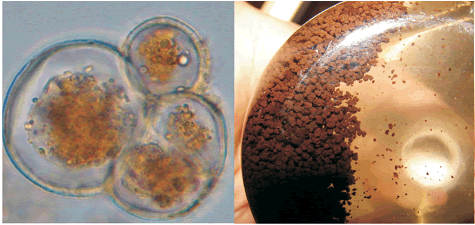
<body><![CDATA[<p><font size="2" face="Verdana, Arial, Helvetica, sans-serif"><b>Callus  culture growth.</b> The callus was initiated after four weeks of incubation  for both varieties. The development of the callus for BIOA variety is  shown in <a href="#f01">figure 1</a>. The color changes of calluses were associated with  the physiological maturity stage of the tissue and polyphenols  accumulation as well as in the seeds. The friability of the calluses  was reached around the sixth month in the variety BIOA and at the  fourth month in the variety BIOD.</font></p>     <p>&nbsp;</p>     <p align="center"><font size="2" face="Verdana, Arial, Helvetica, sans-serif"><a name="f01" id="f01"></a><a href="../img/revistas/acbi/v30n89/a01fig01.gif"><img src="/img/revistas/acbi/v30n89/a01fig01th.gif" border="2" /></a></font></p>     <p align="center"><font size="2" face="Verdana, Arial, Helvetica, sans-serif"><b>Figure  1.</b> Serial sequences of callus development according to variety BIOA in  DKW solid medium supplemented with vitamins, zeatine, and antioxidants.  <b>A.</b> White callus starts growth at third month on cotyledonal tissue. <b>B.</b>  At fourth month callus tissue is beige with granular appearance. <b>C.</b>  Brown friable callus is obtained approximately at sixth month</font></p>     <p>&nbsp;</p>     <p><font size="2" face="Verdana, Arial, Helvetica, sans-serif"><b>Cell  suspension culture growth.</b> Callus culture was transferred into DKW  liquid medium and the suspension culture was established after 45 days  for both varieties. After the third sub&#8211;culture, the cells proliferated  into small and disaggregated cells and were suitable to initiate a  batch culture. The percentage of viability was around 70% and the cells  were round (<a href="#f02">figure 2A</a>). The variety BIOA disaggregated faster than  variety BIOD. Cell suspension cultures were dark brown (<a href="#f02">figure 2B</a>).  Younger cells changed their color from beige to light brown depending  on the culture phase.</font></p>     <p>&nbsp;</p>     <p align="center"><font size="2" face="Verdana, Arial, Helvetica, sans-serif"><a name="f02" id="f02"></a><img src="/img/revistas/acbi/v30n89/a01fig02.gif" /></font></p>     <p align="center"><font size="2" face="Verdana, Arial, Helvetica, sans-serif"><b>Figure 2.</b>  Details of cocoa cell suspension culture for <b>BIOA</b> variety on liquid DKW  medium supplemented with vitamins, zeatine, and antioxidants. <b>A.</b> Cocoa  cells in exponential phase. <b>B.</b> Cell suspension cultures of four weeks  after establishment</font></p>     <p>&nbsp;</p>     ]]></body>
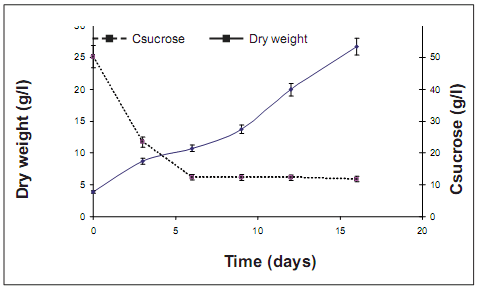
<body><![CDATA[<p><font size="2" face="Verdana, Arial, Helvetica, sans-serif"><b>Inoculum size  effect.</b> According to the results of inoculum size assay, cultures for  next studies were inoculated with 0.5 g (FW) cells in 10 ml of culture  medium. The cell growth corresponds to a normal pattern as has been  described in literature (Street, 1973). The other inoculum sizes tested  did not show a normal growth pattern and they were very unstable with  consecutive increases and decreases in the rate of biomass production.</font></p>     <p><font size="2" face="Verdana, Arial, Helvetica, sans-serif"><b>Kinetics  of both cell growth and substrate consumption.</b> Batch cultures were  initiated with 0.5 g of fresh cells and 6&#8211;fold of biomass was reached  after 16 days of culture (<a href="#f03">figure 3</a>). Lag phase was not observed and  cells started exponential phase at the first day of culture. The  pattern of the substrate consumption seems not to be related with the  rate cell growth, since decreases quickly around 6<sup>th</sup> day and stay  invariable for the next days. This pattern suggests that carbon source  is not the limit substrate, and perhaps were other nutrient factors  that could stimulate the cell growth. The biomass at the final of the  culture was filtered and dried to evaluate some organoleptic properties  like color, smell and flavor. During this preliminary evaluation it was  observed that cocoa biomass was characterized by a brown color, with a  soft smell and flavor similar to the cocoa field seeds. Those results  indicate that the total polyphenols obtained by cell culture could be  used as raw material for cocoa</font></p>     <p>&nbsp;</p>     <p align="center"><font size="2" face="Verdana, Arial, Helvetica, sans-serif"><a name="t01" id="t01"></a><a href="../img/revistas/acbi/v30n89/a01t01.gif"><img src="/img/revistas/acbi/v30n89/a01t01th.gif" border="2" /></a></font></p>     <p align="center"><font size="2" face="Verdana, Arial, Helvetica, sans-serif"><b>Table 1:</b> Total polyphenol content expressed by Cathechin Equivalents (mg by gram of sample; data are shown as media &plusmn; SEM)</font></p>     <p>&nbsp;</p>     <p align="center"><font size="2" face="Verdana, Arial, Helvetica, sans-serif"><a name="f03" id="f03"></a><img src="/img/revistas/acbi/v30n89/a01g01.gif" /></font></p>     <p align="center"><font size="2" face="Verdana, Arial, Helvetica, sans-serif"><b>figure 3.</b> growth bioA cells variety and substrate consumption in batch suspension culture</font></p>     <p>&nbsp;</p>     <p><font size="2" face="Verdana, Arial, Helvetica, sans-serif"> by&#8211;products, but there is still a lot  work to be done before the industrial level. Bromatologic, citotoxic,  mutagenetic, carcinogenic analysis as well as those for cell and  polyophenols stability, among others, are mandatory in order to  supplement cocoa by&#8211;products.</font></p>     ]]></body>
<body><![CDATA[<p><font size="2" face="Verdana, Arial, Helvetica, sans-serif"><b>Polyphenol  analysis.</b> Comparison of total polyphenols content among seeds, callus,  and cell suspension cultures of both varieties are shown in <a href="#t01">table 1</a>.  The total polyphenol content in seed from BIOA variety is higher than  BIOD; although both varieties were cultured under the same  agroecological conditions (soil, precipitation, humidity, and  temperature), they came from trees of different ages. On the other  hand, comparing calluses culture from the two varieties, the total  polyphenols content was higher for the BIOD variety, but in cell  suspension culture, the results show the opposite results, being the  highest for the BIOA variety (<a href="#t01">table 1</a>).</font></p>     <p>&nbsp;</p>     <p><font size="3" face="Verdana, Arial, Helvetica, sans-serif"><b>DISCUSSION</b></font></p>     <p><font size="2" face="Verdana, Arial, Helvetica, sans-serif">For  the field seeds, there are some plausible explanations for the results  were obtained. Phenolic compound biosynthesis and accumulation are  affected by biotic and abiotic conditions (Dixon and Paiva, 1995),  especially by UV irradiation and nutrient starvation (Giorgi et al.,  2009), among others. One of the main functions of flavonoids in plants  is the protection against stress conditions (Winkel&#8211;Shirley, 2002). The  change in the increase in total polyphenol content for BIOA from callus  (3.267) to suspension culture (10.352) could be explained by the stress  caused when the cells passed from solid to a liquid media. However that  explanation does not seem to apply to BIOD variety, which suddenly  decreased the polyphenol content in suspension culture; this result was  probably due to genotype expression and the age of the trees, from  which explants came from.</font></p>     <p><font size="2" face="Verdana, Arial, Helvetica, sans-serif">Flavonoids  are secondary metabolites produced in plant due to stress generated by  biotic or abiotic conditions with many biological functions, apparently  including roles in stress protection (Winkel&#8211;Shirley, 2002). Plant cell  culture are promising potential alternative sources for the production  of these metabolites, for this reason and even when the polyphenol  content into cell suspension culture was lesser than the content in the  seeds of thus study, there are still some interesting strategies  available to increase the secondary metabolite production, including  elicitation, immobilization, and manipulation of some nutrient as well  as to improve yield (Ramachandra and Ravishankar, 2002). Cysteine and  ascorbic acid were used in the media culture, to activate cell growth;  however the presence of these antioxidants seems to inhibit polyphenol  production as shown in the callus and cell suspension culture total  polyphenol content compared with the seed content (<a href="#t01">table 1</a>).</font></p>     <p><font size="2" face="Verdana, Arial, Helvetica, sans-serif">Antioxidants use and effect. Exposure to  environmental stress results in increased production of oxidative  species such as superoxide, hydrogen peroxide, and nitric oxide in  plants (Delledonne et al., 1998). The ability to survive to these  cellular toxins depends on the metabolic responsiveness of  detoxification mechanisms since Reactive Oxygen Species (<b>ROS</b>) and  reactive nitrogen species have both direct and indirect effects on the  cellular redox state and the expression of various stress&#8211;related  genes, including those involved in antioxidant defense (Durner et al.,  1998).</font></p>     <p><font size="2" face="Verdana, Arial, Helvetica, sans-serif">Ascorbic acid has a pivotal  role in plant cells as an antioxidant molecule that prevents oxidative  stress caused by photosynthesis, oxidative metabolism or exposure to  pollutants (Loewus, 1999). In addition, an increase in the synthesis of  phenolic compounds is another common response to environmental stress  in plants (Dixon and Paiva, 1995). The accumulation of anthocyanin  pigments in vegetative tissues is a hallmark of plant stress. In many  cases, these compounds may provide antioxidant activity as part of a  general stress response, however, there is also evidence that  flavonoids may function in plants to screen harmful radiation, bind  phytotoxins, and help to regulate the stress response by controlling  auxin transport (Jacobs, 1988).</font></p>     <p><font size="2" face="Verdana, Arial, Helvetica, sans-serif">Currently,  there is not any available support to explain polyphenols content in  cell suspension culture that could be due to the gene expression of  each genotype, as well as the age of the tissue from the original  explants the samples came from, but may be other causes that are not  possible to explain here, due to the lack of data and more scientific  studies and research. However, to know polyphenol production mechanisms  that have been widely studied in plants could be used as another tool  to increase the synthesis in cell suspension cultures.</font></p>     <p>&nbsp;</p>     <p><font size="3" face="Verdana, Arial, Helvetica, sans-serif"><b>ACKNOWLEDGEMENTS</b></font></p>     ]]></body>
<body><![CDATA[<p><font size="2" face="Verdana, Arial, Helvetica, sans-serif">The  authors thank to Servicio Nacional Aprendizaje (<b>SENA</b>), Universidad de  Antioquia, and Compa&ntilde;&iacute;a Nacional de Chocolates for the financial  support and technical assistance.</font></p>     <p>&nbsp;</p>     <p><font size="3" face="Verdana, Arial, Helvetica, sans-serif"><b>REFERENCES</b></font></p>     <!-- ref --><p><font size="2" face="Verdana, Arial, Helvetica, sans-serif"><b>Bhojwani SS, Razdan MK. </b>1996. Plant tissue culture: Theory and practice, a revised edition. Elvesier Science. Amsterdam.</font>&nbsp;&nbsp;&nbsp;&nbsp;&nbsp;&nbsp;&nbsp;&nbsp;[&#160;<a href="javascript:void(0);" onclick="javascript: window.open('/scielo.php?script=sci_nlinks&ref=000076&pid=S0304-3584200800020000100001&lng=','','width=640,height=500,resizable=yes,scrollbars=1,menubar=yes,');">Links</a>&#160;]<!-- end-ref --><!-- ref --><p><font size="2" face="Verdana, Arial, Helvetica, sans-serif"><b>Cooper  K, Donovan J, Waterhouse A, Williamson G.</b> 2008. Cocoa and health: a  decade of research. British Journal of Nutrition, 99(1):1&#8211;11.</font>&nbsp;&nbsp;&nbsp;&nbsp;&nbsp;&nbsp;&nbsp;&nbsp;[&#160;<a href="javascript:void(0);" onclick="javascript: window.open('/scielo.php?script=sci_nlinks&ref=000077&pid=S0304-3584200800020000100002&lng=','','width=640,height=500,resizable=yes,scrollbars=1,menubar=yes,');">Links</a>&#160;]<!-- end-ref --><!-- ref --><p><font size="2" face="Verdana, Arial, Helvetica, sans-serif"><b>Cakirer  M. </b>2003. Color as an indicator of flavonol content in the fresh seeds  of Theobroma cacao. The Pennsylvania State University.  &lt;<a href="http://guiltinanlab.cas.psu.edu/Publications/Cocoa/Melisthesis.pdf" target="_blank">http://guiltinanlab.cas.psu.edu/Publications/Cocoa/Melisthesis.pdf</a>&gt;.  Fecha de consulta: 21 de febrero de 2007.</font>&nbsp;&nbsp;&nbsp;&nbsp;&nbsp;&nbsp;&nbsp;&nbsp;[&#160;<a href="javascript:void(0);" onclick="javascript: window.open('/scielo.php?script=sci_nlinks&ref=000078&pid=S0304-3584200800020000100003&lng=','','width=640,height=500,resizable=yes,scrollbars=1,menubar=yes,');">Links</a>&#160;]<!-- end-ref --><!-- ref --><p><font size="2" face="Verdana, Arial, Helvetica, sans-serif"><b>Dixon RA, Paiva N.</b> 1995. Stress&#8211;induced phenylpropanoid metabolism. Plant Cell, 7(7):1085&#8211;1097.</font>&nbsp;&nbsp;&nbsp;&nbsp;&nbsp;&nbsp;&nbsp;&nbsp;[&#160;<a href="javascript:void(0);" onclick="javascript: window.open('/scielo.php?script=sci_nlinks&ref=000079&pid=S0304-3584200800020000100004&lng=','','width=640,height=500,resizable=yes,scrollbars=1,menubar=yes,');">Links</a>&#160;]<!-- end-ref --><!-- ref --><p><font size="2" face="Verdana, Arial, Helvetica, sans-serif"><b>Delledone  M, Xia Y, Dixon R, Lamb C.</b> 1998. Nitric oxide functions as a signal in  plant disease resistance. Nature, 394(6693):585&#8211;588.</font>&nbsp;&nbsp;&nbsp;&nbsp;&nbsp;&nbsp;&nbsp;&nbsp;[&#160;<a href="javascript:void(0);" onclick="javascript: window.open('/scielo.php?script=sci_nlinks&ref=000080&pid=S0304-3584200800020000100005&lng=','','width=640,height=500,resizable=yes,scrollbars=1,menubar=yes,');">Links</a>&#160;]<!-- end-ref --><!-- ref --><p><font size="2" face="Verdana, Arial, Helvetica, sans-serif"><b>Durner  J, Gow A, Stamler J, Glazebrook J.</b> 1998. Ancient origins of nitric  oxide signaling in biological systems. Proceedings of the National  Academy of Sciences, 95(25):14206&#8211;14207.</font>&nbsp;&nbsp;&nbsp;&nbsp;&nbsp;&nbsp;&nbsp;&nbsp;[&#160;<a href="javascript:void(0);" onclick="javascript: window.open('/scielo.php?script=sci_nlinks&ref=000081&pid=S0304-3584200800020000100006&lng=','','width=640,height=500,resizable=yes,scrollbars=1,menubar=yes,');">Links</a>&#160;]<!-- end-ref --><!-- ref --><p><font size="2" face="Verdana, Arial, Helvetica, sans-serif"><b>Giorgi  A, Mingozzi M, Madeo M, Speranza G, Cocucci M.</b> 2009. Effect of  nitrogen starvation on the phenolic metabolism and antioxidant  properties of yarrow (Achillea collina Becker ex Rchb.). Food Chemistry,  114(1):204&#8211;211.</font>&nbsp;&nbsp;&nbsp;&nbsp;&nbsp;&nbsp;&nbsp;&nbsp;[&#160;<a href="javascript:void(0);" onclick="javascript: window.open('/scielo.php?script=sci_nlinks&ref=000082&pid=S0304-3584200800020000100007&lng=','','width=640,height=500,resizable=yes,scrollbars=1,menubar=yes,');">Links</a>&#160;]<!-- end-ref --><!-- ref --><p><font size="2" face="Verdana, Arial, Helvetica, sans-serif"><b>Grace SC, Logan BA. </b>2000. Energy dissipation and radical scavenging by the plant  phenylpropanoid pathway. Philosophical Transactions of the Royal  Society B: Biological Sciences, 355:1499&#8211;1510.</font>&nbsp;&nbsp;&nbsp;&nbsp;&nbsp;&nbsp;&nbsp;&nbsp;[&#160;<a href="javascript:void(0);" onclick="javascript: window.open('/scielo.php?script=sci_nlinks&ref=000083&pid=S0304-3584200800020000100008&lng=','','width=640,height=500,resizable=yes,scrollbars=1,menubar=yes,');">Links</a>&#160;]<!-- end-ref --><!-- ref --><p><font size="2" face="Verdana, Arial, Helvetica, sans-serif"><b>Gurney  K, Evans L, Robinson D.</b> 1992. Purine alkaloid production and  accumulation in cocoa callus and suspension cultures. Journal of  Experimental Botany, 43(6):769&#8211;775.</font>&nbsp;&nbsp;&nbsp;&nbsp;&nbsp;&nbsp;&nbsp;&nbsp;[&#160;<a href="javascript:void(0);" onclick="javascript: window.open('/scielo.php?script=sci_nlinks&ref=000084&pid=S0304-3584200800020000100009&lng=','','width=640,height=500,resizable=yes,scrollbars=1,menubar=yes,');">Links</a>&#160;]<!-- end-ref --><!-- ref --><p><font size="2" face="Verdana, Arial, Helvetica, sans-serif"><b>Hammerstone  JF, Schmitz HH.</b> 1998. Cocoa components, edible products having enhanced  polyphenol content, methods of making same and medical uses. Patent  Cooperation Treaty (PCT) WO 98/09533, Mars Incorporated, U.S.A.</font>&nbsp;&nbsp;&nbsp;&nbsp;&nbsp;&nbsp;&nbsp;&nbsp;[&#160;<a href="javascript:void(0);" onclick="javascript: window.open('/scielo.php?script=sci_nlinks&ref=000085&pid=S0304-3584200800020000100010&lng=','','width=640,height=500,resizable=yes,scrollbars=1,menubar=yes,');">Links</a>&#160;]<!-- end-ref --><!-- ref --><p><font size="2" face="Verdana, Arial, Helvetica, sans-serif"><b>Henderson  J, Joyce R, Halls G, Hurst J, McGovern P.</b> 2007. Chemical and  archaeological evidence for the earliest cocoa beverages. Proceedings  of the National Academy of Sciences, 104(48):18937&#8211;18940.</font>&nbsp;&nbsp;&nbsp;&nbsp;&nbsp;&nbsp;&nbsp;&nbsp;[&#160;<a href="javascript:void(0);" onclick="javascript: window.open('/scielo.php?script=sci_nlinks&ref=000086&pid=S0304-3584200800020000100011&lng=','','width=640,height=500,resizable=yes,scrollbars=1,menubar=yes,');">Links</a>&#160;]<!-- end-ref --><!-- ref --><p><font size="2" face="Verdana, Arial, Helvetica, sans-serif"><b>Jacobs M, Rubery P.</b> 1998. Naturally occurring auxin transport regulators. Science, 241:346&#8211;349.</font>&nbsp;&nbsp;&nbsp;&nbsp;&nbsp;&nbsp;&nbsp;&nbsp;[&#160;<a href="javascript:void(0);" onclick="javascript: window.open('/scielo.php?script=sci_nlinks&ref=000087&pid=S0304-3584200800020000100012&lng=','','width=640,height=500,resizable=yes,scrollbars=1,menubar=yes,');">Links</a>&#160;]<!-- end-ref --><!-- ref --><p><font size="2" face="Verdana, Arial, Helvetica, sans-serif"><b>Jalal M, Collin H. </b>1979. Secondary metabolism tissue culture of Theobroma cacao. New Phytologist, 83(2):343&#8211;349.</font>&nbsp;&nbsp;&nbsp;&nbsp;&nbsp;&nbsp;&nbsp;&nbsp;[&#160;<a href="javascript:void(0);" onclick="javascript: window.open('/scielo.php?script=sci_nlinks&ref=000088&pid=S0304-3584200800020000100013&lng=','','width=640,height=500,resizable=yes,scrollbars=1,menubar=yes,');">Links</a>&#160;]<!-- end-ref --><!-- ref --><p><font size="2" face="Verdana, Arial, Helvetica, sans-serif"><b>Janick  J, Pence VC. </b>1980. Method of non&#8211;agricultural production of cotyledons.  US Patent 4.204.366. Purdue Research Foundation, West Lafayette, IN.</font>&nbsp;&nbsp;&nbsp;&nbsp;&nbsp;&nbsp;&nbsp;&nbsp;[&#160;<a href="javascript:void(0);" onclick="javascript: window.open('/scielo.php?script=sci_nlinks&ref=000089&pid=S0304-3584200800020000100014&lng=','','width=640,height=500,resizable=yes,scrollbars=1,menubar=yes,');">Links</a>&#160;]<!-- end-ref --><!-- ref --><p><font size="2" face="Verdana, Arial, Helvetica, sans-serif"><b>Janick  J, Pence VC. </b>1981. Plant tissue produced by non&#8211;agricultural  proliferation of cocoa embryos. US Patent 4.301.619. Purdue Research  Foundation, West Lafayette, IN.</font>&nbsp;&nbsp;&nbsp;&nbsp;&nbsp;&nbsp;&nbsp;&nbsp;[&#160;<a href="javascript:void(0);" onclick="javascript: window.open('/scielo.php?script=sci_nlinks&ref=000090&pid=S0304-3584200800020000100015&lng=','','width=640,height=500,resizable=yes,scrollbars=1,menubar=yes,');">Links</a>&#160;]<!-- end-ref --><!-- ref --><p><font size="2" face="Verdana, Arial, Helvetica, sans-serif"><b>Kim H, Keeney PG. 1984.</b> (&#8211;)Epicatechin content in fermented and unfermented cocoa beans. Journal of Food Science, 49:1090&#8211;1092.</font>&nbsp;&nbsp;&nbsp;&nbsp;&nbsp;&nbsp;&nbsp;&nbsp;[&#160;<a href="javascript:void(0);" onclick="javascript: window.open('/scielo.php?script=sci_nlinks&ref=000091&pid=S0304-3584200800020000100016&lng=','','width=640,height=500,resizable=yes,scrollbars=1,menubar=yes,');">Links</a>&#160;]<!-- end-ref --><!-- ref --><p><font size="2" face="Verdana, Arial, Helvetica, sans-serif"><b>Keen  C, Holt R, Oteiza P, Fraga C, Schmitz H.</b> 2005. Cocoa antioxidants and  cardiovascular health. American Journal of Clinical Nutrition,  81(1):298S&#8211;303S.</font>&nbsp;&nbsp;&nbsp;&nbsp;&nbsp;&nbsp;&nbsp;&nbsp;[&#160;<a href="javascript:void(0);" onclick="javascript: window.open('/scielo.php?script=sci_nlinks&ref=000092&pid=S0304-3584200800020000100017&lng=','','width=640,height=500,resizable=yes,scrollbars=1,menubar=yes,');">Links</a>&#160;]<!-- end-ref --><!-- ref --><p><font size="2" face="Verdana, Arial, Helvetica, sans-serif"><b>Leathers RR, Scragg  AH.</b> 1989. The effect of different temperatures on the growth, lipid  content and fatty acid composition of Theobroma cacao cell suspension  cultures. Plant Science, 62(2):217&#8211;227.</font>&nbsp;&nbsp;&nbsp;&nbsp;&nbsp;&nbsp;&nbsp;&nbsp;[&#160;<a href="javascript:void(0);" onclick="javascript: window.open('/scielo.php?script=sci_nlinks&ref=000093&pid=S0304-3584200800020000100018&lng=','','width=640,height=500,resizable=yes,scrollbars=1,menubar=yes,');">Links</a>&#160;]<!-- end-ref --><!-- ref --><p><font size="2" face="Verdana, Arial, Helvetica, sans-serif"><b>Loewus  FA. </b>1999. Biosynthesis and metabolism of ascorbic acid in plants and of  analogs of ascorbic acid in fungi. Phytochemistry, 52:193&#8211;210.</font>&nbsp;&nbsp;&nbsp;&nbsp;&nbsp;&nbsp;&nbsp;&nbsp;[&#160;<a href="javascript:void(0);" onclick="javascript: window.open('/scielo.php?script=sci_nlinks&ref=000094&pid=S0304-3584200800020000100019&lng=','','width=640,height=500,resizable=yes,scrollbars=1,menubar=yes,');">Links</a>&#160;]<!-- end-ref --><!-- ref --><p><font size="2" face="Verdana, Arial, Helvetica, sans-serif"><b>Ramachandra  S, Ravishankar G. 2002. </b>Plant cell cultures: Chemical factories of  secondary metabolites. Biotechnology Advances, 20:101&#8211;153.</font>&nbsp;&nbsp;&nbsp;&nbsp;&nbsp;&nbsp;&nbsp;&nbsp;[&#160;<a href="javascript:void(0);" onclick="javascript: window.open('/scielo.php?script=sci_nlinks&ref=000095&pid=S0304-3584200800020000100020&lng=','','width=640,height=500,resizable=yes,scrollbars=1,menubar=yes,');">Links</a>&#160;]<!-- end-ref --><!-- ref --><p><font size="2" face="Verdana, Arial, Helvetica, sans-serif"><b>Romanczyk  LJ, Hammerstone, JF, Buck MM, Post LS, Cipolla GG, Micceland CA, Mundt  JA, Schmitz HH.</b> 1997. Cocoa extracts compounds and methods for making  and using the same. Patent Cooperation Treaty (PCT) WO 97/36497, Mars  incorporated, U.S.A.</font>&nbsp;&nbsp;&nbsp;&nbsp;&nbsp;&nbsp;&nbsp;&nbsp;[&#160;<a href="javascript:void(0);" onclick="javascript: window.open('/scielo.php?script=sci_nlinks&ref=000096&pid=S0304-3584200800020000100021&lng=','','width=640,height=500,resizable=yes,scrollbars=1,menubar=yes,');">Links</a>&#160;]<!-- end-ref --><!-- ref --><p><font size="2" face="Verdana, Arial, Helvetica, sans-serif"><b>Street HE. </b>1973. Plant Tissue and Cell Culture. Blackwell Scientific Publications. London, England.</font>&nbsp;&nbsp;&nbsp;&nbsp;&nbsp;&nbsp;&nbsp;&nbsp;[&#160;<a href="javascript:void(0);" onclick="javascript: window.open('/scielo.php?script=sci_nlinks&ref=000097&pid=S0304-3584200800020000100022&lng=','','width=640,height=500,resizable=yes,scrollbars=1,menubar=yes,');">Links</a>&#160;]<!-- end-ref --><!-- ref --><p><font size="2" face="Verdana, Arial, Helvetica, sans-serif"><b>Tsai  C, Kinsella J.</b> 1981. Initiation and growth of callus and cell  suspensions of Theobroma cacao L. Annals of Botany, 48:549&#8211;558.</font>&nbsp;&nbsp;&nbsp;&nbsp;&nbsp;&nbsp;&nbsp;&nbsp;[&#160;<a href="javascript:void(0);" onclick="javascript: window.open('/scielo.php?script=sci_nlinks&ref=000098&pid=S0304-3584200800020000100023&lng=','','width=640,height=500,resizable=yes,scrollbars=1,menubar=yes,');">Links</a>&#160;]<!-- end-ref --><!-- ref --><p><font size="2" face="Verdana, Arial, Helvetica, sans-serif"><b>Tsai  C, Kinsella J.</b> 1982. Tissue culture of cocoa bean (Theobroma cacao L.):  Incorporation of fatty acids into lipids of cultured cells. Lipids,  17(12):848&#8211;852.</font>&nbsp;&nbsp;&nbsp;&nbsp;&nbsp;&nbsp;&nbsp;&nbsp;[&#160;<a href="javascript:void(0);" onclick="javascript: window.open('/scielo.php?script=sci_nlinks&ref=000099&pid=S0304-3584200800020000100024&lng=','','width=640,height=500,resizable=yes,scrollbars=1,menubar=yes,');">Links</a>&#160;]<!-- end-ref --><!-- ref --><p><font size="2" face="Verdana, Arial, Helvetica, sans-serif"><b>Winkel&#8211;Shirley B. </b>2002. Biosynthesis of flavonoids end effects of stress. Current Opinion in Plant Biology, 5:218&#8211;223.</font>&nbsp;&nbsp;&nbsp;&nbsp;&nbsp;&nbsp;&nbsp;&nbsp;[&#160;<a href="javascript:void(0);" onclick="javascript: window.open('/scielo.php?script=sci_nlinks&ref=000100&pid=S0304-3584200800020000100025&lng=','','width=640,height=500,resizable=yes,scrollbars=1,menubar=yes,');">Links</a>&#160;]<!-- end-ref --><!-- ref --><p><font size="2" face="Verdana, Arial, Helvetica, sans-serif"><b>Wollgast  J, Anklam E. </b>2000. Review on polyphenols in Theobroma cacao: changes in  composition during the manufacture of chocolate and methodology for  identification and quantification. Food Research International,  33:423&#8211;447.</font>&nbsp;&nbsp;&nbsp;&nbsp;&nbsp;&nbsp;&nbsp;&nbsp;[&#160;<a href="javascript:void(0);" onclick="javascript: window.open('/scielo.php?script=sci_nlinks&ref=000101&pid=S0304-3584200800020000100026&lng=','','width=640,height=500,resizable=yes,scrollbars=1,menubar=yes,');">Links</a>&#160;]<!-- end-ref --><!-- ref --><p><font size="2" face="Verdana, Arial, Helvetica, sans-serif"><b>Yamasaki H, Sakihama Y,  Ikehara N.</b> 1997. Flavonoidperoxidase reaction as a detoxification  mechanism of plant cells against H2O2. Plant Physiology, 115:1405&#8211;1412.</font>&nbsp;&nbsp;&nbsp;&nbsp;&nbsp;&nbsp;&nbsp;&nbsp;[&#160;<a href="javascript:void(0);" onclick="javascript: window.open('/scielo.php?script=sci_nlinks&ref=000102&pid=S0304-3584200800020000100027&lng=','','width=640,height=500,resizable=yes,scrollbars=1,menubar=yes,');">Links</a>&#160;]<!-- end-ref --><!-- ref --><p><font size="2" face="Verdana, Arial, Helvetica, sans-serif"><b>Yamasaki  H, Grace S.</b> 1998. EPR detection of phytophenoxyl radicals stabilized by  zinc ions: evidence for the redox&#8211;coupling of plant phenolics with  ascorbate in the H2O2&#8211;peroxidase system. FEBS Letters, 422:377&#8211;380.</font>&nbsp;&nbsp;&nbsp;&nbsp;&nbsp;&nbsp;&nbsp;&nbsp;[&#160;<a href="javascript:void(0);" onclick="javascript: window.open('/scielo.php?script=sci_nlinks&ref=000103&pid=S0304-3584200800020000100028&lng=','','width=640,height=500,resizable=yes,scrollbars=1,menubar=yes,');">Links</a>&#160;]<!-- end-ref --><p>&nbsp;</p>     <p>&nbsp;</p>     <p><font size="2" face="Verdana, Arial, Helvetica, sans-serif">Recibido: octubre 2008.<br /> Aceptado para publicaci&oacute;n: diciembre de 2008.</font></p>      ]]></body><back>
<ref-list>
<ref id="B1">
<nlm-citation citation-type="journal">
<person-group person-group-type="author">
<name>
<surname><![CDATA[Bhojwani]]></surname>
<given-names><![CDATA[SS]]></given-names>
</name>
<name>
<surname><![CDATA[Razdan]]></surname>
<given-names><![CDATA[MK]]></given-names>
</name>
</person-group>
<article-title xml:lang="en"><![CDATA[Plant tissue culture: Theory and practice, a revised edition]]></article-title>
<source><![CDATA[Elvesier Science]]></source>
<year>1996</year>
<publisher-loc><![CDATA[Amsterdam ]]></publisher-loc>
</nlm-citation>
</ref>
<ref id="B2">
<nlm-citation citation-type="journal">
<person-group person-group-type="author">
<name>
<surname><![CDATA[Cooper]]></surname>
<given-names><![CDATA[K]]></given-names>
</name>
<name>
<surname><![CDATA[Donovan]]></surname>
<given-names><![CDATA[J]]></given-names>
</name>
<name>
<surname><![CDATA[Waterhouse]]></surname>
<given-names><![CDATA[A]]></given-names>
</name>
<name>
<surname><![CDATA[Williamson]]></surname>
<given-names><![CDATA[G.]]></given-names>
</name>
</person-group>
<article-title xml:lang="en"><![CDATA[Cocoa and health: a decade of research]]></article-title>
<source><![CDATA[British Journal of Nutrition,]]></source>
<year>2008</year>
<volume>99</volume>
<numero>1</numero>
<issue>1</issue>
<page-range>1-11</page-range></nlm-citation>
</ref>
<ref id="B3">
<nlm-citation citation-type="book">
<person-group person-group-type="author">
<name>
<surname><![CDATA[Cakirer]]></surname>
<given-names><![CDATA[M]]></given-names>
</name>
</person-group>
<source><![CDATA[Color as an indicator of flavonol content in the fresh seeds of Theobroma cacao]]></source>
<year>2003</year>
<publisher-name><![CDATA[The Pennsylvania State University]]></publisher-name>
</nlm-citation>
</ref>
<ref id="B4">
<nlm-citation citation-type="journal">
<person-group person-group-type="author">
<name>
<surname><![CDATA[Dixon]]></surname>
<given-names><![CDATA[RA]]></given-names>
</name>
<name>
<surname><![CDATA[Paiva]]></surname>
<given-names><![CDATA[N.]]></given-names>
</name>
</person-group>
<article-title xml:lang="en"><![CDATA[Stress-induced phenylpropanoid metabolism]]></article-title>
<source><![CDATA[Plant Cell,]]></source>
<year>1995</year>
<volume>7</volume>
<numero>7</numero>
<issue>7</issue>
<page-range>1085-1097</page-range></nlm-citation>
</ref>
<ref id="B5">
<nlm-citation citation-type="journal">
<person-group person-group-type="author">
<name>
<surname><![CDATA[Delledone]]></surname>
<given-names><![CDATA[M]]></given-names>
</name>
<name>
<surname><![CDATA[Xia]]></surname>
<given-names><![CDATA[Y]]></given-names>
</name>
<name>
<surname><![CDATA[Dixon]]></surname>
<given-names><![CDATA[R]]></given-names>
</name>
<name>
<surname><![CDATA[Lamb]]></surname>
<given-names><![CDATA[C.]]></given-names>
</name>
</person-group>
<article-title xml:lang="en"><![CDATA[Nitric oxide functions as a signal in plant disease resistance]]></article-title>
<source><![CDATA[Nature,]]></source>
<year>1998</year>
<volume>394</volume>
<numero>6693</numero>
<issue>6693</issue>
<page-range>585-588</page-range></nlm-citation>
</ref>
<ref id="B6">
<nlm-citation citation-type="journal">
<person-group person-group-type="author">
<name>
<surname><![CDATA[Durner]]></surname>
<given-names><![CDATA[J]]></given-names>
</name>
<name>
<surname><![CDATA[Gow]]></surname>
<given-names><![CDATA[A]]></given-names>
</name>
<name>
<surname><![CDATA[Stamler]]></surname>
<given-names><![CDATA[J]]></given-names>
</name>
<name>
<surname><![CDATA[Glazebrook]]></surname>
<given-names><![CDATA[J.]]></given-names>
</name>
</person-group>
<article-title xml:lang="en"><![CDATA[Ancient origins of nitric oxide signaling in biological systems]]></article-title>
<source><![CDATA[Proceedings of the National Academy of Sciences,]]></source>
<year>1998</year>
<volume>95</volume>
<numero>25</numero>
<issue>25</issue>
<page-range>14206-14207</page-range></nlm-citation>
</ref>
<ref id="B7">
<nlm-citation citation-type="journal">
<person-group person-group-type="author">
<name>
<surname><![CDATA[Giorgi]]></surname>
<given-names><![CDATA[A]]></given-names>
</name>
<name>
<surname><![CDATA[Mingozzi]]></surname>
<given-names><![CDATA[M]]></given-names>
</name>
<name>
<surname><![CDATA[Madeo]]></surname>
<given-names><![CDATA[M]]></given-names>
</name>
<name>
<surname><![CDATA[Speranza]]></surname>
<given-names><![CDATA[G]]></given-names>
</name>
<name>
<surname><![CDATA[Cocucci]]></surname>
<given-names><![CDATA[M.]]></given-names>
</name>
</person-group>
<article-title xml:lang="en"><![CDATA[Effect of nitrogen starvation on the phenolic metabolism and antioxidant properties of yarrow (Achillea collina Becker ex Rchb.)]]></article-title>
<source><![CDATA[Food Chemistry,]]></source>
<year>2009</year>
<volume>114</volume>
<numero>1</numero>
<issue>1</issue>
<page-range>204-211</page-range></nlm-citation>
</ref>
<ref id="B8">
<nlm-citation citation-type="journal">
<person-group person-group-type="author">
<name>
<surname><![CDATA[Grace]]></surname>
<given-names><![CDATA[SC]]></given-names>
</name>
<name>
<surname><![CDATA[Logan]]></surname>
<given-names><![CDATA[BA.]]></given-names>
</name>
</person-group>
<article-title xml:lang="en"><![CDATA[Energy dissipation and radical scavenging by the plant phenylpropanoid pathway]]></article-title>
<source><![CDATA[Philosophical Transactions of the Royal Society B: Biological Sciences,]]></source>
<year>2000</year>
<volume>355</volume>
<page-range>1499-1510</page-range></nlm-citation>
</ref>
<ref id="B9">
<nlm-citation citation-type="journal">
<person-group person-group-type="author">
<name>
<surname><![CDATA[Gurney]]></surname>
<given-names><![CDATA[K]]></given-names>
</name>
<name>
<surname><![CDATA[Evans]]></surname>
<given-names><![CDATA[L]]></given-names>
</name>
<name>
<surname><![CDATA[Robinson]]></surname>
<given-names><![CDATA[D.]]></given-names>
</name>
</person-group>
<article-title xml:lang="en"><![CDATA[Purine alkaloid production and accumulation in cocoa callus and suspension cultures]]></article-title>
<source><![CDATA[Journal of Experimental Botany,]]></source>
<year>1992</year>
<volume>43</volume>
<numero>6</numero>
<issue>6</issue>
<page-range>769-775</page-range></nlm-citation>
</ref>
<ref id="B10">
<nlm-citation citation-type="journal">
<person-group person-group-type="author">
<name>
<surname><![CDATA[Hammerstone]]></surname>
<given-names><![CDATA[JF]]></given-names>
</name>
<name>
<surname><![CDATA[Schmitz]]></surname>
<given-names><![CDATA[HH]]></given-names>
</name>
</person-group>
<article-title xml:lang="en"><![CDATA[Cocoa components, edible products having enhanced polyphenol content, methods of making same and medical uses]]></article-title>
<source><![CDATA[Patent Cooperation Treaty]]></source>
<year>1998</year>
<publisher-name><![CDATA[Mars Incorporated]]></publisher-name>
</nlm-citation>
</ref>
<ref id="B11">
<nlm-citation citation-type="journal">
<person-group person-group-type="author">
<name>
<surname><![CDATA[Henderson]]></surname>
<given-names><![CDATA[J]]></given-names>
</name>
<name>
<surname><![CDATA[Joyce]]></surname>
<given-names><![CDATA[R]]></given-names>
</name>
<name>
<surname><![CDATA[Halls]]></surname>
<given-names><![CDATA[G]]></given-names>
</name>
<name>
<surname><![CDATA[Hurst]]></surname>
<given-names><![CDATA[J]]></given-names>
</name>
<name>
<surname><![CDATA[McGovern]]></surname>
<given-names><![CDATA[P.]]></given-names>
</name>
</person-group>
<article-title xml:lang="en"><![CDATA[Chemical and archaeological evidence for the earliest cocoa beverages]]></article-title>
<source><![CDATA[Proceedings of the National Academy of Sciences,]]></source>
<year>2007</year>
<volume>104</volume>
<numero>48</numero>
<issue>48</issue>
<page-range>18937-18940</page-range></nlm-citation>
</ref>
<ref id="B12">
<nlm-citation citation-type="journal">
<person-group person-group-type="author">
<name>
<surname><![CDATA[Jacobs]]></surname>
<given-names><![CDATA[M]]></given-names>
</name>
<name>
<surname><![CDATA[Rubery]]></surname>
<given-names><![CDATA[P.]]></given-names>
</name>
</person-group>
<article-title xml:lang="en"><![CDATA[Naturally occurring auxin transport regulators]]></article-title>
<source><![CDATA[Science,]]></source>
<year>1998</year>
<volume>241</volume>
<page-range>346-349</page-range></nlm-citation>
</ref>
<ref id="B13">
<nlm-citation citation-type="journal">
<person-group person-group-type="author">
<name>
<surname><![CDATA[Jalal]]></surname>
<given-names><![CDATA[M]]></given-names>
</name>
<name>
<surname><![CDATA[Collin]]></surname>
<given-names><![CDATA[H.]]></given-names>
</name>
</person-group>
<article-title xml:lang="en"><![CDATA[Secondary metabolism tissue culture of Theobroma cacao]]></article-title>
<source><![CDATA[New Phytologist,]]></source>
<year>1979</year>
<volume>83</volume>
<numero>2</numero>
<issue>2</issue>
<page-range>343-349</page-range></nlm-citation>
</ref>
<ref id="B14">
<nlm-citation citation-type="">
<person-group person-group-type="author">
<name>
<surname><![CDATA[Janick]]></surname>
<given-names><![CDATA[J]]></given-names>
</name>
<name>
<surname><![CDATA[Pence]]></surname>
<given-names><![CDATA[VC]]></given-names>
</name>
</person-group>
<article-title xml:lang="en"><![CDATA[Method of non-agricultural production of cotyledons]]></article-title>
<source><![CDATA[Purdue Research Foundation]]></source>
<year>1980</year>
</nlm-citation>
</ref>
<ref id="B15">
<nlm-citation citation-type="">
<person-group person-group-type="author">
<name>
<surname><![CDATA[Janick]]></surname>
<given-names><![CDATA[J]]></given-names>
</name>
<name>
<surname><![CDATA[Pence]]></surname>
<given-names><![CDATA[VC]]></given-names>
</name>
</person-group>
<article-title xml:lang="en"><![CDATA[Plant tissue produced by non-agricultural proliferation of cocoa embryos]]></article-title>
<source><![CDATA[Purdue Research Foundation]]></source>
<year>1981</year>
</nlm-citation>
</ref>
<ref id="B16">
<nlm-citation citation-type="journal">
<person-group person-group-type="author">
<name>
<surname><![CDATA[Kim]]></surname>
<given-names><![CDATA[H]]></given-names>
</name>
<name>
<surname><![CDATA[Keeney]]></surname>
<given-names><![CDATA[PG.]]></given-names>
</name>
</person-group>
<article-title xml:lang="en"><![CDATA[(-)Epicatechin content in fermented and unfermented cocoa beans]]></article-title>
<source><![CDATA[Journal of Food Science,]]></source>
<year>1984</year>
<volume>49</volume>
<page-range>1090-1092</page-range></nlm-citation>
</ref>
<ref id="B17">
<nlm-citation citation-type="journal">
<person-group person-group-type="author">
<name>
<surname><![CDATA[Keen]]></surname>
<given-names><![CDATA[C]]></given-names>
</name>
<name>
<surname><![CDATA[Holt]]></surname>
<given-names><![CDATA[R]]></given-names>
</name>
<name>
<surname><![CDATA[Oteiza]]></surname>
<given-names><![CDATA[P]]></given-names>
</name>
<name>
<surname><![CDATA[Fraga]]></surname>
<given-names><![CDATA[C]]></given-names>
</name>
<name>
<surname><![CDATA[Schmitz]]></surname>
<given-names><![CDATA[H.]]></given-names>
</name>
</person-group>
<article-title xml:lang="en"><![CDATA[Cocoa antioxidants and cardiovascular health]]></article-title>
<source><![CDATA[American Journal of Clinical Nutrition,]]></source>
<year>2005</year>
<volume>81</volume>
<numero>1</numero>
<issue>1</issue>
<page-range>298S-303S</page-range></nlm-citation>
</ref>
<ref id="B18">
<nlm-citation citation-type="journal">
<person-group person-group-type="author">
<name>
<surname><![CDATA[Leathers]]></surname>
<given-names><![CDATA[RR]]></given-names>
</name>
<name>
<surname><![CDATA[Scragg]]></surname>
<given-names><![CDATA[AH.]]></given-names>
</name>
</person-group>
<article-title xml:lang="en"><![CDATA[The effect of different temperatures on the growth, lipid content and fatty acid composition of Theobroma cacao cell suspension cultures]]></article-title>
<source><![CDATA[Plant Science,]]></source>
<year>1989</year>
<volume>62</volume>
<numero>2</numero>
<issue>2</issue>
<page-range>217-227</page-range></nlm-citation>
</ref>
<ref id="B19">
<nlm-citation citation-type="journal">
<person-group person-group-type="author">
<name>
<surname><![CDATA[Loewus]]></surname>
<given-names><![CDATA[FA.]]></given-names>
</name>
</person-group>
<article-title xml:lang="en"><![CDATA[Biosynthesis and metabolism of ascorbic acid in plants and of analogs of ascorbic acid in fungi]]></article-title>
<source><![CDATA[Phytochemistry,]]></source>
<year>1999</year>
<volume>52</volume>
<page-range>193-210</page-range></nlm-citation>
</ref>
<ref id="B20">
<nlm-citation citation-type="journal">
<person-group person-group-type="author">
<name>
<surname><![CDATA[Ramachandra]]></surname>
<given-names><![CDATA[S]]></given-names>
</name>
<name>
<surname><![CDATA[Ravishankar]]></surname>
<given-names><![CDATA[G.]]></given-names>
</name>
</person-group>
<article-title xml:lang="en"><![CDATA[Plant cell cultures: Chemical factories of secondary metabolites]]></article-title>
<source><![CDATA[Biotechnology Advances,]]></source>
<year>2002</year>
<volume>20</volume>
<page-range>101-153</page-range></nlm-citation>
</ref>
<ref id="B21">
<nlm-citation citation-type="book">
<person-group person-group-type="author">
<name>
<surname><![CDATA[Romanczyk]]></surname>
<given-names><![CDATA[LJ]]></given-names>
</name>
<name>
<surname><![CDATA[Hammerstone]]></surname>
<given-names><![CDATA[JF]]></given-names>
</name>
<name>
<surname><![CDATA[Buck]]></surname>
<given-names><![CDATA[MM]]></given-names>
</name>
<name>
<surname><![CDATA[Post]]></surname>
<given-names><![CDATA[LS]]></given-names>
</name>
<name>
<surname><![CDATA[Cipolla]]></surname>
<given-names><![CDATA[GG]]></given-names>
</name>
<name>
<surname><![CDATA[Micceland]]></surname>
<given-names><![CDATA[CA]]></given-names>
</name>
<name>
<surname><![CDATA[Mundt]]></surname>
<given-names><![CDATA[JA]]></given-names>
</name>
<name>
<surname><![CDATA[Schmitz]]></surname>
<given-names><![CDATA[HH]]></given-names>
</name>
</person-group>
<article-title xml:lang="en"><![CDATA[Cocoa extracts compounds and methods for making and using the same]]></article-title>
<source><![CDATA[Patent Cooperation Treaty]]></source>
<year>1997</year>
<publisher-name><![CDATA[Mars incorporated]]></publisher-name>
</nlm-citation>
</ref>
<ref id="B22">
<nlm-citation citation-type="journal">
<person-group person-group-type="author">
<name>
<surname><![CDATA[Street]]></surname>
<given-names><![CDATA[HE]]></given-names>
</name>
</person-group>
<article-title xml:lang="en"><![CDATA[Plant Tissue and Cell Culture]]></article-title>
<source><![CDATA[Blackwell Scientific Publications]]></source>
<year>1973</year>
<publisher-loc><![CDATA[London ]]></publisher-loc>
</nlm-citation>
</ref>
<ref id="B23">
<nlm-citation citation-type="journal">
<person-group person-group-type="author">
<name>
<surname><![CDATA[Tsai]]></surname>
<given-names><![CDATA[C]]></given-names>
</name>
<name>
<surname><![CDATA[Kinsella]]></surname>
<given-names><![CDATA[J.]]></given-names>
</name>
</person-group>
<article-title xml:lang="en"><![CDATA[Initiation and growth of callus and cell suspensions of Theobroma cacao L]]></article-title>
<source><![CDATA[Annals of Botany,]]></source>
<year>1981</year>
<volume>48</volume>
<page-range>549-558</page-range></nlm-citation>
</ref>
<ref id="B24">
<nlm-citation citation-type="journal">
<person-group person-group-type="author">
<name>
<surname><![CDATA[Tsai]]></surname>
<given-names><![CDATA[C]]></given-names>
</name>
<name>
<surname><![CDATA[Kinsella]]></surname>
<given-names><![CDATA[J.]]></given-names>
</name>
</person-group>
<article-title xml:lang="en"><![CDATA[Tissue culture of cocoa bean (Theobroma cacao L.): Incorporation of fatty acids into lipids of cultured cells]]></article-title>
<source><![CDATA[Lipids,]]></source>
<year>1982</year>
<volume>17</volume>
<numero>12</numero>
<issue>12</issue>
<page-range>848-852</page-range></nlm-citation>
</ref>
<ref id="B25">
<nlm-citation citation-type="journal">
<person-group person-group-type="author">
<name>
<surname><![CDATA[Winkel-Shirley]]></surname>
<given-names><![CDATA[B.]]></given-names>
</name>
</person-group>
<article-title xml:lang="en"><![CDATA[Biosynthesis of flavonoids end effects of stress]]></article-title>
<source><![CDATA[Current Opinion in Plant Biology,]]></source>
<year>2002</year>
<volume>5</volume>
<page-range>218-223</page-range></nlm-citation>
</ref>
<ref id="B26">
<nlm-citation citation-type="journal">
<person-group person-group-type="author">
<name>
<surname><![CDATA[Wollgast]]></surname>
<given-names><![CDATA[J]]></given-names>
</name>
<name>
<surname><![CDATA[Anklam]]></surname>
<given-names><![CDATA[E.]]></given-names>
</name>
</person-group>
<article-title xml:lang="en"><![CDATA[Review on polyphenols in Theobroma cacao: changes in composition during the manufacture of chocolate and methodology for identification and quantification]]></article-title>
<source><![CDATA[Food Research International,]]></source>
<year>2000</year>
<volume>33</volume>
<page-range>423-447</page-range></nlm-citation>
</ref>
<ref id="B27">
<nlm-citation citation-type="journal">
<person-group person-group-type="author">
<name>
<surname><![CDATA[Yamasaki]]></surname>
<given-names><![CDATA[H]]></given-names>
</name>
<name>
<surname><![CDATA[Sakihama]]></surname>
<given-names><![CDATA[Y]]></given-names>
</name>
<name>
<surname><![CDATA[Ikehara]]></surname>
<given-names><![CDATA[N.]]></given-names>
</name>
</person-group>
<article-title xml:lang="en"><![CDATA[Flavonoidperoxidase reaction as a detoxification mechanism of plant cells against H2O2]]></article-title>
<source><![CDATA[Plant Physiology,]]></source>
<year>1997</year>
<volume>115</volume>
<page-range>1405-1412</page-range></nlm-citation>
</ref>
<ref id="B28">
<nlm-citation citation-type="journal">
<person-group person-group-type="author">
<name>
<surname><![CDATA[Yamasaki]]></surname>
<given-names><![CDATA[H]]></given-names>
</name>
<name>
<surname><![CDATA[Grace]]></surname>
<given-names><![CDATA[S.]]></given-names>
</name>
</person-group>
<article-title xml:lang="en"><![CDATA[EPR detection of phytophenoxyl radicals stabilized by zinc ions: evidence for the redox-coupling of plant phenolics with ascorbate in the H2O2-peroxidase system]]></article-title>
<source><![CDATA[FEBS Letters,]]></source>
<year>1998</year>
<volume>422</volume>
<page-range>377-380</page-range></nlm-citation>
</ref>
</ref-list>
</back>
</article>