<?xml version="1.0" encoding="ISO-8859-1"?><article xmlns:mml="http://www.w3.org/1998/Math/MathML" xmlns:xlink="http://www.w3.org/1999/xlink" xmlns:xsi="http://www.w3.org/2001/XMLSchema-instance">
<front>
<journal-meta>
<journal-id>0304-3584</journal-id>
<journal-title><![CDATA[Actualidades Biológicas]]></journal-title>
<abbrev-journal-title><![CDATA[Actu Biol]]></abbrev-journal-title>
<issn>0304-3584</issn>
<publisher>
<publisher-name><![CDATA[Instituto de Biología, Universidad de Antioquia]]></publisher-name>
</publisher>
</journal-meta>
<article-meta>
<article-id>S0304-35842012000100002</article-id>
<title-group>
<article-title xml:lang="en"><![CDATA[EVALUATION OF ETHANOL PRODUCTION FROM TWO RECOMBINANT AND A COMMERCIAL STRAINS OF SACCHAROMYCES CEREVISIAE (FUNGI: ASCOMYCOTA) IN SUGAR-CANE MOLASSES AND REJECTED-BANANA JUICE FROM URABÁ (ANTIOQUIA), COLOMBIA]]></article-title>
<article-title xml:lang="es"><![CDATA[EVALUACIÓN DE LA PRODUCCIÓN DE ETANOL POR DOS CEPAS RECOMBINANTES Y UNA COMERCIAL DE SACCHAROMYCES CEREVISIAE (FUNGI: ASCOMYCOTA) EN MELAZA DE CAÑA DE AZÚCAR Y MOSTOS DE BANANO DE RECHAZO DE URABÁ (ANTIOQUIA), COLOMBIA]]></article-title>
</title-group>
<contrib-group>
<contrib contrib-type="author">
<name>
<surname><![CDATA[Peña-Serna]]></surname>
<given-names><![CDATA[Carolina]]></given-names>
</name>
<xref ref-type="aff" rid="A01"/>
<xref ref-type="aff" rid="A02"/>
</contrib>
<contrib contrib-type="author">
<name>
<surname><![CDATA[Castro-Gil]]></surname>
<given-names><![CDATA[Carolina]]></given-names>
</name>
<xref ref-type="aff" rid="A02"/>
</contrib>
<contrib contrib-type="author">
<name>
<surname><![CDATA[Peláez-Jaramillo]]></surname>
<given-names><![CDATA[Carlos A.]]></given-names>
</name>
<xref ref-type="aff" rid="A01"/>
</contrib>
</contrib-group>
<aff id="A01">
<institution><![CDATA[,Universidad de Antioquia Grupo Interdisciplinario de Estudios Moleculares ]]></institution>
<addr-line><![CDATA[Medellín Antioquia]]></addr-line>
<country>Colombia</country>
</aff>
<aff id="A02">
<institution><![CDATA[,Corporación para Investigaciones Biológicas Unidad de Biotecnología Vegetal ]]></institution>
<addr-line><![CDATA[Medellín Antioquia]]></addr-line>
<country>Colombia</country>
</aff>
<pub-date pub-type="pub">
<day>00</day>
<month>06</month>
<year>2012</year>
</pub-date>
<pub-date pub-type="epub">
<day>00</day>
<month>06</month>
<year>2012</year>
</pub-date>
<volume>34</volume>
<numero>96</numero>
<fpage>21</fpage>
<lpage>31</lpage>
<copyright-statement/>
<copyright-year/>
<self-uri xlink:href="http://www.scielo.org.co/scielo.php?script=sci_arttext&amp;pid=S0304-35842012000100002&amp;lng=en&amp;nrm=iso"></self-uri><self-uri xlink:href="http://www.scielo.org.co/scielo.php?script=sci_abstract&amp;pid=S0304-35842012000100002&amp;lng=en&amp;nrm=iso"></self-uri><self-uri xlink:href="http://www.scielo.org.co/scielo.php?script=sci_pdf&amp;pid=S0304-35842012000100002&amp;lng=en&amp;nrm=iso"></self-uri><abstract abstract-type="short" xml:lang="en"><p><![CDATA[The production of bioethanol using Saccharomyces cerevisiae (Fungi: Ascomycota) is influenced by sugar concentration and fermentation substrate. For that reason, the kinetics of biomass production, residual sugars, and ethanol production of four of S. cerevisiae strains were evaluated in two different fermentation media (sugar-cane molasses and rejected-banana juice) at two different sugar concentrations (100 and 170 g/l). The EthanolRed® and GG570-CIBII strains exhibited the greatest ethanol production, with peak values of 119.74 (35 h) and 62 g/l (15 h), Yps 0.75 and 0.43 g/g, and Qp 3.42 and 2.61 g/l/h, respectively, at 170 g/l of sugar in sugar-cane molasses broth. Additionally, the strain GG570-CIBII showed an increase of 37.1 g/l ethanol with respect to the control strain.]]></p></abstract>
<abstract abstract-type="short" xml:lang="es"><p><![CDATA[La producción de bioetanol a partir de Saccharomyces cerevisiae (Fungi: Ascomycota) está influenciada por la concentración de azúcares y el sustrato de fermentación. Por ello en este trabajo se evaluaron las cinéticas de producción de biomasa, azúcares residuales y producción de etanol de cuatro cepas de S. cerevisiae en dos medios de fermentación (melaza de caña de azúcar y banano de rechazo) a dos concentraciones de azúcares (100 y 170 g/l). Las cepas EthanolRed® y GG570-CIBII presentaron mayor producción de etanol con pico de producción de 119,74 (35 h) y 62 g/l (15 h), Yps 0,75 y 0,43 g/g y, Qp 3,42 y 2,61 g/l/h, respectivamente a 170 g/l de azúcares en melaza de caña de azúcar. Adicionalmente, la cepa GG570-CIBII mostró un incremento de 37,1 g/l de etanol con respecto a la cepa control.]]></p></abstract>
<kwd-group>
<kwd lng="en"><![CDATA[adhII gene]]></kwd>
<kwd lng="en"><![CDATA[bioethanol]]></kwd>
<kwd lng="en"><![CDATA[pdc gene]]></kwd>
<kwd lng="en"><![CDATA[recombinant Saccharomyces cerevisiae]]></kwd>
<kwd lng="en"><![CDATA[rejected-banana juice]]></kwd>
<kwd lng="en"><![CDATA[sugar-cane molasses]]></kwd>
<kwd lng="es"><![CDATA[bioetanol]]></kwd>
<kwd lng="es"><![CDATA[gen adhII]]></kwd>
<kwd lng="es"><![CDATA[gen pdc]]></kwd>
<kwd lng="es"><![CDATA[jugo de banano de rechazo]]></kwd>
<kwd lng="es"><![CDATA[melaza de caña de azúcar]]></kwd>
<kwd lng="es"><![CDATA[Saccharomyces cerevisiae recombinante]]></kwd>
</kwd-group>
</article-meta>
</front><body><![CDATA[  <font size="2" face="Verdana, Arial, Helvetica, sans-serif">     <p align="right"> <b>ART&Iacute;CULOS DE INVESTIGACI&Oacute;N</b></p>     <p>&nbsp;</p>     <p align="center"><font size="4"><b>EVALUATION OF ETHANOL PRODUCTION FROM TWO RECOMBINANT   AND A COMMERCIAL STRAINS OF SACCHAROMYCES CEREVISIAE   (FUNGI: ASCOMYCOTA) IN SUGAR-CANE MOLASSES   AND REJECTED-BANANA JUICE FROM URAB&Aacute; (ANTIOQUIA), COLOMBIA</b></font></p>     <p align="center">&nbsp;</p>     <p align="center"><font size="3"><b> EVALUACI&Oacute;N DE LA PRODUCCI&Oacute;N DE ETANOL POR DOS CEPAS RECOMBINANTES   Y UNA COMERCIAL DE SACCHAROMYCES CEREVISIAE (FUNGI: ASCOMYCOTA) EN MELAZA DE CA&Ntilde;A DE AZ&Uacute;CAR Y MOSTOS DE BANANO DE RECHAZO DE URAB&Aacute; (ANTIOQUIA), COLOMBIA</b></font></p>     <p>&nbsp;</p>     <p>&nbsp;</p>     <p><b> Carolina Pe&ntilde;a-Serna<sup>1,2,3</sup>; Carolina Castro-Gil<sup>2,4</sup>; Carlos A. Pel&aacute;ez-Jaramillo<sup>1,5</sup></b></p>     <p>&nbsp;</p>     ]]></body>
<body><![CDATA[<p>1  Grupo Interdisciplinario de Estudios Moleculares, Universidad de Antioquia. Medell&iacute;n (Antioquia), Colombia.</p>     <p> 2 Unidad de Biotecnolog&iacute;a Vegetal, Corporaci&oacute;n para Investigaciones Biol&oacute;gicas. Medell&iacute;n (Antioquia), Colombia.</p>     <p> Correos electr&oacute;nicos: 3 <a href="mailto:cpenaser@gmail.com">cpenaser@gmail.com</a>; 4 <a href="mailto:carobs23@hotmail.com">carobs23@hotmail.com</a>; 5 <a href="mailto:cpelaez@matematicas.udea.edu.co">cpelaez@matematicas.udea.edu.co</a>.</p>     <p>&nbsp;</p>     <p>Recibido: septiembre 2011; aceptado: abril 2012. </p> <hr noshade size="1">     <p><b> Abstract</b></p>     <p>The production of bioethanol using <i>Saccharomyces cerevisiae</i> (Fungi: Ascomycota) is influenced by sugar   concentration and fermentation substrate. For that reason, the kinetics of biomass production, residual sugars, and   ethanol production of four of <i><i>S. cerevisiae</i></i> strains were evaluated in two different fermentation media (sugar-cane   molasses and rejected-banana juice) at two different sugar concentrations (100 and 170 g/l). The EthanolRed&reg; and   GG570-CIBII strains exhibited the greatest ethanol production, with peak values of 119.74 (35 h) and 62 g/l (15   h), Y<sub>ps</sub> 0.75 and 0.43 g/g, and Q<sub>p</sub> 3.42 and 2.61 g/l/h, respectively, at 170 g/l of sugar in sugar-cane molasses broth. Additionally, the strain GG570-CIBII showed an increase of 37.1 g/l ethanol with respect to the control strain.</p>     <p> <i>Key words</i>: <i><i>adhII</i></i> gene, bioethanol, pdc gene, recombinant Saccharomyces cerevisiae, rejected-banana juice,   sugar-cane molasses.</p> <hr noshade size="1">     <p> <b>Resumen</b></p>     <p>  La producci&oacute;n de bioetanol a partir de<i> Saccharomyces cerevisiae</i> (Fungi: Ascomycota) est&aacute; influenciada por la   concentraci&oacute;n de az&uacute;cares y el sustrato de fermentaci&oacute;n. Por ello en este trabajo se evaluaron las cin&eacute;ticas de   producci&oacute;n de biomasa, az&uacute;cares residuales y producci&oacute;n de etanol de cuatro cepas de <i><i>S. cerevisiae</i> </i>en dos medios   de fermentaci&oacute;n (melaza de ca&ntilde;a de az&uacute;car y banano de rechazo) a dos concentraciones de az&uacute;cares (100 y 170 g/l).   Las cepas EthanolRed&reg; y GG570-CIBII presentaron mayor producci&oacute;n de etanol con pico de producci&oacute;n de   119,74 (35 h) y 62 g/l (15 h), Y<sub>ps</sub> 0,75 y 0,43 g/g y, Q<sub>p</sub> 3,42 y 2,61 g/l/h, respectivamente a 170 g/l de az&uacute;cares   en melaza de ca&ntilde;a de az&uacute;car. Adicionalmente, la cepa GG570-CIBII mostr&oacute; un incremento de 37,1 g/l de etanol con respecto a la cepa control.</p>     ]]></body>
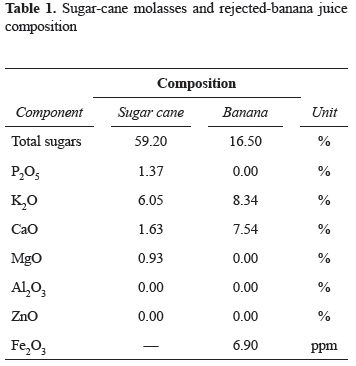
<body><![CDATA[<p> <i>Palabras clave:</i> bioetanol, gen <i><i>adhII</i></i>, gen pdc, jugo de banano de rechazo, melaza de ca&ntilde;a de az&uacute;car, Saccharomyces   cerevisiae recombinante.</p> <hr noshade size="1">     <p>&nbsp;</p>     <p>&nbsp;</p>     <p><b>INTRODUCTION</b></p>     <p>Bioethanol, used as an oxygenator for gasoline, is   produced by the fermentation of sugars present in   renewable materials (FNB 2007, Soliclima 2007).   Colombia produces around 1.05 x 10<sup>6</sup> l/day of   bioethanol from sugar-cane juice and molasses (FNB 2007, MME 2007).</p>     <p> This process could increase its efficiency   through the use of fermentative microorganisms   that produce greater ethanol yields. For that   reason, the Plant Biotechnology Unit of the   Corporaci&oacute;n para Investigaciones Biol&oacute;gicas   (<b>CIB</b>) has developed strains of <i>S. cerevisiae</i>   that are genetically modified by the insertion of   optimized pdc and <i>adhII</i> genes from<i> Zymomonas   mobilis</i>, which have shown greater ethanol   yields in glucose as a carbon source (V&aacute;squez et al. 2007) than CBS8066 (parental strain).</p>     <p> The enzymes pyruvate decarboxylase (<i>PDC</i>) EC   4.1.1.1 and alcohol dehydrogenase (<i>ADH</i>) EC   1.1.1.1 are present in microorganisms such as   <i>S. cerevisiae</i> and <i><i>Z. mobilis</i></i>. These enzymes are   important for ethanol production (Gunasekaran   and Chandra 1999) and have some differences   according to the microorganism of origin. For   instance, it has been found that the enzymes   of <i>Z. mobilis</i> exhibit high affinity for their   respective substrates (Brenda database 2007)   and that <i>Z. mobilis</i> produces a better ethanol   yield than <i>S. cerevisiae</i> (Davis et al. 2006),   with values of 0.49 and 0.46 g/g, respectively,   in broth cultured with 100 g/l of glucose at 200 rpm, with a pH of 5 and a temperature of 30 &deg;C.</p>     <p> It is necessary to search for alternative   substrates to sugar cane derivatives that may   allow actual ethanol production to increase.   Taking into account, that Colombia is an   exporter country of the banana <i>Cavendish valery</i> of which about 9,877.4 tons/month   are rejected and remain in cultivation fields,   leading to contamination (Afanador 2005).   Thus, rejected bananas are potential substrate for the production of bioethanol.</p>     <p> In this research, the kinetics of biomass   production, residual sugars, and ethanol   production of two genetically modified yeast   strains generated by insertion of optimized <i>Z. mobilis</i> <i>pdc</i> and <i><i>adhII</i></i> genes, were evaluated   after being cultivated in broths prepared with   either sugar-cane molasses or rejected-banana juice.</p>     <p>&nbsp;</p>     ]]></body>
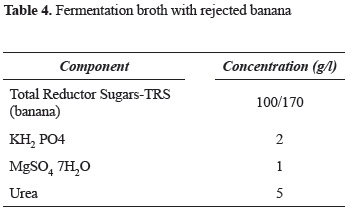
<body><![CDATA[<p><font size="3"> <b>MATERIALS AND METHODS</b></font></p>     <p> <b>Microorganisms and conservation.</b>  Fermentations were carried out with four strains of   Saccharomyces cerevisiae (Fungi: Ascomycota):   parental strain CBS8066 used as a control;   recombinant strain GG570-CIBI which harbors   the pdc gene of <i>Z. mobilis</i> under the control   of the PGK (phosphoglycerate kinase from   <i>S. cerevisiae</i>) gene promoter and terminator;   recombinant strain GG570-CIBII which harbors   the pdc gene of <i>Z. mobilis</i> under the control of   the PGK promoter and terminator and the <i>adhII</i>   gene of <i>Z. mobilis</i> under the control of the <i>ADHI</i>  (<i>alcohol dehydrogenase I from</i> <i>S. cerevisiae</i>) gene   promoter and terminator, both strains developed at   the Plant Biotechnology Unit of CIB (V&aacute;squez et   al. 2007); and a commercial strain, EthanolRed&reg; (Fermentis).</p>     <p> Yeast strains were stored in a glycerol-YPD culture   broth mix at -70 &deg;C in 1.5 ml Eppendorf tubes (Manikandan et al. 2008, Sharma et al. 2007).</p>     <p> <b>Fermentation substrate.</b> Two substrates were   used for fermentation, one made from sugarcane   molasses and the other from rejectedbanana.   Sugar-cane molasses (characteristics   shown in <a href="#t1">table 1</a>), were purchased at the local   market from Mayag&uuml;ez sugar refining industry.   Molasses were diluted to the suitable sugar concentration and filtered.</p>       <p align="center"><a name="t1"></a><img src="/img/revistas/acbi/v34n96/v34n96a02t1.jpg"></p>     <p>&nbsp;</p>     <p> Ripe <i>Cavendish valery</i> banana fruits, rejected   from ''La Manzana'' plantation located in Turbo   (Antioquia), Colombia, with composition   as shown in <a href="#t1">table 1</a>, were manually washed,   peeled and weighted. Pulp juice was extracted   by compression, added hot diluted Ca(OH)<sub>2</sub>   (100 ml per kg of banana) during gently   stirring, allowed for solid agglomeration for   20 min and centrifuged. Banana juice was   neutralized with citric acid 0.5% until pH 5.5 and filtered.</p>     <p> <b>Culture broth</b>. Three different culture broths   were used: modified YPD broth for the inoculum   preparation and two industrial broths for the   fermentation; the fermentation broths were   prepared with either, sugar-cane molasses or   rejected-banana juice and the pH adjusted to   5.0. The composition of each culture broth is   shown in <a href="#t2">tables 2</a>-<a href="#t4">4</a>.</p>     <p align="center"><a name="t2"></a><img src="/img/revistas/acbi/v34n96/v34n96a02t2.jpg"></p>     <p>&nbsp;</p>       ]]></body>
<body><![CDATA[<p align="center"><a name="t4"></a><img src="/img/revistas/acbi/v34n96/v34n96a02t4.jpg"></p>     <p>&nbsp;</p>     <p>  <b>Inoculum preparation</b>. The inoculum was   prepared in 1000-ml Erlenmeyer flasks with   400 ml of modified YPD broth. 1 ml of the   conserved strain was added to the sterile broth   and incubated at 30 &deg;C, for 30 h, without   mechanical agitation and aeration supplied with   an aquarium pump. Once the amount of initial   biomass for fermentation was reached (DO<sub>660</sub>   = 1.3) with viability and vitality above 95%,   the supernatant was removed by centrifugation at 4000 rpm.</p>     <p> <b>Fermentation conditions</b>. Fermentations were   carried out in 500-ml Erlenmeyer flasks with   400 ml of fermentation broth in orbital shaker at   30 &deg;C, 150 rpm, initial pH of 5 and an inoculum   concentration of 8 g/l over 35 h, taking samples of 5 ml every 5 h.</p>     <p> <b>Evaluation of cellular biomass production</b>.   Cellular biomass was quantified by the dry   weight method (Manikandan et al. 2008, Monsalve et al. 2006, Pe&ntilde;a and Arango 2009).</p>     <p><b>Evaluation of residual sugars</b>. Content   of residual sugars was determined using   dinitrosalicylic acid (<b>DNS</b>) with previous   hydrolysis with 10% HCl at 95 &deg;C (del Rosario   and Pamatong 1985, Ergun and Mutlu 2000, Monsalve et al. 2006, Pe&ntilde;a and Arango 2009).</p>     <p> <b>Evaluation of ethanol production</b>.   Measurement of ethanol concentration was   accomplished by gas chromatography, using an   Agilent gas chromatograph model 6890, with   a Flame Ionization Detector and autosampler (Pe&ntilde;a and Arango 2009).</p>     <p> Kinetic parameters determination. Specific   growth rate (mx) at exponential growth phase   is equal to the maximum growth rate (&mu;max) (Doran 1995):</p>     <p align="center"><a name="e1"></a><img src="/img/revistas/acbi/v34n96/v34n96a02e1.jpg"></p>     <p>&nbsp;</p>     ]]></body>
<body><![CDATA[<p> Where:</p>     <p> <b>X</b> = cellular biomass concentration at time<i> (t)</i></p>     <p> <b>X<sub>0</sub></b> = cellular biomass concentration at time<i> (t = 0)</i></p>     <p> &mu; = specific cellular growth rate, considered as  &mu;<sub>max</sub> at the exponential phase</p>     <p>  The observed cell yield (Y'<sub>x/s</sub>) and the observed   ethanol yield (Y'<sub>p/s</sub>) were calculated using   curves of cellular growth vs. residual sugar and   ethanol production vs. residual sugar, which   have slopes of Y'<sub>x/s</sub> and Y'<sub>p/s</sub>, respectively (Doran 1995).</p>     <p> The volumetric ethanol productivity, Q<sub>p</sub>, was   calculated using an ethanol production vs. time curve, in which Q<sub>p</sub> is the slope (Doran 1995).</p>     <p> Statistical analysis. These experiments were   developed with a random design, with a   balanced factorial arrangement 4 x 2<sup>2</sup>, three   repetitions and repeated measurements at 0, 5,   10, 15, 20, 25, 30, and 35 h of fermentation. The   response variables were biomass production, residual sugar amount and ethanol production.</p>     <p>&nbsp;</p>     <p><font size="3"> <b>RESULTS AND DISCUSSION</b></font></p>     <p> <b>Evaluation of biomass production.</b> The   fermentation-kinetics experiment was carried   out over 35 h, reaching a maximum peak of cellular biomass between 30 and 35 h (<a href="/img/revistas/acbi/v34n96/v34n96a02f1.jpg" target="_blank">figure 1</a>).</p>     ]]></body>
<body><![CDATA[<p> In <a href="/img/revistas/acbi/v34n96/v34n96a02f1.jpg" target="_blank">figure 1A</a>, the strains (with the exception of   the commercial strain) have a lag phase from 0   to 5 h at the beginning of fermentation and an   exponential-growth phase between 5 and 30 h,   followed by the stationary phase. EthanolRed&reg;   was the strain that produced the lowest amount   of biomass, with a maximum of 12 g/l, whereas   recombinant GG570-CIBI produced the greatest biomass, with 15 g/l.</p>     <p> On the other hand, when the strains were   cultivated in sugar-cane molasses at 100 g sugar/l   (<a href="/img/revistas/acbi/v34n96/v34n96a02f1.jpg" target="_blank">figure 1B</a>), no lag phase neither stationary phase   was observed, and the biomass production was   slower than the biomass produced in the 170 g/l sugar fermentation process.</p>     <p> During the first 10 h (<a href="/img/revistas/acbi/v34n96/v34n96a02f1.jpg" target="_blank">figure 1C</a>), the different   strains, with the exception of the commercial   strain, showed an adaptation phase with a decrease   in biomass production, which could suggest that   the consumption of the substrate was difficult,   most likely due to the presence of an inhibitor   compound in banana juice. That compound could   prevent sugar consumption, causing a decrease   in biomass by the auto-consumption of cells.   After 10 h, the exponential growth phase began,   followed at 30 h by the death phase. In contrast,   the commercial strain showed an exponentialgrowth   phase from 0 to 25 h, finally reaching the stationary phase after 35 h.</p>     <p> During cultivation with 100 g sugar/l in   banana broth (<a href="/img/revistas/acbi/v34n96/v34n96a02f1.jpg" target="_blank">figure 1D</a>), the strains showed   an adaptation phase during the first 5 h with   a decrease in the biomass, as was explained   previously. Later, the exponential-growth phase lasted until 25 h, when cellular death began.</p>     <p> In general, the strains exhibited greater biomass   production in higher sugar concentrations   (<a href="/img/revistas/acbi/v34n96/v34n96a02f1.jpg" target="_blank">figures 1A</a> and <a href="/img/revistas/acbi/v34n96/v34n96a02f1.jpg" target="_blank">1C</a>), due to greater carbonsource   availability. In contrast, when the   substrates with sugar-cane molasses (<a href="/img/revistas/acbi/v34n96/v34n96a02f1.jpg" target="_blank">figures   1A</a> and <a href="/img/revistas/acbi/v34n96/v34n96a02f1.jpg" target="_blank">1B</a>) and rejected-banana juice (<a href="/img/revistas/acbi/v34n96/v34n96a02f1.jpg" target="_blank">figures   1C</a> and <a href="/img/revistas/acbi/v34n96/v34n96a02f1.jpg" target="_blank">1D</a>) were compared, the strains   displayed better biomass production when   they were cultivated in broth containing sugar   cane-molasses than in broth containing rejectedbanana   juice (between 11-15 g biomass/l and 8-11 g biomass/l, respectively).</p>     <p>  According to statistical analysis, the evaluated   factors and their second-order interactions (such   as substrate*time, time*sugar and sugar*strain)   are statistically significant, with p &lt; 0.0001,   whereas the interactions of the third and fourth   order, with p &gt; 0.05, do not exhibit a statistically significant effect.</p>     <p> Additionally, statistically significant differences   were found between the two substrates (sugarcane   molasses and banana juice, with sugar   cane molasses proving the better substrate)   and between the sugar concentrations (with an   initial concentration of 170 g/l generating higher biomass production).</p>     <p> <b>Evaluation of residual sugars</b>. In <a href="/img/revistas/acbi/v34n96/v34n96a02f2.jpg" target="_blank">figure 2</a> is   shown the kinetics of residual sugars during   the fermentation. The ANOVA test shows that   the factors and their interactions (with the   exception of substrate*sugar, sugar*strain,   substrate*time*sugar and time*sugar*strain,   with p &gt; 0.05) are statistically significant, with p &lt; 0.001.</p>     <p> Statistically significant differences were observed   for the factors of substrate type and sugar   concentration, while strains did not show   statistically significant differences between   control and recombinant GG570-CIBI strains and   between commercial and recombinant GG570- CIBII strains.</p>     <p> <b>Evaluation of ethanol production</b>. When there   is a higher sugar concentration in the fermentation   broth, ethanol production is improved (<a href="/img/revistas/acbi/v34n96/v34n96a02f3.jpg" target="_blank">figure 3</a>)   because when the fermentation broth contains high   sugar concentration (above 3-30 g/l, depending   on the strain; Thatipamala et al. 1992), even under   high dissolved-oxygen concentrations (Lei et al.   2001), the yeast changes its oxidative metabolism   to oxidoreductive or fermentative metabolism,   producing a higher ethanol concentration. This   phenomenon is known as the Crabtree effect   (Converti et al. 1985, Lei et al. 2001, Thatipamala et al. 1992).</p>     ]]></body>
<body><![CDATA[<p> When sugar-cane molasses was used (<a href="/img/revistas/acbi/v34n96/v34n96a02f3.jpg" target="_blank">figures   3A</a> and <a href="/img/revistas/acbi/v34n96/v34n96a02f3.jpg" target="_blank">3B</a>), the strains produced greater ethanol   concentration than they did when rejected-banana   juice was used. Furthermore, as noted previously,   greater biomass was produced by the sugar-cane   molasses substrate. That could suggest that the   banana broth contains some kind of inhibitor   (S&aacute;nchez and Cardona 2008), or, perhaps, the   sugars contained in the broth are less available;   that is, could be oligosaccharides that cannot   be taken up by the yeast, causing a decrease in cellular growth and ethanol production.</p>     <p> Another difference between fermentation broths   is that when sugar-cane molasses was used   (<a href="/img/revistas/acbi/v34n96/v34n96a02f3.jpg" target="_blank">figures 3A</a> and <a href="/img/revistas/acbi/v34n96/v34n96a02f3.jpg" target="_blank">3B</a>) the strains produced the   maximum ethanol concentration (production   peak) in a shorter time (between 15 and 20 h)   than with banana broth (<a href="/img/revistas/acbi/v34n96/v34n96a02f3.jpg" target="_blank">figures 3C</a> and <a href="/img/revistas/acbi/v34n96/v34n96a02f3.jpg" target="_blank">3D</a>), which exhibited production peaks at 30 to 35 h.</p>     <p> According to statistical analysis, ANOVA test   suggests that the factors and their interactions   are statistically highly significant (p &lt; 0.0001).   In addition, the analysis showed statistically   significant differences between evaluated factors;   that is, the substrate factor that took two values   (banana and molasses substrates) presented   significant statistical differences, and the sugarcane   molasses substrate demonstrated higher   ethanol production than did the rejected-banana   juice. Using sugar-cane molasses, the commercial   strain (followed by recombinant GG570-CIBII),   with 170 g/l of initial sugar concentration produced the best ethanol production.</p>     <p> The recombinant GG570-CIBII showed the   best ethanol production comparing to the other   recombinant and parental strains, when it was   cultivated under high iron concentration (above   150 mM), it means when the strain was grown in   sugar-cane molasses at high sugar concentration   (<a href="/img/revistas/acbi/v34n96/v34n96a02f3.jpg" target="_blank">figure 3A</a>). Under this condition, recombinant   GG570-CIBII increased ethanol production by   37.1 g/l compared to the control (CBS8066) strain.</p>     <p> Pe&ntilde;a et al. (2010) showed that the <i>ADHII</i>  enzyme encoded by <i>adhII</i> gene of <i>Z. mobilis</i>   inserted in the recombinant strain GG570-CIBII,   needs the iron ion as an enzymatic cofactor   (Gunasekaran and Chandra 1999, Mackenzie et   al. 1989), leading to an improvement in ethanol production with respect to the control strain.</p>     <p> On the other hand, Cazetta et al. (2007) reported   an ethanol concentration of 2.94 g/l after 24 h   of fermentation with sugar-cane molasses broth   at 180 rpm and 25 &deg;C, using a <i>Z. mobilis</i> ATCC   29191 strain. Meanwhile, recombinant strains   GG570-CIBI and GG570-CIBII produced 41   and 56 g ethanol/l, respectively, after 25 h with   the same substrate. This result shows that the   recombinant strains are more productive when   cultivated in an industrial substrate; moreover,   such strains are not inhibited by the presence   of salts, which is a problem with <i>Z. mobilis</i> (Gunasekaran and Chandra 1999).</p>     <p> Another study that used an industrial strain of   <i>S. cerevisiae</i> in banana broth produced 0.116   l ethanol/kg fruit after 72 h of fermentation   (Hammond et al. 1996), whereas with   recombinant GG570-CIBII and commercial   strains, 0.035 and 0.04 l ethanol/kg fruit were   obtained, respectively, after 35 h. Strains used   in the foregoing study reached a higher level of   ethanol production than the strains evaluated in   this work. However, the production happened   in a shorter time period and, additionally, with a lower initial sugar concentration.</p>     <p> <b>Kinetic parameters.</b> The &mu;<sub>max</sub> data (<a href="/img/revistas/acbi/v34n96/v34n96a02t5.jpg" target="_blank">table 5</a>)   show that the strains increase their specific growth   velocity when there is a higher sugar concentration   and, additionally, when the strains are cultivated   in sugar-cane molasses. These findings are similar to those presented in <a href="/img/revistas/acbi/v34n96/v34n96a02f1.jpg" target="_blank">figure 1</a>.</p>     <p> Regarding to Y<sub>xs</sub>, the biomass produced per   gram of substrate sugar decreases when the   strains are grown in sugar-cane molasses broth   at high sugar concentration 170 g/l of sugars   (except for the control strain) (<a href="/img/revistas/acbi/v34n96/v34n96a02t5.jpg" target="_blank">table 5</a>), which was expected, due to the Crabtree effect.</p>     <p> In contrast, the strains grown in banana broth   produced larger amounts of biomass per gram   of substrate when the sugar concentration was   increased (except for the commercial strain).   This result suggests that, with this substrate,   the strains used the sugars mostly for cellular growth and not for ethanol production.</p>     ]]></body>
<body><![CDATA[<p> Concerning to Y<sub>ps</sub>, the ethanol concentration   per gram of sugar increased with the highest   sugar concentration evaluated for each strain   (except for recombinant GG570-CIBI strain   in banana culture and the control strain in   molasses broth), meaning that the efficiency   of ethanol production was better under high   sugar concentration. Moreover, the sugar-cane   molasses broth is more propitious for ethanol   production than banana broth, and the highest  ethanol concentrations were obtained with the commercial strain and the recombinant GG570- CIBII strain (<a href="/img/revistas/acbi/v34n96/v34n96a02t5.jpg" target="_blank">table 5</a>).</p>     <p> Additionally, strains improve ethanol productivity   when the fermentation broth contains higher sugar   concentration and, in addition, when sugar canemolasses   was used as a carbon source (with the   exception of the recombinant strain GG570-CIBII   with 100 g sugars/l; <a href="/img/revistas/acbi/v34n96/v34n96a02t5.jpg" target="_blank">table 5</a>).</p>     <p> In general, the strains improve their volumetric   productivity by approximately 1 g/l/h when the   sugar concentration rises from 100 to 170 g/l,   with the exception of control and commercial   strains in banana broth that showed an increase   of 2 g/l/h and the recombinant GG570-CIBII   strain in sugar-cane molasses broth that showed   an improvement of 1.5 g/l/h.</p>     <p> The highest Q<sub>p</sub> was observed in sugar-cane   molasses medium with 170 g/l of sugar, and   the highest productivities were produced by   the commercial strain, with a Q<sub>p</sub> of 3.42 g/l/h,   followed by recombinant GG570-CIBII, with a Q<sub>p</sub> of 2.61 g/l/h.</p>     <p>&nbsp;</p>     <p>  CONCLUSIONS</p>     <p> Evaluation of kinetics of biomass production,   residual sugars and ethanol production showed   that the best initial sugar concentration and   fermentation substrate are: 170 g/l and sugarcane   molasses compared with 100 g/l and   rejected-banana juice. According to the results,   the strains EthanolRed&reg; and GG570-CIBII   exhibited the greatest ethanol production,   with peaks of 119.74 (35 h) and 62 g/l (15 h),   Y<sub>ps</sub> 0.75 and 0.43 g/g, and Q<sub>p</sub> 3.42 and 2.61   g/l/h, respectively, and at 170 g/l of sugar in   sugar-cane molasses broth. In addition, the   recombinant strain GG570-CIBII showed an   increase of 37.1 g/l ethanol with respect to   the control strain. This could improve ethanol   production at industrial level once the same   genetic transformation of GG570-CIBII strain is made in an industrial strain.</p>     <p>&nbsp;</p>     <p><font size="3"><b> ACKNOWLEDGMENTS</b></font></p>     <p> This work was supported by a grant from the   Agricultural and Rural Development Ministry   of Colombia.</p>     ]]></body>
<body><![CDATA[<p>&nbsp;</p>     <p><font size="3"> <b>REFERENCES</b></font></p>     <!-- ref --><p> 1. Afanador A. 2005. El banano verde de rechazo en la producci&oacute;n   de alcohol carburante. Revista EIA, 3: 51-68.&nbsp;&nbsp;&nbsp;&nbsp;&nbsp;&nbsp;&nbsp;&nbsp;[&#160;<a href="javascript:void(0);" onclick="javascript: window.open('/scielo.php?script=sci_nlinks&ref=000095&pid=S0304-3584201200010000200001&lng=','','width=640,height=500,resizable=yes,scrollbars=1,menubar=yes,');">Links</a>&#160;]<!-- end-ref --><!-- ref --><p> 2. Brenda database &#091;internet&#093;. 2007. Brenda-The comprehensive   enzyme information system. Department of   Bioinformatics and Biochemistry TU Braunschweig.   Accessed: 16<sup>th</sup> May 2010. Available from: <a href="http://www.brenda-enzymes.org/" target="_blank">http://www.brenda-enzymes.org/</a>.&nbsp;&nbsp;&nbsp;&nbsp;&nbsp;&nbsp;&nbsp;&nbsp;[&#160;<a href="javascript:void(0);" onclick="javascript: window.open('/scielo.php?script=sci_nlinks&ref=000096&pid=S0304-3584201200010000200002&lng=','','width=640,height=500,resizable=yes,scrollbars=1,menubar=yes,');">Links</a>&#160;]<!-- end-ref --><!-- ref --><p> 3. Cazetta M, Celligoi M, Buzato J, Scarmino J. 2007.   Fermentation of molasses by <i>Zymomonas mobilis</i>:   Effects of temperature and sugar concentration on   ethanol production. Bioresource Technology, 98:   2824-2828.&nbsp;&nbsp;&nbsp;&nbsp;&nbsp;&nbsp;&nbsp;&nbsp;[&#160;<a href="javascript:void(0);" onclick="javascript: window.open('/scielo.php?script=sci_nlinks&ref=000097&pid=S0304-3584201200010000200003&lng=','','width=640,height=500,resizable=yes,scrollbars=1,menubar=yes,');">Links</a>&#160;]<!-- end-ref --><!-- ref --><p> 4. Converti A, Perego P, Lodi A, Parisi F, Del Borghi M. 1985. A   Kinetic Study of <i>Saccharomyces</i> Strains: Performance   at High Sugar Concentrations. Biotechnology and   Bioengineering, 27: 1108-1114.&nbsp;&nbsp;&nbsp;&nbsp;&nbsp;&nbsp;&nbsp;&nbsp;[&#160;<a href="javascript:void(0);" onclick="javascript: window.open('/scielo.php?script=sci_nlinks&ref=000098&pid=S0304-3584201200010000200004&lng=','','width=640,height=500,resizable=yes,scrollbars=1,menubar=yes,');">Links</a>&#160;]<!-- end-ref --><!-- ref --><p> 5. Davis L, Rogers P, Pearce J, Peiris P. 2006. Evaluation   of <i>Zymomonas</i> based ethanol production from   a hydrolysed waste starch stream. Biomass and   Bioenergy, 30: 809-814.&nbsp;&nbsp;&nbsp;&nbsp;&nbsp;&nbsp;&nbsp;&nbsp;[&#160;<a href="javascript:void(0);" onclick="javascript: window.open('/scielo.php?script=sci_nlinks&ref=000099&pid=S0304-3584201200010000200005&lng=','','width=640,height=500,resizable=yes,scrollbars=1,menubar=yes,');">Links</a>&#160;]<!-- end-ref --><!-- ref --><p> 6. del Rosario E, Pamatong F. 1985. Continuous-flow   fermentation of banana fruit pulp sugar into ethanol by   carrageenan-inmobilized yeast. Biotechnology Letters,   7: 819-820.&nbsp;&nbsp;&nbsp;&nbsp;&nbsp;&nbsp;&nbsp;&nbsp;[&#160;<a href="javascript:void(0);" onclick="javascript: window.open('/scielo.php?script=sci_nlinks&ref=000100&pid=S0304-3584201200010000200006&lng=','','width=640,height=500,resizable=yes,scrollbars=1,menubar=yes,');">Links</a>&#160;]<!-- end-ref --><!-- ref --><p> 7. Doran P. 1995. Bioprocess engineering principles. London:   Academic Press. p. 439.&nbsp;&nbsp;&nbsp;&nbsp;&nbsp;&nbsp;&nbsp;&nbsp;[&#160;<a href="javascript:void(0);" onclick="javascript: window.open('/scielo.php?script=sci_nlinks&ref=000101&pid=S0304-3584201200010000200007&lng=','','width=640,height=500,resizable=yes,scrollbars=1,menubar=yes,');">Links</a>&#160;]<!-- end-ref --><!-- ref --><p> 8. Ergun M, Mutlu SF. 2000. Application of a statistical   technique to the production of ethanol from sugar beet   molasses by Saccharomyces cerevisiae. Bioresource   Technology, 73: 251-255.&nbsp;&nbsp;&nbsp;&nbsp;&nbsp;&nbsp;&nbsp;&nbsp;[&#160;<a href="javascript:void(0);" onclick="javascript: window.open('/scielo.php?script=sci_nlinks&ref=000102&pid=S0304-3584201200010000200008&lng=','','width=640,height=500,resizable=yes,scrollbars=1,menubar=yes,');">Links</a>&#160;]<!-- end-ref --><!-- ref --><p> 9. FNB (Federaci&oacute;n Nacional de Biocombustibles) [Internet].   2007. ABC de los alcoholes carburantes. Accessed:   27th May 2010. Available from: <a href="http://www.fedebiocombustibles.com/v2/main-pagina-id-5.htm" target="_blank">http://www.fedebiocombustibles.com/v2/main-pagina-id-5.htm</a>.&nbsp;&nbsp;&nbsp;&nbsp;&nbsp;&nbsp;&nbsp;&nbsp;[&#160;<a href="javascript:void(0);" onclick="javascript: window.open('/scielo.php?script=sci_nlinks&ref=000103&pid=S0304-3584201200010000200009&lng=','','width=640,height=500,resizable=yes,scrollbars=1,menubar=yes,');">Links</a>&#160;]<!-- end-ref --><!-- ref --><p> 10. Gunasekaran P, Chandra K. 1999. Ethanol fermentation   technology-<i>Zymomonas mobilis</i>. Current Science,   77: 56-68.&nbsp;&nbsp;&nbsp;&nbsp;&nbsp;&nbsp;&nbsp;&nbsp;[&#160;<a href="javascript:void(0);" onclick="javascript: window.open('/scielo.php?script=sci_nlinks&ref=000104&pid=S0304-3584201200010000200010&lng=','','width=640,height=500,resizable=yes,scrollbars=1,menubar=yes,');">Links</a>&#160;]<!-- end-ref --><!-- ref --><p> 11. Hammond J, Egg R, Diggins D, Cable C. 1996. Alcohol   from bananas. Bioresource Technology, 56: 125-130.&nbsp;&nbsp;&nbsp;&nbsp;&nbsp;&nbsp;&nbsp;&nbsp;[&#160;<a href="javascript:void(0);" onclick="javascript: window.open('/scielo.php?script=sci_nlinks&ref=000105&pid=S0304-3584201200010000200011&lng=','','width=640,height=500,resizable=yes,scrollbars=1,menubar=yes,');">Links</a>&#160;]<!-- end-ref --><!-- ref --><p> 12. Lei F, Rotboll M, Jorgensen SB. 2001. A biochemically   structured model for<i> Saccharomyces cerevisiae.</i> Journal   of Biotechnology, 88: 205-221.&nbsp;&nbsp;&nbsp;&nbsp;&nbsp;&nbsp;&nbsp;&nbsp;[&#160;<a href="javascript:void(0);" onclick="javascript: window.open('/scielo.php?script=sci_nlinks&ref=000106&pid=S0304-3584201200010000200012&lng=','','width=640,height=500,resizable=yes,scrollbars=1,menubar=yes,');">Links</a>&#160;]<!-- end-ref --><!-- ref --><p> 13. Mackenzie K, Eddy C, Ingram L. 1989. Modulation of alcohol   dehydrogenase isoenzyme levels in <i>Zymomonas mobilis</i>  by Iron and Zinc. Journal of bacteriology, 171: 1063-1067.&nbsp;&nbsp;&nbsp;&nbsp;&nbsp;&nbsp;&nbsp;&nbsp;[&#160;<a href="javascript:void(0);" onclick="javascript: window.open('/scielo.php?script=sci_nlinks&ref=000107&pid=S0304-3584201200010000200013&lng=','','width=640,height=500,resizable=yes,scrollbars=1,menubar=yes,');">Links</a>&#160;]<!-- end-ref --><!-- ref --><p> 14. Manikandan K, Saravanan V, Viruthagiri T. 2008. Kinetic   studies on ethanol production from banana peel waste   using mutant strain of <i>Saccharomyces cerevisiae</i>. Indian   Journal Biotechnology, 7: 83-88.&nbsp;&nbsp;&nbsp;&nbsp;&nbsp;&nbsp;&nbsp;&nbsp;[&#160;<a href="javascript:void(0);" onclick="javascript: window.open('/scielo.php?script=sci_nlinks&ref=000108&pid=S0304-3584201200010000200014&lng=','','width=640,height=500,resizable=yes,scrollbars=1,menubar=yes,');">Links</a>&#160;]<!-- end-ref --><!-- ref --><p> 15. MME (Ministerio de Minas y Energ&iacute;a) [Internet]. 2007. Los   biocombustibles en Colombia. Accessed: 7<sup>th</sup> August   2010. Available from: <a href="http://www.minminas.gov.co/minminas/downloads/UserFiles/File/hidrocarburos/Programa.pdf" target="_blank">http://www.minminas.gov.co/minminas/downloads/UserFiles/File/hidrocarburos/Programa.pdf</a>.&nbsp;&nbsp;&nbsp;&nbsp;&nbsp;&nbsp;&nbsp;&nbsp;[&#160;<a href="javascript:void(0);" onclick="javascript: window.open('/scielo.php?script=sci_nlinks&ref=000109&pid=S0304-3584201200010000200015&lng=','','width=640,height=500,resizable=yes,scrollbars=1,menubar=yes,');">Links</a>&#160;]<!-- end-ref --><!-- ref --><p> 16. Monsalve J, Medina V, Ru&iacute;z A. 2006. Producci&oacute;n de etanol   a partir de la c&aacute;scara de banano y de almid&oacute;n de yuca.   Revista Dyna, 150: 21-27.&nbsp;&nbsp;&nbsp;&nbsp;&nbsp;&nbsp;&nbsp;&nbsp;[&#160;<a href="javascript:void(0);" onclick="javascript: window.open('/scielo.php?script=sci_nlinks&ref=000110&pid=S0304-3584201200010000200016&lng=','','width=640,height=500,resizable=yes,scrollbars=1,menubar=yes,');">Links</a>&#160;]<!-- end-ref --><!-- ref --><p> 17. Pe&ntilde;a C, Arango R. 2009. Evaluaci&oacute;n de la producci&oacute;n   de etanol utilizando cepas recombinantes de   <i>Saccharomyces cerevisiae</i> a partir de melaza de ca&ntilde;a   de az&uacute;car. Revista Dyna, 76: 153-161.&nbsp;&nbsp;&nbsp;&nbsp;&nbsp;&nbsp;&nbsp;&nbsp;[&#160;<a href="javascript:void(0);" onclick="javascript: window.open('/scielo.php?script=sci_nlinks&ref=000111&pid=S0304-3584201200010000200017&lng=','','width=640,height=500,resizable=yes,scrollbars=1,menubar=yes,');">Links</a>&#160;]<!-- end-ref --><!-- ref --><p> 18. Pe&ntilde;a C, Arango RE, Restrepo LF. 2010. Efecto de adici&oacute;n   de iones hierro y zinc sobre la producci&oacute;n de etanol de   dos cepas recombinantes de Saccharomyces cerevisiae.   Revista Colombiana de Biotecnolog&iacute;a, 12: 158-168.&nbsp;&nbsp;&nbsp;&nbsp;&nbsp;&nbsp;&nbsp;&nbsp;[&#160;<a href="javascript:void(0);" onclick="javascript: window.open('/scielo.php?script=sci_nlinks&ref=000112&pid=S0304-3584201200010000200018&lng=','','width=640,height=500,resizable=yes,scrollbars=1,menubar=yes,');">Links</a>&#160;]<!-- end-ref --><!-- ref --><p> 19. S&aacute;nchez O, Cardona C. 2008. Trends in biotechnological   production of fuel ethanol from different feedstocks.   Bioresource Technology, 99: 5270-5295.&nbsp;&nbsp;&nbsp;&nbsp;&nbsp;&nbsp;&nbsp;&nbsp;[&#160;<a href="javascript:void(0);" onclick="javascript: window.open('/scielo.php?script=sci_nlinks&ref=000113&pid=S0304-3584201200010000200019&lng=','','width=640,height=500,resizable=yes,scrollbars=1,menubar=yes,');">Links</a>&#160;]<!-- end-ref --><!-- ref --><p> 20. Sharma N, Kalra K, Oberoi H, Bansal S. 2007. Optimization   of fermentation parameters for production of ethanol   from kinnow waste and banana peels by simultaneous   saccharification and fermentation. Indian Journal   Microbiology, 47: 310-316.&nbsp;&nbsp;&nbsp;&nbsp;&nbsp;&nbsp;&nbsp;&nbsp;[&#160;<a href="javascript:void(0);" onclick="javascript: window.open('/scielo.php?script=sci_nlinks&ref=000114&pid=S0304-3584201200010000200020&lng=','','width=640,height=500,resizable=yes,scrollbars=1,menubar=yes,');">Links</a>&#160;]<!-- end-ref --><!-- ref --><p> 21. Soliclima &#91;Internet&#93;. 2006. El etanol como biocombustible.   Accessed: 20<sup>th</sup> May 2007. Available from: <a href="http://news.soliclima.com/divulgacion/biomasa/el-etanol-comobiocombustible" target="_blank">http://news.soliclima.com/divulgacion/biomasa/el-etanol-comobiocombustible</a>.&nbsp;&nbsp;&nbsp;&nbsp;&nbsp;&nbsp;&nbsp;&nbsp;[&#160;<a href="javascript:void(0);" onclick="javascript: window.open('/scielo.php?script=sci_nlinks&ref=000115&pid=S0304-3584201200010000200021&lng=','','width=640,height=500,resizable=yes,scrollbars=1,menubar=yes,');">Links</a>&#160;]<!-- end-ref --><!-- ref --><p> 22. Thatipamala R, Rohani S, Hill GA. 1992. Effects of high   product and substrate inhibition on the kinetics and   biomass and products yields during ethanol batch   fermentation. Biotechnology and bioengineering,   40: 289-297.&nbsp;&nbsp;&nbsp;&nbsp;&nbsp;&nbsp;&nbsp;&nbsp;[&#160;<a href="javascript:void(0);" onclick="javascript: window.open('/scielo.php?script=sci_nlinks&ref=000116&pid=S0304-3584201200010000200022&lng=','','width=640,height=500,resizable=yes,scrollbars=1,menubar=yes,');">Links</a>&#160;]<!-- end-ref --><!-- ref --><p> 23. V&aacute;squez J, Casta&ntilde;o H, Mar&iacute;n P, Rodriguez E, Arango R. 2007.   Ingenier&iacute;a gen&eacute;tica en rutas metab&oacute;licas de<i> Saccharomyces   cerevisiae</i> para incrementar la productividad de etanol.   In: 6 SIPAL - Simposio Internacional de Alcoholes y   Levaduras, 2007, Bogot&aacute;/Colombia. Bogot&aacute; (Colombia):   CD-ROM de Memorias del 6 SIPAL, 2007.&nbsp;&nbsp;&nbsp;&nbsp;&nbsp;&nbsp;&nbsp;&nbsp;[&#160;<a href="javascript:void(0);" onclick="javascript: window.open('/scielo.php?script=sci_nlinks&ref=000117&pid=S0304-3584201200010000200023&lng=','','width=640,height=500,resizable=yes,scrollbars=1,menubar=yes,');">Links</a>&#160;]<!-- end-ref --><p>&nbsp;</p>     <p>&nbsp;</p> </font>      ]]></body><back>
<ref-list>
<ref id="B1">
<label>1</label><nlm-citation citation-type="journal">
<person-group person-group-type="author">
<name>
<surname><![CDATA[Afanador]]></surname>
<given-names><![CDATA[A.]]></given-names>
</name>
</person-group>
<article-title xml:lang="es"><![CDATA[El banano verde de rechazo en la producción de alcohol carburante]]></article-title>
<source><![CDATA[Revista EIA,]]></source>
<year>2005</year>
<volume>3</volume>
<page-range>51-68</page-range></nlm-citation>
</ref>
<ref id="B2">
<label>2</label><nlm-citation citation-type="book">
<collab>Brenda database</collab>
<source><![CDATA[Brenda-The comprehensive enzyme information system]]></source>
<year>2007</year>
<publisher-name><![CDATA[Department of Bioinformatics and Biochemistry TU Braunschweig]]></publisher-name>
</nlm-citation>
</ref>
<ref id="B3">
<label>3</label><nlm-citation citation-type="journal">
<person-group person-group-type="author">
<name>
<surname><![CDATA[Cazetta]]></surname>
<given-names><![CDATA[M]]></given-names>
</name>
<name>
<surname><![CDATA[Celligoi]]></surname>
<given-names><![CDATA[M]]></given-names>
</name>
<name>
<surname><![CDATA[Buzato]]></surname>
<given-names><![CDATA[J]]></given-names>
</name>
<name>
<surname><![CDATA[Scarmino]]></surname>
<given-names><![CDATA[J.]]></given-names>
</name>
</person-group>
<article-title xml:lang="en"><![CDATA[Fermentation of molasses by Zymomonas mobilis: Effects of temperature and sugar concentration on ethanol production]]></article-title>
<source><![CDATA[Bioresource Technology,]]></source>
<year>2007</year>
<volume>98</volume>
<page-range>2824-2828</page-range></nlm-citation>
</ref>
<ref id="B4">
<label>4</label><nlm-citation citation-type="journal">
<person-group person-group-type="author">
<name>
<surname><![CDATA[Converti]]></surname>
<given-names><![CDATA[A]]></given-names>
</name>
<name>
<surname><![CDATA[Perego]]></surname>
<given-names><![CDATA[P]]></given-names>
</name>
<name>
<surname><![CDATA[Lodi]]></surname>
<given-names><![CDATA[A]]></given-names>
</name>
<name>
<surname><![CDATA[Parisi]]></surname>
<given-names><![CDATA[F]]></given-names>
</name>
<name>
<surname><![CDATA[Del Borghi]]></surname>
<given-names><![CDATA[M.]]></given-names>
</name>
</person-group>
<article-title xml:lang="en"><![CDATA[A Kinetic Study of Saccharomyces Strains: Performance at High Sugar Concentrations]]></article-title>
<source><![CDATA[Biotechnology and Bioengineering,]]></source>
<year>1985</year>
<volume>27</volume>
<page-range>1108-1114</page-range></nlm-citation>
</ref>
<ref id="B5">
<label>5</label><nlm-citation citation-type="journal">
<person-group person-group-type="author">
<name>
<surname><![CDATA[Davis]]></surname>
<given-names><![CDATA[L]]></given-names>
</name>
<name>
<surname><![CDATA[Rogers]]></surname>
<given-names><![CDATA[P]]></given-names>
</name>
<name>
<surname><![CDATA[Pearce]]></surname>
<given-names><![CDATA[J]]></given-names>
</name>
<name>
<surname><![CDATA[Peiris]]></surname>
<given-names><![CDATA[P.]]></given-names>
</name>
</person-group>
<article-title xml:lang="en"><![CDATA[Evaluation of Zymomonas based ethanol production from a hydrolysed waste starch stream]]></article-title>
<source><![CDATA[Biomass and Bioenergy,]]></source>
<year>2006</year>
<volume>30</volume>
<page-range>809-814</page-range></nlm-citation>
</ref>
<ref id="B6">
<label>6</label><nlm-citation citation-type="journal">
<person-group person-group-type="author">
<name>
<surname><![CDATA[del]]></surname>
<given-names><![CDATA[Rosario E]]></given-names>
</name>
<name>
<surname><![CDATA[Pamatong]]></surname>
<given-names><![CDATA[F.]]></given-names>
</name>
</person-group>
<article-title xml:lang="en"><![CDATA[Continuous-flow fermentation of banana fruit pulp sugar into ethanol by carrageenan-inmobilized yeast]]></article-title>
<source><![CDATA[Biotechnology Letters,]]></source>
<year>1985</year>
<volume>7</volume>
<page-range>819-820</page-range></nlm-citation>
</ref>
<ref id="B7">
<label>7</label><nlm-citation citation-type="book">
<person-group person-group-type="author">
<name>
<surname><![CDATA[Doran]]></surname>
<given-names><![CDATA[P.]]></given-names>
</name>
</person-group>
<source><![CDATA[Bioprocess engineering principles]]></source>
<year>1995</year>
<page-range>439</page-range><publisher-loc><![CDATA[London ]]></publisher-loc>
<publisher-name><![CDATA[Academic Press]]></publisher-name>
</nlm-citation>
</ref>
<ref id="B8">
<label>8</label><nlm-citation citation-type="journal">
<person-group person-group-type="author">
<name>
<surname><![CDATA[Ergun]]></surname>
<given-names><![CDATA[M]]></given-names>
</name>
<name>
<surname><![CDATA[Mutlu]]></surname>
<given-names><![CDATA[SF.]]></given-names>
</name>
</person-group>
<article-title xml:lang="en"><![CDATA[Application of a statistical technique to the production of ethanol from sugar beet molasses by Saccharomyces cerevisiae]]></article-title>
<source><![CDATA[Bioresource Technology,]]></source>
<year>2000</year>
<volume>73</volume>
<page-range>251-255</page-range></nlm-citation>
</ref>
<ref id="B9">
<label>9</label><nlm-citation citation-type="">
<collab>FNB (Federación Nacional de Biocombustibles)</collab>
<source><![CDATA[ABC de los alcoholes carburantes]]></source>
<year>2007</year>
</nlm-citation>
</ref>
<ref id="B10">
<label>10</label><nlm-citation citation-type="journal">
<person-group person-group-type="author">
<name>
<surname><![CDATA[Gunasekaran]]></surname>
<given-names><![CDATA[P]]></given-names>
</name>
<name>
<surname><![CDATA[Chandra]]></surname>
<given-names><![CDATA[K.]]></given-names>
</name>
</person-group>
<article-title xml:lang="en"><![CDATA[Ethanol fermentation technology-Zymomonas mobilis]]></article-title>
<source><![CDATA[Current Science,]]></source>
<year>1999</year>
<volume>77</volume>
<page-range>56-68</page-range></nlm-citation>
</ref>
<ref id="B11">
<label>11</label><nlm-citation citation-type="journal">
<person-group person-group-type="author">
<name>
<surname><![CDATA[Hammond]]></surname>
<given-names><![CDATA[J]]></given-names>
</name>
<name>
<surname><![CDATA[Egg]]></surname>
<given-names><![CDATA[R]]></given-names>
</name>
<name>
<surname><![CDATA[Diggins]]></surname>
<given-names><![CDATA[D]]></given-names>
</name>
<name>
<surname><![CDATA[Cable]]></surname>
<given-names><![CDATA[C.]]></given-names>
</name>
</person-group>
<article-title xml:lang="en"><![CDATA[Alcohol from bananas]]></article-title>
<source><![CDATA[Bioresource Technology,]]></source>
<year>1996</year>
<volume>56</volume>
<page-range>125-130</page-range></nlm-citation>
</ref>
<ref id="B12">
<label>12</label><nlm-citation citation-type="journal">
<person-group person-group-type="author">
<name>
<surname><![CDATA[Lei]]></surname>
<given-names><![CDATA[F]]></given-names>
</name>
<name>
<surname><![CDATA[Rotboll]]></surname>
<given-names><![CDATA[M]]></given-names>
</name>
<name>
<surname><![CDATA[Jorgensen]]></surname>
<given-names><![CDATA[SB.]]></given-names>
</name>
</person-group>
<article-title xml:lang="en"><![CDATA[A biochemically structured model for Saccharomyces cerevisiae]]></article-title>
<source><![CDATA[Journal of Biotechnology,]]></source>
<year>2001</year>
<volume>88</volume>
<page-range>205-221</page-range></nlm-citation>
</ref>
<ref id="B13">
<label>13</label><nlm-citation citation-type="journal">
<person-group person-group-type="author">
<name>
<surname><![CDATA[Mackenzie]]></surname>
<given-names><![CDATA[K]]></given-names>
</name>
<name>
<surname><![CDATA[Eddy]]></surname>
<given-names><![CDATA[C]]></given-names>
</name>
<name>
<surname><![CDATA[Ingram]]></surname>
<given-names><![CDATA[L.]]></given-names>
</name>
</person-group>
<article-title xml:lang="en"><![CDATA[Modulation of alcohol dehydrogenase isoenzyme levels in Zymomonas mobilis by Iron and Zinc]]></article-title>
<source><![CDATA[Journal of bacteriology,]]></source>
<year>1989</year>
<volume>171</volume>
<page-range>1063-1067</page-range></nlm-citation>
</ref>
<ref id="B14">
<label>14</label><nlm-citation citation-type="journal">
<person-group person-group-type="author">
<name>
<surname><![CDATA[Manikandan]]></surname>
<given-names><![CDATA[K]]></given-names>
</name>
<name>
<surname><![CDATA[Saravanan]]></surname>
<given-names><![CDATA[V]]></given-names>
</name>
<name>
<surname><![CDATA[Viruthagiri]]></surname>
<given-names><![CDATA[T.]]></given-names>
</name>
</person-group>
<article-title xml:lang="en"><![CDATA[Kinetic studies on ethanol production from banana peel waste using mutant strain of Saccharomyces cerevisiae]]></article-title>
<source><![CDATA[Indian Journal Biotechnology,]]></source>
<year>2008</year>
<volume>7</volume>
<page-range>83-88</page-range></nlm-citation>
</ref>
<ref id="B15">
<label>15</label><nlm-citation citation-type="">
<collab>MME (Ministerio de Minas y Energía)</collab>
<source><![CDATA[Los biocombustibles en Colombia]]></source>
<year>2007</year>
</nlm-citation>
</ref>
<ref id="B16">
<label>16</label><nlm-citation citation-type="journal">
<person-group person-group-type="author">
<name>
<surname><![CDATA[Monsalve]]></surname>
<given-names><![CDATA[J]]></given-names>
</name>
<name>
<surname><![CDATA[Medina]]></surname>
<given-names><![CDATA[V]]></given-names>
</name>
<name>
<surname><![CDATA[Ruíz]]></surname>
<given-names><![CDATA[A.]]></given-names>
</name>
</person-group>
<article-title xml:lang="es"><![CDATA[Producción de etanol a partir de la cáscara de banano y de almidón de yuca]]></article-title>
<source><![CDATA[Revista Dyna,]]></source>
<year>2006</year>
<volume>150</volume>
<page-range>21-27</page-range></nlm-citation>
</ref>
<ref id="B17">
<label>17</label><nlm-citation citation-type="journal">
<person-group person-group-type="author">
<name>
<surname><![CDATA[Peña]]></surname>
<given-names><![CDATA[C]]></given-names>
</name>
<name>
<surname><![CDATA[Arango]]></surname>
<given-names><![CDATA[R.]]></given-names>
</name>
</person-group>
<article-title xml:lang="es"><![CDATA[Evaluación de la producción de etanol utilizando cepas recombinantes de Saccharomyces cerevisiae a partir de melaza de caña de azúcar]]></article-title>
<source><![CDATA[Revista Dyna,]]></source>
<year>2009</year>
<volume>76</volume>
<page-range>153-161</page-range></nlm-citation>
</ref>
<ref id="B18">
<label>18</label><nlm-citation citation-type="journal">
<person-group person-group-type="author">
<name>
<surname><![CDATA[Peña]]></surname>
<given-names><![CDATA[C]]></given-names>
</name>
<name>
<surname><![CDATA[Arango]]></surname>
<given-names><![CDATA[RE]]></given-names>
</name>
<name>
<surname><![CDATA[Restrepo]]></surname>
<given-names><![CDATA[LF.]]></given-names>
</name>
</person-group>
<article-title xml:lang="es"><![CDATA[Efecto de adición de iones hierro y zinc sobre la producción de etanol de dos cepas recombinantes de Saccharomyces cerevisiae]]></article-title>
<source><![CDATA[Revista Colombiana de Biotecnología,]]></source>
<year>2010</year>
<volume>12</volume>
<page-range>158-168</page-range></nlm-citation>
</ref>
<ref id="B19">
<label>19</label><nlm-citation citation-type="journal">
<person-group person-group-type="author">
<name>
<surname><![CDATA[Sánchez]]></surname>
<given-names><![CDATA[O]]></given-names>
</name>
<name>
<surname><![CDATA[Cardona]]></surname>
<given-names><![CDATA[C.]]></given-names>
</name>
</person-group>
<article-title xml:lang="en"><![CDATA[Trends in biotechnological production of fuel ethanol from different feedstocks]]></article-title>
<source><![CDATA[Bioresource Technology,]]></source>
<year>2008</year>
<volume>99</volume>
<page-range>5270-5295</page-range></nlm-citation>
</ref>
<ref id="B20">
<label>20</label><nlm-citation citation-type="journal">
<person-group person-group-type="author">
<name>
<surname><![CDATA[Sharma]]></surname>
<given-names><![CDATA[N]]></given-names>
</name>
<name>
<surname><![CDATA[Kalra]]></surname>
<given-names><![CDATA[K]]></given-names>
</name>
<name>
<surname><![CDATA[Oberoi]]></surname>
<given-names><![CDATA[H]]></given-names>
</name>
<name>
<surname><![CDATA[Bansal]]></surname>
<given-names><![CDATA[S.]]></given-names>
</name>
</person-group>
<article-title xml:lang="en"><![CDATA[Optimization of fermentation parameters for production of ethanol from kinnow waste and banana peels by simultaneous saccharification and fermentation]]></article-title>
<source><![CDATA[Indian Journal Microbiology,]]></source>
<year>2007</year>
<volume>47</volume>
<page-range>310-316</page-range></nlm-citation>
</ref>
<ref id="B21">
<label>21</label><nlm-citation citation-type="">
<collab>Soliclima</collab>
<source><![CDATA[El etanol como biocombustible]]></source>
<year>2006</year>
</nlm-citation>
</ref>
<ref id="B22">
<label>22</label><nlm-citation citation-type="journal">
<person-group person-group-type="author">
<name>
<surname><![CDATA[Thatipamala]]></surname>
<given-names><![CDATA[R]]></given-names>
</name>
<name>
<surname><![CDATA[Rohani]]></surname>
<given-names><![CDATA[S]]></given-names>
</name>
<name>
<surname><![CDATA[Hill]]></surname>
<given-names><![CDATA[GA.]]></given-names>
</name>
</person-group>
<article-title xml:lang="en"><![CDATA[Effects of high product and substrate inhibition on the kinetics and biomass and products yields during ethanol batch fermentation]]></article-title>
<source><![CDATA[Biotechnology and bioengineering,]]></source>
<year>1992</year>
<volume>40</volume>
<page-range>289-297</page-range></nlm-citation>
</ref>
<ref id="B23">
<label>23</label><nlm-citation citation-type="">
<person-group person-group-type="author">
<name>
<surname><![CDATA[Vásquez]]></surname>
<given-names><![CDATA[J]]></given-names>
</name>
<name>
<surname><![CDATA[Castaño]]></surname>
<given-names><![CDATA[H]]></given-names>
</name>
<name>
<surname><![CDATA[Marín]]></surname>
<given-names><![CDATA[P]]></given-names>
</name>
<name>
<surname><![CDATA[Rodriguez]]></surname>
<given-names><![CDATA[E]]></given-names>
</name>
<name>
<surname><![CDATA[Arango]]></surname>
<given-names><![CDATA[R]]></given-names>
</name>
</person-group>
<article-title xml:lang="es"><![CDATA[Ingeniería genética en rutas metabólicas de Saccharomyces cerevisiae para incrementar la productividad de etanol]]></article-title>
<source><![CDATA[6 SIPAL - Simposio Internacional de Alcoholes y Levaduras]]></source>
<year>2007</year>
<month>20</month>
<day>07</day>
<publisher-loc><![CDATA[Bogotá ]]></publisher-loc>
</nlm-citation>
</ref>
</ref-list>
</back>
</article>