ARTÍCULOS DE INVESTIGACIÓN
Novelties in Grammitis Sw. and StenoGrammitis Labiak (Polypodiaceae) from Costa Rica, Colombia, and Venezuela
Novedades en Grammitis Sw. Y StenoGrammitis Labiak (Polyp odiaceae) para Costa Rica, Colombia y Venezuela
Alexander F. Rojas-Alvarado1
]]> 1 Escuela de Ciencias Biológicas. Universidad Nacional de Costa Rica. Apartado postal: 86-3000. Heredia, Costa Rica. Correo electrónico: alfrojasa@yahoo.com.
Recibido: enero de 2012; aceptado: noviembre de 2012.
Abstract
Four new species of Grammitis Sw. (G. angustissima A. Rojas, G. roraimensis A. Rojas, G. spathulata A. Rojas and G. undulata A. Rojas) and one new species of StenoGrammitis Labiak (S. grammitoides A. Rojas) are described here. The first species is known only from the Colombian Andes and is characterized by a very narrow blade; the second is known only from the Roraima Mountains in Venezuela, and is the largest species with a long ascending rhizome and a branched blackish blade ribbon; the third species is similar to G. marginella (Sw.) Sw. in spathulate blade with rounded apex, but has sessile fronds and a glabrous blade; the fourth species is also known from the Colombian Andes, and it is similar to G. angustissima in its narrow blade, but has undulate margins and a narrower blackish marginal ribbon; the StenoGrammitis species is endemic to Cocos Island, Costa Rica, and is characterized by clathrate rhizome scales, an entire blade, and discontinuous sori that are oblique at the costa.
Key words: Grammitis, grammitoids, Neotropic, new taxa, Polypodiaceae, StenoGrammitis.
Resumen
Cuatro especies nuevas de Grammitis Sw. (G. angustissima A. Rojas, G. roraimensis A. Rojas, G. sphatulata A. Rojas and G. undulata A. Rojas) y una nueva especie de StenoGrammitis Labiak (S. grammitoides A. Rojas) son descritas aquí. La primera especie es conocida solo para los Andes colombianos y se caracteriza por lámina muy angosta; la segunda especie es conocida sólo para las montañas de Roraima en Venezuela, y es la especie más grande con rizoma largo ascendente y cinta negra del margen de la lámina ramificada; la tercera especie es similar a G. marginella (Sw.) Sw. en lámina espatulada con ápice redondeado, pero tiene frondas sésiles y lámina glabra; la cuarta especie es también conocida para los Andes colombianos y es similar a G. angustissima en la lámina delgada, pero tiene margen ondulado y cinta negra del margen de la lámina más delgado; la especie de StenoGrammitis es endémica de la Isla del Coco, Costa Rica, y es caracterizada por escamas del rizoma clatradas, lámina entera y soro discontinuo y oblicuo a la costa.
Palabras clave: Grammitis, grammitoides, nuevos taxones, neotrópico, Polypodiaceae, StenoGrammitis.
INTRODUCTION
The genus Grammitis Sw. includes those species with simple and entire fronds, with a marginal band of black or dark brown sclerenchyma (Moran and Smith 1995). Moran and Smith (1995) mentioned that although the genus (Grammitis) has been revised tree times in this century (Bishop 1977, Copeland 1952, Maxon 1915), few specimens were available from the studies. Many recent collections, some of which have been described as new species, make necessary a new revision of the genus.
Labiak (2011) mentioned that StenoGrammitis Labiak is readily distinguished from other grammitid genera by its linear laminae, often not reaching more than 0.5 cm in width, clathrate and iridescent rhizome scales, segments with a single and unbranched vein, and by having a single sorus per segment.
The genus StenoGrammitis differs from the related genus Lellingeria A.R. Sm. & R.C. Moran by linear leaves usually less than 5 mm wide, clathrate iridescent rhizome scales that are glabrous except for a single apical cilium, veins unbranched and only one per segment, fertile veins usually with the dark sclerenchyma visible beneath the sporangia, and x = 33 (Labiak 2011).
Based on the author's studies of the Neotropical ferns and revised specimens in COL, CR, MO, US y USJ herbaria, five new species are described here.
MATERIALS AND METHODS
The deposit of the respective types and specimens examined of each taxon treated here is specified in the section of each taxon. The abbreviations used here (herbarium code) correspond to the following herbaria: COL = Herbario Nacional Colombiano, Universidad Nacional de Colombia (Bogotá D. C., Colombia); CR = Herbario Nacional, Museo Nacional (San José, Costa Rica); MO = Missouri Botanical Garden (Saint Louis, Missouri, U. S. A.); NY = New York Botanical Garden (Bronx, New York, U. S. A.); US = United States National Herbarium, Smithsonian Institution (Washington D. C., U. S. A.); USJ = Herbario ''Luis A. Fournier'', Universidad de Costa Rica (San Pedro, San José, Costa Rica).
]]>RESULTS AND DISCUSSION
New species
Grammitis angustissima A. Rojas, sp. nov.
TYPE: COLOMBIA: Putumayo: 50 km W de El Pepino, 2,050 m, 20 Nov 1972, W. Hageman and Leist 1496 (Holotype: COL).
Novum taxon Grammiti bryophila simile, sed lamina foliari angustiora, crassiora, margine nigrescenti, latiore, venis inconspicuis in sterili parte dignocendum.
Epiphytic; rhizome 0.5-1 mm in diameter, compact ascending; rhizome scales 2.5-3.5 x 0.3-0.5 mm, linear-lanceolate, brown, 6-10 cells in broad at base, entire at apex; fronds 2.5-8.7 cm long, pendulous, arching; stipe 4-7 mm long, dark brown, glabrous; blade 2.1-8 x 0.15- 0.25 cm, linear, chartaceous, sparsely hairy adaxially, glabrous at margin, the hairs ca. 0.2 mm long, 2-4-celular, uniseriate, with a dark elonged apical cell, blackish marginal ribbon 0.1-0.2 mm broad; main vein dark brown to atropurpureous abaxially, green to light brown adaxially or darker only at base, prominent in both sides; sterile veins single, few evident to inconspicuous, fertile veins very evident, oblique at 25-40° with respect to costa; sori 1-1.5 mm long, rounded or slightly elongated, sometimes confluent at maturity, present in the 2/5 distal portion of the blade.
]]> Distribution. Known only from the type collection.Etymology. The specific epithet refers to its narrow blade.
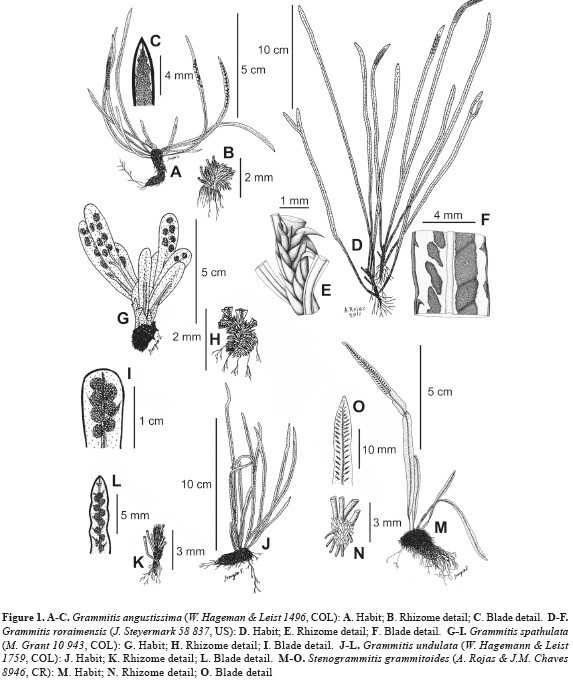
Diagnosis. Grammitis angustissima differs from G. bryophila (Maxon) F. Seym. by its narrower (1.5-2.5 mm broad vs. (3-) 4-7 mm) or (14-) 20-32 times longer than broad (vs. 7-17 times) and thicker (chartaceous vs. papyraceous to subchartaceous) blade with broader (0.1-0.2 mm broad vs. ca. 0.1 mm) blackish marginal ribbon, and not evident (vs. evident) veins in sterile portion (figure 1, A-C).
Grammitis roraimensis A. Rojas, sp. nov.
TYPE: VENEZUELA: Bolivar: summit of mount Roraima, on NW portion, N and NW of Summit camp, 2,620-2,740 m, 27 Sep 1944, J. Steyermark 58 837 (Holotype: US).
Nova species Grammitidi paramicola similis, sed frondibus magnioribus et rhizomatibus longi-ascendentibus separatur.
Terrestrial; rhizome ca. 1 mm in diam., long ascending to 4.5 cm long; rhizome scales 0.5-1.5 x 0.2-0.3 mm, lanceolate, 5-8 cells in broad at the base, entire at the apex; fronds 18- 27 cm long, erect, rigid; stipe 10-15 mm long, atropurpureous, winged and continuous with the blade, glabrous; blade 17-29 x 0.3-0.6 cm, linear-sphatulate to linear, chartaceous, acute at apex, glabrous, blackish marginal ribbon 0.2-0.3 mm broad, branched irregularly; main vein light green to brown, few evident abaxially, very evident dorsally; sterile veins single, inconspicuous, fertile veins single or bifurcate, few evident, oblique at 15-40° with respect to costa; sori 0.5-1.5 mm broad, oblong, confluent at maturity, present only in the 1/5 distal portion of the blade.
Distribution. Known only from the type collection.
Etymology. The specific epithet refers to its geographic distribution.
]]> Diagnosis. Grammitis roraimensis differs from G. paramicola L. E. Bishop by its longer (20-45 mm long vs. 3-10 mm) rhizome, longer (17-29 cm long vs. 2-7.5 cm) blade and branched (vs. no branched) blackish marginal ribbon (figure 1, D-F).Grammitis spathulata A. Rojas, sp. nov.
TYPE: COLOMBIA: Magdalena: Sierra de Perijá, Casacará Valley, 23 km E of Codazzi, 2 km from the Venezuelan border, 2,550 m, 12 Feb 1945, M. Grant 10 943 (Holotype: COL; Isotype: US).
Species haec nova stipem non exhibet, lamina foliaris sua glabra est. Per hos characteres nova species a Grammitidi marginella distinguenda est.
Epiphytic; rhizome 0,6-0,9 mm in diam., compact, ascending; rhizome scales 0.5-1.5 x ca. 0.3 mm, linear-lanceolate, 6-10 cells broad at the base, entire; fronds 2.2-5.5 cm long, erect; stipe absent; blade 0.4-0.8 cm broad, oblanceolate to spathulate, chartaceous, rounded at apex, glabrous in both surfaces, blackish marginal ribbon 0.2-0.3 mm broad; main vein dark brown to atropurpureous basally, light brown distally, evident abaxially, few evident adaxially; sterile and fertile veins single to bifurcate, few evident, oblique at 10-25° with respect to costa; sori 2.5-3.5 mm long, rounded to ovate, few times confluent at maturity, present in the 1/2 distal portion of the blade.
Distribution. Known only from the type collection.
Etymology. The specific epithet refers to its spathulate blade.
Diagnosis. Grammitis spathulata differs from G. marginella (Sw.) Sw. in its absent (vs. present) stipe and glabrous (vs. hairy) blade (figure 1, G-I). For the sessile fronds no other species are similar.
Grammitis undulata A. Rojas, sp. nov.
]]> Figure 1 J-LTYPE: COLOMBIA: Nariño-Junin: 5 km en dirección de Barbacoas, 1,000 m, 20 Dec 1972, W. Hagemann and Leist 1759 (Holotype: COL).
Nova species haec Grammitidi angustissimae affinis est, sed prior rhizomatis squamis brevioribus, lamina foliari tenuiora, in margine undulata, vitta marginali atropurpurea, angustiora, nervis patentibus in sterili parte foliorum distinguenda est.
Epiphytic; rhizome 0.5-0.7 mm in diam., compact, ascending; rhizome scales 0.5-1 x 0.1- 0.2 mm, linear-lanceolate, 4-7 cells in broad at the base, entire at margin; fronds (4-) 6.5-13 cm long, pendulous, flaccid; stipe (1-) 4-15 mm long, brown, glabrous; blade (4-) 6-11.5 x 0.15- 0.25 cm, linear, papyraceous to subchartaceous, glabrous in both surfaces, blackish marginal ribbon 0.5-0.1 mm broad; main vein dark brown to atropurpureous basally, light brown distally, evident abaxially, inconspicuous adaxially, not prominent in both sides; sterile and fertile veins single to bifurcate, few evident, oblique at 5-15° with respect to costa; sori 1-2 mm long, rounded to ovate, sometimes confluent at maturity, present in the 1/2 distal portion of the blade.
Distribution. Colombia, Andean Cordillera, at 600-1,000 m alt.
Etymology. The specific epithet refers to its undulate blade.
Paratype. COLOMBIA. Nariño: carretera Junin-Barbacoas, hacia Buena Vista, 600 m, 20 Dec 1972, W. Hagemann and Leist 1760 (COL).
Diagnosis. Grammitis undulata differs from G. angustissima A. Rojas by its smaller (0.5- 1(-1.5) x 0.1-0.2 mm vs. 2.5-3.5 x 0.3-0.5 mm) rhizome scales, undulate (vs. entire) and thinner (papyraceous vs. chartaceous) blade with narrower (0.05-0.1 mm broad vs. 0.1-0.2 mm) blackish marginal ribbon, main vein not prominent (vs. prominent) and secondary veins evident (vs. no evident) in sterile portion (figure 1, J-L).
StenoGrammitis grammitoides A. Rojas, sp. nov.
]]> TYPE: COSTA RICA: Puntarenas: Puntarenas, Parque Nacional Isla del Coco, orillas del Río Genio, Los Llanos, en el sendero a Cerro Iglesias, 5°32'05''N, 87°03'40''W, 240-260 m, 6 Jan 2010, A. Rojas y J. Chaves 8946 (Holotype: CR; Isotypes: MO, USJ).Nova species Cochlidio proctorii propinqua, sed laminae foliaris margine brunnea (ad vicem virescenti), sine pilis (ad vicem pilosa), soris mediis (ad vicem supracostalibus) et angulo 25°-40° (ad vicem 5°-15°) ad costam respectu inclinatis distinguenda.
Epiphytic; rhizome 0.4-0.7 mm in diam., compact ascending; rhizome scales 0.5-1 x 0.4-0.6 mm, ovate, clathrate, 5-8 cells in broad at the base, entire at the apex; fronds 4-11.5 cm long, erect; stipe absent or less than 2.5 mm long, atropurpureous, hairy, the hairs ca. 0.2 mm long, brown-gold, single or fasciculate; blade 4-11.5 x 0.3-0.5 cm, linear-elliptic to rarely linear, glabrous, without blackish margin or it less than 0.05 mm and brown, entire margin; main vein dark brown to blackish, hairy, the hairs 0.1-0.2 mm, single to fasciculate, sometimes bifurcate with a branch long and the other short; sterile and fertile veins single, inconspicuous, oblique at 25-40° with respect to costa; hydathodes 1-2 x 0.2-0.4 mm, oblong to elliptic, light green to brown; sori ca. 0.5 mm broad, 1-2 mm long, oblong, no confluent at maturity, present in the 1/3 distal portion of the blade.
Distribution. Costa Rica, known only from the type from Cocos Island.
Etymology. The specific epithet makes reference to its simple bade with oblique sori and sometimes a dark marginal blade ribbon same as in the genus Grammitis.
Diagnosis. StenoGrammitis grammitoides differs from other species of the genus because have entire blade, but is included here because have clathrate rhizome scales, inequilaterally branched costal hairs and hydathodes present. The new species differs from the Jamaican Cochlidium proctorii (Copel.) L.E. Bishop by its brown (vs. green) and entire (vs. repand) blade margins, without (vs. with) marginal hairs, medial (vs. supracostal) sori and they oblique at 25-40° (vs. 5-15°) with respect to costa (figure 1, M-O). Due to the relation of the new species with Cochlidium proctorii, probably the second need to be combined under the genus StenoGrammitis.
This species is an interesting element in the evolution of Cochlidium, Grammitis and StenoGrammitis. It resembles other species of Cochlidium, particularly those species with superficial sori, but it differs from them by having clathrate rhizome scales, thin and brown blade margin and markedly oblique sori. It also resembles Grammitis by its simple blade and inclined sori to the costa, but it differs by its small and clathrate rhizome scales, hydathodes present (vs. absent) and thinner (0.1 mm vs. 0.3- 0.5 mm) and brown (vs. blackish) blade margin. More studies are necessary to delimit the genera or to discover if more taxa are present.
ACKNOWLEDGMENTS
I thank to Carlos O. Morales (USJ) for translating the diagnosis to Latin, the curators of the herbaria of the Instituto de Ciencias Naturales- Universidad Nacional de Colombia (COL), the Museo Nacional de Costa Rica (CR), The Missouri Botanical Garden (MO) and the National Museum of Natural History Herbarium (US) for their authorization to review their specimens, to Sergio Villegas for the drawings and the anonymous reviewers for their helpful suggestions.
]]>REFERENCES
Bishop LE. 1977. The American species of Grammitis sect. Grammitis. American Fern Journal, 67: 101-106. [ Links ]
Copeland EB. 1952. Grammitis. Philippine Journal of Science, 80 (2): 93-276, t. 1-6. [ Links ]
Labiak PH 2011. StenoGrammitis, a new genus of grammitid ferns segregated from Lellingeria (Polypodiaceae). Brittonia, 63 (1): 139-149. [ Links ]
Maxon WR. 1915. Polypodium marginellum and its inmediate allies. Bulletin of the Torrey Botanical Club, 42 (4): 219-225. [ Links ]
]]>Moran RC, Smith AR. 1995. Grammitis. In: Moran RC, Riba R, editors. Flora Mesoamericana. Volumen 1. Psilotaceae a Salviniaceae. México D. F. (México): Universidad Nacional Autónoma de México. p. 375-376. [ Links ]
]]>