<?xml version="1.0" encoding="ISO-8859-1"?><article xmlns:mml="http://www.w3.org/1998/Math/MathML" xmlns:xlink="http://www.w3.org/1999/xlink" xmlns:xsi="http://www.w3.org/2001/XMLSchema-instance">
<front>
<journal-meta>
<journal-id>0304-3584</journal-id>
<journal-title><![CDATA[Actualidades Biológicas]]></journal-title>
<abbrev-journal-title><![CDATA[Actu Biol]]></abbrev-journal-title>
<issn>0304-3584</issn>
<publisher>
<publisher-name><![CDATA[Instituto de Biología, Universidad de Antioquia]]></publisher-name>
</publisher>
</journal-meta>
<article-meta>
<article-id>S0304-35842014000100002</article-id>
<title-group>
<article-title xml:lang="en"><![CDATA[Viability of Basidiomycete fungal strains under different conservation methods: cryopreservation vs. freeze-drying processes]]></article-title>
<article-title xml:lang="es"><![CDATA[Viabilidad de cepas de hongos Basidiomycetes bajo diferentes técnicas de conservación: procesos de crioconservación vs. liofilización]]></article-title>
</title-group>
<contrib-group>
<contrib contrib-type="author">
<name>
<surname><![CDATA[Palacio]]></surname>
<given-names><![CDATA[Ana]]></given-names>
</name>
<xref ref-type="aff" rid="A01"/>
<xref ref-type="aff" rid="A03"/>
</contrib>
<contrib contrib-type="author">
<name>
<surname><![CDATA[Gutiérrez]]></surname>
<given-names><![CDATA[Yessica]]></given-names>
</name>
<xref ref-type="aff" rid="A01"/>
<xref ref-type="aff" rid="A04"/>
</contrib>
<contrib contrib-type="author">
<name>
<surname><![CDATA[Rojas]]></surname>
<given-names><![CDATA[Diego]]></given-names>
</name>
<xref ref-type="aff" rid="A01"/>
<xref ref-type="aff" rid="A05"/>
</contrib>
<contrib contrib-type="author">
<name>
<surname><![CDATA[Atehortúa]]></surname>
<given-names><![CDATA[Lucía]]></given-names>
</name>
<xref ref-type="aff" rid="A01"/>
<xref ref-type="aff" rid="A02"/>
<xref ref-type="aff" rid="A06"/>
</contrib>
<contrib contrib-type="author">
<name>
<surname><![CDATA[Zapata]]></surname>
<given-names><![CDATA[Paola]]></given-names>
</name>
<xref ref-type="aff" rid="A01"/>
<xref ref-type="aff" rid="A02"/>
<xref ref-type="aff" rid="A07"/>
</contrib>
</contrib-group>
<aff id="A01">
<institution><![CDATA[,Universidad de Antioquia  ]]></institution>
<addr-line><![CDATA[Medellín Antioquia]]></addr-line>
<country>Colombia</country>
</aff>
<aff id="A02">
<institution><![CDATA[,Universidad de Antioquia Facultad de Ciencias Exactas y Naturales ]]></institution>
<addr-line><![CDATA[Medellín Antioquia]]></addr-line>
<country>Colombia</country>
</aff>
<aff id="A03">
<institution><![CDATA[,Universidad de Antioquia  ]]></institution>
<addr-line><![CDATA[ ]]></addr-line>
</aff>
<aff id="A04">
<institution><![CDATA[,Universidad de Antioquia  ]]></institution>
<addr-line><![CDATA[ ]]></addr-line>
</aff>
<aff id="A05">
<institution><![CDATA[,Universidad de Antioquia  ]]></institution>
<addr-line><![CDATA[ ]]></addr-line>
</aff>
<aff id="A06">
<institution><![CDATA[,Universidad de Antioquia  ]]></institution>
<addr-line><![CDATA[ ]]></addr-line>
</aff>
<aff id="A07">
<institution><![CDATA[,Universidad de Antioquia  ]]></institution>
<addr-line><![CDATA[ ]]></addr-line>
</aff>
<pub-date pub-type="pub">
<day>00</day>
<month>06</month>
<year>2014</year>
</pub-date>
<pub-date pub-type="epub">
<day>00</day>
<month>06</month>
<year>2014</year>
</pub-date>
<volume>36</volume>
<numero>100</numero>
<fpage>13</fpage>
<lpage>21</lpage>
<copyright-statement/>
<copyright-year/>
<self-uri xlink:href="http://www.scielo.org.co/scielo.php?script=sci_arttext&amp;pid=S0304-35842014000100002&amp;lng=en&amp;nrm=iso"></self-uri><self-uri xlink:href="http://www.scielo.org.co/scielo.php?script=sci_abstract&amp;pid=S0304-35842014000100002&amp;lng=en&amp;nrm=iso"></self-uri><self-uri xlink:href="http://www.scielo.org.co/scielo.php?script=sci_pdf&amp;pid=S0304-35842014000100002&amp;lng=en&amp;nrm=iso"></self-uri><abstract abstract-type="short" xml:lang="en"><p><![CDATA[Four basidiomycete fungi, Agaricus blazei Murrill (Agaricomycetideae), Ganoderma lucidum (W.Curt.: Fr.) P. Karst., Grifola frondosa (Dicks.: Fr.) S.F. Gray (Higher Basidiomycetes), and Pleurotus pulmonarius (Fr.) Quél. (Agaricomycetideae) were evaluated using three conservation methods for 12 months, recording their viability in order to establish the best conservation method. Growth kinetics, biomass, and polysaccharide production were studied. The conservation methods implemented included: distilled water at 24 &deg;C; sawdust and rice bran with 10% glycerol at -20 &deg;C; sawdust and rice bran with 10% glycerol at -80 &deg;C; and freeze-drying of biomass with trehalose or skimmed milk. After conducting the analysis of the results after 12 months of conservation, we determined that the distilled water treatment at 24 &deg;C was the best conservation method with the highest percentage of recoverability, at 83.3% during the 12th month, followed by the cryoconservation treatment at 80 &deg;C, where 75% were recovered with no negative effects on biomass and polysaccharide production. The -20 &deg;C and freeze-drying treatments were not effective; with cryoconservation at -20 &deg;C treatment, strain recovery only occurred during the first month and with freeze-drying it was not possible to recover any strains during the entire 12-month period evaluated.]]></p></abstract>
<abstract abstract-type="short" xml:lang="es"><p><![CDATA[Cuatro hongos basidiomycetes, Agaricus blazei Murrill (Agaricomycetideae), Ganoderma lucidum (W.Curt.: Fr.) P. Karst. y Grifola frondosa (Dicks.: Fr.) S.F. Gray (Higher Basidiomycetes), y Pleurotus pulmonarius (Fr.) Quél. (Agaricomycetideae) fueron evaluados bajo tres métodos de conservación durante 12 meses, observando su viabilidad con el fin de establecer el mejor método de conservación. La cinética de crecimiento, producción de biomasa y polisacáridos fueron estudiados. Los métodos de conservación implementados incluyeron: agua destilada a 24 &deg;C; aserrín y salvado de arroz con glicerol 10% a -20 &deg;C; aserrín y salvado de arroz con glicerol 10% a -80 &deg;C y; liofilización de biomasa con trehalosa o leche desnatada. Luego de realizar el análisis de los resultados de 12 meses de conservación, se determinó que el tratamiento de agua destilada a 24 &deg;C fue el mejor método de conservación con el porcentaje de recuperabilidad más alto un 83,3% en el mes 12, seguido por el tratamiento de crioconservación a - 80 &deg;C donde se recuperó el 75%, sin afectar negativamente la producción de biomasa y polisacáridos. El tratamiento a -20 &deg;C y la liofilización no fueron efectivos; con la crioconservación a -20 &deg;C solo se recuperaron cepas en el primer mes y con la liofilización no fue posible recuperar cepas en el período de 12 meses evaluado.]]></p></abstract>
<kwd-group>
<kwd lng="en"><![CDATA[Cryoconservation]]></kwd>
<kwd lng="en"><![CDATA[freeze-drying]]></kwd>
<kwd lng="en"><![CDATA[basidiomycete]]></kwd>
<kwd lng="en"><![CDATA[biomass]]></kwd>
<kwd lng="en"><![CDATA[exopolysaccharides]]></kwd>
<kwd lng="en"><![CDATA[intrapolysaccharides]]></kwd>
<kwd lng="es"><![CDATA[Crioconservación]]></kwd>
<kwd lng="es"><![CDATA[liofilización]]></kwd>
<kwd lng="es"><![CDATA[basidiomycetes]]></kwd>
<kwd lng="es"><![CDATA[biomasa]]></kwd>
<kwd lng="es"><![CDATA[exopolisacáridos]]></kwd>
<kwd lng="es"><![CDATA[intrapolisacáridos]]></kwd>
</kwd-group>
</article-meta>
</front><body><![CDATA[  <font size="2" face="Verdana, Arial, Helvetica, sans-serif">     <p align="right"> <b>RESEARCH PAPERS</b></p>     <p>&nbsp;</p>     <p align="center"><font size="4"><b>Viability of Basidiomycete fungal strains under different   conservation methods: cryopreservation vs. freeze-drying processes</b></font></p>     <p align="center">&nbsp;</p>     <p align="center"><font size="3"><b> Viabilidad de cepas de hongos Basidiomycetes bajo diferentes t&eacute;cnicas de conservaci&oacute;n: procesos de crioconservaci&oacute;n vs. liofilizaci&oacute;n</b></font></p>     <p>&nbsp;</p>     <p>&nbsp;</p>     <p><b> Ana Palacio<sup>1,3</sup>, Yessica Guti&eacute;rrez<sup>1,4</sup>, Diego Rojas<sup>1,5</sup>, Luc&iacute;a Atehort&uacute;a<sup>1,2,6</sup>, Paola Zapata<sup>1,2,7</sup></b></p>     <p>&nbsp;</p>     ]]></body>
<body><![CDATA[<p>1 Grupo de Investigaci&oacute;n de Biotecnolog&iacute;a. Sede de Investigaci&oacute;n Universitaria (SIU), Universidad de Antioquia. A. A. 1226. Medell&iacute;n (Antioquia), Colombia.</p>     <p> 2 Docente, Instituto de Biolog&iacute;a, Facultad de Ciencias Exactas y Naturales, Universidad de Antioquia. A. A. 1226. Medell&iacute;n (Antioquia), Colombia.</p>     <p> Correos electr&oacute;nicos: 3 <a href="mailto:anapa30@gmail.com">anapa30@gmail.com</a>; 4 <a href="mailto:ygl0317@gmail.com">ygl0317@gmail.com</a>; 5 <a href="mailto:diego.rojas@udea.edu.co">diego.rojas@udea.edu.co</a>; 6 <a href="mailto:latehor@gmail.com">latehor@gmail.com</a>;   7 <a href="mailto:paola.zapata@udea.edu.co">paola.zapata@udea.edu.co</a>.</p>     <p>&nbsp;</p>     <p>Recibido: octubre 2009;    aceptado: abril 2010. </p> <hr noshade size="1">     <p><b> Abstract</b></p>     <p>Four basidiomycete fungi, <i>Agaricus blazei</i> Murrill (Agaricomycetideae), <i>Ganoderma lucidum</i> (W.Curt.: Fr.) P. Karst.,   <i>Grifola frondosa</i> (Dicks.: Fr.) S.F. Gray (Higher Basidiomycetes), and <i>Pleurotus pulmonarius</i> (Fr.) Qu&eacute;l.   (Agaricomycetideae) were evaluated using three conservation methods for 12 months, recording their viability in   order to establish the best conservation method. Growth kinetics, biomass, and polysaccharide production were   studied. The conservation methods implemented included: distilled water at 24 &deg;C; sawdust and rice bran with 10%   glycerol at -20 &deg;C; sawdust and rice bran with 10% glycerol at -80 &deg;C; and freeze-drying of biomass with trehalose or   skimmed milk. After conducting the analysis of the results after 12 months of conservation, we determined that the   distilled water treatment at 24 &deg;C was the best conservation method with the highest percentage of recoverability,   at 83.3% during the 12th month, followed by the cryoconservation treatment at 80 &deg;C, where 75% were recovered   with no negative effects on biomass and polysaccharide production. The -20 &deg;C and freeze-drying treatments were   not effective; with cryoconservation at -20 &deg;C treatment, strain recovery only occurred during the first month and with freeze-drying it was not possible to recover any strains during the entire 12-month period evaluated.</p>     <p> <i><b>Key words:</b></i> Cryoconservation, freeze-drying, basidiomycete, biomass, exopolysaccharides, intrapolysaccharides.</p> <hr noshade size="1">     <p> <b>Resumen</b></p>     <p>Cuatro hongos basidiomycetes, <i>Agaricus blazei</i> Murrill (Agaricomycetideae), <i>Ganoderma lucidum</i> (W.Curt.: Fr.) P.   Karst. y <i>Grifola frondosa</i> (Dicks.: Fr.) S.F. Gray (Higher Basidiomycetes), y <i>Pleurotus pulmonarius</i> (Fr.) Qu&eacute;l.   (Agaricomycetideae) fueron evaluados bajo tres m&eacute;todos de conservaci&oacute;n durante 12 meses, observando su   viabilidad con el fin de establecer el mejor m&eacute;todo de conservaci&oacute;n. La cin&eacute;tica de crecimiento, producci&oacute;n de   biomasa y polisac&aacute;ridos fueron estudiados. Los m&eacute;todos de conservaci&oacute;n implementados incluyeron: agua destilada   a 24 &deg;C; aserr&iacute;n y salvado de arroz con glicerol 10% a -20 &deg;C; aserr&iacute;n y salvado de arroz con glicerol 10% a -80 &deg;C y;   liofilizaci&oacute;n de biomasa con trehalosa o leche desnatada. Luego de realizar el an&aacute;lisis de los resultados de 12 meses   de conservaci&oacute;n, se determin&oacute; que el tratamiento de agua destilada a 24 &deg;C fue el mejor m&eacute;todo de conservaci&oacute;n con   el porcentaje de recuperabilidad m&aacute;s alto un 83,3% en el mes 12, seguido por el tratamiento de crioconservaci&oacute;n a -   80 &deg;C donde se recuper&oacute; el 75%, sin afectar negativamente la producci&oacute;n de biomasa y polisac&aacute;ridos. El tratamiento a   -20 &deg;C y la liofilizaci&oacute;n no fueron efectivos; con la crioconservaci&oacute;n a -20 &deg;C solo se recuperaron cepas en el primer mes y con la liofilizaci&oacute;n no fue posible recuperar cepas en el per&iacute;odo de 12 meses evaluado.</p>     ]]></body>
<body><![CDATA[<p> <i><b>Palabras clave:</b> Crioconservaci&oacute;n, liofilizaci&oacute;n, basidiomycetes, biomasa, exopolisac&aacute;ridos, intrapolisac&aacute;ridos.</i></p> <hr noshade size="1">     <p>&nbsp;</p>     <p>&nbsp;</p>     <p><font size="3"><b>INTRODUCTION</b></font></p>     <p>Recently, the use of microorganisms for the production of the   commodity service industry and environmental control has   become an alternative for the sustainable development of   technologies. In this field the use of basidiomycetes is of great   importance due to its wide range of applications including   bioremediation, enzyme production, degradation of   Lignocellulosic residues (Cohen et al. 2002, S&aacute;nchez 2009,   Seto et al. 1999), pharmaceutical products development and functional foods design (Ghorai et al. 2009).</p>     <p> The increase in industrial applications that involves these   types of basidiomycete species implies the establishment of   techniques for the optimization in the use of resources and   yield for industrial products such as biomass, polysaccharides,   proteins, enzymes and others; therefore is necessary the   application of ex-situ conservation protocols in order to   preserve for a long time, not only the viability but also the   morphological, physiological and genetic characteristics (Day   and Stacey 2007). The factors involved in the maintenance   process often cause loss yield or poor quality of the product, as   it has been the case for the production of these fungi over the   last few years. Hence, there is a market pressure to improve the   yield and quality of the edible fungi currently produced, and to   increase studies for the formulation of appropriate substrates,   culture conditions and conservation process for these species   (Homolka et al. 2007).</p>     <p> In order to continue originating innovative proposals based in   the basidiomycete species that are currently being used, and   also with other potential species as the ones reported for   Colombia; 272 species recorded (Franco and Uribe 2000) with   119 species only in the Amazon region (Vasco et al. 2005); in   this work different methods for conservation of four different   basidiomycetes of industrial interest were evaluated (Zhong   and Tang 2004).</p>     <p> Because of their medicinal, functional, and industrial uses, the   fungi <i>Agaricus blazei</i> Murrill (Agaricomycetideae),   <i>Ganoderma lucidum</i> (W.Curt.: Fr.) P. Karst. and <i>Grifola   frondosa</i> (Dicks.: Fr.) S.F. Gray (Higher Basidiomycetes), and   <i>Pleurotus pulmonarius</i> (Fr.) Qu&eacute;l. (Agaricomycetideae) have   been broadly studied (Zhang et al. 2007). These species are   characterized for their content of &#946;-D glucans &#946;(1&rarr;3), &#946;(1&rarr;6), proteoglycans, triterpenes (ganoderic acids, ganodermanotriol, and ganoderiol), phenolic compounds, among others, that have a wide variety of activities as immunostimulating, hypoglycemic, antifungal, antiviral antibacterial, anti-inflammatory, antiallergenic, antioxidant, and cholesterol-lowering (Chen and Seviour 2007, Chen et al. 2012, Gunde-Cimerman et al. 1993a, b, Gunde-Cimerman and Cimerman 1995, Illana-Esteban 2008, Kodama et al. 2003, Lavi et al. 2010, Lindequist et al. 2005, Soares et al. 2009, Zhang et al. 2002).</p>     <p> In order to guarantee viability for these microorganisms,   various procedures have been carried out allowing the   management of strains and at the same time saving funds since   there is no need to acquire new strains, by subculturing or   serial transferring, which is frequently used as a routine   method for preservation of fungi. However, it is not practical   for storing large numbers of cultures. Also, it is timeconsuming,   more susceptible of contamination and does not   prevent genetic and physiological changes during long-term   storage (Homolka et al. 2001, 2007, Kitamoto et al. 2002, Mata   and P&eacute;rez 2003).</p>     <p> Different methods have been developed in order to eliminate   these disadvantages like the storing of agar disks in sterile   distilled water or mineral oil storing at 15 &deg;C with paraffin,   storing in liquid nitrogen and freeze-drying, commonly used in   the preservation of fungi (Homolka et al. 2007, Kitamoto et al.   2002, Voyron et al. 2009); nevertheless, it is necessary to point   out that although storing in liquid nitrogen can guarantee   stability, it can be just as laborious as subculturing since   samples have to be submitted to a specific freezing rate   depending on the species until reaching a temperature of -40 &deg;C   in order to be kept at -196 &deg;C without any collateral effect for   the microorganism, it also involves higher costs and the results   are variable depending on some factors like age of the mycelia,   mycelia matrix, presence or absence of cryoprotector agents,   type of cryoprotector, thawing temperatures, etc. (Homolka et   al. 2007, Kitamoto et al. 2002).</p>     ]]></body>
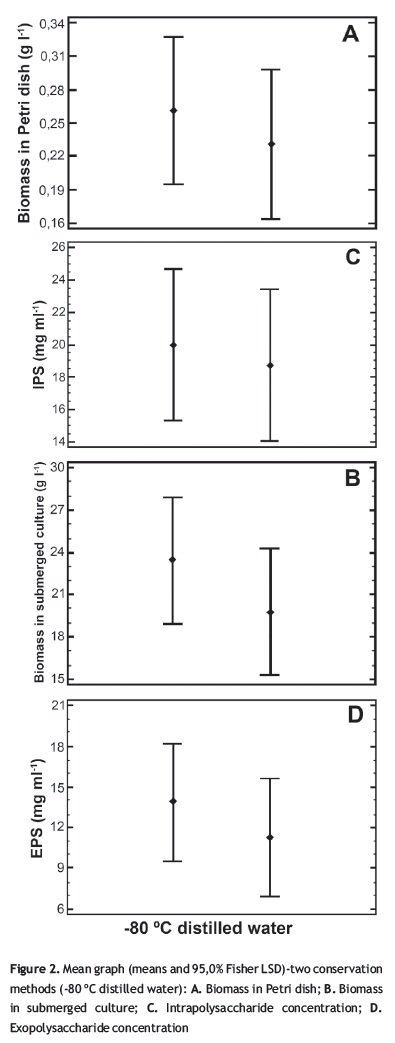
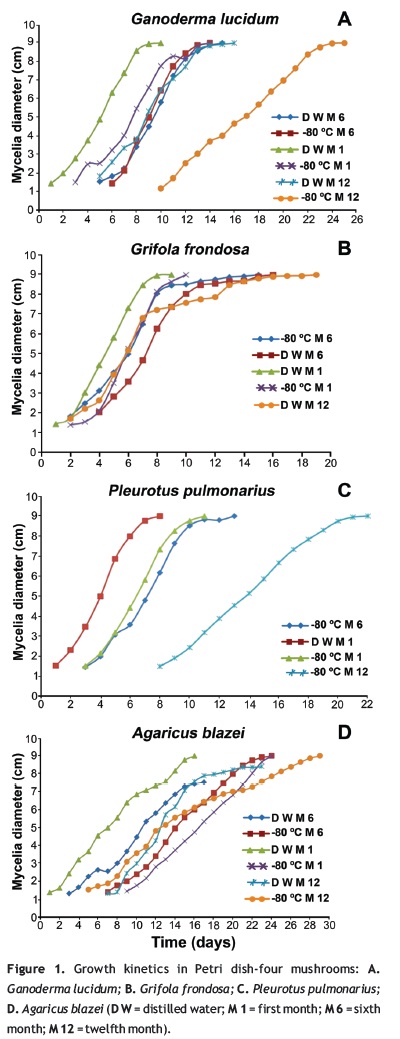
<body><![CDATA[<p> Besides the above mentioned methods, there are others that   have been applied to fungal strains but need to be more studied   in order to standardize protocols that could give the required   stability; methods as freeze-drying and deep freezing within   the range of -70/ -85 &deg;C, in several cases, have demonstrated to   be efficient in the recovery and specific characteristics as   growth rate, enzymatic activity and high genetic stability   (Kitamoto et al. 2002, Voyron et al. 2009). Experiments have   been undertaken already in which some basidiomycete species   were frozen at -85 &deg;C for 10 years managing to survive; even   the strains evaluated were able to produce fruiting bodies after   three months of strain recovery and after having intervals of   freezing and thawing of six months in the conservation time   (Kitamoto et al. 2002).</p>     <p> Because a well-established method for some basidiomycetes   using freeze-drying does not exist yet, further experimentation   is required in order to determine the effectiveness and   feasibility since the results can be seriously affected by the   variations in the protocol, like the type of suspension solution   used for the process and the perfusion time prior to freezing   (Homolka et al. 2001, Singh et al. 2004, Voyron et al. 2009).</p>     <p> Several factors affect the effectiveness of the preservation   process, strain, preservation temperature, composition of the   growth media, time storage, and cryoconservation/freezedrying   protecting agent (like glycerol, dimethyl sulfoxide,   bovine albumin serum, skimmed milk, ethylene glycol   sorbitol, and trehalose or myo-inositol). Few microorganisms   can survive after the preservation process without a protecting   agent; these agents can provide a longer storage time, avoiding   cellular injuries (Hub&aacute;lek 2003).</p>     <p> Based on the above background, the aim of this work, was to   analyze non-conventional, practical and economical methods   for basidiomycete strain conservation using the fungi A<i>.   blazei, G. lucidum, G. frondosa, and P. pulmonarius</i> as models   with the purpose of establishing the best conservation method   that provides an affordable procedure for later use. This project   included the evaluation of the growth kinetics, biomass   exopolysaccharides (<b>EPS</b>) and intrapolysaccharides (<b>IPS</b>)   production of each fungi after 12 months of conservation; the   treatments were distilled water at 24 &deg;C, sawdust and rice bran   with 10% glycerol at -20 &deg;C, sawdust and rice bran with 10%   glycerol at -80 &deg;C, and freeze-drying of biomass with trehalose   or skimmed milk.</p>       <p>&nbsp;</p>     <p><font size="3"><b>MATERIALS Y METHODS</b></font></p>     <p> <b>Strain maintenance</b>. Spawn of four basidiomycete fungi, <i>A.   blazei, G. lucidum, G. frondosa</i>, and <i>P. pulmonarius</i>, were   provided by the Plant Biotechnology Research Group of the   University of Antioquia. The strains were maintained in a   standardized media for fungi called as <b>MGL1</b> designed in the   group which consists of (in g l<sup>-1</sup>): Barley flour-30, yeast   extract-3, saccharose-5.3 and agar-8 with a pH of 5.5 &plusmn; 0.1 (Zapata et al. 2009).</p>        <p> <b>Evaluation of conservation method</b>. Conservation methods   used in this research were distilled water at room temperature   (24&deg;C), cryoconservation, and freeze-drying. The treatments   were evaluated during a period of 12 months.</p>     <p> <i>Distilled water treatment</i>. Mycelial agar disks of 1 cm of   diameter were removed from the margin of an actively   growing colony and transferred to 2 ml vials with 1 ml sterile   distilled water and kept at 24 &plusmn; 1 &deg;C, made as a triplicate for   further analysis after 1, 6, and, 12 months of conservation. For   recovery of strains, mycelia agar disks were directly   Inoculated in MGL1 agar and incubated at 24 &plusmn; 1 &deg;C under   darkness conditions for 15 days.</p>     <p> <i>Cryoconservation processes:</i> <i>-20 and -80 &deg;C</i>. Mycelial agar   disks of 1 cm of diameter were removed from the margin of an   actively growing colony and transferred to 2 ml vials to be   cryoconserved in 0.05 g of sawdust and 0.05 g of rice bran   using 1 ml of 10% glycerol as cryoprotective agent (Kitamoto   et al. 2002). Vials were stored at -20 &deg;C. Each essay was made   as a triplicate for further analysis after 1, 6, and 12 months of   conservation; the same methodology was employed for the   vials stored at -80 &deg;C. For recovery, vials were thawed at 24 &plusmn;   1&deg;C, inoculated in MGL1 agar and incubated under darkness   conditions for 15 days.</p>     ]]></body>
<body><![CDATA[<p> <i>Freeze-drying process.</i> Mycelial agar disks of 1 cm of   diameter were removed from the margin of an actively   growing colony and inoculated in 65 ml of MGL1 under   submerged culture conditions, the media consisted of (g l<sup>-1</sup>):   Barley flour-50, NaNO<sub>3</sub>-0.08, MgSO<sub>4</sub>.7H<sub>2</sub>O-0.02, KCl-0.01 y    KH<sub>2</sub>PO<sub>4</sub>-0.03; pH 5.5 &plusmn; 0.1 (Zapata et al. 2009). After 12 days   of incubation, 10 ml of media culture with biomass were   disposed in conical tubes with 5 ml of 10% skimmed milk (p/v)   or 10% trehalose (p/v) depending on the sample to be freezedried   (Voyron et al. 2009). Each essay was made as a triplicate   for further analysis after 1, 6, and 12 months of conservation.</p>     <p> For recovery 5 mg of freeze-dried biomass were resuspended   in 5 ml of distilled water for 1 h at 24 &plusmn; 1 &deg;C. Then, fragments   extracted from each sample were inoculated in MGL1 agar at   24 &plusmn; 1 &deg;C under darkness conditions for 15 days.</p>     <p> <b>Evaluation of strain viability</b>. <i>Determination of the growth   rate and biomass production in Petri dish</i>. The measurement   of mycelial growth was made by method described by Donini   et al. 2006 modified by the authors, using a millimetrical ruler   for the measurement of growth diameter in Petri dish in four   directions every 24 hours during the period of incubation until   the mycelia invaded all the media in the dish (Donini et al.   2006).</p>     <p> After the last measurement, the agar and mycelia contained in   each Petri dish were placed in boiling water in order to separate   the fungal biomass of the agar. The biomass was then dried in   an oven at 70 &deg;C until constant weight was reached. The results   were registered in g per petri dish (Donini et al. 2006).</p>     <p> <i>Determination of the biomass production, EPS, and IPS in   submerged culture. Biomass production.</i> Mycelial agar disks   from the recovered strains were subcultured in MGL1 agar;   from the subcultured strains 250 ml flasks containing 63 ml of   MGL1 liquid media were inoculated with mycelial agar disks   of 1 cm of diameter, these cultures were incubated at 100 rpm,   24 &plusmn; 1 &deg;C and light periods of 12 h for 12 days (Zapata et al.   2009).</p>     <p> The biomass obtained from each flask was filtered with a mesh   sieve # 35 (Grand Test&reg;), then, washed with abundant distilled   water and finally the biomass was dried in an oven at 70 &deg;C   until constant weight was obtained (Tang and Zhong 2002).</p>     <p> Extraction of polysaccharides (EPS and IPS). IPS   extraction was made from 1 g of dry biomass, polysaccharides   were extracted with boiling water for 20 min, the solution was   immediately filtered with filter paper of &Oslash; 125 mm   (Whatman&reg;), 4 volumes of 96% ethanol were added to this   solution and this mix was kept at 4 &deg;C for at least 1 h; finally this   mix was centrifuged at 4.000 rpm at -4 &deg;C for 20 min, the   supernatant was discarded and the pellet was diluted in 5 ml of   distilled water (Tang and Zhong 2002).</p>     <p>  For EPS extraction the filtered media was centrifuged at 2.500   rpm at 25 &deg;C to eliminate suspended solids, 10 ml of the   supernatant were taken and 4 volumes of 96% ethanol were   added. From here, the same protocol for IPS was performed in   order to get the polysaccharide extract.</p>     <p> <b>Quantification of polysaccharides</b>. Colorimetric method of   phenol-sulfuric acid reported by Dubois et al. (1956) and   modified by Masuko et al. (2005), was followed for IPS and   EPS quantification. The measurement of the samples was   made in microplate format (Dubois et al. 1956, Masuko et al.   2005).</p>     <p> <b>Experimental design</b>. The experimental design applied was a   multifactor ANOVA, completely randomized with 3 replicates   per treatment; two factors were evaluated, preservation   method, and species with the purpose of determining if there   was any difference in the mean of biomass and   polysaccharides production after 12 days of culture. The   design was evaluated with the software StatGraphics   Centurion XV&reg;.</p>       ]]></body>
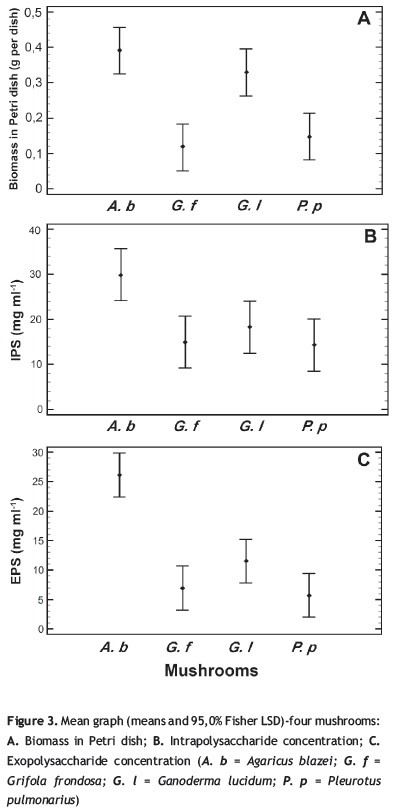
<body><![CDATA[<p>&nbsp;</p>     <p><font size="3"><b>RESULTS</b></font></p>     <p> Each strain submitted to evaluation was recovered after 1, 6,   and 12 months of conservation, -20 &deg;C method only shown   recovery of 3 from 4 fungi in the first month, with no   representative data (data not shown). For the freeze-dried   samples, loss of the strain viability was observed. According to   these facts only distilled water method and cryoconservation   method at -80 &deg;C were suitable for analysis.</p>     <p> The different conservation methods as well as the conservation   time have an influence in the growth kinetics. This could be   observed because the mycelia development had a retarded   growth in the -80 &deg;C method compared with the distilled water   method (<a href="#f1">figure 1</a>). However, for the present work this does not   imply a negative effect since the number of days in which the   petri dish was invaded was similar and equal in some cases for   both methods. This type of results could be confirmed with the   values of biomass and polysaccharide production that, in some   cases, were bigger for the -80 &deg;C method, and there were few   cases in which lower concentration was obtained without   major divergence (<a href="#f2">figure 2</a>).</p>       <p align="center"><a name="f1"></a><img src="/img/revistas/acbi/v36n100/v36n100a2f1.jpg"></p>     <p>&nbsp;</p>     <p align="center"><a name="f2"></a><img src="/img/revistas/acbi/v36n100/v36n100a2f2.jpg"></p>     <p>&nbsp;</p>     <p> In order to verify which was the best method, a multifactor   ANOVA was performed with a p value <u>&lt;</u> 0.05 employing the   results obtained for the 12th month. The analysis shows that   there is no significant statistical difference for the preservation   method factor for all response variables: biomass in Petri dish,   IPS, EPS, and biomass in submerged culture with p values of   0.4961; 0.7502; 0.3128, and 0.3631, respectively. However,   for the species factor there are significant statistical   differences, except for biomass in submerged culture, with pvalues   for biomass in Petri dish, IPS, and EPS of 0.0006,   0.0377, and 0.0001 respectively; this is clear when observing   the behavior of the fungi <i>A. blazei </i>whose mean values were   major than those shown for the rest of the fungi in three of the   four variables (<a href="#f3">figure 3</a>) and also in the cases of<i> P. pulmonarius</i>.</p>       <p align="center"><a name="f3"></a><img src="/img/revistas/acbi/v36n100/v36n100a2f3.jpg"></p>     ]]></body>
<body><![CDATA[<p>&nbsp;</p>     <p><font size="3"><b>DISCUSSION</b></font></p>     <p>  Initially it is important to mention, that the ability of fungi cells   to resist different conservation methods like cryoconservation   and freeze-drying may be affected by factors such as the age   and physiological state of the hyphae, as well as the nature of   cytoplasmic contents (Mata and Rodr&iacute;guez 2005).</p>     <p> In the analysis of results it was observed that the -80 &deg;C   temperature showed improved results when compared with the   -20 &deg;C temperature; a feasible reason for these results, is that at   -80 &deg;C cells can be better preserved, since for some fungi a high   freezing rate might not lead to ice crystal formation (Smith   1983). In the work published by Morris et al. (1988), the fungi   <i>Lentinus edodes, Serpula lacrymans, Sporobolomyces roseu,</i>   and <i>Volvariella volvacea</i> did not formed crystals at a freezing   rate of -100 &deg;C min<sup>-1</sup>; in the case of <i>Serpula lacrymans</i> a rate of   0.5 &deg;C min<sup>-1</sup> to -40 &deg;C and then rapid cooling to -196 &deg;C gave   much higher recoveries than freezing to -196 &deg;C at a cooling   rate of 1 &deg;C min<sup>-l</sup> (Morris et al. 1988), the growth of these ice   crystals formed during cooling can be a key factor promoting   cell damage during freezing and thawing procedures (Morris   et al. 1988). These are other reasons for the lack of good results   at -20 &deg;C temperature; the quantity of formed crystals in this   method could have been higher since the freezing rates were   lower.</p>     <p> In general, the -80 &deg;C method was a good treatment and   allowed the recovery of the fungi; only in the last month a   single experimental unit was recovered for <i>G. frondosa</i>, then it   is feasible that, in the cases of non-recovered samples, the bond   formed between matrix and mycelia was not strong enough, as   several authors have reported about the use of immobilization   techniques for cryoconservation using different matrixes like   alginate beads, silica gel, minerals as perlite and sorghum seed   invaded with mycelia ''spawn'' (Homolka et al. 2006, 2007,   Mata and P&eacute;rez 2003, Ryan 2001, Sharma and Smith 1999); in   data reported by Mata and P&eacute;rez (2003); it is also shown that   even better results were obtained when cryoconservation of   spawn was made without a cryoprotectant or water and hyphae   could grow from the seed hilium or from fissures on the surface   of the seeds. These immobilization techniques can represent an   alternative in the protection of fungal hyphae from mechanical   damage like crystal formation; at the same time a matrix can   serve as substrate before and after freezing. In the present work   fungal hyphae growth in the Petri dish occurred not only from   the agar disk but also from pieces of sawdust inoculated in the   media; this confirms that having only agar as a matrix might   not be suitable for attachment of the mycelia in the   preservation process, which was the case of this work, since it   could be observed that after the freezing this material   disintegrated, which made the recovery of the mycelia for a   new inoculation process very difficult.</p>     <p> Based on the statistical analysis, it could be inferred that the   preservation in distilled water was the best method for <i>A.   blazei, G. lucidum</i>, and <i>G. frondosa</i>, which implies that this   method is reliable, trustworthy, simple, and very economic;   these conclusions can be supported by the work made by   Burdsall et al. (1994) that evaluated 151 basidiomycete   species, where 94% of the isolated strains were viable after   being kept in water during seven years (Burdsall et al. 1994). In   our case 83.3% of recovery in the 12th month was   accomplished in the distilled water method; a higher   percentage compared with the obtained by cryoconservation at   -80 &deg;C in which 75% was recovered; however, it is essential to   highlight that for <i>P. pulmonarius</i> the last one mentioned, was   the most proper method and it further becomes an alternative   when there is no access to cryoconservation in liquid nitrogen   since this one implies more costs and it is labor intensive   because a freezing rate needs to be established; moreover a   feasible reason for the absence of growth of this strain when   conserved in distilled water is that the moisture requirements   probably were higher and combined with possible evaporation   resulted in depletion of water which was not enough for this   conservation period.</p>     <p> The effect of the different conservation methods on   polysaccharide production is a new report, since the majority   of the research that has been done at the moment focuses in   recovery rate, growth rate and enzymatic activity like response   variables (Voyron et al. 2009, Homolka et al. 2010). In this   work was possible to establish that the polysaccharide   production was not negatively affected in a significant way for   all the species and treatments, except for <i>P. pulmonarius</i> in   distilled water; contrary, a rise was observed with values of   (mg/ml) 18.29; 14.94; 29.94 of IPS and 11.50; 6.977; 26.11 of   EPS for <i>G. lucidum, G. frondosa, A. blazei,</i> respectively   (<a href="#f3">figure 3</a>), compared with data reported by other authors with   values of (mg/ml) 4.74; 1.3; 1.40 of IPS and 10.5; 7.2; 5.08 of   EPS for <i>G. lucidum, G. frondosa, A. blazei,</i> respectively (Bae   et al. 2005, Cao et al. 2010, Papinutti 2010, Tang et al. 2011,   Zou 2005), no reports to date for comparison of IPS and EPS   production of<i> P. pulmonarius</i> were found. Most of the higher   values presented were obtained in IPS production, this could   have occurred as a response after the treatments to adverse   conditions of low temperature, lack of nutrients or water   activity for proper metabolism and development; which could   be reflected in subsequent cultures in solid and liquid media of   the recovered strains; therefore it could be inferred that this can   be a mechanism to protect mycelium from any injury   accumulating IPS and secreting EPS with values above the   normal yields obtained when growing actively. Although there   are hardly few reports of effect of preservation methods in   fungi polysaccharide production, these results can be   compared with the behavior of another fungal organism like   yeast, in which polysaccharide accumulation has been   reported in stress conditions, and it has been reported as well   that polysaccharides of these kinds of organisms have   cryoprotective effects (Breierov&aacute; 1992, Papinutti 2010).</p>     <p> Another possible reasons for this rise could be first of all   related with the production of antifreeze substances, among   which proteins and glycoproteins can be found; in some   basidiomycete fungi as <i>Coprinus psychromorbidus,   Flammulina populicola, Lentinus edodes</i>, and<i> Typhula   ishikariensis</i>, it has already been reported the presence of   antifreeze proteins, in the case of the fungi studied it would be   interesting to analyze if there are any glycoproteins with this   function, specially for <i>A. blazei</i> that presented the highest   production of polysaccharides, and can be considerated like a   way to obtain an overproducing polysaccharides strain   (Hoshino et al. 2003, Raymond and Janech 2009).</p>     <p> Regarding the Freeze-drying method, it demonstrated to be   inappropriate for all the strains under the applied conditions,   since they were not viable; this could be confirmed in the first   recovery, in which after one month of incubation the wet   mycelia was unable to multiply, confirming thereby   importance of water activity in the stability of vegetative   mycelia, this was the case of the developed assays, where the   whole process of freeze-drying was carried out by starting   from biomass obtained from submerged culture to develop the   assay; in this state the fungi that were evaluated do not form   spores; and, only these structures, in the case of most of   basidiomycete fungi, are capable of supporting these extreme   and adverse dehydration conditions; However, there are few   cases, like the mycorrhizal forming fungi that have managed to   resist the hard conditions and survive successfully (Tan and   Stalpers 1991).</p>     <p> Although freeze-drying could be used as one of many methods   for the conservation of filamentous fungi, it is important to   consider that in order to obtain an optimal viability without   collateral damage, a strict protocol is needed; not only in terms   of selecting and using the right protective agent at the moment   of freeze-drying, but also a proper selection of an intracellular   accumulation agent during the incubation time for diminishing   the crystal formation process; moreover, it is relevant to   establish a freezing rate prior to the process and also to control   the drying rate. Therefore, several specific conditions and   large processes of standardization of the methodology are   required to achieve a useful technique without secondary   effects (Croan 2001, Smith 1993).</p>     ]]></body>
<body><![CDATA[<p> According with all results, we suggest using distilled water as a   conservation method since it gave the highest percentage of   recoverability (83.3%), for its practicality and the possibility   to diminish costs related with chemicals and equipment;   however for specific cases as the one presented for the fungi <i>P.   pulmonarius</i> cryoconservation at -80 &deg;C is suggested.</p>     <p>&nbsp;</p>     <p><font size="3"> <b>ACKNOWLEDGMENTS</b></font></p>     <p> Special acknowledgement to the Committee for Research   Development of the University of Antioquia (<b>CODI</b>)   responsible for the financial support of the project and to the   PREMEX S. A. and Productora y Comercializadora de   Alimentos S. A. (<b>PCA</b>) companies as well as the governmental   entity, COLCIENCIAS for funding the project 1115-489-25308, Contract 629-2009, and to the Universidad de   Antioquia and the Division of Sustainability of the Committee   for Research Development of the Universidad de Antioquia   (<b>CODI</b>) (Estrategia de Sostenibilidad 2013-2014).</p>     <p>&nbsp;</p>     <p><font size="3"> <b>REFERENCES</b></font></p>     <!-- ref --><p> Breierov&aacute; E, Kockov&aacute;-Kratochilov&aacute; A. 1992. Cryoprotective effects of yeast   extracellular polysaccharides and glycoproteins. Cryobiology, 29 (3):   385-390.    &nbsp;&nbsp;&nbsp;&nbsp;&nbsp;&nbsp;&nbsp;&nbsp;[&#160;<a href="javascript:void(0);" onclick="javascript: window.open('/scielo.php?script=sci_nlinks&ref=000079&pid=S0304-3584201400010000200001&lng=','','width=640,height=500,resizable=yes,scrollbars=1,menubar=yes,');">Links</a>&#160;]<!-- end-ref --></p>     <!-- ref --><p> Burdsall H, Dorworthl E. 1994. Preserving cultures of wood-decaying   Basidiomycotina using sterile distilled water in cryovials. Mycologia,   86 (2): 275-280.    &nbsp;&nbsp;&nbsp;&nbsp;&nbsp;&nbsp;&nbsp;&nbsp;[&#160;<a href="javascript:void(0);" onclick="javascript: window.open('/scielo.php?script=sci_nlinks&ref=000081&pid=S0304-3584201400010000200002&lng=','','width=640,height=500,resizable=yes,scrollbars=1,menubar=yes,');">Links</a>&#160;]<!-- end-ref --></p>     ]]></body>
<body><![CDATA[<!-- ref --><p> Cao XH, Yang QW, Lu MF, Hou LH, Jin YY, Yuan J, Wang CL. 2010.   Preparation and anticoagulation activity of a chemically sulfated   polysaccharide (S-Gfb) obtained from <i>Grifola frondosa</i>. Journal of   Food Biochemistry, 34 (5): 1049-1060.    &nbsp;&nbsp;&nbsp;&nbsp;&nbsp;&nbsp;&nbsp;&nbsp;[&#160;<a href="javascript:void(0);" onclick="javascript: window.open('/scielo.php?script=sci_nlinks&ref=000083&pid=S0304-3584201400010000200003&lng=','','width=640,height=500,resizable=yes,scrollbars=1,menubar=yes,');">Links</a>&#160;]<!-- end-ref --></p>     <!-- ref --><p> Chen J, Seviour R. 2007. Medicinal importance of fungal &#946; (13), &#946; (16)   glucans. Mycological Research, 111 (6): 635-652.    &nbsp;&nbsp;&nbsp;&nbsp;&nbsp;&nbsp;&nbsp;&nbsp;[&#160;<a href="javascript:void(0);" onclick="javascript: window.open('/scielo.php?script=sci_nlinks&ref=000085&pid=S0304-3584201400010000200004&lng=','','width=640,height=500,resizable=yes,scrollbars=1,menubar=yes,');">Links</a>&#160;]<!-- end-ref --></p>     <!-- ref --><p> Chen SY, Ho KJ, Hsieh YJ, Wang LT, Mau JL. 2012. Contents of lovastatin, &#947;-   aminobutyric acid and ergothioneine in mushroom fruiting bodies and   mycelia. LWT - Food Science and Technology, 47 (2): 1-5.    &nbsp;&nbsp;&nbsp;&nbsp;&nbsp;&nbsp;&nbsp;&nbsp;[&#160;<a href="javascript:void(0);" onclick="javascript: window.open('/scielo.php?script=sci_nlinks&ref=000087&pid=S0304-3584201400010000200005&lng=','','width=640,height=500,resizable=yes,scrollbars=1,menubar=yes,');">Links</a>&#160;]<!-- end-ref --></p>     <!-- ref --><p> Cohen R, Persky L, Hadar Y. 2002. Biotechnological applications and   potential of wood-degrading mushrooms of the genus Pleurotus.   Applied Microbiology and Biotechnology, 58 (5): 582-594.    &nbsp;&nbsp;&nbsp;&nbsp;&nbsp;&nbsp;&nbsp;&nbsp;[&#160;<a href="javascript:void(0);" onclick="javascript: window.open('/scielo.php?script=sci_nlinks&ref=000089&pid=S0304-3584201400010000200006&lng=','','width=640,height=500,resizable=yes,scrollbars=1,menubar=yes,');">Links</a>&#160;]<!-- end-ref --></p>     <!-- ref --><p> Croan SC. 2001. Preservation of hyphal-forming brown- and white-rot woodinhabiting   Basidiomycetes. Stockholm (SW): International Research   Group on Wood Protection. Conference: 01-05-20/25 Nara, Japan.   IRG/WP 01-10397.    &nbsp;&nbsp;&nbsp;&nbsp;&nbsp;&nbsp;&nbsp;&nbsp;[&#160;<a href="javascript:void(0);" onclick="javascript: window.open('/scielo.php?script=sci_nlinks&ref=000091&pid=S0304-3584201400010000200007&lng=','','width=640,height=500,resizable=yes,scrollbars=1,menubar=yes,');">Links</a>&#160;]<!-- end-ref --></p>     ]]></body>
<body><![CDATA[<!-- ref --><p> Day JG, Stacey GN. 2007. Cryopreservation and freeze-drying protocols. 2nd   ed. Totowa, NJ (U. S. A.): Humana Press. p. 347.    &nbsp;&nbsp;&nbsp;&nbsp;&nbsp;&nbsp;&nbsp;&nbsp;[&#160;<a href="javascript:void(0);" onclick="javascript: window.open('/scielo.php?script=sci_nlinks&ref=000093&pid=S0304-3584201400010000200008&lng=','','width=640,height=500,resizable=yes,scrollbars=1,menubar=yes,');">Links</a>&#160;]<!-- end-ref --></p>     <!-- ref --><p> Donini LP, Bernardi E, Soares J. 2006. Desenvolvimiento in vitro de Agaricus   blasiliensis em meios suplementados com diferentes farelos. Pesquisa   Agropecu&aacute;ria Brasileira, 41 (6): 995-999.    &nbsp;&nbsp;&nbsp;&nbsp;&nbsp;&nbsp;&nbsp;&nbsp;[&#160;<a href="javascript:void(0);" onclick="javascript: window.open('/scielo.php?script=sci_nlinks&ref=000095&pid=S0304-3584201400010000200009&lng=','','width=640,height=500,resizable=yes,scrollbars=1,menubar=yes,');">Links</a>&#160;]<!-- end-ref --></p>     <!-- ref --><p> Dubois M, Gilles K, Hamilton J, Rebers P, Smith F. 1956. Colorimetric   method for determination of sugar and related substances. Analytical   Chemistry, 28 (3): 350-356.    &nbsp;&nbsp;&nbsp;&nbsp;&nbsp;&nbsp;&nbsp;&nbsp;[&#160;<a href="javascript:void(0);" onclick="javascript: window.open('/scielo.php?script=sci_nlinks&ref=000097&pid=S0304-3584201400010000200010&lng=','','width=640,height=500,resizable=yes,scrollbars=1,menubar=yes,');">Links</a>&#160;]<!-- end-ref --></p>     <!-- ref --><p> Franco A, Uribe E. 2000. Hongos Agaricales y Boletales de Colombia. Biota   Colombiana, 1 (1): 25-43.    &nbsp;&nbsp;&nbsp;&nbsp;&nbsp;&nbsp;&nbsp;&nbsp;[&#160;<a href="javascript:void(0);" onclick="javascript: window.open('/scielo.php?script=sci_nlinks&ref=000099&pid=S0304-3584201400010000200011&lng=','','width=640,height=500,resizable=yes,scrollbars=1,menubar=yes,');">Links</a>&#160;]<!-- end-ref --></p>     <!-- ref --><p> Ghorai S, Banik SP, Verma D, Chowdhury S, Mukherjee S, Khowala S. 2009.    Fungal biotechnology in food and feed processing. Food Research   International, 42 (5-6): 577-587.    &nbsp;&nbsp;&nbsp;&nbsp;&nbsp;&nbsp;&nbsp;&nbsp;[&#160;<a href="javascript:void(0);" onclick="javascript: window.open('/scielo.php?script=sci_nlinks&ref=000101&pid=S0304-3584201400010000200012&lng=','','width=640,height=500,resizable=yes,scrollbars=1,menubar=yes,');">Links</a>&#160;]<!-- end-ref --></p>     ]]></body>
<body><![CDATA[<!-- ref --><p> Gunde-Cimerman N, Friedrich J, Cimerman A, Benicki N. 1993a. Screening   fungi for the production of an inhibitor of HMGCoA reductase:   Production of mevinolin by the fungi of the genus Pleurotus. FEMS   Microbiology Letters, 111 (2-3): 203-206.    &nbsp;&nbsp;&nbsp;&nbsp;&nbsp;&nbsp;&nbsp;&nbsp;[&#160;<a href="javascript:void(0);" onclick="javascript: window.open('/scielo.php?script=sci_nlinks&ref=000103&pid=S0304-3584201400010000200013&lng=','','width=640,height=500,resizable=yes,scrollbars=1,menubar=yes,');">Links</a>&#160;]<!-- end-ref --></p>     <!-- ref --><p> Gunde-Cimerman N, Plemenitas A, Cimerman A. 1993b. Pleurotus fungi   produce mevinolin, an inhibitor of HMGCoA reductase. FEMS   Microbiology Letters, 113 (3): 333-338.    &nbsp;&nbsp;&nbsp;&nbsp;&nbsp;&nbsp;&nbsp;&nbsp;[&#160;<a href="javascript:void(0);" onclick="javascript: window.open('/scielo.php?script=sci_nlinks&ref=000105&pid=S0304-3584201400010000200014&lng=','','width=640,height=500,resizable=yes,scrollbars=1,menubar=yes,');">Links</a>&#160;]<!-- end-ref --></p>     <!-- ref --><p> Gunde-Cimerman N, Cimerman A. 1995. Pleurotus fruiting bodies contain the   inhibitor of 3-hydroxy-3-methylglutaryl-coenzyme A reductase -   lovastatin. Experimental Mycology, 19 (1): 1-6.    &nbsp;&nbsp;&nbsp;&nbsp;&nbsp;&nbsp;&nbsp;&nbsp;[&#160;<a href="javascript:void(0);" onclick="javascript: window.open('/scielo.php?script=sci_nlinks&ref=000107&pid=S0304-3584201400010000200015&lng=','','width=640,height=500,resizable=yes,scrollbars=1,menubar=yes,');">Links</a>&#160;]<!-- end-ref --></p>     <!-- ref --><p> Homolka L, Lis&aacute; L, Eichlerov&aacute; I, Nerud F. 2001. Cryopreservation of   basidiomycete strains using perlite. Journal of Microbiological   Methods, 47 (3): 307-313.    &nbsp;&nbsp;&nbsp;&nbsp;&nbsp;&nbsp;&nbsp;&nbsp;[&#160;<a href="javascript:void(0);" onclick="javascript: window.open('/scielo.php?script=sci_nlinks&ref=000109&pid=S0304-3584201400010000200016&lng=','','width=640,height=500,resizable=yes,scrollbars=1,menubar=yes,');">Links</a>&#160;]<!-- end-ref --></p>     <!-- ref --><p> Homolka L, Lis&aacute; L, Nerud F. 2006. Basidiomycete cryopreservation on   perlite: Evaluation of a new method. Cryobiology, 52 (3): 446-453.    &nbsp;&nbsp;&nbsp;&nbsp;&nbsp;&nbsp;&nbsp;&nbsp;[&#160;<a href="javascript:void(0);" onclick="javascript: window.open('/scielo.php?script=sci_nlinks&ref=000111&pid=S0304-3584201400010000200017&lng=','','width=640,height=500,resizable=yes,scrollbars=1,menubar=yes,');">Links</a>&#160;]<!-- end-ref --></p>     ]]></body>
<body><![CDATA[<!-- ref --><p> Homolka L, Lis&aacute; L, Nerud F. 2007. Basidiomycete cultures on perlite survive   successfully repeated freezing and thawing in cryovials without   subculturing. Journal of Microbiological Methods, 69 (3): 529-532.    &nbsp;&nbsp;&nbsp;&nbsp;&nbsp;&nbsp;&nbsp;&nbsp;[&#160;<a href="javascript:void(0);" onclick="javascript: window.open('/scielo.php?script=sci_nlinks&ref=000113&pid=S0304-3584201400010000200018&lng=','','width=640,height=500,resizable=yes,scrollbars=1,menubar=yes,');">Links</a>&#160;]<!-- end-ref --></p>     <!-- ref --><p> Homolka L, Lis&aacute; L, Eichlerov&aacute; I, Val&aacute;skov&aacute; V, Baldrian P. 2010. Effect of   long-term preservation of basidiomycetes on perlite in liquid nitrogen   on their growth, morphological, enzymatic and genetic characteristics.   Fungal Biololgy, 114 (11-12): 929-935.    &nbsp;&nbsp;&nbsp;&nbsp;&nbsp;&nbsp;&nbsp;&nbsp;[&#160;<a href="javascript:void(0);" onclick="javascript: window.open('/scielo.php?script=sci_nlinks&ref=000115&pid=S0304-3584201400010000200019&lng=','','width=640,height=500,resizable=yes,scrollbars=1,menubar=yes,');">Links</a>&#160;]<!-- end-ref --></p>     <!-- ref --><p> Hoshino T, Kiriaki M, Ohgiya S, Fujiwara M, Kondo H, Nishimiya Y, Yumoto   I, Tsuda S. 2003. Antifreeze proteins from snow mold fungi. Canadian   Journal of Botany, 81 (12): 1175-1181.    &nbsp;&nbsp;&nbsp;&nbsp;&nbsp;&nbsp;&nbsp;&nbsp;[&#160;<a href="javascript:void(0);" onclick="javascript: window.open('/scielo.php?script=sci_nlinks&ref=000117&pid=S0304-3584201400010000200020&lng=','','width=640,height=500,resizable=yes,scrollbars=1,menubar=yes,');">Links</a>&#160;]<!-- end-ref --></p>     <!-- ref --><p> Hub&aacute;lek Z. 2003. Protectants used in the cryopreservation of microorganisms.   Cryobiology, 46 (3): 205-229.    &nbsp;&nbsp;&nbsp;&nbsp;&nbsp;&nbsp;&nbsp;&nbsp;[&#160;<a href="javascript:void(0);" onclick="javascript: window.open('/scielo.php?script=sci_nlinks&ref=000119&pid=S0304-3584201400010000200021&lng=','','width=640,height=500,resizable=yes,scrollbars=1,menubar=yes,');">Links</a>&#160;]<!-- end-ref --></p>     <!-- ref --><p> Ilana-Esteban, C. 2008. El hongo Maitake (<i>Grifola frondosa</i>) y su potencial   terap&eacute;utico. Revista Iberoamericana de Micolog&iacute;a, 25 (3): 141-144.    &nbsp;&nbsp;&nbsp;&nbsp;&nbsp;&nbsp;&nbsp;&nbsp;[&#160;<a href="javascript:void(0);" onclick="javascript: window.open('/scielo.php?script=sci_nlinks&ref=000121&pid=S0304-3584201400010000200022&lng=','','width=640,height=500,resizable=yes,scrollbars=1,menubar=yes,');">Links</a>&#160;]<!-- end-ref --></p>     ]]></body>
<body><![CDATA[<!-- ref --><p> KitamotoY, Suzuki A, Shimada S, Yamanaka K. 2002. A new preservation   method of fungus stock cultures by deep freezing. Mycoscience, 43 (2):   143-149.    &nbsp;&nbsp;&nbsp;&nbsp;&nbsp;&nbsp;&nbsp;&nbsp;[&#160;<a href="javascript:void(0);" onclick="javascript: window.open('/scielo.php?script=sci_nlinks&ref=000123&pid=S0304-3584201400010000200023&lng=','','width=640,height=500,resizable=yes,scrollbars=1,menubar=yes,');">Links</a>&#160;]<!-- end-ref --></p>     <!-- ref --><p> Kodama N, Asakawa A, Inui A, Masuda Y, Nanba Y. 2003 Effect of Maitake   (<i>Grifola frondosa</i>) D-Fraction on the Activation of NK Cells in Cancer   Patients. Journal of Medicinal Food, 6 (4): 371-377.    &nbsp;&nbsp;&nbsp;&nbsp;&nbsp;&nbsp;&nbsp;&nbsp;[&#160;<a href="javascript:void(0);" onclick="javascript: window.open('/scielo.php?script=sci_nlinks&ref=000125&pid=S0304-3584201400010000200024&lng=','','width=640,height=500,resizable=yes,scrollbars=1,menubar=yes,');">Links</a>&#160;]<!-- end-ref --></p>     <!-- ref --><p> Lavi I, Levinson D, Peri I, Tekoah Y, Hadar Y, Schwartz B. 2010. Chemical   characterization, antiproliferative and antiadhesive properties of   polysaccharides extracted from <i>Pleurotus pulmonarius</i> mycelium and   fruiting bodies. Applied Microbiology and Biotechnology, 85 (6):   1977-1990.    &nbsp;&nbsp;&nbsp;&nbsp;&nbsp;&nbsp;&nbsp;&nbsp;[&#160;<a href="javascript:void(0);" onclick="javascript: window.open('/scielo.php?script=sci_nlinks&ref=000127&pid=S0304-3584201400010000200025&lng=','','width=640,height=500,resizable=yes,scrollbars=1,menubar=yes,');">Links</a>&#160;]<!-- end-ref --></p>     <!-- ref --><p> Lindequist U, Niedermeyer T, Julich WD. 2005. The Pharmacological   Potential of Mushrooms. Ecam, 2 (3): 285-299.    &nbsp;&nbsp;&nbsp;&nbsp;&nbsp;&nbsp;&nbsp;&nbsp;[&#160;<a href="javascript:void(0);" onclick="javascript: window.open('/scielo.php?script=sci_nlinks&ref=000129&pid=S0304-3584201400010000200026&lng=','','width=640,height=500,resizable=yes,scrollbars=1,menubar=yes,');">Links</a>&#160;]<!-- end-ref --></p>     <!-- ref --><p> Masuko T, Minamib A, Iwasakib N, Majimab T, Nishimura SI, Lee YC. 2005.   Carbohydrate analysis by a phenol-sulfuric acid method in microplate   format Analytical Biochemistry, 339 (1): 69-72.    &nbsp;&nbsp;&nbsp;&nbsp;&nbsp;&nbsp;&nbsp;&nbsp;[&#160;<a href="javascript:void(0);" onclick="javascript: window.open('/scielo.php?script=sci_nlinks&ref=000131&pid=S0304-3584201400010000200027&lng=','','width=640,height=500,resizable=yes,scrollbars=1,menubar=yes,');">Links</a>&#160;]<!-- end-ref --></p>     ]]></body>
<body><![CDATA[<!-- ref --><p> Mata G, P&eacute;rez-Merlo R. 2003. Spawn viability in edible mushrooms after   freezing in liquid nitrogen without a cryoprotectant. Cryobiology, 47   (1): 104-20.    &nbsp;&nbsp;&nbsp;&nbsp;&nbsp;&nbsp;&nbsp;&nbsp;[&#160;<a href="javascript:void(0);" onclick="javascript: window.open('/scielo.php?script=sci_nlinks&ref=000133&pid=S0304-3584201400010000200028&lng=','','width=640,height=500,resizable=yes,scrollbars=1,menubar=yes,');">Links</a>&#160;]<!-- end-ref --></p>     <!-- ref --><p> Mata G, Rodr&iacute;guez AE. 2005. Viability in spawn stocks of the white button   mushroom, <i>Agaricus bisporus</i>, after freezing in liquid nitrogen without a   cryoprotectant. Journal of Agricultural Technology, 1 (1): 153-162.    &nbsp;&nbsp;&nbsp;&nbsp;&nbsp;&nbsp;&nbsp;&nbsp;[&#160;<a href="javascript:void(0);" onclick="javascript: window.open('/scielo.php?script=sci_nlinks&ref=000135&pid=S0304-3584201400010000200029&lng=','','width=640,height=500,resizable=yes,scrollbars=1,menubar=yes,');">Links</a>&#160;]<!-- end-ref --></p>     <!-- ref --><p> Morris GJ, Smith D, Coulson GE. 1988. A Comparative Study of the Changes   in the Morphology of Hyphae during Freezing and Viability upon   Thawing for Twenty Species of Fungi. Journal of General   Microbiology, 134 (11): 2897-2906.    &nbsp;&nbsp;&nbsp;&nbsp;&nbsp;&nbsp;&nbsp;&nbsp;[&#160;<a href="javascript:void(0);" onclick="javascript: window.open('/scielo.php?script=sci_nlinks&ref=000137&pid=S0304-3584201400010000200030&lng=','','width=640,height=500,resizable=yes,scrollbars=1,menubar=yes,');">Links</a>&#160;]<!-- end-ref --></p>     <!-- ref --><p> Papinutti L. 2010. Effects of nutrients, pH and water potential on   exopolysaccharides production by a fungal strain belonging to   <i>Ganoderma lucidum</i> complex. Bioresource technology, 101 (6): 1941-   1946.    &nbsp;&nbsp;&nbsp;&nbsp;&nbsp;&nbsp;&nbsp;&nbsp;[&#160;<a href="javascript:void(0);" onclick="javascript: window.open('/scielo.php?script=sci_nlinks&ref=000139&pid=S0304-3584201400010000200031&lng=','','width=640,height=500,resizable=yes,scrollbars=1,menubar=yes,');">Links</a>&#160;]<!-- end-ref --></p>     <!-- ref --><p> Raymond J, Janech M. 2009. Ice-binding proteins from enoki and shiitake   mushrooms. Cryobiology, 58 (2): 151-6.    &nbsp;&nbsp;&nbsp;&nbsp;&nbsp;&nbsp;&nbsp;&nbsp;[&#160;<a href="javascript:void(0);" onclick="javascript: window.open('/scielo.php?script=sci_nlinks&ref=000141&pid=S0304-3584201400010000200032&lng=','','width=640,height=500,resizable=yes,scrollbars=1,menubar=yes,');">Links</a>&#160;]<!-- end-ref --></p>     ]]></body>
<body><![CDATA[<!-- ref --><p> Ryan JM. 2001. The use of inmobilisation for the preservation of Serpula   lacrymans. Mycologist, 15 (2): 65-67.    &nbsp;&nbsp;&nbsp;&nbsp;&nbsp;&nbsp;&nbsp;&nbsp;[&#160;<a href="javascript:void(0);" onclick="javascript: window.open('/scielo.php?script=sci_nlinks&ref=000143&pid=S0304-3584201400010000200033&lng=','','width=640,height=500,resizable=yes,scrollbars=1,menubar=yes,');">Links</a>&#160;]<!-- end-ref --></p>     <!-- ref --><p> S&aacute;nchez C. 2009. Lignocellulosic residues: Biodegradation and   bioconversion by fungi. Biotechnology Advances, 27 (2): 185-194.    &nbsp;&nbsp;&nbsp;&nbsp;&nbsp;&nbsp;&nbsp;&nbsp;[&#160;<a href="javascript:void(0);" onclick="javascript: window.open('/scielo.php?script=sci_nlinks&ref=000145&pid=S0304-3584201400010000200034&lng=','','width=640,height=500,resizable=yes,scrollbars=1,menubar=yes,');">Links</a>&#160;]<!-- end-ref --></p>     <!-- ref --><p> Seto M, Nishibori K, Masai E, Fukuda M, Ohdaira Y. 1999. Degradation of   polychlorinated biphenyls by a ''Maitake'' mushroom, <i>Grifola frondosa</i>.   Biotechnology Letters 21 (1): 27-31.    &nbsp;&nbsp;&nbsp;&nbsp;&nbsp;&nbsp;&nbsp;&nbsp;[&#160;<a href="javascript:void(0);" onclick="javascript: window.open('/scielo.php?script=sci_nlinks&ref=000147&pid=S0304-3584201400010000200035&lng=','','width=640,height=500,resizable=yes,scrollbars=1,menubar=yes,');">Links</a>&#160;]<!-- end-ref --></p>     <!-- ref --><p> Sharma B, Smith D. 1999. Recovery of fungi after storage for over a quarter of   a century. World Journal of Microbiology and Biotechnology, 15 (4):   517-519.    &nbsp;&nbsp;&nbsp;&nbsp;&nbsp;&nbsp;&nbsp;&nbsp;[&#160;<a href="javascript:void(0);" onclick="javascript: window.open('/scielo.php?script=sci_nlinks&ref=000149&pid=S0304-3584201400010000200036&lng=','','width=640,height=500,resizable=yes,scrollbars=1,menubar=yes,');">Links</a>&#160;]<!-- end-ref --></p>     <!-- ref --><p> Singh SK, Upadhyay RC, Yadav MC, Tiwari M. 2004. Development of a novel   lyophilization protocol for preservation of mushroom mycelial cultures.   Current Sciences, 87 (5): 568-570.    &nbsp;&nbsp;&nbsp;&nbsp;&nbsp;&nbsp;&nbsp;&nbsp;[&#160;<a href="javascript:void(0);" onclick="javascript: window.open('/scielo.php?script=sci_nlinks&ref=000151&pid=S0304-3584201400010000200037&lng=','','width=640,height=500,resizable=yes,scrollbars=1,menubar=yes,');">Links</a>&#160;]<!-- end-ref --></p>     ]]></body>
<body><![CDATA[<!-- ref --><p> Smith D. 1983. Cryoprotectants and the cryopreservation of fungi.   Transactions of the British Mycological Society, 80 (2): 360-363.    &nbsp;&nbsp;&nbsp;&nbsp;&nbsp;&nbsp;&nbsp;&nbsp;[&#160;<a href="javascript:void(0);" onclick="javascript: window.open('/scielo.php?script=sci_nlinks&ref=000153&pid=S0304-3584201400010000200038&lng=','','width=640,height=500,resizable=yes,scrollbars=1,menubar=yes,');">Links</a>&#160;]<!-- end-ref --></p>     <!-- ref --><p> Smith D. 1993. Long-term Preservation of Test Strains (Fungus). International   Biodeterioration &amp; Biodegradation, 31 (3): 227-230.    &nbsp;&nbsp;&nbsp;&nbsp;&nbsp;&nbsp;&nbsp;&nbsp;[&#160;<a href="javascript:void(0);" onclick="javascript: window.open('/scielo.php?script=sci_nlinks&ref=000155&pid=S0304-3584201400010000200039&lng=','','width=640,height=500,resizable=yes,scrollbars=1,menubar=yes,');">Links</a>&#160;]<!-- end-ref --></p>     <!-- ref --><p> Soares A, Marques de Souza C, Daniel F, Pezente Ferrari G, Gomes da Costa S,   Peralta R. 2009. Antioxidant activity and total phenolic content of   Agaricus brasiliensis (<i>Agaricus blazei</i> Murril) in two stages of maturity.   Food Chemistry, 112 (4): 775-781.    &nbsp;&nbsp;&nbsp;&nbsp;&nbsp;&nbsp;&nbsp;&nbsp;[&#160;<a href="javascript:void(0);" onclick="javascript: window.open('/scielo.php?script=sci_nlinks&ref=000157&pid=S0304-3584201400010000200040&lng=','','width=640,height=500,resizable=yes,scrollbars=1,menubar=yes,');">Links</a>&#160;]<!-- end-ref --></p>     <!-- ref --><p> Tan CS, Stalpers JA. 1991. Freeze-Drying of fungal hyphae. Mycologia, 83   (5): 654-657.    &nbsp;&nbsp;&nbsp;&nbsp;&nbsp;&nbsp;&nbsp;&nbsp;[&#160;<a href="javascript:void(0);" onclick="javascript: window.open('/scielo.php?script=sci_nlinks&ref=000159&pid=S0304-3584201400010000200041&lng=','','width=640,height=500,resizable=yes,scrollbars=1,menubar=yes,');">Links</a>&#160;]<!-- end-ref --></p>     <!-- ref --><p> Tang Y, Zhong J. 2002. Fed-batch fermentation of <i>Ganoderma lucidum</i> for   hyperproduction of polysaccharide and ganoderic acid. Enzyme and   Microbial Technology, 31 (1-2): 20-28.    &nbsp;&nbsp;&nbsp;&nbsp;&nbsp;&nbsp;&nbsp;&nbsp;[&#160;<a href="javascript:void(0);" onclick="javascript: window.open('/scielo.php?script=sci_nlinks&ref=000161&pid=S0304-3584201400010000200042&lng=','','width=640,height=500,resizable=yes,scrollbars=1,menubar=yes,');">Links</a>&#160;]<!-- end-ref --></p>     ]]></body>
<body><![CDATA[<!-- ref --><p> Tang YJ, Zhang W, Liu RS, Zhu LW, Zhong JJ. 2011. Scale-up study on the   fed-batch fermentation of <i>Ganoderma lucidum</i> for the hyperproduction   of ganoderic acid and Ganoderma polysaccharides. Process   Biochemistry, 46 (1): 404-408.    &nbsp;&nbsp;&nbsp;&nbsp;&nbsp;&nbsp;&nbsp;&nbsp;[&#160;<a href="javascript:void(0);" onclick="javascript: window.open('/scielo.php?script=sci_nlinks&ref=000163&pid=S0304-3584201400010000200043&lng=','','width=640,height=500,resizable=yes,scrollbars=1,menubar=yes,');">Links</a>&#160;]<!-- end-ref --></p>     <!-- ref --><p> Vasco A, Franco A, L&oacute;pez C, Boekhout T. 2005. Macromicetes (ascomycota,   basidiomycota) de la regi&oacute;n del medio Caquet&aacute;, departamentos de   Caquet&aacute; y Amazonas. Biota Colombiana, 6 (1): 127-140.    &nbsp;&nbsp;&nbsp;&nbsp;&nbsp;&nbsp;&nbsp;&nbsp;[&#160;<a href="javascript:void(0);" onclick="javascript: window.open('/scielo.php?script=sci_nlinks&ref=000165&pid=S0304-3584201400010000200044&lng=','','width=640,height=500,resizable=yes,scrollbars=1,menubar=yes,');">Links</a>&#160;]<!-- end-ref --></p>     <!-- ref --><p> Voyron S, Roussel S, Munaut F, Varese GC, Ginepro, M, Declerck S,   Marchisio Filipello V. 2009. Vitality and genetic fidelity of white-rot   fungi mycelia following different methods of preservation. Mycological   Research, 113 (10): 1027-1038.    &nbsp;&nbsp;&nbsp;&nbsp;&nbsp;&nbsp;&nbsp;&nbsp;[&#160;<a href="javascript:void(0);" onclick="javascript: window.open('/scielo.php?script=sci_nlinks&ref=000167&pid=S0304-3584201400010000200045&lng=','','width=640,height=500,resizable=yes,scrollbars=1,menubar=yes,');">Links</a>&#160;]<!-- end-ref --></p>     <!-- ref --><p> Zapata P, Rojas D, Ramirez D, Atehort&uacute;a L, Fern&aacute;ndez C. 2009. Effect of   different Light-Emitting Diodes on micelial biomass production of   Lingh Zhi or Reishi medicinal mushroom <i>Ganoderma lucidum</i>   (W.Curt.: F) P. Karst (Aphyllophoromycetidaceae). International   Journal of Medicinal Mushrooms, 11 (1): 93-99.    &nbsp;&nbsp;&nbsp;&nbsp;&nbsp;&nbsp;&nbsp;&nbsp;[&#160;<a href="javascript:void(0);" onclick="javascript: window.open('/scielo.php?script=sci_nlinks&ref=000169&pid=S0304-3584201400010000200046&lng=','','width=640,height=500,resizable=yes,scrollbars=1,menubar=yes,');">Links</a>&#160;]<!-- end-ref --></p>     <!-- ref --><p> Zhang J, Tang Q, Zimmerman-Kordmann M, Reutter W, Fan H. 2002.   Activation of B lymphocytes by GLIS, a bioactive proteoglycan from   <i>Ganoderma lucidum</i>. Life Sciences, 71 (6): 623-638.    &nbsp;&nbsp;&nbsp;&nbsp;&nbsp;&nbsp;&nbsp;&nbsp;[&#160;<a href="javascript:void(0);" onclick="javascript: window.open('/scielo.php?script=sci_nlinks&ref=000171&pid=S0304-3584201400010000200047&lng=','','width=640,height=500,resizable=yes,scrollbars=1,menubar=yes,');">Links</a>&#160;]<!-- end-ref --></p>     ]]></body>
<body><![CDATA[<!-- ref --><p> Zhang M, Cui SW, Cheung PCK, Wang Q. 2007. Antitumor polysaccharides   from mushrooms: A review on their isolation process, structural   characteristics and antitumor activity. Food Science and Technology, 18   (1): 4-19.    &nbsp;&nbsp;&nbsp;&nbsp;&nbsp;&nbsp;&nbsp;&nbsp;[&#160;<a href="javascript:void(0);" onclick="javascript: window.open('/scielo.php?script=sci_nlinks&ref=000173&pid=S0304-3584201400010000200048&lng=','','width=640,height=500,resizable=yes,scrollbars=1,menubar=yes,');">Links</a>&#160;]<!-- end-ref --></p>     <!-- ref --><p> Zhong JJ, Tang YJ. 2004. Submerged Cultivation of Medicinal Mushrooms for   Production of Valuable Bioactive Metabolites. Advances in   Biochemical Engineering. 87, 25-59.    &nbsp;&nbsp;&nbsp;&nbsp;&nbsp;&nbsp;&nbsp;&nbsp;[&#160;<a href="javascript:void(0);" onclick="javascript: window.open('/scielo.php?script=sci_nlinks&ref=000175&pid=S0304-3584201400010000200049&lng=','','width=640,height=500,resizable=yes,scrollbars=1,menubar=yes,');">Links</a>&#160;]<!-- end-ref --></p>     <!-- ref --><p> Zou X. 2005. Effects of Zn supplementation on the growth, amino acid   composition, polysaccharide yields and anti-tumour activity of   Agaricus brasiliensis. World Journal of Microbiology and   Biotechnology, 21 (3): 261-264.    &nbsp;&nbsp;&nbsp;&nbsp;&nbsp;&nbsp;&nbsp;&nbsp;[&#160;<a href="javascript:void(0);" onclick="javascript: window.open('/scielo.php?script=sci_nlinks&ref=000177&pid=S0304-3584201400010000200050&lng=','','width=640,height=500,resizable=yes,scrollbars=1,menubar=yes,');">Links</a>&#160;]<!-- end-ref --></p>     <p>&nbsp;</p> </font>      ]]></body><back>
<ref-list>
<ref id="B1">
<nlm-citation citation-type="journal">
<person-group person-group-type="author">
<name>
<surname><![CDATA[Breierová]]></surname>
<given-names><![CDATA[E]]></given-names>
</name>
<name>
<surname><![CDATA[Kocková-Kratochilová]]></surname>
<given-names><![CDATA[A.]]></given-names>
</name>
</person-group>
<article-title xml:lang="en"><![CDATA[Cryoprotective effects of yeast extracellular polysaccharides and glycoproteins]]></article-title>
<source><![CDATA[Cryobiology,]]></source>
<year>1992</year>
<volume>29</volume>
<numero>3</numero>
<issue>3</issue>
<page-range>385-390</page-range></nlm-citation>
</ref>
<ref id="B2">
<nlm-citation citation-type="journal">
<person-group person-group-type="author">
<name>
<surname><![CDATA[Burdsall]]></surname>
<given-names><![CDATA[H]]></given-names>
</name>
<name>
<surname><![CDATA[Dorworthl]]></surname>
<given-names><![CDATA[E.]]></given-names>
</name>
</person-group>
<article-title xml:lang="en"><![CDATA[Preserving cultures of wood-decaying Basidiomycotina using sterile distilled water in cryovials]]></article-title>
<source><![CDATA[Mycologia,]]></source>
<year>1994</year>
<volume>86</volume>
<numero>2</numero>
<issue>2</issue>
<page-range>275-280</page-range></nlm-citation>
</ref>
<ref id="B3">
<nlm-citation citation-type="journal">
<person-group person-group-type="author">
<name>
<surname><![CDATA[Cao]]></surname>
<given-names><![CDATA[XH]]></given-names>
</name>
<name>
<surname><![CDATA[Yang]]></surname>
<given-names><![CDATA[QW]]></given-names>
</name>
<name>
<surname><![CDATA[Lu]]></surname>
<given-names><![CDATA[MF]]></given-names>
</name>
<name>
<surname><![CDATA[Hou]]></surname>
<given-names><![CDATA[LH]]></given-names>
</name>
<name>
<surname><![CDATA[Jin]]></surname>
<given-names><![CDATA[YY]]></given-names>
</name>
<name>
<surname><![CDATA[Yuan]]></surname>
<given-names><![CDATA[J]]></given-names>
</name>
</person-group>
<collab>Wang CL</collab>
<article-title xml:lang="en"><![CDATA[Preparation and anticoagulation activity of a chemically sulfated polysaccharide (S-Gfb) obtained from Grifola frondosa]]></article-title>
<source><![CDATA[Journal of Food Biochemistry,]]></source>
<year>2010</year>
<volume>34</volume>
<numero>5</numero>
<issue>5</issue>
<page-range>1049-1060</page-range></nlm-citation>
</ref>
<ref id="B4">
<nlm-citation citation-type="journal">
<person-group person-group-type="author">
<name>
<surname><![CDATA[Chen]]></surname>
<given-names><![CDATA[J]]></given-names>
</name>
<name>
<surname><![CDATA[Seviour]]></surname>
<given-names><![CDATA[R.]]></given-names>
</name>
</person-group>
<article-title xml:lang="en"><![CDATA[Medicinal importance of fungal &#946; (13), &#946; (16) glucans]]></article-title>
<source><![CDATA[Mycological Research,]]></source>
<year>2007</year>
<volume>111</volume>
<numero>6</numero>
<issue>6</issue>
<page-range>635-652</page-range></nlm-citation>
</ref>
<ref id="B5">
<nlm-citation citation-type="journal">
<person-group person-group-type="author">
<name>
<surname><![CDATA[Chen]]></surname>
<given-names><![CDATA[SY]]></given-names>
</name>
<name>
<surname><![CDATA[Ho]]></surname>
<given-names><![CDATA[KJ]]></given-names>
</name>
<name>
<surname><![CDATA[Hsieh]]></surname>
<given-names><![CDATA[YJ]]></given-names>
</name>
<name>
<surname><![CDATA[Wang]]></surname>
<given-names><![CDATA[LT]]></given-names>
</name>
</person-group>
<collab>Mau JL</collab>
<article-title xml:lang="en"><![CDATA[Contents of lovastatin, &#947;- aminobutyric acid and ergothioneine in mushroom fruiting bodies and mycelia]]></article-title>
<source><![CDATA[LWT - Food Science and Technology,]]></source>
<year>2012</year>
<volume>47</volume>
<numero>2</numero>
<issue>2</issue>
<page-range>1-5</page-range></nlm-citation>
</ref>
<ref id="B6">
<nlm-citation citation-type="journal">
<person-group person-group-type="author">
<name>
<surname><![CDATA[Cohen]]></surname>
<given-names><![CDATA[R]]></given-names>
</name>
<name>
<surname><![CDATA[Persky]]></surname>
<given-names><![CDATA[L]]></given-names>
</name>
<name>
<surname><![CDATA[Hadar]]></surname>
<given-names><![CDATA[Y.]]></given-names>
</name>
</person-group>
<article-title xml:lang="en"><![CDATA[Biotechnological applications and potential of wood-degrading mushrooms of the genus Pleurotus]]></article-title>
<source><![CDATA[Applied Microbiology and Biotechnology,]]></source>
<year>2002</year>
<volume>58</volume>
<numero>5</numero>
<issue>5</issue>
<page-range>582-594</page-range></nlm-citation>
</ref>
<ref id="B7">
<nlm-citation citation-type="book">
<person-group person-group-type="author">
<name>
<surname><![CDATA[Croan]]></surname>
<given-names><![CDATA[SC]]></given-names>
</name>
</person-group>
<source><![CDATA[Preservation of hyphal-forming brown- and white-rot woodinhabiting Basidiomycetes]]></source>
<year>2001</year>
<publisher-loc><![CDATA[Stockholm^eSW SW]]></publisher-loc>
<publisher-name><![CDATA[International Research Group on Wood Protection]]></publisher-name>
</nlm-citation>
</ref>
<ref id="B8">
<nlm-citation citation-type="book">
<person-group person-group-type="author">
<name>
<surname><![CDATA[Day]]></surname>
<given-names><![CDATA[JG]]></given-names>
</name>
<name>
<surname><![CDATA[Stacey]]></surname>
</name>
</person-group>
<source><![CDATA[Cryopreservation and freeze-drying protocols]]></source>
<year>2007</year>
<edition>2nd</edition>
<publisher-loc><![CDATA[Totowa^eNJ NJ]]></publisher-loc>
<publisher-name><![CDATA[Humana Press]]></publisher-name>
</nlm-citation>
</ref>
<ref id="B9">
<nlm-citation citation-type="journal">
<person-group person-group-type="author">
<name>
<surname><![CDATA[Donini]]></surname>
<given-names><![CDATA[LP]]></given-names>
</name>
<name>
<surname><![CDATA[Bernardi]]></surname>
<given-names><![CDATA[E]]></given-names>
</name>
</person-group>
<collab>Soares J</collab>
<article-title xml:lang="en"><![CDATA[Desenvolvimiento in vitro de Agaricus blasiliensis em meios suplementados com diferentes farelos]]></article-title>
<source><![CDATA[Pesquisa Agropecuária Brasileira,]]></source>
<year>2006</year>
<volume>41</volume>
<numero>6</numero>
<issue>6</issue>
<page-range>995-999</page-range></nlm-citation>
</ref>
<ref id="B10">
<nlm-citation citation-type="journal">
<person-group person-group-type="author">
<name>
<surname><![CDATA[Dubois]]></surname>
<given-names><![CDATA[M]]></given-names>
</name>
<name>
<surname><![CDATA[Gilles]]></surname>
<given-names><![CDATA[K]]></given-names>
</name>
<name>
<surname><![CDATA[Hamilton]]></surname>
<given-names><![CDATA[J]]></given-names>
</name>
<name>
<surname><![CDATA[Rebers]]></surname>
<given-names><![CDATA[P]]></given-names>
</name>
<name>
<surname><![CDATA[Smith]]></surname>
<given-names><![CDATA[F.]]></given-names>
</name>
</person-group>
<article-title xml:lang="en"><![CDATA[Colorimetric method for determination of sugar and related substances]]></article-title>
<source><![CDATA[Analytical Chemistry,]]></source>
<year>1956</year>
<volume>28</volume>
<numero>3</numero>
<issue>3</issue>
<page-range>350-356</page-range></nlm-citation>
</ref>
<ref id="B11">
<nlm-citation citation-type="journal">
<person-group person-group-type="author">
<name>
<surname><![CDATA[Franco]]></surname>
<given-names><![CDATA[A]]></given-names>
</name>
<name>
<surname><![CDATA[Uribe]]></surname>
<given-names><![CDATA[E.]]></given-names>
</name>
</person-group>
<article-title xml:lang="es"><![CDATA[Hongos Agaricales y Boletales de Colombia]]></article-title>
<source><![CDATA[Biota Colombiana,]]></source>
<year>2000</year>
<volume>1</volume>
<numero>1</numero>
<issue>1</issue>
<page-range>25-43</page-range></nlm-citation>
</ref>
<ref id="B12">
<nlm-citation citation-type="journal">
<person-group person-group-type="author">
<name>
<surname><![CDATA[Ghorai]]></surname>
<given-names><![CDATA[S]]></given-names>
</name>
<name>
<surname><![CDATA[Banik]]></surname>
<given-names><![CDATA[SP]]></given-names>
</name>
<name>
<surname><![CDATA[Verma]]></surname>
<given-names><![CDATA[D]]></given-names>
</name>
<name>
<surname><![CDATA[Chowdhury]]></surname>
<given-names><![CDATA[S]]></given-names>
</name>
<name>
<surname><![CDATA[Mukherjee]]></surname>
<given-names><![CDATA[S]]></given-names>
</name>
</person-group>
<collab>Khowala S</collab>
<article-title xml:lang="en"><![CDATA[Fungal biotechnology in food and feed processing]]></article-title>
<source><![CDATA[Food Research International,]]></source>
<year>2009</year>
<volume>42</volume>
<numero>5-6</numero>
<issue>5-6</issue>
<page-range>577-587</page-range></nlm-citation>
</ref>
<ref id="B13">
<nlm-citation citation-type="journal">
<person-group person-group-type="author">
<name>
<surname><![CDATA[Gunde-Cimerman]]></surname>
<given-names><![CDATA[N]]></given-names>
</name>
<name>
<surname><![CDATA[Friedrich]]></surname>
<given-names><![CDATA[J]]></given-names>
</name>
<name>
<surname><![CDATA[Cimerman]]></surname>
<given-names><![CDATA[A]]></given-names>
</name>
<name>
<surname><![CDATA[Benicki]]></surname>
<given-names><![CDATA[N.]]></given-names>
</name>
</person-group>
<article-title xml:lang="en"><![CDATA[Screening fungi for the production of an inhibitor of HMGCoA reductase: Production of mevinolin by the fungi of the genus Pleurotus]]></article-title>
<source><![CDATA[FEMS Microbiology Letters,]]></source>
<year>1993</year>
<month>a</month>
<volume>111</volume>
<numero>2-3</numero>
<issue>2-3</issue>
<page-range>203-206</page-range></nlm-citation>
</ref>
<ref id="B14">
<nlm-citation citation-type="journal">
<person-group person-group-type="author">
<name>
<surname><![CDATA[Gunde-Cimerman]]></surname>
<given-names><![CDATA[N]]></given-names>
</name>
<name>
<surname><![CDATA[Plemenitas]]></surname>
<given-names><![CDATA[A]]></given-names>
</name>
<name>
<surname><![CDATA[Cimerman]]></surname>
<given-names><![CDATA[A.]]></given-names>
</name>
</person-group>
<article-title xml:lang="en"><![CDATA[Pleurotus fungi produce mevinolin, an inhibitor of HMGCoA reductase]]></article-title>
<source><![CDATA[FEMS Microbiology Letters,]]></source>
<year>1993</year>
<month>b</month>
<volume>113</volume>
<numero>3</numero>
<issue>3</issue>
<page-range>333-338</page-range></nlm-citation>
</ref>
<ref id="B15">
<nlm-citation citation-type="journal">
<person-group person-group-type="author">
<name>
<surname><![CDATA[Gunde-Cimerman]]></surname>
<given-names><![CDATA[N]]></given-names>
</name>
<name>
<surname><![CDATA[Cimerman]]></surname>
<given-names><![CDATA[A.]]></given-names>
</name>
</person-group>
<article-title xml:lang="en"><![CDATA[Pleurotus fruiting bodies contain the inhibitor of 3-hydroxy-3-methylglutaryl-coenzyme A reductase - lovastatin]]></article-title>
<source><![CDATA[Experimental Mycology,]]></source>
<year>1995</year>
<volume>19</volume>
<numero>1</numero>
<issue>1</issue>
<page-range>1-6</page-range></nlm-citation>
</ref>
<ref id="B16">
<nlm-citation citation-type="journal">
<person-group person-group-type="author">
<name>
<surname><![CDATA[Homolka]]></surname>
<given-names><![CDATA[L]]></given-names>
</name>
<name>
<surname><![CDATA[Lisá]]></surname>
<given-names><![CDATA[L]]></given-names>
</name>
<name>
<surname><![CDATA[Eichlerová]]></surname>
<given-names><![CDATA[I]]></given-names>
</name>
<name>
<surname><![CDATA[Nerud]]></surname>
<given-names><![CDATA[F.]]></given-names>
</name>
</person-group>
<article-title xml:lang="en"><![CDATA[Cryopreservation of basidiomycete strains using perlite]]></article-title>
<source><![CDATA[Journal of Microbiological Methods,]]></source>
<year>2001</year>
<volume>47</volume>
<numero>3</numero>
<issue>3</issue>
<page-range>307-313</page-range></nlm-citation>
</ref>
<ref id="B17">
<nlm-citation citation-type="journal">
<person-group person-group-type="author">
<name>
<surname><![CDATA[Homolka]]></surname>
<given-names><![CDATA[L]]></given-names>
</name>
<name>
<surname><![CDATA[Lisá]]></surname>
<given-names><![CDATA[L]]></given-names>
</name>
<name>
<surname><![CDATA[Nerud]]></surname>
<given-names><![CDATA[F.]]></given-names>
</name>
</person-group>
<article-title xml:lang="en"><![CDATA[Basidiomycete cryopreservation on perlite: Evaluation of a new method]]></article-title>
<source><![CDATA[Cryobiology,]]></source>
<year>2006</year>
<volume>52</volume>
<numero>3</numero>
<issue>3</issue>
<page-range>446-453</page-range></nlm-citation>
</ref>
<ref id="B18">
<nlm-citation citation-type="journal">
<person-group person-group-type="author">
<name>
<surname><![CDATA[Homolka]]></surname>
<given-names><![CDATA[L]]></given-names>
</name>
<name>
<surname><![CDATA[Lisá]]></surname>
<given-names><![CDATA[L]]></given-names>
</name>
<name>
<surname><![CDATA[Nerud]]></surname>
<given-names><![CDATA[F.]]></given-names>
</name>
</person-group>
<article-title xml:lang="en"><![CDATA[Basidiomycete cultures on perlite survive successfully repeated freezing and thawing in cryovials without subculturing]]></article-title>
<source><![CDATA[Journal of Microbiological Methods,]]></source>
<year>2007</year>
<volume>69</volume>
<numero>3</numero>
<issue>3</issue>
<page-range>529-532</page-range></nlm-citation>
</ref>
<ref id="B19">
<nlm-citation citation-type="journal">
<person-group person-group-type="author">
<name>
<surname><![CDATA[Homolka]]></surname>
<given-names><![CDATA[L]]></given-names>
</name>
<name>
<surname><![CDATA[Lisá]]></surname>
<given-names><![CDATA[L]]></given-names>
</name>
<name>
<surname><![CDATA[Eichlerová]]></surname>
<given-names><![CDATA[I]]></given-names>
</name>
<name>
<surname><![CDATA[Valásková]]></surname>
<given-names><![CDATA[V]]></given-names>
</name>
<name>
<surname><![CDATA[Baldrian]]></surname>
<given-names><![CDATA[P.]]></given-names>
</name>
</person-group>
<article-title xml:lang="en"><![CDATA[Effect of long-term preservation of basidiomycetes on perlite in liquid nitrogen on their growth, morphological, enzymatic and genetic characteristics]]></article-title>
<source><![CDATA[Fungal Biololgy,]]></source>
<year>2010</year>
<volume>114</volume>
<numero>11-12</numero>
<issue>11-12</issue>
<page-range>929-935</page-range></nlm-citation>
</ref>
<ref id="B20">
<nlm-citation citation-type="journal">
<person-group person-group-type="author">
<name>
<surname><![CDATA[Hoshino]]></surname>
<given-names><![CDATA[T]]></given-names>
</name>
<name>
<surname><![CDATA[Kiriaki]]></surname>
<given-names><![CDATA[M]]></given-names>
</name>
<name>
<surname><![CDATA[Ohgiya]]></surname>
<given-names><![CDATA[S]]></given-names>
</name>
<name>
<surname><![CDATA[Fujiwara]]></surname>
<given-names><![CDATA[M]]></given-names>
</name>
<name>
<surname><![CDATA[Kondo]]></surname>
<given-names><![CDATA[H]]></given-names>
</name>
<name>
<surname><![CDATA[Nishimiya]]></surname>
<given-names><![CDATA[Y]]></given-names>
</name>
<name>
<surname><![CDATA[Yumoto]]></surname>
<given-names><![CDATA[I]]></given-names>
</name>
<name>
<surname><![CDATA[Tsuda]]></surname>
<given-names><![CDATA[S.]]></given-names>
</name>
</person-group>
<article-title xml:lang="en"><![CDATA[Antifreeze proteins from snow mold fungi]]></article-title>
<source><![CDATA[Canadian Journal of Botany,]]></source>
<year>2003</year>
<volume>81</volume>
<numero>12</numero>
<issue>12</issue>
<page-range>1175-1181</page-range></nlm-citation>
</ref>
<ref id="B21">
<nlm-citation citation-type="journal">
<collab>Hubálek Z</collab>
<article-title xml:lang="en"><![CDATA[Protectants used in the cryopreservation of microorganisms]]></article-title>
<source><![CDATA[Cryobiology,]]></source>
<year>2003</year>
<volume>46</volume>
<numero>3</numero>
<issue>3</issue>
<page-range>205-229</page-range></nlm-citation>
</ref>
<ref id="B22">
<nlm-citation citation-type="journal">
<person-group person-group-type="author">
<name>
<surname><![CDATA[Ilana-Esteban,]]></surname>
<given-names><![CDATA[C.]]></given-names>
</name>
</person-group>
<article-title xml:lang="es"><![CDATA[El hongo Maitake (Grifola frondosa) y su potencial terapéutico]]></article-title>
<source><![CDATA[Revista Iberoamericana de Micología,]]></source>
<year>2008</year>
<volume>25</volume>
<numero>3</numero>
<issue>3</issue>
<page-range>141-144</page-range></nlm-citation>
</ref>
<ref id="B23">
<nlm-citation citation-type="journal">
<person-group person-group-type="author">
<name>
<surname><![CDATA[KitamotoY,]]></surname>
<given-names><![CDATA[Suzuki A]]></given-names>
</name>
<name>
<surname><![CDATA[Shimada]]></surname>
<given-names><![CDATA[S]]></given-names>
</name>
<name>
<surname><![CDATA[Yamanaka]]></surname>
<given-names><![CDATA[K.]]></given-names>
</name>
</person-group>
<article-title xml:lang="en"><![CDATA[A new preservation method of fungus stock cultures by deep freezing]]></article-title>
<source><![CDATA[Mycoscience,]]></source>
<year>2002</year>
<volume>43</volume>
<numero>2</numero>
<issue>2</issue>
<page-range>143-149</page-range></nlm-citation>
</ref>
<ref id="B24">
<nlm-citation citation-type="journal">
<person-group person-group-type="author">
<name>
<surname><![CDATA[Kodama]]></surname>
<given-names><![CDATA[N]]></given-names>
</name>
<name>
<surname><![CDATA[Asakawa]]></surname>
<given-names><![CDATA[A]]></given-names>
</name>
<name>
<surname><![CDATA[Inui]]></surname>
<given-names><![CDATA[A]]></given-names>
</name>
<name>
<surname><![CDATA[Masuda]]></surname>
<given-names><![CDATA[Y]]></given-names>
</name>
<name>
<surname><![CDATA[Nanba]]></surname>
<given-names><![CDATA[Y.]]></given-names>
</name>
</person-group>
<article-title xml:lang="en"><![CDATA[Effect of Maitake (Grifola frondosa) D-Fraction on the Activation of NK Cells in Cancer Patients]]></article-title>
<source><![CDATA[Journal of Medicinal Food,]]></source>
<year>2003</year>
<volume>6</volume>
<numero>4</numero>
<issue>4</issue>
<page-range>371-377</page-range></nlm-citation>
</ref>
<ref id="B25">
<nlm-citation citation-type="journal">
<person-group person-group-type="author">
<name>
<surname><![CDATA[Lavi]]></surname>
<given-names><![CDATA[I]]></given-names>
</name>
<name>
<surname><![CDATA[Levinson]]></surname>
<given-names><![CDATA[D]]></given-names>
</name>
<name>
<surname><![CDATA[Peri]]></surname>
<given-names><![CDATA[I]]></given-names>
</name>
<name>
<surname><![CDATA[Tekoah]]></surname>
<given-names><![CDATA[Y]]></given-names>
</name>
<name>
<surname><![CDATA[Hadar]]></surname>
<given-names><![CDATA[Y]]></given-names>
</name>
<name>
<surname><![CDATA[Schwartz]]></surname>
<given-names><![CDATA[B.]]></given-names>
</name>
</person-group>
<article-title xml:lang="en"><![CDATA[Chemical characterization, antiproliferative and antiadhesive properties of polysaccharides extracted from Pleurotus pulmonarius mycelium and fruiting bodies]]></article-title>
<source><![CDATA[Applied Microbiology and Biotechnology,]]></source>
<year>2010</year>
<volume>85</volume>
<numero>6</numero>
<issue>6</issue>
<page-range>1977-1990</page-range></nlm-citation>
</ref>
<ref id="B26">
<nlm-citation citation-type="journal">
<person-group person-group-type="author">
<name>
<surname><![CDATA[Lindequist]]></surname>
<given-names><![CDATA[U]]></given-names>
</name>
<name>
<surname><![CDATA[Niedermeyer]]></surname>
<given-names><![CDATA[T]]></given-names>
</name>
<name>
<surname><![CDATA[Julich]]></surname>
<given-names><![CDATA[WD.]]></given-names>
</name>
</person-group>
<article-title xml:lang="en"><![CDATA[The Pharmacological Potential of Mushrooms]]></article-title>
<source><![CDATA[Ecam,]]></source>
<year>2005</year>
<volume>2</volume>
<numero>3</numero>
<issue>3</issue>
<page-range>285-299</page-range></nlm-citation>
</ref>
<ref id="B27">
<nlm-citation citation-type="journal">
<person-group person-group-type="author">
<name>
<surname><![CDATA[Masuko]]></surname>
<given-names><![CDATA[T]]></given-names>
</name>
<name>
<surname><![CDATA[Minamib]]></surname>
<given-names><![CDATA[A]]></given-names>
</name>
<name>
<surname><![CDATA[Iwasakib]]></surname>
<given-names><![CDATA[N]]></given-names>
</name>
<name>
<surname><![CDATA[Majimab]]></surname>
<given-names><![CDATA[T]]></given-names>
</name>
<name>
<surname><![CDATA[Nishimura]]></surname>
<given-names><![CDATA[SI]]></given-names>
</name>
<name>
<surname><![CDATA[Lee]]></surname>
<given-names><![CDATA[YC.]]></given-names>
</name>
</person-group>
<article-title xml:lang="en"><![CDATA[Carbohydrate analysis by a phenol-sulfuric acid method in microplate format]]></article-title>
<source><![CDATA[Analytical Biochemistry,]]></source>
<year>2005</year>
<volume>339</volume>
<numero>1</numero>
<issue>1</issue>
<page-range>69-72</page-range></nlm-citation>
</ref>
<ref id="B28">
<nlm-citation citation-type="journal">
<person-group person-group-type="author">
<name>
<surname><![CDATA[Mata]]></surname>
<given-names><![CDATA[G]]></given-names>
</name>
<name>
<surname><![CDATA[Pérez-Merlo]]></surname>
<given-names><![CDATA[R.]]></given-names>
</name>
</person-group>
<article-title xml:lang="en"><![CDATA[Spawn viability in edible mushrooms after freezing in liquid nitrogen without a cryoprotectant]]></article-title>
<source><![CDATA[Cryobiology,]]></source>
<year>2003</year>
<volume>47</volume>
<numero>1</numero>
<issue>1</issue>
<page-range>104-20</page-range></nlm-citation>
</ref>
<ref id="B29">
<nlm-citation citation-type="journal">
<person-group person-group-type="author">
<name>
<surname><![CDATA[Mata]]></surname>
<given-names><![CDATA[G]]></given-names>
</name>
<name>
<surname><![CDATA[Rodríguez]]></surname>
<given-names><![CDATA[AE.]]></given-names>
</name>
</person-group>
<article-title xml:lang="en"><![CDATA[Viability in spawn stocks of the white button mushroom, Agaricus bisporus, after freezing in liquid nitrogen without a cryoprotectant]]></article-title>
<source><![CDATA[Journal of Agricultural Technology,]]></source>
<year>2005</year>
<volume>1</volume>
<numero>1</numero>
<issue>1</issue>
<page-range>153-162</page-range></nlm-citation>
</ref>
<ref id="B30">
<nlm-citation citation-type="journal">
<person-group person-group-type="author">
<name>
<surname><![CDATA[Morris]]></surname>
<given-names><![CDATA[GJ]]></given-names>
</name>
<name>
<surname><![CDATA[Smith]]></surname>
<given-names><![CDATA[D]]></given-names>
</name>
<name>
<surname><![CDATA[Coulson]]></surname>
<given-names><![CDATA[GE.]]></given-names>
</name>
</person-group>
<article-title xml:lang="en"><![CDATA[A Comparative Study of the Changes in the Morphology of Hyphae during Freezing and Viability upon Thawing for Twenty Species of Fungi]]></article-title>
<source><![CDATA[Journal of General Microbiology,]]></source>
<year>1988</year>
<volume>134</volume>
<numero>11</numero>
<issue>11</issue>
<page-range>2897-2906</page-range></nlm-citation>
</ref>
<ref id="B31">
<nlm-citation citation-type="journal">
<person-group person-group-type="author">
<name>
<surname><![CDATA[Papinutti]]></surname>
<given-names><![CDATA[L.]]></given-names>
</name>
</person-group>
<article-title xml:lang="en"><![CDATA[Effects of nutrients, pH and water potential on exopolysaccharides production by a fungal strain belonging to Ganoderma lucidum complex]]></article-title>
<source><![CDATA[Bioresource technology,]]></source>
<year>2010</year>
<volume>101</volume>
<numero>6</numero>
<issue>6</issue>
<page-range>1941- 1946</page-range></nlm-citation>
</ref>
<ref id="B32">
<nlm-citation citation-type="journal">
<person-group person-group-type="author">
<name>
<surname><![CDATA[Raymond]]></surname>
<given-names><![CDATA[J]]></given-names>
</name>
<name>
<surname><![CDATA[Janech]]></surname>
<given-names><![CDATA[M.]]></given-names>
</name>
</person-group>
<article-title xml:lang="en"><![CDATA[Ice-binding proteins from enoki and shiitake mushrooms]]></article-title>
<source><![CDATA[Cryobiology,]]></source>
<year>2009</year>
<volume>58</volume>
<numero>2</numero>
<issue>2</issue>
<page-range>151-6</page-range></nlm-citation>
</ref>
<ref id="B33">
<nlm-citation citation-type="journal">
<person-group person-group-type="author">
<name>
<surname><![CDATA[Ryan]]></surname>
<given-names><![CDATA[JM.]]></given-names>
</name>
</person-group>
<article-title xml:lang="en"><![CDATA[The use of inmobilisation for the preservation of Serpula lacrymans]]></article-title>
<source><![CDATA[Mycologist,]]></source>
<year>2001</year>
<volume>15</volume>
<numero>2</numero>
<issue>2</issue>
<page-range>65-67</page-range></nlm-citation>
</ref>
<ref id="B34">
<nlm-citation citation-type="journal">
<person-group person-group-type="author">
<name>
<surname><![CDATA[Sánchez]]></surname>
<given-names><![CDATA[C.]]></given-names>
</name>
</person-group>
<article-title xml:lang="en"><![CDATA[Lignocellulosic residues: Biodegradation and bioconversion by fungi]]></article-title>
<source><![CDATA[Biotechnology Advances,]]></source>
<year>2009</year>
<volume>27</volume>
<numero>2</numero>
<issue>2</issue>
<page-range>185-194</page-range></nlm-citation>
</ref>
<ref id="B35">
<nlm-citation citation-type="journal">
<person-group person-group-type="author">
<name>
<surname><![CDATA[Seto]]></surname>
<given-names><![CDATA[M]]></given-names>
</name>
<name>
<surname><![CDATA[Nishibori]]></surname>
<given-names><![CDATA[K]]></given-names>
</name>
<name>
<surname><![CDATA[Masai]]></surname>
<given-names><![CDATA[E]]></given-names>
</name>
<name>
<surname><![CDATA[Fukuda]]></surname>
<given-names><![CDATA[M]]></given-names>
</name>
<name>
<surname><![CDATA[Ohdaira]]></surname>
<given-names><![CDATA[Y.]]></given-names>
</name>
</person-group>
<article-title xml:lang="en"><![CDATA[Degradation of polychlorinated biphenyls by a ''Maitake'' mushroom, Grifola frondosa]]></article-title>
<source><![CDATA[Biotechnology Letters]]></source>
<year>1999</year>
<volume>21</volume>
<numero>1</numero>
<issue>1</issue>
<page-range>27-31</page-range></nlm-citation>
</ref>
<ref id="B36">
<nlm-citation citation-type="journal">
<person-group person-group-type="author">
<name>
<surname><![CDATA[Sharma]]></surname>
<given-names><![CDATA[B]]></given-names>
</name>
<name>
<surname><![CDATA[Smith]]></surname>
<given-names><![CDATA[D.]]></given-names>
</name>
</person-group>
<article-title xml:lang="en"><![CDATA[Recovery of fungi after storage for over a quarter of a century]]></article-title>
<source><![CDATA[World Journal of Microbiology and Biotechnology,]]></source>
<year>1999</year>
<volume>15</volume>
<numero>4</numero>
<issue>4</issue>
<page-range>517-519</page-range></nlm-citation>
</ref>
<ref id="B37">
<nlm-citation citation-type="journal">
<person-group person-group-type="author">
<name>
<surname><![CDATA[Singh]]></surname>
<given-names><![CDATA[SK]]></given-names>
</name>
<name>
<surname><![CDATA[Upadhyay]]></surname>
<given-names><![CDATA[RC]]></given-names>
</name>
<name>
<surname><![CDATA[Yadav]]></surname>
<given-names><![CDATA[MC]]></given-names>
</name>
<name>
<surname><![CDATA[Tiwari]]></surname>
<given-names><![CDATA[M.]]></given-names>
</name>
</person-group>
<article-title xml:lang="en"><![CDATA[Development of a novel lyophilization protocol for preservation of mushroom mycelial cultures]]></article-title>
<source><![CDATA[Current Sciences,]]></source>
<year>2004</year>
<volume>87</volume>
<numero>5</numero>
<issue>5</issue>
<page-range>568-570</page-range></nlm-citation>
</ref>
<ref id="B38">
<nlm-citation citation-type="journal">
<person-group person-group-type="author">
<name>
<surname><![CDATA[Smith]]></surname>
<given-names><![CDATA[D.]]></given-names>
</name>
</person-group>
<article-title xml:lang="en"><![CDATA[Cryoprotectants and the cryopreservation of fungi]]></article-title>
<source><![CDATA[Transactions of the British Mycological Society,]]></source>
<year>1983</year>
<volume>80</volume>
<numero>2</numero>
<issue>2</issue>
<page-range>360-363</page-range></nlm-citation>
</ref>
<ref id="B39">
<nlm-citation citation-type="journal">
<person-group person-group-type="author">
<name>
<surname><![CDATA[Smith]]></surname>
<given-names><![CDATA[D.]]></given-names>
</name>
</person-group>
<article-title xml:lang="en"><![CDATA[Long-term Preservation of Test Strains (Fungus)]]></article-title>
<source><![CDATA[International Biodeterioration & Biodegradation,]]></source>
<year>1993</year>
<volume>31</volume>
<numero>3</numero>
<issue>3</issue>
<page-range>227-230</page-range></nlm-citation>
</ref>
<ref id="B40">
<nlm-citation citation-type="journal">
<person-group person-group-type="author">
<name>
<surname><![CDATA[Soares]]></surname>
<given-names><![CDATA[A]]></given-names>
</name>
<name>
<surname><![CDATA[Marques]]></surname>
<given-names><![CDATA[de Souza C]]></given-names>
</name>
<name>
<surname><![CDATA[Daniel]]></surname>
<given-names><![CDATA[F]]></given-names>
</name>
<name>
<surname><![CDATA[Pezente]]></surname>
<given-names><![CDATA[Ferrari G]]></given-names>
</name>
<name>
<surname><![CDATA[Gomes]]></surname>
<given-names><![CDATA[da Costa S]]></given-names>
</name>
<name>
<surname><![CDATA[Peralta]]></surname>
<given-names><![CDATA[R.]]></given-names>
</name>
</person-group>
<article-title xml:lang="en"><![CDATA[Antioxidant activity and total phenolic content of Agaricus brasiliensis (Agaricus blazei Murril) in two stages of maturity]]></article-title>
<source><![CDATA[Food Chemistry,]]></source>
<year>2009</year>
<volume>112</volume>
<numero>4</numero>
<issue>4</issue>
<page-range>775-781</page-range></nlm-citation>
</ref>
<ref id="B41">
<nlm-citation citation-type="journal">
<person-group person-group-type="author">
<name>
<surname><![CDATA[Tan]]></surname>
<given-names><![CDATA[CS]]></given-names>
</name>
<name>
<surname><![CDATA[Stalpers]]></surname>
<given-names><![CDATA[JA.]]></given-names>
</name>
</person-group>
<article-title xml:lang="en"><![CDATA[Freeze-Drying of fungal hyphae]]></article-title>
<source><![CDATA[Mycologia,]]></source>
<year>1991</year>
<volume>83</volume>
<numero>5</numero>
<issue>5</issue>
<page-range>654-657</page-range></nlm-citation>
</ref>
<ref id="B42">
<nlm-citation citation-type="journal">
<person-group person-group-type="author">
<name>
<surname><![CDATA[Tang]]></surname>
<given-names><![CDATA[Y]]></given-names>
</name>
</person-group>
<collab>Zhong J</collab>
<article-title xml:lang="en"><![CDATA[Fed-batch fermentation of Ganoderma lucidum for hyperproduction of polysaccharide and ganoderic acid]]></article-title>
<source><![CDATA[Enzyme and Microbial Technology,]]></source>
<year>2002</year>
<volume>31</volume>
<numero>1-2</numero>
<issue>1-2</issue>
<page-range>20-28</page-range></nlm-citation>
</ref>
<ref id="B43">
<nlm-citation citation-type="journal">
<person-group person-group-type="author">
<name>
<surname><![CDATA[Tang]]></surname>
<given-names><![CDATA[YJ]]></given-names>
</name>
<name>
<surname><![CDATA[Zhang]]></surname>
<given-names><![CDATA[W]]></given-names>
</name>
<name>
<surname><![CDATA[Liu]]></surname>
<given-names><![CDATA[RS]]></given-names>
</name>
<name>
<surname><![CDATA[Zhu]]></surname>
<given-names><![CDATA[LW]]></given-names>
</name>
<name>
<surname><![CDATA[Zhong]]></surname>
<given-names><![CDATA[JJ.]]></given-names>
</name>
</person-group>
<article-title xml:lang="en"><![CDATA[Scale-up study on the fed-batch fermentation of Ganoderma lucidum for the hyperproduction of ganoderic acid and Ganoderma polysaccharides]]></article-title>
<source><![CDATA[Process Biochemistry,]]></source>
<year>2011</year>
<volume>46</volume>
<numero>1</numero>
<issue>1</issue>
<page-range>404-408</page-range></nlm-citation>
</ref>
<ref id="B44">
<nlm-citation citation-type="journal">
<person-group person-group-type="author">
<name>
<surname><![CDATA[Vasco]]></surname>
<given-names><![CDATA[A]]></given-names>
</name>
<name>
<surname><![CDATA[Franco]]></surname>
<given-names><![CDATA[A]]></given-names>
</name>
<name>
<surname><![CDATA[López]]></surname>
<given-names><![CDATA[C]]></given-names>
</name>
<name>
<surname><![CDATA[Boekhout]]></surname>
<given-names><![CDATA[T.]]></given-names>
</name>
</person-group>
<article-title xml:lang="es"><![CDATA[Macromicetes (ascomycota, basidiomycota) de la región del medio Caquetá, departamentos de Caquetá y Amazonas]]></article-title>
<source><![CDATA[Biota Colombiana,]]></source>
<year>2005</year>
<volume>6</volume>
<numero>1</numero>
<issue>1</issue>
<page-range>127-140</page-range></nlm-citation>
</ref>
<ref id="B45">
<nlm-citation citation-type="journal">
<person-group person-group-type="author">
<name>
<surname><![CDATA[Voyron]]></surname>
<given-names><![CDATA[S]]></given-names>
</name>
<name>
<surname><![CDATA[Roussel]]></surname>
<given-names><![CDATA[S]]></given-names>
</name>
<name>
<surname><![CDATA[Munaut]]></surname>
<given-names><![CDATA[F]]></given-names>
</name>
<name>
<surname><![CDATA[Varese]]></surname>
<given-names><![CDATA[GC]]></given-names>
</name>
<name>
<surname><![CDATA[Ginepro,]]></surname>
<given-names><![CDATA[M]]></given-names>
</name>
<name>
<surname><![CDATA[Declerck]]></surname>
<given-names><![CDATA[S]]></given-names>
</name>
</person-group>
<collab>Marchisio-Filipello V</collab>
<article-title xml:lang="en"><![CDATA[Vitality and genetic fidelity of white-rot fungi mycelia following different methods of preservation]]></article-title>
<source><![CDATA[Mycological Research, 113 (]]></source>
<year>2009</year>
<volume>10)</volume>
<page-range>1027-1038</page-range></nlm-citation>
</ref>
<ref id="B46">
<nlm-citation citation-type="journal">
<person-group person-group-type="author">
<name>
<surname><![CDATA[Zapata]]></surname>
<given-names><![CDATA[P]]></given-names>
</name>
<name>
<surname><![CDATA[Rojas]]></surname>
<given-names><![CDATA[D]]></given-names>
</name>
<name>
<surname><![CDATA[Ramirez]]></surname>
<given-names><![CDATA[D]]></given-names>
</name>
<name>
<surname><![CDATA[Atehortúa]]></surname>
<given-names><![CDATA[L]]></given-names>
</name>
</person-group>
<collab>Fernández C</collab>
<article-title xml:lang="en"><![CDATA[Effect of different Light-Emitting Diodes on micelial biomass production of Lingh Zhi or Reishi medicinal mushroom Ganoderma lucidum (W.Curt.: F) P]]></article-title>
<source><![CDATA[Karst (Aphyllophoromycetidaceae). International Journal of Medicinal Mushrooms,]]></source>
<year>2009</year>
<volume>11</volume>
<numero>1</numero>
<issue>1</issue>
<page-range>93-99</page-range></nlm-citation>
</ref>
<ref id="B47">
<nlm-citation citation-type="journal">
<person-group person-group-type="author">
<name>
<surname><![CDATA[Zhang]]></surname>
<given-names><![CDATA[J]]></given-names>
</name>
<name>
<surname><![CDATA[Tang]]></surname>
<given-names><![CDATA[Q]]></given-names>
</name>
<name>
<surname><![CDATA[Zimmerman-Kordmann]]></surname>
<given-names><![CDATA[M]]></given-names>
</name>
<name>
<surname><![CDATA[Reutter]]></surname>
<given-names><![CDATA[W]]></given-names>
</name>
<name>
<surname><![CDATA[Fan]]></surname>
<given-names><![CDATA[H.]]></given-names>
</name>
</person-group>
<article-title xml:lang="en"><![CDATA[Activation of B lymphocytes by GLIS, a bioactive proteoglycan from Ganoderma lucidum]]></article-title>
<source><![CDATA[Life Sciences,]]></source>
<year>2002</year>
<volume>71</volume>
<numero>6</numero>
<issue>6</issue>
<page-range>623-638</page-range></nlm-citation>
</ref>
<ref id="B48">
<nlm-citation citation-type="journal">
<person-group person-group-type="author">
<name>
<surname><![CDATA[Zhang]]></surname>
<given-names><![CDATA[M]]></given-names>
</name>
<name>
<surname><![CDATA[Cui]]></surname>
<given-names><![CDATA[SW]]></given-names>
</name>
<name>
<surname><![CDATA[Cheung]]></surname>
<given-names><![CDATA[PCK]]></given-names>
</name>
<name>
<surname><![CDATA[Wang]]></surname>
<given-names><![CDATA[Q]]></given-names>
</name>
</person-group>
<article-title xml:lang="en"><![CDATA[Antitumor polysaccharides from mushrooms: A review on their isolation process, structural characteristics and antitumor activity]]></article-title>
<source><![CDATA[Food Science and Technology,]]></source>
<year>2007</year>
<volume>18</volume>
<numero>1</numero>
<issue>1</issue>
<page-range>4-19</page-range></nlm-citation>
</ref>
<ref id="B49">
<nlm-citation citation-type="journal">
<person-group person-group-type="author">
<name>
<surname><![CDATA[Zhong]]></surname>
<given-names><![CDATA[JJ]]></given-names>
</name>
<name>
<surname><![CDATA[Tang]]></surname>
<given-names><![CDATA[YJ]]></given-names>
</name>
</person-group>
<article-title xml:lang="en"><![CDATA[Submerged Cultivation of Medicinal Mushrooms for Production of Valuable Bioactive Metabolites]]></article-title>
<source><![CDATA[Advances in Biochemical Engineering]]></source>
<year>2004</year>
<volume>87</volume>
<page-range>25-59</page-range></nlm-citation>
</ref>
<ref id="B50">
<nlm-citation citation-type="journal">
<collab>Zou X</collab>
<article-title xml:lang="en"><![CDATA[Effects of Zn supplementation on the growth, amino acid composition, polysaccharide yields and anti-tumour activity of Agaricus brasiliensis]]></article-title>
<source><![CDATA[World Journal of Microbiology and Biotechnology,]]></source>
<year>2005</year>
<volume>21</volume>
<numero>3</numero>
<issue>3</issue>
<page-range>261-264</page-range></nlm-citation>
</ref>
</ref-list>
</back>
</article>