<?xml version="1.0" encoding="ISO-8859-1"?><article xmlns:mml="http://www.w3.org/1998/Math/MathML" xmlns:xlink="http://www.w3.org/1999/xlink" xmlns:xsi="http://www.w3.org/2001/XMLSchema-instance">
<front>
<journal-meta>
<journal-id>0304-3584</journal-id>
<journal-title><![CDATA[Actualidades Biológicas]]></journal-title>
<abbrev-journal-title><![CDATA[Actu Biol]]></abbrev-journal-title>
<issn>0304-3584</issn>
<publisher>
<publisher-name><![CDATA[Instituto de Biología, Universidad de Antioquia]]></publisher-name>
</publisher>
</journal-meta>
<article-meta>
<article-id>S0304-35842015000100005</article-id>
<title-group>
<article-title xml:lang="en"><![CDATA[Sexual maturity and sexual dimorphism in a population of the rocket-frog Colostethus aff. fraterdanieli (Anura: Dendrobatidae) on the northeastern Cordillera Central of Colombia]]></article-title>
<article-title xml:lang="es"><![CDATA[Madurez y dimorfismo sexual de la ranita cohete Colostethus aff. fraterdanieli (Anura: Dendrobatidae) en una población al este de la Cordillera Central de Colombia]]></article-title>
</title-group>
<contrib-group>
<contrib contrib-type="author">
<name>
<surname><![CDATA[Tolosa]]></surname>
<given-names><![CDATA[Yeison]]></given-names>
</name>
<xref ref-type="aff" rid="A01"/>
<xref ref-type="aff" rid="A02"/>
<xref ref-type="aff" rid="A03"/>
</contrib>
<contrib contrib-type="author">
<name>
<surname><![CDATA[Molina-Zuluaga]]></surname>
<given-names><![CDATA[Claudia]]></given-names>
</name>
<xref ref-type="aff" rid="A01"/>
<xref ref-type="aff" rid="A02"/>
<xref ref-type="aff" rid="A05"/>
</contrib>
<contrib contrib-type="author">
<name>
<surname><![CDATA[Restrepo]]></surname>
<given-names><![CDATA[Adriana]]></given-names>
</name>
<xref ref-type="aff" rid="A01"/>
<xref ref-type="aff" rid="A05"/>
</contrib>
<contrib contrib-type="author">
<name>
<surname><![CDATA[Daza]]></surname>
<given-names><![CDATA[Juan M]]></given-names>
</name>
<xref ref-type="aff" rid="A01"/>
<xref ref-type="aff" rid="A06"/>
</contrib>
</contrib-group>
<aff id="A01">
<institution><![CDATA[,Universidad de Antioquia Instituto de Biología ]]></institution>
<addr-line><![CDATA[Medellín ]]></addr-line>
<country>Colombia</country>
</aff>
<aff id="A02">
<institution><![CDATA[,Universidad de Antioquia Instituto de Biología ]]></institution>
<addr-line><![CDATA[ ]]></addr-line>
</aff>
<aff id="A03">
<institution><![CDATA[,Universidad de Antioquia Instituto de Biología ]]></institution>
<addr-line><![CDATA[ ]]></addr-line>
</aff>
<aff id="A04">
<institution><![CDATA[,Universidad de Antioquia Instituto de Biología ]]></institution>
<addr-line><![CDATA[ ]]></addr-line>
</aff>
<aff id="A05">
<institution><![CDATA[,Universidad de Antioquia  ]]></institution>
<addr-line><![CDATA[ ]]></addr-line>
</aff>
<aff id="A06">
<institution><![CDATA[,Universidad de Antioquia  ]]></institution>
<addr-line><![CDATA[ ]]></addr-line>
</aff>
<pub-date pub-type="pub">
<day>00</day>
<month>06</month>
<year>2015</year>
</pub-date>
<pub-date pub-type="epub">
<day>00</day>
<month>06</month>
<year>2015</year>
</pub-date>
<volume>37</volume>
<numero>102</numero>
<fpage>287</fpage>
<lpage>294</lpage>
<copyright-statement/>
<copyright-year/>
<self-uri xlink:href="http://www.scielo.org.co/scielo.php?script=sci_arttext&amp;pid=S0304-35842015000100005&amp;lng=en&amp;nrm=iso"></self-uri><self-uri xlink:href="http://www.scielo.org.co/scielo.php?script=sci_abstract&amp;pid=S0304-35842015000100005&amp;lng=en&amp;nrm=iso"></self-uri><self-uri xlink:href="http://www.scielo.org.co/scielo.php?script=sci_pdf&amp;pid=S0304-35842015000100005&amp;lng=en&amp;nrm=iso"></self-uri><abstract abstract-type="short" xml:lang="en"><p><![CDATA[The minimum size of sexual maturity and sexual dimorphism are important life history traits useful to study and understand the population dynamics of any species. In this study, we determined the minimum size at sexual maturity and the existence of sexual dimorphism in a population of the rocket-frog, Colostethus aff. fraterdanieli, by means of morphological and morphometric data and macro and microscopic observation of the gonads. Females attained sexual maturity at 17.90 &plusmn; 0.1 mm snout-vent length (SVL), while males attained sexual maturity at 16.13 &plusmn; 0.06 mm SVL. Females differed from males in size, shape and throat coloration. Males were smaller than females and had a marked and dark throat coloration that sometimes extended to the chest, while females lacked this characteristic, with a throat either immaculate or weakly pigmented. In this study, we describe some important aspects of the reproductive ecology of a population of C. aff. fraterdanieli useful as a baseline for other more specialized studies.]]></p></abstract>
<abstract abstract-type="short" xml:lang="es"><p><![CDATA[El tamaño mínimo de madurez sexual y el dimorfismo sexual son importantes características de historia de vida, útiles para estudiar y comprender la dinámica poblacional de cualquier especie. En este estudio, determinamos el tamaño mínimo de madurez sexual y la existencia de dimorfismo sexual en una población de la ranita cohete, Colostethus aff. fraterdanieli, a través de datos morfológicos y morfométricos y de observaciones macro y microscópicas de las gónadas. Las hembras alcanzan la madurez sexual a los 17,90 &plusmn; 0,1 mm de longitud rostro cloaca (SVL), mientras que los machos alcanzan la madurez sexual sobre los 16,13 &plusmn; 0,06 mm (SVL). Las hembras difirieron de los machos en tamaño, forma y coloración de la garganta. Los machos fueron más pequeños que las hembras y tuvieron una marcada y oscura coloración gular que algunas veces se extiende hasta el pecho, mientras que las hembras carecen de esta característica, con una garganta inmaculada o débilmente manchada. En este estudio, describimos algunos aspectos importantes de la ecología reproductiva de una población de C. aff. fraterdanieli útiles como línea base para otros estudios más especializados.]]></p></abstract>
<kwd-group>
<kwd lng="en"><![CDATA[Amphibian]]></kwd>
<kwd lng="en"><![CDATA[Andes]]></kwd>
<kwd lng="en"><![CDATA[gonads]]></kwd>
<kwd lng="en"><![CDATA[histology]]></kwd>
<kwd lng="en"><![CDATA[morphometry]]></kwd>
<kwd lng="en"><![CDATA[reproduction]]></kwd>
<kwd lng="es"><![CDATA[Andes]]></kwd>
<kwd lng="es"><![CDATA[anfibios]]></kwd>
<kwd lng="es"><![CDATA[gónadas]]></kwd>
<kwd lng="es"><![CDATA[histología]]></kwd>
<kwd lng="es"><![CDATA[morfometría]]></kwd>
<kwd lng="es"><![CDATA[reproducción]]></kwd>
</kwd-group>
</article-meta>
</front><body><![CDATA[  <font size="2" face="Verdana, Arial, Helvetica, sans-serif">     <p align="right"> <b>ART&Iacute;CULOS DE INVESTIGACI&Oacute;N</b></p>     <p align="center">&nbsp;</p>     <p align="center"><font size="4"><b>Sexual maturity and sexual dimorphism in a population   of the rocket-frog <i>Colostethus</i> aff. <i>fraterdanieli</i>   (Anura: Dendrobatidae) on the northeastern Cordillera   Central of Colombia</b></font></p>     <p align="center">&nbsp;</p>     <p align="center"><b> <font size="3">Madurez y dimorfismo sexual de la ranita cohete <i>Colostethus</i> aff. <i>fraterdanieli</i>   (Anura: Dendrobatidae) en una poblaci&oacute;n al este de la Cordillera Central de Colombia</font></b></p>     <p align="center">&nbsp;</p>     <p align="center">&nbsp;</p>     <p>   <b>Yeison Tolosa<sup>1,2, *</sup>, Claudia Molina-Zuluaga<sup>1,4,*</sup>, Adriana Restrepo<sup>1,5</sup>, Juan M. Daza<sup>1,**</sup></b></p>     <p>1 Grupo Herpetol&oacute;gico de Antioquia, Instituto de Biolog&iacute;a, Universidad de Antioquia, AA 1226, Medell&iacute;n, Colombia. * These authors contributed equally.</p>      ]]></body>
<body><![CDATA[<p>   E-mails (**corresponding author): 2 <a href="mailto:yortegon@ut.edu.co">yortegon@ut.edu.co</a>; 3 <a href="mailto:clamozu@gmail.com">clamozu@gmail.com</a>; 4 <a href="mailto:restrepoadriana78@gmail.com">restrepoadriana78@gmail.com</a>; ** <a href="mailto:juanm. daza@udea.edu.co">juanm.   daza@udea.edu.co</a></p>     <p>&nbsp;</p>     <p>Recibido: febrero 2014; aceptado: septiembre 2014.</p>     <p>&nbsp;</p> <hr noshade="noshade" size="1" />     <p><b>Abstract</b></p>     <p>   The minimum size of sexual maturity and sexual dimorphism are important life history traits useful to study   and understand the population dynamics of any species. In this study, we determined the minimum size at   sexual maturity and the existence of sexual dimorphism in a population of the rocket-frog, <i>Colostethus</i> aff.   <i>fraterdanieli</i>, by means of morphological and morphometric data and macro and microscopic observation   of the gonads. Females attained sexual maturity at 17.90 &plusmn; 0.1 mm snout-vent length (SVL), while males   attained sexual maturity at 16.13 &plusmn; 0.06 mm SVL. Females differed from males in size, shape and throat   coloration. Males were smaller than females and had a marked and dark throat coloration that sometimes   extended to the chest, while females lacked this characteristic, with a throat either immaculate or weakly   pigmented. In this study, we describe some important aspects of the reproductive ecology of a population of C. aff. <i>fraterdanieli</i> useful as a baseline for other more specialized studies.</p>     <p> <b>Key words:</b> Amphibian, Andes, gonads, histology, morphometry, reproduction</p> <hr noshade="noshade" size="1" />     <p>   <b>Resumen</b></p>     <p>   El tama&ntilde;o m&iacute;nimo de madurez sexual y el dimorfismo sexual son importantes caracter&iacute;sticas de historia de vida, &uacute;tiles para estudiar y comprender la din&aacute;mica poblacional de cualquier especie. En este estudio, determinamos el tama&ntilde;o m&iacute;nimo de madurez sexual y la existencia de dimorfismo sexual en una poblaci&oacute;n de la ranita cohete, <i>Colostethus</i> aff. <i>fraterdanieli</i>, a trav&eacute;s de datos morfol&oacute;gicos y morfom&eacute;tricos y de observaciones macro y microsc&oacute;picas de las g&oacute;nadas. Las hembras alcanzan la madurez sexual a los 17,90 &plusmn; 0,1 mm de longitud rostro cloaca (SVL), mientras que los machos alcanzan la madurez sexual sobre los 16,13 &plusmn; 0,06 mm (SVL). Las hembras difirieron de los machos en tama&ntilde;o, forma y coloraci&oacute;n de la garganta. Los machos fueron m&aacute;s peque&ntilde;os que las hembras y tuvieron una marcada y oscura coloraci&oacute;n gular que algunas veces se extiende hasta el pecho, mientras que las hembras carecen de esta caracter&iacute;stica, con una garganta inmaculada o d&eacute;bilmente manchada. En este estudio, describimos algunos aspectos importantes de la ecolog&iacute;a reproductiva de una poblaci&oacute;n de C. aff. <i>fraterdanieli</i> &uacute;tiles como l&iacute;nea base para otros estudios m&aacute;s especializados.</p>     <p>   <b>Palabras clave: </b>Andes, anfibios, g&oacute;nadas, histolog&iacute;a, morfometr&iacute;a, reproducci&oacute;n</p> <hr noshade="noshade" size="1" />     ]]></body>
<body><![CDATA[<p>&nbsp;</p>     <p>&nbsp;</p>     <p><b><font size="3">INTRODUCTION</font></b></p>     <p>   Reproductive characteristics are critical components in the   life history of any organism, and constitute an important   aspect of the population dynamics of any species (Morrison   et al. 2004, Watling and Donnelly 2002). The minimum size   of sexual maturity (MSSM, the size at which an individual   has all the morphological and physiological conditions to begin to breed; Morrison and Hero 2003, Stearns 1992)   along with sexual dimorphism (<b>SD</b>, the existence of   morphological differences between sexes; Shine 1979), are   important life history traits useful to study and understand   the population changes through time.</p>     <p>   Different theories have been suggested to explain the   evolutionary mechanisms behind the MSSM and SD   (Lovich et al. 2014, Shine 1979). Life history theory   explains the variation in MSSM between sexes, populations   and species through natural selection mechanisms mainly   related with adult mortality rates (Roff 1992, Stearns   1992). Furthermore, SD is usually explained through two   processes: sexual selection (e.g., intrasexual competition   for mates, epigametic selection; Lovich and Gibbons 1992)   and natural selection (differential interactions of each sex   with its environment; Lovich and Gibbons 1992). Both   processes can operate independently or in a combination,   working together or sequentially to promote a specific   degree or type of SD (Shine 1989). However, ecological   differences may also be forced as a consequence of   sexually selected dimorphism or vice versa (Lovich et al.   2014). Other non-adaptive theories have been suggested,   including body-size scaling, genetic correlations between   male and female body size, and phylogenetic constraints/   inertia (Lovich et al. 2014).</p>     <p>Amphibians and particularly anurans display an   extraordinary diversity of life histories and reproductive   strategies, which include since species with unattended eggs   deposited in water bodies to develop into aquatic larvae   until species with terrestrial eggs and direct development,   passing by a wide range of mating and parental behaviors   (Duellman and Trueb 1994). This diversity has limited the   finding of clear patterns within life history of amphibians,   and the ability to generate hypotheses about its occurrence.   However, has been found that most amphibian females   have larger body sizes than males and thus females   usually reach sexual maturity at larger sizes (90% of   evaluated species; Shine 1979, Woolbright 1983). Several   explanations have been suggested for this pattern: the first   one is related to a higher fertility in larger females (Shine   1989, Woolbright 1983). The second one refers to energetic   constrains in males because territorial defense, agonistic   behavior, and advertising behavior may require energy that   would otherwise be used for growth (Woolbright 1983).   Another explanation is usually appealed in species where   males are larger than females and refers to the existence of   physical male combats for mating because large males are   more likely to win combats (Katsikaros and Shine 1997, Shine 1979, Wells 1978).</p>     <p> Some studies show the existence of chromatic SD in   some amphibian species, where males and females exhibit   different colorations patterns in particular body areas like   dorsum (Buchanan 1994, Rojas and Endler 2013), upper   jaw (Buchanan 1994), vocal sac (Buchanan 1994), hidden   surfaces of forelimbs (e.g.,<i> Pristimantis bicolo</i>r, Rueda-   Almonacid and Lynch 1983; <i>Pristimantis erythropleura</i>,   Lynch 1996) and fingers (<i>Allobates caeruleodactylus</i>,   Lima et al. 2002). However, because these traits are not   conservatives across different taxa have received little   attention. A more conservative coloration SD between   different anuran species is the throat coloration, which is   dark, or dark spotted in males whiles is clear or immaculate   in females (Grant and Castro 1998, Greenberg 1942,   Wells 1978).</p>     <p> In this study, we describe some aspects of the reproductive   ecology of <i>Colostethus</i> aff. <i>fraterdanieli</i>, specifically   we focus on the following objectives: 1) Determine the   minimum size at sexual maturity in males and females and   2) establish if exist some sexual dimorphism in this species.   Keeping in mind the general trends of anurans respect these   two life history traits, we predicted that females would   reach MSSM at larger sizes than males. Additionally, we   expected that this species present sexual dimorphism with   females larger than males and a darker throat coloration pattern in males.</p>     <p>&nbsp;</p>     <p> <b><font size="3">MATERIALS AND METHODS</font></b></p>     ]]></body>
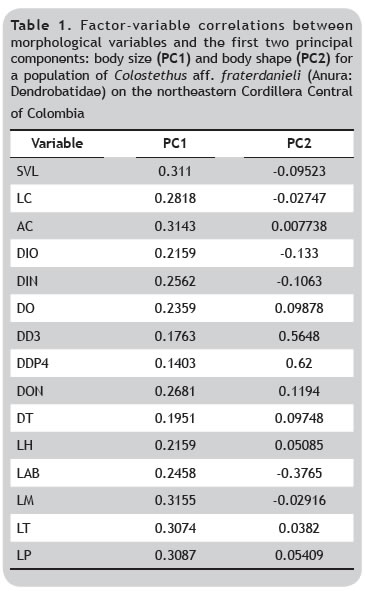
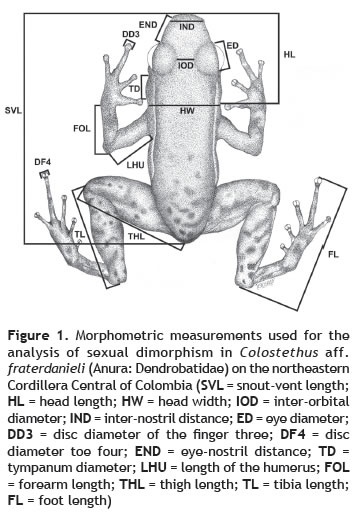
<body><![CDATA[<p>   <b>Study area.</b> The population is located in the site known   as El Ed&eacute;n, a secondary forest in ''vereda San Antonio'',   Alejandria municipality, Antioquia, Colombia (6,36664 N,   75,02746 W), in the buffer area of the Jaguas hydroelectric   project. The area corresponds to pre-montane wet forest   (according to the system of Holdridge 2000) and is located   at 1400 m. a. s. l. at the northeastern of the Cordillera   Central in Colombia. Temperature varies between 18   and 24 &deg;C, with an average relative humidity of 82.2%, and   annual rainfall between 2000 and 4000 mm.</p>     <p><b>Study species. </b><i>Colostethus</i> aff. <i>fraterdanieli</i> is an   undescribed species sister to C. <i>fraterdanieli</i> with 13%   of genetic distance in the mitochondrial gene COI (Daza   et al. unpublished). The genus <i>Colostethus</i> is a trans-   Andean clade, extending from eastern Central America   to northwestern Ecuador, with most species occurring in   cloud forests in the western Andes (Grant et al. 2006). <i>Colostethus</i> aff. <i>fraterdanieli</i> is a leaf-litter dwelling   frog inhabiting forest fragments with small streams. Like its congeners, this species is extremely fast and agile,   responding to danger by hopping a short distance and   hiding underneath the leaf litter. Males call constantly   from leaf litter. The advertisement call is composed by one   note and in some cases; males emit calls with three notes.   Adults seem to be territorial and males have been observed   carrying 10 to 11 tadpoles in their backs.</p>     <p> <b>Field work. </b>Frogs were collected between March and May   2013 using active search (Crump and Scott 2001). Although   it could be useful to collect the animals throughout the year   to record the temporal and seasonal variation in reproductive   status of the frogs, we had to restrict the fieldwork to March   and May due to some logistical difficulties. All collected   individuals were euthanized using lidocaine 3%, fixed   with formaldehyde 10% and stored in the herpetological   collection of the Museo de Herpetolog&iacute;a de la Universidad   de Antioquia (MHUA; vouchers MHUA-A 7878-7898,   7900-7929, 7931-7933, and 7940-7984).</p>     <p> <b>Minimum size of sexual maturity (MSSM).</b> All   individuals were dissected under a stereomicroscope to   examine gonadal characteristics and to determine the sex   and the reproductive stage. The sex of the individuals were   established by the presence of ovaries or testes. The females   were classified according to the following reproductive   stages: previtellogenic (without vitellogenic follicles),   vitellogenic (with brown follicles), and gravid (with   oviductal eggs; M&eacute;ndez-de la Cruz et al. 2013). The females   were considered matures when presented vitellogenic   follicles, eggs, or when presented at the same time   previtelogenic follicles and convoluted oviducts (Prado et   al. 2004, Wake and Dickie 1998). We prepared histological   slides of testes sections stained with the hematoxylin-eosin   (Luna 1968) to classified males like matures or immature.   We used the presence of spermatozoa in the seminiferous   tubules to identify adult males (Prado et al. 2004, Wake and   Dickie 1998). We inferred the MSSM on each sex as the   size of the mature individual with the lowest SVL.</p>     <p> <b>Sexual dimorphism (SD).</b> Prior to dissection, frogs were   photographed and measured to determine the presence of   sexual dimorphism. Only mature individual were included   in the analysis of SD. All measurements were taken three   times at the stereomicroscope with a digital caliper (0.1   mm precision) and then were averaging to reduce type   II errors (Yezerinac et al. 1992). Characters measured   were: snout-vent length (<b>SVL</b>), head length (HL), head   width (HW) measured at the level of the posterior part of   the tympanum, inter-orbital diameter (<b>IOD</b>), inter-nostril   distance (IND), eye diameter (<b>ED</b>), disc diameter of the   third digit (DD3), disc diameter of the fourth toe (DF4),   eye-nostril distance (<b>END</b>), tympanum diameter (TD),   length of the humerus (<b>LHU</b>), forearm length (<b>FOL</b>),   thigh length (<b>THL</b>), tibia length (TL), and foot length   (<b>FL</b>) (<a href="#f1">figure 1</a>). These characters correspond to the typical   measures used to determine morphometric differences in   anurans (e.g., Felgueiras-Napoli 2005). </p>      <p align="center"><a name="f1"></a><img src="/img/revistas/acbi/v37n102/v37n102a5f1.jpg" /></p>     <p>&nbsp;</p>     <p>We used a principal components analysis on the covariance   matrix of all morphological measurements to reduce the   total morphometric variation in few dimensions using   the software Past v.3.01 (Hammer et al. 2001). The first   principal component (PC1) calculated from a set of   morphometric measurements generally expresses body   size variation when all traits load largely and in the same   direction (Reyment et al. 1984). Remaining variance   describes relative shape differences that are not due to   body size (and these are expressed in subsequent PCs).   The relative contribution of the original variables to each   principal components were determined from the matrix of   factor-variable correlations (<a href="#t1">table 1</a>). We evaluated sexual   dimorphism in size (PC1) and shape (PC2) using one-way ANOVAs. </p>     <p align="center"><a name="t1"></a><img src="/img/revistas/acbi/v37n102/v37n102a5t1.jpg" /></p>     <p>&nbsp;</p>     ]]></body>
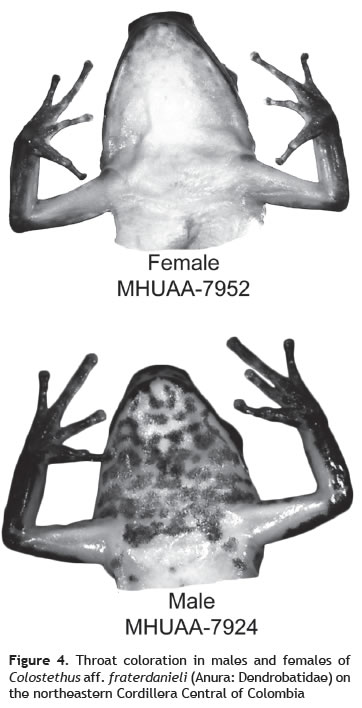
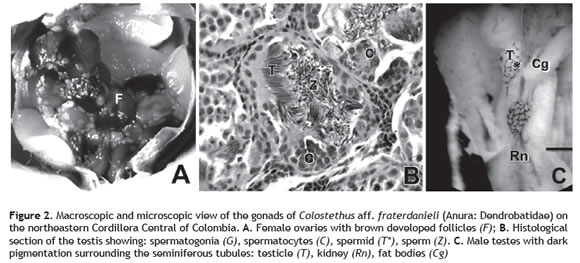
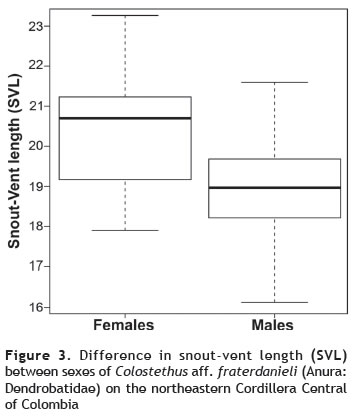
<body><![CDATA[<p>In addition to morphometric variation, we classified   all mature individuals according to throat coloration.   Individuals with spots covering less than 20% of the   throat were classified as <i>''immaculate''</i> and the remaining   individuals were classified as ''spotted''. We used a chi-square test (&chi;2) to test for differences between sexes in this feature.</p>     <p>&nbsp;</p>     <p>   <b><font size="3">RESULTS</font></b></p>     <p>  <b>Minimum size of sexual maturity (MSSM)</b>. We   examined 101 frogs and based on external observation   of the gonads and histological evaluation of the testes:   We found 22 matures females, 24 immature females, 53   matures males and two immature males. MSSM in females   was at 17.90 &plusmn; 0.1 mm. All mature females had between   8-10 brown vitellogenic follicles and convoluted oviduct.   We did not find any female with eggs in the oviduct   (<a href="#f2">figure 2A</a>). The MSSM in males was 16.13 &plusmn; 0.06 mm,   and all showed seminiferous tubules with cysts that had   most of the stages of spermatogenesis (spermatogonia,   spermatocytes, spermatids and sperm). All mature males   had free spermatozoa in the seminiferous tubules (<a href="#f2">figure   2B</a>). The right testis was larger than the left one, and in   some individuals, testes had dark pigmentation surrounding   the seminiferous tubules (<a href="#f2">figure 2C</a>). This pigmentation   seems not related with the reproductive status of individual. </p>      <p align="center"><a name="f2"></a><img src="/img/revistas/acbi/v37n102/v37n102a5f2.jpg" /></p>     <p align="center">&nbsp;</p>      <p><b>Sexual dimorphism (SD).</b> PCAs showed that the subspaces   defined by the first two principal components had the same   orientation in both sexes and can be used as size and shape   variables. Specifically, the sums of the eigenvalues (S) were 0.023 of a possible range of 0 to 2, where 2 indicates identical   subspaces (Krzanowski 1979). The morphometric analysis   showed differences in size and shape between males and   females (size: df = 1, F = 24.33, p &lt; 0.001; shape: df = 1,   F = 109.9, p &lt; 0.001). Females were bigger than males   (<a href="#f3">figure 3</a>). We also found differences between sexes in the   throat coloration (df = 1, &chi;2 = 41.57, p &lt; 0.001). Most of   the mature males had the spotted pattern (90%). The two   immature males lacked this coloration. All females had an   immaculate pattern on the throat (<a href="#f4">figure 4</a>).</p>     <p>&nbsp;</p>     <p align="center"><a name="f3"></a><img src="/img/revistas/acbi/v37n102/v37n102a5f3.jpg" /></p>     <p>&nbsp;</p>     ]]></body>
<body><![CDATA[<p align="center"><a name="f4"></a><img src="/img/revistas/acbi/v37n102/v37n102a5f4.jpg" /></p>     <p align="center">&nbsp;</p>     <p><b><font size="3">DISCUSSION</font></b></p>     <p>   In this study we describe some aspects of the reproductive   ecology of a population of C. aff. <i>fraterdanieli</i>, we show   that females and males differ in MSSM, size, shape, and   throat coloration. Females reach sexual maturity around   17.9 mm while males reach it at a smaller size of about   16.1 mm. Due to the great diversity of life histories and   reproductive strategies recorded to the dart-poison frogs,   this particular group of anurans have attracted the attention   of numerous researchers evaluating different reproductive   and behavioral characteristics. An important part of these   studies has been conducted in species belonging to what   was formerly known as <i>Colostethus</i> (before Grant et   al. 2006) and that now corresponds to several taxa with Most of these works showed that like C. aff. <i>fraterdanieli</i>,   in species as <i>Colostethus</i> <i>beebei</i> (Bourne et al. 2001; now   Anomaloglossus beebei; see Grant et al. 2006), <i>Colostethus</i>   <i>inguinalis</i> (Wells 1980; now <i>Colostethus</i> <i>panamensis</i>; see   Grant 2004), <i>Colostethus</i> <i>subpunctatus</i> (Fandi&ntilde;o et al.   1997; now Hyloxalus subpunctatus, see Grant et al. 2006),   <i>Mannophryne oblitterata</i> (Dixon and Rivero-Blanco 1985)   and <i>Colostethus</i> <i>trinitatis</i> (Cummins and Swan 1995, now   Mannophryne trinitatis, see Grant et al. 2006) females reach sexual maturity at a larger size than males (<a href="/img/revistas/acbi/v37n102/v37n102a5t2.jpg" target="_blank">table 2</a>).</p>     <p>Age and size at sexual maturity is a critical component   of life history studies because of their importance in   determining the fitness (Roff 1992, Stearns 1992).   Observed differences between sexes in MSSM, can relate   to patterns of mating and parental effort (Howard 1981).   For their reproductive role, females should produce and   host the greatest possible number of eggs to maximize   their fitness, which favors that females reach a larger   size (Howard 1978, 1981, Woolbright 1983). Meanwhile,   male fitness is not necessarily related to their body size   depending on the mating system display for particular taxa (Howard 1981, Shine 1979).</p>     <p>   We found that the ration of females and males in the   population was very similar (1 female: 1.3 male), however   the proportion of mature individuals differed between   sexes, with a huge proportion of mature male (96%)   compared with a median percentage of mature females   (48%). These differences could be explained by variation   in detectability of mature and immature males. Adult males   usually display territorial and calling behaviors, which   make them more conspicuous to the researchers. Unlike   immature males that have more cryptic behavior because   they are usually transients (Bailey et al. 2004, Mazerolle   et al. 2007, de Solla et al. 2005).</p>     <p>   Our results suggest sexual size dimorphism in <i>Colostethus</i>   aff. <i>fraterdanieli</i>, where females are larger than males, as   has been reported in the most of anuran species (Shine   1979) and particularly in other species of <i>Colostethus</i>   (<a href="/img/revistas/acbi/v37n102/v37n102a5t2.jpg" target="_blank">table 2</a>, before Grant et al. 2006). Sexual dimorphism is   the result of divergent selective pressures between sexes   that promote morphological and behavioral differences   (Howard 1981). However, regardless of the selection   pressures and evolutionary forces that originated the   differences in size between females and males, these   seems to be the reflection of divergence in size at sexual   maturity because in amphibians both sexes usually have   the same body growth rates (Howard 1981). One the most   known life history trade-offs is that between size and age   at maturity that imply that to reduce time for growth, and   decrease age at maturity might result in a decrease of adult body size (Roff 2000).</p>     <p>   In this study, we found an evident dimorphism in throat   coloration with males having a ''spotted'' pattern and   females with <i>''immaculate''</i> throats. This kind of chromatic   sexual dimorphism is relatively generalized between   anurans and is related to a differential distribution of dermal   chromatophore units between sexes with a higher number   of melanophores per unit area in males (Buchanan 1994, Greenberg 1942). Differences in color saturation seems   to be a secondary result of elevated testosterone levels in   males (Buchanan 1994, Grant and Castro 1998, Greenberg   1942) therefore, immature males lack this character.   Although not quantified here, we also evidenced that the   third finger, as in many <i>Colostethus</i> species, is swollen in adult males (see <a href="#f4">figure 4</a>).</p>     <p>   The minimum size of sexual maturity is a critical parameter   to understand the population dynamic of any species   (Morrison and Hero 2003) and its knowledge is essential   to make inferences about evolutionary history, population   trends, and conservation status. Despite the importance   of this parameter, most of studies in these kind of topics   make inferences about it without a direct evaluation in the   populations generating inaccuracy in their estimates and   conclusions. For this reason, studies as this are valuable   and constitute a baseline to other more specialized studies. </p>     <p>&nbsp;</p>     ]]></body>
<body><![CDATA[<p>   <b><font size="3">ACKNOWLEDGMENTS</font></b></p>     <p>   This study was funded by ISAGEN and the Universidad de   Antioquia under the Convenio Interinstitucional 46/4208.   We thank S. Cuartas and the Grupo Herpetol&oacute;gico de   Antioquia members for comments to an early draft and help during fieldwork.</p>     <p>&nbsp; </p>     <p>   <b><font size="3">REFERENCES</font></b></p>     <!-- ref --><p>   Bailey LL, Simons TR, Pollock KH. 2004. Spatial and temporal   variation in detection probability of <i>Plethodon</i> salamanders   using the robust capture-recapture design. Journal of Wildlife   Management, 68: 14-24.    &nbsp;&nbsp;&nbsp;&nbsp;&nbsp;&nbsp;&nbsp;&nbsp;[&#160;<a href="javascript:void(0);" onclick="javascript: window.open('/scielo.php?script=sci_nlinks&ref=000067&pid=S0304-3584201500010000500001&lng=','','width=640,height=500,resizable=yes,scrollbars=1,menubar=yes,');">Links</a>&#160;]<!-- end-ref --></p>     <!-- ref --><p>   Bourne GR, Collins AC, Holder AM, McCarthy CL. 2001. Vocal   communication and reproductive behavior of the frog <i>Colostethus</i> beebei in Guyana. Journal of Herpetology, 35: 272-281.    &nbsp;&nbsp;&nbsp;&nbsp;&nbsp;&nbsp;&nbsp;&nbsp;[&#160;<a href="javascript:void(0);" onclick="javascript: window.open('/scielo.php?script=sci_nlinks&ref=000069&pid=S0304-3584201500010000500002&lng=','','width=640,height=500,resizable=yes,scrollbars=1,menubar=yes,');">Links</a>&#160;]<!-- end-ref --></p>     <!-- ref --><p>   Buchanan BW. 1994. Sexual dimorphism in <i>Hyla squirella</i>: Chromatic   and pattern variation between the sexes. Copeia, 1994: 797-802.    &nbsp;&nbsp;&nbsp;&nbsp;&nbsp;&nbsp;&nbsp;&nbsp;[&#160;<a href="javascript:void(0);" onclick="javascript: window.open('/scielo.php?script=sci_nlinks&ref=000071&pid=S0304-3584201500010000500003&lng=','','width=640,height=500,resizable=yes,scrollbars=1,menubar=yes,');">Links</a>&#160;]<!-- end-ref --></p>     ]]></body>
<body><![CDATA[<!-- ref --><p>   Crump M, Scott NJ. 2001. Relevamientos por encuentros visuales. In:   Heyer R, Donnelly MD, McDiarmid LA, Hayek A, Foster MS.   editors. Medici&oacute;n y monitoreo de la diversidad biol&oacute;gica. M&eacute;todos   estandarizados para anfibios. Comodoro Rivadavia (Argentina):   Editorial Universitaria de la Patagonia. p. 80-87.    &nbsp;&nbsp;&nbsp;&nbsp;&nbsp;&nbsp;&nbsp;&nbsp;[&#160;<a href="javascript:void(0);" onclick="javascript: window.open('/scielo.php?script=sci_nlinks&ref=000073&pid=S0304-3584201500010000500004&lng=','','width=640,height=500,resizable=yes,scrollbars=1,menubar=yes,');">Links</a>&#160;]<!-- end-ref --></p>     <!-- ref --><p>   Cummins CP, Swan MJ. 1995. Variation in reproductive characteristics   of the stream frog <i>Colostethus</i> <i>trinitatis</i> on the island of Trinidad. Journal of Tropical Ecology, 11: 603-618.    &nbsp;&nbsp;&nbsp;&nbsp;&nbsp;&nbsp;&nbsp;&nbsp;[&#160;<a href="javascript:void(0);" onclick="javascript: window.open('/scielo.php?script=sci_nlinks&ref=000075&pid=S0304-3584201500010000500005&lng=','','width=640,height=500,resizable=yes,scrollbars=1,menubar=yes,');">Links</a>&#160;]<!-- end-ref --></p>     <!-- ref --><p>   Dixon JR, Rivero-Blanco C. 1985. A new dendrobatid frog (<i>Colostethus</i>)   from Venezuela with notes on its natural history and that of related species. Journal of Herpetology, 19: 177-184.    &nbsp;&nbsp;&nbsp;&nbsp;&nbsp;&nbsp;&nbsp;&nbsp;[&#160;<a href="javascript:void(0);" onclick="javascript: window.open('/scielo.php?script=sci_nlinks&ref=000077&pid=S0304-3584201500010000500006&lng=','','width=640,height=500,resizable=yes,scrollbars=1,menubar=yes,');">Links</a>&#160;]<!-- end-ref --></p>     <!-- ref --><p>   Duellman W, Trueb L.1994. Biology of amphibians. Baltimore and   London: The Johns Hopkins University Press. p. 670.    &nbsp;&nbsp;&nbsp;&nbsp;&nbsp;&nbsp;&nbsp;&nbsp;[&#160;<a href="javascript:void(0);" onclick="javascript: window.open('/scielo.php?script=sci_nlinks&ref=000079&pid=S0304-3584201500010000500007&lng=','','width=640,height=500,resizable=yes,scrollbars=1,menubar=yes,');">Links</a>&#160;]<!-- end-ref --></p>     <!-- ref --><p>   Fandi&ntilde;o MC, L&uuml;ddecke H, Am&eacute;zquita A. 1997. Vocalisation and   larval transportation of male <i>Colostethus</i> subpunctatus (Anura: Dendrobatidae). Amphibia-Reptilia, 18: 39-48.    &nbsp;&nbsp;&nbsp;&nbsp;&nbsp;&nbsp;&nbsp;&nbsp;[&#160;<a href="javascript:void(0);" onclick="javascript: window.open('/scielo.php?script=sci_nlinks&ref=000081&pid=S0304-3584201500010000500008&lng=','','width=640,height=500,resizable=yes,scrollbars=1,menubar=yes,');">Links</a>&#160;]<!-- end-ref --></p>     ]]></body>
<body><![CDATA[<!-- ref --><p>   Felgueiras-Napoli M. 2005. A new species allied to <i>Hyla circumdata</i>  (Anura: Hylidae) from Serra da Mantiqueira, Southeastern Brazil.   Herpetologica, 61: 63-69.    &nbsp;&nbsp;&nbsp;&nbsp;&nbsp;&nbsp;&nbsp;&nbsp;[&#160;<a href="javascript:void(0);" onclick="javascript: window.open('/scielo.php?script=sci_nlinks&ref=000083&pid=S0304-3584201500010000500009&lng=','','width=640,height=500,resizable=yes,scrollbars=1,menubar=yes,');">Links</a>&#160;]<!-- end-ref --></p>     <!-- ref --><p>   Grant T. 2004. On the identities of <i>Colostethus</i> inguinalis (Cope, 1868)   and C. panamensis (Dunn, 1933), with comments on C. latinasus   (Cope, 1863) (Anura: Dendrobatidae). American Museum Novitates, 3444: 1-24.    &nbsp;&nbsp;&nbsp;&nbsp;&nbsp;&nbsp;&nbsp;&nbsp;[&#160;<a href="javascript:void(0);" onclick="javascript: window.open('/scielo.php?script=sci_nlinks&ref=000085&pid=S0304-3584201500010000500010&lng=','','width=640,height=500,resizable=yes,scrollbars=1,menubar=yes,');">Links</a>&#160;]<!-- end-ref --></p>     <!-- ref --><p>   Grant T, Castro F. 1998. The cloud forest <i>Colostethus</i> (Anura,   Dendrobatidae) of region of the Cordillera Occidental of Colombia. Journal of Herpetology, 32: 378-392.    &nbsp;&nbsp;&nbsp;&nbsp;&nbsp;&nbsp;&nbsp;&nbsp;[&#160;<a href="javascript:void(0);" onclick="javascript: window.open('/scielo.php?script=sci_nlinks&ref=000087&pid=S0304-3584201500010000500011&lng=','','width=640,height=500,resizable=yes,scrollbars=1,menubar=yes,');">Links</a>&#160;]<!-- end-ref --></p>     <!-- ref --><p>   Grant T, Frost DR, Caldwell JP, Gagliardo R, Haddad CF, Kok PJ, Means   DB, Noonan BP, Schargel WE, Wheeler WC. 2006. Phylogenetic   systematics of dart-poison frogs and their relatives (Amphibia:   Athesphatanura: Dendrobatidae). Bulletin of the American   Museum of Natural History, 299: 1-262.    &nbsp;&nbsp;&nbsp;&nbsp;&nbsp;&nbsp;&nbsp;&nbsp;[&#160;<a href="javascript:void(0);" onclick="javascript: window.open('/scielo.php?script=sci_nlinks&ref=000089&pid=S0304-3584201500010000500012&lng=','','width=640,height=500,resizable=yes,scrollbars=1,menubar=yes,');">Links</a>&#160;]<!-- end-ref --></p>     <!-- ref --><p>   Greenberg B. 1942. Some effects of testosterone in the sexual   pigmentation and other sex characters of the cricket frog (<i>Acris   gryllus</i>). Journal of Experimental Zoology, 91: 435-446.    &nbsp;&nbsp;&nbsp;&nbsp;&nbsp;&nbsp;&nbsp;&nbsp;[&#160;<a href="javascript:void(0);" onclick="javascript: window.open('/scielo.php?script=sci_nlinks&ref=000091&pid=S0304-3584201500010000500013&lng=','','width=640,height=500,resizable=yes,scrollbars=1,menubar=yes,');">Links</a>&#160;]<!-- end-ref --></p>     ]]></body>
<body><![CDATA[<!-- ref --><p>   Hammer O, Harper DAT, Ryan PD. 2001. Past: paleontological statistics   software package for education and data analysis. Palaentologia   Electronica, 4: 9.    &nbsp;&nbsp;&nbsp;&nbsp;&nbsp;&nbsp;&nbsp;&nbsp;[&#160;<a href="javascript:void(0);" onclick="javascript: window.open('/scielo.php?script=sci_nlinks&ref=000093&pid=S0304-3584201500010000500014&lng=','','width=640,height=500,resizable=yes,scrollbars=1,menubar=yes,');">Links</a>&#160;]<!-- end-ref --></p>     <!-- ref --><p>   Holdridge LR. 2000. Ecolog&iacute;a basada en zonas de vida. Quinta   reimpresi&oacute;n. San Jos&eacute; (Costa Rica): Instituto Interamericano de   Cooperaci&oacute;n para la Agricultura (IICA). p. 216.    &nbsp;&nbsp;&nbsp;&nbsp;&nbsp;&nbsp;&nbsp;&nbsp;[&#160;<a href="javascript:void(0);" onclick="javascript: window.open('/scielo.php?script=sci_nlinks&ref=000095&pid=S0304-3584201500010000500015&lng=','','width=640,height=500,resizable=yes,scrollbars=1,menubar=yes,');">Links</a>&#160;]<!-- end-ref --></p>     <!-- ref --><p>   Howard RD. 1978. The influence of male-defended oviposition sites   on early embryo mortality in bullfrogs. Ecology, 59: 789-798.    &nbsp;&nbsp;&nbsp;&nbsp;&nbsp;&nbsp;&nbsp;&nbsp;[&#160;<a href="javascript:void(0);" onclick="javascript: window.open('/scielo.php?script=sci_nlinks&ref=000097&pid=S0304-3584201500010000500016&lng=','','width=640,height=500,resizable=yes,scrollbars=1,menubar=yes,');">Links</a>&#160;]<!-- end-ref --></p>     <!-- ref --><p>   Howard RD. 1981. Sexual dimorphism in bullfrogs. Ecology, 62:   303-310.    &nbsp;&nbsp;&nbsp;&nbsp;&nbsp;&nbsp;&nbsp;&nbsp;[&#160;<a href="javascript:void(0);" onclick="javascript: window.open('/scielo.php?script=sci_nlinks&ref=000099&pid=S0304-3584201500010000500017&lng=','','width=640,height=500,resizable=yes,scrollbars=1,menubar=yes,');">Links</a>&#160;]<!-- end-ref --></p>     <!-- ref --><p>   Junc&aacute; FA. 1998. Reproductive biology of <i>Colostethus</i> <i>stepheni</i> and   <i>Colostethus</i> <i>marchesianus</i> (Dendrobatidae), with the description of a new anuran mating behavior. Herpetologica, 54: 377-387.    &nbsp;&nbsp;&nbsp;&nbsp;&nbsp;&nbsp;&nbsp;&nbsp;[&#160;<a href="javascript:void(0);" onclick="javascript: window.open('/scielo.php?script=sci_nlinks&ref=000101&pid=S0304-3584201500010000500018&lng=','','width=640,height=500,resizable=yes,scrollbars=1,menubar=yes,');">Links</a>&#160;]<!-- end-ref --></p>     ]]></body>
<body><![CDATA[<!-- ref --><p>   Katsikaros K, Shine R. 1997. Sexual dimorphism in the tusked frog,     <i>Adelotus brevis </i>(Anura: Myobatrachidae): the role of natural   and sexual selection. Biological Journal of the Linnean Society,   60: 39-51.    &nbsp;&nbsp;&nbsp;&nbsp;&nbsp;&nbsp;&nbsp;&nbsp;[&#160;<a href="javascript:void(0);" onclick="javascript: window.open('/scielo.php?script=sci_nlinks&ref=000103&pid=S0304-3584201500010000500019&lng=','','width=640,height=500,resizable=yes,scrollbars=1,menubar=yes,');">Links</a>&#160;]<!-- end-ref --></p>     <!-- ref --><p>   Krzanowski WJ. 1979. Between groups comparison of principal   components. Journal of the American Statistical Association,   74: 703-707.    &nbsp;&nbsp;&nbsp;&nbsp;&nbsp;&nbsp;&nbsp;&nbsp;[&#160;<a href="javascript:void(0);" onclick="javascript: window.open('/scielo.php?script=sci_nlinks&ref=000105&pid=S0304-3584201500010000500020&lng=','','width=640,height=500,resizable=yes,scrollbars=1,menubar=yes,');">Links</a>&#160;]<!-- end-ref --></p>     <!-- ref --><p>   Lima AP, Keller C. 2003. Reproductive characteristics of <i>Colostethus</i>   marchesianus from its type locality in Amazonas, Brazil. Journal of Herpetology, 37: 754-757.    &nbsp;&nbsp;&nbsp;&nbsp;&nbsp;&nbsp;&nbsp;&nbsp;[&#160;<a href="javascript:void(0);" onclick="javascript: window.open('/scielo.php?script=sci_nlinks&ref=000107&pid=S0304-3584201500010000500021&lng=','','width=640,height=500,resizable=yes,scrollbars=1,menubar=yes,');">Links</a>&#160;]<!-- end-ref --></p>     <!-- ref --><p>   Lima AP, Caldwell JP, Biavati GM. 2002. Territorial and reproductive   behavior of an Amazonian dendrobatid frog, <i>Colostethus</i>   <i>caeruleodactylus</i>. Copeia, 2002: 44-51.    &nbsp;&nbsp;&nbsp;&nbsp;&nbsp;&nbsp;&nbsp;&nbsp;[&#160;<a href="javascript:void(0);" onclick="javascript: window.open('/scielo.php?script=sci_nlinks&ref=000109&pid=S0304-3584201500010000500022&lng=','','width=640,height=500,resizable=yes,scrollbars=1,menubar=yes,');">Links</a>&#160;]<!-- end-ref --></p>     <!-- ref --><p>   Lovich JE, Gibbons JW. 1992. A review of techniques for quantifying sexual   size dimorphism. Growth, Development, &amp; Aging, 56: 269-281.    &nbsp;&nbsp;&nbsp;&nbsp;&nbsp;&nbsp;&nbsp;&nbsp;[&#160;<a href="javascript:void(0);" onclick="javascript: window.open('/scielo.php?script=sci_nlinks&ref=000111&pid=S0304-3584201500010000500023&lng=','','width=640,height=500,resizable=yes,scrollbars=1,menubar=yes,');">Links</a>&#160;]<!-- end-ref --></p>     ]]></body>
<body><![CDATA[<!-- ref --><p>   Lovich JE, Gibbons JW, Agha M. 2014. Does the timing of attainment   of maturity influence sexual size dimorphism and adult sex ratio in   turtles? Biological Journal of the Linnean Society, 112: 142-149.    &nbsp;&nbsp;&nbsp;&nbsp;&nbsp;&nbsp;&nbsp;&nbsp;[&#160;<a href="javascript:void(0);" onclick="javascript: window.open('/scielo.php?script=sci_nlinks&ref=000113&pid=S0304-3584201500010000500024&lng=','','width=640,height=500,resizable=yes,scrollbars=1,menubar=yes,');">Links</a>&#160;]<!-- end-ref --> </p>     <!-- ref --><p>Luna L. 1968. Manual of Histologic Staining Methods of the Armed   Forces Institute of Pathology. Third edition. New York (U. S. A.): Blakiston division, McGraw-Hill. p. 258.    &nbsp;&nbsp;&nbsp;&nbsp;&nbsp;&nbsp;&nbsp;&nbsp;[&#160;<a href="javascript:void(0);" onclick="javascript: window.open('/scielo.php?script=sci_nlinks&ref=000115&pid=S0304-3584201500010000500025&lng=','','width=640,height=500,resizable=yes,scrollbars=1,menubar=yes,');">Links</a>&#160;]<!-- end-ref --></p>     <!-- ref --><p>   Lynch JD. 1996. <i>Eleutherodactylus erythropleura</i>. Catalogue of   American Amphibians and Reptiles, 623: 1-3.    &nbsp;&nbsp;&nbsp;&nbsp;&nbsp;&nbsp;&nbsp;&nbsp;[&#160;<a href="javascript:void(0);" onclick="javascript: window.open('/scielo.php?script=sci_nlinks&ref=000117&pid=S0304-3584201500010000500026&lng=','','width=640,height=500,resizable=yes,scrollbars=1,menubar=yes,');">Links</a>&#160;]<!-- end-ref --></p>     <!-- ref --><p>   Mazerolle MJ, Bailey LL, Kendall WL, Andrew-Royle J, Converse   SJ, Nichols JD. 2007. Making great leaps forward: accounting   for detectability in herpetological field studies. Journal of   Herpetology, 41: 672-689.    &nbsp;&nbsp;&nbsp;&nbsp;&nbsp;&nbsp;&nbsp;&nbsp;[&#160;<a href="javascript:void(0);" onclick="javascript: window.open('/scielo.php?script=sci_nlinks&ref=000119&pid=S0304-3584201500010000500027&lng=','','width=640,height=500,resizable=yes,scrollbars=1,menubar=yes,');">Links</a>&#160;]<!-- end-ref --></p>     <!-- ref --><p>   M&eacute;ndez-de la Cruz FR, Villagr&aacute;n-Santa Cruz M, L&oacute;pez-Ort&iacute;z ML,   Hern&aacute;ndez-Gallegos O. 2013. Reproductive cycle of a highelevation,   oviparous lizard (<i>Sceloporus spinosus</i>: Reptilia:   Phrynosomatidae). The Southwestern Naturalist, 58: 54-63.    &nbsp;&nbsp;&nbsp;&nbsp;&nbsp;&nbsp;&nbsp;&nbsp;[&#160;<a href="javascript:void(0);" onclick="javascript: window.open('/scielo.php?script=sci_nlinks&ref=000121&pid=S0304-3584201500010000500028&lng=','','width=640,height=500,resizable=yes,scrollbars=1,menubar=yes,');">Links</a>&#160;]<!-- end-ref --></p>     ]]></body>
<body><![CDATA[<!-- ref --><p>   Morrison C, Hero J-M. 2003. Geographic variation in life-history   characteristics of amphibians: A review. Journal of Animal   Ecology, 72: 270-279.    &nbsp;&nbsp;&nbsp;&nbsp;&nbsp;&nbsp;&nbsp;&nbsp;[&#160;<a href="javascript:void(0);" onclick="javascript: window.open('/scielo.php?script=sci_nlinks&ref=000123&pid=S0304-3584201500010000500029&lng=','','width=640,height=500,resizable=yes,scrollbars=1,menubar=yes,');">Links</a>&#160;]<!-- end-ref --></p>     <!-- ref --><p>   Morrison C, Hero J-M, Browning J. 2004. Altitudinal variation in the   age at maturity, longevity and reproductive lifespan of anurans in   subtropical Queensland. Herpetologica, 60: 34-44.    &nbsp;&nbsp;&nbsp;&nbsp;&nbsp;&nbsp;&nbsp;&nbsp;[&#160;<a href="javascript:void(0);" onclick="javascript: window.open('/scielo.php?script=sci_nlinks&ref=000125&pid=S0304-3584201500010000500030&lng=','','width=640,height=500,resizable=yes,scrollbars=1,menubar=yes,');">Links</a>&#160;]<!-- end-ref --></p>     <!-- ref --><p>   Prado A, Abdalla F, Silva P, Zina J. 2004. Late gametogenesis in     <i>Leptodactylus</i> <i>labyrinthicus</i> (Amphibia, Anura, Leptodactylidae)   and some ecological considerations. Brazilian Journal of   Morphological Sciences, 21: 177-184.    &nbsp;&nbsp;&nbsp;&nbsp;&nbsp;&nbsp;&nbsp;&nbsp;[&#160;<a href="javascript:void(0);" onclick="javascript: window.open('/scielo.php?script=sci_nlinks&ref=000127&pid=S0304-3584201500010000500031&lng=','','width=640,height=500,resizable=yes,scrollbars=1,menubar=yes,');">Links</a>&#160;]<!-- end-ref --></p>     <!-- ref --><p>   Reyment RA, Blackith RE, Campell NA. 1984. Multivariate   morphometrics. Second edition. Michigan (U. S. A.): Academic   Press. p. 233.    &nbsp;&nbsp;&nbsp;&nbsp;&nbsp;&nbsp;&nbsp;&nbsp;[&#160;<a href="javascript:void(0);" onclick="javascript: window.open('/scielo.php?script=sci_nlinks&ref=000129&pid=S0304-3584201500010000500032&lng=','','width=640,height=500,resizable=yes,scrollbars=1,menubar=yes,');">Links</a>&#160;]<!-- end-ref --></p>     <!-- ref --><p>   Rojas B, Endler JA. 2013. Sexual dimorphism and intra-populational   color pattern variation in the aposematic frog <i>Dendrobates   tinctorius</i>. Evolutionary Ecology, 27: 739-753.    &nbsp;&nbsp;&nbsp;&nbsp;&nbsp;&nbsp;&nbsp;&nbsp;[&#160;<a href="javascript:void(0);" onclick="javascript: window.open('/scielo.php?script=sci_nlinks&ref=000131&pid=S0304-3584201500010000500033&lng=','','width=640,height=500,resizable=yes,scrollbars=1,menubar=yes,');">Links</a>&#160;]<!-- end-ref --></p>     ]]></body>
<body><![CDATA[<!-- ref --><p>   Roff DA. 1992. The evolution of life histories: Theory and analysis.   New York, (U. S. A.): Chapman &amp; Hall. p. 527.    &nbsp;&nbsp;&nbsp;&nbsp;&nbsp;&nbsp;&nbsp;&nbsp;[&#160;<a href="javascript:void(0);" onclick="javascript: window.open('/scielo.php?script=sci_nlinks&ref=000133&pid=S0304-3584201500010000500034&lng=','','width=640,height=500,resizable=yes,scrollbars=1,menubar=yes,');">Links</a>&#160;]<!-- end-ref --></p>     <!-- ref --><p>   Roff DA. 2000. Trade-offs between growth and reproduction: an analysis   of the quantitative genetic evidence. Journal of Evolutionary   Biology, 13: 434-445.    &nbsp;&nbsp;&nbsp;&nbsp;&nbsp;&nbsp;&nbsp;&nbsp;[&#160;<a href="javascript:void(0);" onclick="javascript: window.open('/scielo.php?script=sci_nlinks&ref=000135&pid=S0304-3584201500010000500035&lng=','','width=640,height=500,resizable=yes,scrollbars=1,menubar=yes,');">Links</a>&#160;]<!-- end-ref --></p>     <!-- ref --><p>   Rueda-Almonacid JV, Lynch JD. 1983. Una nueva especie de     <i>Eleutherodactylus</i> para la cordillera oriental de Colombia.   Lozania, 42: 1-6.    &nbsp;&nbsp;&nbsp;&nbsp;&nbsp;&nbsp;&nbsp;&nbsp;[&#160;<a href="javascript:void(0);" onclick="javascript: window.open('/scielo.php?script=sci_nlinks&ref=000137&pid=S0304-3584201500010000500036&lng=','','width=640,height=500,resizable=yes,scrollbars=1,menubar=yes,');">Links</a>&#160;]<!-- end-ref --></p>     <!-- ref --><p>   Shine R. 1979. Sexual selection and sexual dimorphism in the Amphibia.   Copeia, 1979: 297-306.    &nbsp;&nbsp;&nbsp;&nbsp;&nbsp;&nbsp;&nbsp;&nbsp;[&#160;<a href="javascript:void(0);" onclick="javascript: window.open('/scielo.php?script=sci_nlinks&ref=000139&pid=S0304-3584201500010000500037&lng=','','width=640,height=500,resizable=yes,scrollbars=1,menubar=yes,');">Links</a>&#160;]<!-- end-ref --></p>     <!-- ref --><p>   Shine R. 1989. Ecological causes for the evolution of sexual   dimorphism: A review of the evidence. The Quarterly Review of   Biology, 64: 419-461.    &nbsp;&nbsp;&nbsp;&nbsp;&nbsp;&nbsp;&nbsp;&nbsp;[&#160;<a href="javascript:void(0);" onclick="javascript: window.open('/scielo.php?script=sci_nlinks&ref=000141&pid=S0304-3584201500010000500038&lng=','','width=640,height=500,resizable=yes,scrollbars=1,menubar=yes,');">Links</a>&#160;]<!-- end-ref --></p>     ]]></body>
<body><![CDATA[<!-- ref --><p>   de Solla SR, Shirose LJ, Fernie KJ, Barrett GC, Brousseau CS, Bishop,   CA. 2005. Effect of sampling effort and species detectability   on volunteer based anuran monitoring programs. Biological   Conservation, 121: 585-594.    &nbsp;&nbsp;&nbsp;&nbsp;&nbsp;&nbsp;&nbsp;&nbsp;[&#160;<a href="javascript:void(0);" onclick="javascript: window.open('/scielo.php?script=sci_nlinks&ref=000143&pid=S0304-3584201500010000500039&lng=','','width=640,height=500,resizable=yes,scrollbars=1,menubar=yes,');">Links</a>&#160;]<!-- end-ref --></p>     <!-- ref --><p>   Stearns SC. 1992. The evolution of life histories. New York (U. S. A.):   Oxford University Press. p. 246.    &nbsp;&nbsp;&nbsp;&nbsp;&nbsp;&nbsp;&nbsp;&nbsp;[&#160;<a href="javascript:void(0);" onclick="javascript: window.open('/scielo.php?script=sci_nlinks&ref=000145&pid=S0304-3584201500010000500040&lng=','','width=640,height=500,resizable=yes,scrollbars=1,menubar=yes,');">Links</a>&#160;]<!-- end-ref --></p>     <!-- ref --><p>   Wake MH, Dickie R. 1998. Oviduct structure, function, and reproductive   modes in amphibians. The Journal of Experimental Zoology,   282: 477-506.    &nbsp;&nbsp;&nbsp;&nbsp;&nbsp;&nbsp;&nbsp;&nbsp;[&#160;<a href="javascript:void(0);" onclick="javascript: window.open('/scielo.php?script=sci_nlinks&ref=000147&pid=S0304-3584201500010000500041&lng=','','width=640,height=500,resizable=yes,scrollbars=1,menubar=yes,');">Links</a>&#160;]<!-- end-ref --></p>     <!-- ref --><p>   Watling J, Donnelly M. 2002. Seasonal patterns of reproduction and   abundance of leaf litter frogs in a Central American rainforest.   Journal of Zoology, 258: 269-276.    &nbsp;&nbsp;&nbsp;&nbsp;&nbsp;&nbsp;&nbsp;&nbsp;[&#160;<a href="javascript:void(0);" onclick="javascript: window.open('/scielo.php?script=sci_nlinks&ref=000149&pid=S0304-3584201500010000500042&lng=','','width=640,height=500,resizable=yes,scrollbars=1,menubar=yes,');">Links</a>&#160;]<!-- end-ref --></p>     <!-- ref --><p>   Wells KD. 1978. Territoriality in the green frog (<i>Rana clamitans</i>):   vocalizations and agonistic behavior. Animal Behaviour, 26:   1051-1063.    &nbsp;&nbsp;&nbsp;&nbsp;&nbsp;&nbsp;&nbsp;&nbsp;[&#160;<a href="javascript:void(0);" onclick="javascript: window.open('/scielo.php?script=sci_nlinks&ref=000151&pid=S0304-3584201500010000500043&lng=','','width=640,height=500,resizable=yes,scrollbars=1,menubar=yes,');">Links</a>&#160;]<!-- end-ref --></p>     ]]></body>
<body><![CDATA[<!-- ref --><p>   Wells KD. 1980. Behavioral ecology and social organization of a   dendrobatid frog (<i>Colostethus</i> <i>inguinalis</i>). Behavioral Ecology and Sociobiology, 6: 199-209.    &nbsp;&nbsp;&nbsp;&nbsp;&nbsp;&nbsp;&nbsp;&nbsp;[&#160;<a href="javascript:void(0);" onclick="javascript: window.open('/scielo.php?script=sci_nlinks&ref=000153&pid=S0304-3584201500010000500044&lng=','','width=640,height=500,resizable=yes,scrollbars=1,menubar=yes,');">Links</a>&#160;]<!-- end-ref --></p>     <!-- ref --><p>   Woolbright LL. 1983. Sexual selection and size dimorphism in anuran   amphibian. The American Naturalist, 121: 110-119.    &nbsp;&nbsp;&nbsp;&nbsp;&nbsp;&nbsp;&nbsp;&nbsp;[&#160;<a href="javascript:void(0);" onclick="javascript: window.open('/scielo.php?script=sci_nlinks&ref=000155&pid=S0304-3584201500010000500045&lng=','','width=640,height=500,resizable=yes,scrollbars=1,menubar=yes,');">Links</a>&#160;]<!-- end-ref --></p>     <!-- ref --><p>   Yezerinac SM, Lougheed SC, Handford P. 1992. Measurement error   and morphometric studies. Systematic Biology, 41: 471-482.    &nbsp;&nbsp;&nbsp;&nbsp;&nbsp;&nbsp;&nbsp;&nbsp;[&#160;<a href="javascript:void(0);" onclick="javascript: window.open('/scielo.php?script=sci_nlinks&ref=000157&pid=S0304-3584201500010000500046&lng=','','width=640,height=500,resizable=yes,scrollbars=1,menubar=yes,');">Links</a>&#160;]<!-- end-ref --></p>     <p>&nbsp;</p> </font>      ]]></body><back>
<ref-list>
<ref id="B1">
<nlm-citation citation-type="journal">
<person-group person-group-type="author">
<name>
<surname><![CDATA[Bailey]]></surname>
<given-names><![CDATA[LL]]></given-names>
</name>
<name>
<surname><![CDATA[Simons]]></surname>
<given-names><![CDATA[TR]]></given-names>
</name>
<name>
<surname><![CDATA[Pollock]]></surname>
<given-names><![CDATA[KH.]]></given-names>
</name>
</person-group>
<article-title xml:lang="en"><![CDATA[Spatial and temporal variation in detection probability of Plethodon salamanders using the robust capture-recapture design]]></article-title>
<source><![CDATA[Journal of Wildlife Management,]]></source>
<year>2004</year>
<volume>68</volume>
<page-range>14-24</page-range></nlm-citation>
</ref>
<ref id="B2">
<nlm-citation citation-type="journal">
<person-group person-group-type="author">
<name>
<surname><![CDATA[Bourne]]></surname>
<given-names><![CDATA[GR]]></given-names>
</name>
<name>
<surname><![CDATA[Collins]]></surname>
<given-names><![CDATA[AC]]></given-names>
</name>
<name>
<surname><![CDATA[Holder]]></surname>
<given-names><![CDATA[AM]]></given-names>
</name>
<name>
<surname><![CDATA[McCarthy]]></surname>
<given-names><![CDATA[CL.]]></given-names>
</name>
</person-group>
<article-title xml:lang="en"><![CDATA[Vocal communication and reproductive behavior of the frog Colostethus beebei in Guyana]]></article-title>
<source><![CDATA[Journal of Herpetology,]]></source>
<year>2001</year>
<volume>35</volume>
<page-range>272-281</page-range></nlm-citation>
</ref>
<ref id="B3">
<nlm-citation citation-type="journal">
<person-group person-group-type="author">
<name>
<surname><![CDATA[Buchanan]]></surname>
<given-names><![CDATA[BW.]]></given-names>
</name>
</person-group>
<article-title xml:lang="en"><![CDATA[Sexual dimorphism in Hyla squirella: Chromatic and pattern variation between the sexes]]></article-title>
<source><![CDATA[Copeia,]]></source>
<year>1994</year>
<volume>1994</volume>
<page-range>797-802</page-range></nlm-citation>
</ref>
<ref id="B4">
<nlm-citation citation-type="book">
<person-group person-group-type="author">
<name>
<surname><![CDATA[Crump]]></surname>
<given-names><![CDATA[M]]></given-names>
</name>
<name>
<surname><![CDATA[Scott]]></surname>
<given-names><![CDATA[NJ]]></given-names>
</name>
</person-group>
<article-title xml:lang="es"><![CDATA[Relevamientos por encuentros visuales]]></article-title>
<person-group person-group-type="editor">
<name>
<surname><![CDATA[Heyer]]></surname>
<given-names><![CDATA[R]]></given-names>
</name>
<name>
<surname><![CDATA[Donnelly]]></surname>
<given-names><![CDATA[MD]]></given-names>
</name>
<name>
<surname><![CDATA[McDiarmid]]></surname>
<given-names><![CDATA[LA]]></given-names>
</name>
<name>
<surname><![CDATA[Hayek]]></surname>
<given-names><![CDATA[A]]></given-names>
</name>
<name>
<surname><![CDATA[Foster]]></surname>
<given-names><![CDATA[MS]]></given-names>
</name>
</person-group>
<source><![CDATA[Medición y monitoreo de la diversidad biológica. Métodos estandarizados para anfibios]]></source>
<year>2001</year>
<page-range>80-87</page-range><publisher-loc><![CDATA[Comodoro Rivadavia ]]></publisher-loc>
<publisher-name><![CDATA[Editorial Universitaria de la Patagonia]]></publisher-name>
</nlm-citation>
</ref>
<ref id="B5">
<nlm-citation citation-type="journal">
<person-group person-group-type="author">
<name>
<surname><![CDATA[Cummins]]></surname>
<given-names><![CDATA[CP]]></given-names>
</name>
<name>
<surname><![CDATA[Swan]]></surname>
<given-names><![CDATA[MJ.]]></given-names>
</name>
</person-group>
<article-title xml:lang="en"><![CDATA[Variation in reproductive characteristics of the stream frog Colostethus trinitatis on the island of Trinidad]]></article-title>
<source><![CDATA[Journal of Tropical Ecology,]]></source>
<year>1995</year>
<volume>11</volume>
<page-range>603-618</page-range></nlm-citation>
</ref>
<ref id="B6">
<nlm-citation citation-type="journal">
<person-group person-group-type="author">
<name>
<surname><![CDATA[Dixon]]></surname>
<given-names><![CDATA[JR]]></given-names>
</name>
<name>
<surname><![CDATA[Rivero-Blanco]]></surname>
<given-names><![CDATA[C.]]></given-names>
</name>
</person-group>
<article-title xml:lang="en"><![CDATA[A new dendrobatid frog (Colostethus) from Venezuela with notes on its natural history and that of related species]]></article-title>
<source><![CDATA[Journal of Herpetology,]]></source>
<year>1985</year>
<volume>19</volume>
<page-range>177-184</page-range></nlm-citation>
</ref>
<ref id="B7">
<nlm-citation citation-type="book">
<person-group person-group-type="author">
<name>
<surname><![CDATA[Duellman]]></surname>
<given-names><![CDATA[W]]></given-names>
</name>
<name>
<surname><![CDATA[Trueb]]></surname>
<given-names><![CDATA[L]]></given-names>
</name>
</person-group>
<source><![CDATA[Biology of amphibians]]></source>
<year>1994</year>
<publisher-loc><![CDATA[Baltimore ]]></publisher-loc>
<publisher-name><![CDATA[The Johns Hopkins University Press]]></publisher-name>
</nlm-citation>
</ref>
<ref id="B8">
<nlm-citation citation-type="journal">
<person-group person-group-type="author">
<name>
<surname><![CDATA[Fandiño]]></surname>
<given-names><![CDATA[MC]]></given-names>
</name>
<name>
<surname><![CDATA[Lüddecke]]></surname>
<given-names><![CDATA[H]]></given-names>
</name>
<name>
<surname><![CDATA[Amézquita]]></surname>
<given-names><![CDATA[A.]]></given-names>
</name>
</person-group>
<article-title xml:lang="en"><![CDATA[Vocalisation and larval transportation of male Colostethus subpunctatus (Anura: Dendrobatidae)]]></article-title>
<source><![CDATA[Amphibia-Reptilia,]]></source>
<year>1997</year>
<volume>18</volume>
<page-range>39-48</page-range></nlm-citation>
</ref>
<ref id="B9">
<nlm-citation citation-type="journal">
<person-group person-group-type="author">
<name>
<surname><![CDATA[Felgueiras-Napoli]]></surname>
<given-names><![CDATA[M.]]></given-names>
</name>
</person-group>
<article-title xml:lang="en"><![CDATA[A new species allied to Hyla circumdata (Anura: Hylidae) from Serra da Mantiqueira, Southeastern Brazil]]></article-title>
<source><![CDATA[Herpetologica,]]></source>
<year>2005</year>
<volume>61</volume>
<page-range>63-69</page-range></nlm-citation>
</ref>
<ref id="B10">
<nlm-citation citation-type="journal">
<person-group person-group-type="author">
<name>
<surname><![CDATA[Grant]]></surname>
<given-names><![CDATA[T]]></given-names>
</name>
</person-group>
<article-title xml:lang="en"><![CDATA[On the identities of Colostethus inguinalis (Cope, 1868) and C. panamensis (Dunn, 1933), with comments on C. latinasus (Cope, 1863) (Anura: Dendrobatidae)]]></article-title>
<source><![CDATA[American Museum Novitates,]]></source>
<year>2004</year>
<volume>3444</volume>
<page-range>1-24</page-range></nlm-citation>
</ref>
<ref id="B11">
<nlm-citation citation-type="journal">
<person-group person-group-type="author">
<name>
<surname><![CDATA[Grant]]></surname>
<given-names><![CDATA[T]]></given-names>
</name>
<name>
<surname><![CDATA[Castro]]></surname>
<given-names><![CDATA[F.]]></given-names>
</name>
</person-group>
<article-title xml:lang="en"><![CDATA[The cloud forest Colostethus (Anura, Dendrobatidae) of region of the Cordillera Occidental of Colombia]]></article-title>
<source><![CDATA[Journal of Herpetology,]]></source>
<year>1998</year>
<volume>32</volume>
<page-range>378-392</page-range></nlm-citation>
</ref>
<ref id="B12">
<nlm-citation citation-type="journal">
<person-group person-group-type="author">
<name>
<surname><![CDATA[Grant]]></surname>
<given-names><![CDATA[T]]></given-names>
</name>
<name>
<surname><![CDATA[Frost]]></surname>
<given-names><![CDATA[DR]]></given-names>
</name>
<name>
<surname><![CDATA[Caldwell]]></surname>
<given-names><![CDATA[JP]]></given-names>
</name>
<name>
<surname><![CDATA[Gagliardo]]></surname>
<given-names><![CDATA[R]]></given-names>
</name>
<name>
<surname><![CDATA[Haddad]]></surname>
<given-names><![CDATA[CF]]></given-names>
</name>
<name>
<surname><![CDATA[Kok]]></surname>
<given-names><![CDATA[PJ]]></given-names>
</name>
<name>
<surname><![CDATA[Means]]></surname>
<given-names><![CDATA[DB]]></given-names>
</name>
<name>
<surname><![CDATA[Noonan]]></surname>
<given-names><![CDATA[BP]]></given-names>
</name>
<name>
<surname><![CDATA[Schargel]]></surname>
<given-names><![CDATA[WE]]></given-names>
</name>
<name>
<surname><![CDATA[Wheeler]]></surname>
<given-names><![CDATA[WC.]]></given-names>
</name>
</person-group>
<article-title xml:lang="en"><![CDATA[Phylogenetic systematics of dart-poison frogs and their relatives (Amphibia: Athesphatanura: Dendrobatidae)]]></article-title>
<source><![CDATA[Bulletin of the American Museum of Natural History,]]></source>
<year>2006</year>
<volume>299</volume>
<page-range>1-262</page-range></nlm-citation>
</ref>
<ref id="B13">
<nlm-citation citation-type="journal">
<person-group person-group-type="author">
<name>
<surname><![CDATA[Greenberg]]></surname>
<given-names><![CDATA[B.]]></given-names>
</name>
</person-group>
<article-title xml:lang="en"><![CDATA[Some effects of testosterone in the sexual pigmentation and other sex characters of the cricket frog (Acris gryllus)]]></article-title>
<source><![CDATA[Journal of Experimental Zoology,]]></source>
<year>1942</year>
<volume>91</volume>
<page-range>435-446</page-range></nlm-citation>
</ref>
<ref id="B14">
<nlm-citation citation-type="journal">
<person-group person-group-type="author">
<name>
<surname><![CDATA[Hammer]]></surname>
<given-names><![CDATA[O]]></given-names>
</name>
<name>
<surname><![CDATA[Harper]]></surname>
<given-names><![CDATA[DAT]]></given-names>
</name>
<name>
<surname><![CDATA[Ryan]]></surname>
<given-names><![CDATA[PD.]]></given-names>
</name>
</person-group>
<article-title xml:lang="en"><![CDATA[Past: paleontological statistics software package for education and data analysis]]></article-title>
<source><![CDATA[Palaentologia Electronica,]]></source>
<year>2001</year>
<volume>4</volume>
<page-range>9</page-range></nlm-citation>
</ref>
<ref id="B15">
<nlm-citation citation-type="book">
<person-group person-group-type="author">
<name>
<surname><![CDATA[Holdridge]]></surname>
<given-names><![CDATA[LR]]></given-names>
</name>
</person-group>
<source><![CDATA[Ecología basada en zonas de vida]]></source>
<year>2000</year>
<publisher-loc><![CDATA[San José ]]></publisher-loc>
<publisher-name><![CDATA[Instituto Interamericano de Cooperación para la Agricultura (IICA)]]></publisher-name>
</nlm-citation>
</ref>
<ref id="B16">
<nlm-citation citation-type="journal">
<person-group person-group-type="author">
<name>
<surname><![CDATA[Howard]]></surname>
<given-names><![CDATA[RD.]]></given-names>
</name>
</person-group>
<article-title xml:lang="en"><![CDATA[The influence of male-defended oviposition sites on early embryo mortality in bullfrogs]]></article-title>
<source><![CDATA[Ecology,]]></source>
<year>1978</year>
<volume>59</volume>
<page-range>789-798</page-range></nlm-citation>
</ref>
<ref id="B17">
<nlm-citation citation-type="journal">
<person-group person-group-type="author">
<name>
<surname><![CDATA[Howard]]></surname>
<given-names><![CDATA[RD.]]></given-names>
</name>
</person-group>
<article-title xml:lang="en"><![CDATA[Sexual dimorphism in bullfrogs]]></article-title>
<source><![CDATA[Ecology,]]></source>
<year>1981</year>
<volume>62</volume>
<page-range>303-310</page-range></nlm-citation>
</ref>
<ref id="B18">
<nlm-citation citation-type="journal">
<person-group person-group-type="author">
<name>
<surname><![CDATA[Juncá]]></surname>
<given-names><![CDATA[FA.]]></given-names>
</name>
</person-group>
<article-title xml:lang="en"><![CDATA[Reproductive biology of Colostethus stepheni and Colostethus marchesianus (Dendrobatidae), with the description of a new anuran mating behavior]]></article-title>
<source><![CDATA[Herpetologica,]]></source>
<year>1998</year>
<volume>54</volume>
<page-range>377-387</page-range></nlm-citation>
</ref>
<ref id="B19">
<nlm-citation citation-type="journal">
<person-group person-group-type="author">
<name>
<surname><![CDATA[Katsikaros]]></surname>
<given-names><![CDATA[K]]></given-names>
</name>
<name>
<surname><![CDATA[Shine]]></surname>
<given-names><![CDATA[R.]]></given-names>
</name>
</person-group>
<article-title xml:lang="en"><![CDATA[Sexual dimorphism in the tusked frog, Adelotus brevis (Anura: Myobatrachidae): the role of natural and sexual selection]]></article-title>
<source><![CDATA[Biological Journal of the Linnean Society,]]></source>
<year>1997</year>
<volume>60</volume>
<page-range>39-51</page-range></nlm-citation>
</ref>
<ref id="B20">
<nlm-citation citation-type="journal">
<person-group person-group-type="author">
<name>
<surname><![CDATA[Krzanowski]]></surname>
<given-names><![CDATA[WJ.]]></given-names>
</name>
</person-group>
<article-title xml:lang="en"><![CDATA[Between groups comparison of principal components]]></article-title>
<source><![CDATA[Journal of the American Statistical Association,]]></source>
<year>1979</year>
<volume>74</volume>
<page-range>703-707</page-range></nlm-citation>
</ref>
<ref id="B21">
<nlm-citation citation-type="journal">
<person-group person-group-type="author">
<name>
<surname><![CDATA[Lima]]></surname>
<given-names><![CDATA[AP]]></given-names>
</name>
<name>
<surname><![CDATA[Keller]]></surname>
<given-names><![CDATA[C.]]></given-names>
</name>
</person-group>
<article-title xml:lang="en"><![CDATA[Reproductive characteristics of Colostethus marchesianus from its type locality in Amazonas, Brazil]]></article-title>
<source><![CDATA[Journal of Herpetology,]]></source>
<year>2003</year>
<volume>37</volume>
<page-range>754-757</page-range></nlm-citation>
</ref>
<ref id="B22">
<nlm-citation citation-type="journal">
<person-group person-group-type="author">
<name>
<surname><![CDATA[Lima]]></surname>
<given-names><![CDATA[AP]]></given-names>
</name>
<name>
<surname><![CDATA[Caldwell]]></surname>
<given-names><![CDATA[JP]]></given-names>
</name>
<name>
<surname><![CDATA[Biavati]]></surname>
<given-names><![CDATA[GM.]]></given-names>
</name>
</person-group>
<article-title xml:lang="en"><![CDATA[Territorial and reproductive behavior of an Amazonian dendrobatid frog, Colostethus caeruleodactylus]]></article-title>
<source><![CDATA[Copeia,]]></source>
<year>2002</year>
<volume>2002</volume>
<page-range>44-51</page-range></nlm-citation>
</ref>
<ref id="B23">
<nlm-citation citation-type="journal">
<person-group person-group-type="author">
<name>
<surname><![CDATA[Lovich]]></surname>
<given-names><![CDATA[JE]]></given-names>
</name>
<name>
<surname><![CDATA[Gibbons]]></surname>
<given-names><![CDATA[JW.]]></given-names>
</name>
</person-group>
<article-title xml:lang="en"><![CDATA[A review of techniques for quantifying sexual size dimorphism]]></article-title>
<source><![CDATA[Growth, Development, & Aging,]]></source>
<year>1992</year>
<volume>56</volume>
<page-range>269-281</page-range></nlm-citation>
</ref>
<ref id="B24">
<nlm-citation citation-type="journal">
<person-group person-group-type="author">
<name>
<surname><![CDATA[Lovich]]></surname>
<given-names><![CDATA[JE]]></given-names>
</name>
<name>
<surname><![CDATA[Gibbons]]></surname>
<given-names><![CDATA[JW]]></given-names>
</name>
<name>
<surname><![CDATA[Agha]]></surname>
<given-names><![CDATA[M.]]></given-names>
</name>
</person-group>
<article-title xml:lang="en"><![CDATA[Does the timing of attainment of maturity influence sexual size dimorphism and adult sex ratio in turtles?]]></article-title>
<source><![CDATA[Biological Journal of the Linnean Society,]]></source>
<year>2014</year>
<volume>112</volume>
<page-range>142-149</page-range></nlm-citation>
</ref>
<ref id="B25">
<nlm-citation citation-type="book">
<person-group person-group-type="author">
<name>
<surname><![CDATA[Luna]]></surname>
<given-names><![CDATA[L]]></given-names>
</name>
</person-group>
<source><![CDATA[Manual of Histologic Staining Methods of the Armed Forces Institute of Pathology]]></source>
<year>1968</year>
<edition>Third</edition>
<page-range>258</page-range><publisher-loc><![CDATA[New York ]]></publisher-loc>
<publisher-name><![CDATA[Blakiston division, McGraw-Hill]]></publisher-name>
</nlm-citation>
</ref>
<ref id="B26">
<nlm-citation citation-type="journal">
<person-group person-group-type="author">
<name>
<surname><![CDATA[Lynch]]></surname>
<given-names><![CDATA[JD.]]></given-names>
</name>
</person-group>
<article-title xml:lang="en"><![CDATA[Eleutherodactylus erythropleura]]></article-title>
<source><![CDATA[Catalogue of American Amphibians and Reptiles,]]></source>
<year>1996</year>
<volume>623</volume>
<page-range>1-3</page-range></nlm-citation>
</ref>
<ref id="B27">
<nlm-citation citation-type="journal">
<person-group person-group-type="author">
<name>
<surname><![CDATA[Mazerolle]]></surname>
<given-names><![CDATA[MJ]]></given-names>
</name>
<name>
<surname><![CDATA[Bailey]]></surname>
<given-names><![CDATA[LL]]></given-names>
</name>
<name>
<surname><![CDATA[Kendall]]></surname>
<given-names><![CDATA[WL]]></given-names>
</name>
<name>
<surname><![CDATA[Andrew-Royle]]></surname>
<given-names><![CDATA[J]]></given-names>
</name>
<name>
<surname><![CDATA[Converse]]></surname>
<given-names><![CDATA[SJ]]></given-names>
</name>
<name>
<surname><![CDATA[Nichols]]></surname>
<given-names><![CDATA[JD.]]></given-names>
</name>
</person-group>
<article-title xml:lang="en"><![CDATA[Making great leaps forward: accounting for detectability in herpetological field studies]]></article-title>
<source><![CDATA[Journal of Herpetology,]]></source>
<year>2007</year>
<volume>41</volume>
<page-range>672-689</page-range></nlm-citation>
</ref>
<ref id="B28">
<nlm-citation citation-type="journal">
<person-group person-group-type="author">
<name>
<surname><![CDATA[Méndez-de]]></surname>
<given-names><![CDATA[la Cruz FR]]></given-names>
</name>
<name>
<surname><![CDATA[Villagrán-Santa]]></surname>
<given-names><![CDATA[Cruz M]]></given-names>
</name>
<name>
<surname><![CDATA[López-Ortíz]]></surname>
<given-names><![CDATA[ML]]></given-names>
</name>
<name>
<surname><![CDATA[Hernández-Gallegos]]></surname>
<given-names><![CDATA[O.]]></given-names>
</name>
</person-group>
<article-title xml:lang="en"><![CDATA[Reproductive cycle of a highelevation, oviparous lizard (Sceloporus spinosus: Reptilia: Phrynosomatidae)]]></article-title>
<source><![CDATA[The Southwestern Naturalist,]]></source>
<year>2013</year>
<volume>58</volume>
<page-range>54-63</page-range></nlm-citation>
</ref>
<ref id="B29">
<nlm-citation citation-type="journal">
<person-group person-group-type="author">
<name>
<surname><![CDATA[Morrison]]></surname>
<given-names><![CDATA[C]]></given-names>
</name>
<name>
<surname><![CDATA[Hero]]></surname>
<given-names><![CDATA[J-M.]]></given-names>
</name>
</person-group>
<article-title xml:lang="en"><![CDATA[Geographic variation in life-history characteristics of amphibians: A review]]></article-title>
<source><![CDATA[Journal of Animal Ecology,]]></source>
<year>2003</year>
<volume>72</volume>
<page-range>270-279</page-range></nlm-citation>
</ref>
<ref id="B30">
<nlm-citation citation-type="journal">
<person-group person-group-type="author">
<name>
<surname><![CDATA[Morrison]]></surname>
<given-names><![CDATA[C]]></given-names>
</name>
<name>
<surname><![CDATA[Hero]]></surname>
<given-names><![CDATA[J-M]]></given-names>
</name>
<name>
<surname><![CDATA[Browning]]></surname>
<given-names><![CDATA[J.]]></given-names>
</name>
</person-group>
<article-title xml:lang="en"><![CDATA[Altitudinal variation in the age at maturity, longevity and reproductive lifespan of anurans in subtropical Queensland]]></article-title>
<source><![CDATA[Herpetologica,]]></source>
<year>2004</year>
<volume>60</volume>
<page-range>34-44</page-range></nlm-citation>
</ref>
<ref id="B31">
<nlm-citation citation-type="journal">
<person-group person-group-type="author">
<name>
<surname><![CDATA[Prado]]></surname>
<given-names><![CDATA[A]]></given-names>
</name>
<name>
<surname><![CDATA[Abdalla]]></surname>
<given-names><![CDATA[F]]></given-names>
</name>
<name>
<surname><![CDATA[Silva]]></surname>
<given-names><![CDATA[P]]></given-names>
</name>
<name>
<surname><![CDATA[Zina]]></surname>
<given-names><![CDATA[J.]]></given-names>
</name>
</person-group>
<article-title xml:lang="en"><![CDATA[Late gametogenesis in Leptodactylus labyrinthicus (Amphibia, Anura, Leptodactylidae) and some ecological considerations]]></article-title>
<source><![CDATA[Brazilian Journal of Morphological Sciences,]]></source>
<year>2004</year>
<volume>21</volume>
<page-range>177-184</page-range></nlm-citation>
</ref>
<ref id="B32">
<nlm-citation citation-type="book">
<person-group person-group-type="author">
<name>
<surname><![CDATA[Reyment]]></surname>
<given-names><![CDATA[RA]]></given-names>
</name>
<name>
<surname><![CDATA[Blackith]]></surname>
<given-names><![CDATA[RE]]></given-names>
</name>
<name>
<surname><![CDATA[Campell]]></surname>
<given-names><![CDATA[NA]]></given-names>
</name>
</person-group>
<source><![CDATA[Multivariate morphometrics]]></source>
<year>1984</year>
<edition>Second</edition>
<publisher-loc><![CDATA[Michigan ]]></publisher-loc>
<publisher-name><![CDATA[Academic Press]]></publisher-name>
</nlm-citation>
</ref>
<ref id="B33">
<nlm-citation citation-type="journal">
<person-group person-group-type="author">
<name>
<surname><![CDATA[Rojas]]></surname>
<given-names><![CDATA[B]]></given-names>
</name>
<name>
<surname><![CDATA[Endler]]></surname>
<given-names><![CDATA[JA.]]></given-names>
</name>
</person-group>
<article-title xml:lang="en"><![CDATA[Sexual dimorphism and intra-populational color pattern variation in the aposematic frog Dendrobates tinctorius]]></article-title>
<source><![CDATA[Evolutionary Ecology,]]></source>
<year>2013</year>
<volume>27</volume>
<page-range>739-753</page-range></nlm-citation>
</ref>
<ref id="B34">
<nlm-citation citation-type="book">
<person-group person-group-type="author">
<name>
<surname><![CDATA[Roff]]></surname>
<given-names><![CDATA[DA]]></given-names>
</name>
</person-group>
<source><![CDATA[The evolution of life histories: Theory and analysis]]></source>
<year>1992</year>
<publisher-loc><![CDATA[New York ]]></publisher-loc>
<publisher-name><![CDATA[Chapman & Hall]]></publisher-name>
</nlm-citation>
</ref>
<ref id="B35">
<nlm-citation citation-type="journal">
<person-group person-group-type="author">
<name>
<surname><![CDATA[Roff]]></surname>
<given-names><![CDATA[DA.]]></given-names>
</name>
</person-group>
<article-title xml:lang="en"><![CDATA[Trade-offs between growth and reproduction: an analysis of the quantitative genetic evidence]]></article-title>
<source><![CDATA[Journal of Evolutionary Biology,]]></source>
<year>2000</year>
<volume>13</volume>
<page-range>434-445</page-range></nlm-citation>
</ref>
<ref id="B36">
<nlm-citation citation-type="journal">
<person-group person-group-type="author">
<name>
<surname><![CDATA[Rueda-Almonacid]]></surname>
<given-names><![CDATA[JV]]></given-names>
</name>
<name>
<surname><![CDATA[Lynch]]></surname>
<given-names><![CDATA[JD.]]></given-names>
</name>
</person-group>
<article-title xml:lang="es"><![CDATA[Una nueva especie de Eleutherodactylus para la cordillera oriental de Colombia]]></article-title>
<source><![CDATA[Lozania,]]></source>
<year>1983</year>
<volume>42</volume>
<page-range>1-6</page-range></nlm-citation>
</ref>
<ref id="B37">
<nlm-citation citation-type="journal">
<person-group person-group-type="author">
<name>
<surname><![CDATA[Shine]]></surname>
<given-names><![CDATA[R.]]></given-names>
</name>
</person-group>
<article-title xml:lang="en"><![CDATA[Sexual selection and sexual dimorphism in the Amphibia]]></article-title>
<source><![CDATA[Copeia,]]></source>
<year>1979</year>
<volume>1979</volume>
<page-range>297-306</page-range></nlm-citation>
</ref>
<ref id="B38">
<nlm-citation citation-type="journal">
<person-group person-group-type="author">
<name>
<surname><![CDATA[Shine]]></surname>
<given-names><![CDATA[R.]]></given-names>
</name>
</person-group>
<article-title xml:lang="en"><![CDATA[Ecological causes for the evolution of sexual dimorphism: A review of the evidence]]></article-title>
<source><![CDATA[The Quarterly Review of Biology,]]></source>
<year>1989</year>
<volume>64</volume>
<page-range>419-461</page-range></nlm-citation>
</ref>
<ref id="B39">
<nlm-citation citation-type="journal">
<person-group person-group-type="author">
<name>
<surname><![CDATA[de-Solla]]></surname>
<given-names><![CDATA[SR]]></given-names>
</name>
<name>
<surname><![CDATA[Shirose]]></surname>
<given-names><![CDATA[LJ]]></given-names>
</name>
<name>
<surname><![CDATA[Fernie]]></surname>
<given-names><![CDATA[KJ]]></given-names>
</name>
<name>
<surname><![CDATA[Barrett]]></surname>
<given-names><![CDATA[GC]]></given-names>
</name>
<name>
<surname><![CDATA[Brousseau]]></surname>
<given-names><![CDATA[CS]]></given-names>
</name>
<name>
<surname><![CDATA[Bishop]]></surname>
<given-names><![CDATA[CA]]></given-names>
</name>
</person-group>
<article-title xml:lang="en"><![CDATA[Effect of sampling effort and species detectability on volunteer based anuran monitoring programs]]></article-title>
<source><![CDATA[Biological Conservation,]]></source>
<year>2005</year>
<volume>121</volume>
<page-range>585-594</page-range></nlm-citation>
</ref>
<ref id="B40">
<nlm-citation citation-type="book">
<person-group person-group-type="author">
<name>
<surname><![CDATA[Stearns]]></surname>
<given-names><![CDATA[SC]]></given-names>
</name>
</person-group>
<source><![CDATA[The evolution of life histories]]></source>
<year>1992</year>
<publisher-loc><![CDATA[New York ]]></publisher-loc>
<publisher-name><![CDATA[Oxford University Press]]></publisher-name>
</nlm-citation>
</ref>
<ref id="B41">
<nlm-citation citation-type="journal">
<person-group person-group-type="author">
<name>
<surname><![CDATA[Wake]]></surname>
<given-names><![CDATA[MH]]></given-names>
</name>
<name>
<surname><![CDATA[Dickie]]></surname>
<given-names><![CDATA[R.]]></given-names>
</name>
</person-group>
<article-title xml:lang="en"><![CDATA[Oviduct structure, function, and reproductive modes in amphibians]]></article-title>
<source><![CDATA[The Journal of Experimental Zoology,]]></source>
<year>1998</year>
<volume>282</volume>
<page-range>477-506</page-range></nlm-citation>
</ref>
<ref id="B42">
<nlm-citation citation-type="journal">
<person-group person-group-type="author">
<name>
<surname><![CDATA[Watling]]></surname>
<given-names><![CDATA[J]]></given-names>
</name>
<name>
<surname><![CDATA[Donnelly]]></surname>
<given-names><![CDATA[M.]]></given-names>
</name>
</person-group>
<article-title xml:lang="en"><![CDATA[Seasonal patterns of reproduction and abundance of leaf litter frogs in a Central American rainforest]]></article-title>
<source><![CDATA[Journal of Zoology,]]></source>
<year>2002</year>
<volume>258</volume>
<page-range>269-276</page-range></nlm-citation>
</ref>
<ref id="B43">
<nlm-citation citation-type="journal">
<person-group person-group-type="author">
<name>
<surname><![CDATA[Wells]]></surname>
<given-names><![CDATA[KD.]]></given-names>
</name>
</person-group>
<article-title xml:lang="en"><![CDATA[Territoriality in the green frog (Rana clamitans): vocalizations and agonistic behavior]]></article-title>
<source><![CDATA[Animal Behaviour,]]></source>
<year>1978</year>
<volume>26</volume>
<page-range>1051-1063</page-range></nlm-citation>
</ref>
<ref id="B44">
<nlm-citation citation-type="journal">
<person-group person-group-type="author">
<name>
<surname><![CDATA[Wells]]></surname>
<given-names><![CDATA[KD.]]></given-names>
</name>
</person-group>
<article-title xml:lang="en"><![CDATA[Behavioral ecology and social organization of a dendrobatid frog (Colostethus inguinalis)]]></article-title>
<source><![CDATA[Behavioral Ecology and Sociobiology,]]></source>
<year>1980</year>
<volume>6</volume>
<page-range>199-209</page-range></nlm-citation>
</ref>
<ref id="B45">
<nlm-citation citation-type="journal">
<person-group person-group-type="author">
<name>
<surname><![CDATA[Woolbright]]></surname>
<given-names><![CDATA[LL.]]></given-names>
</name>
</person-group>
<article-title xml:lang="en"><![CDATA[Sexual selection and size dimorphism in anuran amphibian]]></article-title>
<source><![CDATA[The American Naturalist,]]></source>
<year>1983</year>
<volume>121</volume>
<page-range>110-119</page-range></nlm-citation>
</ref>
<ref id="B46">
<nlm-citation citation-type="journal">
<person-group person-group-type="author">
<name>
<surname><![CDATA[Yezerinac]]></surname>
<given-names><![CDATA[SM]]></given-names>
</name>
<name>
<surname><![CDATA[Lougheed]]></surname>
<given-names><![CDATA[SC]]></given-names>
</name>
<name>
<surname><![CDATA[Handford]]></surname>
<given-names><![CDATA[P.]]></given-names>
</name>
</person-group>
<article-title xml:lang="en"><![CDATA[Measurement error and morphometric studies]]></article-title>
<source><![CDATA[Systematic Biology,]]></source>
<year>1992</year>
<volume>41</volume>
<page-range>471-482</page-range></nlm-citation>
</ref>
</ref-list>
</back>
</article>