<?xml version="1.0" encoding="ISO-8859-1"?><article xmlns:mml="http://www.w3.org/1998/Math/MathML" xmlns:xlink="http://www.w3.org/1999/xlink" xmlns:xsi="http://www.w3.org/2001/XMLSchema-instance">
<front>
<journal-meta>
<journal-id>0304-3584</journal-id>
<journal-title><![CDATA[Actualidades Biológicas]]></journal-title>
<abbrev-journal-title><![CDATA[Actu Biol]]></abbrev-journal-title>
<issn>0304-3584</issn>
<publisher>
<publisher-name><![CDATA[Instituto de Biología, Universidad de Antioquia]]></publisher-name>
</publisher>
</journal-meta>
<article-meta>
<article-id>S0304-35842016000200002</article-id>
<article-id pub-id-type="doi">10.17533/udea.acbi.v37n105a02</article-id>
<title-group>
<article-title xml:lang="en"><![CDATA[Divergent drivers of tree community composition in lowland and highland forests of the northern tropical Andes, Colombia]]></article-title>
<article-title xml:lang="es"><![CDATA[Divergencia en los determinantes de la composición de comunidades arbóreas entre bosques de tierras bajas y tierras altas del noroeste de los Andes tropicales, Colombia]]></article-title>
</title-group>
<contrib-group>
<contrib contrib-type="author">
<name>
<surname><![CDATA[Idárraga]]></surname>
<given-names><![CDATA[Álvaro]]></given-names>
</name>
<xref ref-type="aff" rid="A01"/>
</contrib>
<contrib contrib-type="author">
<name>
<surname><![CDATA[Duque-Montoya]]></surname>
<given-names><![CDATA[Álvaro J]]></given-names>
</name>
<xref ref-type="aff" rid="A02"/>
</contrib>
<contrib contrib-type="author">
<name>
<surname><![CDATA[Feeley]]></surname>
<given-names><![CDATA[Kenneth]]></given-names>
</name>
<xref ref-type="aff" rid="A03"/>
</contrib>
</contrib-group>
<aff id="A01">
<institution><![CDATA[,Universidad de Antioquia Instituto de Biología ]]></institution>
<addr-line><![CDATA[Medellín Antioquia]]></addr-line>
<country>Colombia</country>
</aff>
<aff id="A02">
<institution><![CDATA[,Universidad Nacional de Colombia Sede Medellín Departamento de Ciencias Forestales ]]></institution>
<addr-line><![CDATA[Medellín Antioquia]]></addr-line>
<country>Colombia</country>
</aff>
<aff id="A03">
<institution><![CDATA[,Florida International University & Fairchild Tropical Botanic Garden Department of Biological Sciences ]]></institution>
<addr-line><![CDATA[ FL]]></addr-line>
<country>USA</country>
</aff>
<pub-date pub-type="pub">
<day>00</day>
<month>12</month>
<year>2016</year>
</pub-date>
<pub-date pub-type="epub">
<day>00</day>
<month>12</month>
<year>2016</year>
</pub-date>
<volume>38</volume>
<numero>105</numero>
<fpage>145</fpage>
<lpage>156</lpage>
<copyright-statement/>
<copyright-year/>
<self-uri xlink:href="http://www.scielo.org.co/scielo.php?script=sci_arttext&amp;pid=S0304-35842016000200002&amp;lng=en&amp;nrm=iso"></self-uri><self-uri xlink:href="http://www.scielo.org.co/scielo.php?script=sci_abstract&amp;pid=S0304-35842016000200002&amp;lng=en&amp;nrm=iso"></self-uri><self-uri xlink:href="http://www.scielo.org.co/scielo.php?script=sci_pdf&amp;pid=S0304-35842016000200002&amp;lng=en&amp;nrm=iso"></self-uri><abstract abstract-type="short" xml:lang="en"><p><![CDATA[Identifying the determinants of tree species composition among contrasting altitudinal tropical forest types will improve our understanding of the main factors and processes controlling tree species' distributions and patterns of diversity. The study area is located in the northwest region of Colombia. We used Redundancy Analysis (RDA) and a semi-log distance-decay model to analyze the influence of climate, soil fertility, and spatial processes, such as dispersal limitation, on community composition. There were 3 distinct forest types: one in the highlands and two in the lowlands. In the lowlands, both the RDA and the semi-log linear models identified calcium concentrations as the most important explanatory variable for species composition (R²adj = 0.24; p = 0.001 and R Mantel = 0.68; p = 0.006, respectively). In the highlands, the RDA only identified longitude as being a significant explanatory variable (R²adj = 0.24; p = 0.001), primarily determined by the biogeographical location of forests on either the West or the Central Cordillera of the Andes. In these neotropical forests, the factors determining tree species composition between lowlands and highlands varied in both extent and nature. Overall, our findings do not support the idea of a higher habitat-plant specialization in highlands than in lowlands due to greater geomorphologic and edaphic variation. Since tropical Andean ecosystems, and in particular highland forests, have received less attention than their lowland counterparts, our findings help to expand the current knowledge of factors and processes determining community composition of tropical montane forests.]]></p></abstract>
<abstract abstract-type="short" xml:lang="es"><p><![CDATA[Identificar los determinantes de la composición de especies arbóreas entre tipos de bosques tropicales altitudinalmente contrastantes incrementarán nuestro conocimiento de los principales factores y procesos que controlan los patrones de diversidad y distribución de las especies. El área de estudio se localiza en la región noroeste de Colombia, principalmente en el departamento de Antioquia. Se empleó el análisis de redundancia (RDA) y un modelo semi-logarítmico linealizado para analizar la influencia del clima, fertilidad del suelo, y procesos espaciales, tales como la limitación en dispersión, sobre la composición de la comunidad arbórea. Se encontraron tres tipos de bosques: uno en tierras altas y dos en tierras bajas. En las tierras bajas, ambos modelos, el RDA y el modelo semi-logarítmico linealizado, identificaron las concentraciones de calcio como la variable que mejor explica la composición de especies (R²adj = 0,24; p = 0,001 y R Mantel = 0,68; p = 0,006, respectivamente). En las tierras altas, el RDA solo identificó la longitud como una variable explicativa significativa (R²adj = 0,24; p = 0,001), determinada principalmente por la ubicación biogeográfica de los bosques en la cordillera Occidental o Central de los Andes. En estos bosques neotropicales, los factores que determinan la composición de especies de árboles entre tierras bajas y altas varió en magnitud y naturaleza. En general, nuestros resultados no apoyan la idea que existe una mayor especialización de hábitat en tierras altas que en tierras bajas debido a mayor variación geomorfológica y edáfica. Los ecosistemas tropicales andinos y en particular los bosques de tierras altas, han recibido menos atención que sus contrapartes de tierras bajas; nuestros hallazgos ayudan a ampliar el conocimiento actual de los factores y procesos que determinan la composición de las comunidades de los bosques montanos tropicales.]]></p></abstract>
<kwd-group>
<kwd lng="en"><![CDATA[Colombia]]></kwd>
<kwd lng="en"><![CDATA[elevational gradient]]></kwd>
<kwd lng="en"><![CDATA[environmental filtering]]></kwd>
<kwd lng="en"><![CDATA[montane forests]]></kwd>
<kwd lng="en"><![CDATA[spatial ana]]></kwd>
<kwd lng="es"><![CDATA[análisis ambientales]]></kwd>
<kwd lng="es"><![CDATA[bosques de montaña]]></kwd>
<kwd lng="es"><![CDATA[Colombia]]></kwd>
<kwd lng="es"><![CDATA[filtros ambientales]]></kwd>
<kwd lng="es"><![CDATA[gradiente de elevación]]></kwd>
</kwd-group>
</article-meta>
</front><body><![CDATA[  <font size="2" face="Verdana, Arial, Helvetica, sans-serif">     <p align="right"> <b>RESEARCH PAPERS</b></p>     <p align="right">doi: <a href="http://dx.doi.org/10.17533/udea.acbi.v37n105a02" target="_blank">10.17533/udea.acbi.v37n105a02</a></p>     <p>&nbsp;</p>     <p align="center"><font size="4"><b>Divergent drivers of tree community composition in lowland and highland forests of the northern tropical Andes, Colombia</b></font></p>     <p align="center">&nbsp;</p>     <p align="center"><font size="3"><b>Divergencia en los determinantes de la composici&oacute;n de comunidades arb&oacute;reas   entre bosques de tierras bajas y tierras altas del noroeste de los Andes tropicales, Colombia</b></font></p>     <p>&nbsp;</p>     <p>&nbsp;</p>     <p><b> &Aacute;lvaro Id&aacute;rraga<sup>1,4</sup>, &Aacute;lvaro J. Duque-Montoya<sup>2,5</sup>, Kenneth Feeley<sup>3,6</sup></b></p>     ]]></body>
<body><![CDATA[<p>&nbsp;</p>     <p>1 Instituto de Biolog&iacute;a, Universidad de Antioquia. A. A. 1126. Medell&iacute;n (Antioquia), Colombia. <a href="mailto:alvaro.idarraga@udea.edu.co">alvaro.idarraga@udea.edu.co</a> - <a href="mailto:alvaro.idarraga@gmail.com">alvaro.idarraga@gmail.com</a></p>     <p>  2 Departamento de Ciencias Forestales, Universidad Nacional de Colombia Sede Medell&iacute;n. Medell&iacute;n (Antioquia), Colombia. <a href="mailto:ajduque@unal.edu.co">ajduque@unal.edu.co</a> - <a href="mailto:ajduque09@gmail.com">ajduque09@gmail.com</a></p>     <p>  3 International Center for Tropical Botany, Department of Biological Sciences, Florida International University &amp; Fairchild Tropical Botanic Garden. Coral Gables (FL). USA. <a href="mailto:kfeeley@fiu.edu">kfeeley@fiu.edu</a>.</p>     <p>&nbsp;</p>     <p>Received: February 2016; accepted: May 2016 (<i>Recibido: febrero 2016; aceptado: mayo 2016</i>). </p> <hr noshade size="1">     <p><b>Abstract </b></p>     <p>Identifying the determinants of tree species composition among contrasting altitudinal tropical forest types   will improve our understanding of the main factors and processes controlling tree species' distributions and   patterns of diversity. The study area is located in the northwest region of Colombia. We used Redundancy   Analysis (<b>RDA</b>) and a semi-log distance-decay model to analyze the influence of climate, soil fertility, and   spatial processes, such as dispersal limitation, on community composition. There were 3 distinct forest   types: one in the highlands and two in the lowlands. In the lowlands, both the RDA and the semi-log linear   models identified calcium concentrations as the most important explanatory variable for species composition   (R<sup>2</sup><sub>adj</sub> = 0.24; p = 0.001 and R<sub>Mantel</sub> = 0.68; p = 0.006, respectively). In the highlands, the RDA only identified   longitude as being a significant explanatory variable (R<sup>2</sup><sub>adj</sub> = 0.24; p = 0.001), primarily determined by   the biogeographical location of forests on either the West or the Central Cordillera of the Andes. In these   neotropical forests, the factors determining tree species composition between lowlands and highlands   varied in both extent and nature. Overall, our findings do not support the idea of a higher habitat-plant   specialization in highlands than in lowlands due to greater geomorphologic and edaphic variation. Since   tropical Andean ecosystems, and in particular highland forests, have received less attention than their   lowland counterparts, our findings help to expand the current knowledge of factors and processes determining community composition of tropical montane forests.</p>     <p><i>Key words</i>: Colombia, elevational gradient, environmental filtering, montane forests, spatial analysis.</p> <hr noshade size="1">     <p> <b>Resumen</b></p>     ]]></body>
<body><![CDATA[<p>Identificar los determinantes de la composici&oacute;n de especies arb&oacute;reas entre tipos de bosques tropicales   altitudinalmente contrastantes incrementar&aacute;n nuestro conocimiento de los principales factores y procesos   que controlan los patrones de diversidad y distribuci&oacute;n de las especies. El &aacute;rea de estudio se localiza en   la regi&oacute;n noroeste de Colombia, principalmente en el departamento de Antioquia. Se emple&oacute; el an&aacute;lisis   de redundancia (<b>RDA</b>) y un modelo semi-logar&iacute;tmico linealizado para analizar la influencia del clima,   fertilidad del suelo, y procesos espaciales, tales como la limitaci&oacute;n en dispersi&oacute;n, sobre la composici&oacute;n de   la comunidad arb&oacute;rea. Se encontraron tres tipos de bosques: uno en tierras altas y dos en tierras bajas.   En las tierras bajas, ambos modelos, el RDA y el modelo semi-logar&iacute;tmico linealizado, identificaron las   concentraciones de calcio como la variable que mejor explica la composici&oacute;n de especies (R<sup>2</sup><sub>adj</sub> = 0,24; p   = 0,001 y R<sub>Mantel</sub> = 0,68; p = 0,006, respectivamente). En las tierras altas, el RDA solo identific&oacute; la longitud   como una variable explicativa significativa (R<sup>2</sup><sub>adj</sub> = 0,24; p = 0,001), determinada principalmente por la   ubicaci&oacute;n biogeogr&aacute;fica de los bosques en la cordillera Occidental o Central de los Andes. En estos bosques   neotropicales, los factores que determinan la composici&oacute;n de especies de &aacute;rboles entre tierras bajas y altas vari&oacute; en magnitud y naturaleza. En general, nuestros resultados no apoyan la idea que existe una mayor especializaci&oacute;n de h&aacute;bitat en tierras altas que en tierras bajas debido a mayor variaci&oacute;n geomorfol&oacute;gica y ed&aacute;fica. Los ecosistemas tropicales andinos y en particular los bosques de tierras altas, han recibido menos atenci&oacute;n que sus contrapartes de tierras bajas; nuestros hallazgos ayudan a ampliar el conocimiento actual de los factores y procesos que determinan la composici&oacute;n de las comunidades de los bosques montanos tropicales.</p>      <p><i>Palabras claves</i>: an&aacute;lisis ambientales, bosques de monta&ntilde;a, Colombia, filtros ambientales, gradiente de    elevaci&oacute;n.</p> <hr noshade size="1">     <p>&nbsp;</p>     <p>&nbsp;</p>     <p><font size="3"><b>INTRODUCTION</b></font></p>     <p>Changes in tree species composition along spatial   or environmental gradients can be driven by either   environmental filtering, which is associated with abiotic   factors such as climate, topography and soil characteristics   (Aiba and Kitayama 1999, Gentry 1988, Hemp 2005,   V&aacute;squez and Givnish 1998), or by spatially-driven stochastic   processes, such as dispersal limitation (Condit <i>et al.</i> 2002,   Hubbell 2001, Vormisto <i>et al.</i> 2004). Climate is expected to   be the most important factor controlling species distributions   at the regional scale (Clinebell <i>et al.</i> 1995, Engelbrecht et   al. 2007), while topography and soils are expected to play   more important roles at the meso and local scales (Clark <i>et al.</i>   1999, Condit <i>et al.</i> 2013, Duque <i>et al.</i> 2002, John <i>et al.</i> 2007).   Regarding stochastic factors, in forested areas it is expected   that dispersal limitation will not play a significant role in   determining community composition at geographic distances   larger than approximately 50-100 km (Chain-Guadarrama   <i>et al.</i> 2012, Condit <i>et al.</i> 2002). Dispersal limitation has   been proposed as the main mechanism determining species   neutrality due to its capability to overcome differential   competitive advantages associated with species life history   (Hubbell 2001). However, the presence of major physical   barriers (e.g., the Andean mountain ridges) may cause   habitat isolation and promotes dispersal limitation, thereby   determining species distributions at large spatial scales as well (Nekola and White 1999).</p>     <p>  In the northern part of the Andes, lowland valleys are   isolated by of the presence of mountain ranges that reach up   to 4000 m.a.s.l. (meters above sea level). Therefore, under   the assumption of dispersal limitation as key determinant   of community composition, forests located on similar   ranks of elevation (e.g., lowlands or highlands) within the   same valley or catchment may demonstrate higher floristic   similarity when compared to those located on the opposite   sides of ridges (Chain-Guadarrama <i>et al.</i> 2012, Condit <i>et al.</i>   2002, Nekola and White 1999). Otherwise, environmental   filters imposed by either climatic variability or soil fertility   (Condit <i>et al.</i> 2013, Engelbrecht <i>et al.</i> 2007, Garibaldi et   al. 2014, Jones <i>et al.</i> 2011), are expected to be the primary   determinants of species distributions.</p>     <p>  Some authors (e.g., Gentry 1982, Hemp 2005, Jones   <i>et al.</i> 2011) have proposed that the turnover in plant   species composition between highland ecosystems of the   same elevation is greater than turnover between lowland   ecosystems because of lack of habitat connectivity as   well as higher habitat specialization associated with a   greater climatic, edaphic, and topographic variation.   Overall, habitat similarity in the high mountain forests   is expected to decrease rapidly with geographic distance   and similar habitats can be highly fragmented. This   isolation poses limits to dispersal (Garibaldi <i>et al.</i> 2014)   and could also enhance differences in habitat response   or habitat-specialization among taxa (Nekola and White   1999). However, extreme environmental conditions and   highly variable climates could promote decreased habitat   specialization and broader species ranges due to greater   tolerance to thermal variation in the highlands. If this is the   case, in the northern Andes we would expect community   composition to be relatively homogeneous between   highland forests located on the same mountain range,   and species composition to be mainly differentiated by   dispersal constrains caused by geographical barriers, such   as the interandean valleys. The hypothesis about floristic   homogenization in highlands of tropical mountains due to   species tolerance to high climate variability is analogous   to the expected increase of the species' geographic ranges   with latitude caused by higher tolerances to environmental   variation (Stevens 1992).</p>     <p>  The primary goal of the current study was to identify the   main factors and processes that determine patterns of   community composition for woody plant species inhabiting   tropical forests at contrasting elevations. In tropical forests,   comparisons of changes in species turnover among forest   types with different edaphic and climatic characteristics   will improve our understanding of the main processes and   factors that control species distributions in environmentally   complex ecosystems (Davidar <i>et al.</i> 2007). In particular,   we aim to test the hypothesis about the congruence   among environmental factors that determine tree species   composition at large scales in the lowlands and highlands   of tropical forests in this region of Colombia. Thus, based   on a survey of 16 1-ha plots conducted along a complex   environmental gradient that was largely defined by the   Andean mountains, we aimed to answer the following   research question: To what extent do environmental factors   associated with environmental and/or spatial processes   coincide and determine the tree community composition   at large scale in lowlands and highlands of montane   ecosystems in the northern Andes? We did not find support   for a higher habitat-plant specialization in highlands than   in lowlands. Improving our understanding of the main   factors determining plant community composition in this   region will assist in defining conservation strategies for   protecting these highly threatened tropical forests (Duque   <i>et al.</i> 2014, Myers <i>et al.</i> 2000).</p>     <p>&nbsp;</p>     ]]></body>
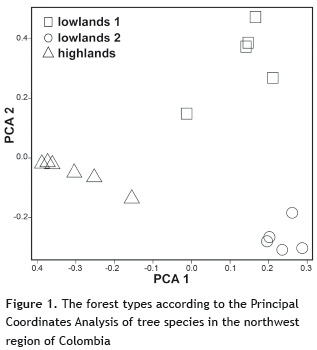
<body><![CDATA[<p> <font size="3"> <b>MATERIALS AND METHODS</b></font></p>     <p>  The study area is located in the northwest region of   Colombia between 5&deg; 50' and 8&deg; 61' N; and 74&deg; 61' and   77&deg; 33' W. This region encompasses an altitudinal gradient   from sea level to 4000 m.a.s.l. and is highly variable in   terms of its topography, climate and soils. The annual   precipitation in this region ranges from 1000 to almost   7000 mm. Likewise, the topography and geology are highly   variable because of the presence of two mountain ranges   influencing patterns of drainage, rainfall and soil fertility   at local scales (IGAC 2007).</p>     <p>  The study was conducted using data collected from 16   permanent 1-ha forest inventory plots. The permanent   plots were distributed across a large geographic area that   covers approximately 64 000 km2, mostly in the province of   Antioquia. Plot locations span an altitudinal gradient from   50 to 2950 m.a.s.l. (<a href="/img/revistas/acbi/v38n105/v38n105a2t1.jpg" target="_blank">table 1</a>). The average distance between   plots was 172.6 km (ranging from 24.5 to 423.1 km). Plots   were established in randomly selected areas meeting the   following criteria: 1) no signs of recent disturbance; 2) located   in either a public or private protected area; 3) located in an   accessible area in which work could be performed for long   periods; and 4) located in a relatively-secure area without the   current presence of guerrillas or any other illegal group. The   historical settlement in the region since the 18th century lead   to a massive occupation in the central cordillera, which has   promoted an intensive deforestation and forest degradation   (Cabrera <i>et al.</i> 2011). Overall, the current forest cover only   accounts for roughly 30% of the original vegetation (Duque   <i>et al.</i> 2014). Four plots (Carepa, El Bagre, Necocl&iacute;, and   T&aacute;mesis) are located in small forest fragments (~ 50 ha), and   may have faced prior degradation and edge effects such as   elevated tree mortality.</p>     <p>  All plots were 100 x 100 m with the exception of one plot   of 40 x 250 m which was shaped to fit within the only   remaining forest fragment in the T&aacute;mesis geographic area.   In each plot, all woody plant individuals (shrubs, trees,   palms, and tree ferns) with a diameter at breast height   (DBH) &ge; 10 cm were mapped, tagged, and measured.   All individuals with a DBH between 1 and 10 cm were   counted in a 40 x 40 m subplot located near the center   of each plot. Voucher collections were made for each   potentially-unique species in each plot. All of the vouchers   are kept at the University of Antioquia's Herbarium (HUA).   Individuals that could not be identified to the species level   were classified as morphospecies based on differences in   the morphology of vegetative characters. Approximately   1.2% (333) of individuals were excluded from the analysis   due to low-quality vouchers resulting from a lack of clear   botanical characters, earlier stages of development, or incorrect enumeration.</p>     <p>  For soil sampling, plots were divided into 20 x 20 m   quadrats, except for the T&aacute;mesis plot, which was divided   in 10 x 10 m quadrats. We collected samples of the soil A   horizon (mineral soil after removing organic layer) from   five points in each quadrat. Composite samples (500 g)   per quadrat were obtained and air-dried after macroscopic   organic matter removal. The chemical properties and texture   of the soil samples were analyzed at the Biogeochemical   Analysis Laboratory at the Universidad Nacional de   Colombia in Medell&iacute;n. The exchangeable Ca, K, and Mg   were extracted with 1 M ammonium acetate and analyzed   using atomic-absorption. The available P was extracted with   L-ascorbic acid and analyzed using a spectrophotometer   UV-VIS. The soil pH was measured in water solution as one   part soil to two parts water. The organic matter (<b>O.M.</b>) was   determined according to the Walkley and Black volumetric   method. Mean values (from quadrats samples) of soil   properties per plot, were used for subsequent analyses.</p>     <p>  <b>Data analysis</b>. <i>Community composition</i>. Because many   species can be artificially classified as unique or rare due to   the relatively low density of plots dispersed over our large   study area, we included only those species recorded in two or   more plots in our analyses. We <i>a priori</i> designated the six plots   occurring above 1700 m asl as ''highland'' forests since these   plots are located within the cloud-immersion zone and are   sometimes exposed to sub-zero temperatures (&deg;C; A. Duque,   personal observations). The remaining ten plots (all below   1100 m.a.s.l.) were classified as lowland forests (<a href="/img/revistas/acbi/v38n105/v38n105a2t1.jpg" target="_blank">table 1</a>).</p>     <p>The patterns of community composition in the entire region   were defined by means of a Principal Component Analysis   (PCA) performed on the Hellinger-transformed species   abundances (Legendre and Gallagher 2001, Legendre   and Legendre 2012). We then performed an Analysis of   Similarities (ANOSIM) with 999 permutations prior to   the calculation of the Euclidean distances between the   Hellinger-transformed species abundances per plot to   identify the different forest types as depicted by the PCA   (Borcard <i>et al.</i> 2011, Legendre and Legendre 2012). The   ANOSIM test confirms if predefined sampling units are   statistically distinct in their species composition under the   assumption that compositional intergroup dissimilarities   should be greater than intragroup dissimilarities (Oksanen   <i>et al.</i> 2016). The species contribution to beta diversity   (<b>SCBD</b>), which was derived from the total community   composition variance following the methodology proposed   by Legendre and De C&aacute;ceres (2013), was quantified for   each species.</p>     <p>  <i>Community composition and environment</i>. Based on the   forest types defined by the PCA on the floristic data, we   performed a one-way analysis of variance (ANOVA) to   evaluate the differences in pH, and the log transformed   contents of O.M., Ca, K, Mg, and P. Tukey's tests were   performed to compare means. Independent Redundancy   Analyses (RDA) based on the Hellinger transformed   species abundances was performed to analyze the   influence of climate, soil fertility, and spatial processes on   compositional patterns (Legendre and Legendre 2012) for   both lowland and highland plots. Climatic variables were   mean annual rainfall (mm), the number of dry months per   year, and the elevation of each plot (m.a.s.l.). Elevation   was taken from the NASA shuttle radar topography   mission digital elevation model (<b>DEM</b>) at a resolution of   30 arc seconds and was used as a proxy for temperature   variation since the Pearson correlation of elevation with   both annual mean temperature and minimum temperature   was extremely high (r = -0.99). Soil fertility was evaluated   by means of the soil pH and the log-transformed content   of O.M., Ca, K, Mg, and P. The geographical space was   then employed to evaluate the biological spatially driven   processes, such as either dispersal limitation (see Jones   <i>et al.</i> 2008) or biogeographical similarity. The spatial   variables were described by a third-order polynomial of   the geographical coordinates, which were centered on   their respective means prior to analysis. This method is   recommended for modeling spatial structures that operates   at large spatial scales (Legendre and Legendre 2012).</p>     <p>  In both the lowlands and highlands, the forward   selection option was applied to each independent set of   explanatory variables (climatic, edaphic, or spatial) to   select all significant factors (P &lt; 0.05 after 999 random   permutations) explaining the variation of the plant   community composition (Borcard <i>et al.</i> 2011). In order   to have the most parsimonious RDA model, forward   selection was run again on the complete set of selected   climatic, edaphic and spatial variables. The distance-decay   approach (Nekola and White 1999, Tuomisto <i>et al.</i> 2003)   was then applied to analyze the relationship between   the floristic similarities and either the log-transformed   spatial distances or the environmental distance of the logtransformed   variables left in the RDA independent models.   The correlation between the floristic distances and spatial   or environmental distances was evaluated by a Mantel   test (Legendre and Legendre 2012). We transformed the   floristic dissimilarities (D) to similarities (S) through a   subtraction S = 2-D. A semi-log linear model was then   fitted to plot the distance decay of floristic similarity. The   approximately linear distance-decay along the logarithm   of geographical distance can be used as an explicit   prediction (and test) of Hubbell's neutral theory (Hubbell   2001, Tuomisto and Ruokolainen 2006). The RDA and the   distance decay methods are complementary methods that   aim to explain changes in plant community composition   (Tuomisto and Ruokolainen 2006).</p>     <p>&nbsp;</p>     ]]></body>
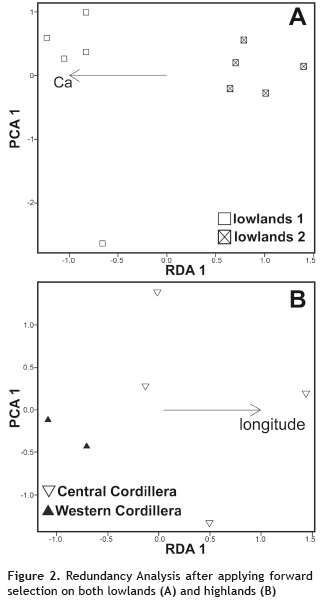
<body><![CDATA[<p> <font size="3"> <b>RESULTS</b></font></p>     <p>  In the entire survey, we tallied a total of 26,512 individuals   woody plants (DBH &ge; 1 cm) belonging to 1622 species or   morphospecies. Of the total species, 959 (59%) could be   identified as named species, 577 (36%) were identified   only to the genus level, 79 (4.9%) were identified only to   the family level, and 7 (0.1%) remained unidentified. In   total, 541 species were present in two or more plots and   therefore could be included in our analyses.</p>     <p>  The number of individuals per plot (including all   individuals with DBH &ge; 1 cm found within the 40 x 40   m subplot) ranged between 862 and 2855. The number of   species per plot ranged between 55 and 303 (table 1). In   the lowlands, there were 358 species (13,303 individuals)   that were present in two or more plots, while in highlands   there were 169 species (6898 individuals) that occurred in   two or more plots.</p>     <p>  <b>Definition of forest types</b>. In the entire study area, we   identified 3 distinct forest types: one in the highlands   and two in the lowlands (<a href="#f1">figure 1</a>). Along the first PCA   axis, which explained 12.7% of the total variation, the   highlands were separated from lowlands. The first PCA   axis was highly correlated with elevation (r = -0.75), which   confirmed the expected strong effect of temperature in   determining tree community composition at large scale   along the whole elevation gradient from lowlands to   highlands. Along the second PCA axis, which explained   11.4% of the total variation, the lowland forests were also   divided into two major forest types - henceforth referred   to as lowlands 1 and lowlands 2 (<a href="#f1">figure 1</a>). The ANOSIM   confirmed the existence of significant differences in the   community composition among the three forest types   identified by means of the PCA (R = 0.89, p = 0.001).</p>       <p align="center"><a name="f1"></a><img src="/img/revistas/acbi/v38n105/v38n105a2f1.jpg"></p>     <p>&nbsp;</p>     <p>  The lowlands 1 group was composed of five plots,   including Sapzurro and Puerto Triunfo, which were located   at the farthest distance apart of any pair of plots (<a href="/img/revistas/acbi/v38n105/v38n105a2t1.jpg" target="_blank">table 1</a>).   The three species with the highest contribution to the total   beta diversity belonging to this forest type were <i>Acalypha   diversifolia, Clarisia biflora,</i> and <i>Clavija mezii </i>(<a href="/img/revistas/acbi/v38n105/v38n105a2t2.jpg" target="_blank">table 2</a>).   The lowlands 2 group was composed of the remaining 5   lowland plots established which were all located within the   Cauca basin in the northeast part of the Antioquia province   (<a href="/img/revistas/acbi/v38n105/v38n105a2t1.jpg" target="_blank">table 1</a>). The three species with the highest contribution   to the total beta diversity belonging to the lowlands 2   forest type were <i>Oenocarpus minor, Pourouma bicolor,</i>   and <i>Virola sebifera</i> (<a href="/img/revistas/acbi/v38n105/v38n105a2t2.jpg" target="_blank">table 2</a>). The highlands forest type   was dominated by<i> Quercus humboldtii</i>, which was the   most abundant species in the entire study area (<a href="/img/revistas/acbi/v38n105/v38n105a2t2.jpg" target="_blank">table 2</a>).</p>     <p>The three highland species that contributed most to beta   diversity were <i>Billia rosea, Q. humboldtii, </i>and <i>Wettinia   kalbreyeri.</i> Understory species, such as <i>Miconia resima</i>   and <i>Palicourea demissa</i> had also an important contribution   to total beta diversity. For both the entire dataset and for   only the 30 species with the highest contribution to beta   diversity, total abundance was highly correlated with SCBD   (r = 0.9 and r = 0.83, respectively).</p>     <p>  <b>Determinants of community composition and species   turnover.</b> Soil fertility in the lowlands 1 forest, as represented   by Ca, Mg, and pH, was significantly higher than the soil   fertility in the lowlands 2 and the highland forests, which did   not differ between each other. However, P concentrations were   higher in the highlands than in the lowlands (<a href="/img/revistas/acbi/v38n105/v38n105a2t3.jpg" target="_blank">table 3</a>). In the   lowlands, the correlations between Ca, K, and Mg with P were   high, but none of them were significant (<a href="/img/revistas/acbi/v38n105/v38n105a2t4.jpg" target="_blank">table 4</a>).</p>     <p>  In the lowlands, Ca, longitude, and elevation were retained   as significant explanatory variables by the forward   selection performed on the separated sets of edaphic,   spatial, and climatic explanatory variables, respectively.   However, when we ran the forward selection on just Ca,   longitude, and elevation only Ca (R<sup>2</sup> = 0.24; p = 0.001)   remained in the model (<a href="#f2">figure 2A</a>). Ca was the only variable   that remained in the model primarily due to the negative   and significant correlation with longitude (r = -0.72) and   elevation (r = -0.61). The semi-log linear models confirmed   the importance of the increase in Ca contents in soils   (R<sub>Mantel</sub> = 0.68; p = 0.006) as well as the increase in the   log-transformed geographical distances (R<sub>Mantel</sub> = 0.49;   p = 0.004) as significantly associated with compositional   turnover in the lowlands (<a href="/img/revistas/acbi/v38n105/v38n105a2f3.jpg" target="_blank">figure 3</a>), but not for elevation   (R<sub>Mantel</sub> = 0.25; p = 0.065). In the highlands, the   independent forward selection of the RDA on each of the   edaphic, spatial, or climatic explanatory set of factors only   identified longitude as a significant explanatory variable   (R<sup>2</sup> = 0.24). The spatial trend in the plant community   composition detected by the constrained RDA ordination   was determined primarily by the biogeographical location   of the plots, which showed a higher floristic similarity   between plots located on either the West or the Central   Cordillera (<a href="#f2">figure 2B</a>). However, the semi-log linear model   did not support a significant decrease in floristic similarity   with the increase in (log-transformed) geographic distances   (R<sub>Mantel</sub> = 0.23; p = 0.18; <a href="/img/revistas/acbi/v38n105/v38n105a2f3.jpg" target="_blank">figure 3</a>).</p>       ]]></body>
<body><![CDATA[<p align="center"><a name="f2"></a><img src="/img/revistas/acbi/v38n105/v38n105a2f2.jpg"></p>     <p>&nbsp;</p>     <p> <font size="3"> <b>DISCUSSION</b></font></p>     <p>  We documented the occurrence of three major forest types   in the Northern Andean study region that were dominated   by different woody plant species. Highland plots (e.g.,   those located above the cloud-base at 1700 m.a.s.l.)   had higher dominance and abundance of species when   compared to lowland plots. For example, in the highlands,   <i>Q. humboldtii</i> was twice as abundant as any species in   the lowlands. Interestingly, the plot located at the lowest   elevation within the highland forest type (Anor&iacute;) had a   mixture of species typical of highlands, such as <i>Billia rosea </i>and<i> Q. humboldtii,</i> and species typical of the lowlands,   such as <i>Pouteria torta </i>and<i> Virola sebifera</i>, emphasizing its   location within an ecotonal climatic-zone. Gentry (1988)   proposed that some plant families, such as Arecaceae and   Moraceae, are more abundant and diverse in fertile soils,   while others like Burseraceae, Lauraceae, and Sapotaceae,   are better-adapted to poorer soils. Although the species   that had the highest contribution to the total beta diversity   in the richer soils of lowlands belonged to the Moraceae   family (<i>Clarisia biflora</i>), our results do not support this   generalization. Since some species belonging to the   Arecaceae and Moraceae families, such as <i>Pseudolmedia    laevis</i> and<i> Oenocarpus minor</i>, respectively, were within the   most important species for the total beta diversity in the   poorer soils of lowlands, we found it difficult to generalize   any likely effect of soils fertility on species distribution   in the lowlands at taxonomic levels higher than species.</p>     <p>  We assessed the degree to which various climatic,   topographic and edaphic variables explain floristic   variation in contrasting forest types within this diverse   and understudied region of the Neotropics. Our findings   did not shed support for the generalized idea about a   greater habitat-plant specialization in highlands than in   lowlands. Therefore, we reject the main hypothesis about   the expected congruence between either environmental   or spatial structured factors that determine species   composition of tree communities in this region of the   northern Andes. Overall, in lowlands, deterministic   processes associated with internal ecotones defined by   soil properties showed to be the main determinants of tree   species composition. In highlands, the biogeographical   position along the longitudinal axis created differences in   tree community composition between mountain ranges,   which were likely driven by isolation due to the barrier   imposed by interandean valleys.</p>     <p>  In lowland forests, we found that changes in the floristic   composition were primarily explained by variation in soil   fertility. This suggests that environmental filtering may   be the main mechanism determining the structure of the   plant community (Gentry 1988, Tuomisto <i>et al.</i> 2003).   The fact that the Puerto Triunfo plot appeared as part of   the lowlands 1 forest type, even though this plot is located   400 km away from some of the other lowland 1 plots, and   is separated from the other lowland 1 plots by the mountain   ranges of the Central and West Cordilleras of Colombia and   the coastal plains in the north, supports the idea that sites   with more similar soil characteristics tend to have greater   similarity in species composition regardless of distance or   geographic separation. Therefore, plant communities in the   lowlands were clearly non-randomly distributed and the   associated tree communities could, to a significant degree,   be predicted based on environmental factors (Clark <i>et al.</i>   1999, Gentry 1988). Our findings support the importance   of niche differences in structuring tree communities across   large spatial scales in the lowlands of the Neotropics   (Condit <i>et al.</i> 2013, Gentry 1988).</p>     <p>  Although our model identified Ca concentrations as   the most-important explanatory variable for species   composition in the lowlands, the significant correlation   of Ca with both Mg concentration and soil pH, suggests   a general soil fertility gradient across the sites that  distinguishes forest types within the lowlands. Specifically,   the lowlands 1 forests have relatively more fertile soils   compared to the lowlands 2 plots. These results are   similar to those found in other neotropical rainforests,   where concentrations of Ca, K, Mg, and pH controlled   patterns of tree species composition in both canopy and   understory species (Duque <i>et al.</i> 2002, Phillips <i>et al.</i>   2003). As described by Condit <i>et al.</i> (2013), tree species   may depend on several nutrients in concert but with Ca   and P generally being the two key elements. In our case,   there was little variation and low concentrations of P in   the lowland plots, which may explain why it was not   identified as an explanatory variable of tree community   composition. Perhaps, a very high demand of P in forests   with high productivity has depleted the soil stock of this   important element.</p>     <p>  Geographical distances also played important roles in   explaining the assemblages of species in the lowlands,   as suggested by the negative and significant relationship   between compositional similarity and the log-distances   between plots. The fact that longitude was not retained as an   explanatory variable in the final RDA model was primarily   due to the co-linearity with Ca concentrations, which   correlation increases with distance. An additional partial   Mantel test showed that geographic distances remained   significant on controlling the floristic composition after   accounting for the effects of Ca (R<sub>Partial.Mantel</sub> = 0.38;   p = 0.019). Disentangling how much of the influence   of spatially-structured soil components in structuring   tree communities is due to either the soils effect per   se or to spatially-structured biological processes such   as dispersal limitation, has previously been debated in   plant communities (Duivenvoorden <i>et al.</i> 2002, Duque   <i>et al.</i> 2009); in this particular case, it appears that plant   community composition within the lowlands is largely   determined by soil fertility (Garibaldi <i>et al.</i> 2014). This   contention is supported by the fact that plots located   on similar soils but with different geologies in different   catchments showed high similarity in their species   composition. In contrast, in mountainous ecosystems of   Costa Rica, plots of canopy tree species located below   1500 m.a.s.l. showed significant spatial autocorrelation at   distances of up to 40 to 50 km and biologically-structured   factors such as dispersal limitation were proposed as one   of the major determinants of tree species distributions   (Chain-Guadarrama <i>et al.</i> 2012).</p>     <p>  Similar to longitude, in the lowlands, elevation was not   retained in the final RDA model due to it being significantly   correlated with Ca contents (RMantel = 0.33; p = 0.042). In   studies of elevational gradients, local thermal conditions   have been found to play an important role in shaping   species distributions and compositional patterns (Feeley   <i>et al.</i> 2013, Hemp 2005). However, in the lowlands of our   study area, the results of both analyses were not conclusive   due to the RDA and the semi-log linear models producing   different outputs at pinpointing elevation as a significant   factor. On the one side, according to the RDA model, we   found a small but still significant effect of temperature on   the plant communities that was masked by the correlation   with Ca. Contrasting this, the log-linear model that tests   the neutral hypothesis of a constant decrease in species   similarity with increasing difference in elevation, did not   support a significant effect of elevation on structuring   tree communities below 1000 m.a.s.l. (see also Chain-   Guadarrama <i>et al.</i> 2012, Gentry 1995). A partial Mantel   test showed that elevation did not remain as a significant   explanatory variable of floristic changes after removing the   effect of Ca (R<sub>Partial.Mantel</sub> = 0.19; p = 0.11). More detailed   analysis about thermal ranges of tree species distributions   at large geographical scales (e.g., Feeley <i>et al.</i> 2013) are   still needed to improve the effectiveness of conservation   strategies aimed at ameliorating global warming effects in   lowland tropical forests.</p>     <p>  In contrast to expectations, in the highland forest plots,   longitude was the only explanatory variable significantly   associated with tree community composition in the RDA   analysis (<a href="/img/revistas/acbi/v38n105/v38n105a2f3.jpg" target="_blank">figure 3</a>). Similar to elevation in lowlands, in   the highlands, the expected decrease in species similarity   with the increase in the geographic distance proposed by   the neutral theory (Hubbell 2001) was rejected. Thus,   the significance of longitude in the RDA model as an   explanatory variable of floristic composition is in accord   with the observations that tree species composition was   more similar between plots established on the same   Cordillera (either Central or Western; <a href="#f2">figure 2B</a>). This may   be due to the Cauca river valley constraining the movement   of propagules between mountain chains producing an   anisotropic effect (<i>sensu</i> Tuomisto and Ruokolainen 2006)   from east to west (and vice versa) in the tree community   composition. However, we acknowledge that additional   studies with increased sample sizes are needed to clarify   this floristic-geographic differentiation.</p>     ]]></body>
<body><![CDATA[<p>  Another explanation for the lack of environmental effects   on floristic composition in the highlands is the fact that   soil fertility was fairly homogeneous between sites. The   highland plots were located on metamorphic and volcanic   intrusive rocks that originate in the West and Central   Cordilleras, respectively. It is expected that the volcanic   intrusive rocks should have high soil fertility because of its   geological origin and high concentrations of volcanic ashes.   Therefore, some unknown processes may have driven soils   fertility or nutrient release to similar levels independent   of their geological origin promoting the relative floristic   homogeneity found in this study, and thus, the lack of   significance of soils in determining tree communities in   highlands. In the highlands, for example, neither Ca nor P   had any significant influence on structuring highland tree   communities. The lack of importance of P in the models   could indicate that P is not a limiting resource in these   forests. Alternatively, the relatively high P concentrations   found in highland soils (in relation to lowlands) may not   be available for the plant uptake due to the low pH of   the soils that could promote P precipitation. However,   a complementary explanation to the lack of importance   of environmental factors in structuring the highland tree   communities may be the existence of broad distributional   ranges for many species. Broad distributional ranges of   species that occur within the cloud-immersion zone may   be the consequence of the regionally homogeneous soils   fertility as well as physiological adaptations to extreme   climatic conditions and variation (Stevens 1992).</p>     <p>  The results of this study proposes that different factor may   play important roles on determining the tree communities   inhabiting the quite diverse forests of the northern Andes   in Colombia. Although in the whole study area either   elevation or temperature was the most important factor   determining tree communities (Duque <i>et al.</i> 2015), our   findings proposed that the extent and nature of the main   factors determining species composition varied according   to the altitudinal position. Although additional assessments   of this question are needed, they emphasize on the need   to develop different strategies to protect the already quite   endangered forests of this region. In cases such as those   found in lowlands, including within reserves as much as   possible of the environmental variation will be a key issue   for conservation. In highlands, on contrary, the larger the   reserve the more effective the conservation strategy will be.</p>     <p>  It is important to note that many Andean forests have been   highly degraded and fragmented (Myers <i>et al.</i> 2000), which   may limit seed dispersal because of the lack of connectivity   and forest continuity in the region. In fact, in the northwest   Andean lowlands of Colombia and their surroundings,   where forest occupancy by human beings spans several   centuries, the local populations of plant species may be a   product of physical and genetic isolation. Species isolation   by habitat loss and forest fragmentation represents a major   threat to this extremely diverse area of the Neotropics   and will likely drive local and global extinctions if we   do not stop the current deforestation trends (Duque <i>et al.</i>   2014). Since tropical Andean ecosystems, and in particular   highland forests, have received less attention than their   lowland counterparts, our findings help to expand the   current knowledge on these important habitats.</p>     <p>&nbsp;</p>     <p> <font size="3"> <b>ACKNOWLEDGEMENTS</b></font></p>     <p>  We thank Fundaci&oacute;n Berta Arias, CORANTIOQUIA,   Fundaci&oacute;n Colibr&iacute;, Empresas Pecuarias del Bajo Cauca,   Mineros S. A., Rodrigo Celis, and Andr&eacute;s Upegui for   allowing us to install and maintain the plots on their   properties. The authors are grateful to James Dalling for   his comments and suggestions to a prior version of this   manuscript. We also thank Herbarium Universidad de   Antioquia for allowing the identification and storage of   collections. A. Duque was funded by a Visitant Researcher   Fulbright Colombia grant (2014-2015) that was hosted in   Miami (FL, U.S.A.) by the International Center for Tropical   Botany at Florida International University and the Fairchild   Tropical Botanic Garden. K. J. Feeley is supported by the   U.S. National Science Foundation (DEB-1350125).</p>     <p>&nbsp;</p>     <p><font size="3">  <b>REFERENCES</b></font></p>     <!-- ref --><p>  Aiba S, Kitayama K. 1999. Structure, composition and species diversity   in an altitude-substrate matrix of rain forest tree communities   on mount Kinabalu, Borneo. Plant Ecology, 140 (2): 139-157.    &nbsp;&nbsp;&nbsp;&nbsp;&nbsp;&nbsp;&nbsp;&nbsp;[&#160;<a href="javascript:void(0);" onclick="javascript: window.open('/scielo.php?script=sci_nlinks&ref=166056&pid=S0304-3584201600020000200001&lng=','','width=640,height=500,resizable=yes,scrollbars=1,menubar=yes,');">Links</a>&#160;]<!-- end-ref --></p>     ]]></body>
<body><![CDATA[<!-- ref --><p>  Borcard D, Gillet F, Legendre P. 2011. Numerical ecology with R. New   York: Springer. p. 306.    &nbsp;&nbsp;&nbsp;&nbsp;&nbsp;&nbsp;&nbsp;&nbsp;[&#160;<a href="javascript:void(0);" onclick="javascript: window.open('/scielo.php?script=sci_nlinks&ref=166058&pid=S0304-3584201600020000200002&lng=','','width=640,height=500,resizable=yes,scrollbars=1,menubar=yes,');">Links</a>&#160;]<!-- end-ref --></p>     <!-- ref --><p>  Cabrera E, Galindo G, Vargas DM. 2011. Protocolo de procesamiento   digital de im&aacute;genes para la cuantificaci&oacute;n de la deforestaci&oacute;n   en Colombia, nivel nacional escala gruesa y fina. Bogot&aacute; D. C.   (Colombia): Instituto de Hidrolog&iacute;a, Meteorolog&iacute;a, y Estudios   Ambientales-IDEAM. p. 44.    &nbsp;&nbsp;&nbsp;&nbsp;&nbsp;&nbsp;&nbsp;&nbsp;[&#160;<a href="javascript:void(0);" onclick="javascript: window.open('/scielo.php?script=sci_nlinks&ref=166060&pid=S0304-3584201600020000200003&lng=','','width=640,height=500,resizable=yes,scrollbars=1,menubar=yes,');">Links</a>&#160;]<!-- end-ref --></p>     <!-- ref --><p>  Chain-Guadarrama A, Finegan B, Vilchez S, Casanoves F. 2012.   Determinants of rain-forest floristic variation on an altitudinal   gradient in southern Costa Rica. Journal of Tropical Ecology,   28 (5): 463-481.    &nbsp;&nbsp;&nbsp;&nbsp;&nbsp;&nbsp;&nbsp;&nbsp;[&#160;<a href="javascript:void(0);" onclick="javascript: window.open('/scielo.php?script=sci_nlinks&ref=166062&pid=S0304-3584201600020000200004&lng=','','width=640,height=500,resizable=yes,scrollbars=1,menubar=yes,');">Links</a>&#160;]<!-- end-ref --></p>     <!-- ref --><p>  Clark DB, Palmer MW, Clark DA. 1999. Edaphic factors and the   landscape-scale distributions of tropical rain forest trees. Ecology,   80 (8): 2662-2675.    &nbsp;&nbsp;&nbsp;&nbsp;&nbsp;&nbsp;&nbsp;&nbsp;[&#160;<a href="javascript:void(0);" onclick="javascript: window.open('/scielo.php?script=sci_nlinks&ref=166064&pid=S0304-3584201600020000200005&lng=','','width=640,height=500,resizable=yes,scrollbars=1,menubar=yes,');">Links</a>&#160;]<!-- end-ref --></p>     <!-- ref --><p>  Clinebell II, RR, Phillips OL, Gentry AH, Stark N, Zuuring H. 1995.   Prediction of neotropical tree and liana species richness from soil   and climatic data. Biodiversity and Conservation, 4 (1): 56-90.    &nbsp;&nbsp;&nbsp;&nbsp;&nbsp;&nbsp;&nbsp;&nbsp;[&#160;<a href="javascript:void(0);" onclick="javascript: window.open('/scielo.php?script=sci_nlinks&ref=166066&pid=S0304-3584201600020000200006&lng=','','width=640,height=500,resizable=yes,scrollbars=1,menubar=yes,');">Links</a>&#160;]<!-- end-ref --></p>     ]]></body>
<body><![CDATA[<!-- ref --><p>  Condit R, Pitman N, Leigh EG, Chave J, Terborgh J, Foster RB, Nu&ntilde;ez   P, Aguilar S, Valencia R, Villa G, Muller-Landau HC, Losos E,   Hubbell SP. 2002. Beta-diversity in tropical forest trees. Science,   295 (5555): 666-669.    &nbsp;&nbsp;&nbsp;&nbsp;&nbsp;&nbsp;&nbsp;&nbsp;[&#160;<a href="javascript:void(0);" onclick="javascript: window.open('/scielo.php?script=sci_nlinks&ref=166068&pid=S0304-3584201600020000200007&lng=','','width=640,height=500,resizable=yes,scrollbars=1,menubar=yes,');">Links</a>&#160;]<!-- end-ref --></p>     <!-- ref --><p>  Condit R, Engelbrecht B, Pino D, P&eacute;rez R, Turner L. 2013. Species   distributions in response to individual soil nutrients and seasonal   drought across a community of tropical trees. Proceedings of the   National Academy of Science, 110: 5064-5068.    &nbsp;&nbsp;&nbsp;&nbsp;&nbsp;&nbsp;&nbsp;&nbsp;[&#160;<a href="javascript:void(0);" onclick="javascript: window.open('/scielo.php?script=sci_nlinks&ref=166070&pid=S0304-3584201600020000200008&lng=','','width=640,height=500,resizable=yes,scrollbars=1,menubar=yes,');">Links</a>&#160;]<!-- end-ref --></p>     <!-- ref --><p>  Davidar P. Rajagopal B, Mohandass D, Puyravaud JP, Condit R, Wright   SJ, Leigh EG. 2007. The effect of climatic gradients, topographic   variation and species traits on the beta diversity of rain forest trees.   Global Ecolology and Biogeography, 16 (4): 510-518.    &nbsp;&nbsp;&nbsp;&nbsp;&nbsp;&nbsp;&nbsp;&nbsp;[&#160;<a href="javascript:void(0);" onclick="javascript: window.open('/scielo.php?script=sci_nlinks&ref=166072&pid=S0304-3584201600020000200009&lng=','','width=640,height=500,resizable=yes,scrollbars=1,menubar=yes,');">Links</a>&#160;]<!-- end-ref --></p>     <!-- ref --><p>  Duivenvoorden, JF, Svenning J-Ch, Wright SJ. 2002. Beta diversity in   tropical forests. Science, 295(5555): 636-637.    &nbsp;&nbsp;&nbsp;&nbsp;&nbsp;&nbsp;&nbsp;&nbsp;[&#160;<a href="javascript:void(0);" onclick="javascript: window.open('/scielo.php?script=sci_nlinks&ref=166074&pid=S0304-3584201600020000200010&lng=','','width=640,height=500,resizable=yes,scrollbars=1,menubar=yes,');">Links</a>&#160;]<!-- end-ref --></p>     <!-- ref --><p>  Duque &Aacute;, S&aacute;nchez M, Cavelier J, Duivenvoorden JF. 2002. Different   floristic patterns of woody understorey and canopy plants in   Colombian Amazonia. Journal of Tropical Ecology, 18 (4): 499-525.    &nbsp;&nbsp;&nbsp;&nbsp;&nbsp;&nbsp;&nbsp;&nbsp;[&#160;<a href="javascript:void(0);" onclick="javascript: window.open('/scielo.php?script=sci_nlinks&ref=166076&pid=S0304-3584201600020000200011&lng=','','width=640,height=500,resizable=yes,scrollbars=1,menubar=yes,');">Links</a>&#160;]<!-- end-ref --></p>     ]]></body>
<body><![CDATA[<!-- ref --><p>  Duque &Aacute;, Phillips JF, Hildebrand P, Posada CA, Prieto A, Rudas A,   Suesc&uacute;n M, Stevenson P. 2009. Distance decay of tree species   similarity in protected areas on terra firme forests in Colombian   Amazonia. Biotropica, 41 (5): 599-607.    &nbsp;&nbsp;&nbsp;&nbsp;&nbsp;&nbsp;&nbsp;&nbsp;[&#160;<a href="javascript:void(0);" onclick="javascript: window.open('/scielo.php?script=sci_nlinks&ref=166078&pid=S0304-3584201600020000200012&lng=','','width=640,height=500,resizable=yes,scrollbars=1,menubar=yes,');">Links</a>&#160;]<!-- end-ref --></p>     <!-- ref --><p>  Duque &Aacute;, Feeley K, Cabrera E, Callejas R, Id&aacute;rraga &Aacute;. 2014. The   dangers of carbon-centric conservation for biodiversity: a case   study in the Andes. Tropical Conservation Science, 7 (2): 178-193.    &nbsp;&nbsp;&nbsp;&nbsp;&nbsp;&nbsp;&nbsp;&nbsp;[&#160;<a href="javascript:void(0);" onclick="javascript: window.open('/scielo.php?script=sci_nlinks&ref=166080&pid=S0304-3584201600020000200013&lng=','','width=640,height=500,resizable=yes,scrollbars=1,menubar=yes,');">Links</a>&#160;]<!-- end-ref --></p>     <!-- ref --><p>  Duque &Aacute;, Stevenson P, Feeley K. 2015. Thermophilization of adult   and juvenile tree communities in the northern tropical Andes.   Proceedings of the National Academy of Science, 7: 10744-10749.    &nbsp;&nbsp;&nbsp;&nbsp;&nbsp;&nbsp;&nbsp;&nbsp;[&#160;<a href="javascript:void(0);" onclick="javascript: window.open('/scielo.php?script=sci_nlinks&ref=166082&pid=S0304-3584201600020000200014&lng=','','width=640,height=500,resizable=yes,scrollbars=1,menubar=yes,');">Links</a>&#160;]<!-- end-ref --></p>     <!-- ref --><p>  Engelbrecht BM, Comita LS, Condit R, Kursar AT, Tyree MT, Turner   BL, Hubbell SP. 2007. Drought sensitivity shapes species   distribution patterns in tropical forests. Nature, 447 (7140): 80-82.    &nbsp;&nbsp;&nbsp;&nbsp;&nbsp;&nbsp;&nbsp;&nbsp;[&#160;<a href="javascript:void(0);" onclick="javascript: window.open('/scielo.php?script=sci_nlinks&ref=166084&pid=S0304-3584201600020000200015&lng=','','width=640,height=500,resizable=yes,scrollbars=1,menubar=yes,');">Links</a>&#160;]<!-- end-ref --></p>     <!-- ref --><p>  Feeley K, Hurtado J, Saatchi S, Silman M, Clark D. 2013. Compositional   shifts due to climate-driven species migration. Global Change   Biology, 19 (11): 3472-3480.    &nbsp;&nbsp;&nbsp;&nbsp;&nbsp;&nbsp;&nbsp;&nbsp;[&#160;<a href="javascript:void(0);" onclick="javascript: window.open('/scielo.php?script=sci_nlinks&ref=166086&pid=S0304-3584201600020000200016&lng=','','width=640,height=500,resizable=yes,scrollbars=1,menubar=yes,');">Links</a>&#160;]<!-- end-ref --></p>     ]]></body>
<body><![CDATA[<!-- ref --><p>  Garibaldi C, Nieto-Ariza B, Mac&iacute;a MJ, Cayuela L. 2014. Soil and   geographic distance as determinants of floristic composition in   the Azuero Peninsula (Panama). Biotropica, 46 (6): 687-895.    &nbsp;&nbsp;&nbsp;&nbsp;&nbsp;&nbsp;&nbsp;&nbsp;[&#160;<a href="javascript:void(0);" onclick="javascript: window.open('/scielo.php?script=sci_nlinks&ref=166088&pid=S0304-3584201600020000200017&lng=','','width=640,height=500,resizable=yes,scrollbars=1,menubar=yes,');">Links</a>&#160;]<!-- end-ref --></p>     <!-- ref --><p>  Gentry AH. 1982. Patterns of neotropical plant species diversity. In:   Hecht MK, Wallace B, Prance ET, editors. Evolutionary biology.   New York (USA): Plenum Press. Vol. 15: 1-84.    &nbsp;&nbsp;&nbsp;&nbsp;&nbsp;&nbsp;&nbsp;&nbsp;[&#160;<a href="javascript:void(0);" onclick="javascript: window.open('/scielo.php?script=sci_nlinks&ref=166090&pid=S0304-3584201600020000200018&lng=','','width=640,height=500,resizable=yes,scrollbars=1,menubar=yes,');">Links</a>&#160;]<!-- end-ref --></p>     <!-- ref --><p>  Gentry AH. 1988. Changes in plant community diversity and floristic   composition on geographical and environmental gradients. Annals   of the Missouri Botanical Garden, 75 (1): 1-34.    &nbsp;&nbsp;&nbsp;&nbsp;&nbsp;&nbsp;&nbsp;&nbsp;[&#160;<a href="javascript:void(0);" onclick="javascript: window.open('/scielo.php?script=sci_nlinks&ref=166092&pid=S0304-3584201600020000200019&lng=','','width=640,height=500,resizable=yes,scrollbars=1,menubar=yes,');">Links</a>&#160;]<!-- end-ref --></p>     <!-- ref --><p>  Gentry AH. 1995. Patterns of diversity and floristic composition in   neotropical montane forests. In: Churchill SP, Balslev H, Forero   E, Luteyn J, editors. Biodiversity and conservation of neotropical   montane forests. New York: New York Botanical Garden. p. 103-126.    &nbsp;&nbsp;&nbsp;&nbsp;&nbsp;&nbsp;&nbsp;&nbsp;[&#160;<a href="javascript:void(0);" onclick="javascript: window.open('/scielo.php?script=sci_nlinks&ref=166094&pid=S0304-3584201600020000200020&lng=','','width=640,height=500,resizable=yes,scrollbars=1,menubar=yes,');">Links</a>&#160;]<!-- end-ref --></p>     <!-- ref --><p>  Hemp A. 2005. Continuum or zonation? Altitudinal gradients in the forest   vegetation of Mt. Kilimanjaro. Plant Ecology, 184 (1): 27-42.    &nbsp;&nbsp;&nbsp;&nbsp;&nbsp;&nbsp;&nbsp;&nbsp;[&#160;<a href="javascript:void(0);" onclick="javascript: window.open('/scielo.php?script=sci_nlinks&ref=166096&pid=S0304-3584201600020000200021&lng=','','width=640,height=500,resizable=yes,scrollbars=1,menubar=yes,');">Links</a>&#160;]<!-- end-ref --></p>     ]]></body>
<body><![CDATA[<!-- ref --><p>  Hubbell SP. 2001. The unified neutral theory of biodiversity and   biogeography. Princeton: Princeton University Press. p. 392.    &nbsp;&nbsp;&nbsp;&nbsp;&nbsp;&nbsp;&nbsp;&nbsp;[&#160;<a href="javascript:void(0);" onclick="javascript: window.open('/scielo.php?script=sci_nlinks&ref=166098&pid=S0304-3584201600020000200022&lng=','','width=640,height=500,resizable=yes,scrollbars=1,menubar=yes,');">Links</a>&#160;]<!-- end-ref --></p>     <!-- ref --><p>  IGAC. 2007. Antioquia. Caracter&iacute;sticas geogr&aacute;ficas. Bogot&aacute; (Colombia):   Instituto Geogr&aacute;fico Agust&iacute;n Codazzi. p. 320.    &nbsp;&nbsp;&nbsp;&nbsp;&nbsp;&nbsp;&nbsp;&nbsp;[&#160;<a href="javascript:void(0);" onclick="javascript: window.open('/scielo.php?script=sci_nlinks&ref=166100&pid=S0304-3584201600020000200023&lng=','','width=640,height=500,resizable=yes,scrollbars=1,menubar=yes,');">Links</a>&#160;]<!-- end-ref --></p>     <!-- ref --><p>  John RC, Dalling JW, Harms KE, Yavitt JB, Stallard RF, Mirabello   M, Hubbell SP, Valencia R, Navarrete H, Vallejo M, Foster RB.   2007. Soil nutrients influence spatial distributions of tropical   tree species. Proceedings of the National Academy of Sciences,   104 (3): 864-869.    &nbsp;&nbsp;&nbsp;&nbsp;&nbsp;&nbsp;&nbsp;&nbsp;[&#160;<a href="javascript:void(0);" onclick="javascript: window.open('/scielo.php?script=sci_nlinks&ref=166102&pid=S0304-3584201600020000200024&lng=','','width=640,height=500,resizable=yes,scrollbars=1,menubar=yes,');">Links</a>&#160;]<!-- end-ref --></p>     <!-- ref --><p>  Jones MM, Tuomisto H, Borcard D, Legendre P, Clark DB, Olivas   PC. 2008. Explaining variation in tropical plant community   composition: influence of environmental and spatial data quality.   Oecologia, 155 (3): 593-604.    &nbsp;&nbsp;&nbsp;&nbsp;&nbsp;&nbsp;&nbsp;&nbsp;[&#160;<a href="javascript:void(0);" onclick="javascript: window.open('/scielo.php?script=sci_nlinks&ref=166104&pid=S0304-3584201600020000200025&lng=','','width=640,height=500,resizable=yes,scrollbars=1,menubar=yes,');">Links</a>&#160;]<!-- end-ref --></p>     <!-- ref --><p>  Jones MM, Szyska B, Kessler M. 2011. Microhabitat partitioning   promotes plant diversity in a tropical montane. Global Ecology   and Biogeography, 20: 558-569.    &nbsp;&nbsp;&nbsp;&nbsp;&nbsp;&nbsp;&nbsp;&nbsp;[&#160;<a href="javascript:void(0);" onclick="javascript: window.open('/scielo.php?script=sci_nlinks&ref=166106&pid=S0304-3584201600020000200026&lng=','','width=640,height=500,resizable=yes,scrollbars=1,menubar=yes,');">Links</a>&#160;]<!-- end-ref --></p>     ]]></body>
<body><![CDATA[<!-- ref --><p>  Legendre P, Gallagher ED. 2001. Ecologically meaningful transformations   for ordination of species data. Oecologia, 129 (2): 271-280.    &nbsp;&nbsp;&nbsp;&nbsp;&nbsp;&nbsp;&nbsp;&nbsp;[&#160;<a href="javascript:void(0);" onclick="javascript: window.open('/scielo.php?script=sci_nlinks&ref=166108&pid=S0304-3584201600020000200027&lng=','','width=640,height=500,resizable=yes,scrollbars=1,menubar=yes,');">Links</a>&#160;]<!-- end-ref --></p>     <!-- ref --><p>  Legendre P, Legendre L. 2012. Numerical ecology. 3th edition.   Amsterdam: Elsevier. p. 1006.    &nbsp;&nbsp;&nbsp;&nbsp;&nbsp;&nbsp;&nbsp;&nbsp;[&#160;<a href="javascript:void(0);" onclick="javascript: window.open('/scielo.php?script=sci_nlinks&ref=166110&pid=S0304-3584201600020000200028&lng=','','width=640,height=500,resizable=yes,scrollbars=1,menubar=yes,');">Links</a>&#160;]<!-- end-ref --></p>     <!-- ref --><p>  Legendre P, De C&aacute;ceres M. 2013. Beta diversity as the variance of   community data: dissimilarity coefficients and partitioning.   Ecology Letters, 16 (8): 951-963.    &nbsp;&nbsp;&nbsp;&nbsp;&nbsp;&nbsp;&nbsp;&nbsp;[&#160;<a href="javascript:void(0);" onclick="javascript: window.open('/scielo.php?script=sci_nlinks&ref=166112&pid=S0304-3584201600020000200029&lng=','','width=640,height=500,resizable=yes,scrollbars=1,menubar=yes,');">Links</a>&#160;]<!-- end-ref --></p>     <!-- ref --><p>  Myers N, Mittermier RA, Mittermier CG, da Fonseca GAB, Kent J.   2000. Biodiversity hotspots for conservation priorities. Nature,   403 (6772): 853-858.    &nbsp;&nbsp;&nbsp;&nbsp;&nbsp;&nbsp;&nbsp;&nbsp;[&#160;<a href="javascript:void(0);" onclick="javascript: window.open('/scielo.php?script=sci_nlinks&ref=166114&pid=S0304-3584201600020000200030&lng=','','width=640,height=500,resizable=yes,scrollbars=1,menubar=yes,');">Links</a>&#160;]<!-- end-ref --></p>     <!-- ref --><p>  Nekola JC, White PS. 1999. The distance decay of similarity in   biogeography and ecology. Journal of Biogeography, 26 (4): 867-878.    &nbsp;&nbsp;&nbsp;&nbsp;&nbsp;&nbsp;&nbsp;&nbsp;[&#160;<a href="javascript:void(0);" onclick="javascript: window.open('/scielo.php?script=sci_nlinks&ref=166116&pid=S0304-3584201600020000200031&lng=','','width=640,height=500,resizable=yes,scrollbars=1,menubar=yes,');">Links</a>&#160;]<!-- end-ref --></p>     ]]></body>
<body><![CDATA[<!-- ref --><p>  Oksanen J, Blanchet FG, Kindt R, Legendre P, Minchin PR, O'Hara RB,   Simpson GL, Solymos P, Stevens MHH, Wagner H. 2016. Vegan:   Community Ecology Package. R package ver. 2.3-5 &#91;Internet&#93;.   Accessed: 03 May 2016. Available from: <a href="https://cran.r-project.org/web/packages/vegan/index.html" target="_blank">https://cran.r-project.org/web/packages/vegan/index.html</a>.    &nbsp;&nbsp;&nbsp;&nbsp;&nbsp;&nbsp;&nbsp;&nbsp;[&#160;<a href="javascript:void(0);" onclick="javascript: window.open('/scielo.php?script=sci_nlinks&ref=166118&pid=S0304-3584201600020000200032&lng=','','width=640,height=500,resizable=yes,scrollbars=1,menubar=yes,');">Links</a>&#160;]<!-- end-ref --></p>     <!-- ref --><p>  Phillips OL, N&uacute;&ntilde;ez-Vargas P, Monteagudo AL, Pe&ntilde;a-Cruz A, Chuspe-   Zans ME, Galiano-S&aacute;nchez W, Yli-Halla M, Rose S. 2003. Habitat   association among Amazonian tree species: a landscape-scale   approach. Journal of Ecology, 91 (5): 757-775.    &nbsp;&nbsp;&nbsp;&nbsp;&nbsp;&nbsp;&nbsp;&nbsp;[&#160;<a href="javascript:void(0);" onclick="javascript: window.open('/scielo.php?script=sci_nlinks&ref=166120&pid=S0304-3584201600020000200033&lng=','','width=640,height=500,resizable=yes,scrollbars=1,menubar=yes,');">Links</a>&#160;]<!-- end-ref --></p>     <!-- ref --><p>  Stevens GC. 1992. The elevational gradient in altitudinal range: an   extension of Rapoport's latitudinal rule to altitude. American   Naturalist, 140 (6): 893-911.    &nbsp;&nbsp;&nbsp;&nbsp;&nbsp;&nbsp;&nbsp;&nbsp;[&#160;<a href="javascript:void(0);" onclick="javascript: window.open('/scielo.php?script=sci_nlinks&ref=166122&pid=S0304-3584201600020000200034&lng=','','width=640,height=500,resizable=yes,scrollbars=1,menubar=yes,');">Links</a>&#160;]<!-- end-ref --></p>     <!-- ref --><p>  Tuomisto H, Ruokolainen K. 2006. Analyzing or explaining beta   diversity? Understanding the targets of different methods of   analysis. Ecology, 87 (11): 2697-2708.    &nbsp;&nbsp;&nbsp;&nbsp;&nbsp;&nbsp;&nbsp;&nbsp;[&#160;<a href="javascript:void(0);" onclick="javascript: window.open('/scielo.php?script=sci_nlinks&ref=166124&pid=S0304-3584201600020000200035&lng=','','width=640,height=500,resizable=yes,scrollbars=1,menubar=yes,');">Links</a>&#160;]<!-- end-ref --></p>     <!-- ref --><p>  Tuomisto H, Ruokolainen K, Yli-Halla M. 2003. Dispersal, environment,   and floristic variation of western Amazonian forests. Science,   299 (5604): 241-244.    &nbsp;&nbsp;&nbsp;&nbsp;&nbsp;&nbsp;&nbsp;&nbsp;[&#160;<a href="javascript:void(0);" onclick="javascript: window.open('/scielo.php?script=sci_nlinks&ref=166126&pid=S0304-3584201600020000200036&lng=','','width=640,height=500,resizable=yes,scrollbars=1,menubar=yes,');">Links</a>&#160;]<!-- end-ref --></p>     ]]></body>
<body><![CDATA[<!-- ref --><p>  V&aacute;squez JA, Givnish TJ. 1998. Altitudinal gradients in tropical forest   composition, structure, and diversity in the sierra de Manantlan.   Journal of Ecology, 86 (6): 999-1020.    &nbsp;&nbsp;&nbsp;&nbsp;&nbsp;&nbsp;&nbsp;&nbsp;[&#160;<a href="javascript:void(0);" onclick="javascript: window.open('/scielo.php?script=sci_nlinks&ref=166128&pid=S0304-3584201600020000200037&lng=','','width=640,height=500,resizable=yes,scrollbars=1,menubar=yes,');">Links</a>&#160;]<!-- end-ref --></p>     <!-- ref --><p>  Vormisto J, Svenning J-Ch, Hall P, Balslev H. 2004. Diversity and   dominance in palm (Arecaceae) communities in terra firme forests   in the western Amazon basin. Journal of Ecology, 92 (4): 577-588.    &nbsp;&nbsp;&nbsp;&nbsp;&nbsp;&nbsp;&nbsp;&nbsp;[&#160;<a href="javascript:void(0);" onclick="javascript: window.open('/scielo.php?script=sci_nlinks&ref=166130&pid=S0304-3584201600020000200038&lng=','','width=640,height=500,resizable=yes,scrollbars=1,menubar=yes,');">Links</a>&#160;]<!-- end-ref --></p>     <p>&nbsp;</p> </font>      ]]></body><back>
<ref-list>
<ref id="B1">
<nlm-citation citation-type="journal">
<person-group person-group-type="author">
<name>
<surname><![CDATA[Aiba]]></surname>
<given-names><![CDATA[S]]></given-names>
</name>
<name>
<surname><![CDATA[Kitayama]]></surname>
<given-names><![CDATA[K]]></given-names>
</name>
</person-group>
<article-title xml:lang="en"><![CDATA[Structure, composition and species diversity in an altitude-substrate matrix of rain forest tree communities on mount Kinabalu, Borneo]]></article-title>
<source><![CDATA[Plant Ecology]]></source>
<year>1999</year>
<volume>140</volume>
<numero>2</numero>
<issue>2</issue>
<page-range>139-157</page-range></nlm-citation>
</ref>
<ref id="B2">
<nlm-citation citation-type="book">
<person-group person-group-type="author">
<name>
<surname><![CDATA[Borcard]]></surname>
<given-names><![CDATA[D]]></given-names>
</name>
<name>
<surname><![CDATA[Gillet]]></surname>
<given-names><![CDATA[F]]></given-names>
</name>
<name>
<surname><![CDATA[Legendre]]></surname>
<given-names><![CDATA[P]]></given-names>
</name>
</person-group>
<source><![CDATA[Numerical ecology with R]]></source>
<year>2011</year>
<page-range>306</page-range><publisher-loc><![CDATA[New York ]]></publisher-loc>
<publisher-name><![CDATA[Springer]]></publisher-name>
</nlm-citation>
</ref>
<ref id="B3">
<nlm-citation citation-type="book">
<person-group person-group-type="author">
<name>
<surname><![CDATA[Cabrera]]></surname>
<given-names><![CDATA[E]]></given-names>
</name>
<name>
<surname><![CDATA[Galindo]]></surname>
<given-names><![CDATA[G]]></given-names>
</name>
<name>
<surname><![CDATA[Vargas]]></surname>
<given-names><![CDATA[DM]]></given-names>
</name>
</person-group>
<source><![CDATA[Protocolo de procesamiento digital de imágenes para la cuantificación de la deforestación en Colombia, nivel nacional escala gruesa y fina]]></source>
<year>2011</year>
<page-range>44</page-range><publisher-loc><![CDATA[Bogotá ]]></publisher-loc>
<publisher-name><![CDATA[Instituto de Hidrología, Meteorología, y Estudios Ambientales]]></publisher-name>
</nlm-citation>
</ref>
<ref id="B4">
<nlm-citation citation-type="journal">
<person-group person-group-type="author">
<name>
<surname><![CDATA[Chain-Guadarrama]]></surname>
<given-names><![CDATA[A]]></given-names>
</name>
<name>
<surname><![CDATA[Finegan]]></surname>
<given-names><![CDATA[B]]></given-names>
</name>
<name>
<surname><![CDATA[Vilchez]]></surname>
<given-names><![CDATA[S]]></given-names>
</name>
<name>
<surname><![CDATA[Casanoves]]></surname>
<given-names><![CDATA[F]]></given-names>
</name>
</person-group>
<article-title xml:lang="en"><![CDATA[Determinants of rain-forest floristic variation on an altitudinal gradient in southern Costa Rica]]></article-title>
<source><![CDATA[Journal of Tropical Ecology]]></source>
<year>2012</year>
<volume>28</volume>
<numero>5</numero>
<issue>5</issue>
<page-range>463-481</page-range></nlm-citation>
</ref>
<ref id="B5">
<nlm-citation citation-type="journal">
<person-group person-group-type="author">
<name>
<surname><![CDATA[Clark]]></surname>
<given-names><![CDATA[DB]]></given-names>
</name>
<name>
<surname><![CDATA[Palmer]]></surname>
<given-names><![CDATA[MW]]></given-names>
</name>
<name>
<surname><![CDATA[Clark]]></surname>
<given-names><![CDATA[DA]]></given-names>
</name>
</person-group>
<article-title xml:lang="en"><![CDATA[Edaphic factors and the landscape-scale distributions of tropical rain forest trees]]></article-title>
<source><![CDATA[Ecology]]></source>
<year>1999</year>
<volume>80</volume>
<numero>8</numero>
<issue>8</issue>
<page-range>2662-2675</page-range></nlm-citation>
</ref>
<ref id="B6">
<nlm-citation citation-type="journal">
<person-group person-group-type="author">
<name>
<surname><![CDATA[Clinebell]]></surname>
<given-names><![CDATA[II]]></given-names>
</name>
<name>
<surname><![CDATA[Phillips]]></surname>
<given-names><![CDATA[OL]]></given-names>
</name>
<name>
<surname><![CDATA[Gentry]]></surname>
<given-names><![CDATA[AH]]></given-names>
</name>
<name>
<surname><![CDATA[Stark]]></surname>
<given-names><![CDATA[N]]></given-names>
</name>
<name>
<surname><![CDATA[Zuuring]]></surname>
<given-names><![CDATA[H]]></given-names>
</name>
</person-group>
<article-title xml:lang="en"><![CDATA[Prediction of neotropical tree and liana species richness from soil and climatic data]]></article-title>
<source><![CDATA[Biodiversity and Conservation]]></source>
<year>1995</year>
<volume>4</volume>
<numero>1</numero>
<issue>1</issue>
<page-range>56-90</page-range></nlm-citation>
</ref>
<ref id="B7">
<nlm-citation citation-type="journal">
<person-group person-group-type="author">
<name>
<surname><![CDATA[Condit]]></surname>
<given-names><![CDATA[R]]></given-names>
</name>
<name>
<surname><![CDATA[Pitman]]></surname>
<given-names><![CDATA[N]]></given-names>
</name>
<name>
<surname><![CDATA[Leigh]]></surname>
<given-names><![CDATA[EG]]></given-names>
</name>
<name>
<surname><![CDATA[Chave]]></surname>
<given-names><![CDATA[J]]></given-names>
</name>
<name>
<surname><![CDATA[Terborgh]]></surname>
<given-names><![CDATA[J]]></given-names>
</name>
<name>
<surname><![CDATA[Foster]]></surname>
<given-names><![CDATA[RB]]></given-names>
</name>
<name>
<surname><![CDATA[Nuñez]]></surname>
<given-names><![CDATA[P]]></given-names>
</name>
<name>
<surname><![CDATA[Aguilar]]></surname>
<given-names><![CDATA[S]]></given-names>
</name>
<name>
<surname><![CDATA[Valencia]]></surname>
<given-names><![CDATA[R]]></given-names>
</name>
<name>
<surname><![CDATA[Villa]]></surname>
<given-names><![CDATA[G]]></given-names>
</name>
<name>
<surname><![CDATA[Muller-Landau]]></surname>
<given-names><![CDATA[HC]]></given-names>
</name>
<name>
<surname><![CDATA[Losos]]></surname>
<given-names><![CDATA[E]]></given-names>
</name>
<name>
<surname><![CDATA[Hubbell]]></surname>
<given-names><![CDATA[SP]]></given-names>
</name>
</person-group>
<article-title xml:lang="en"><![CDATA[Beta-diversity in tropical forest trees]]></article-title>
<source><![CDATA[Science]]></source>
<year>2002</year>
<volume>295</volume>
<numero>5555</numero>
<issue>5555</issue>
<page-range>666-669</page-range></nlm-citation>
</ref>
<ref id="B8">
<nlm-citation citation-type="journal">
<person-group person-group-type="author">
<name>
<surname><![CDATA[Condit]]></surname>
<given-names><![CDATA[R]]></given-names>
</name>
<name>
<surname><![CDATA[Engelbrecht]]></surname>
<given-names><![CDATA[B]]></given-names>
</name>
<name>
<surname><![CDATA[Pino]]></surname>
<given-names><![CDATA[D]]></given-names>
</name>
<name>
<surname><![CDATA[Pérez]]></surname>
<given-names><![CDATA[R]]></given-names>
</name>
<name>
<surname><![CDATA[Turner]]></surname>
<given-names><![CDATA[L]]></given-names>
</name>
</person-group>
<article-title xml:lang="en"><![CDATA[Species distributions in response to individual soil nutrients and seasonal drought across a community of tropical trees]]></article-title>
<source><![CDATA[Proceedings of the National Academy of Science]]></source>
<year>2013</year>
<volume>110</volume>
<page-range>5064-5068</page-range></nlm-citation>
</ref>
<ref id="B9">
<nlm-citation citation-type="journal">
<person-group person-group-type="author">
<name>
<surname><![CDATA[Davidar]]></surname>
<given-names><![CDATA[P]]></given-names>
</name>
<name>
<surname><![CDATA[Rajagopal]]></surname>
<given-names><![CDATA[B]]></given-names>
</name>
<name>
<surname><![CDATA[Mohandass]]></surname>
<given-names><![CDATA[D]]></given-names>
</name>
<name>
<surname><![CDATA[Puyravaud]]></surname>
<given-names><![CDATA[JP]]></given-names>
</name>
<name>
<surname><![CDATA[Condit]]></surname>
<given-names><![CDATA[R]]></given-names>
</name>
<name>
<surname><![CDATA[Wright]]></surname>
<given-names><![CDATA[SJ]]></given-names>
</name>
<name>
<surname><![CDATA[Leigh]]></surname>
<given-names><![CDATA[EG]]></given-names>
</name>
</person-group>
<article-title xml:lang="en"><![CDATA[The effect of climatic gradients, topographic variation and species traits on the beta diversity of rain forest trees]]></article-title>
<source><![CDATA[Global Ecolology and Biogeography]]></source>
<year>2007</year>
<volume>16</volume>
<numero>4</numero>
<issue>4</issue>
<page-range>510-518</page-range></nlm-citation>
</ref>
<ref id="B10">
<nlm-citation citation-type="journal">
<person-group person-group-type="author">
<name>
<surname><![CDATA[Duivenvoorden]]></surname>
<given-names><![CDATA[JF]]></given-names>
</name>
<name>
<surname><![CDATA[Svenning]]></surname>
<given-names><![CDATA[J-Ch]]></given-names>
</name>
<name>
<surname><![CDATA[Wright]]></surname>
<given-names><![CDATA[SJ]]></given-names>
</name>
</person-group>
<article-title xml:lang="en"><![CDATA[Beta diversity in tropical forests]]></article-title>
<source><![CDATA[Science]]></source>
<year>2002</year>
<volume>295</volume>
<numero>5555</numero>
<issue>5555</issue>
<page-range>636-637</page-range></nlm-citation>
</ref>
<ref id="B11">
<nlm-citation citation-type="journal">
<person-group person-group-type="author">
<name>
<surname><![CDATA[Duque]]></surname>
<given-names><![CDATA[Á]]></given-names>
</name>
<name>
<surname><![CDATA[Sánchez]]></surname>
<given-names><![CDATA[M]]></given-names>
</name>
<name>
<surname><![CDATA[Cavelier]]></surname>
<given-names><![CDATA[J]]></given-names>
</name>
<name>
<surname><![CDATA[Duivenvoorden]]></surname>
<given-names><![CDATA[JF]]></given-names>
</name>
</person-group>
<article-title xml:lang="en"><![CDATA[Different floristic patterns of woody understorey and canopy plants in Colombian Amazonia]]></article-title>
<source><![CDATA[Journal of Tropical Ecology]]></source>
<year>2002</year>
<volume>18</volume>
<numero>4</numero>
<issue>4</issue>
<page-range>499-525</page-range></nlm-citation>
</ref>
<ref id="B12">
<nlm-citation citation-type="journal">
<person-group person-group-type="author">
<name>
<surname><![CDATA[Duque]]></surname>
<given-names><![CDATA[Á]]></given-names>
</name>
<name>
<surname><![CDATA[Phillips]]></surname>
<given-names><![CDATA[JF]]></given-names>
</name>
<name>
<surname><![CDATA[Hildebrand]]></surname>
<given-names><![CDATA[P]]></given-names>
</name>
<name>
<surname><![CDATA[Posada]]></surname>
<given-names><![CDATA[CA]]></given-names>
</name>
<name>
<surname><![CDATA[Prieto]]></surname>
<given-names><![CDATA[A]]></given-names>
</name>
<name>
<surname><![CDATA[Rudas]]></surname>
<given-names><![CDATA[A]]></given-names>
</name>
<name>
<surname><![CDATA[Suescún]]></surname>
<given-names><![CDATA[M]]></given-names>
</name>
<name>
<surname><![CDATA[Stevenson]]></surname>
<given-names><![CDATA[P]]></given-names>
</name>
</person-group>
<article-title xml:lang="en"><![CDATA[Distance decay of tree species similarity in protected areas on terra firme forests in Colombian Amazonia]]></article-title>
<source><![CDATA[Biotropica]]></source>
<year>2009</year>
<volume>41</volume>
<numero>5</numero>
<issue>5</issue>
<page-range>599-607</page-range></nlm-citation>
</ref>
<ref id="B13">
<nlm-citation citation-type="journal">
<person-group person-group-type="author">
<name>
<surname><![CDATA[Duque]]></surname>
<given-names><![CDATA[Á]]></given-names>
</name>
<name>
<surname><![CDATA[Feeley]]></surname>
<given-names><![CDATA[K]]></given-names>
</name>
<name>
<surname><![CDATA[Cabrera]]></surname>
<given-names><![CDATA[E]]></given-names>
</name>
<name>
<surname><![CDATA[Callejas]]></surname>
<given-names><![CDATA[R]]></given-names>
</name>
<name>
<surname><![CDATA[Idárraga]]></surname>
<given-names><![CDATA[Á]]></given-names>
</name>
</person-group>
<article-title xml:lang="en"><![CDATA[The dangers of carbon-centric conservation for biodiversity: a case study in the Andes]]></article-title>
<source><![CDATA[Tropical Conservation Science]]></source>
<year>2014</year>
<volume>7</volume>
<numero>2</numero>
<issue>2</issue>
<page-range>178-193</page-range></nlm-citation>
</ref>
<ref id="B14">
<nlm-citation citation-type="journal">
<person-group person-group-type="author">
<name>
<surname><![CDATA[Duque]]></surname>
<given-names><![CDATA[Á]]></given-names>
</name>
<name>
<surname><![CDATA[Stevenson]]></surname>
<given-names><![CDATA[P]]></given-names>
</name>
<name>
<surname><![CDATA[Feeley]]></surname>
<given-names><![CDATA[K]]></given-names>
</name>
</person-group>
<article-title xml:lang="en"><![CDATA[Thermophilization of adult and juvenile tree communities in the northern tropical Andes]]></article-title>
<source><![CDATA[Proceedings of the National Academy of Science]]></source>
<year>2015</year>
<volume>7</volume>
<page-range>10744-10749</page-range></nlm-citation>
</ref>
<ref id="B15">
<nlm-citation citation-type="journal">
<person-group person-group-type="author">
<name>
<surname><![CDATA[Engelbrecht]]></surname>
<given-names><![CDATA[BM]]></given-names>
</name>
<name>
<surname><![CDATA[Comita]]></surname>
<given-names><![CDATA[LS]]></given-names>
</name>
<name>
<surname><![CDATA[Condit]]></surname>
<given-names><![CDATA[R]]></given-names>
</name>
<name>
<surname><![CDATA[Kursar]]></surname>
<given-names><![CDATA[AT]]></given-names>
</name>
<name>
<surname><![CDATA[Tyree]]></surname>
<given-names><![CDATA[MT]]></given-names>
</name>
<name>
<surname><![CDATA[Turner]]></surname>
<given-names><![CDATA[BL]]></given-names>
</name>
<name>
<surname><![CDATA[Hubbell]]></surname>
<given-names><![CDATA[SP]]></given-names>
</name>
</person-group>
<article-title xml:lang="en"><![CDATA[Drought sensitivity shapes species distribution patterns in tropical forests]]></article-title>
<source><![CDATA[Nature]]></source>
<year>2007</year>
<volume>447</volume>
<numero>7140</numero>
<issue>7140</issue>
<page-range>80-82</page-range></nlm-citation>
</ref>
<ref id="B16">
<nlm-citation citation-type="journal">
<person-group person-group-type="author">
<name>
<surname><![CDATA[Feeley]]></surname>
<given-names><![CDATA[K]]></given-names>
</name>
<name>
<surname><![CDATA[Hurtado]]></surname>
<given-names><![CDATA[J]]></given-names>
</name>
<name>
<surname><![CDATA[Saatchi]]></surname>
<given-names><![CDATA[S]]></given-names>
</name>
<name>
<surname><![CDATA[Silman]]></surname>
<given-names><![CDATA[M]]></given-names>
</name>
<name>
<surname><![CDATA[Clark]]></surname>
<given-names><![CDATA[D]]></given-names>
</name>
</person-group>
<article-title xml:lang="en"><![CDATA[Compositional shifts due to climate-driven species migration]]></article-title>
<source><![CDATA[Global Change Biology]]></source>
<year>2013</year>
<volume>19</volume>
<numero>11</numero>
<issue>11</issue>
<page-range>3472-3480</page-range></nlm-citation>
</ref>
<ref id="B17">
<nlm-citation citation-type="journal">
<person-group person-group-type="author">
<name>
<surname><![CDATA[Garibaldi]]></surname>
<given-names><![CDATA[C]]></given-names>
</name>
<name>
<surname><![CDATA[Nieto-Ariza]]></surname>
<given-names><![CDATA[B]]></given-names>
</name>
<name>
<surname><![CDATA[Macía]]></surname>
<given-names><![CDATA[MJ]]></given-names>
</name>
<name>
<surname><![CDATA[Cayuela]]></surname>
<given-names><![CDATA[L]]></given-names>
</name>
</person-group>
<article-title xml:lang="en"><![CDATA[Soil and geographic distance as determinants of floristic composition in the Azuero Peninsula (Panama)]]></article-title>
<source><![CDATA[Biotropica]]></source>
<year>2014</year>
<volume>46</volume>
<numero>6</numero>
<issue>6</issue>
<page-range>687-895</page-range></nlm-citation>
</ref>
<ref id="B18">
<nlm-citation citation-type="book">
<person-group person-group-type="author">
<name>
<surname><![CDATA[Gentry]]></surname>
<given-names><![CDATA[AH]]></given-names>
</name>
</person-group>
<article-title xml:lang="en"><![CDATA[Patterns of neotropical plant species diversity]]></article-title>
<person-group person-group-type="editor">
<name>
<surname><![CDATA[Hecht]]></surname>
<given-names><![CDATA[MK]]></given-names>
</name>
<name>
<surname><![CDATA[Wallace]]></surname>
<given-names><![CDATA[B]]></given-names>
</name>
<name>
<surname><![CDATA[Prance]]></surname>
<given-names><![CDATA[ET]]></given-names>
</name>
</person-group>
<source><![CDATA[Evolutionary biology]]></source>
<year>1982</year>
<volume>15</volume>
<page-range>1-84</page-range><publisher-loc><![CDATA[New York ]]></publisher-loc>
<publisher-name><![CDATA[Plenum Press]]></publisher-name>
</nlm-citation>
</ref>
<ref id="B19">
<nlm-citation citation-type="journal">
<person-group person-group-type="author">
<name>
<surname><![CDATA[Gentry]]></surname>
<given-names><![CDATA[AH]]></given-names>
</name>
</person-group>
<article-title xml:lang="en"><![CDATA[Changes in plant community diversity and floristic composition on geographical and environmental gradients]]></article-title>
<source><![CDATA[Annals of the Missouri Botanical Garden]]></source>
<year>1988</year>
<volume>75</volume>
<numero>1</numero>
<issue>1</issue>
<page-range>1-34</page-range></nlm-citation>
</ref>
<ref id="B20">
<nlm-citation citation-type="book">
<person-group person-group-type="author">
<name>
<surname><![CDATA[Gentry]]></surname>
<given-names><![CDATA[AH]]></given-names>
</name>
</person-group>
<article-title xml:lang="en"><![CDATA[Patterns of diversity and floristic composition in neotropical montane forests]]></article-title>
<person-group person-group-type="editor">
<name>
<surname><![CDATA[Churchill]]></surname>
<given-names><![CDATA[SP]]></given-names>
</name>
<name>
<surname><![CDATA[Balslev]]></surname>
<given-names><![CDATA[H]]></given-names>
</name>
<name>
<surname><![CDATA[Forero]]></surname>
<given-names><![CDATA[E]]></given-names>
</name>
<name>
<surname><![CDATA[Luteyn]]></surname>
<given-names><![CDATA[J]]></given-names>
</name>
</person-group>
<source><![CDATA[Biodiversity and conservation of neotropical montane forests]]></source>
<year>1995</year>
<page-range>103-126</page-range><publisher-loc><![CDATA[New York ]]></publisher-loc>
<publisher-name><![CDATA[New York Botanical Garden]]></publisher-name>
</nlm-citation>
</ref>
<ref id="B21">
<nlm-citation citation-type="journal">
<person-group person-group-type="author">
<name>
<surname><![CDATA[Hemp]]></surname>
<given-names><![CDATA[A]]></given-names>
</name>
</person-group>
<article-title xml:lang="en"><![CDATA[Continuum or zonation?: Altitudinal gradients in the forest vegetation of Mt. Kilimanjaro]]></article-title>
<source><![CDATA[Plant Ecology]]></source>
<year>2005</year>
<volume>184</volume>
<numero>1</numero>
<issue>1</issue>
<page-range>27-42</page-range></nlm-citation>
</ref>
<ref id="B22">
<nlm-citation citation-type="book">
<person-group person-group-type="author">
<name>
<surname><![CDATA[Hubbell]]></surname>
<given-names><![CDATA[SP]]></given-names>
</name>
</person-group>
<source><![CDATA[The unified neutral theory of biodiversity and biogeography]]></source>
<year>2001</year>
<page-range>392</page-range><publisher-loc><![CDATA[Princeton ]]></publisher-loc>
<publisher-name><![CDATA[Princeton University Press]]></publisher-name>
</nlm-citation>
</ref>
<ref id="B23">
<nlm-citation citation-type="book">
<collab>IGAC</collab>
<source><![CDATA[Antioquia: Características geográficas]]></source>
<year>2007</year>
<page-range>320</page-range><publisher-loc><![CDATA[Bogotá ]]></publisher-loc>
<publisher-name><![CDATA[Instituto Geográfico Agustín Codazzi]]></publisher-name>
</nlm-citation>
</ref>
<ref id="B24">
<nlm-citation citation-type="journal">
<person-group person-group-type="author">
<name>
<surname><![CDATA[John]]></surname>
<given-names><![CDATA[RC]]></given-names>
</name>
<name>
<surname><![CDATA[Dalling]]></surname>
<given-names><![CDATA[JW]]></given-names>
</name>
<name>
<surname><![CDATA[Harms]]></surname>
<given-names><![CDATA[KE]]></given-names>
</name>
<name>
<surname><![CDATA[Yavitt]]></surname>
<given-names><![CDATA[JB]]></given-names>
</name>
<name>
<surname><![CDATA[Stallard]]></surname>
<given-names><![CDATA[RF]]></given-names>
</name>
<name>
<surname><![CDATA[Mirabello]]></surname>
<given-names><![CDATA[M]]></given-names>
</name>
<name>
<surname><![CDATA[Hubbell]]></surname>
<given-names><![CDATA[SP]]></given-names>
</name>
<name>
<surname><![CDATA[Valencia]]></surname>
<given-names><![CDATA[R]]></given-names>
</name>
<name>
<surname><![CDATA[Navarrete]]></surname>
<given-names><![CDATA[H]]></given-names>
</name>
<name>
<surname><![CDATA[Vallejo]]></surname>
<given-names><![CDATA[M]]></given-names>
</name>
<name>
<surname><![CDATA[Foster]]></surname>
<given-names><![CDATA[RB]]></given-names>
</name>
</person-group>
<article-title xml:lang="en"><![CDATA[Soil nutrients influence spatial distributions of tropical tree species]]></article-title>
<source><![CDATA[Proceedings of the National Academy of Sciences]]></source>
<year>2007</year>
<volume>104</volume>
<numero>3</numero>
<issue>3</issue>
<page-range>864-869</page-range></nlm-citation>
</ref>
<ref id="B25">
<nlm-citation citation-type="journal">
<person-group person-group-type="author">
<name>
<surname><![CDATA[Jones]]></surname>
<given-names><![CDATA[MM]]></given-names>
</name>
<name>
<surname><![CDATA[Tuomisto]]></surname>
<given-names><![CDATA[H]]></given-names>
</name>
<name>
<surname><![CDATA[Borcard]]></surname>
<given-names><![CDATA[D]]></given-names>
</name>
<name>
<surname><![CDATA[Legendre]]></surname>
<given-names><![CDATA[P]]></given-names>
</name>
<name>
<surname><![CDATA[Clark]]></surname>
<given-names><![CDATA[DB]]></given-names>
</name>
<name>
<surname><![CDATA[Olivas]]></surname>
<given-names><![CDATA[PC]]></given-names>
</name>
</person-group>
<article-title xml:lang="en"><![CDATA[Explaining variation in tropical plant community composition: influence of environmental and spatial data quality]]></article-title>
<source><![CDATA[Oecologia]]></source>
<year>2008</year>
<volume>155</volume>
<numero>3</numero>
<issue>3</issue>
<page-range>593-604</page-range></nlm-citation>
</ref>
<ref id="B26">
<nlm-citation citation-type="journal">
<person-group person-group-type="author">
<name>
<surname><![CDATA[Jones]]></surname>
<given-names><![CDATA[MM]]></given-names>
</name>
<name>
<surname><![CDATA[Szyska]]></surname>
<given-names><![CDATA[B]]></given-names>
</name>
<name>
<surname><![CDATA[Kessler]]></surname>
<given-names><![CDATA[M]]></given-names>
</name>
</person-group>
<article-title xml:lang="en"><![CDATA[Microhabitat partitioning promotes plant diversity in a tropical montane]]></article-title>
<source><![CDATA[Global Ecology and Biogeography]]></source>
<year>2011</year>
<volume>20</volume>
<page-range>558-569</page-range></nlm-citation>
</ref>
<ref id="B27">
<nlm-citation citation-type="journal">
<person-group person-group-type="author">
<name>
<surname><![CDATA[Legendre]]></surname>
<given-names><![CDATA[P]]></given-names>
</name>
<name>
<surname><![CDATA[Gallagher]]></surname>
<given-names><![CDATA[ED]]></given-names>
</name>
</person-group>
<article-title xml:lang="en"><![CDATA[Ecologically meaningful transformations for ordination of species data]]></article-title>
<source><![CDATA[Oecologia]]></source>
<year>2001</year>
<volume>129</volume>
<numero>2</numero>
<issue>2</issue>
<page-range>271-280</page-range></nlm-citation>
</ref>
<ref id="B28">
<nlm-citation citation-type="book">
<person-group person-group-type="author">
<name>
<surname><![CDATA[Legendre]]></surname>
<given-names><![CDATA[P]]></given-names>
</name>
<name>
<surname><![CDATA[Legendre]]></surname>
<given-names><![CDATA[L]]></given-names>
</name>
</person-group>
<source><![CDATA[Numerical ecology]]></source>
<year>2012</year>
<edition>3</edition>
<page-range>1006</page-range><publisher-loc><![CDATA[Amsterdam ]]></publisher-loc>
<publisher-name><![CDATA[Elsevier]]></publisher-name>
</nlm-citation>
</ref>
<ref id="B29">
<nlm-citation citation-type="journal">
<person-group person-group-type="author">
<name>
<surname><![CDATA[Legendre]]></surname>
<given-names><![CDATA[P]]></given-names>
</name>
<name>
<surname><![CDATA[De Cáceres]]></surname>
<given-names><![CDATA[M]]></given-names>
</name>
</person-group>
<article-title xml:lang="en"><![CDATA[Beta diversity as the variance of community data: dissimilarity coefficients and partitioning]]></article-title>
<source><![CDATA[Ecology Letters]]></source>
<year>2013</year>
<volume>16</volume>
<numero>8</numero>
<issue>8</issue>
<page-range>951-963</page-range></nlm-citation>
</ref>
<ref id="B30">
<nlm-citation citation-type="journal">
<person-group person-group-type="author">
<name>
<surname><![CDATA[Myers]]></surname>
<given-names><![CDATA[N]]></given-names>
</name>
<name>
<surname><![CDATA[Mittermier]]></surname>
<given-names><![CDATA[RA]]></given-names>
</name>
<name>
<surname><![CDATA[Mittermier]]></surname>
<given-names><![CDATA[CG]]></given-names>
</name>
<name>
<surname><![CDATA[da Fonseca]]></surname>
<given-names><![CDATA[GAB]]></given-names>
</name>
<name>
<surname><![CDATA[Kent]]></surname>
<given-names><![CDATA[J]]></given-names>
</name>
</person-group>
<article-title xml:lang="en"><![CDATA[Biodiversity hotspots for conservation priorities]]></article-title>
<source><![CDATA[Nature]]></source>
<year>2000</year>
<volume>403</volume>
<numero>6772</numero>
<issue>6772</issue>
<page-range>853-858</page-range></nlm-citation>
</ref>
<ref id="B31">
<nlm-citation citation-type="journal">
<person-group person-group-type="author">
<name>
<surname><![CDATA[Nekola]]></surname>
<given-names><![CDATA[JC]]></given-names>
</name>
<name>
<surname><![CDATA[White]]></surname>
<given-names><![CDATA[PS]]></given-names>
</name>
</person-group>
<article-title xml:lang="en"><![CDATA[The distance decay of similarity in biogeography and ecology]]></article-title>
<source><![CDATA[Journal of Biogeography]]></source>
<year>1999</year>
<volume>26</volume>
<numero>4</numero>
<issue>4</issue>
<page-range>867-878</page-range></nlm-citation>
</ref>
<ref id="B32">
<nlm-citation citation-type="">
<person-group person-group-type="author">
<name>
<surname><![CDATA[Oksanen]]></surname>
<given-names><![CDATA[J]]></given-names>
</name>
<name>
<surname><![CDATA[Blanchet]]></surname>
<given-names><![CDATA[FG]]></given-names>
</name>
<name>
<surname><![CDATA[Kindt]]></surname>
<given-names><![CDATA[R]]></given-names>
</name>
<name>
<surname><![CDATA[Legendre]]></surname>
<given-names><![CDATA[P]]></given-names>
</name>
<name>
<surname><![CDATA[Minchin]]></surname>
<given-names><![CDATA[PR]]></given-names>
</name>
<name>
<surname><![CDATA[O'Hara]]></surname>
<given-names><![CDATA[RB]]></given-names>
</name>
<name>
<surname><![CDATA[Simpson]]></surname>
<given-names><![CDATA[GL]]></given-names>
</name>
<name>
<surname><![CDATA[Solymos]]></surname>
<given-names><![CDATA[P]]></given-names>
</name>
<name>
<surname><![CDATA[Stevens]]></surname>
<given-names><![CDATA[MHH]]></given-names>
</name>
</person-group>
<source><![CDATA[Vegan: Community Ecology Package. R package ver. 2.3-5]]></source>
<year></year>
</nlm-citation>
</ref>
<ref id="B33">
<nlm-citation citation-type="journal">
<person-group person-group-type="author">
<name>
<surname><![CDATA[Phillips]]></surname>
<given-names><![CDATA[OL]]></given-names>
</name>
<name>
<surname><![CDATA[Núñez-Vargas]]></surname>
<given-names><![CDATA[P]]></given-names>
</name>
<name>
<surname><![CDATA[Monteagudo]]></surname>
<given-names><![CDATA[AL]]></given-names>
</name>
<name>
<surname><![CDATA[Peña-Cruz]]></surname>
<given-names><![CDATA[A]]></given-names>
</name>
<name>
<surname><![CDATA[Chuspe- Zans]]></surname>
<given-names><![CDATA[ME]]></given-names>
</name>
<name>
<surname><![CDATA[Galiano-Sánchez]]></surname>
<given-names><![CDATA[W]]></given-names>
</name>
<name>
<surname><![CDATA[Yli-Halla]]></surname>
<given-names><![CDATA[M]]></given-names>
</name>
<name>
<surname><![CDATA[Rose]]></surname>
<given-names><![CDATA[S]]></given-names>
</name>
</person-group>
<article-title xml:lang="en"><![CDATA[Habitat association among Amazonian tree species: a landscape-scale approach]]></article-title>
<source><![CDATA[Journal of Ecology]]></source>
<year>2003</year>
<volume>91</volume>
<numero>5</numero>
<issue>5</issue>
<page-range>757-775</page-range></nlm-citation>
</ref>
<ref id="B34">
<nlm-citation citation-type="journal">
<person-group person-group-type="author">
<name>
<surname><![CDATA[Stevens]]></surname>
<given-names><![CDATA[GC]]></given-names>
</name>
</person-group>
<article-title xml:lang="en"><![CDATA[The elevational gradient in altitudinal range: an extension of Rapoport's latitudinal rule to altitude]]></article-title>
<source><![CDATA[American Naturalist]]></source>
<year>1992</year>
<volume>140</volume>
<numero>6</numero>
<issue>6</issue>
<page-range>893-911</page-range></nlm-citation>
</ref>
<ref id="B35">
<nlm-citation citation-type="journal">
<person-group person-group-type="author">
<name>
<surname><![CDATA[Tuomisto]]></surname>
<given-names><![CDATA[H]]></given-names>
</name>
<name>
<surname><![CDATA[Ruokolainen]]></surname>
<given-names><![CDATA[K]]></given-names>
</name>
</person-group>
<article-title xml:lang="en"><![CDATA[Analyzing or explaining beta diversity?: Understanding the targets of different methods of analysis]]></article-title>
<source><![CDATA[Ecology]]></source>
<year>2006</year>
<volume>87</volume>
<numero>11</numero>
<issue>11</issue>
<page-range>2697-2708</page-range></nlm-citation>
</ref>
<ref id="B36">
<nlm-citation citation-type="journal">
<person-group person-group-type="author">
<name>
<surname><![CDATA[Tuomisto]]></surname>
<given-names><![CDATA[H]]></given-names>
</name>
<name>
<surname><![CDATA[Ruokolainen]]></surname>
<given-names><![CDATA[K]]></given-names>
</name>
<name>
<surname><![CDATA[Yli-Halla]]></surname>
<given-names><![CDATA[M]]></given-names>
</name>
</person-group>
<article-title xml:lang="en"><![CDATA[Dispersal, environment, and floristic variation of western Amazonian forests]]></article-title>
<source><![CDATA[Science]]></source>
<year>2003</year>
<volume>299</volume>
<numero>5604</numero>
<issue>5604</issue>
<page-range>241-244</page-range></nlm-citation>
</ref>
<ref id="B37">
<nlm-citation citation-type="journal">
<person-group person-group-type="author">
<name>
<surname><![CDATA[Vásquez]]></surname>
<given-names><![CDATA[JA]]></given-names>
</name>
<name>
<surname><![CDATA[Givnish]]></surname>
<given-names><![CDATA[TJ]]></given-names>
</name>
</person-group>
<article-title xml:lang="en"><![CDATA[Altitudinal gradients in tropical forest composition, structure, and diversity in the sierra de Manantlan]]></article-title>
<source><![CDATA[Journal of Ecology]]></source>
<year>1998</year>
<volume>86</volume>
<numero>6</numero>
<issue>6</issue>
<page-range>999-1020</page-range></nlm-citation>
</ref>
<ref id="B38">
<nlm-citation citation-type="journal">
<person-group person-group-type="author">
<name>
<surname><![CDATA[Vormisto]]></surname>
<given-names><![CDATA[J]]></given-names>
</name>
<name>
<surname><![CDATA[Svenning]]></surname>
<given-names><![CDATA[J-Ch]]></given-names>
</name>
<name>
<surname><![CDATA[Hall]]></surname>
<given-names><![CDATA[P]]></given-names>
</name>
<name>
<surname><![CDATA[Balslev]]></surname>
<given-names><![CDATA[H]]></given-names>
</name>
</person-group>
<article-title xml:lang="en"><![CDATA[Diversity and dominance in palm (Arecaceae) communities in terra firme forests in the western Amazon basin]]></article-title>
<source><![CDATA[Journal of Ecology]]></source>
<year>2004</year>
<volume>92</volume>
<numero>4</numero>
<issue>4</issue>
<page-range>577-588</page-range></nlm-citation>
</ref>
</ref-list>
</back>
</article>