<?xml version="1.0" encoding="ISO-8859-1"?><article xmlns:mml="http://www.w3.org/1998/Math/MathML" xmlns:xlink="http://www.w3.org/1999/xlink" xmlns:xsi="http://www.w3.org/2001/XMLSchema-instance">
<front>
<journal-meta>
<journal-id>0366-5232</journal-id>
<journal-title><![CDATA[Caldasia]]></journal-title>
<abbrev-journal-title><![CDATA[Caldasia]]></abbrev-journal-title>
<issn>0366-5232</issn>
<publisher>
<publisher-name><![CDATA[Instituto de Ciencias Naturales, Facultad de Ciencias-Universidad Nacional de Colombia]]></publisher-name>
</publisher>
</journal-meta>
<article-meta>
<article-id>S0366-52322005000200004</article-id>
<title-group>
<article-title xml:lang="es"><![CDATA[NEW REPORTS OF RUST FUNGI (UREDINALES) FROM NIGERIA]]></article-title>
<article-title xml:lang="en"><![CDATA[Nuevos registros de royas (Uredinales) de Nigeria]]></article-title>
</title-group>
<contrib-group>
<contrib contrib-type="author">
<name>
<surname><![CDATA[HERNÁNDEZ]]></surname>
<given-names><![CDATA[JOSÉ R.]]></given-names>
</name>
<xref ref-type="aff" rid="A01"/>
</contrib>
<contrib contrib-type="author">
<name>
<surname><![CDATA[EBOH]]></surname>
<given-names><![CDATA[DAN O.]]></given-names>
</name>
<xref ref-type="aff" rid="A02"/>
</contrib>
<contrib contrib-type="author">
<name>
<surname><![CDATA[ROSSMAN]]></surname>
<given-names><![CDATA[AMY Y.]]></given-names>
</name>
<xref ref-type="aff" rid="A03"/>
</contrib>
</contrib-group>
<aff id="A01">
<institution><![CDATA[,USDA/ARS Systematic Botany and Mycology Laboratory ]]></institution>
<addr-line><![CDATA[Maryland ]]></addr-line>
<country>USA</country>
</aff>
<aff id="A02">
<institution><![CDATA[,University of Nigeria Faculty of Biological Sciences ]]></institution>
<addr-line><![CDATA[Nsukka Anambre State]]></addr-line>
<country>Nigeria</country>
</aff>
<aff id="A03">
<institution><![CDATA[,USDA/ARS Systematic Botany and Mycology Laboratory ]]></institution>
<addr-line><![CDATA[Maryland ]]></addr-line>
<country>USA</country>
</aff>
<pub-date pub-type="pub">
<day>30</day>
<month>12</month>
<year>2005</year>
</pub-date>
<pub-date pub-type="epub">
<day>30</day>
<month>12</month>
<year>2005</year>
</pub-date>
<volume>27</volume>
<numero>2</numero>
<fpage>213</fpage>
<lpage>221</lpage>
<copyright-statement/>
<copyright-year/>
<self-uri xlink:href="http://www.scielo.org.co/scielo.php?script=sci_arttext&amp;pid=S0366-52322005000200004&amp;lng=en&amp;nrm=iso"></self-uri><self-uri xlink:href="http://www.scielo.org.co/scielo.php?script=sci_abstract&amp;pid=S0366-52322005000200004&amp;lng=en&amp;nrm=iso"></self-uri><self-uri xlink:href="http://www.scielo.org.co/scielo.php?script=sci_pdf&amp;pid=S0366-52322005000200004&amp;lng=en&amp;nrm=iso"></self-uri><abstract abstract-type="short" xml:lang="en"><p><![CDATA[Five species of rust fungi from Nigeria are treated. Coleosporium plumeriae and Puccinia mogiphanis (originally from tropical America ) are reported for the first time from África. Hemileia chlorocodonis is reported for the first time in Nigeria and on a new host, Tacazzea apiculata (Apocynaceae). Descriptions and comments are provided for the relatively rare species Dietelia codiaei and Endophyllum cassiae.]]></p></abstract>
<abstract abstract-type="short" xml:lang="es"><p><![CDATA[En este trabajo se tratan cinco especies de royas de Nigeria. Coleosporium plumeriae y Puccinia mogiphanis (originalmente de América Tropical) son reportadas por primera vez en Africa. Se reporta por primera vez Hemileia chlorocodonis en Nigeria, sobre un nuevo hospedante (Tacazzea apiculata - Apocynaceae). Se proveen también descripción y comentarios sobre las especies exóticas Dietelia codiaei y Endophyllum cassiae.]]></p></abstract>
<kwd-group>
<kwd lng="en"><![CDATA[Africa]]></kwd>
<kwd lng="en"><![CDATA[Coleosporium plumeriae]]></kwd>
<kwd lng="en"><![CDATA[Dietelia codiaei]]></kwd>
<kwd lng="en"><![CDATA[Endophyllum cassiae]]></kwd>
<kwd lng="en"><![CDATA[Hemileia chlorocodonis]]></kwd>
<kwd lng="en"><![CDATA[Puccinia mogiphanis]]></kwd>
<kwd lng="es"><![CDATA[África]]></kwd>
<kwd lng="es"><![CDATA[Coleosporium plumeriae]]></kwd>
<kwd lng="es"><![CDATA[Dietelia codiaei]]></kwd>
<kwd lng="es"><![CDATA[Endophyllum cassiae]]></kwd>
<kwd lng="es"><![CDATA[Hemileia chlorocodonis]]></kwd>
<kwd lng="es"><![CDATA[Puccinia mogiphanis]]></kwd>
</kwd-group>
</article-meta>
</front><body><![CDATA[ <FONT face=Verdana size=3>     <P align=center>    <BR><B>NEW REPORTS OF RUST FUNGI (<I>UREDINALES</I>) FROM NIGERIA</B></P></FONT><FONT face=Verdana size=2>     <P align=center><B>Nuevos registros de royas (<I>Uredinales</I>) de Nigeria</B></P> </FONT>    <BR>     <P><font size="2" face="Verdana"><B>JOSÉ R. HERNÁNDEZ</I></B>   </font>     <P align="left"><font size="2" face="Verdana"><b>DAN O. EBOH</b></font>     <P align="left"><font size="2" face="Verdana"><b>AMY Y. ROSSMAN</b></font>     <P align="left"><font size="2" face="Verdana"><I>USDA/ARS, Systematic Botany and Mycology Laboratory, 10300 Baltimore Ave., Beltsville, Maryland, USA  20705-2350. <a href="mailto:jose@nt.ars-grin.gov">jose@nt.ars-grin.gov</a></I>   </font>     <P><font size="2" face="Verdana"><i>Faculty of Biological Sciences, University of Nigeria, Nsukka, Anambre State, Nigeria</i></font></P>     ]]></body>
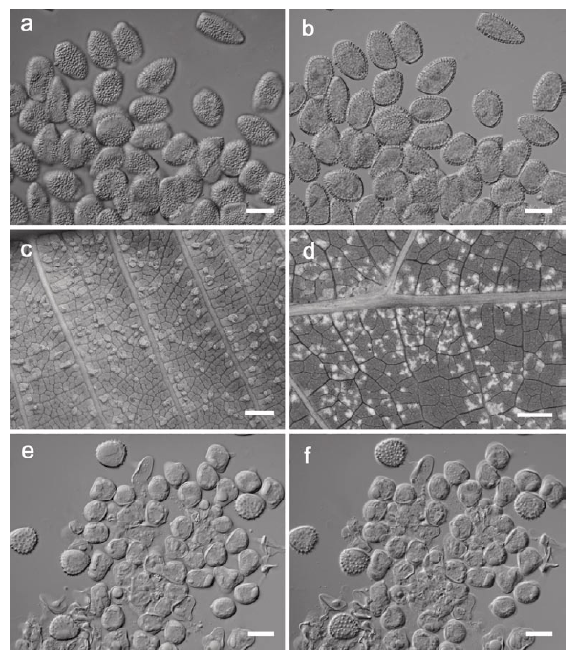
<body><![CDATA[<P><font size="2" face="Verdana"><I>USDA/ARS, Systematic Botany and Mycology Laboratory, 10300 Baltimore Ave., Beltsville, Maryland, USA  20705-2350.</I></font></P>     <P><B><font size="2" face="Verdana, Arial, Helvetica, sans-serif">ABSTRACT</font></B></P>     <P><font size="2" face="Verdana, Arial, Helvetica, sans-serif">Five species of rust fungi from Nigeria are treated. Coleosporium plumeriae and Puccinia mogiphanis (originally from tropical America) are reported for the first time from África. Hemileia chlorocodonis is reported for the first time in Nigeria and on a new host, Tacazzea apiculata (Apocynaceae). Descriptions and comments are provided for the relatively rare species Dietelia codiaei and Endophyllum cassiae. </font></P>      <P><font size="2" face="Verdana, Arial, Helvetica, sans-serif"><B>Key words.</B> Africa, Coleosporium plumeriae, Dietelia codiaei, Endophyllum cassiae, Hemileia chlorocodonis, Puccinia mogiphanis.</font></P>      <P><font size="2" face="Verdana, Arial, Helvetica, sans-serif"><B>RESUMEN</B></font></P>     <P><font size="2" face="Verdana, Arial, Helvetica, sans-serif">En este trabajo se tratan cinco especies de royas de Nigeria. Coleosporium plumeriae y Puccinia mogiphanis (originalmente de América Tropical) son reportadas por primera vez en Africa. Se reporta por primera vez Hemileia chlorocodonis en Nigeria, sobre un  nuevo hospedante (Tacazzea apiculata - Apocynaceae). Se proveen también descripción y comentarios sobre las especies exóticas Dietelia codiaei y Endophyllum cassiae. </font></P>      <P><font size="2" face="Verdana, Arial, Helvetica, sans-serif"><B>Palabras clave.</B> África, Coleosporium plumeriae, Dietelia codiaei, Endophyllum cassiae, Hemileia chlorocodonis, Puccinia mogiphanis.</font></P>      <P><font size="2" face="Verdana, Arial, Helvetica, sans-serif"><B>INTRODUCTION</B></font></P>     <P><font size="2" face="Verdana, Arial, Helvetica, sans-serif">Rust fungi (Uredinales) are a relatively well-known group of fungi in most parts of the world.  However, on the African continent, these studies have been limited primarily to South Africa (Doidge 1927-1948, summarized in Crous et al. 2000) and Nigeria where the rust fungi have been studied extensively by Dan O. Eboh (Eboh 1978, 1981, 1983 a-c, 1984, 1985a-b, 1986 a-b, 1989, Eboh & Cummins 1980, Eboh & Hennen 1987).   In the continued exploration of rust fungi in Nigeria, two species are reported here for the first time from Africa, one species is reported for the first time from Nigeria and on a new host, and two additional rare rust species are described.  Additional images of the species treated in this paper and descriptions and images of other rust fungi can be found on the web site of USDA-ARS Systematic Botany and Mycology Laboratory, under Fungi Online - Images (<a href="http://nt.ars-grin.gov/taxadescriptions/imageview/imageviewflash/imagaViewerFinal.cfm?whichdataset=Rusts">http://nt.ars-grin.gov/taxadescriptions/imageview/imageviewflash/imagaViewerFinal.cfm?whichdataset=Rusts</a>).</font></P>  <font size="2" face="Verdana, Arial, Helvetica, sans-serif"> </P> </font> <font size="2" face="Verdana, Arial, Helvetica, sans-serif"><B>1. <I> Coleosporium plumeriae </I>Pat., Bull. Soc. Mycol. France 18:178 (1902).</B>     <a href="#figura1">Fig. 1</a>, a-c</font>     <p align="center"><img src="/img/revistas/cal/v27n2/v27n2a4fig1.gif"><a name="figura1"></a></p>     ]]></body>
<body><![CDATA[<p align="center"><font size="2"><b><font face="Verdana, Arial, Helvetica, sans-serif">Fig 1. a. b. c. </font></b><font face="Verdana, Arial, Helvetica, sans-serif">Coleosporium plumeriae on Plumeria sp. <b>a.</b> Urediniospores, surface view. Bar = 20 µm. b. Urediniospores, median view. Bar = 20 µm. c. Uredinial sori on lower leaf surface. Bar = 0.5 cm. <b>d. e. f. </b>Hemileia chlorocodonis on Tacazzea apiculata. d. Sori on lower leaf surface corresponding to chlorotic spots on upper surface. Bar = 0.5 cm. e. Telia composed of fascicles of sporogenous cells, teliospores (smooth) mostly attached sporogenous cells, and loose urediniospores (strongly echinulate), median view. Bar = 25 µm. f. Surface view of “e.” Bar = 25 µm.</font></font></p>     <P><font size="2" face="Verdana, Arial, Helvetica, sans-serif">= Coleosporium domingensis Arthur, Amer. J. Bot. 5:329 (1918).</font></P>     <P><font size="2" face="Verdana, Arial, Helvetica, sans-serif">= Uredo domingensis Berk., Ann. Mag. Nat. Hist. 9:9 (1852).</font></P>     <P><font size="2" face="Verdana, Arial, Helvetica, sans-serif">= Uredo plumeriicola Henn., Hedwigia 43:161 (1904).</font></P>     <P><font size="2" face="Verdana, Arial, Helvetica, sans-serif">Spermogonia and aecia unknown. Uredinia hypophyllous, scattered between veins, 0.3-0.8 mm wide, erumpent, powdery, without peridium, orange-yellowish fading to pale yellow; urediniospores 25-32 × 16-24 µm, broadly ellipsoid to subglobose or angular, catenulate, coarsely verrucose, wall 1.5-2 µm, with abundant capitate, annulated tubercles 1.5-3 µm long and 1-2.5 µm wide, germ pores 2 to 4, scattered, obscure. Telia hypophyllous, scattered between veins, 0.1-0.3 mm wide, erumpent, smooth, of numerous teliospores in compact layer, gelatinous when moist, orange-yellow to reddish orange; teliospores 64-85 × 23-32 µm, oblong to clavate, rounded at apex and narrowing at base, contents oily and refractive, orange-yellow, walls smooth, hyaline, thicker at apex than at sides. </font></P>     <P><font size="2" face="Verdana, Arial, Helvetica, sans-serif">Specimen examined: Nigeria, Nsukka, on Plumeria rubra L. (Apocynaceae), leg. Dan O. Eboh, 10.12.2003 (BPI 843715) II.</font></P>     <P><font size="2" face="Verdana, Arial, Helvetica, sans-serif">Coleosporium plumeriae is reported here for the first time from Africa. This rust is relatively common in tropical and semi-tropical regions in the western hemisphere and is known from the Caribbean Islands, Central America, Mexico, northern South America, and the United States (Florida, Hawaii) (Farr et al. n.d.).  It also has been reported from Micronesia (Gonzalez-Ball and Ono 1998) and a greenhouse in Canada (Traquair and Kokko 1980).  This rust may have been introduced into Nigeria on its ornamental host plant Plumeria rubra (‘frangipani’ or ‘plumeria’).</font></P>     <P><font size="2" face="Verdana, Arial, Helvetica, sans-serif">Arthur (1918) transferred Uredo domingensis to Coleosporium, however, he only observed uredinia on the type specimen.  For this reason his publication of this name should be considered a new species rather than a new combination. Arthur (1918) considered Uredo plumeriicola to be a synonym of C. domingensis.</font></P>     <P><font size="2" face="Verdana, Arial, Helvetica, sans-serif">Coleosporium plumeriae has priority over C. domingensis because it was the first valid description of the telial stage. This species was originally spelled Coleosporium “plumierae”.  However, because the specific epithet was based on the host and the accepted spelling of the host genus is Plumeria, the correct specific epithet is “plumeriae” (Art. 60.12, the International Code of Botanical Nomenclature (ICBN), Greuter et al. 2000).  Traquair and Kokko (1980) studied this species using light and scanning electron microscopy and provided a detailed description.</font></P>     <P><font size="2" face="Verdana, Arial, Helvetica, sans-serif"><B>2. <I>Dietelia codiaei </I>Boerema, Versl. Meded. Plziektenk. Dienst Wageningen 153 (Jaarb. 1978):16 (1979).</B></font></P>     ]]></body>
<body><![CDATA[<P><font size="2" face="Verdana, Arial, Helvetica, sans-serif">= Aecidium codiaei Syd., Ann. Mycol. 37:198 (1939).</font></P>     <P><font size="2" face="Verdana, Arial, Helvetica, sans-serif">Spermogonia, aecia and uredinia unknown. Telia hypophyllous, in groups on orange pustules 3-8 mm diameter, sometimes following veins, infection sometimes causing distortion of apical leaves, erumpent, hemispheric, yellow-brown, 200-300 µm diameter, surrounded by host tissue. Peridium erect often shrinking away from the host, dehiscing irregularly at top and becoming revolute; peridial cells hyaline, rhomboid to rectangular, 18-28 × 12-18 µm, inner walls 2-3 µm thick with coarsely verrucose surfaces, tubercles forming humps or short ridges occasionally giving a striate appearance, especially on outer walls which are 4-6 µm thick.  Teliospores globoid-polygonal to oblong, (14.5) 17-22 (26) × 10-14.5 (20.5) µm, wall 1-1.5 µm thick, hyaline to golden, smooth to minutely verrucose.   Intercalary cells not observed.</font></P>     <P><font size="2" face="Verdana, Arial, Helvetica, sans-serif">Specimen examined: Nigeria, Anambra State, Ire Village, Obosi, on Codiaeum variegatum (L.) A. Juss. (Euphorbiaceae), leg. Dan O. Eboh, 15. 12. 2003 (BPI 843629).</font></P>     <P><font size="2" face="Verdana, Arial, Helvetica, sans-serif">This rust was originally described from Ghana (Mangoasi) as Aecidium codiaei (Sydow 1939).  Eboh (1981) reported it under that name from Nigeria.  This species is known from several countries in Africa (Ghana, Ivory Coast, Nigeria, and Togo) and has been introduced into the Netherlands and United Kingdom (Boerema et al. 1994).</font></P>     <P><font size="2" face="Verdana, Arial, Helvetica, sans-serif">Based on material on Codiaeum imported from Ghana into the Netherlands, Boerema and Link (1979) determined that the aecioid sori and spores were actually telia and teliospores, thus they described this species in the teleomorph genus Dietelia.</font></P>     <P><font size="2" face="Verdana, Arial, Helvetica, sans-serif">A detailed study of the biology and morphology of D. codiaei was undertaken in the United Kingdom after the rust was introduced into that area (Boerema et al. 1994).  The teliospores appear nearly smooth under the light microscope, but finely verrucose under the scanning electron microscope with refractive granules over the inconspicuous pores (Boerema et al. 1994).  </font></P>     <P><font size="2" face="Verdana, Arial, Helvetica, sans-serif"><B>3. <I>Endophyllum cassiae</I> F. Stevens & Mendiola, Philipp. Agric. 20: 16 (1931).</B></font></P>     <P><font size="2" face="Verdana, Arial, Helvetica, sans-serif">= Aecidium cassiae Bres., Rev. Mycol. 13: 66 (1891).</font></P>     <P><font size="2" face="Verdana, Arial, Helvetica, sans-serif">= Aecidium torae Henn., Bot. Jahrb. Syst. 34: 42 (1904).</font></P>     <P><font size="2" face="Verdana, Arial, Helvetica, sans-serif">= Endophyllum cassiae Nagaraj, Govindu & Thirum., Sydowia 25: 158 (1971).</font></P>     ]]></body>
<body><![CDATA[<P><font size="2" face="Verdana, Arial, Helvetica, sans-serif">Spermogonia, aecia and uredinia not observed. Leaf spots chlorotic when young, becoming brown when older.  Telia amphigenous, mainly hypophyllous, subepidermal becoming erumpent, arranged in circles and associated with leaf spots up to 8 mm diameter, 150-300 µm diameter, cupulate, peridium 75-150 µm above leaf surface. Peridial cells hyaline, irregularly arranged, 11-28 × 10-21 µm, thick walled, outside wall strongly verrucose, inside wall minutely verrucose. Teliospores catenulate, globose to oblong, 18 × 18-21 µm, orange yellowish, minutely verrucose, wall 1-1.5 µm thick, germ pores obscure.</font></P>     <P><font size="2" face="Verdana, Arial, Helvetica, sans-serif">Specimens examined: Nigeria, Anambra State, Ire Village, Obosi, on Senna obtusifolia (L.) H.S. Irwin and Barneby (Fabaceae), 29.9.2004, leg. Dan O. Eboh (BPI 871369) III.</font></P>     <P><font size="2" face="Verdana, Arial, Helvetica, sans-serif">Endophyllum cassiae was reported from India, the Philippines, and tropical Africa (Buriticá 1991) and also Brunei and Malaysia (Farr et al. n.d.). Lenné (1990) reported this species as Aecidium cassiae from Nigeria based on herbarium records from IMI.</font></P>     <P><font size="2" face="Verdana, Arial, Helvetica, sans-serif"><B>4. <I>Hemileia chlorocodonis </I>Syd. & P. Syd. , Ann. Mycol. 11:55. 1913. </B><a href="#figura1">Fig. 1</a>, d-f	</font></P>     <P><font size="2" face="Verdana, Arial, Helvetica, sans-serif">Spermogonia and aecia unknown. Uredinia composed of fascicles of sporogenous cells that emerge through stomata becoming suprastomatal, mainly hypophyllous, numerous, often aggregated in angular spots surrounded by veins corresponding to pale, angular leaf spots on the upper leaf surface, 0.5-2.5 mm diameter, pale yellow; urediniospores produced on short pedicels, 20-28 × 19-25 µm, ovate to obovate, asymmetric, strongly echinulate, sometimes less echinulate toward ventral side, wall 1.5-2 µm thick, hyaline to sub-hyaline. Telia similar to and intermingled with uredinia, hypophyllous, suprastomatal, pale yellow; teliospores one-celled, produced on short pedicels, 16.5-21.5 µm long × 16.5-24 µm wide, smooth, globose, subglobose, clavate or triangular, sometimes wider than tall, sometimes with an umbo, wall 1 µm thick, 2 µm thick at the base, no germ pore observed, apparently obscure.</font></P>     <P><font size="2" face="Verdana, Arial, Helvetica, sans-serif">Specimens examined: Tanzania (“German East Africa”), Usambara, Amani, on Mondia whitei (Hook. f.) Skeels (as Chlorocodon whitei  Hook. f.), Oct. 1912, A. Zimmerman 3829, Fungi Exotici Exsiccati 221 (BPI) II,  (NY 00053759) II-III Isotypes; Nigeria, Nsukka, University of Nigeria, Botanical Garden, on Tacazzea apiculata Oliv. (Apocynaceae, Periplocoideae), leg. Dan O. Eboh, 9. 1. 2001 (BPI 843634) (II-III); Sudan, Katire, on Tacazzea apiculata Oliv., leg. S.A.J. Tarr (JT 2565), 22. 11. 1954 (IMI 59108) II-III.</font></P>     <P><font size="2" face="Verdana, Arial, Helvetica, sans-serif">Hemileia chlorocodonis Syd. & P. Syd. has been reported on Mondia whitei (Hook. f.) Skeels (as Chlorocodon whitei  Hook. f.) from Malawi, Tanzania and Uganda (Peregrine and Siddiqi 1972, Wakefield and Hansford 1949).  Tarr (1963) reported Hemileia sp. on Tacazzea apiculata from southern Sudan (Katire) that is herein identified as H. chlorodonis (IMI 59108). Tacazzea apiculata is a weedy plant known in Africa as “lufute katika monga,” in the Apocynaceae including the Asclepiadaceae (Endress and Bruyns 2000). </font></P>     <P><font size="2" face="Verdana, Arial, Helvetica, sans-serif">A rust similar to Hemileia chlorocodonis is H. scitula Syd. (Sydow 1937) on Periploca nigrescens Afzel. [= Parquetina nigrescens (Afzel.) Bullock, Apocynaceae, Periplocoideae] described from Sierra Leone.   Although H. scitula is a teleomorph name, only uredinia were described; no telia were found on the type or other specimens examined of H. scitula. Uredinia of Hemileia scitula are hypophyllous, irregularly distributed, and not associated with leaf spots while those of H. chlorocodonis also are mainly hypophyllous but are arranged in angular spots surrounded by veins and associated with leaf spots on the upper leaf surface. The urediniospores of H. scitula are strongly and evenly echinulate while those of H. chlorocodonis are strongly echinulate, sometimes less echinulate toward the ventral side.  No telia are known for H. scitula while H. chlorocodonis produces telia that are intermingled with uredinia.</font></P>     <P><font size="2" face="Verdana, Arial, Helvetica, sans-serif">Specimens examined of Hemileia scitula on Periploca nigrescens Afzel., Ghana, (Gold Coast Colony), Bunsu, leg. S.J. Hughes, 7. 6. 1949 (IMI 42173) II; Sierra Leone, Njala, leg. F.C. Deighton M1053, 5. 11. 1936 (IMI 43274) II, Type; Songo, leg. F.C. Deighton M1136, 28. 11. 1936 (IMI 43275) II; Tawia (Bake Loko), leg. F.C. Deighton M1602, 17. 2. 1938 (IMI 43276) II; Kangakua?, leg. F.C. Deighton M5813, 8. 2. 1954, (IMI 56542) II.</font></P>     <P><font size="2" face="Verdana, Arial, Helvetica, sans-serif">In addition to those mentioned above, two other species of Hemileia have been described on members of the subfamily Periplocoideae.  </font></P>     ]]></body>
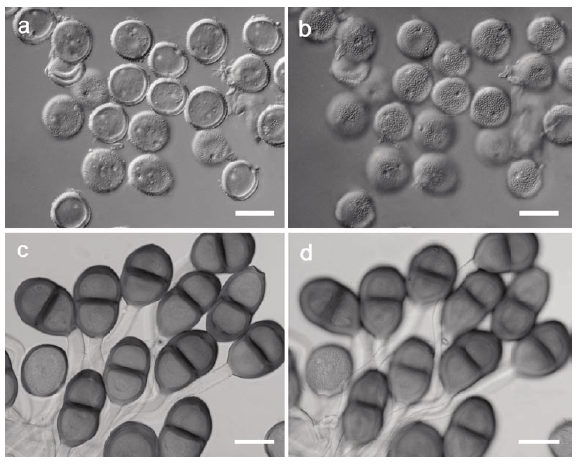
<body><![CDATA[<P><font size="2" face="Verdana, Arial, Helvetica, sans-serif">Hemileia cryptostegiae Vienn.-Bourg. (Viennot- Bourgin 1963), a synonym of Scopella cryptostegiae Cummins (Cummins 1940), was described on Cryptostegia madagascarensis.  This species is now regarded as Maravalia cryptostegiae (Cummins) Y. Ono (Ono 1984) and has been reported on a number of species in the Apocynaceae (Evans 1993, Evans and Tomley 1994). Teliospores of M. cryptostegiae are 23-33(42) × (12)14-18 µm while teliospores of H. chlorocodonis are 16.5-21.5 × 16.5-24 µm.</font></P>     <P><font size="2" face="Verdana, Arial, Helvetica, sans-serif">Specimen examined: Uredo cryptostegiae on Cryptostegia madagascariensis Bojer ex Decne.: Madagascar, Majunga, leg. B. Palm, 4. 1912, Type. (Microm. Rar. Sel. 1660, BPI 154572) II-III.</font></P>     <p><font size="2" face="Verdana, Arial, Helvetica, sans-serif">Three other species of Hemileia for which only uredinia are known were described on Apocynaceae, subfamilies Asclepiadoideae and Secamonoideae.  Hemileia mysorensis Thirum. & Goplkr. was reported from India (Thirumalachar 1947) on Gymnema sp. and Gymnema sylvestre (Retz.) R. Br. ex Schult. (= Periploca sylvestris Retz.,). Only uredinia were described and urediniospores measured 30-45 × 19-25 µm, longer than those of Hemileia chlorocodonis (20-28 × 19-25 µm). Hemileia secamones Wakef. & Hansf. (Wakefield and Hansford 1949) was reported on Secamones sp. from Uganda. Only uredinia were described with urediniospores 18-23 × 15-22 µm, smaller than the ones of Hemileia chlorocodonis (20-28 × 19-25 µm).  Hemileia sonsensis (Henn.) P. Syd. & Syd. (Sydow and Sydow 1915) (anam. Uredo sonsensis Henn. 1907), produces urediniospores that are 22-32 × 18-25 µm, somewhat longer than H. chlorocodonis, and with an aculeate convex surface and smooth near the base. Because no teleomorph was described, these cannot be named in the teleomorph genus Hemileia based on the current ICBN (Greuter et al. 2000).</font></P> <font face="Verdana, Arial, Helvetica, sans-serif">     <P><font size="2"><B> 5. <I>Puccinia mogiphanis </I>Arthur, Bot. Gaz. 65:469 (1918).</B>                            <a href="#figura2">Fig. 2</a>, a-d</font></P> </font>     <p align="center"><font face="Verdana, Arial, Helvetica, sans-serif"><img src="/img/revistas/cal/v27n2/v27n2a4fig2.gif"><a name="figura2"></a></font></p>     <p align="center"><font size="2" face="Verdana, Arial, Helvetica, sans-serif"><b>Fig 2.</b> Puccinia mogiphanis. <b>a.</b> Urediniospores, median view. <b>b.</b> Urediniospores, surface view. <b>c.</b> Teliospores, median view. <b>d.</b> Teliospores, surface view. Bars = 20 µm.</font></p> <font face="Verdana, Arial, Helvetica, sans-serif">     <P><font size="2">= Uredo maculans Pat. & Gaillard, Bull. Soc. Mycol. France 4:98 (1888).</font></P>     <P><font size="2">= Uredo mogiphanis Juel, Bih. Kogl. Svensk. Vetensk.-Akad. Handl. 23:24 (1897).</font></P>     <P><font size="2">= Uredo telantherae Viégas, Bragantia 5:90 (1945).</font></P>     <P><font size="2">= Uredo panamensis Arthur, Bull. Torrey Bot. Club 45: 155 (1918).</font></P>     ]]></body>
<body><![CDATA[<P><font size="2">Spermogonia amphigenous, when   hypophyllous irregularly scattered among aecia. Aecia hypophyllous, in circular groups less than 5 mm diameter, cupulate, 0.25-0.3 mm diameter; aeciospores sphaeroid to ellipsoidal, 23-42 µm, wall hyaline, minutely verrucose, 1-1.5 µm thick. Uredinia amphigenous but mostly hypophyllous, sometimes caulicolous, irregularly scattered or in groups less than 7 mm diam, circular, cinnamon, about 1 mm diameter; urediniospores sphaeroid to broadly ellipsoidal, 28-43 × 24-40 µm, cell wall sienna, 1.5-4 µm thick, densely verrucose-echinulate, pores 3-4(6), equatorial or scattered. Telia amphigenous or caulicolous, irregularly scattered, black, less than 1.5 mm diameter; teliospores ellipsoidal, obtuse above, usually slightly constricted at septum, round or attenuated below, 48-60 × 30-37 µm, wall 3-6 µm thick at sides, up to 6-12 µm thick above, smooth, sienna to umber, germ pores apical; pedicels hyaline, basal, up to 300 µm long.</font></P>     <P><font size="2">Specimens examined:</font></P>     <P><font size="2">As Puccinia mogiphanis: on Achyranthes sp. (Amaranthaceae), Ecuador, Quito, leg. E.W.D. Holway & M.M. Holway 913, 18. 8. 1920 (BPI 86503) I-II; Peru, Pasco, leg. J.N. Rose & J.N. Rose 18804, 6.8.1914 (BPI 848454) II-III; (BPI 81799) II; on Alternanthera brasiliana (L.) Kuntze (Amaranthaceae); Nigeria, Nsukka, leg. Dan O. Eboh, 12. 6. 2001 (BPI 843714) II; Obosi, St. John’s Catholic Church, leg. Dan O. Eboh, 8. 12. 2003 (BPI 843713) II; on Alternanthera puberula (Mart.) D. Dietr. (Amaranthaceae); Brazil, Rio de Janeiro, Nictheory, leg. E.W.D. Holway & M.M. Holway, 22. 8. 1921 (BPI 86505) II; (BPI 86504) II; on Alternanthera ramosissima (Mart.) Chodat (Amaranthaceae); Săo Paulo, leg. E.W.D. Holway & M.M. Holway, 22. 1.1922 (BPI 86506) II; on Mogiphanes sp. (Amaranthaceae); Mato Grosso, leg. C.A.M. Linder, 17. 6. 1904 (BPI 848453) II.</font></P>     <P><font size="2">As Uredo maculans: on Achyranthes sp., Costa Rica, Alajuela, leg. E.W.D. Holway, 7. 1. 1916 (BPI 155253) II; on Alternanthera flavescens Kunth, United States, Florida, leg. H.L. Rubin, 24. 1. 1968 (BPI 155256) II; Venezuela, Caracas, El Valle, leg. A.S. Müller, 27. 9. 1939, (BPI 847371) II; on Alternanthera williamsii (Standl.) Standl., Panama, Ancon, leg. F.L. Stevens 839, 26. 9. 1924 (BPI 155259) II; on Pfaffia iresinoides (Kunth) Spreng. (Amaranthaceae), Trinidad and Tobago, Trinidad, Lady Chancellor Road, leg. F.J. Seaver, 8. 3. 1921 (BPI 155261) II.</font></P>     <P><font size="2">As Uredo mogiphanis, on Mogiphanes sp., Brazil, Matto Grosso, Cuyaba, leg. C.M.A. Lindman, 17. 6. 1894. Type (BPI 155309) II.</font></P>     <P><font size="2">This is the first report of Puccinia mogiphanis from Africa. The fungus previously has been reported from the Caribbean and Central and South America (Farr et al. n.d.).  Only the uredinial stage was found in Nigeria where the rust is abundant from March to September.  Telia appear to be rare and were found only in one of the collections examined (BPI 848454, from Peru).  This description of the telia is based on that Peruvian specimen and Laundon (1965). </font></P>     <P><font size="2">The host Alternanthera brasiliana (Brazilian joyweed) is known primarily from the Americas extending from Mexico south to Argentina.  This ornamental plant was introduced into Nigeria approximately 15 years ago and is now widely distributed.  It seems likely that the rust was introduced with the host.</font></P>     <P><font size="2">Hennen and McCain (1993) considered Uredo paraensis Arthur a synonym of Uredo maculans Pat. & Gaillard and thus of Puccinia mogiphanis.</font></P> </font><font face="Verdana, Arial, Helvetica, sans-serif">     <P><font size="2"><B>ACKNOWLEDGEMENTS</B></font></P>     <P><font size="2">We appreciate the pre-review comments and suggestions of Mary Palm Hernández.  Thank you to the curator of IMI for the loan of specimens. We thank Dave Farr and Erin McCray for posting images and descriptions on the Web.</font></P>     ]]></body>
<body><![CDATA[<P><font size="2"><B>REFERENCES </B></font></P>     <!-- ref --><P><font size="2">1. ARTHUR, J.C. 1918. Uredinales of Guatemala based on collections by E.W.D. Holway. II. Aecidiaceae, exclusive of Puccinia and form-genera.  American Journal of Botany 5: 320-446.</font>&nbsp;&nbsp;&nbsp;&nbsp;&nbsp;&nbsp;&nbsp;&nbsp;[&#160;<a href="javascript:void(0);" onclick="javascript: window.open('/scielo.php?script=sci_nlinks&ref=000074&pid=S0366-5232200500020000400001&lng=','','width=640,height=500,resizable=yes,scrollbars=1,menubar=yes,');">Links</a>&#160;]<!-- end-ref --><!-- ref --><P><font size="2">2. BOEREMA, G.H. & A.E.F. LINK. 1979. Roest bij croton. Verslagen en Mededelingen van de Plantenziektenkundige Dienst Wageningen 153 (Jaarboek 1978): 15-17.</font>&nbsp;&nbsp;&nbsp;&nbsp;&nbsp;&nbsp;&nbsp;&nbsp;[&#160;<a href="javascript:void(0);" onclick="javascript: window.open('/scielo.php?script=sci_nlinks&ref=000075&pid=S0366-5232200500020000400002&lng=','','width=640,height=500,resizable=yes,scrollbars=1,menubar=yes,');">Links</a>&#160;]<!-- end-ref --><!-- ref --><P><font size="2">3. BOEREMA, G.H., R.T.A. COOK, J.S.W. DICKENS, A. PISI, M.G. BELLARDI & J.E.M. MORDUE. 1994. Codiaeum rust. Plant Pathology 43(6): 1072-1079.</font>&nbsp;&nbsp;&nbsp;&nbsp;&nbsp;&nbsp;&nbsp;&nbsp;[&#160;<a href="javascript:void(0);" onclick="javascript: window.open('/scielo.php?script=sci_nlinks&ref=000076&pid=S0366-5232200500020000400003&lng=','','width=640,height=500,resizable=yes,scrollbars=1,menubar=yes,');">Links</a>&#160;]<!-- end-ref --><!-- ref --><P><font size="2">4. BURITICÁ, P. 1991. Familias del Orden Uredinales con ciclo de vida completamente reducido. Revista Academia Colombiana de Ciencias 18: 131-148.</font>&nbsp;&nbsp;&nbsp;&nbsp;&nbsp;&nbsp;&nbsp;&nbsp;[&#160;<a href="javascript:void(0);" onclick="javascript: window.open('/scielo.php?script=sci_nlinks&ref=000077&pid=S0366-5232200500020000400004&lng=','','width=640,height=500,resizable=yes,scrollbars=1,menubar=yes,');">Links</a>&#160;]<!-- end-ref --><!-- ref --><P><font size="2">5. CROUS, P.W., A.J.L. PHILLIPS & A.P. BAXTER. 2000. Phytopathogenic Fungi from South Africa. University of Stellenbosch, Department of Plant Pathology Press.</font>&nbsp;&nbsp;&nbsp;&nbsp;&nbsp;&nbsp;&nbsp;&nbsp;[&#160;<a href="javascript:void(0);" onclick="javascript: window.open('/scielo.php?script=sci_nlinks&ref=000078&pid=S0366-5232200500020000400005&lng=','','width=640,height=500,resizable=yes,scrollbars=1,menubar=yes,');">Links</a>&#160;]<!-- end-ref --><!-- ref --><P><font size="2">6. CUMMINS, G.B. 1940. Description of Tropical Rusts II. Bulletin of the Torrey Botanical Club 67:67-75.</font>&nbsp;&nbsp;&nbsp;&nbsp;&nbsp;&nbsp;&nbsp;&nbsp;[&#160;<a href="javascript:void(0);" onclick="javascript: window.open('/scielo.php?script=sci_nlinks&ref=000079&pid=S0366-5232200500020000400006&lng=','','width=640,height=500,resizable=yes,scrollbars=1,menubar=yes,');">Links</a>&#160;]<!-- end-ref --><!-- ref --><P><font size="2">7. EBOH, D.O. 1978. A taxonomic survey of Nigerian rust fungi-Uredinales Nigerianensis - I. Mycologia 70:1077-1085.</font>&nbsp;&nbsp;&nbsp;&nbsp;&nbsp;&nbsp;&nbsp;&nbsp;[&#160;<a href="javascript:void(0);" onclick="javascript: window.open('/scielo.php?script=sci_nlinks&ref=000080&pid=S0366-5232200500020000400007&lng=','','width=640,height=500,resizable=yes,scrollbars=1,menubar=yes,');">Links</a>&#160;]<!-- end-ref --><!-- ref --><P><font size="2">8. EBOH, D.O. 1981. A taxonomic survey of Nigerian rust fungi: Uredinales Nigerianensis - II. Mycologia 73: 445-453.</font>&nbsp;&nbsp;&nbsp;&nbsp;&nbsp;&nbsp;&nbsp;&nbsp;[&#160;<a href="javascript:void(0);" onclick="javascript: window.open('/scielo.php?script=sci_nlinks&ref=000081&pid=S0366-5232200500020000400008&lng=','','width=640,height=500,resizable=yes,scrollbars=1,menubar=yes,');">Links</a>&#160;]<!-- end-ref --><!-- ref --><P><font size="2">9. EBOH, D.O. 1983a. A new species of Sphaerophragmium on Monodora brevipes from Nigeria. Canadian Journal of Botany 61: 2762-2764.</font>&nbsp;&nbsp;&nbsp;&nbsp;&nbsp;&nbsp;&nbsp;&nbsp;[&#160;<a href="javascript:void(0);" onclick="javascript: window.open('/scielo.php?script=sci_nlinks&ref=000082&pid=S0366-5232200500020000400009&lng=','','width=640,height=500,resizable=yes,scrollbars=1,menubar=yes,');">Links</a>&#160;]<!-- end-ref --><!-- ref --><P><font size="2">10. EBOH, D.O. 1983b. A new species of Newinia from Nigeria. Mycologia 75: 316-318.</font>&nbsp;&nbsp;&nbsp;&nbsp;&nbsp;&nbsp;&nbsp;&nbsp;[&#160;<a href="javascript:void(0);" onclick="javascript: window.open('/scielo.php?script=sci_nlinks&ref=000083&pid=S0366-5232200500020000400010&lng=','','width=640,height=500,resizable=yes,scrollbars=1,menubar=yes,');">Links</a>&#160;]<!-- end-ref --><!-- ref --><P><font size="2">11. EBOH, D.O. 1983c. A new species of Sphaerophragmium on Dalbergia hostilis from Nigeria. Transactions of the British Mycological Society 80: 160-162.</font>&nbsp;&nbsp;&nbsp;&nbsp;&nbsp;&nbsp;&nbsp;&nbsp;[&#160;<a href="javascript:void(0);" onclick="javascript: window.open('/scielo.php?script=sci_nlinks&ref=000084&pid=S0366-5232200500020000400011&lng=','','width=640,height=500,resizable=yes,scrollbars=1,menubar=yes,');">Links</a>&#160;]<!-- end-ref --><!-- ref --><P><font size="2">12. EBOH, D.O. 1984. A taxonomic survey of Nigerian rust fungi: Uredinales Nigerianensis-III. Mycologia 76: 179-189.</font>&nbsp;&nbsp;&nbsp;&nbsp;&nbsp;&nbsp;&nbsp;&nbsp;[&#160;<a href="javascript:void(0);" onclick="javascript: window.open('/scielo.php?script=sci_nlinks&ref=000085&pid=S0366-5232200500020000400012&lng=','','width=640,height=500,resizable=yes,scrollbars=1,menubar=yes,');">Links</a>&#160;]<!-- end-ref --><!-- ref --><P><font size="2">13. EBOH, D.O. 1985a. Nigerian graminicolous Uredinales: grass rusts from Nsukka - II. Mycologia 77: 205-211.</font>&nbsp;&nbsp;&nbsp;&nbsp;&nbsp;&nbsp;&nbsp;&nbsp;[&#160;<a href="javascript:void(0);" onclick="javascript: window.open('/scielo.php?script=sci_nlinks&ref=000086&pid=S0366-5232200500020000400013&lng=','','width=640,height=500,resizable=yes,scrollbars=1,menubar=yes,');">Links</a>&#160;]<!-- end-ref --><!-- ref --><P><font size="2">14. EBOH, D.O. 1985b. A re-evaluation of Ypsilospora. Transactions of the British Mycological Society 85: 39-46</font>&nbsp;&nbsp;&nbsp;&nbsp;&nbsp;&nbsp;&nbsp;&nbsp;[&#160;<a href="javascript:void(0);" onclick="javascript: window.open('/scielo.php?script=sci_nlinks&ref=000087&pid=S0366-5232200500020000400014&lng=','','width=640,height=500,resizable=yes,scrollbars=1,menubar=yes,');">Links</a>&#160;]<!-- end-ref --><!-- ref --><P><font size="2">15. EBOH, D.O. 1986a. A taxonomic survey of Nigerian rust fungi: Uredinales Nigerianensis. IV. Mycologia 78: 577-586.</font>&nbsp;&nbsp;&nbsp;&nbsp;&nbsp;&nbsp;&nbsp;&nbsp;[&#160;<a href="javascript:void(0);" onclick="javascript: window.open('/scielo.php?script=sci_nlinks&ref=000088&pid=S0366-5232200500020000400015&lng=','','width=640,height=500,resizable=yes,scrollbars=1,menubar=yes,');">Links</a>&#160;]<!-- end-ref --><!-- ref --><P><font size="2">16. EBOH, D.O. 1986b. A new variety of Puccinia substriata from Nigeria. Transactions of the British Mycological Society 87: 476-478.</font>&nbsp;&nbsp;&nbsp;&nbsp;&nbsp;&nbsp;&nbsp;&nbsp;[&#160;<a href="javascript:void(0);" onclick="javascript: window.open('/scielo.php?script=sci_nlinks&ref=000089&pid=S0366-5232200500020000400016&lng=','','width=640,height=500,resizable=yes,scrollbars=1,menubar=yes,');">Links</a>&#160;]<!-- end-ref --><!-- ref --><P><font size="2">17. EBOH, D.O. 1989. A taxonomic study of Puccinia species on Smilax (Smilacaceae). Sydowia 41: 136-143.</font>&nbsp;&nbsp;&nbsp;&nbsp;&nbsp;&nbsp;&nbsp;&nbsp;[&#160;<a href="javascript:void(0);" onclick="javascript: window.open('/scielo.php?script=sci_nlinks&ref=000090&pid=S0366-5232200500020000400017&lng=','','width=640,height=500,resizable=yes,scrollbars=1,menubar=yes,');">Links</a>&#160;]<!-- end-ref --><!-- ref --><P><font size="2">18. EBOH, D.O. & G.B. CUMMINS. 1980. Species of Sorataea (Uredinales). Mycologia 72: 203-204.</font>&nbsp;&nbsp;&nbsp;&nbsp;&nbsp;&nbsp;&nbsp;&nbsp;[&#160;<a href="javascript:void(0);" onclick="javascript: window.open('/scielo.php?script=sci_nlinks&ref=000091&pid=S0366-5232200500020000400018&lng=','','width=640,height=500,resizable=yes,scrollbars=1,menubar=yes,');">Links</a>&#160;]<!-- end-ref --><!-- ref --><P><font size="2">19. EBOH, D.O. & J.F. HENNEN. 1987. A re-evaluation of Aecidium crassocephali. Transactions of the British Mycological Society 88: 134-136.</font>&nbsp;&nbsp;&nbsp;&nbsp;&nbsp;&nbsp;&nbsp;&nbsp;[&#160;<a href="javascript:void(0);" onclick="javascript: window.open('/scielo.php?script=sci_nlinks&ref=000092&pid=S0366-5232200500020000400019&lng=','','width=640,height=500,resizable=yes,scrollbars=1,menubar=yes,');">Links</a>&#160;]<!-- end-ref --><!-- ref --><P><font size="2">20. ENDRESS, M.E. & P.V. BRUYNS. 2000. A revised classification of the Apocynaceae s.l. The Botanical Review 66: 1-56.</font>&nbsp;&nbsp;&nbsp;&nbsp;&nbsp;&nbsp;&nbsp;&nbsp;[&#160;<a href="javascript:void(0);" onclick="javascript: window.open('/scielo.php?script=sci_nlinks&ref=000093&pid=S0366-5232200500020000400020&lng=','','width=640,height=500,resizable=yes,scrollbars=1,menubar=yes,');">Links</a>&#160;]<!-- end-ref --><!-- ref --><P><font size="2">21. EVANS, H.C. 1993.  Studies on the rust Maravalia cryptostegiae, a potential biological control agent of rubber-vine weed (Cryptostegia grandiflora), Asclepiadaceae: Periplocoideae in Australia, I: Life-cycle. Mycopathologia 124: 163-174.</font>&nbsp;&nbsp;&nbsp;&nbsp;&nbsp;&nbsp;&nbsp;&nbsp;[&#160;<a href="javascript:void(0);" onclick="javascript: window.open('/scielo.php?script=sci_nlinks&ref=000094&pid=S0366-5232200500020000400021&lng=','','width=640,height=500,resizable=yes,scrollbars=1,menubar=yes,');">Links</a>&#160;]<!-- end-ref --><!-- ref --><P><font size="2">22. EVANS, H.C. & A.J. TOMLEY.  1994. Studies on the rust, Maravalia cryptostegiae, a potential biological control agent of rubber-vine weed, Cryptostegia grandiflora (Asclepiadaceae: Periplocoideae), in Australia, III: host range. Mycopathologia 126: 93-108.</font>&nbsp;&nbsp;&nbsp;&nbsp;&nbsp;&nbsp;&nbsp;&nbsp;[&#160;<a href="javascript:void(0);" onclick="javascript: window.open('/scielo.php?script=sci_nlinks&ref=000095&pid=S0366-5232200500020000400022&lng=','','width=640,height=500,resizable=yes,scrollbars=1,menubar=yes,');">Links</a>&#160;]<!-- end-ref --><!-- ref --><P><font size="2">23. FARR, D.F., A.Y. ROSSMAN, M.E. PALM & E.B. MCCRAY. (n.d.). Fungal Databases, Systematic Botany and Mycology Laboratory, ARS, USDA. Retrieved June 21, 2004, from <a href="http://nt.ars-grin.gov/fungaldatabases/">http://nt.ars-grin.gov/fungaldatabases/</a></font>&nbsp;&nbsp;&nbsp;&nbsp;&nbsp;&nbsp;&nbsp;&nbsp;[&#160;<a href="javascript:void(0);" onclick="javascript: window.open('/scielo.php?script=sci_nlinks&ref=000096&pid=S0366-5232200500020000400023&lng=','','width=640,height=500,resizable=yes,scrollbars=1,menubar=yes,');">Links</a>&#160;]<!-- end-ref --><!-- ref --><P><font size="2">24. GONZALEZ-BALL, R. & Y. ONO. 1998. Rust fungi (Uredinales) found in Marshall Islands and Pohnpei. Mycoscience 39: 221-222.</font>&nbsp;&nbsp;&nbsp;&nbsp;&nbsp;&nbsp;&nbsp;&nbsp;[&#160;<a href="javascript:void(0);" onclick="javascript: window.open('/scielo.php?script=sci_nlinks&ref=000097&pid=S0366-5232200500020000400024&lng=','','width=640,height=500,resizable=yes,scrollbars=1,menubar=yes,');">Links</a>&#160;]<!-- end-ref --><!-- ref --><P><font size="2">25. GREUTER, W., J. MCNEILL, F.R. BARRIE, H.M. BURDET, V. DEMOULIN, T.S. FILGUEIREAS, D.H. NICOLSON, P.C. SILVA, J.E. SKOG, P. TREHANE, N.J. TURLAND & D.L. HAWKSWORTH. 2000. International Code of Botanical Nomenclature (Saint Louis Code). Koeltz Scientific Books, Königstein, Germany.</font>&nbsp;&nbsp;&nbsp;&nbsp;&nbsp;&nbsp;&nbsp;&nbsp;[&#160;<a href="javascript:void(0);" onclick="javascript: window.open('/scielo.php?script=sci_nlinks&ref=000098&pid=S0366-5232200500020000400025&lng=','','width=640,height=500,resizable=yes,scrollbars=1,menubar=yes,');">Links</a>&#160;]<!-- end-ref --><!-- ref --><P><font size="2">26. HENNEN, J.F. & J.W. MCCAIN. 1993. New species and records of Uredinales from the Neotropics. Mycologia 85: 970-986.</font>&nbsp;&nbsp;&nbsp;&nbsp;&nbsp;&nbsp;&nbsp;&nbsp;[&#160;<a href="javascript:void(0);" onclick="javascript: window.open('/scielo.php?script=sci_nlinks&ref=000099&pid=S0366-5232200500020000400026&lng=','','width=640,height=500,resizable=yes,scrollbars=1,menubar=yes,');">Links</a>&#160;]<!-- end-ref --><!-- ref --><P><font size="2">27. LAUNDON, G.F. 1965. Rust fungi III: On Alangiaceae, Amaranthaceae and Amaryllidaceae. Mycological Papers 102: 1-52.</font>&nbsp;&nbsp;&nbsp;&nbsp;&nbsp;&nbsp;&nbsp;&nbsp;[&#160;<a href="javascript:void(0);" onclick="javascript: window.open('/scielo.php?script=sci_nlinks&ref=000100&pid=S0366-5232200500020000400027&lng=','','width=640,height=500,resizable=yes,scrollbars=1,menubar=yes,');">Links</a>&#160;]<!-- end-ref --><!-- ref --><P><font size="2">28. LENNÉ, J.M. 1990. A world list of fungal diseases of tropical pasture species. Phytopathological Papers 31: 1-162.</font>&nbsp;&nbsp;&nbsp;&nbsp;&nbsp;&nbsp;&nbsp;&nbsp;[&#160;<a href="javascript:void(0);" onclick="javascript: window.open('/scielo.php?script=sci_nlinks&ref=000101&pid=S0366-5232200500020000400028&lng=','','width=640,height=500,resizable=yes,scrollbars=1,menubar=yes,');">Links</a>&#160;]<!-- end-ref --><!-- ref --><P><font size="2">29. ONO, Y. 1984. A monograph of Maravalia (Uredinales). Mycologia 76: 892-911.</font>&nbsp;&nbsp;&nbsp;&nbsp;&nbsp;&nbsp;&nbsp;&nbsp;[&#160;<a href="javascript:void(0);" onclick="javascript: window.open('/scielo.php?script=sci_nlinks&ref=000102&pid=S0366-5232200500020000400029&lng=','','width=640,height=500,resizable=yes,scrollbars=1,menubar=yes,');">Links</a>&#160;]<!-- end-ref --><!-- ref --><P><font size="2">30. PEREGRINE, W.T.H. & M.A. SIDDIQI. 1972. A revised and annotated list of plant diseases in Malawi. Phytopathological Papers 16:1-51. </font>&nbsp;&nbsp;&nbsp;&nbsp;&nbsp;&nbsp;&nbsp;&nbsp;[&#160;<a href="javascript:void(0);" onclick="javascript: window.open('/scielo.php?script=sci_nlinks&ref=000103&pid=S0366-5232200500020000400030&lng=','','width=640,height=500,resizable=yes,scrollbars=1,menubar=yes,');">Links</a>&#160;]<!-- end-ref --><!-- ref --><P><font size="2">31. SYDOW, H. 1937. Novae Fungorum species – XXV. Annales Mycologici 35: 244-286.</font>&nbsp;&nbsp;&nbsp;&nbsp;&nbsp;&nbsp;&nbsp;&nbsp;[&#160;<a href="javascript:void(0);" onclick="javascript: window.open('/scielo.php?script=sci_nlinks&ref=000104&pid=S0366-5232200500020000400031&lng=','','width=640,height=500,resizable=yes,scrollbars=1,menubar=yes,');">Links</a>&#160;]<!-- end-ref --><!-- ref --><P><font size="2">32. SYDOW, H. 1939. Novae Fungorum Species.  Annales Mycologici 37: 197-253.</font>&nbsp;&nbsp;&nbsp;&nbsp;&nbsp;&nbsp;&nbsp;&nbsp;[&#160;<a href="javascript:void(0);" onclick="javascript: window.open('/scielo.php?script=sci_nlinks&ref=000105&pid=S0366-5232200500020000400032&lng=','','width=640,height=500,resizable=yes,scrollbars=1,menubar=yes,');">Links</a>&#160;]<!-- end-ref --><!-- ref --><P><font size="2">33. SYDOW, P. & H. SYDOW. 1915.  Monographia Uredinearum. Vol. 3. Pucciniaceae - Melampsoraceae - Zaghouaniaceae - Coleosporiaceae. F. Borntraeger, Leipzig.</font>&nbsp;&nbsp;&nbsp;&nbsp;&nbsp;&nbsp;&nbsp;&nbsp;[&#160;<a href="javascript:void(0);" onclick="javascript: window.open('/scielo.php?script=sci_nlinks&ref=000106&pid=S0366-5232200500020000400033&lng=','','width=640,height=500,resizable=yes,scrollbars=1,menubar=yes,');">Links</a>&#160;]<!-- end-ref --><!-- ref --><P><font size="2">34. TARR, S.A.J. 1963. A supplementary list of Sudan fungi and plant diseases. Mycological Papers 85:1-31.</font>&nbsp;&nbsp;&nbsp;&nbsp;&nbsp;&nbsp;&nbsp;&nbsp;[&#160;<a href="javascript:void(0);" onclick="javascript: window.open('/scielo.php?script=sci_nlinks&ref=000107&pid=S0366-5232200500020000400034&lng=','','width=640,height=500,resizable=yes,scrollbars=1,menubar=yes,');">Links</a>&#160;]<!-- end-ref --><!-- ref --><P><font size="2">35. THIRUMALACHAR, M.J. 1947.  Some noteworthy rusts - II. Mycologia 39: 231-248.</font>&nbsp;&nbsp;&nbsp;&nbsp;&nbsp;&nbsp;&nbsp;&nbsp;[&#160;<a href="javascript:void(0);" onclick="javascript: window.open('/scielo.php?script=sci_nlinks&ref=000108&pid=S0366-5232200500020000400035&lng=','','width=640,height=500,resizable=yes,scrollbars=1,menubar=yes,');">Links</a>&#160;]<!-- end-ref --><!-- ref --><P><font size="2">36. TRAQUAIR, J.A. & E.G. KOKKO. 1980. Spore morphology in Coleosporium plumeriae. Canadian Journal of Botany 58: 2454-2458.</font>&nbsp;&nbsp;&nbsp;&nbsp;&nbsp;&nbsp;&nbsp;&nbsp;[&#160;<a href="javascript:void(0);" onclick="javascript: window.open('/scielo.php?script=sci_nlinks&ref=000109&pid=S0366-5232200500020000400036&lng=','','width=640,height=500,resizable=yes,scrollbars=1,menubar=yes,');">Links</a>&#160;]<!-- end-ref --><!-- ref --><P><font size="2">37. VIENNOT-BOURGIN, G. 1963. Étude de micromycčtes parasites récoltés a Madagascar. Annales de l’institut National Agronomique 47: 1-28.</font>&nbsp;&nbsp;&nbsp;&nbsp;&nbsp;&nbsp;&nbsp;&nbsp;[&#160;<a href="javascript:void(0);" onclick="javascript: window.open('/scielo.php?script=sci_nlinks&ref=000110&pid=S0366-5232200500020000400037&lng=','','width=640,height=500,resizable=yes,scrollbars=1,menubar=yes,');">Links</a>&#160;]<!-- end-ref --><!-- ref --><P><font size="2">38. WAKEFIELD, E.M. & C.G. HANSFORD. 1949. Contributions towards the fungus flora of Uganda. IX. The Uredinales of Uganda. Proceedings of the Linnean Society of London 161: 162-197.</font>&nbsp;&nbsp;&nbsp;&nbsp;&nbsp;&nbsp;&nbsp;&nbsp;[&#160;<a href="javascript:void(0);" onclick="javascript: window.open('/scielo.php?script=sci_nlinks&ref=000111&pid=S0366-5232200500020000400038&lng=','','width=640,height=500,resizable=yes,scrollbars=1,menubar=yes,');">Links</a>&#160;]<!-- end-ref --><P><font size="2">Recibido:   03/04/2005</font></P>     ]]></body>
<body><![CDATA[<P><font size="2">Aceptado:  29/08/2005</font></P> </p> </font>      ]]></body><back>
<ref-list>
<ref id="B1">
<label>1.</label><nlm-citation citation-type="journal">
<person-group person-group-type="author">
<name>
<surname><![CDATA[ARTHUR]]></surname>
<given-names><![CDATA[J.C.]]></given-names>
</name>
</person-group>
<article-title xml:lang="en"><![CDATA[Uredinales of Guatemala based on collections by E.W.D. Holway: II. Aecidiaceae, exclusive of Puccinia and form-genera]]></article-title>
<source><![CDATA[American Journal of Botany]]></source>
<year>1918</year>
<volume>5</volume>
<page-range>320-446</page-range></nlm-citation>
</ref>
<ref id="B2">
<label>2.</label><nlm-citation citation-type="">
<person-group person-group-type="author">
<name>
<surname><![CDATA[BOEREMA]]></surname>
<given-names><![CDATA[G.H.]]></given-names>
</name>
<name>
<surname><![CDATA[LINK]]></surname>
<given-names><![CDATA[A.E.F.]]></given-names>
</name>
</person-group>
<source><![CDATA[Roest bij croton: Verslagen en Mededelingen van de Plantenziektenkundige Dienst Wageningen]]></source>
<year>1979</year>
<volume>153</volume>
<page-range>15-17</page-range></nlm-citation>
</ref>
<ref id="B3">
<label>3.</label><nlm-citation citation-type="journal">
<person-group person-group-type="author">
<name>
<surname><![CDATA[BOEREMA]]></surname>
<given-names><![CDATA[G.H.]]></given-names>
</name>
<name>
<surname><![CDATA[COOK]]></surname>
<given-names><![CDATA[R.T.A.]]></given-names>
</name>
<name>
<surname><![CDATA[DICKENS]]></surname>
<given-names><![CDATA[J.S.W.]]></given-names>
</name>
<name>
<surname><![CDATA[PISI]]></surname>
<given-names><![CDATA[A.]]></given-names>
</name>
<name>
<surname><![CDATA[BELLARDI]]></surname>
<given-names><![CDATA[M.G.]]></given-names>
</name>
<name>
<surname><![CDATA[MORDUE]]></surname>
<given-names><![CDATA[J.E.M.]]></given-names>
</name>
</person-group>
<article-title xml:lang="en"><![CDATA[Codiaeum rust]]></article-title>
<source><![CDATA[Plant Pathology]]></source>
<year>1994</year>
<volume>43</volume>
<numero>6</numero>
<issue>6</issue>
<page-range>1072-1079</page-range></nlm-citation>
</ref>
<ref id="B4">
<label>4.</label><nlm-citation citation-type="journal">
<person-group person-group-type="author">
<name>
<surname><![CDATA[BURITICÁ]]></surname>
<given-names><![CDATA[P.]]></given-names>
</name>
</person-group>
<article-title xml:lang="es"><![CDATA[Familias del Orden Uredinales con ciclo de vida completamente reducido]]></article-title>
<source><![CDATA[Revista Academia Colombiana de Ciencias]]></source>
<year>1991</year>
<volume>18</volume>
<page-range>131-148</page-range></nlm-citation>
</ref>
<ref id="B5">
<label>5.</label><nlm-citation citation-type="book">
<person-group person-group-type="author">
<name>
<surname><![CDATA[CROUS]]></surname>
<given-names><![CDATA[P.W.]]></given-names>
</name>
<name>
<surname><![CDATA[PHILLIPS]]></surname>
<given-names><![CDATA[A.J.L.]]></given-names>
</name>
<name>
<surname><![CDATA[BAXTER]]></surname>
<given-names><![CDATA[A.P.]]></given-names>
</name>
</person-group>
<source><![CDATA[Phytopathogenic Fungi from South Africa]]></source>
<year>2000</year>
<publisher-name><![CDATA[University of Stellenbosch, Department of Plant Pathology Press]]></publisher-name>
</nlm-citation>
</ref>
<ref id="B6">
<label>6.</label><nlm-citation citation-type="journal">
<person-group person-group-type="author">
<name>
<surname><![CDATA[CUMMINS]]></surname>
<given-names><![CDATA[G.B.]]></given-names>
</name>
</person-group>
<article-title xml:lang="en"><![CDATA[Description of Tropical Rusts II]]></article-title>
<source><![CDATA[Bulletin of the Torrey Botanical Club]]></source>
<year>1940</year>
<volume>67</volume>
<page-range>67-75</page-range></nlm-citation>
</ref>
<ref id="B7">
<label>7.</label><nlm-citation citation-type="journal">
<person-group person-group-type="author">
<name>
<surname><![CDATA[EBOH]]></surname>
<given-names><![CDATA[D.O.]]></given-names>
</name>
</person-group>
<article-title xml:lang="en"><![CDATA[A taxonomic survey of Nigerian rust fungi-Uredinales Nigerianensis - I]]></article-title>
<source><![CDATA[Mycologia]]></source>
<year>1978</year>
<volume>70</volume>
<page-range>1077-1085</page-range></nlm-citation>
</ref>
<ref id="B8">
<label>8.</label><nlm-citation citation-type="journal">
<person-group person-group-type="author">
<name>
<surname><![CDATA[EBOH]]></surname>
<given-names><![CDATA[D.O.]]></given-names>
</name>
</person-group>
<article-title xml:lang="en"><![CDATA[A taxonomic survey of Nigerian rust fungi: Uredinales Nigerianensis - II]]></article-title>
<source><![CDATA[Mycologia]]></source>
<year>1981</year>
<volume>73</volume>
<page-range>445-453</page-range></nlm-citation>
</ref>
<ref id="B9">
<label>9.</label><nlm-citation citation-type="journal">
<person-group person-group-type="author">
<name>
<surname><![CDATA[EBOH]]></surname>
<given-names><![CDATA[D.O.]]></given-names>
</name>
</person-group>
<article-title xml:lang="en"><![CDATA[A new species of Sphaerophragmium on Monodora brevipes from Nigeria]]></article-title>
<source><![CDATA[Canadian Journal of Botany]]></source>
<year>1983</year>
<month>a</month>
<volume>61</volume>
<page-range>2762-2764</page-range></nlm-citation>
</ref>
<ref id="B10">
<label>10.</label><nlm-citation citation-type="journal">
<person-group person-group-type="author">
<name>
<surname><![CDATA[EBOH]]></surname>
<given-names><![CDATA[D.O.]]></given-names>
</name>
</person-group>
<article-title xml:lang="en"><![CDATA[A new species of Newinia from Nigeria]]></article-title>
<source><![CDATA[Mycologia]]></source>
<year>1983</year>
<month>b</month>
<volume>75</volume>
<page-range>316-318</page-range></nlm-citation>
</ref>
<ref id="B11">
<label>11.</label><nlm-citation citation-type="journal">
<person-group person-group-type="author">
<name>
<surname><![CDATA[EBOH]]></surname>
<given-names><![CDATA[D.O.]]></given-names>
</name>
</person-group>
<article-title xml:lang="en"><![CDATA[A new species of Sphaerophragmium on Dalbergia hostilis from Nigeria]]></article-title>
<source><![CDATA[Transactions of the British Mycological Society]]></source>
<year>1983</year>
<month>c</month>
<volume>80</volume>
<page-range>160-162</page-range></nlm-citation>
</ref>
<ref id="B12">
<label>12.</label><nlm-citation citation-type="journal">
<person-group person-group-type="author">
<name>
<surname><![CDATA[EBOH]]></surname>
<given-names><![CDATA[D.O.]]></given-names>
</name>
</person-group>
<article-title xml:lang="en"><![CDATA[A taxonomic survey of Nigerian rust fungi: Uredinales Nigerianensis-III]]></article-title>
<source><![CDATA[Mycologia]]></source>
<year>1984</year>
<volume>76</volume>
<page-range>179-189</page-range></nlm-citation>
</ref>
<ref id="B13">
<label>13.</label><nlm-citation citation-type="journal">
<person-group person-group-type="author">
<name>
<surname><![CDATA[EBOH]]></surname>
<given-names><![CDATA[D.O.]]></given-names>
</name>
</person-group>
<article-title xml:lang="en"><![CDATA[Nigerian graminicolous Uredinales: grass rusts from Nsukka - II]]></article-title>
<source><![CDATA[Mycologia]]></source>
<year>1985</year>
<month>a</month>
<volume>77</volume>
<page-range>205-211</page-range></nlm-citation>
</ref>
<ref id="B14">
<label>14.</label><nlm-citation citation-type="journal">
<person-group person-group-type="author">
<name>
<surname><![CDATA[EBOH]]></surname>
<given-names><![CDATA[D.O.]]></given-names>
</name>
</person-group>
<article-title xml:lang="en"><![CDATA[A re-evaluation of Ypsilospora]]></article-title>
<source><![CDATA[Transactions of the British Mycological Society]]></source>
<year>1985</year>
<month>b</month>
<volume>85</volume>
<page-range>39-46</page-range></nlm-citation>
</ref>
<ref id="B15">
<label>15.</label><nlm-citation citation-type="journal">
<person-group person-group-type="author">
<name>
<surname><![CDATA[EBOH]]></surname>
<given-names><![CDATA[D.O.]]></given-names>
</name>
</person-group>
<article-title xml:lang="en"><![CDATA[A taxonomic survey of Nigerian rust fungi: Uredinales Nigerianensis. IV]]></article-title>
<source><![CDATA[Mycologia]]></source>
<year>1986</year>
<month>a</month>
<volume>78</volume>
<page-range>577-586</page-range></nlm-citation>
</ref>
<ref id="B16">
<label>16.</label><nlm-citation citation-type="journal">
<person-group person-group-type="author">
<name>
<surname><![CDATA[EBOH]]></surname>
<given-names><![CDATA[D.O.]]></given-names>
</name>
</person-group>
<article-title xml:lang="en"><![CDATA[A new variety of Puccinia substriata from Nigeria]]></article-title>
<source><![CDATA[Transactions of the British Mycological Society]]></source>
<year>1986</year>
<month>b</month>
<volume>87</volume>
<page-range>476-478</page-range></nlm-citation>
</ref>
<ref id="B17">
<label>17.</label><nlm-citation citation-type="journal">
<person-group person-group-type="author">
<name>
<surname><![CDATA[EBOH]]></surname>
<given-names><![CDATA[D.O.]]></given-names>
</name>
</person-group>
<article-title xml:lang="en"><![CDATA[A taxonomic study of Puccinia species on Smilax (Smilacaceae)]]></article-title>
<source><![CDATA[Sydowia]]></source>
<year>1989</year>
<volume>41</volume>
<page-range>136-143</page-range></nlm-citation>
</ref>
<ref id="B18">
<label>18.</label><nlm-citation citation-type="journal">
<person-group person-group-type="author">
<name>
<surname><![CDATA[EBOH]]></surname>
<given-names><![CDATA[D.O.]]></given-names>
</name>
<name>
<surname><![CDATA[CUMMINS]]></surname>
<given-names><![CDATA[G.B.]]></given-names>
</name>
</person-group>
<article-title xml:lang="en"><![CDATA[Species of Sorataea (Uredinales)]]></article-title>
<source><![CDATA[Mycologia]]></source>
<year>1980</year>
<volume>72</volume>
<page-range>203-204</page-range></nlm-citation>
</ref>
<ref id="B19">
<label>19.</label><nlm-citation citation-type="journal">
<person-group person-group-type="author">
<name>
<surname><![CDATA[EBOH]]></surname>
<given-names><![CDATA[D.O.]]></given-names>
</name>
<name>
<surname><![CDATA[HENNEN]]></surname>
<given-names><![CDATA[J.F.]]></given-names>
</name>
</person-group>
<article-title xml:lang="en"><![CDATA[A re-evaluation of Aecidium crassocephali]]></article-title>
<source><![CDATA[Transactions of the British Mycological Society]]></source>
<year>1987</year>
<volume>88</volume>
<page-range>134-136</page-range></nlm-citation>
</ref>
<ref id="B20">
<label>20.</label><nlm-citation citation-type="journal">
<person-group person-group-type="author">
<name>
<surname><![CDATA[ENDRESS]]></surname>
<given-names><![CDATA[M.E.]]></given-names>
</name>
<name>
<surname><![CDATA[BRUYNS]]></surname>
<given-names><![CDATA[P.V.]]></given-names>
</name>
</person-group>
<article-title xml:lang="en"><![CDATA[A revised classification of the Apocynaceae s.l.]]></article-title>
<source><![CDATA[The Botanical Review]]></source>
<year>2000</year>
<volume>66</volume>
<page-range>1-56</page-range></nlm-citation>
</ref>
<ref id="B21">
<label>21.</label><nlm-citation citation-type="journal">
<person-group person-group-type="author">
<name>
<surname><![CDATA[EVANS]]></surname>
<given-names><![CDATA[H.C.]]></given-names>
</name>
</person-group>
<article-title xml:lang="en"><![CDATA[Studies on the rust Maravalia cryptostegiae, a potential biological control agent of rubber-vine weed (Cryptostegia grandiflora), Asclepiadaceae: Periplocoideae in Australia , I: Life-cycle]]></article-title>
<source><![CDATA[Mycopathologia]]></source>
<year>1993</year>
<volume>124</volume>
<page-range>163-174</page-range></nlm-citation>
</ref>
<ref id="B22">
<label>22.</label><nlm-citation citation-type="journal">
<person-group person-group-type="author">
<name>
<surname><![CDATA[EVANS]]></surname>
<given-names><![CDATA[H.C.]]></given-names>
</name>
<name>
<surname><![CDATA[TOMLEY]]></surname>
<given-names><![CDATA[A.J.]]></given-names>
</name>
</person-group>
<article-title xml:lang="en"><![CDATA[Studies on the rust, Maravalia cryptostegiae, a potential biological control agent of rubber-vine weed, Cryptostegia grandiflora (Asclepiadaceae: Periplocoideae), in Australia , III: host range]]></article-title>
<source><![CDATA[Mycopathologia]]></source>
<year>1994</year>
<volume>126</volume>
<page-range>93-108</page-range></nlm-citation>
</ref>
<ref id="B23">
<label>23.</label><nlm-citation citation-type="">
<person-group person-group-type="author">
<name>
<surname><![CDATA[ARR]]></surname>
<given-names><![CDATA[D.F.]]></given-names>
</name>
<name>
<surname><![CDATA[ROSSMAN]]></surname>
<given-names><![CDATA[A.Y.]]></given-names>
</name>
<name>
<surname><![CDATA[PALM]]></surname>
<given-names><![CDATA[M.E.]]></given-names>
</name>
<name>
<surname><![CDATA[MCCRAY]]></surname>
<given-names><![CDATA[E.B.]]></given-names>
</name>
</person-group>
<source><![CDATA[Fungal Databases, Systematic Botany and Mycology Laboratory, ARS, USDA]]></source>
<year>2004</year>
<edition>Retrieved June 21</edition>
</nlm-citation>
</ref>
<ref id="B24">
<label>24.</label><nlm-citation citation-type="journal">
<person-group person-group-type="author">
<name>
<surname><![CDATA[GONZALEZ-BALL]]></surname>
<given-names><![CDATA[R.]]></given-names>
</name>
<name>
<surname><![CDATA[ONO]]></surname>
<given-names><![CDATA[Y.]]></given-names>
</name>
</person-group>
<article-title xml:lang="en"><![CDATA[Rust fungi (Uredinales) found in Marshall Islands and Pohnpei]]></article-title>
<source><![CDATA[Mycoscience]]></source>
<year>1998</year>
<volume>39</volume>
<page-range>221-222</page-range></nlm-citation>
</ref>
<ref id="B25">
<label>25.</label><nlm-citation citation-type="book">
<person-group person-group-type="author">
<name>
<surname><![CDATA[GREUTER]]></surname>
<given-names><![CDATA[W.]]></given-names>
</name>
<name>
<surname><![CDATA[MCNEILL]]></surname>
<given-names><![CDATA[J.]]></given-names>
</name>
<name>
<surname><![CDATA[BARRIE]]></surname>
<given-names><![CDATA[F.R.]]></given-names>
</name>
<name>
<surname><![CDATA[BURDET]]></surname>
<given-names><![CDATA[H.M.]]></given-names>
</name>
<name>
<surname><![CDATA[DEMOULIN]]></surname>
<given-names><![CDATA[V.]]></given-names>
</name>
<name>
<surname><![CDATA[FILGUEIREAS]]></surname>
<given-names><![CDATA[T.S.]]></given-names>
</name>
<name>
<surname><![CDATA[NICOLSON]]></surname>
<given-names><![CDATA[D.H.]]></given-names>
</name>
<name>
<surname><![CDATA[SILVA]]></surname>
<given-names><![CDATA[P.C.]]></given-names>
</name>
<name>
<surname><![CDATA[SKOG]]></surname>
<given-names><![CDATA[J.E.]]></given-names>
</name>
<name>
<surname><![CDATA[TREHANE]]></surname>
<given-names><![CDATA[P.]]></given-names>
</name>
<name>
<surname><![CDATA[TURLAND]]></surname>
<given-names><![CDATA[N.J.]]></given-names>
</name>
<name>
<surname><![CDATA[HAWKSWORTH]]></surname>
<given-names><![CDATA[D.L.]]></given-names>
</name>
</person-group>
<source><![CDATA[International Code of Botanical Nomenclature (Saint Louis Code)]]></source>
<year>2000</year>
<publisher-loc><![CDATA[Königstein ]]></publisher-loc>
<publisher-name><![CDATA[Koeltz Scientific Books]]></publisher-name>
</nlm-citation>
</ref>
<ref id="B26">
<label>26.</label><nlm-citation citation-type="journal">
<person-group person-group-type="author">
<name>
<surname><![CDATA[HENNEN]]></surname>
<given-names><![CDATA[J.F.]]></given-names>
</name>
<name>
<surname><![CDATA[MCCAIN]]></surname>
<given-names><![CDATA[J.W.]]></given-names>
</name>
</person-group>
<article-title xml:lang="en"><![CDATA[New species and records of Uredinales from the Neotropics]]></article-title>
<source><![CDATA[Mycologia]]></source>
<year>1993</year>
<volume>85</volume>
<page-range>970-986</page-range></nlm-citation>
</ref>
<ref id="B27">
<label>27.</label><nlm-citation citation-type="journal">
<person-group person-group-type="author">
<name>
<surname><![CDATA[LAUNDON]]></surname>
<given-names><![CDATA[G.F.]]></given-names>
</name>
</person-group>
<article-title xml:lang="en"><![CDATA[Rust fungi III: On Alangiaceae, Amaranthaceae and Amaryllidaceae]]></article-title>
<source><![CDATA[Mycological Papers]]></source>
<year>1965</year>
<volume>102</volume>
<page-range>1-52</page-range></nlm-citation>
</ref>
<ref id="B28">
<label>28.</label><nlm-citation citation-type="journal">
<person-group person-group-type="author">
<name>
<surname><![CDATA[LENNÉ]]></surname>
<given-names><![CDATA[J.M.]]></given-names>
</name>
</person-group>
<article-title xml:lang="en"><![CDATA[A world list of fungal diseases of tropical pasture species]]></article-title>
<source><![CDATA[Phytopathological Papers]]></source>
<year>1990</year>
<volume>31</volume>
<page-range>1-162</page-range></nlm-citation>
</ref>
<ref id="B29">
<label>29.</label><nlm-citation citation-type="journal">
<person-group person-group-type="author">
<name>
<surname><![CDATA[ONO]]></surname>
<given-names><![CDATA[Y.]]></given-names>
</name>
</person-group>
<article-title xml:lang="en"><![CDATA[A monograph of Maravalia (Uredinales)]]></article-title>
<source><![CDATA[Mycologia]]></source>
<year>1984</year>
<volume>76</volume>
<page-range>892-911</page-range></nlm-citation>
</ref>
<ref id="B30">
<label>30.</label><nlm-citation citation-type="journal">
<person-group person-group-type="author">
<name>
<surname><![CDATA[PEREGRINE]]></surname>
<given-names><![CDATA[W.T.H.]]></given-names>
</name>
<name>
<surname><![CDATA[SIDDIQI]]></surname>
<given-names><![CDATA[M.A.]]></given-names>
</name>
</person-group>
<article-title xml:lang="en"><![CDATA[A revised and annotated list of plant diseases in Malawi]]></article-title>
<source><![CDATA[Phytopathological Papers]]></source>
<year>1972</year>
<volume>16</volume>
<page-range>1-51</page-range></nlm-citation>
</ref>
<ref id="B31">
<label>31.</label><nlm-citation citation-type="journal">
<person-group person-group-type="author">
<name>
<surname><![CDATA[SYDOW]]></surname>
<given-names><![CDATA[H.]]></given-names>
</name>
</person-group>
<article-title xml:lang="en"><![CDATA[Novae Fungorum species - XXV]]></article-title>
<source><![CDATA[Annales Mycologici]]></source>
<year>1937</year>
<volume>35</volume>
<page-range>244-286</page-range></nlm-citation>
</ref>
<ref id="B32">
<label>32.</label><nlm-citation citation-type="journal">
<person-group person-group-type="author">
<name>
<surname><![CDATA[SYDOW]]></surname>
<given-names><![CDATA[H.]]></given-names>
</name>
</person-group>
<article-title xml:lang="en"><![CDATA[Novae Fungorum Species]]></article-title>
<source><![CDATA[Annales Mycologici]]></source>
<year>1939</year>
<volume>37</volume>
<page-range>197-253</page-range></nlm-citation>
</ref>
<ref id="B33">
<label>33.</label><nlm-citation citation-type="book">
<person-group person-group-type="author">
<name>
<surname><![CDATA[SYDOW]]></surname>
<given-names><![CDATA[P.]]></given-names>
</name>
<name>
<surname><![CDATA[SYDOW]]></surname>
<given-names><![CDATA[H.]]></given-names>
</name>
</person-group>
<source><![CDATA[Monographia Uredinearum. Vol. 3. Pucciniaceae - Melampsoraceae - Zaghouaniaceae - Coleosporiaceae]]></source>
<year>1915</year>
<publisher-loc><![CDATA[Leipzig ]]></publisher-loc>
<publisher-name><![CDATA[F. Borntraeger]]></publisher-name>
</nlm-citation>
</ref>
<ref id="B34">
<label>34.</label><nlm-citation citation-type="journal">
<person-group person-group-type="author">
<name>
<surname><![CDATA[TARR]]></surname>
<given-names><![CDATA[S.A.J.]]></given-names>
</name>
</person-group>
<article-title xml:lang="en"><![CDATA[A supplementary list of Sudan fungi and plant diseases]]></article-title>
<source><![CDATA[Mycological Papers]]></source>
<year>1963</year>
<volume>85</volume>
<page-range>1-31</page-range></nlm-citation>
</ref>
<ref id="B35">
<label>35.</label><nlm-citation citation-type="journal">
<person-group person-group-type="author">
<name>
<surname><![CDATA[THIRUMALACHAR]]></surname>
<given-names><![CDATA[M.J.]]></given-names>
</name>
</person-group>
<article-title xml:lang="en"><![CDATA[Some noteworthy rusts - II]]></article-title>
<source><![CDATA[Mycologia]]></source>
<year>1947</year>
<volume>39</volume>
<page-range>231-248</page-range></nlm-citation>
</ref>
<ref id="B36">
<label>36.</label><nlm-citation citation-type="journal">
<person-group person-group-type="author">
<name>
<surname><![CDATA[TRAQUAIR]]></surname>
<given-names><![CDATA[J.A.]]></given-names>
</name>
<name>
<surname><![CDATA[KOKKO]]></surname>
<given-names><![CDATA[E.G.]]></given-names>
</name>
</person-group>
<article-title xml:lang="en"><![CDATA[Spore morphology in Coleosporium plumeriae]]></article-title>
<source><![CDATA[Canadian Journal of Botany]]></source>
<year>1980</year>
<volume>58</volume>
<page-range>2454-2458</page-range></nlm-citation>
</ref>
<ref id="B37">
<label>37.</label><nlm-citation citation-type="journal">
<person-group person-group-type="author">
<name>
<surname><![CDATA[VIENNOT-BOURGIN]]></surname>
<given-names><![CDATA[G.]]></given-names>
</name>
</person-group>
<article-title xml:lang="fr"><![CDATA[Étude de micromycčtes parasites récoltés a Madagascar]]></article-title>
<source><![CDATA[Annales de l'institut National Agronomique]]></source>
<year>1963</year>
<volume>47</volume>
<page-range>1-28</page-range></nlm-citation>
</ref>
<ref id="B38">
<label>38.</label><nlm-citation citation-type="journal">
<person-group person-group-type="author">
<name>
<surname><![CDATA[WAKEFIELD]]></surname>
<given-names><![CDATA[E.M.]]></given-names>
</name>
<name>
<surname><![CDATA[HANSFORD]]></surname>
<given-names><![CDATA[C.G.]]></given-names>
</name>
</person-group>
<article-title xml:lang="en"><![CDATA[Contributions towards the fungus flora of Uganda: IX. The Uredinales of Uganda]]></article-title>
<source><![CDATA[Proceedings of the Linnean Society of London]]></source>
<year>1949</year>
<volume>161</volume>
<page-range>162-197</page-range></nlm-citation>
</ref>
</ref-list>
</back>
</article>