 ]]>
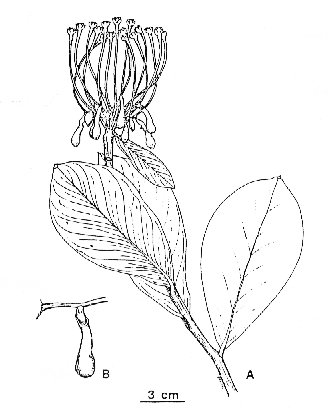
Figure 1. Marcgraviastrum apaporensis de Roon & Bedell. A. Flowering branch; B. Recurved and pendulous saccate nectary (Schultes & Cabrera 14931).
]]>
Figure 1. Marcgraviastrum apaporensis de Roon & Bedell. A. Flowering branch; B. Recurved and pendulous saccate nectary (Schultes & Cabrera 14931).Contribuciones para una monografía del complejo Norantea (Marcgraviaceae, Ericales): Validación de cuatro nuevas especies para el género Marcgraviastrum
ADRIAN C. DE ROON
Nationaal Herbarium Nederland, Utrecht University branch, Heidelberglaan 2, NL-3584 CS Utrecht, The Netherlands. aderoon@ncrvnet.nl
DIEGO GIRALDO-CAÑAS
Instituto de Ciencias Naturales, Universidad Nacional de Colombia, Apartado 7495, Bogotá, D. C., Colombia. dagiraldoc@unal.edu.coABSTRACT
Four new species of Marcgraviastrum are validated. The new species are Marcgraviastrum apaporensis (endemic to the Colombian Amazonia), M. glossostipum (endemic to Ecuador), M. grandiflorum (endemic to the Peruvian Amazonia), and M. vogelii (endemic to Colombia). On the basis of few collections of the genus Marcgraviastrum, we suppose that the species are very rare, caused principally, by deforestation of the forests in recent years.
Key words. Neotropical Flora, Marcgraviaceae, Marcgraviastrum, Norantea.
RESUMEN
]]> Se validan cuatro nuevas especies de Marcgraviastrum. Las nuevas especies son Marcgraviastrum apaporensis (endémica de la Amazonia colombiana), M. glossostipum (endémica de Ecuador), M. grandiflorum (endémica de la Amazonia peruana) y M. vogelii (endémica de Colombia). Con base en la poca representatividad de las especies en los herbarios consultados, suponemos que éstas son raras o escasas, debido, en la mayoría de los casos, a la deforestación de los bosques en los últimos años.Palabras clave. Flora neotropical, Marcgraviaceae, Marcgraviastrum, Norantea.
INTRODUCTION
Marcgraviastrum (Wittmack ex Szyszylowicz) de Roon & S. Dressler is a small genus of the Neotropical family Marcgraviaceae comprising ca. 15 species distributed in wet lowland forests or montane rain and cloud forests from Costa Rica to Brazil and Bolivia. This genus is easily distinguished from Norantea Aublet and other related genera [Schwartzia Vellozo and Sarcopera Bedell, which constitute the Norantea complex] by its umbelliformly contracted raceme with relatively large flowers that are subtended by usually (sub) sessile (only in Marcgraviastrum glossostipum stipitate), recurved, tubular to saccate nectaries. By virtue of its subumbellate inflorescence, Marcgraviastrum is similar to Marcgravia, but differs from this genus in having 5-merous flowers (4-merous in Marcgravia), petals free or variously connate (completely connate into a calyptra in Marcgravia), and leaves spirally arranged (distichous in Marcgravia). A key to the four genera of the Norantea complex was provided in Giraldo-Cañas (2003). Marcgraviastrum apaporensis, M. glossostipum, M. grandiflorum, and M. vogelii, four new species proposed by de Roon & Bedell (Bedell 1985), are validated here.
MATERIALS AND METHODS
De Roon and Bedell examined (before 1985) the collections of Norantea sensu lato from the herbaria BM, BR, C, CAS, COL, DUKE ENCB, F, FI, FI-W, HAC, HB, IAN, INPA, K, L, LAM, LE, M, MA, MEXU, MICH, MO, MOL, MPU, NY, OXF, P, S, SP, TRIN, U, UB,UC, US, USM, VEN, W and WU. Recently Giraldo-Cañas examined the specimens of the genus Marcgraviastrum deposited in different American and Latin American herbaria (CHOCO, COAH, COL, CR, CUVC, F, HUA, IBGE, JAUM, MEDEL, MEXU, MO, MPU, NY, PSO, RSA, SI, SP, UIS, US, and VEN).
A thorough taxonomic treatment of the Norantea complex was the unpublished Ph.D. thesis of Bedell (1985). Additional research on the group has been carried out by de Roon & Dressler (1997), Giraldo-Cañas (2001a, 2001b, 2001c, 2002a, 2002b, 2002c, 2003, 2004, 2005), and Giraldo-Cañas & Fiaschi (2005). The descriptions, Latin diagnosis, and comments in this paper are based on Bedell (1985), with some changes made herein.RESULTS AND DISCUSSION
Marcgraviastrum apaporensis de Roon & Bedell, sp. nov. TYPE: COLOMBIA. Amazonas-Vaupés. Río Apaporis, raudal de Jirijirimo (below mouth of Río Kananari), quarzite base, altitude about 900 feet, 0º5’N - 70º40’W, 25 Nov 1951, R. E. Schultes & I. Cabrera 14931 (holotype US, isotype U). Figure 1.
]]>
Figure 1. Marcgraviastrum apaporensis de Roon & Bedell. A. Flowering branch; B. Recurved and pendulous saccate nectary (Schultes & Cabrera 14931).
Frutex vel liana. Folia obovato-elliptica 12-18 cm longa et 4.8-6.1 cm lata, basibus rotundatis, apicibus acutis; glandes hypophyllae 2-5 mm distantae ex marginibus folii. Axes inflorescentiarum 1.5-2.5 cm longi; flores 8-10; pedicelli 6-7.5 cm longi et 2.5-3 mm lati; nectaria sacciformia 2.5-3.5 cm longa et 7-10 mm lata inserta 1.2-1.5 cm ex basibus pedicellorum; stamina 45-50; ovarium 6-locullatum.
Sprawling shrubs to 5 m tall or lianas, occasionally hemi-epiphytic or epiphytic; branches subligneous to ligneous, slightly terete to subterete, with smooth, reddish-brown bark. Leaves petiolate, glaucous on both surfaces, dark green above, dull and paler below, in sicco greenish- or yellowish-brown above, yellowish-brown to dark reddish-brown below, producing a ciliate fracture when broken perpendicular to the midvein; petioles flattened or slightly canaliculate above, 5-8 mm long, 3-5 mm wide; lamina obovate-elliptic, occasionally somewhat asymmetrical, (12-) 14-18 cm long, 4.8-6.1 cm wide, basally obtuse or rounded to cordate, apically acute or emarginate through the loss of the mucro with slightly revolute margins; hypophyllous glands inconspicuous, few, minute, ca. 3 per side on the upper half of the lamina, 2-5 mm from the margin often seemingly lacking and visible only with a hand lens; midvein obscure above, subprominent below, the lateral veins obscure on both surfaces. Inflorescence axis 1.5-2.5 cm long with 8-10 flowers on subterete pedicels 6-7.5 cm long, 2.5-3 mm wide; foliaceous bract oblong, 4.2-4.8 cm long, 1.7-1.9 cm wide with three pairs of hypophyllous glands; nectariferous bracts leathery and succulent, reddish-white, saccate or pouch-shaped, 2.5-3.5 cm long, 7-10 mm wide, with mostly smooth margins around the orifice and with a 2-3 mm lon acute lip, recurved and pendulous, sessile and attached 1.2-1.5 cm from the base of the pedicel, frequently with the nectaries on the lower 2 or 3 pedicels not developing completely but remaining leaf-like and slightly evaginated. Flowers cream-colored; buds 8-9 mm long; bracteoles sepaloid, 4-5 mm long, 5-6 mm wide with membranaceous margins and appressed to the calyx; sepals suborbicular to orbicular, 5-6 mm long, 6-7 mm wide; stamens 45-50, 7-9 mm long with the inner whorl shorter than the outer whorl; filaments free and flattened; anthers sagittae with bright yellow pollen; ovary conical and striste, 4-5 mm tall, 6-loculed with 18-26 ovules per locule; style 3 mm long; stigma capitate and slightly 6-lobed. Fruit 1.8-2.2 cm in diameter, brick-red; seeds 12-16 per locule, reniform, 2-3 mm long, red-black.Etymology. The specific epithet of this species refers to the region of the type locality.
Distribution and habitat. Marcgraviastrum apaporensis is known only from collections along the Río Apaporis, which runs between the departments of Vaupés and Amazonas in Colombia. This species is a small terrestrial shrub when growing on rocky outcrops but is an epiphytic or hemi-epiphytic liana when found in the trees along the river bank. Apparently it is only found growing in soils with a quarzite origin.
Remarks. This species is recognized by its large, obovate leaves that are occasionally asymmetrical, few-flowered inflorescence, and stamen number.
Paratypes. COLOMBIA. Amazonas-Vaupés. Río Apaporis, raudal de Jirijirimo (below mouth of Río Kananari), quarzite base, altitude about 900 feet, 0º5’N - 70º40’W, 25 Nov 1951, R. E. Schultes & I. Cabrera 14589 (COL, US); raudal de Jirijirimo, Mar 1951, R. E. Schultes 12113 (COL).
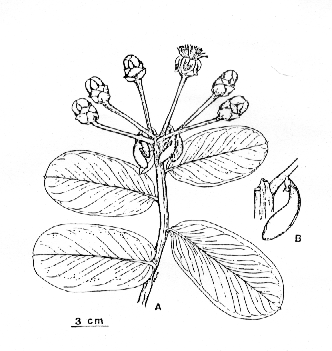
Marcgraviastrum glossostipum de Roon & Bedell, sp. nov. TYPE: ECUADOR. San Ignacio, 5 Jan 1877, André 4682 (holotype NY, isotypes F, K). Figure 2.Figure 2. Marcgraviastrum glossostipum de Roon & Bedell. A. Flowering branch; B. Nectary (André 4682).
Frutex. Folia obovata 7.5-12.5 cm longa et 4.5-6.7 cm lata, basibus acutis obtusis acuminatisus; glandes hypophyllae 3-4, 5-9 mm distantae ex marginibus folii. Axes inflorescentiarum 1.5-2 cm longi; flores 18-22; pedicelli 6-7.2 cm longi et 2 mm lati; nectaria tubuloso-sacciformia 1.5-2.2 cm longa et 4-6 mm lata, inserta 1-1.8 cm ex basibus pedicellorum; petala basi connata; stamina 20-24; ovarium 6-locullatum.
]]> Sprawling shrubs; branches ligneous and subterete with smooth yellowish or yellowis-brown bark. Leaves petiolate, somewhat glaucous and yellowish-brown above, ferrugineous-brown below in dried specimens, producing a ciliate fracture when broken perpendicular to the midvein; petiole stout, 5-7 mm long, 3-4 mm wide, flattened above; lamina obovate, 7.5-12.5 cm long, 4.5-6.7 cm wide, basally acute to slightly obtuse, apically obtuse to rounded or slightly acuminate, with slightly revolute margins and 3-4 medium to small hypophyllous glands per side 5-9 mm from the margin or seemingly absent and visible only with a hand lens; midvein impressed above, subprominent below and the lateral veins obscure on both surfaces or subprominent below. Inflorescence axis 1.5-2 cm long with 18-22 flowers on slender pedicels 6-7.2 cm long, 1.5-2 mm wide; foliaceous bract elliptic-obovate, 5 cm long, 1.5 cm wide with three pairs of hypophyllous glands; nectariferous bracts leathery, brick-red, pouch-shaped, 1.5-2.2 cm long, 4-6 mm wide with revolute or trumpet-shaped margins around the orifice, pendulous and not recurved, on broad, tongue-shaped stipes, 5-8 mm long, 3-4 mm wide and attached 1-1.8 cm from the base of the pedicel. Flowers brick-red; buds 9-11 mm long; bracteoles ovate to rounded-deltoid, 3-4 mm long and wide, appressed to the calyx; sepals suborbicular, 3-4 mm long, 4-5 mm wide; petals basally connate, reflexed at anthesis and then oblong, 10-14 mm long, 4-5.5 mm wide, leathery; stamens 20-24, 6-8 mm long; filaments free, flattened, 3-6 mm long; anthers subsagittate, ca. 2.5 mm long, with yellow pollen; ovary pyriform to flask-shaped, 7-8 mm tall, 6-loculed with 16-18 ovules per locule; style short and robust, 1 mm long; stigma capitate and slightly 6-lobed. Fruit not seen.Etymology. The specific epithet of this species refers to the tongue-shaped stipe of the nectariferous bracts.
Distribution and habitat. Marcgraviastrum glossostipum is known only from the type specimen gathered in Ecuador. In the specimen type there is no information about the habitat of this species. It is hoped that increased collecting activity in Ecuador will soon yield more specimens of this unusual species.
Remarks. It is a distinct species easily recognized by its slender, pedicellate flowers and nectaries with broad, flattened stipes. Marcgraviastrum glossostipum shows no clear affinities with any of the other members of Marcgraviastrum.
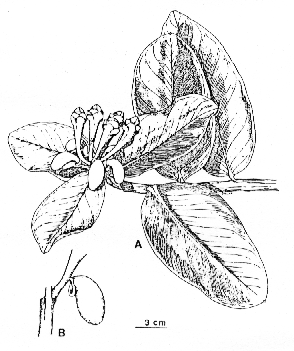
Marcgraviastrum grandiflorum de Roon & Bedell, sp. nov. TYPE: PERU. Amazonas. Stromgebiet des Maranon von Iquitos aufwärts bis zur Santiago-Mündung am Pongo de Manseriche, ca. 77º30’ West, 1924, G. Tessmann 4699 (holotype NY, photographs of the holotype MO, NY, US). Figure 3.
Figure 3. Marcgraviastrum grandiflorum de Roon & Bedell. A. Flowering branch; B. Recurved and pendulous saccate nectary (Tessmann 4699).
Frutex. Folia oblongo-obovata 8-11 cm longa et 3.5-6 cm lata, basibus truncatis, apicibus obtusis; glandes hypophyllae 60-200, 1-12 mm distantes ex marginibus folii. Axes inflorescentiarum 1-1.5 cm longi; flores 5-9; pedicelli 4.5-5.3 cm longi et 3-4 mm lati; nectaria sacciformia 2-2.5 cm longa et 8-10 mm lata inserta 0.9-1.1 cm ex basibus pedicellorum; stamina 70-75; ovarium 7-locullatum.
Sprawling or scandent shrubs to 2.5 m tall; branches ligneous to subligneous, subterete with smooth reddish-brown bark. Leaves petiolate, mostly glaucous, pale dull green above, darker below, in sicco greenish- to yellowish-brown and often flamed above, dark reddish-brown below, producing a long ciliate fracture when broken perpendicular to the midvein; petioles stout, 4-6 mm long, 3-4 mm wide, flattened and slightly canaliculated above; lamina oblong-obovate, 8-11 cm long, 3.5-6 cm wide, basally truncate or rounded, apically obtuse or rounded, mucronate or retuse through the loss of the mucro, with revolute margins; hypophyllous glands very numerous, a few small to medium-sized glands per side near the base of the lamina 3-5 mm from the margin and with numerous (60-200) minute glands with a narrow circumvallation irregulary distributed in a zone 1-12 mm from the margin; midvein impressed above, (sub)prominent below, the lateral veins obscure on both surfaces or subprominent below. Inflorescense axis 1-1.5 cm long with 5-9 flowers on stout pedicels 4.5-5.3 cm long and 3-4 mm thick; foliaceous bract elliptic, 2.5-3.2 cm long, 1.5-2.2 cm wide with 3 pairs of hypophyllous glands; nectariferous bracts leather, brick red, saccate to pouch-shaped, 2-2.5 cm long, 0.8-1 cm wide, with a mediane groove and revolute margins and a short apiculate lip above the constricted orifice, recurved and pendulous, sessile and attached at ca.1 cm from the base of the pedicel. Flowers brick red; buds robust, 13-15 (18) mm long; bracteoles suborbicular, ca.10 mm long, 12-15 mm wide with membranaceous margins and appressed to the calyx; sepals orbicular, 9-12 mm long, 12-16 mm wide with membranaceous margins; petals free, oblong-oblanceolate, 18-21 mm long, 10 mm wide; stamens 70-75, 12-15 mm long; filaments free, 7-10 mm long, flattened and rectangular to triangular in cross section, with the outer whorl basally adnate to the corolla; anthers subsagittate, ca. 5 mm long, with yellow pollen; ovary globose, 5-7 mm long, 7-loculed with 18-24 ovules per locule; style cylindrical, 3-5 mm long; stigma capitate and slightly 4-5 radiate. Fruit 2-3 cm in diameter, brick red; seeds 12-28 per locule, reniform, 3-4 mm long.
Etymology. The specific epithet of this species refers to the large flowers.
]]> Distribution and habitat. Marcgraviastrum grandiflorum is only known from a limited area along the Río Santiago in Amazonas (Peru), in riverine forests.Remarks. This species is easily distinguished from Marcgraviastrum mixtum (Triana & Planch.) Bedell, which also occurs in this region, by its large, robust flowers and basally truncate leaves bearing numerous hypophyllous glands scattered in a zone.
Paratype. PERU. Loreto. Prov. Alto Amazonas, Cerros Campanquiz, right bank of Río Marañón pposite mouth of Río Santiago, 300-400 m, 2 Nov 1962, J. J. Wurdack 2519 (US).
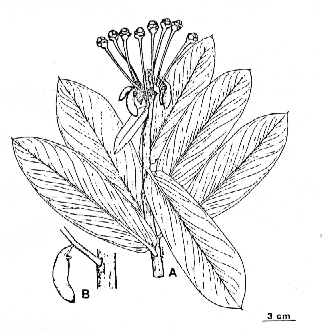
Marcgraviastrum vogelii de Roon & Bedell, sp. nov. TYPE: COLOMBIA. Nariño. El Diviso, between Ñambí (Njambi) and Junín, 800 m, S. Vogel 60 (holotype WU). Figure 4.
Figure 4. Marcgraviastrum vogelii de Roon & Bedell. A. Flowering branch; B. Saccate nectary with revolute margins (Vogel 62).
Frutex. Folia obovato-ovata (10) 12-14 (18) cm longa et (5) 5.5-7 (8) cm lata, basibus obtusis, apicibus acutis; glandes hypophyllae 4-8, 12-17 mm distantes ex marginibus folii. Axes inflorescentiarum 1.5-2 cm longi; flores 5-10 (12); pedicelli 4-5 cm longi et 2-4 mm lati basin versus 8-12 mm lati apicem versus; nectaria sacciformia 2.4-3.2 cm longa et 1.2-1.8 cm lata inserta 0.8-1.2 cm ex basibus pedicellorum; petala connata in dimidio inferiore; stamina 45; ovarium (4) 5-locullatum.
Sprawling shrubs to 4 m tall, occasionally hemi-epiphytic; branches ligneous to subligneous, 3-4 m long, often arching, subterete with chartaceous yellowish-brown to reddish-brown bark. Leaves petiolate, somewhat glaucous on both surfaces and thickly coriaceous, dull green above and paler below, producing a slightly ciliate fracture visible only with a hand lens when broken perpendicular to the midvein; petioles broad, 8-15 mm long, 3-44 mm wide; lamina obovate to ovate, occasionally slightly asymmetrical, (10) 12-14 (18) cm long, (5) 5.5-7 (8) cm wide, basally obtuse, apically acute to obtuse with a poorly developed mucro and revolute margins and 4-8 medium to large hypophyllous glands per side in a row 12-17 mm from the margin; midvein obscure or slightly impressed above, subprominent below, the lateral veins obscure on both surfaces. Inflorescence axis 1.5-2 cm long with 5-10 (12) flowers on stout, tapered pedicels 4-5 cm long and 3-4 mm thick basally widening to 10-12 mm apically, becoming angular in fruit; foliaceous bract elliptic to narrowly ovate, 8.5-9 cm long, 3.2-3.7 cm wide with 4 pairs of hypophyllous glands; nectariferous bracts coriaceous and succulent, lime green, saccate to pouch-shape, 2.4-3.2 cm long, 1.2-1.8 cm wide with a revolute margin around the constricted orifice, recurved and somewhat pendulous, sessile and attached 0.8-1.5 cm from the base of the pedicel. Flowers light pale green to dull yellow; buds robust, 9-15 mm long; bracteoles sepaloid, 6-7 mm long, 7-8 mm wide, appressed to the calyx; sepals suborbicular to orbicular, 7-9 mm long, 12-14 mm wide; petals 1/2 or more connate, strongly reflexed at anthesis, oblanceolate, (11) 13-15 (18) mm long, 4-6 mm wide, leathery; stamens 45, 6-7 mm long; filaments free, 1-2 mm long, angular in cross section; anthers sagittate, 4-6 mm long, with yellow pollen; ovary turbinate, 5-8 mm tall, 5-loculed or, occasionally, less through abortion, with 24-30 ovules per locule; style robust, 2-3 mm long; stigma capitate and slightly 5-lobed. Fruit 2.6-3.4 cm in diameter, rose colored; seeds 6-8 per locule, reniform, 5-7 mm long, shiny red-black.Etymology. This species is dedicated to S. Vogel, professor of Botany and student of pollination biology in Marcgraviaceae and other neotropical plants.
Distribution and habitat. Marcgraviastrum vogelii is know from high, moist forest between 800-1500 m on the western slopes of the Cordillera Occidental in Colombia (probably in northern Ecuador).
Remarks. This species appears to be genetically unstable and developmental abnormalities are frequently observed. Specimens from Cuyambe in Nariño (Colombia, Mora 4148) have flowers with abnomally developed stamens. Specifically, the thecal tissue failed to develop into organized thecae, resulting in unorganized masses along the filaments. The ovary development was also irregular with only four of the five locules developing. Collections from the Río Anchicayá in Valle del Cauca (Colombia), included specimens abnormally developed flowers with many having poorly developed stamens that were leaf-like, while others had contorted filaments. The ovary wall in many of these flowers developed unevenly producing scattered areas of extremely thick-walled tissue that differentiated ramdomly. In all specimens examined, the flowers within a inflorescence developed fruits, but only 6-10 ovules per locule fully developed into seeds with 75-83% of the ovules aborting. This species develops the largest seeds of any of the species in the genus Marcgraviastrum.
]]> Paratypes. COLOMBIA. Nariño. Junín-Tumaco road, 6-11 kms W of Junín, roadside thickets and forest edge, 850-1030 m, 27 Feb 1979, J. L. Luteyn & M. Lebrón-Luteyn 6882 (NY); Mun. Altaquer, carretera entre Altaquer y Junín, Cuyambe, 1450 m, 17 Nov 1967, L. E. Mora 4148 (COL); El Diviso, between Ñambí (Njambi) & Junín, S. Vogel 62 (WU). Valle del Cauca. Alto Yunda, Río Anchicayá, 1000 m, Jan 1973, S. Hilty JaX-25 (US).ACKNOWLEDGEMENTS
We thank Stefan Dressler (FR), Rosa Ortiz-Gentry (MO), and John Lynch (COL) for their valuable help. The curators of following herbaria are acknowledged for the loan of specimens: CHOCO, COAH, COL, CR, CUVC, F, HUA, IBGE, JAUM, MEDEL, MEXU, MO, MPU, NY, PSO, RSA, SI, SP, UIS, US, and VEN. Visits to MO and RSA were financed by the Universidad Nacional de Colombia (Bogotá), Missouri Botanical Garden (St. Louis, Missouri), and Rancho Santa Ana Botanic Garden (Claremont, California). We thank two anonymous reviewers for their critique of the manuscript. This paper is derived from the project “Estudios sistemáticos en el complejo Norantea Aubl. (Marcgraviaceae)”, project No. 803765 of the “División de Investigación (DIB) de la Universidad Nacional de Colombia”, Bogotá.
LITERATURE CITED
1. Bedell, H. G. 1985. A Generic Revision of Marcgraviaceae, I. The Norantea complex. Ph.D. Dissertation, University of Maryland, College Park. [ Links ]
2. De Roon, A. C. & S. Dressler. 1997. New taxa of Norantea Aubl. s.l. (Marcgraviaceae) from Central America and adjacent South America. Bot. Jahrb. Syst. 119: 327-335. [ Links ]
3. Giraldo-Cañas, D. 2001a. Schwartzia brasiliensis (Marcgraviaceae), nueva combinación. Caldasia 23 (1): 341-342. [ Links ]
4. Giraldo-Cañas, D. 2001b. Una nueva especie de Schwartzia (Marcgraviaceae) de la vertiente occidental andina de Colombia y Ecuador. Caldasia 23 (2): 383-388. [ Links ]
5. Giraldo-Cañas, D. 2001c. Dos nuevas especies de Schwartzia (Marcgraviaceae) de Colombia. Revista Acad. Colomb. Ci. Exact. 25 (97): 477-482. [ Links ]
6. Giraldo-Cañas, D. 2002a. Novedades taxonómicas y corológicas en Marcgraviastrum, Sarcopera y Schwartzia (Marcgraviaceae) de Sudamérica. Hickenia 3 (32): 119-123. [ Links ]
7. Giraldo-Cañas, D. 2002b. Estudios en el género Schwartzia Vellozo (Marcgraviaceae): una nueva especie de la Cordillera Central Andina de Colombia. Novon 12 (4): 456-459. [ Links ]
8. Giraldo-Cañas, D. 2002c. Los géneros Marcgraviastrum y Norantea (Marcgraviaceae) en Brasil. Revista Acad. Colomb. Ci. Exact. 26 (101): 469-476. [ Links ]
9. Giraldo-Cañas, D. 2003. Revisión de las especies colombianas del género Schwartzia (Marcgraviaceae). Caldasia 25 (1): 1-21. [ Links ]
10. Giraldo-Cañas, D. 2004. Las especies del género Schwartzia (Complejo Norantea, Marcgraviaceae) en Brasil. Darwiniana 42 (1-4): 169-175. [ Links ]
11. Giraldo-Cañas, D. 2005. Validation of a new species of Schwartzia (Marcgraviaceae) and synopsis of the genus for Ecuador. Novon 15 (1): 123-127. [ Links ]
12. Giraldo-Cañas, D. & P. Fiaschi. 2005. Las Marcgraviaceae (Ericales) de Brasil: Las especies del complejo Norantea. Caldasia 27 (2): 173-194. [ Links ]
Recibido: 18/10/2005
Aceptado: 01/02/2006