<?xml version="1.0" encoding="ISO-8859-1"?><article xmlns:mml="http://www.w3.org/1998/Math/MathML" xmlns:xlink="http://www.w3.org/1999/xlink" xmlns:xsi="http://www.w3.org/2001/XMLSchema-instance">
<front>
<journal-meta>
<journal-id>0366-5232</journal-id>
<journal-title><![CDATA[Caldasia]]></journal-title>
<abbrev-journal-title><![CDATA[Caldasia]]></abbrev-journal-title>
<issn>0366-5232</issn>
<publisher>
<publisher-name><![CDATA[Instituto de Ciencias Naturales, Facultad de Ciencias-Universidad Nacional de Colombia]]></publisher-name>
</publisher>
</journal-meta>
<article-meta>
<article-id>S0366-52322008000100007</article-id>
<title-group>
<article-title xml:lang="en"><![CDATA[EFFECTS OF AQUATIC VEGETATION ON THE SPATIAL DISTRIBUTION OF GRUNDULUS BOGOTENSIS, HUMBOLDT 1821 (CHARACIFORMES: CHARACIDAE)]]></article-title>
<article-title xml:lang="es"><![CDATA[Efecto de la vegetación acuática sobre la distribución espacial de Grundulus bogotensis, Humboldt 1821 (Characiformes: Characidae)]]></article-title>
</title-group>
<contrib-group>
<contrib contrib-type="author">
<name>
<surname><![CDATA[RIVERA-RONDÓN]]></surname>
<given-names><![CDATA[CARLOS ALBERTO]]></given-names>
</name>
<xref ref-type="aff" rid="A01"/>
</contrib>
<contrib contrib-type="author">
<name>
<surname><![CDATA[PRADA-PEDREROS]]></surname>
<given-names><![CDATA[SAÚL]]></given-names>
</name>
<xref ref-type="aff" rid="A01"/>
</contrib>
<contrib contrib-type="author">
<name>
<surname><![CDATA[GALINDO]]></surname>
<given-names><![CDATA[DIANA]]></given-names>
</name>
<xref ref-type="aff" rid="A01"/>
</contrib>
<contrib contrib-type="author">
<name>
<surname><![CDATA[MALDONADO-OCAMPO]]></surname>
<given-names><![CDATA[JAVIER A.]]></given-names>
</name>
<xref ref-type="aff" rid="A02"/>
</contrib>
</contrib-group>
<aff id="A01">
<institution><![CDATA[,Pontificia Universidad Javeriana Departamento de Biología Unidad de Ecología y Sistemática]]></institution>
<addr-line><![CDATA[Bogotá ]]></addr-line>
<country>Colombia</country>
</aff>
<aff id="A02">
<institution><![CDATA[,Instituto Alexander von Humboldt, Claustro de San Agustín Programa Inventarios de Biodiversidad ]]></institution>
<addr-line><![CDATA[Villa de Leyva Boyacá]]></addr-line>
<country>Colombia</country>
</aff>
<pub-date pub-type="pub">
<day>30</day>
<month>06</month>
<year>2008</year>
</pub-date>
<pub-date pub-type="epub">
<day>30</day>
<month>06</month>
<year>2008</year>
</pub-date>
<volume>30</volume>
<numero>1</numero>
<fpage>135</fpage>
<lpage>150</lpage>
<copyright-statement/>
<copyright-year/>
<self-uri xlink:href="http://www.scielo.org.co/scielo.php?script=sci_arttext&amp;pid=S0366-52322008000100007&amp;lng=en&amp;nrm=iso"></self-uri><self-uri xlink:href="http://www.scielo.org.co/scielo.php?script=sci_abstract&amp;pid=S0366-52322008000100007&amp;lng=en&amp;nrm=iso"></self-uri><self-uri xlink:href="http://www.scielo.org.co/scielo.php?script=sci_pdf&amp;pid=S0366-52322008000100007&amp;lng=en&amp;nrm=iso"></self-uri><abstract abstract-type="short" xml:lang="en"><p><![CDATA[G. bogotensis has a geographic distribution restricted to the Colombian Cundiboyacense plateau, it is listed as near threatened, and research on its autoecology is scarce. Three collections were made in 2006 in the Fúquene Lake, Cundinamarca, Colombia (5° 27' 55'' N, 75° 46' 19'' W) to describe the habitats occupied by G. bogotensis and to determine its vertical and horizontal distribution. Three sampling zones were selected according to the type of dominant macrophyte (Eichornia crassipes, Schoenoplectus sp. and Egeria densa). In each sampling zone two different cylindrical sampling traps (cloth and PVC) were placed at three depths: surface, mid-depth and bottom. Three replicates were used for each depth and type of trap. Traps were exposed for 24 hours and checked every 6 hours. In addition to the traps, sampling by electrofishing was conducted in each sampling zone during every month. To characterize the study area, physical and chemical variables were analyzed and the structure of phytoplankton, zooplankton, periphyton, and macroinvertebrate communities was studied. Results showed spatial differences on G. bogotensis habitat occupation and differences in captures at each depth, which depend on the dominant type of aquatic vegetation and size of individual. We conclude that only cylindrical cloth traps are suitable to conduct population studies of G. bogotensis.]]></p></abstract>
<abstract abstract-type="short" xml:lang="es"><p><![CDATA[Grundulus bogotensis tiene una distribución restringida al altiplano Cundiboyacense, se encuentra en la categoría "casi amenazada" y son escasos los trabajos realizados sobre su autoecología. Con el objeto de describir los hábitats ocupados por G. bogotensis y determinar su distribución vertical y horizontal en la laguna de Fúquene, Cundinamarca, Colombia (5° 27´ 55" N, 75° 46´ 19" O, 2560m), se realizaron tres muestreos durante el 2006 en tres zonas que se definieron en función del tipo de macrófita dominante (Eichhornia crassipes, Schoenoplectus sp. y Egeria densa). En cada uno de estos puntos se utilizaron dos tipos de trampas (cilíndricas de tela o de PVC) ubicadas en tres profundidades (superficie, medio, fondo); en cada profundidad y tipo de trampa se utilizaron tres réplicas. Las trampas estuvieron expuestas durante 24h y fueron revisadas cada 6h. Adicionalmente se realizaron muestreos con eletropesca en cada uno de los sitios de muestreo y durante cada mes. Para caracterizar las zonas de estudio, se analizaron variables físicas y químicas y se estudió la estructura de las comunidades de fitoplancton, zooplancton, perifiton y macroinvertebrados. De acuerdo con los resultados existen diferencias espaciales en la ocupación de G. bogotensis y diferencias en las capturas realizadas por profundidad que son dependientes del tipo de vegetación acuática dominante y de la talla del individuo. También se concluye que sólo las trampas cilíndricas de tela son adecuadas para realizar estudios poblacionales de G. bogotensis.]]></p></abstract>
<kwd-group>
<kwd lng="en"><![CDATA[Grundulus bogotensis]]></kwd>
<kwd lng="en"><![CDATA[aquatic macrophytes]]></kwd>
<kwd lng="en"><![CDATA[spatial distribution]]></kwd>
<kwd lng="es"><![CDATA[Grundulus bogotensis]]></kwd>
<kwd lng="es"><![CDATA[macrófitas acuáticas]]></kwd>
<kwd lng="es"><![CDATA[distribución espacial]]></kwd>
</kwd-group>
</article-meta>
</front><body><![CDATA[  <font size="2" face="verdana">      <p><font size="4">        <center>     <b>EFFECTS OF AQUATIC VEGETATION ON THE SPATIAL DISTRIBUTION OF GRUNDULUS      BOGOTENSIS, HUMBOLDT 1821 (CHARACIFORMES: CHARACIDAE)</b>    </center>   </font></p>     <p><font size="3">        <center>     <b>Efecto de la vegetaci&oacute;n acu&aacute;tica sobre la distribuci&oacute;n      espacial de Grundulus bogotensis, Humboldt 1821 (Characiformes: Characidae)</b>    </center>   </font></p>     <p><b>CARLOS ALBERTO RIVERA-ROND&Oacute;N</b>    <br>   <b>SA&Uacute;L PRADA-PEDREROS</b>    <br>   <b>DIANA GALINDO</b>    <br>   <b>JAVIER A. MALDONADO-OCAMPO</b></p>     <p><i>Unidad de Ecolog&iacute;a y Sistem&aacute;tica, Departamento de Biolog&iacute;a,    Pontificia Universidad Javeriana, Cra. 7 No. 40-82, Bogot&aacute;, Colombia.    <a href="mailto:crivera@javeriana.edu.co">crivera@javeriana.edu.co</a>; <a href="mailto:saul.prada@javeriana.edu.co">saul.prada@javeriana.edu.co</a>;    <a href="mailto:dianaguribe@yahoo.com">dianaguribe@yahoo.com</a></i></p>     ]]></body>
<body><![CDATA[<p><i>Programa Inventarios de Biodiversidad, Instituto Alexander von Humboldt,    Claustro de San Agust&iacute;n, Villa de Leyva, Boyac&aacute;, Colombia. <a href="mailto:jamaldonado@humboldt.org.co">jamaldonado@humboldt.org.co</a></i></p>     <p><b>ABSTRACT</b></p>     <p>G. bogotensis has a geographic distribution restricted to the Colombian Cundiboyacense    plateau, it is listed as near threatened, and research on its autoecology is    scarce. Three collections were made in 2006 in the F&uacute;quene Lake, Cundinamarca,    Colombia (5&deg; 27' 55'' N, 75&deg; 46' 19''    W) to describe the habitats occupied by G. bogotensis and to determine its vertical    and horizontal distribution. Three sampling zones were selected according to    the type of dominant macrophyte (Eichornia crassipes, Schoenoplectus sp. and    Egeria densa). In each sampling zone two different cylindrical sampling traps    (cloth and PVC) were placed at three depths: surface, mid-depth and bottom.    Three replicates were used for each depth and type of trap. Traps were exposed    for 24 hours and checked every 6 hours. In addition to the traps, sampling by    electrofishing was conducted in each sampling zone during every month. To characterize    the study area, physical and chemical variables were analyzed and the structure    of phytoplankton, zooplankton, periphyton, and macroinvertebrate communities    was studied. Results showed spatial differences on G. bogotensis habitat occupation    and differences in captures at each depth, which depend on the dominant type    of aquatic vegetation and size of individual. We conclude that only cylindrical    cloth traps are suitable to conduct population studies of G. bogotensis.</p>     <p><b>Key words.</b> Grundulus bogotensis, aquatic macrophytes, spatial distribution.</p>     <p><b>RESUMEN</b></p>     <p>Grundulus bogotensis tiene una distribuci&oacute;n restringida al altiplano    Cundiboyacense, se encuentra en la categor&iacute;a &quot;casi amenazada&quot;    y son escasos los trabajos realizados sobre su autoecolog&iacute;a. Con el objeto    de describir los h&aacute;bitats ocupados por G. bogotensis y determinar su    distribuci&oacute;n vertical y horizontal en la laguna de F&uacute;quene, Cundinamarca,    Colombia (5&deg; 27&acute; 55&quot; N, 75&deg; 46&acute; 19&quot; O, 2560m),    se realizaron tres muestreos durante el 2006 en tres zonas que se definieron    en funci&oacute;n del tipo de macr&oacute;fita dominante (Eichhornia crassipes,    Schoenoplectus sp. y Egeria densa). En cada uno de estos puntos se utilizaron    dos tipos de trampas (cil&iacute;ndricas de tela o de PVC) ubicadas en tres    profundidades (superficie, medio, fondo); en cada profundidad y tipo de trampa    se utilizaron tres r&eacute;plicas. Las trampas estuvieron expuestas durante    24h y fueron revisadas cada 6h. Adicionalmente se realizaron muestreos con eletropesca    en cada uno de los sitios de muestreo y durante cada mes. Para caracterizar    las zonas de estudio, se analizaron variables f&iacute;sicas y qu&iacute;micas    y se estudi&oacute; la estructura de las comunidades de fitoplancton, zooplancton,    perifiton y macroinvertebrados. De acuerdo con los resultados existen diferencias    espaciales en la ocupaci&oacute;n de G. bogotensis y diferencias en las capturas    realizadas por profundidad que son dependientes del tipo de vegetaci&oacute;n    acu&aacute;tica dominante y de la talla del individuo. Tambi&eacute;n se concluye    que s&oacute;lo las trampas cil&iacute;ndricas de tela son adecuadas para realizar    estudios poblacionales de G. bogotensis.</p>     <p><b>Palabras clave.</b> Grundulus bogotensis, macr&oacute;fitas acu&aacute;ticas,    distribuci&oacute;n espacial.</p>     <p>INTRODUCTION</p>     <p>Plant communities are an important component of aquatic systems, creating a    structurally complex environment for fish communities (Tonn &amp; Magnuson 1982,    Anderson 1984). Macrophytes provide adequate substrates for the development    of aquatic organisms on which fish depend (Diehl 1993) and provoke modifications    on physical and chemical water conditions, with the subsequent effect on structure    of fish communities (Meerhoff et al. 2002, Petry et al. 2003, Soares et al.    2006).</p>     <p>The presence and type of macrophytes affect mobility and foraging strategies    of fish (Baker &amp; Ross 1981, Greenberg et al. 1995, Schindler &amp; Scheuerell    2002). Differences on spatial distribution between juveniles and adults have    been associated to habitat structural characteristics related to the presence    of vegetation (Werner &amp; Hall 1988, Lewin et al. 2004).</p>     ]]></body>
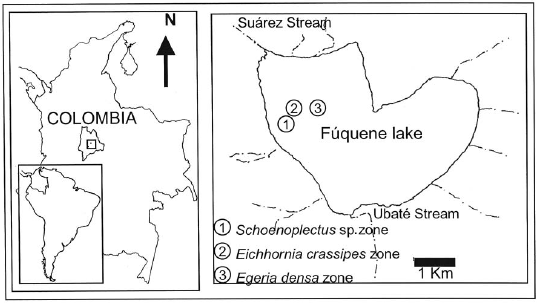
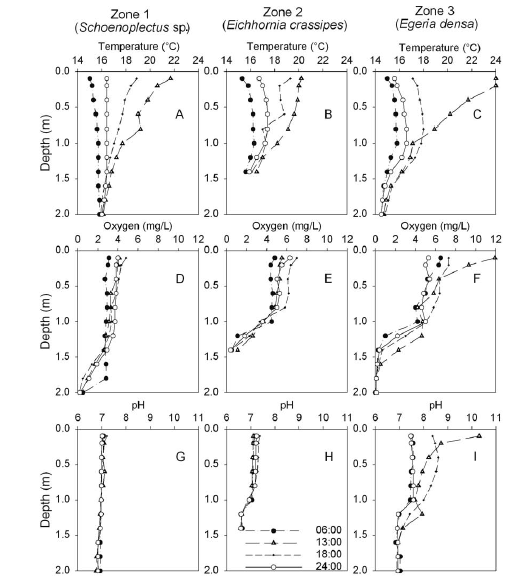
<body><![CDATA[<p>Large areas covered by macrophytes, reduction of water surface, loss of flooding    pulses, and sedimentation due to industrial and agricultural activities are    some of the major changes observed in lakes and wetlands in the Andean region    (Donato 2004). The Bogot&aacute; plateau is one of the areas in the Andean region    that has experienced more alterations, and open water surfaces of its aquatic    systems have been replaced by dense covers of submerged, rooted and floating    macrophytes (Chaparro 2003, van der Hammen 2003).</p>     <p>Grundulus bogotensis is one of the three endemic species that still occur in    the Bogot&aacute; plateau (Eigenmann 1920) and is currently listed as &#8216;near    threatened' because of its occurrence in one of the most transformed zones    of Colombia (Mojica et al. 2002). This species used to be an important food    source for local people and is still exploited by some communities.</p>     <p>Studies on the regional distribution of G. bogotensis are scarce. Eigenmann    (1920), Miles (1947), Dahl (1971) and Maldonado-Ocampo et al. (2005) made comments    on its distribution. The species has been introduced into other Andean aquatic    environments (Alvarado &amp; Gutierrez 2002, Maldonado-Ocampo et al. 2005).    Biology and taxonomy of G. bogotensis were studied by Forero &amp; Garz&oacute;n    (1974), Gonz&aacute;lez-Acosta (1992), Mora et al. (1992), and Rom&aacute;n-Valencia    et al. (2003, 2005). There are no studies on habitat occupation carried out    with appropriate fishing techniques.</p>     <p>Considering the few studies published on the autoecology of this fish and the    recent changes of the environments where the species lives, the following objectives    were proposed in our study: (1) identifying and describing habitats occupied    by G. bogotensis in the F&uacute;quene lake, (2) finding relationships between    its vertical and horizontal distributions and habitat structure, (3) determining    any differential spatial occupation depending on the size of individuals, and    (4) comparing the efficiency of two fishing techniques.</p>     <p>Study area</p>     <p>The F&uacute;quene lake is located in the Cundiboyacense plateau (5&deg; 27'    55'' N, 75&deg; 46' 19'' W, 2,560 m in altitude),    has an approximate area of 1,300 ha, a maximum depth of 6 m and an average depth    of 2 m. The lake's principal inflow source is the Ubat&eacute; stream    and its outflow source is the Su&aacute;rez stream.</p>     <p>The lake has experienced a progressive deterioration over the last years as    a consequence of an increased nutrient load from the drainage basin (Donato    1998). Studies conducted by JICA-CAR (2000) show that livestock farming accounts    for 80% of the polluting load discharged into the lake and that 60% of its surface    has been lost in the last 60 years. The agricultural and livestock farming land    use has caused the drying of the lake during the last years (Donato 2004). Eutrophication    has led to an increased cover of floating plants (Eichhornia crassipes), rooted    plants (Schoenoplectus sp) and submerged rooted plants (Egeria densa), which    have covered almost the entire lake.</p>     <p>Materials and methods</p>     <p>Three samplings were conducted between July and September 2006 to study the    spatial distribution of G. bogotensis. Three different zones were selected and    defined according to the dominant macrophyte type: E. crassipes (buch&oacute;n),    Schoenoplectus sp. (junco) or E. densa (elodea) (<a href="#figura1">Figure 1</a>).    The selected zones show a varying depth of 1.5-2.2 m. Two types of traps were    located in each of the three zones, at three different depths (surface, mid-depth,    and bottom). Three replicates were set at each depth and for each type of trap.    <br>   Type A trap was a cylinder 50 cm long and 15 cm wide, of 0.7 mm-pore white cloth,    with two funnels (one at each end of the cylinder) with a 4-cm wide inner opening.    Type B trap was a dull-coloured PVC cylinder 50 cm long and 15 cm wide, having    one funnel in one end of the cylinder, with a 4-cm wide inner opening, and the    opposite end closed with nylon mesh. Traps were exposed without any bait during    24 hours and checked every 6 hours.</p>     ]]></body>
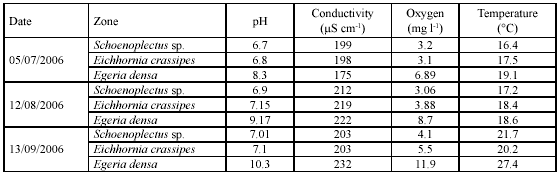
<body><![CDATA[<center>   <img src="/img/revistas/cal/v30n1/v30n1a7fig1.gif"><a name="figura1"></a>  </center>     <p>        <center>     Figure 1. Geographic location of the F&uacute;quene Lake.    </center> </p>     <p>Study of the horizontal distribution was complemented with samplings using    electrofishing equipment for 30 minutes at each of the sampling zones. We followed    the recommendations by Maldonado-Ocampo et al. (2005) on methodology and equipment    specifications.</p>     <p>Collected specimens were preserved in 10 % formalin for 72 h and then transferred    to 70 % ethanol. Weight and length (standard and total) were recorded in all    specimens prior to their deposition into the Fish Collection of the Museo Javeriano    de Historia Natural (MPUJ) in Bogot&aacute; and the collection of the Instituto    Alexander von Humboldt (IAvH-P) in Villa de Leyva, Boyac&aacute;.</p>     <p>In order to have a limnological characterization of the lake, pH, conductivity    (Oakton pHCond10), oxygen and surface water temperature (Oakton oxymeter) were    measured during sampling times. Samples of surface phytoplankton, periphyton,    zooplankton and macroinvertebrates were collected. Physical and chemical vertical    profiles were done during the September sampling.</p>     <p>Water samples of 200 ml were collected from the sampling zones with free water    to study phytoplankton. Samples were preserved in 1% Lugol's solution.    Subsurface water samples (1-10 L) were filtered with a 20 &micro;m-pore mesh    and samples were preserved in Transeau solution to study zooplankton. Periphyton    was sampled by squeezing marshy vegetation and collecting sediments accumulated    on plants. Periphyton samples were preserved with 1% formalin. Macroinvertebrate    communities associated to macrophytes were sampled with a 900-cm2 hand mesh    and samples were preserved in 70 % ethanol.</p>     <p>Phytoplankton was quantified using the sedimentation method and counting under    an inverted microscope (Wetzel &amp; Likens 2000). Periphyton was quantified    by counting 400 cells of the dominant morph type under an optical microscope.    Zooplankton samples were analysed under an optical microscope and a stereoscope    with 1 ml chambers. Macroinvertebrate samples were cleaned and observed under    a stereoscope for their identification. Specimens from each community were determined    down to the lowest possible level using specialized taxonomical keys.</p>     <p>Results</p>     <p>Limnological characterization. Zones dominated by Schoenoplectus sp and E.    crassipes showed a tendency to have water pHs from weakly acid to neutral, while    zones dominated by E. densa showed alkaline water pHs (<a href="#tabla1">Table    1</a>). Zones dominated by E. densa had oxygen values &gt; 70 % in saturation    and values for the other two zones were &lt; 30%. Temperature records were highest    during the September sampling, mainly in the E. densa zone.</p>     ]]></body>
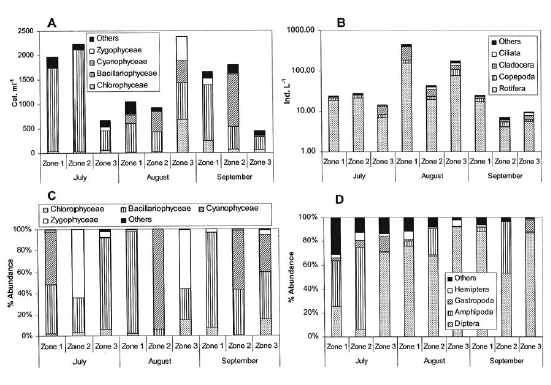
<body><![CDATA[<center>   <img src="/img/revistas/cal/v30n1/v30n1a7tab1.gif"><a name="tabla1"></a>  </center>     <p>        <center>     Table 1. Values of chemical variables recorded during the three samplings      on the surface of the F&uacute;quene lake.    </center>       <br>     <p>Vertical oxygen profiles exhibited spatial differences. In the zone with Schoenoplectus    sp. dominance, values were &lt; 5 mg l-1 within the entire water column; in    the zone dominated by E. crassipes, values ranged between 4 and 7 mg l-1 within    the first meter in depth; and values in the zone dominated by E. densa showed    a variation between 4 and 12 mg l-1 within the first meter in depth (<a href="#figura2">Figure    2</a>).</p>     <center>  <font size="2" face="verdana"><img src="/img/revistas/cal/v30n1/v30n1a7fig2.gif"></font><a name="figura2"></a>  </center>     <p>        <center>     Figure 2. Vertical profiles of temperature (A,B,C), oxygen (D,E,F), and pH      (G,H,I) in the F&uacute;quene lake in 12/09/2006 at (13:00 h and 18:00 h)      and 13/09/2006 (6:00 h and 24:00 h).    </center> </p>     <p>Conductivity values were relatively homogeneous in the entire water column,    while pH, temperature and dissolved oxygen showed a vertical gradient that varied    during the day/night cycle (<a href="#figura2">Figure 2</a>). During the daytime,    the water column showed a progressive increase in temperature in the three zones.    Additionally, we observed an increase of pH and oxygen values in the zone dominated    by E. densa in the daytime.</p>     <p>Phytoplankton revealed a large variation in density of the main groups between    zones and samplings but always with a dominance tendency of Bacillariophyceae    and Cyanophyceae (<a href="#figura3">Figure 3</a>). Algal density varied between    400 and 2,400 cell ml-1 and zooplanktonic density ranged from 10 to 200 ind.    l-1. Rotifers were the dominant group followed by cladocerans and copepods as    codominant groups. An increase of the zooplankton density was recorded in August.</p>     ]]></body>
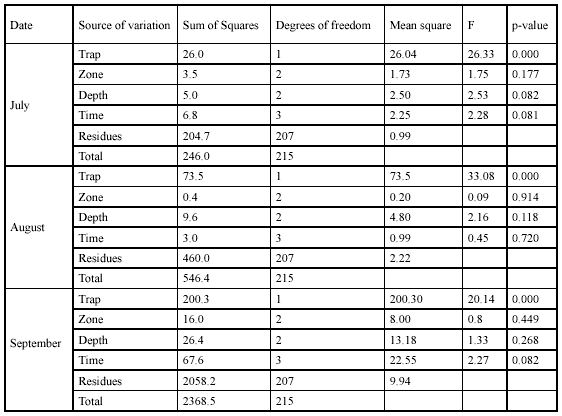
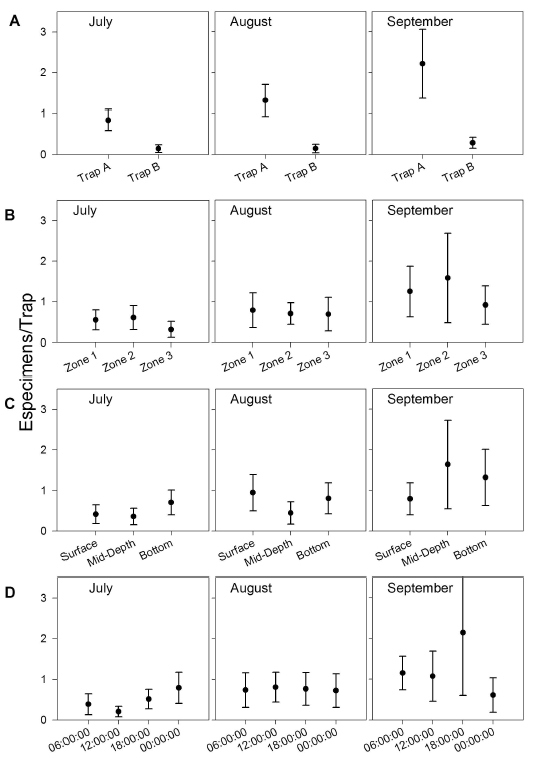
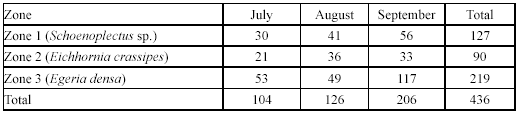
<body><![CDATA[<center>   <img src="/img/revistas/cal/v30n1/v30n1a7fig3.gif"><a name="figura3"></a>  </center>     <p>        <center>     Figure 3. Density and relative importance of the main groups of phytoplankton      (A), zooplankton (B), periphyton (C), and macroinvertebrates (D).    </center> </p>     <p>The periphytic algal community was dominated by Bacillariophyceae, Cyanophyceae    and Zygophyceae. In general, no pattern of temporal or spatial variation was    observed in the dominance by these groups. The benthonic macroinvertebrate community    was dominated by dipterous, mostly of the family Chironomidae. In the zone dominated    by E. crassipes we observed Hyalella sp (Amphipoda) as the most important macroinvertebrate,    while the zone dominated by Schoenoplectus sp contained a higher diversity of    groups and, in general, a higher richness of morph type. Structural differences    of the dominant vegetation in each zone did not allow an adequate estimation    of macroinvertebrate density; however, total specimens collected in the zone    dominated by Schoenoplectus sp were twice lower than those collected in the    other zones.</p>     <p>Efficiency of the fishing techniques. Captures of G. bogotensis with type A    trap were significantly higher than captures with type B trap in all the three    samplings (<a href="#tabla2">Table 2</a>, <a href="#figura4">Figure 4</a>).    Total specimens captured with type A trap were 472 and with type B trap 63 (after    72h of exposure). Electrofishing allowed capturing 436 specimens after a 4.5-hour    effort.</p>     <center>   <img src="/img/revistas/cal/v30n1/v30n1a7tab2.gif"><a name="tabla2"></a>  </center>     <p>        <center>     Table 2. Analyses of Variance of the numbers of captured specimens in each      sampling.    </center> </p>     <center>   <img src="/img/revistas/cal/v30n1/v30n1a7fig4.gif"><a name="figura4"></a>  </center>     <p>        ]]></body>
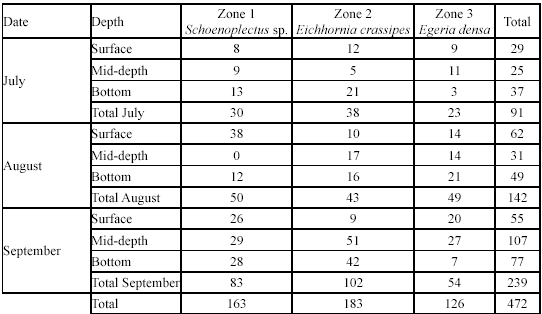
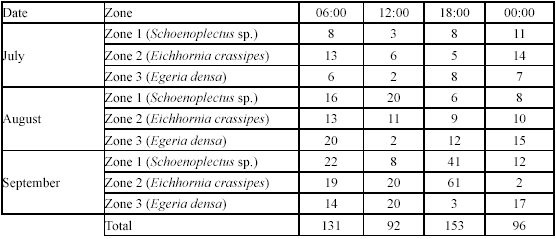
<body><![CDATA[<center>     Figure 4. Average values and confidence intervals (95 %) of the number of      specimens captured per trap with each trap type (A), in each zone (B), at      each depth (C), and at each time (D).    </center> </p>     <p>Spatial and temporal variation in G. bogotensis captures. An Analysis of Variance    revealed no significant differences in captures between zones using traps (<a href="#tabla2">Table    2</a>, <a href="#figura4">Figure 4</a>). However, total captures with traps    was higher in zones dominated by Schoenoplectus sp and E. crassipes (<a href="#tabla3">Table    3</a>). The highest capture scores with electrofishing were obtained in the    zone dominated by E. densa (<a href="#tabla4">Table 4</a>). </p>     <center>   <img src="/img/revistas/cal/v30n1/v30n1a7tab3.gif"><a name="tabla3"></a>  </center>     <p>        <center>     Table 3. Total number of specimens captured per month, depth, and zone using      type A traps.    </center> </p>     <center>   <img src="/img/revistas/cal/v30n1/v30n1a7tab4.gif"><a name="tabla4"></a>  </center>     <p>       <center>     Table 4. Total number of specimens captured per month and zone using electrofishing.   </center>       <br>     <p>Although no significant differences were found either between captures at different    depths, there was a numeric tendency to have higher capture scores in deep samples,    particularly in the zone dominated by E. crassipes.</p>     ]]></body>
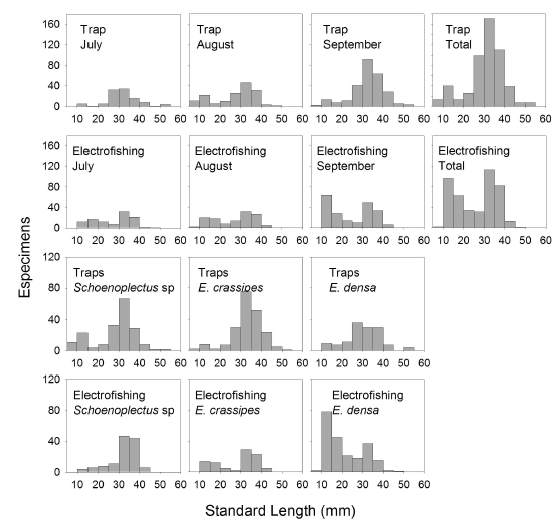
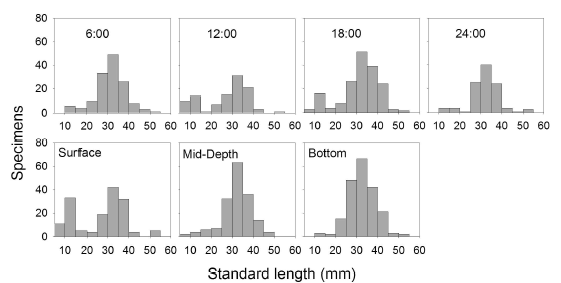
<body><![CDATA[<p>Type A traps and electrofishing showed the highest capture levels in September    (<a href="#tabla3">Table 3</a> and <a href="#tabla4">table 4</a>). There was    a tendency to have higher captures at 6:00 h and 18:00 h and lower captures    at 12:00 h and 24:00 h (<a href="#tabla5">Table 5</a>), but no significant differences    between hours were found.</p>     <center>   <img src="/img/revistas/cal/v30n1/v30n1a7tab5.gif"><a name="tabla5"></a>  </center>     <p>    <center>Table 5. Total number of specimens captured per month, zone, and time using    type A traps.</center>    <br>     <p>Spatial and temporal variations in G. bogotensis size. Size analysis of captured    specimens revealed differences between traps and electrofishing. Traps showed    higher numbers of captures of specimens between 25 and 40 mm in standard length,    while electrofishing allowed capturing specimens mainly with one of two distinct    sizes: 10-20 mm and 30-40 mm (<a href="#figura5">Figure 5</a>).</p>     <center>   <img src="/img/revistas/cal/v30n1/v30n1a7fig5.gif"><a name="figura5"></a>  </center>     <p>        <center>     Figure 5. Frequency histograms of sizes of G. bogotensis specimens captured      with traps and by electrofishing in the different samplings and zones.    </center> </p>     <p>Differences on size selectivity between the two fishing techniques were observed    also on a spatial basis. Electrofishing showed a tendency to higher captures    of small specimens in the zone dominated by E. densa and the zone dominated    by E. crassipes compared with capture results from traps. On the contrary, in    the zone dominated by Schoenoplectus sp, captures by electrofishing were mainly    of large specimens (30-40 mm in size), although small specimens (5-15 mm) were    also captured with traps.</p>     ]]></body>
<body><![CDATA[<p>Size analysis of specimens captured with traps indicated that the highest numbers    of small- sized specimens were obtained at 12:00 h and 18:00 h (<a href="#figura6">Figure    6</a>) and that the smallest specimens were captured mostly with surface traps.</p>     <center>   <img src="/img/revistas/cal/v30n1/v30n1a7fig6.gif"><a name="figura6"></a>  </center>     <p>        <center>     Figure 6. Frequency histograms of sizes of G. bogotensis individuals captured      with traps at different times and depths.    </center>       <br>     <p>DISCUSSION</p>     <p>The limnological characterization shows that F&uacute;quene is an eutrophic    lake. Conductivity scores are high, indicating high levels of organic matter    mineralization (Wetzel 2001). Dominance by macrophyte communities corroborates    a high eutrophic status, in which nutrients accumulate in plant biomass and    control by herbivory is poor (Carpenter et al. 1997). In general, there is a    high variation between sampling zones and sampling months as a consequence of    the system's trophic status and physical heterogeneity.</p>     <p>The pH scores were highly variable between depths and zones. The zone with    E. densa showed very high values compared to other aquatic ecosystems in the    Andean region (Donato et al. 1996, Donato 2001, CI-EAAB 2005), indicating an    increased primary production.</p>     <p>Both the high eutrophic status of the lake and the presence of aquatic plants    throughout its entire water mirror, create environmental conditions suitable    for the development of periphytic communities and the maintenance of large amounts    of particulate organic matter. Despite difficulty in calculating the percentage    of contribution by periphytic algae to the total primary productivity of the    ecosystem, it has been reported that algal communities may contribute with the    largest proportion of fixed biomass in lentic aquatic systems (Vymazal 1995,    Goldsborough &amp; Robinson 1996).</p>     <p>Submerged plants such as E. densa favour the development of extensive sheets    of periphyton by having a larger exposed surface area. Such communities are    more efficient in nutrient retention and therefore exhibit a higher productivity    and favour the development of collector and foraging invertebrate communities    (Wetzel 1996). Sheets of periphytic algae are important components of food webs    in aquatic systems of the Bogot&aacute; plateau; carbon and nutrient flows become    faster in absence of herbivorous fish.</p>     ]]></body>
<body><![CDATA[<p>On the other hand, high organic matter production by emerging plants as Schoenoplectus    sp. and floating plants as E. crassipes, creates anaerobic conditions favouring    phosphorous availability (Esteves 1998) and subsequently an increase in the    ecosystem productivity.</p>     <p>However, anoxic conditions in tropical aquatic systems may favour denitrification    (Lewis 2002) and primary production controlled by cyanophyceous algae. Since    these algae are poorly palatable (Margalef 1983) and the strong limitation of    light due to macrophyte cover, trophic structure can be organized on a decomposer    system. These conditions favour the development of dense communities of collector    and detritivorous macroinvertebrates with the subsequent increase in food availability    for G. bogotensis.</p>     <p>A shallow water column and the nictimeral nature of temperature suggest a polymictic    circulation pattern and a tendency to anoxia in deep water layers (Lewis 1996).    The eutrophic status of the water mass, the shallow depth of the basin and the    high density of aquatic vegetation, allow an increase in oxygen concentrations    in the epilimnion during the day and a fast reduction during the night. In general,    tropical lakes tend to have oxygen deficits as a result of constant annual temperature    and radiation and the higher activity of microbial communities (Lewis 2000).    As a consequence, the presence of a large biomass of aquatic plants affects    water chemistry by intervening on the sedimentation process and the carbon flow    within the ecosystem (Esteves 1998).</p>     <p>Hypoxia in deep water layers represents an important factor for fish populations,    considering that oxygen values were &lt;1 mg l-1 near the bottom. G. bogotensis    individuals were found dead in a few occasions, mainly inside traps placed on    the bottom of the lake. Although no reports exist on G. bogotensis adaptations    to hypoxia, the impossibility for fish to reach the more oxygenated surface    water layers while they remained trapped can explain their death. Many fish    species living in tropical waters with little oxygen exhibit adaptations in    their morphology, physiology or behaviour (Soares &amp; Junk 2000). Laboratory    experiments have revealed that lethal concentrations for some tropical fish    are below 0.6 mg l-1 when exposed to a deficit of several hours (Junk et al.    1997, Soares et al. 2006). However, there are no data on G. bogotensis ability    to withstand anoxia.</p>     <p>Oxygen concentrations in the F&uacute;quene lake were &gt; 2 mg l-1 above 1-m    depth and averaged 5 mg l-1 within that water layer. This finding suggests that    the permanency of G. bogotensis in deep layers may be restricted to short time    intervals and individuals go to upper layers to avoid remaining exposed too    long to hypoxia. Verification of this hypothesis requires sampling with cloth    traps of larger pore size that facilitate water exchange and eliminate any influence    by the trap design.</p>     <p>Currently there is no fishing device properly designed to determine distribution    patterns and habitat preference by G. bogotensis. Efficiency of conventional    fishing techniques may involve considerable habitat damage or poorly selective    biotope samplings. Cloth traps were more effective than PVC traps due probably    to their two openings instead of one. However, other characteristics such as    their white colour and less rigid structure might have favoured their efficiency.</p>     <p>Electric fishing was a very efficient method since it produced a number of    captures similar to those of traps but with much less effort. Despite electric    fishing data provided valuable information on size and horizontal distribution    of G. bogotensis, they did not provide information on vertical distribution    and activity changes at different times in the day. Electric fishing has been    regarded a much more robust method in fish community studies due to its low    selectivity by electric current affecting all individuals. However, electrofishing,    as well as traps, was poorly effective in capturing other fish species that    occur in the lake according to field observations and local people, suggesting    that differences in fleeing strategies and location within the water column    strongly affect the effectiveness of that method.</p>     <p>Only two Eremophilus mutisii individuals were captured by electrofishing and    none with traps. Pinilla &amp; Abril (1996) experienced difficulties in capturing    this species contained in artificial ponds where it had been introduced. They    tried with no success different nets and bottom traps and finally decided to    drain the ponds. </p>     <p>Although no significant differences were found between zones, times and depths,    there was a tendency to find more individuals in deep traps with a higher activity    at 6:00 h and 18:00 h and a lower activity at 12:00 h and 24:00 h. This result    indicates temporal differences in space occupation by G. bogotensis.</p>     <p>Absence of statistically significant differences is related to the differential    response of fish according to size. Based on the assumption that electric fishing    is less selective, results suggest that smaller fish are found in zones with    E. densa dominance as well as being active during the daytime and located mainly    in the surface. Differential distribution of sizes is related to variation in    oxygen profiles between zones. According to the results obtained by electrofishing,    the zones having higher concentrations of oxygen (E. densa and E. crassipes    zones) showed more captures of individuals &lt; 20 mm in standard length.</p>     ]]></body>
<body><![CDATA[<p>However, differences in spatial distribution may be related to differences    in the type of dominant resource in each different plant cover. Higher structural    complexity provided by submerged macrophytes favours higher densities of benthonic    macroinvertebrates. Little foraging efficiency in more complex environments    as those with submerged macrophytes is compensated by a higher productivity    of preys (Diehl 1993). Another explanation is related to differences in predation    risk posed by fish size. Smaller fish can be more easily predated in free waters    (Werner &amp; Hall 1988); therefore submerged macrophytes offer a well sheltered    environment (Lewin et al. 2004).</p>     <p>In conclusion, G. bogotensis exhibits temporal and spatial differences in abundance,    which in turn are related to the size of individuals. Smaller specimens occupying    the zone dominated by E. densa suggest that submerged macrophytes in wetlands    can play a very important role in providing shelter, high oxygen concentrations    and food availability. Further studies covering wider sampling windows and including    more replicates will serve to test our hypothesis.</p>     <p>The large physical, chemical, and resource variations of the environment where    G. bogotensis lives, offer an opportunity to deepen our knowledge on the species    tolerance to extreme pH and oxygen conditions. We need also to assess the direct    relationships between habitat complexity, resource availability and space use.    Understanding these relationships will acquire importance for future habitat    design and rehabilitation plans to promote the maintenance of viable G. bogotensis    populations.    <br>       <br>   ACKNOWLEDGMENTS</p>     <p>Financial support was provided by the Colombian Research Grants Program Jorge    Ignacio Hern&aacute;ndez Camacho-Initiative for Threatened Species (IEA-CO157)    and the Pontificia Universidad Javeriana (Id399-No.1922). Authors are grateful    to: Instituto Alexander von Humboldt for providing logistic assistance; Wilson    and Julio Pach&oacute;n, Vladimir Paez, Ang&eacute;lica P&eacute;rez, Emmanuela    Daza, Tatiana Romero, Carlos &Aacute;vila, Ricardo &Aacute;lvarez, Camilo Roa,    Diana P&eacute;rez, Marisol Beltr&aacute;n, and Lina Ort&iacute;z for their    valuable help in building the traps, carrying out the samplings, and laboratory    work; Mauricio and Jairo Valderrama (Fundaci&oacute;n Humedales) for their kind    hospitality and assistance during field work; and Sandra Constantino for translating    the manuscript. </p>     <p>LITERATURE CITED</p>     <!-- ref --><p>1. AGENCIA DE COOPERACI&Oacute;N INTERNACIONAL DEL JAP&Oacute;N-JICA &amp;    CORPORACI&Oacute;N AUT&Oacute;NOMA REGIONAL DE CUNDINAMARCA COLOMBIA-CAR. 2000.    El estudio sobre plan de mejoramiento ambiental regional para la cuenca de la    laguna F&uacute;quene. Informe Final. CTI Engineering international co., Ltda.,    Bogot&aacute;.    &nbsp;&nbsp;&nbsp;&nbsp;&nbsp;&nbsp;&nbsp;&nbsp;[&#160;<a href="javascript:void(0);" onclick="javascript: window.open('/scielo.php?script=sci_nlinks&ref=000110&pid=S0366-5232200800010000700001&lng=','','width=640,height=500,resizable=yes,scrollbars=1,menubar=yes,');">Links</a>&#160;]<!-- end-ref --><!-- ref --><br>   2. ALVARADO, H. &amp; F. GUTI&Eacute;RREZ. 2002. Especies hidrobiol&oacute;gicas    continentales introducidas y transplantadas y su distribuci&oacute;n en Colombia.    Ministerio de Medio Ambiente, Bogot&aacute;.    &nbsp;&nbsp;&nbsp;&nbsp;&nbsp;&nbsp;&nbsp;&nbsp;[&#160;<a href="javascript:void(0);" onclick="javascript: window.open('/scielo.php?script=sci_nlinks&ref=000111&pid=S0366-5232200800010000700002&lng=','','width=640,height=500,resizable=yes,scrollbars=1,menubar=yes,');">Links</a>&#160;]<!-- end-ref --><!-- ref --><br>   3. ANDERSON, O. 1984. Optimal foraging by largemouth bass in structured environments.    Ecology 65(3): 851-861.    &nbsp;&nbsp;&nbsp;&nbsp;&nbsp;&nbsp;&nbsp;&nbsp;[&#160;<a href="javascript:void(0);" onclick="javascript: window.open('/scielo.php?script=sci_nlinks&ref=000112&pid=S0366-5232200800010000700003&lng=','','width=640,height=500,resizable=yes,scrollbars=1,menubar=yes,');">Links</a>&#160;]<!-- end-ref --><!-- ref --><br>   4. BAKER, J. &amp; S. T. ROSS. 1981. Spatial and temporal resource utilization    by southeastern Cyprinids. Copeia 1981(1): 178-189.    &nbsp;&nbsp;&nbsp;&nbsp;&nbsp;&nbsp;&nbsp;&nbsp;[&#160;<a href="javascript:void(0);" onclick="javascript: window.open('/scielo.php?script=sci_nlinks&ref=000113&pid=S0366-5232200800010000700004&lng=','','width=640,height=500,resizable=yes,scrollbars=1,menubar=yes,');">Links</a>&#160;]<!-- end-ref --><!-- ref --><br>   5.CARPENTER,    S. R.&amp; K. L.COTTINGHAM. 1997. Resilience and restoration of lakes.Conservation Ecology online1(1):2.<a href=”http://www.consecol.org/vol1/iss1/art2” target=”blank”>http://www.consecol.org/vol1/iss1/art2</a>.    &nbsp;&nbsp;&nbsp;&nbsp;&nbsp;&nbsp;&nbsp;&nbsp;[&#160;<a href="javascript:void(0);" onclick="javascript: window.open('/scielo.php?script=sci_nlinks&ref=000114&pid=S0366-5232200800010000700005&lng=','','width=640,height=500,resizable=yes,scrollbars=1,menubar=yes,');">Links</a>&#160;]<!-- end-ref --><!-- ref --><br>    6. CHAPARRO, B. 2003. Rese&ntilde;a de la vegetaci&oacute;n en los humedales    de la Sabana de Bogot&aacute;. Tomo I. P&aacute;gs. 71-89 en: A. Guarnizo A.    &amp; B. Calvachi (eds). Los humedales de Bogot&aacute; y la Sabana. Acueducto    de Bogot&aacute; - Conservaci&oacute;n Internacional Colombia, Bogot&aacute;.    &nbsp;&nbsp;&nbsp;&nbsp;&nbsp;&nbsp;&nbsp;&nbsp;[&#160;<a href="javascript:void(0);" onclick="javascript: window.open('/scielo.php?script=sci_nlinks&ref=000115&pid=S0366-5232200800010000700006&lng=','','width=640,height=500,resizable=yes,scrollbars=1,menubar=yes,');">Links</a>&#160;]<!-- end-ref --><!-- ref --><br>   7. CONSERVACI&Oacute;N INTERNACIONAL COLOMBIA-ACUEDUCTO DE BOGOT&Aacute;. 2005.    Convenio de investigaci&oacute;n aplicada a la restauraci&oacute;n ecol&oacute;gica    del Humedal Juan Amarillo. Informe final.    &nbsp;&nbsp;&nbsp;&nbsp;&nbsp;&nbsp;&nbsp;&nbsp;[&#160;<a href="javascript:void(0);" onclick="javascript: window.open('/scielo.php?script=sci_nlinks&ref=000116&pid=S0366-5232200800010000700007&lng=','','width=640,height=500,resizable=yes,scrollbars=1,menubar=yes,');">Links</a>&#160;]<!-- end-ref --><!-- ref --><br>   8. DAHL, G. 1971. Los peces del norte de Colombia. Ministerio de Agricultura.    INDERENA. Talleres Litograf&iacute;a Arco, Bogot&aacute;.    &nbsp;&nbsp;&nbsp;&nbsp;&nbsp;&nbsp;&nbsp;&nbsp;[&#160;<a href="javascript:void(0);" onclick="javascript: window.open('/scielo.php?script=sci_nlinks&ref=000117&pid=S0366-5232200800010000700008&lng=','','width=640,height=500,resizable=yes,scrollbars=1,menubar=yes,');">Links</a>&#160;]<!-- end-ref --><!-- ref --><br>   9. DIEHL, S. 1993. Effects of habitat structure on resource availability, diet,    and growth of benthivorous perch, Perca fluviatilis. Oikos 67(3):413-414.    &nbsp;&nbsp;&nbsp;&nbsp;&nbsp;&nbsp;&nbsp;&nbsp;[&#160;<a href="javascript:void(0);" onclick="javascript: window.open('/scielo.php?script=sci_nlinks&ref=000118&pid=S0366-5232200800010000700009&lng=','','width=640,height=500,resizable=yes,scrollbars=1,menubar=yes,');">Links</a>&#160;]<!-- end-ref --><!-- ref --><br>   10. DONATO, J. 2004. Consideraciones generales sobre el estado de los ambientes    acu&aacute;ticos de agua dulce en Colombia. P&aacute;gs. 226-236 en: J. J. Neiff    (ed.). Humedales de Iberoam&eacute;rica. Programa Iberoamericano de Ciencia    y Tecn. para el Desarrollo - Subprograma XVIII, CYTED, La Habana.    &nbsp;&nbsp;&nbsp;&nbsp;&nbsp;&nbsp;&nbsp;&nbsp;[&#160;<a href="javascript:void(0);" onclick="javascript: window.open('/scielo.php?script=sci_nlinks&ref=000119&pid=S0366-5232200800010000700010&lng=','','width=640,height=500,resizable=yes,scrollbars=1,menubar=yes,');">Links</a>&#160;]<!-- end-ref --><!-- ref --><br>   11. DONATO, J. 2001. Fitoplancton de los lagos andinos del norte de sudam&eacute;rica    (Colombia). composici&oacute;n y factores de distribuci&oacute;n. Academia Colombiana    de Ciencias Exactas, F&iacute;sicas y Naturales. Universitat de Barcelona. Colecci&oacute;n    Jorge &Aacute;lvarez Lleras No. 19, Bogot&aacute;.    &nbsp;&nbsp;&nbsp;&nbsp;&nbsp;&nbsp;&nbsp;&nbsp;[&#160;<a href="javascript:void(0);" onclick="javascript: window.open('/scielo.php?script=sci_nlinks&ref=000120&pid=S0366-5232200800010000700011&lng=','','width=640,height=500,resizable=yes,scrollbars=1,menubar=yes,');">Links</a>&#160;]<!-- end-ref --><!-- ref --><br>   12. DONATO, J. 1998. Los sistemas acu&aacute;ticos de Colombia: S&iacute;ntesis    y revisi&oacute;n. P&aacute;gs. 31-47 en: Guerrero, E. (ed.) Una aproximaci&oacute;n    a los humedales en Colombia. UICN. Fondo FEN, Bogot&aacute;.    &nbsp;&nbsp;&nbsp;&nbsp;&nbsp;&nbsp;&nbsp;&nbsp;[&#160;<a href="javascript:void(0);" onclick="javascript: window.open('/scielo.php?script=sci_nlinks&ref=000121&pid=S0366-5232200800010000700012&lng=','','width=640,height=500,resizable=yes,scrollbars=1,menubar=yes,');">Links</a>&#160;]<!-- end-ref --><!-- ref --><br>   13. DONATO, J., L. GONZ&Aacute;LEZ &amp; C. RODR&Iacute;GUEZ. 1996. Ecolog&iacute;a    de dos sistemas acu&aacute;ticos de p&aacute;ramo. Academia Colombiana de Ciencias    Exactas, F&iacute;sicas y Naturales. Colecci&oacute;n Jorge &Aacute;lvarez.    No. 9, Bogot&aacute;.    &nbsp;&nbsp;&nbsp;&nbsp;&nbsp;&nbsp;&nbsp;&nbsp;[&#160;<a href="javascript:void(0);" onclick="javascript: window.open('/scielo.php?script=sci_nlinks&ref=000122&pid=S0366-5232200800010000700013&lng=','','width=640,height=500,resizable=yes,scrollbars=1,menubar=yes,');">Links</a>&#160;]<!-- end-ref --><!-- ref --><br>   14. EIGENMANN, C.H. 1920. The fish fauna of the Cordillera of Bogot&aacute;.    Journal of the Washington Academy of Sciences 10:460-468.    &nbsp;&nbsp;&nbsp;&nbsp;&nbsp;&nbsp;&nbsp;&nbsp;[&#160;<a href="javascript:void(0);" onclick="javascript: window.open('/scielo.php?script=sci_nlinks&ref=000123&pid=S0366-5232200800010000700014&lng=','','width=640,height=500,resizable=yes,scrollbars=1,menubar=yes,');">Links</a>&#160;]<!-- end-ref --><!-- ref --><br>   15. ESTEVES, F. 1998. Fundamentos de Limnolog&iacute;a. Editora Interciencia,    R&iacute;o de Janeiro.    &nbsp;&nbsp;&nbsp;&nbsp;&nbsp;&nbsp;&nbsp;&nbsp;[&#160;<a href="javascript:void(0);" onclick="javascript: window.open('/scielo.php?script=sci_nlinks&ref=000124&pid=S0366-5232200800010000700015&lng=','','width=640,height=500,resizable=yes,scrollbars=1,menubar=yes,');">Links</a>&#160;]<!-- end-ref --><!-- ref --><br>   16. FORERO, J. E &amp; M. R. GARZ&Oacute;N. 1974. Ciclo Biol&oacute;gico de    la Guapucha Grundulus bogotensis (Humboldt 1821) (Pisces: Characidae) de la    Sabana de Bogot&aacute;. Trabajo de grado Bi&oacute;logo. Universidad Nacional    de Colombia, Bogot&aacute;.    &nbsp;&nbsp;&nbsp;&nbsp;&nbsp;&nbsp;&nbsp;&nbsp;[&#160;<a href="javascript:void(0);" onclick="javascript: window.open('/scielo.php?script=sci_nlinks&ref=000125&pid=S0366-5232200800010000700016&lng=','','width=640,height=500,resizable=yes,scrollbars=1,menubar=yes,');">Links</a>&#160;]<!-- end-ref --><!-- ref --><br>   17. GOLDSBOROUGH, G. &amp; G. ROBINSON. 1996. Pattern in wetlands. P&aacute;gs.    77-117 en: R. J. Stevenson, M. L. Bothwell &amp; R. L. Lowe (eds.). Algal Ecology.    Academic press, INC. San Diego, California.    &nbsp;&nbsp;&nbsp;&nbsp;&nbsp;&nbsp;&nbsp;&nbsp;[&#160;<a href="javascript:void(0);" onclick="javascript: window.open('/scielo.php?script=sci_nlinks&ref=000126&pid=S0366-5232200800010000700017&lng=','','width=640,height=500,resizable=yes,scrollbars=1,menubar=yes,');">Links</a>&#160;]<!-- end-ref --><!-- ref --><br>   18. GONZ&Aacute;LEZ-ACOSTA, J.A. 1992. Caracterizaci&oacute;n cromos&oacute;mica    en dos especies &iacute;cticas nativas, Guapucha Grundulus bogotensis y el capit&aacute;n    de la Sabana Eremophilus mutisii en la Sabana de Bogot&aacute;. Trabajo de grado    Bi&oacute;logo. Universidad Nacional de Colombia, Bogot&aacute;.    &nbsp;&nbsp;&nbsp;&nbsp;&nbsp;&nbsp;&nbsp;&nbsp;[&#160;<a href="javascript:void(0);" onclick="javascript: window.open('/scielo.php?script=sci_nlinks&ref=000127&pid=S0366-5232200800010000700018&lng=','','width=640,height=500,resizable=yes,scrollbars=1,menubar=yes,');">Links</a>&#160;]<!-- end-ref --><!-- ref --><br>   19. GREENBERG, L. A., C. A. PASZKOWSKI &amp; W. TONN. 1995. Effects of prey    species composition and habitat on foraging of two functionally distinct piscivores.    Oikos 74(3):522-532.    &nbsp;&nbsp;&nbsp;&nbsp;&nbsp;&nbsp;&nbsp;&nbsp;[&#160;<a href="javascript:void(0);" onclick="javascript: window.open('/scielo.php?script=sci_nlinks&ref=000128&pid=S0366-5232200800010000700019&lng=','','width=640,height=500,resizable=yes,scrollbars=1,menubar=yes,');">Links</a>&#160;]<!-- end-ref --><!-- ref --><br>   20. JUNK, W. J., M. G. M. SOARES &amp; U. SAINT-PAUL. 1997. The fish.    126: 385-408 en: W. J. Junk (ed.), The Central Amazon Floodplain: Ecology    of a Pulsing System. Springer, Ecological Studies, Berlin.    &nbsp;&nbsp;&nbsp;&nbsp;&nbsp;&nbsp;&nbsp;&nbsp;[&#160;<a href="javascript:void(0);" onclick="javascript: window.open('/scielo.php?script=sci_nlinks&ref=000129&pid=S0366-5232200800010000700020&lng=','','width=640,height=500,resizable=yes,scrollbars=1,menubar=yes,');">Links</a>&#160;]<!-- end-ref --><!-- ref --><br>   21. LEWIN, W-C., N. OKUN &amp; T. MEHNER. 2004. Determinants of the distribution    of juvenile fish in the littoral area of a shallow lake. Freshwater Biology    49: 410-424.    &nbsp;&nbsp;&nbsp;&nbsp;&nbsp;&nbsp;&nbsp;&nbsp;[&#160;<a href="javascript:void(0);" onclick="javascript: window.open('/scielo.php?script=sci_nlinks&ref=000130&pid=S0366-5232200800010000700021&lng=','','width=640,height=500,resizable=yes,scrollbars=1,menubar=yes,');">Links</a>&#160;]<!-- end-ref --><!-- ref --><br>   22. LEWIS, W. JR. 1996. Tropical lakes: how latitude makes a difference. P&aacute;gs.    43-64 en: Schiemer, F. &amp; K. T. Boland (eds.), Perspectives in tropical Limnology.    SPB Academic Publishers, Amsterdam.    &nbsp;&nbsp;&nbsp;&nbsp;&nbsp;&nbsp;&nbsp;&nbsp;[&#160;<a href="javascript:void(0);" onclick="javascript: window.open('/scielo.php?script=sci_nlinks&ref=000131&pid=S0366-5232200800010000700022&lng=','','width=640,height=500,resizable=yes,scrollbars=1,menubar=yes,');">Links</a>&#160;]<!-- end-ref --><!-- ref --><br>   23. LEWIS, W. JR. 2000. Basis for the protection and management of tropical    lakes. Lakes &amp; Reservoirs: Research and Management 5:35-48.    &nbsp;&nbsp;&nbsp;&nbsp;&nbsp;&nbsp;&nbsp;&nbsp;[&#160;<a href="javascript:void(0);" onclick="javascript: window.open('/scielo.php?script=sci_nlinks&ref=000132&pid=S0366-5232200800010000700023&lng=','','width=640,height=500,resizable=yes,scrollbars=1,menubar=yes,');">Links</a>&#160;]<!-- end-ref --><!-- ref --><br>   24. LEWIS, W. JR. 2002. Causes for the high frecuency of nitrogen limitation    in tropical lakes. Internationale Vereinigung F&uuml;r Theoretiche Und Angewandte    Limnologie 28:210-213.    &nbsp;&nbsp;&nbsp;&nbsp;&nbsp;&nbsp;&nbsp;&nbsp;[&#160;<a href="javascript:void(0);" onclick="javascript: window.open('/scielo.php?script=sci_nlinks&ref=000133&pid=S0366-5232200800010000700024&lng=','','width=640,height=500,resizable=yes,scrollbars=1,menubar=yes,');">Links</a>&#160;]<!-- end-ref --><!-- ref --><br>   25. MALDONADO-OCAMPO, J., A. ORTEGA-LARA, J. USMA, G. GALVIS, F. VILLA-NAVARRO,    L. V&Aacute;SQUEZ, S. PRADA-PEDREROS &amp; C. ARDILA. 2005. Peces de los Andes    de Colombia. Gu&iacute;a de Campo. Instituto de Investigaciones de Recursos    Biol&oacute;gicos Alexander von Humboldt, Bogot&aacute;, D. C.    &nbsp;&nbsp;&nbsp;&nbsp;&nbsp;&nbsp;&nbsp;&nbsp;[&#160;<a href="javascript:void(0);" onclick="javascript: window.open('/scielo.php?script=sci_nlinks&ref=000134&pid=S0366-5232200800010000700025&lng=','','width=640,height=500,resizable=yes,scrollbars=1,menubar=yes,');">Links</a>&#160;]<!-- end-ref --><!-- ref --><br>   26. MARGALEF, R. 1983. Limnolog&iacute;a. Editorial Omega. Barcelona.     &nbsp;&nbsp;&nbsp;&nbsp;&nbsp;&nbsp;&nbsp;&nbsp;[&#160;<a href="javascript:void(0);" onclick="javascript: window.open('/scielo.php?script=sci_nlinks&ref=000135&pid=S0366-5232200800010000700026&lng=','','width=640,height=500,resizable=yes,scrollbars=1,menubar=yes,');">Links</a>&#160;]<!-- end-ref --><!-- ref --><br>   27. MILES, C. 1947. Los peces del R&iacute;o Magdalena. Bogot&aacute;, Colombia,    editorial el Gr&aacute;fico, 214 p.    &nbsp;&nbsp;&nbsp;&nbsp;&nbsp;&nbsp;&nbsp;&nbsp;[&#160;<a href="javascript:void(0);" onclick="javascript: window.open('/scielo.php?script=sci_nlinks&ref=000136&pid=S0366-5232200800010000700027&lng=','','width=640,height=500,resizable=yes,scrollbars=1,menubar=yes,');">Links</a>&#160;]<!-- end-ref --><!-- ref --><br>   28. MEERHOFF M., L. RODR&Iacute;GUEZ-GALLEGO &amp; N. MAZZEO. 2002. Potencialidades    y limitaciones del uso de Eichhornia crassipes (Mart.) Solms en la restauraci&oacute;n    de lagos hipereutr&oacute;ficos subtropicales. P&aacute;gs. 61-74 en: A. Fern&aacute;ndez    &amp; G. Chalar (eds.), Agua en Iberoam&eacute;rica: de la limnolog&iacute;a    a la gesti&oacute;n en Sudam&eacute;rica. CYTED XVII, Buenos Aires.    &nbsp;&nbsp;&nbsp;&nbsp;&nbsp;&nbsp;&nbsp;&nbsp;[&#160;<a href="javascript:void(0);" onclick="javascript: window.open('/scielo.php?script=sci_nlinks&ref=000137&pid=S0366-5232200800010000700028&lng=','','width=640,height=500,resizable=yes,scrollbars=1,menubar=yes,');">Links</a>&#160;]<!-- end-ref --><!-- ref --><br>   29. MOJICA, J.I., C. CASTELLANOS, S. USMA &amp; R. ALVAREZ (Eds.) 2002. Libro    rojo de peces dulceacu&iacute;colas de Colombia. La serie Libros rojos de especies    amenazadas de Colombia. Ministerio del Medio Ambiente, Bogot&aacute;.    &nbsp;&nbsp;&nbsp;&nbsp;&nbsp;&nbsp;&nbsp;&nbsp;[&#160;<a href="javascript:void(0);" onclick="javascript: window.open('/scielo.php?script=sci_nlinks&ref=000138&pid=S0366-5232200800010000700029&lng=','','width=640,height=500,resizable=yes,scrollbars=1,menubar=yes,');">Links</a>&#160;]<!-- end-ref --><!-- ref --><br>   30. PETRY, P., P. B. BAYLEY &amp; D. F. MARKLE. 2003. Relationships between    fish assemblages, macrophytes and environmental gradients in the Amazon River    floodplain. Journal of Fish Biology 63: 547-579.    &nbsp;&nbsp;&nbsp;&nbsp;&nbsp;&nbsp;&nbsp;&nbsp;[&#160;<a href="javascript:void(0);" onclick="javascript: window.open('/scielo.php?script=sci_nlinks&ref=000139&pid=S0366-5232200800010000700030&lng=','','width=640,height=500,resizable=yes,scrollbars=1,menubar=yes,');">Links</a>&#160;]<!-- end-ref --><!-- ref --><br>   31. PINILLA, G. &amp; M. ABRIL. 1996. Crecimiento y desarrollo gonadal del Capit&aacute;n    de la Sabana Eremophilus mutisii, Humbolt 1805, (Pisces: Trichomycteridae) bajo    diferentes densidades de siembra en peque&ntilde;os lagos artificiales. Informe    Final Fondo para la Protecci&oacute;n del Medio Ambiente Jos&eacute; Celestino    Mutis FEN Colombia - Fundaci&oacute;n Universidad de Bogot&aacute; Jorge    Tadeo Lozano Centro de Investigaciones Cient&iacute;ficas, Bogot&aacute;.    &nbsp;&nbsp;&nbsp;&nbsp;&nbsp;&nbsp;&nbsp;&nbsp;[&#160;<a href="javascript:void(0);" onclick="javascript: window.open('/scielo.php?script=sci_nlinks&ref=000140&pid=S0366-5232200800010000700031&lng=','','width=640,height=500,resizable=yes,scrollbars=1,menubar=yes,');">Links</a>&#160;]<!-- end-ref --><!-- ref --><br>   32. ROM&Aacute;N-VALENCIA, C., R. RUIZ C &amp; R. BARRIGA. 2005. Una nueva especie    ecuatoriana del g&eacute;nero de peces andinos Grundulus (Characiformes: Characidae).    Revista de Biolog&iacute;a Tropical 53(3-4): 537-544.    &nbsp;&nbsp;&nbsp;&nbsp;&nbsp;&nbsp;&nbsp;&nbsp;[&#160;<a href="javascript:void(0);" onclick="javascript: window.open('/scielo.php?script=sci_nlinks&ref=000141&pid=S0366-5232200800010000700032&lng=','','width=640,height=500,resizable=yes,scrollbars=1,menubar=yes,');">Links</a>&#160;]<!-- end-ref --><!-- ref --><br>   33. ROM&Aacute;N-VALENCIA, C., HANS-JOACHIM PAEPKE &amp; F. PANTOJA. 2003 (&quot;2001&quot;).    Una especie nueva de Grundulus (Teleostei: Ostariophysi: Characidae) para Colombia    y redescripci&oacute;n de Grundulus bogotensis (Humboldt y Valenciennes, 1833).    Memorias de la Fundaci&oacute;n la Salle de Ciencias Naturales 155: 51-72.    &nbsp;&nbsp;&nbsp;&nbsp;&nbsp;&nbsp;&nbsp;&nbsp;[&#160;<a href="javascript:void(0);" onclick="javascript: window.open('/scielo.php?script=sci_nlinks&ref=000142&pid=S0366-5232200800010000700033&lng=','','width=640,height=500,resizable=yes,scrollbars=1,menubar=yes,');">Links</a>&#160;]<!-- end-ref --><!-- ref --><br>   34. SCHINDLER, D. E. &amp; M. D. SCHEUERELL. 2002. Habitat coupling in lake    ecosystems. Oikos 98: 177-189.    &nbsp;&nbsp;&nbsp;&nbsp;&nbsp;&nbsp;&nbsp;&nbsp;[&#160;<a href="javascript:void(0);" onclick="javascript: window.open('/scielo.php?script=sci_nlinks&ref=000143&pid=S0366-5232200800010000700034&lng=','','width=640,height=500,resizable=yes,scrollbars=1,menubar=yes,');">Links</a>&#160;]<!-- end-ref --><!-- ref --><br>   35. SOARES, M., N.A. MENEZES &amp; W.J. JUNK. 2006. Adaptations of fish species    to oxygen depletion in a central Amazonian floodplain lake. Hydrobiologia 568:353-367.    &nbsp;&nbsp;&nbsp;&nbsp;&nbsp;&nbsp;&nbsp;&nbsp;[&#160;<a href="javascript:void(0);" onclick="javascript: window.open('/scielo.php?script=sci_nlinks&ref=000144&pid=S0366-5232200800010000700035&lng=','','width=640,height=500,resizable=yes,scrollbars=1,menubar=yes,');">Links</a>&#160;]<!-- end-ref --><!-- ref --><br>   36. SOARES, M. G. M. &amp; W. J. JUNK. 2000. Respiratory adaptations of five    curimatid species (Teleostei, Curimatidae) to oxygen depletion in an Amazonian    floodplain lake. Internationale Vereinigung F&uuml;r Theoretiche Und Angewandte    Limnologie 27: 1063-1069.    &nbsp;&nbsp;&nbsp;&nbsp;&nbsp;&nbsp;&nbsp;&nbsp;[&#160;<a href="javascript:void(0);" onclick="javascript: window.open('/scielo.php?script=sci_nlinks&ref=000145&pid=S0366-5232200800010000700036&lng=','','width=640,height=500,resizable=yes,scrollbars=1,menubar=yes,');">Links</a>&#160;]<!-- end-ref --><!-- ref --><br>   37. TONN, W. M. &amp; J. J. MAGNUSON. 1982. Patterns in the species composition    and richness of fish assemblages in northern Wisconsin lakes. Ecology 63(4):    1149-1166.    &nbsp;&nbsp;&nbsp;&nbsp;&nbsp;&nbsp;&nbsp;&nbsp;[&#160;<a href="javascript:void(0);" onclick="javascript: window.open('/scielo.php?script=sci_nlinks&ref=000146&pid=S0366-5232200800010000700037&lng=','','width=640,height=500,resizable=yes,scrollbars=1,menubar=yes,');">Links</a>&#160;]<!-- end-ref --><!-- ref --><br>   38. VAN DER HAMMEN, T. 2003. Los humedales de la Sabana: Origen, evoluci&oacute;n,    degradaci&oacute;n, y restauraci&oacute;n. P&aacute;gs. 19-52 en: A. Guarnizo    &amp; B. Calvachi (eds). Los humedales de Bogot&aacute; y la Sabana. Acueducto    de Bogot&aacute; - Conservaci&oacute;n Internacional Colombia, Bogot&aacute;.    &nbsp;&nbsp;&nbsp;&nbsp;&nbsp;&nbsp;&nbsp;&nbsp;[&#160;<a href="javascript:void(0);" onclick="javascript: window.open('/scielo.php?script=sci_nlinks&ref=000147&pid=S0366-5232200800010000700038&lng=','','width=640,height=500,resizable=yes,scrollbars=1,menubar=yes,');">Links</a>&#160;]<!-- end-ref --><!-- ref --><br>   39. VYMAZAL, J. 1995. ALGAE AND ELEMENT CYCLING IN WETLAND. Lewis Publishers,    Boca Rat&oacute;n, Florida.    &nbsp;&nbsp;&nbsp;&nbsp;&nbsp;&nbsp;&nbsp;&nbsp;[&#160;<a href="javascript:void(0);" onclick="javascript: window.open('/scielo.php?script=sci_nlinks&ref=000148&pid=S0366-5232200800010000700039&lng=','','width=640,height=500,resizable=yes,scrollbars=1,menubar=yes,');">Links</a>&#160;]<!-- end-ref --><!-- ref --><br>   40. WERNER, E. &amp; D. J. HALL. 1988. Ontogenetic Habitat Shifts in Bluegill:    The Foraging Rate-Predation Risk Trade-off Ecology 69(5): 1352-1366.    &nbsp;&nbsp;&nbsp;&nbsp;&nbsp;&nbsp;&nbsp;&nbsp;[&#160;<a href="javascript:void(0);" onclick="javascript: window.open('/scielo.php?script=sci_nlinks&ref=000149&pid=S0366-5232200800010000700040&lng=','','width=640,height=500,resizable=yes,scrollbars=1,menubar=yes,');">Links</a>&#160;]<!-- end-ref --><!-- ref --><br>   41. WETZEL, R. 1996. Benthic algae and nutrient cycling in lentic freshwater    ecosystems. P&aacute;gs. 641-667 en: R. J. Stevenson, M. L. Bothwell &amp; R.    L. Lowe (eds.). Algal Ecology. Academic press, INC. San Diego, California.    &nbsp;&nbsp;&nbsp;&nbsp;&nbsp;&nbsp;&nbsp;&nbsp;[&#160;<a href="javascript:void(0);" onclick="javascript: window.open('/scielo.php?script=sci_nlinks&ref=000150&pid=S0366-5232200800010000700041&lng=','','width=640,height=500,resizable=yes,scrollbars=1,menubar=yes,');">Links</a>&#160;]<!-- end-ref --><!-- ref --><br>   42. WETZEL, R. 2001. Limnology: Lake and river ecosystems.3a Edici&oacute;n.    Academic press. San Diego. USA. pp. 142-150.    &nbsp;&nbsp;&nbsp;&nbsp;&nbsp;&nbsp;&nbsp;&nbsp;[&#160;<a href="javascript:void(0);" onclick="javascript: window.open('/scielo.php?script=sci_nlinks&ref=000151&pid=S0366-5232200800010000700042&lng=','','width=640,height=500,resizable=yes,scrollbars=1,menubar=yes,');">Links</a>&#160;]<!-- end-ref --><!-- ref --><br>   43. WETZEL, R. &amp; G. LIKENS. 2000. Limnological Analyses. Springer-Verlag,    New York.&nbsp;&nbsp;&nbsp;&nbsp;&nbsp;&nbsp;&nbsp;&nbsp;[&#160;<a href="javascript:void(0);" onclick="javascript: window.open('/scielo.php?script=sci_nlinks&ref=000152&pid=S0366-5232200800010000700043&lng=','','width=640,height=500,resizable=yes,scrollbars=1,menubar=yes,');">Links</a>&#160;]<!-- end-ref --><p></p>     <p>Recibido: 08/02/2007    <br>   Aceptado: 14/04/2008</p> </font>           ]]></body><back>
<ref-list>
<ref id="B1">
<label>1.</label><nlm-citation citation-type="book">
<collab>AGENCIA DE COOPERACIÓN INTERNACIONAL DEL JAPÓN-JICA</collab>
<collab>CORPORACIÓN AUTÓNOMA REGIONAL DE CUNDINAMARCA COLOMBIA-CAR</collab>
<source><![CDATA[El estudio sobre plan de mejoramiento ambiental regional para la cuenca de la laguna Fúquene]]></source>
<year>2000</year>
<publisher-loc><![CDATA[Bogotá ]]></publisher-loc>
<publisher-name><![CDATA[CTI Engineering international co., Ltda.]]></publisher-name>
</nlm-citation>
</ref>
<ref id="B2">
<label>2.</label><nlm-citation citation-type="book">
<person-group person-group-type="author">
<name>
<surname><![CDATA[ALVARADO]]></surname>
<given-names><![CDATA[H.]]></given-names>
</name>
<name>
<surname><![CDATA[GUTIÉRREZ]]></surname>
<given-names><![CDATA[F.]]></given-names>
</name>
</person-group>
<source><![CDATA[Especies hidrobiológicas continentales introducidas y transplantadas y su distribución en Colombia]]></source>
<year>2002</year>
<publisher-loc><![CDATA[Bogotá ]]></publisher-loc>
<publisher-name><![CDATA[Ministerio de Medio Ambiente]]></publisher-name>
</nlm-citation>
</ref>
<ref id="B3">
<label>3.</label><nlm-citation citation-type="journal">
<person-group person-group-type="author">
<name>
<surname><![CDATA[ANDERSON]]></surname>
<given-names><![CDATA[O.]]></given-names>
</name>
</person-group>
<article-title xml:lang="en"><![CDATA[Optimal foraging by largemouth bass in structured environments]]></article-title>
<source><![CDATA[Ecology]]></source>
<year>1984</year>
<volume>65</volume>
<numero>3</numero>
<issue>3</issue>
<page-range>851-861</page-range></nlm-citation>
</ref>
<ref id="B4">
<label>4.</label><nlm-citation citation-type="journal">
<person-group person-group-type="author">
<name>
<surname><![CDATA[BAKER]]></surname>
<given-names><![CDATA[J.]]></given-names>
</name>
<name>
<surname><![CDATA[ROSS]]></surname>
<given-names><![CDATA[S. T.]]></given-names>
</name>
</person-group>
<article-title xml:lang="en"><![CDATA[Spatial and temporal resource utilization by southeastern Cyprinids]]></article-title>
<source><![CDATA[Copeia]]></source>
<year>1981</year>
<month>19</month>
<day>81</day>
<numero>1</numero>
<issue>1</issue>
<page-range>178-189</page-range></nlm-citation>
</ref>
<ref id="B5">
<label>5.</label><nlm-citation citation-type="journal">
<person-group person-group-type="author">
<name>
<surname><![CDATA[CARPENTER]]></surname>
<given-names><![CDATA[S. R.]]></given-names>
</name>
<name>
<surname><![CDATA[COTTINGHAM]]></surname>
<given-names><![CDATA[K. L.]]></given-names>
</name>
</person-group>
<article-title xml:lang="en"><![CDATA[Resilience and restoration of lakes]]></article-title>
<source><![CDATA[Conservation Ecology]]></source>
<year>1997</year>
<volume>1</volume>
<numero>1</numero>
<issue>1</issue>
<page-range>2</page-range></nlm-citation>
</ref>
<ref id="B6">
<label>6.</label><nlm-citation citation-type="book">
<person-group person-group-type="author">
<name>
<surname><![CDATA[CHAPARRO]]></surname>
<given-names><![CDATA[B.]]></given-names>
</name>
</person-group>
<article-title xml:lang="es"><![CDATA[Reseña de la vegetación en los humedales de la Sabana de Bogotá]]></article-title>
<person-group person-group-type="editor">
<name>
<surname><![CDATA[Guarnizo A.]]></surname>
<given-names><![CDATA[A.]]></given-names>
</name>
<name>
<surname><![CDATA[Calvachi]]></surname>
<given-names><![CDATA[B.]]></given-names>
</name>
</person-group>
<source><![CDATA[Los humedales de Bogotá y la Sabana]]></source>
<year>2003</year>
<page-range>71-89</page-range><publisher-loc><![CDATA[Bogotá ]]></publisher-loc>
<publisher-name><![CDATA[Acueducto de Bogotá - Conservación Internacional Colombia]]></publisher-name>
</nlm-citation>
</ref>
<ref id="B7">
<label>7.</label><nlm-citation citation-type="">
<collab>CONSERVACIÓN INTERNACIONAL COLOMBIA-ACUEDUCTO DE BOGOTÁ</collab>
<source><![CDATA[Convenio de investigación aplicada a la restauración ecológica del Humedal Juan Amarillo]]></source>
<year>2005</year>
</nlm-citation>
</ref>
<ref id="B8">
<label>8.</label><nlm-citation citation-type="book">
<person-group person-group-type="author">
<name>
<surname><![CDATA[DAHL]]></surname>
<given-names><![CDATA[G.]]></given-names>
</name>
</person-group>
<source><![CDATA[Los peces del norte de Colombia]]></source>
<year>1971</year>
<publisher-loc><![CDATA[Bogotá ]]></publisher-loc>
<publisher-name><![CDATA[Ministerio de Agricultura. INDERENA. Talleres Litografía Arco]]></publisher-name>
</nlm-citation>
</ref>
<ref id="B9">
<label>9.</label><nlm-citation citation-type="journal">
<person-group person-group-type="author">
<name>
<surname><![CDATA[DIEHL]]></surname>
<given-names><![CDATA[S.]]></given-names>
</name>
</person-group>
<article-title xml:lang="en"><![CDATA[Effects of habitat structure on resource availability, diet, and growth of benthivorous perch, Perca fluviatilis]]></article-title>
<source><![CDATA[Oikos]]></source>
<year>1993</year>
<volume>67</volume>
<numero>3</numero>
<issue>3</issue>
<page-range>413-414</page-range></nlm-citation>
</ref>
<ref id="B10">
<label>10.</label><nlm-citation citation-type="book">
<person-group person-group-type="author">
<name>
<surname><![CDATA[DONATO]]></surname>
<given-names><![CDATA[J.]]></given-names>
</name>
</person-group>
<article-title xml:lang="es"><![CDATA[Consideraciones generales sobre el estado de los ambientes acuáticos de agua dulce en Colombia]]></article-title>
<person-group person-group-type="editor">
<name>
<surname><![CDATA[Neiff]]></surname>
<given-names><![CDATA[J. J.]]></given-names>
</name>
</person-group>
<source><![CDATA[Humedales de Iberoamérica]]></source>
<year>2004</year>
<page-range>226-236</page-range><publisher-loc><![CDATA[La Habana ]]></publisher-loc>
<publisher-name><![CDATA[Programa Iberoamericano de Ciencia y Tecn. para el Desarrollo - Subprograma XVIII, CYTED]]></publisher-name>
</nlm-citation>
</ref>
<ref id="B11">
<label>11.</label><nlm-citation citation-type="book">
<person-group person-group-type="author">
<name>
<surname><![CDATA[DONATO]]></surname>
<given-names><![CDATA[J.]]></given-names>
</name>
</person-group>
<source><![CDATA[Fitoplancton de los lagos andinos del norte de sudamérica (Colombia): composición y factores de distribución]]></source>
<year>2001</year>
<volume>19</volume>
<publisher-loc><![CDATA[Bogotá ]]></publisher-loc>
<publisher-name><![CDATA[Academia Colombiana de Ciencias Exactas, Físicas y Naturales. Universitat de Barcelona]]></publisher-name>
</nlm-citation>
</ref>
<ref id="B12">
<label>12.</label><nlm-citation citation-type="book">
<person-group person-group-type="author">
<name>
<surname><![CDATA[DONATO]]></surname>
<given-names><![CDATA[J.]]></given-names>
</name>
</person-group>
<article-title xml:lang="es"><![CDATA[Los sistemas acuáticos de Colombia: Síntesis y revisión]]></article-title>
<person-group person-group-type="editor">
<name>
<surname><![CDATA[Guerrero]]></surname>
<given-names><![CDATA[E.]]></given-names>
</name>
</person-group>
<source><![CDATA[Una aproximación a los humedales en Colombia]]></source>
<year>1998</year>
<page-range>31-47</page-range><publisher-loc><![CDATA[Bogotá ]]></publisher-loc>
<publisher-name><![CDATA[UICN. Fondo FEN]]></publisher-name>
</nlm-citation>
</ref>
<ref id="B13">
<label>13.</label><nlm-citation citation-type="book">
<person-group person-group-type="author">
<name>
<surname><![CDATA[DONATO]]></surname>
<given-names><![CDATA[J.]]></given-names>
</name>
<name>
<surname><![CDATA[GONZÁLEZ]]></surname>
<given-names><![CDATA[L.]]></given-names>
</name>
<name>
<surname><![CDATA[RODRÍGUEZ]]></surname>
<given-names><![CDATA[C.]]></given-names>
</name>
</person-group>
<source><![CDATA[Ecología de dos sistemas acuáticos de páramo]]></source>
<year>1996</year>
<volume>9</volume>
<publisher-loc><![CDATA[Bogotá ]]></publisher-loc>
<publisher-name><![CDATA[Academia Colombiana de Ciencias Exactas, Físicas y Naturales]]></publisher-name>
</nlm-citation>
</ref>
<ref id="B14">
<label>14.</label><nlm-citation citation-type="journal">
<person-group person-group-type="author">
<name>
<surname><![CDATA[EIGENMANN]]></surname>
<given-names><![CDATA[C.H.]]></given-names>
</name>
</person-group>
<article-title xml:lang="en"><![CDATA[The fish fauna of the Cordillera of Bogotá]]></article-title>
<source><![CDATA[Journal of the Washington Academy of Sciences]]></source>
<year>1920</year>
<volume>10</volume>
<page-range>460-468</page-range></nlm-citation>
</ref>
<ref id="B15">
<label>15.</label><nlm-citation citation-type="book">
<person-group person-group-type="author">
<name>
<surname><![CDATA[ESTEVES]]></surname>
<given-names><![CDATA[F.]]></given-names>
</name>
</person-group>
<source><![CDATA[Fundamentos de Limnología]]></source>
<year>1998</year>
<publisher-loc><![CDATA[Río de Janeiro ]]></publisher-loc>
<publisher-name><![CDATA[Editora Interciencia]]></publisher-name>
</nlm-citation>
</ref>
<ref id="B16">
<label>16.</label><nlm-citation citation-type="">
<person-group person-group-type="author">
<name>
<surname><![CDATA[FORERO]]></surname>
<given-names><![CDATA[J. E]]></given-names>
</name>
<name>
<surname><![CDATA[GARZÓN]]></surname>
<given-names><![CDATA[M. R.]]></given-names>
</name>
</person-group>
<source><![CDATA[Ciclo Biológico de la Guapucha Grundulus bogotensis (Humboldt 1821) (Pisces: Characidae) de la Sabana de Bogotá]]></source>
<year>1974</year>
</nlm-citation>
</ref>
<ref id="B17">
<label>17.</label><nlm-citation citation-type="book">
<person-group person-group-type="author">
<name>
<surname><![CDATA[GOLDSBOROUGH]]></surname>
<given-names><![CDATA[G.]]></given-names>
</name>
<name>
<surname><![CDATA[ROBINSON]]></surname>
<given-names><![CDATA[G.]]></given-names>
</name>
</person-group>
<article-title xml:lang="en"><![CDATA[Pattern in wetlands]]></article-title>
<person-group person-group-type="editor">
<name>
<surname><![CDATA[Stevenson]]></surname>
<given-names><![CDATA[R. J.]]></given-names>
</name>
<name>
<surname><![CDATA[Bothwell]]></surname>
<given-names><![CDATA[M. L.]]></given-names>
</name>
<name>
<surname><![CDATA[Lowe]]></surname>
<given-names><![CDATA[R. L.]]></given-names>
</name>
</person-group>
<source><![CDATA[Algal Ecology]]></source>
<year>1996</year>
<page-range>77-117</page-range><publisher-loc><![CDATA[San Diego^eCalifornia California]]></publisher-loc>
<publisher-name><![CDATA[Academic press, INC.]]></publisher-name>
</nlm-citation>
</ref>
<ref id="B18">
<label>18.</label><nlm-citation citation-type="">
<person-group person-group-type="author">
<name>
<surname><![CDATA[GONZÁLEZ-ACOSTA]]></surname>
<given-names><![CDATA[J.A.]]></given-names>
</name>
</person-group>
<source><![CDATA[Caracterización cromosómica en dos especies ícticas nativas, Guapucha Grundulus bogotensis y el capitán de la Sabana Eremophilus mutisii en la Sabana de Bogotá]]></source>
<year>1992</year>
</nlm-citation>
</ref>
<ref id="B19">
<label>19.</label><nlm-citation citation-type="journal">
<person-group person-group-type="author">
<name>
<surname><![CDATA[GREENBERG]]></surname>
<given-names><![CDATA[L. A.]]></given-names>
</name>
<name>
<surname><![CDATA[PASZKOWSKI]]></surname>
<given-names><![CDATA[C. A.]]></given-names>
</name>
<name>
<surname><![CDATA[TONN]]></surname>
<given-names><![CDATA[W.]]></given-names>
</name>
</person-group>
<article-title xml:lang="en"><![CDATA[Effects of prey species composition and habitat on foraging of two functionally distinct piscivores]]></article-title>
<source><![CDATA[Oikos]]></source>
<year>1995</year>
<volume>74</volume>
<numero>3</numero>
<issue>3</issue>
<page-range>522-532</page-range></nlm-citation>
</ref>
<ref id="B20">
<label>20.</label><nlm-citation citation-type="book">
<person-group person-group-type="author">
<name>
<surname><![CDATA[JUNK]]></surname>
<given-names><![CDATA[W. J.]]></given-names>
</name>
<name>
<surname><![CDATA[SOARES]]></surname>
<given-names><![CDATA[M. G. M.]]></given-names>
</name>
<name>
<surname><![CDATA[SAINT-PAUL]]></surname>
<given-names><![CDATA[U.]]></given-names>
</name>
</person-group>
<person-group person-group-type="editor">
<name>
<surname><![CDATA[Junk]]></surname>
<given-names><![CDATA[W. J.]]></given-names>
</name>
</person-group>
<source><![CDATA[The Central Amazon Floodplain: Ecology of a Pulsing System]]></source>
<year>1997</year>
<publisher-loc><![CDATA[Berlin ]]></publisher-loc>
<publisher-name><![CDATA[Springer, Ecological Studies]]></publisher-name>
</nlm-citation>
</ref>
<ref id="B21">
<label>21.</label><nlm-citation citation-type="journal">
<person-group person-group-type="author">
<name>
<surname><![CDATA[LEWIN]]></surname>
<given-names><![CDATA[W-C.]]></given-names>
</name>
<name>
<surname><![CDATA[OKUN]]></surname>
<given-names><![CDATA[N.]]></given-names>
</name>
<name>
<surname><![CDATA[MEHNER]]></surname>
<given-names><![CDATA[T.]]></given-names>
</name>
</person-group>
<article-title xml:lang="en"><![CDATA[Determinants of the distribution of juvenile fish in the littoral area of a shallow lake]]></article-title>
<source><![CDATA[Freshwater Biology]]></source>
<year>2004</year>
<volume>49</volume>
<page-range>410-424</page-range></nlm-citation>
</ref>
<ref id="B22">
<label>22.</label><nlm-citation citation-type="book">
<person-group person-group-type="author">
<name>
<surname><![CDATA[LEWIS]]></surname>
<given-names><![CDATA[W. JR.]]></given-names>
</name>
</person-group>
<article-title xml:lang="en"><![CDATA[Tropical lakes: how latitude makes a difference]]></article-title>
<person-group person-group-type="editor">
<name>
<surname><![CDATA[Schiemer]]></surname>
<given-names><![CDATA[F.]]></given-names>
</name>
<name>
<surname><![CDATA[Boland]]></surname>
<given-names><![CDATA[K. T.]]></given-names>
</name>
</person-group>
<source><![CDATA[Perspectives in tropical Limnology]]></source>
<year>1996</year>
<page-range>43-64</page-range><publisher-loc><![CDATA[Amsterdam ]]></publisher-loc>
<publisher-name><![CDATA[SPB Academic Publishers]]></publisher-name>
</nlm-citation>
</ref>
<ref id="B23">
<label>23.</label><nlm-citation citation-type="journal">
<person-group person-group-type="author">
<name>
<surname><![CDATA[LEWIS]]></surname>
<given-names><![CDATA[W. JR.]]></given-names>
</name>
</person-group>
<article-title xml:lang="en"><![CDATA[Basis for the protection and management of tropical lakes]]></article-title>
<source><![CDATA[Lakes & Reservoirs: Research and Management]]></source>
<year>2000</year>
<volume>5</volume>
<page-range>35-48</page-range></nlm-citation>
</ref>
<ref id="B24">
<label>24.</label><nlm-citation citation-type="journal">
<person-group person-group-type="author">
<name>
<surname><![CDATA[LEWIS]]></surname>
<given-names><![CDATA[W. JR.]]></given-names>
</name>
</person-group>
<article-title xml:lang="en"><![CDATA[Causes for the high frecuency of nitrogen limitation in tropical lakes]]></article-title>
<source><![CDATA[Internationale Vereinigung Für Theoretiche Und Angewandte Limnologie]]></source>
<year>2002</year>
<volume>28</volume>
<page-range>210-213</page-range></nlm-citation>
</ref>
<ref id="B25">
<label>25.</label><nlm-citation citation-type="book">
<person-group person-group-type="author">
<name>
<surname><![CDATA[MALDONADO-OCAMPO]]></surname>
<given-names><![CDATA[J.]]></given-names>
</name>
<name>
<surname><![CDATA[ORTEGA-LARA]]></surname>
<given-names><![CDATA[A.]]></given-names>
</name>
<name>
<surname><![CDATA[USMA]]></surname>
<given-names><![CDATA[J.]]></given-names>
</name>
<name>
<surname><![CDATA[GALVIS]]></surname>
<given-names><![CDATA[G.]]></given-names>
</name>
<name>
<surname><![CDATA[VILLA-NAVARRO]]></surname>
<given-names><![CDATA[F.]]></given-names>
</name>
<name>
<surname><![CDATA[VÁSQUEZ]]></surname>
<given-names><![CDATA[L.]]></given-names>
</name>
<name>
<surname><![CDATA[PRADA-PEDREROS]]></surname>
<given-names><![CDATA[S.]]></given-names>
</name>
<name>
<surname><![CDATA[ARDILA]]></surname>
<given-names><![CDATA[C.]]></given-names>
</name>
</person-group>
<source><![CDATA[Peces de los Andes de Colombia: Guía de Campo]]></source>
<year>2005</year>
<publisher-loc><![CDATA[Bogotá^eD. C. D. C.]]></publisher-loc>
<publisher-name><![CDATA[Instituto de Investigaciones de Recursos Biológicos Alexander von Humboldt]]></publisher-name>
</nlm-citation>
</ref>
<ref id="B26">
<label>26.</label><nlm-citation citation-type="book">
<person-group person-group-type="author">
<name>
<surname><![CDATA[MARGALEF]]></surname>
<given-names><![CDATA[R.]]></given-names>
</name>
</person-group>
<source><![CDATA[Limnología]]></source>
<year>1983</year>
<publisher-loc><![CDATA[Barcelona ]]></publisher-loc>
<publisher-name><![CDATA[Editorial Omega]]></publisher-name>
</nlm-citation>
</ref>
<ref id="B27">
<label>27.</label><nlm-citation citation-type="book">
<person-group person-group-type="author">
<name>
<surname><![CDATA[MILES]]></surname>
<given-names><![CDATA[C.]]></given-names>
</name>
</person-group>
<source><![CDATA[Los peces del Río Magdalena]]></source>
<year>1947</year>
<page-range>214</page-range><publisher-loc><![CDATA[Bogotá ]]></publisher-loc>
<publisher-name><![CDATA[editorial el Gráfico]]></publisher-name>
</nlm-citation>
</ref>
<ref id="B28">
<label>28.</label><nlm-citation citation-type="book">
<person-group person-group-type="author">
<name>
<surname><![CDATA[MEERHOFF]]></surname>
<given-names><![CDATA[M.]]></given-names>
</name>
<name>
<surname><![CDATA[RODRÍGUEZ-GALLEGO]]></surname>
<given-names><![CDATA[L.]]></given-names>
</name>
<name>
<surname><![CDATA[MAZZEO]]></surname>
<given-names><![CDATA[N.]]></given-names>
</name>
</person-group>
<article-title xml:lang="es"><![CDATA[Potencialidades y limitaciones del uso de Eichhornia crassipes (Mart.) Solms en la restauración de lagos hipereutróficos subtropicales]]></article-title>
<person-group person-group-type="editor">
<name>
<surname><![CDATA[Fernández]]></surname>
<given-names><![CDATA[A.]]></given-names>
</name>
<name>
<surname><![CDATA[Chalar]]></surname>
<given-names><![CDATA[G.]]></given-names>
</name>
</person-group>
<source><![CDATA[Agua en Iberoamérica: de la limnología a la gestión en Sudamérica]]></source>
<year>2002</year>
<page-range>61-74</page-range><publisher-loc><![CDATA[Buenos Aires ]]></publisher-loc>
<publisher-name><![CDATA[CYTED XVII]]></publisher-name>
</nlm-citation>
</ref>
<ref id="B29">
<label>29.</label><nlm-citation citation-type="book">
<person-group person-group-type="author">
<name>
<surname><![CDATA[MOJICA]]></surname>
<given-names><![CDATA[J.I.]]></given-names>
</name>
<name>
<surname><![CDATA[CASTELLANOS]]></surname>
<given-names><![CDATA[C.]]></given-names>
</name>
<name>
<surname><![CDATA[USMA]]></surname>
<given-names><![CDATA[S.]]></given-names>
</name>
<name>
<surname><![CDATA[ALVAREZ]]></surname>
<given-names><![CDATA[R.]]></given-names>
</name>
</person-group>
<source><![CDATA[Libro rojo de peces dulceacuícolas de Colombia]]></source>
<year>2002</year>
<publisher-loc><![CDATA[Bogotá ]]></publisher-loc>
<publisher-name><![CDATA[Ministerio del Medio Ambiente]]></publisher-name>
</nlm-citation>
</ref>
<ref id="B30">
<label>30.</label><nlm-citation citation-type="journal">
<person-group person-group-type="author">
<name>
<surname><![CDATA[PETRY]]></surname>
<given-names><![CDATA[P.]]></given-names>
</name>
<name>
<surname><![CDATA[BAYLEY]]></surname>
<given-names><![CDATA[P. B.]]></given-names>
</name>
<name>
<surname><![CDATA[MARKLE]]></surname>
<given-names><![CDATA[D. F.]]></given-names>
</name>
</person-group>
<article-title xml:lang="es"><![CDATA[Relationships between fish assemblages, macrophytes and environmental gradients in the Amazon River floodplain]]></article-title>
<source><![CDATA[Journal of Fish Biology]]></source>
<year>2003</year>
<volume>63</volume>
<page-range>547-579</page-range></nlm-citation>
</ref>
<ref id="B31">
<label>31.</label><nlm-citation citation-type="book">
<person-group person-group-type="author">
<name>
<surname><![CDATA[PINILLA]]></surname>
<given-names><![CDATA[G.]]></given-names>
</name>
<name>
<surname><![CDATA[ABRIL]]></surname>
<given-names><![CDATA[M.]]></given-names>
</name>
</person-group>
<source><![CDATA[Crecimiento y desarrollo gonadal del Capitán de la Sabana Eremophilus mutisii, Humbolt 1805, (Pisces: Trichomycteridae) bajo diferentes densidades de siembra en pequeños lagos artificiales]]></source>
<year>1996</year>
<publisher-loc><![CDATA[Bogotá ]]></publisher-loc>
<publisher-name><![CDATA[Fondo para la Protección del Medio Ambiente José Celestino Mutis FEN Colombia - Fundación Universidad de Bogotá Jorge Tadeo Lozano Centro de Investigaciones Científicas]]></publisher-name>
</nlm-citation>
</ref>
<ref id="B32">
<label>32.</label><nlm-citation citation-type="journal">
<person-group person-group-type="author">
<name>
<surname><![CDATA[ROMÁN-VALENCIA]]></surname>
<given-names><![CDATA[C.]]></given-names>
</name>
<name>
<surname><![CDATA[RUIZ C]]></surname>
<given-names><![CDATA[R.]]></given-names>
</name>
<name>
<surname><![CDATA[BARRIGA]]></surname>
<given-names><![CDATA[R.]]></given-names>
</name>
</person-group>
<article-title xml:lang="es"><![CDATA[Una nueva especie ecuatoriana del género de peces andinos Grundulus (Characiformes: Characidae)]]></article-title>
<source><![CDATA[Revista de Biología Tropical]]></source>
<year>2005</year>
<volume>53</volume>
<numero>3-4</numero>
<issue>3-4</issue>
<page-range>537-544</page-range></nlm-citation>
</ref>
<ref id="B33">
<label>33.</label><nlm-citation citation-type="journal">
<person-group person-group-type="author">
<name>
<surname><![CDATA[ROMÁN-VALENCIA]]></surname>
<given-names><![CDATA[C.]]></given-names>
</name>
<name>
<surname><![CDATA[HANS-JOACHIM]]></surname>
<given-names><![CDATA[PAEPKE]]></given-names>
</name>
<name>
<surname><![CDATA[PANTOJA]]></surname>
<given-names><![CDATA[F.]]></given-names>
</name>
</person-group>
<article-title xml:lang="es"><![CDATA[Una especie nueva de Grundulus (Teleostei: Ostariophysi: Characidae) para Colombia y redescripción de Grundulus bogotensis (Humboldt y Valenciennes, 1833)]]></article-title>
<source><![CDATA[Memorias de la Fundación la Salle de Ciencias Naturales]]></source>
<year>2003</year>
<volume>155</volume>
<page-range>51-72</page-range></nlm-citation>
</ref>
<ref id="B34">
<label>34.</label><nlm-citation citation-type="journal">
<person-group person-group-type="author">
<name>
<surname><![CDATA[SCHINDLER]]></surname>
<given-names><![CDATA[D. E.]]></given-names>
</name>
<name>
<surname><![CDATA[SCHEUERELL]]></surname>
<given-names><![CDATA[M. D.]]></given-names>
</name>
</person-group>
<article-title xml:lang="en"><![CDATA[Habitat coupling in lake ecosystems]]></article-title>
<source><![CDATA[Oikos]]></source>
<year>2002</year>
<volume>98</volume>
<page-range>177-189</page-range></nlm-citation>
</ref>
<ref id="B35">
<label>35.</label><nlm-citation citation-type="journal">
<person-group person-group-type="author">
<name>
<surname><![CDATA[SOARES]]></surname>
<given-names><![CDATA[M.]]></given-names>
</name>
<name>
<surname><![CDATA[MENEZES]]></surname>
<given-names><![CDATA[N.A.]]></given-names>
</name>
<name>
<surname><![CDATA[JUNK]]></surname>
<given-names><![CDATA[W.J.]]></given-names>
</name>
</person-group>
<article-title xml:lang="en"><![CDATA[Adaptations of fish species to oxygen depletion in a central Amazonian floodplain lake]]></article-title>
<source><![CDATA[Hydrobiologia]]></source>
<year>2006</year>
<volume>568</volume>
<page-range>353-367</page-range></nlm-citation>
</ref>
<ref id="B36">
<label>36.</label><nlm-citation citation-type="journal">
<person-group person-group-type="author">
<name>
<surname><![CDATA[SOARES]]></surname>
<given-names><![CDATA[M. G. M.]]></given-names>
</name>
<name>
<surname><![CDATA[JUNK]]></surname>
<given-names><![CDATA[W. J.]]></given-names>
</name>
</person-group>
<article-title xml:lang="en"><![CDATA[Respiratory adaptations of five curimatid species (Teleostei, Curimatidae) to oxygen depletion in an Amazonian floodplain lake]]></article-title>
<source><![CDATA[Internationale Vereinigung Für Theoretiche Und Angewandte Limnologie]]></source>
<year>2000</year>
<volume>27</volume>
<page-range>1063-1069</page-range></nlm-citation>
</ref>
<ref id="B37">
<label>37.</label><nlm-citation citation-type="journal">
<person-group person-group-type="author">
<name>
<surname><![CDATA[TONN]]></surname>
<given-names><![CDATA[W. M.]]></given-names>
</name>
<name>
<surname><![CDATA[MAGNUSON]]></surname>
<given-names><![CDATA[J. J.]]></given-names>
</name>
</person-group>
<article-title xml:lang="en"><![CDATA[Patterns in the species composition and richness of fish assemblages in northern Wisconsin lakes]]></article-title>
<source><![CDATA[Ecology]]></source>
<year>1982</year>
<volume>63</volume>
<numero>4</numero>
<issue>4</issue>
<page-range>1149-1166</page-range></nlm-citation>
</ref>
<ref id="B38">
<label>38.</label><nlm-citation citation-type="book">
<person-group person-group-type="author">
<name>
<surname><![CDATA[VAN DER HAMMEN]]></surname>
<given-names><![CDATA[T.]]></given-names>
</name>
</person-group>
<article-title xml:lang="es"><![CDATA[Los humedales de la Sabana: Origen, evolución, degradación, y restauración]]></article-title>
<person-group person-group-type="editor">
<name>
<surname><![CDATA[Guarnizo]]></surname>
<given-names><![CDATA[A.]]></given-names>
</name>
<name>
<surname><![CDATA[Calvachi]]></surname>
<given-names><![CDATA[B.]]></given-names>
</name>
</person-group>
<source><![CDATA[Los humedales de Bogotá y la Sabana]]></source>
<year>2003</year>
<page-range>19-52</page-range><publisher-loc><![CDATA[Bogotá ]]></publisher-loc>
<publisher-name><![CDATA[Acueducto de Bogotá - Conservación Internacional Colombia]]></publisher-name>
</nlm-citation>
</ref>
<ref id="B39">
<label>39.</label><nlm-citation citation-type="book">
<person-group person-group-type="author">
<name>
<surname><![CDATA[VYMAZAL]]></surname>
<given-names><![CDATA[J.]]></given-names>
</name>
</person-group>
<source><![CDATA[ALGAE AND ELEMENT CYCLING IN WETLAND]]></source>
<year>1995</year>
<publisher-loc><![CDATA[Boca Ratón^eFlorida Florida]]></publisher-loc>
<publisher-name><![CDATA[Lewis Publishers]]></publisher-name>
</nlm-citation>
</ref>
<ref id="B40">
<label>40.</label><nlm-citation citation-type="journal">
<person-group person-group-type="author">
<name>
<surname><![CDATA[WERNER]]></surname>
<given-names><![CDATA[E.]]></given-names>
</name>
<name>
<surname><![CDATA[HALL]]></surname>
<given-names><![CDATA[D. J.]]></given-names>
</name>
</person-group>
<article-title xml:lang="en"><![CDATA[Ontogenetic Habitat Shifts in Bluegill: The Foraging Rate-Predation Risk]]></article-title>
<source><![CDATA[Trade-off Ecology]]></source>
<year>1988</year>
<volume>69</volume>
<numero>5</numero>
<issue>5</issue>
<page-range>1352-1366</page-range></nlm-citation>
</ref>
<ref id="B41">
<label>41.</label><nlm-citation citation-type="book">
<person-group person-group-type="author">
<name>
<surname><![CDATA[WETZEL]]></surname>
<given-names><![CDATA[R.]]></given-names>
</name>
</person-group>
<article-title xml:lang="en"><![CDATA[Benthic algae and nutrient cycling in lentic freshwater ecosystems]]></article-title>
<person-group person-group-type="editor">
<name>
<surname><![CDATA[Stevenson]]></surname>
<given-names><![CDATA[R. J.]]></given-names>
</name>
<name>
<surname><![CDATA[Bothwell]]></surname>
<given-names><![CDATA[M. L.]]></given-names>
</name>
<name>
<surname><![CDATA[Lowe]]></surname>
<given-names><![CDATA[R. L.]]></given-names>
</name>
</person-group>
<source><![CDATA[Algal Ecology]]></source>
<year>1996</year>
<page-range>641-667</page-range><publisher-loc><![CDATA[San Diego^eCalifornia California]]></publisher-loc>
<publisher-name><![CDATA[Academic press, INC.]]></publisher-name>
</nlm-citation>
</ref>
<ref id="B42">
<label>42.</label><nlm-citation citation-type="book">
<person-group person-group-type="author">
<name>
<surname><![CDATA[WETZEL]]></surname>
<given-names><![CDATA[R.]]></given-names>
</name>
</person-group>
<source><![CDATA[Limnology: Lake and river ecosystems]]></source>
<year>2001</year>
<edition>3a</edition>
<page-range>142-150</page-range><publisher-loc><![CDATA[San Diego ]]></publisher-loc>
<publisher-name><![CDATA[Academic press]]></publisher-name>
</nlm-citation>
</ref>
<ref id="B43">
<label>43.</label><nlm-citation citation-type="book">
<person-group person-group-type="author">
<name>
<surname><![CDATA[WETZEL]]></surname>
<given-names><![CDATA[R.]]></given-names>
</name>
<name>
<surname><![CDATA[LIKENS]]></surname>
<given-names><![CDATA[G.]]></given-names>
</name>
</person-group>
<source><![CDATA[Limnological Analyses]]></source>
<year>2000</year>
<publisher-loc><![CDATA[New York ]]></publisher-loc>
<publisher-name><![CDATA[Springer-Verlag]]></publisher-name>
</nlm-citation>
</ref>
</ref-list>
</back>
</article>