<?xml version="1.0" encoding="ISO-8859-1"?><article xmlns:mml="http://www.w3.org/1998/Math/MathML" xmlns:xlink="http://www.w3.org/1999/xlink" xmlns:xsi="http://www.w3.org/2001/XMLSchema-instance">
<front>
<journal-meta>
<journal-id>0366-5232</journal-id>
<journal-title><![CDATA[Caldasia]]></journal-title>
<abbrev-journal-title><![CDATA[Caldasia]]></abbrev-journal-title>
<issn>0366-5232</issn>
<publisher>
<publisher-name><![CDATA[Instituto de Ciencias Naturales, Facultad de Ciencias-Universidad Nacional de Colombia]]></publisher-name>
</publisher>
</journal-meta>
<article-meta>
<article-id>S0366-52322008000100010</article-id>
<title-group>
<article-title xml:lang="en"><![CDATA[ECOLOGY AND PARASITOLOGICAL ANALYSIS OF HORSE FLIES (DIPTERA: TABANIDAE) IN ANTIOQUIA, COLOMBIA]]></article-title>
<article-title xml:lang="es"><![CDATA[Ecología y análisis parasitológico de tábanos (Diptera: Tabanidae) en Antioquia, Colombia]]></article-title>
</title-group>
<contrib-group>
<contrib contrib-type="author">
<name>
<surname><![CDATA[PARRA-HENAO]]></surname>
<given-names><![CDATA[GABRIEL]]></given-names>
</name>
<xref ref-type="aff" rid="A01"/>
</contrib>
<contrib contrib-type="author">
<name>
<surname><![CDATA[ALARCÓN-PINEDA]]></surname>
<given-names><![CDATA[ERIKA PATRICIA]]></given-names>
</name>
<xref ref-type="aff" rid="A01"/>
</contrib>
<contrib contrib-type="author">
<name>
<surname><![CDATA[LÓPEZ-VALENCIA]]></surname>
<given-names><![CDATA[GUSTAVO]]></given-names>
</name>
<xref ref-type="aff" rid="A02"/>
</contrib>
</contrib-group>
<aff id="A01">
<institution><![CDATA[,Universidad CES Instituto Colombiano de Medicina Tropical ]]></institution>
<addr-line><![CDATA[Sabaneta Antioquia]]></addr-line>
<country>Colombia</country>
</aff>
<aff id="A02">
<institution><![CDATA[,Universidad CES Facultad de Medicina Veterinaria y Zootecnia Grupo INCA-CES]]></institution>
<addr-line><![CDATA[Medellín Antioquia]]></addr-line>
<country>Colombia</country>
</aff>
<pub-date pub-type="pub">
<day>30</day>
<month>06</month>
<year>2008</year>
</pub-date>
<pub-date pub-type="epub">
<day>30</day>
<month>06</month>
<year>2008</year>
</pub-date>
<volume>30</volume>
<numero>1</numero>
<fpage>179</fpage>
<lpage>188</lpage>
<copyright-statement/>
<copyright-year/>
<self-uri xlink:href="http://www.scielo.org.co/scielo.php?script=sci_arttext&amp;pid=S0366-52322008000100010&amp;lng=en&amp;nrm=iso"></self-uri><self-uri xlink:href="http://www.scielo.org.co/scielo.php?script=sci_abstract&amp;pid=S0366-52322008000100010&amp;lng=en&amp;nrm=iso"></self-uri><self-uri xlink:href="http://www.scielo.org.co/scielo.php?script=sci_pdf&amp;pid=S0366-52322008000100010&amp;lng=en&amp;nrm=iso"></self-uri><abstract abstract-type="short" xml:lang="en"><p><![CDATA[During the months of June to September 2006, collections of tabanids (Diptera: Tabanidae) and ticks were conducted in the Caucasia municipality, Antioquia, Colombia. Tabanids were caught on horses during daylight using hand nets and pots at the ecotone zone between secondary forests and paddock habitats. Ticks were collected directly from cattle by hand. The purpose of the study was to identify possible vectors of bovine trypanosomosis, and register the diversity and abundance of tabanids in the zone. The arthropods were brought to the laboratory for taxonomic determination and protozooans searching in proboscis, midgut, and salivary glands of flies. In the case of ticks, protozoans were searched in hemolymph. One hundred and forty tabanids belonging to four genera and nine species were caught. Among the species, Lepiselaga crassipes was the most abundant (43.6%), with the highest abundance in July and a biting peak at 14:00 h. The highest diversity of tabanids was observed during September. Three tabanids were found infected with flagellates morphologically compatible with Trypanosoma vivax. 315 ticks belonging to Boophilus microplus species were collected, all of them negative to flagellates. These results suggest T. vivax transmission by tabanids in the study area. However, the specific status of the parasites should be determined by molecular techniques and the transmission mechanism should be established too by controlled studies.]]></p></abstract>
<abstract abstract-type="short" xml:lang="es"><p><![CDATA[Durante los meses de junio a septiembre de 2006 se colectaron tábanos (Diptera: Tabanidae) y garrapatas en el municipio de Caucasia, Antioquia, Colombia. Los tábanos se capturaron sobre equinos durante el día, usando frascos en una zona de ecotono entre bosque secundario y potreros. Las garrapatas se colectaron de forma manual, sobre bovinos. El propósito del estudio fue identificar los posibles vectores de la tripanosomosis bovina y registrar la densidad y la diversidad de tábanos en la zona. Los artrópodos fueron llevados al laboratorio para su determinación taxonómica y búsqueda de protozoos en probóscide, intestino medio y glándulas salivales de las moscas. En las garrapatas los protozoos fueron buscados en hemolinfa. Se capturaron 140 tábanos correspondientes a cuatro géneros y nueve especies. Lepiselaga crassipes fue la especie más abundante (43.6%), con mayor densidad en julio y mayor actividad de picadura a las 14:00 h. La mayor diversidad de tábanos se registró en septiembre. Tres tábanos se encontraron infectados con flagelados compatibles con Trypanosoma vivax. Se colectaron 315 garrapatas de la especie Boophilus microplus, todas negativas a flagelados. Estos resultados sugieren transmisión de T. vivax por tábanos en la zona de estudio. Sin embargo, se debe determinar el estatus específico de los parásitos hallados por medio de técnicas moleculares y esclarecer el mecanismo de transmisión mediante estudios controlados.]]></p></abstract>
<kwd-group>
<kwd lng="en"><![CDATA[Trypanosoma vivax]]></kwd>
<kwd lng="en"><![CDATA[Tabanids]]></kwd>
<kwd lng="en"><![CDATA[Ticks]]></kwd>
<kwd lng="en"><![CDATA[Bovine trypanosomosis]]></kwd>
<kwd lng="en"><![CDATA[Caucasia]]></kwd>
<kwd lng="en"><![CDATA[Colombia]]></kwd>
<kwd lng="es"><![CDATA[Trypanosoma vivax]]></kwd>
<kwd lng="es"><![CDATA[Tabánidos]]></kwd>
<kwd lng="es"><![CDATA[Garrapatas]]></kwd>
<kwd lng="es"><![CDATA[Tripanosomosis bovina]]></kwd>
<kwd lng="es"><![CDATA[Caucasia]]></kwd>
<kwd lng="es"><![CDATA[Colombia]]></kwd>
</kwd-group>
</article-meta>
</front><body><![CDATA[  <font size="2" face="verdana">      <p><font size="4">        <center>     <b> ECOLOGY AND PARASITOLOGICAL ANALYSIS OF HORSE FLIES (DIPTERA: TABANIDAE)      IN ANTIOQUIA, COLOMBIA</b>    </center>   </font></p>     <p><font size="3">        <center>     <b>Ecolog&iacute;a y an&aacute;lisis parasitol&oacute;gico de t&aacute;banos      (Diptera: Tabanidae) en Antioquia, Colombia</b>    </center>   </font></p>     <p>&nbsp;</p>     <p><b>GABRIEL PARRA-HENAO</b></p>     <p><b>ERIKA PATRICIA ALARC&Oacute;N-PINEDA</b></p>     <p><b>GUSTAVO L&Oacute;PEZ-VALENCIA</b></p>     <p><i>Instituto Colombiano de Medicina Tropical - Universidad CES, Sabaneta, Antioquia,    Colombia. <a href="mailto:gparra@ces.edu.co">gparra@ces.edu.co</a></i></p>     ]]></body>
<body><![CDATA[<p><i>Grupo INCA-CES, Facultad de Medicina Veterinaria y Zootecnia - Universidad    CES. Calle 10 A No. 22 - 04 Medell&iacute;n, Antioquia, Colombia</i>.    <br> </p>     <p><b>ABSTRACT</b></p>     <p>During the months of June to September 2006, collections of tabanids (Diptera:    Tabanidae) and ticks were conducted in the Caucasia municipality, Antioquia,    Colombia. Tabanids were caught on horses during daylight using hand nets and    pots at the ecotone zone between secondary forests and paddock habitats. Ticks    were collected directly from cattle by hand.&nbsp;The purpose of the study was    to identify possible vectors of bovine trypanosomosis, and register the diversity    and abundance of tabanids in the zone. The arthropods were brought to the laboratory    for taxonomic determination and protozooans searching in proboscis, midgut,    and salivary glands of flies. In the case of ticks, protozoans were searched    in hemolymph. One hundred and forty tabanids belonging to four genera and nine    species were caught. Among the species, Lepiselaga crassipes&nbsp;was&nbsp;the    most abundant (43.6%), with the highest abundance in July and a biting peak    at 14:00 h. The highest diversity of tabanids&nbsp;was&nbsp;observed during    September. Three tabanids were found infected with flagellates morphologically    compatible with Trypanosoma vivax. 315 ticks belonging to Boophilus microplus    species were collected, all of them negative to flagellates. These results suggest    T. vivax transmission by tabanids in the study area. However, the specific status    of the parasites should be determined by molecular techniques and the transmission    mechanism should be established too by controlled studies. </p>     <p><b>Key words</b>. Trypanosoma vivax, Tabanids, Ticks, Bovine trypanosomosis,    Caucasia, Colombia.</p>     <p><b>RESUMEN</b></p>     <p>Durante los meses de junio a septiembre de 2006 se colectaron t&aacute;banos    (Diptera: Tabanidae) y garrapatas en el municipio de Caucasia, Antioquia, Colombia.    Los t&aacute;banos se capturaron sobre equinos durante el d&iacute;a, usando    frascos en una zona de ecotono entre bosque secundario y potreros. Las garrapatas    se colectaron de forma manual, sobre bovinos. El prop&oacute;sito del estudio    fue identificar los posibles vectores de la tripanosomosis bovina y registrar    la densidad y la diversidad de t&aacute;banos en la zona. Los artr&oacute;podos    fueron llevados al laboratorio para su determinaci&oacute;n taxon&oacute;mica    y b&uacute;squeda de protozoos en prob&oacute;scide, intestino medio y gl&aacute;ndulas    salivales de las moscas. En las garrapatas los protozoos fueron buscados en    hemolinfa. Se capturaron 140 t&aacute;banos correspondientes a cuatro g&eacute;neros    y nueve especies. Lepiselaga crassipes&nbsp;fue la especie m&aacute;s abundante    (43.6%), con mayor densidad en julio y mayor actividad de picadura a las 14:00    h. La mayor diversidad de t&aacute;banos se registr&oacute; en septiembre. Tres    t&aacute;banos se encontraron infectados con flagelados compatibles con Trypanosoma    vivax. Se colectaron 315 garrapatas de la especie Boophilus microplus, todas    negativas a flagelados. Estos resultados sugieren transmisi&oacute;n de T. vivax    por t&aacute;banos en la zona de estudio. Sin embargo, se debe determinar el    estatus espec&iacute;fico de los par&aacute;sitos hallados por medio de t&eacute;cnicas    moleculares y esclarecer el mecanismo de transmisi&oacute;n mediante estudios    controlados. </p>     <p><b>Palabras clave.</b> Trypanosoma vivax, Tab&aacute;nidos, Garrapatas, Tripanosomosis    bovina, Caucasia, Colombia.</p>     <p>INTRODUCTION</p>     <p>Bovine trypanosomosis is a hemoparasitic disease caused by a flagellate protozoan,    T. vivax vienni , which affects bovines, ovines and buffalos (Hoare 1972, Wells    et al. 1982, Gardiner 1989, Sandoval et al. 1996, Bolivar et al. 2006). This    disease causes economic losses due to abortions, decreased milk production and    high costs of treatment and veterinary services (Betancourt &amp; Wells 1979,    Guillen et al. 2001). In South America, T. vivax was introduced by animals carried    from Africa, where Glossina flies are the biological vectors (Wells et al. 1982).  </p>     ]]></body>
<body><![CDATA[<p>In Colombia T. vivax has been adapted to new environmental and ecological conditions    causing endemic infections in cattle of warm zones although epidemiological    aspects are still unknown (Benavides et al. 2004).     <br>   Some authors have reported mechanical transmission of T. vivax by tabanids and    by stable flies of the genus Stomoxys (Gardiner &amp; Wilson 1987, Otte &amp;    Abuabara 1991, Jones &amp; Davila 2001). However, the roles of particular tabanid    species and other biting flies are unknown.     <br>   In Colombia, the bovine trypanosomosis has been studied by Clarkson (1976),    Betancourt &amp; Wells (1979); Betancourt (1982), Otte &amp; Abuabara (1991),    and Otte et al. (1994). From those studies, the regions of Atlantic Coast, Middle    Magdalena, Oriental plains, low Cauca and Cauca Valley have been recognized    as transmission areas; in general, the disease is more common in regions until    1500m asl. These studies have incriminated tabanids as mechanical vectors of    T. vivax. Otte &amp; Abuabara (1991) confirmed experimentally the occurrence    of mechanical transmission of T. vivax by Tabanus nebulosus.</p>     <p>The purpose of this study was to identify possible vectors of bovine trypanosomosis    and register the diversity, abundance and seasonality of tabanids, as well as    the tick species that infest cattle in Caucasia, Antioquia.</p>     <p>MATERIALS AND METHODS</p>     <p>The study was conducted from June to September 2006. The selected sample points    were located in four farms: El Asombro (7&deg; 57,593 North; 75&deg; 10,808    West; 62 m a.s.l), Villa Cristina (7&deg; 56,095 North; 75&deg; 13,125'    West; 79 m a.s.l), Casa Blanca (8&deg; 1,302 North; 75&deg; 7,163 West; 70 m    a.s.l) and Severa (8&deg; 00,249 North; 75&deg; 11,867 West; 58 m a.s.l); located    in Caucasia, north of Antioquia. Caucasia is about 50 m a.s.l. and areas near    Cauca River are seasonally flooded every year. Annual rainfall is about 1 200-1    300 mm and mean temperature and relative humidity are 28&ordm; C and 56.6%,    respectively.</p>     <p>Once a month, tabanid collection on a horse was conducted continually from    9:00 a.m to sunset in the ecotone habitat of each farm, by two observers with    the aid of hand nets (20 cm diameter and 30 cm deep, 75 cm handle length). Tabanids    that landed on different parts of the body (head, stomach and legs) of the animal    were carefully captured with plastic pots. During each collection, two observers    remained near (1 to 3 m) the horse at all times and captured all flies landing    on the horse. The flies were immediately put in an icebox. The horse was kept    stationary [tied up], except for a 5-min walk every 30-min in a pre-defined    transect (about 100m) along the ecotone zone. The purpose of the walk was to    increase host attractivity and improve capturing, particularly of tabanids.    The sampling was conducted for 2 days each month for 4 months.</p>     <p>At the end of each month, flies were transported to the entomology laboratory    (Instituto Colombiano de Medicina Tropical &quot; CES) in Medellin for identification    and enumeration. Identification of collected tabanids was made with the aid    of taxonomic keys (Wilkerson 1979, Fairchild 1984, Coscar&oacute;n &amp; Papavero    1993, Barros &amp; Gorayeb 1996). Representative specimens of each identified    species were incorporated into the entomological collection of the laboratory.    <br>   The collected tabanids were dissected to search for protozoans compatible with    T. vivax in their midgut, salivary glands and proboscis.    <br>   In each farm a sample of cattle was studied for the presence of ticks. The collected    ticks were kept for four days, after which each was analyzed for the presence    of trypanosomatids in its hemolymph, following the technique described by Burgdorfer    et al. (1973). The collected ticks were identified with the aid of taxonomic    keys (Jones et al. 1972, Keirans &amp; Clifford 1978).    ]]></body>
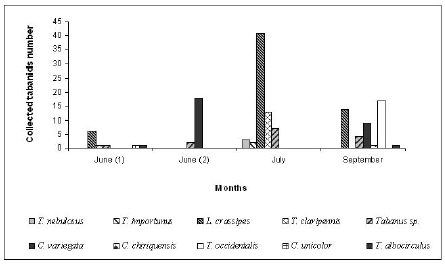
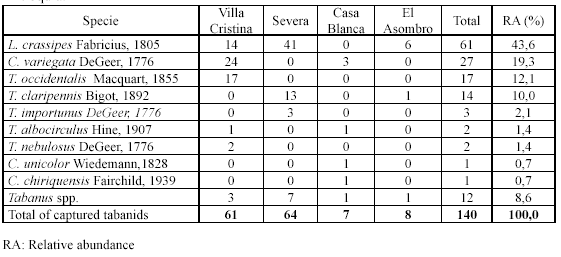
<body><![CDATA[<br>   Samples positive for flagellates were stained with Giemsa and intraperitonally    inoculated in mouses of 20 days old. </p>     <p>RESULTS</p>     <p>A total of 140 tabanids were found, belonging to two subfamilies, Tabaninae    and Chrysopsinae, and distributed in four genera: Tabanus, Lepiselaga, Chrysops    and Cryptotylus, and nine species. The genus Tabanus was found in all sample    points (<a href="#tabla1">table 1</a>), followed by Lepiselaga, which was found    in three sample points.</p>     <center>   <img src="/img/revistas/cal/v30n1/v30n1a10tab1.gif"><a name="tabla1"></a>  </center>     <p>    <center>Table 1. Relative abundante (RA) and Distribution of tabanids in four collecting    sites at Antioquia.</center>    <br>     <p>The most abundant species was L. crassipes (43.6%), which was found in three    of the studied farms. Chrysops variegata (19.3%) was the second most abundant    species, and was found in two farms. Tabanus occidentalis var. dorsovitatus    (12.1%) was found in just one farm and Tabanus claripennis (10.0%) was found    in two farms. </p>     <p>Other less conspicuous species found in this study were Tabanus importunus,    T. nebulosus, Tabanus albocirculus and Cryptotylus unicolor. Some specimens    belonging to genus Tabanus could not be identified to the species level. L.    crassipes was found in three of the four samplings, with population peak abundance    in July. C. variegata abundance peaked in June; T. occidentalis was only collected    in September, which was also the month of highest species diversity (<a href="#figura1">Figure    1</a>).</p>     <center>   <img src="/img/revistas/cal/v30n1/v30n1a10fig1.gif"><a name="figura1"></a>  </center>     ]]></body>
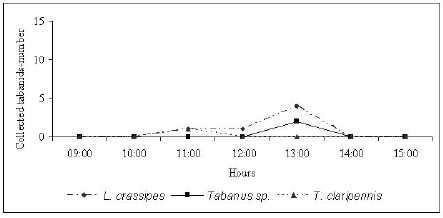
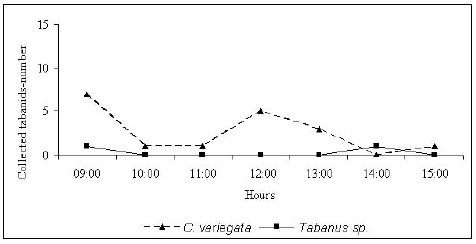
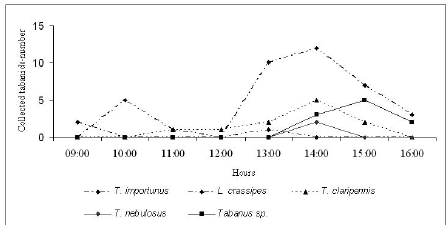
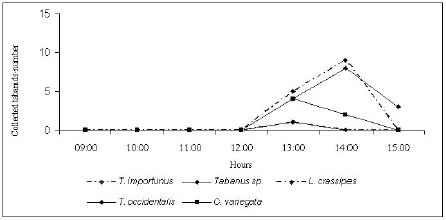
<body><![CDATA[<p>        <center>     Figure 1. Monthly distribution of tabanid species collect on horses at Caucasia,      Antioquia.    </center>       <br> </p>     <p>L. crassipes showed a biting peak at 14:00 h, as did T. occidentalis. C. variegata    peaked at 9:00 h (<a href="#figura2">figure 2</a>, <a href="#figura3">figure    3</a>, <a href="#figura4">figure 4</a>, <a href="#figura5">figure 5</a>). </p>     <center>   <img src="/img/revistas/cal/v30n1/v30n1a10fig2.gif"><a name="figura2"></a>  </center>     <p>        <center>     Figure 2. Diurnal biting activity of tabanids collected on horses at El Asombro      farm.    </center> </p>     <center>   <img src="/img/revistas/cal/v30n1/v30n1a10fig3.gif"><a name="figura3"></a>  </center></p>     <center>   Figure 3. Diurnal biting activity of tabanids collected on horses at Villa Cristina    farm. Sampling 1.  </center></p>     <center>   <img src="/img/revistas/cal/v30n1/v30n1a10fig4.gif"><a name="figura4"></a>  </center></p>     ]]></body>
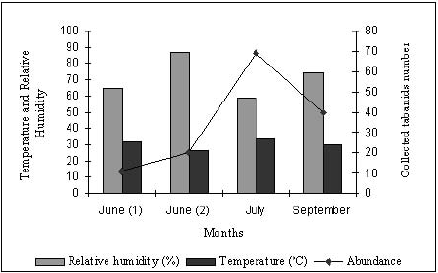
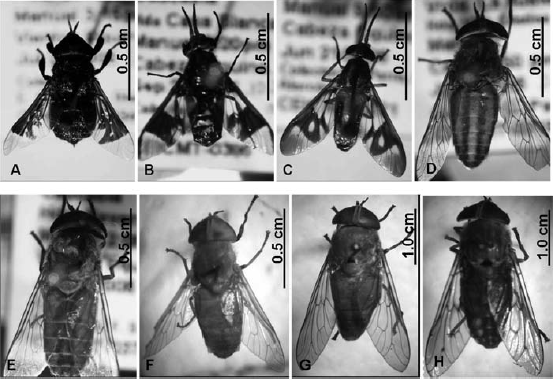
<body><![CDATA[<center>   Figure 4. Diurnal biting activity of tabanids collected on horses at Severa    farm.  </center></p>     <center>   <img src="/img/revistas/cal/v30n1/v30n1a10fig5.gif"><a name="figura5"></a>  </center>     <p>        <center>     Figure 5. Diurnal biting activity of tabanids collected on horses at Villa      Cristina farm. Sampling 2.    </center> </p>     <p>During the study period, the month of July has the highest temperature (33.6&deg;C)    and the lowest relative humidity (58.7%), and this coincided with the highest    abundance of tabanids (<a href="#figura6">figure 6</a>).</p>     <center>   <img src="/img/revistas/cal/v30n1/v30n1a10fig6.gif"><a name="figura6"></a>  </center>     <p>        <center>     Figure 6. Climatic data and tabanid abundance, from June to September 2006,      at Antioquia.    </center> </p>     <p>In general, relative humidity and temperature values have a strong variation    during the study months. Some of the most representative species of this study    are presented in <a href="#figura7">figure 7</a>.</p>     <center>   <img src="/img/revistas/cal/v30n1/v30n1a10fig7.gif"><a name="figura7"></a>  </center>     ]]></body>
<body><![CDATA[<p>       <center>     Figure 7. Some species of tabanids that occurs at Caucasia, Antioquia. A:      L. crassipes B: C. chiriquensis C: C. variegata D: T. occidentalis E: T. claripennis      F: C. unicolor G: T. nebulosus H: T. importunus. Pictures by Gabriel Parra      and Erika Alarc&oacute;n.   </center>       <br>       <br>   In the parasitological analysis of the collected tabanids we found that three    of them have flagellates in their midgut. Two of them were T. occidentalis and    the other was T. nebulosus. In addition, one of the positive T. occidentalis    also was positive for flagellates in the salivary glands.</p>     <p>The flagellates found in the tabanids were morphologically compatible with    T. vivax. However, after mouse inoculation with the flagellates, no parasitemia    was observed after two months. All positive tabanids were collected in the same    farm (Villa Cristina).</p>     <p>A total of 315 ticks was collected, all B. microplus. The distribution between    farms was: Villa Cristina (52.5%), Casa Blanca (22.5%), Severa (19.0%), and    El Asombro (6.0). No tick was found to be positive for Trypanosoma in the hemolymph    tests. </p>     <p>DISCUSSION</p>     <p>The present study extends the knowledge about the diversity of tabanids species    present in the Caucasia municipality. The highest abundance of tabanids was    found in July, that was the month with the higher temperature and the lowest    relative humidity during the sampling period. This is in accordance with the    work of Koller et al. (2002), Barros (2001) y Barros &amp; Foil (1999), who    investigated the seasonal abundance of tabanids in the Pantanal region of Brazil    and found an increase of the horse fly population during the first part of the    rainy season and an increase of the populations by the end of that period. </p>     <p>As indicated by Kettle (1995), the activity and dispersion of adult tabanids    is influenced by meteorological factors, principally luminosity and temperature.</p>     <p>The highest diversity of tabanids was in September, corresponding to the dry    climatic period, this finding was in accordance with Vel&aacute;squez de R&iacute;os    et al. (2004) in Guarico State, Venezuela; Gorayeb (1985) in east Amazonian    region of Brazil and Barros &amp; Foil (1999) in Pantanal, Brazil.</p>     ]]></body>
<body><![CDATA[<p>Of the nine collected species, L. crassipes had the highest relative abundance    (43.6%) and general tabanid populations peak was mainly due to this species,    and similarly findings were reported by Barros (2001). Remaining species showed    low relative abundances, fluctuating between 0.7 and 19.3% (<a href="#tabla1">table    1</a>, <a href="#figura1">figure 1</a>). </p>     <p>L. crassipes has a wide distribution in America, with records from Mexico to    north of Argentina including the Caribbean islands of Cuba, Jamaica, and Puerto    Rico. In Colombia L. crassipes have been found in the departments of Choc&oacute;,    Valle, Cauca, Antioquia, C&oacute;rdoba and Amazonas. The biting peak of L.    crassipes (14:00 h), coincided with the reports of Wilkerson (1979) who found    that the biting peak for that species was at 13:00 h.</p>     <p>C. variegata was the second most abundant species and was most conspicuous    on June, its geographical range goes from Mexico to Argentina, including the    Antilles. In Colombia, C. variegata was registered at the departments of Choc&oacute;,    Valle, Cauca, Antioquia, Santander, Magdalena, Meta, Putumayo and Vaup&eacute;s.    Bequaert &amp; Rengifo (1946) and Porter (1976), both cited by Wilkerson (1979),    reported the presence of C. variegata in the municipality of Caucasia (Antioquia    department). </p>     <p>T. occidentalis has a distribution range from Mexico to Argentina, including    the Trinidad Island (Wilkerson 1979, Fairchild 1986). </p>     <p>T. claripennis occurs in the Antilles, Colombia (Cauca, C&oacute;rdoba, Magdalena,    Meta and Valle departments) to Brazil, Argentina, Chile and Paraguay (Wilkerson    1979, Gorayeb 1985, Barros 2001).     <br>   T. claripennis did not show marked biting peaks but in general was more conspicuous    at 14:00 h, our findings were not different of Wilkerson (1979) who reported    a peak at 15:00 h. </p>     <p>It is known that T. vivax is transmitted cyclically in Africa by flies of the    genus Glossina and is accepted that in America the transmission is mechanical    (Gardiner &amp; Mahmoud 1990). In Latin America there is no presence of Glossina    flies and it is considered that the transmission of T. vivax is carried out    by tabanids and flies of the genus Stomoxys (Gardiner &amp; Wilson 1987, Mihok    et al. 1995, Desquesnes 2004). </p>     <p>Mechanical transmission of T. vivax has been proved in experimental conditions    (Ferenc et al. 1988, Raymond 1990, Otte &amp; Abuabara 1991). In general, is    accepted that the vector population abundance is an important factor to the    transmission of pathogen agents, however, although L. crassipes was the most    abundant species, it was not found the presence of flagellates in the midgut    and in salivary glands of the analyzed insects. This could be explained because    Trypanosomes can be found inside flies for a relatively short period of time    (usually less than 24h) after feeding on an infected host. However, we found    the presence of flagellates compatible with T. vivax in the midgut and salivary    glands of T. occidentalis. These results suggest T. vivax transmission by tabanids    in the study area. However, the specific status of the parasites should be determined    by molecular techniques because it has been demonstrated that morphollogically    is hard to differentiate epimastigote stage of Blastocrithidia from epimastigote    stage of Trypanosoma present in tabanids (Hoare 1972, Krinsky &amp; Pechuman    1975, Desquesnes 2004) and the transmission mechanism should be established    too by controlled studies.</p>     <p>Studies about transmission of T. vivax in the New World are scarce and are    suspected the presence of a biological vector that disseminates the disease    (Betancourt 1978). In Colombia, the only study about Trypanosoma mechanical    transmission by hematophagous dipterans was developed by Otte &amp; Abuabara    (1991), however, Wells et al. (1970) are doubt about the importance of mechanical    transmission for the maintenance of endemic situations. Other experimental studies    carried out elsewhere have confirmed this type of transmission by tabanids in    South America (Ferenc et al. 1988, Raymond 1990) as well as in Africa (Desquesnes    &amp; Dia 2004). </p>     <p>L&oacute;pez et al. (1979) suggested that B. microplus ticks could be potential    vectors of T. vivax; in a laboratory study a splenectomized Holstein calf was    inoculated with an identified T. vivax strain and later infested with B. microplus    larvae which were found to be positive for the parasite in hemolymph, ovaries    and salivary glands after the parasitic cycle. The current study did not find    evidence of T. vivax in ticks. The possible absence of circulating parasites    in the cattle may explain these results. Shastri &amp; Deshpande (1981), Morzaria    et al. (1986), and Ribeiro et al. (1988), cited by Rodr&iacute;guez et al. (2003)    have found Trypanosoma in different ticks species.</p>     ]]></body>
<body><![CDATA[<p>AKNOWLEDGEMENTS</p>     <p>To Direcci&oacute;n de Investigaciones and Facultad de Medicina Veterinaria    y Zootecnia, CES University for financial support. To Dr. Antonio Thadeu M Barros    (Embrapa, Brazil) for taxonomic confirmation of the tabanid species. To Dr.    Miguel Delgado, Asogauca Hemoparasites lab director and to Dra. Bertha Nelly    Restrepo ICMT-CES.</p>     <p>LITERATURE CITED</p>     <!-- ref --><p>1. BARROS, A.T. 2001. Seasonality and relative abundance of Tabanidae (Diptera)    captured on horses in the Pantanal, Brazil. Memorias do Instituto Oswaldo Cruz    96: 917-923.     &nbsp;&nbsp;&nbsp;&nbsp;&nbsp;&nbsp;&nbsp;&nbsp;[&#160;<a href="javascript:void(0);" onclick="javascript: window.open('/scielo.php?script=sci_nlinks&ref=000086&pid=S0366-5232200800010001000001&lng=','','width=640,height=500,resizable=yes,scrollbars=1,menubar=yes,');">Links</a>&#160;]<!-- end-ref --><!-- ref --><br>   2. Barros, A.T. &amp; I de S. Gorayeb. 1996. Chave de identifica&ccedil;&atilde;o    para Taban&iacute;deos (Diptera: Tabanidae) do Panatanal, Sub-regi&atilde;o    da Nhecol&acirc;ndia, Mato Grosso do Sul, Brasil. Revista Brasileira de Biologia    56(3): 547-551.    &nbsp;&nbsp;&nbsp;&nbsp;&nbsp;&nbsp;&nbsp;&nbsp;[&#160;<a href="javascript:void(0);" onclick="javascript: window.open('/scielo.php?script=sci_nlinks&ref=000087&pid=S0366-5232200800010001000002&lng=','','width=640,height=500,resizable=yes,scrollbars=1,menubar=yes,');">Links</a>&#160;]<!-- end-ref --><!-- ref --><br>   3. BARROS, AT. &amp; L. FOIL. 1999. Seasonal occurrence and relative abundance    of Tabanidae (Diptera) from the Pantanal region, Brazil. Memoirs of Entomology    International 14: 387-396.    &nbsp;&nbsp;&nbsp;&nbsp;&nbsp;&nbsp;&nbsp;&nbsp;[&#160;<a href="javascript:void(0);" onclick="javascript: window.open('/scielo.php?script=sci_nlinks&ref=000088&pid=S0366-5232200800010001000003&lng=','','width=640,height=500,resizable=yes,scrollbars=1,menubar=yes,');">Links</a>&#160;]<!-- end-ref --><!-- ref --><br>   4. BENAVIDES, E., P. GARC&Iacute;A, L. CABALLERO, N. PATI&Ntilde;O, V. RONDEROS    &amp; A. D&Aacute;VILA. 2004. Estudio de caso de un ternero de b&uacute;falo    de agua (Bubalus bubalis) infectado con Trypanosoma spp. Memorias I Simposio    Internacional de Hemoparasitos y sus Vectores. Universidad Sim&oacute;n Bol&iacute;var,    Caracas.    &nbsp;&nbsp;&nbsp;&nbsp;&nbsp;&nbsp;&nbsp;&nbsp;[&#160;<a href="javascript:void(0);" onclick="javascript: window.open('/scielo.php?script=sci_nlinks&ref=000089&pid=S0366-5232200800010001000004&lng=','','width=640,height=500,resizable=yes,scrollbars=1,menubar=yes,');">Links</a>&#160;]<!-- end-ref --><!-- ref --><br>   5. BETANCOURT, E.A. 1978. Studies on the epidemiology and economic importance    of Trypanosoma vivax Zieman 1905 in Colombia. Ph.D Dissertation. Texas A &amp;    M. University.     &nbsp;&nbsp;&nbsp;&nbsp;&nbsp;&nbsp;&nbsp;&nbsp;[&#160;<a href="javascript:void(0);" onclick="javascript: window.open('/scielo.php?script=sci_nlinks&ref=000090&pid=S0366-5232200800010001000005&lng=','','width=640,height=500,resizable=yes,scrollbars=1,menubar=yes,');">Links</a>&#160;]<!-- end-ref --><!-- ref --><br>   6. BETANCOURT, E.A. &amp; E.A. WELLS. 1979. P&eacute;rdidas econ&oacute;micas    en un brote de Tripanosomiasis Bovina causada por Trypanosoma vivax. Revista    Acovez 3(19): 6-8.    &nbsp;&nbsp;&nbsp;&nbsp;&nbsp;&nbsp;&nbsp;&nbsp;[&#160;<a href="javascript:void(0);" onclick="javascript: window.open('/scielo.php?script=sci_nlinks&ref=000091&pid=S0366-5232200800010001000006&lng=','','width=640,height=500,resizable=yes,scrollbars=1,menubar=yes,');">Links</a>&#160;]<!-- end-ref --><!-- ref --><br>   7. BETANCOURT, E.A. 1982. Tripanosomosis bovina: distribuci&oacute;n e impacto    econ&oacute;mico en Colombia. En: Curso internacional sobre &quot;Diagn&oacute;stico    de Hemopar&aacute;sitos&quot;. Monter&iacute;a-Colombia mayo 13-14. (Conferencia    mimeografiada).    &nbsp;&nbsp;&nbsp;&nbsp;&nbsp;&nbsp;&nbsp;&nbsp;[&#160;<a href="javascript:void(0);" onclick="javascript: window.open('/scielo.php?script=sci_nlinks&ref=000092&pid=S0366-5232200800010001000007&lng=','','width=640,height=500,resizable=yes,scrollbars=1,menubar=yes,');">Links</a>&#160;]<!-- end-ref --><!-- ref --><br>   8. BOLIVAR, A., P. GARC&Iacute;A-LUGO, G. CRISANTE, A. ROJAS, M. TEIXEIRA &amp;    N. A&Ntilde;EZ. 2006. Detecci&oacute;n de infecciones subcl&iacute;nicas por    Trypanosoma vivax en bovinos de fincas ganaderas de M&eacute;rida, Venezuela.    Bolet&iacute;n de Malariolog&iacute;a y Saneamiento Ambiental XLVI: 87-90.     &nbsp;&nbsp;&nbsp;&nbsp;&nbsp;&nbsp;&nbsp;&nbsp;[&#160;<a href="javascript:void(0);" onclick="javascript: window.open('/scielo.php?script=sci_nlinks&ref=000093&pid=S0366-5232200800010001000008&lng=','','width=640,height=500,resizable=yes,scrollbars=1,menubar=yes,');">Links</a>&#160;]<!-- end-ref --><!-- ref --><br>   9. BURGDORFER, W., M.L. SCHMIDT &amp; H. HOOGSTRAAL. 1973. Detection of Trypanosoma    theileri in Ethiopian Cattle ticks. Acta Tropical 30: 340-345.     &nbsp;&nbsp;&nbsp;&nbsp;&nbsp;&nbsp;&nbsp;&nbsp;[&#160;<a href="javascript:void(0);" onclick="javascript: window.open('/scielo.php?script=sci_nlinks&ref=000094&pid=S0366-5232200800010001000009&lng=','','width=640,height=500,resizable=yes,scrollbars=1,menubar=yes,');">Links</a>&#160;]<!-- end-ref --><!-- ref --><br>   10. CLARKSON, M.J. 1976. Tripanosomiasis of domesticated animals of South America.    Transactions of the Royal Society of Tropical Medicine and Higiene 70:125-126.        &nbsp;&nbsp;&nbsp;&nbsp;&nbsp;&nbsp;&nbsp;&nbsp;[&#160;<a href="javascript:void(0);" onclick="javascript: window.open('/scielo.php?script=sci_nlinks&ref=000095&pid=S0366-5232200800010001000010&lng=','','width=640,height=500,resizable=yes,scrollbars=1,menubar=yes,');">Links</a>&#160;]<!-- end-ref --><!-- ref --><br>   11. COSCAR&Oacute;N, S. &amp; N. PAPAVERO. 1993. An illustrated manual for the    identification of the Neotropical genera and subgenera of Tabanidae (Diptera).    Museu Paraense Emilio Goeldi, Belem, Brazil.     &nbsp;&nbsp;&nbsp;&nbsp;&nbsp;&nbsp;&nbsp;&nbsp;[&#160;<a href="javascript:void(0);" onclick="javascript: window.open('/scielo.php?script=sci_nlinks&ref=000096&pid=S0366-5232200800010001000011&lng=','','width=640,height=500,resizable=yes,scrollbars=1,menubar=yes,');">Links</a>&#160;]<!-- end-ref --><!-- ref --><br>   12. DESQUESNES, M. 2004. Livestock Trypano-somoses and their vectors in Latin    America. CIRAD/EMVT OIE (World Organisation for Animal Health), France.    &nbsp;&nbsp;&nbsp;&nbsp;&nbsp;&nbsp;&nbsp;&nbsp;[&#160;<a href="javascript:void(0);" onclick="javascript: window.open('/scielo.php?script=sci_nlinks&ref=000097&pid=S0366-5232200800010001000012&lng=','','width=640,height=500,resizable=yes,scrollbars=1,menubar=yes,');">Links</a>&#160;]<!-- end-ref --><!-- ref --><br>   13. DESQUESNES, M. &amp; M.L. DIA. 2004. Mechanical transmission of Trypanosoma    vivax in cattle by the African tabanid Atylotus fuscipes. Veterinary Parasitology    119: 9-19.    &nbsp;&nbsp;&nbsp;&nbsp;&nbsp;&nbsp;&nbsp;&nbsp;[&#160;<a href="javascript:void(0);" onclick="javascript: window.open('/scielo.php?script=sci_nlinks&ref=000098&pid=S0366-5232200800010001000013&lng=','','width=640,height=500,resizable=yes,scrollbars=1,menubar=yes,');">Links</a>&#160;]<!-- end-ref --><!-- ref --><br>   14. FAIRCHILD, G.B. 1984. Notes on Neotropical Tabanidae (Diptera) XX. The larger    species of Eastern South America. Contributions of the American Entomological    Institute 21 (3):1-50.     &nbsp;&nbsp;&nbsp;&nbsp;&nbsp;&nbsp;&nbsp;&nbsp;[&#160;<a href="javascript:void(0);" onclick="javascript: window.open('/scielo.php?script=sci_nlinks&ref=000099&pid=S0366-5232200800010001000014&lng=','','width=640,height=500,resizable=yes,scrollbars=1,menubar=yes,');">Links</a>&#160;]<!-- end-ref --><!-- ref --><br>   15. FAIRCHILD, G.B. 1986. The Tabanidae of Panama. Contributions of the American    Entomological Institute 22 (3): 1-139.     &nbsp;&nbsp;&nbsp;&nbsp;&nbsp;&nbsp;&nbsp;&nbsp;[&#160;<a href="javascript:void(0);" onclick="javascript: window.open('/scielo.php?script=sci_nlinks&ref=000100&pid=S0366-5232200800010001000015&lng=','','width=640,height=500,resizable=yes,scrollbars=1,menubar=yes,');">Links</a>&#160;]<!-- end-ref --><!-- ref --><br>   16. FERENC, S.A., H.L. RAYMOND, R. LANCELOT &amp; C.H. COURTNEY. 1988. Mechanical    transmission of South American Trypanosoma vivax by the tabanid Cryptotylus    unicolor. Universit&eacute; de Floride, Gainesville.    &nbsp;&nbsp;&nbsp;&nbsp;&nbsp;&nbsp;&nbsp;&nbsp;[&#160;<a href="javascript:void(0);" onclick="javascript: window.open('/scielo.php?script=sci_nlinks&ref=000101&pid=S0366-5232200800010001000016&lng=','','width=640,height=500,resizable=yes,scrollbars=1,menubar=yes,');">Links</a>&#160;]<!-- end-ref --><!-- ref --><br>   17. GARDINER, P.R. &amp; A.J. WILSON. 1987. Trypanosoma (Dutonella) vivax. Parasitology    Today 3: 49-52.    &nbsp;&nbsp;&nbsp;&nbsp;&nbsp;&nbsp;&nbsp;&nbsp;[&#160;<a href="javascript:void(0);" onclick="javascript: window.open('/scielo.php?script=sci_nlinks&ref=000102&pid=S0366-5232200800010001000017&lng=','','width=640,height=500,resizable=yes,scrollbars=1,menubar=yes,');">Links</a>&#160;]<!-- end-ref --><!-- ref --><br>   18. GARDINER, P. 1989. Recent studies on the biology of Trypanosoma vivax. Advances    in Parasitology 28: 229-317.    &nbsp;&nbsp;&nbsp;&nbsp;&nbsp;&nbsp;&nbsp;&nbsp;[&#160;<a href="javascript:void(0);" onclick="javascript: window.open('/scielo.php?script=sci_nlinks&ref=000103&pid=S0366-5232200800010001000018&lng=','','width=640,height=500,resizable=yes,scrollbars=1,menubar=yes,');">Links</a>&#160;]<!-- end-ref --><!-- ref --><br>   19. GARDINER, P.R. &amp; M.M. MAHMOUD. 1990. Salivarian trypanosomes causing    disease in livestock outside sub-saharan Africa. In: Baker J.R. Parasitic Protozoa,    vol. 3. Academic Press, New York.    &nbsp;&nbsp;&nbsp;&nbsp;&nbsp;&nbsp;&nbsp;&nbsp;[&#160;<a href="javascript:void(0);" onclick="javascript: window.open('/scielo.php?script=sci_nlinks&ref=000104&pid=S0366-5232200800010001000019&lng=','','width=640,height=500,resizable=yes,scrollbars=1,menubar=yes,');">Links</a>&#160;]<!-- end-ref --><!-- ref --><br>   20. GORAYEB, I. 1985. Tabanidae (Diptera) da Amaz&ocirc;nia Oriental; sazonalidade,    ataque e estratifica&ccedil;&atilde;o arb&oacute;rea. (PhD thesis). Instituto    Nacional de Pesquisas da Amaz&ocirc;nia (INPA) e Funda&ccedil;&atilde;o Universidade    do Amazona (FUA), Manaus.    &nbsp;&nbsp;&nbsp;&nbsp;&nbsp;&nbsp;&nbsp;&nbsp;[&#160;<a href="javascript:void(0);" onclick="javascript: window.open('/scielo.php?script=sci_nlinks&ref=000105&pid=S0366-5232200800010001000020&lng=','','width=640,height=500,resizable=yes,scrollbars=1,menubar=yes,');">Links</a>&#160;]<!-- end-ref --><!-- ref --><br>   21. GUILLEN, A., E. LE&Oacute;N, W. ARAGORT &amp; M. SILVA. 2001. Diagn&oacute;stico    de hemopar&aacute;sitos en el Instituto de Investigaciones Veterinarias. Periodo    1986-2000. Veterinaria Tropical 26:47-62.    &nbsp;&nbsp;&nbsp;&nbsp;&nbsp;&nbsp;&nbsp;&nbsp;[&#160;<a href="javascript:void(0);" onclick="javascript: window.open('/scielo.php?script=sci_nlinks&ref=000106&pid=S0366-5232200800010001000021&lng=','','width=640,height=500,resizable=yes,scrollbars=1,menubar=yes,');">Links</a>&#160;]<!-- end-ref --><!-- ref --><br>   22. HOARE, C.A. 1972. The Trypanosomes of Mammals. A Zoological Monograph, Blackwell,    Oxford.     &nbsp;&nbsp;&nbsp;&nbsp;&nbsp;&nbsp;&nbsp;&nbsp;[&#160;<a href="javascript:void(0);" onclick="javascript: window.open('/scielo.php?script=sci_nlinks&ref=000107&pid=S0366-5232200800010001000022&lng=','','width=640,height=500,resizable=yes,scrollbars=1,menubar=yes,');">Links</a>&#160;]<!-- end-ref --><!-- ref --><br>   23. JONES, E.K., C.M. CLIFFORD, J.E. KIERANS &amp; G.M. KHOLS. 1972. The ticks    of Venezuela (Acarina: Ixodoidea) with the key to the species of Amblyomma in    the Western Hemisphere: Brigman Young Universitiy Sciences Bulletin. Biology    series 17: 1-40.    &nbsp;&nbsp;&nbsp;&nbsp;&nbsp;&nbsp;&nbsp;&nbsp;[&#160;<a href="javascript:void(0);" onclick="javascript: window.open('/scielo.php?script=sci_nlinks&ref=000108&pid=S0366-5232200800010001000023&lng=','','width=640,height=500,resizable=yes,scrollbars=1,menubar=yes,');">Links</a>&#160;]<!-- end-ref --><!-- ref --><br>   24. JONES, T. &amp; A. DAVILA. 2001. Trypanosoma vivax - out of Africa.    Trends in Parasitology 17: 99-101.    &nbsp;&nbsp;&nbsp;&nbsp;&nbsp;&nbsp;&nbsp;&nbsp;[&#160;<a href="javascript:void(0);" onclick="javascript: window.open('/scielo.php?script=sci_nlinks&ref=000109&pid=S0366-5232200800010001000024&lng=','','width=640,height=500,resizable=yes,scrollbars=1,menubar=yes,');">Links</a>&#160;]<!-- end-ref --><!-- ref --><br>   25. KEIRANS, J.E. &amp; C.M. CLIFFORD. 1978. The genus Ixodes in the United    Status: A scanning electron microcope study and key to the adults. Journal of    Medical Entomology (Suppl. 2):149.    &nbsp;&nbsp;&nbsp;&nbsp;&nbsp;&nbsp;&nbsp;&nbsp;[&#160;<a href="javascript:void(0);" onclick="javascript: window.open('/scielo.php?script=sci_nlinks&ref=000110&pid=S0366-5232200800010001000025&lng=','','width=640,height=500,resizable=yes,scrollbars=1,menubar=yes,');">Links</a>&#160;]<!-- end-ref --><!-- ref --><br>   26. KETTLE, D.S. 1995. Tabanidae (Horseflies, Deer flies, Clegs). p. 211-224.    En: Cab International (Eds.) Medical and Veterinary Entomology. 2nd Edition.        &nbsp;&nbsp;&nbsp;&nbsp;&nbsp;&nbsp;&nbsp;&nbsp;[&#160;<a href="javascript:void(0);" onclick="javascript: window.open('/scielo.php?script=sci_nlinks&ref=000111&pid=S0366-5232200800010001000026&lng=','','width=640,height=500,resizable=yes,scrollbars=1,menubar=yes,');">Links</a>&#160;]<!-- end-ref --><!-- ref --><br>   27. KRINSKY, W.L. &amp; L.L. PECHUMAN. 1975. Trypanosomes in horse flies and    deer flies in Central New York State. The Journal of Parasitology 61(1): 12-16.        &nbsp;&nbsp;&nbsp;&nbsp;&nbsp;&nbsp;&nbsp;&nbsp;[&#160;<a href="javascript:void(0);" onclick="javascript: window.open('/scielo.php?script=sci_nlinks&ref=000112&pid=S0366-5232200800010001000027&lng=','','width=640,height=500,resizable=yes,scrollbars=1,menubar=yes,');">Links</a>&#160;]<!-- end-ref --><!-- ref --><br>   28. KOLLER, W.W., A.T.M. BARROS, A. GOMEZ, C.R. MADRUGA, C.P. ARAUJO, A. UMAKI    &amp; A.P.K. ISMAEL. 2002. Sazonalidade de taban&iacute;deos (Diptera:Tabanidae)    em &aacute;rea de transi&ccedil;&atilde;o entre o Cerrado e Pantanal, no Mato    Grosso do Sul, Brasil. In: Congresso Brasileiro de Parasitologia Veterin&aacute;ria,    12. Rio de Janeiro, 2002. Programas e Resumos, Rio de Janeiro.    &nbsp;&nbsp;&nbsp;&nbsp;&nbsp;&nbsp;&nbsp;&nbsp;[&#160;<a href="javascript:void(0);" onclick="javascript: window.open('/scielo.php?script=sci_nlinks&ref=000113&pid=S0366-5232200800010001000028&lng=','','width=640,height=500,resizable=yes,scrollbars=1,menubar=yes,');">Links</a>&#160;]<!-- end-ref --><!-- ref --><br>   29. L&Oacute;PEZ, G., K.C. THOMPSON &amp; H. BAZALAR. 1979. Transmisi&oacute;n    experimental de Trypanosoma vivax por la garrapata Boophilus microplus. Revista    del Instituto Colombiano Agropecuario 14: 93-96.     &nbsp;&nbsp;&nbsp;&nbsp;&nbsp;&nbsp;&nbsp;&nbsp;[&#160;<a href="javascript:void(0);" onclick="javascript: window.open('/scielo.php?script=sci_nlinks&ref=000114&pid=S0366-5232200800010001000029&lng=','','width=640,height=500,resizable=yes,scrollbars=1,menubar=yes,');">Links</a>&#160;]<!-- end-ref --><!-- ref --><br>   30. MIHOK, S., L.J. KANGETHE &amp; G.K. KAMAU. 1995. Trials of traps and attractant    for Stomoxys spp. (Diptera, Muscidae). Journal Medical Entomology 32: 283-289.    &nbsp;&nbsp;&nbsp;&nbsp;&nbsp;&nbsp;&nbsp;&nbsp;[&#160;<a href="javascript:void(0);" onclick="javascript: window.open('/scielo.php?script=sci_nlinks&ref=000115&pid=S0366-5232200800010001000030&lng=','','width=640,height=500,resizable=yes,scrollbars=1,menubar=yes,');">Links</a>&#160;]<!-- end-ref --><!-- ref --><br>   31. OTTE, M.J. &amp; J.Y. ABUABARA. 1991. Transmission of South American Trypanosoma    vivax by the neotropical hosefly Tabanus nebulosus. Acta Tropical 49: 73-76.    &nbsp;&nbsp;&nbsp;&nbsp;&nbsp;&nbsp;&nbsp;&nbsp;[&#160;<a href="javascript:void(0);" onclick="javascript: window.open('/scielo.php?script=sci_nlinks&ref=000116&pid=S0366-5232200800010001000031&lng=','','width=640,height=500,resizable=yes,scrollbars=1,menubar=yes,');">Links</a>&#160;]<!-- end-ref --><!-- ref --><br>   32. OTTE, M.J., J.Y. ABUABARA &amp; E.A. WELLS. 1994. Trypanosoma vivax in Colombia:    epidemiology and productivity losses. Tropical Animal Health and Production    26: 146-156.    &nbsp;&nbsp;&nbsp;&nbsp;&nbsp;&nbsp;&nbsp;&nbsp;[&#160;<a href="javascript:void(0);" onclick="javascript: window.open('/scielo.php?script=sci_nlinks&ref=000117&pid=S0366-5232200800010001000032&lng=','','width=640,height=500,resizable=yes,scrollbars=1,menubar=yes,');">Links</a>&#160;]<!-- end-ref --><!-- ref --><br>   33. RAYMOND, H.L. 1990. Tabanus importunus, vecteur m&eacute;canique exp&eacute;rimental    de Trypanosoma vivax en Guyane Fran&ccedil;aise. Annales de Parasitologie Humaine    et Comparee 65:44-46.     &nbsp;&nbsp;&nbsp;&nbsp;&nbsp;&nbsp;&nbsp;&nbsp;[&#160;<a href="javascript:void(0);" onclick="javascript: window.open('/scielo.php?script=sci_nlinks&ref=000118&pid=S0366-5232200800010001000033&lng=','','width=640,height=500,resizable=yes,scrollbars=1,menubar=yes,');">Links</a>&#160;]<!-- end-ref --><!-- ref --><br>   34. RODRIGUEZ, R.I., A.F. QUI&Ntilde;ONES, G.T. RAMIREZ-CRUZ &amp; H. RUIZ-PE&Ntilde;A.    2003. Presencia del g&eacute;nero Trypanosoma en la garrapata Boophilus microplus    en el tr&oacute;pico Mexicano. Revista Biomedica 14: 29-33.    &nbsp;&nbsp;&nbsp;&nbsp;&nbsp;&nbsp;&nbsp;&nbsp;[&#160;<a href="javascript:void(0);" onclick="javascript: window.open('/scielo.php?script=sci_nlinks&ref=000119&pid=S0366-5232200800010001000034&lng=','','width=640,height=500,resizable=yes,scrollbars=1,menubar=yes,');">Links</a>&#160;]<!-- end-ref --><!-- ref --><br>   35. SANDOVAL, E., E. ESPINOZA &amp; A. VALLE. 1996. Leucopenia y trombocitopenia    en ovejas infectadas experimentalmente con Trypanosoma vivax. Veterinaria Tropical    21:13-33.     &nbsp;&nbsp;&nbsp;&nbsp;&nbsp;&nbsp;&nbsp;&nbsp;[&#160;<a href="javascript:void(0);" onclick="javascript: window.open('/scielo.php?script=sci_nlinks&ref=000120&pid=S0366-5232200800010001000035&lng=','','width=640,height=500,resizable=yes,scrollbars=1,menubar=yes,');">Links</a>&#160;]<!-- end-ref --><!-- ref --><br>   36. VEL&Aacute;SQUEZ DE R&Iacute;OS, M., Z. G&Oacute;MEZ, I. GORAYEB &amp; R.    TAMASAUKAS. 2004. Abundancia estacional de tab&aacute;nidos (D&iacute;ptera:    Tabanidae) en el sector Las Lajas, Municipio Miranda, estado Gu&aacute;rico,    Venezuela. Entomotropica 19: 149-152.    &nbsp;&nbsp;&nbsp;&nbsp;&nbsp;&nbsp;&nbsp;&nbsp;[&#160;<a href="javascript:void(0);" onclick="javascript: window.open('/scielo.php?script=sci_nlinks&ref=000121&pid=S0366-5232200800010001000036&lng=','','width=640,height=500,resizable=yes,scrollbars=1,menubar=yes,');">Links</a>&#160;]<!-- end-ref --><!-- ref --><br>   37. WELLS, E.A., A. BETANCOURT &amp; W.A. PAGE. 1970. The epidemiology of bovine    Trypanosomosis in Colombia. Tropical Animal Health and Production 2: 111-125.    &nbsp;&nbsp;&nbsp;&nbsp;&nbsp;&nbsp;&nbsp;&nbsp;[&#160;<a href="javascript:void(0);" onclick="javascript: window.open('/scielo.php?script=sci_nlinks&ref=000122&pid=S0366-5232200800010001000037&lng=','','width=640,height=500,resizable=yes,scrollbars=1,menubar=yes,');">Links</a>&#160;]<!-- end-ref --><!-- ref --><br>   38. WELLS, E.A., L.E. RAM&Iacute;REZ &amp; A. BETANCOURT. 1982. Trypanosoma    vivax en Colombia: interpretation of field results. Tropical Animal Health and    Production 14: 141-150.     &nbsp;&nbsp;&nbsp;&nbsp;&nbsp;&nbsp;&nbsp;&nbsp;[&#160;<a href="javascript:void(0);" onclick="javascript: window.open('/scielo.php?script=sci_nlinks&ref=000123&pid=S0366-5232200800010001000038&lng=','','width=640,height=500,resizable=yes,scrollbars=1,menubar=yes,');">Links</a>&#160;]<!-- end-ref --><!-- ref --><br>   39. WILKERSON, R.C. 1979. Horse flies (Diptera: Tabanidae) of the Colombian    departments of Choc&oacute;, Valle and Cauca. Cespedesia 8: 89-433.&nbsp;&nbsp;&nbsp;&nbsp;&nbsp;&nbsp;&nbsp;&nbsp;[&#160;<a href="javascript:void(0);" onclick="javascript: window.open('/scielo.php?script=sci_nlinks&ref=000124&pid=S0366-5232200800010001000039&lng=','','width=640,height=500,resizable=yes,scrollbars=1,menubar=yes,');">Links</a>&#160;]<!-- end-ref --><p>Recibido: 19/01/2007    <br>   Aceptado: 01/01/2008    <br> </p> </font>       ]]></body><back>
<ref-list>
<ref id="B1">
<label>1.</label><nlm-citation citation-type="journal">
<person-group person-group-type="author">
<name>
<surname><![CDATA[BARROS]]></surname>
<given-names><![CDATA[A.T.]]></given-names>
</name>
</person-group>
<article-title xml:lang="en"><![CDATA[Seasonality and relative abundance of Tabanidae (Diptera) captured on horses in the Pantanal, Brazil]]></article-title>
<source><![CDATA[Memorias do Instituto Oswaldo Cruz]]></source>
<year>2001</year>
<volume>96</volume>
<page-range>917-923</page-range></nlm-citation>
</ref>
<ref id="B2">
<label>2.</label><nlm-citation citation-type="journal">
<person-group person-group-type="author">
<name>
<surname><![CDATA[Barros]]></surname>
<given-names><![CDATA[A.T.]]></given-names>
</name>
<name>
<surname><![CDATA[Gorayeb]]></surname>
<given-names><![CDATA[I de S.]]></given-names>
</name>
</person-group>
<article-title xml:lang="pt"><![CDATA[Chave de identificação para Tabanídeos (Diptera: Tabanidae) do Panatanal, Sub-região da Nhecolândia, Mato Grosso do Sul, Brasil]]></article-title>
<source><![CDATA[Revista Brasileira de Biologia]]></source>
<year>1996</year>
<volume>56</volume>
<numero>3</numero>
<issue>3</issue>
<page-range>547-551</page-range></nlm-citation>
</ref>
<ref id="B3">
<label>3.</label><nlm-citation citation-type="journal">
<person-group person-group-type="author">
<name>
<surname><![CDATA[BARROS]]></surname>
<given-names><![CDATA[AT.]]></given-names>
</name>
<name>
<surname><![CDATA[FOIL]]></surname>
<given-names><![CDATA[L.]]></given-names>
</name>
</person-group>
<article-title xml:lang="en"><![CDATA[Seasonal occurrence and relative abundance of Tabanidae (Diptera) from the Pantanal region, Brazil]]></article-title>
<source><![CDATA[Memoirs of Entomology International]]></source>
<year>1999</year>
<volume>14</volume>
<page-range>387-396</page-range></nlm-citation>
</ref>
<ref id="B4">
<label>4.</label><nlm-citation citation-type="book">
<person-group person-group-type="author">
<name>
<surname><![CDATA[BENAVIDES]]></surname>
<given-names><![CDATA[E.]]></given-names>
</name>
<name>
<surname><![CDATA[GARCÍA]]></surname>
<given-names><![CDATA[P.]]></given-names>
</name>
<name>
<surname><![CDATA[CABALLERO]]></surname>
<given-names><![CDATA[L.]]></given-names>
</name>
<name>
<surname><![CDATA[PATIÑO]]></surname>
<given-names><![CDATA[N.]]></given-names>
</name>
<name>
<surname><![CDATA[RONDEROS]]></surname>
<given-names><![CDATA[V.]]></given-names>
</name>
<name>
<surname><![CDATA[DÁVILA]]></surname>
<given-names><![CDATA[A.]]></given-names>
</name>
</person-group>
<source><![CDATA[Estudio de caso de un ternero de búfalo de agua (Bubalus bubalis) infectado con Trypanosoma spp.]]></source>
<year>2004</year>
<publisher-loc><![CDATA[Caracas ]]></publisher-loc>
<publisher-name><![CDATA[Universidad Simón Bolívar]]></publisher-name>
</nlm-citation>
</ref>
<ref id="B5">
<label>5.</label><nlm-citation citation-type="">
<person-group person-group-type="author">
<name>
<surname><![CDATA[BETANCOURT]]></surname>
<given-names><![CDATA[E.A.]]></given-names>
</name>
</person-group>
<source><![CDATA[Studies on the epidemiology and economic importance of Trypanosoma vivax Zieman 1905 in Colombia]]></source>
<year>1978</year>
</nlm-citation>
</ref>
<ref id="B6">
<label>6.</label><nlm-citation citation-type="journal">
<person-group person-group-type="author">
<name>
<surname><![CDATA[BETANCOURT]]></surname>
<given-names><![CDATA[E.A.]]></given-names>
</name>
<name>
<surname><![CDATA[WELLS]]></surname>
<given-names><![CDATA[E.A.]]></given-names>
</name>
</person-group>
<article-title xml:lang="es"><![CDATA[Pérdidas económicas en un brote de Tripanosomiasis Bovina causada por Trypanosoma vivax]]></article-title>
<source><![CDATA[Revista Acovez]]></source>
<year>1979</year>
<volume>3</volume>
<numero>19</numero>
<issue>19</issue>
<page-range>6-8</page-range></nlm-citation>
</ref>
<ref id="B7">
<label>7.</label><nlm-citation citation-type="">
<person-group person-group-type="author">
<name>
<surname><![CDATA[BETANCOURT]]></surname>
<given-names><![CDATA[E.A.]]></given-names>
</name>
</person-group>
<article-title xml:lang="es"><![CDATA[Tripanosomosis bovina: distribución e impacto económico en Colombia]]></article-title>
<source><![CDATA[Curso internacional sobre "Diagnóstico de Hemoparásitos"]]></source>
<year>1982</year>
<publisher-loc><![CDATA[Montería ]]></publisher-loc>
</nlm-citation>
</ref>
<ref id="B8">
<label>8.</label><nlm-citation citation-type="journal">
<person-group person-group-type="author">
<name>
<surname><![CDATA[BOLIVAR]]></surname>
<given-names><![CDATA[A.]]></given-names>
</name>
<name>
<surname><![CDATA[GARCÍA-LUGO]]></surname>
<given-names><![CDATA[P.]]></given-names>
</name>
<name>
<surname><![CDATA[CRISANTE]]></surname>
<given-names><![CDATA[G.]]></given-names>
</name>
<name>
<surname><![CDATA[ROJAS]]></surname>
<given-names><![CDATA[A.]]></given-names>
</name>
<name>
<surname><![CDATA[TEIXEIRA]]></surname>
<given-names><![CDATA[M.]]></given-names>
</name>
<name>
<surname><![CDATA[AÑEZ]]></surname>
<given-names><![CDATA[N.]]></given-names>
</name>
</person-group>
<article-title xml:lang="es"><![CDATA[Detección de infecciones subclínicas por Trypanosoma vivax en bovinos de fincas ganaderas de Mérida, Venezuela]]></article-title>
<source><![CDATA[Boletín de Malariología y Saneamiento Ambiental]]></source>
<year>2006</year>
<volume>XLVI</volume>
<page-range>87-90</page-range></nlm-citation>
</ref>
<ref id="B9">
<label>9.</label><nlm-citation citation-type="journal">
<person-group person-group-type="author">
<name>
<surname><![CDATA[BURGDORFER]]></surname>
<given-names><![CDATA[W.]]></given-names>
</name>
<name>
<surname><![CDATA[SCHMIDT]]></surname>
<given-names><![CDATA[M.L.]]></given-names>
</name>
<name>
<surname><![CDATA[HOOGSTRAAL]]></surname>
<given-names><![CDATA[H.]]></given-names>
</name>
</person-group>
<article-title xml:lang="en"><![CDATA[Detection of Trypanosoma theileri in Ethiopian Cattle ticks]]></article-title>
<source><![CDATA[Acta Tropical]]></source>
<year>1973</year>
<volume>30</volume>
<page-range>340-345</page-range></nlm-citation>
</ref>
<ref id="B10">
<label>10.</label><nlm-citation citation-type="journal">
<person-group person-group-type="author">
<name>
<surname><![CDATA[CLARKSON]]></surname>
<given-names><![CDATA[M.J.]]></given-names>
</name>
</person-group>
<article-title xml:lang="en"><![CDATA[Tripanosomiasis of domesticated animals of South America]]></article-title>
<source><![CDATA[Transactions of the Royal Society of Tropical Medicine and Higiene]]></source>
<year>1976</year>
<volume>70</volume>
<page-range>125-126</page-range></nlm-citation>
</ref>
<ref id="B11">
<label>11.</label><nlm-citation citation-type="book">
<person-group person-group-type="author">
<name>
<surname><![CDATA[COSCARÓN]]></surname>
<given-names><![CDATA[S.]]></given-names>
</name>
<name>
<surname><![CDATA[PAPAVERO]]></surname>
<given-names><![CDATA[N.]]></given-names>
</name>
</person-group>
<source><![CDATA[An illustrated manual for the identification of the Neotropical genera and subgenera of Tabanidae (Diptera)]]></source>
<year>1993</year>
<publisher-loc><![CDATA[Belem ]]></publisher-loc>
<publisher-name><![CDATA[Museu Paraense Emilio Goeldi]]></publisher-name>
</nlm-citation>
</ref>
<ref id="B12">
<label>12.</label><nlm-citation citation-type="book">
<person-group person-group-type="author">
<name>
<surname><![CDATA[DESQUESNES]]></surname>
<given-names><![CDATA[M.]]></given-names>
</name>
</person-group>
<source><![CDATA[Livestock Trypano-somoses and their vectors in Latin America]]></source>
<year>2004</year>
<publisher-name><![CDATA[CIRAD/EMVT OIE (World Organisation for Animal Health)]]></publisher-name>
</nlm-citation>
</ref>
<ref id="B13">
<label>13.</label><nlm-citation citation-type="journal">
<person-group person-group-type="author">
<name>
<surname><![CDATA[DESQUESNES]]></surname>
<given-names><![CDATA[M.]]></given-names>
</name>
<name>
<surname><![CDATA[DIA]]></surname>
<given-names><![CDATA[M.L.]]></given-names>
</name>
</person-group>
<article-title xml:lang="en"><![CDATA[Mechanical transmission of Trypanosoma vivax in cattle by the African tabanid Atylotus fuscipes]]></article-title>
<source><![CDATA[Veterinary Parasitology]]></source>
<year>2004</year>
<volume>119</volume>
<page-range>9-19</page-range></nlm-citation>
</ref>
<ref id="B14">
<label>14.</label><nlm-citation citation-type="journal">
<person-group person-group-type="author">
<name>
<surname><![CDATA[FAIRCHILD]]></surname>
<given-names><![CDATA[G.B.]]></given-names>
</name>
</person-group>
<article-title xml:lang="en"><![CDATA[Notes on Neotropical Tabanidae (Diptera) XX: The larger species of Eastern South America]]></article-title>
<source><![CDATA[Contributions of the American Entomological Institute]]></source>
<year>1984</year>
<volume>21</volume>
<numero>3</numero>
<issue>3</issue>
<page-range>1-50</page-range></nlm-citation>
</ref>
<ref id="B15">
<label>15.</label><nlm-citation citation-type="journal">
<person-group person-group-type="author">
<name>
<surname><![CDATA[FAIRCHILD]]></surname>
<given-names><![CDATA[G.B.]]></given-names>
</name>
</person-group>
<article-title xml:lang="en"><![CDATA[The Tabanidae of Panama]]></article-title>
<source><![CDATA[Contributions of the American Entomological Institute]]></source>
<year>1986</year>
<volume>22</volume>
<numero>3</numero>
<issue>3</issue>
<page-range>1-139</page-range></nlm-citation>
</ref>
<ref id="B16">
<label>16.</label><nlm-citation citation-type="book">
<person-group person-group-type="author">
<name>
<surname><![CDATA[FERENC]]></surname>
<given-names><![CDATA[S.A.]]></given-names>
</name>
<name>
<surname><![CDATA[RAYMOND]]></surname>
<given-names><![CDATA[H.L.]]></given-names>
</name>
<name>
<surname><![CDATA[LANCELOT]]></surname>
<given-names><![CDATA[R.]]></given-names>
</name>
<name>
<surname><![CDATA[COURTNEY]]></surname>
<given-names><![CDATA[C.H.]]></given-names>
</name>
</person-group>
<source><![CDATA[Mechanical transmission of South American Trypanosoma vivax by the tabanid Cryptotylus unicolor]]></source>
<year>1988</year>
<publisher-loc><![CDATA[Gainesville ]]></publisher-loc>
<publisher-name><![CDATA[Université de Floride]]></publisher-name>
</nlm-citation>
</ref>
<ref id="B17">
<label>17.</label><nlm-citation citation-type="journal">
<person-group person-group-type="author">
<name>
<surname><![CDATA[GARDINER]]></surname>
<given-names><![CDATA[P.R.]]></given-names>
</name>
<name>
<surname><![CDATA[WILSON]]></surname>
<given-names><![CDATA[A.J.]]></given-names>
</name>
</person-group>
<article-title xml:lang="en"><![CDATA[Trypanosoma (Dutonella) vivax]]></article-title>
<source><![CDATA[Parasitology Today]]></source>
<year>1987</year>
<volume>3</volume>
<page-range>49-52</page-range></nlm-citation>
</ref>
<ref id="B18">
<label>18.</label><nlm-citation citation-type="journal">
<person-group person-group-type="author">
<name>
<surname><![CDATA[GARDINER]]></surname>
<given-names><![CDATA[P.]]></given-names>
</name>
</person-group>
<article-title xml:lang="en"><![CDATA[Recent studies on the biology of Trypanosoma vivax]]></article-title>
<source><![CDATA[Advances in Parasitology]]></source>
<year>1989</year>
<volume>28</volume>
<page-range>229-317</page-range></nlm-citation>
</ref>
<ref id="B19">
<label>19.</label><nlm-citation citation-type="book">
<person-group person-group-type="author">
<name>
<surname><![CDATA[GARDINER]]></surname>
<given-names><![CDATA[P.R.]]></given-names>
</name>
<name>
<surname><![CDATA[MAHMOUD]]></surname>
<given-names><![CDATA[M.M.]]></given-names>
</name>
</person-group>
<article-title xml:lang="en"><![CDATA[Salivarian trypanosomes causing disease in livestock outside sub-saharan Africa]]></article-title>
<person-group person-group-type="editor">
<name>
<surname><![CDATA[Baker]]></surname>
<given-names><![CDATA[J.R.]]></given-names>
</name>
</person-group>
<source><![CDATA[Parasitic Protozoa]]></source>
<year>1990</year>
<volume>3</volume>
<publisher-loc><![CDATA[New York ]]></publisher-loc>
<publisher-name><![CDATA[Academic Press]]></publisher-name>
</nlm-citation>
</ref>
<ref id="B20">
<label>20.</label><nlm-citation citation-type="">
<person-group person-group-type="author">
<name>
<surname><![CDATA[GORAYEB]]></surname>
<given-names><![CDATA[I.]]></given-names>
</name>
</person-group>
<source><![CDATA[Tabanidae (Diptera) da Amazônia Oriental; sazonalidade, ataque e estratificação arbórea]]></source>
<year>1985</year>
</nlm-citation>
</ref>
<ref id="B21">
<label>21.</label><nlm-citation citation-type="journal">
<person-group person-group-type="author">
<name>
<surname><![CDATA[GUILLEN]]></surname>
<given-names><![CDATA[A.]]></given-names>
</name>
<name>
<surname><![CDATA[LEÓN]]></surname>
<given-names><![CDATA[E.]]></given-names>
</name>
<name>
<surname><![CDATA[ARAGORT]]></surname>
<given-names><![CDATA[W.]]></given-names>
</name>
<name>
<surname><![CDATA[SILVA]]></surname>
<given-names><![CDATA[M.]]></given-names>
</name>
</person-group>
<article-title xml:lang="es"><![CDATA[Diagnóstico de hemoparásitos en el Instituto de Investigaciones Veterinarias: Periodo 1986-2000]]></article-title>
<source><![CDATA[Veterinaria Tropical]]></source>
<year>2001</year>
<volume>26</volume>
<page-range>47-62</page-range></nlm-citation>
</ref>
<ref id="B22">
<label>22.</label><nlm-citation citation-type="book">
<person-group person-group-type="author">
<name>
<surname><![CDATA[HOARE]]></surname>
<given-names><![CDATA[C.A.]]></given-names>
</name>
</person-group>
<source><![CDATA[The Trypanosomes of Mammals: A Zoological Monograph]]></source>
<year>1972</year>
<publisher-loc><![CDATA[Oxford ]]></publisher-loc>
<publisher-name><![CDATA[Blackwell]]></publisher-name>
</nlm-citation>
</ref>
<ref id="B23">
<label>23.</label><nlm-citation citation-type="journal">
<person-group person-group-type="author">
<name>
<surname><![CDATA[JONES]]></surname>
<given-names><![CDATA[E.K.]]></given-names>
</name>
<name>
<surname><![CDATA[CLIFFORD]]></surname>
<given-names><![CDATA[C.M.]]></given-names>
</name>
<name>
<surname><![CDATA[KIERANS]]></surname>
<given-names><![CDATA[J.E.]]></given-names>
</name>
<name>
<surname><![CDATA[KHOLS]]></surname>
<given-names><![CDATA[G.M.]]></given-names>
</name>
</person-group>
<article-title xml:lang="en"><![CDATA[The ticks of Venezuela (Acarina: Ixodoidea) with the key to the species of Amblyomma in the Western Hemisphere: Brigman Young Universitiy Sciences Bulletin]]></article-title>
<source><![CDATA[Biology series]]></source>
<year>1972</year>
<volume>17</volume>
<page-range>1-40</page-range></nlm-citation>
</ref>
<ref id="B24">
<label>24.</label><nlm-citation citation-type="journal">
<person-group person-group-type="author">
<name>
<surname><![CDATA[JONES]]></surname>
<given-names><![CDATA[T.]]></given-names>
</name>
<name>
<surname><![CDATA[DAVILA]]></surname>
<given-names><![CDATA[A.]]></given-names>
</name>
</person-group>
<article-title xml:lang="en"><![CDATA[Trypanosoma vivax - out of Africa]]></article-title>
<source><![CDATA[Trends in Parasitology]]></source>
<year>2001</year>
<volume>17</volume>
<page-range>99-101</page-range></nlm-citation>
</ref>
<ref id="B25">
<label>25.</label><nlm-citation citation-type="journal">
<person-group person-group-type="author">
<name>
<surname><![CDATA[KEIRANS]]></surname>
<given-names><![CDATA[J.E.]]></given-names>
</name>
<name>
<surname><![CDATA[CLIFFORD]]></surname>
<given-names><![CDATA[C.M.]]></given-names>
</name>
</person-group>
<article-title xml:lang="en"><![CDATA[The genus Ixodes in the United Status: A scanning electron microcope study and key to the adults]]></article-title>
<source><![CDATA[Journal of Medical Entomology]]></source>
<year>1978</year>
<numero>^sSuppl. 2</numero>
<issue>^sSuppl. 2</issue>
<supplement>Suppl. 2</supplement>
<page-range>149</page-range></nlm-citation>
</ref>
<ref id="B26">
<label>26.</label><nlm-citation citation-type="">
<person-group person-group-type="author">
<name>
<surname><![CDATA[KETTLE]]></surname>
<given-names><![CDATA[D.S.]]></given-names>
</name>
</person-group>
<article-title xml:lang="en"><![CDATA[Tabanidae (Horseflies, Deer flies, Clegs)]]></article-title>
<collab>Cab International</collab>
<source><![CDATA[Medical and Veterinary Entomology]]></source>
<year>1995</year>
<edition>2nd</edition>
<page-range>211-224</page-range></nlm-citation>
</ref>
<ref id="B27">
<label>27.</label><nlm-citation citation-type="journal">
<person-group person-group-type="author">
<name>
<surname><![CDATA[KRINSKY]]></surname>
<given-names><![CDATA[W.L.]]></given-names>
</name>
<name>
<surname><![CDATA[PECHUMAN]]></surname>
<given-names><![CDATA[L.L.]]></given-names>
</name>
</person-group>
<article-title xml:lang="en"><![CDATA[Trypanosomes in horse flies and deer flies in Central New York State]]></article-title>
<source><![CDATA[The Journal of Parasitology]]></source>
<year>1975</year>
<volume>61</volume>
<numero>1</numero>
<issue>1</issue>
<page-range>12-16</page-range></nlm-citation>
</ref>
<ref id="B28">
<label>28.</label><nlm-citation citation-type="book">
<person-group person-group-type="author">
<name>
<surname><![CDATA[KOLLER]]></surname>
<given-names><![CDATA[W.W.]]></given-names>
</name>
<name>
<surname><![CDATA[BARROS]]></surname>
<given-names><![CDATA[A.T.M.]]></given-names>
</name>
<name>
<surname><![CDATA[GOMEZ]]></surname>
<given-names><![CDATA[A.]]></given-names>
</name>
<name>
<surname><![CDATA[MADRUGA]]></surname>
<given-names><![CDATA[C.R.]]></given-names>
</name>
<name>
<surname><![CDATA[ARAUJO]]></surname>
<given-names><![CDATA[C.P.]]></given-names>
</name>
<name>
<surname><![CDATA[UMAKI]]></surname>
<given-names><![CDATA[A.]]></given-names>
</name>
<name>
<surname><![CDATA[ISMAEL]]></surname>
<given-names><![CDATA[A.P.K.]]></given-names>
</name>
</person-group>
<article-title xml:lang="pt"><![CDATA[Sazonalidade de tabanídeos (Diptera:Tabanidae) em área de transição entre o Cerrado e Pantanal, no Mato Grosso do Sul, Brasil]]></article-title>
<source><![CDATA[Congresso Brasileiro de Parasitologia Veterinária]]></source>
<year>2002</year>
<volume>12</volume>
<publisher-loc><![CDATA[Rio de Janeiro ]]></publisher-loc>
<publisher-name><![CDATA[Programas e Resumos]]></publisher-name>
</nlm-citation>
</ref>
<ref id="B29">
<label>29.</label><nlm-citation citation-type="journal">
<person-group person-group-type="author">
<name>
<surname><![CDATA[LÓPEZ]]></surname>
<given-names><![CDATA[G.]]></given-names>
</name>
<name>
<surname><![CDATA[THOMPSON]]></surname>
<given-names><![CDATA[K.C.]]></given-names>
</name>
<name>
<surname><![CDATA[BAZALAR]]></surname>
<given-names><![CDATA[H.]]></given-names>
</name>
</person-group>
<article-title xml:lang="es"><![CDATA[Transmisión experimental de Trypanosoma vivax por la garrapata Boophilus microplus]]></article-title>
<source><![CDATA[Revista del Instituto Colombiano Agropecuario]]></source>
<year>1979</year>
<volume>14</volume>
<page-range>93-96</page-range></nlm-citation>
</ref>
<ref id="B30">
<label>30.</label><nlm-citation citation-type="journal">
<person-group person-group-type="author">
<name>
<surname><![CDATA[MIHOK]]></surname>
<given-names><![CDATA[S.]]></given-names>
</name>
<name>
<surname><![CDATA[KANGETHE]]></surname>
<given-names><![CDATA[L.J.]]></given-names>
</name>
<name>
<surname><![CDATA[KAMAU]]></surname>
<given-names><![CDATA[G.K.]]></given-names>
</name>
</person-group>
<article-title xml:lang="en"><![CDATA[Trials of traps and attractant for Stomoxys spp. (Diptera, Muscidae)]]></article-title>
<source><![CDATA[Journal Medical Entomology]]></source>
<year>1995</year>
<volume>32</volume>
<page-range>283-289</page-range></nlm-citation>
</ref>
<ref id="B31">
<label>31.</label><nlm-citation citation-type="journal">
<person-group person-group-type="author">
<name>
<surname><![CDATA[OTTE]]></surname>
<given-names><![CDATA[M.J.]]></given-names>
</name>
<name>
<surname><![CDATA[ABUABARA]]></surname>
<given-names><![CDATA[J.Y.]]></given-names>
</name>
</person-group>
<article-title xml:lang="en"><![CDATA[Transmission of South American Trypanosoma vivax by the neotropical hosefly Tabanus nebulosus]]></article-title>
<source><![CDATA[Acta Tropical]]></source>
<year>1991</year>
<volume>49</volume>
<page-range>73-76</page-range></nlm-citation>
</ref>
<ref id="B32">
<label>32.</label><nlm-citation citation-type="journal">
<person-group person-group-type="author">
<name>
<surname><![CDATA[OTTE]]></surname>
<given-names><![CDATA[M.J.]]></given-names>
</name>
<name>
<surname><![CDATA[ABUABARA]]></surname>
<given-names><![CDATA[J.Y.]]></given-names>
</name>
<name>
<surname><![CDATA[WELLS]]></surname>
<given-names><![CDATA[E.A.]]></given-names>
</name>
</person-group>
<article-title xml:lang="en"><![CDATA[Trypanosoma vivax in Colombia: epidemiology and productivity losses]]></article-title>
<source><![CDATA[Tropical Animal Health and Production]]></source>
<year>1994</year>
<volume>26</volume>
<page-range>146-156</page-range></nlm-citation>
</ref>
<ref id="B33">
<label>33.</label><nlm-citation citation-type="journal">
<person-group person-group-type="author">
<name>
<surname><![CDATA[RAYMOND]]></surname>
<given-names><![CDATA[H.L.]]></given-names>
</name>
</person-group>
<article-title xml:lang="fr"><![CDATA[Tabanus importunus, vecteur mécanique expérimental de Trypanosoma vivax en Guyane Française]]></article-title>
<source><![CDATA[Annales de Parasitologie Humaine et Comparee]]></source>
<year>1990</year>
<volume>65</volume>
<page-range>44-46</page-range></nlm-citation>
</ref>
<ref id="B34">
<label>34.</label><nlm-citation citation-type="journal">
<person-group person-group-type="author">
<name>
<surname><![CDATA[RODRIGUEZ]]></surname>
<given-names><![CDATA[R.I.]]></given-names>
</name>
<name>
<surname><![CDATA[QUIÑONES]]></surname>
<given-names><![CDATA[A.F.]]></given-names>
</name>
<name>
<surname><![CDATA[RAMIREZ-CRUZ]]></surname>
<given-names><![CDATA[G.T.]]></given-names>
</name>
<name>
<surname><![CDATA[RUIZ-PEÑA]]></surname>
<given-names><![CDATA[H.]]></given-names>
</name>
</person-group>
<article-title xml:lang="es"><![CDATA[ncia del género Trypanosoma en la garrapata Boophilus microplus en el trópico Mexicano]]></article-title>
<source><![CDATA[Revista Biomedica]]></source>
<year>2003</year>
<volume>14</volume>
<page-range>29-33</page-range></nlm-citation>
</ref>
<ref id="B35">
<label>35.</label><nlm-citation citation-type="journal">
<person-group person-group-type="author">
<name>
<surname><![CDATA[SANDOVAL]]></surname>
<given-names><![CDATA[E.]]></given-names>
</name>
<name>
<surname><![CDATA[ESPINOZA]]></surname>
<given-names><![CDATA[E.]]></given-names>
</name>
<name>
<surname><![CDATA[VALLE]]></surname>
<given-names><![CDATA[A.]]></given-names>
</name>
</person-group>
<article-title xml:lang="es"><![CDATA[Leucopenia y trombocitopenia en ovejas infectadas experimentalmente con Trypanosoma vivax]]></article-title>
<source><![CDATA[Veterinaria Tropical]]></source>
<year>1996</year>
<volume>21</volume>
<page-range>13-33</page-range></nlm-citation>
</ref>
<ref id="B36">
<label>36.</label><nlm-citation citation-type="journal">
<person-group person-group-type="author">
<name>
<surname><![CDATA[VELÁSQUEZ DE RÍOS]]></surname>
<given-names><![CDATA[M.]]></given-names>
</name>
<name>
<surname><![CDATA[GÓMEZ]]></surname>
<given-names><![CDATA[Z.]]></given-names>
</name>
<name>
<surname><![CDATA[GORAYEB]]></surname>
<given-names><![CDATA[I.]]></given-names>
</name>
<name>
<surname><![CDATA[TAMASAUKAS]]></surname>
<given-names><![CDATA[R.]]></given-names>
</name>
</person-group>
<article-title xml:lang="es"><![CDATA[Abundancia estacional de tabánidos (Díptera: Tabanidae) en el sector Las Lajas, Municipio Miranda, estado Guárico, Venezuela]]></article-title>
<source><![CDATA[Entomotropica]]></source>
<year>2004</year>
<volume>19</volume>
<page-range>149-152</page-range></nlm-citation>
</ref>
<ref id="B37">
<label>37.</label><nlm-citation citation-type="journal">
<person-group person-group-type="author">
<name>
<surname><![CDATA[WELLS]]></surname>
<given-names><![CDATA[E.A.]]></given-names>
</name>
<name>
<surname><![CDATA[BETANCOURT]]></surname>
<given-names><![CDATA[A.]]></given-names>
</name>
<name>
<surname><![CDATA[PAGE]]></surname>
<given-names><![CDATA[W.A.]]></given-names>
</name>
</person-group>
<article-title xml:lang="en"><![CDATA[The epidemiology of bovine Trypanosomosis in Colombia]]></article-title>
<source><![CDATA[Tropical Animal Health and Production]]></source>
<year>1970</year>
<volume>2</volume>
<page-range>111-125</page-range></nlm-citation>
</ref>
<ref id="B38">
<label>38.</label><nlm-citation citation-type="journal">
<person-group person-group-type="author">
<name>
<surname><![CDATA[WELLS]]></surname>
<given-names><![CDATA[E.A.]]></given-names>
</name>
<name>
<surname><![CDATA[RAMÍREZ]]></surname>
<given-names><![CDATA[L.E.]]></given-names>
</name>
<name>
<surname><![CDATA[BETANCOURT]]></surname>
<given-names><![CDATA[A.]]></given-names>
</name>
</person-group>
<article-title xml:lang="en"><![CDATA[Trypanosoma vivax en Colombia: interpretation of field results]]></article-title>
<source><![CDATA[Tropical Animal Health and Production]]></source>
<year>1982</year>
<volume>14</volume>
<page-range>141-150</page-range></nlm-citation>
</ref>
<ref id="B39">
<label>39.</label><nlm-citation citation-type="journal">
<person-group person-group-type="author">
<name>
<surname><![CDATA[WILKERSON]]></surname>
<given-names><![CDATA[R.C.]]></given-names>
</name>
</person-group>
<article-title xml:lang="en"><![CDATA[Horse flies (Diptera: Tabanidae) of the Colombian departments of Chocó, Valle and Cauca]]></article-title>
<source><![CDATA[Cespedesia]]></source>
<year>1979</year>
<volume>8</volume>
<page-range>89-433</page-range></nlm-citation>
</ref>
</ref-list>
</back>
</article>