<?xml version="1.0" encoding="ISO-8859-1"?><article xmlns:mml="http://www.w3.org/1998/Math/MathML" xmlns:xlink="http://www.w3.org/1999/xlink" xmlns:xsi="http://www.w3.org/2001/XMLSchema-instance">
<front>
<journal-meta>
<journal-id>0366-5232</journal-id>
<journal-title><![CDATA[Caldasia]]></journal-title>
<abbrev-journal-title><![CDATA[Caldasia]]></abbrev-journal-title>
<issn>0366-5232</issn>
<publisher>
<publisher-name><![CDATA[Instituto de Ciencias Naturales, Facultad de Ciencias-Universidad Nacional de Colombia]]></publisher-name>
</publisher>
</journal-meta>
<article-meta>
<article-id>S0366-52322008000200012</article-id>
<title-group>
<article-title xml:lang="en"><![CDATA[TWO NEW SPECIES OF FRESHWATER CRAB OF THE GENUS NEOSTRENGERIA PRETZMANN, 1965, FROM COLOMBIA (CRUSTACEA: DECAPODA: PSEUDOTHELPHUSIDAE), WITH AN UPDATED KEY OF THE SPECIES OF THE GENUS]]></article-title>
<article-title xml:lang="es"><![CDATA[Dos nuevas especies de cangrejos del género Neostrengeria Pretzmann, 1965, de Colombia (Crustacea: Decapoda: Pseudothelphusidae), con actualización de la clave de las especies del género]]></article-title>
</title-group>
<contrib-group>
<contrib contrib-type="author">
<name>
<surname><![CDATA[CAMPOS]]></surname>
<given-names><![CDATA[MARTHA R.]]></given-names>
</name>
<xref ref-type="aff" rid="A01"/>
</contrib>
<contrib contrib-type="author">
<name>
<surname><![CDATA[PEDRAZA]]></surname>
<given-names><![CDATA[MANUEL]]></given-names>
</name>
<xref ref-type="aff" rid="A01"/>
</contrib>
</contrib-group>
<aff id="A01">
<institution><![CDATA[,Universidad Nacional de Colombia Instituto de Ciencias Naturales ]]></institution>
<addr-line><![CDATA[Bogotá D. C.]]></addr-line>
<country>Colombia</country>
</aff>
<pub-date pub-type="pub">
<day>30</day>
<month>12</month>
<year>2008</year>
</pub-date>
<pub-date pub-type="epub">
<day>30</day>
<month>12</month>
<year>2008</year>
</pub-date>
<volume>30</volume>
<numero>2</numero>
<fpage>457</fpage>
<lpage>468</lpage>
<copyright-statement/>
<copyright-year/>
<self-uri xlink:href="http://www.scielo.org.co/scielo.php?script=sci_arttext&amp;pid=S0366-52322008000200012&amp;lng=en&amp;nrm=iso"></self-uri><self-uri xlink:href="http://www.scielo.org.co/scielo.php?script=sci_abstract&amp;pid=S0366-52322008000200012&amp;lng=en&amp;nrm=iso"></self-uri><self-uri xlink:href="http://www.scielo.org.co/scielo.php?script=sci_pdf&amp;pid=S0366-52322008000200012&amp;lng=en&amp;nrm=iso"></self-uri><abstract abstract-type="short" xml:lang="en"><p><![CDATA[We describe two new species of Neostrengeria Pretzmann, 1965, N. bataensis, from Santa María, Boyacá Department, and N. celioi, from Aguazul, Casanare Department, on the eastern slope of the Eastern Andes. With the addition of the new species, the number of species in the genus rises to 23. These new species are distinguished from their congeners primarily by the morphology of the first male gonopod, particularly by the shape of the lateral and accessory lobes, outline of apex, mesocaudal projection and mesial lobe. The genus Neostrengeria is endemic to Colombia and is distributed in both slopes and the high plain of the Eastern Cordillera, at elevations ranging from 470 to 3000 m. We present a key for the identification of the species based essencially on the morphology of the first male gonopod and pereopods.]]></p></abstract>
<abstract abstract-type="short" xml:lang="es"><p><![CDATA[Se describen dos nuevas especies de Neostrengeria Pretzmann, 1965, N. bataensis, de Santa María, Departamento de Boyacá y N. celioi, de Aguazul, Departamento de Casanare, en la vertiente oriental de los Andes Orientales. Con la adición de las nuevas especies, el número de especies del género se incrementa a 23. Las nuevas especies se diferencian de las otras del género principalmente en la morfología del primer gonopodo del macho, particularmente en la forma de los lóbulos laterales y accesorios, el contorno del ápice, la proyección mesocaudal y el lóbulo mesial. El género Neostrengeria es endémico de Colombia y se distribuye en las dos vertientes y el altiplano de la Cordillera Oriental, en un rango de elevación de 470 a 3000 m. Se presenta una clave para la identificación de las especies basada esencialmente en la morfología del primer gonopodo del macho y de los pereopodos.]]></p></abstract>
<kwd-group>
<kwd lng="en"><![CDATA[Freshwater crabs]]></kwd>
<kwd lng="en"><![CDATA[Pseudothelphusidae]]></kwd>
<kwd lng="en"><![CDATA[Neostrengeria]]></kwd>
<kwd lng="en"><![CDATA[new species]]></kwd>
<kwd lng="en"><![CDATA[Colombia]]></kwd>
<kwd lng="es"><![CDATA[Cangrejos de agua dulce]]></kwd>
<kwd lng="es"><![CDATA[Pseudothelphusidae]]></kwd>
<kwd lng="es"><![CDATA[Neostrengeria]]></kwd>
<kwd lng="es"><![CDATA[nuevas especies]]></kwd>
<kwd lng="es"><![CDATA[Colombia]]></kwd>
</kwd-group>
</article-meta>
</front><body><![CDATA[  <font size="2" face="verdana">      <p><font size="4">        <center>     <b>TWO NEW SPECIES OF FRESHWATER CRAB OF THE GENUS NEOSTRENGERIA PRETZMANN,      1965, FROM COLOMBIA (CRUSTACEA: DECAPODA: PSEUDOTHELPHUSIDAE), WITH AN UPDATED      KEY OF THE SPECIES OF THE GENUS</b>    </center>   </font></p>     <p><font size="3">        <center>     <b>Dos nuevas especies de cangrejos del g&eacute;nero Neostrengeria Pretzmann,      1965, de Colombia (Crustacea: Decapoda: Pseudothelphusidae), con actualizaci&oacute;n      de la clave de las especies del g&eacute;nero</b>    </center>   </font></p>     <p><b>MARTHA R. CAMPOS</b>      <p><b>MANUEL PEDRAZA</b>      <p><i>Instituto de Ciencias Naturales, Universidad Nacional de Colombia, Apartado    7495, Bogot&aacute; D. C., Colombia. <a href="mailto:mhrochad@unal.edu.co">mhrochad@unal.edu.co</a>;    <a href="mailto:mepedrazam@unal.edu.co">mepedrazam@unal.edu.co</a></i>    <br>     <p><b>ABSTRACT</b>      ]]></body>
<body><![CDATA[<p>We describe two new species of Neostrengeria Pretzmann, 1965, N. bataensis,    from Santa Mar&iacute;a, Boyac&aacute; Department, and N. celioi, from Aguazul,    Casanare Department, on the eastern slope of the Eastern Andes. With the addition    of the new species, the number of species in the genus rises to 23. These new    species are distinguished from their congeners primarily by the morphology of    the first male gonopod, particularly by the shape of the lateral and accessory    lobes, outline of apex, mesocaudal projection and mesial lobe. The genus Neostrengeria    is endemic to Colombia and is distributed in both slopes and the high plain    of the Eastern Cordillera, at elevations ranging from 470 to 3000 m. We present    a key for the identification of the species based essencially on the morphology    of the first male gonopod and pereopods.      <p><b>Key words.</b> Freshwater crabs, Pseudothelphusidae, Neostrengeria, new    species, Colombia.</p>     <p><b>RESUMEN</b></p>     <p>Se describen dos nuevas especies de Neostrengeria Pretzmann, 1965, N. bataensis,    de Santa Mar&iacute;a, Departamento de Boyac&aacute; y N. celioi, de Aguazul,    Departamento de Casanare, en la vertiente oriental de los Andes Orientales.    Con la adici&oacute;n de las nuevas especies, el n&uacute;mero de especies del    g&eacute;nero se incrementa a 23. Las nuevas especies se diferencian de las    otras del g&eacute;nero principalmente en la morfolog&iacute;a del primer gonopodo    del macho, particularmente en la forma de los l&oacute;bulos laterales y accesorios,    el contorno del &aacute;pice, la proyecci&oacute;n mesocaudal y el l&oacute;bulo    mesial. El g&eacute;nero Neostrengeria es end&eacute;mico de Colombia y se distribuye    en las dos vertientes y el altiplano de la Cordillera Oriental, en un rango    de elevaci&oacute;n de 470 a 3000 m. Se presenta una clave para la identificaci&oacute;n    de las especies basada esencialmente en la morfolog&iacute;a del primer gonopodo    del macho y de los pereopodos.    <br>       <br>   <b>Palabras clave.</b> Cangrejos de agua dulce, Pseudothelphusidae, Neostrengeria,    nuevas especies, Colombia.</p>     <p><b>INTRODUCTION</b></p>     <p>The genus Neostrengeria Pretzmann, 1965 includes a group of pseudothelphusid    crabs that inhabit mountain streams in the Eastern Andes. The distribution of    the species comprises both slopes and the high plain of the Eastern Cordillera    of Colombia that encompasses the Magdalena, Orinoco and Catatumbo basins. It    is limited to the north by the Serran&iacute;a de Perij&aacute;, and to the    south by the Serran&iacute;a de La Macarena (2&ordm; N to 9&ordm; 40'    N, 72&ordm; 38' W to 74&ordm; 50' W) (Campos, 2005).</p>     <p>The systematics and biogeography of the genus were reviewed by Campos &amp;    Rodr&iacute;guez (1985), Campos &amp; Lemaitre (1998), and Campos (1992, 1994,    2000, 2004, 2005). The discovery of two new species of Neostrengeria, described    herein, raises the number of species in the genus to 23. The new species were    found on the eastern slope of the Eastern Cordillera, at an elevation of 650    to 1100 m and 720 m respectively.</p>     <p>Largest species of the genus Neostrengeria are important part of Colombian    families's diet. They also represent an important trade income, as e.g.    it is the case of Neostrengeria macropa (H. Milne Edwards, 1853), which occurs    in lakes and ponds around Bogot&aacute;. This species was recently considered    endangered, because of its indiscriminate catches (Campos, 2007).</p>     ]]></body>
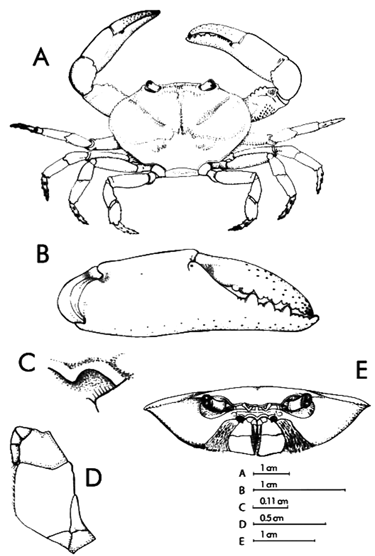
<body><![CDATA[<p>The terminology used for the different processes of the gonopod is that established    by Smalley (1964), Rodr&iacute;guez (1982) and Campos (2005). The material is    deposited in the Museo de Historia Natural, Instituto de Ciencias Naturales,    Universidad Nacional de Colombia, Bogot&aacute; (ICN-MHN). The abbreviations    cb and cl, indicate carapace breadth and carapace length, respectively. Color    nomenclature follows Smithe (1975).</p>     <p>Family Pseudothelphusidae Rathbun, 1893     <br>   Tribe Hypolobocerini Pretzmann, 1971    <br>   Genus Neostrengeria Pretzmann, 1965    <br>   Neostrengeria bataensis, new species     <br>   <a href="#figura1">Fig. 1</a>, <a href="#figura2">Fig. 2</a></p>     <center>   <img src="/img/revistas/cal/v30n2/v30n2a12fig1.gif"><a name="figura1"></a>  </center>     <p>        <center>     <b>Figure 1.</b> Neostrengeria bataensis, new species, male holotype, 1 male,      cl 21.9 mm, cb 38.8 mm, ICN-MHN-CR 2489. A, dorsal view of carapace and pereopods;      B, chela of large cheliped, external view; C, left third maxilliped; D, opening      of left efferent branchial channel, external view; E, frontal view of carapace.    </center>       <br>       ]]></body>
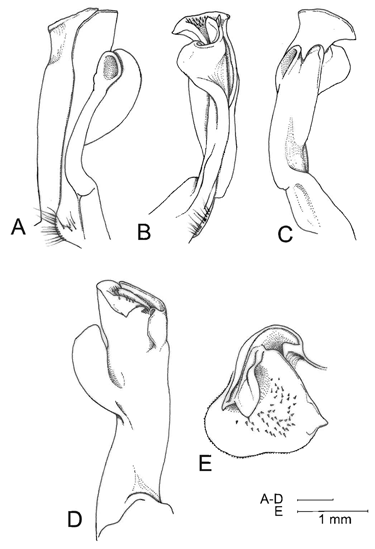
<body><![CDATA[<center>     <img src="/img/revistas/cal/v30n2/v30n2a12fig2.gif"><a name="figura2"></a>    </center>     <p>        <center>     <b>Figure 2.</b> Neostrengeria bataensis, new species, male holotype, 1 male,      ICN-MHN-CR 2489. A, left first gonopod, caudal view; B, same, mesial view;      C, same, lateral view; D, same, cephalic view; E, same, apex distal view.    </center> </p>     <p>Holotype. Colombia, Boyac&aacute; Department, Municipio Santa Mar&iacute;a,    Vereda Culima, creek affluent of Bata River by Santa Mar&iacute;a-M&aacute;mbita    Highway, elevation 650 m, Boyac&aacute; Department, Colombia, 4o 46' 10"    N, 73o 17' 0" W, 4 Jul 1998, leg. M. R. Campos, 1 male, cl 21.9    mm, cb 38.8 mm, ICN-MHN-CR 2489.</p>     <p>Paratypes. Same locality data as holotype, 9 males, the largest cl 18.8 mm,    cb 31.5 mm, the smallest cl 9.4 mm, cb 15.0 mm, 6 females, the largest cl 21.5    mm, cb 37.5 mm, the smallest cl 14.5 mm, cb 23.0 mm, 1 juvenil, ICN-MHN-CR 1718.</p>     <p>Non-Paratypes. Cundinamarca Department, Municipio Ubal&aacute;, Sector B, Inspecci&oacute;n    M&aacute;mbita, Vereda Boca de Monte, El Recuerdo Farm, elevation 1100 m, 28    Jun 1998, leg. M. R. Campos, 4 males, the largest cl 15.7 mm, cb 26.1 mm, the    smallest cl 9.3 mm, cb 14.4 mm, 3 females, the largest cl 13.5 mm, cb 21.8 mm,    the smallest cl 10.3 mm, cb 15.8 mm, ICN-MHN-CR 1713.</p>     <p>Diagnosis. Lateral lobe of first male gonopod wide, semicircular; accessory    lobe elongated with transverse ridges on caudal surface, internal subdistal    protuberance and sinus, ending semi-acute distally, distinctly shorter than    lateral lobe, distal portion of accessory and lateral lobes separate by shallow    notch; apex outline nearly oval in distal view, caudo-lateral border more expanded    than on latero-cephalic one, border fringed with minute acute spinules; prominent,    acute cephalic spine; mesial lobe subtriangular, expanded into a semicircular    projection, directed cephalically.     <br>   Description of holotype. Carapace (<a href="#figura1">Fig. 1 A</a>) with straight,    wide, deep cervical groove and not reaching lateral margin; anterolateral margin    with depression just posterior to anteroexternal orbital angle; lateral margin    with approximately 12 papilliform teeth; postfrontal lobes small, oval and delimited    anteriorly by 2 depression; median groove shallow; front lacking distinct upper    border, frontal area sloping downward, bilobed in dorsal view, lower margin    strongly sinuous in frontal view; upper and lower orbital margins each fringed    with tubercles (<a href="#figura1">Fig. 1 E</a>); dorsal surface of carapace    cover by small papillae, regions demarcated; third maxilliped with deep depression    on subdistal external margin of merus, exognath 0.59 times length of ischium    (<a href="#figura1">Fig.1 D</a>); orifice of efferent branchial channel open,    irregularly ovate (<a href="#figura1">Fig. 1 C</a>).    <br>   First pereopods heterochelous (<a href="#figura1">Fig. 1 A</a>); right cheliped    larger than left; merus with 3 crests as follows: upper crest with rows of tubercles,    internal lower crest with row of teeth, diminishing in size proximally, and    external lower crest with row of low tubercles; carpus with blunt distal spine;    palms of both chelipeds smooth, swollen; fingers of chelae with rows of tubercles,    slightly gaping when closed, tips crossing (<a href="#figura1">Fig. 1 B</a>).    Walking legs (second to fifth pereopods) slender (<a href="#figura1">Fig. 1    A</a>), dactyli each about 1.3 times as long as propodi, with 5 longitudinal    rows of spines diminishing in size proximally, arrangement of spines on dactylus    of left third pereopod as follows: anterolateral row with 5 spines, anteroventral    row with 6 spines, external row with 5 spines plus 2 proximal papillae, posteroventral    and posterolateral rows with 3 spines.    <br>   First male gonopod with mesial side nearly convexe and subdistal shallow depression;    margin fringed with minute, acute spinules on distal portion; lateral lobe wide,    semicircular with distal portion rounded, directed distally; accessory lobe    elongated with transverse ridges on caudal surface, internal subdistal protuberance    and sinus, ending semi-acute distally (<a href="#figura2">Fig. 2 A, D</a>),    distinctly shorter than lateral lobe in caudal view; distal portion of accessory    and lateral lobes separate by notch in lateral view (<a href="#figura2">Fig.    2 C</a>); apex outline nearly oval in distal view, caudo-lateral border more    expanded than latero-cephalic one, border fringed with minute acute spinules,    prominent, acute cephalic spine, directed cephalically (<a href="#figura2">Fig.    2 E</a>); mesial lobe subtriangular, expanded into a semicircular projection,    directed cephalically (<a href="#figura2">Fig. 2 B - E</a>); mesocaudal projection    of spermatic channel terminating bifidly: external side narrow with blunt papilla,    internal side wide with semi-acute papilla; surface of apex cover by patch of    wide spines (<a href="#figura2">Fig. 2 B, E</a>)</p>     ]]></body>
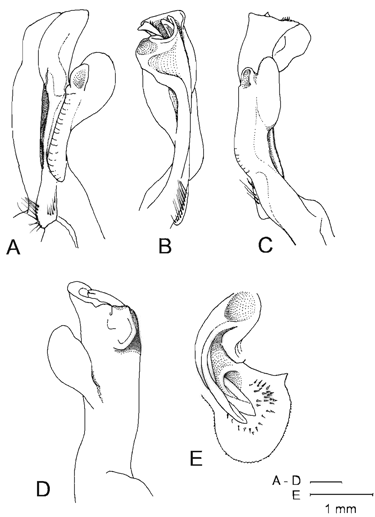
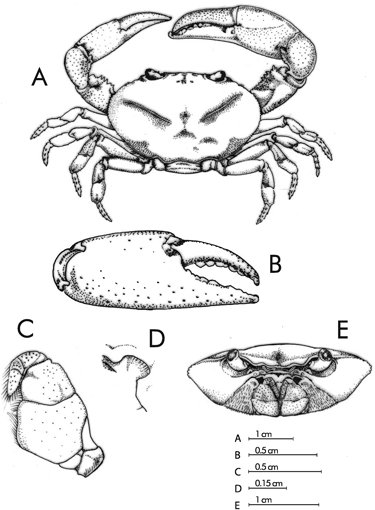
<body><![CDATA[<p>Color. The alcohol preserved holotype is brown (near Cinnamon Brown, 33) on    the dorsal side of the carapace. The walking legs are brown (Antique Brown,    37) dorsally and buffy-brown (Sayal Brown, 223C) ventrally. The chelae are brown    (near Cinnamon Brown, 33) dorsally and buffy-brown (Sayal Brown, 223C) ventrally.    The ventral surface of the carapace is light brown (near Cinnamon, 39) with    yellow specks (near Chamois, 123D) on the abdominal segments. </p>     <p>Etymology. The specific name refers to Bata River, where the specimens were    collected.</p>     <p>Remarks. This species is most similar to Neostrengeria lindigiana (Rathbun,    1897) (see Campos, 2005, Fig. 54 A - I). The main distinguishing feature between    both species in the first male gonopod is that in the new species the lateral    lobe is wider than in N. lindigiana; the distal portion of the lateral lobe    is semiacute in N. lindigiana, meanwhile in N. bataensis it is rounded; the    accessory lobe in N. bataensis shows transverse ridges on caudal surface, internal    protuberance and sinus subdistal, ending semi-acute distally, meanwhile in N.    lindigiana is devoid of transverse ridges, it shows only a sinus subdistal,    followed by rounded expansion, distally; the apex outline in N. lindigiana is    semicircular in distal view, whereas in the new species is nearly oval; the    border of apex is fringed with minute acute spinules in N. bataensis; meanwhile    it is smooth in N. lindigiana; the mesial lobe in N. lindigiana is expanded    into a small subtriangular projection, meanwhile it is expanded into a prominent    semicircular projection in N. bataensis. The exognath of the third maxilliped    presents a variation between 0.50 and 0.59 times the length of ischium in the    new species, whereas it is between 0.60 and 0.69 times the length of ischium    in N. lindigiana (see Campos, 1994).</p>     <p>Neostrengeria celioi new species    <br>   <a href="#figura3">Fig. 3</a>, <a href="#figura4">Fig. 4</a></p>     <center>   <img src="/img/revistas/cal/v30n2/v30n2a12fig3.gif"><a name="figura3"></a>  </center>     <p>        <center>     <b>Figure 3.</b> Neostrengeria celioi, new species, male holotype, 1 male,      cl 20.3 mm, cb 36.2 mm, ICN-MHN-CR 2490. A, dorsal view of carapace and pereopods;      B, chela of large cheliped, external view; C, opening of left efferent branchial      channel, external view; D, left third maxilliped; E, frontal view of carapace.    </center>       <br> </p>     <center>   <img src="/img/revistas/cal/v30n2/v30n2a12fig4.gif"><a name="figura4"></a>  </center>     ]]></body>
<body><![CDATA[<p>       <center>     <b>Figure 4.</b> Neostrengeria celioi, new species, male holotype, 1 male,      ICN-MHN-CR 2490. A, left first gonopod, caudal view; B, same, mesial view;      C, same, lateral view; D, same, cephalic view; E, same, apex distal view.   </center>       <br> </p>     <p>Holotype. Colombia, Casanare Department, Municipio Aguazul, Vereda Cupiagua,    creek affluent of Palmicha stream, elevation 720 m, 5o 14' N, 72o 38'    W, 23 Oct 2007, leg. M. R. Campos, 1 male, cl 20.3 mm, cb 36.2 mm, ICN-MHN-CR    2490. </p>     <p>Paratypes. Same locality data as holotype, 3 females, cl 21.7, 18.3 and 15.3    mm, cb 39.2, 32.4 and 26.5 mm, CN-MHN-CR 2482.</p>     <p>Diagnosis. First male gonopod with mesial side nearly straight and deep depression    subdistally; lateral lobe wide nearly semicircular with distal portion nearly    rounded, directed to the axis of gonopod; accessory lobe spatulated with distal    portion excavated, slightly shorter than lateral lobe; distal portion of accessory    and lateral lobes separate by wide notch; apex outline subtriangular, caudo-cephalic    border rounded expanded with slightly middle depression; prominent, semi-acute    cephalic spine; mesial lobe subtriangular, expanded into a semicircular projection,    directed cephalo-laterally. </p>     <p>Description of the holotype. Carapace (<a href="#figura3">Fig. 3 A</a>) with    straight, deep, narrow cervical groove ending some distance from lateral margin;    anterolateral margin with shallow sinus just posterior to anteroexternal orbital    angle, followed by a series of papillae until cervical groove, rest of anterior    margin with papilliform teeth; posterior margin smooth; postfrontal lobes small,    rounded and delimited anteriorly by 2 depression; median groove shallow; front    with upper border sligthly demarcated by row of tubercles, bilobed in dorsal    view, frontal area sloping downward, lower margin strongly sinuous in frontal    view; orbital margins each with row of tubercles (<a href="#figura3">Fig. 3    E</a>); dorsal surface of carapace smooth, cover by small papillae, regions    distinctly marked (<a href="#figura3">Fig. 3 A</a>); third maxilliped with merus    having sharp angle on distal half of external margin, exognath 0.53 times length    of ischium (<a href="#figura3">Fig. 3 D</a>); orifice of efferent branchial    channel open, nearly trapezoid shape (<a href="#figura3">Fig. 3 C</a>).    <br>   First pereopods heterochelous (<a href="#figura3">Fig. 3 A</a>); right cheliped    larger than left; merus with 3 crests as follows: upper crest with rows of tubercles,    internal lower crest with row of blunt teeth, increazing in size distally, and    external lower crest with row of low tubercles; carpus with 5 tubercles and    blunt distal spine; palms of both chelipeds smooth, swollen; fingers of chelae    not gaping when closed, tips crossing, outer and inner surfaces with rows of    small tubercles (<a href="#figura3">Fig. 3 B</a>). Walking legs (second to fifth    pereopods) slender (<a href="#figura3">Fig. 3 A</a>), dactyli each about 1.6    times as long as propodi, with papillae and 5 longitudinal rows of large spines    diminishing in size proximally. Spines and papillae on each dactylus arranged    as follows: 1 anterolateral row and 1 anteroventral row each with 7 spines;    1 external row with 6 spines, 2 intercalated papillae and 3 proximal papillae;    1 posteroventral row with 4 spines and 2 intercalated papillae and 1 posterolateral    row with 4 spines.    <br>   Mesial side of first male gonopod nearly straight with deep depression subdistally;    lateral lobe wide nearly semicircular with distal portion nearly rounded; accessory    lobe spatulated with distal portion excavated, slightly shorter than lateral    lobe (<a href="#figura4">Fig. 4 A</a>), distal portion of accessory and lateral    lobes separate by wide notch in lateral view (<a href="#figura4">Fig. 4 C</a>);    apex outline subtriangular in distal view, caudo-cephalic border rounded expanded    with slightly middle depression; prominent, semi-acute cephalic spine, directed    cephalically (<a href="#figura4">Fig. 4 E</a>); mesial lobe subtriangular, expanded    into a semicircular projection, directed cephalo-laterally (<a href="#figura4">Fig.    4 B- D</a>); mesocaudal projection of spermatic channel terminating bifidly,    external side narrow with acute papilla, internal side wide with rounded papilla,    which is bearing a spine; surface of apex cover by patch of conspicuous spines    (<a href="#figura4">Fig. 4 B, E</a>).</p>     <p>Color. The alcohol preserved holotype is brown (near Row Umber, 223) on the    dorsal side of the carapace with pale brown specks (near Sayal Brown, 223C)    on the posterior portion of carapace. The walking legs are brown (near Cinnamon,    39) dorsally and buffy-brown (near Tawny Olive, 223D) ventrally. The chelae    are brown (Antique Brown, 37) dorsally and buffy-brown (Sayal Brown, 223C) ventrally.    The ventral surface of the carapace is light brown (near Tawny Olive, 223D).</p>     ]]></body>
<body><![CDATA[<p>Etymology. The species is named in honor of the Brazilian scientist Dr. C&eacute;lio    Magalh&atilde;es, who works with systematics of Neotropical freshwater decapods    at the Instituto Nacional de Pesquisas da Amazonia, INPA, Manaus, Brazil.</p>     <p>Remarks. This species is most similar to Neostrengeria lasallei Rodr&iacute;guez,    1980 (see Campos, 2005, Fig. 51 A - I). The main distinguishing feature between    both species in the first male gonopod is that in the new species the mesial    side is nearly straight, meanwhile in N. lasallei it is convex; the lateral    lobe is wider in N. celioi than in N. lasallei; the distal portion of the lateral    lobe is semi-acute in N. lasallei, meanwhile in N. celioi it is nearly rounded;    the accessory lobe is spatulated with distal portion excavated in N. celioi,    meanwhile in N. lasallei it presents an internal subdistal sinus, ending rounded    distally; the distal portion of the accessory and lateral lobes are separate    by wide notch in lateral view in N. celioi, meanwhile there are continuous in    N. lasallei; in the new species the apex outline is subtriangular, whereas it    is oval in N. lasallei; the caudo-cephalic border of the apex presents conspicuous    spines in N. lasallei, whereas in N. celioi it is fringed by minute spinules;    the cephalic spine in the new species is prominent and semi-acute, whereas it    is smaller and acute in N. lasallei; the mesial lobe is expanded into a semicircular    projection, directed cephalo-laterally in N. celioi, whereas in N. lasallei    it is expanded into a small subtriangular projection cephalically The exognath    of the third maxilliped presents a variation between 0.49 and 0.64 times the    length of ischium in the new species, meanwhile in N. lasallei it is between    0.70 and 0.75 times the length of ischium (see Campos, 1994).</p>     <p>Key to the species of the genus Neostrengeria</p>     <p>The following key is a modification of the one proposed by Campos (2005)</p>     <p>1. Laterodistal expansion of first gonopod forming wide lobe ........................................................N.    botti Rodr&iacute;guez &amp; T&uuml;rkay, 1978    <br>   &#8212; Laterodistal expansion of first gonopod devoid of lobe .............................................2    <br>   2. First gonopod with lateral and accessory lobes distinctly separated ............................3        <br>   &#8212; First gonopod with lateral and accessory lobes not separated from gonopod    ...........13    <br>   3. Apex of first gonopod with outer surface smooth ........................................................4    <br>   &#8212; Apex of first gonopod with outer surface spinulose ...................................................18    ]]></body>
<body><![CDATA[<br>   4. Apex of first gonopod mesial expanded into subtriangular projection ........................................................N.    binderi Campos, 2000    <br>   &#8212; Apex of first gonopod not mesial expanded into subtriangular projection    .......................5    <br>   5. Accessory lobe of first gonopod subequal in length to lateral lobe ...............................6        <br>   &#8212; Accessory lobe of first gonopod distinctly shorter than lateral lobe...............................8    <br>   6. Accessory lobe of first gonopod without spines ...........................................................7        <br>   &#8212; Accessory lobe of first gonopod with spines ....................N. aspera    Campos, 1992     <br>   7. Apex outline of first gonopod oblong in distal view with mesocaudal projection    of spermatic channel awl-shaped ...................................................N.    gilberti Campos, 1992    <br>   &#8212; Apex outline of first gonopod oval in distal view with mesocaudal projection    of spermatic channel bifid ......N. lemaitrei Campos, 2004    <br>   8. Outline of accessory lobe of first gonopod smooth in caudal view ................................9    <br>   &#8212; Outline of accessory lobe of first gonopod festooned in caudal view    ..............................................N. monterrodendoensis (Bott, 1967)    ]]></body>
<body><![CDATA[<br>   9. Longitudinal rows of spines on dactyli of walking legs each with 3 to 5 spines    .........10    <br>   &#8212; Longitudinal rows of spines on dactyli of walking legs each with 6 to    10 spines .......11    <br>   10. Apex outline of first gonopod oval in distal view ..........................................................12    <br>   &#8212; Apex outline of first gonopod semicircular in distal view, expanded    cephalically ..................................N. lindigiana (Rathbun, 1897)    <br>   11. Walking legs unusually long, total length of each about 1.3 times carapace    width ................................N. sketi Rodr&iacute;guez, 1985     <br>   &#8212; Walking legs normal in length, total length of each subequal to carapace    width ............N. macropa (H. Milne Edwards, 1853)     <br>   12. Lateral lobe of first gonopod short, distal margin semicircular in caudal    view ....................N. charalensis Campos &amp; Rodr&iacute;guez, 1985        <br>   &#8212; Lateral lobe of first gonopod long, distal margin broadly rounded in    caudal view ........................N. macarenae Campos, 1992     <br>   13. Laterodistal margin of first gonopod widening distally, forming lobe .................................................N.    lobulata Campos, 1992    <br>   &#8212; Laterodistal margin of first gonopod not widening distally, not forming    lobe ..........14     ]]></body>
<body><![CDATA[<br>   14. Mesocaudal projection of spermatic channel of first gonopod terminating    in simple projection ........................................................N.    perijaensis Campos &amp; Lemaitre, 1998    <br>   &#8212; Mesocaudal projection of spermatic channel of first gonopod terminating    in bifid projection ..................................................15    <br>   15. Lateral lobe of first gonopod directed apically .....................................................16    <br>   &#8212; Lateral lobe of first gonopod curved cephalically ...............................................17    <br>   16. Distal portion of accessory and lateral lobes separated by deep notch in    lateral view ....................N. libradensis Rodr&iacute;guez, 1980    <br>   &#8212; Distal portion of accessory and lateral lobes not separated by deep    notch, nearly continuous, in lateral view ........................................................N.    appressa Campos, 1992    <br>   17. Cephalic border of apex of first gonopod terminating in small, blunt spine    .................................................N. tonensis Campos, 1992    <br>   &#8212; Cephalic border of apex of first gonopod terminating in prominent, acute    spine ................................N. tencalanensis Campos, 1992     <br>   18. Mesial lobe of first gonopod expanded into prominent rounded projection    ..................19    <br>   &#8212; Mesial lobe of first gonopod expanded into small subtriangular projection    ...........21    ]]></body>
<body><![CDATA[<br>   19. Outline of apex of first gonopod oval, or oblong in distal view ................................20    <br>   &#8212; Outline of apex of first gonopod subtriangular in distal view ...............................................................N.    celioi, new species    <br>   &shy;20. Mesocaudal projection of spermatic channel with internal rounded papilla    ...................................N. guenteri (Pretzmann, 1965)    <br>   &#8212; Mesocaudal projection of spermatic channel with internal acute papilla..............................................N.    bataensis, new species    <br>   21. Cephalic side of apex of first gonopod bearing two spines .................................................................N.    niceforoi (Schmitt, 1969)    <br>   &#8212; Cephalic side of apex of first gonopod bearing a spine ..........................................22        <br>   22. Caudolateral side of apex of first gonopod regular expanded ........................................................................N.    lasallei Rodr&iacute;guez, 1980    <br>   &#8212; Caudolateral side of apex of first gonopod irregular expanded ...............................................................N.    boyacensis Rodr&iacute;guez, 1980</p>     <p><b>ACKNOWLEDGMENTS</b></p>     <p>The authors are grateful to C. Magalh&atilde;es and H. Su&aacute;rez for their    valuable comments of the manuscript. The illustrations were prepared as following:    Fig. 1 and 3 by Nora Mendoza and Fig. 3 and 4 by Luis A. Guerra. This research    was supported by Divisi&oacute;n de Investigaci&oacute;n Sede Bogot&aacute;,    DIB, Universidad Nacional de Colombia.</p>     ]]></body>
<body><![CDATA[<p><b>LITERATURE CITED</b></p>     <!-- ref --><p>1. BOTT, R. 1967. Fluss-krabben aus dem westlichen S&uuml;damerika. Senckenbergiana    Biologie 48(5/6): 365 - 372.    &nbsp;&nbsp;&nbsp;&nbsp;&nbsp;&nbsp;&nbsp;&nbsp;[&#160;<a href="javascript:void(0);" onclick="javascript: window.open('/scielo.php?script=sci_nlinks&ref=000114&pid=S0366-5232200800020001200001&lng=','','width=640,height=500,resizable=yes,scrollbars=1,menubar=yes,');">Links</a>&#160;]<!-- end-ref --><!-- ref --><br>   2. CAMPOS, M.R. 1992. New species of fresh-water crabs of the genus Neostrengeria    Pretzmann, 1965 (Crustacea: Decapoda: Pseudothelphusidae) from Colombia. Proceedings    of the Biological Society of Washington 105: 540 - 554.     &nbsp;&nbsp;&nbsp;&nbsp;&nbsp;&nbsp;&nbsp;&nbsp;[&#160;<a href="javascript:void(0);" onclick="javascript: window.open('/scielo.php?script=sci_nlinks&ref=000115&pid=S0366-5232200800020001200002&lng=','','width=640,height=500,resizable=yes,scrollbars=1,menubar=yes,');">Links</a>&#160;]<!-- end-ref --><!-- ref --><br>   3. CAMPOS, M.R. 1994. Diversidad en Colombia de los cangrejos del g&eacute;nero    Neostrengeria. Academia Colombiana de Ciencias Exactas F&iacute;sicas y Naturales.    Col. Jorge &Aacute;lvarez Lleras 5: 1-143.    &nbsp;&nbsp;&nbsp;&nbsp;&nbsp;&nbsp;&nbsp;&nbsp;[&#160;<a href="javascript:void(0);" onclick="javascript: window.open('/scielo.php?script=sci_nlinks&ref=000116&pid=S0366-5232200800020001200003&lng=','','width=640,height=500,resizable=yes,scrollbars=1,menubar=yes,');">Links</a>&#160;]<!-- end-ref --><!-- ref --><br>   4. CAMPOS, M.R. 2000. Neostrengeria binderi, a new species of pseudothelphusid    crab from the eastern Andes of Colombia (Crustacea: Decapoda: Brachyura). Proceedings    of the Biological Society of Washington 113: 401 - 405.    &nbsp;&nbsp;&nbsp;&nbsp;&nbsp;&nbsp;&nbsp;&nbsp;[&#160;<a href="javascript:void(0);" onclick="javascript: window.open('/scielo.php?script=sci_nlinks&ref=000117&pid=S0366-5232200800020001200004&lng=','','width=640,height=500,resizable=yes,scrollbars=1,menubar=yes,');">Links</a>&#160;]<!-- end-ref --><!-- ref --><br>   5. CAMPOS, M.R. 2004. Neostrengeria lemaitrei, a new species of freshwater crab    from Colombia (Crustacea: Decapoda: Pseudothelphusidae), and the vertical distribution    of the genus. Proceedings of the Biological Society of Washington 117: 363 &#8211;    367.    &nbsp;&nbsp;&nbsp;&nbsp;&nbsp;&nbsp;&nbsp;&nbsp;[&#160;<a href="javascript:void(0);" onclick="javascript: window.open('/scielo.php?script=sci_nlinks&ref=000118&pid=S0366-5232200800020001200005&lng=','','width=640,height=500,resizable=yes,scrollbars=1,menubar=yes,');">Links</a>&#160;]<!-- end-ref --><!-- ref --><br>   6. CAMPOS, M.R. 2005. Freshwater crabs from Colombia. A taxonomic and distributional    study. Academia Colombiana de Ciencias Exactas F&iacute;sicas y Naturales. Col.    Jorge &Aacute;lvarez Lleras 24: 1 -363.    &nbsp;&nbsp;&nbsp;&nbsp;&nbsp;&nbsp;&nbsp;&nbsp;[&#160;<a href="javascript:void(0);" onclick="javascript: window.open('/scielo.php?script=sci_nlinks&ref=000119&pid=S0366-5232200800020001200006&lng=','','width=640,height=500,resizable=yes,scrollbars=1,menubar=yes,');">Links</a>&#160;]<!-- end-ref --><!-- ref --><br>   7. CAMPOS, M.R. 2007. Cangrejos de agua dulce. In Libro Rojo de Invertebrados    Terrestres de Colombia. Eds. Amat-G., G., M. G. Andrade-C &amp; E. C. Amat-G.    Bogot&aacute;, Instituto de Ciencias Naturales, Universidad Nacional de Colombia,    Conservaci&oacute;n Internacional Colombia, Instituto Alexander von Humboldt,    Ministerio de Ambiente, Vivienda y Desarrollo Territorial, 1-216.    &nbsp;&nbsp;&nbsp;&nbsp;&nbsp;&nbsp;&nbsp;&nbsp;[&#160;<a href="javascript:void(0);" onclick="javascript: window.open('/scielo.php?script=sci_nlinks&ref=000120&pid=S0366-5232200800020001200007&lng=','','width=640,height=500,resizable=yes,scrollbars=1,menubar=yes,');">Links</a>&#160;]<!-- end-ref --><!-- ref --><br>   8. CAMPOS, M.R. &amp; R. Lemaitre. 1998. A new freshwater crab of the genus    Neostrengeria Pretzmann, 1965, from Colombia (Crustacea: Decapoda: Brachyura:    Pseudothel--phusidae), with a key to the species of the genus. Proceedings of    the Biological Society of Washington 111: 899-907.    &nbsp;&nbsp;&nbsp;&nbsp;&nbsp;&nbsp;&nbsp;&nbsp;[&#160;<a href="javascript:void(0);" onclick="javascript: window.open('/scielo.php?script=sci_nlinks&ref=000121&pid=S0366-5232200800020001200008&lng=','','width=640,height=500,resizable=yes,scrollbars=1,menubar=yes,');">Links</a>&#160;]<!-- end-ref --><!-- ref --><br>   9. CAMPOS, M.R. &amp; G. RODR&Iacute;GUEZ. 1985. A new species of Neostrengeria    (Crustacea: Decapoda: Pseudothelphusidae) with notes on geographical distribution    of the genus. Proceedings of the Biological Society of Washington 98: 718&#8211;727.    &nbsp;&nbsp;&nbsp;&nbsp;&nbsp;&nbsp;&nbsp;&nbsp;[&#160;<a href="javascript:void(0);" onclick="javascript: window.open('/scielo.php?script=sci_nlinks&ref=000122&pid=S0366-5232200800020001200009&lng=','','width=640,height=500,resizable=yes,scrollbars=1,menubar=yes,');">Links</a>&#160;]<!-- end-ref --><!-- ref --><br>   10. MILNE-EDWARDS, H. 1853. M&eacute;moire sur la famille des ocypodiens. Annales    des Sciences Naturelle, Zoologie 20: 163 - 228.    &nbsp;&nbsp;&nbsp;&nbsp;&nbsp;&nbsp;&nbsp;&nbsp;[&#160;<a href="javascript:void(0);" onclick="javascript: window.open('/scielo.php?script=sci_nlinks&ref=000123&pid=S0366-5232200800020001200010&lng=','','width=640,height=500,resizable=yes,scrollbars=1,menubar=yes,');">Links</a>&#160;]<!-- end-ref --><!-- ref --><br>   11. PRETZMANN, G. 1965. Vorl&auml;ufiger Bericht &uuml;ber die Familie Pseudothelphusidae.    Anzeiger der &Ouml;sterreichischen Akademie der Wissenschaften Mathematische    Naturwissenschaftliche Klasse (1)1: 1-10.    &nbsp;&nbsp;&nbsp;&nbsp;&nbsp;&nbsp;&nbsp;&nbsp;[&#160;<a href="javascript:void(0);" onclick="javascript: window.open('/scielo.php?script=sci_nlinks&ref=000124&pid=S0366-5232200800020001200011&lng=','','width=640,height=500,resizable=yes,scrollbars=1,menubar=yes,');">Links</a>&#160;]<!-- end-ref --><!-- ref --><br>   12. PRETZMANN, G. 1971. Fortschritte in der Klassifizierung der Pseudothelphusidae.    An-zeiger der Mathematisch Naturwi-ssenschaftliche der &Ouml;sterreichischen    Aka-demie der Wissenschaften (1)179(1-4): 14-24.    &nbsp;&nbsp;&nbsp;&nbsp;&nbsp;&nbsp;&nbsp;&nbsp;[&#160;<a href="javascript:void(0);" onclick="javascript: window.open('/scielo.php?script=sci_nlinks&ref=000125&pid=S0366-5232200800020001200012&lng=','','width=640,height=500,resizable=yes,scrollbars=1,menubar=yes,');">Links</a>&#160;]<!-- end-ref --><!-- ref --><br>   13. RATHBUN, M. J. 1893. Descriptions of new species of American freshwater    crabs. Proceedings of the United States National Museum 16(959): 649 - 661.    &nbsp;&nbsp;&nbsp;&nbsp;&nbsp;&nbsp;&nbsp;&nbsp;[&#160;<a href="javascript:void(0);" onclick="javascript: window.open('/scielo.php?script=sci_nlinks&ref=000126&pid=S0366-5232200800020001200013&lng=','','width=640,height=500,resizable=yes,scrollbars=1,menubar=yes,');">Links</a>&#160;]<!-- end-ref --><!-- ref --><br>   14. RATHBUN, M. J. 1897. Descriptions de nouvelles especes de crabes d'eau    douce appartenant aux collections du Mus&eacute;um d'Histoire naturelle    du Paris. Bulletin du Mus&eacute;um nationale d'Histoire naturelle, Paris    3(2): 58 - 61.    &nbsp;&nbsp;&nbsp;&nbsp;&nbsp;&nbsp;&nbsp;&nbsp;[&#160;<a href="javascript:void(0);" onclick="javascript: window.open('/scielo.php?script=sci_nlinks&ref=000127&pid=S0366-5232200800020001200014&lng=','','width=640,height=500,resizable=yes,scrollbars=1,menubar=yes,');">Links</a>&#160;]<!-- end-ref --><!-- ref --><br>   15. RODRIGUEZ, G. 1980. Description pr&eacute;liminaire de quelques especes    et genres nouveaux de Crabes d'eau douce de l'Am&eacute;rique tropicale    (Crustacea: Decapoda: Pseudothel-phusidae). Bulletin du Mus&eacute;um nationale    d'Histoire naturelle, Paris, (4) 2 Section A (3): 889 -894.    &nbsp;&nbsp;&nbsp;&nbsp;&nbsp;&nbsp;&nbsp;&nbsp;[&#160;<a href="javascript:void(0);" onclick="javascript: window.open('/scielo.php?script=sci_nlinks&ref=000128&pid=S0366-5232200800020001200015&lng=','','width=640,height=500,resizable=yes,scrollbars=1,menubar=yes,');">Links</a>&#160;]<!-- end-ref --><!-- ref --><br>   16. RODRIGUEZ, G. 1982. Les crabes d'eau douce d'Am&eacute;rique.    Famille des Pseudothelphusidae. Faune Tropicale 22: 1 - 223.    &nbsp;&nbsp;&nbsp;&nbsp;&nbsp;&nbsp;&nbsp;&nbsp;[&#160;<a href="javascript:void(0);" onclick="javascript: window.open('/scielo.php?script=sci_nlinks&ref=000129&pid=S0366-5232200800020001200016&lng=','','width=640,height=500,resizable=yes,scrollbars=1,menubar=yes,');">Links</a>&#160;]<!-- end-ref --><!-- ref --><br>   17. RODRIGUEZ, G. 1985. A new cavernicolous crab (Crustacea: Decapoda: Pseudothel-phusidae)    from Colombia. Bioloski vestnik, Ljubljana 33(2): 73 - 80.     &nbsp;&nbsp;&nbsp;&nbsp;&nbsp;&nbsp;&nbsp;&nbsp;[&#160;<a href="javascript:void(0);" onclick="javascript: window.open('/scielo.php?script=sci_nlinks&ref=000130&pid=S0366-5232200800020001200017&lng=','','width=640,height=500,resizable=yes,scrollbars=1,menubar=yes,');">Links</a>&#160;]<!-- end-ref --><!-- ref --><br>   18. RODRIGUEZ, G. &amp; M. T&Uuml;RKAY. 1978. Der generische Status einiger    Kolumbianischer S&uuml;sswasserkrabben. Senckenbergiana Biologica 59: 297 -    306.    &nbsp;&nbsp;&nbsp;&nbsp;&nbsp;&nbsp;&nbsp;&nbsp;[&#160;<a href="javascript:void(0);" onclick="javascript: window.open('/scielo.php?script=sci_nlinks&ref=000131&pid=S0366-5232200800020001200018&lng=','','width=640,height=500,resizable=yes,scrollbars=1,menubar=yes,');">Links</a>&#160;]<!-- end-ref --><!-- ref --><br>   19. SCHMITT, W.L. 1969. Colombian freshwater crab notes. Proceedings of the    Biological Society of Washington 82: 93 -112.    &nbsp;&nbsp;&nbsp;&nbsp;&nbsp;&nbsp;&nbsp;&nbsp;[&#160;<a href="javascript:void(0);" onclick="javascript: window.open('/scielo.php?script=sci_nlinks&ref=000132&pid=S0366-5232200800020001200019&lng=','','width=640,height=500,resizable=yes,scrollbars=1,menubar=yes,');">Links</a>&#160;]<!-- end-ref --><!-- ref --><br>   20. SMALLEY, A. 1964. A terminology for the gonopods of the American River crabs.    Systematic Zoology 13: 28 - 31.    &nbsp;&nbsp;&nbsp;&nbsp;&nbsp;&nbsp;&nbsp;&nbsp;[&#160;<a href="javascript:void(0);" onclick="javascript: window.open('/scielo.php?script=sci_nlinks&ref=000133&pid=S0366-5232200800020001200020&lng=','','width=640,height=500,resizable=yes,scrollbars=1,menubar=yes,');">Links</a>&#160;]<!-- end-ref --><!-- ref --><br>   21. SMITHE, F.B. 1975. Nuturalist's color guide. The American Museum of    Natural History, New York. Part I: unnumbered pages.    &nbsp;&nbsp;&nbsp;&nbsp;&nbsp;&nbsp;&nbsp;&nbsp;[&#160;<a href="javascript:void(0);" onclick="javascript: window.open('/scielo.php?script=sci_nlinks&ref=000134&pid=S0366-5232200800020001200021&lng=','','width=640,height=500,resizable=yes,scrollbars=1,menubar=yes,');">Links</a>&#160;]<!-- end-ref --><br> </p>     <p> Recibido: 28/01/2008    <br>   Aceptado: 15/07/2008</p> </font>       ]]></body><back>
<ref-list>
<ref id="B1">
<label>1.</label><nlm-citation citation-type="journal">
<person-group person-group-type="author">
<name>
<surname><![CDATA[BOTT]]></surname>
<given-names><![CDATA[R.]]></given-names>
</name>
</person-group>
<article-title xml:lang="de"><![CDATA[Fluss-krabben aus dem westlichen Südamerika]]></article-title>
<source><![CDATA[Senckenbergiana Biologie]]></source>
<year>1967</year>
<volume>48</volume>
<numero>5/6</numero>
<issue>5/6</issue>
<page-range>365 - 372</page-range></nlm-citation>
</ref>
<ref id="B2">
<label>2.</label><nlm-citation citation-type="journal">
<person-group person-group-type="author">
<name>
<surname><![CDATA[CAMPOS]]></surname>
<given-names><![CDATA[M.R.]]></given-names>
</name>
</person-group>
<article-title xml:lang="en"><![CDATA[New species of fresh-water crabs of the genus Neostrengeria Pretzmann, 1965 (Crustacea: Decapoda: Pseudothelphusidae) from Colombia]]></article-title>
<source><![CDATA[Proceedings of the Biological Society of Washington]]></source>
<year>1992</year>
<volume>105</volume>
<page-range>540 - 554</page-range></nlm-citation>
</ref>
<ref id="B3">
<label>3.</label><nlm-citation citation-type="book">
<person-group person-group-type="author">
<name>
<surname><![CDATA[CAMPOS]]></surname>
<given-names><![CDATA[M.R.]]></given-names>
</name>
</person-group>
<source><![CDATA[Diversidad en Colombia de los cangrejos del género Neostrengeria]]></source>
<year>1994</year>
<volume>5</volume>
<page-range>1-143</page-range><publisher-name><![CDATA[Academia Colombiana de Ciencias Exactas Físicas y Naturales]]></publisher-name>
</nlm-citation>
</ref>
<ref id="B4">
<label>4.</label><nlm-citation citation-type="journal">
<person-group person-group-type="author">
<name>
<surname><![CDATA[CAMPOS]]></surname>
<given-names><![CDATA[M.R.]]></given-names>
</name>
</person-group>
<article-title xml:lang="en"><![CDATA[Neostrengeria binderi, a new species of pseudothelphusid crab from the eastern Andes of Colombia (Crustacea: Decapoda: Brachyura)]]></article-title>
<source><![CDATA[Proceedings of the Biological Society of Washington]]></source>
<year>2000</year>
<volume>113</volume>
<page-range>401 - 405</page-range></nlm-citation>
</ref>
<ref id="B5">
<label>5.</label><nlm-citation citation-type="journal">
<person-group person-group-type="author">
<name>
<surname><![CDATA[CAMPOS]]></surname>
<given-names><![CDATA[M.R.]]></given-names>
</name>
</person-group>
<article-title xml:lang="en"><![CDATA[Neostrengeria lemaitrei, a new species of freshwater crab from Colombia (Crustacea: Decapoda: Pseudothelphusidae), and the vertical distribution of the genus]]></article-title>
<source><![CDATA[Proceedings of the Biological Society of Washington]]></source>
<year>2004</year>
<volume>117</volume>
<page-range>363 - 367</page-range></nlm-citation>
</ref>
<ref id="B6">
<label>6.</label><nlm-citation citation-type="book">
<person-group person-group-type="author">
<name>
<surname><![CDATA[CAMPOS]]></surname>
<given-names><![CDATA[M.R.]]></given-names>
</name>
</person-group>
<source><![CDATA[Freshwater crabs from Colombia. A taxonomic and distributional study]]></source>
<year>2005</year>
<volume>24</volume>
<page-range>1 -363</page-range><publisher-name><![CDATA[Academia Colombiana de Ciencias Exactas Físicas y Naturales]]></publisher-name>
</nlm-citation>
</ref>
<ref id="B7">
<label>7.</label><nlm-citation citation-type="book">
<person-group person-group-type="author">
<name>
<surname><![CDATA[CAMPOS]]></surname>
<given-names><![CDATA[M.R.]]></given-names>
</name>
</person-group>
<article-title xml:lang="es"><![CDATA[Cangrejos de agua dulce]]></article-title>
<person-group person-group-type="editor">
<name>
<surname><![CDATA[Amat-G.]]></surname>
<given-names><![CDATA[G.]]></given-names>
</name>
<name>
<surname><![CDATA[Andrade-C]]></surname>
<given-names><![CDATA[M. G.]]></given-names>
</name>
<name>
<surname><![CDATA[Amat-G.]]></surname>
<given-names><![CDATA[E. C.]]></given-names>
</name>
</person-group>
<source><![CDATA[Libro Rojo de Invertebrados Terrestres de Colombia]]></source>
<year>2007</year>
<page-range>1-216</page-range><publisher-loc><![CDATA[Bogotá ]]></publisher-loc>
<publisher-name><![CDATA[Instituto de Ciencias Naturales, Universidad Nacional de Colombia, Conservación Internacional Colombia, Instituto Alexander von Humboldt, Ministerio de Ambiente, Vivienda y Desarrollo Territorial]]></publisher-name>
</nlm-citation>
</ref>
<ref id="B8">
<label>8.</label><nlm-citation citation-type="journal">
<person-group person-group-type="author">
<name>
<surname><![CDATA[CAMPOS]]></surname>
<given-names><![CDATA[M.R.]]></given-names>
</name>
<name>
<surname><![CDATA[Lemaitre]]></surname>
<given-names><![CDATA[R.]]></given-names>
</name>
</person-group>
<article-title xml:lang="en"><![CDATA[A new freshwater crab of the genus Neostrengeria Pretzmann, 1965, from Colombia (Crustacea: Decapoda: Brachyura: Pseudothel--phusidae), with a key to the species of the genus]]></article-title>
<source><![CDATA[Proceedings of the Biological Society of Washington]]></source>
<year>1998</year>
<volume>111</volume>
<page-range>899-907</page-range></nlm-citation>
</ref>
<ref id="B9">
<label>9.</label><nlm-citation citation-type="journal">
<person-group person-group-type="author">
<name>
<surname><![CDATA[CAMPOS]]></surname>
<given-names><![CDATA[M.R.]]></given-names>
</name>
<name>
<surname><![CDATA[RODRÍGUEZ]]></surname>
<given-names><![CDATA[G.]]></given-names>
</name>
</person-group>
<article-title xml:lang="en"><![CDATA[A new species of Neostrengeria (Crustacea: Decapoda: Pseudothelphusidae) with notes on geographical distribution of the genus]]></article-title>
<source><![CDATA[Proceedings of the Biological Society of Washington]]></source>
<year>1985</year>
<volume>98</volume>
<page-range>718-727</page-range></nlm-citation>
</ref>
<ref id="B10">
<label>10.</label><nlm-citation citation-type="journal">
<person-group person-group-type="author">
<name>
<surname><![CDATA[MILNE-EDWARDS]]></surname>
<given-names><![CDATA[H.]]></given-names>
</name>
</person-group>
<article-title xml:lang="fr"><![CDATA[Mémoire sur la famille des ocypodiens]]></article-title>
<source><![CDATA[Annales des Sciences Naturelle, Zoologie]]></source>
<year>1853</year>
<volume>20</volume>
<page-range>163 - 228</page-range></nlm-citation>
</ref>
<ref id="B11">
<label>11.</label><nlm-citation citation-type="journal">
<person-group person-group-type="author">
<name>
<surname><![CDATA[PRETZMANN]]></surname>
<given-names><![CDATA[G.]]></given-names>
</name>
</person-group>
<article-title xml:lang="de"><![CDATA[Vorläufiger Bericht über die Familie Pseudothelphusidae]]></article-title>
<source><![CDATA[Anzeiger der Österreichischen Akademie der Wissenschaften Mathematische Naturwissenschaftliche Klasse]]></source>
<year>1965</year>
<volume>1</volume>
<numero>1</numero>
<issue>1</issue>
<page-range>1-10</page-range></nlm-citation>
</ref>
<ref id="B12">
<label>12.</label><nlm-citation citation-type="journal">
<person-group person-group-type="author">
<name>
<surname><![CDATA[PRETZMANN]]></surname>
<given-names><![CDATA[G.]]></given-names>
</name>
</person-group>
<article-title xml:lang="de"><![CDATA[Fortschritte in der Klassifizierung der Pseudothelphusidae]]></article-title>
<source><![CDATA[An-zeiger der Mathematisch Naturwi-ssenschaftliche der Österreichischen Aka-demie der Wissenschaften]]></source>
<year>1971</year>
<volume>1</volume>
<numero>179^s1-4</numero>
<issue>179^s1-4</issue>
<supplement>1-4</supplement>
<page-range>14-24</page-range></nlm-citation>
</ref>
<ref id="B13">
<label>13.</label><nlm-citation citation-type="journal">
<person-group person-group-type="author">
<name>
<surname><![CDATA[RATHBUN]]></surname>
<given-names><![CDATA[M. J.]]></given-names>
</name>
</person-group>
<article-title xml:lang="en"><![CDATA[Descriptions of new species of American freshwater crabs]]></article-title>
<source><![CDATA[Proceedings of the United States National Museum]]></source>
<year>1893</year>
<volume>16</volume>
<numero>959</numero>
<issue>959</issue>
<page-range>649 - 661</page-range></nlm-citation>
</ref>
<ref id="B14">
<label>14.</label><nlm-citation citation-type="journal">
<person-group person-group-type="author">
<name>
<surname><![CDATA[RATHBUN]]></surname>
<given-names><![CDATA[M. J.]]></given-names>
</name>
</person-group>
<article-title xml:lang="fr"><![CDATA[Descriptions de nouvelles especes de crabes d'eau douce appartenant aux collections du Muséum d'Histoire naturelle du Paris]]></article-title>
<source><![CDATA[Bulletin du Muséum nationale d'Histoire naturelle, Paris]]></source>
<year>1897</year>
<volume>3</volume>
<numero>2</numero>
<issue>2</issue>
<page-range>58 - 61</page-range></nlm-citation>
</ref>
<ref id="B15">
<label>15.</label><nlm-citation citation-type="journal">
<person-group person-group-type="author">
<name>
<surname><![CDATA[RODRIGUEZ]]></surname>
<given-names><![CDATA[G.]]></given-names>
</name>
</person-group>
<article-title xml:lang="fr"><![CDATA[Description préliminaire de quelques especes et genres nouveaux de Crabes d'eau douce de l'Amérique tropicale (Crustacea: Decapoda: Pseudothel-phusidae)]]></article-title>
<source><![CDATA[Bulletin du Muséum nationale d'Histoire naturelle]]></source>
<year>1980</year>
<volume>4</volume>
<numero>3</numero>
<issue>3</issue>
<page-range>889 -894</page-range><publisher-loc><![CDATA[Paris ]]></publisher-loc>
</nlm-citation>
</ref>
<ref id="B16">
<label>16.</label><nlm-citation citation-type="journal">
<person-group person-group-type="author">
<name>
<surname><![CDATA[RODRIGUEZ]]></surname>
<given-names><![CDATA[G.]]></given-names>
</name>
</person-group>
<article-title xml:lang="fr"><![CDATA[Les crabes d'eau douce d'Amérique: Famille des Pseudothelphusidae]]></article-title>
<source><![CDATA[Faune Tropicale]]></source>
<year>1982</year>
<volume>22</volume>
<numero>1 - 223</numero>
<issue>1 - 223</issue>
</nlm-citation>
</ref>
<ref id="B17">
<label>17.</label><nlm-citation citation-type="journal">
<person-group person-group-type="author">
<name>
<surname><![CDATA[RODRIGUEZ]]></surname>
<given-names><![CDATA[G.]]></given-names>
</name>
</person-group>
<article-title xml:lang="en"><![CDATA[A new cavernicolous crab (Crustacea: Decapoda: Pseudothel-phusidae) from Colombia]]></article-title>
<source><![CDATA[Bioloski vestnik, Ljubljana]]></source>
<year>1985</year>
<volume>33</volume>
<numero>2</numero>
<issue>2</issue>
<page-range>73 - 80</page-range></nlm-citation>
</ref>
<ref id="B18">
<label>18.</label><nlm-citation citation-type="journal">
<person-group person-group-type="author">
<name>
<surname><![CDATA[RODRIGUEZ]]></surname>
<given-names><![CDATA[G.]]></given-names>
</name>
<name>
<surname><![CDATA[TÜRKAY]]></surname>
<given-names><![CDATA[M.]]></given-names>
</name>
</person-group>
<article-title xml:lang="de"><![CDATA[Der generische Status einiger Kolumbianischer Süsswasserkrabben]]></article-title>
<source><![CDATA[Senckenbergiana Biologica]]></source>
<year>1978</year>
<volume>59</volume>
<page-range>297 - 306</page-range></nlm-citation>
</ref>
<ref id="B19">
<label>19.</label><nlm-citation citation-type="journal">
<person-group person-group-type="author">
<name>
<surname><![CDATA[SCHMITT]]></surname>
<given-names><![CDATA[W.L.]]></given-names>
</name>
</person-group>
<article-title xml:lang="en"><![CDATA[Colombian freshwater crab notes]]></article-title>
<source><![CDATA[Proceedings of the Biological Society of Washington]]></source>
<year>1969</year>
<volume>82</volume>
<page-range>93 -112</page-range></nlm-citation>
</ref>
<ref id="B20">
<label>20.</label><nlm-citation citation-type="journal">
<person-group person-group-type="author">
<name>
<surname><![CDATA[SMALLEY]]></surname>
<given-names><![CDATA[A.]]></given-names>
</name>
</person-group>
<article-title xml:lang="en"><![CDATA[A terminology for the gonopods of the American River crabs]]></article-title>
<source><![CDATA[Systematic Zoology]]></source>
<year>1964</year>
<volume>13</volume>
<page-range>28 - 31</page-range></nlm-citation>
</ref>
<ref id="B21">
<label>21.</label><nlm-citation citation-type="book">
<person-group person-group-type="author">
<name>
<surname><![CDATA[SMITHE]]></surname>
<given-names><![CDATA[F.B.]]></given-names>
</name>
</person-group>
<source><![CDATA[Nuturalist's color guide]]></source>
<year>1975</year>
<page-range>Part I: unnumbered pages.</page-range><publisher-loc><![CDATA[New York ]]></publisher-loc>
<publisher-name><![CDATA[The American Museum of Natural History]]></publisher-name>
</nlm-citation>
</ref>
</ref-list>
</back>
</article>