<?xml version="1.0" encoding="ISO-8859-1"?><article xmlns:mml="http://www.w3.org/1998/Math/MathML" xmlns:xlink="http://www.w3.org/1999/xlink" xmlns:xsi="http://www.w3.org/2001/XMLSchema-instance">
<front>
<journal-meta>
<journal-id>0366-5232</journal-id>
<journal-title><![CDATA[Caldasia]]></journal-title>
<abbrev-journal-title><![CDATA[Caldasia]]></abbrev-journal-title>
<issn>0366-5232</issn>
<publisher>
<publisher-name><![CDATA[Instituto de Ciencias Naturales, Facultad de Ciencias-Universidad Nacional de Colombia]]></publisher-name>
</publisher>
</journal-meta>
<article-meta>
<article-id>S0366-52322011000200005</article-id>
<title-group>
<article-title xml:lang="en"><![CDATA[A SYNOPSIS OF THE FRULLANIACEAE (MARCHANTIOPHYTA) FROM COLOMBIA]]></article-title>
<article-title xml:lang="es"><![CDATA[Sinopsis de la familia Frullaniaceae (Marchantiophyta) para Colombia]]></article-title>
</title-group>
<contrib-group>
<contrib contrib-type="author">
<name>
<surname><![CDATA[GRADSTEIN]]></surname>
<given-names><![CDATA[ROBBERT]]></given-names>
</name>
<xref ref-type="aff" rid="A01"/>
</contrib>
<contrib contrib-type="author">
<name>
<surname><![CDATA[URIBE-M.]]></surname>
<given-names><![CDATA[JAIME]]></given-names>
</name>
<xref ref-type="aff" rid="A02"/>
</contrib>
</contrib-group>
<aff id="A01">
<institution><![CDATA[,Muséum National deHistoire Naturelle Dept. Systématique et Evolution ]]></institution>
<addr-line><![CDATA[Paris ]]></addr-line>
<country>France</country>
</aff>
<aff id="A02">
<institution><![CDATA[,Universidad Nacional de Colombia Facultad de Ciencias Instituto de Ciencias Naturales]]></institution>
<addr-line><![CDATA[Bogotá D.C.]]></addr-line>
<country>Colombia</country>
</aff>
<pub-date pub-type="pub">
<day>30</day>
<month>12</month>
<year>2011</year>
</pub-date>
<pub-date pub-type="epub">
<day>30</day>
<month>12</month>
<year>2011</year>
</pub-date>
<volume>33</volume>
<numero>2</numero>
<fpage>367</fpage>
<lpage>396</lpage>
<copyright-statement/>
<copyright-year/>
<self-uri xlink:href="http://www.scielo.org.co/scielo.php?script=sci_arttext&amp;pid=S0366-52322011000200005&amp;lng=en&amp;nrm=iso"></self-uri><self-uri xlink:href="http://www.scielo.org.co/scielo.php?script=sci_abstract&amp;pid=S0366-52322011000200005&amp;lng=en&amp;nrm=iso"></self-uri><self-uri xlink:href="http://www.scielo.org.co/scielo.php?script=sci_pdf&amp;pid=S0366-52322011000200005&amp;lng=en&amp;nrm=iso"></self-uri><abstract abstract-type="short" xml:lang="en"><p><![CDATA[Frullania (Frullaniaceae) is the second-largest liverwort genus of Colombia (after Plagiochila), with 59 recorded species in six subgenera. In this paper keys are provided for the identification of 42 Frullania species reported from Colombia together with brief descriptions of their main morphological characters, distribution, habitat and elevation in the country, as well as worldwide distribution. Some species recorded from neighbouring countries, but not yet from Colombia, are also included in the keys. The remaining species reported from Colombia are considered doubtful taxa. Frullania apollinarii Steph. is a new synonym of F. lobato-hastata Steph.]]></p></abstract>
<abstract abstract-type="short" xml:lang="es"><p><![CDATA[Frullania (Frullaniaceae) es el segundo género en número de especies de Colombia (después de Plagiochila), con 59 especies en seis subgéneros. En este artículo se proveen claves para la identificación de 42 especies de Frullania registradas para Colombia, además se incluyen breves descripciones de los caracteres morfológicos diagnósticos, distribución, hábitat y gradiente altitudinal en el país, así como la distribución mundial. Algunas especies registradas de países vecinos, pero aún no registradas para Colombia son incluidas en la clave. Las demás especies registradas para Colombia se consideran taxones dudosos. Frullania apollinari Steph. es un nuevo sinónimo de F. lobato-hastata Steph.]]></p></abstract>
<kwd-group>
<kwd lng="en"><![CDATA[Colombia]]></kwd>
<kwd lng="en"><![CDATA[elevational distribution]]></kwd>
<kwd lng="en"><![CDATA[Frullania]]></kwd>
<kwd lng="en"><![CDATA[identification keys]]></kwd>
<kwd lng="en"><![CDATA[liverworts]]></kwd>
<kwd lng="en"><![CDATA[Marchantiophyta]]></kwd>
<kwd lng="en"><![CDATA[world distribution]]></kwd>
<kwd lng="es"><![CDATA[Colombia]]></kwd>
<kwd lng="es"><![CDATA[distribución altitudinal]]></kwd>
<kwd lng="es"><![CDATA[Frullania]]></kwd>
<kwd lng="es"><![CDATA[claves de identificación]]></kwd>
<kwd lng="es"><![CDATA[hepáticas]]></kwd>
<kwd lng="es"><![CDATA[Marchantiophyta]]></kwd>
<kwd lng="es"><![CDATA[distribución mundial]]></kwd>
</kwd-group>
</article-meta>
</front><body><![CDATA[  <font size="2" face="verdana">      <p><font size="4">      <center>       <p><b>A SYNOPSIS OF THE FRULLANIACEAE (MARCHANTIOPHYTA) FROM COLOMBIA</b> </p> </center> </font><font size="3">      <center>       <p><b>Sinopsis de la familia Frullaniaceae (Marchantiophyta) para Colombia</b></p> </center> </font>      <p><b>ROBBERT GRADSTEIN</b>     <br>   <b>JAIME URIBE-M.</b>      <p><i>Mus&eacute;um National deHistoire Naturelle, Dept. Syst&eacute;matique et    Evolution, UMS 7205, Case Postale 39, 57 rue Cuvier, 75231 Paris cedex 05, France.</i>  </p>     <p><i>Instituto de Ciencias Naturales, Facultad de Ciencias, Universidad Nacional    de Colombia, Apartado 7495, Bogot&aacute; D.C., Colombia. <a href="mailto:juribem@bt.unal.edu.co">juribem@bt.unal.edu.co</a></i></p>     ]]></body>
<body><![CDATA[<p><b>ABSTRACT</b>      <p><i>Frullania</i> (Frullaniaceae) is the second-largest liverwort genus of Colombia    (after <i>Plagiochila</i>), with 59 recorded species in six subgenera. In this    paper keys are provided for the identification of 42 Frullania species reported    from Colombia together with brief descriptions of their main morphological characters,    distribution, habitat and elevation in the country, as well as worldwide distribution.    Some species recorded from neighbouring countries, but not yet from Colombia,    are also included in the keys. The remaining species reported from Colombia    are considered doubtful taxa. <i>Frullania apollinarii</i> Steph. is a new synonym    of <i>F. lobato-hastata</i> Steph.      <p><b>Key words.</b> Colombia, elevational distribution, <i>Frullania</i>, identification    keys, liverworts, Marchantiophyta, world distribution.</p>     <p><b>RESUMEN</b></p>     <p><i>Frullania</i> (Frullaniaceae) es el segundo g&eacute;nero en n&uacute;mero    de especies de Colombia (despu&eacute;s de <i>Plagiochila</i>), con 59 especies    en seis subg&eacute;neros. En este art&iacute;culo se proveen claves para la    identificaci&oacute;n de 42 especies de <i>Frullania</i> registradas para Colombia,    adem&aacute;s se incluyen breves descripciones de los caracteres morfol&oacute;gicos    diagn&oacute;sticos, distribuci&oacute;n, h&aacute;bitat y gradiente altitudinal    en el pa&iacute;s, as&iacute; como la distribuci&oacute;n mundial. Algunas especies    registradas de pa&iacute;ses vecinos, pero a&uacute;n no registradas para Colombia    son incluidas en la clave. Las dem&aacute;s especies registradas para Colombia    se consideran taxones dudosos. <i>Frullania apollinari</i> Steph. es un nuevo    sin&oacute;nimo de <i>F. lobato-hastata</i> Steph.</p>     <p><b>Palabras clave.</b> Colombia, distribuci&oacute;n altitudinal, <i>Frullania</i>,    claves de identificaci&oacute;n, hep&aacute;ticas, Marchantiophyta, distribuci&oacute;n    mundial.</p>     <p>Recibido: 07/03/2011    <br>   Aceptado: 19/08/2011</p>     <p><b>INTRODUCTION</b></p>     <p>The liverwort family Frullaniaceae consists of two genera, <i>Frullania</i>    with about 300-350 species worldwide and Neohattoria with one species in eastern    Asia (Gradstein et al., 2001, with updates). In Colombia, <i>Frullania</i> is    the second-largest liverwort genus (after Plagiochila) with 59 species. The    first records from Colombia were by Alexander von Humboldt and Aim&eacute;e    Bonpland who collected <i>Frullania atrata</i> (Sw.) Nees (as Jungermannia atrata    Sw.) and <i>F. riojaneirensis</i> Raddi (as Jungermannia obscura Sw.) between    Popay&aacute;n and Almaguer, Dept. Cauca (Kunth, 1822). Gottsche (1864) reported    17 species from various localities based on specimens collected by Alexander    Lindig and by Jos&eacute; Jeronimo Triana. The majority of these early collections    from Colombia have not been re-examined critically; those studied by Gottsche    were presumably destroyed in 1944 with the bombing of the herbarium of Berlin.    A further 30+ species were reported as new to Colombia by Jack &amp; Stephani    (1892), Stephani (1901-1905), Herzog (1942, 1955), Bonner (1965), Robinson (1967)    and others. Stotler (1969) in his revision of the neotropical species of <i>Frullania</i>    subgenus <i>Thyopsiella</i> Spruce (as subg. &quot;<i>Frullania</i>&quot;) accepted    10 species for Colombia and reduced several others to synonymy. Yuzawa (1991)    in his world monograph of subgenus Chonanthelia Spruce recorded 19 species from    Colombia.</p>     ]]></body>
<body><![CDATA[<p>The first edition catalogue of the liverworts and hornworts of Colombia by    Gradstein &amp; Hekking (1979) listed 58 species of Frullania for the country.    This number has remained almost unaltered in subsequent editions (Uribe &amp;    Gradstein, 1998; Gradstein &amp; Uribe, in press) in spite of intensive recent    collecting activities and discovery of species new to the country, such as F.    kunzei (Pinz&oacute;n et al., 2003) and F. dulimensis Uribe (Uribe, 2006). Thus,    the second edition of the catalogue lists 58 species (Uribe &amp; Gradstein,    1998) and the third edition 59 species (Gradstein &amp; Uribe, in press). The    lack of increase in the number of species is explained by the reduction of various    species to synonymy, thus counterbalancing the new floristic records. Examples    of recent new synonymy include <i>F. atrosanguinea</i> Tayl. (= <i>F. peruviana</i>;    Uribe, 2008), <i>F. crinoidea</i> Spruce ex Steph. (= <i>F. atrata</i>; Uribe    &amp; Gradstein, 2003), <i>F. mathanii</i> Steph. (= <i>F. peruviana</i>; Uribe,    2008) and <i>F. mucronata</i> (Lehm. &amp; Lindenb.) Lehm. &amp; Lindenb. (=    <i>F. brasiliensis</i>; Uribe &amp; Gradstein, 2003).</p>     <p>In this paper, keys are provided for the identification of 42 species of <i>Frullania</i>    from Colombia which we have been able to recognize with certainty. A few well-defined    species known from neighbouring countries but not yet from Colombia are also    included in the keys. For each species from Colombia a brief characterization    is given of its distribution, habitat and elevation in the country, its world    distribution, as well the main diagnostic morphological characters separating    the species from related ones. The remaining species recorded from Colombia    are little known taxa that need more study and may turn out to be synonyms;    they are listed under &quot;Doubtful taxa&quot; or mentioned briefly in the    discussions under the species. </p>     <p>The species are keyed according to the six subgenera to which they are traditionally    assigned (Spruce, 1884; Uribe, 2008): subg. <i>Chonanthelia</i> with 17 species    from Colombia, subg. <i>Diastaloba</i> with 2 species, subg. <i>Frullania</i>    (= Trachycolea) with 1 species, subg. <i>Homotropantha</i> with 1 species, subg.    Meteoriopsis with 4 species and subg. <i>Thyopsiella</i> with 17 species. A    first morphological-phylogenetic analysis of the genus <i>Frullania</i> (Uribe,    2008) recovered four of these subgenera as monophyletic s.l. (incl. paraphyly;    H&ouml;randl &amp; Stuessy, 2010): subg. <i>Frullania</i>, subg. <i>Homotropantha</i>,    subg. <i>Meteoriopsis</i> and subg. <i>Thyopsiella</i>. The subgenera <i>Chonanthelia</i>    and <i>Diastaloba</i>, however, proved to be polyphyletic. Hentschel et al.    (2009) in a molecular-phylogenetic study based on a broader sampling confirmed    the polyphyly of subg. <i>Diastaloba</i> and the monophyly of subg. <i>Frullania</i>    and subg. <i>Homotropantha</i>; in addition, subg. <i>Chonanthelia</i> turned    out to be monophyletic in the latter study. Subgenus <i>Thyopsiella</i>, however,    was recovered as two poorly supported clades, a &quot;temperate&quot; clade    containing the type of subg. <i>Thyopsiella</i> (<i>F. tamarisci</i>) and a    few other species, and a &quot;tropical&quot; clade which included the majority    of the <i>Thyopsiella</i> species and the type of subg. <i>Meteoriopsis</i>    (<i>F. peruviana</i>). Accordingly, the temperate clade was called subg. <i>Thyopsiella</i>    and the tropical clade was called subg. <i>Meteoriopsis</i>. In the present    treatment, however, we have retained the six subgenera of neotropical <i>Frullania</i>    as traditionally circumscribed. The new defintions of <i>Thyopsiella</i> and    <i>Meteoriopsis</i> proposed by Hentschel et al. (2009) must be considered premature    due to the lack of robust support for the two clades and the very limited sampling    of the subgenus Meteoriopsis. A reclassification of the polyphyletic subgenus    Diastaloba, finally, should await the urgently needed systematic revision of    this group, especially of the neotropical species which have not been studied    critically.</p>     <p><b>DISTRIBUTION PATTERNS</b> </p>     <p>About half of the species of <i>Frullania</i> recorded from Colombia (22) have    very wide geographical ranges and occur throughout tropical America, from Mexico    to southern Brazil (see below). Six of them also occur in the Old World tropics    and are pantropical species. The remaining species (20) are largely restricted    to the Andes; some of these extend to the mountains of Central America and Mexico    and one species (<i>F. standaertii</i>) occurs also in East Africa. Eight Andean    species occur only in the northern Andes, from northern Peru to Venezuela (sometimes    also in Costa Rica) and two species (<i>F. bogotensis</i>, <i>F. dulimensis</i>)    are only known from Colombia. The geographical distribution patterns of the    Colombian species of <i>Frullania</i> are as follows:    <br>   <b>Pantropical:</b> <i>apiculata, arecae, ecklonii, ericoides, nodulosa, riojaneirensis</i>        <br>   <b>Neotropical:</b> <i>atrata, beyrichiana, brasiliensis, caulisequa, confertiloba,    convoluta, cuencensis, dusenii, ecuadorensis, gibbosa, intumenscens, kunzei,    macrocephala, montagnei, pittieri, setigera</i>     <br>   <b>Andes, sometimes extending to Central America and Mexico:</b> <i>grandifolia,    laxiflora, paradoxa, peruviana, pluricarinata, sphaerocephala, standaertii,    tetraptera, tunguraguana, winteri</i>    <br>   <b>Northern Andes, sometimes extending to Costa Rica:</b> <i>bicornistipula,    clandestina, formosa, jelskii, lobato-hastata, meridana, mirabilis, ringens</i>        <br>   <b>Colombia only:</b> <i>bogotensis, dulimensis</i></p>     ]]></body>
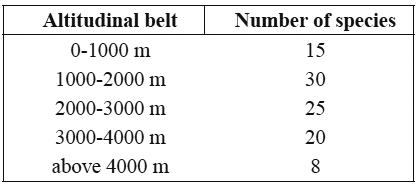
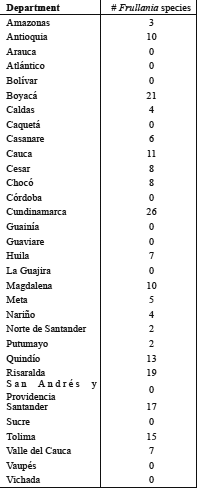
<body><![CDATA[<p>The distribution of the species within Colombia is still incompletely known.    The largest number of species is known from Cundinamarca (26 spp.), followed    by Boyac&aacute; (21 spp.), Risaralda (19 spp.) and Santander (17 spp.). Eight    departments have 5-15 species (Casanare, Cesar, Choc&oacute;, Huila, Magdalena,    Meta, Quind&iacute;o, Tolima, Valle de Cauca), 5 departments have 2-4 species    (Amazonas, Caldas, Nari&ntilde;o, Norte de Santander, Putumayo) and 12 departments    are without any species record (see <a href="#tabla1">Table 1</a>). The departmental    species richness reflects on the one hand the very uneven collecting intensity    in the different departments, on the other hand it shows the typically montane    distribution of <i>Frullania</i> in Colombia with more than 95% of the species    occurring in the Andean region, above 1000 m. </p>     <center>       <p><b>Table 1.</b> Number of <i>Frullania</i> species recorded from the Departments      of Colombia</p> </center>     <center>       <p><img src="/img/revistas/cal/v33n2/v33n2a5tab1.gif"><a name="tabla1"></a>  </center>     <p>The elevational distribution of the species diversity of <i>Frullania</i> in    Colombia is typically hump-shaped which the highest diversity (75% of the species)    occurring at mid-elevations, between 1000- 2000 m (<a href="#tabla2">Table 2</a>).    The elevational distribution pattern of <i>Frullania</i> in Colombia is similar    to that of liverworts in general (Uribe &amp; Gradstein. 1999; data from 750    spp.) and apparently reflects the prevalence of epiphytism in liverworts and    the preference of liverworts for humid ecological conditions. Similar hump-shaped    richness patterns with peaks at mid-elevations have been reported for other    plant groups, for example Melastomataceae and ferns, which like liverworts have    strong ecological preferences for humid conditions (Kessler, 2000; Kluge et    al., 2006). The elevation pattern of species richness detected in <i>Frullania</i>    may thus be similar to that of many other plant groups of Colombia.     <br>   The number of <i>Frullania</i> species decreases to the p&aacute;ramo (17 spp.)    but no species of <i>Frullania</i> is exclusive to the p&aacute;ramo belt even    though <i>F. decidua</i> has been found only in p&aacute;ramo at 3800. The latter    species occurs in Ecuador at much lower elevation in the forest belt (type location!),    indicating that its distribution in Colombia is insufficiently known. Species    richness is lowest in the submontane and lowland areas with only 10 and 13 species,    respectively. <i>Frullania kunzei</i> and <i>F. nodulosa</i>, are only known    from Amazonia below 500 m. The latter two are common and widespread lowland    taxa of tropical America and <i>F. nodulosa</i> occurs also in tropical Africa    and Asia. A third species recorded from Amazonia, <i>F. caulisequa</i>, is also    known from the Andean region where it is reported up to 3000 m. The high-Andean    records of this species should be checked, however, because elsewhere in tropical    America <i>F. caulisequa</i> is a lowland or lower montane species (Gradstein    &amp; Costa, 2003; Le&oacute;n-Y&aacute;nez et al., 2006). Possibly, confusion    with some other member of the subgenus Diastaloba to which F. caulisequa belongs    has occurred. Such confusion may well have happened since the neotropical species    of subg. Diastaloba have not been revised and are still very poorly known.</p>     <center>       <p><b>Table 2.</b> Altitudinal distribution of Colombian <i>Frullania</i>.</p> </center>     <center>       ]]></body>
<body><![CDATA[<p><img src="/img/revistas/cal/v33n2/v33n2a5tab2.gif"><a name="tabla2"></a>  </center>     <p> <b>KEYS AND DESCRIPTIONS</b></p>     <p><b><i>Frullania Raddi</i></b>    <br>   Plants small to large, reddish-green to reddish-brown or purplish, sometimes    pure green, creeping, ascending or pendent, regularly or irregularly 1-3-pinnately    branched. Branches Frullania-type; innovations normally lacking. Stems rigid,    made up of thick-walled cells. Leaves incubous with a very short, subtransverse    insertion, divided into a large dorsal lobe, a smaller ventral lobule, and a    small stylus between lobule and stem. Leaf lobe usually ovate-orbicular, apex    rounded to acute to acuminate, margins entire, rarely toothed. Leaf lobule almost    free from the dorsal lobe, rounded to elongate, transformed into a sac or flattened,    or both. Stylus usually linear and minute, rarely large, foliar. Cells isodiametrical    to (more often) elongate, usually with trigones and intermediate thickenings,    the trigones often confluent and cell walls often irregularly undulate-sinuose,    cuticle smooth; oil bodies finely granular; ocelli sometimes present. Underleaves    small or large, 2-lobed, rarely undivided. Rhizoids in bundles from underleaf    bases. Dioicous or autoicous, rarely paroicous. Androecia usually on a short,    globose male branch with a few pairs of bracts and bracteoles. Gynoecia on short    or elongate shoots, each with 2-5 archegonia. Perianths flattened or inflated,    with 0-14 keels, the mouth contracted into a beak. Seta of numerous rows of    cells. Foot of the sporophyte not penetrating into the stem. Capsule globose,    wall 2-layered. Elaters attached to the capsule valves, arranged vertically    inside the capsule, with 2-3-spirals. Spores large, multicellular, germination    endosporic. Vegetative reproduction rare, by caducous or fragmenting leaves.  </p>     <p><b>Keys to the species of <i>Frullania</i> from Colombia</b></p>     <p>Some species recorded from Ecuador and/or Venezuela that may occur in Colombia    but are not yet known from the country are also included in the key [in brackets].</p>     <p><b>1. Introductory Key</b></p>     <p>1. Lobules distant from the stem, space between stem and lobule wider than    the width of the lobule. Plants very small, creeping ............<b>Key 2</b>    (subg. <i>Diastaloba</i>)    <br>   1. Lobules close to the stem, space between stem and lobule narrower than the    width of the lobule. Plants small or large ..............2    <br>   2. Lobules pendent, opening of the lobule positioned toward the stem or the    apex of the plant. Amazonian lowlands (subg. <i>Homotropantha</i>) .....................<i>F.    nodulosa</i>    ]]></body>
<body><![CDATA[<br>   2. Lobules upright, opening of the lobule positioned toward the base of the    plant ...3    <br>   3. Lobules with a long or short flattened lower portion (flattened portion sometimes    very short!). Ventral surface of perianth with 2-6 keels .............<b>Key    3</b> (subg. <i>Chonanthelia</i>)    <br>   3. Lobules without flattened lower portion. Ventral surface of perianths with    0-1(-4) keels ........................................................4    <br>   4. Leaves distinctly squarrose when moist, brittle. Lobules as long as wide.    Surface of perianth rough by scattered tubercles or scale-like outgrowths (subg.    <i>Frullania</i>) ................................................<i>F. ericoides</i>    <br>   4. Leaves not squarrose, not brittle. Lobules longer than wide. Surface of perianth    without tubercles or scale-like outgrowths, smooth .....................................................5        <br>   5. Plants long-pendent from branches in cloud forest. Leaf bases with 2 very    large auricles, the auricles similar in size. Leaves convolute around the stem    both when dry and when moist ........<b>Key 4</b> (subg. <i>Meteoriopsis</i>)    <br>   5. Plants not long-pendent. Auricles at leaf bases lacking or not similar in    size, the dorsal auricle distinctly larger than the ventral auricle. Leaves    &plusmn; convolute when dry, spreading when moist ...................................................<b>Key    5</b> (subg. <i>Thyopsiella</i>)</p>     <p><b>Key 2. <i>Frullania</i> subgenus <i>Diastaloba</i></b></p>     <p>1. Leaf apex always rounded. Plants creeping, regularly or irregularly branched    ...............................................................<i>F. caulisequa</i>    <br>   1. Leaf apex at least in some leaves apiculate. Plants regularly (bi)pinnate,    ascending from the substrate ............................................2    ]]></body>
<body><![CDATA[<br>   2. Dorsal leaf base distinctly auriculate. Female bracts strongly toothed. Known    from Ecuador, not yet recorded from Colombia .................[F. serrata Gottsche]    <br>   2. Dorsal leaf base not auriculate. Female bracts entire ............................<i>F.    apiculata</i></p>     <p><b>Key 3. <i>Frullania</i> subgenus <i>Chonanthelia</i></b></p>     <p>1. Lobules on the main stem with a very long laminate (= flattened) portion,    which extends downwards beyond the ventral margin of the leaf lobe (sect. Cladocarpicae)    .........2    <br>   1. Lobules on the main stem with a short laminate portion, which does not extend    beyond the ventral margin of the leaf lobe (sect. Chonanthelia) ................................9    <br>   2. Margins of leaves and underleaves strongly undulate. Perianth 8-10-keeled    .......<i>F. arecae</i>    <br>   2. Margins not undulate, plane. Perianth 4-keeled or 8-10-keeled ..............................3    <br>   3. Stylus large, more than 0.3 mm long, suborbicular. Perianth 4-keeled ..............................................................<i>F.    confertiloba</i>    <br>   3. Stylus small, less than 0.1 mm long, filiform ..............................................................4    <br>   4. Laminate portion of the lobule toothed. Perianth 8-10-keeled ..................<i>F.    ringens</i>    ]]></body>
<body><![CDATA[<br>   4. Laminate portion of the lobule entire .....5    <br>   5. Perianth 4-keeled. Lobule with a distinct beak, formed by the sac extending    narrowly downwards along the free margin of the laminate portion ......................................6    <br>   5. Perianth 8-14-keeled. Lobule with or without beak ............................................7        <br>   6. Free margin of the laminate portion of the lobule strongly folded below the    beak. Laminate portion of lobule wider than the sac. Rare species ..................<i>F.    bogotensis</i>    <br>   6. Free margin of the laminate portion of the lobule plane, not folded below    the beak. Laminate portion of lobule not wider than the sac. Very common species    ..............................................................<i>F. riojaneirensis</i>    <br>   7. Lobule with a distinct beak ................................................................<i>F.    tunguraguana</i>     <br>   7. Lobule without beak ...............................8    <br>   8. Female bracts and bracteoles densely imbricate and incurved, forming a globose    head. Stylus minute, 1(-2) cells long. Dioicous .......................<i>F.    sphaerocephala</i>    <br>   8. Female bracts and bracteoles spreading, not forming a globose head. Stylus    2-3 cells long. Monoicous .......................<i>F. ecklonii</i>    <br>   9. Leaf apex acute. Described from Ecuador, not yet recorded from Colombia ............................................[<i>F.    haematocysta</i> Spruce]    ]]></body>
<body><![CDATA[<br>   9. Leaf apex broadly rounded ...................10    <br>   10. Leaves distinctly squarrose when moist. Stylus large, rounded ...............<i>F.    gibbosa</i>    <br>   10. Leaves plane when moist. Stylus filiform or lanceolate, not rounded ......................11    <br>   11. Base of the laminate portion of the lobule folded upwards ..........................<i>F.    winteri</i>    <br>   11. Base of the laminate portion of the lobule plane ......................................................12    <br>   12. Stylus 10-25 cells long and 4-8 cells wide ..............................................<i>F.    standaertii</i>    <br>   12. Stylus less than 10 cells long ..............13    <br>   13. Underleaves on main stem maximally 3 times as wide as the stem, distant    .............14    <br>   13. Underleaves on main stem more than 3 times as wide as the stem, distant    or imbricate ..................................................................16    <br>   14. Underleaves more than 2 times wider than the stem, bifid to 1/3. Lobule    with a beak. Dioicous. Montane forest species ..............................................<i>F.    cuencensis</i>     ]]></body>
<body><![CDATA[<br>   14. Underleaves smaller, 1-2 times wider than the stem, bifid to 1/6-1/4. Lobule    without beak. Monoicous. Montane forest and p&aacute;ramo ..................................................15        <br>   15. Perianth 8-10-keeled. Montane forest ............................................<i>F.    pluricarinata</i>     <br>   15. Perianth 4-keeled. P&aacute;ramo ......................................................<i>F.    tetraptera</i>     <br>   16. Laminate portion of the lobule large, to ca. 0.85 mm long. Lobule with a    distinct beak, formed by the sac extending narrowly downwards along the free    margin of the laminate portion ....................................17    <br>   16. Laminate portion of the lobule very small, less than 0.4 mm long. Lobule    not beaked ................................................................18    <br>   17. Perianth 4-keeled. Underleaves with large auricles, auricles approaching    each other ..................................................<i>F. laxiflora</i>    <br>   17. Perianth 8-10-keeled. Underleaves with small auricles, auricles not approaching    each other. Known from Ecuador, Venezuela and Costa Rica, not yet recorded from    Colombia ..................................[<i>F. planifolia</i> Steph.]    <br>   18. Underleaf apex undivided. Underleaf bases with very large auricles, the    auricles &plusmn; touching each other. Described from Venezuela, not yet recorded    from Colombia ..................[<i>F. holostipula</i> Hatt. &amp; Griffin]        <br>   18. Underleaf apex short bifid. Underleaf bases without or with small auricles    ......19     <br>   19. Underleaves &plusmn; rounded. Mouth of the lobule narrow (ca. &frac12; the    width of the lobule). Lobule surface folded in the middle ....................................................<i>F.    dusenii</i>    ]]></body>
<body><![CDATA[<br>   19. Underleaves longer than wide. Mouth of the lobule wide (almost as wide as    the lobule). Lobule surface smooth, not folded ......................................................<i>F.    jelskii</i></p>     <p><b>Key 4. <i>Frullania</i> subgenus <i>Meteoriopsis</i></b> </p>     <p>1. Leaf margins toothed ...........<i>F. dulimensis</i>    <br>   1. Leaf margins entire .................................2    <br>   2. Leaf apex rounded to obtuse. Female bracts entire (rarely toothed: <i>F.    grandifolia</i>) .....3    <br>   2. Leaf apex acute to acuminate. Female bracts toothed .....................................................4    <br>   3. Underleaves ovate-oblong, 1.4-2 x longer than wide, not overlapping. Female    bracts entire. Perianth distinctly exserted beyond the bracts ...............................<i>F.    convoluta</i>    <br>   3. Underleaves suborbicular, 1-1.3 x longer than wide, overlapping. Female bracts    toothed. Perianth not exserted beyond the bracts ...................................<i>F.    grandifolia</i>    <br>   4. Underleaf base without auricles. Underleaves narrow elongate, at least 2    x longer than wide ..........................<i>F. peruviana</i>    <br>   4. Underleaf base with very large auricles (more than 0.15 mm long). Underleaves    less than 2 x longer than wide. Known from Ecuador and Venezuela; not yet recorded    from Colombia ..........................................................[<i>F.    phalangiflora</i> Steph.]</p>     ]]></body>
<body><![CDATA[<p><b>Key 5. <i>Frullania</i> subgenus <i>Thyopsiella</i></b> </p>     <p>1. Leaf apex very long and finely acuminate, the acuminate portion to 1 mm    long. Known from Ecuador; not yet recorded from Colombia ....................[<i>F.    aculeata</i> Taylor]    <br>   1. Leaf apex not very long and finely acuminate ..................................................................2    <br>   2. Lobules short, 1-1.5 &times; longer than wide. Plants very small, 0.5-1 mm    wide, tightly prostrate. Cells in the upper part of the leaf lobes isodiametrical,    evenly thickened, without trigones. Dorsal leaf base not auriculate ....................................<i>F.    kunzei</i>    <br>   2. Lobules 1.5-3 &times; longer than wide. Plants larger. Cells in the upper    part of the leaf lobes longer than wide, with trigones. Dorsal leaf base auriculate    ......................3    <br>   3. Leaf apex apiculate to acuminate ...........4    <br>   3. Leaf apex rounded to subacute (never apiculate to acuminate) .........................13    <br>   4. Underleaves reniform (much wider than long), underleaf apex broadly truncate    and with 2 small, subulate teeth ............................................................<i>F.    bicornistipula</i>    <br>   4. Underleaves rounded, ovate to oblong, not reniform; underleaf apex not broadly    truncate with 2 small teeth ......................5    <br>   5. Underleaf apices long acuminate. Lamina of first branch underleaf undivided,    long acuminate .................................<i>F. setigera</i>    ]]></body>
<body><![CDATA[<br>   5. Underleaf apices acute or obtuse. Lamina of first branch underleaf bifid    or undivided, rounded to subacute ................................6    <br>   6. Leaf apex distinctly recurved, apiculate ..7    <br>   6. Leaf apex plane ......................................8    <br>   7. Stylus sometimes with a small foliose appendage at the base, ca. 5-10 cells    long and 3-7 cells wide (underleaves must be carefully removed to examine this    character). Perianth sharply 3-keeled .....................................................<i>F.    intumescens</i>    <br>   7. Stylus without foliose appendage. Perianth terete or with 3 weak, broad keels    near the apex ....................................<i>F. brasiliensis</i>    <br>   8. Leaf apex long mucronate to acuminate .....................................................<i>F.    pittieri</i>    <br>   8. Leaf apex obtuse to acute to short apiculate ..................................................................9    <br>   9. Underleaves almost as large as the leaf lobes, 3-4 times as wide as the stem,    imbricate ...............................................10    <br>   9. Underleaves much smaller than leaf lobes, 2-3 times as wide as the stem,    distant or imbricate ................................................11    <br>   10. Underleaves longer than wide, distant ................................................<i>F.    meridana</i>    ]]></body>
<body><![CDATA[<br>   10. Underleaves rounded or wider than long, imbricate ..................................<i>F.    formosa</i>    <br>   11. Perianth terete. Female bracts entire .........................................<i>F.    macrocephala</i>    <br>   11. Perianth 3-keeled. Female bracts toothed or entire .................................................12    <br>   12. Underleaf margins recurved ......<i>F. atrata</i>    <br>   12. Underleaf margins plane .......................................<i>F. beyrichiana</i>    (incl. <i>F. breuteliana</i>)    <br>   13. Ventral leaf base with 2 long and narrow appendages, one hanging down and    the other standing up, parallel to the stem ................................................<i>F.    mirabilis</i>    <br>   13. Ventral leaf base without long appendages ...............................................................14    <br>   14. Underleaves with long undulate auricles, auricles &frac12; or more the length    of the underleaf (underleaf length measured from the middle of the insertion    to the apex) .......................................<i>F. lobato-hastata</i>    <br>   14. Underleaves without or with short auricles ................................................................15    <br>   15. Underleaves about as large as the leaf lobe, more than 3 times as wide as    the stem, imbricate. Underleaf margins plane ............................................<i>F.    clandestina</i>     ]]></body>
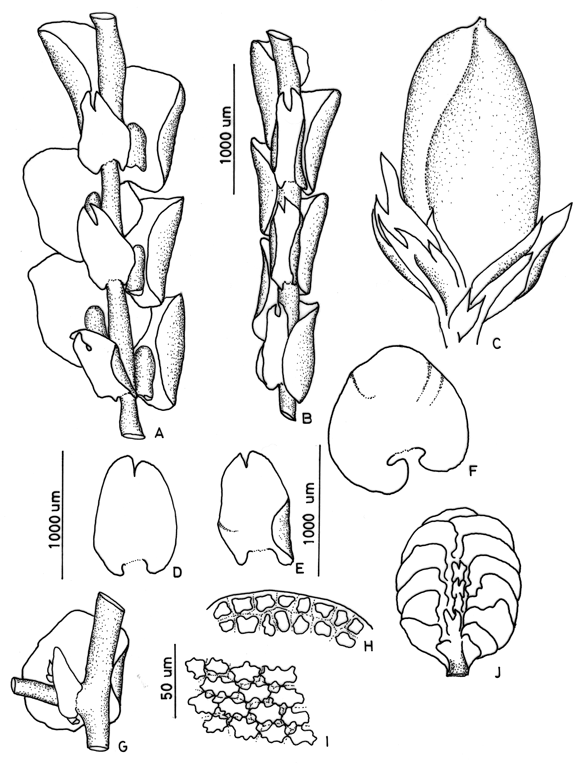
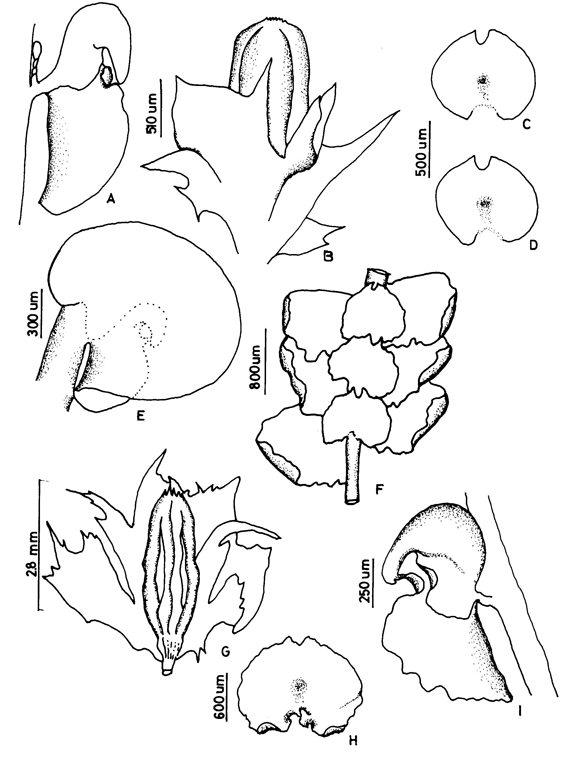
<body><![CDATA[<br>   15. Underleaves smaller, less than 3 times as wide as the stem, distant to subimbricate.    Underleaf margins recurved or plane ....16    <br>   16. Plants small, less than 1 mm wide when moist. Lobules often diverging from    the stem at an oblique angle. Underleaves as long as wide, deeply bifid (to    &frac12;), underleaf margins plane ...................<i>F. ecuadorensis</i>        <br>   16. Plants larger. Lobules standing upright, &plusmn; parallel to the stem.    Underleaves longer than wide, less deeply bifid (to 1/5-1/3) ...17    <br>   17. Underleaves imbricate, margins strongly recurved. Lamina of the first branch    underleaf undivided. Margins of female bracts and bracteoles entire .....<i>F.    montagnei</i>     <br>   17. Underleaves distant to subimbricate, margins plane or slightly recurved.    Lamina of the first branch underleaf bifid. Margins of female bracts and bracteoles    toothed .................................................<i>F. paradoxa</i></p>     <p><b>Alphabetical treatment of the <i>Frullania</i> species of Colombia</b></p>     <p><b>1. Frullania apiculata</b> (Reinw. et al.) Nees </p>     <p>On bark of trees in lowland and montane rain forest, from sea level to 3000    m. Recorded from Choc&oacute;, Quind&iacute;o and Santander. World distribution:    pantropical.    <br>   <i>Frullania apiculata</i> (subg. <i>Diastaloba</i>) is recognized by the regularly    (bi)pinnate branching and the apiculate leaf apex. The species is common throughout    the tropics and has been described and illustrated in detail by Hattori (1973,    1980) for Asia and by VandenBerghen (1976) for Africa. <i>Frullania exilis</i>,    described from the Neotropics and recorded from Colombia, has been considered    a synonym of <i>F. apiculata</i> (e.g. Gradstein &amp; Ilkiu-Borges, 2009) but    this synonymy was not based on examination of type materials and needs confirmation.  </p>     <p><b>2. Frullania arecae</b> (Spreng.) Gottsche <a href="#figura1">Fig. 1</a></p>     ]]></body>
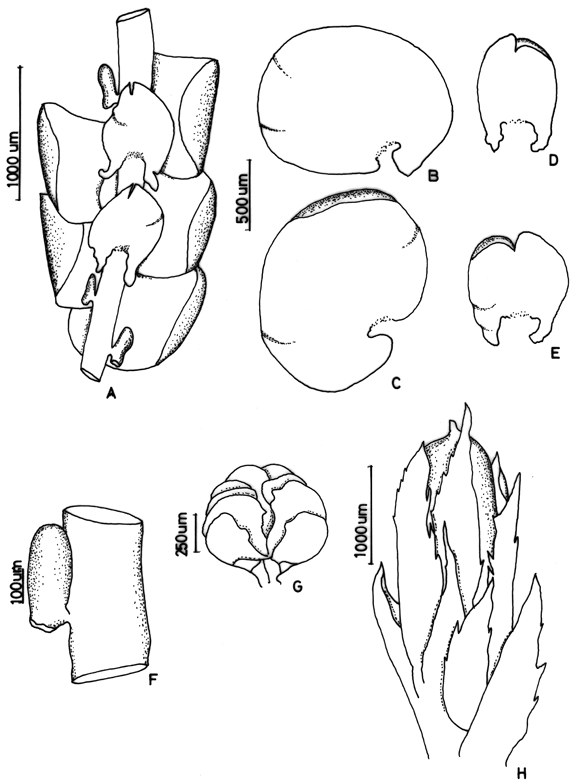
<body><![CDATA[<p>On bark and rock, 1600-3400 m. Recorded from Boyac&aacute;, Casanare, Cauca,    Cesar, Cundinamarca, Huila, Magdalena, Quind&iacute;o, Risaralda, Santander    and Tolima. World distribution: pantropical.     <br>   <i>Frullania arecae</i> (subg. <i>Chonanthelia</i>) is a very conspicuous, robust    plant with undulate margins of leaves and underleaves. The perianth of F. arecae    is 10-keeled and is surrounded by a large and strongly toothed, flower-like    involucre. The species has been confused with F. ecklonii (Yuzawa, 1991), but    the leaf and underleaf margins in the latter speciers are not undulate. </p>     <p>        <center>     <img src="/img/revistas/cal/v33n2/v33n2a5fig1.gif"><a name="figura1"></a>    </center>     <p>        <center>     <b>Figure 1.</b> <i>Frullania bogotensis</i> Steph. A. Leaf lobule. B. Perianth.      C and D. Underleaves. E. Stem-leaf, dorsal view. <i>Frullania arecae</i> (Spreng.)      Gottsche. F. Part of shoot, ventral view. G. Perianth. H. Underleaf. I. Ventral      lobule.    </center> </p>     <p><b>3. Frullania atrata</b> (Sw.) Nees <a href="#figura2">Fig. 2</a></p>     <p><i>Frullania crinoidea</i> Spruce ex Steph. (syn. fide Uribe &amp; Gradstein,    2003)    <br>   On bark of trees in montane rain forests, 600-3000(-4000) m. Recorded from Antioquia,    Boyac&aacute;, Casanare, Cauca, Cesar, Cundinamarca, Huila, Magdalena, Meta,    Santander and Tolima. World distribution: tropical America.     <br>   <i>Frullania atrata</i> (subg. <i>Thyopsiella</i>) has often been misidentified    and confused with members of the subgenus <i>Meteoriopsis</i> such as <i>F.    convoluta</i> and <i>F. peruviana</i>. However, Uribe &amp; Gradstein (2003)    showed that <i>F. atrata</i> is a member of the subgenus Thyopsiella and possibly    related to <i>F. intumescens</i>, which differs by strongly recurved leaf apices    (plane in <i>F. atrata</i>). <i>Frullania atrata</i> is also close to <i>F.    beyrichiana</i>, which differs from <i>F. atrata</i> by the plane underleaf    margins (recurved in <i>F. atrata</i>). The relationships of <i>F. atrata</i>    to other members of the subgenus <i>Thyopsiella</i> remain poorly known and    need more study. </p>     ]]></body>
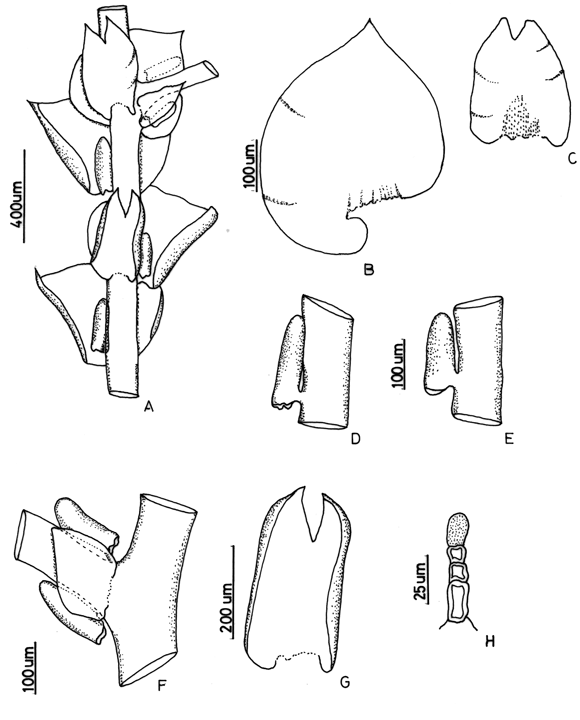
<body><![CDATA[<p>        <center>     <img src="/img/revistas/cal/v33n2/v33n2a5fig2.gif"><a name="figura2"></a>    </center>     <center>       <p><b>Figure 2.</b> <i>Frullania atrata</i> (Sw.) Nees. A. Part of shoot, ventral      view. B. Stem leaf. C. Underleaf. D and E. Leaf lobules. F. Initial branching      appendages. G. Underleaf. H. Stylus. Reproduced from Cryptogamie, Bryologie      with permission</p> </center> <b>4. Frullania beyrichiana</b> (Lehm. &amp; Lindenb.) Lehm. &amp; Lindenb.</p>      <p>On bark of trees, 1800-2100 m. Recorded from Antioquia and Cundinamarca. World    distribution: tropical America.     <br>   <i>Frullania beyrichiana</i> (subg. <i>Thyopsiella</i>) is very similar to <i>F.    atrata</i> (see under the latter species). <i>Frullania breuteliana</i>, which    has been reported from Colombia, may be a synonym of <i>F. beyrichiana</i> and    seems to differ from <i>F. beyrichiana</i> only in the slightly longer leaftip    and the somewhat toothed female bracts (entire in <i>F. beyrichiana</i>; see    Stotler, 1969). </p>     <p><b>5. Frullania bicornistipula</b> Spruce</p>     <p>On bark of trees and soil, 1500-2300 m. Recorded from Cauca, Huila, Norte de    Santander and Risaralda. World distribution: northern Andes and Costa Rica.    <br>   <i>Frullania bicornistipula</i> (subg. <i>Thyopsiella</i>) is a very characteristic    species which is immediately recognized by the reniform underleaves with a broad    truncate apex bearing 2 short, subulate teeth. The two small teeth are standing    upwards and separated from each other by some distance. The long filiform stylus,    6-12 cells long, is another characteristic feature of <i>Frullania bicornistipula</i>.        <br>   By the long mucronate leaf apex <i>Frullania bicornistipula</i> is similar to    <i>F. pittieri</i> but the peculiar underleaves of <i>F. bicornistipula</i>    readily separate the two species.</p>     ]]></body>
<body><![CDATA[<p><b>6.Frullania bogotensis</b> Steph. <a href="#figura1">Fig. 1</a></p>     <p>On logs, 700 m. Recorded from Boyac&aacute;, Cundinamarca and Santander. World    distribution: only known from Colombia.    <br>   <i>Frullania bogotensis</i> (subg. <i>Chonanthelia</i>) is closely related to    <i>F. riojaneirensis</i> but differs from the latter species by the laminate    portion of the lobule being broader than the sac (narrower than the sac in <i>F.    riojaneirensis</i>) and having a folded margin (Yuzawa, 1991). </p>     <p><b>7. Frullania brasiliensis</b> Raddi <a href="#figura3">Fig. 3</a></p>     <p><i>Frullania mucronata</i> (Lehm. &amp; Lindenb.) Lehm. &amp; Lindenb. (syn.    fide Uribe &amp; Gradstein, 2003)    <br>   Common on bark of trees, logs, soil, or rock, 1200-3900 m. Recorded from Antioquia,    Boyac&aacute;, Caldas, Cauca, Cesar, Choc&oacute;, Cundinamarca, Huila, Magdalena,    Meta, Nari&ntilde;o, Quind&iacute;o, Risaralda, Santander, Tolima and Valle    del Cauca. World distribution: common and widespread in tropical America.    <br>   <i>Frullania brasiliensis</i> is the most common neotropical species of subg.    <i>Thyopsiella</i> and is recognized by the recurved, apiculate leaf apices    and the terete perianth. Moreover, the underleaf margins are always recurved.    According to Stotler (1969), <i>F. brasiliensis</i> has deeply bifid underleaves    (to 1/3), however in material from Colombia and Ecuador of F. brasiliensis the    underleaf incision varies considerably in depth (1/5-1/3). </p>     <p>        <center>     <img src="/img/revistas/cal/v33n2/v33n2a5fig3.gif"><a name="figura3"></a>    </center>     <p>        ]]></body>
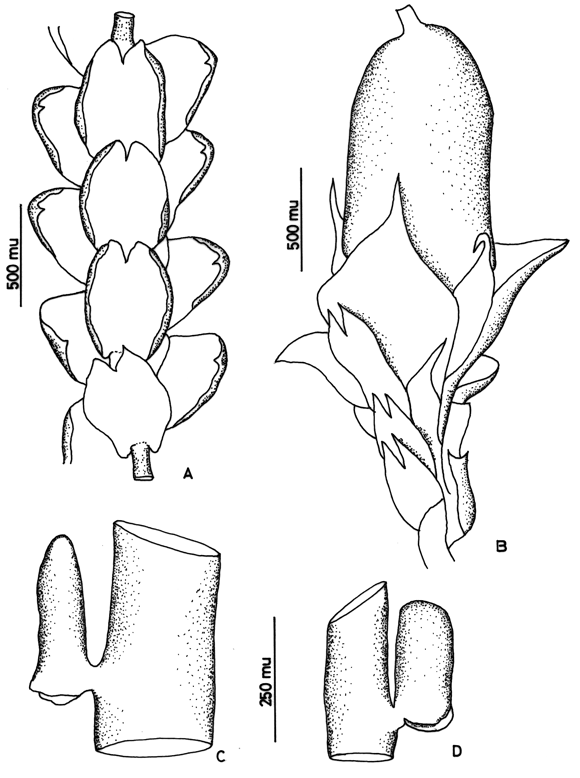
<body><![CDATA[<center>     <b>Figure 3.</b> <i>Frullania brasiliensis</i> Raddi. A. Part of shoot, ventral      view. B. Perianth. C and D. Leaf lobules. Reproduced from Cryptogamie, Bryologie      with permission.    </center>     <p><b>8. Frullania caulisequa</b> (Nees) Nees </p>     <p><i>Frullania gymnotis</i> Mont.     <br>   <i>Frullania obcordata</i> (Lehm. &amp; Lindenb.) Lehm. &amp; Lindenb.    <br>   On bark and rotten wood in lowland and montane rainforest areas and woodlands,    from sealevel to about 3000 m. Recorded from Amazonas, Boyac&aacute;, Casanare,    Cesar, Magdalena, Quind&iacute;o, Risaralda, Santander and Tolima. World distribution:    tropical America.    <br>   <i>Frullania caulisequa</i> (subg. <i>Diastaloba</i>) is related to F. apiculata    but is immediately separated from the latter by the sparse, irregular branching    and rounded leaftips. The species occurs on bark of trees at low elevations.    The species was treated by Schuster (1992) under the names <i>Frullania obcordata</i>    (Lehm. &amp; Lindenb.) Lehm. &amp; Lindenb. and <i>Frullania gymnotis</i> Mont.,    which are synonyms (see Gradstein &amp; Costa, 2003). <i>Frullania gymnotis</i>    is a form of <i>F. caulisequa</i> with toothed female bracts. </p>     <p><b>9. Frullania clandestina</b> (Nees &amp; Mont.) Nees</p>     <p>On bark of trees, 1500 m. Recorded from Cauca. World distribution: northern    Andes (Colombia, Ecuador, Peru).    <br>   <i>Frullania clandestina</i> (subg. <i>Thyopsiella</i>) is a rare species from    lower montane elevation in the northern Andes. The species is recognized by    the rounded leaf apex and the large underleaves which are about as large as    the leaf lobes and imbricate. By its large underleaves, <i>F. clandestina</i>    resembles <i>F. formosa</i> Spruce but in the latter species the leaf apex is    apiculate. </p>     <p><b>10. Frullania confertiloba</b> Steph. <a href="#figura4">Fig. 4</a></p>     ]]></body>
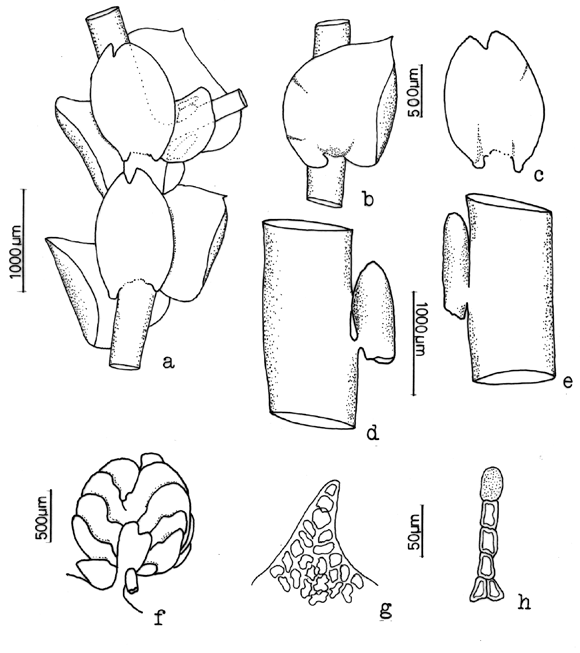
<body><![CDATA[<p>On bark of trees and logs, 700-1700 m. Recorded from Boyac&aacute; and Santander.    World distribution: scattered in tropical America.    <br>   <i>Frullania confertiloba</i> (subg. <i>Chonanthelia</i>) is closely related    to <i>F. riojaneirensis</i> but differs by the large, rounded stylus (Yuzawa,    1991). The species is known from only few locations in tropical America and    may have been overlooked. </p>     <p>        <center>     <img src="/img/revistas/cal/v33n2/v33n2a5fig4.gif"><a name="figura4"></a>    </center>     <p>        <center>     <b>Figure 4.</b> <i>Frullania confertiloba</i> Steph. A. Part of shoot, ventral      view. B. Leaf lobule and discoid stylus. C. Stem leaf, dorsal view. Reproduced      from Cryptogamie, Bryologie with permission.    </center>     <p><b>11. Frullania convoluta</b> Lindenb. &amp; Hampe <a href="#figura5">Fig.    5</a></p>     <p>On bark of trees, pendent from branches, in upper montane cloud forest, to    3400 m. Recorded from Boyac&aacute;, Cundinamarca, Meta, Nari&ntilde;o, Norte    de Santander, Putumayo, Risaralda, Santander and Tolima. World distribution:    Central America, Dominican Republic, tropical Andes, Guayana Highlands.     <br>   <i> Frullania convoluta</i> (subg. <i>Meteoriopsis</i>) is a common species    of the subgenus Meteriopsis and is recognized by pendent growth, rounded (to    obtuse) leaf apex and the rather distant, ovate-oblong underleaves (Uribe, 2008).    The species closely resembles <i>Frullania grandifolia</i>, which is the only    other member of subgenus Meteriopsis with a rounded leaf apex; for differences    between the two species see the key. <i>Frullania convoluta</i> has sometimes    been confused with <i>F. peruviana</i>, which is also widespread in tropical    America, but in the latter species the leaf apices are acute. </p>     <p>        ]]></body>
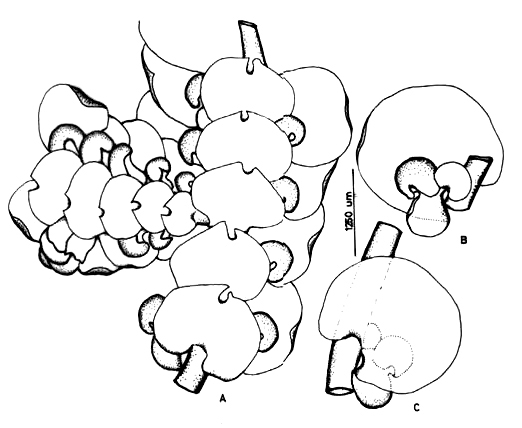
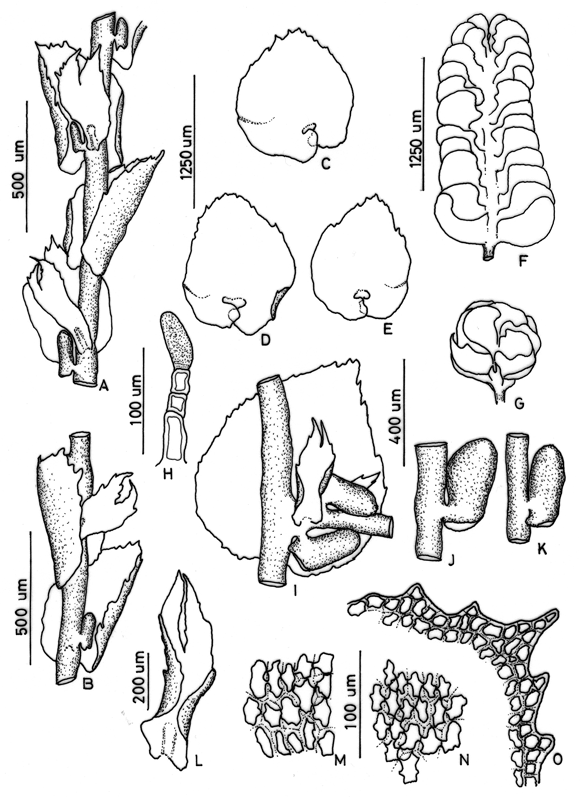
<body><![CDATA[<center>     <img src="/img/revistas/cal/v33n2/v33n2a5fig5.gif"><a name="figura5"></a>    </center>     <p>        <center>     <b>Figure 5.</b> <i>Frullania convoluta</i> Lindenb. &amp; Hampe. A and B.      Part of shoot, ventral view. C. Perianth. D and E. Underleaves. F. Leaf. G.      Initial branching appendages. H. Apical cells. I. Median cells. J. Androecium.      Reproduced from Cryptogamie, Bryologie with permission.    </center>     <p><b>12. Frullania cuencensis</b> Tayl.</p>     <p>On bark and logs, to 3000 m. Recorded from Cundinamarca and Santander. World    distribution: tropical America.    <br>   <i>Frullania cuencensis</i> (subg. <i>Chonanthelia</i>) is recognized by the    beaked lobule with a large sac and short laminate part, and rather deeply bifid    underleaves (to 1/3) which are 2-3 times wider than the stem. The species has    been confused with F. tetraptera, but the latter species has narrower and less    deeply bifid underleaves and occurs at higher elevation. </p>     <p><b>13. Frullania dulimensis</b> Uribe <a href="#figura6">Fig. 6</a></p>     <p>On bark of isolated trees in open areas in the upper montane belt, growing    together with other pendent species of the subgenus <i>Meteriopsis</i> (<i>F.    peruviana, F. convoluta</i>), 3200 m. Recorded from Tolima (Uribe, 2006). World    distribution: only known from the type specimen from Colombia.    <br>   <i>Frullania dulimensis</i> (subg. <i>Meteoriopsis</i>) is readily separated    from the other members of the subgenus <i>Meteoriopsis</i> by the toothed leaves.    The species is only known from a single collection from Colombia. </p>     <p>        ]]></body>
<body><![CDATA[<center>     <img src="/img/revistas/cal/v33n2/v33n2a5fig6.gif"><a name="figura6"></a>    </center>     <p>        <center>     <b>Figure 6.</b> <i>Frullania dulimensis</i> Uribe. A and B. Part of shoot,      ventral view. C, D and E. Stem leaf-lobes. F and G. Androecia. H. Stylus.      I. Initial branching appendages. J and K. Leaf lobules. L. Stem underleaf.      M. Basal cells. N. Median cells. O. Apical cells. Reproduced from Cryptogamie,      Bryologie with permission.    </center>   &nbsp;</p>     <p><b>14. Frullania dusenii</b> Steph. </p>     <p>On bark and rock, ca. 1700 m. Recorded from Cesar, Cundinamarca and Magdalena.    World distribution: tropical America.    <br>   <i>Frullania dusenii</i> (subg. <i>Chonanthelia</i>) is recognized by the saccate    lobule with a very short lamina, a narrow mouth (ca. half the width of the sac)    and a plicate surface, and the rather large, rounded, imbricate underleaves    which are 3-4 times wider than the stem. According to Yuzawa (1991), the species    is largely restricted to elevations above 2000 m. Frullania dusenii may be confused    with <i>F. gibbosa</i> but the latter species has squarrose leaves and a large,    leaf-like stylus, and occurs at lower elevations. </p>     <p><b>15. Frullania ecklonii</b> (Spreng. ) Gottsche et al.</p>     <p>On bark and rock at high elevations, 3000-3500 m. Recorded from Boyac&aacute;,    Cundinamarca and Tolima. World distribution: pantropical.    <br>   <i>Frullania ecklonii</i> (subg. <i>Chonanthelia</i>) is recognized by the 10-keeled    perianth, the smooth margins of leaves, lobules and underleaves, and the absence    of a well-developed lobule beak. The species has sometimes been treated as a    synonym of <i>Frullania arecae</i> but in the latter species the leaf and underleaf    margins are undulate and the lobule is distinctly beaked (Yuzawa, 1991).</p>     <p><b>16. Frullania ecuadorensis</b> Steph.</p>     ]]></body>
<body><![CDATA[<p>On bark of trees and soil, 700-1200 m. Recorded from Boyac&aacute; and Risaralda.    World distribution: scattered in tropical America.    <br>   <i>Frullania ecuadorensis</i> (subg. <i>Thyopsiella</i>) is characterized by    the small plant size (width less than 1 mm), the rounded leaf apex and the small,    distant underleaves which are hardly wider than the stem, deeply bifid (to &frac12;),    cuneate at the base and with flat margins. The lobules in the species are often    somewhat diverging and positioned at an oblique angle with the stem (Stotler,    1969). <i>Frullania ecuadorensis</i> has been described based on sterile material    and its affinities remain little known.</p>     <p><b>17. Frullania ericoides</b> (Nees) Mont. </p>     <p>Common on bark and rock in rather dry, open woodlands, from sea level to 2800    m. Recorded from Antioquia, Boyac&aacute;, Casanare, Choc&oacute;, Cundinamarca,    Quind&iacute;o, Risaralda, Santander and Tolima. World distribution: pantropical.    <br>   <i>Frullania ericoides</i> (subg. <i>Frullania</i>) is one of the most drought-tolerant    epiphytic liverworts and one of the few leafy liverwort species that occur in    the arid lowland belt of the Galapagos Islands (Gradstein, 2008). The species    is readily recognized by the squarrose and rather brittle leaves, which reproduce    asexually by leaf fragmentation. The lobules are highly variable and may be    saccate in some populations and laminate, without formation of watersac, in    others. <i>Frullania ericoides</i> may be confused with Frullania gibbosa which    also has squarrose leaves and occurs in the same habitat. The two species can    be readily separated by their different sizes, <i>F. gibbosa</i> being a larger    plant with leafy stems more than 2 mm wide (1-1.5 mm in <i>F. ericoides</i>).    Moreover, the leaves in <i>F. gibbosa</i> are not brittle, the lobules are more    broadly attached to the lobe, the perianth surfaces are smooth and the stylus    is large, leaf-like (small subulate in <i>F. ericoides</i>).</p>     <p><b>18. Frullania formosa</b> Spruce</p>     <p>On branches of trees in lowland rain forest at the foot of the Andes, ca. 500    m. Recorded from Risaralda. World distribution: only known from Colombia and    Ecuador.    <br>   <i>Frullania formosa</i> (subg. <i>Thyopsiella</i>) is recognized by the flat    and short apiculate leaf apex, and the large, imbricate underleaves, which are    more than 3 times as wide as the stem (Stotler, 1969). By the characters of    the underleaves <i>F. formosa</i> is similar to <i>F. clandestina</i> but in    the latter species the leaf apex is rounded, never apiculate.</p>     <p><b>19. Frullania gibbosa</b> Nees </p>     <p>Common on bark and rock, usually in rather dry, open places, 500-3200 m. Recorded    from Antioquia, Boyac&aacute;, Caldas, Casanare, Cauca, Cesar, Cundinamarca,    Magdalena, Risaralda, Santander and Tolima. World distribution: widespread in    tropical America.    ]]></body>
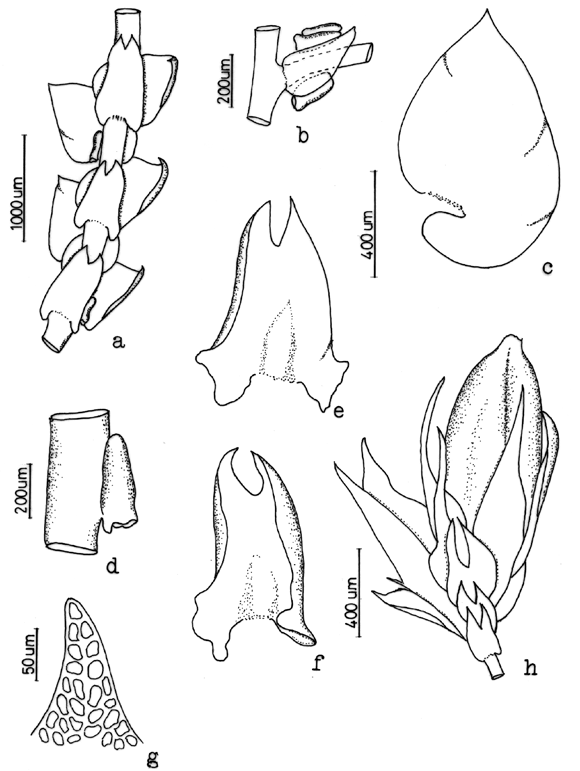
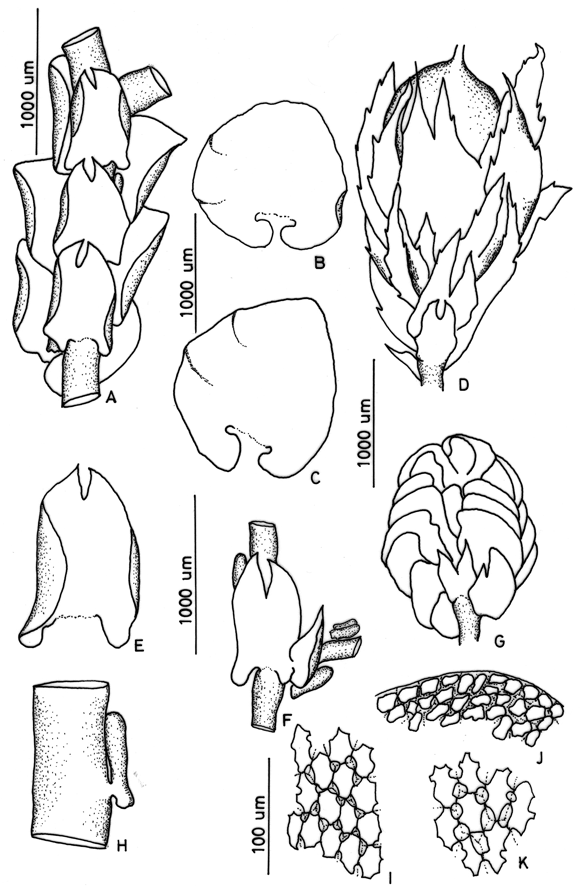
<body><![CDATA[<br>   <i>Frullania gibbosa</i> (subg. <i>Chonanthelia</i>) differs from all other    members of the subgenus <i>Chonanthelia</i> by the squarrose leaves and the    large, foliose stylus. The stylus is usually covered the large and densely imbricate    (and shallowly bifid) underleaves, and can be observed only by removing the    underleaves. <i>Frullania gibbosa</i> grows in rather open locations at low    elevations, often together with <i>F. ericoides</i> with which it may be confused.    For differences between the two see under <i>F. ericoides</i>. </p>     <p><b>20. Frullania grandifolia</b> Steph. <a href="#figura7">Fig. 7</a></p>     <p>On bark in upper montane forest, 3400 m. Recorded from Tolima (Uribe, 2008).    World distribution: rare species, known from a few localities in Central America    (Mexico, Costa Rica) and the northern Andes (Colombia, Ecuador).    <br>   <i>Frullania grandifolia</i> (subg. <i>Meteoriopsis</i>) is recognized by the    pendent growth, the rounded leaf apex, the large, imbricate, &plusmn; rounded    underleaves, and the toothed female bracts. The species is closely related to    <i>F. convoluta</i> but in the latter the underleaves are distinctly longer    than wide and not imbricate, and the margins of the female bracts are entire    (Uribe, 2008).</p>     <p>        <center>     <img src="/img/revistas/cal/v33n2/v33n2a5fig7.gif"><a name="figura7"></a>    </center>     <p>        <center>     <b>Figure 7.</b> <i>Frullania grandifolia</i> Steph. A. Part of shoot, ventral      view. B. and C. Stem leaf-lobes. D. Perianth. E. Underleaf. F. Initial branching      appendages. G. Androecium. H. Leaf-lobule. I. Median cells. J. Apical cells.      K. Basal cells. Reproduced from Cryptogamie, Bryologie with permission.    </center>     <p><b>21. Frullania intumescens</b> (Lehm. &amp; Lindenb.) Lehm. &amp; Lindenb.</p>     <p>On bark and rock in montane rain forest areas and p&aacute;ramo, 1000-3800    m. Recorded from Antioquia, Boyac&aacute;, Cauca, Cesar, Choc&oacute;, Cundinamarca,    Huila, Magdalena, Quind&iacute;o, Risaralda, Santander, Tolima and Valle del    Cauca. World distribution: tropical America.    ]]></body>
<body><![CDATA[<br>   <i>Frullania intumescens</i> (subg. <i>Thyopsiella</i>) is similar to <i>F.    brasiliensis</i> but differs by the perianth with 3 sharp keels (terete in <i>F.    brasiliensis</i>). Yuzawa &amp; Koike (1989), in addition, found that the two    species differ by the presence of a small foliose appendage at the base of the    stylus in <i>F. intumescens</i> (Yuzawa &amp; Koike, 1989). We have studied    the type material of <i>F. intumescens</i> (Jamaica, Bancroft s.n., ex hb. Hooker    1833, lectotype in hb. S [no. B27792]) and can confirm the observations of Yuzawa    &amp; Koike (1989). However, we have not observed this appendage in any Colombian    specimen identified as <i>F. intumescens</i>.     <br>   Stotler (1969) treated <i>F. intumescens</i> in a broader sense, including plants    with and without an appendaged stylus in <i>F. intumescens</i>. According to    Yuzawa &amp; Koike (1989), the plants without appendaged stylus belong to <i>F.    closterantha</i> which was described from Ecuador by Spruce (1884) and was treated    as a synonym of <i>F. intumescens</i> s.l. by Stotler (1969). It should be noted,    however, that, Stotler listed eight further species as synonyms of <i>F. intumescens</i>    that were not studied by Yuzawa and Koike. Three of them (<i>F. baptistae</i>    Gottsche, <i>F. cucullata</i> Lindenb. &amp; Gottsche, F. longicollis Lindenb.    &amp; Gottsche) are older names than <i>F. closterantha</i> that might have    priority and should therefore be studied (types should be in W).     <br>       <br>   <b>22. Frullania jelskii</b> Loitlesb.</p>     <p>This rare species was recorded from Colombia by Yuzawa (1991) without further    information on habitat and distribution. World distribution: only known from    Peru (type) and Colombia.    <br>   <i>Frullania jelskii</i> (subg. <i>Chonanthelia</i>) is characterized by the    large saccate lobule with a very short lamina, the broadly recurved leaf apex,    and the large underleaves (ca. 4 times as wide as the stem). The species is    closely related to <i>F. dusenii</i> but the latter species is readily separated    from <i>F. jelskii</i> by the narrow mouth of the sac, rounded underleaves (slightly    longer than wide in <i>F. jelskii</i>), and the plicate lobule surface (Yuzawa,    1991).</p>     <p><b>23. Frullania kunzei</b> (Lehm. &amp; Lindenb.) Lehm. &amp; Lindenb. </p>     <p><i>Frullania neesii</i> Lindenb. (fide Gradstein &amp; Costa, 2003)    <br>   On bark in rather open lowland woodlands and isolated trees, also on rock, 200    m. Recorded from Amazonas. World distribution: tropical America.    <br>   <i>Frullania kunzei</i> (subg. <i>Thyopsiella</i>) is readily recognized by    the very small plants, less than 1 mm wide, which are creeping on bark or rock,    sometimes over larger bryophytes or lichens, and always tighly appressed to    the subtrate. The rather short lobules (less than 1.5 times longer than wide),    the isodiametrical, evenly thickened upper leaf cells and the total absence    of auricles at leaf bases, separate <i>F. kunzei</i> from other neotropical    members of the subgenus <i>Thyopsiella</i> (Schuster, 1992). The species may    be confused with members of the subgenus <i>Diastaloba</i> (e.g. <i>F. caulisequa</i>)    which resemble <i>F. kunzei</i> by small size and prostrate growth, but the    very different lobule in the latter species (positioned at some distance from    the stem, not close to the stem) readily distinguishes them from <i>F. kunzei</i>.        ]]></body>
<body><![CDATA[<br>   <i>Frullania kunzei</i> is the only heteroicous member of the genus <i>Frullania</i>    in the Neotropics; the dioicous phenotype of the species has been described    as <i>F. neesii</i>, which is a synonym (Gradstein &amp; Costa, 2003).</p>     <p><b>24. Frullania laxiflora</b> Spruce</p>     <p>On bark in montane rain forest areas, 1500-3500 m. Recorded from Cauca and    Tolima. World distribution: scattered in the tropical Andes (Bolivia to Venezuela)    and the Galapagos Islands.    <br>   <i>Frullania laxiflora</i> (subg. <i>Chonanthelia</i>) is characterized by the    strongly concave leaves, the rather long laminate portion of the lobule, which    is about as long as the sac yet does not extend beyond the ventral lobe margin,    the decurrent beak of the lobule, and the broad, rounded underleaves with large    basal auricles (Yuzawa, 1991). The species may be confused with <i>F. riojaneirensis</i>    but in the latter species the laminate portion of the lobule extends beyond    the ventral lobe margin and the beak is not decurrent. </p>     <p><b>25. Frullania lobato-hastata</b> Steph. <a href="#figura8">Fig. 8</a></p>     <p><i>Frullania apollinarii</i> Steph., syn. nov.     <br>   On bark, 1800-3400 m. Colombia: Cundinamarca, Quindio and Santander. World distribution:    northern Andes (Colombia, Ecuador).    <br>   <i>Frullania lobato-hastata</i> (subg. <i>Thyopsiella</i>) is a robust plant    from high elevation in the northern Andes. The species is recognized by the    very long, undulate auricules at underleaf bases, which are at least half as    long as the underleaf lamina (lamina length measured from the middle of the    underleaf insertion line to apex). The leaf apex is broadly rounded or, occasionally,    short apiculate. The species resembles <i>F. brasiliensis</i> in the almost    terete perianth but the leaf apex in <i>F. brasiliensis</i> is always apiculate    and the underleaf auricles are small and not undulate.    <br>   <i>Frullania apollinarii</i> Steph., published by Stephani in the same volume    of the Species <i>Hepaticarum</i> as <i>F. lobato-hastata</i> but 3 month later,    is a synonym of the latter species (see Uribe, 2004a for description and illustration    of <i>F. apollinarii</i>). </p>     <p>        ]]></body>
<body><![CDATA[<center>     <img src="/img/revistas/cal/v33n2/v33n2a5fig8.gif"><a name="figura8"></a>    </center>     <p>        <center>     <b>Figure 8.</b> <i>Frullania lobato-hastata</i> Steph.A. Part of shoot, ventral      view. B and C. Stem leaves. D and E. Underleaves. F. Leaf lobule. G. Androecium.      H. Perianth. Reproduced from Caldasia with permission.    </center>   &nbsp;</p>     <p><b>26. Frullania macrocephala</b> (Lehm. &amp; Lindenb.) Lehm. &amp; Lindenb.</p>     <p>On bark of trees and rocks, 1400-2900 m. Recorded from Boyac&aacute;, Cundinamarca,    Quind&iacute;o, Risaralda and Santander. World distribution: tropical America.    <br>   <i>Frullania macrocephala</i> (subg. <i>Thyopsiella</i>) closely resembles <i>F.    brasiliensis</i> but differs by the &plusmn; flat leaf apex (recurved in <i>F.    brasiliensis</i>; see Stotler, 1969).</p>     <p><b>27. Frullania meridana</b> Steph. <a href="#figura9">Fig. 9</a></p>     <p>On bark of trees, 1500-3200 m. Recorded from Cundinamarca, Risaralda and Tolima.    World distribution: northern Andes (Venezuela (type), Colombia).    <br>   <i>Frullania meridana</i> (subg. <i>Thyopsiella</i>) is characterized by the    characters given in the key. The species is known from only few collections,    and only from male plants (Uribe, 2004b).</p>     <p>        ]]></body>
<body><![CDATA[<center>     <img src="/img/revistas/cal/v33n2/v33n2a5fig9.gif"><a name="figura9"></a>    </center>     <p>        <center>     <b>Figure 9.</b> <i>Frullania meridana</i> Steph. A. Part of shoot, ventral      view. B. Leaf lobe, dorsal view. C. Underleaf. D and E. Leaf-lobules. F. androecium.      G. Apical cells. H. Stylus. Reproduced from Tropical Bryology with permission.    </center>   &nbsp;</p>     <p><b>28. Frullania mirabilis</b> Jack &amp; Steph.</p>     <p>On bark of trees and soil, 1200-2400 m. Recorded from Antioquia, Cauca, Choc&oacute;,    Meta, Nari&ntilde;o and Valle. World distribution: northern Andes, Costa Rica.    <br>   <i>Frullania mirabilis</i> (subg. <i>Thyopsiella</i>) is easily recognized by    the two long appendices at the ventral base of the leaf, one standing up and    one hanging down. The species has also been described under the name <i>F. pendulostyla</i>    Steph. (Stotler, 1969)</p>     <p><b>29. Frullania montagnei</b> Gottsche</p>     <p>On bark, 1500-2100 m. Recorded from Magdalena, Santander and Tolima. World    distribution: tropical America.    <br>   <i>Frullania montagnei</i> (subg. <i>Thyopsiella</i>) resembles <i>F. paradoxa</i>    by the rounded leaf apex and the rather narrow underleaves which are less than    3 times as wide as the stem, but differs by underleaves being imbricate and    having distinctly recurved margins, the undivided lamina of the first branch    underleaf, and the entire margins of female bracts and bracteoles (see Key).</p>     <p><b>30. Frullania nodulosa</b> (Reinw. et al.) Gottsche et al.     ]]></body>
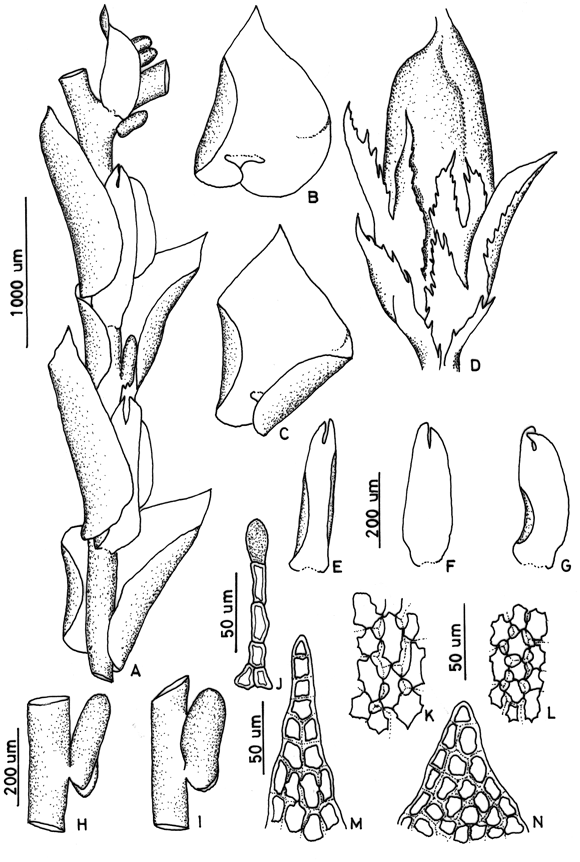
<body><![CDATA[<br>       <br>   In crowns of trees in dense lowland rain forest, and lower down on bark of trees    and shrubs in savannas and other open places, 200-250 m. Recorded from Amazonas    and Vaup&eacute;s. World distribution: pantropical.    <br>   The small, pendent lobules in <i>Frullania nodulosa</i> (subg. <i>Homotropantha</i>)    readily separate this species from all other neotropical members of the genus    <i>Frullania</i>. The species is furthermore characterized by its robust size,    the regularly pinnate to 2-pinnate branching, the suborbicular leaves with a    broadly rounded apex and the large, imbricate underleaves with a very shallow    incision at the apex and with large basal auricles (Gradstein &amp; Ilkiu-Borges,    2009). The species is widespread in the lowlands of Amazonia but has been surprisingly    little collected in Colombia. </p>     <p><b>31. Frullania paradoxa</b> Lehm. &amp; Lindenb.</p>     <p>On bark of trees, 3000-3700 m. Recorded from Boyac&aacute;, Cauca, Cundinamarca,    Quind&iacute;o, Risaralda and Valle. World distribution: tropical Andes.    <br>   <i>Frullania paradoxa</i> (subg. <i>Thyopsiella</i>) is characterized by the    rounded leaf apex, the longer than wide and rather narrow underleaves which    are hardly wider than the stem, the shallowly bifid lamina (to &frac14;) of    the first branch underleaf, and the sharply 3-keeled perianth surrounded by    bracts and bracteoles with ciliate-laciniate margins (Stotler, 1969). <i>Frullania    flexicaulis</i> Spruce, recorded from Colombia, is very similar to <i>F. paradoxa</i>    and may be a synonym of the latter. The species differs from <i>F. paradoxa</i>    by the female bract lobes with entire margins (usually toothed in <i>F. paradoxa</i>)    and the somewhat more deeply bifid lamina (to &frac12;) of the first branch    underleaf. </p>     <p><b>32. Frullania peruviana</b> Gottsche <a href="#figura10">Fig. 10</a></p>     <p><i>Frullania mathanii</i> Steph. (syn. fide Uribe, 2008)    <br>   <i>Frullania atrata</i> sensu Spruce (non typus) (fide Uribe, 2008)    <br>   On bark of tree branches in montane cloud forest areas, 1800-3800 m. Recorded    from Antioquia, Boyac&aacute;, Caldas, Choc&oacute;, Cundinamarca, Magdalena,    Nari&ntilde;o, Quind&iacute;o, Risaralda, Tolima and Valle. World distribution:    Central America, tropical Andes, Galapagos Islands.    ]]></body>
<body><![CDATA[<br>   <i>Frullania peruviana</i> (subg. <i>Meteoriopsis</i>) is recognized by the    pendent growth, acute leaf apices and underleaves without basal auricles (Uribe,    2008). The species is very common in the Andean region and has been described    under several different names. Spruce (1884) in his famous handbook on the liverworts    of the Amazon region and the Andes, described the species under the name <i>Frullania    atrata</i>, which is a different species, however, and not related to <i>F.    peruviana</i> (see under <i>F. atrata</i>). </p>     <p>        <center>     <img src="/img/revistas/cal/v33n2/v33n2a5fig10.gif"><a name="figura10"></a>    </center>     <p>        <center>     <b>Figure 10.</b> <i>Frullania peruviana</i> Gottsche. A. Part of shoot, ventral      view. B. and C. Leaf lobes. D. Perianth. E, F and G. Underleaves. H and I.      Leaf lobules. J. Stylus. K. Basal cells. L. Median cells. M and N. Apical      cells. Reproduced from Cryptogamie, Bryologie with permission.    </center>   &nbsp;</p>     <p><b>33. Frullania pittieri</b> Steph.     <br>   <i>Frullania mucronata</i> auct. (non typus) (fide Uribe &amp; Gradstein, 2003)    <br>   On bark of trees, occasionally on shaded, wet rock, from sea level to 2500 m.    Recorded from Boyac&aacute;, Cauca, Choc&oacute;, Quind&iacute;o and Risaralda.    World distribution: tropical America.    <br>   <i>Frullania pittieri</i> (subg. <i>Thyopsiella</i>) is recognized by the flat    and longly mucronate to acuminate leaf apices (Stotler, 1969). The species has    sometimes been misidentified as <i>F. mucronata</i>, which is a synonym of<i>F.    brasiliensis</i> (Uribe &amp; Gradstein, 2003).</p>     <p><b>34. Frullania pluricarinata</b> Gott.</p>     ]]></body>
<body><![CDATA[<p>On bark of trees, 1700-3000 m. Recorded from Cundinamarca and Magdalena. World    distribution: scattered in the Andes and the mountains of Central America, from    Chile to Mexico.     <br>   <i>Frullania pluricarinata</i> (subg. <i>Chonanthelia</i>) is very similar to    <i>F. tetraptera</i> but differs by the 8-10-keeled perianth (4-keeled in <i>F.    tetraptera</i>). The two species seem to differ somewhat in elevational range,    <i>F. tetraptera</i> being most common in p&aacute;ramo whereas <i>F. pluricarinata</i>    seems to occur mainly in the upper montane belt. </p>     <p><b>35. Frullania ringens</b> Spruce</p>     <p>On bark of trees, 3400 m. Recorded from Cauca. World distribution: northern    Andes (Colombia, Ecuador).    <br>   <i>Frullania ringens</i> (subg. <i>Chonanthelia</i>) is recognized by the large,    2-3-toothed laminate portion of the lobule, the long, the decurrent beak of    the lobule, the large, rounded underlaves with 2 very large auricles which are    usually overlapping each other, and 10-keeled perianths (Yuzawa 1991). Frullania    ringens is most closely related to F. ecklonii but differs from the latter by    the lobule with a long beak and toothed lamina (beak &plusmn; lacking and lamina    entire in <i>F. ecklonii</i>) and the larger underleaf auricles, which are often    overlapping each other (not overlapping in <i>F. ecklonii</i>). </p>     <p><b>36. Frullania riojaneirensis</b> (Raddi) &Aring;ngstr.     <br>       <br>   On bark and rock, 500-3800 m. Recorded from Antioquia, Boyac&aacute;, Caldas,    Casanare, Cauca, Cesar, Choc&oacute;, Cundinamarca, Huila, Magdalena, Quind&iacute;o,    Risaralda, Santander and Tolima. World distribution: pantropical.    <br>   <i>Frullania riojaneirensis</i> (subg. <i>Chonanthelia</i>) is a very common    species of lower montane elevations and is recognized by the large laminate    portion of the lobule (to be examined on the leaves of the main stem) with a    flat margin and distinct beak, and the 4-keeled perianth. </p>     <p><b>37. Frullania setigera</b> Steph. <a href="#figura11">Fig. 11</a></p>     ]]></body>
<body><![CDATA[<p>On bark of trees, soil, rocks and logs, 900-3600 m. Recorded from Antioquia,    Boyac&aacute;, Cauca, Choc&oacute;, Huila, Santander and Valle. World distribution:    scattered in tropical America.    <br>   <i>Frullania setigera</i> (subg. <i>Thyopsiella</i>) is a little-known species    that is recognized by the triangular-ovate underleaves with narrowly acuminate    apices and auriculate bases, and by the long acuminate apex of the lamina of    the first branch underleaf (Stotler, 1969). The leaf apex in <i>F. setigera</i>    is apiculate to short acuminate, plane or recurved, and the perianth is 3-keeled.  </p>     <p>        <center>     <img src="/img/revistas/cal/v33n2/v33n2a5fig11.gif"><a name="figura11"></a>    </center>     <p>        <center>     <b>Figure 11.</b> <i>Frullania setigera</i> Steph. A. Part of shoot, ventral      view. B. Initial branching appendages. C. Leaf lobe. D. Leaf lobule. F. Underleaf.      G. Apical cells. H. Perianth. Reproduced from Tropical Bryology with permission.    </center>   &nbsp; </p>     <p><b>38. Frullania sphaerocephala</b> Spruce</p>     <p>On bark of trees in montane cloud forest areas and p&aacute;ramo, 1700-3900    m. Recorded from Cundinamarca, Meta, Quind&iacute;o, Risaralda and Tolima. World    distribution: tropical Andes from Bolivia to Colombia.    <br>   <i>Frullania sphaerocephala</i> (subg. <i>Chonanthelia</i>) resembles <i>F.    ecklonii</i> by the pluriplicate perianth, the smooth, entire leaves and underleaves,    and the lobule with a large appendage without distinct beak, but is easily separated    from <i>F. ecklonii</i> by the large, inflated female bracts and bracteoles,    which are closely imbricate and incurved, forming a globose head. Morover, <i>F.    ecklonii</i> is monoicous whereas <i>F. sphaerocephala</i> is dioicous. By its    peculiar, ball-shaped female involucres <i>F. sphaerocephala</i> cannot be confused    with any other neotropical species of <i>Frullania</i>. Further characteristics    of <i>F. sphaerocephala</i> are the minute, 1(-2)-celled stylus, the large trigones    of the leaf cells and the large auricles of leaves and underleaves. The species    is characteristic of upper montane cloud forests and shrubby p&aacute;ramo,    above 2500 m.</p>     <p><b>39. Frullania standaertii</b> Steph.</p>     ]]></body>
<body><![CDATA[<p>On bark of trees, 1500-4000 m. Recorded from Cundinamarca and Santander. World    distribution: in p&aacute;ramos of the tropical Andes from Colombia to Bolivia;    also in East Africa (Kenya).    <br>   <i>Frullania standaertii</i> (subg. <i>Chonanthelia</i>) is recognized by the    short laminate portion of the lobule and the long, lanceolate stylus (Yuzawa,    1991). A a long, lanceolate stylus is also present in <i>F. albertii</i> Steph.    and F. arsenii Steph., which are very similar to <i>F. standaertii</i> and have    been recorded from Colombia; probably they are synonyms of <i>Frullania standaertii</i>.    <i>Frullania standaertii</i> is a characteristic species of the p&aacute;ramos    of the tropical Andes; in addition there is one record from East Africa. </p>     <p><b>40. Frullania tetraptera</b> Nees &amp; Mont.</p>     <p>On bark of trees, 2000-3800 m. Recorded from Cundinamarca, Meta and Risaralda.    World distribution: common at high elevations in Central America and the Andes,    from Mexico to Chile and Argentina.    <br>   <i>Frullania tetraptera</i> (subg. <i>Chonanthelia</i>) is a characteristic    species of the p&aacute;ramo and is recognized by its rather small size (plants    ca. 1-1.4 mm wide), the short laminate portion of the lobule, the very small    stylus, the narrow underleaves that are hardly wider than the stem, and the    monoicous sexuality (Yuzawa, 1991). The species has sometimes been confused    with <i>F. cuencensis</i> but the latter species has larger underleaves and    is dioicous. <i>Frullania tetraptera</i> is also very similar to <i>F. pluricarinata</i>,    which is a poorly known species from high elevation in the Andes, but the latter    species has a pluriplicate perianth (see Key). </p>     <p><b>41. Frullania tunguraguana</b> Clark &amp; Frye</p>     <p>On soil, 1600 m. Recorded from Santander. World distribution: scattered in    the tropical Andes (Venezuela to Argentina) and in Mexico.    <br>   <i>Frullania tunguraguana</i> (subg. <i>Chonanthelia</i>) is characterized by    the pluriplicate perianth and the distincly beaked lobule with a long laminate    portion (longer than the sac) whose margins are entire and smooth, not folded    or undulate. Also, the margins of leaves and underleaves in this species are    never undulate like in the closely related <i>F. arecae</i>. <i>Frullania tunguraguana</i>    somewhat resembles <i>F. riojaneirensis</i> but in the latter species the perianths    have only 4 keels while those in <i>F. tunguraguana</i> have more 12-14 keels    (Yuzawa, 1991). <i>Frullania tunguraguana</i> is known from only very few collections    in spite of its wide neotropical distribution. </p>     <p><b>42. Frullania winteri</b> Steph.</p>     <p>On bark of trees, 1700-2500 m. Recorded from Boyac&aacute;, Quindio, Risaralda    and Santander. World distribution: northern Andes, Mexico.    ]]></body>
<body><![CDATA[<br>   <i>Frullania winteri</i> (subg. <i>Chonanthelia</i>) is recognized by the lobule    with a short laminate portion whose lateral margin is folded and projecting    upwards towards the sac. Two varieties have been recognized in this species:    var. winteri with a relatively large stylus (10-13 cells long, 5-10 cells wide)    and var. vanderhammenii (Haarbrink) Yuzawa with a smaller stylus (5-8 cells    long, 1-2 cells wide). The material from Colombia and Ecuador belongs to var.    vanderhammenii (Yuzawa, 1991). The species is known from only few collections.</p>     <p><b>Doubtful taxa</b></p>     <p><i>Frullania armata</i> Herz. - Recorded from Cesar and Magdalena    <br>   <i>Frullania atropurpurea</i> Steph. - Recorded from Cundinamarca    <br>   <i>Frullania crenulifolia</i> Jack &amp; Steph. - Recorded from Antioquia    <br>   <i>Frullania granatensis</i> Gottsche - Recorded from Cundinamarca    <br>   <i>Frullania guadalupensis</i> Gottsche ex Steph. - Recorded from Magdalena    <br>   <i>Frullania harpantha</i> Herz. - Recorded from Cundinamarca    <br>   <i>Frullania moritziana</i> Lindenb. &amp; Gott. - Recorded from Risaralda    <br>   <i>Frullania occanniensis</i> Steph. - Recorded from Antioquia    ]]></body>
<body><![CDATA[<br>   <i>rullania repanda</i> Gottsche - Recorded from Cundinamarca    <br>   <i>Frullania sabanetica</i> Gottsche - Recorded from Cundinamarca    <br>   <i>Frullania trianae</i> Gottsche - Recorded from Nova Granata, S. L.     <br>   <i>Frullania trollii</i> Herz. - Recorded from Cundinamarca</p>     <p><b>ACKNOWLEDGMENTS</b></p>     <p>We thank Dr. Lars Hedenas, Stockholm, for the loan of the type material of    Frullania intumescens and Mr. Denis Lamy for the permission to reproduce some    figures from Cryptogamie, Bryologie. </p>     <p><b>LITERATURE CITED</b></p>     <!-- ref --><p> 1. BONNER, C. E. B. 1965. Index Hepaticarum V. Delavayella to Geocarpus. Weinheim.    480 pp.    &nbsp;&nbsp;&nbsp;&nbsp;&nbsp;&nbsp;&nbsp;&nbsp;[&#160;<a href="javascript:void(0);" onclick="javascript: window.open('/scielo.php?script=sci_nlinks&ref=000350&pid=S0366-5232201100020000500001&lng=','','width=640,height=500,resizable=yes,scrollbars=1,menubar=yes,');">Links</a>&#160;]<!-- end-ref --><!-- ref --><br>   2. GOTTSCHE, C. M. 1864. Hepaticae. In: J. J. Triana, J. J. &amp; J. E. Planchon,    Prodromus florae novo- granatensis. Annales des Sciences Naturelles 5, Botanique    1: 95-198.    &nbsp;&nbsp;&nbsp;&nbsp;&nbsp;&nbsp;&nbsp;&nbsp;[&#160;<a href="javascript:void(0);" onclick="javascript: window.open('/scielo.php?script=sci_nlinks&ref=000351&pid=S0366-5232201100020000500002&lng=','','width=640,height=500,resizable=yes,scrollbars=1,menubar=yes,');">Links</a>&#160;]<!-- end-ref --><!-- ref --><br>   3. GRADSTEIN, S.R. 2008. Annotated catalogue of liverworts and hornworts of    the Galapagos Islands. Bibliotheca Lichenologica 99: 143-162.    &nbsp;&nbsp;&nbsp;&nbsp;&nbsp;&nbsp;&nbsp;&nbsp;[&#160;<a href="javascript:void(0);" onclick="javascript: window.open('/scielo.php?script=sci_nlinks&ref=000352&pid=S0366-5232201100020000500003&lng=','','width=640,height=500,resizable=yes,scrollbars=1,menubar=yes,');">Links</a>&#160;]<!-- end-ref --><!-- ref --><br>   4. GRADSTEIN, S. R. &amp; D. P. COSTA. 2003. The Hepaticae and Anthocerotae    of Brazil. Memoirs of the New York Botanical Garden 87: 1-317.     &nbsp;&nbsp;&nbsp;&nbsp;&nbsp;&nbsp;&nbsp;&nbsp;[&#160;<a href="javascript:void(0);" onclick="javascript: window.open('/scielo.php?script=sci_nlinks&ref=000353&pid=S0366-5232201100020000500004&lng=','','width=640,height=500,resizable=yes,scrollbars=1,menubar=yes,');">Links</a>&#160;]<!-- end-ref --><!-- ref --><br>   5. GRADSTEIN, S. R. &amp; W. H. A. HEKKING. 1979. Studies on Colombian Cryptogams    IV. A Catalogue of the Hepaticae of Colombia. Journal of the Hattori Botanical    Laboratory 45: 93-144.    &nbsp;&nbsp;&nbsp;&nbsp;&nbsp;&nbsp;&nbsp;&nbsp;[&#160;<a href="javascript:void(0);" onclick="javascript: window.open('/scielo.php?script=sci_nlinks&ref=000354&pid=S0366-5232201100020000500005&lng=','','width=640,height=500,resizable=yes,scrollbars=1,menubar=yes,');">Links</a>&#160;]<!-- end-ref --><!-- ref --><br>   6. GRADSTEIN, S.R. &amp; A.-L. ILKIU-BORGES. 2009. Guide to the Plants of Central    French Guiana. Part IV. Liverworts and Hornworts. Memoirs of the New York Botanical    Garden 76,4: 1-140.     &nbsp;&nbsp;&nbsp;&nbsp;&nbsp;&nbsp;&nbsp;&nbsp;[&#160;<a href="javascript:void(0);" onclick="javascript: window.open('/scielo.php?script=sci_nlinks&ref=000355&pid=S0366-5232201100020000500006&lng=','','width=640,height=500,resizable=yes,scrollbars=1,menubar=yes,');">Links</a>&#160;]<!-- end-ref --><!-- ref --><br>   7. GRADSTEIN, S. R. &amp; J. URIBE-M. In press. Marchantiophyta. In: Bernal,    R., M. Celis &amp; S. R. Gradstein (eds.), Catalogue of the Plants of Colombia.    Bogot&aacute;.     &nbsp;&nbsp;&nbsp;&nbsp;&nbsp;&nbsp;&nbsp;&nbsp;[&#160;<a href="javascript:void(0);" onclick="javascript: window.open('/scielo.php?script=sci_nlinks&ref=000356&pid=S0366-5232201100020000500007&lng=','','width=640,height=500,resizable=yes,scrollbars=1,menubar=yes,');">Links</a>&#160;]<!-- end-ref --><!-- ref --><br>   8. GRADSTEIN, S. R., S. P. CHURCHILL &amp; N. SALAZAR ALLEN. 2001. Guide to    the Bryophytes of Tropical America. Memoirs of the New York Botanical Garden    86: 1-577.    &nbsp;&nbsp;&nbsp;&nbsp;&nbsp;&nbsp;&nbsp;&nbsp;[&#160;<a href="javascript:void(0);" onclick="javascript: window.open('/scielo.php?script=sci_nlinks&ref=000357&pid=S0366-5232201100020000500008&lng=','','width=640,height=500,resizable=yes,scrollbars=1,menubar=yes,');">Links</a>&#160;]<!-- end-ref --><!-- ref --><br>   9. HATTORI, S. 1973. Two South American Frullanias, F. mirabilis and F. pendulostyla.    Journal of Japanese Botany 48: 104-110.    &nbsp;&nbsp;&nbsp;&nbsp;&nbsp;&nbsp;&nbsp;&nbsp;[&#160;<a href="javascript:void(0);" onclick="javascript: window.open('/scielo.php?script=sci_nlinks&ref=000358&pid=S0366-5232201100020000500009&lng=','','width=640,height=500,resizable=yes,scrollbars=1,menubar=yes,');">Links</a>&#160;]<!-- end-ref --><!-- ref --><br>   10. HATTORI, S. 1980. Notes on Asiatic species of the genus Frullania, Hepaticae    XII. Journal of the Hattori Botanical Laboratory 47: 85-125.    &nbsp;&nbsp;&nbsp;&nbsp;&nbsp;&nbsp;&nbsp;&nbsp;[&#160;<a href="javascript:void(0);" onclick="javascript: window.open('/scielo.php?script=sci_nlinks&ref=000359&pid=S0366-5232201100020000500010&lng=','','width=640,height=500,resizable=yes,scrollbars=1,menubar=yes,');">Links</a>&#160;]<!-- end-ref --><!-- ref --><br>   11. HENTSCHEL, J., M.J. VON KONRAT, T. P&Oacute;CS, A. SCH&Auml;FER-VERWIMP,    A. J. SHAW, H. SCHNEIDER &amp; J. HEINRICHS. 2009. Molecular insights into the    phylogeny and subgeneric classification of Frullania Raddi (Frullaniaceae, Porellales).    Molecular Phylogenetics and Evolution 52: 142-156.    &nbsp;&nbsp;&nbsp;&nbsp;&nbsp;&nbsp;&nbsp;&nbsp;[&#160;<a href="javascript:void(0);" onclick="javascript: window.open('/scielo.php?script=sci_nlinks&ref=000360&pid=S0366-5232201100020000500011&lng=','','width=640,height=500,resizable=yes,scrollbars=1,menubar=yes,');">Links</a>&#160;]<!-- end-ref --><!-- ref --><br>   12. HERZOG, T. 1942. Beitr&auml;ge zur Kenntnis neotropischer Bryophyten. Beihefte    zum Botanischen Centralblatt 61: 559-590.    &nbsp;&nbsp;&nbsp;&nbsp;&nbsp;&nbsp;&nbsp;&nbsp;[&#160;<a href="javascript:void(0);" onclick="javascript: window.open('/scielo.php?script=sci_nlinks&ref=000361&pid=S0366-5232201100020000500012&lng=','','width=640,height=500,resizable=yes,scrollbars=1,menubar=yes,');">Links</a>&#160;]<!-- end-ref --><!-- ref --><br>   13. HERZOG, T. 1955. Hepaticae aus Columbia und Peru. Feddes Repertorium 57:    156-203.    &nbsp;&nbsp;&nbsp;&nbsp;&nbsp;&nbsp;&nbsp;&nbsp;[&#160;<a href="javascript:void(0);" onclick="javascript: window.open('/scielo.php?script=sci_nlinks&ref=000362&pid=S0366-5232201100020000500013&lng=','','width=640,height=500,resizable=yes,scrollbars=1,menubar=yes,');">Links</a>&#160;]<!-- end-ref --><!-- ref --><br>   14. H&Ouml;RANDL, E. &amp; T. STUESSY. 2010. Paraphyletic groups as natural    units of biological classification. Taxon 59:1641-1653.     &nbsp;&nbsp;&nbsp;&nbsp;&nbsp;&nbsp;&nbsp;&nbsp;[&#160;<a href="javascript:void(0);" onclick="javascript: window.open('/scielo.php?script=sci_nlinks&ref=000363&pid=S0366-5232201100020000500014&lng=','','width=640,height=500,resizable=yes,scrollbars=1,menubar=yes,');">Links</a>&#160;]<!-- end-ref --><!-- ref --><br>   15. JACK, J. B. &amp; F. STEPHANI. 1892. Hepaticae Wallisianae. Hedwigia 31:    11-27.    &nbsp;&nbsp;&nbsp;&nbsp;&nbsp;&nbsp;&nbsp;&nbsp;[&#160;<a href="javascript:void(0);" onclick="javascript: window.open('/scielo.php?script=sci_nlinks&ref=000364&pid=S0366-5232201100020000500015&lng=','','width=640,height=500,resizable=yes,scrollbars=1,menubar=yes,');">Links</a>&#160;]<!-- end-ref --><!-- ref --><br>   16. KESSLER, M. 2000. Elevational gradients in species richness and endemism    of selected plant groups in the central Bolivian Andes. Plant Ecology 149: 181-193.        &nbsp;&nbsp;&nbsp;&nbsp;&nbsp;&nbsp;&nbsp;&nbsp;[&#160;<a href="javascript:void(0);" onclick="javascript: window.open('/scielo.php?script=sci_nlinks&ref=000365&pid=S0366-5232201100020000500016&lng=','','width=640,height=500,resizable=yes,scrollbars=1,menubar=yes,');">Links</a>&#160;]<!-- end-ref --><!-- ref --><br>   17. KLUGE, J., M. KESSLER &amp; R. DUNN. 2006. What drives elevational patterns    of diversity? A test of geometric constraints, climate, and species pool effects    for pteridophytes on an elevational gradient in Costa Rica. Global Ecology and    Biogeography 15: 358-371.    &nbsp;&nbsp;&nbsp;&nbsp;&nbsp;&nbsp;&nbsp;&nbsp;[&#160;<a href="javascript:void(0);" onclick="javascript: window.open('/scielo.php?script=sci_nlinks&ref=000366&pid=S0366-5232201100020000500017&lng=','','width=640,height=500,resizable=yes,scrollbars=1,menubar=yes,');">Links</a>&#160;]<!-- end-ref --><!-- ref --><br>   18. KUNTH, C. S. 1822. Synopsis Plantarum, quas in intere ad plagam aequinoctialem    orbis novi collegerunt A. de Humboldt et Am. Bonpland 1: 40-45. Paris.    &nbsp;&nbsp;&nbsp;&nbsp;&nbsp;&nbsp;&nbsp;&nbsp;[&#160;<a href="javascript:void(0);" onclick="javascript: window.open('/scielo.php?script=sci_nlinks&ref=000367&pid=S0366-5232201100020000500018&lng=','','width=640,height=500,resizable=yes,scrollbars=1,menubar=yes,');">Links</a>&#160;]<!-- end-ref --><!-- ref --><br>   19. LE&Oacute;N-Y&Aacute;NEZ, S., S. R. GRADSTEIN &amp; C. WEGNER. 2006. Hep&aacute;ticas    y Antoceros del Ecuador. Herbario QCA, Quito. 101 pp.    &nbsp;&nbsp;&nbsp;&nbsp;&nbsp;&nbsp;&nbsp;&nbsp;[&#160;<a href="javascript:void(0);" onclick="javascript: window.open('/scielo.php?script=sci_nlinks&ref=000368&pid=S0366-5232201100020000500019&lng=','','width=640,height=500,resizable=yes,scrollbars=1,menubar=yes,');">Links</a>&#160;]<!-- end-ref --><!-- ref --><br>   20. PINZ&Oacute;N, M., E. L. LINARES &amp; J. URIBE-M. 2003. Hepaticas del Medio    Caquet&aacute; (Amazonia Colombiana). Caldasia 25: 297-311.     &nbsp;&nbsp;&nbsp;&nbsp;&nbsp;&nbsp;&nbsp;&nbsp;[&#160;<a href="javascript:void(0);" onclick="javascript: window.open('/scielo.php?script=sci_nlinks&ref=000369&pid=S0366-5232201100020000500020&lng=','','width=640,height=500,resizable=yes,scrollbars=1,menubar=yes,');">Links</a>&#160;]<!-- end-ref --><!-- ref --><br>   21. ROBINSON, H. 1967a. Preliminary studies on the bryophytes of Colombia. Bryologist    70:1-61.    &nbsp;&nbsp;&nbsp;&nbsp;&nbsp;&nbsp;&nbsp;&nbsp;[&#160;<a href="javascript:void(0);" onclick="javascript: window.open('/scielo.php?script=sci_nlinks&ref=000370&pid=S0366-5232201100020000500021&lng=','','width=640,height=500,resizable=yes,scrollbars=1,menubar=yes,');">Links</a>&#160;]<!-- end-ref --><!-- ref --><br>   22. SCHUSTER, R. M. 1992. The Hepaticae and Anthocerotae of North America V.    Chicago. 854 pp.    &nbsp;&nbsp;&nbsp;&nbsp;&nbsp;&nbsp;&nbsp;&nbsp;[&#160;<a href="javascript:void(0);" onclick="javascript: window.open('/scielo.php?script=sci_nlinks&ref=000371&pid=S0366-5232201100020000500022&lng=','','width=640,height=500,resizable=yes,scrollbars=1,menubar=yes,');">Links</a>&#160;]<!-- end-ref --><!-- ref --><br>   23. SPRUCE, R. 1884. Frullania. En: Hepaticae Amazonicae et Andinae. Trans.    Proc. Bot. Soc. Edinburgh 15:3-59.    &nbsp;&nbsp;&nbsp;&nbsp;&nbsp;&nbsp;&nbsp;&nbsp;[&#160;<a href="javascript:void(0);" onclick="javascript: window.open('/scielo.php?script=sci_nlinks&ref=000372&pid=S0366-5232201100020000500023&lng=','','width=640,height=500,resizable=yes,scrollbars=1,menubar=yes,');">Links</a>&#160;]<!-- end-ref --><!-- ref --><br>   24. STEPHANI, F. 1901-05. Species Hepaticarum II. Geneva.    &nbsp;&nbsp;&nbsp;&nbsp;&nbsp;&nbsp;&nbsp;&nbsp;[&#160;<a href="javascript:void(0);" onclick="javascript: window.open('/scielo.php?script=sci_nlinks&ref=000373&pid=S0366-5232201100020000500024&lng=','','width=640,height=500,resizable=yes,scrollbars=1,menubar=yes,');">Links</a>&#160;]<!-- end-ref --><!-- ref --><br>   25. STOTLER, R. E. 1969. The genus Frullania subgenus Frullania in Latin America.    Nova Hedwigia 18: 397-555.    &nbsp;&nbsp;&nbsp;&nbsp;&nbsp;&nbsp;&nbsp;&nbsp;[&#160;<a href="javascript:void(0);" onclick="javascript: window.open('/scielo.php?script=sci_nlinks&ref=000374&pid=S0366-5232201100020000500025&lng=','','width=640,height=500,resizable=yes,scrollbars=1,menubar=yes,');">Links</a>&#160;]<!-- end-ref --><!-- ref --><br>   26. URIBE, J. 2004a. Type studies on Frullania subgenus Meteoriopsis (Hepaticae).    II. On F. apollinarii and F. paranensis. Caldasia 26: 89-93.    &nbsp;&nbsp;&nbsp;&nbsp;&nbsp;&nbsp;&nbsp;&nbsp;[&#160;<a href="javascript:void(0);" onclick="javascript: window.open('/scielo.php?script=sci_nlinks&ref=000375&pid=S0366-5232201100020000500026&lng=','','width=640,height=500,resizable=yes,scrollbars=1,menubar=yes,');">Links</a>&#160;]<!-- end-ref --><!-- ref --><br>   27. URIBE, J. 2004b. Estudios en ejemplares tipo del g&eacute;nero Frullania.    III. Sobre F. meridana Steph. y F. setigera Steph. Tropical Bryology 25: 9-34.        &nbsp;&nbsp;&nbsp;&nbsp;&nbsp;&nbsp;&nbsp;&nbsp;[&#160;<a href="javascript:void(0);" onclick="javascript: window.open('/scielo.php?script=sci_nlinks&ref=000376&pid=S0366-5232201100020000500027&lng=','','width=640,height=500,resizable=yes,scrollbars=1,menubar=yes,');">Links</a>&#160;]<!-- end-ref --><!-- ref --><br>   28. URIBE, J. 2006. Type studies on Frullania subgenus Meteoriopsis (Hepaticae).    Frullania dulimensis sp. nov. from Colombia. Cryptogamie, Bryologie 27:309-312.    &nbsp;&nbsp;&nbsp;&nbsp;&nbsp;&nbsp;&nbsp;&nbsp;[&#160;<a href="javascript:void(0);" onclick="javascript: window.open('/scielo.php?script=sci_nlinks&ref=000377&pid=S0366-5232201100020000500028&lng=','','width=640,height=500,resizable=yes,scrollbars=1,menubar=yes,');">Links</a>&#160;]<!-- end-ref --><!-- ref --><br>   29. URIBE, J. 2008. Monografia del subgenero Meteoriopsis del g&eacute;nero    Frullania (Frullaniaceae, Marchantiopsida). Caldasia 30: 49-94.    &nbsp;&nbsp;&nbsp;&nbsp;&nbsp;&nbsp;&nbsp;&nbsp;[&#160;<a href="javascript:void(0);" onclick="javascript: window.open('/scielo.php?script=sci_nlinks&ref=000378&pid=S0366-5232201100020000500029&lng=','','width=640,height=500,resizable=yes,scrollbars=1,menubar=yes,');">Links</a>&#160;]<!-- end-ref --><!-- ref --><br>   30. URIBE, J. &amp; S. R. GRADSTEIN. 1998. Catalogue of the Hepaticae and Anthocerotae    of Colombia. Bryophytorum Bibliotheca 53: 1-99.    &nbsp;&nbsp;&nbsp;&nbsp;&nbsp;&nbsp;&nbsp;&nbsp;[&#160;<a href="javascript:void(0);" onclick="javascript: window.open('/scielo.php?script=sci_nlinks&ref=000379&pid=S0366-5232201100020000500030&lng=','','width=640,height=500,resizable=yes,scrollbars=1,menubar=yes,');">Links</a>&#160;]<!-- end-ref --><!-- ref --><br>   31. URIBE M., J. &amp; S. R. GRADSTEIN. 1999. Estado del conocimiento de la    flora de hep&aacute;ticas de Colombia. Revista de la Academia Colombiana de    Ciencias Exactas, F&iacute;sicas y Naturales 23, 87:315-318.     &nbsp;&nbsp;&nbsp;&nbsp;&nbsp;&nbsp;&nbsp;&nbsp;[&#160;<a href="javascript:void(0);" onclick="javascript: window.open('/scielo.php?script=sci_nlinks&ref=000380&pid=S0366-5232201100020000500031&lng=','','width=640,height=500,resizable=yes,scrollbars=1,menubar=yes,');">Links</a>&#160;]<!-- end-ref --><!-- ref --><br>   32. URIBE, J. &amp; S. R. GRADSTEIN. 2003. Type studies on Frullania subgenus    Meteoriopsis. I. Cryptogamie, Bryologie 24: 193-207.     &nbsp;&nbsp;&nbsp;&nbsp;&nbsp;&nbsp;&nbsp;&nbsp;[&#160;<a href="javascript:void(0);" onclick="javascript: window.open('/scielo.php?script=sci_nlinks&ref=000381&pid=S0366-5232201100020000500032&lng=','','width=640,height=500,resizable=yes,scrollbars=1,menubar=yes,');">Links</a>&#160;]<!-- end-ref --><!-- ref --><br>   33. VANDENBERGHEN, C. 1976. Frullaniaceae (Hepaticae) africanae. Bulletin du    Jardin Botanique National de Belgique 46: 1-220.    &nbsp;&nbsp;&nbsp;&nbsp;&nbsp;&nbsp;&nbsp;&nbsp;[&#160;<a href="javascript:void(0);" onclick="javascript: window.open('/scielo.php?script=sci_nlinks&ref=000382&pid=S0366-5232201100020000500033&lng=','','width=640,height=500,resizable=yes,scrollbars=1,menubar=yes,');">Links</a>&#160;]<!-- end-ref --><!-- ref --><br>   34. YUZAWA, Y. 1991. A monograph of subgen. Chonanthelia of gen. Frullania (Hepaticae)    of the World. Journal of the Hattori Botanical Laboratory 70: 181-291.    &nbsp;&nbsp;&nbsp;&nbsp;&nbsp;&nbsp;&nbsp;&nbsp;[&#160;<a href="javascript:void(0);" onclick="javascript: window.open('/scielo.php?script=sci_nlinks&ref=000383&pid=S0366-5232201100020000500034&lng=','','width=640,height=500,resizable=yes,scrollbars=1,menubar=yes,');">Links</a>&#160;]<!-- end-ref --><!-- ref --><br>   35. YUZAWA, Y. &amp; N. KOIKE. 1989. Studies of the type specimens of Latin    American Frullania species (1). Journal of the Hattori Botanical Laboratory    66: 343-358.    &nbsp;&nbsp;&nbsp;&nbsp;&nbsp;&nbsp;&nbsp;&nbsp;[&#160;<a href="javascript:void(0);" onclick="javascript: window.open('/scielo.php?script=sci_nlinks&ref=000384&pid=S0366-5232201100020000500035&lng=','','width=640,height=500,resizable=yes,scrollbars=1,menubar=yes,');">Links</a>&#160;]<!-- end-ref --><br> </p> </font>       ]]></body><back>
<ref-list>
<ref id="B1">
<label>1.</label><nlm-citation citation-type="book">
<person-group person-group-type="author">
<name>
<surname><![CDATA[BONNER]]></surname>
<given-names><![CDATA[C. E. B.]]></given-names>
</name>
</person-group>
<source><![CDATA[Index Hepaticarum V. Delavayella to Geocarpus]]></source>
<year>1965</year>
<page-range>480</page-range><publisher-name><![CDATA[Weinheim]]></publisher-name>
</nlm-citation>
</ref>
<ref id="B2">
<label>2.</label><nlm-citation citation-type="book">
<person-group person-group-type="author">
<name>
<surname><![CDATA[GOTTSCHE]]></surname>
<given-names><![CDATA[C. M.]]></given-names>
</name>
</person-group>
<article-title xml:lang="fr"><![CDATA[Hepaticae]]></article-title>
<person-group person-group-type="editor">
<name>
<surname><![CDATA[Triana]]></surname>
<given-names><![CDATA[J. J.]]></given-names>
</name>
<name>
<surname><![CDATA[Planchon]]></surname>
<given-names><![CDATA[J. E.]]></given-names>
</name>
</person-group>
<source><![CDATA[Prodromus florae novo- granatensis.]]></source>
<year>1864</year>
<volume>1</volume>
<page-range>95-198</page-range><publisher-name><![CDATA[Botanique]]></publisher-name>
</nlm-citation>
</ref>
<ref id="B3">
<label>3.</label><nlm-citation citation-type="journal">
<person-group person-group-type="author">
<name>
<surname><![CDATA[GRADSTEIN]]></surname>
<given-names><![CDATA[S.R.]]></given-names>
</name>
</person-group>
<article-title xml:lang="en"><![CDATA[Annotated catalogue of liverworts and hornworts of the Galapagos Islands]]></article-title>
<source><![CDATA[Bibliotheca Lichenologica]]></source>
<year>2008</year>
<volume>99</volume>
<page-range>143-162</page-range></nlm-citation>
</ref>
<ref id="B4">
<label>4.</label><nlm-citation citation-type="journal">
<person-group person-group-type="author">
<name>
<surname><![CDATA[GRADSTEIN]]></surname>
<given-names><![CDATA[S. R.]]></given-names>
</name>
<name>
<surname><![CDATA[COSTA]]></surname>
<given-names><![CDATA[D. P.]]></given-names>
</name>
</person-group>
<article-title xml:lang="en"><![CDATA[The Hepaticae and Anthocerotae of Brazil]]></article-title>
<source><![CDATA[Memoirs of the New York Botanical Garden]]></source>
<year>2003</year>
<volume>87</volume>
<page-range>1-317</page-range></nlm-citation>
</ref>
<ref id="B5">
<label>5.</label><nlm-citation citation-type="journal">
<person-group person-group-type="author">
<name>
<surname><![CDATA[GRADSTEIN]]></surname>
<given-names><![CDATA[S. R.]]></given-names>
</name>
<name>
<surname><![CDATA[HEKKING]]></surname>
<given-names><![CDATA[W. H. A.]]></given-names>
</name>
</person-group>
<article-title xml:lang="en"><![CDATA[Studies on Colombian Cryptogams IV. A Catalogue of the Hepaticae of Colombia]]></article-title>
<source><![CDATA[Journal of the Hattori Botanical Laboratory]]></source>
<year>1979</year>
<volume>45</volume>
<page-range>93-144</page-range></nlm-citation>
</ref>
<ref id="B6">
<label>6.</label><nlm-citation citation-type="journal">
<person-group person-group-type="author">
<name>
<surname><![CDATA[GRADSTEIN]]></surname>
<given-names><![CDATA[S.R.]]></given-names>
</name>
<name>
<surname><![CDATA[ILKIU-BORGES]]></surname>
<given-names><![CDATA[A.-L.]]></given-names>
</name>
</person-group>
<article-title xml:lang="en"><![CDATA[Guide to the Plants of Central French Guiana. Part IV. Liverworts and Hornworts]]></article-title>
<source><![CDATA[Memoirs of the New York Botanical Garden]]></source>
<year>2009</year>
<volume>76</volume>
<numero>4</numero>
<issue>4</issue>
<page-range>1-140</page-range></nlm-citation>
</ref>
<ref id="B7">
<label>7.</label><nlm-citation citation-type="">
<person-group person-group-type="author">
<name>
<surname><![CDATA[GRADSTEIN]]></surname>
<given-names><![CDATA[S. R.]]></given-names>
</name>
<name>
<surname><![CDATA[URIBE-M]]></surname>
<given-names><![CDATA[J.]]></given-names>
</name>
</person-group>
<article-title xml:lang="en"><![CDATA[Marchantiophyta]]></article-title>
<person-group person-group-type="editor">
<name>
<surname><![CDATA[Bernal]]></surname>
<given-names><![CDATA[R.]]></given-names>
</name>
<name>
<surname><![CDATA[Celis]]></surname>
<given-names><![CDATA[M.]]></given-names>
</name>
<name>
<surname><![CDATA[Gradstein]]></surname>
<given-names><![CDATA[S. R.]]></given-names>
</name>
</person-group>
<source><![CDATA[Catalogue of the Plants of Colombia]]></source>
<year></year>
<publisher-loc><![CDATA[Bogotá ]]></publisher-loc>
</nlm-citation>
</ref>
<ref id="B8">
<label>8.</label><nlm-citation citation-type="journal">
<person-group person-group-type="author">
<name>
<surname><![CDATA[GRADSTEIN]]></surname>
<given-names><![CDATA[S. R.]]></given-names>
</name>
<name>
<surname><![CDATA[CHURCHILL]]></surname>
<given-names><![CDATA[S. P.]]></given-names>
</name>
<name>
<surname><![CDATA[SALAZAR ALLEN]]></surname>
<given-names><![CDATA[N.]]></given-names>
</name>
</person-group>
<article-title xml:lang="en"><![CDATA[Guide to the Bryophytes of Tropical America]]></article-title>
<source><![CDATA[Memoirs of the New York Botanical Garden]]></source>
<year>2001</year>
<volume>86</volume>
<page-range>1-577</page-range></nlm-citation>
</ref>
<ref id="B9">
<label>9.</label><nlm-citation citation-type="journal">
<person-group person-group-type="author">
<name>
<surname><![CDATA[HATTORI]]></surname>
<given-names><![CDATA[S.]]></given-names>
</name>
</person-group>
<article-title xml:lang="en"><![CDATA[Two South American Frullanias, F. mirabilis and F. pendulostyla]]></article-title>
<source><![CDATA[Journal of Japanese Botany]]></source>
<year>1973</year>
<volume>48</volume>
<page-range>104-110</page-range></nlm-citation>
</ref>
<ref id="B10">
<label>10.</label><nlm-citation citation-type="journal">
<person-group person-group-type="author">
<name>
<surname><![CDATA[HATTORI]]></surname>
<given-names><![CDATA[S.]]></given-names>
</name>
</person-group>
<article-title xml:lang="en"><![CDATA[Notes on Asiatic species of the genus Frullania, Hepaticae XII]]></article-title>
<source><![CDATA[Journal of the Hattori Botanical Laboratory]]></source>
<year>1980</year>
<volume>47</volume>
<page-range>85-125</page-range></nlm-citation>
</ref>
<ref id="B11">
<label>11.</label><nlm-citation citation-type="journal">
<person-group person-group-type="author">
<name>
<surname><![CDATA[HENTSCHEL]]></surname>
<given-names><![CDATA[J.]]></given-names>
</name>
<name>
<surname><![CDATA[VON KONRAT]]></surname>
<given-names><![CDATA[M.J.]]></given-names>
</name>
<name>
<surname><![CDATA[PÓCS]]></surname>
<given-names><![CDATA[T.]]></given-names>
</name>
<name>
<surname><![CDATA[SCHÄFER-VERWIMP]]></surname>
<given-names><![CDATA[A.]]></given-names>
</name>
<name>
<surname><![CDATA[SHAW]]></surname>
<given-names><![CDATA[A. J.]]></given-names>
</name>
<name>
<surname><![CDATA[SCHNEIDER]]></surname>
<given-names><![CDATA[H.]]></given-names>
</name>
<name>
<surname><![CDATA[HEINRICHS]]></surname>
<given-names><![CDATA[J.]]></given-names>
</name>
</person-group>
<article-title xml:lang="en"><![CDATA[Molecular insights into the phylogeny and subgeneric classification of Frullania Raddi (Frullaniaceae, Porellales)]]></article-title>
<source><![CDATA[Molecular Phylogenetics and Evolution]]></source>
<year>2009</year>
<volume>52</volume>
<page-range>142-156</page-range></nlm-citation>
</ref>
<ref id="B12">
<label>12.</label><nlm-citation citation-type="journal">
<person-group person-group-type="author">
<name>
<surname><![CDATA[HERZOG]]></surname>
<given-names><![CDATA[T.]]></given-names>
</name>
</person-group>
<article-title xml:lang="de"><![CDATA[Beiträge zur Kenntnis neotropischer Bryophyten]]></article-title>
<source><![CDATA[Beihefte zum Botanischen Centralblatt]]></source>
<year>1942</year>
<volume>61</volume>
<page-range>559-590</page-range></nlm-citation>
</ref>
<ref id="B13">
<label>13.</label><nlm-citation citation-type="journal">
<person-group person-group-type="author">
<name>
<surname><![CDATA[HERZOG]]></surname>
<given-names><![CDATA[T.]]></given-names>
</name>
</person-group>
<article-title xml:lang="fr"><![CDATA[Hepaticae aus Columbia und Peru]]></article-title>
<source><![CDATA[Feddes Repertorium]]></source>
<year>1955</year>
<volume>57</volume>
<page-range>156-203</page-range></nlm-citation>
</ref>
<ref id="B14">
<label>14.</label><nlm-citation citation-type="journal">
<person-group person-group-type="author">
<name>
<surname><![CDATA[HÖRANDL]]></surname>
<given-names><![CDATA[E.]]></given-names>
</name>
<name>
<surname><![CDATA[STUESSY]]></surname>
<given-names><![CDATA[T.]]></given-names>
</name>
</person-group>
<article-title xml:lang="en"><![CDATA[Paraphyletic groups as natural units of biological classification]]></article-title>
<source><![CDATA[Taxon]]></source>
<year>2010</year>
<volume>59</volume>
<page-range>1641-1653</page-range></nlm-citation>
</ref>
<ref id="B15">
<label>15.</label><nlm-citation citation-type="journal">
<person-group person-group-type="author">
<name>
<surname><![CDATA[JACK]]></surname>
<given-names><![CDATA[J. B.]]></given-names>
</name>
<name>
<surname><![CDATA[STEPHANI]]></surname>
<given-names><![CDATA[F.]]></given-names>
</name>
</person-group>
<article-title xml:lang="en"><![CDATA[Hepaticae Wallisianae]]></article-title>
<source><![CDATA[Hedwigia]]></source>
<year>1892</year>
<volume>31</volume>
<page-range>11-27</page-range></nlm-citation>
</ref>
<ref id="B16">
<label>16.</label><nlm-citation citation-type="journal">
<person-group person-group-type="author">
<name>
<surname><![CDATA[KESSLER]]></surname>
<given-names><![CDATA[M.]]></given-names>
</name>
</person-group>
<article-title xml:lang="en"><![CDATA[Elevational gradients in species richness and endemism of selected plant groups in the central Bolivian Andes]]></article-title>
<source><![CDATA[Plant Ecology]]></source>
<year>2000</year>
<volume>149</volume>
<page-range>181-193</page-range></nlm-citation>
</ref>
<ref id="B17">
<label>17.</label><nlm-citation citation-type="journal">
<person-group person-group-type="author">
<name>
<surname><![CDATA[KLUGE]]></surname>
<given-names><![CDATA[J.]]></given-names>
</name>
<name>
<surname><![CDATA[KESSLER]]></surname>
<given-names><![CDATA[M.]]></given-names>
</name>
<name>
<surname><![CDATA[DUNN]]></surname>
<given-names><![CDATA[R.]]></given-names>
</name>
</person-group>
<article-title xml:lang="en"><![CDATA[What drives elevational patterns of diversity? A test of geometric constraints, climate, and species pool effects for pteridophytes on an elevational gradient in Costa Rica]]></article-title>
<source><![CDATA[Global Ecology and Biogeography]]></source>
<year>2006</year>
<volume>15</volume>
<page-range>358-371</page-range></nlm-citation>
</ref>
<ref id="B18">
<label>18.</label><nlm-citation citation-type="book">
<person-group person-group-type="author">
<name>
<surname><![CDATA[KUNTH]]></surname>
<given-names><![CDATA[C. S.]]></given-names>
</name>
</person-group>
<source><![CDATA[Synopsis Plantarum, quas in intere ad plagam aequinoctialem orbis novi collegerunt A. de Humboldt et Am.]]></source>
<year>1822</year>
<volume>1</volume>
<page-range>40-45</page-range><publisher-loc><![CDATA[Paris ]]></publisher-loc>
<publisher-name><![CDATA[Bonpland]]></publisher-name>
</nlm-citation>
</ref>
<ref id="B19">
<label>19.</label><nlm-citation citation-type="book">
<person-group person-group-type="author">
<name>
<surname><![CDATA[LEÓN-YÁNEZ]]></surname>
<given-names><![CDATA[S.]]></given-names>
</name>
<name>
<surname><![CDATA[GRADSTEIN]]></surname>
<given-names><![CDATA[S. R.]]></given-names>
</name>
<name>
<surname><![CDATA[WEGNER]]></surname>
<given-names><![CDATA[C.]]></given-names>
</name>
</person-group>
<source><![CDATA[Hepáticas y Antoceros del Ecuador]]></source>
<year>2006</year>
<page-range>101</page-range><publisher-loc><![CDATA[Quito ]]></publisher-loc>
<publisher-name><![CDATA[Herbario QCA]]></publisher-name>
</nlm-citation>
</ref>
<ref id="B20">
<label>20.</label><nlm-citation citation-type="journal">
<person-group person-group-type="author">
<name>
<surname><![CDATA[PINZÓN]]></surname>
<given-names><![CDATA[M.]]></given-names>
</name>
<name>
<surname><![CDATA[LINARES]]></surname>
<given-names><![CDATA[E. L.]]></given-names>
</name>
<name>
<surname><![CDATA[URIBE-M]]></surname>
<given-names><![CDATA[J.]]></given-names>
</name>
</person-group>
<article-title xml:lang="es"><![CDATA[Hepaticas del Medio Caquetá (Amazonia Colombiana)]]></article-title>
<source><![CDATA[Caldasia]]></source>
<year>2003</year>
<volume>25</volume>
<page-range>297-311</page-range></nlm-citation>
</ref>
<ref id="B21">
<label>21.</label><nlm-citation citation-type="journal">
<person-group person-group-type="author">
<name>
<surname><![CDATA[ROBINSON]]></surname>
<given-names><![CDATA[H.]]></given-names>
</name>
</person-group>
<article-title xml:lang="en"><![CDATA[Preliminary studies on the bryophytes of Colombia]]></article-title>
<source><![CDATA[Bryologist]]></source>
<year>1967</year>
<month>a</month>
<volume>70</volume>
<page-range>1-61</page-range></nlm-citation>
</ref>
<ref id="B22">
<label>22.</label><nlm-citation citation-type="">
<person-group person-group-type="author">
<name>
<surname><![CDATA[SCHUSTER]]></surname>
<given-names><![CDATA[R. M.]]></given-names>
</name>
</person-group>
<source><![CDATA[The Hepaticae and Anthocerotae of North America V]]></source>
<year>1992</year>
<page-range>854</page-range><publisher-loc><![CDATA[Chicago ]]></publisher-loc>
</nlm-citation>
</ref>
<ref id="B23">
<label>23.</label><nlm-citation citation-type="book">
<person-group person-group-type="author">
<name>
<surname><![CDATA[SPRUCE]]></surname>
<given-names><![CDATA[R.]]></given-names>
</name>
</person-group>
<article-title xml:lang="fr"><![CDATA[Frullania]]></article-title>
<source><![CDATA[Hepaticae Amazonicae et Andinae]]></source>
<year>1884</year>
<volume>15</volume>
<page-range>3-59</page-range><publisher-loc><![CDATA[Edinburgh ]]></publisher-loc>
<publisher-name><![CDATA[Trans. Proc. Bot. Soc]]></publisher-name>
</nlm-citation>
</ref>
<ref id="B24">
<label>24.</label><nlm-citation citation-type="">
<person-group person-group-type="author">
<name>
<surname><![CDATA[STEPHANI]]></surname>
<given-names><![CDATA[F.]]></given-names>
</name>
</person-group>
<source><![CDATA[Species Hepaticarum II]]></source>
<year>1901</year>
<month>-0</month>
<day>5</day>
<publisher-loc><![CDATA[Geneva ]]></publisher-loc>
</nlm-citation>
</ref>
<ref id="B25">
<label>25.</label><nlm-citation citation-type="journal">
<person-group person-group-type="author">
<name>
<surname><![CDATA[STOTLER]]></surname>
<given-names><![CDATA[R. E.]]></given-names>
</name>
</person-group>
<article-title xml:lang="en"><![CDATA[The genus Frullania subgenus Frullania in Latin America]]></article-title>
<source><![CDATA[Nova Hedwigia]]></source>
<year>1969</year>
<volume>18</volume>
<page-range>397-555</page-range></nlm-citation>
</ref>
<ref id="B26">
<label>26.</label><nlm-citation citation-type="journal">
<person-group person-group-type="author">
<name>
<surname><![CDATA[URIBE]]></surname>
<given-names><![CDATA[J.]]></given-names>
</name>
</person-group>
<article-title xml:lang="en"><![CDATA[Type studies on Frullania subgenus Meteoriopsis (Hepaticae). II. On F. apollinarii and F. paranensis]]></article-title>
<source><![CDATA[Caldasia]]></source>
<year>2004</year>
<month>a</month>
<volume>26</volume>
<page-range>89-93</page-range></nlm-citation>
</ref>
<ref id="B27">
<label>27.</label><nlm-citation citation-type="journal">
<person-group person-group-type="author">
<name>
<surname><![CDATA[URIBE]]></surname>
<given-names><![CDATA[J.]]></given-names>
</name>
</person-group>
<article-title xml:lang="es"><![CDATA[Estudios en ejemplares tipo del género Frullania. III. Sobre F. meridana Steph. y F. setigera Steph]]></article-title>
<source><![CDATA[Tropical Bryology]]></source>
<year>2004</year>
<month>b</month>
<volume>25</volume>
<page-range>9-34</page-range></nlm-citation>
</ref>
<ref id="B28">
<label>28.</label><nlm-citation citation-type="journal">
<person-group person-group-type="author">
<name>
<surname><![CDATA[URIBE]]></surname>
<given-names><![CDATA[J.]]></given-names>
</name>
</person-group>
<article-title xml:lang="en"><![CDATA[Type studies on Frullania subgenus Meteoriopsis (Hepaticae). Frullania dulimensis sp. nov. from Colombia]]></article-title>
<source><![CDATA[Cryptogamie, Bryologie]]></source>
<year>2006</year>
<volume>27</volume>
<page-range>309-312</page-range></nlm-citation>
</ref>
<ref id="B29">
<label>29.</label><nlm-citation citation-type="journal">
<person-group person-group-type="author">
<name>
<surname><![CDATA[URIBE]]></surname>
<given-names><![CDATA[J.]]></given-names>
</name>
</person-group>
<article-title xml:lang="es"><![CDATA[Monografia del subgenero Meteoriopsis del género Frullania (Frullaniaceae, Marchantiopsida)]]></article-title>
<source><![CDATA[Caldasia]]></source>
<year>2008</year>
<volume>30</volume>
<page-range>49-94</page-range></nlm-citation>
</ref>
<ref id="B30">
<label>30.</label><nlm-citation citation-type="journal">
<person-group person-group-type="author">
<name>
<surname><![CDATA[URIBE]]></surname>
<given-names><![CDATA[J.]]></given-names>
</name>
<name>
<surname><![CDATA[GRADSTEIN]]></surname>
<given-names><![CDATA[S. R.]]></given-names>
</name>
</person-group>
<article-title xml:lang="en"><![CDATA[Catalogue of the Hepaticae and Anthocerotae of Colombia]]></article-title>
<source><![CDATA[Bryophytorum Bibliotheca]]></source>
<year>1998</year>
<volume>53</volume>
<page-range>1-99</page-range></nlm-citation>
</ref>
<ref id="B31">
<label>31.</label><nlm-citation citation-type="journal">
<person-group person-group-type="author">
<name>
<surname><![CDATA[URIBE M]]></surname>
<given-names><![CDATA[J.]]></given-names>
</name>
<name>
<surname><![CDATA[GRADSTEIN]]></surname>
<given-names><![CDATA[S. R.]]></given-names>
</name>
</person-group>
<article-title xml:lang="es"><![CDATA[Estado del conocimiento de la flora de hepáticas de Colombia]]></article-title>
<source><![CDATA[Revista de la Academia Colombiana de Ciencias Exactas, Físicas y Naturales]]></source>
<year>1999</year>
<volume>23</volume>
<numero>87</numero>
<issue>87</issue>
<page-range>315-318</page-range></nlm-citation>
</ref>
<ref id="B32">
<label>32.</label><nlm-citation citation-type="journal">
<person-group person-group-type="author">
<name>
<surname><![CDATA[URIBE]]></surname>
<given-names><![CDATA[J.]]></given-names>
</name>
<name>
<surname><![CDATA[GRADSTEIN]]></surname>
<given-names><![CDATA[S. R.]]></given-names>
</name>
</person-group>
<article-title xml:lang="en"><![CDATA[Type studies on Frullania subgenus Meteoriopsis. I]]></article-title>
<source><![CDATA[Cryptogamie, Bryologie]]></source>
<year>2003</year>
<volume>24</volume>
<page-range>193-207</page-range></nlm-citation>
</ref>
<ref id="B33">
<label>33.</label><nlm-citation citation-type="journal">
<person-group person-group-type="author">
<name>
<surname><![CDATA[VANDENBERGHEN]]></surname>
<given-names><![CDATA[C.]]></given-names>
</name>
</person-group>
<article-title xml:lang="fr"><![CDATA[Frullaniaceae (Hepaticae) africanae]]></article-title>
<source><![CDATA[Bulletin du Jardin Botanique National de Belgique]]></source>
<year>1976</year>
<volume>46</volume>
<page-range>1-220</page-range></nlm-citation>
</ref>
<ref id="B34">
<label>34.</label><nlm-citation citation-type="journal">
<person-group person-group-type="author">
<name>
<surname><![CDATA[YUZAWA]]></surname>
<given-names><![CDATA[Y.]]></given-names>
</name>
</person-group>
<article-title xml:lang="en"><![CDATA[A monograph of subgen. Chonanthelia of gen. Frullania (Hepaticae) of the World]]></article-title>
<source><![CDATA[Journal of the Hattori Botanical Laboratory]]></source>
<year>1991</year>
<volume>70</volume>
<page-range>181-291</page-range></nlm-citation>
</ref>
<ref id="B35">
<label>35.</label><nlm-citation citation-type="journal">
<person-group person-group-type="author">
<name>
<surname><![CDATA[YUZAWA]]></surname>
<given-names><![CDATA[Y.]]></given-names>
</name>
<name>
<surname><![CDATA[KOIKE]]></surname>
<given-names><![CDATA[N.]]></given-names>
</name>
</person-group>
<article-title xml:lang="en"><![CDATA[Studies of the type specimens of Latin American Frullania species (1)]]></article-title>
<source><![CDATA[Journal of the Hattori Botanical Laboratory]]></source>
<year>1989</year>
<volume>66</volume>
<page-range>343-358</page-range></nlm-citation>
</ref>
</ref-list>
</back>
</article>