<?xml version="1.0" encoding="ISO-8859-1"?><article xmlns:mml="http://www.w3.org/1998/Math/MathML" xmlns:xlink="http://www.w3.org/1999/xlink" xmlns:xsi="http://www.w3.org/2001/XMLSchema-instance">
<front>
<journal-meta>
<journal-id>0366-5232</journal-id>
<journal-title><![CDATA[Caldasia]]></journal-title>
<abbrev-journal-title><![CDATA[Caldasia]]></abbrev-journal-title>
<issn>0366-5232</issn>
<publisher>
<publisher-name><![CDATA[Instituto de Ciencias Naturales, Facultad de Ciencias-Universidad Nacional de Colombia]]></publisher-name>
</publisher>
</journal-meta>
<article-meta>
<article-id>S0366-52322011000200019</article-id>
<title-group>
<article-title xml:lang="en"><![CDATA[A NEW SPECIES OF FRESHWATER CRAB OF THE GENUS NEOSTRENGERIA PRETZMANN, 1965, FROM META DEPARTMENT, COLOMBIA (CRUSTACEA: DECAPODA: PSEUDOTHELPHUSIDAE)]]></article-title>
<article-title xml:lang="es"><![CDATA[Una nueva especie de cangrejo de agua dulce del género Neostrengeria Pretzmann, 1965, del departamento del Meta, Colombia (Crustacea: Decapoda: Pseudothelphusidae)]]></article-title>
</title-group>
<contrib-group>
<contrib contrib-type="author">
<name>
<surname><![CDATA[CAMPOS]]></surname>
<given-names><![CDATA[MARTHA R.]]></given-names>
</name>
<xref ref-type="aff" rid="A01"/>
</contrib>
</contrib-group>
<aff id="A01">
<institution><![CDATA[,Universidad Nacional de Colombia Facultad de Ciencias Instituto de Ciencias Naturales]]></institution>
<addr-line><![CDATA[Bogotá D.C.]]></addr-line>
<country>Colombia</country>
</aff>
<pub-date pub-type="pub">
<day>30</day>
<month>12</month>
<year>2011</year>
</pub-date>
<pub-date pub-type="epub">
<day>30</day>
<month>12</month>
<year>2011</year>
</pub-date>
<volume>33</volume>
<numero>2</numero>
<fpage>659</fpage>
<lpage>664</lpage>
<copyright-statement/>
<copyright-year/>
<self-uri xlink:href="http://www.scielo.org.co/scielo.php?script=sci_arttext&amp;pid=S0366-52322011000200019&amp;lng=en&amp;nrm=iso"></self-uri><self-uri xlink:href="http://www.scielo.org.co/scielo.php?script=sci_abstract&amp;pid=S0366-52322011000200019&amp;lng=en&amp;nrm=iso"></self-uri><self-uri xlink:href="http://www.scielo.org.co/scielo.php?script=sci_pdf&amp;pid=S0366-52322011000200019&amp;lng=en&amp;nrm=iso"></self-uri><abstract abstract-type="short" xml:lang="en"><p><![CDATA[A new species of freshwater crab of the pseudothelphusid genus Neostrengeria Pretzmann, 1965, is described and illustrated. This discovery means the genus now contains 25 species, all of which are endemic to the Eastern Andes of Colombia. The new species is distinguished from their congeners primarily by the morphology of the first male gonopod, particularly by the shape of the accessory lobe, outline of apex and mesial lobe.]]></p></abstract>
<abstract abstract-type="short" xml:lang="es"><p><![CDATA[Una nueva especie de cangrejo pseudothelphusido del género Neostrengeria Pretzmann, 1965, es descrita e ilustrada. Este descubrimiento significa que el género ahora contiene 25 especies, endémicas de los Andes Orientales de Colombia. La nueva especie se distingue de sus congéneres principalmente por la morfología del primer gonopodo del macho, particularmente por las formas del lóbulo accesorio, del ápice y del lóbulo mesial]]></p></abstract>
<kwd-group>
<kwd lng="en"><![CDATA[Taxonomy]]></kwd>
<kwd lng="en"><![CDATA[Neotropical region]]></kwd>
<kwd lng="en"><![CDATA[Brachyura]]></kwd>
<kwd lng="en"><![CDATA[Hypolobocerini]]></kwd>
<kwd lng="es"><![CDATA[Taxonomía]]></kwd>
<kwd lng="es"><![CDATA[Región Neotropical]]></kwd>
<kwd lng="es"><![CDATA[Brachyura]]></kwd>
<kwd lng="es"><![CDATA[Hypolobocerini]]></kwd>
</kwd-group>
</article-meta>
</front><body><![CDATA[  <font size="2" face="verdana">      <p><font size="4">        <center>     <b>A NEW SPECIES OF FRESHWATER CRAB OF THE GENUS NEOSTRENGERIA PRETZMANN,      1965, FROM META DEPARTMENT, COLOMBIA (CRUSTACEA: DECAPODA: PSEUDOTHELPHUSIDAE)</b>    </center>   </font></p> <font size="3">      <center>       <p><b>Una nueva especie de cangrejo de agua dulce del g&eacute;nero Neostrengeria      Pretzmann, 1965, del departamento del Meta, Colombia (Crustacea: Decapoda:      Pseudothelphusidae)</b></p> </center> </font>      <p><b>MARTHA R. CAMPOS</b>      <p><i>Instituto de Ciencias Naturales, Facultad de Ciencias, Universidad Nacional    de Colombia, Apartado 7495, Bogot&aacute; D.C., Colombia. <a href="mailto:mhrochad@unal.edu.co">mhrochad@unal.edu.co</a></i></p>     <p><b>ABSTRACT</b>      <p> A new species of freshwater crab of the pseudothelphusid genus <i>Neostrengeria</i>    Pretzmann, 1965, is described and illustrated. This discovery means the genus    now contains 25 species, all of which are endemic to the Eastern Andes of Colombia.    The new species is distinguished from their congeners primarily by the morphology    of the first male gonopod, particularly by the shape of the accessory lobe,    outline of apex and mesial lobe.      <p><b>Key words.</b> Taxonomy, Neotropical region, Brachyura, Hypolobocerini.</p>     ]]></body>
<body><![CDATA[<p><b>RESUMEN</b></p>     <p> Una nueva especie de cangrejo pseudothelphusido del g&eacute;nero Neostrengeria    Pretzmann, 1965, es descrita e ilustrada. Este descubrimiento significa que    el g&eacute;nero ahora contiene 25 especies, end&eacute;micas de los Andes Orientales    de Colombia. La nueva especie se distingue de sus cong&eacute;neres principalmente    por la morfolog&iacute;a del primer gonopodo del macho, particularmente por    las formas del l&oacute;bulo accesorio, del &aacute;pice y del l&oacute;bulo    mesial.</p>     <p><b>Palabras clave.</b> Taxonom&iacute;a, Regi&oacute;n Neotropical, Brachyura,    Hypolobocerini.</p> <font size="2" face="verdana">      <p>Recibido: 05/03/2011    <br>   Aceptado: 18/08/2011</p>     <p><b>INTRODUCTION</b></p> </font>      <p>The genus <i>Neostrengeria</i> Pretzmann, 1965, of the family Pseudothelphusidae,    comprises a group of freshwater crabs that live in mountain springs and streams    on the slopes and high plains of the Eastern Andes of Colombia (ca. 3-9&deg;    40'N, 73-74&deg; 50'W), at elevations of 470 to 3000 m. Recent collections in    the Acac&iacute;as region of Meta Department have resulted in the discovery    of a new species. The addition of the new species brings to 25 the total number    of taxa known in this genus.</p>     <p> The systematics and biogeography of the genus were reviewed by Campos &amp;    Rodr&iacute;guez (1985), Campos &amp; Lemaitre (1998), Campos &amp; Pedraza    (2008), and Campos (1992, 1994, 2000, 2004, 2010). The general characteristics    of the genus, included species and an identification key was presented by Campos    (2005). </p>     <p>The terminology used for the different processes of the male first gonopods    is that established by Smalley (1964), Rodr&iacute;guez (1982) and Campos (2005).    The material is deposited in the Museo de Historia Natural, Instituto de Ciencias    Naturales, Universidad Nacional de Colombia, Bogot&aacute; (ICN-MHN). The abbreviations    cb and cl, indicate carapace breadth and carapace length, respectively. Color    nomenclature follows Smithe (1975).</p>     <p><b>TAXONOMY</b></p>     ]]></body>
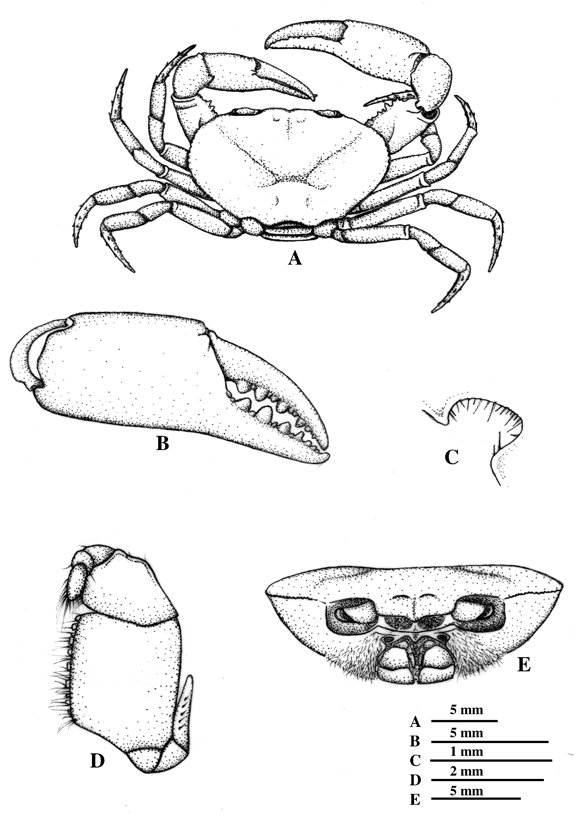
<body><![CDATA[<p>Family Pseudothelphusidae Ortmann, 1893    <br>   Tribe Hypolobocerini Pretzmann, 1971    <br>   Genus Neostrengeria Pretzmann, 1965    <br>   <b><i>Neostrengeria natashae</i></b>, new species    <br>   <a href="#figura1">Fig. 1</a>, <a href="#figura2">fig. 2</a></p>     <p>        <center>     <img src="/img/revistas/cal/v33n2/v33n2a19fig1.gif"><a name="figura1"></a>    </center>     <center>       <p><b>Figure 1.</b> <i>Neostrengeria natashae</i>, new species, male holotype,1      male, cl 12.0 mm, cb 21.0 mm, ICN-MHN-CR 2616?. A, dorsal view of carapace      and pereopods; B, largrge cheliped, external view; C, opening of efffferent      branchial channel, external view; D, left third maxilliped, external view;      E, frontal view of carapace.&nbsp; </p> </center>     <center>   <img src="/img/revistas/cal/v33n2/v33n2a19fig2.gif"><a name="figura2"></a>  </center>     ]]></body>
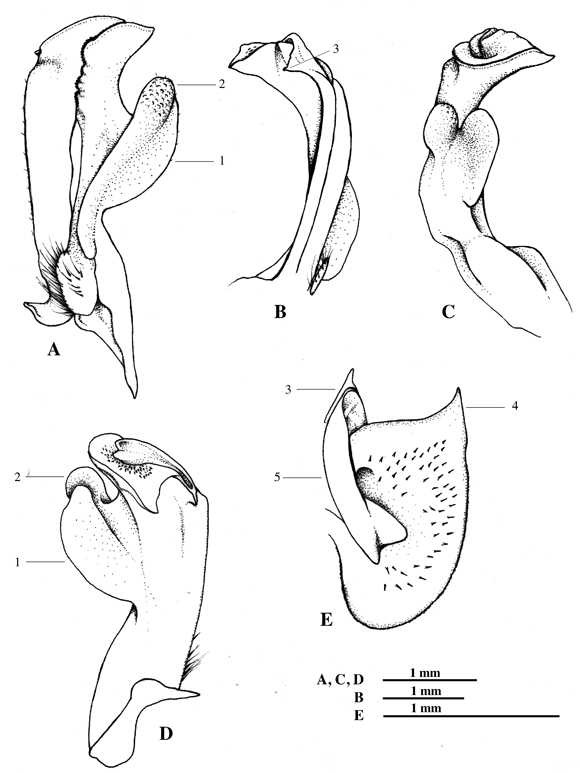
<body><![CDATA[<center>       <p><b>Figure 2.</b> <i>Neostrengeria natashae</i>, new species, male holotype,      ??ICN-MHN-CR 2616?. A, left first gonopod, caudal view; B, same, mesial view;      C, same, lateral view; D, same, cephalic view; E, same, apex distal view.      1, lateral lobe; 2, accessory lobe; 3, mesial lobe; 4, cephalic spine; 5,      meso-caudal projection of spermatic channel.&nbsp; </p> </center>     <p><b>Holotype.</b> Municipio Acac&iacute;as, Vereda Portachuelo, km 12 Manzanares    Way, La Esmeralda Farm, elevation 650 m, Meta Department, Colombia, 4&deg; 9'    28.63&quot; N, 73&deg; 46' 53.29&quot; W, 25 Sep 2010, leg. G. Ball&eacute;n,    1 male, cl 12.0 mm, cb 21.0 mm, ICN-MHN-CR 2616. </p>     <p><b>Paratype.</b> Same locality data as holotype, 1 juvenil male, cl 9.5 mm,    cb 15.5 mm, ICN-MHN-CR 2618.</p>     <p><b>Diagnosis.</b> First male gonopod strongly bent caudo-cephalic; lateral    lobe semicircular with distal portion semi-acute, directed distally; accessory    lobe spatulated with distal portion regularly rounded, subequal in length to    lateral lobe, almost continuous with lateral lobe, except by V-shaped recess    between them distally, on lateral view (<a href="#figura2">Fig. 2C</a>); apex    outline nearly oblong in distal view, latero-cephalic expanded into triangular    projection, forming cephalo-mesial angle of 90o with prominent acute spine,    directed mesially; mesial lobe subtriangular, directed cephalically, ending    in acute spine; meso-caudal projection of spermatic channel terminating bifidly.</p>     <p><b>Description of holotype.</b> Carapace (<a href="#figura1">Fig. 1A, E</a>)    with straight, wide, deep cervical groove, ending some distance from lateral    margin; anterolateral margin with shallow depression just posterior to antero-external    orbital angle; lateral margin with series of papilliform teeth; postfrontal    lobes small, oval, delimited anteriorly by 2 depressions; median groove shallow;    front lacking distinct upper border, frontal area sloping downwards, bilobed    in dorsal view, lower margin strongly sinuous in frontal view with row of tubercles;    upper and lower orbital margins each fringed with tubercles; dorsal surface    of carapace cover by small papillae, regions well demarcated; third maxilliped    (<a href="#figura1">Fig. 1D</a>) with shallow depression on subdistal external    margin of merus, exognath 0.65 times length of ischium; orifice of efferent    branchial channel (<a href="#figura1">Fig.1C</a> ) open, nearly ovate.</p>     <p>First pereopods heterochelous (<a href="#figura1">Fig. 1A</a>); right cheliped    (<a href="#figura1">Fig. 1B</a>) larger than left; merus with 3 crests as follows:    upper crest with rows of tubercles, internal lower crest with 12 teeth, diminishing    in size proximally, external lower crest with row of low tubercles; carpus with    5 tubercles on internal crest; palms of both chelipeds smooth, swollen; fingers    of chelae with rows of tubercles, not gaping when closed, tips crossing, both    fingers with large rounded teeth, intercalated with smaller ones. Walking legs    (second to fifth pereopods) (<a href="#figura1">Fig. 1A</a>) slender, dactyli    each about 1.7 times as long as propodi, with 5 longitudinal rows of spines    diminishing in size proximally, arrangement of spines on dactylus of left third    pereopod as follows: anterolateral and anteroventral rows each with 4 spines,    external row with 4 spines plus 2 proximal papillae, posteroventral and posterolateral    rows each with 3 spines plus 1 proximal papilla. </p>     <p>First male gonopod strongly bent caudo-cephalic, with mesial side nearly straight    and subdistal shallow depression, external border with row of setae; margin    nearly sinuous, fringed with minute, acute spinules on distal portion (<a href="#figura2">Fig.    2A</a>); lateral lobe semicircular with distal portion semi-acute, directed    distally, caudal surface excavated, external border with row of minute setae;    accessory lobe spatulate with distal portion regularly rounded, caudal surface    covered by rough papillae (<a href="#figura2">Fig. 2A</a>), subequal in length    to lateral lobe, almost continuous with lateral lobe, except by V-shaped recess    between accessory and lateral lobes distally, on lateral view (<a href="#figura2">Fig.    2C</a>); apex outline nearly oblong in distal view, latero-cephalic expanded    into triangular projection, forming a cephalo-mesial angle of 90o with prominent    acute spine, directed mesially (<a href="#figura2">Fig. 2E</a>); mesial lobe    subtriangular, directed cephalically, ending in acute spine (<a href="#figura2">Fig.    2D, E</a>); meso-caudal projection of spermatic channel terminating bifidly:    internal and external papillae of equal size (<a href="#figura2">Fig. 2D, E</a>).</p>     <p><b>Color.</b> The alcohol preserved holotype is brown (near Olive Brown, 28)    with pale brown (near Cinnamon, 39) specks on the dorsal side of the carapace.    The walking legs are brown (Antique Brown, 37) dorsally and light brown (Clay    Color, 26) ventrally. The chelae are brown (near Cinnamon, 33) dorsally and    light brown (Clay Color, 26) ventrally. The ventral surface of the carapace    is brown (near Olive Brown, 28) with yellow specks (near Tawny Olive, 223D)    on the sternum and abdominal segments. </p>     <p><b>Habitat.</b> The specimens were collected in shaded, moist banks of small    stream. They were found in soft sand, under rocks.</p>     ]]></body>
<body><![CDATA[<p><b>Etymology.</b> The species is dedicated to the young Colombian-American    naturalist Natasha Campos.</p>     <p><b>Remarks.</b> This present new species closed resembles <i>Neostrengeria    lindigiana</i> (Rathbun, 1897). The main distinguishing feature between the    species is in the first male gonopod. In <i>N. natashae</i>, the mesial side    is nearly straight with a subdistal shallow depression (nearly convex and sinuous    subdistally in <i>N. lindigiana</i>); the lateral lobe is relatively narrower;    the distal portion of the lateral lobe is semi-acute and directed distally (it    is rounded and curved to the axis of gonopod in <i>N. lindigiana</i>); the accesory    lobe is spatulated with the distal portion regularly rounded and subequal in    length to lateral lobe (it is elongated and distinctly shorter than lateral    lobe in <i>N. lindigiana</i>); and the apex outline is nearly oblong in distal    view, with the latero-cephalic expanded into triangular projection and forming    a cephalo-mesial angle of 90o with prominent acute spine, directed mesially    (it is semicircular, forming caudo-cephalic rounded expansion with acute cephalic    spine in <i>N. lindigiana</i>) (see <a href="#figura2">Fig. 2</a>; Campos, 2005:    Fig. 54A-I).</p>     <p><b>ACKNOWLEDGMENTS</b></p>     <p>The author is grateful to the reviewers for providing constructive comments    on the manuscript. The illustrations were prepared by Carolina Medell&iacute;n.</p>     <p><b>LITERATURE CITED</b></p>     <!-- ref --><p> 1. CAMPOS, M.R. 1992. New species of fresh-water crabs of the genus Neostrengeria    Pretzmann, 1965 (Crustacea: Decapoda: Pseudothelphusidae) from Colombia. Proceedings    of the Biological Society of Washington 105: 540 - 554.     &nbsp;&nbsp;&nbsp;&nbsp;&nbsp;&nbsp;&nbsp;&nbsp;[&#160;<a href="javascript:void(0);" onclick="javascript: window.open('/scielo.php?script=sci_nlinks&ref=000048&pid=S0366-5232201100020001900001&lng=','','width=640,height=500,resizable=yes,scrollbars=1,menubar=yes,');">Links</a>&#160;]<!-- end-ref --><!-- ref --><br>   2. CAMPOS, M.R. 1994. Diversidad en Colombia de los cangrejos del g&eacute;nero    Neostrengeria. Academia Colombiana de Ciencias Exactas F&iacute;sicas y Naturales.    Col. Jorge &Aacute;lvarez Lleras No. 5: 1 - 143.    &nbsp;&nbsp;&nbsp;&nbsp;&nbsp;&nbsp;&nbsp;&nbsp;[&#160;<a href="javascript:void(0);" onclick="javascript: window.open('/scielo.php?script=sci_nlinks&ref=000049&pid=S0366-5232201100020001900002&lng=','','width=640,height=500,resizable=yes,scrollbars=1,menubar=yes,');">Links</a>&#160;]<!-- end-ref --><!-- ref --><br>   3. CAMPOS, M.R. 2000. Neostrengeria binderi, a new species of pseudothelphusid    crab from the eastern Andes of Colombia (Crustacea: Decapoda: Brachyura). Proceedings    of the Biological Society of Washington, 113: 401 - 405.    &nbsp;&nbsp;&nbsp;&nbsp;&nbsp;&nbsp;&nbsp;&nbsp;[&#160;<a href="javascript:void(0);" onclick="javascript: window.open('/scielo.php?script=sci_nlinks&ref=000050&pid=S0366-5232201100020001900003&lng=','','width=640,height=500,resizable=yes,scrollbars=1,menubar=yes,');">Links</a>&#160;]<!-- end-ref --><!-- ref --><br>   4. CAMPOS, M.R. 2004. Neostrengeria lemaitrei, a new species of freshwater crab    from Colombia (Crustacea: Decapoda: Pseudothelphusidae), and the vertical distribution    of the genus. Proceedings of the Biological Society of Washington 117: 363 -    367.    &nbsp;&nbsp;&nbsp;&nbsp;&nbsp;&nbsp;&nbsp;&nbsp;[&#160;<a href="javascript:void(0);" onclick="javascript: window.open('/scielo.php?script=sci_nlinks&ref=000051&pid=S0366-5232201100020001900004&lng=','','width=640,height=500,resizable=yes,scrollbars=1,menubar=yes,');">Links</a>&#160;]<!-- end-ref --><!-- ref --><br>   5. CAMPOS, M.R. 2005. Freshwater crabs from Colombia. A taxonomic and distributional    study. Academia Colombiana de Ciencias Exactas F&iacute;sicas y Naturales. Col.    Jorge &Aacute;lvarez Lleras No. 24: 1 -363.    &nbsp;&nbsp;&nbsp;&nbsp;&nbsp;&nbsp;&nbsp;&nbsp;[&#160;<a href="javascript:void(0);" onclick="javascript: window.open('/scielo.php?script=sci_nlinks&ref=000052&pid=S0366-5232201100020001900005&lng=','','width=640,height=500,resizable=yes,scrollbars=1,menubar=yes,');">Links</a>&#160;]<!-- end-ref --><!-- ref --><br>   6. CAMPOS, M.R. &amp; R. LEMAITRE. 1998. A new freshwater crab of the genus    Neostrengeria Pretzmann, 1965, from Colombia (Crustacea: Decapoda: Brachyura:    Pseudothelphusidae), with a key to the species of the genus. Proceedings of    the Biological Society of Washington 111: 899 - 907.    &nbsp;&nbsp;&nbsp;&nbsp;&nbsp;&nbsp;&nbsp;&nbsp;[&#160;<a href="javascript:void(0);" onclick="javascript: window.open('/scielo.php?script=sci_nlinks&ref=000053&pid=S0366-5232201100020001900006&lng=','','width=640,height=500,resizable=yes,scrollbars=1,menubar=yes,');">Links</a>&#160;]<!-- end-ref --><!-- ref --><br>   7. CAMPOS, M.R. &amp; M. PEDRAZA. 2008. Two new species of freshwater crab of    the genus Neostrengeria pretzmann, 1965, from Colombia (Crustacea: Decapoda:    Pseudothelphusidae), with an updated key of the species of the genus. Caldasia    30: 457 - 468.    &nbsp;&nbsp;&nbsp;&nbsp;&nbsp;&nbsp;&nbsp;&nbsp;[&#160;<a href="javascript:void(0);" onclick="javascript: window.open('/scielo.php?script=sci_nlinks&ref=000054&pid=S0366-5232201100020001900007&lng=','','width=640,height=500,resizable=yes,scrollbars=1,menubar=yes,');">Links</a>&#160;]<!-- end-ref --><!-- ref --><br>   8. CAMPOS, M.R. &amp; G. RODR&Iacute;GUEZ. 1985. A new species of Neostrengeria    (Crustacea: Decapoda: Pseudothelphusidae) with notes on geographical distribution    of the genus. Proceedings of the Biological Society of Washington 98: 718 -    727.    &nbsp;&nbsp;&nbsp;&nbsp;&nbsp;&nbsp;&nbsp;&nbsp;[&#160;<a href="javascript:void(0);" onclick="javascript: window.open('/scielo.php?script=sci_nlinks&ref=000055&pid=S0366-5232201100020001900008&lng=','','width=640,height=500,resizable=yes,scrollbars=1,menubar=yes,');">Links</a>&#160;]<!-- end-ref --><!-- ref --><br>   9. ORTMANN, A. 1893. Die Dekapoden-Krebse des Strassbourg Museums, mit besonder    ber&uuml;cksichtigung der von Herrn Dr. D&ouml;derlein bei Japan und bei den    Liu-Kiu-Inseln gesammelten und zur Zeit im Strassburger Museum aufbewahrten    Formen. VII Theil Abtheilung: Brachyura (Brachyura genuina Boas) II. Unterabtheilung:    Cancroidea, 2 Section: Cancrinea, 1. Gruppe: Cyclometopa. Zoologische Jahrb&uuml;cher,    Abtheilung f&uuml;r Systematik, Geographie und Biologie der Thiere 7: 411 -    495.     &nbsp;&nbsp;&nbsp;&nbsp;&nbsp;&nbsp;&nbsp;&nbsp;[&#160;<a href="javascript:void(0);" onclick="javascript: window.open('/scielo.php?script=sci_nlinks&ref=000056&pid=S0366-5232201100020001900009&lng=','','width=640,height=500,resizable=yes,scrollbars=1,menubar=yes,');">Links</a>&#160;]<!-- end-ref --><!-- ref --><br>   10. PRETZMANN, G. 1965. Vorl&auml;ufiger Bericht &uuml;ber die Familie Pseudothelphusidae.    Anzeiger der &Ouml;sterreichischen Akademie der Wissenschaften Mathematische    Naturwissenschaftliche Klasse (1)1: 1-10.    &nbsp;&nbsp;&nbsp;&nbsp;&nbsp;&nbsp;&nbsp;&nbsp;[&#160;<a href="javascript:void(0);" onclick="javascript: window.open('/scielo.php?script=sci_nlinks&ref=000057&pid=S0366-5232201100020001900010&lng=','','width=640,height=500,resizable=yes,scrollbars=1,menubar=yes,');">Links</a>&#160;]<!-- end-ref --><!-- ref --><br>   11. PRETZMANN, G. 1971. Fortschritte in der Klassifizierung der Pseudothelphusidae.    Anzeiger der Mathematisch Naturwissenschaftliche der &Ouml;sterreichischen Akademie    der Wissenschaften (1)179(1-4): 14 - 24.    &nbsp;&nbsp;&nbsp;&nbsp;&nbsp;&nbsp;&nbsp;&nbsp;[&#160;<a href="javascript:void(0);" onclick="javascript: window.open('/scielo.php?script=sci_nlinks&ref=000058&pid=S0366-5232201100020001900011&lng=','','width=640,height=500,resizable=yes,scrollbars=1,menubar=yes,');">Links</a>&#160;]<!-- end-ref --><!-- ref --><br>   12. RATHBUN, M.J. 1897. Descriptions de nouvelles especes de crabes d'eau    douce appartenant aux collections du Mus&eacute;um d'Histoire naturelle    du Paris. Bulletin du Mus&eacute;um nationale d'Histoire naturelle, Paris    3(2): 58 - 61.    &nbsp;&nbsp;&nbsp;&nbsp;&nbsp;&nbsp;&nbsp;&nbsp;[&#160;<a href="javascript:void(0);" onclick="javascript: window.open('/scielo.php?script=sci_nlinks&ref=000059&pid=S0366-5232201100020001900012&lng=','','width=640,height=500,resizable=yes,scrollbars=1,menubar=yes,');">Links</a>&#160;]<!-- end-ref --><!-- ref --><br>   13. RODRIGUEZ, G. 1982. Les crabes d'eau douce d'Am&eacute;rique.    Famille des Pseudothelphusidae. Faune Tropicale 22: 1 - 223.    &nbsp;&nbsp;&nbsp;&nbsp;&nbsp;&nbsp;&nbsp;&nbsp;[&#160;<a href="javascript:void(0);" onclick="javascript: window.open('/scielo.php?script=sci_nlinks&ref=000060&pid=S0366-5232201100020001900013&lng=','','width=640,height=500,resizable=yes,scrollbars=1,menubar=yes,');">Links</a>&#160;]<!-- end-ref --><!-- ref --><br>   14. SMALLEY, A. 1964. A terminology for the gonopods of the American River crabs.    Systematic Zoology 13: 28 - 31.    &nbsp;&nbsp;&nbsp;&nbsp;&nbsp;&nbsp;&nbsp;&nbsp;[&#160;<a href="javascript:void(0);" onclick="javascript: window.open('/scielo.php?script=sci_nlinks&ref=000061&pid=S0366-5232201100020001900014&lng=','','width=640,height=500,resizable=yes,scrollbars=1,menubar=yes,');">Links</a>&#160;]<!-- end-ref --><!-- ref --><br>   15. SMITHE, F.B. 1975. Naturalist's color guide. The American Museum of    Natural History, New York. Part I: 17 unnumbered pages.    &nbsp;&nbsp;&nbsp;&nbsp;&nbsp;&nbsp;&nbsp;&nbsp;[&#160;<a href="javascript:void(0);" onclick="javascript: window.open('/scielo.php?script=sci_nlinks&ref=000062&pid=S0366-5232201100020001900015&lng=','','width=640,height=500,resizable=yes,scrollbars=1,menubar=yes,');">Links</a>&#160;]<!-- end-ref --><br> </p> </font>       ]]></body><back>
<ref-list>
<ref id="B1">
<label>1.</label><nlm-citation citation-type="journal">
<person-group person-group-type="author">
<name>
<surname><![CDATA[CAMPOS]]></surname>
<given-names><![CDATA[M.R.]]></given-names>
</name>
</person-group>
<article-title xml:lang="en"><![CDATA[New species of fresh-water crabs of the genus Neostrengeria Pretzmann, 1965 (Crustacea: Decapoda: Pseudothelphusidae) from Colombia]]></article-title>
<source><![CDATA[Proceedings of the Biological Society of Washington]]></source>
<year>1992</year>
<volume>105</volume>
<page-range>540 - 554</page-range></nlm-citation>
</ref>
<ref id="B2">
<label>2.</label><nlm-citation citation-type="book">
<person-group person-group-type="author">
<name>
<surname><![CDATA[CAMPOS]]></surname>
<given-names><![CDATA[M.R.]]></given-names>
</name>
</person-group>
<source><![CDATA[Diversidad en Colombia de los cangrejos del género Neostrengeria]]></source>
<year>1994</year>
<volume>No. 5</volume>
<page-range>1 - 143</page-range><publisher-name><![CDATA[Academia Colombiana de Ciencias Exactas Físicas y Naturales]]></publisher-name>
</nlm-citation>
</ref>
<ref id="B3">
<label>3.</label><nlm-citation citation-type="journal">
<person-group person-group-type="author">
<name>
<surname><![CDATA[CAMPOS]]></surname>
<given-names><![CDATA[M.R.]]></given-names>
</name>
</person-group>
<article-title xml:lang="en"><![CDATA[Neostrengeria binderi, a new species of pseudothelphusid crab from the eastern Andes of Colombia (Crustacea: Decapoda: Brachyura)]]></article-title>
<source><![CDATA[Proceedings of the Biological Society of Washington]]></source>
<year>2000</year>
<volume>113</volume>
<page-range>401 - 405</page-range></nlm-citation>
</ref>
<ref id="B4">
<label>4.</label><nlm-citation citation-type="journal">
<person-group person-group-type="author">
<name>
<surname><![CDATA[CAMPOS]]></surname>
<given-names><![CDATA[M.R.]]></given-names>
</name>
</person-group>
<article-title xml:lang="en"><![CDATA[Neostrengeria lemaitrei, a new species of freshwater crab from Colombia (Crustacea: Decapoda: Pseudothelphusidae), and the vertical distribution of the genus]]></article-title>
<source><![CDATA[Proceedings of the Biological Society of Washington]]></source>
<year>2004</year>
<volume>117</volume>
<page-range>363 - 367</page-range></nlm-citation>
</ref>
<ref id="B5">
<label>5.</label><nlm-citation citation-type="book">
<person-group person-group-type="author">
<name>
<surname><![CDATA[CAMPOS]]></surname>
<given-names><![CDATA[M.R.]]></given-names>
</name>
</person-group>
<source><![CDATA[Freshwater crabs from Colombia. A taxonomic and distributional study]]></source>
<year>2005</year>
<volume>No. 24</volume>
<page-range>1 -363</page-range><publisher-name><![CDATA[Academia Colombiana de Ciencias Exactas Físicas y Naturales]]></publisher-name>
</nlm-citation>
</ref>
<ref id="B6">
<label>6.</label><nlm-citation citation-type="journal">
<person-group person-group-type="author">
<name>
<surname><![CDATA[CAMPOS]]></surname>
<given-names><![CDATA[M.R.]]></given-names>
</name>
<name>
<surname><![CDATA[LEMAITRE]]></surname>
<given-names><![CDATA[R.]]></given-names>
</name>
</person-group>
<article-title xml:lang="en"><![CDATA[A new freshwater crab of the genus Neostrengeria Pretzmann, 1965, from Colombia (Crustacea: Decapoda: Brachyura: Pseudothelphusidae), with a key to the species of the genus]]></article-title>
<source><![CDATA[Proceedings of the Biological Society of Washington]]></source>
<year>1998</year>
<volume>111</volume>
<page-range>899 - 907</page-range></nlm-citation>
</ref>
<ref id="B7">
<label>7.</label><nlm-citation citation-type="journal">
<person-group person-group-type="author">
<name>
<surname><![CDATA[CAMPOS]]></surname>
<given-names><![CDATA[M.R.]]></given-names>
</name>
<name>
<surname><![CDATA[PEDRAZA]]></surname>
<given-names><![CDATA[M.]]></given-names>
</name>
</person-group>
<article-title xml:lang="en"><![CDATA[Two new species of freshwater crab of the genus Neostrengeria pretzmann, 1965, from Colombia (Crustacea: Decapoda: Pseudothelphusidae), with an updated key of the species of the genus]]></article-title>
<source><![CDATA[Caldasia]]></source>
<year>2008</year>
<volume>30</volume>
<page-range>457 - 468</page-range></nlm-citation>
</ref>
<ref id="B8">
<label>8.</label><nlm-citation citation-type="journal">
<person-group person-group-type="author">
<name>
<surname><![CDATA[CAMPOS]]></surname>
<given-names><![CDATA[M.R.]]></given-names>
</name>
<name>
<surname><![CDATA[RODRÍGUEZ]]></surname>
<given-names><![CDATA[G.]]></given-names>
</name>
</person-group>
<article-title xml:lang="en"><![CDATA[A new species of Neostrengeria (Crustacea: Decapoda: Pseudothelphusidae) with notes on geographical distribution of the genus]]></article-title>
<source><![CDATA[Proceedings of the Biological Society of Washington]]></source>
<year>1985</year>
<volume>98</volume>
<page-range>718 - 727</page-range></nlm-citation>
</ref>
<ref id="B9">
<label>9.</label><nlm-citation citation-type="journal">
<person-group person-group-type="author">
<name>
<surname><![CDATA[ORTMANN]]></surname>
<given-names><![CDATA[A.]]></given-names>
</name>
</person-group>
<article-title xml:lang="de"><![CDATA[Die Dekapoden-Krebse des Strassbourg Museums, mit besonder berücksichtigung der von Herrn Dr. Döderlein bei Japan und bei den Liu-Kiu-Inseln gesammelten und zur Zeit im Strassburger Museum aufbewahrten Formen. VII Theil Abtheilung: Brachyura (Brachyura genuina Boas) II. Unterabtheilung: Cancroidea, 2 Section: Cancrinea, 1. Gruppe: Cyclometopa]]></article-title>
<source><![CDATA[Zoologische Jahrbücher, Abtheilung für Systematik, Geographie und Biologie der Thiere]]></source>
<year>1893</year>
<volume>7</volume>
<page-range>411 - 495</page-range></nlm-citation>
</ref>
<ref id="B10">
<label>10.</label><nlm-citation citation-type="journal">
<person-group person-group-type="author">
<name>
<surname><![CDATA[PRETZMANN]]></surname>
<given-names><![CDATA[G.]]></given-names>
</name>
</person-group>
<article-title xml:lang="de"><![CDATA[Vorläufiger Bericht über die Familie Pseudothelphusidae]]></article-title>
<source><![CDATA[Anzeiger der Österreichischen Akademie der Wissenschaften Mathematische Naturwissenschaftliche Klasse]]></source>
<year>1965</year>
<volume>(1)</volume>
<numero>1</numero>
<issue>1</issue>
<page-range>1-10</page-range></nlm-citation>
</ref>
<ref id="B11">
<label>11.</label><nlm-citation citation-type="journal">
<person-group person-group-type="author">
<name>
<surname><![CDATA[PRETZMANN]]></surname>
<given-names><![CDATA[G.]]></given-names>
</name>
</person-group>
<article-title xml:lang="de"><![CDATA[Fortschritte in der Klassifizierung der Pseudothelphusidae]]></article-title>
<source><![CDATA[Anzeiger der Mathematisch Naturwissenschaftliche der Österreichischen Akademie der Wissenschaften]]></source>
<year>1971</year>
<volume>(1)</volume>
<numero>179</numero>
<issue>179</issue>
<page-range>14 - 24</page-range></nlm-citation>
</ref>
<ref id="B12">
<label>12.</label><nlm-citation citation-type="journal">
<person-group person-group-type="author">
<name>
<surname><![CDATA[RATHBUN]]></surname>
<given-names><![CDATA[M.J.]]></given-names>
</name>
</person-group>
<article-title xml:lang="fr"><![CDATA[Descriptions de nouvelles especes de crabes d'eau douce appartenant aux collections du Muséum d'Histoire naturelle du Paris]]></article-title>
<source><![CDATA[Bulletin du Muséum nationale d'Histoire naturelle, Paris]]></source>
<year>1897</year>
<volume>3</volume>
<numero>(2)</numero>
<issue>(2)</issue>
<page-range>58 - 61</page-range></nlm-citation>
</ref>
<ref id="B13">
<label>13.</label><nlm-citation citation-type="journal">
<person-group person-group-type="author">
<name>
<surname><![CDATA[RODRIGUEZ]]></surname>
<given-names><![CDATA[G.]]></given-names>
</name>
</person-group>
<article-title xml:lang="fr"><![CDATA[Les crabes d'eau douce d'Amérique. Famille des Pseudothelphusidae]]></article-title>
<source><![CDATA[Faune Tropicale]]></source>
<year>1982</year>
<volume>22</volume>
<page-range>1 - 223</page-range></nlm-citation>
</ref>
<ref id="B14">
<label>14.</label><nlm-citation citation-type="journal">
<person-group person-group-type="author">
<name>
<surname><![CDATA[SMALLEY]]></surname>
<given-names><![CDATA[A.]]></given-names>
</name>
</person-group>
<article-title xml:lang="en"><![CDATA[A terminology for the gonopods of the American River crabs]]></article-title>
<source><![CDATA[Systematic Zoology]]></source>
<year>1964</year>
<volume>13</volume>
<page-range>28 - 31</page-range></nlm-citation>
</ref>
<ref id="B15">
<label>15.</label><nlm-citation citation-type="book">
<person-group person-group-type="author">
<name>
<surname><![CDATA[SMITHE]]></surname>
<given-names><![CDATA[F.B.]]></given-names>
</name>
</person-group>
<source><![CDATA[Naturalist's color guide]]></source>
<year>1975</year>
<volume>Part I</volume>
<page-range>17</page-range><publisher-loc><![CDATA[New York ]]></publisher-loc>
<publisher-name><![CDATA[The American Museum of Natural History]]></publisher-name>
</nlm-citation>
</ref>
</ref-list>
</back>
</article>